JP5592008B2 - Adsorption process for the separation of C8 aromatic hydrocarbons - Google Patents
Adsorption process for the separation of C8 aromatic hydrocarbons Download PDFInfo
- Publication number
- JP5592008B2 JP5592008B2 JP2013518545A JP2013518545A JP5592008B2 JP 5592008 B2 JP5592008 B2 JP 5592008B2 JP 2013518545 A JP2013518545 A JP 2013518545A JP 2013518545 A JP2013518545 A JP 2013518545A JP 5592008 B2 JP5592008 B2 JP 5592008B2
- Authority
- JP
- Japan
- Prior art keywords
- adsorbent
- xylene
- desorbent
- aromatic hydrocarbons
- metal organic
- Prior art date
- Legal status (The legal status is an assumption and is not a legal conclusion. Google has not performed a legal analysis and makes no representation as to the accuracy of the status listed.)
- Expired - Fee Related
Links
- 238000000034 method Methods 0.000 title claims description 72
- 150000004945 aromatic hydrocarbons Chemical class 0.000 title claims description 36
- 230000008569 process Effects 0.000 title description 40
- 238000000926 separation method Methods 0.000 title description 32
- 238000001179 sorption measurement Methods 0.000 title description 32
- URLKBWYHVLBVBO-UHFFFAOYSA-N Para-Xylene Chemical group CC1=CC=C(C)C=C1 URLKBWYHVLBVBO-UHFFFAOYSA-N 0.000 claims description 88
- 239000003463 adsorbent Substances 0.000 claims description 79
- CTQNGGLPUBDAKN-UHFFFAOYSA-N O-Xylene Chemical compound CC1=CC=CC=C1C CTQNGGLPUBDAKN-UHFFFAOYSA-N 0.000 claims description 39
- 239000012621 metal-organic framework Substances 0.000 claims description 38
- 239000000203 mixture Substances 0.000 claims description 37
- 239000013078 crystal Substances 0.000 claims description 32
- 239000013206 MIL-53 Substances 0.000 claims description 17
- 239000007788 liquid Substances 0.000 claims description 15
- 239000013132 MOF-5 Substances 0.000 claims description 12
- YNQLUTRBYVCPMQ-UHFFFAOYSA-N Ethylbenzene Chemical compound CCC1=CC=CC=C1 YNQLUTRBYVCPMQ-UHFFFAOYSA-N 0.000 claims description 10
- IVSZLXZYQVIEFR-UHFFFAOYSA-N m-xylene Chemical group CC1=CC=CC(C)=C1 IVSZLXZYQVIEFR-UHFFFAOYSA-N 0.000 claims description 10
- UHOVQNZJYSORNB-UHFFFAOYSA-N Benzene Chemical compound C1=CC=CC=C1 UHOVQNZJYSORNB-UHFFFAOYSA-N 0.000 claims description 6
- 239000002904 solvent Substances 0.000 claims description 6
- 239000008096 xylene Substances 0.000 claims description 6
- PQNFLJBBNBOBRQ-UHFFFAOYSA-N indane Chemical compound C1=CC=C2CCCC2=C1 PQNFLJBBNBOBRQ-UHFFFAOYSA-N 0.000 claims description 4
- 150000004996 alkyl benzenes Chemical class 0.000 claims description 2
- 239000000463 material Substances 0.000 description 29
- 150000001875 compounds Chemical class 0.000 description 17
- 238000005516 engineering process Methods 0.000 description 15
- 238000000605 extraction Methods 0.000 description 14
- 239000013178 MIL-101(Cr) Substances 0.000 description 12
- 230000000274 adsorptive effect Effects 0.000 description 9
- 239000002245 particle Substances 0.000 description 9
- 238000011084 recovery Methods 0.000 description 9
- 239000011230 binding agent Substances 0.000 description 8
- 239000012530 fluid Substances 0.000 description 7
- KKEYFWRCBNTPAC-UHFFFAOYSA-N Terephthalic acid Chemical compound OC(=O)C1=CC=C(C(O)=O)C=C1 KKEYFWRCBNTPAC-UHFFFAOYSA-N 0.000 description 6
- 239000000126 substance Substances 0.000 description 6
- 239000007791 liquid phase Substances 0.000 description 5
- 238000004519 manufacturing process Methods 0.000 description 5
- 238000001878 scanning electron micrograph Methods 0.000 description 5
- DSNHSQKRULAAEI-UHFFFAOYSA-N 1,4-Diethylbenzene Chemical compound CCC1=CC=C(CC)C=C1 DSNHSQKRULAAEI-UHFFFAOYSA-N 0.000 description 4
- 238000002441 X-ray diffraction Methods 0.000 description 4
- 239000011148 porous material Substances 0.000 description 4
- LYCAIKOWRPUZTN-UHFFFAOYSA-N Ethylene glycol Chemical compound OCCO LYCAIKOWRPUZTN-UHFFFAOYSA-N 0.000 description 3
- YXFVVABEGXRONW-UHFFFAOYSA-N Toluene Chemical compound CC1=CC=CC=C1 YXFVVABEGXRONW-UHFFFAOYSA-N 0.000 description 3
- 230000002860 competitive effect Effects 0.000 description 3
- 238000011156 evaluation Methods 0.000 description 3
- 238000004508 fractional distillation Methods 0.000 description 3
- 239000011159 matrix material Substances 0.000 description 3
- 238000000746 purification Methods 0.000 description 3
- 238000012546 transfer Methods 0.000 description 3
- 229910052723 transition metal Inorganic materials 0.000 description 3
- -1 transition metal salt Chemical class 0.000 description 3
- 239000010457 zeolite Substances 0.000 description 3
- IJGRMHOSHXDMSA-UHFFFAOYSA-N Atomic nitrogen Chemical compound N#N IJGRMHOSHXDMSA-UHFFFAOYSA-N 0.000 description 2
- 229910021536 Zeolite Inorganic materials 0.000 description 2
- 230000015572 biosynthetic process Effects 0.000 description 2
- 230000008859 change Effects 0.000 description 2
- 238000006243 chemical reaction Methods 0.000 description 2
- 238000013461 design Methods 0.000 description 2
- 238000003795 desorption Methods 0.000 description 2
- HNPSIPDUKPIQMN-UHFFFAOYSA-N dioxosilane;oxo(oxoalumanyloxy)alumane Chemical compound O=[Si]=O.O=[Al]O[Al]=O HNPSIPDUKPIQMN-UHFFFAOYSA-N 0.000 description 2
- 238000005194 fractionation Methods 0.000 description 2
- 229920000728 polyester Polymers 0.000 description 2
- 239000000843 powder Substances 0.000 description 2
- 238000011027 product recovery Methods 0.000 description 2
- 239000002994 raw material Substances 0.000 description 2
- 230000000717 retained effect Effects 0.000 description 2
- 238000011144 upstream manufacturing Methods 0.000 description 2
- SPPWGCYEYAMHDT-UHFFFAOYSA-N 1,4-di(propan-2-yl)benzene Chemical compound CC(C)C1=CC=C(C(C)C)C=C1 SPPWGCYEYAMHDT-UHFFFAOYSA-N 0.000 description 1
- 239000004215 Carbon black (E152) Substances 0.000 description 1
- XDTMQSROBMDMFD-UHFFFAOYSA-N Cyclohexane Chemical compound C1CCCCC1 XDTMQSROBMDMFD-UHFFFAOYSA-N 0.000 description 1
- LGRFSURHDFAFJT-UHFFFAOYSA-N Phthalic anhydride Natural products C1=CC=C2C(=O)OC(=O)C2=C1 LGRFSURHDFAFJT-UHFFFAOYSA-N 0.000 description 1
- 229910007566 Zn-MOF Inorganic materials 0.000 description 1
- 239000003377 acid catalyst Substances 0.000 description 1
- 230000004913 activation Effects 0.000 description 1
- 239000004480 active ingredient Substances 0.000 description 1
- 230000002776 aggregation Effects 0.000 description 1
- 238000004220 aggregation Methods 0.000 description 1
- 125000000217 alkyl group Chemical group 0.000 description 1
- 239000011324 bead Substances 0.000 description 1
- JHIWVOJDXOSYLW-UHFFFAOYSA-N butyl 2,2-difluorocyclopropane-1-carboxylate Chemical compound CCCCOC(=O)C1CC1(F)F JHIWVOJDXOSYLW-UHFFFAOYSA-N 0.000 description 1
- 125000004432 carbon atom Chemical group C* 0.000 description 1
- 239000003054 catalyst Substances 0.000 description 1
- 238000006555 catalytic reaction Methods 0.000 description 1
- 238000001833 catalytic reforming Methods 0.000 description 1
- 238000003889 chemical engineering Methods 0.000 description 1
- 238000004587 chromatography analysis Methods 0.000 description 1
- 238000011109 contamination Methods 0.000 description 1
- 230000008025 crystallization Effects 0.000 description 1
- 238000011161 development Methods 0.000 description 1
- 238000011143 downstream manufacturing Methods 0.000 description 1
- 230000000694 effects Effects 0.000 description 1
- 239000004744 fabric Substances 0.000 description 1
- 239000010419 fine particle Substances 0.000 description 1
- 238000011010 flushing procedure Methods 0.000 description 1
- 238000001640 fractional crystallisation Methods 0.000 description 1
- 239000007789 gas Substances 0.000 description 1
- 239000008187 granular material Substances 0.000 description 1
- 238000000227 grinding Methods 0.000 description 1
- 230000036571 hydration Effects 0.000 description 1
- 238000006703 hydration reaction Methods 0.000 description 1
- 229930195733 hydrocarbon Natural products 0.000 description 1
- 150000002430 hydrocarbons Chemical class 0.000 description 1
- 239000004615 ingredient Substances 0.000 description 1
- 230000003993 interaction Effects 0.000 description 1
- 239000011872 intimate mixture Substances 0.000 description 1
- 239000003446 ligand Substances 0.000 description 1
- 238000005259 measurement Methods 0.000 description 1
- 229910052751 metal Inorganic materials 0.000 description 1
- 239000002184 metal Substances 0.000 description 1
- 229910052757 nitrogen Inorganic materials 0.000 description 1
- 229920000620 organic polymer Polymers 0.000 description 1
- 230000003647 oxidation Effects 0.000 description 1
- 238000007254 oxidation reaction Methods 0.000 description 1
- 239000008188 pellet Substances 0.000 description 1
- 239000012071 phase Substances 0.000 description 1
- 229920003023 plastic Polymers 0.000 description 1
- 239000004033 plastic Substances 0.000 description 1
- 239000004014 plasticizer Substances 0.000 description 1
- 229920000642 polymer Polymers 0.000 description 1
- 229920000915 polyvinyl chloride Polymers 0.000 description 1
- 239000004800 polyvinyl chloride Substances 0.000 description 1
- 239000000376 reactant Substances 0.000 description 1
- 230000009467 reduction Effects 0.000 description 1
- 238000012216 screening Methods 0.000 description 1
- 238000004088 simulation Methods 0.000 description 1
- 239000007790 solid phase Substances 0.000 description 1
- 238000002336 sorption--desorption measurement Methods 0.000 description 1
- 238000001694 spray drying Methods 0.000 description 1
- 125000000547 substituted alkyl group Chemical group 0.000 description 1
- 238000006467 substitution reaction Methods 0.000 description 1
- 238000003786 synthesis reaction Methods 0.000 description 1
- 239000013077 target material Substances 0.000 description 1
- 150000003738 xylenes Chemical class 0.000 description 1
- 239000013094 zinc-based metal-organic framework Substances 0.000 description 1
Images


Classifications
-
- C—CHEMISTRY; METALLURGY
- C07—ORGANIC CHEMISTRY
- C07C—ACYCLIC OR CARBOCYCLIC COMPOUNDS
- C07C7/00—Purification; Separation; Use of additives
- C07C7/12—Purification; Separation; Use of additives by adsorption, i.e. purification or separation of hydrocarbons with the aid of solids, e.g. with ion-exchangers
Landscapes
- Chemical & Material Sciences (AREA)
- Organic Chemistry (AREA)
- Engineering & Computer Science (AREA)
- Analytical Chemistry (AREA)
- Oil, Petroleum & Natural Gas (AREA)
- Water Supply & Treatment (AREA)
- Treatment Of Liquids With Adsorbents In General (AREA)
- Organic Low-Molecular-Weight Compounds And Preparation Thereof (AREA)
- Solid-Sorbent Or Filter-Aiding Compositions (AREA)
Description
国内先願の優先権の主張
本出願は、2010年6月30日出願の米国特許出願第12/827,560号の優先権を主張するものである。
This application claims the priority of US patent application Ser. No. 12 / 827,560, filed Jun. 30, 2010.
本発明は、C8芳香族炭化水素の吸着分離のための方法全般に関する。より詳細には、本発明は、C8芳香族炭化水素の混合物からの1つの化合物の吸着分離のための方法に関する。 The present invention relates to a method in general for the adsorptive separation of C 8 aromatic hydrocarbons. More particularly, the present invention relates to a method for the adsorptive separation of a compound from a mixture of C 8 aromatic hydrocarbons.
選択的吸着による種々の物質の分離は、純粋な物質を生産するために重要なプロセスである。擬似移動床(SMB)技術の開発により、吸着分離プロセスを、連続的に、大量の分離すべき物質に対して実施することが可能となった。 Separation of various substances by selective adsorption is an important process for producing pure substances. The development of simulated moving bed (SMB) technology has made it possible to carry out the adsorption separation process continuously on a large quantity of substances to be separated.
擬似移動床技術は、数多くの大スケールでの石油化学分離において商業的に使用されている。擬似移動床式吸着分離の実施に用いられている一般的な技術は、公開されている文献に詳細に記載されている。例えば、パラキシレンの回収に関する一般的な記述は、September 1970 edition of CHEMICAL ENGINEERING PROGRESS (Vol. 66, No 9)の70ページに提示された。数学的モデル化に重点を置いたプロセスの一般化された説明は、International Conference on "Fundamentals of Adsorption", Schloss Elmau, Upper Bavaria, Germany on May 6-11, 1983、において、D. B. BroughtonおよびS. A. Gembickiによってなされた。その他の数多くの入手可能な参考文献に、種々の液体流を分配するためのロータリーバルブ、吸着剤チャンバーの内部、および制御システムを含む、擬似移動床システムの機械的な部分の多くが記載されている。 Simulated moving bed technology is used commercially in many large scale petrochemical separations. General techniques used to perform simulated moving bed adsorption separation are described in detail in the published literature. For example, a general description of paraxylene recovery was presented on page 70 of September 1970 edition of CHEMICAL ENGINEERING PROGRESS (Vol. 66, No 9). A generalized description of the process with an emphasis on mathematical modeling was given by DB Broughton and SA Gembicki at International Conference on "Fundamentals of Adsorption", Schloss Elmau, Upper Bavaria, Germany on May 6-11, 1983. Was made. Many other available references describe many of the mechanical parts of a simulated moving bed system, including rotary valves for dispensing various liquid streams, the interior of an adsorbent chamber, and a control system. Yes.
擬似移動床は、床を一連の固定床に分割し、流体流の導入および取り出し点を通り過ぎるように床を移動させるのではなく、この一連の固定床を通り過ぎるように流体流の導入および取り出し点を移動させるものとして簡便に記述することができる。擬似移動床技術における床は、典型的には、触媒(触媒反応のための)または吸着剤である。この擬似技術を実施するために、フィード流を一連の床へ順に指向させることが必要である。床の数は、多くの場合12から24の間であるが、これより少ない場合も、または多い場合もある。これらの床は、その移動が模擬される単一の大きい床の各部分であると見なし得る。 A simulated moving bed does not divide the floor into a series of fixed beds and move the bed past the fluid flow introduction and removal points, but rather the fluid flow introduction and removal points past this series of fixed beds. Can be simply described as moving. The bed in simulated moving bed technology is typically a catalyst (for catalytic reaction) or an adsorbent. In order to implement this simulation technique, it is necessary to direct the feed stream sequentially into a series of beds. The number of floors is often between 12 and 24, but may be less or more. These floors can be considered as parts of a single large floor whose movement is simulated.
ロータリーバルブにより、床の各部分へ流体を指向する導管の2つの別々の群を、同時に相互接続することが実現される。擬似移動床技術では、流体導管の再指向にマルチポートロータリーバルブが用いられる。フィード流の輸送先が変わるたびに、床に対して流入および流出する少なくとも3つの他の流れの輸送先(または輸送元)も変える必要がある。このような流れには、生成物もしくは抽出流、ラフィネート流、および脱着剤流が含まれる。擬似移動床プロセスには、種々の多くのプロセス要求事項があり、それによってフロースキームが異なる結果となり、従って、ロータリーバルブの配置が様々となる。SMB装置の機械的な側面および内部については、公知である。 With the rotary valve, it is realized that two separate groups of conduits that direct the fluid to each part of the floor are interconnected simultaneously. In simulated moving bed technology, a multi-port rotary valve is used to redirect the fluid conduit. Each time the feed stream destination changes, the destination (or source) of at least three other streams that flow in and out of the bed must also change. Such streams include product or extract streams, raffinate streams, and desorbent streams. The simulated moving bed process has many different process requirements, which results in different flow schemes and therefore different rotary valve arrangements. The mechanical aspects and the interior of the SMB device are known.
今日広く使用されているポリエステルの布地および物品は、エチレングルコールおよびテレフタル酸のポリマーから作製されている。テレフタル酸は、パラキシレンの酸化によって作製される。従って、パラキシレンは、ポリエステルおよび化学工業において重要な原材料である。同様に、オルソキシレンは、無水フタル酸の作製における重要な原材料であり、これは、プラスチック工業において、特に可撓性ポリ塩化ビニル材料において、可塑剤として用いられることが多い。 Polyester fabrics and articles widely used today are made from polymers of ethylene glycol and terephthalic acid. Terephthalic acid is made by oxidation of para-xylene. Paraxylene is therefore an important raw material in the polyester and chemical industries. Similarly, ortho-xylene is an important raw material in the production of phthalic anhydride, which is often used as a plasticizer in the plastics industry, particularly in flexible polyvinyl chloride materials.
パラキシレンは、接触改質などの種々の芳香族炭化水素源由来のC8芳香族炭化水素から、数多くの分離プロセスによって回収することができる。液/液抽出、分別蒸留、結晶化、および吸着分離が、C8芳香族炭化水素からのパラキシレンの回収に用いられてきた。その他のキシレンも、同様に、C8芳香族炭化水素の混合物から分離することができる。しかし、現在、パラキシレンは、そのほとんどすべてが、C8芳香族炭化水素から、擬似移動床技術を用いて分離されている。 Para-xylene can be recovered by a number of separation processes from C 8 aromatic hydrocarbons derived from various aromatic hydrocarbon sources such as catalytic reforming. Liquid / liquid extraction, fractional distillation, crystallization, and adsorption separation, have been used for the recovery of para-xylene from C 8 aromatic hydrocarbons. Other xylene likewise, can be separated from a mixture of C 8 aromatic hydrocarbons. However, currently, paraxylene, almost all of, the C 8 aromatic hydrocarbons, are separated using simulated moving bed technology.
多くの場合、C8芳香族炭化水素の分離における吸着剤としては、ゼオライトが用いられている。米国特許第3,686,342号には、ゼオライト吸着剤を用い、パラジエチルベンゼンを脱着剤として用いる、キシレンの混合物からのパラキシレンの分離について記載されている。これは、商業的運転の良い代表例である。しかし、多くの場合、ゼオライトは、このシステムにおいて最高の性能を確実に引き出すために、水和レベルなどの特定の運転条件を必要とする。また、分離選択性の改善は、価値の高い生成物の回収、および下流プロセスの要求事項における改善の可能性も高めた。 As in many cases, the adsorbent in the separation of C 8 aromatic hydrocarbons, zeolite is used. US Pat. No. 3,686,342 describes the separation of para-xylene from a mixture of xylenes using a zeolite adsorbent and para-diethylbenzene as a desorbent. This is a good example of commercial operation. However, in many cases, zeolites require specific operating conditions such as hydration levels to ensure maximum performance in this system. Improved separation selectivity also increased the potential for higher value product recovery and improvements in downstream process requirements.
従って、C8芳香族炭化水素の選択的分離を提供する分離プロセスが求められている。特に、パラキシレンをその他のC8芳香族炭化水素から分離するための方法が求められている。 Thus, the separation process to provide selective separation of C 8 aromatic hydrocarbons are required. In particular, there is a need for a method for separating para-xylene from other C 8 aromatic hydrocarbons.
本発明の態様は、C8芳香族炭化水素の吸着分離のための方法に関する。より詳細には、本発明は、C8芳香族炭化水素の混合物から1つの化合物を吸着分離するための方法に関する。 Aspect of the present invention relates to methods for the adsorptive separation of C 8 aromatic hydrocarbons. More particularly, the present invention relates to a method for adsorbing separating one compound from a mixture of C 8 aromatic hydrocarbons.
本発明は、C8芳香族炭化水素の分離に関する。C8芳香族炭化水素は、本明細書で定める場合、典型的には、パラキシレン、メタキシレン、オルソキシレン、およびエチルベンゼンを相互溶剤中に含む混合物を意味する。しかし、本発明は、二元または三元混合物の分離にも関する。 The present invention relates to the separation of C 8 aromatic hydrocarbons. C 8 aromatic hydrocarbon, if specified herein, typically means paraxylene, meta-xylene, ortho-xylene, and a mixture comprising ethylbenzene into mutual solvent. However, the invention also relates to the separation of binary or ternary mixtures.
本発明の実施形態は、C8芳香族炭化水素の混合物からの1つの化合物の吸着分離のための方法に関する。本発明の別の実施形態は、C8芳香族炭化水素の混合物からのパラキシレンの吸着分離に関する。本発明のさらに別の実施形態は、C8芳香族炭化水素の混合物からのオルソキシレンの吸着分離に関する。特に、本発明の実施形態は、金属有機フレームワーク吸着剤を擬似移動床プロセスで用いることで、C8芳香族炭化水素の混合物からパラキシレンまたはオルソキシレンを吸着分離するための方法に関する。本発明者らは、C8芳香族炭化水素からパラキシレンを選択的に回収する金属有機フレームワーク、およびオルソキシレンを選択的に回収する金属有機フレームワークを発見した。そして、標的化合物は、金属有機フレームワークから脱着され、次に、得られた流れは、公知の方法に従ってさらに処理されて、精製された標的化合物が回収される。 Embodiments of the present invention relates to methods for the adsorptive separation of a compound from a mixture of C 8 aromatic hydrocarbons. Another embodiment of the present invention is directed to the adsorptive separation of para-xylene from a mixture of C 8 aromatic hydrocarbons. Yet another embodiment of the present invention is directed to adsorptive separation of ortho-xylene from a mixture of C 8 aromatic hydrocarbons. In particular, embodiments of the present invention relate to a method for adsorptive separation of para-xylene or ortho-xylene from a mixture of C 8 aromatic hydrocarbons by using a metal organic framework adsorbent in a simulated moving bed process. The present inventors have discovered a metal organic framework that selectively recovers para-xylene from C 8 aromatic hydrocarbons, and a metal organic framework that selectively recovers ortho-xylene. The target compound is then desorbed from the metal organic framework, and the resulting stream is then further processed according to known methods to recover the purified target compound.
本発明の態様は、金属有機フレームワークによるC8芳香族炭化水素の選択的吸着に関するが、便宜上、本発明の実施形態は、それらがC8芳香族炭化水素からの1つのキシレンの回収に関するものとして、特に記述する。特に、本発明の実施形態は、それらが、金属有機フレームワークおよび擬似移動床技術を用いたC8芳香族炭化水素からのパラキシレンの吸着に関するものとして、記述される。金属有機フレームワークおよび擬似移動床技術を用いたC8芳香族炭化水素からのオルソキシレンの吸着に関する本発明の別の特定の実施形態も記述される。 Aspect of the present invention is directed to the selective adsorption of C 8 aromatic hydrocarbons by metal organic framework, for convenience, embodiments of the present invention is that they are related to the recovery of one xylene from C 8 aromatic hydrocarbons As described in particular. In particular, embodiments of the present invention, they are, as relating to the adsorption of para-xylene from C 8 aromatic hydrocarbons using a metal organic framework and simulated moving bed technology, is described. Another specific embodiment of the present invention relates to the adsorption of ortho-xylene from C 8 aromatic hydrocarbons using a metal organic framework and simulated moving bed technology is also described.
パラキシレンは、擬似移動床(SMB)技術を用いて、キシレン混合物からほぼ独占的に分離される。SMBプロセスは、いくつかの吸着床を用い、入口流および出口流を床間で移動させる、商業的な吸着分離プロセスであり、ここで、パラキシレンを含むプロセス流が、これらの床を通される。吸着床は、パラキシレンを選択的に吸着し、後にプロセス流として脱着剤を用いることでパラキシレンを脱着する吸着剤を含む。オルソキシレンは、同様に、類似の運転条件下で回収されるが、吸着性MOF物質が異なる。 Para-xylene is separated almost exclusively from the xylene mixture using simulated moving bed (SMB) technology. The SMB process is a commercial adsorptive separation process that uses several adsorbent beds and moves the inlet and outlet streams between the beds, where a process stream containing paraxylene is passed through these beds. The The adsorbent bed includes an adsorbent that selectively adsorbs paraxylene and later desorbs paraxylene by using a desorbent as a process stream. Ortho-xylene is similarly recovered under similar operating conditions, but with different adsorbent MOF materials.
本明細書で用いられる場合、「フィード混合物」とは、1つ以上の抽出成分、本明細書ではパラキシレン、および本プロセスによって分離されるべき1つ以上のラフィネート成分を含有する混合物である。「フィード流」の用語は、本プロセスで用いられるMOF吸着剤と接触されるフィード混合物流を示す。「抽出成分」は、パラキシレンであり、これは、吸着剤によってより選択的に吸着され、一方「ラフィネート成分」は、吸着の選択性がより低い化合物または化合物のタイプである。「脱着剤化合物」の用語は、一般的に、パラキシレンを吸着剤から脱着することができる物質を意味する。「ラフィネート流」または「ラフィネート排出流」の用語は、パラキシレンの吸着後に吸着剤床からラフィネート成分が除去される流れを意味する。ラフィネート流の組成は、本質的に100%の脱着剤物質から本質的に100%のラフィネート成分まで様々であり得る。「抽出流」または「抽出排出流」の用語は、脱着剤物質によって脱着されたパラキシレンが、吸着剤床から除去される流れを意味する。抽出流の組成は、本質的に100パーセントの脱着剤物質から本質的に100パーセントのパラキシレンまで様々であり得る。 As used herein, a “feed mixture” is a mixture containing one or more extraction components, herein para-xylene, and one or more raffinate components to be separated by the process. The term “feed stream” refers to a feed mixture stream that is contacted with the MOF adsorbent used in the process. The “extraction component” is para-xylene, which is more selectively adsorbed by the adsorbent, while the “raffinate component” is a compound or type of compound that has lower adsorption selectivity. The term “desorbent compound” generally refers to a substance capable of desorbing para-xylene from an adsorbent. The term “raffinate stream” or “raffinate discharge stream” means a stream in which raffinate components are removed from the adsorbent bed after adsorption of para-xylene. The composition of the raffinate stream can vary from essentially 100% desorbent material to essentially 100% raffinate component. The term “extraction stream” or “extraction discharge stream” means a stream in which para-xylene desorbed by the desorbent material is removed from the adsorbent bed. The composition of the extract stream can vary from essentially 100 percent desorbent material to essentially 100 percent paraxylene.
本明細書において、便宜上、本発明の実施形態は、それが、擬似移動床技術を用いたC8芳香族炭化水素からのパラキシレンの回収に関するものとして、特に記述する。擬似移動床技術は、確立された商業的技術を用いるものであり、ここで、吸着剤床は、1つ以上の典型的には円柱形である吸着剤チャンバー内の所定の位置に保持され、およびプロセスに関与する流れがチャンバーに対して投入、排出される位置は、床の長さ方向に沿ってゆっくりシフトされる。 In this specification, for convenience, embodiments of the present invention, it is, as relating to the recovery of para-xylene from C 8 aromatic hydrocarbons using a simulated moving bed technology, especially describe. Simulated moving bed technology uses established commercial technology, where the adsorbent bed is held in place within one or more adsorbent chambers that are typically cylindrical, And the position where the flow involved in the process is input and output to and from the chamber is slowly shifted along the length of the bed.
通常、本手順には少なくとも4つの流れが用いられ(フィード、脱着剤、抽出、およびラフィネート)、フィードおよび脱着剤流が個々の床ラインを介してチャンバーへ投入される位置、ならびに抽出およびラフィネート流が他の床ラインを介してチャンバーから排出される位置は、設定された間隔で、同じ方向へ同時にシフトされる。これらの移送点の位置での各シフトにおいて、吸着剤チャンバー内の異なる床に対する液体の供給または除去が行われる。このシフトは、各床への入口において、各流れについて専用の床ラインを用いて行うことが可能である。しかし、大スケールでの擬似移動床技術のプロセスユニットは、通常、少なくとも8個の個別の床を有し、多くの商業的ユニットは、24個の個別の床を有する。各床における各流れに対して別々の床ラインを用いることは、プロセスのコストを大きく上昇させるものであり、従って、床ラインは、各床ラインがサイクルのある時点で4つのプロセス流の1つを輸送するように再使用される。これは、擬似移動床プロセスの非常に単純化された記述である。 Typically, at least four streams are used for this procedure (feed, desorbent, extraction, and raffinate), where the feed and desorbent streams are introduced into the chamber via individual bed lines, and extraction and raffinate streams. The positions at which are discharged from the chamber via other floor lines are simultaneously shifted in the same direction at set intervals. At each shift at the location of these transfer points, liquid is supplied to or removed from different beds in the adsorbent chamber. This shift can be done using a dedicated floor line for each flow at the entrance to each floor. However, large scale simulated moving bed technology process units typically have at least 8 individual beds, and many commercial units have 24 individual beds. Using a separate floor line for each flow in each floor greatly increases the cost of the process, and therefore the floor line is one of the four process streams at which each floor line is in a cycle. Will be reused to transport. This is a very simplified description of the simulated moving bed process.
SMBプロセスは、少なくとも2つの排出流を発生させるものであり;吸着剤上に選択的に保持された化合物を含有する抽出流、および吸着されなかった化合物を含有するラフィネート流である。抽出流およびラフィネート流は共に、1もしくは複数の脱着剤化合物も含有する。抽出流およびラフィネート流中の脱着剤の濃度は、いくつかの因子に起因して、プロセス床ラインの各段階的なシフトの過程で、時間と共にある程度変動する。抽出流およびラフィネート流は、典型的には、抽出およびラフィネート分別カラム(fractionation columns)に通され、ここで、脱着剤が、抽出およびラフィネート化合物から分離される。脱着剤は、このようにして回収され、次にそれは、本明細書にて脱着剤流と称されるプロセス流として吸着ゾーンへ再循環される。 The SMB process is one that generates at least two effluent streams; an extract stream containing compounds selectively retained on the adsorbent and a raffinate stream containing compounds that have not been adsorbed. Both the extract stream and the raffinate stream also contain one or more desorbent compounds. The concentration of desorbent in the extract and raffinate streams varies to some extent with time during each step shift of the process bed line due to several factors. The extraction stream and raffinate stream are typically passed through extraction and raffinate fractionation columns, where the desorbent is separated from the extraction and raffinate compound. The desorbent is recovered in this manner and then it is recycled to the adsorption zone as a process stream, referred to herein as the desorbent stream.
本発明の実施形態では、フィード混合物は、2つ以上のC8芳香族炭化水素を含む。典型的には、フィードは、パラキシレン、メタキシレン、オルソキシレン、およびエチルベンゼンを溶媒中に含有する。適切な溶媒の性質および特性を以下に示す。床は、典型的にはAl−MIL−53またはZn−MOF−5であるMOF吸着剤であり、これは、パラキシレンを吸着する一方、メタキシレン、オルソキシレン、エチルベンゼン、および溶媒については、無変化の状態で本質的に吸着ゾーンを通過させ、ラフィネート流の一部とする。 In an embodiment of the present invention, the feed mixture contains more than one C 8 aromatic hydrocarbons. Typically, the feed contains para-xylene, meta-xylene, ortho-xylene, and ethylbenzene in a solvent. The properties and properties of suitable solvents are shown below. The bed is a MOF adsorbent, typically Al-MIL-53 or Zn-MOF-5, which adsorbs para-xylene, while no meta-xylene, ortho-xylene, ethylbenzene, and solvents It passes essentially through the adsorption zone in the state of change and becomes part of the raffinate stream.
吸着剤床を通るフィード流の流れは、停止され、次に、吸着ゾーンにフラッシングが施され、吸着剤周辺の非吸着物質が除去される。その後、吸着した炭化水素は、吸着剤床を通される脱着剤流によって吸着剤から脱着され、抽出流を形成する。脱着剤物質は、一般的に、吸着剤の周囲およびその内部の空隙から非吸着物質をフラッシングするためにも用いられる。ラフィネート流および抽出流はいずれも、1もしくは複数の脱着剤化合物を含有し、分別されて脱着剤が回収される。 The flow of feed flow through the adsorbent bed is stopped and then the adsorption zone is flushed to remove non-adsorbed material around the adsorbent. The adsorbed hydrocarbon is then desorbed from the adsorbent by a desorbent stream that is passed through the adsorbent bed to form an extract stream. Desorbent materials are also commonly used to flush non-adsorbed material from voids around and within the adsorbent. Both the raffinate stream and the extract stream contain one or more desorbent compounds and are fractionated to recover the desorbent.
抽出流およびラフィネート流の少なくとも一部は、典型的には分別蒸留カラムである分離手段に通され、ここで、脱着剤物質の少なくとも一部が回収され、抽出生成物およびラフィネート生成物が生成される。「抽出生成物」および「ラフィネート生成物」の用語は、吸着剤チャンバーから取り出された抽出流およびラフィネート流で見られるよりも高い濃度で抽出成分およびラフィネート成分をそれぞれ含有する、本プロセスによって生成される流れを意味する。抽出流は、所望される化合物が豊富であってよく、または高められた濃度で含有するだけであってもよい。「豊富である」の用語は、示される化合物または化合物のクラスが、50モルパーセント超の濃度であることを示すことを意図している。 At least a portion of the extract stream and the raffinate stream are passed through a separation means, typically a fractional distillation column, where at least a portion of the desorbent material is recovered to produce an extract product and a raffinate product. The The terms “extracted product” and “raffinate product” are produced by the present process containing an extract component and a raffinate component, respectively, at higher concentrations than found in the extract stream and raffinate stream removed from the adsorbent chamber. Means the flow. The extract stream may be rich in the desired compound or may only contain an increased concentration. The term “rich” is intended to indicate that the indicated compound or class of compounds is at a concentration greater than 50 mole percent.
本技術分野において、1もしくは複数のSMB吸着チャンバー内の数多くの床をグループ化していくつかのゾーンとすることが一般的となってきている。本プロセスは、通常、4または5ゾーンについて記載する。フィード流と吸着剤との間の最初の接触は、ゾーンI、吸着ゾーンで行われる。ゾーンIの吸着剤または固相は、1もしくは複数の所望されない異性体を含有する液体、すなわちラフィネートによって囲まれることになる。この液体は、精製ゾーンと称されるゾーンIIにて、吸着剤から除去される。精製ゾーンでは、所望されないラフィネート成分は、分別蒸留によって所望される成分から容易に分離される物質によって、吸着剤床の空隙からフラッシングされる。1もしくは複数の吸着チャンバーのゾーンIIIでは、吸着剤を脱着剤(移動相)で曝露およびフラッシングすることにより、吸着剤からパラキシレンが放出される。放出されたパラキシレンおよび付随する脱着剤は、抽出流の形態で吸着剤から除去される。ゾーンIVは、ゾーンIとIIIを分離するために用いられる、ゾーンIとゾーンIIIとの間に位置する吸着剤の一部である。ゾーンIVでは、脱着剤が、脱着剤とフィード流の所望されない成分との混合物の流れにより、吸着剤から部分的に除去される。ゾーンIVを通るこの液体流は、ゾーンIIIからゾーンIに向かう吸着剤の擬似移動に対する並流により、ゾーンIの液体によるゾーンIIIの汚染を防止する。擬似移動床プロセスのより十分な説明は、KIRK-OTHMER ENCYCLOPEDIA OF CHEMICAL TECHNOLOGYのセクションAdsorptive Separationに記載されている。「上流」および「下流」の用語は、本明細書にて、これらの通常の意味で用いられ、吸着剤チャンバーを流れる液体の全体としての方向に基づいて解釈される。すなわち、液体が全体として垂直型の吸着チャンバー内を下向きに流れる場合、上流は、チャンバーの上方向または高い方の場所に相当する。 In the art, it has become common to group a number of beds in one or more SMB adsorption chambers into several zones. The process is usually described for 4 or 5 zones. The initial contact between the feed stream and the adsorbent takes place in Zone I, the adsorption zone. The adsorbent or solid phase of Zone I will be surrounded by a liquid containing one or more unwanted isomers, i.e. raffinate. This liquid is removed from the adsorbent in Zone II, called the purification zone. In the purification zone, undesired raffinate components are flushed from the adsorbent bed voids by materials that are easily separated from the desired components by fractional distillation. In Zone III of one or more adsorption chambers, paraxylene is released from the adsorbent by exposing and flushing the adsorbent with a desorbent (mobile phase). Released para-xylene and the accompanying desorbent are removed from the adsorbent in the form of an extract stream. Zone IV is the part of the adsorbent located between zone I and zone III that is used to separate zones I and III. In Zone IV, the desorbent is partially removed from the adsorbent by a flow of a mixture of desorbent and undesired components of the feed stream. This liquid flow through Zone IV prevents Zone III contamination by Zone I liquid by co-current to the adsorbent simulated transfer from Zone III to Zone I. A more thorough explanation of the simulated moving bed process can be found in the section Adorptive Separation of KIRK-OTHMER ENCYCLOPEDIA OF CHEMICAL TECHNOLOGY. The terms “upstream” and “downstream” are used herein in their ordinary sense and are interpreted based on the overall direction of the liquid flowing through the adsorbent chamber. That is, when the liquid flows downward in the vertical adsorption chamber as a whole, the upstream corresponds to the upper direction or the higher position of the chamber.
典型的には、以下の運転条件が全体としての性能に影響を与える:
A=プロセスを通しての、選択的細孔体積の擬似循環速度
D=プロセスを通しての、脱着剤の体積流速
F=フィード混合物の体積フィード速度
L3=ゾーンIIIを通る液体流速
性能指標、PIは、以下のようにして算出される:
プロセスの抽出生成物流中のパラキシレンに関して、PI=[(収率パーセント)×(純度パーセント)]0.5
本発明の実施形態は、典型的には、0.5から0.7のA/F比にて、90超の性能指標で運転される。脱着剤の純度により、1.6から2.3のL3/A比での運転が可能となる。
Typically, the following operating conditions affect overall performance:
A = Simulated circulation rate of selective pore volume throughout the process D = Volume flow rate of the desorbent throughout the process F = Volume feed rate of the feed mixture L 3 = Liquid flow rate through zone III The performance index, PI is Is calculated as:
For para-xylene in the extracted product stream of the process, PI = [(percent yield) × (percent purity)] 0.5
Embodiments of the present invention are typically operated with a performance index greater than 90, with an A / F ratio of 0.5 to 0.7. Depending on the purity of the desorbent, operation at an L 3 / A ratio of 1.6 to 2.3 is possible.
A/F比は、特定の速度L3に対して特異的である運転曲線を決定する。典型的には、本発明の実施形態のための擬似移動床プロセスは、0.5から0.7のA/F比で運転される。高純度の生成物(例:99パーセント)を通常生成するように設計されたプロセスユニットは、この一般的範囲の上限で運転される。80〜85パーセントの純度を有する低純度生成物(例えば、結晶器への供給用)を生成するように設計されたユニットは、この範囲の下限で運転される。 A / F ratio, determines the operating curve is specific for a particular speed L 3. Typically, simulated moving bed processes for embodiments of the present invention are operated at an A / F ratio of 0.5 to 0.7. Process units designed to normally produce high purity products (eg, 99 percent) are operated at the upper end of this general range. Units designed to produce low purity products having a purity of 80-85 percent (eg, for feeding to a crystallizer) are operated at the lower end of this range.
これらの運転条件は、相互に作用し合うことから、全体としての最適な性能には、いくつかの条件の効果をバランスさせることが必要となる。可変である相互作用の例として、L3/A比を高めると、回収率が増加するが、より多くの脱着剤循環が必要となる。通常は、L3およびAの両方を最小限に抑えることが好ましく、それには、初期設計および運転のバランスを取ることが必要となることには留意されたい。典型的には、L3/A比は1.6から2.3である。典型的に、脱着剤のフィードに対する体積比(D/F)は、全体としての性能に影響を与える。D/F比は、多くの場合、フィード組成、目標とする性能レベル、および所望される吸着ゾーン運転温度に応じて変動される。脱着剤の純度も、可変運転条件と見なし得る。 Since these operating conditions interact with each other, it is necessary to balance the effects of several conditions for optimum performance as a whole. As an example of an interaction that is variable, increasing the L 3 / A ratio increases recovery but requires more desorbent circulation. Normally, it is preferable to minimize both L 3 and A, the it should is noted that it is necessary to balance the initial design and operation. Typically, the L 3 / A ratio is 1.6 to 2.3. Typically, the volume ratio (D / F) of the desorbent to the feed affects the overall performance. The D / F ratio is often varied depending on the feed composition, target performance level, and desired adsorption zone operating temperature. The purity of the desorbent can also be considered as a variable operating condition.
吸着および脱着工程は、単一の大型の吸着剤床で行っても、または揺動床式に基づいて複数の並行する床で行ってもよい。しかし、擬似移動床吸着分離は、高い純度および回収率などのいくつかの利点を提供することが見出された。従って、多くの商業的スケールでの石油化学分離、特にキシレンおよび混合ノルマルパラフィンの分離のためのものは、擬似移動床技術を用いて実施される。これまでに引用した参考文献は、この技術の実施についての教示事項に関して組み込まれる。SMBプロセスで用いるための設備および技術についてのさらなる詳細は、米国特許第3,208,833号;米国特許第3,214,247号;米国特許第3,392,113号;米国特許第3,455,815号;米国特許第3,523,762号;米国特許第3,617,504号;米国特許第4,006,197号;米国特許第4,133,842号;米国特許第4,434,051号;およびその他の特許に見出すことができる。類似の設備、吸着剤、および条件を用いて実施することができるが、吸着チャンバー内において吸着剤および液体の並流を模擬するものである異なるタイプの擬似移動床運転が、米国特許第4,402,832号および米国特許第4,498,991号に記載されている。 The adsorption and desorption steps may be performed on a single large adsorbent bed or on a plurality of parallel beds based on a rocking bed system. However, it has been found that simulated moving bed adsorptive separation provides several advantages such as high purity and recovery. Thus, many commercial scale petrochemical separations, particularly those for xylene and mixed normal paraffins, are carried out using simulated moving bed technology. The references cited so far are incorporated with regard to teachings on the practice of this technique. For further details on equipment and techniques for use in the SMB process, see U.S. Pat. No. 3,208,833; U.S. Pat. No. 3,214,247; U.S. Pat. No. 3,392,113; U.S. Pat. No. 3,523,762; U.S. Pat. No. 3,617,504; U.S. Pat. No. 4,006,197; U.S. Pat. No. 4,133,842; U.S. Pat. 434,051; and other patents. A different type of simulated moving bed operation that can be implemented using similar equipment, adsorbents, and conditions, but that simulates cocurrent adsorbent and liquid flow in an adsorption chamber is described in US Pat. No. 402,832 and US Pat. No. 4,498,991.
本発明の実施形態では、吸着ゾーンの吸着剤チャンバー、および本プロセスの他の部分は、それ以外は標準的な設備を用い、慣用の条件で運転することができる。脱着剤は、標的物質を吸着剤から適切に脱着させるように選択され、したがって、吸着剤および脱着剤は関連している。全体プロセスの性能は、これらの両方に依存しており、従って、脱着剤は、注意深く選択される必要がある。脱着剤は、通常は代替可能でも交換可能でもない。すなわち、1つの吸着剤に対して良好に機能する脱着剤は、異なる吸着剤と共に用いられた場合、必ずしも良好な結果をもたらすとは限らない。擬似移動床技術での本プロセスのための吸着剤は、MOFであり、特に、パラキシレンに対しては特にAl−MIL−53、Cr−MIL−101、オルソキシレンに対しては特にZn−MOF−5である。 In an embodiment of the present invention, the adsorbent chamber of the adsorption zone, and other parts of the process, can otherwise be operated at conventional conditions using standard equipment. The desorbent is selected to properly desorb the target material from the adsorbent, and therefore the adsorbent and desorbent are related. The overall process performance depends on both of these, and therefore the desorbent needs to be carefully selected. The desorbent is usually not replaceable or replaceable. That is, a desorbent that works well for one adsorbent does not necessarily give good results when used with different adsorbents. The adsorbent for this process in simulated moving bed technology is MOF, especially for para-xylene, especially Al-MIL-53, Cr-MIL-101, especially for ortho-xylene, Zn-MOF. -5.
本プロセスで用いられる脱着剤は、多くの場合、ベンゼン、インダン、および置換アルキルベンゼンであり、ここで、アルキル部分は、1から5個の炭素原子を有する。典型的には、置換アルキルベンゼンとしては、パラジエチルベンゼン、トルエン、および1,4−ジイソプロピルベンゼンが挙げられる。吸着剤−脱着剤系の選択は、通常、経済的因子によって決定され、そしてそれは、特定の条件における特定のフィード組成に対する回収率および純度に関しての吸着剤−脱着剤対の性能によって支配される。従って、本明細書で表されるほとんどの典型的な運転条件は、吸着剤の能力などの技術的因子、ならびに所望される生成物およびその純度などの経済的因子によって決定される。これらの選択は、特定のユニットの経済的な、および事業上の状況によって変動する。 Desorbents used in the process are often benzene, indane, and substituted alkylbenzenes, where the alkyl moiety has 1 to 5 carbon atoms. Typically, substituted alkyl benzenes include paradiethylbenzene, toluene, and 1,4-diisopropylbenzene. The choice of adsorbent-desorbent system is usually determined by economic factors and is governed by the performance of the adsorbent-desorbent pair with respect to recovery and purity for a particular feed composition at specific conditions. Thus, most typical operating conditions represented herein are determined by technical factors such as adsorbent capacity, and economic factors such as the desired product and its purity. These choices will vary depending on the economic and business circumstances of the particular unit.
運転条件は、いくつかの考慮事項によって設定してよい。例えば、多くの場合、高温での高回収率と低温での高純度との間のトレードオフが存在する。また、吸着促進条件としては、液相中のプロセス流体を維持するのに十分な圧力も挙げられ、これは、大気圧から4137kPa(600psig)までであり得る。脱着条件は、一般的に、吸着条件で用いられるものと同じ温度および圧力が挙げられる。本発明の実践では、運転条件、吸着剤チャンバー内の吸着剤または脱着剤組成を大きく変動させる必要はない。すなわち、チャンバー内の吸着剤は、好ましくは、プロセス全体を通して同じ温度に維持される。 Operating conditions may be set according to several considerations. For example, there is often a trade-off between high recovery at high temperatures and high purity at low temperatures. Adsorption promotion conditions also include sufficient pressure to maintain the process fluid in the liquid phase, which can be from atmospheric pressure to 4137 kPa (600 psig). Desorption conditions generally include the same temperature and pressure used in the adsorption conditions. In the practice of the present invention, it is not necessary to significantly vary the operating conditions, the adsorbent or desorbent composition in the adsorbent chamber. That is, the adsorbent in the chamber is preferably maintained at the same temperature throughout the process.
A/F比は、プロセスの性能およびプロセスユニットのコストに大きな影響を与える別個の可変設計条件である。Aが、吸着剤チャンバー内に保持される吸着剤の量に直接関連することから、高A/F比は、直接、吸着剤を収容するためのより大型のユニットの必要性に繋がる。吸着剤自体のコストも上昇する。従って、許容される最小のA/F比で運転することが望まれる。 The A / F ratio is a separate variable design condition that has a significant impact on process performance and process unit cost. Since A is directly related to the amount of adsorbent retained in the adsorbent chamber, a high A / F ratio directly leads to the need for a larger unit to contain the adsorbent. The cost of the adsorbent itself also increases. Therefore, it is desirable to operate with the minimum allowable A / F ratio.
典型的に、L3/A比は、最小限に抑えられる。フィード流の流量が設定されると、L3は、基本的には、脱着剤の流速を変化させることによってのみ変動させることができる。この流量を最小限に抑えることによって、必要とされる流体流量が減少し、これによって、移送ラインを小さくし、抽出およびラフィネートカラムのサイズならびに運転コストを低減することが可能となる。 Typically, the L 3 / A ratio is minimized. Once the feed flow rate is set, L 3 can basically be varied only by changing the flow rate of the desorbent. By minimizing this flow rate, the required fluid flow rate is reduced, which allows for smaller transfer lines and reduced extraction and raffinate column sizes and operating costs.
選択性および生産能力の両方によって測定される性能は、種々の吸着剤/脱着剤系の間で大きく変動し、フィード組成および運転条件によって影響される。
典型的に、吸着ゾーンは、200℃未満の温度を含む条件で運転されるものであり、それは、このことによって、より良好な選択性および生産能力が得られるからである。多くの場合、温度は、100℃から190℃の範囲内に維持され、より多くの場合は、120℃から177℃の間である。
Performance, measured by both selectivity and production capacity, varies greatly between different adsorbent / desorbent systems and is affected by feed composition and operating conditions.
Typically, the adsorption zone is one that is operated at conditions that include temperatures below 200 ° C. because this provides better selectivity and production capacity. In many cases, the temperature is maintained within the range of 100 ° C. to 190 ° C., more often between 120 ° C. and 177 ° C.
吸着剤の重要な特性は、フィード混合物物質のパラキシレンに対する脱着剤の交換速度、言い換えると、パラキシレンの吸着/脱着の相対速度である。この特性は、吸着剤からパラキシレンを回収するプロセスに用いる必要のある脱着剤物質の量と直接関連する。交換速度が速いと、パラキシレンを除去するのに要する脱着剤物質の量が減少し、従って、本プロセスの運転コストの削減が可能となる。交換速度を速くすることで、プロセスを通してポンプ移送する必要のある、およびプロセスで再利用するために抽出流から分離する必要のある脱着剤物質の量が低減される。交換速度は、温度に依存する場合が多い。理想的には、脱着剤物質は、すべての抽出成分に対して1に等しいかまたは僅かに1より小さい選択性を有するべきであり、それによって、妥当な流速の脱着剤物質によって抽出成分のすべてを1つの種類として脱着することができ、および抽出成分が、後に、続いての吸着工程において、脱着剤物質を置換することができる。 An important property of the adsorbent is the rate of exchange of the desorbent with respect to the paraxylene of the feed mixture material, in other words, the relative rate of adsorption / desorption of paraxylene. This property is directly related to the amount of desorbent material that needs to be used in the process of recovering para-xylene from the adsorbent. Faster exchange rates reduce the amount of desorbent material required to remove para-xylene, thus allowing for a reduction in the operating cost of the process. Increasing the exchange rate reduces the amount of desorbent material that must be pumped through the process and separated from the extract stream for reuse in the process. The exchange rate often depends on the temperature. Ideally, the desorbent material should have a selectivity equal to 1 or slightly less than 1 for all extract components, so that all of the extract components with a reasonable flow rate desorbent material. Can be desorbed as one type, and the extraction component can later replace the desorbent material in a subsequent adsorption step.
実質的に一定圧にて、および確実に液相とする温度にて一般的に連続運転される吸着分離プロセスにおいて、脱着剤物質は、多くの基準を満足するように賢明に選択される必要がある。第一に、脱着剤物質は、続いて行われる吸着サイクルにおいて抽出成分が脱着剤物質を置換することを過度に阻害するほどにそれ自体が強力に吸着されることなく、妥当な質量流速によって抽出成分を吸着剤から置換するべきである。選択性という意味で表すと、吸着剤は、ラフィネート成分と比較した場合の抽出成分のすべてに対する選択性が、ラフィネート成分と比較した場合の脱着剤物質に対するものよりも高いことが好ましい。第二に、脱着剤物質は、特定の吸着剤および特定のフィード混合物と適合性を有する必要がある。より詳細には、これらは、吸着剤の容量、もしくはラフィネート成分と比較した場合の抽出成分に対する吸着剤の選択性を低下、または破壊してはならない。さらに、脱着剤物質は、抽出成分またはラフィネート成分のいずれかと化学反応を起こすか、またはそれらの化学反応を誘発するべきではない。抽出流およびラフィネート流はいずれも、典型的には、脱着剤物質との混合物として吸着剤の空隙から除去されるものであり、脱着剤物質および抽出成分またはラフィネート成分またはこれらの両方が関与するいかなる化学反応も、生成物の回収を複雑化するか、または阻害してしまう。脱着剤はまた、分別などにより、抽出およびラフィネート成分から容易に分離されるべきでもある。最後に、脱着剤物質は、容易に入手可能であり、妥当なコストであるべきである。 In an adsorption separation process that is generally continuously operated at a substantially constant pressure and at a temperature that ensures a liquid phase, the desorbent material must be wisely selected to meet many criteria. is there. First, the desorbent material is extracted at a reasonable mass flow rate without itself being so strongly adsorbed that it excessively inhibits the extraction component from replacing the desorbent material in the subsequent adsorption cycle. Ingredients should be replaced from the adsorbent. In terms of selectivity, the adsorbent preferably has a higher selectivity for all of the extracted components when compared to the raffinate component than for the desorbent material when compared to the raffinate component. Second, the desorbent material needs to be compatible with the specific adsorbent and the specific feed mixture. More particularly, they must not reduce or destroy the capacity of the adsorbent or the selectivity of the adsorbent to the extracted component as compared to the raffinate component. Furthermore, the desorbent material should not cause or induce a chemical reaction with either the extract component or the raffinate component. Both the extract stream and the raffinate stream are typically removed from the adsorbent voids as a mixture with the desorbent material, and any desorbent material and extractor or raffinate component or both involved. Chemical reactions also complicate or inhibit product recovery. The desorbent should also be easily separated from the extraction and raffinate components, such as by fractionation. Finally, the desorbent material should be readily available and at a reasonable cost.
本発明の実施形態は、C8芳香族炭化水素を、その混合物からパラキシレンを選択的に吸着する金属有機フレームワーク上に通すことにより、C8芳香族炭化水素からパラキシレンを分離することに関する。典型的には、この金属有機フレームワークは、Al−MIL−53、Zn−MOF−5、およびこれらのブレンドから成る群より選択される。最も典型的には、この金属有機フレームワークは、Al−MIL−53である。 Embodiments of the present invention, the C 8 aromatic hydrocarbons, by passage over a metal organic framework to selectively adsorb paraxylene from a mixture thereof, relates to the separation of para-xylene from C 8 aromatic hydrocarbons . Typically, the metal organic framework is selected from the group consisting of Al-MIL-53, Zn-MOF-5, and blends thereof. Most typically, this metal organic framework is Al-MIL-53.
本発明の別の実施形態は、C8芳香族炭化水素を、その混合物からオルソキシレンを選択的に吸着する金属有機フレームワーク上に通すことにより、C8芳香族炭化水素からオルソキシレンを分離することに関する。典型的には、この金属有機フレームワークは、Cr−MIL−101である。 Another embodiment of the present invention, the C 8 aromatic hydrocarbon, by passing the metal organic on framework to selectively adsorb ortho-xylene from the mixture, to separate the ortho-xylene from C 8 aromatic hydrocarbons About that. Typically, this metal organic framework is Cr-MIL-101.
特定された金属有機フレームワークの各々は、公知の技術に従って合成される。一般的には、遷移金属塩および有機二座配位子の溶液を、所望される場合は酸触媒の存在下にて、金属有機フレームワークを含む結晶が形成されるのに十分な温度および時間にて反応させる。以下の表は、典型的な反応体および合成条件をまとめたものである: Each of the identified metal organic frameworks is synthesized according to known techniques. In general, a solution of the transition metal salt and the organic bidentate ligand is heated to a temperature and time sufficient to form crystals containing the metal organic framework, if desired, in the presence of an acid catalyst. React with. The following table summarizes typical reactants and synthesis conditions:
得られた結晶を、次に洗浄し、ろ過し、公知の方法および技術に従ってさらに処理して、本発明の実施形態での使用に適する金属有機フレームワーク結晶が得られる。当業者であれば、このような金属有機フレームワーク結晶を作製するその他の方法によっても、本発明の実施形態での使用に適する金属有機フレームワーク結晶が作製されることは認識される。本明細書で提供される指針により、当業者であれば、適切な金属有機フレームワーク結晶を作製することができる。 The resulting crystals are then washed, filtered and further processed according to known methods and techniques to provide metal organic framework crystals suitable for use in embodiments of the present invention. One skilled in the art will recognize that other methods of making such metal organic framework crystals also produce metal organic framework crystals suitable for use in embodiments of the present invention. The guidelines provided herein enable those skilled in the art to make suitable metal organic framework crystals.
結晶粉末からそのような凝集体を形成するための方法としては、ウェット混合物として高純度吸着剤粉末へバインダーを添加することが挙げられる。バインダーは、結晶粒子の形成または凝集を補助するものである。ブレンドされたバインダー−吸着剤混合物は、押出しによって円柱形ペレットとするか、またはビーズを形成させてよく、これらは、続いて、このバインダーを高い機械的強度を有するバインダーへ変換するために処理される。吸着剤はまた、スプレードライ、または大きい塊状物の粉砕およびそれに続くサイズスクリーニングによって形成された不定形粒子へ結合させてもよい。吸着剤粒子は、従って、所望される粒子範囲、好ましくは16から60メッシュ(標準USメッシュ)(1.9mmから250ミクロン)を有する押出し物、錠剤、球状物、または顆粒の形態であってよい。バインダーとしては、水透過性有機ポリマーが一般的に用いられる。 A method for forming such aggregates from the crystalline powder includes adding a binder to the high purity adsorbent powder as a wet mixture. The binder assists the formation or aggregation of crystal particles. The blended binder-adsorbent mixture may be extruded into cylindrical pellets or formed into beads, which are subsequently processed to convert the binder into a binder with high mechanical strength. The The adsorbent may also be bound to amorphous particles formed by spray drying, or by grinding large chunks and subsequent size screening. The adsorbent particles may therefore be in the form of extrudates, tablets, spheres, or granules having the desired particle range, preferably 16 to 60 mesh (standard US mesh) (1.9 mm to 250 microns). . As the binder, a water-permeable organic polymer is generally used.
金属有機フレームワーク結晶は、通常は、吸着剤粒子中に、調製された状態の組成に基づいて粒子の75重量%から100重量%の範囲の量で存在する、小結晶の形態である。吸着剤の残りの部分は、典型的には、吸着剤物質の小粒子との密接な混合物として存在するバインダーのマトリックスである。このマトリックス物質は、MOFの製造プロセスの付随物であってよく、例えば、その製造の過程でのMOFの意図的な不完全な精製からのものである。本明細書で提供される指針により、当業者であれば、バインダーを選択し、吸着剤粒子を形成することができる。 Metal organic framework crystals are usually in the form of small crystals present in the adsorbent particles in an amount ranging from 75% to 100% by weight of the particles based on the composition as prepared. The remainder of the adsorbent is typically a matrix of binder that exists as an intimate mixture with small particles of adsorbent material. This matrix material may be an adjunct to the MOF manufacturing process, for example from intentional incomplete purification of MOF during its manufacturing. The guidelines provided herein enable those skilled in the art to select a binder and form adsorbent particles.
本発明の実施形態は、C8芳香族炭化水素からのパラキシレンの分離に関する。1つの成分(A)の、別の成分(B)と比較した場合の選択性は、典型的には、以下の式に従って算出され:
選択性=(XA/XB)×(CB/CA)、ここで、
XAは、吸着された成分Aの重量パーセントでの量であり、
XBは、吸着された成分Bの重量パーセントでの量であり、
CAは、外部液相における成分Aの平衡濃度であり、および、
CBは、外部液相における成分Bの平衡濃度であり、ここで、これらの値は、競合吸着等温評価(competitive adsorption isotherm evaluation)において、C8芳香族炭化水素の存在下にて測定される。
Embodiments of the present invention relates to the separation of para-xylene from C 8 aromatic hydrocarbons. The selectivity of one component (A) as compared to another component (B) is typically calculated according to the following formula:
Selectivity = (X A / X B ) × (C B / C A ), where
X A is the amount in weight percent of adsorbed component A;
X B is the amount in weight percent of adsorbed component B;
C A is the equilibrium concentration of component A in the external liquid phase, and
C B is the equilibrium concentration of component B in the external liquid phase, where these values are measured in the presence of C 8 aromatic hydrocarbons in competitive adsorption isotherm evaluation. .
本発明の実施形態は、このようにして算出された選択性が少なくとも1.1、より典型的には少なくとも1.3、最も典型的には、少なくとも1.5である金属有機フレームワーク結晶の、C8芳香族炭化水素の1つの化合物に対する吸着剤としての使用に関する。 Embodiments of the present invention provide for metal organic framework crystals having a selectivity thus calculated of at least 1.1, more typically at least 1.3, and most typically at least 1.5. relates to the use as an adsorbent for one compound of C 8 aromatic hydrocarbons.
金属有機フレームワーク結晶は、通常は、活性成分自体よりも物理的強度および耐摩耗性が高い、微粒子凝集体の形態で用いられる。凝集体は、上述のように、活性吸着性物質を、吸着性物質への流体の到達を可能とするチャネルおよびキャビティをその中に有するアモルファスマトリックスまたはバインダー中に分散して含有する。 Metal organic framework crystals are usually used in the form of fine particle aggregates, which have higher physical strength and wear resistance than the active ingredient itself. Aggregates contain, as described above, the active adsorbent material dispersed in an amorphous matrix or binder having therein channels and cavities that allow fluid to reach the adsorbent material.
以下の実施例は、本発明の実施形態の例示として見なされるべきであり、いかなる形であっても、本発明を限定するために用いられるべきではない。 The following examples should be considered as illustrative of embodiments of the invention and should not be used to limit the invention in any way.
実施例1
Al−MIL−53、Cr−MIL−101、およびZn−MOF−5の結晶を、各々について遷移金属塩およびH2BDCの溶液を調製することで作製した。この遷移金属塩およびH2BDCは、以下の表2に示す温度および時間で反応させた。
Example 1
Crystals of Al-MIL-53, Cr-MIL-101, and Zn-MOF-5 were prepared by preparing a solution of transition metal salt and H 2 BDC for each. The transition metal salt and H 2 BDC were reacted at the temperatures and times shown in Table 2 below.
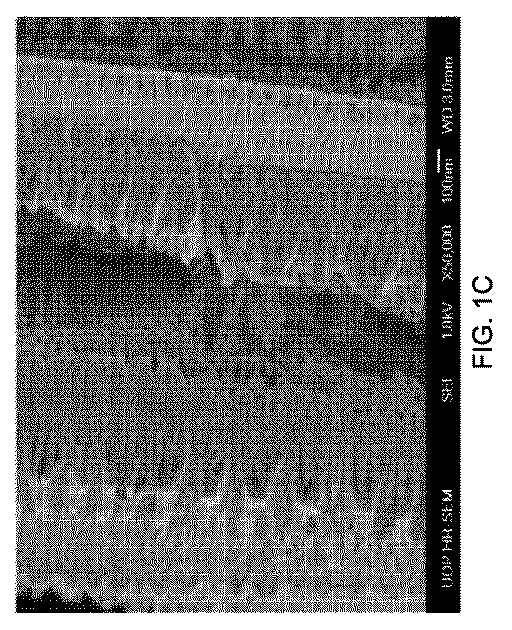
上記表1に示した方法に従って作製したAl−MIL−53の結晶を、図1A〜1Cに示す。これらの図は、Al−MIL−53の線形格子特性を示している。特に、図1Bおよび1Cは、活性化後のこの生成物に期待される折り畳まれた線形構造を示している。 The crystals of Al-MIL-53 produced according to the method shown in Table 1 are shown in FIGS. These figures show the linear lattice characteristics of Al-MIL-53. In particular, FIGS. 1B and 1C show the folded linear structure expected for this product after activation.
上記表1に示した方法に従って作製したCr−MIL−101の結晶を、図2Aおよび2Bに示し、これらは、Cr−MIL−101の菱面体結晶形態特性を示している。
上記表1に示した方法に従って作製したZn−MOF−5の結晶を、図3Aに示し、これは、Zn−MOF−5の直方体、立方体結晶形態特性を示している。
Crystals of Cr-MIL-101 prepared according to the method shown in Table 1 above are shown in FIGS. 2A and 2B, which show the rhombohedral crystal morphology characteristics of Cr-MIL-101.
A crystal of Zn—MOF-5 produced according to the method shown in Table 1 above is shown in FIG. 3A, which shows the rectangular and cubic crystal morphology characteristics of Zn—MOF-5.
上記表1に示した方法に従って作製したAl−MIL−53、Cr−MIL−101、およびZn−MOF−5のXRDパターンを、それぞれ、図4、5、および6に示す。
上記方法に従って作製したAl−MIL−53およびCr−MIL−101の代表的な性質および特性、ならびにZn−MOF−5に対するこれらの性質および特性の推定値を表3に示す。
The XRD patterns of Al-MIL-53, Cr-MIL-101, and Zn-MOF-5 produced according to the method shown in Table 1 are shown in FIGS. 4, 5, and 6, respectively.
Table 3 shows representative properties and characteristics of Al-MIL-53 and Cr-MIL-101 prepared according to the above method, and estimated values of these properties and characteristics for Zn-MOF-5.
表3の値は、77KでのMOFサンプルへの窒素吸着を介して測定した。メソ細孔性は、粒子中の金属有機フレームワーク結晶間の細孔体積として定義され、ミクロ細孔性は、結晶構造内の細孔体積として定義される。これらは、当業者には公知である標準的な定義である。比表面積の測定も、当業者に公知である。 The values in Table 3 were measured via nitrogen adsorption on the MOF sample at 77K. Mesoporosity is defined as the pore volume between metal organic framework crystals in the particle, and microporosity is defined as the pore volume within the crystal structure. These are standard definitions known to those skilled in the art. The measurement of specific surface area is also known to those skilled in the art.
実施例2
実施例1で合成した吸着剤金属有機フレームワーク結晶を、別々の液相競合吸着等温評価にかけた。各々のMOFについて、密封バイアル中のある量の金属有機フレームワーク結晶を、パラキシレン、メタキシレン、オルソキシレン、およびエチルベンゼンをシクロヘキサン中に含むある量のフィードと共に転動(tumbled)させた。同量のフィードのバイアルを含むコントロールも調製した。バイアルを室温にて一晩(12時間)転動させた。各MOFに対する吸着剤およびフィードの量、フィードの組成、ならびにバイアルの容量を、以下の表4に示す。
Example 2
The adsorbent metal organic framework crystals synthesized in Example 1 were subjected to separate liquid phase competitive adsorption isothermal evaluation. For each MOF, a quantity of metal organic framework crystals in a sealed vial was tumbled with a quantity of feed containing paraxylene, metaxylene, orthoxylene, and ethylbenzene in cyclohexane. A control containing the same amount of feed vial was also prepared. The vial was tumbled overnight (12 hours) at room temperature. The amount of adsorbent and feed for each MOF, feed composition, and vial volume are shown in Table 4 below.
ガスクロマトグラフィ分析を実施し、各MOFについての競合吸着容量および選択性を算出した。Al−MIL−53については評価を2回行った。これらの性質および特性を、以下の表5に示す。 Gas chromatographic analysis was performed to calculate the competitive adsorption capacity and selectivity for each MOF. Al-MIL-53 was evaluated twice. These properties and characteristics are shown in Table 5 below.
Cr−MIL−101は、1Dチャネルを有する2.6オングストロームかける13.6オングストロームおよび8.5オングストロームの細孔を有する。
これらの評価から、Al−MIL−53およびZn−MOF−5はいずれも、非常に優れたパラキシレンに対する選択性を有し、Cr−MIL−101は、オルソキシレンに対して良好な選択性を有することが示された。従って、これらの金属有機フレームワーク結晶の各々は、C8芳香族炭化水素中のパラキシレンまたはオルソキシレンに対する良好で商業的に許容される吸着剤である。
Cr-MIL-101 has 2.6 Angstroms multiplied by 13.6 Angstroms and 8.5 Angstroms pores with 1D channels.
From these evaluations, both Al-MIL-53 and Zn-MOF-5 have very good selectivity for para-xylene, and Cr-MIL-101 has good selectivity for ortho-xylene. It was shown to have. Thus, each of these metal organic framework crystals is a good and commercially acceptable adsorbent for para-xylene or ortho-xylene in C 8 aromatic hydrocarbons.
本発明を、本発明を実施する現時点で好ましいモードを含む具体例に関して記載してきたが、当業者であれば、上述のシステムおよび技術について、添付の請求項に示される本発明の趣旨および範囲内に含まれる数多くの変形および置き換えが存在することは理解されるであろう。例えば、本発明の実施形態は、異なる溶媒からのC8芳香族炭化水素の分離に関するものであり得る。また、本発明の実施形態は、オルソキシレンの分離回収も含む。同様に、本発明の実施形態は、二元混合物の分離に関するものであり得る。 While the invention has been described in terms of specific examples including the presently preferred modes of carrying out the invention, those skilled in the art will recognize the above systems and techniques within the spirit and scope of the invention as set forth in the appended claims. It will be understood that there are numerous variations and substitutions included in For example, embodiments of the present invention may concern the separation of C 8 aromatic hydrocarbons from different solvents. Embodiments of the present invention also include the separation and recovery of orthoxylene. Similarly, embodiments of the present invention may relate to separation of binary mixtures.
Claims (7)
所望されない異性体を含有する液体を、Al−MIL−53、Zn−MOF−5、およびこれらのブレンドから成る群より選択される金属有機フレームワーク結晶を含む吸着剤床と接触させること、および
パラキシレンを前記吸着剤から回収すること、
を含み、
ここで、前記金属有機フレームワーク結晶が、パラキシレンを吸着し、メタキシレン、オルソキシレン、及びエチルベンゼンを吸着することなく通過させる、
方法。 A method for separating para-xylene from a feed mixture comprising:
Contacting a liquid containing undesired isomers with an adsorbent bed comprising a metal organic framework crystal selected from the group consisting of Al-MIL-53, Zn-MOF-5, and blends thereof; Recovering xylene from the adsorbent;
Including
Here, the metal organic framework crystal adsorbs para-xylene and passes meta-xylene, ortho-xylene, and ethylbenzene without adsorbing.
Method.
Applications Claiming Priority (3)
| Application Number | Priority Date | Filing Date | Title |
|---|---|---|---|
| US12/827,560 US8704031B2 (en) | 2010-06-30 | 2010-06-30 | Adsorptive process for separation of C8 aromatic hydrocarbons |
| US12/827,560 | 2010-06-30 | ||
| PCT/US2011/042077 WO2012012125A2 (en) | 2010-06-30 | 2011-06-28 | Adsorptive process for separation of c8 aromatic hydrocarbons |
Publications (2)
| Publication Number | Publication Date |
|---|---|
| JP2013531676A JP2013531676A (en) | 2013-08-08 |
| JP5592008B2 true JP5592008B2 (en) | 2014-09-17 |
Family
ID=45400214
Family Applications (1)
| Application Number | Title | Priority Date | Filing Date |
|---|---|---|---|
| JP2013518545A Expired - Fee Related JP5592008B2 (en) | 2010-06-30 | 2011-06-28 | Adsorption process for the separation of C8 aromatic hydrocarbons |
Country Status (6)
| Country | Link |
|---|---|
| US (1) | US8704031B2 (en) |
| EP (1) | EP2588433A4 (en) |
| JP (1) | JP5592008B2 (en) |
| CN (1) | CN102958878B (en) |
| RU (1) | RU2521386C1 (en) |
| WO (1) | WO2012012125A2 (en) |
Families Citing this family (22)
| Publication number | Priority date | Publication date | Assignee | Title |
|---|---|---|---|---|
| GB201215693D0 (en) * | 2012-09-03 | 2012-10-17 | Univ Liverpool | Metal-organic framework |
| US9950972B2 (en) | 2013-09-27 | 2018-04-24 | Uop Llc | Apparatuses and methods for forming C8 aromatic streams with selected amounts of C9 aromatics |
| US9302955B2 (en) | 2013-09-27 | 2016-04-05 | Uop Llc | Systems and methods for separating xylene isomers using selective adsorption |
| US9326150B2 (en) * | 2013-11-05 | 2016-04-26 | Microsoft Technology Licensing, Llc | Community Wi-Fi network joined access point configuration |
| US10239044B2 (en) | 2014-06-06 | 2019-03-26 | Northwestern University | Carbohydrate-mediated purification of petrochemicals |
| US10358401B2 (en) * | 2015-09-17 | 2019-07-23 | Exxonmobil Chemical Patents Inc. | Process for recovering para-xylene using a metal organic framework adsorbent in a simulated moving-bed process |
| WO2017146914A1 (en) * | 2016-02-26 | 2017-08-31 | Exxonmobil Chemical Patents Inc. | Process for recovering para-xylene |
| WO2017201159A1 (en) | 2016-05-20 | 2017-11-23 | Exxonmobil Chemical Patents Inc. | Xylene separation process |
| CN107519942A (en) * | 2016-11-17 | 2017-12-29 | 天津工业大学 | Advanced composite material (ACM) with cell breath is prepared using " one kettle way " |
| CN107519841A (en) * | 2016-11-17 | 2017-12-29 | 天津工业大学 | The mesoporous composite material with absorption and catalytic degradation activity is prepared using " one kettle way " |
| CN107537457A (en) * | 2016-11-17 | 2018-01-05 | 天津工业大学 | Advanced composite material (ACM) with MTN zeolite configurations is prepared using " one kettle way " |
| CN107529451A (en) * | 2016-11-17 | 2018-01-02 | 天津工业大学 | The advanced composite material (ACM) with one-dimensional channels and catalytic activity is prepared using " one kettle way " |
| CN110961080B (en) * | 2018-09-29 | 2022-06-28 | 中国石油化工股份有限公司 | A kind of adsorbent for adsorption and separation of C8 aromatics and preparation method thereof |
| CN110237816B (en) * | 2019-06-13 | 2022-06-17 | 江苏科技大学 | Preparation method and application of silver nitrate-modified metal organic framework adsorption material |
| CN112110787B (en) * | 2019-06-21 | 2022-09-27 | 辽宁科技大学 | Simulated Moving Bed Chromatography for Separation of Xylene Isomer Mixtures |
| CN112110786B (en) * | 2019-06-21 | 2023-08-01 | 辽宁科技大学 | Preparative liquid chromatography for separating xylene isomer mixtures |
| CN110283033B (en) * | 2019-06-28 | 2021-11-02 | 中国石油天然气集团有限公司 | Multi-region coordinated control microcirculation high-capacity adsorption crystallization coupled aromatic hydrocarbon production method and system |
| WO2021173238A1 (en) | 2020-02-27 | 2021-09-02 | Exxonmobil Chemical Patents Inc. | Xylene separation processes using a membrane separator |
| CN111410596B (en) * | 2020-04-02 | 2021-03-30 | 浙江大学 | A kind of separation method of carbon eight aromatic hydrocarbon isomer mixture |
| WO2022042508A1 (en) | 2020-08-26 | 2022-03-03 | 中国石油化工股份有限公司 | Composite adsorbent for separating ethylbenzene by adsorptive rectification and use thereof |
| US12215079B2 (en) | 2021-02-03 | 2025-02-04 | Zhejiang University | Method for separating mixed xylene |
| KR102786484B1 (en) * | 2022-05-12 | 2025-03-27 | 연세대학교 산학협력단 | p-xylene Selective Adsorbents and method for selectively separating p-xylene using the same |
Family Cites Families (16)
| Publication number | Priority date | Publication date | Assignee | Title |
|---|---|---|---|---|
| US3686342A (en) | 1970-09-18 | 1972-08-22 | Universal Oil Prod Co | Aromatic hydrocarbon separation by adsorption |
| US4376226A (en) * | 1982-02-05 | 1983-03-08 | Exxon Research & Engineering Co. | Process for the separation of ortho aromatic isomers by selective adsorption |
| JPH08217700A (en) * | 1995-02-13 | 1996-08-27 | Chiyoda Corp | Paraxylene separation method |
| US6395951B1 (en) * | 2000-09-26 | 2002-05-28 | Uop Llc | Adsorptive separation product recovery by fractional distillation |
| AU2002230549A1 (en) | 2000-11-16 | 2002-05-27 | Uop Llc | Adsorptive separation process for recovery of para-xylene |
| US7396973B1 (en) * | 2005-02-02 | 2008-07-08 | Winter George R | Simulated moving bed adsorptive separation process for handling multiple feedstocks |
| DE102005012087A1 (en) * | 2005-03-16 | 2006-09-21 | Basf Ag | Liquid absorption by organometallic frameworks |
| WO2008057140A2 (en) | 2006-04-14 | 2008-05-15 | The Board Of Trustees Of The University Of Illinois | Rapid metal organic framework molecule synthesis method |
| US7638677B2 (en) | 2006-09-22 | 2009-12-29 | Uop Llc | Mixed matrix adsorbent for para-xylene separation |
| ES2383770T3 (en) | 2006-10-30 | 2012-06-26 | Basf Se | Aluminum naphthalenedicarboxylate as organometallic porous structural material |
| WO2008072896A1 (en) | 2006-12-13 | 2008-06-19 | Korea Research Institute Of Chemical Technology | A porous organic-inorganic hybrid materials and an absorbent comprising the same |
| FR2921661B1 (en) | 2007-10-01 | 2013-05-31 | Centre Nat Rech Scient | INORGANIC ORGANIC HYBRID SOLID WITH MODIFIED SURFACE. |
| FR2921660B1 (en) | 2007-10-01 | 2015-09-25 | Centre Nat Rech Scient | INORGANIC ORGANIC HYBRID NANOPARTICLES BASED ON IRON CARBOXYLATES. |
| JP2011520592A (en) | 2008-04-22 | 2011-07-21 | ユニヴェルシテ ドゥ モンス | Gas adsorbent |
| CN102076826B (en) * | 2008-06-26 | 2013-10-09 | 环球油品公司 | Process and apparatus for separating para-xylene from mixture of c8 and c9 aromatic hydrocarbons |
| US7812208B2 (en) * | 2008-09-22 | 2010-10-12 | Uop Llc | Binderless adsorbents with improved mass transfer properties and their use in the adsorptive separation of para-xylene |
-
2010
- 2010-06-30 US US12/827,560 patent/US8704031B2/en not_active Expired - Fee Related
-
2011
- 2011-06-28 WO PCT/US2011/042077 patent/WO2012012125A2/en not_active Ceased
- 2011-06-28 RU RU2012148725/05A patent/RU2521386C1/en not_active IP Right Cessation
- 2011-06-28 CN CN201180029166.0A patent/CN102958878B/en not_active Expired - Fee Related
- 2011-06-28 JP JP2013518545A patent/JP5592008B2/en not_active Expired - Fee Related
- 2011-06-28 EP EP11810094.0A patent/EP2588433A4/en not_active Withdrawn
Also Published As
| Publication number | Publication date |
|---|---|
| RU2012148725A (en) | 2014-05-20 |
| RU2521386C1 (en) | 2014-06-27 |
| EP2588433A4 (en) | 2014-01-01 |
| CN102958878B (en) | 2014-12-31 |
| JP2013531676A (en) | 2013-08-08 |
| WO2012012125A3 (en) | 2012-03-29 |
| EP2588433A2 (en) | 2013-05-08 |
| WO2012012125A2 (en) | 2012-01-26 |
| CN102958878A (en) | 2013-03-06 |
| US20120004491A1 (en) | 2012-01-05 |
| US8704031B2 (en) | 2014-04-22 |
Similar Documents
| Publication | Publication Date | Title |
|---|---|---|
| JP5592008B2 (en) | Adsorption process for the separation of C8 aromatic hydrocarbons | |
| JP4871887B2 (en) | Improved product recovery process from simulated moving bed adsorption | |
| KR100845198B1 (en) | Adsorptive Separation Method for Recovery of Para-Xylene | |
| CN101903073B (en) | Improved device for separation in a simulated mobile bed | |
| JP3547759B2 (en) | Improved method of adsorption separation by simulated moving bed | |
| JP5559782B2 (en) | Method and apparatus for separating para-xylene from a mixture of C8 and C9 aromatic hydrocarbons | |
| JPS6045856B2 (en) | Separation method | |
| JP2015063527A (en) | No binder-containing adsorbent having improved product transfer property and application thereof in adsorption separation of paraxylene | |
| US5912395A (en) | Raffinate line flush in simulated continuous moving bed adsorptive separation process | |
| KR100344043B1 (en) | Improved Adsorptive Separation of Ethylbenzene from Other C8 Hydrocarbons Using Cesium Exchanged Zeolite X | |
| US20090326311A1 (en) | Adsorbents with improved mass transfer properties and their use in the adsorptive separation of para-xylene | |
| US8933288B2 (en) | System and process for flushing residual fluid from transfer lines in simulated moving bed adsorption | |
| US4467126A (en) | Process for the separation of di-substituted benzene | |
| CN103508837B (en) | Method for producing paraxylene through adsorption and crystallization process | |
| US4876390A (en) | Process for separating dichlorodiphenylsulfone isomers | |
| CN112110787A (en) | Simulated moving bed chromatography for separating xylene isomer mixtures | |
| AU3497599A (en) | Use of raffinate line flush in a simulated continuous moving bed adsorptive separation process |
Legal Events
| Date | Code | Title | Description |
|---|---|---|---|
| A977 | Report on retrieval |
Free format text: JAPANESE INTERMEDIATE CODE: A971007 Effective date: 20140310 |
|
| A131 | Notification of reasons for refusal |
Free format text: JAPANESE INTERMEDIATE CODE: A131 Effective date: 20140318 |
|
| A521 | Request for written amendment filed |
Free format text: JAPANESE INTERMEDIATE CODE: A523 Effective date: 20140612 |
|
| TRDD | Decision of grant or rejection written | ||
| A01 | Written decision to grant a patent or to grant a registration (utility model) |
Free format text: JAPANESE INTERMEDIATE CODE: A01 Effective date: 20140701 |
|
| A61 | First payment of annual fees (during grant procedure) |
Free format text: JAPANESE INTERMEDIATE CODE: A61 Effective date: 20140730 |
|
| R150 | Certificate of patent or registration of utility model |
Ref document number: 5592008 Country of ref document: JP Free format text: JAPANESE INTERMEDIATE CODE: R150 |
|
| R250 | Receipt of annual fees |
Free format text: JAPANESE INTERMEDIATE CODE: R250 |
|
| R250 | Receipt of annual fees |
Free format text: JAPANESE INTERMEDIATE CODE: R250 |
|
| R250 | Receipt of annual fees |
Free format text: JAPANESE INTERMEDIATE CODE: R250 |
|
| R250 | Receipt of annual fees |
Free format text: JAPANESE INTERMEDIATE CODE: R250 |
|
| LAPS | Cancellation because of no payment of annual fees |