JP5632003B2 - Expandable thermoplastic nanocomposite polymer composition with improved thermal insulation performance - Google Patents
Expandable thermoplastic nanocomposite polymer composition with improved thermal insulation performance Download PDFInfo
- Publication number
- JP5632003B2 JP5632003B2 JP2012532678A JP2012532678A JP5632003B2 JP 5632003 B2 JP5632003 B2 JP 5632003B2 JP 2012532678 A JP2012532678 A JP 2012532678A JP 2012532678 A JP2012532678 A JP 2012532678A JP 5632003 B2 JP5632003 B2 JP 5632003B2
- Authority
- JP
- Japan
- Prior art keywords
- polymer
- nanoscale
- vinyl aromatic
- parts
- graphite
- Prior art date
- Legal status (The legal status is an assumption and is not a legal conclusion. Google has not performed a legal analysis and makes no representation as to the accuracy of the status listed.)
- Expired - Fee Related
Links
Classifications
-
- C—CHEMISTRY; METALLURGY
- C08—ORGANIC MACROMOLECULAR COMPOUNDS; THEIR PREPARATION OR CHEMICAL WORKING-UP; COMPOSITIONS BASED THEREON
- C08J—WORKING-UP; GENERAL PROCESSES OF COMPOUNDING; AFTER-TREATMENT NOT COVERED BY SUBCLASSES C08B, C08C, C08F, C08G or C08H
- C08J9/00—Working-up of macromolecular substances to porous or cellular articles or materials; After-treatment thereof
- C08J9/0066—Use of inorganic compounding ingredients
-
- C—CHEMISTRY; METALLURGY
- C08—ORGANIC MACROMOLECULAR COMPOUNDS; THEIR PREPARATION OR CHEMICAL WORKING-UP; COMPOSITIONS BASED THEREON
- C08J—WORKING-UP; GENERAL PROCESSES OF COMPOUNDING; AFTER-TREATMENT NOT COVERED BY SUBCLASSES C08B, C08C, C08F, C08G or C08H
- C08J9/00—Working-up of macromolecular substances to porous or cellular articles or materials; After-treatment thereof
- C08J9/0066—Use of inorganic compounding ingredients
- C08J9/0071—Nanosized fillers, i.e. having at least one dimension below 100 nanometers
-
- C—CHEMISTRY; METALLURGY
- C08—ORGANIC MACROMOLECULAR COMPOUNDS; THEIR PREPARATION OR CHEMICAL WORKING-UP; COMPOSITIONS BASED THEREON
- C08J—WORKING-UP; GENERAL PROCESSES OF COMPOUNDING; AFTER-TREATMENT NOT COVERED BY SUBCLASSES C08B, C08C, C08F, C08G or C08H
- C08J2325/00—Characterised by the use of homopolymers or copolymers of compounds having one or more unsaturated aliphatic radicals, each having only one carbon-to-carbon double bond, and at least one being terminated by an aromatic carbocyclic ring; Derivatives of such polymers
- C08J2325/02—Homopolymers or copolymers of hydrocarbons
- C08J2325/04—Homopolymers or copolymers of styrene
- C08J2325/06—Polystyrene
Landscapes
- Chemical & Material Sciences (AREA)
- Engineering & Computer Science (AREA)
- Materials Engineering (AREA)
- Chemical Kinetics & Catalysis (AREA)
- Inorganic Chemistry (AREA)
- Health & Medical Sciences (AREA)
- Medicinal Chemistry (AREA)
- Polymers & Plastics (AREA)
- Organic Chemistry (AREA)
- Nanotechnology (AREA)
- Compositions Of Macromolecular Compounds (AREA)
- Manufacture Of Porous Articles, And Recovery And Treatment Of Waste Products (AREA)
- Carbon And Carbon Compounds (AREA)
- Extrusion Moulding Of Plastics Or The Like (AREA)
- Polymerisation Methods In General (AREA)
Description
本発明は、改善された断熱性能を備えた発泡物品の作製に適した、ナノスケールグラフェンプレートを充填した発泡性熱可塑性ポリマーをベースとしたナノコンポジット組成物、その調製方法及びその組成物から得られる発泡物品に関する。 The present invention relates to a nanocomposite composition based on a foamable thermoplastic polymer filled with nanoscale graphene plates suitable for the production of foamed articles with improved thermal insulation performance, its preparation method and its composition. Relates to a foamed article to be produced.
より具体的には、本発明は発泡性熱可塑性ビニル芳香族ポリマー、例えば、ナノスケールグラフェンプレートを充填した、例えば20g/l未満の低密度であっても発泡後の熱伝導性が低いスチレンの発泡性ポリマーをベースとした顆粒/ビーズ及びその顆粒/ビーズから得られる発泡製品(すなわち、このビニル芳香族組成物を原料として得られる押出成形された発泡シート)に関する。後述するように、本発明は、説明及び請求もするように、発泡性熱可塑性ビニルポリマー(例えば、ポリエチレン)にも応用することができる。 More specifically, the present invention relates to a foamed thermoplastic vinyl aromatic polymer, such as a styrene filled with nanoscale graphene plates, which has a low thermal conductivity after foaming, for example, at a low density of less than 20 g / l. The present invention relates to a granule / bead based on an expandable polymer and a foamed product obtained from the granule / bead (that is, an extruded foam sheet obtained from this vinyl aromatic composition as a raw material). As will be described later, the present invention can also be applied to expandable thermoplastic vinyl polymers (eg, polyethylene) as will be described and claimed.
発泡性熱可塑性ポリマー、その中でも特に発泡性ポリスチレン(EPS)は、様々な応用分野で採用可能な発泡物品の作製において長年にわたって知られ、また使用されている生成物であり、最も重要な応用分野の1つが、断熱分野である。 Expandable thermoplastic polymers, especially expandable polystyrene (EPS), are products that have been known and used for many years in the production of foamed articles that can be employed in a variety of applications, and are the most important applications. One of them is the heat insulation field.
これらの発泡製品は、まず閉鎖環境において、発泡性流体、例えば脂肪族炭化水素(ペンタン、ヘキサン等)を含浸させたポリマー顆粒を膨張させ、次に金型内に入れた膨張した粒子を圧力及び温度の同時作用により成形/焼結することで得られる。粒子の膨張は、その焼結と同様に、一般にこのポリマーのガラス転移温度(Tg)より若干高い温度に維持した蒸気又は別の気体によりもたらされる。 These foamed products first expand polymer granules impregnated with a foaming fluid, such as aliphatic hydrocarbons (pentane, hexane, etc.) in a closed environment, and then apply the expanded particles placed in the mold to pressure and pressure. It is obtained by molding / sintering by simultaneous action of temperature. The expansion of the particles, as well as their sintering, is generally caused by steam or another gas maintained at a temperature slightly above the glass transition temperature (Tg) of the polymer.
例えば発泡ポリスチレンを応用可能な特定の分野として、建築産業における断熱があり、発泡ポリスチレンは一般に平坦なシートの形態で使用される。発泡ポリスチレンのこの平坦なシートは通常、密度約30g/lで使用されるが、これはポリマーの熱伝導性がこの値で最低となるからである。技術的に可能であったとしてもこの密度より低くすることは有利ではない。これは低密度であることがシートの熱伝導性に劇的な上昇をもたらし、その上昇を厚みを増大させることで相殺しなくてはならないからである。この欠点を克服するために、ポリマーに不透熱性材料、例えば黒鉛、カーボンブラック又はアルミニウムを充填することが提案されてきた。不透熱性材料は実際、放射性フロー(赤外線)との相互作用が可能であり、その相互作用によって透過を低下させて、この不透熱性材料を含む発泡材料の断熱性を上昇させる。 For example, a particular area where expanded polystyrene can be applied is thermal insulation in the construction industry, which is generally used in the form of a flat sheet. This flat sheet of expanded polystyrene is usually used at a density of about 30 g / l because the polymer has the lowest thermal conductivity at this value. Even if technically possible, lowering this density is not advantageous. This is because the low density results in a dramatic increase in the thermal conductivity of the sheet, which must be offset by increasing the thickness. In order to overcome this drawback, it has been proposed to fill the polymer with a heat-impermeable material such as graphite, carbon black or aluminum. The impermeable material can actually interact with the radioactive flow (infrared rays), which lowers the permeation and increases the thermal insulation of the foam material containing the impermeable material.
断熱性能が最高であると、発泡物品の密度又はその厚さを全体の熱抵抗値を低下させることなく大幅に低下させることが可能になる。 If the heat insulation performance is the highest, the density of the foamed article or the thickness thereof can be significantly reduced without reducing the overall thermal resistance value.
例えば欧州特許第620246号明細書には、不透熱性材料(例えば、カーボンブラック)を表面に分散させた又は代案として粒子自体の内部に取り込ませた、発泡性ポリスチレンの顆粒の調製方法が記載されている。 For example, EP 620246 describes a process for preparing expandable polystyrene granules in which a heat-impermeable material (eg carbon black) is dispersed on the surface or alternatively incorporated within the particles themselves. ing.
カーボンブラックの充填材、顔料又は成核剤としての使用は長きにわたって知られている(例えば、Chem.Abstr.,1987,“Carbon Black Containing Polystyrene Beads”を参照のこと)。 The use of carbon black as a filler, pigment or nucleating agent has been known for a long time (see, for example, Chem. Abstr., 1987, “Carbon Black Containing Polystyrene Beads”).
様々なタイプのカーボンブラックの中でも最も重要なものは、石油燃焼によって得られるカーボンブラック(ペトロリウムブラック)、ガス燃焼から得られるカーボンブラック、アセチレン由来のカーボンブラック、ランプブラック、チャンネルブラック、サーマルブラック及び導電性のカーボンブラックである。国際特許出願WO1997/45477号パンフレットには、スチレンポリマー、0.05〜25%のランプブラックタイプのカーボンブラック及び製品を耐火性にするための0.6〜5%の臭素化添加剤を含む発泡性ポリスチレンをベースとした組成物が記載されている。 The most important of the various types of carbon blacks are carbon black obtained from oil combustion (petrolium black), carbon black obtained from gas combustion, carbon black derived from acetylene, lamp black, channel black, thermal black and Conductive carbon black. International Patent Application WO 1997/45477 pamphlet includes foam containing styrene polymer, 0.05-25% lamp black type carbon black and 0.6-5% brominated additive to make the product fire resistant. Compositions based on reactive polystyrene are described.
製造工程に応じて、これらのカーボンブラックは約10〜1000nmの直径を有し、また広範囲に異なる比表面積(10〜2000m2/g)を有する。これらの差は赤外線の遮断能力の差につながる。国際特許出願WO2006/61571号パンフレットには、重量平均分子量(Mw)150000〜450000を有するスチレンポリマー、2〜20質量%の発泡剤及び0.05〜1%未満の、表面積が550〜1600m2/gのカーボンブラックを含む発泡性ポリスチレンをベースとした組成物が記載されている。 Depending on the manufacturing process, these carbon blacks have a diameter of about 10 to 1000 nm and a wide range of specific surface areas (10 to 2000 m 2 / g). These differences lead to differences in infrared blocking ability. International patent application WO 2006/61571 pamphlet includes a styrene polymer having a weight average molecular weight (Mw) of 150,000 to 450,000, a foaming agent of 2 to 20% by mass and a surface area of 550 to 1600 m 2 / of less than 0.05 to 1%. Compositions based on expandable polystyrene containing g carbon black are described.
(例えば、JP63−183941号明細書、WO04/022636号パンフレット、WO96/34039号パンフレットに記載されているように)黒鉛を黒体として効果的に使用できることも知られている。しかしながら、高分子発泡体における赤外線の減衰剤としてのその使用は、もっと最近のものである。特許出願JP63−183941号は、6〜14ミクロンの波長の赤外線の遮断に有効な幾つかの添加剤を使用することによって、低熱伝導性を恒久的に維持可能な断熱性の熱可塑性樹脂を得ることを初めて提案している。全ての添加剤の中でも黒鉛が好ましい。 It is also known that graphite can be used effectively as a black body (for example, as described in JP63-183941 specification, WO04 / 022636 pamphlet, WO96 / 34039 pamphlet). However, its use as an infrared attenuator in polymer foam is more recent. Patent application JP 63-183941 obtains a heat insulating thermoplastic that can permanently maintain low thermal conductivity by using several additives that are effective in blocking infrared radiation at wavelengths of 6-14 microns. This is the first proposal. Of all the additives, graphite is preferred.
特許DE9305431U号明細書には、20kg/m3未満の密度及び低熱伝導性を有する発泡成形品を製造する方法が記載されている。この結果は、不透熱性材料(黒鉛、カーボンブラック等)を硬質ポリスチレンフォームに組み入れることによって得られる。 Patent DE 9305431U describes a method for producing a foamed molded article having a density of less than 20 kg / m 3 and low thermal conductivity. This result is obtained by incorporating a heat impermeable material (graphite, carbon black, etc.) into the rigid polystyrene foam.
国際特許出願WO98/51735号パンフレットには、ポリスチレンマトリックスに均質に分散した0.05〜25質量%の合成又は天然黒鉛粒子を含有する発泡性ポリスチレン微粒子が記載されている。この黒鉛は、好ましくは平均直径1〜50μm、かさ密度100〜500g/l及び表面積5〜20m2/gを有する。 International patent application WO 98/51735 describes expandable polystyrene microparticles containing 0.05 to 25% by weight of synthetic or natural graphite particles homogeneously dispersed in a polystyrene matrix. The graphite preferably has an average diameter of 1-50 μm, a bulk density of 100-500 g / l and a surface area of 5-20 m 2 / g.
ここで出願人は、強化された断熱特性を備えた、発泡性ビニル又はビニル芳香族ポリマーをベースとした組成物を、不透熱性物質としてナノスケールグラフェンプレートを使用して調製することが可能であることを発見した。 Here, applicants can prepare compositions based on foamable vinyl or vinyl aromatic polymers with enhanced thermal insulation properties using nanoscale graphene plates as heat impermeable materials. I discovered that there is.
上記の発泡性複合材料から得られる発泡体が、同じ密度でも、ナノスケールプレートを含有していないポリマーの発泡体より改善された断熱性を示すことが判明している。断熱性能は、他の不透熱性物質(例えば、石炭、黒鉛、アルミニウムフレーク)を使用して得られる発泡体より概して驚くほど良好である。このことは、ナノスケールグラフェンプレートが緻密なポリマーに高い熱伝導性をもたらし(例えば、Wang et al,“Thermal Expansion of Graphene Composites”(Macromolecules)を参照のこと)、結果的に当業者なら、例えばEPSの断熱性を改善するには不適当だとみなすに至るであろうことを考えると更に驚くべきことである。 It has been found that foams obtained from the above foamable composite materials exhibit improved thermal insulation at the same density than polymer foams that do not contain nanoscale plates. Thermal insulation performance is generally surprisingly better than foams obtained using other impermeable materials (eg, coal, graphite, aluminum flakes). This means that nanoscale graphene plates provide high thermal conductivity for dense polymers (see, for example, Wang et al, “Thermal Expansion of Graphene Compositions” (Macromolecules)), resulting in those skilled in the art, for example, It is even more surprising considering that it would be considered inappropriate to improve the thermal insulation of EPS.
また、これらの革新的なナノコンポジット発泡体では、従来の難燃添加剤(ハロゲン誘導体等)をより低い濃度で使用しても難燃性を付与可能であると判明している。 It has also been found that these innovative nanocomposite foams can impart flame retardancy even when conventional flame retardant additives (such as halogen derivatives) are used at lower concentrations.
ナノスケールグラフェンプレートは近年、科学界において大きな関心を集めているが、これはナノスケールグラフェンプレートが効果的且つ極めて経済的なカーボンナノチューブの代替物であると判明したからである。 Nanoscale graphene plates have attracted a great deal of interest in the scientific community in recent years because nanoscale graphene plates have proven to be an effective and highly economical alternative to carbon nanotubes.
カーボンナノチューブ(carbon nanotube:CNT)は黒鉛をベースとしたナノ材料であり、高アスペクト比(L/D)及びひときわ優れた電気的性質、機械的性質他のおかげで高分子ナノコンポジットの分野で広く応用されている。 Carbon nanotubes (CNTs) are graphite-based nanomaterials that are widely used in the field of polymer nanocomposites thanks to their high aspect ratio (L / D) and exceptional electrical and mechanical properties. Applied.
例えば国際特許出願WO2008/091308号パンフレットには、0.05〜1質量%の濃度で使用される、多層ナノチューブ(multi walled nano tube:MWNT)をベースとした導電性熱可塑性高分子発泡体が記載されている。 For example, the international patent application WO 2008/091308 describes a conductive thermoplastic polymer foam based on multi-walled nanotubes (MWNTs) used at a concentration of 0.05 to 1% by weight. Has been.
国際特許出願WO2006/114495号パンフレットには、60質量%未満の濃度のナノチューブをベースとした気泡寸法(cell dimension)<150μmの高分子発泡体(熱可塑性及び熱硬化性)が記載されている。これらの発泡体は食品包装、断熱、膜等の分野で使用される。 International patent application WO 2006/114495 describes polymer foams (thermoplastic and thermosetting) with cell dimensions <150 μm based on nanotubes with a concentration of less than 60% by weight. These foams are used in fields such as food packaging, heat insulation and membranes.
特許出願WO03/085681号は、カーボンナノチューブを充填した、体積抵抗率10-3〜108Ω・cmを有する高分子発泡体に関する。 Patent application WO 03/085681 relates to a polymer foam filled with carbon nanotubes and having a volume resistivity of 10 −3 to 10 8 Ω · cm.
CNTは概して2つの主要グループに分類される。単層ナノチューブ(single wall nanotube:SWNT)と多層ナノチューブ(MWNT)である。理想的なSWNTは、2つのフラーレン半球で端部が閉じられた管状構造を形成する、丸められたグラフェンシートとして表わすことができる。SWNTは典型的には1〜10nmの直径及びミクロンオーダーの長さを有し、L/Dアスペクト比は>1000である。グラフェンシートの巻き方向に応じて、キラル(螺旋)構造と非キラル構造とを区別可能である。 CNTs are generally divided into two main groups. Single-walled nanotubes (SWNT) and multi-walled nanotubes (MWNT). An ideal SWNT can be represented as a rounded graphene sheet that forms a tubular structure with two fullerene hemispheres closed at the ends. SWNTs typically have a diameter of 1-10 nm and a length on the order of microns, with an L / D aspect ratio> 1000. Depending on the winding direction of the graphene sheet, a chiral (helical) structure and a non-chiral structure can be distinguished.
SWNTの電気的特性についての研究は、直径及びキラリティとの関連で、SWNTが金属的挙動と半導体的挙動の両方を有し得ることを示している。 Studies on the electrical properties of SWNTs indicate that SWNTs can have both metallic and semiconducting behaviors in relation to diameter and chirality.
弱いファンデルワールス力で繋がれた同心のグラフェンチューブとして表わされるMWNTは、典型的にはSWNTと同様の電気的性質を有する。 MWNTs, expressed as concentric graphene tubes connected by weak van der Waals forces, typically have the same electrical properties as SWNTs.
本発明で言及するところのナノスケールグラフェンプレートはカーボンナノチューブとは異なる。これらのナノスケールグラフェンプレートは、1枚以上のグラフェンシートから成る。グラフェンは、炭素原子で構成される二次元の六方格子である。グラフェンシートを少なくとも部分的に互いに重ね合わせることができ、ナノスケールグラフェンプレートがこのようにして形成される。 The nanoscale graphene plate referred to in the present invention is different from the carbon nanotube. These nanoscale graphene plates are composed of one or more graphene sheets. Graphene is a two-dimensional hexagonal lattice composed of carbon atoms. The graphene sheets can be at least partially overlapped with each other and a nanoscale graphene plate is thus formed.
これらのグラフェンシートを、場合によっては官能化又は化学的に修飾し得る。この官能化又は修飾によって、純粋なグラフェンを重ね合わせて得られるものより概して大きい異なる格子面間距離を付与することができる。 These graphene sheets may optionally be functionalized or chemically modified. This functionalization or modification can impart different interplanar distances that are generally greater than those obtained by overlaying pure graphene.
特に、本発明で言及するナノスケールグラフェンプレートは、150nm以下の厚さ(グラフェンシートに対して直角)を有する。厚さは好ましくは50nm未満であり、より一層好ましくは厚さは0.3〜5nmである。このナノスケールプレートはまた、10μm以下、好ましくは1μm以下、より一層好ましくは500nm以下の平均寸法(長さ、幅又は直径)有する。本発明で言及するところのナノスケールグラフェンプレートは表面積>50m2/gを有する。表面積は好ましくは100〜2600m2/gであり、より一層好ましくは表面積は300〜2600m2/gである。 In particular, the nanoscale graphene plate referred to in the present invention has a thickness of 150 nm or less (perpendicular to the graphene sheet). The thickness is preferably less than 50 nm, even more preferably the thickness is 0.3-5 nm. The nanoscale plate also has an average dimension (length, width or diameter) of 10 μm or less, preferably 1 μm or less, more preferably 500 nm or less. The nanoscale graphene plates referred to in the present invention have a surface area> 50 m 2 / g. The surface area is preferably 100-2600 m 2 / g, and even more preferably the surface area is 300-2600 m 2 / g.
1枚のグラフェンシートが極めて高いヤング率(Young modules)(約1.1TPa)、及びゼロギャップで半導体電子物性を有することが文献において(Lee et al,Science,321,385−388,2008)詳述されている。 In the literature, one graphene sheet has very high Young's modulus (about 1.1 TPa) and semiconductor electronic properties with zero gap (Lee et al, Science, 321, 385-388, 2008). It is stated.
特に、1枚のグラフェンシートについて行われた研究(R.R.Nair et al,“Universal Dynamic Conductivity and Quantized Visible Opacity of Suspended Graphene”,Science 320,1308,2008)は、グラフェンシートが、原子1個の寸法に匹敵する厚さにも関わらず(約0.3nm)、波長λに関係なく入射光の2.3%を吸収可能であることを示している。これはグラフェンの独特な電子構造を示したものであり、即ち、電子は質量のない相対論的フェルミオン(ディラック)として挙動するため、光との相互作用は結晶構造に無関係である。 In particular, research conducted on one graphene sheet (RR Nair et al, “Universal Dynamic Conductiveness and Quantified Visible of Sustained Graphene”, Science 320, 1308; It is shown that 2.3% of the incident light can be absorbed regardless of the wavelength λ regardless of the thickness (about 0.3 nm). This shows the unique electronic structure of graphene, that is, the electrons behave as massless relativistic fermions (Dirac), so the interaction with light is independent of the crystal structure.
近年、これらの材料の合成工程の最適化を目的として数多くの研究が行われている。第1の製造手順において、ナノスケールグラフェンプレートは、黒鉛酸化物(graphite oxide:GO)を前駆体として使用して得られる。黒鉛の酸化には3つの方法があり、これらは最も広く利用され、またBrodie B.C.,Philos.Trans.R.Soc.London,149,249(1859)、Staudenmaier L.,Ber.Dtsh.Chem.Ges,31,1481(1898)、Hummers W.et al,J.Am.Chem.Soc.,80,1339(1958)に記載されていて、これらの文献に従うと、酸化は、カリウム塩の存在下、酸性環境(例えば、硫酸、硝酸)で起きる。生成された黒鉛酸化物を水溶液中での連続した洗浄作業及び濾過に供し、最終的に真空下で乾燥させる。 In recent years, many studies have been conducted for the purpose of optimizing the synthesis process of these materials. In the first manufacturing procedure, nanoscale graphene plates are obtained using graphite oxide (GO) as a precursor. There are three methods for the oxidation of graphite, these being the most widely used and Brodie B. C. , Philos. Trans. R. Soc. London, 149, 249 (1859), Staudenmaier L. et al. Ber. Dtsh. Chem. Ges, 31, 1481 (1898), Hummers W., et al. et al, J. et al. Am. Chem. Soc. 80, 1339 (1958), and according to these references, oxidation occurs in an acidic environment (eg, sulfuric acid, nitric acid) in the presence of potassium salts. The produced graphite oxide is subjected to continuous washing operation and filtration in an aqueous solution, and finally dried under vacuum.
上記の方法の1つに従って得られた黒鉛酸化物は、
共有結合した酸素基(すなわち、エポキシ、ヒドロキシル基、およびより度合いの低いカルボニル及びカルボン酸基)、
共有結合していない水(Stankovich et al,Carbon,45,1558−1565(2007))
を層間挿入した黒鉛層から成る材料である。
The graphite oxide obtained according to one of the above methods is
Covalently bonded oxygen groups (ie, epoxy, hydroxyl groups, and to a lesser extent carbonyl and carboxylic acid groups),
Non-covalent water (Stankovich et al, Carbon, 45, 1558-1565 (2007))
It is a material composed of a graphite layer in which is inserted.
黒鉛酸化物は、X線回折(XRD)で特徴づけることができる。GOに典型的なXRDスペクトルは一般に約0.71nm(WO2008/045778号)の格子面間距離を示し、結果的にそのままの黒鉛に典型的な格子面間距離0.34nmより大きい。 Graphite oxide can be characterized by X-ray diffraction (XRD). The XRD spectrum typical for GO generally exhibits an interplanar distance of about 0.71 nm (WO 2008/045778), resulting in a larger interplanar distance of 0.34 nm typical for neat graphite.
GOの官能基がこの材料を高親水性にするため、水溶液中で簡単に剥離可能となる。特に、特許出願WO2008/048295号では、水中で黒鉛酸化物を剥離するために例えば周波数約20kHzの音波を使用して、最終的に安定したコロイド懸濁液を得ている。 Since the functional group of GO makes this material highly hydrophilic, it can be easily removed in an aqueous solution. In particular, in patent application WO2008 / 048295, a sonic colloidal suspension is finally obtained, for example using sound waves with a frequency of about 20 kHz to exfoliate graphite oxide in water.
黒鉛酸化物は一般に電気絶縁性であり且つ光学的に極めて厚い材料であり、更にその極めて高い親水性のせいで、最も一般的な有機ポリマーとは不相溶性である。 Graphite oxide is generally an electrically insulating and optically very thick material, and because of its extremely high hydrophilicity, it is incompatible with the most common organic polymers.
驚くべきことに、ここで出願人は、黒鉛及び/又は黒鉛材料を慣用的ではない物理的な処理を通じても酸素基で官能化できることを発見した。本発明において、これらの処理は、制御された雰囲気中での熱酸化から成る。 Surprisingly, the Applicant has now found that graphite and / or graphite material can be functionalized with oxygen groups through non-conventional physical treatments. In the present invention, these treatments consist of thermal oxidation in a controlled atmosphere.
第1の手順は、酸化熱処理が様々な濃度の酸素の存在下で行われることを想定していて、好ましくはO2量は全体に対して0.5〜100体積%、より一層好ましくは全体に対して1〜30体積%である。窒素又は他の不活性ガス(ヘリウム、アルゴン等)を酸素の希釈に使用することができる。 The first procedure assumes that the oxidative heat treatment is carried out in the presence of various concentrations of oxygen, preferably the amount of O 2 is 0.5-100% by volume, more preferably the total. 1 to 30% by volume. Nitrogen or other inert gases (helium, argon, etc.) can be used for oxygen dilution.
より具体的には、酸化は、黒鉛を入れる石英管から成る炉内で5時間未満、好ましくは1〜3時間にわたって適切な温度、好ましくは700℃未満、より一層好ましくは350〜600℃で行われる。 More specifically, the oxidation is carried out in a furnace consisting of a quartz tube containing graphite at a suitable temperature for less than 5 hours, preferably for 1 to 3 hours, preferably less than 700 ° C., more preferably 350-600 ° C. Is called.
特定の量の水蒸気も酸化雰囲気に加えることができる。水蒸気の濃度は、0.5〜50体積%、好ましくは0.5〜10体積%、より一層好ましくは0.5〜5体積%であり得る。 A specific amount of water vapor can also be added to the oxidizing atmosphere. The concentration of water vapor can be 0.5-50% by volume, preferably 0.5-10% by volume, and more preferably 0.5-5% by volume.
出願人は、驚くべきことに、黒鉛及び/又は黒鉛材料を、オゾン又はオゾンを含有するガスを使用しても酸素基で官能化できることを発見した。本発明で言及するところのこのオゾンを、例えば以下の手順の1つに従って発生させることができる。
・酸素を含有するガスを使用し、このガスを、誘電体で隔てられた2つの電極間で発生する及び実際の放電領域からくる特定の放電に通す(クラウン効果)。
・波長約185nmを有するUVランプの使用。上述したような酸素を含有するガスをランプの周囲に流すと、そのランプから発せられる紫外線によってオゾンが発生する。
・誘電体バリア放電によって形成される冷たいプラズマの使用。
Applicants have surprisingly discovered that graphite and / or graphite material can also be functionalized with oxygen groups using ozone or ozone-containing gas. This ozone as referred to in the present invention can be generated, for example, according to one of the following procedures.
Use a gas containing oxygen and pass this gas through a specific discharge generated between two electrodes separated by a dielectric and coming from the actual discharge region (crown effect).
Use of a UV lamp having a wavelength of about 185 nm. When a gas containing oxygen as described above is caused to flow around the lamp, ozone is generated by the ultraviolet rays emitted from the lamp.
Use of cold plasma formed by dielectric barrier discharge.
ガスの酸素含有量は変化し得る。含有量が高いと、一般にオゾン発生量はより多い。特定のケースにおいて、ガスは空気(この場合、酸素は典型的には約20%)又は純粋な酸素であり得る。水蒸気は、オゾン化前又は後にガス流に加えることができる。 The oxygen content of the gas can vary. A higher content generally results in more ozone generation. In certain cases, the gas can be air (in this case, oxygen is typically about 20%) or pure oxygen. Water vapor can be added to the gas stream before or after ozonation.
オゾンを含有するガスを黒鉛材料上に流すことによって、黒鉛材料が官能化される。 The graphite material is functionalized by flowing a gas containing ozone over the graphite material.
オゾンを含有するガスを、黒鉛材料に1分より長い時間、好ましくは1時間より長い時間にわたって通す。 A gas containing ozone is passed through the graphite material for a time longer than 1 minute, preferably longer than 1 hour.
ガス及び/又は黒鉛材料を、−200〜600℃、好ましくは−20〜200℃の温度にし得る。 The gas and / or graphite material can be brought to a temperature of -200 to 600 ° C, preferably -20 to 200 ° C.
有利には、飽和又は過熱され得る水蒸気流も、オゾンを含有するガスと共に供給され得る。 Advantageously, a steam stream that can be saturated or superheated can also be supplied with a gas containing ozone.
本発明で使用する黒鉛は天然又は合成であり得て、カーボンブラックの場合、0.5〜50μm、好ましくは1〜15μmの粒径及び比表面積5〜20m2/gを有し得る。一例がKropfmuhl社の製品UF 2であり、4.5μmの粒径を有する。 The graphite used in the present invention may be natural or synthetic, and in the case of carbon black, it may have a particle size of 0.5 to 50 μm, preferably 1 to 15 μm and a specific surface area of 5 to 20 m 2 / g. An example is the product UF 2 from Kropfmuhl, which has a particle size of 4.5 μm.
黒鉛材料としては、IUPACによって記載されるものを意図している(IUPAC Recommendations(1995)の“RECOMMENDED TERMINOLOGY FOR THE DESCRIPTION OF CARBON AS A SOLID”を参照のこと)。 The graphite material is intended to be described by IUPAC (see “RECOMMENDED TERMINOLOGY FOR THE DESCRIPTION OF CARBON AS A SOLID” in IUPAC Recommendations (1995)).
物理的及び化学的なものの両方を含めた様々な方法が文献で提案されていて、これらの方法によって、高分子ナノコンポジットにおける潜在的な使用のために、前駆体としての黒鉛酸化物から開始してナノスケールグラフェンプレートを得ることが可能になる。例えば、WO2008/045778号パンフレット、Stankovich et al,Carbon,45,1558−1565(2007)、Tung et al,Nature Nanotech.4,25−29(2008)、WO2008/048295号パンフレット、Si and Samulski,Nano Letters,8,1679−1682(2008)、WO2009/018204号パンフレット、WO2009/049375号パンフレットを参照のこと。 Various methods have been proposed in the literature, including both physical and chemical ones, starting from graphite oxide as a precursor for potential use in polymer nanocomposites. Nanoscale graphene plates can be obtained. For example, WO2008 / 045778 pamphlet, Stankovich et al, Carbon, 45, 1558-1565 (2007), Tung et al, Nature Nanotech. 4, 25-29 (2008), WO 2008/048295 pamphlet, Si and Samulski, Nano Letters, 8, 1679-1682 (2008), WO 2009/018204 pamphlet, WO 2009/049375 pamphlet.
例えば、GOの急速な加熱は挿入原子の揮発につながり得て、結果的にグラフェンシートが膨張し、熱剥離する。特許出願WO2008/045778号パンフレットには、GO(又はGOスラリー(水)も)の不活性雰囲気(例えば、窒素、アルゴン、これら2種の混合物)中での急速な加熱(>2000℃/分)が黒鉛酸化物の膨張/離層につながることが明記されている。 For example, rapid heating of GO can lead to volatilization of inserted atoms, resulting in expansion of the graphene sheet and thermal delamination. Patent application WO 2008/045778 describes rapid heating (> 2000 ° C./min) in an inert atmosphere (eg nitrogen, argon, a mixture of the two) of GO (or GO slurry (water)). Leads to expansion / delamination of graphite oxide.
ナノスケールグラフェンプレート、より具体的には官能化FGSグラフェンタイプ(エポキシ、ヒドロキシル、カルボキシル基が殆どない)の、導電性であり且つ最も一般的な熱可塑性弾性ポリマー中に容易に分散することができるナノスケールグラフェンプレートがこのようにして得られる。表面積約1500m2/g及びそのままの黒鉛に典型的な結晶ピークも黒鉛酸化物に典型的な結晶ピークも存在しないXRDスペクトルを有するFGS材料は、2000℃/分オーダーの温度勾配に対応する。 Nanoscale graphene plates, more specifically functionalized FGS graphene type (having few epoxy, hydroxyl, carboxyl groups), conductive and can be easily dispersed in the most common thermoplastic elastic polymers Nanoscale graphene plates are thus obtained. An FGS material having a surface area of about 1500 m 2 / g and an XRD spectrum with no crystal peaks typical of neat graphite and no typical crystal peaks of graphite oxide corresponds to a temperature gradient on the order of 2000 ° C./min.
官能化グラフェン(FGS)は膨張黒鉛とは異なる。膨張黒鉛はプラスチック材料用の充填材として幾度となく提案されている(US2008/0171824号、US2008/0096988号)。例えば、米国特許第6444714号明細書において、膨張黒鉛は、発泡性スチレンポリマー用の難燃添加剤として使用される。 Functionalized graphene (FGS) is different from expanded graphite. Expanded graphite has been proposed several times as a filler for plastic materials (US2008 / 0171824, US2008 / 0096988). For example, in US Pat. No. 6,444,714, expanded graphite is used as a flame retardant additive for expandable styrene polymers.
膨張黒鉛は部分的に剥離した黒鉛であり、典型的には虫様の外観を有し(US2008/0171824号、WO04/5778号)、黒鉛に揮発性の発泡剤、例えば硝酸と組み合わせた硫酸を層間挿入して製造される(US2008/0171824号、WO04/5778号)。次に、この層間挿入済みの材料を、発泡剤を気体に変換するのに十分な温度にまで加熱する。気体の膨張によって黒鉛層が除去されて軸cの方向(層に対して垂直)の距離が拡大する。しかしながら、加熱は軸cの方向での層の除去につながるものの、膨張黒鉛のXRDスペクトルは一般に、約0.34nmの層間距離のそのままの黒鉛に典型的な結晶ピークを示す(2θ:約26.5°、Cu−Kα線)。このピークの存在及び典型的には200m2/gより小さい表面積は、黒鉛の一部しか剥離していないことを示す。本発明に関係するナノスケールグラフェンプレートは、そのままの黒鉛及び黒鉛酸化物の両方に典型的な結晶ピークのないXRDスペクトルを有する。 Expanded graphite is partially exfoliated graphite, typically having a worm-like appearance (US2008 / 0171824, WO04 / 5778), and volatile foaming agents such as sulfuric acid combined with nitric acid. It is produced by intercalation (US2008 / 0171824, WO04 / 5778). The intercalated material is then heated to a temperature sufficient to convert the blowing agent into a gas. The graphite layer is removed by gas expansion, and the distance in the direction of the axis c (perpendicular to the layer) is increased. However, although heating leads to the removal of the layer in the direction of axis c, the XRD spectrum of expanded graphite generally shows a crystalline peak typical of intact graphite with an interlayer distance of about 0.34 nm (2θ: about 26. 5 °, Cu-Kα radiation). The presence of this peak and a surface area typically less than 200 m 2 / g indicates that only a portion of the graphite is exfoliated. Nanoscale graphene plates related to the present invention have XRD spectra without the crystal peaks typical of both neat graphite and graphite oxide.
ナノスケールグラフェンプレートは、水溶液中に分散させたGOをヒドラジン水和物(H2NNH2−H2O)又は他の還元剤を使用して化学的に還元して製造することもできる(StanKovich et al,Carbon,45,1558−1565(2007))。還元が進行するにつれて、還元された酸化物の水性環境における不溶性に関係したコアレッセンス現象が起き、結果として部分的な再黒鉛化現象が起き得る。 Nanoscale graphene plates can also be produced by chemically reducing GO dispersed in an aqueous solution using hydrazine hydrate (H 2 NNH 2 —H 2 O) or other reducing agents (StanKovich). et al, Carbon, 45, 1558-1565 (2007)). As the reduction proceeds, a coalescence phenomenon related to the insolubility of the reduced oxide in the aqueous environment can occur, resulting in a partial regraphitization phenomenon.
Tungら(Nature Nanotech.4,25−29(2008))は、GOを純粋なヒドラジンに還元して導電性のヒドラジングラフェン(HG)を得て、これを乾燥させてジメチルスルホキシド(DMSO)又はN,N−ジメチルホルムアミド等の有機溶媒に再懸濁させることができる。 Tung et al. (Nature Nanotech. 4, 25-29 (2008)) reduced GO to pure hydrazine to obtain conductive hydrazine graphene (HG), which was dried to form dimethyl sulfoxide (DMSO) or N , N-dimethylformamide and the like.
特許出願WO2008/048295号パンフレットにおいて、GOの還元は高濃度(質量比10:1=PSS:GO)で使用されるポリマー材料(例えば、ポリ(ナトリウム4−スチレンスルホネート:PSS))の存在下で行われる。これによって高分子基(例えば、PSS)とグラフトしたナノスケールグラフェンプレートの製造が可能になり、このグラフトのおかげで還元中のコアレッセンス現象が回避される。 In the patent application WO2008 / 048295, the reduction of GO is in the presence of a polymeric material (eg poly (sodium 4-styrenesulfonate: PSS)) used at high concentrations (mass ratio 10: 1 = PSS: GO). Done. This allows the production of nanoscale graphene plates grafted with polymeric groups (eg PSS), which avoids the coalescence phenomenon during reduction.
代替の手順においては、特許出願WO2008/048295号パンフレットに記載されるように、黒鉛酸化物をイソシアネート基の挿入によって官能化することができる。イソシアネートで官能化されたGO(iGO)は、黒鉛酸化物より低い親水性を有する。したがって、iGOは、適切な非プロトン性有機溶媒(例えば、N,N−ジメチルホルムアミド、ジメチルスルホキシド、N−メチルピロリドン)において安定した分散物を構成することができ、この分散物中に対象のポリマーを溶解させることも可能である。 In an alternative procedure, graphite oxide can be functionalized by insertion of isocyanate groups as described in patent application WO 2008/048295. Isocyanate-functionalized GO (iGO) has a lower hydrophilicity than graphite oxide. Thus, iGO can constitute a stable dispersion in a suitable aprotic organic solvent (eg, N, N-dimethylformamide, dimethyl sulfoxide, N-methylpyrrolidone) in which the polymer of interest Can also be dissolved.
Stankovichら(WO2008/048295号、Nature,442,282−286(2006))は、N,N−ジメチルホルムアミド及びポリスチレンの溶液に分散させたiGOをジメチルヒドラジンで還元する方法を提案している。この方法は、還元中の凝集現象を回避しながら伝導性のナノスケールグラフェンプレートを得ることを可能にする。 Stankovich et al. (WO 2008/048295, Nature, 442, 282-286 (2006)) have proposed a method of reducing iGO dispersed in a solution of N, N-dimethylformamide and polystyrene with dimethylhydrazine. This method makes it possible to obtain conductive nanoscale graphene plates while avoiding the aggregation phenomenon during reduction.
Si e Samulski(Nano Letters,8,1679−1682(2008))は、水及び有機溶媒(メタノール、アセトン、アセトニトリル等)の両方に可溶性のナノスケールグラフェンプレートの調製方法を提案している。この方法は3つの基本ステップ、すなわち黒鉛酸化物のナトリウムボロハイドライドでの前還元、スルホン化によるp−フェニル−SO3H基のGOへの導入、最後のヒドラジンでの後還元から成る。 Sie Samulski (Nano Letters, 8, 1679-1682 (2008)) proposes a method for preparing nanoscale graphene plates that are soluble in both water and organic solvents (methanol, acetone, acetonitrile, etc.). This method consists of three basic steps: pre-reduction of graphite oxide with sodium borohydride, introduction of p-phenyl-SO 3 H groups into GO by sulfonation, and post-reduction with final hydrazine.
ナノスケールグラフェンプレートを製造する代替の合成方法では、黒鉛又はその誘導体の、化学的及び/又は物理的方法による剥離を想定している(US2009/0026086号、US2008/0206124号、US2008/0258359号、US2009/0022649号、Hernandez et al,Nat.Nanotechnol.3,N.9,pp.563−568(2008)、Hernandez et al,J.Am.Chem.Soc.,2009,131(10),pp.3611−3620、US2009/0155578号、Li et al,Science 319,1229−1232(2008)、Li et al,Nature Nanotech.3,538−542(2008))。 Alternative synthetic methods for producing nanoscale graphene plates envision exfoliation of graphite or its derivatives by chemical and / or physical methods (US2009 / 0026086, US2008 / 0206124, US2008 / 0258359, US2009 / 0022649, Hernandez et al, Nat. Nanotechnol.3, N.9, pp. 563-568 (2008), Hernandez et al, J. Am. Chem. Soc., 2009, 131 (10), pp. 3611-3620, US2009 / 0155578, Li et al, Science 319, 1229-1232 (2008), Li et al, Nature Nanotech. 3, 538-542 (2008). .
例えば、特許出願US2008/0206124号明細書には、黒鉛又はその誘導体(カーボンファイバ、高配向熱分解黒鉛、黒鉛ナノファイバ、予備層間挿入黒鉛等)から開始して厚さ100nm未満のナノスケールグラフェンプレートを製造する方法が記載されている。この方法は2つの基本ステップから成る。
1.気相でハロゲン分子(臭素、ヨウ素等)を使用した黒鉛又はその誘導体の層間挿入。層間挿入工程は、この分子の融点又は昇華点より高い温度で行われる。
2.2つの代替手順による層間挿入済み化合物の剥離。第1の手順は、層間挿入済み化合物をハロゲン分子の沸点より高い温度にまで加熱することを含む。この結果、ハロゲン分子は膨張し、黒鉛層が剥離する。続く機械的な処理、例えば熱剥離した生成物の粉砕によって更に層を分離することができる。第2の手順では、超音波処理と組み合わせた、特定の溶媒中での層間挿入済み化合物の液体剥離を想定している。
For example, patent application US2008 / 0206124 describes a nanoscale graphene plate having a thickness of less than 100 nm starting from graphite or a derivative thereof (carbon fiber, highly oriented pyrolytic graphite, graphite nanofiber, pre-intercalated graphite, etc.) Is described. This method consists of two basic steps.
1. Intercalation of graphite or its derivatives using halogen molecules (bromine, iodine, etc.) in the gas phase. The intercalation step is performed at a temperature above the melting point or sublimation point of this molecule.
2. Delamination of intercalated compounds by two alternative procedures. The first procedure involves heating the intercalated compound to a temperature above the boiling point of the halogen molecule. As a result, the halogen molecules expand and the graphite layer peels off. Further layers can be separated by subsequent mechanical processing, such as grinding of the heat stripped product. The second procedure assumes liquid exfoliation of the intercalated compound in a specific solvent in combination with sonication.
Hernandezらの“High−Yield Production of Graphene by Liquid−phase Exfoliation of Graphite”(Nat.Nanotechnol.3,N.9,pp.563−568,2008)には、N−メチルピロリドン(NMP)、N,N−ジメチルアセトアミド、γ−ブチロラクトン、1,3−ジメチル−2−イミダゾリジノン(DMEU)等の有機溶媒中での黒鉛の音波処理及びその結果としての剥離によって高品質の単層グラフェンシートのコロイド懸濁液を得る方法が記載されている。 Hernandez et al., “High-Yield Production of Graphene by Liquid-phase Exfoliation of Graphite” (Nat. Nanotechnol. 3, N. 9, pp. 563-568, 2008) includes N-MP (N-Pyrolidone). Colloid of high quality single layer graphene sheets by sonication of graphite in organic solvents such as N-dimethylacetamide, γ-butyrolactone, 1,3-dimethyl-2-imidazolidinone (DMEU) and consequent exfoliation A method for obtaining a suspension is described.
或いは、グラフェンシートのこの分散液を、水溶液中の黒鉛の剥離から開始して適切な界面活性剤(ナトリウムドデシルベンゼンスルホネート等)を使用して得ることができる(例えば、Hernandez et al,“Liquid Phase Production of Graphene by Exfoliation of Graphite in Surfactant/Water Solutions”,J.Am.Chem.Soc.,2009,131(10),pp.3611−3620を参照のこと)。しかしながら、上記のHernandezらの論文に示すように、これらの工程の効率は概して限定され、執筆者は収率1〜12%を示している。 Alternatively, this dispersion of graphene sheets can be obtained using an appropriate surfactant (such as sodium dodecylbenzene sulfonate) starting from exfoliation of graphite in an aqueous solution (eg, Hernandez et al, “Liquid Phase”). See Production of Graphy by Exfoliation of Graphite in Surfactant / Water Solutions ", J. Am. Chem. Soc., 2009, 131 (10), pp. 3611-3620). However, as shown in Hernandez et al. Above, the efficiency of these processes is generally limited and the authors have shown yields of 1-12%.
特許出願US2009/0155578号明細書には、カーボンファイバ又は黒鉛ファイバの層間挿入及びその層間挿入済み化合物の続く剥離によって得られる大きい長さ/幅比(3を超える)を有するナノスケールグラフェンプレートが記載されている。層間挿入は、様々な層間挿入剤(例えば、硫酸、硝酸、カルボン酸、液相又は気相のハロゲン分子、アルカリ金属、超臨界二酸化炭素等)を使用して行うことができる。代替の手順において、この層間挿入は電気化学的に行われる。層間挿入済み生成物は電気化学反応によって得られ、この反応では酸(ギ酸、硝酸、カルボン酸等)を電解液及び層間挿入剤の両方として使用し、カーボンファイバ又は黒鉛ファイバをアノードとして使用する。上記の手順の一方で得られた層間挿入済み生成物を次に熱剥離し(300〜1100℃の温度)、最後に機械的に処理(例えば、粉砕)すると、所望の寸法を有するナノスケールグラフェンプレートが得られる。 Patent application US2009 / 0155578 describes a nanoscale graphene plate having a large length / width ratio (greater than 3) obtained by intercalation of carbon or graphite fibers and subsequent delamination of the intercalated compound Has been. Intercalation can be performed using various intercalation agents (eg, sulfuric acid, nitric acid, carboxylic acid, liquid or vapor phase halogen molecules, alkali metals, supercritical carbon dioxide, etc.). In an alternative procedure, this intercalation is performed electrochemically. The intercalated product is obtained by an electrochemical reaction, in which an acid (formic acid, nitric acid, carboxylic acid, etc.) is used as both an electrolyte and an intercalating agent, and a carbon fiber or graphite fiber is used as the anode. The intercalated product obtained from one of the above procedures is then thermally exfoliated (temperature of 300-1100 ° C.) and finally mechanically processed (eg, crushed) to produce nanoscale graphene having the desired dimensions A plate is obtained.
特許出願US2009/0022649号明細書には、厚さ2nm以下の超微細ナノスケールグラフェンプレートが記載され、このナノスケールグラフェンプレートは、黒鉛又はその誘導体の層間挿入及び層間挿入済み化合物の続く剥離で得られたナノスケールプレート(厚さ<10nm)の再層間挿入及び続く剥離で得られる。層間挿入/剥離工程の幾つかの例はこれまでにも記載されている(例えば、特許US2009/0155578に関連)。ここでもまた、特許出願US2009/0022649明細書には、厚さ2nm以下のナノスケールグラフェンプレートを得るための代替の手順が記載されている。この代替手順では、適切な時間及びエネルギーレベル条件下、黒鉛、場合によっては中程度の厚さ(<10nm)のナノスケールプレートを、層間挿入ステップを経ることなく溶液中で剥離するための超音波の使用を想定している。 Patent application US2009 / 0022649 describes ultra-fine nanoscale graphene plates with a thickness of 2 nm or less, which nanoscale graphene plates are obtained by intercalation of graphite or its derivatives and subsequent delamination of intercalated compounds. Obtained by re-intercalation and subsequent delamination of the resulting nanoscale plate (thickness <10 nm). Some examples of intercalation / peeling processes have been described previously (eg related to patent US2009 / 0155578). Here again, patent application US2009 / 0022649 describes an alternative procedure for obtaining nanoscale graphene plates with a thickness of 2 nm or less. In this alternative procedure, under appropriate time and energy level conditions, ultrasonic waves are used to exfoliate graphite, and possibly moderate thickness (<10 nm) nanoscale plates in solution without going through an intercalation step. Is assumed to be used.
Li et al,“Chemically Derived,Ultrasmooth Graphene Nanoribbon Semiconductors”,(Science 319,1229−1232(2008)及びLi et al,“Highly Conducting Graphene Sheets and Langmuir−Blodgett Films”,(Nature Nanotech.3,538−542(2008))には、膨張性/膨張黒鉛から開始して得られる化学修飾グラフェン(chemically modified graphene:CMG)が記載されている。第1の手順に従って、膨張黒鉛をジクロロエタン及びポリ(m−フェニレンビニレン−コ−2,5−ジオクトキシ−p−フェニレンビニレン)(PmPV)の溶液中で音波処理すると、グラフェン「ナノリボン」の安定した懸濁液が得られる(Li et al,“Chemically Derived,Ultrasmooth Graphene Nanoribbon Semiconductors”,Science 319,1229−1232(2008))。 Li et al, "Chemically Derived, Ultrasmooth Graphene Nanoribbon Semiconductors", (Science 319,1229-1232 (2008) and Li et al, "Highly Conducting Graphene Sheets and Langmuir-Blodgett Films", (Nature Nanotech.3,538-542 (2008)) describes chemically modified graphene (CMG) obtained starting from expandable / expanded graphite According to a first procedure, expanded graphite is converted to dichloroethane and poly (m-phenylene). Vinylene-co-2,5-dioctoxy-p Sonication in a solution of phenylene vinylene (PmPV) yields a stable suspension of graphene “nanoribbons” (Li et al, “Chemically Delivered, Ultrasmooth Graphene Nanoribbon Semiconductors 29 (Science 12), 19:12 )).
別のタイプのアプローチ(Li et al,“Highly Conducting Graphene Sheets and Langmuir−Blodgett Films”,Nature Nanotech.3,538−542(2008))は、発煙硫酸を使用した膨張黒鉛の再層間挿入及びそれに続くテトラブチルアンモニウムヒドロキシドの黒鉛層間への挿入による発煙硫酸の膨張に基づく。このようにして再層間挿入された黒鉛を、N,N−ジメチルホルムアミド(DMF)中でポリエチレングリコール−リン脂質(DSPE−mPEG)の存在下、音波処理する。得られる最終的な懸濁液は、高分子鎖を吸着した約90%の単層グラフェンシートから成る。 Another type of approach (Li et al, “Highly Conducting Graphene Sheets and Langmuir-Blodgett Films”, Nature Nanotech. 3, 538-542 (2008)) followed by re-intercalation of expanded graphite using fuming sulfuric acid. Based on the expansion of fuming sulfuric acid by insertion of tetrabutylammonium hydroxide between graphite layers. The graphite thus re-intercalated is sonicated in N, N-dimethylformamide (DMF) in the presence of polyethylene glycol-phospholipid (DSPE-mPEG). The final suspension obtained consists of approximately 90% monolayer graphene sheets adsorbed with polymer chains.
Osvathら(Carbon 45,3022−3026,(2007))は、市販の剥離黒鉛(20mlのベンゼン中1mg)の空気中における高温(450〜550℃)での熱処理によって単層グラフェン層を得る方法について記載している。 Osvath et al. (Carbon 45, 3022-3026, (2007)) describe a method for obtaining a single layer graphene layer by heat treatment of commercially available exfoliated graphite (1 mg in 20 ml benzene) at high temperature (450-550 ° C.) in air. It is described.
ナノスケールグラフェンプレートは、黒鉛ではない前駆体から開始しても焼結された(US2006/0216222号、Stride et al,Nature Nanotech.4,30−33(2009)、WO2009/029984号)。第1の手順(US2006/0216222号)は、高分子前駆体(例えば、ポリアクリロニトリルファイバ、フェノール−ホルムアルデヒド樹脂)又は石油又は炭素化石タールの完全黒鉛化(1000〜3000℃)又は部分黒鉛化(300〜1000℃)に基づく。炭素様又は黒鉛様構造を備えた得られた生成物を、酸化剤又は層間挿入剤の存在下、溶液中での処理による続く剥離に供する。剥離した粒子を最後に機械的処理(例えば、粉砕)に供して更にグラフェン層を分離すると、ナノメートル寸法のグラフェン粒子(ナノスケールプレート)が得られる。 Nanoscale graphene plates were sintered even starting from a precursor that was not graphite (US 2006/0216222, Stride et al, Nature Nanotech. 4, 30-33 (2009), WO 2009/029984). The first procedure (US2006 / 0216222) is a complete graphitization (1000-3000 ° C.) or partial graphitization (300 ° C.) of a polymer precursor (eg polyacrylonitrile fiber, phenol-formaldehyde resin) or petroleum or carbon fossil tar. ~ 1000 ° C). The resulting product with a carbon-like or graphite-like structure is subjected to subsequent stripping by treatment in solution in the presence of an oxidant or intercalation agent. When the exfoliated particles are finally subjected to a mechanical treatment (for example, pulverization) to further separate the graphene layer, nanometer-sized graphene particles (nanoscale plates) are obtained.
代替の手順においては(Stride et al,Nature Nanotech.4,30−33(2009)、WO2009/029984)、グラムオーダーの量のグラフェンを、金属ナトリウム(Na)とエタノール(EtOH)との反応から開始して製造した。この合成法は、220℃で72時間にわたって2gのNaを5mlのEtOH(モル比1:1)中で反応させることから成る。この反応によってグラフェン前駆体(ソルボサーマル前駆体、例えば金属アルコキシド)が生成され、この前駆体を続いて熱分解するとグラフェンが得られる。このグラフェンを次に脱イオン水で洗浄し、濾過、乾燥させる。 In an alternative procedure (Stride et al, Nature Nanotech. 4, 30-33 (2009), WO 2009/029984), gram-order quantities of graphene are started from the reaction of sodium metal (Na) with ethanol (EtOH). And manufactured. This synthesis method consists of reacting 2 g Na in 5 ml EtOH (molar ratio 1: 1) at 220 ° C. for 72 hours. This reaction produces a graphene precursor (solvothermal precursor, such as a metal alkoxide), which is subsequently pyrolyzed to yield graphene. The graphene is then washed with deionized water, filtered and dried.
上記のナノスケールグラフェンプレートを、本発明の目的であるポリマー組成物にそのまま又はマスターバッチの形態でとりこませることができる。 The nanoscale graphene plate can be incorporated into the polymer composition which is the object of the present invention as it is or in the form of a masterbatch.
マスターバッチを調製するための第1の方法は、ポリマーを十分な溶媒(例えば、N,N−ジメチルホルムアミド、N−メチルピロリドン、テトラヒドロフラン)に溶解させる溶液中での工程である。次に、ナノスケールグラフェンプレートをこの溶液に加え、例えば音波流を利用して分散させる。代替の手順においては、ナノスケールグラフェンプレートを溶媒の一部に予備分散させ、この分散液を続いてポリマー溶液と混合する。多くの場合、溶媒は、蒸発によって生成物から除去できるように低沸点である。沸点がより高い溶媒を使用する場合、コンポジットを、沈殿とそれに続く濾過及び/又は遠心分離によって回収することができる。溶液中での方法は、ナノスケールグラフェンプレートを適切な溶媒中の安定した懸濁液の形態で直接合成する場合に特に有用である(Tung et al,Nature Nanotech.4,25−29(2008)、WO2008/048295号、Si and Samulski,Nano Letters,8,1679−1682(2008)、US2008/0206124号、Hernandez et al,Nat.Nanotechnol.3,N.9,pp.563−568,(2008)、US2009/0022649号、Li et al,Science 319,1229−1232(2008)、Li et al,Nature Nanotech.3,538−542(2008))。 The first method for preparing the masterbatch is in a solution in which the polymer is dissolved in a sufficient solvent (eg, N, N-dimethylformamide, N-methylpyrrolidone, tetrahydrofuran). Next, a nanoscale graphene plate is added to the solution and dispersed using, for example, sonic flow. In an alternative procedure, the nanoscale graphene plate is predispersed in a portion of the solvent and this dispersion is subsequently mixed with the polymer solution. In many cases, the solvent has a low boiling point so that it can be removed from the product by evaporation. If a solvent with a higher boiling point is used, the composite can be recovered by precipitation followed by filtration and / or centrifugation. The solution method is particularly useful when nanoscale graphene plates are synthesized directly in the form of a stable suspension in a suitable solvent (Tung et al, Nature Nanotech. 4, 25-29 (2008)). , WO 2008/048295, Si and Samulski, Nano Letters, 8, 1679-1682 (2008), US 2008/0206124, Hernandez et al, Nat. Nanotechnol. 3, N. 9, pp. 563-568, (2008). No. 2009/0022649, Li et al, Science 319, 1229-1232 (2008), Li et al, Nature Nanotech. 3, 538-542 (2008)).
マスターバッチを調製するための第2の方法は溶融状態での混合から成り、この方法ではポリマーを融点又は軟化点より高い温度にし、次にナノスケールグラフェンプレートと混合する。これを目的として使用されるナノスケールプレートは好ましくは粉末形態であり、例えば特許出願WO2008/045778号パンフレット、US2008/0206124号明細書、US2009/0155578号明細書、US2009/0022649号明細書、US2006/0216222号明細書、WO2009/029984号パンフレットに記載の手順に従って合成されるものである。混合は、プラスチック材料の加工に一般に使用される装置で行うことができる(二軸押出機、ブラベンダー混合機等)。 The second method for preparing the masterbatch consists of mixing in the molten state, where the polymer is brought to a temperature above the melting or softening point and then mixed with the nanoscale graphene plate. The nanoscale plates used for this purpose are preferably in powder form, for example patent applications WO2008 / 045778, US2008 / 0206124, US2009 / 0155578, US2009 / 0022649, US2006 / It is synthesized according to the procedures described in the specification of 0216222, WO2009 / 029984. Mixing can be performed with equipment commonly used for processing plastic materials (such as a twin screw extruder, Brabender mixer, etc.).
更なる代替の手順においては、粉末形態のポリマー及び同じく粉末形態のナノスケールグラフェンプレートを、ドライブレンド又はターボ混合によって予備混合し、続いて混合機内で溶融状態で加工することができる。この予備混合によって、ポリマーマトリックス内部でのナノスケール装入材料のより良好な分散度が保証される。 In a further alternative procedure, the polymer in powder form and the nanoscale graphene plate, also in powder form, can be premixed by dry blending or turbomixing and subsequently processed in the melt in a mixer. This premixing ensures a better dispersion of the nanoscale charge within the polymer matrix.
別の代替の方法はインシチュでの重合によって表わされ、この方法ではナノスケールグラフェンプレートをモノマーに分散させ、このモノマーを続いて重合する。このモノマーを適切な溶媒に溶解させることもでき、低粘度にすることで、ナノスケール装入材料の良好な分散度を確保することができる。ナノスケールプレートをこの工程の間分散させ続けるために、重合を撹拌条件下で行うこともできる。 Another alternative method is represented by in situ polymerization, in which nanoscale graphene plates are dispersed in a monomer, which is subsequently polymerized. This monomer can also be dissolved in an appropriate solvent, and by making the viscosity low, it is possible to ensure a good degree of dispersion of the nanoscale charging material. In order to keep the nanoscale plate dispersed during this process, the polymerization can also be carried out under stirring conditions.
ナノスケールプレートを重合前に場合によっては官能化させることもできる。特に、ビニル基に挿入することができる。このようにして、ナノスケールプレートを共重合して、ポリマー自体が融点を超えて熱せられても再凝集しないようにすることができる。 The nanoscale plate can optionally be functionalized prior to polymerization. In particular, it can be inserted into a vinyl group. In this way, the nanoscale plates can be copolymerized so that the polymer itself does not reagglomerate when heated beyond the melting point.
出願人は、重合それ自体の最中にナノスケールグラフェンプレートを製造する方法も発見した。この方法では、ナノスケールプレートを最適に分散させることが可能になる。 Applicants have also discovered a method for producing nanoscale graphene plates during the polymerization itself. This method makes it possible to optimally disperse the nanoscale plate.
一般に、ナノスケールプレートには、実際に自然と凝集する傾向があり、この結果、例えば黒鉛酸化物を水性環境で還元すると、このナノスケールプレートは溶媒から分離して凝集しやすい。この現象を回避するために、ナノスケールプレートを部分的に酸化又は官能化することができる。しかしながら、このような修飾によって原子構造が変化し、これは概して赤外光の吸収力を低下させ、また結果的に熱伝導性及び導電性を低下させてしまう。したがって、これらの変化は概して望ましくない。 In general, nanoscale plates actually tend to agglomerate naturally. As a result, for example, when graphite oxide is reduced in an aqueous environment, the nanoscale plates tend to separate from the solvent and agglomerate. To avoid this phenomenon, the nanoscale plate can be partially oxidized or functionalized. However, such modifications change the atomic structure, which generally reduces the absorption of infrared light and consequently reduces thermal and electrical conductivity. Therefore, these changes are generally undesirable.
しかしながら、出願人は、グラフェンにおける官能化の度合いを低く維持しながら凝集を防止する方法を発見した。 However, Applicants have discovered a method to prevent aggregation while maintaining a low degree of functionalization in graphene.
この方法は、黒鉛酸化物等のナノスケールグラフェンプレートの前駆体を水性懸濁液に分散させることを含む。次にモノマーを添加し、続いて重合を懸濁下で行う。重合の開始と同時又はその前に、ただし水溶液中にモノマーを既に懸濁させた状態で、還元剤を添加してナノスケールグラフェンプレートの前駆体を還元する。 This method involves dispersing a precursor of a nanoscale graphene plate, such as graphite oxide, in an aqueous suspension. The monomer is then added, followed by polymerization in suspension. At the same time or before the start of polymerization, but with the monomer already suspended in the aqueous solution, a reducing agent is added to reduce the precursor of the nanoscale graphene plate.
この場合、疎水性の還元剤(例えば、メチルヒドラジン)を依然として使用できるとしても、還元剤の殆どが親水性であることが好ましい(例えば、ヒドラジン)。 In this case, it is preferred that most of the reducing agent is hydrophilic (eg hydrazine), even though a hydrophobic reducing agent (eg methyl hydrazine) can still be used.
重合は、使用されている通常の方法に従って終了させることができる。 The polymerization can be terminated according to the usual methods used.
本発明は、添付の請求項に完璧に記載されている。 The invention is fully described in the appended claims.
したがって、本発明の目的は、例えば顆粒又はビーズ状の発泡性熱可塑性ポリマーの組成物に関し、
(a)1種以上の重合性モノマーを含むベースの重合によって生成される熱可塑性ポリマーマトリックスと、
(b)ポリマーマトリックスに球状に取り込まれた、ポリマー(a)に対して1〜10質量%の発泡剤と、
(c)ポリマー(a)に対して0.004〜15質量%、好ましくは0.01〜5質量%、より一層好ましくは0.05〜2質量%の、ナノスケールグラフェンプレートを含む不透熱性充填材とを含む。
The object of the present invention therefore relates to a composition of foamable thermoplastic polymer, for example in the form of granules or beads.
(A) a thermoplastic polymer matrix produced by a base polymerization comprising one or more polymerizable monomers;
(B) 1 to 10% by mass of a foaming agent with respect to the polymer (a), incorporated into the polymer matrix in a spherical shape
(C) Impermeableness including nanoscale graphene plates, 0.004-15% by weight, preferably 0.01-5% by weight, more preferably 0.05-2% by weight, based on polymer (a) And filler.
特に、本発明に関係するナノスケールグラフェンプレートは、150nm以下の厚さ(グラフェンシートに対して直角)を有する。厚さは好ましくは50nm未満であり、より一層好ましくは厚さは0.3〜5nmである。このナノスケールプレートはまた、10μm以下、好ましくは1μm以下、より一層好ましくは500nm以下の平均寸法(長さ、幅又は直径)を有する。本発明が関係するところのナノスケールグラフェンプレートは表面積>50m2/gを有する。表面積は好ましくは100〜2600m2/gであり、より一層好ましくは表面積は300〜2600m2/gである。 In particular, the nanoscale graphene plate related to the present invention has a thickness of 150 nm or less (perpendicular to the graphene sheet). The thickness is preferably less than 50 nm, even more preferably the thickness is 0.3-5 nm. The nanoscale plate also has an average dimension (length, width or diameter) of 10 μm or less, preferably 1 μm or less, and even more preferably 500 nm or less. Nanoscale graphene plates with which the present invention is concerned have a surface area> 50 m 2 / g. The surface area is preferably 100-2600 m 2 / g, and even more preferably the surface area is 300-2600 m 2 / g.
本発明の目的は、上記の発泡性組成物を使用して得られる発泡体にも関し、したがって組成物は発泡剤をもはや含有しないか、又はその含有率は低い。 The object of the present invention also relates to a foam obtained using the above foamable composition, so that the composition no longer contains or has a low content of blowing agent.
本発明において、重合性モノマーを、ビニルモノマー(エチレン、プロピレン等)及びビニル芳香族モノマーから選択する。しかしながら、ビニル芳香族モノマーが好ましい。 In the present invention, the polymerizable monomer is selected from vinyl monomers (ethylene, propylene, etc.) and vinyl aromatic monomers. However, vinyl aromatic monomers are preferred.
しかしながら、本発明の代替の実施形態において、不透熱性充填材は、ナノスケールグラフェンプレートに加えて、ポリマーに対して最高で6質量%、例えば0.01〜6質量%、好ましくは0.05〜4.5質量%の更なる不透熱性物質(黒鉛及び/又はカーボンコーク及び/又はカーボンブラック等)を相乗剤(synergic agent)として含むことができる。黒鉛は天然又は合成であってよく、また任意で膨張性黒鉛又は膨張黒鉛タイプであってよい。黒鉛、カーボンコーク又はカーボンブラックは、レーザー回折での測定で粒径0.5〜50μmを有してよい。 However, in an alternative embodiment of the present invention, the impermeable filler is in addition to the nanoscale graphene plate up to 6% by weight, eg 0.01-6% by weight, preferably 0.05% with respect to the polymer. Up to 4.5% by weight of a further impermeable material (such as graphite and / or carbon coke and / or carbon black) can be included as a synergist. The graphite may be natural or synthetic and optionally may be expandable graphite or expanded graphite type. Graphite, carbon coke or carbon black may have a particle size of 0.5-50 μm as measured by laser diffraction.
本発明の目的であるポリマー組成物は、以下で例を挙げてより詳細に説明するように、ポリマーマトリックス及び出発原料モノマーとの関連で、
(1)ナノスケールグラフェンプレート及び考えられる添加剤のモノマーへの溶解/分散と、それに続く水性懸濁液中での重合及び発泡剤の添加を含む、懸濁液中での工程、或いは
(2)ポリマーマトリックス及びナノスケールグラフェンプレートを含む予備生成されたポリマー組成物の懸濁(例えば、水性)と、それに続く発泡剤の添加及び取り込みを含む、懸濁液中での工程、或いは
(3)以下の:
顆粒若しくは粉末の形態又は既に溶融状態にある熱可塑性ポリマーをナノスケールグラフェンプレート(そのまま又はマスターバッチの形態)及び他の考えられる添加剤と混合し、
場合によっては、まだ溶融状態にないならば、熱可塑性ポリマー混合物をポリマーの融点より高い温度にし、
発泡剤を溶融した熱可塑性ポリマーに、他の考えられる添加剤(後述する難燃系等)と共に取り込ませ、
このようにして得られたポリマー組成物を静的又は動的混合要素によって混合し、
このようにして得られたポリマー組成物を(例えば、米国特許第7320585号明細書に記載の手順に従って)圧力下でカッティングダイに送る
ステップを順番に含む、連続塊状工程(continuous mass process)、或いは
(4)直接押出成形工程、すなわち熱可塑性ポリマーの顆粒とナノスケールグラフェンプレート(そのまま又はマスターバッチの形態)との混合物を直接、押出機に送り、そこに発泡剤も送られる工程
によって調製することができる。
The polymer composition that is the object of the present invention, in the context of the polymer matrix and starting monomer, as described in more detail below by way of example,
(1) Steps in suspension, including dissolution / dispersion of nanoscale graphene plates and possible additives in monomers followed by polymerization in aqueous suspension and addition of blowing agent, or (2 ) A step in suspension, including suspension (eg, aqueous) of a pre-formed polymer composition comprising a polymer matrix and nanoscale graphene plates, followed by addition and incorporation of a blowing agent, or (3) below:
Mixing the thermoplastic polymer in the form of granules or powder or already molten with nanoscale graphene plates (as is or in the form of a masterbatch) and other possible additives,
In some cases, if not already in the molten state, the thermoplastic polymer mixture is brought to a temperature above the melting point of the polymer,
Incorporate the foaming agent into the molten thermoplastic polymer along with other possible additives (such as flame retardant systems described below)
Mixing the polymer composition thus obtained with a static or dynamic mixing element;
A continuous mass process, which in turn includes a step of sending the polymer composition thus obtained (eg, according to the procedure described in US Pat. No. 7,320,585) to a cutting die under pressure, or (4) Prepare by a direct extrusion process, ie a process in which a mixture of thermoplastic polymer granules and nanoscale graphene plates (as is or in the form of a masterbatch) is sent directly to the extruder and the blowing agent is also sent there. Can do.
或いは、ビニル芳香族ポリマーの場合、ポリマーは重合プラントからの既に溶融状態にあるポリマーになり得て、続いて不透熱性充填材を添加する。次に発泡剤を加え、対応する生成物を続いて冷却し、顆粒化するために又はシート、チューブ、発泡シート等を直接作製(直接押出成形)するためにダイに通す。 Alternatively, in the case of vinyl aromatic polymers, the polymer can be an already molten polymer from the polymerization plant, followed by the addition of a heat-impermeable filler. The blowing agent is then added and the corresponding product is subsequently cooled and granulated or passed through a die for direct production (direct extrusion) of sheets, tubes, foam sheets and the like.
本文及び請求項で使用の用語「ビニル芳香族モノマー」は本質的に、以下の一般式:
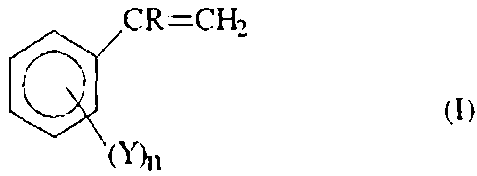
上で挙げた一般式を有するビニル芳香族モノマーの例は、スチレン、α−メチルスチレン、メチルスチレン、エチルスチレン、ブチルスチレン、ジメチルスチレン、モノ−、ジ−、トリ−、テトラ−及びペンタクロロスチレン、ブロモスチレン、メトキシスチレン、アセトキシスチレン等である。好ましいビニル芳香族モノマーは、スチレン及びα−メチルスチレンである。 Examples of vinyl aromatic monomers having the general formula listed above are styrene, alpha-methyl styrene, methyl styrene, ethyl styrene, butyl styrene, dimethyl styrene, mono-, di-, tri-, tetra- and pentachlorostyrene. Bromostyrene, methoxystyrene, acetoxystyrene and the like. Preferred vinyl aromatic monomers are styrene and α-methylstyrene.
一般式(I)に対応するビニル芳香族モノマーは、単独で、又は他の共重合性モノマーとの最高で50質量%の混合物として使用することができる。共重合性モノマーの例は、(メタ)クリル酸、(メタ)クリル酸のC1〜C4アルキルエステル(例えばメチルアクリレート、メチルメタクリレート、エチルアクリレート、エチルメタクリレート、イソプロピルアクリレート、ブチルアクリレート)、(メタ)クリル酸のアミド及びニトリル(例えばアクリルアミド、メタクリルアミド、アクリロニトリル、メタクリロニトリル)、ブタジエン、エチレン、ジビニルベンゼン、無水マレイン酸等である。好ましい共重合性モノマーは、アクリロニトリル及びメチルメタクリレートである。 The vinyl aromatic monomers corresponding to the general formula (I) can be used alone or as a mixture of up to 50% by weight with other copolymerizable monomers. Examples of copolymerizable monomers include (meth) acrylic acid, C 1 -C 4 alkyl esters of (meth) acrylic acid (eg, methyl acrylate, methyl methacrylate, ethyl acrylate, ethyl methacrylate, isopropyl acrylate, butyl acrylate), (meth ) Acrylamides and nitriles (for example, acrylamide, methacrylamide, acrylonitrile, methacrylonitrile), butadiene, ethylene, divinylbenzene, maleic anhydride and the like. Preferred copolymerizable monomers are acrylonitrile and methyl methacrylate.
熱可塑性ポリマーマトリックス内に球状に取り込み可能ないずれの発泡剤も、本発明の目的である発泡性ポリマーと組み合わせて使用することができる。典型的な例は、脂肪族炭化水素、フレオン、二酸化炭素、アルコール(エチルアルコール等)、水等である。 Any blowing agent that can be incorporated spherically into the thermoplastic polymer matrix can be used in combination with the foamable polymer that is the object of the present invention. Typical examples are aliphatic hydrocarbons, freons, carbon dioxide, alcohols (such as ethyl alcohol), water, and the like.
一般に従来の材料と共に使用される慣用の添加剤(顔料、安定剤、成核剤、難燃系、静電気防止剤、離型剤等)を、本発明の目的である発泡性熱可塑性ポリマーの組成物に添加することができる。特に、本発明の組成物に、後述するように、ポリマー(a)に対して0.1〜8質量%の、少なくとも30質量%の臭素を含有する自消性の臭素化添加剤と、ここでもまたポリマー(a)に対して0.05〜2質量%の、少なくとも1つのC−C又はO−Oの弱い結合を有する相乗生成物(synergic product)とを含む難燃系を添加することができる。 Conventional additives generally used with conventional materials (pigments, stabilizers, nucleating agents, flame retardants, antistatic agents, mold release agents, etc.) are used for the composition of the foamable thermoplastic polymer that is the object of the present invention. Can be added to the product. In particular, the composition of the present invention comprises a self-extinguishing bromination additive containing 0.1 to 8% by weight, based on polymer (a), of at least 30% by weight of bromine, as described below, However, adding a flame retardant system comprising 0.05 to 2% by weight of the polymer (a) and at least one synergistic product having a weak bond of C—C or O—O. Can do.
不透熱性充填材、発泡剤及び考えられる添加剤の添加後、発泡性熱可塑性ポリマーが顆粒又はビーズ状で得られ、この顆粒又はビーズ状の発泡性熱可塑性ポリマーを変形させて、5〜50g/l、好ましくは10〜25g/lの密度を有する発泡物品を製造することができる。一方、直接押出成形の場合は、20〜40g/lの密度が採用される。 After the addition of the impermeable filler, foaming agent and possible additives, a foamable thermoplastic polymer is obtained in the form of granules or beads, the granules or beads of foamable thermoplastic polymer being deformed, 5 to 50 g Foamed articles can be produced having a density of / l, preferably 10 to 25 g / l. On the other hand, in the case of direct extrusion molding, a density of 20 to 40 g / l is employed.
これらの発泡物品は、25〜50mW/mK、好ましくは29〜45mW/mKの熱伝導性によって表される優れた断熱性能を有し、この数値は概して、現在流通している充填材非含有の材料(例えば、Polimeri Europa SpA社のEXTIR A−5000)から得られる同等の発泡物品の値より更に10%を超えて低い。 These foamed articles have excellent thermal insulation performance represented by a thermal conductivity of 25-50 mW / mK, preferably 29-45 mW / mK, which is generally free of fillers currently in circulation. It is even more than 10% lower than the value of an equivalent foamed article obtained from a material (for example, EXTIR A-5000 from Polymeri Europa SpA).
本発明の目的である発泡性熱可塑性ポリマーのこれらの特徴により、材料を大幅に節約した断熱物品を作製すること又は例えば従来の充填材非含有のポリマーを使用して作製したシートより薄いシートを作製することが可能であり、結果的に空間及び生成物の節約となる。 These features of the expandable thermoplastic polymer that is the object of the present invention make it possible to make insulation articles that save significant material, or sheets that are thinner than sheets made using, for example, conventional filler-free polymers. Can be made, resulting in space and product savings.
発泡物品の定義には、密度10〜200g/l、平均気泡寸法0.01〜1.00mmを有し且つ熱可塑性ポリマーに対して0.004〜15質量%、好ましくは0.01〜5質量%、より一層好ましくは0.05〜2質量%の、150nm以下の厚さ(グラフェンシートに対して直角)を有するナノスケールグラフェンプレートを含む不透熱性充填材を含有する例えばビニル又はビニル芳香族ポリマー(例えば、ポリエチレン、ポリスチレン)の気泡マトリックスを含む、熱可塑性ポリマーの発泡押出成形シートが含まれる。ナノスケールグラフェンプレートの厚さは好ましくは50nm未満であり、より一層好ましくは0.3〜5nmである。このナノスケールプレートは、10μm以下、好ましくは1μm以下、より一層好ましくは500nm以下の平均寸法(長さ、幅又は直径)も有する。このナノスケールグラフェンプレートは表面積>50m2/gを有する。表面積は好ましくは100〜2600m2/gであり、より一層好ましくは表面積は300〜2600m2/gである。 The definition of foamed article includes a density of 10 to 200 g / l, an average cell size of 0.01 to 1.00 mm and 0.004 to 15% by weight, preferably 0.01 to 5% by weight with respect to the thermoplastic polymer. %, Even more preferably 0.05-2% by weight, containing a heat-impermeable filler comprising nanoscale graphene plates having a thickness of 150 nm or less (perpendicular to the graphene sheet) eg vinyl or vinyl aromatic Included are foamed extruded sheets of thermoplastic polymers that include a cellular matrix of polymer (eg, polyethylene, polystyrene). The thickness of the nanoscale graphene plate is preferably less than 50 nm, and more preferably 0.3-5 nm. The nanoscale plate also has an average dimension (length, width or diameter) of 10 μm or less, preferably 1 μm or less, more preferably 500 nm or less. The nanoscale graphene plate has a surface area> 50 m 2 / g. The surface area is preferably 100-2600 m 2 / g, and even more preferably the surface area is 300-2600 m 2 / g.
発泡押出成形シートの熱可塑性ポリマーに添加される不透熱性充填材は、ナノスケールプレートを含むことに加えて、ポリマーに対して最高で6質量%、例えば0.01〜6質量%、好ましくは0.05〜4.5質量%の更なる不透熱性添加剤(黒鉛及び/又はカーボンコーク及び/又はカーボンブラック等)をそれぞれ相乗剤として含み得る。 The impermeable filler added to the thermoplastic polymer of the foam extruded sheet, in addition to including the nanoscale plate, is at most 6% by weight with respect to the polymer, for example 0.01-6% by weight, preferably 0.05 to 4.5% by weight of a further heat-impermeable additive (such as graphite and / or carbon coke and / or carbon black) can each be included as a synergist.
発泡押出成形シートは、従来の材料と共に通常使用される慣用の添加剤(顔料、安定剤、成核剤、難燃系、静電気防止剤、離型剤等)も含有することができる。 The foam-extruded sheet can also contain conventional additives (pigments, stabilizers, nucleating agents, flame retardants, antistatic agents, release agents, etc.) that are commonly used with conventional materials.
本発明の更なる目的は、発泡性熱可塑性ポリマーをベースとした、例えばビーズ又は顆粒状の、改善された断熱性能及び密度50g/l未満(発泡後)を有する該組成物を調製する工程に関する。 A further object of the invention relates to a process for preparing the composition based on an expandable thermoplastic polymer, for example in the form of beads or granules, having improved thermal insulation performance and density less than 50 g / l (after foaming). .
特に、本発明の更なる目的は、ビーズ又は顆粒状の発泡性ビニル芳香族ポリマーを調製する工程に関し、本工程は、水性懸濁液中で、1種以上のビニル芳香族モノマーを、場合によっては最高で50質量%の少なくとも1種の重合性コモノマーと共に、不透熱性充填材の存在下で重合することを含み、該不透熱性充填剤は、以下を含む。
150nm以下の厚さ(グラフェンシートに対して直角)を有するナノスケールグラフェンプレート。該厚さは好ましくは50nm未満であり、より一層好ましくは厚さは0.3〜5nmである。このナノスケールプレートはまた、10μm以下、好ましくは1μm以下、より一層好ましくは500nm以下の平均寸法(長さ、幅又は直径)を有する。ナノスケールグラフェンプレートは表面積>50m2/gを有する。表面積は好ましくは100〜2600m2/gであり、より一層好ましくは表面積は300〜2600m2/gである。
ペルオキシドラジカル開始系、及び
重合前、重合中又は重合後に添加される発泡剤。
In particular, a further object of the present invention relates to a process for preparing beaded or granular expandable vinyl aromatic polymers, which process optionally comprises one or more vinyl aromatic monomers in an aqueous suspension. Comprises polymerizing with up to 50% by weight of at least one polymerizable comonomer in the presence of a heat impermeable filler, the heat impermeable filler comprising:
A nanoscale graphene plate having a thickness of 150 nm or less (perpendicular to the graphene sheet). The thickness is preferably less than 50 nm, and even more preferably the thickness is 0.3-5 nm. The nanoscale plate also has an average dimension (length, width or diameter) of 10 μm or less, preferably 1 μm or less, and even more preferably 500 nm or less. Nanoscale graphene plates have a surface area> 50 m 2 / g. The surface area is preferably 100-2600 m 2 / g, and even more preferably the surface area is 300-2600 m 2 / g.
Peroxide radical initiating system and blowing agent added before, during or after polymerization.
不透熱性充填材は、ナノスケールプレートを含むことに加えて、ポリマーに対して最高で6質量%、例えば0.01〜6質量%、好ましくは0.05〜4.5質量%の更なる不透熱性添加剤(黒鉛及び/又はカーボンコーク及び/又はカーボンブラック等)もそれぞれ相乗剤として含み得る。 In addition to including the nanoscale plate, the heat-impermeable filler has a maximum of 6% by weight, eg 0.01-6% by weight, preferably 0.05-4.5% by weight, based on the polymer. Impermeable additives (graphite and / or carbon coke and / or carbon black, etc.) may also be included as synergists, respectively.
重合は、水性懸濁液中で、リン酸の無機塩、例えばリン酸三カルシウム又はリン酸マグネシウムを伴って行われる。これらの塩は重合混合物に、あらかじめ細かく分割されるか、又は例えばピロリン酸ナトリウムと硫酸マグネシウムとの反応によってインシチュで合成されるかのいずれかによって添加することができる。 The polymerization is carried out in an aqueous suspension with an inorganic salt of phosphoric acid such as tricalcium phosphate or magnesium phosphate. These salts can be added to the polymerization mixture either in advance finely divided or synthesized in situ, for example by reaction of sodium pyrophosphate with magnesium sulfate.
この無機塩をその懸濁化作用において、米国特許第3631014号明細書に記載されるように、アニオン界面活性剤、例えばドデシルベンゼンスルホン酸ナトリウム又はその前駆体(メタ重亜硫酸ナトリウム等)によって支援する。 This inorganic salt is supported in its suspending action by an anionic surfactant, such as sodium dodecylbenzenesulfonate or a precursor thereof (such as sodium metabisulfite), as described in US Pat. No. 3,631,014. .
重合は、有機系懸濁化剤(ポリビニルピロリドン、ポリビニルアルコール等)の存在下で行うこともできる。 The polymerization can also be carried out in the presence of an organic suspending agent (polyvinyl pyrrolidone, polyvinyl alcohol, etc.).
開始系は通常、2種のペルオキシドを含み、1つ目は85〜95℃で1時間の半減期を有し、もう一方は110〜120℃で1時間の半減期を有する。これらの開始剤の例は、tert−ブチルペルオキシ−2−エチルヘキサノエート及びtert−ブチルパーベンゾエートである。 The initiating system usually comprises two peroxides, the first having a half-life of 1 hour at 85-95 ° C and the other having a half-life of 1 hour at 110-120 ° C. Examples of these initiators are tert-butyl peroxy-2-ethylhexanoate and tert-butyl perbenzoate.
得られるビニル芳香族ポリマー又はコポリマーは、平均分子量(Mw)50000〜300000、好ましくは70000〜200000を有する。概して、水溶液中での発泡性ビニル芳香族ポリマーの調製又はより広い意味での懸濁液における重合の手順についての更なる詳細は、Journal of Macromolecular Science,Review in Macromolecular Chemistry and Physics C31(263),215−299(1991)に見ることができる。 The resulting vinyl aromatic polymer or copolymer has an average molecular weight (Mw) of 50000-300000, preferably 70000-200000. In general, more details about the preparation of expandable vinyl aromatic polymers in aqueous solution or the procedure of polymerization in a broader suspension are given in Journal of Macromolecular Science, Review in Macromolecular Chemistry and Physics C31 (263), 215-299 (1991).
懸濁液の安定性を改善するために、水に懸濁させるビニル芳香族モノマーの反応物溶液の粘度を、ビニル芳香族ポリマーをこの溶液に、モノマーに対して最高で1〜30質量%、好ましくは5〜20質量%の濃度まで溶解させることによって上昇させることが可能である。溶液は、上記の濃度が得られるまで、予備生成されたポリマーを反応物混合物(例えば、新鮮なポリマー又は先行の重合及び/若しくは発泡からの廃棄物)に溶解させる、又はモノマー若しくはモノマーの混合物を塊状予備重合し、続いて水性懸濁液中での重合を残りの添加剤の存在下で継続することにより得ることができる。 In order to improve the stability of the suspension, the viscosity of the reactant solution of the vinyl aromatic monomer suspended in water is adjusted to a maximum of 1-30 wt. Preferably, it can be increased by dissolving to a concentration of 5 to 20% by mass. The solution dissolves the preformed polymer in the reactant mixture (eg, fresh polymer or waste from previous polymerization and / or foaming) or the monomer or monomer mixture until the above concentration is obtained. It can be obtained by bulk prepolymerization followed by continued polymerization in aqueous suspension in the presence of the remaining additives.
懸濁液中での重合中、当業者に周知の方法に従って、発泡性ビニル芳香族ポリマーの製造に典型的な重合添加剤、例えば懸濁液の安定剤、連鎖移動剤、発泡補助剤、成核剤、可塑剤等を使用する。特に、重合中、得られるポリマーの質量に対して0.1〜8%の難燃剤及び0.05〜2%の相乗生成物を含む耐炎系を添加することが好ましい。本発明の目的である発泡性ビニル芳香族ポリマーに特に適した難燃剤は、脂肪族化合物、脂環式化合物、臭素化芳香族化合物(ヘキサブロモシクロドデカン、ペンタブロモモノクロロシクロヘキサン、ペンタブロモフェニルアリルエーテル等)である。使用可能な相乗生成物はジクミルペルオキシド、クメンヒドロペルオキシド、3,4−ジメチル−3,4−ジフェニル−ヘキサン、3,4−ジメチル−3,4−ジフェニルブタン、3,6,9−トリエチル−3,6,9−トリメチル−1,4,7−トリペルオキシノナンである。 During polymerization in suspension, the polymerization additives typical for the production of foamable vinyl aromatic polymers, such as suspension stabilizers, chain transfer agents, foaming aids, synthetics, according to methods well known to those skilled in the art. Use nucleating agents, plasticizers, etc. In particular, during the polymerization, it is preferable to add a flame resistant system containing 0.1 to 8% flame retardant and 0.05 to 2% synergistic product based on the mass of the polymer obtained. Flame retardants particularly suitable for the expandable vinyl aromatic polymer that is the object of the present invention are aliphatic compounds, alicyclic compounds, brominated aromatic compounds (hexabromocyclododecane, pentabromomonochlorocyclohexane, pentabromophenyl allyl ether). Etc.). Synergistic products that can be used are dicumyl peroxide, cumene hydroperoxide, 3,4-dimethyl-3,4-diphenyl-hexane, 3,4-dimethyl-3,4-diphenylbutane, 3,6,9-triethyl- 3,6,9-trimethyl-1,4,7-triperoxynonane.
発泡剤は、好ましくは、重合段階中又はその後に再懸濁技法により添加される。特に、後者は以下の段階:
水性懸濁液中で、1種以上のビニル芳香族モノマーを、少なくとも不透熱性充填材の存在下で重合し、
このようにして得られたビーズ又は顆粒を分離し、
ビーズ又は顆粒を水に再懸濁させ、球状形態が得られるまで加熱し、
発泡剤を懸濁液に添加し、含浸するまでビーズを発泡剤と接触させ続け、
ビーズを再分離すること
を含む。
The blowing agent is preferably added by a resuspension technique during or after the polymerization stage. In particular, the latter has the following stages:
Polymerizing one or more vinyl aromatic monomers in an aqueous suspension in the presence of at least an impermeable filler;
Separating the beads or granules thus obtained,
Resuspend the beads or granules in water and heat until a spherical morphology is obtained,
Add the blowing agent to the suspension and keep the beads in contact with the blowing agent until impregnation,
Re-isolating the beads.
発泡剤は、3〜6個の炭素原子を含む脂肪族又は脂環式炭化水素(n−ペンタン、イソペンタン、シクロペンタン、これらのブレンド等)、1〜3個の炭素原子を含む脂肪族炭化水素のハロゲン化誘導体(例えば、ジクロロジフルオロメタン、1,2,2−トリフルオロエタン、1,1,2−トリフルオロエタン)、二酸化炭素、水及びエチルアルコールから選択される。 Foaming agents are aliphatic or alicyclic hydrocarbons containing 3 to 6 carbon atoms (n-pentane, isopentane, cyclopentane, blends thereof, etc.), aliphatic hydrocarbons containing 1 to 3 carbon atoms Selected from halogenated derivatives of (for example, dichlorodifluoromethane, 1,2,2-trifluoroethane, 1,1,2-trifluoroethane), carbon dioxide, water and ethyl alcohol.
重合終了時に、懸濁、再懸濁を問わず、発泡性ポリマーの実質的に球状のビーズ/顆粒が平均直径0.2〜2mm、好ましくは1〜1.5mmで得られ、この中に不透熱性充填材及び他の考えられる添加剤が均質に分散している。 At the end of the polymerization, a substantially spherical bead / granule of expandable polymer is obtained with an average diameter of 0.2 to 2 mm, preferably 1 to 1.5 mm, whether suspended or resuspended. The thermally permeable filler and other possible additives are homogeneously dispersed.
次に、米国特許第5041465号明細書に記載されているように、顆粒を重合反応器から取り出し、非イオン界面活性剤又は酸により連続的に又はバッチ式で洗浄する。続いて、ポリマー顆粒を、30〜60℃の熱風で熱処理することができる。 The granules are then removed from the polymerization reactor and washed continuously or batchwise with a nonionic surfactant or acid as described in US Pat. No. 5,041,465. Subsequently, the polymer granules can be heat treated with hot air at 30-60 ° C.
本発明の更なる目的は、発泡性熱可塑性ポリマーをベースとした顆粒又はビーズ状の組成物を連続塊状で調製する工程に関し、本工程は以下の連続したステップを含む。
(i)顆粒/ペレット若しくは粉末形態又は既に溶融状態にある平均分子量(Mw)50000〜300000、好ましくは70000〜200000を有する熱可塑性ポリマーを、厚さ(グラフェンシートに対して直角)150nm以下を有するナノスケールグラフェンプレートを含む不透熱性充填材と混合する。厚さは好ましくは50nm未満であり、より一層好ましくは厚さは0.3〜5nmである。このナノスケールプレートは、10μm以下、好ましくは1μm以下、より一層好ましくは500nm以下の平均寸法(長さ、幅又は直径)も有する。このナノスケールグラフェンプレートは、表面積>50m2/gを有する。表面積は好ましくは100〜2600m2/gであり、より一層好ましくは表面積は300〜2600m2/gである。ナノスケールグラフェンプレートに加えて、この不透熱性充填材は、ポリマーに対して最高で6質量%、例えば0.01〜6質量%、好ましくは0.05〜4.5質量%の更なる不透熱性添加剤(黒鉛及び/又はカーボンコーク及び/又はカーボンブラック等)をそれぞれ相乗剤として含み得る。既に記載した他の考えられる添加剤、とりわけ顔料、安定剤、成核剤、難燃系、静電気防止剤、離型剤等もこのステップにおいて全て又は部分的に添加することができる。
(ii)任意で、まだ溶融状態にないならば、ポリマー混合物を熱可塑性ポリマーの融点より高い温度にする。
(iii)発泡剤及び場合によっては残りの(一部又は全て)他の添加剤を溶融したポリマーに取り込ませる。
(iv)このようにして得られたポリマー組成物を、静的又は動的混合要素により混合する。
(v)このようにして得られた組成物を、ダイ、切断チャンバ及び切断システムを含む装置で顆粒化する。
A further object of the present invention relates to the process of preparing a granulated or beaded composition based on an expandable thermoplastic polymer in a continuous mass, the process comprising the following sequential steps:
(I) a thermoplastic polymer having an average molecular weight (Mw) of 50,000 to 300,000, preferably 70,000 to 200,000 in a granule / pellet or powder form or already in a molten state, having a thickness (perpendicular to the graphene sheet) of 150 nm or less Mix with impermeable filler including nanoscale graphene plates. The thickness is preferably less than 50 nm, even more preferably the thickness is 0.3-5 nm. The nanoscale plate also has an average dimension (length, width or diameter) of 10 μm or less, preferably 1 μm or less, more preferably 500 nm or less. This nanoscale graphene plate has a surface area> 50 m 2 / g. The surface area is preferably 100-2600 m 2 / g, and even more preferably the surface area is 300-2600 m 2 / g. In addition to the nanoscale graphene plate, this heat-impermeable filler can have a maximum of 6% by weight, for example 0.01-6% by weight, preferably 0.05-4.5% by weight, based on the polymer. Thermally permeable additives (such as graphite and / or carbon coke and / or carbon black) can each be included as a synergist. Other possible additives already mentioned, especially pigments, stabilizers, nucleating agents, flame retardants, antistatic agents, mold release agents, etc. can also be added in whole or in part in this step.
(Ii) Optionally, if not already in the molten state, bring the polymer mixture to a temperature above the melting point of the thermoplastic polymer.
(Iii) Incorporating the blowing agent and optionally the remaining (partially or all) other additives into the molten polymer.
(Iv) The polymer composition thus obtained is mixed by static or dynamic mixing elements.
(V) The composition thus obtained is granulated in an apparatus comprising a die, a cutting chamber and a cutting system.
顆粒化終了時には、発泡性熱可塑性ポリマーの顆粒/ビーズを、平均直径0.2〜2.3mm、好ましくは1〜1.5mmを有する実質的な球状形態で得ることができ、その中に不透熱性充填材、考えられる更なる相乗的不透熱性添加剤及び他の更なる添加剤が、肉眼では均質に分散している。 At the end of granulation, granules / beads of expandable thermoplastic polymer can be obtained in a substantially spherical form with an average diameter of 0.2-2.3 mm, preferably 1-1.5 mm, in which The heat-permeable filler, possible further synergistic heat-impermeable additives and other further additives are homogeneously dispersed with the naked eye.
本発明において、ステップ(i)は、既に生成された、場合によっては処理廃棄物が混ざったポリマー顆粒を押出機に送って行うことができる。この押出機で本発明の目的である組成物の個々の成分が混合され、続いてポリマー分が溶融し、次に発泡剤及び他の考えられる添加剤が添加される。 In the present invention, step (i) can be carried out by sending polymer granules already produced, possibly mixed with processing waste, to an extruder. In this extruder, the individual components of the composition which is the object of the present invention are mixed, the polymer content is subsequently melted and then the blowing agent and other possible additives are added.
或いは、ビニル芳香族ポリマーの場合、当業者には「連続塊状法」として知られる工程に従って、溶液状で重合プラント、特には相対脱蔵ユニット(relative devolatilization unit)から直接くる、既に溶融状態にあるポリマーを使用することができる。溶融ポリマーを適切な装置、例えば動的又は静的混合機に送り、そこで添加剤、例えば不透熱性充填材及び発泡剤と混合し、引き続き押出成形することによって本発明の目的である生成物が発泡性顆粒/ビーズで得られる。熱可塑性ポリマー組成物の顆粒(又はビーズ)を、例えばガラス転移温度Tg以下又はそれより若干高い温度、例えばTgより最高で8℃高い温度で、場合によっては圧力下で再ベークすることができる。連続塊状でビニル芳香族ポリマーを調製するための詳細な方法は、国際特許出願WO03/53651パンフレットに記載されている。 Alternatively, in the case of vinyl aromatic polymers, they are already in the molten state, coming directly from the polymerization plant, in particular the relative development unit, in solution, according to a process known to those skilled in the art as “continuous bulk process” Polymers can be used. By sending the molten polymer to a suitable apparatus, such as a dynamic or static mixer, where it is mixed with additives such as impermeable fillers and blowing agents and subsequently extruded, the product that is the object of the present invention is obtained. Obtained with expandable granules / beads. The granules (or beads) of the thermoplastic polymer composition can be rebaked, for example at a temperature below or slightly above the glass transition temperature Tg, for example up to 8 ° C. above Tg, optionally under pressure. Detailed methods for preparing vinyl aromatic polymers in continuous mass are described in the international patent application WO 03/53651.
一般に、少なくとも不透熱性充填材を、平均分子量(Mw)50000〜300000、好ましくは70000〜200000を有する、ポリマーマトリックス(a)の熱可塑性ポリマーと適合する熱可塑性ポリマーを好ましくはベースとしたマスターバッチに取り込ませることによって、ポリマー流とのその混合を促進し、またプラント管理を簡略化することが可能である。このマスターバッチにおいて、ナノスケールグラフェンプレート及び場合によっては黒鉛及び/又はカーボンコーク及び/又はカーボンブラックを含む不透熱性充填材の含有量は、15〜60質量%である。 In general, a masterbatch based on a thermoplastic polymer, preferably based on a thermoplastic polymer compatible with the thermoplastic polymer of the polymer matrix (a), having at least an impermeable filler, having an average molecular weight (Mw) of 50,000 to 300,000, preferably 70,000 to 200,000. Can facilitate their mixing with the polymer stream and simplify plant management. In this masterbatch, the content of the heat-impermeable filler comprising nanoscale graphene plates and possibly graphite and / or carbon coke and / or carbon black is 15 to 60% by mass.
特に、水性懸濁液中での重合の場合、ペレット状のマスターバッチを、ビニル芳香族モノマーに溶解させることができる。他方で、塊状重合の場合は、ペレットの形態のマスターバッチを熱可塑性ポリマーの顆粒又は溶液状での重合からくる溶融状態のビニル芳香族ポリマーと混合することができる。 In particular, in the case of polymerization in an aqueous suspension, a pellet master batch can be dissolved in a vinyl aromatic monomer. On the other hand, in the case of bulk polymerization, the masterbatch in the form of pellets can be mixed with the molten vinyl aromatic polymer resulting from polymerization of thermoplastic polymer granules or solution.
より一層具体的には、ビニル芳香族ポリマーの連続塊状重合の場合、ペレット状のマスターバッチを、ビニル芳香族モノマー/溶媒混合物に溶解させてから重合反応器に溶液状態で送ることができる。 More specifically, in the case of continuous bulk polymerization of vinyl aromatic polymers, the pelletized masterbatch can be dissolved in the vinyl aromatic monomer / solvent mixture and then sent in solution to the polymerization reactor.
ビニル芳香族ポリマーの重合が終了すると、重合が懸濁式、塊状又は連続塊状で行われるかを問わず、得られた発泡性ビーズ又は顆粒を、慣用の発泡性組成物に通常適用される予備処理に供することができる。この予備処理は本質的に以下から成る。
(1)ビーズ又は顆粒を静電気防止液剤(アミン、エトキシ化第三級アルキルアミン、エチレンオキシド/プロピレンオキシドコポリマー等から選択される)で被覆する。この薬剤によりコーティングの接着が可能になり、また懸濁液中で調製されたビーズのスクリーニングが促進される。
(2)このビーズ又は顆粒に、場合によってはカーボンブラックとも混合された、本質的に脂肪酸とのグリセリン(又は他のアルコール)のモノ−、ジ−及びトリエステル並びにステアリン酸金属塩(ステアリン酸亜鉛及び/又はステアリン酸マグネシウム等)の混合物から成るコーティングを適用する。
Once the polymerization of the vinyl aromatic polymer is complete, the resulting expandable beads or granules are used in a conventional foamable composition, regardless of whether the polymerization is carried out in a suspension, block or continuous block. Can be used for processing. This pretreatment essentially consists of:
(1) The beads or granules are coated with an antistatic solution (selected from amines, ethoxylated tertiary alkyl amines, ethylene oxide / propylene oxide copolymers, etc.). This agent allows adhesion of the coating and facilitates screening of beads prepared in suspension.
(2) Mono-, di- and triesters of glycerin (or other alcohols) with fatty acids, and optionally stearic acid metal salts (zinc stearate), optionally mixed with carbon black. And / or a coating comprising a mixture of magnesium stearate, etc.).
本発明の更なる目的は、熱可塑性ポリマーの発泡押出成形シートを製造する工程に関し、本工程は以下を含む。
(a1)ペレット、顆粒又はビーズの形態の熱可塑性ポリマー(ビニル又はビニル芳香族ポリマー、例えばポリエチレン、ポリスチレンから選択される)と、少なくとも、厚さ150nm以下(グラフェンシートに対して直角)を有するナノスケールグラフェンプレートを含む不透熱性充填材とを混合する。厚さは好ましくは50nm未満であり、より一層好ましくは厚さは0.3〜5nmである。このナノスケールプレートは、10μm以下、好ましくは1μm以下、より一層好ましくは500nm以下の平均寸法(長さ、幅又は直径)も有する。ナノスケールグラフェンプレートは、表面積>50m2/gを有する。表面積は好ましくは100〜2600m2/gであり、より一層好ましくは表面積は300〜2600m2/gである。
(b1)この混合物(a1)を180〜250℃の温度に加熱することによって均質化に供するポリマー溶融物を得る。
(c1)このポリマー溶融物に少なくとも1種の発泡剤及び場合によっては他の添加剤、例えば難燃系を添加する。
(d1)少なくとも発泡剤を球状で取り込む(englobe)このポリマー溶融物を均質化する。
(e1)このポリマー溶融物(d1)を200℃以下であり且つ得られるポリマー組成物のTg以上である温度にまで均質に冷却する。
(f1)このポリマー溶融物をダイに通して押出成形することによって発泡ポリマーシートを得る。
A further object of the present invention relates to a process for producing a foamed extruded sheet of thermoplastic polymer, the process comprising:
(A1) a thermoplastic polymer in the form of pellets, granules or beads (selected from vinyl or vinyl aromatic polymers such as polyethylene, polystyrene) and at least a thickness of 150 nm or less (perpendicular to the graphene sheet) Mix with heat impermeable filler including scale graphene plate. The thickness is preferably less than 50 nm, even more preferably the thickness is 0.3-5 nm. The nanoscale plate also has an average dimension (length, width or diameter) of 10 μm or less, preferably 1 μm or less, more preferably 500 nm or less. Nanoscale graphene plates have a surface area> 50 m 2 / g. The surface area is preferably 100-2600 m 2 / g, and even more preferably the surface area is 300-2600 m 2 / g.
(B1) A polymer melt for homogenization is obtained by heating the mixture (a1) to a temperature of 180 to 250 ° C.
(C1) Add at least one blowing agent and optionally other additives such as a flame retardant system to the polymer melt.
(D1) The polymer melt is homogenized by engraving at least the blowing agent.
(E1) The polymer melt (d1) is homogeneously cooled to a temperature of 200 ° C. or lower and equal to or higher than Tg of the resulting polymer composition.
(F1) The polymer melt is extruded through a die to obtain a foamed polymer sheet.
本発明の更なる目的である発泡押出成形シートを製造する工程の実施形態において、熱可塑性ポリマーに添加される不透熱性充填材は、ナノスケールグラフェンプレートに加えて、ポリマーに対して最高で6質量%、例えば0.01〜6質量%、好ましくは0.05〜4.5質量%の更なる不透熱性添加剤(黒鉛及び/又はカーボンコーク及び/又はカーボンブラック等)もそれぞれ相乗剤として含み得る。 In an embodiment of the process for producing a foam extruded sheet, which is a further object of the present invention, the impermeable filler added to the thermoplastic polymer is up to 6 for the polymer in addition to the nanoscale graphene plate. Further heat-impermeable additives (graphite and / or carbon coke and / or carbon black, etc.) of mass%, for example 0.01 to 6 mass%, preferably 0.05 to 4.5 mass%, are also used as synergists, respectively. May be included.
本発明の目的である発泡押出成形シートを製造する工程の代替の実施形態においては、ペレットの形態の熱可塑性ポリマーを、全て又は部分的に、上述の工程の1つにおいて説明した又はそれに従って調製されたビーズ/顆粒状の熱可塑性ビニル又はビニル芳香族ポリマーの組成物に置き換える。 In an alternative embodiment of the process for producing the foamed extruded sheet that is the object of the present invention, the thermoplastic polymer in the form of pellets is wholly or partly prepared or prepared according to one of the processes described above. With a bead / granular thermoplastic vinyl or vinyl aromatic polymer composition.
また、熱可塑性ビニル又はビニル芳香族ポリマーをベースとした発泡押出成形シートを製造する工程において、不透熱性充填材は、マスターバッチで使用することができる。 Also, in the process of producing a foamed extruded sheet based on thermoplastic vinyl or vinyl aromatic polymer, the impermeable filler can be used in a masterbatch.
熱可塑性ポリマーの発泡押出成形シートを調製する工程についての更なる詳細は、国際特許出願WO06/128656パンフレットに見つけることができる。 Further details about the process for preparing foamed extruded sheets of thermoplastic polymers can be found in the international patent application WO 06/128656.
本発明をより深く理解し、また具体化するために、以下に幾つかの例示的且つ非限定的な実施例を挙げる。 In order to better understand and embody the present invention, several illustrative and non-limiting examples are given below.
実施例1
パートA:黒鉛の液体剥離によるナノスケールグラフェンプレートの調製
20部の黒鉛「UF1 98.5」(Kropfmuhl社製)を、磁気アンカー撹拌機を使用して880部のN−メチルピロリドン(Sigma Aldrich社)中に分散させる。撹拌しながら、超音波音場を、20kHzで較正され、発生器の吸収出力に基づいて計算された約100W/リットルの比出力を有するソノトロードで印加する。約2時間後、このようにして得られた生成物を遠心分離に供する。上澄みの生成物を回収し、次に今度は機械的撹拌機(Silverson Machines社)を使用して再度撹拌する。100部のEDISTIR N1782タイプのポリスチレン(Mw130000g/モル、Mw/Mn=2.3、MFI(200℃、5kg)25g/10’を有するポリスチレン。Polimeri Europa社製)を粉末化し、次に、連続的な撹拌下に溶液を維持しながらゆっくりと注ぐ。加工サイクル全体を通じて、温度は約120℃に維持される。
Example 1
Part A: Preparation of nanoscale graphene plates by liquid exfoliation of graphite 20 parts of graphite “UF1 98.5” (from Kropfumuhl) were added to 880 parts of N-methylpyrrolidone (Sigma Aldrich) using a magnetic anchor stirrer. ) Dispersed in. While stirring, an ultrasonic field is applied with a sonotrode calibrated at 20 kHz and having a specific power of about 100 W / liter calculated based on the absorption power of the generator. After about 2 hours, the product thus obtained is subjected to centrifugation. The supernatant product is collected and then again stirred using a mechanical stirrer (Silverson Machines). 100 parts EDISTIR N1782 type polystyrene (Mw 130000 g / mol, Mw / Mn = 2.3, MFI (200 ° C., 5 kg) 25 g / 10 ′ polystyrene, powdered by Polymeri Europa), then continuously Slowly pour while keeping the solution under good agitation. The temperature is maintained at about 120 ° C. throughout the processing cycle.
パートB:ナノスケールグラフェンプレートを含有する発泡性ポリスチレンの調製
900部のEDISTIR N2982タイプのポリスチレン(Mw180000g/モル、Mw/Mn=2.3、MFI(200℃、5kg)7.5g/10’を有するポリスチレン。Polimeri Europa社製)を、一軸押出機で溶融させる。
Part B: Preparation of Expandable Polystyrene Containing Nanoscale Graphene Plates 900 parts of EDISTIR N2982 type polystyrene (Mw 180000 g / mol, Mw / Mn = 2.3, MFI (200 ° C., 5 kg) 7.5 g / 10 ′ Polystyrene (Polymeri Europa) is melted in a single screw extruder.
66部のポリスチレンN1782(Polimeri Europa社製)、2部のエチレン−ビス−ステレアミド(stereamide)、10部のSaytex HP900(ヘキサブロモシクロドデカン。Alberarle社が販売)、2部のPerkadox 30(2,3−ジメチル−2,3−ジフェニルブタン。Akzo Nobel社が販売)を二軸押出機で混合する。パートAで最初に生成された溶液20部を側方注入口からこの二軸押出機に送る。 66 parts polystyrene N1782 (Polymeri Europa), 2 parts ethylene-bis-steramide (stereamide), 10 parts Saytex HP900 (hexabromocyclododecane, sold by Albertarle), 2 parts Perkadox 30 (2,3 Dimethyl-2,3-diphenylbutane (sold by Akzo Nobel)) is mixed in a twin screw extruder. Twenty parts of the solution initially produced in Part A are fed from the side inlet to the twin screw extruder.
n−ペンタン(75%)とイソペンタン(25%)との混合物50部及び二軸押出機を後にした流れを、一軸押出機を後にしたポリマー溶融物に添加する。このようにして得られた混合物を、一連の静的混合要素で混合する。ギアポンプで、このようにして得られた混合物の圧力を200bargにまで上昇させる。次に、混合物を、混合交換器(SMR)で約170℃にまで冷却する。 50 parts of a mixture of n-pentane (75%) and isopentane (25%) and the stream leaving the twin screw extruder are added to the polymer melt after the single screw extruder. The mixture thus obtained is mixed with a series of static mixing elements. With a gear pump, the pressure of the mixture thus obtained is increased to 200 barg. The mixture is then cooled to about 170 ° C. with a mixing exchanger (SMR).
次に、組成物をダイに分配し、直径0.5mmを有する多数の孔を通して押出成形し、水流で速やかに冷却し、一連の回転ナイフで切断する(米国特許第7320585号明細書に記載の方法に従う)。 The composition is then dispensed into a die, extruded through a number of holes having a diameter of 0.5 mm, rapidly cooled with a stream of water, and cut with a series of rotating knives (as described in US Pat. No. 7,320,585). Follow the method).
顆粒化チャンバ内の圧力は5バールであり、せん断速度は、平均直径1.2mmを有する顆粒が得られるように選択される。水は冷却噴霧液として使用され、窒素はキャリアガスとして使用される。 The pressure in the granulation chamber is 5 bar and the shear rate is selected so as to obtain granules having an average diameter of 1.2 mm. Water is used as a cooling spray and nitrogen is used as a carrier gas.
得られる顆粒を遠心乾燥機で乾燥させ、次にコーティングで被覆する。このコーティングは、顆粒に、乾燥顆粒1000部あたり3部のモノステアリン酸グリセリン、1部のステアリン酸亜鉛及び0.2部のグリセリンを添加することによって調製される。コーティングの添加剤は、連続スクリュー混合機により顆粒と混合される。 The resulting granules are dried in a centrifugal dryer and then covered with a coating. This coating is prepared by adding 3 parts glyceryl monostearate, 1 part zinc stearate and 0.2 parts glycerin to 1000 parts dry granules. The coating additives are mixed with the granules by a continuous screw mixer.
生成物を100℃の蒸気を使用して17g/lにまで予備発泡させ、1日かけてエージングに供し、ブロック(寸法1040x1030x550mmを有する)の成形に使用する。 The product is pre-foamed using steam at 100 ° C. to 17 g / l, subjected to aging for 1 day, and used to form blocks (having dimensions 1040 × 1030 × 550 mm).
次に、ブロックを切断して平坦なシートを作製し、この上で熱伝導性を測定する。熱伝導性は33.8mW/mKであると判明した。 Next, the block is cut to produce a flat sheet, on which the thermal conductivity is measured. The thermal conductivity was found to be 33.8 mW / mK.
同じブロックから得られたシートの一部を70℃の炉内に2日間にわたって置く。次に、規格DIN 4102に準拠した耐火挙動試験用に試料(9cmx19cmx2cm)を採取する。試料は試験を通過する。 A portion of the sheet obtained from the same block is placed in a 70 ° C. oven for 2 days. Next, a sample (9 cm × 19 cm × 2 cm) is taken for a fire resistance behavior test based on the standard DIN 4102. The sample passes the test.
実施例2
パートA:濃縮物の調製
実施例1のパートAに従って得られた生成物を真空下に置き、連続的に撹拌し且つ窒素をわずかにバブリングさせながら3時間にわたって約170℃にする。500部の溶媒をこのようにして蒸発させ、考えられる再利用のために別の容器で再凝縮する。
Example 2
Part A: Preparation of Concentrate The product obtained according to Example 1, Part A is placed under vacuum, brought to about 170 ° C. over 3 hours with continuous stirring and slight bubbling of nitrogen. 500 parts of solvent are thus evaporated and recondensed in a separate container for possible reuse.
パートB:ナノスケールグラフェンプレートを含有する発泡性ポリスチレンの調製
89.8部のエチルベンゼン、730.0部のスチレン、56.2部のα−メチルスチレン及び0.2部のジビニルベンゼンを撹拌反応器に送る。
Part B: Preparation of Expandable Polystyrene Containing Nanoscale Graphene Plates Stirring reactor with 89.8 parts ethylbenzene, 730.0 parts styrene, 56.2 parts α-methylstyrene and 0.2 parts divinylbenzene Send to.
パートAで得られた調製物123.8部を反応器に送り、溶解させる(全体:1000部)。次に、反応を125℃、2時間の平均滞留時間で行う。次に、流出口の流体組成物を第2反応器に送り、反応を135℃、2時間の平均滞留時間で完了させる。 123.8 parts of the preparation obtained in Part A are sent to the reactor and dissolved (total: 1000 parts). The reaction is then carried out at 125 ° C. with an average residence time of 2 hours. The outlet fluid composition is then sent to the second reactor to complete the reaction at 135 ° C. with an average residence time of 2 hours.
転化率72%を有する得られる組成物(以下、「組成物(A)」と称する)を240℃にまで加熱し、続いて脱蔵装置に送って溶媒及び残留モノマーを除去する。この組成物は、分子量(Mw)200000g/モル及びMw/Mn比2.8を特徴とし、Mwは重量平均分子量であり、Mnは数平均分子量である。 The resulting composition having a conversion of 72% (hereinafter referred to as “Composition (A)”) is heated to 240 ° C. and then sent to a devolatilizer to remove solvent and residual monomer. This composition is characterized by a molecular weight (Mw) of 200,000 g / mol and a Mw / Mn ratio of 2.8, where Mw is the weight average molecular weight and Mn is the number average molecular weight.
組成物(A)を脱蔵装置から熱交換器に送り、その温度を170℃にまで低下させる。 The composition (A) is sent from the devolatilizer to the heat exchanger and its temperature is reduced to 170 ° C.
130.9部のポリスチレンN2982(Polimeri Europa社製)、14.0部のSaytex HP900(ヘキサブロモシクロドデカン。Alberarle社が販売)及び5.1部のPerkadox 30(登録商標)(2,3−ジメチル−2,3−ジフェニルブタン。Akzo Nobel社が販売)の全部で150部を第2の二軸押出機に送る。ギアポンプを使用して、この溶融した添加剤の送り圧力を260bargにまで上昇させる。次に、n−ペンタン(75%)とイソペンタン(25%)との混合物50部に加圧し、添加剤流に注入する。混合を、静的混合機を使用して約190℃で完了させる。このようにして得られた組成物を以下、「組成物(B)」と記載する。 130.9 parts of polystyrene N2982 (manufactured by Polymeri Europa), 14.0 parts of Saytex HP900 (hexabromocyclododecane, sold by Albertale) and 5.1 parts of Perkadox 30 (registered trademark) (2,3-dimethyl) A total of 150 parts of -2,3-diphenylbutane (sold by Akzo Nobel) is sent to the second twin screw extruder. A gear pump is used to increase the feed pressure of the molten additive to 260 barg. Next, 50 parts of a mixture of n-pentane (75%) and isopentane (25%) are pressurized and injected into the additive stream. Mixing is completed at about 190 ° C. using a static mixer. The composition thus obtained is hereinafter referred to as “composition (B)”.
組成物(B)を、熱交換器からくる組成物(A)850部に添加する。次に、これらの原料を、静的混合要素を使用して、計算された7分の平均滞留時間にわたって混合する。次に、組成物をダイに分配し、ここで組成物は、実施例1のパートBに示すように押出成形、顆粒化、発泡、成形される。実施例1のパートBに記載される手順に完全に従って、熱伝導性及び耐火挙動試験の測定のために試料をブロックから採取し、17g/lで発泡させ、成形する。 Add composition (B) to 850 parts of composition (A) coming from the heat exchanger. These ingredients are then mixed for a calculated average residence time of 7 minutes using a static mixing element. The composition is then dispensed into dies, where the composition is extruded, granulated, foamed and molded as shown in Example 1, Part B. Completely following the procedure described in Part B of Example 1, a sample is taken from the block for measurement of thermal conductivity and fire resistance behavior, foamed at 17 g / l and molded.
試料は、耐火挙動試験(DIN 4102)を通過する。熱伝導性は、30.8mW/mKであると判明した。 The sample passes the fire resistance behavior test (DIN 4102). The thermal conductivity was found to be 30.8 mW / mK.
また、試料を、EN ISO 844に準拠した圧縮強度の評価のために採取する。10%の圧縮での応力は130kPaであると判明した。 Samples are also taken for evaluation of compressive strength according to EN ISO 844. The stress at 10% compression was found to be 130 kPa.
存在する炭質材料の割合を測定するために、熱重量分析(TGA)を同じブロックから採取した試料に行う。以下の手順を採用した。窒素中での20℃/分、最高600℃までの温度上昇率を採用する。次に、損失重量を記録する。空気の供給を開始し、温度を800℃にする。窒素中での600℃で記録された値と空気中での800℃で記録された値との損失重量における差が、存在する炭質材料に等しいと見なす。この分析を3回繰り返す。炭質材料の含有量とは、個々の分析から得られる値の平均値のことである。 In order to determine the proportion of carbonaceous material present, thermogravimetric analysis (TGA) is performed on samples taken from the same block. The following procedure was adopted. A temperature rise rate of 20 ° C / min in nitrogen up to 600 ° C is employed. Next, the weight loss is recorded. Air supply is started and the temperature is brought to 800 ° C. The difference in weight loss between the value recorded at 600 ° C. in nitrogen and the value recorded at 800 ° C. in air is considered equal to the carbonaceous material present. Repeat this analysis three times. The content of the carbonaceous material is an average value of values obtained from individual analyses.
試料中の炭質材料の含有量は、0.4質量%であると判明した。 The carbonaceous material content in the sample was found to be 0.4% by weight.
実施例3
パートA:ナノスケールグラフェンプレートの濃縮物の調製
実施例1のパートAを繰り返す。ただし、N−メチルピロリドンの代わりにN,N−ジメチルホルムアミド(DMF)を溶媒として使用する。このようにして得られた生成物100部を、2000部のメタノールが入った容器に滴下する。この作業を、力強い撹拌下に容器を維持しながら行う。濾過により凝固したコンポジット粉末を回収し、メタノールで洗浄し、120℃で12時間にわたって乾燥させる。
Example 3
Part A: Preparation of Concentrate for Nanoscale Graphene Plate Repeat Part A of Example 1. However, N, N-dimethylformamide (DMF) is used as a solvent instead of N-methylpyrrolidone. 100 parts of the product thus obtained are dropped into a container containing 2000 parts of methanol. This is done while maintaining the vessel under vigorous stirring. The composite powder solidified by filtration is collected, washed with methanol, and dried at 120 ° C. for 12 hours.
パートB:ナノスケールグラフェンプレートを含有する発泡性ポリスチレンの調製
混合物を、閉鎖され且つ攪拌された容器内に装入する。この混合物は、150質量部の水、0.2部のピロリン酸ナトリウム、99部のスチレン、0.25部のtert−ブチルペルオキシ−2−エチルヘキサノエート、0.25部のtert−ブチルパーベンゾエート及びパートAで調製された調製物1部から成る。この混合物を、攪拌しながら90℃にまで加熱する。
Part B: Preparation of expandable polystyrene containing nanoscale graphene plates Charge the mixture into a closed and stirred container. This mixture is composed of 150 parts by weight water, 0.2 parts sodium pyrophosphate, 99 parts styrene, 0.25 parts tert-butylperoxy-2-ethylhexanoate, 0.25 parts tert-butyl per Consists of 1 part of the preparation prepared in benzoate and part A. The mixture is heated to 90 ° C. with stirring.
90℃での約2時間にわたる加熱後、4部のポリビニルピロリドン溶液(10%)を添加する。この混合物を依然として撹拌しながら100℃にまで更に2時間にわたって加熱し、n−ペンタンとi−ペンタンとの70/30の混合物7部を添加し、混合物全体を更に4時間にわたって125℃にまで加熱する。次に、混合物を冷却し、バッチを取り出す。 After heating for about 2 hours at 90 ° C., 4 parts of polyvinylpyrrolidone solution (10%) are added. The mixture is heated to 100 ° C. for a further 2 hours with still stirring, 7 parts of a 70/30 mixture of n-pentane and i-pentane are added and the whole mixture is heated to 125 ° C. for a further 4 hours. To do. The mixture is then cooled and the batch is removed.
このようにして調製された発泡性ポリマーの顆粒を続いて回収し、エチレンオキシド及びプロピレンオキシドと縮合させた脂肪アルコールから成る0.05%の非イオン界面活性剤(Huntsman社が商標名Empilan 2638で販売)を含有する脱塩水で洗浄する。次に、顆粒を温風流で乾燥させ、グリセリンをベースとしたエチレンオキシド及びプロピレンオキシドの縮合物から成る0.02%の非イオン界面活性剤(Dow社が販売するVoranol CP4755)を添加し、続いて篩にかけることによって直径1〜1.5mmの顆粒を得る。 The granules of foamable polymer thus prepared were subsequently recovered and 0.05% nonionic surfactant consisting of fatty alcohol condensed with ethylene oxide and propylene oxide (sold by Huntsman under the trade name Empilan 2638) And washed with demineralized water. The granules are then dried with a stream of warm air and 0.02% nonionic surfactant (Voranol CP4755 sold by Dow) consisting of a condensate of ethylene oxide and propylene oxide based on glycerin is added, followed by Granules having a diameter of 1 to 1.5 mm are obtained by sieving.
次に、0.2%のモノステアリン酸グリセリン及び0.1%のステアリン酸亜鉛を、この顆粒に添加する。 Next, 0.2% glyceryl monostearate and 0.1% zinc stearate are added to the granules.
生成物を、実施例1のパートBの記載に従って蒸気を使用して発泡、成形する。試料を、同じ実施例で明記したものに従って熱伝導性を測定するために採取する。熱伝導性は33.2mW/mKであり、実施例2のパートBと同じ手順に従って計算される石炭の濃度は0.2質量%であると判明した。 The product is foamed and molded using steam as described in Example 1, Part B. Samples are taken to measure thermal conductivity according to what is specified in the same example. The thermal conductivity was 33.2 mW / mK and the coal concentration calculated according to the same procedure as in Part B of Example 2 was found to be 0.2% by weight.
試料を、EN ISO 844に準拠した圧縮強度の評価のために該シートから採取する。10%の圧縮での応力は110kPaであると判明した。 Samples are taken from the sheet for evaluation of compressive strength according to EN ISO 844. The stress at 10% compression was found to be 110 kPa.
実施例4
パートA:濃縮物の調製
濃縮物を、実施例3のパートAに従って調製する。得られた生成物を脱イオン水中で洗浄し、濾過、乾燥させる。生成物を続いてジェットミルで超微粉砕する。
Example 4
Part A: Preparation of Concentrate A concentrate is prepared according to Part A of Example 3. The resulting product is washed in deionized water, filtered and dried. The product is subsequently micronized with a jet mill.
パートB:ナノスケールグラフェンプレートを含有する発泡ポリスチレンシートの作製
97部のポリスチレンN1782及び実施例3のパートAで調製された生成物3部から成る混合物を、直列に並ぶ2基の押出機から成る系に連続的に送る。
Part B: Preparation of Expanded Polystyrene Sheet Containing Nanoscale Graphene Plate A mixture consisting of 97 parts of polystyrene N1782 and 3 parts of the product prepared in Part A of Example 3 consists of two extruders arranged in series Send continuously to the system.
第1押出機内の温度は、ポリスチレンを溶かして添加剤と混合するために220℃である。 The temperature in the first extruder is 220 ° C. in order to dissolve the polystyrene and mix it with the additive.
このようにして得られた混合物に、混合物100部あたり2部のエチルアルコールを4部の二酸化炭素と共に発泡剤として添加する。 To the resulting mixture, 2 parts of ethyl alcohol per 100 parts of the mixture are added as a blowing agent together with 4 parts of carbon dioxide.
この発泡系を含むポリマー溶融物を均質化し、120℃にまで冷却し、次に、寸法300mmx1.5mmの矩形の横断面を有するダイを通して押出成形する。 The polymer melt containing this foaming system is homogenized, cooled to 120 ° C., and then extruded through a die having a rectangular cross section of dimensions 300 mm × 1.5 mm.
厚さ120mmを有する連続シートが得られる。このシートの密度は35g/lであり、シート内部の気泡(実質的に球状)の平均サイズは約400μmである。熱伝導性は34mW/mKであると判明した。 A continuous sheet having a thickness of 120 mm is obtained. The density of this sheet is 35 g / l, and the average size of bubbles (substantially spherical) inside the sheet is about 400 μm. The thermal conductivity was found to be 34 mW / mK.
試料をこのシートから得て、EN ISO 844に準拠して圧縮強度を評価する。10%の圧縮での応力は550kPaであると判明した。 Samples are obtained from this sheet and evaluated for compressive strength according to EN ISO 844. The stress at 10% compression was found to be 550 kPa.
実施例5(比較例)
ナノスケールグラフェンプレートを含有しない発泡ポリスチレンシートの作製
100部のポリスチレンN1782を、直列に並ぶ2基の押出機から成る系に連続的に送る。
Example 5 (comparative example)
Production of Expanded Polystyrene Sheet Containing No Nanoscale Graphene Plate 100 parts of polystyrene N1782 are fed continuously to a system consisting of two extruders arranged in series.
第1押出機内の温度は、ポリスチレンを溶かすために220℃である。 The temperature in the first extruder is 220 ° C. to dissolve the polystyrene.
このポリスチレンに、混合物(A)100部あたり2部のエチルアルコールを4部の二酸化炭素と共に発泡剤として添加する。 To this polystyrene, 2 parts of ethyl alcohol per 100 parts of mixture (A) are added as a blowing agent together with 4 parts of carbon dioxide.
この発泡系を含むポリマー溶融物を均質化し、120℃にまで冷却し、続いて寸法300mmx1.5mmの矩形の横断面を有するダイを通して押出成形する。 The polymer melt containing the foaming system is homogenized, cooled to 120 ° C. and subsequently extruded through a die having a rectangular cross section of dimensions 300 mm × 1.5 mm.
厚さ120mmを有する連続シートが得られる。このシートの密度は35g/lであり、シート内部の気泡(実質的に球状)の平均サイズは約500μmである。 A continuous sheet having a thickness of 120 mm is obtained. The density of this sheet is 35 g / l, and the average size of bubbles (substantially spherical) inside the sheet is about 500 μm.
試料をこのシートから得て、EN ISO 844に準拠して圧縮強度を評価する。10%の圧縮での応力は420kPaであると判明した。 Samples are obtained from this sheet and evaluated for compressive strength according to EN ISO 844. The stress at 10% compression was found to be 420 kPa.
実施例6
ナノスケールグラフェンプレートを含有する発泡性ポリスチレンの調製
0.4部のナトリウムドデシルベンゼンスルホネートを1000部の脱イオン水に、磁気アンカーで撹拌することによって分散させる。
Example 6
Preparation of expandable polystyrene containing nanoscale graphene plates 0.4 parts of sodium dodecylbenzenesulfonate are dispersed in 1000 parts of deionized water by stirring with a magnetic anchor.
次に、5部の黒鉛「UF1 98.5」(Kropfmuhl社製)を、一定の撹拌下に維持しながら溶液に添加する。依然として連続的に撹拌しながら、超音波音場を、20kHzで較正され、発生器の吸収出力に基づいて計算された約100W/リットルの比出力を有するソノトロードで印加する。約2時間後、このようにして得られた生成物を遠心分離に供する。 Next, 5 parts of graphite “UF1 98.5” (Kropfmuhl) is added to the solution while maintaining constant stirring. While still stirring continuously, an ultrasonic field is applied with a sonotrode calibrated at 20 kHz and having a specific power of about 100 W / liter calculated based on the absorption power of the generator. After about 2 hours, the product thus obtained is subjected to centrifugation.
上澄み150部を回収し、撹拌され且つ閉鎖された容器内に装入する。次に、0.2部のピロリン酸ナトリウム、100部のスチレン、0.25部のtert−ブチルペルオキシ−2−エチルヘキサノエート、0.25部のtert−ブチルパーベンゾエートを添加する。 150 parts of the supernatant are recovered and charged into a stirred and closed container. Next, 0.2 parts sodium pyrophosphate, 100 parts styrene, 0.25 parts tert-butylperoxy-2-ethylhexanoate, 0.25 parts tert-butyl perbenzoate are added.
このようにして得られた混合物を、実施例3に記載のものと同じステップ及び工程条件に供する。顆粒を、同じ条件下で発泡、成形する。 The mixture thus obtained is subjected to the same steps and process conditions as described in Example 3. The granules are foamed and molded under the same conditions.
17g/lで測定した伝導性は31.7mW/mKであった。炭素含有量は0.2質量%であり、10%の圧縮での応力は120kPaであった。 The conductivity measured at 17 g / l was 31.7 mW / mK. The carbon content was 0.2% by mass, and the stress at 10% compression was 120 kPa.
実施例7
パートA:濃縮物の調製
68部のポリスチレンN1782(Polimeri Europa社製)を二軸押出機で混合する。2部のエチレン−ビス−ステレアミドを、実施例3のパートAで得られた組成物30部と共に添加する。押出成形された生成物をマスターバッチとして使用する。
Example 7
Part A: Preparation of the concentrate 68 parts of polystyrene N1782 (Polymeri Europa) are mixed in a twin screw extruder. 2 parts of ethylene-bis-steramide are added along with 30 parts of the composition obtained in Part A of Example 3. The extruded product is used as a masterbatch.
パートB:ナノスケールグラフェンプレートを含有する発泡性ポリスチレンの調製
89.8部のエチルベンゼン、730.0部のスチレン、56.4部のα−メチル−スチレンを撹拌反応器に送る。
Part B: Preparation of Expandable Polystyrene Containing Nanoscale Graphene Plates 89.8 parts ethylbenzene, 730.0 parts styrene, 56.4 parts α-methyl-styrene are sent to a stirred reactor.
上で調製されたマスターバッチ123.8部を反応器に送り、溶解させる(全体:1000部)。反応を125℃、2時間の平均滞留時間で行う。流出口の流体組成物を第2反応器に送り、反応を135℃、2時間の平均滞留時間で完了させる。 123.8 parts of the masterbatch prepared above are sent to the reactor and dissolved (total: 1000 parts). The reaction is carried out at 125 ° C. with an average residence time of 2 hours. The outlet fluid composition is sent to the second reactor and the reaction is completed at 135 ° C. with an average residence time of 2 hours.
転化率72%を有する得られる組成物(以下、「組成物(A)」と称する)を240℃にまで加熱し、続いて脱蔵装置に送って溶媒及び残留モノマーを除去する。この組成物は、分子量(Mw)200000g/モル及びMw/Mn比2.8を特徴とし、Mwは重量平均分子量であり、Mnは数平均分子量である。 The resulting composition having a conversion of 72% (hereinafter referred to as “Composition (A)”) is heated to 240 ° C. and then sent to a devolatilizer to remove solvent and residual monomer. This composition is characterized by a molecular weight (Mw) of 200,000 g / mol and a Mw / Mn ratio of 2.8, where Mw is the weight average molecular weight and Mn is the number average molecular weight.
組成物(A)を脱蔵装置から熱交換器に送り、その温度を170℃にまで低下させる。 The composition (A) is sent from the devolatilizer to the heat exchanger and its temperature is reduced to 170 ° C.
130.7部のポリスチレンN2982(Polimeri Europa社製)、14.2部の安定化EBCD(Saytex HP900SG。Chemtura社が販売)及び5.1部のPerkadox 30(登録商標)(2,3−ジメチル−2,3−ジフェニルブタン。Akzo Nobel社が販売)の全部で150部を第2の二軸押出機に送る。 130.7 parts polystyrene N2982 (Polymeri Europa), 14.2 parts stabilized EBCD (Saytex HP900SG, sold by Chemtura) and 5.1 parts Perkadox 30® (2,3-dimethyl- A total of 150 parts of 2,3-diphenylbutane (sold by Akzo Nobel) is sent to the second twin screw extruder.
ギアポンプを使用して、この溶融した添加剤の送り圧力を260bargにまで上昇させる。次に、n−ペンタン(75%)とイソペンタン(25%)との混合物47部に加圧し、添加剤流に注入する。混合を、静的混合機を使用して約190℃で完了させる。このようにして得られた組成物を以下、「組成物(B)」と記載する。 A gear pump is used to increase the feed pressure of the molten additive to 260 barg. Next, 47 parts of a mixture of n-pentane (75%) and isopentane (25%) are pressurized and injected into the additive stream. Mixing is completed at about 190 ° C. using a static mixer. The composition thus obtained is hereinafter referred to as “composition (B)”.
組成物(B)を、熱交換器からくる組成物(A)850部に添加する。次に、これらの原料を、静的混合要素を使用して、7分の平均滞留時間にわたって混合する。 Add composition (B) to 850 parts of composition (A) coming from the heat exchanger. These ingredients are then mixed over an average residence time of 7 minutes using a static mixing element.
次に、組成物をダイに分配し、ここで組成物は、実施例1のパートBに示すように押出成形、顆粒化、発泡、成形される。ここでもまた実施例1のパートBに示すものに従った熱伝導性及び耐火挙動試験の測定のために試料をブロックから採取し、17g/lで発泡、成形する。 The composition is then dispensed into dies, where the composition is extruded, granulated, foamed and molded as shown in Example 1, Part B. Again, a sample is taken from the block, foamed and molded at 17 g / l for measurement of thermal conductivity and fire resistance behavior tests according to those shown in Part B of Example 1.
試料は、耐火挙動試験(DIN 4102)を通過する。熱伝導性は、29.8mW/mKであると判明した。 The sample passes the fire resistance behavior test (DIN 4102). The thermal conductivity was found to be 29.8 mW / mK.
実施例2のパートBに示すものに従って測定される熱重量分析(TGA)及び圧縮強度は、それぞれ炭素含有量0.7質量%及び10%の圧縮での応力140kPaを示す。 Thermogravimetric analysis (TGA) and compressive strength measured according to those shown in Part B of Example 2 show a stress of 140 kPa at compression with a carbon content of 0.7% by weight and 10%, respectively.
実施例8
パートA:濃縮物の調製
WO2008/048295号パンフレットの実施例3に従って、ナノスケールグラフェンプレートのポリスチレンへの分散を行う。本発明の実施例1のパートBに記載のように行われた炭素含有量に関するTGA分析により、含有量は2.5質量%であると判明した。
Example 8
Part A: Preparation of concentrate Dispersion of nanoscale graphene plates in polystyrene is carried out according to Example 3 of WO 2008/048295. A TGA analysis on the carbon content performed as described in Part B of Example 1 of the present invention revealed that the content was 2.5% by weight.
パートB:ナノスケールグラフェンプレートを含有する発泡性ポリスチレンの調製
945部のポリスチレンN1782、パートAで調製された分散物40部、2部のPerkadox 30及び13部の安定化EBCD Saytex HP900SG(Albemarle社が販売)(全体:1000部)を二軸押出機に送る。
Part B: Preparation of Expandable Polystyrene Containing Nanoscale Graphene Plates 945 parts of polystyrene N1782, 40 parts of the dispersion prepared in Part A, 2 parts Perkadox 30 and 13 parts stabilized EBCD Saytex HP900SG (Albemarle (Sale) (total: 1000 parts) is sent to the twin screw extruder.
このようにして得られた混合物を、ギアポンプを使用して250バールの圧力に供する。 The mixture thus obtained is subjected to a pressure of 250 bar using a gear pump.
このようにして得られた溶融した組成物100部を、高圧膜ポンプを使用して注入するn−ペンタン(75%)とイソペンタン(25%)との混合物5部と混合する。 100 parts of the molten composition thus obtained are mixed with 5 parts of a mixture of n-pentane (75%) and isopentane (25%) injected using a high pressure membrane pump.
得られた生成物の温度を160℃にする。次に、生成物を、実施例1のパートBに記載の条件でのように、顆粒化、乾燥及びコーティングでの被覆をする。ここでもまた実施例1のパートBの手順に従って、このようにして得られた顆粒を次に発泡、成形してブロックを形成する。 The temperature of the product obtained is brought to 160 ° C. The product is then granulated, dried and coated with a coating as in the conditions described in Example 1, Part B. Again, following the procedure of Part B of Example 1, the granules thus obtained are then foamed and molded to form blocks.
ここでもまた実施例1のパートBの手順に従って、試料を、耐火挙動試験及び熱伝導性の測定のために採取する。熱伝導性は、17g/lで32.7mW/mKであると判明した。試料は耐火挙動試験を通過する。 Again, according to the procedure of Example 1, Part B, samples are taken for fire resistance testing and thermal conductivity measurements. The thermal conductivity was found to be 32.7 mW / mK at 17 g / l. The sample passes the fire resistance behavior test.
試料を、実施例5(比較例)に従って、圧縮強度の評価のために同じブロックから採取する。10%の圧縮での応力は115kPaであると判明した。 Samples are taken from the same block for evaluation of compressive strength according to Example 5 (comparative example). The stress at 10% compression was found to be 115 kPa.
実施例9(比較例)
パートA:濃縮物の調製
975部のポリスチレンN1782及び25部の黒鉛UF2−96/97(Kropfmuhl社製)を二軸押出機に送る。次に、生成物を混合、押出成形し、続いて顆粒化する。
Example 9 (comparative example)
Part A: Concentrate preparation 975 parts of polystyrene N1782 and 25 parts of graphite UF2-96 / 97 (Kropfmuhl) are sent to a twin screw extruder. The product is then mixed, extruded and subsequently granulated.
パートB:黒鉛を含有する発泡性ポリスチレンの調製
実施例8のパートBを繰り返す。ただし、ナノスケールグラフェンプレートの分散物40部の代わりに実施例9のパートAで調製された顆粒を使用する。
Part B: Preparation of expandable polystyrene containing graphite Repeat Part B of Example 8. However, the granules prepared in Part A of Example 9 are used instead of 40 parts of the dispersion of nanoscale graphene plates.
得られた試料の17g/lでの伝導性が34.2mW/mKであり、10%の圧縮での応力は95kPaであると判明した。 The conductivity of the obtained sample at 17 g / l was found to be 34.2 mW / mK and the stress at 10% compression was found to be 95 kPa.
実施例10
パートA:濃縮物の調製
WO2008/045778パンフレットの実施例2に従って、ナノスケールグラフェンプレートを、黒鉛酸化物から開始して得る。
Example 10
Part A: Preparation of the concentrate Nanoscale graphene plates are obtained starting from graphite oxide according to Example 2 of WO 2008/045778.
900部のポリスチレンEDISTIR N1782(Mw180000g/モル、Mw/Mn=2.3、MFI(200℃、5kg)7.5g/10’を有するポリスチレン。Polimeri Europa社製)を、ミルで超微粉砕する。 900 parts of polystyrene EDISTIR N1782 (Mw 180000 g / mole, Mw / Mn = 2.3, MFI (200 ° C., 5 kg) 7.5 g / 10 ′ polystyrene, manufactured by Polymeri Europa) is micronized in a mill.
100部のナノスケールグラフェンプレートを、高せん断粉末混合機(Plasmec社の混合機TRL 10)において、30秒にわたって2000rpmで900部の超微粉砕されたポリスチレンと共に混合する。 100 parts of the nanoscale graphene plate are mixed with 900 parts of micronized polystyrene at 2000 rpm for 30 seconds in a high shear powder mixer (Plasmec mixer TRL 10).
このようにして得られた混合物を二軸押出機に送り、ここで混合物を溶融、混合する。このポリマー溶融物を、スパゲッティ状に切断することによって顆粒化する。押出機には脱ガスセクションがあり、ここで揮発性成分が真空吸引によって除去される。 The mixture thus obtained is sent to a twin screw extruder where the mixture is melted and mixed. The polymer melt is granulated by cutting into spaghetti. The extruder has a degassing section where volatile components are removed by vacuum suction.
パートB:ナノスケールグラフェンプレートを含有する発泡性ポリスチレンの調製
実施例8のパートBを繰り返す。ただし、実施例8のパートAの40部のナノスケールグラフェンプレートを、実施例10のパートAで得られた顆粒6部と34部の顆粒状のポリスチレンN1782との混合物に置き換える。
Part B: Preparation of Expandable Polystyrene Containing Nanoscale Graphene Plates Repeat Part B of Example 8. However, the 40 parts nanoscale graphene plate of Part A of Example 8 is replaced with a mixture of 6 parts of the granules obtained in Part A of Example 10 and 34 parts of granular polystyrene N1782.
ここでもまた示された手順に従って、得られた材料を発泡、成形して密度17g/lを得る。発泡後、ビーズの一部を24時間にわたるエージングに供し、次に同じ手順で再度発泡させる。更に24時間にわたってエージングに供した後、得られた材料を成形して12.5g/lの密度を有するブロックを形成する。 Again, following the procedure shown, the resulting material is foamed and molded to obtain a density of 17 g / l. After foaming, a portion of the beads are subjected to aging for 24 hours and then foamed again in the same procedure. After further aging for 24 hours, the resulting material is molded to form a block having a density of 12.5 g / l.
ここでもまた実施例2のパートBに従って行われたTGAは、炭素含有量が0.6質量%であることを示した。 Again, TGA performed according to Part B of Example 2 showed that the carbon content was 0.6% by weight.
伝導性は、12.5g/lで30.2mW/mKであると判明した。試料は耐火挙動試験を通過する。 The conductivity was found to be 30.2 mW / mK at 12.5 g / l. The sample passes the fire resistance behavior test.
試料を、実施例5(比較例)に従って、圧縮強度の評価のために同じブロックから得た。10%の圧縮での応力は85kPaであると判明した。 Samples were obtained from the same block for evaluation of compressive strength according to Example 5 (comparative example). The stress at 10% compression was found to be 85 kPa.
実施例11(比較例)
実施例9(比較例)を繰り返す。ただし、25部の黒鉛を同量のポリスチレンN1782に置き換える。
Example 11 (comparative example)
Example 9 (comparative example) is repeated. However, 25 parts of graphite is replaced with the same amount of polystyrene N1782.
このようにして得られたビーズを、実施例10に従って発泡、成形して12.5g/lでブロックを得る。 The beads thus obtained are foamed and molded according to Example 10 to obtain a block at 12.5 g / l.
伝導性は12.5g/lで38mW/mKであると判明した。 The conductivity was found to be 38 mW / mK at 12.5 g / l.
圧縮強度を実施例5(比較例)に従って評価する。10%の圧縮での応力は60kPaであると判明した。 The compressive strength is evaluated according to Example 5 (comparative example). The stress at 10% compression was found to be 60 kPa.
実施例12
パートA:濃縮物の調製
ナノスケールグラフェンプレートの濃縮物を、特許出願WO2009/029984号パンフレットに含まれる開示に基づいて調製する。20gのナトリウム金属を、220℃で72時間にわたって50mlのEtOH(モル比1:1)中で反応させる。この反応によってグラフェン前駆体(ソルボサーマル生成物、例えば金属アルコキシド)が生成される。この前駆体を、アルゴン雰囲気下、リンドバーグ管状炉で熱分解する。炉は、1100℃に予熱される。アルゴン雰囲気下の前駆体の入った石英管を素早く炉内に入れ、1分後に抜く。このようにして得られた生成物を続いて脱イオン水で洗浄し、濾過、乾燥させ、次にジェットミルで超微粉砕する。このようにしてナノスケールグラフェンプレートが得られる。
Example 12
Part A: Preparation of Concentrate A concentrate of nanoscale graphene plates is prepared based on the disclosure contained in patent application WO2009 / 029984. 20 g sodium metal is reacted in 50 ml EtOH (1: 1 molar ratio) at 220 ° C. for 72 hours. This reaction produces a graphene precursor (a solvothermal product such as a metal alkoxide). This precursor is pyrolyzed in a Lindberg tube furnace under an argon atmosphere. The furnace is preheated to 1100 ° C. The quartz tube containing the precursor in an argon atmosphere is quickly put into the furnace and pulled out after 1 minute. The product thus obtained is subsequently washed with deionized water, filtered, dried and then micronized with a jet mill. In this way, a nanoscale graphene plate is obtained.
ここでもまた実施例2のパートBに示す手順に従って、試料をTGAで分析する。測定によって、炭素含有量が80質量%であることが示された。 Again, the sample is analyzed by TGA according to the procedure shown in Part B of Example 2. Measurements showed that the carbon content was 80% by weight.
粒径をレーザー回折式粒度計で評価する。平均粒径は5μmであると判明した。 The particle size is evaluated with a laser diffraction particle size meter. The average particle size was found to be 5 μm.
パートB:ナノスケールグラフェンプレートを含有する発泡性ポリスチレンの調製
89.8部のエチルベンゼン、853.8部のスチレン、56.4部のα−メチルスチレン(全体:1000部)を撹拌反応器に送る。反応を125℃、2時間の平均滞留時間で行う。次に、流出口の流体組成物を第2反応器に送り、反応を135℃、2時間の平均滞留時間で完了させる。
Part B: Preparation of expandable polystyrene containing nanoscale graphene plates 89.8 parts ethylbenzene, 853.8 parts styrene, 56.4 parts α-methylstyrene (total: 1000 parts) are sent to a stirred reactor . The reaction is carried out at 125 ° C. with an average residence time of 2 hours. The outlet fluid composition is then sent to the second reactor to complete the reaction at 135 ° C. with an average residence time of 2 hours.
転化率72%を有する得られる組成物(以下、「組成物(A)」と称する)を240℃にまで加熱し、続いて脱蔵装置に送って溶媒及び残留モノマーを除去する。この組成物は、メルトフローインデックス(MFI)(200℃、5kg)8g/10’、分子量(Mw)200000g/モル及びMw/Mn比2.8を特徴とし、Mwは重量平均分子量であり、Mnは数平均分子量である。 The resulting composition having a conversion of 72% (hereinafter referred to as “Composition (A)”) is heated to 240 ° C. and then sent to a devolatilizer to remove solvent and residual monomer. This composition is characterized by a melt flow index (MFI) (200 ° C., 5 kg) of 8 g / 10 ′, a molecular weight (Mw) of 200,000 g / mol and a Mw / Mn ratio of 2.8, where Mw is the weight average molecular weight, Mn Is the number average molecular weight.
組成物(A)を脱蔵装置から熱交換器に送り、その温度を170℃にまで低下させる。 The composition (A) is sent from the devolatilizer to the heat exchanger and its temperature is reduced to 170 ° C.
123.7部のポリスチレンN2982(Polimeri Europa社製)、本実施例のパートAで得られた試料10.0部、14.2部の安定化EBCD(Saytex HP900SG。Chemtura社が販売)及び2.1部のPerkadox 30(登録商標)(2,3−ジメチル−2,3−ジフェニルブタン。Akzo Nobel社が販売)の全部で150部を第2の二軸押出機に送る。 123.7 parts of polystyrene N2982 (Polymeri Europa), 10.0 parts of the sample obtained in Part A of this example, 14.2 parts of stabilized EBCD (Saytex HP900SG, sold by Chemtura) and 2. A total of 150 parts of 1 part Perkadox 30® (2,3-dimethyl-2,3-diphenylbutane, sold by Akzo Nobel) is sent to the second twin screw extruder.
ギアポンプを使用して、この溶融した添加剤の送り圧力を260bargにまで上昇させる。このようにして得られた組成物を以下、「組成物(B)」と記載する。 A gear pump is used to increase the feed pressure of the molten additive to 260 barg. The composition thus obtained is hereinafter referred to as “composition (B)”.
組成物(B)を、熱交換器からくる組成物(A)850部及びn−ペンタン(75%)とイソペンタン(25%)との混合物50部に添加する。混合を、静的混合機を使用して約190℃で完了させる。 Composition (B) is added to 850 parts of composition (A) coming from the heat exchanger and 50 parts of a mixture of n-pentane (75%) and isopentane (25%). Mixing is completed at about 190 ° C. using a static mixer.
次に、実施例2に記載のように原料を混合、顆粒化する。 Next, the raw materials are mixed and granulated as described in Example 2.
実施例10と同様に顆粒の発泡及び成形を行った。本発明の実施例1のパートBと同様に行われたTGA分析により、0.8質量%であると判明した。熱伝導性は12.5g/lで30.6mW/mKであると判明した。 Granules were foamed and molded in the same manner as in Example 10. TGA analysis performed in the same manner as in Part B of Example 1 of the present invention revealed 0.8% by mass. The thermal conductivity was found to be 30.6 mW / mK at 12.5 g / l.
実施例13
パートA:濃縮物の調製
ナノスケールグラフェンプレートを、特許出願US2008/0206124明細書の実施例2に従って調製する。
Example 13
Part A: Preparation of Concentrate Nanoscale graphene plates are prepared according to Example 2 of patent application US2008 / 0206124.
このようにして得られた生成物を脱イオン水中で洗浄し、濾過、乾燥させる。次に、生成物をジェットミルを使用して超微粉砕する。このようにしてナノスケールグラフェンプレートが得られる。 The product thus obtained is washed in deionized water, filtered and dried. The product is then micronized using a jet mill. In this way, a nanoscale graphene plate is obtained.
ここでもまた実施例2のパートBに示す手順に従って、試料をTGAで分析する。測定によって、炭素含有量が90質量%であることが示された。 Again, the sample is analyzed by TGA according to the procedure shown in Part B of Example 2. Measurements showed that the carbon content was 90% by weight.
粒径をレーザー回折式粒度計で評価する。平均粒径は6μmであると判明した。 The particle size is evaluated with a laser diffraction particle size meter. The average particle size was found to be 6 μm.
パートB:ナノスケールグラフェンプレートを含有する発泡性ポリスチレンの調製
実施例12のパートBを繰り返す。ただし、実施例12のパートAに従って得られた10部のナノスケールグラフェンプレートを本実施例のパートAで得られたものと置き換える。
Part B: Preparation of Expandable Polystyrene Containing Nanoscale Graphene Plates Repeat Part B of Example 12. However, the 10 parts nanoscale graphene plate obtained according to Part A of Example 12 is replaced with that obtained in Part A of this Example.
実施例1のパートBに従って行われたTGA分析により、0.9質量%であると判明した。 TGA analysis performed according to Example 1 Part B revealed 0.9% by weight.
熱伝導性は12.5g/lで30.8mW/mKであると判明した。 The thermal conductivity was found to be 30.8 mW / mK at 12.5 g / l.
実施例14
パートA:濃縮物の調製
70部のFlexirene FG30タイプの線状低密度ポリエチレン(Polimeri Europa社製。密度0.925g/l、MFI(190°、2.16kg)1.0g/10’)及び実施例3のパートAで得られた組成物30部を二軸押出機で混合する。押出成形された生成物をマスターバッチとして使用する。
Example 14
Part A: Preparation of Concentrate 70 parts of Flexylene FG30 type linear low density polyethylene (Polymeri Europa, density 0.925 g / l, MFI (190 °, 2.16 kg) 1.0 g / 10 ′) and practice 30 parts of the composition obtained in Part A of Example 3 are mixed in a twin screw extruder. The extruded product is used as a masterbatch.
パートB:ナノスケールグラフェンプレートを含有する発泡ポリエチレンシートの作製
80部のFlexirene FG30タイプの線状低密度ポリエチレン及び本実施例のパートAで調製されたマスターバッチ20部から成る混合物を、直列に並ぶ2基の押出機から成る系に連続的に送る。
Part B: Preparation of Foamed Polyethylene Sheet Containing Nanoscale Graphene Plate A mixture of 80 parts Flexylene FG30 type linear low density polyethylene and 20 parts of the masterbatch prepared in Part A of this example are lined in series Continuously sent to a system consisting of two extruders.
第1押出機内の温度は、ポリエチレンを溶かして添加剤と混合するために220℃である。 The temperature in the first extruder is 220 ° C. to melt the polyethylene and mix with the additive.
このようにして得られた混合物に、混合物100部あたり2部のエチルアルコールを4部の二酸化炭素と共に発泡剤として添加する。 To the resulting mixture, 2 parts of ethyl alcohol per 100 parts of the mixture are added as a blowing agent together with 4 parts of carbon dioxide.
この発泡系を含むポリマー溶融物を均質化し、130℃にまで冷却し、次に、寸法200mmx1.5mmの矩形の横断面を有するダイを通して押出成形する。 The polymer melt containing the foaming system is homogenized, cooled to 130 ° C., and then extruded through a die having a rectangular cross section of dimensions 200 mm × 1.5 mm.
厚さ90mmを有する連続シートが得られる。このシートの密度は50g/lであり、シート内部の気泡(実質的に球状)の平均寸法は約400μmである。 A continuous sheet having a thickness of 90 mm is obtained. The density of the sheet is 50 g / l, and the average size of bubbles (substantially spherical) inside the sheet is about 400 μm.
試料をこのシートから得て、EN ISO 844に準拠して圧縮強度を評価する。10%の圧縮での応力は250kPaであると判明した。 Samples are obtained from this sheet and evaluated for compressive strength according to EN ISO 844. The stress at 10% compression was found to be 250 kPa.
実施例15
パートA:マスターバッチの調製
ナノスケールグラフェンプレートを、特許出願US2009/0155578明細書の実施例1に従って調製する。第2の再層間挿入ステップは行わない。
Example 15
Part A: Preparation of Masterbatch Nanoscale graphene plates are prepared according to Example 1 of patent application US2009 / 0155578. The second re-interlayer insertion step is not performed.
900部のEDISTIR N1782タイプのポリスチレン(Mw180000g/モル、Mw/Mn=2.3、MFI(200℃、5kg)7.5g/10’を有するポリスチレン。Polimeri Europa社製)を、グラインディングミルで超微粉砕する。 900 parts of EDISTIR N1782 type polystyrene (Mw 180000 g / mol, Mw / Mn = 2.3, MFI (200 ° C., 5 kg) 7.5 g / 10 ′ polystyrene, manufactured by Polymeri Europa Co.) with a grinding mill Finely pulverize.
上記のナノスケールグラフェンプレート100部を、高せん断粉末混合機(Plasmec社の混合機TRL 10)において30秒にわたって2000rpmで900部の超微粉砕されたポリスチレンと混合する。 100 parts of the above nanoscale graphene plate are mixed with 900 parts of micronized polystyrene at 2000 rpm for 30 seconds in a high shear powder mixer (Plasmec mixer TRL 10).
このようにして得られた混合物を二軸押出機に送り、ここで混合物を溶融、混合する。このポリマー溶融物を、スパゲッティ状に切断することによって顆粒化する。押出機には脱ガスセクションがあり、ここで揮発性成分が真空吸引によって除去される。 The mixture thus obtained is sent to a twin screw extruder where the mixture is melted and mixed. The polymer melt is granulated by cutting into spaghetti. The extruder has a degassing section where volatile components are removed by vacuum suction.
パートB:ナノスケールグラフェンプレートを含有する発泡性ポリスチレンの調製
61部のポリスチレンN1782(Polimeri Europa社製)、2部のエチレン−ビス−ステレアミド、20部のSaytex HP900(ヘキサブロモシクロドデカン。Alberarle社が販売)、5部のPerkadox 30(2,3−ジメチル−2,3−ジフェニルブタン。Akzo Nobel社が販売)及び本実施例のパートAで生成したマスターバッチ12部を二軸押出機で混合する。
Part B: Preparation of Expandable Polystyrene Containing Nanoscale Graphene Plates 61 parts polystyrene N1782 (Polymeri Europa), 2 parts ethylene-bis-stereramide, 20 parts Saytex HP900 (hexabromocyclododecane, Albararle Sales) 5 parts Perkadox 30 (2,3-dimethyl-2,3-diphenylbutane, sold by Akzo Nobel) and 12 parts masterbatch produced in Part A of this example are mixed in a twin screw extruder. .
n−ペンタン(75%)とイソペンタン(25%)との混合物50部を、一軸押出機の流出口のポリマー溶融物に添加する。このようにして得られた混合物を、一連の静的混合要素で混合する。ギアポンプで、このようにして得られた混合物の圧力を200bargにまで上昇させる。次に、混合物を混合交換器(SMR)で約170℃にまで冷却する。 50 parts of a mixture of n-pentane (75%) and isopentane (25%) is added to the polymer melt at the outlet of the single screw extruder. The mixture thus obtained is mixed with a series of static mixing elements. With a gear pump, the pressure of the mixture thus obtained is increased to 200 barg. The mixture is then cooled to about 170 ° C. with a mixing exchanger (SMR).
次に、組成物をダイに分配し、ここで組成物は、実施例1のパートBに示すものに従って顆粒化、発泡、成形される。 The composition is then dispensed into dies, where the composition is granulated, foamed and molded according to that shown in Part B of Example 1.
実施例10のパートBに示すように、第1の発泡でブロックが17g/lで得られ、第2の発泡では12.5g/lで得られる。 As shown in Part B of Example 10, the first foam yields a block of 17 g / l and the second foam yields 12.5 g / l.
実施例1のパートBに示すように行われたTGA分析により、石炭含有量が1.2質量%であると判明した。熱伝導性は、12.5g/lで29.5mW/mKであると判明した。実施例2のパートBに示すように行われた10%の圧縮での応力は、17g/lで160kPaであると判明した。 TGA analysis performed as shown in Part B of Example 1 revealed a coal content of 1.2% by weight. The thermal conductivity was found to be 29.5 mW / mK at 12.5 g / l. The stress at 10% compression performed as shown in Part B of Example 2 was found to be 160 kPa at 17 g / l.
実施例16
パートA:マスターバッチの調製
ナノスケールグラフェンプレートを、特許出願US2009/0155578明細書の実施例1に従って調製する。第2の再層間挿入ステップを、引用した実施例に示すように行う。
Example 16
Part A: Preparation of Masterbatch Nanoscale graphene plates are prepared according to Example 1 of patent application US2009 / 0155578. A second re-interlayer insertion step is performed as shown in the cited example.
980部のEDISTIR N1782タイプのポリスチレン(Mw180000g/モル、Mw/Mn=2.3、MFI(200℃、5kg)7.5g/10’を有するポリスチレン。Polimeri Europa社製)を、グラインディングミルで超微粉砕する。 980 parts of EDISTIR N1782 type polystyrene (Mw 180000 g / mol, Mw / Mn = 2.3, MFI (200 ° C., 5 kg) 7.5 g / 10 ′ polystyrene manufactured by Polymeri Europa Co.) with a grinding mill Finely pulverize.
上記のナノスケールグラフェンプレート20部を、高せん断粉末混合機(Plasmec社の混合機TRL 10)において30秒にわたって2000rpmで900部の超微粉砕されたポリスチレンと混合する。 20 parts of the above nanoscale graphene plate are mixed with 900 parts of micronized polystyrene at 2000 rpm for 30 seconds in a high shear powder mixer (Plasmec mixer TRL 10).
上記の粉末混合物を、実施例15のパートAと同じ手順に従って押出成形、顆粒化する。 The above powder mixture is extruded and granulated according to the same procedure as in Part 15 of Example 15.
パートB:ナノスケールグラフェンプレートを含有する発泡性ポリスチレンの調製
実施例15のパートBを繰り返す。ただし、本実施例のパートAで得られたナノスケールグラフェンプレートのマスターバッチを使用する。
Part B: Preparation of Expandable Polystyrene Containing Nanoscale Graphene Plates Repeat Part B of Example 15. However, the masterbatch of the nanoscale graphene plate obtained in Part A of this example is used.
12.5g/lのブロックを作製し、実施例10のパートBに示す第2の発泡に進む。 Make a 12.5 g / l block and proceed to the second foaming shown in Part B of Example 10.
本発明の実施例1のパートBに示すように行われたTGA分析により、石炭含有量が0.2%であると判明した。熱伝導性は、12.5g/lで31.9mW/mKであると判明した。実施例2のパートBに示すように行われた10%の圧縮での応力は、80kPaであると判明した。 TGA analysis performed as shown in Part B of Example 1 of the present invention revealed that the coal content was 0.2%. The thermal conductivity was found to be 31.9 mW / mK at 12.5 g / l. The stress at 10% compression performed as shown in Part B of Example 2 was found to be 80 kPa.
実施例17
パートA:マスターバッチの調製
実施例16のパートAを繰り返す。ただし、特許出願US2009/0155578明細書の実施例4に従って調製された同量のナノスケールグラフェンプレートを使用する。
Example 17
Part A: Preparation of Masterbatch Repeat Part A of Example 16. However, the same amount of nanoscale graphene plate prepared according to Example 4 of patent application US2009 / 0155578 is used.
パートB:ナノスケールグラフェンプレートを含有する発泡性ポリスチレンの調製
実施例15のパートBを繰り返す。ただし、本実施例のパートAで得られたナノスケールグラフェンプレートのマスターバッチを使用する。
Part B: Preparation of Expandable Polystyrene Containing Nanoscale Graphene Plates Repeat Part B of Example 15. However, the masterbatch of the nanoscale graphene plate obtained in Part A of this example is used.
12.5g/lでブロックを作製し、実施例10のパートBに示す第2の発泡に進む。 Make a block at 12.5 g / l and proceed to the second foaming shown in Part B of Example 10.
熱伝導性は、12.5g/lで32.0mW/mKであると判明した。 The thermal conductivity was found to be 32.0 mW / mK at 12.5 g / l.
実施例18
パートA:マスターバッチの調製
実施例16のパートAを繰り返す。ただし、特許出願US2009/0026086号明細書の実施例2に従って調製された同量のナノスケールグラフェンプレートを使用する。
Example 18
Part A: Preparation of Masterbatch Repeat Part A of Example 16. However, the same amount of nanoscale graphene plate prepared according to Example 2 of patent application US2009 / 0026086 is used.
パートB:ナノスケールグラフェンプレートを含有する発泡性ポリスチレンの調製
実施例15のパートBを繰り返す。ただし、本実施例のパートAで得られたナノスケールグラフェンプレートのマスターバッチを使用する。
Part B: Preparation of Expandable Polystyrene Containing Nanoscale Graphene Plates Repeat Part B of Example 15. However, the masterbatch of the nanoscale graphene plate obtained in Part A of this example is used.
12.5g/lでブロックを作製し、実施例10のパートBに示す第2の発泡に進む。 Make a block at 12.5 g / l and proceed to the second foaming shown in Part B of Example 10.
熱伝導性は、12.5g/lで32.1mW/mKであると判明した。実施例2のパートBに示すように行われた10%の圧縮での応力は、75kPaであると判明した。 The thermal conductivity was found to be 32.1 mW / mK at 12.5 g / l. The stress at 10% compression performed as shown in Part B of Example 2 was found to be 75 kPa.
実施例19
パートA:ナノスケールグラフェンプレートの濃縮物の調製
UF2−96/97タイプの黒鉛粉末(Kropfmuhl社製)を、酸化アルミニウムの管に入れる。この管を冷蔵庫に入れて−18℃に維持する。
Example 19
Part A: Preparation of nanoscale graphene plate concentrate A UF2-96 / 97 type graphite powder (Kropfmuhl) is placed in an aluminum oxide tube. The tube is placed in the refrigerator and maintained at -18 ° C.
酸素シリンダ式、マイクロラボタイプの一連のオゾン発生器(Biaccabi社製)を使用する。このようにして発生させたオゾンを−18℃にまで冷却し、次に黒鉛に24時間にわたってフラッシングする。 An oxygen cylinder type, microlab type series of ozone generator (Biacababi) is used. The ozone thus generated is cooled to −18 ° C. and then flushed over graphite for 24 hours.
97.5部のポリスチレンを、N,N−ジメチルホルムアミドに溶解させる。酸素基で官能化した黒鉛(FOG)2.5部を酸化アルミニウム管から回収し、溶液に浸漬させた超音波ソノトロードの助けを借りて溶液中に分散させる。溶液を90℃にまで加熱し、次にジメチルヒドラジンを添加し、24時間にわたって作用させる。この溶液を、メタノールを満たした容器に滴加し、力強い撹拌下に維持する。遠心分離で分離した化合物を洗浄、乾燥させ、乳棒を使用して粉末形態に細分化する。 97.5 parts of polystyrene are dissolved in N, N-dimethylformamide. 2.5 parts of graphite functionalized with oxygen groups (FOG) are recovered from the aluminum oxide tube and dispersed in the solution with the help of ultrasonic sonotrode immersed in the solution. The solution is heated to 90 ° C., then dimethylhydrazine is added and allowed to act for 24 hours. This solution is added dropwise to a container filled with methanol and maintained under vigorous stirring. The compound separated by centrifugation is washed, dried, and subdivided into a powder form using a pestle.
パートB:ナノスケールグラフェンプレートを含有する発泡性ポリスチレンの調製
実施例15のパートBを繰り返す。ただし、本実施例のパートAで得られたナノスケールグラフェンプレートのマスターバッチを使用する。17g/lでブロックを作製する。
Part B: Preparation of Expandable Polystyrene Containing Nanoscale Graphene Plates Repeat Part B of Example 15. However, the masterbatch of the nanoscale graphene plate obtained in Part A of this example is used. Blocks are made at 17 g / l.
実施例2に示すように測定された炭素含有量は、0.2質量%であると判明した。 The carbon content measured as shown in Example 2 was found to be 0.2% by weight.
熱伝導性は、17g/lで31.7mW/mKであると判明した。実施例2のパートBに示すように行われた10%の圧縮での応力は、110kPaであると判明した。 The thermal conductivity was found to be 31.7 mW / mK at 17 g / l. The stress at 10% compression performed as shown in Part B of Example 2 was found to be 110 kPa.
実施例20
パートA1:ナノスケールグラフェンプレートの調製
UF2−96/97タイプの黒鉛粉末(Kropfmuhl社製)を、酸化アルミニウムの管に入れる。
Example 20
Part A1: Preparation of nanoscale graphene plates UF2-96 / 97 type graphite powder (Kropfmuhl) is placed in an aluminum oxide tube.
今度は乾燥空気式のマイクロラボタイプの一連のオゾン発生器(Biaccabi社製)を使用する。このようにして発生させたオゾンを、過熱水蒸気流と混合する。次に、このようにして得られた混合物で、黒鉛を12時間にわたってフラッシングする。 This time, a series of dry air microlab type ozone generators (Biacababi) are used. The ozone thus generated is mixed with a superheated steam stream. The graphite is then flushed with the mixture thus obtained for 12 hours.
官能化した黒鉛(FOG)の入った酸化アルミニウム管をアルゴン中で数分にわたってフラッシングし、次に、依然としてアルゴン雰囲気下に維持しながら素早くリンドバーグ管状炉に入れる。炉は、1100℃に予熱される。30秒後、管を炉から抜き、依然としてアルゴン流下に置きながら冷却する。 An aluminum oxide tube with functionalized graphite (FOG) is flushed in argon for several minutes and then quickly placed in a Lindberg tube furnace while still maintaining an argon atmosphere. The furnace is preheated to 1100 ° C. After 30 seconds, the tube is removed from the furnace and allowed to cool while still under argon flow.
パートA2:ナノスケールグラフェンプレートの濃縮物の調製
980部のポリスチレンEDISTIR N1782(Mw180000g/モル、Mw/Mn=2.3、MFI(200℃、5kg)7.5g/10’を有するポリスチレン。Polimeri Europa社製)を、グラインディングミルで超微粉砕する。
Part A2: Preparation of nanoscale graphene plate concentrate 980 parts polystyrene EDISTIR N1782 (Mw 180000 g / mol, Mw / Mn = 2.3, MFI (200 ° C., 5 kg) 7.5 g / 10 ′) Polymer Europa. ) By ultra-fine grinding with a grinding mill.
上記のナノスケールグラフェンプレート20部を、高せん断粉末混合機(Plasmec社の混合機TRL 10)において30秒にわたって2000rpmで900部の超微粉砕されたポリスチレンと共に混合する。 20 parts of the above nanoscale graphene plate are mixed with 900 parts of micronized polystyrene at 2000 rpm for 30 seconds in a high shear powder mixer (Plasmec mixer TRL 10).
上記の粉末混合物を、実施例15のパートAと同じ手順に従って押出成形、顆粒化する。 The above powder mixture is extruded and granulated according to the same procedure as in Part 15 of Example 15.
パートB:ナノスケールグラフェンプレートを含有する発泡性ポリスチレンの調製
実施例15のパートBを繰り返す。ただし、本実施例のパートA2で得られたナノスケールグラフェンプレートのマスターバッチを使用する。17g/lでブロックを作製する。
Part B: Preparation of Expandable Polystyrene Containing Nanoscale Graphene Plates Repeat Part B of Example 15. However, the masterbatch of the nanoscale graphene plate obtained in Part A2 of this example is used. Blocks are made at 17 g / l.
実施例2に示すように測定された炭素含有量は、0.2質量%であると判明した。 The carbon content measured as shown in Example 2 was found to be 0.2% by weight.
熱伝導性は、17g/lで31.5mW/mKであると判明した。実施例2のパートBに示すように行われた10%の圧縮での応力は、110kPaであると判明した。 The thermal conductivity was found to be 31.5 mW / mK at 17 g / l. The stress at 10% compression performed as shown in Part B of Example 2 was found to be 110 kPa.
実施例21
パートA1:ナノスケールグラフェンプレートの調製
黒鉛粉末UF2−96/97(Kropfmuhl社製)を、酸化アルミニウムの管に入れる。
Example 21
Part A1: Preparation of nanoscale graphene plates Graphite powder UF2-96 / 97 (Kropfmuhl) is placed in an aluminum oxide tube.
この管を、窒素雰囲気下、550℃に予熱されたマッフル炉に導入する。10部の空気、40部の窒素及び50部の水蒸気の混合物を、マッフル炉内部に位置したコイル管に通すことで加熱し、次に黒鉛の入った管に入れる。550℃での4時間後、依然としてフラッシングを維持しながらマッフル炉の加熱を停止する。酸素基で官能化した黒鉛(FOG)を、実施例20のパートA1に示すようにリンドバーグ管状炉に送る。 The tube is introduced into a muffle furnace preheated to 550 ° C. in a nitrogen atmosphere. A mixture of 10 parts air, 40 parts nitrogen and 50 parts water vapor is heated by passing through a coiled tube located inside the muffle furnace and then placed in a tube containing graphite. After 4 hours at 550 ° C., the heating of the muffle furnace is stopped while still maintaining flushing. Graphite functionalized with oxygen groups (FOG) is sent to a Lindberg tube furnace as shown in Part A1 of Example 20.
パートA2:ナノスケールグラフェンプレートの濃縮物の調製
マスターバッチを、実施例20のパートA2と同じ手順で調製する。ただし、本実施例のパートA1で調製したナノスケールプレートを使用する。
Part A2: Preparation of Concentrate of Nanoscale Graphene Plate A masterbatch is prepared by the same procedure as Part A2 of Example 20. However, the nanoscale plate prepared in Part A1 of this example is used.
パートB:ナノスケールグラフェンプレートを含有する発泡性ポリスチレンの調製
実施例15のパートBを繰り返す。ただし、本実施例のパートA2で得られたナノスケールグラフェンプレートのマスターバッチを使用する。17g/lでブロックを作製する。
Part B: Preparation of Expandable Polystyrene Containing Nanoscale Graphene Plates Repeat Part B of Example 15. However, the masterbatch of the nanoscale graphene plate obtained in Part A2 of this example is used. Blocks are made at 17 g / l.
実施例2に示すように測定された炭素含有量は、0.2質量%であると判明した。 The carbon content measured as shown in Example 2 was found to be 0.2% by weight.
熱伝導性は、17g/lで32.0mW/mKであると判明した。実施例2のパートBに示すように行われた10%の圧縮での応力は、105kPaであると判明した。 The thermal conductivity was found to be 32.0 mW / mK at 17 g / l. The stress at 10% compression performed as shown in Part B of Example 2 was found to be 105 kPa.
実施例22
ナノスケールグラフェンプレートを含有する発泡性ポリスチレンの調製
黒鉛粉末UF2−96/97(Kropfmuhl社製)を、ハマーズ法(Hummers method)に従って酸化する。このようにして得られた生成物の一部を、100部の脱イオン水に超音波処理で分散させる。
Example 22
Preparation of expandable polystyrene containing nanoscale graphene plates Graphite powder UF2-96 / 97 (manufactured by Kropfmmuhl) is oxidized according to the Hummers method. A portion of the product thus obtained is dispersed in 100 parts of deionized water by sonication.
このようにして得られた生成物を、閉鎖され且つ攪拌された容器内に装入する。50質量部の水、0.2部のピロリン酸ナトリウム、100部のスチレン、0.25部のtert−ブチルペルオキシド−2−エチルヘキサノエート、0.25部のtert−ブチルパーベンゾエートの混合物を添加する。10%のヒドラジンの溶液20部を撹拌しながら添加し、この混合物を90℃にまで加熱する。 The product thus obtained is charged into a closed and stirred container. A mixture of 50 parts by weight water, 0.2 parts sodium pyrophosphate, 100 parts styrene, 0.25 parts tert-butyl peroxide-2-ethylhexanoate, 0.25 parts tert-butyl perbenzoate. Added. 20 parts of a 10% hydrazine solution are added with stirring and the mixture is heated to 90 ° C.
90℃での約2時間後、4部のポリビニルピロリドン溶液(10%)を添加する。この混合物を、依然として撹拌しながら100℃にまで更に2時間にわたって加熱し、n−ペンタンとi−ペンタンとの70/30の混合物7部を添加し、混合物を更に4時間にわたって125℃にまで加熱する。次に、混合物を冷却し、バッチを取り出す。 After about 2 hours at 90 ° C., 4 parts of polyvinylpyrrolidone solution (10%) are added. The mixture is heated to 100 ° C. for a further 2 hours with still stirring, 7 parts of a 70/30 mixture of n-pentane and i-pentane are added and the mixture is heated to 125 ° C. for a further 4 hours. To do. The mixture is then cooled and the batch is removed.
このようにして調製された発泡性ポリマーの顆粒を、続いて実施例3のパートBと同じ手順で処理する。 The foamable polymer granules thus prepared are subsequently processed in the same procedure as in Part B of Example 3.
生成物を、実施例10のパートBに示されるものに従って蒸気を使用して発泡、成形する。熱伝導性は12.5g/lで30.2mW/mKであり、実施例2のパートBと同じ手順に従って計算される炭素濃度は0.8質量%であると判明した。 The product is foamed and shaped using steam according to that shown in Part B of Example 10. The thermal conductivity was 12.5 g / l and 30.2 mW / mK, and the carbon concentration calculated according to the same procedure as in Part B of Example 2 was found to be 0.8% by weight.
試料を17g/lで作製し、EN ISO 844に準拠して圧縮強度を評価する。10%の圧縮での応力は130kPaであると判明した。 Samples are prepared at 17 g / l and the compressive strength is evaluated according to EN ISO 844. The stress at 10% compression was found to be 130 kPa.
実施例23
パートA:ナノスケールグラフェンプレートの濃縮物の調製
ナノスケールグラフェンプレートを、特許出願US2009/0026086明細書の実施例2に従って調製する。
Example 23
Part A: Preparation of nanoscale graphene plate concentrate Nanoscale graphene plates are prepared according to Example 2 of patent application US2009 / 0026086.
このようにして調製されたナノスケールプレート10部を、溶液に浸漬させた超音波ソノトロードを使用した音波処理によって200部のテトラヒドロフラン(THF)に分散させる。 10 parts of the nanoscale plate thus prepared are dispersed in 200 parts of tetrahydrofuran (THF) by sonication using an ultrasonic sonotrode immersed in the solution.
300部のN1782タイプのポリスチレン(Polimeri Europa社製)を、3000部のテトラヒドロフランの入った撹拌槽で溶解させる。次に、ナノスケールグラフェンプレートの溶液をポリスチレン溶液に連続的に撹拌しながら注ぎ、このようにして得られた溶液を4時間にわたって撹拌し続ける。過熱蒸気を溶液に吹き込んでTHFを蒸発させる。このようにして得られた濃縮物を、真空下、マッフル炉で乾燥させる。 300 parts of N1782 type polystyrene (Polymeri Europa) are dissolved in a stirred tank containing 3000 parts of tetrahydrofuran. Next, the solution of the nanoscale graphene plate is poured into the polystyrene solution with continuous stirring, and the solution thus obtained is kept stirred for 4 hours. Superheated steam is blown into the solution to evaporate the THF. The concentrate thus obtained is dried in a muffle furnace under vacuum.
パートB:ナノスケールグラフェンプレートを含有する発泡性ポリスチレンの調製
実施例15のパートBを繰り返す。ただし、本実施例のパートAで得られたナノスケールグラフェンプレートの濃縮物を使用する。12.5g/lでブロックを作製する。実施例2に示すように測定された炭素含有量は、0.4%であると判明した。
Part B: Preparation of Expandable Polystyrene Containing Nanoscale Graphene Plates Repeat Part B of Example 15. However, the nanoscale graphene plate concentrate obtained in Part A of this example is used. Blocks are made at 12.5 g / l. The carbon content measured as shown in Example 2 was found to be 0.4%.
熱伝導性は、12.5g/lで30.0mW/mKであると判明した。実施例2のパートBに示すように行われた10%の圧縮での応力は、120kPaであると判明した。 The thermal conductivity was found to be 30.0 mW / mK at 12.5 g / l. The stress at 10% compression performed as shown in Part B of Example 2 was found to be 120 kPa.
実施例24
ナノスケールグラフェンプレートを含有する発泡性ポリスチレンの調製
実施例15のパートAを繰り返す。150部のポリスチレンN1782(Polimeri Europa社製)、20部のエチレン−ビス−ステレアミド、25部のSaytex HP900(ヘキサブロモシクロドデカン。Alberarle社が販売)、5部のPerkadox 30(2,3−ジメチル−2,3−ジフェニルブタン。Akzo Nobel社が販売)及び本実施例のパートAで生成したマスターバッチ800部を二軸押出機で混合する。
Example 24
Preparation of expandable polystyrene containing nanoscale graphene plates Repeat Part A of Example 15. 150 parts of polystyrene N1782 (manufactured by Polymeri Europa), 20 parts of ethylene-bis-steramide, 25 parts of Saytex HP900 (hexabromocyclododecane, sold by Albertarle), 5 parts of Perkadox 30 (2,3-dimethyl- 2,3-diphenylbutane (sold by Akzo Nobel) and 800 parts of the masterbatch produced in Part A of this example are mixed in a twin screw extruder.
n−ペンタン(75%)とイソペンタン(25%)との混合物50部を、一軸押出機の流出口のポリマー溶融物に添加する。このようにして得られた混合物を、一連の静的混合要素で混合する。ギアポンプで、このようにして得られた混合物の圧力を200bargにまで上昇させる。次に、混合物を混合交換器(SMR)で約170℃にまで冷却する。 50 parts of a mixture of n-pentane (75%) and isopentane (25%) is added to the polymer melt at the outlet of the single screw extruder. The mixture thus obtained is mixed with a series of static mixing elements. With a gear pump, the pressure of the mixture thus obtained is increased to 200 barg. The mixture is then cooled to about 170 ° C. with a mixing exchanger (SMR).
次に、組成物をダイに分配し、ここで組成物は、実施例1のパートBに示すものに従って顆粒化、発泡、成形される。 The composition is then dispensed into dies, where the composition is granulated, foamed and molded according to that shown in Part B of Example 1.
実施例10のパートBに示すように、第1の発泡でブロックが20g/lで得られ、第2の発泡では12.5g/lで得られる。 As shown in Part B of Example 10, the first foam yields a block of 20 g / l and the second foam yields 12.5 g / l.
本発明の実施例1のパートBに示すように行われたTGA分析により、炭素含有量は2.6質量%であると判明した。熱伝導性は、12.5g/lで30.8mW/mKであると判明した。実施例2のパートBに示すように行われた10%の圧縮での応力は、20g/lで210kPaであると判明した。 TGA analysis performed as shown in Part B of Example 1 of the present invention revealed a carbon content of 2.6% by weight. The thermal conductivity was found to be 30.8 mW / mK at 12.5 g / l. The stress at 10% compression conducted as shown in Part B of Example 2 was found to be 210 kPa at 20 g / l.
導電性の測定を、4探針法を利用して20g/lの最終生成物について行った。導電性は、0.0001ジーメンス/cm2であると判明した。 Conductivity measurements were made on a final product of 20 g / l using a 4-probe method. The conductivity was found to be 0.0001 Siemens / cm 2 .
実施例25
パートA:ナノスケールグラフェンプレートの濃縮物の調製
ポリスチレン−TEMPOを、文献(Georges et al,Macromolecules,26,5316(1993)、Hawkar et al,Macromolecules,28,2993(1995))に示される方法に従って、スチレン及びm−キシレン(Polimeri Europa社)、TEMPO(2,2,6,6−テトラメチル−1−ピペリジニルオキシ)(Aldrich Chemical社が供給)、ジベンゾイルペルオキシド(AKZO NOBEL社)を使用して生成した。
Example 25
Part A: Preparation of Nanoscale Graphene Plate Concentrate Polystyrene-TEMPO was prepared according to the method described in the literature (Georges et al, Macromolecules, 26, 5316 (1993), Hawkar et al, Macromolecules, 28, 2993 (1995)). , Styrene and m-xylene (Polymeri Europa), TEMPO (2,2,6,6-tetramethyl-1-piperidinyloxy) (supplied by Aldrich Chemical), dibenzoyl peroxide (AKZO NOBEL) Was generated.
ナノスケールグラフェンプレートを、特許出願US2009/0026086明細書の実施例2に従って調製する。 Nanoscale graphene plates are prepared according to Example 2 of patent application US2009 / 0026086.
100部のナノスケールグラフェンプレート、1000部のポリスチレン−TEMPO及び5000部のm−キシレンを槽内で混合する。 100 parts nanoscale graphene plate, 1000 parts polystyrene-TEMPO and 5000 parts m-xylene are mixed in a bath.
この混合物を125℃にし、一定した撹拌下に維持する。8時間後、反応物混合物を、力強い撹拌下に維持された過剰量のメタノールが入った第2の容器に滴下で注ぐ。沈殿物を濾紙で濾別し、メタノールで洗浄し、80℃の炉で窒素流下、24時間にわたって乾燥させる。 The mixture is brought to 125 ° C. and kept under constant stirring. After 8 hours, the reaction mixture is poured dropwise into a second vessel containing an excess of methanol maintained under vigorous stirring. The precipitate is filtered off with filter paper, washed with methanol and dried in an 80 ° C. oven under a stream of nitrogen for 24 hours.
パートB:ナノスケールグラフェンプレートを含有する発泡性ポリスチレンの調製
実施例15のパートBを繰り返す。ただし、本実施例のパートAで得られたナノスケールグラフェンプレートの濃縮物を使用する。12.5g/lでブロックを作製する。実施例2に示すように測定された炭素含有量は、1.2質量%であると判明した。
Part B: Preparation of Expandable Polystyrene Containing Nanoscale Graphene Plates Repeat Part B of Example 15. However, the nanoscale graphene plate concentrate obtained in Part A of this example is used. Blocks are made at 12.5 g / l. The carbon content measured as shown in Example 2 was found to be 1.2% by weight.
熱伝導性は、12.5g/lで29.6mW/mKであると判明した。実施例2のパートBに示すように行われた10%の圧縮での応力は、17g/lで140kPaであると判明した。 The thermal conductivity was found to be 29.6 mW / mK at 12.5 g / l. The stress at 10% compression performed as shown in Part B of Example 2 was found to be 140 kPa at 17 g / l.
本文書の全てにおいて、用語「部(part)」は、特に記載がない限り、暗黙のうちに「質量部」を意味する。同じことが百分率の値にも適用される。 In all of this document, the term “part” implies “part by mass”, unless stated otherwise. The same applies to percentage values.
これらの実施例は、本発明の目的を説明するものであって、限定的であると見なされるべきではない。 These examples illustrate the purpose of the present invention and should not be considered limiting.
本発明を、本発明の好ましい実施形態に特に言及しながら詳細に説明してきたが、変更及び変型が本発明の精神及び範囲内でもたらされ得ることが理解される。本明細書に記載の本発明の実施形態例が上で詳述した目的を満たすことは明白であり、当業者なら、数々の変型及び他の実施形態を考え出すことができると理解される。 Although the invention has been described in detail with particular reference to preferred embodiments of the invention, it will be understood that modifications and variations can be effected within the spirit and scope of the invention. It will be apparent that the example embodiments of the invention described herein meet the objectives detailed above, and it will be appreciated by those skilled in the art that numerous variations and other embodiments can be devised.
したがって、特定の請求項がこれらの変型及び実施形態の全てをカバーすることが理解され、これらは本発明の精神及び目的の一部を構成する。 Accordingly, it is understood that the specific claims cover all of these variations and embodiments, which form part of the spirit and objectives of the present invention.
明細書で示した全条件は、たとえはっきりと明記されていなくても、好ましい条件であると見なされるべきである。 All conditions set forth in the specification are to be regarded as preferred conditions even if not explicitly stated.
Claims (37)
(a)1種以上の重合性モノマーを含むベースの重合によって生成されるポリマーマトリックスと、
(b)前記ポリマーマトリックスに埋設された、ポリマー(a)に対して1〜10質量%の発泡剤と、
(c)前記ポリマー(a)に対して0.004〜15質量%の、150nm以下の厚さ(グラフェンシートに対して直角)、10μm以下の平均寸法(長さ、幅又は直径)及び>50m2/gの表面積を有するナノスケールグラフェンプレートを含む不透熱性充填材とを含む
ことを特徴とする、ナノコンポジット組成物。 A foamable nanocomposite compositions based on thermoplastic polymers,
(A) a polymer matrix produced by a base polymerization comprising one or more polymerizable monomers;
(B) 1 to 10% by mass of a foaming agent embedded in the polymer matrix with respect to the polymer (a);
(C) 0.004-15% by weight with respect to the polymer (a), a thickness of 150 nm or less (perpendicular to the graphene sheet), an average dimension (length, width or diameter) of 10 μm or less and> 50 m And a heat impermeable filler comprising a nanoscale graphene plate having a surface area of 2 / g.
密度10〜200g/l、平均気泡寸法0.01〜1.00mmを有し且つ、150nm以下の厚さ(グラフェンシートに対して直角)、10μm以下の平均寸法(長さ、幅又は直径)及び>50m2/gの表面積を有するナノスケールグラフェンプレートを含む不透熱性充填材を熱可塑性ポリマーに対して0.004〜15質量%含有する気泡マトリックスを含む
ことを特徴とする、発泡押出成形シート。 A thermoplastic polymer foam extrusion sheet comprising:
Having a density of 10 to 200 g / l, an average cell size of 0.01 to 1.00 mm and a thickness of 150 nm or less (perpendicular to the graphene sheet), an average dimension (length, width or diameter) of 10 μm or less; A foam extrusion sheet comprising a cellular matrix containing 0.004 to 15% by weight, based on a thermoplastic polymer, of an impermeable filler comprising nanoscale graphene plates having a surface area of> 50 m 2 / g .
水性懸濁液中で1種以上のビニル芳香族モノマーを、150nm以下の厚さ(グラフェンシートに対して直角)、10μm以下の平均寸法(長さ、幅又は直径)及び>50m2/gの表面積を有するナノスケールグラフェンプレートを含む不透熱性充填材の存在下、また少なくともペルオキシドラジカル開始系及び重合前、重合中又は重合後に添加される発泡剤の存在下で重合することを含む
ことを特徴とする、工程。 A process of preparing a foamable composition beads or granular vinyl-aromatic thermoplastic polymer according to any one of claims 1 to 10,
One or more vinyl aromatic monomers in an aqueous suspension, 1 50 nm or less in thickness (perpendicular to the graphene sheet), 10 [mu] m or less in average size (length, width or diameter) and> 50 m 2 / g Polymerizing in the presence of an impermeable filler comprising a nanoscale graphene plate having a surface area of at least and in the presence of at least a peroxide radical initiation system and a blowing agent added before, during or after polymerization. Characteristic process.
(i)顆粒/ペレット若しくは粉末形態又は既に溶融状態にある平均分子量(Mw)50000〜300000を有する熱可塑性ポリマーを、150nm以下の厚さ(グラフェンシートに対して直角)、10μm以下の平均寸法(長さ、幅又は直径)及び>50m2/gの表面積を有するナノスケールグラフェンプレートを含む不透熱性充填材と、他の添加剤の全て又は一部と共に混合し、
(ii)まだ溶融状態にない場合には、ポリマー混合物を熱可塑性ポリマーの融点より高い温度にし、
(iii)発泡剤を溶融したポリマーに取り込ませ、
(iv)このようにして得られたポリマー組成物を、静的又は動的混合要素により混合し、
(v)このようにして得られた組成物を、ダイ、切断チャンバ及び切断システムを含む装置で顆粒化する
ステップを順番に含む
ことを特徴とする工程。 The foamable composition of granules or beads of thermoplastic polymer according to any one of claims 1 to 10 comprising the steps of preparing in bulk, the following (i) granule / pellet or powder form or already molten state A thermoplastic polymer having an average molecular weight (Mw) of 50,000 to 300,000 has a thickness of 150 nm or less (perpendicular to the graphene sheet), an average dimension (length, width or diameter) of 10 μm or less and> 50 m 2 / g Mixed with a heat impermeable filler comprising a nanoscale graphene plate with a surface area, with all or part of other additives,
If not in the (ii) or it molten state, the polymer mixture to a temperature above the melting point of the thermoplastic polymer,
(Iii) incorporating a blowing agent into the molten polymer;
(Iv) mixing the polymer composition thus obtained with a static or dynamic mixing element;
(V) A step characterized in that it comprises the steps of granulating the composition thus obtained in an apparatus comprising a die, a cutting chamber and a cutting system.
(a1)ペレット、顆粒又はビーズ状の熱可塑性ポリマーと、少なくとも150nm以下の厚さ(グラフェンシートに対して直角)、10μm以下の平均寸法(長さ、幅又は直径)及び>50m2/gの表面積を有するナノスケールグラフェンプレートを含む不透熱性充填材と混合し、
(b1)混合物(a1)を180〜250℃の温度に加熱することによって均質化に供する溶融ポリマーを得て、
(c1)前記ポリマー溶融物に少なくとも1種の発泡剤を添加し、
(d1)少なくとも発泡剤を球状で取り込む前記ポリマー溶融物を均質化し、
(e1)ポリマー溶融物(d1)を200℃以下であり且つ得られるポリマー組成物のTg以上である温度にまで均質に冷却し、
(f1)このポリマー溶融物をダイに通して押出成形することによって発泡ポリマーシートを得る
ことを含むことを特徴とする工程。 A process for producing a foamed extruded sheet of the thermoplastic polymer according to any one of claims 12 to 15,
(A1) Pellet, granule or bead-shaped thermoplastic polymer with a thickness of at least 150 nm or less (perpendicular to the graphene sheet), an average dimension (length, width or diameter) of 10 μm or less and> 50 m 2 / g Mixed with an impermeable filler comprising a nanoscale graphene plate with a surface area;
(B1) obtaining a molten polymer for homogenization by heating the mixture (a1) to a temperature of 180-250 ° C .;
(C1) adding at least one blowing agent to the polymer melt,
(D1) homogenizing the polymer melt incorporating at least the blowing agent in a spherical form;
(E1) The polymer melt (d1) is homogeneously cooled to a temperature of 200 ° C. or lower and equal to or higher than Tg of the resulting polymer composition;
(F1) A step comprising obtaining a foamed polymer sheet by extruding the polymer melt through a die.
Applications Claiming Priority (3)
| Application Number | Priority Date | Filing Date | Title |
|---|---|---|---|
| ITMI2009A001715 | 2009-10-07 | ||
| ITMI2009A001715A IT1396193B1 (en) | 2009-10-07 | 2009-10-07 | EXPANDABLE THERMOPLASTIC NANOCOMPOSITE POLYMER COMPOSITIONS WITH IMPROVED THERMAL INSULATION CAPACITY. |
| PCT/IB2010/002547 WO2011042800A1 (en) | 2009-10-07 | 2010-10-06 | Expandable thermoplastic nanocomposite polymeric compositions with an improved thermal insulation capacity |
Publications (2)
| Publication Number | Publication Date |
|---|---|
| JP2013507477A JP2013507477A (en) | 2013-03-04 |
| JP5632003B2 true JP5632003B2 (en) | 2014-11-26 |
Family
ID=41809061
Family Applications (1)
| Application Number | Title | Priority Date | Filing Date |
|---|---|---|---|
| JP2012532678A Expired - Fee Related JP5632003B2 (en) | 2009-10-07 | 2010-10-06 | Expandable thermoplastic nanocomposite polymer composition with improved thermal insulation performance |
Country Status (13)
| Country | Link |
|---|---|
| US (1) | US8969466B2 (en) |
| EP (1) | EP2486085B1 (en) |
| JP (1) | JP5632003B2 (en) |
| CN (1) | CN102666686B (en) |
| BR (1) | BR112012007978B1 (en) |
| ES (1) | ES2625888T3 (en) |
| HU (1) | HUE034340T2 (en) |
| IT (1) | IT1396193B1 (en) |
| MX (1) | MX343957B (en) |
| PL (1) | PL2486085T3 (en) |
| PT (1) | PT2486085T (en) |
| RU (1) | RU2537311C9 (en) |
| WO (1) | WO2011042800A1 (en) |
Families Citing this family (59)
| Publication number | Priority date | Publication date | Assignee | Title |
|---|---|---|---|---|
| IT1396918B1 (en) | 2009-11-03 | 2012-12-20 | Polimeri Europa Spa | PROCEDURE FOR THE PREPARATION OF GRAPHENIC NANOPIASTRINES WITH HIGH LEVELABILITY IN LOW POLARITY POLYMER MATRICES AND THEIR POLYMERIC COMPOSITIONS |
| NL2004588C2 (en) * | 2010-04-21 | 2011-10-24 | Synbra Tech Bv | PARTICULATE, EXPANDABLE POLYMER, METHOD OF MANUFACTURE, AND APPLICATION. |
| JP5685072B2 (en) * | 2010-12-15 | 2015-03-18 | 積水化学工業株式会社 | Thermally foamable particles and foam production method |
| CN103717648A (en) * | 2011-10-18 | 2014-04-09 | 积水化学工业株式会社 | Method for producing resin composite material, and resin composite material |
| KR101318481B1 (en) * | 2012-09-19 | 2013-10-16 | 엘에스전선 주식회사 | Insulating composition for dc power cable and dc power cable prepared by using the same |
| US11479652B2 (en) * | 2012-10-19 | 2022-10-25 | Rutgers, The State University Of New Jersey | Covalent conjugates of graphene nanoparticles and polymer chains and composite materials formed therefrom |
| CA2888865C (en) * | 2012-10-19 | 2020-05-12 | Rutgers, The State University Of New Jersey | In situ exfoliation method to fabricate a graphene-reinforced polymer matrix composite |
| US12460064B2 (en) | 2012-10-19 | 2025-11-04 | Rutgers, The State University Of New Jersey | In situ exfoliation method to fabricate a graphene-reinforced polymer matrix composite |
| EA029840B1 (en) | 2012-12-28 | 2018-05-31 | Тотал Ресерч & Технолоджи Фелай | Improved expandable vinyl aromatic polymers |
| PL2938662T3 (en) | 2012-12-28 | 2020-02-28 | Total Research & Technology Feluy | Expandable vinyl aromatic polymers containing graphite particles having a polymodal particle size distribution |
| WO2014144139A1 (en) * | 2013-03-15 | 2014-09-18 | Xolve, Inc. | Polymer-graphene nanocomposites |
| KR102292918B1 (en) * | 2013-04-18 | 2021-08-24 | 럿거스, 더 스테이트 유니버시티 오브 뉴저지 | In situ exfoliation method to fabricate a graphene-reinforced polymer matrix composite |
| WO2015049008A1 (en) | 2013-10-04 | 2015-04-09 | Orion Engineered Carbons Gmbh | Micro-domain carbon material for thermal insulation |
| EP3055349A1 (en) * | 2013-10-11 | 2016-08-17 | Bewi Styrochem Oy | Polystyrene beads with low thermal conductivity |
| JP2015120842A (en) * | 2013-12-24 | 2015-07-02 | 積水テクノ成型株式会社 | Method for producing foam molded body, and foam molded body |
| US10138378B2 (en) | 2014-01-30 | 2018-11-27 | Monolith Materials, Inc. | Plasma gas throat assembly and method |
| US10370539B2 (en) | 2014-01-30 | 2019-08-06 | Monolith Materials, Inc. | System for high temperature chemical processing |
| US11939477B2 (en) | 2014-01-30 | 2024-03-26 | Monolith Materials, Inc. | High temperature heat integration method of making carbon black |
| JP6765305B2 (en) | 2014-01-31 | 2020-10-07 | モノリス マテリアルズ インコーポレイテッド | Plasma torch design |
| WO2016018995A1 (en) | 2014-07-30 | 2016-02-04 | Rutgers, The State University Of New Jersey | Graphene-reinforced polymer matrix composites |
| WO2016113321A1 (en) | 2015-01-14 | 2016-07-21 | Synthos S.A. | Geopolymer composite and expandable vinyl aromatic polymer granulate and expanded vinyl aromatic polymer foam comprising the same |
| MA41342A (en) | 2015-01-14 | 2017-11-21 | Synthos Sa | PROCESS FOR THE PRODUCTION OF EXPANDABLE AROMATIC VINYL POLYMER GRANULATES WITH REDUCED THERMAL CONDUCTIVITY |
| MA41344B1 (en) | 2015-01-14 | 2019-01-31 | Synthos Sa | Combination of silica and graphite and its use to reduce the thermal conductivity of a vinyl aromatic polymer foam |
| KR20170108043A (en) | 2015-01-14 | 2017-09-26 | 신도스 에스.에이. | Use of perovskite-structured minerals in vinyl aromatic polymer foams |
| KR102705340B1 (en) | 2015-02-03 | 2024-09-09 | 모놀리스 머티어리얼스 인코포레이티드 | Carbon Black Production System |
| MX2017009982A (en) | 2015-02-03 | 2018-01-25 | Monolith Mat Inc | Regenerative cooling method and apparatus. |
| CN108292826B (en) | 2015-07-29 | 2020-06-16 | 巨石材料公司 | DC plasma torch power design method and equipment |
| WO2017027385A1 (en) | 2015-08-07 | 2017-02-16 | Monolith Materials, Inc. | Method of making carbon black |
| US20170066923A1 (en) | 2015-09-09 | 2017-03-09 | Monolith Materials, Inc. | Circular few layer graphene |
| CN105417535B (en) * | 2015-12-29 | 2017-05-31 | 成都新柯力化工科技有限公司 | A kind of method that grapheme material is prepared by stretching |
| ITUB20160159A1 (en) * | 2016-01-27 | 2017-07-27 | Versalis Spa | COMPOSITION CONTAINING GRAPHENE AND NANO GRAPHENIC PLATES AND THEIR PREPARATION PROCEDURE. |
| EP4379005A3 (en) | 2016-04-29 | 2024-10-16 | Monolith Materials, Inc. | Torch stinger method and apparatus |
| WO2017190045A1 (en) | 2016-04-29 | 2017-11-02 | Monolith Materials, Inc. | Secondary heat addition to particle production process and apparatus |
| RU2618881C1 (en) * | 2016-05-16 | 2017-05-11 | Федеральное государственное бюджетное образовательное учреждение высшего образования "Тамбовский государственный технический университет" ФГБОУ ВО "ТГТУ" | Method of producing dispersions of carbon nanomaterials |
| JP6804222B2 (en) * | 2016-06-14 | 2020-12-23 | 東洋スチレン株式会社 | Styrene resin |
| LT3487829T (en) | 2016-07-20 | 2021-10-25 | Synthos Dwory 7 Spolka Z Ograniczona Odpowiedzialnoscia Spolka Jawna | Process for the production of geopolymer or geopolymer composite |
| US20190218359A1 (en) | 2016-07-20 | 2019-07-18 | Synthos S.A. | Use of geopolymeric additive in combination with non-brominated flame retardant in polymer foams |
| EP3487830B1 (en) * | 2016-07-20 | 2025-08-20 | Synthos Dwory 7 spolka z ograniczona odpowiedzialnoscia | Use of modified geopolymer for decreasing the thermal conductivity of vinyl aromatic polymers |
| KR102379827B1 (en) | 2016-07-22 | 2022-03-29 | 럿거스, 더 스테이트 유니버시티 오브 뉴 저지 | In situ (IN SITU) bonding to polymers of carbon fibers and nanotubes |
| US11702518B2 (en) | 2016-07-22 | 2023-07-18 | Rutgers, The State University Of New Jersey | In situ bonding of carbon fibers and nanotubes to polymer matrices |
| WO2018069185A1 (en) | 2016-10-10 | 2018-04-19 | Total Research & Technology Feluy | Improved expandable vinyl aromatic polymers |
| US20190263991A1 (en) | 2016-10-10 | 2019-08-29 | Total Research & Technology Feluy | Improved Expandable Vinyl Aromatic Polymers |
| EP3523362A1 (en) | 2016-10-10 | 2019-08-14 | Total Research & Technology Feluy | Improved expandable vinyl aromatic polymers |
| EP3592810A4 (en) | 2017-03-08 | 2021-01-27 | Monolith Materials, Inc. | Systems and methods of making carbon particles with thermal transfer gas |
| JP6854671B2 (en) * | 2017-03-08 | 2021-04-07 | 株式会社カネカ | Foamable thermoplastic resin particles and their manufacturing method |
| CN106829935B (en) * | 2017-03-27 | 2023-03-24 | 重庆墨希科技有限公司 | Multi-cavity graphene continuous growth equipment arranged transversely |
| CN115637064A (en) | 2017-04-20 | 2023-01-24 | 巨石材料公司 | Granular systems and methods |
| US20200136143A1 (en) * | 2017-06-05 | 2020-04-30 | Sekisui Chemical Co., Ltd. | Carbon material-containing dispersion liquid, slurry for electrode formation, and method for producing electrode for nonaqueous electrolyte secondary batteries |
| CN111278767A (en) | 2017-08-28 | 2020-06-12 | 巨石材料公司 | System and method for particle generation |
| EP3676335A4 (en) | 2017-08-28 | 2021-03-31 | Monolith Materials, Inc. | PARTICULAR SYSTEMS AND PROCESSES |
| WO2019084200A1 (en) | 2017-10-24 | 2019-05-02 | Monolith Materials, Inc. | Particle systems and methods |
| WO2019143662A1 (en) | 2018-01-16 | 2019-07-25 | Rutgers The State University Of New Jersey | Use of graphene-polymer composites to improve barrier resistance of polymers to liquid and gas permeants |
| GB2572764B (en) * | 2018-04-09 | 2023-06-07 | Applied Graphene Mat Uk Ltd | Corrosion protection for metallic substrates |
| DE202018106258U1 (en) | 2018-10-15 | 2020-01-20 | Rutgers, The State University Of New Jersey | Nano-graphite sponges |
| RU2707601C1 (en) * | 2019-02-05 | 2019-11-28 | Федеральное государственное бюджетное образовательное учреждение высшего образования "Санкт-Петербургский государственный технологический институт (технический университет)" | Method of producing gas-filled polyacrimimides |
| US11807757B2 (en) | 2019-05-07 | 2023-11-07 | Rutgers, The State University Of New Jersey | Economical multi-scale reinforced composites |
| CN114341256A (en) | 2019-09-04 | 2022-04-12 | 道达尔能源一技术比利时公司 | Expandable vinyl aromatic polymers with improved flame retardancy |
| CN114750441B (en) * | 2022-05-12 | 2022-12-13 | 南京航空航天大学 | Magnetic orientation arrangement wave-absorbing thermoplastic wire and preparation method thereof |
| CN121794055A (en) * | 2023-07-25 | 2026-04-03 | 博拉炭黑美国公司 | Processes for beading and drying carbon nanotube-based compositions |
Family Cites Families (40)
| Publication number | Priority date | Publication date | Assignee | Title |
|---|---|---|---|---|
| US3631014A (en) | 1967-05-26 | 1971-12-28 | Sinclair Koppers Co | Suspension polymerization process |
| JPS63183941A (en) | 1987-01-27 | 1988-07-29 | Asahi Chem Ind Co Ltd | Heat insulating thermoplastic resin foam |
| US5041465A (en) | 1990-09-17 | 1991-08-20 | Arco Chemical Technology, Inc. | Reducing lustrous carbon in the lost foam process |
| DE9305431U1 (en) | 1993-04-13 | 1994-08-11 | AlgoStat GmbH & Co. KG, 29227 Celle | Molded body made of polystyrene rigid foam |
| US5679718A (en) | 1995-04-27 | 1997-10-21 | The Dow Chemical Company | Microcellular foams containing an infrared attenuating agent and a method of using |
| AU2960897A (en) | 1996-05-28 | 1998-01-05 | Basf Aktiengesellschaft | Expandable styrene polymers containing carbon black |
| WO1998051735A1 (en) | 1997-05-14 | 1998-11-19 | Basf Aktiengesellschaft | Expandable styrene polymers containing graphite particles |
| EP1137700B1 (en) | 1998-12-09 | 2003-10-01 | Basf Aktiengesellschaft | Method for producing expandable polystyrene particles |
| ITMI20012708A1 (en) | 2001-12-20 | 2003-06-20 | Enichem Spa | DEVICE FOR HOT GRANULATION OF THERMOLASTIC POLYMERS |
| ITMI20012706A1 (en) | 2001-12-20 | 2003-06-20 | Enichem Spa | PROCEDURE FOR THE PRODUCTION OF EXPANDABLE THERMOPLASTIC POLYMER GRANULES AND APPARATUS SUITABLE FOR THE PURPOSE |
| DE10392469T5 (en) | 2002-04-01 | 2005-03-03 | World Properties, Inc., Lincolnwood | Electrically conductive polymer foams and elastomers and process for the preparation of these |
| ITSV20020032A1 (en) | 2002-07-09 | 2004-01-09 | Alberto Lodolo | DIAPHRAGM VALVE AND SHUTTER FOR SUCH VALVE |
| DE10241298A1 (en) | 2002-09-04 | 2004-03-18 | Basf Ag | Process for the production of polystyrene foam particles with low bulk density |
| US7071258B1 (en) | 2002-10-21 | 2006-07-04 | Nanotek Instruments, Inc. | Nano-scaled graphene plates |
| ITMI20030627A1 (en) * | 2003-03-31 | 2004-10-01 | Polimeri Europa Spa | EXPANDABLE VINYLAROMATIC POLYMERS AND PROCEDURE FOR THEIR PREPARATION. |
| US20080287560A1 (en) * | 2004-12-31 | 2008-11-20 | Loh Roland R | Polymer foams containing multi-functional layered nano-graphite |
| US7605188B2 (en) * | 2004-12-31 | 2009-10-20 | Owens Corning Intellectual Capital, Llc | Polymer foams containing multi-functional layered nano-graphite |
| US7404888B2 (en) * | 2004-07-07 | 2008-07-29 | Chevron U.S.A. Inc. | Reducing metal corrosion of hydrocarbons using acidic fischer-tropsch products |
| DE102004058586A1 (en) | 2004-12-03 | 2006-06-14 | Basf Ag | Halogen-free, flame-retardant, expandable styrene polymers |
| WO2006061571A1 (en) | 2004-12-06 | 2006-06-15 | Ineos Europe Limited | Expandable polystyrene composition |
| FR2885131B1 (en) | 2005-04-27 | 2008-03-07 | Arkema Sa | POLYMER-BASED CELL STRUCTURE COMPRISING CARBON NANOTUBES, PREPARATION METHOD AND APPLICATIONS THEREOF |
| ITMO20050135A1 (en) | 2005-06-03 | 2006-12-04 | Coopbox Europ S P A | PROCEDURE FOR THE PRODUCTION OF EXPANDED POLYSTYRENE. |
| WO2008048295A2 (en) | 2005-11-18 | 2008-04-24 | Northwestern University | Stable dispersions of polymer-coated graphitic nanoplatelets |
| JP2007154041A (en) * | 2005-12-05 | 2007-06-21 | Nissan Motor Co Ltd | Thermosetting resin composition and thermosetting resin foam obtained by foaming and curing the same |
| US7604049B2 (en) * | 2005-12-16 | 2009-10-20 | Schlumberger Technology Corporation | Polymeric composites, oilfield elements comprising same, and methods of using same in oilfield applications |
| JP2010500446A (en) | 2006-08-10 | 2010-01-07 | ダウ グローバル テクノロジーズ インコーポレイティド | Polymer filled with high expansion graphite |
| US7745528B2 (en) | 2006-10-06 | 2010-06-29 | The Trustees Of Princeton University | Functional graphene-rubber nanocomposites |
| EP2106417A2 (en) | 2007-01-19 | 2009-10-07 | Dow Global Technologies Inc. | Polymeric foam containing long carbon nano-tubes |
| US7892514B2 (en) | 2007-02-22 | 2011-02-22 | Nanotek Instruments, Inc. | Method of producing nano-scaled graphene and inorganic platelets and their nanocomposites |
| US20080242752A1 (en) * | 2007-03-28 | 2008-10-02 | Yadollah Delaviz | Polystyrene foams incorporating nanographite and HFC-134 |
| US8132746B2 (en) | 2007-04-17 | 2012-03-13 | Nanotek Instruments, Inc. | Low-temperature method of producing nano-scaled graphene platelets and their nanocomposites |
| US20090022649A1 (en) | 2007-07-19 | 2009-01-22 | Aruna Zhamu | Method for producing ultra-thin nano-scaled graphene platelets |
| US8524067B2 (en) | 2007-07-27 | 2013-09-03 | Nanotek Instruments, Inc. | Electrochemical method of producing nano-scaled graphene platelets |
| US8246856B2 (en) | 2007-08-01 | 2012-08-21 | Dow Global Technologies Llc | Highly efficient process for manufacture of exfoliated graphene |
| WO2009029984A1 (en) | 2007-09-03 | 2009-03-12 | Newsouth Innovations Pty Limited | Graphene |
| EP2212248B1 (en) | 2007-10-19 | 2017-05-24 | University Of Wollongong | Process for the preparation of graphene |
| US7790285B2 (en) | 2007-12-17 | 2010-09-07 | Nanotek Instruments, Inc. | Nano-scaled graphene platelets with a high length-to-width aspect ratio |
| IT1392391B1 (en) * | 2008-12-19 | 2012-03-02 | Polimeri Europa Spa | COMPOSITIONS OF VINYLAROMATIC POLYMERS EXPANDABLE TO IMPROVED THERMAL INSULATION CAPACITY, PROCEDURE FOR THEIR PREPARATION AND ITEMS EXPANDED BY THEM OBTAINED |
| WO2011028924A2 (en) * | 2009-09-02 | 2011-03-10 | University Of Washington | Porous thermoplastic foams as heat transfer materials |
| US8314177B2 (en) * | 2010-09-09 | 2012-11-20 | Baker Hughes Incorporated | Polymer nanocomposite |
-
2009
- 2009-10-07 IT ITMI2009A001715A patent/IT1396193B1/en active
-
2010
- 2010-10-06 PT PT107823734T patent/PT2486085T/en unknown
- 2010-10-06 BR BR112012007978-6A patent/BR112012007978B1/en not_active IP Right Cessation
- 2010-10-06 JP JP2012532678A patent/JP5632003B2/en not_active Expired - Fee Related
- 2010-10-06 US US13/500,763 patent/US8969466B2/en not_active Expired - Fee Related
- 2010-10-06 WO PCT/IB2010/002547 patent/WO2011042800A1/en not_active Ceased
- 2010-10-06 ES ES10782373.4T patent/ES2625888T3/en active Active
- 2010-10-06 EP EP10782373.4A patent/EP2486085B1/en active Active
- 2010-10-06 MX MX2012004081A patent/MX343957B/en active IP Right Grant
- 2010-10-06 PL PL10782373T patent/PL2486085T3/en unknown
- 2010-10-06 CN CN201080052870.3A patent/CN102666686B/en active Active
- 2010-10-06 HU HUE10782373A patent/HUE034340T2/en unknown
- 2010-10-06 RU RU2012116879/05A patent/RU2537311C9/en active
Also Published As
| Publication number | Publication date |
|---|---|
| ITMI20091715A1 (en) | 2011-04-08 |
| HUE034340T2 (en) | 2018-02-28 |
| EP2486085B1 (en) | 2017-02-22 |
| WO2011042800A1 (en) | 2011-04-14 |
| JP2013507477A (en) | 2013-03-04 |
| US20120264836A1 (en) | 2012-10-18 |
| RU2012116879A (en) | 2013-11-20 |
| IT1396193B1 (en) | 2012-11-16 |
| US8969466B2 (en) | 2015-03-03 |
| RU2537311C9 (en) | 2015-05-20 |
| RU2537311C2 (en) | 2014-12-27 |
| CN102666686A (en) | 2012-09-12 |
| CN102666686B (en) | 2014-03-26 |
| MX2012004081A (en) | 2012-10-03 |
| EP2486085A1 (en) | 2012-08-15 |
| BR112012007978B1 (en) | 2020-07-07 |
| BR112012007978A2 (en) | 2016-03-29 |
| ES2625888T3 (en) | 2017-07-20 |
| PL2486085T3 (en) | 2017-08-31 |
| PT2486085T (en) | 2017-05-29 |
| MX343957B (en) | 2016-11-30 |
Similar Documents
| Publication | Publication Date | Title |
|---|---|---|
| CN102666686B (en) | Expandable thermoplastic nanocomposite polymeric compositions with an improved thermal insulation capacity | |
| JP5796859B2 (en) | Method for producing nanoscale graphene platelets | |
| CN101679658B (en) | Composite material based on vinyl aromatic polymers having enhanced thermal insulation properties and process for the preparation thereof | |
| Garzón et al. | Electrical behavior of polypropylene composites melt mixed with carbon-based particles: Effect of the kind of particle and annealing process | |
| Feng et al. | Fabrication of spirocyclic phosphazene epoxy-based nanocomposites with graphene via exfoliation of graphite platelets and thermal curing for enhancement of mechanical and conductive properties | |
| Wang et al. | A nano graphene oxide/α-zirconium phosphate hybrid for rigid polyvinyl chloride foams with simultaneously improved mechanical strengths, smoke suppression, flame retardancy and thermal stability | |
| CN108699172A (en) | Include the composition and preparation method thereof of graphene and graphene nanometer sheet | |
| Mondal et al. | Graphene-based elastomer nanocomposites: functionalization techniques, morphology, and physical properties | |
| JP6279199B2 (en) | Resin composite material and method for producing resin composite material | |
| HK1170518B (en) | Expandable thermoplastic nanocomposite polymeric compositions with an improved thermal insulation capacity | |
| HK1170518A (en) | Expandable thermoplastic nanocomposite polymeric compositions with an improved thermal insulation capacity | |
| Nandi et al. | Reduced Graphene Oxide/Ethylene Vinyl Acetate Co-polymer Composite with Improved Thermal Stability and Flame Retardancy. | |
| HK1172882B (en) | Process for the preparation of nano-scaled graphene platelets with a high dispersibility in low-polarity polymeric matrixes | |
| HK1172882A (en) | Process for the preparation of nano-scaled graphene platelets with a high dispersibility in low-polarity polymeric matrixes | |
| Sorrentino et al. | Graphite-and graphene-based nanocomposites | |
| Wang et al. | Graphene/Polymer Composites: A New Class of Fire Retardant | |
| Seyedi Ghezghapan | Graphene Oxide-Thermoplastic Nanocomposites: Fabrication and Properties | |
| Jian et al. | Polymer Nanocomposites and Multilayer Nanocomposite Films by Coextrusion |
Legal Events
| Date | Code | Title | Description |
|---|---|---|---|
| A621 | Written request for application examination |
Free format text: JAPANESE INTERMEDIATE CODE: A621 Effective date: 20130904 |
|
| A977 | Report on retrieval |
Free format text: JAPANESE INTERMEDIATE CODE: A971007 Effective date: 20140203 |
|
| A131 | Notification of reasons for refusal |
Free format text: JAPANESE INTERMEDIATE CODE: A131 Effective date: 20140210 |
|
| A601 | Written request for extension of time |
Free format text: JAPANESE INTERMEDIATE CODE: A601 Effective date: 20140512 |
|
| A602 | Written permission of extension of time |
Free format text: JAPANESE INTERMEDIATE CODE: A602 Effective date: 20140519 |
|
| A521 | Request for written amendment filed |
Free format text: JAPANESE INTERMEDIATE CODE: A523 Effective date: 20140605 |
|
| TRDD | Decision of grant or rejection written | ||
| A01 | Written decision to grant a patent or to grant a registration (utility model) |
Free format text: JAPANESE INTERMEDIATE CODE: A01 Effective date: 20140908 |
|
| A61 | First payment of annual fees (during grant procedure) |
Free format text: JAPANESE INTERMEDIATE CODE: A61 Effective date: 20141008 |
|
| R150 | Certificate of patent or registration of utility model |
Ref document number: 5632003 Country of ref document: JP Free format text: JAPANESE INTERMEDIATE CODE: R150 |
|
| R250 | Receipt of annual fees |
Free format text: JAPANESE INTERMEDIATE CODE: R250 |
|
| R250 | Receipt of annual fees |
Free format text: JAPANESE INTERMEDIATE CODE: R250 |
|
| R250 | Receipt of annual fees |
Free format text: JAPANESE INTERMEDIATE CODE: R250 |
|
| R250 | Receipt of annual fees |
Free format text: JAPANESE INTERMEDIATE CODE: R250 |
|
| LAPS | Cancellation because of no payment of annual fees |