JP6315560B2 - Method for producing cis-isomer-containing lycopene and lycopene isomerization method - Google Patents
Method for producing cis-isomer-containing lycopene and lycopene isomerization method Download PDFInfo
- Publication number
- JP6315560B2 JP6315560B2 JP2014065020A JP2014065020A JP6315560B2 JP 6315560 B2 JP6315560 B2 JP 6315560B2 JP 2014065020 A JP2014065020 A JP 2014065020A JP 2014065020 A JP2014065020 A JP 2014065020A JP 6315560 B2 JP6315560 B2 JP 6315560B2
- Authority
- JP
- Japan
- Prior art keywords
- lycopene
- cis
- isomer
- content
- reaction
- Prior art date
- Legal status (The legal status is an assumption and is not a legal conclusion. Google has not performed a legal analysis and makes no representation as to the accuracy of the status listed.)
- Active
Links
Images






Landscapes
- Coloring Foods And Improving Nutritive Qualities (AREA)
- Non-Alcoholic Beverages (AREA)
- Cosmetics (AREA)
- Organic Low-Molecular-Weight Compounds And Preparation Thereof (AREA)
- Low-Molecular Organic Synthesis Reactions Using Catalysts (AREA)
Description
本発明は、求電子剤を触媒として用いてトランス異性体リコピンをシス異性体リコピンへ異性化することにより、シス異性体含有リコピンを製造する方法に関する。 The present invention relates to a process for producing cis isomer-containing lycopene by isomerizing trans isomer lycopene to cis isomer lycopene using an electrophile as a catalyst.
リコピン(Lycopene)は、トマトに含まれている赤い色素であり、天然に存在するカロテノイド化合物の一種である。リコピンは、β−カロテン等の他のカロテノイド化合物と比較し、抗酸化作用が大きいことが報告されている(例えば、非特許文献1参照。)。また、リコピンには11個の共役π結合があるため、様々なシス異性体が存在しており、シス異性体リコピンは、トランス異性体リコピンよりも腸管吸収性がよいことも知られている(例えば、非特許文献2参照。)。 Lycopene is a red pigment contained in tomato and is a kind of naturally occurring carotenoid compound. It has been reported that lycopene has a greater antioxidant effect than other carotenoid compounds such as β-carotene (see Non-Patent Document 1, for example). In addition, since lycopene has 11 conjugated π bonds, various cis isomers exist, and cis isomer lycopene is also known to have better intestinal absorption than trans isomer lycopene ( For example, refer nonpatent literature 2.).
β−カロテンやリコピン等のカロテノイド化合物は、自然界ではそのほとんどがトランス異性体として存在している。このため、通常、植物等から抽出・精製されたカロテノイド化合物含有組成物では、トランス異性体を多く含有する。そこで、カロテノイド化合物のシス異性体の含有率(シス体含有率)を高める方法が望まれている。例えば、特許文献1には、リコピンをはじめとするカロテノイド化合物に対して、熱処理、電磁波照射処理、又はラジカル反応を行うことにより、シス体含有率を高められること、さらに、リコピンのシス体含有率を、100℃の熱反応により約40%にまで、電子レンジによる電磁波照射処理により約65%にまで、ジクロロメタン溶液中でヨウ素を触媒として光異性化すること(ラジカル反応)により約77%にまで高められたことが記載されている。 Most carotenoid compounds such as β-carotene and lycopene exist as trans isomers in nature. For this reason, a carotenoid compound-containing composition extracted and purified from a plant or the like usually contains many trans isomers. Therefore, a method for increasing the content (cis content) of a cis isomer of a carotenoid compound is desired. For example, Patent Document 1 discloses that the cis-isomer content can be increased by subjecting a carotenoid compound such as lycopene to heat treatment, electromagnetic wave irradiation treatment, or radical reaction, and further, the cis-isomer content of lycopene. To about 40% by thermal reaction at 100 ° C., to about 65% by electromagnetic wave irradiation treatment using a microwave oven, and to about 77% by photoisomerization using iodine as a catalyst (radical reaction) in dichloromethane solution. It is described that it was raised.
特許文献1に記載の方法のうち、熱処理では、シス体含有率はせいぜい40%程度に留まり、電磁波処理は、電磁波装置を必要とする。ラジカル反応では、食品加工には使用できないヨウ素を使用しているため、異性化後のリコピンの使用用途が限定されてしまうという問題がある。 Among the methods described in Patent Document 1, in the heat treatment, the cis-body content remains at most about 40%, and the electromagnetic wave treatment requires an electromagnetic wave device. In the radical reaction, iodine that cannot be used for food processing is used, so that there is a problem that the use of lycopene after isomerization is limited.
本発明は、触媒として可食性の求電子剤である塩化鉄(III)を用いて、リコピンの分解を抑制しつつリコピンを効率よくシス異性化し、シス異性体含有リコピンを製造する方法を提供することを目的とする。 The present invention provides a method for producing lysine-containing lycopene by efficiently cis-isomerizing lycopene while suppressing decomposition of lycopene using iron (III) chloride, which is an edible electrophile, as a catalyst. For the purpose.
本発明者らは、上記課題を解決すべく鋭意研究した結果、リコピンのシス異性化反応を、酢酸エチル、アセトン又はジクロロメタン中で、触媒として塩化鉄(III)を使用して行うことにより、リコピンの分解を抑制しつつ、効率よくシス異性化できることを見出し、本発明を完成させた。 As a result of intensive studies to solve the above problems, the present inventors have conducted lysopine cis isomerization reaction in ethyl acetate, acetone or dichloromethane using iron (III) chloride as a catalyst. The present invention was completed by finding that cis isomerization can be carried out efficiently while inhibiting the decomposition of.
すなわち、本発明に係るシス異性体含有リコピンの製造方法、飲食品の製造方法、化粧品の製造方法、及びリコピンの異性化方法は、下記[1]〜[20]である。
[1] 酢酸エチル、アセトン又はジクロロメタンからなる溶媒中で、塩化鉄(III)存在下、リコピンをシス異性化することを特徴とする、シス異性体含有リコピンの製造方法。
[2] リコピンのシス異性化反応後におけるリコピンのシス体含有量が50%以上であり、かつリコピン残存率が70%以上であることを特徴とする、前記[1]のシス異性体含有リコピンの製造方法。
[3] リコピンのシス異性化反応の反応開始時点における塩化鉄(III)とリコピンの含有量比([塩化鉄(III)の含有量]/[リコピンの含有量])(質量比)が0.005〜0.04である、前記[1]又は[2]のシス異性体含有リコピンの製造方法。
[4] リコピンのシス異性化反応の反応開始時点における塩化鉄(III)とリコピンの含有量比([塩化鉄(III)の含有量]/[リコピンの含有量])(質量比)が0.01〜0.04である、前記[1]又は[2]のシス異性体含有リコピンの製造方法。
[5] リコピンのシス異性化反応の反応温度が20〜75℃である、前記[1]〜[4]のいずれかのシス異性体含有リコピンの製造方法。
[6] リコピンのシス異性化反応の反応時間が1〜48時間である、前記[1]〜[5]のいずれかのシス異性体含有リコピンの製造方法。
[7] リコピンのシス異性化反応の反応時間が3〜48時間である、前記[1]〜[5]のいずれかのシス異性体含有リコピンの製造方法。
[8] リコピンのシス異性化反応に用いるリコピンが青果物由来である、前記[1]〜[7]のいずれかのシス異性体含有リコピンの製造方法。
[9] 前記青果物がトマトを含む、前記[8]のシス異性体含有リコピンの製造方法。
[10] 前記[1]〜[9]のいずれかのシス異性体含有リコピンの製造方法により製造されたシス異性体含有リコピンを原料とすることを特徴とする、飲食品の製造方法。
[11] 前記[1]〜[9]のいずれかのシス異性体含有リコピンの製造方法により製造されたシス異性体含有リコピンを原料とすることを特徴とする、化粧品の製造方法。
[12] 酢酸エチル、アセトン又はジクロロメタンからなる溶媒中で、塩化鉄(III)存在下、リコピンをシス異性化することを特徴とする、リコピンの異性化方法。
[13] リコピンのシス異性化反応後におけるリコピンのシス体含有量が50%以上であり、かつリコピン残存率が70%以上である、前記[12]のリコピンの異性化方法。
[14] リコピンのシス異性化反応の反応開始時点における塩化鉄(III)とリコピンの含有量比([塩化鉄(III)の含有量]/[リコピンの含有量])(質量比)が0.005〜0.04である、前記[12]又は[13]のリコピンの異性化方法。
[15] リコピンのシス異性化反応の反応開始時点における塩化鉄(III)とリコピンの含有量比([塩化鉄(III)の含有量]/[リコピンの含有量])(質量比)が0.01〜0.04である、前記[12]又は[13]のリコピンの異性化方法。
[16] リコピンのシス異性化反応の反応温度が20〜75℃である、前記[12]〜[15]のいずれかのリコピンの異性化方法。
[17] リコピンのシス異性化反応の反応時間が1〜48時間である、前記[12]〜[16]のいずれかのリコピンの異性化方法。
[18] リコピンのシス異性化反応の反応時間が3〜48時間である、前記[12]〜[16]のいずれかのリコピンの異性化方法。
[19] リコピンのシス異性化反応に用いるリコピンが青果物由来である、前記[12]〜[18]のいずれかのリコピンの異性化方法。
[20] 前記青果物がトマトを含む、前記[19]のリコピンの異性化方法。
That is, the manufacturing method of the cis isomer containing lycopene concerning this invention, the manufacturing method of food-drinks, the manufacturing method of cosmetics, and the isomerization method of lycopene are the following [1]-[20].
[1] A method for producing a cis-isomer-containing lycopene, comprising cis-isomerizing lycopene in a solvent comprising ethyl acetate, acetone or dichloromethane in the presence of iron (III) chloride.
[2] The cis-isomer-containing lycopene according to the above [1], wherein the cis-isomer content of lycopene after the cis-isomerization reaction of lycopene is 50% or more and the residual ratio of lycopene is 70% or more. Manufacturing method.
[3] Content ratio of iron (III) chloride to lycopene ([content of iron (III) chloride] / [content of lycopene]) (mass ratio) at the time of starting the cis isomerization reaction of lycopene is 0 The method for producing lycopene containing the cis isomer of [1] or [2], which is 0.005 to 0.04.
[4] Content ratio of iron (III) chloride to lycopene ([content of iron (III) chloride] / [content of lycopene]) (mass ratio) at the start of the cis isomerization reaction of lycopene is 0 The method for producing lycopene containing cis isomer according to [1] or [2], which is 0.01 to 0.04.
[5] The method for producing lycopene containing cis isomer according to any one of the above [1] to [4], wherein the reaction temperature of the cis isomerization reaction of lycopene is 20 to 75 ° C.
[6] The method for producing a lycopene-containing lycopene according to any one of the above [1] to [5], wherein the reaction time of the cis-isomerization reaction of lycopene is 1 to 48 hours.
[7] The process for producing lycopene containing cis isomer according to any one of [1] to [5] above, wherein the reaction time of the cis isomerization reaction of lycopene is 3 to 48 hours.
[8] The method for producing lycopene containing cis isomer according to any one of the above [1] to [7], wherein the lycopene used in the cis isomerization reaction of lycopene is derived from fruits and vegetables.
[9] The method for producing cis-isomer-containing lycopene according to [8], wherein the fruits and vegetables include tomatoes.
[10] A method for producing a food or drink, characterized by using as a raw material the cis isomer-containing lycopene produced by the method for producing a cis isomer-containing lycopene according to any one of [1] to [9].
[11] A method for producing a cosmetic, characterized in that the cis isomer-containing lycopene produced by the method for producing a cis isomer-containing lycopene according to any one of [1] to [9] is used as a raw material.
[12] A method for isomerizing lycopene, comprising cis-isomerizing lycopene in a solvent consisting of ethyl acetate, acetone or dichloromethane in the presence of iron (III) chloride.
[13] The method for isomerizing lycopene according to [12], wherein the cis-isomer content of lycopene after the cis-isomerization reaction of lycopene is 50% or more, and the residual ratio of lycopene is 70% or more.
[14] The content ratio of iron (III) chloride and lycopene ([content of iron (III) chloride] / [content of lycopene]) (mass ratio) at the start of the cis isomerization reaction of lycopene is 0. The lycopene isomerization method according to the above [12] or [13], which is 0.005 to 0.04.
[15] Content ratio of iron (III) chloride and lycopene ([content of iron (III) chloride] / [content of lycopene]) (mass ratio) at the time of starting the cis isomerization reaction of lycopene is 0 The isomerization method of lycopene according to the above [12] or [13], which is 0.01 to 0.04.
[16] The lycopene isomerization method according to any one of the above [12] to [15], wherein the reaction temperature of lycopene cis isomerization reaction is 20 to 75 ° C.
[17] The lycopene isomerization method according to any one of [12] to [16] above, wherein the reaction time of the cis-isomerization reaction of lycopene is 1 to 48 hours.
[18] The method for isomerizing lycopene according to any one of the above [12] to [16], wherein the reaction time of the cis-isomerization reaction of lycopene is 3 to 48 hours.
[19] The lycopene isomerization method according to any one of the above [12] to [18], wherein the lycopene used in the cis-isomerization reaction of lycopene is derived from fruits and vegetables.
[20] The method for isomerizing lycopene according to [19], wherein the fruits and vegetables contain tomatoes.
本発明により、トランス異性体よりも生体吸収性が良好なシス異性体の含有比率が高いリコピンを、効率よく得ることができる。 According to the present invention, it is possible to efficiently obtain lycopene having a higher content ratio of cis isomer having better bioabsorbability than trans isomer.
本発明及び本願明細書において、シス体含有率(%)とは、全リコピン量に対する全シス異性体リコピン量の割合(%)を意味する。また、リコピン残存率とは、異性化処理(本発明においては、塩化鉄(III)触媒による異性化反応)前のリコピン量に対する異性化処理後のリコピン量の割合を意味する。さらに、シス体含有量(%)とは、異性化反応後の反応溶液におけるシス異性体リコピンの含有量(%)を意味し、具体的には、下記式で算出される。
[シス体含有量(%)]=[シス体含有率(%)]×[リコピン残存率(%)]/100
In the present invention and the present specification, the cis-isomer content (%) means the ratio (%) of the total cis-isomer lycopene amount to the total lycopene amount. The lycopene residual rate means the ratio of the amount of lycopene after the isomerization treatment to the amount of lycopene before the isomerization treatment (in the present invention, the isomerization reaction with an iron (III) chloride catalyst). Furthermore, the cis isomer content (%) means the cis isomer lycopene content (%) in the reaction solution after the isomerization reaction, and is specifically calculated by the following formula.
[Cis isomer content (%)] = [cis isomer content (%)] × [lycopene residual rate (%)] / 100
なお、本発明及び本願明細書において、リコピンの含有量は、逆相カラムや順相カラムを用いたHPLC(高速液体クロマトグラフィー)法により測定できる。定量は、クロマトグラム中における各リコピン異性体ピークのピーク面積に基づいて算出される。より詳細には、シス体含有率(%)及びリコピン残存率(%)は、下記式により算出できる。 In addition, in this invention and this-application specification, content of lycopene can be measured by HPLC (high performance liquid chromatography) method using a reverse phase column or a normal phase column. The quantification is calculated based on the peak area of each lycopene isomer peak in the chromatogram. More specifically, the cis-isomer content (%) and the lycopene residual rate (%) can be calculated by the following equations.
[シス体含有率(%)]=[全シス異性体のピークのピーク面積の合算値]/[全リコピンのピークのピーク面積の合算値]×100
[リコピン残存率(%)]=[異性化処理後の全リコピンのピークのピーク面積の合算値]/[異性化処理前の全リコピンのピークのピーク面積の合算値]×100
[Cis isomer content (%)] = [total value of peak areas of all cis isomers] / [total value of peak areas of all lycopene peaks] × 100
[Lycopene residual ratio (%)] = [total value of peak areas of all lycopene peaks after isomerization] / [total value of peak areas of all lycopene peaks before isomerization] × 100
本発明に係るシス異性体含有リコピンの製造方法(以下、「本発明に係る製造方法」ということがある。)は、酢酸エチル、アセトン又はジクロロメタンからなる溶媒中で、塩化鉄(III)を触媒として、リコピンをシス異性化することを特徴とする。本発明に係る製造方法は、特定の溶媒中で、特定の求電子剤との反応を行うことにより、リコピンの分解を抑制しつつ、リコピンを効率よくシス異性化することができる。なお、本発明に係る製造方法により得られたシス異性体含有リコピンが含有するシス異性体は、シス異性体であれば特に限定されるものではなく、また、1種類のシス異性体を含有するものであってもよく、2種類以上のシス異性体を含有するものであってもよい。リコピンのシス異性体には、5−シス異性体、9−シス異性体、13−シス異性体等の様々な異性体がある。 The method for producing lysopine containing cis isomer according to the present invention (hereinafter sometimes referred to as “the production method according to the present invention”) catalyzes iron (III) chloride in a solvent comprising ethyl acetate, acetone or dichloromethane. The lycopene is characterized by cis isomerization. The production method according to the present invention can efficiently cis-isomerize lycopene while suppressing decomposition of lycopene by reacting with a specific electrophile in a specific solvent. The cis isomer contained in the cis isomer-containing lycopene obtained by the production method according to the present invention is not particularly limited as long as it is a cis isomer, and contains one kind of cis isomer. Or may contain two or more cis isomers. The cis isomer of lycopene includes various isomers such as a 5-cis isomer, a 9-cis isomer, and a 13-cis isomer.
リコピンは、テトラヒドロフラン、クロロホルム、ベンゼン、ヘキサン、石油エーテル等の様々な有機溶剤に可溶であるが、本発明に係る製造方法においては、リコピンを溶解可能な有機溶剤のうち、特に酢酸エチル、アセトン又はジクロロメタンを溶媒として用いる。酢酸エチル、アセトン又はジクロロメタンを溶媒とすることにより、リコピンの分解を抑制しつつ、塩化鉄(III)に触媒されたリコピンのシス異性化反応を効率よく行うことができる。本発明においては、特に、酢酸エチル又はアセトンを溶媒として用いることが好ましい。酢酸エチル又はアセトンを溶媒とすることにより、異性化反応中のリコピンの分解率を充分に低減させる(すなわち、リコピン残存率を顕著に向上させる)ことができるため、シス異性化が促進されてより効率よくシス異性体を得ることができる。特に、酢酸エチル又はアセトン中では、60℃程度の比較的高い温度条件でもリコピン残存率が高いため、シス異性化反応後に溶媒を留去する際にも製造されたシス異性体が分解されにくいという利点もある。加えて、酢酸エチル及びアセトンは可食性の溶媒であるため、これらの溶媒を使用して得られたシス異性体含有リコピンは安全性が高く、飲食品、医薬品、化粧品等の原料として好適である。 Lycopene is soluble in various organic solvents such as tetrahydrofuran, chloroform, benzene, hexane, petroleum ether, etc., but in the production method according to the present invention, among the organic solvents capable of dissolving lycopene, particularly ethyl acetate, acetone. Alternatively, dichloromethane is used as a solvent. By using ethyl acetate, acetone, or dichloromethane as a solvent, cis isomerization reaction of lycopene catalyzed by iron (III) chloride can be efficiently performed while suppressing decomposition of lycopene. In the present invention, it is particularly preferable to use ethyl acetate or acetone as a solvent. By using ethyl acetate or acetone as a solvent, the decomposition rate of lycopene during the isomerization reaction can be sufficiently reduced (that is, the lycopene residual rate is remarkably improved). The cis isomer can be obtained efficiently. In particular, in ethyl acetate or acetone, the lycopene residual rate is high even under relatively high temperature conditions of about 60 ° C., so that the produced cis isomer is hardly decomposed even when the solvent is distilled off after the cis isomerization reaction. There are also advantages. In addition, since ethyl acetate and acetone are edible solvents, lysopine containing cis isomers obtained using these solvents is highly safe and suitable as a raw material for foods, drinks, pharmaceuticals, cosmetics, etc. .
本発明に係る製造方法においては、リコピンのシス体含有量と残存率のバランスが重要である。リコピンの分解が進み、リコピン残存率が低下すると、リコピン由来の分解物等が増加し、リコピンとしての純度が低下する可能性がある。このため、リコピンの分解を抑制しつつリコピンを効率よくシス異性化したシス異性体含有リコピンを得る点から、本発明に係る製造方法においては、異性化反応後において、リコピンのシス体含有量が50%以上であり、かつリコピン残存率が70%以上であることが好ましく、リコピンのシス体含有量が50%以上であり、かつリコピン残存率が80%以上であることがより好ましく、リコピンのシス体含有量が50%以上であり、かつリコピン残存率が90%以上であることがさらに好ましい。 In the production method according to the present invention, the balance between lycopene cis-isomer content and residual rate is important. If the decomposition of lycopene progresses and the residual lycopene ratio decreases, the lycopene-derived decomposition products and the like increase, and the purity as lycopene may decrease. For this reason, from the point of obtaining cis isomer-containing lycopene obtained by efficiently cis-isomerizing lycopene while suppressing decomposition of lycopene, in the production method according to the present invention, after isomerization reaction, the cis-isomer content of lycopene is It is preferably 50% or more and the lycopene residual rate is preferably 70% or more, the ciscopper content of lycopene is 50% or more, and the lycopene residual rate is more preferably 80% or more. More preferably, the cis-isomer content is 50% or more and the lycopene residual rate is 90% or more.
本発明に係る製造方法においては、触媒として、求電子剤である塩化鉄(III)を用いる。シス異性化反応の反応液における塩化鉄(III)の含有量は、特に限定されるものではないが、リコピンのシス異性化をより効率よく行えることから、反応開始時点における塩化鉄(III)とリコピンの含有量比([塩化鉄(III)の含有量]/[リコピンの含有量])(質量比)が0.005以上であることが好ましく、0.01以上であることがより好ましい。一方で、反応系における塩化鉄(III)の含有量が多いほど、リコピンが分解されやすくなるおそれがある。このため、リコピンの分解抑制の点から、反応開始時点における塩化鉄(III)とリコピンの含有量比(質量比)が0.08以下であることが好ましく、0.04以下であることがより好ましい。異性化反応後のシス体含有量とリコピンの分解抑制のバランスの点から、反応開始時点における塩化鉄(III)とリコピンの含有量比(質量比)が0.005〜0.04であることが好ましく、0.01〜0.04であることがより好ましく、0.02〜0.04であることがさらに好ましい。なお、「リコピンの含有量」は、全ての異性体を含む全リコピンの総含有量を意味する。 In the production method according to the present invention, iron (III) chloride, which is an electrophile, is used as a catalyst. The content of iron (III) chloride in the reaction solution of the cis isomerization reaction is not particularly limited. However, since cis isomerization of lycopene can be performed more efficiently, iron (III) chloride at the start of the reaction The content ratio of lycopene ([content of iron (III) chloride] / [content of lycopene]) (mass ratio) is preferably 0.005 or more, and more preferably 0.01 or more. On the other hand, as the content of iron (III) chloride in the reaction system increases, lycopene may be easily decomposed. For this reason, from the viewpoint of inhibiting decomposition of lycopene, the content ratio (mass ratio) of iron (III) chloride and lycopene at the start of the reaction is preferably 0.08 or less, more preferably 0.04 or less. preferable. The content ratio (mass ratio) of iron (III) chloride and lycopene at the start of the reaction is 0.005 to 0.04 in view of the balance between the cis-isomer content after the isomerization reaction and the suppression of decomposition of lycopene. Is preferable, it is more preferable that it is 0.01-0.04, and it is further more preferable that it is 0.02-0.04. The “lycopene content” means the total content of all lycopene including all isomers.
本発明に係る製造方法において供されるリコピンとしては、合成品であってもよいが、植物、動物、微生物等由来の天然物であることが好ましい。なかでも、リコピン含有量の多い青果物由来のものが好ましい。リコピン含有量の多い青果物としては、例えば、トマト、ナス、パプリカ、ピーマン、ニンジン、スイカ、メロン、グレープフルーツ、カキ、サクランボ、アンズ、プラム、パパイヤ、レッドグアバ等が挙げられ、特にトマトが好ましい。 The lycopene provided in the production method according to the present invention may be a synthetic product, but is preferably a natural product derived from plants, animals, microorganisms and the like. Especially, the thing derived from fruits and vegetables with much lycopene content is preferable. Examples of fruits and vegetables with a high lycopene content include tomato, eggplant, paprika, pepper, carrot, watermelon, melon, grapefruit, oyster, cherry, apricot, plum, papaya, and red guava, with tomato being particularly preferred.
本発明に係る製造方法において供されるリコピンとしては、水や有機溶媒を含まないか、又はこれらの含有量が非常に少ないものが好ましい。リコピンと共に持ち込まれる溶媒が少ない方が、酢酸エチル等の特定の溶媒によるリコピンのシス異性化効果が充分に発揮できる。例えば、青果物由来のリコピンをシス化する場合には、酢酸エチル等の溶媒に、青果物の搾汁液を充分に濃縮した濃縮物やオレオレジン(有機溶媒により抽出した後、有機溶媒を除去することにより得られる脂質画分)を混合してこれらに含まれているリコピンを溶解させることによってリコピン溶液を調製することができる。本発明に係る製造方法においては、青果物由来のリコピンには、青果物等から抽出したリコピンも含まれる。 The lycopene provided in the production method according to the present invention preferably does not contain water or an organic solvent or has a very low content thereof. When the amount of the solvent brought along with lycopene is small, the cis-isomerization effect of lycopene by a specific solvent such as ethyl acetate can be sufficiently exerted. For example, when lycopene derived from fruits and vegetables is cis-formed, a concentrate or oleoresin (extracted with an organic solvent and then the organic solvent is removed by fully concentrating the juice of the fruits and vegetables in a solvent such as ethyl acetate. A lycopene solution can be prepared by mixing the obtained lipid fractions) and dissolving the lycopene contained therein. In the production method according to the present invention, the lycopene derived from fruits and vegetables includes lycopene extracted from fruits and vegetables.
なお、青果物の搾汁液は、原料となる青果物を常法により搾汁することによって調製することができる。搾汁機としては、パルパー、スクリュープレス、ギナー、デカンター、一軸又は二軸(同方向若しくは異方向回転型)エクストルーダー等の飲食品分野で搾汁、搾油に通常用いられるものを適宜組み合わせて用いることができる。搾汁は、窒素ガス等の不活性ガス雰囲気下で行うこともできる。青果物は、搾汁前に、適当な大きさに細断又は破砕しておくことも好ましい。細断等には、ダイサー、カッター、スライサー、ハンマークラッシャー等の通常野菜や果物の細断や破砕に用いられるものを使用することができる。また、青果物又はその細断物等は、搾汁する前に、必要に応じて加熱処理を行ってもよい。搾汁液の濃縮処理は、減圧濃縮機、撹拌型薄膜式濃縮機、プレート式濃縮機等の通常用いられる濃縮機を用いて、常法により行うことができる。 In addition, the squeezed juice of fruit and vegetables can be prepared by squeezing the fruit and vegetables used as a raw material by a conventional method. As the squeezer, those commonly used for squeezing and squeezing in the field of food and drink such as a pulper, screw press, ginner, decanter, uniaxial or biaxial (same direction or different direction rotation type) extruder are used in combination. be able to. Squeezing can also be performed in an inert gas atmosphere such as nitrogen gas. It is also preferable that the fruits and vegetables are shredded or crushed to an appropriate size before squeezing. For shredding and the like, those usually used for shredding or crushing vegetables and fruits such as dicers, cutters, slicers and hammer crushers can be used. Moreover, before squeezing fruit and vegetables or its shredded material etc., you may heat-process as needed. The concentration treatment of the squeezed liquid can be performed by a conventional method using a commonly used concentrator such as a vacuum concentrator, a stirring type thin film concentrator, or a plate concentrator.
青果物のオレオレジンは、常法により調製できる。例えば、青果物の搾汁液から不溶性画分を回収し、この不溶性画分を、アセトン、酢酸エチル、ヘキサン、ジクロロメタン、ジクロロエタン、低級脂肪族アルコール類等の有機溶剤と混合して脂質画分を抽出した後、当該有機溶剤を留去法等により除去することにより、オレオレジンが得られる。本発明においては、市販されているオレオレジンを用いてもよい。 The oleoresin of fruits and vegetables can be prepared by a conventional method. For example, the insoluble fraction is recovered from the juice of fruits and vegetables, and the insoluble fraction is mixed with an organic solvent such as acetone, ethyl acetate, hexane, dichloromethane, dichloroethane, lower aliphatic alcohols, and the lipid fraction is extracted. Thereafter, the oleoresin is obtained by removing the organic solvent by a distillation method or the like. In the present invention, commercially available oleoresin may be used.
本発明に係る製造方法においては、まず、酢酸エチル、アセトン又はジクロロメタンを溶媒とし、リコピンと塩化鉄(III)を溶解させた反応溶液を調製する。当該反応溶液は、溶媒にリコピンを溶解させた溶液に塩化鉄(III)を添加することによって調製してもよく、塩化鉄(III)を含有する溶媒にリコピンを溶解させることによって調製してもよい。 In the production method according to the present invention, first, a reaction solution in which lycopene and iron (III) are dissolved is prepared using ethyl acetate, acetone or dichloromethane as a solvent. The reaction solution may be prepared by adding iron (III) chloride to a solution in which lycopene is dissolved in a solvent, or by dissolving lycopene in a solvent containing iron (III) chloride. Good.
反応溶液中のリコピン濃度は、特に限定されるものではない。本発明においては、例えば、全リコピン濃度を0.001〜10mg/mLとすることが好ましく、0.01〜10mg/mLとすることがより好ましく、0.01〜1mg/mLとすることがさらに好ましい。 The concentration of lycopene in the reaction solution is not particularly limited. In the present invention, for example, the total lycopene concentration is preferably 0.001 to 10 mg / mL, more preferably 0.01 to 10 mg / mL, and further preferably 0.01 to 1 mg / mL. preferable.
当該反応液を、所定時間保持することによって異性化反応を行う。反応温度が高いほど、異性化反応が進みやすいが、リコピンの分解も起こりやすくなる傾向にある。本発明に係る製造方法においては、異性化反応の反応温度は、0〜80℃の範囲内で行うことが好ましく、20〜75℃の範囲内で行うことがより好ましい。また、反応時間としては、1〜48時間であることが好ましく、3〜48時間であることがより好ましい。 An isomerization reaction is performed by holding the reaction solution for a predetermined time. The higher the reaction temperature, the easier the isomerization reaction proceeds, but the lycopene tends to decompose. In the production method according to the present invention, the reaction temperature of the isomerization reaction is preferably within a range of 0 to 80 ° C, and more preferably within a range of 20 to 75 ° C. Moreover, as reaction time, it is preferable that it is 1 to 48 hours, and it is more preferable that it is 3 to 48 hours.
異性化反応の反応条件は、反応後のリコピンのシス体含有量及びリコピン残存率が所望の範囲内となるように調節されることが好ましい。本発明に係る製造方法においては、異性化反応後のリコピンのシス体含有量が50%以上であり、かつリコピン残存率が70%以上、好ましくは80%以上、より好ましくは90%以上となるように、異性化反応におけるリコピン濃度、リコピンと塩化鉄(III)の含有量比、反応温度、及び反応条件等を調整することが好ましい。 The reaction conditions for the isomerization reaction are preferably adjusted so that the cis-isomer content of lycopene and the lycopene residual rate after the reaction are within a desired range. In the production method according to the present invention, the cis-isomer content of lycopene after the isomerization reaction is 50% or more, and the lycopene residual rate is 70% or more, preferably 80% or more, more preferably 90% or more. Thus, it is preferable to adjust the lycopene concentration in the isomerization reaction, the content ratio of lycopene and iron (III) chloride, the reaction temperature, the reaction conditions, and the like.
本発明に係る製造方法によって得られたシス異性体含有リコピンは、原料としたリコピンと同様に、様々な用途に用いることができる。特に、溶媒として酢酸エチル又はアセトンを用いて行った本発明に係る製造方法によって得られたシス異性体含有リコピンは、腸管吸収性に優れたシス異性体の含有率が高く、かつ安全であるため、飲食品、化粧品、医薬品等の原料として好適である。当該飲食品としては、特に限定されるものではないが、各種飲料、ジュレ、ゼリー、ジャム、シャーベット、サプリメント(栄養補助食品)等が好ましい。 The cis isomer-containing lycopene obtained by the production method according to the present invention can be used for various applications in the same manner as lycopene used as a raw material. In particular, the cis isomer-containing lycopene obtained by the production method according to the present invention performed using ethyl acetate or acetone as a solvent has a high content of cis isomers excellent in intestinal absorption and is safe. It is suitable as a raw material for foods, drinks, cosmetics, pharmaceuticals and the like. Although it does not specifically limit as the said food-drinks, Various drinks, jelly, jelly, jam, sherbet, a supplement (dietary supplement) etc. are preferable.
以下、実施例により本発明をより具体的に説明するが、本発明は以下の実施例に限定されるものではない。なお、リコピンの各異性体を定量する際のHPLCは、下記の条件で行った。 EXAMPLES Hereinafter, although an Example demonstrates this invention more concretely, this invention is not limited to a following example. The HPLC for quantifying each isomer of lycopene was performed under the following conditions.
<リコピンの順相HPLC条件>
装置:日立高速液体クロマトグラフChromaster((株)日立ハイテクノロジーズ社製)、
カラム:Nucleosil 300−5 〔固定相:シリカゲル、内径:4.6mm×250mm、ジーエルサイエンス(株)〕、
カラム温度:30℃、
サンプル注入量:10μL、
移動相:ヘキサン(0.1% N,N−ジイソプロピルエチルアミン含有)、
移動相の流速:1.0mL/min、
検出器:フォトダイオードアレイ検出器、
検出波長:460nm。
<Normal phase HPLC conditions for lycopene>
Apparatus: Hitachi high-performance liquid chromatograph Chromamaster (manufactured by Hitachi High-Technologies Corporation),
Column: Nucleosil 300-5 [stationary phase: silica gel, inner diameter: 4.6 mm × 250 mm, GL Sciences, Inc.]
Column temperature: 30 ° C.
Sample injection volume: 10 μL,
Mobile phase: hexane (containing 0.1% N, N-diisopropylethylamine),
Mobile phase flow rate: 1.0 mL / min,
Detector: Photodiode array detector,
Detection wavelength: 460 nm.
[実施例1]
溶媒として酢酸エチル、アセトン又はジクロロメタンを用いて、塩化鉄(III)を触媒としてリコピンのシス異性化反応を行った。反応に供する原料のリコピンは、トマトペーストから抽出した純度95%以上、オールトランス異性体比率99%以上のリコピン(オールトランス異性体リコピン含有量:99.2%、シス体リコピン含有量:0.8%)を用いた。
まず、原料のリコピンを0.1mg/mLとなるように各溶媒にそれぞれ溶解させた溶液を20℃に調整した後、さらに塩化鉄(III)を最終濃度が0.001mg/mL(反応溶液中の塩化鉄(III)とリコピンの含有量比(質量比):0.01)となるようにそれぞれ添加して溶解させた反応溶液を調製し、シス異性化反応を行った。シス異性化反応中、反応溶液の液温は20℃に維持した。異性化反応開始前(塩化鉄(III)添加前)と異性化反応開始後から経時的に各反応溶液の一部をサンプリングし、前記の方法で順相HPLC分析を行い、クロマトグラフ中のピーク面積に基づいて、リコピンのシス体含有率(%)、リコピン残存率(%)、シス体含有量(%)を求めた。シス体含有量(%)は下記の式から算出した。
[シス体含有量(%)]=[シス体含有率(%)]×[リコピン残存率(%)]/100
[Example 1]
The cis isomerization reaction of lycopene was performed using iron acetate (III) as a catalyst using ethyl acetate, acetone or dichloromethane as a solvent. The raw material lycopene used for the reaction was lycopene extracted from tomato paste with a purity of 95% or more and an all-trans isomer ratio of 99% or more (all-trans isomer lycopene content: 99.2%, cis lycopene content: 0.0. 8%) was used.
First, a solution in which lycopene as a raw material was dissolved in each solvent so as to be 0.1 mg / mL was adjusted to 20 ° C., and then iron (III) chloride was further added to a final concentration of 0.001 mg / mL (in the reaction solution). A reaction solution was added and dissolved so that the content ratio (mass ratio) of iron (III) and lycopene was 0.01), and cis isomerization reaction was performed. The liquid temperature of the reaction solution was maintained at 20 ° C. during the cis isomerization reaction. A portion of each reaction solution is sampled over time before the start of the isomerization reaction (before the addition of iron (III) chloride) and after the start of the isomerization reaction. Based on the area, the cis-isomer content (%), lycopene residual rate (%), and cis-isomer content (%) of lycopene were determined. The cis-isomer content (%) was calculated from the following formula.
[Cis isomer content (%)] = [cis isomer content (%)] × [lycopene residual rate (%)] / 100
シス体含有率(%)の測定結果を図1に、リコピン残存率(%)の測定結果を図2に、シス体含有量(%)の算出結果を表1に、それぞれ示す。この結果、全ての溶媒中でシス異性化反応は進行し、シス体含有率は、充分な反応時間経過後にはプラトーに達していた。ジクロロメタン中で反応させた場合が最もシス体含有率が高くなったが、リコピンは経時的に分解し、反応開始から24時間経過時点(反応時間24時間)ではリコピン残存率は24.2%であった。一方で、酢酸エチル又はアセトン中では、ジクロロメタン中よりもシス体含有率は低かったものの、いずれも反応時間が6時間の時点ではシス体含有量は50%以上と高かった。また、酢酸エチル又はアセトン中では、反応時間が24時間経過しても、リコピン残存率は90%以上と高かった。表1に示すように、シス体含有量は、反応時間が1〜6時間の時点ではジクロロメタンを用いた場合に59.8〜63.8%であり最も高かったが、反応時間が12時間後以降では、酢酸エチル又はアセトンを用いた場合のほうが50%以上と高く、効率よくシス異性体が安定して得られていた。
The measurement result of cis isomer content (%) is shown in FIG. 1, the measurement result of lycopene residual rate (%) is shown in FIG. 2, and the calculation result of cis isomer content (%) is shown in Table 1. As a result, the cis isomerization reaction proceeded in all the solvents, and the cis isomer content reached a plateau after a sufficient reaction time. When reacted in dichloromethane, the cis-isomer content was the highest, but lycopene decomposed over time, and the lycopene residual rate was 24.2% at 24 hours after the start of the reaction (

[実施例2]
溶媒として酢酸エチルを用いた場合の、リコピンのシス異性化反応に対する塩化鉄(III)の濃度の影響を調べた。シス異性化反応に供する原料のリコピンは、実施例1と同様のものを用いた。
具体的には、原料のリコピンを0.1mg/mLとなるように酢酸エチルに溶解させた溶液を20℃に調整した後、さらに塩化鉄(III)を最終濃度が0.0005、0.001、0.002、0.004、0.008、又は0.016mg/mL(反応溶液中の塩化鉄(III)とリコピンの含有量比(質量比):0.005、0.01、0.02、0.04、0.08、又は0.16)となるようにそれぞれ添加して溶解させた反応溶液を調製し、シス異性化反応を行った。シス異性化反応中、反応溶液の液温は20℃に維持した。実施例1と同様にして、反応溶液から経時的にサンプリングし、リコピンのシス体含有率(%)、リコピン残存率(%)、シス体含有量(%)を求めた。
[Example 2]
The effect of iron (III) chloride concentration on the cis isomerization reaction of lycopene when ethyl acetate was used as a solvent was investigated. The raw material lycopene used in the cis isomerization reaction was the same as in Example 1.
Specifically, after adjusting the solution of raw material lycopene in ethyl acetate so as to be 0.1 mg / mL to 20 ° C., iron (III) chloride is further added at final concentrations of 0.0005, 0.001. , 0.002, 0.004, 0.008, or 0.016 mg / mL (content ratio of iron (III) chloride and lycopene in the reaction solution (mass ratio): 0.005, 0.01,. 02, 0.04, 0.08, or 0.16) were added and dissolved to prepare cis isomerization reaction. The liquid temperature of the reaction solution was maintained at 20 ° C. during the cis isomerization reaction. In the same manner as in Example 1, the reaction solution was sampled over time, and lycopene cis-isomer content (%), lycopene residual rate (%), and cis-isomer content (%) were determined.
シス体含有率(%)の測定結果を図3に、リコピン残存率(%)の測定結果を図4に、シス体含有量(%)の算出結果を表2に、それぞれ示す。この結果、塩化鉄(III)の濃度が高いほど、リコピンのシス体含有率が高くなり、分解速度が速くなった。また、塩化鉄(III)の濃度が0.0005〜0.002mg/mLでは、リコピンの分解はほとんどみられず、シス異性化が効率よく進行していた。シス体含有率と残存率のバランスから、表2に示すように、塩化鉄(III)の濃度が0.001〜0.004mg/mLの場合に反応時間3時間以上でシス体含有量が50%以上と高く、シス体含有率の高いシス異性体含有リコピンを効率よく製造できた。 The measurement result of cis isomer content (%) is shown in FIG. 3, the measurement result of lycopene residual rate (%) is shown in FIG. 4, and the calculation result of cis isomer content (%) is shown in Table 2. As a result, the higher the concentration of iron (III) chloride, the higher the cis-body content of lycopene and the faster the decomposition rate. Further, when the concentration of iron (III) chloride was 0.0005 to 0.002 mg / mL, lycopene was hardly decomposed and cis isomerization proceeded efficiently. From the balance between the cis-isomer content and the residual rate, as shown in Table 2, when the concentration of iron (III) chloride is 0.001 to 0.004 mg / mL, the reaction time is 3 hours or more and the cis-isomer content is 50. The cis isomer-containing lycopene having a high cis isomer content and a high cis isomer content could be efficiently produced.
[実施例3]
溶媒としてアセトンを用いた場合の、リコピンのシス異性化反応に対する塩化鉄(III)の濃度の影響を調べた。具体的には、溶媒として酢酸エチルに代えてアセトンを用いた以外は実施例2と同様にしてシス異性化反応を行い、反応溶液から経時的にサンプリングし、リコピンのシス体含有率(%)、リコピン残存率(%)、シス体含有量(%)を求めた。
[Example 3]
The effect of iron (III) chloride concentration on the cis isomerization reaction of lycopene when acetone was used as a solvent was investigated. Specifically, a cis isomerization reaction was performed in the same manner as in Example 2 except that acetone was used instead of ethyl acetate as a solvent, sampled over time from the reaction solution, and ciscopper content of lycopene (%) The lycopene residual rate (%) and the cis-isomer content (%) were determined.
シス体含有率(%)の測定結果を図5に、リコピン残存率(%)の測定結果を図6に、シス体含有量(%)の算出結果を表3に、それぞれ示す。この結果、実施例2と同様に、塩化鉄(III)の濃度が高いほど、リコピンのシス体含有率が高くなり、分解速度が速くなり、塩化鉄(III)の濃度が0.0005〜0.002mg/mLではリコピンの分解はほとんどみられなかった。シス体含有率と残存率のバランスから、表3に示すように、塩化鉄(III)の濃度が0.001〜0.004mg/mLの場合に反応時間6〜12時間でシス体含有量が50%以上と高く、シス体含有率の高いシス異性体含有リコピンを効率よく製造できた。 The measurement result of cis isomer content (%) is shown in FIG. 5, the measurement result of lycopene residual rate (%) is shown in FIG. 6, and the calculation result of cis isomer content (%) is shown in Table 3. As a result, as in Example 2, the higher the concentration of iron (III) chloride, the higher the cis-body content of lycopene, the faster the decomposition rate, and the concentration of iron (III) chloride was 0.0005-0. Almost no degradation of lycopene was observed at 0.002 mg / mL. From the balance of cis-isomer content and residual rate, as shown in Table 3, when the concentration of iron (III) chloride is 0.001 to 0.004 mg / mL, the cis-isomer content is 6 to 12 hours. A cis isomer-containing lycopene having a high cis isomer content rate of 50% or more was efficiently produced.
[実施例4]
溶媒としてジクロロメタンを用いた場合の、リコピンのシス異性化反応に対する塩化鉄(III)の濃度の影響を調べた。具体的には、溶媒として酢酸エチルに代えてジクロロメタンを用いた以外は実施例2と同様にしてシス異性化反応を行い、反応溶液から経時的にサンプリングし、リコピンのシス体含有率(%)、リコピン残存率(%)、シス体含有量(%)を求めた。
[Example 4]
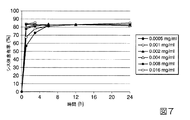
The effect of iron (III) chloride concentration on the cis isomerization reaction of lycopene when dichloromethane was used as a solvent was investigated. Specifically, a cis isomerization reaction was performed in the same manner as in Example 2 except that dichloromethane was used in place of ethyl acetate as a solvent, sampled from the reaction solution over time, and the cis isomer content (%) of lycopene The lycopene residual rate (%) and the cis-isomer content (%) were determined.
シス体含有率(%)の測定結果を図7に、リコピン残存率(%)の測定結果を図8に、シス体含有量(%)の算出結果を表4に、それぞれ示す。この結果、塩化鉄(III)の濃度が高いほど、リコピンのシス化速度と分解速度が速くなった。酢酸エチルやアセトンを用いた場合とは異なり、塩化鉄(III)の濃度が0.0005〜0.002mg/mLでも経時的にリコピンは分解されており、シス体含有率は80%以上と高いものの、シス体含有量は反応時間12時間以上で50%未満と低かった。リコピンの分解傾向はジクロロメタンを留去するまで続くことから、ジクロロメタンを溶媒とした場合には、シス異性化反応の反応時間を短く(例えば、1時間以上3時間未満)し、反応終了後直ちに溶媒留去処置を行うことが好ましい。 The measurement result of cis isomer content (%) is shown in FIG. 7, the measurement result of lycopene residual rate (%) is shown in FIG. 8, and the calculation result of cis isomer content (%) is shown in Table 4. As a result, the higher the iron (III) chloride concentration, the faster the lycopene cisification rate and decomposition rate. Unlike the case of using ethyl acetate or acetone, lycopene was decomposed over time even when the concentration of iron (III) chloride was 0.0005 to 0.002 mg / mL, and the cis-isomer content rate was as high as 80% or more. However, the cis content was as low as less than 50% at a reaction time of 12 hours or longer. Since the decomposition tendency of lycopene continues until the dichloromethane is distilled off, when dichloromethane is used as a solvent, the reaction time of the cis isomerization reaction is shortened (for example, 1 hour or more and less than 3 hours), and the solvent is used immediately after the reaction is completed. It is preferable to carry out a distillation treatment.
[実施例5]
溶媒として酢酸エチルを用いた場合の、リコピンのシス異性化反応に対する反応温度の影響を調べた。具体的には、塩化鉄(III)濃度を0.001mg/mLとし、反応温度を0、20、40、又は60℃とした以外は実施例2と同様にしてシス異性化反応を行い、反応溶液から経時的にサンプリングし、リコピンのシス体含有率(%)、リコピン残存率(%)、シス体含有量(%)を求めた。
[Example 5]
The effect of reaction temperature on the cis-isomerization reaction of lycopene when using ethyl acetate as a solvent was investigated. Specifically, the cis isomerization reaction was performed in the same manner as in Example 2 except that the iron (III) chloride concentration was 0.001 mg / mL and the reaction temperature was 0, 20, 40, or 60 ° C. Sampling was performed from the solution with time, and the cis-body content (%), lycopene residual rate (%), and cis-body content (%) of lycopene were determined.
シス体含有率(%)の測定結果を図9に、リコピン残存率(%)の測定結果を図10に、シス体含有量(%)の算出結果を表5に、それぞれ示す。この結果、反応温度が高いほど、リコピンのシス体含有率が高くなり、シス体含有量も高くなった。リコピン残存率は、60℃で反応時間24時間の場合に80%程度であったが、その他は全て90%以上と高く、ほとんどリコピンは分解していなかった。 The measurement result of cis isomer content (%) is shown in FIG. 9, the measurement result of lycopene residual rate (%) is shown in FIG. 10, and the calculation result of cis isomer content (%) is shown in Table 5. As a result, the higher the reaction temperature, the higher the cis-isomer content of lycopene and the higher the cis-isomer content. The lycopene residual rate was about 80% when the reaction time was 24 hours at 60 ° C., but the others were as high as 90% or more, and lycopene was hardly decomposed.
[実施例6]
溶媒としてアセトンを用いた場合の、リコピンのシス異性化反応に対する反応温度の影響を調べた。具体的には、溶媒として酢酸エチルに代えてアセトンを用いた以外は実施例5と同様にしてシス異性化反応を行い、反応溶液から経時的にサンプリングし、リコピンのシス体含有率(%)、リコピン残存率(%)、シス体含有量(%)を求めた。
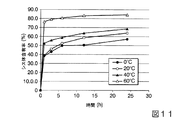
[Example 6]
The influence of reaction temperature on the cis-isomerization reaction of lycopene when acetone was used as a solvent was investigated. Specifically, a cis isomerization reaction was performed in the same manner as in Example 5 except that acetone was used instead of ethyl acetate as a solvent, sampled over time from the reaction solution, and the cis-body content (%) of lycopene The lycopene residual rate (%) and the cis-isomer content (%) were determined.
シス体含有率(%)の測定結果を図11に、リコピン残存率(%)の測定結果を図12に、シス体含有量(%)の算出結果を表6に、それぞれ示す。この結果、反応温度が高いほど、リコピンのシス体含有率が高くなり、シス体含有量も高くなった。リコピン残存率は、40〜60℃で反応時間24時間の場合に80%程度であったが、その他は全て90%以上と高く、ほとんどリコピンは分解していなかった。 The measurement result of the cis isomer content (%) is shown in FIG. 11, the measurement result of the lycopene residual rate (%) is shown in FIG. 12, and the calculation result of the cis isomer content (%) is shown in Table 6. As a result, the higher the reaction temperature, the higher the cis-isomer content of lycopene and the higher the cis-isomer content. The lycopene residual rate was about 80% when the reaction time was 24 hours at 40 to 60 ° C., but the others were as high as 90% or more, and almost no lycopene was decomposed.
[実施例7]
溶媒としてジクロロメタンを用いた場合の、リコピンのシス異性化反応に対する反応温度の影響を調べた。具体的には、溶媒として酢酸エチルに代えてジクロロメタンを用いた以外は実施例5と同様にしてシス異性化反応を行い、反応溶液から経時的にサンプリングし、リコピンのシス体含有率(%)、リコピン残存率(%)、シス体含有量(%)を求めた。
[Example 7]
The effect of reaction temperature on the cis isomerization reaction of lycopene when dichloromethane was used as a solvent was investigated. Specifically, a cis isomerization reaction was performed in the same manner as in Example 5 except that dichloromethane was used in place of ethyl acetate as a solvent, sampled over time from the reaction solution, and ciscopper content of lycopene (%) The lycopene residual rate (%) and the cis-isomer content (%) were determined.
シス体含有率(%)の測定結果を図13に、リコピン残存率(%)の測定結果を図14に、シス体含有量(%)の算出結果を表7に、それぞれ示す。この結果、反応温度が高いほど、リコピンのシス化速度と分解速度が速くなった。酢酸エチルやアセトンを用いた場合とは異なり、反応温度が0〜20℃の場合にも経時的にリコピンは分解されており、シス体含有率は80%以上と高いものの、シス体含有量は反応時間12時間以上で50%未満と低かった。 The measurement result of cis isomer content (%) is shown in FIG. 13, the measurement result of lycopene residual rate (%) is shown in FIG. 14, and the calculation result of cis isomer content (%) is shown in Table 7. As a result, the higher the reaction temperature, the faster the ciscopping rate and decomposition rate of lycopene. Unlike the case of using ethyl acetate or acetone, lycopene was decomposed over time even when the reaction temperature was 0 to 20 ° C., and the cis isomer content was as high as 80% or more. The reaction time was as low as less than 50% over 12 hours.
Claims (20)
Priority Applications (1)
| Application Number | Priority Date | Filing Date | Title |
|---|---|---|---|
| JP2014065020A JP6315560B2 (en) | 2014-03-27 | 2014-03-27 | Method for producing cis-isomer-containing lycopene and lycopene isomerization method |
Applications Claiming Priority (1)
| Application Number | Priority Date | Filing Date | Title |
|---|---|---|---|
| JP2014065020A JP6315560B2 (en) | 2014-03-27 | 2014-03-27 | Method for producing cis-isomer-containing lycopene and lycopene isomerization method |
Publications (2)
| Publication Number | Publication Date |
|---|---|
| JP2015187088A JP2015187088A (en) | 2015-10-29 |
| JP6315560B2 true JP6315560B2 (en) | 2018-04-25 |
Family
ID=54429571
Family Applications (1)
| Application Number | Title | Priority Date | Filing Date |
|---|---|---|---|
| JP2014065020A Active JP6315560B2 (en) | 2014-03-27 | 2014-03-27 | Method for producing cis-isomer-containing lycopene and lycopene isomerization method |
Country Status (1)
| Country | Link |
|---|---|
| JP (1) | JP6315560B2 (en) |
Families Citing this family (3)
| Publication number | Priority date | Publication date | Assignee | Title |
|---|---|---|---|---|
| JP7189613B2 (en) * | 2019-02-25 | 2022-12-14 | 学校法人 名城大学 | Poultry eggs containing lycopene |
| JP7665176B2 (en) | 2020-12-09 | 2025-04-21 | 学校法人 名城大学 | Functional food composition, functional food, and method for producing functional food composition |
| JP7674734B2 (en) * | 2021-07-21 | 2025-05-12 | 学校法人 名城大学 | Method for producing cis-carotenoid-containing composition |
Family Cites Families (7)
| Publication number | Priority date | Publication date | Assignee | Title |
|---|---|---|---|---|
| EP1716210B1 (en) * | 2004-02-10 | 2016-10-05 | Nestec S.A. | Compositions containing cis-isomers of carotenoids and corresponding method |
| EP1886584A1 (en) * | 2006-08-08 | 2008-02-13 | Indena S.P.A. | Stable and bioavailable compositions of isomers of lycopene for skin and hair |
| JP2010502572A (en) * | 2006-08-08 | 2010-01-28 | ネステク ソシエテ アノニム | Stable and bioavailable skin and hair compositions of carotenoid isomers |
| CN101575256B (en) * | 2009-06-10 | 2013-02-27 | 江南大学 | Lycopene cis-isomerization method and lycopene products with high cis-isomer content |
| CA2848955A1 (en) * | 2011-09-19 | 2013-03-28 | Omniactive Health Technologies Limited | An efficient process for the preparation of lycopene containing oleoresin and lycopene crystals for human consumption |
| JP6236599B2 (en) * | 2013-09-05 | 2017-11-29 | カゴメ株式会社 | Method for cis isomerization of lycopene |
| JP6179895B2 (en) * | 2013-09-05 | 2017-08-16 | カゴメ株式会社 | Method for cis isomerization of lycopene |
-
2014
- 2014-03-27 JP JP2014065020A patent/JP6315560B2/en active Active
Also Published As
| Publication number | Publication date |
|---|---|
| JP2015187088A (en) | 2015-10-29 |
Similar Documents
| Publication | Publication Date | Title |
|---|---|---|
| Honda et al. | Spectral characterisation of Z-isomers of lycopene formed during heat treatment and solvent effects on the E/Z isomerisation process | |
| Murakami et al. | Effect of thermal treatment and light irradiation on the stability of lycopene with high Z-isomers content | |
| Aman et al. | Isolation of carotenoids from plant materials and dietary supplements by high-speed counter-current chromatography | |
| Cooperstone et al. | Thermal processing differentially affects lycopene and other carotenoids in cis-lycopene containing, tangerine tomatoes | |
| Yuan et al. | Isomerization of trans-astaxanthin to cis-isomers in organic solvents | |
| Xu et al. | Effects of various factors of ultrasonic treatment on the extraction yield of all-trans-lycopene from red grapefruit (Citrus paradise Macf.) | |
| Gama et al. | Effect of thermal pasteurization and concentration on carotenoid composition of Brazilian Valencia orange juice | |
| Ge et al. | Extraction of natural vitamin E from wheat germ by supercritical carbon dioxide | |
| Khachik et al. | Separation and identification of carotenoids and carotenol fatty acid esters in some squash products by liquid chromatography. 1. Quantification of carotenoids and related esters by HPLC | |
| Mayer-Miebach et al. | Thermal processing of carrots: lycopene stability and isomerisation with regard to antioxidant potential | |
| Shi et al. | Effect of modifier on the composition and antioxidant activity of carotenoid extracts from pumpkin (Cucurbita maxima) by supercritical CO2 | |
| Honda et al. | Isolation and spectral characterization of thermally generated multi-Z-isomers of lycopene and the theoretically preferred pathway to di-Z-isomers | |
| Vallecilla-Yepez et al. | Increasing cis-lycopene content of the oleoresin from tomato processing byproducts using supercritical carbon dioxide | |
| Qiu et al. | Effect of heating on solid β-carotene | |
| Takehara et al. | Isolation and characterization of (15Z)-lycopene thermally generated from a natural source | |
| JP6236599B2 (en) | Method for cis isomerization of lycopene | |
| Kaiser et al. | A small-scale method for quantitation of carotenoids in bacteria and yeasts | |
| JP6735781B2 (en) | Method for producing cis-lycopene-containing composition, method for promoting isomerization of lycopene, and catalyst for lycopene isomerization | |
| JP6315560B2 (en) | Method for producing cis-isomer-containing lycopene and lycopene isomerization method | |
| Watanabe et al. | Rapid and selective concentration of lycopene Z-isomers from tomato pulp by supercritical CO2 with co-solvents | |
| WO2013002398A1 (en) | Method for producing carotenoid composition | |
| Lilwani et al. | Extraction and isolation of lycopene form various natural sources | |
| Derrien et al. | Optimization of a sustainable purification protocol for lutein and chlorophyll from spinach by-products by a saponification procedure using Box Behnken design and desirability function | |
| Murakami et al. | Thermal isomerization of (all-E)-lycopene and separation of the Z-isomers by using a low boiling solvent: Dimethyl ether | |
| Figueira et al. | Ultrasound-assisted liquid-liquid extraction followed by ultrahigh pressure liquid chromatography for the quantification of major carotenoids in tomato |
Legal Events
| Date | Code | Title | Description |
|---|---|---|---|
| A621 | Written request for application examination |
Free format text: JAPANESE INTERMEDIATE CODE: A621 Effective date: 20161208 |
|
| A977 | Report on retrieval |
Free format text: JAPANESE INTERMEDIATE CODE: A971007 Effective date: 20170803 |
|
| A131 | Notification of reasons for refusal |
Free format text: JAPANESE INTERMEDIATE CODE: A131 Effective date: 20170815 |
|
| A521 | Request for written amendment filed |
Free format text: JAPANESE INTERMEDIATE CODE: A523 Effective date: 20171005 |
|
| A131 | Notification of reasons for refusal |
Free format text: JAPANESE INTERMEDIATE CODE: A131 Effective date: 20171205 |
|
| A521 | Request for written amendment filed |
Free format text: JAPANESE INTERMEDIATE CODE: A523 Effective date: 20180125 |
|
| TRDD | Decision of grant or rejection written | ||
| A01 | Written decision to grant a patent or to grant a registration (utility model) |
Free format text: JAPANESE INTERMEDIATE CODE: A01 Effective date: 20180227 |
|
| A61 | First payment of annual fees (during grant procedure) |
Free format text: JAPANESE INTERMEDIATE CODE: A61 Effective date: 20180322 |
|
| R150 | Certificate of patent or registration of utility model |
Ref document number: 6315560 Country of ref document: JP Free format text: JAPANESE INTERMEDIATE CODE: R150 |
|
| R250 | Receipt of annual fees |
Free format text: JAPANESE INTERMEDIATE CODE: R250 |
|
| R250 | Receipt of annual fees |
Free format text: JAPANESE INTERMEDIATE CODE: R250 |
|
| R250 | Receipt of annual fees |
Free format text: JAPANESE INTERMEDIATE CODE: R250 |
|
| R250 | Receipt of annual fees |
Free format text: JAPANESE INTERMEDIATE CODE: R250 |
|
| R250 | Receipt of annual fees |
Free format text: JAPANESE INTERMEDIATE CODE: R250 |
|
| R250 | Receipt of annual fees |
Free format text: JAPANESE INTERMEDIATE CODE: R250 |