JP6524908B2 - Bread and confectionery dough containing a protease - Google Patents
Bread and confectionery dough containing a protease Download PDFInfo
- Publication number
- JP6524908B2 JP6524908B2 JP2015508809A JP2015508809A JP6524908B2 JP 6524908 B2 JP6524908 B2 JP 6524908B2 JP 2015508809 A JP2015508809 A JP 2015508809A JP 2015508809 A JP2015508809 A JP 2015508809A JP 6524908 B2 JP6524908 B2 JP 6524908B2
- Authority
- JP
- Japan
- Prior art keywords
- bread
- dough
- weight
- confectionery
- parts
- Prior art date
- Legal status (The legal status is an assumption and is not a legal conclusion. Google has not performed a legal analysis and makes no representation as to the accuracy of the status listed.)
- Active
Links
Classifications
-
- A—HUMAN NECESSITIES
- A21—BAKING; EDIBLE DOUGHS
- A21D—TREATMENT OF FLOUR OR DOUGH FOR BAKING, e.g. BY ADDITION OF MATERIALS; BAKING; BAKERY PRODUCTS
- A21D2/00—Treatment of flour or dough by adding materials thereto before or during baking
- A21D2/08—Treatment of flour or dough by adding materials thereto before or during baking by adding organic substances
- A21D2/14—Organic oxygen compounds
- A21D2/145—Acids, anhydrides or salts thereof
-
- A—HUMAN NECESSITIES
- A21—BAKING; EDIBLE DOUGHS
- A21D—TREATMENT OF FLOUR OR DOUGH FOR BAKING, e.g. BY ADDITION OF MATERIALS; BAKING; BAKERY PRODUCTS
- A21D2/00—Treatment of flour or dough by adding materials thereto before or during baking
- A21D2/08—Treatment of flour or dough by adding materials thereto before or during baking by adding organic substances
- A21D2/14—Organic oxygen compounds
- A21D2/16—Fatty acid esters
-
- A—HUMAN NECESSITIES
- A21—BAKING; EDIBLE DOUGHS
- A21D—TREATMENT OF FLOUR OR DOUGH FOR BAKING, e.g. BY ADDITION OF MATERIALS; BAKING; BAKERY PRODUCTS
- A21D8/00—Methods for preparing or baking dough
- A21D8/02—Methods for preparing dough; Treating dough prior to baking
- A21D8/04—Methods for preparing dough; Treating dough prior to baking treating dough with microorganisms or enzymes
- A21D8/042—Methods for preparing dough; Treating dough prior to baking treating dough with microorganisms or enzymes with enzymes
Landscapes
- Life Sciences & Earth Sciences (AREA)
- Engineering & Computer Science (AREA)
- Food Science & Technology (AREA)
- Microbiology (AREA)
- Bakery Products And Manufacturing Methods Therefor (AREA)
Description
本発明は、プロテアーゼを含有するパン・菓子用生地に関する。 The present invention relates to bread and confectionery dough containing a protease.
パン生地においては、膨化や保形の為にグルテンを形成させ強固なネットワークを形成することが必要で、一般的に蛋白質含量の高い強力粉を使用する。しかし、生地中で一旦形成されたグルテンは、加熱調理後もパンの中に残存し、その影響で、加熱調理後のパンの食感が硬くねちゃついて口の中に残留感のある口溶けの悪い食感となってしまう。 In bread dough, it is necessary to form gluten and form a strong network for expansion and shape retention, and generally a strong flour with high protein content is used. However, gluten, which is once formed in the dough, remains in the bread after cooking, and as a result, the texture of the bread after cooking becomes hard and messy, and the mouth melts with a feeling of remaining in the mouth It has a bad texture.
またケーキ等の菓子生地においては、生地中の大量の気泡を加熱調理中安定に保つ為に、生地には若干の粘性が必要である。このためグルテンの形成がある程度必要であるが、パンほどは不要で、コスト面などからも蛋白質含量が7〜9重量%程度の薄力粉が使用される。近年、ケーキ等の工業生産においては、簡便で連続生産が可能なオールインミックス製法が主流であり、該製法でケーキ等を製造すると蛋白質含量の少ない薄力粉を使用しても、結局生地が捏ねられ過ぎてグルテン量が多くなってしまうため、加熱調理後のケーキの食感が硬くねちゃつき、口の中に残留感のある口溶けが悪いものとなってしまう。 In addition, in confectionery materials such as cakes, in order to keep a large amount of air bubbles in the material stable during cooking, the material needs some viscosity. For this reason, the formation of gluten is necessary to some extent, but it is not necessary as much as bread, and weak flour having a protein content of about 7 to 9% by weight is used also from the viewpoint of cost. In recent years, in the industrial production of cakes and the like, the all-in-mix manufacturing method which is simple and capable of continuous production is the mainstream, and when cakes etc. are manufactured by this manufacturing method, the dough is eventually kneaded even if using weak flour with low protein content. Because the amount of gluten passes too much, the texture of the cake after cooking becomes hard and messy, resulting in poor mouth melting with a residual feeling in the mouth.
そこで、さっくりとして口溶けのよいパン・菓子を製造する方法として、アミラーゼや乳化剤を使用して製造する方法が一般的であるが、残留グルテン量は変わらず、上記食感の課題を改善できていない。さらに、プロテアーゼを用いてグルテンを生地中で処理させる方法として例えば、中間熱安定性または熱安定性のセリンまたは金属プロテアーゼをパン菓子製品に添加する方法があるが(特許文献1)、さっくりとして口溶けに関してはある程度の改善は見られるものの満足できるレベルにはなく、安定的に良質なパン・菓子を大量生産することは極めて難しい。 Therefore, as a method for producing well-boiled bread and confectionery in a smooth mouth, it is common to use amylase and an emulsifier, but the amount of residual gluten is not changed, and the above-mentioned problem of texture can be improved. Absent. Furthermore, as a method of processing gluten in dough using protease, for example, there is a method of adding intermediate heat stable or heat stable serine or metalloprotease to a bakery product (Patent Document 1). With regard to mouth melting, although some improvement can be seen, it is not at a satisfactory level, and it is extremely difficult to stably produce high quality bread and confectionery.
また、至適温度が85℃以下、酵素が活性を失う失活温度が100℃以下のアミラーゼ類やプロテアーゼ類の酵素を0.1〜0.6U/g添加した油相を水相と乳化した油中水型乳化物中に、グリセリン脂肪酸エステル、蔗糖脂肪酸エステル、ソルビタン脂肪酸エステル、プロピレングリコール脂肪酸エステル、レシチン、ポリグリセリン縮合脂肪酸エステル等の乳化剤を特定量含有する油脂組成物中1〜15重量%と、マルトースとを含有した製パン用油脂組成物が開示されているが(特許文献2)、食感がソフトで、かつ老化を遅らせてソフトな食感が長く保持されることが目的のため、酵素の添加量は少なく、逆に乳化剤の添加量が多いため、さっくりさと口溶けの改善効果を有していない。 In addition, the oil phase was emulsified with the aqueous phase by adding 0.1 to 0.6 U / g of enzymes of amylases and proteases whose optimum temperature is 85 ° C. or less and the inactivation temperature at which the enzyme loses activity is 100 ° C. or less 1 to 15% by weight in a fat-and-oil composition containing a specific amount of an emulsifier such as glycerin fatty acid ester, sucrose fatty acid ester, sorbitan fatty acid ester, propylene glycol fatty acid ester, lecithin, polyglycerin condensed fatty acid ester in a water-in-oil type emulsion And a maltose-containing fat and oil composition for bread making has been disclosed (Patent Document 2), but the texture is soft, aging is delayed, and the soft texture is maintained for a long time. Because the amount of enzyme added is small and the amount of emulsifier added is large, it does not have the effect of improving refreshing and mouth melting.
更には、特定の固体脂含量を有する油脂とプロピレングリコール脂肪酸エステル、ポリグリセリン縮合リシノレイン酸エステル0.1〜4質量%及び糖を含有し、食感やその保存安定性に優れた焼き菓子用油中水型乳化組成物が開示されているが(特許文献3)、さっくりさと口溶けを満足させるには至っていない。 Furthermore, it contains oil and fat having a specific solid fat content, propylene glycol fatty acid ester, 0.1 to 4% by mass of polyglycerin condensed ricinoleate ester and sugar, and is an oil for baked goods having excellent texture and its storage stability Although a water-in-water emulsion composition has been disclosed (Patent Document 3), it has not been achieved to satisfy refreshing and mouth melting.
また、水で膨潤させた加工澱粉と、パパインなどのプロテアーゼが力価に換算して好ましくは0.66〜3.3AU単位、油脂中に分散しており、乳化物でない油脂組成物を、パン生地に使用する小麦粉100部に対して好ましくは5〜35部(生地中の小麦粉100gあたりに対するプロテアーゼの添加量は0.033〜1.155Uとなる。)用いたパン生地が開示されているが(特許文献4、請求項1、段落[0015]、[0022])、さっくりとした食感は満足のいくレベルではなく、ねちゃつきのある食感のパンになる。 In addition, a modified starch swollen with water and a protease such as papain are preferably dispersed in fats and oils, preferably 0.66 to 3.3 AU units in terms of titer, and are not emulsified, fat and oil composition, bread dough Although 5 to 35 parts (the addition amount of protease per 100 g of wheat flour in the dough is 0.033 to 1.155 U) is preferably disclosed with respect to 100 parts of wheat flour used in the invention (patented) Document 4, claim 1, paragraphs [0015], [0022]), the crunchy texture is not a satisfactory level, it becomes a pan of a jerky texture.
本発明の目的は、経時変化によるべたつきの増加や保形性の低下が起こらないなど、生地安定性の高いパン・菓子用生地、また該生地を用いてなり、異味がなく、さっくりと軟らかい食感で口溶けのよいパン・菓子を提供することである。 An object of the present invention is a dough for bread and confectionery having high dough stability, such as increase in stickiness and decrease in shape retention due to time-lapse change, and also using the dough, having no unusual taste, smooth and soft It is to provide well-cooked bread and confectionery with a texture.
本発明者らは上記課題を解決するために鋭意研究を重ねた結果、特定の小麦粉100重量部に対して、HLB7以下のポリグリセリン縮合リシノレイン酸エステルなど特定の乳化剤を特定量、及び、特定のエンド型プロテアーゼを特定量含む生地を加熱調理して得られたパン・菓子は、作業時に生地がべたついたり、生地粘度が極端に低下することなく、また得られる生地は経時変化によるべたつきの増加や保形性の低下が起こらないなど生地安定性が高く、しかも異味がなく、さっくりとした食感で口溶けのよいことを見出し、本発明を完成するに至った。 As a result of intensive studies to solve the above problems, the present inventors have determined that a specific amount of a specific emulsifier such as polyglycerin condensed ricinoleate ester of HLB 7 or less is specific to 100 parts by weight of a specific flour. The bread and confectionery obtained by cooking the dough containing a specific amount of endo-type protease does not become sticky during the operation or the dough viscosity is extremely reduced, and the resulting dough has an increase in stickiness due to aging and It has been found that the dough stability is high such as no reduction in shape-retaining property occurs, moreover, there is no unusual taste, and the mouthfeel is good with a smooth texture, resulting in the completion of the present invention.
即ち、本発明の第一は、生地中の小麦粉の蛋白質含量が7.0〜17.0重量%であり、小麦粉100重量部に対して、HLB7以下のポリグリセリン縮合リシノレイン酸エステル、HLB7以下のショ糖脂肪酸エステル、HLB7以下のポリグリセリン脂肪酸エステル、ステアロイル乳酸カルシウム及びステアロイル乳酸ナトリウムからなる群より選ばれる少なくとも1種の乳化剤を0.01〜0.5重量部含有し、40℃での相対活性が40%以下且つ至適温度が60〜85℃であるエンド型プロテアーゼを小麦粉100gあたり50〜3300U含有するパン・菓子用生地に関する。好ましい実施態様は、さらに、小麦粉100重量部に対して還元剤0.0001〜0.1重量部を含有する上記記載のパン・菓子用生地に関する。より好ましくは、小麦粉100重量部に対して酸化剤0.0001〜0.05重量部を含有する上記記載のパン・菓子用生地、更に好ましくは、小麦粉100重量部に対して、SFCが10℃で70%以上、且つ30℃のSFC/10℃のSFCが0.4以下である油脂組成物1〜200重量部を含有する上記記載のパン・菓子用生地、特に好ましくは、小麦粉100重量部に対して増粘剤0.01〜5.0重量部を含有する上記記載のパン・菓子用生地、極めて好ましくは、さらに、小麦粉100重量部に対して苦味低減剤0.0001〜0.5重量部を含有する上記記載のパン・菓子用生地、最も好ましくは、前記40℃での相対活性が40%以下で且つ至適温度が60〜85℃であるエンド型プロテアーゼが、サームス・アクアチクス(Thermus aquaticus)LMG8924由来のTaqプロテアーゼ、サーモアクチノミセス・ブルガリス(Thermoactinomyces vulgaris)由来のサーミターゼ、バシラス・サーモプロテオリチクス(Bacillus thermoproteolyticus)由来のサーモリシン、バシラス・リケニホルミス(Bacillus licheniformis)由来のズブチリシン、パパイア属・パパイア(Carica papaya)由来のパパイン及びアナナス・コモサス(Ananas comosus)由来のブロメラインからなる群より選ばれる少なくとも1種である上記記載のパン・菓子用生地に関する。本発明の第二は、上記記載のパン・菓子用生地を加熱調理してなるパン・菓子に関する。本発明の第三は、上記記載のパン・菓子用生地配合からエンド型プロテアーゼ及び乳化剤を除いた以外は同じ配合のパン・菓子用生地を5℃以上40℃以下で捏ねあげ、更に加熱中の生地温度が90℃以上120℃未満で1〜30分間加熱調理してなるパン・菓子に対して、破断測定における相対破断距離が95%以下である上記記載のパン・菓子に関する。 That is, in the first aspect of the present invention, the protein content of wheat flour in the dough is 7.0 to 17.0% by weight, and polyglycerin condensed ricinoleate having HLB 7 or less and HLB 7 or less per 100 parts by weight of wheat flour Containing 0.01 to 0.5 parts by weight of at least one emulsifier selected from the group consisting of sucrose fatty acid ester, polyglycerin fatty acid ester of HLB 7 or less, stearoyl calcium lactate and stearoyl sodium lactate, and relative activity at 40 ° C. The present invention relates to a dough for bread and confectionery containing 50 to 3300 U of endo-type protease per 40 g of wheat flour having an L.sub.40% or less and an optimum temperature of 60 to 85.degree. A preferred embodiment relates to the above-mentioned bread and confectionery dough, further comprising 0.0001 to 0.1 parts by weight of a reducing agent based on 100 parts by weight of wheat flour. More preferably, the above-mentioned bread and confectionery dough containing 0.0001 to 0.05 parts by weight of an oxidizing agent per 100 parts by weight of wheat flour, still more preferably SFC at 10 ° C. per 100 parts by weight of wheat flour Bread and confectionery dough as described above containing 1 to 200 parts by weight of a fat and oil composition having an SFC of 70% or more and an SFC at 30 ° C. of 10 ° C. of 0.4 or less, particularly preferably 100 parts by weight of wheat flour The above-mentioned bread and confectionery dough containing 0.01 to 5.0 parts by weight of a thickener, very preferably a bitterness reducing agent 0.0001 to 0.5 per 100 parts by weight of wheat flour The above-mentioned bread and confectionery dough containing parts by weight, most preferably, the endo-type protease having a relative activity at 40 ° C. of 40% or less and an optimum temperature of 60 to 85 ° C. Thermus aquaticus) TMG protease from LMG8924, thermitase from Thermoactinomyces vulgaris, thermolysin from Bacillus thermoproteolyticus, the Bacillus licheniformis-derived subtilisin, -The bread and confectionery dough as described above, which is at least one selected from the group consisting of papain derived from papaya (Carica papaya) and bromelain derived from Ananas comosus. The second of the present invention relates to a bread and confectionery obtained by cooking the bread and confectionery dough described above. In the third aspect of the present invention, bread and confectionery dough of the same composition except the endo-protease and the emulsifier is removed from the above-mentioned dough composition for bread and confectionery, and kneaded at 5 ° C. or more and 40 ° C. or less. The present invention relates to the above-described bread and confectionery having a relative breaking distance of 95% or less in breaking measurement with respect to bread and confectionery prepared by cooking at a dough temperature of 90 ° C. or more and less than 120 ° C. for 1 to 30 minutes.
本発明に従えば、経時変化によるべたつきの増加や保形性の低下が起こらないなど、生地安定性の高いパン・菓子用生地、また該生地を用いてなる、異味がなく、さっくりと軟らかい食感で口溶けのよいパン・菓子を提供することができる。加えて、海外産などの蛋白質含量の多い小麦粉を使っても、軟らかさをコントロールしたパン・菓子を容易に製造することができる。 According to the present invention, there is no increase in stickiness due to aging and no decrease in shape retention property, bread and confectionery dough having high dough stability, and the dough having no unusual taste and being completely soft according to the present invention. It is possible to provide well-cooked bread and confectionery with a texture. In addition, it is possible to easily manufacture bread and confectionery with controlled softness even when using wheat flour high in protein content such as that produced overseas.
以下、本発明につき、さらに詳細に説明する。本発明のパン・菓子用生地は、小麦粉などの穀粉類を始めとする原材料を加熱調理前に混合した生地混合物に適宜水を加えて捏ね上げたもので、特定の小麦粉を含有する生地に対し、特定のエンド型プロテアーゼ及び特定の乳化剤を特定量含有することを特徴とする。そして、前記パン・菓子用生地を加熱調理して本発明のパン・菓子を得る。 Hereinafter, the present invention will be described in more detail. The dough for bread and confectionery according to the present invention is a dough mixture prepared by adding water to a dough mixture prepared by mixing raw materials such as flour and the like prior to heating and cooking. , A specific endo-type protease and a specific emulsifier. Then, the bread and confectionery dough is cooked to obtain the bread and confectionery of the present invention.
本発明のパンとは、小麦粉を原料として加熱調理して製造されるものであれば、その他特に限定はなく、例えば、食パン、あんパンやクリームパン等の菓子パン、クロワッサン等のデニッシュペストリー、ロールパン、フランスパン等の堅焼きパン、バラエティブレッド、サンドイッチ等の調理パン、蒸しパンまたはそれらの二次加工品、或いはレンジ調理を必要とするもの等、いかなるパンでもよい。 The bread of the present invention is not particularly limited as long as it is manufactured by cooking using flour as a raw material, and there is no particular limitation, and for example, bread, pastry bread such as bean paste or cream bread, Danish pastry such as croissant, bread roll, It may be any bread such as hard-baked bread such as French bread, cooking bread such as variety bread, sandwich, steamed bread or their processed products, or those requiring range cooking.
本発明の菓子とは、小麦粉を原料として加熱調理して製造されるものであれば、それ以外には特に限定はなく、例えば、ショートケーキ等のスポンジケーキ類、パウンドケーキやマドレーヌ、フィナンシェ、バウムクーヘン等のバターケーキ類、シュー菓子類、サバラン等の発酵菓子類、ワッフル類、タルトやミルフィーユ等のフィユタージュ類、パンケーキやクレープ等のデザート菓子類、ドーナツ類、ビスケットやクッキー等のビスケット類、どら焼きや饅頭、カステラ、げっぺい等の和菓子類、あるいはこれら各種ケーキ類や菓子類にチョコレートやクリーム、ジャム、あんこ等のフィリングをコーティング、サンド、注入、包餡した加工品等、いかなる菓子でもよい。 The confectionery of the present invention is not particularly limited as long as it is manufactured by cooking using flour as a raw material, for example, sponge cakes such as short cakes, pound cakes, madeleine, financiers, baumkuchen, etc. Butter cakes such as butter, pastry cakes, fermented confectionery such as savalan, waffles, figutage such as tarts and milfeils, dessert confections such as pancake and crepe, biscuits such as donuts, biscuits and cookies Any confectionery may be used, such as baked goods, Japanese confectionery products such as castella and gepei, or various cakes and confectionery products coated with, coated with, filled with, filled with fillings such as chocolate, cream, jam, anko etc.
本発明のパン・菓子に用いる小麦粉は、蛋白質含量が7.0〜17.0重量%であることが好ましく、単一品種の小麦から製造された小麦粉、或いはそれらのブレンド品でもよい。蛋白質含量が7.0重量%未満であると、グルテンが過剰に形成されず、本発明の効果が享受できない場合がある。また蛋白質含量が17.0重量%を超えると、生地中で一旦形成されたグルテンが加熱調理後もパン・菓子の中にも存在し、その影響で、焼き上がりの食感が硬くねちゃつき、口の中に残留感のある口溶けが悪いものとなってしまう場合がある。なお、本発明において、小麦粉などの穀粉類は、あらかじめ水や他の原材料とある程度捏ねあげていても良いし、α化などを施していても良い。 The wheat flour used in the bread and confectionery of the present invention preferably has a protein content of 7.0 to 17.0% by weight, and may be wheat flour produced from a single variety of wheat, or a blended product thereof. If the protein content is less than 7.0% by weight, gluten is not excessively formed, and the effects of the present invention may not be obtained. In addition, when the protein content exceeds 17.0% by weight, gluten which is once formed in the dough is present in the bread and confectionery after cooking, and due to this, the baked texture becomes hard and messy May cause poor melting of the mouth with a residual feeling in the mouth. In the present invention, flours such as wheat flour may be previously kneaded with water and other raw materials to some extent, or may be subjected to gelatinization or the like.
本発明のパン・菓子に用いる乳化剤は、HLB7以下のポリグリセリン縮合リシノレイン酸エステル、HLB7以下のショ糖脂肪酸エステル、HLB7以下のポリグリセリン脂肪酸エステル、ステアロイル乳酸カルシウム及びステアロイル乳酸ナトリウムからなる群より選ばれる少なくとも1種が好ましく、HLB7以下のポリグリセリン縮合リシノレイン酸エステル、ステアロイル乳酸カルシウム及びステアロイル乳酸ナトリウムからなる群より選ばれる少なくとも1種を使用することがより好ましい。 The emulsifier used for the bread and confectionery of the present invention is selected from the group consisting of polyglycerin condensed ricinoleate of HLB 7 or less, sucrose fatty acid ester of HLB 7 or less, polyglycerin fatty acid ester of HLB 7 or less, stearoyl calcium lactate and stearoyl sodium lactate It is more preferable to use at least one type selected from the group consisting of polyglycerin condensed ricinoleate ester having HLB 7 or less, calcium stearoyl lactate and sodium stearoyl lactate, which is at least one kind.
前記ポリグリセリン縮合リシノレイン酸エステルは、HLB5以下がより好ましく、3以下が更に好ましい。ポリグリセリン縮合リシノレイン酸エステルのHLBが7を超えると、食感がねちゃついて口溶けが悪くなる場合がある。また、リシノレイン酸の重合度については何ら限定されない。 HLB 5 or less is more preferable, and 3 or less is still more preferable for the said polyglycerol condensation ricinoleic acid ester. When the HLB of polyglycerin condensed ricinoleate exceeds 7, the mouth feel may be deteriorated and the dissolution in the mouth may be deteriorated. Further, the polymerization degree of ricinoleic acid is not limited at all.
前記ショ糖脂肪酸エステルは、HLB5以下がより好ましく、3以下が更に好ましい。ショ糖脂肪酸エステルのHLBが7を超えると、食感がねちゃついて口溶けが悪くなる場合がある。また、ショ糖に結合する脂肪酸の種類については何ら限定されない。 HLB 5 or less is more preferable, and 3 or less is still more preferable for the said sucrose fatty acid ester. When the HLB of sucrose fatty acid ester exceeds 7, the texture may be jerky and the mouth melting may be deteriorated. Further, the type of fatty acid binding to sucrose is not limited at all.
前記ポリグリセリン脂肪酸エステルは、HLB5以下がより好ましい。ポリグリセリン脂肪酸エステルのHLBが7を超えると、食感がねちゃついて口溶けが悪くなる場合がある。また、グリセリンに対する脂肪酸のモル比は、1/3以上が好ましく、1/2以上がより好ましい。モル比が1/3未満では食感がねちゃついて口溶けが悪くなる場合がある。 The polyglycerin fatty acid ester is more preferably HLB 5 or less. When the HLB of the polyglycerin fatty acid ester exceeds 7, the texture may be catastrophic and the mouth melting may be deteriorated. Moreover, 1/3 or more is preferable and, as for the molar ratio of the fatty acid with respect to glycerol, 1/2 or more is more preferable. If the molar ratio is less than 1/3, the texture may be catastrophic and mouth melting may deteriorate.
前記ステアロイル乳酸カルシウムとステアロイル乳酸ナトリウムは、特にHLBについては限定されず、他の限定もない。 The stearoyl calcium lactate and sodium stearoyl sodium lactate are not particularly limited for HLB, and there is no other limitation.
これら乳化剤のパン・菓子用生地への添加量は、小麦粉100重量部に対して0.01〜0.5重量部が好ましく、0.05〜0.3重量部がより好ましい。乳化剤の添加量が0.01重量部よりも少ないと、口溶け改善効果が十分でない場合があり、0.5重量部より多くしても、口溶け改善効果がそれ以上見込めず、コスト上昇や乳化剤の異味による品質低下を招く場合がある。 0.01-0.5 weight part is preferable with respect to 100 weight parts of wheat flour, and, as for the addition amount to the dough for breads and confectionery of these emulsifiers, 0.05-0.3 weight part is more preferable. If the amount of the emulsifier added is less than 0.01 parts by weight, the mouth melting improving effect may not be sufficient, and if it is more than 0.5 parts by weight, the mouth melting improving effect can not be expected any more, and the cost increases It may lead to the deterioration of quality due to strange taste.
本発明のパン・菓子に用いるエンド型プロテアーゼは、40℃での相対活性が40%以下であることが好ましく、35%以下がより好ましく、30%以下が更に好ましい。40℃での相対活性が40%を超えると、加熱調理前の生地中でグルテンの分解が進み、生地がべたついたりして作業性が悪化したり、保形性や安定性が低下し、加熱調理時のパン・菓子の浮きが悪くなり、食感が硬くなる場合がある。ここでいう相対活性とは、酵素の至適温度における活性値に対する各温度での相対値(%)で表した数値である。 The endo-protease used in the bread and confectionery of the present invention preferably has a relative activity at 40 ° C. of 40% or less, more preferably 35% or less, and still more preferably 30% or less. When the relative activity at 40 ° C. exceeds 40%, the decomposition of gluten proceeds in the dough before cooking, the dough becomes sticky and the workability deteriorates, and the shape retention and stability decrease, and heating is performed. Lifting of bread and confectionery at the time of cooking may deteriorate and the texture may become hard. The relative activity as referred to herein is a numerical value represented by a relative value (%) at each temperature with respect to the activity value at the optimum temperature of the enzyme.
また前記エンド型プロテアーゼの至適温度は、60〜85℃であることが好ましい。エンド型プロテアーゼの至適温度が60℃より低いと、一般的なパン・菓子生地作製時の温度である10〜40℃でグルテンの分解が進み、生地がべたついて作業性が悪化したり、保形性や安定性が低下したりして、加熱調理時のパン・菓子の浮きが悪くなり、食感が硬くなる場合がある。エンド型プロテアーゼの至適温度が85℃より高いと、加熱調理後もプロテアーゼ活性が残存することがあり、加熱調理後のパン・菓子の品質管理が困難になる場合がある。 Moreover, it is preferable that the optimum temperature of the said endo-type protease is 60-85 degreeC. If the optimum temperature for endo-type protease is lower than 60 ° C, the decomposition of gluten proceeds at 10 to 40 ° C, which is the temperature at which general bread and confectionery dough is prepared, and the dough becomes sticky and the workability deteriorates or The formability and stability may be reduced, and the floating of bread and confectionery during cooking may be deteriorated, and the texture may become hard. When the optimum temperature of the endo-type protease is higher than 85 ° C., the protease activity may remain even after cooking, which may make it difficult to control the quality of bread and confectionery after cooking.
なお、前記プロテアーゼの相対活性は、例えば、食品添加物公定書(第8版)「ブロメライン」欄(421頁〜422頁)に記載の測定方法に従って測定することができる。当該測定方法の概要は、プロテアーゼがカゼインをどの程度消化できるか吸光度(275nm)により定量するというものであり、1分間にチロシン1μgに相当するアミノ酸を生成する酵素量が1Uである。 In addition, the relative activity of the said protease can be measured in accordance with the measuring method as described, for example in the food additive official approval (8th edition) "bromelain" column (p. 421-p. 422). The outline of the measurement method is to quantify the extent to which protease can digest casein by the absorbance (275 nm), and the amount of enzyme that produces an amino acid equivalent to 1 μg of tyrosine in 1 minute is 1 U.
本発明のエンド型プロテアーゼの具体例としては、サームス・アクアチクス(Thermus aquaticus)LMG8924由来のTaqプロテアーゼ、サーモアクチノミセス・ブルガリス(Thermoactinomyces vulgaris)由来のサーミターゼ、バシラス・サーモプロテオリチクス(Bacillus thermoproteolyticus)由来のサーモリシン、バシラス・リケニホルミス(Bacillus licheniformis)由来のズブチリシン、パパイア属・パパイア(Carica papaya)由来のパパイン、アナナス・コモサス(Ananas comosus)由来のブロメラインなどが挙げられ、それらの群より選ばれる少なくとも1種を使用することができる。 Specific examples of the endo-type protease of the present invention include Taq protease derived from Thermus aquaticus LMG 8924, thermitase derived from Thermoactinomyces vulgaris, and Bacillus thermoproteolyticus derived Thermolysin of Bacillus subtilis, subtilisin derived from Bacillus licheniformis (Bacillus licheniformis), papain derived from papaya genus Papaya (Carica papaya), bromelain derived from Ananas comosus, and the like, and at least one selected from the group Can be used.
本発明のエンド型プロテアーゼのパン・菓子用生地への添加量は、小麦粉100gあたり50〜3300Uであることが好ましく、より好ましくは300〜3000U、さらに好ましくは300〜2000Uである。エンド型プロテアーゼの添加量が50Uよりも少ないと、プロテアーゼの蛋白質分解作用が不足する場合があり、3300Uよりも多いと、生地中でグルテンの分解が進み、生地がべたついたりして作業性が悪化したり、保形性や安定性が低下し、加熱時のパン・菓子の浮きが悪くなり、食感が硬くなる場合がある。なお、上記した小麦粉に対するエンド型プロテアーゼの添加量(U)は、各プロテアーゼ(酵素)の比活性(U/g)と添加量(g)の積である。 The amount of endo-protease of the present invention to be added to bread and confectionery dough is preferably 50 to 3300 U, more preferably 300 to 3000 U, and still more preferably 300 to 2000 U per 100 g of wheat flour. If the amount of endo-protease added is less than 50 U, the proteolytic activity of the protease may be insufficient. If it is more than 3300 U, the degradation of gluten in the dough proceeds and the dough may become sticky, resulting in poor workability. In addition, the shape retention and stability may be reduced, and the floating of the bread and confectionery may be deteriorated during heating, and the texture may become hard. The addition amount (U) of endo-type protease to the above-mentioned wheat flour is the product of the specific activity (U / g) of each protease (enzyme) and the addition amount (g).
本発明のパン・菓子のさっくりさと口溶けを更に改善するためには、還元剤を添加することが好ましい。該還元剤は、生地中でグルテンのジスルフィド結合を還元するものであればいかなるものを使用しても良く、例えばグルタチオン、システインやこれら還元物質を含む原材料などが挙げられる。還元剤の添加量は、小麦粉100重量部に対して0.0001〜0.1重量部が好ましく、0.001〜0.05重量部がより好ましい。還元剤の添加量が0.0001重量部よりも少ないと還元剤による効果が得られない場合があり、0.1重量部を超えると生地がダレる場合がある。 In order to further improve the freshness and mouth melting of the bread and confectionery of the present invention, it is preferable to add a reducing agent. Any reducing agent may be used as long as it reduces gluten disulfide bonds in the dough, and examples thereof include glutathione, cysteine and raw materials containing these reducing substances. The addition amount of the reducing agent is preferably 0.0001 to 0.1 parts by weight, and more preferably 0.001 to 0.05 parts by weight with respect to 100 parts by weight of wheat flour. If the amount of the reducing agent added is less than 0.0001 parts by weight, the effect of the reducing agent may not be obtained, and if it exceeds 0.1 parts by weight, the dough may sag.
本発明において、分割、成型、充填時などの生地物性や加熱調理後のボリュームをより良くするためには、生地に酸化剤を添加することが好ましい。該酸化剤は、ジスルフィド結合を増加させるものであればいかなるものを使用しても良く、例えばアスコルビン酸、シスチン、臭素酸カリウムやこれらと同様の作用効果を有するグルコースオキシダーゼなどが挙げられ、それらの群より選ばれる少なくとも1種を使用することができる。 In the present invention, in order to improve the physical properties of the dough at the time of division, molding, filling and the like and the volume after cooking, it is preferable to add an oxidizing agent to the dough. Any oxidizing agent may be used as long as it increases disulfide bonds, and examples thereof include ascorbic acid, cystine, potassium bromate and glucose oxidase having the same function and effect as these, and the like. At least one selected from the group can be used.
グルコースオキシダーゼ以外の酸化剤を使用する場合の添加量は、小麦粉100重量部に対して0.0001〜0.05重量部が好ましい。前記酸化剤の添加量が0.0001重量部よりも少ないと生地のべたつき、伸展性、作業性やボリュームの改善効果がやや劣る場合があり、0.05重量部を超えると生地が強くなって痛んだり、さっくりした食感が得られない場合がある。また、グルコースオキシダーゼを使用する場合の添加量は、小麦粉100gあたり0.1〜30Uであることが好ましい。グルコースオキシダーゼの添加量が0.1Uよりも少ないと生地のべたつき、伸展性、作業性やボリュームの改善効果がやや劣る場合があり、30Uを超えると生地が強くなって痛んだり、さっくりした食感が得られない場合がある。なお、前記グルコースオキシダーゼの酵素活性は、食品添加物公定書(第8版)に準拠して測定される値である。 The amount of addition in the case of using oxidizing agents other than glucose oxidase is preferably 0.0001 to 0.05 parts by weight with respect to 100 parts by weight of wheat flour. If the amount of the oxidizing agent added is less than 0.0001 parts by weight, the effect of improving the stickiness, extensibility, workability and volume of the dough may be slightly inferior, and if it exceeds 0.05 parts by weight, the dough becomes strong. It may be painful or you may not get a crunchy texture. Moreover, it is preferable that the addition amount in the case of using glucose oxidase is 0.1-30 U per 100 g of wheat flour. If the amount of glucose oxidase added is less than 0.1 U, the effect of improving the stickiness, extensibility, workability, and volume of the dough may be slightly inferior. There are times when you can not get a feeling. In addition, the enzyme activity of the said glucose oxidase is a value measured based on the food additive official approval (8th edition).
本発明のパン・菓子において、さっくりさと口溶けに加え、軟らかさをより良くするためには、エンド型プロテアーゼに加えて他の酵素を生地に添加することが好ましい。該酵素としては、キシラナーゼ、α−アミラーゼ、β−アミラーゼ、グルコアミラーゼなどが挙げられ、それらの群より選ばれる少なくとも1種を使用することができる。エンド型プロテアーゼ以外の酵素の添加量は、小麦粉100gあたり0.5〜75Uであることが好ましい。前記酵素の添加量が0.5Uよりも少ないと効果が発揮されない場合があり、75Uを超えると生地物性が軟らかくなりすぎてべたついたり、伸展性が悪くなったり、作業性が著しく劣り、また、ボリュームが小さくなる場合がある。なお、前記キシラナーゼ、α−アミラーゼ、β−アミラーゼ、グルコアミラーゼなどの酵素活性は、食品添加物公定書(第8版)に準拠して測定される値である。 In the bread and confectionery of the present invention, it is preferable to add other enzymes to the dough in addition to endo-protease in order to improve the softness in addition to the crispness and mouth melting. Examples of the enzyme include xylanase, α-amylase, β-amylase, glucoamylase and the like, and at least one selected from the group can be used. The addition amount of enzymes other than endo-type protease is preferably 0.5 to 75 U per 100 g of wheat flour. If the amount of the enzyme added is less than 0.5 U, the effect may not be exhibited, and if it exceeds 75 U, the physical properties of the dough become too soft and sticky, the extensibility is deteriorated, the workability is remarkably deteriorated, The volume may be small. In addition, enzyme activities, such as the said xylanase, an alpha-amylase, a beta-amylase, and a glucoamylase, are values measured based on the food additive official approval (the 8th edition).
本発明のパン・菓子において、さっくりさと口溶けを更に改善するためには、SFCが10℃で70%以上、且つ30℃のSFC/10℃のSFCが0.4以下である油脂組成物を添加することが好ましい。該油脂組成物としては、ヤシ油、パーム核油、およびそれらの水素添加油脂やエステル交換油脂、パーム分別中融点部、カカオバター、シア脂などが挙げられ、それらの群より選ばれる少なくとも1種を使用することができる。前記油脂組成物の添加量は、小麦粉100重量部に対して1〜200重量部が好ましい。前記油脂組成物の添加量が1重量部よりも少ないとさっくりした食感や口溶けの改善効果がやや劣る場合があり、200重量部を超えるとボリュームが小さくなったり、食感が硬くなる場合がある。なお、前記SFCは、「油脂基準分析試験法、2.2.9−2003 固体脂含量(NMR法)」により測定される値である。 In the bread and confectionery of the present invention, in order to further improve the freshness and mouth melting, a fat and oil composition having an SFC of 70% or more at 10 ° C. and an SFC of 30 ° C. and an SFC of 10 ° C. of 0.4 or less It is preferable to add. Examples of the oil composition include coconut oil, palm kernel oil, hydrogenated fats and oils, transesterified fats and oils thereof, middle fraction of palm fraction, cocoa butter, shea butter and the like, and at least one selected from the group thereof Can be used. The addition amount of the oil composition is preferably 1 to 200 parts by weight with respect to 100 parts by weight of wheat flour. If the amount of the oil composition added is less than 1 part by weight, the improvement effect of the mouthfeel and the mouthfeel may be slightly inferior, and if it exceeds 200 parts by weight, the volume may be reduced or the texture may be hard. There is. In addition, said SFC is a value measured by "the fat-and-oil reference | standard analysis test method, 2.2.9-2003 solid fat content (NMR method)."
本発明のパン・菓子において、さっくりさと口溶けに加え、軟らかさ、分割、成型、充填時などの生地物性、加熱調理後のボリュームをより良くするためには、増粘剤を添加することが好ましい。該増粘剤としては、ペクチン、グアガム、キサンタンガム、アルギン酸エステルなどが挙げられ、それらの群より選ばれる少なくとも1種を使用することができる。増粘剤の添加量は、小麦粉100重量部に対して0.01〜5.0重量部が好ましい。増粘剤の添加量が0.01重量部よりも少ないと生地のべたつき、伸展性、作業性やボリュームの改善効果がやや劣る場合があり、5.0重量部を超えるとさっくりとした食感が得られない場合がある。 In the bread and confectionery of the present invention, it is possible to add a thickener in order to improve softness, physical properties of the dough at the time of division, molding, filling, etc. and heating after cooking, in addition to crispness and mouth melting. preferable. Examples of the thickener include pectin, guar gum, xanthan gum, alginic acid ester and the like, and at least one selected from the group can be used. The addition amount of the thickener is preferably 0.01 to 5.0 parts by weight with respect to 100 parts by weight of wheat flour. If the amount of the thickener added is less than 0.01 parts by weight, the effect of improving the stickiness, extensibility, workability, and volume of the dough may be slightly inferior, and if it exceeds 5.0 parts by weight, the food is smooth There are times when you can not get a feeling.
本発明のパン・菓子に使用できる前記以外の原材料としては、通常パン・菓子に使用されるいかなる原材料を使用してもよく、必要に応じて、前記以外の油脂製品、糖類、卵、乳製品、ココア、でん粉、穀物粉、食塩、フルーツ、ナッツ、香辛料、酵母、酒、水及びそれらの加工品、前記以外の乳化剤、香料、着色料、膨張剤、前記以外の酸化剤、酸化防止剤、前記以外の増粘剤、酸味料、甘味料、pH調整剤、保存料、前記以外の酵素、イーストフード、その他の生地改良剤等の食品添加物を添加してもよい。 As raw materials other than the above which can be used for bread and confectionery of the present invention, any raw materials generally used for bread and confectionery may be used, and if necessary, oil and fat products other than the above, sugars, eggs, dairy products , Cocoa, starch, cereal flour, salt, fruit, nuts, spices, yeast, liquor, water and processed products thereof, emulsifiers other than the above, flavors, coloring agents, swelling agents, oxidants other than the above, antioxidants, Food additives such as thickeners other than the above, acidulants, sweeteners, pH adjusters, preservatives, enzymes other than the above, yeast food, and other dough improvers may be added.
また、小麦粉以外の原料である糖類、卵、乳製品、フルーツなどの風味原料の使用量が少なく、比較的淡泊な風味である食パン、堅焼きパン、調理パン、蒸しパンなどのパンや菓子においては、エンド型プロテアーゼの作用で生成する蛋白分解物による苦味が感じられる場合があり、その場合は苦味低減剤を添加することもできる。苦味低減剤としては、例えば、香料、甘味料、乳化剤、キレート剤などの食品添加物、糖類、蛋白質類、油脂類、塩類、果汁、ペプチド分解酵素やペプチド合成酵素などの酵素類、苦味受容細胞ブロッキング剤などが例示できる。特に分子量5000以上である甘味蛋白質やさとうきび抽出物が好ましく、ソーマチンがより好ましい。苦味低減剤のパン・菓子用生地混合物への添加量は、小麦粉100重量部に対して0.0001〜0.5重量部添加すればよい。 In addition, in bread and confectionery such as hard-baked bread, cooked bread, steamed bread, etc., the amount of flavor materials such as saccharides, eggs, dairy products and fruits other than flour is small and the flavor is relatively light. In some cases, a bitter taste may be felt due to a proteolysis product generated by the action of endo type protease, and in that case, a bitter taste reducing agent can be added. Examples of bitter taste reducing agents include food additives such as flavors, sweeteners, emulsifiers, chelating agents, saccharides, proteins, oils and fats, salts, fruit juices, enzymes such as peptide degrading enzymes and peptide synthetases, bitter taste receptor cells A blocking agent etc. can be illustrated. In particular, sweet protein and sugar cane extract having a molecular weight of 5,000 or more are preferable, and thaumatin is more preferable. The amount of the bitter taste reducing agent to be added to the bread / confectionery dough mixture may be 0.0001 to 0.5 parts by weight with respect to 100 parts by weight of wheat flour.
本発明において、前記エンド型プロテアーゼ、前記乳化剤、前記還元剤やその他の原材料は、いずれも最終的に加熱調理する前のパン・菓子用生地作製工程のどの段階で生地混合物に添加しても良く、全量を一括で添加してもよいし、複数回に分割して添加してもよく、更に添加する形態はそのまま生地混合物に添加してもよいし、水中油型乳化油脂組成物や油中水型乳化油脂組成物などの乳化物やショートニングなどの油脂中に含有させて添加してもよい。 In the present invention, the endo-protease, the emulsifying agent, the reducing agent and other raw materials may be added to the dough mixture at any stage of the bread / confectionery dough preparation process before final cooking. The whole amount may be added all at once, or may be divided and added several times, and the form to be added may be added to the dough mixture as it is, or it may be added to an oil-in-water emulsified oil composition or oil You may make it contain in fats and oils, such as emulsion, such as a water type emulsified fats-and-oils composition, and shortening, and add.
前記水中油型乳化油脂組成物は、例えば次のように製造することができる。まず油脂に、前記ポリグリセリン縮合リシノレイン酸エステル、ショ糖脂肪酸エステル、ポリグリセリン脂肪酸エステル及びステアロイル乳酸カルシウムからなる群より選ばれる少なくとも1種を添加し、必要に応じてその他の油溶性乳化剤や他の油溶性成分を溶解させた油相部を調製する。次に、水に前記エンド型プロテアーゼとステアロイル乳酸ナトリウム、必要に応じて還元剤、酸化剤、増粘剤、その他の酵素など水溶性成分を添加し、さらに必要に応じて糖類や糖アルコール類、その他水溶性成分を溶解させた水相部を調製し、攪拌しながら前記水相部に前記油相部を投入して水中油型乳化液を調製する。 The oil-in-water type emulsified fat and oil composition can be produced, for example, as follows. First, at least one selected from the group consisting of polyglycerin condensed ricinoleate, sucrose fatty acid ester, polyglycerin fatty acid ester and calcium stearoyl lactate is added to the oil and fat, and, if necessary, other oil-soluble emulsifiers and other additives An oil phase portion in which the oil soluble component is dissolved is prepared. Next, water-soluble components such as the endo-type protease and sodium stearoyl lactate, if necessary, reducing agents, oxidizing agents, thickeners and other enzymes are added to water, and, if necessary, saccharides and sugar alcohols, In addition, an aqueous phase portion in which a water-soluble component is dissolved is prepared, and while stirring, the oil phase portion is charged into the aqueous phase portion to prepare an oil-in-water emulsion.
そして必要に応じて殺菌工程を経てから、この乳化液をホモジナイザーで均質化しながら10〜60℃まで冷却し、必要に応じてエージング処理して水中油型乳化油脂組成物を得ることができる。殺菌工程を経る場合は、殺菌後に酵素を添加する方が好ましい。また、エンド型プロテアーゼとしてパパインを用いる場合は、水中油型乳化油脂組成物中には添加しない方が好ましい。 If necessary, after passing through a sterilization step, the emulsion is cooled to 10 to 60 ° C. while being homogenized with a homogenizer, and if necessary, is subjected to aging treatment to obtain an oil-in-water emulsified oil / fat composition. When going through a sterilization step, it is preferable to add the enzyme after sterilization. Moreover, when using papain as an endo-type protease, it is preferable not to add in an oil-in-water-type emulsified oil-fat composition.
前記油中水型乳化油脂組成物は、水中油型乳化油脂組成物の場合と同様にして油相部と水相部を調製する。それから前記油相部を攪拌しながら、そこへ前記水相部を投入して油中水型乳化液を調製し、必要に応じて殺菌工程を経てから、この乳化液を常法通り冷却捏和し、必要に応じてテンパリング処理して油中水型乳化油脂組成物を得ることができる。殺菌工程を経る場合は、殺菌後に酵素を添加する方が好ましい。また、エンド型プロテアーゼとしてパパインを用いる場合は、油中水型乳化油脂組成物中には添加しない方が好ましい。 The water-in-oil type emulsified fat and oil composition is prepared in the same manner as in the case of the oil-in-water type emulsified fat and oil composition to prepare the oil phase portion and the water phase portion. Then, while stirring the oil phase portion, the water phase portion is charged into the water phase portion to prepare a water-in-oil type emulsion, and if necessary, passes through a sterilization step, and then this emulsion is cooled and solidified as usual. The water-in-oil type emulsified fat and oil composition can be obtained by tempering treatment as required. When going through a sterilization step, it is preferable to add the enzyme after sterilization. Moreover, when using papain as an endo-type protease, it is preferable not to add in water-in-oil type emulsified fat and oil composition.
また前記ショートニングは、常法に従い作製される水分を含まない油脂組成物であればよく、固形でも液状でもよい。その際、前記エンド型プロテアーゼ、ポリグリセリン縮合リシノレイン酸エステル、ショ糖脂肪酸エステル、ポリグリセリン脂肪酸エステル、ステアロイル乳酸カルシウム、ステアロイル乳酸ナトリウム、還元剤は油脂組成物中に添加され、溶解または分散した状態となる。また、必要に応じて他の原材料を含有させてもよい。その製造方法は特に限定はないが、融解させた油脂を冷却捏和し、必要に応じてガスを含有させたり、テンパリング処理してショートニングを得ることができる。 The shortening may be any oil-and-fat composition that does not contain water, and may be solid or liquid as long as it is prepared according to a conventional method. At that time, the endo type protease, polyglycerin condensed ricinoleate ester, sucrose fatty acid ester, polyglycerin fatty acid ester, calcium stearoyl lactate, stearoyl sodium lactate, reducing agent is added to the oil composition and dissolved or dispersed. Become. In addition, other raw materials may be contained as needed. Although the manufacturing method is not particularly limited, the melted fat and oil can be subjected to cooling and kneading, and if necessary, a gas can be contained or a tempering treatment can be performed to obtain a shortening.
本発明のパン・菓子の製造は、例えば以下のような方法に従えば良い。即ち、所定の小麦粉に、所定のエンド型プロテアーゼ、乳化剤、更には還元剤やその他の原材料全てを添加したパン・菓子用生地混合物に適宜水を加えて、好ましくは5〜40℃、より好ましくは10〜40℃、さらに好ましくは10〜35℃で捏ねあげてパン・菓子用生地を得る。前記生地混合物を捏ね始めてから加熱調理直前までの間の生地の最高到達温度を40℃以下に維持することが好ましい。それは、添加したエンド型プロテアーゼが加熱調理する直前まではできるだけ働かないようにすることが重要だからである。パンの製法としては、ストレート法、ノータイム法、中種法等が挙げられる。また菓子の製法としては、オールインミックス法、後粉法、シュガーバッター法、フラワーバッター法等が挙げられる。 The bread and confectionery production of the present invention may be performed, for example, according to the following method. That is, water is suitably added to a dough mixture for bread and confectionery to which a predetermined endo-protease, an emulsifying agent, a reducing agent and all other raw materials are added to a predetermined flour, preferably 5 to 40 ° C, more preferably It is kneaded at 10 to 40 ° C., more preferably 10 to 35 ° C. to obtain a dough for bread and confectionery. It is preferable to maintain the maximum temperature reached of the dough at 40 ° C. or less between the start of kneading the dough mixture and the time immediately before cooking. That is because it is important to make the added endo-type protease work as little as possible immediately before cooking. Examples of bread manufacturing methods include the straight method, the no-time method, and the medium-sized method. Moreover, as a manufacturing method of a confectionery, an all-in-mix method, an after-powder method, a sugar batter method, a flower batter method etc. are mentioned.
前記においてパン・菓子用生地混合物を捏ねあげる温度が5℃より低いと、生地混合物の粘性が高くなり作業性が悪くなったり、イーストが死滅する場合がある。捏ねあげる温度が40℃を超えると、生地中でグルテンの分解が進み、生地がべたついたり、粘度が極端に低下して作業性が悪化したり、保形性や安定性が低下し、加熱調理時のパン・菓子の浮きが悪くなり、食感が硬くなる場合がある。このため、湯種パンやシューの製造においては、生地温度が40℃以下になってからエンド型プロテアーゼを混ぜる必要がある。前記条件を満たしていれば、加熱調理前に冷蔵あるいは冷凍しても構わない。 In the above, if the temperature for kneading the bread / confectionery dough mixture is lower than 5 ° C., the viscosity of the dough mixture may be increased, the workability may be deteriorated, or the yeast may be killed. When the temperature of kneading exceeds 40 ° C, the decomposition of gluten in the dough proceeds, the dough becomes sticky, the viscosity extremely decreases, the workability deteriorates, the shape retention and stability decrease, and the cooking The texture of the bread and confectionery may deteriorate due to its poor texture. For this reason, it is necessary to mix an endo-type protease after the dough temperature reaches 40 ° C. or lower in the production of a hot water-type bread or a shoe. If the above conditions are satisfied, refrigeration or freezing may be performed before cooking.
本発明における加熱調理とは、焼いたり、揚げたり、蒸したり、蒸し焼きにしたり、レンジ調理したりする加工のことを言い、加熱中の生地温度が90〜120℃で1〜30分間加熱調理することが好ましい。生地温度が90〜120℃で1分間未満の加熱調理では、エンド型プロテアーゼの酵素活性が残存するため、パン・菓子の品質管理が極めて困難な場合がある。90〜120℃で30分間を超えて加熱調理すると出来たパンや菓子の食感が硬くなったり、本来の風味が損なわれる場合がある。 In the present invention, the term "cooking" refers to the process of baking, frying, steaming, steaming, or range cooking, and cooking is performed at a dough temperature of 90 to 120 ° C during heating for 1 to 30 minutes. Is preferred. When cooking is performed at a dough temperature of 90 to 120 ° C. for less than 1 minute, since the enzyme activity of endoprotease remains, the quality control of bread and confectionery may be extremely difficult. If cooking is performed at 90 to 120 ° C. for more than 30 minutes, the texture of the resulting bread or confectionery may become hard or the original flavor may be lost.
本発明のパン・菓子は、HLB7以下のポリグリセリン縮合リシノレイン酸エステル、HLB7以下のショ糖脂肪酸エステル、HLB7以下のポリグリセリン脂肪酸エステル、ステアロイル乳酸カルシウム、ステアロイル乳酸ナトリウムからなる群より選ばれる少なくとも1種の乳化剤、及び前記エンド型プロテアーゼを所定量含む本発明のパン・菓子用生地から、該乳化剤及び該エンド型プロテアーゼを除き、他の使用原料は同じであるパン・菓子用生地を5℃以上40℃以下、好ましくは15℃以上40℃以下で捏ねあげ、更に加熱中の生地温度が90℃以上120℃未満で1〜30分間加熱調理してなるパン・菓子に対して、破断測定における相対破断距離(下記式1)が95%以下であることが好ましく、より好ましくは93%以下である。相対破断距離が95%を超えると、無添加の場合とのさっくりとした食感の違いは小さく、優位であると言えない。
相対破断距離(%)=[(乳化剤及び該エンド型プロテアーゼを含む生地を加熱調理したパン・菓子の破断距離)/(乳化剤及び該エンド型プロテアーゼを含まない生地を加熱調理したパン・菓子の破断距離)]×100・・・(式1)The bread and confectionery of the present invention is at least one selected from the group consisting of polyglycerin condensed ricinoleate of HLB 7 or less, sucrose fatty acid ester of HLB 7 or less, polyglycerin fatty acid ester of HLB 7 or less, calcium stearoyl lactate, sodium stearoyl lactate And the endo-protease from the present invention containing a predetermined amount of the above-mentioned endo-protease, except for the emulsifier and the endo-protease, the other ingredients used are the same as the bread / confectionery dough at 5 ° C or higher. Relative breakage in breaking measurement for bread and confectionery made by baking at 15 ° C or more and preferably 15 ° C or more and 40 ° C or less and further cooking by heating the dough temperature at 90 ° C or more and less than 120 ° C for 1 to 30 minutes The distance (the following formula 1) is preferably 95% or less, more preferably 93% or less A. When the relative breaking distance is more than 95%, the difference in the texture which is completely the same as in the case of no addition is small and can not be said to be superior.
Relative breaking distance (%) = [(breaking distance of bread and confectionery prepared by heating the dough containing the emulsifier and the end-type protease) / (breaking of bread and confectionery prepared by heating the dough without the emulsifier and the end-type protease) Distance)] × 100 ... (Equation 1)
本発明におけるパン・菓子の破断測定における破断距離は、加熱調理後20℃で24時間保存後の測定サンプルを各々厚さ20mmに切り出した後に、クリープメータ(株式会社山電製「レオナー」、型番:RE2−3305S)を用い、破断測定モードにて、ロードセル:20N、プランジャー:くさび型(破断面1mm×20mm)、測定速度:5mm/secの条件で測定される破断変形(mm)の6検体の平均値を意味し、破断距離が短い程、さっくりとした食感であることを表わす。 The breaking distance in the breaking measurement of bread and confectionery in the present invention is a creep meter (“Reoner” manufactured by Sanden Co., Ltd., model number after cutting out each measurement sample after storage for 24 hours at 20 ° C. after cooking to a thickness of 20 mm) 6: Load cell: 20 N, Plunger: Wedge (1 mm × 20 mm fracture surface), measurement speed: 5 mm / sec in the measurement mode of fracture using RE2-3305S) 6 The average value of the samples is meant, and the shorter the break distance, the more the texture is more palatable.
以下に実施例を示し、本発明をより具体的に説明するが、本発明はこれらの実施例に何ら限定されるものではない。 EXAMPLES The present invention will be more specifically described by way of the following examples, but the present invention is not limited to these examples.
<パン・菓子の官能評価>
実施例・比較例で得られたパン・菓子について、加熱調理してから20℃で2日間保存した後に、熟練した10人のパネラーに、さっくりさ、口溶け、風味の観点で食感を評価してもらい、平均点を評価値とした。その際の評価基準は以下の通りである。<Sensory evaluation of bread and confectionery>
About the bread and confectionery obtained in the example and comparative example, after being cooked and stored for 2 days at 20 ° C., the texture of the panel is evaluated by the 10 trained panelists in terms of taste, mouth melt and taste And the average score was taken as the evaluation value. The evaluation criteria at that time are as follows.
(さっくりさ)
5点:非常にさっくりしており、歯切れが良い。
4点:ややさっくりしており、歯切れが良い。
3点:普通である。
2点:ややねちゃついて、歯切れが悪い。
1点:非常にねちゃついて、歯切れが悪い。(Sickness)
5 points: Very crunchy and crisp.
4 points: It is a little cramped and crisp.
3 points: It is normal.
2 points: Somewhat jerky, broken.
1 point: It's very crazy, it's broken.
(口溶け)
5点:非常に良い。
4点:やや良い。
3点:普通である。
2点:やや悪い。
1点:非常に悪い。(Mouth melts)
5 points: very good.
4 points: somewhat good.
3 points: It is normal.
2 points: somewhat bad.
1 point: very bad.
(風味)
5点:苦みや異味が全く感じられず、大変美味しい。
4点:苦みや異味が僅かに感じられる場合があるが、美味しい。
3点:苦みや異味が若干感じられるが、美味しい。
2点:苦みや異味が感じられ、あまり美味しくない。
1点:苦みや異味が強く感じられ、美味しくない。(Flavour)
5 points: Bitterness and unusual taste are not felt at all, and it is very delicious.
4 points: Bitterness and odd taste may be slightly felt, but it is delicious.
3 points: Bitterness and strange taste are slightly felt, but it is delicious.
2 points: Bitterness and unusual taste are felt and not so delicious.
1 point: Bitterness and unusual taste are felt strongly and are not delicious.
<パン・菓子の比容積(加熱調理後のボリューム)の評価>
実施例・比較例で得られたパン・菓子の比容積を以下のようにして求めた。レーザー体積計(株)アステックス製「WinVM2000」)を用いて体積(単位:cc)を計測し、体積を重量(単位:g)で除して比容積(cc/g)を計算した。<Evaluation of specific volume of bread and confectionery (volume after cooking)>
The specific volumes of the bread and confectionery obtained in Examples and Comparative Examples were determined as follows. The volume (unit: cc) was measured using “WinVM 2000” manufactured by Laser Volume Meter Co., Ltd., and the volume was divided by the weight (unit: g) to calculate the specific volume (cc / g).
<パン・菓子の軟らかさ評価>
加熱調理後20℃で24時間保存後の測定サンプルを、食パンでは厚さ20mmで50mm角に、ロールパンおよびドーナツでは厚さ20mmで30mm角に、スポンジケーキおよび蒸しパンでは厚さ20mmで20mm角に切り出した後に、クリープメータ(株式会社山電製「レオナー」、型番:RE2−3305S、)を用い、テクスチャーモードにて、ロードセル:20N、プランジャー:平板型(破断面60mm×60mm)、測定速度:5mm/sec、圧縮率50%の条件で測定される最大荷重(N)の6検体の平均値で評価した。数値が小さい程軟らかな食感であることを表わす。<Evaluation of the softness of bread and confectionery>
Measured samples after storage for 24 hours at 20 ° C after cooking, 20 mm thick and 50 mm square for bread, 20 mm thick for roll bread and donut, 30 mm square for sponge cake and 20 mm square for steaming bread After cutting out, using a creep meter (“Leona” manufactured by Sanden Co., Ltd., model number: RE2-3305S), in texture mode, load cell: 20 N, plunger: flat plate type (broken surface 60 mm × 60 mm), measurement speed : Evaluated by an average value of six specimens of the maximum load (N) measured under the conditions of 5 mm / sec and a compression rate of 50%. The smaller the value, the softer the texture.
<パン生地の作業性(生地物性)評価>
実施例・比較例におけるパン作製時の作業性について、以下の評価基準で評価した。
5点:べたつきがなく、伸展性も良く、極めて良好な作業性である。
4点:べたつきがなく、伸展性も良く、良好な作業性である。
3点:普通である。
2点:ややべたつく、若しくはやや伸展性が悪く、作業性が少し劣る。
1点:べたつく、若しくは伸展性が悪く、作業性が著しく劣る。<Workability (bread physical properties) evaluation of bread dough>
About the workability at the time of bread preparation in an Example and a comparative example, the following evaluation criteria evaluated.
5 points: no stickiness, good extensibility, very good workability.
4 points: no stickiness, good extensibility, good workability.
3 points: It is normal.
2 points: somewhat sticky or slightly poor extensibility, slightly inferior in workability.
1 point: Stickiness or extensibility is bad, and workability is remarkably inferior.
<パン・菓子の総合評価>
☆:さっくりさと口溶けが極めて良好であり、風味、作業性も問題ない。
◎:さっくりさと口溶けが良好であり、風味、作業性も問題ない。
○:さっくりさと口溶けは良好であるが、風味や作業性が若干劣る。
△:さっくりさと口溶けが劣るが、風味や作業性に問題はない、又は、さっくりさと口溶けは良好であるが、風味や作業性に問題がある。
×:さっくりさと口溶けが劣り、風味や作業性にも問題がある。<Overall evaluation of bread and confectionery>
☆: The taste and mouth melting are extremely good, and there are no problems with flavor and workability.
◎: Refreshing and melting in the mouth are good, and the flavor and workability are not a problem.
○: The taste and mouth melting are good, but the flavor and workability are slightly inferior.
Fair: Less than neatness and melt in the mouth, but there is no problem in taste and workability, or, in terms of taste and workability, there is a problem in taste and workability.
X: Refreshing and poor melting of the mouth, and problems with flavor and workability.
<使用したショートニング>
ショートニング1:株式会社カネカ製「VショートK」
ショートニング2:株式会社カネカ製「エバーライトG」
ショートニング6:株式会社カネカ製「マリーパート」<Shortening used>
Shortening 1: Kaneka Co., Ltd. "V short K"
Shortening 2: Kaneka Corporation "Eberlight G"
Shortening 6: Kaneka Corporation "Mary Part"
(製造例1) ショートニング3の作製
ヤシ油とハイエルシンナタネ極度硬化油のエステル交換油(IV=10)10重量部、パーム油とヤシ油のエステル交換油(IV=45)60重量部、パーム低融点部(IV=64)15重量部、ナタネ油13重量部を混合してから60℃で完全に融解させ、乳化剤(ポリグリセリン縮合リシノレイン酸エステル:阪本薬品(株)製「SYグリスターCRS−75」、HLB約1)を2重量部、プロテアーゼ(天野エンザイム(株)製「パパインW−40」、比活性:400,000U/g、40℃での相対活性が16%、至適温度は80℃)を0.03重量部添加した。これを常法通り掻き取り式チューブラー冷却捏和装置にて冷却捏和して、ショートニング3を作製した。Production Example 1 Preparation of Shortening 3 10 parts by weight of transesterified oil of coconut oil and extremely hardened hydrogenated oil (IV = 10), 60 parts by weight of transesterified oil of palm oil and coconut oil (IV = 45), palm 15 parts by weight of a low melting point (IV = 64) and 13 parts by weight of rapeseed oil are mixed and then completely melted at 60 ° C., and an emulsifier (polyglycerin condensed ricinoleate ester: manufactured by Sakamoto Yakuhin Co., Ltd. “SY Glyster CRS- 75 ", HLB about 1) 2 parts by weight, protease (Apano Enzyme Co., Ltd. product" Papain W-40 ", specific activity: 400,000 U / g, relative activity at 40 ° C 16%, optimum temperature is 0.03 parts by weight of 80.degree. C. was added. The mixture was cooled and kneaded with a scraping-type tubular cooling and kneading apparatus as usual, to prepare a shortening 3.
(製造例2) ショートニング4の作製
製造例1において、更にα−アミラーゼ(新日本化学工業(株)製「スミチームAS」、比活性:1,500U/g)を0.05重量部、及びキシラナーゼ(新日本化学工業(株)製「スミチームX」、比活性:5,000U/g)を0.005重量部追加で添加した以外は、同様の方法にてショートニング4を作製した。Production Example 2 Preparation of Shortening 4 In Production Example 1, 0.05 part by weight of α-amylase (Shinteam Chemical Industries, Ltd. “Sumiteam AS”, specific activity: 1,500 U / g), and xylanase were further added. A shortening 4 was prepared in the same manner except that 0.005 parts by weight of (Sumiteam X, manufactured by Shin Nippon Chemical Industries Co., Ltd., specific activity: 5,000 U / g) was additionally added.
(製造例3) ショートニング5の作製
プロテアーゼを添加しなかった以外は、製造例1と同様の方法にしてショートニング5を作製した。Production Example 3 Preparation of Shortening 5 A shortening 5 was produced in the same manner as in Production Example 1 except that no protease was added.
(製造例4) 油脂組成物の作製
ヤシ油とハイエルシンナタネ極度硬化油のエステル交換油(IV=10)8重量部、パーム油とヤシ油のエステル交換油(IV=45)48重量部、パーム低融点部(IV=64)12重量部、ナタネ油10.4重量部を混合してから60℃で完全に融解させ、加工澱粉(α化澱粉:松谷化学株式会社製「マツノリンW」)15重量部を粉末のまま添加、分散させ、更に乳化剤(ポリグリセリン縮合リシノレイン酸エステル:阪本薬品(株)製「SYグリスターCRS−75」、HLB約1)1.6重量部を溶解して油相部を調製した。そして、油相部を攪拌しながら、水5重量部を徐々に添加した。加工澱粉は徐々に吸水、膨潤し、膨潤加工澱粉が油脂に分散した油脂組成物となった。更に、この油脂組成物にプロテアーゼ(天野エンザイム(株)製「パパインW−40」、比活性:400,000U/g、40℃での相対活性が16%、至適温度は80℃)を0.024重量部添加し、これを常法通り掻き取り式チューブラー冷却捏和装置にて冷却捏和して、油脂組成物を作製した。(Production Example 4) Preparation of oil and fat composition 8 parts by weight of transesterified oil (IV = 10) of coconut oil and extremely hardened hydrogenated oil, 48 parts by weight of transesterified oil (IV = 45) of palm oil and coconut oil, Palm low melting point (IV = 64) 12 parts by weight, 10.4 parts by weight of rapeseed oil are mixed and then completely melted at 60 ° C, and modified starch (α-starch: "Matsunorin W" manufactured by Matsutani Chemical Co., Ltd.) Add 15 parts by weight of the powder as it is in powder form and disperse, and further dissolve 1.6 parts by weight of emulsifier (polyglycerin condensed ricinoleic acid ester: "SY Glyster CRS-75" manufactured by Sakamoto Yakuhin Co., Ltd., HLB about 1) into oil The phase part was prepared. Then, 5 parts by weight of water was gradually added while stirring the oil phase. The processed starch gradually absorbed and swelled, and became a fat and oil composition in which the swollen and processed starch was dispersed in the fat and oil. Further, the oil composition was added with a protease (“Papain W-40” manufactured by Amano Enzyme Co., Ltd., specific activity: 400,000 U / g, relative activity at 40 ° C. 16%, optimum temperature 80 ° C.) .024 parts by weight was added, and the mixture was cooled and kneaded by a scraping type tubular cooling / kneading apparatus as usual, to prepare a fat and oil composition.
(実施例1) 食パン評価(乳化剤の添加量)
表1に示す配合に従って、強力粉(蛋白質含量:12.2重量%)、イースト、イーストフード及び水をミキサーボウルに投入し、低速で2分間、中速で2分間混合した生地を28℃、相対湿度85%の恒温槽で4時間、中種醗酵を行い、中種生地を得た。該中種生地と、強力粉、上白糖、食塩、脱脂粉乳、水、乳化剤及びプロテアーゼをミキサーボウルに投入し、低速で3分間、中速で3分間混合した。さらにショートニング1を投入して、低速で3分間、中速で3分間、高速で1分間混合し、食パン生地を得た。捏ねあげ温度は27℃であった。作製した食パン生地をフロアタイムを25分間とった後、230gに分割し、丸めを行った。その後ベンチタイムを20分間とった後、モルダー成形し、3斤型角食型に入れ、38℃、相対湿度85%の恒温槽で55分間ホイロをとった後、195℃の固定窯に入れて36分間焼成し、プルマン型食パンを作製して評価を行い、表1に評価結果を示した。なおプロテアーゼを生地混合物に混ぜてから焼成までの間の最高到達温度は38℃であり、焼成時における生地の最高到達温度は96℃で、90〜120℃での保持時間は13分間であった。また使用したプロテアーゼの特性を表2に示した。(Example 1) Bread evaluation (addition amount of emulsifier)
According to the formulation shown in Table 1, strong flour (protein content: 12.2% by weight), yeast, yeast food and water were placed in a mixer bowl and mixed for 2 minutes at low speed and 2 minutes at medium speed at 28 ° C, relative The medium seed fermentation was carried out in a constant temperature bath with a humidity of 85% for 4 hours to obtain a medium seed dough. The medium-sized dough, strong flour, white sucrose, salt, skimmed milk powder, water, emulsifier and protease were charged into a mixer bowl and mixed for 3 minutes at low speed and 3 minutes at medium speed. Furthermore, Shortening 1 was added and mixed for 3 minutes at low speed, 3 minutes at medium speed, and 1 minute at high speed to obtain bread dough. The roasting temperature was 27 ° C. The prepared bread dough was taken on a floor time of 25 minutes, divided into 230 g, and rounded. After taking a bench time for 20 minutes, mold it in a molder, put in a 3-gate square mold, take 55 minutes in a constant temperature bath at 38 ° C and 85% relative humidity, and put in a fixed crucible at 195 ° C. After baking for 36 minutes, a pullman-type bread was prepared and evaluated, and the evaluation results are shown in Table 1. The maximum temperature reached after mixing the protease in the dough mixture until baking was 38 ° C, the maximum temperature of the dough at baking was 96 ° C, and the holding time at 90 to 120 ° C was 13 minutes. . The properties of the protease used are also shown in Table 2.
(実施例2) 食パン(苦味低減剤の添加)
苦味低減剤を添加した以外は、実施例1と同様にして食パンを作製して、評価を行った。得られた評価結果を表1に示した。(Example 2) Bread (addition of bitter taste reducing agent)
A bread was prepared and evaluated in the same manner as in Example 1 except that a bitter taste reducing agent was added. The obtained evaluation results are shown in Table 1.
(比較例1) 食パン(プロテアーゼ、乳化剤無添加)
プロテアーゼと乳化剤を添加しなかった以外は、実施例1と同様にして食パンを作製して、評価を行い、表1に評価結果を示した。(Comparative Example 1) Bread (without protease and no emulsifier)
A bread was prepared and evaluated in the same manner as in Example 1 except that the protease and the emulsifier were not added, and the evaluation results are shown in Table 1.
(比較例2および3) 食パン(プロテアーゼまたは乳化剤無添加)
プロテアーゼを添加しない(比較例2)、又は乳化剤を添加しない(比較例3)以外は、実施例2と同様にして食パンを作製し、評価を行った。得られた評価結果を表1に示した。(Comparative Examples 2 and 3) Bread (without protease or emulsifier)
A bread was prepared and evaluated in the same manner as in Example 2 except that no protease was added (Comparative Example 2) or no emulsifier was added (Comparative Example 3). The obtained evaluation results are shown in Table 1.
(実施例3および4、比較例4および5) 食パン(乳化剤の添加量)
乳化剤の添加量を変えた以外は、実施例2と同様にして食パンを作製し、評価を行った。得られた評価結果を表1に示した。(Examples 3 and 4, Comparative Examples 4 and 5) Bread (addition amount of emulsifier)
A bread was prepared and evaluated in the same manner as in Example 2 except that the amount of the emulsifier added was changed. The obtained evaluation results are shown in Table 1.
表1から明らかなように、プロテアーゼと乳化剤を添加したもの(実施例1)は、若干苦味が感じられるとするパネラーもいて風味の評価はやや低いが、さっくりさと口溶けは良好であった。このものに苦味低減剤を添加したもの(実施例2)では、苦味が感じられるとするパネラーはおらず風味は極めて良好であった。一方、プロテアーゼと乳化剤の両方を添加しないもの(比較例1)、乳化剤のみを添加したもの(比較例2)、プロテアーゼのみを添加したもの(比較例3)では、さっくりさと口溶けが明らかに劣った。また、乳化剤の添加量が0.05重量%のもの(実施例3)および0.4重量%のもの(実施例4)は、さっくりさと口溶け、風味、作業性およびパンの比容積は良好であったが、0.005重量%のもの(比較例4)は、口溶けが満足のいくレベルではなく、1.0重量%のもの(比較例5)は、乳化剤の苦味が付与され好ましくなかった。 As is clear from Table 1, the panel to which the protease and the emulsifier were added (Example 1) had a slight bitter taste, and the evaluation of taste was somewhat low, but the taste and mouth melting were good. In the product in which a bitterness reducing agent was added to this product (Example 2), no panelist who felt bitterness was found, and the flavor was extremely good. On the other hand, those not containing both the protease and the emulsifier (Comparative Example 1), those containing only the emulsifier (Comparative Example 2), and those containing only the protease (Comparative Example 3) were clearly inferior in the refreshing and mouth melting. The In addition, those containing 0.05% by weight of the emulsifier (Example 3) and those containing 0.4% by weight (Example 4) had good taste and melt in the mouth, flavor, workability and specific volume of bread. However, those of 0.005 wt% (Comparative Example 4) were not satisfactory levels of mouth melting, and those of 1.0 wt% (Comparative Example 5) were not preferable because the bitterness of the emulsifier was imparted. The
(実施例5〜8、比較例6および7) 食パン(乳化剤の種類)
表3に示す配合に従って、ポリグリセリン縮合リシノレイン酸エステルをショ糖脂肪酸エステルに変えた以外は、実施例2と同様にして食パンを作製し、評価を行った。得られた評価結果を表3に示した。(Examples 5-8, Comparative Examples 6 and 7) Bread (type of emulsifier)
According to the composition shown in Table 3, bread was prepared and evaluated in the same manner as in Example 2 except that polyglycerin condensed ricinoleate was changed to sucrose fatty acid ester. The evaluation results obtained are shown in Table 3.
表3から明らかなように、ショ糖脂肪酸エステルのHLBが5以下のものでは結合する脂肪酸の種類に関係なく、さっくりさと口溶けは良好であったが、HLBが9以上のものは、さっくりさと口溶けが劣っていた。 As apparent from Table 3, when the HLB of sucrose fatty acid ester is 5 or less, the taste and mouth melting were good regardless of the type of fatty acid to be bound, but those with HLB of 9 or more were succesfully The mouth and mouth melt was inferior.
(実施例9〜12、比較例8および9) 食パン(乳化剤の種類)
表4に示す配合に従って、ポリグリセリン縮合リシノレイン酸エステルを、HLBが異なるものやポリグリセリン脂肪酸エステルに変えた以外は、実施例2と同様にして食パンを作製し、評価を行った。得られた評価結果を表4に示した。(Examples 9 to 12, Comparative Examples 8 and 9) Bread (type of emulsifier)
According to the composition shown in Table 4, bread was prepared and evaluated in the same manner as in Example 2 except that polyglycerin condensed ricinoleate was changed to one having a different HLB or polyglycerin fatty acid ester. The obtained evaluation results are shown in Table 4.
表4から明らかなように、HLBが4.5以下のものは、さっくりさと口溶けが良好であったが、HLBが8.4以上のものは、さっくりさと口溶けが劣っており、特に口溶けが悪かった。 As is apparent from Table 4, those having an HLB of 4.5 or less were good in mouthfeel and mouthfeeling, but those having an HLB of 8.4 or more had poorness in mouthfeel and mouthfeeling, and in particular, the mouth melter Was bad.
(実施例13〜19、比較例10〜12) 食パン(プロテアーゼの添加量、種類)
表5に示す配合に従って、パパインを、その添加量を変えるか又は他のプロテアーゼに変えた以外は、実施例2と同様にして食パンを作製し、評価を行った。得られた評価結果を表5に示した。各プロテアーゼの特性は表2に示す。(Examples 13 to 19, Comparative Examples 10 to 12) Bread (added amount of protease, type)
According to the composition shown in Table 5, bread was prepared and evaluated in the same manner as in Example 2 except that papain was changed in the amount added or changed to another protease. The obtained evaluation results are shown in Table 5. The properties of each protease are shown in Table 2.
表5から明らかなように、パパイン1の添加量が小麦粉100gに対して400〜3200U(実施例13〜15)ではさっくりさと口溶けは良好であったが、20U(比較例11)や4000U(比較例12)では、さっくりさと口溶けが劣っていた。特に、プロテアーゼを過剰に添加した比較例12は、口溶けが極めて悪かった。また、プロテアーゼの種類を変えたものでは、40℃での相対活性が55%で至適温度が65℃のプロテアーゼを使用した比較例10を除いては、さっくりさと口溶けは良好であった。 As is clear from Table 5, when the added amount of papain 1 was 400 to 3200 U (Examples 13 to 15) with respect to 100 g of wheat flour, the refreshing and mouth melting properties were good, but 20 U (Comparative Example 11) or 4000 U ( In Comparative Example 12), the freshness and mouth melting were inferior. In particular, Comparative Example 12 in which the protease was added in excess had extremely poor mouth melting. In addition, in the case where the type of protease was changed, the refreshing and mouth melting were good except for Comparative Example 10 in which the relative activity at 40 ° C. was 55% and the optimum temperature was 65 ° C.
(実施例20) ロールパン
表6に示す配合において、強力粉(蛋白質含量:13.0重量%)、イースト、イーストフード、上白糖、全卵及び水をミキサーボウルに投入し、低速で3分間、中速で2分間混合し、中種生地を得た。この中種生地を28℃、相対湿度85%の恒温槽で2.5時間、中種醗酵を行い、中種生地を得た。該中種生地と、強力粉、上白糖、食塩、脱脂粉乳、水、乳化剤及びプロテアーゼをミキサーボウルに投入し、低速で2分間、中速で6分間混合した。さらにショートニングを投入して、低速で2分間、中速で5分間混合し、ロールパン生地を得た。捏ねあげ温度は27℃であった。作製したロールパン生地は、フロアタイムを30分間とった後、70gに分割し、丸めを行った。その後ベンチタイムを20分間とった後、モルダー成形し、38℃、相対湿度85%の恒温槽で60分間ホイロをとった後、200℃の固定窯に入れて10分間焼成し、ロールパンを作製して評価を行い、表6に評価結果を示した。なおプロテアーゼを生地混合物に混ぜてから焼成までの間の最高到達温度は38℃であり、焼成時における生地の最高到達温度は98℃で、90〜120℃での保持時間は5分間であった。(Example 20) Roll bread In the composition shown in Table 6, strong flour (protein content: 13.0% by weight), yeast, yeast food, super white sugar, whole eggs and water are put into a mixer bowl, 3 minutes at low speed, medium The mixture was rapidly mixed for 2 minutes to obtain a medium seed dough. The medium seed fermentation was carried out in a constant temperature bath at 28 ° C. and a relative humidity of 85% for 2.5 hours to obtain a medium seed dough. The medium-sized dough, strong flour, white sucrose, salt, skimmed milk powder, water, emulsifier and protease were charged into a mixer bowl and mixed for 2 minutes at low speed and 6 minutes at medium speed. Furthermore, shortening was added and mixed for 2 minutes at low speed and 5 minutes at medium speed to obtain roll bread dough. The roasting temperature was 27 ° C. The prepared roll bread dough was divided into 70 g and rounded after taking a floor time of 30 minutes. The bench time was then taken for 20 minutes, and then molded by molding, and after being ground for 60 minutes in a thermostat bath at 38 ° C. and 85% relative humidity, placed in a fixed crucible at 200 ° C. and baked for 10 minutes to make a roll pan The evaluation was conducted, and the evaluation results are shown in Table 6. The maximum temperature reached after mixing the protease into the dough mixture and before firing was 38 ° C, the maximum temperature reached of the dough during baking was 98 ° C, and the holding time at 90 to 120 ° C was 5 minutes. .
(実施例21) ロールパン
表6に示す配合に従って、ステアロイル乳酸カルシウムに変えてステアロイル乳酸ナトリウムを使用した以外は、実施例20と同様にしてロールパンを作製して、評価を行い、表6に評価結果を示した。(Example 21) Rolled bread A rolled bread was prepared and evaluated in the same manner as in Example 20 except that sodium stearoyl lactate was used instead of calcium stearoyl lactate according to the composition shown in Table 6, and the evaluation results are shown in Table 6. showed that.
(実施例22,23) ロールパン(還元剤、酸化剤の効果)
更に還元剤や酸化剤を添加した以外は、実施例20と同様にしてロールパンを作製し、評価を行った。得られた評価結果を表6に示した。(Examples 22 and 23) Roll bread (effect of reducing agent, oxidizing agent)
Further, a roll pan was produced and evaluated in the same manner as in Example 20 except that a reducing agent and an oxidizing agent were added. The obtained evaluation results are shown in Table 6.
(比較例13) ロールパン
プロテアーゼと乳化剤を添加しない以外は、実施例20と同様にしてロールパンを作製し、評価を行った。得られた評価結果を表6に示した。Comparative Example 13 Rolled bread A rolled bread was prepared and evaluated in the same manner as in Example 20 except that the protease and the emulsifier were not added. The obtained evaluation results are shown in Table 6.
表6から明らかなように、ステアロイル乳酸カルシウム(実施例20)やステアロイル乳酸ナトリウム(実施例21)を添加したものは、無添加のもの(比較例13)に比べ、さっくりさと口溶けは良好であった。また、還元剤を添加したもの(実施例22)はさっくりさがより向上した。さらに還元剤に加え、酸化剤を添加したもの(実施例23)は、さっくりさの向上と共に、生地物性の改善効果が認められた。 As is clear from Table 6, those to which calcium stearoyl lactate (Example 20) and sodium stearoyl lactate (Example 21) were added were better in refreshingness and mouth melting than those not added (Comparative Example 13). there were. In addition, the addition of the reducing agent (Example 22) improved the smoothness. Furthermore, in addition to the reducing agent, those to which the oxidizing agent was added (Example 23) were found to have the effect of improving the physical properties of the dough along with the improvement of the freshness.
(実施例24) ドーナツ評価
表7に示す配合において、強力粉(蛋白質含量:12.2重量%)、上白糖、イースト、イーストフード、全卵及び水をミキサーボウルに投入し、低速で2分間、中速で2分間混合し、中種生地を得た。この中種生地を28℃、相対湿度85%の恒温槽で2.5時間、中種醗酵を行い、中種生地を得た。該中種生地と、強力粉、薄力粉(蛋白質含量:7.1重量%)、上白糖、食塩、脱脂粉乳及び水をミキサーボウルに投入し、低速で2分間、中速で4分間混合した。さらにショートニングを投入して、低速で2分間、中速で2分間混合し、ドーナツ生地を得た。捏ねあげ温度は27℃であった。得られた生地はフロアタイムを20分間とった後、50gに分割し、丸めを行った。その後ベンチタイムを20分間とった後、成形し、35℃、相対湿度60%の恒温槽で60分間ホイロをとり、その後室温でラックタイムを10分間とった後、180℃のフライ油で片面2分間、さらに反転させて2分間揚げ、ドーナツを作製して評価を行った。得られた評価結果を表7に示した。プロテアーゼを生地混合物に混ぜてから揚げるまでの間の最高到達温度は35℃であり、焼成時における生地の最高到達温度は93℃で、90〜120℃での保持時間は3分間であった。(Example 24) Donut evaluation In the composition shown in Table 7, strong flour (protein content: 12.2% by weight), super white sugar, yeast, yeast food, whole eggs and water are put into a mixer bowl and 2 minutes at a low speed Mix at medium speed for 2 minutes to obtain a medium seed dough. The medium seed fermentation was carried out in a constant temperature bath at 28 ° C. and a relative humidity of 85% for 2.5 hours to obtain a medium seed dough. The medium-sized dough, strong flour, weak flour (protein content: 7.1% by weight), white sucrose, salt, skimmed milk powder and water were charged into a mixer bowl and mixed for 2 minutes at low speed and 4 minutes at medium speed. Furthermore, the shortening was added and mixed for 2 minutes at low speed and 2 minutes at medium speed to obtain donut dough. The roasting temperature was 27 ° C. The obtained dough was divided into 50 g after taking a floor time of 20 minutes and was rounded. After taking bench time for 20 minutes, it is molded and ground for 60 minutes in a constant temperature bath at 35 ° C and 60% relative humidity, and then rack time is taken for 10 minutes at room temperature, and then single sided with 180 ° C frying oil The mixture was further inverted and fried for 2 minutes to prepare a donut for evaluation. The obtained evaluation results are shown in Table 7. The maximum temperature reached between mixing and frying the protease into the dough mixture was 35 ° C., the maximum temperature reached of the dough at baking was 93 ° C., and the holding time at 90 to 120 ° C. was 3 minutes.
(実施例25)ドーナツ(還元剤の添加)
更に還元剤を添加した以外は、実施例24と同様にしてドーナツを作製し、評価を行った。得られた評価結果を表7に示した。(Example 25) Donut (addition of reducing agent)
A donut was prepared and evaluated in the same manner as in Example 24 except that a reducing agent was further added. The obtained evaluation results are shown in Table 7.
(実施例26)ドーナツ
ショートニング3をショートニング4に変えた以外は、実施例25と同様にしてドーナツを作製し、評価を行った。得られた評価結果を表7に示した。Example 26 Donut A donut was produced and evaluated in the same manner as in Example 25 except that the shortening 3 was changed to the shortening 4. The obtained evaluation results are shown in Table 7.
(比較例14)ドーナツ
ショートニング3をショートニング5に変えた以外は、実施例24と同様にしてドーナツを作製し、評価を行った。得られた評価結果を表7に示した。Comparative Example 14 Donut A donut was produced and evaluated in the same manner as in Example 24 except that the shortening 3 was changed to the shortening 5. The obtained evaluation results are shown in Table 7.
表7から明らかなように、プロテアーゼ添加のショートニングを使用したもの(実施例24)は、プロテアーゼ無添加のショートングを使用したもの(比較例14)に比べ、さっくりさと口溶けが良好であった。また、還元剤を添加したもの(実施例25)はさっくりさがより向上した。さらに、アミラーゼやキシラナーゼを添加したもの(実施例26)は、さっくりさや口溶けの向上に加え、軟らかな食感も付与されたものであった。 As is clear from Table 7, those using protease-added shortening (Example 24) had better refreshing and mouth melting than those using protease-free shortening (Comparative Example 14). . Also, the addition of the reducing agent (Example 25) improved the smoothness. Furthermore, those to which amylase and xylanase were added (Example 26) were those to which a soft food texture was also imparted in addition to the improvement of finish and mouth melting.
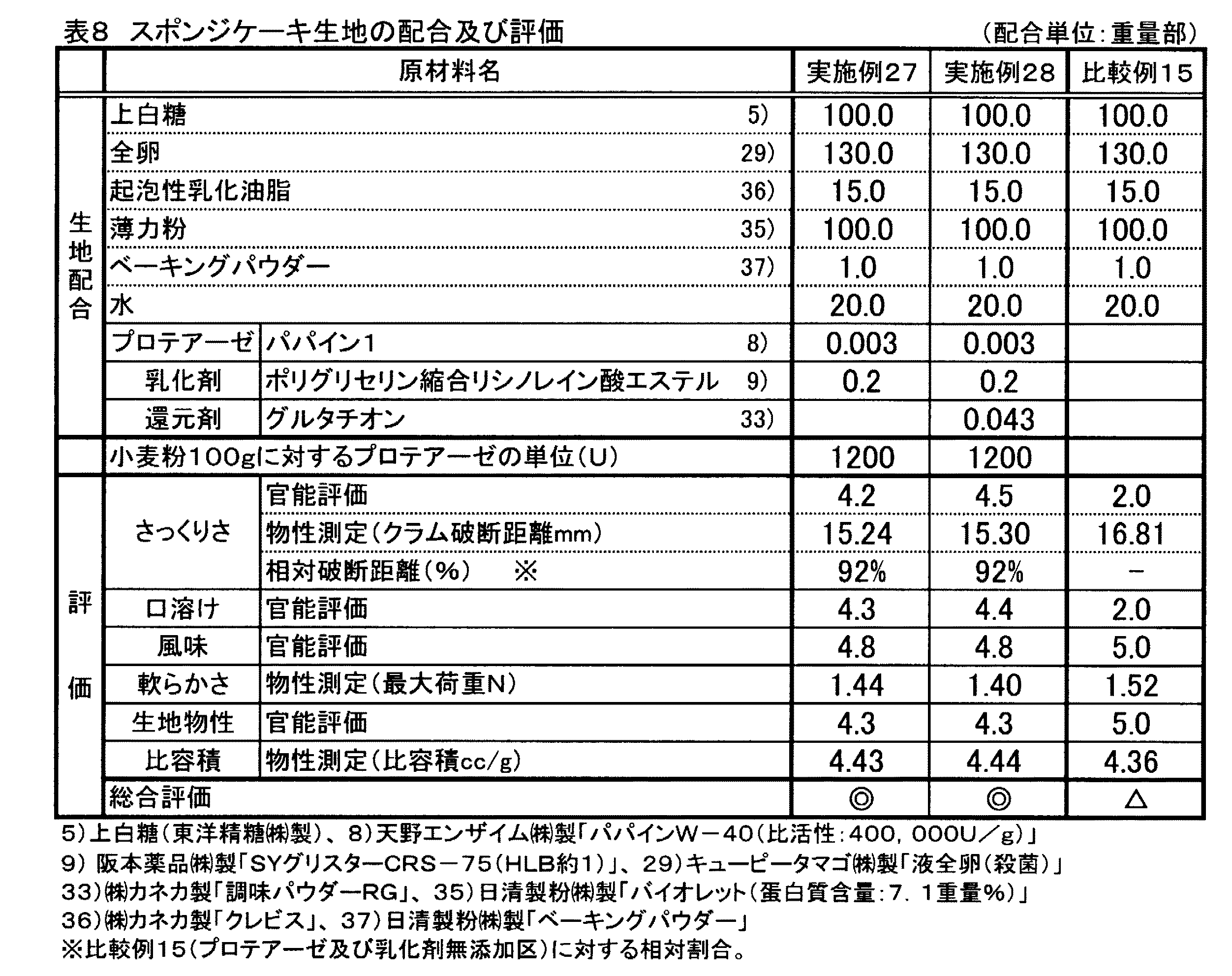
(実施例27) スポンジケーキ
表8に示す配合において、上白糖、全卵、起泡性乳化油脂及び水をミキサーボウルに投入し、低速で30秒間混合した後、薄力粉(蛋白質含量:7.1重量%)、ベーキングパウダー、乳化剤及びプロテアーゼを投入し、低速で30秒間、中速で3分30秒間混合し、比重0.45g/ccのスポンジケーキ生地を得た。捏ねあげ温度は22℃であった。得られた生地を6号缶に350g流し込み、170℃の固定窯で35分間焼成し、スポンジケーキを作製して評価を行った。得られた評価結果を表8に示した。プロテアーゼを生地混合物に混ぜてから焼成までの間の最高到達温度は22℃であり、焼成時における生地の最高到達温度は103℃で、90〜120℃での保持時間は26分間であった。(Example 27) Sponge cake In the compounding as shown in Table 8, after pouring the top white sugar, whole eggs, foamable emulsified fat and water and water into the mixer bowl and mixing at low speed for 30 seconds, flour flour (protein content: 7.1 Baking powder, emulsifier and protease were added and mixed at a low speed for 30 seconds and a medium speed for 3 minutes and 30 seconds to obtain a sponge cake material having a specific gravity of 0.45 g / cc. The roasting temperature was 22 ° C. The obtained dough was poured into 350 g of No. 6 can and baked for 35 minutes in a fixed temperature of 170 ° C. to prepare a sponge cake for evaluation. The evaluation results obtained are shown in Table 8. The maximum temperature reached between mixing the protease into the dough mixture and firing was 22 ° C., the maximum temperature of the dough at firing was 103 ° C., and the holding time at 90 ° -120 ° C. was 26 minutes.
(実施例28) スポンジケーキ
更に還元剤を添加した以外は、実施例27と同様にしてスポンジケーキを作製し、評価を行った。得られた評価結果を表8に示した。Example 28 Sponge Cake A sponge cake was produced and evaluated in the same manner as in Example 27 except that a reducing agent was further added. The evaluation results obtained are shown in Table 8.
(比較例15) スポンジケーキ
プロテアーゼと乳化剤を添加しない以外は、実施例27と同様にしてスポンジケーキを作製し、評価を行った。得られた評価結果を表8に示した。(Comparative Example 15) Sponge cake A sponge cake was produced and evaluated in the same manner as in Example 27 except that the protease and the emulsifier were not added. The evaluation results obtained are shown in Table 8.
表8から明らかなように、プロテアーゼ及び乳化剤を添加したもの(実施例27)は、プロテアーゼ及び乳化剤無添加のもの(比較例15)に比べ、さっくりさと口溶けは良好であった。さらに、還元剤を添加したもの(実施例28)は、さっくりさと口溶けがより向上した。 As is clear from Table 8, the one to which the protease and the emulsifier were added (Example 27) was better in totalness and melt in the mouth than the one to which the protease and the emulsifier were not added (Comparative Example 15). Furthermore, the one to which the reducing agent was added (Example 28) was more improved in the freshness and mouth melting.
(実施例29)食パン
表9に示すとおり、乳化剤、プロテアーゼ及びショートニング1をショートニング3に変え、その添加量を小麦粉100重量部に対し10重量部にした以外は、実施例1と同様にして食パンを作製し、評価を行った。得られた評価結果を表9に示した。(Example 29) Bread As shown in Table 9, bread was prepared in the same manner as Example 1, except that the emulsifying agent, protease and shortening 1 were changed to shortening 3 and the amount added was 10 parts by weight with respect to 100 parts by weight of wheat flour. Were evaluated and evaluated. The obtained evaluation results are shown in Table 9.
(比較例16)食パン(乳化剤無添加)
ショートニング3をショートニング1に変えた以外は、実施例29と同様にして食パンを作製し、評価を行った。得られた評価結果を表9に示した。(Comparative Example 16) Bread (with no emulsifier added)
A bread was prepared and evaluated in the same manner as in Example 29 except that the shortening 3 was changed to the shortening 1. The obtained evaluation results are shown in Table 9.
(比較例17)食パン
ショートニング3を製造例4の油脂組成物に変え、その添加量を小麦粉100重量部に対し12.5重量部にした以外は、実施例29と同様にして食パンを作製し、評価を行った。得られた評価結果を表9に示した。(Comparative Example 17) Bread In the same manner as in Example 29, bread was prepared except that the shortening 3 was changed to the oil and fat composition of Production Example 4 and the addition amount was changed to 12.5 parts by weight with respect to 100 parts by weight of wheat flour. , Made an evaluation. The obtained evaluation results are shown in Table 9.
表9から明らかなように、水で膨潤させた加工澱粉を添加せず、プロテアーゼと乳化剤を添加したもの(実施例29)は、さっくりさと口溶けは良好であった。一方、プロテアーゼと乳化剤を添加しないもの(比較例16)では、さっくりさと口溶けが明らか劣った。また、水で膨潤させた加工澱粉を添加した(比較例17)は、しっとりとして、さっくりさは低下し、ねちゃついた食感のパンであった。 As is clear from Table 9, the addition of the water-swelled modified starch and the addition of the protease and the emulsifier (Example 29) gave a goodness of mouthfeel and mouthfeel. On the other hand, in the case where the protease and the emulsifier were not added (Comparative Example 16), the freshness and mouth melting were clearly inferior. Moreover, the water-swollen modified starch was added (Comparative Example 17), which was moist and had a reduced crispness and a jerky texture.
(比較例18、19) 食パン(プロテアーゼの種類)
表10に示すとおり、エンド型プロテアーゼであるパパインを、その他のプロテアーゼに変えた以外は、実施例13と同様にして食パンを作製し、評価を行った。得られた評価結果を表10に示した。各プロテアーゼの特性は表2に示す。(Comparative Examples 18 and 19) Bread (type of protease)
As shown in Table 10, bread was prepared and evaluated in the same manner as in Example 13 except that papain, which is an endo-type protease, was changed to another protease. The obtained evaluation results are shown in Table 10. The properties of each protease are shown in Table 2.
表10から明らかなように、40℃での相対活性が40%を超えたり(比較例18)、至適温度が60℃より低い(比較例19)プロテアーゼに変えたものでは、生地が緩み、ボリュームが著しく劣っており、さっくりさと口溶けが悪かった。 As apparent from Table 10, when the relative activity at 40 ° C. exceeds 40% (Comparative Example 18), and the optimum temperature is lower than 60 ° C. (Comparative Example 19), the dough is loosened, The volume was remarkably inferior, and it was refreshing and poor melting.
(実施例30)食パン
表11に示すとおり、ソーマチンをさとうきび抽出物に変え、その添加量を小麦粉100重量部に対し0.015重量部にした以外は、実施例3と同様にして食パンを作製し、評価を行った。得られた評価結果を表11に示した。(Example 30) Bread As shown in Table 11, bread was prepared in the same manner as Example 3, except that thaumatin was changed to a sugarcane extract, and the amount added was 0.015 parts by weight with respect to 100 parts by weight of wheat flour. And evaluated. The obtained evaluation results are shown in Table 11.
(実施例31、32)食パン
表11に示すとおり、更にアルギン酸エステル又は乾燥こんにゃくを添加した以外は、実施例3と同様にして食パンを作製し、評価を行った。得られた評価結果を表11に示した。(Examples 31 and 32) Bread As shown in Table 11, breads were prepared and evaluated in the same manner as in Example 3 except that alginate ester or dried konjac was further added. The obtained evaluation results are shown in Table 11.
表11から明らかなように、ソーマチンをさとうきび抽出物に変えても苦味は感じられず、良好な風味のパンであった。また、アルギン酸エステル(実施例31)又は乾燥こんにゃく(実施例32)を添加したパンは、さっくりさと口溶けの良好さに加え、食感に弾力性があり、ボリュームが大きかった。 As apparent from Table 11, even when thaumatin was changed to a sugarcane extract, no bitter taste was felt, and the bread had a good flavor. Also, breads to which alginate ester (Example 31) or dried konjac (Example 32) was added had elasticity in texture and large volume, in addition to the goodness of refreshing and mouth melting.
(実施例33) 蒸しパン
表12に示す配合において、上白糖、全卵、起泡性乳化油脂、ショートニング6、牛乳、チーズペーストをミキサーボウルに投入し、低速で30秒間混合した後、薄力粉(蛋白質含量:7.1重量%)、ベーキングパウダー、乳化剤及びプロテアーゼを投入し、低速で30秒間、中速で3分間混合し、比重0.60g/ccの蒸しパン生地を得た。捏ねあげ温度は23℃であった。得られた生地を楕円形のグラシン紙に100g流し込み、庫内温度98℃の蒸し器で20分間蒸し、蒸しパンを作製して評価を行った。得られた評価結果を表12に示した。プロテアーゼを生地混合物に混ぜてから蒸しまでの間の最高到達温度は23℃であり、蒸し時における生地の最高到達温度は96℃で、90〜120℃での保持時間は7分間であった。(Example 33) Steamed bread In the composition shown in Table 12, super white sugar, whole eggs, foamable emulsified fats and oils, shortening 6, milk, and cheese paste are put into a mixer bowl and mixed at low speed for 30 seconds, Protein content: 7.1% by weight), baking powder, emulsifier and protease were added and mixed for 30 seconds at low speed and 3 minutes at medium speed to obtain a steamed bread dough with a specific gravity of 0.60 g / cc. The roasting temperature was 23 ° C. 100 g of the obtained dough was poured into an oval glassine paper and steamed for 20 minutes with a steamer at a container temperature of 98 ° C. to make steamed bread and evaluated. The evaluation results obtained are shown in Table 12. The maximum temperature reached between mixing the protease into the dough mixture and steaming was 23 ° C, the maximum temperature of the dough at the time of steaming was 96 ° C, and the holding time at 90-120 ° C was 7 minutes.
(比較例20) 蒸しパン
プロテアーゼと乳化剤を添加しない以外は、実施例33と同様にして蒸しパンを作製し、評価を行った。得られた評価結果を表12に示した。表12から明らかなように、プロテアーゼと乳化剤を添加したもの(実施例33)は、プロテアーゼと乳化剤を添加しなかったもの(比較例20)に比べ、さっくりさと口溶けは良好であった。Comparative Example 20 Steamed Bread A steamed bread was prepared and evaluated in the same manner as in Example 33 except that the protease and the emulsifier were not added. The evaluation results obtained are shown in Table 12. As is clear from Table 12, the ones to which the protease and the emulsifier were added (Example 33) had better finish and mouth melting than those to which the protease and the emulsifier were not added (Comparative Example 20).
Claims (8)
A dough for bread and confectionery having the same composition as that for bread and confectionery according to any one of claims 1 to 6 except that the endo-protease and the emulsifier are removed, is kneaded at 5 ° C to 40 ° C and further heated. The bread and confectionery according to claim 7 , wherein a relative breaking distance in breaking measurement is 95% or less with respect to a bread and confectionery prepared by cooking at a dough temperature of 90 ° C to 120 ° C for 1 to 30 minutes.
Applications Claiming Priority (3)
| Application Number | Priority Date | Filing Date | Title |
|---|---|---|---|
| JP2013074852 | 2013-03-29 | ||
| JP2013074852 | 2013-03-29 | ||
| PCT/JP2014/059341 WO2014157696A1 (en) | 2013-03-29 | 2014-03-28 | Protease-containing dough for bread or confectionery |
Publications (2)
| Publication Number | Publication Date |
|---|---|
| JPWO2014157696A1 JPWO2014157696A1 (en) | 2017-02-16 |
| JP6524908B2 true JP6524908B2 (en) | 2019-06-05 |
Family
ID=51624652
Family Applications (1)
| Application Number | Title | Priority Date | Filing Date |
|---|---|---|---|
| JP2015508809A Active JP6524908B2 (en) | 2013-03-29 | 2014-03-28 | Bread and confectionery dough containing a protease |
Country Status (2)
| Country | Link |
|---|---|
| JP (1) | JP6524908B2 (en) |
| WO (1) | WO2014157696A1 (en) |
Families Citing this family (2)
| Publication number | Priority date | Publication date | Assignee | Title |
|---|---|---|---|---|
| BE1022313B1 (en) | 2014-11-28 | 2016-03-15 | Puratos N.V. | ENZYM INHIBITOR COMPLEXES |
| JP7073633B2 (en) * | 2017-06-08 | 2022-05-24 | 日油株式会社 | Oil-in-water emulsified oil composition and confectionery flour composition |
Family Cites Families (11)
| Publication number | Priority date | Publication date | Assignee | Title |
|---|---|---|---|---|
| JPS6049751A (en) * | 1983-08-29 | 1985-03-19 | Ajinomoto Co Inc | Food composition |
| JPH0675461B2 (en) * | 1989-01-14 | 1994-09-28 | 鐘淵化学工業株式会社 | Oil and fat composition for improving flour dough |
| JPH03119948A (en) * | 1989-10-03 | 1991-05-22 | Kanegafuchi Chem Ind Co Ltd | Production of bread |
| JP3058208B2 (en) * | 1991-09-11 | 2000-07-04 | 鐘淵化学工業株式会社 | Breads suitable for microwave heating and compositions used therefor |
| ATE151948T1 (en) * | 1993-03-31 | 1997-05-15 | Gist Brocades Nv | YEAST FORMULATION FOR PRODUCING BAKED PRODUCTS |
| JP4086352B2 (en) * | 1998-02-04 | 2008-05-14 | 株式会社Adeka | Oil composition |
| JP2003235512A (en) * | 2002-02-22 | 2003-08-26 | Ajinomoto Co Inc | Amino acid-containing composition improved in taste |
| JP2003274896A (en) * | 2002-03-26 | 2003-09-30 | Hayashibara Biochem Lab Inc | Reducer of bitterness of bitter amino acid and its use |
| JP2004113051A (en) * | 2002-09-25 | 2004-04-15 | Nitto Seifun Kk | Frozen bread dough-improving agent |
| JP4360600B2 (en) * | 2003-03-07 | 2009-11-11 | ミヨシ油脂株式会社 | Oil composition for bread making |
| EP2123163A1 (en) * | 2008-05-16 | 2009-11-25 | Puratos N.V. | Method and composition to improve short bite of bakery products. |
-
2014
- 2014-03-28 JP JP2015508809A patent/JP6524908B2/en active Active
- 2014-03-28 WO PCT/JP2014/059341 patent/WO2014157696A1/en not_active Ceased
Also Published As
| Publication number | Publication date |
|---|---|
| WO2014157696A1 (en) | 2014-10-02 |
| JPWO2014157696A1 (en) | 2017-02-16 |
Similar Documents
| Publication | Publication Date | Title |
|---|---|---|
| JP7634171B2 (en) | Oil and fat composition for bread making, flour dough for bread making, and method for producing flour dough for bread making | |
| AU2002233639B2 (en) | Products containing $G(b)-glucan | |
| JPWO2009101972A1 (en) | Kokumi enhancer | |
| JP6845735B2 (en) | A modifier for bakery products and a method for manufacturing bakery dough and bakery products using it. | |
| JP6721392B2 (en) | Oil and fat composition for kneading bread | |
| JP2011062086A (en) | Enzyme-containing water-in-oil type emulsified fat and fatty oil composition | |
| CN107223676A (en) | One kind bakees grease and preparation method thereof | |
| JP7407522B2 (en) | Oil and fat composition for kneading confectionery and confectionery using the same | |
| JP4360600B2 (en) | Oil composition for bread making | |
| JP2014050323A (en) | Plasticity water-in-oil type emulsification fat composition | |
| JP7103732B2 (en) | Oil-in-water emulsified oil composition | |
| JP7679183B2 (en) | Bakery fat composition | |
| JP2019165646A (en) | Bread improving material | |
| WO2014157696A1 (en) | Protease-containing dough for bread or confectionery | |
| JP2022085207A (en) | Frozen bread dough and its manufacturing method | |
| JP2008067642A (en) | Oil composition for bread making | |
| JP7017288B2 (en) | Bakery dough and bakery food | |
| JP2013176365A (en) | Method for producing bread and confectionery comprising protease | |
| JP4430864B2 (en) | Bread making method | |
| JP2021153414A (en) | Oil and fat composition for frozen bread, frozen bread dough, and method for producing frozen bread dough | |
| JP4942719B2 (en) | Bread production method | |
| JP2022085208A (en) | Frozen bread dough and its manufacturing method | |
| JP2022142416A (en) | Oil and fat composition for breadmaking kneading | |
| JP2751560B2 (en) | Emulsified fat composition for bread making and method for producing bread | |
| JP7704540B2 (en) | Bakery fat composition |
Legal Events
| Date | Code | Title | Description |
|---|---|---|---|
| A621 | Written request for application examination |
Free format text: JAPANESE INTERMEDIATE CODE: A621 Effective date: 20170126 |
|
| A131 | Notification of reasons for refusal |
Free format text: JAPANESE INTERMEDIATE CODE: A131 Effective date: 20171031 |
|
| A601 | Written request for extension of time |
Free format text: JAPANESE INTERMEDIATE CODE: A601 Effective date: 20171228 |
|
| A521 | Request for written amendment filed |
Free format text: JAPANESE INTERMEDIATE CODE: A523 Effective date: 20180118 |
|
| A131 | Notification of reasons for refusal |
Free format text: JAPANESE INTERMEDIATE CODE: A131 Effective date: 20180703 |
|
| A601 | Written request for extension of time |
Free format text: JAPANESE INTERMEDIATE CODE: A601 Effective date: 20180903 |
|
| A521 | Request for written amendment filed |
Free format text: JAPANESE INTERMEDIATE CODE: A523 Effective date: 20181101 |
|
| TRDD | Decision of grant or rejection written | ||
| A01 | Written decision to grant a patent or to grant a registration (utility model) |
Free format text: JAPANESE INTERMEDIATE CODE: A01 Effective date: 20190409 |
|
| A61 | First payment of annual fees (during grant procedure) |
Free format text: JAPANESE INTERMEDIATE CODE: A61 Effective date: 20190422 |
|
| R150 | Certificate of patent or registration of utility model |
Ref document number: 6524908 Country of ref document: JP Free format text: JAPANESE INTERMEDIATE CODE: R150 |
|
| R250 | Receipt of annual fees |
Free format text: JAPANESE INTERMEDIATE CODE: R250 |
|
| R250 | Receipt of annual fees |
Free format text: JAPANESE INTERMEDIATE CODE: R250 |
|
| R250 | Receipt of annual fees |
Free format text: JAPANESE INTERMEDIATE CODE: R250 |
|
| R250 | Receipt of annual fees |
Free format text: JAPANESE INTERMEDIATE CODE: R250 |
|
| R250 | Receipt of annual fees |
Free format text: JAPANESE INTERMEDIATE CODE: R250 |