JP6702181B2 - Composite semipermeable membrane - Google Patents
Composite semipermeable membrane Download PDFInfo
- Publication number
- JP6702181B2 JP6702181B2 JP2016514772A JP2016514772A JP6702181B2 JP 6702181 B2 JP6702181 B2 JP 6702181B2 JP 2016514772 A JP2016514772 A JP 2016514772A JP 2016514772 A JP2016514772 A JP 2016514772A JP 6702181 B2 JP6702181 B2 JP 6702181B2
- Authority
- JP
- Japan
- Prior art keywords
- functional layer
- separation functional
- less
- semipermeable membrane
- composite semipermeable
- Prior art date
- Legal status (The legal status is an assumption and is not a legal conclusion. Google has not performed a legal analysis and makes no representation as to the accuracy of the status listed.)
- Active
Links
Images

Classifications
-
- B—PERFORMING OPERATIONS; TRANSPORTING
- B01—PHYSICAL OR CHEMICAL PROCESSES OR APPARATUS IN GENERAL
- B01D—SEPARATION
- B01D69/00—Semi-permeable membranes for separation processes or apparatus characterised by their form, structure or properties; Manufacturing processes specially adapted therefor
- B01D69/12—Composite membranes; Ultra-thin membranes
-
- B—PERFORMING OPERATIONS; TRANSPORTING
- B01—PHYSICAL OR CHEMICAL PROCESSES OR APPARATUS IN GENERAL
- B01D—SEPARATION
- B01D69/00—Semi-permeable membranes for separation processes or apparatus characterised by their form, structure or properties; Manufacturing processes specially adapted therefor
-
- B—PERFORMING OPERATIONS; TRANSPORTING
- B01—PHYSICAL OR CHEMICAL PROCESSES OR APPARATUS IN GENERAL
- B01D—SEPARATION
- B01D69/00—Semi-permeable membranes for separation processes or apparatus characterised by their form, structure or properties; Manufacturing processes specially adapted therefor
- B01D69/10—Supported membranes; Membrane supports
- B01D69/107—Organic support material
- B01D69/1071—Woven, non-woven or net mesh
-
- B—PERFORMING OPERATIONS; TRANSPORTING
- B01—PHYSICAL OR CHEMICAL PROCESSES OR APPARATUS IN GENERAL
- B01D—SEPARATION
- B01D71/00—Semi-permeable membranes for separation processes or apparatus characterised by the material; Manufacturing processes specially adapted therefor
- B01D71/06—Organic material
- B01D71/56—Polyamides, e.g. polyester-amides
Landscapes
- Chemical & Material Sciences (AREA)
- Chemical Kinetics & Catalysis (AREA)
- Separation Using Semi-Permeable Membranes (AREA)
- Coating Of Shaped Articles Made Of Macromolecular Substances (AREA)
- Laminated Bodies (AREA)
- Polyamides (AREA)
Description
本発明は、液状混合物の選択的分離に有用な複合半透膜に関し、特に高温高圧下で性能を維持し、かつ、透水性の高い複合半透膜に関する。 TECHNICAL FIELD The present invention relates to a composite semipermeable membrane useful for selective separation of a liquid mixture, and particularly to a composite semipermeable membrane that maintains performance under high temperature and high pressure and has high water permeability.
現在市販されている逆浸透膜およびナノろ過膜の大部分は複合半透膜である。特に、多官能アミンと多官能酸ハロゲン化物との重縮合反応によって得られる架橋ポリアミドからなる分離機能層で支持層を被覆して得られる複合半透膜は、透過性や選択分離性の高い分離膜として広く用いられている(特許文献1)。 Most of the reverse osmosis membranes and nanofiltration membranes currently on the market are composite semipermeable membranes. In particular, a composite semipermeable membrane obtained by coating a supporting layer with a separation functional layer composed of a crosslinked polyamide obtained by a polycondensation reaction of a polyfunctional amine and a polyfunctional acid halide has a high permeability and a high separation selectivity. It is widely used as a film (Patent Document 1).
発明者らは、高温高圧下で従来の複合半透膜を運転すると、透水性が低下することを見出した。本発明の目的は、高温高圧下でも性能を維持できる複合半透膜を提供することにある。 The inventors have found that when a conventional composite semipermeable membrane is operated under high temperature and high pressure, the water permeability decreases. An object of the present invention is to provide a composite semipermeable membrane that can maintain its performance even under high temperature and high pressure.
上記目的を達成するために、本発明は以下の構成を有する。
(1)基材と、前記基材上に位置する多孔性支持層と、前記多孔性支持層上に位置する分離機能層とを備えた複合半透膜であって、前記分離機能層は、架橋全芳香族ポリアミドを主成分とする薄膜を有し、前記薄膜は、複数の凸部と凹部とを備えるひだ構造を有し、前記凸部の40%以上が、25℃の純水中で凸部を5nNの力で押し込んだ際の変形量が2.5nm以下であり、かつ前記凸部の高さの中間値が100nm以上であり、かつ前記凸部における前記薄膜の膜厚が20nm以下である複合半透膜。
(2)5nNの力で押し込んだ際の変形量が2.5nm以下となる前記凸部の数が50%以上である、前記(1)に記載の複合半透膜。
(3)前記分離機能層が、多官能芳香族アミンと多官能芳香族酸ハロゲン化物との重縮合反応によって形成されたポリアミド分離機能層であり、前記ポリアミド分離機能層がアミノ基、カルボキシ基及びアミド基を含み、アミノ基/アミド基のモル比をxとしたとき、xが0.28以下である、前記(1)又は(2)に記載の複合半透膜。
(4)前記ポリアミド分離機能層のアミノ基/アミド基のモル比をx、カルボキシ基/アミド基のモル比をyとしたとき、x+yが0.80以下である、前記(3)に記載の複合半透膜。In order to achieve the above object, the present invention has the following configurations.
(1) A composite semipermeable membrane comprising a base material, a porous support layer located on the base material, and a separation functional layer located on the porous support layer, wherein the separation functional layer comprises: A thin film containing a cross-linked wholly aromatic polyamide as a main component, wherein the thin film has a pleated structure having a plurality of convex portions and concave portions, and 40% or more of the convex portions are in pure water at 25° C. The amount of deformation when the convex portion is pressed with a force of 5 nN is 2.5 nm or less, the intermediate value of the height of the convex portion is 100 nm or more, and the film thickness of the thin film on the convex portion is 20 nm or less. Is a composite semipermeable membrane.
(2) The composite semipermeable membrane as described in (1) above, wherein the number of the convex portions having a deformation amount of 2.5 nm or less when pressed by a force of 5 nN is 50% or more.
(3) The separation functional layer is a polyamide separation functional layer formed by a polycondensation reaction of a polyfunctional aromatic amine and a polyfunctional aromatic acid halide, and the polyamide separation functional layer includes an amino group, a carboxy group and The composite semipermeable membrane according to the above (1) or (2), wherein the composite semipermeable membrane contains an amide group and x is 0.28 or less, where x is a molar ratio of amino group/amide group.
(4) The x+y is 0.80 or less, where x is the amino group/amide group molar ratio of the polyamide separation functional layer and y is the carboxy group/amide group molar ratio. Composite semipermeable membrane.
本発明の複合半透膜は、凸部のうち、変形量が小さい凸部が占める割合が40%以上であることで、高温高圧下でもポリアミド分離機能層の変形を抑制することができる。さらに、凸部高さの中間値が100nm以上であることで表面積を高め、また、凸部の分離機能層の膜厚を20nm以下とすることで抵抗を低減し、透水性を高くすることができる。これにより、高温高圧下でも性能を維持し、かつ、透水性の高い複合半透膜が得られる。 In the composite semipermeable membrane of the present invention, the proportion of the convex portion having a small deformation amount in the convex portion is 40% or more, so that the deformation of the polyamide separation functional layer can be suppressed even under high temperature and high pressure. Further, when the median value of the heights of the protrusions is 100 nm or more, the surface area can be increased, and when the thickness of the separation functional layer of the protrusions is 20 nm or less, the resistance can be reduced and the water permeability can be increased. it can. This makes it possible to obtain a composite semipermeable membrane which maintains its performance even under high temperature and high pressure and has high water permeability.
以下に本発明の実施の形態を詳細に説明するが、以下に記載する構成要件の説明は、本発明の実施態様の一例(代表例)であり、本発明はその要旨を超えない限り、以下の内容に限定されない。
また、本明細書において、「質量」で表される百分率や部は「重量」で表される百分率や部と同義である。BEST MODE FOR CARRYING OUT THE INVENTION Hereinafter, embodiments of the present invention will be described in detail, but the description of the constituent elements described below is one example (representative example) of the embodiments of the present invention, and the present invention is as follows unless the gist thereof is exceeded. The content is not limited to.
Moreover, in this specification, the percentages and parts represented by "mass" are synonymous with the percentages and parts represented by "weight."
1.複合半透膜
本発明に係る複合半透膜は、基材と前記基材上に位置する多孔性支持層とを含む支持膜(多孔性支持膜)と、前記多孔性支持層上に位置する分離機能層とを備える。前記分離機能層は実質的に分離性能を有するものであり、前記支持膜は実質的にイオン等の分離性能を有さず、前記分離機能層に強度を与えることができる。1. Composite semipermeable membrane The composite semipermeable membrane according to the present invention is located on the support membrane (porous support membrane) including a base material and a porous support layer located on the base material, and the porous support layer. And a separation functional layer. The separation functional layer has substantially separation performance, and the support film does not substantially have separation performance of ions and the like, and can give strength to the separation functional layer.
(1−1)基材
基材としては、ポリエステル系重合体、ポリアミド系重合体、ポリオレフィン系重合体、あるいはこれらの混合物や共重合体等が挙げられる。中でも、機械的、熱的に安定性の高いポリエステル系重合体の布帛が特に好ましい。布帛の形態としては、長繊維不織布や短繊維不織布、さらには織編物を好ましく用いることができる。ここで、長繊維不織布とは、平均繊維長300mm以上、かつ平均繊維径3〜30μmの不織布のことを指す。(1-1) Substrate Examples of the substrate include polyester-based polymers, polyamide-based polymers, polyolefin-based polymers, and mixtures and copolymers thereof. Among them, a polyester polymer cloth having high mechanical and thermal stability is particularly preferable. As the form of the cloth, a long fiber non-woven fabric, a short fiber non-woven fabric, or a woven or knitted fabric can be preferably used. Here, the long fiber nonwoven fabric refers to a nonwoven fabric having an average fiber length of 300 mm or more and an average fiber diameter of 3 to 30 μm.
基材は、通気量が0.5cc/cm2/sec以上5.0cc/cm2/secであることが好ましい。基材の通気量が上記範囲内にあることにより、高分子溶液が基材に含浸するため、基材と多孔性支持層との接着性が向上し、得られる多孔性支持膜の物理的安定性を高めることができる。The substrate preferably has an air flow rate of 0.5 cc/cm 2 /sec or more and 5.0 cc/cm 2 /sec. When the air permeability of the base material is within the above range, the polymer solution is impregnated into the base material, so that the adhesiveness between the base material and the porous support layer is improved, and the physical stability of the obtained porous support membrane is improved. You can improve your sex.
基材の厚みは10〜200μmの範囲内にあることが好ましく、より好ましくは30〜120μmの範囲内である。なお、本書において、特に付記しない限り、厚みとは、平均値を意味する。ここで平均値とは相加平均値を表す。すなわち、基材の厚みは、断面観察で厚み方向に直交する方向(膜の面方向)に20μm間隔で測定した20点の厚みの平均値を算出することで求められる。また、基材の厚みは、デジタルシックネスゲージによっても測定することができる。デジタルシックネスゲージとしては、株式会社尾崎製作所のPEACOCK(登録商標)などが使用できる。デジタルシックネスゲージを用いる場合は、20箇所について厚みを測定して平均値を算出する。 The thickness of the substrate is preferably in the range of 10 to 200 μm, more preferably 30 to 120 μm. In the present specification, the thickness means an average value unless otherwise specified. Here, the average value represents an arithmetic mean value. That is, the thickness of the base material is obtained by calculating the average value of the thicknesses of 20 points measured at intervals of 20 μm in the direction orthogonal to the thickness direction (the surface direction of the film) in cross-section observation. The thickness of the base material can also be measured with a digital thickness gauge. As the digital thickness gauge, PEACOCK (registered trademark) from Ozaki Seisakusho Co., Ltd. can be used. When a digital thickness gauge is used, the thickness is measured at 20 points and the average value is calculated.
(1−2)多孔性支持層
本発明において多孔性支持層は、実質的にイオン等の分離性能を有さず、実質的に分離性能を有する分離機能層に強度を与えるためのものである。多孔性支持層の孔のサイズや分布は特に限定されないが、例えば、均一で微細な孔、あるいは分離機能層が形成される側の表面からもう一方の面まで徐々に大きな微細孔をもち、かつ、分離機能層が形成される側の表面で微細孔の大きさが0.1nm以上100nm以下であるような多孔性支持層が好ましいが、使用する材料やその形状は特に限定されない。(1-2) Porous support layer In the present invention, the porous support layer is for giving strength to a separation functional layer having substantially no separation performance for ions and the like and having substantially separation performance. .. The size and distribution of the pores of the porous support layer are not particularly limited, for example, uniform and fine pores, or having gradually larger fine pores from the surface on the side where the separation functional layer is formed to the other surface, and A porous support layer in which the size of the fine pores on the surface on which the separation functional layer is formed is 0.1 nm or more and 100 nm or less is preferable, but the material used and its shape are not particularly limited.
多孔性支持層の素材には、例えば、ポリスルホン、ポリエーテルスルホン、ポリアミド、ポリエステル、セルロース系ポリマー、ビニルポリマー、ポリフェニレンスルフィド、ポリフェニレンスルフィドスルホン、ポリフェニレンスルホン、ポリフェニレンオキシドなどのホモポリマーあるいはコポリマーを単独であるいはブレンドして使用することができる。ここでセルロース系ポリマーとしては、例えば、酢酸セルロース、硝酸セルロースなど、ビニルポリマーとしては、例えば、ポリエチレン、ポリプロピレン、ポリ塩化ビニル、ポリアクリロニトリルなどが使用できる。中でも、ポリスルホン、ポリアミド、ポリエステル、酢酸セルロース、硝酸セルロース、ポリ塩化ビニル、ポリアクリロニトリル、ポリフェニレンスルフィド、ポリフェニレンスルフィドスルホンなどのホモポリマーまたはコポリマーが好ましい。より好ましくは酢酸セルロース、ポリスルホン、ポリフェニレンスルフィドスルホン、またはポリフェニレンスルホンが挙げられ、さらに、これらの素材の中では化学的、機械的、熱的に安定性が高く、成型が容易であることからポリスルホンが一般的に使用できる。
具体的には、次の化学式に示す繰り返し単位からなるポリスルホンを用いると、多孔性支持層の孔径が制御しやすく、寸法安定性が高いため好ましい。なお、下記式中、nは繰り返し単位数を表す。The material of the porous support layer includes, for example, homopolymers or copolymers such as polysulfone, polyether sulfone, polyamide, polyester, cellulosic polymer, vinyl polymer, polyphenylene sulfide, polyphenylene sulfide sulfone, polyphenylene sulfone, and polyphenylene oxide alone or. It can be used by blending. Here, as the cellulose-based polymer, for example, cellulose acetate, cellulose nitrate or the like can be used, and as the vinyl polymer, for example, polyethylene, polypropylene, polyvinyl chloride, polyacrylonitrile or the like can be used. Of these, homopolymers or copolymers such as polysulfone, polyamide, polyester, cellulose acetate, cellulose nitrate, polyvinyl chloride, polyacrylonitrile, polyphenylene sulfide, and polyphenylene sulfide sulfone are preferable. More preferably, cellulose acetate, polysulfone, polyphenylene sulfide sulfone, or polyphenylene sulfone is mentioned.Furthermore, among these materials, polysulfone is high in chemical, mechanical and thermal stability and easy to mold. Generally available.
Specifically, it is preferable to use polysulfone having a repeating unit represented by the following chemical formula because the pore diameter of the porous support layer can be easily controlled and the dimensional stability is high. In the formula below, n represents the number of repeating units.
ポリスルホンは、ゲルパーミエーションクロマトグラフィー(GPC)でN−メチルピロリドンを溶媒に、ポリスチレンを標準物質として測定した場合の重量平均分子量(Mw)が、10000以上200000以下であることが好ましく、より好ましくは15000以上100000以下である。Mwが10000以上であることで、多孔性支持層として好ましい機械的強度および耐熱性を得ることができる。また、Mwが200000以下であることで、溶液の粘度が適切な範囲となり、良好な成形性を実現することができる。 The polysulfone preferably has a weight average molecular weight (Mw) of 10000 or more and 200000 or less when measured by gel permeation chromatography (GPC) using N-methylpyrrolidone as a solvent and polystyrene as a standard substance, and more preferably It is 15,000 or more and 100,000 or less. When Mw is 10,000 or more, mechanical strength and heat resistance preferable as the porous support layer can be obtained. Further, when the Mw is 200,000 or less, the viscosity of the solution is in an appropriate range, and good moldability can be realized.
例えば、上記ポリスルホンのN,N−ジメチルホルムアミド(以降、DMFと記載)溶液を、密に織ったポリエステル布あるいは不織布の上に一定の厚さに注型し、それを水中で湿式凝固させることによって、表面の大部分が直径数10nm以下の微細な孔を有する多孔性支持層を得ることができる。 For example, an N,N-dimethylformamide (hereinafter referred to as DMF) solution of polysulfone is cast on a densely woven polyester cloth or non-woven cloth to a certain thickness and wet-coagulated in water to form a solution. Thus, it is possible to obtain a porous support layer having most of the surface having fine pores having a diameter of several 10 nm or less.
基材と多孔性支持層の厚みは、複合半透膜の強度およびそれをエレメントにしたときの充填密度に影響を与える。十分な機械的強度および充填密度を得るためには、基材と多孔性支持層の厚みの合計が、30μm以上300μm以下であることが好ましく、100μm以上220μm以下であるとより好ましい。また、多孔性支持層の厚みは、20μm以上100μm以下であることが好ましい。多孔性支持層の厚みは、基材と同様に断面観察で厚み方向に直交する方向(膜の面方向)に20μm間隔で測定した、20点の厚みの平均値を算出することで求められる。また、多孔性支持層の厚みは、デジタルシックネスゲージによっても測定することができる。分離機能層の厚みは多孔性支持層と比較して非常に薄いので、複合半透膜の厚みを基材と多孔性支持層の厚みとみなすことができる。従って、複合半透膜の厚みをデジタルシックネスゲージで測定し、複合半透膜の厚みから基材の厚みを引くことで、多孔性支持層の厚みを簡易的に算出することができる。デジタルシックネスゲージとしては、株式会社尾崎製作所のPEACOCK(登録商標)などが使用できる。デジタルシックネスゲージを用いる場合は、20箇所について厚みを測定して平均値を算出する。 The thickness of the base material and the porous support layer affects the strength of the composite semipermeable membrane and the packing density when it is used as an element. In order to obtain sufficient mechanical strength and packing density, the total thickness of the base material and the porous support layer is preferably 30 μm or more and 300 μm or less, and more preferably 100 μm or more and 220 μm or less. The thickness of the porous support layer is preferably 20 μm or more and 100 μm or less. The thickness of the porous support layer can be obtained by calculating the average value of the thicknesses at 20 points measured at intervals of 20 μm in the direction orthogonal to the thickness direction (the surface direction of the film) by observing the cross section similarly to the substrate. The thickness of the porous support layer can also be measured with a digital thickness gauge. Since the thickness of the separation functional layer is much smaller than that of the porous support layer, the thickness of the composite semipermeable membrane can be regarded as the thickness of the substrate and the porous support layer. Therefore, the thickness of the porous support layer can be easily calculated by measuring the thickness of the composite semipermeable membrane with a digital thickness gauge and subtracting the thickness of the base material from the thickness of the composite semipermeable membrane. As the digital thickness gauge, PEACOCK (registered trademark) from Ozaki Seisakusho Co., Ltd. can be used. When a digital thickness gauge is used, the thickness is measured at 20 points and the average value is calculated.
本発明に使用する多孔性支持層は、ミリポア社製”ミリポアフィルターVSWP”(商品名)や、東洋濾紙社製”ウルトラフィルターUK10”(商品名)のような各種市販材料から選択することもできるが、”オフィス・オブ・セイリーン・ウォーター・リサーチ・アンド・ディベロップメント・プログレス・レポート”No.359(1968)に記載された方法に従って製造することができる。 The porous support layer used in the present invention can also be selected from various commercially available materials such as "Millipore Filter VSWP" (trade name) manufactured by Millipore and "Ultra Filter UK10" (trade name) manufactured by Toyo Roshi Kaisha, Ltd. "Office of Saline Water Research and Development Progress Report" No. 359 (1968).
(1−3)分離機能層
分離機能層は、多官能性アミンと多官能性酸ハロゲン化物との重縮合反応で得られたポリアミドを主成分とする薄膜を有する。言い換えると、分離機能層は、架橋全芳香族ポリアミドを主成分として含有する。主成分とは分離機能層の成分のうち、50%以上を占める成分を指す。分離機能層が架橋全芳香族ポリアミドを50%以上含むことにより、高性能な膜性能を発現しやすい。(1-3) Separation Functional Layer The separation functional layer has a thin film whose main component is polyamide obtained by a polycondensation reaction of a polyfunctional amine and a polyfunctional acid halide. In other words, the separation functional layer contains a crosslinked wholly aromatic polyamide as a main component. The main component means a component that accounts for 50% or more of the components of the separation functional layer. When the separation functional layer contains 50% or more of cross-linked wholly aromatic polyamide, high-performance membrane performance is easily exhibited.
また、架橋全芳香族ポリアミドは、多官能芳香族アミンと多官能芳香族酸ハロゲン化物との界面重縮合により形成することができる。 The cross-linked wholly aromatic polyamide can be formed by interfacial polycondensation of a polyfunctional aromatic amine and a polyfunctional aromatic acid halide.
ここで、多官能芳香族アミン及び多官能芳香族酸ハロゲン化物の少なくとも一方が3官能以上の化合物を含んでいることが好ましい。また、分離機能層の厚みは、十分な分離性および透水性を得るために、通常0.01〜1μmの範囲内、好ましくは0.1〜0.5μmの範囲内である。本発明における分離機能層を、以下、ポリアミド分離機能層とも記載する。 Here, it is preferable that at least one of the polyfunctional aromatic amine and the polyfunctional aromatic acid halide contains a trifunctional or higher functional compound. The thickness of the separation functional layer is usually in the range of 0.01 to 1 μm, preferably 0.1 to 0.5 μm in order to obtain sufficient separability and water permeability. The separation functional layer in the present invention is hereinafter also referred to as a polyamide separation functional layer.
多官能芳香族アミンとは、一分子中に第一級アミノ基及び第二級アミノ基のうち少なくとも一方のアミノ基を2個以上有し、かつ、アミノ基のうち少なくとも1つは第一級アミノ基である芳香族アミンを意味する。例えば、o−フェニレンジアミン、m−フェニレンジアミン、p−フェニレンジアミン、o−キシリレンジアミン、m−キシリレンジアミン、p−キシリレンジアミン、o−ジアミノピリジン、m−ジアミノピリジン、p−ジアミノピリジン等の2個のアミノ基がオルト位やメタ位、パラ位のいずれかの位置関係で芳香環に結合した多官能芳香族アミン、1,3,5−トリアミノベンゼン、1,2,4−トリアミノベンゼン、3,5−ジアミノ安息香酸、3−アミノベンジルアミン、4−アミノベンジルアミンなどの多官能芳香族アミンなどが挙げられる。中でも、膜の選択分離性や透水性を考慮すると、m−フェニレンジアミン、p−フェニレンジアミン、1,3,5−トリアミノベンゼンが好ましく、入手の容易性や取り扱いのしやすさから、m−フェニレンジアミン(以下、m−PDAとも記す)を用いることがより好ましい。これらの多官能芳香族アミンは、単独で用いても、2種以上を併用してもよい。 A polyfunctional aromatic amine has two or more amino groups of at least one of a primary amino group and a secondary amino group in one molecule, and at least one of the amino groups is a primary amino group. It means an aromatic amine that is an amino group. For example, o-phenylenediamine, m-phenylenediamine, p-phenylenediamine, o-xylylenediamine, m-xylylenediamine, p-xylylenediamine, o-diaminopyridine, m-diaminopyridine, p-diaminopyridine and the like. Two amino groups are bound to an aromatic ring in any of the ortho, meta, or para positions, 1,3,5-triaminobenzene, 1,2,4-triamine Examples include polyfunctional aromatic amines such as aminobenzene, 3,5-diaminobenzoic acid, 3-aminobenzylamine, and 4-aminobenzylamine. Of these, m-phenylenediamine, p-phenylenediamine, and 1,3,5-triaminobenzene are preferable in consideration of the selective separation property and water permeability of the membrane, and m-phenylenediamine, m-phenylenediamine, and 1,3,5-triaminobenzene are preferable because they are easily available and easily handled. It is more preferable to use phenylenediamine (hereinafter, also referred to as m-PDA). These polyfunctional aromatic amines may be used alone or in combination of two or more.
多官能芳香族酸ハロゲン化物とは、一分子中に少なくとも2個のハロゲン化カルボニル基を有する芳香族酸ハロゲン化物をいう。例えば、3官能酸ハロゲン化物では、トリメシン酸クロリドなどを挙げることができ、2官能酸ハロゲン化物では、ビフェニルジカルボン酸ジクロリド、アゾベンゼンジカルボン酸ジクロリド、テレフタル酸クロリド、イソフタル酸クロリド、ナフタレンジカルボン酸クロリドなどを挙げることができる。多官能芳香族アミンとの反応性を考慮すると、多官能芳香族酸ハロゲン化物は多官能芳香族酸塩化物であることが好ましく、また、膜の選択分離性、耐熱性を考慮すると、一分子中に2〜4個の塩化カルボニル基を有する多官能芳香族酸塩化物であることが好ましい。中でも、入手の容易性や取り扱いのしやすさの観点から、トリメシン酸クロリド、テレフタル酸クロリド、イソフタル酸クロリドを用いるとより好ましい。これらの多官能芳香族酸ハロゲン化物は、単独で用いても、2種以上を併用してもよい。 The polyfunctional aromatic acid halide refers to an aromatic acid halide having at least two carbonyl halide groups in one molecule. Examples of trifunctional acid halides include trimesic acid chloride, and examples of bifunctional acid halides include biphenyldicarboxylic acid dichloride, azobenzenedicarboxylic acid dichloride, terephthalic acid chloride, isophthalic acid chloride, and naphthalenedicarboxylic acid chloride. Can be mentioned. Considering the reactivity with the polyfunctional aromatic amine, the polyfunctional aromatic acid halide is preferably a polyfunctional aromatic acid chloride, and in consideration of the selective separability and heat resistance of the membrane, one molecule A polyfunctional aromatic acid chloride having 2 to 4 carbonyl chloride groups therein is preferable. Among them, trimesic acid chloride, terephthalic acid chloride, and isophthalic acid chloride are more preferably used from the viewpoint of easy availability and easy handling. These polyfunctional aromatic acid halides may be used alone or in combination of two or more kinds.
また、分離機能層において、薄膜は、複数の凹部と凸部とを有するひだ構造を形成する。より具体的には、ひだ構造においては、凹部と凸部が繰り返される。 Moreover, in the separation functional layer, the thin film forms a pleated structure having a plurality of concave portions and convex portions. More specifically, in the pleat structure, the concave portion and the convex portion are repeated.
本発明における分離機能層の凸部とは、10点平均面粗さの5分の1以上の高さの凸部のことを言う。10点平均面粗さとは、次のような算出方法で得られる値である。まず電子顕微鏡により、膜面に垂直な方向の断面を観察する。観察倍率は10,000〜100,000倍が好ましい。得られた断面画像には、図1に示すように、分離機能層(図1に符号“1”で示す。)の表面が、凸部と凹部が連続的に繰り返されるひだ構造の曲線として表れる。この曲線について、ISO4287:1997に基づき定義される粗さ曲線を求める。上記粗さ曲線の平均線の方向に2.0μmの幅で断面画像を抜き取る。
なお、平均線とは、ISO4287:1997に基づき定義される直線であり、測定長さにおいて、平均線と粗さ曲線とで囲まれる領域の面積の合計が平均線の上下で等しくなるように描かれる直線である。The convex portion of the separation functional layer in the present invention means a convex portion having a height of ⅕ or more of 10-point average surface roughness. The 10-point average surface roughness is a value obtained by the following calculation method. First, a cross section perpendicular to the film surface is observed with an electron microscope. The observation magnification is preferably 10,000 to 100,000 times. In the obtained cross-sectional image, as shown in FIG. 1, the surface of the separation functional layer (indicated by reference numeral “1” in FIG. 1) appears as a curve having a pleated structure in which convex portions and concave portions are continuously repeated. .. About this curve, a roughness curve defined based on ISO4287:1997 is obtained. A cross-sectional image is extracted with a width of 2.0 μm in the direction of the average line of the roughness curve.
The average line is a straight line defined based on ISO4287:1997, and is drawn such that the total area of the region surrounded by the average line and the roughness curve is equal above and below the average line in the measurement length. It is a straight line.
抜き取った幅2.0μmの画像において、上記平均線を基準線として、分離機能層1における凸部の高さと、凹部の深さをそれぞれ測定する。最も高い凸部から徐々に高さが低くなって5番目の高さまでの5つの凸部の高さH1〜H5の絶対値について平均値を算出し、最も深い凹部から徐々に深さが浅くなって5番目の深さまでの5つの凹部の深さD1〜D5の絶対値について平均値を算出して、さらに、得られた2つの平均値の絶対値の和を算出する。こうして得られた和が、10点平均面粗さである。
In the extracted image having a width of 2.0 μm, the height of the convex portion and the depth of the concave portion in the separation
本発明者らは鋭意検討した結果、純水中で測定した分離機能層の凸部の変形量が小さいと、熱による変形が小さくなる知見を得た。具体的には、測定温度25℃と40℃で凸部の変形量を測定した時、測定温度25℃で変形量が2.5nm以下である凸部は、2.5nmを超える凸部に比べて、測定温度40℃にしたときの変形量の変化が小さいことがわかった。そこで、測定温度25℃で変形量が2.5nm以下である凸部を増加させたところ、この変形量が2.5nm以下の凸部を、凸部の総数の40%以上存在させることで高温高圧下でも性能を維持できる複合半透膜が得られることを見出した。
具体的には、分離機能層は、以下の条件を満たすことが好ましい。分離機能層の表面を原子間力顕微鏡(AFM)にて純水中で観察し、2μm四方範囲の任意の3つの領域を選択する。これらの3つの領域に含まれる凸部を、それぞれの領域において10点選択する。さらに、選択した凸部の頂点を中心とした直径100nmの円領域内の一点を5nNの力で押し込んだときに2.5nm以下の変形量を示す凸部の数Xを数え、割合(X/30)を求める。割合(X/30)が40%以上であることで、本発明の所望の効果を得ることができ、また、割合(X/30)は50%以上であることが好ましく、60%以上であることがより好ましい。As a result of diligent studies, the present inventors have found that when the amount of deformation of the convex portions of the separation functional layer measured in pure water is small, the deformation due to heat is small. Specifically, when the deformation amount of the convex portion is measured at the measurement temperature of 25° C. and 40° C., the convex portion having the deformation amount of 2.5 nm or less at the measurement temperature of 25° C. is higher than that of the convex portion exceeding 2.5 nm. It was found that the change in the amount of deformation was small when the measurement temperature was 40°C. Therefore, when the number of convex portions having a deformation amount of 2.5 nm or less at the measurement temperature of 25° C. was increased, the convex portions having a deformation amount of 2.5 nm or less were present at 40% or more of the total number of the convex portions to increase the high temperature. It was found that a composite semipermeable membrane that can maintain performance even under high pressure can be obtained.
Specifically, the separation functional layer preferably satisfies the following conditions. The surface of the separation functional layer is observed in pure water with an atomic force microscope (AFM), and three arbitrary areas within a 2 μm square area are selected. Ten convex portions included in these three regions are selected in each region. Furthermore, the number X of convex portions that show a deformation amount of 2.5 nm or less when one point in a circular region having a diameter of 100 nm centering on the vertex of the selected convex portion is pushed in with a force of 5 nN is counted, and the ratio (X/ 30) is required. When the ratio (X/30) is 40% or more, the desired effect of the present invention can be obtained, and the ratio (X/30) is preferably 50% or more, and 60% or more. Is more preferable.
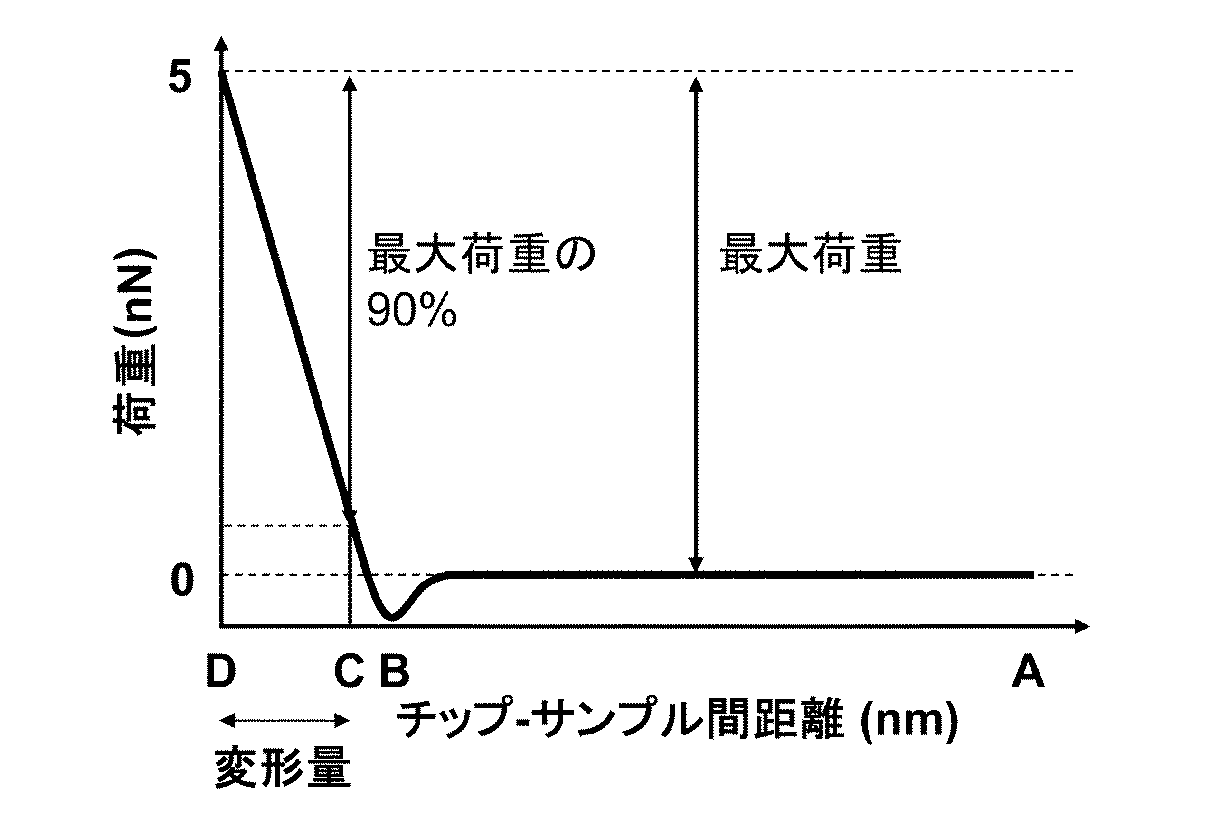
凸部の変形量(Deformation)は、原子間力顕微鏡(AFM)のタッピングモードで測定することができる。具体的には、図2に示すように、横軸にチップ−サンプル間距離(Separation)、縦軸に荷重をとったフォースカーブ上において、カンチレバーをサンプルに近付ける前の点をA点、荷重が立ち上がる瞬間をB点、荷重が最大荷重の90%となる点をC点、最大荷重点をD点としたとき、CD間の距離を変形量とした。なお、フォースカーブは、カンチレバーをサンプルに近付けるときのものを使用した。
原子間力顕微鏡はBruker AXS社製Dimension FastScanを用いることができる。付属のアタッチメントを利用することで、水中での観察が可能である。また、その際、使用するカンチレバーの探針の形状は、円錐形(ピラミッド型)のものを用いる。カンチレバーを使用する前には、必ず校正(Calibration)を行う。まず、十分な硬度を有する物質でカンチレバーの反り感度(Deflection Sensitivity)を測定する。十分な硬度を有する物質としては、シリコンウェハーやサファイヤを用いることができる。次に、熱振動(Thermal Tune)でカンチレバーのバネ定数を測定する。校正を行うことで、測定の精度が向上する。The deformation amount (Deformation) of the convex portion can be measured in a tapping mode of an atomic force microscope (AFM). Specifically, as shown in FIG. 2, on the force curve with the tip-sample distance (Separation) on the horizontal axis and the load on the vertical axis, the point before the cantilever is brought close to the sample is point A, and the load is The distance between the CDs was defined as the amount of deformation, where B was the moment of standing, C was the point at which the load was 90% of the maximum load, and D was the maximum load point. The force curve used was that when the cantilever was brought close to the sample.
As the atomic force microscope, a Dimension Fast Scan manufactured by Bruker AXS can be used. It is possible to observe underwater by using the attached attachment. In addition, at this time, the shape of the probe of the cantilever used is a conical shape (pyramidal shape). Be sure to calibrate before using the cantilever. First, the cantilever warpage sensitivity (Deflection Sensitivity) is measured using a substance having sufficient hardness. A silicon wafer or sapphire can be used as the substance having sufficient hardness. Next, the spring constant of the cantilever is measured by thermal vibration (Thermal Tune). The accuracy of measurement is improved by performing the calibration.
凸部の高さは100nm以上であることが好ましい。凸部の高さが100nm以上であることで、分離機能層の表面積を大きく確保することができ、有効膜面積が大きくなるので、透水性は向上する。 The height of the convex portion is preferably 100 nm or more. When the height of the convex portion is 100 nm or more, a large surface area of the separation functional layer can be secured and the effective membrane area becomes large, so that the water permeability is improved.
さらに、凸部の分離機能層の膜厚は20nm以下である。また、凸部の分離機能層の膜厚は、10nm以上であることが好ましい。凸部の分離機能層の膜厚が20nm以下であることで、水が透過する際の抵抗が小さくなり、透水性が向上する。凸部の分離機能層の膜厚が10nm未満だと、実用的な除去率を得ることが難しくなる。 Furthermore, the film thickness of the separation functional layer of the convex portion is 20 nm or less. Further, the thickness of the separation functional layer of the convex portion is preferably 10 nm or more. When the film thickness of the separation functional layer of the convex portion is 20 nm or less, the resistance when water permeates is reduced, and the water permeability is improved. If the thickness of the separation functional layer of the convex portion is less than 10 nm, it becomes difficult to obtain a practical removal rate.
つまり、凸部頂点を5nNで押し込んだ際の変形量が2.5nm以下の凸部の数が凸部の総数の40%以上であり、かつ、凸部の高さ中間値が100nm以上であり、かつ、凸部の分離機能層の膜厚が20nm以下であることで、高温高圧下でも性能を維持し、かつ、透水性が高い複合半透膜が得られる。 That is, the number of protrusions whose deformation amount is 2.5 nm or less when the protrusion apex is pushed in with 5 nN is 40% or more of the total number of protrusions, and the intermediate height value of the protrusions is 100 nm or more. Moreover, since the thickness of the separation functional layer of the convex portion is 20 nm or less, a composite semipermeable membrane that maintains performance even under high temperature and high pressure and has high water permeability is obtained.
凸部の高さ中間値および膜厚は、透過型電子顕微鏡により、測定することができる。まず、透過型電子顕微鏡(TEM)用の超薄切片作製のため、サンプルを水溶性高分子で包埋する。水溶性高分子としては、サンプルの形状を保持できるものであればよく、例えばポリビニルアルコール(PVA)等を用いることができる。次に、断面観察を容易にするためにOsO4で染色し、これをウルトラミクロトームで切断して超薄切片を作製する。得られた超薄切片を、TEMを用いて断面写真を撮影する。観察倍率は、分離機能層の膜厚により適宜決定すればよい。凸部の高さは、断面写真を画像解析ソフトに読み込んで解析を行うことができる。このとき、凸部の高さは、10点平均面粗さの5分の1以上の高さを有する凸部について測定される値である。凸部の高さ中間値は次のようにして測定される。複合半透膜において、任意の10箇所の断面を観察したときに、各断面において、上述の10点平均面粗さの5分の1以上である凸部の高さを測定する。さらに、10箇所の断面についての算出結果に基づいて、中間値を算出することで凸部高さ中間値を求めることができる。ここで、各断面は、上記粗さ曲線の平均線の方向において、2.0μmの幅を有する。The height intermediate value and the film thickness of the convex portion can be measured with a transmission electron microscope. First, a sample is embedded with a water-soluble polymer in order to prepare an ultrathin section for a transmission electron microscope (TEM). Any water-soluble polymer may be used as long as it can retain the shape of the sample, and for example, polyvinyl alcohol (PVA) or the like can be used. Next, in order to facilitate cross-sectional observation, it is stained with OsO 4 and cut with an ultramicrotome to prepare an ultrathin section. A cross-sectional photograph is taken of the obtained ultrathin section using a TEM. The observation magnification may be appropriately determined depending on the film thickness of the separation functional layer. The height of the convex portion can be analyzed by reading a cross-sectional photograph into image analysis software. At this time, the height of the convex portion is a value measured for the convex portion having a height of ⅕ or more of the 10-point average surface roughness. The median height of the convex portions is measured as follows. When observing arbitrary 10 cross sections in the composite semipermeable membrane, the height of the convex portion, which is ⅕ or more of the above-mentioned 10-point average surface roughness, is measured in each cross section. Furthermore, the convex portion height intermediate value can be obtained by calculating the intermediate value based on the calculation results for the cross sections at 10 locations. Here, each cross section has a width of 2.0 μm in the direction of the average line of the roughness curve.
凸部の分離機能層の膜厚も同様に、断面写真を画像解析ソフトに読み込んで解析を行うことができる。凸部5個を選定し、凸部高さの上部から9割までの範囲の中から各凸部について10点の凸部分離機能層の厚さを測定し、計50点の相加平均値を求める。 Similarly, the film thickness of the separation functional layer of the convex portion can be analyzed by reading the cross-sectional photograph into the image analysis software. Five convex parts are selected, and the thickness of the convex separating layer is measured at 10 points for each convex from the range from the top of the convex height to 90%, and the arithmetic mean value of 50 points in total is measured. Ask for.
ポリアミド分離機能層には、多官能芳香族アミンと多官能芳香族酸ハロゲン化物の重合に由来するアミド基、未反応官能基に由来するアミノ基とカルボキシ基が存在する。これらに加え、多官能芳香族アミンまたは多官能芳香族酸ハロゲン化物が有していた、その他の官能基が存在する。さらに、化学処理により新たな官能基を導入することもできる。化学処理を行うことで、ポリアミド分離機能層に官能基を導入することができ、複合半透膜の性能を向上することができる。新たな官能基としては、アルキル基、アルケニル基、アルキニル基、ハロゲン基、水酸基、エーテル基、チオエーテル基、エステル基、アルデヒド基、ニトロ基、ニトロソ基、ニトリル基、アゾ基等が挙げられる。例えば、次亜塩素酸ナトリウム水溶液で処理することで塩素基を導入できる。また、ジアゾニウム塩生成を経由したザンドマイヤー反応でもハロゲン基を導入できる。さらに、ジアゾニウム塩生成を経由したアゾカップリング反応を行うことで、アゾ基を導入することができる。 The polyamide separation functional layer has an amide group derived from polymerization of a polyfunctional aromatic amine and a polyfunctional aromatic acid halide, and an amino group and a carboxy group derived from unreacted functional groups. In addition to these, there are other functional groups possessed by the polyfunctional aromatic amine or the polyfunctional aromatic acid halide. Furthermore, new functional groups can be introduced by chemical treatment. By performing the chemical treatment, a functional group can be introduced into the polyamide separation functional layer, and the performance of the composite semipermeable membrane can be improved. Examples of the new functional group include an alkyl group, an alkenyl group, an alkynyl group, a halogen group, a hydroxyl group, an ether group, a thioether group, an ester group, an aldehyde group, a nitro group, a nitroso group, a nitrile group and an azo group. For example, a chlorine group can be introduced by treating with an aqueous solution of sodium hypochlorite. The halogen group can also be introduced by the Sandmeyer reaction via the formation of a diazonium salt. Furthermore, an azo group can be introduced by performing an azo coupling reaction via formation of a diazonium salt.
本発明において、さらに耐酸性を向上させる場合、ポリアミド分離機能層は、アミノ基/アミド基のモル比をxとしたとき、xが0.28以下であることが好ましく、0.20以下であることがより好ましい。末端にアミノ基を有するポリアミドが酸性水溶液に接触すると、アミノ基がイオン化することがある。イオン化するアミノ基の割合は、接触した水溶液の酸性度とアミノ基の共役酸の酸解離定数により決まる。イオン化するアミノ基の量が多いと、クーロン反発が生じてポリアミドの高次構造が崩れ、透水性や溶質の除去率が変化すると考えられる。 In the present invention, in the case of further improving the acid resistance, in the polyamide separation functional layer, x is preferably 0.28 or less, and is 0.20 or less, where x is the amino group/amide group molar ratio. Is more preferable. When a polyamide having an amino group at the terminal comes into contact with an acidic aqueous solution, the amino group may be ionized. The ratio of the amino groups to be ionized is determined by the acidity of the contacted aqueous solution and the acid dissociation constant of the conjugate acid of the amino groups. It is considered that when the amount of ionized amino groups is large, Coulomb repulsion occurs and the higher-order structure of polyamide is destroyed, resulting in changes in water permeability and solute removal rate.
また、アミノ基とカルボキシ基の合計量とアミド基のモル比も、耐酸性と相関することを見出した。ポリアミドを強酸性条件下で処理すると、アミド基が加水分解されることで分子鎖が切断され、溶質の除去率が低下することがある。しかし、末端官能基であるカルボキシ基とアミノ基の割合が少なく、アミド基の割合が多いポリアミド機能層は、分子量が高く、高架橋であることから、強酸性条件下でも構造が変化しにくいため、溶質の除去率が低下しにくくなる。アミノ基/アミド基のモル比をx、カルボキシ基/アミド基のモル比をyとしたとき、x+yが0.80以下であると、強酸性条件下で処理しても、実用に耐えうる溶質の除去率を維持することができる。 It was also found that the total amount of amino groups and carboxy groups and the molar ratio of amide groups also correlate with acid resistance. When a polyamide is treated under strongly acidic conditions, the amide group is hydrolyzed to break the molecular chain, which may reduce the solute removal rate. However, a polyamide functional layer having a small proportion of carboxy groups and amino groups, which are terminal functional groups, and a large proportion of amide groups, has a high molecular weight and is highly crosslinked, so that the structure does not easily change even under strong acidic conditions, The solute removal rate is less likely to decrease. When x+y is 0.80 or less, where x is the amino group/amide group molar ratio and y is the carboxy group/amide group molar ratio, a solute that can withstand practical use even when treated under strongly acidic conditions The removal rate can be maintained.
ここでアミノ基、カルボキシ基、アミド基のモル比は、分離機能層の13C固体NMR測定より求めることができる。具体的には、複合半透膜5m2から基材を剥離し、ポリアミド分離機能層と支持層を得た後、支持層をDMFやジクロロメタンなどの溶媒で溶解・除去し、ポリアミド分離機能層を得る。得られたポリアミド分離機能層をDD/MAS−13C固体NMR法により測定を行い、各官能基の炭素ピークまたは各官能基が結合している炭素ピークの積分値の比較から各比を算出することができる。Here, the molar ratio of the amino group, the carboxy group and the amide group can be determined by 13 C solid state NMR measurement of the separation functional layer. Specifically, after peeling the base material from the composite semipermeable membrane 5 m 2 to obtain a polyamide separation functional layer and a support layer, the support layer is dissolved and removed with a solvent such as DMF or dichloromethane to form the polyamide separation functional layer. obtain. The obtained polyamide separation functional layer is measured by the DD/MAS- 13 C solid state NMR method, and each ratio is calculated from the comparison of the integrated value of the carbon peak of each functional group or the carbon peak to which each functional group is bound. be able to.
2.複合半透膜の製造方法
次に、上記複合半透膜の製造方法について説明する。2. Method for Manufacturing Composite Semipermeable Membrane Next, a method for manufacturing the composite semipermeable membrane will be described.
(2−1)概要
複合半透膜の製造方法は、基材と支持層とを有する膜の上で、分離機能層を形成する工程を少なくとも備える。また、複合半透膜の製造方法は、基材上に支持層を形成する工程、基材を製造する工程、分離機能層を形成後に後処理を行う工程などを備えてもよい。(2-1) Outline The method for producing a composite semipermeable membrane includes at least a step of forming a separation functional layer on a membrane having a base material and a support layer. Further, the method for producing the composite semipermeable membrane may include a step of forming a support layer on the base material, a step of producing the base material, a step of performing a post-treatment after forming the separation functional layer, and the like.
(2−2)分離機能層の形成工程
複合半透膜を構成する分離機能層の形成工程を説明する。分離機能層の形成工程は、
(a)多官能芳香族アミンを含有する水溶液を支持層上に接触させる工程、
(b)多官能芳香族アミンを含有する水溶液を接触させた支持層に多官能芳香族酸ハロゲン化物を含有する有機溶媒溶液を接触させる工程、
(c)多官能芳香族酸ハロゲン化物を含有する有機溶媒溶液を接触させた支持層を加熱する工程、及び
(d)上記工程(c)の後で、有機溶媒溶液を液切りする工程、
を有する。(2-2) Separation Functional Layer Forming Step The separation functional layer forming step constituting the composite semipermeable membrane will be described. The step of forming the separation functional layer is
(A) contacting an aqueous solution containing a polyfunctional aromatic amine on the support layer,
(B) a step of contacting an organic solvent solution containing a polyfunctional aromatic acid halide with a support layer that is in contact with an aqueous solution containing a polyfunctional aromatic amine,
(C) heating the support layer in contact with an organic solvent solution containing a polyfunctional aromatic acid halide, and (d) draining the organic solvent solution after the step (c).
Have.
工程(a)において、多官能芳香族アミン水溶液における多官能芳香族アミンの濃度は0.1質量%以上12質量%以下の範囲内であることが好ましく、より好ましくは0.5質量%以上8質量%以下の範囲内である。多官能芳香族アミンの濃度がこの範囲であると十分な溶質除去性および透水性を得ることができる。多官能芳香族アミン水溶液には、多官能芳香族アミンと多官能芳香族酸ハロゲン化物との反応を妨害しないものであれば、有機溶媒、アルカリ性化合物、酸化防止剤などが含まれていてもよい。有機溶媒は界面重縮合反応の触媒として働くことがあり、添加することにより界面重縮合反応を効率よく行える場合がある。 In the step (a), the concentration of the polyfunctional aromatic amine in the polyfunctional aromatic amine aqueous solution is preferably in the range of 0.1% by mass or more and 12% by mass or less, more preferably 0.5% by mass or more and 8% by mass or more. It is within the range of mass% or less. When the concentration of the polyfunctional aromatic amine is within this range, sufficient solute removal properties and water permeability can be obtained. The polyfunctional aromatic amine aqueous solution may contain an organic solvent, an alkaline compound, an antioxidant or the like as long as it does not interfere with the reaction between the polyfunctional aromatic amine and the polyfunctional aromatic acid halide. .. The organic solvent may act as a catalyst for the interfacial polycondensation reaction, and if added, the interfacial polycondensation reaction may be performed efficiently.
また、多官能芳香族アミンは酸化を受けて劣化しやすいため、多官能芳香族アミン水溶液を作る直前に多官能芳香族アミンを再精製することで、工程(b)の反応の収率を向上させ、結果的に耐酸性の高い膜を得ることができる。精製には再結晶や昇華精製等の方法を用いることができる。多官能芳香族アミンの純度は99%以上であることが好ましく、99.9%以上であることがより好ましい。 Moreover, since the polyfunctional aromatic amine is easily deteriorated by being oxidized, the yield of the reaction in the step (b) is improved by re-purifying the polyfunctional aromatic amine immediately before forming the polyfunctional aromatic amine aqueous solution. As a result, a film having high acid resistance can be obtained. For purification, a method such as recrystallization or sublimation purification can be used. The polyfunctional aromatic amine preferably has a purity of 99% or higher, more preferably 99.9% or higher.
多官能芳香族アミン水溶液には界面活性剤が含まれていることが好ましい。界面活性剤としては、直鎖アルキルスルホン酸やその塩が好ましく、ヘキサンスルホン酸、ヘキサンスルホン酸ナトリウム、オクタンスルホン酸ナトリウム、デカンスルホン酸ナトリウムなどが挙げられる。界面活性剤は、支持膜表面の濡れ性を向上させ、多官能芳香族アミン水溶液と非極性溶媒との間の界面張力を減少させる効果がある。界面活性剤の濃度は、多官能芳香族アミンのモル濃度に対して0.1当量以上含まれていれば効果を得ることができる。 It is preferable that the polyfunctional aromatic amine aqueous solution contains a surfactant. As the surfactant, a linear alkyl sulfonic acid or a salt thereof is preferable, and examples thereof include hexane sulfonic acid, sodium hexane sulfonate, sodium octane sulfonate, and sodium decane sulfonate. The surfactant has the effects of improving the wettability of the surface of the supporting film and reducing the interfacial tension between the polyfunctional aromatic amine aqueous solution and the non-polar solvent. The effect can be obtained if the concentration of the surfactant is 0.1 equivalent or more with respect to the molar concentration of the polyfunctional aromatic amine.
多官能芳香族アミン水溶液の接触は、支持層上に均一にかつ連続的に行うことが好ましい。具体的には、例えば、多官能芳香族アミン水溶液を支持層にコーティングする方法や、支持層を多官能芳香族アミン水溶液に浸漬する方法を挙げることができる。特に、支持層側にのみ多官能芳香族アミン水溶液を塗布することが好ましく、塗布にはシャワーやスプレーなどを用いることができる。多孔性支持層と多官能アミン水溶液との接触時間は、1秒以上10分間以下であることが好ましく、10秒以上3分間以下であるとさらに好ましい。支持層側にのみ多官能芳香族アミン水溶液を塗布する場合には、接触時間は、1秒以上1分間以下であることが好ましく、1秒以上30秒以下であるとさらに好ましい。 The contact with the polyfunctional aromatic amine aqueous solution is preferably carried out uniformly and continuously on the support layer. Specifically, for example, a method of coating the polyfunctional aromatic amine aqueous solution on the support layer and a method of immersing the support layer in the polyfunctional aromatic amine aqueous solution can be mentioned. In particular, it is preferable to apply the polyfunctional aromatic amine aqueous solution only to the support layer side, and a shower or a spray can be used for the application. The contact time between the porous support layer and the polyfunctional amine aqueous solution is preferably 1 second or more and 10 minutes or less, and more preferably 10 seconds or more and 3 minutes or less. When the polyfunctional aromatic amine aqueous solution is applied only to the support layer side, the contact time is preferably 1 second or longer and 1 minute or shorter, and more preferably 1 second or longer and 30 seconds or shorter.
多官能芳香族アミン水溶液を支持層に接触させた後は、膜上に液滴が残らないように十分に液切りする。十分に液切りすることで、分離機能層形成後に液滴残存部分が膜欠点となって膜性能が低下することを防ぐことができる。液切りの方法としては、例えば、日本国特開平2−78428号公報に記載されているように、多官能芳香族アミン水溶液接触後の支持膜を垂直方向に把持して過剰の水溶液を自然流下させる方法や、エアーノズルから窒素などの気流を吹き付け、強制的に液切りする方法などを用いることができる。また、液切り後、膜面を乾燥させて水溶液の水分を一部除去することもできる。 After the polyfunctional aromatic amine aqueous solution is brought into contact with the support layer, it is sufficiently drained so that no droplets remain on the membrane. By sufficiently draining the liquid, it is possible to prevent the remaining portion of the liquid droplets from becoming a film defect and deteriorating the film performance after the formation of the separation functional layer. As a method of draining, for example, as described in Japanese Patent Application Laid-Open No. 2-78428, the supporting membrane after contacting the aqueous solution of the polyfunctional aromatic amine is vertically held to allow the excess aqueous solution to flow naturally. It is possible to use, for example, a method of performing the above, or a method of blowing a stream of nitrogen or the like from an air nozzle to forcibly drain the liquid. Further, after draining, the film surface may be dried to partially remove the water content of the aqueous solution.
工程(b)において、有機溶媒溶液中の多官能芳香族酸ハロゲン化物の濃度は、0.01質量%以上5.0質量%以下の範囲内であると好ましく、0.02質量%以上2.0質量%以下の範囲内であるとさらに好ましい。0.01質量%以上とすることで十分な反応速度が得られ、また、5.0質量%以下とすることで副反応の発生を抑制することができるためである。 In the step (b), the concentration of the polyfunctional aromatic acid halide in the organic solvent solution is preferably in the range of 0.01% by mass or more and 5.0% by mass or less, and 0.02% by mass or more and 2. More preferably, it is within the range of 0 mass% or less. This is because a sufficient reaction rate can be obtained with an amount of 0.01% by mass or more, and the occurrence of side reactions can be suppressed with an amount of 5.0% by mass or less.
有機溶媒は、水と非混和性であり、かつ多官能酸ハロゲン化物を溶解し、支持膜を破壊しないものが望ましく、多官能アミン化合物および多官能酸ハロゲン化物に対して不活性であるものであればよい。また、有機溶媒の沸点または初留点が100℃以上であると、有機溶媒の残存率を制御しやすく、好ましい。好ましい例として、例えば、n−ノナン、n−デカン、n−ウンデカン、n−ドデカン、イソデカン、イソドデカンなどの炭化水素化合物が挙げられる。 The organic solvent is preferably one that is immiscible with water, dissolves the polyfunctional acid halide and does not destroy the support film, and is inert to the polyfunctional amine compound and the polyfunctional acid halide. I wish I had it. Further, when the boiling point or the initial boiling point of the organic solvent is 100° C. or higher, it is easy to control the residual rate of the organic solvent, which is preferable. Preferred examples include hydrocarbon compounds such as n-nonane, n-decane, n-undecane, n-dodecane, isodecane and isododecane.
さらに、有機溶媒中の含水量が100ppm以下5ppm以上であることが好ましく、50ppm以下5ppm以上であることがより好ましく、20ppm以下5ppm以上であることがさらに好ましい。酸ハロゲン化物は有機溶媒中の水によって加水分解されてカルボキシ基になり、アミンと反応しなくなる。また、加熱時は加水分解が促進されるため、分子量や架橋度が向上しにくくなる。含水量が100ppm以下であると、酸ハロゲン化物の加水分解が抑制され、凸部を5nNの力で押し込んだ際の変形量が2.5nm以下となる凸部が40%以上となる。含水量が5ppm以上であることで、界面重合時に多官能芳香族アミンの有機溶媒への拡散性が高くなり、凸部高さ中間値が100nm以上であるひだ構造を形成することができる。 Further, the water content in the organic solvent is preferably 100 ppm or less and 5 ppm or more, more preferably 50 ppm or less and 5 ppm or more, and further preferably 20 ppm or less and 5 ppm or more. The acid halide is hydrolyzed by water in an organic solvent to a carboxy group, which does not react with an amine. Moreover, since hydrolysis is promoted during heating, it is difficult to improve the molecular weight and the degree of crosslinking. When the water content is 100 ppm or less, the hydrolysis of the acid halide is suppressed, and the deformation amount when the projection is pushed in with a force of 5 nN is 2.5 nm or less and 40% or more. When the water content is 5 ppm or more, the diffusivity of the polyfunctional aromatic amine into the organic solvent is increased during the interfacial polymerization, and a fold structure having an intermediate height value of the protrusions of 100 nm or more can be formed.
有機溶媒中の含水量は、カールフィッシャー法やガスクロマトグラフなどで測定することができる。カールフィッシャー法で測定する場合、三菱化成工業株式会社の微量水分測定装置を用いることができる。 The water content in the organic solvent can be measured by the Karl Fischer method or a gas chromatograph. When measuring by the Karl Fischer method, a trace moisture measuring device manufactured by Mitsubishi Kasei Co., Ltd. can be used.
有機溶媒中の含水量を減らす方法としては、使用前に有機溶媒中に乾燥剤を入れて吸水させる方法などがある。乾燥剤としては、モレキュラーシーブ、酸化アルミニウム、酸化マグネシウム、シリカゲル、塩化亜鉛等が挙げられる。
有機溶媒中の含水量を増やす方法としては、使用前に有機溶媒中に純水を入れて撹拌させる方法などがある。また、有機溶媒中に添加剤を加えると含水量を制御しやすくなる。添加剤としては、有機溶媒および水との親和性が高いものが良く、例えば、アセトン、エタノール、イソプロピルアルコール等が挙げられる。As a method of reducing the water content in the organic solvent, there is a method in which a desiccant is added to the organic solvent to absorb water before use. Examples of the desiccant include molecular sieve, aluminum oxide, magnesium oxide, silica gel, zinc chloride and the like.
As a method for increasing the water content in the organic solvent, there is a method in which pure water is put into the organic solvent and stirred before use. In addition, the water content can be easily controlled by adding the additive to the organic solvent. As the additive, one having a high affinity with an organic solvent and water is preferable, and examples thereof include acetone, ethanol and isopropyl alcohol.
多官能芳香族酸ハロゲン化物の有機溶媒溶液の多官能芳香族アミン化合物水溶液と接触させた支持層への接触の方法は、多官能芳香族アミン水溶液の支持層への被覆方法と同様に行えばよい。 The method of contacting the support layer in contact with the polyfunctional aromatic amine compound aqueous solution of the organic solvent solution of the polyfunctional aromatic acid halide is the same as the method for coating the support layer of the polyfunctional aromatic amine aqueous solution. Good.
工程(c)において、多官能芳香族酸ハロゲン化物の有機溶媒溶液を接触させた支持層を加熱する。加熱する方法としては、例えば、熱風オーブン若しくは赤外線照射、または基材側から高温物体を接触させる方法などがある。例えば熱風オーブンの場合、温度を80℃以上120℃以下とすることが好ましい。80℃以上で加熱することで、界面重合反応でのモノマー消費に伴う反応性の低下を熱による反応の促進効果で補うことができると同時に、モノマーやオリゴマーの運動性を高めることができる。その結果、凸部を5nNの力で押し込んだ際の変形量が2.5nm以下となる凸部が40%以上となり、凸部高さ中間値が100nm以上であるひだ構造を形成することができる。また、120℃以下で加熱することで、濃縮によるモノマー濃度の極端な上昇や過剰なオリゴマーの生成を防ぎ、凸部の分離機能層厚みが20nm以下となる。 In the step (c), the support layer brought into contact with the organic solvent solution of the polyfunctional aromatic acid halide is heated. Examples of the heating method include a hot-air oven or infrared irradiation, or a method of bringing a high-temperature object into contact with the base material side. For example, in the case of a hot air oven, it is preferable that the temperature be 80°C or higher and 120°C or lower. By heating at 80° C. or higher, it is possible to compensate for the decrease in reactivity due to the consumption of monomers in the interfacial polymerization reaction by the effect of accelerating the reaction by heat, and at the same time, increase the mobility of the monomer or oligomer. As a result, 40% or more of the protrusions have a deformation amount of 2.5 nm or less when the protrusions are pressed with a force of 5 nN, and a pleated structure having an intermediate height of the protrusions of 100 nm or more can be formed. .. Further, by heating at 120° C. or lower, it is possible to prevent the monomer concentration from excessively increasing due to concentration and excessive oligomer formation, and the separation functional layer thickness of the convex portion becomes 20 nm or less.
加熱処理は、前後の多孔性支持層中の有機溶媒の残存率が20%以上60%以下になるまで行うことが好ましい。ここで溶媒の残存率とは、加熱前の支持膜の質量に対する加熱後の支持膜の質量の割合で表される。すなわち、有機溶媒の残存率は、多孔性支持層100cm2の加熱前後の質量から、下記式により求められる。
有機溶媒残存率(%)=(加熱後膜質量)/(加熱前膜質量)×100The heat treatment is preferably performed until the residual ratio of the organic solvent in the porous support layer before and after becomes 20% or more and 60% or less. Here, the residual ratio of the solvent is represented by the ratio of the mass of the support film after heating to the mass of the support film before heating. That is, the residual rate of the organic solvent is calculated from the mass of the porous support layer 100 cm 2 before and after heating by the following formula.
Organic solvent residual rate (%)=(mass of film after heating)/(mass of film before heating)×100
有機溶媒の残存率を制御する方法としては、例えば、オーブン温度や膜面風速、加熱時間により制御することができる。有機溶剤の残存率が60%以下であることで、熱による界面重合反応の促進と界面重合中の多官能芳香族酸ハロゲン化物の濃縮による界面重合反応の促進の相乗効果により、凸部を5nNの力で押し込んだ際の変形量が2.5nm以下となる凸部が40%以上となる。また、有機溶剤の残存率が20%以上であることにより、界面重合により生成するオリゴマー分子の運動性が確保でき、界面重合反応速度の低下が抑制され、凸部を5nNの力で押し込んだ際の変形量が2.5nm以下となる凸部が40%以上となる。 As a method of controlling the residual rate of the organic solvent, for example, it can be controlled by the oven temperature, the wind velocity on the film surface, and the heating time. When the residual ratio of the organic solvent is 60% or less, the convex portion is 5 nN due to the synergistic effect of promoting the interfacial polymerization reaction by heat and promoting the interfacial polymerization reaction by concentrating the polyfunctional aromatic acid halide during the interfacial polymerization. 40% or more of the convexes have a deformation amount of 2.5 nm or less when pressed by the force of. When the residual ratio of the organic solvent is 20% or more, the mobility of the oligomer molecules generated by the interfacial polymerization can be ensured, the decrease in the interfacial polymerization reaction rate can be suppressed, and the convex portion can be pressed with a force of 5 nN. 40% or more of the convexes have a deformation amount of 2.5 nm or less.
工程(d)において、反応後の有機溶媒溶液を液切り工程により除去する。有機溶媒の除去は、例えば、膜を垂直方向に把持して過剰の有機溶媒を自然流下して除去する方法、送風機で風を吹き付けることで有機溶媒を乾燥除去する方法、水とエアーの混合流体(2流体)で過剰の有機溶媒を除去する方法等を用いることができる。 In the step (d), the organic solvent solution after the reaction is removed by the draining step. The organic solvent can be removed by, for example, holding the film in a vertical direction to naturally remove excess organic solvent, removing the organic solvent by blowing air with a blower, or a mixed fluid of water and air. A method of removing excess organic solvent with (two fluids) can be used.
工程(d)の後に、さらに、60℃〜90℃の範囲内で1分間〜60分間熱水で洗浄処理する工程を付加することが好ましい。 After the step (d), it is preferable to add a step of performing a washing treatment with hot water in the range of 60°C to 90°C for 1 minute to 60 minutes.
アミノ基/アミド基のモル比を小さくする場合には、炭素数8以下の炭化水素化合物と炭素数9以上の炭化水素化合物を混合して用いるとより好ましい。この場合、炭素数8以下の炭化水素化合物の好ましい例として、例えば、n−ヘキサン、n−ヘプタン、n−オクタン、イソオクタン等が挙げられる。この理由については明らかではないが、炭素数8以下の炭化水素化合物は、多孔性支持層中の多官能芳香族アミン水溶液から多官能芳香族アミンを有機溶媒側に拡散させやすく、工程(b)の反応を促進させると考えられる。また、炭素数8以下の炭化水素化合物は揮発性が高いので、工程(c)の加熱時に気化することで、有機溶媒中の多官能芳香族アミン、及び多官能芳香族酸ハロゲン化物の濃度を増加させる。これによって界面重合反応を促進させ、アミノ基/アミド基のモル比を小さくすることができると考えられる。炭素数8以下の炭化水素化合物と炭素数9以上の炭化水素化合物の混合比率は、両者の和に対して炭素数8以下の炭化水素化合物が30質量%以上70質量%以下の範囲にあることが望ましい。炭素数8以下の炭化水素化合物が30質量%未満だとアミノ基/アミド基のモル比を小さくする効果が得られず、70質量%を超えると熱による反応の促進効果を得ることが難しく、凸部を5nNの力で押し込んだ際の変形量が2.5nm以下となる凸部を40%以上にできない場合がある。 When the amino group/amide group molar ratio is reduced, it is more preferable to use a mixture of a hydrocarbon compound having 8 or less carbon atoms and a hydrocarbon compound having 9 or more carbon atoms. In this case, preferable examples of the hydrocarbon compound having 8 or less carbon atoms include n-hexane, n-heptane, n-octane and isooctane. Although the reason for this is not clear, the hydrocarbon compound having 8 or less carbon atoms easily diffuses the polyfunctional aromatic amine from the polyfunctional aromatic amine aqueous solution in the porous support layer to the organic solvent side, and thus the step (b) It is thought to accelerate the reaction of. Further, since the hydrocarbon compound having 8 or less carbon atoms has high volatility, it is possible to reduce the concentration of the polyfunctional aromatic amine and the polyfunctional aromatic acid halide in the organic solvent by vaporizing during the heating in the step (c). increase. It is considered that this can accelerate the interfacial polymerization reaction and reduce the amino group/amide group molar ratio. The mixing ratio of the hydrocarbon compound having 8 or less carbon atoms and the hydrocarbon compound having 9 or more carbon atoms is in the range of 30% by mass or more and 70% by mass or less of the hydrocarbon compound having 8 or less carbon atoms with respect to the sum of both. Is desirable. If the amount of the hydrocarbon compound having 8 or less carbon atoms is less than 30% by mass, the effect of reducing the molar ratio of amino group/amide group cannot be obtained, and if it exceeds 70% by mass, it is difficult to obtain the effect of promoting the reaction by heat. In some cases, the amount of deformation when the convex portion is pushed in by a force of 5 nN is 2.5 nm or less and the convex portion cannot be 40% or more.
3.複合半透膜の利用
本発明の複合半透膜は、溶媒に溶解した物質を除く用途に用いられ、特に水から塩等の溶質を除去するのに好適である。具体的には、本発明の複合半透膜は、水処理に好適である。水処理とは、海水、かん水若しくは有害物を含んだ水からの飲料水または農業用水等の製造;工業用超純水の製造;排水処理;および有価物の回収などを含む。3. Use of Composite Semipermeable Membrane The composite semipermeable membrane of the present invention is used for removing substances dissolved in a solvent, and is particularly suitable for removing solutes such as salts from water. Specifically, the composite semipermeable membrane of the present invention is suitable for water treatment. Water treatment includes production of drinking water or agricultural water from seawater, brackish water or water containing harmful substances; production of industrial ultrapure water; wastewater treatment; and recovery of valuables.
本発明の複合半透膜は、特に、高温のかん水や海水の脱塩に適している。具体的には、本発明の複合半透膜は、原水の温度が30℃以上であり、かつ圧力が1.0MPa以上である条件での水処理に使用することができる。また、原水の温度は50℃以下であることが好ましく、圧力は7.0MPa以下であることが好ましい。 The composite semipermeable membrane of the present invention is particularly suitable for desalination of high temperature brackish water and seawater. Specifically, the composite semipermeable membrane of the present invention can be used for water treatment under conditions where the temperature of raw water is 30°C or higher and the pressure is 1.0 MPa or higher. The temperature of raw water is preferably 50° C. or lower, and the pressure is preferably 7.0 MPa or lower.
本発明の複合半透膜は、スパイラル型の複合半透膜エレメントとして好適に用いられる。さらに、このエレメントを直列または並列に接続して圧力容器に収納した複合半透膜モジュールとすることもできる。 The composite semipermeable membrane of the present invention is suitably used as a spiral type composite semipermeable membrane element. Furthermore, a composite semipermeable membrane module in which these elements are connected in series or in parallel and housed in a pressure vessel can be used.
また、上記の複合半透膜やそのエレメント、モジュールは、それらに供給水を供給するポンプや、その供給水を前処理する装置などと組み合わせて、流体分離装置を構成することができる。この分離装置を用いることにより、供給水を飲料水などの透過水と膜を透過しなかった濃縮水とに分離して、目的にあった水を得ることができる。 The above-mentioned composite semipermeable membrane, its element, and module can be combined with a pump for supplying feed water to them, a device for pretreating the feed water, and the like to form a fluid separation device. By using this separator, the feed water can be separated into permeated water such as drinking water and concentrated water that has not permeated through the membrane to obtain water suitable for the purpose.
本発明に係る複合半透膜によって処理される供給水としては、海水、かん水、排水等の500mg/L以上100g/L以下のTDS(Total Dissolved Solids:総溶解固形分)を含有する液状混合物が挙げられる。一般に、TDSは総溶解固形分量を指し、「質量÷体積」あるいは「質量比」で表される。定義によれば、0.45ミクロンのフィルターで濾過した溶液を39.5℃以上40.5℃以下の温度で蒸発させた際に残った残留物の重さから算出できるが、より簡便には実用塩分(S)から換算する。 As the feed water treated by the composite semipermeable membrane according to the present invention, a liquid mixture containing 500 mg/L or more and 100 g/L or less of TDS (Total Dissolved Solids: total dissolved solids) such as seawater, brackish water, and drainage water. Can be mentioned. Generally, TDS refers to the total amount of dissolved solids and is represented by "mass/volume" or "mass ratio". According to the definition, it can be calculated from the weight of the residue remaining when the solution filtered with a 0.45 micron filter is evaporated at a temperature of 39.5°C or higher and 40.5°C or lower, but more simply, Convert from practical salt (S).
流体分離装置の操作圧力は高い方が溶質除去率は向上するが、運転に必要なエネルギーも増加すること、また、複合半透膜の耐久性を考慮すると、複合半透膜に被処理水を透過する際の操作圧力は、0.5MPa以上、10MPa以下が好ましい。また、供給水pHが高くなると、海水などの高溶質濃度の供給水の場合、マグネシウムなどのスケールが発生する恐れがあり、また、高pH運転による膜の劣化が懸念されるため、中性領域での運転が好ましい。 The higher the operating pressure of the fluid separation device, the higher the solute removal rate, but the energy required for operation also increases, and considering the durability of the composite semipermeable membrane, the water to be treated is placed in the composite semipermeable membrane. The operating pressure for permeation is preferably 0.5 MPa or more and 10 MPa or less. Further, when the pH of the feed water becomes high, scales such as magnesium may be generated in the case of feed water having a high solute concentration such as seawater, and there is a concern that the membrane may deteriorate due to high pH operation. Driving is preferred.
以下に実施例によって本発明をさらに詳細に説明するが、本発明はこれらの実施例によってなんら限定されるものではない。 Hereinafter, the present invention will be described in more detail with reference to Examples, but the present invention is not limited to these Examples.
比較例、実施例における凸部の変形量、凸部高さの中間値、凸部の分離機能層の膜厚、有機溶媒の含水量、官能基・組成の解析は以下のように測定した。 The amount of deformation of the convex portion, the intermediate value of the height of the convex portion, the film thickness of the separation functional layer of the convex portion, the water content of the organic solvent, and the analysis of the functional group/composition in Comparative Examples and Examples were measured as follows.
<凸部の変形量>
純水で濡れた状態の複合半透膜を1cm四方に切り、接着剤を用いて分離機能層面が上になるようにサンプル台に固定し、測定サンプルを作製した。次に、測定ステージ上に磁石を用いて測定サンプルを固定し、分離機能層上に純水を滴下した後、原子間力顕微鏡(AFM)で表面の観察を行った。得られた画像のうち凸部のフォースカーブを10点抜きだし、変形量を解析した。この操作を3視野分行い、計30点の変形量を算出した。具体的な測定条件は以下のとおりである。
・装置:Bruker AXS社製 Dimension FastScan
・走査モード:水中ナノメカニカルマッピング
・探針:シリコンカンチレバー(Bruker AXS社製ScanAsyst−Fluid)なお、カンチレバーは測定前に校正した。
・最大荷重:5nN
・走査範囲:2μm×2μm
・走査速度:0.5Hz
・ピクセル数:256×256
・測定条件:純水中
・測定温度:25℃<Deformation amount of convex part>
A composite semipermeable membrane wet with pure water was cut into 1 cm squares and fixed on a sample table with an adhesive so that the surface of the separation functional layer faces upward, to prepare a measurement sample. Next, the measurement sample was fixed on the measurement stage using a magnet, pure water was dropped on the separation functional layer, and then the surface was observed with an atomic force microscope (AFM). Ten points of the force curve of the convex portion were extracted from the obtained image, and the amount of deformation was analyzed. This operation was performed for 3 fields of view, and the deformation amount of 30 points in total was calculated. The specific measurement conditions are as follows.
-Device: Dimension FastScan manufactured by Bruker AXS
Scanning mode: underwater nanomechanical mapping Probe: Silicon cantilever (ScanAsyst-Fluid manufactured by Bruker AXS) The cantilever was calibrated before measurement.
・Maximum load: 5nN
・Scan range: 2μm×2μm
・Scanning speed: 0.5Hz
-Number of pixels: 256 x 256
・Measurement conditions: in pure water ・Measurement temperature: 25°C
<凸部の分離機能層の膜厚>
複合半透膜をポリビニルアルコール(PVA)で包埋し、OsO4で染色し、これをウルトラミクロトームで切断して超薄切片を作製した。得られた超薄切片を、透過型電子顕微鏡を用いて断面写真を撮影した。透過型電子顕微鏡により撮影した断面写真を、画像解析ソフトImage Jに取り込み、凸部5個を選定し、凸部の高さの上部から9割までの範囲の中から各凸部について10点の凸部の分離機能層の膜厚を測定し、計50点の相加平均値を求めた。<Thickness of the separation functional layer of the convex portion>
The composite semipermeable membrane was embedded in polyvinyl alcohol (PVA), stained with OsO 4 , and cut with an ultramicrotome to prepare ultrathin sections. A cross-sectional photograph was taken of the obtained ultrathin section using a transmission electron microscope. A cross-sectional photograph taken by a transmission electron microscope is imported into the image analysis software Image J, 5 convex portions are selected, and 10 points are selected for each convex portion from the range from the upper part of the height of the convex portion to 90%. The film thickness of the separation functional layer of the convex portion was measured, and an arithmetic mean value of 50 points in total was obtained.
<凸部高さの中間値>
凸部高さは、凸部分離機能層の厚みと同様、透過型電子顕微鏡により、測定することができる。上述した手法で得られた断面写真を画像解析ソフトに読み込み、長さ2.0μmの距離における凸部高さと凹部深さを測定し、上述したように10点平均面粗さを算出した。この10点平均面粗さに基づいて、10点平均面粗さの5分の1以上の高さを有する凸部について、その凸部の高さを測定した。これにより凸部高さの中間値を算出した。<Mid value of height of convex part>
The height of the convex portion can be measured by a transmission electron microscope, like the thickness of the functional layer for separating convex portions. The cross-sectional photograph obtained by the above-described method was read into image analysis software, the height of the convex portion and the depth of the concave portion at a distance of 2.0 μm were measured, and the 10-point average surface roughness was calculated as described above. Based on this 10-point average surface roughness, the height of the convex portion was measured for the convex portion having a height of ⅕ or more of the 10-point average surface roughness. Thereby, the median value of the height of the convex portions was calculated.
<有機溶媒の含水量>
有機溶媒の含水量は、三菱化成工業株式会社製微量水分測定装置CA−05型を用いて5回測定し、その平均値を求めた。<Water content of organic solvent>
The water content of the organic solvent was measured 5 times using a trace moisture analyzer CA-05 type manufactured by Mitsubishi Kasei Co., Ltd., and the average value was obtained.
<アミノ基、カルボキシ基、及びアミド基の定量(官能基比率)>
複合半透膜5m2から基材を物理的に剥離し、多孔性支持層と分離機能層を回収した。25℃で24時間静置することで乾燥させた後、ジクロロメタンの入ったビーカー内に少量ずつ加えて撹拌し、多孔性支持層を構成するポリマーを溶解させた。その後、ビーカー内の不溶物を濾紙で回収し、この不溶物を再度ジクロロメタンの入ったビーカー内に入れ攪拌し、ビーカー内の不溶物を回収した。この作業をジクロロメタン溶液中に多孔性支持層を形成するポリマーの溶出が検出できなくなるまで繰り返した。回収した分離機能層は真空乾燥機で乾燥させ、残存するジクロロメタンを除去した。得られた分離機能層は凍結粉砕によって粉末状の試料とし、固体NMR法測定に用いられる試料管内に封入して、CP/MAS法、及びDD/MAS法による13C固体NMR測定を行った。13C固体NMR測定には、例えば、Chemagnetics社製CMX−300を用いることができる。測定条件例を以下に示す。
基準物質:ポリジメチルシロキサン(内部基準:1.56ppm)
試料回転数:10.5kHz
パルス繰り返し時間:100秒
得られたスペクトルから、各官能基が結合している炭素原子由来のピークごとにピーク分割を行い、分割されたピークの面積から官能基比率を定量した。
アミノ基が結合している炭素原子:148ppm付近のピーク面積から定量した。
カルボキシ基が結合している炭素原子:166ppm付近のピーク面積から定量した。
アミド基が結合している炭素原子:100〜145ppmのピーク面積から全芳香族炭素原子量を定量し、アミノ基が結合している炭素原子、およびカルボキシ基が結合している炭素原子の量との差を計算することで求めた。<Quantification of amino group, carboxy group, and amide group (functional group ratio)>
The base material was physically peeled off from the composite semipermeable membrane 5 m 2 to recover the porous support layer and the separation functional layer. After being left to stand at 25° C. for 24 hours to dry, it was added little by little into a beaker containing dichloromethane and stirred to dissolve the polymer constituting the porous support layer. After that, the insoluble matter in the beaker was collected with a filter paper, and the insoluble matter was put again in a beaker containing dichloromethane and stirred to collect the insoluble matter in the beaker. This operation was repeated until the elution of the polymer forming the porous support layer in the dichloromethane solution could not be detected. The collected separation functional layer was dried with a vacuum dryer to remove residual dichloromethane. The obtained separation functional layer was freeze-pulverized to give a powdery sample, which was enclosed in a sample tube used for solid-state NMR measurement and subjected to 13 C solid-state NMR measurement by CP/MAS method and DD/MAS method. For 13 C solid state NMR measurement, for example, CMX-300 manufactured by Chemagenetics can be used. An example of measurement conditions is shown below.
Reference substance: Polydimethylsiloxane (internal standard: 1.56ppm)
Sample rotation speed: 10.5 kHz
Pulse repetition time: 100 seconds From the obtained spectrum, peak division was performed for each peak derived from the carbon atom to which each functional group was bound, and the functional group ratio was quantified from the area of the divided peaks.
Quantification was carried out from the peak area near the carbon atom bonded to the amino group: 148 ppm.
It was quantified from the peak area near the carbon atom to which the carboxy group is bonded: 166 ppm.
Carbon atom to which amide group is bonded: Total aromatic carbon atom amount is quantified from the peak area of 100 to 145 ppm, and the amount of carbon atom to which amino group is bonded and carbon atom to which carboxy group is bonded are determined. It was calculated by calculating the difference.
<膜性能評価>
以下に示す方法で、複合半透膜の性能を評価した。
(NaCl透過率)
複合半透膜に、温度25℃、pH6.5に調整した評価原水(NaCl濃度3.2%、ホウ素濃度約5ppm)を操作圧力5.5MPaで供給して膜ろ過処理を24時間行ない、その後の供給水および透過水の電気伝導度を東亜電波工業株式会社製電気伝導度計で測定して、それぞれのNaCl濃度を得た。
NaCl透過率(%)=100×(透過水中のNaCl濃度/供給水中のNaCl濃度)
(膜透過流束)
前項の試験において、供給水(評価原水)の膜透過水量を、膜面1平方メートルあたり、1日あたりの透水量(立方メートル)でもって膜透過流束(m3/m2/日)を表した。
(ホウ素透過率)
前項の試験において、供給水と透過水中のホウ素濃度をICP発光分析装置(株式会社日立製作所製 P−4010)で分析し、次の式から求めた。
ホウ素透過率(%)=100×(透過水中のホウ素濃度/供給水中のホウ素濃度)<Membrane performance evaluation>
The performance of the composite semipermeable membrane was evaluated by the method described below.
(NaCl permeability)
Raw water for evaluation (NaCl concentration: 3.2%, boron concentration: about 5 ppm) adjusted to a temperature of 25° C. and a pH of 6.5 was supplied to the composite semipermeable membrane at an operating pressure of 5.5 MPa to carry out a membrane filtration treatment for 24 hours, and thereafter. The electric conductivity of the feed water and the permeated water of was measured by an electric conductivity meter manufactured by Toa Denpa Kogyo Co., Ltd. to obtain respective NaCl concentrations.
NaCl permeability (%)=100×(NaCI concentration in permeate/NaCI concentration in feed water)
(Membrane permeation flux)
In the test of the preceding paragraph, the membrane permeation flow rate (m 3 /m 2 /day) was expressed by the membrane permeation rate of the supply water (evaluated raw water) per square meter of the membrane surface per day (cubic meter). ..
(Boron transmittance)
In the test of the previous section, the boron concentrations in the feed water and the permeated water were analyzed by an ICP emission spectrometer (P-4010 manufactured by Hitachi, Ltd.) and calculated from the following formula.
Boron permeability (%)=100×(boron concentration in permeate water/boron concentration in feed water)
<高温高圧下での耐久性評価>
複合半透膜に、温度40℃、pH6.5に調整した評価原水(NaCl濃度3.2%、ホウ素濃度約5ppm)を操作圧力5.5MPaで供給して膜ろ過処理を3時間行ない、その後の透過水、供給水の水質を測定した(3時間値)。引き続き運転を継続し、120時間後に透過水、供給水の水質を測定した(120時間値)。3時間値と120時間値で求めた膜透過流束を比較し、その変化量(120時間値−3時間値)を耐久性の指標とした。<Durability evaluation under high temperature and high pressure>
Raw water for evaluation (NaCl concentration of 3.2%, boron concentration of about 5 ppm) adjusted to a temperature of 40° C. and a pH of 6.5 was supplied to the composite semipermeable membrane at an operating pressure of 5.5 MPa to perform membrane filtration treatment for 3 hours, and thereafter. The permeated water and the water quality of the supplied water were measured (3 hour value). The operation was continued, and after 120 hours, the water quality of the permeated water and the feed water was measured (120-hour value). The membrane permeation fluxes obtained by the 3 hour value and the 120 hour value were compared, and the change amount (120 hour value-3 hour value) was used as an index of durability.
<耐酸性評価>
複合半透膜をpH1に調整した硫酸水溶液に25℃で、24時間浸漬した。その後、複合半透膜を硫酸水溶液から取り出し、純水で十分に洗浄し、酸接触後のホウ素透過率を測定した。膜性能評価で測定したホウ素透過率(酸接触前のホウ素透過率)と酸接触後のホウ素透過率の変化量(酸接触後−酸接触前)を耐酸性の指標とした。<Acid resistance evaluation>
The composite semipermeable membrane was immersed in a sulfuric acid aqueous solution adjusted to
<参考例1>
ポリエステル不織布(通気量2.0cc/cm2/sec)上にポリスルホン(PSf)の16.0質量%DMF溶液を25℃の雰囲気下で200μmの厚みでキャストし、ただちに純水中に浸漬して5分間放置することによって支持膜を作製した。<Reference example 1>
A 16.0 mass% DMF solution of polysulfone (PSf) was cast on a polyester non-woven fabric (air permeability of 2.0 cc/cm 2 /sec) at a temperature of 25° C. to a thickness of 200 μm, and immediately immersed in pure water. A support film was prepared by leaving it for 5 minutes.
<実施例1>
国際公開第2011/105278号に記載の方法にならい、参考例1によって得られた支持膜をm−フェニレンジアミン(m−PDA)の4質量%を含む水溶液中に2分間浸漬し、該支持膜を垂直方向にゆっくりと引き上げ、エアーノズルから窒素を吹き付け支持膜表面から余分な水溶液を取り除いた後、トリメシン酸クロリド(TMC)0.12質量%を含む25℃のウンデカン溶液(含水量16ppm)を表面が完全に濡れるように塗布した。次に、100℃のオーブンで有機溶媒残存率60%となるまで加熱し、その後膜から余分な溶液を除去するために、膜を垂直にして液切りを行って、送風機を使い20℃の空気を吹き付けて乾燥させた。最後に、90℃の純水で洗浄することで複合半透膜を得た。得られた複合半透膜の、5nNで押し込んだ際の変形量が2.5nm以下となる凸部の割合、凸部高さの中間値、凸部の分離機能層厚み、25℃、40℃での膜性能を表2に示す。<Example 1>
According to the method described in International Publication No. 2011/105278, the supporting film obtained in Reference Example 1 was immersed in an aqueous solution containing 4% by mass of m-phenylenediamine (m-PDA) for 2 minutes to prepare the supporting film. Is slowly pulled up in the vertical direction, nitrogen is blown from the air nozzle to remove the excess aqueous solution from the surface of the supporting film, and then a 25°C undecane solution (water content 16 ppm) containing 0.12% by mass of trimesic acid chloride (TMC) is added. It was applied so that the surface was completely wet. Next, it is heated in an oven at 100°C until the residual rate of the organic solvent becomes 60%, and then, in order to remove the excess solution from the membrane, the membrane is made vertical and drained, and a blower is used to remove air at 20°C. Was sprayed on and dried. Finally, a composite semipermeable membrane was obtained by washing with pure water at 90°C. The resulting composite semipermeable membrane has a proportion of convex portions whose deformation amount is 2.5 nm or less when pressed with 5 nN, a median height of the convex portions, a separation functional layer thickness of the convex portions, 25° C., 40° C. Table 2 shows the performance of the film.
<実施例2〜9、比較例1〜11>
TMCを溶解する有機溶媒、有機溶媒中の含水量、加熱処理時の温度、有機溶媒残存率を表1に示す条件に変更した以外は実施例1と同様にして複合半透膜を作製した。得られた複合半透膜の、5nNで押し込んだ際の変形量が2.5nm以下となる凸部の割合、凸部高さの中間値、凸部の分離機能層の膜厚、25℃、40℃での膜性能を表2に示す。<Examples 2-9, Comparative Examples 1-11>
A composite semipermeable membrane was produced in the same manner as in Example 1 except that the organic solvent in which TMC was dissolved, the water content in the organic solvent, the temperature at the time of heat treatment, and the organic solvent residual ratio were changed to those shown in Table 1. The resulting composite semipermeable membrane has a proportion of convex portions whose deformation amount is 2.5 nm or less when pressed with 5 nN, a median height of the convex portions, a film thickness of a separation functional layer of the convex portions, 25° C., The membrane performance at 40° C. is shown in Table 2.
<実施例10〜12>
m−PDAの水溶液にヘキサンスルホン酸ナトリウム3質量%が含まれており、加熱処理を表1に示す条件に変更した以外は実施例1と同様にして複合半透膜を作製した。得られた複合半透膜の、5nNで押し込んだ際の変形量が2.5nm以下となる凸部の割合、凸部高さの中間値、凸部の分離機能層厚み、25℃、40℃での膜性能を表2に示す。<Examples 10 to 12>
A composite semipermeable membrane was produced in the same manner as in Example 1 except that the aqueous solution of m-PDA contained 3% by mass of sodium hexanesulfonate and the heat treatment was changed to the conditions shown in Table 1. The resulting composite semipermeable membrane has a proportion of convex portions whose deformation amount is 2.5 nm or less when pressed with 5 nN, a median height of the convex portions, a separation functional layer thickness of the convex portions, 25° C., 40° C. Table 2 shows the performance of the film.
表2の結果から、凸部を5nNの力で押し込んだ際の変形量が2.5nm以下となる凸部が40%以上を占める実施例1〜12の複合半透膜は、40℃で運転した際の膜透過流束変化量が0.25以下と小さくなることがわかった。また、凸部高さの中間値が100nm以上であり、かつ凸部の分離機能層の膜厚が20nm以下であることで、25℃評価では0.60(m3/m2/日)以上の高い透水性を有することがわかった。From the results of Table 2, the composite semipermeable membranes of Examples 1 to 12 in which the convex portion having a deformation amount of 2.5 nm or less when the convex portion was pressed with a force of 5 nN accounted for 40% or more were operated at 40°C. It was found that the amount of change in the membrane permeation flux at that time was as small as 0.25 or less. In addition, the intermediate value of the height of the protrusions is 100 nm or more, and the thickness of the separation functional layer of the protrusions is 20 nm or less, so that the evaluation at 25° C. is 0.60 (m 3 /m 2 /day) or more. It was found to have high water permeability.
<実施例13〜18、比較例12〜13>
TMCを溶解する溶媒、有機溶媒中の含水量、有機溶媒の残存率を表3に示す条件に変更した以外は実施例5と同様にして複合半透膜を作製した。得られた複合半透膜の、5nNで押し込んだ際の変形量が2.5nm以下となる凸部の割合、凸部高さの中間値、凸部の分離機能層厚み、25℃、40℃での膜性能、官能基比率、耐酸性試験後の性能を表4に示す。<Examples 13 to 18, Comparative Examples 12 to 13>
A composite semipermeable membrane was produced in the same manner as in Example 5 except that the solvent for dissolving TMC, the water content in the organic solvent, and the residual ratio of the organic solvent were changed to those shown in Table 3. The resulting composite semipermeable membrane has a proportion of convex portions whose deformation amount is 2.5 nm or less when pressed with 5 nN, a median height of the convex portions, a separation functional layer thickness of the convex portions, 25° C., 40° C. The film performance, the functional group ratio, and the performance after the acid resistance test are shown in Table 4.
表4の結果から、実施例13〜18に示したように、分離機能層のアミノ基/アミド基のモル比が0.28以下であることで、酸接触後のホウ素透過率の変化量が小さく、耐酸性が高い複合半透膜が得られることがわかった。 From the results of Table 4, as shown in Examples 13 to 18, when the amino group/amide group molar ratio of the separation functional layer was 0.28 or less, the amount of change in boron transmittance after acid contact was It was found that a composite semipermeable membrane that is small and has high acid resistance can be obtained.
本発明を詳細にまた特定の実施態様を参照して説明したが、本発明の精神と範囲を逸脱することなく様々な変更や修正を加えることができることは当業者にとって明らかである。本出願は、2015年2月27日出願の日本特許出願(特願2015−038121)及び2015年3月31日出願の日本特許出願(特願2015−072326)に基づくものであり、その内容はここに参照として取り込まれる。 Although the present invention has been described in detail and with reference to particular embodiments, it will be apparent to those skilled in the art that various changes and modifications can be made without departing from the spirit and scope of the invention. This application is based on the Japanese patent application filed on February 27, 2015 (Japanese Patent Application No. 2015-038121) and the Japanese patent application filed on March 31, 2015 (Japanese Patent Application No. 2005-072326), the contents of which are as follows. Incorporated here by reference.
1 分離機能層
H1、H2、H3、H4、H5 分離機能層のひだ構造における凸部の高さ
D1、D2、D3、D4、D5 分離機能層のひだ構造における凹部の深さ1 Separation Functional Layers H1, H2, H3, H4, H5 Height of Convex Part in Fold Structure of Separation Functional Layer D1, D2, D3, D4, D5 Depth of Recess in Fold Structure of Separation Functional Layer
Claims (4)
前記分離機能層は、架橋全芳香族ポリアミドを主成分とする薄膜を有し、
前記薄膜は、複数の凸部と凹部とを備えるひだ構造を有し、
前記凸部の40%以上が、25℃の純水中で前記凸部を5nNの力で押し込んだ際の変形量が2.5nm以下であり、
かつ前記凸部の高さの中間値が100nm以上であり、
かつ前記凸部における前記薄膜の膜厚が20nm以下である複合半透膜。A composite semipermeable membrane comprising a base material, a porous support layer located on the base material, and a separation functional layer located on the porous support layer,
The separation functional layer has a thin film containing a cross-linked wholly aromatic polyamide as a main component,
The thin film has a pleated structure including a plurality of convex portions and concave portions,
40% or more of the protrusions have a deformation amount of 2.5 nm or less when the protrusions are pressed with a force of 5 nN in pure water at 25° C.,
And the intermediate value of the height of the convex portion is 100 nm or more,
Moreover, a composite semipermeable membrane in which the thickness of the thin film in the convex portion is 20 nm or less.
前記ポリアミド分離機能層がアミノ基、カルボキシ基及びアミド基を含み、アミノ基/アミド基のモル比をxとしたとき、xが0.28以下である、請求項1又は2に記載の複合半透膜。The separation functional layer is a polyamide separation functional layer formed by a polycondensation reaction of a polyfunctional aromatic amine and a polyfunctional aromatic acid halide,
The composite half according to claim 1 or 2, wherein the polyamide separation functional layer contains an amino group, a carboxy group and an amide group, and x is 0.28 or less, where x is a molar ratio of amino group/amide group. Membrane.
Applications Claiming Priority (5)
| Application Number | Priority Date | Filing Date | Title |
|---|---|---|---|
| JP2015038121 | 2015-02-27 | ||
| JP2015038121 | 2015-02-27 | ||
| JP2015072326 | 2015-03-31 | ||
| JP2015072326 | 2015-03-31 | ||
| PCT/JP2016/055895 WO2016136966A1 (en) | 2015-02-27 | 2016-02-26 | Composite semipermeable membrane |
Publications (2)
| Publication Number | Publication Date |
|---|---|
| JPWO2016136966A1 JPWO2016136966A1 (en) | 2017-11-30 |
| JP6702181B2 true JP6702181B2 (en) | 2020-05-27 |
Family
ID=56788961
Family Applications (1)
| Application Number | Title | Priority Date | Filing Date |
|---|---|---|---|
| JP2016514772A Active JP6702181B2 (en) | 2015-02-27 | 2016-02-26 | Composite semipermeable membrane |
Country Status (2)
| Country | Link |
|---|---|
| JP (1) | JP6702181B2 (en) |
| WO (1) | WO2016136966A1 (en) |
Families Citing this family (3)
| Publication number | Priority date | Publication date | Assignee | Title |
|---|---|---|---|---|
| EP3533516A4 (en) * | 2016-10-28 | 2020-06-03 | Toray Industries, Inc. | Gas separation membrane, gas separation membrane element, and gas separation method |
| EP4327920A4 (en) * | 2021-04-22 | 2024-09-18 | Toray Industries, Inc. | SEMI-PERMEABLE COMPOSITE MEMBRANE |
| WO2023048288A1 (en) * | 2021-09-27 | 2023-03-30 | 東レ株式会社 | Composite semipermeable membrane |
Family Cites Families (6)
| Publication number | Priority date | Publication date | Assignee | Title |
|---|---|---|---|---|
| JP3489922B2 (en) * | 1994-12-22 | 2004-01-26 | 日東電工株式会社 | Method for producing highly permeable composite reverse osmosis membrane |
| JP4543296B2 (en) * | 2000-09-21 | 2010-09-15 | 東洋紡績株式会社 | Composite semipermeable membrane, method for producing the same, and composite semipermeable membrane separation element incorporating the same |
| JP2008253905A (en) * | 2007-04-03 | 2008-10-23 | Nitto Denko Corp | Method for producing dry composite semipermeable membrane |
| JP2010125439A (en) * | 2008-12-01 | 2010-06-10 | Toray Ind Inc | Method of manufacturing composite semi-permeable membrane |
| CN102781560B (en) * | 2010-02-23 | 2015-05-20 | 东丽株式会社 | Composite semipermeable membrane and process for production thereof |
| JP2014065004A (en) * | 2012-09-26 | 2014-04-17 | Toray Ind Inc | Composite semipermeable membrane |
-
2016
- 2016-02-26 JP JP2016514772A patent/JP6702181B2/en active Active
- 2016-02-26 WO PCT/JP2016/055895 patent/WO2016136966A1/en not_active Ceased
Also Published As
| Publication number | Publication date |
|---|---|
| WO2016136966A1 (en) | 2016-09-01 |
| JPWO2016136966A1 (en) | 2017-11-30 |
Similar Documents
| Publication | Publication Date | Title |
|---|---|---|
| KR102289642B1 (en) | Composite semipermeable membrane | |
| JP5895838B2 (en) | Separation membrane element and method for producing composite semipermeable membrane | |
| JP6295949B2 (en) | Composite semipermeable membrane and method for producing the same | |
| JP6943180B2 (en) | Method for manufacturing composite semipermeable membrane and composite semipermeable membrane | |
| KR102293090B1 (en) | Composite semipermeable membrane | |
| JP7010216B2 (en) | Composite semipermeable membrane and its manufacturing method | |
| KR102497473B1 (en) | composite semi-permeable membrane | |
| KR20160063337A (en) | Composite semipermeable membrane and method for manufacturing same | |
| KR20150124952A (en) | Composite semipermeable membrane | |
| JP6544245B2 (en) | Composite semipermeable membrane | |
| CN111787998B (en) | Composite semipermeable membrane and composite semipermeable membrane element | |
| JPWO2014133133A1 (en) | Composite semipermeable membrane | |
| JP6642860B2 (en) | Water treatment separation membrane and method for producing the same | |
| WO2023048288A1 (en) | Composite semipermeable membrane | |
| JPWO2020137066A1 (en) | Composite semipermeable membrane | |
| JPWO2016136966A1 (en) | Composite semipermeable membrane | |
| JP2017213501A (en) | Composite semipermeable membrane and method for producing composite semipermeable membrane | |
| JP6511808B2 (en) | Composite semipermeable membrane | |
| WO2017110898A1 (en) | Composite semipermeable membrane | |
| JP2021069988A (en) | Composite semipermeable membrane, and filtration method using composite semipermeable membrane | |
| WO2024048695A1 (en) | Composite semipermeable membrane and method for producing composite semipermeable membrane | |
| JP2024007836A (en) | composite semipermeable membrane | |
| JP2025075329A (en) | Composite semipermeable membrane | |
| WO2020091007A1 (en) | Composite semipermeable membrane |
Legal Events
| Date | Code | Title | Description |
|---|---|---|---|
| A621 | Written request for application examination |
Free format text: JAPANESE INTERMEDIATE CODE: A621 Effective date: 20190111 |
|
| A131 | Notification of reasons for refusal |
Free format text: JAPANESE INTERMEDIATE CODE: A131 Effective date: 20191203 |
|
| A601 | Written request for extension of time |
Free format text: JAPANESE INTERMEDIATE CODE: A601 Effective date: 20200128 |
|
| TRDD | Decision of grant or rejection written | ||
| A01 | Written decision to grant a patent or to grant a registration (utility model) |
Free format text: JAPANESE INTERMEDIATE CODE: A01 Effective date: 20200407 |
|
| A61 | First payment of annual fees (during grant procedure) |
Free format text: JAPANESE INTERMEDIATE CODE: A61 Effective date: 20200420 |
|
| R151 | Written notification of patent or utility model registration |
Ref document number: 6702181 Country of ref document: JP Free format text: JAPANESE INTERMEDIATE CODE: R151 |