JP6814089B2 - Object control system and object control method - Google Patents
Object control system and object control method Download PDFInfo
- Publication number
- JP6814089B2 JP6814089B2 JP2017091909A JP2017091909A JP6814089B2 JP 6814089 B2 JP6814089 B2 JP 6814089B2 JP 2017091909 A JP2017091909 A JP 2017091909A JP 2017091909 A JP2017091909 A JP 2017091909A JP 6814089 B2 JP6814089 B2 JP 6814089B2
- Authority
- JP
- Japan
- Prior art keywords
- user
- internal state
- emotions
- robot
- estimation unit
- Prior art date
- Legal status (The legal status is an assumption and is not a legal conclusion. Google has not performed a legal analysis and makes no representation as to the accuracy of the status listed.)
- Active
Links
Images




Classifications
-
- B—PERFORMING OPERATIONS; TRANSPORTING
- B25—HAND TOOLS; PORTABLE POWER-DRIVEN TOOLS; MANIPULATORS
- B25J—MANIPULATORS; CHAMBERS PROVIDED WITH MANIPULATION DEVICES
- B25J11/00—Manipulators not otherwise provided for
- B25J11/0005—Manipulators having means for high-level communication with users, e.g. speech generator, face recognition means
- B25J11/001—Manipulators having means for high-level communication with users, e.g. speech generator, face recognition means with emotions simulating means
-
- B—PERFORMING OPERATIONS; TRANSPORTING
- B25—HAND TOOLS; PORTABLE POWER-DRIVEN TOOLS; MANIPULATORS
- B25J—MANIPULATORS; CHAMBERS PROVIDED WITH MANIPULATION DEVICES
- B25J11/00—Manipulators not otherwise provided for
- B25J11/0005—Manipulators having means for high-level communication with users, e.g. speech generator, face recognition means
- B25J11/0015—Face robots, animated artificial faces for imitating human expressions
-
- B—PERFORMING OPERATIONS; TRANSPORTING
- B25—HAND TOOLS; PORTABLE POWER-DRIVEN TOOLS; MANIPULATORS
- B25J—MANIPULATORS; CHAMBERS PROVIDED WITH MANIPULATION DEVICES
- B25J11/00—Manipulators not otherwise provided for
- B25J11/003—Manipulators for entertainment
-
- G—PHYSICS
- G06—COMPUTING OR CALCULATING; COUNTING
- G06N—COMPUTING ARRANGEMENTS BASED ON SPECIFIC COMPUTATIONAL MODELS
- G06N3/00—Computing arrangements based on biological models
-
- G—PHYSICS
- G10—MUSICAL INSTRUMENTS; ACOUSTICS
- G10L—SPEECH ANALYSIS TECHNIQUES OR SPEECH SYNTHESIS; SPEECH RECOGNITION; SPEECH OR VOICE PROCESSING TECHNIQUES; SPEECH OR AUDIO CODING OR DECODING
- G10L25/00—Speech or voice analysis techniques not restricted to a single one of groups G10L15/00 - G10L21/00
- G10L25/48—Speech or voice analysis techniques not restricted to a single one of groups G10L15/00 - G10L21/00 specially adapted for particular use
- G10L25/51—Speech or voice analysis techniques not restricted to a single one of groups G10L15/00 - G10L21/00 specially adapted for particular use for comparison or discrimination
- G10L25/63—Speech or voice analysis techniques not restricted to a single one of groups G10L15/00 - G10L21/00 specially adapted for particular use for comparison or discrimination for estimating an emotional state
Landscapes
- Engineering & Computer Science (AREA)
- Health & Medical Sciences (AREA)
- General Health & Medical Sciences (AREA)
- Audiology, Speech & Language Pathology (AREA)
- Human Computer Interaction (AREA)
- Robotics (AREA)
- Mechanical Engineering (AREA)
- Physics & Mathematics (AREA)
- Computational Linguistics (AREA)
- Theoretical Computer Science (AREA)
- Multimedia (AREA)
- Acoustics & Sound (AREA)
- Child & Adolescent Psychology (AREA)
- Signal Processing (AREA)
- Psychiatry (AREA)
- Hospice & Palliative Care (AREA)
- Molecular Biology (AREA)
- General Engineering & Computer Science (AREA)
- Biophysics (AREA)
- Data Mining & Analysis (AREA)
- Evolutionary Computation (AREA)
- Artificial Intelligence (AREA)
- Computing Systems (AREA)
- Biomedical Technology (AREA)
- General Physics & Mathematics (AREA)
- Mathematical Physics (AREA)
- Software Systems (AREA)
- Life Sciences & Earth Sciences (AREA)
- Manipulator (AREA)
- Toys (AREA)
Description
本発明は、実際のオブジェクトまたは仮想的なオブジェクトであるオブジェクトの行動を制御する技術に関する。 The present invention relates to a technique for controlling the behavior of an object that is a real object or a virtual object.
他人と良好な関係を構築するために、「向かい合う関係」ではなく、共に同じ物を視る「共視体験」が有効であると言われている。同じ場所で同じ物を視て互いに共感することで、他人との距離は縮まり親近感が高まることが知られている。 In order to build a good relationship with others, it is said that it is effective not to have a "face-to-face relationship" but to have a "sympathetic experience" in which you see the same thing together. It is known that by looking at the same thing in the same place and empathizing with each other, the distance from others is shortened and the sense of intimacy is enhanced.
本発明者はロボットをユーザの共視体験者として活用する可能性に注目した。たとえばユーザによるゲームプレイ中、ロボットがユーザの横でゲームプレイを観戦し、ユーザと一緒に喜んだり悲しんだりすることで、ユーザのロボットに対する親近感が高まり、またゲームをプレイすることへのモチベーションが向上することが期待される。またゲームに限らず、映画やテレビ番組等に関しても、ユーザはロボットと一緒に視聴することで、一人で視聴する場合と比較して、コンテンツをより楽しめることも期待される。 The present inventor paid attention to the possibility of utilizing the robot as a user's sympathetic experience. For example, during game play by the user, the robot watches the game play next to the user, and the user becomes more familiar with the robot and motivates to play the game by being happy or sad with the user. It is expected to improve. In addition to games, it is expected that users can enjoy more content by watching movies, TV programs, etc. together with robots, as compared to watching them alone.
本発明はこうした課題に鑑みてなされたものであり、その目的は、ユーザがロボットなどのオブジェクトと共視体験を得られる技術を提供することにある。 The present invention has been made in view of these problems, and an object of the present invention is to provide a technique for a user to obtain a sympathetic experience with an object such as a robot.
上記課題を解決するために、本発明のある態様は、オブジェクトを制御するオブジェクト制御システムであって、ユーザの感情を推定する感情推定部と、ユーザの感情を含むユーザの内部状態を記憶するユーザ内部状態記憶部と、オブジェクトの感情を含むオブジェクトの内部状態を記憶するオブジェクト内部状態記憶部と、推定されたユーザの感情にもとづいて、オブジェクトの内部状態およびユーザの内部状態を管理する内部状態管理部と、オブジェクトの内部状態にもとづいて、オブジェクトの行動を決定する行動管理部と、行動管理部により決定された行動をオブジェクトに実施させる出力処理部とを備える。 In order to solve the above problems, one aspect of the present invention is an object control system that controls an object, that is, an emotion estimation unit that estimates the user's emotions, and a user that stores the user's internal state including the user's emotions. Internal state storage unit, object internal state storage unit that stores the internal state of the object including the emotion of the object, and internal state management that manages the internal state of the object and the internal state of the user based on the estimated user's emotion. It includes a unit, an action management unit that determines the action of the object based on the internal state of the object, and an output processing unit that causes the object to execute the action determined by the action management unit.
本発明の別の態様は、オブジェクト制御方法である。この方法は、ユーザの感情を推定するステップと、ユーザの感情を含むユーザの内部状態を管理するステップと、オブジェクトの感情を含むオブジェクトの内部状態を管理するステップと、推定されたユーザの感情にもとづいて、オブジェクトの内部状態およびユーザの内部状態を更新するステップと、オブジェクトの内部状態にもとづいて、オブジェクトの行動を決定するステップと、決定された行動をオブジェクトに実施させるステップとを有する。 Another aspect of the present invention is an object control method. This method involves estimating the user's emotions, managing the user's internal state including the user's emotions, managing the object's internal state including the object's emotions, and the estimated user's emotions. Based on this, it has a step of updating the internal state of the object and the internal state of the user, a step of determining the action of the object based on the internal state of the object, and a step of causing the object to perform the determined action.
なお、以上の構成要素の任意の組合せ、本発明の表現を方法、装置、システム、コンピュータプログラム、コンピュータプログラムを読み取り可能に記録した記録媒体、データ構造などの間で変換したものもまた、本発明の態様として有効である。 It should be noted that any combination of the above components, the expression of the present invention converted between a method, a device, a system, a computer program, a recording medium in which a computer program is readable, a data structure, and the like are also used in the present invention. It is effective as an aspect of.
本発明によれば、ユーザがロボットなどのオブジェクトと共視体験を得られる技術を提供できる。 According to the present invention, it is possible to provide a technique that allows a user to experience co-viewing with an object such as a robot.
実施例のオブジェクト制御システムは、実際のオブジェクトまたは仮想的なオブジェクトとの共視体験を実現する仕組みを提供する。実際のオブジェクトは人型やペット型などのロボットであってよく、少なくとも音声を出力可能とし、また関節部分にモータを有して腕や脚、首などを動かせることが好ましい。ユーザは傍らにロボットを置いて一緒にコンテンツを視聴し、ロボットは、推定されるユーザの感情にもとづいて、ユーザに共感する反応を出力したり、逆にユーザに反発する反応を出力して、ユーザとのコミュニケーションを図る。 The object control system of the embodiment provides a mechanism for realizing a co-viewing experience with a real object or a virtual object. The actual object may be a humanoid or pet-shaped robot, and it is preferable that at least a voice can be output and that a motor is provided at a joint portion to move an arm, a leg, a neck, or the like. The user puts a robot beside him and watches the content together, and the robot outputs a reaction that sympathizes with the user or conversely outputs a reaction that repels the user based on the estimated user's emotions. Communicate with users.
仮想的なオブジェクトは3Dモデルにより構成される人やペットなどのキャラクタであってよく、コンピュータにより生成される仮想空間に存在する。実施例ではユーザがヘッドマウントディスプレイ(HMD)を装着したときに構築される仮想空間において、ユーザの正面にコンテンツが再生され、ユーザが横を向くと仮想的なキャラクタが一緒にコンテンツを視聴している様子を見ることのできる仕組みを提案する。仮想キャラクタも、ロボットと同様に、ユーザに共感する反応を出力したり、逆にユーザに反発する反応を出力することで、ユーザとのコミュニケーションを図る。 The virtual object may be a character such as a person or a pet composed of a 3D model, and exists in a virtual space generated by a computer. In the embodiment, in a virtual space constructed when the user wears a head-mounted display (HMD), the content is played in front of the user, and when the user turns sideways, the virtual character watches the content together. We propose a mechanism that allows you to see how you are. Like the robot, the virtual character also outputs a reaction that sympathizes with the user, and conversely outputs a reaction that repels the user to communicate with the user.
図1は、実際のオブジェクトの外観例を示す。このオブジェクトは人型のロボット20であって、音声を出力するスピーカ、外界の音声を入力するマイク、各関節を動かすモータやモータ間を連結するリンクから構成される駆動機構等を備える。ロボット20は、ユーザとの間で会話する対話機能を有することが好ましく、さらに自律移動機能を有することが好ましい。
FIG. 1 shows an example of the appearance of an actual object. This object is a
図2は、オブジェクト制御システム1の概要を説明するための図である。図2には、ユーザがソファに腰掛けてゲームをプレイし、ロボット20が同じソファに座って、ユーザのゲームプレイを観戦している様子を示している。ロボット20は、ソファに自分で腰掛けられるような高度な自律移動機能を有することが理想的であるが、そのような機能を有していなければ、ユーザがロボット20をソファに運んで、自分の横に座らせる。ロボット20は、ゲームに仮想的なプレイヤとして参加し、たとえばユーザがプレイしている野球ゲームの相手チームを仮想的に操作してもよい。
FIG. 2 is a diagram for explaining an outline of the
情報処理装置10は、ユーザにより入力装置12に入力された操作情報を受け付けて、ゲームなどのアプリケーションを実行する。なお情報処理装置10は、DVDなどのコンテンツメディアを再生したり、またネットワークに接続して、コンテンツサーバからコンテンツをストリーミング再生できてもよい。カメラ14はステレオカメラであって、テレビである表示装置11の前方に座っているユーザを所定の周期で撮影し、撮影画像を情報処理装置10に供給する。
The
オブジェクト制御システム1は、ユーザの反応から感情を推定することで、実オブジェクトであるロボット20の行動を制御する。ユーザのゲームプレイを応援するロボット20は、基本的には、ユーザと一緒に喜んでユーザへの共感を表現し、ユーザに共視体験を与えるように行動を制御される。なお実施例のオブジェクト制御システム1は、ロボット20およびユーザの内部状態を管理し、たとえばユーザが喜んでいても、ロボット20のユーザに対する好感度が低ければ、一緒に喜ばない(共感しない)ように行動を制御する。なおロボット20がユーザの対戦相手としてゲームに仮想的に参加する場合、ユーザが喜んでいれば、逆に悲しむように行動を制御されてよい。ロボット20は、基本的には感情を示す発話内容を音声出力することで感情表現するが、体を動かすことで感情表現してもよい。
The
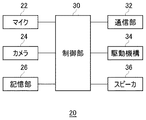
図3は、ロボット20の入出力系統を示す。制御部30は、音声データ、センサデータなどの各種データや、命令を処理して出力するメインプロセッサである。マイク22は周囲の音声を集音して音声信号に変換し、カメラ24は周囲を撮影して、撮影画像を取得する。記憶部26は、制御部30が処理するデータや命令などを一時的に記憶する。通信部32はアンテナを介して、制御部30から出力されるデータを無線通信により外部の情報処理装置10に送信する。また通信部32はアンテナを介して、情報処理装置10から音声データおよび駆動データを無線通信により受信し、制御部30に出力する。
FIG. 3 shows an input / output system of the
制御部30は、音声データを受け取ると、スピーカ36に供給して音声出力させ、駆動データを受け取ると、駆動機構34のモータを回転させる。駆動機構34は、ロボット20の可動部である関節部分に組み込まれたモータおよびモータ間を連結するリンク機構を含み、モータが駆動されることで、ロボット20の腕や脚、首などが動かされる。
When the
図4は、オブジェクトを制御するオブジェクト制御システムの構成を示す。オブジェクト制御システム1は、感情推定部100、内部状態管理部110、行動管理部120、内部状態記憶部130および出力処理部140を備える。内部状態記憶部130は、オブジェクト内部状態記憶部132およびユーザ内部状態記憶部134を有する。感情推定部100は、第1感情推定部102、第2感情推定部104および第3感情推定部106を有して、3系統で感情を推定する処理を実施する。
FIG. 4 shows the configuration of an object control system that controls an object. The
またオブジェクト制御システム1は、ユーザを撮影するカメラ14、ユーザの生体情報を検出する生体センサ15、ユーザの動きを検出するモーションセンサ16、ユーザ周囲の音声信号を取得するマイク17、イベントの発生を検知するイベント検知部40を有する。
Further, the
図4において、さまざまな処理を行う機能ブロックとして記載される各要素は、ハードウェア的には、回路ブロック、メモリ、その他のLSIで構成することができ、ソフトウェア的には、メモリにロードされたプログラムなどによって実現される。したがって、これらの機能ブロックがハードウェアのみ、ソフトウェアのみ、またはそれらの組合せによっていろいろな形で実現できることは当業者には理解されるところであり、いずれかに限定されるものではない。 In FIG. 4, each element described as a functional block that performs various processes can be composed of a circuit block, a memory, and other LSIs in terms of hardware, and is loaded in the memory in terms of software. It is realized by a program or the like. Therefore, it is understood by those skilled in the art that these functional blocks can be realized in various ways by hardware only, software only, or a combination thereof, and is not limited to any of them.
図4において、感情推定部100、内部状態管理部110、行動管理部120、内部状態記憶部130および出力処理部140の各構成は、情報処理装置10に設けられて、情報処理装置10が、ロボット20の行動を制御してもよい。また感情推定部100、内部状態管理部110、行動管理部120、内部状態記憶部130および出力処理部140の各構成は、ロボット20に設けられて、ロボット20が、自身の行動を自律的に制御してもよい。この場合、ロボット20は自律型ロボットとして構成され、単独で行動できる。また感情推定部100、内部状態管理部110、行動管理部120、内部状態記憶部130および出力処理部140の一部が、情報処理装置10に設けられ、残りがロボット20に設けられてもよい。この場合、情報処理装置10とロボット20とが協働して、ロボット20の行動を制御するために動作する。
In FIG. 4, each configuration of the
このように図4に示すオブジェクト制御システム1は、様々な態様で実現されてよい。上記各構成が情報処理装置10に設けられる場合、ロボット20のマイク22が取得した音声信号およびカメラ24が撮影した撮影画像は、情報処理装置10における処理で利用するために情報処理装置10に送信されてよい。また上記各構成がロボット20に設けられる場合、情報処理装置10に接続するマイク17が取得した音声信号およびカメラ14が撮影した撮影画像は、ロボット20における処理で利用するためにロボット20に送信されてよい。また図示する以外のマイクやカメラにより音声信号や撮影画像が取得されて、情報処理装置10またはロボット20に提供されてもよい。以下では、説明の便宜上、代表してカメラ14がユーザの様子を撮影し、マイク17がユーザの発声を集音して音声信号に変換する。
As described above, the
感情推定部100は、各種センサの出力や外部サーバからのデータをもとに、ユーザの感情を推定する。感情推定部100は、喜び、怒り、愛情、驚きなどの感情指標のそれぞれについて評価値を導出することで、ユーザの感情を推定する。なお実施例ではユーザの感情を単純なモデルで表現し、感情推定部100は、ユーザの感情を、良い感情(ポジティブな感情)、悪い感情(ネガティブな感情)、良くも悪くもない感情(ニュートラルな感情)の3つの評価値の中から推定する。なお実際には、「ポジティブ」、「ネガティブ」のそれぞれが複数段階に細分化されて、きめ細かな評価値を導出可能としてもよい。
The
第1感情推定部102は、各種センサの出力、すなわちイメージセンサであるカメラ14、生体センサ15、モーションセンサ16およびマイク17の出力をもとに、パラ言語情報や非言語情報にもとづいた非言語行動理解を行い、ユーザの感情を推定する。第1感情推定部102は、第2感情推定部104と比較すると、発話内容にもとづかずにユーザの感情を推定することを特徴とする。
The first
第1感情推定部102は、カメラ14の撮影画像から、ユーザの顔の表情、視線方向、手振りなどの変化を抽出し、ユーザの感情を推定する。生体センサ15はユーザに取り付けられて、ユーザの心拍数や発汗状態などの生体情報を検出し、第1感情推定部102は、生体情報からユーザの心理状態を導出して、ユーザの感情を推定する。モーションセンサ16はユーザに取り付けられて、ユーザの動きを検出し、第1感情推定部102は、ユーザの動きからユーザの感情を推定する。なおモーションセンサ16の役割は、カメラ14の撮像画像を解析することで代用することも可能である。また第1感情推定部102は、マイク17の音声信号からパラ言語情報の特徴量を用いて、ユーザの感情を推定する。パラ言語情報は、話速、音量、声の抑揚、イントネーション、言葉遣いなどの情報を含む。第1感情推定部102は、各種センサの出力のそれぞれから推定したユーザの感情を評価指標ごとに一つの評価値としてまとめて、内部状態管理部110に供給する。
The first
第2感情推定部104は、ユーザの発話内容をもとにユーザの感情を推定し、具体的にはマイク17の出力からユーザの発話内容を音声解析する自然言語理解を行って、ユーザの感情を推定する。自然言語理解の手法は、既知のアルゴリズムを利用してよい。ユーザが野球ゲームのプレイ中に、「よっしゃ。ホームラン打ったぜ。」と発話すれば、第2感情推定部104はユーザの「喜び」指標の感情を「ポジティブ」と推定し、一方でユーザが「ホームランを打たれてしまった。」と発話すれば、第2感情推定部104はユーザの「喜び」指標の感情を「ネガティブ」と推定してよい。第2感情推定部104は、推定したユーザの感情の評価値を、内部状態管理部110に供給する。
The second
イベント検知部40は、オブジェクト制御システム1におけるイベントの発生を検知し、第3感情推定部106に、発生したイベントの内容を通知する。ゲームのイベントに関して言えば、エミュレータ上でゲームプログラムを実行することで、エミュレータがホームランなどのイベントを検知できるため、イベント検知部40は、エミュレータからイベントを通知されてよい。なおイベント検知部40は、ホームラン時に再生される演出データへのアクセスを参照してホームランイベントを検知したり、また実際に表示装置11に画面表示される演出から、ホームランイベントを検知してもよい。第3感情推定部106は、通知されたイベント内容から、ユーザの感情を推定して、評価値を内部状態管理部110に供給する。
The
なおイベント検知部40は、ビッグデータを蓄積する外部サーバから、イベント発生タイミングを提供されてもよい。たとえば情報処理装置10が映画コンテンツを再生する場合、イベント検知部40は、その映画コンテンツの注目シーンの時間情報と、その注目シーンで推定されるユーザ感情との対応関係テーブルを事前に外部サーバから取得して、第3感情推定部106に提供しておく。イベント検知部40は、注目シーンの時間が到来すると、時間情報を第3感情推定部106に通知し、第3感情推定部106は、対応関係テーブルを参照して時間情報に対応付けられたユーザ感情を取得し、注目シーンにおけるユーザの感情を推定する。このように第3感情推定部106は、外部サーバからの情報をもとにユーザの感情を推定してもよい。
The
内部状態記憶部130において、オブジェクト内部状態記憶部132は、オブジェクトであるロボット20の内部状態を記憶し、ユーザ内部状態記憶部134は、ユーザの内部状態を記憶する。ロボット20の内部状態は、少なくともロボット20のユーザに対する感情および好感度によって定義され、ユーザの内部状態は、ユーザの感情と、ユーザのロボット20に対する好感度によって定義される。好感度は、現在に至る直近の複数の感情の評価値をもとに生成されるものであって、ユーザとロボット20との長期的な関係性により評価される。ロボット20の内部状態は、ロボット20に対するユーザの言動から導出される。
In the internal
内部状態管理部110は、感情推定部100により推定されたユーザの感情にもとづいて、ロボット20の内部状態およびユーザの内部状態を管理する。以下、最初にユーザの内部状態について説明し、その後、ロボット20の内部状態について説明する。
ユーザの「感情」は、感情推定部100により推定される感情によって設定される。内部状態管理部110は、感情推定部100により推定される感情にもとづいて、ユーザ内部状態記憶部134における評価値を更新する。
The internal
The user's "emotion" is set by the emotion estimated by the
内部状態管理部110は、ユーザの感情指標について「ポジティブ」の評価値が感情推定部100から供給されると、その感情指標の評価値を「ポジティブ」に更新し、「ネガティブ」の評価値が供給されると、その感情指標の評価値を「ネガティブ」に更新する。ここで「更新」とは、内部状態記憶部130における元の評価値を上書きする処理を意味し、元の評価値が「ポジティブ」であり、上書きする評価値が「ポジティブ」であって評価値に変化がない場合であっても、評価値の更新と呼ぶ。
When the evaluation value of "positive" for the user's emotion index is supplied from the
なお感情推定部100は、第1感情推定部102、第2感情推定部104および第3感情推定部106の3つの系統でユーザの感情を推定するため、各系統で推定されたユーザの感情の評価値が、互いに矛盾することが生じうる。以下、ユーザが野球ゲームでホームランを打ったときの「喜び」指標に関する評価値更新処理について説明する。
Since the
第3感情推定部106は、ホームランイベントに関して、ユーザがホームランを打った場合には「ポジティブ」、ユーザがホームランを打たれた場合には「ネガティブ」と感情推定するための評価値テーブルを保持している。第3感情推定部106は、イベント検知部40からユーザがホームランを打ったイベント通知を受けると、評価値テーブルを参照して、「喜び」指標の評価値を「ポジティブ」と推定する。
The third
通常、ユーザはホームランを打てば、体を動かしてはしゃいだり、「よっしゃ。ホームラン打ったぜ。」と叫んだりする喜びの感情表現を行う。このとき第1感情推定部102および第2感情推定部104ともに、「喜び」指標の評価値を「ポジティブ」と推定する。したがって内部状態管理部110に対して感情推定部100から3系統で供給される「喜び」指標の評価値は、すべて「ポジティブ」であり、内部状態管理部110は、ユーザ内部状態記憶部134の「喜び」指標の評価値を「ポジティブ」に更新する。
Normally, when a user hits a home run, he / she moves his / her body and makes a joyful emotional expression such as yelling, "Yeah. I hit a home run." At this time, both the first
しかしながら、ユーザがホームラン以外を狙っていた場合、ユーザは必ずしも喜びの言動を示さないことがある。たとえば、あるバッターの打席で、サイクル安打(1人の打者が1試合で単打、二塁打、三塁打、ホームランのそれぞれを1本以上打つこと)を成立させるために三塁打を狙っていると、ユーザはホームランを打っても喜べない。ゲームでは勝敗以外に、サイクル安打のような特別なプレーを表彰する仕組みが用意されていることも多く、表彰狙いのユーザにとっては、ホームランよりも三塁打の方が嬉しいケースもある。そこでホームランを打ったユーザが元気なく「しまった。ホームランかよ。」と発話すると、第1感情推定部102および第2感情推定部104ともに、「喜び」指標の評価値を「ネガティブ」と推定する。
However, if the user is aiming for something other than a home run, the user may not always show joy. For example, in a batter's turn at bat, a user is aiming for a triple hit to make a hitting for the cycle (one batter hits one or more singles, doubles, thirds, and home runs in one game). I'm not happy even if I hit. In addition to winning and losing, games often have a mechanism to commend special play such as hitting for the cycle, and in some cases, users aiming for commendation are more happy with triples than home runs. Then, when the user who hit the home run utters "I'm done. Is it a home run?", Both the first
そのため内部状態管理部110は、第1感情推定部102および第2感情推定部104から「ネガティブ」の評価値を、第3感情推定部106から「ポジティブ」の評価値を供給されることになる。内部状態管理部110は、3系統から供給される評価値のうち、半数以上で一致する評価値を採用してもよい。つまり内部状態管理部110は、複数系統から独立して供給される評価値のうち、多数決のルールにしたがって半数以上で一致する評価値を採用し、したがって、このケースでは、「喜び」指標の評価値を「ネガティブ」に更新してよい。
Therefore, the internal
なお内部状態管理部110は、3系統から供給される評価値に優先順位を設定し、優先順位にしたがって、採用する評価値を決定してよい。以下、各評価値の順位付けについて説明する。
まず第3感情推定部106により推定される評価値については、イベントに定義された固有の評価値であって、実際のユーザの状態を反映したものではない。そのため第3感情推定部106により推定される評価値は、採用する優先順位を最下位に設定されてよい。
The internal
First, the evaluation value estimated by the third
次に第1感情推定部102と第2感情推定部104とを比較すると、第2感情推定部104は、ユーザの発話内容にのみもとづいて感情推定を行っており、推定のための情報量が少ないという側面がある。また発話内容自体はポジティブな内容であっても、ユーザは自虐的に発話することもある。たとえば三塁打を狙っていたのに「ホームラン打ったぜ。」と肩を落として元気なく発話するようなケースである。この場合、第2感情推定部104は「ポジティブ」の評価値を推定するが、第1感情推定部102は、ユーザの態度やパラ言語情報から「ネガティブ」の評価値を推定する。このようにユーザは、気持ちとは裏腹な言葉を発することがあるため、内部状態管理部110は、第1感情推定部102による評価値の信頼性を、第2感情推定部104による評価値の信頼性より高く設定してよい。したがって内部状態管理部110は、第1感情推定部102、第2感情推定部104、第3感情推定部106による評価値の順番で、優先順位を設定してよい。
Next, when the first
内部状態管理部110は、優先順位を設定することで、少なくともいずれか1系統で評価値を得られれば、ユーザの内部状態を更新できるようになる。内部状態管理部110は、第1感情推定部102により推定されるユーザの感情と、第2感情推定部104により推定されるユーザの感情とが一致しない場合に、優先順位にしたがって第1感情推定部102により推定されるユーザの感情をもとに、ユーザの内部状態を更新する。また、たとえばユーザがホームランを打ったときに、第1感情推定部102および第2感情推定部104によってはユーザのポジティブまたはネガティブの感情を推定できない場合(ユーザが全く動くこともなく発話もしない場合)、内部状態管理部110は、第3感情推定部106により推定される評価値を採用すればよい。
By setting the priority, the internal
ユーザのロボット20に対する「好感度」は、現在までの間にユーザがロボット20に対して行った言動から推定された感情の複数の評価値から導出される。ロボット20の名前を「ヒコエモン」とすると、ロボット20がユーザに話しかけたときに、ユーザが「ヒコエモンの言うとおりだね。」と応答すれば、感情推定部100はユーザの「愛情」指標の評価値を「ポジティブ」であると推定し、一方で、ユーザが「ヒコエモン、うるさいから静かにして。」と応答すると、感情推定部100は、ユーザの「愛情」指標の評価値を「ネガティブ」であると推定する。またロボット20がユーザに「そろそろ充電してください。」と話しかけたときに、ユーザがすぐに充電してくれれば、感情推定部100はユーザの「愛情」指標の評価値を「ポジティブ」であると推定し、一方でなかなか充電してくれなければ、感情推定部100は、ユーザの「愛情」指標の評価値を「ネガティブ」であると推定する。またユーザがロボット20の頭をなでると、感情推定部100はユーザの「愛情」指標の評価値を「ポジティブ」であると推定し、ユーザがロボット20を蹴ると、感情推定部100はユーザの「愛情」指標の評価値を「ネガティブ」であると推定する。
The user's "favorability" toward the
内部状態管理部110は、感情推定部100から「愛情」指標の評価値を受け取ると、ユーザの好感度の評価値に反映する。内部状態管理部110は、現在までの「愛情」指標の複数の評価値をストックし、たとえば直近の複数個(たとえば21個)の評価値をもとにユーザのロボット20に対する好感度を推定する。ここではニュートラルの評価値を除いた複数の評価値のうち、ポジティブ評価値とネガティブ評価値のうち多い方の評価値を、好感度の評価値と設定してよい。つまり直近の21個の評価値のうち、ポジティブ評価値が11個以上あれば、好感度の評価値は「ポジティブ」と設定され、ネガティブ評価値が11個以上あれば、好感度の評価値は「ネガティブ」と設定されてよい。
When the internal
以上は、ユーザの内部状態についての説明であり、続いてロボット20の内部状態について説明する。
ロボット20のユーザに対する「好感度」は、現在までの間にユーザがロボット20に対して行った言動から推定された感情の複数の評価値から導出される。内部状態管理部110は、感情推定部100から「愛情」指標の評価値を受け取り、ロボット20のユーザに対する好感度の評価値に反映する。ロボット20のユーザに対する好感度は、上記したユーザのロボット20に対する好感度に連動する傾向にある。内部状態管理部110は、現在までの「愛情」指標の複数の評価値をストックし、たとえば直近の複数個(たとえば11個)の評価値をもとに、ロボット20のユーザに対する好感度を決定する。ここでユーザの好感度を推定する際に参照する評価値数よりも少なくしているのは、ロボット20のユーザに対する好感度を変動しやすくするためである。ロボット20のユーザに対する好感度は、ロボット20の感情を決定する際の重要なパラメータとなる。なおユーザに対する好感度は、単に「ポジティブ」、「ネガティブ」のみで評価するのではなく、「ポジティブ」、「ネガティブ」のそれぞれを複数段階で評価してもよい。
The above is a description of the internal state of the user, and subsequently, the internal state of the
The "favorability" of the
実施例において、ロボット20のユーザに対する好感度がポジティブであれば、ロボット20はユーザに共感して、共視体験を実現する行動をとるが、一方でユーザに対する好感度がネガティブであれば、ロボット20はユーザに共感することなく、むしろユーザに反発する行動をとる。行動管理部120は、ロボット20の内部状態およびユーザの内部状態にもとづいて、ロボット20の音声出力を含む行動を決定する。
In the embodiment, if the
野球ゲームでユーザがホームランを打ったときのロボット20の行動について説明する。感情推定部100は、「喜び」指標の評価値を「ポジティブ」と推定し、内部状態管理部110は、ユーザの「喜び」指標の評価値を「ポジティブ」に更新する。また内部状態管理部110は、ユーザの「喜び」指標の評価値と、ロボット20のユーザに対する好感度の評価値とを参照して、ロボット20の「喜び」指標の評価値を決定する。
The behavior of the
<ユーザに対する好感度がポジティブである場合>
ユーザに対するロボット20の好感度がポジティブに設定されている場合、内部状態管理部110は、ロボット20の感情を、ユーザの感情と共感するように管理する。そのためユーザの「喜び」指標の評価値がポジティブに更新されれば、内部状態管理部110は、ロボット20の「喜び」指標の評価値もポジティブに更新する。内部状態管理部110は、ロボット20の内部状態を更新すると、行動管理部120に、ロボット20の行動を決定するタイミングであることを示す契機情報を提供する。行動管理部120は契機情報を受け付けると、オブジェクト内部状態記憶部132で更新されたロボット20の内部状態、具体的には更新された感情の評価値にもとづいて、ロボット20の音声出力を含む行動を決定する。たとえば行動管理部120は、「○×選手すごいね。ホームラン打ったね。」という発話内容を生成し、またロボット20の動作として2回万歳する行動を決定する。この発話内容および動作は、出力処理部140に通知され、出力処理部140は、行動管理部120により決定された行動をロボット20に実施させる。
<When the user's liking is positive>
When the liking of the
出力処理部140は、発話のスピードや、発話と動作のタイミングなど、ロボット20における出力タイミングを制御した音声データおよびロボット20を駆動する駆動データを生成し、ロボット20に出力する。ロボット20において通信部32が音声データおよび駆動データを受信すると、制御部30が、音声データをスピーカ36に供給して音声出力させ、また駆動データにもとづいて駆動機構34のモータを駆動させる。これによりロボット20は、ホームランを打ったユーザに共感する発話および動作を行う。ユーザは、一緒にロボット20が喜んでいるのを見て、ロボット20に対する親近感を高められるとともに、ゲームへのモチベーションも高められる。
The
なお逆に、ユーザがホームランを打たれた場合には、ユーザの「喜び」指標の評価値がネガティブに更新されるため、内部状態管理部110は、ロボット20の「喜び」指標の評価値をネガティブに更新する。内部状態管理部110は、ロボット20の内部状態を更新すると、行動管理部120に契機情報を提供する。これにより行動管理部120は、オブジェクト内部状態記憶部132で更新されたロボット20の「喜び」指標の評価値にもとづいて、ロボット20の音声出力を含む行動を決定する。たとえば行動管理部120は、「あーあ。ホームラン打たれちゃったね。」という発話内容を生成し、またロボット20の動作として、がっくりと脱力する行動を決定する。この発話内容および動作は、出力処理部140に通知され、出力処理部140は、行動管理部120により決定された行動をロボット20に実施させる。
On the contrary, when the user hits a home run, the evaluation value of the user's "joy" index is updated negatively, so that the internal
<ユーザに対する好感度がネガティブである場合>
一方で、ユーザに対するロボット20の好感度がネガティブに設定されている場合、内部状態管理部110は、ロボット20の感情を、ユーザの感情と共感しないように管理する。内部状態管理部110は、むしろユーザに反発するようにロボット20の感情を管理することで、ユーザがもっとロボット20を大事に扱った方がよいことを気付かせるようにする。
<When the user's liking is negative>
On the other hand, when the liking of the
そのためホームランを打ったユーザの「喜び」指標の評価値がポジティブに更新されても、内部状態管理部110は、ロボット20の「喜び」指標の評価値をネガティブに更新する。ユーザに対するロボット20の好感度がネガティブであれば、内部状態管理部110は、ロボット20の感情の評価値を、ユーザの感情の評価値と逆の値に更新する。そのためユーザの感情評価値がポジティブであれば、ロボット20の感情評価値をネガティブに更新し、ユーザの感情評価値がネガティブであれば、ロボット20の感情評価値をポジティブに更新してよい。
Therefore, even if the evaluation value of the "joy" index of the user who hit the home run is updated positively, the internal
内部状態管理部110はロボット20の内部状態を更新すると、行動管理部120に、ロボット20の行動を決定するタイミングであることを示す契機情報を提供する。これにより行動管理部120は、オブジェクト内部状態記憶部132で更新されたロボット20の内部状態、具体的には「喜び」指標のネガティブ評価値にもとづいて、ロボット20の音声出力を含む行動を決定する。たとえば行動管理部120は、発話内容を生成せず(つまりユーザを無視し)、またロボット20の動作としてユーザと逆方向を向く(そっぽを向く)行動を決定してよい。この行動内容は、出力処理部140に通知され、出力処理部140は、行動管理部120により決定された行動をロボット20に実施させる。
When the internal
このロボット20の行動を見て、ユーザは、以前は一緒に喜んでくれていたのに、今回は一緒に喜んでくれていないことに気付く。ユーザは自身のこれまでの態度を振り返り、ロボット20に冷たく接していたことで、一緒に喜んでもらえないことを認識する。ロボット20が、あえて反発する反応をすることで、ユーザがこれからロボット20に優しく接することを心がけるきっかけを与えられる。
Looking at the behavior of this
このようにオブジェクト制御システム1では、ユーザとロボット20との関係を、実際の人間社会における人間関係と同じように管理する。現実の人同士のコミュニケーションでは、お互いに思いやりをもって接することで良好な関係が生成されるが、一方が思いやりをなくせば他方も思いやりをもてなくなる。オブジェクト制御システム1では、この思いやりを「愛情」指標の感情で表現し、思いやりを通じた人間関係を「好感度」の指標で表現している。そのためオブジェクト制御システム1におけるユーザの好感度の評価値とロボット20の好感度の評価値も連動する傾向をとる。ロボット20のユーザに対する好感度が下がっている場合には、あらためてユーザが思いやりをもってロボット20と接することで、ユーザに対する好感度の評価値はネガティブからポジティブに改善されていき、ユーザは、再びロボット20と共視体験を得られるようになる。
In this way, the
ユーザがロボット20に対して親近感を高めることで、ロボット20は一種の友人のような存在になり得る。ユーザが不規則な生活を送っていれば、ロボット20は「そろそろ寝ようか。」など生活リズムの改善を提案し、ユーザが友人からの助言として聞き入れるようなケースも将来的には考えられる。そのようなことを実現するためにも、ロボット20による共視体験を通じて、ユーザがロボット20に対する親近感を高めるような仕組みを構築することは、ロボット20の今後の可能性を広げることにもつながる。
By increasing the familiarity of the user with the
なお上記した実施例では、ユーザが、実際のオブジェクトであるロボット20との間で共視体験を得る仕組みを提案したが、仮想的なオブジェクトとの間で共視体験を得る仕組みも同様に構築できる。
In the above embodiment, the user has proposed a mechanism for obtaining a sympathetic experience with the
この場合、仮想的なオブジェクトは、3Dモデルにより構成される人やペットなどのキャラクタであってよく、コンピュータにより生成される仮想空間に存在する。実施例ではユーザがヘッドマウントディスプレイ(HMD)を装着したときに構築される仮想空間において、ユーザの正面にコンテンツが再生され、ユーザが横を向くと仮想的なキャラクタが一緒にコンテンツを視聴している様子を見ることのできる仕組みを提案する。仮想キャラクタも、ロボット20と同様に、ユーザに共感する反応を出力したり、逆にユーザに反発する反応を出力することで、ユーザとのコミュニケーションを図る。
In this case, the virtual object may be a character such as a person or a pet composed of a 3D model, and exists in a virtual space generated by a computer. In the embodiment, in a virtual space constructed when the user wears a head-mounted display (HMD), the content is played in front of the user, and when the user turns sideways, the virtual character watches the content together. We propose a mechanism that allows you to see how you are. Similar to the
図5は、HMD200の外観形状の例を示す。HMD200は、出力機構部202および装着機構部204から構成される。装着機構部204は、ユーザが被ることにより頭部を一周してHMD200を頭部に固定する装着バンド206を含む。
FIG. 5 shows an example of the appearance shape of the HMD200. The
出力機構部202は、HMD200をユーザが装着した状態において左右の目を覆う形状の筐体208を含み、内部には装着時に目に正対する表示パネルを備える。表示パネルは液晶パネルや有機ELパネルなどであってよい。筐体208内部にはさらに、表示パネルとユーザの目との間に位置し、ユーザの視野角を拡大する左右一対の光学レンズが備えられる。HMD200はさらに、ユーザの耳に対応する位置にスピーカーやイヤホンを備えてよく、外付けのヘッドホンが接続されるように構成されてもよい。また筐体208の内部には、ユーザの顔を撮影するカメラが設けられ、ユーザの顔の表情を検出するために利用される。
The
筐体208の外面には、トラッキング用LEDである発光マーカ210a、210b、210c、210dが備えられる。発光マーカ210はカメラ14により撮影されて、情報処理装置10がマーカ位置を画像解析する。またHMD200には姿勢センサ(加速度センサおよびジャイロセンサ)が搭載される。HMD200は、情報処理装置10と既知の無線通信プロトコルで接続され、姿勢センサが検出したセンサデータを情報処理装置10に送信する。情報処理装置10は、発光マーカ210の撮像位置および姿勢センサのセンサデータをもとに、HMD200が向いている方向を特定する。
ここでは情報処理装置10が、映画などのコンテンツデータをHMD200に送信する。情報処理装置10はHMD200が向く基準方向を設定し、基準方向に仮想ディスプレイを設置して、仮想ディスプレイにコンテンツの再生データを表示させる。また情報処理装置10は、基準方向に対して、例えば視点位置を中心に90度回転した位置に、仮想ディスプレイを向いている仮想的なオブジェクトを配置させる。これによりユーザが視線方向を90度横に回転すると、隣に仮想的なオブジェクトが一緒にコンテンツを視聴している様子を見ることができる。
Here, the
このようにしてHMD200を装着したユーザは、仮想的なオブジェクトと共視体験を得られることができる。仮想的なオブジェクトの行動決定処理については、ロボット20に関して説明したとおりである。また仮想的なオブジェクトの行動自由度は、ロボット20と比べて高いため、様々なポジティブまたはネガティブな感情表現をさせることが可能となる。
In this way, the user wearing the
このように実施例によれば、ユーザが実際のオブジェクトまたは仮想的なオブジェクトと共視体験を通じて親近感を高めることができ、ユーザの生活をより豊かなものにできる。 In this way, according to the embodiment, the user can enhance the familiarity through the experience of sympathizing with the real object or the virtual object, and the user's life can be enriched.
以上、本発明を実施例をもとに説明した。実施例は例示であり、それらの各構成要素や各処理プロセスの組合せにいろいろな変形例が可能なこと、またそうした変形例も本発明の範囲にあることは当業者に理解されるところである。 The present invention has been described above based on examples. Examples are examples, and it will be understood by those skilled in the art that various modifications are possible for each of these components and combinations of each processing process, and that such modifications are also within the scope of the present invention.
実施例で行動管理部120は、ユーザがホームランを打ったときの共感表現として「○×選手すごいね。ホームラン打ったね。」という発話内容を生成した。変形例では、共視体験であることを強調するために、行動管理部120は積極的に、対象物を指示代名詞で置換した音声をオブジェクトから出力させるようにしてもよい。具体的には、「○×選手」の表現を、指示代名詞である「こいつ」に置換し、「こいつすごいね。ホームラン打ったね。」という発話内容を生成してもよい。指示代名詞を利用することで、ユーザは、ロボット20と共視している感覚をさらに高めることができる。
In the embodiment, the
1・・・オブジェクト制御システム、10・・・情報処理装置、20・・・ロボット、40・・・イベント検知部、100・・・感情推定部、102・・・第1感情推定部、104・・・第2感情推定部、106・・・第3感情推定部、110・・・内部状態管理部、120・・・行動管理部、130・・・内部状態記憶部、132・・・オブジェクト内部状態記憶部、134・・・ユーザ内部状態記憶部、140・・・出力処理部。 1 ... Object control system, 10 ... Information processing device, 20 ... Robot, 40 ... Event detection unit, 100 ... Emotion estimation unit, 102 ... First emotion estimation unit, 104. 2nd emotion estimation unit, 106 ... 3rd emotion estimation unit, 110 ... internal state management unit, 120 ... behavior management unit, 130 ... internal state storage unit, 132 ... inside the object State storage unit, 134 ... User internal state storage unit, 140 ... Output processing unit.
Claims (8)
ユーザの感情を推定する感情推定部と、
ユーザの感情を含むユーザの内部状態を記憶するユーザ内部状態記憶部と、
オブジェクトの感情を含むオブジェクトの内部状態を記憶するオブジェクト内部状態記憶部と、
推定されたユーザの感情にもとづいて、オブジェクトの内部状態およびユーザの内部状態を管理する内部状態管理部と、
オブジェクトの内部状態にもとづいて、オブジェクトの行動を決定する行動管理部と、
前記行動管理部により決定された行動をオブジェクトに実施させる出力処理部と、を備え、
前記感情推定部は、
センサ出力をもとにユーザの感情を推定する第1感情推定部と、
ユーザの発話内容をもとにユーザの感情を推定する第2感情推定部と、
当該オブジェクト制御システムにおいて発生したイベントの内容をもとにユーザの感情を推定する第3感情推定部と、を有し、
前記内部状態管理部は、前記第1感情推定部、前記第2感情推定部および前記第3感情推定部の出力をもとに、オブジェクトの内部状態およびユーザの内部状態を更新するものであって、
オブジェクトの内部状態は、現在までの間に推定されたユーザの感情の複数の評価値から導出されるオブジェクトのユーザに対する好感度を含み、
前記内部状態管理部は、ユーザに対する好感度がポジティブに設定されている場合、オブジェクトの感情をユーザの感情と共感するように決定し、ユーザに対する好感度がネガティブに設定されている場合、オブジェクトの感情をユーザの感情と共感しないように決定する、
ことを特徴とするオブジェクト制御システム。 An object control system that controls objects
An emotion estimation unit that estimates the user's emotions,
A user internal state storage unit that stores the user's internal state including the user's emotions,
An object internal state storage unit that stores the internal state of an object, including the emotions of the object,
An internal state management unit that manages the internal state of the object and the internal state of the user based on the estimated user's emotions,
The behavior management department that determines the behavior of the object based on the internal state of the object,
It is provided with an output processing unit that causes an object to execute an action determined by the behavior management unit.
The emotion estimation unit
The first emotion estimation unit that estimates the user's emotions based on the sensor output,
A second emotion estimation unit that estimates the user's emotions based on the user's utterances,
It has a third emotion estimation unit that estimates the user's emotions based on the content of the event that occurred in the object control system.
The internal state management unit updates the internal state of the object and the internal state of the user based on the outputs of the first emotion estimation unit, the second emotion estimation unit, and the third emotion estimation unit. ,
The internal state of an object includes the object's liking for the user, which is derived from multiple evaluation values of the user's emotions estimated to date.
The internal state management unit determines that the emotion of the object sympathizes with the emotion of the user when the favorability for the user is set to be positive, and when the favorability for the user is set to be negative, the object Determine your emotions not to sympathize with your emotions,
An object control system characterized by that.
ことを特徴とする請求項1に記載のオブジェクト制御システム。 The internal state management unit has different reliability of the evaluation value by the first emotion estimation unit, reliability of the evaluation value by the second emotion estimation unit, and reliability of the evaluation value by the third emotion estimation unit. Set,
The object control system according to claim 1.
前記行動管理部は、契機情報を受け付けると、オブジェクトの行動を決定する、
ことを特徴とする請求項1または2に記載のオブジェクト制御システム。 When the internal state management unit updates the internal state, the internal state management unit provides the behavior management unit with trigger information indicating that it is time to determine the behavior of the object.
When the behavior management unit receives the trigger information, it decides the behavior of the object.
The object control system according to claim 1 or 2.
ことを特徴とする請求項1から3のいずれかに記載のオブジェクト制御システム。 The object is a real object or a virtual object,
The object control system according to any one of claims 1 to 3.
ことを特徴とする請求項1から4のいずれかに記載のオブジェクト制御システム。 The behavior management unit outputs a voice in which the object is replaced with a demonstrative pronoun from the object.
The object control system according to any one of claims 1 to 4.
ことを特徴とする請求項1から5のいずれかに記載のオブジェクト制御システム。 The internal state management unit sets the user's liking for the object from a predetermined number of evaluation values of the user's emotions estimated up to the present, and estimates the user's liking for the object up to the present. It is set from a number of evaluation values larger than the predetermined number.
The object control system according to any one of claims 1 to 5.
センサ出力をもとにユーザの感情を推定するステップと、
ユーザの発話内容をもとにユーザの感情を推定するステップと、
発生したイベントの内容をもとにユーザの感情を推定するステップと、
ユーザの感情を含むユーザの内部状態を管理するステップと、
オブジェクトの感情を含むオブジェクトの内部状態を管理するステップと、
推定されたユーザの感情にもとづいて、オブジェクトの内部状態およびユーザの内部状態を更新するステップと、
オブジェクトの内部状態にもとづいて、オブジェクトの行動を決定するステップと、
決定された行動をオブジェクトに実施させるステップと、を実施させるオブジェクト制御方法であって、
オブジェクトの内部状態は、現在までの間に推定されたユーザの感情の複数の評価値から導出されるオブジェクトのユーザに対する好感度を含み、
オブジェクトの内部状態を更新するステップは、ユーザに対する好感度がポジティブに設定されている場合、オブジェクトの感情をユーザの感情と共感するように決定し、ユーザに対する好感度がネガティブに設定されている場合、オブジェクトの感情をユーザの感情と共感しないように決定する、オブジェクト制御方法。 In the object control system,
Steps to estimate the user's emotions based on the sensor output,
Steps to estimate the user's emotions based on the user's utterance,
Steps to estimate the user's emotions based on the content of the event that occurred,
Steps to manage the user's internal state, including the user's emotions,
Steps to manage the internal state of an object, including the object's emotions,
Steps to update the internal state of the object and the internal state of the user based on the estimated user's emotions,
Steps that determine the behavior of an object based on the internal state of the object,
It is an object control method that causes an object to perform a determined action and a step that causes the object to perform the determined action.
The internal state of an object includes the object's liking for the user, which is derived from multiple evaluation values of the user's emotions estimated to date.
The step of updating the internal state of an object determines that the object's emotions sympathize with the user's emotions when the user's liking is set to positive, and the user's liking is set to negative. An object control method that determines that an object's emotions do not sympathize with the user's emotions.
センサ出力をもとにユーザの感情を推定する機能と、
ユーザの発話内容をもとにユーザの感情を推定する機能と、
発生したイベントの内容をもとにユーザの感情を推定する機能と、
ユーザの感情を含むユーザの内部状態を管理する機能と、
オブジェクトの感情を含むオブジェクトの内部状態を管理する機能と、
推定されたユーザの感情にもとづいて、オブジェクトの内部状態およびユーザの内部状態を更新する機能と、
オブジェクトの内部状態にもとづいて、オブジェクトの行動を決定する機能と、
決定された行動をオブジェクトに実施させる機能と、を実現させるためのプログラムであって、
オブジェクトの内部状態は、現在までの間に推定されたユーザの感情の複数の評価値から導出されるオブジェクトのユーザに対する好感度を含み、
オブジェクトの内部状態を更新する機能は、ユーザに対する好感度がポジティブに設定されている場合、オブジェクトの感情をユーザの感情と共感するように決定し、ユーザに対する好感度がネガティブに設定されている場合、オブジェクトの感情をユーザの感情と共感しないように決定する機能を含む、プログラム。 On the computer
A function to estimate the user's emotions based on the sensor output,
A function to estimate the user's emotions based on the user's utterance,
A function to estimate the user's emotions based on the content of the event that occurred,
A function to manage the user's internal state including the user's emotions,
Ability to manage the internal state of an object, including the object's emotions,
Ability to update the internal state of an object and the internal state of a user based on the estimated user's emotions,
A function that determines the behavior of an object based on the internal state of the object,
It is a program to realize the function to make the object perform the determined action.
The internal state of an object includes the object's liking for the user, which is derived from multiple evaluation values of the user's emotions estimated to date.
The ability to update the internal state of an object determines that the object's emotions sympathize with the user's emotions when the user's liking is set to positive, and when the user's liking is set to negative. A program that includes the ability to determine that an object's emotions do not sympathize with the user's emotions.
Priority Applications (3)
| Application Number | Priority Date | Filing Date | Title |
|---|---|---|---|
| JP2017091909A JP6814089B2 (en) | 2017-05-02 | 2017-05-02 | Object control system and object control method |
| PCT/JP2018/016759 WO2018203501A1 (en) | 2017-05-02 | 2018-04-25 | Object control system and object control method |
| US16/605,835 US11759959B2 (en) | 2017-05-02 | 2018-04-25 | Object control system and object control method |
Applications Claiming Priority (1)
| Application Number | Priority Date | Filing Date | Title |
|---|---|---|---|
| JP2017091909A JP6814089B2 (en) | 2017-05-02 | 2017-05-02 | Object control system and object control method |
Publications (3)
| Publication Number | Publication Date |
|---|---|
| JP2018187712A JP2018187712A (en) | 2018-11-29 |
| JP2018187712A5 JP2018187712A5 (en) | 2019-06-20 |
| JP6814089B2 true JP6814089B2 (en) | 2021-01-13 |
Family
ID=64016649
Family Applications (1)
| Application Number | Title | Priority Date | Filing Date |
|---|---|---|---|
| JP2017091909A Active JP6814089B2 (en) | 2017-05-02 | 2017-05-02 | Object control system and object control method |
Country Status (3)
| Country | Link |
|---|---|
| US (1) | US11759959B2 (en) |
| JP (1) | JP6814089B2 (en) |
| WO (1) | WO2018203501A1 (en) |
Families Citing this family (12)
| Publication number | Priority date | Publication date | Assignee | Title |
|---|---|---|---|---|
| JP7051728B2 (en) * | 2019-01-25 | 2022-04-11 | Necパーソナルコンピュータ株式会社 | Interactive robot and its control device |
| WO2020213244A1 (en) * | 2019-04-16 | 2020-10-22 | ソニー株式会社 | Information processing device, information processing method, and program |
| JP2020188824A (en) * | 2019-05-17 | 2020-11-26 | 株式会社東海理化電機製作所 | Control apparatus and presentation system |
| CN110399193A (en) * | 2019-07-25 | 2019-11-01 | 腾讯科技(深圳)有限公司 | Guide data sending method, device, terminal, server and storage medium |
| CN113571087B (en) * | 2020-04-29 | 2023-07-28 | 宏达国际电子股份有限公司 | Method and electronic device for generating action based on audio signal |
| JP7518791B2 (en) * | 2021-03-31 | 2024-07-18 | ミサワホーム株式会社 | In-house display system |
| US20240198225A1 (en) * | 2021-04-23 | 2024-06-20 | Sony Interactive Entertainment Inc. | Information processing apparatus and comment generation method |
| US20240346728A1 (en) | 2021-05-24 | 2024-10-17 | Sony Group Corporation | Information processing device, information processing method, and information processing system |
| WO2023013027A1 (en) * | 2021-08-06 | 2023-02-09 | 株式会社I’mbesideyou | Video analysis system |
| JP2026031405A (en) * | 2024-08-09 | 2026-02-24 | シャープ株式会社 | Information processing device, display device, television receiver, information processing system, and information processing method |
| JP7685660B1 (en) | 2024-08-09 | 2025-05-29 | シャープ株式会社 | Information processing device, display device, television receiver, and information processing system |
| JP7716547B1 (en) | 2024-08-09 | 2025-07-31 | シャープ株式会社 | Information processing device, display device, television receiver, information processing system, and information processing method |
Family Cites Families (9)
| Publication number | Priority date | Publication date | Assignee | Title |
|---|---|---|---|---|
| JP3860409B2 (en) * | 2000-11-27 | 2006-12-20 | 日本電信電話株式会社 | Pet robot apparatus and pet robot apparatus program recording medium |
| JP2002258886A (en) * | 2001-03-02 | 2002-09-11 | Sony Corp | Speech synthesis apparatus, speech synthesis method, program and recording medium |
| JP4266552B2 (en) * | 2001-10-16 | 2009-05-20 | 日本電気株式会社 | Robot apparatus and control method thereof |
| JP4555039B2 (en) * | 2004-03-30 | 2010-09-29 | 日本電気株式会社 | Robot, robot control method, robot control program |
| JP2006123136A (en) * | 2004-11-01 | 2006-05-18 | Advanced Telecommunication Research Institute International | Communication robot |
| JP2012059107A (en) * | 2010-09-10 | 2012-03-22 | Nec Corp | Emotion estimation device, emotion estimation method and program |
| JP6166234B2 (en) * | 2014-08-08 | 2017-07-19 | 日本電信電話株式会社 | Robot control apparatus, robot control method, and robot control program |
| JP2017077595A (en) * | 2015-10-20 | 2017-04-27 | 株式会社日本自動車部品総合研究所 | Emotional operation control device and emotional operation control method of operation body |
| US11074491B2 (en) * | 2016-10-20 | 2021-07-27 | RN Chidakashi Technologies Pvt Ltd. | Emotionally intelligent companion device |
-
2017
- 2017-05-02 JP JP2017091909A patent/JP6814089B2/en active Active
-
2018
- 2018-04-25 WO PCT/JP2018/016759 patent/WO2018203501A1/en not_active Ceased
- 2018-04-25 US US16/605,835 patent/US11759959B2/en active Active
Also Published As
| Publication number | Publication date |
|---|---|
| JP2018187712A (en) | 2018-11-29 |
| WO2018203501A1 (en) | 2018-11-08 |
| US11759959B2 (en) | 2023-09-19 |
| US20200114520A1 (en) | 2020-04-16 |
Similar Documents
| Publication | Publication Date | Title |
|---|---|---|
| JP6814089B2 (en) | Object control system and object control method | |
| US11947719B2 (en) | Building saccade models for predicting a landing point of a saccade experienced by a player | |
| US10636217B2 (en) | Integration of tracked facial features for VR users in virtual reality environments | |
| US10438394B2 (en) | Information processing method, virtual space delivering system and apparatus therefor | |
| US12079943B2 (en) | Neutral avatars | |
| US20180357817A1 (en) | Information processing method, program, and computer | |
| CA2979036C (en) | Systems and processes for providing virtual sexual experiences | |
| CN109716397B (en) | Simulation system, processing method, and information storage medium | |
| JP2010253277A (en) | Method and system for controlling movements of objects in video game | |
| JP2010257461A (en) | Method and system for creating shared game space for networked game | |
| JP6719633B1 (en) | Program, method, and viewing terminal | |
| WO2019116521A1 (en) | Entertainment system, robot device, and server device | |
| JP2021518778A (en) | Asynchronous virtual reality interaction | |
| JP6979539B2 (en) | Information processing system, display method and computer program | |
| JP7809684B2 (en) | Information processing device, information processing terminal, information processing method, and program | |
| CN116322507A (en) | A sexual demand interactive platform system | |
| CN119576128A (en) | Device, method and graphical user interface for three-dimensional user experience session in an extended reality environment | |
| CN119451734A (en) | Method for adjusting headphone noise cancellation based on real-world activity or gaming context | |
| Lages | Nine Challenges for Immersive | |
| CN118142168A (en) | Virtual object control method, device, storage medium and equipment | |
| JP2021053358A (en) | Program, method and viewing terminal |
Legal Events
| Date | Code | Title | Description |
|---|---|---|---|
| A521 | Request for written amendment filed |
Free format text: JAPANESE INTERMEDIATE CODE: A523 Effective date: 20190510 |
|
| A621 | Written request for application examination |
Free format text: JAPANESE INTERMEDIATE CODE: A621 Effective date: 20190510 |
|
| A131 | Notification of reasons for refusal |
Free format text: JAPANESE INTERMEDIATE CODE: A131 Effective date: 20200602 |
|
| A521 | Request for written amendment filed |
Free format text: JAPANESE INTERMEDIATE CODE: A523 Effective date: 20200729 |
|
| A131 | Notification of reasons for refusal |
Free format text: JAPANESE INTERMEDIATE CODE: A131 Effective date: 20200908 |
|
| A521 | Request for written amendment filed |
Free format text: JAPANESE INTERMEDIATE CODE: A523 Effective date: 20201105 |
|
| TRDD | Decision of grant or rejection written | ||
| A01 | Written decision to grant a patent or to grant a registration (utility model) |
Free format text: JAPANESE INTERMEDIATE CODE: A01 Effective date: 20201208 |
|
| A61 | First payment of annual fees (during grant procedure) |
Free format text: JAPANESE INTERMEDIATE CODE: A61 Effective date: 20201218 |
|
| R150 | Certificate of patent or registration of utility model |
Ref document number: 6814089 Country of ref document: JP Free format text: JAPANESE INTERMEDIATE CODE: R150 |