JP6830807B2 - Method for manufacturing metal-coated resin molded product and metal-coated resin molded product - Google Patents
Method for manufacturing metal-coated resin molded product and metal-coated resin molded product Download PDFInfo
- Publication number
- JP6830807B2 JP6830807B2 JP2016242362A JP2016242362A JP6830807B2 JP 6830807 B2 JP6830807 B2 JP 6830807B2 JP 2016242362 A JP2016242362 A JP 2016242362A JP 2016242362 A JP2016242362 A JP 2016242362A JP 6830807 B2 JP6830807 B2 JP 6830807B2
- Authority
- JP
- Japan
- Prior art keywords
- metal
- resin molded
- molded product
- thermoplastic resin
- coated resin
- Prior art date
- Legal status (The legal status is an assumption and is not a legal conclusion. Google has not performed a legal analysis and makes no representation as to the accuracy of the status listed.)
- Active
Links
Images

Landscapes
- Lining Or Joining Of Plastics Or The Like (AREA)
- Moulds For Moulding Plastics Or The Like (AREA)
- Injection Moulding Of Plastics Or The Like (AREA)
Description
本発明は、金属被覆樹脂成形体および金属被覆樹脂成形体の製造方法に関する。 The present invention relates to a metal-coated resin molded product and a method for producing a metal-coated resin molded product.
近年、ユーザーの目に直接触れる、あるいはユーザーが直接手に触れる樹脂成形品において、装飾性の観点から、曲面形状を有し、透明な樹脂成形体の表面に金属調の意匠面が設けられた複合体のニーズが高まっている。
ユーザーの目に直接触れる、あるいはユーザーが直接手に触れる樹脂成形体としては、例えば、自動車の内装品、家電製品、居住空間の壁面材、日常容器、ヘルメット等のフェイスシールド、アイウェア、照明部材、看板やソーラーパネル等の屋外設置材料、化粧料収容用のコンパクト容器等のコスメティック製品等が挙げられる。
In recent years, in a resin molded product that is directly touched by the user's eyes or directly touched by the user, a metal-like design surface is provided on the surface of a transparent resin molded product having a curved shape from the viewpoint of decorativeness. The need for complexes is increasing.
Resin molded products that are directly touched by the user's eyes or directly touched by the user include, for example, automobile interiors, home appliances, wall materials for living spaces, everyday containers, face shields such as helmets, eyewear, and lighting members. , Outdoor installation materials such as signboards and solar panels, cosmetic products such as compact containers for storing cosmetics, and the like.
透明な樹脂成形体に金属調の意匠面を形成する方法として、例えば、特許文献1に記載の技術がある。 As a method of forming a metallic design surface on a transparent resin molded body, for example, there is a technique described in Patent Document 1.
特許文献1には一部分にラミネート層が貼り付けられた特定領域を有するインモールド転写フィルムを、成形金型のキャビティにセットした状態で射出樹脂を上記キャビティに注入して成形品を加飾するインモールド成形方法が記載されている。 In Patent Document 1, an in-mold transfer film having a specific region to which a laminated layer is partially attached is set in a cavity of a molding die, and an injection resin is injected into the cavity to decorate the molded product. The molding method is described.
しかし、特許文献1のような方法で得られた成形体は機械的な強度が必要とされる分野には適用が難しい場合があり、またインモールドにより得られる金属調の触感や質感は樹脂成形体の触感や質感の域を超えることができず、実際の金属の触感や質感のレベルには未だ到達していないという問題があった。また電磁波、ノイズシールド性が要求される家電分野には十分な対応ができないという問題点があった。 However, the molded product obtained by the method as in Patent Document 1 may be difficult to apply to the field where mechanical strength is required, and the metallic feel and texture obtained by in-molding are resin molded. There was a problem that it could not exceed the range of the tactile sensation and texture of the body and had not yet reached the level of the actual tactile sensation and texture of metal. In addition, there is a problem that it cannot sufficiently cope with the field of home appliances that require electromagnetic wave and noise shielding properties.
また、樹脂成形体の表面に金属調の意匠面として金属層を設ける方法がある。金属層を設ける方法としては、めっき、蒸着等の手段が挙げられる。しかし、いずれも金属層の強度や接着力が不十分である場合が多い。また、めっきに関しては有害なめっき廃液の処理等の問題がある。 Further, there is a method of providing a metal layer as a metallic design surface on the surface of the resin molded body. Examples of the method of providing the metal layer include means such as plating and thin film deposition. However, in all cases, the strength and adhesive strength of the metal layer are often insufficient. Further, regarding plating, there is a problem such as treatment of harmful plating waste liquid.
そこで、樹脂成形体の表面に意匠面を形成する金属箔や金属シートを接合することが考えられる。しかしながら、これら金属箔や金属シートは加熱圧着しただけでは樹脂との接着が弱く、わずかな応力によって剥離してしまう場合がある。強固に接着するために金属と樹脂成形体の間に接着剤を塗布する、あるいはホットメルト接着シートを挟んで加熱する等の手段もあるが、生産性、コストの面で不利である。
また、熱圧着方法(熱プレス法)で行われるので、成形体表面は通常、平面上に限定されるという問題点があった。その理由は、熱プレスでは樹脂成形体の表面状態を維持させて、そのまま仕上げとするので、最適な条件で熱加工しなければ、表面が軟化しすぎてクモリや型当たり跡等の問題が発生しやすかったり、また金属層に比べて熱収縮が数倍大きいので、ベコつきや形状異常、ソリ等の問題が発生しやすかったりするからだと考えられる。
Therefore, it is conceivable to join a metal foil or a metal sheet that forms a design surface to the surface of the resin molded body. However, these metal foils and metal sheets are weakly adhered to the resin only by heat-pressing, and may be peeled off by a slight stress. There are means such as applying an adhesive between the metal and the resin molded body in order to firmly bond them, or sandwiching a hot melt adhesive sheet and heating them, but this is disadvantageous in terms of productivity and cost.
Further, since it is performed by a thermocompression bonding method (thermocompression bonding method), there is a problem that the surface of the molded product is usually limited to a flat surface. The reason is that the heat press maintains the surface condition of the resin molded product and finishes it as it is, so if heat processing is not performed under the optimum conditions, the surface will become too soft and problems such as cloudiness and mold contact marks will occur. It is thought that this is because it is easy to do, and since the heat shrinkage is several times larger than that of the metal layer, problems such as stickiness, shape abnormality, and warpage are likely to occur.
本発明は上記事情に鑑みてなされたものであり、曲面における金属箔と熱可塑性樹脂成形体との接合性に優れた金属被覆樹脂成形体を提供するものである。 The present invention has been made in view of the above circumstances, and provides a metal-coated resin molded product having excellent bondability between a metal foil and a thermoplastic resin molded product on a curved surface.
すなわち、本発明によれば、以下に示す金属被覆樹脂成形体および金属被覆樹脂成形体の製造方法が提供される。 That is, according to the present invention, the following metal-coated resin molded product and a method for producing the metal-coated resin molded product are provided.
[1]
曲面を有する透明な熱可塑性樹脂成形体と、
前記熱可塑性樹脂成形体の前記曲面に沿って密着して接合された金属箔と、
を備え、
前記曲面は可展面ではない三次元曲面であり、
前記金属箔は、少なくとも前記熱可塑性樹脂成形体との接合部表面に微細凹凸構造を有し、
前記曲面上の任意の点における法線ベクトル方向において、前記金属箔の厚みをθ M 、前記熱可塑性樹脂成形体の厚みをθ R とした場合、下記式(1)を満たし、
前記金属箔の厚み(θ M )が0.1mm以上0.6mm以下である、
金属被覆樹脂成形体。
0.05≦θ M /θ R <1.0 (1)
[2]
上記[1]に記載の金属被覆樹脂成形体において、
前記金属箔の前記微細凹凸構造に前記熱可塑性樹脂成形体の一部分が浸入することにより前記金属箔と前記熱可塑性樹脂成形体とが接合されている金属被覆樹脂成形体。
[3]
上記[1]または[2]に記載の金属被覆樹脂成形体において、
前記金属箔がアルミニウム箔またはアルミニウム合金箔である金属被覆樹脂成形体。
[4]
上記[1]乃至[3]のいずれか一つに記載の金属被覆樹脂成形体において、
前記熱可塑性樹脂成形体を構成する熱可塑性樹脂(A)が、ポリスチレン樹脂、ポリアクリロニトリル樹脂、スチレン−アクリロニトリル共重合体樹脂、アクリロニトリル−ブタジエン−スチレン共重合体樹脂、ポリメタクリル酸メチル樹脂、およびポリカーボネート樹脂から選択される一種または二種以上の非晶性熱可塑性樹脂成分(a)を含む金属被覆樹脂成形体。
[5]
上記[4]に記載の金属被覆樹脂成形体において、
前記非晶性熱可塑性樹脂成分(a)がポリカーボネート樹脂を含む金属被覆樹脂成形体。
[6]
上記[1]乃至[5]のいずれか一つに記載の金属被覆樹脂成形体において、
前記金属箔の前記微細凹凸構造には、複数の凸部が5nm以上500μm以下の間隔周期で設けられている金属被覆樹脂成形体。
[7]
上記[1]乃至[6]のいずれか一つに記載の金属被覆樹脂成形体において、
前記金属箔の前記熱可塑性樹脂成形体との接合部分以外の表面が、研磨処理およびカラーアルマイト処理のうち少なくとも一方の処理がなされている金属被覆樹脂成形体。
[8]
上記[1]乃至[7]のいずれか一つに記載の金属被覆樹脂成形体を製造するための製造方法であって、
金型のキャビティ部に、表面の少なくとも一部に微細凹凸構造を有する金属箔を配置する工程と、
前記キャビティ部に非晶性熱可塑性樹脂成分(a)を含む熱可塑性樹脂(A)を注入することにより前記金属箔と前記熱可塑性樹脂成形体とを接合する工程と、
を含み、
前記熱可塑性樹脂の注入開始から保圧完了までの間、前記金型の表面温度を前記非晶性熱可塑性樹脂成分(a)のガラス転移温度以上の温度に維持し、前記保圧完了後、前記金型の表面温度を前記非晶性熱可塑性樹脂成分(a)のガラス転移温度未満の温度に冷却する金属被覆樹脂成形体の製造方法。
[9]
上記[8]に記載の金属被覆樹脂成形体の製造方法において、
前記非晶性熱可塑性樹脂成分(a)がポリカーボネート樹脂を含む金属被覆樹脂成形体の製造方法。
[10]
上記[8]または[9]に記載の金属被覆樹脂成形体の製造方法において、
前記金型の表面の近くに設けられた流路に水蒸気、温水および温油から選択される加熱媒体を導入する、あるいは電磁誘導加熱を用いることにより、前記金型の前記表面温度を前記非晶性熱可塑性樹脂成分(a)のガラス転移温度以上の温度に維持する金属被覆樹脂成形体の製造方法。
[11]
上記[8]乃至[10]のいずれか一つに記載の金属被覆樹脂成形体の製造方法において、
前記金型の表面の近くに設けられた流路に冷水および冷油から選択される冷却媒体を導入することにより、前記金型の前記表面温度を前記非晶性熱可塑性樹脂成分(a)のガラス転移温度未満の温度に冷却する金属被覆樹脂成形体の製造方法。
[12]
上記[8]乃至[11]のいずれか一つに記載の金属被覆樹脂成形体の製造方法において、
前記注入開始から前記保圧完了までの時間が1秒以上200秒以下である金属被覆樹脂成形体の製造方法。
[1]
A transparent thermoplastic resin molded body with a curved surface,
A metal foil bonded tightly along the curved surface of the thermoplastic resin molded product,
With
The curved surface is a three-dimensional curved surface that is not a developable surface.
The metal foil may have a fine unevenness on the joint surface of at least the thermoplastic resin molded article,
When the thickness of the metal foil is θ M and the thickness of the thermoplastic resin molded product is θ R in the normal vector direction at an arbitrary point on the curved surface, the following equation (1) is satisfied.
The thickness (θ M ) of the metal foil is 0.1 mm or more and 0.6 mm or less.
Metal-coated resin molded body.
0.05 ≤ θ M / θ R <1.0 (1)
[2]
In the metal-coated resin molded product according to the above [1],
A metal-coated resin molded product in which the metal foil and the thermoplastic resin molded product are joined by infiltrating a part of the thermoplastic resin molded product into the fine concavo-convex structure of the metal foil.
[3]
In the metal-coated resin molded product according to the above [1] or [2].
A metal-coated resin molded body in which the metal foil is an aluminum foil or an aluminum alloy foil.
[4]
In the metal-coated resin molded product according to any one of the above [1] to [3].
The thermoplastic resin (A) constituting the thermoplastic resin molded product is a polystyrene resin, a polyacrylonitrile resin, a styrene-acrylonitrile copolymer resin, an acrylonitrile-butadiene-styrene copolymer resin, a polymethyl methacrylate resin, and a polycarbonate. A metal-coated resin molded body containing one or more types of amorphous thermoplastic resin component (a) selected from resins.
[5]
In the metal-coated resin molded product according to the above [4],
A metal-coated resin molded product in which the amorphous thermoplastic resin component (a) contains a polycarbonate resin.
[6]
In the metal-coated resin molded product according to any one of the above [1] to [5].
A metal-coated resin molded body in which a plurality of convex portions are provided at intervals of 5 nm or more and 500 μm or less in the fine concavo-convex structure of the metal foil.
[7]
In the metal-coated resin molded product according to any one of the above [1] to [6].
A metal-coated resin molded product in which the surface of the metal foil other than the joint portion with the thermoplastic resin molded product is subjected to at least one of polishing treatment and color alumite treatment.
[8]
The production method for producing the metal-coated resin molded product according to any one of the above [1] to [7].
A process of arranging a metal foil having a fine concavo-convex structure on at least a part of the surface in the cavity of the mold,
A step of joining the metal foil and the thermoplastic resin molded product by injecting a thermoplastic resin (A) containing an amorphous thermoplastic resin component (a) into the cavity portion.
Including
From the start of injection of the thermoplastic resin to the completion of holding pressure, the surface temperature of the mold is maintained at a temperature equal to or higher than the glass transition temperature of the amorphous thermoplastic resin component (a), and after the holding pressure is completed, A method for producing a metal-coated resin molded product, which cools the surface temperature of the mold to a temperature lower than the glass transition temperature of the amorphous thermoplastic resin component (a).
[9]
In the method for producing a metal-coated resin molded product according to the above [8],
A method for producing a metal-coated resin molded product in which the amorphous thermoplastic resin component (a) contains a polycarbonate resin.
[10]
In the method for producing a metal-coated resin molded product according to the above [8] or [9],
By introducing a heating medium selected from steam, hot water, and hot oil into a flow path provided near the surface of the mold, or by using electromagnetic induction heating, the surface temperature of the mold is made amorphous. A method for producing a metal-coated resin molded product, which maintains a temperature equal to or higher than the glass transition temperature of the thermoplastic resin component (a).
[11]
In the method for producing a metal-coated resin molded product according to any one of the above [8] to [10].
By introducing a cooling medium selected from cold water and cold oil into a flow path provided near the surface of the mold, the surface temperature of the mold can be adjusted to that of the amorphous thermoplastic resin component (a). A method for producing a metal-coated resin molded product that is cooled to a temperature lower than the glass transition temperature.
[12]
In the method for producing a metal-coated resin molded product according to any one of the above [8] to [11].
A method for producing a metal-coated resin molded product, wherein the time from the start of injection to the completion of holding pressure is 1 second or more and 200 seconds or less.
曲面における金属箔と熱可塑性樹脂成形体との接合性に優れた金属被覆樹脂成形体を提供することができる。 It is possible to provide a metal-coated resin molded product having excellent bondability between the metal foil and the thermoplastic resin molded product on a curved surface.
以下に、本発明の実施形態について、図面を用いて説明する。なお、すべての図面において、同様な構成要素には共通の符号を付し、適宜説明を省略する。また、図は概略図であり、実際の寸法比率とは一致していない。文中の数字の間にある「〜」は特に断りがなければ、以上から以下を表す。 Hereinafter, embodiments of the present invention will be described with reference to the drawings. In all drawings, similar components are designated by a common reference numeral, and description thereof will be omitted as appropriate. Moreover, the figure is a schematic view and does not match the actual dimensional ratio. Unless otherwise specified, the "~" between the numbers in the sentence indicates the following from the above.
[金属被覆樹脂成形体]
まず、本実施形態に係る金属被覆樹脂成形体10について説明する。
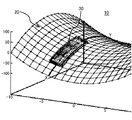
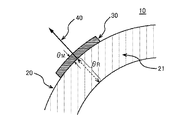
図1は本発明に係る実施形態の、透明な熱可塑性樹脂成形体21の曲面20に均一厚みの金属箔30が密着接合している金属被覆樹脂成形体10の構造の一例を模式的に示した斜視図である。図2は本発明に係る実施形態の金属被覆樹脂成形体10の構造の一例を模式的に示した断面図であり、図1に示したX−Y方向における断面図である。
[Metal-coated resin molded product]
First, the metal-coated resin molded
FIG. 1 schematically shows an example of the structure of a metal-coated resin molded
本実施形態に係る金属被覆樹脂成形体10は、曲面20を有する透明な熱可塑性樹脂成形体21と、熱可塑性樹脂成形体21の曲面20に沿って密着して接合された金属箔30と、を備え、金属箔30は、少なくとも熱可塑性樹脂成形体21との接合部表面に微細凹凸構造を有する。
ここで、本実施形態における曲面とは、曲線が動いてできる面、換言すれば連続的に曲がった平面でない面であり、具体的には、円柱面や円錐面に代表される可展面(二次曲面)と、可展面ではない三次元曲面とを含む。本実施形態では熱可塑性樹脂成形体21は、意匠性により優れる観点から、三次元曲面を有することが好ましい。
The metal-coated resin molded
Here, the curved surface in the present embodiment is a surface formed by moving a curve, in other words, a surface that is not a continuously curved plane, and specifically, a developable surface represented by a cylindrical surface or a conical surface (a surface that is not a continuously curved plane). A quadric surface) and a three-dimensional curved surface that is not a developable surface. In the present embodiment, the thermoplastic resin molded
従来、曲面形状を有する成形体表面に金属プレートあるいは金属箔を貼り付けて金属被覆樹脂成形体を作る作業は、シートモールディングコンパウンド(SMC)やスタンパブルシート等の樹脂シートと金属プレートを上型と下型で作った製品形状の空間に挟み込んでプレスして、形状付与する方法に頼らざるを得なかった。このようなプレス成形においては、曲面状の接合部分においてはスプリングバックが発生しやすかった。そのため平面形状を有する金属被覆樹脂成形体に限られていた。
射出成形(インモールド成形)によって曲面形状を有する金属被覆樹脂成形体を作成する方法も考えられるが、公知の射出成形技術では、接合点における樹脂部厚みは金属部厚みに比べて小さいのが一般的である。換言すれば、公知技術は、金属部を専ら機械強度発現のための構成材料として用い、その表面上に装飾付与等を目的として薄い樹脂層を被覆接合する技術に終始してきたと言える。
Conventionally, in the work of attaching a metal plate or metal leaf to the surface of a molded body having a curved surface shape to make a metal-coated resin molded body, a resin sheet such as a sheet molding compound (SMC) or a stampable sheet and a metal plate are used as an upper mold. I had to rely on the method of giving the shape by sandwiching it in the space of the product shape made with the lower mold and pressing it. In such press molding, springback is likely to occur at the curved joint portion. Therefore, it has been limited to a metal-coated resin molded product having a planar shape.
A method of producing a metal-coated resin molded body having a curved surface shape by injection molding (in-mold molding) is also conceivable, but in a known injection molding technique, the thickness of the resin portion at the joint is generally smaller than the thickness of the metal portion. Is the target. In other words, it can be said that the known technology has been all about the technology of using the metal part exclusively as a constituent material for developing mechanical strength and coating and joining a thin resin layer on the surface thereof for the purpose of imparting decoration.
本実施形態においては、曲面20上の任意の点における法線ベクトル40方向において、金属箔30の厚みをθM、熱可塑性樹脂成形体21の厚みをθRとした場合(図2の模式図を参照)、下記式(1)を満たすことが好ましく、下記式(2)を満たすことがより好ましく、下記式(3)を満たすことがさらに好ましい。
本実施形態において、金属被覆樹脂成形体10における金属箔30部分は、前述の通り、装飾性や金属調の質感付与のために設けられるので、熱可塑性樹脂成形体21部分に比べて相対的に重い金属箔部はできるだけ薄くして金属被覆樹脂成形体10全体の軽量化を図ることが好ましい。すなわち、θM/θRが1.0未満であると金属被覆樹脂成形体10がより軽くなり、特に自動車内装材やコスメティック製品に適用する場合に好ましい。θM/θRが0.05以上であると、金属被覆樹脂成形体10の機械的強度がより良好になり、特にフェイスシールド等の安全部品として使用する場合に好ましい。
In the present embodiment, the thickness of the
In the present embodiment, as described above, the

本実施形態に係る金属被覆樹脂成形体10を構成する熱可塑性樹脂成形体21はJIS R3106に準じて測定される波長領域380〜780nmでの可視光透過率が、好ましくは60%以上、より好ましくは70%以上である。このような可視光透過率を備えることによって、より良好な透明性を得ることが可能となり、フェイスシールド、アイウェア、ソーラーパネル等の透明性が必要とされる分野に本実施形態に係る金属被覆樹脂成形体10を好適に用いることができる。
The thermoplastic resin molded
以下、本実施形態に係る金属被覆樹脂成形体10を構成する各部材について説明する。
Hereinafter, each member constituting the metal-coated resin molded
<熱可塑性樹脂成形体>
本実施形態に係る金属被覆樹脂成形体10を構成する熱可塑性樹脂成形体21は透明性を示す。熱可塑性樹脂成形体21を構成する熱可塑性樹脂(A)は、非晶性熱可塑性樹脂成分(a)を含む場合であってもよいし、結晶性熱可塑性樹脂成分(b)からなるがその実用状態で非晶状態もしくは結晶化度が相当に低い、または結晶サイズが微細である場合であってもよい。前者の例としては、後述する非晶性熱可塑性樹脂成分(a)を挙げることができる。後者の例としてはポリエチレンテレフタレート(PET)、ポリブチレンテレフタレート(PBT)、ポリプロピレン(PP)、低密度ポリエチレン(LDPE)、ナイロン6(NY6)等を挙げることができ、これらの樹脂については溶融したものを成形後に急速冷却することにより透明化を図ることができる。ただし、後者の方法では微結晶と非結晶の量制御によっては安定して透明化できない場合があるので、非晶性熱可塑性樹脂成分(a)を含む熱可塑性樹脂(A)を用いる方法を採用することが好ましい。
<Thermoplastic resin molded product>
The thermoplastic resin molded
非晶性熱可塑性樹脂成分(a)を含む熱可塑性樹脂(A)を用いる場合では、熱可塑性樹脂(A)は、非晶性熱可塑性樹脂成分(a)を必須成分として含み、必要に応じて結晶性熱可塑性樹脂成分(b)やその他配合剤(c)を含む。熱可塑性樹脂(A)に含まれる非晶性熱可塑性樹脂成分(a)の含有量は、通常60質量%超え、好ましくは70質量%以上、より好ましくは80質量%以上、特に好ましくは90質量%以上である。
熱可塑性樹脂(A)に含まれる結晶性熱可塑性樹脂成分(b)としては特に限定されないが、例えば、ポリオレフィン系樹脂、ポリエステル樹脂、ポリアミド樹脂、ポリフェニレンエーテル樹脂、ポリフェニレンスルフィド樹脂等を挙げることができる。熱可塑性樹脂(A)に含まれる結晶性熱可塑性樹脂成分(b)の含有量は、通常40質量%以下、好ましくは30質量%以下である。
熱可塑性樹脂(A)に含まれるその他配合剤(c)としては特に限定されないが、例えば、顔料、難燃剤、酸化防止剤、可塑剤、帯電防止剤等を挙げることができる。熱可塑性樹脂(A)に含まれるその他配合剤(c)の含有量は、熱可塑性樹脂成形体21の透明性を損なわない量であれば特に限定されないが、通常40質量%以下、好ましくは30質量%以下である。
When the thermoplastic resin (A) containing the amorphous thermoplastic resin component (a) is used, the thermoplastic resin (A) contains the amorphous thermoplastic resin component (a) as an essential component, and if necessary. It contains a crystalline thermoplastic resin component (b) and other compounding agents (c). The content of the amorphous thermoplastic resin component (a) contained in the thermoplastic resin (A) is usually more than 60% by mass, preferably 70% by mass or more, more preferably 80% by mass or more, and particularly preferably 90% by mass. % Or more.
The crystalline thermoplastic resin component (b) contained in the thermoplastic resin (A) is not particularly limited, and examples thereof include a polyolefin resin, a polyester resin, a polyamide resin, a polyphenylene ether resin, and a polyphenylene sulfide resin. .. The content of the crystalline thermoplastic resin component (b) contained in the thermoplastic resin (A) is usually 40% by mass or less, preferably 30% by mass or less.
The other compounding agent (c) contained in the thermoplastic resin (A) is not particularly limited, and examples thereof include pigments, flame retardants, antioxidants, plasticizers, and antistatic agents. The content of the other compounding agent (c) contained in the thermoplastic resin (A) is not particularly limited as long as it does not impair the transparency of the thermoplastic resin molded
(非晶性熱可塑性樹脂成分(a))
熱可塑性樹脂成形体21を構成する熱可塑性樹脂(A)に用いられる非晶性熱可塑性樹脂成分(a)としては、例えば、ポリスチレン樹脂、ポリアクリロニトリル樹脂、スチレン−アクリロニトリル共重合体樹脂、アクリロニトリル−ブタジエン−スチレン共重合体樹脂(ABS樹脂)、ポリメタクリル酸メチル樹脂(PMMA樹脂)、およびポリカーボネート樹脂(PC樹脂)から選択される一種または二種以上が挙げられる。これらの中では、熱可塑性樹脂成形体21の透明性と機械強度(特に耐衝撃性と耐熱性)をより良好にする観点から、ポリカーボネート樹脂が好ましい。
(Amorphous thermoplastic resin component (a))
Examples of the amorphous thermoplastic resin component (a) used in the thermoplastic resin (A) constituting the thermoplastic resin molded
熱可塑性樹脂(A)は、金属箔30の表面に付与された微細凹凸構造への浸入をより容易にするために流動性が高いことが好ましい。そのため、本実施形態に係る熱可塑性樹脂(A)は、ASTM D1238に準拠し、230℃、2.16kg荷重の条件で測定されるMFRが1〜200g/10minであることが好ましく、5〜50g/10minであることがより好ましい。
The thermoplastic resin (A) preferably has high fluidity in order to facilitate penetration into the fine concavo-convex structure imparted to the surface of the
(熱可塑性樹脂(A)の製造方法)
熱可塑性樹脂(A)の製造方法は特に限定されず、一般的に公知の方法により製造することができる。例えば、非晶性熱可塑性樹脂成分(a)、必要に応じて結晶性熱可塑性樹脂成分(b)やその他の配合剤(c)を、バンバリーミキサー、単軸押出機、2軸押出機、高速2軸押出機等の混合装置を用いて、混合または溶融混合することにより、熱可塑性樹脂(A)を得ることができる。
(Manufacturing method of thermoplastic resin (A))
The method for producing the thermoplastic resin (A) is not particularly limited, and the thermoplastic resin (A) can be produced by a generally known method. For example, the amorphous thermoplastic resin component (a), the crystalline thermoplastic resin component (b) and other compounding agents (c), if necessary, can be used in a Banbury mixer, a single-screw extruder, a twin-screw extruder, and a high-speed device. The thermoplastic resin (A) can be obtained by mixing or melt-mixing using a mixing device such as a twin-screw extruder.
<金属箔>
本実施形態に係る金属被覆樹脂成形体10を構成する金属箔30の厚み(θM)は、すべての場所で同一であっても異なっていてもよいが、金属箔が入手容易であるという観点からその厚みは一定であることが好ましい。具体的には、金属箔30の厚み(θM)は、通常0.1mm〜2.0mm、好ましくは0.2mm〜1.5mm、より好ましくは0.2mm〜1.0mm、さらに好ましくは0.2〜0.6mmである。厚みが上記下限値以上であると、得られる金属被覆樹脂成形体10の機械的強度を向上させることができる。厚みが上記上限値以下であることにより、金属被覆樹脂成形体10をより軽量化することができ、また接合前において金属箔30の曲板状に折り曲げる等の加工をより容易にすることができる。
<Metal leaf>
The thickness (θ M ) of the
金属箔30を構成する金属材料は特に限定されないが、例えば、鉄、ステンレス、アルミニウム、アルミニウム合金、マグネシウム、マグネシウム合金、銅および銅合金等を挙げることができる。これらは単独で使用してもよいし、二種以上組み合わせて使用してもよい。これらの中でも、軽量かつ高強度の点から、アルミニウム(アルミニウム単体)およびアルミニウム合金が好ましく、アルミニウム合金がより好ましい。すなわち、金属箔30はアルミニウム箔またはアルミニウム合金箔が好ましく、アルミニウム合金箔がより好ましい。
アルミニウム合金としては、JIS H4000に規定された合金番号1050、1100、2014、2024、3003、5052、7075等が好ましく用いられる。
The metal material constituting the
As the aluminum alloy, alloy numbers 1050, 1100, 2014, 2024, 3003, 5052, 7075 and the like specified in JIS H4000 are preferably used.
金属箔30は、金属材料を切断、プレス等による塑性加工、打ち抜き加工、切削、研磨、放電加工等の除肉加工によって上述した所定の形状に加工された後に、後述する粗化処理がなされたものが好ましい。要するに、種々の加工法により、必要な形状に加工されたものを用いることが好ましい。
The
(金属箔の粗化処理方法)
金属箔30の表面のうち少なくとも熱可塑性樹脂成形体21に接合される部分には、微細凹凸構造が設けられている。この場合、金属被覆樹脂成形体10における熱可塑性樹脂成形体21の一部分(より具体的には熱可塑性樹脂成形体21のうち金属箔30との接合部の一部分)が、金属箔30の上記微細凹凸構造に浸入することにより金属箔30と熱可塑性樹脂成形体21とが接合されていることが好ましい。これにより、金属箔30と熱可塑性樹脂成形体21との接合強度をより向上させることができる。
(Roughening method of metal leaf)
A fine concavo-convex structure is provided on at least a portion of the surface of the
金属箔30の上記微細凹凸構造は、例えば、5nm以上500μm以下の間隔周期で複数の凸部(又は凹部)が設けられたものである。本実施形態においては、金属被覆樹脂成形体10を高い接合力が要求される分野に用いる場合は、上記間隔周期は1μm〜500μmの範囲にあることが好ましく、5μm〜300μmの範囲にあることがより好ましい。
The fine uneven structure of the
金属箔30に設けられた微細凹凸構造は、金属箔30の全表面に設けられてもよいし、片面のみに設けられてもよいし、片面の一部分のみに設けられてもよい。ただし、本実施形態に係る金属被覆樹脂成形体10の主なる用途が、金属箔30が熱可塑性樹脂成形体21の表面の一部に貼付・接合されて産業上利用されることに鑑みれば、微細凹凸面は全表面または片面全面であることが好ましい。ここで表面粗さを大きくする方法としては、公知の様々な方法が制限なく用いることができる。
The fine concavo-convex structure provided on the
金属箔30の表面に微細凹凸構造を付与する方法は、得られる微細凹凸構造の形状から大別して以下の3種類の方法がある。
The method of imparting a fine concavo-convex structure to the surface of the
第1の方法は、侵食性水溶液または侵食性懸濁液に金属箔30を浸漬する方法である。この方法により得られた金属箔30を電子顕微鏡観察により測定すると、金属箔30の表面が無数の凹部で覆われた形となっている。上記凹部の数平均内径は、例えば、3μm以下である。
ここで、上記凹凸の数平均内径とは、凹凸の凹部の内径の平均値であり、例えば、以下のようにして測定される。まず、電子顕微鏡により金属箔30の表面の凹凸の画像を観察し、凹部が100個以上撮影できる倍率において、全ての凹部についてその内径を計り取る。この際、円形でないものは面積が同等の円として内径を仮定する。そして、仮定した内径も含め、全てを積算して個数で除したものを数平均内径とする。
第1の方法としては、例えば、国際公開第2015/008847号パンフレットや特開2001−348684号公報に開示されている酸系エッチング剤を用いる方法等を挙げることができる。また、第1の方法としては、例えば、国際公開第2009/31632号パンフレットや特開2005−119005号公報に開示されているような、水和ヒドラジン、アンモニア、及び水溶性アミン化合物から選ばれる1種以上のアミン系水溶液に金属箔30を浸漬する方法であってもよい。
The first method is a method of immersing the
Here, the number average inner diameter of the unevenness is an average value of the inner diameters of the concave and convex portions, and is measured as follows, for example. First, an image of unevenness on the surface of the
Examples of the first method include a method using an acid-based etching agent disclosed in International Publication No. 2015/008847 Pamphlet and Japanese Patent Application Laid-Open No. 2001-348648. Further, as the first method, for example, it is selected from hydrated hydrazine, ammonia, and a water-soluble amine compound as disclosed in International Publication No. 2009/31632 and Japanese Patent Application Laid-Open No. 2005-119005. A method of immersing the
第2の方法は陽極酸化法である。この場合、金属箔30の表面は主として金属酸化物層となっている。金属酸化物層の表面層は、例えば、多数の数平均内径10nm以上200nm以下の開口部(又は凹部)で覆われる。
The second method is the anodizing method. In this case, the surface of the
第3の方法は機械的切削である。より具体的には、凹凸を有する金型パンチをプレスすることにより金属箔30の表面に凹凸を形成する方法や、サンドブラスト、ローレット加工、レーザー加工により金属箔30の表面に凹凸形状を作製する方法がある。ここで金属パンチの凹凸は、例えば、ダイヤモンド砥粒研削またはブラスト加工によって形成される。この場合、凹部の幅は10〜800μmである。
The third method is mechanical cutting. More specifically, a method of forming irregularities on the surface of the
量産性を考慮すると、第1の方法がより好適である。その理由は、複数の金属箔30(又は金属箔30に個片化される前の金属箔板)を一度に処理できるためである。 Considering mass productivity, the first method is more preferable. The reason is that a plurality of metal foils 30 (or metal foil plates before being separated into metal foils 30) can be processed at one time.
上記した粗化処理は、金属箔30を元板(箔地)の加工(例えば切断、プレス等による塑性加工、湾曲加工、打ち抜き加工、切削、研削、及び放電加工等の除肉加工の少なくとも一つ)により所定形状にした後に行われることが好ましい。また、上記粗化処理が行われる前に、これらの処理が行われる面から酸化層(例えば自然酸化膜)や水酸化層が除去されているのが好ましい。この除去は、例えば、研磨等の物理的処理や化学的な処理によって行われる。 The above-mentioned roughening treatment is at least one of the processing of the base plate (foil material) of the metal foil 30 (for example, plastic working by cutting, pressing, etc., bending, punching, cutting, grinding, electric discharge machining, etc.). It is preferable that this is performed after the shape is formed into a predetermined shape. Further, it is preferable that the oxide layer (for example, a natural oxide film) and the hydroxide layer are removed from the surface on which these treatments are performed before the roughening treatment is performed. This removal is performed by, for example, a physical treatment such as polishing or a chemical treatment.
[金属被覆樹脂成形体の製造方法]
つづいて、本実施形態に係る金属被覆樹脂成形体10の製造方法について説明する。
金属被覆樹脂成形体10の製造方法は、以下の(i)〜(ii)の工程を含む。
(i)金型のキャビティ部に、表面の少なくとも一部に微細凹凸構造を有する金属箔30を配置する工程
(ii)上記キャビティ部に非晶性熱可塑性樹脂成分(a)を含む熱可塑性樹脂(A)を注入することにより金属箔30と熱可塑性樹脂成形体21とを接合する工程
以下、具体的に説明する。
[Manufacturing method of metal-coated resin molded product]
Next, a method for manufacturing the metal-coated resin molded
The method for producing the metal-coated resin molded
(I) Step of arranging a
まず、(i)金型を用意し、その金型を開いてそのキャビティ部(空間部)に金属箔30を配置する。(ii)その後、金型を閉じ、熱可塑性樹脂(A)の少なくとも一部が金属箔30の上記微細凹凸構造が設けられた表面と接するように、上記金型の上記キャビティ部に熱可塑性樹脂(A)を注入して固化し、金属箔30を熱可塑性樹脂成形体表面に接合する。その後、金型を開き離型することにより、金属被覆樹脂成形体10を得ることができる。上記金型としては、例えば、高速ヒートサイクル成形(RHCM、ヒート&クール成形)で一般的に使用される射出成形用金型を用いることができる。金属箔30としては、間隔周期が5nm以上500μm以下である凸部が林立した微細凹凸構造を有する金属箔を用いることができる。
First, (i) a mold is prepared, the mold is opened, and the
ここで、上記(ii)の工程において、熱可塑性樹脂(A)の注入開始から保圧完了までの間、上記金型の表面温度を好ましくは非晶性熱可塑性樹脂成分(a)のガラス転移温度(以下、Tgとも呼ぶ。)以上、より好ましくはTg+(5以上100以下)℃以上の温度に維持する。
これにより、非晶性熱可塑性樹脂成分(a)を含む熱可塑性樹脂(A)を溶融させた状態に保ちながら、金属箔30の上記微細凹凸構造に熱可塑性樹脂(A)を高圧でより長い時間接触させることができる。
その結果、金属箔30の微細凹凸構造の凹部の奥まで熱可塑性樹脂(A)を十分に侵入させることができるため、金属箔30と熱可塑性樹脂成形体21の表面との間に物理的な抵抗力(アンカー効果)が効果的に発現し、接合強度に優れた金属被覆樹脂成形体10を安定的に得ることができる。
Here, in the step (ii), the surface temperature of the mold is preferably changed to the glass transition of the amorphous thermoplastic resin component (a) from the start of injection of the thermoplastic resin (A) to the completion of holding pressure. The temperature is maintained above the temperature (hereinafter, also referred to as Tg), more preferably at Tg + (5 or more and 100 or less) ° C. or higher.
As a result, while keeping the thermoplastic resin (A) containing the amorphous thermoplastic resin component (a) in a molten state, the thermoplastic resin (A) is made longer at high pressure on the fine uneven structure of the
As a result, the thermoplastic resin (A) can be sufficiently penetrated into the recesses of the fine concavo-convex structure of the
また、上記(ii)の工程において、上記保圧完了後、上記金型の表面温度を非晶性熱可塑性樹脂成分(a)の好ましくはガラス転移温度未満、より好ましくはTg−(5以上100以下)℃以下の温度に冷却する。
これにより、溶融状態の熱可塑性樹脂(A)を急速に固化させることができる。その結果、金属被覆樹脂成形体10の成形サイクルを短縮できるため、金属被覆樹脂成形体10を効率よく得ることができる。
Further, in the step (ii), after the pressure holding is completed, the surface temperature of the mold is preferably lower than the glass transition temperature of the amorphous thermoplastic resin component (a), more preferably Tg- (5 or more and 100). Below) Cool to a temperature below ° C.
As a result, the molten thermoplastic resin (A) can be rapidly solidified. As a result, the molding cycle of the metal-coated resin molded
以上から、本実施形態に係る金属被覆樹脂成形体10の製造方法によれば、金属箔30と熱可塑性樹脂成形体表面との接合強度に優れた金属被覆樹脂成形体10を安定的に、かつ、効率よく製造することができる。
From the above, according to the method for producing the metal-coated resin molded
上記金型の表面温度の調整は、急速加熱冷却装置を金型に接続することにより、実施することができる。急速加熱冷却装置は、一般的に使用されている方式を採用することができる。 The adjustment of the surface temperature of the mold can be carried out by connecting the rapid heating / cooling device to the mold. As the rapid heating / cooling device, a commonly used method can be adopted.
加熱方法として、蒸気式、加圧熱水式、熱水式、熱油式、電気ヒータ式、電磁誘導過熱式のいずれか1方式またはそれらを複数組み合わせた方式でよい。
具体的には、金型の表面の近くに設けられた流路に水蒸気、温水および温油から選択される加熱媒体を導入する、あるいは電磁誘導加熱を用いることにより、上記金型の上記表面温度を非晶性熱可塑性樹脂成分(a)のガラス転移温度以上の温度に維持することが好ましい。
As the heating method, any one of steam type, pressurized hot water type, hot water type, hot oil type, electric heater type, electromagnetic induction superheating type, or a combination thereof may be used.
Specifically, the surface temperature of the mold is obtained by introducing a heating medium selected from steam, hot water and hot oil into a flow path provided near the surface of the mold, or by using electromagnetic induction heating. Is preferably maintained at a temperature equal to or higher than the glass transition temperature of the amorphous thermoplastic resin component (a).
冷却方法としては、冷水式、冷油式のいずれか1方式またはそれらを組み合わせた方式でよい。
具体的には、金型の表面の近くに設けられた流路に冷水および冷油から選択される冷却媒体を導入することにより、金型の表面温度を非晶性熱可塑性樹脂成分(a)のガラス転移温度未満の温度に冷却することが好ましい。
The cooling method may be any one of cold water type and cold oil type, or a combination thereof.
Specifically, the surface temperature of the mold is set to the amorphous thermoplastic resin component (a) by introducing a cooling medium selected from cold water and cold oil into a flow path provided near the surface of the mold. It is preferable to cool to a temperature lower than the glass transition temperature of.
上記(ii)の工程において、上記注入開始から上記保圧完了までの時間は、好ましくは1秒以上200秒以下、より好ましくは5秒以上40秒以下であり、さらに好ましくは10秒以上30秒以下である。
上記時間が上記下限値以上であると熱可塑性樹脂(A)を溶融させた状態に保ちながら、金属箔30の上記微細凹凸構造に熱可塑性樹脂(A)を高圧でより長い時間接触させることができる。これにより、接合強度により一層優れた金属被覆樹脂成形体10をより安定的に得ることができる。
また、上記時間が上記上限値以下であると、金属被覆樹脂成形体10の成形サイクルを短縮できるため、金属被覆樹脂成形体10をより効率よく得ることができる。
In the step (ii), the time from the start of the injection to the completion of the holding pressure is preferably 1 second or more and 200 seconds or less, more preferably 5 seconds or more and 40 seconds or less, and further preferably 10 seconds or more and 30 seconds. It is as follows.
When the above time is equal to or more than the above lower limit value, the thermoplastic resin (A) can be brought into contact with the fine uneven structure of the
Further, when the above time is not more than the above upper limit value, the molding cycle of the metal-coated resin molded
上記工程(i)および(ii)を含む製造方法によって得られた金属被覆樹脂成形体10については、金属箔部および/または熱可塑性樹脂成形体部の少なくとも一部の表面部に、必要に応じて更なる美観向上・耐久性向上のための加飾処理を行うことも任意である。このような加飾処理としては、金属箔表面については、鏡面仕上げ(研磨処理)、模様・文字印刷、カラーアルマイト処理等が例示できる。また、熱可塑性樹脂成形体表面については意匠性や耐久性向上のためのアクリル等のクリアーコートや各種ハードコートによる被覆層を例示できる。
これらの中でも金属箔30の熱可塑性樹脂成形体21との接合部分以外の表面が、研磨処理およびカラーアルマイト処理のうち少なくとも一方の処理がなされていることが好ましい。
Regarding the metal-coated resin molded
Among these, it is preferable that the surface of the
[金属被覆樹脂成形体の用途]
本実施形態に係る金属被覆樹脂成形体10は、樹脂成形体部分が透明であり、その成形体表面に金属装飾が付与されるあらゆる用途に展開することが可能である。また、本実施形態に係る金属樹脂成形体の製造方法は、生産性が高く、形状制御の自由度も高いので、様々な用途に展開することが可能である。
[Use of metal-coated resin molded product]
The metal-coated resin molded
具体的には、自動車の内装品(インスツルメントパネル、コンソールボックス、ドアノブ、座席シート、ステアリングホイール、ECUボックス、電装部品等)、各種窓類(車両用窓、機器用のぞき窓、建築用窓等)、家電製品(冷蔵庫、洗濯機、掃除機、電子レンジ、エアコン、照明機器、電気湯沸かし器、テレビ、時計、換気扇、プロジェクター等)、調理用具(鍋、ボール、マグカップ等)、建材・家具類(居住空間の壁面材、ガラス窓枠、手すり、カーテンレール等)、ヘルメット等のフェイスシールドおよびアイウェア(ヘルメット、ヘルメット顔面保護板、スポーツゴーグル、アイウェア物品等)、照明部材(照明反射板等)、看板やソーラーパネル等の屋外設置材料、化粧料収容用のコンパクト容器等のコスメティック製品等に好適に用いられる。 Specifically, automobile interiors (instrument panels, console boxes, door knobs, seats, steering wheels, ECU boxes, electrical components, etc.), various windows (vehicle windows, equipment peepholes, building windows, etc.) Etc.), home appliances (refrigerators, washing machines, vacuum cleaners, microwave ovens, air conditioners, lighting equipment, electric water heaters, TVs, watches, ventilation fans, projectors, etc.), cooking utensils (pots, balls, mugs, etc.), building materials / furniture (Wall materials for living spaces, glass window frames, handrails, curtain rails, etc.), face shields and eyewear for helmets (helmets, helmet face protection plates, sports goggles, eyewear articles, etc.), lighting members (lighting reflectors, etc.) ), Outdoor installation materials such as signboards and solar panels, cosmetic products such as compact containers for storing cosmetics, etc.
以上、本発明の金属被覆樹脂成形体10の用途について述べたが、これらは本発明の用途の例示であり、上記以外の様々な用途に用いることもできる。
The uses of the metal-coated resin molded
以上、本発明の実施形態について述べたが、これらは本発明の例示であり、上記以外の様々な構成を採用することもできる。
以下、参考形態の例を付記する。
[1]
曲面を有する透明な熱可塑性樹脂成形体と、
上記熱可塑性樹脂成形体の上記曲面に沿って密着して接合された金属箔と、
を備え、
上記金属箔は、少なくとも上記熱可塑性樹脂成形体との接合部表面に微細凹凸構造を有する金属被覆樹脂成形体。
[2]
上記[1]に記載の金属被覆樹脂成形体において、
上記金属箔の上記微細凹凸構造に上記熱可塑性樹脂成形体の一部分が浸入することにより上記金属箔と上記熱可塑性樹脂成形体とが接合されている金属被覆樹脂成形体。
[3]
上記[1]または[2]に記載の金属被覆樹脂成形体において、
上記曲面が三次元曲面を含む金属被覆樹脂成形体。
[4]
上記[1]乃至[3]のいずれか一つに記載の金属被覆樹脂成形体において、
上記曲面上の任意の点における法線ベクトル方向において、上記金属箔の厚みをθ M 、上記熱可塑性樹脂成形体の厚みをθ R とした場合、下記式(1)を満たす金属被覆樹脂成形体。
0.05≦θ M /θ R <1.0 (1)
[5]
上記[1]乃至[4]のいずれか一つに記載の金属被覆樹脂成形体において、
上記金属箔の厚み(θ M )が0.1mm以上2.0mm以下の範囲にある金属被覆樹脂成形体。
[6]
上記[1]乃至[5]のいずれか一つに記載の金属被覆樹脂成形体において、
上記金属箔がアルミニウム箔またはアルミニウム合金箔である金属被覆樹脂成形体。
[7]
上記[1]乃至[6]のいずれか一つに記載の金属被覆樹脂成形体において、
上記熱可塑性樹脂成形体を構成する熱可塑性樹脂(A)が、ポリスチレン樹脂、ポリアクリロニトリル樹脂、スチレン−アクリロニトリル共重合体樹脂、アクリロニトリル−ブタジエン−スチレン共重合体樹脂、ポリメタクリル酸メチル樹脂、およびポリカーボネート樹脂から選択される一種または二種以上の非晶性熱可塑性樹脂成分(a)を含む金属被覆樹脂成形体。
[8]
上記[7]に記載の金属被覆樹脂成形体において、
上記非晶性熱可塑性樹脂成分(a)がポリカーボネート樹脂を含む金属被覆樹脂成形体。
[9]
上記[1]乃至[8]のいずれか一つに記載の金属被覆樹脂成形体において、
上記金属箔の上記微細凹凸構造には、複数の凸部が5nm以上500μm以下の間隔周期で設けられている金属被覆樹脂成形体。
[10]
上記[1]乃至[9]のいずれか一つに記載の金属被覆樹脂成形体において、
上記金属箔の上記熱可塑性樹脂成形体との接合部分以外の表面が、研磨処理およびカラーアルマイト処理のうち少なくとも一方の処理がなされている金属被覆樹脂成形体。
[11]
上記[1]乃至[10]のいずれか一つに記載の金属被覆樹脂成形体を製造するための製造方法であって、
金型のキャビティ部に、表面の少なくとも一部に微細凹凸構造を有する金属箔を配置する工程と、
上記キャビティ部に非晶性熱可塑性樹脂成分(a)を含む熱可塑性樹脂(A)を注入することにより上記金属箔と上記熱可塑性樹脂成形体とを接合する工程と、
を含み、
上記熱可塑性樹脂の注入開始から保圧完了までの間、上記金型の表面温度を上記非晶性熱可塑性樹脂成分(a)のガラス転移温度以上の温度に維持し、上記保圧完了後、上記金型の表面温度を上記非晶性熱可塑性樹脂成分(a)のガラス転移温度未満の温度に冷却する金属被覆樹脂成形体の製造方法。
[12]
上記[11]に記載の金属被覆樹脂成形体の製造方法において、
上記非晶性熱可塑性樹脂成分(a)がポリカーボネート樹脂を含む金属被覆樹脂成形体の製造方法。
[13]
上記[11]または[12]に記載の金属被覆樹脂成形体の製造方法において、
上記金型の表面の近くに設けられた流路に水蒸気、温水および温油から選択される加熱媒体を導入する、あるいは電磁誘導加熱を用いることにより、上記金型の上記表面温度を上記非晶性熱可塑性樹脂成分(a)のガラス転移温度以上の温度に維持する金属被覆樹脂成形体の製造方法。
[14]
上記[11]乃至[13]のいずれか一つに記載の金属被覆樹脂成形体の製造方法において、
上記金型の表面の近くに設けられた流路に冷水および冷油から選択される冷却媒体を導入することにより、上記金型の上記表面温度を上記非晶性熱可塑性樹脂成分(a)のガラス転移温度未満の温度に冷却する金属被覆樹脂成形体の製造方法。
[15]
上記[11]乃至[14]のいずれか一つに記載の金属被覆樹脂成形体の製造方法において、
上記注入開始から上記保圧完了までの時間が1秒以上200秒以下である金属被覆樹脂成形体の製造方法。
Although the embodiments of the present invention have been described above, these are examples of the present invention, and various configurations other than the above can be adopted.
Hereinafter, an example of the reference form will be added.
[1]
A transparent thermoplastic resin molded body with a curved surface,
A metal foil bonded tightly along the curved surface of the thermoplastic resin molded product,
With
The metal foil is a metal-coated resin molded body having at least a fine concavo-convex structure on the surface of a joint with the thermoplastic resin molded body.
[2]
In the metal-coated resin molded product according to the above [1],
A metal-coated resin molded product in which the metal foil and the thermoplastic resin molded product are joined by infiltrating a part of the thermoplastic resin molded product into the fine uneven structure of the metal foil.
[3]
In the metal-coated resin molded product according to the above [1] or [2].
A metal-coated resin molded body in which the curved surface includes a three-dimensional curved surface.
[4]
In the metal-coated resin molded product according to any one of the above [1] to [3].
When the thickness of the metal foil is θ M and the thickness of the thermoplastic resin molded product is θ R in the normal vector direction at an arbitrary point on the curved surface, the metal-coated resin molded product satisfying the following formula (1). ..
0.05 ≤ θ M / θ R <1.0 (1)
[5]
In the metal-coated resin molded product according to any one of the above [1] to [4].
A metal-coated resin molded product having a thickness (θ M ) of the metal foil in the range of 0.1 mm or more and 2.0 mm or less.
[6]
In the metal-coated resin molded product according to any one of the above [1] to [5].
A metal-coated resin molded body in which the metal foil is an aluminum foil or an aluminum alloy foil.
[7]
In the metal-coated resin molded product according to any one of the above [1] to [6].
The thermoplastic resin (A) constituting the thermoplastic resin molded product is a polystyrene resin, a polyacrylonitrile resin, a styrene-acrylonitrile copolymer resin, an acrylonitrile-butadiene-styrene copolymer resin, a polymethyl methacrylate resin, and a polycarbonate. A metal-coated resin molded body containing one or more types of amorphous thermoplastic resin component (a) selected from resins.
[8]
In the metal-coated resin molded product according to the above [7],
A metal-coated resin molded product in which the amorphous thermoplastic resin component (a) contains a polycarbonate resin.
[9]
In the metal-coated resin molded product according to any one of the above [1] to [8].
A metal-coated resin molded body in which a plurality of convex portions are provided at intervals of 5 nm or more and 500 μm or less in the fine uneven structure of the metal foil.
[10]
In the metal-coated resin molded product according to any one of the above [1] to [9].
A metal-coated resin molded product in which the surface of the metal foil other than the joint portion with the thermoplastic resin molded product is subjected to at least one of polishing treatment and color alumite treatment.
[11]
The production method for producing the metal-coated resin molded product according to any one of the above [1] to [10].
A process of arranging a metal foil having a fine concavo-convex structure on at least a part of the surface in the cavity of the mold,
A step of joining the metal foil and the thermoplastic resin molded product by injecting the thermoplastic resin (A) containing the amorphous thermoplastic resin component (a) into the cavity.
Including
From the start of injection of the thermoplastic resin to the completion of the holding pressure, the surface temperature of the mold is maintained at a temperature equal to or higher than the glass transition temperature of the amorphous thermoplastic resin component (a). A method for producing a metal-coated resin molded product, which cools the surface temperature of the mold to a temperature lower than the glass transition temperature of the amorphous thermoplastic resin component (a).
[12]
In the method for producing a metal-coated resin molded product according to the above [11],
A method for producing a metal-coated resin molded product in which the amorphous thermoplastic resin component (a) contains a polycarbonate resin.
[13]
In the method for producing a metal-coated resin molded product according to the above [11] or [12],
By introducing a heating medium selected from steam, hot water, and hot oil into a flow path provided near the surface of the mold, or by using electromagnetic induction heating, the surface temperature of the mold is made amorphous. A method for producing a metal-coated resin molded product, which maintains a temperature equal to or higher than the glass transition temperature of the thermoplastic resin component (a).
[14]
In the method for producing a metal-coated resin molded product according to any one of the above [11] to [13].
By introducing a cooling medium selected from cold water and cold oil into a flow path provided near the surface of the mold, the surface temperature of the mold can be adjusted to the amorphous thermoplastic resin component (a). A method for producing a metal-coated resin molded product that is cooled to a temperature lower than the glass transition temperature.
[15]
In the method for producing a metal-coated resin molded product according to any one of the above [11] to [14].
A method for producing a metal-coated resin molded product, wherein the time from the start of injection to the completion of holding pressure is 1 second or more and 200 seconds or less.
以下、本実施形態を、実施例・比較例を参照して詳細に説明する。なお、本実施形態は、これらの実施例の記載に何ら限定されるものではない。 Hereinafter, the present embodiment will be described in detail with reference to Examples and Comparative Examples. The present embodiment is not limited to the description of these examples.
(射出成形方法)
図3に、金属箔30と熱可塑性樹脂成形体21とが接合した金属被覆樹脂成形体10を射出成形法によって製造する過程の一例を模式的に示した。具体的には、長手方向に湾曲した短冊形状に加工され、表面に微細凹凸面を有する金属箔30を金型55内に設置し、射出成形機51により、熱可塑性樹脂(A)をゲート/ランナー52を通して射出することにより、微細凹凸構造を有する金属箔30と熱可塑性樹脂成形体21とが一体化された金属被覆樹脂成形体10を製造する過程を模式的に示している。なお、図示されていないが、後述する接合力評価のために金属箔の長手方向の片側端部に微細凹凸構造の未形成領域を設けた。
(Injection molding method)
FIG. 3 schematically shows an example of a process of manufacturing a metal-coated resin molded
(接合力の評価方法および合否判定)
上記射出成形方法で得られた金属被覆樹脂成形体において、熱可塑性樹脂成形体に接合していない金属箔の端部を平型スパチュラで剥離させ、この端部を引張試験機(アイコーエンジニアリング社製、モデル1323)の専用の治具でチャックした後に、鉛直方向に引っ張って剥離(剥離速度;500mm/分)させ、その剥離界面周辺を目視で判定し、以下の基準で評価した。
◎:金属箔の全面に樹脂が付着している
〇:金属箔の表面の一部に樹脂が付着している
×:金属箔には樹脂が全く付着しておらず、実質的に樹脂が金属箔に接合していない
(Evaluation method of bonding force and pass / fail judgment)
In the metal-coated resin molded product obtained by the above injection molding method, the end portion of the metal foil not bonded to the thermoplastic resin molded product is peeled off with a flat spatula, and this end portion is peeled off by a tensile tester (manufactured by Aiko Engineering Co., Ltd.). , Model 1323), and then pulled in the vertical direction for peeling (peeling speed; 500 mm / min), and the periphery of the peeling interface was visually judged and evaluated according to the following criteria.
⊚: Resin adheres to the entire surface of the metal foil 〇: Resin adheres to a part of the surface of the metal foil ×: No resin adheres to the metal foil, and the resin is substantially metal. Not joined to foil
(金属箔の表面粗化処理)
[金属箔1の調製方法]
JIS H4000に規定された合金番号5052のアルミニウム箔(厚み:0.3mm)を、長さ45mm、幅18mmに切断した。このアルミニウム箔を、長手方向端部5mm分を残して酸系エッチング剤(硫酸:8.2質量%、塩化第二鉄:7.8質量%(Fe3+:2.7質量%)、塩化第二銅:0.4質量%(Cu2+:0.2質量%)、イオン交換水:残部)(30℃)中に80秒間浸漬し、揺動させることによってエッチングした。次いで、流水で超音波洗浄(水中、1分)を行い、乾燥させることにより表面処理済みの金属箔1を得た。
(Surface roughness treatment of metal foil)
[Preparation method of metal leaf 1]
An aluminum foil (thickness: 0.3 mm) having alloy number 5052 specified in JIS H4000 was cut into a length of 45 mm and a width of 18 mm. This aluminum foil is subjected to an acid-based etching agent (sulfate: 8.2% by mass, ferric chloride: 7.8% by mass (Fe 3+ : 2.7% by mass), and ferric chloride, leaving 5 mm at the end in the longitudinal direction. Etching was performed by immersing in dicopper: 0.4% by mass (Cu 2+ : 0.2% by mass), ion-exchanged water: balance) (30 ° C.) for 80 seconds and shaking. Next, ultrasonic cleaning (in water, 1 minute) was performed with running water, and the surface-treated metal leaf 1 was obtained by drying.
得られた金属箔1の微細凹凸構造の間隔周期は、レーザー顕微鏡(KEYENCE製VK−X100)にて測定した結果、92μmであることが分かった。また、エッチング率は2.6質量%であった。 The interval period of the fine concavo-convex structure of the obtained metal foil 1 was measured with a laser microscope (VK-X100 manufactured by KEYENCE) and found to be 92 μm. The etching rate was 2.6% by mass.
[金属箔2の調製方法]
JIS H4000に規定された合金番号5052のアルミニウム箔(厚み:0.3mm)を、長さ45mm、幅18mmに切断した。このアルミニウム箔を、長手方向端部5mm分を残して特開2005−119005号公報の実施例1に記載の処理をおこなった。具体的には、市販のアルミニウム脱脂剤「NE−6(メルテックス社製)」を15%濃度で水に溶かし75℃とした。この水溶液が入ったアルミニウム脱脂槽に上記アルミニウム箔の長手方向端部5mm分を残して、5分間浸漬し水洗し、40℃の1%塩酸水溶液が入った槽に1分浸漬し水洗した。つづいて、40℃の1%水酸化ナトリウム水溶液が入った槽に1分浸漬し水洗した。次いで40℃の1%塩酸水溶液を入れた槽に1分浸漬し水洗し、60℃の2.5%濃度の1水和ヒドラジン水溶液を入れた第1ヒドラジン処理槽に1分浸漬し、40℃の0.5%濃度の1水和ヒドラジン水溶液を入れた第2ヒドラジン処理槽に0.5分浸漬し水洗した。これを40℃で15分間、60℃で5分程度温風乾燥させることにより、表面処理済みの金属箔2を得た。
[Preparation method of metal leaf 2]
An aluminum foil (thickness: 0.3 mm) having alloy number 5052 specified in JIS H4000 was cut into a length of 45 mm and a width of 18 mm. This aluminum foil was subjected to the treatment described in Example 1 of JP-A-2005-119005, leaving a portion of 5 mm in the longitudinal direction. Specifically, a commercially available aluminum degreasing agent "NE-6 (manufactured by Meltex)" was dissolved in water at a concentration of 15% to 75 ° C. The aluminum foil was immersed in an aluminum degreasing tank containing this aqueous solution for 5 minutes, leaving 5 mm of the end portion in the longitudinal direction, and washed with water, and then immersed in a tank containing a 1% hydrochloric acid aqueous solution at 40 ° C. for 1 minute and washed with water. Subsequently, it was immersed in a tank containing a 1% aqueous sodium hydroxide solution at 40 ° C. for 1 minute and washed with water. Next, it was immersed in a tank containing a 1% hydrochloric acid aqueous solution at 40 ° C. for 1 minute, washed with water, and immersed in a first hydrazine treatment tank containing a 2.5% concentration monohydrated hydrazine aqueous solution at 60 ° C. for 1 minute, and then immersed at 40 ° C. It was immersed in a second hydrazine treatment tank containing a 0.5% aqueous solution of hydrazine monohydrate for 0.5 minutes and washed with water. This was dried with warm air at 40 ° C. for 15 minutes and at 60 ° C. for about 5 minutes to obtain a surface-treated metal leaf 2.
得られた金属箔2の微細凹凸構造の間隔周期は、走査型電子顕微鏡(JEOL製JSM−6701F)にて測定した。
また、エッチング処理前後の金属箔の質量比から求めたエッチング率を算出した。
得られた結果を以下に示す。
The interval period of the fine concavo-convex structure of the obtained metal foil 2 was measured with a scanning electron microscope (JSM-6701F manufactured by JEOL).
In addition, the etching rate obtained from the mass ratio of the metal foil before and after the etching treatment was calculated.
The results obtained are shown below.
間隔周期[nm]:45
エッチング率[質量%]:0.3
Interval period [nm]: 45
Etching rate [mass%]: 0.3
[実施例1]
日本製鋼所社製の射出成形機J85ADに、図3に示した短冊湾曲形状のキャビティ部(曲率半径=2500R、深さ=3.0mm)を有する金型55を装着し、金型55内に金属箔1を可動側金型の湾曲部に設けた、金属箔1と同一形状寸法の座ぐり部分に設置した。次いで、高速ヒートサイクル成形用金型温調装置(Single社製ATT H2)を接続した金型55の表面温度を、加熱媒体である加圧熱水を用いて155℃まで加熱した。
次いで、その金型55内に、非晶性熱可塑性樹脂であるポリカーボネート樹脂(PC樹脂)(帝人社製パンライトL1225L、ガラス転移温度:146℃)を、シリンダー温度320℃、射出速度25mm/sec、保圧100MPa、保圧時間15秒の条件にて射出成形を行い、次いで、冷却媒体である水にて金型55の表面温度を60℃まで急冷し、曲面を有する透明な熱可塑性樹脂成形体と熱可塑性樹脂成形体の上記曲面に沿って密着して接合されたアルミニウム箔と、を備える金属被覆樹脂成形体10を得た。
なお、PC樹脂のガラス転移温度はDSC装置(TA Instruments社製Q2000)にて、昇温速度10℃/分の昇温過程により測定した値である。
[Example 1]
A
Next, a polycarbonate resin (PC resin) (Teijin Co., Ltd. Panlite L1225L, glass transition temperature: 146 ° C.), which is an amorphous thermoplastic resin, was placed in the
The glass transition temperature of the PC resin is a value measured by a DSC device (Q2000 manufactured by TA Instruments) in a heating process at a heating rate of 10 ° C./min.
[実施例2]
実施例1において、金属箔1を金属箔2に変更した以外は実施例1と同様にして金属被覆樹脂成形体10を得た。接合強度の評価結果を表1に示す。
[Example 2]
In Example 1, a metal-coated resin molded
[比較例1]
実施例1において、金属箔1を表面処理していない金属箔に変更した以外は実施例1と同様にして金属被覆樹脂成形体10を得た。接合強度の評価結果を表1に示す。
[Comparative Example 1]
In Example 1, a metal-coated resin molded
10 金属被覆樹脂成形体
20 曲面
21 熱可塑性樹脂成形体
30 金属箔
40 法線ベクトル
51 射出成形機
52 ゲート/ランナー
55 金型
10 Metal-coated resin molded
Claims (12)
前記熱可塑性樹脂成形体の前記曲面に沿って密着して接合された金属箔と、
を備え、
前記曲面は可展面ではない三次元曲面であり、
前記金属箔は、少なくとも前記熱可塑性樹脂成形体との接合部表面に微細凹凸構造を有し、
前記曲面上の任意の点における法線ベクトル方向において、前記金属箔の厚みをθ M 、前記熱可塑性樹脂成形体の厚みをθ R とした場合、下記式(1)を満たし、
前記金属箔の厚み(θ M )が0.1mm以上0.6mm以下である、
金属被覆樹脂成形体。
0.05≦θ M /θ R <1.0 (1) A transparent thermoplastic resin molded body with a curved surface,
A metal foil bonded tightly along the curved surface of the thermoplastic resin molded product,
With
The curved surface is a three-dimensional curved surface that is not a developable surface.
The metal foil may have a fine unevenness on the joint surface of at least the thermoplastic resin molded article,
When the thickness of the metal foil is θ M and the thickness of the thermoplastic resin molded product is θ R in the normal vector direction at an arbitrary point on the curved surface, the following equation (1) is satisfied.
The thickness (θ M ) of the metal foil is 0.1 mm or more and 0.6 mm or less.
Metal-coated resin molded body.
0.05 ≤ θ M / θ R <1.0 (1)
前記金属箔の前記微細凹凸構造に前記熱可塑性樹脂成形体の一部分が浸入することにより前記金属箔と前記熱可塑性樹脂成形体とが接合されている金属被覆樹脂成形体。 In the metal-coated resin molded product according to claim 1,
A metal-coated resin molded product in which the metal foil and the thermoplastic resin molded product are joined by infiltrating a part of the thermoplastic resin molded product into the fine concavo-convex structure of the metal foil.
前記金属箔がアルミニウム箔またはアルミニウム合金箔である金属被覆樹脂成形体。 In the metal-coated resin molded product according to claim 1 or 2 .
A metal-coated resin molded body in which the metal foil is an aluminum foil or an aluminum alloy foil.
前記熱可塑性樹脂成形体を構成する熱可塑性樹脂(A)が、ポリスチレン樹脂、ポリアクリロニトリル樹脂、スチレン−アクリロニトリル共重合体樹脂、アクリロニトリル−ブタジエン−スチレン共重合体樹脂、ポリメタクリル酸メチル樹脂、およびポリカーボネート樹脂から選択される一種または二種以上の非晶性熱可塑性樹脂成分(a)を含む金属被覆樹脂成形体。 In the metal-coated resin molded product according to any one of claims 1 to 3 .
The thermoplastic resin (A) constituting the thermoplastic resin molded product is a polystyrene resin, a polyacrylonitrile resin, a styrene-acrylonitrile copolymer resin, an acrylonitrile-butadiene-styrene copolymer resin, a polymethyl methacrylate resin, and a polycarbonate. A metal-coated resin molded body containing one or more types of amorphous thermoplastic resin component (a) selected from resins.
前記非晶性熱可塑性樹脂成分(a)がポリカーボネート樹脂を含む金属被覆樹脂成形体。 In the metal-coated resin molded product according to claim 4 .
A metal-coated resin molded product in which the amorphous thermoplastic resin component (a) contains a polycarbonate resin.
前記金属箔の前記微細凹凸構造には、複数の凸部が5nm以上500μm以下の間隔周期で設けられている金属被覆樹脂成形体。 In the metal-coated resin molded product according to any one of claims 1 to 5 .
A metal-coated resin molded body in which a plurality of convex portions are provided at intervals of 5 nm or more and 500 μm or less in the fine concavo-convex structure of the metal foil.
前記金属箔の前記熱可塑性樹脂成形体との接合部分以外の表面が、研磨処理およびカラーアルマイト処理のうち少なくとも一方の処理がなされている金属被覆樹脂成形体。 In the metal-coated resin molded product according to any one of claims 1 to 6 .
A metal-coated resin molded product in which the surface of the metal foil other than the joint portion with the thermoplastic resin molded product is subjected to at least one of polishing treatment and color alumite treatment.
金型のキャビティ部に、表面の少なくとも一部に微細凹凸構造を有する金属箔を配置する工程と、
前記キャビティ部に非晶性熱可塑性樹脂成分(a)を含む熱可塑性樹脂(A)を注入することにより前記金属箔と前記熱可塑性樹脂成形体とを接合する工程と、
を含み、
前記熱可塑性樹脂の注入開始から保圧完了までの間、前記金型の表面温度を前記非晶性熱可塑性樹脂成分(a)のガラス転移温度以上の温度に維持し、前記保圧完了後、前記金型の表面温度を前記非晶性熱可塑性樹脂成分(a)のガラス転移温度未満の温度に冷却する金属被覆樹脂成形体の製造方法。 A manufacturing method for manufacturing the metal-coated resin molded product according to any one of claims 1 to 7 .
A process of arranging a metal foil having a fine concavo-convex structure on at least a part of the surface in the cavity of the mold,
A step of joining the metal foil and the thermoplastic resin molded product by injecting a thermoplastic resin (A) containing an amorphous thermoplastic resin component (a) into the cavity portion.
Including
From the start of injection of the thermoplastic resin to the completion of holding pressure, the surface temperature of the mold is maintained at a temperature equal to or higher than the glass transition temperature of the amorphous thermoplastic resin component (a), and after the holding pressure is completed, A method for producing a metal-coated resin molded product, which cools the surface temperature of the mold to a temperature lower than the glass transition temperature of the amorphous thermoplastic resin component (a).
前記非晶性熱可塑性樹脂成分(a)がポリカーボネート樹脂を含む金属被覆樹脂成形体の製造方法。 In the method for producing a metal-coated resin molded product according to claim 8 .
A method for producing a metal-coated resin molded product in which the amorphous thermoplastic resin component (a) contains a polycarbonate resin.
前記熱可塑性樹脂の注入開始から保圧完了までの間、前記金型の表面の近くに設けられた流路に水蒸気、温水および温油から選択される加熱媒体を導入する、あるいは電磁誘導加熱を用いることにより、前記金型の前記表面温度を前記非晶性熱可塑性樹脂成分(a)のガラス転移温度以上の温度に維持する金属被覆樹脂成形体の製造方法。 In the method for producing a metal-coated resin molded product according to claim 8 or 9 .
From the start of injection of the thermoplastic resin to the completion of holding pressure, a heating medium selected from steam, hot water and hot oil is introduced into a flow path provided near the surface of the mold, or electromagnetic induction heating is performed. A method for producing a metal-coated resin molded product, which is used to maintain the surface temperature of the mold at a temperature equal to or higher than the glass transition temperature of the amorphous thermoplastic resin component (a).
前記金型の表面の近くに設けられた流路に冷水および冷油から選択される冷却媒体を導入することにより、前記金型の前記表面温度を前記非晶性熱可塑性樹脂成分(a)のガラス転移温度未満の温度に冷却する金属被覆樹脂成形体の製造方法。 In the method for producing a metal-coated resin molded product according to any one of claims 8 to 10 .
By introducing a cooling medium selected from cold water and cold oil into a flow path provided near the surface of the mold, the surface temperature of the mold can be adjusted to that of the amorphous thermoplastic resin component (a). A method for producing a metal-coated resin molded product that is cooled to a temperature lower than the glass transition temperature.
前記注入開始から前記保圧完了までの時間が1秒以上200秒以下である金属被覆樹脂成形体の製造方法。 In the method for producing a metal-coated resin molded product according to any one of claims 8 to 11 .
A method for producing a metal-coated resin molded product, wherein the time from the start of injection to the completion of holding pressure is 1 second or more and 200 seconds or less.
Priority Applications (1)
| Application Number | Priority Date | Filing Date | Title |
|---|---|---|---|
| JP2016242362A JP6830807B2 (en) | 2016-12-14 | 2016-12-14 | Method for manufacturing metal-coated resin molded product and metal-coated resin molded product |
Applications Claiming Priority (1)
| Application Number | Priority Date | Filing Date | Title |
|---|---|---|---|
| JP2016242362A JP6830807B2 (en) | 2016-12-14 | 2016-12-14 | Method for manufacturing metal-coated resin molded product and metal-coated resin molded product |
Publications (2)
| Publication Number | Publication Date |
|---|---|
| JP2018094814A JP2018094814A (en) | 2018-06-21 |
| JP6830807B2 true JP6830807B2 (en) | 2021-02-17 |
Family
ID=62634072
Family Applications (1)
| Application Number | Title | Priority Date | Filing Date |
|---|---|---|---|
| JP2016242362A Active JP6830807B2 (en) | 2016-12-14 | 2016-12-14 | Method for manufacturing metal-coated resin molded product and metal-coated resin molded product |
Country Status (1)
| Country | Link |
|---|---|
| JP (1) | JP6830807B2 (en) |
Family Cites Families (9)
| Publication number | Priority date | Publication date | Assignee | Title |
|---|---|---|---|---|
| JPH10337800A (en) * | 1997-04-07 | 1998-12-22 | Mitsui Chem Inc | Transparent thermal insulation laminated body, transparent thermal insulator using the same, and production thereof |
| JPH11115013A (en) * | 1997-10-17 | 1999-04-27 | Tohoku Munekata Co Ltd | Plastic injection molding method |
| JP4331050B2 (en) * | 2004-05-13 | 2009-09-16 | 出光興産株式会社 | Molding method of polycarbonate copolymer |
| JP2006116686A (en) * | 2004-10-25 | 2006-05-11 | Asahi Diamond Industrial Co Ltd | Super abrasive wheel |
| JP2009157698A (en) * | 2007-12-27 | 2009-07-16 | Pentel Corp | Coordinate input device input pen |
| JP5909793B2 (en) * | 2011-12-02 | 2016-04-27 | 新コスモス電機株式会社 | Gas detector |
| JP2014091263A (en) * | 2012-11-05 | 2014-05-19 | Jtekt Corp | Composite molding |
| JP6469403B2 (en) * | 2014-10-03 | 2019-02-13 | 三井化学株式会社 | Method for producing metal / resin composite structure |
| CN104540341A (en) * | 2014-10-23 | 2015-04-22 | 深圳富泰宏精密工业有限公司 | Shell, electronic device employing shell and manufacture method of shell |
-
2016
- 2016-12-14 JP JP2016242362A patent/JP6830807B2/en active Active
Also Published As
| Publication number | Publication date |
|---|---|
| JP2018094814A (en) | 2018-06-21 |
Similar Documents
| Publication | Publication Date | Title |
|---|---|---|
| KR101426946B1 (en) | Decorative sheet, edible resin molded article and manufacturing method thereof | |
| EP1308259B1 (en) | Method of manufacturing multiple levels of automobile trim | |
| KR102428130B1 (en) | Decorative sheet | |
| JP6469403B2 (en) | Method for producing metal / resin composite structure | |
| CN102215653B (en) | Thin metal shell with plastic binding parts and its manufacturing method | |
| KR20160048138A (en) | Metal/resin composite structure | |
| CN109195791A (en) | The manufacturing method of metal/resin complex structure body, metal component and metal component | |
| KR101296783B1 (en) | Method for forming three dimentional design on an three dimentional article and the three dimentional cover formed by the same method | |
| JP6064740B2 (en) | Decorative sheet and decorative resin molded product | |
| JP2008540196A (en) | Manufacturing process of laminated composite product and composite product produced by lamination process | |
| CN111566150B (en) | Film for holding metal layer, metallic decorative sheet intermediate, metallic decorative sheet, and extrusion-laminated body | |
| JP6830807B2 (en) | Method for manufacturing metal-coated resin molded product and metal-coated resin molded product | |
| EP3409443A1 (en) | Manufacturing method for an aesthetic structural part and an aesthetic structural part | |
| DE102005032421B4 (en) | Method for producing a decorative trim piece | |
| JP6428582B2 (en) | Molding method of resin molded products | |
| JP4357804B2 (en) | Molding decoration sheet and injection molding simultaneous decoration method | |
| JP2006321124A (en) | Decorative sheet, thermoformed body, and decorative laminated structure | |
| JP4268378B2 (en) | Injection molding simultaneous decoration method | |
| JP4542667B2 (en) | Method for producing glitter decorative sheet and glitter decorative molded product | |
| WO2011123969A1 (en) | Thin-walled plastic shell with decorative coating film and preparation method thereof | |
| JP7088659B2 (en) | Metal / Resin Composite Structure and Method for Manufacturing Metal / Resin Composite Structure | |
| JPH02248247A (en) | Wood grain molded product and its manufacturing method | |
| CN110435173A (en) | A kind of manufacturing process of IMD type automobile rolling door | |
| JP3826562B2 (en) | Method for producing high gloss injection molded product and molded product thereof | |
| JPWO2019138816A1 (en) | Decorative molding sheet, preform molded body, and decorative molded body |
Legal Events
| Date | Code | Title | Description |
|---|---|---|---|
| A621 | Written request for application examination |
Free format text: JAPANESE INTERMEDIATE CODE: A621 Effective date: 20190912 |
|
| A977 | Report on retrieval |
Free format text: JAPANESE INTERMEDIATE CODE: A971007 Effective date: 20200814 |
|
| A131 | Notification of reasons for refusal |
Free format text: JAPANESE INTERMEDIATE CODE: A131 Effective date: 20200818 |
|
| A521 | Request for written amendment filed |
Free format text: JAPANESE INTERMEDIATE CODE: A523 Effective date: 20201009 |
|
| TRDD | Decision of grant or rejection written | ||
| A01 | Written decision to grant a patent or to grant a registration (utility model) |
Free format text: JAPANESE INTERMEDIATE CODE: A01 Effective date: 20210112 |
|
| A61 | First payment of annual fees (during grant procedure) |
Free format text: JAPANESE INTERMEDIATE CODE: A61 Effective date: 20210127 |
|
| R150 | Certificate of patent or registration of utility model |
Ref document number: 6830807 Country of ref document: JP Free format text: JAPANESE INTERMEDIATE CODE: R150 |
|
| R250 | Receipt of annual fees |
Free format text: JAPANESE INTERMEDIATE CODE: R250 |
|
| R250 | Receipt of annual fees |
Free format text: JAPANESE INTERMEDIATE CODE: R250 |
|
| R250 | Receipt of annual fees |
Free format text: JAPANESE INTERMEDIATE CODE: R250 |