KR101299518B1 - Novel tetracyclic tetrahydrofuran derivatives containing a cyclic amine side chain - Google Patents
Novel tetracyclic tetrahydrofuran derivatives containing a cyclic amine side chain Download PDFInfo
- Publication number
- KR101299518B1 KR101299518B1 KR1020087001391A KR20087001391A KR101299518B1 KR 101299518 B1 KR101299518 B1 KR 101299518B1 KR 1020087001391 A KR1020087001391 A KR 1020087001391A KR 20087001391 A KR20087001391 A KR 20087001391A KR 101299518 B1 KR101299518 B1 KR 101299518B1
- Authority
- KR
- South Korea
- Prior art keywords
- compound
- formula
- tetrahydro
- fluoro
- dibenzo
- Prior art date
- Legal status (The legal status is an assumption and is not a legal conclusion. Google has not performed a legal analysis and makes no representation as to the accuracy of the status listed.)
- Expired - Fee Related
Links
- 0 C[*+]Cc1ccc(C2OC(C*3CC(CC(O)=O)OCC3)CC2c2ccc(C)cc2*2)c2c1 Chemical compound C[*+]Cc1ccc(C2OC(C*3CC(CC(O)=O)OCC3)CC2c2ccc(C)cc2*2)c2c1 0.000 description 9
Classifications
-
- C—CHEMISTRY; METALLURGY
- C07—ORGANIC CHEMISTRY
- C07D—HETEROCYCLIC COMPOUNDS
- C07D409/00—Heterocyclic compounds containing two or more hetero rings, at least one ring having sulfur atoms as the only ring hetero atoms
- C07D409/02—Heterocyclic compounds containing two or more hetero rings, at least one ring having sulfur atoms as the only ring hetero atoms containing two hetero rings
- C07D409/12—Heterocyclic compounds containing two or more hetero rings, at least one ring having sulfur atoms as the only ring hetero atoms containing two hetero rings linked by a chain containing hetero atoms as chain links
-
- A—HUMAN NECESSITIES
- A61—MEDICAL OR VETERINARY SCIENCE; HYGIENE
- A61P—SPECIFIC THERAPEUTIC ACTIVITY OF CHEMICAL COMPOUNDS OR MEDICINAL PREPARATIONS
- A61P25/00—Drugs for disorders of the nervous system
-
- A—HUMAN NECESSITIES
- A61—MEDICAL OR VETERINARY SCIENCE; HYGIENE
- A61P—SPECIFIC THERAPEUTIC ACTIVITY OF CHEMICAL COMPOUNDS OR MEDICINAL PREPARATIONS
- A61P25/00—Drugs for disorders of the nervous system
- A61P25/06—Antimigraine agents
-
- A—HUMAN NECESSITIES
- A61—MEDICAL OR VETERINARY SCIENCE; HYGIENE
- A61P—SPECIFIC THERAPEUTIC ACTIVITY OF CHEMICAL COMPOUNDS OR MEDICINAL PREPARATIONS
- A61P25/00—Drugs for disorders of the nervous system
- A61P25/18—Antipsychotics, i.e. neuroleptics; Drugs for mania or schizophrenia
-
- A—HUMAN NECESSITIES
- A61—MEDICAL OR VETERINARY SCIENCE; HYGIENE
- A61P—SPECIFIC THERAPEUTIC ACTIVITY OF CHEMICAL COMPOUNDS OR MEDICINAL PREPARATIONS
- A61P25/00—Drugs for disorders of the nervous system
- A61P25/20—Hypnotics; Sedatives
-
- A—HUMAN NECESSITIES
- A61—MEDICAL OR VETERINARY SCIENCE; HYGIENE
- A61P—SPECIFIC THERAPEUTIC ACTIVITY OF CHEMICAL COMPOUNDS OR MEDICINAL PREPARATIONS
- A61P25/00—Drugs for disorders of the nervous system
- A61P25/22—Anxiolytics
-
- A—HUMAN NECESSITIES
- A61—MEDICAL OR VETERINARY SCIENCE; HYGIENE
- A61P—SPECIFIC THERAPEUTIC ACTIVITY OF CHEMICAL COMPOUNDS OR MEDICINAL PREPARATIONS
- A61P25/00—Drugs for disorders of the nervous system
- A61P25/24—Antidepressants
-
- A—HUMAN NECESSITIES
- A61—MEDICAL OR VETERINARY SCIENCE; HYGIENE
- A61P—SPECIFIC THERAPEUTIC ACTIVITY OF CHEMICAL COMPOUNDS OR MEDICINAL PREPARATIONS
- A61P25/00—Drugs for disorders of the nervous system
- A61P25/28—Drugs for disorders of the nervous system for treating neurodegenerative disorders of the central nervous system, e.g. nootropic agents, cognition enhancers, drugs for treating Alzheimer's disease or other forms of dementia
-
- A—HUMAN NECESSITIES
- A61—MEDICAL OR VETERINARY SCIENCE; HYGIENE
- A61P—SPECIFIC THERAPEUTIC ACTIVITY OF CHEMICAL COMPOUNDS OR MEDICINAL PREPARATIONS
- A61P25/00—Drugs for disorders of the nervous system
- A61P25/30—Drugs for disorders of the nervous system for treating abuse or dependence
-
- A—HUMAN NECESSITIES
- A61—MEDICAL OR VETERINARY SCIENCE; HYGIENE
- A61P—SPECIFIC THERAPEUTIC ACTIVITY OF CHEMICAL COMPOUNDS OR MEDICINAL PREPARATIONS
- A61P3/00—Drugs for disorders of the metabolism
- A61P3/04—Anorexiants; Antiobesity agents
-
- A—HUMAN NECESSITIES
- A61—MEDICAL OR VETERINARY SCIENCE; HYGIENE
- A61P—SPECIFIC THERAPEUTIC ACTIVITY OF CHEMICAL COMPOUNDS OR MEDICINAL PREPARATIONS
- A61P43/00—Drugs for specific purposes, not provided for in groups A61P1/00-A61P41/00
-
- C—CHEMISTRY; METALLURGY
- C07—ORGANIC CHEMISTRY
- C07D—HETEROCYCLIC COMPOUNDS
- C07D307/00—Heterocyclic compounds containing five-membered rings having one oxygen atom as the only ring hetero atom
- C07D307/77—Heterocyclic compounds containing five-membered rings having one oxygen atom as the only ring hetero atom ortho- or peri-condensed with carbocyclic rings or ring systems
- C07D307/93—Heterocyclic compounds containing five-membered rings having one oxygen atom as the only ring hetero atom ortho- or peri-condensed with carbocyclic rings or ring systems condensed with a ring other than six-membered
-
- C—CHEMISTRY; METALLURGY
- C07—ORGANIC CHEMISTRY
- C07D—HETEROCYCLIC COMPOUNDS
- C07D405/00—Heterocyclic compounds containing both one or more hetero rings having oxygen atoms as the only ring hetero atoms, and one or more rings having nitrogen as the only ring hetero atom
- C07D405/02—Heterocyclic compounds containing both one or more hetero rings having oxygen atoms as the only ring hetero atoms, and one or more rings having nitrogen as the only ring hetero atom containing two hetero rings
- C07D405/06—Heterocyclic compounds containing both one or more hetero rings having oxygen atoms as the only ring hetero atoms, and one or more rings having nitrogen as the only ring hetero atom containing two hetero rings linked by a carbon chain containing only aliphatic carbon atoms
-
- C—CHEMISTRY; METALLURGY
- C07—ORGANIC CHEMISTRY
- C07D—HETEROCYCLIC COMPOUNDS
- C07D405/00—Heterocyclic compounds containing both one or more hetero rings having oxygen atoms as the only ring hetero atoms, and one or more rings having nitrogen as the only ring hetero atom
- C07D405/02—Heterocyclic compounds containing both one or more hetero rings having oxygen atoms as the only ring hetero atoms, and one or more rings having nitrogen as the only ring hetero atom containing two hetero rings
- C07D405/12—Heterocyclic compounds containing both one or more hetero rings having oxygen atoms as the only ring hetero atoms, and one or more rings having nitrogen as the only ring hetero atom containing two hetero rings linked by a chain containing hetero atoms as chain links
-
- C—CHEMISTRY; METALLURGY
- C07—ORGANIC CHEMISTRY
- C07D—HETEROCYCLIC COMPOUNDS
- C07D405/00—Heterocyclic compounds containing both one or more hetero rings having oxygen atoms as the only ring hetero atoms, and one or more rings having nitrogen as the only ring hetero atom
- C07D405/14—Heterocyclic compounds containing both one or more hetero rings having oxygen atoms as the only ring hetero atoms, and one or more rings having nitrogen as the only ring hetero atom containing three or more hetero rings
-
- C—CHEMISTRY; METALLURGY
- C07—ORGANIC CHEMISTRY
- C07D—HETEROCYCLIC COMPOUNDS
- C07D409/00—Heterocyclic compounds containing two or more hetero rings, at least one ring having sulfur atoms as the only ring hetero atoms
- C07D409/14—Heterocyclic compounds containing two or more hetero rings, at least one ring having sulfur atoms as the only ring hetero atoms containing three or more hetero rings
-
- C—CHEMISTRY; METALLURGY
- C07—ORGANIC CHEMISTRY
- C07D—HETEROCYCLIC COMPOUNDS
- C07D413/00—Heterocyclic compounds containing two or more hetero rings, at least one ring having nitrogen and oxygen atoms as the only ring hetero atoms
- C07D413/02—Heterocyclic compounds containing two or more hetero rings, at least one ring having nitrogen and oxygen atoms as the only ring hetero atoms containing two hetero rings
- C07D413/06—Heterocyclic compounds containing two or more hetero rings, at least one ring having nitrogen and oxygen atoms as the only ring hetero atoms containing two hetero rings linked by a carbon chain containing only aliphatic carbon atoms
-
- C—CHEMISTRY; METALLURGY
- C07—ORGANIC CHEMISTRY
- C07D—HETEROCYCLIC COMPOUNDS
- C07D413/00—Heterocyclic compounds containing two or more hetero rings, at least one ring having nitrogen and oxygen atoms as the only ring hetero atoms
- C07D413/02—Heterocyclic compounds containing two or more hetero rings, at least one ring having nitrogen and oxygen atoms as the only ring hetero atoms containing two hetero rings
- C07D413/12—Heterocyclic compounds containing two or more hetero rings, at least one ring having nitrogen and oxygen atoms as the only ring hetero atoms containing two hetero rings linked by a chain containing hetero atoms as chain links
-
- C—CHEMISTRY; METALLURGY
- C07—ORGANIC CHEMISTRY
- C07D—HETEROCYCLIC COMPOUNDS
- C07D417/00—Heterocyclic compounds containing two or more hetero rings, at least one ring having nitrogen and sulfur atoms as the only ring hetero atoms, not provided for by group C07D415/00
- C07D417/02—Heterocyclic compounds containing two or more hetero rings, at least one ring having nitrogen and sulfur atoms as the only ring hetero atoms, not provided for by group C07D415/00 containing two hetero rings
- C07D417/12—Heterocyclic compounds containing two or more hetero rings, at least one ring having nitrogen and sulfur atoms as the only ring hetero atoms, not provided for by group C07D415/00 containing two hetero rings linked by a chain containing hetero atoms as chain links
-
- C—CHEMISTRY; METALLURGY
- C07—ORGANIC CHEMISTRY
- C07D—HETEROCYCLIC COMPOUNDS
- C07D491/00—Heterocyclic compounds containing in the condensed ring system both one or more rings having oxygen atoms as the only ring hetero atoms and one or more rings having nitrogen atoms as the only ring hetero atoms, not provided for by groups C07D451/00 - C07D459/00, C07D463/00, C07D477/00 or C07D489/00
- C07D491/02—Heterocyclic compounds containing in the condensed ring system both one or more rings having oxygen atoms as the only ring hetero atoms and one or more rings having nitrogen atoms as the only ring hetero atoms, not provided for by groups C07D451/00 - C07D459/00, C07D463/00, C07D477/00 or C07D489/00 in which the condensed system contains two hetero rings
- C07D491/04—Ortho-condensed systems
-
- C—CHEMISTRY; METALLURGY
- C07—ORGANIC CHEMISTRY
- C07D—HETEROCYCLIC COMPOUNDS
- C07D491/00—Heterocyclic compounds containing in the condensed ring system both one or more rings having oxygen atoms as the only ring hetero atoms and one or more rings having nitrogen atoms as the only ring hetero atoms, not provided for by groups C07D451/00 - C07D459/00, C07D463/00, C07D477/00 or C07D489/00
- C07D491/02—Heterocyclic compounds containing in the condensed ring system both one or more rings having oxygen atoms as the only ring hetero atoms and one or more rings having nitrogen atoms as the only ring hetero atoms, not provided for by groups C07D451/00 - C07D459/00, C07D463/00, C07D477/00 or C07D489/00 in which the condensed system contains two hetero rings
- C07D491/10—Spiro-condensed systems
-
- C—CHEMISTRY; METALLURGY
- C07—ORGANIC CHEMISTRY
- C07D—HETEROCYCLIC COMPOUNDS
- C07D493/00—Heterocyclic compounds containing oxygen atoms as the only ring hetero atoms in the condensed system
- C07D493/02—Heterocyclic compounds containing oxygen atoms as the only ring hetero atoms in the condensed system in which the condensed system contains two hetero rings
- C07D493/04—Ortho-condensed systems
-
- C—CHEMISTRY; METALLURGY
- C07—ORGANIC CHEMISTRY
- C07D—HETEROCYCLIC COMPOUNDS
- C07D495/00—Heterocyclic compounds containing in the condensed system at least one hetero ring having sulfur atoms as the only ring hetero atoms
- C07D495/02—Heterocyclic compounds containing in the condensed system at least one hetero ring having sulfur atoms as the only ring hetero atoms in which the condensed system contains two hetero rings
- C07D495/04—Ortho-condensed systems
Landscapes
- Chemical & Material Sciences (AREA)
- Organic Chemistry (AREA)
- Health & Medical Sciences (AREA)
- Engineering & Computer Science (AREA)
- Bioinformatics & Cheminformatics (AREA)
- General Health & Medical Sciences (AREA)
- Veterinary Medicine (AREA)
- Chemical Kinetics & Catalysis (AREA)
- General Chemical & Material Sciences (AREA)
- Medicinal Chemistry (AREA)
- Nuclear Medicine, Radiotherapy & Molecular Imaging (AREA)
- Pharmacology & Pharmacy (AREA)
- Life Sciences & Earth Sciences (AREA)
- Animal Behavior & Ethology (AREA)
- Public Health (AREA)
- Neurosurgery (AREA)
- Neurology (AREA)
- Biomedical Technology (AREA)
- Psychiatry (AREA)
- Pain & Pain Management (AREA)
- Hematology (AREA)
- Diabetes (AREA)
- Anesthesiology (AREA)
- Addiction (AREA)
- Obesity (AREA)
- Child & Adolescent Psychology (AREA)
- Hospice & Palliative Care (AREA)
- Pharmaceuticals Containing Other Organic And Inorganic Compounds (AREA)
- Heterocyclic Carbon Compounds Containing A Hetero Ring Having Oxygen Or Sulfur (AREA)
- Nitrogen Condensed Heterocyclic Rings (AREA)
- Furan Compounds (AREA)
- Plural Heterocyclic Compounds (AREA)
- Nitrogen And Oxygen Or Sulfur-Condensed Heterocyclic Ring Systems (AREA)
Abstract
Description
본 발명은 도파민 수용체, 특히 도파민 D2 수용체, 세로토닌 수용체, 특히 5-HT2A 및 5-HT2C 수용체에 대한 결합친화성을 가진 사이클릭 아민 측쇄를 함유한 신규한 치환된 테트라사이클릭 테트라하이드로푸란 유도체 및 본 발명에 따른 화합물을 포함하는 약제학적 조성물, 그의 의약으로서의 용도 (특히, 정신의학성 및 신경계 장애 범위, 특히 특정한 정신병, 심장혈관성 및 위장운동 장애의 예방 및/또는 치료를 위하여) 및 그를 제조하는 방법에 관한 것이다.The present invention provides a novel substituted tetracyclic tetrahydrofuran containing a cyclic amine side chain having binding affinity for dopamine receptors, in particular dopamine D 2 receptors, serotonin receptors, in particular 5-HT 2A and 5-HT 2C receptors. Pharmaceutical compositions comprising derivatives and compounds according to the invention, their use as medicaments (particularly for the range of psychiatric and neurological disorders, in particular for the prevention and / or treatment of certain psychotic, cardiovascular and gastrointestinal disorders) and It relates to a manufacturing method.
1997년 10월 23일 공개된 WO 97/38991호 (Janssen Pharmaceutica N. V.)는 CNS 장애, 심장혈관성 장애 또는 위장관 장애의 치료 또는 예방에서 치료제로 사용될 수 있는 치환된 테트라사이클릭 테트라하이드로푸란 유도체를 개시한다. 특히, 화합물은 세로토닌 5-HT2 수용체, 특히 5-HT2A 및 5-HT2C-수용체에 대한 친화성을 나타낸다. 사이클릭 아민 측쇄를 가진 다수의 화합물이 개시되었고, 이는 청구포기 (disclaimer)에 의해 상기 출원으로부터 배제되었다. 동일한 화합물이 또한 Cid J. et al. Bioorganic & Medicinal Chemistry Letters, 14 (2004) 2765-2771에 개시되었다.WO 97/38991 (Janssen Pharmaceutica NV), published October 23, 1997, discloses substituted tetracyclic tetrahydrofuran derivatives that can be used as therapeutic agents in the treatment or prevention of CNS disorders, cardiovascular disorders or gastrointestinal disorders. . In particular, the compounds exhibit affinity for serotonin 5-HT 2 receptors, in particular 5-HT 2A and 5-HT 2C -receptors . A number of compounds with cyclic amine side chains have been disclosed, which have been excluded from the application by the disclaimer. The same compound is also described in Cid J. et al. Bioorganic & Medicinal Chemistry Letters, 14 (2004) 2765-2771.
1999년 4월 22일 공개된 WO 99/19317호 (Janssen Pharmaceutica N. V.)는 디벤조아제핀, 디벤조옥세핀, 디벤조티에핀 또는 디벤조수베란 환에 특정한 할로겐 치환 패턴을 가진 치환된 테트라사이클릭 테트라하이드로푸란 유도체를 개시한다. 화합물은 CNS 장애, 심장혈관성 장애 또는 위장관 장애의 치료 또는 예방에 유용하고, WO 97/38991호에 개시된 화합물을 능가하는 더 빠른 작용 개시를 나타낸다. 또한, 선형 아민 측쇄를 가진 다수의 화합물의 도파민 대항 특성에 대한 시험 (ATN 시험)이 보고되었고 (도파민 작용제 아포모르핀에 의해 유도되는 증상, 예를 들어, 초조함 및 상동증을 예방함으로써), 여기에서, 특정한 할로겐 치환이 도파민 대항작용에 건설적으로 기여했음을 나타내었다. 이러한 효과는 사이클릭 아민 측쇄를 함유한 화합물에 대하여 나타내어지지 않았으며, 제시되지도 않았다. 사이클릭 아민 측쇄를 가진 다수의 화합물이 개시되었고, 이들은 상기 발명에서 청구포기에 의해 배제되었다.WO 99/19317, published April 22, 1999 (Janssen Pharmaceutica NV), discloses substituted tetracytes having a halogen substitution pattern specific for a dibenzoazine, dibenzooxepin, dibenzothiene, or dibenzosuberan ring. A click tetrahydrofuran derivative is disclosed. The compounds are useful for the treatment or prevention of CNS disorders, cardiovascular disorders or gastrointestinal disorders and exhibit faster onset of action over compounds disclosed in WO 97/38991. In addition, tests on the dopamine opposing properties of a number of compounds with linear amine side chains (ATN tests) have been reported (by preventing symptoms induced by the dopamine agonist apomorphine, for example anxiety and homology), wherein It has been shown that certain halogen substitutions constructively contributed to dopamine counteractions. This effect was not shown for the compounds containing the cyclic amine side chains and was not shown. A number of compounds with cyclic amine side chains have been disclosed, which are excluded by the claim groups in the invention.
2003년 6월 12일 공개된 WO 03/048146호 (Janssen Pharmaceutica N. V.) 및 2003년 6월 12일 공개된 WO 03/048147호 (Janssen Pharmaceutica N. V.)는 모두, 각각 트랜스-, 시스-융합 3,3a,8,12b-테트라하이드로-2H-디벤조[3,4:6,7]사이클로헵타[1,2-b]푸란 유도체의 4개의 디아스테레오머를 단일한 에난티오머적으로 순수한 전구체로부터 입체화학적으로 순수한 형태로 제조하는 방법을 개시한다. WO 03/048146호의 화합물은 5-HT2 수용체, 특히, 5-HT2A 및 5-HT2C 수용체에 대한 친화성을 나타낸다. WO 03/048147호의 화합물은 세로토닌 5-HT2A, 5-HT2C 및 5-HT7 수용체, H1-수용체 (pIC50=7.15-7.89), D2 및/또는 D3 수용체 및 노르에피네프린 재섭취 전달체 (pIC50=6.03-7.34)에 대한 친화성을 나타낸다. 후자의 두 공개본에서 개시된 화합물은 사이클릭 아민 측쇄를 함유하지 않는다.WO 03/048146 published on June 12, 2003 (Janssen Pharmaceutica NV) and WO 03/048147 published on June 12, 2003, both trans-, cis-fusion 3,3a, respectively. Four diastereomers of, 8,12b-tetrahydro-2H-dibenzo [3,4: 6,7] cyclohepta [1,2-b] furan derivatives were stereochemically synthesized from a single enantiomerically pure precursor Discloses a process for producing in pure form. The compounds of WO 03/048146 show affinity for 5-HT 2 receptors, in particular 5-HT 2A and 5-HT 2C receptors. The compounds of WO 03/048147 include serotonin 5-HT 2A , 5-HT 2C and 5-HT 7 receptors, H 1 -receptors (pIC 50 = 7.15-7.89), D2 and / or D3 receptors and norepinephrine reuptake carriers ( pIC 50 = 6.03-7.34). The compounds disclosed in the latter two publications do not contain cyclic amine side chains.
2003년 5월 15일 공개된 WO 03/040122호 (Janssen Pharmaceutica N.V.)는 WO 97/38991 및 WO 99/19317호에 따른 화합물의 만델레이트 염을 개시한다. 상기 염은 의외로, WO 97/38991 및 WO 99/19317호에 개시된 화합물보다 증가된 온도 및 상대 습도에서 더 안정한 것으로 발견되었다.WO 03/040122 published Jan. 15, 2003 (Janssen Pharmaceutica N.V.) discloses mandelate salts of compounds according to WO 97/38991 and WO 99/19317. The salts were surprisingly found to be more stable at increased temperature and relative humidity than the compounds disclosed in WO 97/38991 and WO 99/19317.
본 발명의 목적은 PCT 명세서 WO 97/38991 및 WO 99/19317호에 개시된 화합물에 비해 유리한 약리적 프로파일, 특히 D2 활성을 갖는 상기 PCT 명세서의 테트라사이클릭 테트라하이드로푸란 유도체의 신규한 유사체를 제공하는 것이다.It is an object of the present invention to provide novel analogs of the tetracyclic tetrahydrofuran derivatives of the PCT specification having advantageous pharmacological profiles, in particular D 2 activity, compared to the compounds disclosed in PCT specifications WO 97/38991 and WO 99/19317. will be.
이러한 목적은 본 발명의 화학식 (I)의 신규한 화합물, 그의 약제학적으로 허용가능한 산 또는 염기 부가염, 그의 N-옥사이드 형태 또는 그의 4차 암모늄 염에 의해 달성된다:This object is achieved by the novel compounds of formula (I) of the invention, their pharmaceutically acceptable acid or base addition salts, their N-oxide forms or their quaternary ammonium salts:

상기식에서,In this formula,
i, j는 0, 1, 2, 3 및 4로부터 각각 독립적으로 선택되는 정수이고;i, j are integers each independently selected from 0, 1, 2, 3 and 4;
각각의 R1 및 R2는 할로; 시아노; 하이드록시; 카복실; 니트로; 아미노; 모노- 또는 디(알킬)아미노; 모노- 또는 디(알킬카보닐)아미노; 아미노설포닐; 모노- 또는 디(알킬)아미노설포닐; 알킬; 알케닐; 알킬옥시; 알킬카보닐 및 알킬옥시카보닐의 그룹으로부터 독립적으로 선택되며;Each of R 1 and R 2 is halo; Cyano; Hydroxy; Carboxyl; Nitro; Amino; Mono- or di (alkyl) amino; Mono- or di (alkylcarbonyl) amino; Aminosulfonyl; Mono- or di (alkyl) aminosulfonyl; Alkyl; Alkenyl; Alkyloxy; Independently selected from the group of alkylcarbonyl and alkyloxycarbonyl;
A는 하기 화학식 (a), (b), (c) 및 (d)로부터 선택되는 라디칼을 나타내고:A represents a radical selected from the formulas (a), (b), (c) and (d):

여기에서,From here,
m은 0, 1, 2 또는 3의 정수이며;m is an integer of 0, 1, 2 or 3;
n은 2 또는 3의 정수이고;n is an integer of 2 or 3;
p는 1, 2, 3 또는 4의 정수이며;p is an integer of 1, 2, 3 or 4;
q는 1 또는 2의 정수이고;q is an integer of 1 or 2;
r은 1, 2 또는 3의 정수이며;r is an integer of 1, 2 or 3;
s는 0, 1 또는 2의 정수이고;s is an integer of 0, 1 or 2;
t는 1 또는 2의 정수이며;t is an integer of 1 or 2;
화학식 (a)의 점선은 m이 1, 2 또는 3일 때 결합을 나타내고; 점선은 m이 0일 때 존재하지 않고;The dotted line in formula (a) represents a bond when m is 1, 2 or 3; The dotted line is not present when m is zero;
환 B는 융합된 벤젠 환; 또는 산소, 질소 및 황으로부터 선택된 1, 2 또는 3개의 헤테로원자를 함유한 융합된 5 또는 6-원 모노사이클릭 환을 나타내고, 여기에서 각각의 환 B는 알킬 또는 알킬옥시로 임의로 치환되며;Ring B is a fused benzene ring; Or a fused 5 or 6-membered monocyclic ring containing 1, 2 or 3 heteroatoms selected from oxygen, nitrogen and sulfur, wherein each ring B is optionally substituted with alkyl or alkyloxy;
R3은 하이드록시; 카복실, 시아노; 옥소; 알킬; 알킬옥시알킬; 아릴옥시알킬; 알킬카보닐옥시알킬; 알킬옥시카보닐옥시알킬; 모노- 또는 디(알킬)아미노카보닐옥시알킬; 모노- 또는 디(아릴)아미노-카보닐옥시알킬; 모노- 또는 디(아릴알킬)아미노카보닐옥시알킬; 알킬옥시-카보닐알킬; 아릴옥시카보닐알킬; 알킬옥시카보닐메틸리덴; 알케닐; 아릴; Het; 알킬옥시; 아릴옥시; 알킬카보닐옥시; 아릴카보닐옥시; 아릴알킬카보닐옥시; Het-카보닐옥시; 알킬카보닐; Het-카보닐; 아릴-Het-카보닐; 아릴알케닐-Het-카보닐; 알킬옥시카보닐; 아릴옥시카보닐; 모노- 또는 디(알킬)아미노카보닐; 모노- 또는 디(알킬옥시알킬)-아미노카보닐; 모노- 또는 디(알킬티오알킬)아미노카보닐; 모노- 또는 디(아릴알킬)아미노카보닐; 모노- 또는 디(Het-알킬)아미노카보닐; (모노- 또는 디(알킬)아미노알킬)(알킬)아미노카보닐; (아릴)(알킬옥시카보닐-알킬)아미노카보닐; 모노- 또는 디(알케닐)아미노카보닐; (알킬)(알케닐)아미노카보닐; 모노- 또는 디(아릴)아미노카보닐; 모노- 또는 디(Het)아미노카보닐; 모노- 또는 디(알킬)아미노; 모노- 또는 디(알킬카보닐)아미노; 모노- 또는 디(알킬옥시카보닐)아미노; 모노- 또는 디(알킬옥시알킬옥시카보닐)아미노; 모노- 또는 디(아릴옥시알킬카보닐)아미노; 모노- 또는 디(아릴티오알킬카보닐)아미노; 모노- 또는 디(아릴알킬카보닐)아미노; 모노- 또는 디(Het-알킬카보닐)아미노; 모노- 또는 디(알키닐옥시카보닐)-아미노; 모노- 또는 디(아릴카보닐)아미노; 모노- 또는 디(아릴아릴카보닐)-아미노; 모노- 또는 디(Het-카보닐)아미노; 모노- 또는 디(아릴-Het-카보닐)아미노; 모노- 또는 디(알킬옥시카보닐)아미노; 모노- 또는 디(아릴알킬옥시카보닐)아미노; 모노- 또는 디(아릴옥시카보닐)아미노; 모노- 또는 디(아미노알킬아미노티오카보닐)아미노; 모노- 또는 디(알킬아미노카보닐)아미노; 모노- 또는 디(모노- 또는 디(알킬옥시알킬)아미노티오카보닐)아미노; 모노- 또는 디(모노- 또는 디(아릴알킬)아미노카보닐)아미노; 모노- 또는 디(모노- 또는 디(알킬설포닐알킬)아미노티오카보닐)아미노; 모노- 또는 디(모노- 또는 디(Het-알킬)아미노티오카보닐)아미노; 모노- 또는 디(모노- 또는 디(알킬옥시카보닐알킬)아미노카보닐)아미노; 모노- 또는 디(모노- 또는 디(아릴)아미노카보닐)아미노; 모노- 또는 디(모노- 또는 디(아릴)아미노티오카보닐)아미노; 모노- 또는 디(모노- 또는 디(아릴옥시아릴)아미노카보닐)아미노; 모노- 또는 디(모노- 또는 디(Het)아미노티오카보닐)아미노; 및 모노- 또는 디(모노- 또는 디(Het)아미노카보닐)아미노의 그룹으로부터 선택되고;R 3 is hydroxy; Carboxyl, cyano; Oxo; Alkyl; Alkyloxyalkyl; Aryloxyalkyl; Alkylcarbonyloxyalkyl; Alkyloxycarbonyloxyalkyl; Mono- or di (alkyl) aminocarbonyloxyalkyl; Mono- or di (aryl) amino-carbonyloxyalkyl; Mono- or di (arylalkyl) aminocarbonyloxyalkyl; Alkyloxy-carbonylalkyl; Aryloxycarbonylalkyl; Alkyloxycarbonylmethylidene; Alkenyl; Aryl; Het; Alkyloxy; Aryloxy; Alkylcarbonyloxy; Arylcarbonyloxy; Arylalkylcarbonyloxy; Het-carbonyloxy; Alkylcarbonyl; Het-carbonyl; Aryl-Het-carbonyl; Arylalkenyl-Het-carbonyl; Alkyloxycarbonyl; Aryloxycarbonyl; Mono- or di (alkyl) aminocarbonyl; Mono- or di (alkyloxyalkyl) -aminocarbonyl; Mono- or di (alkylthioalkyl) aminocarbonyl; Mono- or di (arylalkyl) aminocarbonyl; Mono- or di (Het-alkyl) aminocarbonyl; (Mono- or di (alkyl) aminoalkyl) (alkyl) aminocarbonyl; (Aryl) (alkyloxycarbonyl-alkyl) aminocarbonyl; Mono- or di (alkenyl) aminocarbonyl; (Alkyl) (alkenyl) aminocarbonyl; Mono- or di (aryl) aminocarbonyl; Mono- or di (Het) aminocarbonyl; Mono- or di (alkyl) amino; Mono- or di (alkylcarbonyl) amino; Mono- or di (alkyloxycarbonyl) amino; Mono- or di (alkyloxyalkyloxycarbonyl) amino; Mono- or di (aryloxyalkylcarbonyl) amino; Mono- or di (arylthioalkylcarbonyl) amino; Mono- or di (arylalkylcarbonyl) amino; Mono- or di (Het-alkylcarbonyl) amino; Mono- or di (alkynyloxycarbonyl) -amino; Mono- or di (arylcarbonyl) amino; Mono- or di (arylarylcarbonyl) -amino; Mono- or di (Het-carbonyl) amino; Mono- or di (aryl-Het-carbonyl) amino; Mono- or di (alkyloxycarbonyl) amino; Mono- or di (arylalkyloxycarbonyl) amino; Mono- or di (aryloxycarbonyl) amino; Mono- or di (aminoalkylaminothiocarbonyl) amino; Mono- or di (alkylaminocarbonyl) amino; Mono- or di (mono- or di (alkyloxyalkyl) aminothiocarbonyl) amino; Mono- or di (mono- or di (arylalkyl) aminocarbonyl) amino; Mono- or di (mono- or di (alkylsulfonylalkyl) aminothiocarbonyl) amino; Mono- or di (mono- or di (Het-alkyl) aminothiocarbonyl) amino; Mono- or di (mono- or di (alkyloxycarbonylalkyl) aminocarbonyl) amino; Mono- or di (mono- or di (aryl) aminocarbonyl) amino; Mono- or di (mono- or di (aryl) aminothiocarbonyl) amino; Mono- or di (mono- or di (aryloxyaryl) aminocarbonyl) amino; Mono- or di (mono- or di (Het) aminothiocarbonyl) amino; And mono- or di (mono- or di (Het) aminocarbonyl) amino;
R4는 알킬; 알킬옥시아릴알킬; 아릴알킬; 알킬옥시카보닐아릴알킬; 아릴옥시아릴알킬; Het-알킬; 아릴-Het-알킬; 아릴설포닐-Het-알킬; 아릴알킬옥시알킬; 아릴옥시알킬; Het-알킬옥시알킬; 아릴카보닐옥시알킬; Het-카보닐옥시알킬; 알킬설포닐옥시알킬; 알킬카보닐알킬; 아릴알킬카보닐알킬; 아릴카보닐알킬; Het-카보닐알킬; 알케닐; 아릴알케닐; Het-알케닐; 알킬옥시아릴; Het; 알킬카보닐; 알킬옥시알킬카보닐; 아릴알킬카보닐; 아릴카보닐; Het-카보닐; 아릴알킬옥시카보닐; 아릴옥시카보닐; 알케닐옥시카보닐; 모노- 또는 디(알킬)아미노카보닐; 모노- 또는 디(알킬)아미노티오카보닐; 모노- 또는 디(알킬옥시알킬)아미노카보닐; 모노- 또는 디(알킬티오알킬)아미노카보닐; 모노- 또는 디(아릴알킬)아미노카보닐; 모노- 또는 디(아릴-알킬)아미노티오카보닐; 모노- 또는 디(Het-알킬)아미노카보닐; 모노- 또는 디(알킬옥시카보닐알킬)아미노카보닐; 모노- 또는 디(알킬옥시카보닐-알킬)아미노티오카보닐; 모노- 또는 디(아릴)아미노카보닐; 모노- 또는 디(아릴)아미노티오카보닐; 모노- 또는 디(Het)아미노카보닐; 모노- 또는 디(아릴카보닐)아미노티오카보닐; 모노- 또는 디(아릴카보닐)아미노카보닐; 모노- 또는 디(Het-카보닐)아미노카보닐; 알킬설포닐; 아릴알킬설포닐; 알케닐설포닐; 및 아릴설포닐의 그룹으로부터 선택되거나;R 4 is alkyl; Alkyloxyarylalkyl; Arylalkyl; Alkyloxycarbonylarylalkyl; Aryloxyarylalkyl; Het-alkyl; Aryl-Het-alkyl; Arylsulfonyl-Het-alkyl; Arylalkyloxyalkyl; Aryloxyalkyl; Het-alkyloxyalkyl; Arylcarbonyloxyalkyl; Het-carbonyloxyalkyl; Alkylsulfonyloxyalkyl; Alkylcarbonylalkyl; Arylalkylcarbonylalkyl; Arylcarbonylalkyl; Het-carbonylalkyl; Alkenyl; Arylalkenyl; Het-alkenyl; Alkyloxyaryl; Het; Alkylcarbonyl; Alkyloxyalkylcarbonyl; Arylalkylcarbonyl; Arylcarbonyl; Het-carbonyl; Arylalkyloxycarbonyl; Aryloxycarbonyl; Alkenyloxycarbonyl; Mono- or di (alkyl) aminocarbonyl; Mono- or di (alkyl) aminothiocarbonyl; Mono- or di (alkyloxyalkyl) aminocarbonyl; Mono- or di (alkylthioalkyl) aminocarbonyl; Mono- or di (arylalkyl) aminocarbonyl; Mono- or di (aryl-alkyl) aminothiocarbonyl; Mono- or di (Het-alkyl) aminocarbonyl; Mono- or di (alkyloxycarbonylalkyl) aminocarbonyl; Mono- or di (alkyloxycarbonyl-alkyl) aminothiocarbonyl; Mono- or di (aryl) aminocarbonyl; Mono- or di (aryl) aminothiocarbonyl; Mono- or di (Het) aminocarbonyl; Mono- or di (arylcarbonyl) aminothiocarbonyl; Mono- or di (arylcarbonyl) aminocarbonyl; Mono- or di (Het-carbonyl) aminocarbonyl; Alkylsulfonyl; Arylalkylsulfonyl; Alkenylsulfonyl; And arylsulfonyl;
또는, p 및 q가 둘다 2가 아니고/아니거나 s가 0이 아닐 때, R4는 또한, 수소, 알킬 또는 알킬카보닐옥시알킬을 나타내고;Or, when p and q are both not 2 and / or s is not 0, R 4 also represents hydrogen, alkyl or alkylcarbonyloxyalkyl;
R5는 알킬을 나타내며;R 5 represents alkyl;
R6은 알킬; 알킬옥시알킬; 아릴옥시알킬; 하이드록시카보닐알킬; 알킬옥시카보닐알킬; 모노- 또는 디(알킬)아미노카보닐알킬; 모노- 또는 디(알킬)아미노카보닐옥시알킬; 모노- 또는 디(아릴)아미노카보닐알킬; 모노- 또는 디(알킬)아미노알킬 및 알킬설포닐옥시알킬의 그룹으로부터 선택되고;R 6 is alkyl; Alkyloxyalkyl; Aryloxyalkyl; Hydroxycarbonylalkyl; Alkyloxycarbonylalkyl; Mono- or di (alkyl) aminocarbonylalkyl; Mono- or di (alkyl) aminocarbonyloxyalkyl; Mono- or di (aryl) aminocarbonylalkyl; Mono- or di (alkyl) aminoalkyl and alkylsulfonyloxyalkyl;
X는 CR7R8; O; S; S(=O); S(O)2; 및 NR9의 그룹으로부터 선택되며;X is CR 7 R 8 ; O; S; S (= 0); S (O) 2 ; And NR 9 ;
여기에서,From here,
R7 및 R8은 각각 독립적으로 수소; 하이드록시; 알킬; 및 알킬옥시의 그룹으로부터 선택되거나; 또는,R 7 and R 8 are each independently hydrogen; Hydroxy; Alkyl; And alkyloxy; or,
R7 및 R8은 함께, 라디칼 메틸렌; 또는 화학식 -(CH2)2-; -(CH2)3-; -(CH2)4-; -(CH2)5-; -O-(CH2)2-O-; 또는 -O(CH2)3O-의 2가 라디칼을 형성하거나, 또는 그들이 부착되는 탄소 원자와 함께 카보닐 라디칼을 형성하고;R 7 and R 8 together are radical methylene; Or formula-(CH 2 ) 2- ; - (CH 2 ) 3 -; - (CH 2 ) 4 -; - (CH 2) 5 -; -O- (CH 2 ) 2 -O-; Or form a divalent radical of —O (CH 2 ) 3 O—, or form a carbonyl radical with the carbon atom to which they are attached;
R9는 수소; 알킬; 알킬카보닐; 아릴카보닐; 아릴알킬; 아릴알킬카보닐; 알킬설포닐; 아릴설포닐 및 아릴알킬설포닐로부터 선택되며;R 9 is hydrogen; Alkyl; Alkylcarbonyl; Arylcarbonyl; Arylalkyl; Arylalkylcarbonyl; Alkylsulfonyl; Arylsulfonyl and arylalkylsulfonyl;
알킬은 1 ~ 10개의 탄소 원자를 갖는 직쇄 또는 분지쇄 포화 탄화수소 라디칼, 3 ~ 8개의 탄소 원자를 갖는 사이클릭 포화 탄화수소 라디칼 또는 1 ~ 10개의 탄소 원자를 갖는 직쇄 또는 분지쇄 부분 및 3 ~ 8개의 탄소 원자를 갖는 사이클릭 부분을 함유한 포화 탄화수소 라디칼을 나타내고; 각각의 라디칼은 할로; 니트로; 시아노; 옥소; 하이드록시; 포르밀; 카복실 및 아미노 라디칼의 그룹으로부터 선택되는 하나 이상의 치환체로 임의로 치환되고;Alkyl is a straight or branched chain saturated hydrocarbon radical having 1 to 10 carbon atoms, a cyclic saturated hydrocarbon radical having 3 to 8 carbon atoms or a straight or branched chain portion having 1 to 10 carbon atoms and 3 to 8 carbon atoms. A saturated hydrocarbon radical containing a cyclic moiety having a carbon atom; Each radical is halo; Nitro; Cyano; Oxo; Hydroxy; Formyl; Optionally substituted with one or more substituents selected from the group of carboxyl and amino radicals;
알케닐은 1 ~ 10개의 탄소 원자를 가진 직쇄 또는 분지쇄 불포화 탄화수소 라디칼, 3 ~ 8개의 탄소 원자를 가진 사이클릭 불포화 탄화수소 라디칼 또는 1 ~ 10개의 탄소 원자를 가진 직쇄 또는 분지쇄 부분 및 3 ~ 8개의 탄소 원자를 가진 사이클릭 부분을 함유한 불포화 탄화수소 라디칼을 나타내고; 상기 라디칼은 하나 이상의 이중 결합을 가지고, 할로; 니트로; 시아노; 옥소; 하이드록시; 포르밀; 카복실 및 아미노 라디칼의 그룹으로부터 선택된 하나 이상의 치환체로 임의로 치환되며;Alkenyl is a straight or branched chain unsaturated hydrocarbon radical having 1 to 10 carbon atoms, a cyclic unsaturated hydrocarbon radical having 3 to 8 carbon atoms or a straight or branched chain portion having 1 to 10 carbon atoms and 3 to 8 carbon atoms. Unsaturated hydrocarbon radicals containing a cyclic moiety having 2 carbon atoms; The radical has one or more double bonds, halo; Nitro; Cyano; Oxo; Hydroxy; Formyl; Optionally substituted with one or more substituents selected from the group of carboxyl and amino radicals;
아릴은 할로; 니트로; 시아노; 하이드록시; 알킬옥시; 알킬티오; 할로알킬, 알킬옥시카보닐 및 알킬 라디칼로부터 선택되는 하나 이상의 치환체; 또는 화학식 -(CH2)3-의 2가 라디칼로 각각 임의로 치환되는 페닐 또는 나프틸이고;Aryl is halo; Nitro; Cyano; Hydroxy; Alkyloxy; Alkylthio; One or more substituents selected from haloalkyl, alkyloxycarbonyl and alkyl radicals; Or phenyl or naphthyl, each optionally substituted with a divalent radical of the formula-(CH 2 ) 3- ;
Het는 산소, 질소 및 황으로부터 선택되는 1, 2 또는 3개의 헤테로원자를 함유하고, 임의로 벤젠 환에 융합되거나, 또는 산소, 질소 및 황으로부터 선택되는 1, 2 또는 3개의 헤테로원자를 함유한 추가적인 환에 융합된 포화 또는 불포화 4, 5 또는 6-원 모노사이클릭 환을 나타내고; 각각의 상기 환은 시아노, 알킬, 할로알킬, 알킬옥시, 알킬티오, 알킬카보닐, 알킬옥시카보닐 및 모노- 또는 디-알킬아미노카보닐알킬 라디칼로부터 선택되는 하나 이상의 치환체로 임의로 치환되며;Het contains one, two or three heteroatoms selected from oxygen, nitrogen and sulfur, and optionally is fused to a benzene ring or an additional one, two or three heteroatoms selected from oxygen, nitrogen and sulfur. A saturated or unsaturated 4, 5 or 6 membered monocyclic ring fused to the ring; Each said ring is optionally substituted with one or more substituents selected from cyano, alkyl, haloalkyl, alkyloxy, alkylthio, alkylcarbonyl, alkyloxycarbonyl and mono- or di-alkylaminocarbonylalkyl radicals;
할로는 플루오로; 클로로; 브로모 또는 아이오도를 나타내나; Halo fluoro; Chloro; Bromo or iodo;
단, 하기 화합물은 배제된다:Provided that the following compounds are excluded:
- 4-페닐-1-(3,3a,8,12b-테트라하이드로-2H-1-옥사-디벤조[e,h]아줄렌-2-일메틸)-피페리딘;4-phenyl-1- (3,3a, 8,12b-tetrahydro-2H-1-oxa-dibenzo [e, h] azulen-2-ylmethyl) -piperidine;
- 4-페닐-1-(11-플루오로-3,3a,8,12b-테트라하이드로-2H-1-옥사-디벤조[e,h]아줄렌-2-일-메틸)-피페리딘;4-phenyl-1- (11-fluoro-3,3a, 8,12b-tetrahydro-2H-1-oxa-dibenzo [e, h] azulen-2-yl-methyl) -piperidine ;
- 4-페닐-1-(5-플루오로-3,3a,8,12b-테트라하이드로-2H-1-옥사-디벤조[e,h]아줄렌-2-일-메틸)-피페리딘;4-phenyl-1- (5-fluoro-3,3a, 8,12b-tetrahydro-2H-1-oxa-dibenzo [e, h] azulen-2-yl-methyl) -piperidine ;
- (4-플루오로페닐)-[1-(3,3a,8,12b-테트라하이드로-2H-1-옥사-디벤조[e,h]아줄렌-2-일-메틸)-피페리딘-4-일]-메타논;(4-Fluorophenyl)-[1- (3,3a, 8,12b-tetrahydro-2H-1-oxa-dibenzo [e, h] azulen-2-yl-methyl) -piperidine -4-yl] -methanone;
- (4-플루오로페닐)-[1-(11-플루오로-3,3a,8,12b-테트라하이드로-2H-1-옥사-디벤조[e,h]아줄렌-2-일메틸)-피페리딘-4-일]-메타논;(4-fluorophenyl)-[1- (11-fluoro-3,3a, 8,12b-tetrahydro-2H-1-oxa-dibenzo [e, h] azulen-2-ylmethyl) -Piperidin-4-yl] -methanone;
- (4-플루오로페닐)-[1-(5-플루오로-3,3a,8,12b-테트라하이드로-2H-1-옥사-디벤조[e,h]아줄렌-2-일메틸)-피페리딘-4-일]-메타논;(4-fluorophenyl)-[1- (5-fluoro-3,3a, 8,12b-tetrahydro-2H-1-oxa-dibenzo [e, h] azulen-2-ylmethyl) -Piperidin-4-yl] -methanone;
- 1-메틸-4-(3,3a,8,12b-테트라하이드로-2H-1-옥사-디벤조[e,h]아줄렌-2-일메틸)-피페라진;1-methyl-4- (3,3a, 8,12b-tetrahydro-2H-1-oxa-dibenzo [e, h] azulen-2-ylmethyl) -piperazine;
- 1-메틸-4-(11-플루오로-3,3a,8,12b-테트라하이드로-2H-1-옥사-디벤조[e,h]아줄렌-2-일-메틸)-피페라진;1-methyl-4- (11-fluoro-3,3a, 8,12b-tetrahydro-2H-1-oxa-dibenzo [e, h] azulen-2-yl-methyl) -piperazine;
- 1-메틸-4-(5,11-디플루오로-3,3a,8,12b-테트라하이드로-2H-1-옥사-디벤조[e,h]아줄렌-2-일메틸)-피페라진;1-methyl-4- (5,11-difluoro-3,3a, 8,12b-tetrahydro-2H-1-oxa-dibenzo [e, h] azulen-2-ylmethyl) -pipe Razin;
- 2-[4-(3,3a,8,12b-테트라하이드로-2H-1-옥사-디벤조[e,h]아줄렌-2-일메틸)-피페라진-1-일]-에탄올;2- [4- (3,3a, 8,12b-tetrahydro-2H-1-oxa-dibenzo [e, h] azulen-2-ylmethyl) -piperazin-1-yl] -ethanol;
- 2-[4-(5,11-디플루오로-3,3a,8,12b-테트라하이드로-2H-1-옥사-디벤조[e,h]아줄렌-2-일-메틸)-피페라진-1-일]-에탄올2- [4- (5,11-Difluoro-3,3a, 8,12b-tetrahydro-2H-1-oxa-dibenzo [e, h] azulen-2-yl-methyl) -pipe Razin-1-yl] -ethanol
- 2-[4-(11-플루오로-3,3a,8,12b-테트라하이드로-2H-1-옥사-디벤조[e,h]아줄렌-2-일메틸)-피페라진-1-일]-에탄올;2- [4- (11-Fluoro-3,3a, 8,12b-tetrahydro-2H-1-oxa-dibenzo [e, h] azulen-2-ylmethyl) -piperazine-1- General] -ethanol;
- 4-페닐-1-(2,3,3a,12b-테트라하이드로-1-옥사-8-티아-디벤조[e,h]아줄렌-2-일메틸)-피페리딘; 및4-phenyl-1- (2,3,3a, 12b-tetrahydro-1-oxa-8-thia-dibenzo [e, h] azulen-2-ylmethyl) -piperidine; And
- 1-메틸-4-(2,3,3a,12b-테트라하이드로-1-옥사-8-티아-디벤조[e,h]아줄렌-2-일메틸)-피페라진.1-methyl-4- (2,3,3a, 12b-tetrahydro-1-oxa-8-thia-dibenzo [e, h] azulen-2-ylmethyl) -piperazine.
상기 언급된 화합물이 본 발명으로부터, 특히, 화합물, 약제학적 조성물, 방법 및 용도와 관련한 범위로부터 배제된다는 것이 하기로부터 이해될 것이다.It will be understood from the following that the abovementioned compounds are excluded from the invention, in particular from the ranges relating to the compounds, pharmaceutical compositions, methods and uses.
본 발명에 따른 화합물은 2-위치에 치환된 사이클릭 아민 측쇄가 존재하는 것으로 구조적 특징을 갖는다. 이러한 측쇄의 존재는 상기 언급된 PCT 명세서 WO 97/38991 및 WO 99/19317호에서 화합물에 기여하지 않은 활성인, D2 수용체에 대한 잠재적인 친화성을 갖는 화합물을 제공한다는 것이 발견되었고, 이는 본 발명에 따른 화합물을 정신병 예를 들어, 조병, 흥분, 공격 및 정신분열병의 양성증상의 치료에서 사용하기에 특히 적합하게 한다, 대조적으로, 본 발명에 따른 화합물은 노르에피네프린 전달체 재섭취 (NET)에 대한 어떤 유의한 억제 작용도 나타내지 않았고, 이는 그들이 유용한 항우울 활성을 가지지 않는다는 것을 나타낸다. 이러한 항우울 활성의 부재는 특정한 치료적 프로파일에 대한 화합물을 선택하는 경우, 특히, 화합물이 추가로 5-HT2A 및 5-HT2C 수용체에 대한 친화성을 가지기 때문에 유리할 수 있다. 본 발명에 따른 화합물에 대한 활성의 그러한 프로파일은 상기 PCT 명세서에서 교시되지 않았거나, 또는 제시되지 않았다.The compounds according to the invention are structurally characterized by the presence of cyclic amine side chains substituted in the 2-position. The presence of such side chains was found in the PCT specifications WO 97/38991 and WO 99/19317 mentioned above to provide compounds that have potential affinity for the D 2 receptor, which is active which does not contribute to the compound. The compounds according to the invention are particularly suitable for use in the treatment of psychotic symptoms such as mania, excitement, attack and schizophrenia. In contrast, the compounds according to the invention are directed to norepinephrine transporter reuptake (NET). No significant inhibitory action was shown, indicating that they do not have useful antidepressant activity. The absence of such antidepressant activity may be advantageous when selecting a compound for a particular therapeutic profile, in particular because the compound further has affinity for 5-HT 2A and 5-HT 2C receptors. Such a profile of activity for the compounds according to the invention has not been taught or presented in the PCT specification.
해당 분야의 숙련자는 이러한 약리적 프로파일에 기초하여 쉽게 화합물을 선택할 수 있을 것이다. 화합물의 임의의 선택은 본 발명내에 포함된다.One skilled in the art will readily be able to select compounds based on these pharmacological profiles. Any choice of compound is included within the present invention.
예를 들어, 본 발명은For example, the present invention
i, j는 0 및 1로부터 각각 독립적으로 선택되는 정수이고;i, j are integers each independently selected from 0 and 1;
각각의 R1 및 R2는 할로; 시아노 및 알킬옥시의 그룹으로부터 독립적으로 선택되며;Each of R 1 and R 2 is halo; Independently selected from the group of cyano and alkyloxy;
A는 화학식 (a), (b), (c) 및 (d)로부터 선택되는 라디칼을 나타내고:A represents a radical selected from formulas (a), (b), (c) and (d):
여기에서:From here:
m은 0, 1 또는 2의 정수이며;m is an integer of 0, 1 or 2;
n은 2의 정수이고;n is an integer of 2;
p는 2 또는 3의 정수이며;p is an integer of 2 or 3;
q는 2의 정수이고;q is an integer of 2;
r은 1 또는 2의 정수이며;r is an integer of 1 or 2;
s는 0 또는 2의 정수이고;s is an integer of 0 or 2;
t는 1의 정수이며;t is an integer of 1;
환 B는 융합된 벤젠 환; 또는 1개의 산소 헤테로원자를 함유한 융합된 5-원 모노사이클릭환을 나타내고; 여기에서, 각각의 환 B는 알킬 또는 알킬옥시로 임의로 치환되고;Ring B is a fused benzene ring; Or a fused 5-membered monocyclic ring containing one oxygen heteroatom; Wherein each ring B is optionally substituted with alkyl or alkyloxy;
R3은 하이드록시; 카복실, 시아노; 옥소; 알킬; 알킬옥시알킬; 아릴옥시알킬; 알킬옥시카보닐옥시알킬; 모노- 또는 디(알킬)아미노카보닐옥시알킬; 모노- 또는 디(아릴)아미노카보닐옥시알킬; 모노- 또는 디(아릴알킬)아미노카보닐옥시알킬; 알킬옥시카보닐알킬; 알킬옥시카보닐메틸리덴; 알케닐; 아릴; Het; 알킬옥시; 아릴옥시; 알킬카보닐옥시; 아릴카보닐옥시; 아릴알킬카보닐옥시; 알킬카보닐; Het-카보닐; 아릴-Het-카보닐; 아릴알케닐-Het-카보닐; 알킬옥시카보닐; 모노- 또는 디(알킬)아미노카보닐;; 모노- 또는 디(알킬티오알킬)-아미노카보닐; 모노- 또는 디(아릴알킬)아미노카보닐; 모노- 또는 디(Het-알킬)아미노카보닐; (모노- 또는 디(알킬)아미노알킬)(알킬)아미노카보닐; (아릴)(알킬옥시카보닐알킬)아미노카보닐; 모노- 또는 디(알케닐)아미노카보닐; (알킬)(알케닐)아미노카보닐; 모노- 또는 디(아릴)아미노카보닐; 모노- 또는 디(Het)아미노카보닐; 모노- 또는 디(알킬카보닐)아미노; 모노- 또는 디(알킬옥시카보닐)아미노; 모노- 또는 디(알킬옥시알킬옥시카보닐)-아미노; 모노- 또는 디(아릴티오알킬카보닐)아미노; 모노- 또는 디(아릴알킬-카보닐)아미노; 모노- 또는 디(Het-알킬카보닐)아미노; 모노- 또는 디(알키닐옥시카보닐)아미노; 모노- 또는 디(아릴카보닐)아미노; 모노- 또는 디(아릴아릴카보닐)아미노; 모노- 또는 디(Het-카보닐)아미노; 모노- 또는 디(아릴-Het-카보닐)아미노; 모노- 또는 디(알킬옥시카보닐)아미노; 모노- 또는 디(아릴알킬옥시카보닐)아미노; 모노- 또는 디(아릴옥시카보닐)아미노; 모노- 또는 디(아미노알킬아미노티오카보닐)아미노; 모노- 또는 디(알킬아미노-카보닐)아미노; 모노- 또는 디(모노- 또는 디(알킬옥시알킬)아미노티오카보닐)아미노; 모노- 또는 디(모노- 또는 디(아릴알킬)아미노카보닐)아미노; 모노- 또는 디(모노- 또는 디(알킬설포닐알킬)아미노티오카보닐)아미노; 모노- 또는 디(모노- 또는 디(Het-알킬)아미노티오카보닐)아미노; 모노- 또는 디(모노- 또는 디(알킬옥시카보닐알킬)아미노카보닐)아미노; 모노- 또는 디(모노- 또는 디(아릴)아미노카보닐)아미노; 모노- 또는 디(모노- 또는 디(아릴)아미노티오카보닐)아미노; 모노- 또는 디(모노- 또는 디(아릴옥시아릴)아미노카보닐)아미노; 모노- 또는 디(모노- 또는 디(Het)아미노티오카보닐)아미노; 및 모노- 또는 디(모노- 또는 디(Het)아미노카보닐)아미노의 그룹으로부터 선택되며;R 3 is hydroxy; Carboxyl, cyano; Oxo; Alkyl; Alkyloxyalkyl; Aryloxyalkyl; Alkyloxycarbonyloxyalkyl; Mono- or di (alkyl) aminocarbonyloxyalkyl; Mono- or di (aryl) aminocarbonyloxyalkyl; Mono- or di (arylalkyl) aminocarbonyloxyalkyl; Alkyloxycarbonylalkyl; Alkyloxycarbonylmethylidene; Alkenyl; Aryl; Het; Alkyloxy; Aryloxy; Alkylcarbonyloxy; Arylcarbonyloxy; Arylalkylcarbonyloxy; Alkylcarbonyl; Het-carbonyl; Aryl-Het-carbonyl; Arylalkenyl-Het-carbonyl; Alkyloxycarbonyl; Mono- or di (alkyl) aminocarbonyl ;; Mono- or di (alkylthioalkyl) -aminocarbonyl; Mono- or di (arylalkyl) aminocarbonyl; Mono- or di (Het-alkyl) aminocarbonyl; (Mono- or di (alkyl) aminoalkyl) (alkyl) aminocarbonyl; (Aryl) (alkyloxycarbonylalkyl) aminocarbonyl; Mono- or di (alkenyl) aminocarbonyl; (Alkyl) (alkenyl) aminocarbonyl; Mono- or di (aryl) aminocarbonyl; Mono- or di (Het) aminocarbonyl; Mono- or di (alkylcarbonyl) amino; Mono- or di (alkyloxycarbonyl) amino; Mono- or di (alkyloxyalkyloxycarbonyl) -amino; Mono- or di (arylthioalkylcarbonyl) amino; Mono- or di (arylalkyl-carbonyl) amino; Mono- or di (Het-alkylcarbonyl) amino; Mono- or di (alkynyloxycarbonyl) amino; Mono- or di (arylcarbonyl) amino; Mono- or di (arylarylcarbonyl) amino; Mono- or di (Het-carbonyl) amino; Mono- or di (aryl-Het-carbonyl) amino; Mono- or di (alkyloxycarbonyl) amino; Mono- or di (arylalkyloxycarbonyl) amino; Mono- or di (aryloxycarbonyl) amino; Mono- or di (aminoalkylaminothiocarbonyl) amino; Mono- or di (alkylamino-carbonyl) amino; Mono- or di (mono- or di (alkyloxyalkyl) aminothiocarbonyl) amino; Mono- or di (mono- or di (arylalkyl) aminocarbonyl) amino; Mono- or di (mono- or di (alkylsulfonylalkyl) aminothiocarbonyl) amino; Mono- or di (mono- or di (Het-alkyl) aminothiocarbonyl) amino; Mono- or di (mono- or di (alkyloxycarbonylalkyl) aminocarbonyl) amino; Mono- or di (mono- or di (aryl) aminocarbonyl) amino; Mono- or di (mono- or di (aryl) aminothiocarbonyl) amino; Mono- or di (mono- or di (aryloxyaryl) aminocarbonyl) amino; Mono- or di (mono- or di (Het) aminothiocarbonyl) amino; And mono- or di (mono- or di (Het) aminocarbonyl) amino;
R4는 알킬; 알킬옥시아릴알킬; 아릴알킬; 알킬옥시카보닐아릴알킬; 아릴옥시아릴알킬; Het-알킬; 아릴-Het-알킬; 아릴설포닐-Het-알킬; 아릴옥시알킬; Het-알킬옥시알킬; 알킬설포닐옥시알킬; 아릴카보닐알킬; 아릴알케닐; 알킬옥시아릴; Het; 알킬카보닐; 알킬옥시알킬카보닐; 아릴카보닐; Het-카보닐; 아릴알킬옥시카보닐; 아릴옥시카보닐; 알케닐옥시카보닐; 모노- 또는 디(알킬)아미노카보닐; 모노- 또는 디(알킬)아미노티오카보닐; 모노- 또는 디(알킬옥시알킬)아미노-카보닐; 모노- 또는 디(알킬티오알킬)아미노카보닐; 모노- 또는 디(아릴-알킬)아미노카보닐; 모노- 또는 디(아릴알킬)아미노티오카보닐; 모노- 또는 디(Het-알킬)아미노카보닐; 모노- 또는 디(알킬옥시카보닐알킬)아미노-카보닐; 모노- 또는 디(알킬옥시카보닐알킬)아미노티오카보닐; 모노- 또는 디(아릴)아미노카보닐; 모노- 또는 디(아릴)아미노티오카보닐; 모노- 또는 디(아릴카보닐)아미노티오카보닐; 알킬설포닐; 아릴알킬설포닐; 알케닐설포닐; 및 아릴설포닐의 그룹으로부터 선택되거나; 또는, p 및 q가 모두 2가 아니고/아니거나 s가 0이 아닐 때, R4는 또한, 수소, 알킬 또는 알킬카보닐옥시알킬을 나타내고;R 4 is alkyl; Alkyloxyarylalkyl; Arylalkyl; Alkyloxycarbonylarylalkyl; Aryloxyarylalkyl; Het-alkyl; Aryl-Het-alkyl; Arylsulfonyl-Het-alkyl; Aryloxyalkyl; Het-alkyloxyalkyl; Alkylsulfonyloxyalkyl; Arylcarbonylalkyl; Arylalkenyl; Alkyloxyaryl; Het; Alkylcarbonyl; Alkyloxyalkylcarbonyl; Arylcarbonyl; Het-carbonyl; Arylalkyloxycarbonyl; Aryloxycarbonyl; Alkenyloxycarbonyl; Mono- or di (alkyl) aminocarbonyl; Mono- or di (alkyl) aminothiocarbonyl; Mono- or di (alkyloxyalkyl) amino-carbonyl; Mono- or di (alkylthioalkyl) aminocarbonyl; Mono- or di (aryl-alkyl) aminocarbonyl; Mono- or di (arylalkyl) aminothiocarbonyl; Mono- or di (Het-alkyl) aminocarbonyl; Mono- or di (alkyloxycarbonylalkyl) amino-carbonyl; Mono- or di (alkyloxycarbonylalkyl) aminothiocarbonyl; Mono- or di (aryl) aminocarbonyl; Mono- or di (aryl) aminothiocarbonyl; Mono- or di (arylcarbonyl) aminothiocarbonyl; Alkylsulfonyl; Arylalkylsulfonyl; Alkenylsulfonyl; And arylsulfonyl; Or when p and q are not both 2 and / or s is not 0, R 4 also represents hydrogen, alkyl or alkylcarbonyloxyalkyl;
R5는 알킬을 나타내며;R 5 represents alkyl;
R6은 알킬; 알킬옥시알킬; 아릴옥시알킬; 하이드록시카보닐알킬; 알킬옥시카보닐알킬; 모노- 또는 디(알킬)아미노카보닐알킬; 모노- 또는 디(알킬)아미노카보닐옥시알킬; 모노- 또는 디(아릴)아미노카보닐알킬; 모노- 또는 디(알킬)아미노알킬 및 알킬설포닐옥시알킬의 그룹으로부터 선택되고;R 6 is alkyl; Alkyloxyalkyl; Aryloxyalkyl; Hydroxycarbonylalkyl; Alkyloxycarbonylalkyl; Mono- or di (alkyl) aminocarbonylalkyl; Mono- or di (alkyl) aminocarbonyloxyalkyl; Mono- or di (aryl) aminocarbonylalkyl; Mono- or di (alkyl) aminoalkyl and alkylsulfonyloxyalkyl;
X는 CR7R8; O; S 및 NR9의 그룹으로부터 선택되며;X is CR 7 R 8 ; O; Is selected from the group of S and NR 9 ;
여기에서:From here:
R7 및 R8은 수소 및 알킬의 그룹으로부터 각각 독립적으로 선택되고;R 7 and R 8 are each independently selected from the group of hydrogen and alkyl;
R9는 알킬인 일반 화학식 (I)의 본 발명의 화합물, 그의 약제학적으로 허용가능한 산 또는 염기 부가염, 그의 N-옥사이드 형태, 또는 그의 4차 암모늄 염에 관한 것이다.R 9 relates to compounds of the invention of general formula (I) which are alkyl, pharmaceutically acceptable acid or base addition salts thereof, their N-oxide forms, or quaternary ammonium salts thereof.
더욱 특히, 본 발명은More particularly, the present invention
i는 0이고;i is 0;
j는 1이며;j is 1;
R1은 할로이고;R 1 is halo;
A는 화학식 (a)의 라디칼을 나타내며, 여기에서:A represents a radical of formula (a), wherein:
(i) m은 1이고;(i) m is 1;
r은 1이며; r is 1;
R3은 하이드록시, 옥소 또는 알킬옥시카보닐이거나; 또는,R 3 is hydroxy, oxo or alkyloxycarbonyl; or,
(ii) m은 2이고;(ii) m is 2;
r은 1이며; r is 1;
R3은 하이드록시; 알킬; 알킬옥시알킬; 알킬옥시카보닐; 알킬옥시카보닐알킬; 및 알킬렌디옥시의 그룹으로부터 선택되거나; 또는R 3 is hydroxy; Alkyl; Alkyloxyalkyl; Alkyloxycarbonyl; Alkyloxycarbonylalkyl; And alkylenedioxy; or
A는 화학식 (b)의 라디칼을 나타내며, 여기에서:A represents a radical of formula (b), wherein:
n은 2이고;n is 2;
환 A는 융합된 벤젠 환 또는 산소 헤테로원자를 함유한 융합된 5-원 환을 나타내고; 상기 환은 알킬 또는 알킬옥시로 임의로 치환되거나; 또는Ring A represents a fused benzene ring or a fused 5-membered ring containing an oxygen heteroatom; The ring is optionally substituted with alkyl or Al? Oxy; or
A는 화학식 (c)의 라디칼을 나타내며, 여기에서:A represents a radical of formula (c), wherein:
p 및 q는 각각 2와 같고;p and q are each equal to 2;
R4는 Het-알킬; 알킬카보닐; 아릴카보닐; 및 알킬아미노카보닐의 그룹으로부터 선택되거나; 또는R 4 is Het-alkyl; Alkylcarbonyl; Arylcarbonyl; And alkylaminocarbonyl; or
A는 화학식 (d)의 라디칼을 나타내며, 여기에서:A represents a radical of formula (d), wherein:
t는 1이고;t is 1;
R6은 하이드록실로 임의로 치환된 알킬이며;R 6 is alkyl optionally substituted with hydroxyl;
X는 -CH2- 또는 -O-인 일반 화학식 (I)의 본 발명의 화합물, 그의 약제학적으로 허용가능한 산 또는 염기 부가염, 그의 N-옥사이드 형태, 또는 그의 4차 암모늄 염에 관한 것이다.X relates to a compound of the invention of general formula (I) which is —CH 2 — or —O—, to a pharmaceutically acceptable acid or base addition salt thereof, to its N-oxide form, or to a quaternary ammonium salt thereof.
더욱 특히, 본 발명은More particularly, the present invention
i는 0이고;i is 0;
j는 1이며;j is 1;
R1은 플루오로이고;R 1 is fluoro;
A는 화학식 (a)의 라디칼을 나타내며, 여기에서: A represents a radical of formula (a), wherein:
(i) m은 1이고;(i) m is 1;
r은 1이며; r is 1;
R3은 3-하이드록시, 3-옥소 또는 3-알킬옥시카보닐이거나; 또는R 3 is 3-hydroxy, 3-oxo or 3-alkyloxycarbonyl; or
(ii) m은 2이고;(ii) m is 2;
r은 1 또는 2이며; r is 1 or 2;
R3은 3- 또는 4-하이드록시; 하이드록시로 치환된 3- 또는 4-C1 - 3알킬; 또는, 3- 또는 4-알킬옥시알킬; 3- 또는 4-알킬옥시카보닐; 3- 또는 4-알킬옥시카보닐알킬; 또는 4,4-(하이드록시)(알킬옥시알킬); 또는 4,4-에틸렌디옥시이거나; 또는R 3 is 3- or 4-hydroxy; The 3-or 4-C 1 substituted with hydroxy-3-alkyl; Or 3- or 4-alkyloxyalkyl; 3- or 4-alkyloxycarbonyl; 3- or 4-alkyloxycarbonylalkyl; Or 4,4- (hydroxy) (alkyloxyalkyl); Or 4,4-ethylenedioxy; or
A는 화학식 (b)의 라디칼을 나타내고, 여기에서:A represents a radical of formula (b), wherein:
n는 2이고;n is 2;
환 A는 융합된 벤젠 환 또는 산소 헤테로원자를 함유한 융합된 5-원 환을 나타내고; 상기 환은 하이드록시알킬 또는 알킬옥시로 치환되거나; 또는Ring A represents a fused benzene ring or a fused 5-membered ring containing an oxygen heteroatom; The ring is substituted with hydroxyalkyl or alkyloxy; or
A는 화학식 (c)의 라디칼을 나타내고, 여기에서:A represents a radical of formula (c), wherein:
p 및 q는 각각 2이고;p and q are each 2;
R4는 푸릴알킬; 사이클로프로필카보닐; 페닐카보닐; 또는 사이클로프로필아미노카보닐이거나; 또는R 4 is furylalkyl; Cyclopropylcarbonyl; Phenylcarbonyl; Or cyclopropylaminocarbonyl; or
A는 화학식 (d)의 라디칼을 나타내고, 여기에서:A represents a radical of formula (d), wherein:
t는 1이고;t is 1;
R6은 하이드록실로 치환된 알킬이며;R 6 is alkyl substituted with hydroxyl;
X는 -CH2- 또는 -O-인 일반 화학식 (I)의 화합물, 그의 약제학적으로 허용가능한 산 또는 염기 부가염, 그의 N-옥사이드 형태 또는 그의 4차 암모늄 염에 관한 것이다.X relates to a compound of general formula (I) which is —CH 2 — or —O—, to a pharmaceutically acceptable acid or base addition salt thereof, to its N-oxide form or to a quaternary ammonium salt thereof.
특히, 하기 화합물이 바람직하다:In particular, the following compounds are preferred:
- 1-(11-플루오로-3,3a,8,12b-테트라하이드로-2H-1-옥사-디벤조[e,h]아줄렌-2-일메틸)-피롤리딘-3-온;1- (11-fluoro-3,3a, 8,12b-tetrahydro-2H-1-oxa-dibenzo [e, h] azulen-2-ylmethyl) -pyrrolidin-3-one;
- 1-(11-플루오로-3,3a,8,12b-테트라하이드로-2H-1-옥사-디벤조[e,h]아줄렌-2-일메틸)-피롤리딘-3-카복실산 메틸 에스테르;1- (11-Fluoro-3,3a, 8,12b-tetrahydro-2H-1-oxa-dibenzo [e, h] azulen-2-ylmethyl) -pyrrolidine-3-carboxylic acid methyl ester;
- 1-(11-플루오로-3,3a,8,12b-테트라하이드로-2H-1-옥사-디벤조[e,h]아줄렌-2-일메틸)-4-푸란-3-일메틸-피페라진;1- (11-fluoro-3,3a, 8,12b-tetrahydro-2H-1-oxa-dibenzo [e, h] azulen-2-ylmethyl) -4-furan-3-ylmethyl Piperazine;
- 사이클로프로필-[4-(11-플루오로-3,3a,8,12b-테트라하이드로-2H-1-옥사-디벤조[e,h]아줄렌-2-일메틸)-피페라진-1-일]-메타논;Cyclopropyl- [4- (11-fluoro-3,3a, 8,12b-tetrahydro-2H-1-oxa-dibenzo [e, h] azulen-2-ylmethyl) -piperazine-1 -Yl] -methanone;
- [4-(11-플루오로-3,3a,8,12b-테트라하이드로-2H-1-옥사-디벤조[e,h]아줄렌-2-일메틸)-피페라진-1-일]-페닐-메타논;[4- (11-Fluoro-3,3a, 8,12b-tetrahydro-2H-1-oxa-dibenzo [e, h] azulen-2-ylmethyl) -piperazin-1-yl] -Phenyl-methanone;
- 4-(11-플루오로-3,3a,8,12b-테트라하이드로-2H-1-옥사-디벤조[e,h]아줄렌-2-일메틸)-피페라진-1-카복실산 사이클로프로필아미드;4- (11-Fluoro-3,3a, 8,12b-tetrahydro-2H-1-oxa-dibenzo [e, h] azulen-2-ylmethyl) -piperazine-1-carboxylic acid cyclopropyl amides;
- [4-(11-플루오로-3,3a,8,12b-테트라하이드로-2H-1-옥사-디벤조[e,h]아줄렌-2-일메틸)-모폴린-2-일]-메탄올;[4- (11-Fluoro-3,3a, 8,12b-tetrahydro-2H-1-oxa-dibenzo [e, h] azulen-2-ylmethyl) -morpholin-2-yl] Methanol;
- 1-(11-플루오로-3,3a,8,12b-테트라하이드로-2H-1-옥사-디벤조[e,h]아줄렌-2-일메틸)-피페리딘-3-올;1- (11-fluoro-3,3a, 8,12b-tetrahydro-2H-1-oxa-dibenzo [e, h] azulen-2-ylmethyl) -piperidin-3-ol;
- [1-(11-플루오로-3,3a,8,12b-테트라하이드로-2H-1-옥사-디벤조[e,h]아줄렌-2-일메틸)-피페리딘-3-일]-메탄올;[1- (11-Fluoro-3,3a, 8,12b-tetrahydro-2H-1-oxa-dibenzo [e, h] azulen-2-ylmethyl) -piperidin-3-yl ] -Methanol;
- [1-(11-플루오로-3,3a,8,12b-테트라하이드로-2H-1-옥사-디벤조[e,h]아줄렌-2-일메틸)-피페리딘-4-일]-메탄올;[1- (11-Fluoro-3,3a, 8,12b-tetrahydro-2H-1-oxa-dibenzo [e, h] azulen-2-ylmethyl) -piperidin-4-yl ] -Methanol;
- 3-[1-(11-플루오로-3,3a,8,12b-테트라하이드로-2H-1-옥사-디벤조[e,h]아줄렌-2-일메틸)-피페리딘-4-일]-프로판-1-올;3- [1- (11-Fluoro-3,3a, 8,12b-tetrahydro-2H-1-oxa-dibenzo [e, h] azulen-2-ylmethyl) -piperidine-4 -Yl] -propan-1-ol;
- 1-(11-플루오로-3,3a,8,12b-테트라하이드로-2H-1-옥사-디벤조[e,h]아줄렌-2-일메틸)-피페리딘-4-카복실산 에틸 에스테르;1- (11-Fluoro-3,3a, 8,12b-tetrahydro-2H-1-oxa-dibenzo [e, h] azulen-2-ylmethyl) -piperidine-4-carboxylic acid ethyl ester;
- [1-(11-플루오로-3,3a,8,12b-테트라하이드로-2H-1-옥사-디벤조[e,h]아줄렌-2-일메틸)-피페리딘-4-일]-아세트산 에틸 에스테르;[1- (11-Fluoro-3,3a, 8,12b-tetrahydro-2H-1-oxa-dibenzo [e, h] azulen-2-ylmethyl) -piperidin-4-yl ] -Acetic acid ethyl ester;
- [5-(11-플루오로-3,3a,8,12b-테트라하이드로-2H-1-옥사-디벤조[e,h]아줄렌-2-일메틸)-옥타하이드로-푸로[3,2-c]피리딘-2-일]-메탄올;[5- (11-Fluoro-3,3a, 8,12b-tetrahydro-2H-1-oxa-dibenzo [e, h] azulen-2-ylmethyl) -octahydro-furo [3, 2-c] pyridin-2-yl] -methanol;
- 1-(11-플루오로-3,3a,8,12b-테트라하이드로-2H-1-옥사-디벤조[e,h]아줄렌-2-일메틸)-피롤리딘-3-올;1- (11-fluoro-3,3a, 8,12b-tetrahydro-2H-1-oxa-dibenzo [e, h] azulen-2-ylmethyl) -pyrrolidin-3-ol;
- 1-(11-플루오로-3,3a,8,12b-테트라하이드로-2H-1-옥사-디벤조[e,h]아줄렌-2-일메틸)-피페리딘-4-올;1- (11-fluoro-3,3a, 8,12b-tetrahydro-2H-1-oxa-dibenzo [e, h] azulen-2-ylmethyl) -piperidin-4-ol;
- 2-[1-(11-플루오로-3,3a,8,12b-테트라하이드로-2H-1-옥사-디벤조[e,h]아줄렌-2-일메틸)-피페리딘-4-일]-에탄올;2- [1- (11-Fluoro-3,3a, 8,12b-tetrahydro-2H-1-oxa-dibenzo [e, h] azulen-2-ylmethyl) -piperidine-4 -Yl] -ethanol;
- 1-(11-플루오로-3,3a,8,12b-테트라하이드로-2H-1-옥사-디벤조[e,h]아줄렌-2-일메틸)-4-메톡시메틸-피페리딘-4-올;1- (11-Fluoro-3,3a, 8,12b-tetrahydro-2H-1-oxa-dibenzo [e, h] azulen-2-ylmethyl) -4-methoxymethyl-piperi Din-4-ol;
- 2-(11-플루오로-3,3a,8,12b-테트라하이드로-2H-1-옥사-디벤조[e,h]아줄렌-2-일메틸)-6,7-디메톡시-1,2,3,4-테트라하이드로-이소퀴놀린; 및2- (11-fluoro-3,3a, 8,12b-tetrahydro-2H-1-oxa-dibenzo [e, h] azulen-2-ylmethyl) -6,7-dimethoxy-1 , 2,3,4-tetrahydro-isoquinoline; And
- 8-(11-플루오로-3,3a,8,12b-테트라하이드로-2H-1-옥사-디벤조[e,h]아줄렌-2-일메틸)-1,4-디옥사-8-아자-스피로[4.5]데칸.8- (11-fluoro-3,3a, 8,12b-tetrahydro-2H-1-oxa-dibenzo [e, h] azulen-2-ylmethyl) -1,4-dioxa-8 Aza-spiro [4.5] decane.
더욱 특히, 본 발명은 본 발명에 따른 화합물, 특히 상기 언급된 화합물의 [2R-(2α,3aα,12bβ)]-이성질체에 관한 것이다.More particularly, the invention relates to the compounds according to the invention, in particular the [2R- (2α, 3aα, 12bβ)]-isomers of the abovementioned compounds.
더욱 특히, 본 발명은 본 발명에 따른 화합물, 특히 상기 언급된 화합물의 옥살레이트 염, 특히 (1:1) 옥살레이트 염, 및 트리플루오로아세테이트 염, 특히 (1:1) 트리플루오로아세테이트 염에 관한 것이다.More particularly, the invention relates to the oxalate salts of the compounds according to the invention, in particular the abovementioned compounds, in particular (1: 1) oxalate salts, and trifluoroacetate salts, in particular (1: 1) trifluoroacetate salts. It is about.
특히 바람직한 본 발명에 따른 화합물은 하기 화합물을 포함한다:Particularly preferred compounds according to the invention include the following compounds:
- [2R-(2α,3aα,12bβ)] 1-(11-플루오로-3,3a,8,12b-테트라하이드로-2H-1-옥사-디벤조[e,h]-아줄렌-2-일메틸)-피롤리딘-3-온 (화합물 7);[2R- (2α, 3aα, 12bβ)] 1- (11-Fluoro-3,3a, 8,12b-tetrahydro-2H-1-oxa-dibenzo [e, h] -azulene-2- Monomethyl) -pyrrolidin-3-one (compound 7);
- [2R-(2α,3aα,12bβ)]-(3'RS) 1-(11-플루오로-3,3a,8,12b-테트라하이드로-2H-1-옥사-디벤조[e,h]아줄렌-2-일메틸)-피롤리딘-3-카복실산 메틸 에스테르.옥살레이트 (1:1) (화합물 11);[2R- (2α, 3aα, 12bβ)]-(3'RS) 1- (11-fluoro-3,3a, 8,12b-tetrahydro-2H-1-oxa-dibenzo [e, h] Azulen-2-ylmethyl) -pyrrolidine-3-carboxylic acid methyl ester. Oxalate (1: 1) (Compound 11);
- [2R-(2α,3aα,12bβ)] 1-(11-플루오로-3,3a,8,12b-테트라하이드로-2H-1-옥사-디벤조[e,h]-아줄렌-2-일메틸)-4-푸란-3-일메틸-피페라진.트리플루오로아세테이트 (1:1) (화합물 61);[2R- (2α, 3aα, 12bβ)] 1- (11-Fluoro-3,3a, 8,12b-tetrahydro-2H-1-oxa-dibenzo [e, h] -azulene-2- Monomethyl) -4-furan-3-ylmethyl-piperazine. Trifluoroacetate (1: 1) (Compound 61);
- [2R-(2α,3aα,12bβ)] 사이클로프로필-[4-(11-플루오로-3,3a,8,12b-테트라하이드로-2H-1-옥사-디벤조[e,h]아줄렌-2-일메틸)-피페라진-1-일]-메타논.옥살레이트 (1:1) (화합물 78);[2R- (2α, 3aα, 12bβ)] cyclopropyl- [4- (11-fluoro-3,3a, 8,12b-tetrahydro-2H-1-oxa-dibenzo [e, h] azulene -2-ylmethyl) -piperazin-1-yl] -methanone. Oxalate (1: 1) (compound 78);
- [2R-(2α,3aα,12bβ)] [4-(11-플루오로-3,3a,8,12b-테트라하이드로-2H-1-옥사-디벤조[e,h]-아줄렌-2-일메틸)-피페라진-1-일]-페닐-메타논.옥살레이트 (1:1) (화합물 82);[2R- (2α, 3aα, 12bβ)] [4- (11-Fluoro-3,3a, 8,12b-tetrahydro-2H-1-oxa-dibenzo [e, h] -azulene-2 -Ylmethyl) -piperazin-1-yl] -phenyl-methanone.oxalate (1: 1) (compound 82);
- [2R-(2α,3aα,12bβ)] 4-(11-플루오로-3,3a,8,12b-테트라하이드로-2H-1-옥사-디벤조[e,h]-아줄렌-2-일메틸)-피페라진-1-카복실산 사이클로프로필아미드.옥살레이트 (1:1) (화합물 94);[2R- (2α, 3aα, 12bβ)] 4- (11-Fluoro-3,3a, 8,12b-tetrahydro-2H-1-oxa-dibenzo [e, h] -azulene-2- Ylmethyl) -piperazine-1-carboxylic acid cyclopropylamide. Oxalate (1: 1) (Compound 94);
- [2R-(2α,3aα,12bβ)]-(3'RS)-[4-(11-플루오로-3,3a,8,12b-테트라하이드로-2H-1-옥사-디벤조[e,h]아줄렌-2-일메틸)-모폴린-2-일]-메탄올.옥살레이트 (1:1) (화합물 128);[2R- (2α, 3aα, 12bβ)]-(3'RS)-[4- (11-fluoro-3,3a, 8,12b-tetrahydro-2H-1-oxa-dibenzo [e, h] azulen-2-ylmethyl) -morpholin-2-yl] -methanol. Oxalate (1: 1) (Compound 128);
- [2R-(2α,3aα,12bβ)]-(3'RS)-1-(11-플루오로-3,3a,8,12b-테트라하이드로-2H-1-옥사-디벤조[e,h]아줄렌-2-일메틸)-피페리딘-3-올 (화합물 140);[2R- (2α, 3aα, 12bβ)]-(3'RS) -1- (11-fluoro-3,3a, 8,12b-tetrahydro-2H-1-oxa-dibenzo [e, h ] Azulen-2-ylmethyl) -piperidin-3-ol (Compound 140);
- [2R-(2α,3aα,12bβ)]-(3'RS)-[1-(11-플루오로-3,3a,8,12b-테트라하이드로-2H-1-옥사-디벤조[e,h]아줄렌-2-일메틸)-피페리딘-3-일]-메탄올.옥살레이트 (1:1) (화합물 147);[2R- (2α, 3aα, 12bβ)]-(3'RS)-[1- (11-fluoro-3,3a, 8,12b-tetrahydro-2H-1-oxa-dibenzo [e, h] azulen-2-ylmethyl) -piperidin-3-yl] -methanol. Oxalate (1: 1) (Compound 147);
- [2R-(2α,3aα,12bβ)] [1-(11-플루오로-3,3a,8,12b-테트라하이드로-2H-1-옥사-디벤조[e,h]-아줄렌-2-일메틸)-피페리딘-4-일]-메탄올 (화합물 150);[2R- (2α, 3aα, 12bβ)] [1- (11-Fluoro-3,3a, 8,12b-tetrahydro-2H-1-oxa-dibenzo [e, h] -azulene-2 -Ylmethyl) -piperidin-4-yl] -methanol (Compound 150);
- [2R-(2α,3aα,12bβ)] 3-[1-(11-플루오로-3,3a,8,12b-테트라하이드로-2H-1-옥사-디벤조[e,h]-아줄렌-2-일메틸)-피페리딘-4-일]-프로판-1-올.옥살레이트 (1:1) (화합물 155);[2R- (2α, 3aα, 12bβ)] 3- [1- (11-fluoro-3,3a, 8,12b-tetrahydro-2H-1-oxa-dibenzo [e, h] -azulene -2-ylmethyl) -piperidin-4-yl] -propan-1-ol.oxalate (1: 1) (compound 155);
- [2R-(2α,3aα,12bβ)] 1-(11-플루오로-3,3a,8,12b-테트라하이드로-2H-1-옥사-디벤조[e,h]-아줄렌-2-일메틸)-피페리딘-4-카복실산 에틸 에스테르 (화합물 161);[2R- (2α, 3aα, 12bβ)] 1- (11-Fluoro-3,3a, 8,12b-tetrahydro-2H-1-oxa-dibenzo [e, h] -azulene-2- Monomethyl) -piperidine-4-carboxylic acid ethyl ester (Compound 161);
- [2R-(2α,3aα,12bβ)] [1-(11-플루오로-3,3a,8,12b-테트라하이드로-2H-1-옥사-디벤조[e,h]-아줄렌-2-일메틸)-피페리딘-4-일]-아세트산 에틸 에스테르.옥살레이트 (1:1) (화합물 164); 및[2R- (2α, 3aα, 12bβ)] [1- (11-Fluoro-3,3a, 8,12b-tetrahydro-2H-1-oxa-dibenzo [e, h] -azulene-2 -Ylmethyl) -piperidin-4-yl] -acetic acid ethyl ester. Oxalate (1: 1) (Compound 164); And
- [2R-(2α,3aα,12bβ)]-(2'RS,3a'RS,7a'RS) [5-(11-플루오로-3,3a,8,12b-테트라하이드로-2H-1-옥사-디벤조[e,h]아줄렌-2-일메틸)-옥타하이드로-푸로[3,2-c]피리딘-2-일]-메탄올.옥살레이트 (1:1) (화합물 274).[2R- (2α, 3aα, 12bβ)]-(2'RS, 3a'RS, 7a'RS) [5- (11-fluoro-3,3a, 8,12b-tetrahydro-2H-1- Oxa-dibenzo [e, h] azulen-2-ylmethyl) -octahydro-furo [3,2-c] pyridin-2-yl] -methanol. Oxalate (1: 1) (compound 274).
가장 특히 바람직한 본 발명에 따른 화합물은 하기 화합물을 포함한다:Most particularly preferred compounds according to the invention include the following compounds:
- [2R-(2α,3aα,l2bβ)]-(3'RS) 1-(11-플루오로-3,3a,8,12b-테트라하이드로-2H-1-옥사-디벤조[e,h]아줄렌-2-일메틸)-피롤리딘-3-올.옥살레이트 (1:1) (화합물 1);[2R- (2α, 3aα, l2bβ)]-(3'RS) 1- (11-fluoro-3,3a, 8,12b-tetrahydro-2H-1-oxa-dibenzo [e, h] Azulen-2-ylmethyl) -pyrrolidin-3-ol.oxalate (1: 1) (compound 1);
- [2R-(2α,3aα,12bβ)] 1-(11-플루오로-3,3a,8,12b-테트라하이드로-2H-1-옥사-디벤조[e,h]아줄렌-2-일메틸)-피페리딘-4-올.옥살레이트 (1:1) (화합물 144);[2R- (2α, 3aα, 12bβ)] 1- (11-fluoro-3,3a, 8,12b-tetrahydro-2H-1-oxa-dibenzo [e, h] azulen-2-yl Methyl) -piperidin-4-ol.oxalate (1: 1) (compound 144);
- [2R-(2α,3aα,12bβ)] 2-[1-(11-플루오로-3,3a,8,12b-테트라하이드로-2H-1-옥사-디벤조[e,h]-아줄렌-2-일메틸)-피페리딘-4-일]-에탄올 (화합물 153);[2R- (2α, 3aα, 12bβ)] 2- [1- (11-fluoro-3,3a, 8,12b-tetrahydro-2H-1-oxa-dibenzo [e, h] -azulene -2-ylmethyl) -piperidin-4-yl] -ethanol (Compound 153);
- [2R-(2α,3aα,12bβ)] 2-(11-플루오로-3,3a,8,12b-테트라하이드로-2H-1-옥사-디벤조[e,h]아줄렌-2-일메틸)-6,7-디메톡시-1,2,3,4-테트라하이드로-이소퀴놀린.트리플루오로아세테이트 (1:1) (화합물 272);[2R- (2α, 3aα, 12bβ)] 2- (11-fluoro-3,3a, 8,12b-tetrahydro-2H-1-oxa-dibenzo [e, h] azulen-2-yl Methyl) -6,7-dimethoxy-1,2,3,4-tetrahydro-isoquinoline. Trifluoroacetate (1: 1) (Compound 272);
- [2R-(2α,3aα,12bβ)] 1-(11-플루오로-3,3a,8,12b-테트라하이드로-2H-1-옥사-디벤조[e,h]아줄렌-2-일메틸)-4-메톡시메틸-피페리딘-4-올.트리플루오로아세테이트 (1:1) (화합물 276); 및[2R- (2α, 3aα, 12bβ)] 1- (11-fluoro-3,3a, 8,12b-tetrahydro-2H-1-oxa-dibenzo [e, h] azulen-2-yl Methyl) -4-methoxymethyl-piperidin-4-ol. Trifluoroacetate (1: 1) (Compound 276); And
- [2R-(2α,3aα,12bβ)] 8-(11-플루오로-3,3a,8,12b-테트라하이드로-2H-1-옥사-디벤조[e,h]아줄렌-2-일메틸)-1,4-디옥사-8-아자-스피로[4.5]데칸 (화합물 277).[2R- (2α, 3aα, 12bβ)] 8- (11-fluoro-3,3a, 8,12b-tetrahydro-2H-1-oxa-dibenzo [e, h] azulen-2-yl Methyl) -1,4-dioxa-8-aza-spiro [4.5] decane (Compound 277).
본 발명의 상세한 설명DETAILED DESCRIPTION OF THE INVENTION
본 발명의 관점에서, 알킬은 예를 들어, 메틸, 에틸, 프로필, 부틸, 1-메틸프로필, 1,1-디메틸에틸, 펜틸, 헥실; 사이클로프로필, 메틸사이클로프로필, 사이클로부틸, 사이클로펜틸 및 사이클로헥실을 포함한다.In the context of the present invention, alkyl is, for example, methyl, ethyl, propyl, butyl, 1-methylpropyl, 1,1-dimethylethyl, pentyl, hexyl; Cyclopropyl, methylcyclopropyl, cyclobutyl, cyclopentyl and cyclohexyl.
본 발명의 관점에서, "본 발명에 따른 화합물"은 일반 화학식 (I)의 화합물, 그의 약제학적으로 허용가능한 산 또는 염기 부가염, 그의 N-옥사이드 형태, 또는 그의 4차 암모늄 염을 의미한다.In the context of the present invention, "compound according to the invention" means a compound of the general formula (I), a pharmaceutically acceptable acid or base addition salt thereof, its N-oxide form, or its quaternary ammonium salts.
약제학적으로 허용가능한 산 부가염은 화학식 (I)의 화합물이 형성할 수 있는 치료적으로 활성인 비독성 산 부가염 형태를 포함하는 것으로 정의된다. 상기 염은 화학식 (I)의 화합물의 염기 형태를 적절한 산, 예를 들어 무기 산, 예를 들어 할로겐화수소산, 특히, 염산, 브롬화수소산, 황산, 질산 및 인산; 유기산, 예를 들어 아세트산, 하이드록시아세트산, 프로판산, 락트산, 피루브산, 옥살산, 마론산, 숙신산, 말레산, 만델산, 푸마르산, 말산, 타르타르산, 시트르산, 메탄설폰산, 에탄설폰산, 벤젠설폰산, p-톨루엔설폰산, 시클람산, 살리실산, p-아미노살리실산, 파몬산 및 만델산으로 처리하여 수득될 수 있다.Pharmaceutically acceptable acid addition salts are defined to include therapeutically active non-toxic acid addition salt forms which compounds of formula (I) can form. Said salts may be used in the form of a base of the compound of formula (I) in suitable acids, for example inorganic acids such as hydrochloric acid, in particular hydrochloric acid, hydrobromic acid, sulfuric acid, nitric acid and phosphoric acid; Organic acids such as acetic acid, hydroxyacetic acid, propanoic acid, lactic acid, pyruvic acid, oxalic acid, maronic acid, succinic acid, maleic acid, mandelic acid, fumaric acid, malic acid, tartaric acid, citric acid, methanesulfonic acid, ethanesulfonic acid, benzenesulfonic acid , can be obtained by treatment with p-toluenesulfonic acid, cyclic acid, salicylic acid, p-aminosalicylic acid, pamonic acid and mandelic acid.
반대로, 상기 산 부가염 형태는 적절한 염기로 처리함으로써 유리 형태로 변환될 수 있다.In contrast, the acid addition salt form can be converted to the free form by treatment with a suitable base.
산성 양자를 함유한 화학식 (I)의 화합물은 또한, 적절한 유기 및 무기 염기로 처리함으로써 치료적으로 활성인 비독성 금속 또는 아민 부가염 형태 (염기 부가염)로 변환될 수 있다. 적절한 염기 염 형태는 예를 들어, 암모늄 염, 알칼리 및 알칼리토금속 염, 특히, 리튬, 나트륨, 칼륨, 마그네슘 및 칼슘 염, 유기 염기, 예를 들어, 벤자틴, N-메틸-D-글루카민과의 염, 하이브라민 (hybramine) 염 및 아미노산, 예를 들어 아르기닌 및 리신과의 염을 포함한다.Compounds of formula (I) containing acidic protons can also be converted to therapeutically active non-toxic metal or amine addition salt forms (base addition salts) by treatment with appropriate organic and inorganic bases. Suitable base salt forms are, for example, ammonium salts, alkali and alkaline earth metal salts, in particular lithium, sodium, potassium, magnesium and calcium salts, organic bases such as benzatin, N-methyl-D-glucamine and Salts, hybramine salts and salts with amino acids such as arginine and lysine.
반대로, 상기 염 형태는 적절한 산으로 처리함으로써 유리 형태로 변환될 수 있다.In contrast, the salt form can be converted to the free form by treatment with a suitable acid.
본 발명의 관점에서 사용된 바와 같은 용어 부가염은 또한, 화학식 (I)의 화합물 및 그의 염이 형성할 수 있는 용매화물을 포함한다. 이러한 용매화물은 예를 들어, 수화물 및 알코올레이트이다.The term addition salt as used in the context of the present invention also includes solvates which the compounds of formula (I) and salts thereof can form. Such solvates are, for example, hydrates and alcoholates.
화학식 (I)의 화합물의 N-옥사이드 형태는 하나 또는 복수개의 질소 원자가 소위 N-옥사이드로 산화되는 화학식 (I)의 화합물 (특히, N-옥사이드는 하나 이상의 3차 질소 (예: 특히, 3차 질소는 R1 및 R2 치환체를 포함함)가 N-산화됨)를 포함하는 것을 의미한다. 이러한 N-옥사이드는 어떤 발명적인 기술없이 해당 분야의 숙련자에 의해 쉽게 얻어질 수 있고, 이들 화합물은 인간 신체에서 흡수되어 산화로 형성되는 대사산물이기 때문에, 명백하게 화학식 (I)의 화합물의 대안 (alternatives)이다. 일반적으로 알려져 있듯이, 산화는 보통 약물 대사에 포함되는 제1 단계이다 (Textbook of Organic Medicinal and Pharmaceutical Chemistry, 1977, pages 70- 75). 또한, 일반적으로 알려져 있듯이, 화합물의 대사산물 형태는 또한 화합물 그 자체 대신 인간에게 더 많은 효과를 지니고 투여될 수 있다.The N-oxide form of the compound of formula (I) is a compound of formula (I) in which one or a plurality of nitrogen atoms are oxidized to so-called N-oxides (in particular, the N-oxide is one or more tertiary nitrogens such as, in particular, tertiary Nitrogen means that R 1 and R 2 substituents) include N-oxidized). These N-oxides can be readily obtained by those skilled in the art without any inventive technique, and since these compounds are metabolites that are absorbed in the human body and formed by oxidation, obviously alternatives to the compounds of formula (I) )to be. As is generally known, oxidation is usually the first step involved in drug metabolism (Textbook of Organic Medicinal and Pharmaceutical Chemistry, 1977, pages 70-75). In addition, as is generally known, the metabolite form of a compound may also be administered with more effect on humans instead of the compound itself.
본 발명에 따른 화합물은 적어도 하나의 산화가능한 질소 (3차 아민 부분)를 포함한다. 따라서, N-옥사이드는 인간 대사에서 형성되기가 매우 쉽다.The compound according to the invention comprises at least one oxidizable nitrogen (tertiary amine moiety). Thus, N-oxides are very easy to form in human metabolism.
화학식 (I)의 화합물은 3가 질소를 그의 N-옥사이드 형태로 변환시키기 위한 해당 분야에 알려져 있는 방법에 따라 대응하는 N-옥사이드 형태로 변환될 수 있다. 상기 N-산화 반응은 일반적으로, 화학식 (I)의 출발 물질을 적절한 유기 또는 무기 퍼옥사이드와 반응시켜 수행될 수 있다. 적절한 무기 퍼옥사이드는 예를 들어, 과산화수소, 알칼리 금속 또는 알칼리토금속 퍼옥사이드, 예를 들어, 과산화나트륨, 과산화칼륨을 포함하고; 적절한 유기 퍼옥사이드는 퍼옥시산, 예를 들어, 벤젠카보퍼옥소산 또는 할로 치환된 벤젠카보퍼옥소산, 예를 들어, 3-클로로벤젠카보퍼옥소산, 퍼옥소알칸산, 예를 들어, 퍼옥소아세트산, 알킬하이드로퍼옥사이드, 예를 들어, tert-부틸 하이드로퍼옥사이드를 포함할 수 있다. 적절한 용매는 예를 들어, 물, 저급 알칸올, 예를 들어, 에탄올 등, 탄화수소, 예를 들어, 톨루엔, 케톤, 예를 들어, 2-부타논, 할로겐화된 탄화수소, 예를 들어, 디클로로메탄 및 이러한 용매의 혼합물이다.Compounds of formula (I) may be converted to the corresponding N-oxide form according to methods known in the art for converting trivalent nitrogen to its N-oxide form. The N-oxidation reaction can generally be carried out by reacting the starting material of formula (I) with a suitable organic or inorganic peroxide. Suitable inorganic peroxides include, for example, hydrogen peroxide, alkali metal or alkaline earth metal peroxides such as sodium peroxide, potassium peroxide; Suitable organic peroxides are peroxy acids, for example benzenecarboperoxoic acid or benzenecarboperoxoacids substituted with halo, for example 3-chlorobenzenecarboperoxoic acid, peroxoalkanoic acid, for example Peroxoacetic acid, alkylhydroperoxides such as tert-butyl hydroperoxide. Suitable solvents include, for example, water, lower alkanols such as ethanol, hydrocarbons such as toluene, ketones such as 2-butanone, halogenated hydrocarbons such as dichloromethane and Mixtures of these solvents.
화학식 (I)의 화합물의 4차 암모늄 염은 화학식 (I)의 화합물의 염기성 질소와 적절한 4차화제 (quaternizing agent), 예를 들어, 임의로 치환되는 알킬할라이드, 아릴할라이드 또는 아릴알킬할라이드, 특히, 메틸아이오다이드 및 벤질아이오다이드간의 반응에 의해 형성될 수 있는 상기 화합물을 정의한다. 우수한 이탈기를 가진 다른 반응물이 또한 사용될 수 있고, 예를 들어, 알킬 트리플루오로메탄설포네이트, 알킬 메탄설포네이트 및 알킬 p-톨루엔설포네이트이다. 4차 암모늄 염은 적어도 하나의 양으로 하전된 질소를 갖는다. 약제학적으로 허용가능한 상대이온은 클로로, 브로모, 아이오도, 트리플루오로아세테이트 및 아세테이트 이온을 포함한다.The quaternary ammonium salts of the compounds of formula (I) are based on the basic nitrogen of the compounds of formula (I) and suitable quaternizing agents, for example, optionally substituted alkyl halides, aryl halides or arylalkyl halides, in particular, This compound is defined which can be formed by the reaction between methyl iodide and benzyl iodide. Other reactants with good leaving groups can also be used, for example, alkyl trifluoromethane sulfonate, alkyl methane sulfonate and alkyl p-toluene sulfonate. The quaternary ammonium salt has nitrogen charged in at least one amount. Pharmaceutically acceptable counterions include chloro, bromo, iodo, trifluoroacetate and acetate ions.
본 발명은 또한 본 발명에 따른 약리적으로 활성인 화합물의 유도체 화합물 (보통 "프로드럭"이라고 함)을 본질적으로 포함하고, 이는 생체내에서 분해되어 본 발명에 따른 화합물을 수득시킨다. 프로드럭은 보통 (항상은 아님) 표적 수용체에서, 이들이 분해될 화합물보다 낮은 잠재력을 갖는다. 프로드럭은 특히, 원하는 화합물이 그의 투여를 어렵거나 비효율적으로 만드는 화학적 또는 물리적 특성을 가졌을 때 유용하다. 예를 들어, 원하는 화합물은 조금만 용해될 수 있고, 이는 점막 상피를 건너 조금 전달되거나, 또는 원하지 않는 짧은 혈장 반감기를 가질 수 있다. 프로드럭에 대한 추가적인 논의는 Stella, V. J. et al, "Prodrugs", Drug Delivery Systems, 1985, pp. 112-176, 및 Drugs, 1985, 29, pp. 455-473에서 찾을 수 있다. 본 발명에 따른 약리적으로 활성인 화합물의 프로드럭 형태는 일반적으로 에스테르화되거나, 또는 아미드화되는 산기를 가진 화학식 (I)에 따른 화합물, 그의 약제학적으로 허용가능한 산 또는 염기 부가염, 그의 입체화학적 이성질체 및 그의 N-옥사이드 형태일 것이다. 이러한 에스테르화된 산기에 포함된 것은 화학식 -COORx의 그룹이고, 여기에서 Rx는 C1 - 6알킬, 페닐, 벤질 또는 하기 그룹의 하나이다:The invention also essentially comprises derivative compounds of the pharmacologically active compounds according to the invention (commonly referred to as "prodrugs"), which are degraded in vivo to yield the compounds according to the invention. Prodrugs usually (but not always) have a lower potential than target compounds in the target receptor. Prodrugs are particularly useful when the desired compound has chemical or physical properties that make its administration difficult or inefficient. For example, the desired compound may dissolve slightly, which may be delivered slightly across the mucosal epithelium, or have an undesirable short plasma half-life. Further discussion of prodrugs can be found in Stella, VJ et al, "Prodrugs", Drug Delivery Systems , 1985, pp. 112-176, and Drugs , 1985, 29, pp. 455-473. The prodrug forms of the pharmacologically active compounds according to the invention are generally compounds according to formula (I) having acid groups which are esterified or amidated, pharmaceutically acceptable acid or base addition salts thereof, stereochemically Isomers and their N-oxide forms. The cost of these included in the esterified acid group is a group of the formula -COOR x, where R x is C 1 - 6 is one of alkyl, phenyl, benzyl or a group:

아미드화된 기는 화학식 -C0NRyRz의 그룹을 포함하고, 여기에서 Ry는 H, C1-6알킬, 페닐 또는 벤질이고, Rz는 -OH, H, C1-6알킬, 페닐 또는 벤질이다. 아미노기를 가진 본 발명에 따른 화합물은 케톤 또는 알데히드, 예를 들어 포름알데히드로 유도되어, 만니히 염기를 형성할 수 있다. 이 염기는 수용액에서 1차 동력학으로 가수분해될 것이다.The amidated group comprises a group of the formula -C0NR y R z , wherein R y is H, C 1-6 alkyl, phenyl or benzyl and R z is -OH, H, C 1-6 alkyl, phenyl or Benzyl. Compounds according to the invention with amino groups can be derived from ketones or aldehydes, for example formaldehyde, to form Mannich bases. This base will be hydrolyzed first order in an aqueous solution.
본 발명의 관점에서, 본 발명에 따른 화합물은 그의 모든 입체화학적 이성질체를 포함하는 것으로 본질적으로 의도된다. 본원에서 사용된 용어 "입체화학적 이성질체"는 화학식 (I)의 화합물이 가질 수 있는 모든 가능한 입체화학적 이성질체를 정의한다. 달리 언급되거나, 지시되지 않으면 화합물의 화학적 명칭은 모든 가능한 입체화학적 이성질체의 혼합물을 나타내고, 상기 혼합물은 모든 기본 분자 구조의 모든 디아스테레오머 및 에난티오머를 함유한다. 더욱 특히, 입체 중심은 R- 또는 S-배열을 가질 수 있고; 2가 사이클릭 (부분적으로) 포화 라디칼상의 치환체는 시스- 또는 트랜스-배열을 가질 수 있다. 이중 결합을 포함한 화합물은 상기 이중 결합에서 E 또는 Z-입체 화학을 가질 수 있다. 따라서, 화학식 (I)의 화합물의 모든 입체화학적 이성질체는 본 발명의 범위내에 포함되는 것으로 명백히 의도되었다.In the context of the present invention, the compounds according to the invention are essentially intended to include all stereochemical isomers thereof. The term “stereochemical isomer” as used herein defines all possible stereochemical isomers that a compound of formula (I) may have. Unless otherwise stated or indicated, the chemical names of compounds represent mixtures of all possible stereochemical isomers, which mixtures contain all diastereomers and enantiomers of all basic molecular structures. More particularly, the stereogenic center may have an R- or S-configuration; Substituents on divalent cyclic (partially) saturated radicals may have cis- or trans-configuration. Compounds comprising a double bond may have an E or Z-stereochemistry at the double bond. Accordingly, all stereochemical isomers of the compounds of formula (I) are expressly intended to be included within the scope of the present invention.
CAS 명명법 관례에 따라, 알려져 있는 절대 배열의 두개의 입체 중심이 분자에 존재할 때, R 또는 S 기술어가 가장 낮은 번호의 키랄 중심, 레퍼런스 중심에 할당된다 (칸-인골드-프레록 서열 법칙 (Cahn-Ingold-Prelog sequence rule)에 기초함). 제2 입체 중심의 배열은 상대적인 기술어 [R*,R*] 또는 [R*,S*]를 사용하여 지시되고, 여기에서, R*는 항상 레퍼런스 중심으로 명기되고, [R*,R*]은 같은 키랄성을 갖는 중심을 나타내며, [R*,S*]는 다른 키랄성의 중심을 나타낸다. 예를 들어, 만약 분자중에서 가장 낮은 번호의 키랄 중심이 S 배열을 가지고, 제2 중심이 R을 가지면, 입체 기술어는 S-[R*,S*]로 명기될 것이다. 만약 "α" 및 "β"가 사용된다면: 가장 낮은 환 수를 가진 환 시스템에서 비대칭 탄소 원자상의 가장 높은 우선순위 치환체의 위치는 임의로 항상, 환 시스템에 의해 결정되는 평균 면의 "α" 위치에 있다. 환 시스템중 다른 비대칭 탄소 원자상의 가장 높은 우선순위 치환체의 위치 (화학식 (I)에 따른 화합물중 수소 원자)는 레퍼런스 원자상의 가장 높은 우선순위 치환체의 위치에 비하여, 만약 환 시스템에 의해 평균 면의 같은 면상에 있다면 "α"로, 또는 환 시스템에 의해 평균 면의 다른 면상에 있다면 "β"로 명명된다.According to the CAS nomenclature convention, when two stereogenic centers of known absolute configuration exist in a molecule, an R or S descriptor is assigned to the lowest numbered chiral center, reference center (Cahn-Ingold-Prelock Sequence Law (Cahn -Ingold-Prelog sequence rule). The arrangement of the second stereoscopic center is indicated using the relative descriptors [R *, R *] or [R *, S *], where R * is always specified as the reference center and [R *, R * ] Represents the center with the same chirality, and [R *, S *] represents the center of another chirality. For example, if the lowest numbered chiral center in a molecule has an S configuration and the second center has an R, the stereo descriptor would be specified as S- [R *, S *]. If "α" and "β" are used: the position of the highest priority substituent on the asymmetric carbon atom in the ring system with the lowest ring number is optionally always at the "α" position of the average plane determined by the ring system. have. The position of the highest priority substituent on another asymmetric carbon atom in the ring system (the hydrogen atom in the compound according to formula (I)) is compared to the position of the highest priority substituent on the reference atom, if It is named "α" if it is on face, or "β" if it is on another face of the mean face by the ring system.
본 발명의 관점에서, 본 발명에 따른 화합물은 그의 화학 원소의 모든 동위원소 배합을 포함하는 것으로 본래 의도되었다. 본 출원의 관점에서, 화학 원소는 특히, 화학식 (I)에 따른 화합물에 관련하여 언급될 때, 이 원소의 모든 동위 원소 및 동위원소의 혼합물을 자연적으로 발생했거나, 또는 합성으로 제조되었거나, 자연적으로 풍부하거나, 또는 동위원소적으로 풍부한 형태이거나 포함한다. 특히, 수소가 언급될 때, 1H, 2H, 3H 및 그의 혼합물을 의미하는 것으로 이해되며; 탄소가 언급될 때, 11C, 12C, 13C, 14C 및 그의 혼합물을 의미하는 것으로 이해되고; 질소가 언급될 때, 13N, 14N, 15N 및 그의 혼합물을 의미하는 것으로 이해되며; 산소가 언급될 때, 14O, 15O, 16O, 17O, 18O 및 그의 혼합물을 의미하는 것으로 이해되고; 플루오로가 언급될 때, 18F, 19F 및 그의 혼합물을 의미하는 것으로 이해된다.In the context of the present invention, the compounds according to the invention are originally intended to include all isotopic combinations of their chemical elements. In the context of the present application, a chemical element occurs naturally or is produced synthetically or naturally produced a mixture of all isotopes and isotopes of this element, especially when referring to compounds according to formula (I) Or is abundant or isotopically enriched. In particular, when hydrogen is mentioned, it is understood to mean 1 H, 2 H, 3 H and mixtures thereof; When carbon is mentioned, it is understood to mean 11 C, 12 C, 13 C, 14 C and mixtures thereof; When nitrogen is mentioned, it is understood to mean 13 N, 14 N, 15 N and mixtures thereof; When oxygen is mentioned, it is understood to mean 14 O, 15 O, 16 O, 17 O, 18 O and mixtures thereof; When fluoro is mentioned, it is understood to mean 18 F, 19 F and mixtures thereof.
따라서, 본 발명에 따른 화합물은 하나 이상의 원소의 하나 이상의 동위원소를 가진 화합물, 그의 혼합물을 포함하고, 또한 방사성 표지된 화합물로도 불리우는 방사성 화합물을 포함하고, 여기에서 하나 이상의 비방사성 원자는 그의 방사성 동위원소의 하나로 치환되었다. 용어 "방사성 표지된 화합물"은 화학식 (I)에 따른 임의의 화합물, 그의 약제학적으로 허용가능한 산 또는 염기 부가염, 그의 N-옥사이드 형태, 또는 그의 4차 암모늄 염을 의미하고, 이는 적어도 하나의 방사성 원자를 함유한다. 예를 들어, 화합물은 양전자 또는 감마 방사 방사성 동위원소로 표지될 수 있다. 방사성 리간드-결합 기술 (막 수용체 분석)을 위해, 3H-원자 또는 125I-원자가 치환될 선택된 원자이다. 영상화 (imaging)를 위해 가장 흔히 사용되는 양전자 방사 (PET) 방사성 동위원소는 11C, 18F, 15O 및 13N이고, 이들 전부는 가속기에서 생성되며, 각각 20, 100, 2 및 10분의 반감기를 갖는다. 이들 방사성 동위원소의 반감기가 매우 짧기 때문에, 이들의 제조를 위해 현장에 가속기를 가진 기관에서 이들을 사용하는 것만이 가능하므로, 이들의 용도가 제한적이다. 이들중 가장 널리 사용되는 것은 18F, 99 mTc, 201Tl 및 123I이다. 이들 방사성 동위원소의 취급, 이의 제조, 분리 및 분자내 포함은 해당분야의 숙련자에게 알려져 있다.Thus, the compounds according to the invention comprise compounds having one or more isotopes of one or more elements, mixtures thereof, and also radioactive compounds, also called radiolabeled compounds, wherein the one or more non-radioactive atoms are radioactive Replaced with one of the isotopes. The term “radiolabelled compound” means any compound according to formula (I), a pharmaceutically acceptable acid or base addition salt thereof, its N-oxide form, or its quaternary ammonium salt, which is at least one It contains radioactive atoms. For example, the compound may be labeled with a positron or gamma radiation radioisotope. For radioligand-binding techniques (membrane receptor assay), 3 H-atoms or 125 I-atoms are selected atoms to be substituted. The most commonly used positron emission (PET) radioisotopes for imaging are 11 C, 18 F, 15 O and 13 N, all of which are produced in accelerators, each of 20, 100, 2 and 10 minutes. Have a half-life. Since the half-lives of these radioisotopes are very short, their use is limited because it is only possible to use them in engines with accelerators in the field for their preparation. The most widely used of these are 18 F, 99 m Tc, 201 Tl and 123 I. The handling, preparation, isolation and intramolecular inclusion of these radioisotopes are known to those skilled in the art.
특히, 방사성 원자는 수소, 탄소, 질소, 황, 산소 및 할로겐의 그룹으로부터 선택된다. 바람직하게, 방사성 원자는 수소, 탄소 및 할로겐의 그룹으로부터 선택된다.In particular, the radioactive atom is selected from the group of hydrogen, carbon, nitrogen, sulfur, oxygen and halogen. Preferably, the radioactive atom is selected from the group of hydrogen, carbon and halogen.
특히, 방사성 동위원소는 3H, 11C, 18F, 122I, 123I, 125I, 131I, 75Br, 76Br, 77Br 및 82Br의 그룹으로부터 선택된다. 바람직하게, 방사성 동위원소는 3H, 11C 및 18F의 그룹으로부터 선택된다.In particular, the radioisotope is selected from the group of 3 H, 11 C, 18 F, 122 I, 123 I, 125 I, 131 I, 75 Br, 76 Br, 77 Br and 82 Br. Preferably the radioisotope is selected from the group of 3 H, 11 C and 18 F.
화학식 (I)의 화합물에 존재하는 테트라사이클릭 환 시스템의 넘버링 (numbering)은 CA (Chemical Abstracts) 명명법에 의해 정의된 대로, 하기 화학식에서 나타내었다:The numbering of the tetracyclic ring system present in the compound of formula (I) is shown in the following formula, as defined by the Chemical Abstracts (CA) nomenclature:

화학식 (I)의 화합물은 그들의 화학적 구조에 적어도 3개의 입체 중심을 가지며, 즉, 탄소 원자 2, 3a 및 12b이다. 상기 비대칭 중심 및 존재할 수 있는 임의의 다른 비대칭 중심은 기술어 R 및 S로 지시되었다.Compounds of formula (I) have at least three steric centers in their chemical structure, ie carbon atoms 2, 3a and 12b. The asymmetric center and any other asymmetric center that may be present are indicated by the descriptors R and S.
하기 기술된 방법에서 제조되었듯이 화학식 (I)의 화합물은 에난티오머의 라세미 혼합물 형태로 합성될 수 있고, 이는 하기의 알려져 있는 분할 (resolution) 방법으로 서로 분리될 수 있다. 화학식 (I)의 라세미 화합물은 적절한 키랄 산과 반응하여 상응하는 디아스테레오머 염 형태로 변환될 수 있다. 상기 디아스테레오머 염 형태는 그 후, 예를 들어, 선택적 또는 분획적 결정화로 분리되고, 에난티오머는 그로부터 알칼리에 의해 유리된다. 화학식 (I)의 화합물의 에난티오머를 분리하는 택일적인 방식은 키랄 정지상을 사용하는 액체 크로마토그래피를 포함한다. 상기 순수한 입체화학적 이성질체는 적절한 출발 물질의 상응하는 순수한 입체화학적 이성질체로부터 유발될 수 있고, 단, 반응은 입체특이적으로 발생한다. 바람직하게, 만약 특정한 입체이성질체를 원한다면, 상기 화합물은 제조의 입체특이적 방법으로 합성될 것이다. 이들 방법은 에난티오머적으로 순수한 출발 물질을 유리하게 사용할 것이다.As prepared in the process described below, the compounds of formula (I) can be synthesized in the form of racemic mixtures of enantiomers, which can be separated from one another by the following known resolution methods. The racemic compound of formula (I) can be converted into the corresponding diastereomeric salt form by reaction with a suitable chiral acid. The diastereomeric salt form is then separated, for example by selective or fractional crystallization, and the enantiomer is freed therefrom by alkali. An alternative way to separate enantiomers of compounds of formula (I) involves liquid chromatography using chiral stationary phases. The pure stereochemical isomers can be derived from the corresponding pure stereochemical isomers of the appropriate starting materials, provided that the reaction occurs stereospecifically. Preferably, if a particular stereoisomer is desired, the compound will be synthesized by stereospecific methods of preparation. These methods will advantageously use enantiomerically pure starting materials.
약리학Pharmacology
본 발명의 화합물은 5-HT2 수용체, 특히 5-HT2A 및 5-HT2C 수용체에 대한 친화성 (M.D. Ferrari에 의해 편집되고, 1994년 Boerhaave Commission of the University of Leiden에서 출판된 "Serotonin (5-HT) in neurologic and psychiatric disorders"에서 D. Hoyer에 의해 기술된 명명법) 및 D2 수용체에 대한 친화성을 나타낸다. 본 발명의 세로토닌 길항성 특성은 Drug Dev . Res ., 13, 237-244 (1988)에 기술된 "5-Hydroxytryptophan Test on Rats"에서 그들의 저해 효과에 의해 나타내어질 수 있다.The compounds of the present invention are 5-HT 2 receptors, particularly 5-HT 2A and 5-HT 2C and edited by affinity (MD Ferrari to the receptor, the "Serotonin (5 published in 1994 Boerhaave Commission of the University of Leiden -HT) in neurologic and psychiatric disorders "nomenclature described by D. Hoyer) and affinity for the D 2 receptor. Serotonin antagonistic properties of the present invention is a drug Dev . Res . , 13, 237-244 (1988), "5-Hydroxytryptophan Test on Rats" can be represented by their inhibitory effect.
본 발명의 화합물은 또한, 유리한 물리화학적 특성을 갖는다. 예를 들어, 그것들은 화학적으로 안정한 화합물이다.The compounds of the present invention also have advantageous physicochemical properties. For example, they are chemically stable compounds.
그들의 5-HT2 수용체, 특히 5-HT2A 및 5-HT2C 수용체 및 D2 수용체를 방해하는 능력의 관점에서, 본 발명에 따른 화합물은 의약으로, 특히 이들 수용체의 어느 하나를 통해 매개되는 이상의 예방 및 치료에서 유용하다.In view of their ability to interfere with their 5-HT 2 receptors, in particular 5-HT 2A and 5-HT 2C receptors and D 2 receptors, the compounds according to the invention are medicaments, in particular those which are mediated through any one of these receptors. It is useful in prevention and treatment.
따라서, 본 발명은 일반식 (I)에 따른 화합물, 그의 약제학적으로 허용가능한 산 또는 염기 부가염, 그의 N-옥사이드 형태 또는 그의 4차 암모늄 염의 의약으로서의 용도에 관한 것이다.The present invention therefore relates to the use of the compounds according to general formula (I), their pharmaceutically acceptable acid or base addition salts, their N-oxide forms or their quaternary ammonium salts as medicaments.
또한, 본 발명은 5-HT2 수용체를 통해 매개되는 이상을 예방적 또는 치료적 또는 둘 다로 치료하기 위한 약제의 제조를 위한 일반식 (I)에 따른 화합물, 그의 약제학적으로 허용가능한 산 또는 염기 부가염, 그의 N-옥사이드 형태 또는 그의 4차 암모늄 염의 용도에 관한 것이다.The present invention also provides a compound according to formula (I), a pharmaceutically acceptable acid or base thereof, for the manufacture of a medicament for the prophylactic or therapeutic treatment of abnormalities mediated through the 5-HT 2 receptor or both. It relates to the use of addition salts, their N-oxide forms or their quaternary ammonium salts.
또한, 본 발명은 D2 수용체를 통해 매개되는 이상을 예방적 또는 치료적 또는 둘 다로 치료하기 위한 약제의 제조를 위한 일반식 (I)에 따른 화합물, 그의 약제학적으로 허용가능한 산 또는 염기 부가염, 그의 N-옥사이드 형태 또는 그의 4차 암모늄 염의 용도에 관한 것이다. In addition, the present invention provides a compound according to formula (I), a pharmaceutically acceptable acid or base addition salt thereof, for the manufacture of a medicament for the prophylactic or therapeutic treatment of abnormalities mediated through the D 2 receptor, or both. , N-oxide forms thereof or quaternary ammonium salts thereof.
또한, 본 발명은 5-HT2 및/또는 D2 수용체를 통해 매개되는 이상을 예방적 또는 치료적 또는 둘 다로 치료하기 위한 약제의 제조를 위한 일반식 (I)에 따른 화합물, 그의 약제학적으로 허용가능한 산 또는 염기 부가염, 그의 입체화학적 이성질체, 그의 N-옥사이드 형태, 및 그의 4차 암모늄 염의 용도에 관한 것이다.In addition, the present invention provides a compound according to formula (I) for the preparation of a medicament for the prophylactic or therapeutic treatment of abnormalities mediated through 5-HT 2 and / or D 2 receptors, or both, It relates to acceptable acid or base addition salts, stereochemical isomers thereof, N-oxide forms thereof, and quaternary ammonium salts thereof.
이들 약리적 및 물리화학적 특성의 관점에서, 화학식 (I)의 화합물은 불안, 양극성 장애, 수면 및 성적 장애, 정신병, 경계성 정신병, 정신분열병, 편두통, 인격 장애 또는 강박 반응성 장애, 사회공포증 또는 공황 발작, 기질성 정신 장애, ADHD와 같은 아동에서의 정신 장애, 공격성, 노인에서의 기억 장애 및 태도 장애, 중독, 비만, 폭식증 및 유사 장애와 같은 중추신경계 장애의 치료 또는 예방에서 치료제로 유용하다. 특히, 본 화합물은 항불안제, 항정신병제, 항정신분열병제, 항편두통제 및 남용 약물의 중독성을 압도하는 능력을 가진 약제로 사용될 수 있다.In view of these pharmacological and physicochemical properties, the compounds of formula (I) are anxiety, bipolar disorder, sleep and sexual disorders, psychosis, borderline psychosis, schizophrenia, migraine, personality disorder or obsessive-responsive disorder, social phobia or panic attack , Organic mental disorders, mental disorders in children such as ADHD, aggression, memory and attitude disorders in the elderly, and treatments or prevention of central nervous system disorders such as addiction, obesity, bulimia and similar disorders. In particular, the compound can be used as a medicament with the ability to overwhelm the addictive properties of anti-anxiety, antipsychotics, antischizophrenia, antimigraine and abuse drugs.
화학식 (I)의 화합물은 또한, 운동성 장애의 치료에서 치료제로 사용될 수 있다. 이러한 장애에 대한 전통적인 치료제와 병용으로 본 화합물을 사용하는 것이 이로울 수 있다.The compounds of formula (I) can also be used as therapeutics in the treatment of motility disorders. It may be beneficial to use the compounds in combination with traditional therapeutics for such disorders.
화학식 (I)의 화합물은 또한, 외상, 뇌졸중, 신경변성 질병 등에 의해 유발되는 신경계에 대한 손상; 고혈압, 혈전증, 뇌졸중, 등과 같은 심장혈관 장애; 및 위장관계 등의 운동성의 기능장애와 같은 위창자 장애의 치료, 또는 예방에서 수행할 수 있다.Compounds of formula (I) also include damage to the nervous system caused by trauma, stroke, neurodegenerative diseases, and the like; Cardiovascular disorders such as hypertension, thrombosis, stroke, and the like; And gastrointestinal disorders such as dysfunction of motility such as gastrointestinal tract.
화학식 (I)의 화합물의 상기 용도의 관점에서, 본 발명은 또한, 이러한 질병으로 고통받는 온혈 동물의 치료 방법, 상술된 장애, 특히 불안, 정신병, 편두통 및 남용 약물의 중독성을 치료하는데 효과적인 화학식 (I)의 화합물의 치료적 양을 전신 투여하는 것을 포함하는 상기 방법을 제공한다.In view of the above uses of the compounds of formula (I), the present invention also relates to methods of treating warm-blooded animals suffering from such diseases, formulas effective for treating the disorders mentioned above, in particular anxiety, psychosis, migraine and abuse drugs, Provided is the method comprising systemically administering a therapeutic amount of the compound of I).
따라서, 본 발명은 또한, 의약으로 사용되기 위한 상기 정의된 화학식 (I)의 화합물에 관한 것이고, 화학식 (I)의 화합물은 불안, 정신병, 편두통 및 남용 약물의 중독성을 치료하는 약제의 제조용으로 사용될 수 있다.Accordingly, the present invention also relates to a compound of formula (I) as defined above for use as a medicament, wherein the compound of formula (I) is to be used for the manufacture of a medicament for treating anxiety, psychosis, migraine and abuse of drugs Can be.
이러한 질병의 치료에서 숙련자는 이후 나타낸 시험 결과로부터 효과적인 치료량을 결정할 수 있다. 효과적인 치료의 일일량은 체중의 kg당 약 0.01 mg ~ 약 10 mg이고, 더욱 바람직하게는 체중의 kg당 약 0.05 mg ~ 약 1 mg일 것이다.The skilled person in the treatment of such a disease can then determine the effective amount of treatment from the test results presented below. The daily dose of effective treatment will be from about 0.01 mg to about 10 mg per kg of body weight, more preferably from about 0.05 mg to about 1 mg per kg of body weight.
또한, 본 발명은 약제학적으로 허용가능한 담체 및 활성 성분으로 본 발명에 따른 화합물, 특히 화학식 (I)에 따른 화합물, 그의 약제학적으로 허용가능한 산 또는 염기 부가염, 그의 N-옥사이드 형태 또는 그의 4차 암모늄 염의 치료적 유효량을 포함하는 약제학적 조성물에 관한 것이다.In addition, the present invention provides a compound according to the invention, in particular a compound according to formula (I), a pharmaceutically acceptable acid or base addition salt thereof, an N-oxide form thereof or 4, as a pharmaceutically acceptable carrier and active ingredient. It relates to a pharmaceutical composition comprising a therapeutically effective amount of a primary ammonium salt.
투여의 용이성을 위해, 문제의 화합물은 다양한 약제학적 형태로 투여 목적을 위해 제제화될 수 있다. 본 발명에 따른 화합물, 특히 화학식 (I)에 따른 화합물, 그의 약제학적으로 허용가능한 산 또는 염기 부가염, 그의 N-옥사이드 형태 또는 그의 4차 암모늄 염, 또는 그의 임의의 아형 (subgroup) 또는 배합은 다양한 약제학적 형태로 투여 목적을 위해 제제화될 수 있다. 적절한 조성물로서, 전신 투여되는 약물로 보통 사용되는 모든 조성물이 언급될 수 있다. 본 발명의 약제학적 조성물을 제조하기 위해, 활성 성분으로 특정 화합물의 유효량이 임의로 부가염 형태로 약제학적으로 허용가능한 담체와 충분한 혼합물로 결합되고, 이 담체는 투여를 위해 원하는 제조의 형태에 따라 다양한 형태를 가질 수 있다. 이들 약제학적 조성물은 단일 투여량 형태, 경구적으로, 직장으로, 경피적으로 투여, 비경구적 주입 또는 흡입을 위해 원하게 된다. 예를 들어, 조성물을 경구 제형으로 제조할 때, 임의의 보통의 약제학적 매개체가 사용될 수 있고, 예를 들어, 현탁액, 시럽, 엘릭시르, 유제 및 용액과 같은 경구 액체 제제의 경우, 물, 글리콜, 오일, 알콜 등이거나; 또는 분말, 환제, 캡슐 및 정제의 경우, 고체 담체는 예를 들어, 전분, 당, 카올린, 희석제, 윤활제, 결합제, 붕괴제 등이다. 투여의 용이성 때문에, 정제 및 캡슐은 고체 약제학적 담체가 명백하게 사용되는 경우, 가장 유리한 경구 투여량 단위 형태를 대표한다. 비경구적 조성물용으로, 담체는 보통 살균수를 적어도 다수의 부분으로 포함하지만, 다른 성분, 예를 들어 가용성을 제공하기 위한 것이 포함될 수 있다. 주입가능한 용액은 예를 들어, 담체가 염수 용액, 글루코스 용액 또는 염수 및 글루코스 용액의 혼합물을 포함하는 것으로 제조될 수 있다. 화학식 (I)의 화합물을 함유한 주입가능한 용액이 지속적인 작용을 위해 오일내에 제제화될 수 있다. 이러한 목적을 위한 적절한 오일은 예를 들어, 땅콩유, 참깨유, 면실유, 옥수수유, 대두유, 장쇄 지방산의 합성 글리세롤 에스테르 및 이들과 다른 오일의 혼합물이다. 주입가능한 현탁액은 또한, 적절한 액체 담체, 현탁제 등이 사용될 수 있는 경우, 제조될 수 있다. 또한 포함되는 것은 사용되기 직전 액체 형태 제제로 변환되는 것으로 의도된 고체 형태 제제이다. 경피 투여에 적절한 조성물에서, 담체는 적은 비율의 임의의 성질의 적절한 첨가제와 임의로 결합된 침투증강제 및/또는 적절한 습윤제를 임의로 포함하고, 이 첨가제는 피부에 상당한 해로운 효과를 도입시키지 않는다. 상기 첨가제는 피부에 투여하는 것을 용이하게 할 수 있고/있거나, 원하는 조성물을 제조하는데 도움이 될 수 있다. 이들 조성물은 다양한 방식으로 투여될 수 있고, 예를 들어 경피 패치, 스팟온 (spot-on), 연고로서이다. 화학식 (I)의 화합물의 산 또는 염기 부가염은 상응하는 염기 또는 산 형태를 능가하는 그들의 증가된 수 가용성 때문에, 수성 조성물의 제조에 더욱 적절하다.For ease of administration, the compounds in question can be formulated for administration purposes in a variety of pharmaceutical forms. The compounds according to the invention, in particular the compounds according to formula (I), their pharmaceutically acceptable acid or base addition salts, their N-oxide forms or their quaternary ammonium salts, or any subgroup or combination thereof Various pharmaceutical forms can be formulated for administration purposes. As suitable compositions, mention may be made of all compositions normally used as drugs for systemic administration. To prepare a pharmaceutical composition of the invention, an effective amount of a particular compound as the active ingredient is combined in a sufficient mixture with a pharmaceutically acceptable carrier, optionally in the form of an addition salt, which carrier can be varied according to the form of preparation desired for administration. It may have a form. These pharmaceutical compositions are desired for single dosage forms, orally, rectally, percutaneously, parenteral infusion or inhalation. For example, when preparing the composition in oral dosage form, any of the usual pharmaceutical mediators can be used, for example oral liquid preparations such as suspensions, syrups, elixirs, emulsions and solutions, water, glycols, Oils, alcohols, and the like; Or in the case of powders, pills, capsules and tablets, solid carriers are, for example, starch, sugars, kaolin, diluents, lubricants, binders, disintegrants and the like. Because of their ease of administration, tablets and capsules represent the most advantageous oral dosage unit form when a solid pharmaceutical carrier is explicitly used. For parenteral compositions, the carrier usually comprises sterile water in at least a plurality of parts, but other ingredients may be included, for example, to provide solubility. Injectable solutions can be prepared, for example, in which the carrier comprises saline solution, glucose solution or a mixture of saline and glucose solution. Injectable solutions containing a compound of formula (I) may be formulated in oils for sustained action. Suitable oils for this purpose are, for example, peanut oil, sesame oil, cottonseed oil, corn oil, soybean oil, synthetic glycerol esters of long chain fatty acids and mixtures of these and other oils. Injectable suspensions may also be prepared in which case appropriate liquid carriers, suspending agents and the like may be used. Also included are solid form preparations which are intended to be converted, shortly before use, to liquid form preparations. In compositions suitable for transdermal administration, the carrier optionally comprises a small proportion of penetration enhancers and / or suitable wetting agents, optionally in combination with suitable additives of any nature, which additives do not introduce significant deleterious effects on the skin. Such additives may facilitate administration to the skin and / or may be helpful for preparing the desired compositions. These compositions can be administered in a variety of ways, for example as transdermal patches, spot-ons, ointments. Acids or base addition salts of compounds of formula (I) are more suitable for the preparation of aqueous compositions because of their increased water solubility that exceeds the corresponding base or acid form.
상기 언급된 약제학적 조성물을 투여의 용이성 및 투여량의 균일성을 위해 단위 제형으로 제제화하는 것이 특히 유리하다. 본원에서 사용된 단위 제형은 적절한 단위 투여량으로 적절한 물리적으로 분리된 단위를 의미하고, 각각의 단위는 원하는 치료적 효과를 생성하도록 계산된 활성성분의 미리 결정된 양을 요구되는 약제학적 담체와 관련하여 함유한다. 이러한 단위 제형의 예는 정제 (분할되거나 (scored), 또는 코팅된 정제 포함), 캡슐, 환제, 분말 패킷, 웨이퍼, 좌약, 주입가능한 용액 또는 현탁액 등 및 그들의 분리된 복합물 (segregated multiples)이다.It is particularly advantageous to formulate the aforementioned pharmaceutical compositions in unit dosage form for ease of administration and uniformity of dosage. As used herein, unit dosage form refers to physically discrete units suitable at appropriate unit dosages, each unit with respect to a pharmaceutical carrier requiring a predetermined amount of active ingredient calculated to produce the desired therapeutic effect. It contains. Examples of such unit dosage forms are tablets (including divided or coated tablets), capsules, pills, powder packets, wafers, suppositories, injectable solutions or suspensions, and the like and their separated multiples.
본 발명에 따른 화합물이 효능적인 경구적으로 투여할 수 있는 화합물이기 때문에, 경구적으로 투여하기 위한 상기 화합물을 포함하는 약제학적 조성물이 특히 유리하다.Since the compounds according to the invention are compounds that can be administered effectively orally, pharmaceutical compositions comprising said compounds for oral administration are particularly advantageous.
약제학적 조성물중 화학식 (I)의 화합물의 가용성 및/또는 안정성을 증강시키기 위해, α-, β- 또는 γ- 사이클로덱스트린 또는 그들의 유도체, 특히 하이드록시알킬 치환 사이클로덱스트린, 예를 들어, 2-하이드록시프로필-β-사이클로덱스트린을 사용하는 것이 유리할 수 있다. 또한, 알콜과 같은 공용매는 약제학적 조성물중 본 발명에 따른 화합물의 가용성 및/또는 안정성을 개선할 수 있다.To enhance the solubility and / or stability of the compounds of formula (I) in pharmaceutical compositions, α-, β- or γ- cyclodextrins or derivatives thereof, in particular hydroxyalkyl substituted cyclodextrins such as 2-hydroxy It may be advantageous to use oxypropyl-β-cyclodextrin. In addition, cosolvents such as alcohols may improve the solubility and / or stability of the compounds according to the invention in pharmaceutical compositions.
제조Produce
화학식 (I)의 화합물은 일반적으로, 화학식 (II)의 중간체 화합물을 화학식 (III)의 중간체 화합물로 N-알킬화하여 제조될 수 있고, 여기에서 W는 적절한 이탈기, 예를 들어, 할로, 예를 들어 브로모, 또는 유기-설포닐기, 예를 들어 p-톨루엔설포닐이다.Compounds of formula (I) can generally be prepared by N-alkylating intermediate compounds of formula (II) with intermediate compounds of formula (III), wherein W is a suitable leaving group, for example halo, eg For example bromo, or organo-sulfonyl groups, for example p-toluenesulfonyl.

중간체 화합물 (II) 및 (III)에서, i, j, R1, R2, X 및 사이클릭 부분 A는 화학식 (I)의 화합물에서 정의되었다. 상기 N-알킬화는 반응-불활성 용매, 예를 들어, 메탄올, 에탄올, 테트라하이드로푸란, 메틸이소부틸 케톤, N,N-디메틸포름아미드, 디메틸설폭사이드 또는 아세토니트릴에서, 그리고 임의로 적절한 염기, 예를 들어 산화 칼슘의 존재하에서 편리하게 수행될 수 있다. 교반 및 상승된 온도, 예를 들어 환류 온도는 반응 속도를 증강시킬 수 있다.In intermediate compounds (II) and (III), i, j, R 1 , R 2 , X and cyclic moiety A have been defined in compounds of formula (I). The N-alkylation is carried out in a reaction-inert solvent such as methanol, ethanol, tetrahydrofuran, methylisobutyl ketone, N, N-dimethylformamide, dimethylsulfoxide or acetonitrile, and optionally a suitable base, for example For example in the presence of calcium oxide. Agitation and elevated temperatures, such as reflux temperatures, can enhance the reaction rate.
택일적으로, 상기 N-알킬화는 또한 Monkovic et al. (J. Med . Chem . (1973), 16(4), p. 403-407)에 의해 기술된 방법을 사용하여 수행될 수 있고, 이는 압축 반응 용기의 사용을 포함한다.Alternatively, the N-alkylation is also described by Monkovic et al. ( J. Med . Chem . (1973), 16 (4), p. 403-407), which may include the use of compression reaction vessels.
화학식 (I)의 화합물을 제조하는 택일적인 방법은 하기에 기술된 것을 포함한다.Alternative methods of preparing the compounds of formula (I) include those described below.
A가 화학식 (a) (여기에서, R3은 Het-카보닐; 아릴-Het-카보닐; 아릴알케닐-Het-카보닐 (여기에서, Het-부분은 환 질소 헤테로원자를 통해 카보닐에 결합된다)이거나; 또는 R3은 모노- 또는 디(알킬)아미노카보닐; 모노- 또는 디(알킬티오알킬)아미노카보닐; 모노- 또는 디(아릴-알킬)아미노카보닐; 모노- 또는 디(Het-알킬)아미노카보닐; 모노- 또는 디(모노- 또는 디- (알킬)아미노알킬)아미노카보닐; (아릴)(알킬옥시카보닐알킬)아미노카보닐; (알킬)(알케닐)아미노카보닐; 또는 모노- 또는 디(아릴)아미노카보닐이다)의 라디칼인, 일반식 Ib (여기에서, -NRaRb는 N-Het-; N-아릴-Het-; N-아릴알케닐-Het-; 또는, 모노- 또는 디(알킬)아미노; 모노- 또는 디(알킬티오알킬)아미노; 모노- 또는 디(아릴알킬)아미노; 모노- 또는 디(Het-알킬)아미노; 모노- 또는 디(모노- 또는 디(알킬)아미노알킬)아미노; 아릴(알킬옥시카보닐)알킬아미노; (알킬)(알케닐)아미노카보닐; 또는 모노- 또는 디(아릴)아미노이다)로 나타내는 화학식 (I)의 화합물은 화학식 (IV)의 화합물(여기에서, L은 이탈기, 예를 들어, 할로, 예를 들어 클로로이다)과 화학식 (V)의 화합물을 적절한 용매 예를 들어, 디클로로메탄중에서 예를 들어 중합체-지지 트리스아민, MP-카보네이트, 중합체-지지 이소시아네이트, 및 Me2NCHO가 있는 중합체-지지 DIEA와 함께 반응시켜 제조될 수 있다.A is represented by the formula (a) where R 3 is Het-carbonyl; aryl-Het-carbonyl; arylalkenyl-Het-carbonyl (where the Het- moiety is bound to carbonyl via a ring nitrogen heteroatom; Or R 3 is mono- or di (alkyl) aminocarbonyl; mono- or di (alkylthioalkyl) aminocarbonyl; mono- or di (aryl-alkyl) aminocarbonyl; mono- or di (Het-alkyl) aminocarbonyl; mono- or di (mono- or di- (alkyl) aminoalkyl) aminocarbonyl; (aryl) (alkyloxycarbonylalkyl) aminocarbonyl; (alkyl) (alkenyl) Is a radical of aminocarbonyl or mono- or di (aryl) aminocarbonyl, wherein -NR a R b is N-Het-; N-aryl-Het-; N-arylal Kenyl-Het-; or, mono- or di (alkyl) amino; mono- or di (alkylthioalkyl) amino; mono- or di (arylalkyl) amino; mono- or di (Het-alkyl) amino; mono- Or di (mono- or di (alkyl) A compound of formula (I) represented by formula: (amino)) amino; aryl (alkyloxycarbonyl) alkylamino; (alkyl) (alkenyl) aminocarbonyl; or mono- or di (aryl) amino) Compound of the formula (V) and a compound of formula (V) in a suitable solvent such as dichloromethane, for example polymer-supported trisamine, in which L is a leaving group such as halo, for example chloro It can be prepared by reacting with MP-carbonate, polymer-supported isocyanate, and polymer-supported DIEA with Me 2 NCHO.

A가 화학식 (c) (여기에서, R4는 하이드록시알킬, 알킬옥시카보닐알킬, 아릴설포닐 또는 Het이다)의 라디칼인, 화학식 (Ic) (여기에서, Rc는 하이드록시알킬, 알킬옥시카보닐알킬, 아릴설포닐 또는 Het이다)로 나타내는 화학식 (I)의 화합물은 화학식 (VI)의 화합물을 화학식 (VII)의 화합물 (여기에서, L1은 이탈기, 예를 들어, 할로, 예를 들어 클로로이다)과 적절한 용매 예를 들어, 디메틸포름아미드, 디클로로메탄, 아세토니트릴 또는 디메틸설폭시드중에서, 필요하다면, 수소화나트륨 또는 탄산칼륨과 같은 염기의 존재하에서 반응시켜 제조될 수 있다.A is a radical of formula (c) wherein R 4 is hydroxyalkyl, alkyloxycarbonylalkyl, arylsulfonyl or Het, wherein R c is hydroxyalkyl, alkyl Compounds of formula (I) represented by oxycarbonylalkyl, arylsulfonyl or Het are compounds of formula (VI) wherein compounds of formula (VII) (wherein L 1 is a leaving group, for example halo, For example chloro) and a suitable solvent such as dimethylformamide, dichloromethane, acetonitrile or dimethylsulfoxide, if necessary, in the presence of a base such as sodium hydride or potassium carbonate.

A가 화학식 (c) (여기에서, R4는 알케닐옥시카보닐, 아릴옥시카보닐 또는 아릴알킬옥시카보닐이다)의 라디칼인, 화학식 (Id) (여기에서, Rd는 알케닐, 아릴 또는 아릴알킬이다)로 나타내는 화학식 (I)의 화합물은 화학식 (VI)의 화합물을 화학식 (VIII) (여기에서, L2는 이탈기, 예를 들어, 할로, 예를 들어 클로로이다)의 화합물과 적절한 용매 예를 들어, 디클로로메탄중에서 수소화나트륨과 같은 염기의 존재하에서 반응시켜 제조될 수 있다.A is a radical of formula (c) wherein R 4 is alkenyloxycarbonyl, aryloxycarbonyl or arylalkyloxycarbonyl, wherein R d is alkenyl, aryl Or arylalkyl) compounds of formula (VI) with compounds of formula (VIII) wherein L 2 is a leaving group, for example halo, for example chloro It may be prepared by reacting in a suitable solvent, for example, in the presence of a base such as sodium hydride in dichloromethane.

A가 화학식 (c) (여기에서, R4는 알킬, 아릴알케닐, Het-알킬, 아릴-Het-알킬, 알킬옥시아릴알킬, 아릴알킬, 아릴옥시아릴알킬, 알킬옥시아릴알킬 또는 아릴설포닐-Het-알킬이다)의 라디칼인, 화학식 (Ie) (여기에서, Re는 알킬, 아릴알케닐, Het-알킬, 아릴-Het-알킬, 알킬옥시아릴알킬, 아릴알킬, 아릴옥시아릴알킬, 알킬옥시아릴알킬 또는 아릴설포닐-Het-알킬 (CH2Re는 최종 R4기를 형성함)이다)로 나타내는 화학식 (I)의 화합물은 화학식 (VI)의 화합물을 화학식 (IX)의 화합물과 테트라하이드로푸란/아세트산 및 TFA가 있는 디클로로메탄중에서 중합체 지지 소듐 시아노보로하이드라이드 (PS-CNBH4Na) 및 중합체 지지 설폰산 (PS-SO3H)의 존재하에서 반응시켜 제조될 수 있다.A is formula (c) wherein R 4 is alkyl, arylalkenyl, Het-alkyl, aryl-Het-alkyl, alkyloxyarylalkyl, arylalkyl, aryloxyarylalkyl, alkyloxyarylalkyl or arylsulfonyl Is a radical of formula (Ie), wherein R e is alkyl, arylalkenyl, Het-alkyl, aryl-Het-alkyl, alkyloxyarylalkyl, arylalkyl, aryloxyarylalkyl, A compound of formula (I) represented by alkyloxyarylalkyl or arylsulfonyl-Het-alkyl (CH 2 R e forms a final R 4 group) is a compound of formula (VI) with a compound of formula (IX) It can be prepared by reacting in the presence of polymer supported sodium cyanoborohydride (PS-CNBH 4 Na) and polymer supported sulfonic acid (PS-SO 3 H) in dichloromethane with tetrahydrofuran / acetic acid and TFA.

A가 화학식 (c) (여기에서, R4는 모노- 또는 디(알킬)아미노카보닐, 모노- 또는 디(아릴알킬)아미노카보닐, 모노- 또는 디(알킬티오알킬)아미노카보닐, 모노- 또는 디(Het-알킬)아미노카보닐 또는 모노- 또는 디(알킬옥시알킬)아미노카보닐이다)의 라디칼인, 화학식 (If) (여기에서, Rf는 알킬, 아릴알킬, 알킬티오알킬, Het-알킬 또는 알킬옥시알킬이다)로 나타내는 화학식 (I)의 화합물은 화학식 (VI)의 화합물과 화학식 (X)의 화합물을 트리에틸아민과 같은 염기의 존재하에서, 적절한 용매 예를 들어, 디클로로메탄 또는 아세토니트릴중에서 반응시켜 제조될 수 있다.A is of formula (c) wherein R 4 is mono- or di (alkyl) aminocarbonyl, mono- or di (arylalkyl) aminocarbonyl, mono- or di (alkylthioalkyl) aminocarbonyl, mono Or is a radical of di (Het-alkyl) aminocarbonyl or mono- or di (alkyloxyalkyl) aminocarbonyl, wherein R f is alkyl, arylalkyl, alkylthioalkyl, Compound of formula (VI) and a compound of formula (X) in the presence of a base such as triethylamine, with a suitable solvent such as dichloromethane Or by reacting in acetonitrile.

A가 화학식 (a) (여기에서, r은 1이고, R3은 알킬옥시카보닐아미노, 알키닐옥시카보닐아미노, 알킬옥시알킬옥시-카보닐아미노, 아릴옥시카보닐아미노, 모노- 또는 디알킬아미노카보닐아미노, Het-카보닐아미노, 아릴카보닐아미노, 아릴알킬카보닐아미노, 아릴-Het-카보닐아미노, 알킬카보닐아미노, 아릴아릴카보닐아미노, Het-알킬카보닐아미노, 아릴티오알킬-카보닐아미노 또는 아릴알킬옥시-카보닐아미노이다)의 라디칼인, 화학식 (Ig) (여기에서, Rg는 알킬옥시, 알키닐옥시, 알킬옥시알킬옥시, 아릴옥시, 모노- 또는 디알킬아미노, Het, 아릴, 아릴알킬, 아릴-Het, 알킬, 아릴아릴, Het-알킬, 아릴티오알킬 또는 아릴알킬옥시이다)로 나타내는 화학식 (I)의 화합물은 화학식 (XI)의 화합물을 화학식 (XII) (여기에서, L3은 이탈기, 예를 들어, 할로, 예를 들어 클로로이다)의 화합물과 R-DIEA, R-트리스아민 및 R-NCO와 함께, 디클로로메탄과 같은 적절한 용매중에서 반응시켜 제조될 수 있다.A is of formula (a) where r is 1 and R 3 is alkyloxycarbonylamino, alkynyloxycarbonylamino, alkyloxyalkyloxy-carbonylamino, aryloxycarbonylamino, mono- or di Alkylaminocarbonylamino, Het-carbonylamino, arylcarbonylamino, arylalkylcarbonylamino, aryl-Het-carbonylamino, alkylcarbonylamino, arylarylcarbonylamino, Het-alkylcarbonylamino, aryl Formula (Ig), wherein R g is alkyloxy, alkynyloxy, alkyloxyalkyloxy, aryloxy, mono- or di, which is a radical of thioalkyl-carbonylamino or arylalkyloxy-carbonylamino Compounds of formula (I) represented by alkylamino, Het, aryl, arylalkyl, aryl-Het, alkyl, arylaryl, Het-alkyl, arylthioalkyl or arylalkyloxy) represent compounds of formula (XI) XII) (wherein L 3 is a leaving group, for example halo, for example claw Roida) and R-DIEA, R-trisamine and R-NCO, may be prepared by reacting in a suitable solvent such as dichloromethane.

A가 화학식 (a) (여기에서, r은 1이고, R3은 알킬아미노카보닐아미노, 아릴알킬아미노카보닐아미노, 아릴아미노-카보닐아미노, 아릴옥시아릴아미노카보닐아미노, 아릴아미노티오카보닐아미노, Het-아미노티오카보닐아미노, 알킬옥시카보닐알킬아미노카보닐아미노, 아미노-알킬아미노티오카보닐아미노, Het-알킬아미노티오카보닐아미노, 알킬옥시알킬-아미노티오카보닐아미노 또는 알킬설포닐알킬아미노티오카보닐아미노이다)의 라디칼인, 화학식 (Ih) (여기에서, Rh는 X가 산소일 때, 알킬, 아릴알킬, 아릴, 아릴옥시아릴 또는 알킬옥시카보닐-알킬이거나, 또는 X가 황일 때, 아릴, Het-, 아미노알킬, Het-알킬, 알킬옥시알킬 또는 알킬-설포닐알킬이다)로 나타내는 화학식 (I)의 화합물은 화학식 (XI)의 화합물을 화학식 (XIII) (여기에서, X는 카보닐아미노 화합물의 제조에 대하여 O이나, 티오카보닐아미노 화합물의 제조에 대하여서는 S이다)의 화합물과 R-DIEA, R-트리스아민, R-NCO를 디클로로메탄과 같은 적절한 용매중에서 반응시켜 제조될 수 있다.A is formula (a), wherein r is 1, R 3 is alkylaminocarbonylamino, arylalkylaminocarbonylamino, arylamino-carbonylamino, aryloxyarylaminocarbonylamino, arylaminothiocarbon Neylamino, Het-aminothiocarbonylamino, alkyloxycarbonylalkylaminocarbonylamino, amino-alkylaminothiocarbonylamino, Het-alkylaminothiocarbonylamino, alkyloxyalkyl-aminothiocarbonylamino or alkyl Formula (Ih), wherein R h is alkyl, arylalkyl, aryl, aryloxyaryl or alkyloxycarbonyl-alkyl when X is oxygen, which is a radical of sulfonylalkylaminothiocarbonylamino Or when X is sulfur, it is an aryl, Het-, aminoalkyl, Het-alkyl, alkyloxyalkyl or alkyl-sulfonylalkyl), wherein the compound of formula (I) represents a compound of formula (XI) Where X is carbonylaminoated Among properties in the production of O or thiocarbonyl amino compound with respect to water produced is the compound of the S), and R-DIEA, R- tris amine, R-NCO can be prepared by reacting in a suitable solvent, such as dichloromethane.

A가 화학식 (c) (여기에서, R4는 알킬아미노티오카보닐, 알킬옥시카보닐아미노티오카보닐, 아릴아미노티오카보닐, 아릴알킬아미노티오카보닐 또는 아릴카보닐아미노티오카보닐이다)의 라디칼인, 화학식 (Ii) (여기에서, Ri는 알킬, 알킬옥시카보닐, 아릴, 아릴알킬 또는 아릴카보닐이다)로 나타내는 화학식 (I)의 화합물은 화학식 (VI)의 화합물을 화학식 (XIV)의 화합물 및 폴리스티렌-이소시아네이트와 디클로로메탄과 같은 적절한 용매중에서 반응시켜 제조될 수 있다.A is formula (c), wherein R 4 is alkylaminothiocarbonyl, alkyloxycarbonylaminothiocarbonyl, arylaminothiocarbonyl, arylalkylaminothiocarbonyl or arylcarbonylaminothiocarbonyl Compounds of formula (I) represented by formula (Ii), wherein R i is alkyl, alkyloxycarbonyl, aryl, arylalkyl or arylcarbonyl, are radicals of the compounds of formula (VI) Compounds of XIV) and polystyrene-isocyanates with suitable solvents such as dichloromethane.

상기 방법과 유사한 방식으로, A가 화학식 (c) (여기에서, R4는 알킬아미노카보닐, 아릴아미노-카보닐 또는 알킬옥시카보닐알킬아미노카보닐이다)의 라디칼인, 화학식 (Ij) (여기에서, Rj는 알킬, 아릴, 또는 알킬옥시카보닐알킬이다)으로 나타내는 화학식 (I)의 화합물은 화학식 (VI)의 화합물을 화학식 (XV)의 화합물과 폴리스티렌-이소시아네이트를 디클로로메탄과 같은 적절한 용매중에서 반응시켜 제조될 수 있다.In a manner analogous to the above process, A is a radical of formula (c), wherein R 4 is alkylaminocarbonyl, arylamino-carbonyl or alkyloxycarbonylalkylaminocarbonyl) Wherein R j is alkyl, aryl, or alkyloxycarbonylalkyl) wherein the compound of formula (I) is suitable for a compound of formula (VI) such as dichloromethane with a compound of formula (XV) and polystyrene-isocyanate It can be prepared by reacting in a solvent.

A가 화학식 (c) (여기에서, p 및 q는 각각 2이고, R4는 알킬설포닐옥시알킬이다)의 라디칼인, 화학식 (Ik) (여기에서, Rk는 알킬설포닐이다)으로 나타내는 화학식 (I)의 화합물은 화학식 (XVI)의 화합물을 화학식 (XVII) (여기에서, L4는 이탈기, 예를 들어, 할로, 예를 들어 클로로이다)의 화합물과 트리에틸아민과 같은 염기의 존재하에서, 디클로로메탄과 같은 적절한 용매중에서 반응시켜 제조될 수 있다.Represented by Formula (Ik), wherein R k is alkylsulfonyl, wherein A is a radical of formula (c), wherein p and q are each 2 and R 4 is alkylsulfonyloxyalkyl A compound of formula (I) is a compound of formula (XVI) wherein a compound of formula (XVII), wherein L 4 is a leaving group, for example halo, for example chloro, and a base such as triethylamine In the presence of a solvent, it may be prepared by reacting in a suitable solvent such as dichloromethane.

A가 화학식 (d) (여기에서, 기 R6은 3-위치에 있고, 알킬옥시카보닐메틸 또는 하이드록시 카보닐메틸이다)의 라디칼인, 화학식 (Im-1) 및 (Im-2)로 나타내는 (여기에서, 각각 Rm1은 알킬이다) 화학식 (I)의 화합물은 화학식 (XVIII)의 화합물을 예를 들어, 포타슘 tert-부톡사이드와 같은 염기로 적절한 용매, 예를 들어 테트라하이드로푸란중에서 처리하여 반응시킴으로서 제조되어, 폐환 (ring closure)을 행하여 화학식 (Im-1) 및 (Im-2)의 화합물의 혼합물을 형성할 수 있고, 이는 통상적인 방식, 예를 들어, 컬럼 크로마토그래피로 분리될 수 있다.With the formulas (Im-1) and (Im-2), wherein A is a radical of formula (d) wherein the group R 6 is in the 3-position and is alkyloxycarbonylmethyl or hydroxy carbonylmethyl The compounds of formula (I), wherein each R m1 is alkyl, are treated with a base of formula (XVIII) in a suitable solvent, for example tetrahydrofuran, with a base such as, for example, potassium tert-butoxide To form a mixture of the compounds of formulas (Im-1) and (Im-2), which can be separated by conventional means, for example by column chromatography. Can be.

화학식 (Im-1)의 화합물은 화학식 (Im-3)으로 나타내는 화학식 (I)의 화합물 (여기에서, R6은 2-하이드록시에틸이다)로, 예를 들어 리튬 알루미늄 하이드라이드로 테트라하이드로푸란과 같은 적절한 용매중에서 환원함으로써 변환될 수 있다. 화학식 (Im-3)의 수득한 화합물은 화학식 (Im-4)로 나타내는 화학식 I의 화합물 (여기에서, R6은 알킬설포닐옥시에틸이다)로, 예를 들어 알킬설포닐 할라이드 (예를 들어, 클로라이드)로 트리에틸아민과 같은 염기의 존재하에서, 디클로로메탄과 같은 적절한 용매중에서 처리함으로서 변환될 수 있다. 화학식 (Im-4)의 화합물은 화학식 (Im-5)으로 나타내는 화학식 (I)의 화합물 (여기에서, R6은 알킬옥시에틸 또는 아릴옥시에틸이다). 화학식 (Im-4)의 화합물은 화학식 (Im-5) (여기에서, Rm2는 알킬 또는 아릴이다)로 나타내는 화학식 (I)의 화합물 (여기에서, R6은 알킬옥시에틸 또는 아릴옥시에틸이다)로, 예를 들어, 화학식 Rm2-M의 화합물 (여기에서, M은 알칼리 금속, 예를 들어, 나트륨이다)로 메탄올 또는 (CH3)2CHO과 같은 적절한 용매중에서 처리함으로써 변환될 수 있다. 택일적으로, 화학식 (Im-4)의 화합물은 화학식 (Im-6) (여기에서, Rm3은 모노- 또는 디-알킬아미노이다)로 나타내는 화학식 (I)의 화합물로, 예를 들어 화학식 Rm3H의 화합물로 산화칼슘과 같은 염기의 존재하에서, 테트라하이드로푸란과 같은 적절한 용매중에서 처리함으로써 변환될 수 있다.The compound of formula (Im-1) is a compound of formula (I) represented by formula (Im-3), wherein R 6 is 2-hydroxyethyl, for example tetrahydrofuran with lithium aluminum hydride It can be converted by reducing in a suitable solvent such as. The obtained compound of formula (Im-3) is a compound of formula I represented by formula (Im-4), wherein R 6 is alkylsulfonyloxyethyl, for example alkylsulfonyl halide (eg , Chloride) in the presence of a base such as triethylamine, and can be converted by treatment in a suitable solvent such as dichloromethane. The compound of formula (Im-4) is a compound of formula (I) represented by formula (Im-5), wherein R 6 is alkyloxyethyl or aryloxyethyl. Compound of formula (Im-4) is a compound of formula (I) represented by formula (Im-5), where R m2 is alkyl or aryl, wherein R 6 is alkyloxyethyl or aryloxyethyl ) Can be converted, for example, by treatment with a compound of the formula R m2 -M, wherein M is an alkali metal, for example sodium, in a suitable solvent such as methanol or (CH 3 ) 2 CHO. . Alternatively, the compound of formula (Im-4) is a compound of formula (I) represented by formula (Im-6), wherein R m3 is mono- or di-alkylamino, for example formula R The compound of m 3 H can be converted by treatment in a suitable solvent such as tetrahydrofuran in the presence of a base such as calcium oxide.

화학식 (Im-2)의 화합물은 택일적으로, 화학식 (Im-7) (여기에서, Rm4는 모노- 또는 디-알킬아미노 또는 아릴아미노이다)로 나타내는 화학식 (I)의 화합물 (여기에서, R6은 모노- 또는 디-알킬아미노카보닐메틸 또는 아릴아미노카보닐메틸이다)로, 화학식 Rm4H의 화합물로 1-하이드록시-1H-벤조트리아졸, (CH3)2CHO 및 디사이클로헥산카보디이미드의 존재하에서 처리함으로써 변환될 수 있다.Compounds of formula (Im-2) are alternatively compounds of formula (I) represented by formula (Im-7), wherein R m4 is mono- or di-alkylamino or arylamino, wherein R 6 is mono- or di-alkylaminocarbonylmethyl or arylaminocarbonylmethyl), a compound of formula R m4 H as 1-hydroxy-1H-benzotriazole, (CH 3 ) 2 CHO and dicyclo It can be converted by treating in the presence of hexanecarbodiimide.

화학식 (XVIII)의 화합물은 예를 들어, 실시예에서 하기에 기술된 바와 같이 통상적으로 제조될 수 있다.Compounds of formula (XVIII) can be prepared conventionally, for example, as described below in the Examples.
화학식 (I)의 화합물은 또한, 예를 들어, 하기와 같은 해당 분야에 알려져 있는 변형 반응에 따라 서로 변환될 수 있다:The compounds of formula (I) may also be converted to one another according to, for example, modification reactions known in the art as follows:
(a) 화학식 (I)의 화합물 (여기에서, R3은 하이드록시이다)은 화학식 (I)의 대응하는 화합물 (여기에서, R3은 옥소이다)로, ClCOCOCl과 같은 산화제로, 예를 들어, 트리에틸아민과 같은 염기의 존재하에서, 일반적으로는 디클로로메탄 및/또는 DMSO과 같은 용매중에서 처리함으로써 변환될 수 있고;(a) a compound of formula (I), wherein R 3 is hydroxy, is a corresponding compound of formula (I), wherein R 3 is oxo, an oxidizing agent such as ClCOCOCl, for example In the presence of a base such as triethylamine, generally by treatment in a solvent such as dichloromethane and / or DMSO;
(b) 화학식 (I)의 화합물 (여기에서, R3은 옥소이다)은 화학식 (I)의 대응하는 화합물 (여기에서, R3은 젬(하이드록시)(알킬)이다)로, CH3MgCl과 같은 그리냐드 시약으로 일반적으로는 테트라하이드로푸란과 같은 용매중에서 처리함으로써 변환될 수 있으며;(b) A compound of formula (I), wherein R 3 is oxo, is the corresponding compound of formula (I), wherein R 3 is gem (hydroxy) (alkyl), CH 3 MgCl Grignard reagents such as can generally be converted by treatment in a solvent such as tetrahydrofuran;
(c) 화학식 (I)의 화합물 (여기에서, R3은 하이드록시이다)은 화학식 (I)의 대응하는 화합물 (여기에서, R3은 알킬옥시이다)로, 알킬 할라이드, 예를 들어 알킬 아이오다이드와 같은 적절한 알킬화제로 예를 들어, 수소화나트륨과 같은 염기의 존재하에서, 일반적으로는 1,2-디메톡시에탄과 같은 용매중에서 처리함으로써 변환될 수 있고;(c) A compound of formula (I), wherein R 3 is hydroxy, is a corresponding compound of formula (I), wherein R 3 is alkyloxy, an alkyl halide, for example an alkyl Suitable alkylating agents, such as odides, can be converted, for example, by treatment in the presence of a base such as sodium hydride, generally in a solvent such as 1,2-dimethoxyethane;
(d) 화학식 (I)의 화합물 (여기에서, R3은 하이드록시이다)은 화학식 (I)의 대응하는 화합물 (여기에서, R3은 아릴옥시이다)로, 적절한 아릴화제, 예를 들어, 대응하는 페놀로 예를 들어, 트리페닐포스핀 및 CH3CH2CON=NCOCH2CH3의 존재하에서, 일반적으로는 테트라하이드로푸란과 같은 용매중에서 처리함으로써 변환될 수 있고; 유사한 방식으로, 화학식 (I)의 화합물 (여기에서, R3은 하이드록시알킬이다)은 화학식 (I)의 대응하는 화합물 (여기에서, R3은 아릴옥시알킬이다)로 변환될 수 있으며;(d) A compound of formula (I), wherein R 3 is hydroxy, is a corresponding compound of formula (I), wherein R 3 is aryloxy, and an appropriate arylating agent, for example To the corresponding phenols can be converted, for example, by treatment in a solvent such as tetrahydrofuran in the presence of triphenylphosphine and CH 3 CH 2 CON = NCOCH 2 CH 3 ; In a similar manner, the compound of formula (I), wherein R 3 is hydroxyalkyl, can be converted to the corresponding compound of formula (I), wherein R 3 is aryloxyalkyl;
(e) 화학식 (I)의 화합물 (여기에서, R3은 알킬옥시카보닐이다)은 화학식 (I)의 대응하는 화합물 (여기에서, R3은 하이드록시카보닐이다)로, 염기성 조건하에서, 예를 들어, 수산화나트륨 또는 수산화리튬의 존재하에서, 일반적으로는 디옥산과 같은 수성 용매중에서 가수분해함으로써 변환될 수 있고;(e) a compound of formula (I), wherein R 3 is alkyloxycarbonyl is a corresponding compound of formula (I), wherein R 3 is hydroxycarbonyl, under basic conditions, For example, in the presence of sodium hydroxide or lithium hydroxide, it can generally be converted by hydrolysis in an aqueous solvent such as dioxane;
(f) 화학식 (I)의 화합물 (여기에서, R3은 알킬옥시카보닐 또는 알킬옥시카보닐알킬이다)은 화학식 (I)의 대응하는 화합물 (여기에서, R3은 하이드록시알킬이다)로, 예를 들어, 리튬 알루미늄 하이드라이드의 존재하에서, 일반적으로는 테트라하이드로푸란 또는 디에틸 에테르와 같은 용매중에서 환원시킴으로써 변환될 수 있으며;(f) a compound of formula (I), wherein R 3 is alkyloxycarbonyl or alkyloxycarbonylalkyl, is a corresponding compound of formula (I), wherein R 3 is hydroxyalkyl Can be converted, for example, by reduction in a solvent such as tetrahydrofuran or diethyl ether in the presence of lithium aluminum hydride;
(g) 화학식 (I)의 화합물 (여기에서, R2는 할로 (예를 들어, 아이오도)이다)은 화학식 (I)의 대응하는 화합물 (여기에서, R2는 시아노이다)로, 시아나이드 화합물, 예를 들어 아연 시아나이드로 Pd(PPh3)4와 같은 팔라듐 화합물의 존재하에서, N,N-디메틸포름아미드와 같은 적절한 용매중에서 처리함으로써 변환될 수 있고;(g) A compound of formula (I), wherein R 2 is halo (eg, iodo) is a corresponding compound of formula (I), wherein R 2 is cyano, Can be converted by treating in a suitable solvent such as N, N-dimethylformamide in the presence of a amide compound, for example zinc cyanide, and a palladium compound such as Pd (PPh 3 ) 4 ;
(i) 화학식 (I)의 화합물 (여기에서, R3은 하이드록시이다)은 화학식 (I)의 대응하는 화합물 (여기에서, R3은 알킬카보닐옥시, 아릴카보닐옥시 또는 아릴알킬카보닐옥시이다)로, 적절한 아실화제 예를 들어, 아실 할라이드 예를 들어 아실 클로라이드로 중합체-지지-DIPEA, -DIEA 또는 -트리스아민의 존재하에서, 일반적으로는 디클로로메탄과 같은 용매중에서 처리함으로써 변환될 수 있으며; (ii) 화학식 (I)의 화합물 (여기에서, R3은 하이드록시알킬이다)은 화학식 (I)의 대응하는 화합물 (여기에서, R3은 알킬옥시카보닐옥시알킬이다)로, 적절한 아실화제, 예를 들어, 아실 할라이드, 예를 들어 아실 클로라이드로, 예를 들면 4-디메틸아미노피리딘과 같은 염기의 존재하에서 일반적으로는 디클로로메탄과 같은 용매중에서 처리함으로써 변환될 수 있고;(i) a compound of formula (I) wherein R 3 is hydroxy is a corresponding compound of formula (I) wherein R 3 is alkylcarbonyloxy, arylcarbonyloxy or arylalkylcarbonyl Oxy), in the presence of a polymer-supported-DIPEA, -DIEA or -trisamine with a suitable acylating agent such as an acyl halide for example acyl chloride, generally in the presence of a solvent such as dichloromethane. And; (ii) a compound of formula (I), wherein R 3 is hydroxyalkyl, is a corresponding compound of formula (I), wherein R 3 is alkyloxycarbonyloxyalkyl, a suitable acylating agent For example, it can be converted to an acyl halide, for example acyl chloride, for example by treatment in a solvent such as dichloromethane in the presence of a base such as 4-dimethylaminopyridine;
(h) A가 화학식 (a)의 라디칼이고, m은 2이며 두개의 R3 기는 각각 하이드록시 및 1-프로페닐인, 하기에서 화학식 (In-1)로 나타내는 화학식 (I)의 화합물은 화학식 (In-2)의 화합물로, 예를 들어, I(Py)2.BF4로 디클로로메탄과 같은 적절한 용매중에서 처리함으로써 변환될 수 있고, 이는 그 후, A가 화학식 (b)의 라디칼이고, 환 B는 하이드록시메틸기로 치환된, 하기에서 화학식 (In-3)의 화합물로 나타내는 화학식 (I)의 화합물로, 예를 들어, 소듐 메톡사이드로 적절한 용매, 예를 들어 메탄올중에서 처리함으로써 변환될 수 있으며;(h) A compound of formula (I), represented by formula (In-1) below, wherein A is a radical of formula (a), m is 2 and two R 3 groups are hydroxy and 1-propenyl, respectively; Compounds of (In-2) can be converted, for example, by treatment with I (Py) 2 .BF 4 in a suitable solvent such as dichloromethane, in which A is a radical of formula (b), Ring B is a compound of formula (I) represented by the compound of formula (In-3) below, substituted with a hydroxymethyl group, which can be converted by treatment with sodium methoxide in a suitable solvent, for example methanol Can be;

(j) A가 화학식 (a) (여기에서, R3은 하이드록시알킬이다)의 라디칼인, 화학식 (I)의 화합물은 화학식 (I)의 대응하는 화합물 (여기에서, R3은 알킬아미노-카보닐옥시알킬, 아릴아미노카보닐옥시알킬 또는 아릴알킬아미노카보닐옥시알킬이다)로, 적절한 RONCO 화합물 (여기에서, RO는 알킬, 아릴 또는 아릴알킬이다)로 예를 들어, 트리에틸아민 또는 4-디메틸아미노피리딘과 같은 염기의 존재하에서, 일반적으로는 디클로로메탄과 같은 용매중에서 처리함으로써 변환될 수 있고; 유사한 방식으로; 화학식 (I)의 화합물 (여기에서, R6은 하이드록시알킬이다)은 화학식 (I)의 대응하는 화합물 (여기에서, R6은 알킬아미노카보닐옥시알킬이다)로 변환될 수 있다.(j) A compound of formula (I), wherein A is a radical of formula (a), wherein R 3 is hydroxyalkyl, is a corresponding compound of formula (I), wherein R 3 is alkylamino- Carbonyloxyalkyl, arylaminocarbonyloxyalkyl or arylalkylaminocarbonyloxyalkyl, as appropriate R O NCO compounds, wherein R O is alkyl, aryl or arylalkyl, for example triethyl In the presence of a base such as an amine or 4-dimethylaminopyridine, which can generally be converted by treatment in a solvent such as dichloromethane; In a similar way; The compound of formula (I), wherein R 6 is hydroxyalkyl, can be converted to the corresponding compound of formula (I), wherein R 6 is alkylaminocarbonyloxyalkyl.
상기 언급된 중간체 화합물은 상업적으로 입수할 수 있거나, 또는 하기의 알려져 있는 방법에 따라 제조될 수 있다. 예를 들어, 화학식 (III)의 중간체 화합물은 Monkovic et al. (J. Med. Chem. (1973), 16(4), p. 403-407)에 의해 기술된 방법에 따라 제조될 수 있다.The above-mentioned intermediate compounds can be obtained commercially or prepared according to the known methods below. For example, intermediate compounds of formula (III) are described in Monkovic et al. ( J. Med. Chem. (1973), 16 (4), p. 403-407).
택일적으로, 화학식 (III)의 중간체 화합물은, 또한, 화학식 (XIX)의 에폭시드 유도체를 화학식 (XX)의 그리냐드 시약과 반응시켜 제조될 수 있고, 여기에서 X는 적절하게 할로이며, 따라서, 화학식 (XXI)의 중간체 화합물을 형성하고, 이는 그 후, Monkovic et al에서 기술된 것과 같은 알려져 있는 방법에 따라 고리화될 수 있다.Alternatively, intermediate compounds of formula (III) may also be prepared by reacting an epoxide derivative of formula (XIX) with a Grignard reagent of formula (XX), where X is suitably halo and thus , An intermediate compound of formula (XXI), which can then be cyclized according to known methods such as those described in Monkovic et al.

화학식 (XIX)의 에폭시드는 화학식 (XXII)의 중간체 화합물을 적절한 퍼옥사이드, 예를 들어 m-클로로퍼벤조산으로 에폭시화하는 것과 같은 알려져 있는 방법을 사용하여 제조될 수 있다.Epoxides of formula (XIX) can be prepared using known methods such as epoxidation of intermediate compounds of formula (XXII) with suitable peroxides, for example m-chloroperbenzoic acid.

화학식 (I)의 화합물의 순수한 입체화학적 이성질체는 알려져 있는 방법을 적용하여 수득될 수 있다. 디아스테레오머는 물리적 방법, 예를 들어 선택적 결정화 및 크로마토그래피 기술, 예를 들어, 향류분배 (counter-current distribution), 액체 크로마토그래피 등으로 분리될 수 있다.Pure stereochemically isomers of compounds of formula (I) can be obtained by applying known methods. Diastereomers can be separated by physical methods such as selective crystallization and chromatography techniques such as counter-current distribution, liquid chromatography and the like.
실험부Experiment Department
이후, "DMF"는 N,N-디메틸포름아미드로 정의되고, "DCM"는 디클로로메탄으로 정의되며, "DIPE"는 디이소프로필 에테르로 정의되고, "DMSO"는 디메틸설폭시드로 정의되고, "Et2O"는 디에틸 에테르로 정의되고, "EtOAc"는 에틸 아세테이트로 정의되며, "EtOH"는 에탄올로 정의되고, "MeOH"는 메탄올로 정의되며, "TFA"는 트리플루오로아세트산으로 정의되고, "THF"는 테트라하이드로푸란으로 정의되었다."DMF" is defined as N, N-dimethylformamide, "DCM" is defined as dichloromethane, "DIPE" as diisopropyl ether, "DMSO" as dimethylsulfoxide, "Et 2 O" is defined as diethyl ether, "EtOAc" is defined as ethyl acetate, "EtOH" is defined as ethanol, "MeOH" is defined as methanol, "TFA" as trifluoroacetic acid "THF" was defined as tetrahydrofuran.
A. 중간체 화합물의 제조A. Preparation of Intermediate Compounds
실시예 A1Example A1
중간체 1의 제조Preparation of Intermediate 1

[2R-(2α,3aα,12bβ)]-11-플루오로-2-하이드록시메틸-3,3a,8,12b-테트라하이드로-2H-디벤조[3,4:6,7]사이클로헵타[1,2-b]푸란 (4.1 g, 0.0144 mol)을 DCM (20 ml)중에 용해시켰다. 트리에틸아민 (0.0173 mol)을 첨가하고, 혼합물을 얼음배스상에서 냉각시켰다. DCM (10 ml)중에 4-메틸-벤젠설포닐 클로라이드 (0.0159 mol)의 용액을 ± 5분에 걸쳐 첨가하였다. 혼합물을 2시간 동안 0 ℃에서 교반한 후, 실온으로 가온시켰다. 반응 혼합물을 밤새 실온에서 교반하였다. 물 (20 ml)을 첨가하였다. 층을 분리하였다. 유기상을 10 % 수성 탄산칼륨 용액중에서 1시간 동안 교반하였다. 층을 분리하였다. 유기층을 건조시키고 (MgSO4), 여과하고, 용매를 증발시켰다. 잔류물을 톨루엔 (30 ml)중에서 교반하였다. 10% 수성 탄산칼륨 용액 (30 ml)을 첨가하였다. 층을 분리하였다. 유기층을 건조시키고 (MgSO4), 여과하고, 용매를 증발시켜 5.8 g (92%)의 [2R-(2α,3aα,12bβ)]11-플루오로-3,3a,8,12b-테트라하이드로-2H-디벤조[3,4:6,7]사이클로헵타[1,2-b]푸란-2-메탄올-4-메틸벤젠설포네이트, 중간체 1을 수득하였다. 이러한 중간체를 제조하는 택일적인 방법이 WO03/048146 [CAS 번호= 543741-40-8]에 기술되었다.[2R- (2α, 3aα, 12bβ)]-11-fluoro-2-hydroxymethyl-3,3a, 8,12b-tetrahydro-2H-dibenzo [3,4: 6,7] cyclohepta [ 1,2-b] furan (4.1 g, 0.0144 mol) was dissolved in DCM (20 ml). Triethylamine (0.0173 mol) was added and the mixture was cooled on an ice bath. A solution of 4-methyl-benzenesulfonyl chloride (0.0159 mol) in DCM (10 ml) was added over ± 5 minutes. The mixture was stirred for 2 h at 0 ° C. and then warmed to room temperature. The reaction mixture was stirred overnight at room temperature. Water (20 ml) was added. The layers were separated. The organic phase was stirred in 10% aqueous potassium carbonate solution for 1 hour. The layers were separated. The organic layer was dried (MgSO 4 ), filtered and the solvent was evaporated. The residue was stirred in toluene (30 ml). 10% aqueous potassium carbonate solution (30 ml) was added. The layers were separated. The organic layer was dried (MgSO 4 ), filtered and the solvent evaporated to 5.8 g (92%) of [2R- (2α, 3aα, 12bβ)] 11-fluoro-3,3a, 8,12b-tetrahydro- 2H-dibenzo [3,4: 6,7] cyclohepta [1,2-b] furan-2-methanol-4-methylbenzenesulfonate, intermediate 1 was obtained. Alternative methods of preparing such intermediates are described in WO03 / 048146 [CAS No. 543741-40-8].
실시예 A2Example A2
중간체 2의 제조Preparation of Intermediate 2

티오닐 클로라이드 (0.006325 mol)를 0 ℃에서 톨루엔 (6 ml)중에 화합물 156 (0.001265 mol)의 혼합물에 천천히 첨가하고, 반응 혼합물을 70 ℃에서 10시간 동안 가열한 후, 실온으로 냉각시켰다. 휘발성 물질을 진공에서 증발시켰다. 톨루엔 (10 ml)을 첨가하고, 혼합물을 진공에서 증발시켜 중간체 2를 수득하였다.Thionyl chloride (0.006325 mol) was added slowly to a mixture of compound 156 (0.001265 mol) in toluene (6 ml) at 0 ° C., and the reaction mixture was heated at 70 ° C. for 10 hours and then cooled to room temperature. The volatiles were evaporated in vacuo. Toluene (10 ml) was added and the mixture was evaporated in vacuo to yield intermediate 2.
실시예 A3Example A3
중간체 3의 제조Preparation of Intermediate 3

THF중에 중간체 1 (0.023 mol), 피페라진 (0.23 mol) 및 산화칼슘 (2.3 mol)의 혼합물을 교반하고, 16시간 동안 140 ℃ (오일배스 온도)에서 가열한 후, 반응 혼합물을 실온으로 냉각시켰다. 고체를 여과하고, 여과액을 증발시켰다. 잔류물을 EtOAc중에 녹이고, 두번 물로 세척하였다. 유기층을 분리하고, 건조시키고 (Na2SO4), 여과하고, 용매를 증발시켜 (진공), 중간체 3을 갈색 오일로 수득하였다.A mixture of intermediate 1 (0.023 mol), piperazine (0.23 mol) and calcium oxide (2.3 mol) in THF was stirred and heated at 140 ° C. (oil bath temperature) for 16 hours, then the reaction mixture was cooled to room temperature . The solid was filtered off and the filtrate was evaporated. The residue was taken up in EtOAc and washed twice with water. The organic layer was separated, dried (Na 2 SO 4 ), filtered and the solvent evaporated (vacuum) to afford intermediate 3 as a brown oil.
실시예 A4Example A4
a) 중간체 4의 제조a) Preparation of Intermediate 4

THF (15 ml)중에 중간체 1 (0.0068 mol), 2-아미노-에탄올 (0.068 mol) 및 산화칼슘 (0.068 mol)의 혼합물을 120 ℃ (오일배스 온도)에서 16시간 동안 가열하였다. 수득한 현탁액을 셀라이트를 통해 여과하고, 여과액을 감압하에서 증발시켰다. 잔류물을 DCM/물로 분배하고; 유기층을 분리하고, NaHCO3, 물 및 염수로 세척한 후, 건조시키고 (Na2SO4), 여과하고, 용매를 증발시켰다. 잔류한 오일을 쇼트 오픈 컬럼 크로마토그래피로 실리카겔상에서 정제하였다 (용리액: DCM/MeOH 95/5). 생성물 분획을 수집하고, 용매를 증발시켜, 2.2 g (99 %)의 중간체 4를 수득하였다.A mixture of intermediate 1 (0.0068 mol), 2-amino-ethanol (0.068 mol) and calcium oxide (0.068 mol) in THF (15 ml) was heated at 120 ° C. (oil bath temperature) for 16 hours. The resulting suspension was filtered through celite and the filtrate was evaporated under reduced pressure. Partition the residue into DCM / water; The organic layer was separated, washed with NaHCO 3 , water and brine, dried (Na 2 SO 4 ), filtered and the solvent was evaporated. The remaining oil was purified on silica gel by short open column chromatography (eluent: DCM / MeOH 95/5). Product fractions were collected and solvent was evaporated to yield 2.2 g (99%) of intermediate 4.
b) 중간체 5의 제조b) preparation of intermediate 5

물 (30 ml)중에 중간체 4 (0.0067 mol), (E)-4-브로모-2-부텐산, 에틸 에스테르 (0.0067 mol) 및 트리에틸아민 (0.0067 mol)의 혼합물을 교반하고, 3시간 동안 환류시킨 후, 반응 혼합물을 실온으로 냉각시켰다. 수산화나트륨 (0.010 mol)을 첨가하고, 혼합물을 30분간 교반한 후, DCM/물로 분배하였다. 유기층을 분리하고, 물과 염수로 세척하고, 건조시키고 (MgSO4), 여과하고, 용매를 증발시켜, 2.8 g의 중간체 5를 수득하였다 (다음 반응 단계에서 추가 정제없이 그대로 사용함).A mixture of intermediate 4 (0.0067 mol), (E) -4-bromo-2-butene acid, ethyl ester (0.0067 mol) and triethylamine (0.0067 mol) in water (30 ml) is stirred and for 3 hours After reflux, the reaction mixture was cooled to room temperature. Sodium hydroxide (0.010 mol) was added and the mixture was stirred for 30 minutes before partitioning with DCM / water. The organic layer was separated, washed with water and brine, dried (MgSO 4 ), filtered and the solvent was evaporated to yield 2.8 g of intermediate 5 (used as such without further purification in the next reaction step).
실시예 A5Example A5
중간체 6의 제조Preparation of intermediate 6

4-메틸모폴린 (0.078 mol) 및 DCM중에 카보노클로리드산, 4-니트로페닐 에스테르 (0.0157 g)의 용액을 무수 DCM (200 ml)중에 중합체-결합 4-머캅토페놀 (Aldrich, 카탈로그 번호 511714, 0.039 mol; 로딩 1.3 mmol/g)의 현탁액에 천천히 첨가하였다. 압력을 제거하고, 혼합물을 밤새 실온에서 교반하였다. 고체를 여과하고, THF/DCM (무수)으로 세척하고, 건조시켜 (진공) 중간체 6을 수득하였다. A solution of carbonochloric acid, 4-nitrophenyl ester (0.0157 g) in 4-methylmorpholine (0.078 mol) and DCM, was polymer-bound 4-mercaptophenol (Aldrich, catalog number) in anhydrous DCM (200 ml) 511714, 0.039 mol; loading 1.3 mmol / g) was added slowly. The pressure was removed and the mixture was stirred overnight at room temperature. The solid was filtered, washed with THF / DCM (anhydrous) and dried to give (vacuum) intermediate 6.
실시예 A6Example A6
a) 중간체 7의 제조a) Preparation of intermediate 7

THF (20 ml) 및 메탄올 (10 ml)중에 4-옥소-3-(2-프로페닐)-1-피페리딘카복실산, 1,1-디메틸에틸 에스테르 (1.67 mmol)의 혼합물에 실온에서 소듐 테트라하이드로보레이트 (3.33 mmol)를 조금씩 첨가하였다. 수득한 혼합물을 3시간 동안 실온에서 교반한 후, 수성 포화 NH4Cl 용액으로 퀀칭하고, 10분간 교반하였다. 유기층을 분리하고, 건조시키고 (Na2SO4), 여과하고, 용매를 증발시켜 중간체 7을 0.411 g 수득하였다.Sodium tetra at room temperature in a mixture of 4-oxo-3- (2-propenyl) -1-piperidinecarboxylic acid, 1,1-dimethylethyl ester (1.67 mmol) in THF (20 ml) and methanol (10 ml) Hydroborate (3.33 mmol) was added in portions. The resulting mixture was stirred for 3 hours at room temperature, then quenched with aqueous saturated NH 4 Cl solution and stirred for 10 minutes. The organic layer was separated, dried (Na 2 SO 4 ), filtered and the solvent was evaporated to afford 0.411 g of intermediate 7.
b) 중간체 8의 제조b) Preparation of intermediate 8

TFA (0.102 mol, DCM중에 30% 용액)를 중간체 7 (0.01019 mol)에 첨가하고, 수득한 용액을 실온에서 N2하에서 4시간 동안 교반하였다. 20 % 수성 탄산칼륨 용액을 첨가하고, 수득한 용액을 실온에서 1시간 동안 교반하였다. 유기층을 분리하고, 건조하고 (Na2SO4) 용매를 감압하에서 증발시켜, 2.45 g의 중간체 8을 수득하였다 (무색 오일, 추가 정제없이 그대로 사용함).TFA (0.102 mol, 30% solution in DCM) was added to intermediate 7 (0.01019 mol) and the resulting solution was stirred for 4 h under N 2 at room temperature. 20% aqueous potassium carbonate solution was added and the resulting solution was stirred at room temperature for 1 hour. The organic layer was separated, dried (Na 2 SO 4 ) and the solvent was evaporated under reduced pressure to yield 2.45 g of intermediate 8 (colorless oil, used as such without further purification).
실시예 A7Example A7
a) 중간체 9의 제조a) Preparation of intermediate 9

DCM (50 ml)중에, J. Med. Chem. 2005, Vol. 48 No. 6, pages 1709-1712 (0.0106 mol)에 기술된 
실시예 A8Example A8
중간체 10의 제조Preparation of Intermediate 10

THF (q.s.)중에 중간체 1 (0.01824 mol), tert-부틸 4-피페리딜카바메이트 (10 g) 및 산화칼슘 (q.s.)의 혼합물을 교반하고, 130 ℃ (오일배스 온도)에서 8시간 동안 가열하였다. 혼합물을 실온으로 냉각시킨 후, 여과하였다. 용매를 증발시켰다. 전류물을 EtOAc중에 녹이고, 포화 수성 NaHCO3 용액으로 세척하였다. 유기층을 분리하고, 건조시키고 (Na2SO4), 여과하고, 용매를 증발시켰다 (진공). 잔류물을 DCM (탈보호)중에 25% TFA 용액에 녹였다. 혼합물을 실온에서 3시간 동안 교반하고, 용매를 증발시켰다. 잔류물을 DCM중에 녹인 후, 포화 수성 NaHCO3 용액으로 두번 세척하였다. 유기층을 분리하고, 건조시키고 (Na2SO4), 여과하고, 용매를 증발시 켰다 (진공). 잔류물을 쇼트 오픈 컬럼 크로마토그래피로 정제하였다. 생성물 분획을 수집하고, 용매를 증발시켜, 중간체 10을 수득하였다. A mixture of intermediate 1 (0.01824 mol), tert-butyl 4-piperidylcarbamate (10 g) and calcium oxide (qs) in THF (qs) is stirred and heated at 130 ° C. (oil bath temperature) for 8 hours. It was. The mixture was cooled to room temperature and then filtered. The solvent was evaporated. The current was taken up in EtOAc and washed with saturated aqueous NaHCO 3 solution. The organic layer was separated, dried (Na 2 SO 4 ), filtered and the solvent evaporated (vacuum). The residue was taken up in 25% TFA solution in DCM (deprotection). The mixture was stirred at rt for 3 h and the solvent was evaporated. The residue was taken up in DCM and washed twice with saturated aqueous NaHCO 3 solution. The organic layer was separated, dried (Na 2 SO 4 ), filtered and the solvent was evaporated (vacuum). The residue was purified by short open column chromatography. Product fractions were collected and solvent was evaporated to yield intermediate 10.
실시예 A9Example A9
중간체 11의 제조Preparation of Intermediate 11

[2R-(2α,3aα,12bβ)]11-플루오로-3,3a,8,12b-테트라하이드로-N-메틸-2H-디벤조[3,4:6,7]사이클로헵타[1,2-b]푸란-2-메탄아민 (WO 03/048146호에 기술됨) (0.0114 mol) 및 1-피페라진-에탄올 (0.0342 mol)을 마이크로파 조건하에서 조사 (irradiate)하였다 (출력: 500 Watt; 150 ℃; 15분). 그 후, 수득한 혼합물을 EtOAc로 희석하였다. 유기 용액을 물로 세척하고, 건조시키고 (Na2SO4), 여과하고, 용매를 감압하에서 증발시켰다. 잔류물을 쇼트 오픈 컬럼 크로마토그래피로 실리카겔상에서 정제하였다 (용리액: DCM/MeOH 97/3). 생성물 분획을 수집하고, 용매를 증발시켜, 2.5 g의 중간체 11을 오렌지색 오일로 수득하였고, 이것을 추가 정제없이 사용하였다.[2R- (2α, 3aα, 12bβ)] 11-fluoro-3,3a, 8,12b-tetrahydro-N-methyl-2H-dibenzo [3,4: 6,7] cyclohepta [1,2 -b] furan-2-methanamine (described in WO 03/048146) (0.0114 mol) and 1-piperazine-ethanol (0.0342 mol) were irradiated under microwave conditions (output: 500 Watt; 150 C; 15 minutes). Then, the obtained mixture was diluted with EtOAc. The organic solution was washed with water, dried (Na 2 SO 4 ), filtered and the solvent was evaporated under reduced pressure. The residue was purified on silica gel by short open column chromatography (eluent: DCM / MeOH 97/3). The product fractions were collected and the solvent was evaporated to give 2.5 g of intermediate 11 as orange oil, which was used without further purification.
B. 최종 화합물의 제조B. Preparation of Final Compound
실시예 B1Example B1
화합물 1의 제조Preparation of Compound (1)

THF (30 ml)중에 중간체 1 (0.00253 mol), 3-피롤리디놀 (0.00759 mol) 및 산화칼슘 (0.250 g)의 혼합물을 교반하고, 140 ℃ (오일배스 온도)에서 8시간 동안 가열한 후, 냉각시킨 혼합물을 여과하고, 용매를 증발시켰다. 잔류물을 고성능 분취 (prep) 액체 크로마토그래피로 정제하였다. 생성물 분획을 수집하고, 용매를 증발시켰다. 잔류물 (유리 염기)을 디에틸 에테르중에 용해시키고, 에탄디오산염 (1:1)으로 변환시켰다. 침전물을 여과한 후, 건조시켜 화합물 1을 수득하였다.A mixture of intermediate 1 (0.00253 mol), 3-pyrrolidinol (0.00759 mol) and calcium oxide (0.250 g) in THF (30 ml) is stirred and heated at 140 ° C. (oil bath temperature) for 8 hours, The cooled mixture was filtered and the solvent was evaporated. The residue was purified by high performance prep liquid chromatography. The product fractions were collected and the solvent was evaporated. The residue (free base) was dissolved in diethyl ether and converted to ethanedionate (1: 1). The precipitate was filtered off and dried to give compound 1.
실시예 B2Example B2
화합물 144의 제조Preparation of Compound 144

중간체 1 (0.00096 mol), 4-피페리디놀 (0.0012 mol), 산화칼슘 (0.013 mol) 및 무수 THF (q.s.)를 140 ℃ (오일배스 온도)에서 16시간 동안 가열하였다. 혼합 물을 실온으로 냉각시키고, 고체를 여과하였다. 용매를 증발시키고 (진공), 잔류물을 DCM중에 녹이고, 수성 포화 Na2CO3 용액 및 물로 세척하였다. 유기층을 분리하고, 건조시키고 (MgSO4) 용매를 증발시켰다 (진공). 잔류물을 쇼트 오픈 컬럼 크로마토그래피로 정제하였다 (용리액: DCM/(MeOH/NH3) 100/0, 98/2). 생성물 분획을 수집하고, 용매를 증발시켰다. 잔류물을 에탄디오산으로 처리하고, Et2O중에서 에탄디오산염으로 변환시켰다. 수득한 침전물을 여과하고, 찬 Et2O로 세척하고, 진공에서 건조시켜 0.070 g의 화합물 144를 수득하였다.Intermediate 1 (0.00096 mol), 4-piperidinol (0.0012 mol), calcium oxide (0.013 mol) and anhydrous THF (qs) were heated at 140 ° C. (oil bath temperature) for 16 hours. The mixture was cooled to room temperature and the solid was filtered off. The solvent was evaporated (vacuum) and the residue was taken up in DCM and washed with aqueous saturated Na 2 CO 3 solution and water. The organic layer was separated, dried (MgSO 4 ) and the solvent was evaporated (vacuum). The residue was purified by short open column chromatography (eluent: DCM / (MeOH / NH 3 ) 100/0, 98/2). Product fractions were collected and solvent was evaporated. The residue was treated with ethanedioic acid and converted to ethanediolate in Et 2 O. The precipitate obtained was filtered off, washed with cold Et 2 O and dried in vacuo to afford 0.070 g of compound 144.
실시예 B3Example B3
화합물 153 및 154의 제조Preparation of Compounds 153 and 154

아세토니트릴 (q.s.)중에 중간체 1 (0.00091 mol), 4-피페리딘에탄올 (0.00456 mol) 및 산화칼슘 (0.0045 mol)의 혼합물을 교반하고, 밀봉 튜브중에서 3일간 100 ℃로 가열하였다. 반응 혼합물을 셀라이트 패드를 통해 여과하고, 여과액을 증발시켰다. 이렇게 수득한 잔류물을 쇼트 오픈 컬럼 크로마토그래피로 정제하 였다 (용리액: DCM/MeOH 98.5/1.5). 생성물 분획을 수집하고, 용매를 증발시켜, 0.343 g의 화합물 153을 수득하였다. 이 분획의 일부를 Et2O중에 옥살산으로 처리함으로써 에탄디오산염으로 변환시키고, 형성된 침전물을 여과하고, 찬 Et2O로 세척하고 건조시켜 화합물 154를 수득하였다.A mixture of Intermediate 1 (0.00091 mol), 4-piperidineethanol (0.00456 mol) and calcium oxide (0.0045 mol) in acetonitrile (qs) was stirred and heated to 100 ° C. in a sealed tube for 3 days. The reaction mixture was filtered through a pad of celite and the filtrate was evaporated. The residue thus obtained was purified by short open column chromatography (eluent: DCM / MeOH 98.5 / 1.5). The product fractions were collected and the solvent was evaporated to yield 0.343 g of compound 153. A portion of this fraction was converted to ethanediolate by treatment with oxalic acid in Et 2 O, and the formed precipitate was filtered, washed with cold Et 2 O and dried to give 154.
실시예 B4Example B4
화합물 272의 제조Preparation of Compound 272

중간체 1 (0.00044 mol) 및 
실시예 B5Example B5
실시예 276의 제조Preparation of Example 276

아세토니트릴 (10 ml)중에 중간체 1 (1 moL.당량), 1,2,3,4-테트라하이드로-6,7-디메톡시-이소퀴놀린, 염산염 (3 moL.당량) 및 탄산칼륨 (2 moL.당량)의 혼합물을 교반하고, 130 ℃에서 45분간 마이크로파 오븐에서 (600W)로 가열하였다. 용매를 증발시키고, 잔류물을 DCM중에 녹인 후, 고체를 여과하고, 용매를 증발시켰다. 잔류물을 역상 고성능 액체 크로마토그래피로 정제하였다. 생성물 분획을 수집하고, 용매를 증발시켜, 화합물 276을 수득하였다.Intermediate 1 (1 moL. Equivalent), 1,2,3,4-tetrahydro-6,7-dimethoxy-isoquinoline, hydrochloride (3 moL. Equivalent) and potassium carbonate (2 moL) in acetonitrile (10 ml) Equivalent weight) was stirred and heated to (600 W) in a microwave oven at 130 ° C. for 45 minutes. The solvent is evaporated and the residue is taken up in DCM, then the solid is filtered off and the solvent is evaporated. The residue was purified by reverse phase high performance liquid chromatography. The product fractions were collected and the solvent was evaporated to give compound 276.
실시예 B6Example B6
화합물 277 및 278의 제조Preparation of Compounds 277 and 278

아세토니트릴 (20 ml)중에 중간체 1 (0.00137 mol), 1,4-디옥사-8-아자스피로[4.5]데칸 (0.00682 mol) 및 산화칼슘 (0.00696 mol)의 혼합물을 밀봉 튜브중에서 100 ℃로 2일간 가열한 후, 현탁액을 셀라이트 패드를 통해 여과하고, 여과액을 감압하에서 증발시켰다. 잔류물을 쇼트 오픈 컬럼 크로마토그래피로 정제하였다 (용리액: DCM/MeOH 99/1). 생성물 분획을 수집하고, 용매를 증발시켜, 0.300 g의 화합물 277 (유리 염기)을 수득하였다. 잔류물의 일부를 에탄디오산염으로, Et2O중에 옥살산으로 처리함으로써 변환시키고, 형성된 침전물을 여과로 수집하고, 찬 Et2O로 세척하고, 진공에서 건조시켜, 화합물 278을 수득하였다.A mixture of Intermediate 1 (0.00137 mol), 1,4-dioxa-8-azaspiro [4.5] decane (0.00682 mol) and calcium oxide (0.00696 mol) in acetonitrile (20 ml) was heated to 100 ° C. in a sealed tube. After daily heating, the suspension was filtered through a pad of celite and the filtrate was evaporated under reduced pressure. The residue was purified by short open column chromatography (eluent: DCM / MeOH 99/1). The product fractions were collected and the solvent was evaporated to yield 0.300 g of compound 277 (free base). A portion of the residue was converted to ethanediolate by treatment with oxalic acid in Et 2 O, and the formed precipitate was collected by filtration, washed with cold Et 2 O and dried in vacuo to give Compound 278.
실시예 B7Example B7
a) 화합물 161 및 162의 제조 a) Preparation of Compounds 161 and 162

아세토니트릴 (20 ml)중에 중간체 1 (0.000456 mol), 4-피페리딘카복실산, 에틸 에스테르 (0.00458 mol) 및 산화칼슘 (0.00232 mol)의 혼합물을 밀봉 튜브중에서 100 ℃로 3일간 가열한 후, 현탁액을 셀라이트상에서 여과하고, 여과액을 감압하에서 증발시켰다. 잔류물을 쇼트 오픈 컬럼 크로마토그래피로 정제한 후 (용리액: DCM/MeOH 100/0 → 99/1), 플래시 컬럼 크로마토그래피로 추가적으로 정제하였다 (용리액: DCM/MeOH 99/1). 생성물 분획을 수집하고, 용매를 증발시켜, 0.288 g의 화합물 161을 수득하였다. 잔류한 오일을 에탄디오산염으로 변환하였고, 이를 수집하고, 진공에서 건조시켜, 0.085 g의 화합물 162 (32.7 %)를 수득하였다.A mixture of intermediate 1 (0.000456 mol), 4-piperidinecarboxylic acid, ethyl ester (0.00458 mol) and calcium oxide (0.00232 mol) in acetonitrile (20 ml) was heated to 100 ° C. in a sealed tube for 3 days and then the suspension Was filtered over celite and the filtrate was evaporated under reduced pressure. The residue was purified by short open column chromatography (eluent: DCM / MeOH 100/0 to 99/1) and further purified by flash column chromatography (eluent: DCM / MeOH 99/1). The product fractions were collected and the solvent was evaporated to yield 0.288 g of compound 161. The remaining oil was converted to ethanedionate, which was collected and dried in vacuo to yield 0.085 g of compound 162 (32.7%).
b) 화합물 156 및 157의 제조b) Preparation of Compounds 156 and 157

1,4-디옥산 (70 ml)중에 화합물 161 (0.01818 mol) 및 수산화리튬 (수성 용 액, 20 ml, 0.02 mol)의 혼합물을 실온에서 16시간 동안 교반하고, 반응 혼합물을 감압하에서 농축하고, 잔류물을 동결건조하여 7 g (백색 고체)의 화합물 156을 수득하였다. 이 분획의 일부를 에탄디오산염 (1:1)으로 변환시켰다. 수득한 침전물을 여과하고, 건조시켜 상기 염, 화합물 157을 회색 고체로 수득하였다.A mixture of compound 161 (0.01818 mol) and lithium hydroxide (aqueous solution, 20 ml, 0.02 mol) in 1,4-dioxane (70 ml) was stirred at room temperature for 16 hours, the reaction mixture was concentrated under reduced pressure, The residue was lyophilized to yield 7 g (white solid) of compound 156. Part of this fraction was converted to ethanediolate (1: 1). The precipitate obtained was filtered and dried to afford the salt, compound 157, as a gray solid.
c) 화합물 l78의 제조c) preparation of compound l78

1-데칸아민 (0.00029 mol) 및 PS-디이소프로필아민 (Aldrich, ref 53873-6; 100-200 메시, 로딩 2.0-3.5 mmol/g) (0.000408 mol)을 DCM (2 ml) 및 TFA (촉매량(cat.quant.), 3방울)중에 중간체 2 (0.0002415 mol)의 혼합물에 첨가한 후, 반응 혼합물을 2시간 동안 교반하였다. DMF (2 ml)중에 PS-트리아민 (Aldrich, ref 47,210-7; 200-400 메시, 로딩 4.2 mmol/g) (0.0004 mol), MP-카보네이트 (Fluka, ref 21850; 로딩 3.5 mmol/g) (0.00096 mol) 및 PS-이소시아네이트 (3 eq., Aldrich, ref 47368-5: 200-400 메시; 로딩 1.85 mmol/g) (0.0003 mol)의 혼합물을 첨가하고, 수득한 혼합물을 24시간 동안 교반하였다. 미정제물을 여과하고, 여과액을 증발시켜 화합물 178을 수득하였다.1-decanamine (0.00029 mol) and PS-diisopropylamine (Aldrich, ref 53873-6; 100-200 mesh, loading 2.0-3.5 mmol / g) (0.000408 mol) were added to DCM (2 ml) and TFA (catalyst amount). (cat.quant.), 3 drops) to a mixture of intermediate 2 (0.0002415 mol), and then the reaction mixture was stirred for 2 hours. PS-triamine (Aldrich, ref 47,210-7; 200-400 mesh, loading 4.2 mmol / g) (0.0004 mol), MP-carbonate (Fluka, ref 21850; loading 3.5 mmol / g) in DMF (2 ml) ( 0.00096 mol) and a mixture of PS-isocyanate (3 eq., Aldrich, ref 47368-5: 200-400 mesh; loading 1.85 mmol / g) (0.0003 mol) were added and the resulting mixture was stirred for 24 hours. The crude was filtered off and the filtrate was evaporated to give compound 178.
실시예 B8Example B8
화합물 166의 제조Preparation of Compound 166

PS-디이소프로필아민 (Aldrich, ref 53873-6; 100-200 메시, 로딩 2.0-3.5 mmol/g) (0.200 g)을 DCM으로 두번 세척한 후, 무수 DCM (15 ml)중에 현탁화하였다. 화합물 144 (0.00023 mol) 및 아세틸 클로라이드 (0.00025 mol)를 첨가하고, 반응 혼합물을 실온에서 밤새 진탕하였다. 중합체를 여과하고, DCM으로 세척하였다. 유기 여과액을 결합시키고, 증발시켰다. 잔류물을 에탄디오산으로 처리하고, Et2O중에 에탄디오산염으로 변환시켰다. 수득한 침전물을 여과하고, 찬 Et2O로 세척하고, 진공에서 건조시켜 0.047 g의 화합물 166을 수득하였다.PS-diisopropylamine (Aldrich, ref 53873-6; 100-200 mesh, loading 2.0-3.5 mmol / g) (0.200 g) was washed twice with DCM and then suspended in anhydrous DCM (15 ml). Compound 144 (0.00023 mol) and acetyl chloride (0.00025 mol) were added and the reaction mixture was shaken at rt overnight. The polymer was filtered off and washed with DCM. The organic filtrates were combined and evaporated. The residue was treated with ethanedioic acid and converted to ethanediolate in Et 2 O. The precipitate obtained was filtered off, washed with cold Et 2 O and dried in vacuo to afford 0.047 g of compound 166.
실시예 B9Example B9
화합물 86의 제조Preparation of Compound 86

에틸이소시아네이트 (0.9 당량)를 실온에서 한번에 DCM (6 ml)중에 중간체 3 (1 당량)의 용액에 첨가하였다. 반응 혼합물을 실온에서 1시간 동안 교반한 후, 폴리스티렌-이소시아네이트 (3 eq., Aldrich, ref 47368-5: 200-400 메시; 로딩 1.85 mmol/g)를 첨가하고, 혼합물을 밤새 교반하였다. 중합체를 여과하고, 용매를 증발시켰다. 잔류물을 쇼트 오픈 컬럼 크로마토그래피로 정제하였다. 생성물 분획을 수집하고, 용매를 증발시켜, 대응하는 유리 염기를 수득하고, 이를 대응하는 에탄디오산 염 (ethanodioic acid salt)으로 Et2O중에 옥살산으로 처리함으로써 변환시켰다. 형성된 침전물을 여과하고, 찬 Et2O로 세척하고, 진공하에서 건조시켜, 화합물 86을 수득하였다.Ethylisocyanate (0.9 equiv) was added to a solution of intermediate 3 (1 equiv) in DCM (6 ml) at a time at room temperature. The reaction mixture was stirred at rt for 1 h, then polystyrene-isocyanate (3 eq., Aldrich, ref 47368-5: 200-400 mesh; loading 1.85 mmol / g) and the mixture was stirred overnight. The polymer was filtered off and the solvent was evaporated. The residue was purified by short open column chromatography. The product fractions were collected and the solvent was evaporated to yield the corresponding free base which was converted by treatment with oxalic acid in Et 2 O with the corresponding ethanodioic acid salt. The precipitate formed was filtered off, washed with cold Et 2 O and dried under vacuum to give compound 86.
실시예 B10Example B10
화합물 119의 제조Preparation of Compound 119

DMSO (5 ml)중에 중간체 3 (0.425 mmol) 및 2-클로로-6-(트리플루오로메틸)-피리딘 (1.275 mmol)의 혼합물을 140 ℃에서 45분간 마이크로파 오븐에서 300 Watt로 교반하였다. 물을 첨가하고, 반응 혼합물을 DCM으로 추출하였다. 분리시킨 유기층을 염수로 세척하고, 건조시키고 (Na2SO4), 여과하고, 용매를 증발시켰다. 잔류물을 고성능 액체 크로마토그래피로 역상에서 정제하였다. 원하는 분획을 수집하고, 용매를 증발시켰다. 잔류물을 TFA 염으로 변환시켜 화합물 119를 수득하였다.A mixture of intermediate 3 (0.425 mmol) and 2-chloro-6- (trifluoromethyl) -pyridine (1.275 mmol) in DMSO (5 ml) was stirred at 300 Watts for 300 minutes in a microwave oven at 140 ° C. Water was added and the reaction mixture was extracted with DCM. The separated organic layer was washed with brine, dried (Na 2 SO 4 ), filtered and the solvent was evaporated. The residue was purified on reverse phase by high performance liquid chromatography. The desired fractions were collected and the solvent was evaporated. The residue was converted to TFA salt to give compound 119.
실시예 B11Example B11
화합물 78의 제조Preparation of Compound 78

사이클로프로판카보닐 클로라이드 (1.1 당량) 및 트리에틸아민 (2 당량)을 DCM (3 ml)중에 중간체 3 (0.000567 mol, 1 당량)의 용액에 첨가하고, 실온에서 교반하였다. 반응 혼합물을 6시간 동안 실온에서 교반하였다. PS-트리스아민 (Aldrich, ref 47,210-7; 200-400 메시, 로딩 4.2 mmol/g), 1 당량)을 첨가하여, 1시간 동안 교반하면서 과량의 사이클로프로판카보닐 클로라이드를 제거 (scavenge) 하였다. 그 후, 수지를 여과하고, 여과액을 진공에서 증발시켰다. 잔류물을 쇼트 오픈 컬럼 크로마토그래피로 실리카겔상에서 정제하였다. 생성물 분획을 수집하고, 용매를 증발시켰다. 유리 염기 잔류물을 Et2O중에 용해시키고, 에탄디오산염 (1:1)으로 변환시켰다. 침전물을 여과하고, 찬 Et2O로 세척하고, 진공에서 건조시켜, 0.04742 g의 화합물 78을 수득하였다.Cyclopropanecarbonyl chloride (1.1 equiv) and triethylamine (2 equiv) were added to a solution of intermediate 3 (0.000567 mol, 1 equiv) in DCM (3 ml) and stirred at room temperature. The reaction mixture was stirred for 6 hours at room temperature. PS-trisamine (Aldrich, ref 47,210-7; 200-400 mesh, loading 4.2 mmol / g), 1 equiv) was added to remove excess cyclopropanecarbonyl chloride with stirring for 1 hour. Thereafter, the resin was filtered and the filtrate was evaporated in vacuo. The residue was purified on silica gel by short open column chromatography. Product fractions were collected and solvent was evaporated. The free base residue was dissolved in Et 2 O and converted to ethanedionate (1: 1). The precipitate was filtered off, washed with cold Et 2 O and dried in vacuo to afford 0.04742 g of compound 78.
실시예 B12Example B12
a) 화합물 7의 제조a) Preparation of Compound 7

DMSO (무수, 0.005 mol)를 -60 ℃에서 DCM (무수, 1 ml)중에 에탄디오일 디클로라이드 (0.0025 mol)의 용액에 질소 분위기하에서 첨가하였고, 반응 혼합물을 5분간 -60 ℃에서 교반하였다. DCM (2 ml)중에 화합물 1 (0.0005 mol)의 유기 염기 혼합물을 -60 ℃에서 첨가하였고, 수득한 혼합물을 2시간 동안 -60 ℃에서 교반하였다. 트리에틸아민 (0.007 mol)을 -60 ℃에서 첨가한 후, 반응 혼합물을 실온이 되도록 하였다. 수성 포화 NaHCO3 용액을 첨가하였고; 유기층을 분리하고, 건조시키고 (Na2SO4) 용매를 증발시켰다. 잔류물을 매니폴드 (manifold) (진공)에서 정제하였다 (용리액 1: DCM; 용리액 2: DCM/EtOAc 4/1). 생성물 분획을 수집하고, 용매를 증발시켰다. 잔류물을 DIPE로 세척하고, 건조시켜 0.077 g (22 %)의 화합물 7을 수득하였다.DMSO (anhydrous, 0.005 mol) was added to a solution of ethanedioyl dichloride (0.0025 mol) in DCM (anhydrous, 1 ml) at −60 ° C. under nitrogen atmosphere and the reaction mixture was stirred at −60 ° C. for 5 minutes. An organic base mixture of compound 1 (0.0005 mol) in DCM (2 ml) was added at -60 ° C and the resulting mixture was stirred at -60 ° C for 2 hours. After triethylamine (0.007 mol) was added at -60 ° C, the reaction mixture was allowed to come to room temperature. Aqueous saturated NaHCO 3 solution was added; The organic layer was separated, dried (Na 2 SO 4 ) and the solvent was evaporated. The residue was purified in manifold (vacuum) (eluent 1: DCM; eluent 2: DCM / EtOAc 4/1). Product fractions were collected and solvent was evaporated. The residue was washed with DIPE and dried to afford 0.077 g (22%) of compound 7.
b) 화합물 39의 제조b) Preparation of Compound 39

클로로메틸-마그네슘 (0.00059 mol)을 0 ℃에서 무수 THF (1 ml)중에 화합물 7 (0.00028 mol)의 용액에 질소 분위기하에서 첨가하였고, 반응 혼합물을 1시간 동안 실온에서 교반하였다. 10 % 수성 NH4Cl 용액을 첨가하고, 혼합물을 DCM으로 추출하였다. 유기층을 분리하고, 건조시키고 (Na2SO4) 용매를 증발시켰다. 잔류물을 쇼트 오픈 컬럼 크로마토그래피로 정제하였다 (용리액 1: DCM/MeOH 95/5; 용리액 2: DCM/(MeOH/NH3) 95/5). 생성물 분획을 수집하고, 용매를 증발시켰다. 잔류물을 에테르중에 에탄디오산염으로 변환시켰다. 수득한 침전물을 수집하고, 찬 Et2O로 세척하 고, 진공에서 건조시켜 0.0985 g (77 %)의 화합물 39를 수득하였다.Chloromethyl-magnesium (0.00059 mol) was added to a solution of compound 7 (0.00028 mol) in dry THF (1 ml) at 0 ° C. under nitrogen atmosphere, and the reaction mixture was stirred at room temperature for 1 hour. 10% aqueous NH 4 Cl solution was added and the mixture was extracted with DCM. The organic layer was separated, dried (Na 2 SO 4 ) and the solvent was evaporated. The residue was purified by short open column chromatography (eluent 1: DCM / MeOH 95/5; eluent 2: DCM / (MeOH / NH 3 ) 95/5). Product fractions were collected and solvent was evaporated. The residue was converted to ethanediolate in ether. The precipitate obtained was collected, washed with cold Et 2 O and dried in vacuo to afford 0.0985 g (77%) of compound 39.
실시예 B13Example B13
화합물 69의 제조Preparation of Compound 69

PS-CNBH4Na (Fluka, ref 17337; 로딩 2.5-4.5 mmol/g) (0.0006 mol)를 THF/아세트산 (2.2 ml/ 0.14 ml) (2.34 ml)중에 중간체 3 (0.0002414 mol) 및 사이클로헥산카복스알데히드 (0.0003621 mol)의 용액에 첨가하였고, 반응 혼합물을 20시간 동안 실온에서 교반하였다. 혼합물을 여과하고, 용매를 증발시켰다. 미정제의 잔류물을 PS-SO3H (3 eq., Fluka, ref 06423, 20-50 메시, 로딩 4.6 mmol/g) 및 MeOH (0.000361 mol)으로 처리하고, 혼합물을 20시간 동안 교반하였다. 수지를 여과하고, MeOH로 세척하였다. 수지를 암모니아 (amonia)로 포화시킨 MeOH로 5시간 동안 처리하였다. 수지를 여과하고, MeOH-암모니아 용액을 진공에서 농축시켜, 화합물 69를 수득하였다.PS-CNBH 4 Na (Fluka, ref 17337; loading 2.5-4.5 mmol / g) (0.0006 mol) was added to intermediate 3 (0.0002414 mol) and cyclohexanecarboxes in THF / acetic acid (2.2 ml / 0.14 ml) (2.34 ml). To a solution of aldehyde (0.0003621 mol) was added and the reaction mixture was stirred for 20 hours at room temperature. The mixture is filtered and the solvent is evaporated. The crude residue was treated with PS-SO 3 H (3 eq., Fluka, ref 06423, 20-50 mesh, loading 4.6 mmol / g) and MeOH (0.000361 mol) and the mixture was stirred for 20 hours. The resin was filtered off and washed with MeOH. The resin was treated with MeOH saturated with ammonia for 5 hours. The resin was filtered and the MeOH-ammonia solution was concentrated in vacuo to give compound 69.
실시예 B14Example B14
화합물 56의 제조Preparation of Compound 56

2-프로판올 (20 ml)중에 중간체 3 (0.000567 mol) 및 4-클로로페닐글리시딜 에테르 (2 equiv)의 혼합물을 밤새 130 ℃ (오일배스 온도)에서 교반하였다. 반응 혼합물을 실온으로 냉각시켰다. 용매를 증발시켰다. 잔류물을 HPLC로 정제하였다. 생성물 분획을 수집하고, 용매를 증발시켜, 대응하는 유리 염기를 수득하였고, 이를 Et2O중에 옥살산으로 처리함으로써 대응하는 에탄디오산 염으로 변환시켰다. 생성된 침전물을 여과하고, 찬 Et2O로 세척하고, 진공하에서 건조시켜 0.05628 g의 화합물 56을 수득하였다.A mixture of intermediate 3 (0.000567 mol) and 4-chlorophenylglycidyl ether (2 equiv) in 2-propanol (20 ml) was stirred overnight at 130 ° C. (oil bath temperature). The reaction mixture was cooled to room temperature. The solvent was evaporated. The residue was purified by HPLC. The product fractions were collected and the solvent was evaporated to give the corresponding free base which was converted to the corresponding ethanedioic acid salt by treatment with oxalic acid in Et 2 O. The resulting precipitate was filtered off, washed with cold Et 2 O and dried under vacuum to afford 0.05628 g of compound 56.
실시예 B15Example B15
a) 화합물 159 및 160의 제조a) Preparation of Compounds 159 and 160

아세토니트릴 (20 ml)중에 중간체 1 (0.00182 mol), 3-피페리딘카복실산, 에틸 에스테르 (0.00914 mol) 및 산화칼슘 (0.00928 mol)의 혼합물을 밀봉 튜브중에서 100 ℃로 2일간 가열한 후, 현탁액을 셀라이트상에서 여과하고, 여과액을 감압하에서 증발시켰다. 잔류물을 쇼트 오픈 컬럼 크로마토그래피로 정제하였다 (용리액: DCM/MeOH 99/1). 생성물 분획을 수집하고, 용매를 증발시켜, 0.4794 g의 화합물 159를 수득하였다. 잔류물의 일부를 에탄디오산염으로 변환시키고, 이를 수집하여 찬 Et2O로 세척하고, 진공에서 건조시켜 대응하는 에탄디오산염, 화합물 160을 수득하였다.A mixture of intermediate 1 (0.00182 mol), 3-piperidinecarboxylic acid, ethyl ester (0.00914 mol) and calcium oxide (0.00928 mol) in acetonitrile (20 ml) was heated to 100 ° C. in a sealed tube for 2 days and then the suspension Was filtered over celite and the filtrate was evaporated under reduced pressure. The residue was purified by short open column chromatography (eluent: DCM / MeOH 99/1). The product fractions were collected and the solvent was evaporated to yield 0.4794 g of compound 159. A portion of the residue was converted to ethanediolate, which was collected, washed with cold Et 2 O and dried in vacuo to yield the corresponding ethanediolate, compound 160.
b) 화합물 147의 제조b) Preparation of Compound 147

Et2O (20 ml)중에 화합물 159 (0.000909 mol)의 혼합물을 N2하에서 -20 ℃로 교반하고, THF (0.00136 mol)중에 LiAlH4 1M을 적가한 후, 반응 혼합물을 점진적으로 실온으로 가온시키고, 1시간 동안 교반하였다. 수성 10 % NH4Cl 용액을 적가하고, 수득한 혼합물을 셀라이트 패드상에서 여과하였다. 유기층을 분리하고, 물과 염수로 세척하고, 건조시키고 (Na2SO4), 여과하고, 용매를 감압하에서 증발시켰다. 잔류물을 쇼트 오픈 컬럼 크로마토그래피로 실리카겔상에서 정제하였다 (용리액: DCM/MeOH 97/3). 생성물 분획을 수집하고, 용매를 증발시켰다. 잔류물을 에탄디오산염으로 변환시키고, 이를 수집하고, 찬 Et2O로 세척하고, 진공에서 건조시켜 0.363 g (80.5 %, 두개의 디아스테레오이성질체의 혼합물)의 화합물 147을 수득하였다.A mixture of compound 159 (0.000909 mol) in Et 2 O (20 ml) was stirred at −20 ° C. under N 2 , LiAlH 4 1M was added dropwise in THF (0.00136 mol), and the reaction mixture was gradually warmed to room temperature , Was stirred for 1 hour. Aqueous 10% NH 4 Cl solution was added dropwise and the resulting mixture was filtered over a pad of celite. The organic layer was separated, washed with water and brine, dried (Na 2 SO 4 ), filtered and the solvent was evaporated under reduced pressure. The residue was purified on silica gel by short open column chromatography (eluent: DCM / MeOH 97/3). Product fractions were collected and solvent was evaporated. The residue was converted to ethanediolate, collected, washed with cold Et 2 O and dried in vacuo to yield 0.363 g (80.5%, a mixture of two diastereoisomers) compound 147.
실시예 B16Example B16
a) 화합물 134 및 135의 제조a) Preparation of Compounds 134 and 135


THF (10 ml)중에 중간체 5 (0.0055 mol) 및 2-메틸-2-프로판올, 칼륨 염 (0.006 mol)의 혼합물을 -50 ℃에서 2시간 동안 교반한 후, 반응 혼합물을 DCM/물로 분배하였다. 수성층을 수차례 DCM으로 추출하고; 유기층을 결합시키고, 염수로 세척하고, 건조시키고 (Na2SO4), 여과하고, 용매를 감압하에서 증발시켰다. 잔류물을 쇼트 오픈 컬럼 크로마토그래피로 실리카겔상에서 건조시켰다 (용리액 1: DCM/MeOH 99/1; 용리액 2: DCM/MeOH 95/5). 두개의 생성물 분획을 수집하고, 용매를 증발시켰다. 두개의 분획을 각각 그의 에탄디오산염으로 변환시키고; 수득한 침전물을 각각 여과하고, 세척하고 건조시켜, 각각 화합물 135 및 화합물 134를 수득하였다.A mixture of intermediate 5 (0.0055 mol) and 2-methyl-2-propanol, potassium salt (0.006 mol) in THF (10 ml) was stirred at −50 ° C. for 2 hours, then the reaction mixture was partitioned into DCM / water. The aqueous layer was extracted several times with DCM; The organic layers were combined, washed with brine, dried (Na 2 SO 4 ), filtered and the solvent was evaporated under reduced pressure. The residue was dried over silica gel by short open column chromatography (eluent 1: DCM / MeOH 99/1; eluent 2: DCM / MeOH 95/5). Two product fractions were collected and the solvent was evaporated. Each of the two fractions is converted to its ethanedioate; The precipitates obtained were filtered, washed and dried, respectively, to yield compound 135 and compound 134, respectively.
b) 화합물 136의 제조b) Preparation of Compound 136

DMF (5 ml)중에 화합물 134 (0.00062 mol)의 유리 염기, N,N-디메틸아민 (0.00003 mol), 1-하이드록시-1H-벤조트리아졸 (0.0010 mol) 및 N,N'-메탄테트라일-비스사이클로헥산아민 (0.0010 mol)의 혼합물을 실온에서 16시간 동안 교반한 후, 반응 혼합물을 물/DCM으로 분배하고, 수성층을 수차례 DCM으로 추출하였다. 유기층을 결합시키고, NaHCO3 및 염수로 추출하고, 건조시키고 (Na2SO4), 여과하고, 용매를 감압하에서 증발시켰다. 잔류물을 쇼트 오픈 컬럼 크로마토그래피로 실리카겔상에서 건조시켰다 (용리액: DCM/(MeOH/NH3) 93/7). 생성물 분획을 수집하고, 용매를 증발시켰다. 잔류물을 에탄디오산염으로 변환시키고; 수득한 침전물을 수집하여 찬 Et2O로 세척하고, 건조시켜 0.055 g의 화합물 136을 수득하였다.Free base of compound 134 (0.00062 mol), N, N-dimethylamine (0.00003 mol), 1-hydroxy-1H-benzotriazole (0.0010 mol) and N, N'-methanetetrayl in DMF (5 ml) The mixture of biscyclohexanamine (0.0010 mol) was stirred for 16 hours at room temperature, then the reaction mixture was partitioned with water / DCM and the aqueous layer was extracted several times with DCM. The organic layers were combined, extracted with NaHCO 3 and brine, dried (Na 2 SO 4 ), filtered and the solvent was evaporated under reduced pressure. The residue was dried over silica gel by short open column chromatography (eluent: DCM / (MeOH / NH 3 ) 93/7). Product fractions were collected and solvent was evaporated. Converting the residue into ethanediolate; The precipitate obtained was collected, washed with cold Et 2 O and dried to afford 0.055 g of compound 136.
c) 화합물 139의 제조c) preparation of compound 139

DMF (5 ml)중에 화합물 134 (0.00085 mol)의 유리 염기, 4-메톡시-벤젠아민 (0.00127 mol), 1-하이드록시-1H-벤조트리아졸 (0.00127 mol) 및 N,N'-메탄테트라일-비스사이클로헥산아민 (0.00127 mol)의 혼합물을 실온에서 16시간 동안 교반한 후, 반응 혼합물을 물/DCM으로 분배하고, 수성층을 수차례 DCM으로 추출하였다. 유기층을 결합시키고, 수성 NaHCO3 및 염수로 추출하고, 건조시키고 (Na2SO4), 여과하고, 용매를 감압하에서 증발시켰다. 잔류물을 쇼트 오픈 컬럼 크로마토그래피로 실리카겔상에서 건조시켰다 (용리액: DCM/(MeOH/NH3) 93/7). 생성물 분획을 수집하고, 용매를 증발시켰다. 잔류물을 에탄디오산염으로 변환시키고; 수득한 침전물을 수집하고, 건조시켜 0.025 g의 화합물 139를 수득하였다.Free base of compound 134 (0.00085 mol), 4-methoxy-benzeneamine (0.00127 mol), 1-hydroxy-1H-benzotriazole (0.00127 mol) and N, N'-methanetetra in DMF (5 ml) After stirring the mixture of mono-biscyclohexanamine (0.00127 mol) for 16 hours at room temperature, the reaction mixture was partitioned with water / DCM and the aqueous layer was extracted several times with DCM. The organic layers were combined, extracted with aqueous NaHCO 3 and brine, dried (Na 2 SO 4 ), filtered and the solvent was evaporated under reduced pressure. The residue was dried over silica gel by short open column chromatography (eluent: DCM / (MeOH / NH 3 ) 93/7). Product fractions were collected and solvent was evaporated. Converting the residue into ethanediolate; The precipitate obtained was collected and dried to afford 0.025 g of compound 139.
d) 화합물 129의 제조d) preparation of compound 129
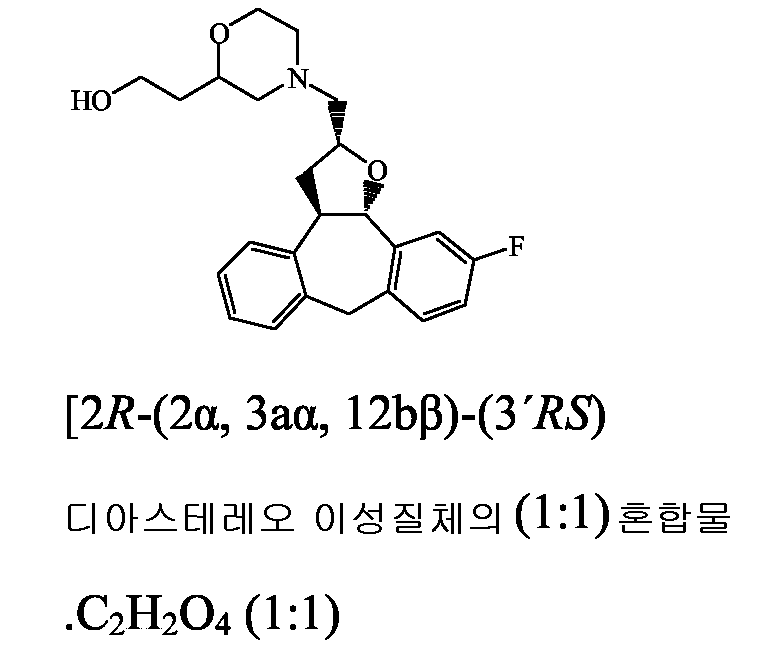
THF (10 ml)중에 화합물 135 (0.00296 mol) 및 리튬 알루미늄 하이드라이드 (0.003 mol)의 혼합물을 실온에서 3시간 동안 교반한 후, 반응 혼합물을 DCM/물로 분배하였다. 수성층을 수차례 DCM으로 추출하고; 유기층을 결합시키고, 수성 수산화나트륨 (1N)으로 추출하고, 염수로 세척하고, 건조시키고 (Na2SO4), 여과하고, 용매를 감압하에서 증발시켜 11 g (93 %)의 화합물 129의 유리 염기를 수득하였다. 이 잔류물의 소량을 Et2O중에 옥살산으로 처리함으로써 에탄디오산염으로 변환시키고; 수득한 침전물을 여과하고, 찬 Et2O로 세척하고, 진공에서 건조시켜 화합물 129를 수득하였다.After a mixture of compound 135 (0.00296 mol) and lithium aluminum hydride (0.003 mol) in THF (10 ml) was stirred at room temperature for 3 hours, the reaction mixture was partitioned into DCM / water. The aqueous layer was extracted several times with DCM; The organic layers were combined, extracted with aqueous sodium hydroxide (1N), washed with brine, dried (Na 2 SO 4 ), filtered and the solvent was evaporated under reduced pressure to give 11 g (93%) of the free base of compound 129. Obtained. A small amount of this residue was converted to ethanedionate by treatment with oxalic acid in Et 2 O; The precipitate obtained was filtered off, washed with cold Et 2 O and dried in vacuo to yield compound 129.
e) 화합물 138의 제조e) preparation of compound 138

DCM (15 ml)중에 화합물 129 (0.00277 mol)의 유리 염기, 메탄설포닐 클로라이드 (0.00305 mol), 트리에틸아민 (0.004155 mol) 및 N,N-디메틸-4-피리딘아민 (0.000277 mol)의 혼합물을 실온에서 16시간 동안 교반한 후, 반응 혼합물을 DCM/물로 분배하였다. 수성층을 수차례 DCM으로 추출하고; 유기층을 결합시키고, NaHCO3 및 염수로 세척하고, 건조시키고 (Na2SO4), 여과하고, 용매를 감압하에서 증발시켰다. 잔류물을 쇼트 오픈 컬럼 크로마토그래피로 실리카겔상에서 건조시켰다 (용리액: DCM/MeOH 95/5). 생성물 분획을 수집하고, 용매를 증발시켜, 0.8 g (61 %)의 화합물 138을 수득하였다.A mixture of free base of compound 129 (0.00277 mol), methanesulfonyl chloride (0.00305 mol), triethylamine (0.004155 mol) and N, N-dimethyl-4-pyridinamine (0.000277 mol) in DCM (15 ml) was prepared. After stirring for 16 h at rt, the reaction mixture was partitioned into DCM / water. The aqueous layer was extracted several times with DCM; The organic layers were combined, washed with NaHCO 3 and brine, dried (Na 2 SO 4 ), filtered and the solvent was evaporated under reduced pressure. The residue was dried over silica gel by short open column chromatography (eluent: DCM / MeOH 95/5). The product fractions were collected and the solvent was evaporated to yield 0.8 g (61%) of compound 138.
f) 화합물 130의 제조f) Preparation of Compound 130

MeOH (10 ml)중에 화합물 138 (0.0002 mol) 및 NaOCH3/MeOH (3 ml)의 혼합물을 마이크로파 조건하에서 130 ℃로 50분간 교반하고, 수득한 용액을 감압하에서 농축시켰다. 잔류물을 DCM중에 용해시키고; 유기층을 분리하고, 물과 염수로 세척하고, 건조시키고 (Na2SO4), 여과하고, 용매를 증발시켰다. 잔류물을 쇼트 오픈 컬 럼 크로마토그래피로 실리카겔상에서 건조시켰다 (용리액: DCM/(MeOH/NH3) 98/2). 생성물 분획을 수집하고, 용매를 증발시켰다. 잔류한 오일을 Et2O중에 옥살산으로 처리함으로써, 에탄디오산염으로 변환시키고; 수득한 침전물을 여과하고, 찬 Et2O로 세척하고, 건조시켜 0.020 g의 화합물 130을 수득하였다.A mixture of compound 138 (0.0002 mol) and NaOCH 3 / MeOH (3 ml) in MeOH (10 ml) was stirred for 50 minutes at 130 ° C. under microwave conditions, and the resulting solution was concentrated under reduced pressure. The residue was dissolved in DCM; The organic layer was separated, washed with water and brine, dried (Na 2 SO 4 ), filtered and the solvent was evaporated. The residue was dried over silica gel by short open column chromatography (eluent: DCM / (MeOH / NH 3 ) 98/2). Product fractions were collected and solvent was evaporated. The remaining oil is converted to ethanedionate by treatment with oxalic acid in Et 2 O; The precipitate obtained was filtered off, washed with cold Et 2 O and dried to afford 0.020 g of compound 130.
g) 화합물 132의 제조g) Preparation of Compound 132

THF (10 ml)중에 화합물 138 (0.00023 mol), N-,N-디메틸아민(0.0023 mol, THF중에 2.0 M) 및 산화칼슘 (0.0023 mol)의 혼합물을 밀봉 튜브중에서 120 ℃ (오일배스 온도)로 16시간 동안 교반한 후, 반응 혼합물을 실온으로 냉각시키고, 셀라이트 패드를 통해 여과하였다. 여과액을 감압하에서 증발시키고, 잔류물을 쇼트 오픈 컬럼 크로마토그래피로 실리카겔상에서 건조시켰다 (용리액: DCM/(MeOH/NH3) 99/1). 생성물 분획을 수집하고, 용매를 증발시켰다. 잔류한 오일을 에탄디오산염으로 변환시키고; 수득한 침전물을 여과하고, Et2O로 세척하고, 건조시켜 0.060 g의 화합물 132를 수득하였다.A mixture of compound 138 (0.00023 mol), N-, N-dimethylamine (0.0023 mol, 2.0 M in THF) and calcium oxide (0.0023 mol) in THF (10 ml) was brought to 120 ° C. (oil bath temperature) in a sealed tube. After stirring for 16 hours, the reaction mixture was cooled to room temperature and filtered through a pad of celite. The filtrate was evaporated under reduced pressure and the residue was dried over silica gel by short open column chromatography (eluent: DCM / (MeOH / NH 3 ) 99/1). Product fractions were collected and solvent was evaporated. Converting residual oil to ethanediolate; The precipitate obtained was filtered off, washed with Et 2 O and dried to afford 0.060 g of compound 132.
h) 화합물 131의 제조h) Preparation of Compound 131

DMF (5 ml)중에 화합물 138 (0.000147 mol) 및 페놀, 나트륨 염, 삼수화물 (0.000441 mol)의 혼합물을 마이크로파 조건하에서 180 ℃으로 50분간 교반한 후, 용매를 N2하에서 50 ℃로 증발시켰다. 잔류물을 DCM중에 용해시키고, 물 및 염수로 세척한 후, 건조시키고 (Na2SO4) 여과시켰다. 용매를 증발시키고, 잔류물을 쇼트 오픈 컬럼 크로마토그래피로 실리카겔상에서 건조시켰다 (용리액: DCM/(MeOH/NH3) 97/3). 생성물 분획을 수집하고, 용매를 증발시켰다. 잔류물을 에탄디오산염으로 변환시키고; 수득한 침전물을 수집하여 찬 Et2O로 세척하고, 건조시켜 화합물 131을 수득하였다.A mixture of compound 138 (0.000147 mol) and phenol, sodium salt, trihydrate (0.000441 mol) in DMF (5 ml) was stirred for 50 minutes at 180 ° C. under microwave conditions, and then the solvent was evaporated to 50 ° C. under N 2 . The residue was dissolved in DCM, washed with water and brine, then dried (Na 2 SO 4 ) and filtered. The solvent was evaporated and the residue was dried over silica gel by short open column chromatography (eluent: DCM / (MeOH / NH 3 ) 97/3). Product fractions were collected and solvent was evaporated. Converting the residue into ethanediolate; The precipitate obtained was collected, washed with cold Et 2 O and dried to give compound 131.
실시예 B17Example B17
화합물 4의 제조Preparation of compound 4

화합물 1의 유리 염기 (0.00028 mol)를 0 ℃에서 1,2-디메톡시에탄 (5 ml)중에 수소화나트륨 (광물유중에 60%, 0.00056 mol)의 빙냉 혼합물에 적가하고, 반응 혼합물을 20분간 0 ℃에서 교반하였다. 아이오도메탄 (0.00056 mol)을 첨가하고, 반응 혼합물을 24시간 동안 실온에서 교반하였다. 포화 수성 NaHCO3 용액을 첨가하고, 혼합물을 DCM으로 추출하였다. 유기층을 분리하고, 건조시키고 (Na2SO4) 용매를 증발시켰다. 잔류물을 쇼트 오픈 컬럼 크로마토그래피로 정제하였다 (용리액: DCM/EtOAc 1/1, 0/1). 생성물 분획을 수집하고, 용매를 증발시켰다. 잔류물을 에탄디오산염으로, Et2O을 사용하여 변환시켰다. 수득한 침전물을 여과하고, 찬 Et2O로 세척하고, 건조시켜 0.0298 g (29 %)의 화합물 4를 수득하였다.The free base (0.00028 mol) of compound 1 was added dropwise to an ice cold mixture of sodium hydride (60% in mineral oil, 0.00056 mol) in 1,2-dimethoxyethane (5 ml) at 0 ° C. and the reaction mixture was stirred at 0 ° C. for 20 minutes. Stirred at. Iodomethane (0.00056 mol) was added and the reaction mixture was stirred for 24 hours at room temperature. Saturated aqueous NaHCO 3 solution was added and the mixture was extracted with DCM. The organic layer was separated, dried (Na 2 SO 4 ) and the solvent was evaporated. The residue was purified by short open column chromatography (eluent: DCM / EtOAc 1/1, 0/1). Product fractions were collected and solvent was evaporated. The residue was converted to ethanedionate, using Et 2 O. The precipitate obtained was filtered off, washed with cold Et 2 O and dried to afford 0.0298 g (29%) of compound 4.
실시예 B18Example B18
화합물 98의 제조Preparation of Compound 98

DCM (5 ml)을 수지 중간체 6 (0.000215 mol)에 첨가하고, 혼합물을 30분간 교반하고, 여과하였다. DCM (10 ml)을 세척한 필터 잔류물에 첨가한 후, 과량의 사이클로옥탄아민 (0.00215 mol)을 첨가하여, 반응 혼합물을 밤새 교반하였다. 수지를 자동적으로, DCM (5 × 5ml), THF (5 × 5 ml), MeOH (5 × 5 ml), DCM (1 × 5 ml) 및 아세토니트릴 (1 × 5 ml)로 세척하였다. 무수 아세토니트릴 (10 ml) 및 중간체 3 (0.0002365 mol)을 첨가한 후, 트리에틸아민 (0.00086 mol)을 첨가하고, 반응 혼합물을 20시간 동안 60 ℃에서 교반한 후 여과하였다. 잔류물을 Et2O/EtOH (7/2)중에 용해시키고, 에탄디오산염으로 변환시켰다. 침전물을 여과한 후, 찬 Et2O로 세척하고, 진공에서 건조시켜 화합물 98을 수득하였다.DCM (5 ml) was added to Resin Intermediate 6 (0.000215 mol) and the mixture was stirred for 30 minutes and filtered. DCM (10 ml) was added to the washed filter residue, then excess cyclooctatanamine (0.00215 mol) was added and the reaction mixture was stirred overnight. The resin was automatically washed with DCM (5 × 5 ml), THF (5 × 5 ml), MeOH (5 × 5 ml), DCM (1 × 5 ml) and acetonitrile (1 × 5 ml). Anhydrous acetonitrile (10 ml) and intermediate 3 (0.0002365 mol) were added, then triethylamine (0.00086 mol) was added and the reaction mixture was stirred at 60 ° C. for 20 hours and then filtered. The residue was dissolved in Et 2 O / EtOH (7/2) and converted to ethanedionate. The precipitate was filtered off, washed with cold Et 2 O and dried in vacuo to afford compound 98.
실시예 B19Example B19
a) 화합물 11의 제조a) Preparation of Compound 11

아세토니트릴 (10 ml)중에 중간체 1 (0.001 mol), 3-피롤리딘카복실산, 메틸 에스테르 (0.003 mol) 및 산화칼슘 (0.100 g)의 혼합물을 마이크로파 오븐중에서 30분간 130 ℃로, 그 후, 160 ℃로 30분간 가열하였다. 고체를 여과하고, 용매를 증발시켰다. 잔류물을 쇼트 오픈 컬럼 크로마토그래피로 실리카겔상에서 건조시켰다 (용리액 1: DCM/EtOAc 1/1, 0/1; 용리액 2: DCM/MeOH 96/4). 생성물 분획을 수집하고, 용매를 증발시켜, 0.215 g (54 %)의 화합물 11의 유리 염기를 수득하였다.A mixture of intermediate 1 (0.001 mol), 3-pyrrolidinecarboxylic acid, methyl ester (0.003 mol) and calcium oxide (0.100 g) in acetonitrile (10 ml) was then heated at 130 ° C. for 30 minutes in a microwave oven, followed by 160 Heat to 30 min. The solid was filtered off and the solvent was evaporated. The residue was dried over silica gel by short open column chromatography (eluent 1: DCM / EtOAc 1/1, 0/1; eluent 2: DCM / MeOH 96/4). The product fractions were collected and the solvent was evaporated to give 0.215 g (54%) of free base of compound 11.
잔류물의 일부 (0.100 g)를 분리하고, EtOH중에서 에탄디오산염으로 변환시켰다. 용매를 증발시키고, 잔류물을 찬 Et2O로 세척한 후, 건조시켜 0.1065 g의 화합물 11을 수득하였다.A portion of the residue (0.100 g) was separated and converted to ethanediolate in EtOH. The solvent was evaporated and the residue washed with cold Et 2 O and dried to yield 0.1065 g of compound 11.
b) 화합물 10의 제조b) Preparation of Compound 10

물 (0.5 ml)중에 수산화나트륨 (0.00031 mol)의 혼합물을 디옥산 (5 ml)중에 화합물 11 (0.00028 mol)의 유리 염기의 용액에 첨가하고, 반응 혼합물을 실온에서 24시간 동안 교반하였다. 고체를 여과하고, 용매를 증발시켰다. 잔류물을 Et2O으로 세척하고, 건조시켜 0.0735 g (69 %)의 화합물 10을 수득하였다.A mixture of sodium hydroxide (0.00031 mol) in water (0.5 ml) was added to a solution of the free base of compound 11 (0.00028 mol) in dioxane (5 ml) and the reaction mixture was stirred at rt for 24 h. The solid was filtered off and the solvent was evaporated. The residue was washed with Et 2 O and dried to afford 0.0735 g (69%) of compound 10.
실시예 B20Example B20
a) 화합물 5의 제조a) Preparation of Compound 5

리튬 알루미늄 하이드라이드 (0.00013 mol)를 무수 THF (1 ml)중에 화합물 11 (0.00013 mol)의 유리 염기의 용액에 질소 분위기하에서 첨가하고, 반응 혼합물을 3시간 동안 실온에서 교반하였다. 수성 포화 NH4Cl 용액 (촉매량, 수 방울)을 기 체 생성이 중단될 때까지 첨가하였다. DCM를 첨가하였다. 층을 분리하고, 유기층을 건조시키고 (Na2SO4), 용매를 증발시켰다. 잔류물을 쇼트 오픈 컬럼 크로마토그래피로 정제하였다 (용리액 1: DCM/MeOH 95/5; 용리액 2: DCM/(MeOH/NH3) 95/5). 생성물 분획을 수집하고, 용매를 증발시켰다. 잔류물을 DIPE로 처리하여, 고체를 제공하였고, 이를 진공에서 건조시켜 0.0196 g (41 %)의 화합물 5를 수득하였다.Lithium aluminum hydride (0.00013 mol) was added to a solution of the free base of compound 11 (0.00013 mol) in anhydrous THF (1 ml) under nitrogen atmosphere and the reaction mixture was stirred at room temperature for 3 hours. Aqueous saturated NH 4 Cl solution (catalyst amount, drops) was added until gas production stopped. DCM was added. The layers were separated, the organic layer was dried (Na 2 SO 4 ) and the solvent was evaporated. The residue was purified by short open column chromatography (eluent 1: DCM / MeOH 95/5; eluent 2: DCM / (MeOH / NH 3 ) 95/5). Product fractions were collected and solvent was evaporated. The residue was treated with DIPE to give a solid, which was dried in vacuo to yield 0.0196 g (41%) of compound 5.
b) 화합물 25의 제조b) Preparation of Compound 25

THF (q.s.)중에 화합물 5 (0.000136 mol), 4-메톡시-페놀 (0.00027 mol), 디아젠디카복실산, 디에틸 에스테르 (0.00027 mol) 및 트리페닐포스핀 (0.00027 mol)의 혼합물을 30분간 마이크로파 오븐중에서 90 ℃로 교반하였다. 용매를 증발시키고, 잔류물을 MeOH (5 ml)중에서 용해시켰다. 앰버리스트 (Amberlyst) 15 (0.00054 mol)를 용액에 첨가하고, 수득한 혼합물을 48시간 동안 실온에서 진탕하고, 여과하였다. 수지를 3회 MeOH로 세척한 후 (MeOH 추출물은 버린다), MeOH/NH3 (3 ml)를 수지에 첨가한다. 혼합물을 4.5시간 동안 실온에서 진탕하고, 여과하였다. 수지를 3회 MeOH/NH3으로 세척하고, 여과액을 결합시키고, 증발시켰다. 잔류물을 쇼트 오픈 컬럼 크로마토그래피로 정제하였다 (용리액 1: DCM/EtOAc 1/1; 용리액 2: DCM/MeOH 96/4). 생성물 분획을 수집하고, 용매를 증발시켜, 0.0097 g (15 %)의 화합물 25를 수득하였다.A mixture of compound 5 (0.000136 mol), 4-methoxy-phenol (0.00027 mol), diazendicarboxylic acid, diethyl ester (0.00027 mol) and triphenylphosphine (0.00027 mol) in THF (qs) was stirred for 30 minutes in a microwave oven. It stirred at 90 degreeC in the inside. The solvent was evaporated and the residue was dissolved in MeOH (5 ml). Amberlyst 15 (0.00054 mol) was added to the solution and the resulting mixture was shaken at room temperature for 48 hours and filtered. After washing the resin three times with MeOH (MeOH extract is discarded), MeOH / NH 3 (3 ml) is added to the resin. The mixture was shaken at rt for 4.5 h and filtered. The resin was washed three times with MeOH / NH 3 , the filtrates were combined and evaporated. The residue was purified by short open column chromatography (eluent 1: DCM / EtOAc 1/1; eluent 2: DCM / MeOH 96/4). The product fractions were collected and the solvent was evaporated to yield 0.0097 g (15%) of compound 25.
실시예 B21Example B21
a) 화합물 271의 제조a) Preparation of Compound 271

디옥산 (10 ml)중에 중간체 8 (0.015 mol) 및 아세토니트릴 (10 ml)의 용액을 THF (100 ml)로 희석시킨 후, 중간체 1 (0.005 mol)과 산화칼슘 (0.15 mol)을 첨가하고, 반응 혼합물을 16시간 동안 140 ℃에서 가열하였다. 현탁액을 셀라이트상에서 여과하고, 여과액을 감압하에서 증발시켰다. 잔류물을 쇼트 오픈 컬럼 크로마토그래피로 실리카겔상에서 건조시켰다 (용리액: DCM/(MeOH/NH3)(포화) 97/3). 생성물 분획을 수집하고, 용매를 증발시켜, 0.153 g의 화합물 271을 수득하였다.A solution of intermediate 8 (0.015 mol) and acetonitrile (10 ml) in dioxane (10 ml) was diluted with THF (100 ml), then intermediate 1 (0.005 mol) and calcium oxide (0.15 mol) were added, The reaction mixture was heated at 140 ° C. for 16 hours. The suspension was filtered over celite and the filtrate was evaporated under reduced pressure. The residue was dried over silica gel by short open column chromatography (eluent: DCM / (MeOH / NH 3 ) (saturated) 97/3). The product fractions were collected and the solvent was evaporated to yield 0.153 g of compound 271.
b) 화합물 279의 제조b) Preparation of Compound 279

비스(피리딘)아이오도늄 테트라플루오로보레이트 (0.001717 mol)를 DCM (q.s.)중에 화합물 271 (0.001717 mol)의 혼합물에 실온에서 N2하에서 첨가하였다. 반응 혼합물을 1시간 동안 교반한 후, Na2S2O3 용액을 첨가하였다. 유기층을 분리하고, 건조시키고 (MgSO4), 여과하고, 용매를 감압하에서 증발시켰다. 잔류물을 쇼트 오픈 컬럼 크로마토그래피로 실리카겔상에서 건조시켰다 (용리액: EtOAc/헵탄 2/4). 생성물 분획을 수집하고, 용매를 증발시켜 0.320 g의 화합물 279를 수득하였다 (추가 정제 없이, 다음 반응 단계에서 그대로 사용함).Bis (pyridine) iodonium tetrafluoroborate (0.001717 mol) was added to a mixture of compound 271 (0.001717 mol) in DCM (qs) at room temperature under N 2 . The reaction mixture was stirred for 1 hour and then Na 2 S 2 O 3 solution was added. The organic layer was separated, dried (MgSO 4 ), filtered and the solvent was evaporated under reduced pressure. The residue was dried over silica gel by short open column chromatography (eluent: EtOAc / heptane 2/4). The product fractions were collected and the solvent was evaporated to yield 0.320 g of compound 279 (without further purification, used as such in the next reaction step).
c) 화합물 274의 제조c) preparation of compound 274

MeOH (5 ml)중에 화합물 279 (0.0006 mol) 및 CH3ONa/MeOH 30% (0.006 mol) 의 혼합물을 마이크로파 조건하에서 100 ℃로 20분간 조사하였다. 용매를 증발시키고, 잔류물을 에탄디오산염으로 변환시켰다. 수득한 침전물을 수집하고, 건조시켜 0.100 g의 화합물 274를 수득하였다.A mixture of compound 279 (0.0006 mol) and CH 3 ONa / MeOH 30% (0.006 mol) in MeOH (5 ml) was irradiated for 20 minutes at 100 ° C. under microwave conditions. The solvent was evaporated and the residue was converted to ethanedionate. The precipitate obtained was collected and dried to yield 0.100 g of compound 274.
실시예 B22Example B22
a) 화합물 258의 제조a) Preparation of Compound 258

THF (25 ml)중에 중간체 9 (0.00186 mol), 3-피롤리디놀 (0.0186 mol) 및 산화칼슘 (0.186 mol)의 혼합물을 16시간 동안 120 ℃로 교반한 후, 수득한 현탁액을 셀라이트상에서 여과하였다. 여과액을 감압하에서 증발시키고, 잔류물을 DCM중에 용해시켰다. 용액을 NaHCO3의 수성 포화 용액, 물 및 염수로 세척하였다. 유기층을 건조시키고 (Na2SO4), 여과하고, 용매를 증발시켰다. 잔류물을 쇼트 오픈 컬럼 크로마토그래피로 실리카겔상에서 미리 정제하고, 생성물 분획을 수집하였다. 용매를 증발시키고, 잔류물을 실리카겔상에서 라디칼 크로마토그래피로 정제하였다 (용리액: DCM). 순수한 분획을 수집하고, 용매를 증발시켜 0.480 g의 화합물 258을 수득하였다.After stirring a mixture of intermediate 9 (0.00186 mol), 3-pyrrolidinol (0.0186 mol) and calcium oxide (0.186 mol) in THF (25 ml) for 16 h at 120 ° C., the resulting suspension was filtered over celite It was. The filtrate was evaporated under reduced pressure and the residue was dissolved in DCM. The solution was washed with an aqueous saturated solution of NaHCO 3 , water and brine. The organic layer was dried (Na 2 SO 4 ), filtered and the solvent was evaporated. The residue was prepurified on silica gel by short open column chromatography and product fractions were collected. The solvent was evaporated and the residue was purified by radical chromatography on silica gel (eluent: DCM). Pure fractions were collected and solvent was evaporated to yield 0.480 g of compound 258.
b) 화합물 260의 제조b) Preparation of Compound 260

화합물 258 (0.00014 mol), 아연 시아나이드 (0.00009 mol) 및 테트라키스(트리페닐포스핀)-팔라듐 (0.000014 mol)을 실온에서 DMF (10 ml, 미리 탈산소화함)에 첨가하고, 반응 혼합물을 120 ℃ (실온에서 120 ℃로, 5분간)로 15분간 마이크로파 조건하에서 가열하였다. 혼합물을 여과하고, 유기 용매 (DMF)를 증발시켰다. 잔류물을 쇼트 오픈 컬럼 크로마토그래피로 실리카겔상에서 건조시켰다 (용리액: DCM/(MeOH/NH3) 95/5). 생성물 분획을 수집하고, 용매를 증발시켰다. 잔류물을 에탄디오산염으로 변환시키고, 수득한 고체를 수집하여 찬 Et2O로 세척하고, 진공에서 건조시켜 화합물 260을 수득하였다.Compound 258 (0.00014 mol), zinc cyanide (0.00009 mol) and tetrakis (triphenylphosphine) -palladium (0.000014 mol) were added to DMF (10 ml, pre-oxygenated) at room temperature, and the reaction mixture was 120 Heated at 15 ° C. (120 ° C. at room temperature for 5 minutes) under microwave conditions for 15 minutes. The mixture was filtered and the organic solvent (DMF) was evaporated. The residue was dried over silica gel by short open column chromatography (eluent: DCM / (MeOH / NH 3 ) 95/5). Product fractions were collected and solvent was evaporated. The residue was converted to ethanediolate, the solid obtained was collected and washed with cold Et 2 O and dried in vacuo to afford compound 260.
실시예 B23Example B23
화합물 218의 제조Preparation of compound 218

중간체 10을 DCM중에 용해시키고, 2-클로로벤질 클로로포르메이트 (1.1 eq)를 첨가하였다. 중합체 지지 DIPEA (Aldrich, ref 53, 873-6; 100-200 메시; 로딩 2.0-3.5 mmol/g, 2.5 eq)를 첨가하고, 바이알 (vial)을 밤새 진탕하였다. 중합체 지지 트리스아민 (Aldrich, ref 47,210-7; 200-400 메시; 로딩 4.2 mmol/g, 3 eq)을 첨가하고, 혼합물을 3시간 동안 진탕하였다. 고체를 여과하고, 여과액을 농축시켜, 순수한 화합물 또는 쇼트 오픈 컬럼 크로마토그래피로 정제되는 혼합물을 수득하였다. 순수한 화합물을 DCM중에 트리플루오로아세트산으로 처리함으로써 대응하는 트리플루오로아세테이트 염으로 변환시키고, 휘발성 물질을 진공에서 증발시켜 화합물 218을 수득하였다.Intermediate 10 was dissolved in DCM and 2-chlorobenzyl chloroformate (1.1 eq) was added. Polymer supported DIPEA (Aldrich, ref 53, 873-6; 100-200 mesh; loading 2.0-3.5 mmol / g, 2.5 eq) was added and the vial was shaken overnight. Polymer supported trisamine (Aldrich, ref 47,210-7; 200-400 mesh; loading 4.2 mmol / g, 3 eq) was added and the mixture was shaken for 3 hours. The solid was filtered and the filtrate was concentrated to give a pure compound or a mixture which was purified by short open column chromatography. The pure compound was converted to the corresponding trifluoroacetate salt by treatment with trifluoroacetic acid in DCM and the volatiles were evaporated in vacuo to afford compound 218.
실시예 B24Example B24
화합물 244의 제조Preparation of compound 244

중간체 10을 DCM중에 용해시키고, 프로필이소시아네이트 (1.1 eq)를 첨가하였다. 바이알을 밤새 진탕하였다. 중합체 지지 트리스아민 (Aldrich, ref 47, 210-7; 200-400 메시; 로딩 4.2 mmol/g, 3 eq)을 첨가하고, 혼합물을 3시간 동안 진탕하였다. 고체를 여과하고, 여과액을 농축시켜, 순수한 화합물 또는 쇼트 오픈 컬럼 크로마토그래피로 정제되는 혼합물을 수득하였다. 순수한 화합물을 DCM중에 트리플루오로아세트산으로 처리함으로써 대응하는 트리플루오로아세테이트 염으로 변환시키고, 휘발성 물질을 진공에서 증발시켜 화합물 244를 수득하였다.Intermediate 10 was dissolved in DCM and propyl isocyanate (1.1 eq) was added. The vial was shaken overnight. Polymer supported trisamine (Aldrich, ref 47, 210-7; 200-400 mesh; loading 4.2 mmol / g, 3 eq) was added and the mixture was shaken for 3 hours. The solid was filtered and the filtrate was concentrated to give a pure compound or a mixture which was purified by short open column chromatography. The pure compound was converted to the corresponding trifluoroacetate salt by treatment with trifluoroacetic acid in DCM and the volatiles were evaporated in vacuo to afford compound 244.
실시예 B25Example B25
화합물 108의 제조Preparation of Compound 108

DCM (6 ml)중에 중간체 3 (0.000113 mol)의 혼합물에 실온에서 1-이소티오시아네이토-부탄 (0.9 equiv., 0.0001 mol)을 첨가하였다. 혼합물을 1시간 동안 실온에서 교반하였다. 중합체 연결 (linked) -N=C=O (Aldrich, ref 47, 368-5; 200-400 메시, 로딩 1.85 mmol/g, 3 당량)을 첨가하고, 혼합물을 밤새 교반하였다. 혼합물을 여과하고, 용매를 증발시켰다. 잔류물을 쇼트 오픈 컬럼 크로마토그래피로 정제하였다 (용리액: DCM, 그 후, DCM/MeOH-NH3 98/2). 생성물 분획을 수집하고, 용매를 증발시켜 대응하는 유리 염기를 수득하고, 이를 Et2O중에 옥살산으로 처리함으로써 대응하는 옥살레이트 염으로 변형시켰다. 형성된 침전물을 여과하여 찬 Et2O로 세척하고, 진공에서 건조시켜 화합물 108을 수득하였다.To a mixture of intermediate 3 (0.000113 mol) in DCM (6 ml) was added 1-isothiocyanato-butane (0.9 equiv., 0.0001 mol) at room temperature. The mixture was stirred at rt for 1 h. Polymer linked -N = C = O (Aldrich, ref 47, 368-5; 200-400 mesh, loading 1.85 mmol / g, 3 equiv) was added and the mixture was stirred overnight. The mixture is filtered and the solvent is evaporated. The residue was purified by short open column chromatography (eluent: DCM, then DCM / MeOH-NH 3 98/2). The product fractions were collected and the solvent was evaporated to give the corresponding free base which was transformed to the corresponding oxalate salt by treatment with oxalic acid in Et 2 O. The precipitate formed was filtered off, washed with cold Et 2 O and dried in vacuo to afford compound 108.
실시예 B26Example B26
화합물 53의 제조Preparation of Compound 53

메탄설포닐 클로라이드 (0.00225 mol)을 트리에틸아민 (0.42 ml) 및 무수 DCM (10 ml)중에 중간체 11 (0.0015 mol)의 용액에 첨가하고, 0 ℃에서 교반하였다. 반응 혼합물을 16시간 동안 실온에서 교반하였다. 물을 첨가하고, 혼합물을 교반하였다. 유기층을 분리하고, 건조시키고 (Na2SO4), 여과하여 용매를 증발시켰다. 잔류물을 쇼트 오픈 컬럼 크로마토그래피로 실리카겔상에서 건조시켰다 (용리액: DCM/MeOH 98/8). 생성물 분획을 수집하고, 용매를 증발시켜, 0.390 g의 화합물 53을 수득하였다.Methanesulfonyl chloride (0.00225 mol) was added to a solution of intermediate 11 (0.0015 mol) in triethylamine (0.42 ml) and dry DCM (10 ml) and stirred at 0 ° C. The reaction mixture was stirred at room temperature for 16 hours. Water was added and the mixture was stirred. The organic layer was separated, dried (Na 2 SO 4 ) and filtered to evaporate the solvent. The residue was dried over silica gel by short open column chromatography (eluent: DCM / MeOH 98/8). The product fractions were collected and the solvent was evaporated to yield 0.390 g of compound 53.
이에 의거하여 제조한 최종 화합물은 모두, 달리 명시되지 않는 한, 이성질체의 혼합물이다.The final compounds prepared therefrom are all mixtures of isomers, unless otherwise specified.
표 1Table 1


표 2Table 2


표 3TABLE 3


표 4Table 4


표 5Table 5

표 6Table 6


C. 물리화학적 데이터C. Physical and Chemical Data
표 7에 나타낸 LCMS 데이터를 하기의 방법으로 수득하였다:LCMS data shown in Table 7 were obtained by the following method:
40℃에 설정한 컬럼 히터가 있는 애질런트사 (Agilent)의 HP 1100으로 HPLC 구배를 제공하였다. 컬럼으로부터의 흐름은 광다이오드 어레이 (PDA) 검출기를 통과한 후, 빛 산란 검출기 (ELSD) 및 양성 및 음성 이온화 모드로 동시에 작동하는 전자분무 이온화원 (electrospray ionization source)을 가진 Waters-Micromass 비행시간 (ToF) 질량 분석기로 분리된다.The HPLC gradient was provided by Agilent's HP 1100 with a column heater set at 40 ° C. The flow from the column passes through a photodiode array (PDA) detector and then, with a light scatter detector (ELSD) and an electrospray ionization source operating simultaneously in positive and negative ionization modes, ToF) separated by mass spectrometer.
애질런트사의 XDB-C18 카트리지 (3.5μm, 4.6×30 mm)상에서 1 ml/min의 유속으로 역상 HPLC를 수행하였다. 3개의 이동상 (이동상 A: 0.5g/l 암모늄아세테이트 용액, 이동상 B: 아세토니트릴; 이동상 C: 메탄올)을 사용하여 구배 조건을 80% A, 10% B, 10% C ~ 50% B 및 50% C로 6.0분 내에, 100% B로 6.5분 내에 진행시키고, 7.0분까지 유지하고, 80% A, 10% B 및 10% C로 7.6분에서 재평형화하여, 9.0분까지 유지하였다. 5 μL의 주입 부피를 사용하였다. Reverse phase HPLC was performed on an Agilent XDB-C18 cartridge (3.5 μm, 4.6 × 30 mm) at a flow rate of 1 ml / min. Gradient conditions were adjusted using three mobile phases (mobile phase A: 0.5 g / l ammonium acetate solution, mobile phase B: acetonitrile; mobile phase C: methanol) to 80% A, 10% B, 10% C to 50% B and 50% Progressed within 6.0 minutes with C, within 6.5 minutes with 100% B, maintained up to 7.0 minutes, re-equilibrated with 80% A, 10% B and 10% C at 7.6 minutes, and maintained up to 9.0 minutes. An injection volume of 5 μL was used.
1초에 100 ~ 750으로 스캐닝하여 1초의 체류 시간을 사용하여, 고분해능 질량 스펙트럼을 수득하였다. 모세관 바늘 전압은 3kV였고, 원 온도를 140℃로 유지하였다. 질소를 흡입 기체로 사용하였다. 양성 및 음성 이온화 방식 모두에 대하여 콘 (cone) 전압을 30V로 하였다. 류신-엔케팔린을 락 스프레이 (lock spray)에 대한 레퍼런스로 사용하였다. Waters-Micromass MassLynx-Openlynx 데이터 시스템으로 데이터를 얻었다.Scanning from 100 to 750 per second to obtain a high resolution mass spectrum using a residence time of 1 second. The capillary needle voltage was 3 kV and the original temperature was maintained at 140 ° C. Nitrogen was used as the intake gas. The cone voltage was 30V for both positive and negative ionization modes. Leucine-enkephalin was used as a reference for lock spray. Data was obtained with a Waters-Micromass MassLynx-Openlynx data system.
표 7Table 7


D. 약리적 데이터D. Pharmacological Data
실시예Example D.1: 5- D.1: 5- HTHT 2A2A 및 5- And 5- HTHT 2C2C 수용체에 대한 For receptors 시험관내In vitro 결합 친화성 Binding affinity
화학식 (I)의 화합물과 5-HT2A 및 5-HT2C 수용체의 상호작용을 시험관내 방사성리간드 결합 실험에서 평가하였다. 일반적으로, 수용체에 대한 높은 결합 친화성을 가진 낮은 농도의 방사성 리간드를 완충시킨 배지 (0.2 ~ 5ml)중 특정한 수용체 (1 ~ 5mg 조직)를 풍부하게 한 조직 표본의 시료와 함께 배양하였다. 배양 도중, 방사성 리간드는 수용체에 결합한다. 결합의 평형에 도달할 때, 수용체 결합 방사성은 비결합 방사성과 분리되고, 수용체 결합 활성을 계산하였다. 수용체가 있는 시험 화합물의 상호작용을 경쟁 결합 실험에서 평가하였다. 다양한 농도의 시험 화합물을 조직 표본 및 방사성리간드를 함유한 배양 혼합물에 첨가하였다. 방사성리간드의 결합은 시험 화합물에 의해 그의 결합 친화성 및 그의 농도에 비례하여 저 해될 것이다. 하기로 수행한 방사성리간드 결합 연구로 5-HT2 수용체에 대한 화합물의 친화도를 측정하였다: (a) 방사성리간드로 [125I]R91150를 사용한 L929 세포중 발현된 인간 복제 5-HT2A 수용체, 및 (b) 방사성리간드로 [3H]메술레르긴 (mesulergine)을 사용한 CHO 세포중 발현된 인간 복제 5-HT2C 수용체.Interactions of the compounds of formula (I) with 5-HT 2A and 5-HT 2C receptors were evaluated in in vitro radioligand binding experiments. In general, cultures were performed with samples of tissue specimens enriched with specific receptors (1-5 mg tissue) in medium (0.2-5 ml) buffered low concentration radioligand with high binding affinity for the receptor. During incubation, the radioligand binds to the receptor. When the equilibrium of binding was reached, receptor binding radioactivity was separated from unbound radioactivity and the receptor binding activity was calculated. The interaction of test compounds with receptors was evaluated in a competitive binding experiment. Various concentrations of test compound were added to the culture mixture containing tissue specimens and radioligands. The binding of the radioligand will be inhibited by the test compound in proportion to its binding affinity and its concentration. Radioligand binding studies conducted below determined the affinity of the compound for the 5-HT 2 receptor: (a) human cloned 5-HT 2A receptor expressed in L929 cells using [ 125 I] R91150 as a radioligand, And (b) expressed human clone 5-HT 2C receptor in CHO cells using [ 3 H] mesulergine as radioligand.
실시예Example D.2: 인간 D.2: Human D2D2 LL 수용체에 대한 For receptors 시험관내In vitro 결합 친화성 Binding affinity
인간 도파민 D2L 수용체-형질감염된 (transfected) CHO 세포의 냉동 막을 녹이고, Ultra-Turrax T25 균질화기를 사용하여 간단히 균질화하고, NaCl, CaCl2, MgCl2, KCl (각각 50, 120, 2, 1, 및 5 mM, HCl을 사용하여 pH 7.7로 조정함)을 함유한 트리스-HCl 분석 완충제에서 특정 및 비특정 결합에 최적화한 적절한 단백질 농도로 희석시켰다. 방사성리간드 [3H] 스피페론 (Spiperone) (NEN, 특이 활성 ~ 70Ci/mmol)을 분석 완충제에 2 nmol/L의 농도로 희석시켰다. 그 후, 제조한 방사성리간드 (50μl)를 10% DMSO 대조군, 부타클라몰 (10-6mol/l 최종 농도), 또는 중요한 화합물의 50μl와 함께, 400μl의 제조한 막 용액과 함께 배양하였다 (30분, 37℃). Packard Filtermate 수확기를 통해 GF/B Unifilter 플레이트상으로 막-결합 활성을 여과시키고, 빙냉 트리스-HCl 완충제 (50mM; pH 7.7; 6×0.5 ml)로 세척하 였다. 섬광 유체를 첨가하고, Topcount 섬광 계수기로 계산하기 전, 필터를 건조시켰다. 특정한 결합 및 경쟁 결합 비율의 곡선을 S-Plus 소프트웨어 (Insightful사)를 사용하여 계산하였다.Frozen membranes of human dopamine D2 L receptor-transfected CHO cells were thawed, homogenized briefly using Ultra-Turrax T25 homogenizer, NaCl, CaCl 2 , MgCl 2 , KCl (50, 120, 2, 1, and In Tris-HCl assay buffer containing 5 mM, adjusted to pH 7.7 using HCl), and diluted to appropriate protein concentration optimized for specific and nonspecific binding. Radioligand [ 3 H] Spiperone (NEN, specific activity ˜70 Ci / mmol) was diluted in assay buffer to a concentration of 2 nmol / L. The prepared radioligand (50 μl) was then incubated with 400 μl of the prepared membrane solution with 10% DMSO control, butaclamole (10 −6 mol / l final concentration), or 50 μl of the important compound (30 Min, 37 ° C.). Membrane-binding activity was filtered onto a GF / B Unifilter plate through a Packard Filtermate harvester and washed with ice cold Tris-HCl buffer (50 mM; pH 7.7; 6 × 0.5 ml). The scintillation fluid was added and the filter was dried before counting with a Topcount scintillation counter. Curves of specific binding and competitive binding ratios were calculated using S-Plus software (Insightful).
실시예Example D.3: D.3: NETNET 재섭취 억제의 Of reingestion suppression 시험관내In vitro 측정 Measure
래트 뇌로부터 피질을 수집하고, Ultra-Turrax T25 및 듀얼 균질화기를 사용하여, Tris, NaCl 및 KCl (각각 50 mM, 120 mM 및 5 mM, pH 7.4)을 함유한 빙냉 균질화 완충액중에서, 특정 및 비특정 결합에 대하여 최적화된 적절한 단백질 농도로 희석시키기 전 균질화하였다. Tris, NaCl 및 KCl (각각 50 mM, 300 mM 및 5 mM, pH 7.4)을 함유하는 빙냉 분석 완충제에 20 nmol/L의 농도로 희석시킨 방사성 [3H]Nixosetine (NEN, NET-1084, 특정 활성 ~ 70 Ci/mmol)으로 결합을 수행하였다. 그 후, 제조한 방사성 리간드 (50 μl)를 적절한 단백질 농도 (400 μl)로 미리 희석시킨 막 제제 (membrane preparations), 50 μl의 10 % DMSO 대조군, 마진돌 (Mazindol) (최종 농도, 10-6 mol/L), 또는 중요한 화합물로 배양하였다. Packard Filtermate 수확기를 통해 GF/B Unifilter 플레이트상으로 여과시킴으로써, 막-결합 활성을 검출하고, 빙냉 Tris-HCl 완충제 (NaCl 및 KCl 함유 (50 mM, 120 mM 및 4 mM; pH 7.4; 6 × 0.5 ml))로 세척하였다. 섬광 유체를 첨가하기 전 필터를 24시간 동안 건조시켰다. Topcount 섬광 계수기에서 계수하기 전 24시간 동안 섬광 유체가 필터를 포화시키도록 하였다. 특정한 결합 및 경쟁 결합 비율의 곡선을 S- Plus 소프트웨어 (Insightful사)를 사용하여 계산하였다.Collect cortex from rat brain and, using Ultra-Turrax T25 and dual homogenizers, in ice cold homogenization buffer containing Tris, NaCl and KCl (50 mM, 120 mM and 5 mM, pH 7.4, respectively), specific and non-specific Homogenized prior to dilution to the appropriate protein concentration optimized for binding. Radioactive [ 3 H] Nixosetine (NEN, NET-1084, specific activity diluted in ice cold assay buffer containing Tris, NaCl and KCl (50 mM, 300 mM and 5 mM, pH 7.4) at a concentration of 20 nmol / L Binding was performed at ˜70 Ci / mmol). Subsequently, membrane preparations in which the prepared radioligand (50 μl) were previously diluted with an appropriate protein concentration (400 μl), 50 μl of 10% DMSO control, Mazindol (final concentration, 10 −6) mol / L), or important compounds. By filtering onto a GF / B Unifilter plate through a Packard Filtermate harvester, membrane-bound activity was detected and ice-cold Tris-HCl buffer (containing NaCl and KCl (50 mM, 120 mM and 4 mM; pH 7.4; 6 × 0.5 ml) )). The filter was dried for 24 hours before the flash fluid was added. The flash fluid was allowed to saturate the filter for 24 hours before counting in a Topcount scintillation counter. Curves of specific binding and competitive binding ratios were calculated using S-Plus software (Insightful).
결과를 각 화합물에 대한 pIC50 수치로 하기 표 8에 제공하였다.The results are provided in Table 8 below as pIC 50 values for each compound.
표 8Table 8


n.d. = 측정되지 않음 (not determined)n.d. = Not determined
E. 조성물 E. Composition 실시예Example
이들 실시예에 걸쳐 사용된 "활성 성분" (A.I.)는 화학식 (I)의 화합물, 그의 약제학적으로 허용가능한 산 또는 염기 부가염, 그의 N-옥사이드 형태 또는 그의 4차 암모늄 염에 관한 것이다.As used throughout these examples, the "active ingredient" (A.I.) relates to a compound of formula (I), a pharmaceutically acceptable acid or base addition salt thereof, an N-oxide form thereof or a quaternary ammonium salt thereof.
실시예Example E.1: 경구 용액 E.1: Oral Solutions
메틸 4-하이드록시벤조에이트 (9g) 및 프로필 4-하이드록시벤조에이트 (1g)를 끓는 정제수 (4 l)에 용해시켰다. 이 용액 3 l에 우선 2,3-디하이드록시부탄이산 (10g), 그 후 A.I (20g)을 용해시켰다. 후자의 용액을 전자의 용액의 나머지와 결합시키고, 거기에 1,2,3-프로판트리올 (12 l) 및 소르비톨 70 % 용액 (3 l)을 첨가하였다. 소듐 사카린 (40g)을 물 (500ml)에 용해시키고, 라스베리 (2ml) 및 구즈베리 에센스 (2ml)를 첨가하였다. 후자의 용액을 전자와 결합시키고, 물을 q.s. ~ 20 l의 부피로 첨가하여, 차숟가락으로 하나 당 (5ml) 활성 성분 5mg을 함유하는 경구 용액을 제공하였다. 수득한 용액을 적절한 용기에 채웠다.Methyl 4-hydroxybenzoate (9 g) and propyl 4-hydroxybenzoate (1 g) were dissolved in boiling purified water (4 l). To 3 l of this solution, 2,3-dihydroxybutane diacid (10 g) was dissolved first, followed by A.I (20 g). The latter solution was combined with the rest of the former solution, to which 1,2,3-propanetriol (12 l) and sorbitol 70% solution (3 l) were added. Sodium saccharin (40 g) was dissolved in water (500 ml) and raspberries (2 ml) and gooseberry essence (2 ml) were added. The latter solution is combined with the former and water is added to q.s. To a volume of ˜20 l, a teaspoon provided an oral solution containing 5 mg of one active ingredient (5 ml). The resulting solution was filled into a suitable container.
실시예Example E.2: 필름 코팅 정제 E.2: Film Coated Tablets
정제 코어의 제조Preparation of Tablet Core
A.I. (100g), 락토스 (570g) 및 전분 (200g)의 혼합물을 잘 혼합한 후, (200ml)중 소듐 도데실 설페이트 (5g) 및 폴리비닐피롤리돈 (10g)의 용액으로 적셨다. 습윤 분말 혼합물을 체로 거르고, 건조시키고, 다시 체로 걸렀다. 그 후, 미세결정성 셀룰로오스 (100g) 및 경화 야채유 (15g)를 첨가하였다. 전체를 잘 혼합하고, 정제로 압축하여 각각 10mg의 활성 성분을 함유한 정제 10,000개를 제공하였다.A.I. (100 g), a mixture of lactose (570 g) and starch (200 g) were mixed well and then wetted with a solution of sodium dodecyl sulfate (5 g) and polyvinylpyrrolidone (10 g) in (200 ml). The wet powder mixture was sieved, dried and sieved again. Thereafter, microcrystalline cellulose (100 g) and cured vegetable oil (15 g) were added. The whole was mixed well and compressed into tablets to give 10,000 tablets each containing 10 mg of active ingredient.
코팅coating
변성 에탄올 (75ml)중 메틸 셀룰로오스 (10g)의 용액에 디클로로메탄 (150ml)중 에틸 셀룰로오스 (5g)의 용액을 첨가하였다. 그 후, 디클로로메탄 (75ml) 및 1,2,3-프로판트리올 (2.5ml)을 첨가하였다. 폴리에틸렌 글리콜 (10g)을 녹이고, 디클로로메탄 (75ml)에 용해시켰다. 후자의 용액을 전자에 첨가한 후, 마그네슘 옥타데카노에이트 (2.5g), 폴리비닐피롤리돈 (5g) 및 농축된 착색 현탁액 (30ml)을 첨가하고, 전체를 균질하게 하였다. 코팅 장치에서, 이렇게 수득한 혼합물로 정제 코어를 코팅하였다.To a solution of methyl cellulose (10 g) in denatured ethanol (75 ml) was added a solution of ethyl cellulose (5 g) in dichloromethane (150 ml). Then dichloromethane (75 ml) and 1,2,3-propanetriol (2.5 ml) were added. Polyethylene glycol (10 g) was dissolved and dissolved in dichloromethane (75 ml). After the latter solution was added to the former, magnesium octadecanoate (2.5 g), polyvinylpyrrolidone (5 g) and concentrated colored suspension (30 ml) were added and the whole was homogeneous. In the coating apparatus, the tablet cores were coated with the mixture thus obtained.
실시예Example E.3: 주입가능한 용액 E.3: Injectable Solution
메틸 4-하이드록시벤조에이트 (1.8g) 및 프로필 4-하이드록시벤조에이트 (0.2g)를 주입을 위해 끓는 물 (500ml)에 용해시켰다. 약 50℃로 냉각시킨 후, 교반시키면서 락트산 (4g), 프로필렌 글리콜 (0.05g) 및 A.I. (4g)를 첨가하였다. 용액을 실온으로 냉각시키고, 주입을 위해 물을 q.s. ~ 1000ml로 공급하여, 4mg/ml의 A.I.를 포함하는 용액을 제공하였다. 용액을 여과로 살균하고, 살균 용기에 채웠다.Methyl 4-hydroxybenzoate (1.8 g) and propyl 4-hydroxybenzoate (0.2 g) were dissolved in boiling water (500 ml) for injection. After cooling to about 50 ° C., lactic acid (4 g), propylene glycol (0.05 g) and A.I. (4 g) was added. The solution was cooled to room temperature and water was poured into the q.s. Supplied at 1000 ml to give a solution comprising 4 mg / ml of A.I. The solution was sterilized by filtration and filled into sterile containers.
Claims (13)


Applications Claiming Priority (3)
| Application Number | Priority Date | Filing Date | Title |
|---|---|---|---|
| EP05105398.1 | 2005-06-17 | ||
| EP05105398 | 2005-06-17 | ||
| PCT/EP2006/063273 WO2006134163A2 (en) | 2005-06-17 | 2006-06-16 | Novel tetracyclic tetrahydrofuran derivatives containing a cyclic amine side chain |
Publications (2)
| Publication Number | Publication Date |
|---|---|
| KR20080021793A KR20080021793A (en) | 2008-03-07 |
| KR101299518B1 true KR101299518B1 (en) | 2013-08-29 |
Family
ID=35276980
Family Applications (1)
| Application Number | Title | Priority Date | Filing Date |
|---|---|---|---|
| KR1020087001391A Expired - Fee Related KR101299518B1 (en) | 2005-06-17 | 2006-06-16 | Novel tetracyclic tetrahydrofuran derivatives containing a cyclic amine side chain |
Country Status (15)
| Country | Link |
|---|---|
| US (1) | US8569267B2 (en) |
| EP (1) | EP1896456B1 (en) |
| JP (1) | JP5103388B2 (en) |
| KR (1) | KR101299518B1 (en) |
| CN (1) | CN101228154B (en) |
| AT (1) | ATE460411T1 (en) |
| AU (1) | AU2006259020C1 (en) |
| BR (1) | BRPI0613711A2 (en) |
| CA (1) | CA2611443C (en) |
| DE (1) | DE602006012832D1 (en) |
| EA (1) | EA014104B1 (en) |
| ES (1) | ES2342110T3 (en) |
| MX (1) | MX2007016247A (en) |
| NZ (1) | NZ564181A (en) |
| WO (1) | WO2006134163A2 (en) |
Families Citing this family (3)
| Publication number | Priority date | Publication date | Assignee | Title |
|---|---|---|---|---|
| WO2010013805A1 (en) * | 2008-08-01 | 2010-02-04 | 日本臓器製薬株式会社 | Aminopropylidene derivative |
| RU2542103C2 (en) * | 2009-05-22 | 2015-02-20 | Эббви Инк. | 5-ht receptor modulators and methods for using them |
| CN107383034A (en) * | 2017-06-29 | 2017-11-24 | 上海药明康德新药开发有限公司 | The synthetic method of (tertbutyloxycarbonyl) octahydro of racemic 5 furans simultaneously [3,2 c] pyridine 3a carboxylic acids |
Citations (1)
| Publication number | Priority date | Publication date | Assignee | Title |
|---|---|---|---|---|
| WO1997038991A1 (en) | 1996-04-12 | 1997-10-23 | Janssen Pharmaceutica N.V. | Substituted tetracyclic tetrahydrofuran derivatives |
Family Cites Families (5)
| Publication number | Priority date | Publication date | Assignee | Title |
|---|---|---|---|---|
| UA52778C2 (en) * | 1997-10-10 | 2003-01-15 | Янссен Фармацевтика Н.В. | Tetrahydrofurane halogen substituted tetracyclic derivatives, a process for production and compositions on basis thereof |
| UA79248C2 (en) | 2001-11-09 | 2007-06-11 | Janssen Pharmaceutica Nv | Mandelate salts of substituted tetracyclic tetrahydrofuran derivatives |
| BR0214775A (en) | 2001-12-07 | 2004-11-09 | Janssen Pharmaceutica Nv | Preparation of cis-fused 3,3a, 8,12b-tetrahydro-2h-dibenzo [3,4: 6,7] cyclohepta [1,2-b] furan derivatives |
| KR20050044329A (en) | 2001-12-07 | 2005-05-12 | 얀센 파마슈티카 엔.브이. | Preparation of trans-fused 3,3a,8,12b-tetrahydro-2h-dibenzo[3,4:6,7]cyclohepta[1,2-b]furan derivatives |
| BRPI0611518A2 (en) * | 2005-05-19 | 2010-09-14 | Janssen Pharmaceutica Nv | selected tetracyclic tetrahydrofuran derivatives containing a cyclically amine side chain |
-
2006
- 2006-06-16 NZ NZ564181A patent/NZ564181A/en not_active IP Right Cessation
- 2006-06-16 ES ES06777340T patent/ES2342110T3/en active Active
- 2006-06-16 EP EP06777340A patent/EP1896456B1/en active Active
- 2006-06-16 AU AU2006259020A patent/AU2006259020C1/en not_active Ceased
- 2006-06-16 CA CA2611443A patent/CA2611443C/en not_active Expired - Fee Related
- 2006-06-16 CN CN200680026917.2A patent/CN101228154B/en not_active Expired - Fee Related
- 2006-06-16 DE DE602006012832T patent/DE602006012832D1/en active Active
- 2006-06-16 EA EA200800072A patent/EA014104B1/en not_active IP Right Cessation
- 2006-06-16 US US11/917,840 patent/US8569267B2/en not_active Expired - Fee Related
- 2006-06-16 MX MX2007016247A patent/MX2007016247A/en active IP Right Grant
- 2006-06-16 BR BRPI0613711-3A patent/BRPI0613711A2/en not_active IP Right Cessation
- 2006-06-16 KR KR1020087001391A patent/KR101299518B1/en not_active Expired - Fee Related
- 2006-06-16 JP JP2008516332A patent/JP5103388B2/en not_active Expired - Fee Related
- 2006-06-16 AT AT06777340T patent/ATE460411T1/en not_active IP Right Cessation
- 2006-06-16 WO PCT/EP2006/063273 patent/WO2006134163A2/en not_active Ceased
Patent Citations (1)
| Publication number | Priority date | Publication date | Assignee | Title |
|---|---|---|---|---|
| WO1997038991A1 (en) | 1996-04-12 | 1997-10-23 | Janssen Pharmaceutica N.V. | Substituted tetracyclic tetrahydrofuran derivatives |
Also Published As
| Publication number | Publication date |
|---|---|
| AU2006259020C1 (en) | 2012-01-19 |
| ES2342110T3 (en) | 2010-07-01 |
| WO2006134163A2 (en) | 2006-12-21 |
| CN101228154B (en) | 2014-01-29 |
| WO2006134163A8 (en) | 2007-02-22 |
| KR20080021793A (en) | 2008-03-07 |
| NZ564181A (en) | 2010-02-26 |
| AU2006259020B2 (en) | 2011-07-14 |
| BRPI0613711A2 (en) | 2011-02-01 |
| DE602006012832D1 (en) | 2010-04-22 |
| CA2611443C (en) | 2014-08-26 |
| EA014104B1 (en) | 2010-10-29 |
| JP2008546668A (en) | 2008-12-25 |
| JP5103388B2 (en) | 2012-12-19 |
| US8569267B2 (en) | 2013-10-29 |
| EP1896456B1 (en) | 2010-03-10 |
| WO2006134163A3 (en) | 2007-04-12 |
| ATE460411T1 (en) | 2010-03-15 |
| CN101228154A (en) | 2008-07-23 |
| CA2611443A1 (en) | 2006-12-21 |
| MX2007016247A (en) | 2008-03-10 |
| EP1896456A2 (en) | 2008-03-12 |
| US20080262076A1 (en) | 2008-10-23 |
| AU2006259020A1 (en) | 2006-12-21 |
| EA200800072A1 (en) | 2008-06-30 |
Similar Documents
| Publication | Publication Date | Title |
|---|---|---|
| US8404729B2 (en) | Heterocyclic tetracyclic tetrahydrofuran derivatives | |
| KR100883236B1 (en) | Chemokine receptor antagonists | |
| KR101299518B1 (en) | Novel tetracyclic tetrahydrofuran derivatives containing a cyclic amine side chain | |
| BG64871B1 (en) | Tricyclic delta 3-piperidines as pharmaceuticals | |
| AU2005256625B2 (en) | Novel unsaturated tetracyclic tetrahydrofuran derivatives | |
| KR20080015407A (en) | Selected Tetracyclic Tetrahydrofuran Derivatives Containing Cyclic Amine Side Chains |
Legal Events
| Date | Code | Title | Description |
|---|---|---|---|
| PA0105 | International application |
St.27 status event code: A-0-1-A10-A15-nap-PA0105 |
|
| PG1501 | Laying open of application |
St.27 status event code: A-1-1-Q10-Q12-nap-PG1501 |
|
| A201 | Request for examination | ||
| PA0201 | Request for examination |
St.27 status event code: A-1-2-D10-D11-exm-PA0201 |
|
| E902 | Notification of reason for refusal | ||
| PE0902 | Notice of grounds for rejection |
St.27 status event code: A-1-2-D10-D21-exm-PE0902 |
|
| E13-X000 | Pre-grant limitation requested |
St.27 status event code: A-2-3-E10-E13-lim-X000 |
|
| P11-X000 | Amendment of application requested |
St.27 status event code: A-2-2-P10-P11-nap-X000 |
|
| P13-X000 | Application amended |
St.27 status event code: A-2-2-P10-P13-nap-X000 |
|
| E701 | Decision to grant or registration of patent right | ||
| PE0701 | Decision of registration |
St.27 status event code: A-1-2-D10-D22-exm-PE0701 |
|
| GRNT | Written decision to grant | ||
| PR0701 | Registration of establishment |
St.27 status event code: A-2-4-F10-F11-exm-PR0701 |
|
| PR1002 | Payment of registration fee |
St.27 status event code: A-2-2-U10-U12-oth-PR1002 Fee payment year number: 1 |
|
| PG1601 | Publication of registration |
St.27 status event code: A-4-4-Q10-Q13-nap-PG1601 |
|
| FPAY | Annual fee payment |
Payment date: 20160720 Year of fee payment: 4 |
|
| PR1001 | Payment of annual fee |
St.27 status event code: A-4-4-U10-U11-oth-PR1001 Fee payment year number: 4 |
|
| FPAY | Annual fee payment |
Payment date: 20170719 Year of fee payment: 5 |
|
| PR1001 | Payment of annual fee |
St.27 status event code: A-4-4-U10-U11-oth-PR1001 Fee payment year number: 5 |
|
| LAPS | Lapse due to unpaid annual fee | ||
| PC1903 | Unpaid annual fee |
St.27 status event code: A-4-4-U10-U13-oth-PC1903 Not in force date: 20180820 Payment event data comment text: Termination Category : DEFAULT_OF_REGISTRATION_FEE |
|
| PC1903 | Unpaid annual fee |
St.27 status event code: N-4-6-H10-H13-oth-PC1903 Ip right cessation event data comment text: Termination Category : DEFAULT_OF_REGISTRATION_FEE Not in force date: 20180820 |
|
| R18-X000 | Changes to party contact information recorded |
St.27 status event code: A-5-5-R10-R18-oth-X000 |