KR20140077164A - Polycarbonate resin composition - Google Patents
Polycarbonate resin composition Download PDFInfo
- Publication number
- KR20140077164A KR20140077164A KR1020147008522A KR20147008522A KR20140077164A KR 20140077164 A KR20140077164 A KR 20140077164A KR 1020147008522 A KR1020147008522 A KR 1020147008522A KR 20147008522 A KR20147008522 A KR 20147008522A KR 20140077164 A KR20140077164 A KR 20140077164A
- Authority
- KR
- South Korea
- Prior art keywords
- mass
- polycarbonate
- group
- general formula
- unit represented
- Prior art date
- Legal status (The legal status is an assumption and is not a legal conclusion. Google has not performed a legal analysis and makes no representation as to the accuracy of the status listed.)
- Granted
Links
Classifications
-
- C—CHEMISTRY; METALLURGY
- C08—ORGANIC MACROMOLECULAR COMPOUNDS; THEIR PREPARATION OR CHEMICAL WORKING-UP; COMPOSITIONS BASED THEREON
- C08K—Use of inorganic or non-macromolecular organic substances as compounding ingredients
- C08K9/00—Use of pretreated ingredients
- C08K9/02—Ingredients treated with inorganic substances
-
- C—CHEMISTRY; METALLURGY
- C08—ORGANIC MACROMOLECULAR COMPOUNDS; THEIR PREPARATION OR CHEMICAL WORKING-UP; COMPOSITIONS BASED THEREON
- C08K—Use of inorganic or non-macromolecular organic substances as compounding ingredients
- C08K3/00—Use of inorganic substances as compounding ingredients
- C08K3/18—Oxygen-containing compounds, e.g. metal carbonyls
- C08K3/20—Oxides; Hydroxides
- C08K3/22—Oxides; Hydroxides of metals
-
- C—CHEMISTRY; METALLURGY
- C08—ORGANIC MACROMOLECULAR COMPOUNDS; THEIR PREPARATION OR CHEMICAL WORKING-UP; COMPOSITIONS BASED THEREON
- C08K—Use of inorganic or non-macromolecular organic substances as compounding ingredients
- C08K9/00—Use of pretreated ingredients
- C08K9/04—Ingredients treated with organic substances
-
- C—CHEMISTRY; METALLURGY
- C08—ORGANIC MACROMOLECULAR COMPOUNDS; THEIR PREPARATION OR CHEMICAL WORKING-UP; COMPOSITIONS BASED THEREON
- C08K—Use of inorganic or non-macromolecular organic substances as compounding ingredients
- C08K9/00—Use of pretreated ingredients
- C08K9/10—Encapsulated ingredients
-
- C—CHEMISTRY; METALLURGY
- C08—ORGANIC MACROMOLECULAR COMPOUNDS; THEIR PREPARATION OR CHEMICAL WORKING-UP; COMPOSITIONS BASED THEREON
- C08L—COMPOSITIONS OF MACROMOLECULAR COMPOUNDS
- C08L69/00—Compositions of polycarbonates; Compositions of derivatives of polycarbonates
-
- C—CHEMISTRY; METALLURGY
- C08—ORGANIC MACROMOLECULAR COMPOUNDS; THEIR PREPARATION OR CHEMICAL WORKING-UP; COMPOSITIONS BASED THEREON
- C08L—COMPOSITIONS OF MACROMOLECULAR COMPOUNDS
- C08L83/00—Compositions of macromolecular compounds obtained by reactions forming in the main chain of the macromolecule a linkage containing silicon with or without sulfur, nitrogen, oxygen or carbon only; Compositions of derivatives of such polymers
- C08L83/10—Block- or graft-copolymers containing polysiloxane sequences
-
- C—CHEMISTRY; METALLURGY
- C08—ORGANIC MACROMOLECULAR COMPOUNDS; THEIR PREPARATION OR CHEMICAL WORKING-UP; COMPOSITIONS BASED THEREON
- C08G—MACROMOLECULAR COMPOUNDS OBTAINED OTHERWISE THAN BY REACTIONS ONLY INVOLVING UNSATURATED CARBON-TO-CARBON BONDS
- C08G77/00—Macromolecular compounds obtained by reactions forming a linkage containing silicon with or without sulfur, nitrogen, oxygen or carbon in the main chain of the macromolecule
- C08G77/42—Block-or graft-polymers containing polysiloxane sequences
- C08G77/448—Block-or graft-polymers containing polysiloxane sequences containing polycarbonate sequences
-
- C—CHEMISTRY; METALLURGY
- C08—ORGANIC MACROMOLECULAR COMPOUNDS; THEIR PREPARATION OR CHEMICAL WORKING-UP; COMPOSITIONS BASED THEREON
- C08K—Use of inorganic or non-macromolecular organic substances as compounding ingredients
- C08K3/00—Use of inorganic substances as compounding ingredients
- C08K3/18—Oxygen-containing compounds, e.g. metal carbonyls
- C08K3/20—Oxides; Hydroxides
- C08K3/22—Oxides; Hydroxides of metals
- C08K2003/2237—Oxides; Hydroxides of metals of titanium
- C08K2003/2241—Titanium dioxide
-
- C—CHEMISTRY; METALLURGY
- C08—ORGANIC MACROMOLECULAR COMPOUNDS; THEIR PREPARATION OR CHEMICAL WORKING-UP; COMPOSITIONS BASED THEREON
- C08L—COMPOSITIONS OF MACROMOLECULAR COMPOUNDS
- C08L2201/00—Properties
- C08L2201/02—Flame or fire retardant/resistant
-
- C—CHEMISTRY; METALLURGY
- C08—ORGANIC MACROMOLECULAR COMPOUNDS; THEIR PREPARATION OR CHEMICAL WORKING-UP; COMPOSITIONS BASED THEREON
- C08L—COMPOSITIONS OF MACROMOLECULAR COMPOUNDS
- C08L2203/00—Applications
- C08L2203/20—Applications use in electrical or conductive gadgets
-
- C—CHEMISTRY; METALLURGY
- C08—ORGANIC MACROMOLECULAR COMPOUNDS; THEIR PREPARATION OR CHEMICAL WORKING-UP; COMPOSITIONS BASED THEREON
- C08L—COMPOSITIONS OF MACROMOLECULAR COMPOUNDS
- C08L2205/00—Polymer mixtures characterised by other features
- C08L2205/02—Polymer mixtures characterised by other features containing two or more polymers of the same C08L -group
-
- C—CHEMISTRY; METALLURGY
- C08—ORGANIC MACROMOLECULAR COMPOUNDS; THEIR PREPARATION OR CHEMICAL WORKING-UP; COMPOSITIONS BASED THEREON
- C08L—COMPOSITIONS OF MACROMOLECULAR COMPOUNDS
- C08L2205/00—Polymer mixtures characterised by other features
- C08L2205/02—Polymer mixtures characterised by other features containing two or more polymers of the same C08L -group
- C08L2205/025—Polymer mixtures characterised by other features containing two or more polymers of the same C08L -group containing two or more polymers of the same hierarchy C08L, and differing only in parameters such as density, comonomer content, molecular weight, structure
-
- C—CHEMISTRY; METALLURGY
- C08—ORGANIC MACROMOLECULAR COMPOUNDS; THEIR PREPARATION OR CHEMICAL WORKING-UP; COMPOSITIONS BASED THEREON
- C08L—COMPOSITIONS OF MACROMOLECULAR COMPOUNDS
- C08L2205/00—Polymer mixtures characterised by other features
- C08L2205/03—Polymer mixtures characterised by other features containing three or more polymers in a blend
Landscapes
- Chemical & Material Sciences (AREA)
- Health & Medical Sciences (AREA)
- Chemical Kinetics & Catalysis (AREA)
- Medicinal Chemistry (AREA)
- Polymers & Plastics (AREA)
- Organic Chemistry (AREA)
- Compositions Of Macromolecular Compounds (AREA)
- Polyesters Or Polycarbonates (AREA)
Abstract
폴리오르가노실록산-폴리카보네이트 공중합체의 우수한 특성을 유지하면서, 우수한 색 외관을 가진 폴리카보네이트계 수지 조성물을 제공한다.
구체적으로는, (A) : 주사슬이 일반식 (Ⅰ) 로 나타내는 반복 단위 및 일반식 (Ⅱ) 로 나타내는 구성 단위를 갖는 폴리카보네이트-폴리오르가노실록산 공중합체로서, 일반식 (Ⅱ) 중의 n 이 25 ∼ 65 이며, 또한 일반식 (Ⅱ) 로 나타내는 구성 단위의 함유량이 2 ∼ 20 질량% 인 폴리카보네이트-폴리오르가노실록산 공중합체 (A-1) 5 ∼ 100 질량%, 주사슬이 일반식 (Ⅰ) 로 나타내는 반복 단위 및 일반식 (Ⅱ) 로 나타내는 구성 단위를 갖는 폴리카보네이트-폴리오르가노실록산 공중합체로서, 일반식 (Ⅱ) 중의 n 이 70 ∼ 350 이며, 또한 일반식 (Ⅱ) 로 나타내는 구성 단위의 함유량이 2 ∼ 20 질량% 인 폴리카보네이트-폴리오르가노실록산 공중합체 (A-2) 0 ∼ 95 질량%, 및 상기 (A-1) 및 (A-2) 이외의 방향족 폴리카보네이트 (A-3) 0 ∼ 95 질량% 로 이루어지는 폴리카보네이트계 수지 99.9 ∼ 96 질량부, 및 (B) : 산화티탄 0.1 ∼ 4 질량부 (단, (A) 성분 및 (B) 성분의 합계는 100 질량부이다) 를 함유하는 폴리카보네이트계 수지 조성물을 제공한다.
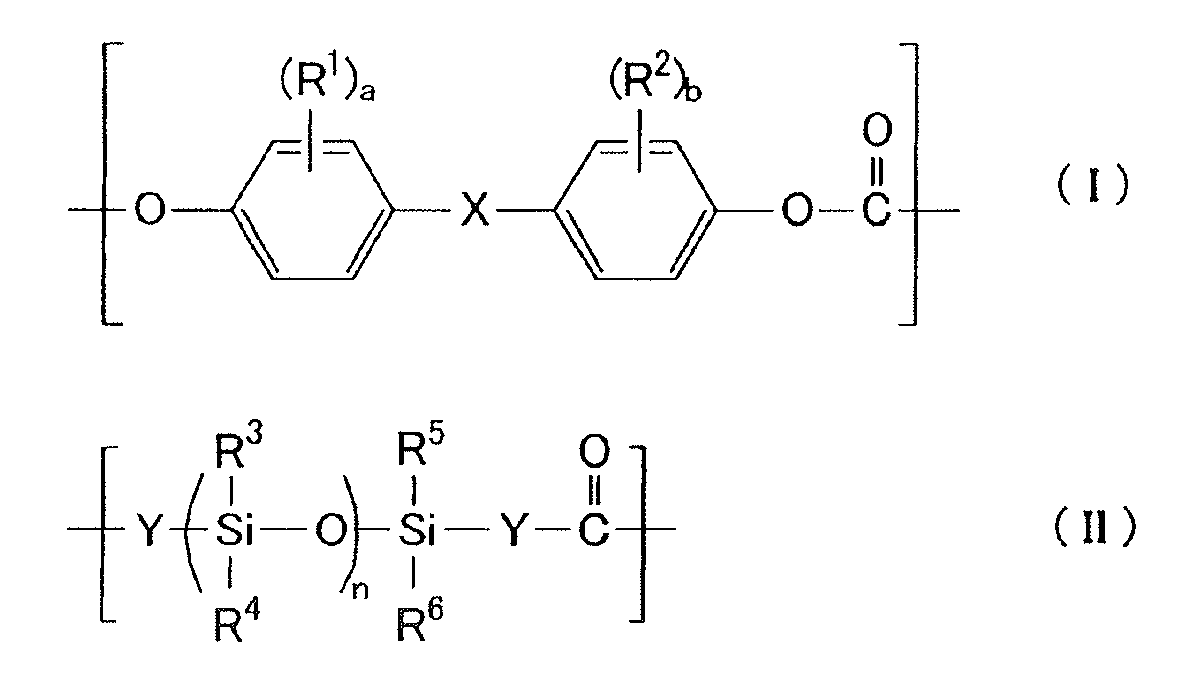
[R1 및 R2 는, 할로겐 원자, 알킬기 또는 알콕시기를 나타낸다. X 는 단결합, 알킬렌기 알킬리덴기, 시클로알킬렌기, 시클로알킬리덴기, -S-, -SO-, -SO2-, -O- 또는 -CO- 를 나타낸다. a 및 b 는 0 ∼ 4 의 정수를 나타낸다. R3 ∼ R6 은 수소 원자, 할로겐 원자 또는 알킬기, 알콕시기 또는 아릴기를 나타낸다. Y 는 단결합, 지방족 또는 방향족을 포함하는 유기 잔기를 나타낸다. n 은 평균 반복수.]A polycarbonate resin composition having excellent color appearance while maintaining excellent properties of a polyorganosiloxane-polycarbonate copolymer is provided.
Specifically, a polycarbonate-polyorganosiloxane copolymer (A) having a main chain of a repeating unit represented by the general formula (I) and a structural unit represented by the general formula (II) Is 5 to 100% by mass, the content of the structural unit represented by the general formula (II) is 25 to 65, the content of the structural unit represented by the general formula (II) is 2 to 20% by mass, (II) is a polycarbonate-polyorganosiloxane copolymer having a repeating unit represented by the general formula (I) and a structural unit represented by the general formula (II), wherein n in the general formula (II) 0 to 95% by mass of a polycarbonate-polyorganosiloxane copolymer (A-2) having a content of constituent units representing 2 to 20% by mass and an aromatic polycarbonate other than the above (A-1) (A-3) 0 to 95% by mass of a polycarbonate 99.9 to 96 parts by mass of a resin (B) and 0.1 to 4 parts by mass of titanium oxide (provided that the total amount of the component (A) and the component (B) is 100 parts by mass) do.
[R 1 and R 2 represent a halogen atom, an alkyl group or an alkoxy group. X represents a single bond, an alkylene group, an alkylidene group, a cycloalkylene group, a cycloalkylidene group, -S-, -SO-, -SO 2 -, -O- or -CO-. a and b represent an integer of 0 to 4; R 3 to R 6 represent a hydrogen atom, a halogen atom or an alkyl group, an alkoxy group or an aryl group. Y represents an organic residue including a single bond, aliphatic or aromatic. n is the average number of iterations.]
Description
본 발명은 폴리카보네이트계 수지 조성물에 관한 것이다.The present invention relates to a polycarbonate resin composition.
폴리카보네이트 수지는 기계적 강도, 전기적 특성, 투명성 등이 우수하고, 엔지니어링 플라스틱으로서, 전기·전자 기기 분야, 자동차 분야 등 여러 분야에서 폭넓게 이용되고 있다. 휴대 전화, 모바일 PC, 디지털 카메라, 비디오 카메라, 전동 공구 등의 케이스에도 폴리카보네이트 수지가 이용되고, 이들 용도에서는, 취급시에 낙하 등의 가능성이 있는 점에서 내충격성이 중요함과 함께, 의장성 (특히 색채) 도 중요한 인자이다.Polycarbonate resins are excellent in mechanical strength, electrical properties and transparency, and are widely used in various fields such as electric and electronic devices, automobiles, and the like as engineering plastics. Polycarbonate resins are also used in cases such as mobile phones, mobile PCs, digital cameras, video cameras, power tools, etc. In these applications, impact resistance is important in terms of dropping during handling, (Especially color) are also important factors.
그런데, 수지 재료는, 비교적 그 착색이 용이하고, 컬러풀한 수지 재료는 신변의 많은 곳에서 활용되고 있다. 특히, 백색이나 그레이 등이 많이 사용된다. 한편, 폴리오르가노실록산을 공중합한 폴리카보네이트-폴리오르가노실록산 공중합체 (이하, PC-PDMS 라고 하는 경우가 있다) 가 알려져 있다. PC-PDMS 는 내충격성 등의 성질이 우수한 점에서, 상기 용도에 대한 적용이 기대되고 있다. 또한, 상기 용도에서는 내충격성이 중요한 한편, 의장성도 중요하다는 점에서 안료로서 산화티탄의 사용이 바람직하다.However, resin materials are relatively easy to color, and colored resin materials are used in many places. Particularly, white or gray are widely used. On the other hand, a polycarbonate-polyorganosiloxane copolymer (hereinafter sometimes referred to as PC-PDMS) obtained by copolymerizing a polyorganosiloxane is known. PC-PDMS is expected to be applied to the above applications because of its excellent properties such as impact resistance. In addition, the use of titanium oxide as a pigment is preferable in view of the importance of impact resistance in the above-mentioned applications and also in designability.
과거에, PC-PDMS 와 산화티탄의 조합에 의해 백색 외관이고 양호한 내충격 강도를 갖는 것이 알려졌다. 예를 들어, 내충격성, 강성 등의 기계적 물성, 광학적 특성 등이 우수함과 함께, 반사율 특성도 우수한 폴리카보네이트계 수지 조성물 (특허문헌 1 참조) 이 알려져 있다. 특허문헌 1 에 의하면, 산화티탄의 함유량을 5 ∼ 10 % 로 한 PC-PDMS 함유 조성물은, 양호한 반사율과 기계적 강도를 나타낸다. 또, 다른 예에서는, 인계 난연제나 할로겐계 난연제를 첨가하지 않고 우수한 난연성을 나타내며, 또한 고반사성·고차광성이고, 열안정성이 우수한 폴리카보네이트계 수지 조성물이 알려져 있다 (특허문헌 2 참조). 특허문헌 2 에 의하면, 산화티탄의 함유량을 5 ∼ 50 % 로 한 PC-PDMS 함유 조성물은, 양호한 반사율과 Izod 충격 강도와 난연성을 나타낸다.In the past, it has been known that the combination of PC-PDMS and titanium oxide has a white appearance and a good impact strength. For example, there has been known a polycarbonate resin composition (see Patent Document 1) which is excellent in mechanical properties such as impact resistance and rigidity, optical properties and the like, and also has excellent reflectance characteristics. According to Patent Document 1, the composition containing PC-PDMS in which the content of titanium oxide is 5 to 10% shows good reflectance and mechanical strength. In another example, there is known a polycarbonate resin composition which does not contain a phosphorus-based flame retardant or a halogen-based flame retardant, exhibits excellent flame retardancy, and has high reflectivity, high-order lightness and excellent thermal stability (see Patent Document 2). According to Patent Document 2, the PC-PDMS-containing composition in which the content of titanium oxide is 5 to 50% exhibits good reflectance and Izod impact strength and flame retardancy.
이들 문헌에 기재된 조성물은 높은 광 반사 특성을 나타내기는 하지만, 그 한편으로 산화티탄 함유량이 많기 때문에, 본래의 PC-PDMS 가 갖는 강도에 비하면 그 강도는 낮은 것이고, 상기 용도에 있어서는 그 비중이 적정치보다 컸기 때문에, 양호한 반사율 및 기계적 강도 등을 가지면서도 산화티탄 함유량이 보다 적은 PC-PDMS 함유 조성물의 개발이 요망되고 있었다.Although the compositions described in these documents exhibit high light reflecting properties, the strength of the original PC-PDMS is lower than that of the original PC-PDMS because of the high content of titanium oxide. On the other hand, , It has been desired to develop a PC-PDMS-containing composition having a good reflectance, mechanical strength and the like and having a smaller titanium oxide content.
한편, 비교적 소량 (예를 들어 1 ∼ 2.5 중량%) 의 산화티탄과 PC-PDMS 를 함유하는 조성물도 알려져 있다 (특허문헌 3 참조).On the other hand, a composition containing a relatively small amount (for example, 1 to 2.5% by weight) of titanium oxide and PC-PDMS is also known (see Patent Document 3).
특허문헌 3 에 기재된 PC-PDMS 함유 조성물에서는, 산화티탄은 난연성을 향상시키는 수단으로서 소량 사용되고 있지만, 색 외관에 관해서는 아무런 기재가 없다.In the PC-PDMS-containing composition described in Patent Document 3, titanium oxide is used in small quantities as a means for improving flame retardancy, but there is no description about color appearance.
그래서, 본 발명의 과제는, 폴리카보네이트-폴리오르가노실록산 공중합체의 우수한 특성을 유지하면서, 우수한 색 외관을 가진 폴리카보네이트계 수지 조성물을 제공하는 것에 있다.It is therefore an object of the present invention to provide a polycarbonate resin composition having excellent color appearance while maintaining excellent properties of a polycarbonate-polyorganosiloxane copolymer.
본 발명자들은, 예의 검토한 결과, 폴리카보네이트-폴리오르가노실록산 공중합체 중의 폴리실록산 사슬 길이가 짧으면 강도가 발현되기 어렵기 때문에, 내충격성을 발현하기 위해서는 일정 이상의 폴리실록산 사슬 길이의 길이가 필요한 것, 및, 폴리실록산 사슬 길이가 길면, 양호한 강도를 발현하기는 하지만 성형품 표면에 검은 줄무늬 형상의 외관 불량이 발생하는 것을 알아내고, 특정 조건하이면, 폴리카보네이트-폴리오르가노실록산 공중합체의 특성을 유지하면서 우수한 색 외관을 갖게 할 수 있는 것을 알아냈다.As a result of intensive studies, the inventors of the present invention have found that when a polysiloxane chain length in a polycarbonate-polyorganosiloxane copolymer is short, it is difficult to exhibit strength, so that a length of a polysiloxane chain length of at least a certain value is required for exhibiting impact resistance, , When the polysiloxane chain length is long, it is possible to find that the appearance of black stripes on the surface of the molded article is poor, although it exhibits good strength. I found that I could have an appearance.
즉, 본 발명은 하기 [1] ∼ [10] 에 관한 것이다.That is, the present invention relates to the following [1] to [10].
[1] (A) : 주사슬이 일반식 (Ⅰ) 로 나타내는 반복 단위 및 일반식 (Ⅱ) 로 나타내는 구성 단위를 갖는 폴리카보네이트-폴리오르가노실록산 공중합체로서, 일반식 (Ⅱ) 중의 n 이 25 ∼ 65 이며, 또한 일반식 (Ⅱ) 로 나타내는 구성 단위의 함유량이 2 ∼ 20 질량% 인 폴리카보네이트-폴리오르가노실록산 공중합체 (A-1) 5 ∼ 100 질량%,(1) A polycarbonate-polyorganosiloxane copolymer having a main chain represented by the general formula (I) and a structural unit represented by the general formula (II), wherein n in the general formula (II) 5 to 100% by mass of a polycarbonate-polyorganosiloxane copolymer (A-1) having a constitutional unit represented by the general formula (II) in an amount of 2 to 20% by mass,
주사슬이 일반식 (Ⅰ) 로 나타내는 반복 단위 및 일반식 (Ⅱ) 로 나타내는 구성 단위를 갖는 폴리카보네이트-폴리오르가노실록산 공중합체로서, 일반식 (Ⅱ) 중의 n 이 70 ∼ 350 이며, 또한 일반식 (Ⅱ) 로 나타내는 구성 단위의 함유량이 2 ∼ 20 질량% 인 폴리카보네이트-폴리오르가노실록산 공중합체 (A-2) 0 ∼ 95 질량%, 및A polycarbonate-polyorganosiloxane copolymer having a main chain of a repeating unit represented by the general formula (I) and a constitutional unit represented by the general formula (II), wherein n in the general formula (II) is 70 to 350, 0 to 95% by mass of a polycarbonate-polyorganosiloxane copolymer (A-2) having a constituent unit represented by the formula (II) in an amount of 2 to 20% by mass,
상기 (A-1) 및 (A-2) 이외의 방향족 폴리카보네이트 (A-3) 0 ∼ 95 질량% 로 이루어지는 폴리카보네이트계 수지 99.9 ∼ 96 질량부, 및99.9 to 96 parts by mass of a polycarbonate resin composed of 0 to 95% by mass of an aromatic polycarbonate (A-3) other than the above-mentioned (A-1) and (A-2)
(B) : 산화티탄 0.1 ∼ 4 질량부 (단, (A) 성분 및 (B) 성분의 합계는 100 질량부이다) 를 함유하는 폴리카보네이트계 수지 조성물.(B): 0.1 to 4 parts by mass of titanium oxide (provided that the sum of the components (A) and (B) is 100 parts by mass).
[화학식 1] [Chemical Formula 1]

[식 중, R1 및 R2 는, 각각 독립적으로 할로겐 원자, 탄소수 1 ∼ 6 의 알킬기 또는 탄소수 1 ∼ 6 의 알콕시기를 나타낸다. X 는 단결합, 탄소수 1 ∼ 8 의 알킬렌기, 탄소수 2 ∼ 8 의 알킬리덴기, 탄소수 5 ∼ 15 의 시클로알킬렌기, 탄소수 5 ∼ 15 의 시클로알킬리덴기, -S-, -SO-, -SO2-, -O- 또는 -CO- 를 나타낸다. a 및 b 는, 각각 독립적으로 0 ∼ 4 의 정수를 나타낸다.[Wherein R 1 and R 2 each independently represent a halogen atom, an alkyl group having 1 to 6 carbon atoms, or an alkoxy group having 1 to 6 carbon atoms. X is a single bond, an alkylene group having 1 to 8 carbon atoms, an alkylidene group having 2 to 8 carbon atoms, a cycloalkylene group having 5 to 15 carbon atoms, a cycloalkylidene group having 5 to 15 carbon atoms, -S-, -SO-, SO 2 -, -O- or -CO-. a and b each independently represent an integer of 0 to 4;
R3 ∼ R6 은, 각각 독립적으로 수소 원자, 할로겐 원자 또는 탄소수 1 ∼ 6 의 알킬기, 탄소수 1 ∼ 6 의 알콕시기 또는 탄소수 6 ∼ 12 의 아릴기를 나타낸다. Y 는 단결합, 지방족 또는 방향족을 포함하는 유기 잔기를 나타낸다. n 은 평균 반복수이다.]R 3 to R 6 each independently represent a hydrogen atom, a halogen atom or an alkyl group having 1 to 6 carbon atoms, an alkoxy group having 1 to 6 carbon atoms, or an aryl group having 6 to 12 carbon atoms. Y represents an organic residue including a single bond, aliphatic or aromatic. n is the average number of iterations.]
[2] 일반식 (Ⅱ) 로 나타내는 구성 단위에 있어서, Y 가 알릴페놀 또는 오이게놀 유래의 유기 잔기인, 상기 [1] 에 기재된 폴리카보네이트계 수지 조성물.[2] The polycarbonate resin composition according to the above [1], wherein in the constituent unit represented by the general formula (II), Y is an organic residue derived from allylphenol or augenol.
[3] 일반식 (Ⅰ) 로 나타내는 반복 단위에 있어서, X 가 이소프로필리덴기이며, 또한 a = b = 0 인, 상기 [1] 또는 [2] 에 기재된 폴리카보네이트계 수지 조성물.[3] The polycarbonate resin composition according to [1] or [2], wherein in the repeating unit represented by the general formula (I), X is an isopropylidene group and a = b =
[4] 일반식 (Ⅱ) 로 나타내는 구성 단위에 있어서, R3 ∼ R6 이 모두 메틸기인, 상기 [1] ∼ [3] 중 어느 하나에 기재된 폴리카보네이트계 수지 조성물.[4] The polycarbonate resin composition according to any one of [1] to [3], wherein in the constituent unit represented by the general formula (II), R 3 to R 6 are all methyl groups.
[5] (A) 성분의 폴리카보네이트계 수지에 있어서, (A-2) 성분 유래의 일반식 (Ⅱ) 로 나타내는 구성 단위의 함유량이, (A-1) ∼ (A-3) 성분의 합계량에 대하여 2.5 질량% 이하인, 상기 [1] ∼ [4] 중 어느 하나에 기재된 폴리카보네이트계 수지 조성물.[5] The polycarbonate resin composition according to [1] or [2], wherein the content of the structural unit (II) derived from the component (A-2) The polycarbonate resin composition according to any one of the above [1] to [4], wherein the content of the polycarbonate resin composition is 2.5% by mass or less.
[6] (A) 성분 및 (B) 성분의 합계 100 질량부에 대하여, 추가로 (C) 폴리테트라플루오로에틸렌 함유 혼합 분체 0.1 ∼ 1 질량부를 함유하는, 상기 [1] ∼ [5] 중 어느 하나에 기재된 폴리카보네이트계 수지 조성물.[6] The polymer composition according to any one of [1] to [5] above, which further comprises 0.1 to 1 part by mass of a polytetrafluoroethylene-containing mixed powder (C) relative to 100 parts by mass in total of the components (A) A polycarbonate resin composition according to any one of the preceding claims.
[7] (A) 성분 및 (B) 성분의 합계 100 질량부에 대하여, 추가로 (D) 유기 술폰산의 알칼리 금속염 및 유기 술폰산의 알칼리 토금속염에서 선택되는 적어도 1 종 0.01 ∼ 0.15 질량부를 함유하는, 상기 [1] ∼ [6] 중 어느 하나에 기재된 폴리카보네이트계 수지 조성물.[7] The positive resist composition according to any one of [1] to [5], further comprising (D) 0.01 to 0.15 parts by mass of at least one member selected from the group consisting of an alkali metal salt of an organic sulfonic acid and an alkaline earth metal salt of an organic sulfonic acid based on 100 parts by mass of the total of 100% , The polycarbonate resin composition according to any one of [1] to [6] above.
[8] 상기 [1] ∼ [7] 중 어느 하나에 기재된 폴리카보네이트계 수지 조성물로 이루어지는 성형품.[8] A molded article comprising the polycarbonate resin composition according to any one of [1] to [7].
[9] 상기 [1] ∼ [7] 중 어느 하나에 기재된 폴리카보네이트계 수지 조성물로 이루어지는 전기·전자 기기용 부품.[9] A component for an electric or electronic device comprising the polycarbonate resin composition according to any one of [1] to [7].
[10] 상기 [1] ∼ [7] 중 어느 하나에 기재된 폴리카보네이트계 수지 조성물로 이루어지는 자동차용 부품.[10] An automotive part comprising the polycarbonate resin composition according to any one of [1] to [7].
본 발명에 의하면, 폴리오르가노실록산-폴리카보네이트 공중합체의 우수한 특성을 유지하면서, 우수한 색 외관을 갖는 폴리카보네이트계 수지 조성물을 제공할 수 있다. 본 발명의 폴리카보네이트계 수지 조성물은, 또한 난연성도 우수하다.According to the present invention, it is possible to provide a polycarbonate resin composition having excellent color appearance while maintaining excellent properties of the polyorganosiloxane-polycarbonate copolymer. The polycarbonate resin composition of the present invention is also excellent in flame retardancy.
[폴리카보네이트계 수지 조성물][Polycarbonate-based resin composition]
본 발명은, (A) : 주사슬이 일반식 (Ⅰ) 로 나타내는 반복 단위 및 일반식 (Ⅱ) 로 나타내는 구성 단위를 갖는 폴리카보네이트-폴리오르가노실록산 공중합체로서, 일반식 (Ⅱ) 중의 n 이 25 ∼ 65 이며, 또한 일반식 (Ⅱ) 로 나타내는 구성 단위의 함유량이 2 ∼ 20 질량% 인 폴리카보네이트-폴리오르가노실록산 공중합체 (A-1) 5 ∼ 100 질량%,The present invention relates to a polycarbonate-polyorganosiloxane copolymer (A) having a main chain having a repeating unit represented by the general formula (I) and a constitutional unit represented by the general formula (II) , 5 to 100% by mass of a polycarbonate-polyorganosiloxane copolymer (A-1) having a content of structural units represented by the general formula (II) of 2 to 20% by mass,
주사슬이 일반식 (Ⅰ) 로 나타내는 반복 단위 및 일반식 (Ⅱ) 로 나타내는 구성 단위를 갖는 폴리카보네이트-폴리오르가노실록산 공중합체로서, 일반식 (Ⅱ) 중의 n 이 70 ∼ 350 이며, 또한 일반식 (Ⅱ) 로 나타내는 구성 단위의 함유량이 2 ∼ 20 질량% 인 폴리카보네이트-폴리오르가노실록산 공중합체 (A-2) 0 ∼ 95 질량%, 및A polycarbonate-polyorganosiloxane copolymer having a main chain of a repeating unit represented by the general formula (I) and a constitutional unit represented by the general formula (II), wherein n in the general formula (II) is 70 to 350, 0 to 95% by mass of a polycarbonate-polyorganosiloxane copolymer (A-2) having a constituent unit represented by the formula (II) in an amount of 2 to 20% by mass,
상기 (A-1) 및 (A-2) 이외의 방향족 폴리카보네이트 (A-3) 0 ∼ 95 질량% 로 이루어지는 폴리카보네이트계 수지 99.9 ∼ 96 질량부, 및99.9 to 96 parts by mass of a polycarbonate resin composed of 0 to 95% by mass of an aromatic polycarbonate (A-3) other than the above-mentioned (A-1) and (A-2)
(B) : 산화티탄 0.1 ∼ 4 질량부 (단, (A) 성분 및 (B) 성분의 합계는 100 질량부이다) 를 함유하는 폴리카보네이트계 수지 조성물에 관한 것이다.(B): 0.1 to 4 parts by mass of titanium oxide (provided that the total amount of the component (A) and the component (B) is 100 parts by mass).
[화학식 2] (2)
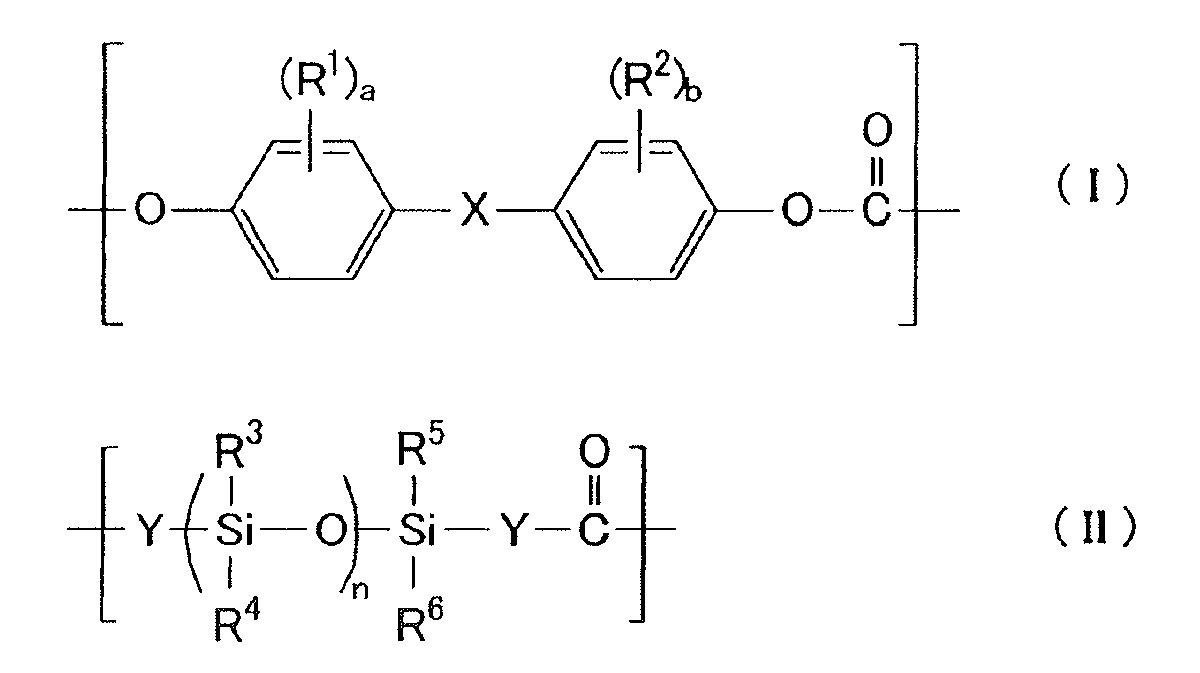
[식 중, R1 및 R2 는, 각각 독립적으로, 할로겐 원자, 탄소수 1 ∼ 6 의 알킬기 또는 탄소수 1 ∼ 6 의 알콕시기를 나타낸다. X 는 단결합, 탄소수 1 ∼ 8 의 알킬렌기, 탄소수 2 ∼ 8 의 알킬리덴기, 탄소수 5 ∼ 15 의 시클로알킬렌기, 탄소수 5 ∼ 15 의 시클로알킬리덴기, -S-, -SO-, -SO2-, -O- 또는 -CO- 를 나타낸다. a 및 b 는, 각각 독립적으로 0 ∼ 4 의 정수를 나타낸다.[Wherein R 1 and R 2 each independently represent a halogen atom, an alkyl group having 1 to 6 carbon atoms, or an alkoxy group having 1 to 6 carbon atoms. X is a single bond, an alkylene group having 1 to 8 carbon atoms, an alkylidene group having 2 to 8 carbon atoms, a cycloalkylene group having 5 to 15 carbon atoms, a cycloalkylidene group having 5 to 15 carbon atoms, -S-, -SO-, SO 2 -, -O- or -CO-. a and b each independently represent an integer of 0 to 4;
R3 ∼ R6 은, 각각 독립적으로, 수소 원자, 할로겐 원자 또는 탄소수 1 ∼ 6 의 알킬기, 탄소수 1 ∼ 6 의 알콕시기 또는 탄소수 6 ∼ 12 의 아릴기를 나타낸다. Y 는, 단결합, 지방족 또는 방향족을 포함하는 유기 잔기를 나타낸다. n 은 평균 반복수이다.]R 3 to R 6 each independently represent a hydrogen atom, a halogen atom or an alkyl group having 1 to 6 carbon atoms, an alkoxy group having 1 to 6 carbon atoms, or an aryl group having 6 to 12 carbon atoms. Y represents an organic residue including a single bond, aliphatic or aromatic. n is the average number of iterations.]
일반식 (Ⅰ) 중, R1 및 R2 가 각각 독립적으로 나타내는 할로겐 원자로는, 불소 원자, 염소 원자, 브롬 원자, 요오드 원자를 들 수 있다.In the general formula (I), examples of the halogen atom represented by R 1 and R 2 each independently include a fluorine atom, a chlorine atom, a bromine atom and an iodine atom.
R1 및 R2 가 각각 독립적으로 나타내는 알킬기로는, 메틸기, 에틸기, n-프로필기, 이소프로필기, 각종 부틸기 (「각종」이란, 직사슬형 및 모든 분기사슬형의 것을 포함하는 것을 나타내고, 이하 동일하다), 각종 펜틸기, 각종 헥실기를 들 수 있다. R1 및 R2 가 각각 독립적으로 나타내는 알콕시기로는, 알킬기 부위가 상기 알킬기인 경우를 들 수 있다.Examples of the alkyl group represented by R 1 and R 2 each independently include a methyl group, an ethyl group, an n-propyl group, an isopropyl group, and various butyl groups (the term "various groups" , The same applies hereinafter), various pentyl groups, and various hexyl groups. Examples of the alkoxy group represented by R 1 and R 2 each independently include the case where the alkyl group is the above alkyl group.
X 가 나타내는 알킬렌기로는, 예를 들어, 메틸렌기, 에틸렌기, 트리메틸렌기, 테트라메틸렌기, 헥사메틸렌기 등을 들 수 있고, 탄소수 1 ∼ 5 의 알킬렌기가 바람직하다. X 가 나타내는 알킬리덴기로는, 에틸리덴기, 이소프로필리덴기 등을 들 수 있다. X 가 나타내는 시클로알킬렌기로는, 시클로펜탄디일기나 시클로헥산디일기, 시클로옥탄디일기 등을 들 수 있고, 탄소수 5 ∼ 10 의 시클로알킬렌기가 바람직하다. X 가 나타내는 시클로알킬리덴기로는, 예를 들어, 시클로헥실리덴기, 3,5,5-트리메틸시클로헥실리덴기, 2-아다만틸리덴기 등을 들 수 있고, 탄소수 5 ∼ 10 의 시클로알킬리덴기가 바람직하고, 탄소수 5 ∼ 8 의 시클로알킬리덴기가 보다 바람직하다.The alkylene group represented by X includes, for example, a methylene group, an ethylene group, a trimethylene group, a tetramethylene group, and a hexamethylene group, and an alkylene group having 1 to 5 carbon atoms is preferable. Examples of the alkylidene group represented by X include an ethylidene group and an isopropylidene group. Examples of the cycloalkylene group represented by X include a cyclopentanediyl group, a cyclohexanediyl group, and a cyclooctanediyl group, and a cycloalkylene group having 5 to 10 carbon atoms is preferable. As the cycloalkylidene group represented by X, for example, a cyclohexylidene group, a 3,5,5-trimethylcyclohexylidene group, a 2-adamantylidene group and the like can be given, and a cycloalkylidene group having 5 to 10 carbon atoms Group is preferable, and a cycloalkylidene group having 5 to 8 carbon atoms is more preferable.
a 및 b 는, 각각 독립적으로 0 ∼ 4 의 정수를 나타내고, 바람직하게는 0 ∼ 2, 보다 바람직하게는 0 또는 1 이다.a and b each independently represent an integer of 0 to 4, preferably 0 to 2, more preferably 0 or 1.
일반식 (Ⅱ) 중, R3 ∼ R6 이 각각 독립적으로 나타내는 할로겐 원자로는, 불소 원자, 염소 원자, 브롬 원자, 요오드 원자를 들 수 있다. R3 ∼ R6 이 각각 독립적으로 나타내는 알킬기, 알콕시기로는, R1 및 R2 의 경우와 동일한 것을 들 수 있다. R3 ∼ R6 이 각각 독립적으로 나타내는 아릴기로는, 페닐기, 나프틸기 등을 들 수 있다.In the general formula (II), examples of the halogen atom represented by R 3 to R 6 each independently include a fluorine atom, a chlorine atom, a bromine atom and an iodine atom. Examples of the alkyl group and the alkoxy group represented by R 3 to R 6 each independently include the same groups as those for R 1 and R 2 . Examples of the aryl group represented by R 3 to R 6 each independently include a phenyl group and a naphthyl group.
Y 가 나타내는 지방족을 포함하는 유기 잔기로는, 예를 들어, 탄소수 1 ∼ 10 (바람직하게는 탄소수 1 ∼ 6, 보다 바람직하게는 탄소수 1 ∼ 3) 의 알킬렌기 등을 들 수 있다. 또, Y 가 나타내는 방향족을 포함하는 유기 잔기로는, 예를 들어, 페닐렌기, 나프틸렌기, 비페닐디일기 등의 고리 형성 탄소수 6 ∼ 12 의 아릴렌기 등을 들 수 있다.The organic residue containing an aliphatic group represented by Y is, for example, an alkylene group having 1 to 10 carbon atoms (preferably 1 to 6 carbon atoms, more preferably 1 to 3 carbon atoms). Examples of the organic residue containing an aromatic group represented by Y include an arylene group having 6 to 12 ring-forming carbon atoms such as a phenylene group, a naphthylene group and a biphenyldiyl group.
((A) 폴리카보네이트계 수지)((A) polycarbonate resin)
- (A-1) -- (A-1) -
처음에, (A) 성분의 하나이며, 또한 필수 성분인 「폴리카보네이트-폴리오르가노실록산 공중합체 (A-1)」에 대하여 설명한다.First, the "polycarbonate-polyorganosiloxane copolymer (A-1)" which is one of the components (A) and is an essential component will be described.
폴리카보네이트-폴리오르가노실록산 공중합체 (A-1) 은, 상기 일반식 (Ⅱ) 로 나타내는 구성 단위의 함유량이 2 ∼ 20 질량% 이고, 바람직하게는 2 ∼ 15 질량%, 보다 바람직하게는 2 ∼ 10 질량%, 보다 바람직하게는 3 ∼ 8 질량%, 더욱 바람직하게는 4 ∼ 7 질량%, 특히 바람직하게는 4 ∼ 6 질량% 이다. 2 질량% 미만이면 내충격 강도 향상의 효과가 불충분하고, 또 20 질량% 를 초과하면 내열성의 저하가 커진다.The polycarbonate-polyorganosiloxane copolymer (A-1) preferably contains 2 to 20% by mass, preferably 2 to 15% by mass, more preferably 2 to 20% by mass, of the constituent unit represented by the formula (II) To 10% by mass, more preferably 3 to 8% by mass, still more preferably 4 to 7% by mass, and particularly preferably 4 to 6% by mass. If it is less than 2% by mass, the effect of improving the impact resistance is insufficient, and if it exceeds 20% by mass, the heat resistance deteriorates greatly.
또, (A-1) 에 있어서, 상기 일반식 (Ⅱ) 로 나타내는 구성 단위에 있어서의 평균 반복수 n 은, 25 ∼ 65 이고, 바람직하게는 30 ∼ 60, 보다 바람직하게는 30 ∼ 50, 더욱 바람직하게는 30 ∼ 45 이다. (A-1) 에 있어서는, n 이 25 미만이면 내충격 강도 향상의 효과가 충분하지 않고, 65 를 초과하면 우수한 색 외관을 얻기 어렵다.In the structural unit (A-1), the average repeating number n in the structural unit represented by the general formula (II) is 25 to 65, preferably 30 to 60, more preferably 30 to 50, And preferably 30 to 45. In the case of (A-1), when n is less than 25, the effect of improving the impact resistance is not sufficient, and when it exceeds 65, it is difficult to obtain a good color appearance.
(A-1) 의 점도 평균 분자량 (Mv) 은, 바람직하게는 16,000 ∼ 30,000 이고, 보다 바람직하게는 16,000 ∼ 25,000 이고, 더욱 바람직하게는 17,000 ∼ 23,000 이다. (A-1) 의 점도 평균 분자량이 이 범위이면, 성형품의 강도가 충분해지고, 공중합체의 점도가 지나치게 커지지 않아 제조시의 생산성이 안정적이게 되고, 두께가 얇은 성형도 용이해진다.The viscosity average molecular weight (Mv) of the polymer (A-1) is preferably 16,000 to 30,000, more preferably 16,000 to 25,000, and still more preferably 17,000 to 23,000. When the viscosity average molecular weight of the component (A-1) is within this range, the strength of the molded product becomes sufficient, the viscosity of the copolymer is not excessively increased, the productivity during production becomes stable, and the molding with a small thickness becomes easy.
폴리카보네이트-폴리오르가노실록산 공중합체 (A-1) 은, 하기 일반식 (1) 로 나타내는 2 가 페놀과, 하기 일반식 (2) 로 나타내는 폴리오르가노실록산과, 포스겐, 탄산에스테르 또는 클로로포메이트를 공중합시킴으로써 제조할 수 있다. 또, 폴리카보네이트 올리고머 (예를 들어 말단에 클로로포메이트기를 갖는 폴리카보네이트 올리고머) 와 폴리오르가노실록산을 반응시키는 것에 의해서도, 폴리카보네이트-폴리오르가노실록산 공중합체 (A-1) 을 제조할 수 있다.The polycarbonate-polyorganosiloxane copolymer (A-1) is obtained by reacting a divalent phenol represented by the following formula (1), a polyorganosiloxane represented by the following formula (2), phosgene, a carbonate ester or a chloroform / RTI > acid, or a mixture thereof. The polycarbonate-polyorganosiloxane copolymer (A-1) can also be prepared by reacting a polycarbonate oligomer (for example, a polycarbonate oligomer having a chloroformate group at the terminal) with a polyorganosiloxane .
폴리카보네이트-폴리오르가노실록산 공중합체 (A-1) 의 제조에 있어서는, 하기 일반식 (2) 로 나타내는 폴리오르가노실록산의 반응률을 95 % 이상으로 하는 것이 바람직하고, 97 % 이상으로 하는 것이 보다 바람직하고, 99 % 이상으로 하는 것이 더욱 바람직하다.In the production of the polycarbonate-polyorganosiloxane copolymer (A-1), the reaction rate of the polyorganosiloxane represented by the following general formula (2) is preferably 95% or more, more preferably 97% , More preferably not less than 99%.
[화학식 3] (3)

[일반식 (1) 중, X, R1 ∼ R2, a 및 b 는, 상기 일반식 (Ⅰ) 에 있어서의 경우와 동일하다. 일반식 (2) 중, R3 ∼ R6, Y 및 n 은, 상기 일반식 (Ⅱ) 에 있어서의 경우와 동일하고, (A-1) 을 제조하는 경우에 있어서는, n 은 25 ∼ 65 이다. Z 는, 할로겐 원자, -R7OH, -R7-Z'-R8-OH, -R7COOH, -R7NH2, -COOH 또는 -SH 를 나타내고, 상기 R7 은, 치환 혹은 비치환의 알킬렌기, 치환 혹은 비치환의 시클로알킬렌기, 또는 치환 혹은 비치환의 아릴렌기를 나타낸다. 상기 R8 은, 고리 형성 탄소수 6 ∼ 12 의 아릴렌기를 나타내고, 상기 Z' 는 탄소수 1 ∼ 8 의 알킬렌기, 탄소수 2 ∼ 8 의 알킬리덴기, 탄소수 5 ∼ 10 의 시클로알킬렌기, 탄소수 5 ∼ 10 의 시클로알킬리덴기를 나타낸다. m 은, 0 또는 1 을 나타낸다.][In the general formula (1), X, R 1 to R 2 , a and b are the same as those in the general formula (I). In the general formula (2), R 3 to R 6 , Y and n are the same as those in the general formula (II), and when producing (A-1), n is 25 to 65 . Z is a halogen atom, -R 7 OH, -R 7 -Z' -R 8 -OH, -R 7 COOH, -R 7 NH 2, represents an -SH or -COOH, wherein R 7 is a substituted or beach A substituted or unsubstituted alkylene group, a substituted or unsubstituted cycloalkylene group, or a substituted or unsubstituted arylene group. Wherein R 8 is and represents an arylene ring forming carbon number of 6 to 12, wherein Z 'is a cycloalkylene group, a C 1 -C 8 alkylene group, having a carbon number of 2-8 alkylidene group, a carbon number of 5 to 10 of a carbon number of 5 to 10 < / RTI > cycloalkylidene group. and m represents 0 or 1.]
Z 가 나타내는 할로겐 원자로는, 예를 들어, 불소 원자, 염소 원자, 브롬 원자, 요오드 원자를 들 수 있다. 이들 중에서도 염소 원자가 바람직하다.Examples of the halogen atom represented by Z include a fluorine atom, a chlorine atom, a bromine atom and an iodine atom. Among them, a chlorine atom is preferable.
Z 가 나타내는 -R7OH, -R7-Z'-R8-OH, -R7COOH, -R7NH2 중의 R7 이 나타내는 알킬렌기로는, 예를 들어, 메틸렌기, 에틸렌기, 프로필렌기, 트리메틸렌기, 펜타메틸렌기 등의 탄소수 1 ∼ 10 (바람직하게는 1 ∼ 5) 의 알킬렌기를 들 수 있다. 또, R7 이 나타내는 시클로알킬렌기로는, 예를 들어, 시클로펜틸렌기, 시클로헥실렌기 등의 고리 형성 탄소수 3 ∼ 10 (바람직하게는 4 ∼ 8) 의 시클로알킬렌기를 들 수 있다. R7 이 나타내는 아릴렌기로는, 예를 들어 페닐렌기, 나프틸렌기, 비페닐디일기 등의 고리 형성 탄소수 6 ∼ 12 의 아릴렌기를 들 수 있다.Examples of the alkylene group represented by R 7 in -R 7 OH, -R 7 -Z'-R 8 -OH, -R 7 COOH and -R 7 NH 2 represented by Z include methylene, And an alkylene group having 1 to 10 (preferably 1 to 5) carbon atoms such as a propylene group, a trimethylene group and a pentamethylene group. Examples of the cycloalkylene group represented by R 7 include a cycloalkylene group having 3 to 10 ring-forming carbon atoms (preferably 4 to 8 carbon atoms) such as a cyclopentylene group and a cyclohexylene group. The arylene group represented by R 7 includes, for example, an arylene group having 6 to 12 ring-forming carbon atoms such as a phenylene group, a naphthylene group and a biphenyldiyl group.
R7 은, 탄소수 1 ∼ 5 의 알킬기, 탄소수 1 ∼ 5 의 알콕시기, 고리 형성 탄소수 6 ∼ 12 의 아릴기 등에 의해 치환되어 있어도 된다. 그 알킬기로는, 메틸기, 에틸기, 프로필기, 각종 부틸기 등을 들 수 있다. 그 알콕시기로는, 알킬기 부위가 상기 알킬기인 것을 들 수 있다. 그 아릴기로는, 페닐기 등을 들 수 있다.R 7 may be substituted by an alkyl group having 1 to 5 carbon atoms, an alkoxy group having 1 to 5 carbon atoms, an aryl group having 6 to 12 ring-forming carbon atoms, or the like. Examples of the alkyl group include a methyl group, an ethyl group, a propyl group, and various butyl groups. As the alkoxy group, the alkyl group may be the above-mentioned alkyl group. Examples of the aryl group include a phenyl group and the like.
Z' 가 나타내는 알킬렌기, 알킬리덴기, 시클로알킬렌기, 시클로알킬리덴기로는, X 의 경우와 동일한 것을 들 수 있다. Z' 로는, 탄소수 2 ∼ 8 의 알킬리덴기가 바람직하고, 이소프로필리덴기가 보다 바람직하다.The alkylene group, alkylidene group, cycloalkylene group and cycloalkylidene group represented by Z 'may be the same as those in the case of X. As Z ', an alkylidene group having 2 to 8 carbon atoms is preferable, and an isopropylidene group is more preferable.
- (A-2) -- (A-2) -
다음으로, (A) 성분의 하나이고, 임의 성분인 「폴리카보네이트-폴리오르가노실록산 공중합체 (A-2)」에 대하여 설명한다.Next, the "polycarbonate-polyorganosiloxane copolymer (A-2)" which is one of the components (A) and which is an optional component will be described.
폴리카보네이트-폴리오르가노실록산 공중합체 (A-2) 는, 상기 일반식 (Ⅱ) 로 나타내는 구성 단위의 함유량이 2 ∼ 20 질량% 이고, 바람직하게는 2 ∼ 15 질량%, 보다 바람직하게는 2 ∼ 10 질량%, 더욱 바람직하게는 3 ∼ 8 질량%, 특히 바람직하게는 3 ∼ 7 질량% 이다. 2 질량% 미만이면 내충격 강도 향상의 효과가 불충분하고, 또 20 질량% 를 초과하면 내열성의 저하가 커진다.The content of the structural unit represented by the general formula (II) is 2 to 20% by mass, preferably 2 to 15% by mass, and more preferably 2% by mass, in the polycarbonate-polyorganosiloxane copolymer (A- To 10% by mass, more preferably 3 to 8% by mass, and particularly preferably 3 to 7% by mass. If it is less than 2% by mass, the effect of improving the impact resistance is insufficient, and if it exceeds 20% by mass, the heat resistance deteriorates greatly.
또, (A-2) 에 있어서, 상기 일반식 (Ⅱ) 로 나타내는 구성 단위에 있어서의 평균 반복수 n 은, 70 ∼ 350 이고, 바람직하게는 80 ∼ 200, 보다 바람직하게는 80 ∼ 110, 더욱 바람직하게는 80 ∼ 100 이다. n 이 70 미만이면 내충격 강도 향상의 효과가 충분하지 않고, 350 을 초과하면 점도가 높아져 취급성이 나빠진다.In the structural unit (A-2), the average repeating number n in the structural unit represented by the general formula (II) is 70 to 350, preferably 80 to 200, more preferably 80 to 110, And preferably 80 to 100. [ When n is less than 70, the effect of improving the impact resistance is not sufficient, and when it exceeds 350, viscosity becomes high and handling becomes poor.
(A-2) 의 점도 평균 분자량 (Mv) 은, 바람직하게는 16,000 ∼ 30,000 이고, 보다 바람직하게는 16,000 ∼ 25,000 이고, 더욱 바람직하게는 17,000 ∼ 23,000 이다. (A-2) 의 점도 평균 분자량이 이 범위이면, 성형품의 강도가 충분해지고, 공중합체의 점도가 지나치게 커지지 않아 제조시의 생산성이 안정적이게 되고, 얇은 성형도 용이해진다.The viscosity average molecular weight (Mv) of the polymer (A-2) is preferably 16,000 to 30,000, more preferably 16,000 to 25,000, and still more preferably 17,000 to 23,000. When the viscosity average molecular weight of the copolymer (A-2) is within this range, the strength of the molded product becomes sufficient and the viscosity of the copolymer is not excessively increased, so that the productivity during production becomes stable and thin molding becomes easy.
또한, (A-2) 중의 상기 일반식 (Ⅱ) 로 나타내는 구성 단위는, 검은 줄무늬의 외관 불량의 발생이 억제되고, 내충격 강도를 개선하는 효과가 얻기 쉬워진다는 관점에서, (A) 성분 전체량에 대하여 2.5 질량% 이하이면 바람직하고, 2.0 질량% 이하이면 보다 바람직하다.The structural unit represented by the general formula (II) in (A-2) is preferably a structural unit represented by the general formula (II) from the viewpoint of suppressing appearance of black streaks and improving the impact resistance, By mass, more preferably 2.5% by mass or less, and more preferably 2.0% by mass or less.
폴리카보네이트-폴리오르가노실록산 공중합체 (A-2) 는, 상기 일반식 (1) 로 나타내는 2 가 페놀과, 상기 일반식 (2) 로 나타내는 폴리오르가노실록산 (단, n 은 70 ∼ 350) 과, 포스겐, 탄산에스테르 또는 클로로포메이트를 공중합시킴으로써 제조할 수 있다. 또, 폴리카보네이트 올리고머 (예를 들어 말단에 클로로포메이트기를 갖는 폴리카보네이트 올리고머) 와 폴리오르가노실록산을 반응시키는 것에 의해서도, 폴리카보네이트-폴리오르가노실록산 공중합체 (A-2) 를 제조할 수 있다.The polycarbonate-polyorganosiloxane copolymer (A-2) is obtained by reacting a divalent phenol represented by the above general formula (1) with a polyorganosiloxane represented by the general formula (2) (where n is 70 to 350) And phosgene, carbonic ester or chloroformate. The polycarbonate-polyorganosiloxane copolymer (A-2) can also be prepared by reacting a polycarbonate oligomer (for example, a polycarbonate oligomer having a chloroformate group at the terminal) with a polyorganosiloxane .
폴리카보네이트-폴리오르가노실록산 공중합체 (A-2) 의 제조에 있어서는, 상기 일반식 (2) 로 나타내는 폴리오르가노실록산의 반응률을 90 % 이상으로 하는 것이 바람직하고, 95 % 이상으로 하는 것이 보다 바람직하고, 97 % 이상으로 하는 것이 더욱 바람직하고, 99 % 이상으로 하는 것이 특히 바람직하다.In the production of the polycarbonate-polyorganosiloxane copolymer (A-2), the reaction rate of the polyorganosiloxane represented by the general formula (2) is preferably 90% or more, more preferably 95% , More preferably 97% or more, and particularly preferably 99% or more.
본 발명의 폴리카보네이트계 수지 조성물에 있어서, (A-1) 또는 (A-2) 의 원료에 사용하는, 일반식 (1) 로 나타내는 2 가 페놀로는 여러 가지의 것이 있지만, 특히, 2,2-비스(4-하이드록시페닐)프로판 [통칭 : 비스페놀 A] 이 바람직하다. 2 가 페놀로서 비스페놀 A 를 사용하면, 일반식 (Ⅰ) 에 있어서, X 가 이소프로필리덴기이며, 또한 a = b = 0 의 (A-1) 또는 (A-2) 가 된다.In the polycarbonate resin composition of the present invention, there are various dihydric phenols represented by the general formula (1) used in the raw materials of (A-1) or (A-2) 2-bis (4-hydroxyphenyl) propane (commonly known as bisphenol A) is preferable. When bisphenol A is used as the dihydric phenol, X is an isopropylidene group in the general formula (I), and (A-1) or (A-2) with a = b = 0.
비스페놀 A 이외의 비스페놀로는, 예를 들어, 비스(4-하이드록시페닐)메탄, 1,1-비스(4-하이드록시페닐)에탄, 2,2-비스(4-하이드록시페닐)부탄, 2,2-비스(4-하이드록시페닐)옥탄, 비스(4-하이드록시페닐)페닐메탄, 비스(4-하이드록시페닐)디페닐메탄, 2,2-비스(4-하이드록시-3-메틸페닐)프로판, 비스(4-하이드록시페닐)나프틸메탄, 1,1-비스(4-하이드록시-t-부틸페닐)프로판, 2,2-비스(4-하이드록시-3-브로모페닐)프로판, 2,2-비스(4-하이드록시-3,5-테트라메틸페닐)프로판, 2,2-비스(4-하이드록시-3-클로로페닐)프로판, 2,2-비스(4-하이드록시-3,5-디클로로페닐)프로판, 2,2-비스(4-하이드록시-3,5-디브로모페닐)프로판 등의 비스(하이드록시아릴)알칸류 ; 1,1-비스(4-하이드록시페닐)시클로펜탄, 1,1-비스(4-하이드록시페닐)시클로헥산, 1,1-비스(4-하이드록시페닐)-3,5,5-트리메틸시클로헥산, 2,2-비스(4-하이드록시페닐)노르보르난, 1,1-비스(4-하이드록시페닐)시클로도데칸 등의 비스(하이드록시아릴)시클로알칸류 ; 4,4'-디하이드록시페닐에테르, 4,4'-디하이드록시-3,3'-디메틸페닐에테르 등의 디하이드록시아릴에테르류 ; 4,4'-디하이드록시디페닐술파이드, 4,4'-디하이드록시-3,3'-디메틸디페닐술파이드 등의 디하이드록시디아릴술파이드류 ; 4,4'-디하이드록시디페닐술폭사이드, 4,4'-디하이드록시-3,3'-디메틸디페닐술폭사이드 등의 디하이드록시디아릴술폭사이드류 ; 4,4'-디하이드록시디페닐술폰, 4,4'-디하이드록시-3,3'-디메틸디페닐술폰 등의 디하이드록시디아릴술폰류 ; 4,4'-디하이드록시디페닐 등의 디하이드록시디페닐류 ; 9,9-비스(4-하이드록시페닐)플루오렌, 9,9-비스(4-하이드록시-3-메틸페닐)플루오렌 등의 디하이드록시디아릴플루오렌류 ; 비스(4-하이드록시페닐)디페닐메탄, 1,3-비스(4-하이드록시페닐)아다만탄, 2,2-비스(4-하이드록시페닐)아다만탄, 1,3-비스(4-하이드록시페닐)-5,7-디메틸아다만탄 등의 디하이드록시디아릴아다만탄류 ; 4,4'-[1,3-페닐렌비스(1-메틸에틸리덴)]비스페놀, 10,10-비스(4-하이드록시페닐)-9-안트론, 1,5-비스(4-하이드록시페닐티오)-2,3-디옥사펜타엔 등을 들 수 있다.Examples of bisphenol other than bisphenol A include bisphenols such as bis (4-hydroxyphenyl) methane, 1,1-bis (4-hydroxyphenyl) ethane, 2,2- Bis (4-hydroxyphenyl) methane, 2,2-bis (4-hydroxyphenyl) octane, bis (4-hydroxyphenyl) propane, 2,2-bis (4-hydroxyphenyl) naphthylmethane, 1,1- Propane, 2,2-bis (4-hydroxy-3,5-tetramethylphenyl) propane, 2,2- Bis (hydroxyaryl) alkanes such as 2,2-bis (4-hydroxy-3,5-dibromophenyl) propane; (4-hydroxyphenyl) cyclopentane, 1,1-bis (4-hydroxyphenyl) cyclohexane, 1,1- Bis (hydroxyaryl) cycloalkanes such as cyclohexane, 2,2-bis (4-hydroxyphenyl) norbornane, and 1,1-bis (4-hydroxyphenyl) cyclododecane; Dihydroxyaryl ethers such as 4,4'-dihydroxyphenyl ether and 4,4'-dihydroxy-3,3'-dimethylphenyl ether; Dihydroxydiaryl sulfide such as 4,4'-dihydroxydiphenyl sulfide and 4,4'-dihydroxy-3,3'-dimethyl diphenyl sulfide; Dihydroxydialyl sulfoxide such as 4,4'-dihydroxydiphenyl sulfoxide and 4,4'-dihydroxy-3,3'-dimethyl diphenyl sulfoxide; Dihydroxydiarylsulfone such as 4,4'-dihydroxydiphenyl sulfone and 4,4'-dihydroxy-3,3'-dimethyl diphenyl sulfone; Dihydroxydiphenyls such as 4,4'-dihydroxydiphenyl; Dihydroxydiarylfluorenes such as 9,9-bis (4-hydroxyphenyl) fluorene and 9,9-bis (4-hydroxy-3-methylphenyl) fluorene; Bis (4-hydroxyphenyl) diphenylmethane, 1,3-bis (4-hydroxyphenyl) adamantane, 2,2- 4-hydroxyphenyl) -5,7-dimethyladamantane, and other dihydroxydiarylamantan derivatives; Bis (4-hydroxyphenyl) -9-anthrone, 1,5-bis (4-hydroxyphenyl) Hydroxyphenylthio) -2,3-dioxapentaene, and the like.
이들 2 가 페놀은, 1 종을 단독으로 사용하여도 되고, 2 종 이상을 혼합하여 사용하여도 된다.These divalent phenols may be used singly or in combination of two or more kinds.
일반식 (2) 로 나타내는 폴리오르가노실록산은, 올레핀성의 불포화 탄소-탄소 결합을 갖는 페놀류 (바람직하게는 비닐페놀, 알릴페놀, 오이게놀, 이소프로페닐페놀 등) 를, 소정의 중합도 n 을 갖는 폴리오르가노실록산 사슬의 말단에 하이드로실라네이션 반응시킴으로써 용이하게 제조할 수 있다. 상기 페놀류는, 알릴페놀 또는 오이게놀인 것이 보다 바람직하다. 이 경우, (A-1) 이나 (A-2) 의 일반식 (Ⅱ) 에 있어서의 Y 가 알릴페놀 또는 오이게놀 유래의 유기 잔기가 된다.The polyorganosiloxane represented by the general formula (2) is obtained by reacting phenols having an olefinic unsaturated carbon-carbon bond (preferably vinylphenol, allylphenol, oganol, isopropenylphenol, etc.) Can be easily produced by subjecting the end of the polyorganosiloxane chain having hydrolyzation reaction to a hydro-silanation reaction. More preferably, the phenol is allylphenol or ogenol. In this case, Y in the general formula (II) of (A-1) or (A-2) is an organic residue derived from allylphenol or augenol.
일반식 (2) 로 나타내는 폴리오르가노실록산으로는, 예를 들어, 이하의 것을 들 수 있다.The polyorganosiloxane represented by the general formula (2) includes, for example, the followings.
[화학식 4] [Chemical Formula 4]
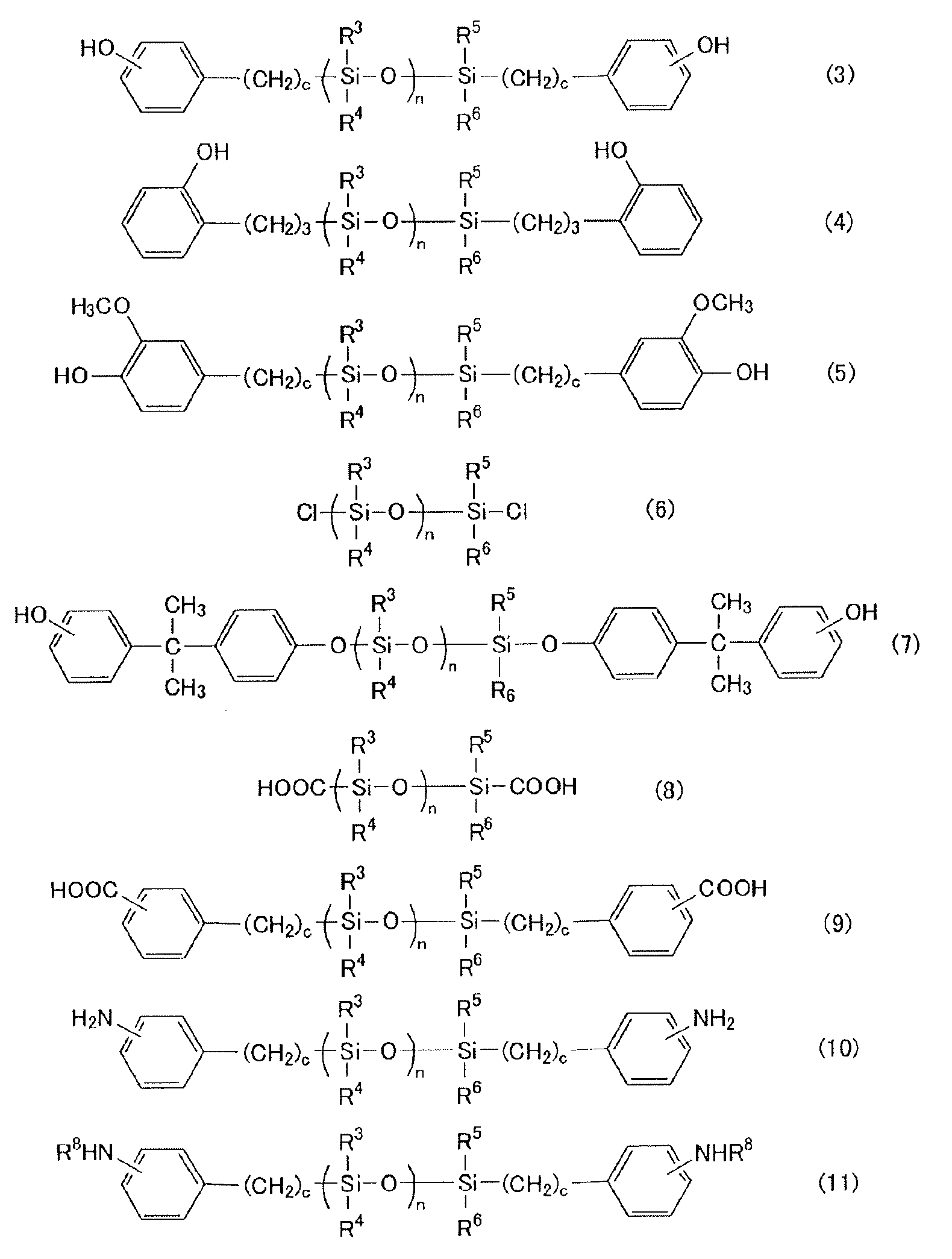
상기 일반식 (3) ∼ (11) 중, R3 ∼ R6 은 일반식 (1) 중의 R3 ∼ R6 과 동일하다. n 은 오르가노실록산 구성 단위의 평균 반복수로서, (A-1) 의 경우에는 25 ∼ 65 를 나타내고, (A-2) 의 경우에는 70 ∼ 350 을 나타낸다. 또, c 는 양의 정수를 나타내고, 바람직하게는 1 ∼ 6 의 정수, 보다 바람직하게는 1 ∼ 3 의 정수, 더욱 바람직하게는 3 이다.In the above general formula (3) ~ (11), R 3 ~ R 6 is the same as R 3 ~ R 6 in the general formula (1). n is the average number of repeating units of the organosiloxane structural unit, and represents 25 to 65 in the case of (A-1) and 70 to 350 in the case of (A-2). Further, c represents a positive integer, preferably an integer of 1 to 6, more preferably an integer of 1 to 3, and still more preferably 3.
이들 중에서도, 일반식 (3) 에 나타내는 페놀 변성 폴리오르가노실록산 (바람직하게는 c = 3) 이, 중합 용이성의 관점에서 바람직하다. 나아가서는 일반식 (4) 에 나타내는 화합물 중의 일종인 α,ω-비스[3-(o-하이드록시페닐)프로필]폴리디메틸실록산, 또는 일반식 (5) 에 나타내는 화합물 중의 일종인 α,ω-비스[3-(4-하이드록시-3-메톡시페닐)프로필]폴리디메틸실록산이, 입수 용이성의 관점에서 바람직하다.Among them, the phenol-modified polyorganosiloxane represented by the general formula (3) (preferably c = 3) is preferable from the viewpoint of polymerization easiness. Further, α, ω-bis [3- (o-hydroxyphenyl) propyl] polydimethylsiloxane, which is one kind of compound represented by the general formula (4) Bis [3- (4-hydroxy-3-methoxyphenyl) propyl] polydimethylsiloxane is preferable from the viewpoint of availability.
상기 페놀 변성 폴리오르가노실록산은, 공지된 방법에 의해 제조할 수 있다. 공지된 제조법으로는, 예를 들어 다음과 같은 것이 있다.The phenol-modified polyorganosiloxane can be prepared by a known method. Known manufacturing methods include, for example, the following.
시클로트리실록산과 디실록산을 산성 촉매 존재하에서 반응시켜, α,ω-디하이드로겐오르가노폴리실록산을 합성한다. 이 때, 시클로트리실록산과 디실록산의 주입비를 바꿈으로써 원하는 반복 단위를 갖는 α,ω-디하이드로겐오르가노폴리실록산을 합성할 수 있다. 이어서, 하이드로실릴화 반응용 촉매의 존재하에, 이 α,ω-디하이드로겐오르가노폴리실록산에 알릴페놀이나 오이게놀 등의 불포화 지방족 탄화수소기를 갖는 페놀 화합물을 부가 반응시킴으로써, 원하는 반복 단위를 갖는 페놀 변성 폴리오르가노실록산을 제조할 수 있다.The?,? - dihydrogen organopolysiloxane is synthesized by reacting cyclotrisiloxane and disiloxane in the presence of an acidic catalyst. At this time, the?,? - dihydrogen organopolysiloxane having a desired repeating unit can be synthesized by changing the injection ratio of cyclotrisiloxane and disiloxane. Subsequently, a phenol compound having an unsaturated aliphatic hydrocarbon group such as allylphenol or augenol is added to the?,? - dihydrogen organopolysiloxane in the presence of a catalyst for hydrosilylation reaction to obtain phenol having a desired repeating unit A modified polyorganosiloxane can be produced.
또, 이 단계에서는, 저분자량의 고리형 폴리오르가노실록산이나 과잉량의 상기 페놀 화합물이 불순물로서 잔존하기 때문에, 감압하에서 가열하여, 이들 저분자 화합물을 증류 제거한다.In this step, since the cyclic polyorganosiloxane having a low molecular weight and the phenol compound in an excessive amount remain as impurities, they are heated under reduced pressure to remove these low molecular compounds.
- (A-3) -- (A-3) -
다음으로, (A) 성분의 하나인 「방향족 폴리카보네이트 (A-3)」에 대하여 설명한다.Next, the "aromatic polycarbonate (A-3)" which is one of the components (A) will be described.
(A-3) 은, (A-1) 및 (A-2) 이외의 방향족 폴리카보네이트 모두에 해당하는 것이다. 그들 중에서도, (A-3) 으로는, 상기 일반식 (Ⅰ) 로 나타내는 구성 단위만으로 이루어지는 방향족 폴리카보네이트가 바람직하다.(A-3) corresponds to both aromatic polycarbonates other than (A-1) and (A-2). Among them, an aromatic polycarbonate comprising only the structural unit represented by the above general formula (I) is preferable as the (A-3).
본 발명의 폴리카보네이트계 수지 조성물에 있어서, (A-3) 은, 반응에 불활성인 유기 용매, 알칼리 수용액의 존재하에, 2 가 페놀계 화합물 및 포스겐과 반응시킨 후, 제3급 아민 혹은 제4급 암모늄염 등의 중합 촉매를 첨가하여 중합시키는 계면 중합법이나, 2 가 페놀계 화합물을 피리딘 또는 피리딘과 불활성 용매의 혼합 용액에 용해시키고, 포스겐을 도입하여 직접 제조하는 피리딘법 등 종래의 방향족 폴리카보네이트의 제조법에 의해 얻어지는 것이 사용된다.In the polycarbonate resin composition of the present invention, (A-3) is obtained by reacting a divalent phenol compound and phosgene in the presence of an organic solvent or an aqueous alkali solution inert to the reaction, A method in which an aromatic polycarbonate such as a pyridine method in which a divalent phenol compound is dissolved in a mixed solution of pyridine or pyridine and an inert solvent and directly prepared by introducing phosgene, Is used.
상기 반응시에, 필요에 따라, 말단 정지제, 분자량 조절제, 분기화제 등이 사용된다.At the time of the reaction, an end terminator, a molecular weight regulator, a branching agent and the like are used, if necessary.
(A-3) 의 제조에 사용되는 2 가 페놀계 화합물로는, 2,2-비스(4-하이드록시페닐)프로판 [= 비스페놀 A], 비스(4-하이드록시페닐)메탄, 1,1-비스(4-하이드록시페닐)에탄, 2,2-비스(4-하이드록시페닐)부탄, 2,2-비스(4-하이드록시페닐)옥탄, 비스(4-하이드록시페닐)페닐메탄, 비스(4-하이드록시페닐)디페닐메탄, 2,2-비스(4-하이드록시-3-메틸페닐)프로판, 비스(4-하이드록시페닐)나프틸메탄, 1,1-비스(4-하이드록시-3-t-부틸페닐)프로판, 2,2-비스(4-하이드록시-3-브로모페닐)프로판, 2,2-비스(4-하이드록시-3,5-디메틸페닐)프로판, 2,2-비스(4-하이드록시-3-클로로페닐)프로판, 2,2-비스(4-하이드록시-3,5-디클로로페닐)프로판, 2,2-비스(4-하이드록시-3,5-디브로모페닐)프로판 등의 비스(하이드록시아릴)알칸류 ; 1,1-비스(4-하이드록시페닐)시클로펜탄, 1,1-비스(4-하이드록시페닐)시클로헥산, 1,1-비스(4-하이드록시페닐)-3,5,5-트리메틸시클로헥산, 2,2-비스(4-하이드록시페닐)노르보르난, 1,1-비스(4-하이드록시페닐)시클로도데칸 등의 비스(하이드록시아릴)시클로알칸류 ; 4,4'-디하이드록시페닐에테르, 4,4'-디하이드록시-3,3'-디메틸페닐에테르 등의 디하이드록시아릴에테르류 ; 4,4'-디하이드록시디페닐술파이드, 4,4'-디하이드록시-3,3'-디메틸디페닐술파이드 등의 디하이드록시디아릴술파이드류 ; 4,4'-디하이드록시디페닐술폭사이드, 4,4'-디하이드록시-3,3'-디메틸디페닐술폭사이드 등의 디하이드록시디아릴술폭사이드류 ; 4,4'-디하이드록시디페닐술폰, 4,4'-디하이드록시-3,3'-디메틸디페닐술폰 등의 디하이드록시디아릴술폰류 ; 4,4'-디하이드록시디페닐 등의 디하이드록시디페닐류 ; 9,9-비스(4-하이드록시페닐)플루오렌, 9,9-비스(4-하이드록시-3-메틸페닐)플루오렌 등의 디하이드록시디아릴플루오렌류 ; 비스(4-하이드록시페닐)디페닐메탄, 1,3-비스(4-하이드록시페닐)아다만탄, 2,2-비스(4-하이드록시페닐)아다만탄, 1,3-비스(4-하이드록시페닐)-5,7-디메틸아다만탄 등의 디하이드록시디아릴아다만탄류 ; 4,4'-[1,3-페닐렌비스(1-메틸에틸리덴)]비스페놀, 10,10-비스(4-하이드록시페닐)-9-안트론, 1,5-비스(4-하이드록시페닐티오)-2,3-디옥사펜타엔 등을 들 수 있다. 이들 2 가 페놀은, 각각 단독으로 사용하여도 되고, 2 종 이상을 혼합하여 사용하여도 된다.(4-hydroxyphenyl) propane [= bisphenol A], bis (4-hydroxyphenyl) methane, 1,1-bis (4-hydroxyphenyl) ethane, 2,2-bis (4-hydroxyphenyl) butane, 2,2- Bis (4-hydroxyphenyl) diphenylmethane, 2,2-bis (4-hydroxy-3-methylphenyl) propane, Propane, 2,2-bis (4-hydroxy-3-bromophenyl) propane, (4-hydroxy-3-chlorophenyl) propane, 2,2-bis (4-hydroxy- , 5-dibromophenyl) propane, and other bis (hydroxyaryl) alkanes; (4-hydroxyphenyl) cyclopentane, 1,1-bis (4-hydroxyphenyl) cyclohexane, 1,1- Bis (hydroxyaryl) cycloalkanes such as cyclohexane, 2,2-bis (4-hydroxyphenyl) norbornane, and 1,1-bis (4-hydroxyphenyl) cyclododecane; Dihydroxyaryl ethers such as 4,4'-dihydroxyphenyl ether and 4,4'-dihydroxy-3,3'-dimethylphenyl ether; Dihydroxydiaryl sulfide such as 4,4'-dihydroxydiphenyl sulfide and 4,4'-dihydroxy-3,3'-dimethyl diphenyl sulfide; Dihydroxydialyl sulfoxide such as 4,4'-dihydroxydiphenyl sulfoxide and 4,4'-dihydroxy-3,3'-dimethyl diphenyl sulfoxide; Dihydroxydiarylsulfone such as 4,4'-dihydroxydiphenyl sulfone and 4,4'-dihydroxy-3,3'-dimethyl diphenyl sulfone; Dihydroxydiphenyls such as 4,4'-dihydroxydiphenyl; Dihydroxydiarylfluorenes such as 9,9-bis (4-hydroxyphenyl) fluorene and 9,9-bis (4-hydroxy-3-methylphenyl) fluorene; Bis (4-hydroxyphenyl) diphenylmethane, 1,3-bis (4-hydroxyphenyl) adamantane, 2,2- 4-hydroxyphenyl) -5,7-dimethyladamantane, and other dihydroxydiarylamantan derivatives; Bis (4-hydroxyphenyl) -9-anthrone, 1,5-bis (4-hydroxyphenyl) Hydroxyphenylthio) -2,3-dioxapentaene, and the like. These divalent phenols may be used alone or in combination of two or more.
(A-3) 의 제조에 있어서는, 말단 정지제 혹은 분자량 조절제가 통상 사용된다.(A-3), an end terminator or a molecular weight regulator is usually used.
분자량 조절제로는, 통상, 폴리카보네이트 수지의 중합에 사용되는 것이면, 각종의 것을 사용할 수 있다.As the molecular weight regulator, various ones can be used as long as they are usually used for polymerization of a polycarbonate resin.
구체적으로는, 1 가 페놀로서, 예를 들어, 페놀, o-n-부틸페놀, m-n-부틸페놀, p-n-부틸페놀, o-이소부틸페놀, m-이소부틸페놀, p-이소부틸페놀, o-t-부틸페놀, m-t-부틸페놀, p-t-부틸페놀, o-n-펜틸페놀, m-n-펜틸페놀, p-n-펜틸페놀, o-n-헥실페놀, m-n-헥실페놀, p-n-헥실페놀, p-t-옥틸페놀, o-시클로헥실페놀, m-시클로헥실페놀, p-시클로헥실페놀, o-페닐페놀, m-페닐페놀, p-페닐페놀, o-n-노닐페놀, m-노닐페놀, p-n-노닐페놀, o-쿠밀페놀, m-쿠밀페놀, p-쿠밀페놀, o-나프틸페놀, m-나프틸페놀, p-나프틸페놀, 2,5-디-t-부틸페놀, 2,4-디-t-부틸페놀, 3,5-디-t-부틸페놀, 2,5-디쿠밀페놀, 3,5-디쿠밀페놀, p-크레졸, 브로모페놀, 트리브로모페놀, 평균 탄소수 12 ∼ 35 의 직사슬형 또는 분기형의 알킬기를 오르토 위치, 메타 위치 또는 파라 위치에 갖는 모노알킬페놀, 9-(4-하이드록시페닐)-9-(4-메톡시페닐)플루오렌, 9-(4-하이드록시-3-메틸페닐)-9-(4-메톡시-3-메틸페닐)플루오렌, 4-(1-아다만틸)페놀 등을 들 수 있다.Specific examples of the monovalent phenol include phenol, on-butyl phenol, m-butyl phenol, pn-butyl phenol, o-isobutyl phenol, m-isobutyl phenol, Pentylphenol, m-hexylphenol, pn-hexylphenol, pt-octylphenol, o-butylphenol, pt-butylphenol, Cyclohexylphenol, p-cyclohexylphenol, o-phenylphenol, m-phenylphenol, p-phenylphenol, on-nonylphenol, m-nonylphenol, pn-nonylphenol, o-cumylphenol , m-cumylphenol, p-cumylphenol, o-naphthylphenol, m-naphthylphenol, p-naphthylphenol, 2,5-di- , 3,5-di-t-butylphenol, 2,5-dicumylphenol, 3,5-dicumylphenol, p-cresol, bromophenol, tribromophenol, Or a monoalkylphenol having a branched alkyl group in an ortho, meta or para position, 9- (4-hydroxyphenyl) -9- (4-methoxyphenyl) fluorene, 4- (1-adamantyl) phenol, and the like can be used. .
이들 1 가 페놀 중에서는, p-t-부틸페놀, p-쿠밀페놀, p-페닐페놀 등이 바람직하게 사용된다. 2 종 이상의 화합물을 병용하는 것도 당연히 가능하다.Among these monohydric phenols, p-t-butylphenol, p-cumylphenol, p-phenylphenol and the like are preferably used. It is of course possible to use two or more compounds in combination.
또한, 분기화제를 상기 2 가 페놀계 화합물에 대하여, 0.01 ∼ 3 몰%, 특히 0.1 ∼ 1 몰% 의 범위에서 병용하여 분기화 폴리카보네이트로 할 수 있다. 분기화제로는, 1,1,1-트리스(4-하이드록시페닐)에탄, 4,4'-[1-[4-[1-(4-하이드록시페닐)-1-메틸에틸]페닐]에틸리덴]비스페놀, α,α',α''-트리스(4-하이드록시페닐)-1,3,5-트리이소프로필벤젠, 1-[α-메틸-α-(4'-하이드록시페닐)에틸]-4-[α',α'-비스(4''-하이드록시페닐)에틸]벤젠, 플로로글리신, 트리멜리트산, 이사틴비스(o-크레졸) 등의 관능기를 3 개 이상 갖는 화합물을 사용할 수 있다.Further, the branched polycarbonate can be used in combination with the dihydric phenol compound in the range of 0.01 to 3 mol%, particularly 0.1 to 1 mol%. Examples of the branching agent include 1,1,1-tris (4-hydroxyphenyl) ethane, 4,4 '- [1- [4- [1- (4-hydroxyphenyl) Ethylidene] bisphenol, α, α ', α "-tris (4-hydroxyphenyl) -1,3,5-triisopropylbenzene, 1- [ 3 or more functional groups such as ethyl] -4- [α ', α'-bis (4 "-hydroxyphenyl) ethyl] benzene, fluoroglycine, trimellitic acid, and isastin bis May be used.
(각 (A) 성분의 배합 비율)(Mixing ratio of each component (A)
(A) 폴리카보네이트계 수지에 있어서의 (A-1) ∼ (A-3) 의 함유량은, (A-1) 5 ∼ 100 질량%, (A-2) 0 ∼ 95 질량%, 및 (A-3) 0 ∼ 95 질량% 이다.The content of (A-1) to (A-3) in the polycarbonate resin (A) is from 5 to 100% by mass of (A-1), from 0 to 95% by mass of (A- -3) 0 to 95% by mass.
(A) 성분 중의 (A-1) 의 함유량이 5 질량% 미만이면, (A-1) 제조시에 일반식 (Ⅱ) 로 나타내는 구성 단위를 포함하는 폴리오르가노실록산 블록 부분의 함유량을 20 질량% 이상으로 할 필요가 있는데, 이 경우 (A-1) 제조시의 중합 공정에서 반응의 균일성이 저하되는 경우가 있고, 또 중합물의 세정 공정에서 중합물과 세정수의 분리성이 악화되는 경우가 있기 때문에, (A-1) 의 생산성이 크게 저하된다. 한편, (A-2) 또는 (A-3) 의 함유량이 95 질량% 를 초과하면, (A-1) 의 비율이 5 질량% 미만이 되기 때문에, (A-1) 제조시에 일반식 (Ⅱ) 로 나타내는 구성 단위를 포함하는 폴리오르가노실록산 블록 부분의 함유량을 많이 할 필요가 있어, 상기와 동일한 이유로부터 바람직하지 않다.When the content of (A-1) in the component (A) is less than 5 mass%, the content of the polyorganosiloxane block portion containing the constituent unit represented by the general formula (II) %. In this case, the uniformity of the reaction may be lowered in the step (A-1) during the production of the polymer (A-1), and the separability between the polymer and the washing water deteriorates in the step of washing the polymer , The productivity of (A-1) is significantly lowered. On the other hand, when the content of (A-2) or (A-3) exceeds 95 mass%, the ratio of (A- The content of the polyorganosiloxane block portion containing the constitutional unit represented by the formula (II) is required to be large, which is not preferable for the same reason as described above.
상기와 동일한 관점에서, (A) 성분에 있어서의 (A-1) 의 함유량은, 바람직하게는 20 ∼ 100 질량%, 보다 바람직하게는 30 ∼ 100 질량%, 더욱 바람직하게는 40 ∼ 100 질량% 이고, (A-2) 의 함유량은, 바람직하게는 0 ∼ 80 질량%, 보다 바람직하게는 0 ∼ 70 질량%, 더욱 바람직하게는 0 ∼ 60 질량%, 특히 바람직하게는 0 ∼ 40 질량% 이고, (A-3) 의 함유량은, 바람직하게는 0 ∼ 80 질량%, 보다 바람직하게는 0 ∼ 70 질량%, 더욱 바람직하게는 0 ∼ 60 질량%, 특히 바람직하게는 0 ∼ 40 질량% 이다.The content of (A-1) in the component (A) is preferably 20 to 100 mass%, more preferably 30 to 100 mass%, further preferably 40 to 100 mass% , The content of (A-2) is preferably 0 to 80 mass%, more preferably 0 to 70 mass%, still more preferably 0 to 60 mass%, and particularly preferably 0 to 40 mass% , The content of (A-3) is preferably 0 to 80 mass%, more preferably 0 to 70 mass%, still more preferably 0 to 60 mass%, and particularly preferably 0 to 40 mass%.
또한, (A) 성분으로는, (A-1) 및 (A-2) 로 이루어지는 것, (A-1) 및 (A-3) 으로 이루어지는 것, (A-1) ∼ (A-3) 모두로 이루어지는 것도 바람직하다. (A) 성분이 (A-1) 및 (A-2) 만을 함유하는 경우, 양자의 함유 비율은, 바람직하게는 (A-1) 20 ∼ 95 질량% 및 (A-2) 80 ∼ 5 질량%, 보다 바람직하게는 (A-1) 20 ∼ 90 질량% 및 (A-2) 80 ∼ 10 질량%, 더욱 바람직하게는 (A-1) 40 ∼ 80 질량% 및 (A-2) 60 ∼ 20 질량%, 특히 바람직하게는 (A-1) 50 ∼ 70 질량% 및 (A-2) 50 ∼ 30 질량% 이다.The component (A) is preferably composed of (A-1) and (A-2), (A-1) and (A- It is also preferable that all of them are formed. When the component (A) contains only (A-1) and (A-2), the content ratio of both components is preferably from 20 to 95% by mass of (A-1) and from 80 to 5% by mass of (A-1), preferably 20 to 90 mass%, and (A-2) 80 to 10 mass%, more preferably 40 to 80 mass% and (A- (A-1) is 50 to 70% by mass and (A-2) is 50 to 30% by mass.
(A-1) 및 (A-3) 만을 함유하는 경우, 양자의 함유 비율은, 바람직하게는 (A-1) 20 ∼ 95 질량% 및 (A-3) 80 ∼ 5 질량%, 보다 바람직하게는 (A-1) 20 ∼ 90 질량% 및 (A-3) 80 ∼ 10 질량%, 더욱 바람직하게는 (A-1) 50 ∼ 90 질량% 및 (A-3) 50 ∼ 10 질량% 이다.(A-1) and (A-3), the content ratio of both is preferably from 20 to 95 mass% of (A-1) and from 80 to 5 mass% of (A- Is 20 to 90% by mass of (A-1) and 80 to 10% by mass of (A-3), more preferably 50 to 90% by mass of (A-1) and 50 to 10% by mass of (A-3).
또, (A) 성분이 (A-1) ∼ (A-3) 의 모두를 함유하는 경우, 이들의 함유 비율은, 바람직하게는 (A-1) 20 ∼ 80 질량%, (A-2) 10 ∼ 60 질량%, 및 (A-3) 10 ∼ 50 질량% 이고, 보다 바람직하게는 (A-1) 25 ∼ 60 질량%, (A-2) 10 ∼ 50 질량%, 및 (A-3) 25 ∼ 60 질량% 이다.When the component (A) contains all of (A-1) to (A-3), the content of the component (A-1) is preferably 20 to 80% by mass, (A-1), 10 to 60 mass% and (A-3) 10 to 50 mass%, more preferably 25 to 60 mass% ) Is 25 to 60% by mass.
((B) 산화티탄)((B) titanium oxide)
본 발명의 폴리카보네이트계 수지 조성물에 있어서, (B) 산화티탄 (이산화티탄 : TiO2) 의 함유량은, 내충격 강도의 관점에서, (A) 99.9 ∼ 96 질량부에 대하여 0.1 ∼ 4 질량부이고, 바람직하게는 (A) 99.5 ∼ 97 질량부에 대하여 0.5 ∼ 3 질량부, 더욱 바람직하게는 (A) 99.5 ∼ 98 질량부에 대하여 0.5 ∼ 2 질량부이다 (단, (A) 성분 및 (B) 성분의 합계는 100 질량부이다).In the polycarbonate resin composition of the present invention, the content of (B) titanium oxide (titanium dioxide: TiO 2 ) is 0.1-4 parts by mass with respect to 99.9-96 parts by mass of (A) from the viewpoint of impact resistance, (A) and (B) is preferably 0.5 to 3 parts by mass, more preferably 0.5 to 2 parts by mass with respect to 99.5 to 98 parts by mass of the component (A), relative to 99.5 to 97 parts by mass of the component (A) The total amount of the components is 100 parts by mass).
산화티탄의 1 차 평균 입자 직경은, 바람직하게는 0.05 ∼ 0.5 ㎛, 보다 바람직하게는 0.1 ∼ 0.4 ㎛, 더욱 바람직하게는 0.15 ∼ 0.3 ㎛ 이다.The primary average particle diameter of the titanium oxide is preferably 0.05 to 0.5 占 퐉, more preferably 0.1 to 0.4 占 퐉, and still more preferably 0.15 to 0.3 占 퐉.
산화티탄은, 그 표면이 피복된 것이어도 된다. 산화티탄은, 그 표면을, 알루미늄, 규소, 마그네슘, 지르코니아티탄, 주석 등의 원소를 포함하는 적어도 1 종의 원소의 함수 산화물 및/또는 산화물로 피복되어 있어도 된다. 산화티탄은, 질소 원자를 포함하지 않는 폴리올, 유기 규소 화합물, 알칸올아민류, 고급 지방산류 등에 의해, 추가로 표면 처리가 이루어져 있어도 된다. 산화티탄으로는, 알루미늄이나 규소의 함수 산화물 및/또는 산화물로 피복되어 있는 것이 바람직하다. 또, 질소 원자를 포함하지 않는 폴리올로 표면 처리된 산화티탄도 바람직하다.The titanium oxide may be coated with its surface. The surface of the titanium oxide may be covered with a hydrous oxide and / or an oxide of at least one element including elements such as aluminum, silicon, magnesium, zirconia titanium, and tin. The titanium oxide may be further subjected to surface treatment by a polyol not containing a nitrogen atom, an organic silicon compound, alkanolamines, higher fatty acids, or the like. As the titanium oxide, it is preferable that the titanium oxide is coated with a hydrous oxide and / or an oxide of aluminum or silicon. Titanium oxide surface-treated with a polyol not containing a nitrogen atom is also preferable.
산화티탄을 피복하는 질소 원자를 포함하지 않는 폴리올로는, 트리메틸올프로판, 트리메틸올에탄, 디트리메틸올프로판, 트리메틸올프로판에톡실레이트, 펜타에리트리톨 등을 들 수 있고, 이들 중에서도, 충격 강도의 저하를 방지할 수 있는 관점에서, 트리메틸올프로판과 트리메틸올에탄이 바람직하다. 이들 폴리올은, 1 종을 단독으로 사용하여도 되고, 2 종 이상을 조합하여 사용하여도 된다.Examples of the polyol that does not contain a nitrogen atom covering the titanium oxide include trimethylol propane, trimethylol ethane, ditrimethylol propane, trimethylol propane ethoxylate, and pentaerythritol. Of these, From the viewpoint of preventing degradation, trimethylolpropane and trimethylolethane are preferred. These polyols may be used singly or in combination of two or more kinds.
질소 원자를 포함하지 않는 폴리올로 표면을 피복하는 방법은, 습식법과 건식법의 어느 것이어도 된다. 습식법은, 질소 원자를 포함하지 않는 폴리올과 저비점 용매의 혼합액에 산화티탄을 첨가하고, 교반한 후, 저비점 용매를 제거하는 방법으로 실시한다. 건식법은, 질소 원자를 포함하지 않는 폴리올과 산화티탄을 헨셸 믹서, 텀블러 등의 혼합기 중에서 혼합하거나, 혹은 질소 원자를 포함하지 않는 폴리올을 용매에 용해시키거나, 혹은 분산시킨 혼합 용액을 산화티탄에 분무하는 방법으로 실시한다.A method of covering the surface with a polyol not containing a nitrogen atom may be either a wet method or a dry method. The wet method is a method in which titanium oxide is added to a mixture of a polyol not containing a nitrogen atom and a low boiling point solvent, followed by stirring, and then a low boiling point solvent is removed. In the dry method, a mixed solution obtained by mixing a polyol not containing a nitrogen atom and titanium oxide in a mixer such as a Henschel mixer or a tumbler, or a polyol containing no nitrogen atom in a solvent, or dispersing the mixed solution is sprayed onto titanium oxide .
산화티탄의 제조 방법은, 염소법, 황산법의 어느 방법에 의해 제조된 것이어도 된다. 또, 산화티탄의 결정 구조는, 루틸형, 아나타아제형의 어느 형이든 사용할 수 있지만, 폴리카보네이트계 수지 조성물의 열 안정성 및 내광성 등의 관점에서는, 루틸형이 바람직하다.The titanium oxide may be produced by a chlorine method or a sulfuric acid method. The crystal structure of titanium oxide can be any of rutile type and anatase type, but rutile type is preferable from the viewpoints of heat stability and light resistance of the polycarbonate resin composition.
((C) 폴리테트라플루오로에틸렌 함유 혼합 분체)((C) polytetrafluoroethylene-containing mixed powder)
본 발명의 폴리카보네이트계 수지 조성물에는, 추가로 (C) 성분으로서 폴리테트라플루오로에틸렌 함유 혼합 분체를 배합할 수도 있다. 폴리테트라플루오로에틸렌 함유 혼합 분체는, 평균 입자 직경 10 ㎛ 이하의 폴리테트라플루오로에틸렌계 입자와 유기계 중합체 입자로 이루어지는 것이다.The polycarbonate resin composition of the present invention may further contain a polytetrafluoroethylene-containing mixed powder as component (C). The polytetrafluoroethylene-containing mixed powder is composed of polytetrafluoroethylene-based particles having an average particle diameter of 10 m or less and organic polymer particles.
폴리테트라플루오로에틸렌 함유 혼합 분체의 모르폴로지는, 폴리테트라플루오로에틸렌계 입자와 유기계 중합체 입자의 혼합비나 입자 직경에 따라 여러 가지이고, 특별히 제한은 없다. 예를 들어, 폴리테트라플루오로에틸렌계 입자의 둘레를 유기계 중합체 입자가 둘러싼 형태나, 그 반대로 유기계 중합체 입자의 둘레를 폴리테트라플루오로에틸렌계 입자가 둘러싼 형태나, 1 개의 입자에 대하여 수 개의 입자가 응집한 형태 등이 존재한다.The morphology of the polytetrafluoroethylene-containing mixed powder varies depending on the blending ratio of the polytetrafluoroethylene-based particles and the organic-based polymer particles and the particle diameter, and is not particularly limited. For example, the polytetrafluoroethylene-based particles may be surrounded by the organic polymer particles, or conversely, the polytetrafluoroethylene-based particles may surround the organic polymer particles, And the like.
본 발명에서 사용하는 폴리테트라플루오로에틸렌 함유 혼합 분체는, 입자 직경 10 ㎛ 이하의 폴리테트라플루오로에틸렌 입자와 유기계 중합체로 이루어지고, 분체 중에서 폴리테트라플루오로에틸렌이 10 ㎛ 이상의 응집체로 되어 있지 않을 필요가 있다. 이와 같은 폴리테트라플루오로에틸렌 함유 혼합 분체로는, 입자 직경 0.05 ∼ 1.0 ㎛ 의 폴리테트라플루오로에틸렌 입자 수성 분산액과 유기계 중합체 입자 수성 분산액을 혼합하여 응고 또는 스프레이 드라이에 의해 분체화하여 얻어지는 것, 혹은 입자 직경 0.05 ∼ 1.0 ㎛ 의 폴리테트라플루오로에틸렌 입자 수성 분산액 존재하에서 유기계 중합체를 구성하는 단량체를 중합한 후, 응고 또는 스프레이 드라이에 의해 분체화하여 얻어지는 것, 혹은 입자 직경 0.05 ∼ 1.0 ㎛ 의 폴리테트라플루오로에틸렌 입자 수성 분산액과 유기계 중합체 입자 수성 분산액을 혼합한 분산액 중에서, 에틸렌성 불포화 결합을 갖는 단량체를 유화 중합한 후, 응고 또는 스프레이 드라이에 의해 분체화하여 얻어지는 것이 바람직하다.The polytetrafluoroethylene-containing mixed powder used in the present invention is composed of polytetrafluoroethylene particles having a particle diameter of 10 m or less and an organic polymer, and polytetrafluoroethylene is not formed into an aggregate of 10 m or more in the powder There is a need. Such a polytetrafluoroethylene-containing mixed powder may be obtained by mixing an aqueous dispersion of a polytetrafluoroethylene particle having a particle diameter of 0.05 to 1.0 탆 and an aqueous dispersion of an organic polymer particle and pulverizing the mixture by coagulation or spray drying, A polymer obtained by polymerizing a monomer constituting an organic polymer in the presence of an aqueous dispersion of polytetrafluoroethylene particles having a particle diameter of 0.05 to 1.0 占 퐉 and then solidifying or pulverizing the polymer by spray drying or a polytetrafluoroethylene having a particle diameter of 0.05 to 1.0 占 퐉 It is preferable to emulsify and polymerize a monomer having an ethylenically unsaturated bond in a dispersion in which an aqueous dispersion of fluoroethylene particles and an aqueous dispersion of organic polymer particles are mixed and then solidify or spray-dry the dispersion.
또, 입자 직경 0.05 ∼ 1.0 ㎛ 의 폴리테트라플루오로에틸렌 입자 수성 분산액은, 함불소 계면 활성제를 사용하는 유화 중합으로 테트라플루오로에틸렌 모노머를 중합시킴으로써 얻어진다. 유화 중합시, 폴리테트라플루오로에틸렌에 공중합 성분으로서, 헥사플루오로프로필렌, 클로로트리플루오로에틸렌, 플루오로알킬에틸렌, 퍼플루오로알킬비닐에테르 등의 함불소 올레핀이나, 퍼플루오로알킬(메트)아크릴레이트 등의 함불소 알킬(메트)아크릴레이트를 사용할 수 있다. 이들 공중합 성분은, 테트라플루오로에틸렌에 대하여 10 질량% 이하인 것이 바람직하다.The aqueous dispersion of polytetrafluoroethylene particles having a particle diameter of 0.05 to 1.0 μm is obtained by polymerizing a tetrafluoroethylene monomer by emulsion polymerization using a fluorinated surfactant. In emulsion polymerization, fluorinated olefins such as hexafluoropropylene, chlorotrifluoroethylene, fluoroalkylethylene and perfluoroalkyl vinyl ether, and perfluoroalkyl (meth) acrylates as copolymerization components in polytetrafluoroethylene, Fluoroalkyl (meth) acrylates such as acrylate can be used. These copolymerization components are preferably 10 mass% or less with respect to tetrafluoroethylene.
폴리테트라플루오로에틸렌계 입자 수성 분산액의 시판 원료로는, 아사히 ICI 플로로폴리머사 제조의 플루온 AD-1, AD-936, 다이킨 공업사 제조의 폴리프론 D-1, D-2, 미츠이 듀퐁 플로로케미컬사 제조의 테플론 (등록 상표) 30J 등을 대표예로서 들 수 있다.As commercial raw materials for the polytetrafluoroethylene-based particle aqueous dispersion, Fluon AD-1 and AD-936 manufactured by Asahi ICI Fluoropolymer Co., Polyflon D-1 and D-2 manufactured by Daikin Industries, And Teflon (registered trademark) 30J manufactured by Fluoro Chemical Co., Ltd. as representative examples.
상기 유기계 중합체 입자는 특별히 제한되는 것은 아니고, 예를 들어, 폴리카보네이트 (PC), 폴리에틸렌테레프탈레이트, 폴리부틸렌테레프탈레이트, 폴리에틸렌나프탈레이트, 폴리부틸렌나프탈레이트, 6-나일론, 6,6-나일론, 폴리아릴레이트, 폴리페닐렌에테르, 변성 폴리페닐렌에테르, 폴리페닐렌술파이드, 폴리에테르케톤, 폴리에테르에테르케톤, 폴리술폰, 폴리에테르술폰, 폴리아미드이미드, 폴리에테르이미드, 폴리프로필렌, 폴리에틸렌, 폴리스티렌, 하이 임팩트 폴리스티렌, 폴리알킬(메트)아크릴레이트, 폴리아세탈, 방향족 알케닐 화합물과 시안화비닐 화합물로 이루어지는 공중합체, 페놀 수지, 우레아 수지, 멜라민 수지, 불포화 폴리에스테르 수지, 알키드 수지, 에폭시 수지, 규소 수지, 폴리우레탄, 에틸렌-프로필렌 공중합체, 스티렌-부타디엔 블록 공중합체, 폴리부타디엔, 폴리이소프렌, 스티렌-부타디엔의 랜덤 공중합체 및 블록 공중합체, 그 블록 공중합체의 수소 첨가물, 아크릴로니트릴-부타디엔 공중합체, 부타디엔-이소프렌 공중합체 등의 디엔계 고무, 에틸렌-프로필렌의 랜덤 공중합체 및 블록 공중합체, 에틸렌-부텐의 랜덤 공중합체 및 블록 공중합체, 에틸렌과 α-올레핀의 공중합체, 에틸렌-메타크릴레이트, 에틸렌-부틸아크릴레이트 등의 에틸렌-불포화 카르복실산에스테르의 공중합체, 아크릴산에스테르-부타디엔 공중합체, 예를 들어 부틸아크릴레이트-부타디엔 등의 아크릴계 탄성 중합체, 에틸렌-아세트산비닐의 공중합체, 에틸렌-프로필렌-에틸리덴노르보르넨 공중합체, 에틸렌-프로필렌-헥사디엔 공중합체 등의 에틸렌-프로필렌 비공액디엔 터폴리머, 부틸렌-이소프렌 공중합체, 염소화폴리에틸렌, 폴리오르가노실록산, 폴리알킬(메트)아크릴레이트 등의 고무질 중합체, 폴리오르가노실록산 및 폴리알킬(메트)아크릴레이트를 포함하는 복합 고무, 고무질 중합체에 방향족 비닐 단량체와 시안화비닐 단량체가 그래프트 중합된 그래프트 공중합체, 폴리오르가노실록산 및 폴리알킬(메트)아크릴레이트를 포함하는 복합 고무에 비닐 단량체를 그래프트하여 이루어지는 복합 고무계 그래프트 공중합체 및 이들과 공중합 가능한 성분을 중합체 전체에 대하여 50 질량% 이하가 되도록 함유하는 중합체 등을 들 수 있다. 이들은 1 종을 단독으로 사용하여도 되고, 2 종 이상을 병용하여도 된다.The organic polymer particles are not particularly limited and include, for example, polycarbonate (PC), polyethylene terephthalate, polybutylene terephthalate, polyethylene naphthalate, polybutylene naphthalate, 6-nylon, 6,6- Polyether ether ketone, polysulfone, polyether sulfone, polyamideimide, polyetherimide, polypropylene, polyethylene, polystyrene, polyether sulfone, polyether sulfone, polyether sulfone, polyether sulfone, polyether sulfone, polyarylate, polyphenylene ether, modified polyphenylene ether, polyphenylene sulfide, , A high impact polystyrene, a polyalkyl (meth) acrylate, a polyacetal, a copolymer comprising an aromatic alkenyl compound and a vinyl cyanide compound, a phenol resin, a urea resin, a melamine resin, an unsaturated polyester resin, an alkyd resin, Resins, polyurethanes, ethylene-propylene copolymers, styrene-butadiene Block copolymers, random copolymers and block copolymers of polybutadiene, polyisoprene, styrene-butadiene, hydrogenated products of block copolymers thereof, diene rubbers such as acrylonitrile-butadiene copolymer and butadiene-isoprene copolymer, - random copolymers and block copolymers of propylene, random copolymers and block copolymers of ethylene-butene, copolymers of ethylene and alpha -olefins, ethylene-unsaturated carboxylates such as ethylene-methacrylate and ethylene- Acrylic ester-butadiene copolymers such as acrylic elastomers such as butyl acrylate-butadiene, copolymers of ethylene-vinyl acetate, ethylene-propylene-ethylidene norbornene copolymers, ethylene-propylene-butadiene copolymers, Ethylene-propylene non-conjugated diene terpolymers such as hexadiene copolymers, butylene-isoprene copolymers (Meth) acrylate, a polyorganosiloxane and a polyalkyl (meth) acrylate, a rubber-like polymer having an aromatic vinyl monomer and a vinyl cyanide monomer , A polyorganosiloxane and a polyalkyl (meth) acrylate grafted with a vinyl monomer, and a component copolymerizable therewith, in an amount of 50 parts by mass By mass or less, and the like. These may be used alone, or two or more of them may be used in combination.
폴리테트라플루오로에틸렌의 분산성의 관점에서, 폴리카보네이트계 수지에 친화성을 갖는 것인 것이 바람직하고, 특히, 폴리알킬(메트)아크릴레이트를 주성분으로 하는 것이나, 고무질 중합체가 바람직하고, 또한 탄소수 4 이상의 알킬기를 갖는 폴리알킬(메트)아크릴레이트를 30 질량% 이상 갖는 것이 바람직하다.From the viewpoint of dispersibility of polytetrafluoroethylene, those having affinity to a polycarbonate-based resin are preferable, and those comprising a polyalkyl (meth) acrylate as a main component and a rubbery polymer are preferable, (Meth) acrylate having an alkyl group of at least 30 mass%.
상기 고무질 중합체로는, 폴리부타디엔, 폴리이소프렌, 스티렌-부타디엔의 랜덤 공중합체, 및 블록 공중합체, 그 블록 공중합체의 수첨가물, 아크릴로니트릴-부타디엔 공중합체, 부타디엔-이소프렌 공중합체 등의 디엔계 고무, 에틸렌-프로필렌의 랜덤 공중합체 및 블록 공중합체, 에틸렌-부텐의 랜덤 공중합체 및 블록 공중합체, 에틸렌과 α-올레핀의 공중합체, 에틸렌-메타크릴레이트, 에틸렌-부틸아크릴레이트 등의 에틸렌-불포화 카르복실산에스테르의 공중합체, 아크릴산에스테르-부타디엔 공중합체, 예를 들어 부틸아크릴레이트-부타디엔 등의 아크릴계 탄성 중합체, 에틸렌-아세트산비닐의 공중합체, 에틸렌-프로필렌-에틸리덴노르보르넨 공중합체, 에틸렌-프로필렌-헥사디엔 공중합체 등의 에틸렌-프로필렌 비공액디엔 터폴리머, 부틸렌-이소프렌 공중합체 등을 예시할 수 있고, 이들은 단독으로 사용하여도 되고, 2 종 이상을 병용하여도 된다.Examples of the rubbery polymer include random copolymers of polybutadiene, polyisoprene, styrene-butadiene, block copolymers, water additives of the block copolymers, acrylonitrile-butadiene copolymers, and butadiene-isoprene copolymers Rubber, random copolymers and block copolymers of ethylene-propylene, random copolymers and block copolymers of ethylene-butene, copolymers of ethylene and? -Olefins, ethylene-methacrylates such as ethylene- Unsaturated carboxylic acid esters, acrylic ester-butadiene copolymers such as acrylic elastomers such as butyl acrylate-butadiene, copolymers of ethylene-vinyl acetate, ethylene-propylene-ethylidene norbornene copolymers, Ethylene-propylene-non-conjugated diene terpolymers such as ethylene-propylene-hexadiene copolymers, And the like. These may be used alone, or two or more of them may be used in combination.
이들 중에서는 에틸렌-프로필렌 고무, 에틸렌-프로필렌 비공액디엔 터폴리머 디엔계 고무, 아크릴계 탄성 중합체가 바람직하고, 특히 폴리부타디엔, 스티렌-부타디엔 공중합체를 예시할 수 있고, 폴리부타디엔, 스티렌-부타디엔 공중합체, 폴리오르가노실록산, 폴리알킬(메트)아크릴레이트, 폴리오르가노실록산 및 폴리알킬(메트)아크릴레이트를 포함하는 복합 고무 등이 바람직하다. 이들 유기계 중합체의 제조법으로는, 벌크 중합, 용액 중합, 현탁 중합, 유화 중합 등의 통상 공지된 방법이 사용된다.Of these, ethylene-propylene rubber, ethylene-propylene non-conjugated diene terpolymer diene rubber and acrylic elastomer are preferable, and polybutadiene and styrene-butadiene copolymers are exemplified. Polybutadiene, styrene- , Polyorganosiloxane, polyalkyl (meth) acrylate, polyorganosiloxane, and polyalkyl (meth) acrylate. As the production method of these organic polymers, conventionally known methods such as bulk polymerization, solution polymerization, suspension polymerization, emulsion polymerization and the like are used.
폴리테트라플루오로에틸렌 함유 혼합 분체에 있어서의 폴리테트라플루오로에틸렌계 입자와 유기물 중합체 입자의 혼합 비율에는 특별히 제한은 없지만, 폴리테트라플루오로에틸렌계 입자가 0.1 ∼ 90 질량% 인 것이 바람직하다. 폴리테트라플루오로에틸렌 함유 혼합 분체는, 폴리테트라플루오로에틸렌계 입자 분산액과 유기물 중합체 입자 분산액을 교반 혼합하여 얻어진 수성 분산액을, 염화칼슘, 황산마그네슘 등의 금속염을 용해시킨 열수 중에 투입하고, 염석, 응고하는 방법 등에 의해 입자로서 분리 회수할 수 있다.The mixing ratio of the polytetrafluoroethylene-based particles and the organic polymer particles in the polytetrafluoroethylene-containing mixed powder is not particularly limited, but it is preferable that the polytetrafluoroethylene-based particles are contained in an amount of 0.1 to 90% by mass. The polytetrafluoroethylene-containing mixed powder is obtained by mixing an aqueous dispersion obtained by stirring and mixing a polytetrafluoroethylenic particle dispersion and an organic polymer particle dispersion into hot water in which a metal salt such as calcium chloride or magnesium sulfate is dissolved, , And the like.
본 발명의 폴리카보네이트계 수지 조성물에 (C) 성분을 배합하는 경우, 그 배합량은, (A) 성분 및 (B) 성분의 합계 100 질량부에 대하여, 바람직하게는 0.1 ∼ 1 질량부, 보다 바람직하게는 0.1 ∼ 0.6 질량부이다.When the component (C) is blended in the polycarbonate resin composition of the present invention, the blending amount thereof is preferably 0.1 to 1 part by mass, more preferably 0.1 to 1 part by mass based on 100 parts by mass of the total of the components (A) and (B) Is from 0.1 to 0.6 parts by mass.
((D) 유기 술폰산의 알칼리 금속염 및/또는 유기 술폰산의 알칼리 토금속염)((D) an alkali metal salt of an organic sulfonic acid and / or an alkaline earth metal salt of an organic sulfonic acid)
본 발명의 폴리카보네이트계 수지 조성물에는, 난연성의 관점에서, 추가로 (D) 성분으로서, 유기 술폰산의 알칼리 금속염 및 유기 술폰산의 알칼리 토금속염에서 선택되는 적어도 1 종을 배합할 수도 있다.In the polycarbonate resin composition of the present invention, at least one member selected from an alkali metal salt of an organic sulfonic acid and an alkaline earth metal salt of an organic sulfonic acid may be further blended as the component (D) from the viewpoint of flame retardancy.
유기 술폰산의 알칼리 금속염이나 알칼리 토금속염으로는, 여러 가지의 것을 들 수 있지만, 적어도 하나의 탄소 원자를 갖는 유기 술폰산의 알칼리 금속염이나 알칼리 토금속염이다.Examples of the alkali metal salt or alkaline earth metal salt of the organic sulfonic acid include alkali metal salts and alkaline earth metal salts of organic sulfonic acids having at least one carbon atom,
유기산 술폰산으로는, 유기 술폰산, 폴리스티렌술폰산 등을 들 수 있다.Examples of the organic acid sulfonic acid include organic sulfonic acid and polystyrene sulfonic acid.
알칼리 금속으로는, 나트륨, 칼륨, 리튬 및 세슘 등을 들 수 있다.Examples of the alkali metal include sodium, potassium, lithium and cesium.
또, 알칼리 토금속으로는, 마그네슘, 칼슘, 스트론튬 및 바륨 등을 들 수 있다. 그 중에서도, 유기산 술폰산염으로는, 나트륨, 칼륨 및 세슘의 알칼리 금속염이 바람직하게 사용된다.Examples of the alkaline earth metals include magnesium, calcium, strontium and barium. Among them, an alkali metal salt of sodium, potassium and cesium is preferably used as the organic acid sulfonic acid salt.
각종 유기 술폰산 알칼리 금속염 및 유기 술폰산 알칼리 토금속염 중, 유기 술폰산으로는, 하기 일반식 (12)Among the various alkali metal salts of organic sulfonic acids and the alkali earth metal salts of organic sulfonic acids, organic sulfonic acids represented by the following general formula (12)
(CcF2c +1SO3)dM···(12)(C c F 2c + 1 SO 3 ) d M (12)
[식 중, c 는 1 ∼ 10 의 정수를 나타내고, M 은 리튬, 나트륨, 칼륨 및 세슘 등의 알칼리 금속, 또는 마그네슘, 칼슘, 스트론튬 및 바륨 등의 알칼리 토금속을 나타내고, d 는 M 의 원자가를 나타낸다] 로 나타내는 퍼플루오로알칸술폰산의 알칼리 금속염이나 알칼리 토금속염이 바람직하게 사용된다.Wherein m represents an alkali metal such as lithium, sodium, potassium and cesium, or an alkaline earth metal such as magnesium, calcium, strontium and barium, and d represents a valence of M Is preferably an alkali metal salt or an alkaline earth metal salt of perfluoroalkanesulfonic acid.
이들 금속염으로는, 예를 들어, 일본 특허공보 소47-40445호에 기재되어 있는 것이 해당된다.These metal salts include those described in, for example, Japanese Patent Publication No. 47-40445.
상기 일반식 (12) 에 있어서, 퍼플루오로알칸술폰산으로는, 예를 들어, 퍼플루오로메탄술폰산, 퍼플루오로에탄술폰산, 퍼플루오로프로판술폰산, 퍼플루오로부탄술폰산, 퍼플루오로메틸부탄술폰산, 퍼플루오로헥산술폰산, 퍼플루오로헵탄술폰산 및 퍼플루오로옥탄술폰산 등을 들 수 있다. 특히, 이들의 칼륨염이 바람직하게 사용된다.Examples of the perfluoroalkanesulfonic acid in the general formula (12) include perfluoromethanesulfonic acid, perfluoroethanesulfonic acid, perfluoropropanesulfonic acid, perfluorobutanesulfonic acid, perfluoromethylbutane Sulfonic acid, perfluorohexanesulfonic acid, perfluoroheptanesulfonic acid, and perfluorooctanesulfonic acid. In particular, potassium salts thereof are preferably used.
그 밖에, 알킬술폰산, 벤젠술폰산, 알킬벤젠술폰산, 디페닐술폰산, 나프탈렌술폰산, 2,5-디클로로벤젠술폰산, 2,4,5-트리클로로벤젠술폰산, 디페닐술폰-3-술폰산, 디페닐술폰-3,3'-디술폰산, 나프탈렌트리술폰산 및 이들의 불소 치환체 그리고 폴리스티렌술폰산 등의 유기 술폰산의 알칼리 금속염이나 알칼리 토금속염 등을 들 수 있다.In addition, examples of the alkylsulfonic acid, benzenesulfonic acid, alkylbenzenesulfonic acid, diphenylsulfonic acid, naphthalenesulfonic acid, 2,5-dichlorobenzenesulfonic acid, 2,4,5-trichlorobenzenesulfonic acid, diphenylsulfone- -3,3'-disulfonic acid, naphthalenetrisulfonic acid, fluorine substituents thereof, and alkali metal salts and alkaline earth metal salts of organic sulfonic acids such as polystyrenesulfonic acid.
특히, 유기 술폰산으로는, 퍼플루오로알칸술폰산 및 디페닐술폰산이 바람직하다.Particularly, as the organic sulfonic acid, perfluoroalkanesulfonic acid and diphenylsulfonic acid are preferable.
폴리스티렌술폰산의 알칼리 금속염 및/또는 알칼리 토금속염으로는, 하기 일반식 (13)As the alkali metal salt and / or alkaline earth metal salt of polystyrene sulfonic acid,
[화학식 5] [Chemical Formula 5]

[식 (13) 중, X 는 술폰산염기를 나타내고, m 은 1 ∼ 5 의 정수를 나타낸다. Y 는 수소 원자 또는 탄소수 1 ∼ 10 의 탄화수소기를 나타낸다. n 은 몰분율을 나타내고, 0 < n ≤ 1 이다.] 으로 나타내는 술폰산염기 함유 방향족 비닐계 수지를 들 수 있다.[In the formula (13), X represents a sulfonic acid group, and m represents an integer of 1 to 5. Y represents a hydrogen atom or a hydrocarbon group of 1 to 10 carbon atoms. n is a molar fraction, and 0 < n < = 1.).
여기서, 술폰산염기는, 술폰산의 알칼리 금속염 및/또는 알칼리 토금속염이고, 금속으로는, 나트륨, 칼륨, 리튬, 루비듐, 세슘, 베릴륨, 마그네슘, 칼슘, 스트론튬 및 바륨 등을 들 수 있다.Examples of the metal include sodium, potassium, lithium, rubidium, cesium, beryllium, magnesium, calcium, strontium and barium, and the like.
또한, Y 는 수소 원자 또는 탄소수 1 ∼ 10 의 탄화수소기이고, 바람직하게는 수소 원자 또는 메틸기이다.Y is a hydrogen atom or a hydrocarbon group of 1 to 10 carbon atoms, preferably a hydrogen atom or a methyl group.
m 은 1 ∼ 5 의 정수이고, n 은 0 < n ≤ 1 의 관계이다.m is an integer of 1 to 5, and n is 0 <n? 1.
즉, 술폰산염기 (X) 는, 방향고리에 대하여, 전체 치환한 것이어도 되고, 부분 치환한 것, 또는 비치환의 것을 포함한 것이어도 된다.That is, the sulfonic acid group (X) may be completely substituted with respect to the aromatic ring, partially substituted or unsubstituted.
본 발명의 폴리카보네이트계 수지 조성물에 (D) 성분을 배합하는 경우, 그 배합량은, (A) 성분 및 (B) 성분의 합계 100 질량부에 대하여, 바람직하게는 0.01 ∼ 0.15 질량부, 바람직하게는 0.02 ∼ 0.13 질량부, 보다 바람직하게는 0.03 ∼ 0.1 질량부이다.When the component (D) is blended in the polycarbonate resin composition of the present invention, the blending amount thereof is preferably 0.01 to 0.15 parts by mass, more preferably 0.01 to 0.15 parts by mass, per 100 parts by mass of the total of the components (A) Is 0.02 to 0.13 parts by mass, and more preferably 0.03 to 0.1 parts by mass.
(그 밖의 성분)(Other components)
본 발명의 폴리카보네이트계 수지 조성물에는, 그 밖의 성분으로서, 필요에 따라, 종래, 폴리카보네이트계 수지 조성물에 첨가되는 공지된 여러 가지 첨가제류를 배합할 수 있다. 이들 그 밖의 성분으로는, 예를 들어, 보강재, 충전제, 안정제, 산화 방지제, 자외선 흡수제, 대전 방지제, 활제, 이형제, 염료, 안료, 그 밖의 난연제나, 내충격성 개량용의 엘라스토머 등을 들 수 있다.In the polycarbonate resin composition of the present invention, various known additives to be added to the polycarbonate resin composition can be formulated as other components, if necessary, conventionally. These other components include, for example, reinforcing materials, fillers, stabilizers, antioxidants, ultraviolet absorbers, antistatic agents, lubricants, release agents, dyes, pigments, other flame retardants, and elastomers for improving impact resistance .
본 발명의 폴리카보네이트계 수지 조성물에 그 밖의 성분을 배합하는 경우, 그 배합량은, (A) 성분 및 (B) 성분의 합계 100 질량부에 대하여, 각각 바람직하게는 20 질량부 이하, 보다 바람직하게는 10 질량부 이하, 더욱 바람직하게는 5 질량부 이하이다.When other components are blended in the polycarbonate resin composition of the present invention, the amount thereof is preferably 20 parts by mass or less, more preferably 20 parts by mass or less, per 100 parts by mass in total of the components (A) and (B) Is not more than 10 parts by mass, more preferably not more than 5 parts by mass.
본 발명의 폴리카보네이트계 수지 조성물에는, 인계 안정제를 배합하는 것이 바람직하다.The polycarbonate resin composition of the present invention is preferably blended with a phosphorus stabilizer.
본 발명의 폴리카보네이트계 수지 조성물은, 산화티탄을 함유하는데, 산화티탄을 폴리카보네이트계 수지에 첨가한 경우, 폴리카보네이트계 수지를 분해시켜, 그 분자량을 저하시키는 바람직하지 않은 작용이 발현되는 경우가 있다. 인계 안정제는, 이 바람직하지 않은 작용을 가능한 한 억제시킬 수 있다.The polycarbonate resin composition of the present invention contains titanium oxide. When titanium oxide is added to a polycarbonate resin, an undesirable effect of decomposing the polycarbonate resin and lowering its molecular weight is exhibited have. The phosphorus stabilizer can inhibit this undesirable effect as much as possible.
본 발명에 사용되는 인계 안정제로는, 방향족 포스핀 화합물 및/또는 인산계 화합물을 들 수 있다.Examples of the phosphorus stabilizer used in the present invention include aromatic phosphine compounds and / or phosphoric acid compounds.
방향족 포스핀 화합물로는, 예를 들어, 트리페닐포스핀, 디페닐부틸포스핀, 디페닐옥타데실포스핀, 트리스-(p-톨릴)포스핀, 트리스-(p-노닐페닐)포스핀, 트리스-(나프틸)포스핀, 디페닐-(하이드록시메틸)-포스핀, 디페닐-(아세톡시메틸)-포스핀, 디페닐-(β-에틸카르복시에틸)-포스핀, 트리스-(p-클로로페닐)포스핀, 트리스-(p-플루오로페닐)포스핀, 디페닐벤질포스핀, 디페닐-β-시아노에틸포스핀, 디페닐-(p-하이드록시페닐)-포스핀, 디페닐-1,4-디하이드록시페닐-2-포스핀, 페닐나프틸벤질포스핀 등을 들 수 있다. 그 중에서도, 특히 트리페닐포스핀을 바람직하게 사용할 수 있다.Examples of the aromatic phosphine compound include triphenylphosphine, diphenylbutylphosphine, diphenyloctadecylphosphine, tris- (p-tolyl) phosphine, tris- (p-nonylphenyl) Tris- (naphthyl) phosphine, diphenyl- (hydroxymethyl) -phosphine, diphenyl- (acetoxymethyl) -phosphine, diphenyl- (p-ethylcarboxyethyl) (p-chlorophenyl) phosphine, tris- (p-fluorophenyl) phosphine, diphenylbenzylphosphine, diphenyl -? - cyanoethylphosphine, diphenyl- , Diphenyl-1,4-dihydroxyphenyl-2-phosphine, and phenylnaphthylbenzylphosphine. Of these, triphenylphosphine is particularly preferably used.
또, 인산계 화합물로는, 아인산, 인산, 아포스폰산, 포스폰산 및 이들의 에스테르 등을 들 수 있다. 구체적으로는, 트리페닐포스파이트, 트리스(노닐페닐)포스파이트, 트리스(2,4-디-tert-부틸페닐)포스파이트, 트리데실포스파이트, 트리옥틸포스파이트, 트리옥타데실포스파이트, 디데실모노페닐포스파이트, 디옥틸모노페닐포스파이트, 디이소프로필모노페닐포스파이트, 디페닐이소옥틸포스파이트, 디페닐-n-옥틸포스파이트, 모노부틸디페닐포스파이트, 모노데실디페닐포스파이트, 모노옥틸디페닐포스파이트, 비스(2,6-디-tert-부틸-4-메틸페닐)펜타에리트리톨디포스파이트, 2,2-메틸렌비스(4,6-디-tert-부틸페닐)옥틸포스파이트, 비스(노닐페닐)펜타에리트리톨디포스파이트, 비스(2,4-디-tert-부틸페닐)펜타에리트리톨디포스파이트, 디스테아릴펜타에리트리톨디포스파이트, 트리부틸포스페이트, 트리에틸포스페이트, 트리메틸포스페이트, 트리페닐포스테이트, 디페닐모노오르토크세닐포스페이트, 디부틸포스페이트, 디옥틸포스페이트, 디이소프로필포스페이트, 4,4'-비페닐렌디포스포스핀산테트라키스(2,4-디-tert-부틸페닐), 벤젠포스폰산디메틸, 벤젠포스폰산디에틸, 벤젠포스폰산디프로필 등을 들 수 있다.Examples of the phosphoric acid compound include phosphorous acid, phosphoric acid, phosphonic acid, phosphonic acid and esters thereof. Specific examples include triphenylphosphite, tris (nonylphenyl) phosphite, tris (2,4-di-tert-butylphenyl) phosphite, tridecylphosphite, trioctylphosphite, trioctadecylphosphite, Silane monophenyl phosphite, dioctyl monophenyl phosphite, diisopropyl monophenyl phosphite, diphenyl isooctyl phosphite, diphenyl-n-octyl phosphite, monobutyl diphenyl phosphite, monodecyldiphenyl phosphite (2,6-di-tert-butyl-4-methylphenyl) pentaerythritol diphosphite, 2,2-methylenebis (4,6-di-tert- butylphenyl) octylphosphate (2,4-di-tert-butylphenyl) pentaerythritol diphosphite, distearyl pentaerythritol diphosphite, tributyl phosphate, triethyl phosphate, trimethyl phosphate, Phosphate, triphenyl phosphite , Diphenylmonoctalkenylphosphate, dibutylphosphate, dioctylphosphate, diisopropylphosphate, 4,4'-biphenylene diphosphospin tetrakis (2,4-di-tert-butylphenyl) Dimethylphosphonate, diethyl benzenephosphonate, dipropyl benzenephosphonate and the like.
디페닐이소옥틸포스파이트, 디페닐-n-옥틸포스파이트, 트리스노닐페닐포스파이트, 트리메틸포스페이트, 트리스(2,4-디-tert-부틸페닐)포스파이트 및 벤젠포스폰산디메틸이 바람직하다.Preferred are diphenyl isooctyl phosphite, diphenyl-n-octyl phosphite, trisnonyl phenyl phosphite, trimethyl phosphate, tris (2,4-di-tert-butylphenyl) phosphite and dimethyl benzene phosphonic acid.
상기 인계 안정제를 배합하는 경우, (A) 성분 및 (B) 성분의 합계 100 질량부에 대하여, 바람직하게는 0.1 ∼ 1 질량부이다.When the above phosphorus stabilizer is blended, it is preferably 0.1 to 1 part by mass based on 100 parts by mass of the total of the components (A) and (B).
본 발명의 폴리카보네이트계 수지 조성물은, 상기 (A) 성분 및 (B) 성분, 또한 필요에 따라 상기 첨가제류를 배합하고, 혼련함으로써 얻을 수 있다.The polycarbonate resin composition of the present invention can be obtained by blending the above components (A) and (B) and, if necessary, the above additives, and kneading.
그 배합 및 혼련은, 통상 사용되고 있는 방법, 예를 들어, 리본 블렌더, 헨셸 믹서, 밴버리 믹서, 드럼 텀블러, 단축 스크루 압출기, 2 축 스크루 압출기, 코니더, 다축 스크루 압출기 등을 사용하는 방법에 의해 실시할 수 있다.The compounding and kneading are carried out by a commonly used method, for example, a method using a ribbon blender, a Henschel mixer, a Banbury mixer, a drum tumbler, a single screw extruder, a twin screw extruder, a coneizer, a multiaxial screw extruder, can do.
또한, 혼련시의 가열 온도는, 통상, 250 ∼ 320 ℃ 의 범위에서 선택된다.The heating temperature at the time of kneading is usually selected in the range of 250 to 320 占 폚.
상기와 같이 하여 얻어진 본 발명의 폴리카보네이트계 수지 조성물의 성형에는, 종래 공지된 각종 성형 방법, 예를 들어, 사출 성형법, 사출 압축 성형법, 압출 성형법, 블로우 성형법, 프레스 성형법, 진공 성형법 및 발포 성형법 등을 사용할 수 있다.The polycarbonate resin composition of the present invention obtained as described above can be molded by various conventionally known molding methods such as an injection molding method, an injection compression molding method, an extrusion molding method, a blow molding method, a press molding method, a vacuum molding method, Can be used.
또한, 본 명세서에 있어서, 바람직한 것 (바람직한 범위를 포함한다) 끼리의 조합은 당연히 바람직하고, 모든 규정에 있어서, 임의의 바람직한 것 (바람직한 범위를 포함한다) 을 조합할 수 있다.In this specification, a combination of the preferable ones (inclusive of preferable ranges) is of course preferable, and any desirable one (including preferred ranges) can be combined in all the specifications.
실시예Example
본 발명의 실시예를 더욱 설명한다. 또한, 본 발명은 이들 예에 의해 전혀 한정되지 않는다. 또한, 각 예에 있어서, 점도 평균 분자량 (Mv), 미반응 PDMS 량, PDMS 의 반응률은, 이하의 방법에 의해 구하였다.Embodiments of the present invention will be further described. Further, the present invention is not limited at all by these examples. In each example, the viscosity average molecular weight (Mv), the amount of unreacted PDMS, and the reaction rate of PDMS were determined by the following methods.
(1. 점도 평균 분자량 (Mv) 의 측정 방법)(1) Method of measuring viscosity average molecular weight (Mv)
우벨로데형 점도관으로, 20 ℃ 에 있어서의 염화메틸렌 용액의 극한 점도 [η] 를 측정하고, 다음 관계식 (Schnell 의 식) 으로부터 계산하였다.The intrinsic viscosity [?] Of the methylene chloride solution at 20 占 폚 was measured with a Ubbelohde type viscometer and calculated from the following relation (Schnell's equation).
[η] = 1.23 × 10⁻⁵ × Mv0.83 [?] = 1.23 10 -5 Mv 0.83
(2. 미반응 PDMS 량의 산출 방법)(2. Method for calculating the amount of unreacted PDMS)
(ⅰ) 각 예에서 얻어진 폴리카보네이트-폴리디메틸실록산 공중합체 6 g 을 염화메틸렌 50 ㎖ 에 용해시킨 용액에, 아세톤 50 ㎖ 및 n-헥산 150 ㎖ 를 첨가하여 혼합한 후, 30 분간 가만히 정지시켰다.(I) 50 ml of acetone and 150 ml of n-hexane were added to a solution prepared by dissolving 6 g of the polycarbonate-polydimethylsiloxane copolymer obtained in each Example in 50 ml of methylene chloride, and the mixture was stirred for 30 minutes.
(ⅱ) 여과지 (No.5A) 를 사용하여 흡인 여과에 의해 여과액을 회수하고, 회수한 여과액을 농축 건고시키고, 얻어진 건고물의 중량을 측정하였다. 얻어진 건고물을 중클로로포름에 용해시키고, 1H-NMR 측정을 실시하였다. 미반응의 페놀 변성 폴리디메틸실록산의 수산기의 오르토 위치의 프로톤 (δ6.7 ppm) 의 적분치 x, 메틸렌 사슬에 귀속되는 프로톤 (δ0.6 ppm) 의 적분치 y 로부터, 하기 식에 의해, 미반응 PDMS 의 비율 z (%) 를 산출하였다.(Ii) The filtrate was recovered by suction filtration using a filter paper (No. 5A), and the recovered filtrate was concentrated and dried, and the weight of the resulting dry matter was measured. The obtained dry solid was dissolved in deuterated chloroform and subjected to 1 H-NMR measurement. The integral value x of the proton (? 6.7 ppm) of the ortho position of the hydroxyl group of the unreacted phenol-modified polydimethylsiloxane and the integral value y of the proton (? 0.6 ppm) attributed to the methylene chain, The ratio z (%) of the reaction PDMS was calculated.
z = 2 × x ÷ y × 100z = 2 x x / y x 100
(ⅲ) 한편, 폴리카보네이트-폴리디메틸실록산 공중합체에 페놀 변성 폴리디메틸실록산을 150 ∼ 2000 ppm 첨가한 표준 시료를 별도로 준비하고, 상기와 동일한 조작을 실시함으로써, z 와 미반응 PDMS 량 (ppm, = 페놀 변성 폴리디메틸실록산 첨가량) 의 관계식을 구하였다.(Iii) On the other hand, a standard sample prepared by adding 150 to 2000 ppm of phenol-modified polydimethylsiloxane to the polycarbonate-polydimethylsiloxane copolymer was separately prepared and the same operation as described above was carried out to obtain an amount of unreacted PDMS (ppm, = Amount of phenol-modified polydimethylsiloxane added) was determined.
(ⅱ) 에서 구한 z 와 (ⅲ) 에서 구한 관계식으로부터, 미반응 PDMS 량 (ppm) 을 산출하였다.(Ppm) of unreacted PDMS was calculated from the relationship between z obtained in (ii) and (iii).
(3. PDMS 의 반응률의 산출 방법)(3. Calculation of Reaction Rate of PDMS)
하기 계산식에 따라 PDMS 의 반응률을 산출하였다.The reaction rate of PDMS was calculated according to the following formula.
PDMS 반응률 (질량%) = (1 - 미반응 PDMS 량 (질량%) ÷ 폴리디메틸실록산 잔기량 (질량%)) × 100PDMS reaction rate (mass%) = (1 - amount of unreacted PDMS (mass%) / amount of polydimethylsiloxane residue (mass%)) × 100
<합성예 1> 폴리카보네이트 올리고머의 합성예Synthesis Example 1 Synthesis Example of Polycarbonate Oligomer
5.6 질량% 수산화나트륨 수용액에, 나중에 용해시키는 비스페놀 A 에 대하여 2000 질량ppm 의 아이티온산나트륨을 첨가하고, 이것에 비스페놀 A 농도가 13.5 질량% 가 되도록 비스페놀 A 를 용해시켜, 비스페놀 A 의 수산화나트륨 수용액을 조제하였다.2000 ppm by mass sodium dithionite was added to 5.6% by mass aqueous solution of sodium hydroxide to dissolve bisphenol A, bisphenol A was dissolved in the resulting solution so that the bisphenol A concentration was 13.5% by mass, and an aqueous solution of sodium hydroxide of bisphenol A Lt; / RTI >
이 비스페놀 A 의 수산화나트륨 수용액 40 ℓ/hr, 염화메틸렌 15 ℓ/hr 의 유량으로, 포스겐을 4.0 ㎏/hr 의 유량으로, 내경 6 ㎜, 관 길이 30 m 의 관형 반응기에 연속적으로 통과시켰다. 관형 반응기는 재킷 부분을 갖고 있고, 재킷에 냉각수를 통과시켜 반응액의 온도를 40 ℃ 이하로 유지하였다.This phosgene was continuously passed through a tubular reactor having an inner diameter of 6 mm and a tube length of 30 m at a flow rate of 4.0 kg / hr at a flow rate of 40 l / hr of an aqueous sodium hydroxide solution of bisphenol A and 15 l / hr of methylene chloride. The tubular reactor had a jacket portion, and cooling water was passed through the jacket to maintain the temperature of the reaction solution at 40 캜 or lower.
관형 반응기를 나온 반응액은, 후퇴 날개를 구비한 내용적 40 ℓ 의 배플 부착 조형 반응기에 연속적으로 도입되고, 이곳에 또한 비스페놀 A 의 수산화나트륨 수용액 2.8 ℓ/hr, 25 질량% 수산화나트륨 수용액 0.07 ℓ/hr, 물 17 ℓ/hr, 1 질량% 트리에틸아민 수용액을 0.64 ℓ/hr 첨가하여 반응을 실시하였다. 조형 반응기로부터 넘쳐 나오는 반응액을 연속적으로 빼내고, 가만히 정지시킴으로써 수상을 분리 제거하고, 염화메틸렌상을 채취하였다.The reaction liquid exiting the tubular reactor was continuously introduced into an internal volume 40 L bubble-form molding reactor equipped with a retreating wing, to which 2.8 L / hr of an aqueous solution of sodium hydroxide of bisphenol A and 0.07 L of a 25 mass% aqueous sodium hydroxide solution / hr, water 17 l / hr, and a 1 mass% aqueous triethylamine solution at 0.64 l / hr. The reaction liquid overflowing from the molding reactor was continuously withdrawn, and the water phase was separated and removed by stopping it, and a methylene chloride phase was collected.
이와 같이 하여 얻어진 폴리카보네이트 올리고머는 농도 318 g/ℓ, 클로로포메이트기 농도 0.75 ㏖/ℓ 였다. 또, 그 중량 평균 분자량 (Mw) 은, 1190 이었다.The polycarbonate oligomer thus obtained had a concentration of 318 g / l and a chloroformate group concentration of 0.75 mol / l. The weight average molecular weight (Mw) was 1190.
또한, 중량 평균 분자량 (Mw) 은, 전개 용매로서 THF (테트라하이드로푸란) 를 사용하고, GPC [칼럼 : TOSOH TSK-GEL MULTIPORE HXL-M (2 개) + Shodex KF801 (1 개), 온도 40 ℃, 유속 1.0 ㎖/분, 검출기 : RI] 로, 표준 폴리스티렌 환산 분자량 (중량 평균 분자량 : Mw) 으로서 측정하였다.GPC (column: TOSOH TSK-GEL MULTIPORE HXL-M (2) + Shodex KF801 (1), temperature: 40 占 폚) was used as the developing solvent, and THF (tetrahydrofuran) , Flow rate: 1.0 ml / min, detector: RI] as a standard polystyrene reduced molecular weight (weight average molecular weight: Mw).
<제조예 1> 폴리카보네이트-폴리디메틸실록산 공중합체 (A-1) [SiPC-1]Production Example 1 Polycarbonate-polydimethylsiloxane copolymer (A-1) [SiPC-1]
방해판, 패들형 교반 날개 및 냉각용 재킷을 구비한 50 ℓ 조형 반응기에, 합성예 1 에서 제조한 폴리카보네이트 올리고머 용액 15 ℓ, 염화메틸렌 8.9 ℓ, 디메틸실록시 단위의 평균 반복수가 40 인 2-알릴페놀 말단 변성 폴리디메틸실록산 (PDMS-1) 307 g 및 트리에틸아민 8.8 ㎖ 를 주입하고, 교반하에서 이곳에 6.4 질량% 수산화나트륨 수용액 1389 g 을 첨가하고, 10 분간 폴리카보네이트 올리고머와 2-알릴페놀 말단 변성 폴리디메틸실록산의 반응을 실시하였다.15 liters of the polycarbonate oligomer solution prepared in Synthesis Example 1, 8.9 liter of methylene chloride, 2-ethylhexyl acrylate having an average repetition number of dimethylsiloxy units of 40, 307 g of allylphenol-terminated polydimethylsiloxane (PDMS-1) and 8.8 ml of triethylamine were introduced, 1389 g of 6.4% by mass aqueous sodium hydroxide solution was added thereto under stirring, 10 minutes of polycarbonate oligomer and 2-allylphenol The reaction of terminally modified polydimethylsiloxane was carried out.
이 중합액에, p-t-부틸페놀 (PTBP) 의 염화메틸렌 용액 [PTBP 129 g 을 염화메틸렌 2.0 ℓ 에 용해시킨 것], 비스페놀 A 의 수산화나트륨 수용액 [수산화나트륨 581 g 과 아이티온산나트륨 2.3 g 을 물 8.5 ℓ 에 용해시킨 수용액에 비스페놀 A 1147 g 을 용해시킨 것] 을 첨가하고, 50 분간 중합 반응을 실시하였다. 희석을 위해 염화메틸렌 10 ℓ 를 첨가하고 나서 10 분간 교반한 후, 폴리카보네이트를 포함하는 유기상과 과잉된 비스페놀 A 및 수산화나트륨을 포함하는 수상으로 분리하고, 유기상을 단리하였다.To this polymerization solution was added a methylene chloride solution of pt-butylphenol (PTBP) [obtained by dissolving 129 g of PTBP in 2.0 L of methylene chloride], an aqueous solution of sodium hydroxide of bisphenol A [581 g of sodium hydroxide and 2.3 g of sodium dithionite, 8.5 l of an aqueous solution of bisphenol A dissolved therein] was added, and the polymerization reaction was carried out for 50 minutes. 10 L of methylene chloride was added for dilution, and the mixture was stirred for 10 minutes. Then, the mixture was separated into an organic phase containing polycarbonate and an aqueous phase containing excess bisphenol A and sodium hydroxide, and the organic phase was isolated.
이렇게 하여 얻어진 폴리카보네이트-폴리디메틸실록산 공중합체의 염화메틸렌 용액을, 그 용액에 대하여 순차로, 15 용적% 의 0.03 ㏖/ℓ 수산화나트륨 수용액, 0.2 ㏖/ℓ 염산으로 세정하고, 이어서 세정 후의 수상 중의 전기 전도도가 0.01 μS/m 이하가 될 때까지 순수로 세정을 반복하였다. 세정에 의해 얻어진 폴리카보네이트-폴리디메틸실록산 공중합체의 염화메틸렌 용액을 농축·분쇄하고, 얻어진 플레이크를 감압하에 120 ℃ 에서 건조시켰다.A methylene chloride solution of the polycarbonate-polydimethylsiloxane copolymer thus obtained was washed successively with a 15% by volume aqueous solution of 0.03 mol / l sodium hydroxide and 0.2 mol / l hydrochloric acid, The cleaning was repeated with pure water until the electric conductivity became 0.01 μS / m or less. The methylene chloride solution of the polycarbonate-polydimethylsiloxane copolymer obtained by washing was concentrated and pulverized, and the resulting flakes were dried at 120 DEG C under reduced pressure.
상기와 같이 하여 얻어진 폴리카보네이트-폴리디메틸실록산 공중합체 (SiPC-1) 은, NMR 측정에 의해 구한 폴리디메틸실록산 잔기의 양이 4.8 질량%, ISO1628-4 (1999) 에 준거하여 측정한 점도수가 49.5 이고, 점도 평균 분자량 (Mv) 은 18,600 이었다. 또, 미반응의 PDMS-1 의 양은 150 ppm 이하이고, PDMS-1 의 반응률은 99.5 % 이상이었다.The polycarbonate-polydimethylsiloxane copolymer (SiPC-1) thus obtained had a polydimethylsiloxane residue amount of 4.8 mass% determined by NMR measurement, a viscosity of 49.5 measured in accordance with ISO1628-4 (1999) , And the viscosity average molecular weight (Mv) was 18,600. The amount of unreacted PDMS-1 was 150 ppm or less, and the reaction rate of PDMS-1 was 99.5% or more.
<제조예 2> 폴리카보네이트-폴리디메틸실록산 공중합체 (A-1) [SiPC-2]Production Example 2 Polycarbonate-polydimethylsiloxane copolymer (A-1) [SiPC-2]
제조예 1 에 있어서, 디메틸실록시 단위의 반복수가 40 인 2-알릴페놀 말단 변성 PDMS (PDMS-1) 의 사용량을 256 g 으로 하고, p-t-부틸페놀 (PTBP) 의 염화메틸렌 용액으로서, PTBP 107 g 을 염화메틸렌 2.0 ℓ 에 용해시킨 것을 사용한 것 이외에는 동일하게 하여 폴리카보네이트-폴리디메틸실록산 공중합체를 제조하였다.Butylphenol (PTBP) was used as a methylene chloride solution of PTBP 107 (PTBP) in the same manner as in Production Example 1 except that the amount of 2-allylphenol-terminated PDMS (PDMS-1) having a repetition number of dimethylsiloxy units of 40 was 256 g, was dissolved in 2.0 L of methylene chloride to prepare a polycarbonate-polydimethylsiloxane copolymer.
상기와 같이 하여 얻어진 폴리카보네이트-폴리디메틸실록산 공중합체 (SiPC-2) 는, NMR 측정에 의해 구한 폴리디메틸실록산 잔기의 양이 4.0 질량%, ISO1628-4 (1999) 에 준거하여 측정한 점도수가 55.9 이고, 점도 평균 분자량 (Mv) 은 21,400 이었다. 또, 미반응의 PDMS-1 의 양은 150 ppm 이하이고, PDMS-1 의 반응률은 99.5 % 이상이었다.The polycarbonate-polydimethylsiloxane copolymer (SiPC-2) thus obtained was found to have a polydimethylsiloxane residue amount of 4.0 mass% determined by NMR measurement, a viscosity of 55.9 measured in accordance with ISO1628-4 (1999) , And the viscosity average molecular weight (Mv) was 21,400. The amount of unreacted PDMS-1 was 150 ppm or less, and the reaction rate of PDMS-1 was 99.5% or more.
<제조예 3> 폴리카보네이트-폴리디메틸실록산 공중합체 (A-1) [SiPC-3]Production Example 3 Polycarbonate-polydimethylsiloxane copolymer (A-1) [SiPC-3]
제조예 1 에 있어서, 디메틸실록시 단위의 반복수가 40 인 2-알릴페놀 말단 변성 PDMS (PDMS-1) 의 사용량을 384 g 으로 하고, p-t-부틸페놀 (PTBP) 의 염화메틸렌 용액으로서, PTBP 137 g 을 염화메틸렌 2.0 ℓ 에 용해시킨 것을 사용한 것 이외에는 동일하게 하여 폴리카보네이트-폴리디메틸실록산 공중합체 (SiPC-3) 을 제조하였다.The amount of 2-allylphenol-terminated PDMS (PDMS-1) having a repetition number of dimethylsiloxy units of 40 was determined to be 384 g, and a methylene chloride solution of pt-butylphenol (PTBP) polydimethylsiloxane copolymer (SiPC-3) was prepared in the same manner as in the synthesis of polycarbonate-polydimethylsiloxane copolymer (SiPC-3).
상기와 같이 하여 얻어진 폴리카보네이트-폴리디메틸실록산 공중합체 (SiPC-3) 은, NMR 측정에 의해 구한 폴리디메틸실록산 잔기의 양이 6.1 질량%, ISO1628-4 (1999) 에 준거하여 측정한 점도수가 47.5 이고, 점도 평균 분자량 (Mv) 은 17,700 이었다. 또, 미반응의 PDMS-1 의 양은 150 ppm 이하이고, PDMS-1 의 반응률은 99.5 % 이상이었다.The polycarbonate-polydimethylsiloxane copolymer (SiPC-3) thus obtained had a polydimethylsiloxane residue amount of 6.1 mass% determined by NMR measurement, a viscosity of 47.5 measured in accordance with ISO1628-4 (1999) , And the viscosity average molecular weight (Mv) was 17,700. The amount of unreacted PDMS-1 was 150 ppm or less, and the reaction rate of PDMS-1 was 99.5% or more.
<제조예 4> 폴리카보네이트-폴리디메틸실록산 공중합체 (A-1) [SiPC-4]Production Example 4 Polycarbonate-polydimethylsiloxane copolymer (A-1) [SiPC-4]
제조예 3 에 있어서, 디메틸실록시 단위의 반복수가 40 인 2-알릴페놀 말단 변성 PDMS (PDMS-1) 대신에, 디메틸실록시 단위의 반복수가 52 인 2-알릴페놀 말단 변성 PDMS (PDMS-2) 를 사용한 것 이외에는 동일하게 하여 폴리카보네이트-폴리디메틸실록산 공중합체 (SiPC-4) 를 제조하였다.Allylphenol-terminated PDMS (PDMS-2) having a repetition number of dimethylsiloxy units of 52 was used instead of 2-allylphenol-terminated PDMS (PDMS-1) having a repetition number of dimethylsiloxy units of 40 in Production Example 3 ) Was used in place of the polycarbonate-polydimethylsiloxane copolymer (SiPC-4).
상기와 같이 하여 얻어진 폴리카보네이트-폴리디메틸실록산 공중합체 (SiPC-4) 는, NMR 측정에 의해 구한 폴리디메틸실록산 잔기의 양이 6.0 질량%, ISO1628-4 (1999) 에 준거하여 측정한 점도수가 47.5 이고, 점도 평균 분자량 (Mv) 은 17,700 이었다. 또, 미반응의 PDMS-2 의 양은 150 ppm 이하이고, PDMS-2 의 반응률은 99.5 % 이상이었다.The polycarbonate-polydimethylsiloxane copolymer (SiPC-4) thus obtained was found to have a polydimethylsiloxane residue amount of 6.0 mass% determined by NMR measurement, a viscosity of 47.5 measured in accordance with ISO1628-4 (1999) , And the viscosity average molecular weight (Mv) was 17,700. The amount of unreacted PDMS-2 was 150 ppm or less, and the reaction rate of PDMS-2 was 99.5% or more.
<제조예 5> 폴리카보네이트-폴리디메틸실록산 공중합체 (A-1) [SiPC-5]Production Example 5 Polycarbonate-polydimethylsiloxane copolymer (A-1) [SiPC-5]
제조예 1 에 있어서, 디메틸실록시 단위의 반복수가 40 인 2-알릴페놀 말단 변성 PDMS (PDMS-1) 의 사용량을 768 g 으로 한 것 이외에는 동일하게 하여 폴리카보네이트-폴리디메틸실록산 공중합체 (SiPC-5) 를 제조하였다.Polycarbonate-polydimethylsiloxane copolymer (SiPC-1) was prepared in the same manner as in Production Example 1, except that the amount of 2-allylphenol-terminated PDMS (PDMS-1) having a repetition number of dimethylsiloxy units of 40 was used in an amount of 768 g. 5).
상기와 같이 하여 얻어진 폴리카보네이트-폴리디메틸실록산 공중합체 (SiPC-5) 는, NMR 측정에 의해 구한 폴리디메틸실록산 잔기의 양이 12 질량%, ISO1628-4 (1999) 에 준거하여 측정한 점도수가 46.8 이고, 점도 평균 분자량 (Mv) 은 17,400 이었다. 또, 미반응의 PDMS-1 의 양은 200 ppm 이고, PDMS-1 의 반응률은 99.5 % 이상이었다.The polycarbonate-polydimethylsiloxane copolymer (SiPC-5) thus obtained had a polydimethylsiloxane residue amount of 12 mass% determined by NMR measurement, a viscosity of 46.8 measured in accordance with ISO1628-4 (1999) , And the viscosity average molecular weight (Mv) was 17,400. The amount of unreacted PDMS-1 was 200 ppm, and the reaction rate of PDMS-1 was 99.5% or more.
<제조예 6> 폴리카보네이트-폴리디메틸실록산 공중합체 (A-1) [SiPC-6]Production Example 6 Polycarbonate-polydimethylsiloxane copolymer (A-1) [SiPC-6]
제조예 1 에 있어서, 디메틸실록시 단위의 반복수가 40 인 오이게놀 말단 변성 PDMS (PDMS-1) 의 사용량을 256 g 으로 한 것 이외에는 동일하게 하여 폴리카보네이트-폴리디메틸실록산 공중합체 (SiPC-6) 을 제조하였다.A polycarbonate-polydimethylsiloxane copolymer (SiPC-6) was obtained in the same manner as in Production Example 1, except that the amount of Ogenerol-terminated PDMS (PDMS-1) having a repetition number of dimethylsiloxy units of 40 was changed to 256 g ).
상기와 같이 하여 얻어진 폴리카보네이트-폴리디메틸실록산 공중합체 (SiPC-6) 은, NMR 측정에 의해 구한 폴리디메틸실록산 잔기의 양이 4.7 질량%, ISO1628-4 (1999) 에 준거하여 측정한 점도수가 49.5 이고, 점도 평균 분자량 (Mv) 은 18,600 이었다. 또, 미반응의 PDMS-1 의 양은 150 ppm 이하이고, PDMS-1 의 반응률은 99.5 % 이상이었다.The polycarbonate-polydimethylsiloxane copolymer (SiPC-6) thus obtained had a polydimethylsiloxane residue amount of 4.7 mass% determined by NMR measurement, a viscosity of 49.5 measured in accordance with ISO1628-4 (1999) , And the viscosity average molecular weight (Mv) was 18,600. The amount of unreacted PDMS-1 was 150 ppm or less, and the reaction rate of PDMS-1 was 99.5% or more.
<제조예 7> 폴리카보네이트-폴리디메틸실록산 공중합체 (A-2) [SiPC-7]Production Example 7 Polycarbonate-polydimethylsiloxane copolymer (A-2) [SiPC-7]
제조예 2 에 있어서, 디메틸실록시 단위의 반복수가 40 인 2-알릴페놀 말단 변성 PDMS (PDMS-1) 256 g 대신에, 디메틸실록시 단위의 반복수가 150 인 2-알릴페놀 말단 변성 PDMS (PDMS-3) 을 256 g 사용한 것 이외에는 동일하게 하여 폴리카보네이트-폴리디메틸실록산 공중합체 (SiPC-7) 을 제조하였다.Allylphenol-terminated PDMS (PDMS-1) having a repetition number of dimethylsiloxy units of 150 in place of 256 g of 2-allylphenol-terminated PDMS (PDMS-1) having a repetition number of dimethylsiloxy units of 40 in Production Example 2 Polycarbonate-polydimethylsiloxane copolymer (SiPC-7) was prepared in the same manner as in Example 1 except that 256 g of polypropylene-3) was used.
상기와 같이 하여 얻어진 폴리카보네이트-폴리디메틸실록산 공중합체 (SiPC-7) 은, NMR 측정에 의해 구한 폴리디메틸실록산 잔기의 양이 3.9 질량%, ISO1628-4 (1999) 에 준거하여 측정한 점도수가 55.9 이고, 점도 평균 분자량 (Mv) 은 21,400 이었다. 또, 미반응의 PDMS-3 의 양은 150 ppm 이하이고, PDMS-3 의 반응률은 99.5 % 이상이었다.The polycarbonate-polydimethylsiloxane copolymer (SiPC-7) thus obtained had a polydimethylsiloxane residue amount of 3.9 mass% determined by NMR measurement, a viscosity of 55.9 measured in accordance with ISO1628-4 (1999) , And the viscosity average molecular weight (Mv) was 21,400. The amount of unreacted PDMS-3 was 150 ppm or less, and the reaction rate of PDMS-3 was 99.5% or more.
<제조예 8> 폴리카보네이트-폴리디메틸실록산 공중합체 (A-3) [SiPC-8]Production Example 8 Polycarbonate-polydimethylsiloxane copolymer (A-3) [SiPC-8]
제조예 6 에 있어서, 디메틸실록시 단위의 반복수가 150 인 2-알릴페놀 말단 변성 PDMS (PDMS-3) 대신에, 디메틸실록시 단위의 반복수가 20 인 2-알릴페놀 말단 변성 PDMS (PDMS-4) 를 사용한 것 이외에는 동일하게 하여 폴리카보네이트-폴리디메틸실록산 공중합체 (SiPC-8) 을 제조하였다.Allylphenol-terminated PDMS (PDMS-4) having a repetition number of dimethylsiloxy units of 20 was used in place of the 2-allylphenol-terminated PDMS-PDMS-3 having a repetition number of dimethylsiloxy units of 150 ) Was used in place of the polycarbonate-polydimethylsiloxane copolymer (SiPC-8).
상기와 같이 하여 얻어진 폴리카보네이트-폴리디메틸실록산 공중합체 (SiPC-8) 은, NMR 측정에 의해 구한 폴리디메틸실록산 잔기의 양이 4.1 질량%, ISO1628-4 (1999) 에 준거하여 측정한 점도수가 55.4 이고, 점도 평균 분자량 (Mv) 은 21,200 이었다. 또, 미반응의 PDMS-4 의 양은 150 ppm 이하이고, PDMS-4 의 반응률은 99.5 % 이상이었다.The polycarbonate-polydimethylsiloxane copolymer (SiPC-8) thus obtained had an amount of polydimethylsiloxane residues determined by NMR measurement of 4.1% by mass, a viscosity of 55.4 measured according to ISO1628-4 (1999) , And the viscosity average molecular weight (Mv) was 21,200. The amount of unreacted PDMS-4 was 150 ppm or less, and the reaction rate of PDMS-4 was 99.5% or more.
<제조예 9> 폴리카보네이트-폴리디메틸실록산 공중합체 (A-2) [SiPC-9]Production Example 9 Synthesis of Polycarbonate-Polydimethylsiloxane Copolymer (A-2) [SiPC-9]
제조예 6 에 있어서, 디메틸실록시 단위의 반복수가 150 인 2-알릴페놀 말단 변성 PDMS (PDMS-3) 대신에, 디메틸실록시 단위의 반복수가 90 인 2-알릴페놀 말단 변성 PDMS (PDMS-4) 를 사용한 것 이외에는 동일하게 하여 폴리카보네이트-폴리디메틸실록산 공중합체 (SiPC-9) 를 제조하였다.In the same manner as in Production Example 6 except that 2-allylphenol-terminated PDMS (PDMS-4) having a repetition number of dimethylsiloxy units of 90 was used instead of 2-allylphenol-terminated PDMS (PDMS- ) Was used in place of the polycarbonate-polydimethylsiloxane copolymer (SiPC-9).
상기와 같이 하여 얻어진 폴리카보네이트-폴리디메틸실록산 공중합체 (SiPC-9) 는, NMR 측정에 의해 구한 폴리디메틸실록산 잔기의 양이 4.0 질량%, ISO1628-4 (1999) 에 준거하여 측정한 점도수가 55.9 이고, 점도 평균 분자량 (Mv) 은 21,400 이었다. 또, 미반응의 PDMS-4 의 양은 150 ppm 이하이고, PDMS-4 의 반응률은 99.5 % 이상이었다.The polycarbonate-polydimethylsiloxane copolymer (SiPC-9) thus obtained had a polydimethylsiloxane residue amount of 4.0 mass% determined by NMR measurement, a viscosity of 55.9 measured in accordance with ISO1628-4 (1999) , And the viscosity average molecular weight (Mv) was 21,400. The amount of unreacted PDMS-4 was 150 ppm or less, and the reaction rate of PDMS-4 was 99.5% or more.
<제조예 10> 폴리카보네이트-폴리디메틸실록산 공중합체 (A-2) [SiPC-10]Production Example 10 Polycarbonate-polydimethylsiloxane copolymer (A-2) [SiPC-10]
제조예 3 에 있어서, 디메틸실록시 단위의 반복수가 40 인 2-알릴페놀 말단 변성 PDMS (PDMS-1) 대신에, 디메틸실록시 단위의 반복수가 90 인 2-알릴페놀 말단 변성 PDMS (PDMS-4) 를 사용한 것 이외에는 동일하게 하여 폴리카보네이트-폴리디메틸실록산 공중합체 (SiPC-10) 을 제조하였다.Allylphenol-terminated PDMS (PDMS-4) having a repetition number of dimethylsiloxy units of 90 was used instead of 2-allylphenol-terminated PDMS (PDMS-1) having a repetition number of dimethylsiloxy units of 40 in Production Example 3 ) Was used in place of the polycarbonate-polydimethylsiloxane copolymer (SiPC-10).
상기와 같이 하여 얻어진 폴리카보네이트-폴리디메틸실록산 공중합체 (SiPC-10) 은, NMR 측정에 의해 구한 폴리디메틸실록산 잔기의 양이 6.0 질량%, ISO1628-4 (1999) 에 준거하여 측정한 점도수가 47.5 이고, 점도 평균 분자량 (Mv) 은 17,700 이었다. 미반응의 PDMS-4 의 양은 150 ppm 이하이고, PDMS-4 의 반응률은 99.5 % 이상이었다.The polycarbonate-polydimethylsiloxane copolymer (SiPC-10) thus obtained was found to have a polydimethylsiloxane residue amount of 6.0 mass% determined by NMR measurement, a viscosity of 47.5 measured in accordance with ISO1628-4 (1999) , And the viscosity average molecular weight (Mv) was 17,700. The amount of unreacted PDMS-4 was 150 ppm or less, and the reaction rate of PDMS-4 was 99.5% or more.
<제조예 11> 폴리카보네이트-폴리디메틸실록산 공중합체 (A-2) [SiPC-11]Production Example 11 Synthesis of Polycarbonate-Polydimethylsiloxane Copolymer (A-2) [SiPC-11]
(PDMS 함유 폴리카보네이트 올리고머의 합성)(Synthesis of PDMS-containing polycarbonate oligomer)
5.6 질량% 수산화나트륨 수용액에, 나중에 용해시키는 비스페놀 A 에 대하여 2000 질량ppm 의 아이티온산나트륨을 첨가하고, 이것에 비스페놀 A 농도가 13.5 질량% 가 되도록 BPA 를 용해시켜, 비스페놀 A 의 수산화나트륨 수용액을 조제하였다.2000 ppm by mass of sodium dithionite was added to 5.6% by mass aqueous sodium hydroxide solution to dissolve bisphenol A, and BPA was dissolved therein to give a bisphenol A concentration of 13.5% by mass to prepare an aqueous solution of sodium hydroxide of bisphenol A Respectively.
이 비스페놀 A 의 수산화나트륨 수용액 40 ℓ/hr, PDMS-2 의 9.3 질량% 염화메틸렌 용액을 17 ℓ/hr, 포스겐을 4.0 kg/hr 의 유량으로, 내경 6 ㎜, 관 길이 30 m 의 관형 반응기에 연속적으로 통과시켰다. 관형 반응기는 재킷 부분을 갖고 있고, 재킷에 냉각수를 통과시켜 반응액의 온도를 40 ℃ 이하로 유지하였다.A tubular reactor having an inner diameter of 6 mm and a tube length of 30 m at a flow rate of 40 l / hr of sodium hydroxide aqueous solution of bisphenol A, 9.3 mass% of methylene chloride solution of PDMS-2 at 17 l / hr and phosgene at 4.0 kg / And passed continuously. The tubular reactor had a jacket portion, and cooling water was passed through the jacket to maintain the temperature of the reaction solution at 40 캜 or lower.
관형 반응기를 나온 반응액은, 후퇴 날개를 구비한 내용적 40 ℓ 의 배플 부착 조형 반응기에 연속적으로 도입되고, 이곳에 또한 비스페놀 A 의 수산화나트륨 수용액 2.8 ℓ/hr, 25 질량% 수산화나트륨 수용액 0.07 ℓ/hr, 물 17 ℓ/hr, 1 질량% 트리에틸아민 수용액을 0.64 ℓ/hr 첨가하여 반응을 실시하였다. 조형 반응기로부터 넘쳐 나오는 반응액을 연속적으로 빼내고, 가만히 정지시킴으로써 수상을 분리 제거하고, 염화메틸렌상을 채취하였다.The reaction liquid exiting the tubular reactor was continuously introduced into an internal volume 40 L bubble-form molding reactor equipped with a retreating wing, to which 2.8 L / hr of an aqueous solution of sodium hydroxide of bisphenol A and 0.07 L of a 25 mass% aqueous sodium hydroxide solution / hr, water 17 l / hr, and a 1 mass% aqueous triethylamine solution at 0.64 l / hr. The reaction liquid overflowing from the molding reactor was continuously withdrawn, and the water phase was separated and removed by stopping it, and a methylene chloride phase was collected.
이와 같이 하여 얻어진 폴리카보네이트 올리고머는 농도 400 g /ℓ, 클로로포메이트기 농도 0.75 ㏖/ℓ 였다. 또, 그 중량 평균 분자량 (Mw) 은 2,110 이었다.The polycarbonate oligomer thus obtained had a concentration of 400 g / l and a chloroformate group concentration of 0.75 mol / l. The weight average molecular weight (Mw) was 2,110.
(SiPC-11 의 제조)(Production of SiPC-11)
방해판, 패들형 교반 날개 및 냉각용 재킷을 구비한 50 ℓ 조형 반응기에, 상기에서 제조한 폴리카보네이트 올리고머 용액 15 ℓ, 염화메틸렌 8.9 ℓ, p-t-부틸페놀 (PTBP) 의 염화메틸렌 용액 [PTBP 129 g 을 염화메틸렌 2.0 ℓ 에 용해시킨 것], 트리에틸아민 8.8 ㎖ 를 주입하고, 교반하에서 이곳에, BPA 의 수산화나트륨 수용액 [수산화나트륨 675 g 과 아이티온산나트륨 2.4 g 을 물 9.9 ℓ 에 용해시킨 수용액에 비스페놀 A 1231 g 을 용해시킨 것] 을 첨가하고 60 분간 중합 반응을 실시하였다. 희석을 위해 염화메틸렌 10 ℓ 를 첨가하고 10 분간 교반한 후, 폴리카보네이트를 포함하는 유기상과 과잉된 비스페놀 A 및 수산화나트륨을 포함하는 수상으로 분리하고, 유기상을 단리하였다.15 L of the polycarbonate oligomer solution prepared above, 8.9 L of methylene chloride, a methylene chloride solution of pt-butylphenol (PTBP) [PTBP 129 (manufactured by Mitsubishi Chemical Corporation)], and 8.8 ml of triethylamine. To this solution, an aqueous solution of sodium hydroxide of BPA [an aqueous solution prepared by dissolving 675 g of sodium hydroxide and 2.4 g of sodium dithionate in 9.9 L of water And 1231 g of bisphenol A dissolved therein] was added and polymerization reaction was carried out for 60 minutes. 10 L of methylene chloride was added for dilution, and the mixture was stirred for 10 minutes. Then, the mixture was separated into an organic phase containing polycarbonate and an aqueous phase containing excess bisphenol A and sodium hydroxide, and the organic phase was isolated.
이렇게 하여 얻어진 폴리카보네이트-폴리디메틸실록산 공중합체의 염화메틸렌 용액을, 그 용액에 대하여 순차로, 15 용적% 의 0.03 ㏖/ℓ 수산화나트륨 수용액, 0.2 ㏖/ℓ 염산으로 세정하고, 이어서 세정 후의 수상 중의 전기 전도도가 0.01 μS/m 이하가 될 때까지 순수로 세정을 반복하였다. 세정에 의해 얻어진 폴리카보네이트-폴리디메틸실록산 공중합체의 염화메틸렌 용액을 농축·분쇄하고, 얻어진 플레이크를 감압하에 120 ℃ 에서 건조시켰다.A methylene chloride solution of the polycarbonate-polydimethylsiloxane copolymer thus obtained was washed successively with a 15% by volume aqueous solution of 0.03 mol / l sodium hydroxide and 0.2 mol / l hydrochloric acid, The cleaning was repeated with pure water until the electric conductivity became 0.01 μS / m or less. The methylene chloride solution of the polycarbonate-polydimethylsiloxane copolymer obtained by washing was concentrated and pulverized, and the resulting flakes were dried at 120 DEG C under reduced pressure.
상기와 같이 하여 얻어진 폴리카보네이트-폴리디메틸실록산 공중합체 (SiPC-11) 은, NMR 측정에 의해 구한 폴리디메틸실록산 잔기의 양이 20 질량%, ISO1628-4 (1999) 에 준거하여 측정한 점도수가 49.5 이고, 점도 평균 분자량 (Mv) 은 18,600 이었다. 미반응의 PDMS-2 의 양은 150 ppm 이하이고, PDMS-2 의 반응률은 99.5 % 이상이었다.The polycarbonate-polydimethylsiloxane copolymer (SiPC-11) thus obtained had a polydimethylsiloxane residue amount of 20 mass% determined by NMR measurement, a viscosity of 49.5 measured in accordance with ISO1628-4 (1999) , And the viscosity average molecular weight (Mv) was 18,600. The amount of unreacted PDMS-2 was 150 ppm or less, and the reaction rate of PDMS-2 was 99.5% or more.
<실시예 1 ∼ 16, 비교예 1 ∼ 7>≪ Examples 1 to 16 and Comparative Examples 1 to 7 >
표 1 에 기재된 성분을 기재된 배합량 (단위 : 질량부) 으로 배합하고, 벤트 부착 40 ㎜φ 의 단축 압출기를 사용하여, 수지 온도 280 ℃ 에서 조립 (造粒) 펠릿을 얻었다.(Granulation) pellets were obtained at a resin temperature of 280 占 폚 using a single-screw extruder with a vent of 40 mmφ.
얻어진 조립 펠릿을 120 ℃ 에서 8 시간 건조시킨 후, 사출 성형기를 사용하여, 성형 온도 280 ℃, 금형 온도 80 ℃ 에서 사출 성형하여 시험편을 얻었다. 조립 펠릿 또는 사출 성형에 의해 얻어진 시험편을 사용하여, 이하의 측정을 실시하였다. 결과를 표 1 에 나타낸다.The obtained assembled pellets were dried at 120 DEG C for 8 hours and then injection molded at an extrusion molding machine at a molding temperature of 280 DEG C and a mold temperature of 80 DEG C to obtain test pieces. Using the assembled pellets or test pieces obtained by injection molding, the following measurements were carried out. The results are shown in Table 1.
(1) Izod 충격 강도(1) Izod impact strength
JIS-K-7110 에 준거하여, 노치 형성 아이조드 충격 강도를 -20 ℃ 및 23 ℃ 에서 측정하였다.In accordance with JIS-K-7110, the notched formation Izod impact strength was measured at -20 占 폚 and 23 占 폚.
(2) 성형품 외관(2) appearance of molded article
120 ℃ 에서 5 시간, 건조기로 예비 건조를 실시한 후, 두께 1.5 ㎜, 세로 140 ㎜, 가로 140 ㎜ 의 성형품을 10 샷분의 사출 성형을 하기 조건에서 실시하고, 그 표면의 색 외관을 육안으로 관찰하여, 하기 평가 기준에 따라 평가하였다.Preliminary drying was carried out at 120 DEG C for 5 hours in a dryer and then the molded product having a thickness of 1.5 mm, a length of 140 mm and a width of 140 mm was subjected to injection molding under the conditions of injection molding for 10 shots, , And evaluated according to the following evaluation criteria.
○ : 성형품 표면에 갈색 ∼ 흑색의 줄무늬가 전혀 관찰되지 않음?: No brown to black stripe was observed on the surface of the molded article
× : 성형품 표면에 갈색 ∼ 흑색의 줄무늬가 관찰됨X: Brown to black stripe was observed on the surface of the molded article
(사출 성형 조건)(Injection molding conditions)
사출 성형기 : 토시바 기계 주식회사 제조 「IS150E」Injection molding machine: "IS150E" manufactured by Toshiba Machine Co., Ltd.
실린더 온도 : 300 ℃Cylinder temperature: 300 ° C
금형 온도 : 80 ℃Mold temperature: 80 ℃
(3) 난연성(3) Flammability
1.5 ㎜ 두께 상당으로의 UL94 법에 준한 수직 연소 시험을 실시하였다.A vertical combustion test according to the UL94 method equivalent to a thickness of 1.5 mm was carried out.

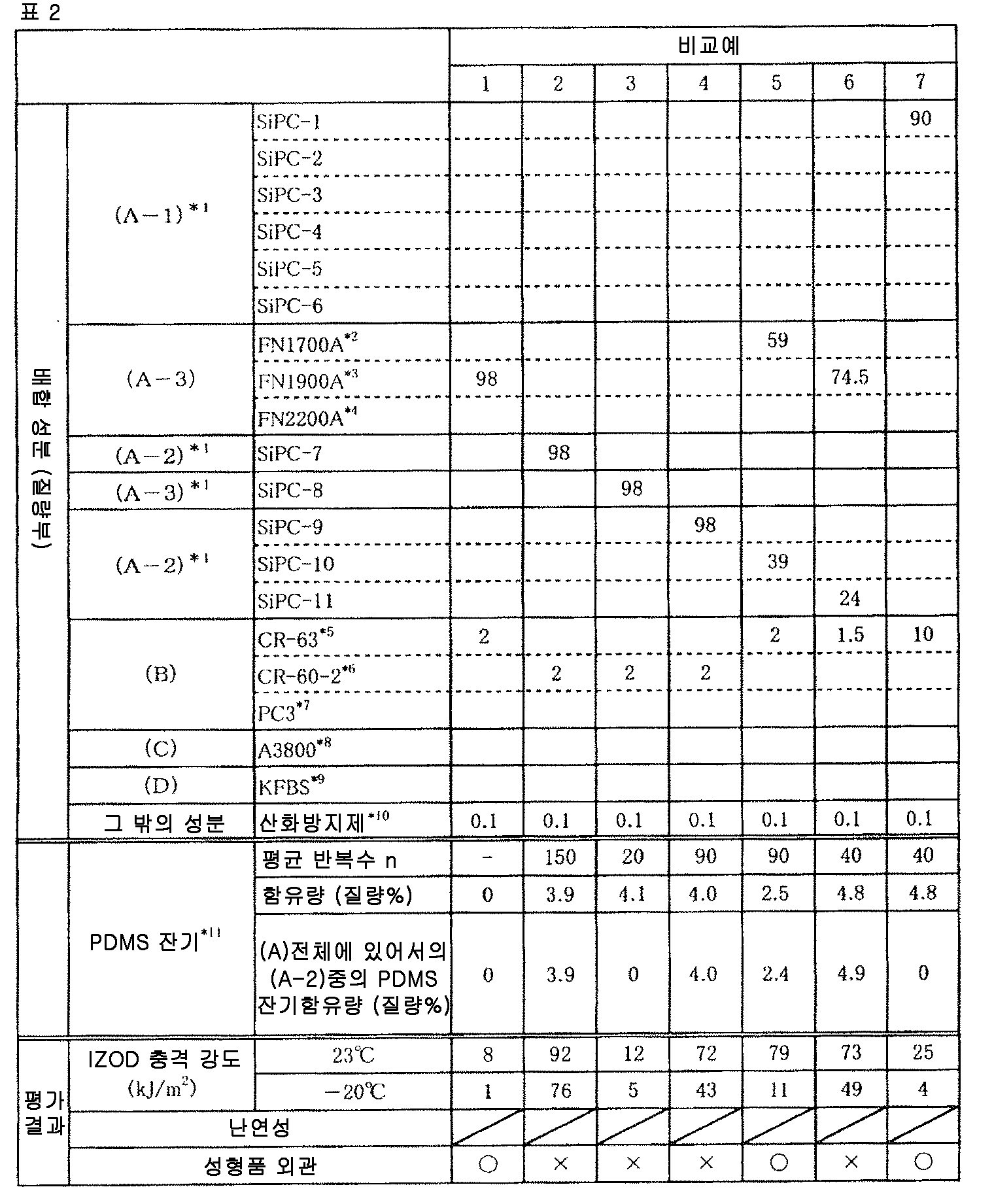
표 1 및 표 2 중의 주석에 대하여, 이하에 설명한다.The annotations in Tables 1 and 2 will be described below.
*1 : 각각 제조예 1 ∼ 11 에서 제조한 폴리카보네이트-폴리디메틸실록산 공중합체* 1: Polycarbonate-polydimethylsiloxane copolymer prepared in Production Examples 1 to 11
*2 : 「타플론 FN1700A」(상품명, 이데미츠 흥산 주식회사 제조, p-t-부틸페놀을 말단기에 갖는 비스페놀 A 폴리카보네이트, 점도수 46.6, 점도 평균 분자량 (Mv) = 17,300)* 2: Bisphenol A polycarbonate having a viscosity of 46.6 and a viscosity average molecular weight (Mv) of 17,300 (trade name, available from Idemitsu Kosan Co., Ltd., p-t-butylphenol in the terminal group)
*3 : 「타플론 FN1900A」(상품명, 이데미츠 흥산 주식회사 제조, p-t-부틸페놀을 말단기에 갖는 비스페놀 A 폴리카보네이트, 점도수 51.1, 점도 평균 분자량 (Mv) = 19,300)* 3: Bisphenol A polycarbonate having a viscosity of 51.1, a viscosity average molecular weight (Mv) of 19,300 (trade name, manufactured by Idemitsu Kosan Co., Ltd., p-t-
*4 : 「타플론 FN2200A」(상품명, 이데미츠 흥산 주식회사 제조, p-t-부틸페놀을 말단기에 갖는 비스페놀 A 폴리카보네이트, 점도수 55.6, 점도 평균 분자량 (Mv) = 21,300)* 4: Bisphenol A polycarbonate having a viscosity of 55.6 and a viscosity average molecular weight (Mv) of 21,300 (trade name, manufactured by Idemitsu Kosan Co., Ltd., p-t-
*5 : 「CR-63」(이시하라 산업 주식회사 제조, 이산화티탄에 실리카·알루미나 1 % 및 디메틸실리콘 0.5 % 로 표면 처리한 것, 평균 입자 직경 : 0.21 ㎛)* 5: "CR-63" (manufactured by Ishihara Sangyo Co., Ltd., titanium dioxide treated with 1% of silica and alumina and 0.5% of dimethylsilicone, average particle diameter: 0.21 μm)
*6 : 「CR-60-2」(이시하라 산업 주식회사 제조, 폴리올에 의해 피복된 산화티탄, 평균 입자 직경 : 0.21 ㎛)* 6: " CR-60-2 " (titanium oxide coated with polyol, manufactured by Ishihara Industries Co., Ltd., average particle diameter: 0.21 mu m)
*7 : 「PC3」(이시하라 산업 주식회사 제조, 루틸형, 표면 산량 : 10 μ㏖/g, 표면 염기량 : 4 μ㏖/g)* 7: " PC3 " (manufactured by Ishihara Industries Co., Ltd., rutile type, surface amount: 10 mu mol / g, surface salt amount: 4 mu mol / g)
*8 : 「메타부렌 A-3800」(상품명, 미츠비시 레이온 주식회사 제조)* 8: " Metabrene A-3800 " (trade name, manufactured by Mitsubishi Rayon Co., Ltd.)
*9 : 「에프톱 KFBS」(상품명, 성분 ; 퍼플루오로부탄술폰산칼륨, 미츠비시 마테리알 전자 화성 주식회사 제조)* 9: "F-top KFBS" (trade name, component: potassium perfluorobutanesulfonate, manufactured by Mitsubishi Materials Electronics Co., Ltd.)
*10 : 「IRGAFOS168」(상품명, 트리스(2,4-디-t-부틸페닐)포스파이트, 치바·스페셜티·케미컬즈 주식회사 제조)* 10: IRGAFOS168 (trade name, tris (2,4-di-t-butylphenyl) phosphite, manufactured by Chiba Specialty Chemicals Co., Ltd.)
*11 : 폴리디메틸실록산 잔기* 11: Polydimethylsiloxane residue
표 1 로부터, 본 발명의 폴리카보네이트계 수지 조성물은, 폴리오르가노실록산-폴리카보네이트 공중합체의 우수한 특성 (예를 들어 내충격성, 특히 저온에서의 내충격성) 을 유지하면서, 우수한 색 외관을 갖고 있는 것을 알 수 있다. 또, 실시예 12 및 14 에서는 난연성도 우수하였다.It can be seen from Table 1 that the polycarbonate resin composition of the present invention has excellent color appearance while retaining excellent properties (for example, impact resistance, particularly impact resistance at low temperature) of the polyorganosiloxane-polycarbonate copolymer . In Examples 12 and 14, flame retardancy was also excellent.
한편, 표 2 중의 비교예 1 및 3 으로부터, (A-1) 및 (A-2) 를 함유하지 않고 (A-3) 을 함유한 폴리카보네이트 수지 조성물에서는, 내충격성의 저하, 특히 저온 (-20 ℃) 에 있어서의 내충격성의 저하가 현저한 것을 알 수 있다. 또, 비교예 2, 4 및 6 으로부터, 평균 반복수 n 이 25 ∼ 65 인 (A-1) 을 함유하지 않는 폴리카보네이트계 수지 조성물에서는, 평균 반복수 n 이 70 ∼ 350 인 (A-2) 를 함유하고 있더라도, 색 외관이 나빠지는 것을 알 수 있다. 비교예 5 와 같이, (A-2) 및 (A-3) 을 함유하는 폴리카보네이트계 수지 조성물에서는, 23 ℃ 에 있어서의 내충격성은 높게 유지되어 있지만, 저온 (-20 ℃) 에 있어서의 내충격성이 현저히 감소되는 것을 알 수 있다. 또한 비교예 7 과 같이, (B) 성분인 산화티탄의 함유량이 지나치게 많으면, 23 ℃ 및 -20 ℃ 의 어느 경우에 있어서도 내충격성이 현저히 저하되는 것을 알 수 있었다.On the other hand, in Comparative Examples 1 and 3 in Table 2, it was confirmed that the polycarbonate resin composition containing (A-1) and (A-2) Lt; 0 > C) is remarkably lowered. (A-2) having an average repeating number n of 70 to 350 in the polycarbonate resin composition containing no (A-1) having an average repeating number n of 25 to 65 from the comparative examples 2, 4, It is understood that the color appearance is deteriorated. In the polycarbonate resin composition containing (A-2) and (A-3) as in Comparative Example 5, the impact resistance at 23 캜 was kept high, but the impact resistance at low temperature (-20 캜) Is significantly reduced. Also, as in Comparative Example 7, it was found that when the content of the titanium oxide as the component (B) was excessively large, the impact resistance remarkably decreased at both 23 占 폚 and -20 占 폚.
산업상 이용가능성Industrial availability
본 발명에 의해 얻어지는 폴리카보네이트계 수지 조성물은, 전기·전자 기기 분야, 자동차 분야 등 여러 분야에서 폭넓게 이용할 수 있다. 특히, 휴대 전화, 모바일 PC, 디지털 카메라, 비디오 카메라, 전동 공구 등의 케이스의 재료로서도 이용할 수 있다.The polycarbonate resin composition obtained by the present invention can be widely used in various fields such as electric and electronic devices, automobiles, and the like. In particular, it can be used as a material of a case of a mobile phone, a mobile PC, a digital camera, a video camera, an electric power tool, and the like.
Claims (10)
주사슬이 일반식 (Ⅰ) 로 나타내는 반복 단위 및 일반식 (Ⅱ) 로 나타내는 구성 단위를 갖는 폴리카보네이트-폴리오르가노실록산 공중합체로서, 일반식 (Ⅱ) 중의 n 이 70 ∼ 350 이며, 또한 일반식 (Ⅱ) 로 나타내는 구성 단위의 함유량이 2 ∼ 20 질량% 인 폴리카보네이트-폴리오르가노실록산 공중합체 (A-2) 0 ∼ 95 질량%, 및
상기 (A-1) 및 (A-2) 이외의 방향족 폴리카보네이트 (A-3) 0 ∼ 95 질량% 로 이루어지는 폴리카보네이트계 수지 99.9 ∼ 96 질량부, 및
(B) : 산화티탄 0.1 ∼ 4 질량부 (단, (A) 성분 및 (B) 성분의 합계는 100 질량부이다) 를 함유하는 폴리카보네이트계 수지 조성물.
[화학식 1]
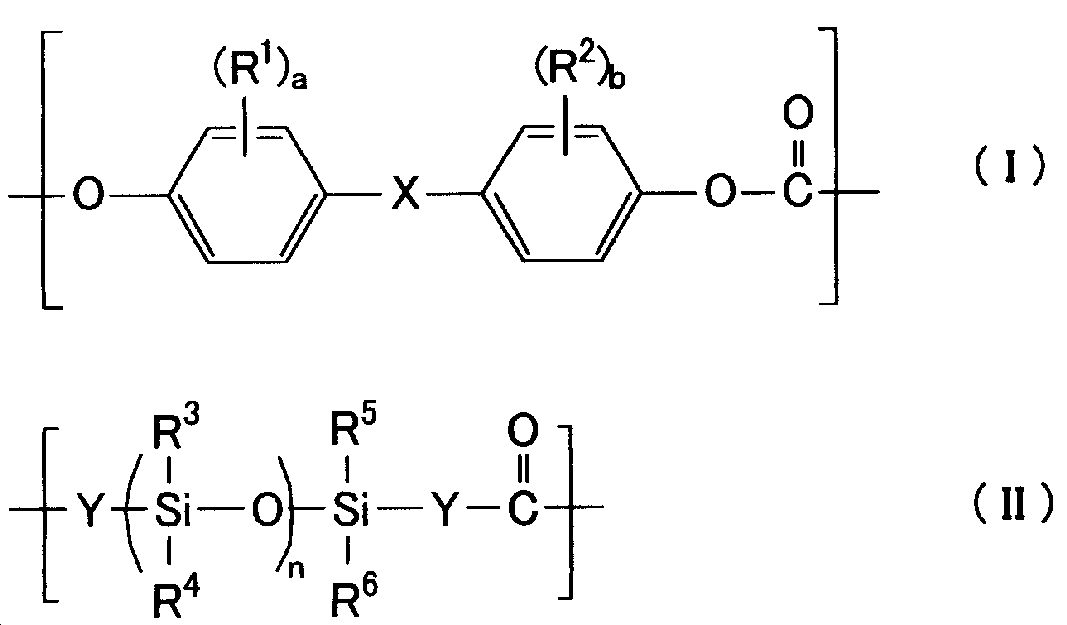
[식 중, R1 및 R2 는, 각각 독립적으로 할로겐 원자, 탄소수 1 ∼ 6 의 알킬기 또는 탄소수 1 ∼ 6 의 알콕시기를 나타낸다. X 는 단결합, 탄소수 1 ∼ 8 의 알킬렌기, 탄소수 2 ∼ 8 의 알킬리덴기, 탄소수 5 ∼ 15 의 시클로알킬렌기, 탄소수 5 ∼ 15 의 시클로알킬리덴기, -S-, -SO-, -SO2-, -O- 또는 -CO- 를 나타낸다. a 및 b 는, 각각 독립적으로 0 ∼ 4 의 정수를 나타낸다.
R3 ∼ R6 은, 각각 독립적으로 수소 원자, 할로겐 원자 또는 탄소수 1 ∼ 6 의 알킬기, 탄소수 1 ∼ 6 의 알콕시기 또는 탄소수 6 ∼ 12 의 아릴기를 나타낸다. Y 는 단결합, 지방족 또는 방향족을 포함하는 유기 잔기를 나타낸다. n 은 평균 반복수이다.](A): a polycarbonate-polyorganosiloxane copolymer having a main chain of a repeating unit represented by the general formula (I) and a constitutional unit represented by the general formula (II), wherein n in the general formula (II) , 5 to 100% by mass of a polycarbonate-polyorganosiloxane copolymer (A-1) having a constituent unit represented by the general formula (II) in an amount of 2 to 20% by mass,
A polycarbonate-polyorganosiloxane copolymer having a main chain of a repeating unit represented by the general formula (I) and a constitutional unit represented by the general formula (II), wherein n in the general formula (II) is 70 to 350, 0 to 95% by mass of a polycarbonate-polyorganosiloxane copolymer (A-2) having a constituent unit represented by the formula (II) in an amount of 2 to 20% by mass,
99.9 to 96 parts by mass of a polycarbonate resin composed of 0 to 95% by mass of an aromatic polycarbonate (A-3) other than the above-mentioned (A-1) and (A-2)
(B): 0.1 to 4 parts by mass of titanium oxide (provided that the sum of the components (A) and (B) is 100 parts by mass).
[Chemical Formula 1]
[Wherein R 1 and R 2 each independently represent a halogen atom, an alkyl group having 1 to 6 carbon atoms, or an alkoxy group having 1 to 6 carbon atoms. X is a single bond, an alkylene group having 1 to 8 carbon atoms, an alkylidene group having 2 to 8 carbon atoms, a cycloalkylene group having 5 to 15 carbon atoms, a cycloalkylidene group having 5 to 15 carbon atoms, -S-, -SO-, SO 2 -, -O- or -CO-. a and b each independently represent an integer of 0 to 4;
R 3 to R 6 each independently represent a hydrogen atom, a halogen atom or an alkyl group having 1 to 6 carbon atoms, an alkoxy group having 1 to 6 carbon atoms, or an aryl group having 6 to 12 carbon atoms. Y represents an organic residue containing a single bond, aliphatic or aromatic. n is the average number of iterations.]
일반식 (Ⅱ) 로 나타내는 구성 단위에 있어서, Y 가 알릴페놀 또는 오이게놀 유래의 유기 잔기인 폴리카보네이트계 수지 조성물.The method according to claim 1,
Wherein the constituent unit represented by the general formula (II) is an organic residue derived from allylphenol or augenol.
일반식 (Ⅰ) 로 나타내는 반복 단위에 있어서, X 가 이소프로필리덴기이며, 또한 a = b = 0 인 폴리카보네이트계 수지 조성물.3. The method according to claim 1 or 2,
In the polycarbonate-based resin composition, in the repeating unit represented by the general formula (I), X is an isopropylidene group and a = b = 0.
일반식 (Ⅱ) 로 나타내는 구성 단위에 있어서, R3 ∼ R6 이 모두 메틸기인 폴리카보네이트계 수지 조성물.4. The method according to any one of claims 1 to 3,
In the structural unit represented by the general formula (II), R 3 to R 6 are all methyl groups.
(A) 성분의 폴리카보네이트계 수지에 있어서, (A-2) 성분 유래의 일반식 (Ⅱ) 로 나타내는 구성 단위의 함유량이, (A-1) ∼ (A-3) 성분의 합계량에 대하여 2.5 질량% 이하인 폴리카보네이트계 수지 조성물.5. The method according to any one of claims 1 to 4,
(A-1) to (A-3) in the polycarbonate resin as the component (A), the content of the constituent unit derived from the component (A-2) By mass or less, based on the total amount of the polycarbonate resin composition.
(A) 성분 및 (B) 성분의 합계 100 질량부에 대하여, 추가로 (C) 폴리테트라플루오로에틸렌 함유 혼합 분체 0.1 ∼ 1 질량부를 함유하는 폴리카보네이트계 수지 조성물.6. The method according to any one of claims 1 to 5,
(C) 0.1 to 1 part by mass of a polytetrafluoroethylene-containing mixed powder, based on 100 parts by mass of the total of the component (A) and the component (B).
(A) 성분 및 (B) 성분의 합계 100 질량부에 대하여, 추가로 (D) 유기 술폰산의 알칼리 금속염 및 유기 술폰산의 알칼리 토금속염에서 선택되는 적어도 1 종 0.01 ∼ 0.15 질량부를 함유하는 폴리카보네이트계 수지 조성물.7. The method according to any one of claims 1 to 6,
(D) 0.01 to 0.15 parts by mass of at least one member selected from the group consisting of an alkali metal salt of an organic sulfonic acid and an alkaline earth metal salt of an organic sulfonic acid, based on 100 parts by mass of a total of 100 parts by mass of the component (A) Resin composition.
Applications Claiming Priority (3)
| Application Number | Priority Date | Filing Date | Title |
|---|---|---|---|
| JPJP-P-2011-219430 | 2011-10-03 | ||
| JP2011219430 | 2011-10-03 | ||
| PCT/JP2012/075506 WO2013051557A1 (en) | 2011-10-03 | 2012-10-02 | Polycarbonate resin composition |
Publications (2)
| Publication Number | Publication Date |
|---|---|
| KR20140077164A true KR20140077164A (en) | 2014-06-23 |
| KR101971751B1 KR101971751B1 (en) | 2019-08-13 |
Family
ID=48043714
Family Applications (1)
| Application Number | Title | Priority Date | Filing Date |
|---|---|---|---|
| KR1020147008522A Active KR101971751B1 (en) | 2011-10-03 | 2012-10-02 | Polycarbonate resin composition |
Country Status (5)
| Country | Link |
|---|---|
| JP (1) | JP6106593B2 (en) |
| KR (1) | KR101971751B1 (en) |
| CN (2) | CN103857745B (en) |
| TW (2) | TWI604012B (en) |
| WO (1) | WO2013051557A1 (en) |
Cited By (9)
| Publication number | Priority date | Publication date | Assignee | Title |
|---|---|---|---|---|
| KR20160067731A (en) * | 2014-12-04 | 2016-06-14 | 주식회사 엘지화학 | Copolycarbonate and composition comprising the same |
| US9580597B2 (en) | 2014-12-04 | 2017-02-28 | Lg Chem, Ltd. | Polycarbonate composition and article comprising the same |
| US9732186B2 (en) | 2014-09-05 | 2017-08-15 | Lg Chem, Ltd. | Copolycarbonate and composition comprising the same |
| KR20180098259A (en) * | 2015-12-22 | 2018-09-03 | 이데미쓰 고산 가부시키가이샤 | Polycarbonate resin composition |
| KR20180120178A (en) * | 2016-03-09 | 2018-11-05 | 이데미쓰 고산 가부시키가이샤 | Polycarbonate resin composition and molded article thereof |
| KR20180122620A (en) * | 2016-03-09 | 2018-11-13 | 이데미쓰 고산 가부시키가이샤 | Polycarbonate resin composition and molded article thereof |
| KR20190072882A (en) * | 2017-12-18 | 2019-06-26 | 롯데첨단소재(주) | Thermoplastic resin composition and article produced therefrom |
| KR20190120763A (en) * | 2017-03-01 | 2019-10-24 | 이데미쓰 고산 가부시키가이샤 | Polycarbonate-polyorganosiloxane copolymer, polycarbonate-based resin composition and molded article thereof |
| KR20210027282A (en) * | 2018-07-03 | 2021-03-10 | 이데미쓰 고산 가부시키가이샤 | Polycarbonate resin composition and molded article thereof |
Families Citing this family (21)
| Publication number | Priority date | Publication date | Assignee | Title |
|---|---|---|---|---|
| JP5957399B2 (en) * | 2013-03-06 | 2016-07-27 | 出光興産株式会社 | Polycarbonate resin composition and molded body |
| US9365683B2 (en) * | 2013-12-10 | 2016-06-14 | Idemitsu Kosan Co., Ltd. | Polycarbonate-polyorganosiloxane copolymer and method for producing same |
| JP6614574B2 (en) * | 2014-02-13 | 2019-12-04 | 出光興産株式会社 | Polycarbonate resin composition |
| CN104174895B (en) * | 2014-07-11 | 2017-10-10 | 浙江明磊工具实业有限公司 | A kind of Simple hand electric drill |
| CN104693772A (en) * | 2015-03-04 | 2015-06-10 | 安徽科聚新材料有限公司 | Glass fiber-mica mixed enhanced polycarbonate material and preparation method thereof |
| TWI753855B (en) * | 2015-03-12 | 2022-02-01 | 日本商出光興產股份有限公司 | Polycarbonate resin composition and molded article thereof |
| JP6699859B2 (en) * | 2015-03-30 | 2020-05-27 | 出光興産株式会社 | Polycarbonate resin composition and molded article thereof |
| US10975195B2 (en) * | 2015-03-30 | 2021-04-13 | Idemitsu Kosan Co., Ltd. | Polycarbonate resin composition and molded body of same |
| CN107735452B (en) * | 2015-06-17 | 2023-06-09 | 出光兴产株式会社 | Method for producing polycarbonate resin composition |
| KR102535441B1 (en) * | 2015-06-17 | 2023-05-22 | 이데미쓰 고산 가부시키가이샤 | Polycarbonate resin composition and molded product thereof |
| KR102748411B1 (en) | 2015-12-22 | 2024-12-30 | 이데미쓰 고산 가부시키가이샤 | Polycarbonate resin composition and molded article thereof |
| JP6856454B2 (en) * | 2017-06-14 | 2021-04-07 | 三菱ケミカル株式会社 | Aromatic polycarbonate resin composition |
| JP7075224B2 (en) * | 2018-01-23 | 2022-05-25 | ダイセルポリマー株式会社 | Polycarbonate resin composition |
| JP7075223B2 (en) * | 2018-01-23 | 2022-05-25 | ダイセルポリマー株式会社 | Polycarbonate resin composition |
| JP7075225B2 (en) * | 2018-01-23 | 2022-05-25 | ダイセルポリマー株式会社 | Flame-retardant polycarbonate-based resin composition |
| KR102197159B1 (en) * | 2018-07-26 | 2020-12-31 | 롯데첨단소재(주) | Thermoplastic resin composition and article produced therefrom |
| JP7219102B2 (en) * | 2019-01-30 | 2023-02-07 | 帝人株式会社 | Thermoplastic resin composition |
| CN112552668A (en) * | 2020-10-21 | 2021-03-26 | 金发科技股份有限公司 | Long-term stable polycarbonate composition and preparation method thereof |
| CN112457644B (en) * | 2020-10-21 | 2022-03-22 | 金发科技股份有限公司 | High toughness, high flow flame retardant polycarbonate composition, preparation method and application thereof |
| JP7786892B2 (en) * | 2021-06-08 | 2025-12-16 | 帝人株式会社 | Resin composition for display materials and resin parts for display materials |
| CN113201127B (en) * | 2021-06-21 | 2022-09-16 | 万华化学集团股份有限公司 | Polysiloxane-polycarbonate copolymer, method for producing same, and polycarbonate resin |
Citations (7)
| Publication number | Priority date | Publication date | Assignee | Title |
|---|---|---|---|---|
| JPH05320519A (en) | 1992-05-20 | 1993-12-03 | Idemitsu Petrochem Co Ltd | Polycarbonate resin composition |
| JPH07173276A (en) * | 1993-12-17 | 1995-07-11 | Idemitsu Petrochem Co Ltd | Polycarbonate resin, production thereof and resin composition |
| JP2004091567A (en) | 2002-08-30 | 2004-03-25 | Idemitsu Petrochem Co Ltd | Polycarbonate resin composition and its molded article |
| JP2006030405A (en) * | 2004-07-13 | 2006-02-02 | Mitsubishi Engineering Plastics Corp | Light reflectors and molded products |
| KR20070018801A (en) * | 2003-10-16 | 2007-02-14 | 제너럴 일렉트릭 캄파니 | Lightly colored polycarbonate composition and preparation method thereof |
| JP2007509208A (en) | 2003-10-16 | 2007-04-12 | ゼネラル・エレクトリック・カンパニイ | Pale color polycarbonate composition and production method |
| KR20070116789A (en) * | 2005-03-03 | 2007-12-11 | 제너럴 일렉트릭 캄파니 | Thermoplastic Polycarbonate Compositions, Products Made Therefrom and Methods of Making the Same |
Family Cites Families (9)
| Publication number | Priority date | Publication date | Assignee | Title |
|---|---|---|---|---|
| DE69224937T2 (en) * | 1991-07-01 | 1998-10-22 | Gen Electric | Polycarbonate-polysiloxane block copolymers |
| JPH06329781A (en) * | 1993-03-25 | 1994-11-29 | Idemitsu Petrochem Co Ltd | Polycarbonate/polyorganosiloxane copolymer and resin composition |
| JP3365525B2 (en) * | 1994-01-21 | 2003-01-14 | 出光石油化学株式会社 | Polycarbonate resin composition |
| JPH09241914A (en) * | 1995-12-26 | 1997-09-16 | Idemitsu Petrochem Co Ltd | Shock-resistant human body protector |
| JP4212841B2 (en) * | 2002-07-01 | 2009-01-21 | 出光興産株式会社 | Thermoplastic resins and molded products |
| EP1597317B1 (en) * | 2003-02-21 | 2015-09-09 | SABIC Global Technologies B.V. | Translucent thermoplastic composition, method for making the composition and articles molded there from. |
| US7323536B2 (en) * | 2005-05-20 | 2008-01-29 | General Electric Company | Transparent compositions, methods for the preparation thereof, and articles derived therefrom |
| US7557153B2 (en) * | 2005-10-31 | 2009-07-07 | Sabic Innovative Plastics Ip Bv | Ionizing radiation stable thermoplastic composition, method of making, and articles formed therefrom |
| JP2009280725A (en) * | 2008-05-23 | 2009-12-03 | Idemitsu Kosan Co Ltd | Flame-retardant polycarbonate resin composition and light reflection member |
-
2012
- 2012-10-02 JP JP2013537510A patent/JP6106593B2/en active Active
- 2012-10-02 KR KR1020147008522A patent/KR101971751B1/en active Active
- 2012-10-02 CN CN201280048767.0A patent/CN103857745B/en active Active
- 2012-10-02 CN CN201610703154.6A patent/CN106280496B/en active Active
- 2012-10-02 WO PCT/JP2012/075506 patent/WO2013051557A1/en not_active Ceased
- 2012-10-03 TW TW105117869A patent/TWI604012B/en active
- 2012-10-03 TW TW101136597A patent/TWI586754B/en active
Patent Citations (7)
| Publication number | Priority date | Publication date | Assignee | Title |
|---|---|---|---|---|
| JPH05320519A (en) | 1992-05-20 | 1993-12-03 | Idemitsu Petrochem Co Ltd | Polycarbonate resin composition |
| JPH07173276A (en) * | 1993-12-17 | 1995-07-11 | Idemitsu Petrochem Co Ltd | Polycarbonate resin, production thereof and resin composition |
| JP2004091567A (en) | 2002-08-30 | 2004-03-25 | Idemitsu Petrochem Co Ltd | Polycarbonate resin composition and its molded article |
| KR20070018801A (en) * | 2003-10-16 | 2007-02-14 | 제너럴 일렉트릭 캄파니 | Lightly colored polycarbonate composition and preparation method thereof |
| JP2007509208A (en) | 2003-10-16 | 2007-04-12 | ゼネラル・エレクトリック・カンパニイ | Pale color polycarbonate composition and production method |
| JP2006030405A (en) * | 2004-07-13 | 2006-02-02 | Mitsubishi Engineering Plastics Corp | Light reflectors and molded products |
| KR20070116789A (en) * | 2005-03-03 | 2007-12-11 | 제너럴 일렉트릭 캄파니 | Thermoplastic Polycarbonate Compositions, Products Made Therefrom and Methods of Making the Same |
Cited By (28)
| Publication number | Priority date | Publication date | Assignee | Title |
|---|---|---|---|---|
| US9732186B2 (en) | 2014-09-05 | 2017-08-15 | Lg Chem, Ltd. | Copolycarbonate and composition comprising the same |
| US9745418B2 (en) | 2014-09-05 | 2017-08-29 | Lg Chem, Ltd. | Copolycarbonate and composition comprising the same |
| US10011716B2 (en) | 2014-12-04 | 2018-07-03 | Lg Chem, Ltd. | Copolycarbonate composition and article containing the same |
| US10240038B2 (en) | 2014-12-04 | 2019-03-26 | Lg Chem, Ltd. | Flame resistant polycarbate based resin composition and molded articles thereof |
| US9745417B2 (en) | 2014-12-04 | 2017-08-29 | Lg Chem, Ltd. | Copolycarbonate and composition comprising the same |
| US9745466B2 (en) | 2014-12-04 | 2017-08-29 | Lg Chem, Ltd. | Copolycarbonate and composition containing the same |
| US9580597B2 (en) | 2014-12-04 | 2017-02-28 | Lg Chem, Ltd. | Polycarbonate composition and article comprising the same |
| US9751979B2 (en) | 2014-12-04 | 2017-09-05 | Lg Chem, Ltd. | Copolycarbonate and composition containing the same |
| US9777112B2 (en) | 2014-12-04 | 2017-10-03 | Lg Chem, Ltd. | Copolycarbonate resin composition |
| US9809677B2 (en) | 2014-12-04 | 2017-11-07 | Lg Chem, Ltd. | Polycarbonate composition and article comprising the same |
| US9840585B2 (en) | 2014-12-04 | 2017-12-12 | Lg Chem, Ltd. | Polycarbonate resin composition |
| US9868818B2 (en) | 2014-12-04 | 2018-01-16 | Lg Chem, Ltd. | Copolycarbonate and composition containing the same |
| US9902853B2 (en) | 2014-12-04 | 2018-02-27 | Lg Chem, Ltd. | Copolycarbonate and composition comprising the same |
| US9969841B2 (en) | 2014-12-04 | 2018-05-15 | Lg Chem, Ltd. | Copolycarbonate and composition comprising the same |
| US9718958B2 (en) | 2014-12-04 | 2017-08-01 | Lg Chem, Ltd. | Copolycarbonate and composition containing the same |
| US10294365B2 (en) | 2014-12-04 | 2019-05-21 | Lg Chem, Ltd. | Polycarbonate-based resin composition and molded article thereof |
| US10196516B2 (en) | 2014-12-04 | 2019-02-05 | Lg Chem, Ltd. | Copolycarbonate resin composition and article including the same |
| US10240037B2 (en) | 2014-12-04 | 2019-03-26 | Lg Chem, Ltd. | Polycarbonate-based resin composition and molded article thereof |
| KR20160067731A (en) * | 2014-12-04 | 2016-06-14 | 주식회사 엘지화학 | Copolycarbonate and composition comprising the same |
| US10174194B2 (en) | 2014-12-04 | 2019-01-08 | Lg Chem, Ltd. | Copolycarbonate and composition comprising the same |
| US10081730B2 (en) | 2014-12-04 | 2018-09-25 | Lg Chem, Ltd. | Polycarbonate-based resin composition and molded article thereof |
| KR20180098259A (en) * | 2015-12-22 | 2018-09-03 | 이데미쓰 고산 가부시키가이샤 | Polycarbonate resin composition |
| KR20180122620A (en) * | 2016-03-09 | 2018-11-13 | 이데미쓰 고산 가부시키가이샤 | Polycarbonate resin composition and molded article thereof |
| KR20180120178A (en) * | 2016-03-09 | 2018-11-05 | 이데미쓰 고산 가부시키가이샤 | Polycarbonate resin composition and molded article thereof |
| US11161977B2 (en) | 2016-03-09 | 2021-11-02 | Idemitsu Kosan Co., Ltd. | Polycarbonate-based resin composition and molded product thereof |
| KR20190120763A (en) * | 2017-03-01 | 2019-10-24 | 이데미쓰 고산 가부시키가이샤 | Polycarbonate-polyorganosiloxane copolymer, polycarbonate-based resin composition and molded article thereof |
| KR20190072882A (en) * | 2017-12-18 | 2019-06-26 | 롯데첨단소재(주) | Thermoplastic resin composition and article produced therefrom |
| KR20210027282A (en) * | 2018-07-03 | 2021-03-10 | 이데미쓰 고산 가부시키가이샤 | Polycarbonate resin composition and molded article thereof |
Also Published As
| Publication number | Publication date |
|---|---|
| CN106280496B (en) | 2019-09-10 |
| WO2013051557A1 (en) | 2013-04-11 |
| TWI586754B (en) | 2017-06-11 |
| CN103857745B (en) | 2016-08-31 |
| TWI604012B (en) | 2017-11-01 |
| JP6106593B2 (en) | 2017-04-05 |
| KR101971751B1 (en) | 2019-08-13 |
| TW201323517A (en) | 2013-06-16 |
| CN103857745A (en) | 2014-06-11 |
| CN106280496A (en) | 2017-01-04 |
| JPWO2013051557A1 (en) | 2015-03-30 |
| TW201634578A (en) | 2016-10-01 |
Similar Documents
| Publication | Publication Date | Title |
|---|---|---|
| KR20140077164A (en) | Polycarbonate resin composition | |
| KR101866581B1 (en) | Polycarbonate resin composition and molded polycarbonate resin | |
| KR101820182B1 (en) | Polycarbonate-based resin composition and molded article thereof | |
| EP2610308B1 (en) | Use of polycarbosilane as dispersant for fluoropolymers in polycarbonate resins | |
| US9540511B2 (en) | Polycarbonate resin composition and molded body | |
| EP2639271B1 (en) | Polycarbonate resin composition, molded article and structure member for solar photovoltaic power generation | |
| KR101903214B1 (en) | Polycarbonate resin composition and molding produced using same | |
| US9163121B2 (en) | Polycarbonate and polysiloxane block copolymer and flame retardant resin composition | |
| US10787567B2 (en) | Thermoplastic resin composition and molded product comprising same | |
| JP2003105184A (en) | Polycarbonate resin composition | |
| US20030027928A1 (en) | Polycarbonate resin composition | |
| JP4746891B2 (en) | Flame retardant resin composition and molded body thereof | |
| KR20120092129A (en) | Polycarbonate resin composition | |
| US9353260B2 (en) | Polycarbonate resin composition and molded article | |
| JP5753776B2 (en) | Aromatic polycarbonate resin composition | |
| JP2011084692A (en) | Aromatic polycarbonate resin composition | |
| JP6352030B2 (en) | Polycarbonate resin composition and molded article | |
| JP5123907B2 (en) | Flame retardant polycarbonate resin composition | |
| JP5614926B2 (en) | Polycarbonate resin composition and molded article comprising the same |
Legal Events
| Date | Code | Title | Description |
|---|---|---|---|
| PA0105 | International application |
St.27 status event code: A-0-1-A10-A15-nap-PA0105 |
|
| PG1501 | Laying open of application |
St.27 status event code: A-1-1-Q10-Q12-nap-PG1501 |
|
| A201 | Request for examination | ||
| PA0201 | Request for examination |
St.27 status event code: A-1-2-D10-D11-exm-PA0201 |
|
| D13-X000 | Search requested |
St.27 status event code: A-1-2-D10-D13-srh-X000 |
|
| D14-X000 | Search report completed |
St.27 status event code: A-1-2-D10-D14-srh-X000 |
|
| E902 | Notification of reason for refusal | ||
| PE0902 | Notice of grounds for rejection |
St.27 status event code: A-1-2-D10-D21-exm-PE0902 |
|
| P11-X000 | Amendment of application requested |
St.27 status event code: A-2-2-P10-P11-nap-X000 |
|
| P13-X000 | Application amended |
St.27 status event code: A-2-2-P10-P13-nap-X000 |
|
| E90F | Notification of reason for final refusal | ||
| PE0902 | Notice of grounds for rejection |
St.27 status event code: A-1-2-D10-D21-exm-PE0902 |
|
| P11-X000 | Amendment of application requested |
St.27 status event code: A-2-2-P10-P11-nap-X000 |
|
| P13-X000 | Application amended |
St.27 status event code: A-2-2-P10-P13-nap-X000 |
|
| E701 | Decision to grant or registration of patent right | ||
| PE0701 | Decision of registration |
St.27 status event code: A-1-2-D10-D22-exm-PE0701 |
|
| GRNT | Written decision to grant | ||
| PR0701 | Registration of establishment |
St.27 status event code: A-2-4-F10-F11-exm-PR0701 |
|
| PR1002 | Payment of registration fee |
St.27 status event code: A-2-2-U10-U12-oth-PR1002 Fee payment year number: 1 |
|
| PG1601 | Publication of registration |
St.27 status event code: A-4-4-Q10-Q13-nap-PG1601 |
|
| R18-X000 | Changes to party contact information recorded |
St.27 status event code: A-5-5-R10-R18-oth-X000 |
|
| PR1001 | Payment of annual fee |
St.27 status event code: A-4-4-U10-U11-oth-PR1001 Fee payment year number: 4 |
|
| PR1001 | Payment of annual fee |
St.27 status event code: A-4-4-U10-U11-oth-PR1001 Fee payment year number: 5 |
|
| PR1001 | Payment of annual fee |
St.27 status event code: A-4-4-U10-U11-oth-PR1001 Fee payment year number: 6 |
|
| PR1001 | Payment of annual fee |
St.27 status event code: A-4-4-U10-U11-oth-PR1001 Fee payment year number: 7 |
|
| U11 | Full renewal or maintenance fee paid |
Free format text: ST27 STATUS EVENT CODE: A-4-4-U10-U11-OTH-PR1001 (AS PROVIDED BY THE NATIONAL OFFICE) Year of fee payment: 7 |