KR20160021237A - Solvent soluble polyimide copolymer - Google Patents
Solvent soluble polyimide copolymer Download PDFInfo
- Publication number
- KR20160021237A KR20160021237A KR1020167001109A KR20167001109A KR20160021237A KR 20160021237 A KR20160021237 A KR 20160021237A KR 1020167001109 A KR1020167001109 A KR 1020167001109A KR 20167001109 A KR20167001109 A KR 20167001109A KR 20160021237 A KR20160021237 A KR 20160021237A
- Authority
- KR
- South Korea
- Prior art keywords
- polyimide copolymer
- group
- polyimide
- solvent
- carbon atoms
- Prior art date
- Legal status (The legal status is an assumption and is not a legal conclusion. Google has not performed a legal analysis and makes no representation as to the accuracy of the status listed.)
- Granted
Links
- 239000004642 Polyimide Substances 0.000 title claims abstract description 98
- 229920001721 polyimide Polymers 0.000 title claims abstract description 98
- 239000002904 solvent Substances 0.000 title description 22
- 125000004432 carbon atom Chemical group C* 0.000 claims abstract description 19
- 125000005442 diisocyanate group Chemical group 0.000 claims abstract description 14
- 125000004435 hydrogen atom Chemical group [H]* 0.000 claims abstract description 13
- 150000004985 diamines Chemical class 0.000 claims abstract description 12
- 125000000217 alkyl group Chemical group 0.000 claims abstract description 7
- 125000003342 alkenyl group Chemical group 0.000 claims abstract description 6
- 125000003545 alkoxy group Chemical group 0.000 claims abstract description 6
- 125000003277 amino group Chemical group 0.000 claims abstract description 6
- WKDNYTOXBCRNPV-UHFFFAOYSA-N bpda Chemical compound C1=C2C(=O)OC(=O)C2=CC(C=2C=C3C(=O)OC(C3=CC=2)=O)=C1 WKDNYTOXBCRNPV-UHFFFAOYSA-N 0.000 claims abstract description 5
- IQPQWNKOIGAROB-UHFFFAOYSA-N isocyanate group Chemical group [N-]=C=O IQPQWNKOIGAROB-UHFFFAOYSA-N 0.000 claims abstract description 5
- 150000001875 compounds Chemical class 0.000 claims abstract description 4
- 238000000034 method Methods 0.000 claims description 24
- 125000001495 ethyl group Chemical group [H]C([H])([H])C([H])([H])* 0.000 claims description 11
- 230000009477 glass transition Effects 0.000 claims description 11
- 125000002496 methyl group Chemical group [H]C([H])([H])* 0.000 claims description 11
- 238000003860 storage Methods 0.000 abstract description 6
- YXFVVABEGXRONW-UHFFFAOYSA-N Toluene Chemical compound CC1=CC=CC=C1 YXFVVABEGXRONW-UHFFFAOYSA-N 0.000 description 60
- SECXISVLQFMRJM-UHFFFAOYSA-N N-Methylpyrrolidone Chemical compound CN1CCCC1=O SECXISVLQFMRJM-UHFFFAOYSA-N 0.000 description 48
- 238000006243 chemical reaction Methods 0.000 description 45
- JUJWROOIHBZHMG-UHFFFAOYSA-N Pyridine Chemical compound C1=CC=NC=C1 JUJWROOIHBZHMG-UHFFFAOYSA-N 0.000 description 34
- 239000000203 mixture Substances 0.000 description 29
- 239000010408 film Substances 0.000 description 27
- IJGRMHOSHXDMSA-UHFFFAOYSA-N Atomic nitrogen Chemical compound N#N IJGRMHOSHXDMSA-UHFFFAOYSA-N 0.000 description 26
- 239000003960 organic solvent Substances 0.000 description 20
- GTDPSWPPOUPBNX-UHFFFAOYSA-N ac1mqpva Chemical compound CC12C(=O)OC(=O)C1(C)C1(C)C2(C)C(=O)OC1=O GTDPSWPPOUPBNX-UHFFFAOYSA-N 0.000 description 18
- -1 alkylene glycol monoalkyl ether Chemical class 0.000 description 17
- UMJSCPRVCHMLSP-UHFFFAOYSA-N pyridine Natural products COC1=CC=CN=C1 UMJSCPRVCHMLSP-UHFFFAOYSA-N 0.000 description 17
- 239000002253 acid Substances 0.000 description 16
- 229910052757 nitrogen Inorganic materials 0.000 description 16
- 238000004519 manufacturing process Methods 0.000 description 15
- XLYOFNOQVPJJNP-UHFFFAOYSA-N water Substances O XLYOFNOQVPJJNP-UHFFFAOYSA-N 0.000 description 13
- 238000010438 heat treatment Methods 0.000 description 11
- 238000006116 polymerization reaction Methods 0.000 description 10
- 239000000126 substance Substances 0.000 description 10
- 239000003054 catalyst Substances 0.000 description 9
- 238000001035 drying Methods 0.000 description 9
- 238000006358 imidation reaction Methods 0.000 description 8
- VLDPXPPHXDGHEW-UHFFFAOYSA-N 1-chloro-2-dichlorophosphoryloxybenzene Chemical compound ClC1=CC=CC=C1OP(Cl)(Cl)=O VLDPXPPHXDGHEW-UHFFFAOYSA-N 0.000 description 7
- QJGQUHMNIGDVPM-UHFFFAOYSA-N nitrogen group Chemical group [N] QJGQUHMNIGDVPM-UHFFFAOYSA-N 0.000 description 7
- 239000000758 substrate Substances 0.000 description 7
- PISLZQACAJMAIO-UHFFFAOYSA-N 2,4-diethyl-6-methylbenzene-1,3-diamine Chemical compound CCC1=CC(C)=C(N)C(CC)=C1N PISLZQACAJMAIO-UHFFFAOYSA-N 0.000 description 6
- WFDIJRYMOXRFFG-UHFFFAOYSA-N Acetic anhydride Chemical compound CC(=O)OC(C)=O WFDIJRYMOXRFFG-UHFFFAOYSA-N 0.000 description 6
- LYCAIKOWRPUZTN-UHFFFAOYSA-N Ethylene glycol Chemical compound OCCO LYCAIKOWRPUZTN-UHFFFAOYSA-N 0.000 description 6
- ZMXDDKWLCZADIW-UHFFFAOYSA-N N,N-Dimethylformamide Chemical compound CN(C)C=O ZMXDDKWLCZADIW-UHFFFAOYSA-N 0.000 description 6
- 229920005575 poly(amic acid) Polymers 0.000 description 6
- 125000001624 naphthyl group Chemical group 0.000 description 5
- 229920005989 resin Polymers 0.000 description 5
- 239000011347 resin Substances 0.000 description 5
- 238000003756 stirring Methods 0.000 description 5
- 238000010533 azeotropic distillation Methods 0.000 description 4
- 230000000052 comparative effect Effects 0.000 description 4
- 239000012024 dehydrating agents Substances 0.000 description 4
- VYPSYNLAJGMNEJ-UHFFFAOYSA-N Silicium dioxide Chemical compound O=[Si]=O VYPSYNLAJGMNEJ-UHFFFAOYSA-N 0.000 description 3
- XUIMIQQOPSSXEZ-UHFFFAOYSA-N Silicon Chemical compound [Si] XUIMIQQOPSSXEZ-UHFFFAOYSA-N 0.000 description 3
- ZMANZCXQSJIPKH-UHFFFAOYSA-N Triethylamine Chemical compound CCN(CC)CC ZMANZCXQSJIPKH-UHFFFAOYSA-N 0.000 description 3
- WPYMKLBDIGXBTP-UHFFFAOYSA-N benzoic acid Chemical compound OC(=O)C1=CC=CC=C1 WPYMKLBDIGXBTP-UHFFFAOYSA-N 0.000 description 3
- 238000000576 coating method Methods 0.000 description 3
- 239000000975 dye Substances 0.000 description 3
- 230000000694 effects Effects 0.000 description 3
- 238000011156 evaluation Methods 0.000 description 3
- 239000000945 filler Substances 0.000 description 3
- WGCNASOHLSPBMP-UHFFFAOYSA-N hydroxyacetaldehyde Natural products OCC=O WGCNASOHLSPBMP-UHFFFAOYSA-N 0.000 description 3
- 238000005259 measurement Methods 0.000 description 3
- 125000001997 phenyl group Chemical group [H]C1=C([H])C([H])=C(*)C([H])=C1[H] 0.000 description 3
- 239000000049 pigment Substances 0.000 description 3
- 239000002994 raw material Substances 0.000 description 3
- 229910052710 silicon Inorganic materials 0.000 description 3
- 239000010703 silicon Substances 0.000 description 3
- 0 *c1c(*)c(*)c(*)c(*)c1* Chemical compound *c1c(*)c(*)c(*)c(*)c1* 0.000 description 2
- QEGNUYASOUJEHD-UHFFFAOYSA-N 1,1-dimethylcyclohexane Chemical compound CC1(C)CCCCC1 QEGNUYASOUJEHD-UHFFFAOYSA-N 0.000 description 2
- JYYNAJVZFGKDEQ-UHFFFAOYSA-N 2,4-Dimethylpyridine Chemical compound CC1=CC=NC(C)=C1 JYYNAJVZFGKDEQ-UHFFFAOYSA-N 0.000 description 2
- XWKFPIODWVPXLX-UHFFFAOYSA-N 2,5-dimethylpyridine Chemical compound CC1=CC=C(C)N=C1 XWKFPIODWVPXLX-UHFFFAOYSA-N 0.000 description 2
- NURQLCJSMXZBPC-UHFFFAOYSA-N 3,4-dimethylpyridine Chemical compound CC1=CC=NC=C1C NURQLCJSMXZBPC-UHFFFAOYSA-N 0.000 description 2
- HWWYDZCSSYKIAD-UHFFFAOYSA-N 3,5-dimethylpyridine Chemical compound CC1=CN=CC(C)=C1 HWWYDZCSSYKIAD-UHFFFAOYSA-N 0.000 description 2
- QTBSBXVTEAMEQO-UHFFFAOYSA-M Acetate Chemical compound CC([O-])=O QTBSBXVTEAMEQO-UHFFFAOYSA-M 0.000 description 2
- XKRFYHLGVUSROY-UHFFFAOYSA-N Argon Chemical compound [Ar] XKRFYHLGVUSROY-UHFFFAOYSA-N 0.000 description 2
- FXHOOIRPVKKKFG-UHFFFAOYSA-N N,N-Dimethylacetamide Chemical compound CN(C)C(C)=O FXHOOIRPVKKKFG-UHFFFAOYSA-N 0.000 description 2
- SMWDFEZZVXVKRB-UHFFFAOYSA-N Quinoline Chemical compound N1=CC=CC2=CC=CC=C21 SMWDFEZZVXVKRB-UHFFFAOYSA-N 0.000 description 2
- 150000004945 aromatic hydrocarbons Chemical class 0.000 description 2
- 239000012298 atmosphere Substances 0.000 description 2
- 239000011248 coating agent Substances 0.000 description 2
- 238000007334 copolymerization reaction Methods 0.000 description 2
- KZTYYGOKRVBIMI-UHFFFAOYSA-N diphenyl sulfone Chemical compound C=1C=CC=CC=1S(=O)(=O)C1=CC=CC=C1 KZTYYGOKRVBIMI-UHFFFAOYSA-N 0.000 description 2
- AWJUIBRHMBBTKR-UHFFFAOYSA-N isoquinoline Chemical compound C1=NC=CC2=CC=CC=C21 AWJUIBRHMBBTKR-UHFFFAOYSA-N 0.000 description 2
- 239000000463 material Substances 0.000 description 2
- UAEPNZWRGJTJPN-UHFFFAOYSA-N methylcyclohexane Chemical compound CC1CCCCC1 UAEPNZWRGJTJPN-UHFFFAOYSA-N 0.000 description 2
- AJFDBNQQDYLMJN-UHFFFAOYSA-N n,n-diethylacetamide Chemical compound CCN(CC)C(C)=O AJFDBNQQDYLMJN-UHFFFAOYSA-N 0.000 description 2
- 150000007524 organic acids Chemical class 0.000 description 2
- 230000003647 oxidation Effects 0.000 description 2
- 238000007254 oxidation reaction Methods 0.000 description 2
- 239000002861 polymer material Substances 0.000 description 2
- 239000002243 precursor Substances 0.000 description 2
- 238000004528 spin coating Methods 0.000 description 2
- 229910001220 stainless steel Inorganic materials 0.000 description 2
- 239000010935 stainless steel Substances 0.000 description 2
- HXJUTPCZVOIRIF-UHFFFAOYSA-N sulfolane Chemical compound O=S1(=O)CCCC1 HXJUTPCZVOIRIF-UHFFFAOYSA-N 0.000 description 2
- JOXIMZWYDAKGHI-UHFFFAOYSA-N toluene-4-sulfonic acid Chemical compound CC1=CC=C(S(O)(=O)=O)C=C1 JOXIMZWYDAKGHI-UHFFFAOYSA-N 0.000 description 2
- 125000002023 trifluoromethyl group Chemical group FC(F)(F)* 0.000 description 2
- 239000002966 varnish Substances 0.000 description 2
- CBCKQZAAMUWICA-UHFFFAOYSA-N 1,4-phenylenediamine Chemical compound NC1=CC=C(N)C=C1 CBCKQZAAMUWICA-UHFFFAOYSA-N 0.000 description 1
- FBHPRUXJQNWTEW-UHFFFAOYSA-N 1-benzyl-2-methylimidazole Chemical compound CC1=NC=CN1CC1=CC=CC=C1 FBHPRUXJQNWTEW-UHFFFAOYSA-N 0.000 description 1
- BSKHPKMHTQYZBB-UHFFFAOYSA-N 2-methylpyridine Chemical compound CC1=CC=CC=N1 BSKHPKMHTQYZBB-UHFFFAOYSA-N 0.000 description 1
- QAOSTFBRPIGUKM-UHFFFAOYSA-N 3-[2-[2-[2-(2,3-dicarboxyphenoxy)phenyl]propan-2-yl]phenoxy]phthalic acid Chemical compound C=1C=CC=C(OC=2C(=C(C(O)=O)C=CC=2)C(O)=O)C=1C(C)(C)C1=CC=CC=C1OC1=CC=CC(C(O)=O)=C1C(O)=O QAOSTFBRPIGUKM-UHFFFAOYSA-N 0.000 description 1
- HLBLWEWZXPIGSM-UHFFFAOYSA-N 4-Aminophenyl ether Chemical compound C1=CC(N)=CC=C1OC1=CC=C(N)C=C1 HLBLWEWZXPIGSM-UHFFFAOYSA-N 0.000 description 1
- NWIVYGKSHSJHEF-UHFFFAOYSA-N 4-[(4-amino-3,5-diethylphenyl)methyl]-2,6-diethylaniline Chemical compound CCC1=C(N)C(CC)=CC(CC=2C=C(CC)C(N)=C(CC)C=2)=C1 NWIVYGKSHSJHEF-UHFFFAOYSA-N 0.000 description 1
- UTDAGHZGKXPRQI-UHFFFAOYSA-N 4-[4-[4-(4-aminophenoxy)phenyl]sulfonylphenoxy]aniline Chemical compound C1=CC(N)=CC=C1OC1=CC=C(S(=O)(=O)C=2C=CC(OC=3C=CC(N)=CC=3)=CC=2)C=C1 UTDAGHZGKXPRQI-UHFFFAOYSA-N 0.000 description 1
- KIFDSGGWDIVQGN-UHFFFAOYSA-N 4-[9-(4-aminophenyl)fluoren-9-yl]aniline Chemical compound C1=CC(N)=CC=C1C1(C=2C=CC(N)=CC=2)C2=CC=CC=C2C2=CC=CC=C21 KIFDSGGWDIVQGN-UHFFFAOYSA-N 0.000 description 1
- JAWZAONCXMJLFT-UHFFFAOYSA-N 4-propylpyridine Chemical compound CCCC1=CC=NC=C1 JAWZAONCXMJLFT-UHFFFAOYSA-N 0.000 description 1
- QQGYZOYWNCKGEK-UHFFFAOYSA-N 5-[(1,3-dioxo-2-benzofuran-5-yl)oxy]-2-benzofuran-1,3-dione Chemical compound C1=C2C(=O)OC(=O)C2=CC(OC=2C=C3C(=O)OC(C3=CC=2)=O)=C1 QQGYZOYWNCKGEK-UHFFFAOYSA-N 0.000 description 1
- RWXZXCZBMQPOBF-UHFFFAOYSA-N 5-methyl-1H-benzimidazole Chemical compound CC1=CC=C2N=CNC2=C1 RWXZXCZBMQPOBF-UHFFFAOYSA-N 0.000 description 1
- JVERADGGGBYHNP-UHFFFAOYSA-N 5-phenylbenzene-1,2,3,4-tetracarboxylic acid Chemical compound OC(=O)C1=C(C(O)=O)C(C(=O)O)=CC(C=2C=CC=CC=2)=C1C(O)=O JVERADGGGBYHNP-UHFFFAOYSA-N 0.000 description 1
- ULKLGIFJWFIQFF-UHFFFAOYSA-N 5K8XI641G3 Chemical compound CCC1=NC=C(C)N1 ULKLGIFJWFIQFF-UHFFFAOYSA-N 0.000 description 1
- NIXOWILDQLNWCW-UHFFFAOYSA-M Acrylate Chemical compound [O-]C(=O)C=C NIXOWILDQLNWCW-UHFFFAOYSA-M 0.000 description 1
- 239000005711 Benzoic acid Substances 0.000 description 1
- OKTJSMMVPCPJKN-UHFFFAOYSA-N Carbon Chemical compound [C] OKTJSMMVPCPJKN-UHFFFAOYSA-N 0.000 description 1
- 229920000298 Cellophane Polymers 0.000 description 1
- 229920002284 Cellulose triacetate Polymers 0.000 description 1
- XDTMQSROBMDMFD-UHFFFAOYSA-N Cyclohexane Chemical compound C1CCCCC1 XDTMQSROBMDMFD-UHFFFAOYSA-N 0.000 description 1
- CTQNGGLPUBDAKN-UHFFFAOYSA-N O-Xylene Chemical compound CC1=CC=CC=C1C CTQNGGLPUBDAKN-UHFFFAOYSA-N 0.000 description 1
- 239000004952 Polyamide Substances 0.000 description 1
- 239000004697 Polyetherimide Substances 0.000 description 1
- 239000004698 Polyethylene Substances 0.000 description 1
- 239000004734 Polyphenylene sulfide Substances 0.000 description 1
- 229920001646 UPILEX Polymers 0.000 description 1
- NNLVGZFZQQXQNW-ADJNRHBOSA-N [(2r,3r,4s,5r,6s)-4,5-diacetyloxy-3-[(2s,3r,4s,5r,6r)-3,4,5-triacetyloxy-6-(acetyloxymethyl)oxan-2-yl]oxy-6-[(2r,3r,4s,5r,6s)-4,5,6-triacetyloxy-2-(acetyloxymethyl)oxan-3-yl]oxyoxan-2-yl]methyl acetate Chemical compound O([C@@H]1O[C@@H]([C@H]([C@H](OC(C)=O)[C@H]1OC(C)=O)O[C@H]1[C@@H]([C@@H](OC(C)=O)[C@H](OC(C)=O)[C@@H](COC(C)=O)O1)OC(C)=O)COC(=O)C)[C@@H]1[C@@H](COC(C)=O)O[C@@H](OC(C)=O)[C@H](OC(C)=O)[C@H]1OC(C)=O NNLVGZFZQQXQNW-ADJNRHBOSA-N 0.000 description 1
- 125000004018 acid anhydride group Chemical group 0.000 description 1
- 239000000853 adhesive Substances 0.000 description 1
- 230000001070 adhesive effect Effects 0.000 description 1
- 239000012790 adhesive layer Substances 0.000 description 1
- PNEYBMLMFCGWSK-UHFFFAOYSA-N aluminium oxide Inorganic materials [O-2].[O-2].[O-2].[Al+3].[Al+3] PNEYBMLMFCGWSK-UHFFFAOYSA-N 0.000 description 1
- 150000001408 amides Chemical class 0.000 description 1
- 150000008064 anhydrides Chemical class 0.000 description 1
- 239000004760 aramid Substances 0.000 description 1
- 229910052786 argon Inorganic materials 0.000 description 1
- 125000006615 aromatic heterocyclic group Chemical group 0.000 description 1
- 229920003235 aromatic polyamide Polymers 0.000 description 1
- 235000010233 benzoic acid Nutrition 0.000 description 1
- 238000009835 boiling Methods 0.000 description 1
- UHOVQNZJYSORNB-UHFFFAOYSA-N c1ccccc1 Chemical compound c1ccccc1 UHOVQNZJYSORNB-UHFFFAOYSA-N 0.000 description 1
- 125000003178 carboxy group Chemical group [H]OC(*)=O 0.000 description 1
- 239000000919 ceramic Substances 0.000 description 1
- 238000003486 chemical etching Methods 0.000 description 1
- 238000003851 corona treatment Methods 0.000 description 1
- UKJLNMAFNRKWGR-UHFFFAOYSA-N cyclohexatrienamine Chemical group NC1=CC=C=C[CH]1 UKJLNMAFNRKWGR-UHFFFAOYSA-N 0.000 description 1
- 230000003247 decreasing effect Effects 0.000 description 1
- 230000018044 dehydration Effects 0.000 description 1
- 238000006297 dehydration reaction Methods 0.000 description 1
- 238000011161 development Methods 0.000 description 1
- 125000006159 dianhydride group Chemical group 0.000 description 1
- 229910001873 dinitrogen Inorganic materials 0.000 description 1
- 238000007598 dipping method Methods 0.000 description 1
- 239000002270 dispersing agent Substances 0.000 description 1
- 238000004821 distillation Methods 0.000 description 1
- 238000010292 electrical insulation Methods 0.000 description 1
- 150000002148 esters Chemical class 0.000 description 1
- 238000005530 etching Methods 0.000 description 1
- 239000004744 fabric Substances 0.000 description 1
- 239000000835 fiber Substances 0.000 description 1
- 239000012467 final product Substances 0.000 description 1
- ANSXAPJVJOKRDJ-UHFFFAOYSA-N furo[3,4-f][2]benzofuran-1,3,5,7-tetrone Chemical compound C1=C2C(=O)OC(=O)C2=CC2=C1C(=O)OC2=O ANSXAPJVJOKRDJ-UHFFFAOYSA-N 0.000 description 1
- 239000011521 glass Substances 0.000 description 1
- 230000009931 harmful effect Effects 0.000 description 1
- 239000003779 heat-resistant material Substances 0.000 description 1
- 229930195733 hydrocarbon Natural products 0.000 description 1
- 125000002887 hydroxy group Chemical group [H]O* 0.000 description 1
- 150000002460 imidazoles Chemical class 0.000 description 1
- 230000001771 impaired effect Effects 0.000 description 1
- 239000011261 inert gas Substances 0.000 description 1
- 239000003112 inhibitor Substances 0.000 description 1
- 239000000976 ink Substances 0.000 description 1
- 239000011810 insulating material Substances 0.000 description 1
- 238000009413 insulation Methods 0.000 description 1
- 239000011229 interlayer Substances 0.000 description 1
- 229940079865 intestinal antiinfectives imidazole derivative Drugs 0.000 description 1
- 239000007788 liquid Substances 0.000 description 1
- 239000002184 metal Substances 0.000 description 1
- GYNNXHKOJHMOHS-UHFFFAOYSA-N methyl-cycloheptane Natural products CC1CCCCCC1 GYNNXHKOJHMOHS-UHFFFAOYSA-N 0.000 description 1
- 239000010445 mica Substances 0.000 description 1
- 229910052618 mica group Inorganic materials 0.000 description 1
- 238000002156 mixing Methods 0.000 description 1
- 238000000465 moulding Methods 0.000 description 1
- 239000011368 organic material Substances 0.000 description 1
- 239000003002 pH adjusting agent Substances 0.000 description 1
- 239000003973 paint Substances 0.000 description 1
- 239000000123 paper Substances 0.000 description 1
- 230000000704 physical effect Effects 0.000 description 1
- 238000009832 plasma treatment Methods 0.000 description 1
- 229920003207 poly(ethylene-2,6-naphthalate) Polymers 0.000 description 1
- 229920003223 poly(pyromellitimide-1,4-diphenyl ether) Polymers 0.000 description 1
- 229920002492 poly(sulfone) Polymers 0.000 description 1
- 229920002647 polyamide Polymers 0.000 description 1
- 229920000515 polycarbonate Polymers 0.000 description 1
- 239000004417 polycarbonate Substances 0.000 description 1
- 229920001601 polyetherimide Polymers 0.000 description 1
- 229920000573 polyethylene Polymers 0.000 description 1
- 239000011112 polyethylene naphthalate Substances 0.000 description 1
- 229920000139 polyethylene terephthalate Polymers 0.000 description 1
- 239000005020 polyethylene terephthalate Substances 0.000 description 1
- 229920000069 polyphenylene sulfide Polymers 0.000 description 1
- 238000002360 preparation method Methods 0.000 description 1
- 239000000047 product Substances 0.000 description 1
- 230000002250 progressing effect Effects 0.000 description 1
- 150000003222 pyridines Chemical class 0.000 description 1
- 238000007363 ring formation reaction Methods 0.000 description 1
- 239000004576 sand Substances 0.000 description 1
- 239000000377 silicon dioxide Substances 0.000 description 1
- 230000007928 solubilization Effects 0.000 description 1
- 238000005063 solubilization Methods 0.000 description 1
- 238000005507 spraying Methods 0.000 description 1
- 239000004094 surface-active agent Substances 0.000 description 1
- 229920003002 synthetic resin Polymers 0.000 description 1
- 239000000057 synthetic resin Substances 0.000 description 1
- 238000012360 testing method Methods 0.000 description 1
- 125000006158 tetracarboxylic acid group Chemical group 0.000 description 1
- 239000002562 thickening agent Substances 0.000 description 1
- 239000010409 thin film Substances 0.000 description 1
- 239000013008 thixotropic agent Substances 0.000 description 1
- 239000008096 xylene Substances 0.000 description 1
Classifications
-
- C—CHEMISTRY; METALLURGY
- C08—ORGANIC MACROMOLECULAR COMPOUNDS; THEIR PREPARATION OR CHEMICAL WORKING-UP; COMPOSITIONS BASED THEREON
- C08G—MACROMOLECULAR COMPOUNDS OBTAINED OTHERWISE THAN BY REACTIONS ONLY INVOLVING UNSATURATED CARBON-TO-CARBON BONDS
- C08G73/00—Macromolecular compounds obtained by reactions forming a linkage containing nitrogen with or without oxygen or carbon in the main chain of the macromolecule, not provided for in groups C08G12/00 - C08G71/00
- C08G73/06—Polycondensates having nitrogen-containing heterocyclic rings in the main chain of the macromolecule
- C08G73/10—Polyimides; Polyester-imides; Polyamide-imides; Polyamide acids or similar polyimide precursors
- C08G73/1067—Wholly aromatic polyimides, i.e. having both tetracarboxylic and diamino moieties aromatically bound
- C08G73/1071—Wholly aromatic polyimides containing oxygen in the form of ether bonds in the main chain
-
- C—CHEMISTRY; METALLURGY
- C08—ORGANIC MACROMOLECULAR COMPOUNDS; THEIR PREPARATION OR CHEMICAL WORKING-UP; COMPOSITIONS BASED THEREON
- C08G—MACROMOLECULAR COMPOUNDS OBTAINED OTHERWISE THAN BY REACTIONS ONLY INVOLVING UNSATURATED CARBON-TO-CARBON BONDS
- C08G73/00—Macromolecular compounds obtained by reactions forming a linkage containing nitrogen with or without oxygen or carbon in the main chain of the macromolecule, not provided for in groups C08G12/00 - C08G71/00
- C08G73/06—Polycondensates having nitrogen-containing heterocyclic rings in the main chain of the macromolecule
- C08G73/10—Polyimides; Polyester-imides; Polyamide-imides; Polyamide acids or similar polyimide precursors
- C08G73/1042—Copolyimides derived from at least two different tetracarboxylic compounds or two different diamino compounds
-
- C—CHEMISTRY; METALLURGY
- C08—ORGANIC MACROMOLECULAR COMPOUNDS; THEIR PREPARATION OR CHEMICAL WORKING-UP; COMPOSITIONS BASED THEREON
- C08G—MACROMOLECULAR COMPOUNDS OBTAINED OTHERWISE THAN BY REACTIONS ONLY INVOLVING UNSATURATED CARBON-TO-CARBON BONDS
- C08G73/00—Macromolecular compounds obtained by reactions forming a linkage containing nitrogen with or without oxygen or carbon in the main chain of the macromolecule, not provided for in groups C08G12/00 - C08G71/00
- C08G73/06—Polycondensates having nitrogen-containing heterocyclic rings in the main chain of the macromolecule
- C08G73/10—Polyimides; Polyester-imides; Polyamide-imides; Polyamide acids or similar polyimide precursors
- C08G73/1046—Polyimides containing oxygen in the form of ether bonds in the main chain
- C08G73/105—Polyimides containing oxygen in the form of ether bonds in the main chain with oxygen only in the diamino moiety
-
- C—CHEMISTRY; METALLURGY
- C08—ORGANIC MACROMOLECULAR COMPOUNDS; THEIR PREPARATION OR CHEMICAL WORKING-UP; COMPOSITIONS BASED THEREON
- C08G—MACROMOLECULAR COMPOUNDS OBTAINED OTHERWISE THAN BY REACTIONS ONLY INVOLVING UNSATURATED CARBON-TO-CARBON BONDS
- C08G73/00—Macromolecular compounds obtained by reactions forming a linkage containing nitrogen with or without oxygen or carbon in the main chain of the macromolecule, not provided for in groups C08G12/00 - C08G71/00
- C08G73/06—Polycondensates having nitrogen-containing heterocyclic rings in the main chain of the macromolecule
- C08G73/10—Polyimides; Polyester-imides; Polyamide-imides; Polyamide acids or similar polyimide precursors
- C08G73/1057—Polyimides containing other atoms than carbon, hydrogen, nitrogen or oxygen in the main chain
- C08G73/1064—Polyimides containing other atoms than carbon, hydrogen, nitrogen or oxygen in the main chain containing sulfur
-
- C—CHEMISTRY; METALLURGY
- C08—ORGANIC MACROMOLECULAR COMPOUNDS; THEIR PREPARATION OR CHEMICAL WORKING-UP; COMPOSITIONS BASED THEREON
- C08G—MACROMOLECULAR COMPOUNDS OBTAINED OTHERWISE THAN BY REACTIONS ONLY INVOLVING UNSATURATED CARBON-TO-CARBON BONDS
- C08G73/00—Macromolecular compounds obtained by reactions forming a linkage containing nitrogen with or without oxygen or carbon in the main chain of the macromolecule, not provided for in groups C08G12/00 - C08G71/00
- C08G73/06—Polycondensates having nitrogen-containing heterocyclic rings in the main chain of the macromolecule
- C08G73/10—Polyimides; Polyester-imides; Polyamide-imides; Polyamide acids or similar polyimide precursors
- C08G73/1067—Wholly aromatic polyimides, i.e. having both tetracarboxylic and diamino moieties aromatically bound
-
- C—CHEMISTRY; METALLURGY
- C09—DYES; PAINTS; POLISHES; NATURAL RESINS; ADHESIVES; COMPOSITIONS NOT OTHERWISE PROVIDED FOR; APPLICATIONS OF MATERIALS NOT OTHERWISE PROVIDED FOR
- C09D—COATING COMPOSITIONS, e.g. PAINTS, VARNISHES OR LACQUERS; FILLING PASTES; CHEMICAL PAINT OR INK REMOVERS; INKS; CORRECTING FLUIDS; WOODSTAINS; PASTES OR SOLIDS FOR COLOURING OR PRINTING; USE OF MATERIALS THEREFOR
- C09D179/00—Coating compositions based on macromolecular compounds obtained by reactions forming in the main chain of the macromolecule a linkage containing nitrogen, with or without oxygen, or carbon only, not provided for in groups C09D161/00 - C09D177/00
- C09D179/04—Polycondensates having nitrogen-containing heterocyclic rings in the main chain; Polyhydrazides; Polyamide acids or similar polyimide precursors
- C09D179/08—Polyimides; Polyester-imides; Polyamide-imides; Polyamide acids or similar polyimide precursors
-
- C—CHEMISTRY; METALLURGY
- C09—DYES; PAINTS; POLISHES; NATURAL RESINS; ADHESIVES; COMPOSITIONS NOT OTHERWISE PROVIDED FOR; APPLICATIONS OF MATERIALS NOT OTHERWISE PROVIDED FOR
- C09J—ADHESIVES; NON-MECHANICAL ASPECTS OF ADHESIVE PROCESSES IN GENERAL; ADHESIVE PROCESSES NOT PROVIDED FOR ELSEWHERE; USE OF MATERIALS AS ADHESIVES
- C09J179/00—Adhesives based on macromolecular compounds obtained by reactions forming in the main chain of the macromolecule a linkage containing nitrogen, with or without oxygen, or carbon only, not provided for in groups C09J161/00 - C09J177/00
- C09J179/04—Polycondensates having nitrogen-containing heterocyclic rings in the main chain; Polyhydrazides; Polyamide acids or similar polyimide precursors
- C09J179/08—Polyimides; Polyester-imides; Polyamide-imides; Polyamide acids or similar polyimide precursors
Landscapes
- Chemical & Material Sciences (AREA)
- Chemical Kinetics & Catalysis (AREA)
- Organic Chemistry (AREA)
- Health & Medical Sciences (AREA)
- Medicinal Chemistry (AREA)
- Polymers & Plastics (AREA)
- Life Sciences & Earth Sciences (AREA)
- Engineering & Computer Science (AREA)
- Materials Engineering (AREA)
- Wood Science & Technology (AREA)
- Macromolecular Compounds Obtained By Forming Nitrogen-Containing Linkages In General (AREA)
Abstract
저장 안정성, 및 내열성을 고도로 만족시키고, 실용성이 우수한 용매 가용형 폴리이미드 공중합체를 제공한다.
(A) 3,3',4,4'-비페닐테트라카르본산 이무수물과, (B) 디아민 및/또는 디이소시아네이트가 공중합되어 이루어지는, 500℃ 미만에서 유리 전이점이 관측되지 않는 폴리이미드 공중합체이다. (B) 성분은, 하기 일반식(1)∼일반식(3)

(상기 일반식(1)∼일반식(3) 중에서, X는 아미노기 또는 이소시아네이트기이고, R1∼R8은, 각각 독립적으로 수소 원자, 탄소수 1∼4의 알킬기, 탄소수 2∼4의 알케닐기, 또는 탄소수 1∼4의 알콕시기이며, R1∼R8 중 적어도 1개는 수소 원자는 아님)으로 표시되는 1종 이상의 디아민 및/또는 디이소시아네이트인 것이 바람직하다.Soluble polyimide copolymer excellent in storage stability and heat resistance and excellent in practical use.
(A) a polyimide copolymer which is obtained by copolymerizing 3,3 ', 4,4'-biphenyltetracarboxylic dianhydride and (B) a diamine and / or a diisocyanate, to be. (B) is a compound represented by the following general formula (1) to general formula (3)
(In the general formulas (1) to (3), X is an amino group or an isocyanate group, and R 1 to R 8 each independently represent a hydrogen atom, an alkyl group having 1 to 4 carbon atoms, an alkenyl group having 2 to 4 carbon atoms , Or an alkoxy group having 1 to 4 carbon atoms, and at least one of R 1 to R 8 is not a hydrogen atom), and / or a diisocyanate.
Description
본 발명은, 용매 가용형(可溶型) 폴리이미드 공중합체(이하, 간단히 「폴리이미드 공중합체」라고도 칭함)에 관한 것이며, 상세하게는, 저장 안정성, 및 내열성을 고도로 만족시키고, 실용성이 우수한 용매 가용형 폴리이미드 공중합체에 관한 것이다.The present invention relates to a solvent-soluble polyimide copolymer (hereinafter simply referred to as " polyimide copolymer "), and more particularly to a polyimide copolymer which satisfies storage stability and heat resistance, Soluble polyimide copolymer.
폴리이미드는, 유기 재료 중에서도 최고 레벨의 내열성, 내약품성, 전기 절연성을 가지는 고분자 재료이며, 피로멜리트산 이무수물(PMDA)과 4,4'-디아미노디페닐에테르(pDADE)로부터 합성되는 듀퐁사의 「Kapton(등록상표)」이나, 비페닐테트라카르본산 이무수물(BPDA)과 파라페닐렌디아민(pPD)으로부터 합성되는 우베 흥산(주)의 「UPILEX(등록상표)」 등이, 전기 전자 업계에서는 내열 절연 재료로서 널리 사용되고 있다. 그러나, 폴리이미드는, 우수한 내약품성을 가지는 것에 의한 폐해로서, 용매에 용해하기 어려운 문제점을 가지고 있다. 이 때문에, 폴리이미드는 가공성이 좋지 못하고, 주로 필름형의 형태로 유통되고 있다.Polyimide is a polymer material having the highest level of heat resistance, chemical resistance, and electrical insulation among organic materials. It is a polymer material which is produced from a mixture of pyromellitic dianhydride (PMDA) and 4,4'-diaminodiphenyl ether (pDADE) "UPILEX (registered trademark)" manufactured by Ube Industries, Ltd., which is synthesized from "Kapton (registered trademark)" or biphenyltetracarboxylic acid dianhydride (BPDA) and paraphenylenediamine And is widely used as a heat-resistant insulating material. However, polyimide has a problem that it is difficult to dissolve in a solvent as a harmful effect due to having excellent chemical resistance. For this reason, polyimide has poor processability and is mainly distributed in the form of a film.
폴리이미드의 필름은, 산무수물기를 분자 중에 2개 가지는 산 이무수물과, 아미노기를 분자 중에 2개 가지는 디아민을 용매에 용해시키고, 폴리아믹산으로 불리는 폴리이미드의 전구체(前驅體) 바니스를 합성하고, 이 전구체 바니스를 도포하고, 건조시키고, 350℃ 정도의 가열을 행함으로써 제조되고 있다. 종전부터, 폴리이미드를 용액 상태로 취급하고자 하는 요망이 높아, 용매 가용의 폴리이미드에 대하여 개발이 많이 진행되고 있다.The film of polyimide is prepared by dissolving an acid dianhydride having two acid anhydride groups in a molecule and a diamine having two amino groups in a molecule in a solvent to synthesize a precursor varnish of polyimide called polyamic acid, This precursor varnish is applied, dried, and heated at about 350 캜. From the past, there has been a great demand for handling polyimide in a solution state, and development of polyimide having solubility in solvents has been progressing much.
그러나, 용매에 가용인 폴리이미드를 얻기 위해서는, 일반적으로는 용해성이 높은, 즉 내열성이 낮은 원재료를 이용하지 않으면 안되며, 이 때문에, 얻어지는 폴리이미드는, 내열성이나 내약품성이 낮은 것이 된다. 한편, 내열성이나 내약품성을 희생하지 않고, 폴리이미드를 용액으로서 취급하는 방법으로서는, 사용자가 폴리아믹산 용액으로 도막을 형성하고, 그 후, 이미드화를 행하는 방법이 있다. 그러나, 폴리아믹산 용액은 습도의 영향을 받기 쉽고, 취급이나 보관이 어렵고, 또한, 폴리아믹산의 이미드화에는 350℃ 정도의 가열 처리도 필요하므로, 내열성이 있는 재료로의 도포 용도로 한정된다. 이와 같은 상황에 있어서, 용매에 가용인 폴리이미드에 대한 기술로서는, 예를 들면, 특허 문헌 1이나 특허 문헌 2가 있다.However, in order to obtain a polyimide soluble in a solvent, it is generally necessary to use a raw material having high solubility, that is, a low heat resistance. Therefore, the obtained polyimide is low in heat resistance and chemical resistance. On the other hand, as a method of treating polyimide as a solution without sacrificing heat resistance and chemical resistance, there is a method in which a coating film is formed by a user with a polyamic acid solution, and then imidation is performed. However, the polyamic acid solution is susceptible to humidity, is difficult to handle and store, and heat treatment of about 350 DEG C is also required for imidization of polyamic acid, so that the application is limited to application to heat resistant materials. In such a situation, for example, Patent Document 1 or Patent Document 2 discloses a technique for a solvent-soluble polyimide.
그러나, 특허 문헌 1이나 2에 의해 얻어지는 폴리이미드 공중합체는, 유기용매에 가용화시키는 것에 대한 대가로서, 내열성이나 기계적 강도가 저하된다. 한편, 이들 문제를 개선하기 위해 내열성이나 기계적 강도를 향상시키면, 유기용매에 용해시킨 상태를 유지하는 것이 어렵고, 저장 안정성이 저하되는 등, 실용성의 관점에서는 반드시 만족할 수는 없는 것이 현재 실정이다.However, the polyimide copolymer obtained by Patent Document 1 or 2 has a lowered heat resistance and mechanical strength as a compensation for solubilization in an organic solvent. On the other hand, if heat resistance and mechanical strength are improved to solve these problems, it is difficult to maintain the dissolved state in an organic solvent, and storage stability is lowered.
이에, 본 발명의 목적은, 저장 안정성, 및 내열성을 고도로 만족시켜, 실용성이 우수한 용매 가용형 폴리이미드 공중합체를 제공하는 것에 있다.Accordingly, an object of the present invention is to provide a solvent-soluble polyimide copolymer which is highly satisfactory in storage stability and heat resistance and is excellent in practical use.
본 발명자는, 상기 문제점을 해소하기 위해 예의(銳意) 검토한 결과, 소정의 산 이무수물과, 디아민 및/또는 디이소시아네이트를 공중합시킴으로써, 500℃ 미만에서 유리 전이점이 관측되지 않는 폴리이미드 공중합체를 얻을 수 있는 것을 발견하고, 본 발명을 완성하기에 이르렀다.The present inventors have conducted intensive studies to solve the above problems and have found that a polyimide copolymer having a glass transition point not observed at temperatures lower than 500 캜 by copolymerizing a predetermined acid dianhydride with a diamine and / The present invention has been accomplished on the basis of these findings.
즉, 본 발명의 용매 가용형 폴리이미드 공중합체는, (A) 3,3',4,4'-비페닐테트라카르본산 이무수물과, (B) 디아민 및/또는 디이소시아네이트가 공중합되어 이루어지고, 500℃ 미만에서 유리 전이점이 관측되지 않는 것을 특징으로 한다.That is, the solvent-soluble polyimide copolymer of the present invention is obtained by copolymerizing (A) 3,3 ', 4,4'-biphenyltetracarboxylic dianhydride (B) and diamine and / or diisocyanate , And no glass transition point is observed at temperatures lower than 500 ° C.
본 발명의 용매 가용형 폴리이미드 공중합체에 있어서는, 상기 (B) 성분은, 하기 일반식(1)∼일반식(3)In the solvent-soluble polyimide copolymer of the present invention, the component (B) is preferably a compound represented by any one of the following general formulas (1) to (3)
[화 1]However,

(식중, X는 아미노기 또는 이소시아네이트기이고, R1∼R8은, 각각 독립적으로 수소 원자, 탄소수 1∼4의 알킬기, 탄소수 2∼4의 알케닐기, 또는 탄소수 1∼4의 알콕시기이며, R1∼R8 중 적어도 1개는 수소 원자는 아님)으로 표시되는 1종 이상의 디아민 및/또는 디이소시아네이트인 것이 바람직하다. 또한, 본 발명의 용매 가용형 폴리이미드 공중합체에 있어서는, 상기 R1∼R4 중 2개가 에틸기이며, 나머지 2개가 메틸기와 수소 원자인 것이 바람직하다. 또한, 상기 R5∼R8은, 메틸기 또는 에틸기인 것이 바람직하다.(Wherein X is an amino group or an isocyanate group, R 1 to R 8 each independently represent a hydrogen atom, an alkyl group having 1 to 4 carbon atoms, an alkenyl group having 2 to 4 carbon atoms, or an alkoxy group having 1 to 4 carbon atoms, R And at least one of R 1 to R 8 is not a hydrogen atom), and / or a diisocyanate. In the solvent-soluble polyimide copolymer of the present invention, it is preferable that two of R 1 to R 4 are an ethyl group and the remaining two are a methyl group and a hydrogen atom. It is preferable that R 5 to R 8 are a methyl group or an ethyl group.
본 발명에 의하면, 저장 안정성, 및 내열성을 고도로 만족시키고, 실용성이 우수한 용매 가용형 폴리이미드 공중합체를 제공할 수 있다.According to the present invention, it is possible to provide a solvent-soluble polyimide copolymer which is highly satisfactory in storage stability and heat resistance and excellent in practical use.
이하에서, 본 발명의 실시형태에 대하여, 상세하게 설명한다.Hereinafter, embodiments of the present invention will be described in detail.
본 발명의 용매 가용형 폴리이미드 공중합체는, (A) 3,3',4,4'-비페닐테트라카르본산 이무수물과, (B) 디아민 및/또는 디이소시아네이트가 공중합되어 이루어지는 것이다. 상기 폴리이미드 공중합체는, 종래의 폴리이미드 공중합체와 비교하여 유리 전이점이 높고, 500℃ 미만에서는 유리 전이점이 관측되지 않고 내열성이 우수하다. 또한, 저장 안정성도 우수한 장점도 가지고 있다.The solvent-soluble polyimide copolymer of the present invention is obtained by copolymerizing (A) 3,3 ', 4,4'-biphenyltetracarboxylic dianhydride and (B) diamine and / or diisocyanate. The polyimide copolymer has a higher glass transition point as compared with the conventional polyimide copolymer, and the glass transition point is not observed at temperatures lower than 500 占 폚, and the heat resistance is excellent. In addition, it has excellent storage stability.
본 발명의 폴리이미드 공중합체에 있어서는, (B) 디아민 및/또는 디이소시아네이트에 대하여는, 특별히 제한은 없으며, 공지의 것을 사용할 수 있다. 예를 들면, 하기 일반식(4)∼일반식(13)In the polyimide copolymer of the present invention, the diamine (B) and / or the diisocyanate are not particularly limited and known ones can be used. For example, the following general formulas (4) to (13)
[화 2][Figure 2]
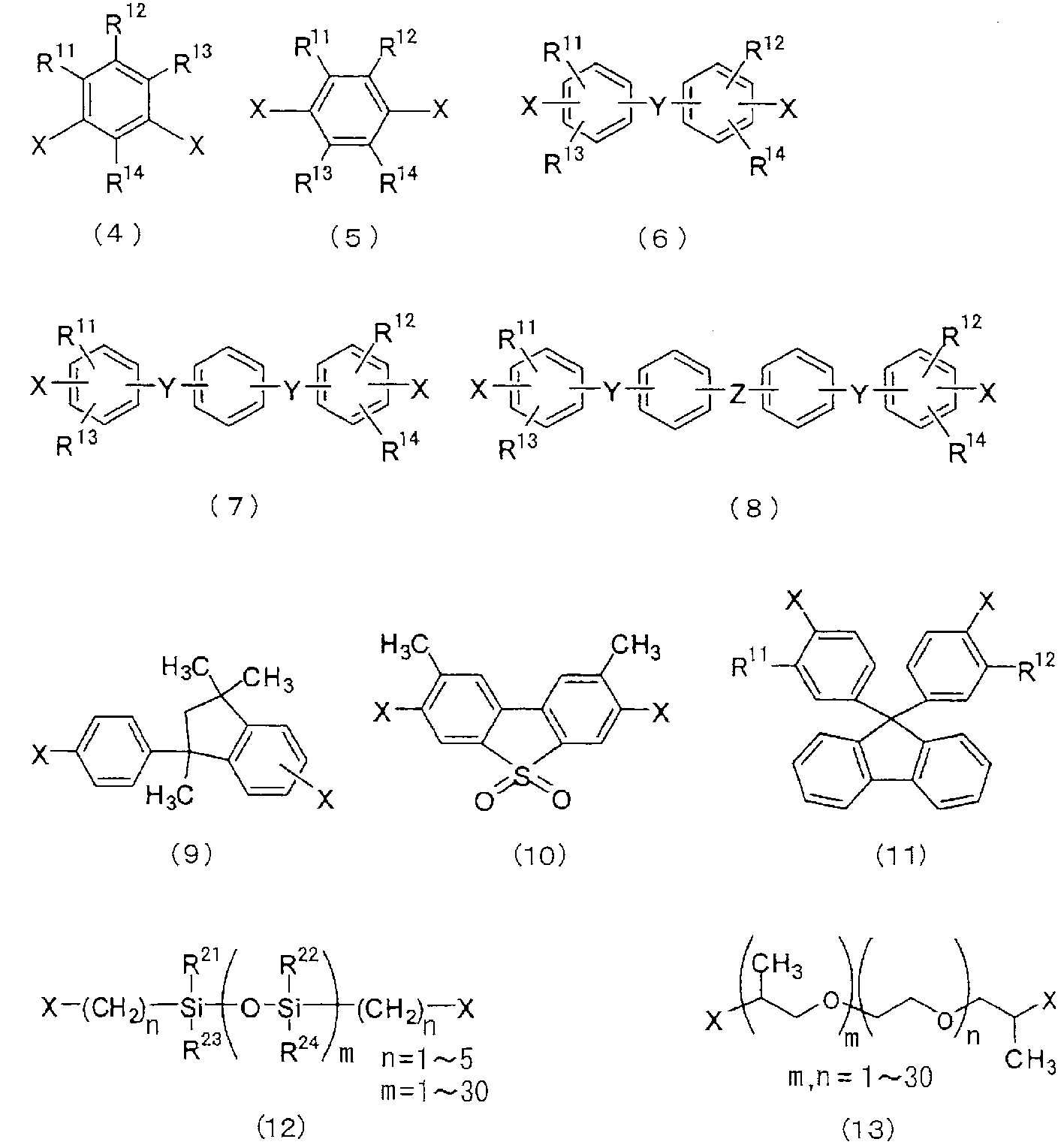
(식중, X는 아미노기 또는 이소시아네이트기이고, R11∼R14는, 각각 독립적으로 수소 원자, 탄소수 1∼4의 알킬기, 탄소수 2∼4의 알케닐기, 탄소수 1∼4의 알콕시기, 수산기, 카르복시기, 또는 트리플루오로메틸기이며, Y 및 Z는,(Wherein X is an amino group or an isocyanate group, and R 11 to R 14 each independently represent a hydrogen atom, an alkyl group having 1 to 4 carbon atoms, an alkenyl group having 2 to 4 carbon atoms, an alkoxy group having 1 to 4 carbon atoms, , Or a trifluoromethyl group, and Y and Z are,
[화 3][Figure 3]

R21∼R24는, 각각 독립적으로 탄소수 1∼4의 알킬기 또는페닐기이며, R31 및 R32는 각각 독립적으로 수소 원자, 탄소수 1∼4의 알킬기, 탄소수 2∼4의 알케닐기, 탄소수 1∼4의 알콕시기, 수산기, 카르복시기, 또는 트리플루오로메틸기임)으로 표시되는 군으로부터 선택되는 적어도 1종인 것이 바람직하다.R 21 to R 24 each independently represents an alkyl group having 1 to 4 carbon atoms or a phenyl group; R 31 and R 32 each independently represent a hydrogen atom, an alkyl group having 1 to 4 carbon atoms, an alkenyl group having 2 to 4 carbon atoms, An alkoxy group having 1 to 4 carbon atoms, a hydroxyl group, a carboxyl group, or a trifluoromethyl group).
본 발명의 폴리이미드 공중합체에 있어서는, (B) 성분은, 특히, 하기 일반식(1)∼일반식(3)In the polyimide copolymer of the present invention, the component (B) is preferably a compound represented by any one of the following general formulas (1) to (3)
[화 4][Figure 4]
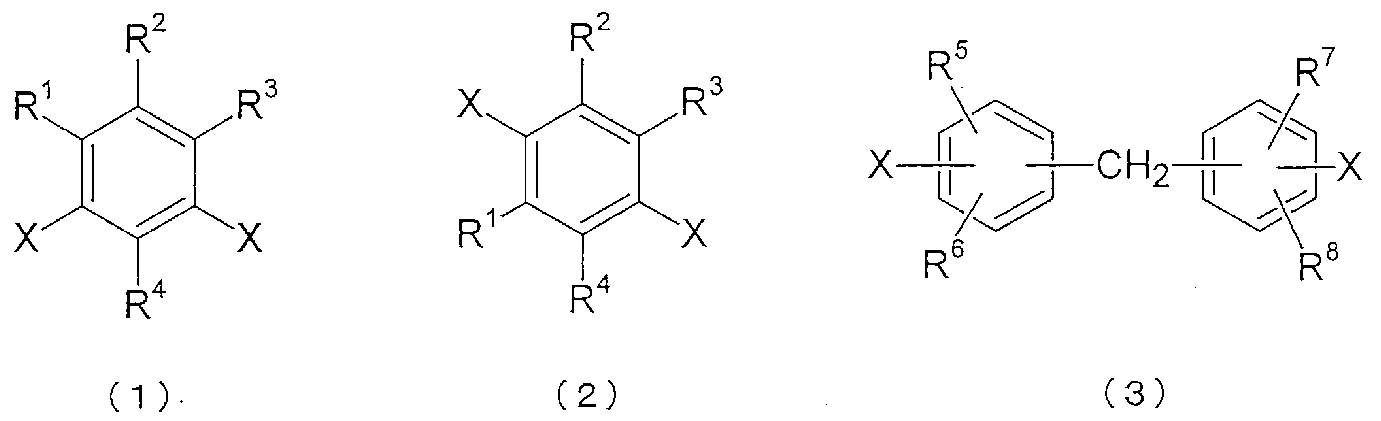
(식중, X는 아미노기 또는 이소시아네이트기이고, R1∼R8은, 각각 독립적으로 수소 원자, 탄소수 1∼4의 알킬기, 탄소수 2∼4의 알케닐기, 또는 탄소수 1∼4의 알콕시기이며, R1∼R8 중 적어도 1개는 수소 원자는 아님)으로 표시되는 1종 이상의 디아민 및/또는 디이소시아네이트인 것이 바람직하다. 이들 중에서도, 입수가 용이하며 저가이면서, 또한 본 발명의 효과를 양호하게 얻을 수 있는, 상기 일반식(1)∼일반식(2) 중의 R1∼R4 중 2개가 에틸기이며, 나머지 2개가 메틸기와 수소 원자인 디에틸톨루엔디아민(DETDA)이 바람직하다. 상기 일반식(3) 중의 R5∼R8은 메틸기 또는 에틸기인 것이 바람직하다.(Wherein X is an amino group or an isocyanate group, R 1 to R 8 each independently represent a hydrogen atom, an alkyl group having 1 to 4 carbon atoms, an alkenyl group having 2 to 4 carbon atoms, or an alkoxy group having 1 to 4 carbon atoms, R And at least one of R 1 to R 8 is not a hydrogen atom), and / or a diisocyanate. Of these, two of R 1 to R 4 in the general formulas (1) to (2), which are easily available, inexpensive, and can obtain satisfactory effects of the present invention, are an ethyl group and the remaining two are methyl groups And diethyltoluenediamine (DETDA) which is a hydrogen atom are preferable. R 5 to R 8 in the general formula (3) are preferably a methyl group or an ethyl group.
본 발명의 폴리이미드 공중합체를 공중합하는데 있어서는, 얻어지는 폴리이미드 공중합체가 상기 본 발명의 효과를 얻을 수 있다면, 산 이무수물로서, (A) 3,3',4,4'-비페닐테트라카르본산 이무수물 외에도, (C) 제2 산 이무수물을 더욱 공중합시킨 것이라도 된다. (C) 제2 산 이무수물로서는, 종래 폴리이미드의 제조에 사용되어 온 산 이무수물이면 특별히 제한은 없지만, 4,4'-옥시디프탈산 이무수물, 3,3',4,4'-디페닐술폰테트라카르본산 이무수물, 3,3',4,4'-벤조페논테트라카르본산 이무수물, 2,2'-비스[(디카르복시페녹시)페닐]프로판 이무수물, 에틸렌글리콜비스 무수 트리멜리트산 에스테르, 피로멜리트산 이무수물, 3,3',4,4'-비페닐테트라카르본산 이무수물을 바람직하게 사용할 수 있다. (C) 제2 산 이무수물로서는, 1종으로 사용할 수도 있지만, 2종 이상의 산 이무수물을 혼합하여 사용할 수도 있다. 그리고, (C) 제2 산 이무수물의 양은, (A) 성분 1 몰에 대하여 1.5 몰 이하가 바람직하다.In the copolymerization of the polyimide copolymer of the present invention, if the polyimide copolymer to be obtained can achieve the effects of the present invention, it is preferable to use, as the acid dianhydride, (A) 3,3 ', 4,4'-biphenyltetracar In addition to the main dianhydride, (C) a second acid dianhydride may be further copolymerized. The second acid dianhydride (C) is not particularly limited as long as it is an acid dianhydride conventionally used in the production of a polyimide, and examples thereof include 4,4'-oxydiphthalic dianhydride, 3,3 ', 4,4'-di Bis [(dicarboxyphenoxy) phenyl] propane dianhydride, ethylene glycol bis anhydride tri (meth) acrylate dianhydride, It is possible to preferably use melitic acid ester, pyromellitic acid dianhydride and 3,3 ', 4,4'-biphenyltetracarboxylic dianhydride. As the second acid dianhydride (C), one kind may be used, but two or more kinds of acid dianhydrides may be mixed and used. The amount of the second acid dianhydride (C) is preferably 1.5 mol or less based on 1 mol of the component (A).
본 발명의 폴리이미드 공중합체를 제조하는데 있어서는, (A) 성분과 (B) 성분을 공중합시키면 된다. 또한, (A) 성분과 (B) 성분을 공중합시키고, 먼저, 질량 평균 분자량 550∼16,000 정도의 폴리이미드 공중합체 올리고머를 제조하고, 얻어진 폴리이미드 공중합체 올리고머와, (C) 제2 산 이무수물이나 (D) 제2 디아민 및/또는 디이소시아네이트를 공중합시켜 제조할 수도 있다. 이 경우에, (D) 제2 디아민 및/또는 디이소시아네이트로서는, 상기 본 발명의 효과를 손상시키지 않는 범위이면, 통상, 폴리이미드 공중합체의 제조에 사용되는 것을 사용할 수 있고, 상기 (B) 성분과 동일한 것을 사용할 수도 있다. (D) 제2 디아민 및/또는 디이소시아네이트로서, 상기 (B) 성분과 상이한 것을 사용하는 경우에는, 그 양은, (B) 성분 1 몰에 대하여 2 몰 이하가 바람직하다.In the production of the polyimide copolymer of the present invention, the components (A) and (B) may be copolymerized. (A) and (B) are copolymerized to prepare a polyimide copolymer oligomer having a mass average molecular weight of about 550 to 16,000, and the resulting polyimide copolymer oligomer is reacted with (C) a second acid dianhydride Or (D) a second diamine and / or a diisocyanate. In this case, as the second diamine (D) and / or the diisocyanate, those generally used in the production of the polyimide copolymer can be used so long as the effect of the present invention is not impaired. May be used. (D) When the second diamine and / or diisocyanate is different from the component (B), the amount thereof is preferably 2 mol or less per 1 mol of the component (B).
본 발명의 폴리이미드 공중합체에 있어서는, 질량 평균 분자량은 20,000∼200,000이 바람직하고, 35,000∼150,000이 더욱 바람직하다. 폴리이미드 공중합체의 질량 평균 분자량이 상기 범위 외이면, 취급성이 악화된다. 또한, 본 발명의 폴리이미드 공중합체를 유기용매에 용해시키는 경우, 유기용매 중의 폴리이미드 공중합체의 농도에 대해서는 특별히 제한은 없지만, 예를 들면, 5∼35 질량% 정도로 할 수 있다. 폴리이미드 공중합체의 농도가 5 질량% 미만의 농도에서도 사용 가능하지만, 농도가 희박하면, 폴리이미드 공중합체 도포 등의 작업 효율이 악화된다. 한편, 35 질량%를 넘으면, 폴리이미드 공중합체의 유동성이 좋지 못하여, 도포 등이 곤란하게 되어, 이 또한 작업성이 악화된다.In the polyimide copolymer of the present invention, the mass average molecular weight is preferably 20,000 to 200,000, more preferably 35,000 to 150,000. If the mass average molecular weight of the polyimide copolymer is out of the above range, the handling property is deteriorated. When the polyimide copolymer of the present invention is dissolved in an organic solvent, the concentration of the polyimide copolymer in the organic solvent is not particularly limited, but may be, for example, about 5 to 35 mass%. Although the concentration of the polyimide copolymer can be used at a concentration of less than 5 mass%, if the concentration is low, the working efficiency such as application of the polyimide copolymer deteriorates. On the other hand, if it exceeds 35% by mass, the polyimide copolymer may have poor fluidity, which makes it difficult to apply, and the workability also deteriorates.
본 발명의 폴리이미드 공중합체는, 유기용매에 용해시킬 수 있지만, 이 유기용매로서는, 예를 들면, N-메틸-2-피롤리돈, N,N-디메틸아세트아미드, 술포란, N,N-디메틸포름아미드, N,N-디에틸아세트아미드, γ-부티로락톤, 알킬렌글리콜모노알킬에테르, 알킬렌글리콜디알킬에테르, 알킬카르비톨아세테이트, 벤조산 에스테르 등을 사용할 수 있다. 이들 유기용매는, 단독으로 사용할 수도 있고, 2종 이상을 혼합하여 사용할 수도 있다.The polyimide copolymer of the present invention can be dissolved in an organic solvent. Examples of the organic solvent include N-methyl-2-pyrrolidone, N, N-dimethylacetamide, sulfolane, N, N -Dimethylformamide, N, N-diethylacetamide,? -Butyrolactone, alkylene glycol monoalkyl ether, alkylene glycol dialkyl ether, alkylcarbitol acetate, benzoate and the like. These organic solvents may be used alone or in combination of two or more.
본 발명의 폴리이미드 공중합체를 사용하여 성형체를 제조하는 경우, 그 제조 방법에 대해서는, 특별히 제한은 없고, 기지(旣知)의 방법을 이용할 수 있다. 예를 들면, 기재(基材)의 표면에, 본 발명의 폴리이미드 공중합체를 도포한 후, 건조하여 용매를 증류 제거하고, 피막, 필름형 또는 시트형으로 성형하는 방법, 본 발명의 폴리이미드 공중합체를 금형 내에 주입한 후, 용매를 증류 제거하여 성형체로 만드는 방법 등이 있다.In the case of producing a molded article using the polyimide copolymer of the present invention, there is no particular limitation on the production method thereof, and a known method can be used. For example, a method in which the polyimide copolymer of the present invention is coated on the surface of a substrate, followed by drying to distill off the solvent to form a film, a film or a sheet, And injecting the coalesced body into a mold, and then removing the solvent by distillation to obtain a molded body.
본 발명의 폴리이미드 공중합체로부터, 피막, 필름 또는 시트를 형성하는 방법으로서는, 본 발명의 폴리이미드 공중합체를 그 점도 등에 따라, 스핀 코팅법, 디핑법, 스프레이법, 캐스팅법 등 공지의 방법으로 기재의 표면에 도포한 후, 건조하면 된다.As the method for forming the film, film or sheet from the polyimide copolymer of the present invention, the polyimide copolymer of the present invention can be produced by a known method such as spin coating, dipping, spraying, It may be applied to the surface of the substrate and then dried.
기재로서는 최종 제품의 용도에 따라 임의의 것을 사용하면 된다. 예를 들면, 천 등의 섬유 제품, 유리, 폴리에틸렌테레프탈레이트, 폴리에틸렌나프탈레이트, 폴리에틸렌, 폴리카보네이트, 트리아세틸셀룰로오스, 셀로판, 폴리이미드, 폴리아미드, 폴리페닐렌술피드, 폴리에테르이미드, 폴리에테르술폰, 방향족 폴리아미드, 또는 폴리술폰 등의 합성 수지, 금속, 세라믹, 종이 등의 재질을 사용할 수 있다. 그리고, 기재는 투명할 수도 있고, 이것을 구성하는 재질에 각종 안료나 염료를 배합하여 착색한 것일 수도 있고, 기재 표면에 각종 안료나 염료를 배합한 수지를 코팅한 것일 수도 있다. 또한 표면이 샌드 블라스트(sand blast) 등의 물리적 에칭 또는 약액에 의한 화학적 에칭, 필러(filler)를 함유하는 수지를 도포함으로써 요철(凹凸)을 형성하는 등의 매트 가공(matt finishing)이 행해져 있어도 되고, 플라즈마 처리나 코로나 처리, 프라이머(primer) 도포 등에 의해 이접착층(易接着層)을 형성한 것이라도 된다.An arbitrary substrate may be used depending on the use of the final product. For example, it is possible to use fibers such as cloth, glass, polyethylene terephthalate, polyethylene naphthalate, polyethylene, polycarbonate, triacetylcellulose, cellophane, polyimide, polyamide, polyphenylene sulfide, polyetherimide, Aromatic polyamide, or synthetic resin such as polysulfone, metal, ceramic, paper, or the like. The substrate may be transparent or may be colored by mixing various pigments or dyes with the material constituting the substrate, or may be coated with a resin in which various pigments or dyes are blended on the surface of the substrate. The surface may also be subjected to matt finishing such as physical etching such as sand blast or chemical etching with a chemical liquid or application of a resin containing a filler to form irregularities (Adhesive layer) may be formed by plasma treatment, corona treatment, primer application, or the like.
도포한 본 발명의 폴리이미드 공중합체의 건조에는, 통상의 가열 건조로를 사용하면 된다. 건조로 중의 분위기로서는, 대기, 불활성 가스(질소, 아르곤) 등을 예로 들 수 있다. 건조 온도로서는, 본 발명의 폴리이미드 공중합체를 용해시킨 용매의 비점(沸点)에 따라 적절하게 선택 가능하지만, 통상은 80∼350 ℃, 바람직하게는 100∼320 ℃, 특히 바람직하게는 120∼250 ℃로 하면 된다. 건조 시간은, 두께, 농도, 용매의 종류에 따라 적절하게 선택하면 되며, 1초∼360분 정도로 하면 된다.For drying the applied polyimide copolymer of the present invention, a usual heating drying furnace may be used. Examples of the atmosphere in the drying furnace include an atmosphere, an inert gas (nitrogen, argon), and the like. The drying temperature may be appropriately selected depending on the boiling point of the solvent in which the polyimide copolymer of the present invention is dissolved, but is usually 80 to 350 占 폚, preferably 100 to 320 占 폚, particularly preferably 120 to 250 占 폚 Deg.] C. The drying time may be appropriately selected depending on the thickness, concentration, and type of solvent, and may be set to about 1 second to about 360 minutes.
건조 후에는, 그대로, 본 발명의 폴리이미드 공중합체를 피막으로서 가지는 제품을 얻을 수 있고, 그 외에도 피막을 기재로부터 분리함으로써 필름으로서 얻을 수 있다.After drying, a product having the polyimide copolymer of the present invention as a film can be obtained as such, and the film can be obtained as a film by separating the film from the substrate.
본 발명의 폴리이미드 공중합체를 사용하여 성형품을 제조하는 경우에는, 실리카, 알루미나, 운모 등의 충전재나, 탄소 가루, 안료, 염료, 중합 금지제, 증점제, 틱소트로피제, 침전 방지제, 산화 방지제, 분산제, pH 조정제, 계면활성제, 각종 유기용매, 각종 수지 등을 첨가할 수 있다.In the case of producing a molded article using the polyimide copolymer of the present invention, a filler such as silica, alumina, mica, or the like, a filler such as carbon powder, pigment, dye, polymerization inhibitor, thickener, thixotropic agent, A dispersant, a pH adjuster, a surfactant, various organic solvents, various resins, and the like.
또한, 금형을 사용하여 성형체를 얻는 경우, 소정량의 본 발명의 폴리이미드 공중합체를 금형 내(특히 회전 금형이 바람직함)에 주입한 후, 필름 등의 성형 조건과 동일한 온도, 시간으로 건조함으로써 성형체를 얻을 수 있다.When a molded article is obtained by using a mold, a predetermined amount of the polyimide copolymer of the present invention is injected into a mold (particularly, a rotary mold is preferably used), and then dried at the same temperature and time as the molding conditions of the film or the like A molded article can be obtained.
본 발명의 폴리이미드 공중합체는 내열성이 우수하므로, 내열성을 필요로 하는 코팅제, 접착제, 전선 등의 절연 피복재, 잉크, 도료, 층간 절연막, 초박막 필름 등에 유용하다.The polyimide copolymer of the present invention is excellent in heat resistance, and therefore is useful for coatings, adhesives, insulation coating materials such as wires, inks, paints, interlayer insulating films, ultra thin films and the like which require heat resistance.
다음으로, 본 발명의 용매 가용형 폴리이미드 공중합체의 제조 방법에 대하여 설명한다. 폴리이미드 공중합체를 얻기 위해서는, 열적(熱的)으로 탈수 폐환하는 열이미드화법, 탈수제를 사용하는 화학 이미드화법의 어느 방법을 사용해도 되며, 이하에서, 열이미드화법, 화학 이미드화법의 순서로 상세하게 설명한다.Next, a method for producing the solvent-soluble polyimide copolymer of the present invention will be described. In order to obtain the polyimide copolymer, any of the thermal imidation method in which thermal dehydration cyclization is carried out and the chemical imidization method in which a dehydrating agent is used may be used. Hereinafter, the thermal imidation method, the chemical imidization method Will be described in detail.
<열이미드화법>≪ Heat modulation method &
본 발명의 폴리이미드 공중합체는, 상기 (A) 성분과 (B) 성분을 공중합시킴으로써 얻을 수 있지만, 전술한 바와 같이, 본 발명의 폴리이미드 공중합체를 제조하는데 있어서는, 상기 본 발명의 효과를 손상시키지 않는 범위에서, (A) 성분 이외의 산 이무수물로서 (C) 제2 산 이무수물을 첨가할 수도 있다.The polyimide copolymer of the present invention can be obtained by copolymerizing the above components (A) and (B). However, as described above, in producing the polyimide copolymer of the present invention, , A second acid dianhydride (C) may also be added as an acid dianhydride other than the component (A).
본 발명의 폴리이미드 공중합체의 제조 시에서의 중합 온도 및 중합 시간은, 바람직하게는 150∼200 ℃에서 60∼600 분간이다. 중합 온도가 200℃를 넘으면 용매나 미반응 원재료의 산화, 용매의 휘발에 따른 수지 농도의 상승이 발생하기 때문에, 바람직하지 않다. 한편, 150℃ 미만이면, 이미드화 반응이 진행하지 않거나 완료하지 않을 우려가 있어, 이 또한 바람직하지 않다.The polymerization temperature and the polymerization time in the production of the polyimide copolymer of the present invention are preferably from 150 to 200 占 폚 for 60 to 600 minutes. When the polymerization temperature exceeds 200 캜, oxidation of the solvent or unreacted raw material and increase of the resin concentration due to volatilization of the solvent occur, which is not preferable. On the other hand, if it is less than 150 캜, the imidization reaction may not proceed or may not be completed, which is also undesirable.
본 발명의 폴리이미드 공중합체를 제조하는데 있어서, 공중합은 유기용매 내에서 행해지지만, 그 때 사용되는 유기용매에 대해서는, 특별히 제한은 없다. 예를 들면, N-메틸-2-피롤리돈, N,N-디메틸아세트아미드, 술포란, N,N-디메틸포름아미드, N,N-디에틸아세트아미드 등, γ-부티로락톤, 알킬렌글리콜모노알킬에테르, 알킬렌글리콜디알킬에테르, 알킬카르비톨아세테이트, 벤조산 에스테르를 바람직하게 사용할 수 있다. 이들 유기용매는, 단독으로 사용할 수도 있고, 2종 이상을 혼합하여 사용할 수도 있다.In the production of the polyimide copolymer of the present invention, copolymerization is carried out in an organic solvent, but there is no particular limitation on the organic solvent used at that time. Examples of the solvent include N-methyl-2-pyrrolidone, N, N-dimethylacetamide, sulfolane, N, N-dimethylformamide, N, N-diethylacetamide, Alkylene glycol dialkyl ether, alkylcarbitol acetate, and benzoic acid ester can be preferably used. These organic solvents may be used alone or in combination of two or more.
또한, 본 발명의 폴리이미드 공중합체의 제조에 있어서는, 공지의 이미드화 촉매를 사용할 수 있다. 예를 들면, 이미드화 촉매로서는, 통상, 피리딘을 사용하면 되지만, 그 외에도, 치환 또는 비치환의 질소 함유 복소환 화합물, 질소 함유 복소환 화합물의 N-옥시드 화합물, 치환 또는 비치환의 아미노산 화합물, 하이드록실기를 가지는 방향족 탄화수소 화합물 또는 방향족 복소환상 화합물이 있고, 특히 1,2-디메틸이미다졸, N-메틸이미다졸, N-벤질-2-메틸이미다졸, 2-메틸이미다졸, 2-에틸-4-메틸이미다졸, 5-메틸벤즈이미다졸 등의 저급 알킬 이미다졸, N-벤질-2-메틸이미다졸 등의 이미다졸 유도체, 이소퀴놀린, 3,5-디메틸피리딘, 3,4-디메틸피리딘, 2,5-디메틸피리딘, 2,4-디메틸피리딘, 4-n-프로필피리딘 등의 치환 피리딘, p-톨루엔술폰산 등을 바람직하게 사용할 수 있다. 이미드화 촉매의 사용량은, 폴리아미드산의 아미드산 단위에 대하여 0.01∼2 배 당량, 특히 0.02∼1 배 당량 정도인 것이 바람직하다. 이미드화 촉매를 사용하는 것에 의해, 얻어지는 폴리이미드의 물성, 특히 신장이나 파단 저항이 향상되는 경우가 있다.In the production of the polyimide copolymer of the present invention, a known imidization catalyst may be used. For example, as the imidization catalyst, pyridine may be generally used. However, it is also possible to use a substituted or unsubstituted nitrogen-containing heterocyclic compound, an N-oxide compound of a nitrogen-containing heterocyclic compound, a substituted or unsubstituted amino acid compound, An aromatic hydrocarbon compound or an aromatic heterocyclic compound having a phenyl group, a phenyl group, a naphthyl group, a naphthyl group, a naphthyl group, a naphthyl group, a naphthyl group, Lower alkyl imidazoles such as 2-ethyl-4-methyl imidazole and 5-methylbenzimidazole, imidazole derivatives such as N-benzyl-2-methyl imidazole, isoquinoline, 3,5-dimethylpyridine, Substituted pyridines such as 3,4-dimethylpyridine, 2,5-dimethylpyridine, 2,4-dimethylpyridine and 4-n-propylpyridine, and p-toluenesulfonic acid. The amount of the imidation catalyst to be used is preferably about 0.01 to 2 times, more preferably about 0.02 to 1 times, equivalent to the amide acid unit of the polyamic acid. By using an imidation catalyst, physical properties, particularly elongation and fracture resistance of the obtained polyimide may be improved.
또한, 본 발명의 폴리이미드 공중합체의 제조에 있어서는, 이미드화 반응에 의해 생성되는 물을 효율적으로 제거하기 위하여, 유기용매에 공비(共沸) 용매를 가할 수 있다. 공비 용매로서는, 톨루엔, 크실렌, 솔벤트 나프타 등의 방향족 탄화수소나, 시클로헥산, 메틸시클로헥산, 디메틸시클로헥산 등의 지환족 탄화수소 등을 사용할 수 있다. 공비 용매를 사용하는 경우에는, 그 첨가량은, 전체 유기용매량 중의 1∼30 질량% 정도, 바람직하게는 5∼20 질량%이다.Further, in the production of the polyimide copolymer of the present invention, an azeotropic solvent may be added to the organic solvent in order to efficiently remove the water generated by the imidization reaction. As the azeotropic solvent, aromatic hydrocarbons such as toluene, xylene and solvent naphtha, and alicyclic hydrocarbons such as cyclohexane, methylcyclohexane, and dimethylcyclohexane can be used. When an azeotropic solvent is used, the amount of the azeotropic solvent to be added is about 1 to 30 mass%, preferably 5 to 20 mass%, based on the total amount of the organic solvent.
<화학 이미드화법>≪ Chemical imidization method &
본 발명의 폴리이미드 공중합체를 화학 이미드화법에 의해 제조하는 경우, 상기 (A) 성분과 상기 (B) 성분을 공중합시키는 공중합체 제조 공정에 있어서, 예를 들면, 유기용매 중, 무수 아세트산 등의 탈수제와, 트리에틸아민, 피리딘, 피콜린 또는 퀴놀린 등의 촉매를, 폴리아미드산 용액에 첨가한 후, 열이미드화법과 동일한 조작을 행한다. 이로써, 본 발명의 폴리이미드 공중합체를 얻을 수 있다. 본 발명의 폴리이미드 공중합체를 화학 이미드화법에 의해 제조하는 경우에서의 중합 온도 및 중합 시간은, 바람직하게는 통상 상온으로부터 150℃ 정도의 온도 범위에서 1∼200 시간이다.In the case of producing the polyimide copolymer of the present invention by a chemical imidization method, in the step of copolymerizing the component (A) and the component (B), for example, in an organic solvent, acetic anhydride And a catalyst such as triethylamine, pyridine, picoline or quinoline are added to the polyamic acid solution, and then the same operation as in the heat imidation method is carried out. As a result, the polyimide copolymer of the present invention can be obtained. The polymerization temperature and the polymerization time in the case of producing the polyimide copolymer of the present invention by the chemical imidization method are preferably from 1 to 200 hours in the temperature range usually from room temperature to about 150 캜.
본 발명의 폴리이미드 공중합체를 제조하는데 있어서, 탈수제가 사용되지만, 유기산 무수물, 예를 들면, 지방족 산무수물, 방향족 산무수물, 지환식 산무수물, 복소환 식 산무수물, 또는 이들의 2종 이상의 혼합물을 사용할 수 있다. 이 유기산 무수물의 구체예로서는, 예를 들면, 무수 아세트산 등이 있다.In producing the polyimide copolymer of the present invention, a dehydrating agent is used, but an organic acid anhydride such as an aliphatic acid anhydride, an aromatic acid anhydride, an alicyclic acid anhydride, a heterocyclic acid anhydride, or a mixture of two or more thereof Can be used. Specific examples of the organic acid anhydride include, for example, acetic anhydride.
본 발명의 폴리이미드 공중합체의 제조에 있어서는, 이미드화 촉매, 유기용매를 사용하지만, 열이미드화법과 동일한 것을 사용할 수 있다.In the production of the polyimide copolymer of the present invention, an imidization catalyst and an organic solvent are used, but the same thermal imidation method can be used.
<폴리이미드 공중합체의 제조>≪ Preparation of polyimide copolymer &
본 발명의 폴리이미드 공중합체의 제조에 있어서는, 중합 방법은 공지의 어느 방법이라도 되고, 특별히 한정되는 것은 아니다. 예를 들면, (A) 성분 전량을 유기용매 중에 넣고, 그 후, (B) 성분을 (A) 성분을 용해시킨 유기용매에 가하여 중합하는 방법이라도 되고, 또한, 먼저 (B) 성분 전량을 유기용매 중에 넣고, 그 후, (A) 성분을 용해시킨 유기용매에 가하여 중합하는 방법이라도 된다.In the production of the polyimide copolymer of the present invention, the polymerization method may be any known method and is not particularly limited. For example, a method may be employed in which the whole amount of the component (A) is put into an organic solvent and then the component (B) is added to an organic solvent having the component (A) dissolved therein. And then the resulting mixture is added to an organic solvent in which the component (A) is dissolved, followed by polymerization.
본 발명의 폴리이미드 공중합체의 제조에 있어서는, (A) 성분과 (B) 성분을 공중합시켜 폴리이미드 공중합체 올리고머를 제조하고, 얻어진 폴리이미드 공중합체 올리고머를 사용하여 폴리이미드 공중합체를 제조하는 경우, 전술한 바와 같이, (C) 제2 산 이무수물과 함께, (D) 제2 디아민 및/또는 디이소시아네이트를 폴리이미드 공중합체 올리고머와 공중합시켜도 된다. (C) 제2 산 이무수물, (D) 제2 디아민 및/또는 디이소시아네이트로서는, 전술한 것을 사용할 수 있다.In the production of the polyimide copolymer of the present invention, when the polyimide copolymer oligomer is prepared by copolymerizing the component (A) and the component (B) to prepare a polyimide copolymer using the obtained polyimide copolymer oligomer , (D) a second diamine and / or a diisocyanate may be copolymerized with a polyimide copolymer oligomer together with (C) a second acid dianhydride, as described above. (C) a second acid dianhydride, and (D) a second diamine and / or a diisocyanate.
상기 폴리이미드 공중합체 올리고머를 제조할 때 사용하는 유기용매, 촉매, 공비 용매 및 탈수제로서는, 각각의 이미드화의 방법에 기초하여 상기 본 발명의 폴리이미드 공중합체의 제조에 사용하는 유기용매, 촉매, 공비 용매 및 탈수제를 적절하게 선택하여 사용할 수 있다.Examples of the organic solvent, catalyst, azeotropic solvent and dehydrating agent used in the production of the polyimide copolymer oligomer include organic solvents, catalysts, and catalysts used in the production of the polyimide copolymer of the present invention, An azeotropic solvent and a dehydrating agent can be appropriately selected and used.
상기 폴리이미드 공중합체 올리고머를 제조하는 데 있어서는, 열이미드화법의 경우, 중합 온도는, 150∼200 ℃이다. 이는, 중합 온도가 150℃ 미만이면, 이미드화가 진행하지 않거나 완료하지 않는 경우가 있기 때문이며, 한편, 200℃를 넘으면, 용매나 미반응 원재료의 산화, 용매의 휘발에 의한 수지 농도의 상승이 발생하기 때문이다. 바람직하게는 160∼195 ℃이다.In the production of the polyimide copolymer oligomer, in the case of the thermal imidation method, the polymerization temperature is 150 to 200 ° C. If the polymerization temperature is lower than 150 캜, the imidization may not proceed or may not be completed. On the other hand, when the temperature exceeds 200 캜, an increase in the resin concentration due to oxidation of the solvent or unreacted raw material and volatilization of the solvent . Preferably 160 to 195 ° C.
실시예Example
이하, 본 발명을, 실시예를 사용하여 더욱 상세하게 설명한다.Hereinafter, the present invention will be described in more detail with reference to examples.
<실시예 1>≪ Example 1 >
스테인레스스틸제 앵커형(anchor-shaped) 교반기, 질소 도입관, 딘·스타크(Dean-stark) 장치를 장착한 500 mL의 세퍼러블 4구 플라스크에 BPDA 66.52 g(0.225 몰), DETDA 32.09 g(0.18 몰), N-메틸-2-피롤리돈(NMP) 100 g, 피리딘 3.56 g, 톨루엔 50 g을 투입하고, 반응계 내를 질소 치환하였다. 질소 기류 하 80℃에서 30분간 교반함으로써 BPDA를 용해시키고, 그 후 180℃까지 승온(昇溫)하고 2시간 가열 교반하였다. 반응에 의해 생성된 물은, 톨루엔과의 공비에 의해 반응계 외로 증류 제거했다.In a 500 mL separable four-necked flask equipped with a stainless steel anchor-shaped stirrer, a nitrogen inlet tube and a Dean-stark apparatus, 66.52 g (0.225 mol) of BPDA, 32.09 g Mol), 100 g of N-methyl-2-pyrrolidone (NMP), 3.56 g of pyridine and 50 g of toluene were charged and the inside of the reaction system was replaced with nitrogen. The mixture was stirred at 80 캜 for 30 minutes in a nitrogen stream to dissolve BPDA, and then heated to 180 캜 and stirred with heating for 2 hours. The water produced by the reaction was distilled off from the reaction system by azeotropic distillation with toluene.
다음으로, 120℃까지 냉각시키고, pDADE 9.01 g(0.045 몰), NMP 84.22 g을 가하고 5분간 교반한 후에 180℃까지 승온하고, 가열 교반하면서 6시간 반응을 행했다. 반응 중에 생성되는 물은 톨루엔, 피리딘과의 공비 혼합물로서 반응계 외로 제거했다. 반응 종료 후, 120℃까지 냉각한 후 NMP 212.56 g을 첨가함으로써, 20 질량% 농도의 폴리이미드 용액을 얻었다. 얻어진 폴리이미드 공중합체의 구조는, 하기의 식(14)과 같다.Next, the mixture was cooled to 120 deg. C, 9.01 g (0.045 mol) of pDADE and 84.22 g of NMP were added. After stirring for 5 minutes, the mixture was heated to 180 DEG C and reacted for 6 hours while heating and stirring. Water produced during the reaction was removed from the reaction system as an azeotropic mixture with toluene and pyridine. After completion of the reaction, the mixture was cooled to 120 ° C and 212.56 g of NMP was added to obtain a polyimide solution having a concentration of 20 mass%. The structure of the obtained polyimide copolymer is shown in the following formula (14).
[화 5][Figure 5]

(식중 R은, 메틸기 또는 에틸기이다)(Wherein R is a methyl group or an ethyl group)
<실시예 2>≪ Example 2 >
실시예 1과 동일한 장치에 BPDA 41.49 g(0.141 몰), DETDA 33.52 g(0.188 몰), NMP 84.89 g, 피리딘 3.72 g, 톨루엔 50 g을 투입하고, 반응계 내를 질소 치환하였다. 질소 기류 하 80℃에서 30분간 교반함으로써 BPDA를 용해시키고, 그 후 180℃까지 승온 하고 2시간 가열 교반하였다. 반응에 의해 생성된 물은, 톨루엔과의 공비에 의해 반응계 외로 증류 제거했다.41.49 g (0.141 mol) of BPDA, 33.52 g (0.188 mol) of DETDA, 84.89 g of NMP, 3.72 g of pyridine and 50 g of toluene were fed into the same apparatus as in Example 1 and the inside of the reaction system was replaced with nitrogen. The mixture was stirred at 80 占 폚 for 30 minutes in a nitrogen stream to dissolve BPDA, then heated to 180 占 폚 and stirred with heating for 2 hours. The water produced by the reaction was distilled off from the reaction system by azeotropic distillation with toluene.
다음으로, 130℃까지 냉각시키고, 1-(4-아미노페닐)-1,3,3-트리메틸-1H-인덴-5(또는 6)-아민(TMDA) 12.52 g(0.047 몰), NMP 50g을 가하고 5분간 교반한 후에 PMDA 20.74 g(0.094 몰), NMP 50g을 가하고 180℃까지 승온하고, 가열 교반하면서 6시간 반응을 행했다. 반응 중에 생성되는 물은 톨루엔, 피리딘과의 공비 혼합물로서 반응계 외로 제거했다. 반응 종료 후, 120℃까지 냉각한 후 NMP 113.78 g을 첨가함으로써, 25 질량% 농도의 폴리이미드 용액을 얻었다. 얻어진 폴리이미드 공중합체의 구조는, 하기의 식(15)과 같다.Next, the mixture was cooled to 130 占 폚, and 12.52 g (0.047 mol) of 1- (4-aminophenyl) -1,3,3-trimethyl-1H-inden-5 (or 6) After stirring for 5 minutes, 20.74 g (0.094 mol) of PMDA and 50 g of NMP were added and the temperature was raised to 180 ° C and the reaction was carried out for 6 hours while heating and stirring. Water produced during the reaction was removed from the reaction system as an azeotropic mixture with toluene and pyridine. After the completion of the reaction, the solution was cooled to 120 캜 and 113.78 g of NMP was added to obtain a polyimide solution having a concentration of 25 mass%. The structure of the obtained polyimide copolymer is shown in the following formula (15).
[화 6][6]

(식중 R은, 메틸기 또는 에틸기이다)(Wherein R is a methyl group or an ethyl group)
<실시예 3>≪ Example 3 >
실시예 1과 동일한 장치에 BPDA 40.60 g(0.138 몰), DETDA 16.40 g(0.092 몰), NMP 83.69 g, 피리딘 2.91 g, 톨루엔 50 g을 투입하고, 반응계 내를 질소 치환하였다. 질소 기류 하 80℃에서 30분간 교반함으로써 BPDA를 용해시키고, 그 후 180℃까지 승온 하고 2시간 가열 교반하였다. 반응에 의해 생성된 물은, 톨루엔과의 공비에 의해 반응계 외로 증류 제거했다.In the same apparatus as in Example 1, 40.60 g (0.138 mol) of BPDA, 16.40 g (0.092 mol) of DETDA, 83.69 g of NMP, 2.91 g of pyridine and 50 g of toluene were charged and the inside of the reaction system was replaced with nitrogen. The mixture was stirred at 80 占 폚 for 30 minutes in a nitrogen stream to dissolve BPDA, then heated to 180 占 폚 and stirred with heating for 2 hours. The water produced by the reaction was distilled off from the reaction system by azeotropic distillation with toluene.
다음으로, 130℃까지 냉각시키고, 9,9-비스(4-아미노페닐)플루오렌(FDA) 32.06 g(0.092 몰), NMP 60g을 가하고 5분간 교반한 후에 3,3',4,4'-디페닐술폰테트라카르본산 이무수물(DSDA) 16.86 g(0.046 몰), NMP 40g을 가하고 180℃까지 승온하고, 가열 교반하면서 6시간 반응을 행했다. 반응 중에 생성되는 물은 톨루엔, 피리딘과의 공비 혼합물로서 반응계 외로 제거했다. 반응 종료 후, 120℃까지 냉각한 후 NMP 113.04 g을 첨가함으로써, 25 질량% 농도의 폴리이미드 용액을 얻었다. 얻어진 폴리이미드 공중합체의 구조는, 하기의 식(16)과 같다.Next, 32.06 g (0.092 mol) of 9,9-bis (4-aminophenyl) fluorene (FDA) and 60 g of NMP were added to the mixture and the mixture was stirred for 5 minutes. (0.046 mol) of diphenylsulfone tetracarboxylic dianhydride (DSDA) and 40 g of NMP were added, and the temperature was raised to 180 ° C, and the reaction was carried out for 6 hours while heating and stirring. Water produced during the reaction was removed from the reaction system as an azeotropic mixture with toluene and pyridine. After completion of the reaction, the solution was cooled to 120 캜 and 113.04 g of NMP was added to obtain a polyimide solution having a concentration of 25% by mass. The structure of the obtained polyimide copolymer is shown in the following formula (16).
[화 7][Figure 7]

(식중 R은, 메틸기 또는 에틸기이다)(Wherein R is a methyl group or an ethyl group)
<실시예 4><Example 4>
실시예 1과 동일한 장치에 BPDA 36.19 g(0.123 몰), 4,4'-메틸렌비스(2,6-디에틸아닐린)(M-DEA) 25.46 g(0.082 몰), NMP 83.86 g, 피리딘 2.60 g, 톨루엔 50 g을 투입하고, 반응계 내를 질소 치환하였다. 질소 기류 하 80℃에서 30분간 교반함으로써 BPDA를 용해시키고, 그 후 180℃까지 승온하고 2시간 가열 교반하였다. 반응에 의해 생성된 물은, 톨루엔과의 공비에 의해 반응계 외로 증류 제거했다.(0.123 mol) of BPDA, 25.46 g (0.082 mol) of 4,4'-methylene bis (2,6-diethylaniline) (M-DEA), 83.86 g of NMP and 2.60 g And 50 g of toluene, and the inside of the reaction system was replaced with nitrogen. The mixture was stirred at 80 占 폚 for 30 minutes in a nitrogen stream to dissolve BPDA, then heated to 180 占 폚 and stirred with heating for 2 hours. The water produced by the reaction was distilled off from the reaction system by azeotropic distillation with toluene.
다음으로, 130℃까지 냉각시키고, FDA 28.57 g(0.082 몰), NMP 60g을 가하고 5분간 교반한 후에 DSDA 15.07 g(0.041 몰), NMP 40g을 가하고 180℃까지 승온하고, 가열 교반하면서 6시간 반응을 행했다. 반응 중에 생성되는 물은 톨루엔, 피리딘과의 공비 혼합물로서 반응계 외로 제거했다. 반응 종료 후, 120℃까지 냉각한 후 NMP 113.04 g을 첨가함으로써, 25 질량% 농도의 폴리이미드 용액을 얻었다. 얻어진 폴리이미드 공중합체의 구조는, 하기의 식(17)과 같다.Then, 28.57 g (0.082 mol) of FDA and 60 g of NMP were added and stirred for 5 minutes. Then, 15.07 g (0.041 mol) of DSDA and 40 g of NMP were added and the temperature was raised to 180 ° C. . Water produced during the reaction was removed from the reaction system as an azeotropic mixture with toluene and pyridine. After completion of the reaction, the solution was cooled to 120 캜 and 113.04 g of NMP was added to obtain a polyimide solution having a concentration of 25% by mass. The structure of the obtained polyimide copolymer is shown in the following formula (17).
[화 8][Figure 8]

<실시예 5>≪ Example 5 >
실시예 1과 동일한 장치에 BPDA 35.31 g(0.12 몰), DETDA 21.39 g(0.12 몰), NMP 209.50 g, 피리딘 1.90 g, 톨루엔 50 g을 투입하고, 반응계 내를 질소 치환하였다. 질소 기류 하 80℃에서 30분간 교반함으로써 BPDA를 용해시키고, 그 후 180℃까지 승온하고 6시간 가열 교반하였다. 반응 중에 생성되는 물은 톨루엔, 피리딘과의 공비 혼합물로서 반응계 외로 제거했다. 반응 종료 후, 120℃까지 냉각시켜, 20 질량% 농도의 폴리이미드 용액을 얻었다. 얻어진 폴리이미드 공중합체의 구조는, 하기의 식(18)과 같다.Into the same apparatus as in Example 1, 35.31 g (0.12 mol) of BPDA, 21.39 g (0.12 mol) of DETDA, 209.50 g of NMP, 1.90 g of pyridine and 50 g of toluene were charged and the inside of the reaction system was replaced with nitrogen. The mixture was stirred at 80 캜 for 30 minutes in a nitrogen stream to dissolve BPDA, and then heated to 180 캜 and heated and stirred for 6 hours. Water produced during the reaction was removed from the reaction system as an azeotropic mixture with toluene and pyridine. After completion of the reaction, the reaction solution was cooled to 120 deg. C to obtain a polyimide solution having a concentration of 20 mass%. The structure of the obtained polyimide copolymer is shown in the following formula (18).
[화 9][Figure 9]

(식중 R은, 메틸기 또는 에틸기이다)(Wherein R is a methyl group or an ethyl group)
<실시예 6>≪ Example 6 >
실시예 1과 동일한 장치에 BPDA 47.08 g(0.16 몰), PMDA 17.68 g(0.08 몰), DETDA 42.79 g(0.24 몰), NMP 183.23 g, 피리딘 3.8 g, 톨루엔 50 g을 투입하고, 반응계 내를 질소 치환하였다. 질소 기류 하 80℃에서 30분간 교반함으로써 BPDA와 PMDA를 용해시키고, 그 후 180℃까지 승온하고 6시간 가열 교반하였다. 반응 중에 생성되는 물은 톨루엔, 피리딘과의 공비 혼합물로서 반응계 외로 제거했다. 반응 종료 후, 120℃까지 냉각한 후 NMP 112.76 g을 첨가함으로써, 25 질량% 농도의 폴리이미드 용액을 얻었다. 얻어진 폴리이미드 공중합체의 구조는, 하기의 식(19)과 같다.47.08 g (0.16 mol) of BPDA, 17.68 g (0.08 mol) of PMDA, 42.79 g (0.24 mol) of DETDA, 183.23 g of NMP, 3.8 g of pyridine and 50 g of toluene were fed into the same apparatus as in Example 1, . The mixture was stirred at 80 캜 for 30 minutes in a nitrogen gas stream to dissolve BPDA and PMDA, and then heated to 180 캜 and stirred with heating for 6 hours. Water produced during the reaction was removed from the reaction system as an azeotropic mixture with toluene and pyridine. After the completion of the reaction, the mixture was cooled to 120 캜 and 112.76 g of NMP was added to obtain a polyimide solution having a concentration of 25 mass%. The structure of the obtained polyimide copolymer is shown in the following formula (19).
[화 10][10]

(식중 R은, 메틸기 또는 에틸기이다)(Wherein R is a methyl group or an ethyl group)
<비교예 1>≪ Comparative Example 1 &
실시예 1과 동일한 장치에 DSDA 46.58 g(0.13 몰), 비스[4-(4-아미노페녹시)페닐]술폰(pBAPS) 56.22 g(0.13 몰), NMP 182.22 g, 피리딘 2.06 g, 톨루엔 50 g을 투입하고, 반응계 내를 질소 치환하였다. 질소 기류 하 80℃에서 30분간 교반함으로써 PMDA를 용해시키고, 그 후 180℃까지 승온하고 6시간 가열 교반하였다. 반응 중에 생성되는 물은 톨루엔, 피리딘과의 공비 혼합물로서 반응계 외로 제거했다. 반응 종료 후, 120℃까지 냉각한 후 NMP 112.13 g을 첨가함으로써, 25% 농도의 폴리이미드 용액을 얻었다.In the same apparatus as in Example 1, 56.22 g (0.13 mol) of bis [4- (4-aminophenoxy) phenyl] sulfone (pBAPS), 182.22 g of NMP, 2.06 g of pyridine, And the inside of the reaction system was replaced with nitrogen. The mixture was stirred at 80 캜 for 30 minutes in a nitrogen stream to dissolve the PMDA, and then the mixture was heated to 180 캜 and heated and stirred for 6 hours. Water produced during the reaction was removed from the reaction system as an azeotropic mixture with toluene and pyridine. After the completion of the reaction, the mixture was cooled to 120 DEG C and 112.13 g of NMP was added to obtain a polyimide solution having a concentration of 25%.
<비교예 2>≪ Comparative Example 2 &
실시예 1과 동일한 장치에 BPDA 38.25 g(0.13 몰), pBAPS 56.22 g(0.13 몰), NMP 269.37 g, 피리딘 2.06 g, 톨루엔 50 g을 투입하고, 반응계 내를 질소 치환하였다. 질소 기류 하 80℃에서 30분간 교반함으로써 PMDA를 용해시키고, 그 후 180℃까지 승온하고 6시간 가열 교반하였다. 반응 중에 생성되는 물은 톨루엔, 피리딘과의 공비 혼합물로서 반응계 외로 제거했다. 반응 종료 후, 120℃까지 냉각한 후 NMP 192.40 g을 첨가함으로써, 20% 농도의 폴리이미드 용액을 얻었다.38.25 g (0.13 mol) of BPDA, 56.22 g (0.13 mol) of pBAPS, 269.37 g of NMP, 2.06 g of pyridine and 50 g of toluene were fed into the same apparatus as in Example 1 and the inside of the reaction system was replaced with nitrogen. The mixture was stirred at 80 캜 for 30 minutes in a nitrogen stream to dissolve the PMDA, and then the mixture was heated to 180 캜 and heated and stirred for 6 hours. Water produced during the reaction was removed from the reaction system as an azeotropic mixture with toluene and pyridine. After the completion of the reaction, the reaction solution was cooled to 120 캜 and 192.40 g of NMP was added thereto to obtain a polyimide solution having a concentration of 20%.
<성막성>≪ Film formability >
실시예 및 비교예에서 얻어진 폴리이미드 공중합체를 스핀 코팅법을 사용하여 실리콘 웨이퍼 상에 도포하고, 120℃의 핫 플레이트 상에서 10분간 가건조를 행하였다. 가건조한 필름을 실리콘 웨이퍼로부터 박리하고, 스테인레스제의 프레임에 고정하고 180℃에서 1시간, 250℃에서 30분간, 320℃에서 1시간 건조를 실시하였다. 성막성의 평가는, 120℃ 가건조 시에 실리콘 웨이퍼로부터 박리할 때 단독으로 막 형상을 유지할 수 없는 경우를 "×", 250℃ 건조 종료 시에는 단독으로 막 형상을 유지할 수 있지만, 320℃ 건조 후에 막 형상을 유지할 수 없을 정도로 취성화(脆性化)한 경우를 "△", 320℃ 건조 후에 있어서도 단독으로 막 형상을 유지할 수 있는 경우를 "○"로 하였다. 얻어진 결과를, 표 1, 2에 나타내었다.The polyimide copolymers obtained in Examples and Comparative Examples were coated on a silicon wafer by spin coating and dried on a hot plate at 120 占 폚 for 10 minutes. The dried film was peeled off from the silicon wafer, fixed to a stainless steel frame, and dried at 180 캜 for 1 hour, 250 캜 for 30 minutes and 320 캜 for 1 hour. The film formability was evaluated as "x" when the film form could not be maintained independently when the film was peeled off from the silicon wafer at 120 deg. C during drying, and the film form could be maintained alone at the end of drying at 250 deg. &Quot; DELTA "when the film was brittle to such an extent that the film shape could not be maintained, and " A" The obtained results are shown in Tables 1 and 2.
<유리 전이점>≪ Glass transition point >
성막성 평가에서 작성한 필름을 사용하여, 유리 전이 온도를 측정하였다. 측정은, DSC6200(세이코인스트루먼트 주식회사 제조)를 사용하여 행하였다. 그리고, 10℃/min.의 승온 속도로 500℃까지 가열하였고, 유리 전이 온도는 중간점 유리 전이 온도를 적용하였다. 얻어진 결과를, 표 1, 2에 나타내었다.The glass transition temperature was measured using the film prepared in the evaluation of film formability. The measurement was performed using a DSC6200 (manufactured by Seiko Instruments Inc.). Then, the glass transition temperature was heated to 500 ° C at a heating rate of 10 ° C / min., And a mid-point glass transition temperature was applied. The obtained results are shown in Tables 1 and 2.
<5% 열중량 감소 온도><5% thermogravimetric reduction temperature>
성막성 평가에서 작성한 필름을 사용하여, 5% 열중량 감소 온도를 측정하였다. 측정은, TG/DTA6200(세이코인스트루먼트 주식회사 제조)을 사용하여 행하였다. 그리고, 승온 조건은, 10℃/min.의 속도로 승온하여, 질량이 5% 감소했을 때의 온도를 측정하고, 5% 열중량 감소 온도로 하였다. 얻어진 결과를 표 1, 2에 나타내었다.Using the film prepared in the film formability evaluation, a 5% thermogravimetric reduction temperature was measured. The measurement was performed using TG / DTA6200 (manufactured by Seiko Instruments Inc.). Then, the temperature was raised at a rate of 10 ° C / min., And the temperature when the mass was reduced by 5% was measured, and the temperature was decreased to 5%. The obtained results are shown in Tables 1 and 2.
<기계적 물성><Mechanical Properties>
성막성 평가에서 작성한 필름을 길이 100 ㎜×폭 10 ㎜의 시험편으로 가공하고 크리프미터(creepmeter)(주식회사 산전 제조, RE2-33005B)를 사용하여 인장 탄성율, 파단점 응력, 파단점 신장도를 측정하였다. 측정은 각 5회 행하였고, 최대 파단점 응력을 나타낸 데이터를 사용하였다. 그리고, 척(chuck)간 거리는 50 ㎜, 인장 속도는 5 ㎜/sec.로 하였다.The film prepared in the evaluation of the film formability was processed into a test piece having a length of 100 mm and a width of 10 mm and a tensile elastic modulus, a breaking point stress, and a breaking point elongation were measured using a creepmeter (RE2-33005B, . Measurements were made 5 times each and data showing maximum fracture point stress were used. The distance between the chucks was 50 mm and the tensile speed was 5 mm / sec.
[표 1][Table 1]
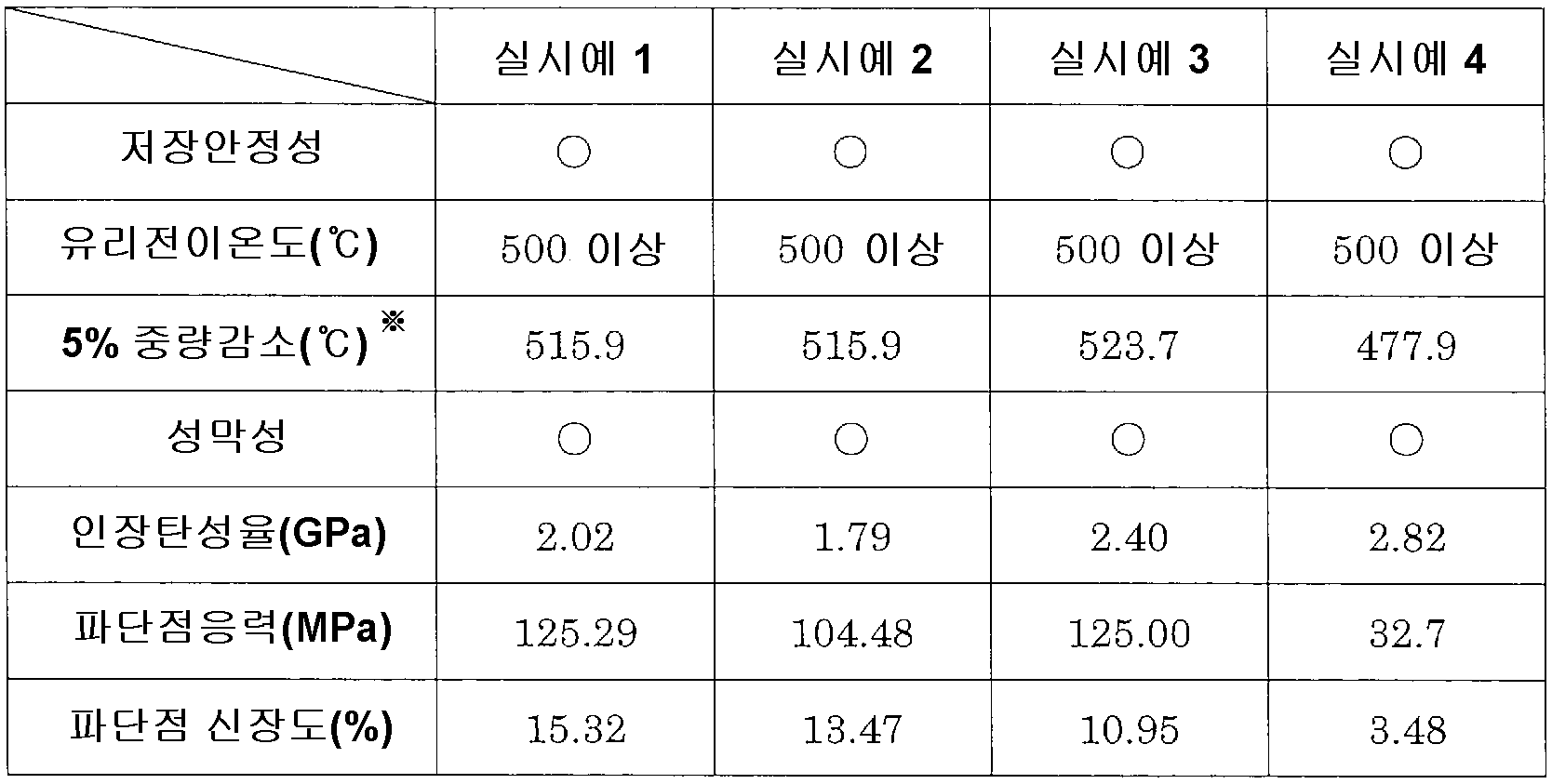
※: 5% 열중량 감소 온도※: 5% thermogravimetric reduction temperature
[표 2][Table 2]
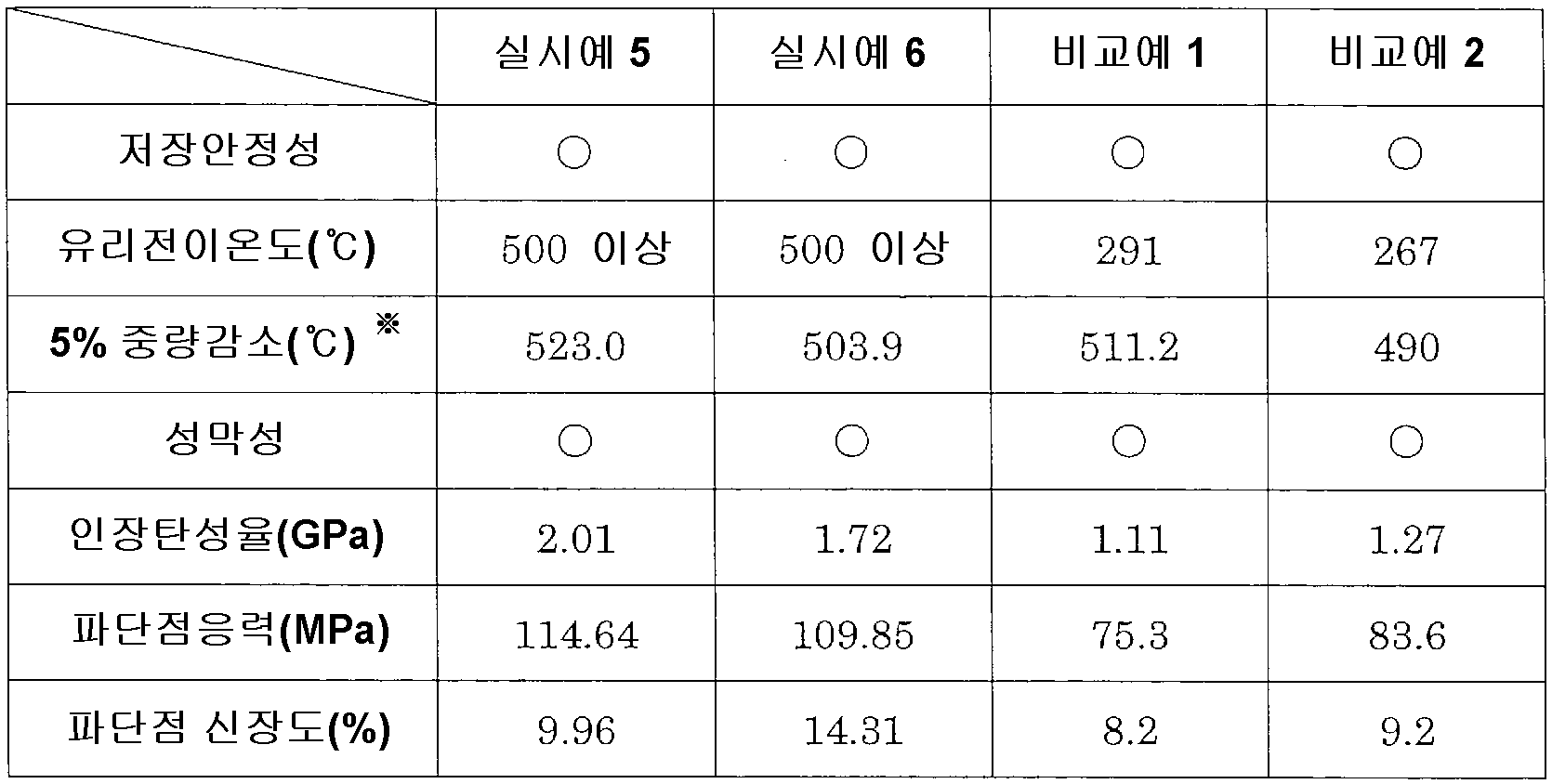
표 1 및 표 2에 의하면, 본 발명의 폴리이미드 공중합체는, 용매에 가용이면서도 유리 전이점이 500℃ 미만에 존재하지 않고, 우수한 내열성을 나타내고 있다. 또한, 기계적 강도도 충분히 가지고 있는 것을 알 수 있다. 이에 비해, 비교예 1 및 2는, (A) 성분과 (B) 성분이 중합한 구조를 가지지 않기 때문에, 유리 전이점, 기계적 강도 모두 낮아 실용적인 수준으로 제공할 수 없는 것을 알 수 있다.According to Tables 1 and 2, the polyimide copolymer of the present invention is soluble in a solvent, but does not have a glass transition point lower than 500 占 폚, and exhibits excellent heat resistance. In addition, it can be seen that it has sufficient mechanical strength. In contrast, Comparative Examples 1 and 2 do not have a structure in which the component (A) and the component (B) are polymerized, and therefore both the glass transition point and the mechanical strength are low and can not be provided at practical levels.
Claims (4)
(B) 디아민 및/또는 디이소시아네이트가 공중합되어 이루어지는, 500℃ 미만에서 유리 전이점이 관측되지 않는 것을 특징으로 하는 용매 가용형(可溶型) 폴리이미드 공중합체.(A) 3,3 ', 4,4'-biphenyltetracarboxylic dianhydride,
(B) a solvent-soluble polyimide copolymer which is obtained by copolymerizing a diamine and / or a diisocyanate and has no glass transition point observed at temperatures lower than 500 占 폚.
상기 (B) 성분이, 하기 일반식(1)∼일반식(3)

(상기 일반식(1)∼일반식(3) 중에서, X는 아미노기 또는 이소시아네이트기이고, R1∼R8은, 각각 독립적으로 수소 원자, 탄소수 1∼4의 알킬기, 탄소수 2∼4의 알케닐기, 또는 탄소수 1∼4의 알콕시기이며, R1∼R8 중 적어도 1개는 수소 원자는 아님)으로 표시되는 1종 이상의 디아민 및/또는 디이소시아네이트인, 용매 가용형 폴리이미드 공중합체.The method according to claim 1,
Wherein the component (B) is at least one compound represented by any of the following formulas (1) to (3)
(In the general formulas (1) to (3), X is an amino group or an isocyanate group, and R 1 to R 8 each independently represent a hydrogen atom, an alkyl group having 1 to 4 carbon atoms, an alkenyl group having 2 to 4 carbon atoms , Or an alkoxy group having 1 to 4 carbon atoms, and at least one of R 1 to R 8 is not a hydrogen atom), and / or a diisocyanate.
상기 R1∼R4 중 2개가 에틸기이며, 나머지 2개가 메틸기와 수소 원자인, 용매 가용형 폴리이미드 공중합체.3. The method of claim 2,
Wherein two of R 1 to R 4 are an ethyl group and the remaining two are a methyl group and a hydrogen atom.
상기 R5∼R8이 메틸기 또는 에틸기인, 용매 가용형 폴리이미드 공중합체.3. The method of claim 2,
Soluble group-containing polyimide copolymer wherein R 5 to R 8 are a methyl group or an ethyl group.
Applications Claiming Priority (3)
| Application Number | Priority Date | Filing Date | Title |
|---|---|---|---|
| JP2013126043A JP2015000939A (en) | 2013-06-14 | 2013-06-14 | Solvent-soluble polyimide copolymer |
| JPJP-P-2013-126043 | 2013-06-14 | ||
| PCT/JP2014/060976 WO2014199724A1 (en) | 2013-06-14 | 2014-04-17 | Solvent soluble polyimide copolymer |
Publications (2)
| Publication Number | Publication Date |
|---|---|
| KR20160021237A true KR20160021237A (en) | 2016-02-24 |
| KR102184617B1 KR102184617B1 (en) | 2020-11-30 |
Family
ID=52022026
Family Applications (1)
| Application Number | Title | Priority Date | Filing Date |
|---|---|---|---|
| KR1020167001109A Active KR102184617B1 (en) | 2013-06-14 | 2014-04-17 | Solvent soluble polyimide copolymer |
Country Status (6)
| Country | Link |
|---|---|
| US (1) | US10308766B2 (en) |
| JP (1) | JP2015000939A (en) |
| KR (1) | KR102184617B1 (en) |
| CN (1) | CN105324414B (en) |
| TW (1) | TWI632176B (en) |
| WO (1) | WO2014199724A1 (en) |
Families Citing this family (6)
| Publication number | Priority date | Publication date | Assignee | Title |
|---|---|---|---|---|
| JP6485996B2 (en) * | 2013-06-14 | 2019-03-20 | ソマール株式会社 | Polyimide copolymer oligomer, polyimide copolymer, and production method thereof |
| JP6289014B2 (en) * | 2013-10-11 | 2018-03-07 | ソマール株式会社 | Polyimide fibers and assemblies |
| JP6289015B2 (en) * | 2013-10-11 | 2018-03-07 | ソマール株式会社 | Polyimide fiber and method for producing polyimide fiber |
| US20170306094A1 (en) * | 2014-09-30 | 2017-10-26 | Somar Corporation | Polyimide copolymer and molded article using same |
| KR102589214B1 (en) | 2016-06-03 | 2023-10-13 | 삼성디스플레이 주식회사 | Display device |
| WO2019026795A1 (en) | 2017-07-29 | 2019-02-07 | 国立大学法人北陸先端科学技術大学院大学 | Hydrophilic polyamide or polyimide |
Citations (6)
| Publication number | Priority date | Publication date | Assignee | Title |
|---|---|---|---|---|
| JPS59219330A (en) | 1983-05-18 | 1984-12-10 | オーシージー マイクロエレクトロニク マテリアルズ インク. | Polyimide, manufacture and use |
| JPH0365228A (en) * | 1989-06-01 | 1991-03-20 | E I Du Pont De Nemours & Co | Gas separation membrane of co-polyimide induced from substitution polyphenylene- diamine and substitution methyleneaniline |
| JPH08325533A (en) * | 1995-05-31 | 1996-12-10 | Tomoegawa Paper Co Ltd | Adhesive tape for electronic parts and liquid adhesive |
| JPH11236447A (en) * | 1998-02-24 | 1999-08-31 | Matsushita Electric Works Ltd | Polyimide evaporated polymerized film |
| KR20100016190A (en) * | 2007-04-03 | 2010-02-12 | 소루피 고교 가부시키가이샤 | Solvent-soluble 6,6-polyimide copolymer and process for producing the same |
| JP2011122079A (en) | 2009-12-11 | 2011-06-23 | Solpit Industries Ltd | Method of making thick film by applying solution of polyimide soluble into polar organic solvent |
Family Cites Families (5)
| Publication number | Priority date | Publication date | Assignee | Title |
|---|---|---|---|---|
| US4698295A (en) * | 1984-11-16 | 1987-10-06 | Ciba-Geigy Corporation | Polyimides, a process for their preparation and their use, and tetracarboxylic acids and tetracarboxylic acid derivatives |
| US5554684A (en) | 1993-10-12 | 1996-09-10 | Occidental Chemical Corporation | Forming polyimide coating by screen printing |
| KR100895848B1 (en) * | 2004-12-03 | 2009-05-06 | 우베 고산 가부시키가이샤 | Polyimide, polyimide film and laminated body |
| JP2008255141A (en) * | 2007-03-31 | 2008-10-23 | Ube Ind Ltd | Method for producing polyimide film and polyimide film |
| JP6485996B2 (en) * | 2013-06-14 | 2019-03-20 | ソマール株式会社 | Polyimide copolymer oligomer, polyimide copolymer, and production method thereof |
-
2013
- 2013-06-14 JP JP2013126043A patent/JP2015000939A/en active Pending
-
2014
- 2014-04-17 WO PCT/JP2014/060976 patent/WO2014199724A1/en not_active Ceased
- 2014-04-17 CN CN201480033940.9A patent/CN105324414B/en active Active
- 2014-04-17 US US14/897,511 patent/US10308766B2/en active Active
- 2014-04-17 KR KR1020167001109A patent/KR102184617B1/en active Active
- 2014-04-18 TW TW103114320A patent/TWI632176B/en active
Patent Citations (6)
| Publication number | Priority date | Publication date | Assignee | Title |
|---|---|---|---|---|
| JPS59219330A (en) | 1983-05-18 | 1984-12-10 | オーシージー マイクロエレクトロニク マテリアルズ インク. | Polyimide, manufacture and use |
| JPH0365228A (en) * | 1989-06-01 | 1991-03-20 | E I Du Pont De Nemours & Co | Gas separation membrane of co-polyimide induced from substitution polyphenylene- diamine and substitution methyleneaniline |
| JPH08325533A (en) * | 1995-05-31 | 1996-12-10 | Tomoegawa Paper Co Ltd | Adhesive tape for electronic parts and liquid adhesive |
| JPH11236447A (en) * | 1998-02-24 | 1999-08-31 | Matsushita Electric Works Ltd | Polyimide evaporated polymerized film |
| KR20100016190A (en) * | 2007-04-03 | 2010-02-12 | 소루피 고교 가부시키가이샤 | Solvent-soluble 6,6-polyimide copolymer and process for producing the same |
| JP2011122079A (en) | 2009-12-11 | 2011-06-23 | Solpit Industries Ltd | Method of making thick film by applying solution of polyimide soluble into polar organic solvent |
Also Published As
| Publication number | Publication date |
|---|---|
| WO2014199724A1 (en) | 2014-12-18 |
| CN105324414A (en) | 2016-02-10 |
| KR102184617B1 (en) | 2020-11-30 |
| CN105324414B (en) | 2019-02-15 |
| TW201509996A (en) | 2015-03-16 |
| JP2015000939A (en) | 2015-01-05 |
| TWI632176B (en) | 2018-08-11 |
| US10308766B2 (en) | 2019-06-04 |
| US20160159985A1 (en) | 2016-06-09 |
Similar Documents
| Publication | Publication Date | Title |
|---|---|---|
| KR102184616B1 (en) | Polyimide copolymer oligomer, polyimide copolymer, and method for producing each of same | |
| CN107531902B (en) | Polyimide resin and film using the same | |
| TW201742879A (en) | Polyamide-imide and process for preparing the same, polyamide-imide film and cover substrate for display | |
| KR102184617B1 (en) | Solvent soluble polyimide copolymer | |
| TWI735550B (en) | Polyamide acid, polyamide acid solution, polyimide, and polyimide substrate and manufacturing method thereof | |
| KR101896537B1 (en) | Polyimide copolymer, and production method for same | |
| US20250230282A1 (en) | Manufacturing method of polyimide powder and polyimide powder manufactured by the same | |
| TWI782901B (en) | Polyimide copolymer and molded article using same | |
| JP6604003B2 (en) | Polyimide precursor solution composition and method for producing polyimide film using the same | |
| JP7567071B2 (en) | Polyimide, polyimide solution, coating material and molding material | |
| TWI705987B (en) | Crosslinkable polyamic acid composition and method of manufacturing the same, and polyimide film prepared by using the same, and electronic device comprising the polyimide film |
Legal Events
| Date | Code | Title | Description |
|---|---|---|---|
| PA0105 | International application |
Patent event date: 20160114 Patent event code: PA01051R01D Comment text: International Patent Application |
|
| PG1501 | Laying open of application | ||
| A201 | Request for examination | ||
| PA0201 | Request for examination |
Patent event code: PA02012R01D Patent event date: 20190416 Comment text: Request for Examination of Application |
|
| E902 | Notification of reason for refusal | ||
| PE0902 | Notice of grounds for rejection |
Comment text: Notification of reason for refusal Patent event date: 20200416 Patent event code: PE09021S01D |
|
| E701 | Decision to grant or registration of patent right | ||
| PE0701 | Decision of registration |
Patent event code: PE07011S01D Comment text: Decision to Grant Registration Patent event date: 20201026 |
|
| GRNT | Written decision to grant | ||
| PR0701 | Registration of establishment |
Comment text: Registration of Establishment Patent event date: 20201124 Patent event code: PR07011E01D |
|
| PR1002 | Payment of registration fee |
Payment date: 20201124 End annual number: 3 Start annual number: 1 |
|
| PG1601 | Publication of registration | ||
| PR1001 | Payment of annual fee |
Payment date: 20231120 Start annual number: 4 End annual number: 4 |