KR20170077286A - Method of producing a polypeptide or virus of interest in a continuous cell culture - Google Patents
Method of producing a polypeptide or virus of interest in a continuous cell culture Download PDFInfo
- Publication number
- KR20170077286A KR20170077286A KR1020177017512A KR20177017512A KR20170077286A KR 20170077286 A KR20170077286 A KR 20170077286A KR 1020177017512 A KR1020177017512 A KR 1020177017512A KR 20177017512 A KR20177017512 A KR 20177017512A KR 20170077286 A KR20170077286 A KR 20170077286A
- Authority
- KR
- South Korea
- Prior art keywords
- cell
- cells
- culture
- cell culture
- culture system
- Prior art date
- Legal status (The legal status is an assumption and is not a legal conclusion. Google has not performed a legal analysis and makes no representation as to the accuracy of the status listed.)
- Granted
Links
Classifications
-
- C—CHEMISTRY; METALLURGY
- C12—BIOCHEMISTRY; BEER; SPIRITS; WINE; VINEGAR; MICROBIOLOGY; ENZYMOLOGY; MUTATION OR GENETIC ENGINEERING
- C12N—MICROORGANISMS OR ENZYMES; COMPOSITIONS THEREOF; PROPAGATING, PRESERVING, OR MAINTAINING MICROORGANISMS; MUTATION OR GENETIC ENGINEERING; CULTURE MEDIA
- C12N7/00—Viruses; Bacteriophages; Compositions thereof; Preparation or purification thereof
-
- C—CHEMISTRY; METALLURGY
- C12—BIOCHEMISTRY; BEER; SPIRITS; WINE; VINEGAR; MICROBIOLOGY; ENZYMOLOGY; MUTATION OR GENETIC ENGINEERING
- C12M—APPARATUS FOR ENZYMOLOGY OR MICROBIOLOGY; APPARATUS FOR CULTURING MICROORGANISMS FOR PRODUCING BIOMASS, FOR GROWING CELLS OR FOR OBTAINING FERMENTATION OR METABOLIC PRODUCTS, i.e. BIOREACTORS OR FERMENTERS
- C12M3/00—Tissue, human, animal or plant cell, or virus culture apparatus
- C12M3/006—Cell injection or fusion devices
-
- C—CHEMISTRY; METALLURGY
- C12—BIOCHEMISTRY; BEER; SPIRITS; WINE; VINEGAR; MICROBIOLOGY; ENZYMOLOGY; MUTATION OR GENETIC ENGINEERING
- C12N—MICROORGANISMS OR ENZYMES; COMPOSITIONS THEREOF; PROPAGATING, PRESERVING, OR MAINTAINING MICROORGANISMS; MUTATION OR GENETIC ENGINEERING; CULTURE MEDIA
- C12N5/00—Undifferentiated human, animal or plant cells, e.g. cell lines; Tissues; Cultivation or maintenance thereof; Culture media therefor
- C12N5/0018—Culture media for cell or tissue culture
- C12N5/0056—Xeno-free medium
-
- C—CHEMISTRY; METALLURGY
- C12—BIOCHEMISTRY; BEER; SPIRITS; WINE; VINEGAR; MICROBIOLOGY; ENZYMOLOGY; MUTATION OR GENETIC ENGINEERING
- C12N—MICROORGANISMS OR ENZYMES; COMPOSITIONS THEREOF; PROPAGATING, PRESERVING, OR MAINTAINING MICROORGANISMS; MUTATION OR GENETIC ENGINEERING; CULTURE MEDIA
- C12N9/00—Enzymes; Proenzymes; Compositions thereof; Processes for preparing, activating, inhibiting, separating or purifying enzymes
- C12N9/14—Hydrolases (3)
- C12N9/48—Hydrolases (3) acting on peptide bonds (3.4)
- C12N9/50—Proteinases, e.g. Endopeptidases (3.4.21-3.4.25)
- C12N9/64—Proteinases, e.g. Endopeptidases (3.4.21-3.4.25) derived from animal tissue
- C12N9/6421—Proteinases, e.g. Endopeptidases (3.4.21-3.4.25) derived from animal tissue from mammals
- C12N9/6489—Metalloendopeptidases (3.4.24)
-
- C—CHEMISTRY; METALLURGY
- C12—BIOCHEMISTRY; BEER; SPIRITS; WINE; VINEGAR; MICROBIOLOGY; ENZYMOLOGY; MUTATION OR GENETIC ENGINEERING
- C12P—FERMENTATION OR ENZYME-USING PROCESSES TO SYNTHESISE A DESIRED CHEMICAL COMPOUND OR COMPOSITION OR TO SEPARATE OPTICAL ISOMERS FROM A RACEMIC MIXTURE
- C12P21/00—Preparation of peptides or proteins
- C12P21/02—Preparation of peptides or proteins having a known sequence of two or more amino acids, e.g. glutathione
-
- C—CHEMISTRY; METALLURGY
- C12—BIOCHEMISTRY; BEER; SPIRITS; WINE; VINEGAR; MICROBIOLOGY; ENZYMOLOGY; MUTATION OR GENETIC ENGINEERING
- C12N—MICROORGANISMS OR ENZYMES; COMPOSITIONS THEREOF; PROPAGATING, PRESERVING, OR MAINTAINING MICROORGANISMS; MUTATION OR GENETIC ENGINEERING; CULTURE MEDIA
- C12N2500/00—Specific components of cell culture medium
- C12N2500/98—Xeno-free medium and culture conditions
-
- C—CHEMISTRY; METALLURGY
- C12—BIOCHEMISTRY; BEER; SPIRITS; WINE; VINEGAR; MICROBIOLOGY; ENZYMOLOGY; MUTATION OR GENETIC ENGINEERING
- C12N—MICROORGANISMS OR ENZYMES; COMPOSITIONS THEREOF; PROPAGATING, PRESERVING, OR MAINTAINING MICROORGANISMS; MUTATION OR GENETIC ENGINEERING; CULTURE MEDIA
- C12N2710/00—MICROORGANISMS OR ENZYMES; COMPOSITIONS THEREOF; PROPAGATING, PRESERVING, OR MAINTAINING MICROORGANISMS; MUTATION OR GENETIC ENGINEERING; CULTURE MEDIA dsDNA viruses
- C12N2710/00011—Details
- C12N2710/00051—Methods of production or purification of viral material
- C12N2710/00052—Methods of production or purification of viral material relating to complementing cells and packaging systems for producing virus or viral particles
-
- C—CHEMISTRY; METALLURGY
- C12—BIOCHEMISTRY; BEER; SPIRITS; WINE; VINEGAR; MICROBIOLOGY; ENZYMOLOGY; MUTATION OR GENETIC ENGINEERING
- C12Y—ENZYMES
- C12Y304/00—Hydrolases acting on peptide bonds, i.e. peptidases (3.4)
- C12Y304/24—Metalloendopeptidases (3.4.24)
- C12Y304/24087—ADAMTS13 endopeptidase (3.4.24.87)
-
- Y—GENERAL TAGGING OF NEW TECHNOLOGICAL DEVELOPMENTS; GENERAL TAGGING OF CROSS-SECTIONAL TECHNOLOGIES SPANNING OVER SEVERAL SECTIONS OF THE IPC; TECHNICAL SUBJECTS COVERED BY FORMER USPC CROSS-REFERENCE ART COLLECTIONS [XRACs] AND DIGESTS
- Y02—TECHNOLOGIES OR APPLICATIONS FOR MITIGATION OR ADAPTATION AGAINST CLIMATE CHANGE
- Y02P—CLIMATE CHANGE MITIGATION TECHNOLOGIES IN THE PRODUCTION OR PROCESSING OF GOODS
- Y02P20/00—Technologies relating to chemical industry
- Y02P20/50—Improvements relating to the production of bulk chemicals
- Y02P20/52—Improvements relating to the production of bulk chemicals using catalysts, e.g. selective catalysts
Landscapes
- Life Sciences & Earth Sciences (AREA)
- Health & Medical Sciences (AREA)
- Chemical & Material Sciences (AREA)
- Engineering & Computer Science (AREA)
- Organic Chemistry (AREA)
- Wood Science & Technology (AREA)
- Zoology (AREA)
- Bioinformatics & Cheminformatics (AREA)
- Genetics & Genomics (AREA)
- Biomedical Technology (AREA)
- Biotechnology (AREA)
- Biochemistry (AREA)
- General Engineering & Computer Science (AREA)
- General Health & Medical Sciences (AREA)
- Microbiology (AREA)
- Medicinal Chemistry (AREA)
- Molecular Biology (AREA)
- Virology (AREA)
- Immunology (AREA)
- Chemical Kinetics & Catalysis (AREA)
- Proteomics, Peptides & Aminoacids (AREA)
- General Chemical & Material Sciences (AREA)
- Cell Biology (AREA)
- Sustainable Development (AREA)
- Micro-Organisms Or Cultivation Processes Thereof (AREA)
- Preparation Of Compounds By Using Micro-Organisms (AREA)
- Enzymes And Modification Thereof (AREA)
- Peptides Or Proteins (AREA)
Abstract
본 명세서에서는 특히, 혈청-없는 또는 화학적으로 규정된 배지에서 포유동물 세포, 예를 들면, 유전적으로 변형되는 세포의 배양을 향상시키기 위하여, 관류 개방 시스템 및 키모스탯 개방 시스템의 일정한 이점을 결합하는 키모스탯-유사 연속 세포 배양 시스템이 기술된다. 본 명세서에서 기술되는 연속 배양 시스템은 연속 세포 배양 시스템에서 포유동물 세포를 배양하는 것을 수반하고, 상기 시스템은 세포 유지 장치를 포함하고, 여기서 상기 세포 배양 시스템은 대략 2 d-1 이하의 희석 속도 (D), 그리고 대략 2X10⁷개 세포/㎖ 이하의 세포 밀도를 갖는다. 또한, 본 명세서에서는 연속 세포 배양에서 목적 폴리펩티드 및/또는 바이러스를 생산하는 방법이 기술되고, 상기 방법은 연속 세포 배양 시스템에서 목적 폴리펩티드 및/또는 바이러스를 발현하는 포유동물 세포를 배양하는 단계, 상기 시스템은 세포 유지 장치를 포함하고, 여기서 상기 세포 배양 시스템은 대략 2 d-1 이하의 희석 속도 (D), 그리고 대략 2X10⁷개 세포/㎖ 이하의 세포 밀도를 갖고; 그리고 상기 세포 배양 시스템의 배지로부터 목적 폴리펩티드 및/또는 바이러스를 회수하는 단계를 포함한다.In particular, the present invention relates to a method for improving the culture of mammalian cells, such as genetically modified cells, in a serum-free or chemically defined medium, A stat-like continuous cell culture system is described. A continuous culture system as described herein involves culturing mammalian cells in a continuous cell culture system, said system comprising a cell holding device, wherein said cell culture system has a dilution rate of about 2 d -1 D), and a cell density of approximately 2 × 10 7 cells / ml or less. Also disclosed herein is a method of producing a polypeptide of interest and / or virus in a continuous cell culture, said method comprising culturing a mammalian cell expressing a polypeptide of interest and / or virus in a continuous cell culture system, Wherein the cell culture system has a dilution rate (D) of about 2 d -1 or less and a cell density of about 2 x 10 7 cells / mL or less; And recovering the target polypeptide and / or virus from the medium of the cell culture system.
Description
관련된 출원에 대한 교차 참조Cross-references to related applications
본 출원은 2009년 7월 31일 제출된 U.S. 특허가출원 No. 61/230,313에 우선권을 주장하고, 이는 본 발명에 순전히 참조로서 편입된다. This application is a continuation-in-part of U. S. Provisional Application filed on July 31, 2009. Patent No. 61 / 230,313, which is hereby incorporated by reference in its entirety.
본 발명의 기술분야The technical field of the present invention
본 발명은 포유동물 세포 배양에서 목적 폴리펩티드 또는 바이러스를 생산하기 위한 연속 세포 배양 전략에 관계한다. 본 명세서에서 기술되는 연속 세포 배양 전략은 키모스탯 (chemostat)과 관류 (perfusion) 배양 기술의 이점을 결합한다.The present invention relates to a continuous cell culture strategy for producing a polypeptide or virus of interest in a mammalian cell culture. The continuous cell culture strategy described herein combines the advantages of chemostat and perfusion culture technology.
본 발명의 배경기술BACKGROUND OF THE INVENTION
목적 폴리펩티드 또는 바이러스를 생산하는 능력은 생물공학 산업에 더욱 중요해지고 있다. 지난 20년동안, 생물공학에서 진전은 백신 및 약제로서 잠재적 치료적 유용성을 갖는 다수의 폴리펩티드와 바이러스에 관심을 유발시켰다. 대규모 생산은 일반적으로, 예로써 세균, 효모, 곤충, 포유동물, 또는 기타 세포 유형에서 목적 폴리펩티드 또는 바이러스의 재조합 생산을 필요로 한다. 특히, 포유동물 배양에서 목적 폴리펩티드 또는 바이러스의 생산은 예로써, 이황화물-의존성 접힘 (folding)과 당화 (glycosylation)에 의해 복잡한 단백질 구조를 번역후 가공하는 포유동물 세포의 능력으로 인하여, 세균 또는 기타 하등 미생물 숙주에서 생산보다 이점을 갖는다.The ability to produce the desired polypeptide or virus is becoming more important in the biotechnology industry. Over the past two decades, advances in biotechnology have attracted interest in a large number of polypeptides and viruses with potential therapeutic utility as vaccines and drugs. Large scale production generally requires recombinant production of the polypeptide or virus of interest in, for example, bacteria, yeast, insects, mammals, or other cell types. In particular, the production of a polypeptide or virus of interest in a mammalian culture may be accomplished, for example, by the ability of mammalian cells to post-translate complex protein structures by bifurcation-dependent folding and glycosylation, It has advantages over production in lower microbial hosts.
포유동물 세포는 일반적으로, 2가지 양식 중에서 한 가지로 시험관내에서 증식된다: 대부분의 배양 동안 현탁 상태에서 자유롭게 성장하는 비-고정 의존성 세포로서; 또는 증식 (즉, 단층 유형의 세포 성장)을 위하여 고형 기질에 부착을 요하는 고정-의존성 세포로서. 양쪽 유형의 성장을 조화시키는 미립담체 시스템이 개발되었다. 가령, 고정-의존성 세포는 느린 교반에 의해 성장 배지에서 현탁된 작은 고형 입자를 포함하는 미립담체 시스템에서 증식되었다. 이러한 시스템은 고정-의존성 세포가 현탁된 입자의 표면에 부착하고, 그리고 합류 수준 (confluency)으로 성장할 수 있도록 하고, 반면 미립담체는 성장 배지에서 현탁된 상태로 남아있다. 대안으로, 마크로다공성 미립담체는 예로써, 이런 미립담체의 표면에 대한 세포의 비-특이적 부착에 의해 생물반응장치에서 비-고정 의존성 세포를 내포하는데 이용될 수 있다. 비-고정 의존성 세포 또는 고정-의존성 세포의 미립담체 현탁 배양은 세포 및 세포 산물의 대규모 생산에 가장 폭넓게 이용되는 수단이다.Mammalian cells are generally grown in vitro in one of two ways: as non-immobilized cells that grow freely in suspension during most cultures; Or as fixation-dependent cells requiring attachment to a solid substrate for proliferation (i.e., cell growth of a monolayer type). A microfine carrier system has been developed that harmonizes both types of growth. For example, the fixation-dependent cells were proliferated in a microfluidic carrier system containing small solid particles suspended in growth medium by slow agitation. These systems allow the fix-dependent cells to adhere to the surface of the suspended particles and grow to confluency, while the particulate carrier remains suspended in the growth medium. Alternatively, the macroporous particulate carrier can be used, for example, to encapsulate non-immobilized cells in the bioreactor by non-specific attachment of the cells to the surface of such a particulate carrier. Microscopic suspension suspension cultures of non-fixed or fixed-dependent cells are the most widely used means for large-scale production of cells and cell products.
대규모 현탁 배양은 폐쇄 시스템, 예를 들면, 회분식 또는 유가식 폐쇄 시스템에서 수행될 수 있는데, 이들은 개방 시스템보다 수행 및 정률 증가가 더욱 간단하다. 전형적으로, 폐쇄 시스템에서, 세포, 산물, 및/또는 폐기물은 전혀 제거되지 않는다(비록 공기 (가령, 산소)가 첨가되고 CO2가 통기에 의해 제거되긴 하지만). 회분식 성장 시스템에서 관찰되는 전형적인 성장 프로필은 유도기 (lag phase), 그 이후에 지수기 (exponential phase), 정지기 (stationary phase), 그리고 쇠퇴기 (decline phase)를 수반한다. 이런 회분식 시스템에서, 환경은 지속적으로 변하는데, 그 이유는 영양소가 고갈되고 대사산물이 축적되기 때문이다. 유가식 시스템에서, 핵심 영양소는 비록 세포, 산물, 부산물, 그리고 독성 대사산물을 비롯한 폐기물이 제거되지 않지만, 성장 주기를 연장시키기 위하여 시스템 내로 지속적으로 공급된다. 따라서 회분식 또는 유가식 시스템에 의한 목적 폴리펩티드 또는 바이러스의 생산은 세포 및 유해 물질, 예를 들면, 독성 대사산물의 축적에 의해 제한된다.Large-scale suspension culturing can be performed in a closed system, for example, a batch or a cost-effective closed system, which is simpler to perform and increase in rate than an open system. Typically, in a closed system, no cells, products, and / or waste are removed (although air (e.g., oxygen) is added and CO 2 Though removed by venting). A typical growth profile observed in a batch growth system involves a lag phase followed by an exponential phase, a stationary phase, and a decline phase. In this batch system, the environment is constantly changing because the nutrients are depleted and metabolites accumulate. In a cost-effective system, core nutrients are continuously supplied into the system to extend the growth cycle, although wastes, including cells, products, by-products, and toxic metabolites, are not removed. Thus, production of a polypeptide or virus of interest by a batch or infusion system is limited by the accumulation of cellular and toxic substances, such as toxic metabolites.
대규모 현탁 배양은 또한, 개방 시스템, 예를 들면, 관류 시스템 또는 키모스탯 시스템에서 수행될 수 있다. 관류 시스템에서, 새로운 배지는 배양 내내 관류되는 반면, 세포는 다양한 세포 유지 장치로 유지된다. 세포 유지 장치의 유형에는 예로써, 미립담체, 미세 그물눈 스핀 필터 (fine mesh spin filter), 유공 섬유 (hollow fiber), 플랫 플레이트 막 필터 (flat plate membrane filter), 정착 튜브 (settling tube), 초음파 세포 유지 장치 등이 포함된다. 전형적으로, 관류 배양은 >90%의 세포 유지 비율을 갖도록 설계되고 작동되는 세포 유지 장치로, 세포 밀도를 최대로 증가시키도록 설계된다. 이런 배양은 전형적으로, >2X10⁷의 세포 밀도에 도달하는데, 이것은 대략 2.0 d-1보다 큰 희석 속도 (dilution rate)에서 세포 배양 배지 공급으로 제공되어야 한다. 하지만 이러한 시스템의 정상 상태 (steady state)는 바이오매스 (biomass)에서 통제되지 않은 증가로 인하여 지속되기 어렵고, 그리고 불변하는 생산 조건은 통제 및/또는 달성하기 어렵다.Large scale suspension cultures can also be performed in an open system, e. G., A perfusion system or a chymostat system. In the perfusion system, the new medium is perfused throughout the culture while the cells are maintained in a variety of cell holding devices. Examples of the type of the cell holding device include a fine particle spin filter, a fine mesh spin filter, a hollow fiber, a flat plate membrane filter, a settling tube, And a holding device. Typically, perfusion culture is a cell-holding device designed and operated to have a cell maintenance rate of > 90%, designed to maximize cell density. Such cultures typically reach a cell density of> 2 × 10 7 , which should be provided by the cell culture medium feed at a dilution rate greater than approximately 2.0 d -1 . However, the steady state of such a system is difficult to sustain due to uncontrolled increase in biomass, and constant production conditions are difficult to control and / or achieve.
키모스탯 시스템은 배지의 연속 유입 및 세포와 산물의 유출로 작동된다. 키모스탯 시스템에서, 세포 유지 장치는 존재하지 않고, 따라서 생물반응장치에서 세포의 농도 및 생물반응장치로부터 수확된 상층액에서 세포의 농도가 실질적으로 동일하다. 전형적으로, 배양 배지는 미리 결정된 불변 속도로 반응장치에 공급되고, 배양의 낮은 희석 속도 (전형적으로 0.3 d-1 내지 0.8 d-1)를 지속한다. 세포의 유실을 예방하기 위하여, 희석 속도는 일반적으로, 세포의 최대 비 성장 속도 (specific growth rate)보다 낮고, 그리고 때때로 이와 동등하도록 선택된다. 세포, 세포 산물, 부산물, 폐기물 등을 내포하는 배양액은 동일한 속도에서, 또는 실질적으로 동일한 속도로 제거된다. 키모스탯 시스템은 전형적으로, 높은 수준의 통제를 제공하는데, 그 이유는 배양이 평형을 유지하기 때문이다, 다시 말하면, 희석 속도에 동등한 비 성장 속도에서 정상 상태에 도달하기 때문이다. 이러한 평형상태 (equilibration)는 세포, 대사산물, 폐기물, 발현된 산물 (가령, 분비된 단백질) 등의 농도를 결정한다. 키모스탯 시스템에서 비 성장 속도는 전형적으로, 적어도 한 가지 제한 기질 (limiting substrate)로 인하여 최대 성장 속도보다 낮다. 하지만, 일부 시스템에서, 정상 상태는 예로써, 키모스탯 배양의 터비도스탯 시스템에서 바이오매스를 통제하고 조정함으로써 최대 비 성장 속도에서 지속될 수 있다. 바람직하게는, 이런 키모스탯 배양은 생물반응장치 전반에서 세포의 균질한 분포 (가령, 단일 세포 현탁)를 내포한다. 하지만, 관류 시스템과 비교하여, 키모스탯 시스템은 전형적으로, 더욱 낮은 세포 밀도를 유발한다. 게다가, 키모스탯 시스템의 선천적 단점은 세포의 공급이 생물반응장치 시스템에서 세포 밀도와 독립적으로 통제될 수 없다는 것이다.The chymostatic system operates by continuous inflow of the medium and outflow of cells and products. In the case of the chymostatic system, there is no cell holding device, and thus the concentration of the cells in the bioreactor and the concentration of the cells in the supernatant harvested from the bioreactor are substantially the same. Typically, the culture medium is fed to the reactor at a predetermined constant rate and continues at a low dilution rate (typically 0.3 d < -1 > to 0.8 d < -1 > To prevent cell loss, the dilution rate is generally chosen to be lower than, and sometimes equal to, the cell's maximum specific growth rate. The culture medium containing cells, cell products, by-products, wastes and the like is removed at the same rate, or at substantially the same rate. The chemostat system typically provides a high level of control because the culture remains equilibrium, that is, it reaches steady state at a rate of growth that is equal to the rate of dilution. This equilibration determines the concentration of cells, metabolites, wastes, expressed products (eg, secreted proteins), and the like. Non-growth rates in a paramostat system are typically below the maximum growth rate due to at least one limiting substrate. However, in some systems, the steady state can be sustained at maximum non-growth rates, for example, by controlling and adjusting biomass in the thermostat system of chymostat cultures. Preferably, such a chymostat culture implies a homogeneous distribution of cells throughout the bioreactor (e. G., A single cell suspension). However, as compared to perfusion systems, the chymostatic system typically results in lower cell densities. In addition, the inherent disadvantage of the chymostatic system is that the cell supply can not be controlled independently of cell density in the bioreactor system.
혈청-없는 및/또는 화학적으로 규정된 배지에서 재조합 단백질을 생산하기 위한 현탁 세포 배양 역시 혈청-없는 및/또는 화학적으로 규정된 배지가 전형적으로, 혈청을 내포하는 배지에서 성장된 세포와 비교하여 더욱 느린 성장 속도를 지원한다는 점에서 제한된다. 배양 수단에서 하향된 성장 속도는 목적 폴리펩티드 또는 바이러스의 생산을 하향시켰다.Suspension cell cultures for the production of recombinant proteins in serum-free and / or chemically defined medium also include serum-free and / or chemically defined media, typically in the presence of serum-free medium It is limited in that it supports slow growth rate. The downward growth rate in the culture medium lowered the production of the polypeptide or virus of interest.
따라서 예로써, 적은 비용으로 증가된 생산에 대한 요구를 충족시키기 위하여, 목적 폴리펩티드 또는 바이러스의 생산을 계속할 수 있는 세포 배양 시스템의 개발, 특히 연장된 기간 동안 계속될 수 있는 배양이 여전히 요구된다.Thus, for example, there is still a need to develop a cell culture system capable of continuing to produce a polypeptide of interest or virus, in order to meet the demand for increased production at low cost, and in particular to allow culture to continue for extended periods of time.
본 발명에서는 이런 요구 및 기타 요구를 충족시키는 것을 목적으로 하는 방법과 조성물을 제시한다.The present invention provides methods and compositions aimed at meeting these and other needs.
요약summary
본 명세서에서는 포유동물 세포, 특히 비-고정 의존성 세포에서 목적 폴리펩티드 및/또는 바이러스의 생산을 위한 연속 세포 배양이 개시된다. 본 명세서에서 개시되는 연속 세포 배양 방법은 관류 개방 시스템 및 키모스탯 개방 시스템의 이점을 결합하고, 그리고 특히 혈청-없는 또는 화학적으로 규정된 배지에서 증가된 세포 밀도와 세포 성장을 가능하게 한다. 증가된 세포 밀도와 세포 성장은 목적 단백질 및/또는 바이러스의 향상된 수율을 제공하면서 공정 파라미터에서 더욱 세심한 통제를 가능하게 한다.Continuous cell culture for the production of a polypeptide of interest and / or virus in mammalian cells, particularly non-fixed dependent cells, is disclosed herein. The continuous cell culture methods disclosed herein combine the advantages of a perfusion open system and a chymostat opening system, and enable increased cell density and cell growth, especially in serum-free or chemically defined media. Increased cell density and cell growth allow for greater control of process parameters while providing improved yields of the desired protein and / or virus.
따라서 본 발명의 한 측면은 연속 세포 배양에서 목적 폴리펩티드 및/또는 바이러스를 산출하는 방법에 관계하고, 상기 방법은 연속 세포 배양 시스템에서 이러한 폴리펩티드 및/또는 바이러스를 발현하는 포유동물 세포를 배양하는 단계, 여기서 세포 배양 시스템은 세포 유지 장치를 포함하고 대략 2 d-1 이하의 희석 속도 및 대략 2X10⁷개 세포/㎖ 이하의 세포 밀도를 갖고; 그리고 세포 배양 시스템으로부터 제거된 배지로부터 목적 폴리펩티드 및/또는 바이러스를 회수하는 단계를 포함한다. 일부 구체예에서, 이들 세포는 목적 폴리펩티드 및/또는 바이러스를 재조합 방식으로 발현하도록 유전적으로 변형된다.Accordingly, one aspect of the present invention relates to a method of producing a polypeptide of interest and / or virus in a continuous cell culture, the method comprising culturing mammalian cells expressing such polypeptide and / or virus in a continuous cell culture system, Wherein the cell culture system comprises a cell retaining device and has a dilution rate of about 2 d -1 or less and a cell density of about 2 x 10 7 cells / ml or less; And recovering the polypeptide of interest and / or virus from the medium removed from the cell culture system. In some embodiments, these cells are genetically modified to express the desired polypeptide and / or virus in a recombinant manner.
일부 구체예에서, 이러한 세포 유지 장치는 전형적인 세포 유지 장치보다 세포를 유지하는 능력이 덜하도록 선택된다. 일부 구체예에서, 세포 유지 장치는 대략 90% 이하, 대략 85% 이하, 대략 80% 이하, 또는 대략 75% 이하의 세포 유지 비율을 산출한다. 일부 구체예에서, 세포 유지 장치는 마크로다공성 미립담체, 예를 들면, 셀룰로오스-기초된 입자를 포함한다.In some embodiments, such a cell retaining device is selected to be less capable of retaining cells than a typical cell retaining device. In some embodiments, the cell retaining device produces a cell retention rate of about 90% or less, about 85% or less, about 80% or less, or about 75% or less. In some embodiments, the cell retaining device comprises a macroporous, particulate carrier, for example, a cellulose-based particle.
희석 속도와 세포 밀도는 바람직하게는, 선택된 값 또는 범위에서 지속된다. 일부 구체예에서, 희석 속도는 대략 1 d-1 이하, 예를 들면, 대략 0.1 내지 대략 1.0 d-1이다. 일부 구체예에서, 세포 밀도는 대략 1X10⁷개 세포/㎖ 이하이다. 일부 구체예에서, 세포 배양 시스템의 희석 속도와 비 성장 속도의 비율 (D/μ)은 선택된 값 또는 범위에서 지속된다. 일부 바람직한 구체예에서, 세포 배양 시스템은 대략 1 이상, 예를 들면, 대략 1.2 내지 대략 5.0, 또는 대략 1.8 내지 대략 3의 희석 속도와 비 성장 속도의 비율을 갖는다. 일부 구체예에서, 비 성장 속도는 0.2 d-1 내지 0.8 d-1에서 지속된다.The dilution rate and cell density are preferably maintained at a selected value or range. In some embodiments, the dilution rate is about 1 d -1 or less, for example, about 0.1 to about 1.0 d -1 . In some embodiments, the cell density is less than about 1 x 10 7 cells / ml. In some embodiments, the ratio (D / μ) of the dilution rate to the non-growth rate of the cell culture system is maintained at the selected value or range. In some preferred embodiments, the cell culture system has a ratio of dilution rate to non-growth rate of about 1 or more, for example, about 1.2 to about 5.0, or about 1.8 to about 3. In some embodiments, the growth rate is continued from 0.2 to 0.8 d -1 d -1.
본 명세서에서 기술되는 연속 세포 배양 시스템의 일정한 구체예의 이점은 배양이 연장된 기간 동안 지속될 수 있다는 것이다. 일부 구체예에서, 예로써, 희석 속도 및/또는 세포 밀도는 연속 세포 배양 시스템에서 세포가 배양되는 시간의 적어도 대략 80% 동안 지속된다. 일부 구체예에서, 세포는 세포 배양 시스템에서 20일 이상, 바람직하게는 40일 이상, 그리고 더욱 바람직하게는, 50일 이상 배양되고, 예로써 잠재적으로 적은 비용으로 목적 폴리펩티드 및/또는 바이러스의 증가된 생산을 가능하게 한다.An advantage of certain embodiments of the continuous cell culture system described herein is that the culture can last for an extended period of time. In some embodiments, by way of example, the dilution rate and / or cell density is maintained for at least about 80% of the time that the cells are cultured in the continuous cell culture system. In some embodiments, the cells are cultured in a cell culture system for at least 20 days, preferably at least 40 days, and more preferably at least 50 days, for example at an increased cost, potentially at an increased cost of the polypeptide of interest and / Production.
연속 세포 배양 시스템의 일정한 구체예의 다른 이점은 전형적인 키모스탯 배양과 비교하여, 더욱 높은 세포 밀도에 기인하는 부피당 생산성 (volumetric productivity)에서 증가이다. 가령, 특정 바람직한 구체예에서, 부피당 생산성은 70%, 90%, 또는 그 이상 증가한다. 연속 세포 배양 시스템의 일정한 구체예의 또 다른 이점은 예로써, 배양 단위에서 감소된 체류 시간에 기인하는 회수되는 단백질의 향상된 비 활성인데, 이는 단백질의 안정성, 구조 및/또는 기능에 대한 유익한 효과를 가질 수 있다.Another advantage of certain embodiments of continuous cell culture systems is an increase in volumetric productivity due to higher cell density, as compared to typical chymostatic cultures. For example, in certain preferred embodiments, the productivity per volume increases by 70%, 90%, or more. Another advantage of certain embodiments of the continuous cell culture system is, for example, the enhanced non-activity of the recovered protein due to reduced residence time in the culture unit, which has beneficial effects on the stability, structure and / or function of the protein .
본 명세서에서 기술되는 연속 세포 배양 시스템의 일정한 구체예의 다른 이점은 상기 시스템이 대규모 생산을 위하여 정률 증가될 수 있다는 것이다. 다시 말하면, 표준 키모스탯 배양 시스템과 비교하여 증가된 세포 밀도 및/또는 세포 성장을 가능하게 함으로써, 본 명세서에서 개시되는 연속 세포 배양 시스템은 목적 폴리펩티드 및/또는 바이러스의 상업적 규모 생산을 제공한다. 가령, 일부 구체예에서, 세포는 적어도 대략 250 ℓ의 배지, 예를 들면, 적어도 대략 500 ℓ, 또는 적어도 대략 1,000 ℓ의 배지에서 배양된다. 일부 바람직한 구체예에서, 세포는 혈청-없는 배지 및/또는 화학적으로 규정된 배지에서 배양된다.Another advantage of certain embodiments of the continuous cell culture system described herein is that the system can be scaled up for large scale production. In other words, by enabling increased cell density and / or cell growth compared to standard chymostat culturing systems, the continuous cell culture system disclosed herein provides for commercial scale production of the polypeptide of interest and / or virus. For example, in some embodiments, the cells are cultured in at least about 250 liters of medium, such as at least about 500 liters, or at least about 1,000 liters. In some preferred embodiments, the cells are cultured in serum-free medium and / or chemically defined medium.
일부 구체예에서, 상기 방법은 예로써, 본 명세서에서 기술된 바와 같은 연속 세포 배양 시스템에서 목적 폴리펩티드 및/또는 바이러스의 생산을 위하여 세포를 순응시키는 전-배양 단계를 더욱 포함한다. 따라서 일부 바람직한 구체예에서, 상기 방법은 배양 단계에 앞서, 예로써 배양이 적절한 부피에 도달할 때까지 세포를 현탁 상태에서 전-배양하는 단계를 더욱 포함한다.In some embodiments, the method further comprises, by way of example, a pre-cultivation step to adapt the cells for production of the polypeptide of interest and / or virus in a continuous cell culture system as described herein. Thus, in some preferred embodiments, the method further comprises pre-culturing the cells in suspension prior to the culturing step, for example until the culture reaches a suitable volume.
특정 구체예에서, 목적 폴리펩티드는 트롬보스폰딘 타입 1 모티프 13을 갖는 디스인테그린-유사 및 금속단백분해효소 (ADAMTS13) 단백질이다. 일부 구체예에서, 포유동물 세포는 CHO 세포, 예를 들면, ADAMTS13 단백질을 발현하도록 유전적으로 변형된 CHO 세포이다. 특정 구체예에서, 연속 세포 배양에서 목적 폴리펩티드 및/또는 바이러스를 생산하는 방법이 제시되고, 상기 방법은 (a) 연속 세포 배양 시스템에서 목적 폴리펩티드 및/또는 바이러스를 발현하는 비-고정 의존성 포유동물 세포를 배양하는 단계, 여기서 세포 배양 시스템은 90% 이하의 세포 유지 비율을 갖는 세포 유지 장치를 포함하고, 그리고 0.1 내지 1.0 d-1의 희석 속도 (D) 및 1 X 10⁷개 세포/㎖ 이하의 세포 밀도를 갖고; 그리고 (b) 세포 배양 시스템으로부터 제거된 배지로부터 목적 폴리펩티드 및/또는 바이러스를 회수하는 단계를 포함한다.In a specific embodiment, the polypeptide of interest is a disintegrin-like and metalloproteinase (ADAMTS13) protein with thrombospondin type 1 motif 13. In some embodiments, the mammalian cell is a CHO cell, for example, a CHO cell genetically modified to express an ADAMTS13 protein. In certain embodiments, there is provided a method of producing a polypeptide of interest and / or virus in a continuous cell culture, said method comprising the steps of: (a) in a continuous cell culture system, a non-anchoring dependent mammalian cell expressing the polypeptide of interest and / culturing in which the cell culture system containing the cells maintained under device has a cell retention rate of 90% or less, and from 0.1 to 1.0 and d -1 dilution rate (D) and 1 X 10 7 cells / ㎖ of Have cell density; And (b) recovering the polypeptide of interest and / or virus from the medium removed from the cell culture system.
다른 특정 구체예에서, 연속 세포 배양에서 목적 폴리펩티드 및/또는 바이러스를 생산하는 방법이 제시되고, 상기 방법은 (a) 연속 세포 배양 시스템에서 목적 폴리펩티드 및/또는 바이러스를 발현하는 비-고정 의존성 세포 CHO 세포를 배양하는 단계, 여기서 세포 배양 시스템은 90% 이하의 세포 유지 비율을 갖는 마크로다공성 미립담체 세포 유지 장치를 포함하고, 그리고 0.1 내지 1.0 d-1의 희석 속도 (D) 및 1 X 10⁷개 세포/㎖ 이하의 세포 밀도를 갖고; 그리고 (b) 배양 시스템으로부터 제거된 배지로부터 목적 폴리펩티드 및/또는 바이러스 세포를 회수하는 단계를 포함한다.In another specific embodiment, there is provided a method of producing a polypeptide of interest and / or a virus in a continuous cell culture, said method comprising the steps of: (a) culturing in a continuous cell culture system a non-fixed dependent cell CHO culturing the cell, wherein the cell culture system is dilution rate (d) and 1 X 10 of porous particulate carrier includes a macro cell holding device having a cell retention rate of 90% or less, and and from 0.1 to 1.0 d -1 7 gae Cells / ml or less; And (b) recovering the polypeptide of interest and / or virus from the medium removed from the culture system.
또 다른 특정 구체예에서, 연속 세포 배양에서 ADAMTS13을 생산하는 방법이 제시되고, 상기 방법은 (a) 연속 세포 배양 시스템에서 재조합 ADAMTS13 단백질을 발현하는 비-고정 의존성 세포 포유동물 세포를 배양하는 단계, 여기서 세포 배양 시스템은 90% 이하의 세포 유지 비율을 갖는 마크로다공성 미립담체 세포 유지 장치를 포함하고, 그리고 0.1 내지 1.0 d-1의 희석 속도 (D) 및 1 X 10⁷개 세포/㎖ 이하의 세포 밀도를 갖고; 그리고 (b) 배양 시스템으로부터 제거된 배지로부터 ADAMTS13 세포를 회수하는 단계를 포함한다.In another specific embodiment, a method of producing ADAMTS13 in a continuous cell culture is provided, comprising the steps of (a) culturing a non-anchoring dependent cell mammalian cell expressing recombinant ADAMTS13 protein in a continuous cell culture system, the cell culture system comprises cells of more than the macro-porous particulate carrier cell holding device having a cell retention rate of 90% or less, and from 0.1 to 1.0 and d -1 dilution rate (D) and 1 X 10 7 cells / ㎖ of Have density; And (b) recovering the ADAMTS13 cells from the medium removed from the culture system.
또 다른 특정 구체예에서, 연속 세포 배양에서 목적 폴리펩티드 및/또는 바이러스를 생산하는 방법이 제시되고, 상기 방법은 (a) 연속 세포 배양 시스템에서 목적 폴리펩티드 및/또는 바이러스를 발현하는 비-고정 의존성 세포 포유동물 세포를 배양하는 단계, 여기서 세포 배양 시스템은 90% 이하의 세포 유지 비율을 갖는 세포 유지 장치를 포함하고, 그리고 0.1 내지 1.0 d-1의 희석 속도 (D), 1 X 10⁷개 세포/㎖ 이하의 세포 밀도, 그리고 1.2 내지 5의 희석 속도와 비 성장 속도의 비율 (D/μ)을 갖고; 그리고 (b) 배양 시스템으로부터 제거된 배지로부터 목적 폴리펩티드 및/또는 바이러스 세포를 회수하는 단계를 포함하고; 게다가 이들 세포는 세포 배양 시스템에서 50일 이상 동안 배양되고, 그리고 희석 속도, 세포 밀도, 그리고 희석 속도와 비 성장 속도의 비율은 각각, 세포가 세포 배양 시스템에서 배양되는 시간의 적어도 80% 동안 지속된다.In yet another specific embodiment, there is provided a method of producing a polypeptide of interest and / or virus in a continuous cell culture, said method comprising the steps of: (a) cultivating a non-fixed dependent cell expressing a polypeptide of interest and / Wherein the cell culture system comprises a cell holding device having a cell maintenance ratio of 90% or less, and wherein the dilution rate (D) of 0.1 to 1.0 d -1 , 1 x 10 7 cells / Ml and a ratio (D / μ) of a rate of non-growth to a rate of dilution of 1.2 to 5; And (b) recovering the polypeptide of interest and / or virus from the medium removed from the culture system; In addition, these cells are cultured for more than 50 days in a cell culture system, and the rate of dilution rate, cell density, and rate of dilution to non-growth rate respectively last for at least 80% of the time that the cells are cultured in the cell culture system .
본 발명의 다른 측면은 본 명세서에서 기술되는 방법에 따라 생산된 목적 폴리펩티드 및/또는 바이러스를 포함하는 조성물, 예를 들면, 본 발명에 따라 생산된 재조합 ADAMTS13 단백질을 포함하는 조성물에 관계한다.Another aspect of the invention pertains to compositions comprising a polypeptide of interest and / or virus produced according to the methods described herein, for example, a recombinant ADAMTS13 protein produced according to the present invention.
본 발명의 이들 측면 및 기타 측면은 하기에 더욱 상세하게 기술된다.These and other aspects of the invention are described in further detail below.
상세한 설명details
본 명세서에서 기술되는 바와 같은 연속 세포 배양 시스템은 포유동물 세포의 관류 배양 및 키모스탯 배양 둘 모두의 일부 장점을 결합시킨다. 앞서 기술된 바와 같이, 관류 배양 시스템은 세포 배양 내내 관류하는 새로운 배지로 작동되고, 반면 세포는 세포 유지 장치를 이용하여 유지된다; 키모스탯 배양 시스템은 세포 유지 장치 없이, 배지의 연속 유입 및 세포와 산물의 유출로 작동된다.Continuous cell culture systems as described herein combine some advantages of both perfusion culture of mammalian cells and culturing of the chymostats. As described above, the perfusion culture system operates with fresh media that perfuses throughout the cell culture while the cells are maintained using cell holding devices; The chymostatic culture system operates without cell maintenance, with continuous inflow of the medium and outflow of cells and products.
본 명세서에서, "관류"는 세포 집단을 통해 또는 세포 집단 위에서 정상 속도 (steady rate)로 생리학적 영양소 용액의 연속 흐름을 지칭한다. 관류 시스템이 일반적으로, 배양 단위 내에서 세포의 유지를 수반하기 때문에, 관류 배양은 특징적으로, 상대적으로 높은 세포 밀도를 갖지만, 이들 배양 조건은 지속 및 통제가 어렵다. 이에 더하여, 세포가 배양 단위 내에서 높은 밀도로 성장되고, 이후 높은 밀도에서 유지되기 때문에, 성장 속도는 전형적으로, 시간의 흐름에서 지속적으로 감소하고, 세포 성장의 후기 지수기 또는 심지어 정지기로 이어진다. 대조적으로, 본 명세서에서, "키모스탯"은 예로써, 키모스탯 시스템에서처럼 세포 배양을 통해, 회수된 배지와 함께 세포 및 기타 산물의 연속 유출과 결합된 생리학적 영양소 용액의 연속 유입을 지칭한다. 하지만, 세포가 지속적으로 제거되기 때문에, 이러한 키모스탯 시스템은 전형적으로, 단지 낮은 세포 밀도만을 지원한다.As used herein, "perfusion" refers to a continuous flow of a physiological nutrient solution through a cell population or at a steady rate on a cell population. Perfusion cultures characteristically have relatively high cell densities, but these culture conditions are difficult to sustain and control because perfusion systems generally involve the maintenance of cells within the culture unit. In addition, since cells grow at high densities in culture units and are then maintained at high densities, growth rates typically decrease steadily over time and lead to late exponential periods or even stoppers of cell growth. In contrast, the term " chymostat "as used herein refers to a continuous infusion of a physiological nutrient solution combined with continuous release of cells and other products along with the recovered medium, for example, through cell culture as in the case of a chymostatic system. However, since cells are continuously removed, such a chymostatic system typically only supports low cell densities.
본 명세서에서 기술되는 연속 배양 전략은 일반적으로, 포유동물 세포, 예를 들면, 비-고정 의존성 세포를 배양하고, 연속 세포 배양 시스템에서 생산 국면 (production phase) 동안 목적 폴리펩티드 및/또는 바이러스를 발현하는 것을 포함한다. "비-고정 의존성 세포"는 증식 동안 고형 기질에 부착되거나 고정되는 것과 대조적으로, 대부분의 배양 동안 현탁 상태에서 자유롭게 증식하는 세포를 의미한다. 연속 세포 배양 시스템은 관류 시스템에 이용되는 것과 유사하지만, 바람직하게는 관류 배양에서보다 더욱 낮은 비율의 세포가 유지되도록 세포의 상당 부분의 연속 제거를 가능하게 하는 세포 유지 장치를 포함할 것이다. "세포 유지 장치"는 세포 배양 동안 특정 위치에서 세포, 특히 비-고정 의존성 세포를 유지할 수 있는 임의의 구조를 의미한다. 무제한적 실례에는 생물반응장치 내에서 비-고정 의존성 세포를 유지할 수 있는 미립담체, 미세 그물눈 스핀 필터, 유공 섬유, 플랫 플레이트 막 필터, 정착 튜브, 초음파 세포 유지 장치 등이 포함된다. 목적 폴리펩티드 및/또는 바이러스 (가령, 재조합 폴리펩티드 및/또는 재조합 바이러스)는 세포 배양 시스템, 예를 들면, 세포 배양 시스템으로부터 제거된 배지로부터 회수될 수 있다.Continuous culture strategies described herein generally involve culturing mammalian cells, such as non-fixed dependent cells, and expressing the desired polypeptide and / or virus in a continuous cell culture system during the production phase . By "non-fixed dependent cells" is meant cells that proliferate freely in suspension during most of the culture, as opposed to being attached or immobilized to a solid substrate during proliferation. Continuous cell culture systems are similar to those used in perfusion systems, but will preferably include a cell retaining device that allows continuous removal of a substantial portion of the cells to maintain a lower percentage of cells than in perfusion culture. "Cell-holding device" means any structure capable of retaining a cell, in particular a non-fixed-dependent cell, at a particular location during cell culture. Examples include, but are not limited to, a particulate carrier, a fine mesh spin filter, a perforated fiber, a flat plate membrane filter, a fixation tube, an ultrasonic cell retainer, etc., capable of retaining non-fixed dependent cells in a bioreactor. The subject polypeptides and / or viruses (e. G., Recombinant polypeptides and / or recombinant viruses) may be recovered from the culture medium removed from the cell culture system, for example, a cell culture system.
본 명세서에서 개시되는 목적 폴리펩티드 및/또는 바이러스 (가령, 재조합 폴리펩티드 및/또는 재조합 바이러스)를 생산하는 방법에는 키모스탯-유사 배양 시스템을 제공하고 세포 유지 장치를 이용하는 세포 배양 방법이 포함된다. 이러한 시스템은 연속 세포 배양 시스템에서 세포 유지 장치로 목적 폴리펩티드 및/또는 바이러스를 발현하는 포유동물 세포를 배양하는 것을 포함한다. 세포 유지 장치의 역할은 새로운 배지로 소모된 배양 배지의 보충 동안 생존 세포의 일부분, 바람직하게는 상당 부분이 배양으로부터 제거되는 것을 예방하는 것이다. 성공적인 세포 유지 장치는 하기 필요 조건 중에서 가능한 많은 것을 충족해야 한다: (1) 최소 세포 손상 또는 세포 성장과 생산성에 대한 효과, (2) 단지 생존 세포의 선별적 유지 (비-생존 세포는 바람직하게는, 배양으로부터 제거되는데, 그 이유는 이들이 배양 환경으로 독성 대사산물을 방출하기 때문이다), (3) 오랜 배양 기간 동안 중단없는 작동, (4) 낮은 에너지 소비, (5) 작동 및 정비의 간편, (6) 대규모 생산 단위를 위한 정률 증가 능력, (7) 밀집된 구조, 그리고 (8) 비용 효율성.Methods for producing the target polypeptides and / or viruses (e.g., recombinant polypeptides and / or recombinant viruses) disclosed herein include a cell culture method that provides a chymostat-like culture system and uses a cell holding device. Such systems include culturing mammalian cells expressing the polypeptide of interest and / or virus in a continuous cell culture system with a cell-holding device. The role of the cell maintenance device is to prevent a portion, preferably a substantial portion, of the viable cells from being removed from the culture during replenishment of the spent culture medium with fresh media. A successful cell-holding device should meet as many of the following requirements as possible: (1) minimal cellular damage or effects on cell growth and productivity, (2) selective maintenance of viable cells only (non- (3) uninterrupted operation over a long incubation period, (4) low energy consumption, (5) ease of operation and maintenance, and (4) (6) constant capacity for large scale production units, (7) dense structures, and (8) cost efficiency.
특히 바람직한 구체예에서, 이용된 세포 유지 장치는 세포의 부분적인 유지를 허용한다. 세포 유지 장치 및/또는 방법은 당분야에 널리 공지되어 있다. 다수는 전통적인 침강 (sedimentation), 원심분리 (centrifugation), 및/또는 여과 (filtration) 기술에 기초된다. 세포 유지 장치의 무제한적 실례에는 미립담체, 스핀 필터, 예를 들면, 미세 그물눈 스핀 필터, 유공 섬유, 플랫 플레이트 막 필터, 정착 튜브, 초음파 세포 유지 장치, 중력 침강기 (gravity settler), 원심분리기, 음향 세포 필터 (acoustic cell filter), 유전이동 (dielectrophoresis)-기초된 세포 분리기 등이 포함된다 (참조: U.S. Patent No. 5,019,512; 5,626,734, 이들은 본 발명에 순전히 참조로서 편입된다).In a particularly preferred embodiment, the cell holding device used allows partial maintenance of the cells. Cell-holding devices and / or methods are well known in the art. Many are based on traditional sedimentation, centrifugation, and / or filtration techniques. Unlimited examples of cell holding devices include, but are not limited to, a particulate carrier, a spin filter, such as a fine mesh spin filter, a perforated fiber, a flat plate membrane filter, a fixation tube, an ultrasonic cell retainer, a gravity settler, Acoustic cell filters, dielectrophoresis-based cell separators, etc. (US Patent No. 5,019,512; 5,626,734, which are incorporated by reference in their entirety).
본 명세서에서 기술되는 배양 시스템의 한 구체예에 따라, 미립담체가 세포 유지 장치로서 이용될 수 있다. 미립담체는 세포 유지를 보조하기 위하여 비-고정 의존성 세포가 고정될 수 있는 저비용 확장성 표면으로서 기능할 수 있다. 본 명세서에서, "미립담체"는 바람직하게는, 세포에 현저한 전단 손상 (shear damage)을 유발하지 않는 교반 속도 (stirring rate)로, 현탁 배양에 이용될 수 있을 만큼 작은 입자를 지칭한다. 미립담체는 고형이거나, 다공성이거나, 또는 다공성 코팅을 갖는 고형 코어를 가질 수 있다. 미립담체는 예로써, 제한 없이 셀룰로오스 또는 덱스트란-기초되고, 그리고 그들의 표면 (다공성 담체의 경우에 외부와 내부 표면)이 양으로 하전될 수 있다. 미립담체에 관한 추가의 상세는 예로써, WO 02/29083에서 확인할 수 있고, 이는 본 발명에 순전히 참조로서 편입된다.According to one embodiment of the culture system described herein, the particulate carrier can be used as a cell holding device. The particulate carrier can serve as a low cost expandable surface to which non-fixed dependent cells can be immobilized to aid in cell maintenance. As used herein, the term "particulate carrier" preferably refers to a particle that is small enough to be used for suspension culture at a stirring rate that does not cause significant shear damage to the cells. The particulate carrier may be solid, porous, or have a solid core with a porous coating. The particulate carrier may be cellulosic or dextran-based, for example, without limitation, and their surfaces (outer and inner surfaces in the case of a porous carrier) may be positively charged. Further details regarding the particulate carrier can be found, for example, in WO 02/29083, which is incorporated by reference in its entirety.
한 구체예에서, 미립담체는 마크로다공성 미립담체이다. 본 명세서에서, "마크로다공성 미립담체"는 하기 특성을 갖는 입자, 예를 들면, 셀룰로오스-기초된 입자를 지칭한다: (a) 이들은 바람직하게는, 세포에 현저한 전단 손상을 유발하지 않는 교반 속도로, 현탁 배양에 이용될 수 있을 만큼 작다; 그리고 (b) 이들은 세포가 내부 공간으로 이동할 수 있도록 할 만큼 충분한 크기의 구멍과 내부 공간을 갖는다. 이들의 표면 (외부와 내부)은 한 구체예에서, 양으로 하전될 수 있다.In one embodiment, the particulate carrier is a macroporous particulate carrier. As used herein, a "macroporous particulate carrier" refers to particles having the following characteristics, for example, cellulose-based particles: (a) they are preferably present at a rate of agitation that does not cause significant shear damage to the cells , Small enough to be used for suspension culture; And (b) they have holes and internal spaces of sufficient size to allow the cells to move into the interior space. Their surfaces (exterior and interior) can, in one embodiment, be positively charged.
한 구체예에서, 담체는 (a) 대략 150 내지 대략 350 ㎛의 전체 입자 직경을 갖고; (b) 대략 15 내지 대략 40 ㎛의 평균 구멍 개방 직경을 갖는 구멍을 보유하고; 그리고 (c) 대략 0.8 내지 2.0 meq/g의 양성 전하 밀도를 갖는다. 일부 구체예에서, 양성 전하는 DEAE (N,N,-디에틸아미노에틸) 기에 의해 제공된다. 유용한 마크로다공성 미립담체에는 제한 없이, CYTOPORE 1TM 및 CYTOPORE 2TM (GE Healthcare Life Sciences, Piscataway, NJ)이 포함된다. 특히 유용한 마크로다공성 미립담체는 CYTOPORE 2TM 담체인데, 이들은 230 ㎛의 평균 입자 직경, 30 ㎛의 평균 구멍 크기, 그리고 1.8 meq/g의 양성 전하 밀도를 갖는다.In one embodiment, the carrier has: (a) a total particle diameter of from about 150 to about 350 micrometers; (b) having apertures having an average pore opening diameter of from about 15 to about 40 microns; And (c) a positive charge density of about 0.8 to 2.0 meq / g. In some embodiments, a positive charge is provided by a DEAE (N, N, -diethylaminoethyl) group. Useful macroporous, particulate carriers include, without limitation, CYTOPORE 1 TM and CYTOPORE 2 TM (GE Healthcare Life Sciences, Piscataway, NJ). Particularly useful macroporous particulate carriers are CYTOPORE 2 TM carriers, which have an average particle diameter of 230 μm, an average pore size of 30 μm, and a positive charge density of 1.8 meq / g.
일부 구체예에서, 이들 배양 단위는 교반된다. 교반은 당분야에 공지된 바와 같이, 셰이킹 (shaking), 스터링 (stirring), 락킹 (rocking), 비브레이팅 (vibrating) 등을 포함할 수 있다. 바람직한 구체예에서, 교반은 배플 (baffle)이 구비된 Rushton 타입 임펠러 (impeller)로 달성된다. 배플은 대략 140 rpm으로 작동되는데, 이는 대략 40 W/m3의 비 파워/부피 입력 (specific power/volume input)에 상응한다. 일부 구체예에서, 비 파워/부피 입력은 대략 40 W/m3 이상, 예를 들면, 대략 50 W/m3, 대략 60 W/m3, 대략 70 W/m3, 대략 80 W/m3 또는 그 이상이다. 다른 속도는 이용되는 특정 세포 또는 배양에 따라 적절한 경우에 이용될 수 있다.In some embodiments, these culture units are agitated. Stirring may include shaking, stirring, rocking, vibrating, etc., as is known in the art. In a preferred embodiment, stirring is achieved with a Rushton type impeller equipped with a baffle. The baffle operates at approximately 140 rpm, which corresponds to a specific power / volume input of approximately 40 W / m < 3 & gt ;. In some embodiments, the non-power / volume input is approximately 40 W / m 3 or higher, e.g., approximately 50 W / m 3, about 60 W / m 3, about 70 W / m 3, about 80 W / m 3 Or more. Different rates can be used where appropriate depending on the particular cell or culture being used.
본 명세서에서 기술되는 바와 같은 미립담체의 농도는 예로써, 희석 속도 및 세포 밀도를 특정 범위에서 지속하는데 도움이 되도록 일반적으로 낮다. 한 구체예에서, 배양 단위는 0.05-1.0 g/ℓ의 범위에서 최종 미립담체 농도에 상응하는 양의 미립담체를 포함할 수 있다. 한 구체예에서, 최종 미립담체 농도는 대략 0.05-0.1 g/ℓ이다. 한 구체예에서, 최종 미립담체 농도는 대략 0.1-0.25 g/ℓ이다. 다른 구체예에서, 최종 미립담체 농도는 대략 0.25-0.5 g/ℓ이다. 다른 구체예에서, 최종 미립담체 농도는 대략 0.5-0.75 g/ℓ이다. 다른 구체예에서, 최종 미립담체 농도는 대략 0.75-1.0 g/ℓ이다. 다른 구체예에서, 담체 농도는 예로써, 세포 밀도 및 희석 속도를 미리 결정된 범위 내에서 조정하기 위하여 연속 배양 동안 증가되거나 감소될 수 있다.The concentration of the particulate carrier as described herein is generally low, for example, to help maintain the rate of dilution and cell density in a particular range. In one embodiment, the culture unit may comprise an amount of the particulate carrier corresponding to the final particulate carrier concentration in the range of 0.05-1.0 g / l. In one embodiment, the final particulate carrier concentration is approximately 0.05-0.1 g / l. In one embodiment, the final particulate carrier concentration is approximately 0.1-0.25 g / l. In other embodiments, the final particulate carrier concentration is approximately 0.25-0.5 g / l. In other embodiments, the final particulate carrier concentration is approximately 0.5-0.75 g / l. In another embodiment, the final particulate carrier concentration is approximately 0.75-1.0 g / l. In other embodiments, the carrier concentration can be increased or decreased during continuous cultivation, for example, to adjust the cell density and dilution rate within a predetermined range.
본 명세서에서 개시되는 연속 세포 배양 시스템은 바람직한 희석 속도 (D) 및 바람직한 세포 밀도를 갖는다. 특히, 희석 속도 및 세포 밀도는 미리 결정된 값에서 또는 미리 결정된 범위 내에서 지속된다. 게다가 본 명세서에서 개시되는 연속 세포 배양 시스템은 전체 공정 기간 동안 최소 비 성장 속도 또는 미리 결정된 범위의 비 성장 속도를 가질 수 있다.The continuous cell culture system disclosed herein has a preferred dilution rate (D) and a desirable cell density. In particular, the dilution rate and cell density are maintained at a predetermined value or within a predetermined range. Moreover, the continuous cell culture system disclosed herein may have a minimum non-growth rate or a non-growth rate in a predetermined range during the entire process period.
희석 속도 (D)는 배양의 부피로 나눗셈된, 하루에 공급되는 배지의 부피를 지칭한다. 비록 본 명세서에서 기술되는 연속 세포 배양 시스템이 세포 유지를 수반하지만, 연속 세포 배양 시스템의 희석 속도는 일반적으로 관류 배양의 희석 속도보다 낮다, 예를 들면, 대략 2 희석 부피/day (2 d- 1)보다 낮다. 한 구체예에서, 희석 속도는 대략 0.2 d-1 이상 내지 대략 2.0 d-1 이하에서 지속된다. 다른 구체예에서, 희석 속도는 대략 2.0 d-1 이하, 예를 들면, 대략 1.8 d-1 이하, 예를 들면, 대략 1.5 d-1 이하, 예를 들면, 대략 1.2 d-1 이하 등에서 지속된다. 다른 구체예에서, 희석 속도는 대략 1.0 d-1 이하, 예를 들면, 대략 0.9 d-1 이하, 예를 들면, 대략 0.8 d-1 이하, 예를 들면, 대략 0.7 d-1 이하, 예를 들면, 대략 0.6 d-1 이하 등에서 지속된다. 다른 구체예에서, 희석 속도는 대략 0.2 d-1 이상, 예를 들면, 대략 0.3 d-1 이상, 예를 들면, 대략 0.4 d-1 이상, 예를 들면, 대략 0.5 d-1 이상 등에서 지속된다.The dilution rate (D) refers to the volume of medium supplied per day, divided by the volume of culture. Although the continuous cell culture system described herein involves cell maintenance, the dilution rate of the continuous cell culture system is generally lower than the dilution rate of the perfusion culture, for example, about 2 dilutions per day (2 d - 1 ). In one embodiment, the dilution rate is maintained at about 0.2 d -1 or more to about 2.0 d -1 or less. In other embodiments, the dilution rate is maintained at about 2.0 d -1 or less, for example, about 1.8 d -1 or less, for example, about 1.5 d -1 or less, for example, about 1.2 d -1 or less . In other embodiments, the dilution rate is not greater than about 1.0 d -1 , such as not greater than about 0.9 d -1 , such as not greater than about 0.8 d -1 , such as not greater than about 0.7 d -1 , For example, about 0.6 d -1 or less. In other embodiments, the dilution rate is maintained at about 0.2 d -1 or more, for example, about 0.3 d -1 or more, for example, about 0.4 d -1 or more, for example, about 0.5 d -1 or more .
부가적으로, 본 명세서에서 기술되는 바와 같은 연속 세포 배양 시스템에서, 세포 밀도는 관류 배양 시스템에서 지속되는 세포 밀도보다 낮지만 키모스탯 시스템에서 달성되는 세포 밀도보다 높은 값에서 지속된다. 한 구체예에서, 세포 밀도는 대략 2X10⁷개 세포/㎖ 이하, 예를 들면, 대략 1.5X10⁷개 세포/㎖ 이하, 예를 들면, 대략 1X10⁷개 세포/㎖ 이하, 예를 들면, 대략 8X10⁶개 세포/㎖ 이하, 예를 들면, 대략 6X10⁶개 세포/㎖ 이하, 예를 들면, 대략 5X10⁶개 세포/㎖ 이하이다. 다른 구체예에서, 세포 밀도는 대략 1X10⁶개 세포/㎖ 이상, 예를 들면, 대략 1.5X10⁶개 세포/㎖ 이상, 예를 들면, 대략 2X10⁶개 세포/㎖ 이상, 예를 들면, 대략 3X10⁶개 세포/㎖ 이상, 예를 들면, 대략 4X10⁶개 세포/㎖ 이상 등이다. 다른 구체예에서, 세포 밀도는 대략 1.0X10⁶개 세포/㎖ 내지 대략 2X10⁶개 세포/㎖에서 지속된다. 다른 구체예에서, 세포 밀도는 대략 2X10⁶개 세포/㎖ 내지 대략 4X10⁶개 세포/㎖에서 지속된다. 다른 구체예에서, 세포 밀도는 대략 5X10⁶개 세포/㎖ 내지 대략 1X10⁷개 세포/㎖, 예를 들면, 대략 6X10⁶개 세포/㎖ 내지 대략 8X10⁶개 세포/㎖에서 지속된다. 다른 구체예에서, 세포 밀도는 대략 1X10⁷개 세포/㎖ 내지 대략 2X10⁷개 세포/㎖에서 지속된다.Additionally, in continuous cell culture systems as described herein, the cell density is lower than the cell density that persists in the perfusion culture system but continues at a value higher than the cell density achieved in the chymostatic system. In one embodiment, the cell density of approximately 2X10 7 cells / ㎖ or less, e.g., about 1.5X10 7 cells / ㎖ or less, for example, approximately 1X10 7 cells / ㎖ or less, e.g., about 8X10 6 cells / ml or less, for example, about 6 × 10 6 cells / ml or less, for example, about 5 × 10 6 cells / ml or less. In another embodiment, the cell density was approximately 1X10 6 cells / ㎖ or more, e.g., about 1.5X10 6 cells / ㎖ or more, for example, approximately 2X10 6 cells / ㎖ or more, e.g., about 3X10 6 cells / ml or more, for example, approximately 4 × 10 6 cells / ml or more. In another embodiment, the cell density is maintained at about 1.0 x 10 6 cells / ml to about 2 x 10 6 cells / ml. In another embodiment, the cell density lasts from approximately 2X10 6 cells / ㎖ to approximately 4X10 6 cells / ㎖. In other embodiments, the cell density is maintained at about 5 × 10 6 cells / ml to about 1 × 10 7 cells / ml, for example, about 6 × 10 6 cells / ml to about 8 × 10 6 cells / ml. In another embodiment, the cell density is maintained at about 1 × 10 7 cells / ml to about 2 × 10 7 cells / ml.
당업자가 인지하는 바와 같이, 세포 밀도가 지속되는 기전은 세포 유지 장치로 유지되는 세포의 부분, 다시 말하면, 세포 유지 비율을 감소시키는 것을 수반할 수 있다. 일반적으로, 관류 배양은 90% 또는 95% 이상, 그리고 많은 경우에, 100%에 가까운 세포 유지 비율을 갖는다. 본 명세서에서 개시되는 연속 세포 배양 시스템에서, 세포 유지 비율은 90% 이하이다. 한 구체예에서, 세포 유지는 대략 85% 이하, 예를 들면, 대략 75% 이하이다. 한 구체예에서, 세포 유지 비율은 대략 70% 이하, 예를 들면, 대략 60% 이하, 예를 들면, 대략 50% 이하, 예를 들면, 대략 40% 이하, 예를 들면, 대략 30% 이하이다. 한 구체예에서, 세포 유지는 대략 30% 내지 대략 90%에서 지속된다. 다른 구체예에서, 세포 유지는 대략 30% 내지 대략 80%에서 지속된다. 다른 구체예에서, 세포 유지는 대략 30% 내지 대략 70%에서 지속된다. 다른 구체예에서, 세포 유지는 대략 40% 내지 대략 60%에서 지속된다. 다른 구체예에서, 세포 유지는 대략 40% 내지 대략 70%에서 지속된다. 다른 구체예에서, 세포 유지는 대략 50% 내지 대략 90%에서 지속된다. 다른 구체예에서, 세포 유지는 대략 60% 내지 대략 90%에서 지속된다. 다른 구체예에서, 세포 유지는 대략 70% 내지 대략 90%에서 지속된다. 다른 구체예에서, 세포 유지는 대략 80% 내지 대략 90%에서 지속된다.As those skilled in the art will appreciate, the mechanism by which cell density is sustained can entail decreasing the percentage of cells maintained by the cell maintenance device, i. E., The cell maintenance rate. In general, perfusion cultures have cell maintenance rates close to 90% or 95% and, in many cases, close to 100%. In the continuous cell culture system disclosed in the present specification, the cell retention rate is 90% or less. In one embodiment, the cell retention is about 85% or less, for example, about 75% or less. In one embodiment, the cell retention rate is about 70% or less, such as about 60% or less, such as about 50% or less, such as about 40% or less, such as about 30% or less . In one embodiment, cell maintenance lasts from about 30% to about 90%. In other embodiments, cell maintenance lasts from about 30% to about 80%. In other embodiments, cell maintenance lasts from about 30% to about 70%. In other embodiments, cell maintenance lasts from about 40% to about 60%. In other embodiments, cell maintenance lasts from about 40% to about 70%. In other embodiments, cell maintenance lasts from about 50% to about 90%. In other embodiments, cell maintenance lasts from about 60% to about 90%. In other embodiments, cell maintenance lasts from about 70% to about 90%. In other embodiments, cell maintenance lasts from about 80% to about 90%.
배양은 또한, 희석 속도와 비 성장 속도의 비율로 특징될 수 있다. 비 성장 속도 (μ)는 하루 세포량 (cell mass)당 세포량에서 증가 (총 세포량에 상대적)를 지칭한다: μ = (ln(Xt / Xt -1))/((t)-(t-1)); 여기서 Xt는 시간 (t)에서 바이오매스 농도이고, 그리고 Xt -1은 이전 시점에서 바이오매스이다. 일반적으로, 본 명세서에서 기술되는 바와 같은 연속 배양 시스템의 비 성장 속도는 최소의 성장-연관된 폴리펩티드 및/또는 바이러스 발현을 담보하기 위하여 미리 결정된 범위 내에서, 그리고 바람직하게는, 일정한 최소 수준에서 불변이어야 한다. 가령, 본 명세서에서 기술되는 연속 배양 시스템의 비 성장 속도는 대략 0.1 d-1 내지 대략 1.0 d-1일 수 있다. 한 구체예에서, 본 명세서에서 기술되는 연속 배양 시스템에 의해 지속되는 비 성장 속도는 대략 0.1 d-1 이상, 예를 들면, 대략 0.15 d-1 이상, 예를 들면, 대략 0.2 d-1 이상, 예를 들면, 대략 0.25 d-1 이상, 예를 들면, 대략 0.3 d-1 이상, 예를 들면, 대략 0.35d-1 이상 등이다. 다른 구체예에서, 본 명세서에서 기술되는 연속 배양 시스템에 의해 지속되는 비 성장 속도는 대략 1.0 d-1 이하, 예를 들면, 대략 0.8 d-1 이하, 예를 들면, 대략 0.7 d-1 이하, 예를 들면, 대략 0.6 d-1 이하, 예를 들면, 대략 0.5 d-1 이하, 예를 들면, 대략 0.45 d-1 이하이다. 다른 구체예에서, 비 성장 속도는 대략 0.1 d-1 내지 대략 0.45 d-1에서 지속될 수 있다. 한 구체예에서, 본 명세서에서 기술되는 연속 배양 시스템에 의해 지속되는 비 성장 속도는 대략 0.15 d-1 내지 대략 0.3 d-1이다. 한 구체예에서, 본 명세서에서 기술되는 연속 배양 시스템에 의해 지속되는 비 성장 속도는 대략 0.2 d-1 내지 대략 0.25 d-1이다.The culture may also be characterized by a ratio of dilution rate to non-growth rate. The non-growth rate (μ) refers to the increase in cell mass per cell mass (relative to total cell volume): μ = (ln (X t / X t -1 )) / (t-1)); Where X t is the biomass concentration at time t, and X t -1 is the biomass at the previous time point. In general, the non-growth rate of a continuous culture system as described herein should be constant within a predetermined range and preferably at a constant minimum level to ensure minimal growth-associated polypeptide and / or viral expression do. For example, the non-growth rate of the continuous culture system described herein may be from about 0.1 d < -1 > to about 1.0 d < -1 >. In one embodiment, the rate of non-growth sustained by the continuous culture system described herein is greater than or equal to about 0.1 d -1 , such as greater than or equal to about 0.15 d -1 , such as greater than or equal to about 0.2 d -1 , for example, d is about 0.25 -1 or more, for example, approximately 0.3 d -1 or more, for example, approximately 0.35d -1 or more and more. In other embodiments, the non-growth rate sustained by the continuous culture system described herein is about 1.0 d -1 or less, for example, about 0.8 d -1 or less, for example, about 0.7 d -1 or less, For example, about 0.6 d -1 or less, for example, about 0.5 d -1 or less, for example, about 0.45 d -1 or less. In other embodiments, the rate of non-growth can be maintained at about 0.1 d -1 to about 0.45 d -1 . In one embodiment, the non-growth rate sustained by the continuous culture system described herein is from about 0.15 d < -1 > to about 0.3 d < -1 & gt ;. In one embodiment, the non-growth rate sustained by the continuous culture system described herein is from about 0.2 d -1 to about 0.25 d -1 .
앞서 기술된 바와 같이, 본 명세서에서 개시되는 연속 배양 시스템은 대략 2X10⁷개 세포/㎖ 이하의 세포 밀도를 지속한다. 앞서 기술된 바와 같이, 세포 밀도가 지속되는 기전은 특정 희석 속도 대(對) 비 성장 속도 비율을 지속하는 것을 수반한다. 키모스탯 배양은 대략 1의 D/μ 비율로, 비 성장 속도에 거의 동등한 희석 속도를 갖는다. 관류 배양은 일반적으로, 더욱 높은 절대 희석 속도 및 매우 낮은 비 성장 속도를 갖고, 따라서 D/μ 비율이 1보다 훨씬 크다. 하지만, 본 명세서에서 개시되는 연속 배양 시스템에서, 바람직하게는 비 성장 속도보다 약간 높은 희석 속도가 지속된다. 따라서 본 명세서에서 개시되는 연속 배양에서, 1보다 큰 D/μ 비율이 지속된다. 특히 바람직한 구체예에서, 희석 속도는 비 성장 속도를 미리 결정된 범위 내에서 지속하기 위하여 유지 장치의 효율에 따라서 계산되고 설정된다. 한 구체예에서, 희석 속도 대(對) 비 성장 속도의 비율은 대략 1.0 이상, 예를 들면, 대략 1.2 이상, 예를 들면, 대략 1.5 이상, 예를 들면, 대략 2 이상, 예를 들면, 대략 2.5 이상이다. 다른 구체예에서, 희석 속도 대(對) 비 성장 속도의 비율은 대략 5 이하, 예를 들면, 대략 4 이하, 예를 들면, 대략 3 이하이다. 한 구체예에서, D/μ의 비율은 대략 1.2 내지 대략 5이다. 다른 구체예에서, 희석 속도 대(對) 비 성장 속도의 비율은 대략 1.8 내지 대략 3이다. 다른 구체예에서, 희석 속도 대(對) 비 성장 속도의 비율은 대략 2.0 내지 대략 2.5이다.As described above, the continuous culture system disclosed herein sustains a cell density of approximately 2 x 10 7 cells / ml or less. As previously described, the mechanism by which cell density is sustained involves sustaining a specific rate of dilution versus non-growth rate. The chymostat cultures have a dilution rate approximately equal to the non-growth rate, with a D / μ ratio of approximately 1. The perfusion culture generally has a higher absolute dilution rate and a very low specific growth rate, and therefore the D / μ ratio is much greater than one. However, in the continuous culture system disclosed in this specification, a dilution rate which is preferably slightly higher than the non-growth rate persists. Thus, in the continuous cultures described herein, a D / mu ratio of greater than one lasts. In a particularly preferred embodiment, the dilution rate is calculated and set according to the efficiency of the holding device to sustain the non-growth rate within a predetermined range. In one embodiment, the ratio of the dilution rate to the non-growth rate is about 1.0 or more, for example, about 1.2 or more, such as about 1.5 or more, for example, about 2 or more, for example about 2.5 or more. In other embodiments, the ratio of the dilution rate to the non-growth rate is about 5 or less, for example, about 4 or less, for example, about 3 or less. In one embodiment, the ratio of D / mu is from about 1.2 to about 5. In other embodiments, the ratio of the dilution rate to the non-growth rate is from about 1.8 to about 3. In another embodiment, the ratio of dilution rate to non-growth rate is from about 2.0 to about 2.5.
본 발명의 방법은 적절한 배양 단위 또는 생물반응장치에서 실시될 수 있다. 생물반응장치는 세포, 예를 들면, 포유동물 세포를 배양하는데 유용하기만 하면 임의의 크기일 수 있다. 낮은 세포 밀도에서 공정은 일반적으로 정률 증가가 용이하기 때문에, 본 발명의 방법은 대규모 배양 (즉, 250 ℓ 이상의 배양 부피)에 특히 유리하고, 그리고 배양 조건의 최소 변형으로 작은 실험실 규모 배양 (가령, 10 ℓ)에서 생산 규모 배양 (가령, 250 ℓ 또는 그 이상)으로의 정률 증가가 특히 용이하다. pH, pO2, 그리고 온도가 포함되지만 이들에 국한되지 않는, 배양 단위의 내부 조건은 전형적으로, 배양 기간 동안 통제된다. 생산 배양 단위 (production culture unit)는 목적 폴리펩티드, 바이러스, 및/또는 임의의 기타 산물의 생산에 이용되는 최종 배양 단위를 지칭한다. 대규모 생산 배양 단위의 부피는 일반적으로, 대략 250 리터 이상이고, 그리고 대략 300, 대략 500, 대략 800, 대략 1000, 대략 2500, 대략 5000, 대략 8000, 대략 10,000, 대략 12,0000 ℓ 또는 그 이상, 또는 임의의 중간 부피일 수 있다. 적절한 배양 단위 또는 생산 배양 단위는 본 발명에서 예기되는 배양 조건 하에 배지에서 현탁된 세포 배양을 계속 유지하는데 적합한 물질, 그리고 포유동물 세포 성장과 생존력에 도움이 되는 물질로 구성될 수 있다 (즉, 구축될 수 있다). 적절한 물질의 실례에는 제한 없이, 유리, 플라스틱 및/또는 금속이 포함된다. 바람직한 구체예에서, 이들 물질은 원하는 산물, 예를 들면, 목적 폴리펩티드 및/또는 바이러스의 발현 및/또는 안정성을 간섭하지 않거나, 현저하게 간섭하지 않거나, 또는 실질적으로 간섭하지 않는다. 당업자는 본 발명의 연속 배양 시스템을 실시하는데 이용하기 적합한 배양 단위를 인지하고 선택할 수 있을 것이다.The method of the present invention can be carried out in a suitable culture unit or bioreactor. The bioreactor may be of any size as long as it is useful for culturing cells, e. G., Mammalian cells. The process of the present invention is particularly advantageous for large scale cultures (i.e., greater than 250 liters of culture volume) and the smallest variation in culture conditions allows for small laboratory scale cultures (e.g., 10 l) to a production scale culture (e.g., 250 l or more). The internal conditions of the culture unit, including, but not limited to, pH, pO 2 , and temperature, are typically controlled during the incubation period. The production culture unit refers to the final culture unit used for production of the target polypeptide, virus, and / or any other product. The volume of the large scale production culture unit is generally about 250 liters or more and about 300, about 500, about 800, about 1000, about 2500, about 5000, about 8000, about 10,000, about 12,0000 liters or more, Or any intermediate volume. A suitable culture unit or production culture unit may consist of a material suitable for maintaining the cell culture suspended in the culture medium under the culture conditions anticipated in the present invention, and a material useful for mammalian cell growth and viability . Examples of suitable materials include, without limitation, glass, plastic and / or metal. In a preferred embodiment, these materials do not interfere, significantly interfere, or substantially interfere with the expression and / or stability of the desired product, e. G., The polypeptide of interest and / or virus. One skilled in the art will be able to recognize and select suitable culture units for use in practicing the continuous culture system of the present invention.
일부 구체예에서, 세포 배양 공정은 예로써, 하나 또는 그 이상의 종 (증식) 배양 단위(들)를 이용하여, 그 이후에 생산 배양 단위를 이용함으로써 하나 이상의 별개의 배양 단위에서 수행된다. 일부 구체예에서, 상기 공정은 이후, 대략 50 ℓ의 증식된 종 배양 (seed culture) (대략 1.0X10⁶개 세포/㎖)를 대략 150 ℓ의 배양 배지를 내포하는 250 ℓ 배양 단위로 이전하는 것을 수반한다. 일반적으로, 본 명세서에서 기술되는 연속 배양 시스템은 생산 배양 단위에만 적용된다. 가령, 종 포유동물 세포는 예로써, 회분식, 유가식, 관류, 및/또는 키모스탯 시스템 내에, 하나 또는 그 이상의 종 배양 단위에서 먼저 증식된다. 세포의 생산 배양 단위로의 이전 이후에, 이들 세포는 본 명세서에서 기술되는 바와 같은 연속 배양 시스템에 따라, 예로써 대략 2 d-1 이하의 희석 속도 및 대략 2X10⁷개 세포/㎖ 이하의 세포 밀도를 갖는 세포 배양 시스템 내에서 세포 유지 장치로 배양될 수 있다.In some embodiments, the cell culture process is performed in one or more separate culture units, for example, using one or more species (proliferation) culture unit (s), and thereafter using production culture units. In some embodiments, the process then involves transferring approximately 50 L of the propagated seed culture (approximately 1.0 X 10 6 cells / mL) to 250 L culture units containing approximately 150 L of culture medium It is accompanied. Generally, the continuous culture system described herein applies only to the production culture unit. For example, the species mammalian cells are first proliferated in one or more seed culture units, for example, in a batch, fed-batch, perfusion, and / or chymostatic system. After transfer to the production culture units of the cells, these cells may be cultured according to a continuous culture system as described herein, for example at a dilution rate of approximately 2 d -1 or less and a cell density of approximately 2 x 10 7 cells / RTI ID = 0.0 > cell-culture < / RTI >
대안으로, 세포의 생산 배양 단위와 생산 국면으로의 확대는 하나의 물리적 배양 단위에서 달성될 수 있다. 가령, 세포는 최종 생산 규모로 확대되고, 그리고 공정은 생산 조건으로 전환되고, 여기서 본 명세서에서 기술되는 연속 세포 배양 시스템에 대한 조건이 이용될 수 있다.Alternatively, expansion of the cell into production culture units and production phases can be accomplished in one physical culture unit. For example, cells are expanded to final production scale, and the process is converted to production conditions, conditions for a continuous cell culture system as described herein can be used.
본 발명의 배양 방법은 예로써, 키모스탯 또는 관류 시스템에서와 유사한 지속 기간 동안 생산 국면을 지원하기 위하여, 세포 밀도 및 희석 속도를 미리 결정된 범위 내에서 지속하는데 이용될 수 있는 것으로 예상치 않게 밝혀졌다. "미리 결정된 범위"는 표적 범위, 예를 들면, 본 발명의 구체예에 따른 연속 배양 시스템의 작동을 위한 본 명세서에서 기술되는 범위를 의미한다. 가령, 일부 구체예에서, 희석 속도에 대한 표적 범위는 0.2 d-1 내지 2.0 d-1이고, 그리고 세포 밀도는 2X10⁷개 세포/㎖ 이하이다. 다른 구체예에서, 희석 속도는 2.0 d-1 이하, 예를 들면, 1.8 d-1 이하, 예를 들면, 1.5 d-1 이하, 또는 예를 들면, 1.2 d-1 이하에서 지속되고, 그리고 세포 밀도는 1.5X10⁷개 세포/㎖ 이하, 예를 들면, 1X10⁷개 세포/㎖ 이하, 또는 예를 들면, 8X10⁶개 세포/㎖ 이하이다. 일부 구체예에서, 비 성장 속도는 0.1 d-1 내지 1.0 d-1이고, 그리고 희석 속도 대(對) 비 성장 속도의 비율은 1.2 내지 5이다. 일부 구체예에서, 희석 속도에 대한 표적 범위는 0.5 d-1 내지 1.0 d-1이고, 그리고 세포 밀도는 5X10⁶개 세포/㎖ 이하이다. 일부 구체예에서, 비 성장 속도는 0.15 d-1 내지 0.3 d-1이고, 그리고 희석 속도 대(對) 비 성장 속도의 비율은 1.8 내지 3이다. 일부 구체예에서, 비 성장 속도는 0.2 d-1 내지 0.25 d-1이고, 그리고 희석 속도 대(對) 비 성장 속도의 비율은 2.0 내지 2.5이다. 특히 바람직한 구체예에서, 세포 밀도는 5 X 10⁶개 세포/㎖ 또는 그 이하이고, 희석 속도는 0.6 d-1 이하이고, 그리고 비 성장 속도는 0.18 내지 0.27 d-1이다. 다른 특히 바람직한 구체예에서, 세포 밀도는 5 X 10⁶개 세포/㎖ 이하이고, 희석 속도는 0.55 내지 0.6 d-1이고, 그리고 비 성장 속도는 0.16 내지 0.26 d-1이다. 구체예는 총 연속 배양 시간 및/또는 생산 국면 시간의 적어도 대략 50%, 예를 들면, 적어도 대략 60%, 예를 들면, 적어도 대략 70%, 예를 들면, 적어도 대략 80%, 예를 들면, 적어도 대략 90%, 예를 들면, 적어도 대략 95%, 예를 들면, 적어도 대략 98% 동안 희석 속도 및/또는 세포 밀도 및/또는 비 성장 속도 및/또는 희석 속도 대(對) 비 성장 속도의 비율을 표적 범위 (가령, 앞서 열거된 범위) 내에서 지속하는 것을 포함한다.It has been unexpectedly found that the inventive culture method can be used, for example, to sustain the cell density and dilution rate within a predetermined range, to support the production phase for a duration similar to that of the chymostat or perfusion system. "Predefined range" means a target range, for example, the range described herein for the operation of a continuous culture system according to embodiments of the present invention. For example, in some embodiments, the target range for the dilution rate is 0.2 d < -1 > to 2.0 d < -1 >, and the cell density is less than 2 x 10 cells / ml. In other embodiments, the dilution rate is maintained at less than or equal to 2.0 d -1 , such as less than or equal to 1.8 d -1 , such as less than or equal to 1.5 d -1 , or, for example, less than or equal to 1.2 d -1 , The density is less than 1.5 x 10 7 cells / ml, for example less than 1 x 10 7 cells / ml, or, for example, less than 8 x 10 6 cells / ml. In some embodiments, the non-growth rate is 0.1 d -1 to 1.0 d -1 , and the ratio of the dilution rate to the non-growth rate is 1.2 to 5. In some embodiments, the target range for the dilution rate is 0.5 d < -1 > to 1.0 d < -1 >, and the cell density is 5 x 10 cells / ml or less. In some embodiments, the non-growth rate is from 0.15 d- 1 to 0.3 d- 1 , and the ratio of the dilution rate to the non-growth rate is from 1.8 to 3. In some embodiments, the non-growth rate is 0.2 d -1 to 0.25 d -1 , and the ratio of the dilution rate to the non-growth rate is 2.0 to 2.5. In a particularly preferred embodiment, the cell density is 5 x 10 6 cells / ml or less, the dilution rate is 0.6 d -1 or less, and the non-growth rate is 0.18 to 0.27 d -1 . In another particularly preferred embodiment, the cell density is 5 x 10 6 cells / ml or less, the dilution rate is 0.55 to 0.6 d -1 , and the non-growth rate is 0.16 to 0.26 d -1 . Embodiments may include at least about 50%, such as at least about 60%, such as at least about 70%, such as at least about 80%, for example, of total continuous incubation time and / The ratio of dilution rate and / or cell density and / or non-growth rate and / or dilution rate versus non-growth rate for at least about 90%, such as at least about 95%, such as at least about 98% Within the target range (e. G., The range enumerated above).
본 명세서에서 기술되는 연속 세포 배양 시스템은 포유동물 세포로부터 목적 폴리펩티드 및/또는 바이러스의 계속되는 생산을 가능하게 할 수 있다. 일부 구체예에서, 세포는 대략 7일 이상의 총 연속 세포 배양 시간 동안 배양된다. 더욱 바람직한 구체예에서, 세포는 대략 9일 이상, 대략 14일 이상, 대략 21일 이상, 대략 28일 이상, 대략 35일 이상, 대략 40일 이상, 대략 45일 이상, 또는 대략 50일 이상 동안 배양된다.The continuous cell culture system described herein may enable the continued production of the desired polypeptide and / or virus from the mammalian cells. In some embodiments, the cells are cultured for a total continuous cell culture time of about 7 days or more. In a more preferred embodiment, the cells are cultured for at least about 9 days, at least about 14 days, at least about 21 days, at least about 28 days, at least about 35 days, at least about 40 days, at least about 45 days, do.
용어 "세포 배양 배지" 및 "배양 배지" (또는 단순히 "배지")는 하기 범주 중에서 하나 또는 그 이상으로부터 적어도 한 가지 성분을 전형적으로 제공하는 진핵생물 세포를 성장시키는데 이용되는 영양소 용액을 지칭한다: (1) 배지의 삼투질 농도 (osmolality)에 기여하는 염 (가령, 나트륨, 칼륨, 마그네슘, 칼슘 등); (2) 통상적으로, 탄수화물, 예를 들면, 글루코오스 형태의 에너지 공급원; (3) 모든 필수 아미노산, 그리고 통상적으로, 20개 아미노산의 기본 세트; (4) 비타민 및/또는 낮은 농도로 요구되는 기타 유기 화합물; 그리고 (5) 미량 원소, 여기서 미량 원소는 전형적으로, 매우 낮은 농도, 통상적으로 마이크로몰 범위에서 요구되는 무기 화합물로서 정의된다. 영양소 용액은 선택적으로, 하기 범주 중에서 임의의 한 가지로부터 하나 또는 그 이상의 성분으로 보충될 수 있다: (a) 동물 혈청; (b) 호르몬 및 기타 성장 인자, 예를 들면, 인슐린, 트랜스페린, 그리고 표피 성장 인자; 그리고 (c) 단백질 가수분해물을 비롯한 식물, 효모 및/또는 조직의 가수분해물.The term "cell culture medium" and "culture medium" (or simply "medium") refers to a nutrient solution used to grow eukaryotic cells that typically provide at least one component from one or more of the following categories: (1) salts that contribute to the osmolality of the medium (e.g., sodium, potassium, magnesium, calcium, etc.); (2) an energy source, typically in the form of a carbohydrate, e.g., glucose; (3) all essential amino acids, and typically, a basic set of 20 amino acids; (4) vitamins and / or other organic compounds required at low concentrations; And (5) trace elements, where trace elements are typically defined as inorganic compounds that are required at very low concentrations, typically in the micromolar range. The nutrient solution may optionally be supplemented with one or more components from any one of the following categories: (a) animal serum; (b) hormones and other growth factors, such as insulin, transferrin, and epidermal growth factor; And (c) hydrolysates of plants, yeasts and / or tissues, including protein hydrolysates.
본 발명의 연속 배양 시스템은 혈청-없는 배지, 화학적으로 규정된 배지, 또는 동물-유래된 성분이 없는 배지에서 목적 폴리펩티드 및/또는 바이러스를 발현하는 포유동물 세포를 배양할 때 특히 유용하다. 화학적으로 규정된 배지는 모든 성분이 공지된 화학 구조를 갖는 배지이다. 화학적으로 규정된 배지는 상업적 공급업체, 예를 들면, Sigma, JRH Biosciences, Gibco 및 Gemini로부터 구입가능하다. 본 발명의 다른 구체예에서, 배지는 하나 또는 그 이상의 아미노산을 첨가함으로써, 또는 펩톤 또는 단백질 가수분해물 (동물, 효모, 또는 식물 공급원(들)로부터 가수분해물 포함)을 첨가함으로써 유래된 아미노산(들)이 포함되지만 이들에 국한되지 않는, 당분야에 공지된 임의의 공급원 또는 방법으로부터 유래된 아미노산(들)을 내포할 수 있다. 본 발명의 조건 하에 세포 성장과 유지를 지원하는 임의의 세포 배양 배지가 이용될 수 있다. 전형적으로, 배지는 물, 삼투질농도 조절제, 완충액, 에너지 공급원, 아미노산, 무기 또는 재조합 철 공급원, 하나 또는 그 이상의 합성 또는 재조합 성장 인자, 비타민, 그리고 보조인자를 내포한다. 바람직한 구체예에서, 배양 배지는 동물-유래된 성분이 없다. 본 명세서에서, "동물-유래된" 성분은 온전한 동물에서 생산된 임의의 성분 (가령, 혈청으로부터 분리되고 정제된 단백질), 또는 온전한 동물에서 생산되는 성분을 이용하여 생산된 임의의 성분 (가령, 동물로부터 분리되고 정제된 효소를 이용하여 식물 근원 물질을 가수분해함으로써 만들어진 아미노산)이다. 대조적으로, 동물 단백질의 서열을 갖지만 (즉, 동물에서 게놈 기원 (genomic origin)을 갖지만), 온전한 동물에서 생산되거나, 또는 온전한 동물로부터 분리되고 정제된 성분이 없는 배지를 이용하여 세포 배양 동안 시험관내에서 (가령, 재조합 효모 또는 세균 세포에서, 또는 재조합 여부와 상관없이 확립된 연속 진핵생물 세포주에서) 생산되는 단백질은 "동물-유래된" 성분이 아니다. 가령, 효모 또는 세균 세포에서 생산된 인슐린, 또는 확립된 포유동물 세포주, 예를 들면, CHO, BHK 또는 HEK 세포에서 생산된 인슐린, 또는 Namalwa 세포에서 생산된 인터페론은 "동물-유래된" 성분"을 구성하지 못한다. 따라서 동물-유래된 성분이 없는 세포 배양 배지는 재조합 방식으로 생산되는 동물 단백질을 내포할 수 있는 것이다; 하지만, 이런 배지는 예로써, 동물 혈청 또는 단백질, 또는 동물 혈청으로부터 정제된 기타 산물을 내포하지 않는다. 이런 배지는 예로써, 식물로부터 유래된 하나 또는 그 이상의 성분을 내포할 수도 있다.The continuous culture system of the present invention is particularly useful when culturing mammalian cells expressing a polypeptide of interest and / or virus in a serum-free medium, a chemically defined medium, or a medium free of animal-derived ingredients. The chemically defined medium is a medium in which all components have a known chemical structure. Chemically defined media are available from commercial suppliers, such as Sigma, JRH Biosciences, Gibco and Gemini. In another embodiment of the invention, the medium is a medium in which the amino acid (s) derived from the addition of one or more amino acids or from the addition of peptone or protein hydrolysates (including hydrolysates from animal, yeast, or plant source (s) (S) derived from any source or method known in the art including, but not limited to, < RTI ID = 0.0 > and / or < / RTI > Any cell culture medium that supports cell growth and maintenance under the conditions of the present invention can be used. Typically, the medium encompasses water, an osmotic concentration-adjusting agent, a buffer, an energy source, an amino acid, an inorganic or recombinant iron source, one or more synthetic or recombinant growth factors, vitamins, and cofactors. In a preferred embodiment, the culture medium is free of animal-derived components. As used herein, an "animal-derived" component refers to any component produced in a whole animal (e.g., a protein isolated and purified from serum) or any component produced using a component produced in a whole animal, Amino acids made by hydrolyzing plant source materials using enzymes isolated and purified from animals). In contrast, the use of a medium free from the components of the animal protein sequence (i. E., Having a genomic origin in the animal), produced in intact animals, or isolated and purified from intact animals, (E.g., in recombinant yeast or bacterial cells, or in established eukaryotic cell lines regardless of recombination) are not "animal-derived" components. For example, insulin produced in yeast or bacterial cells, or established mammalian cell lines, such as insulin produced in CHO, BHK or HEK cells, or interferons produced in Namalwa cells, may be referred to as "animal- Thus, cell culture media without animal-derived components are capable of containing recombinantly produced animal proteins; however, such media may include, for example, animal serum or protein, or other purified Such a medium may, for example, contain one or more components derived from plants.
본 발명의 또 다른 구체예에서, 세포 성장 국면 동안 이용되는 배지에는 농축된 배지, 다시 말하면, 성장 배양에 정상적으로 필요하고 정상적으로 제공되는 것보다 높은 농도의 영양소를 내포하는 배지가 포함된다. 당업자가 인지하는 바와 같이, 세포 배지, 접종 배지 등은 특정 세포, 예를 들면, 동물 세포 (가령, CHO 세포)를 배양하는데 적합하다. 가령, 당업자는 특정 배양을 위한 글루코오스 및 기타 영양소, 예를 들면, 글루타민, 철, 미량 원소 등의 양, 그리고 기타 배양 변수, 예를 들면, 기포의 양, 삼투질농도 등을 적절하게 선택할 수 있을 것이다 (참조: Mather, J. P., et al. (1999) "Culture media, animal cells, large scale production," Encyclopedia of Bioprocess Technology: Fermentation, Biocatalysis, and Bioseparation, Vol. 2:777-785 (특히, 페이지 780 내지 783); U.S. Patent Application Publication No. 2006/0121568 (특히, 단락 [0144] 내지 [0185] 및 [0203] 내지 [0331]); 둘 모두 본 발명에 순전히 참조로서 편입된다). 본 발명에서는 또한, 이런 공지된 배지의 변형, 예를 들면, 이런 배지의 영양소-농축된 변형, 농축된 배지, 화학적으로 규정된 배지, 혈청-없는 배지, 그리고 본 발명의 다양한 구체예에 따라서 달리 변형된 배지를 예기한다.In another embodiment of the present invention, the medium used during the cell growth phase includes a concentrated medium, i.e., a medium containing nutrients at a higher concentration than normally normally required and normally provided for growth culture. As will be appreciated by those skilled in the art, cell culture media, inoculation media, etc. are suitable for culturing certain cells, such as animal cells (e.g., CHO cells). For example, those skilled in the art will be able to select appropriately the amount of glucose and other nutrients for a particular culture, such as glutamine, iron, trace elements, and other culture variables, such as the amount of bubbles, 2, pp. 777-785 (in particular, page 780 (1998)). In this regard, US Patent Application Publication No. 2006/0121568 (particularly paragraphs [0144] to [0185] and [0203] to [0331]); both of which are incorporated by reference in their entirety. The present invention also encompasses variants of such known media, for example, nutrient-enriched variants of such media, concentrated media, chemically defined media, serum-free media, and, in accordance with various embodiments of the present invention, Exemplary modified media.
연속 배양 시스템은 임의의 유형의 비-고정 의존성 포유동물 세포에 한정되지 않는다. 포유동물 세포는 목적 재조합 폴리펩티드 (및/또는 재조합 바이러스)를 발현하는 유전적으로 변형된 포유동물 세포, 또는 목적 폴리펩티드 (및/또는 바이러스)를 발현하는 변형되지 않은 포유동물 세포일 수 있다. 다수의 포유동물 세포주가 폴리펩티드 및/또는 바이러스의 재조합 발현에 적합한 숙주 세포이다. 포유동물 숙주 세포주에는 예로써, COS, PER.C6, TM4, VERO, MDCK, BRL-3A, W138, Hep G2, MMT, MRC 5, FS4, CHO, 293T, A431, 3T3, CV-1, C3H10T1/2, Colo205, 293, HeLa, L 세포, BHK, HL-60, FRhL-2, U937, HaK, Jurkat 세포, Rat2, BaF3, 32D, FDCP-1, PC12, M1x, 뮤린 골수종 (가령, SP2/0과 NS0) 및 C2C12 세포, 형질전환된 영장류 세포주, 하이브리도마, 정상 2배체 세포, 그리고 일차 조직과 일차 외식체의 시험관내 배양으로부터 유래된 세포 계통이 포함된다. 현탁 배양에 순응될 수 있는 임의의 포유동물 세포가 본 명세서에서 개시되는 세포 배양 방법에 이용될 수 있다. 무제한적 실례에는 CHO 세포가 포함되는데, 이들은 혈청 및 적절한 표면의 존재에서 배양될 때 고정 의존성이지만, 현탁 배양에서 성장에 쉽게 순응된다 (혈청-없는 CHO 세포주의 배양과 관련하여, 예로써 Rasmussen 1998, Cytotechnology 28: pp31-42, 특히 페이지 34-37 참조). 또한, 목적 폴리펩티드 및/또는 바이러스 (재조합 방식으로 생산되는 지의 여부와 상관없이)를 발현할 수 있는 임의의 포유동물 세포가 본 명세서에서 개시되는 세포 배양 방법에 이용될 수 있다. 한 구체예에서, 본 명세서에서 개시되는 연속 세포 배양 방법은 고정 의존성 세포주를 비-고정 의존성 세포주로 순응시키는데 이용될 수 있다. 다수의 세포주는 상업적 공급원, 예를 들면, American Type Culture Collection (ATCC)으로부터 구입가능하다. 한 구체예에서, 연속 세포 배양 시스템은 유전적으로 변형된 CHO 세포를 배양하는데 이용된다.The continuous culture system is not limited to any type of non-fixed dependent mammalian cell. The mammalian cell may be a genetically modified mammalian cell expressing a recombinant polypeptide of interest (and / or a recombinant virus), or an unmodified mammalian cell expressing a polypeptide of interest (and / or virus). A number of mammalian cell lines are suitable host cells for the recombinant expression of polypeptides and / or viruses. Examples of mammalian host cell lines include COS, PER.C6, TM4, VERO, MDCK, BRL-3A, W138, Hep G2, MMT, MRC 5, FS4, CHO, 293T, A431, 3T3, CV- 2, Colo205, 293, HeLa, L cells, BHK, HL-60, FRhL-2, U937, HaK, Jurkat cells, Rat2, BaF3, 32D, FDCP-1, PC12, M1x, And NS0) and C2C12 cells, transformed primate cell lines, hybridomas, normal diploid cells, and cell lines derived from in vitro culture of primary tissues and primary excreta. Any mammalian cell that can be adapted to suspension culture can be used in the cell culture methods disclosed herein. Unlimited examples include CHO cells, which are fixed-dependent when cultured in the presence of serum and appropriate surface, but are readily adapted to growth in suspension culture (see, for example, Rasmussen 1998, Cytotechnology 28: pp 31-42, especially pages 34-37). In addition, any mammalian cell capable of expressing the desired polypeptide and / or virus (whether or not produced recombinantly) may be used in the cell culture methods disclosed herein. In one embodiment, the continuous cell culture method disclosed herein can be used to adapt a fixed-dependent cell line to a non-fixed-dependent cell line. Many cell lines are available from commercial sources, such as the American Type Culture Collection (ATCC). In one embodiment, a continuous cell culture system is used to culture genetically modified CHO cells.
본 명세서에서 기술되는 바와 같이, 연속 세포 배양 시스템은 목적 폴리펩티드 및/또는 바이러스 (가령, 재조합 폴리펩티드 및/또는 재조합 바이러스)의 회수를 가능하게 한다. 폴리펩티드 및/또는 바이러스는 전형적으로, 시스템으로부터 제거된 소모된 배지로부터 회수된다. 본 발명의 바람직한 구체예의 이점에는 생물반응장치에서 단백질 및/또는 바이러스의 체류 시간의 감소가 포함되는데, 이는 분해에 민감한 산물에 특히 유용하다. 하지만, 본 명세서에서 개시되는 바와 같은 연속 세포 배양 시스템은 이런 불안정 폴리펩티드 또는 바이러스에 한정되지 않고, 그리고 다른 목적 폴리펩티드 또는 바이러스의 회수에 이용될 수 있다.As described herein, a continuous cell culture system enables the recovery of a polypeptide of interest and / or a virus (e.g., a recombinant polypeptide and / or a recombinant virus). Polypeptides and / or viruses are typically recovered from the spent media removed from the system. Advantages of the preferred embodiments of the present invention include a reduction in the residence time of the protein and / or virus in the bioreactor, which is particularly useful for degradation-sensitive products. However, continuous cell culture systems as disclosed herein are not limited to such unstable polypeptides or viruses, and may be used for the recovery of other target polypeptides or viruses.
본 발명은 내인성 유전자 또는 자연 감염으로부터, 또는 목적 단백질 또는 바이러스를 인코딩하는 재조합 유전자의 세포 내로의 도입 이후에, 하나 또는 그 이상의 목적 단백질 및/또는 바이러스를 발현하는 포유동물 세포의 향상된 대규모 연속 배양을 위한 방법에 관계한다. 이런 단백질에는 무제한적 실례로써, 효소, 호르몬, 항체, 단백질 수용체, 융합 단백질 (가령, 가용성 수용체 및 IgG의 Fc 도메인의 융합체), 백신, 사이토킨, 케모킨, 성장 인자, 혈액 인자 단백질 등이 포함된다. 한 구체예에서, 목적 단백질은 ADAMTS13이다. 다른 구체예에서, 목적 단백질은 인자 VII 또는 인자 VIII이다. 다른 구체예에서, 목적 단백질은 알파-1-단백분해효소 억제인자이다.The present invention provides an improved large-scale continuous culture of mammalian cells expressing one or more target proteins and / or viruses from an endogenous gene or a natural infection, or after introduction of a recombinant gene encoding a target protein or virus into the cell ≪ / RTI > Such proteins include, by way of example and without limitation, enzymes, hormones, antibodies, protein receptors, fusion proteins (such as soluble receptors and fusions of the Fc domain of IgG), vaccines, cytokines, chemokines, growth factors, . In one embodiment, the target protein is ADAMTS13. In another embodiment, the protein of interest is Factor VII or Factor VIII. In another embodiment, the protein of interest is an alpha-1-proteinase inhibitor.
본 발명은 또한, 야생형 또는 재조합인지에 상관없이, 하나 또는 그 이상의 목적 바이러스 (바이러스 입자 및 바이러스 벡터 포함)를 발현하는 포유동물 세포의 향상된 대규모 연속 배양을 위한 방법에 관계한다. 이런 야생형 또는 재조합 바이러스, 바이러스 입자 및/또는 바이러스 벡터의 무제한적 실례에는 아데노바이러스, 포진 바이러스, 레트로바이러스, 렌티바이러스, 인플루엔자 바이러스 등이 포함된다. 재조합 바이러스의 생산, 바이러스 입자, 그리고 재조합 바이러스 벡터의 용도는 당분야에 널리 공지되어 있다. 바이러스의 발현을 위하여, 본 발명에 따른 방법은 예로써, HEK293 또는 기타 인간 또는 포유동물 세포주에서 예로써, Vero 세포 또는 렌티바이러스에서 A형 간염 및 TBE와 같은 비-용해성 바이러스로 감염과 이들의 발현이 포함되지만 이들에 국한되지 않는 적용에 특히 적합하다.The present invention also relates to a method for improved large scale continuous culture of mammalian cells expressing one or more desired viruses (including viral particles and viral vectors), whether wild type or recombinant. Unlimited examples of such wild-type or recombinant viruses, viral particles and / or viral vectors include adenoviruses, herpesviruses, retroviruses, lentiviruses, influenza viruses, and the like. Production of recombinant viruses, viral particles, and the use of recombinant viral vectors are well known in the art. For expression of the virus, the method according to the invention may be used for example as an example in HEK293 or other human or mammalian cell lines, with infection with Vero cells or non-soluble viruses such as Hepatitis A and TBE in lentiviruses and their expression But are not limited thereto.
일단 배지가 배양 단위로부터 제거되면, 상기 배지는 목적 단백질 및/또는 바이러스를 수득하기 위하여 하나 또는 그 이상의 가공 단계에 종속될 수 있다. 하류 가공 단계에는 제한 없이, 배양으로부터 이전에 회수되지 않은 세포를 제거하는 원심분리 및/또는 여과; 친화성 크로마토그래피, 소수성 상호작용 크로마토그래피; 이온-교환 크로마토그래피; 크기 배제 크로마토그래피; 전기영동 절차 (가령, 예비 등전 초점화 (preparative isoelectric focusing, IEF)), 차별적 용해도 (가령, 황산암모늄 침전), 추출 등이 포함된다. 전반적으로, Scopes, Protein Purification, Springer-Verlag, New York, 1982; 그리고 Protein Purification, J.-C. Janson and Lars Ryden, editors, VCH Publishers, New York, 1989를 참조한다.Once the medium is removed from the culture unit, the medium may be subjected to one or more processing steps to obtain the desired protein and / or virus. Centrifugation and / or filtration to remove previously unrecovered cells from the culture, without limitation to downstream processing steps; Affinity chromatography, hydrophobic interaction chromatography; Ion-exchange chromatography; Size exclusion chromatography; Electrophoresis procedures (e.g., preparative isoelectric focusing (IEF)), differential solubility (e.g., ammonium sulfate precipitation), extraction, and the like. Overall, Scopes, Protein Purification, Springer-Verlag, New York, 1982; And Protein Purification, J.-C. Janson and Lars Ryden, editors, VCH Publishers, New York, 1989.
일정한 구체예에서, 포유동물 세포는 전-배양 단계, 예를 들면, 목적 폴리펩티드 및/또는 바이러스의 생산을 위하여 세포를 순응시키는 전-배양 단계에 종속된다. 일부 구체예에서, 순응은 예로써, 배양이 대략 5 ℓ, 대략 8 ℓ, 대략 10 ℓ, 대략 12 ℓ, 대략 15 ℓ, 또는 대략 20 ℓ 등의 원하는 최종 작업 부피 (working volume)에 도달할 수 있도록 하는 시간 동안, 현탁 상태에서 세포를 전-배양하는 것을 포함한다. 이 시점에서, 배양은 연속 배지 공급으로 전환되고, 그리고 본 명세서에서 기술되는 연속 세포 배양 시스템에 따라 수행될 수 있다.In certain embodiments, the mammalian cells are subject to a pre-culture step, e. G., A pre-culture step, to acclimate the cells for production of the desired polypeptide and / or virus. In some embodiments, compliance is achieved by, for example, allowing the culture to reach a desired final working volume of about 5 L, about 8 L, about 10 L, about 12 L, about 15 L, or about 20 L , ≪ / RTI > pre-incubating the cells in suspension. At this point, the culture is switched to a continuous medium supply and can be performed according to the continuous cell culture system described herein.
본 명세서에서 개시되는 본 발명의 예시적인 구체예는 하기에 제공된 실시예에 의해 더욱 논의된다. 하지만, 이들 실시예, 그리고 이들의 특정 상세는 본 발명을 한정하는 것으로 의도되지 않는다.Exemplary embodiments of the invention disclosed herein are further discussed by the examples provided below. However, these embodiments and their specific details are not intended to limit the invention.
실시예Example
실시예 1 : 키모스탯 배양은 표 1.1에서 제시된 바와 같이 보충되는 화학적으로 규정된 BACD-A13 배지 (농축된 DMEM/F12 제제)에서 인간 ADAMTS13을 발현하는 재조합 CHO 세포주로 준비되었다. Example 1 : Chymostat cultures were prepared with recombinant CHO cell lines expressing human ADAMTS13 in chemically defined BACD-A13 medium (concentrated DMEM / F12 preparation) supplemented as shown in Table 1.1.
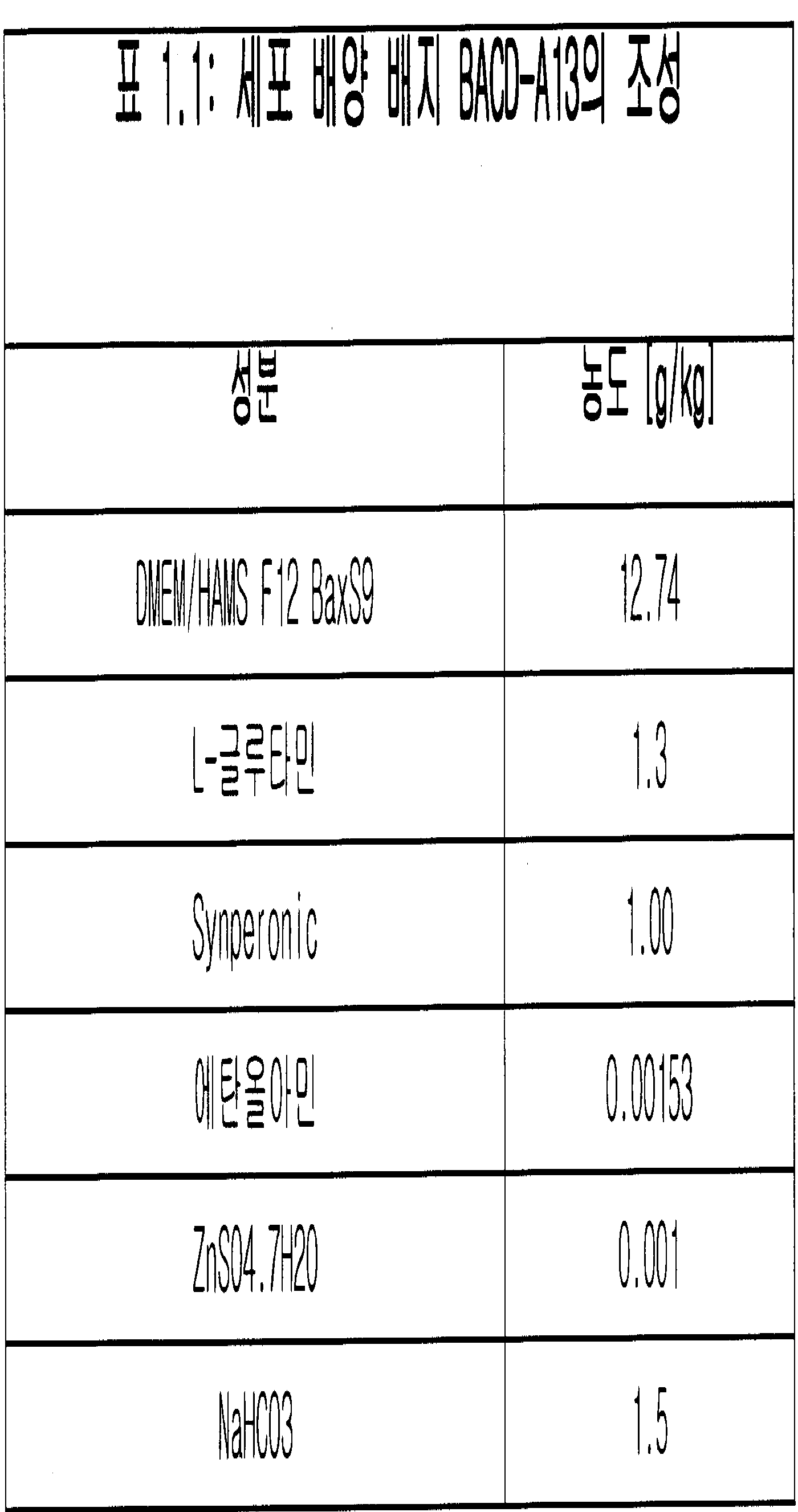
인간 ADAMTS13을 발현하는 재조합 CHO 세포는 표 1.2에서 제시된 바와 같은 화학적으로 규정된 배지, 다시 말하면, BCS 배지에 순응되었다.Recombinant CHO cells expressing human ADAMTS13 were adapted to a chemically defined medium, i. E., BCS medium, as set forth in Table 1.2.
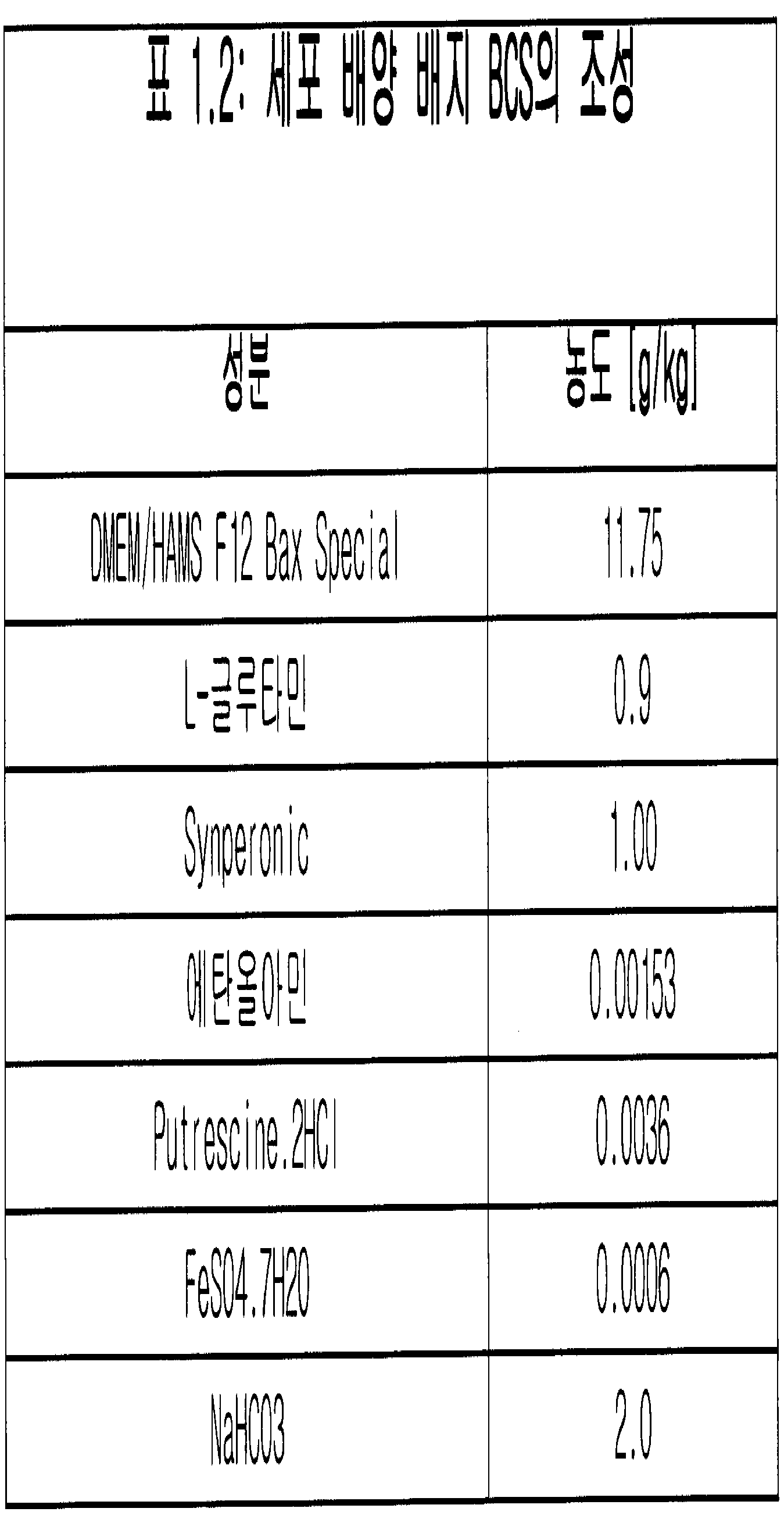
개발 작업 세포 은행은 해동되고, 그리고 세포 접종물은 BCS 배지에서 준비되었다. 세포는 Rushton 타입 임펠러가 구비된 10 ℓ 배양 단위에 이전되고, 그리고 아래와 같이 인라인 통제된 파라미터를 갖는 BACD-A13 배지에서 반복 회분식 배양으로 배양되었다: pH 7.10, 온도 36℃, 그리고 DO 20% 공기 포화도 (air saturation).Development work Cell banks were thawed, and cell inocula were prepared in BCS medium. Cells were transferred to 10 l culture units equipped with a Rushton type impeller and incubated in a batch batch culture on BACD-A13 medium with inline controlled parameters as follows: pH 7.10, temperature 36 ° C, and DO 20% air saturation (air saturation).
2회 회분 주기후, 배양은 10 ℓ의 최종 작업 부피에 도달하고, 그리고 배양은 4일자에 연속 배지 공급으로 전환되고 키모스탯 양식으로 18일자까지 수행되었다.After the 2-time ash period, the cultures reached a final working volume of 10 l, and the cultures were switched to continuous medium feeding on day 4 and were performed in the form of a chymostat until day 18.
이러한 배양으로부터, Rushton 타입 임펠러 및 세포 유지 장치가 구비된 두 번째 10 ℓ 배양 단위는 동일한 세포 배양 배지를 이용하여, 키모스탯-유사 관류를 위하여 접종되고, 그리고 반복 회분식 배양으로 8일 동안 배양되었다. CYTOPORE 2TM 미립담체 (GE Healthcare)가 첨가되고 (0.25 g/ℓ), 그리고 배양 단위는 키모스탯 양식에서 다른 배양 단위와 병렬로, 연속 키모스탯-유사 관류 양식에서 더욱 작동되었다. 배양 단위는 배플이 구비된 Rushton 타입 임펠러로 140 rpm으로 교반되고, 이는 대략 40 W/m3의 비 파워/부피 입력에 상응한다.From these cultures, a second 10 l culture unit equipped with a Rushton type impeller and cell holding device was inoculated for chymostat-like perfusion using the same cell culture medium and incubated for 8 days in a batch batch culture. CYTOPORE 2 TM microspheres (GE Healthcare) were added (0.25 g / l), and the culture units were further operated in a continuous chymostat-like perfusion format in parallel with other culture units in the form of a chymostat. The culture unit is agitated at 140 rpm with a Rushton type impeller equipped with a baffle, which corresponds to a non-power / volume input of approximately 40 W / m 3 .
양쪽 배양 단위는 24일 동안 병렬로 작동되었다. 데이터는 3주 간격 및 추가의 3일 간격으로 계산되었다 (표 1.3. (키모스탯) 및 표 1.4 (키모스탯-유사 관류)). 표 1.3.의 4가지 간격 (일자 26-32; 일자 33-39; 일자 40-46; 그리고 일자 47-49)으로부터 데이터는 표 1.4에 제시된 4가지 간격 (일자 9-15; 일자 16-22; 일자 23-29; 그리고 일자 30-32)과 직접적으로 비교되었다.Both culture units were run in parallel for 24 days. Data were calculated at intervals of 3 weeks and an additional 3 days (Table 1.3. (Chymostat) and Table 1.4 (chymostat-like perfusion)). Data from the four intervals in Table 1.3 (date 26-32; date 33-39; date 40-46; and date 47-49) are shown in Table 1.4 for the four intervals (date 9-15; date 16-22; Dates 23-29; and Dates 30-32).
이들 배양 단위로부터 샘플은 채취되고 ELISA에 의해 ADAMTS13 농도에 대하여 분석되고, 그리고 FRETS-73 검사법에 의해 ADAMTS13 활성에 대하여 분석되었다. 세포 수는 Nucleocounter 기술에 의해 결정되었다. 관류 배양의 경우에, 총 세포 수 및 상층액에서 세포 수는 상대적 세포 유지를 계산하기 위하여 별개로 측정되었다. 희석 속도는 측정되고, 그리고 성장 속도 및 부피당 생산성을 계산하는데 이용되었다. 이들 방정식은 하기에 제공된다.Samples were taken from these cultured units and analyzed for ADAMTS13 activity by ELISA and for ADAMTS13 activity by the FRETS-73 assay. Cell number was determined by Nucleocounter technology. In the case of perfusion culture, the total number of cells and the number of cells in the supernatant were measured separately to calculate relative cell maintenance. The dilution rate was measured and used to calculate growth rate and productivity per volume. These equations are provided below.
키모스탯 배양에서 성장 속도 (μ)는 하기 방정식을 이용하여 계산되었다: μ = D + ln ( Xt / Xt -1 ) / (t - t-1), 여기서 D = 희석 속도, Xt = 시간 t에서 총 세포 밀도, 그리고 (t - t-1) = t와 t-1 사이에 시간.Chemo stat growth rate in culture (μ) was calculated using the following equation: μ = D + ln (X t / X t -1) / (t - t -1), where D = dilution rate, X = t Total cell density at time t, and time between (t - t -1 ) = t and t -1 .
키모스탯-유사 관류 배양에서 성장 속도 (μ)는 하기 방정식을 이용하여 계산되었다: μ = ln ( Xt / Xt -1 ) / (t - t-1) + D x (log평균 XSN/ log평균 X)/ (t - t-1); 여기서 D = 희석 속도, Xt = 시간 t에서 총 세포 밀도, (t - t-1) = t와 t-1 사이에 시간, log평균 X = 총 세포 밀도의 대수 평균 = ( Xt - Xt -1 ) / ( ln( Xt ) - ln (Xt-1 )), 그리고 log평균 XSN = 세포 밀도 상층액의 대수 평균.Chemo stat-growth rate in the similar perfusion culture (μ) was calculated using the following equation: μ = ln (X t / X t -1) / (t - t -1) + D x (log mean X SN / log mean X) / (t - t - 1 ); The total cell density at D = dilution rate, X t = time t, (t - t -1) = t and the time t between -1, X = log mean of the total number average cell density = (X t - X t -1 ) / (ln (X t ) - ln (X t-1 )), and the log average X SN = the logarithmic mean of the cell density supernatant.
세포 유지 비율은 하기와 같이 계산되었다: 100 x (1 - XSN / X)[%]The cell maintenance ratio was calculated as follows: 100 x (1 - X SN / X) [%]
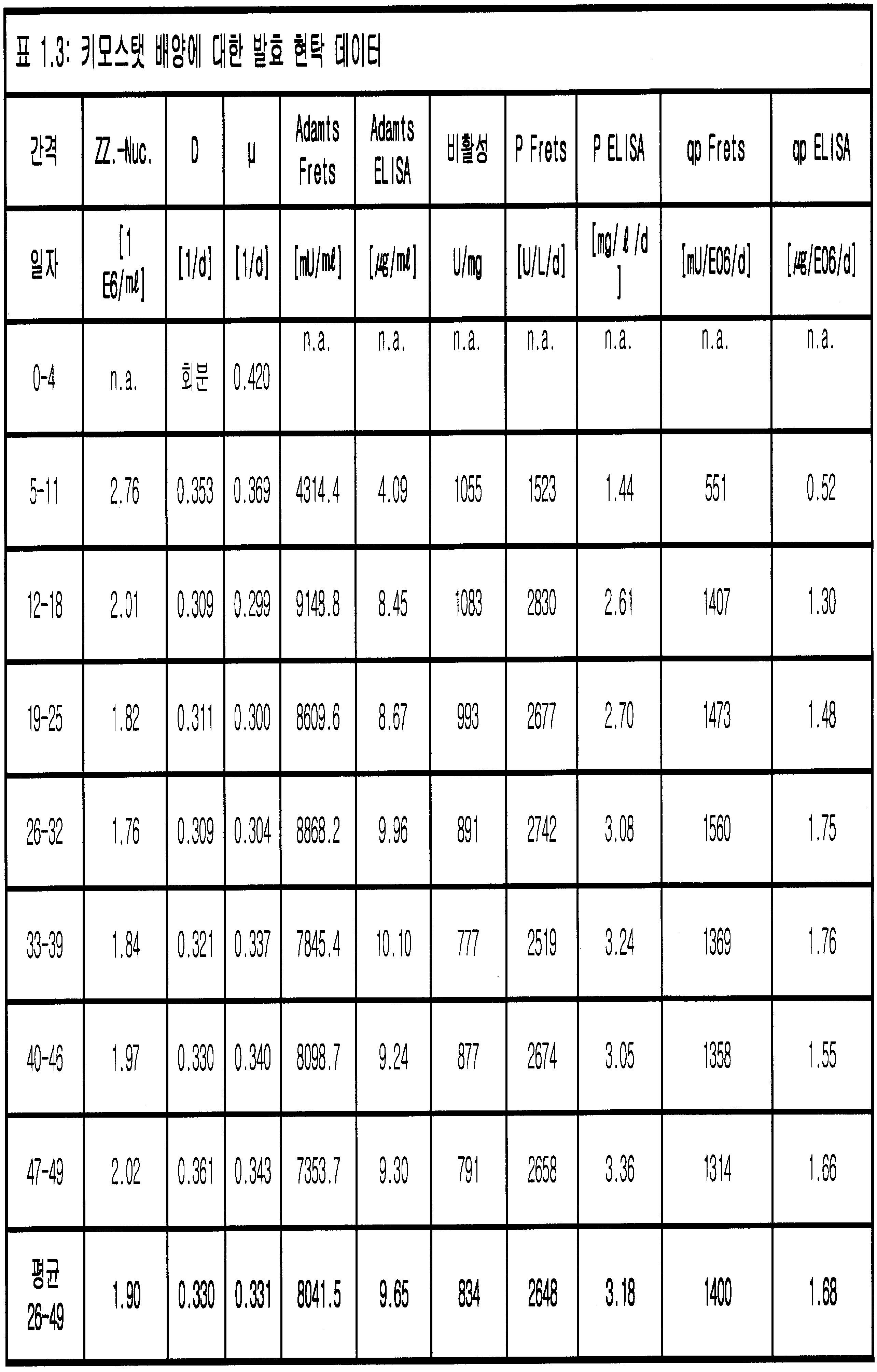

회분식 배양에서 이들 세포의 비 성장 속도는 대략 0.42 d-1이었다. 키모스탯 배양으로 전환후, 대략 0.30 d-1까지 비 성장 속도의 감소가 관찰되었는데, 이는 화학적으로 규정된 배지에서 성장 제한 조건을 지시한다. 세포 밀도는 1.8-2x10⁶개 세포/㎖의 범위에서 평형화되었다. 이런 연속 배양 조건 하에, 정상 상태가 도달되고 (간격 12-18에서부터), 그리고 2500U/L/d가 달성될 수 있다.The rate of non-growth of these cells in the batch culture was approximately 0.42 d -1 . After conversion to chymostat cultures, a decrease in non-growth rate up to approximately 0.30 d -1 was observed, indicating growth restriction conditions in chemically defined media. Cell density was equilibrated in the range of 1.8-2x10 6 cells / ml. Under these continuous culture conditions, steady state is reached (from intervals 12-18), and 2500 U / L / d can be achieved.
앞서 언급된 바와 같이, 18일자에 세포 유지 장치로 배양 단위를 접종한 이후, 세포는 연속 키모스탯-유사 관류 양식으로 더욱 배양되었다. 세포 유지로 인하여, 키모스탯-유사 관류 배양에서 세포 밀도가 증가하였다. 하지만, 상대적으로 낮은 세포 유지 비율 (평균 72%; 범위 60%-84%)로 인하여, 세포 밀도는 <1X10⁷개 세포/㎖ (평균 4.93X10⁶개 세포/㎖)의 상대적으로 낮은 수준에서 지속되고, 그리고 최대 희석 속도는 0.62 d-1이었다.As mentioned earlier, after inoculation of the culture units with cell-holding apparatus at day 18, the cells were further cultured in a continuous chymostat-like manner. Due to cell maintenance, the cell density was increased in the chymostat-like perfusion culture. However, due to the relatively low cell maintenance rate (mean 72%; range 60% -84%), the cell density was maintained at a relatively low level of <1 × 10 7 cells / ml (average 4.93 × 10 6 cells / And the maximum dilution rate was 0.62 d -1 .
이러한 낮은 세포 유지 비율은 또한, 이들 세포가 과도한 세포 밀도를 유발하지 않으면서, 0.18 - 0.27 d-1의 연속 비 성장 속도를 지속할 수 있도록 하였다. 이것은 성장 연관된 방식으로 재조합 단백질을 발현하는 재조합 세포의 경우에 이점으로 간주된다. 감소된 비 생산성 (specific productivity) (가령, 974 mU/E06/d 대(對) 1400 mU/E06/d)에도 불구하고, 부피당 생산성은 대략 2.8-배 높은 세포 밀도로 인하여, 2648 U/L/d에서 4538 U/L/d로 70% 이상 증가하였다. 재조합 단백질의 비 활성 역시 아마도, 배양 단위에서 감소된 체류 시간으로 인하여 향상되고 (941 U/mg 대(對) 834 U/mg), 따라서 발현된 재조합 ADAMTS13의 안정성, 또는 발현된 재조합 ADAMTS13의 구조와 기능에 대한 임의의 다른 유익한 효과가 향상되었다.This low cell maintenance ratio also allowed these cells to sustain a continuous rate of growth of 0.18 - 0.27 d -1 , without causing excessive cell density. This is considered an advantage in the case of recombinant cells expressing the recombinant protein in a growth-related manner. Despite the reduced specific productivity (eg, 974 mU / E06 / d vs. 1400 mU / E06 / d), productivity per volume was 2648 U / L / d to 4538 U / L / d. The inactivation of the recombinant protein is also probably enhanced due to the reduced residence time in the culture unit (941 U / mg vs. 834 U / mg), thus the stability of the expressed recombinant ADAMTS13, or the structure of the expressed recombinant ADAMTS13 Any other beneficial effect on function has been improved.
실시예 2: 키모스탯 배양은 표 1.1에서 제시된 바와 같이 보충되는 화학적으로 규정된 BACD-A13 배지 (농축된 DMEM/F12 제제)에서 인간 ADAMTS13을 발현하는 재조합 CHO 세포주로 준비되었다. Example 2 : Chymostat cultures were prepared with a recombinant CHO cell line expressing human ADAMTS13 in chemically defined BACD-A13 medium (concentrated DMEM / F12 preparation) supplemented as shown in Table 1.1.
인간 ADAMTS13을 발현하는 재조합 CHO 세포는 표 1.2에서 제시된 바와 같은 화학적으로 규정된 배지, 다시 말하면, BCS 배지에 순응되었다. 개발 작업 세포 은행은 해동되고, 그리고 세포 접종물은 BCS 배지에서 준비되었다. 세포는 블레이드 임펠러가 구비된 1.5 ℓ 배양 단위에 이전되고, 그리고 인라인 통제된 pH 7.1, 온도 36℃, 그리고 DO 20% 공기 포화도 (air saturation)를 갖는 BACD-A13 배지에서 반복 회분식 배양으로 배양되었다.Recombinant CHO cells expressing human ADAMTS13 were adapted to a chemically defined medium, i. E., BCS medium, as set forth in Table 1.2. Development work Cell banks were thawed, and cell inocula were prepared in BCS medium. Cells were transferred to a 1.5 L culture unit equipped with a blade impeller and incubated in a batch batch culture on BACD-A13 medium with in-line controlled pH 7.1, temperature 36 ° C, and DO 20% air saturation.
2회 회분 주기후, 배양은 1.5 ℓ의 최종 작업 부피에 도달하고, 그리고 배양은 5일자에 연속 배지 공급으로 전환되고 키모스탯 양식으로 7일자까지 수행되었다.After the 2-time ash period, the cultures reached a final working volume of 1.5 L, and the cultures were switched to continuous medium feeding on day 5 and were performed in chymostat form until day 7.
이러한 배양으로부터, 블레이드 임펠러가 구비된 세포 유지 장치를 포함하는 두 번째 배양 단위는 동일한 세포 배양 배지를 이용하여 접종되고, 그리고 회분식 배양으로 1일 동안 배양되었다. CYTOPORE 2TM 미립담체 (GE Healthcare)가 첨가되고 (0.25 g/ℓ), 그리고 배양 단위는 키모스탯 양식에서 다른 배양 단위와 병렬로, 연속 키모스탯-유사 관류 양식에서 더욱 작동되었다.From these cultures, a second culture unit containing a cell holding device equipped with a blade impeller was inoculated using the same cell culture medium and incubated for 1 day in a batch culture. CYTOPORE 2 TM microspheres (GE Healthcare) were added (0.25 g / l), and the culture units were further operated in a continuous chymostat-like perfusion format in parallel with other culture units in the form of a chymostat.
양쪽 배양 단위는 28일 동안 병렬로 작동되었다. 데이터는 4주 간격으로 계산되었다 (표 2.1 (키모스탯) 및 표 2.2 (키모스탯-유사 관류 양식)).Both culture units were run in parallel for 28 days. Data were calculated at 4-week intervals (Table 2.1 (chymostats) and Table 2.2 (chymostat-like perfusion patterns)).
이들 배양 단위로부터 샘플은 채취되고 ELISA에 의해 ADAMTS13 농도에 대하여 분석되고, 그리고 FRETS-73 검사법에 의해 ADAMTS13 활성에 대하여 분석되었다. 세포 수는 Nucleocounter 기술에 의해 결정되었다. 키모스탯-유사 관류 배양의 경우에, 총 세포 수 및 상층액에서 세포 수는 상대적 세포 유지를 계산하기 위하여 별개로 측정되었다. 희석 속도는 측정되고, 그리고 성장 속도 및 부피당 생산성을 계산하는데 이용되었다. 이들 방정식은 하기에 제공된다.Samples were taken from these cultured units and analyzed for ADAMTS13 activity by ELISA and for ADAMTS13 activity by the FRETS-73 assay. Cell number was determined by Nucleocounter technology. In the case of chymostatic-like perfusion cultures, total cell count and cell number in the supernatant were separately determined to calculate relative cell maintenance. The dilution rate was measured and used to calculate growth rate and productivity per volume. These equations are provided below.
키모스탯 배양에서 성장 속도 (μ)는 하기 방정식을 이용하여 계산되었다: μ = D + ln ( Xt / Xt -1 ) / (t - t-1), 여기서 D = 희석 속도, Xt = 시간 t에서 총 세포 밀도, 그리고 (t - t-1) = t와 t-1 사이에 시간.Chemo stat growth rate in culture (μ) was calculated using the following equation: μ = D + ln (X t / X t -1) / (t - t -1), where D = dilution rate, X = t Total cell density at time t, and time between (t - t -1 ) = t and t -1 .
키모스탯-유사 관류 배양에서 성장 속도 (μ)는 하기 방정식을 이용하여 계산되었다: μ = ln ( Xt / Xt -1 ) / (t - t-1) + D x (log평균 XSN/ log평균 X)/ (t - t-1); 여기서 D = 희석 속도, Xt = 시간 t에서 총 세포 밀도, (t - t-1) = t와 t-1 사이에 시간, log평균 X = 총 세포 밀도의 대수 평균 = ( Xt - Xt -1 ) / ( ln( Xt ) - ln (Xt-1 )), 그리고 log평균 XSN = 세포 밀도 상층액의 대수 평균.Chemo stat-growth rate in the similar perfusion culture (μ) was calculated using the following equation: μ = ln (X t / X t -1) / (t - t -1) + D x (log mean X SN / log mean X) / (t - t - 1 ); The total cell density at D = dilution rate, X t = time t, (t - t -1) = t and the time t between -1, X = log mean of the total number average cell density = (X t - X t -1 ) / (ln (X t ) - ln (X t-1 )), and the log average X SN = the logarithmic mean of the cell density supernatant.
세포 유지 비율은 하기와 같이 계산되었다: 100 x (1 - XSN / X)[%]The cell maintenance ratio was calculated as follows: 100 x (1 - X SN / X) [%]


회분식 배양에서 ADAMTS-13을 발현하는 재조합 CHO 세포의 비 성장 속도는 대략 0.51 d-1이었다. 키모스탯 배양으로 전환후, 0.30 d-1 이하까지 비 성장 속도의 감소가 관찰되었는데, 이는 화학적으로 규정된 배지에서 성장 제한 조건을 지시한다. 세포 밀도는 0.25-0.27 d-1의 비 성장 속도에서 0.8-1.2x10⁶개 세포/㎖의 범위에서 평형화되었다. 이런 연속 배양 조건 하에, 정상 상태가 도달되었다 (간격 16-36에서부터). 일자 09-36으로부터 4가지 간격 모두의 평균 생산성은 920 U/L/d이었다.The non-growth rate of recombinant CHO cells expressing ADAMTS-13 in batch culture was approximately 0.51 d -1 . After conversion to chymostat cultures, a decrease in non-growth rate up to 0.30 d -1 was observed, indicating growth restriction conditions in chemically defined media. The cell density was equilibrated in the range of 0.8-1.2x10 6 cells / ml at the non-growth rate of 0.25-0.27 d- 1 . Under these continuous culture conditions, a steady state was reached (from intervals 16-36). From dates 09-36, the average productivity of all four intervals was 920 U / L / d.
앞서 기술된 바와 같이, 7일자에 세포 유지 장치로 배양 단위를 접종한 이후, 세포는 연속 키모스탯-유사 양식으로 더욱 배양되었다. 표 2.1의 4가지 간격 (일자 9-15; 일자 16-22; 일자 23-29; 그리고 일자 30-36)으로부터 데이터 및 일자 9-36의 평균 값은 표 2.2의 4가지 간격 (일자 2-8; 일자 9-15; 일자 16-22; 그리고 일자 23-29)으로부터 데이터 및 일자 2-29의 평균 값과 직접적으로 비교되었다.As described above, after inoculating the culture units with the cell holding device at day 7, the cells were further cultured in a continuous chymostat-like manner. The data from Table 4 and the average values of dates 9-36 from the four intervals (date 9-15; date 16-22; date 23-29; and date 30-36) ; Dates 9-15; dates 16-22; and dates 23-29) and the average value of dates 2-29.
키모스탯-유사 관류 배양은 이후, 키모스탯-유사 관류 배양의 장기 안정성을 증명하기 위하여 추가로 3가지 간격 (일자 30-36; 일자 37-43; 그리고 일자 44-49) 동안 수행되었다 (참고로서 키모스탯 없이). 7주간 연속 배양의 평균 값은 표 2.2에 제시된다 (일자 2-49의 평균).The chymostat-like perfusion culture was then carried out for three further intervals (date 30-36; date 37-43; and date 44-49) to demonstrate the long-term stability of the chymostat-like perfusion culture Without a keystroke). The mean values of the 7-week continuous cultures are shown in Table 2.2 (average of dates 2-49).
세포 유지로 인하여, 관류 배양에서 세포 밀도가 증가한다. 하지만, 상대적으로 낮은 세포 유지 비율 (일자 02-29의 평균: 61%, 일자 02-49의 평균: 68%. 범위 38%-72%)로 인하여, 세포 밀도는 <5X10⁶ 세포/㎖ (일자 02-49의 평균 = 3.49X10⁶개 세포/㎖)의 상대적으로 낮은 수준에서 지속되었다. 대략 0.60 d-1의 최대 희석 속도가 세 번째 간격에서 도달되고, 이후 실험의 종결 때까지 0.55 d-1 내지 0.60 d-1에서 일정하였다 (일자 02-49의 평균: 0.55 d-1).Due to cell maintenance, cell density increases in perfusion culture. However, due to the relatively low cell maintenance ratio (average of days 02-29: 61%, average of days 02-49: 68%, range 38% -72%), cell density was <5X10 6 cells / 0.0 > 02-49 < / RTI > = 3.49X10 6 cells / ml). A maximum dilution rate of approximately 0.60 d -1 was reached at the third interval and then was constant at 0.55 d -1 to 0.60 d -1 until the end of the experiment (0.55 d -1 on the average of days 02-49).
이러한 낮은 세포 유지 비율은 또한, 이들 세포가 과도한 세포 밀도를 유발하지 않으면서, 0.16 - 0.26 d-1 (일자 02-49의 평균: 0.22d- 1)의 연속 비 성장 속도를 지속할 수 있도록 하였다. 감소된 비 생산성 (specific productivity) (가령, 595 mU/E06/d 대(對) 799 mU/E06/d)에도 불구하고, 부피당 생산성은 대략 2.8x 높은 세포 밀도로 인하여, 920 U/L/d에서 1807 U/L/d (첫 4가지 간격의 평균)로 90% 이상 증가하였다. 키모스탯-유사 배양의 생산성은 추가의 3가지 간격 동안 1500-1600 U/L/d의 범위에서 상대적으로 안정적으로 유지되었다.This low cell maintenance ratio also allowed the cells to sustain a continuous non-growth rate of 0.16 - 0.26 d -1 (mean of 0.22 d - 1 on day 02-49), without causing excessive cell density . Despite the reduced specific productivity (eg, 595 mU / E06 / d vs. 799 mU / E06 / d), the productivity per volume was 920 U / L / d At 1807 U / L / d (average of the first four intervals). The productivity of the chymostat-like cultures remained relatively stable in the range of 1500-1600 U / L / d during the three additional intervals.
실시예 1에서처럼, 하향된 세포 유지 비율로 연속 현탁 배양을 안정화시키는 이러한 접근법은 일정한 배양 조건 하에 (가령, 화학적으로 규정된 배지를 이용할 때) 심각한 성장 제한의 단점을 보상할 수 있는 것으로 증명되었다. 따라서 세포 유지의 통제는 상대적으로 중간 정도 세포 밀도 및 상대적으로 낮고 불변하는 희석 속도에서 배양이 지속될 수 있도록 한다. 또한, 상대적으로 낮은 세포 유지 비율로 인하여, 이러한 배양은 예로써, 비 성장 속도에 의해 증명되는 바와 같이, 연속 현탁 배양의 특징 중에서 상당수를 유지하였다.As in Example 1, this approach of stabilizing the continuous suspension culture with a reduced cell maintenance ratio has proven to be able to compensate for the disadvantages of severe growth restriction under certain culture conditions (e.g., when using chemically defined media). Thus, cell maintenance control allows the culture to continue at relatively moderate cell densities and at relatively low and constant dilution rates. In addition, due to the relatively low cell maintenance rate, such cultures have retained a significant number of characteristics of the continuous suspension culture, as evidenced by the non-growth rate, for example.
본 명세서에 인용되는 모든 특허, 특허 공보, 그리고 기타 간행물은 마치 각 개별 간행물, 특허, 또는 특허 출원이 본 발명에 참조로서 편입되는 것으로 구체적이고 개별적으로 지시되는 것과 동일한 정도로 본 발명에 참조로서 편입된다.All patents, patent publications, and other publications cited herein are incorporated by reference to the same extent as if each individual publication, patent, or patent application was specifically and individually indicated to be incorporated by reference herein .
상기 설명을 살펴본 이후에, 당업자는 일정한 변형과 개선을 구상할 것이다. 이와 같은 모든 변형과 개선은 간결함 및 가독성의 이유로 본 명세서에서 생략된 것으로 이해되어야 한다. 그럼에도 불구하고, 이와 같은 모든 변형과 개선은 본 발명의 범위 내에 있는 것으로 예기되고, 그리고 적절하게는, 하기 특허청구범위의 범위 내에 있다.After reviewing the above description, one of ordinary skill in the art will envision certain variations and improvements. All such modifications and improvements are to be understood as being omitted herein for reasons of brevity and readability. Nevertheless, all such modifications and improvements are intended to be within the scope of the present invention and, as appropriate, fall within the scope of the following claims.
Claims (19)
(b) 상기 세포 배양 시스템으로부터 제거된 배지로부터 상기 폴리펩티드를 회수하는 단계를 포함하고,
여기서 상기 세포는 트롬보스폰딘 타입 1 모티프 13을 갖는 디스인테그린-유사 및 금속단백분해효소 (ADAMTS13) 단백질을 발현하도록 유전적으로 변형되는 것인,
연속 세포 배양에서 폴리펩티드를 생산하는 방법.(a) culturing a mammalian cell expressing a polypeptide in a continuous cell culture system, said cell culture system comprising a cell retaining device and having a dilution rate (D) of less than 2 d -1 and 2 x 10 7 cells / Ml, < / RTI > And
(b) recovering the polypeptide from the medium removed from the cell culture system,
Wherein the cell is genetically modified to express a disintegrin-like and metalloproteinase (ADAMTSl 3) protein having a thrombospondin type 1 motif 13,
A method of producing a polypeptide in continuous cell culture.
(a) 연속 세포 배양 시스템에서 재조합 ADAMTS13 단백질을 발현하는 비고정 의존성 포유동물 세포를 배양하는 단계이며, 상기 세포 배양 시스템은 90% 미만의 세포 유지 비율을 갖는 세포 유지 장치를 포함하고 0.1 d-1 내지 1.0 d- 1 의 희석 속도 (D) 및 1 X 10⁷개 세포/㎖ 미만의 세포 밀도를 갖는, 단계; 및
(b) 상기 세포 배양 시스템으로부터 제거된 배지로부터 ADAMTS13 단백질을 회수하는 단계를 포함하는,
연속 세포 배양에서 ADAMTS13 단백질을 생산하는 방법.The method according to claim 1,
(a) a continuous cell culturing unfixed dependent mammalian cells expressing recombinant ADAMTS13 protein in the culture system, the cell culture system comprising a cell holding device having a cell retention rate of less than 90% 0.1 d -1 A dilution rate (D) of 1.0 d - 1 and a cell density of less than 1 x 10 7 cells / ml; And
(b) recovering the ADAMTS13 protein from the medium removed from the cell culture system.
Methods for producing ADAMTS13 protein in continuous cell culture.
Applications Claiming Priority (3)
| Application Number | Priority Date | Filing Date | Title |
|---|---|---|---|
| US23031309P | 2009-07-31 | 2009-07-31 | |
| US61/230,313 | 2009-07-31 | ||
| PCT/EP2010/061191 WO2011012725A1 (en) | 2009-07-31 | 2010-08-02 | Method of producing a polypeptide or virus of interest in a continuous cell culture |
Related Parent Applications (1)
| Application Number | Title | Priority Date | Filing Date |
|---|---|---|---|
| KR1020127004996A Division KR101752789B1 (en) | 2009-07-31 | 2010-08-02 | Method of producing a polypeptide or virus of interest in a continuous cell culture |
Publications (2)
| Publication Number | Publication Date |
|---|---|
| KR20170077286A true KR20170077286A (en) | 2017-07-05 |
| KR101885046B1 KR101885046B1 (en) | 2018-08-02 |
Family
ID=42668436
Family Applications (2)
| Application Number | Title | Priority Date | Filing Date |
|---|---|---|---|
| KR1020127004996A Active KR101752789B1 (en) | 2009-07-31 | 2010-08-02 | Method of producing a polypeptide or virus of interest in a continuous cell culture |
| KR1020177017512A Active KR101885046B1 (en) | 2009-07-31 | 2010-08-02 | Method of producing a polypeptide or virus of interest in a continuous cell culture |
Family Applications Before (1)
| Application Number | Title | Priority Date | Filing Date |
|---|---|---|---|
| KR1020127004996A Active KR101752789B1 (en) | 2009-07-31 | 2010-08-02 | Method of producing a polypeptide or virus of interest in a continuous cell culture |
Country Status (22)
| Country | Link |
|---|---|
| US (4) | US8580554B2 (en) |
| EP (2) | EP2459697B1 (en) |
| JP (2) | JP5808742B2 (en) |
| KR (2) | KR101752789B1 (en) |
| CN (1) | CN102549142B (en) |
| AU (1) | AU2010277490B2 (en) |
| BR (1) | BR112012002137B8 (en) |
| CA (1) | CA2769354A1 (en) |
| CO (1) | CO6491119A2 (en) |
| DK (1) | DK2459697T3 (en) |
| EA (1) | EA022219B1 (en) |
| ES (1) | ES2705206T3 (en) |
| HR (1) | HRP20182165T1 (en) |
| IN (1) | IN2012DN00899A (en) |
| MX (2) | MX2012001274A (en) |
| NZ (1) | NZ597742A (en) |
| PL (1) | PL2459697T3 (en) |
| PT (1) | PT2459697T (en) |
| SG (1) | SG178176A1 (en) |
| SI (1) | SI2459697T1 (en) |
| TR (1) | TR201900213T4 (en) |
| WO (1) | WO2011012725A1 (en) |
Families Citing this family (24)
| Publication number | Priority date | Publication date | Assignee | Title |
|---|---|---|---|---|
| EA202090067A3 (en) * | 2010-07-08 | 2020-07-31 | Баксалта Инкорпорейтид | METHOD FOR OBTAINING RECOMBINANT ADAMTS13 IN CELL CULTURE |
| HRP20211494T1 (en) * | 2011-01-17 | 2021-12-24 | F. Hoffmann - La Roche Ag | Separation apparatus |
| RU2600886C2 (en) | 2011-05-13 | 2016-10-27 | Октафарма Аг | Method of increasing productivity of eucaryotic cells in production of recombinant fviii |
| SI2726600T1 (en) | 2011-07-01 | 2017-07-31 | Amgen Inc. | Mammalian cell culture |
| CN203129697U (en) | 2013-02-05 | 2013-08-14 | 客贝利(厦门)休闲用品有限公司 | Tent frame pole |
| WO2013076309A1 (en) | 2011-11-24 | 2013-05-30 | Genethon | Scalable lentiviral vector production system compatible with industrial pharmaceutical applications |
| US9574167B2 (en) | 2013-02-15 | 2017-02-21 | Pharyx, Inc. | Methods and apparatus for independent control of product and reactant concentrations |
| AU2014226126B2 (en) | 2013-03-08 | 2019-02-14 | Genzyme Corporation | Continuous purification of therapeutic proteins |
| US9217168B2 (en) | 2013-03-14 | 2015-12-22 | Momenta Pharmaceuticals, Inc. | Methods of cell culture |
| ES2842350T3 (en) | 2013-03-19 | 2021-07-13 | Cmc Biologics As | A procedure for the production of a product (eg, polypeptide) in a continuous cell culture fermentation process |
| BE1022132B1 (en) * | 2013-08-30 | 2016-02-19 | Glaxosmithkline Biologicals S.A. | NEW METHOD. |
| US11390663B2 (en) | 2013-10-11 | 2022-07-19 | Regeneron Pharmaceuticals, Inc. | Metabolically optimized cell culture |
| TWI709569B (en) | 2014-01-17 | 2020-11-11 | 美商健臻公司 | Sterile chromatography resin and use thereof in manufacturing processes |
| TWI709570B (en) | 2014-01-17 | 2020-11-11 | 美商健臻公司 | Sterile chromatography and manufacturing processes |
| CN106456720A (en) | 2014-04-01 | 2017-02-22 | 爱德技术生物科学有限公司 | Stabilization of factor viii without calcium as an excipient |
| US9907835B2 (en) | 2014-04-01 | 2018-03-06 | Advanced Bioscience Farmacêutica LTDA | Stable Factor VIII formulations with low sugar-glycine |
| EP3158055B1 (en) * | 2014-06-13 | 2019-09-11 | CSL Limited | Improved production of recombinant von willebrand factor in a bioreactor |
| SG11201806310TA (en) * | 2016-01-26 | 2018-08-30 | Boehringer Ingelheim Int | Linked perfusion to continuous-flow stirred-tank reactor cell culture system |
| WO2017180814A1 (en) | 2016-04-15 | 2017-10-19 | Boehringer Ingelheim International Gmbh | Cell retention device and method |
| CN110023482B (en) * | 2016-12-21 | 2023-05-02 | 豪夫迈·罗氏有限公司 | Growth control of eukaryotic cells |
| IL307155B2 (en) | 2018-05-01 | 2025-11-01 | Amgen Inc | Antibodies with a modulated glycan profile |
| WO2019239780A1 (en) * | 2018-06-15 | 2019-12-19 | 富士フイルム株式会社 | Cell culture method, cell culture device, and method for producing product |
| JP7699537B2 (en) | 2018-08-31 | 2025-06-27 | ジェンザイム・コーポレーション | Sterile chromatography resins and their use in manufacturing processes - Patents.com |
| CN113355297A (en) * | 2021-06-23 | 2021-09-07 | 吉林冠界生物技术有限公司 | Method for producing recombinant avian influenza virus by perfusion culture of full-suspension MDCK cells |
Family Cites Families (8)
| Publication number | Priority date | Publication date | Assignee | Title |
|---|---|---|---|---|
| US5019512A (en) | 1989-03-17 | 1991-05-28 | Baxter International Inc. | Spin filter for removing substantially cell-free culture medium from suspension cell culture system |
| US5626734A (en) | 1995-08-18 | 1997-05-06 | University Technologies International, Inc. | Filter for perfusion cultures of animal cells and the like |
| AU2001291653A1 (en) | 2000-10-02 | 2002-04-15 | Novo-Nordisk A/S | Industrial-scale serum-free production of recombinant factor vii in mammalian cells |
| US20050069979A1 (en) * | 2001-11-28 | 2005-03-31 | Steffen Zeng | Cell culture process |
| US7294484B2 (en) | 2004-08-27 | 2007-11-13 | Wyeth Research Ireland Limited | Production of polypeptides |
| DK1902141T3 (en) | 2005-06-17 | 2012-05-07 | Baxter Int | ADAMTS 13-containing compositions with thrombolytic effect |
| ES2474573T3 (en) * | 2006-01-04 | 2014-07-09 | Baxter International Inc | Cell culture medium without oligopeptides |
| SI2574677T1 (en) * | 2007-12-27 | 2017-11-30 | Baxalta GmbH | Cell culture processes |
-
2010
- 2010-07-30 US US12/847,921 patent/US8580554B2/en active Active
- 2010-08-02 CA CA2769354A patent/CA2769354A1/en not_active Abandoned
- 2010-08-02 ES ES10737916T patent/ES2705206T3/en active Active
- 2010-08-02 KR KR1020127004996A patent/KR101752789B1/en active Active
- 2010-08-02 NZ NZ597742A patent/NZ597742A/en unknown
- 2010-08-02 CN CN201080036754.2A patent/CN102549142B/en active Active
- 2010-08-02 DK DK10737916.6T patent/DK2459697T3/en active
- 2010-08-02 IN IN899DEN2012 patent/IN2012DN00899A/en unknown
- 2010-08-02 EP EP10737916.6A patent/EP2459697B1/en active Active
- 2010-08-02 EA EA201270213A patent/EA022219B1/en not_active IP Right Cessation
- 2010-08-02 PL PL10737916T patent/PL2459697T3/en unknown
- 2010-08-02 MX MX2012001274A patent/MX2012001274A/en active IP Right Grant
- 2010-08-02 KR KR1020177017512A patent/KR101885046B1/en active Active
- 2010-08-02 HR HRP20182165TT patent/HRP20182165T1/en unknown
- 2010-08-02 JP JP2012522190A patent/JP5808742B2/en active Active
- 2010-08-02 PT PT10737916T patent/PT2459697T/en unknown
- 2010-08-02 BR BR112012002137A patent/BR112012002137B8/en active IP Right Grant
- 2010-08-02 EP EP18199855.0A patent/EP3480292A1/en not_active Withdrawn
- 2010-08-02 SG SG2012006599A patent/SG178176A1/en unknown
- 2010-08-02 SI SI201031835T patent/SI2459697T1/en unknown
- 2010-08-02 WO PCT/EP2010/061191 patent/WO2011012725A1/en not_active Ceased
- 2010-08-02 TR TR2019/00213T patent/TR201900213T4/en unknown
- 2010-08-02 AU AU2010277490A patent/AU2010277490B2/en active Active
-
2012
- 2012-01-27 MX MX2014008515A patent/MX353610B/en unknown
- 2012-02-06 CO CO12020130A patent/CO6491119A2/en unknown
-
2013
- 2013-10-10 US US14/050,710 patent/US9650612B2/en active Active
-
2015
- 2015-01-14 JP JP2015004718A patent/JP6177260B2/en active Active
-
2017
- 2017-04-12 US US15/486,181 patent/US10221400B2/en active Active
-
2019
- 2019-01-18 US US16/252,216 patent/US10745672B2/en active Active
Non-Patent Citations (4)
| Title |
|---|
| BIOTECHNOLOGY AND BIOENGINEERING, 1995, vol. 48, no. 3, pages 289-300.* * |
| BIOTECHNOLOGY AND BIOENGINEERING,2003, vol. 82, no. 7, pages 751-765.* * |
| JOURNAL OF BIOTECHNOLOGY, 1992, vol. 22, no. 1-2, pages 31-40.* * |
| JOURNAL OF BIOTECHNOLOGY, 1992, vol. 22, no. 1-2, pages 41-50.* * |
Also Published As
Similar Documents
| Publication | Publication Date | Title |
|---|---|---|
| KR101752789B1 (en) | Method of producing a polypeptide or virus of interest in a continuous cell culture | |
| KR101143796B1 (en) | Improved process for the culturing of cells | |
| Thyden et al. | Recycling spent animal cell culture media using the thermally resistant microalga Chlorella sorokiniana | |
| CN111454877B (en) | CHO cell culture method | |
| JP2859679B2 (en) | New cell line | |
| Hong et al. | Development of an alternating tangential flow (ATF) perfusion‐based transient gene expression (TGE) bioprocess for universal influenza vaccine | |
| Zhang | Approaches to optimizing animal cell culture process: substrate metabolism regulation and protein expression improvement | |
| HK40008436A (en) | Method of producing a polypeptide or virus of interest in a continuous cell culture | |
| HK1169439B (en) | Method of producing a polypeptide or virus of interest in a continuous cell culture | |
| HK1169439A (en) | Method of producing a polypeptide or virus of interest in a continuous cell culture | |
| CN118667752A (en) | Cell culture method for producing human bone morphogenetic protein | |
| Rodríguez et al. | Experimental factorial design for the study of some variables in roller bottles cell culture | |
| CN116694580A (en) | Method for producing recombinant adenovirus |
Legal Events
| Date | Code | Title | Description |
|---|---|---|---|
| A107 | Divisional application of patent | ||
| A201 | Request for examination | ||
| PA0104 | Divisional application for international application |
Comment text: Divisional Application for International Patent Patent event code: PA01041R01D Patent event date: 20170626 Application number text: 1020127004996 Filing date: 20120227 |
|
| PA0201 | Request for examination | ||
| PG1501 | Laying open of application | ||
| E902 | Notification of reason for refusal | ||
| PE0902 | Notice of grounds for rejection |
Comment text: Notification of reason for refusal Patent event date: 20170913 Patent event code: PE09021S01D |
|
| E701 | Decision to grant or registration of patent right | ||
| PE0701 | Decision of registration |
Patent event code: PE07011S01D Comment text: Decision to Grant Registration Patent event date: 20180528 |
|
| GRNT | Written decision to grant | ||
| PR0701 | Registration of establishment |
Comment text: Registration of Establishment Patent event date: 20180727 Patent event code: PR07011E01D |
|
| PR1002 | Payment of registration fee |
Payment date: 20180727 End annual number: 3 Start annual number: 1 |
|
| PG1601 | Publication of registration | ||
| FPAY | Annual fee payment |
Payment date: 20210628 Year of fee payment: 4 |
|
| PR1001 | Payment of annual fee |
Payment date: 20210628 Start annual number: 4 End annual number: 4 |
|
| FPAY | Annual fee payment |
Payment date: 20220627 Year of fee payment: 5 |
|
| PR1001 | Payment of annual fee |
Payment date: 20220627 Start annual number: 5 End annual number: 5 |
|
| PR1001 | Payment of annual fee |
Payment date: 20240625 Start annual number: 7 End annual number: 7 |
|
| PR1001 | Payment of annual fee |
Payment date: 20250630 Start annual number: 8 End annual number: 8 |