KR20200041342A - Polylactic acid composite material and its application - Google Patents
Polylactic acid composite material and its application Download PDFInfo
- Publication number
- KR20200041342A KR20200041342A KR1020207006982A KR20207006982A KR20200041342A KR 20200041342 A KR20200041342 A KR 20200041342A KR 1020207006982 A KR1020207006982 A KR 1020207006982A KR 20207006982 A KR20207006982 A KR 20207006982A KR 20200041342 A KR20200041342 A KR 20200041342A
- Authority
- KR
- South Korea
- Prior art keywords
- polylactic acid
- composite material
- acid composite
- mfi
- carboxyl group
- Prior art date
- Legal status (The legal status is an assumption and is not a legal conclusion. Google has not performed a legal analysis and makes no representation as to the accuracy of the status listed.)
- Granted
Links
Classifications
-
- C—CHEMISTRY; METALLURGY
- C08—ORGANIC MACROMOLECULAR COMPOUNDS; THEIR PREPARATION OR CHEMICAL WORKING-UP; COMPOSITIONS BASED THEREON
- C08K—Use of inorganic or non-macromolecular organic substances as compounding ingredients
- C08K3/00—Use of inorganic substances as compounding ingredients
- C08K3/34—Silicon-containing compounds
-
- C—CHEMISTRY; METALLURGY
- C08—ORGANIC MACROMOLECULAR COMPOUNDS; THEIR PREPARATION OR CHEMICAL WORKING-UP; COMPOSITIONS BASED THEREON
- C08L—COMPOSITIONS OF MACROMOLECULAR COMPOUNDS
- C08L67/00—Compositions of polyesters obtained by reactions forming a carboxylic ester link in the main chain; Compositions of derivatives of such polymers
-
- B—PERFORMING OPERATIONS; TRANSPORTING
- B29—WORKING OF PLASTICS; WORKING OF SUBSTANCES IN A PLASTIC STATE IN GENERAL
- B29C—SHAPING OR JOINING OF PLASTICS; SHAPING OF MATERIAL IN A PLASTIC STATE, NOT OTHERWISE PROVIDED FOR; AFTER-TREATMENT OF THE SHAPED PRODUCTS, e.g. REPAIRING
- B29C45/00—Injection moulding, i.e. forcing the required volume of moulding material through a nozzle into a closed mould; Apparatus therefor
- B29C45/0001—Injection moulding, i.e. forcing the required volume of moulding material through a nozzle into a closed mould; Apparatus therefor characterised by the choice of material
-
- B—PERFORMING OPERATIONS; TRANSPORTING
- B29—WORKING OF PLASTICS; WORKING OF SUBSTANCES IN A PLASTIC STATE IN GENERAL
- B29C—SHAPING OR JOINING OF PLASTICS; SHAPING OF MATERIAL IN A PLASTIC STATE, NOT OTHERWISE PROVIDED FOR; AFTER-TREATMENT OF THE SHAPED PRODUCTS, e.g. REPAIRING
- B29C48/00—Extrusion moulding, i.e. expressing the moulding material through a die or nozzle which imparts the desired form; Apparatus therefor
- B29C48/022—Extrusion moulding, i.e. expressing the moulding material through a die or nozzle which imparts the desired form; Apparatus therefor characterised by the choice of material
-
- C—CHEMISTRY; METALLURGY
- C08—ORGANIC MACROMOLECULAR COMPOUNDS; THEIR PREPARATION OR CHEMICAL WORKING-UP; COMPOSITIONS BASED THEREON
- C08G—MACROMOLECULAR COMPOUNDS OBTAINED OTHERWISE THAN BY REACTIONS ONLY INVOLVING UNSATURATED CARBON-TO-CARBON BONDS
- C08G63/00—Macromolecular compounds obtained by reactions forming a carboxylic ester link in the main chain of the macromolecule
- C08G63/02—Polyesters derived from hydroxycarboxylic acids or from polycarboxylic acids and polyhydroxy compounds
- C08G63/06—Polyesters derived from hydroxycarboxylic acids or from polycarboxylic acids and polyhydroxy compounds derived from hydroxycarboxylic acids
- C08G63/08—Lactones or lactides
-
- C—CHEMISTRY; METALLURGY
- C08—ORGANIC MACROMOLECULAR COMPOUNDS; THEIR PREPARATION OR CHEMICAL WORKING-UP; COMPOSITIONS BASED THEREON
- C08K—Use of inorganic or non-macromolecular organic substances as compounding ingredients
- C08K3/00—Use of inorganic substances as compounding ingredients
- C08K3/01—Use of inorganic substances as compounding ingredients characterized by their specific function
- C08K3/013—Fillers, pigments or reinforcing additives
-
- C—CHEMISTRY; METALLURGY
- C08—ORGANIC MACROMOLECULAR COMPOUNDS; THEIR PREPARATION OR CHEMICAL WORKING-UP; COMPOSITIONS BASED THEREON
- C08K—Use of inorganic or non-macromolecular organic substances as compounding ingredients
- C08K3/00—Use of inorganic substances as compounding ingredients
- C08K3/18—Oxygen-containing compounds, e.g. metal carbonyls
- C08K3/24—Acids; Salts thereof
- C08K3/26—Carbonates; Bicarbonates
-
- C—CHEMISTRY; METALLURGY
- C08—ORGANIC MACROMOLECULAR COMPOUNDS; THEIR PREPARATION OR CHEMICAL WORKING-UP; COMPOSITIONS BASED THEREON
- C08K—Use of inorganic or non-macromolecular organic substances as compounding ingredients
- C08K3/00—Use of inorganic substances as compounding ingredients
- C08K3/34—Silicon-containing compounds
- C08K3/346—Clay
-
- C—CHEMISTRY; METALLURGY
- C08—ORGANIC MACROMOLECULAR COMPOUNDS; THEIR PREPARATION OR CHEMICAL WORKING-UP; COMPOSITIONS BASED THEREON
- C08K—Use of inorganic or non-macromolecular organic substances as compounding ingredients
- C08K3/00—Use of inorganic substances as compounding ingredients
- C08K3/34—Silicon-containing compounds
- C08K3/36—Silica
-
- C—CHEMISTRY; METALLURGY
- C08—ORGANIC MACROMOLECULAR COMPOUNDS; THEIR PREPARATION OR CHEMICAL WORKING-UP; COMPOSITIONS BASED THEREON
- C08K—Use of inorganic or non-macromolecular organic substances as compounding ingredients
- C08K5/00—Use of organic ingredients
- C08K5/0008—Organic ingredients according to more than one of the "one dot" groups of C08K5/01 - C08K5/59
- C08K5/0016—Plasticisers
-
- C—CHEMISTRY; METALLURGY
- C08—ORGANIC MACROMOLECULAR COMPOUNDS; THEIR PREPARATION OR CHEMICAL WORKING-UP; COMPOSITIONS BASED THEREON
- C08K—Use of inorganic or non-macromolecular organic substances as compounding ingredients
- C08K5/00—Use of organic ingredients
- C08K5/04—Oxygen-containing compounds
- C08K5/05—Alcohols; Metal alcoholates
- C08K5/053—Polyhydroxylic alcohols
-
- C—CHEMISTRY; METALLURGY
- C08—ORGANIC MACROMOLECULAR COMPOUNDS; THEIR PREPARATION OR CHEMICAL WORKING-UP; COMPOSITIONS BASED THEREON
- C08K—Use of inorganic or non-macromolecular organic substances as compounding ingredients
- C08K5/00—Use of organic ingredients
- C08K5/04—Oxygen-containing compounds
- C08K5/06—Ethers; Acetals; Ketals; Ortho-esters
-
- C—CHEMISTRY; METALLURGY
- C08—ORGANIC MACROMOLECULAR COMPOUNDS; THEIR PREPARATION OR CHEMICAL WORKING-UP; COMPOSITIONS BASED THEREON
- C08K—Use of inorganic or non-macromolecular organic substances as compounding ingredients
- C08K5/00—Use of organic ingredients
- C08K5/04—Oxygen-containing compounds
- C08K5/09—Carboxylic acids; Metal salts thereof; Anhydrides thereof
- C08K5/098—Metal salts of carboxylic acids
-
- C—CHEMISTRY; METALLURGY
- C08—ORGANIC MACROMOLECULAR COMPOUNDS; THEIR PREPARATION OR CHEMICAL WORKING-UP; COMPOSITIONS BASED THEREON
- C08L—COMPOSITIONS OF MACROMOLECULAR COMPOUNDS
- C08L67/00—Compositions of polyesters obtained by reactions forming a carboxylic ester link in the main chain; Compositions of derivatives of such polymers
- C08L67/04—Polyesters derived from hydroxycarboxylic acids, e.g. lactones
-
- C—CHEMISTRY; METALLURGY
- C08—ORGANIC MACROMOLECULAR COMPOUNDS; THEIR PREPARATION OR CHEMICAL WORKING-UP; COMPOSITIONS BASED THEREON
- C08L—COMPOSITIONS OF MACROMOLECULAR COMPOUNDS
- C08L71/00—Compositions of polyethers obtained by reactions forming an ether link in the main chain; Compositions of derivatives of such polymers
- C08L71/02—Polyalkylene oxides
-
- B—PERFORMING OPERATIONS; TRANSPORTING
- B29—WORKING OF PLASTICS; WORKING OF SUBSTANCES IN A PLASTIC STATE IN GENERAL
- B29L—INDEXING SCHEME ASSOCIATED WITH SUBCLASS B29C, RELATING TO PARTICULAR ARTICLES
- B29L2031/00—Other particular articles
- B29L2031/52—Sports equipment ; Games; Articles for amusement; Toys
- B29L2031/5281—Articles for amusement
- B29L2031/529—Toys
-
- C—CHEMISTRY; METALLURGY
- C08—ORGANIC MACROMOLECULAR COMPOUNDS; THEIR PREPARATION OR CHEMICAL WORKING-UP; COMPOSITIONS BASED THEREON
- C08K—Use of inorganic or non-macromolecular organic substances as compounding ingredients
- C08K3/00—Use of inorganic substances as compounding ingredients
- C08K3/18—Oxygen-containing compounds, e.g. metal carbonyls
- C08K3/24—Acids; Salts thereof
- C08K3/26—Carbonates; Bicarbonates
- C08K2003/265—Calcium, strontium or barium carbonate
-
- C—CHEMISTRY; METALLURGY
- C08—ORGANIC MACROMOLECULAR COMPOUNDS; THEIR PREPARATION OR CHEMICAL WORKING-UP; COMPOSITIONS BASED THEREON
- C08L—COMPOSITIONS OF MACROMOLECULAR COMPOUNDS
- C08L2201/00—Properties
- C08L2201/06—Biodegradable
-
- C—CHEMISTRY; METALLURGY
- C08—ORGANIC MACROMOLECULAR COMPOUNDS; THEIR PREPARATION OR CHEMICAL WORKING-UP; COMPOSITIONS BASED THEREON
- C08L—COMPOSITIONS OF MACROMOLECULAR COMPOUNDS
- C08L2203/00—Applications
- C08L2203/30—Applications used for thermoforming
-
- C—CHEMISTRY; METALLURGY
- C08—ORGANIC MACROMOLECULAR COMPOUNDS; THEIR PREPARATION OR CHEMICAL WORKING-UP; COMPOSITIONS BASED THEREON
- C08L—COMPOSITIONS OF MACROMOLECULAR COMPOUNDS
- C08L2205/00—Polymer mixtures characterised by other features
- C08L2205/02—Polymer mixtures characterised by other features containing two or more polymers of the same C08L -group
-
- C—CHEMISTRY; METALLURGY
- C08—ORGANIC MACROMOLECULAR COMPOUNDS; THEIR PREPARATION OR CHEMICAL WORKING-UP; COMPOSITIONS BASED THEREON
- C08L—COMPOSITIONS OF MACROMOLECULAR COMPOUNDS
- C08L2205/00—Polymer mixtures characterised by other features
- C08L2205/03—Polymer mixtures characterised by other features containing three or more polymers in a blend
Landscapes
- Chemical & Material Sciences (AREA)
- Health & Medical Sciences (AREA)
- Chemical Kinetics & Catalysis (AREA)
- Medicinal Chemistry (AREA)
- Polymers & Plastics (AREA)
- Organic Chemistry (AREA)
- Engineering & Computer Science (AREA)
- Mechanical Engineering (AREA)
- Manufacturing & Machinery (AREA)
- Dispersion Chemistry (AREA)
- Biological Depolymerization Polymers (AREA)
- Compositions Of Macromolecular Compounds (AREA)
Abstract
본 발명은 중량 몫으로 계산하여, i)50~85중량몫의 폴리유산, ii)8~35중량몫의 무기 충전재, iii)0~8중량몫의 가소제 를 포함하고, 그중, 상기 폴리유산 복합재료의 단말 카르복실기 함량을 12~51 molKOH/t로 하는 폴리유산 복합재료를 개시하였다. 본 발명은 연구를 통해 뜻밖으로 폴이유산 복합재료의 단말 카르복실기 함량을 12~51 molKOH/t내로 컨트롤하고, 상기 폴리유산 복합재료를 60℃,60% 온습도 조건하에서 30일간 측정한 질량 멜트 인덱스MFIt=30와 최초 질량 멜트 인덱스MFIt=0의 비율은 3.5<η= MFIt=30/ MFIt=0<5.1임을 발견하였다. 이는 제품이 상기 측정 조건하에서 노화와 생분해가 느리다는 것을 설명하며, 두께가 2.5mm이하 조건하에서 상기 폴리유산 복합재료가12주를 경과한 후생분해율은 90%이상으로서, 적합한 노화성과 생분해 성능을 가짐을 설명한다.The present invention is calculated by weight share, i) 50 to 85 weight share of polylactic acid, ii) 8 to 35 weight share of inorganic filler, and iii) 0 to 8 weight share of plasticizer, wherein the polylactic acid composite A polylactic acid composite material having a terminal carboxyl group content of 12 to 51 molKOH / t is disclosed. The present invention unexpectedly controls the terminal carboxyl group content of the polylactic acid composite material within 12 to 51 molKOH / t through research, and the mass melt index MFI of the polylactic acid composite material measured for 30 days under conditions of 60 ° C and 60% temperature and humidity. It was found that the ratio of t = 30 to the initial mass melt index MFI t = 0 is 3.5 <η = MFI t = 30 / MFI t = 0 <5.1. This explains that the product has slow aging and biodegradation under the above measurement conditions, and the biodegradation rate of the polylactic acid composite material after 12 weeks under the thickness of 2.5 mm or less is 90% or more, and has suitable aging and biodegradation performance. To explain.
Description
본 발명은 고분자 재료 변성 기술분야에 관한 것으로서, 구체적으로는 폴리유산 복합재료 및 그 응용에 관한 것이다. The present invention relates to the field of polymer material modification technology, specifically to a polylactic acid composite material and its application.
폴리유산 수지는 유산을 모노머로 하는 화학 합성 또는 생물 합성에 의해 얻어지는 고분자 재료로서, 옥수수, 감자 등을 주요 원료로 하는 바, 가격이 저렴할 뿐만 아니라 그 원료가 자연 농작물이기 때문에 탄소 배출량이 아주 적다. 안전성으로 부터 볼때, 폴리유산은 독성과 자극성이 없고, 뛰어난 투명성과 생분해성을 가지며, 자연계의 여러가지 미생물 또는 동식물 체내의 효소에 의해 분해 또는 대사되어, 최종적으로 이산화 탄소와 물을 형성하여, 어느 정도 백색오염을 덜어 주며, 이상적인 친환경 고분자재료이다. Polylactic acid resin is a polymer material obtained by chemical synthesis or biosynthesis using lactic acid as a monomer, and is mainly made of corn, potato, and the like. It is not only inexpensive, but also has very low carbon emission because its raw material is a natural crop. From the safety point of view, polylactic acid has no toxicity and irritation, has excellent transparency and biodegradability, is decomposed or metabolized by enzymes in various microorganisms or animals and plants in nature, and finally forms carbon dioxide and water, to some extent. It reduces white pollution and is an ideal eco-friendly polymer material.
폴리유산으로 제작된 제품은 생분해성 뿐만 아니라, 생체 적합성, 광택도, 투명성을 가지며, 일정한 내균성과 내자외선성을 가지기 때문에, 의료, 방사, 식기, 완구 등 분야에 널리 사용되고 있다. Products made of polylactic acid have not only biodegradability, but also biocompatibility, glossiness, and transparency, and have constant antibacterial and ultraviolet resistance, and thus are widely used in fields such as medical, radiation, tableware, and toys.
현재, 폴리유산 제품은 일회용 제품 또는 사용기간에 특별히 엄격한 요구가 없는 쾌속 소비품에 흔히 사용되며, 미생물, 광선, 방사선, 공기 및 접촉하는 물질 환경의 작용에 의하여, 폴리유산 제품은 가공, 저장, 운수 등 기간에 노화 및 생분해 되기 쉽기 때문에, 최종제품의 사용에 지장을 주고 있다. Currently, polylactic acid products are commonly used in disposable products or rapid consumer products that do not have particularly stringent demands on their useful life. Under the action of microorganisms, light, radiation, air and contacting material environments, polylactic acid products are processed, stored and transported. It is prone to aging and biodegradation during such periods, hindering the use of the final product.
상기 문제점으로 부터 출발하여, 본 발명은 폴리유산 복합재료의 단말 산기 함량을 일정한 범위내로 컨트롤 함을 통하여, 복합재료에 적합한 노화 성능과 뛰어난 생분해성을 부여할 수 있다. Starting from the above problems, the present invention can provide aging performance and excellent biodegradability suitable for the composite material by controlling the terminal acid content of the polylactic acid composite material within a certain range.
본 발명은 적합한 노화성능과 뛰어난 생분해성을 가지는 폴리유산 복합재료를 제공하는 것을 목적으로 한다. An object of the present invention is to provide a polylactic acid composite material having suitable aging performance and excellent biodegradability.
중량 몫으로 계산하여, Calculated as weight share,
i)50~85중량몫의 폴리유산, i) 50 to 85 weight share of polylactic acid,
ii)8~35중량몫의 무기 충전재,ii) 8 ~ 35 weight share of inorganic filler,
iii)0~8중량몫의 가소제 를 포함하고, iii) 0 to 8 parts by weight of plasticizer,
그중, 상기 폴리유산 복합재료의 단말 카르복실기 함량을 12~51 molKOH/t로 하는 폴리유산 복합재료. Among them, a polylactic acid composite material having a terminal carboxyl group content of the polylactic acid composite material of 12 to 51 molKOH / t.
그중, 상기 단말 카르복실기 함량의 측정방법: 질량비를 7:3으로 하는 o-클레졸과 트리클로로메탄 혼합액을 용매로 하고, 스위스 Metrohm-Titrino실리즈 자동 전위차 적정계로 단말 카르복실기 값을 측정하며, 측정방법은 FZ/T 50012-2006<폴리 에스테르중 단말 카르복실기 함유량 측정-적정분석법>을 적용하며, 단말 카르복실기 값은 소수점뒤 한자리수를 사사오입하는 방법으로 정수를 취한다. Among them, the method for measuring the content of the terminal carboxyl group: a mixture of o-clesol and trichloromethane having a mass ratio of 7: 3 as a solvent, and measuring the terminal carboxyl group value with a Swiss Metrohm-Titrino Silice automatic potentiometer FZ / T 50012-2006 <Terminal carboxyl group content measurement-titration analysis method in polyester> is applied, and the terminal carboxyl group value takes an integer by rounding off one digit after the decimal point.
폴리유산 복합재료의 단말 카르복실기 함량에 영향을 주는 요소는 아주 많으며, 예를 들어, 폴리유산의 미시적 구조가 다르다 던가, 또는 본 분야의 기술자라면 다 알다시피 폴리유산은 유산을 직접 축합하거나, 락티드의 개환중합을 통해 얻어지며, 합성 과정중, 단말 차단제로 폴리유산에 대한 단말 차단처리를 하지 않은 상태에서 얻어지는 폴리유산은 일정한 량의 단말 카르복실기를 함유하는 중합체이다. 그리고 폴리유산의 합성 과정중, 촉매의 첨가량을 컨트롤하고, 진공도 및 반응시간을 조절함을 통해, 합성되는 폴리유산의 단말 카르복실기의 함량에 영향을 줄 수 있기 때문에, 폴리유산의 미시적 구조가 각기 달라진다. 폴리유산 복합재료의 변성과정중에는 고온 용융을 거쳐야 하며, 고온용융자체는 중합체 단말기를 더욱 반응시키고 생분해시키는 밸런스이다. 게다가 각종 첨가제를 첨가하는 것도, 최종적으로 제작되는 폴리유산 복합재료의 단말 카르복실기 함량에 대해 일정한 영향을 주기 때문에, 제품은 거시적으로 각기 부동한 노화 성능과 생분해성능을 나타내게 된다. There are many factors that affect the terminal carboxyl group content of polylactic acid composite materials, for example, the microscopic structure of polylactic acid is different, or as one skilled in the art knows, polylactic acid directly condenses or lactates lactide. Polylactic acid obtained through ring-opening polymerization of and obtained during the synthesis process without terminal blocking treatment for polylactic acid as a terminal blocking agent is a polymer containing a certain amount of terminal carboxyl groups. And, during the process of synthesizing the polylactic acid, the microstructure of the polylactic acid is different because it can affect the content of the terminal carboxyl group of the polylactic acid to be synthesized by controlling the addition amount of the catalyst and controlling the degree of vacuum and reaction time. . During the modification process of the polylactic acid composite material, it must undergo high-temperature melting, and the high-temperature melting itself is a balance that further reacts and biodegrades the polymer terminal. In addition, the addition of various additives also has a certain effect on the terminal carboxyl group content of the finally produced polylactic acid composite material, and thus the products exhibit macroscopically different aging performance and biodegradability.
본 발명의 연구에 따르면, 폴리유산 복합재료의 단말 카르복실기를 12~51molKOH/t범위내로 컨트롤 할 때, 복합재료에 적합한 노화성능과 뛰어난 생분해성을 부여한다는 것이 밝혀졌다. 폴리유산 복합재료의 단말 카르복실기의 함량이 높으면 높을 수록 폐기처리후 쉽게 생분해되어, 환경오염을 덜어 주게 되나, 폴리유산 복합재료중의 단말 카르복실기의 함량이 너무 높으면 폴리 유산제품이 가공, 저장, 운송기간에 노화 및 생분해가 발생되어, 최종제품의 사용에 영향을 주게 된다. 만약 폴리유산 복합재료의 단말 카르복실기의 함량이 너무 낮으면, 합성과정중 더욱 많은 촉매와 더욱 높은 진공도 및 더욱 긴 반응시간이 수요된다는 것을 의미하며, 동시에 더욱 정밀한 설비와 더욱 많은 설비 투자가 수요되고 더욱 많은 에너지 소모가 생긴다는 것을 의미한다. 때문에 바랍직하게 상기 폴리유산 복합재료의 단말 산기의 함량을 18~41 molKOH/t로 하고, 더욱 바람직하게 28~36 molKOH/t로 한다. According to the research of the present invention, when controlling the terminal carboxyl group of the polylactic acid composite material within the range of 12 to 51 molKOH / t, it was found that it imparts aging performance and excellent biodegradability suitable for the composite material. The higher the terminal carboxyl group content of the polylactic acid composite material, the easier it is to biodegrade after disposal, thereby reducing environmental pollution, but if the content of the terminal carboxyl group in the polylactic acid composite material is too high, the polylactic acid product is processed, stored, and transported. Aging and biodegradation occur, which affects the use of the final product. If the content of the terminal carboxyl group in the polylactic acid composite material is too low, it means that more catalyst, higher vacuum and longer reaction time are required during the synthesis process, and at the same time, more precise equipment and more equipment investment are required and more This means that a lot of energy is being consumed. Therefore, preferably, the content of the terminal acid group of the polylactic acid composite material is 18 to 41 molKOH / t, and more preferably 28 to 36 molKOH / t.
상기 폴리유산 복합재료는 60℃, 60%의 온습도 조건하에서, 30일간 측정한 질량 멜트 인덱스MFIt=30와 최초 멜트 질량 멜트 인덱스MFIt=0의 비율은 아래 계산식을 만족한다. The ratio of the mass melt index MFI t = 30 and the initial melt mass melt index MFI t = 0 measured for 30 days under the conditions of 60 ° C and 60% temperature and humidity of the polylactic acid composite material satisfies the following formula.
3.5<η= MFIt=30/ MFIt=0<5.1;3.5 <η = MFI t = 30 / MFI t = 0 <5.1;
바람직하게:3.9<η= MFIt=30/ MFIt=0<4.7;Preferably: 3.9 <η = MFI t = 30 / MFI t = 0 <4.7;
더욱 바람직하게:4.2<η= MFIt=30/ MFIt=0<4.5;More preferably: 4.2 <η = MFI t = 30 / MFI t = 0 <4.5;
상기 폴리유산 복합재료의 질량 멜트 인덱스 MFI는 ASTM D1238규격에 의해 측정하며, 측정조건을 190℃, 2.16kg으로 하고, 단위를 g/10min로 한다. The mass melt index MFI of the polylactic acid composite material is measured by the ASTM D1238 standard, the measurement conditions are 190 ° C, 2.16 kg, and the unit is g / 10min.
상기 폴리유산 복합재료는 ISO 16929(2013)규격에 따라, 두께가 2,5mm 이하일 경우, 상기 폴리유산 복합재료가 12주를 경과한 후 생분해율이 90%이상에 달한다. According to the ISO 16929 (2013) standard, the polylactic acid composite material has a biodegradation rate of 90% or more after 12 weeks of the polylactic acid composite material having a thickness of 2,5 mm or less.
상기 무기 충전제는 활석분, 벤토나이트, 고령토, 백악, 탄산칼슘, 석고, 염화칼슘, 산화철, 백운석, 이산화규소, 규회석, 티타니아, 규산염, 운모중의 하나 또는 여러가지 혼합물이다. 무기 충전제의 첨가는 재료의 기계적 성능을 개선시켜 줄 뿐만 아니라, 핵 형성제로 사용할 수 있어, 폴리엣테르 조성물의 결정화 속도를 높혀 주며, 폴리유산 복합재료의 가공조건을 개선시켜 준다. The inorganic filler is one or various mixtures of talc powder, bentonite, kaolin, chalk, calcium carbonate, gypsum, calcium chloride, iron oxide, dolomite, silicon dioxide, wollastonite, titania, silicate, mica. The addition of an inorganic filler not only improves the mechanical performance of the material, but also can be used as a nucleating agent, thereby increasing the crystallization rate of the polyether composition and improving the processing conditions of the polylactic acid composite material.
상기 실온 조건하에서 액체상태인 가소제는 글리세린, 폴리글리세린, 에틸렌글리콜, 폴리에틸렌글리콜-400, 폴리에틸렌글리콜-600, 폴리에틸렌글리콜-800, 에폭시 콩기름, 구연산 에스테르, 아세틸 구연산 에스테르, 트리아세틴, 디옥틸 아디페이트중의 하나 또는 여러가지 혼합물이다. Under the above room temperature conditions, the liquid plasticizer is in glycerin, polyglycerin, ethylene glycol, polyethylene glycol-400, polyethylene glycol-600, polyethylene glycol-800, epoxy soybean oil, citric acid ester, acetyl citric acid ester, triacetin, dioctyl adipate It is one or several mixtures.
실온 조건하에서 액체상태인 가소제는 주로 저분자량 화합물로서, 저분자량 가소제를 폴리유산중에 첨가함으로써, 폴리유산 체인세그먼트의 운동을 촉진함으로써, 일정한 정도에서 폴리유산 복합재료의 인성을 높혀 준다. 이와 동시에, 저분자량 가소제는 폴리유산의 결정화를 효과적으로 촉진하며, 일정한 정도에서, 폴리유산의 내열온도를 높혀 준다. Under the conditions of room temperature, the plasticizer in the liquid state is mainly a low-molecular-weight compound, and by adding a low-molecular-weight plasticizer to the polylactic acid, promotes the movement of the polylactic acid chain segment, thereby increasing the toughness of the polylactic acid composite material to a certain extent. At the same time, the low molecular weight plasticizer effectively promotes the crystallization of polylactic acid and, to a certain extent, increases the heat resistance temperature of polylactic acid.
상기 폴리유산 복합재료에는 또 0내지 10 중량몫의 인성 강화제가 포함되고, 상기 인성 강화제는 바람직하게 지방족 폴리에스테르 또는 지방족-방향족 공중합 폴리에스테르 이다. The polylactic acid composite material also includes a toughness enhancer of 0 to 10 weight share, and the toughness enhancer is preferably an aliphatic polyester or an aliphatic-aromatic copolymerized polyester.
실제 성능의 수요에 따라, 본 발명의 상기 폴리유산 복합재료는 중량몫으로 계산하여, 또 0내지 4중량몫의 이형제, 표면활성제, 왁스, 정전기 방지제, 염료 또는 기타 플라스틱 등 기타 첨가제도 포함된다. Depending on the demand of actual performance, the polylactic acid composite material of the present invention is calculated by weight share, and also includes 0 to 4 weight share of release agent, surfactant, wax, antistatic agent, dye or other plastic additives.
상기 이형제는 살리콘 마스터배치, 몬탄왁스, 에루카아미드, 또는 올래오아미드 이다. The release agent is a salicon masterbatch, montan wax, erucamide, or oleoamide.
상기 표면활성제는 폴리소르베이트, 팔미트산에스테르 또는 라우린산 에스테르중의 하나 또는 여러가지 혼합물이다. The surfactant is one or a mixture of polysorbate, palmitic acid ester or lauric acid ester.
상기 왁스는 에루카아미드, 스테아로아미드, 베헨산 아미드, 밀랍, 밀랍에스테르중의 하나 또는 여러가지 혼합물이다. The wax is one or various mixtures of erucamide, stearoamide, behenic acid amide, beeswax and beeswax ester.
상기 정전기 방지제는 영구성 정전기제로서, 구체적으로는 PELESTAT-230、PELESTAT-6500、SUNNICO ASA-2500중의 하나 또는 여러가지 혼합물이다. The antistatic agent is a permanent electrostatic agent, specifically, one or a mixture of PELESTAT-230, PELESTAT-6500, and SUNNICO ASA-2500.
상기 염료는 카본블랙, 흑종초, 이산화티탄, 황화아연, 프탈로시아닌 청 또는 형광 오렌지중의 하나 또는 여러가지 혼합물이다. The dye is one or various mixtures of carbon black, black vinegar, titanium dioxide, zinc sulfide, phthalocyanine blue or fluorescent orange.
상기 플라스틱 첨가제는 핵 형성제, 방무제, 윤활제(스테아르산칼슘), 메인 항산화제, 서브 항산화제 등이다. The plastic additives are nucleating agents, anti-fogging agents, lubricants (calcium stearate), main antioxidants, sub antioxidants, and the like.
본 발명에 의해 제공되는 폴리유산 복합재료는 식기, 완구, 문구 등 사출형, 흡입형, 사출형 플라스틱 제품에 사용된다. The polylactic acid composite material provided by the present invention is used in injection-type, suction-type, and injection-type plastic products such as tableware, toys, and stationery.
본 발명은 연구를 통해 뜻밖으로 폴이유산 복합재료의 단말 카르복실기 함량을 12~51 molKOH/t내로 컨트롤하고, 상기 폴리유산 복합재료를 60℃,60% 온습도 조건하에서 30일간 측정한 질량 멜트 인덱스MFIt=30와 최초 질량 멜트 인덱스MFIt=0의 비율은 3.5<η= MFIt=30/ MFIt=0<5.1임을 발견하였다. 이는 제품이 상기 측정 조건하에서 노화와 생분해가 느리다는 것을 설명하며, 두께가 2.5mm이하 조건하에서 상기 폴리유산 복합재료가12주를 경과한 후의 생분해율은 90%이상으로서, 적합한 노화성과 생분해 성능을 가짐을 설명한다.The present invention unexpectedly controls the terminal carboxyl group content of the polylactic acid composite material within 12 to 51 molKOH / t through research, and the mass melt index MFI of the polylactic acid composite material measured for 30 days under conditions of 60 ° C and 60% temperature and humidity. It was found that the ratio of t = 30 to the initial mass melt index MFI t = 0 is 3.5 <η = MFI t = 30 / MFI t = 0 <5.1. This explains that the product is slow in aging and biodegradation under the above measurement conditions, and the biodegradation rate after the 12 weeks of the polylactic acid composite material is over 90% under a thickness of 2.5 mm or less is suitable for aging and biodegradation performance. Explain to have.
아래에서는 구체적인 예를 들어 본 발명에 대해 설명하는데, 아래 실시예들은 본 발명의 바람직한 실시예들일 뿐이지 본 발명의 실시형태는 아래 실시예에 한정되는 것은 아니다. Hereinafter, the present invention will be described with specific examples. The following examples are only preferred embodiments of the present invention, but the embodiments of the present invention are not limited to the following embodiments.
본 발명에 사용되는 원료들은 모두 시판으로부터 유래한다. The raw materials used in the present invention are all commercially available.
성능 테스트 방법:Performance test method:
생분해율: ISO 16929(2013)에 근거하여, 두께가 2.5 mm이하인 폴리유산 복합재료가 12주를 경과한 후의 생분해율을 측정한다. Biodegradation rate: Based on ISO 16929 (2013), the biodegradation rate of a polylactic acid composite material having a thickness of 2.5 mm or less after 12 weeks has been measured.
η : 60℃,60% 온습도 조건하에서 30일간 측정한 질량 멜트 인덱스MFIt=30와 최초 질량 멜트 인덱스MFIt=0의 비율이다. 즉 η= MFIt=30/ MFIt=0로서, η값이 낮으면 낮을 수록 제품의 노화와 생분해가 느리며, 항노화 성능이 좋다는 것을 설명한다. η: The ratio of the mass melt index MFI t = 30 and the initial mass melt index MFI t = 0 measured for 30 days at 60 ° C and 60% temperature and humidity conditions. That is, as η = MFI t = 30 / MFI t = 0 , the lower the η value, the slower the aging and biodegradation of the product and the better the anti-aging performance.
질량 멜트 인덱스 MFI: ASTM D1238규격에 따라 측정하고, 측정조건은 190℃,2.16kg, 단위는 g/10min이다. Mass melt index MFI: measured according to ASTM D1238 standard, the measurement conditions are 190 ° C, 2.16 kg, and the unit is g / 10min.
단말 카르복실기 함량의 측정방법: 질량비를 7:3으로 하는 o-클레졸과 트리클로로메탄 혼합액을 용매로 하고, 스위스 Metrohm-Titrino실리즈 자동 전위차 적정계로 단말 카르복실기 값을 측정하며, 측정방법은 FZ/T 50012-2006 <폴리 에스테르중 단말 카르복실기 함유량 측정-적정분석법>을 적용하며, 단말 카르복실기 값은 소수점뒤 한자리수를 사사오입하는 방법으로 정수를 취한다.Measuring method of terminal carboxyl group content: Using a mixture of o-clesol and trichloromethane having a mass ratio of 7: 3 as a solvent, the terminal carboxyl group value is measured by a Swiss Metrohm-Titrino Silz automatic potentiometric titrator, and the measuring method is FZ / T 50012-2006 <Terminal carboxyl group content measurement-titration analysis method in polyester> is applied, and the terminal carboxyl group value takes an integer by rounding off one digit after the decimal point.
폴리유산의 합성:Synthesis of polylactic acid:
실시예A1Example A1
20mol의 시판 L-락티드를 원료로, 톨루엔을 유기용매로 하고, 0.035mol의 유기금속틴( stannous octoate)을 촉매로 하여, 20L의 스테인리스 반응가마에 넣고 압력을 0.080Pa진공도까지 낮추어, 천천히 145℃까지 가열한 후, 1h교반하여 락티드를 완전히 용해시킨다. 그 다음 가열에 의해 생기는 톨루엔 증기를 축출하여 진공도를 0.080MPa로 유지하면서 145℃항온하에서 18h반응 시킨 후, 반응을 정지시킨다. 반응가마의 압력이 상압으로 회복 된 후, 초산에틸을 넣어 반응가마중의 고체를 용해시켜, 용기중에 부어 넣어 바람에 말리고, 용매 초산에틸이 완전히 휘발된 후, 진공 건조장치에 넣어 예비용으로 한다. Using 20mol of commercially available L-lactide as a raw material, toluene as an organic solvent, and 0.035mol of organometallic tin (noustannous octoate) as a catalyst, put it in a 20L stainless steel reaction kiln and lower the pressure to a vacuum of 0.080 Pa, slowly 145 After heating to ℃, 1h stirring to completely dissolve the lactide. Then, the toluene vapor generated by heating was removed, and the reaction was stopped after reacting for 18 h at a temperature of 145 ° C. while maintaining the vacuum at 0.080 MPa. After the pressure of the reaction kiln is restored to normal pressure, ethyl acetate is added to dissolve the solid in the reaction kiln, poured into a container, dried in the wind, and the solvent ethyl acetate is completely volatilized, and then put into a vacuum dryer for preliminary use. .
단말 산기 값: 14mgKOH/g.Terminal acid value: 14 mgKOH / g.
단위산출량 전기소모: 85 kw·h/Kg.Unit output electricity consumption: 85 kw · h / Kg.
실시예A2Example A2
20mol의 시판 L-락티드를 원료로, 톨루엔을 유기용매로 하고, 0.035mol의 유기금속틴( stannous octoate)을 촉매로 하여, 20L의 스테인리스 반응가마에 넣고 압력을 0.080Pa진공도까지 낮추어, 천천히 145℃까지 가열한 후, 1h교반하여 락티드를 완전히 용해시킨다. 그 다음 가열에 의해 생기는 톨루엔 증기를 축출하여 진공도를 0.080MPa로 유지하면서 145℃항온하에서 13h반응 시킨 후, 반응을 정지시킨다. 반응가마의 압력이 상압으로 회복 된 후, 초산에틸을 넣어 반응가마중의 고체를 용해시켜, 용기중에 부어 넣어 바람에 말리고, 용매 초산에틸이 완전히 휘발된 후, 진공 건조장치에 넣어 예비용으로 한다.Using 20mol of commercially available L-lactide as a raw material, toluene as an organic solvent, and 0.035mol of organometallic tin (noustannous octoate) as a catalyst, put it in a 20L stainless steel reaction kiln and lower the pressure to a vacuum of 0.080 Pa, slowly 145 After heating to ℃, 1h stirring to completely dissolve the lactide. Then, the toluene vapor generated by heating was expelled, and the reaction was stopped after reacting for 13 h at 145 ° C constant temperature while maintaining the vacuum at 0.080 MPa. After the pressure of the reaction kiln is restored to normal pressure, ethyl acetate is added to dissolve the solid in the reaction kiln, poured into a container, dried in the wind, and the solvent ethyl acetate is completely volatilized, and then put into a vacuum dryer for preliminary use. .
단말 산기 값: 19mgKOH/g.Terminal acid value: 19mgKOH / g.
단위산출량 전기소모: 63 kw·h/Kg.Unit output Electricity consumption: 63 kw · h / Kg.
실시예A3Example A3
20mol의 시판 L-락티드를 원료로, 톨루엔을 유기용매로 하고, 0.027mol의 유기금속틴( stannous octoate)을 촉매로 하여, 20L의 스테인리스 반응가마에 넣고 압력을 0.101Pa진공도까지 낮추어, 천천히 135℃까지 가열한 후, 1h교반하여 락티드를 완전히 용해시킨다. 그 다음 가열에 의해 생기는 톨루엔 증기를 축출하여 진공도를 0.101MPa로 유지하면서 135℃항온하에서 12h반응 시킨 후, 반응을 정지시킨다. 반응가마의 압력이 상압으로 회복 된 후, 초산에틸을 넣어 반응가마중의 고체를 용해시켜, 용기중에 부어 넣어 바람에 말리고, 용매 초산에틸이 완전히 휘발된 후, 진공 건조장치에 넣어 예비용으로 한다.Using 20mol of commercially available L-lactide as a raw material, toluene as an organic solvent, and 0.027mol of organometallic tin (stannous octoate) as a catalyst, put it in a 20L stainless steel reaction kiln and lower the pressure to a vacuum of 0.101 Pa, slowly 135 After heating to ℃, 1h stirring to completely dissolve the lactide. Then, the toluene vapor generated by heating was expelled to react at 12 ° C. for 12 h while maintaining the vacuum at 0.101 MPa, and the reaction was stopped. After the pressure of the reaction kiln is restored to normal pressure, ethyl acetate is added to dissolve the solid in the reaction kiln, poured into a container, dried in the wind, and the solvent ethyl acetate is completely volatilized, and then put into a vacuum dryer for preliminary use. .
단말 산기 값: 25mgKOH/g.Terminal acid value: 25 mgKOH / g.
단위산출량 전기소모: 60 kw·h/Kg.Unit output electricity consumption: 60 kw · h / Kg.
실시예A4Example A4
20mol의 시판 L-락티드를 원료로, 톨루엔을 유기용매로 하고, 0.027mol의 유기금속틴( stannous octoate)을 촉매로 하여, 20L의 스테인리스 반응가마에 넣고 압력을 0.101Pa진공도까지 낮추어, 천천히 135℃까지 가열한 후, 1h교반하여 락티드를 완전히 용해시킨다. 그 다음 가열에 의해 생기는 톨루엔 증기를 축출하여 진공도를 0.101MPa로 유지하면서 135℃항온하에서 9h반응 시킨 후, 반응을 정지시킨다. 반응가마의 압력이 상압으로 회복 된 후, 초산에틸을 넣어 반응가마중의 고체를 용해시켜, 용기중에 부어 넣어 바람에 말리고, 용매 초산에틸이 완전히 휘발된 후, 진공 건조장치에 넣어 예비용으로 한다.Using 20mol of commercially available L-lactide as a raw material, toluene as an organic solvent, and 0.027mol of organometallic tin (stannous octoate) as a catalyst, put it in a 20L stainless steel reaction kiln and lower the pressure to a vacuum of 0.101 Pa, slowly 135 After heating to ℃, 1h stirring to completely dissolve the lactide. Then, the toluene vapor generated by heating is removed, and the reaction is stopped after reacting for 9 h at 135 ° C. constant temperature while maintaining the vacuum at 0.101 MPa. After the pressure of the reaction kiln is restored to normal pressure, ethyl acetate is added to dissolve the solid in the reaction kiln, poured into a container, dried in the wind, and the solvent ethyl acetate is completely volatilized, and then put into a vacuum dryer for preliminary use. .
단말 산기 값: 31mgKOH/g.Terminal acid value: 31 mgKOH / g.
단위산출량 전기소모: 52 kw·h/Kg.Unit output electricity consumption: 52 kw · h / Kg.
실시예A5Example A5
20mol의 시판 L-락티드를 원료로, 톨루엔을 유기용매로 하고, 0.022mol의 유기금속틴( stannous octoate)을 촉매로 하여, 20L의 스테인리스 반응가마에 넣고 압력을 0.150Pa진공도까지 낮추어, 천천히 130℃까지 가열한 후, 1h교반하여 락티드를 완전히 용해시킨다. 그 다음 가열에 의해 생기는 톨루엔 증기를 축출하여 진공도를 0.150MPa로 유지하면서 130℃항온하에서 9h반응 시킨 후, 반응을 정지시킨다. 반응가마의 압력이 상압으로 회복 된 후, 초산에틸을 넣어 반응가마중의 고체를 용해시켜, 용기중에 부어 넣어 바람에 말리고, 용매 초산에틸이 완전히 휘발된 후, 진공 건조장치에 넣어 예비용으로 한다.20mol of commercially available L-lactide as a raw material, toluene as an organic solvent, and 0.022mol of organometallic tin (틴 stannous octoate) as a catalyst, placed in a 20L stainless steel reaction kiln, the pressure was reduced to a vacuum of 0.150 Pa, and slowly 130 After heating to ℃, 1h stirring to completely dissolve the lactide. Then, the toluene vapor generated by heating was removed, and the reaction was stopped after reacting for 9 h at a constant temperature of 130 ° C. while maintaining the vacuum at 0.150 MPa. After the pressure of the reaction kiln is restored to normal pressure, ethyl acetate is added to dissolve the solid in the reaction kiln, poured into a container, dried in the wind, and the solvent ethyl acetate is completely volatilized, and then put into a vacuum dryer for preliminary use. .
단말 산기 값: 36mgKOH/g.Terminal acid value: 36 mgKOH / g.
단위산출량 전기소모: 50 kw·h/Kg.Unit output electricity consumption: 50 kw · h / Kg.
비교예1:Comparative Example 1:
20mol의 시판 L-락티드를 원료로, 톨루엔을 유기용매로 하고, 0.022mol의 유기금속틴( stannous octoate)을 촉매로 하여, 20L의 스테인리스 반응가마에 넣고 압력을 0.150Pa진공도까지 낮추어, 천천히 130℃까지 가열한 후, 1h교반하여 락티드를 완전히 용해시킨다. 그 다음 가열에 의해 생기는 톨루엔 증기를 축출하여 진공도를 0.150MPa로 유지하면서 130℃항온하에서 6h반응 시킨 후, 반응을 정지시킨다. 반응가마의 압력이 상압으로 회복 된 후, 초산에틸을 넣어 반응가마중의 고체를 용해시켜, 용기중에 부어 넣어 바람에 말리고, 용매 초산에틸이 완전히 휘발된 후, 진공 건조장치에 넣어 예비용으로 한다.20mol of commercially available L-lactide as a raw material, toluene as an organic solvent, and 0.022mol of organometallic tin (틴 stannous octoate) as a catalyst, placed in a 20L stainless steel reaction kiln, the pressure was reduced to a vacuum of 0.150 Pa, and slowly 130 After heating to ℃, 1h stirring to completely dissolve the lactide. Then, the toluene vapor generated by heating is expelled, and the reaction is stopped after reacting for 6 h at a constant temperature of 130 ° C. while maintaining the vacuum at 0.150 MPa. After the pressure of the reaction kiln is restored to normal pressure, ethyl acetate is added to dissolve the solid in the reaction kiln, poured into a container, dried in the wind, and the solvent ethyl acetate is completely volatilized, and then put into a vacuum dryer for preliminary use. .
단말 산기 값: 48mgKOH/g.Terminal acid value: 48 mgKOH / g.
단위산출량 전기소모: 36 kw·h/Kg.Unit output electricity consumption: 36 kw · h / Kg.
비교예B2:Comparative Example B2:
20mol의 시판 L-락티드를 원료로, 톨루엔을 유기용매로 하고, 0.035mol의 유기금속틴( stannous octoate)을 촉매로 하여, 20L의 스테인리스 반응가마에 넣고 압력을 0.065Pa진공도까지 낮추어, 천천히 145℃까지 가열한 후, 1h교반하여 락티드를 완전히 용해시킨다. 그 다음 가열에 의해 생기는 톨루엔 증기를 축출하여 진공도를 0.065MPa로 유지하면서 145℃항온하에서 21h반응 시킨 후, 반응을 정지시킨다. 반응가마의 압력이 상압으로 회복 된 후, 초산에틸을 넣어 반응가마중의 고체를 용해시켜, 용기중에 부어 넣어 바람에 말리고, 용매 초산에틸이 완전히 휘발된 후, 진공 건조장치에 넣어 예비용으로 한다.Using 20mol of commercially available L-lactide as a raw material, toluene as an organic solvent, and 0.035mol of organometallic tin (stannous octoate) as a catalyst, put it in a 20L stainless steel reaction kiln and lower the pressure to a vacuum of 0.065 Pa, slowly 145 After heating to ℃, 1h stirring to completely dissolve the lactide. Then, toluene vapor generated by heating is removed, and the reaction is stopped after 21 h of reaction at 145 ° C. constant temperature while maintaining the vacuum at 0.065 MPa. After the pressure of the reaction kiln is restored to normal pressure, ethyl acetate is added to dissolve the solid in the reaction kiln, poured into a container, dried in the wind, and the solvent ethyl acetate is completely volatilized, and then put into a vacuum dryer for preliminary use. .
단말 산기 값: 9mgKOH/g.Terminal acid value: 9 mgKOH / g.
단위산출량 전기소모: 92 kw·h/Kg.Unit output Electricity consumption: 92 kw · h / Kg.
표1의 레시피대로 폴리유산, 무기충전제, 가소제 및 스테아르산칼슘을 균일하게 혼합한 후, 트윈 스크류 압출기로 150℃-220℃에서 압출, 조립하여, 폴리유산 복합재료를 얻는 바, 성능 실험성적은 표1과 같다. After mixing polylactic acid, inorganic filler, plasticizer and calcium stearate uniformly according to the recipe in Table 1, extruding and assembling at 150 ° C-220 ° C with a twin screw extruder to obtain a polylactic acid composite material. Table 1.
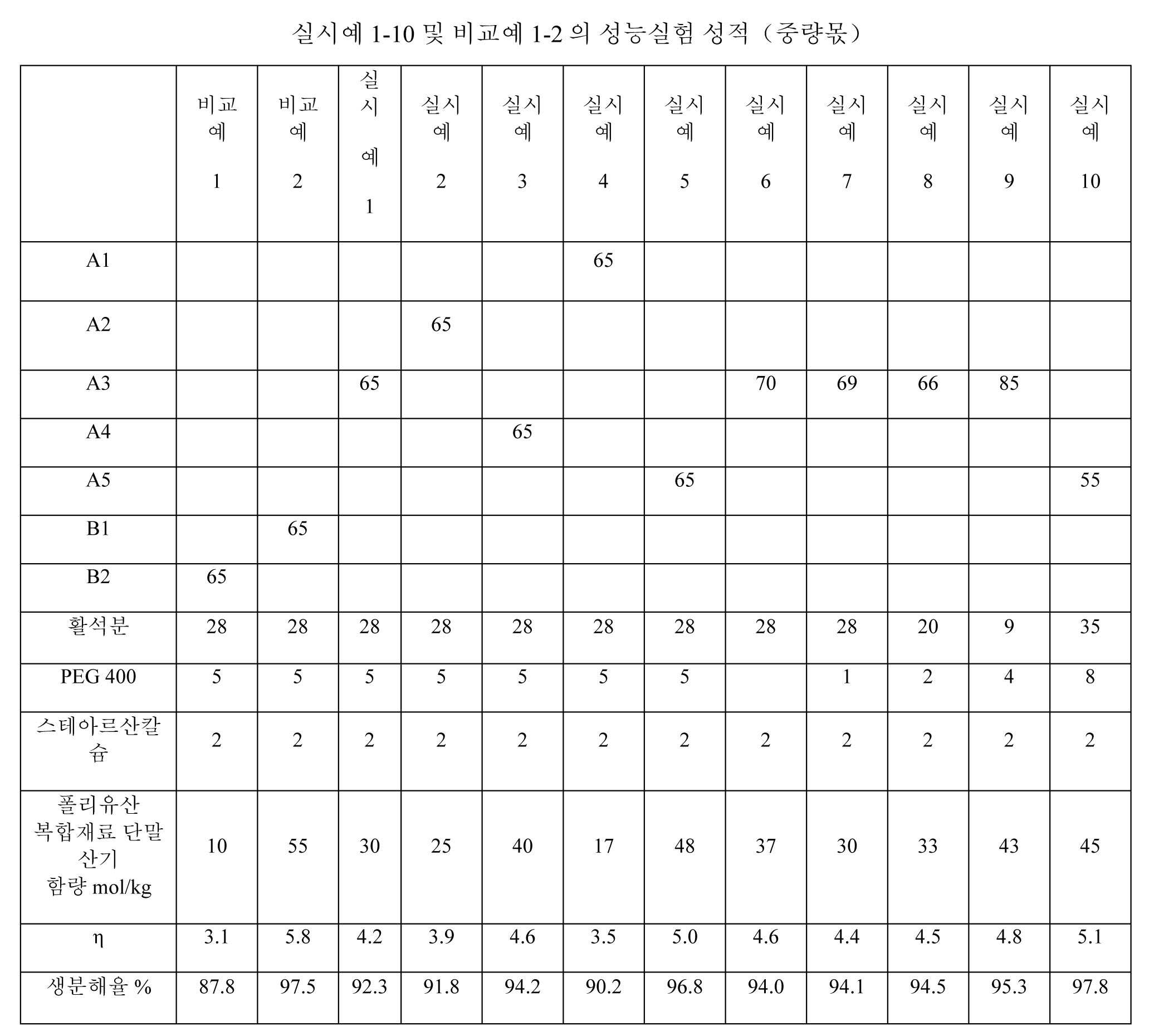
표1의 결과로 부터 볼때, 본 발명의 실시예는 폴리유산 복합재료의 단말 카르복실기 함량을 12~51 molKOH/t 범위내로 건트롤 하는 것을 통하여, 복합재료의 질량 멜트 인덱스가 측정조건하에서 합리적인 범위에 처하게 하며, 두께가 2.5mm이하 조건하에서 상기 폴리유산 복합재료가 12주를 경과한 후의 생분해율은 90%를 초과하여, 적합한 노화 성능과 뛰어난 생분해성을 가진다. 이에 비해, 비교예1중의 폴리유산 복합재료의 단말 카르복실기의 함량은 12molKOH/t미만이고, 복합재료의 생분해율은 90%미만 이였다. 비교례2중의 폴리유산 복합재료의 단말 카르복실기의 함량은 51mol/kg을 초과하고, 복합재료의 생분해율은 높았지만 그 질량 멜트 인덱스는 측정주기내에서 상승이 빨라, 내노화성이 떨어졌다. From the results of Table 1, the embodiment of the present invention, by controlling the terminal carboxyl group content of the polylactic acid composite material within a range of 12 to 51 molKOH / t, the mass melt index of the composite material is in a reasonable range under measurement conditions. The biodegradation rate of the polylactic acid composite material after 12 weeks under a thickness of 2.5 mm or less exceeds 90%, and has suitable aging performance and excellent biodegradability. In contrast, the content of the terminal carboxyl group of the polylactic acid composite material in Comparative Example 1 was less than 12 molKOH / t, and the biodegradation rate of the composite material was less than 90%. The content of the terminal carboxyl group of the polylactic acid composite material in Comparative Example 2 exceeded 51 mol / kg, and the biodegradation rate of the composite material was high, but its mass melt index was rapidly increased within the measurement cycle, and the aging resistance was poor.
Claims (10)
i)50~85중량몫의 폴리유산,
ii)8~35중량몫의 무기 충전재,
iii)0~8중량몫의 가소제 를 포함하고,
그중, 상기 폴리유산 복합재료의 단말 카르복실기 함량을 12~51 molKOH/t로 하는 것을 특징으로 하는 폴리유산 복합재료.Calculated as weight share,
i) 50 to 85 weight share of polylactic acid,
ii) 8 ~ 35 weight share of inorganic filler,
iii) 0 to 8 parts by weight of plasticizer,
Among them, a polylactic acid composite material characterized in that the terminal carboxyl group content of the polylactic acid composite material is 12 to 51 molKOH / t.
3.5<η= MFIt=30/ MFIt=0<5.1;
바람직하게:3.9<η= MFIt=30/ MFIt=0<4.7;
더욱 바람직하게:4.2<η= MFIt=30/ MFIt=0<4.5;
상기 폴리유산 복합재료의 질량 멜트 인덱스 MFI는 ASTM D1238규격에 의해 측정하며, 측정조건을 190℃,2.16kg으로 하고, 단위를 g/10min로 하는 특징으로하는 청구항1에 기재된 폴리유산 복합재료.The ratio of the mass melt index MFI t = 30 and the initial mass melt index MFI t = 0 measured for 30 days under a temperature and humidity condition of 60 ° C. satisfies the following formula:
3.5 <η = MFI t = 30 / MFI t = 0 <5.1;
Preferably: 3.9 <η = MFI t = 30 / MFI t = 0 <4.7;
More preferably: 4.2 <η = MFI t = 30 / MFI t = 0 <4.5;
The mass melt index MFI of the polylactic acid composite material is measured according to the ASTM D1238 standard, the measurement conditions are 190 ℃, 2.16kg, the polylactic acid composite material according to claim 1, characterized in that the unit is g / 10min.
Applications Claiming Priority (3)
| Application Number | Priority Date | Filing Date | Title |
|---|---|---|---|
| CN201711019796.5A CN107868416B (en) | 2017-10-27 | 2017-10-27 | Polylactic acid composite material and application thereof |
| CN201711019796.5 | 2017-10-27 | ||
| PCT/CN2018/092804 WO2019080524A1 (en) | 2017-10-27 | 2018-06-26 | Polylactic acid composite material and application thereof |
Publications (2)
| Publication Number | Publication Date |
|---|---|
| KR20200041342A true KR20200041342A (en) | 2020-04-21 |
| KR102306427B1 KR102306427B1 (en) | 2021-09-28 |
Family
ID=61753389
Family Applications (1)
| Application Number | Title | Priority Date | Filing Date |
|---|---|---|---|
| KR1020207006982A Active KR102306427B1 (en) | 2017-10-27 | 2018-06-26 | Polylactic acid composite material and its application |
Country Status (7)
| Country | Link |
|---|---|
| US (1) | US20210363344A1 (en) |
| EP (1) | EP3666826B1 (en) |
| KR (1) | KR102306427B1 (en) |
| CN (1) | CN107868416B (en) |
| AU (1) | AU2018357174B2 (en) |
| ES (1) | ES2878310T3 (en) |
| WO (1) | WO2019080524A1 (en) |
Families Citing this family (8)
| Publication number | Priority date | Publication date | Assignee | Title |
|---|---|---|---|---|
| CN107868416B (en) * | 2017-10-27 | 2021-04-30 | 金发科技股份有限公司 | Polylactic acid composite material and application thereof |
| CN108948703B (en) * | 2018-08-07 | 2021-04-13 | 万卓(武汉)新材料有限公司 | Weather-resistant degradable plastic bottle and preparation method thereof |
| CN108997721A (en) * | 2018-08-29 | 2018-12-14 | 佛山市森昂生物科技有限公司 | A kind of environmental protection polylactic acid plastic |
| CN109294188A (en) * | 2018-09-17 | 2019-02-01 | 佛山朝鸿新材料科技有限公司 | A kind of high-ductility composite material |
| CN109705547B (en) * | 2018-11-30 | 2022-01-21 | 中粮集团有限公司 | Heat-resistant modified polylactic acid material and preparation method thereof |
| CN112210200A (en) * | 2020-10-29 | 2021-01-12 | 银金达(上海)新材料有限公司 | Environment-friendly PLA (polylactic acid) film material and application thereof |
| CN114350125A (en) * | 2021-12-13 | 2022-04-15 | 王玲芝 | Hydrophobic environment-friendly degradable composite packaging film |
| CN116102858B (en) * | 2023-01-17 | 2024-11-26 | 金发科技股份有限公司 | Modified polylactic acid material, preparation method thereof and tableware |
Citations (2)
| Publication number | Priority date | Publication date | Assignee | Title |
|---|---|---|---|---|
| JP2010070588A (en) * | 2008-09-16 | 2010-04-02 | Teijin Ltd | Composition containing polylactic acid and method for producing the same |
| KR20140007859A (en) * | 2011-02-24 | 2014-01-20 | 도레이 카부시키가이샤 | Polylactic acid-based film |
Family Cites Families (12)
| Publication number | Priority date | Publication date | Assignee | Title |
|---|---|---|---|---|
| EP1400328B1 (en) * | 2002-09-18 | 2010-09-15 | Toyota Boshoku Kabushiki Kaisha | Fiber board and its producing method |
| JP4495535B2 (en) * | 2004-07-22 | 2010-07-07 | 東セロ株式会社 | Polylactic acid biaxially stretched laminated film and use thereof |
| WO2007050560A2 (en) * | 2005-10-24 | 2007-05-03 | Mgp Ingredients, Inc. | Thermotolerant starch-polyester composites and methods of making same |
| TW200909512A (en) * | 2007-03-30 | 2009-03-01 | Teijin Ltd | Polylactic acid composition and fiber composed of the same |
| CN102174201B (en) * | 2011-01-31 | 2012-11-21 | 华润包装材料有限公司 | Modified copolyester material for manufacturing high-gloss thick-wall products, and preparation method thereof |
| US9404032B2 (en) * | 2011-12-16 | 2016-08-02 | Natureworks Llc | Polylactide fibers |
| KR102083779B1 (en) * | 2012-03-07 | 2020-03-03 | 후타매키 오이즈 | An essentially biobased, thermoformable composition and containers formed thereof |
| CN102838858B (en) * | 2012-09-21 | 2014-12-24 | 上海同杰良生物材料有限公司 | Polylactic acid nucleating agent, preparation method and application thereof |
| CN102863654B (en) * | 2012-10-11 | 2015-07-08 | 武汉华丽环保科技有限公司 | Starch and polylactic acid composite material and preparation method thereof |
| CN103788357A (en) * | 2012-10-30 | 2014-05-14 | 东丽先端材料研究开发(中国)有限公司 | Solid-phase end capping method of polylactic acid |
| CN103013070B (en) * | 2012-12-11 | 2015-01-28 | 奇瑞汽车股份有限公司 | Polylactic acid composite material and preparation method thereof |
| CN107868416B (en) * | 2017-10-27 | 2021-04-30 | 金发科技股份有限公司 | Polylactic acid composite material and application thereof |
-
2017
- 2017-10-27 CN CN201711019796.5A patent/CN107868416B/en active Active
-
2018
- 2018-06-26 US US16/647,507 patent/US20210363344A1/en not_active Abandoned
- 2018-06-26 ES ES18870964T patent/ES2878310T3/en active Active
- 2018-06-26 EP EP18870964.6A patent/EP3666826B1/en active Active
- 2018-06-26 WO PCT/CN2018/092804 patent/WO2019080524A1/en not_active Ceased
- 2018-06-26 KR KR1020207006982A patent/KR102306427B1/en active Active
- 2018-06-26 AU AU2018357174A patent/AU2018357174B2/en active Active
Patent Citations (2)
| Publication number | Priority date | Publication date | Assignee | Title |
|---|---|---|---|---|
| JP2010070588A (en) * | 2008-09-16 | 2010-04-02 | Teijin Ltd | Composition containing polylactic acid and method for producing the same |
| KR20140007859A (en) * | 2011-02-24 | 2014-01-20 | 도레이 카부시키가이샤 | Polylactic acid-based film |
Also Published As
| Publication number | Publication date |
|---|---|
| CN107868416B (en) | 2021-04-30 |
| WO2019080524A1 (en) | 2019-05-02 |
| EP3666826A4 (en) | 2020-10-14 |
| CN107868416A (en) | 2018-04-03 |
| EP3666826B1 (en) | 2021-06-09 |
| AU2018357174B2 (en) | 2021-05-27 |
| ES2878310T3 (en) | 2021-11-18 |
| US20210363344A1 (en) | 2021-11-25 |
| KR102306427B1 (en) | 2021-09-28 |
| AU2018357174A1 (en) | 2020-04-09 |
| EP3666826A1 (en) | 2020-06-17 |
Similar Documents
| Publication | Publication Date | Title |
|---|---|---|
| KR20200041342A (en) | Polylactic acid composite material and its application | |
| CN108003581B (en) | A kind of polylactic acid composite material and its application | |
| CN108047658B (en) | A biodegradable polyester agricultural mulch film | |
| CN108795001B (en) | Biodegradable polymer composition and application thereof | |
| WO2020195550A1 (en) | Polyhydroxy alkanoate resin composition, molded article thereof, and film or sheet | |
| CN106957514B (en) | PBAT-based biodegradable composite material with high water vapor barrier property | |
| CN102977319B (en) | Degradable polylactic acid diblock copolymer, preparation method and application to modified polylactic acid | |
| RU2605592C2 (en) | Biologically degradable polymer composition with high deformability | |
| CN115232456B (en) | Polyhydroxyalkanoate composition containing hydroxyacid nucleating agent, polyhydroxyalkanoate molded body and preparation method thereof | |
| CN104140522B (en) | A kind of degradable polyhydroxyalkanoate | |
| JP7173259B1 (en) | Biodegradable resin composition, molded article and biodegradation method | |
| CN102675611A (en) | Polylactic acid composition and copolymerization modification method thereof | |
| JP3905896B2 (en) | Biodegradable film with improved water vapor barrier property and method for controlling water vapor barrier property | |
| KR20150107286A (en) | Poly Lactic Acid Resin Plasticizer Composition Containing Low Molecular Weight Lactide Oligomer | |
| KR101502796B1 (en) | PVC Resin Plasticizer Composition Containing Low Molecular Weight Lactide Oligomer | |
| WO2022190373A1 (en) | Thermoplastic resin composition | |
| KR20220061474A (en) | biodegradable resin composition and biodegradable products produced by the same | |
| KR102400298B1 (en) | Biodegradable polyester and its applications | |
| JP2020531662A (en) | Biodegradable polyester and its applications | |
| JPH03290461A (en) | Biodegradable plastic composition | |
| JP2009167297A (en) | Hydrolyzable polyester resin composition | |
| CN120137367A (en) | Degradable materials, films and their applications | |
| WO2014189021A1 (en) | Polylactide sheet and manufacturing method therefor | |
| JP2006219679A (en) | Biodegradable film with improved water vapor barrier property and method for controlling water vapor barrier property | |
| CN101962438A (en) | Polylactide terpolymer and preparation method thereof |
Legal Events
| Date | Code | Title | Description |
|---|---|---|---|
| A201 | Request for examination | ||
| AMND | Amendment | ||
| P11-X000 | Amendment of application requested |
St.27 status event code: A-2-2-P10-P11-nap-X000 |
|
| P13-X000 | Application amended |
St.27 status event code: A-2-2-P10-P13-nap-X000 |
|
| PA0105 | International application |
St.27 status event code: A-0-1-A10-A15-nap-PA0105 |
|
| PA0201 | Request for examination |
St.27 status event code: A-1-2-D10-D11-exm-PA0201 |
|
| PG1501 | Laying open of application |
St.27 status event code: A-1-1-Q10-Q12-nap-PG1501 |
|
| D13-X000 | Search requested |
St.27 status event code: A-1-2-D10-D13-srh-X000 |
|
| D14-X000 | Search report completed |
St.27 status event code: A-1-2-D10-D14-srh-X000 |
|
| E902 | Notification of reason for refusal | ||
| PE0902 | Notice of grounds for rejection |
St.27 status event code: A-1-2-D10-D21-exm-PE0902 |
|
| AMND | Amendment | ||
| P11-X000 | Amendment of application requested |
St.27 status event code: A-2-2-P10-P11-nap-X000 |
|
| P13-X000 | Application amended |
St.27 status event code: A-2-2-P10-P13-nap-X000 |
|
| E601 | Decision to refuse application | ||
| PE0601 | Decision on rejection of patent |
St.27 status event code: N-2-6-B10-B15-exm-PE0601 |
|
| X091 | Application refused [patent] | ||
| AMND | Amendment | ||
| E13-X000 | Pre-grant limitation requested |
St.27 status event code: A-2-3-E10-E13-lim-X000 |
|
| P11-X000 | Amendment of application requested |
St.27 status event code: A-2-2-P10-P11-nap-X000 |
|
| P13-X000 | Application amended |
St.27 status event code: A-2-2-P10-P13-nap-X000 |
|
| PX0901 | Re-examination |
St.27 status event code: A-2-3-E10-E12-rex-PX0901 |
|
| PX0701 | Decision of registration after re-examination |
St.27 status event code: A-3-4-F10-F13-rex-PX0701 |
|
| X701 | Decision to grant (after re-examination) | ||
| GRNT | Written decision to grant | ||
| PR0701 | Registration of establishment |
St.27 status event code: A-2-4-F10-F11-exm-PR0701 |
|
| PR1002 | Payment of registration fee |
St.27 status event code: A-2-2-U10-U12-oth-PR1002 Fee payment year number: 1 |
|
| PG1601 | Publication of registration |
St.27 status event code: A-4-4-Q10-Q13-nap-PG1601 |
|
| PR1001 | Payment of annual fee |
St.27 status event code: A-4-4-U10-U11-oth-PR1001 Fee payment year number: 4 |
|
| PR1001 | Payment of annual fee |
St.27 status event code: A-4-4-U10-U11-oth-PR1001 Fee payment year number: 5 |
|
| U11 | Full renewal or maintenance fee paid |
Free format text: ST27 STATUS EVENT CODE: A-4-4-U10-U11-OTH-PR1001 (AS PROVIDED BY THE NATIONAL OFFICE) Year of fee payment: 5 |