KR20200074128A - Method for producing benzothiophen-2-yl boronate - Google Patents
Method for producing benzothiophen-2-yl boronate Download PDFInfo
- Publication number
- KR20200074128A KR20200074128A KR1020207011684A KR20207011684A KR20200074128A KR 20200074128 A KR20200074128 A KR 20200074128A KR 1020207011684 A KR1020207011684 A KR 1020207011684A KR 20207011684 A KR20207011684 A KR 20207011684A KR 20200074128 A KR20200074128 A KR 20200074128A
- Authority
- KR
- South Korea
- Prior art keywords
- formula
- compound
- solvent
- providing
- toluene
- Prior art date
- Legal status (The legal status is an assumption and is not a legal conclusion. Google has not performed a legal analysis and makes no representation as to the accuracy of the status listed.)
- Ceased
Links
- IAUBUELRSHDINQ-UHFFFAOYSA-N CC(Oc1c2[s]ccc2cc(C(OC)=O)c1)=O Chemical compound CC(Oc1c2[s]ccc2cc(C(OC)=O)c1)=O IAUBUELRSHDINQ-UHFFFAOYSA-N 0.000 description 1
- MSKUNCMDULMIFB-UHFFFAOYSA-N COC(c1cc(OC)c2[s]ccc2c1)=O Chemical compound COC(c1cc(OC)c2[s]ccc2c1)=O MSKUNCMDULMIFB-UHFFFAOYSA-N 0.000 description 1
- QMSRQVNGCIFRAP-UHFFFAOYSA-N Cc1cc(OC)c2[s]c(B(O)O)cc2c1 Chemical compound Cc1cc(OC)c2[s]c(B(O)O)cc2c1 QMSRQVNGCIFRAP-UHFFFAOYSA-N 0.000 description 1
- NEGUYZPTEJBCNN-UHFFFAOYSA-N OC(c1cc(O)c2[s]ccc2c1)=O Chemical compound OC(c1cc(O)c2[s]ccc2c1)=O NEGUYZPTEJBCNN-UHFFFAOYSA-N 0.000 description 1
Classifications
-
- C—CHEMISTRY; METALLURGY
- C07—ORGANIC CHEMISTRY
- C07F—ACYCLIC, CARBOCYCLIC OR HETEROCYCLIC COMPOUNDS CONTAINING ELEMENTS OTHER THAN CARBON, HYDROGEN, HALOGEN, OXYGEN, NITROGEN, SULFUR, SELENIUM OR TELLURIUM
- C07F5/00—Compounds containing elements of Groups 3 or 13 of the Periodic Table
- C07F5/02—Boron compounds
- C07F5/025—Boronic and borinic acid compounds
-
- A—HUMAN NECESSITIES
- A61—MEDICAL OR VETERINARY SCIENCE; HYGIENE
- A61K—PREPARATIONS FOR MEDICAL, DENTAL OR TOILETRY PURPOSES
- A61K31/00—Medicinal preparations containing organic active ingredients
- A61K31/69—Boron compounds
-
- A—HUMAN NECESSITIES
- A61—MEDICAL OR VETERINARY SCIENCE; HYGIENE
- A61P—SPECIFIC THERAPEUTIC ACTIVITY OF CHEMICAL COMPOUNDS OR MEDICINAL PREPARATIONS
- A61P35/00—Antineoplastic agents
-
- C—CHEMISTRY; METALLURGY
- C07—ORGANIC CHEMISTRY
- C07D—HETEROCYCLIC COMPOUNDS
- C07D333/00—Heterocyclic compounds containing five-membered rings having one sulfur atom as the only ring hetero atom
- C07D333/50—Heterocyclic compounds containing five-membered rings having one sulfur atom as the only ring hetero atom condensed with carbocyclic rings or ring systems
- C07D333/52—Benzo[b]thiophenes; Hydrogenated benzo[b]thiophenes
- C07D333/54—Benzo[b]thiophenes; Hydrogenated benzo[b]thiophenes with only hydrogen atoms, hydrocarbon or substituted hydrocarbon radicals, directly attached to carbon atoms of the hetero ring
-
- C—CHEMISTRY; METALLURGY
- C07—ORGANIC CHEMISTRY
- C07D—HETEROCYCLIC COMPOUNDS
- C07D333/00—Heterocyclic compounds containing five-membered rings having one sulfur atom as the only ring hetero atom
- C07D333/50—Heterocyclic compounds containing five-membered rings having one sulfur atom as the only ring hetero atom condensed with carbocyclic rings or ring systems
- C07D333/72—Benzo[c]thiophenes; Hydrogenated benzo[c]thiophenes
-
- C—CHEMISTRY; METALLURGY
- C07—ORGANIC CHEMISTRY
- C07D—HETEROCYCLIC COMPOUNDS
- C07D487/00—Heterocyclic compounds containing nitrogen atoms as the only ring hetero atoms in the condensed system, not provided for by groups C07D451/00 - C07D477/00
- C07D487/02—Heterocyclic compounds containing nitrogen atoms as the only ring hetero atoms in the condensed system, not provided for by groups C07D451/00 - C07D477/00 in which the condensed system contains two hetero rings
- C07D487/04—Ortho-condensed systems
Landscapes
- Chemical & Material Sciences (AREA)
- Organic Chemistry (AREA)
- Health & Medical Sciences (AREA)
- Veterinary Medicine (AREA)
- General Health & Medical Sciences (AREA)
- Medicinal Chemistry (AREA)
- Public Health (AREA)
- Pharmacology & Pharmacy (AREA)
- Life Sciences & Earth Sciences (AREA)
- Animal Behavior & Ethology (AREA)
- General Chemical & Material Sciences (AREA)
- Nuclear Medicine, Radiotherapy & Molecular Imaging (AREA)
- Chemical Kinetics & Catalysis (AREA)
- Epidemiology (AREA)
- Pharmaceuticals Containing Other Organic And Inorganic Compounds (AREA)
- Heterocyclic Carbon Compounds Containing A Hetero Ring Having Oxygen Or Sulfur (AREA)
- Nitrogen Condensed Heterocyclic Rings (AREA)
- Plural Heterocyclic Compounds (AREA)
Abstract
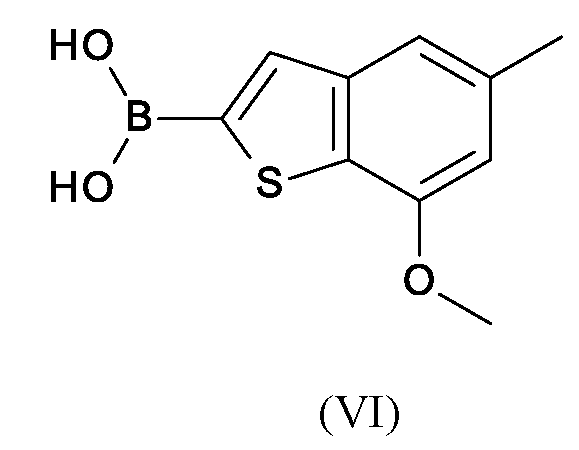
의약의 제조를 위한 및 증식성 장애, 예컨대 암 및 종양 질환의 치료 및/또는 예방을 위한 의약의 제조를 위한 중간체로서 작용하는 화학식 (VI)의 벤조티오펜-2-일 보로네이트의 제조 방법.
Description
본 출원은 의약의 제조를 위한 및 증식성 장애, 예컨대 암 및 종양 질환의 치료 및/또는 예방을 위한 의약의 제조를 위한 중간체로서 작용하는 화학식 (VI)의 벤조티오펜-2-일 보로네이트를 제조하는 신규의 효율적인 방법에 관한 것이다. The present application provides benzothiophen-2-yl boronate of formula (VI) which acts as an intermediate for the manufacture of a medicament and for the manufacture of a medicament for the treatment and/or prevention of proliferative disorders such as cancer and tumor diseases. It relates to a new efficient method of manufacturing.

보다 특히, 화학식 (VI)의 벤조티오펜-2-일 보로네이트는 화학식 (I)의 화합물More particularly, benzothiophen-2-yl boronate of formula (VI) is a compound of formula (I)

4-{[4-아미노-6-(메톡시메틸)-5-(7-메톡시-5-메틸-1-벤조티오펜-2-일)피롤로[2,1f]-[1,2,4]-트리아진-7-일]메틸}피페라진-2-온 4-{[4-amino-6-(methoxymethyl)-5-(7-methoxy-5-methyl-1-benzothiophen-2-yl)pyrrolo[2,1f]-[1,2 ,4]-triazine-7-yl]methyl}piperazin-2-one
또는 그의 제약상 허용되는 염, 수화물, 또는 용매화물들의 제조에 적합한데, 이는 의약의 제조를 위해 및 증식성 장애, 예컨대 암 및 종양 질환의 치료 및/또는 예방용 의약의 제조를 위해 사용된다. Or a pharmaceutically acceptable salt, hydrate, or solvate thereof, which is used for the manufacture of a medicament and for the manufacture of a medicament for the treatment and/or prevention of proliferative disorders such as cancer and tumor diseases.
4-{[4-아미노-6-(메톡시메틸)-5-(7-메톡시-5-메틸-1-벤조티오펜-2-일)피롤로[2,1f]-[1,2,4]-트리아진-7-일]메틸}피페라진-2-온은 인 로가라티닙 (INN ROGARATINIB)으로 명명되었다.4-{[4-amino-6-(methoxymethyl)-5-(7-methoxy-5-methyl-1-benzothiophen-2-yl)pyrrolo[2,1f]-[1,2 ,4]-triazin-7-yl]methyl}piperazin-2-one was named INN ROGARATINIB.
로가라티닙은 가치있는 약리학적 특성을 가지며 인간 및 다른 포유동물에서 장애의 예방 및 치료를 위해 사용될 수 있다.Logaratinib has valuable pharmacological properties and can be used for the prevention and treatment of disorders in humans and other mammals.
로가라티닙은 수용체 티로신 키나제, 특히 FGFR 키나제, 및 가장 특히 FGFR-1 및 FGFR-3 키나제의 활성 또는 발현의 강력한 억제제이다. 특정 실시양태에서, FGFR 키나제의 활성에 관련된 장애는 증식성 장애, 특히 암 및 종양 질환이다.Logaratinib is a potent inhibitor of the activity or expression of the receptor tyrosine kinase, especially FGFR kinase, and most particularly FGFR-1 and FGFR-3 kinase. In certain embodiments, disorders related to the activity of FGFR kinase are proliferative disorders, particularly cancer and tumor diseases.
암은 전세계적으로 주요 사망 원인이고 2008년에 760만 명의 사망 (모든 사망의 약 13 %)을 차지했다. 암으로부터의 사망은 전세계적으로 2030년에 1100만 명 초과로 계속하여 상승할 것으로 예상된다 (WHO source, Fact Sheet No. 297, 2011년 2월).Cancer is the leading cause of death worldwide and accounted for 7.6 million deaths (about 13% of all deaths) in 2008. Deaths from cancer are expected to continue to rise in excess of 11 million people in 2030 worldwide (WHO source, Fact Sheet No. 297, February 2011).
로가라티닙의 제조 방법뿐만 아니라 벤조티오펜 2-일 보로네이트의 핵심 중간체의 합성이 WO 2013/087578에 개시되어 있다.Methods for the preparation of logaratinib as well as the synthesis of key intermediates of benzothiophene 2-yl boronate are disclosed in WO 2013/087578.
화학식 (VI)의 벤조티오펜-2-일 보로네이트는 화학식 (XXIV)의 치환된 티오페놀 유도체로부터 출발하여 편리하게 제조될 수 있다 (하기 반응식 1 참조). 브로모-아세탈 (XXV)을 사용한 알킬화 및 후속 폴리인산-매개 고리화는 화학식 (XXVII)의 벤조티오펜 중간체를 제공하며 이는 이어서 2-위치에서 금속화되고 트리알킬 보레이트와 반응한다. 알칼리성 후처리는 화학식 (VIa)의 유리 (벤조티오펜-2-일) 보론산을 제공하며, 이는 원하는 경우, 관련 기술분야에 공지된 표준 절차에 의해 시클릭 보로네이트, 예를 들어 소위 화학식 (VIb)의 MIDA 보로네이트로 변환될 수 있다 [예를 들어, 문헌[D. M. Knapp et al., J. Am. Chem. Soc. 131 (20), 6961-6963 (2009)] 참조].The benzothiophen-2-yl boronate of formula (VI) can be conveniently prepared starting from the substituted thiophenol derivative of formula (XXIV) (see Scheme 1 below). Alkylation with bromo-acetal (XXV) and subsequent polyphosphoric acid-mediated cyclization gives the benzothiophene intermediate of formula (XXVII), which is then metallized in the 2-position and reacts with trialkyl borate. The alkaline post-treatment provides free (benzothiophen-2-yl) boronic acid of formula (VIa), which, if desired, is cyclic boronate, for example the so-called formula () by standard procedures known in the art. VIb) to MIDA boronate. See, eg, D. M. Knapp et al. , J. Am. Chem. Soc. 131 (20), 6961-6963 (2009)].
반응식 1:Scheme 1:

[참고: 문헌[P. A. Ple and L. J. Marnett, J. Heterocyclic Chem. 25 (4), 1271-1272 (1988)]; 문헌[A. Venturelli et al., J. Med. Chem. 50 (23), 5644-5654 (2007)]].[ Reference : P. A. Ple and L. J. Marnett, J. Heterocyclic Chem. 25 (4), 1271-1272 (1988)]; [A. Venturelli et al. , J. Med. Chem. 50 (23), 5644-5654 (2007)].
화학식 (XXIV)의 화합물은 상업적으로 입수가능하거나, 문헌으로부터 공지되어 있거나, 또는 문헌에 기재된 표준 방법의 변형법에 의해 용이하게 입수가능한 출발 물질로부터 제조될 수 있다. 출발 물질을 제조하기 위한 상세한 절차 및 참고 문헌은 또한 WO 2013/087578의 중간체 및 출발 물질의 제조 섹션의 실험 부분에서 발견될 수 있다.Compounds of formula (XXIV) are commercially available, known from the literature, or can be prepared from readily available starting materials by modifications of standard methods described in the literature. Detailed procedures and references for preparing the starting materials can also be found in the experimental section of the Intermediate and Preparation of Starting Materials section of WO 2013/087578.
● 상기 도시된 반응식에 따른 합성은 화학식 (XXVII)의 화합물로 이어지는 폐환이 열악한 조건, 예컨대 비정상적으로 높은 반응 온도 및 바람직하지 않은 시약, 예컨대 반응 혼합물과 2 상 시스템을 형성할 수 있는 시럽-유사 폴리인산을 필요로 하는 일반적인 단점을 갖는다. 이러한 조건은 산업적 규모로의 전환에 상당한 안전 예방조치 및 실질적인 엔지니어링 노력을 필요로 하고 따라서 높은 제조 비용을 야기한다.● Synthesis according to the reaction scheme shown above is a syrup-like polyphosphoric acid capable of forming a two-phase system with poor conditions for conditions such as abnormally high reaction temperatures and undesirable reagents, such as reaction mixtures, leading to compounds of formula (XXVII) It has the general disadvantage of requiring. These conditions require significant safety precautions and practical engineering effort to convert to an industrial scale, and thus lead to high manufacturing costs.
● 상기 도시된 반응식에 따른 합성은 단지 화학식 (XXVII)의 화합물에 대한 광범위한 정제 노력에 의해 또는 합성의 후속 단계에서 퍼징될 수 있는, 언급된 급격한 반응 조건으로 인해 높은 구조적 유사성의 불순물을 형성하는 단점을 갖는다. 이는 특히 산업적 규모에서 수율의 유의한 감소 및 추가적인 노력, 비용을 초래한다. 이러한 불순물은 적절한 조절 지침에 따라 제약 제품에 필요한 정도로 퍼징되지 않을 수 있다.● Synthesis according to the reaction scheme shown above has the disadvantage of forming impurities of high structural similarity due to the rapid reaction conditions mentioned, which can only be purged by extensive purification efforts for the compounds of formula (XXVII) or in subsequent steps of synthesis. Have This results in a significant reduction in yield and additional effort and cost, especially on an industrial scale. These impurities may not be purged to the extent necessary for pharmaceutical products according to appropriate control guidelines.
화학식 (VI)의 벤조티오펜-2-일 보로네이트를 반응식 1에 요약된 방법에 따라 (1)에서 (2)로의 폐환을 통해 제조하는 동안:During the preparation of the benzothiophen-2-yl boronate of formula (VI) according to the method outlined in Scheme 1, through ring closure from (1) to (2):

질량 분광법에 따른 화학식 (3.1) 내지 (3.6)의 구조 불순물의 형성이 관찰되었다.The formation of structural impurities of formulas (3.1) to (3.6) according to mass spectrometry was observed.

이들 불순물은 메톡시-메틸-벤조티오펜 중간체 (2)에서 화학식 (4.1) 내지 (4.6)의 구조에 따른 불순물로 다시 추적될 수 있다. These impurities can be traced back to impurities according to the structures of formulas (4.1) to (4.6) in methoxy-methyl-benzothiophene intermediate (2).


이들 불순물은 고온에서 PPA를 사용하는 폐환 공정 동안 형성되었고 (2)의 분별 고진공 증류에 의해 퍼징되었고, 이는 산업적 규모에서 수율을 14-20 %로 감소시키지만, 여전히 후기 단계 임상 개발에서 API에 대한 요건에 부합하는 불순물 수준을 초래하지 않는다.These impurities were formed during the ring closing process using PPA at high temperature and purged by fractional high vacuum distillation of (2), which reduced the yield to 14-20% on an industrial scale, but still a requirement for API in later stage clinical development Does not result in impurity levels consistent with.
본 발명의 목적은 화학식 (I)의 화합물 또는 그의 제약상 허용되는 염, 수화물, 또는 용매화물의 제조를 위한 고수율의 효율적인 공정을 위한 주요 성분으로서의The object of the present invention is as a main component for a high yield efficient process for the preparation of a compound of formula (I) or a pharmaceutically acceptable salt, hydrate, or solvate thereof.

화학식 (VI)의 벤조티오펜-2-일 보로네이트의 제조를 위한 고수율의 효율적인 공정을 제공하는 것이다. It provides an efficient process with high yield for the production of benzothiophen-2-yl boronate of formula (VI).

본 발명은 하기 화학식 (VII)의 화합물을 The present invention is a compound of formula (VII)

THF와 같은 불활성 용매 중에서 용해시키고, n-부틸 리튬 용액과 같은 금속 유기 염기 및 트리 이소-프로필 보레이트와 같은 트리알킬 보레이트를, 임의로 THF와 같은 용매 중에서 첨가함으로써 화학식 (VII)의 화합물을 반응시켜,The compound of formula (VII) is reacted by dissolving in an inert solvent such as THF and adding a metal organic base such as an n-butyl lithium solution and a trialkyl borate such as triiso-propyl borate, optionally in a solvent such as THF,
이에 의해 하기 화학식 (VI)의 화합물을 제공하는 단계 5를 포함하고,Thereby providing step 5 to provide a compound of formula (VI):

여기서 상기 화학식 (VII)의 화합물이Wherein the compound of formula (VII)

하기 화학식 (X)의 화합물을 임의로 THF와 같은 불활성 용매의 존재 하에, 예를 들어 나트륨-비스(2-메톡시-에톡시)-알루미늄-디히드라이드 용액과 같은 하나 이상의 환원제와 반응시켜, 이에 의해 하기 화학식 (IX)의 화합물을 제공하고,The compound of formula (X) below is optionally reacted with one or more reducing agents such as sodium-bis(2-methoxy-ethoxy)-aluminum-dihydride solution, optionally in the presence of an inert solvent such as THF, thereby To provide a compound of formula (IX)


화학식 (IX)의 화합물을 예를 들어 톨루엔과 같은 용매의 존재 하에 수성 HCl과 반응시켜, 이에 의해 하기 화학식 (VIII)의 화합물을 제공하고,The compound of formula (IX) is reacted with aqueous HCl in the presence of a solvent, for example toluene, thereby providing the compound of formula (VIII)

화학식 (VIII)의 화합물을 예를 들어 나트륨-비스(2-메톡시-에톡시)-알루미늄-디히드라이드 용액과 같은 하나 이상의 환원제와 반응시켜, 이에 의해 하기 화학식 (VII)의 화합물을 제공하는 단계 4에 의해 제조되는 것인, 화학식 (VI):Reacting a compound of formula (VIII) with one or more reducing agents such as, for example, sodium-bis(2-methoxy-ethoxy)-aluminum-dihydride solution, thereby providing a compound of formula (VII) Formula (VI), prepared by 4:

의 화합물의 제조 방법에 관한 것이다.It relates to a method for producing a compound.
본 발명은 또한 하기로부터 선택된 화합물에 관한 것이다:The invention also relates to compounds selected from:


상기 언급한 바와 같이, 본 발명의 목적은 화학식 (I)의 화합물 또는 그의 제약상 허용되는 염, 수화물, 또는 용매화물의 제조를 위한 고수율의 효율적인 공정을 위한 주요 성분으로서의As mentioned above, the object of the present invention is as a main component for a high yield, efficient process for the preparation of a compound of formula (I) or a pharmaceutically acceptable salt, hydrate, or solvate thereof.

화학식 (VI)의 벤조티오펜-2-일 보로네이트의 제조를 위한 고수율의 효율적인 공정을 제공하는 것이다. It provides an efficient process with high yield for the production of benzothiophen-2-yl boronate of formula (VI).

이러한 목적은, 하기와 같이, 본 발명에 따라 달성된다. 아래의 반응식 2는 예로서 개개의 반응 단계를 예시한다.This object is achieved according to the invention, as follows. Scheme 2 below illustrates, by way of example, individual reaction steps.
반응식 2:Scheme 2:


본 발명의 한 측면은 고온 프리델-크래프트-유사 조건 및 폴리-인산의 사용에 의해 티오펜 고리계의 폐환을 방지하는 반응식 2에 따른 합성 경로를 사용하여 상기에 나타낸 불순물 (3.1 내지 3.6)을 함유하지 않는 화학식 (VI)의 벤조티오펜-2-일 보로네이트의 제조에 관한 것이다. 대신에 탈수 조건을 통해 화학식 (X)를 갖는 벤조티오펜 유도체를 형성하고 이어서 벤조티오펜 유도체 (VII)를 통해 화학식 (VI)의 벤조티오펜-2-일 보로네이트로 전환시킨다. 이러한 중간 조건은 높은 전환율을 초래하고 이 공정으로부터의 불순물은 (VII)의 진공 증류 동안 잘 퍼징될 수 있다. 합성 단계의 증가된 수에도 불구하고 전체 수율이 상당히 개선되고 표준 파일럿 플랜트 설비가 사용될 수 있고, 생산 비용의 유의한 감소를 초래한다.One aspect of the present invention contains impurities (3.1 to 3.6) shown above using the synthetic route according to Scheme 2, which prevents ring closure of the thiophene ring system by the use of high temperature Friedel-Craft-like conditions and poly-phosphoric acid Does not relate to the preparation of benzothiophen-2-yl boronate of formula (VI). Instead, a benzothiophene derivative having formula (X) is formed through dehydration conditions and then converted to benzothiophen-2-yl boronate of formula (VI) via benzothiophene derivative (VII). These intermediate conditions result in high conversion rates and impurities from this process can be purged well during vacuum distillation of (VII). Despite the increased number of synthesis steps, the overall yield is significantly improved and standard pilot plant equipment can be used, resulting in a significant reduction in production costs.
하기 단계 1 및 2에 개시된 폐환은 EP 2338887 Al 참조 실시예 12 및 13으로부터의 변형된 형태뿐만 아니라 문헌[JACS Vol 129, No. 45, 2007 Boger, et al.]으로부터의 추가 변형된 버전으로부터 이미 공지되어 있다.The cyclizations disclosed in steps 1 and 2 below, as well as modified forms from EP 2338887 Al reference examples 12 and 13, are described in JACS Vol 129, No. 45, 2007 Boger, et al.].
하기 단점은 문헌[Boger, et al.]에 따라 에틸 7-아세톡시-3-메틸벤조[b]티오펜-5-카르복실레이트를 유도하는 상기 실험실 규모 공정과 연결되어 있다: 낮은 전체 수율은 아마도 축합 반응 동안 염기성 반응 조건 하에서 티오펜-알데히드의 분해로 인한 것으로 관찰된다. 따라서, 다량의 숙시네이트 시약이 적용되었다 (예를 들어, 6 당량). 탈수 조건 하에서의 폐환 반응에서 140 ℃ 이하의 높은 반응 온도에서 용매로서 아세트산 무수물을 사용함으로써 아세트산 무수물의 큰 접근이 적용되었다. 그 결과 생성물 에틸 7-아세톡시-3-메틸벤조[b]티오펜-5-카르복실레이트는 크로마토그래피에 의한 정제 후에 단지 40 % 수율로 단리될 수 있었다. 또한 환류하는 아세트산 무수물 중의 반응은 규모 확대 동안 상당한 안전성 및 공학적 고려사항을 필요로 할 것이다.The following disadvantages are linked to the above laboratory scale process leading to ethyl 7-acetoxy-3-methylbenzo[b]thiophene-5-carboxylate according to Boger, et al.: Low overall yield It is presumably due to the decomposition of thiophene-aldehyde under basic reaction conditions during the condensation reaction. Thus, a large amount of succinate reagent was applied (eg, 6 equivalents). A large approach of acetic anhydride has been applied by using acetic anhydride as a solvent at a high reaction temperature of 140° C. or less in a ring reaction under dehydration conditions. As a result, the product ethyl 7-acetoxy-3-methylbenzo[b]thiophene-5-carboxylate could be isolated in only 40% yield after purification by chromatography. Also, the reaction in refluxed acetic anhydride will require significant safety and engineering considerations during scale-up.
예상밖으로 티오펜-3-알데히드를 숙신산 에스테르 및 나트륨 메탄올레이트의 혼합물에 첨가하는 것을 통해 첨가 순서를 변화시킴으로써 중간체 (XIII)에 대한 축합 반응에서 높은 전환율을 달성할 수 있었다. 이러한 조건 하에 단지 약간 과량의 숙시네이트 (2.5 당량)가 적용되어야 한다. 부 성분 및 과량의 시약을 이러한 초기 단계에서, 이 중간체를 예를 들어 톨루엔으로부터 결정화시켜 나중 단계에서 크로마토그래피 정제를 피하여 퍼징할 수 있다.A high conversion rate in the condensation reaction for the intermediate (XIII) could be achieved by unexpectedly changing the order of addition through the addition of thiophene-3-aldehyde to the mixture of succinic acid ester and sodium methanolate. Under these conditions only a slight excess of succinate (2.5 eq) should be applied. The minor components and excess reagents can be purged in this initial step, avoiding chromatographic purification in a later step by crystallizing this intermediate from, for example, toluene.
또한, 탈수 조건 하에서의 폐환은 7 시간 이내에 단지 75 ℃의 중간 온도에서 불활성 용매로서 톨루엔에 의해 희석된 낮은 과량의 아세트산 무수물을 사용하여 완료될 수 있었다. 이러한 조건은 산업적 규모로 반응 매스의 더 적은 부반응 및 안전한 후처리를 용이하게 한다. 만약 조 중간체 벤조티오펜 카르복실산 에스테르 (XII)를 MeOH 중 수성 NaOH로 비누화시킨 후, 산으로 중화시킨다면, 벤조티오펜 카르복실산을 고체로서 고수율 및 순도로 단리할 수 있다.In addition, ring closure under dehydration conditions could be completed within 7 hours using low excess acetic anhydride diluted with toluene as an inert solvent at an intermediate temperature of only 75°C. These conditions facilitate less side reactions and safe post-treatment of the reaction mass on an industrial scale. If the crude intermediate benzothiophene carboxylic acid ester (XII) is saponified with aqueous NaOH in MeOH and then neutralized with acid, benzothiophene carboxylic acid can be isolated as a solid in high yield and purity.
본 발명의 제1 측면은 화학식 (VI)의 벤조티오펜-2-일 보로네이트의 제조 방법에 관한 것이다.The first aspect of the invention relates to a process for the preparation of benzothiophen-2-yl boronate of formula (VI).
단계 1:Step 1:

본 발명의 제1 측면에 따르면 상기 도시된 (XV) 및 (XIV)에서 (XIII)로의 반응은 (XIV)와 (XV)의 축합에 의해 수행된다. 이는 알콜, 바람직하게는 메탄올 중의 알칼리 알콜레이트, 예컨대 나트륨 메탄올레이트의 용액을 25-40 ℃에서 디메틸 숙시네이트의 용액에 첨가함으로써 수행된다. 에스테르가 하기 단계 동안 절단되기 때문에, 다른 숙시네이트 에스테르가 (XV) 대신에 사용될 수 있다. According to the first aspect of the present invention, the reaction of (XV) and (XIV) to (XIII) shown above is carried out by condensation of (XIV) and (XV). This is done by adding a solution of an alcohol, preferably alkali alcoholate in methanol, such as sodium methanolate, to a solution of dimethyl succinate at 25-40 °C. Because the ester is cleaved during the following steps, other succinate esters can be used instead of (XV).
혼합물을 환류로 가열하고 티오펜-3-알데히드의 용액을 첨가하였다. 전환 완료 후 물을 첨가하여 혼합물을 가수분해하고 생성물을 톨루엔 (또는 다른 비-수 혼화성 용매)으로 추출하였다. 용매의 제거 후에 조 (XIII)는 결정화 및/또는 톨루엔 (또는 다른 적합한 용매)으로부터의 재슬러리에 의해 정제된다.The mixture was heated to reflux and a solution of thiophene-3-aldehyde was added. After completion of the conversion, water was added to hydrolyze the mixture and the product was extracted with toluene (or other non-water miscible solvent). After removal of the solvent, the crude (XIII) is purified by crystallization and/or reslurry from toluene (or other suitable solvent).
● 이 방법은 티오펜-3-알데히드를 반응 혼합물에 서서히 첨가함으로써 알데히드와 관련된 높은 전환율의 이점을 갖는다.● This method has the advantage of the high conversion rate associated with aldehydes by slowly adding thiophene-3-aldehyde to the reaction mixture.
● 이 방법은 완전한 전환을 위해 감소된 과량의 디메틸 숙시네이트를 적용하는 이점을 갖는다.● This method has the advantage of applying a reduced excess of dimethyl succinate for complete conversion.
● 이 방법은 결정화 및/또는 재슬러리에 의한 정제 후 매우 순수하고 고체 중간체 (XIII)를 제공하는 이점을 가지며, 이는 추후 단계에서 예를 들어, 정제용 크로마토그래피에 의한 정제를 회피하는 데에 기여한다.● This method has the advantage of providing a very pure and solid intermediate (XIII) after crystallization and/or purification by re-slurry, which contributes to avoiding purification, for example by preparative chromatography, in a later step. .
단계 2:Step 2:

본 발명의 제1 측면에 따르면, 단계 2에 나타낸 바와 같은 (XIII)의 카르복실산 중간체 (XI)로의 (XII)를 통한 반응은 탈수 조건 하에 벤조티오펜 유도체 (XII)로의 폐환 및 에스테르 잔기의 가수분해에 의해 수행되어 7-히드록시-1-벤조티오펜-5-카르복실산 (XI)을 수득한다. 이는 (XIII)을 톨루엔 중 아세트산 무수물 및 아세트산나트륨과 70-75 ℃에서 7 시간 동안 가열하여 행해진다. (다른 탈수제: 예를 들어 산 무수물(트리플루오로아세트산 무수물), 메틸 클로로 포르메이트; 아세트산나트륨 외의 다른 염기(아세트산칼륨); T & t는 모든 공정 단계에 대해 달라질 수 있음). 혼합물은 25-30 ℃에서 물의 첨가에 의해 가수분해된다. 유기 상을 분리하고, 물로 다시, 세척하고, 용매를 감압 하에 증류에 의해 부분적으로 제거하였다. 톨루엔 중의 (XII)의 나머지 용액을 MeOH 및 물로 희석하고 수산화나트륨 수용액(기타 염기, 주로 무기)을 45 ℃ 미만의 온도에서 서서히 첨가하고 최종적으로 5 시간 동안 50 내지 55 ℃로 가열한다. 수성 상을 분리하고 추가로 물로 희석하고 pH 2-3에 도달할 때까지 강한 양성자성 산, 예컨대 HCl, HNO3, 술폰산, CH3COOH 및 H2SO4, 바람직하게는 H2SO4를 10-15 ℃에서 첨가함으로써 생성물을 침전시켰다. 현탁액을 40-45 ℃로 가열하고 2 시간 이내에 25-30 ℃로 냉각시켜 생성물의 여과 거동을 개선하고, 여과에 의해 단리시켰다. According to the first aspect of the present invention, the reaction of (XIII) with (XII) to the carboxylic acid intermediate (XI) as shown in step 2 is carried out under the conditions of dehydration of the ring closure and ester residues with the benzothiophene derivative (XII). Performed by hydrolysis to obtain 7-hydroxy-1-benzothiophen-5-carboxylic acid (XI). This is done by heating (XIII) with acetic anhydride and sodium acetate in toluene at 70-75° C. for 7 hours. (Other dehydrating agents: for example acid anhydride (trifluoroacetic anhydride), methyl chloro formate; base other than sodium acetate (potassium acetate); T & t may vary for all process steps). The mixture is hydrolyzed by addition of water at 25-30 °C. The organic phase was separated, washed again with water, and the solvent was partially removed by distillation under reduced pressure. The remaining solution of (XII) in toluene is diluted with MeOH and water, and an aqueous sodium hydroxide solution (other base, mainly inorganic) is slowly added at a temperature below 45°C and finally heated to 50-55°C for 5 hours. Separated and the aqueous phase was diluted with water and added to a strong protic acid until reaching a pH 2-3, e.g., HCl, HNO 3, sulfonic acid, CH 3 COOH and H 2 SO 4, preferably a H 2 SO 4 10 The product precipitated by addition at -15 °C. The suspension was heated to 40-45° C. and cooled to 25-30° C. within 2 hours to improve the filtration behavior of the product and isolated by filtration.
● 이 방법은 용매로서 많은 과량의 아세트산 무수물을 사용하지 않지만, 톨루엔 중에서의 희석에 의해 제한된 과량을 사용하는 것에 의해 산업적 규모로 증가된 공정 안전성의 이점을 갖는다. 안전한 후처리는 희석된 조건 하에 아세트산 무수물의 가수분해 동안의 에너지의 제어 방출에 의해 달성된다.● This method does not use a large excess of acetic anhydride as a solvent, but has the advantage of increased process safety on an industrial scale by using a limited excess by dilution in toluene. Safe work-up is achieved by controlled release of energy during hydrolysis of acetic anhydride under diluted conditions.
● 이 방법은 (XII)로의 폐환 단계 동안에 단지 중간 정도의 반응 온도를 사용하여 감소된 양의 부산물을 주는 이점을 갖는다.● This method has the advantage of giving a reduced amount of by-products using only a moderate reaction temperature during the cyclization step to (XII).
● 이 방법은 단리 전에 온도 처리 동안 고체 상태 특성을 개선함으로써 (XI)의 단리 동안 산업적 규모로 허용되는 여과 시간의 이점을 갖는다. ● This method has the advantage of acceptable filtration time on an industrial scale during isolation of (XI) by improving solid state properties during temperature treatment prior to isolation.
● 이 방법은 중간체 (XII) 상의 추가의 정제 단계 또는 합성의 후기 단계를 피하면서, 매우 우수한 수율의 매우 높은 순도로 중간체 (XI)의 잘 결정화된 고체 생성물을 수득하는 이점을 갖는다. ● This method has the advantage of obtaining a well crystallized solid product of intermediate (XI) with very high purity in very good yields, while avoiding further purification steps on intermediate (XII) or later steps of synthesis.
단계 3:Step 3:

본 발명의 제1 측면에 따르면, 반응식에 나타낸 바와 같은 (XI)의 메틸 7-메톡시-1-벤조티오펜-5-카르복실레이트 (X)로의 반응은 에스테르 및 페놀 잔기를 메틸화함으로써 수행된다. 이는 (XI)을 아세톤 및 톨루엔(다른 용매)의 혼합물에 용해시킴으로써 수행하였다. 탄산칼륨(다른 염기 무기, 아민…)을 첨가한 후 현탁액을 50-60 ℃로 가열하고 디메틸술페이트(다른 메틸화제: 메틸 아이오다이드)를 서서히 첨가하였다. 완전 전환 후 용매를 85 ℃에서 부분 증류하고 물을 첨가하였다. 상을 분리하고 수성 상을 추가로 톨루엔으로 추출하였다. 합한 유기 상을 물로 세척하고 용매를 감압하에 60 ℃에서 제거하였다. 조 생성물을 다음 단계에 적용시켰다. According to the first aspect of the invention, the reaction of (XI) with methyl 7-methoxy-1-benzothiophen-5-carboxylate (X) as shown in the scheme is carried out by methylating ester and phenol residues. . This was done by dissolving (XI) in a mixture of acetone and toluene (another solvent). After adding potassium carbonate (another basic inorganic, amine…), the suspension was heated to 50-60° C. and dimethyl sulfate (another methylating agent: methyl iodide) was added slowly. After complete conversion the solvent was partially distilled at 85° C. and water was added. The phases were separated and the aqueous phase was further extracted with toluene. The combined organic phase was washed with water and the solvent was removed under reduced pressure at 60 °C. The crude product was applied to the next step.
단계 4:Step 4:

본 발명의 제1 측면에 따르면, (X)와 7-메톡시-5-메틸-1-벤조티오펜 (VII) 의 반응은 에스테르 잔기를 메틸 기로 환원시켜 (VII)을 수득한다. 이는 우선적으로 단계 4에 나타낸 바와 같이 (X)의 에스테르 잔기를 알콜 (IX)로 환원시킨 후, 알콜 잔기를 (VIII)로 염소화시킨 후, (VII)로 환원시킴으로써 단계적 환원에 의해 달성된다. 이는 조 생성물(X)을 에테르, 예를 들어 디옥산 Me-THF, CPME, 및 MTBE, 방향족 & 지방족 탄화수소, 예를 들어 벤젠, 톨루엔, 자일롤 시클로헥산과 같은 불활성 용매 중에 용해시키고; 바람직하게는 THF를 사용하고 25-30 ℃에서 톨루엔 중 나트륨-비스(2-메톡시-에톡시)-알루미늄-디히드라이드 (레드-Al®(Red-AI®)) 용액을 첨가함으로써 수행된다. 다른 적합한 환원제는 수소 (적합한 촉매와), LAH, 보란 및 실란을 포함한다.According to the first aspect of the present invention, the reaction of (X) with 7-methoxy-5-methyl-1-benzothiophene (VII) reduces the ester moiety to a methyl group to give (VII). This is achieved by stepwise reduction by first reducing the ester residue of (X) with alcohol (IX) as shown in step 4, followed by chlorination of the alcohol residue with (VIII) and then with (VII). This dissolves the crude product (X) in an inert solvent such as ether, for example dioxane Me-THF, CPME, and MTBE, aromatic & aliphatic hydrocarbons, for example benzene, toluene, xylol cyclohexane; It is preferably carried out by using THF and adding a solution of sodium-bis(2-methoxy-ethoxy)-aluminum-dihydride (Red-AI®) in toluene at 25-30°C. Other suitable reducing agents include hydrogen (with suitable catalyst), LAH, borane and silane.
수산화나트륨 수용액 (기타 수성 염기)을 첨가하여 혼합물을 가수분해하고 생성물을 톨루엔 (다른 비-수혼화성 용매 또는 반-용매 첨가에 의해 침전/결정화)으로 추출하고 60 ℃에서 감압 하에 용매를 제거함으로써 단리하였다.Isolation by adding a sodium hydroxide aqueous solution (other aqueous base) to hydrolyze the mixture and extracting the product with toluene (precipitation/crystallization by adding another non-water-miscible solvent or semi-solvent) and removing the solvent under reduced pressure at 60°C. Did.
조 (IX)를 톨루엔 중에 용해시키고 50-55 ℃에서 수성 HCl을 서서히 첨가하였다. 다른 염소화제 예컨대 SOCl2가 사용될 수 있다. 전환 완료 후 혼합물을 중탄산나트륨 수용액으로 가수분해하였다. 유기 상을 염수, Na2SO4로의 처리 및 60 ℃에서 감압 하에 용매를 제거함으로써 공비 건조에 의해 건조시켰다.The crude (IX) was dissolved in toluene and aqueous HCl was slowly added at 50-55°C. Other chlorinating agents such as SOCl 2 can be used. After completion of the conversion, the mixture was hydrolyzed with aqueous sodium bicarbonate solution. The organic phase was dried by azeotropic drying by treatment with brine, Na 2 SO 4 and removal of the solvent under reduced pressure at 60°C.
또한, 다른 이탈기, 예를 들어, 화학식 (VIII)의 대안적 염소 구조, 예컨대 Br, I, F, RSO3를 사용할 수 있다.It is also possible to use other leaving groups, for example alternative chlorine structures of formula (VIII), such as Br, I, F, RSO 3 .
조 생성물 (VIII)을 에테르, 예를 들어 디옥산 Me-THF, CPME, 및 MTBE와 같은 불활성 용매, 방향족 & 지방족 탄화수소, 예를 들어 벤젠, 톨루엔, 자일롤 시클로헥산에 용해시키고; 바람직하게는 THF를 사용하고 톨루엔 중 환원제 예컨대 나트륨-비스 (2-메톡시-에톡시)-알루미늄-디히드라이드 (레드-Al®) 용액을 25-30 ℃에서 첨가하고 이를 사용하여 환원시킨다. 다른 적합한 환원제는 수소 (적합한 촉매와), LAH, 보란 및 실란을 포함한다.The crude product (VIII) is dissolved in ether, such as inert solvents such as dioxane Me-THF, CPME, and MTBE, aromatic & aliphatic hydrocarbons such as benzene, toluene, xylol cyclohexane; Preferably THF is used and a reducing agent in toluene such as sodium-bis (2-methoxy-ethoxy)-aluminum-dihydride (red-Al®) solution is added at 25-30° C. and reduced using it. Other suitable reducing agents include hydrogen (with suitable catalyst), LAH, borane and silane.
수산화나트륨 수용액(기타 수성 염기)을 첨가하여 혼합물을 가수분해하고 생성물을 톨루엔 (다른 비-수혼화성 용매 또는 반-용매 첨가에 의해 침전/결정화)으로 추출하고 60 ℃에서 감압 하에 용매를 제거함으로써 단리하였다. (VIII)을 진공 하에 125-160 ℃에서 증류에 의해 정제한다.Isolation by adding aqueous sodium hydroxide solution (other aqueous base) to hydrolyze the mixture and extracting the product with toluene (precipitation/crystallization by adding another non-water-miscible solvent or semi-solvent) and removing the solvent under reduced pressure at 60°C. Did. (VIII) is purified by distillation at 125-160° C. under vacuum.
● 이 방법은 7-메톡시-5-메틸-1-벤조티오펜 (VII)을 임상적 적용을 위한 최종 제약 성분 (I)의 품질과 관련하여 결정적이고 하기 공정 단계들 중 하나에서 용이하게 (I)을 향해 용이하게 퍼징될 수 없는 반응식 1에 따른 불순물 없이 높은 순도 및 높은 수율로 제공된다는 이점을 갖는다.● This method is 7-methoxy-5-methyl-1-benzothiophene (VII) is decisive in relation to the quality of the final pharmaceutical ingredient (I) for clinical application and can be easily prepared in one of the following process steps (I It has the advantage of being provided with high purity and high yield without impurities according to Scheme 1, which cannot be easily purged toward).
● 이 방법은 표준 다목적 장비 및 안전한 시약을 산업적 규모로 사용하여, 7-메톡시-5-메틸-1-벤조티오펜 (VII)을 제공하는 이점을 갖는다. 고온 > 160 ℃와 같은 급격한 반응 조건 및 반응 혼합물 중에, 완전히 용해되지 않은 시럽-유사 폴리인산과 같은 불리한 시약의 사용이 회피된다. 따라서 산업적 규모에서 매우 비용이 많이 드는 안전성 및 엔지니어링 고려사항이 회피된다.● This method has the advantage of using standard multipurpose equipment and safe reagents on an industrial scale to provide 7-methoxy-5-methyl-1-benzothiophene (VII). In the reaction mixture and rapid reaction conditions such as high temperature >160° C., the use of unfavorable reagents such as syrup-like polyphosphoric acid that is not completely dissolved is avoided. Thus, very costly safety and engineering considerations on an industrial scale are avoided.
단계 5:Step 5:

본 발명의 제1 측면에 따르면, (VII)의 화학식 (VI)의 벤조티오펜-2-일 보로네이트로의 반응은 보릴화에 의해 수행된다. (VII)을 THF와 같은 불활성 용매 중에 용해시키고 금속 유기 염기 예컨대 THF/헥산 중 n-부틸 리튬 용액에 -73 내지 -80 ℃에서 첨가하여 금속화한다. 반응 매스를 30 분 동안 교반한 후, 트리이소프로필 보레이트를 -73 내지 -80 ℃에서 서서히 첨가하였다. 30 분의 반응 시간 후, 혼합물을 수산화칼륨 수용액을 사용하여 <10 ℃에서 가수분해하고, 상을 20-30 ℃에서 분리하였다. 수성 상을 톨루엔으로 세척하고 0-5 ℃에서 황산 수용액을 첨가하여 생성물을 침전시켰다 (다른 산). (VI)을 여과에 의해 단리하고, 물로 세척하였다. 생성물을 40-45 ℃에서 용매, 예컨대 시클로헥산으로 재슬러리화하고, 단리하고 감압에서 40-45 ℃에서 건조시켰다.According to a first aspect of the invention, the reaction of formula (VI) to benzothiophen-2-yl boronate of (VII) is carried out by borylation. (VII) is dissolved in an inert solvent such as THF and metallized by addition of a metal organic base such as n -butyl lithium solution in THF/hexane at -73 to -80 °C. After the reaction mass was stirred for 30 minutes, triisopropyl borate was slowly added at -73 to -80 °C. After a reaction time of 30 minutes, the mixture was hydrolyzed at <10°C using an aqueous potassium hydroxide solution, and the phases were separated at 20-30°C. The aqueous phase was washed with toluene and the product was precipitated by adding an aqueous sulfuric acid solution at 0-5 °C (other acids). (VI) was isolated by filtration and washed with water. The product was reslurried with a solvent such as cyclohexane at 40-45 °C, isolated and dried at 40-45 °C under reduced pressure.
● 이러한 방법은 (7-메톡시-5-메틸-1-벤조티오펜-2-일) 보론산 (VI)을 임상적 적용을 위한 최종 제약 성분 (I)의 품질과 관련하여 결정적이고 (I)을 향한 하기 공정 단계들 중 하나에서 용이하게 퍼징될 수 없는 반응식 1에 따른 불순물 없이 고순도 및 고수율로 제공하는 이점을 갖는다.● This method is determinative (I) with regard to the quality of the final pharmaceutical ingredient (I) for clinical application of (7-methoxy-5-methyl-1-benzothiophen-2-yl) boronic acid (VI). It has the advantage of providing in high purity and high yield without impurities according to Scheme 1, which cannot be easily purged in one of the following process steps towards.
본 발명의 제1 측면의 대안적 실시양태에 따르면, 중간체 (XII)로부터 (X)로의 경로가 하기 반응식 3에 나타나 있다: According to an alternative embodiment of the first aspect of the invention, the route from intermediate (XII) to (X) is shown in Scheme 3 below:

본 발명의 상기 제1 측면의 대안적 실시양태는 중간체 (XV)를 통한 중간체 (XII)로부터 (X)로의 전환이다. 중간체 (XI)의 제조 방법에 비해 보다 약한 염기를 적용함으로써 (XII)의 아세틸 관능기만을 중간체 (XV)로 선택적으로 가수분해한다. 이는 승온에서 에탄올 중 탄산칼륨과 (XII)를 혼합함으로써 수행된다. 반응 매스를 염화수소 수용액을 첨가하여 가수분해하고, 생성물을 메틸 t-부틸 에테르로 추출하였다. 감압에서 용매를 제거한 후에 (XV)를 수득한다.An alternative embodiment of this first aspect of the invention is the conversion from intermediate (XII) to (X) via intermediate (XV). Only the acetyl functional group of (XII) is hydrolyzed selectively to intermediate (XV) by applying a weaker base than the method of preparing intermediate (XI). This is done by mixing (XII) with potassium carbonate in ethanol at elevated temperature. The reaction mass was hydrolyzed by adding an aqueous hydrogen chloride solution, and the product was extracted with methyl t- butyl ether. (XV) is obtained after removing the solvent at reduced pressure.
(XV)의 메틸 7-메톡시-1-벤조티오펜-5-카르복실레이트 (X)로의 반응은 염기의 존재 하에 또는 부재 하에 메틸화제로 처리하여 수행한다. 이는 (XV)를 2-부타논 중 탄산칼륨 및 디메틸 술페이트와 혼합하고 실온에서 교반함으로써 수행된다. 반응 완료 후, 암모니아 및 메틸 t-부틸 에테르의 수용액을 첨가하였다. 유기 상을 감압에서 농축시켜 (X)를 수득하였다.The reaction of (XV) with methyl 7-methoxy-1-benzothiophen-5-carboxylate (X) is carried out by treatment with a methylating agent in the presence or absence of a base. This is done by mixing (XV) with potassium carbonate and dimethyl sulfate in 2-butanone and stirring at room temperature. After completion of the reaction, an aqueous solution of ammonia and methyl t- butyl ether was added. The organic phase was concentrated under reduced pressure to give (X).
● 이러한 대안적인 방법은 중간체 (XI)의 양호한 결정화 고체 생성물을 피하는 단점을 갖는다.● This alternative method has the disadvantage of avoiding the good crystallization solid product of intermediate (XI).
● 이러한 대안적인 방법은 (XV)를 용액으로서 텔레스코핑하고 보다 적은 양의 독성 메틸화제를 적당한 온도에서 적용하는 것을 허용하는 이점을 갖는다. ● This alternative method has the advantage of telescoping (XV) as a solution and allowing a smaller amount of toxic methylating agent to be applied at a suitable temperature.
본 발명의 제1 측면의 대안적 실시양태에서 중간체 (XI)로부터 7-메톡시-5-메틸-1-벤조티오펜 (VII)으로의 경로는 하기 반응식 4에 나타낸다: In an alternative embodiment of the first aspect of the invention the route from intermediate (XI) to 7-methoxy-5-methyl-1-benzothiophene (VII) is shown in Scheme 4 below:

이러한 경로에서 (XIII)을 먼저 단일 단계에서 (XVII)를 제공하거나 또는 중간체 (XVI)를 통해 중간체 (XVII)를 제공하는 2 단계로 환원시킨다. 이어서 (XVII)을 (VII)로 메틸화시킨다.In this route (XIII) is first reduced to two steps, either providing (XVII) in a single step or providing intermediate (XVII) via intermediate (XVI). (XVII) is then methylated with (VII).
본 발명의 목적상 염은 바람직하게는 본 발명에 따른 화합물의 제약상 허용되는 염이다(예를 들어, 문헌[S. M. Berge et al., "Pharmaceutical Salts", J. Pharm. Sci. 1977, 66, 1-19] 참조). 그 자체가 제약 용도에 적합하지는 않지만, 예를 들어, 발명에 따른 화합물의 단리 또는 정제에 사용될 수 있는 염이 또한 포함된다. Salts for the purposes of the present invention are preferably pharmaceutically acceptable salts of the compounds according to the present invention (see, eg, SM Berge et al ., "Pharmaceutical Salts", J. Pharm. Sci. 1977 , 66, 1-19). Salts that are not themselves suitable for pharmaceutical use, but can also be used, for example, for isolation or purification of the compounds according to the invention, are also included.
제약상 허용되는 염에는 무기산, 카르복실산 및 술폰산의 산 부가염, 예를 들어 염산, 브로민화수소산, 황산, 인산, 메탄술폰산, 에탄술폰산, 벤젠술폰산, 톨루엔술폰산, 나프탈렌디술폰산, 포름산, 아세트산, 트리플루오로아세트산, 프로피온산, 락트산, 타르타르산, 말산, 시트르산, 푸마르산, 말레산, 및 벤조산의 염이 포함된다. Pharmaceutically acceptable salts include acid addition salts of inorganic acids, carboxylic acids and sulfonic acids, such as hydrochloric acid, hydrobromic acid, sulfuric acid, phosphoric acid, methanesulfonic acid, ethanesulfonic acid, benzenesulfonic acid, toluenesulfonic acid, naphthalenedisulfonic acid, formic acid, acetic acid , Trifluoroacetic acid, propionic acid, lactic acid, tartaric acid, malic acid, citric acid, fumaric acid, maleic acid, and salts of benzoic acid.
제약상 허용되는 염은 또한 통상의 염기, 예컨대 예를 들어 및 바람직하게는 알칼리 금속 염 (예를 들어 나트륨 및 칼륨 염), 알칼리 토금속 염 (예를 들어 칼슘 및 마그네슘 염), 및 암모니아 또는 유기 아민으로부터 유래된 암모늄 염, 예컨대 예시적으로 및 바람직하게는 에틸아민, 디에틸아민, 트리에틸아민, N,N-디이소프로필에틸아민, 모노에탄올아민, 디에탄올아민, 트리에탄올아민, 디메틸아미노에탄올, 디에틸아미노에탄올, 프로카인, 디시클로헥실아민, 디벤질아민, N-메틸모르폴린, N-메틸피페리딘, 아르기닌, 리신, 및 1,2-에틸렌디아민의 염을 포함한다. Pharmaceutically acceptable salts are also common bases, such as, for example, and preferably alkali metal salts (eg sodium and potassium salts), alkaline earth metal salts (eg calcium and magnesium salts), and ammonia or organic amines Ammonium salts derived from, for example and preferably ethylamine, diethylamine, triethylamine, N , N -diisopropylethylamine, monoethanolamine, diethanolamine, triethanolamine, dimethylaminoethanol, Salts of diethylaminoethanol, procaine, dicyclohexylamine, dibenzylamine, N -methylmorpholine, N -methylpiperidine, arginine, lysine, and 1,2-ethylenediamine.
본 발명의 맥락에서 용매화물은 용매 분자와의 화학량론적 배위에 의해 고체 상태 또는 액체 상태로 복합체를 형성하는 본 발명에 따른 화합물의 그러한 형태로서 지명된다. 수화물은 배위가 물과 함께 일어나는 특정 형태의 용매화물이다. 수화물은 본 발명의 맥락에서 바람직한 용매화물이다. Solvates in the context of the present invention are named as such forms of the compounds according to the invention which form a complex in a solid or liquid state by stoichiometric coordination with solvent molecules. Hydrates are specific forms of solvates where coordination occurs with water. Hydrates are preferred solvates in the context of the present invention.
본 발명의 화합물은, 비대칭 중심의 본질 또는 제한된 회전 중 어느 하나에 의해, 이성질체 (거울상이성질체, 부분입체이성질체)의 형태로 존재할 수 있다. 비대칭 중심이 (R)-, (S)-또는 (R, S)-배위로 있는 임의의 이성질체가 존재할 수 있다. The compounds of the present invention may exist in the form of isomers (enantiomers, diastereomers), either by the nature of an asymmetric center or by limited rotation. Any isomer with asymmetric centers in the ( R )-, ( S )- or ( R , S )-configuration may be present.
본 발명의 화합물의 모든 이성질체는, 분리되든, 순수하든, 부분적으로 순수하든, 또는 라세미 혼합물이든, 본 발명의 범위 내에 포괄된다. 상기 이성질체의 정제 및 상기 이성질체 혼합물의 분리는 당업계에 공지된 표준 기법에 의해 달성될 수 있다. 예를 들어, 부분입체이성질체 혼합물은 크로마토그래피 공정 또는 결정화에 의해 개별 이성질체로 분리될 수 있고, 라세미 화합물은 키랄 상에서의 크로마토그래피 공정에 의해 또는 분해에 의해 각각의 거울상이성질체로 분리될 수 있다.All isomers of the compounds of the invention, whether separated, pure, partially pure, or racemic mixtures, are included within the scope of the invention. Purification of the isomer and separation of the isomer mixture can be accomplished by standard techniques known in the art. For example, diastereomeric mixtures can be separated into individual isomers by chromatographic processes or crystallization, and racemic compounds can be separated into their respective enantiomers by chromatographic processes on chirals or by resolution.
게다가, 상기 화합물의 모든 가능한 호변이성질체 형태는 본 발명에 따라 포함된다.Moreover, all possible tautomeric forms of the compounds are included according to the invention.
본 발명은 또한 본 발명에 따른 화합물의 모든 적합한 동위원소 변형체를 포함한다. 본 발명에 따른 화합물의 동위원소 변형체는 본 발명에 따른 화합물 내의 하나 이상의 원자가 동일한 원자 번호의 또 다른 원자로 교환되지만 자연에서 통상적으로 또는 주로 발생하는 원자 질량과 상이한 원자 질량을 갖는 화합물을 의미하는 것으로 이해된다. 본 발명에 따른 화합물에 혼입될 수 있는 동위원소의 예는 수소, 탄소, 질소, 산소, 플루오린, 염소, 브로민 및 아이오딘의 동위원소, 예컨대 2H (중수소), 3H (삼중수소), 13C, 14C, 15N, 17O, 18O, 18F, 36Cl, 82Br, 123I, 124I, 129I 및 131I이다. 본 발명에 따른 화합물의 특정한 동위원소 변이체, 특히 하나 이상의 방사성 동위원소가 혼입된 것은, 예를 들어, 신체에서 작용 메카니즘 또는 활성 화합물 분포의 조사에 유익할 수 있다. 비교적 용이한 제조성 및 검출가능성으로 인해, 특히 3H 또는 14C 동위원소로 표지된 화합물이 이러한 목적에 적합하다. 또한, 동위원소, 예를 들어 중수소의 혼입은 화합물의 보다 큰 대사 안정성, 예를 들어 신체 내 반감기의 연장 또는 요구되는 활성 용량의 감소의 결과로서 특정 치료 이점을 초래할 수 있다. 따라서, 본 발명에 따른 화합물의 이러한 변형은 일부 경우에 또한 본 발명의 바람직한 실시양태를 구성할 수 있다. 본 발명에 따른 화합물의 동위원소 변형체는 통상의 기술자에 공지된 방법으로, 예를 들어, 하기 기재한 방법 및 실시예에 기재한 방법으로, 특정 시약 및/또는 출발 화합물을 상응하게 동위원소 변형시켜 제조될 수 있다.The present invention also includes all suitable isotopic variants of the compounds according to the invention. Isotopic variants of the compounds according to the invention are understood to mean compounds having one or more atoms in the compound according to the invention being exchanged for another atom of the same atomic number but having an atomic mass different from the atomic mass normally or predominantly occurring in nature. do. Examples of isotopes that can be incorporated into the compounds according to the invention are isotopes of hydrogen, carbon, nitrogen, oxygen, fluorine, chlorine, bromine and iodine, such as 2 H (deuterium), 3 H (tritium). , 13 C, 14 C, 15 N, 17 O, 18 O, 18 F, 36 Cl, 82 Br, 123 I, 124 I, 129 I and 131 I. The incorporation of specific isotopic variants of the compounds according to the invention, in particular one or more radioactive isotopes, may be beneficial, for example, in the investigation of the mechanism of action or distribution of active compounds in the body. Due to their relatively easy manufacturability and detectability, compounds labeled with 3 H or 14 C isotopes are particularly suitable for this purpose. In addition, incorporation of isotopes, such as deuterium, can result in certain therapeutic benefits as a result of greater metabolic stability of the compound, eg, prolongation of the half-life in the body or reduction of the required active dose. Thus, such modifications of the compounds according to the invention may in some cases also constitute preferred embodiments of the invention. Isotopic variants of the compounds according to the present invention are isotopically modified by specific reagents and/or starting compounds according to methods known to those skilled in the art, e.g., by the methods described below and by the methods described in the Examples. Can be manufactured.
달리 언급되지 않는 한, 필요한 경우에, 커플링 반응을 위한 적합한 염기는 특히, 알칼리 카르보네이트, 예컨대 나트륨, 칼륨 또는 세슘 카르보네이트, 알칼리 포스페이트, 예컨대 나트륨 또는 칼륨 포스페이트, 또는 알칼리 플루오라이드, 예컨대 칼륨 또는 세슘 플루오라이드이다. 통상적으로, 이들 염기는 수용액으로서 사용된다. 반응은 반응 조건 하에 불활성인 유기 용매 중에서 수행된다. 바람직하게는, 수혼화성 유기 용매, 예컨대 1,2-디메톡시에탄, 테트라히드로푸란, 1,4-디옥산, 아세토니트릴, N,N-디메틸포름아미드(DMF) 또는 디메틸술폭시드(DMSO)가 사용되지만, 다른 불활성 용매, 예컨대 디클로로메탄 또는 톨루엔이 또한 사용될 수 있다.Unless otherwise stated, suitable bases for coupling reactions, if necessary, are in particular alkali carbonates, such as sodium, potassium or cesium carbonate, alkali phosphates, such as sodium or potassium phosphate, or alkali fluorides, such as Potassium or cesium fluoride. Typically, these bases are used as aqueous solutions. The reaction is carried out in an inert organic solvent under reaction conditions. Preferably, a water miscible organic solvent such as 1,2-dimethoxyethane, tetrahydrofuran, 1,4-dioxane, acetonitrile, N,N-dimethylformamide (DMF) or dimethylsulfoxide (DMSO) Although used, other inert solvents such as dichloromethane or toluene can also be used.
달리 언급되지 않는 한, 필요한 경우에, 이 방법 단계에 적합한 축합제는 예를 들어, 카르보디이미드 예컨대 N,N'-디에틸-, N,N'-디프로필-, N,N'-디이소프로필-, N,N'-디시클로-헥실 카르보디이미드(DCC) 또는 N-(3-디메틸아미노프로필)-N'-에틸 카르보디이미드(EDC), 포스겐 유도체 예컨대 N,N'-카르보닐디이미다졸 (CDI) 또는 이소부틸 클로로포르메이트, α-클로로엔아민 예컨대 1-클로로-2-메틸-1-디메틸아미노-1-프로펜, 인 화합물 예컨대 프로판포스폰산 무수물, 디에틸 시아노포스포네이트, 비스(2-옥소-3-옥사졸리디닐)포스포릴 클로라이드, 벤조트리아졸-1-일옥시-트리스(디메틸아미노)포스포늄 헥사플루오로포스페이트(BOP) 또는 벤조트리아졸-1-일옥시-트리스(피롤리디노)포스포늄 헥사플루오로포스페이트(PyBOP), 및 우로늄 화합물 예컨대 O-(벤조트리아졸-1-일)-N,N,N',N'-테트라메틸우로늄 테트라플루오로보레이트(TBTU), O-(벤조트리아졸-1-일)-N,N,N',N'-테트라메틸우로늄 헥사플루오로포스페이트(HBTU), 2-(2-옥소-1-(2H)-피리딜)-1,1,3,3-테트라메틸우로늄 테트라플루오로보레이트(TPTU), O-(7-아자벤조트리아졸-1-일)-N,N,N',N'-테트라메틸우로늄 헥사플루오로포스페이트(HATU) 또는 O-(1H-6-클로로벤조트리아졸-1-일)-1,1,3,3-테트라메틸우로늄 테트라플루오로보레이트(TCTU)를, 적절한 경우, 추가 보조제, 예를 들면 1-히드록시벤조트리아졸(HOBt) 또는 N-히드록시숙신이미드(HOSu), 및/또는 염기 예를 들면 알칼리 탄산염, 예를 들어 탄산나트륨 또는 탄산칼륨, 또는 유기 아민 염기, 예를 들면 트리에틸아민, N-메틸피페리딘, N-메틸모르폴린 (NMM), N,N-디이소프로필에틸아민(DIPEA), 피리딘 또는 4-N,N-디메틸아미노피리딘(DMAP)와 함께 포함한다. N,N-디이소프로필에틸아민 (DIPEA) 및 임의로 1-히드록시벤조트리아졸(HOBt)과 조합하여 O-(7-아자벤조트리아졸-1-일)-N,N,N',N'-테트라메틸우로늄 헥사플루오로포스페이트(HATU) 또는 O-(벤조트리아졸-1-일)-N,N,N',N'-테트라메틸우로늄 테트라플루오로보레이트(TBTU)를 사용하는 것이 바람직하다. Unless otherwise stated, condensing agents suitable for this method step, if necessary, are, for example, carbodiimides such as N,N'-diethyl-, N,N'-dipropyl-, N,N'-di Isopropyl-, N,N'-dicyclo-hexyl carbodiimide (DCC) or N-(3-dimethylaminopropyl)-N'-ethyl carbodiimide (EDC), phosgene derivatives such as N,N'-car Bonildiimidazole (CDI) or isobutyl chloroformate, α-chloroenamine such as 1-chloro-2-methyl-1-dimethylamino-1-propene, phosphorus compound such as propanephosphonic anhydride, diethyl cyanophore Phosphonate, bis(2-oxo-3-oxazolidinyl)phosphoryl chloride, benzotriazol-1-yloxy-tris(dimethylamino)phosphonium hexafluorophosphate (BOP) or benzotriazole-1-ylox Cy-tris(pyrrolidino)phosphonium hexafluorophosphate (PyBOP), and uronium compounds such as O-(benzotriazol-1-yl)-N,N,N',N'-tetramethyluronium tetra Fluoroborate (TBTU), O-(benzotriazol-1-yl)-N,N,N',N'-tetramethyluronium hexafluorophosphate (HBTU), 2-(2-oxo-1- (2H)-pyridyl)-1,1,3,3-tetramethyluronium tetrafluoroborate (TPTU), O-(7-azabenzotriazol-1-yl)-N,N,N', N'-tetramethyluronium hexafluorophosphate (HATU) or O-(1H-6-chlorobenzotriazol-1-yl)-1,1,3,3-tetramethyluronium tetrafluoroborate (TCTU ), where appropriate, additional auxiliaries, such as 1-hydroxybenzotriazole (HOBt) or N-hydroxysuccinimide (HOSu), and/or bases such as alkali carbonates, such as sodium carbonate or carbonic acid Potassium, or organic amine bases such as triethylamine, N-methylpiperidine, N-methylmorpholine (NMM), N,N-diisopropylethylamine (DIPEA), pyridine or 4-N,N -Dimethylaminopyridine (DMAP). O-(7-azabenzotriazol-1-yl)-N,N,N',N in combination with N,N-diisopropylethylamine (DIPEA) and optionally 1-hydroxybenzotriazole (HOBt) Using'-tetramethyluronium hexafluorophosphate (HATU) or O-(benzotriazol-1-yl)-N,N,N',N'-tetramethyluronium tetrafluoroborate (TBTU) It is preferred.
달리 언급되지 않는 한, (필요한 경우) 공정을 위한 허용되는 불활성 용매는 예를 들어 에테르, 예컨대 디에틸 에테르, tert-부틸 메틸 에테르, 테트라히드로푸란 (THF), 1,4-디옥산 또는 1,2-디메톡시에탄, 탄화수소, 예컨대 벤젠, 톨루엔, 크실렌, 헥산 또는 시클로헥산, 할로겐화 탄화수소, 예컨대 디클로로메탄, 트리클로로메탄, 사염화탄소, 1,2-디클로로에탄, 트리클로로에틸렌 또는 클로로벤젠, 또는 다른 용매, 예컨대 아세톤, 아세토니트릴, 에틸 아세테이트, 피리딘, 디메틸술폭시드 (DMSO), N,N-디메틸포름아미드 (DMF), N,N'-디메틸프로필렌 우레아 (DMPU) 또는 N-메틸피롤리디논 (NMP)다. 이들 용매의 혼합물을 사용할 수도 있다. 디클로로메탄, 테트라히드로푸란, N,N-디메틸포름아미드 또는 이들의 혼합물을 사용하는 것이 바람직하다.Unless otherwise stated, acceptable inert solvents for the process (if required) are, for example, ethers such as diethyl ether, tert-butyl methyl ether, tetrahydrofuran (THF), 1,4-dioxane or 1, 2-dimethoxyethane, hydrocarbons such as benzene, toluene, xylene, hexane or cyclohexane, halogenated hydrocarbons such as dichloromethane, trichloromethane, carbon tetrachloride, 1,2-dichloroethane, trichloroethylene or chlorobenzene, or other solvents , Such as acetone, acetonitrile, ethyl acetate, pyridine, dimethylsulfoxide (DMSO), N,N-dimethylformamide (DMF), N,N'-dimethylpropylene urea (DMPU) or N-methylpyrrolidinone (NMP )All. Mixtures of these solvents can also be used. Preference is given to using dichloromethane, tetrahydrofuran, N,N-dimethylformamide or mixtures thereof.
실시예 Example
약어 및 두문자어:Abbreviations and acronyms:
Ac 아세틸Ac Acetyl
Ac2O 아세트산 무수물Ac 2 O acetic anhydride
AcOH 아세트산AcOH Acetic acid
aq. 수성 (용액)aq. Aqueous (solution)
Boc tert-부톡시카르보닐Boc tert -butoxycarbonyl
br. 넓은 (1H-NMR 신호)br. Wide ( 1 H-NMR signal)
Bu 부틸Bu Butyl
cat. 촉매cat. catalyst
conc. 농축conc. concentration
d 이중선 (1H-NMR 신호)d Double line ( 1 H-NMR signal)
DBDMH 1,3-디브로모-5,5-디메틸히단토인 DBDMH 1,3-dibromo-5,5-dimethylhydantoin
DCI 직접 화학적 이온화 (MS)DCI Direct chemical ionization (MS)
DCM 디클로로메탄DCM Dichloromethane
데스-마틴 페리오디난 1,1,1-트리아세톡시-1,1-디히드로-1,2-벤즈아이오독솔-3(1H)-온Dess-Martin periodinane 1,1,1-triacetoxy-1,1-dihydro-1,2-benziodoxol-3( 1H )-one
DIPEA N,N-디이소프로필에틸아민DIPEA N,N -diisopropylethylamine
DMF N,N-디메틸포름아미드DMF N,N -dimethylformamide
DMSO 디메틸술폭시드DMSO Dimethyl sulfoxide
EI 전자 충격 이온화 (MS)EI Electron impact ionization (MS)
eq. 등가(들)eq. Equivalent(s)
ESI 전기-분무 이온화 (MS)ESI Electro-spray ionization (MS)
Et 에틸Et ethyl
EtOAc 에틸 아세테이트EtOAc Ethyl acetate
GC-MS 기체 크로마토그래피-커플링된 질량 분광분석법GC-MS Gas chromatography-coupled mass spectrometry
h 시간(들)h Time(s)
Hal 할로겐Hal halogen
1H-NMR 양성자 핵 자기 공명 분광법 1 H-NMR proton nuclear magnetic resonance spectroscopy
HPLC 고성능 액체 크로마토그래피HPLC High performance liquid chromatography
iPr 이소프로필iPr Isopropyl
LC-MS 액체 크로마토그래피-커플링된 질량 분광분석법LC-MS Liquid chromatography-coupled mass spectrometry
Me 메틸Me methyl
MeOH 메탄올MeOH Methanol
min 분(들)min Minute(s)
MS 질량 분광법MS Mass spectrometry
m/z 질량-대-전하 비율 (MS)m/z Mass-to-charge ratio (MS)
NBS N-브로모숙신이미드NBS N -Bromosuccinimide
n-Bu n-부틸 n -Bu n -butyl
NCS N-클로로숙신이미드NCS N -chlorosuccinimide
of th. 이론상 (화학적 수율)of th. Theoretical (chemical yield)
Pd/C 목탄 상 팔라듐Pd/C Palladium on charcoal
PdCl2(dppf) [1,1'-비스(디페닐포스피노)페로센]디클로로팔라듐(II)PdCl 2 (dppf) [1,1'-bis(diphenylphosphino)ferrocene]dichloropalladium(II)
Pd(dba)2 비스(디벤질리덴아세톤)팔라듐Pd(dba) 2 bis(dibenzylideneacetone)palladium
Ph 페닐Ph Phenyl
PPA 폴리인산PPA Polyphosphoric acid
q 사중선 (1H-NMR 신호)q quartet ( 1 H-NMR signal)
quant. 정량적 (수율)quant. Quantitative (yield)
rac 라세미rac Racemic
Rf TLC 체류 인자R f TLC retention factor
RP 역상 (HPLC)RP Reverse phase (HPLC)
rt 실온rt Room temperature
Rt 체류 시간 (HPLC)R t residence time (HPLC)
s 단일선 (1H-NMR 신호)s single line ( 1 H-NMR signal)
sat. 포화 (용액)sat. Saturated (solution)
t 삼중선 (1H-NMR 신호)t triplet ( 1 H-NMR signal)
TBAF 테트라-n-부틸암모늄 플루오라이드TBAF tetra- n -butylammonium fluoride
TBDMS tert-부틸디메틸실릴TBDMS tert -butyldimethylsilyl
TBTU N-[(1H-벤조트리아졸-1-일옥시)(디메틸아미노)메틸렌]-N-메틸-메탄아미늄 테트라플루오로보레이트TBTU N- [(1 H -benzotriazol-1-yloxy)(dimethylamino)methylene] -N -methyl-methaneaminium tetrafluoroborate
tBu tert-부틸tBu tert -butyl
tert 3차 tert tertiary
TFA 트리플루오로아세트산TFA Trifluoroacetic acid
THF 테트라히드로푸란THF Tetrahydrofuran
TLC 박층 크로마토그래피TLC Thin layer chromatography
LCMS (방법 1): HSST3LCMS (Method 1): HSST3
기기: 워터스 액퀴티 (Waters ACQUITY) SQD UPLC 시스템; 칼럼: 워터스 액퀴티 UPLC HSS T3 1.8 μm 50 x 1 mm; 용리액 A: 물 1 l + 99 % 포름산 0.25 ml, 용리액 B: 아세토니트릴 1 l + 99 % 포름산 0.25 ml; 구배: 0.0 분 90 % A → 1.2 분 5 % A → 2.0 분 5 % A; 유량: 0.40 ml/분; UV 검출: 208 - 400 nm.Instrument: Waters ACQUITY SQD UPLC system; Column: Waters Acquity UPLC HSS T3 1.8 μm 50×1 mm; Eluent A: 1 l of water + 0.25 ml of 99% formic acid, eluent B: 1 l of acetonitrile + 0.25 ml of 99% formic acid; Gradient: 0.0 min 90% A → 1.2 min 5% A → 2.0 min 5% A; Flow rate: 0.40 ml/min; UV detection: 208-400 nm.
LCMS (방법 2): MHZ-QP-골드LCMS (Method 2): MHZ-QP- gold
기기: 마이크로매스 쿼트로 프리미어 (Micromass Quattro Premier) mit 워터스 UPLC 액퀴티 시스템; 칼럼: 써모 하이퍼실 골드 1.9 μ 50 x 1 mm; 용리액 A: 물 1 l + 50 % 포름산 0.5 ml, 용리액 B: 아세토니트릴 1 l+ 50 % 포름산 0.5 ml; 구배: 0.0 분 97 % A → 0.5 분 97 % A → 3.2 분 5 % A → 4.0 분 5 % A 오븐: 50 ℃; 유량: 0.3 ml/분; UV 검출: 210 nm.Instrument: Micromass Quattro Premier mit Waters UPLC Acquity System; Column: Thermo Hypersil Gold 1.9 μ 50×1 mm; Eluent A: 1 l of water + 0.5 ml of 50% formic acid, eluent B: 1 l of acetonitrile + 0.5 ml of 50% formic acid; Gradient: 0.0 min 97% A → 0.5 min 97% A → 3.2 min 5% A → 4.0 min 5% A oven: 50 °C; Flow rate: 0.3 ml/min; UV detection: 210 nm.
LCMS (방법 3): MCW-FT-MS-M1LCMS (Method 3): MCW-FT-MS-M1
기기: 써모 사이언티픽 (Thermo Scientific) FT-MS UHPLC+ 시스템; 써모 사이언티픽 얼티메이트 3000; 칼럼: 워터스, HSST3, 2.1 x 75 mm, C18 1.8 μm; 용리액 A: 1 l 물+ 0.01 % 포름산; 용리액 B: 1 l 아세토니트릴+ 0.01 % 포름산; 구배: 0.0 분 10 % B → 2.5 분 95 % B → 3.5 분 95 % B; 오븐: 50 ℃; 유량: 0.90 ml/분; UV 검출: 210 nm/옵티멈 통합 경로 210-300 nmInstrument: Thermo Scientific FT-MS UHPLC+ system; Thermo Scientific Ultimate 3000; Column: Waters, HSST3, 2.1 x 75 mm, C18 1.8 μm; Eluent A: 1 l water+0.01% formic acid; Eluent B: 1 l acetonitrile+0.01% formic acid; Gradient: 0.0 min 10% B → 2.5 min 95% B → 3.5 min 95% B; Oven: 50° C.; Flow rate: 0.90 ml/min; UV detection: 210 nm/optimal integration path 210-300 nm
LCMS (방법 4): MCW_SQ-HSST3_장기LCMS (Method 4): MCW_SQ-HSST3_Long Term
기기: 워터스 액퀴티 SQD UPLC 시스템; 칼럼: 워터스 액퀴티 UPLC HSS T3 1.8 μ 50 x 1 mm; 용리액 A: 물 1 l+ 99 % 포름산 0.25 ml, 용리액 B: 아세토니트릴 1 l+ 99 % 포름산 0.25 ml; 구배: 0.0 분 95 % A → 6.0 분 5 % A → 7.5 분 5 % A 오븐: 50 ℃; 유량: 0.35 ml/분; UV 검출: 210-400 nm.Instruments: Waters Acquity SQD UPLC system; Column: Waters Acquity UPLC HSS T3 1.8 μ 50×1 mm; Eluent A: 1 l of water + 0.25 ml of formic acid, eluent B: 1 l of acetonitrile + 0.25 ml of 99% formic acid; Gradient: 0.0 min 95% A → 6.0 min 5% A → 7.5 min 5% A oven: 50 °C; Flow rate: 0.35 ml/min; UV detection: 210-400 nm.
GCMS (방법 1): DSQ-IIGCMS (Method 1): DSQ-II
기기: 써모 사이언티픽 DSQII, 써모 사이언티픽 트레이스 GC 울트라 시스템; 칼럼: 레스텍 RTX-35 MS, 15 m x 200 μm x 0.33 μm; 일정한 헬륨 유동: 1.20 ml/분; 오븐: 60 ℃; 주입구: 220 ℃; 구배: 60 ℃, 30 ℃/분→ 300 ℃ (유지 시간 3.33 분).Instruments: Thermo Scientific DSQII, Thermo Scientific Trace GC Ultra System; Column: Restek RTX-35 MS, 15 m×200 μm×0.33 μm; Constant helium flow: 1.20 ml/min; Oven: 60° C.; Inlet: 220° C.; Gradient: 60° C., 30° C./min→ 300° C. (retention time 3.33 min).
HPLC 방법 1:HPLC method 1:
시스템: 구배 펌프, UV 검출기가 구비되고 데이터 기록기 및 인테그레이터 소프트웨어가 부착된 고성능 액체 크로마토그래프; 컬럼: 조르박스 이클립스 (Zorbax Eclipse) XDB C18 (150 mm * 3 mm, 3.5 μm); 유동: 0.5 mL/분; 칼럼 온도: 30 ℃; 주입 부피 10 μL, 검출 226 nm, 실행 시간: 30분; 이동상 A: 1 L mili-Q 물 중 1.15 g NH4H2PO4 및 1.16 g H3PO4 (85 %); 이동상 B: 아세토니트릴; 구배:System: High performance liquid chromatograph with gradient pump, UV detector and with data recorder and integrator software; Column: Zorbax Eclipse XDB C18 (150 mm * 3 mm, 3.5 μm); Flow: 0.5 mL/min; Column temperature: 30° C.; Injection volume 10 μL, detection 226 nm, run time: 30 minutes; Mobile Phase A: 1.15 g NH 4 H 2 PO 4 and 1.16 g H 3 PO 4 (85%) in 1 L mili-Q water; Mobile phase B: acetonitrile; gradient:

실시예 1 Example 1
3-(메톡시카르보닐)-4-(3-티에닐)부트-3-엔카르복실산 (XIII)3-(methoxycarbonyl)-4-(3-thienyl)but-3-enecarboxylic acid (XIII)

256 kg의 디메틸 숙시네이트를 296 L의 메탄올 중에 먼저 충전하였다. 332 kg의 NaOMe (MeOH 중 30 %)를 2 시간에 걸쳐 25-40 ℃의 온도에서 첨가하였다. 반응 혼합물을 65-70 ℃로 가열하고 20 L의 메탄올 중 98.5 kg의 티오펜-3-알데히드의 용액을 4 시간에 걸쳐 첨가하였다. 혼합물을 2 시간 동안 추가로 교반한 후 30-35 ℃로 냉각시켰다. 용매를 <55 ℃에서 감압하에 증류 제거하였다 (잔류 부피 약 400 L). 혼합물을 10-30 ℃로 냉각시키고 296 L의 톨루엔 및 788 L의 물을 첨가하였다. 상을 분리하고 수성 상을 진한 HCl을 사용하여 pH 1 내지 3으로 조정하였다. 수성 상을 총 789 L의 톨루엔으로 추가로 3 회 추출하고 합한 유기 상을 493 L의 물 중 98.5 kg의 NaCl의 용액으로 세척하였다. 용매를 <60 ℃에서 감압 하에 증류 제거하고 톨루엔 197 L를 35-40 ℃에서 잔류물에 첨가하였다. 혼합물을 -5 ℃로 냉각시키고 여과하였다. 필터 잔류물을 49 L의 톨루엔 및 197 L의 헥산으로 세척한 후 감압 하에 45 내지 50 ℃에서 건조시켰다. 128.9 kg의 3을 65 % 수율로 수득하였다.256 kg of dimethyl succinate was first charged into 296 L of methanol. 332 kg of NaOMe (30% in MeOH) was added over 2 hours at a temperature of 25-40 °C. The reaction mixture was heated to 65-70° C. and a solution of 98.5 kg of thiophene-3-aldehyde in 20 L of methanol was added over 4 hours. The mixture was further stirred for 2 hours and then cooled to 30-35 °C. The solvent was distilled off under reduced pressure at <55° C. (residual volume about 400 L). The mixture was cooled to 10-30 °C and 296 L of toluene and 788 L of water were added. The phases were separated and the aqueous phase was adjusted to pH 1-3 with concentrated HCl. The aqueous phase was further extracted three times with a total of 789 L of toluene and the combined organic phases were washed with a solution of 98.5 kg of NaCl in 493 L of water. The solvent was distilled off under reduced pressure at <60°C and 197 L of toluene was added to the residue at 35-40°C. The mixture was cooled to -5 °C and filtered. The filter residue was washed with 49 L of toluene and 197 L of hexane and then dried under reduced pressure at 45-50°C. 128.9 kg of 3 was obtained in 65% yield.
상기 절차와 유사하게 - 하지만 보다 작은 규모로 - 제조된 실험실 실험으로부터의 조 생성물을 하기 분석 특성화 방법에 따라 추가로 정제하였다:Similar to the above procedure-but on a smaller scale-the crude product from the prepared laboratory experiment was further purified according to the following analytical characterization method:
톨루엔 90 mL 중 조 생성물 45 g을 40 ℃에서 1 시간 동안 교반하고 이어서 2 시간에 걸쳐 -5 ℃로 냉각시키고 필터 상에서 단리하였다. 필터 잔류물을 추가로 차가운 톨루엔 및 헥산으로 세척하고 40 ℃에서 진공 건조 캐비넷에서 건조시킨다. 25.6 g의 (XIII)을 수득하고 특성화하였다:45 g of crude product in 90 mL of toluene was stirred at 40 °C for 1 hour, then cooled to -5 °C over 2 hours and isolated on the filter. The filter residue is further washed with cold toluene and hexane and dried in a vacuum drying cabinet at 40°C. 25.6 g (XIII) was obtained and characterized:
1H NMR (600 MHz, DMSO-d 6) δppm 3.53 (s, 2 H), 3.74 (s, 3 H), 7.31 (dd, J=4.95, 1.10 Hz, 1 H), 7.67 (dd, J=4.95, 2.93 Hz, 1 H), 7.75 (s, 1 H), 7.86 (d, J=2.57 Hz, 1 H), 12.53 (br s, 1 H) 1 H NMR (600 MHz, DMSO- d 6 ) δppm 3.53 (s, 2 H), 3.74 (s, 3 H), 7.31 (dd, J =4.95, 1.10 Hz, 1 H), 7.67 (dd, J = 4.95, 2.93 Hz, 1 H), 7.75 (s, 1 H), 7.86 (d, J =2.57 Hz, 1 H), 12.53 (br s, 1 H)
LCMS (방법 3): Rt = 1.27 분; MS (ESIpos): m/z = 227 (M+H)+ LCMS (method 3): R t = 1.27 min; MS (ESIpos): m/z = 227 (M+H) +
실시예 2Example 2
메틸 7-아세톡시-1-벤조티오펜-5-카르복실레이트 (XII)Methyl 7-acetoxy-1-benzothiophen-5-carboxylate (XII)

73.1 kg의 (XIII)을 먼저 731 L의 톨루엔에 충전하고 115.5 kg의 아세트산 무수물 및 32.2 kg의 아세트산나트륨을 첨가하였다. 반응 혼합물을 70-75 ℃로 7 시간 동안 가열하였다. 366 L의 물을 25-30 ℃에서 첨가하고 상을 분리하고 유기상을 366 L의 물로 세척하였다. 유기 상을 300-360 L의 잔류 부피가 남을 때까지 <60 ℃에서 감압 하에 농축시켰다. 조 생성물을 다음 단계에서 용액으로서 사용한다.73.1 kg (XIII) was first charged to 731 L of toluene and 115.5 kg acetic anhydride and 32.2 kg sodium acetate were added. The reaction mixture was heated to 70-75 °C for 7 hours. 366 L of water was added at 25-30° C., the phases were separated and the organic phase was washed with 366 L of water. The organic phase was concentrated under reduced pressure at <60° C. until a residual volume of 300-360 L remained. The crude product is used as a solution in the next step.
하기 실험실 절차로부터의 샘플에 대해 분석적 특성화를 수행하였다:Analytical characterization was performed on samples from the following laboratory procedures:
204 g의 중간체 (XIII)를 톨루엔 720 mL 중에 먼저 충전하고 아세트산 무수물 230 g 및 아세트산나트륨 89 g을 첨가하였다. 반응 혼합물을 70 내지 75 ℃로 7 시간 동안 가열하였다. 냉각시킨 후, 반응 혼합물을 여과하고, 여과물을 물 1 L로 세척하고 상을 분리하였다. 유기 상을 1 L의 포화 NaCl 수용액으로 세척하였다. 유기 상을 감압 하에 <60 ℃에서 농축시키고, 에탄올 2x200 mL를 첨가하고 혼합물을 다시 농축시켰다. 202 g의 조 생성물 4를 수득하고, 추가의 정제 없이 다음 단계에서 사용할 수 있다.204 g of intermediate (XIII) was first charged in 720 mL of toluene and 230 g of acetic anhydride and 89 g of sodium acetate were added. The reaction mixture was heated to 70-75° C. for 7 hours. After cooling, the reaction mixture was filtered, and the filtrate was washed with 1 L of water and the phases were separated. The organic phase was washed with 1 L of saturated NaCl aqueous solution. The organic phase was concentrated under reduced pressure at <60 °C, 2x200 mL of ethanol was added and the mixture was concentrated again. 202 g of crude product 4 are obtained and can be used in the next step without further purification.
조 생성물 10 g을 디이소프로필 에테르 50 mL로부터 재결정화시키고 40 ℃에서 건조 캐비넷에서 건조시켰다.10 g of crude product was recrystallized from 50 mL of diisopropyl ether and dried in a drying cabinet at 40°C.
1H NMR (400 MHz, DMSO-d 6) δppm 2.41 (s, 3 H), 3.91 (s, 3 H), 7.70 (d, J=5.38 Hz, 1 H), 7.76 (s, 1 H), 7.95 (d, J=5.38 Hz, 1 H), 8.46 (s, 1 H) 1 H NMR (400 MHz, DMSO- d 6 ) δppm 2.41 (s, 3 H), 3.91 (s, 3 H), 7.70 (d, J =5.38 Hz, 1 H), 7.76 (s, 1 H), 7.95 (d, J = 5.38 Hz, 1 H), 8.46 (s, 1 H)
LCMS (방법 4): Rt = 2.72 분; MS (ESIpos): m/z = 251 (M+H)+ LCMS (method 4): R t = 2.72 min; MS (ESIpos): m/z = 251 (M+H) +
실시예 3Example 3
7-히드록시-1-벤조티오펜-5-카르복실산 (XI)7-hydroxy-1-benzothiophene-5-carboxylic acid (XI)

146 L의 메탄올 및 292 L의 물을 25-30 ℃에서 (XII)의 농축된 조 용액에 첨가하고 366 L의 물 중 77.5 kg의 NaOH의 용액을 <45 ℃에서 1.5 시간에 걸쳐 첨가하였다. 반응 혼합물을 5 시간 동안 50-55 ℃로 가열하였다. 상을 분리하고 수성 상을 73 L의 물로 추가로 희석하였다. 수성 상을 10 내지 15 ℃에서 반-농축된 황산을 사용하여 pH 2-3으로 산성화시킨 다음 추가로 1 시간 동안 40 내지 45 ℃로 가열하였다. 2 시간의 기간에 걸쳐 25-30 ℃로 천천히 냉각시킨 후, 생성물을 원심분리 필터 상에서 단리하고 219 L의 물로 세척하였다. 따뜻한 공기 건조기에서 60-65 ℃에서 건조시킨 후, 57.5 kg의 중간체 (XI)를 수득하였다 (수율: 92 %).146 L of methanol and 292 L of water were added to a concentrated crude solution of (XII) at 25-30° C. and a solution of 77.5 kg NaOH in 366 L of water was added at <45° C. over 1.5 hours. The reaction mixture was heated to 50-55 °C for 5 hours. The phases were separated and the aqueous phase was further diluted with 73 L of water. The aqueous phase was acidified to pH 2-3 with semi-concentrated sulfuric acid at 10-15° C. and then heated to 40-45° C. for an additional hour. After slowly cooling to 25-30° C. over a period of 2 hours, the product was isolated on a centrifugal filter and washed with 219 L of water. After drying at 60-65° C. in a warm air dryer, 57.5 kg of intermediate (XI) was obtained (yield: 92%).
하기 실험실 절차로부터의 샘플에 대해 분석적 특성화를 수행하였다:Analytical characterization was performed on samples from the following laboratory procedures:
2.0 g의 4를 먼저 실온에서 15 mL의 에탄올 및 5 mL의 THF에 충전하고 20 mL의 수산화나트륨 수용액 (2 몰)을 첨가하였다. 혼합물을 50 ℃로 3 시간 동안 가열한 다음 에틸 아세테이트 50 mL 및 톨루엔 10 mL를 첨가하였다. 상을 분리하고 수성 상을 3.6 g의 반-농축 황산으로 산성화시켰다. 현탁액을 0 ℃로 냉각시키고 여과하였다. 필터 잔류물을 물로 세척하고 진공 건조 캐비넷에서 40 ℃에서 건조시켰다. 1.4 g (90 %)의 (XI)를 수득하고 특성화하였다:2.0 g of 4 was first charged to 15 mL of ethanol and 5 mL of THF at room temperature and 20 mL of aqueous sodium hydroxide solution (2 mol) was added. The mixture was heated to 50° C. for 3 hours, then 50 mL of ethyl acetate and 10 mL of toluene were added. The phases were separated and the aqueous phase was acidified with 3.6 g of semi-concentrated sulfuric acid. The suspension was cooled to 0 °C and filtered. The filter residue was washed with water and dried in a vacuum drying cabinet at 40°C. 1.4 g (90%) of (XI) was obtained and characterized:
1H NMR (400 MHz, DMSO-d 6) δppm 2.50 (dt, J=3.55, 1.77 Hz, 1H), 2.54 (s, 1 H) 3.32 (s, 3 H), 7.33 (d, J=1.10 Hz, 1 H), 7.53 (d, J=5.38 Hz, 1 H), 7.79 (d, J=5.38 Hz, 1 H), 8.00 (d, J=1.34 Hz, 1 H), 10.64 (s, 1 H), 12.79 (s, 1 H) 1 H NMR (400 MHz, DMSO- d 6 ) δppm 2.50 (dt, J =3.55, 1.77 Hz, 1H), 2.54 (s, 1 H) 3.32 (s, 3 H), 7.33 (d, J =1.10 Hz , 1 H), 7.53 (d, J =5.38 Hz, 1 H), 7.79 (d, J =5.38 Hz, 1 H), 8.00 (d, J =1.34 Hz, 1 H), 10.64 (s, 1 H ), 12.79 (s, 1 H)
LCMS (방법 1): Rt = 0.67 분; MS (ESI neg): m/z = 194 (M-H)LCMS (method 1): R t = 0.67 min; MS (ESI neg): m/z = 194 (MH)
실시예 4Example 4
메틸 7-메톡시-1-벤조티오펜-5-카르복실레이트 (X)Methyl 7-methoxy-1-benzothiophen-5-carboxylate (X)

방법 A:Method A:
61.0 kg의 중간체 (XI)를 먼저 244 L의 아세톤에 충전하고 427 L의 톨루엔 및 130.2 kg의 K2CO3을 첨가하였다. 현탁액을 50 내지 60 ℃로 가열하고 79.2 kg의 디메틸 술페이트를 1 시간의 기간에 걸쳐 첨가하였다. 혼합물을 추가의 8 시간 동안 이 온도에서 교반하고 이어서 추가의 증류물이 통과하지 않을 때까지 용매를 85 ℃에서 증류 제거하였다.61.0 kg of intermediate (XI) was first charged to 244 L of acetone and 427 L of toluene and 130.2 kg of K 2 CO 3 were added. The suspension was heated to 50-60° C. and 79.2 kg of dimethyl sulfate was added over a period of 1 hour. The mixture was stirred at this temperature for an additional 8 hours and then the solvent was distilled off at 85° C. until no further distillate passed.
25-30 ℃로 냉각시킨 후, 610 L의 물을 첨가하고 상을 분리하였다. 수성상을 244 L의 톨루엔으로 추출하고, 합한 유기상을 305 L의 물로 세척하고 용매를 60 ℃에서 감압 하에 증류 제거하였다. 조 생성물 (X)을 추가의 정제 없이 다음 단계에서 사용하였다.After cooling to 25-30 °C, 610 L of water was added and the phases were separated. The aqueous phase was extracted with 244 L of toluene, and the combined organic phases were washed with 305 L of water and the solvent was distilled off under reduced pressure at 60°C. The crude product (X) was used in the next step without further purification.
방법 B:Method B:
중간체 (XV) 18.5 g을 먼저 2-부타논 220 mL에 넣고 탄산칼륨 18.4 g을 첨가하고, 혼합물을 실온에서 5 분 동안 교반하였다. 이어서 디메틸 술페이트 8.4 mL를 첨가하고 혼합물을 실온에서 5 시간 동안 교반하였다. 현탁액에 28 % 암모니아 용액 26.7 mL, 물 220 mL 및 메틸 t-부틸 에테르 220 mL를 첨가하고 혼합물을 1 시간 동안 교반하였다. 상을 분리하고 수성상을 메틸 t-부틸 에테르 3 x 220 mL로 추출하였다. 합한 유기 상을 황산나트륨 상에서 건조시키고 감압 하에 40 ℃에서 농축시켰다. 중간체 (X)는 정량적 수율로 수득된다.18.5 g of intermediate (XV) was first placed in 220 mL of 2-butanone, 18.4 g of potassium carbonate was added, and the mixture was stirred at room temperature for 5 minutes. Then 8.4 mL of dimethyl sulfate was added and the mixture was stirred at room temperature for 5 hours. To the suspension, 26.7 mL of 28% ammonia solution, 220 mL of water and 220 mL of methyl t-butyl ether were added and the mixture was stirred for 1 hour. The phases were separated and the aqueous phase was extracted with 3 x 220 mL of methyl t-butyl ether. The combined organic phase was dried over sodium sulfate and concentrated under reduced pressure at 40 °C. Intermediate (X) is obtained in quantitative yield.
분석적 특성화를 위해 몇몇 실험실 실험으로부터의 조합된 샘플을 정제용 크로마토그래피에 의해 정제하고 특성화하였다:For analytical characterization, combined samples from several laboratory experiments were purified and characterized by preparative chromatography:
조 생성물 (X) 11.4 g을 n-헵탄 및 에틸 아세테이트 (95:5 내지 90:10)를 사용하여 약 370 g의 실리카 겔의 크로마토그래피로 정제하였다. 주요 분획을 농축하고 분석적으로 특성화함으로써 7.4 g의 6을 수득하였다.11.4 g of crude product (X) was purified by chromatography of about 370 g of silica gel using n -heptane and ethyl acetate (95:5 to 90:10). 7.4 g of 6 was obtained by concentrating and analytical characterizing the main fraction.
1H NMR (400 MHz, DMSO-d 6) δppm 3.91 (s, 3 H), 4.03 (s, 3 H), 7.40 (s, 1 H), 7.61 (d, J=5.26 Hz, 1 H), 7.88 (d, J=5.38 Hz, 1H), 8.19 (s, 1 H) 1 H NMR (400 MHz, DMSO- d 6 ) δppm 3.91 (s, 3 H), 4.03 (s, 3 H), 7.40 (s, 1 H), 7.61 (d, J =5.26 Hz, 1 H), 7.88 (d, J =5.38 Hz, 1H), 8.19 (s, 1 H)
GCMS (방법 1): Rt = 6.51 분; MS: m/z = 222 (M)+ GCMS (Method 1): R t =6.51 min; MS: m/z = 222 (M) +
실시예 5Example 5
(7-메톡시-1-벤조티오펜-5-일) 메탄올 (IX)(7-methoxy-1-benzothiophen-5-yl) methanol (IX)

선행 단계로부터의 조 생성물 (X)을 244 L의 THF에 용해시키고 톨루엔 중 나트륨 비스 (2-메톡시에톡시) 알루미늄 디히드라이드 (레드-Al®)의 60 % 용액 159 kg을 25-30 ℃에서 3 시간의 기간에 걸쳐 첨가하였다. 반응 혼합물을 추가 3 시간 동안 교반하고, 0-5 ℃로 냉각시킨 후 610 L의 물 중 61.0 kg의 NaOH 용액으로 <25 ℃에서 가수분해시켰다. 이어서 122 L의 톨루엔을 25-30 ℃에서 첨가하고, 상을 분리하고 수성 상을 305 L의 톨루엔으로 추출하였다. 합한 유기상을 305 L의 물 중 61 kg의 NaCl의 용액으로 세척하고 감압 하에 60 ℃에서 농축시켰다. 중간체 (IX)를 다음 단계에서 추가 정제 없이 사용하였다.The crude product (X) from the previous step was dissolved in 244 L of THF and 159 kg of a 60% solution of sodium bis (2-methoxyethoxy) aluminum dihydride (red-Al®) in toluene at 25-30° C. It was added over a period of 3 hours. The reaction mixture was stirred for an additional 3 hours, cooled to 0-5 °C and then hydrolyzed at <25 °C with a 61.0 kg NaOH solution in 610 L of water. Then 122 L of toluene was added at 25-30° C., the phases were separated and the aqueous phase was extracted with 305 L of toluene. The combined organic phase was washed with a solution of 61 kg NaCl in 305 L of water and concentrated under reduced pressure at 60 °C. Intermediate (IX) was used in the next step without further purification.
분석 특성화를 위한 샘플을 하기 절차에 따라 제조하였다:Samples for analytical characterization were prepared according to the following procedure:
26.3 g의 (X)를 230 mL의 THF에 용해시키고 THF 중 수소화알루미늄리튬의 2.4 몰 용액 25.2 mL를 10 분의 기간에 걸쳐 10-20 ℃에서 첨가하였다. 반응 혼합물을 추가 1 시간 동안 교반한 다음 빙조에서 수성 염산 (1 M) 84 mL로 가수분해하였다.26.3 g (X) was dissolved in 230 mL of THF and 25.2 mL of a 2.4 molar solution of lithium aluminum hydride in THF was added at 10-20° C. over a period of 10 minutes. The reaction mixture was stirred for an additional hour and then hydrolyzed in an ice bath with 84 mL of aqueous hydrochloric acid (1 M).
130 mL의 메틸 tert-부틸 에테르를 첨가하고 80 mL의 수성 염산 (2 M)을 사용하여 pH 1으로 조정하였다. 수성 상을 분리하고 메틸 tert-부틸 에테르로 추출하였다. 합한 유기 상을 5 % 염수 수용액 50 mL로 세척하고, Na2SO4상에서 건조시키고 감압 하에 농축시켰다. 잔류물을 900 g의 실리카 겔 상에서 정제용 크로마토그래피로 정제하였다 (용리액 n-헵탄:에틸 아세테이트 70:30→65:35). 생성물 (IX) 18.5 g (92 %)을 오일로서 수득하였다.130 mL of methyl tert -butyl ether was added and adjusted to pH 1 with 80 mL of aqueous hydrochloric acid (2 M). The aqueous phase was separated and extracted with methyl tert -butyl ether. The combined organic phase was washed with 50 mL of 5% brine aqueous solution, dried over Na 2 SO 4 and concentrated under reduced pressure. The residue was purified by preparative chromatography on 900 g silica gel (eluent n -heptane:ethyl acetate 70:30→65:35). 18.5 g (92%) of product (IX) was obtained as an oil.
1H NMR (400 MHz, DMSO-d 6) δppm 3.95 (s, 3 H), 4.61 (d, J=5.75 Hz, 2 H), 5.25 (t, J=5.75 Hz, 1 H), 6.90 (s, 1 H), 7.37 - 7.45 (m, 2 H) 7.70 (d, J=5.26 Hz, 1 H) 1 H NMR (400 MHz, DMSO- d 6 ) δppm 3.95 (s, 3 H), 4.61 (d, J =5.75 Hz, 2 H), 5.25 (t, J =5.75 Hz, 1 H), 6.90 (s , 1 H), 7.37-7.45 (m, 2 H) 7.70 (d, J =5.26 Hz, 1 H)
GCMS (방법 1): Rt = 6.45 분; MS: m/z = 194 (M)+ GCMS (method 1): R t = 6.45 min; MS: m/z = 194 (M) +
실시예 6Example 6
5-(클로로메틸)-1-벤조티오펜-7-일 메틸 에테르 (VIII)5-(chloromethyl)-1-benzothiophen-7-yl methyl ether (VIII)

중간체 (IX)를 852 L의 톨루엔 중 50 내지 55 ℃로 가열하고 609 L의 농축된 수성 HCl을 90 분의 기간에 걸쳐 첨가하였다. 혼합물을 추가 6 시간 동안 교반한 다음 25 내지 30 ℃로 냉각시켰다. 상을 분리하고 유기 상을 609 L의 물 중 54.8 kg의 NaHCO3의 용액에 첨가하였다. 유기 상을 분리하고, 304 L의 물 중 61 kg의 NaCl로 세척하고 60.9 kg의 Na2SO4를 첨가하였다. 현탁액을 여과하고 필터 케이크를 61 L의 톨루엔으로 세척한다. 용매를 <60 ℃에서 감압 하에 증류 제거하고 (VIII)을 추가 정제없이 다음 단계에서 사용하였다.Intermediate (IX) was heated to 50-55° C. in 852 L of toluene and 609 L of concentrated aqueous HCl was added over a period of 90 minutes. The mixture was stirred for an additional 6 hours and then cooled to 25-30 °C. The phases were separated and the organic phase was added to a solution of 54.8 kg NaHCO 3 in 609 L of water. The organic phase was separated, washed with 61 kg of NaCl in 304 L of water and 60.9 kg of Na 2 SO 4 was added. The suspension is filtered and the filter cake is washed with 61 L of toluene. The solvent was distilled off under reduced pressure at <60° C. (VIII) was used in the next step without further purification.
분석 특성화를 위한 샘플을 하기 절차에 따라 제조하였다:Samples for analytical characterization were prepared according to the following procedure:
6.3 ml의 티오닐 클로라이드를 실온에서 210 mL의 톨루엔 중 14.0 g의 중간체 (IX)에 첨가하고, 혼합물을 2 시간 동안 교반하였다. 반응 혼합물을 감압 하에 60 ℃에서 농축시키고 톨루엔을 매회 150 ml로 2 회 더 첨가하고, 혼합물을 농축시켰다.6.3 ml of thionyl chloride was added at room temperature to 14.0 g of intermediate (IX) in 210 mL of toluene, and the mixture was stirred for 2 hours. The reaction mixture was concentrated under reduced pressure at 60° C. and toluene was added twice more to 150 ml each time, and the mixture was concentrated.
잔류물을 메틸 tert-부틸 에테르 230 mL 및 물 150 mL에 녹였다. 10 % 염수 수용액 30 mL를 첨가하고 혼합물을 포화 수성 NaHCO3 용액 15 mL로 중화시켰다. 유기상을 10 % 염수 수용액 30 mL로 세척하고 감압 하에 농축시켰다. 건조를 위해, 잔류물을 소량의 에틸 아세테이트로 2 회 처리하고 농축시켰다. 생성물 (VIII) 14.20 g (93 %)을 오일로서 수득하였다.The residue was taken up in 230 mL methyl tert- butyl ether and 150 mL water. 30 mL of 10% brine aqueous solution was added and the mixture was neutralized with 15 mL of saturated aqueous NaHCO 3 solution. The organic phase was washed with 30 mL of 10% brine aqueous solution and concentrated under reduced pressure. For drying, the residue was treated twice with a small amount of ethyl acetate and concentrated. 14.20 g (93%) of product (VIII) was obtained as an oil.
GCMS (방법 1): Rt = 6.29 분; MS: m/z = 212 (M)+ GCMS (method 1): R t = 6.29 min; MS: m/z = 212 (M) +
실시예 7Example 7
7-메톡시-5-메틸-1-벤조티오펜 (VII)7-methoxy-5-methyl-1-benzothiophene (VII)

이전 단계로부터의 조 생성물 (VIII)을 304 L의 THF에 용해시키고 톨루엔 중 나트륨 비스 (2-메톡시에톡시) 알루미늄 디히드라이드 (레드-Al®)의 60 % 용액 237.5 kg을 20 내지 35 ℃에서 4 시간의 기간에 걸쳐 첨가하였다. 반응 혼합물을 추가 2 시간 동안 교반하고, 0 내지 5 ℃로 냉각시키고 이어서 913 L의 물 중 91.3 kg의 NaOH의 용액을 <25 ℃에서 천천히 첨가하였다. 이어서 122 L의 톨루엔을 25-30 ℃에서 첨가하고 상을 분리하고, 수성 상을 304 L의 톨루엔으로 추출하였다. 합한 유기 상을 305 L의 물 중 60.9 kg의 NaCl 용액으로 세척하고 감압 하에 60 ℃에서 농축시켰다. 조 생성물을 고진공 하에 125 내지 160 ℃에서 분별 증류에 의해 정제하였다. 34.3 kg의 중간체 (VII)를 수득하였다.The crude product (VIII) from the previous step was dissolved in 304 L of THF and 237.5 kg of a 60% solution of sodium bis (2-methoxyethoxy) aluminum dihydride (red-Al®) in toluene at 20 to 35 °C. It was added over a period of 4 hours. The reaction mixture was stirred for an additional 2 hours, cooled to 0-5 °C, and then a solution of 91.3 kg NaOH in 913 L of water was slowly added at <25 °C. Then 122 L of toluene was added at 25-30° C., the phases were separated, and the aqueous phase was extracted with 304 L of toluene. The combined organic phase was washed with 60.9 kg of NaCl solution in 305 L of water and concentrated under reduced pressure at 60 °C. The crude product was purified by fractional distillation at 125 to 160° C. under high vacuum. 34.3 kg of intermediate (VII) were obtained.
HPLC (방법 1): 면적 %: 99.56 % VII; 함량: 99.9 중량 %HPLC (Method 1): area %: 99.56% VII; Content: 99.9% by weight
실시예 8Example 8
(7-메톡시-5-메틸-1-벤조티오펜-2-일) 보론산 (VI)(7-methoxy-5-methyl-1-benzothiophen-2-yl) boronic acid (VI)

THF 357 L를 -68 내지 -80 ℃로 냉각시키고 이 온도에서 n-부틸리튬 118.2 kg (헥산 중 2.5 M)을 첨가하였다. 이어서 혼합물을 추가로 -73 내지 -80 ℃로 냉각시켰다.THF 357 L was cooled to -68 to -80 °C and at this temperature 118.2 kg n -butyllithium (2.5 M in hexane) was added. Then the mixture was further cooled to -73 to -80 °C.
추가의 반응 용기에서, 51.0 kg의 (VII)을 87 L의 THF에 용해시키고 이전에 제조된 고도로 냉각된 n-부틸리튬 용액에 서서히 첨가하였다. 이어서 반응 혼합물을 추가의 30 분 동안 더 저온에서 교반하고 이어서 트리이소프로필 보레이트 109 L를 -70 내지 -80 ℃에서 첨가하였다. 30 분 후, 102 L의 물 중 20.9 kg KOH를 <10 ℃에서 첨가하였다. 이어서 혼합물을 추가로 663 L의 물로 희석하고, 유기 상을 20-30 ℃에서 분리하였다.In a further reaction vessel, 51.0 kg (VII) was dissolved in 87 L of THF and slowly added to the previously prepared highly cooled n -butyllithium solution. The reaction mixture was then stirred at a lower temperature for an additional 30 minutes and then 109 L of triisopropyl borate was added at -70 to -80 °C. After 30 minutes, 20.9 kg KOH in 102 L of water was added at <10 °C. The mixture was then further diluted with 663 L of water, and the organic phase was separated at 20-30 °C.
수성 상을 153 L의 톨루엔으로 3 회 세척하고, 0 내지 5 ℃로 냉각시키고 반-농축 황산을 사용하여 pH 2-3으로 서서히 산성화시켰다. 0 내지 -5 ℃에서 3 시간 후, 혼합물을 여과하고 필터 잔류물을 510 L의 물로 세척하였다. 습윤 필터 케이크를 40 내지 45 ℃에서 510 L의 시클로헥산에 현탁시키고, 20 내지 35 ℃에서 여과에 의해 단리하고 255 L의 시클로헥산으로 필터 상에서 세척하였다.The aqueous phase was washed 3 times with 153 L of toluene, cooled to 0-5° C. and slowly acidified to pH 2-3 with semi-concentrated sulfuric acid. After 3 hours at 0-5° C., the mixture was filtered and the filter residue was washed with 510 L of water. The wet filter cake was suspended in 510 L of cyclohexane at 40-45° C., isolated by filtration at 20-35° C. and washed on the filter with 255 L of cyclohexane.
생성물을 진공 건조 캐비넷에서 40-45 ℃에서 건조시켰다. 물 함량 약 10 % 내지 15 %를 가진 64.8 kg의 (VI)을 수득하였다.The product was dried at 40-45 °C in a vacuum drying cabinet. 64.8 kg (VI) was obtained with a water content of about 10% to 15%.
HPLC (방법 1) 면적 %: 99.01 % VI, 0.97 % VII; 함량: 88.6 중량 %HPLC (Method 1) Area %: 99.01% VI , 0.97% VII ; Content: 88.6% by weight
NMR 특성화를 위한 샘플을 상기 기재된 것과 동일한 절차에 따라, 그러나 보다 작은 실험실 규모로 제조하였다:Samples for NMR characterization were prepared following the same procedure as described above, but on a smaller laboratory scale:
1H NMR (500 MHz, DMSO-d 6) δppm 2.43 (s, 3 H), 3.93 (s, 3 H), 6.77 (s, 1 H), 7.29 (s, 1 H), 7.86 (s, 1 H), 8.44 (s, 2 H) 1 H NMR (500 MHz, DMSO- d 6 ) δppm 2.43 (s, 3 H), 3.93 (s, 3 H), 6.77 (s, 1 H), 7.29 (s, 1 H), 7.86 (s, 1 H), 8.44 (s, 2 H)
대안적 합성 중간체Alternative synthetic intermediates
실시예 9 Example 9
메틸 7-히드록시-1-벤조티오펜-5-마르복실레이트 (XV)Methyl 7-hydroxy-1-benzothiophene-5-marboxylate (XV)

22.6 g의 중간체 (X)를 먼저 560 mL의 에탄올에 충전시키고 13.7 g의 K2CO3을 첨가하였다. 현탁액을 4 시간 동안 환류 가열한 후 이어서 감압 하에 40 ℃에서 농축시켰다.22.6 g of intermediate (X) was first charged into 560 mL of ethanol and 13.7 g of K 2 CO 3 was added. The suspension was heated to reflux for 4 hours and then concentrated under reduced pressure at 40°C.
560 mL의 물 및 560 mL의 메틸 t-부틸 에테르를 잔류물에 첨가하고 pH를 2 M 수성 HCl을 사용하여 2-3으로 조정하였다. 상을 분리하고 수성상을 메틸 t-부틸 에테르 3 x 230 mL로 추출하였다. 합한 유기 상을 황산나트륨 상에서 건조시키고 감압 하에 40 ℃에서 농축시켰다. 중간체 (XV) 18.8 g을 정량적 수율로 수득하였다.560 mL of water and 560 mL of methyl t -butyl ether were added to the residue and the pH was adjusted to 2-3 with 2 M aqueous HCl. The phases were separated and the aqueous phase was extracted with 3 x 230 mL of methyl t -butyl ether. The combined organic phase was dried over sodium sulfate and concentrated under reduced pressure at 40 °C. 18.8 g of intermediate (XV) was obtained in quantitative yield.
1H NMR (400 MHz, DMSO-d 6) δppm 3.87 (s, 3 H), 7.34 (d, J=0.98 Hz, 1 H), 7.55 (d, J=5.26 Hz, 1 H), 7.82 (d, J=5.38 Hz, 1 H), 8.03 (d, J=1.10 Hz, 1 H), 10.73 (s, 1 H) 1 H NMR (400 MHz, DMSO- d 6 ) δppm 3.87 (s, 3 H), 7.34 (d, J =0.98 Hz, 1 H), 7.55 (d, J =5.26 Hz, 1 H), 7.82 (d , J =5.38 Hz, 1 H), 8.03 (d, J =1.10 Hz, 1 H), 10.73 (s, 1 H)
LCMS (방법 3): Rt = 1.52 분; MS (ESI pos): m/z = 209 (M+H)+ LCMS (method 3): R t = 1.52 min; MS (ESI pos): m/z = 209 (M+H) +
실시예 10Example 10
5-(히드록시메틸)-1-벤조티오펜-7-올 (XVI)5-(hydroxymethyl)-1-benzothiophen-7-ol (XVI)

25.0 g의 중간체 (XI)를 먼저 250 mL의 테트라히드로푸란에 충전하고 톨루엔 중 나트륨 비스 (2-메톡시에톡시) 알루미늄 디히드라이드 (레드-Al®)의 60 % 용액 117.1 g을 15-20 ℃에서 1.5 시간의 기간에 걸쳐 첨가하였다. 반응 혼합물을 추가 20 시간 동안 교반하고, 5 내지 10 ℃로 냉각시키고 이어서 300 mL의 2 M 수성 염산 및 100 mL의 물을 서서히 첨가하였다. 350 mL의 메틸 t-부틸 에테르를 첨가하고 혼합물을 규조토 상에서 추가의 100 mL의 메틸 t-부틸 에테르로 여과하였다. 상을 분리하고 수성 상을 메틸 t-부틸 에테르 2 x 60 mL로 추출하였다. 합한 유기 상을 물 50 mL로 세척하고, Na2SO4 상에서 건조시키고 감압 하에 35 ℃에서 농축시켰다. 중간체 (XVI) 18.4 g을 수득하였다.25.0 g of intermediate (XI) was first charged into 250 mL of tetrahydrofuran and 117.1 g of a 60% solution of sodium bis(2-methoxyethoxy) aluminum dihydride (red-Al®) in toluene was added at 15-20°C. In over a period of 1.5 hours. The reaction mixture was stirred for an additional 20 hours, cooled to 5-10 °C, then 300 mL of 2 M aqueous hydrochloric acid and 100 mL of water were slowly added. 350 mL of methyl t -butyl ether was added and the mixture was filtered over diatomaceous earth with an additional 100 mL of methyl t -butyl ether. The phases were separated and the aqueous phase was extracted with 2 x 60 mL of methyl t -butyl ether. The combined organic phase was washed with 50 mL of water, dried over Na 2 SO 4 and concentrated under reduced pressure at 35°C. 18.4 g of intermediate (XVI) was obtained.
1H NMR (400 MHz, DMSO-d 6) δppm 4.53 (d, J=5.75 Hz, 2H), 5.16 (t, J=5.75 Hz, 1 H), 6.76 (s, 1 H), 7.27 (s, 1 H), 7.35 (d, J=5.26 Hz, 1 H), 7.64 (d, J=5.26 Hz, 1 H), 10.19 (s, 1 H) 1 H NMR (400 MHz, DMSO- d 6 ) δppm 4.53 (d, J =5.75 Hz, 2H), 5.16 (t, J =5.75 Hz, 1 H), 6.76 (s, 1 H), 7.27 (s, 1 H), 7.35 (d, J =5.26 Hz, 1 H), 7.64 (d, J =5.26 Hz, 1 H), 10.19 (s, 1 H)
LCMS (방법 1): Rt = 0.58 분; MS (ESI pos): m/z = 179 (M-H)- LCMS (method 1): R t = 0.58 min; MS (ESI pos): m/z = 179 (MH) -
Claims (9)

THF와 같은 불활성 용매 중에서 용해시키고, n-부틸 리튬 용액과 같은 금속 유기 염기 및 트리 이소-프로필 보레이트와 같은 트리알킬 보레이트를, 임의로 THF와 같은 용매 중에서 첨가함으로써 화학식 (VII)의 화합물을 반응시켜,
이에 의해 하기 화학식 (VI)의 화합물을 제공하는 단계 5를 포함하고,

여기서 상기 화학식 (VII)의 화합물이

하기 화학식 (X)의 화합물을 임의로 THF와 같은 불활성 용매의 존재 하에, 예를 들어 나트륨-비스(2-메톡시-에톡시)-알루미늄-디히드라이드 용액과 같은 하나 이상의 환원제와 반응시켜, 이에 의해 하기 화학식 (IX)의 화합물을 제공하고,


화학식 (IX)의 화합물을 예를 들어 톨루엔과 같은 용매의 존재 하에 수성 HCl과 반응시켜, 이에 의해 하기 화학식 (VIII)의 화합물을 제공하고,

화학식 (VIII)의 화합물을 예를 들어 나트륨-비스(2-메톡시-에톡시)-알루미늄-디히드라이드 용액과 같은 하나 이상의 환원제와 반응시켜, 이에 의해 하기 화학식 (VII)의 화합물을 제공하는 단계 4에 의해 제조되는 것인, 화학식 (VI):

의 화합물의 제조 방법.Compound of formula (VII)
The compound of formula (VII) is reacted by dissolving in an inert solvent such as THF and adding a metal organic base such as an n-butyl lithium solution and a trialkyl borate such as triiso-propyl borate, optionally in a solvent such as THF,
Thereby providing step 5 to provide a compound of formula (VI):
Wherein the compound of formula (VII)
The compound of formula (X) below is optionally reacted with one or more reducing agents, such as sodium-bis(2-methoxy-ethoxy)-aluminum-dihydride solution, optionally in the presence of an inert solvent such as THF, thereby To provide a compound of formula (IX)
The compound of formula (IX) is reacted with aqueous HCl in the presence of a solvent, for example toluene, thereby providing a compound of formula (VIII)
Reacting a compound of formula (VIII) with one or more reducing agents such as, for example, sodium-bis(2-methoxy-ethoxy)-aluminum-dihydride solution, thereby providing a compound of formula (VII) Formula (VI), prepared by 4:
Method of preparing a compound.
상기 화학식 (X):

의 화합물이,
하기 화학식 (XI)의 화합물을

예를 들어 디메틸술페이트와 같은 메틸화제의 존재 하에, 예를 들어 아세톤 및 톨루엔의 혼합물과 같은 용매에서 반응시켜, 이에 의해 화학식 (X)의 화합물을 제공하는 단계 3에 의해 제조되는 것인, 방법.
According to claim 1,
Formula (X):
The compound of,
The compound of formula (XI)
Is prepared by step 3, in the presence of a methylating agent, for example dimethylsulfate, in a solvent, for example a mixture of acetone and toluene, thereby providing a compound of formula (X) .
상기 화학식 (XI):

의 화합물이,
하기 화학식 (XII)의 화합물을

예를 들어 수산화나트륨 수용액과 같은 염기의 존재 하에 반응시키고, 예를 들어 H2SO4와 같은 강한 양성자성 산으로 처리하고, 이에 의해 화학식 (XI)의 화합물을 제공하는 단계에 의해 제조되는 것인, 방법.
According to claim 2,
Formula (XI):
The compound of,
Compound of formula (XII)
Is prepared by the step of reacting in the presence of a base, for example an aqueous sodium hydroxide solution, with a strong protic acid, for example H 2 SO 4 , thereby providing a compound of formula (XI) , Way.
상기 화학식 (X):

의 화합물이,
화학식 (XII)의 화합물을

예를 들어 에탄올과 같은 용매의 존재 하에, 예를 들어 탄산칼륨과 같은 염기와 반응시켜, 이에 의해 하기 화학식 (XV)의 화합물을 제공하고:

이어서 화학식 (XV)의 화합물을 예를 들어 디메틸술페이트와 같은 메틸화제의 존재 하에, 임의로 염기의 존재 하에 반응시켜, 이에 의해 화학식 (X)의 화합물을 제공하는 단계 3에 의해 제조되는 것인, 방법.According to claim 1,
Formula (X):
The compound of,
Compound of formula (XII)
Reacting with a base, for example potassium carbonate, in the presence of a solvent, for example ethanol, thereby providing a compound of formula (XV):
Is then prepared by step 3 of reacting a compound of formula (XV) in the presence of a methylating agent such as, for example, dimethyl sulfate, optionally in the presence of a base, thereby providing a compound of formula (X), Way.
상기 화학식 (XII):

의 화합물이,
하기 화학식 (XIII)의 화합물을

예를 들어 아세트산나트륨과 같은 염기의 존재 하에, 예를 들어 아세트산 무수물과 같은 탈수제와 반응시키고, 반응 생성물을 물의 첨가에 의해 가수분해시켜, 이에 의해 화학식 (XII)의 화합물을 제공하는 단계 2에 의해 제조되는 것인, 방법.
The method of claim 3 or 4,
Formula (XII):
The compound of,
Compound of formula (XIII)
By step 2 which is reacted with a dehydrating agent, for example acetic anhydride, in the presence of a base such as sodium acetate, and the reaction product is hydrolyzed by addition of water, thereby providing a compound of formula (XII) Method of being prepared.
상기 화학식 (XIII):

의 화합물이,
하기 화학식 (XV)의 화합물을

예를 들어 나트륨 메탄올레이트와 같은 염기의 존재 하에, 예를 들어 메탄올과 같은 용매 중에서 화학식 (XIV)의 화합물과 반응시켜,

이에 의해 화학식 (XIII)의 화합물을 제공하는 단계 1에 의해 제조되는 것인, 방법.
The method of claim 5,
Formula (XIII):
The compound of,
Compound of formula (XV)
Reacting with a compound of formula (XIV) in a solvent such as methanol, for example in the presence of a base such as sodium methanolate,
Wherein it is prepared by step 1 to provide a compound of formula (XIII).

로부터 선택된 화합물.
Compound selected from.

의 화합물을 제조하는데 사용되는,

로부터 선택된 화합물의 용도.
Formula (VI):
Used to prepare compounds of,
The use of a compound selected from

을 제조하는데 사용되는,

로부터 선택된 화합물의 용도.Logaratinib:
Used to manufacture,
The use of a compound selected from
Applications Claiming Priority (3)
| Application Number | Priority Date | Filing Date | Title |
|---|---|---|---|
| EP17198336.4 | 2017-10-25 | ||
| EP17198336 | 2017-10-25 | ||
| PCT/EP2018/078586 WO2019081346A1 (en) | 2017-10-25 | 2018-10-18 | Process for preparing benzothiophen-2yl boronate |
Publications (1)
| Publication Number | Publication Date |
|---|---|
| KR20200074128A true KR20200074128A (en) | 2020-06-24 |
Family
ID=60293714
Family Applications (1)
| Application Number | Title | Priority Date | Filing Date |
|---|---|---|---|
| KR1020207011684A Ceased KR20200074128A (en) | 2017-10-25 | 2018-10-18 | Method for producing benzothiophen-2-yl boronate |
Country Status (20)
| Country | Link |
|---|---|
| US (2) | US11274110B2 (en) |
| EP (1) | EP3700894A1 (en) |
| JP (1) | JP2021500392A (en) |
| KR (1) | KR20200074128A (en) |
| CN (1) | CN111225907B (en) |
| AR (1) | AR113793A1 (en) |
| AU (1) | AU2018354780A1 (en) |
| BR (1) | BR112020008063A2 (en) |
| CA (1) | CA3084755A1 (en) |
| CL (1) | CL2020001093A1 (en) |
| CO (1) | CO2020004984A2 (en) |
| IL (1) | IL273952A (en) |
| JO (1) | JOP20200090A1 (en) |
| MX (1) | MX2020004285A (en) |
| PE (1) | PE20211268A1 (en) |
| SG (1) | SG11202002199RA (en) |
| TW (1) | TWI784074B (en) |
| UA (1) | UA126592C2 (en) |
| UY (1) | UY37949A (en) |
| WO (1) | WO2019081346A1 (en) |
Families Citing this family (3)
| Publication number | Priority date | Publication date | Assignee | Title |
|---|---|---|---|---|
| US10894812B1 (en) | 2020-09-30 | 2021-01-19 | Alpine Roads, Inc. | Recombinant milk proteins |
| AU2021353004A1 (en) | 2020-09-30 | 2023-04-13 | Nobell Foods, Inc. | Recombinant milk proteins and food compositions comprising the same |
| US10947552B1 (en) | 2020-09-30 | 2021-03-16 | Alpine Roads, Inc. | Recombinant fusion proteins for producing milk proteins in plants |
Family Cites Families (5)
| Publication number | Priority date | Publication date | Assignee | Title |
|---|---|---|---|---|
| ITRM20030355A1 (en) * | 2003-07-18 | 2005-01-19 | Sigma Tau Ind Farmaceuti | COMPOUNDS OF CYTOTOXIC ACTIVITIES COMBRETASTATINE DERIVATIVES. |
| MX2009008439A (en) * | 2007-02-12 | 2009-08-13 | Intermune Inc | Novel inhibitors hepatitis c virus replication. |
| CA2739058A1 (en) * | 2008-10-15 | 2010-04-22 | Kissei Pharmaceutical Co., Ltd. | Fused heterocyclic derivative and use thereof for medical purposes |
| UY34484A (en) * | 2011-12-15 | 2013-07-31 | Bayer Ip Gmbh | BENZOTIENILO-PIRROLOTRIAZINAS DISUSTITUIDAS AND ITS USES |
| CN104159900B (en) * | 2011-12-15 | 2016-08-24 | 拜耳知识产权有限责任公司 | Substituted benzothienyl-pyrrolo-triazine and the purposes in treatment of cancer thereof |
-
2018
- 2018-10-18 PE PE2020000736A patent/PE20211268A1/en unknown
- 2018-10-18 JO JOP/2020/0090A patent/JOP20200090A1/en unknown
- 2018-10-18 AU AU2018354780A patent/AU2018354780A1/en not_active Abandoned
- 2018-10-18 CA CA3084755A patent/CA3084755A1/en active Pending
- 2018-10-18 SG SG11202002199RA patent/SG11202002199RA/en unknown
- 2018-10-18 JP JP2020523692A patent/JP2021500392A/en active Pending
- 2018-10-18 KR KR1020207011684A patent/KR20200074128A/en not_active Ceased
- 2018-10-18 BR BR112020008063-2A patent/BR112020008063A2/en not_active IP Right Cessation
- 2018-10-18 EP EP18786350.1A patent/EP3700894A1/en not_active Withdrawn
- 2018-10-18 UA UAA202002884A patent/UA126592C2/en unknown
- 2018-10-18 WO PCT/EP2018/078586 patent/WO2019081346A1/en not_active Ceased
- 2018-10-18 CN CN201880069634.9A patent/CN111225907B/en not_active Expired - Fee Related
- 2018-10-18 MX MX2020004285A patent/MX2020004285A/en unknown
- 2018-10-18 US US16/759,139 patent/US11274110B2/en not_active Expired - Fee Related
- 2018-10-24 TW TW107137491A patent/TWI784074B/en not_active IP Right Cessation
- 2018-10-25 UY UY0001037949A patent/UY37949A/en not_active Application Discontinuation
- 2018-10-25 AR ARP180103104A patent/AR113793A1/en not_active Application Discontinuation
-
2020
- 2020-04-13 IL IL273952A patent/IL273952A/en unknown
- 2020-04-23 CL CL2020001093A patent/CL2020001093A1/en unknown
- 2020-04-23 CO CONC2020/0004984A patent/CO2020004984A2/en unknown
-
2022
- 2022-03-10 US US17/691,858 patent/US20220356194A1/en not_active Abandoned
Also Published As
| Publication number | Publication date |
|---|---|
| SG11202002199RA (en) | 2020-04-29 |
| CA3084755A1 (en) | 2019-05-02 |
| CL2020001093A1 (en) | 2020-10-23 |
| TW201925211A (en) | 2019-07-01 |
| US20220356194A1 (en) | 2022-11-10 |
| RU2020115600A (en) | 2021-11-25 |
| CN111225907B (en) | 2023-05-26 |
| JP2021500392A (en) | 2021-01-07 |
| JOP20200090A1 (en) | 2020-05-03 |
| WO2019081346A1 (en) | 2019-05-02 |
| CN111225907A (en) | 2020-06-02 |
| PE20211268A1 (en) | 2021-07-19 |
| MX2020004285A (en) | 2020-07-29 |
| UA126592C2 (en) | 2022-11-02 |
| CO2020004984A2 (en) | 2020-05-05 |
| IL273952A (en) | 2020-05-31 |
| AR113793A1 (en) | 2020-06-10 |
| US11274110B2 (en) | 2022-03-15 |
| RU2020115600A3 (en) | 2022-03-29 |
| EP3700894A1 (en) | 2020-09-02 |
| BR112020008063A2 (en) | 2020-11-03 |
| TWI784074B (en) | 2022-11-21 |
| UY37949A (en) | 2019-05-31 |
| US20200339606A1 (en) | 2020-10-29 |
| AU2018354780A1 (en) | 2020-04-09 |
Similar Documents
| Publication | Publication Date | Title |
|---|---|---|
| JP6746613B2 (en) | Urea derivative or its pharmacologically acceptable salt | |
| KR20180073689A (en) | Inhibitors of RET | |
| JP7774312B2 (en) | Fused ring compounds, methods for their preparation, pharmaceutical compositions, and uses thereof | |
| WO2018181345A1 (en) | Heterocyclic compound | |
| CN110041333B (en) | Bromodomain inhibitor compounds and uses thereof | |
| US20220356194A1 (en) | Process for preparing benzothiophen-2yl boronate | |
| CA3121952A1 (en) | Macrocyclic compound and use thereof | |
| US6689798B2 (en) | Benzofuran derivatives | |
| MX2013001202A (en) | Condensed ring pyridine compound. | |
| WO2007042669A2 (en) | Derivatives of 4-amino-quinazoline, preparation method thereof and use of same in therapeutics | |
| ES2934361T3 (en) | Indolizine derivatives and application thereof in medicine | |
| ES2892161T3 (en) | Preparation of 2-([1,2,3]triazol-2-yl)-benzoic acid derivatives | |
| JP2025513904A (en) | Substituted pyrimidine hydrazide compounds and their preparation and use | |
| EP3681881B1 (en) | Hormone receptor modulators for treating metabolic mutagenic and fibrotic conditions and disorders | |
| FR2891825A1 (en) | 1-AMINO-ISOQUINOLINE DERIVATIVES, THEIR PREPARATION AND THEIR THERAPEUTIC APPLICATION | |
| WO2019163731A1 (en) | Production method for oxazolidinone compound | |
| RU2790014C2 (en) | Method for production of benzothiophene-2-ylboronate | |
| KR20210046649A (en) | Bicyclic heteroaromatic ring derivatives | |
| HK40021847A (en) | Process for preparing benzothiophen-2yl boronate | |
| KR101865868B1 (en) | Process for large scale production of 1-isopropyl-3-[5-[1-(3-methoxypropyl) piperidin-4-yl]-[1,3,4]oxadiazol-2-yl]-1h-indazole oxalate | |
| TWI855100B (en) | Novel apoptosis signal-regulating kinase 1 inhibitors | |
| WO2024087782A1 (en) | Gpr139 receptor agonist, preparation method therefor, and application thereof | |
| CN121824501A (en) | Application of a class of aromatic compounds in the preparation of USP7 agonists | |
| NZ759485B2 (en) | Methods for accurate computational decomposition of dna mixtures from contributors of unknown genotypes | |
| NZ759485A (en) | Methods and systems for decomposition and quantification of dna mixtures from multiple contributors of known or unknown genotypes |
Legal Events
| Date | Code | Title | Description |
|---|---|---|---|
| PA0105 | International application |
Patent event date: 20200422 Patent event code: PA01051R01D Comment text: International Patent Application |
|
| PG1501 | Laying open of application | ||
| A201 | Request for examination | ||
| PA0201 | Request for examination |
Patent event code: PA02012R01D Patent event date: 20211012 Comment text: Request for Examination of Application |
|
| E902 | Notification of reason for refusal | ||
| PE0902 | Notice of grounds for rejection |
Comment text: Notification of reason for refusal Patent event date: 20230908 Patent event code: PE09021S01D |
|
| E601 | Decision to refuse application | ||
| PE0601 | Decision on rejection of patent |
Patent event date: 20231120 Comment text: Decision to Refuse Application Patent event code: PE06012S01D Patent event date: 20230908 Comment text: Notification of reason for refusal Patent event code: PE06011S01I Patent event date: 20230908 Comment text: Notification of reason for refusal Patent event code: PE09021S01D |