KR20220031663A - Lithium Nickel Manganese Cobalt Composite Oxide as Positive Active Material for Rechargeable Lithium Ion Batteries - Google Patents
Lithium Nickel Manganese Cobalt Composite Oxide as Positive Active Material for Rechargeable Lithium Ion Batteries Download PDFInfo
- Publication number
- KR20220031663A KR20220031663A KR1020227003786A KR20227003786A KR20220031663A KR 20220031663 A KR20220031663 A KR 20220031663A KR 1020227003786 A KR1020227003786 A KR 1020227003786A KR 20227003786 A KR20227003786 A KR 20227003786A KR 20220031663 A KR20220031663 A KR 20220031663A
- Authority
- KR
- South Korea
- Prior art keywords
- active material
- content
- material powder
- surface layer
- particle
- Prior art date
- Legal status (The legal status is an assumption and is not a legal conclusion. Google has not performed a legal analysis and makes no representation as to the accuracy of the status listed.)
- Granted
Links
- 239000007774 positive electrode material Substances 0.000 title claims abstract description 49
- 229910001416 lithium ion Inorganic materials 0.000 title claims abstract description 8
- HBBGRARXTFLTSG-UHFFFAOYSA-N Lithium ion Chemical compound [Li+] HBBGRARXTFLTSG-UHFFFAOYSA-N 0.000 title claims abstract description 7
- SOXUFMZTHZXOGC-UHFFFAOYSA-N [Li].[Mn].[Co].[Ni] Chemical compound [Li].[Mn].[Co].[Ni] SOXUFMZTHZXOGC-UHFFFAOYSA-N 0.000 title description 2
- 239000002131 composite material Substances 0.000 title 1
- 239000000843 powder Substances 0.000 claims abstract description 114
- 239000002245 particle Substances 0.000 claims abstract description 112
- 239000002344 surface layer Substances 0.000 claims abstract description 96
- 229910052782 aluminium Inorganic materials 0.000 claims abstract description 50
- 229910052744 lithium Inorganic materials 0.000 claims abstract description 44
- 229910052723 transition metal Inorganic materials 0.000 claims abstract description 42
- 239000006182 cathode active material Substances 0.000 claims abstract description 40
- -1 lithium transition metal Chemical class 0.000 claims abstract description 38
- 229910052717 sulfur Inorganic materials 0.000 claims abstract description 36
- 229910010093 LiAlO Inorganic materials 0.000 claims abstract description 28
- 229910052759 nickel Inorganic materials 0.000 claims abstract description 21
- 229910052748 manganese Inorganic materials 0.000 claims abstract description 20
- 229910052751 metal Inorganic materials 0.000 claims abstract description 16
- 239000002184 metal Substances 0.000 claims abstract description 16
- 239000002019 doping agent Substances 0.000 claims abstract description 15
- QVGXLLKOCUKJST-UHFFFAOYSA-N atomic oxygen Chemical compound [O] QVGXLLKOCUKJST-UHFFFAOYSA-N 0.000 claims abstract description 12
- 229910052760 oxygen Inorganic materials 0.000 claims abstract description 12
- 239000001301 oxygen Substances 0.000 claims abstract description 12
- 239000011593 sulfur Substances 0.000 claims abstract description 9
- 150000001875 compounds Chemical class 0.000 claims description 56
- 238000000034 method Methods 0.000 claims description 38
- QAOWNCQODCNURD-UHFFFAOYSA-L Sulfate Chemical compound [O-]S([O-])(=O)=O QAOWNCQODCNURD-UHFFFAOYSA-L 0.000 claims description 36
- 239000000203 mixture Substances 0.000 claims description 20
- 238000004458 analytical method Methods 0.000 claims description 18
- OKTJSMMVPCPJKN-UHFFFAOYSA-N Carbon Chemical compound [C] OKTJSMMVPCPJKN-UHFFFAOYSA-N 0.000 claims description 13
- 229910052799 carbon Inorganic materials 0.000 claims description 12
- 238000010438 heat treatment Methods 0.000 claims description 10
- 238000004519 manufacturing process Methods 0.000 claims description 10
- 238000002156 mixing Methods 0.000 claims description 10
- 239000012298 atmosphere Substances 0.000 claims description 9
- XLYOFNOQVPJJNP-UHFFFAOYSA-N water Substances O XLYOFNOQVPJJNP-UHFFFAOYSA-N 0.000 claims description 9
- 238000000026 X-ray photoelectron spectrum Methods 0.000 claims description 6
- 229910052721 tungsten Inorganic materials 0.000 claims description 3
- 229910052796 boron Inorganic materials 0.000 claims description 2
- 229910052791 calcium Inorganic materials 0.000 claims description 2
- 229910052804 chromium Inorganic materials 0.000 claims description 2
- 229910052749 magnesium Inorganic materials 0.000 claims description 2
- 229910052758 niobium Inorganic materials 0.000 claims description 2
- 230000001590 oxidative effect Effects 0.000 claims description 2
- 238000010183 spectrum analysis Methods 0.000 claims description 2
- 229910052712 strontium Inorganic materials 0.000 claims description 2
- 229910052719 titanium Inorganic materials 0.000 claims description 2
- 229910052720 vanadium Inorganic materials 0.000 claims description 2
- 229910052727 yttrium Inorganic materials 0.000 claims description 2
- 229910052725 zinc Inorganic materials 0.000 claims description 2
- 229910052726 zirconium Inorganic materials 0.000 claims description 2
- OAICVXFJPJFONN-UHFFFAOYSA-N Phosphorus Chemical compound [P] OAICVXFJPJFONN-UHFFFAOYSA-N 0.000 claims 2
- 229910052698 phosphorus Inorganic materials 0.000 claims 2
- 239000011574 phosphorus Substances 0.000 claims 2
- FWFGVMYFCODZRD-UHFFFAOYSA-N oxidanium;hydrogen sulfate Chemical compound O.OS(O)(=O)=O FWFGVMYFCODZRD-UHFFFAOYSA-N 0.000 claims 1
- XAGFODPZIPBFFR-UHFFFAOYSA-N aluminium Chemical compound [Al] XAGFODPZIPBFFR-UHFFFAOYSA-N 0.000 abstract description 27
- NINIDFKCEFEMDL-UHFFFAOYSA-N Sulfur Chemical compound [S] NINIDFKCEFEMDL-UHFFFAOYSA-N 0.000 abstract description 5
- 238000004833 X-ray photoelectron spectroscopy Methods 0.000 description 43
- PXHVJJICTQNCMI-UHFFFAOYSA-N nickel Substances [Ni] PXHVJJICTQNCMI-UHFFFAOYSA-N 0.000 description 37
- 239000011572 manganese Substances 0.000 description 30
- 101150088727 CEX1 gene Proteins 0.000 description 28
- 238000009616 inductively coupled plasma Methods 0.000 description 21
- 238000002149 energy-dispersive X-ray emission spectroscopy Methods 0.000 description 16
- 230000008569 process Effects 0.000 description 15
- 238000004381 surface treatment Methods 0.000 description 15
- 238000012360 testing method Methods 0.000 description 14
- 229910018072 Al 2 O 3 Inorganic materials 0.000 description 12
- 238000009826 distribution Methods 0.000 description 12
- 238000004841 transmission electron microscopy energy-dispersive X-ray spectroscopy Methods 0.000 description 12
- WHXSMMKQMYFTQS-UHFFFAOYSA-N Lithium Chemical compound [Li] WHXSMMKQMYFTQS-UHFFFAOYSA-N 0.000 description 11
- 239000000243 solution Substances 0.000 description 11
- 238000004364 calculation method Methods 0.000 description 10
- 239000002243 precursor Substances 0.000 description 10
- 150000003624 transition metals Chemical class 0.000 description 10
- HEMHJVSKTPXQMS-UHFFFAOYSA-M Sodium hydroxide Chemical compound [OH-].[Na+] HEMHJVSKTPXQMS-UHFFFAOYSA-M 0.000 description 9
- 238000000975 co-precipitation Methods 0.000 description 9
- 230000002427 irreversible effect Effects 0.000 description 9
- 238000005259 measurement Methods 0.000 description 9
- 238000005245 sintering Methods 0.000 description 9
- 239000003792 electrolyte Substances 0.000 description 8
- 230000014759 maintenance of location Effects 0.000 description 8
- 239000011164 primary particle Substances 0.000 description 8
- QGZKDVFQNNGYKY-UHFFFAOYSA-N Ammonia Chemical compound N QGZKDVFQNNGYKY-UHFFFAOYSA-N 0.000 description 6
- 101100439211 Caenorhabditis elegans cex-2 gene Proteins 0.000 description 6
- WMFOQBRAJBCJND-UHFFFAOYSA-M Lithium hydroxide Chemical compound [Li+].[OH-] WMFOQBRAJBCJND-UHFFFAOYSA-M 0.000 description 6
- SECXISVLQFMRJM-UHFFFAOYSA-N N-Methylpyrrolidone Chemical compound CN1CCCC1=O SECXISVLQFMRJM-UHFFFAOYSA-N 0.000 description 6
- XLYOFNOQVPJJNP-UHFFFAOYSA-M hydroxide Chemical compound [OH-] XLYOFNOQVPJJNP-UHFFFAOYSA-M 0.000 description 6
- 239000000047 product Substances 0.000 description 6
- 239000002002 slurry Substances 0.000 description 6
- 230000001351 cycling effect Effects 0.000 description 5
- 239000013067 intermediate product Substances 0.000 description 5
- VEXZGXHMUGYJMC-UHFFFAOYSA-N Hydrochloric acid Chemical compound Cl VEXZGXHMUGYJMC-UHFFFAOYSA-N 0.000 description 4
- 239000006258 conductive agent Substances 0.000 description 4
- 239000011888 foil Substances 0.000 description 4
- 239000000463 material Substances 0.000 description 4
- 238000012545 processing Methods 0.000 description 4
- 239000011163 secondary particle Substances 0.000 description 4
- QAOWNCQODCNURD-UHFFFAOYSA-N sulfuric acid Substances OS(O)(=O)=O QAOWNCQODCNURD-UHFFFAOYSA-N 0.000 description 4
- KMTRUDSVKNLOMY-UHFFFAOYSA-N Ethylene carbonate Chemical compound O=C1OCCO1 KMTRUDSVKNLOMY-UHFFFAOYSA-N 0.000 description 3
- 101001030537 Homo sapiens FERM domain-containing protein 6 Proteins 0.000 description 3
- 229910021529 ammonia Inorganic materials 0.000 description 3
- 239000011248 coating agent Substances 0.000 description 3
- 238000000576 coating method Methods 0.000 description 3
- VNTQORJESGFLAZ-UHFFFAOYSA-H cobalt(2+) manganese(2+) nickel(2+) trisulfate Chemical compound [Mn++].[Co++].[Ni++].[O-]S([O-])(=O)=O.[O-]S([O-])(=O)=O.[O-]S([O-])(=O)=O VNTQORJESGFLAZ-UHFFFAOYSA-H 0.000 description 3
- 238000001914 filtration Methods 0.000 description 3
- 239000007789 gas Substances 0.000 description 3
- 229910002804 graphite Inorganic materials 0.000 description 3
- 239000010439 graphite Substances 0.000 description 3
- 239000012535 impurity Substances 0.000 description 3
- 238000010884 ion-beam technique Methods 0.000 description 3
- 239000008213 purified water Substances 0.000 description 3
- 238000001878 scanning electron micrograph Methods 0.000 description 3
- 238000007086 side reaction Methods 0.000 description 3
- 238000003860 storage Methods 0.000 description 3
- 238000010998 test method Methods 0.000 description 3
- 238000005406 washing Methods 0.000 description 3
- VAYTZRYEBVHVLE-UHFFFAOYSA-N 1,3-dioxol-2-one Chemical compound O=C1OC=CO1 VAYTZRYEBVHVLE-UHFFFAOYSA-N 0.000 description 2
- XKRFYHLGVUSROY-UHFFFAOYSA-N Argon Chemical compound [Ar] XKRFYHLGVUSROY-UHFFFAOYSA-N 0.000 description 2
- OIFBSDVPJOWBCH-UHFFFAOYSA-N Diethyl carbonate Chemical compound CCOC(=O)OCC OIFBSDVPJOWBCH-UHFFFAOYSA-N 0.000 description 2
- 229910013870 LiPF 6 Inorganic materials 0.000 description 2
- 239000002033 PVDF binder Substances 0.000 description 2
- DPXJVFZANSGRMM-UHFFFAOYSA-N acetic acid;2,3,4,5,6-pentahydroxyhexanal;sodium Chemical compound [Na].CC(O)=O.OCC(O)C(O)C(O)C(O)C=O DPXJVFZANSGRMM-UHFFFAOYSA-N 0.000 description 2
- 239000011149 active material Substances 0.000 description 2
- TYYRFZAVEXQXSN-UHFFFAOYSA-H aluminium sulfate hexadecahydrate Chemical compound O.O.O.O.O.O.O.O.O.O.O.O.O.O.O.O.[Al+3].[Al+3].[O-]S([O-])(=O)=O.[O-]S([O-])(=O)=O.[O-]S([O-])(=O)=O TYYRFZAVEXQXSN-UHFFFAOYSA-H 0.000 description 2
- 239000011230 binding agent Substances 0.000 description 2
- 238000003490 calendering Methods 0.000 description 2
- 229940063834 carboxymethylcellulose sodium Drugs 0.000 description 2
- 230000000875 corresponding effect Effects 0.000 description 2
- 230000007423 decrease Effects 0.000 description 2
- 239000008367 deionised water Substances 0.000 description 2
- 229910021641 deionized water Inorganic materials 0.000 description 2
- 238000011161 development Methods 0.000 description 2
- 239000006185 dispersion Substances 0.000 description 2
- 230000000694 effects Effects 0.000 description 2
- 239000007772 electrode material Substances 0.000 description 2
- 238000005430 electron energy loss spectroscopy Methods 0.000 description 2
- 238000000921 elemental analysis Methods 0.000 description 2
- JBTWLSYIZRCDFO-UHFFFAOYSA-N ethyl methyl carbonate Chemical compound CCOC(=O)OC JBTWLSYIZRCDFO-UHFFFAOYSA-N 0.000 description 2
- 230000010354 integration Effects 0.000 description 2
- 238000012886 linear function Methods 0.000 description 2
- 238000011068 loading method Methods 0.000 description 2
- 239000011255 nonaqueous electrolyte Substances 0.000 description 2
- 238000010606 normalization Methods 0.000 description 2
- 229920002981 polyvinylidene fluoride Polymers 0.000 description 2
- 239000011148 porous material Substances 0.000 description 2
- 238000002360 preparation method Methods 0.000 description 2
- 230000035945 sensitivity Effects 0.000 description 2
- 239000002904 solvent Substances 0.000 description 2
- 238000001228 spectrum Methods 0.000 description 2
- 239000000126 substance Substances 0.000 description 2
- BTBUEUYNUDRHOZ-UHFFFAOYSA-N Borate Chemical compound [O-]B([O-])[O-] BTBUEUYNUDRHOZ-UHFFFAOYSA-N 0.000 description 1
- 239000006245 Carbon black Super-P Substances 0.000 description 1
- RYGMFSIKBFXOCR-UHFFFAOYSA-N Copper Chemical compound [Cu] RYGMFSIKBFXOCR-UHFFFAOYSA-N 0.000 description 1
- 241000446313 Lamella Species 0.000 description 1
- 229910012258 LiPO Inorganic materials 0.000 description 1
- 229910002651 NO3 Inorganic materials 0.000 description 1
- NHNBFGGVMKEFGY-UHFFFAOYSA-N Nitrate Chemical compound [O-][N+]([O-])=O NHNBFGGVMKEFGY-UHFFFAOYSA-N 0.000 description 1
- 241000156302 Porcine hemagglutinating encephalomyelitis virus Species 0.000 description 1
- ATJFFYVFTNAWJD-UHFFFAOYSA-N Tin Chemical compound [Sn] ATJFFYVFTNAWJD-UHFFFAOYSA-N 0.000 description 1
- KFDQGLPGKXUTMZ-UHFFFAOYSA-N [Mn].[Co].[Ni] Chemical compound [Mn].[Co].[Ni] KFDQGLPGKXUTMZ-UHFFFAOYSA-N 0.000 description 1
- 239000000654 additive Substances 0.000 description 1
- 238000004220 aggregation Methods 0.000 description 1
- 230000002776 aggregation Effects 0.000 description 1
- 239000010405 anode material Substances 0.000 description 1
- 239000012736 aqueous medium Substances 0.000 description 1
- 229910052786 argon Inorganic materials 0.000 description 1
- 238000000498 ball milling Methods 0.000 description 1
- 230000015572 biosynthetic process Effects 0.000 description 1
- 235000010948 carboxy methyl cellulose Nutrition 0.000 description 1
- 239000010406 cathode material Substances 0.000 description 1
- 239000000919 ceramic Substances 0.000 description 1
- 230000008859 change Effects 0.000 description 1
- CKFRRHLHAJZIIN-UHFFFAOYSA-N cobalt lithium Chemical compound [Li].[Co] CKFRRHLHAJZIIN-UHFFFAOYSA-N 0.000 description 1
- 238000002485 combustion reaction Methods 0.000 description 1
- 238000012790 confirmation Methods 0.000 description 1
- 238000001816 cooling Methods 0.000 description 1
- 239000011889 copper foil Substances 0.000 description 1
- 230000002596 correlated effect Effects 0.000 description 1
- 230000001186 cumulative effect Effects 0.000 description 1
- 238000005520 cutting process Methods 0.000 description 1
- 238000013480 data collection Methods 0.000 description 1
- 230000003247 decreasing effect Effects 0.000 description 1
- 230000001419 dependent effect Effects 0.000 description 1
- 238000013461 design Methods 0.000 description 1
- 238000009792 diffusion process Methods 0.000 description 1
- 238000010790 dilution Methods 0.000 description 1
- 239000012895 dilution Substances 0.000 description 1
- 239000002612 dispersion medium Substances 0.000 description 1
- 238000004090 dissolution Methods 0.000 description 1
- 238000001035 drying Methods 0.000 description 1
- 230000009977 dual effect Effects 0.000 description 1
- 239000011262 electrochemically active material Substances 0.000 description 1
- 239000011883 electrode binding agent Substances 0.000 description 1
- 239000011267 electrode slurry Substances 0.000 description 1
- ZZUFCTLCJUWOSV-UHFFFAOYSA-N furosemide Chemical compound C1=C(Cl)C(S(=O)(=O)N)=CC(C(O)=O)=C1NCC1=CC=CO1 ZZUFCTLCJUWOSV-UHFFFAOYSA-N 0.000 description 1
- 239000011521 glass Substances 0.000 description 1
- 230000006698 induction Effects 0.000 description 1
- 238000011835 investigation Methods 0.000 description 1
- INHCSSUBVCNVSK-UHFFFAOYSA-L lithium sulfate Inorganic materials [Li+].[Li+].[O-]S([O-])(=O)=O INHCSSUBVCNVSK-UHFFFAOYSA-L 0.000 description 1
- 238000000386 microscopy Methods 0.000 description 1
- 239000012046 mixed solvent Substances 0.000 description 1
- 238000012986 modification Methods 0.000 description 1
- 230000004048 modification Effects 0.000 description 1
- 239000007773 negative electrode material Substances 0.000 description 1
- 229920006254 polymer film Polymers 0.000 description 1
- 238000011002 quantification Methods 0.000 description 1
- 230000005855 radiation Effects 0.000 description 1
- 238000011076 safety test Methods 0.000 description 1
- 150000003839 salts Chemical class 0.000 description 1
- 238000007873 sieving Methods 0.000 description 1
- 238000007581 slurry coating method Methods 0.000 description 1
- 239000011734 sodium Substances 0.000 description 1
- 239000007787 solid Substances 0.000 description 1
- 238000003746 solid phase reaction Methods 0.000 description 1
- 238000010671 solid-state reaction Methods 0.000 description 1
- 238000003756 stirring Methods 0.000 description 1
- 229920003048 styrene butadiene rubber Polymers 0.000 description 1
- 238000005211 surface analysis Methods 0.000 description 1
- 239000004094 surface-active agent Substances 0.000 description 1
- RBTVSNLYYIMMKS-UHFFFAOYSA-N tert-butyl 3-aminoazetidine-1-carboxylate;hydrochloride Chemical compound Cl.CC(C)(C)OC(=O)N1CC(N)C1 RBTVSNLYYIMMKS-UHFFFAOYSA-N 0.000 description 1
- RBYFNZOIUUXJQD-UHFFFAOYSA-J tetralithium oxalate Chemical compound [Li+].[Li+].[Li+].[Li+].[O-]C(=O)C([O-])=O.[O-]C(=O)C([O-])=O RBYFNZOIUUXJQD-UHFFFAOYSA-J 0.000 description 1
- 238000012546 transfer Methods 0.000 description 1
- WFKWXMTUELFFGS-UHFFFAOYSA-N tungsten Chemical compound [W] WFKWXMTUELFFGS-UHFFFAOYSA-N 0.000 description 1
- 239000010937 tungsten Substances 0.000 description 1
- 229910021642 ultra pure water Inorganic materials 0.000 description 1
- 239000012498 ultrapure water Substances 0.000 description 1
- 238000010947 wet-dispersion method Methods 0.000 description 1
- 238000004804 winding Methods 0.000 description 1
Images


Classifications
-
- H—ELECTRICITY
- H01—ELECTRIC ELEMENTS
- H01M—PROCESSES OR MEANS, e.g. BATTERIES, FOR THE DIRECT CONVERSION OF CHEMICAL ENERGY INTO ELECTRICAL ENERGY
- H01M4/00—Electrodes
- H01M4/02—Electrodes composed of, or comprising, active material
- H01M4/36—Selection of substances as active materials, active masses, active liquids
- H01M4/362—Composites
-
- H—ELECTRICITY
- H01—ELECTRIC ELEMENTS
- H01M—PROCESSES OR MEANS, e.g. BATTERIES, FOR THE DIRECT CONVERSION OF CHEMICAL ENERGY INTO ELECTRICAL ENERGY
- H01M4/00—Electrodes
- H01M4/02—Electrodes composed of, or comprising, active material
- H01M4/36—Selection of substances as active materials, active masses, active liquids
- H01M4/362—Composites
- H01M4/366—Composites as layered products
-
- C—CHEMISTRY; METALLURGY
- C01—INORGANIC CHEMISTRY
- C01G—COMPOUNDS CONTAINING METALS NOT COVERED BY SUBCLASSES C01D OR C01F
- C01G53/00—Compounds of nickel
- C01G53/40—Complex oxides containing nickel and at least one other metal element
- C01G53/42—Complex oxides containing nickel and at least one other metal element containing alkali metals, e.g. LiNiO2
- C01G53/44—Complex oxides containing nickel and at least one other metal element containing alkali metals, e.g. LiNiO2 containing manganese
- C01G53/50—Complex oxides containing nickel and at least one other metal element containing alkali metals, e.g. LiNiO2 containing manganese of the type (MnO2)n-, e.g. Li(NixMn1-x)O2 or Li(MyNixMn1-x-y)O2
-
- H—ELECTRICITY
- H01—ELECTRIC ELEMENTS
- H01M—PROCESSES OR MEANS, e.g. BATTERIES, FOR THE DIRECT CONVERSION OF CHEMICAL ENERGY INTO ELECTRICAL ENERGY
- H01M10/00—Secondary cells; Manufacture thereof
- H01M10/05—Accumulators with non-aqueous electrolyte
- H01M10/052—Li-accumulators
- H01M10/0525—Rocking-chair batteries, i.e. batteries with lithium insertion or intercalation in both electrodes; Lithium-ion batteries
-
- H—ELECTRICITY
- H01—ELECTRIC ELEMENTS
- H01M—PROCESSES OR MEANS, e.g. BATTERIES, FOR THE DIRECT CONVERSION OF CHEMICAL ENERGY INTO ELECTRICAL ENERGY
- H01M4/00—Electrodes
- H01M4/02—Electrodes composed of, or comprising, active material
- H01M4/04—Processes of manufacture in general
- H01M4/0471—Processes of manufacture in general involving thermal treatment, e.g. firing, sintering, backing particulate active material, thermal decomposition, pyrolysis
-
- H—ELECTRICITY
- H01—ELECTRIC ELEMENTS
- H01M—PROCESSES OR MEANS, e.g. BATTERIES, FOR THE DIRECT CONVERSION OF CHEMICAL ENERGY INTO ELECTRICAL ENERGY
- H01M4/00—Electrodes
- H01M4/02—Electrodes composed of, or comprising, active material
- H01M4/13—Electrodes for accumulators with non-aqueous electrolyte, e.g. for lithium-accumulators; Processes of manufacture thereof
- H01M4/131—Electrodes based on mixed oxides or hydroxides, or on mixtures of oxides or hydroxides, e.g. LiCoOx
-
- H—ELECTRICITY
- H01—ELECTRIC ELEMENTS
- H01M—PROCESSES OR MEANS, e.g. BATTERIES, FOR THE DIRECT CONVERSION OF CHEMICAL ENERGY INTO ELECTRICAL ENERGY
- H01M4/00—Electrodes
- H01M4/02—Electrodes composed of, or comprising, active material
- H01M4/36—Selection of substances as active materials, active masses, active liquids
- H01M4/362—Composites
- H01M4/364—Composites as mixtures
-
- H—ELECTRICITY
- H01—ELECTRIC ELEMENTS
- H01M—PROCESSES OR MEANS, e.g. BATTERIES, FOR THE DIRECT CONVERSION OF CHEMICAL ENERGY INTO ELECTRICAL ENERGY
- H01M4/00—Electrodes
- H01M4/02—Electrodes composed of, or comprising, active material
- H01M4/36—Selection of substances as active materials, active masses, active liquids
- H01M4/48—Selection of substances as active materials, active masses, active liquids of inorganic oxides or hydroxides
- H01M4/50—Selection of substances as active materials, active masses, active liquids of inorganic oxides or hydroxides of manganese
- H01M4/505—Selection of substances as active materials, active masses, active liquids of inorganic oxides or hydroxides of manganese of mixed oxides or hydroxides containing manganese for inserting or intercalating light metals, e.g. LiMn2O4 or LiMn2OxFy
-
- H—ELECTRICITY
- H01—ELECTRIC ELEMENTS
- H01M—PROCESSES OR MEANS, e.g. BATTERIES, FOR THE DIRECT CONVERSION OF CHEMICAL ENERGY INTO ELECTRICAL ENERGY
- H01M4/00—Electrodes
- H01M4/02—Electrodes composed of, or comprising, active material
- H01M4/36—Selection of substances as active materials, active masses, active liquids
- H01M4/48—Selection of substances as active materials, active masses, active liquids of inorganic oxides or hydroxides
- H01M4/52—Selection of substances as active materials, active masses, active liquids of inorganic oxides or hydroxides of nickel, cobalt or iron
- H01M4/525—Selection of substances as active materials, active masses, active liquids of inorganic oxides or hydroxides of nickel, cobalt or iron of mixed oxides or hydroxides containing iron, cobalt or nickel for inserting or intercalating light metals, e.g. LiNiO2, LiCoO2 or LiCoOxFy
-
- H—ELECTRICITY
- H01—ELECTRIC ELEMENTS
- H01M—PROCESSES OR MEANS, e.g. BATTERIES, FOR THE DIRECT CONVERSION OF CHEMICAL ENERGY INTO ELECTRICAL ENERGY
- H01M4/00—Electrodes
- H01M4/02—Electrodes composed of, or comprising, active material
- H01M4/36—Selection of substances as active materials, active masses, active liquids
- H01M4/58—Selection of substances as active materials, active masses, active liquids of inorganic compounds other than oxides or hydroxides, e.g. sulfides, selenides, tellurides, halogenides or LiCoFy; of polyanionic structures, e.g. phosphates, silicates or borates
- H01M4/581—Chalcogenides or intercalation compounds thereof
- H01M4/5815—Sulfides
-
- C—CHEMISTRY; METALLURGY
- C01—INORGANIC CHEMISTRY
- C01P—INDEXING SCHEME RELATING TO STRUCTURAL AND PHYSICAL ASPECTS OF SOLID INORGANIC COMPOUNDS
- C01P2002/00—Crystal-structural characteristics
- C01P2002/01—Crystal-structural characteristics depicted by a TEM-image
-
- C—CHEMISTRY; METALLURGY
- C01—INORGANIC CHEMISTRY
- C01P—INDEXING SCHEME RELATING TO STRUCTURAL AND PHYSICAL ASPECTS OF SOLID INORGANIC COMPOUNDS
- C01P2002/00—Crystal-structural characteristics
- C01P2002/50—Solid solutions
- C01P2002/52—Solid solutions containing elements as dopants
-
- C—CHEMISTRY; METALLURGY
- C01—INORGANIC CHEMISTRY
- C01P—INDEXING SCHEME RELATING TO STRUCTURAL AND PHYSICAL ASPECTS OF SOLID INORGANIC COMPOUNDS
- C01P2002/00—Crystal-structural characteristics
- C01P2002/50—Solid solutions
- C01P2002/52—Solid solutions containing elements as dopants
- C01P2002/54—Solid solutions containing elements as dopants one element only
-
- C—CHEMISTRY; METALLURGY
- C01—INORGANIC CHEMISTRY
- C01P—INDEXING SCHEME RELATING TO STRUCTURAL AND PHYSICAL ASPECTS OF SOLID INORGANIC COMPOUNDS
- C01P2002/00—Crystal-structural characteristics
- C01P2002/80—Crystal-structural characteristics defined by measured data other than those specified in group C01P2002/70
- C01P2002/85—Crystal-structural characteristics defined by measured data other than those specified in group C01P2002/70 by XPS, EDX or EDAX data
-
- C—CHEMISTRY; METALLURGY
- C01—INORGANIC CHEMISTRY
- C01P—INDEXING SCHEME RELATING TO STRUCTURAL AND PHYSICAL ASPECTS OF SOLID INORGANIC COMPOUNDS
- C01P2004/00—Particle morphology
- C01P2004/01—Particle morphology depicted by an image
- C01P2004/03—Particle morphology depicted by an image obtained by SEM
-
- C—CHEMISTRY; METALLURGY
- C01—INORGANIC CHEMISTRY
- C01P—INDEXING SCHEME RELATING TO STRUCTURAL AND PHYSICAL ASPECTS OF SOLID INORGANIC COMPOUNDS
- C01P2004/00—Particle morphology
- C01P2004/51—Particles with a specific particle size distribution
-
- C—CHEMISTRY; METALLURGY
- C01—INORGANIC CHEMISTRY
- C01P—INDEXING SCHEME RELATING TO STRUCTURAL AND PHYSICAL ASPECTS OF SOLID INORGANIC COMPOUNDS
- C01P2004/00—Particle morphology
- C01P2004/60—Particles characterised by their size
- C01P2004/61—Micrometer sized, i.e. from 1-100 micrometer
-
- C—CHEMISTRY; METALLURGY
- C01—INORGANIC CHEMISTRY
- C01P—INDEXING SCHEME RELATING TO STRUCTURAL AND PHYSICAL ASPECTS OF SOLID INORGANIC COMPOUNDS
- C01P2004/00—Particle morphology
- C01P2004/80—Particles consisting of a mixture of two or more inorganic phases
-
- C—CHEMISTRY; METALLURGY
- C01—INORGANIC CHEMISTRY
- C01P—INDEXING SCHEME RELATING TO STRUCTURAL AND PHYSICAL ASPECTS OF SOLID INORGANIC COMPOUNDS
- C01P2006/00—Physical properties of inorganic compounds
- C01P2006/40—Electric properties
-
- H—ELECTRICITY
- H01—ELECTRIC ELEMENTS
- H01M—PROCESSES OR MEANS, e.g. BATTERIES, FOR THE DIRECT CONVERSION OF CHEMICAL ENERGY INTO ELECTRICAL ENERGY
- H01M4/00—Electrodes
- H01M4/02—Electrodes composed of, or comprising, active material
- H01M2004/021—Physical characteristics, e.g. porosity, surface area
-
- H—ELECTRICITY
- H01—ELECTRIC ELEMENTS
- H01M—PROCESSES OR MEANS, e.g. BATTERIES, FOR THE DIRECT CONVERSION OF CHEMICAL ENERGY INTO ELECTRICAL ENERGY
- H01M4/00—Electrodes
- H01M4/02—Electrodes composed of, or comprising, active material
- H01M2004/026—Electrodes composed of, or comprising, active material characterised by the polarity
- H01M2004/028—Positive electrodes
-
- H—ELECTRICITY
- H01—ELECTRIC ELEMENTS
- H01M—PROCESSES OR MEANS, e.g. BATTERIES, FOR THE DIRECT CONVERSION OF CHEMICAL ENERGY INTO ELECTRICAL ENERGY
- H01M2220/00—Batteries for particular applications
- H01M2220/20—Batteries in motive systems, e.g. vehicle, ship, plane
-
- Y—GENERAL TAGGING OF NEW TECHNOLOGICAL DEVELOPMENTS; GENERAL TAGGING OF CROSS-SECTIONAL TECHNOLOGIES SPANNING OVER SEVERAL SECTIONS OF THE IPC; TECHNICAL SUBJECTS COVERED BY FORMER USPC CROSS-REFERENCE ART COLLECTIONS [XRACs] AND DIGESTS
- Y02—TECHNOLOGIES OR APPLICATIONS FOR MITIGATION OR ADAPTATION AGAINST CLIMATE CHANGE
- Y02E—REDUCTION OF GREENHOUSE GAS [GHG] EMISSIONS, RELATED TO ENERGY GENERATION, TRANSMISSION OR DISTRIBUTION
- Y02E60/00—Enabling technologies; Technologies with a potential or indirect contribution to GHG emissions mitigation
- Y02E60/10—Energy storage using batteries
Landscapes
- Chemical & Material Sciences (AREA)
- Chemical Kinetics & Catalysis (AREA)
- Electrochemistry (AREA)
- General Chemical & Material Sciences (AREA)
- Inorganic Chemistry (AREA)
- Composite Materials (AREA)
- Engineering & Computer Science (AREA)
- Organic Chemistry (AREA)
- Materials Engineering (AREA)
- Manufacturing & Machinery (AREA)
- Battery Electrode And Active Subsutance (AREA)
- Inorganic Compounds Of Heavy Metals (AREA)
Abstract
리튬 전이 금속-기반 산화물 입자를 포함하는, 리튬-이온 배터리에 적합한 양극 활물질 분말로서, 상기 입자가 코어 및 표면층을 포함하고, 상기 표면층이 상기 코어의 상부에 있고, 상기 입자가 원소 Li, 금속 M' 및 산소를 포함하고, 여기서 금속 M'는 식 M'=(Niz(Ni0.5Mn0.5)yCox)1-kAk를 갖고, 상기 식에서 A는 도펀트이고, 0.60≤z<0.86, 0.05≤y≤0.20, 0.05≤x≤0.20, x+y+z+k=1, 및 k≤0.01이고, 상기 양극 활물질 분말이 5μm 내지 15μm 범위의 중간 입자 크기 D50 및 10nm 내지 200nm 범위의 표면층 두께를 갖고, 상기 표면층이 - 양극 활물질 분말의 총 중량에 대해 0.150wt% 이상 및 0.375wt% 이하의 함량의 황, 및 - 양극 활물질 분말의 총 중량에 대해 0.05wt% 이상 및 0.15wt% 이하의 함량의 알루미늄을 포함하고, 리튬 전이 금속-기반 산화물 입자의 상기 표면층이 LiAlO2 상 및 LiM"1-aAlaO2 상을 포함하고, 여기서 M"이 Ni, Mn, 및 Co를 포함하고, 상기 LiAlO2 상이 양극 활물질 분말 중 M'의 총 원자 함량에 대해 0.10at% 이상 및 0.30at% 이하의 함량으로 표면층에 존재하고, 상기 LiM"1-aAlaO2 상이 양극 활물질 분말 중 M'의 총 원자 함량에 대해 0.14at% 미만의 함량으로 표면층에 존재하는, 양극 활물질 분말.A positive electrode active material powder suitable for a lithium-ion battery comprising lithium transition metal-based oxide particles, wherein the particles include a core and a surface layer, the surface layer is on top of the core, and the particles are element Li, metal M ' and oxygen, wherein the metal M' has the formula M'=(Ni z (Ni 0.5 Mn 0.5 ) y Co x ) 1-k A k , wherein A is a dopant, and 0.60≤z<0.86; 0.05≤y≤0.20, 0.05≤x≤0.20, x+y+z+k=1, and k≤0.01, wherein the cathode active material powder has a median particle size D50 in the range of 5 μm to 15 μm and a surface layer thickness in the range of 10 nm to 200 nm wherein the surface layer has a sulfur content of 0.150 wt% or more and 0.375 wt% or less with respect to the total weight of the positive electrode active material powder, and a content of 0.05 wt% or more and 0.15 wt% or less with respect to the total weight of the positive electrode active material powder of aluminum, wherein the surface layer of lithium transition metal-based oxide particles comprises a LiAlO 2 phase and a LiM" 1-a Al a O 2 phase, wherein M" comprises Ni, Mn, and Co, and wherein The LiAlO 2 phase is present in the surface layer in an amount of 0.10 at% or more and 0.30 at% or less with respect to the total atomic content of M' in the cathode active material powder, and the LiM" 1-a Al a O 2 phase is M' in the cathode active material powder A cathode active material powder present in the surface layer in an amount of less than 0.14 at% with respect to a total atomic content.

Description
본 발명은 코어의 (상부에) 표면층이 제공된 코어를 갖는 리튬 전이 금속-기반 산화물 입자를 포함하는, 전기 차량(electric vehicle; EV) 및 하이브리드 전기 차량(hybrid electric vehicle; HEV) 적용에 적합한 리튬-이온 이차 배터리(lithium-ion secondary battery; LIB)용 리튬 니켈 (망간) 코발트-기반 산화물 양극 활물질 분말에 관한 것이다. 표면층은 설페이트 이온(SO4 2-)을 포함한다. 입자는 원소 Li, 금속 M' 및 산소를 포함하고, 여기서 금속 M'는 식 M'=(NizMnyCox)1-kAk를 갖고, 상기 식에서 A는 도펀트이고, 0.60≤z<0.86, 0.05≤y≤0.20, 0.05≤x≤0.20, x+y+z+k=1, 및 k≤0.01이다. The present invention relates to lithium-suitable for electric vehicle (EV) and hybrid electric vehicle (HEV) applications, comprising lithium transition metal-based oxide particles having a core provided with a surface layer (on top) of the core. It relates to a lithium nickel (manganese) cobalt-based oxide cathode active material powder for a lithium-ion secondary battery (LIB). The surface layer contains sulfate ions (SO 4 2- ). The particle comprises the elements Li, a metal M' and oxygen, wherein the metal M' has the formula M'=(Ni z Mn y Co x ) 1-k A k , wherein A is a dopant, and 0.60≤z< 0.86, 0.05≤y≤0.20, 0.05≤x≤0.20, x+y+z+k=1, and k≤0.01.
양극 활물질은 양극에서 전기화학적으로 활성인 물질로 정의된다. 활물질은 소정의 기간에 걸쳐 전압 변화를 받을 때 Li 이온을 포획하고 방출할 수 있는 물질인 것으로 이해되어야 한다.A positive electrode active material is defined as an electrochemically active material in a positive electrode. It should be understood that an active material is a material capable of trapping and releasing Li ions when subjected to a voltage change over a period of time.
구체적으로, 본 발명은 이하에서 "hN(M)C 화합물", 즉, M'에 대한 Ni의 원자 비율이 적어도 50.0%(또는 50.0at%), 바람직하게는 적어도 55.0%(또는 55.0at%), 더욱 바람직하게는 적어도 60.0%(또는 60.0at%)인 hN(M)C 화합물로 지칭되는 높은 니켈 (망간) 코발트-기반 산화물 양극 활물질에 관한 것이다.Specifically, the present invention provides hereinafter "hN(M)C compound", that is, the atomic ratio of Ni to M' is at least 50.0% (or 50.0at%), preferably at least 55.0% (or 55.0at%) , more preferably at least 60.0% (or 60.0at%) of a high nickel (manganese) cobalt-based oxide positive electrode active material referred to as a hN(M)C compound.
본 발명의 틀에서, at%는 원자 백분율을 나타낸다. 농도의 주어진 원소 표현의 at% 또는 "원자 퍼센트"는 청구된 화합물의 모든 원자에서 몇 퍼센트가 상기 원소의 원자인지를 의미한다. In the framework of the present invention, at% denotes atomic percentage. At % or "atomic percent" of a given elemental expression of a concentration means what percentage of all atoms of the claimed compound are atoms of that element.
물질 중 제1 원소 E의 중량 퍼센트(wt%)(Ewt1)는 다음 식을 적용함으로써 상기 물질 중 상기 제1 원소 E의 주어진 원자 퍼센트(at%)(Eat1)로부터 환산될 수 있다: 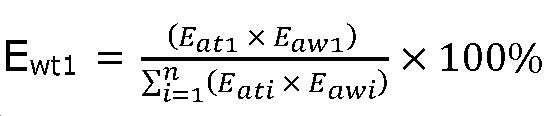
EV 및 HEV의 개발과 더불어, 이러한 적용에 적합한 리튬-이온 배터리에 대한 수요가 발생하게 되었고, hN(M)C 화합물이 이의 비교적 저렴한 비용(리튬 코발트-기반 산화물 등과 같은 대체물과 관련하여) 및 더 높은 동작 전압에서의 더 높은 용량(capacity) 때문에 LIB의 양극 활물질로서 사용될 고체 후보로서 점점 더 많이 연구되고 있다. With the development of EVs and HEVs, there has been a demand for lithium-ion batteries suitable for these applications, and hN(M)C compounds have been developed for their relatively low cost (with respect to alternatives such as lithium cobalt-based oxides, etc.) and more Because of its higher capacity at high operating voltages, it is increasingly being studied as a solid candidate to be used as a cathode active material for LIBs.
이러한 hN(M)C 화합물은, 예를 들어, 문헌 JP5584456B2(이하에서 "JP'456"로 지칭됨) 또는 JP5251401B2(이하에서 "JP'401"로 지칭됨)으로부터 이미 공지된 바 있다. Such hN(M)C compounds have already been known, for example, from the document JP5584456B2 (hereinafter referred to as "JP'456") or JP5251401B2 (hereinafter referred to as "JP'401").
JP'456에는 hN(M)C 화합물로서, 1000ppm 내지 4000ppm 범위의 함량으로 상기 hN(M)C 화합물의 입자 표면 층에 SO4 2-(예를 들어, JP'456의 표현에 따라 황산 라디칼)을 갖는 hN(M)C 화합물이 개시되어 있다. JP'456에는 황산 라디칼의 양이 상기 언급된 범위 내에 있는 경우 화합물의 용량 보유율 및 방전 용량 특성이 증가된다고 설명되어 있다. 그러나, 황산 라디칼의 양이 상기 언급된 범위 미만인 경우에 용량 보유율은 감소되고, 반면에 황산 라디칼의 양이 상기 언급된 범위를 초과하는 경우에 방전 용량은 감소된다.JP'456 describes an hN(M)C compound, in a content in the range of 1000 ppm to 4000 ppm, SO 4 2- (for example, sulfuric acid radicals according to the expression of JP'456) in the particle surface layer of the hN(M)C compound. hN(M)C compounds having JP'456 describes that the capacity retention rate and discharge capacity characteristics of the compound are increased when the amount of the sulfuric acid radical is within the above-mentioned range. However, when the amount of the sulfuric acid radical is less than the above-mentioned range, the capacity retention rate is reduced, whereas when the amount of the sulfuric acid radical exceeds the above-mentioned range, the discharge capacity is decreased.
JP'401에는 1차 입자 상에 설페이트 코팅, 특히 리튬 설페이트 코팅을 적용하면, 상기 설페이트 코팅된 1차 입자의 응집으로 인해 2차 입자가 특정 공극 구조를 갖도록 설계될 수 있어서 상기 2차 입자로부터 제조된 hN(M)C 화합물에 더 높은 사이클 내구성 및 더 높은 초기 방전 용량이 제공될 수 있다는 것이 교시되어 있다. 또한, JP'401에는 이러한 특정 공극 구조가 상기 설페이트 코팅이 세척되고 제거될 때 달성된다고 설명되어 있다. In JP'401, when a sulfate coating, particularly lithium sulfate coating, is applied on the primary particles, secondary particles can be designed to have a specific pore structure due to aggregation of the sulfate-coated primary particles, and thus prepared from the secondary particles. It is taught that higher cycle endurance and higher initial discharge capacity can be provided to the hN(M)C compound. JP'401 also describes that this specific pore structure is achieved when the sulfate coating is washed and removed.
hN(M)C 화합물은 상기 언급된 이점에 있어서 유망하지만, 이들은 또한 Ni 함량이 증가에 따라 사이클링 안정성의 저하와 같은 단점을 나타낸다.Although hN(M)C compounds are promising in the above-mentioned advantages, they also exhibit disadvantages such as a decrease in cycling stability with increasing Ni content.
이들 단점의 예시로서, 종래 기술의 hN(M)C 화합물은 180mAh/g을 넘지 않는 낮은 제1 방전 용량을 갖거나(JP'456) 최대 86%의 제한된 용량 보유율을 갖는다(JP'401). As an example of these disadvantages, the hN(M)C compounds of the prior art have a low first discharge capacity not exceeding 180 mAh/g (JP'456) or have a limited capacity retention rate of up to 86% (JP'401).
따라서, 현재, 본 발명에 따라 (H)EV 적용에 적합한 LIB에서 이러한 hN(M)C 화합물의 사용을 위한 전제 조건인, 적어도 4.0V의 동작 전압에서 필수적인 낮은 비가역적 용량(즉, 제1 사이클의 11% 이하)을 보유하면서 충분히 높은 제1 방전 용량(즉, 적어도 200mAh/g) 및 사이클 수명(즉, LIB가 대략 80% 보유 용량에 도달할 때까지, 25℃에서 적어도 450회 사이클 및 45℃에서 적어도 350회 사이클)을 갖는 hN(M)C 화합물을 달성하는 것이 요구된다. Thus, at present, the essential low irreversible capacity (i.e. the first cycle) at an operating voltage of at least 4.0 V, which is a prerequisite for the use of such hN(M)C compounds in LIBs suitable for (H)EV applications according to the present invention. A sufficiently high first discharge capacity (i.e., at least 200 mAh/g) and cycle life (i.e., at least 450 cycles at 25°C and 45 It is desired to achieve hN(M)C compounds with at least 350 cycles at °C).
본 발명의 목적은 리튬-이온 이차 배터리에서 사용하기에 충분히 안전하면서 본 발명의 분석 방법에 의해 얻어진 최대 11%의 향상된 비가역적 용량(irreversible capacity; IRRQ) 및 25℃에서 80%의 용량 보유율로 적어도 450회 사이클의 향상된 사이클 수명을 갖는 양극 활물질 분말을 제공하는 것이다. 본 발명은 또한 M'에 대한 Ni의 원자 비율이 78at% 내지 85at%(예를 들어, EX1의 경우 80at%)일 때 적어도 200mAh/g, 그리고 M'에 대한 Ni의 원자 비율이 85at% 내지 90at%(예를 들어, EX3의 경우 86at%)일 때 적어도 210mAh/g의 향상된 제1 충전 용량을 갖는 양극 활물질 분말을 제공한다: It is an object of the present invention to achieve at least an improved irreversible capacity (IRRQ) of up to 11% and a capacity retention of 80% at 25°C obtained by the analytical method of the present invention while being sufficiently safe for use in lithium-ion secondary batteries. An object of the present invention is to provide a positive electrode active material powder having an improved cycle life of 450 cycles. The present invention also provides that the atomic ratio of Ni to M' is at least 200 mAh/g when the atomic ratio of Ni to M' is 78 at% to 85 at% (eg, 80 at% for EX1), and the atomic ratio of Ni to M' is 85 at% to 90at % (eg, 86 at% for EX3), providing a positive electrode active material powder having an improved first charge capacity of at least 210 mAh/g:

본 발명의 틀에서, 안전한 양극 활물질 분말은 상기 안전한 물질을 포함하는 LIB의 두께 증가와 관련이 있는데, 두께는 90℃(후술되는 벌징 시험(bulging test) 조건에 따름)에서 25%를 초과하지 않는다. In the framework of the present invention, the safe cathode active material powder is related to an increase in the thickness of the LIB containing the safe material, and the thickness does not exceed 25% at 90° C. (according to the bulging test conditions to be described later) .
발명의 개요Summary of invention
이러한 목적은 청구항 제1항에 따른 양극 활물질 화합물로서, For this purpose, as a positive active material compound according to
- 양극 활물질 분말의 총 중량에 대해 0.150wt% 이상 및 0.375wt% 이하의 함량의 황, 및- sulfur in a content of 0.150 wt% or more and 0.375 wt% or less based on the total weight of the cathode active material powder, and
- 양극 활물질 분말의 총 중량에 대해 0.05wt% 이상 및 0.15wt% 이하의 함량의 알루미늄을 갖는 표면층을 포함하는, 양극 활물질 화합물을 제공함으로써 달성된다.- by providing a positive electrode active material compound comprising a surface layer having aluminum in a content of 0.05 wt% or more and 0.15 wt% or less with respect to the total weight of the positive electrode active material powder.
또한, 리튬 전이 금속-기반 산화물 입자의 상기 표면층은 LiAlO2 및 LiM"1-aAlaO2를 포함하고, 여기서 M"는 Ni, Mn, 및 Co를 포함하고, 상기 LiAlO2 원자 함량은 양극 활물질 분말 중 M'의 총 원자 함량에 대해 0.10at% 이상 및 0.30at% 이하이고, 상기 LiM"1-aAlaO2 원자 함량은 양극 활물질 분말 중 M'의 총 원자 함량에 대해 0.14at% 미만이다.Further, the surface layer of the lithium transition metal-based oxide particle comprises LiAlO 2 and LiM" 1-a Al a O 2 , wherein M" comprises Ni, Mn, and Co, and wherein the LiAlO 2 atomic content is the positive electrode. 0.10 at% or more and 0.30 at% or less with respect to the total atomic content of M' in the active material powder, and the LiM" 1-a Al a O 2 atomic content is 0.14 at% with respect to the total atomic content of M' in the positive active material powder is less than
본 발명의 틀에서, ppm은 농도 단위에 대한 백만분율을 의미하며, 1ppm = 0.0001wt%를 나타낸다.In the framework of the present invention, ppm means parts per million per concentration unit, and represents 1 ppm = 0.0001 wt%.
본 발명에 따른 양극 활물질 분말은 5μm 내지 15μm 범위의 중간 입자 크기 D50 및 5nm 내지 200nm, 바람직하게는 10nm 내지 200nm 범위의 표면층 두께를 갖는다.The cathode active material powder according to the present invention has a median particle size D50 in the range of 5 μm to 15 μm and a surface layer thickness in the range of 5 nm to 200 nm, preferably 10 nm to 200 nm.
실제로, 25℃에서 80% 용량 보유율로 약 460회 사이클 초과의 향상된 사이클 수명 및 200mAh/g 초과의 향상된 제1 방전 용량은, 표 3.2 및 표 4에 제공된 결과에 예시된 바와 같이(하기 섹션 H) 결과 참조), 하기 특징을 갖는 EX1에 따른 양극 활물질 분말로 달성되는 것으로 관찰되었다:Indeed, improved cycle life of greater than about 460 cycles and improved first discharge capacity of greater than 200 mAh/g at 80% capacity retention at 25°C, as exemplified in the results provided in Tables 3.2 and 4 (Section H below) See results), it was observed to be achieved with a positive electrode active material powder according to EX1 having the following characteristics:
- 분말의 총 중량에 대해 각각 0.28wt% 및 0.11wt%의 표면층 중 황 및 알루미늄 함량,- sulfur and aluminum content in the surface layer of 0.28 wt % and 0.11 wt %, respectively, relative to the total weight of the powder;
- 분말의 M'의 총 원자 함량에 대해 0.15at%인 LiAlO2 상 함량,- a LiAlO 2 phase content of 0.15 at% relative to the total atomic content of M' of the powder,
- 분말의 M'의 총 원자 함량에 대해 0.09at%인 LiM"1-aAlaO2 상 함량.- LiM" 1-a Al a O 2 phase content of 0.09 at% relative to the total atomic content of M' of the powder.
EX1 분말의 입자는 평균 100nm의 두께를 갖는 표면층을 갖고, 이의 입도 분포는 12μm의 D50을 특징으로 한다. The particles of the EX1 powder had a surface layer with an average thickness of 100 nm, and its particle size distribution was characterized by a D50 of 12 μm.
본 발명은 하기 구현예들에 관한 것이다: The present invention relates to the following embodiments:
구현예 1
첫 번째 양태에서, 본 발명은 리튬 전이 금속-기반 산화물 입자를 포함하는 리튬-이온 배터리에 적합한 양극 활물질 분말에 관한 것으로서, 상기 입자가 코어 및 표면층을 포함하고, 상기 표면층이 상기 코어의 상부에 있고, 상기 입자가 원소 Li, 금속 M' 및 산소를 포함하고, 여기서 금속 M'는 식 M'=(NizMnyCox)1-kAk를 갖고, 상기 식에서 A는 도펀트이고, 0.60≤z<0.86, 0.05≤y≤0.20, 0.05≤x≤0.20, x+y+z+k=1, 및 k≤0.01이고, 상기 양극 활물질 분말이 5μm 내지 15μm 범위의 중간 입자 크기 D50 및 5nm 내지 200nm의 범위, 바람직하게는 적어도 10nm 및 200nm 이하의 표면층 두께를 갖는다.In a first aspect, the present invention relates to a positive electrode active material powder suitable for a lithium-ion battery comprising lithium transition metal-based oxide particles, said particles comprising a core and a surface layer, said surface layer on top of said core; , wherein the particles comprise elements Li, a metal M' and oxygen, wherein the metal M' has the formula M'=(Ni z Mn y Co x ) 1-k A k , wherein A is a dopant, and 0.60≤ z<0.86, 0.05≤y≤0.20, 0.05≤x≤0.20, x+y+z+k=1, and k≤0.01, and the cathode active material powder has a median particle size D50 in the range of 5 μm to 15 μm, and 5 nm to 200 nm , preferably at least 10 nm and less than or equal to 200 nm.
바람직하게는, 표면층이 50nm 내지 200nm, 더욱 바람직하게는 100nm 내지 200nm, 가장 바람직하게는 10nm 내지 150nm 범위의 두께를 갖는다.Preferably, the surface layer has a thickness in the range from 50 nm to 200 nm, more preferably from 100 nm to 200 nm, and most preferably from 10 nm to 150 nm.
더욱 바람직하게는, 0.70≤z<0.86이다. More preferably, 0.70≤z<0.86.
상기 표면층은 The surface layer is
- 양극 활물질 분말의 총 중량에 대해 0.150wt% 이상 및 0.375wt% 이하의 함량의 황, 및- sulfur in a content of 0.150 wt% or more and 0.375 wt% or less based on the total weight of the cathode active material powder, and
- 양극 활물질 분말의 총 중량에 대해 0.05wt% 이상 및 0.15wt% 이하의 함량의 알루미늄을 포함한다. - Contains aluminum in an amount of 0.05 wt% or more and 0.15 wt% or less based on the total weight of the cathode active material powder.
리튬 전이 금속-기반 산화물 입자의 상기 표면층은 LiAlO2 상 및 LiM"1-aAlaO2 상을 포함하고, 여기서 Al이 M"을 부분적으로 대체하고, M"이 Ni, Mn, 및 Co를 포함한다. The surface layer of lithium transition metal-based oxide particles comprises a LiAlO 2 phase and a LiM″ 1-a Al a O 2 phase, wherein Al partially displaces M″ and M″ replaces Ni, Mn, and Co. include
LiAlO2 상은 양극 활물질 분말 중 M'의 총 원자 함량에 대해 0.10at% 이상 및 0.30at% 이하의 함량으로 표면층에 존재한다. LiM"1-aAlaO2 상은 양극 활물질 분말 중 M'의 총 원자 함량에 대해 0.14at% 미만의 함량으로 표면층에 존재한다.The LiAlO 2 phase is present in the surface layer in an amount of 0.10 at% or more and 0.30 at% or less with respect to the total atomic content of M' in the cathode active material powder. The LiM" 1-a Al a O 2 phase is present in the surface layer in an amount of less than 0.14 at% with respect to the total atomic content of M' in the positive electrode active material powder.
본 발명의 틀에서, 상은 화합물과 관련이 있는 것으로 이해되어야 한다. 이러한 맥락에서, 이는 표면층에 포함된 알루미늄 ?t량의 적어도 19at% 및 최대 56at%가 상기 표면층의 LiAlO2 상에 함유되고, 그에 따라 LiAlO2 화합물을 구성하는 원소로서 상기 표면층에 존재한다는 것을 의미한다. In the framework of the present invention, it is to be understood that a phase relates to a compound. In this context, this means that at least 19 at% and at most 56 at% of the t amount of aluminum contained in the surface layer is contained on the LiAlO 2 of the surface layer, and thus is present in the surface layer as an element constituting the LiAlO 2 compound. .
또한, 표면층에 포함된 알루미늄 함량의 최대 26at%는 상기 표면층의 LiM"1-aAlaO2 상에 함유되고, 이 상에서 상기 상을 구성하는 LiM"1-aAlaO2 화합물 중 M"는 Al으로 부분적으로 치환된다.In addition, a maximum of 26at% of the aluminum content contained in the surface layer is contained in the LiM" 1-a Al a O 2 phase of the surface layer, and M" in the LiM" 1-a Al a O 2 compound constituting the phase in this phase is partially substituted with Al.
A의 공급원은 전구체 제조의 공침 단계 동안 슬러리에 공급될 수 있거나, 그 후에 제조된 전구체와 블렌딩되고 이어서 가열될 수 있다. 예를 들어, A의 공급원은 니트레이트, 옥사이드, 설페이트, 또는 카르보네이트 화합물일 수 있지만, 이들 예로 제한되지 않는다. 도펀트는 일반적으로 양극 활물질의 성능을 향상시키기 위해, 예컨대, 리튬 확산을 보조하거나 전해질과의 부반응을 억제하기 위해 첨가된다. 도펀트는 일반적으로 코어에 균질하게 분포된다. 양극 활물질에서 도펀트는 유도 결합 플라즈마(Inductively Coupled Plasma; ICP) 방법과 TEM-EDS(투과 전자 현미경 - 에너지 분산형 X-선 분광법(transmission electron microscopy - energy dispersive X-ray spectroscopy))(crf. 섹션 E)의 조합과 같은 분석 방법의 조합에 의해 확인된다. The source of A may be supplied to the slurry during the co-precipitation step of the precursor preparation, or it may then be blended with the prepared precursor and then heated. For example, the source of A may be, but is not limited to, a nitrate, oxide, sulfate, or carbonate compound. A dopant is generally added to improve the performance of the positive electrode active material, for example, to assist lithium diffusion or to suppress a side reaction with an electrolyte. The dopant is generally homogeneously distributed in the core. The dopant in the positive electrode active material is inductively coupled plasma (ICP) method and TEM-EDS (transmission electron microscopy - energy dispersive X-ray spectroscopy) (crf. section E) ) are identified by a combination of analytical methods, such as the combination of
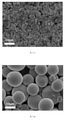
바람직하게는, 상기 리튬 전이 금속-기반 산화물 입자는 모놀리식 또는 다결정질 형태를 갖는다. 모놀리식 형태는 주사 전자 현미경(Scanning Electron Microscope; SEM)과 같은 적절한 현미경 기술로 관찰되는, 단일 입자 또는 2개 또는 3개의 1차 입자로 이루어진 2차 입자의 형태를 나타낸다. 분말은 SEM에 의해 제공되는 적어도 45μm × 적어도 60μm(즉, 적어도 2700μm2), 바람직하게는 적어도 100μm × 적어도 100μm(즉, 적어도 10000μm2)의 시야에서 입자 수의 80% 이상이 모놀리식 형태를 갖는 경우에 모놀리식 분말로 지칭된다. 다결정질 형태는 3개 초과의 1차 입자로 이루어진 2차 입자의 형태를 나타낸다. 모놀리식 및 다결정질 형태를 갖는 입자에 대한 SEM 이미지의 예는 각각 도 1.1 및 도 1.2에 나타나 있다.Preferably, the lithium transition metal-based oxide particles have a monolithic or polycrystalline form. Monolithic morphology refers to the morphology of single particles or secondary particles consisting of two or three primary particles observed with an appropriate microscopy technique, such as a Scanning Electron Microscope (SEM). The powder has a monolithic morphology with at least 80% of the number of particles in a field of view of at least 45 μm × at least 60 μm (ie at least 2700 μm 2 ), preferably at least 100 μm × at least 100 μm (ie at least 10000 μm 2 ) provided by SEM When present, it is referred to as a monolithic powder. Polycrystalline form refers to the form of secondary particles consisting of more than three primary particles. Examples of SEM images for particles with monolithic and polycrystalline morphology are shown in Figures 1.1 and 1.2, respectively.
구현예 2
바람직하게는 구현예 1에 따른 두 번째 구현예에서, 상기 리튬 전이 금속-기반 산화물 입자는 73.0±0.2eV 내지 74.5±0.2eV, 바람직하게는 73.6±0.2eV 내지 74.1±0.2eV의 결합 에너지 범위에서 최대 Al2p 피크 세기를 갖고, 상기 세기는 XPS 스펙트럼 분석에 의해 얻어진다.Preferably in a second embodiment according to
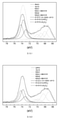
상기 범위에서 Al2p 피크의 최대 피크 세기는 표면층에서 주요 Al 형태가 LiAlO2라는 것을 지시한다. 73.0eV, 바람직하게는 73.6eV 내지 74.5eV, 바람직하게는 74.1eV의 범위에서 Al2p 피크의 최대 피크 세기를 갖는 hN(M)C 화합물은, 표 3.2 및 표 3.4에 예시된 바와 같이, 배터리에 사용될 때 더 높은 비용량 및 더 우수한 사이클 수명을 나타낸다.The maximum peak intensity of the Al2p peak in the above range indicates that the main Al form in the surface layer is LiAlO 2 . The hN(M)C compound having a maximum peak intensity of the Al2p peak in the range of 73.0 eV, preferably 73.6 eV to 74.5 eV, preferably 74.1 eV, as exemplified in Tables 3.2 and 3.4, can be used in batteries shows higher specific capacity and better cycle life.
구현예 3embodiment 3
바람직하게는 구현예 1 또는 구현예 2에 따른 세 번째 구현예에서, 상기 리튬 전이 금속-기반 산화물 입자는 100 이상인 Al 표면 커버리지 A1/A2를 갖고, 여기서 A1은 표면층에 함유된 원소 Al, Ni, Mn, Co, 및 S의 원자 비율 Al/(Ni+Mn+Co+Al+S)이고, 상기 원자 비율 A1은 XPS 스펙트럼 분석에 의해 얻어지고, A2는 ICP에 의해 얻어진 원자 비율 Al/(Ni+Mn+Co+Al+S)이다. Preferably in a third embodiment according to
A1은 하기 연속 단계를 포함하는 하기 방법에 의해 얻어진다: A1 is obtained by the following method comprising the following successive steps:
1) 리튬 전이 금속-기반 산화물 입자의 XPS 스펙트럼을 획득하는 단계; 1) obtaining an XPS spectrum of lithium transition metal-based oxide particles;
2) 상기 XPS 스펙트럼을 역합성곱(deconvolution)하여 각각 LiM"1-aAlaO2(Al 피크1 ; 면적_1), LiAlO2(Al 피크2 ; 면적_2), 및 Al2O3(Al 피크3 ; 면적_3) 화합물로 지정되는 각각의 3개 면적(면적_1, 면적_2, 면적_3)을 갖는 3개의 고유한 피크(Al 피크1, Al 피크2, 및 Al 피크3)를 확인하는 단계; 2) Deconvolution of the XPS spectrum was performed to perform LiM" 1-a Al a O 2 (
3) 상기 3개의 고유한 피크의 면적(_1 내지 _3)을 합하여 전체 Al2p 피크 면적 값을 계산하는 단계; 및 3) calculating a total Al2p peak area value by summing the areas (_1 to _3) of the three unique peaks; and
4) 상기 Al2p 피크 면적 값을 원자 비율 A1 (at%/at%) = (Al/(Ni+Mn+Co+Al+S))로 환산하는 단계. 4) converting the Al2p peak area value into an atomic ratio A1 (at%/at%) = (Al/(Ni+Mn+Co+Al+S)).
단계 4)는 하기 연속 단계를 포함하는 하기 방법에 따라 얻어진다: Step 4) is obtained according to the following method comprising the following successive steps:
a) 스마트 배경 기능(Smart background function)이 있는 Thermo Scientific Avantage 소프트웨어를 사용하여 Ni, Mn, Co, 및 S의 1차 XPS 피크를 핏팅하여 각 원소의 피크 면적을 얻는 단계; a) using Thermo Scientific Avantage software with a smart background function to fit the first XPS peaks of Ni, Mn, Co, and S to obtain the peak area of each element;
b) 단계 4a)로부터 얻어진 Ni, Mn, Co, 및 S 피크 면적 및 단계 3)으로부터 얻어진 Al 피크 면적을 Thermo Scientific Avantage 소프트웨어 및 Scofield 상대 민감도 라이브러리를 사용하여 at%로 환산하는 단계;b) converting the Ni, Mn, Co, and S peak areas obtained from step 4a) and the Al peak areas obtained from step 3) into at% using Thermo Scientific Avantage software and Scofield relative sensitivity library;
c) Al at%의 값을 전체 Ni, Mn, Co, Al 및 S의 at%로 나눔으로써 상기 Al2p at%를 A1으로 환산하는 단계. c) converting the Al2p at% into Al by dividing the value of Al at% by the at% of the total Ni, Mn, Co, Al and S.
적어도 100의 Al 표면 커버리지 A1/A2의 값은 표면층에 함유된 Al이 균일한 공간 분포로 코어의 상부에 존재한다는 것을 지시한다. 실시예 1에 예시된 바와 같이, 표면층에 균일하게 분포되어 있는 Al을 갖는 hN(M)C 화합물은, 표 3.2 및 표 3.4에 예시된 바와 같이 배터리의 더 높은 비용량 및 더 우수한 사이클 수명을 나타낸다. A value of Al surface coverage A1/A2 of at least 100 indicates that Al contained in the surface layer is present on top of the core in a uniform spatial distribution. As illustrated in Example 1, the hN(M)C compound with Al uniformly distributed in the surface layer exhibits higher specific capacity and better cycle life of the battery, as illustrated in Tables 3.2 and 3.4 .
구현예 4embodiment 4
바람직하게는 구현예 1 내지 구현예 3 중 어느 한 구현예에 따른 네 번째 구현예에서, 리튬 전이 금속-기반 산화물 입자의 상기 표면층은 4500ppm 이상 및 11250ppm 이하의 함량의 설페이트 이온(SO4 2-)을 갖는다.Preferably in a fourth embodiment according to any one of
리튬 전이 금속-기반 산화물 입자의 표면층 중 4500ppm 내지 11250ppm의 설페이트 이온은 표 3.1 및 표 3.2에 예시된 바와 같이 높은 비용량 및 더 낮은 비가역적 용량과 같은 향상된 전기화학적 성능을 나타낸다.Sulfate ions from 4500 ppm to 11250 ppm in the surface layer of lithium transition metal-based oxide particles exhibit improved electrochemical performance such as high specific capacity and lower irreversible capacity as exemplified in Tables 3.1 and 3.2.
구현예 5embodiment 5
바람직하게는 구현예 1 내지 구현예 4 중 어느 한 구현예에 따른 다섯 번째 구현예에서, 상기 양극 활물질 분말은 0.85 초과 및 1.00 이하인 설페이트 이온 표면 커버리지 S1/S2를 갖는 리튬 전이 금속-기반 산화물 입자를 포함하고, 여기서 S1은 리튬 전이 금속-기반 산화물 입자의 표면층에 함유된 설페이트 이온의 양이고, S2는 양극 활물질 분말 중 설페이트 이온의 총량이다.Preferably in a fifth embodiment according to any one of
적어도 0.85의 설페이트 이온 표면 커버리지 S1/S2의 값은 표면층에 함유된 S가 균일한 공간 분포로 코어의 상부에 존재한다는 것을 지시한다. 실시예 1에 예시된 바와 같이, 표면층에 균일하게 분포되어 있는 S를 갖는 hN(M)C 화합물은 표 3.1 및 표 3.2에 예시된 바와 같이 배터리의 더 높은 비용량 및 더 우수한 비가역적 용량을 나타낸다.A value of sulfate ion surface coverage S1/S2 of at least 0.85 indicates that S contained in the surface layer is present in the upper part of the core with a uniform spatial distribution. As illustrated in Example 1, the hN(M)C compound with S uniformly distributed in the surface layer exhibits higher specific capacity and better irreversible capacity of the battery, as illustrated in Tables 3.1 and 3.2. .
구현예 6embodiment 6
바람직하게는 구현예 1 내지 구현예 5 중 어느 한 구현예에 따른 여섯 번째 구현예에서, 이에 따른 상기 양극 활물질 분말은 200ppm 미만의 탄소 함량을 갖는다. Preferably in a sixth embodiment according to any one of
높은 탄소 함량(예를 들어, 200ppm 초과)은 사이클링 동안의 부반응과 관련이 있기 때문에, 양극 활물질 분말이 배터리의 전해질과 접촉하는 경우, 더 낮은 탄소 함량(예를 들어, 200ppm 이하)을 갖는 hN(M)C 화합물은, 이로 제한되지는 않지만, 배터리에서 사이클링될 때 우수한 비가역적 용량과 같은 향상된 전기화학적 성능을 야기한다(cfr. 표 3.1 및 표 3.2). Since a high carbon content (e.g., greater than 200 ppm) is associated with side reactions during cycling, when the cathode active material powder is in contact with the electrolyte of the battery, hN with a lower carbon content (e.g., less than 200 ppm) ( M)C compounds lead to improved electrochemical performance such as, but not limited to, good irreversible capacity when cycled in a battery (cfr. Tables 3.1 and 3.2).
구현예 7embodiment 7
바람직하게는 구현예 1 내지 구현예 6 중 어느 한 구현예에 따른 일곱 번째 구현예에서, 양극 활물질 분말은 일반식 Li1+a'((Niz'Mny'Cox'AlvSw)1-kAk)1-a'O2를 갖고, 여기서 오로지 A만이 도펀트이고, 0.60≤z'<0.86, 0.05≤y'≤0.20, 0.05≤x'≤0.20, x'+y'+z'+v+w+k=1, 0.0018≤v≤0.0053, 0.006≤w≤0.012 , -0.05≤a'≤0.05, 및 k≤0.01이다.Preferably in a seventh embodiment according to any one of
더욱 바람직하게는, 0.70≤z'<0.86이다.More preferably, 0.70≤z'<0.86.
구현예 8Embodiment 8
바람직하게는 구현예 1 내지 구현예 7 중 어느 한 구현예에 따른 여덟 번째 구현예에서, A는 다음 원소들 중 하나 이상이다: Al, B, S, Mg, Zr, Nb, W, Si, Ba, Sr, Ca, Zn, Cr, V, Y, 및 Ti. 또 다른 구현예에서, A의 각각의 원소의 양은 양극 활물질 분말의 총 중량에 대해 100ppm 초과이다.Preferably in an eighth embodiment according to any one of
구현예 9embodiment 9
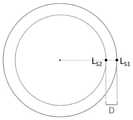
바람직하게는 구현예 1 내지 구현예 8 중 어느 한 구현예에 따른 아홉 번째 구현예에서, 표면층의 (최소) 두께는 입자의 단면 주변에 위치한 제1 지점과 상기 제1 지점과 상기 입자의 기하학적 중심(또는 도심) 사이에 정의된 선에 위치한 제2 지점 사이의 최단 거리로 정의되고, 여기서 제2 지점 위치 및 상기 제2 지점 위치와 입자의 중심 사이의 임의의 위치에서 TEM-EDS(cfr. 섹션 E)에 의해 측정되는 S의 함량(S2)은 0at%±0.1at%이다. In a ninth embodiment, preferably according to any one of
제2 지점 위치에서의 S의 함량(S2)은 일정하다: 이는 0at% 초과일 수 있고 제1 지점 위치에서 S의 제1 함량(S1)의 5.0at% 이하여야 하며, S2의 상기 제2 함량은 상기 선의 제3 지점 위치에서의 S의 함량(S3)과 같고, 상기 제3 지점은 상기 입자의 기하학적 중심과 제2 지점 위치 사이의 임의의 위치에 위치한다. The content of S at the second point position (S 2 ) is constant: it can be greater than 0 at% and must be less than or equal to 5.0 at% of the first content of S at the first point position (S 1 ), the above of S 2 The second content is equal to the content of S at the position of the third point of the line (S 3 ), the third point being located at any position between the geometric center of the particle and the position of the second point.
다시 말해서, 표면층의 두께는 하기와 같이 정의되는 최소 거리 D에 해당한다: In other words, the thickness of the surface layer corresponds to the minimum distance D defined as

(여기서, 도 2에 예시된 바와 같이, LS1은 입자 주변의 제1 지점 위치이고, LS2는 상기 제1 지점 위치와 상기 입자의 기하학적 중심 사이에 정의된 선의 제2 지점 위치이고,(Where, as illustrated in FIG. 2 , L S1 is the position of a first point around the particle, L S2 is the position of the second point on a line defined between the first point position and the geometric center of the particle,
제2 지점 위치 LS2에서 TEM-EDS에 의해 측정되는 S의 제2 함량은 제1 지점 위치에서 측정된 S의 제1 함량(S1)의 0at% 이상 및 5.0at% 이하이고, 상기 S의 제2 함량(S2)은 The second content of S measured by TEM-EDS at the second point position L S2 is 0at% or more and 5.0at% or less of the first content of S measured at the first point position (S 1 ), and 5.0at% or less, The second content (S 2 ) is


와 같이 정의되고, S3는 상기 선의 제3 지점 위치(LS3)에서의 S의 제3 함량(at%)이고, 상기 제3 지점은 상기 입자의 기하학적 중심과 제2 지점 위치 LS2 사이의 임의의 위치에 위치함). where S 3 is the third content (at%) of S at the third point position L S3 of the line, the third point being between the geometric center of the particle and the second point position L S2 located anywhere).
S2 및 S3가 0.0at% 초과인 경우, S의 제2 및 제3 함량은, 본 발명에 따른 입자의 코어에서 도펀트로서 존재하는, TEM-EDS에 의해 측정되는 S의 함량에 상응한다. When S 2 and S 3 are greater than 0.0at%, the second and third contents of S correspond to the contents of S, as determined by TEM-EDS, present as dopant in the core of the particles according to the invention.
TEM-EDS 프로토콜은 하기와 같이 적용된다: The TEM-EDS protocol is applied as follows:
1) 리튬 전이 금속-기반 산화물 입자의 단면 TEM 라멜라를 Ga 이온 빔을 이용하여 입자 샘플을 절단함으로써 추출하여 제조된 샘플을 얻는다. 1) A cross-sectional TEM lamella of lithium transition metal-based oxide particles is extracted by cutting the particle sample using a Ga ion beam to obtain a prepared sample.
2) 제조된 샘플(입자의 단면)을 표면층의 외부 에지에서부터 리튬 전이 금속-기반 산화물 입자의 중심까지 TEM/EDS 라인 스캔으로 스캐닝하여 단면의 정량적 원소 분석을 제공한다. 2) Scanning the prepared sample (cross-section of the particle) with a TEM/EDS line scan from the outer edge of the surface layer to the center of the lithium transition metal-based oxide particle to provide a quantitative elemental analysis of the cross-section.
3) EDS에 의해 검출된 Al 및 S 함량을 M*에 의해 정규화하고, 여기서 M*는 스캐닝된 라멜라에서 Ni, Mn, Co, Al, 및 S의 총 원자 함량이다. 3) Normalize the Al and S content detected by EDS by M * , where M * is the total atomic content of Ni, Mn, Co, Al, and S in the scanned lamellae.
4) 이어서, Al/M* 및 S/M*의 측정된 라인 스캔을 상기 입자의 단면에서 선형 거리의 함수로서 플롯팅한다. 4) Then, the measured line scans of Al/M * and S/M * are plotted as a function of linear distance in the cross section of the particle.
상기 언급된 단계 1) 내지 단계 4)는 분석하고자 하는 입자가 존재하는 만큼 여러 번 반복된다.Steps 1) to 4) mentioned above are repeated as many times as there are particles to be analyzed.
상기 언급된 TEM-EDS 측정은 적어도 하나의 입자에 대하여 수행된다. 하나 초과의 입자를 측정하는 경우, Al/M* 및 S/M*는 수치적으로 평균내어진다.The above-mentioned TEM-EDS measurement is performed on at least one particle. When more than one particle is measured, Al/M * and S/M * are numerically averaged.
구현예 10
바람직하게는 구현예 10에 따른 열 번째 구현예에서, Al은 하기와 같이 정의되는 함량 l로 표면층에 존재한다: In a tenth embodiment, preferably according to

(여기서,(here,
- 
- 
여기서,here,
- Al표면은 EDS에 의해 측정된 표면층 중 Al의 함량(at%)이고; - Al surface is the content (at %) of Al in the surface layer measured by EDS;
- Al전체는 EDS에 의해 측정된 상기 분말의 입자 중 Al의 총 함량(at%)이고; - Al total is the total content (at %) of Al in the particles of the powder as measured by EDS;
- 면적1은 D에 걸쳐 단면-TEM-EDS에 의해 측정된 Al/M* 함량의 적분이고:- area1 is the integral of the Al/M * content measured by cross-section-TEM-EDS over D:

- Al(x)는 단면-TEM EDS에 의해 측정된 단면 입자의 지점 x에서의 Al의 원자 함량이고, - Al(x) is the atomic content of Al at point x of the cross-sectional particle measured by cross-section-TEM EDS,
- M*(x)은 단면-TEM EDS에 의해 측정된 단면 입자의 지점 x에서의 Ni, Mn, Co, Al, 및 S의 원자 함량이고,- M * (x) is the atomic content of Ni, Mn, Co, Al, and S at point x of the cross-sectional particle measured by cross-section-TEM EDS,
- x는 상기 제1 지점 위치와 제2 지점 위치 사이의 TEM에 의해 측정된 거리(nm로 표현됨)임; - x is the distance (expressed in nm) measured by TEM between the first and second point locations;
- 면적2는 거리 C에 걸쳐 단면-SEM EDS에 의해 측정된 Al/M* 함량의 적분이다: - area2 is the integral of the Al/M * content measured by cross-section-SEM EDS over distance C:

- Al(x)는 단면-TEM EDS에 의해 측정된 단면 입자의 지점 x에서의 Al의 원자 함량이고, - Al(x) is the atomic content of Al at point x of the cross-sectional particle measured by cross-section-TEM EDS,
- M*(x)은 단면-TEM EDS에 의해 측정된 단면 입자의 지점 x에서의 Ni, Mn, Co, Al, 및 S의 원자 함량이고,- M * (x) is the atomic content of Ni, Mn, Co, Al, and S at point x of the cross-sectional particle measured by cross-section-TEM EDS,
- x는 상기 제1 지점 위치(x = 0nm)와 상기 입자의 기하학적 중심(x = C) 사이의 거리(nm로 표현되고 TEM에 의해 측정됨)이고, 여기서 C는 바람직하게는 2.5μm 내지 7.5μm의 범위임). - x is the distance (expressed in nm and measured by TEM) between the first point position (x = 0 nm) and the geometric center of the particle (x = C), where C is preferably between 2.5 μm and 7.5 μm in the μm range).
상기 제공된 모든 구현예 1 내지 구현예 10은 조합 가능하다.All
본 발명은 배터리에서의 상기 구현예 1 내지 구현예 10 중 어느 한 구현예에 따른 양극 활물질 분말의 용도에 관한 것이다. The present invention relates to the use of the positive electrode active material powder according to any one of
본 발명은 또한 하기 단계들을 포함하는, 상기 구현예 1 내지 구현예 10 중 어느 한 구현예에 따른 양극 활물질 분말을 제조하는 공정을 포함한다: The present invention also includes a process for preparing a cathode active material powder according to any one of
- 전이 금속-기반 산화물 화합물을 준비하는 단계,- preparing a transition metal-based oxide compound;
- 상기 리튬 전이 금속-기반 산화물 화합물을, 설페이트의 공급원, 바람직하게는 Al2(SO4)3, 및 물과 혼합함으로써 혼합물을 얻는 단계, 및 - obtaining a mixture by mixing said lithium transition metal-based oxide compound with a source of sulfate, preferably Al 2 (SO 4 ) 3 , and water, and
- 노(furnace)에서 산화 분위기 하에 350℃ 내지 500℃ 미만, 바람직하게는 최대 450℃의 온도에서 1시간 내지 10시간의 시간 동안 혼합물을 가열하여 본 발명에 따른 양극 활물질 분말을 얻는 단계.- heating the mixture at a temperature of 350°C to less than 500°C, preferably at most 450°C under an oxidizing atmosphere in a furnace for a time of 1 hour to 10 hours to obtain a cathode active material powder according to the present invention.
도 1.1은 모놀리식 형태를 갖는 입자에 대한 SEM 이미지이다.
도 1.2는 다결정질 형태를 갖는 입자에 대한 SEM 이미지이다.
도 2는 본 발명에 따른 양극 활물질 입자의 단면에 대한 개략적 이미지이고, 여기서 LS1은 입자의 단면의 주변의 제1 지점 위치이고, LS2는 상기 입자의 기하학적 중심과 LS1 사이의 가상선에 위치한 제2 지점 위치이다. D는 LS1과 LS2 사이의 거리로 정의된 표면층의 두께이다(cfr. 구현예 9).
도 3.1은 핏팅 과정 전 EX1의 XPS Al 피크 역합성곱이다(x-축: 결합 에너지, y-축: 수).
도 3.2는 핏팅 과정 후 EX1의 XPS Al 피크 역합성곱이다(x-축: 결합 에너지, y-축: 수).
도 4.1은 EX1, CEX1, 및 CEX3의 Al2p 및 Ni3p XPS 스펙트럼이다(x-축: 결합 에너지, y-축: 수).
도 4.2는 각각 LiM"1-aAlaO2, LiAlO2, 및 Al2O3 상의 Al2p3 XPS 피크에 대한 결합 에너지 범위이다. 수직 점선은 CEX1에 대한 Al2p3 XPS 피크 위치를 나타내는 반면, 수직 실선은 EX1에 대한 Al2p3 XPS 피크 위치를 나타낸다.
도 5는 25℃ 및 45℃에서 2.7V 내지 4.2V 범위의 EX1, CEX1, 및 CEX3에 대한 풀 셀 시험 결과이다(x-축: 사이클 수, y-축: 용량 보유율).
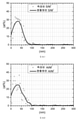
도 6.1은 EX1의 S에 대한 TEM-EDS 분석 결과이다(x-축: 거리(0은 표면층의 시작점임), y-축: 원소(원자 비율)).
도 6.2는 EX1의 Al에 대한 TEM-EDS 분석 결과이다(x-축: 거리(0은 표면층의 시작점임), y-축: 원소(원자 비율)).Figure 1.1 is an SEM image of a particle having a monolithic morphology.
1.2 is an SEM image of a particle having a polycrystalline morphology.
2 is a schematic image of a cross-section of a particle of a positive electrode active material according to the present invention, where L S1 is the position of a first point on the periphery of the cross-section of the particle, and L S2 is on the imaginary line between the geometric center of the particle and L S1 It is the second point location where it is located. D is the thickness of the surface layer defined as the distance between L S1 and L S2 (cfr. embodiment 9).
Figure 3.1 is the XPS Al peak deconvolution of EX1 before the fitting process (x-axis: binding energy, y-axis: number).
Figure 3.2 is the XPS Al peak deconvolution of EX1 after the fitting process (x-axis: binding energy, y-axis: number).
4.1 is Al2p and Ni3p XPS spectra of EX1, CEX1, and CEX3 (x-axis: binding energy, y-axis: number).
4.2 is the binding energy range for Al2p3 XPS peaks on LiM″ 1-a Al a O 2 , LiAlO 2 , and Al 2 O 3 , respectively. The vertical dashed line indicates the Al2p3 XPS peak position for CEX1, while the vertical solid line is Al2p3 XPS peak positions for EX1 are shown.
5 is full cell test results for EX1, CEX1, and CEX3 ranging from 2.7V to 4.2V at 25°C and 45°C (x-axis: number of cycles, y-axis: capacity retention).
6.1 is a TEM-EDS analysis result for S of EX1 (x-axis: distance (0 is the starting point of the surface layer), y-axis: element (atomic ratio)).
6.2 is a TEM-EDS analysis result for Al of EX1 (x-axis: distance (0 is the starting point of the surface layer), y-axis: element (atomic ratio)).
상세한 설명details
도면 및 하기 상세한 설명에서, 바람직한 구현예가 본 발명의 실시를 가능하게 하기 위해 기술된다. 본 발명이 이들 특정의 바람직한 구현예를 참조하여 기술되었지만, 본 발명은 이들 바람직한 구현예로 제한되지 않는 것으로 이해될 것이다. 본 발명은 하기 상세한 설명 및 첨부된 도면을 고려하여 명백해지는 다수의 대안, 수정 및 등가물을 포함한다.In the drawings and the detailed description that follows, preferred embodiments are described in order to enable the practice of the invention. Although the present invention has been described with reference to these specific preferred embodiments, it will be understood that the present invention is not limited to these preferred embodiments. The present invention covers many alternatives, modifications and equivalents, which will become apparent in consideration of the following detailed description and accompanying drawings.
A) ICP 분석A) ICP analysis
양극 활물질 분말의 Li, Ni, Mn, Co, Al, 및 S 함량은 Agillent ICP 720-ES를 사용함으로써 유도 결합 플라즈마(ICP) 방법으로 측정된다. 2g의 생성물 분말 샘플을 Erlenmeyer 플라스크에서 10mL의 고순도 염산에 용해시킨다. 플라스크를 유리로 덮고 전구체의 완전한 용해까지 380℃의 핫 플레이트에서 가열한다. 실온으로 냉각한 후, Erlenmeyer 플라스크의 용액을 250mL 부피 플라스크에 붓는다. 그 후에, 부피 플라스크를 250mL 표시까지 탈이온수로 채우고, 이어서 완전히 균질화시킨다. 적절한 양의 용액을 피펫으로 꺼내고, 2차 희석을 위해 250mL 부피 플라스크로 옮기고, 부피 플라스크에 내부 표준물 및 10% 염산을 250mL 표시까지 채운 후, 균질화시킨다. 마지막으로, 이 50mL 용액을 ICP 측정에 사용한다. Ni, Mn, Co, Al, 및 S의 총량에 대한 Al의 원자 비율(Al/(Ni+Mn+Co+Al+S) (at%))은 A2로 명명된다. The Li, Ni, Mn, Co, Al, and S contents of the cathode active material powder were measured by an inductively coupled plasma (ICP) method by using an Agilent ICP 720-ES. A 2 g product powder sample is dissolved in 10 mL of high purity hydrochloric acid in an Erlenmeyer flask. The flask is covered with a glass and heated on a hot plate at 380° C. until complete dissolution of the precursor. After cooling to room temperature, pour the solution from the Erlenmeyer flask into a 250 mL volumetric flask. Thereafter, the volumetric flask is filled with deionized water to the 250 mL mark, and then thoroughly homogenized. Pipette out an appropriate amount of solution, transfer to a 250 mL volumetric flask for secondary dilution, fill the volumetric flask with internal standard and 10% hydrochloric acid to the 250 mL mark, and homogenize. Finally, this 50 mL solution is used for ICP measurement. The atomic ratio of Al to the total amount of Ni, Mn, Co, Al, and S (Al/(Ni+Mn+Co+Al+S) (at%)) is named A2.
S2로 명명되는, 분말 전체 중 설페이트 이온(SO4 2-)의 양은 하기 방정식에 의해 얻어진다: The amount of sulfate ions (SO 4 2- ) in the whole powder, designated S 2 , is obtained by the following equation:

*SO4의 분자량을 S의 분자량으로 나눈 MW SO4/ MW S 의 값은 2.996이다.The value of MW SO4/ MW S obtained by dividing the molecular weight of *SO 4 by the molecular weight of S is 2.996.
본 발명에 따른 리튬 전이 금속-기반 산화물 입자의 표면에서 S 함량을 조사하기 위해, 세척 및 여과 공정이 수행된다. 5g의 양극 활물질 분말 및 100g의 초순수를 비커에서 측정한다. 전극 활물질 분말을 자기 교반기를 사용하여 25℃에서 5분 동안 물에 분산시킨다. 분산액을 진공 여과하고, 여과된 용액을 상기 ICP 측정에 의해 분석하여 표면층에 존재하는 S의 양을 결정한다. 세척 및 여과 공정 후 세척된 분말에 남아 있는 S의 양은 도펀트로서 정의되고(이는 코어에 존재하는 S의 함량에 해당하므로), 세척 및 여과 공정 후 세척된 분말로부터 제거된 S의 양은 표면층에 존재하는 S의 양으로 정의된다. 입자 표면층 중 설페이트 이온(SO4 2-)의 양은 이러한 분석으로부터의 S의 양에 2.996 및 10000ppm을 곱함으로써 얻어지고, 이는 S1으로 명명된다. 설페이트 이온 표면 커버리지, S1/S2는 S1을 S2로 나눔으로써 계산된다.In order to investigate the S content on the surface of the lithium transition metal-based oxide particles according to the present invention, washing and filtering processes are performed. 5 g of the cathode active material powder and 100 g of ultrapure water were measured in a beaker. The electrode active material powder was dispersed in water at 25° C. for 5 minutes using a magnetic stirrer. The dispersion is vacuum filtered, and the filtered solution is analyzed by the above ICP measurement to determine the amount of S present in the surface layer. The amount of S remaining in the washed powder after the washing and filtration process is defined as the dopant (since it corresponds to the content of S present in the core), and the amount of S removed from the washed powder after the washing and filtration process is the amount of S present in the surface layer. It is defined as the amount of S. The amount of sulfate ions (SO 4 2- ) in the particle surface layer is obtained by multiplying the amount of S from this analysis by 2.996 and 10000 ppm, which is designated S1. The sulfate ion surface coverage, S1/S2, is calculated by dividing S1 by S2.
B) X-선 광전자 분광법 측정B) X-ray photoelectron spectroscopy measurements
본 발명에서, X-선 광전자 분광법(XPS)은 본 발명에 따른 캐소드 물질 입자의 표면층에 존재하는 각각의 Al-기반 화합물 또는 상을 확인하고 이의 함량(at%)을 결정하기 위해 사용된다.In the present invention, X-ray photoelectron spectroscopy (XPS) is used to identify each Al-based compound or phase present in the surface layer of the cathode material particle according to the present invention and to determine its content (at%).
이러한 확인은 다음을 수행하는 것을 포함한다: i) XPS에 의해 확인된 Al2p 피크의 핏팅(cfr. 섹션 B2 - XPS 피크 처리) 및 이어서 ii) Al2p 피크의 핏팅에 의해 확인된 각각의 화합물에 대한 함량 계산에 의한 정량적 상 분석(cfr. 섹션 B3 - Al-기반 화합물의 함량). This confirmation involves performing the following: i) fitting of the Al2p peak identified by XPS (cfr. Section B2 - XPS peak treatment) followed by ii) fitting of the Al2p peak content for each compound identified Quantitative phase analysis by calculation (cfr. section B3 - content of Al-based compounds).
또한, XPS는 본 발명에 따른 입자의 표면층에서 상기 Al 분포의 균질성 정도를 지시하는 Al 표면 커버리지 값을 측정하기 위해 본 발명의 틀에서 사용된다. In addition, XPS is used in the framework of the present invention to measure the Al surface coverage value, which indicates the degree of homogeneity of the Al distribution in the surface layer of the particles according to the present invention.
B1) XPS 측정 조건B1) XPS measurement conditions
리튬 전이 금속-기반 산화물 입자의 표면 분석을 위해, Thermo K-α+(Thermo Scientific) 분광기를 사용하여 XPS 측정이 수행된다. 단색화된 Al Kα 방사선(hυ=1486.6eV)이 400μm의 스폿 크기 및 45°의 측정각으로 사용된다. 표면에 존재하는 원소를 확인하기 위한 넓은 조사 스캔은 200eV 통과 에너지에서 실시된다. 284.4eV에서 최대 세기를 갖는(또는 중심에 있는) C1s 피크는 데이터 수집 후 보정 피크 위치로 사용된다. 이후에 정확한 표면 조성을 결정하기 위해 적어도 10회 스캔 동안 50eV에서 확인된 각 원소에 대하여 정확한 좁은-스캔이 수행된다. For surface analysis of lithium transition metal-based oxide particles, XPS measurements are performed using a Thermo K-α+ (Thermo Scientific) spectrometer. Monochromated Al Kα radiation (hυ=1486.6 eV) is used with a spot size of 400 μm and a measurement angle of 45°. A wide irradiation scan to identify elements present on the surface is performed at 200 eV pass energy. The C1s peak with maximum intensity (or centered) at 284.4 eV is used as the calibration peak position after data collection. An accurate narrow-scan is then performed for each element identified at 50 eV for at least 10 scans to determine the correct surface composition.
B2) XPS 피크 처리B2) XPS peak processing
XPS 측정에서, 신호는 샘플 표면층의 처음 몇 나노미터(예를 들어, 1nm 내지 10nm)에서 획득된다. 따라서, XPS에 의해 측정된 모든 원소는 표면층에 함유되어 있다. 표면층이 확인된 상의 균질한 분포를 갖는지 추정된다. In XPS measurements, signals are acquired in the first few nanometers (eg, 1 nm to 10 nm) of the sample surface layer. Therefore, all elements measured by XPS are contained in the surface layer. It is assumed that the surface layer has a homogeneous distribution of the identified phase.
XPS 원시 데이터의 정량적 상 분석은 XPS 피크의 역합성곱 및 역합성곱된 피크에 대한 기존 Al-기반 화합물의 기여 결정으로 이어지는 XPS 신호의 처리에 기초한다.Quantitative phase analysis of XPS raw data is based on deconvolution of XPS peaks and processing of XPS signals leading to determination of the contribution of existing Al-based compounds to the deconvolved peaks.
XPS 피크 역합성곱은 조사된 양극 활물질 입자의 표면층에 LiM"1-aAlaO2, LiAlO2, 및 Al2O3를 포함하는 원자 Al-기반 화합물의 상이한 기여를 얻기 위해 실시된다. Al2O3 화합물은 처음 소결된 리튬 전이 금속-기반 산화물 화합물의 리튬과 반응하지 않은 Al2(SO4)3의 가열로부터 발생한다.XPS peak deconvolution is performed to obtain different contributions of atomic Al-based compounds including LiM" 1-a Al a O 2 , LiAlO 2 , and Al 2 O 3 to the surface layer of the irradiated positive electrode active material particles. Al 2 The O 3 compound arises from the heating of Al 2 (SO 4 ) 3 which did not react with the lithium of the first sintered lithium transition metal-based oxide compound.
본 발명에 따른 양극 활물질 분말에 대하여 측정된 XPS 피크는 본질적으로 좁은 범위의 결합 에너지 내에 위치한 다중 서브-피크의 조합이다. 70eV 내지 79eV의 결합 에너지 범위에서 나타나는 최대 세기를 갖는(또는 중심에 있는) Al2p 피크는 상이한 Al 함유 화합물의 상이한 서브-피크로부터의 기여로 이루어진다. 각 서브-피크의 위치(최대 세기의 위치)는 서로 상이하다. The measured XPS peak for the positive electrode active material powder according to the present invention is essentially a combination of multiple sub-peaks located within a narrow range of binding energies. The Al2p peak with maximum intensity (or at the center) appearing in the binding energy range of 70 eV to 79 eV consists of contributions from different sub-peaks of different Al containing compounds. The position of each sub-peak (position of maximum intensity) is different from each other.
본 발명에서 XPS 피크 역합성곱 과정을 포함하는 XPS 신호 처리는 이하에서 제공되는 단계들을 따른다:XPS signal processing including XPS peak deconvolution in the present invention follows the steps provided below:
단계 1) 선형 함수에 의한 배경 차감,Step 1) background subtraction by a linear function,
단계 2) 핏팅 모델의 방정식 결정, Step 2) Determine the equation of the fitting model;
단계 3) 핏팅 모델의 방정식에서 변수의 제약조건 결정,Step 3) Determine the constraints of the variables in the equations of the fitting model;
단계 4) 계산 전 변수의 초기 값 결정,Step 4) Determination of initial values of variables before calculation;
단계 5) 계산 실행.Step 5) Calculation run.
단계 1) 선형 함수에 의한 배경 차감Step 1) Background subtraction by linear function
본 발명에서, XPS 신호 처리는 65±0.5eV 내지 85±0.5eV의 범위에서 Al2p 좁은 스캔의 스펙트럼을 사용하여 수행되며, 여기서 스펙트럼은 70eV 내지 85eV의 범위에서 최대 세기를 갖는(또는 중심에 있는) Al2p 피크를 포함하고, Ni3p 피크와 중첩되며, 각각의 이들 피크는 65eV 내지 71eV의 범위에서 최대 세기를 갖는다(또는 중심에 있다). 측정된 데이터 포인트의 배경은 65.0±0.5eV 내지 81.5±0.5eV의 범위에서 선형으로 기준선이 지정된다.In the present invention, XPS signal processing is performed using the spectrum of Al2p narrow scan in the range of 65±0.5 eV to 85±0.5 eV, where the spectrum has (or centered) the maximum intensity in the range of 70 eV to 85 eV. It contains the Al2p peak and overlaps the Ni3p peak, each of these peaks having (or centered on) the maximum intensity in the range of 65 eV to 71 eV. The background of the measured data points is linearly baselined in the range of 65.0±0.5 eV to 81.5±0.5 eV.
단계 2) 핏팅 모델의 방정식 결정Step 2) Determine the equation of the fitting model
65.0±0.5eV 내지 81.5±0.5eV의 범위에서 최대 세기를 갖는 Ni3p 피크의 4개의 서브-피크 및 Al2p 피크의 3개의 서브-피크가 존재한다. 피크는 Ni3p1, Ni3p1 사텔라이트(satellite), Ni3p2, Ni3p2 사텔라이트, Al 피크1, Al 피크2, 및 Al 피크3로 표시된다. 사텔라이트 피크는 이의 1차 피크보다 몇 eV 더 높은 결합 에너지에서 나타나는 작은 추가 피크이다. 이는 XPS 기기에서 애노드 물질로부터 필터링되지 않은 X-선 공급원과 관련이 있다. Al 피크 1 내지 3은 각각이 i) LiM"1-aAlaO2, ii) LiAlO2, 및 iii) Al2O3 상과 각각 관련이 있는 입자 표면층에 존재하는 화합물에 해당한다.There are four sub-peaks of the Ni3p peak and three sub-peaks of the Al2p peak with maximum intensity in the range of 65.0±0.5 eV to 81.5±0.5 eV. The peaks are denoted by Ni3p1, Ni3p1 satellite, Ni3p2, Ni3p2 satellite,
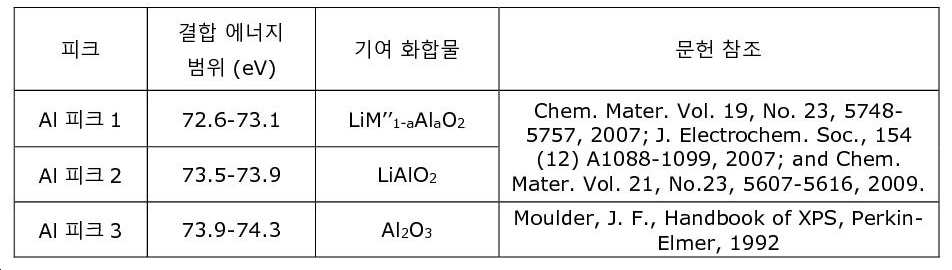
표 1.1은 LiM"1-aAlaO2, LiAlO2, 및 Al2O3 상에 대한 최대 피크 세기 위치 범위의 참조를 나타낸 것이다. Al 피크1의 결합 에너지 범위는 구조에 도핑된 Al의 양에 따라 달라진다.Table 1.1 shows a reference of the maximum peak intensity position ranges for the LiM" 1-a Al a O 2 , LiAlO 2 , and Al 2 O 3 phases. The binding energy range for
표 1.1. XPS 피크 참조Table 1.1. XPS peak reference
핏팅 모델의 방정식은 XPS 피크 핏팅에 흔히 사용되는 가우시안(Gaussian)과 로렌치안(Lorentzian) 함수의 조합인 슈도-보이그트(pseudo-Voigt) 방정식을 따른다. 방정식은 하기와 같다:The equation of the fitting model follows the pseudo-Voigt equation, which is a combination of Gaussian and Lorentzian functions commonly used for XPS peak fitting. The equation is:

(상기 식에서, yo= 오프셋이고, xc= 서브-피크의 중심 위치이고, A'= 서브-피크의 면적이고, w= 서브-피크의 폭(반치전폭 또는 FWHM)이고, mu= 프로파일 형상 계수이다).(where y o = offset, x c = central position of sub-peak, A' = area of sub-peak, w = width of sub-peak (full-maximum full width or FWHM), m u = profile is the shape factor).
단계 3) 핏팅 모델의 방정식에서 변수의 제약조건 결정Step 3) Determine the constraint of variables in the equation of the fitting model
5개의 변수(y0, xc, A', w, mu)의 제약조건이 하기에 기재된다:The constraints of the five variables (y 0 , x c , A', w, m u ) are described below:
- y0(오프셋):- y 0 (offset):
7개 서브-피크 모두의 y0는 0이다.y 0 of all 7 sub-peaks is 0.
- xc(서브-피크의 중심 위치):- x c (center position of sub-peak):
Ni3p1의 Xc ≥ 66.0eV; X c ≥ 66.0 eV for Ni3p1;
Ni3p1의 Xc ≤ Ni3p1 사텔라이트의 Xc - 0.7eV;X c of Ni3p1 ≤ X c of Ni3p1 satelite - 0.7 eV;
Ni3p1 사텔라이트의 Xc ≤ Ni3p2의 Xc - 0.7eV; X c of Ni3p1 satelite ≤ X c of Ni3p2 - 0.7 eV;
Ni3p2의 Xc ≤ 72eVX c ≤ 72 eV for Ni3p2
Ni3p2의 Xc ≤ Ni3p2 사텔라이트의 Xc - 0.7eV;X c of Ni3p2 ≤ X c of Ni3p2 satelite - 0.7 eV;
72.3eV ≤ Al 피크1의 Xc ≤ 73.3eV;72.3 eV ≤ X c ≤ 73.3 eV of
73.3eV ≤ Al 피크2의 Xc ≤ 73.9eV; 및73.3 eV ≤ X c ≤ 73.9 eV of
73.9eV ≤ Al 피크3의 Xc ≤ 74.3eV이다.73.9 eV ≤ Al peak 3 X c ≤ 74.3 eV.
Al 피크 1 내지 3에 대한 Xc의 범위는 문헌[Chem. Mater. Vol. 19, No. 23, 5748-5757, 2007; J. Electrochem. Soc., 154 (12) A1088-1099, 2007; 및 Chem. Mater. Vol. 21, No.23, 5607-5616, 2009]으로부터 결정된다.The range of X c for Al peaks 1 to 3 is described in Chem. Mater. Vol. 19, No. 23, 5748-5757, 2007; J. Electrochem. Soc., 154 (12) A1088-1099, 2007; and Chem. Mater. Vol. 21, No. 23, 5607-5616, 2009].
- A'(서브-피크의 면적):- A' (area of sub-peaks):
Ni3p1의 A' * 0.1 ≤ Ni3p1 사텔라이트의 A' * 1.2 ≤ Ni3p1의 A'; A' of Ni3p1 * 0.1 ≤ A' of Ni3p1 satelite * 1.2 ≤ A' of Ni3p1;
Ni3p2의 A' * 0.1 ≤ Ni3p2 사텔라이트의 A'; 및 A' of Ni3p2 * 0.1 ≤ A' of Ni3p2 satelite; and
7개 서브-피크 모두의 A'는 1.0 초과이다. A' of all 7 sub-peaks is greater than 1.0.
- w(서브-피크의 폭):- w (width of sub-peak):
1.2 ≤ w ≤ 1.8 1.2 ≤ w ≤ 1.8
- Mu(프로파일 형상 계수):- M u (profile shape factor):
0.1 ≤ mu ≤ 0.90.1 ≤ m u ≤ 0.9
단계 4) 계산 전 변수의 초기 값 결정Step 4) Determine the initial value of the variable before calculation
서브-피크의 핏팅에 대한 계산은 변수의 초기 값이 하기 절차에 따라 얻어질 때 재현 가능하다: Calculations for the fit of the sub-peaks are reproducible when the initial values of the variables are obtained according to the following procedure:
1) y0, w, mu의 초기 값을 각각 0, 1.5, 및 0.7로 설정한다.1) Set the initial values of y 0 , w and m u to 0, 1.5, and 0.7, respectively.
2) 서브-피크 Ni3p1, Ni3p1 사텔라이트, Ni3p2, Ni3p2 사텔라이트, Al 피크1, Al 피크2, 및 Al 피크3의 xc의 초기 값은 각각 67.0eV, 68.0eV, 69.0eV, 70.0eV, 73.0eV, 73.7eV, 및 74.3eV이다.2) The initial values of x c of the sub-peaks Ni3p1, Ni3p1 satelite, Ni3p2, Ni3p2 satelite,
3) 서브-피크 Ni3p1, Ni3p1 사텔라이트, Ni3p2, 및 Ni3p2 사텔라이트의 A'의 초기 값을 하기 절차에 의해 얻는다: 3) The initial value of A' of the sub-peaks Ni3p1, Ni3p1 satelite, Ni3p2, and Ni3p2 satelite is obtained by the following procedure:
3.a) Ni3p1의 서브-피크의 A'은 1.5 계수를 곱한 Ni3p 피크의 최대 피크 세기이고, 여기서 피크의 형상은 3eV의 밑변을 갖는 삼각형으로 추정된다. 3.a) A' of the sub-peak of Ni3p1 is the maximum peak intensity of the Ni3p peak multiplied by a factor of 1.5, where the shape of the peak is assumed to be a triangle with a base of 3 eV.
3.b) Ni3p2의 서브-피크의 A'는 Ni3p1의 서브-피크의 60%이다. 3.b) A' of the sub-peak of Ni3p2 is 60% of the sub-peak of Ni3p1.
3.c) Ni3p1 사텔라이트의 서브-피크의 A'는 Ni3p1의 서브-피크의 80%이다. 3.c) A' of the sub-peak of Ni3p1 satelite is 80% of the sub-peak of Ni3p1.
3.d) Ni3p2 사텔라이트의 서브-피크의 A'는 Ni3p2의 서브-피크의 80%이다. 3.d) A' of the sub-peak of Ni3p2 satelite is 80% of the sub-peak of Ni3p2.
4) 서브-피크 Al 피크1, Al 피크2, 및 Al 피크3의 A'의 초기 값을 하기 절차를 따름으로써 얻는다:4) The initial values of A' of
4.a) Al2p의 3개의 서브-피크의 A' 값은 하기 방정식에 따라 계산된다: 4.a) The A' values of the three sub-peaks of Al2p are calculated according to the following equation:

분율 계수(FF)는 xo 내지 xn의 범위에서 Al2p의 3개 서브-피크의 xc의 함수이고, 여기서 xo=72.8eV이고, xn=74.6eV이다. Al 피크1의 세기는 xn에서 xo로 선형으로 감소한다. The fraction factor (FF) is a function of x c of the three sub-peaks of Al2p in the range of x o to x n , where x o =72.8 eV and x n =74.6 eV. The intensity of
4.b) Al 피크3의 세기는 xn에서 xo으로 선형으로 증가한다. 따라서, Al 피크1과 Al 피크3 사이에 위치한 Al 피크2의 세기는 이의 중앙에서 가장 높은 세기 73.7eV를 갖는다. 각 서브-피크에 대한 분율 계수(FF)는 하기 방적식에 따라 계산된다:4.b) The intensity of Al peak 3 increases linearly from x n to x o . Accordingly, the intensity of
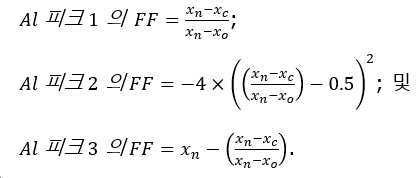
추정된 면적은 Al2p 피크의 최대 피크 세기 * 2.5이고, 여기서 피크의 형상은 5eV의 밑변을 갖는 삼각형으로 추정된다. The estimated area is the maximum peak intensity of the Al2p peak * 2.5, where the shape of the peak is estimated to be a triangle with a base of 5 eV.
4.c) 정규화 계수(NF)는 서브-피크가 합산될 때 계산된 전체 피크에서 중첩된 면적을 빼기 위해 추가된다. 이는 피크 면적(A') 방정식에서 처음 2개 구성요소(분율 계수 및 추정 면적)가 계산된 세기를 지나치게 높게 만드는 일부 중첩된 영역을 포함하기 때문에 중요하다. 계산법에서, 서브-피크는 높이 t 및 밑변 b를 갖는 삼각형 형상과 같이 간주되도록 단순화된다. 4.c) A normalization factor (NF) is added to subtract the overlapped area from the total peaks calculated when the sub-peaks are summed. This is important because the first two components (fraction coefficient and estimated area) in the peak area (A') equation contain some overlapping regions that make the calculated intensity too high. In the calculation, the sub-peak is simplified to be regarded as a triangular shape with height t and base b.
최대 세기의 위치는, Al 피크1, Al 피크2, 및 Al 피크3에 대하여 각각 72.8eV, 74.0eV, 및 74.6eV이다. 모든 서브-피크는 밑변 b가 1.8ev가 되도록 설정된 동일한 크기 및 형상을 갖는 것으로 가정된다. 각 서브-피크에 대한 정규화 계수는 하기와 같이 계산된다:The positions of the maximum intensity are 72.8 eV, 74.0 eV, and 74.6 eV for
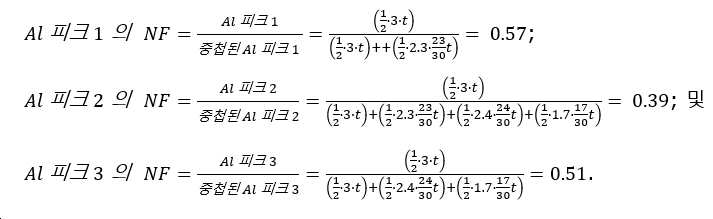
표 1.2는 EX1에 대한 변수의 초기 값의 예를 나타낸 것이다.Table 1.2 shows examples of initial values of variables for EX1.
표 1.2. EX1에 대한 변수의 초기 값의 예Table 1.2. Example of Initial Value of Variable for EX1

단계 5) 계산 실행Step 5) Calculation run
피크 역합성곱 과정은 Microsoft Excel 소프트웨어 버전 1808에 내장된 Solver 툴에 의해 지원된다. 타겟 셀의 최소 값은 Solver 계산의 개체로 설정된다. 타겟 셀은 측정된 곡선과 계산된 곡선 간 차이의 제곱합을 회답한다. 측정된 곡선과 계산된 곡선 간의 상관 계수가 99.5% 이상에 도달하면 계산이 종료된다. 수가 100%에 더 가까운 경우, 이는 계산된 곡선의 형상이 측정된 곡선의 형상과 밀접하게 일치한다는 것을 나타낸다. 그렇지 않으면, 개체의 최소 값에 도달하도록 계속 반복될 것이다. The peak deconvolution process is supported by the solver tool built into Microsoft Excel software version 1808. The minimum value of the target cell is set as the object of the solver calculation. The target cell returns the sum of squares of the difference between the measured curve and the calculated curve. Calculation is terminated when the correlation coefficient between the measured curve and the calculated curve reaches 99.5% or higher. When the number is closer to 100%, it indicates that the shape of the calculated curve closely matches the shape of the measured curve. Otherwise, it will iterate over and over to reach the minimum value of the entity.
핏팅 과정의 전 및 후 EX1의 Al2p 피크는 각각 도 3.1(x-축: 결합 에너지, y-축: 수) 및 도 3.2(x-축: 결합 에너지, y-축: 수)에 도시되어 있다. 계산된 변수의 결과는 표 1.3에 나타나 있다.The Al2p peaks of EX1 before and after the fitting process are shown in Figure 3.1 (x-axis: binding energy, y-axis: number) and Figure 3.2 (x-axis: binding energy, y-axis: number), respectively. The results of the calculated variables are shown in Table 1.3.
표 1.3. EX1에 대한 핏팅 후 계산된 매개변수 Table 1.3. Calculated parameters after fitting to EX1

B3) 확인된 Al 서브-피크 1 내지 3과 관련된 Al-기반 화합물의 함량B3) Content of Al-based compounds related to identified Al sub-peaks 1 to 3
각 Al 서브-피크의 A'(면적)의 비율은 3개 Al 서브-피크의 총 면적으로 각각의 Al 서브-피크 면적을 나눔으로써 표면층에서 해당 Al 화합물 중 상대 원자 비율로 직접 환산된다. 이어서, 양극 활물질 분말 중 M'의 총 원자 함량에 대해 LiM"1-aAlaO2, LiAlO2, 및 Al2O3의 양이 제공된다. The ratio of A' (area) of each Al sub-peak is directly converted to the relative atomic ratio of the corresponding Al compound in the surface layer by dividing the area of each Al sub-peak by the total area of the three Al sub-peaks. Then, the amounts of LiM″ 1-a Al a O 2 , LiAlO 2 , and Al 2 O 3 are provided relative to the total atomic content of M′ in the positive electrode active material powder.
예를 들어, Al 피크1(LiM"1-aAlaO2): Al 피크2(LiAlO2): Al 피크3(Al2O3)의 상대 원자 비율은 표 1.2에 기초하여 EX1의 표면층에서 23.7at%:40.5at%:35.8at%이다. 총 함량의 알루미늄이 EX1의 표면층에 함유되어 있고 ICP 분석에 의해 얻어지므로, 양극 활물질 분말의 M'의 총 원자 함량에 대한 LiM"1-aAlaO2, LiAlO2, 및 Al2O3의 양은 양극 활물질 분말 중 Al/M'의 원자 백분율(ICP에 의해 측정됨)과 각 Al 서브-피크의 상대 원자 비율(XPS에 의해 측정됨)을 곱함으로써 얻어진다. 예를 들어, EX1에서 LiAlO2의 양은 0.377(at%)(Al/M') * 40.5%(LiAlO2 / (LiM"1-aAlaO2+ LiAlO2 + Al2O3) = 0.15at%이다.For example, the relative atomic ratios of Al peak 1 (LiM" 1-a Al a O 2 ): Al peak 2 (LiAlO 2 ): Al peak 3 (Al 2 O 3 ) were determined in the surface layer of EX1 based on Table 1.2. 23.7at%:40.5at%:35.8at% Since the total content of aluminum is contained in the surface layer of EX1 and obtained by ICP analysis, LiM" 1-a Al for the total atomic content of M' of the positive electrode active material powder The amounts of a O 2 , LiAlO 2 , and Al 2 O 3 are the atomic percentage of Al/M′ in the positive electrode active material powder (measured by ICP) and the relative atomic ratio of each Al sub-peak (measured by XPS). obtained by multiplying For example, the amount of LiAlO 2 in EX1 is 0.377(at%)(Al/M') * 40.5%(LiAlO 2 / (LiM" 1-a Al a O 2 + LiAlO 2 + Al 2 O 3 ) = 0.15at %am.
B4) XPS 피크 적분 및 커버리지B4) XPS peak integration and coverage
Al2p를 제외한 다른 원소에 대한 모든 1차 피크는 스마트 배경이 있는 Thermo Scientific Avantage 소프트웨어를 사용하여 핏팅된다. 배경은 배경 세기가 데이터 포인트 세기보다 낮아야 한다는 제약조건이 있는 셜리(Shirley)형 기준선이다. Al2p 피크 적분 면적은 B2) XPS 역합성곱 과정에서 Al 피크1, Al 피크2, 및 Al 피크3의 총 면적으로 계산된다. 스코필드 상대 민감도 라이브러리(Scofield relative sensitivity library)는 적분된 피크 면적으로부터 원자 분율의 계산을 위해 사용된다. Ni, Mn, Co, Al, 및 S의 총량에 대한 Al의 원자 비율(Al/(Ni+Mn+Co+Al+S)(at%/at%))은 A1으로 명명된다. All primary peaks for elements other than Al2p are fitted using Thermo Scientific Avantage software with smart background. The background is a Shirley-type baseline with the constraint that the background intensity must be lower than the data point intensity. The Al2p peak integral area is calculated as the total area of
Al 표면 커버리지 값은 XPS에 의해 측정된 입자의 표면에 대한 Al의 분율(A1)을 ICP에 의해 측정된 입자 중 Al 분율(A2)로 나누어 계산된다.The Al surface coverage value is calculated by dividing the fraction of Al on the surface of the particles (A1) measured by XPS by the fraction of Al in the particles (A2) measured by ICP.
Al에 의한 양극 활물질의 표면 커버리지는 하기와 같이 계산된다:The surface coverage of the positive electrode active material by Al is calculated as follows:

(여기서, M*는 양극 활물질 입자의 Ni, Mn, Co, Al, 및 S의 총 원자 분율이다).(where M * is the total atomic fraction of Ni, Mn, Co, Al, and S of the positive electrode active material particles).
Al에 의한 표면 커버리지는 알루미늄에 의한 양극 활물질 입자의 커버리지의 정도를 나타낸다. Al 표면 커버리지 값이 높으면, Al 화합물은 균질한 분포로 표면을 덮는다.The surface coverage by Al indicates the degree of coverage of the positive electrode active material particles by aluminum. When the Al surface coverage value is high, the Al compound covers the surface with a homogeneous distribution.
C) 탄소 측정C) carbon measurement
양극 활물질 분말의 탄소 함량은 Horiba EMIA-320V 탄소/황 분석기에 의해 측정된다. 1g의 hNMC 분말을 고주파 유도로(high frequency induction furnace)의 세라믹 도가니에 배치한다. 가속화제로서의 1.5g의 텅스텐 및 0.3g의 주석을 도가니에 첨가한다. 분말을 프로그래밍 가능한 온도로 가열한다. 이어서, 연소 중 생성된 가스를 4개의 적외선 검출기에 의해 분석한다. 저 및 고 CO2 및 CO의 분석으로 탄소 농도를 결정한다.The carbon content of the cathode active material powder was measured by a Horiba EMIA-320V carbon/sulfur analyzer. 1 g of hNMC powder is placed in a ceramic crucible of a high frequency induction furnace. 1.5 g of tungsten and 0.3 g of tin as accelerators are added to the crucible. The powder is heated to a programmable temperature. The gases produced during combustion are then analyzed by means of four infrared detectors. Analysis of low and high CO 2 and CO determines the carbon concentration.
D) PSD 측정D) PSD measurement
입도 분포(particle-size distribution; PSD)는 수성 매체에 분말을 분산시킨 후 Hydro MV 습식 분산 부속품을 구비한 Malvern Mastersizer 3000을 사용하여 측정된다. 분말의 분산을 향상시키기 위해, 충분한 초음파 조사 및 교반이 적용되고, 적절한 계면활성제가 도입된다. D10, D50 및 D90은 10%, 50% 및 90%의 누적 부피% 분포에서의 입자 크기로 정의된다. 스팬(span)은 다음과 같이 정의된다: 스팬=(D90-D10)/D50.The particle-size distribution (PSD) is measured using a Malvern Mastersizer 3000 equipped with a Hydro MV wet dispersion accessory after dispersing the powder in an aqueous medium. In order to improve the dispersion of the powder, sufficient ultrasonic irradiation and stirring are applied, and an appropriate surfactant is introduced. D10, D50 and D90 are defined as particle sizes at cumulative volume % distributions of 10%, 50% and 90%. The span is defined as: Span=(D90-D10)/D50.
E) TEM-EDS 측정E) TEM-EDS measurement
리튬 전이 금속-기반 산화물 입자 내 Al 분포를 조사하기 위해, 입자의 단면 TEM 라멜라가 Helios Nanolab 450hp(FEI, USA) 이중 빔 주사 전자 현미경-초점 이온 빔(SEM-FIB)에 의해 제조된다. Ga 이온 빔은 30kV 전압 및 30pA-7nA 전류로 사용된다. 에칭된 샘플은 100nm의 두께와 함께 5×8μm의 치수를 갖는다. 제조된 샘플을 사용하여, TEM 및 에너지-분산형 X-선 분광법(EDS)에 의해 리튬 전이 금속-기반 산화물 입자의 상부에서 중심까지의 표면 특성이 분석된다. TEM-EDS는 X-MaxN 80T(Oxford instruments, https://nano.oxinst.com/products/x-max/x-max)와 JEM-2100F(JEOL, https://www.jeol.co.jp/en/products/detail/JEM-2100F.html)에서 수행된다. 리튬 전이 금속-기반 산화물 입자의 EDS 분석은 단면의 정량적 원소 분석을 제공한다. Al 및 S는 M*에 의해 정규화되고, 여기서 M*는 Ni, Mn, Co, Al, 및 S의 총 원자 분율이다. To investigate Al distribution in lithium transition metal-based oxide particles, cross-sectional TEM lamellae of the particles were fabricated by Helios Nanolab 450hp (FEI, USA) double beam scanning electron microscopy-focused ion beam (SEM-FIB). A Ga ion beam is used with a voltage of 30 kV and a current of 30 pA-7 nA. The etched sample has dimensions of 5×8 μm with a thickness of 100 nm. Using the prepared sample, the top to center surface properties of lithium transition metal-based oxide particles are analyzed by TEM and energy-dispersive X-ray spectroscopy (EDS). TEM-EDS is X-Max N 80T (Oxford instruments, https://nano.oxinst.com/products/x-max/x-max) and JEM-2100F (JEOL, https://www.jeol.co. jp/en/products/detail/JEM-2100F.html). EDS analysis of lithium transition metal-based oxide particles provides quantitative elemental analysis of cross-sections. Al and S are normalized by M * , where M * is the total atomic fraction of Ni, Mn, Co, Al, and S.
입자의 단면에서 선형 거리의 함수로서 측정된 Al/M* 및 S/M*의 라인 스캔은 EDS의 내재적 분석 오류를 완화하기 위해 Origin 9.1 소프트웨어를 사용하여 20의 포인트로 Savitzhky-Golay 필터에 의해 평활화된다. Line scans of Al/M * and S/M * measured as a function of linear distance in the cross section of the particle were smoothed by a Savitzhky-Golay filter by a point of 20 using Origin 9.1 software to mitigate the inherent analytical error of EDS. do.
F) 코인 셀 시험F) Coin cell test
F1) 코인 셀 제조F1) Coin cell manufacturing
양극의 제조를 위해, 용매(NMP, Mitsubishi) 중 90:5:5 중량 비율의 제형으로 양극 활물질 분말, 도전제(Super P, Timcal), 바인더(KF#9305, Kureha)를 함유하는 슬러리를 고속 균질기에 의해 제조한다. 균질화된 슬러리를 230μm 갭으로 닥터 블레이드 코터를 사용하여 알루미늄 호일의 한 면에 펼친다. 슬러리 코팅 호일을 120℃의 오븐에서 건조시킨 후, 캘린더링 툴을 사용하여 압착한다. 그 후에, 이를 진공 오븐에서 다시 건조시켜 전극 필름에 남아 있는 용매를 완전히 제거한다. 코인 셀을 아르곤-충전 글로브박스에서 조립한다. 세퍼레이터(Celgard 2320)는 음극으로서 사용되는 리튬 호일의 조각과 양극 사이에 위치한다. EC/DMC(1:2) 중의 1M LiPF6을 전해질로서 사용하고, 세퍼레이터와 전극 사이에 떨어뜨린다. 이어서, 전해질의 누출을 막도록 코인 셀을 완전히 밀봉한다.For the production of the positive electrode, a slurry containing positive electrode active material powder, conductive agent (Super P, Timcal), and binder (KF#9305, Kureha) in a 90:5:5 weight ratio in a solvent (NMP, Mitsubishi) was prepared at high speed. prepared by a homogenizer. Spread the homogenized slurry on one side of aluminum foil using a doctor blade coater with a 230 μm gap. After drying the slurry coating foil in an oven at 120° C., it is pressed using a calendering tool. After that, it is dried again in a vacuum oven to completely remove the solvent remaining on the electrode film. Assemble the coin cell in an argon-filled glovebox. A separator (Celgard 2320) is placed between the positive electrode and the piece of lithium foil used as the negative electrode. 1M LiPF 6 in EC/DMC (1:2) was used as the electrolyte and dropped between the separator and the electrode. The coin cell is then completely sealed to prevent leakage of electrolyte.
F2) 시험 방법F2) Test method
시험 방법은 통상적인 "차단 정전압" 시험이다. 본 발명에서 통상적인 코인 셀 시험은 표 2에 나타나 있는 스케줄을 따른다. 각 셀을 Toscat-3100 컴퓨터-제어 갈바노스태틱 사이클링 스테이션(Toyo로부터 입수)을 이용하여 25℃에서 사이클링한다. The test method is a conventional "breaking constant voltage" test. A typical coin cell test in the present invention follows the schedule shown in Table 2. Each cell is cycled at 25° C. using a Toscat-3100 computer-controlled galvanostatic cycling station (obtained from Toyo).
스케줄은 220mA/g의 1C 전류 정의를 이용한다. 초기 충전 용량(CQ1) 및 방전 용량(DQ1)을 4.3V 내지 3.0V/Li 금속 윈도우 범위에서 0.1C의 C 레이트로 정전류 모드(CC)에서 측정한다.The schedule uses a 1C current definition of 220mA/g. The initial charge capacity (CQ1) and discharge capacity (DQ1) are measured in constant current mode (CC) at a C rate of 0.1C in the range of 4.3V to 3.0V/Li metal window.
비가역적 용량 IRRQ는 다음과 같이 %로 표시된다:The irreversible capacity IRRQ is expressed in % as follows:
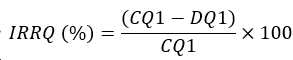
표 2. 코인 셀 시험 방법에 대한 사이클링 스케줄Table 2. Cycling Schedules for Coin Cell Test Methods

G) 풀 셀 시험 G) full cell test
G1) 풀 셀 제조G1) Full cell fabrication
650mAh 파우치형 셀을 다음과 같이 제조한다: 양극 활물질, 도전제(Super-P, Timcal), 양극 도전제로서의 그래파이트(KS-6, Timcal), 및 양극 바인더로서의 폴리비닐리덴 플루오라이드(PVDF 1710, Kureha)를 분산 매체로서의 N-메틸-2-피롤리돈(NMP)에 양극 활물질 분말, 도전제(super P 및 그래파이트), 및 바인더의 몰비가 92/3/1/4로 설정되도록 첨가한다. 그 후에, 혼합물을 혼련하여 양극 슬러리를 제조한다. 이어서, 생성된 양극 혼합물 슬러리를 15μm 두께의 알루미늄 호일로 제조된 양극 집전체의 양면 상에 도포한다. 도포 면적의 폭은 43mm이고, 길이는 407mm이다. 양극 활물질의 전형적인 로딩 중량은 약 11.5±0.2mg/cm2이다. 이어서, 전극을 건조시키고, 120Kgf(1176.8N)의 압력을 이용하여 3.3±0.5g/cm3의 전극 밀도로 캘린더링한다. 또한, 양극 집전체 탭으로서의 역할을 하는 알루미늄 플레이트를 양극의 끝 부분에 아크-용접한다. A 650mAh pouch-type cell was prepared as follows: positive electrode active material, conductive agent (Super-P, Timcal), graphite as positive electrode conductive agent (KS-6, Timcal), and polyvinylidene fluoride (PVDF 1710, positive electrode binder) Kureha) is added to N-methyl-2-pyrrolidone (NMP) as a dispersion medium so that the molar ratio of the positive electrode active material powder, the conductive agent (super P and graphite), and the binder is set to 92/3/1/4. After that, the mixture is kneaded to prepare a positive electrode slurry. Then, the resulting positive electrode mixture slurry is applied on both sides of a positive electrode current collector made of 15 μm thick aluminum foil. The width of the application area is 43 mm and the length is 407 mm. A typical loading weight of the positive active material is about 11.5±0.2 mg/cm 2 . The electrode is then dried and calendered to an electrode density of 3.3±0.5 g/cm 3 using a pressure of 120 Kgf (1176.8 N). Further, an aluminum plate serving as a positive electrode current collector tab is arc-welded to the end of the positive electrode.
상업적으로 입수 가능한 음극을 사용한다. 요컨대, 96/2/2 중량비의 그래파이트, 카르복시-메틸-셀룰로스-나트륨(CMC), 및 스티렌부타디엔-고무(SBR)의 혼합물을 구리 호일의 양면 상에 도포한다. 음극 집전체 탭으로서의 역할을 하는 니켈 플레이트를 음극의 끝 부분에 아크-용접한다. 음극 활물질의 전형적인 로딩 중량은 8±0.5mg/cm2이다. A commercially available cathode is used. Briefly, a mixture of graphite, carboxy-methyl-cellulose-sodium (CMC), and styrenebutadiene-rubber (SBR) in a 96/2/2 weight ratio is applied on both sides of a copper foil. A nickel plate serving as a negative electrode current collector tab is arc-welded to the end of the negative electrode. A typical loading weight of the negative active material is 8±0.5 mg/cm 2 .
1:1:1 부피비의 에틸렌 카르보네이트(EC), 에틸 메틸 카르보네이트(EMC), 및 디에틸 카르보네이트(DEC)의 혼합 용매 중에 리튬 헥사플루오로포스페이트(LiPF6) 염을 1.0mol/L의 농도로 용해시킴으로써 비수성 전해질을 얻는다. 1wt%의 비닐렌 카르보네이트(VC), 0.5wt%의 리튬 비스(옥살레이트)보레이트(LiBOB), 1wt%의 LiPO2F2를 첨가제로서 상기 전해질에 도입한다.1.0 mol of lithium hexafluorophosphate (LiPF 6 ) salt in a mixed solvent of ethylene carbonate (EC), ethyl methyl carbonate (EMC), and diethyl carbonate (DEC) in a 1:1:1 volume ratio A non-aqueous electrolyte is obtained by dissolving at a concentration of /L. 1wt% of vinylene carbonate (VC), 0.5wt% of lithium bis(oxalate)borate (LiBOB), 1wt% of LiPO 2 F 2 are introduced into the electrolyte as additives.
양극 시트, 음극 시트, 및 이들 사이에 삽입된 20μm-두께 미세다공성 폴리머 필름(Celgard® 2320, Celgard)으로 제조된 세퍼레이트 시트를 와인딩 코어 로드를 이용하여 나선으로 권취하여 나선 권취형 전극 어셈블리를 얻는다. 그 후에, 어셈블리 및 전해질을 이슬점이 -50℃인 건조 공기실에서 알루미늄 적층 파우치에 넣어, 평평한 파우치형 리튬 이차 배터리를 제조한다. 4.2V로 충전할 때 이차 배터리의 설계 용량은 650mAh이다.A positive electrode sheet, a negative electrode sheet, and a separator sheet made of a 20 μm-thick microporous polymer film (Celgard® 2320, Celgard) sandwiched therebetween are spirally wound using a winding core rod to obtain a spiral wound electrode assembly. After that, the assembly and electrolyte are put into an aluminum laminated pouch in a dry air chamber having a dew point of -50°C, to prepare a flat pouch-type lithium secondary battery. When charging at 4.2V, the design capacity of the secondary battery is 650mAh.
비수성 전해질 용액을 실온에서 8시간 동안 함침시킨다. 배터리를 이의 이론 용량의 15%까지 예비-충전하고, 실온에서 1 일 동안 에이징한다. 그 후에, 배터리를 30초 동안 -760mmHg의 압력을 이용하여 탈기시키고, 알루미늄 파우치를 밀봉한다. 배터리를 사용을 위해 다음과 같이 준비한다: 배터리를, CC 모드(정전류)로 0.2C(1C = 650mA)의 전류를 이용하여 4.2V까지 충전한 후, CV 모드(정전압)로 C/20의 차단 전류에 도달할 때까지 충전하고, 이어서 0.5C 레이트로 CC 모드로 2.7 V의 차단 전압까지 방전시킨다.The non-aqueous electrolyte solution is impregnated at room temperature for 8 hours. The battery is pre-charged to 15% of its theoretical capacity and aged at room temperature for 1 day. Thereafter, the battery is degassed using a pressure of -760 mmHg for 30 seconds, and the aluminum pouch is sealed. Prepare the battery for use as follows: Charge the battery to 4.2V using a current of 0.2C (1C = 650mA) in CC mode (constant current), then cut off C/20 in CV mode (constant voltage) Charge until current is reached, then discharge in CC mode at 0.5C rate to a cut-off voltage of 2.7V.
G2) 사이클 수명 시험G2) Cycle life test
제조된 풀 셀 배터리를 25℃ 또는 45℃에서 하기 조건 하에 여러 번 충방전시켜서 이들의 충방전 사이클 수명을 결정한다: The prepared full-cell batteries were charged and discharged several times at 25°C or 45°C under the following conditions to determine their charge/discharge cycle life:
- 충전을 CC 모드로 1C 레이트 하에 4.2 V까지, 이후 CV 모드로 C/20에 도달할 때까지 수행하고,- charging is carried out in CC mode at 1C rate to 4.2 V, then in CV mode until C/20 is reached,
- 이어서, 셀을 10분 동안 휴식(rest)으로 설정하고,- then set the cell to rest for 10 minutes,
- 방전을 CC 모드로 1C 레이트에서 2.7V까지 수행하고,- Discharge is performed at 1C rate to 2.7V in CC mode,
- 이어서, 셀을 10분 동안 휴식으로 설정하고,- then set the cell to rest for 10 minutes,
- 배터리가 대략 80% 보유 용량에 도달할 때까지 충방전 사이클을 진행한다. 이때, 80% 전 사이클 수는 "사이클# 80"로 표시된다. 100회 사이클마다, 1회 방전을 CC 모드로 0.2C 레이트에서 2.7V까지 수행한다.- Continue the charge/discharge cycle until the battery reaches approximately 80% holding capacity. At this time, the number of cycles before 80% is displayed as “
G3) 벌징 시험G3) Bulging test
상기 제조 방법에 의해 제조된 650mAh 파우치형 배터리를 4.2V까지 완전히 충전하고, 90℃로 가열된 오븐에 넣은 후, 4시간 동안 정치시킨다. 90℃에서, 하전된 양극은 전해질과 반응하여 가스를 생성한다. 발생된 가스는 파우치의 벌징을 생성한다. 파우치 두께((저장 후 두께 - 저장 전 두께)/저장 전 두께)의 증가를 4시간 후에 측정한다. The 650mAh pouch-type battery prepared by the above manufacturing method is fully charged to 4.2V, put in an oven heated to 90°C, and left still for 4 hours. At 90° C., the charged anode reacts with the electrolyte to produce a gas. The gas generated creates a bulging of the pouch. The increase in pouch thickness ((thickness after storage - thickness before storage)/thickness before storage) is measured after 4 hours.
H) 결과H) result
본 발명은 하기 (비-제한적) 실시예에 의해 추가로 예시된다:The invention is further illustrated by the following (non-limiting) examples:
실시예 1Example 1
하기와 같이 실행하는 리튬 공급원과 전이 금속-기반 공급원 사이의 고체-상태 반응인 이중 소결 공정을 통해 식 Li1+a(Ni0.8Mn0.1Co0.1)1-aO2를 갖는 다결정질 hNMC 분말(CEX1)을 얻었다:Polycrystalline hNMC powder having the formula Li 1+a (Ni 0.8 Mn 0.1 Co 0.1 ) 1-a O 2 via a dual sintering process, which is a solid-state reaction between a lithium source and a transition metal-based source, carried out as follows ( CEX1) was obtained:
1) 공침: 혼합된 니켈-망간-코발트 설페이트, 소듐 하이드록사이드, 및 암모니아가 있는 대규모 연속 교반 탱크 반응기(CSTR)에서 공침 공정에 의해 금속 조성 M'=Ni0.80Mn0.10Co0.1을 갖는 전이 금속-기반 수산화물 전구체 M'O0.24(OH)1.76을 제조하였다. 1) Co-precipitation: transition metal with metal composition M'=Ni 0.80 Mn 0.10 Co 0.1 by co-precipitation process in a large-scale continuous stirred tank reactor (CSTR) with mixed nickel-manganese-cobalt sulfate, sodium hydroxide, and ammonia -Based hydroxide precursor M'O 0.24 (OH) 1.76 was prepared.
2) 블렌딩: 전이 금속-기반 수산화물 및 리튬 공급원으로서의 LiOH를 산업적 블렌딩 장비에서 1.01의 금속 M'에 대한 리튬(Li/M')의 비율로 균질하게 블렌딩하였다.2) Blending: The transition metal-based hydroxide and LiOH as lithium source were homogeneously blended in an industrial blending equipment at a ratio of lithium (Li/M′) to metal M′ of 1.01.
3) 1차 소결: 블렌드를 산소 분위기 하에 730℃에서 12시간 동안 소결하였다. 소결된 분말을 부수고, 분류하고, 체질하여 소결된 중간 생성물을 얻었다.3) Primary sintering: The blend was sintered at 730° C. for 12 hours under an oxygen atmosphere. The sintered powder was crushed, classified and sieved to obtain a sintered intermediate product.
4) 2차 소결: 중간 생성물을 산소 분위기 하에 830℃에서 12시간 동안 소결하였다. 소결된 분말을 부수고, 분류하고, 체질하여 M'=Ni0.8Mn0.10Co0.1인 식 Li1.005M'0.995O2(a=0.005)를 갖는 CEX1을 얻었다. CEX1는 12.0μm의 D50 및 1.24의 스팬(SPAN)을 가졌다. CEX1은 단계 1) 공침 공정에서 금속 설페이트 공급원으로부터 얻어진 미량의 황을 포함하였다.4) Secondary sintering: The intermediate product was sintered at 830° C. for 12 hours under an oxygen atmosphere. The sintered powder was crushed, classified and sieved to give CEX1 with the formula Li 1.005 M′ 0.995 O 2 (a=0.005) with M′=Ni 0.8 Mn 0.10 Co 0.1 . CEX1 had a D50 of 12.0 μm and a SPAN of 1.24. CEX1 contained a trace amount of sulfur obtained from a metal sulfate source in the step 1) co-precipitation process.
선택적으로, 도펀트의 공급원은 단계 1)의 공침 공정에서 또는 단계 2)의 블렌딩 단계에서 리튬 공급원과 함께 첨가될 수 있다. 도펀트는, 예를 들어, 양극 활물질 분말 생성물의 전기화학적 특성을 향상시키기 위해 첨가될 수 있다.Optionally, the source of dopant may be added together with the lithium source in the co-precipitation process of step 1) or in the blending step of step 2). A dopant may be added, for example, to improve the electrochemical properties of the positive electrode active material powder product.
CEX1은 본 발명에 따른 것이 아니었다.CEX1 was not according to the invention.
EX1을 다음 절차에 의해 제조하였고, 이는 본 발명에 따른 것이었다. 1kg의 CEX1을 알루미늄 및 설페이트 이온 용액과 블렌딩하였고, 11.68g의 Al2(SO4)3·16H2O 및 29.66mL의 탈이온 정제수를 사용하여 제조하였다. 제조된 블렌드를 산소 분위기 하에 375℃에서 8시간 동안 가열하였다. 가열 후, 분말을 부수고, 분류하고, 체질하여 EX1을 얻었다. 이에 따라, hNMC 화합물, EX1은 EX1의 총 중량에 대해 약 1000ppm의 Al을 함유하였다. CEX1로부터의 EX1의 제조는, 본 발명의 틀에서, 표면 처리로도 불린다. EX1 was prepared by the following procedure, which was according to the present invention. 1 kg of CEX1 was blended with aluminum and sulfate ion solution, and prepared using 11.68 g of Al 2 (SO 4 ) 3 ·16H 2 O and 29.66 mL of deionized purified water. The prepared blend was heated at 375° C. under an oxygen atmosphere for 8 hours. After heating, the powder was crushed, classified and sieved to obtain EX1. Accordingly, the hNMC compound, EX1, contained about 1000 ppm Al with respect to the total weight of EX1. The preparation of EX1 from CEX1, in the framework of the present invention, is also called surface treatment.
EX1은 다결정질 형태를 가졌다. 이러한 형태는 2차 소결[즉, 실시예 1에 따른 CEX1의 제조 공정의 단계 4] 후에 그리고 후속적인 부수고 분류하고 체질하는 단계 전에 하기 4a 및 단계 4b를 적용함으로써 모놀리식 형태로 변형될 수 있다:EX1 had a polycrystalline form. This form can be transformed into a monolithic form by applying the following steps 4a and 4b after secondary sintering [i.e. step 4 of the manufacturing process of CEX1 according to Example 1] and before the subsequent crushing, sorting and sieving steps. :
4a) 소결된 중간 생성물을 습식 볼 밀링 단계로 처리함으로써 응집된 1차 입자를 탈응집시키고, 탈응집된 1차 입자를 포함하는 슬러리를 얻는 단계, 및4a) subjecting the sintered intermediate product to a wet ball milling step to deagglomerate the agglomerated primary particles and obtain a slurry comprising the deagglomerated primary particles, and
4b) 슬러리로부터 탈응집된 1차 입자를 분리하고, 탈응집된 1차 입자를 300℃ 내지 2차 소결 단계 (4)에서의 온도보다 적어도 200℃ 낮은 온도[즉, 최대 630℃]의 온도에서 열처리함으로써 단결정질 모놀리식 입자를 얻는 단계.4b) separating the deagglomerated primary particles from the slurry, and separating the deagglomerated primary particles from 300° C. to at least 200° C. lower than the temperature in the secondary sintering step (4) [i.e., at most 630° C.] obtaining monocrystalline monolithic particles by heat treatment.
다결정질 입자를 모놀리식 입자로 전환시키는 이러한 처리는 WO2019/185349의 20쪽 11줄 내지 20쪽 33줄에서 EX1로부터 공지되어 있다. Such a treatment for converting polycrystalline particles into monolithic particles is known from EX1 on
알루미늄 및 설페이트 이온 용액을 23.36g의 Al2(SO4)3·16H2O 및 24.32mL의 탈이온 정제수를 사용하여 제조한 점을 제외하고, EX1과 동일한 방법에 따라 CEX2를 얻었는데, 이는 본 발명에 따른 것이 아니었다. 이에 따라, hNMC 화합물, CEX2는 EX2의 총 중량에 대해 약 2000ppm의 Al을 함유하였다.CEX2 was obtained according to the same method as EX1, except that an aluminum and sulfate ion solution was prepared using 23.36 g of Al 2 (SO 4 ) 3 .16H 2 O and 24.32 mL of deionized purified water. It wasn't by invention. Accordingly, the hNMC compound, CEX2, contained about 2000 ppm Al with respect to the total weight of EX2.
CEX3를 다음 절차에 의해 제조하였는데, 이는 본 발명에 따른 것이 아니었다: 1kg의 CEX1을 2g의 Al2O3 분말 및 추가로 알루미늄 및 설페이트 이온 용액과 블렌딩하였고, 12g의 Na2S2O8 분말 및 35mL의 탈이온 정제수로 제조하였다. 블렌드를 산소 분위기 하에 375℃에서 8시간 동안 가열하였다. 가열 후, 분말을 부수고, 분류하고, 체질하여 CEX3를 얻었다. 이에 따라, hNMC 화합물, CEX3는 CEX3의 총 중량에 대해 약 1000ppm의 Al을 함유하였다.CEX3 was prepared by the following procedure, which was not according to the invention: 1 kg of CEX1 was blended with 2 g of Al 2 O 3 powder and additionally a solution of aluminum and sulfate ions, 12 g of Na 2 S 2 O 8 powder and It was prepared with 35 mL of deionized purified water. The blend was heated at 375° C. under an oxygen atmosphere for 8 hours. After heating, the powder was crushed, classified and sieved to obtain CEX3. Accordingly, the hNMC compound, CEX3, contained about 1000 ppm Al with respect to the total weight of CEX3.
섹션 A) ICP 분석 및 C) 탄소 측정에 기재된 바와 같이 EX1, CEX1, CEX2, 및 CEX3 중의 알루미늄(Al), 황(S), 설페이트 이온(설페이트 또는 SO4 2-), 및 탄소(C)의 총량을 조사하였다. EX1및 CEX3의 경우, Al 화합물 및 표면층에서의 이의 분포를 B) XPS 측정에 의해 조사하였다. EX1, CEX1, CEX2 및 CEX3를 또한 섹션 F) 코인 셀 시험에 기재된 바와 같이 평가하였다. 분석 결과는 표 3.1 내지 표 3.4 및 도 4.1, 도 4.2, 및 도 5에 나타나 있다.of aluminum (Al), sulfur (S), sulfate ions (sulfate or SO 4 2- ), and carbon (C) in EX1, CEX1, CEX2, and CEX3 as described in section A) ICP analysis and C) carbon determination. The total amount was investigated. For EX1 and CEX3, Al compounds and their distribution in the surface layer were investigated by B) XPS measurement. EX1, CEX1, CEX2 and CEX3 were also evaluated as described in Section F) Coin Cell Test. The analysis results are shown in Tables 3.1 to 3.4 and FIGS. 4.1, 4.2, and 5 .
표 3.1. ICP, C, 및 S 표면 커버리지 결과Table 3.1. ICP, C, and S surface coverage results
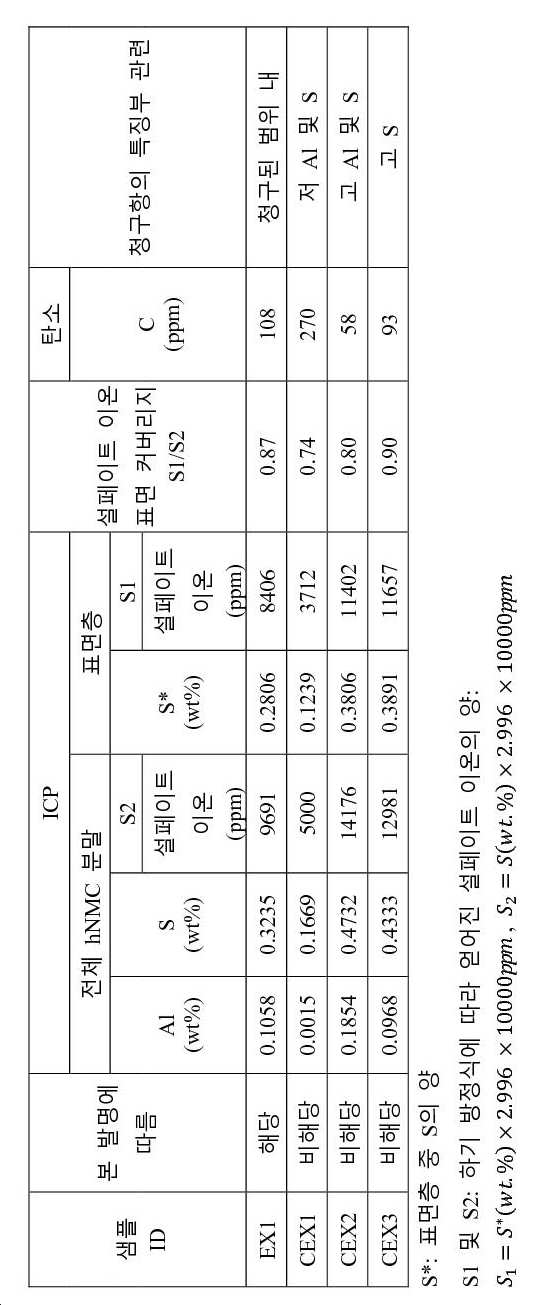
표 3.2. EX1, CEX1, CEX2, 및 CEX3의 코인 셀 성능Table 3.2. Coin Cell Performance for EX1, CEX1, CEX2, and CEX3
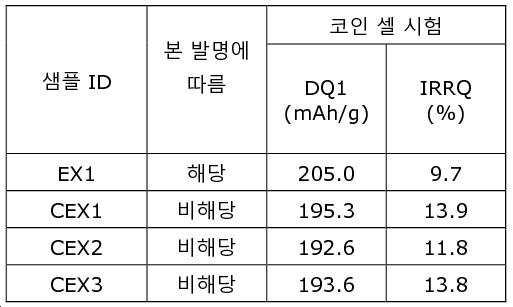
EX1은 CEX1의 높은 C 함량이 사이클링 동안 전극 활물질과 전해질 사이의 부반응으로부터 유도된 불량한 전기화학적 성능을 초래하기 때문에 CEX1에 비해 향상된 전기화학적 성능을 나타냈다. 표면층에서 적절한 양의 S는 전이 금속-기반 산화물 전구체로부터 또는 리튬 공급원(불순물로서)으로부터 유래된 Li2CO3와 같은 불순물의 형성을 막았다. 제조 중에 hNMC 분말이 공기에 노출되면 또한 불순물로서 양 C의 증가에 영향을 미쳤다. EX1 showed improved electrochemical performance compared to CEX1 because the high C content of CEX1 resulted in poor electrochemical performance derived from side reactions between the electrode active material and the electrolyte during cycling. An appropriate amount of S in the surface layer prevented the formation of impurities such as Li 2 C O 3 derived from a transition metal-based oxide precursor or from a lithium source (as an impurity). Exposure of hNMC powder to air during manufacture also affected the increase in amount C as an impurity.
EX1보다 2 배 많은 Al 및 S를 함유하는 표면 처리 공급원을 사용하는 CEX2의 경우, C 함량은 더 감소되었지만, DQ1및 IRRQ는 저하되었다. 이는 표면층에 존재하는 Al 및 S의 함량이 매우 높아 배터리 성능을 저하시켰기 때문이다.For CEX2 using a surface treatment source containing twice as much Al and S as EX1, the C content was further reduced, but DQ1 and IRRQ were lowered. This is because the content of Al and S present in the surface layer is very high, and thus the battery performance is deteriorated.
실시예 1에서 제조된 hNMC 화합물의 설페이트 이온 표면 커버리지를 이해하기 위해, 섹션 A) ICP 분석에 기재된 바와 같이 전체 분말 및 표면층 중 설페이트 이온의 양을 조사하였다. 양극 활물질 분말의 전체 분말 중 S 함량(또는 S 함량)을 ICP에 의해 결정하였고, S의 양을 설페이트 이온의 양으로 환산함으로써 얻어진 값을 S2로 정의하였다. 또한, hNMC 분말과 물의 혼합물로부터의 여과된 용액을 ICP에 의해 조사하였다. 용액은 리튬 전이 금속-기반 산화물 입자의 표면층으로부터 용해된 S를 함유하였다. 따라서, 용액으로부터 얻어진 S 함량을 설페이트 이온의 양으로 환산하였고, 이를 S1로 명명하였다. 마지막으로, S1을 S2로 나눔으로써 설페이트 이온 표면 커버리지를 결정하였다. 설페이트 이온 표면 커버리지, S1/S2가 0.85 이상인 경우, C 함량은 감소되고, 전기화학적 성능은 향상되었는데, 그 이유는 양극 활물질 분말의 코어가 설페이트 이온으로 균일하게 덮여 있었기 때문이다.To understand the sulfate ion surface coverage of the hNMC compound prepared in Example 1, the amount of sulfate ion in the total powder and surface layer was investigated as described in Section A) ICP analysis. The S content (or S content) in the total powder of the cathode active material powder was determined by ICP, and the value obtained by converting the amount of S into the amount of sulfate ions was defined as S2. In addition, the filtered solution from the mixture of hNMC powder and water was investigated by ICP. The solution contained dissolved S from the surface layer of lithium transition metal-based oxide particles. Therefore, the S content obtained from the solution was converted into the amount of sulfate ions, and this was named S1. Finally, the sulfate ion surface coverage was determined by dividing S1 by S2. When the sulfate ion surface coverage, S1/S2, was 0.85 or more, the C content was reduced and the electrochemical performance was improved, because the core of the cathode active material powder was uniformly covered with sulfate ions.
그러나, 또 다른 표면 처리 공급원에 의해 유도된 유사한 Al 함량(또는 Al 함량)이되 더 높은 S 함량을 갖는 CEX3는 탁월한 설페이트 이온 표면 커버리지와 관계없이 저하된 용량을 나타냈다. 따라서, 본 발명에서, hNMC 분말의 표면층 중 S 함량은 0.150wt% 내지 0.375wt%인 것이 바람직하다. 다시 말해서, hNMC 분말의 표면층 중 설페이트 이온 함량은 4500ppm 내지 11250ppm인 것이 바람직하다.However, CEX3 with similar Al content (or Al content) but higher S content induced by another surface treatment source showed reduced capacity irrespective of excellent sulfate ion surface coverage. Therefore, in the present invention, the S content in the surface layer of the hNMC powder is preferably 0.150 wt% to 0.375 wt%. In other words, the sulfate ion content in the surface layer of the hNMC powder is preferably 4500 ppm to 11250 ppm.
표 3.3. EX1 및 CEX3의 XPS 피크 역합성곱Table 3.3. XPS peak deconvolution of EX1 and CEX3

표 3.4. EX1 및 CEX3의 Al 표면 커버리지Table 3.4. Al surface coverage of EX1 and CEX3
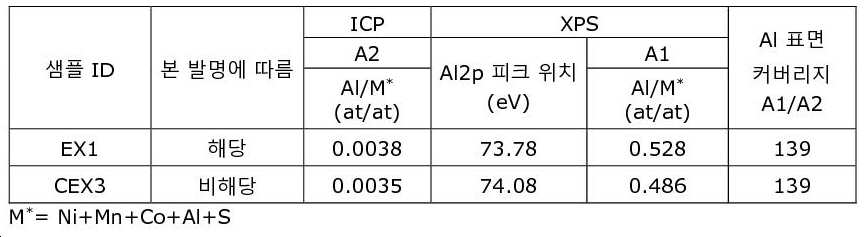
표면 특성의 추가 조사를 위해, EX1, CEX1, 및 CEX3를 섹션 B) XPS 측정에 기재된 바와 같이 분석하였다. 도 4.1(x-축: 결합 에너지, y-축: 수)에 나타낸 바와 같이, XPS 스펙트럼은 80eV 내지 65eV의 범위에서 최대 세기를 갖는 Al2p 및 Ni3p의 피크를 나타냈다. EX1 및 CEX3의 Al2p의 최대 피크 세기는 각각 73.78eV 및 74.08eV의 결합 에너지에서였다. 최대 세기를 갖는 EX1 및 CEX3의 Al2p 피크 위치는 표 3.4에 나타나 있다. 문헌[Chem. Mater., 2017, 19, 5748-5757]에 개시된 바와 같이, Al2p 피크 위치가 더 낮은 결합 에너지로 바뀌지만 Ni3p 피크 위치가 변하지 않은 경우, 이는 LiAlO2 화합물의 존재를 지시한다. 표 3.2에 나타낸 바와 같이, 더 우수한 배터리 성능은 EX1에서와 같이 LiAlO2 화합물의 존재에 상응하여 73.6eV 내지 74.1eV의 범위에서 Al2p 피크의 출현에 기인한다. 도 4.2는 각각 LiM"1-aAlaO2, LiAlO2, 및 Al2O3 상의 Al2p3 XPS 피크에 대한 결합 에너지 범위를 도시한 것이다. 수직 점선은 CEX1에 대한 Al2p3 XPS 피크 위치를 나타내는 반면, 수직 실선은 EX1에 대한 Al2p3 XPS 피크 위치를 나타낸다.For further investigation of surface properties, EX1, CEX1, and CEX3 were analyzed as described in Section B) XPS Measurements. As shown in FIG. 4.1 (x-axis: binding energy, y-axis: number), the XPS spectrum showed peaks of Al2p and Ni3p with maximum intensities in the range of 80 eV to 65 eV. The maximum peak intensities of Al2p of EX1 and CEX3 were at binding energies of 73.78 eV and 74.08 eV, respectively. The Al2p peak positions of EX1 and CEX3 with the maximum intensity are shown in Table 3.4. See Chem. Mater., 2017, 19, 5748-5757], when the Al2p peak position is changed to a lower binding energy but the Ni3p peak position is not changed, this indicates the presence of the LiAlO 2 compound. As shown in Table 3.2, the better battery performance is due to the appearance of Al2p peaks in the range of 73.6 eV to 74.1 eV, corresponding to the presence of the LiAlO 2 compound as in EX1. 4.2 depicts the binding energy ranges for Al2p3 XPS peaks on LiM″ 1-a Al a O 2 , LiAlO 2 , and Al 2 O 3 , respectively. The vertical dashed line indicates the Al2p3 XPS peak positions for CEX1, while The vertical solid line indicates the Al2p3 XPS peak position for EX1.
Al2p 피크는 LiM"1-aAlaO2, LiAlO2, 및 Al2O3와 같은 화합물을 함유하였고, 이들 화합물의 각각의 양을 섹션 B2) XPS 피크 역합성곱에 기재된 절차에 의해 정량화하였다. 표 3.3은 Al 피크 위치 및 Al 화합물의 정량화를 나타낸 것이다. 탁월한 전기화학적 성능을 갖는 EX1의 경우, LiAlO2 상의 존재를 지시하는 Al 피크2의 함량은 양극 활물질 분말 중 M'의 총 원자 함량에 대해 0.10at% 이상 및 0.30at% 이하인 것으로 확인되었다. 또한, LiM"1-aAlaO2 함량은 양극 활물질 분말의 M'의 총 원자 함량에 대해 0.14at% 미만이었다.The Al2p peak contained compounds such as LiM" 1-a Al a O 2 , LiAlO 2 , and Al 2 O 3 , and the amount of each of these compounds was quantified by the procedure described in section B2) XPS peak deconvolution Table 3.3 shows the Al peak position and the quantification of Al compounds In the case of EX1 with excellent electrochemical performance, the content of
양극 활물질 분말 중 Al에 의한 표면 커버리지를 조사하기 위해, B4) XPS 피크 적분 및 커버리지에 나타나 있는 바와 같이, XPS 분석으로부터의 Al/M"의 원자 비율(A1)을 ICP 분석으로부터의 Al/M"의 원자 비율(A2)로 나누었다. Al1/Al2의 값이 100 이상인 경우, 이는 양극 활물질 화합물이 표면층에 균일하게 분포되어 있는 Al를 갖는다는 것을 의미한다. 표 3.4에 나타낸 바와 같이, EX1 및 CEX3는 표면 처리 방법에 관계없이 표면층에서 균질한 Al 분포를 가졌다.To investigate the surface coverage by Al in the positive electrode active material powder, the atomic ratio (A1) of Al/M" from XPS analysis as shown in B4) XPS peak integration and coverage was calculated as Al/M" from ICP analysis. divided by the atomic ratio (A2) of When the value of Al1/Al2 is 100 or more, it means that the positive electrode active material compound has Al uniformly distributed in the surface layer. As shown in Table 3.4, EX1 and CEX3 had a homogeneous Al distribution in the surface layer regardless of the surface treatment method.
본 실시예에서 hNMC 분말의 풀 셀 성능을 평가하기 위해, 25℃와 45℃ 둘 모두에서 2.7V 내지 4.2V의 범위에서 G2) 섹션 사이클 수명 시험에 기재된 바와 같이 풀 셀 시험을 수행하였다. 풀 셀의 안전성을 조사하기 위해, G3) 벌징 시험에 기재된 바와 같이 90℃에서의 벌징 시험 동안 두께 증가를 측정하였다. EX1, CEX1 및 CEX3의 풀 셀 시험 결과는 표 4 및 도 5(x-축: 사이클 수, y-축: 용량 보유율)에 나타나 있다. 표 4에서, '사이클# 80%'는 80%의 용량 보유율 전에 도달한 사이클 수를 의미한다.To evaluate the full cell performance of the hNMC powder in this example, a full cell test was performed as described in section G2) Cycle Life Test in the range of 2.7V to 4.2V at both 25°C and 45°C. To investigate the safety of the full cell, the thickness increase was measured during the bulging test at 90° C. as described in G3) Bulging test. The full cell test results of EX1, CEX1 and CEX3 are shown in Table 4 and FIG. 5 (x-axis: number of cycles, y-axis: capacity retention). In Table 4, 'Cycle# 80%' means the number of cycles reached before the capacity retention of 80%.
표 4. EX1, CEX1 및 CEX3의 풀 셀 성능Table 4. Full-cell performance of EX1, CEX1, and CEX3

표 4 및 도 5에 나타낸 바와 같이, 표면층에 균일하게 분포되어 있는 Al 화합물을 갖는 EX1은 더 높은 비용량 및 더 우수한 사이클 수명을 나타냈다. 45℃와 같은 상승된 온도에서 사이클링될 때, 이는 우수한 사이클 안정성을 여전히 나타냈다. 이러한 결과는 표면 처리에 의해 두께 증가가 완화되는 안전성 시험과 상관 관계가 있다.As shown in Table 4 and Fig. 5, EX1 having an Al compound uniformly distributed in the surface layer exhibited higher specific capacity and better cycle life. When cycled at elevated temperatures such as 45° C., it still exhibited good cycle stability. These results are correlated with the safety test in which the increase in thickness is mitigated by surface treatment.
EX1의 표면층을 섹션 E) TEM-EDS 측정에 기재된 바와 같이 확인하였고, 그 결과는 도 6.1 및 도 6.2에 나타나 있다(x-축: 거리(0은 표면층의 시작점임), y-축: 원소(원자 비율)). SEM-FIB에 의해 제조된 단면 샘플을 TEM/EDS 장비로 조사하고, 원자 비율에서 샘플의 Al 및 S 함량을 전이 금속, Al, 및 S의 총량으로 나눔으로써 얻었다. The surface layer of EX1 was confirmed as described in section E) TEM-EDS measurement, and the results are shown in FIGS. 6.1 and 6.2 (x-axis: distance (0 is the starting point of the surface layer), y-axis: element ( atomic ratio)). A cross-sectional sample prepared by SEM-FIB was irradiated with a TEM/EDS instrument, and obtained by dividing the Al and S content of the sample in atomic ratio by the total amount of transition metals, Al, and S.
도 6.1에는 S/M* 비율이 입자의 표면층의 외부 에지로부터 100nm의 선형 거리(또는 거리)에서 0at%에 도달한 것으로 나타나 있다. 따라서, EX1 입자의 표면층의 두께는 100nm이다. Figure 6.1 shows that the S/M * ratio reached 0 at% at a linear distance (or distance) of 100 nm from the outer edge of the surface layer of the particle. Therefore, the thickness of the surface layer of the EX1 particles is 100 nm.
도 6.2는 EX1 입자의 100nm 두께의 표면층에 총 함량의 알루미늄이 함유되어 있다는 것을 보여준다. Figure 6.2 shows that the total content of aluminum is contained in the 100 nm-thick surface layer of the EX1 particles.
이는 실제로 CEX1 입자(표면 처리 전)가 알루미늄을 함유하지 않기 때문에 예상된다. This is expected because in fact the CEX1 particles (before surface treatment) do not contain aluminum.
도 6.1에는 S/M* 비율이 입자의 표면층의 외부 에지로부터 100nm의 선형 거리(또는 거리)에서 0at%에 도달한 것으로 나타나 있다. 따라서, EX1 입자의 표면층의 두께는 100nm이다. Figure 6.1 shows that the S/M * ratio reached 0 at% at a linear distance (or distance) of 100 nm from the outer edge of the surface layer of the particle. Therefore, the thickness of the surface layer of the EX1 particles is 100 nm.
도 6.2는 EX1 입자의 100nm 두께의 표면층에 총 함량의 알루미늄이 함유되어 있다는 것을 보여준다. Figure 6.2 shows that the total content of aluminum is contained in the 100 nm-thick surface layer of the EX1 particles.
이는 실제로 CEX1 입자(표면 처리 전)가 알루미늄을 함유하지 않기 때문에 예상된다. This is expected because in fact the CEX1 particles (before surface treatment) do not contain aluminum.
따라서, 이의 코어에 존재하는 도펀트로서 알루미늄을 함유하는 hNMC의 경우(표면 처리가 적용되기 전을 의미함), 본 발명에 따른 hNMC의 표면 처리가 적용된 후 양극 활물질 분말 중 알루미늄의 총량(Al전체)에 대한 표면층 중 알루미늄의 양(Al표면)을 하기 절차에 의해 얻었다:Therefore, in the case of hNMC containing aluminum as a dopant present in its core (meaning before surface treatment is applied), the total amount of aluminum in the cathode active material powder after the surface treatment of hNMC according to the present invention is applied ( total Al ) The amount of aluminum (Al surface ) in the surface layer for
1) 첫 번째로, ICP 분석에 의해 양극 활물질 분말 중 알루미늄의 총량(Al/M* ICP)을 얻는다. 1) First, the total amount of aluminum in the cathode active material powder (Al/M * ICP ) is obtained by ICP analysis.
2) 두 번째로, EDS 및/또는 EELS(전자 에너지 손실 분광법)와 같은 기술에 의해 입자 단면의 선 프로파일을 측정한다. 2) Second, measure the line profile of the particle cross-section by techniques such as EDS and/or EELS (electron energy loss spectroscopy).
3) 세 번째로, 표면층의 두께를 입자의 외부 에지로부터의 거리(S/M*=0이거나 S/M*이 일정할 때 표면층의 외부 에지에서부터 입자 내 지점까지의 거리)에 대한 황 함량 전개에 기초하여 결정하고, 상기 최소 거리 D는 하기와 같이 정의된다: 3) Third, the development of sulfur content with respect to the thickness of the surface layer with respect to the distance from the outer edge of the particle (distance from the outer edge of the surface layer to the point within the particle when S/M * = 0 or S/M * is constant) is determined based on , and the minimum distance D is defined as

(여기서, LS1은 입자의 에지에서의 제1 지점 위치이고, LS2는 상기 제1 지점 위치와 상기 입자의 기하학적 중심 사이에 정의된 선의 제2 지점 위치이고, 제2 지점 위치 LS2에서 TEM-EDS에 의해 측정된 S의 함량은 제1 지점 위치(LS1)에서 측정된 S의 함량의 0at% 이상 및 5.0at% 이하이고, 상기 S의 제2 함량(S2)은 (Where L S1 is the position of the first point at the edge of the particle, L S2 is the position of the second point on the line defined between the first point position and the geometric center of the particle, and the TEM at the second point position L S2 - The content of S measured by EDS is 0at% or more and 5.0at% or less of the content of S measured at the first point position (L S1 ), and the second content of S (S 2 ) is

와 같이 정의되고, S3는 상기 선의 제3 지점 위치(LS3)에서의 S의 함량(at%)이고, 상기 제3 지점은 상기 입자의 기하학적 중심과 제2 지점 위치 LS2 사이의 임의의 위치에 위치한다). , where S 3 is the content (at%) of S at the third point position LS 3 of the line, the third point being any point between the geometric center of the particle and the second point position L S2 . located in position).
4) 네 번째로, 1차원 선 프로파일(cfr. 도 6.2)에서 표면층의 거리에 대해 Al/M*을 적분함으로써 면적1 매개변수를 얻고, 표면층의 외부 에지에서부터 입자의 중심까지의 거리에 의해 Al/M*을 적분함으로써 면적2 매개변수를 얻는다. 입자가 구형이고 표면층이 균일하다고 가정하여, 면적1 및 면적2를 사용하여 하기 방정식에 의해 Al전체에 대한 Al표면의 원자 비율을 계산한다.4) Fourth, the

양극 활물질 분말 중 M'의 총 원자 함량에 대한 표면층 중 알루미늄의 양을 다음 방정식 Al/M* ICP * Al표면/Al전체에 따라 Al/M* ICP 비율을 Al표면/Al전체 비율과 곱함으로써 얻었다.The amount of aluminum in the surface layer with respect to the total atomic content of M' in the cathode active material powder was obtained by multiplying the Al/M * ICP ratio by the Al surface /Al total ratio according to the following equation Al/M * ICP * Al surface / Al total .
표 5. 본 발명 및 이와 관련된 공정의 요약Table 5. Summary of the present invention and related processes

표 5는 청구된 특징부를 달성하기 위한 본 발명에 따른 양극 활물질의 제조 공정을 요약한 것이다.Table 5 summarizes the manufacturing process of the positive electrode active material according to the present invention to achieve the claimed features.
실시예 2Example 2
0.65의 스팬을 갖는 금속 조성 M'=Ni0.80Mn0.10Co0.1을 갖는 전이 금속-기반 수산화물 전구체 M'O0.24(OH)1.76을 Li 공급원과의 블렌딩 전 10 시간 동안 365℃에서 예열한 점을 제외하고, CEX1와 동일한 방법에 따라 CEX4를 얻었다.A transition metal-based hydroxide precursor M'O 0.24 (OH) 1.76 with a metal composition M′=Ni 0.80 Mn 0.10 Co 0.1 with a span of 0.65 was preheated at 365° C. for 10 h prior to blending with a Li source except that and CEX4 was obtained in the same manner as for CEX1.
또한, 최종 hNMC 분말은 11.7μm의 D50 및 0.65의 스팬을 가졌는데, 이 값은 CEX1보다 훨씬 더 낮은 것이다. CEX4는 본 발명에 따른 것이 아니었다.In addition, the final hNMC powder had a D50 of 11.7 μm and a span of 0.65, which is much lower than that of CEX1. CEX4 was not according to the invention.
CEX1 대신 0.65의 스팬을 갖는 CEX4를 사용하고 표면층 공정에서 가열 온도가 400℃인 점을 제외하고, EX1과 동일한 방법에 따라 EX2를 제조하였다. EX2는 본 발명에 따른 것이었다. EX2 was prepared in the same manner as EX1, except that CEX4 having a span of 0.65 was used instead of CEX1 and the heating temperature was 400° C. in the surface layer process. EX2 was according to the invention.
표면 처리 공정에서 가열 온도가 550℃인 점을 제외하고, EX2와 동일한 방법에 따라 CEX5를 제조하였다. CEX5는 본 발명에 따른 것이 아니었다.CEX5 was prepared according to the same method as EX2, except that the heating temperature was 550° C. in the surface treatment process. CEX5 was not according to the invention.
EX2, CEX4 및 CEX5의 전기화학적 성능을 실시예 1과 동일한 방법에 의해 평가하였다. 초기 방전 용량 및 비가역적 용량은 표 6.1에 나타나 있다. 실시예 1에서와 동일한 방법에 의해 EX2, CEX4 및 CEX5의 표면 상의 Al 화합물 및 이의 분포를 조사하였다. 표면 특성은 표 6.2에 예시되어 있다.The electrochemical performance of EX2, CEX4 and CEX5 was evaluated in the same manner as in Example 1. The initial discharge capacity and irreversible capacity are shown in Table 6.1. Al compounds and their distributions on the surfaces of EX2, CEX4 and CEX5 were investigated by the same method as in Example 1. The surface properties are illustrated in Table 6.2.
표 6.1. EX2, CEX4, 및 CEX5의 코인 셀 성능Table 6.1. Coin Cell Performance for EX2, CEX4, and CEX5

표 6.2. EX2 및 CEX5의 XPS 피크 역합성곱Table 6.2. XPS peak deconvolution of EX2 and CEX5

표 6.1은 0.65와 같이 훨씬 좁은 스팬을 갖는 EX2가 실시예 1의 EX1에서와 같이 높은 방전 용량 및 우수한 가역성을 나타낸다는 것을 보여준다. 표 6.2에 나타낸 바와 같이, 550℃와 같은 고온에서 표면 처리된 생성물인 CEX5는 400℃에서 제조된 EX2보다 훨씬 더 높은 Al 피크1의 양을 가졌다. 따라서, 표면 처리 동안 가열 온도는 500℃ 이하인 것이 바람직하다.Table 6.1 shows that EX2 with a much narrower span, such as 0.65, exhibits high discharge capacity and good reversibility as in EX1 of Example 1. As shown in Table 6.2, CEX5, a product surface-treated at a high temperature such as 550°C, had a much higher amount of
실시예 3Example 3
하기와 같이 표면 처리 효과를 확인하기 위해 본 실시예에서 87at%의 M'에 대한 Ni의 원자 비율을 갖는 다결정질 hNMC 분말을 제조하였다:Polycrystalline hNMC powder having an atomic ratio of Ni to M' of 87at% was prepared in this example to confirm the effect of surface treatment as follows:
1) 공침: 금속 조성 M'=Ni0.87Mn0.03Co0.1을 갖는 혼합된 금속-기반 수산화물 전구체 M'O0.26(OH)1.74를 혼합된 니켈-망간-코발트 설페이트, 소듐 하이드록사이드 및 암모니아와 대규모 연속 교반 탱크 반응기(CSTR)에서 공침 공정에 의해 제조하였다.1) Co-precipitation: mixed metal-based hydroxide precursor M'O 0.26 (OH) 1.74 with metal composition M'=Ni 0.87 Mn 0.03 Co 0.1 was mixed with nickel-manganese-cobalt sulfate, sodium hydroxide and ammonia on a large scale It was prepared by a co-precipitation process in a continuous stirred tank reactor (CSTR).
2) 블렌딩: 중간 생성물을 얻기 위해, 혼합된 전이 금속-기반 수산화물 전구체 및 리튬 공급원으로서의 LiOH·H2O를 산업적 블렌딩 장비에서 0.99의 Li/M' 비율로 균질하게 블렌딩하였다.2) Blending: To obtain an intermediate product, the mixed transition metal-based hydroxide precursor and LiOH·H 2 O as lithium source were homogeneously blended in an industrial blending equipment at a Li/M′ ratio of 0.99.
3) 소결: 블렌드를 산소 분위기 하에 755℃에서 12시간 동안 소결하였다. 소결 후, 소결된 분말을 분류하고 체질하여 비-응집된 hNMC 분말을 얻었다. 3) Sintering: The blend was sintered for 12 hours at 755° C. under oxygen atmosphere. After sintering, the sintered powder was classified and sieved to obtain non-agglomerated hNMC powder.
CEX6으로 명명되는 최종 hNMC 분말은 식 Li0.995M'1.005O2를 가졌고, 이의 D50 및 스팬은 각각 12.8μm 및 1.41이었다. CEX6은 본 발명에 따른 것이 아니었다.The final hNMC powder, designated CEX6, had the formula Li 0.995 M′ 1.005 O 2 , and its D50 and span were 12.8 μm and 1.41, respectively. CEX6 was not according to the invention.
CEX6을 CEX1 대신에 사용한 점을 제외하고, EX1과 동일한 방법에 따라 CEX7을 제조하였다. CEX7은 본 발명에 따른 것이 아니었다.CEX7 was prepared in the same manner as EX1, except that CEX6 was used instead of CEX1. CEX7 was not according to the invention.
CEX6 및 CEX7의 전기화학적 성능을 실시예 1과 동일한 방법에 의해 평가하였다. 초기 방전 용량 및 비가역적 용량은 표 7에 나타나 있다.The electrochemical performance of CEX6 and CEX7 was evaluated by the same method as in Example 1. The initial discharge capacity and the irreversible capacity are shown in Table 7.
표 7. CEX6 및 CEX7의 코인 셀 성능Table 7. Coin Cell Performance for CEX6 and CEX7

표 6에 나타낸 바와 같이, 0.80만큼 높은 M'에 대한 Ni의 원자 비율을 갖는 hNMC 화합물(CEX7)은 표면 처리에도 불구하고 낮은 방전 용량 및 높은 IRRQ를 여전히 나타냈다.As shown in Table 6, the hNMC compound (CEX7) with an atomic ratio of Ni to M′ as high as 0.80 still exhibited low discharge capacity and high IRRQ despite the surface treatment.
실시예 4Example 4
하기와 같이 표면 처리 효과를 확인하기 위해 본 실시예에서 식 Li1+a(Ni0.86Mn0.04Co0.10)1-aO2를 갖는 86at%의 M'에 대한 Ni의 원자 비율을 갖는 다결정질 hNMC 분말을 제조하였다:Polycrystalline hNMC having an atomic ratio of Ni to M' of 86at% with the formula Li 1+a (Ni 0.86 Mn 0.04 Co 0.10 ) 1-a O 2 in this Example to confirm the surface treatment effect as follows A powder was prepared:
1) 공침: 금속 조성 M'=Ni0.86Mn0.04Co0.10을 갖는 전이 금속-기반 수산화물 전구체 M'O0.16(OH)1.84를 혼합된 니켈-망간-코발트 설페이트, 소듐 하이드록사이드, 및 암모니아와 CSTR에서 공침 공정에 의해 제조하였다. 1) Co-precipitation: CSTR of a transition metal-based hydroxide precursor M'O 0.16 (OH) 1.84 with metal composition M'=Ni 0.86 Mn 0.04 Co 0.10 with mixed nickel-manganese-cobalt sulfate, sodium hydroxide, and ammonia was prepared by a co-precipitation process.
2) 블렌딩: 중간 생성물을 얻기 위해, 단계 1)로부터 제조된 혼합된 전이 금속-기반 전구체 및 리튬 공급원으로서의 LiOH·H2O를 산업적 블렌딩 장비에서 1.02의 Li/M' 비율로 균질하게 블렌딩하였다.2) Blending: To obtain an intermediate product, the mixed transition metal-based precursor prepared in step 1) and LiOH·H 2 O as a lithium source were homogeneously blended in an industrial blending equipment at a Li/M′ ratio of 1.02.
3) 소결: 블렌드를 산소 분위기 하에 765℃에서 12시간 동안 소결하였다. 소결 후, 소결된 분말을 분류하고 체질하여 비-응집된 hNMC 분말을 얻었다. 3) Sintering: The blend was sintered at 765° C. under oxygen atmosphere for 12 hours. After sintering, the sintered powder was classified and sieved to obtain non-agglomerated hNMC powder.
CEX8로 명명되는 최종 hNMC 분말은 식 Li1.002M'0.998O2를 가졌고, 이의 D50 및 스팬은 각각 11.2μm 및 0.53이었다. CEX8은 본 발명에 따른 것이 아니었다.The final hNMC powder, designated CEX8, had the formula Li 1.002 M′ 0.998 O 2 , and its D50 and span were 11.2 μm and 0.53, respectively. CEX8 was not according to the invention.
CEX8을 CEX1 대신에 사용한 점을 제외하고, EX1과 동일한 방법에 따라 EX3을 제조하였다. EX3 was prepared in the same manner as EX1, except that CEX8 was used instead of CEX1.
다음 절차에 의해 본 발명에 따른 EX3을 제조하였다: 1kg의 CEX8을 알루미늄 및 설페이트 이온 용액과 블렌딩하였고, 11.68g의 Al2(SO4)3·16H2O를 29.66mL의 탈이온수에 용해시킴으로써 제조하였다. 제조된 블렌드를 산소 분위기 하에 375℃에서 8시간 동안 가열하였다. 가열 후, 분말을 부수고, 분류하고, 체질하여 CEX8을 얻었다. 이에 따라, hNMC 화합물, EX3은 EX3의 총 중량에 대해 약 1000ppm의 Al을 함유하였다. EX3 according to the invention was prepared by the following procedure: 1 kg of CEX8 was blended with a solution of aluminum and sulfate ions and prepared by dissolving 11.68 g of Al 2 (SO 4 ) 3 .16H 2 O in 29.66 mL of deionized water. did. The prepared blend was heated at 375° C. under an oxygen atmosphere for 8 hours. After heating, the powder was crushed, classified and sieved to obtain CEX8. Accordingly, the hNMC compound, EX3, contained about 1000 ppm Al with respect to the total weight of EX3.
EX3 및 CEX8의 전기화학적 성능을 실시예 1과 동일한 방법에 의해 평가하였다. 초기 방전 용량 및 비가역적 용량은 표 8에 나타나 있다.The electrochemical performance of EX3 and CEX8 was evaluated by the same method as in Example 1. The initial discharge capacity and irreversible capacity are shown in Table 8.
표 8. CEX8 및 EX3의 코인 셀 성능Table 8. Coin Cell Performance for CEX8 and EX3
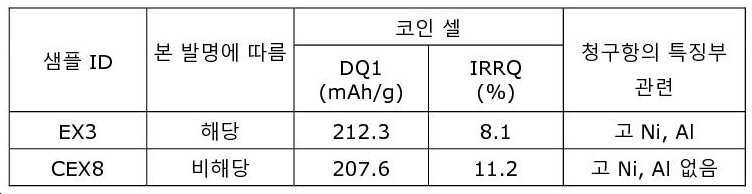
표 8에 나타낸 바와 같이, 0.86만큼 높은 M'에 대한 Ni의 원자 비율을 갖는 hNMC 화합물(EX3)은 CEX8에 비해 더 높은 DQ1 및 IRRQ 향상을 나타냈다. 상기 관찰은 0.86의 M'에 대한 Ni의 원자 비율을 갖는 조성물에 대해 표면 처리가 적용될 수 있다는 것을 지시한다.As shown in Table 8, the hNMC compound (EX3) with an atomic ratio of Ni to M′ as high as 0.86 showed higher DQ1 and IRRQ enhancement compared to CEX8. This observation indicates that a surface treatment can be applied for compositions having an atomic ratio of Ni to M' of 0.86.
Claims (16)
상기 표면층이
- 양극 활물질 분말의 총 중량에 대해 0.150wt% 이상 및 0.375wt% 이하의 함량의 황, 및
- 양극 활물질 분말의 총 중량에 대해 0.05wt% 이상 및 0.15wt% 이하의 함량의 알루미늄
을 포함하고, 상기 리튬 전이 금속-기반 산화물 입자의 표면층이 LiAlO2 상(phase) 및 LiM"1-aAlaO2 상을 포함하고, 여기서 M"이 Ni, Mn, 및 Co를 포함하고, 상기 LiAlO2 상이 양극 활물질 분말 중 M'의 총 원자 함량에 대해 0.10at% 이상 및 0.30at% 이하의 함량으로 표면층에 존재하고, 상기 LiM"1-aAlaO2 상이 양극 활물질 분말 중 M'의 총 원자 함량에 대해 0.14at% 미만의 함량으로 표면층에 존재하는, 양극 활물질 분말.A positive electrode active material powder suitable for a lithium-ion battery comprising lithium transition metal-based oxide particles, wherein the particles include a core and a surface layer, the surface layer is on top of the core, and the particles are element Li, metal M ' and oxygen, wherein the metal M' has the formula M'=(Ni z Mn y Co x ) 1-k A k , wherein A is a dopant, 0.60≤z<0.86, 0.05≤x≤0.20 , x+y+z+k=1, and k≤0.01, and the cathode active material powder has a median particle size D50 in the range of 5 μm to 15 μm and a surface layer thickness in the range of 10 nm to 200 nm,
the surface layer
- sulfur in a content of 0.150 wt% or more and 0.375 wt% or less based on the total weight of the cathode active material powder, and
- Aluminum in an amount of 0.05 wt% or more and 0.15 wt% or less based on the total weight of the cathode active material powder
wherein the surface layer of the lithium transition metal-based oxide particle comprises a LiAlO 2 phase and a LiM" 1-a Al a O 2 phase, wherein M" comprises Ni, Mn, and Co; The LiAlO 2 phase is present in the surface layer in an amount of 0.10at% or more and 0.30at% or less with respect to the total atomic content of M' in the positive active material powder, and the LiM" 1-a Al aO 2 phase is M' in the positive active material powder A cathode active material powder present in the surface layer in an amount of less than 0.14 at% with respect to the total atomic content of

여기서, LS1은 입자의 중심의 제1 지점 위치이고, LS2는 상기 제1 지점 위치와 상기 입자의 기하학적 중심 사이에 정의된 선의 제2 지점 위치이고,
제2 지점 위치 LS2에서 TEM-EDS에 의해 측정된 S의 함량은 제1 지점 위치에서 측정된 S의 함량의 0at% 이상 및 5.0at% 미만이고, 상기 S의 제2 함량(S2)은

와 같이 정의되고, S3는 상기 선의 제3 지점 위치(LS3)에서의 S의 함량(at%)이고, 상기 제3 지점은 상기 입자의 기하학적 중심과 제2 지점 위치 LS2 사이의 임의의 위치에 위치한다.The cathode active material powder according to any one of claims 1 to 10, wherein the thickness of the surface layer corresponds to a minimum distance D defined as follows:
where L S1 is the position of the first point of the center of the particle, L S2 is the position of the second point of the line defined between the position of the first point and the geometric center of the particle,
The content of S measured by TEM-EDS at the second point position L S2 is 0 at% or more and less than 5.0 at% of the content of S measured at the first point position, and the second content of S (S 2 ) is
is defined as, S 3 is the content (at%) of S at the third point position LS 3 of the line, the third point is any point between the geometric center of the particle and the second point position L S2 located in position

인, 양극 활물질 분말.12. The method of claim 11,
Phosphorus, positive electrode active material powder.

여기서,
-

-

여기서,
- Al표면은 EDS에 의해 측정된, 표면층 중 Al의 함량(at%)이고;
- Al전체는 EDS에 의해 측정된, 상기 분말의 입자 중 Al의 총 함량(at%)이고;
- 면적1은 D에 걸쳐 단면-TEM-EDS에 의해 측정된 Al/M* 함량의 적분이고:

- Al(x)는 단면-TEM EDS에 의해 측정된, 단면 입자의 지점 x에서의 Al의 원자 함량이고,
- M*(x)은 단면-TEM EDS에 의해 측정된, 단면 입자의 지점 x에서의 Ni, Mn, Co, Al, 및 S의 원자 함량이고,
- x는 상기 제1 지점 위치와 제2 지점 위치 사이의, TEM에 의해 측정된 nm로 표현되는 거리이고;
- 면적2는 거리 C에 걸쳐 크로스-SEM EDS에 의해 측정된 Al/M* 함량의 적분이며:

- Al(x)는 단면-TEM EDS에 의해 측정된, 단면 입자의 지점 x에서의 Al의 원자 함량이고,
- M*(x)은 단면-TEM EDS에 의해 측정된, 단면 입자의 지점 x에서의 Ni, Mn, Co, Al, 및 S의 원자 함량이고,
- x는 상기 제1 지점 위치(x = 0nm)와 상기 입자의 기하학적 중심(x = C) 사이의, nm로 표현되고 TEM에 의해 측정된 거리이고, 여기서 C는 바람직하게는 2.5μm 내지 7.5μm의 범위이다.The cathode active material powder according to claim 11 or 12, wherein Al is present in the surface layer in a content l defined as follows:
here,
-
-
here,
- Al surface is the content (at %) of Al in the surface layer, measured by EDS;
- Al total is the total content (at %) of Al in the particles of the powder, measured by EDS;
- area1 is the integral of the Al/M * content measured by cross-section-TEM-EDS over D:
- Al(x) is the atomic content of Al at point x of the cross-section particle, measured by cross-section-TEM EDS,
- M * (x) is the atomic content of Ni, Mn, Co, Al, and S at point x of the cross-section particle, measured by cross-section-TEM EDS,
- x is the distance, expressed in nm, measured by TEM between the first point position and the second point position;
- area2 is the integral of the Al/M * content measured by cross-SEM EDS over distance C:
- Al(x) is the atomic content of Al at point x of the cross-section particle, measured by cross-section-TEM EDS,
- M * (x) is the atomic content of Ni, Mn, Co, Al, and S at point x of the cross-section particle, measured by cross-section-TEM EDS,
- x is the distance between the first point position (x = 0 nm) and the geometric center of the particle (x = C), expressed in nm and measured by TEM, where C is preferably between 2.5 μm and 7.5 μm is the range of
a) 리튬 전이 금속-기반 산화물 화합물을 준비하는 단계,
b) 상기 리튬 전이 금속-기반 산화물 화합물을 설페이트 이온의 공급원 및 물과 혼합함으로써 혼합물을 얻는 단계, 및
c) 노(furnace)에서 산화 분위기 하에 350℃ 내지 500℃ 미만, 바람직하게는 최대 450℃의 온도에서 1시간 내지 10시간의 시간 동안 혼합물을 가열하여 본 발명에 따른 양극 활물질 분말을 얻는 단계
의 연속 단계를 포함하는, 상기 양극 활물질의 제조 방법.14. A method for producing a positive active material according to any one of claims 1 to 13, comprising:
a) preparing a lithium transition metal-based oxide compound;
b) obtaining a mixture by mixing the lithium transition metal-based oxide compound with a source of sulfate ions and water, and
c) heating the mixture at a temperature of 350°C to less than 500°C, preferably at most 450°C under an oxidizing atmosphere in a furnace for a time of 1 hour to 10 hours to obtain a cathode active material powder according to the present invention
A method for producing the positive active material, comprising a continuous step of.
Applications Claiming Priority (5)
| Application Number | Priority Date | Filing Date | Title |
|---|---|---|---|
| EP19184165 | 2019-07-03 | ||
| EP19184186.5 | 2019-07-03 | ||
| EP19184165.9 | 2019-07-03 | ||
| EP19184186 | 2019-07-03 | ||
| PCT/EP2020/068718 WO2021001498A1 (en) | 2019-07-03 | 2020-07-02 | Lithium nickel manganese cobalt composite oxide as a positive electrode active material for rechargeable lithium ion batteries |
Publications (2)
| Publication Number | Publication Date |
|---|---|
| KR20220031663A true KR20220031663A (en) | 2022-03-11 |
| KR102790741B1 KR102790741B1 (en) | 2025-04-03 |
Family
ID=71409430
Family Applications (5)
| Application Number | Title | Priority Date | Filing Date |
|---|---|---|---|
| KR1020227003734A Active KR102785075B1 (en) | 2019-07-03 | 2020-07-02 | Lithium nickel manganese cobalt composite oxide as cathode active material for rechargeable lithium ion batteries |
| KR1020227003758A Active KR102806753B1 (en) | 2019-07-03 | 2020-07-02 | Lithium nickel manganese cobalt composite oxide as cathode active material for rechargeable lithium ion batteries |
| KR1020227003786A Active KR102790741B1 (en) | 2019-07-03 | 2020-07-02 | Lithium nickel manganese cobalt composite oxide as cathode active material for rechargeable lithium ion batteries |
| KR1020227003754A Active KR102801181B1 (en) | 2019-07-03 | 2020-07-02 | Lithium nickel manganese cobalt composite oxide as cathode active material for rechargeable lithium ion batteries |
| KR1020227003773A Active KR102628723B1 (en) | 2019-07-03 | 2020-07-02 | Lithium nickel manganese cobalt complex oxide as anode active material for rechargeable lithium-ion batteries |
Family Applications Before (2)
| Application Number | Title | Priority Date | Filing Date |
|---|---|---|---|
| KR1020227003734A Active KR102785075B1 (en) | 2019-07-03 | 2020-07-02 | Lithium nickel manganese cobalt composite oxide as cathode active material for rechargeable lithium ion batteries |
| KR1020227003758A Active KR102806753B1 (en) | 2019-07-03 | 2020-07-02 | Lithium nickel manganese cobalt composite oxide as cathode active material for rechargeable lithium ion batteries |
Family Applications After (2)
| Application Number | Title | Priority Date | Filing Date |
|---|---|---|---|
| KR1020227003754A Active KR102801181B1 (en) | 2019-07-03 | 2020-07-02 | Lithium nickel manganese cobalt composite oxide as cathode active material for rechargeable lithium ion batteries |
| KR1020227003773A Active KR102628723B1 (en) | 2019-07-03 | 2020-07-02 | Lithium nickel manganese cobalt complex oxide as anode active material for rechargeable lithium-ion batteries |
Country Status (10)
| Country | Link |
|---|---|
| US (5) | US12294077B2 (en) |
| EP (5) | EP3994747B1 (en) |
| JP (5) | JP7376673B2 (en) |
| KR (5) | KR102785075B1 (en) |
| CN (5) | CN114041216B (en) |
| ES (2) | ES3009908T3 (en) |
| FI (1) | FI3994749T3 (en) |
| HU (2) | HUE062129T2 (en) |
| PL (3) | PL3994748T3 (en) |
| WO (5) | WO2021001496A1 (en) |
Families Citing this family (17)
| Publication number | Priority date | Publication date | Assignee | Title |
|---|---|---|---|---|
| KR102652332B1 (en) * | 2019-03-06 | 2024-03-27 | 주식회사 엘지에너지솔루션 | Anode Active Material and Lithium Secondary Battery comprising the Same |
| KR102734799B1 (en) * | 2019-07-03 | 2024-11-27 | 유미코아 | Lithium nickel manganese cobalt composite oxide as cathode active material for rechargeable lithium ion batteries |
| US12294077B2 (en) * | 2019-07-03 | 2025-05-06 | Umicore | Lithium nickel manganese cobalt composite oxide as a positive electrode active material for rechargeable lithium ion batteries |
| CA3221203A1 (en) * | 2021-05-27 | 2022-12-01 | Umicore | Lithium nickel-based composite oxide as a positive electrode active material for rechargeable lithium-ion batteries |
| CN118339110A (en) * | 2021-12-16 | 2024-07-12 | 尤米科尔公司 | Positive electrode active materials for rechargeable solid-state batteries |
| CN114530595B (en) * | 2022-01-21 | 2024-08-27 | 珠海冠宇电池股份有限公司 | A lithium iron manganese phosphate positive electrode material and a positive electrode sheet and a battery comprising the same |
| CN115448386B (en) * | 2022-11-14 | 2023-02-28 | 宜宾锂宝新材料有限公司 | A kind of hollow structure precursor, cathode material and preparation method thereof |
| CN116169261B (en) * | 2022-12-22 | 2026-02-24 | 北京当升材料科技股份有限公司 | Single crystal type multielement positive electrode material, preparation method thereof and lithium ion battery |
| EP4646393A1 (en) * | 2023-01-05 | 2025-11-12 | Umicore | Lithium hydroxide-based powder for use in preparing a lithium composite oxide, composition comprising the same and a transition-metal hydroxide or oxyhydroxide, and method of manufacturing the same |
| KR20250062877A (en) * | 2023-10-31 | 2025-05-08 | 삼성에스디아이 주식회사 | Positive active material, preparation method thereof, positive electrode, and rechargeable lithium batteries |
| WO2025132335A1 (en) * | 2023-12-18 | 2025-06-26 | Umicore | Positive electrode active material powder and method for manufacturing a positive electrode active material powder |
| WO2025164382A1 (en) * | 2024-02-02 | 2025-08-07 | パナソニックIpマネジメント株式会社 | Positive electrode active material for non-aqueous electrolyte secondary battery, and non-aqueous electrolyte secondary battery |
| WO2025164411A1 (en) * | 2024-02-02 | 2025-08-07 | パナソニックIpマネジメント株式会社 | Positive electrode active material for non-aqueous electrolyte secondary battery, and non-aqueous electrolyte secondary battery |
| WO2025164374A1 (en) * | 2024-02-02 | 2025-08-07 | パナソニックIpマネジメント株式会社 | Positive electrode active material for non-aqueous electrolyte secondary battery, and non-aqueous electrolyte secondary battery |
| WO2025228856A1 (en) * | 2024-04-29 | 2025-11-06 | Umicore | Positive electrode composite material |
| WO2026048786A1 (en) * | 2024-08-30 | 2026-03-05 | パナソニックIpマネジメント株式会社 | Positive electrode active material and production method for positive electrode active material |
| CN118833881B (en) * | 2024-09-20 | 2025-02-18 | 河南科隆新能源股份有限公司 | Extremely narrow distribution positive electrode material precursor based on regulation of Oswald curing rate and preparation method thereof |
Citations (3)
| Publication number | Priority date | Publication date | Assignee | Title |
|---|---|---|---|---|
| KR20140051926A (en) * | 2011-08-05 | 2014-05-02 | 아사히 가라스 가부시키가이샤 | Positive electrode active material for lithium-ion secondary battery |
| KR20170118091A (en) * | 2015-01-23 | 2017-10-24 | 유미코아 | Lithium nickel-manganese-cobalt oxide cathode powder for high-voltage lithium-ion batteries |
| KR20190008120A (en) * | 2017-07-14 | 2019-01-23 | 유미코아 | Ni based cathode material for rechargeable lithium-ion batteries |
Family Cites Families (80)
| Publication number | Priority date | Publication date | Assignee | Title |
|---|---|---|---|---|
| US6787232B1 (en) | 1998-04-30 | 2004-09-07 | Massachusetts Institute Of Technology | Intercalation compounds and electrodes for batteries |
| JP3649953B2 (en) | 1999-06-23 | 2005-05-18 | 三洋電機株式会社 | Active material, electrode, non-aqueous electrolyte secondary battery, and method for producing active material |
| JP2002015739A (en) | 2000-04-26 | 2002-01-18 | Mitsubishi Chemicals Corp | Cathode materials for lithium secondary batteries |
| JP4995382B2 (en) | 2001-07-05 | 2012-08-08 | 日本化学工業株式会社 | Lithium cobalt complex oxide, method for producing the same, lithium secondary battery positive electrode active material, and lithium secondary battery |
| US6878490B2 (en) | 2001-08-20 | 2005-04-12 | Fmc Corporation | Positive electrode active materials for secondary batteries and methods of preparing same |
| KR100490549B1 (en) * | 2003-02-07 | 2005-05-17 | 삼성에스디아이 주식회사 | Cathode active materials adsorbed with carbon compounds and lithium battery using the cathode activematerials |
| US7566479B2 (en) | 2003-06-23 | 2009-07-28 | Lg Chem, Ltd. | Method for the synthesis of surface-modified materials |
| ATE523906T1 (en) * | 2004-04-27 | 2011-09-15 | Mitsubishi Chem Corp | LAYER LITHIUM-NICKEL-MANGANESE-COBALT COMPOSITE OXIDE POWDER FOR THE MATERIAL OF A POSITIVE ELECTRODE OF A LITHIUM SECONDARY BATTERY, PRODUCTION PROCESS THEREOF, POSITIVE ELECTRODE OF A LITHIUM SECONDARY BATTERY THEREOF AND LITHIUM SECONDARY BATTERY |
| JP4923397B2 (en) | 2004-09-06 | 2012-04-25 | 日産自動車株式会社 | Non-aqueous electrolyte lithium ion secondary battery positive electrode material and method for producing the same |
| JP4997700B2 (en) * | 2004-12-13 | 2012-08-08 | 三菱化学株式会社 | Lithium nickel manganese composite oxide powder for positive electrode material of lithium secondary battery, production method thereof, and positive electrode for lithium secondary battery and lithium secondary battery using the same |
| JP4211865B2 (en) | 2006-12-06 | 2009-01-21 | 戸田工業株式会社 | Li-Ni composite oxide particle powder for non-aqueous electrolyte secondary battery, method for producing the same, and non-aqueous electrolyte secondary battery |
| EP2337125A1 (en) * | 2006-12-26 | 2011-06-22 | Mitsubishi Chemical Corporation | Lithium transition metal based compound powder and method for manufacturing the same |
| JP5153156B2 (en) | 2007-02-13 | 2013-02-27 | 三洋電機株式会社 | Method for producing positive electrode for non-aqueous electrolyte secondary battery |
| EP2466671A3 (en) * | 2007-09-04 | 2012-08-22 | Mitsubishi Chemical Corporation | Lithium transition metal-based compound powder, method for manufacturing the same, spray-dried substance serving as firing precursor thereof, and lithium secondary battery positive electrode and lithium secondary battery using the same |
| JP5515211B2 (en) * | 2007-12-14 | 2014-06-11 | ソニー株式会社 | Method for producing positive electrode active material |
| JP5251401B2 (en) | 2008-09-29 | 2013-07-31 | 住友金属鉱山株式会社 | Positive electrode active material for non-aqueous electrolyte secondary battery, method for producing the same, and non-aqueous electrolyte secondary battery |
| JP2010129471A (en) | 2008-11-28 | 2010-06-10 | Sony Corp | Cathode active material and nonaqueous electrolyte battery |
| CN101447566B (en) * | 2008-12-29 | 2010-08-11 | 清华大学深圳研究生院 | Lithium ion battery positive electrode material with layered-spinel symbiotic structure and preparation method |
| JP5584456B2 (en) | 2009-12-10 | 2014-09-03 | 日本化学工業株式会社 | Positive electrode active material for lithium secondary battery, method for producing the same, and lithium secondary battery |
| JP2012003891A (en) * | 2010-06-15 | 2012-01-05 | Nissan Motor Co Ltd | Method for producing active material |
| CA2807229A1 (en) * | 2010-08-17 | 2012-02-23 | Umicore | Alumina dry-coated cathode material precursors |
| JP5720909B2 (en) * | 2010-08-17 | 2015-05-20 | ユミコア | Cathode material precursor with aluminum dry coating and heat treatment |
| EP2421077B1 (en) | 2010-08-17 | 2013-10-23 | Umicore | Positive electrode materials combining high safety and high power in a Li rechargeable battery |
| JP2013175412A (en) * | 2012-02-27 | 2013-09-05 | Sumitomo Electric Ind Ltd | Nonaqueous electrolyte battery |
| CN102627332B (en) | 2012-04-20 | 2014-05-28 | 湖北万润新能源科技发展有限公司 | Oxide solid solution, preparation method of oxide solid solution, lithium ion battery anode material and preparation method of lithium ion battery anode material |
| JP5204913B1 (en) | 2012-04-27 | 2013-06-05 | 三井金属鉱業株式会社 | Lithium metal composite oxide with layer structure |
| CN103515606B (en) | 2012-06-21 | 2016-09-14 | 中国科学院宁波材料技术与工程研究所 | Lithium ion battery with high energy density oxide anode material and preparation method thereof |
| CN102832389B (en) | 2012-09-25 | 2015-04-15 | 湖南长远锂科有限公司 | High-nickel positive active material of surface-modified lithium ion battery and preparation method of positive active material |
| US9601809B2 (en) * | 2012-11-21 | 2017-03-21 | Nec Corporation | Lithium secondary battery |
| JP6470914B2 (en) * | 2013-05-07 | 2019-02-13 | Dowaホールディングス株式会社 | Positive electrode active material powder and manufacturing method thereof |
| KR101785262B1 (en) * | 2013-07-08 | 2017-10-16 | 삼성에스디아이 주식회사 | Positive electrode active material, preparing method thereof, positive electrode including the same, and lithium secondary battery employing the positive electrode |
| CN103441261A (en) * | 2013-08-14 | 2013-12-11 | 湖南化工研究院 | Method for preparing lithium manganate anode material with low SO4<2-> content |
| TWI521778B (en) * | 2013-09-05 | 2016-02-11 | 烏明克公司 | Carbonate precursor for cathode materials containing high lithium and manganese |
| JP6207329B2 (en) | 2013-10-01 | 2017-10-04 | 日立マクセル株式会社 | Positive electrode material for non-aqueous secondary battery and method for producing the same, positive electrode mixture layer for non-aqueous secondary battery using positive electrode material for non-aqueous secondary battery, positive electrode for non-aqueous secondary battery, and non-aqueous secondary battery |
| EP3062373B1 (en) | 2013-10-31 | 2019-05-22 | LG Chem, Ltd. | Cathode active material, method for preparing same, and lithium secondary battery comprising same |
| JP6359323B2 (en) * | 2013-12-27 | 2018-07-18 | 住友化学株式会社 | Surface-modified lithium-containing composite oxide for lithium ion secondary battery positive electrode |
| CN103715424B (en) | 2014-01-06 | 2016-06-08 | 中国科学院宁波材料技术与工程研究所 | A kind of nucleocapsid structure positive electrode and preparation method thereof |
| KR102228109B1 (en) * | 2014-01-27 | 2021-03-15 | 스미또모 가가꾸 가부시끼가이샤 | Positive electrode active material for lithium secondary batteries, positive electrode for lithium secondary batteries, and lithium secondary battery |
| TWI581489B (en) | 2014-02-27 | 2017-05-01 | 烏明克公司 | Sulfate containing rechargeable battery cathode with oxidized surface |
| WO2015151606A1 (en) * | 2014-03-31 | 2015-10-08 | 日立金属株式会社 | Positive electrode active material for lithium ion secondary batteries, method for producing same and lithium ion secondary battery |
| JP6128393B2 (en) * | 2014-06-04 | 2017-05-17 | トヨタ自動車株式会社 | Non-aqueous electrolyte secondary battery and method of manufacturing the battery |
| CA2951374C (en) | 2014-07-08 | 2023-03-21 | Mark A. Donavon | Systems and methods for providing animal health, nutrition, and/or wellness recommendations |
| CN104183834A (en) * | 2014-08-15 | 2014-12-03 | 南京师范大学 | Preparation method of sulphur/silicon dioxide core-shell nanostructure for lithium sulphur battery anode |
| GB2539612B (en) * | 2014-09-03 | 2021-12-01 | Mitsui Mining & Smelting Co Ltd | Positive electrode active material for lithium secondary cell |
| CN104347853B (en) | 2014-09-24 | 2017-04-12 | 秦皇岛中科远达电池材料有限公司 | Lithium manganate composite positive electrode material, a preparing method thereof and a lithium-ion battery |
| KR101758992B1 (en) * | 2014-10-02 | 2017-07-17 | 주식회사 엘지화학 | Positive electrode active material for lithium secondary battery, method for preparing the same, and lithium secondary battery comprising the same |
| US10388944B2 (en) | 2014-10-06 | 2019-08-20 | Hitachi Metals, Ltd. | Positive electrode active material for lithium ion secondary battery, and positive electrode for lithium ion secondary battery and lithium ion secondary battery comprising the same |
| US10411258B2 (en) | 2014-10-08 | 2019-09-10 | Umicore | Impurity containing cathode material with preferred morphology and method to prepare from impurity containing metal carbonate |
| GB2533161C (en) * | 2014-12-12 | 2019-07-24 | Nexeon Ltd | Electrodes for metal-ion batteries |
| KR20160081545A (en) | 2014-12-31 | 2016-07-08 | 주식회사 에코프로 | Cathod active material and manufacturing method of the same |
| US10854874B2 (en) | 2015-01-23 | 2020-12-01 | Umicore | Lithium metal oxide cathode powders for high voltage lithium-ion batteries |
| JP2016162601A (en) * | 2015-03-02 | 2016-09-05 | Jx金属株式会社 | Method for producing positive electrode active material for lithium ion battery, positive electrode active material for lithium ion battery, positive electrode for lithium ion battery, and lithium ion battery |
| JP6723074B2 (en) | 2015-06-01 | 2020-07-15 | マクセルホールディングス株式会社 | Lithium ion secondary battery |
| US10333140B2 (en) * | 2015-07-02 | 2019-06-25 | Umicore | Cobalt-based lithium metal oxide cathode material |
| WO2017042655A1 (en) * | 2015-09-08 | 2017-03-16 | Umicore | PRECURSOR AND METHOD FOR PREPARING Li TRANSITION METAL OXIDE CATHODES FOR RECHARGEABLE BATTERIES |
| US10547056B2 (en) | 2015-09-30 | 2020-01-28 | Umicore | Precursors for lithium transition metal oxide cathode materials for rechargeable batteries |
| KR102699209B1 (en) * | 2015-11-05 | 2024-08-26 | 스미또모 가가꾸 가부시끼가이샤 | Positive electrode active material for lithium secondary battery, method for producing positive electrode active material for lithium secondary battery, positive electrode for lithium secondary battery and lithium secondary battery |
| KR102580235B1 (en) | 2015-12-22 | 2023-09-19 | 삼성에스디아이 주식회사 | Positive active material, lithium battery containing the material, and method of manufacturing the material |
| TWI633692B (en) | 2016-03-31 | 2018-08-21 | 烏明克公司 | Lithium-ion battery pack for automotive applications |
| CN106058188A (en) | 2016-07-14 | 2016-10-26 | 中南大学 | LiNi1-x-yMxAlyO2, a lithium-ion battery composite positive electrode material with core-shell structure and preparation method thereof |
| KR20190042572A (en) * | 2016-08-25 | 2019-04-24 | 할도르 토프쉐 에이/에스 | Cathode active materials for high-voltage secondary batteries |
| JP6412094B2 (en) | 2016-12-26 | 2018-10-24 | 住友化学株式会社 | Positive electrode active material for lithium secondary battery, positive electrode for lithium secondary battery, and lithium secondary battery |
| US20190081322A1 (en) * | 2017-02-22 | 2019-03-14 | Lionano Inc. | Core-shell electroactive materials |
| JP6856763B2 (en) * | 2017-03-03 | 2021-04-14 | ユミコア | Precursors and methods for preparing Ni-based cathode materials for rechargeable lithium-ion batteries |
| US12315915B2 (en) * | 2017-07-14 | 2025-05-27 | Umicore | Ni based cathode material for rechargeable lithium-ion batteries |
| CN108023077A (en) | 2017-11-30 | 2018-05-11 | 宁波容百新能源科技股份有限公司 | A kind of nickelic positive electrode of fast-ionic conductor coating modification and preparation method thereof |
| KR102400921B1 (en) * | 2017-12-22 | 2022-05-20 | 유미코아 | Positive electrode material for rechargeable lithium-ion battery and method for manufacturing same |
| HUE056745T2 (en) * | 2017-12-22 | 2022-03-28 | Umicore Nv | Positive electrode material for rechargeable lithium ion batteries |
| PL3774661T3 (en) | 2018-03-29 | 2022-09-19 | Umicore | Methods for preparing positive electrode material for rechargeable lithium ion batteries |
| CN108807887A (en) | 2018-05-31 | 2018-11-13 | 电子科技大学 | A kind of dual modified anode material for lithium-ion batteries of aluminium fluorine and preparation method thereof |
| CN109037649A (en) | 2018-08-13 | 2018-12-18 | 河北省科学院能源研究所 | It is a kind of to be mixed with modified nickel cobalt lithium aluminate cathode material and preparation method thereof |
| CN108751265B (en) * | 2018-09-04 | 2021-04-20 | 北京当升材料科技股份有限公司 | A kind of lithium ion battery cathode material and preparation method of precursor thereof |
| WO2020066848A1 (en) * | 2018-09-28 | 2020-04-02 | パナソニックIpマネジメント株式会社 | Positive electrode active material for non-aqueous electrolyte secondary battery, non-aqueous electrolyte secondary battery, and method for producing positive electrode active material for non-aqueous electrolyte secondary battery |
| EP3861577A1 (en) | 2018-10-02 | 2021-08-11 | Basf Se | Process for making a partially coated electrode active material |
| KR102263998B1 (en) * | 2018-11-02 | 2021-06-11 | 삼성에스디아이 주식회사 | Positive active material for rechargeable lithium battery, method of preparing same and rechargeable lithium battery including same |
| CN109742344B (en) * | 2018-12-21 | 2022-07-19 | 贵州振华新材料股份有限公司 | Aluminum oxide coated high-nickel cathode material with low free lithium, preparation method and application |
| CA3126058A1 (en) * | 2019-01-17 | 2020-07-23 | Camx Power Llc | Polycrystalline metal oxides with enriched grain boundaries |
| US12294077B2 (en) * | 2019-07-03 | 2025-05-06 | Umicore | Lithium nickel manganese cobalt composite oxide as a positive electrode active material for rechargeable lithium ion batteries |
| KR102734799B1 (en) * | 2019-07-03 | 2024-11-27 | 유미코아 | Lithium nickel manganese cobalt composite oxide as cathode active material for rechargeable lithium ion batteries |
| JP7513983B2 (en) * | 2020-09-17 | 2024-07-10 | マツダ株式会社 | Lithium-ion secondary battery and its manufacturing method |
-
2020
- 2020-07-02 US US17/623,676 patent/US12294077B2/en active Active
- 2020-07-02 JP JP2022500096A patent/JP7376673B2/en active Active
- 2020-07-02 KR KR1020227003734A patent/KR102785075B1/en active Active
- 2020-07-02 WO PCT/EP2020/068714 patent/WO2021001496A1/en not_active Ceased
- 2020-07-02 KR KR1020227003758A patent/KR102806753B1/en active Active
- 2020-07-02 CN CN202080048348.1A patent/CN114041216B/en active Active
- 2020-07-02 KR KR1020227003786A patent/KR102790741B1/en active Active
- 2020-07-02 KR KR1020227003754A patent/KR102801181B1/en active Active
- 2020-07-02 CN CN202080048758.6A patent/CN114072937B/en active Active
- 2020-07-02 US US17/623,682 patent/US12381206B2/en active Active
- 2020-07-02 CN CN202080048390.3A patent/CN114051487B/en active Active
- 2020-07-02 EP EP20735596.7A patent/EP3994747B1/en active Active
- 2020-07-02 ES ES20735596T patent/ES3009908T3/en active Active
- 2020-07-02 US US17/623,720 patent/US12288872B2/en active Active
- 2020-07-02 EP EP20736670.9A patent/EP3994748B1/en active Active
- 2020-07-02 JP JP2021577596A patent/JP7343625B2/en active Active
- 2020-07-02 US US17/623,729 patent/US12362350B2/en active Active
- 2020-07-02 PL PL20736670.9T patent/PL3994748T3/en unknown
- 2020-07-02 JP JP2021577598A patent/JP7328372B2/en active Active
- 2020-07-02 JP JP2022500092A patent/JP7343682B2/en active Active
- 2020-07-02 EP EP20736671.7A patent/EP3994749B1/en active Active
- 2020-07-02 HU HUE20736671A patent/HUE062129T2/en unknown
- 2020-07-02 WO PCT/EP2020/068728 patent/WO2021001503A1/en not_active Ceased
- 2020-07-02 EP EP20736673.3A patent/EP3994750A1/en active Pending
- 2020-07-02 PL PL20736671.7T patent/PL3994749T3/en unknown
- 2020-07-02 PL PL20735596.7T patent/PL3994747T3/en unknown
- 2020-07-02 KR KR1020227003773A patent/KR102628723B1/en active Active
- 2020-07-02 WO PCT/EP2020/068730 patent/WO2021001505A1/en not_active Ceased
- 2020-07-02 US US17/623,694 patent/US12368161B2/en active Active
- 2020-07-02 FI FIEP20736671.7T patent/FI3994749T3/en active
- 2020-07-02 WO PCT/EP2020/068724 patent/WO2021001501A1/en not_active Ceased
- 2020-07-02 CN CN202080051238.0A patent/CN114127992B/en active Active
- 2020-07-02 CN CN202080047688.2A patent/CN114072360B/en active Active
- 2020-07-02 HU HUE20735596A patent/HUE070260T2/en unknown
- 2020-07-02 JP JP2021577622A patent/JP7410984B2/en active Active
- 2020-07-02 WO PCT/EP2020/068718 patent/WO2021001498A1/en not_active Ceased
- 2020-07-02 ES ES20736670T patent/ES3055642T3/en active Active
- 2020-07-02 EP EP20735595.9A patent/EP3994746A1/en active Pending
Patent Citations (3)
| Publication number | Priority date | Publication date | Assignee | Title |
|---|---|---|---|---|
| KR20140051926A (en) * | 2011-08-05 | 2014-05-02 | 아사히 가라스 가부시키가이샤 | Positive electrode active material for lithium-ion secondary battery |
| KR20170118091A (en) * | 2015-01-23 | 2017-10-24 | 유미코아 | Lithium nickel-manganese-cobalt oxide cathode powder for high-voltage lithium-ion batteries |
| KR20190008120A (en) * | 2017-07-14 | 2019-01-23 | 유미코아 | Ni based cathode material for rechargeable lithium-ion batteries |
Also Published As
Similar Documents
| Publication | Publication Date | Title |
|---|---|---|
| KR102790741B1 (en) | Lithium nickel manganese cobalt composite oxide as cathode active material for rechargeable lithium ion batteries | |
| JP2021517719A (en) | Lithium transition metal composite oxide as positive electrode active material for rechargeable lithium secondary batteries | |
| KR102734799B1 (en) | Lithium nickel manganese cobalt composite oxide as cathode active material for rechargeable lithium ion batteries |
Legal Events
| Date | Code | Title | Description |
|---|---|---|---|
| PA0105 | International application |
Patent event date: 20220203 Patent event code: PA01051R01D Comment text: International Patent Application |
|
| PA0201 | Request for examination | ||
| PG1501 | Laying open of application | ||
| E902 | Notification of reason for refusal | ||
| PE0902 | Notice of grounds for rejection |
Comment text: Notification of reason for refusal Patent event date: 20240805 Patent event code: PE09021S01D |
|
| E701 | Decision to grant or registration of patent right | ||
| PE0701 | Decision of registration |
Patent event code: PE07011S01D Comment text: Decision to Grant Registration Patent event date: 20250312 |
|
| GRNT | Written decision to grant | ||
| PR0701 | Registration of establishment |
Comment text: Registration of Establishment Patent event date: 20250331 Patent event code: PR07011E01D |
|
| PR1002 | Payment of registration fee |
Payment date: 20250331 End annual number: 3 Start annual number: 1 |
|
| PG1601 | Publication of registration |