KR20220134603A - Cerium-zirconium oxide-based oxygen ion conductor (CZOIC) material with high oxygen mobility - Google Patents
Cerium-zirconium oxide-based oxygen ion conductor (CZOIC) material with high oxygen mobility Download PDFInfo
- Publication number
- KR20220134603A KR20220134603A KR1020227029756A KR20227029756A KR20220134603A KR 20220134603 A KR20220134603 A KR 20220134603A KR 1020227029756 A KR1020227029756 A KR 1020227029756A KR 20227029756 A KR20227029756 A KR 20227029756A KR 20220134603 A KR20220134603 A KR 20220134603A
- Authority
- KR
- South Korea
- Prior art keywords
- czoic
- cerium
- catalyst
- measured
- exhibits
- Prior art date
- Legal status (The legal status is an assumption and is not a legal conclusion. Google has not performed a legal analysis and makes no representation as to the accuracy of the status listed.)
- Withdrawn
Links
Images


Classifications
-
- C—CHEMISTRY; METALLURGY
- C01—INORGANIC CHEMISTRY
- C01F—COMPOUNDS OF THE METALS BERYLLIUM, MAGNESIUM, ALUMINIUM, CALCIUM, STRONTIUM, BARIUM, RADIUM, THORIUM, OR OF THE RARE-EARTH METALS
- C01F17/00—Compounds of rare earth metals
- C01F17/20—Compounds containing only rare earth metals as the metal element
- C01F17/206—Compounds containing only rare earth metals as the metal element oxide or hydroxide being the only anion
- C01F17/224—Oxides or hydroxides of lanthanides
- C01F17/235—Cerium oxides or hydroxides
-
- B—PERFORMING OPERATIONS; TRANSPORTING
- B01—PHYSICAL OR CHEMICAL PROCESSES OR APPARATUS IN GENERAL
- B01D—SEPARATION
- B01D53/00—Separation of gases or vapours; Recovering vapours of volatile solvents from gases; Chemical or biological purification of waste gases, e.g. engine exhaust gases, smoke, fumes, flue gases, aerosols
- B01D53/34—Chemical or biological purification of waste gases
- B01D53/92—Chemical or biological purification of waste gases of engine exhaust gases
- B01D53/94—Chemical or biological purification of waste gases of engine exhaust gases by catalytic processes
- B01D53/9445—Simultaneously removing carbon monoxide, hydrocarbons or nitrogen oxides making use of three-way catalysts [TWC] or four-way-catalysts [FWC]
- B01D53/945—Simultaneously removing carbon monoxide, hydrocarbons or nitrogen oxides making use of three-way catalysts [TWC] or four-way-catalysts [FWC] characterised by a specific catalyst
-
- B—PERFORMING OPERATIONS; TRANSPORTING
- B01—PHYSICAL OR CHEMICAL PROCESSES OR APPARATUS IN GENERAL
- B01J—CHEMICAL OR PHYSICAL PROCESSES, e.g. CATALYSIS OR COLLOID CHEMISTRY; THEIR RELEVANT APPARATUS
- B01J23/00—Catalysts comprising metals or metal oxides or hydroxides, not provided for in group B01J21/00
- B01J23/10—Catalysts comprising metals or metal oxides or hydroxides, not provided for in group B01J21/00 of rare earths
-
- B—PERFORMING OPERATIONS; TRANSPORTING
- B01—PHYSICAL OR CHEMICAL PROCESSES OR APPARATUS IN GENERAL
- B01J—CHEMICAL OR PHYSICAL PROCESSES, e.g. CATALYSIS OR COLLOID CHEMISTRY; THEIR RELEVANT APPARATUS
- B01J23/00—Catalysts comprising metals or metal oxides or hydroxides, not provided for in group B01J21/00
- B01J23/38—Catalysts comprising metals or metal oxides or hydroxides, not provided for in group B01J21/00 of noble metals
- B01J23/40—Catalysts comprising metals or metal oxides or hydroxides, not provided for in group B01J21/00 of noble metals of the platinum group metals
-
- C—CHEMISTRY; METALLURGY
- C01—INORGANIC CHEMISTRY
- C01F—COMPOUNDS OF THE METALS BERYLLIUM, MAGNESIUM, ALUMINIUM, CALCIUM, STRONTIUM, BARIUM, RADIUM, THORIUM, OR OF THE RARE-EARTH METALS
- C01F17/00—Compounds of rare earth metals
- C01F17/20—Compounds containing only rare earth metals as the metal element
- C01F17/206—Compounds containing only rare earth metals as the metal element oxide or hydroxide being the only anion
- C01F17/241—Compounds containing only rare earth metals as the metal element oxide or hydroxide being the only anion containing two or more rare earth metals, e.g. NdPrO3 or LaNdPrO3
-
- C—CHEMISTRY; METALLURGY
- C01—INORGANIC CHEMISTRY
- C01G—COMPOUNDS CONTAINING METALS NOT COVERED BY SUBCLASSES C01D OR C01F
- C01G25/00—Compounds of zirconium
-
- C—CHEMISTRY; METALLURGY
- C01—INORGANIC CHEMISTRY
- C01G—COMPOUNDS CONTAINING METALS NOT COVERED BY SUBCLASSES C01D OR C01F
- C01G25/00—Compounds of zirconium
- C01G25/006—Compounds containing zirconium, with or without oxygen or hydrogen, and containing two or more other elements
-
- C—CHEMISTRY; METALLURGY
- C01—INORGANIC CHEMISTRY
- C01G—COMPOUNDS CONTAINING METALS NOT COVERED BY SUBCLASSES C01D OR C01F
- C01G25/00—Compounds of zirconium
- C01G25/02—Oxides
-
- H—ELECTRICITY
- H01—ELECTRIC ELEMENTS
- H01M—PROCESSES OR MEANS, e.g. BATTERIES, FOR THE DIRECT CONVERSION OF CHEMICAL ENERGY INTO ELECTRICAL ENERGY
- H01M8/00—Fuel cells; Manufacture thereof
- H01M8/10—Fuel cells with solid electrolytes
- H01M8/12—Fuel cells with solid electrolytes operating at high temperature, e.g. with stabilised ZrO2 electrolyte
- H01M8/124—Fuel cells with solid electrolytes operating at high temperature, e.g. with stabilised ZrO2 electrolyte characterised by the process of manufacturing or by the material of the electrolyte
- H01M8/1246—Fuel cells with solid electrolytes operating at high temperature, e.g. with stabilised ZrO2 electrolyte characterised by the process of manufacturing or by the material of the electrolyte the electrolyte consisting of oxides
-
- H—ELECTRICITY
- H01—ELECTRIC ELEMENTS
- H01M—PROCESSES OR MEANS, e.g. BATTERIES, FOR THE DIRECT CONVERSION OF CHEMICAL ENERGY INTO ELECTRICAL ENERGY
- H01M8/00—Fuel cells; Manufacture thereof
- H01M8/10—Fuel cells with solid electrolytes
- H01M8/12—Fuel cells with solid electrolytes operating at high temperature, e.g. with stabilised ZrO2 electrolyte
- H01M8/124—Fuel cells with solid electrolytes operating at high temperature, e.g. with stabilised ZrO2 electrolyte characterised by the process of manufacturing or by the material of the electrolyte
- H01M8/1246—Fuel cells with solid electrolytes operating at high temperature, e.g. with stabilised ZrO2 electrolyte characterised by the process of manufacturing or by the material of the electrolyte the electrolyte consisting of oxides
- H01M8/1253—Fuel cells with solid electrolytes operating at high temperature, e.g. with stabilised ZrO2 electrolyte characterised by the process of manufacturing or by the material of the electrolyte the electrolyte consisting of oxides the electrolyte containing zirconium oxide
-
- H—ELECTRICITY
- H01—ELECTRIC ELEMENTS
- H01M—PROCESSES OR MEANS, e.g. BATTERIES, FOR THE DIRECT CONVERSION OF CHEMICAL ENERGY INTO ELECTRICAL ENERGY
- H01M8/00—Fuel cells; Manufacture thereof
- H01M8/10—Fuel cells with solid electrolytes
- H01M8/12—Fuel cells with solid electrolytes operating at high temperature, e.g. with stabilised ZrO2 electrolyte
- H01M8/124—Fuel cells with solid electrolytes operating at high temperature, e.g. with stabilised ZrO2 electrolyte characterised by the process of manufacturing or by the material of the electrolyte
- H01M8/1246—Fuel cells with solid electrolytes operating at high temperature, e.g. with stabilised ZrO2 electrolyte characterised by the process of manufacturing or by the material of the electrolyte the electrolyte consisting of oxides
- H01M8/126—Fuel cells with solid electrolytes operating at high temperature, e.g. with stabilised ZrO2 electrolyte characterised by the process of manufacturing or by the material of the electrolyte the electrolyte consisting of oxides the electrolyte containing cerium oxide
-
- B—PERFORMING OPERATIONS; TRANSPORTING
- B01—PHYSICAL OR CHEMICAL PROCESSES OR APPARATUS IN GENERAL
- B01D—SEPARATION
- B01D2255/00—Catalysts
- B01D2255/10—Noble metals or compounds thereof
- B01D2255/102—Platinum group metals
-
- B—PERFORMING OPERATIONS; TRANSPORTING
- B01—PHYSICAL OR CHEMICAL PROCESSES OR APPARATUS IN GENERAL
- B01D—SEPARATION
- B01D2255/00—Catalysts
- B01D2255/20—Metals or compounds thereof
- B01D2255/206—Rare earth metals
- B01D2255/2061—Yttrium
-
- B—PERFORMING OPERATIONS; TRANSPORTING
- B01—PHYSICAL OR CHEMICAL PROCESSES OR APPARATUS IN GENERAL
- B01D—SEPARATION
- B01D2255/00—Catalysts
- B01D2255/20—Metals or compounds thereof
- B01D2255/206—Rare earth metals
- B01D2255/2063—Lanthanum
-
- B—PERFORMING OPERATIONS; TRANSPORTING
- B01—PHYSICAL OR CHEMICAL PROCESSES OR APPARATUS IN GENERAL
- B01D—SEPARATION
- B01D2255/00—Catalysts
- B01D2255/20—Metals or compounds thereof
- B01D2255/206—Rare earth metals
- B01D2255/2066—Praseodymium
-
- B—PERFORMING OPERATIONS; TRANSPORTING
- B01—PHYSICAL OR CHEMICAL PROCESSES OR APPARATUS IN GENERAL
- B01D—SEPARATION
- B01D2255/00—Catalysts
- B01D2255/20—Metals or compounds thereof
- B01D2255/206—Rare earth metals
- B01D2255/2068—Neodymium
-
- B—PERFORMING OPERATIONS; TRANSPORTING
- B01—PHYSICAL OR CHEMICAL PROCESSES OR APPARATUS IN GENERAL
- B01D—SEPARATION
- B01D2255/00—Catalysts
- B01D2255/40—Mixed oxides
- B01D2255/407—Zr-Ce mixed oxides
-
- B—PERFORMING OPERATIONS; TRANSPORTING
- B01—PHYSICAL OR CHEMICAL PROCESSES OR APPARATUS IN GENERAL
- B01D—SEPARATION
- B01D2255/00—Catalysts
- B01D2255/90—Physical characteristics of catalysts
- B01D2255/908—O2-storage component incorporated in the catalyst
-
- C—CHEMISTRY; METALLURGY
- C01—INORGANIC CHEMISTRY
- C01P—INDEXING SCHEME RELATING TO STRUCTURAL AND PHYSICAL ASPECTS OF SOLID INORGANIC COMPOUNDS
- C01P2002/00—Crystal-structural characteristics
- C01P2002/50—Solid solutions
- C01P2002/52—Solid solutions containing elements as dopants
-
- C—CHEMISTRY; METALLURGY
- C01—INORGANIC CHEMISTRY
- C01P—INDEXING SCHEME RELATING TO STRUCTURAL AND PHYSICAL ASPECTS OF SOLID INORGANIC COMPOUNDS
- C01P2002/00—Crystal-structural characteristics
- C01P2002/50—Solid solutions
- C01P2002/52—Solid solutions containing elements as dopants
- C01P2002/54—Solid solutions containing elements as dopants one element only
-
- C—CHEMISTRY; METALLURGY
- C01—INORGANIC CHEMISTRY
- C01P—INDEXING SCHEME RELATING TO STRUCTURAL AND PHYSICAL ASPECTS OF SOLID INORGANIC COMPOUNDS
- C01P2002/00—Crystal-structural characteristics
- C01P2002/70—Crystal-structural characteristics defined by measured X-ray, neutron or electron diffraction data
- C01P2002/77—Crystal-structural characteristics defined by measured X-ray, neutron or electron diffraction data by unit-cell parameters, atom positions or structure diagrams
-
- C—CHEMISTRY; METALLURGY
- C01—INORGANIC CHEMISTRY
- C01P—INDEXING SCHEME RELATING TO STRUCTURAL AND PHYSICAL ASPECTS OF SOLID INORGANIC COMPOUNDS
- C01P2002/00—Crystal-structural characteristics
- C01P2002/80—Crystal-structural characteristics defined by measured data other than those specified in group C01P2002/70
- C01P2002/88—Crystal-structural characteristics defined by measured data other than those specified in group C01P2002/70 by thermal analysis data, e.g. TGA, DTA, DSC
-
- C—CHEMISTRY; METALLURGY
- C01—INORGANIC CHEMISTRY
- C01P—INDEXING SCHEME RELATING TO STRUCTURAL AND PHYSICAL ASPECTS OF SOLID INORGANIC COMPOUNDS
- C01P2004/00—Particle morphology
- C01P2004/01—Particle morphology depicted by an image
- C01P2004/04—Particle morphology depicted by an image obtained by TEM, STEM, STM or AFM
-
- C—CHEMISTRY; METALLURGY
- C01—INORGANIC CHEMISTRY
- C01P—INDEXING SCHEME RELATING TO STRUCTURAL AND PHYSICAL ASPECTS OF SOLID INORGANIC COMPOUNDS
- C01P2004/00—Particle morphology
- C01P2004/51—Particles with a specific particle size distribution
-
- C—CHEMISTRY; METALLURGY
- C01—INORGANIC CHEMISTRY
- C01P—INDEXING SCHEME RELATING TO STRUCTURAL AND PHYSICAL ASPECTS OF SOLID INORGANIC COMPOUNDS
- C01P2004/00—Particle morphology
- C01P2004/60—Particles characterised by their size
- C01P2004/61—Micrometer sized, i.e. from 1-100 micrometer
-
- H—ELECTRICITY
- H01—ELECTRIC ELEMENTS
- H01M—PROCESSES OR MEANS, e.g. BATTERIES, FOR THE DIRECT CONVERSION OF CHEMICAL ENERGY INTO ELECTRICAL ENERGY
- H01M8/00—Fuel cells; Manufacture thereof
- H01M8/10—Fuel cells with solid electrolytes
- H01M8/12—Fuel cells with solid electrolytes operating at high temperature, e.g. with stabilised ZrO2 electrolyte
- H01M2008/1293—Fuel cells with solid oxide electrolytes
-
- H—ELECTRICITY
- H01—ELECTRIC ELEMENTS
- H01M—PROCESSES OR MEANS, e.g. BATTERIES, FOR THE DIRECT CONVERSION OF CHEMICAL ENERGY INTO ELECTRICAL ENERGY
- H01M2300/00—Electrolytes
- H01M2300/0017—Non-aqueous electrolytes
- H01M2300/0065—Solid electrolytes
- H01M2300/0068—Solid electrolytes inorganic
- H01M2300/0071—Oxides
- H01M2300/0074—Ion conductive at high temperature
- H01M2300/0077—Ion conductive at high temperature based on zirconium oxide
-
- Y—GENERAL TAGGING OF NEW TECHNOLOGICAL DEVELOPMENTS; GENERAL TAGGING OF CROSS-SECTIONAL TECHNOLOGIES SPANNING OVER SEVERAL SECTIONS OF THE IPC; TECHNICAL SUBJECTS COVERED BY FORMER USPC CROSS-REFERENCE ART COLLECTIONS [XRACs] AND DIGESTS
- Y02—TECHNOLOGIES OR APPLICATIONS FOR MITIGATION OR ADAPTATION AGAINST CLIMATE CHANGE
- Y02E—REDUCTION OF GREENHOUSE GAS [GHG] EMISSIONS, RELATED TO ENERGY GENERATION, TRANSMISSION OR DISTRIBUTION
- Y02E60/00—Enabling technologies; Technologies with a potential or indirect contribution to GHG emissions mitigation
- Y02E60/30—Hydrogen technology
- Y02E60/50—Fuel cells
-
- Y—GENERAL TAGGING OF NEW TECHNOLOGICAL DEVELOPMENTS; GENERAL TAGGING OF CROSS-SECTIONAL TECHNOLOGIES SPANNING OVER SEVERAL SECTIONS OF THE IPC; TECHNICAL SUBJECTS COVERED BY FORMER USPC CROSS-REFERENCE ART COLLECTIONS [XRACs] AND DIGESTS
- Y02—TECHNOLOGIES OR APPLICATIONS FOR MITIGATION OR ADAPTATION AGAINST CLIMATE CHANGE
- Y02T—CLIMATE CHANGE MITIGATION TECHNOLOGIES RELATED TO TRANSPORTATION
- Y02T10/00—Road transport of goods or passengers
- Y02T10/10—Internal combustion engine [ICE] based vehicles
- Y02T10/12—Improving ICE efficiencies
Landscapes
- Chemical & Material Sciences (AREA)
- Organic Chemistry (AREA)
- Engineering & Computer Science (AREA)
- Inorganic Chemistry (AREA)
- Life Sciences & Earth Sciences (AREA)
- Chemical Kinetics & Catalysis (AREA)
- Manufacturing & Machinery (AREA)
- General Chemical & Material Sciences (AREA)
- Geology (AREA)
- Electrochemistry (AREA)
- Sustainable Energy (AREA)
- Sustainable Development (AREA)
- Materials Engineering (AREA)
- Biomedical Technology (AREA)
- Health & Medical Sciences (AREA)
- Combustion & Propulsion (AREA)
- Environmental & Geological Engineering (AREA)
- Analytical Chemistry (AREA)
- Oil, Petroleum & Natural Gas (AREA)
- Catalysts (AREA)
- Inorganic Compounds Of Heavy Metals (AREA)
- Exhaust Gas Treatment By Means Of Catalyst (AREA)
- Fuel Cell (AREA)
- Exhaust Gas After Treatment (AREA)
Abstract
CZOIC 물질의 전체 질량을 기준으로 5 wt% 내지 95 wt% 범위의 양의 산화지르코늄, 95 wt% 내지 5 wt% 범위의 산화세륨, 95 wt% 내지 5 wt%, 및 30 wt% 이하 범위의 희토류 금속의 적어도 하나의 산화물을 포함하는 세륨-지르코늄 산화물계 이온성 전도체(CZOIC) 물질. CZOIC 물질은 하나 이상의 확장된 단위 셀 및 정렬된 나노-도메인을 갖는 복수의 결정자를 포함하는 구조를 나타낸다. CZOIC 물질의 구조는 왜곡을 나타내는 SAED 기술을 사용하여 다중 (hkl) 위치에서 측정된 d-값에 의해 정의되는 결정 격자를 나타내어, 동일한 (hKl) 위치에 대한 d-값이 동일한 (hKI) 위치에서 참조 세륨-지르코늄 물질에 대해 측정된 d-값으로부터 약 2% 내지 약 5%로 변한다.zirconium oxide in an amount ranging from 5 wt % to 95 wt %, cerium oxide in the range of 95 wt % to 5 wt %, rare earth in the range of 95 wt % to 5 wt %, and up to 30 wt %, based on the total mass of the CZOIC material A cerium-zirconium oxide based ionic conductor (CZOIC) material comprising at least one oxide of a metal. CZOIC materials exhibit structures comprising one or more expanded unit cells and a plurality of crystallites with ordered nano-domains. The structure of the CZOIC material exhibits a crystal lattice defined by d-values measured at multiple (hkl) positions using SAED techniques that exhibit distortion, such that the d-values for the same (hKl) position are at the same (hKI) position. It varies from about 2% to about 5% from the d-value measured for the reference cerium-zirconium material.
Description
본 개시는 일반적으로 산소 센서로서, 고체 산화물 연료 셀(fuel cell)에서, 촉매로서, 또는 빠른 산소 이동성 및 전도성을 필요로 하는 다른 응용 분야에서 사용되는 세륨-지르코늄 산화물계 이온 전도체(CZOIC; cerium-zirconium oxide-based ion conductor) 물질에 관한 것이다.The present disclosure relates generally to cerium-zirconium oxide-based ion conductors (CZOICs) used as oxygen sensors, in solid oxide fuel cells, as catalysts, or in other applications requiring fast oxygen mobility and conductivity. zirconium oxide-based ion conductor).
이 섹션의 설명은 단지 본 개시내용과 관련된 배경 정보를 제공하고 선행 기술을 구성하지 않을 수 있다. 3-원 전환(TWC) 촉매에서는, 세륨-지르코늄 산화물계 이온 전도체(CZOIC) 물질이 산소 저장 물질로 널리 사용된다. 본원에서 성공하기 위해, CZOIC 물질은 높은 산소 저장 용량을 나타낼 필요가 있고, 넓은 온도 범위, 예를 들어 최대 1150℃에 걸쳐 소결에 대한 높은 저항성은 효과적인 물질 수송 특성을 나타내고 귀금속과의 상용성을 제공하기 위해 중간다공성을 발달시킨다. 손쉬운 산소 이동성은 CZOIC 물질에 대한 또 다른 중요한 요건이다. 산소 이동성은 특히 가속 기간 동안 CO/HC 돌파를 방지하기 위해 배기 가스에서 발생하는 급격한 환경 변화 동안 산소 방출 및 재흡착 모두에 중요하다.The description in this section merely provides background information related to the present disclosure and may not constitute prior art. In three-way conversion (TWC) catalysts, cerium-zirconium oxide based ion conductor (CZOIC) materials are widely used as oxygen storage materials. To be successful herein, CZOIC materials need to exhibit high oxygen storage capacity, and high resistance to sintering over a wide temperature range, e.g. up to 1150°C, exhibits effective mass transport properties and provides compatibility with noble metals. to develop mesoporosity. Ease of oxygen mobility is another important requirement for CZOIC materials. Oxygen mobility is important for both oxygen release and resorption, especially during rapid environmental changes that occur in exhaust gases to prevent CO/HC breakthrough during acceleration periods.
CZOIC 물질에서의 산소 이동성은 산화물 조성, 존재하는 희토류 도펀트의 유형 및 양, 결정 상(예를 들어, 정방정계, 입방정계, 파이로클로어 등) 및 결정자 크기와 같은 다수의 인자의 상호작용에 의존한다. 지난 25년 동안 수행된 CZOIC 물질의 산소 이동성에 대한 광범위한 연구를 통해 300 내지 600℃의 온도 범위에서 TWC 촉매의 효율적인 작동을 허용하는 물질이 개발되었다.Oxygen mobility in CZOIC materials is dependent on the interaction of a number of factors such as oxide composition, type and amount of rare earth dopants present, crystalline phase (e.g., tetragonal, cubic, pyrochlore, etc.) and crystallite size. depend on Extensive studies of oxygen mobility in CZOIC materials carried out over the past 25 years have resulted in materials allowing efficient operation of TWC catalysts in the temperature range of 300 to 600°C.
그러나 CO, NOx, HC 및 검댕의 방출 수준에 대한 새로운 엄격한 요건은 상당히 더 낮은 온도, 이상적으로는 주위 온도에서 물질의 격자 구조 내의 CeO2의 감소 및 산소의 이동성에 대한 용이한 특성을 나타내는 새로운 CZOIC 물질에 대한 탐색을 필요로 한다. 빠른 산소 이동성을 가진 이러한 새로운 CZOIC 물질의 개발은 TWC 촉매 적용뿐만 아니라 저온에서 높은 전도성도 요구되는 고체 산화물 연료 셀(SOFC)에서의 전해질로 사용하는 데 중요하다.However, the new stringent requirements for emission levels of CO, NO x , HC and soot are new and facile properties of oxygen mobility and reduction of CeO 2 within the lattice structure of the material at significantly lower temperatures, ideally ambient temperature. A search for CZOIC materials is required. The development of these novel CZOIC materials with fast oxygen mobility is important not only for TWC catalytic applications, but also for use as electrolytes in solid oxide fuel cells (SOFCs), which require high conductivity at low temperatures.
적용 가능성의 추가 영역은 본원에 제공된 설명에서 명백해질 것이다. 설명 및 특정 예는 단지 예시를 위한 것이며 본 개시내용의 범위를 제한하려는 의도가 아님을 이해해야 한다.Additional areas of applicability will become apparent from the description provided herein. It is to be understood that the description and specific examples are for illustrative purposes only and are not intended to limit the scope of the present disclosure.
본 개시내용이 잘 이해될 수 있도록, 첨부 도면을 참조하여 예시로서 제공되는 다양한 형태가 이제 설명될 것이다.
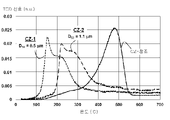
도 1은 6시간 동안 1000℃에서 에이징(aging) 후 세리아-지르코니아(ceria-zirconia) 참조 물질(CZ-참조)과 비교하여 상이한 평균 입자 크기(d50)를 갖는 본 개시내용의 2개의 CZOIC 물질(CZ-1, CZ-2)에 대한 TPR-H2 프로파일의 그래픽 표현이고;
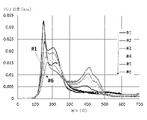
도 2는 측정된 Tmax의 안정성을 결정하기 위해 연속적으로 실행된 CZOIC 물질(CZ-1)에 대한 TPR-H2 프로파일의 그래픽 표현이고;
도 3은 본 개시내용의 CZOIC 물질 또는 세리아-지르코니아 참조 물질의 존재 및 부재 하에 카본 블랙의 산화에 대한 유도체 열중량측정(DTG) 곡선의 그래픽 표현이고;
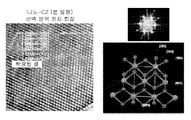
도 4는 선택 영역 전자 회절 (SAED)에 의해 측정된 세리아-지르코니아 참조 물질의 결정학적 구조의 표현이고;
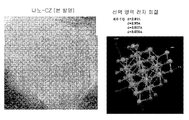
도 5는 선택 영역 전자 회절 (SAED)에 의해 측정된 본 개시내용의 CZOIC 물질의 결정학적 구조의 표현이고; 그리고
도 6은 선택 영역 전자 회절 (SAED)에 의해 측정된 본 개시내용의 또 다른 CZOIC 물질의 결정학적 구조의 표현이다.
본 명세서에 기재된 도면은 단지 설명하기 위한 것이며 어떤 식으로든 본 개시내용의 범위를 제한하도록 의도되지 않는다.In order that the present disclosure may be better understood, various forms, provided by way of illustration, will now be described with reference to the accompanying drawings.
1 shows two CZOIC materials of the present disclosure having different average particle sizes (d 50 ) compared to ceria-zirconia reference material (CZ-reference) after aging at 1000° C. for 6 hours is a graphical representation of the TPR-H 2 profile for (CZ-1, CZ-2);
2 is a graphical representation of the TPR-H 2 profile for a CZOIC material (CZ-1) run continuously to determine the stability of the measured T max ;
3 is a graphical representation of derivative thermogravimetry (DTG) curves for oxidation of carbon black in the presence and absence of a CZOIC material or ceria-zirconia reference material of the present disclosure;
4 is a representation of the crystallographic structure of a ceria-zirconia reference material as determined by selective area electron diffraction (SAED);
5 is a representation of the crystallographic structure of a CZOIC material of the present disclosure as measured by selective area electron diffraction (SAED); and
6 is a representation of the crystallographic structure of another CZOIC material of the present disclosure as measured by selective area electron diffraction (SAED).
The drawings described herein are for illustrative purposes only and are not intended to limit the scope of the present disclosure in any way.
다음 설명은 본질적으로 단지 예시일 뿐이며 본 개시내용 또는 그의 적용 또는 용도를 제한하려는 의도가 결코 아니다. 예를 들어, 본원에 포함된 교시에 따라 제조되고 사용되는 세륨-지르코늄 산화물계 이온 전도체(CZOIC) 물질은 조성물 및 이의 용도를 보다 완전하게 실증하기 위해 자동차 배출 가스를 줄이기 위해 사용되는 3-원 촉매(TWC)와 함께 본 개시내용 전체에 걸쳐 기재된다. 가솔린 또는 디젤 엔진에서 HC, CO, NOx 및 검댕을 제거하기 위한 기타 촉매, 디젤 산화 촉매 및 기타 산화 촉매에서, 또는 기타 적용, 예컨대 산소 센서 또는 고체 산화물 연료 셀 (SOFC)에 사용된 전해질에서 이러한 CZOIC 물질의 혼입 및 사용은 본 개시내용의 범위 내에 있는 것으로 고려된다. 설명 전체에 걸쳐, 대응하는 참조 번호는 유사하거나 대응하는 부분 및 특징을 나타내는 것으로 이해되어야 한다.The following description is merely exemplary in nature and is in no way intended to limit the disclosure or its application or use. For example, a cerium-zirconium oxide-based ion conductor (CZOIC) material made and used in accordance with the teachings contained herein is a three-way catalyst used to reduce automotive emissions to more fully demonstrate compositions and uses thereof. (TWC) are described throughout this disclosure. In other catalysts to remove HC, CO, NO x and soot from gasoline or diesel engines, diesel oxidation catalysts and other oxidation catalysts, or in other applications such as oxygen sensors or electrolytes used in solid oxide fuel cells (SOFCs), such The incorporation and use of CZOIC materials are contemplated as being within the scope of this disclosure. Throughout the description, it should be understood that corresponding reference numerals indicate similar or corresponding parts and features.
본 개시내용은 일반적으로 하나 이상의 확장된 단위 셀 및 정렬된 나노-도메인을 갖는 복수의 결정자를 포함하는 구조를 나타내는 세륨-지르코늄 산화물계 이온 전도체(CZOIC) 물질을 제공한다. CZOIC 물질은 산화지르코늄, 산화세륨, 및 세륨 이외의 적어도 하나의 희토류 금속의 산화물을 포함하거나, 이로 구성되거나 본질적으로 구성될 수 있다. CZOIC 물질은, 물질이 약 0.2 내지 약 1.0인 세륨 대 지르코늄(Ce:Zr)의 질량비를 나타내도록 산화지르코늄 및 산화세륨을 포함할 수 있다. 대안적으로, Ce:Zr 비는 0.3 내지 0.9의 범위; 대안적으로 0.4 내지 0.8의 범위이다.The present disclosure generally provides cerium-zirconium oxide-based ion conductor (CZOIC) materials that exhibit a structure comprising one or more extended unit cells and a plurality of crystallites having ordered nano-domains. The CZOIC material may comprise, consist of, or consist essentially of zirconium oxide, cerium oxide, and oxides of at least one rare earth metal other than cerium. The CZOIC material may include zirconium oxide and cerium oxide such that the material exhibits a mass ratio of cerium to zirconium (Ce:Zr) of from about 0.2 to about 1.0. Alternatively, the Ce:Zr ratio ranges from 0.3 to 0.9; alternatively in the range of 0.4 to 0.8.
본 개시내용의 목적을 위해, 용어 "적어도 하나" 및 "하나 이상"의 요소는 상호교환가능하게 사용되며 동일한 의미를 가질 수 있다. 단일 요소 또는 복수의 요소의 포함을 나타내는 이러한 용어는 또한 요소의 끝에 접미사 "(들)"로 표시될 수 있다. 예를 들어, "적어도 하나의 단위 셀", "하나 이상의 단위 셀" 및 "단위 셀(들)"은 상호교환적으로 사용될 수 있으며 동일한 의미를 갖는 것으로 의도된다.For the purposes of this disclosure, the terms “at least one” and “one or more” elements are used interchangeably and may have the same meaning. Such terms indicating the inclusion of a single element or a plurality of elements may also be indicated by the suffix "(s)" at the end of the element. For example, "at least one unit cell," "one or more unit cells," and "unit cell(s)" may be used interchangeably and are intended to have the same meaning.
본 개시의 목적을 위해, 용어 "약" 및 "실질적으로"는 당업자에게 공지된 예상 변동(예를 들어, 측정의 한계 및 변동)으로 인한 측정 가능한 값 및 범위와 관련하여 본 명세서에서 사용된다.For the purposes of this disclosure, the terms “about” and “substantially” are used herein in reference to measurable values and ranges due to expected variations (eg, limits and variations of measurements) known to those skilled in the art.
또한, "[첫 번째 숫자]와 [두 번째 숫자] 사이" 또는 "[첫 번째 숫자] 내지 [두 번째 숫자] 사이"라고 본원에 언급된 파라미터의 임의의 범위는 인용된 숫자를 포괄하도록 의도된다. 즉, 범위는 "[첫 번째 숫자]에서 [두 번째 숫자]까지"로 지정된 범위와 유사하게 해석되어야 한다.Also, any range of a parameter recited herein as “between [first digit] and [second digit]” or “between [first digit] and [second digit]” is intended to encompass the recited number. . That is, a range should be interpreted similarly to a range specified as "[first digit] to [second digit]".
CZOIC 물질은 CZOIC 물질의 전체 중량에 대해 약 5 중량% 내지 95 중량%인 산화지르코늄 함량을 갖는다. 바람직한 경우, CZOIC 물질은 CZOIC 물질의 전체 중량에 대해 10 중량% 내지 90 중량% 범위; 대안적으로, 약 20 wt% 내지 약 80 wt%의 지르코늄 산화물 함량을 가질 수 있다. CZOIC 물질 내의 산화세륨 함량은 또한 CZOIC 물질의 전체 중량에 대해 5% 내지 95중량%; 대안적으로, 약 10 wt% 내지 약 90 wt%; 대안적으로, 약 20 wt% 내지 약 80 wt%의 범위일 수 있다.The CZOIC material has a zirconium oxide content of about 5% to 95% by weight relative to the total weight of the CZOIC material. If desired, the CZOIC material is present in a range from 10% to 90% by weight relative to the total weight of the CZOIC material; Alternatively, it may have a zirconium oxide content of from about 20 wt % to about 80 wt %. The cerium oxide content in the CZOIC material may also be 5% to 95% by weight relative to the total weight of the CZOIC material; alternatively, from about 10 wt % to about 90 wt %; Alternatively, it may range from about 20 wt % to about 80 wt %.
본 개시의 목적을 위해, 용어 "중량"은 그램, 킬로그램 등의 단위를 갖는 것과 같은 질량 값을 지칭한다. 또한, 종점에 의한 수치 범위의 인용은 종점 및 그 수치 범위 내의 모든 숫자를 포함한다. 예를 들어, 40 중량% 내지 60 중량% (40 wt% 내지 60 wt%로도 표기됨) 범위의 농도는 40 중량%, 60 중량% 및 그 사이의 모든 농도(예를 들어, 40.1%, 41%, 45%, 50%, 52.5%, 55%, 59% 등)을 포함한다. For the purposes of this disclosure, the term “weight” refers to a mass value, such as having units such as grams, kilograms, and the like. Also, recitation of a numerical range by an endpoint includes the endpoint and all numbers within that numerical range. For example, a concentration in the range of 40 wt% to 60 wt% (also expressed as 40 wt% to 60 wt%) is 40 wt%, 60 wt% and all concentrations in between (e.g., 40.1%, 41% , 45%, 50%, 52.5%, 55%, 59%, etc.).
본 발명의 다른 양태에 따르면, 세륨(Ce) 이외의 CZOIC에 존재하는 적어도 하나의 희토류 금속은 디스프로슘 (Dy), 에르븀 (Er), 유로퓸 (Eu), 가돌리늄 (Gd), 홀뮴 (Ho), 란탄 (La), 루테튬 (Lu), 네오디뮴 (Nd), 프라세오디뮴 (Pr), 프로메튬 (Pm), 사마륨 (Sm), 스칸듐 (Sc), 테르븀 (Tb), 툴륨 (Tm), 이테르븀 (Yb), 이트륨 (Y), 또는 이들의 혼합물을 포함한다. 대안적으로, 세륨 이외의 CZOIC 물질에 존재하는 희토류 금속은 란탄, 네오디뮴, 프라세오디뮴, 이트륨, 또는 이들의 조합의 군으로부터 선택된다. CZOIC 내의 이들 희토류 금속의 함량은 CZOIC 물질의 전체 중량에 대해 0 wt% 초과 내지 35중량%; 대안적으로, 30 wt% 미만; 대안적으로, 약 5 wt% 내지 25 wt%의 범위일 수 있다. OSM에 존재하는 희토류 금속의 양은 CZOIC 물질의 결정 격자를 안정화하기에 충분하다.According to another aspect of the present invention, at least one rare earth metal present in CZOIC other than cerium (Ce) is dysprosium (Dy), erbium (Er), europium (Eu), gadolinium (Gd), holmium (Ho), lanthanum. (La), Lutetium (Lu), Neodymium (Nd), Praseodymium (Pr), Promethium (Pm), Samarium (Sm), Scandium (Sc), Terbium (Tb), Thulium (Tm), Ytterbium (Yb), Yttrium (Y), or a mixture thereof. Alternatively, the rare earth metal present in the CZOIC material other than cerium is selected from the group of lanthanum, neodymium, praseodymium, yttrium, or combinations thereof. The content of these rare earth metals in CZOIC is greater than 0 wt % to 35 wt % with respect to the total weight of the CZOIC material; alternatively, less than 30 wt %; Alternatively, it may range from about 5 wt % to 25 wt %. The amount of rare earth metal present in the OSM is sufficient to stabilize the crystal lattice of the CZOIC material.
바람직한 경우, CZOIC 물질은 구리, 철, 니켈, 코발트, 망간 또는 이들의 조합의 군으로부터 비제한적으로 선택된 하나 이상의 전이 금속을 추가로 포함할 수 있다. CZOIC 물질에 존재하는 이러한 선택적 전이 금속의 양은 0% 최대 8중량%; 대안적으로, 약 1 wt% 내지 약 7 wt%; 대안적으로, 약 2 wt% 내지 약 5 wt%의 범위일 수 있다.If desired, the CZOIC material may further comprise one or more transition metals selected from, but not limited to, the group of copper, iron, nickel, cobalt, manganese, or combinations thereof. The amount of these selective transition metals present in the CZOIC material is 0% up to 8% by weight; alternatively, from about 1 wt % to about 7 wt %; Alternatively, it may range from about 2 wt % to about 5 wt %.
CZOIC 물질에 의해 나타나는 산소 이동성은 일반적인 배기 가스 혼합물에서 발생하는 Ce4 + 쌍화살기호 Ce3 + 산화/환원 반응의 용이한 특성과 CZOIC 물질의 결정 격자 구조에서 이종원자가(aliovalent) 이온(La3 +, Nd3 +, Y3+ 등)의 존재의 조합으로 인한 것이다. 이러한 이종원자가 이온의 존재는 격자 구조에서 산소 결손의 형성을 담당하며, 이는 역 공정과 함께 대부분의 결정자에서 표면으로 산소 이동을 가능하게 한다.Oxygen mobility exhibited by CZOIC materials is due to the facile properties of Ce 4 + double arrow Ce 3 + oxidation/reduction reactions occurring in typical exhaust gas mixtures and heterovalent ions (La 3 + ) in the crystal lattice structure of CZOIC materials. , Nd 3+ , Y 3+ , etc.). The presence of these heterovalent ions is responsible for the formation of oxygen vacancies in the lattice structure, which, together with the reverse process, enables oxygen transfer from most crystallites to the surface.
산화세륨은 비화학량론적 CeO2 -x 표면 결함 부위를 형성하는 능력이 있어 산소 결손과 활성 표면 산소 종의 형성을 유발한다. 산화지르코늄도 유사한 효과를 나타낸다. 산화세륨과 산화지르코늄이 모두 조합되어 CZOIC 물질을 형성하면 이 효과가 향상된다. 표면 산소 이동성 외에도, 산화지르코늄은 Ce4 +에서 Ce3 +로의 환원성 증가로 인해 격자 산소 종의 이동성을 증가시킨다. 입방체 산화세륨 격자에 산화지르코늄을 도입하면 세륨-지르코늄 산화물계 이온전도체(CZOIC) 물질의 결함 발생이 증가하고, 이는 격자 산소의 이동성을 촉진하여, 표면에서 일어나는 산화환원 반응이 또한 CZOIC 물질의 내부에서 일어나도록 한다. 산화지르코늄은 또한 고온 사용 중에 결정 구조를 안정화시키는 능력이 있다.Cerium oxide has the ability to form non-stoichiometric CeO 2 -x surface defect sites, leading to oxygen vacancies and the formation of active surface oxygen species. Zirconium oxide has a similar effect. This effect is enhanced when both cerium oxide and zirconium oxide are combined to form a CZOIC material. In addition to surface oxygen mobility, zirconium oxide increases the mobility of lattice oxygen species due to increased Ce 4+ to Ce 3+ reducibility . The introduction of zirconium oxide into the cubic cerium oxide lattice increases the occurrence of defects in the cerium-zirconium oxide-based ion conductor (CZOIC) material, which promotes the mobility of lattice oxygen, so that the redox reaction occurring at the surface also occurs inside the CZOIC material. make it happen Zirconium oxide also has the ability to stabilize the crystal structure during high temperature use.
하기 특정 실시예는 본 개시내용의 교시에 따라 형성된 세륨-지르코늄 산화물계 이온 전도체(CZOIC), 뿐만 아니라 그의 특성을 실증하기 위해 제공되며 본 개시내용의 범위를 제한하는 것으로 해석되어서는 안 된다. 당업자는 본 개시내용에 비추어, 본 명세서에 개시된 특정 구현예에서 많은 변경이 이루어질 수 있고 본 개시내용의 사상 또는 범위를 벗어나거나 초과하지 않고 비슷하거나 유사한 결과를 여전히 얻을 수 있음을 이해할 것이다. 당업자는 본 명세서에 보고된 임의의 특성이 일상적으로 측정되고 다수의 상이한 방법에 의해 수득될 수 있는 특성을 나타낸다는 것을 추가로 이해할 것이다. 본 명세서에 기재된 방법은 이러한 방법 중 하나를 나타내며 다른 방법은 본 개시내용의 범위를 초과하지 않고 활용될 수 있다.The following specific examples are provided to demonstrate the properties of, as well as, cerium-zirconium oxide based ion conductors (CZOICs) formed in accordance with the teachings of the present disclosure and are not to be construed as limiting the scope of the present disclosure. Those of ordinary skill in the art, in light of the present disclosure, will understand that many changes can be made in the specific embodiments disclosed herein and still obtain a similar or similar result without departing from or exceeding the spirit or scope of the present disclosure. Those skilled in the art will further appreciate that any property reported herein represents a property that can be measured routinely and obtained by a number of different methods. The methods described herein represent one such method and other methods may be utilized without exceeding the scope of the present disclosure.
이제 도 1을 참조하면, 상이한 평균 입자 크기 (d50)를 갖는 본 개시내용의 2개의 CZOIC 물질 (CZ-1; CZ-2)에 대해 그리고 1000℃에서 6시간 동안 에이징한 후의 세리아-지르코니아 참조 물질(CZ-기준)에 대해 1000℃에서 6시간 동안 에이징 후에 수득된 TPR-H2 프로파일의 그래픽 표현이 제공된다. Micromeritics Autochem 2920 II 기기는 25℃ 내지 900℃의 온도 범위에서 10℃/분의 온도 램프 및 5 cm3/분의 일정한 90% Ar/10% H2 가스 유속으로 TPR(온도 프로그램 환원)을 테스트하는 데 사용된다. TPR-H2는 활성 산소 종의 양과 금속 산화물의 환원 공정에 관련된 단계를 나타낼 수 있는 측정 값을 제공한다. CZ-1과 CZ-2의 차이는 CZOIC 물질이 나타내는 평균 입자 크기(D50)이다. 보다 구체적으로, CZ-1 및 CZ-2의 CZOIC 물질에 대한 D50은 각각 1.1마이크로미터(뮤기호m) 및 0.5 뮤기호m이다. CZ-참조는 유럽 특허 제1 527 018 B1호에 제시된 실시예에 기재된 것과 같은 통상적인 세리아-지르코니아 물질을 나타내며, 이 특허의 전체 내용은 본원에 참조로 포함된다.Referring now to FIG. 1 , for two CZOIC materials of the present disclosure (CZ-1; CZ-2) having different average particle sizes (d 50 ) and ceria-zirconia after aging at 1000° C. for 6 hours A graphical representation of the TPR-H 2 profile obtained after aging at 1000° C. for 6 hours for the material (CZ-based) is provided. The Micromeritics Autochem 2920 II instrument was designed to test TPR (Temperature Program Reduction) with a temperature ramp of 10 °C/min and a constant 90% Ar/10% H 2 gas flow rate of 5 cm 3 /min over a temperature range of 25 °C to 900 °C. used to TPR-H 2 provides measurements that can indicate the amount of reactive oxygen species and the steps involved in the reduction process of metal oxides. The difference between CZ-1 and CZ-2 is the average particle size (D 50 ) exhibited by the CZOIC material. More specifically, the D 50 for the CZOIC material of CZ-1 and CZ-2 are 1.1 micrometers (sym mu m) and 0.5 mu symbol m, respectively. CZ-reference refers to conventional ceria-zirconia materials such as those described in the examples set forth in European Patent No. 1 527 018 B1, the entire contents of which are incorporated herein by reference.
더 높은 온도에서 일어나는 환원 공정은 일반적으로 금속 산화물의 구조와 함께 산소 원자의 이동성과 연관된다. 본 개시내용의 CZOIC 물질은 250℃ 이하의 온도에서 발생하는 TPR-H2에 의해 측정된 Tmax의 발생에 의해 자체로 분명해지는 빠른 산소 이온 이동성 및 전도성을 나타낸다 (CZ-1; CZ-2 참조). 비교하자면, CZ-참조는 약 475℃의 온도에서 발생하는 TPR-H2에 의해 측정된 Tmax를 나타낸다. 본 개시내용의 CZOIC 물질에 대해 TPR-H2에 의해 측정된 Tmax는 1,000℃에서 6시간 에이징 후에도 250℃ 이하의 온도를 유지한다. 또한, 본 개시내용의 CZOIC 물질(CZ-1; CZ-2)에 대한 TPR-H2 프로파일은 400℃ 미만의 온도에서 존재하는 환원성 산소의 적어도 80% 이상을 나타낸다. 마지막으로, 도 2에 도시된 바와 같이 CZ-1에 대한 연속적인 TPR-H2 실행(실행 #1 내지 실행 #6)의 측정은 본 개시내용의 CZOIC 물질에 대한 Tmax의 발생이 더 높은 온도로의 약간의 이동만으로 비교적 일정하게 유지됨을 입증한다.Reduction processes that occur at higher temperatures are usually associated with the mobility of oxygen atoms along with the structure of the metal oxide. The CZOIC materials of the present disclosure exhibit fast oxygen ion mobility and conductivity, which is evident in itself by the generation of T max measured by TPR-H 2 occurring at temperatures below 250° C. (see CZ-1; CZ-2). ). By way of comparison, the CZ-reference represents the T max measured by TPR-H 2 occurring at a temperature of about 475 °C. The T max measured by TPR-H 2 for the CZOIC material of the present disclosure maintains a temperature of 250° C. or lower even after aging at 1,000° C. for 6 hours. In addition, the TPR-H 2 profile for the CZOIC materials of the present disclosure (CZ-1; CZ-2) exhibits at least 80% or more of the reducing oxygen present at temperatures below 400°C. Finally, as shown in FIG. 2 , measurements of successive TPR-H2 runs (runs #1 to #6) for CZ-1 showed that the generation of T max for the CZOIC materials of the present disclosure was higher at higher temperatures. proves that it remains relatively constant with only a slight shift of .
이제 도 3을 참조하면, 본 개시내용의 CZOIC 물질(CZ-1) 또는 세리아-지르코니아 참조 물질(CZ-참조)의 존재 및 부재 하에 카본 블랙의 산화에 대해 유도체 열중량측정(DTG) 곡선의 그래픽 표현이 제공된다. 카본 블랙은 디젤 엔진에서 배출되는 모의실험 검댕으로 사용된다. 본 개시내용의 CZOIC 물질(CZ-1) 및 세리아-지르코니아 참조 물질(CZ-참조)에 대한 DTG 곡선은 95%의 혼합 산화물 물질(CZ-1 또는 CZ-참조)과 혼합된 5% 카본 블랙을 사용하여 수득된다. DTG 곡선은 10℃/분의 램프 속도로 25℃에서 700℃로 가열된 Seiko EXTAR 7300 TG/DTA/DSC 기기를 사용하여 CZOIC 물질의 25 mg 샘플에 대해 측정된다.Referring now to FIG. 3 , a graphic of a derivative thermogravimetry (DTG) curve for oxidation of carbon black in the presence and absence of a CZOIC material of the present disclosure (CZ-1) or a ceria-zirconia reference material (CZ-reference). expression is provided. Carbon black is used as simulated soot emitted from diesel engines. The DTG curves for the CZOIC material (CZ-1) and ceria-zirconia reference material (CZ-reference) of the present disclosure are 5% carbon black mixed with 95% mixed oxide material (CZ-1 or CZ-reference). is obtained using DTG curves are measured on 25 mg samples of CZOIC material using a Seiko EXTAR 7300 TG/DTA/DSC instrument heated from 25°C to 700°C at a ramp rate of 10°C/min.
DTG 곡선은 지정된 온도 또는 시간(-dm/dt) 동안 가열 또는 냉각 등온선에서 얻어진 또는 중량 손실의 측정값을 나타낸다. 다중 분해 공정의 발생은 중복될 수 있고, 예를 들어, 두 번째(고온 분해 공정)이 시작될 때 하나의 분해 반응이 완료되지 않을 수 있다. 그러나 대부분의 경우 TG 곡선의 신뢰할 수 있는 정성적 및 정량적 평가는 1차 도함수(즉, DTG 곡선)를 측정하지 않고는 불가능하다. 임의의 온도에서 DTG 곡선 내의 피크 높이는 질량 손실률을 나타낸다.DTG curves represent measurements of weight loss or obtained in heating or cooling isotherms for a specified temperature or time (-dm/dt). The occurrence of multiple cracking processes may overlap, for example, one cracking reaction may not be complete when the second (high temperature cracking process) is started. However, in most cases reliable qualitative and quantitative evaluation of TG curves is not possible without measuring the first derivative (ie, DTG curve). The peak height in the DTG curve at any temperature represents the mass loss rate.
도 3에서, 본 개시내용의 CZOIC 물질(CZ-1)은 500℃ 미만에서 탄소 검댕 또는 탄화수소를 산화시키는 능력에 의해 자체로 분명해지는 빠른 산소 이온 이동성 및 전도성을 나타낸다. 비교하자면, 세리아-지르코니아 참조 물질(CZ-참조)은 500℃보다 높은 온도; 대안적으로 300℃ 미만에서 포화 탄화수소를 산화시키는 능력으로 탄소 검댕 또는 탄화수소를 산화시킨다. CZOIC 물질이 없는 카본 블랙은 600℃에 가까운 온도에서 산화되는 것으로 밝혀졌다. DTG 곡선은 300℃ 이하에서 일산화탄소(CO) 산화에 사용 가능한 산소 저장 용량(OSC)의 적어도 10%를 추가로 입증한다.In FIG. 3 , the CZOIC material (CZ-1) of the present disclosure exhibits rapid oxygen ion mobility and conductivity, evident in itself by the ability to oxidize carbon soot or hydrocarbons below 500°C. By way of comparison, the ceria-zirconia reference material (CZ-reference) has a temperature greater than 500°C; Alternatively oxidize carbon soot or hydrocarbons with the ability to oxidize saturated hydrocarbons below 300°C. Carbon black without CZOIC material was found to oxidize at temperatures close to 600°C. The DTG curve further demonstrates at least 10% of the oxygen storage capacity (OSC) available for carbon monoxide (CO) oxidation below 300°C.
이제 도 4 내지 도 6을 참조하면, 세리아-지르코니아 참조 물질(도 4) 및 본 개시내용의 CZOIC 물질(도 5 및 도 6)의 결정학적 구조의 표현은 선택 영역 전자 회절(SAED)을 사용하여 측정된 바와 같이 제공된다. 선택 영역 전자 회절 (SAED)은 투과형 전자 현미경(TEM)에서 얇은 결정질 시료(~100nm 두께)에 고에너지 전자의 평행 빔을 가하여 전자가 샘플을 통과하도록 하는 결정학적 실험 기술이다. 전자와 연관된 파장은 일반적으로 나노미터의 수천 분의 일 정도이고 결정질 샘플 내의 원자 사이의 간격은 약 100배 더 크기 때문에 전자는 원자가 회절 격자 역할을 하여 회절된다. 따라서 전자의 일부는 샘플의 결정 구조에 의해 결정된 특정 각도로 산란되는 반면, 다른 전자는 편향 없이 샘플을 통과한다. 생성된 TEM 이미지(100)(도 4 내지 도 6 참조)는 회절 패턴을 구성하는 일련의 스팟(spot)을 나타낸다. 이들 스팟 각각은 샘플의 결정 구조의 회절 조건에 해당한다. SAED는 결정 구조를 식별하고 결정 결함(111)을 조사하는 데 사용된다(도 4 내지 도 6 참조). 이와 관련하여, SAED는 수백 나노미터 크기의 작은 영역을 검사할 수 있는 반면 X선 회절은 일반적으로 크기가 수 센티미터인 영역을 검사한다는 점을 제외하면 X-선 회절과 유사하다.Referring now to FIGS. 4-6 , representations of the crystallographic structures of a ceria-zirconia reference material ( FIG. 4 ) and a CZOIC material of the present disclosure ( FIGS. 5 and 6 ) were obtained using selective area electron diffraction (SAED). It is presented as measured. Selective-area electron diffraction (SAED) is a crystallographic experimental technique in which a parallel beam of high-energy electrons is applied to a thin crystalline sample (~100 nm thick) in a transmission electron microscope (TEM) to cause the electrons to pass through the sample. Because the wavelengths associated with electrons are typically on the order of a few thousandths of a nanometer, and the spacing between atoms in a crystalline sample is about 100 times greater, the electrons act as valence gratings and are diffracted. Thus, some of the electrons are scattered at a specific angle determined by the crystal structure of the sample, while others pass through the sample without deflection. The resulting TEM image 100 (see FIGS. 4 to 6 ) shows a series of spots constituting the diffraction pattern. Each of these spots corresponds to the diffraction condition of the crystal structure of the sample. SAED is used to identify crystal structures and investigate crystal defects 111 (see FIGS. 4-6 ). In this regard, X-ray diffraction is similar to X-ray diffraction, except that SAED can examine small areas on the order of several hundred nanometers, whereas X-ray diffraction typically examines areas that are several centimeters in size.
본 개시내용의 CZOIC 물질의 구조(도 5 및 도 6)는 SAED 기술을 사용하여 다중 (hkl) 위치에서 측정된 d-값에 의해 정의된 결정 격자를 나타낸다. 보다 구체적으로, 도 5 및 도 6에서 CZ-1의 상이한 결정자는 상이한 구역 축을 따라 도시된다. 본 개시내용의 CZOIC 물질에 대한 측정된 d-값은 왜곡을 나타낸다. CZ-참조 및 본 개시내용의 CZOIC 물질에 대한 다중 (hkl) 위치에서 측정된 d-값은 표 1에 제공된다. 본 개시내용의 CZOIC 물질에 대한 동일한 (hkl) 위치에 대한 d-값은 동일한 (hKI) 위치에서 참조 세륨-지르코늄 물질에 대해 측정된 d-값으로부터 약 2% 내지 약 5%로 변한다.The structures of the CZOIC materials of the present disclosure ( FIGS. 5 and 6 ) exhibit a crystal lattice defined by d-values measured at multiple (hkl) positions using the SAED technique. More specifically, in Figures 5 and 6 different determinants of CZ-1 are shown along different regional axes. The measured d-values for the CZOIC materials of the present disclosure are indicative of distortion. The d-values measured at multiple (hkl) positions for the CZ-reference and CZOIC materials of the present disclosure are provided in Table 1. The d-value for the same (hkl) position for the CZOIC material of the present disclosure varies from about 2% to about 5% from the d-value measured for the reference cerium-zirconium material at the same (hKI) position.

본 개시내용의 또 다른 양태에 따르면, 앞서 기재되고 본원에 추가로 정의된 바와 같은 적어도 하나의 백금족 금속(PGM) 및 세륨-지르코늄 산화물계 이온 전도체(CZOIC) 물질을 포함하는 촉매가 제공된다. 촉매는 제한 없이 3-원 촉매, 4-원 촉매 또는 디젤 산화 촉매일 수 있다.According to another aspect of the present disclosure, there is provided a catalyst comprising at least one platinum group metal (PGM) and a cerium-zirconium oxide based ion conductor (CZOIC) material as described above and further defined herein. The catalyst may be, without limitation, a three-way catalyst, a four-way catalyst or a diesel oxidation catalyst.
CZOIC 물질은 3-원 촉매(TWC)의 조성물의 중요한 부분을 나타내는데, 그 이유는 CQOIC 물질이 희박하고 풍부한 연료 조건 하에서 산소 저장 및 방출에 중요한 역할을 하고, 이에 의해 CO 및 휘발성 유기물의 산화 및 NOx의 환원을 가능하게 하기 때문이다. 고효율 촉매 성능은 높은 비표면적 및 열 안정성, 뿐만 아니라 높은 산소 저장 용량과도 관련이 있다.CZOIC materials represent an important part of the composition of three-way catalysts (TWCs) because CQOIC materials play an important role in oxygen storage and release under lean and rich fuel conditions, thereby reducing the oxidation and NO of CO and volatile organics. This is because the reduction of x is possible. High efficiency catalytic performance is related to high specific surface area and thermal stability, as well as high oxygen storage capacity.
촉매 조성물은 전체 촉매 조성물의 질량에 대해 약 0.01 wt% 내지 10 wt%인 양으로 하나 이상의 백금족 금속(PGM)을 포함한다. 대안적으로, PGM은 약 0.05 wt% 내지 약 7.5 wt%; 대안적으로, 1.0 wt% 내지 약 5 wt% 범위의 양으로 존재한다. 백금족 금속은 백금(Pt), 팔라듐(Pd) 및 로듐(Rh)을 포함할 수 있지만 이에 제한되지 않는다.The catalyst composition includes one or more platinum group metals (PGMs) in an amount of about 0.01 wt % to 10 wt % relative to the mass of the total catalyst composition. Alternatively, the PGM may be present in an amount from about 0.05 wt % to about 7.5 wt %; Alternatively, it is present in an amount ranging from 1.0 wt % to about 5 wt %. Platinum group metals may include, but are not limited to, platinum (Pt), palladium (Pd), and rhodium (Rh).
본 명세서 내에서, 구현예는 명확하고 간결한 명세서가 기재될 수 있게 하는 방식으로 기재되었지만, 구현예는 본 발명으로부터 벗어나지 않으면서 다양하게 조합 또는 분리될 수 있는 것으로 의도되고 인지될 것이다. 예를 들어, 본 명세서에 기재된 모든 바람직한 특징은 본 명세서에 기재된 본 발명의 모든 양태에 적용가능하다는 것이 이해될 것이다.While within this specification, embodiments have been described in such a way that a clear and concise specification may be set forth, it will be understood and intended that the embodiments may be variously combined or separated without departing from the invention. For example, it will be understood that all preferred features described herein are applicable to all aspects of the invention described herein.
본 발명의 다양한 형태에 대한 전술한 설명은 예시 및 설명의 목적으로 제시되었다. 이것은 개시된 정확한 형태로 본 발명을 완전하게 제한하거나 제한하려는 의도가 아니다. 상기 교시에 비추어 수많은 수정 또는 변형이 가능하다. 논의된 형태는 본 발명의 원리 및 그의 실제 적용의 최선의 예시를 제공하기 위해 선택되고 기재되었으며, 이에 의해 관련 당업자가 본 발명을 다양한 형태로 및 고려되는 특정한 용도에 적합한 다양한 변형으로 이용할 수 있게 하였다. 그러한 모든 수정 및 변형은 공정하고 합법적이며 공평하게 자격이 부여되는 범위에 따라 해석될 때 첨부된 청구범위에 의해 결정되는 본 발명의 범위 내에 있다.The foregoing description of various aspects of the invention has been presented for purposes of illustration and description. It is not intended to be exhaustive or to limit the invention to the precise form disclosed. Numerous modifications or variations are possible in light of the above teachings. The forms discussed were chosen and described in order to provide the best illustration of the principles of the invention and its practical application, thereby enabling those skilled in the art to utilize the invention in various forms and with various modifications as are suited to the particular use contemplated. . All such modifications and variations are within the scope of the invention as determined by the appended claims when construed in accordance with the scope to which they are fair, lawful and equitably entitled.
Claims (21)
하나 이상의 확장된 단위 셀 및 정렬된 나노-도메인을 갖는 복수의 결정자를 포함하는 구조를 나타내는, CZOIC 물질.A cerium-zirconium oxide based ionic conductor (CZOIC) material, wherein zirconium oxide in an amount ranging from 5 wt% to 95 wt%, based on the total mass of the CZOIC material, in an amount ranging from 95 wt% to 5 wt% cerium oxide, 95 wt% % to 5 wt %, and up to 30 wt % of at least one oxide of a rare earth metal other than cerium;
A CZOIC material exhibiting a structure comprising one or more expanded unit cells and a plurality of crystallites having ordered nano-domains.
적어도 하나의 백금족 금속 (PGM); 및
세륨-지르코늄 산화물계 이온성 전도체(CZOIC) 물질로서, CZOIC 물질의 전체 질량을 기준으로 5 wt% 내지 95 wt% 범위의 양의 산화지르코늄, 95 wt% 내지 5 wt% 범위의 산화세륨, 95 wt% 내지 5 wt%, 및 30 wt% 이하 범위의 세륨 이외의 희토류 금속의 적어도 하나의 산화물을 포함하고; 하나 이상의 확장된 단위 셀 및 정렬된 나노-도메인을 갖는 복수의 결정자를 포함하는 구조를 나타내는 CZOIC 물질.A catalyst having fast oxygen ion mobility and conductivity, the catalyst comprising:
at least one platinum group metal (PGM); and
A cerium-zirconium oxide based ionic conductor (CZOIC) material, wherein zirconium oxide in an amount ranging from 5 wt% to 95 wt%, based on the total mass of the CZOIC material, in an amount ranging from 95 wt% to 5 wt% cerium oxide, 95 wt% % to 5 wt %, and up to 30 wt % of at least one oxide of a rare earth metal other than cerium; A CZOIC material exhibiting a structure comprising one or more expanded unit cells and a plurality of crystallites having ordered nano-domains.
(i) 250℃ 이하의 온도에서 발생하는 TPR-H2에 의해 측정된 Tmax의 발생;
(ii) 400℃ 미만의 온도에서 TPR-H2에 의해 측정된 바와 같이 존재하는 환원성 산소의 적어도 80% 이상의 발생;
(iii) 500℃ 미만에서 탄소 검댕 또는 탄화수소를 산화시키는 능력; 및
(iv) 300℃ 이하에서 일산화탄소(CO) 산화에 이용 가능한 산소 저장 용량(OSC)의 적어도 10%.18. The catalyst according to any one of claims 14 to 17, wherein the CZOIC material exhibits fast oxygen ion mobility and conductivity manifested itself by at least one of:
(i) the occurrence of T max measured by TPR-H 2 occurring at a temperature of 250° C. or lower;
(ii) generation of at least 80% or more of the reducing oxygen present as measured by TPR-H 2 at a temperature below 400° C.;
(iii) the ability to oxidize carbon soot or hydrocarbons below 500°C; and
(iv) at least 10% of the oxygen storage capacity (OSC) available for carbon monoxide (CO) oxidation below 300°C.
(i) 250℃ 이하의 온도에서 발생하는 TPR-H2에 의해 측정된 Tmax의 발생;
(ii) 400℃ 미만의 온도에서 TPR-H2에 의해 측정된 바와 같이 존재하는 환원성 산소의 적어도 80% 이상의 발생;
(iii) 500℃ 미만에서 탄소 검댕 또는 탄화수소를 산화시키는 능력; 및
(iv) 300℃ 이하에서 일산화탄소(CO) 산화에 이용 가능한 산소 저장 용량(OSC)의 적어도 10%.19. The catalyst according to any one of claims 14 to 18, wherein the CZOIC material exhibits a fast oxygen ion mobility and conductivity which is manifested itself by at least one of the following after exposure to aging for 6 hours:
(i) the occurrence of T max measured by TPR-H 2 occurring at a temperature of 250° C. or lower;
(ii) generation of at least 80% or more of the reducing oxygen present as measured by TPR-H 2 at a temperature below 400° C.;
(iii) the ability to oxidize carbon soot or hydrocarbons below 500°C; and
(iv) at least 10% of the oxygen storage capacity (OSC) available for carbon monoxide (CO) oxidation below 300°C.
Applications Claiming Priority (3)
| Application Number | Priority Date | Filing Date | Title |
|---|---|---|---|
| US202062966590P | 2020-01-28 | 2020-01-28 | |
| US62/966,590 | 2020-01-28 | ||
| PCT/US2021/013358 WO2021154499A1 (en) | 2020-01-28 | 2021-01-14 | Cerium-zirconium oxide-based oxygen ion conductor (czoic) materials with high oxygen mobility |
Publications (1)
| Publication Number | Publication Date |
|---|---|
| KR20220134603A true KR20220134603A (en) | 2022-10-05 |
Family
ID=74587113
Family Applications (1)
| Application Number | Title | Priority Date | Filing Date |
|---|---|---|---|
| KR1020227029756A Withdrawn KR20220134603A (en) | 2020-01-28 | 2021-01-14 | Cerium-zirconium oxide-based oxygen ion conductor (CZOIC) material with high oxygen mobility |
Country Status (6)
| Country | Link |
|---|---|
| US (1) | US20230090959A1 (en) |
| EP (1) | EP4069641A1 (en) |
| JP (1) | JP2023510863A (en) |
| KR (1) | KR20220134603A (en) |
| CN (1) | CN115003628A (en) |
| WO (1) | WO2021154499A1 (en) |
Family Cites Families (9)
| Publication number | Priority date | Publication date | Assignee | Title |
|---|---|---|---|---|
| US6585944B1 (en) * | 2000-10-17 | 2003-07-01 | Delphi Technologies, Inc. | Enhancement of the OSC properties of Ce-Zr based solid solutions |
| FR2841547B1 (en) | 2002-06-26 | 2005-05-06 | Rhodia Elect & Catalysis | COMPOSITION BASED ON ZIRCONIUM OXIDE AND CERIUM OXIDES, LANTHAN AND ANOTHER RARE EARTH, PROCESS FOR PREPARING THE SAME AND USE THEREOF AS CATALYST |
| JP4331792B1 (en) * | 2008-02-12 | 2009-09-16 | 株式会社三徳 | Complex oxide |
| JP7206045B2 (en) * | 2015-07-01 | 2023-01-17 | ビーエーエスエフ コーポレーション | Nitrous oxide removal catalyst for exhaust system |
| EP3687667B1 (en) * | 2018-01-08 | 2023-03-01 | Pacific Industrial Development Corporation | Catalyst comprising ceria-zirconia-oxygen storage material and process for its production |
| CN111447997B (en) * | 2018-01-08 | 2023-08-01 | 太平洋工业发展公司 | Method for producing a Kong Chu oxygen material for exhaust gas treatment, oxygen storage material and use thereof |
| WO2020142472A1 (en) * | 2019-01-04 | 2020-07-09 | Pacific Industrial Development Corporation | Nanocrystal-sized cerium-zirconium oxide material and method of making the same |
| US12227428B2 (en) * | 2019-01-29 | 2025-02-18 | Pacific Industrial Development Corporation | Nanocrystal-sized cerium-zirconium-aluminum oxide material and method of making the same |
| GB201904694D0 (en) * | 2019-04-03 | 2019-05-15 | Johnson Matthey Plc | Ceria-containingmixed oxides for oxygen storage |
-
2021
- 2021-01-14 KR KR1020227029756A patent/KR20220134603A/en not_active Withdrawn
- 2021-01-14 WO PCT/US2021/013358 patent/WO2021154499A1/en not_active Ceased
- 2021-01-14 CN CN202180010931.8A patent/CN115003628A/en active Pending
- 2021-01-14 EP EP21704644.0A patent/EP4069641A1/en not_active Withdrawn
- 2021-01-14 JP JP2022542763A patent/JP2023510863A/en active Pending
- 2021-01-14 US US17/793,979 patent/US20230090959A1/en not_active Abandoned
Also Published As
| Publication number | Publication date |
|---|---|
| JP2023510863A (en) | 2023-03-15 |
| EP4069641A1 (en) | 2022-10-12 |
| CN115003628A (en) | 2022-09-02 |
| US20230090959A1 (en) | 2023-03-23 |
| WO2021154499A1 (en) | 2021-08-05 |
Similar Documents
| Publication | Publication Date | Title |
|---|---|---|
| KR101405826B1 (en) | Catalyst system used in an exhaust gas purifying apparatus for an automobile, exhaust gas purifying apparatus using the same, and exhaust gas purifying method | |
| US7329627B2 (en) | Ce/Cu/Mn-catalysts | |
| US8187995B2 (en) | Cerium/zirconium-base composite oxide, method for producing the same, oxygen storage/release component using said cerium-zirconium-base composite oxide, exhaust gas purification catalyst, and exhaust gas purification method using the same | |
| USRE45083E1 (en) | Method for preparing metal oxide particles and an exhaust gas purifying catalyst | |
| US20070244002A1 (en) | Ce-Zr based solid solutions and methods for making and using the same | |
| Wu et al. | Effect of preparation methods on the structure and redox behavior of platinum–ceria–zirconia catalysts | |
| US20150148216A1 (en) | Spinel compositions and applications thereof | |
| JP5431158B2 (en) | Catalyst carrier or catalyst and method for producing the same | |
| Zhong et al. | Ce incorporated pyrochlore Pr2Zr2O7 solid electrolytes for enhanced mild-temperature NO2 sensing | |
| KR101593683B1 (en) | Composite oxide | |
| Cuif et al. | New generation of rare earth compounds for automotive catalysis | |
| US20190099715A1 (en) | Exhaust gas purifying catalyst and production method therefor, and exhaust gas purification device using same | |
| US20180311616A1 (en) | Exhaust gas purifying catalyst and method for producing same, and exhaust gas purification device using same | |
| JP2012061398A (en) | Catalyst for producing hydrogen, method for manufacturing the catalyst, and method for producing hydrogen by using the catalyst | |
| KR20220134603A (en) | Cerium-zirconium oxide-based oxygen ion conductor (CZOIC) material with high oxygen mobility | |
| Masui et al. | Low-temperature redox activity of Ce0. 64Zr0. 16Bi0. 20O1. 90/γ-Al2O3 and Ag/Ce0. 64Zr0. 16Bi0. 20O1. 90/γ-Al2O3 catalysts | |
| JPH0586259B2 (en) | ||
| JP7091278B2 (en) | Electrode material for solid oxide fuel cell, anode electrode for solid oxide fuel cell using it, and solid oxide fuel cell using it | |
| JP2006346587A (en) | Exhaust gas purification catalyst | |
| WO2013042300A1 (en) | Particulate filter with catalyst | |
| Murakami et al. | The low-temperature synthesis of cation-ordered Ce–Zr-based oxide via an intermediate phase between Ce and Fe | |
| US20070054800A1 (en) | Exhaust gas purification catalyst and catalyst-equipped diesel particulate filter | |
| Sakai et al. | Degradation behavior at interface of LSCF cathodes and rare earth doped ceria | |
| Duangsa et al. | The Effect of Tartaric and Citric Acid as a Complexing Agent on Defect Structure and Conductivity of Copper Samarium Co-doped Ceria Prepared by a Sol-Gel Auto-Combustion Method | |
| JP7754881B2 (en) | Oxygen storage material and method for producing the same |
Legal Events
| Date | Code | Title | Description |
|---|---|---|---|
| PA0105 | International application |
St.27 status event code: A-0-1-A10-A15-nap-PA0105 |
|
| PG1501 | Laying open of application |
St.27 status event code: A-1-1-Q10-Q12-nap-PG1501 |
|
| PC1203 | Withdrawal of no request for examination |
St.27 status event code: N-1-6-B10-B12-nap-PC1203 |