KR20230051663A - organic electroluminescent element - Google Patents
organic electroluminescent element Download PDFInfo
- Publication number
- KR20230051663A KR20230051663A KR1020237004531A KR20237004531A KR20230051663A KR 20230051663 A KR20230051663 A KR 20230051663A KR 1020237004531 A KR1020237004531 A KR 1020237004531A KR 20237004531 A KR20237004531 A KR 20237004531A KR 20230051663 A KR20230051663 A KR 20230051663A
- Authority
- KR
- South Korea
- Prior art keywords
- group
- unsubstituted
- substituted
- substituent
- organic
- Prior art date
- Legal status (The legal status is an assumption and is not a legal conclusion. Google has not performed a legal analysis and makes no representation as to the accuracy of the status listed.)
- Ceased
Links
Images





Classifications
-
- H—ELECTRICITY
- H10—SEMICONDUCTOR DEVICES; ELECTRIC SOLID-STATE DEVICES NOT OTHERWISE PROVIDED FOR
- H10K—ORGANIC ELECTRIC SOLID-STATE DEVICES
- H10K85/00—Organic materials used in the body or electrodes of devices covered by this subclass
- H10K85/60—Organic compounds having low molecular weight
- H10K85/631—Amine compounds having at least two aryl rest on at least one amine-nitrogen atom, e.g. triphenylamine
-
- C—CHEMISTRY; METALLURGY
- C09—DYES; PAINTS; POLISHES; NATURAL RESINS; ADHESIVES; COMPOSITIONS NOT OTHERWISE PROVIDED FOR; APPLICATIONS OF MATERIALS NOT OTHERWISE PROVIDED FOR
- C09K—MATERIALS FOR MISCELLANEOUS APPLICATIONS, NOT PROVIDED FOR ELSEWHERE
- C09K11/00—Luminescent materials, e.g. electroluminescent or chemiluminescent
- C09K11/06—Luminescent materials, e.g. electroluminescent or chemiluminescent containing organic luminescent materials
-
- C—CHEMISTRY; METALLURGY
- C07—ORGANIC CHEMISTRY
- C07C—ACYCLIC OR CARBOCYCLIC COMPOUNDS
- C07C211/00—Compounds containing amino groups bound to a carbon skeleton
- C07C211/43—Compounds containing amino groups bound to a carbon skeleton having amino groups bound to carbon atoms of six-membered aromatic rings of the carbon skeleton
- C07C211/54—Compounds containing amino groups bound to a carbon skeleton having amino groups bound to carbon atoms of six-membered aromatic rings of the carbon skeleton having amino groups bound to two or three six-membered aromatic rings
-
- C—CHEMISTRY; METALLURGY
- C07—ORGANIC CHEMISTRY
- C07F—ACYCLIC, CARBOCYCLIC OR HETEROCYCLIC COMPOUNDS CONTAINING ELEMENTS OTHER THAN CARBON, HYDROGEN, HALOGEN, OXYGEN, NITROGEN, SULFUR, SELENIUM OR TELLURIUM
- C07F5/00—Compounds containing elements of Groups 3 or 13 of the Periodic Table
- C07F5/02—Boron compounds
- C07F5/027—Organoboranes and organoborohydrides
-
- C—CHEMISTRY; METALLURGY
- C07—ORGANIC CHEMISTRY
- C07F—ACYCLIC, CARBOCYCLIC OR HETEROCYCLIC COMPOUNDS CONTAINING ELEMENTS OTHER THAN CARBON, HYDROGEN, HALOGEN, OXYGEN, NITROGEN, SULFUR, SELENIUM OR TELLURIUM
- C07F7/00—Compounds containing elements of Groups 4 or 14 of the Periodic Table
- C07F7/02—Silicon compounds
- C07F7/08—Compounds having one or more C—Si linkages
- C07F7/0803—Compounds with Si-C or Si-Si linkages
- C07F7/081—Compounds with Si-C or Si-Si linkages comprising at least one atom selected from the elements N, O, halogen, S, Se or Te
-
- H—ELECTRICITY
- H10—SEMICONDUCTOR DEVICES; ELECTRIC SOLID-STATE DEVICES NOT OTHERWISE PROVIDED FOR
- H10K—ORGANIC ELECTRIC SOLID-STATE DEVICES
- H10K50/00—Organic light-emitting devices
- H10K50/10—OLEDs or polymer light-emitting diodes [PLED]
- H10K50/11—OLEDs or polymer light-emitting diodes [PLED] characterised by the electroluminescent [EL] layers
- H10K50/12—OLEDs or polymer light-emitting diodes [PLED] characterised by the electroluminescent [EL] layers comprising dopants
-
- H—ELECTRICITY
- H10—SEMICONDUCTOR DEVICES; ELECTRIC SOLID-STATE DEVICES NOT OTHERWISE PROVIDED FOR
- H10K—ORGANIC ELECTRIC SOLID-STATE DEVICES
- H10K50/00—Organic light-emitting devices
- H10K50/10—OLEDs or polymer light-emitting diodes [PLED]
- H10K50/14—Carrier transporting layers
- H10K50/15—Hole transporting layers
- H10K50/156—Hole transporting layers comprising a multilayered structure
-
- H—ELECTRICITY
- H10—SEMICONDUCTOR DEVICES; ELECTRIC SOLID-STATE DEVICES NOT OTHERWISE PROVIDED FOR
- H10K—ORGANIC ELECTRIC SOLID-STATE DEVICES
- H10K85/00—Organic materials used in the body or electrodes of devices covered by this subclass
- H10K85/40—Organosilicon compounds, e.g. TIPS pentacene
-
- H—ELECTRICITY
- H10—SEMICONDUCTOR DEVICES; ELECTRIC SOLID-STATE DEVICES NOT OTHERWISE PROVIDED FOR
- H10K—ORGANIC ELECTRIC SOLID-STATE DEVICES
- H10K85/00—Organic materials used in the body or electrodes of devices covered by this subclass
- H10K85/60—Organic compounds having low molecular weight
- H10K85/631—Amine compounds having at least two aryl rest on at least one amine-nitrogen atom, e.g. triphenylamine
- H10K85/633—Amine compounds having at least two aryl rest on at least one amine-nitrogen atom, e.g. triphenylamine comprising polycyclic condensed aromatic hydrocarbons as substituents on the nitrogen atom
-
- C—CHEMISTRY; METALLURGY
- C07—ORGANIC CHEMISTRY
- C07B—GENERAL METHODS OF ORGANIC CHEMISTRY; APPARATUS THEREFOR
- C07B2200/00—Indexing scheme relating to specific properties of organic compounds
- C07B2200/05—Isotopically modified compounds, e.g. labelled
-
- C—CHEMISTRY; METALLURGY
- C09—DYES; PAINTS; POLISHES; NATURAL RESINS; ADHESIVES; COMPOSITIONS NOT OTHERWISE PROVIDED FOR; APPLICATIONS OF MATERIALS NOT OTHERWISE PROVIDED FOR
- C09K—MATERIALS FOR MISCELLANEOUS APPLICATIONS, NOT PROVIDED FOR ELSEWHERE
- C09K2211/00—Chemical nature of organic luminescent or tenebrescent compounds
- C09K2211/10—Non-macromolecular compounds
- C09K2211/1003—Carbocyclic compounds
- C09K2211/1007—Non-condensed systems
-
- C—CHEMISTRY; METALLURGY
- C09—DYES; PAINTS; POLISHES; NATURAL RESINS; ADHESIVES; COMPOSITIONS NOT OTHERWISE PROVIDED FOR; APPLICATIONS OF MATERIALS NOT OTHERWISE PROVIDED FOR
- C09K—MATERIALS FOR MISCELLANEOUS APPLICATIONS, NOT PROVIDED FOR ELSEWHERE
- C09K2211/00—Chemical nature of organic luminescent or tenebrescent compounds
- C09K2211/10—Non-macromolecular compounds
- C09K2211/1003—Carbocyclic compounds
- C09K2211/1011—Condensed systems
-
- C—CHEMISTRY; METALLURGY
- C09—DYES; PAINTS; POLISHES; NATURAL RESINS; ADHESIVES; COMPOSITIONS NOT OTHERWISE PROVIDED FOR; APPLICATIONS OF MATERIALS NOT OTHERWISE PROVIDED FOR
- C09K—MATERIALS FOR MISCELLANEOUS APPLICATIONS, NOT PROVIDED FOR ELSEWHERE
- C09K2211/00—Chemical nature of organic luminescent or tenebrescent compounds
- C09K2211/10—Non-macromolecular compounds
- C09K2211/1003—Carbocyclic compounds
- C09K2211/1014—Carbocyclic compounds bridged by heteroatoms, e.g. N, P, Si or B
-
- C—CHEMISTRY; METALLURGY
- C09—DYES; PAINTS; POLISHES; NATURAL RESINS; ADHESIVES; COMPOSITIONS NOT OTHERWISE PROVIDED FOR; APPLICATIONS OF MATERIALS NOT OTHERWISE PROVIDED FOR
- C09K—MATERIALS FOR MISCELLANEOUS APPLICATIONS, NOT PROVIDED FOR ELSEWHERE
- C09K2211/00—Chemical nature of organic luminescent or tenebrescent compounds
- C09K2211/10—Non-macromolecular compounds
- C09K2211/1018—Heterocyclic compounds
-
- H—ELECTRICITY
- H10—SEMICONDUCTOR DEVICES; ELECTRIC SOLID-STATE DEVICES NOT OTHERWISE PROVIDED FOR
- H10K—ORGANIC ELECTRIC SOLID-STATE DEVICES
- H10K50/00—Organic light-emitting devices
- H10K50/10—OLEDs or polymer light-emitting diodes [PLED]
- H10K50/11—OLEDs or polymer light-emitting diodes [PLED] characterised by the electroluminescent [EL] layers
-
- H—ELECTRICITY
- H10—SEMICONDUCTOR DEVICES; ELECTRIC SOLID-STATE DEVICES NOT OTHERWISE PROVIDED FOR
- H10K—ORGANIC ELECTRIC SOLID-STATE DEVICES
- H10K50/00—Organic light-emitting devices
- H10K50/10—OLEDs or polymer light-emitting diodes [PLED]
- H10K50/17—Carrier injection layers
-
- H—ELECTRICITY
- H10—SEMICONDUCTOR DEVICES; ELECTRIC SOLID-STATE DEVICES NOT OTHERWISE PROVIDED FOR
- H10K—ORGANIC ELECTRIC SOLID-STATE DEVICES
- H10K85/00—Organic materials used in the body or electrodes of devices covered by this subclass
- H10K85/60—Organic compounds having low molecular weight
- H10K85/615—Polycyclic condensed aromatic hydrocarbons, e.g. anthracene
-
- H—ELECTRICITY
- H10—SEMICONDUCTOR DEVICES; ELECTRIC SOLID-STATE DEVICES NOT OTHERWISE PROVIDED FOR
- H10K—ORGANIC ELECTRIC SOLID-STATE DEVICES
- H10K85/00—Organic materials used in the body or electrodes of devices covered by this subclass
- H10K85/60—Organic compounds having low molecular weight
- H10K85/615—Polycyclic condensed aromatic hydrocarbons, e.g. anthracene
- H10K85/626—Polycyclic condensed aromatic hydrocarbons, e.g. anthracene containing more than one polycyclic condensed aromatic rings, e.g. bis-anthracene
-
- H—ELECTRICITY
- H10—SEMICONDUCTOR DEVICES; ELECTRIC SOLID-STATE DEVICES NOT OTHERWISE PROVIDED FOR
- H10K—ORGANIC ELECTRIC SOLID-STATE DEVICES
- H10K85/00—Organic materials used in the body or electrodes of devices covered by this subclass
- H10K85/60—Organic compounds having low molecular weight
- H10K85/649—Aromatic compounds comprising a hetero atom
- H10K85/657—Polycyclic condensed heteroaromatic hydrocarbons
-
- H—ELECTRICITY
- H10—SEMICONDUCTOR DEVICES; ELECTRIC SOLID-STATE DEVICES NOT OTHERWISE PROVIDED FOR
- H10K—ORGANIC ELECTRIC SOLID-STATE DEVICES
- H10K85/00—Organic materials used in the body or electrodes of devices covered by this subclass
- H10K85/60—Organic compounds having low molecular weight
- H10K85/658—Organoboranes
Landscapes
- Chemical & Material Sciences (AREA)
- Organic Chemistry (AREA)
- Engineering & Computer Science (AREA)
- Materials Engineering (AREA)
- Physics & Mathematics (AREA)
- Spectroscopy & Molecular Physics (AREA)
- Optics & Photonics (AREA)
- Electroluminescent Light Sources (AREA)
Abstract
[과제] 본 발명의 과제는, 정공의 주입ㆍ수송 성능, 전자 저지 능력, 박막 상태에서의 안정성이나 내구성이 우수한 유기 EL 소자용의 재료를 제공하고, 나아가 해당 재료, 및 정공 및 전자의 주입ㆍ수송 성능, 전자 저지 능력, 박막 상태에서의 안정성, 내구성이 우수한 유기 EL 소자용의 각종 재료를, 각각의 재료가 갖는 특성을 효과적으로 발휘할 수 있도록 조합함으로써, 고효율, 저구동 전압, 장수명의 유기 EL 소자를 제공하는 데 있다. [해결 수단] 특정의 구조를 갖는 트리아릴아민 화합물이, 정공의 주입ㆍ수송 능력, 박막의 안정성 및 내구성이 우수한 점에 착안하여, 제2 정공 수송층을 구성하는 재료로서 특정의 아릴아민 화합물을 선별하여 유기 EL 소자를 제작하고, 본 발명을 완성하기에 이르렀다.[PROBLEMS] An object of the present invention is to provide a material for an organic EL device having excellent hole injection/transport performance, electron blocking ability, stability and durability in a thin film state, and furthermore, the material and hole and electron injection/transport performance. By combining various materials for organic EL devices that are excellent in transport performance, electron blocking ability, stability in a thin film state, and durability so as to effectively exhibit the characteristics of each material, an organic EL device with high efficiency, low driving voltage, and long lifespan. is to provide [Means of solution] Selecting a specific arylamine compound as a material constituting the second hole transport layer, focusing on the fact that a triarylamine compound having a specific structure has excellent hole injection/transport capability, stability and durability of a thin film Thus, an organic EL element was produced and the present invention was completed.
Description
본 발명은 각종 표시 장치에 적합한 자발광 소자인 유기 일렉트로루미네센스 소자에 관한 것이며, 상세하게는 특정의 아릴아민 화합물을 사용한 유기 일렉트로루미네센스 소자(이하, 유기 EL 소자라고 약칭함)에 관한 것이다.The present invention relates to an organic electroluminescent element that is a self-luminous element suitable for various display devices, and in detail, to an organic electroluminescent element (hereinafter abbreviated as an organic EL element) using a specific arylamine compound. will be.
유기 EL 소자는 자기 발광성 소자이기 때문에, 액정 소자에 비하여 밝고 시인성이 우수하며, 선명한 표시가 가능한 점에서, 활발한 연구가 이루어져 왔다.Since the organic EL element is a self-luminous element, active research has been conducted in that it is brighter than a liquid crystal element and has excellent visibility and enables a clear display.
1987년에 이스트만ㆍ코닥사의 C. W. Tang 등은 각종 역할을 각 재료에 분담시킨 적층 구조 소자를 개발함으로써 유기 재료를 사용한 유기 EL 소자를 실용적인 것으로 하였다. 그들은 전자를 수송할 수 있는 형광체와 정공을 수송할 수 있는 유기물을 적층하고, 양쪽의 전하를 형광체의 층 내에 주입하여 발광시킴으로써, 10V 이하의 전압에서 1000cd/㎡ 이상의 고휘도가 얻어지게 되었다(예를 들어, 특허문헌 1 및 특허문헌 2 참조).In 1987, C. W. Tang of Eastman and Kodak Co., Ltd. developed a multilayer structure element in which various roles were assigned to each material, thereby making organic EL elements using organic materials practical. They laminated a phosphor capable of transporting electrons and an organic material capable of transporting holes, and injecting charge from both into the layer of the phosphor to emit light, resulting in high luminance of 1000 cd/m or more at a voltage of 10 V or less (e.g., For example, see Patent Document 1 and Patent Document 2).
현재까지, 유기 EL 소자의 실용화를 위해 많은 개량이 이루어지고, 적층 구조의 각종 역할을 더 세분화하여, 기판 상에 순차적으로, 양극, 정공 주입층, 정공 수송층, 발광층, 전자 수송층, 전자 주입층, 음극을 마련한 전계 발광 소자에 의해 고효율과 내구성이 달성되게 되었다(예를 들어, 비특허문헌 1 참조).To date, many improvements have been made for practical use of organic EL devices, and the various roles of the laminated structure are further subdivided, sequentially on the substrate, an anode, a hole injection layer, a hole transport layer, a light emitting layer, an electron transport layer, an electron injection layer, High efficiency and durability have been achieved by an electroluminescent device provided with a cathode (see, for example, Non-Patent Document 1).
또한, 발광 효율의 더한층의 향상을 목적으로 하여 삼중항 여기자의 이용이 시도되고, 인광 발광성 화합물의 이용이 검토되고 있다(예를 들어, 비특허문헌 2 참조).In addition, for the purpose of further improving the luminous efficiency, the use of triplet excitons has been attempted, and the use of phosphorescent compounds has been studied (for example, see Non-Patent Document 2).
그리고, 열 활성화 지연 형광(TADF)에 의한 발광을 이용하는 소자도 개발되어 있다. 2011년에 규슈 대학의 아다치 등은, 열 활성화 지연 형광 재료를 사용한 소자에 의해 5.3%의 외부 양자 효율을 실현시켰다(예를 들어, 비특허문헌 3 참조).In addition, a device using light emission by thermally activated delayed fluorescence (TADF) has also been developed. In 2011, Adachi et al. of Kyushu University realized an external quantum efficiency of 5.3% with a device using a thermally activated delayed fluorescent material (see, for example, Non-Patent Document 3).
발광층은, 일반적으로 호스트 재료라고 칭해지는 전하 수송성 화합물에, 형광성 화합물이나 인광 발광성 화합물 또는 지연 형광을 방사하는 재료를 도프하여 제작할 수도 있다. 상기 비특허문헌에 기재되어 있는 바와 같이, 유기 EL 소자에 있어서의 유기 재료의 선택은, 그 소자의 효율이나 내구성 등 여러 특성에 큰 영향을 준다(예를 들어, 비특허문헌 1 내지 3 참조).The light-emitting layer can also be produced by doping a fluorescent compound, a phosphorescent compound, or a material that emits delayed fluorescence to a charge-transporting compound generally referred to as a host material. As described in the above non-patent literature, the selection of an organic material in an organic EL device has a great influence on various characteristics such as efficiency and durability of the device (for example, see Non-Patent Documents 1 to 3). .
유기 EL 소자에 있어서는, 양쪽 전극으로부터 주입된 전하가 발광층에서 재결합하여 발광이 얻어지는데, 정공, 전자의 양쪽 전하를 어떻게 효율적으로 발광층에 전달하는지가 중요하며, 캐리어 밸런스가 우수한 소자로 할 필요가 있다. 또한, 정공 주입성을 높이고, 음극으로부터 주입된 전자를 블록하는 전자 저지성을 높임으로써, 정공과 전자가 재결합할 확률을 향상시키고, 나아가 발광층 내에서 생성된 여기자를 가둠으로써, 고발광 효율을 얻을 수 있다. 그 때문에, 정공 수송 재료가 하는 역할은 중요하며, 정공 주입성이 높고, 정공의 이동도가 크고, 전자 저지성이 높고, 나아가 전자에 대한 내구성이 높은 정공 수송 재료가 요구되고 있다.In an organic EL device, charge injected from both electrodes recombines in the light emitting layer to obtain light emission. It is important how to efficiently transfer the charge of both holes and electrons to the light emitting layer, and it is necessary to make the device excellent in carrier balance. . In addition, by increasing the hole injecting property and increasing the electron blocking property of blocking the electrons injected from the cathode, the probability of recombination of holes and electrons is improved, and further, by confining excitons generated in the light emitting layer, high luminous efficiency is obtained. can Therefore, the role played by the hole transport material is important, and a hole transport material having high hole injectability, high hole mobility, high electron blocking property, and high durability against electrons is required.
또한, 소자의 수명에 관해서는 재료의 내열성이나 비정질성도 중요하다. 내열성이 낮은 재료에서는, 소자 구동 시에 생기는 열에 의해, 낮은 온도에서도 열분해가 일어나, 재료가 열화된다. 비정질성이 낮은 재료에서는, 짧은 시간에도 박막의 결정화가 일어나, 소자가 열화되어 버린다. 그 때문에 사용하는 재료에는 내열성이 높고, 비정질성이 양호한 성질이 요구된다.In addition, heat resistance and amorphousness of the material are also important with respect to the life of the element. In a material with low heat resistance, thermal decomposition occurs even at a low temperature due to heat generated during element driving, and the material deteriorates. In materials with low amorphousness, crystallization of the thin film occurs even in a short time, and the device deteriorates. Therefore, the material to be used is required to have high heat resistance and good amorphous properties.
지금까지 유기 EL 소자에 사용되어 온 정공 수송 재료로서는, N,N'-디페닐-N,N'-디(α-나프틸)벤지딘(NPD)이나 여러 가지의 방향족 아민 유도체가 알려져 있었다(예를 들어, 특허문헌 1 및 특허문헌 2 참조). NPD는 양호한 정공 수송 능력을 갖고 있지만, 내열성의 지표가 되는 유리 전이점(Tg)이 96℃로 낮고, 고온 조건 하에서는 결정화에 의한 소자 특성의 저하가 일어나 버린다(예를 들어, 비특허문헌 4 참조). 또한, 상기 특허문헌에 기재된 방향족 아민 유도체 중에는, 정공의 이동도가 10-3㎠/Vs 이상으로 우수한 이동도를 갖는 화합물이 알려져 있지만(예를 들어, 특허문헌 1 및 특허문헌 2 참조), 전자 저지성이 불충분하기 때문에, 전자의 일부가 발광층을 빠져나가 버려, 발광 효율의 향상을 기대할 수 없는 등, 더한층의 고효율화를 위해, 보다 전자 저지성이 높고, 박막이 보다 안정되고 내열성이 높은 재료가 요구되고 있었다. 또한, 내구성이 높은 방향족 아민 유도체의 보고가 있지만(예를 들어, 특허문헌 3 참조), 전자 사진 감광체에 사용되는 전하 수송 재료로서 사용한 것으로, 유기 EL 소자로서 사용한 예는 없었다.As hole transport materials that have been used in organic EL devices so far, N,N'-diphenyl-N,N'-di(α-naphthyl)benzidine (NPD) and various aromatic amine derivatives have been known (eg For example, see Patent Document 1 and Patent Document 2). Although NPD has good hole transport ability, its glass transition point (Tg), which is an indicator of heat resistance, is as low as 96°C, and under high temperature conditions, deterioration in device characteristics due to crystallization occurs (see, for example, Non-Patent Document 4). ). In addition, among the aromatic amine derivatives described in the above Patent Documents, compounds having excellent hole mobility of 10 −3 cm 2 /Vs or more are known (for example, see Patent Document 1 and Patent Document 2), but electron Since some of the electrons pass through the light emitting layer because the blocking property is insufficient, and improvement in luminous efficiency cannot be expected, a material with higher electron blocking property, a more stable thin film, and high heat resistance is needed for further high efficiency. was being demanded In addition, aromatic amine derivatives with high durability have been reported (see, for example, Patent Document 3), but they have been used as charge transport materials used in electrophotographic photoreceptors and have not been used as organic EL devices.
내열성이나 정공 주입성 등의 특성을 개량한 화합물로서, 치환 카르바졸 구조를 갖는 아릴아민 화합물이 제안되어 있지만(예를 들어, 특허문헌 4 및 특허문헌 5 참조), 이들 화합물을 정공 주입층 또는 정공 수송층에 사용한 소자에서는, 내열성이나 발광 효율 등의 개량은 되어 있지만, 아직 충분하다고는 할 수 없어, 더한층의 저구동 전압화나, 더한층의 고발광 효율화가 요구되고 있다.Arylamine compounds having a substituted carbazole structure have been proposed as compounds with improved properties such as heat resistance and hole injection properties (see, for example, Patent Document 4 and Patent Document 5), but these compounds can be used as a hole injection layer or a hole injection layer. In the element used for the transport layer, although heat resistance and luminous efficiency have been improved, it is not yet sufficient, and further lower driving voltage and further higher luminous efficiency are required.
유기 EL 소자의 소자 특성의 개선이나 소자 제작의 수율 향상을 위해, 정공 및 전자의 주입ㆍ수송 성능, 박막의 안정성이나 내구성이 우수한 재료를 조합함으로써, 정공 및 전자가 고효율로 재결합할 수 있는, 발광 효율이 높고, 구동 전압이 낮고, 장수명인 소자가 요구되고 있다.In order to improve the device characteristics of organic EL devices and improve the yield of device manufacturing, by combining materials with excellent hole and electron injection and transport performance, thin film stability and durability, holes and electrons can recombine with high efficiency, light emission Devices with high efficiency, low driving voltage, and long life are in demand.
또한, 유기 EL 소자의 소자 특성을 개선시키기 위해, 정공 및 전자의 주입ㆍ수송 성능, 박막의 안정성이나 내구성이 우수한 재료를 조합함으로써, 캐리어 밸런스가 취해진 고효율, 저구동 전압, 장수명의 소자가 요구되고 있다.In addition, in order to improve the device characteristics of an organic EL device, a device with high efficiency, low driving voltage and long lifespan with a carrier balance is required by combining materials with excellent hole and electron injection/transport performance, thin film stability and durability. there is.
본 발명의 목적은, 고효율, 고내구성의 유기 EL 소자용의 재료로서, 정공의 주입ㆍ수송 성능, 전자 저지 능력, 박막 상태에서의 안정성이나 내구성이 우수한 유기 EL 소자용의 재료를 제공하고, 나아가 해당 재료, 및 정공 및 전자의 주입ㆍ수송 성능, 전자 저지 능력, 박막 상태에서의 안정성, 내구성이 우수한 유기 EL 소자용의 각종 재료를, 각각의 재료가 갖는 특성을 효과적으로 발휘할 수 있도록 조합함으로써, 고효율, 저구동 전압, 장수명의 유기 EL 소자를 제공하는 데 있다.An object of the present invention is to provide a material for an organic EL device having excellent hole injection/transport performance, electron blocking ability, and stability and durability in a thin film state as a material for an organic EL device having high efficiency and high durability, and further By combining the material and various materials for organic EL devices with excellent hole and electron injection/transport performance, electron blocking ability, stability in a thin film state, and durability so that the characteristics of each material can be effectively exhibited, high efficiency is achieved. , to provide an organic EL device with a low driving voltage and a long lifespan.
본 발명이 제공하려고 하는 유기 화합물이 구비해야 하는 물리적인 특성으로서는, (1) 정공의 주입 특성이 좋은 것, (2) 정공의 이동도가 큰 것, (3) 전자 저지 능력이 우수한 것, (4) 박막 상태가 안정된 것, (5) 내열성이 우수한 것을 들 수 있다. 또한, 본 발명이 제공하려고 하는 유기 EL 소자가 구비해야 하는 물리적인 특성으로서는, (1) 발광 효율 및 전력 효율이 높은 것, (2) 발광 개시 전압이 낮은 것, (3) 실용 구동 전압이 낮은 것, (4) 장수명인 것을 들 수 있다.As the physical properties that the organic compound to be provided by the present invention should have, (1) good hole injection characteristics, (2) high hole mobility, (3) excellent electron blocking ability, ( 4) those with stable thin film state and (5) those with excellent heat resistance. In addition, as the physical characteristics that the organic EL device to be provided by the present invention should have, (1) high luminous efficiency and power efficiency, (2) low luminescence starting voltage, (3) low practical driving voltage and (4) having a long lifespan.
따라서 상기 목적을 달성하기 위해, 본 발명자들은 검토를 예의 행한 결과, 특정의 구조를 갖는 아릴아민 화합물이 정공의 주입ㆍ수송 능력, 박막의 안정성 및 내구성이 우수하기 때문에, 이것들을 정공 수송층의 재료로서 선택하면, 양극측으로부터 주입된 정공을 효율적으로 수송할 수 있다고 하는 지견을 얻었다. 또한, 특정의 구조를 갖는 발광 재료 등과 조합한 여러 가지의 유기 EL 소자를 제작하여, 소자의 특성 평가를 행한 결과, 본 발명을 완성하기에 이르렀다.Therefore, in order to achieve the above object, the inventors of the present invention have studied intensively and, as a result, found that arylamine compounds having a specific structure are excellent in hole injecting and transporting ability, stability and durability of a thin film, and therefore, they are used as a material for a hole transport layer. When selected, it was found that holes injected from the anode side can be transported efficiently. Further, as a result of fabricating various organic EL elements in combination with a light emitting material having a specific structure and the like, and evaluating the characteristics of the elements, the present invention has been completed.
즉 본 발명에 따르면, 이하의 유기 EL 소자가 제공된다.That is, according to the present invention, the following organic EL device is provided.
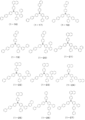
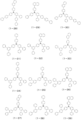
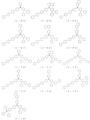
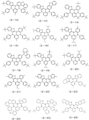
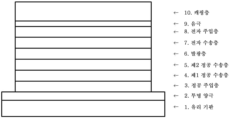
1) 적어도 양극, 제1 정공 수송층, 제2 정공 수송층, 발광층, 전자 수송층 및 음극을 이 순으로 갖는 유기 일렉트로루미네센스 소자에 있어서, 상기 제2 정공 수송층이 하기 일반식 (1)로 표시되는 아릴아민 화합물을 함유하는 것을 특징으로 하는 유기 EL 소자.1) An organic electroluminescent device having at least an anode, a first hole transport layer, a second hole transport layer, a light emitting layer, an electron transport layer and a cathode in this order, wherein the second hole transport layer is represented by the following general formula (1): An organic EL device characterized by containing an arylamine compound.
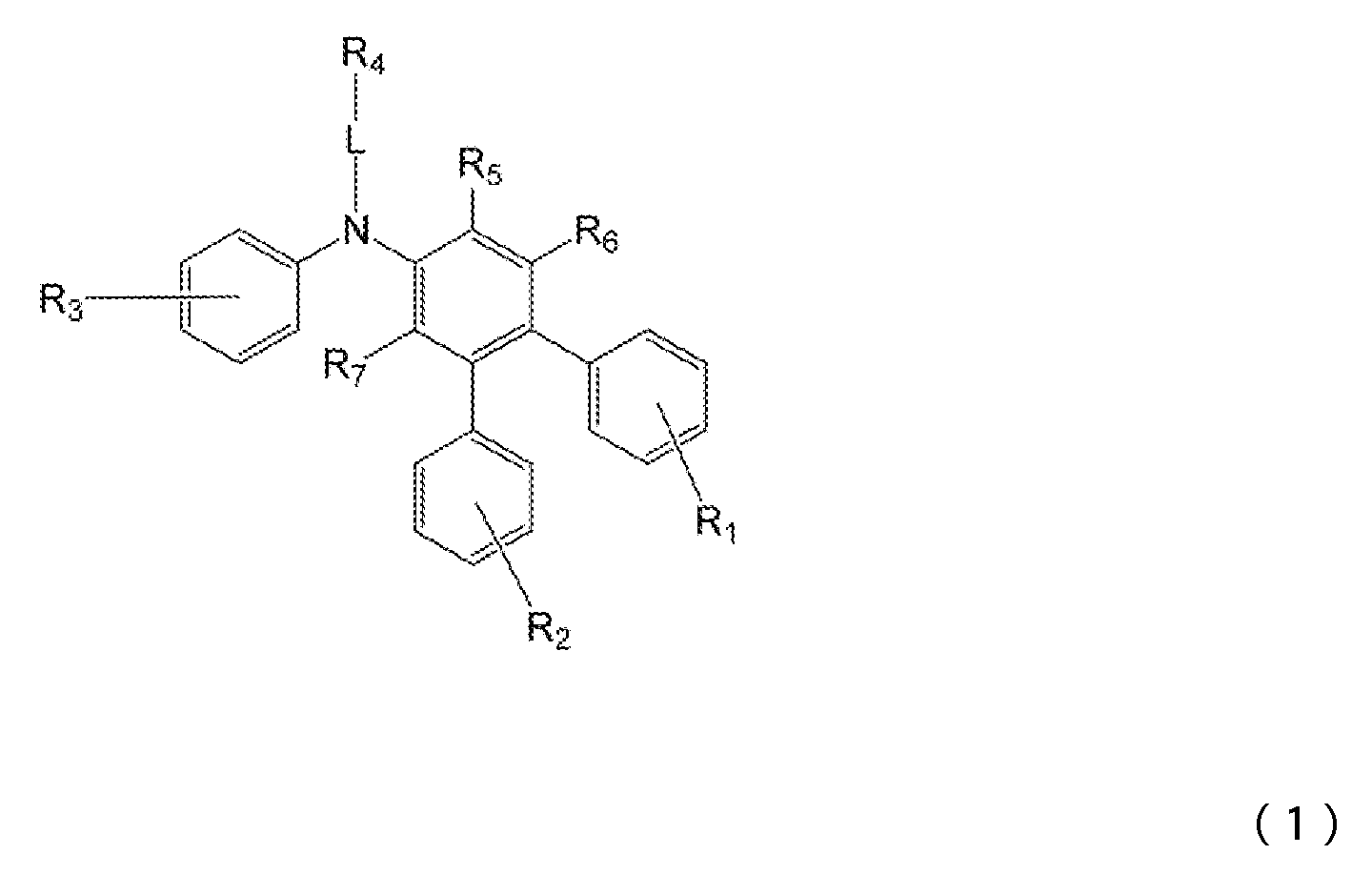
상기 일반식 (1) 중, R1 내지 R4는 서로 동일해도 되고 달라도 되며, 수소 원자, 중수소 원자, 카르보닐기, 시아노기, 치환기를 갖고 있어도 되는 실릴기, 치환기를 갖고 있어도 되는 포스피노기, 치환기를 갖고 있어도 되는 포스핀옥사이드기, 치환기를 갖고 있어도 되는 탄소 원자수 1 내지 6의 직쇄상 혹은 분지상의 알킬기, 치환 혹은 비치환의 환 형성 탄소 원자수 6 내지 25의 방향족 탄화수소기를 나타낸다. L은 치환 혹은 비치환의 환 형성 탄소 원자수 6 내지 20의 방향족 탄화수소의 2가 기, 또는 단결합을 나타낸다. R5 내지 R7은 수소 원자, 중수소 원자, 치환기를 갖고 있어도 되는 탄소 원자수 1 내지 6의 직쇄상 혹은 분지상의 알킬기, 할로겐 원자, 시아노기를 나타낸다.In the above general formula (1), R 1 to R 4 may be the same or different, and are a hydrogen atom, a heavy hydrogen atom, a carbonyl group, a cyano group, a silyl group which may have a substituent, a phosphino group which may have a substituent, a substituent A phosphine oxide group which may have a, a straight-chain or branched alkyl group having 1 to 6 carbon atoms which may have a substituent, and a substituted or unsubstituted aromatic hydrocarbon group having 6 to 25 ring carbon atoms. L represents a divalent group of a substituted or unsubstituted ring-forming aromatic hydrocarbon having 6 to 20 carbon atoms or a single bond. R 5 to R 7 represent a hydrogen atom, a deuterium atom, a linear or branched alkyl group having 1 to 6 carbon atoms which may have substituents, a halogen atom or a cyano group.
2) 상기 식 (1)에 있어서, R1, R2는 서로 동일해도 되고 달라도 되며, 수소 원자, 치환기를 갖고 있어도 되는 실릴기 또는 치환 혹은 비치환의 환 형성 탄소 원자수 6 내지 20의 방향족 탄화수소기이고, R3은 치환기를 갖고 있어도 되는 실릴기 또는 치환 혹은 비치환의 환 형성 탄소 원자수 6 내지 25의 방향족 탄화수소기이고, R4는 수소 원자, 치환기를 갖고 있어도 되는 실릴기 또는 치환 혹은 비치환의 환 형성 탄소 원자수 6 내지 25의 방향족 탄화수소기인 것을 특징으로 하는, 상기 1) 기재의 유기 EL 소자.2) In the above formula (1), R 1 and R 2 may be the same or different, and are a hydrogen atom, a silyl group which may have a substituent, or a substituted or unsubstituted aromatic hydrocarbon group having 6 to 20 ring carbon atoms. R 3 is a silyl group which may have a substituent or a substituted or unsubstituted ring-forming aromatic hydrocarbon group having 6 to 25 carbon atoms, R 4 is a hydrogen atom, a silyl group which may have a substituent, or a substituted or unsubstituted ring The organic EL device according to 1) above, characterized in that it is an aromatic hydrocarbon group having 6 to 25 carbon atoms.
3) 상기 식 (1)에 있어서, R1, R2는 서로 동일해도 되고 달라도 되며, 수소 원자, 비치환의 페닐기, 비치환의 나프틸기, 비치환의 비페닐릴기, 나프틸기로 치환된 페닐기, 비치환의 터페닐릴기 중 어느 것이고, R3은 비치환의 비페닐릴기, 나프틸기로 치환된 페닐기, 2개의 페닐기로 치환된 페닐기, 페닐기로 치환된 나프틸기 중 어느 것이고, R4는 비치환의 페닐기, 비치환의 나프틸기, 페닐기로 치환된 나프틸기 중 어느 것인 것을 특징으로 하는, 상기 1) 또는 2) 기재의 유기 EL 소자.3) In the above formula (1), R 1 and R 2 may be the same or different, and may be a hydrogen atom, an unsubstituted phenyl group, an unsubstituted naphthyl group, an unsubstituted biphenylyl group, a phenyl group substituted with a naphthyl group, or an unsubstituted naphthyl group. Any of terphenylyl groups, R 3 is an unsubstituted biphenylyl group, a phenyl group substituted with a naphthyl group, a phenyl group substituted with two phenyl groups, or a naphthyl group substituted with a phenyl group, R 4 is an unsubstituted phenyl group, an unsubstituted phenyl group, The organic EL device according to 1) or 2) above, characterized in that it is a naphthyl group or a naphthyl group substituted with a phenyl group.
4) 상기 식 (1)에 있어서, R1은 비치환의 페닐기, 비치환의 비페닐릴기, 나프틸기로 치환된 페닐기, 비치환의 터페닐릴기 중 어느 것이고, R2는 수소 원자, 비치환의 페닐기, 비치환의 나프틸기, 비치환의 비페닐릴기, 나프틸기로 치환된 페닐기, 비치환의 터페닐릴기 중 어느 것이고, R3은 비치환의 페닐기이고, R4는 비치환의 페닐기, 비치환의 나프틸기, 페닐기로 치환된 나프틸기 중 어느 것인 것을 특징으로 하는, 상기 1) 내지 3) 중 어느 것에 기재된 유기 EL 소자.4) In the formula (1), R 1 is an unsubstituted phenyl group, an unsubstituted biphenylyl group, a phenyl group substituted with a naphthyl group, or an unsubstituted terphenylyl group, and R 2 is a hydrogen atom, an unsubstituted phenyl group, Any of a cyclic naphthyl group, an unsubstituted biphenylyl group, a phenyl group substituted with a naphthyl group, or an unsubstituted terphenylyl group, R 3 is an unsubstituted phenyl group, and R 4 is an unsubstituted phenyl group, an unsubstituted naphthyl group, or a phenyl group substituted. The organic EL device according to any one of 1) to 3) above, characterized by being a naphthyl group.
5) 상기 식 (1)에 있어서, R1 내지 R4 중 적어도 하나가 트리페닐실릴기, 또는 트리페닐실릴기로 치환된 페닐기 중 어느 것인 것을 특징으로 하는, 상기 1) 또는 2) 기재의 유기 EL 소자.5) In the above formula (1), at least one of R 1 to R 4 is a triphenylsilyl group or a phenyl group substituted with a triphenylsilyl group, the organic described in 1) or 2) above, characterized in that EL element.
6) 상기 식 (1)에 있어서, R5 내지 R7의 전부가 수소 원자인 것을 특징으로 하는, 상기 1) 내지 5) 중 어느 것에 기재된 유기 EL 소자.6) The organic EL device according to any one of 1) to 5) above, wherein in the formula (1), all of R 5 to R 7 are hydrogen atoms.
7) 상기 식 (1)에 있어서, L이 1,4-페닐렌기인 것을 특징으로 하는, 상기 1) 내지 6) 중 어느 것에 기재된 유기 EL 소자.7) The organic EL device according to any one of 1) to 6) above, wherein in the formula (1), L is a 1,4-phenylene group.
8) 상기 청색 발광층이, 청색 발광성 도펀트로서, 분자 중에 피렌 골격을 갖는 피렌 유도체를 함유하는 것을 특징으로 하는, 상기 1) 내지 7) 중 어느 것에 기재된 유기 EL 소자.8) The organic EL device according to any one of 1) to 7), wherein the blue light emitting layer contains a pyrene derivative having a pyrene skeleton in a molecule as a blue light emitting dopant.
9) 상기 청색 발광층이, 청색 발광성 도펀트로서, 하기 일반식 (2) 또는 일반식 (3)으로 표시되는 화합물을 함유하는 것을 특징으로 하는, 상기 1) 내지 7) 중 어느 것에 기재된 유기 EL 소자.9) The organic EL device according to any one of 1) to 7), wherein the blue light emitting layer contains a compound represented by the following general formula (2) or general formula (3) as a blue light emitting dopant.
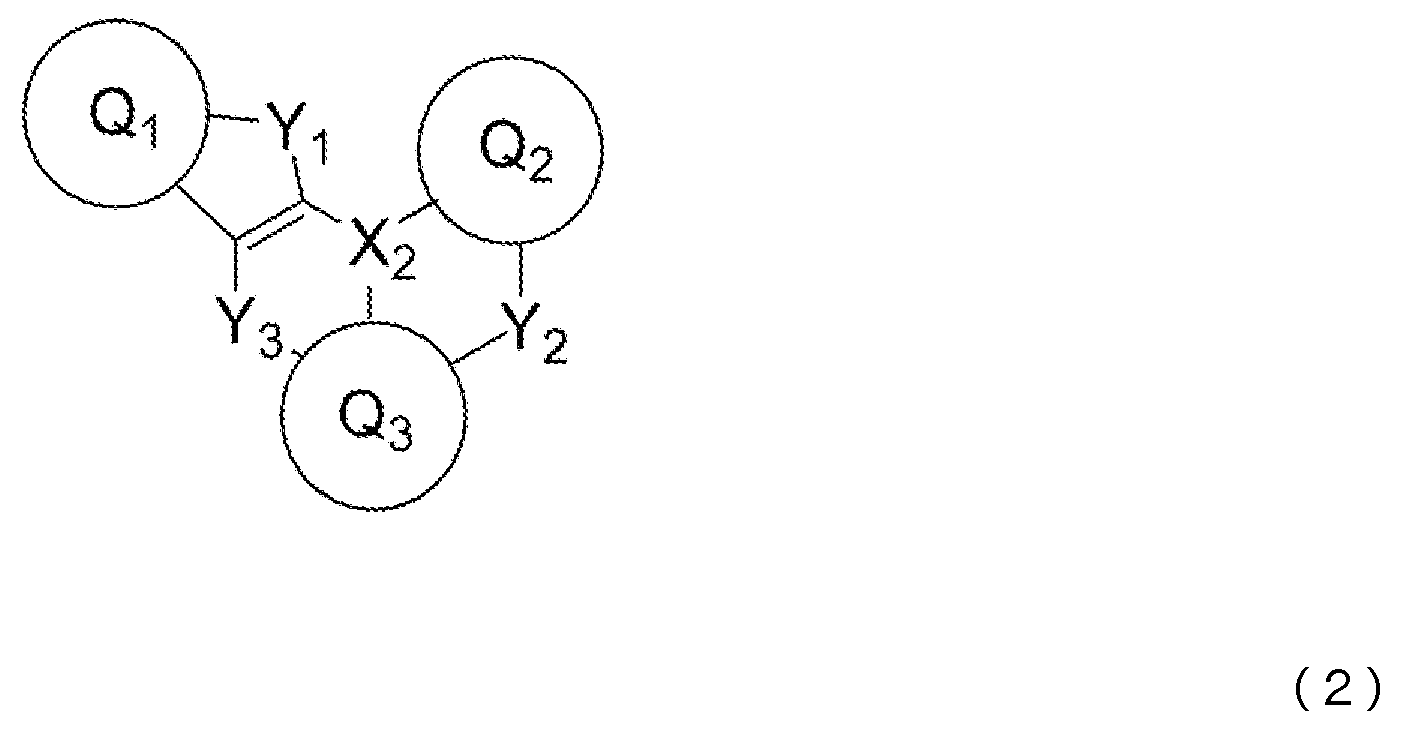
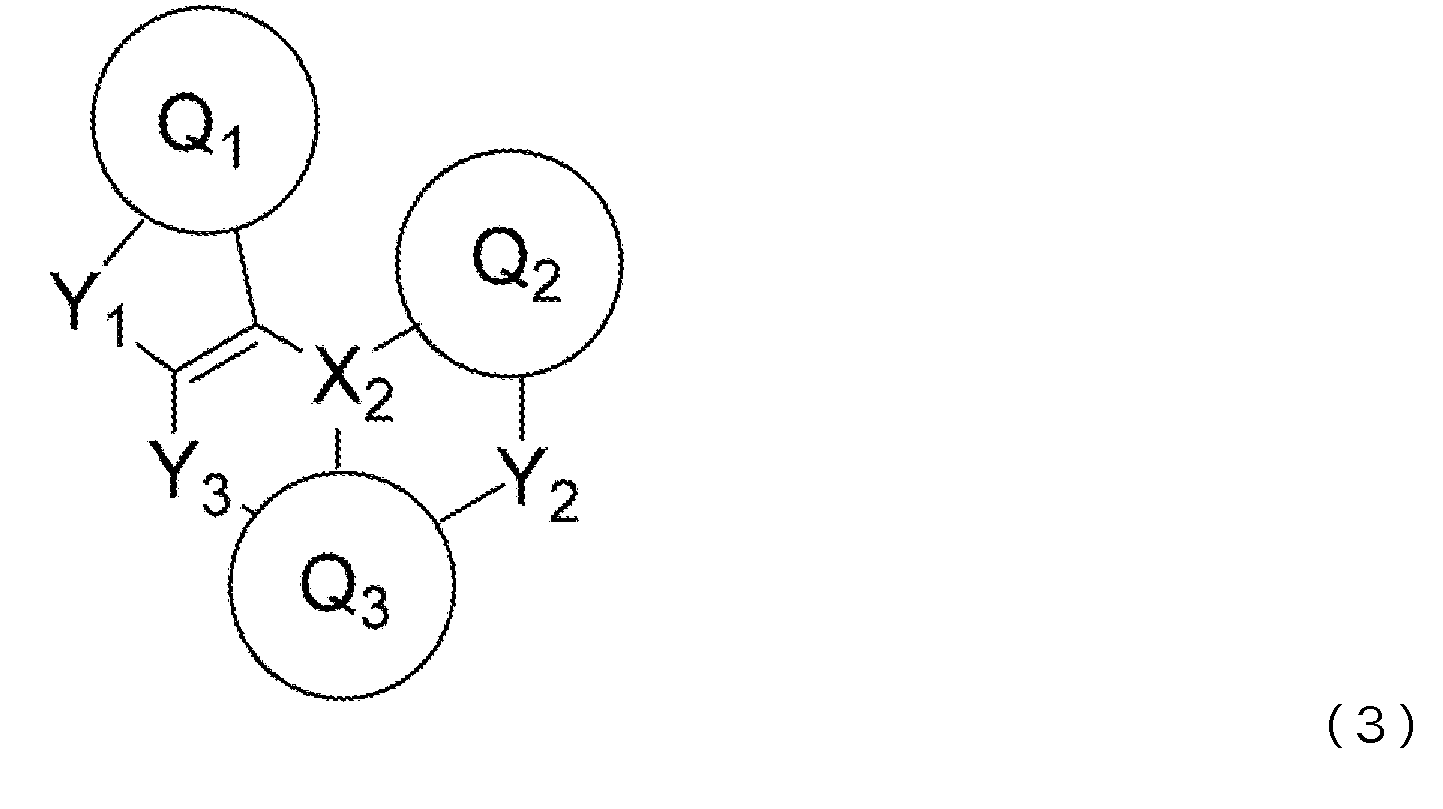
일반식 (2) 및 일반식 (3) 중, Q1 내지 Q3은 서로 동일해도 되고 달라도 되며, 치환 혹은 비치환의 방향족 탄화수소, 또는 치환 혹은 비치환의 방향족 복소환을 나타낸다. X2는 B, P, P=O 또는 P=S를 나타낸다. Y1 내지 Y3은 서로 동일해도 되고 달라도 되며, N-R8, CR9R10, O, S, Se 또는 SiR11R12 중에서 선택되는 어느 하나이고, 그 R8 내지 R12는 서로 동일해도 되고 달라도 되며, 수소 원자, 중수소 원자, 불소 원자, 염소 원자, 시아노기, 니트로기, 치환기를 갖고 있어도 되는 탄소 원자수 1 내지 6의 직쇄상 혹은 분지상의 알킬기, 치환기를 갖고 있어도 되는 탄소 원자수 5 내지 10의 시클로알킬기, 치환기를 갖고 있어도 되는 탄소 원자수 2 내지 6의 직쇄상 혹은 분지상의 알케닐기, 치환기를 갖고 있어도 되는 탄소 원자수 1 내지 6의 직쇄상 혹은 분지상의 알킬옥시기, 치환기를 갖고 있어도 되는 탄소 원자수 5 내지 10의 시클로알킬옥시기, 치환 혹은 비치환의 방향족 탄화수소기, 치환 혹은 비치환의 방향족 복소환기, 또는 치환 혹은 비치환의 아릴옥시기를 나타낸다. 또한, R9와 R10, R11과 R12는 각각의 기끼리 단결합, 치환 혹은 비치환의 메틸렌기, 산소 원자 또는 황 원자, 1치환 아미노기를 통하여 서로 결합하여 환을 형성해도 된다. 단, Y1 내지 Y3이 N-R8, CR9R10 또는 SiR11R12인 경우, R8 내지 R12는 각각 인접하는 Q1 내지 Q3과, 단결합, 치환 혹은 비치환의 메틸렌기, 산소 원자, 황 원자, 1치환 아미노기 등의 연결기를 통하여 서로 결합하여 환을 형성해도 된다.In general formulas (2) and (3), Q 1 to Q 3 may be the same as or different from each other, and represent a substituted or unsubstituted aromatic hydrocarbon or a substituted or unsubstituted aromatic heterocycle. X 2 represents B, P, P=0 or P=S. Y 1 to Y 3 may be the same as or different from each other, and may be any one selected from NR 8 , CR 9 R 10 , O, S, Se, or SiR 11 R 12 , and R 8 to R 12 may be the same or different from each other. and a hydrogen atom, a deuterium atom, a fluorine atom, a chlorine atom, a cyano group, a nitro group, a linear or branched alkyl group having 1 to 6 carbon atoms which may have a substituent, and a carbon atom number 5 to 5 which may have a substituent A cycloalkyl group of 10, a straight-chain or branched alkenyl group of 2 to 6 carbon atoms which may have a substituent, a straight-chain or branched alkyloxy group of 1 to 6 carbon atoms which may have a substituent, a substituent A cycloalkyloxy group having 5 to 10 carbon atoms, a substituted or unsubstituted aromatic hydrocarbon group, a substituted or unsubstituted aromatic heterocyclic group, or a substituted or unsubstituted aryloxy group, which may be present. Further, R 9 and R 10 , R 11 and R 12 may be bonded to each other through a single bond, a substituted or unsubstituted methylene group, an oxygen atom or a sulfur atom, or a monosubstituted amino group to form a ring. However, when Y 1 to Y 3 are NR 8 , CR 9 R 10 or SiR 11 R 12 , R 8 to R 12 are each adjacent to Q 1 to Q 3 and a single bond, a substituted or unsubstituted methylene group, oxygen They may be bonded to each other through a linking group such as an atom, a sulfur atom, or a monosubstituted amino group to form a ring.
10) 상기 청색 발광층이, 분자 중에 안트라센 골격을 갖는 안트라센 유도체를 함유하는 것을 특징으로 하는, 상기 1) 내지 9) 중 어느 것에 기재된 유기 EL 소자.10) The organic EL device according to any one of 1) to 9), wherein the blue light emitting layer contains an anthracene derivative having an anthracene skeleton in a molecule.
일반식 (1) 중의 R1 내지 R7로 표시되는 「치환기를 갖고 있어도 되는 탄소 원자수 1 내지 6의 직쇄상 혹은 분지상의 알킬기」에 있어서의 「탄소 원자수 1 내지 6의 직쇄상 혹은 분지상의 알킬기」로서는, 구체적으로 메틸기, 에틸기, n-프로필기, 이소프로필기, n-부틸기, 이소부틸기, tert-부틸기, n-펜틸기, 이소펜틸기, 네오펜틸기, n-헥실기 등을 들 수 있다."C1 -C6 straight-chain or branched alkyl group" in the "C1-C6 straight-chain or branched alkyl group which may have a substituent" represented by R1-R7 in Formula ( 1 ) As for the above-ground alkyl group, specifically, a methyl group, ethyl group, n-propyl group, isopropyl group, n-butyl group, isobutyl group, tert-butyl group, n-pentyl group, isopentyl group, neopentyl group, n- A hexyl group etc. are mentioned.
일반식 (1) 중의 R1 내지 R4로 표시되는 「치환 혹은 비치환의 환 형성 탄소 원자수 6 내지 25의 방향족 탄화수소기」에 있어서의 「탄소 원자수 6 내지 25의 방향족 탄화수소기」로서는, 구체적으로 페닐기, 비페닐릴기, 터페닐릴기, 나프틸기, 안트라세닐기, 페난트레닐기, 플루오레닐기, 인데닐기, 피레닐기, 페릴레닐기, 플루오란테닐기, 트리페닐레닐기 등을 들 수 있다.Specific examples of the "aromatic hydrocarbon group having 6 to 25 carbon atoms" in the "substituted or unsubstituted aromatic hydrocarbon group having 6 to 25 carbon atoms" represented by R 1 to R 4 in the general formula (1) Examples include a phenyl group, a biphenylyl group, a terphenylyl group, a naphthyl group, anthracenyl group, a phenanthrenyl group, a fluorenyl group, an indenyl group, a pyrenyl group, a perylenyl group, a fluoranthenyl group, a triphenylenyl group, and the like. .
상기 예시한 기 중에서, 환 형성 탄소 원자수가 6 내지 20인 방향족 탄화수소기는, 「환 형성 탄소 원자수 6 내지 20의 방향족 탄화수소기」로서 정의되는 기로서 예시할 수 있다.Among the groups exemplified above, an aromatic hydrocarbon group having 6 to 20 ring carbon atoms can be exemplified as a group defined as "an aromatic hydrocarbon group having 6 to 20 ring carbon atoms".
일반식 (1) 중의 R1 내지 R7로 표시되는 「치환기를 갖는 탄소수 1 내지 6의 직쇄상 혹은 분지상의 알킬기」에 있어서의 「치환기」로서는, 구체적으로 중수소 원자, 시아노기, 니트로기; 불소 원자, 염소 원자, 브롬 원자, 요오드 원자 등의 할로겐 원자; 메틸옥시기, 에틸옥시기, 프로필옥시기 등의 탄소 원자수 1 내지 6의 직쇄상 혹은 분지상의 알킬옥시기; 비닐기, 알릴기 등의 알케닐기; 페닐옥시기, 톨릴옥시기 등의 아릴옥시기; 벤질옥시기, 페네틸옥시기 등의 아릴알킬옥시기; 페닐기, 비페닐릴기, 터페닐릴기, 나프틸기, 안트라세닐기, 페난트레닐기, 플루오레닐기, 인데닐기, 피레닐기, 페릴레닐기, 플루오란테닐기, 트리페닐레닐기 등의 방향족 탄화수소기; 피리딜기, 피리미디닐기, 트리아지닐기, 티에닐기, 푸릴기, 피롤릴기, 퀴놀릴기, 이소퀴놀릴기, 벤조푸라닐기, 벤조티에닐기, 인돌릴기, 카르바졸릴기, 벤조옥사졸릴기, 벤조티아졸릴기, 퀴녹살리닐기, 벤조이미다졸릴기, 피라졸릴기, 디벤조푸라닐기, 디벤조티에닐기, 카르볼리닐기 등의 방향족 복소환기; 디페닐아미노기, 디나프틸아미노기 등의 방향족 탄화수소기로 치환된 디 치환 아미노기; 디피리딜아미노기, 디티에닐아미노기 등의 방향족 복소환기로 치환된 디 치환 아미노기; 방향족 탄화수소기, 또는 방향족 복소환기에서 선택되는 치환기로 치환된 디 치환 아미노기와 같은 기를 들 수 있으며, 이들 치환기는 추가로, 상기 예시한 치환기가 치환되어 있어도 된다.Specific examples of the "substituent" in the "straight-chain or branched alkyl group having 1 to 6 carbon atoms" represented by R 1 to R 7 in Formula (1) include a deuterium atom, a cyano group, and a nitro group; Halogen atoms, such as a fluorine atom, a chlorine atom, a bromine atom, and an iodine atom; C1-C6 linear or branched alkyloxy groups, such as a methyloxy group, an ethyloxy group, and a propyloxy group; Alkenyl groups, such as a vinyl group and an allyl group; Aryloxy groups, such as a phenyloxy group and a tolyloxy group; Arylalkyloxy groups, such as a benzyloxy group and a phenethyloxy group; aromatic hydrocarbon groups such as a phenyl group, a biphenylyl group, a terphenylyl group, a naphthyl group, anthracenyl group, a phenanthrenyl group, a fluorenyl group, an indenyl group, a pyrenyl group, a perylenyl group, a fluoranthenyl group, and a triphenylenyl group; A pyridyl group, a pyrimidinyl group, a triazinyl group, a thienyl group, a furyl group, a pyrrolyl group, a quinolyl group, an isoquinolyl group, a benzofuranyl group, a benzothienyl group, an indolyl group, a carbazolyl group, a benzoxazolyl group, Aromatic heterocyclic groups, such as a benzothiazolyl group, a quinoxalinyl group, a benzoimidazolyl group, a pyrazolyl group, a dibenzofuranyl group, a dibenzothienyl group, and a carbolinyl group; disubstituted amino groups substituted with aromatic hydrocarbon groups such as diphenylamino group and dinaphthylamino group; disubstituted amino groups substituted with aromatic heterocyclic groups such as dipyridylamino group and dithienylamino group; groups such as disubstituted amino groups substituted with substituents selected from aromatic hydrocarbon groups and aromatic heterocyclic groups; these substituents may further be substituted with the substituents exemplified above.
일반식 (1) 중의 R1 내지 R4로 표시되는 「치환기를 갖는 실릴기」, 「치환기를 갖는 포스피노기」, 「치환기를 갖는 포스핀옥사이드기」, 또는 「치환기를 갖는 환 형성 탄소 원자수 6 내지 25의 방향족 탄화수소기」에 있어서의 「치환기」로서는, 구체적으로 중수소 원자, 시아노기, 니트로기; 불소 원자, 염소 원자, 브롬 원자, 요오드 원자 등의 할로겐 원자; 메틸기, 에틸기, n-프로필기, 이소프로필기, n-부틸기, 이소부틸기, tert-부틸기, n-펜틸기, 이소펜틸기, 네오펜틸기, n-헥실기 등의 탄소 원자수 1 내지 6의 직쇄상 혹은 분지상의 알킬기; 메틸옥시기, 에틸옥시기, 프로필옥시기 등의 탄소 원자수 1 내지 6의 직쇄상 혹은 분지상의 알킬옥시기; 비닐기, 알릴기 등의 알케닐기; 페닐옥시기, 톨릴옥시기 등의 아릴옥시기; 벤질옥시기, 페네틸옥시기 등의 아릴알킬옥시기; 페닐기, 비페닐릴기, 터페닐릴기, 나프틸기, 안트라세닐기, 페난트레닐기, 플루오레닐기, 인데닐기, 피레닐기, 페릴레닐기, 플루오란테닐기, 트리페닐레닐기 등의 방향족 탄화수소기; 피리딜기, 피리미디닐기, 트리아지닐기, 티에닐기, 푸릴기, 피롤릴기, 퀴놀릴기, 이소퀴놀릴기, 벤조푸라닐기, 벤조티에닐기, 인돌릴기, 카르바졸릴기, 벤조옥사졸릴기, 벤조티아졸릴기, 퀴녹살리닐기, 벤조이미다졸릴기, 피라졸릴기, 디벤조푸라닐기, 디벤조티에닐기, 카르볼리닐기 등의 방향족 복소환기; 디페닐아미노기, 디나프틸아미노기 등의 방향족 탄화수소기로 치환된 디 치환 아미노기; 디피리딜아미노기, 디티에닐아미노기 등의 방향족 복소환기로 치환된 디 치환 아미노기; 방향족 탄화수소기, 또는 방향족 복소환기에서 선택되는 치환기로 치환된 디 치환 아미노기와 같은 기를 들 수 있으며, 이들 치환기는 추가로, 상기 예시한 치환기가 치환되어 있어도 된다."A silyl group having a substituent", "a phosphino group having a substituent", "a phosphine oxide group having a substituent", or "a ring-forming carbon atom having a substituent" represented by R 1 to R 4 in Formula (1) Examples of the "substituent" in the "aromatic hydrocarbon group having 6 to 25 atoms" include a heavy hydrogen atom, a cyano group, and a nitro group; Halogen atoms, such as a fluorine atom, a chlorine atom, a bromine atom, and an iodine atom; 1 carbon atom such as methyl group, ethyl group, n-propyl group, isopropyl group, n-butyl group, isobutyl group, tert-butyl group, n-pentyl group, isopentyl group, neopentyl group, n-hexyl group to 6 linear or branched alkyl groups; C1-C6 linear or branched alkyloxy groups, such as a methyloxy group, an ethyloxy group, and a propyloxy group; Alkenyl groups, such as a vinyl group and an allyl group; Aryloxy groups, such as a phenyloxy group and a tolyloxy group; Arylalkyloxy groups, such as a benzyloxy group and a phenethyloxy group; aromatic hydrocarbon groups such as a phenyl group, a biphenylyl group, a terphenylyl group, a naphthyl group, anthracenyl group, a phenanthrenyl group, a fluorenyl group, an indenyl group, a pyrenyl group, a perylenyl group, a fluoranthenyl group, and a triphenylenyl group; A pyridyl group, a pyrimidinyl group, a triazinyl group, a thienyl group, a furyl group, a pyrrolyl group, a quinolyl group, an isoquinolyl group, a benzofuranyl group, a benzothienyl group, an indolyl group, a carbazolyl group, a benzoxazolyl group, Aromatic heterocyclic groups, such as a benzothiazolyl group, a quinoxalinyl group, a benzoimidazolyl group, a pyrazolyl group, a dibenzofuranyl group, a dibenzothienyl group, and a carbolinyl group; disubstituted amino groups substituted with aromatic hydrocarbon groups such as diphenylamino group and dinaphthylamino group; disubstituted amino groups substituted with aromatic heterocyclic groups such as dipyridylamino group and dithienylamino group; groups such as disubstituted amino groups substituted with substituents selected from aromatic hydrocarbon groups and aromatic heterocyclic groups; these substituents may further be substituted with the substituents exemplified above.
일반식 (1) 중의 L로 표시되는 「치환 혹은 비치환의 환 형성 탄소 원자수 6 내지 20의 방향족 탄화수소의 2가 기」에 있어서의 「치환 혹은 비치환의 환 형성 탄소 원자수 6 내지 20의 방향족 탄화수소」의 「환 형성 탄소 원자수 6 내지 20의 방향족 탄화수소」로서는, 구체적으로 벤젠, 비페닐, 터페닐, 나프탈렌, 안트라센, 아세나프탈렌, 플루오렌, 페난트렌, 인단, 피렌, 트리페닐렌 등을 들 수 있다."Substituted or unsubstituted aromatic hydrocarbon having 6 to 20 ring carbon atoms" in "divalent group of substituted or unsubstituted aromatic hydrocarbon having 6 to 20 ring carbon atoms" represented by L in formula (1) As "aromatic hydrocarbons having 6 to 20 ring carbon atoms", specifically, benzene, biphenyl, terphenyl, naphthalene, anthracene, acenaphthalene, fluorene, phenanthrene, indane, pyrene, triphenylene, etc. are mentioned. can
그리고, 일반식 (1) 중의 L로 표시되는 「치환 혹은 비치환의 환 형성 탄소 원자수 6 내지 20의 방향족 탄화수소의 2가 기」에 있어서의 「환 형성 탄소 원자수 6 내지 20의 방향족 탄화수소의 2가 기」는, 상기 「환 형성 탄소 원자수 6 내지 20의 방향족 탄화수소」로부터 수소 원자를 2개 제거하여 생기는 2가 기를 나타낸다.Then, in the "substituted or unsubstituted divalent group of an aromatic hydrocarbon having 6 to 20 ring carbon atoms" represented by L in Formula (1), "2 of an aromatic hydrocarbon having 6 to 20 ring carbon atoms" The "valent group" represents a divalent group formed by removing two hydrogen atoms from the "aromatic hydrocarbon having 6 to 20 ring carbon atoms".
일반식 (1) 중의 L로 표시되는 「치환기를 갖는 환 형성 탄소 원자수 6 내지 20의 방향족 탄화수소의 2가 기」에 있어서의 「치환기」로서는, 구체적으로 중수소 원자, 시아노기, 니트로기; 불소 원자, 염소 원자, 브롬 원자, 요오드 원자 등의 할로겐 원자; 메틸기, 에틸기, n-프로필기, 이소프로필기, n-부틸기, 이소부틸기, tert-부틸기, n-펜틸기, 이소펜틸기, 네오펜틸기, n-헥실기 등의 탄소 원자수 1 내지 6의 직쇄상 혹은 분지상의 알킬기; 메틸옥시기, 에틸옥시기, 프로필옥시기 등의 탄소 원자수 1 내지 6의 직쇄상 혹은 분지상의 알킬옥시기; 비닐기, 알릴기 등의 알케닐기; 페닐옥시기, 톨릴옥시기 등의 아릴옥시기; 벤질옥시기, 페네틸옥시기 등의 아릴알킬옥시기; 페닐기, 비페닐릴기, 터페닐릴기, 나프틸기, 안트라세닐기, 페난트레닐기, 플루오레닐기, 인데닐기, 피레닐기, 페릴레닐기, 플루오란테닐기, 트리페닐레닐기 등의 방향족 탄화수소기; 피리딜기, 피리미디닐기, 트리아지닐기, 티에닐기, 푸릴기, 피롤릴기, 퀴놀릴기, 이소퀴놀릴기, 벤조푸라닐기, 벤조티에닐기, 인돌릴기, 카르바졸릴기, 벤조옥사졸릴기, 벤조티아졸릴기, 퀴녹살리닐기, 벤조이미다졸릴기, 피라졸릴기, 디벤조푸라닐기, 디벤조티에닐기, 카르볼리닐기 등의 방향족 복소환기; 디페닐아미노기, 디나프틸아미노기 등의 방향족 탄화수소기로 치환된 디 치환 아미노기; 디피리딜아미노기, 디티에닐아미노기 등의 방향족 복소환기로 치환된 디 치환 아미노기; 방향족 탄화수소기, 또는 방향족 복소환기에서 선택되는 치환기로 치환된 디 치환 아미노기와 같은 기를 들 수 있으며, 이들 치환기는 추가로, 상기 예시한 치환기가 치환되어 있어도 된다.Specific examples of the "substituent" in the "divalent group of an aromatic hydrocarbon having 6 to 20 ring carbon atoms having a substituent" represented by L in the general formula (1) include a deuterium atom, a cyano group, and a nitro group; Halogen atoms, such as a fluorine atom, a chlorine atom, a bromine atom, and an iodine atom; 1 carbon atom such as methyl group, ethyl group, n-propyl group, isopropyl group, n-butyl group, isobutyl group, tert-butyl group, n-pentyl group, isopentyl group, neopentyl group, n-hexyl group to 6 linear or branched alkyl groups; C1-C6 linear or branched alkyloxy groups, such as a methyloxy group, an ethyloxy group, and a propyloxy group; Alkenyl groups, such as a vinyl group and an allyl group; Aryloxy groups, such as a phenyloxy group and a tolyloxy group; Arylalkyloxy groups, such as a benzyloxy group and a phenethyloxy group; aromatic hydrocarbon groups such as a phenyl group, a biphenylyl group, a terphenylyl group, a naphthyl group, anthracenyl group, a phenanthrenyl group, a fluorenyl group, an indenyl group, a pyrenyl group, a perylenyl group, a fluoranthenyl group, and a triphenylenyl group; A pyridyl group, a pyrimidinyl group, a triazinyl group, a thienyl group, a furyl group, a pyrrolyl group, a quinolyl group, an isoquinolyl group, a benzofuranyl group, a benzothienyl group, an indolyl group, a carbazolyl group, a benzoxazolyl group, Aromatic heterocyclic groups, such as a benzothiazolyl group, a quinoxalinyl group, a benzoimidazolyl group, a pyrazolyl group, a dibenzofuranyl group, a dibenzothienyl group, and a carbolinyl group; disubstituted amino groups substituted with aromatic hydrocarbon groups such as diphenylamino group and dinaphthylamino group; disubstituted amino groups substituted with aromatic heterocyclic groups such as dipyridylamino group and dithienylamino group; groups such as disubstituted amino groups substituted with substituents selected from aromatic hydrocarbon groups and aromatic heterocyclic groups; these substituents may further be substituted with the substituents exemplified above.
상기 일반식 (1)에 있어서, R1로서는 「수소 원자」, 「치환기를 갖고 있어도 되는 실릴기」 또는 「치환 혹은 비치환의 환 형성 탄소 원자수 6 내지 20의 방향족 탄화수소기」가 바람직하고, 「수소 원자」, 「치환 혹은 비치환의 페닐기」, 「비치환의 나프틸기」, 「비치환의 비페닐릴기」, 「비치환의 터페닐릴기」, 「트리페닐실릴기」가 보다 바람직하고, 「수소 원자」, 「비치환의 페닐기」, 「비치환의 나프틸기」, 「비치환의 비페닐릴기」가 더욱 바람직하다.In the above general formula (1), as R 1 , a "hydrogen atom", "a silyl group which may have a substituent", or "a substituted or unsubstituted aromatic hydrocarbon group having 6 to 20 ring carbon atoms" is preferable, and ""Hydrogenatom","substituted or unsubstituted phenyl group", "unsubstituted naphthyl group", "unsubstituted biphenylyl group", "unsubstituted terphenylyl group", "triphenylsilyl group" are more preferable, and "hydrogen atom" , "unsubstituted phenyl group", "unsubstituted naphthyl group", and "unsubstituted biphenylyl group" are more preferable.
여기서, 「치환기를 갖는 페닐기」의 「치환기」로서는, 「페닐기」, 「비페닐기」, 「나프틸기」, 「트리페닐실릴기」가 바람직하다.Here, as a "substituent" of the "phenyl group having a substituent", a "phenyl group", a "biphenyl group", a "naphthyl group", and a "triphenylsilyl group" are preferable.
구체적으로, R1로서는 「수소 원자」, 「비치환의 페닐기」, 「비치환의 나프틸기」, 「비치환의 비페닐릴기」, 「비치환의 터페닐릴기」, 「나프틸기로 치환된 페닐기」, 「트리페닐실릴기」, 「트리페닐실릴기로 치환된 페닐기」가 보다 바람직하고, 「수소 원자」, 「비치환의 페닐기」, 「비치환의 나프틸기」, 「비치환의 비페닐릴기」가 더욱 바람직하다.Specifically, as R 1 , “a hydrogen atom”, “an unsubstituted phenyl group”, “an unsubstituted naphthyl group”, “an unsubstituted biphenylyl group”, “an unsubstituted terphenylyl group”, “a phenyl group substituted with a naphthyl group”, “ A "triphenylsilyl group" and a "phenyl group substituted with a triphenylsilyl group" are more preferable, and a "hydrogen atom", an "unsubstituted phenyl group", a "unsubstituted naphthyl group", and a "unsubstituted biphenylyl group" are still more preferable.
상기 일반식 (1)에 있어서, R2로서는 「수소 원자」, 「치환기를 갖고 있어도 되는 실릴기」 또는 「치환 혹은 비치환의 환 형성 탄소 원자수 6 내지 20의 방향족 탄화수소기」가 바람직하고, 「수소 원자」, 「치환 혹은 비치환의 페닐기」, 「비치환의 나프틸기」, 「비치환의 비페닐릴기」, 「비치환의 터페닐릴기」, 「트리페닐실릴기」가 보다 바람직하고, 「수소 원자」, 「비치환의 페닐기」가 더욱 바람직하다.In the above general formula (1), R 2 is preferably a "hydrogen atom", "a silyl group which may have a substituent" or "a substituted or unsubstituted aromatic hydrocarbon group having 6 to 20 ring carbon atoms", and ""Hydrogenatom","substituted or unsubstituted phenyl group", "unsubstituted naphthyl group", "unsubstituted biphenylyl group", "unsubstituted terphenylyl group", "triphenylsilyl group" are more preferable, and "hydrogen atom" , "unsubstituted phenyl group" is more preferable.
여기서, 「치환기를 갖는 페닐기」의 「치환기」로서는, 「페닐기」, 「비페닐기」, 「나프틸기」, 「트리페닐실릴기」가 바람직하다.Here, as a "substituent" of the "phenyl group having a substituent", a "phenyl group", a "biphenyl group", a "naphthyl group", and a "triphenylsilyl group" are preferable.
구체적으로, R2로서는 「수소 원자」, 「비치환의 페닐기」, 「비치환의 나프틸기」, 「비치환의 비페닐릴기」, 「비치환의 터페닐릴기」, 「나프틸기로 치환된 페닐기」, 「트리페닐실릴기」, 「트리페닐실릴기로 치환된 페닐기」가 보다 바람직하고, 「수소 원자」, 「비치환의 페닐기」가 더욱 바람직하다.Specifically, as R 2 , “a hydrogen atom”, “an unsubstituted phenyl group”, “an unsubstituted naphthyl group”, “an unsubstituted biphenylyl group”, “an unsubstituted terphenylyl group”, “a phenyl group substituted with a naphthyl group”, “ A "triphenylsilyl group" and a "phenyl group substituted with a triphenylsilyl group" are more preferable, and a "hydrogen atom" and an "unsubstituted phenyl group" are still more preferable.
상기 일반식 (1)에 있어서, R3으로서는 「치환기를 갖고 있어도 되는 실릴기」 또는 「치환 혹은 비치환의 환 형성 탄소 원자수 6 내지 25의 방향족 탄화수소기」가 바람직하고, 「치환 혹은 비치환의 페닐기」, 「치환 혹은 비치환의 비페닐기」, 「치환 혹은 비치환의 나프틸기」, 「트리페닐실릴기」가 보다 바람직하고, 「치환 혹은 비치환의 페닐기」, 「비치환의 비페닐릴기」, 「치환기를 갖는 나프틸기」가 더욱 바람직하다.In the above general formula (1), as R 3 , “a silyl group which may have a substituent” or “a substituted or unsubstituted aromatic hydrocarbon group having 6 to 25 ring carbon atoms” is preferable, and “a substituted or unsubstituted phenyl group 」, "substituted or unsubstituted biphenyl group", "substituted or unsubstituted naphthyl group", and "triphenylsilyl group" are more preferable, and "substituted or unsubstituted phenyl group", "unsubstituted biphenylyl group", "substituent naphthyl group having” is more preferable.
여기서, 「치환기를 갖는 페닐기」, 「치환기를 갖는 비페닐기」, 「치환기를 갖는 나프틸기」의 「치환기」로서는, 「페닐기」, 「나프틸기」, 「트리페닐실릴기」가 바람직하고, 「페닐기」, 「나프틸기」가 보다 바람직하다. 또한, 「페닐기」를 복수개(예를 들어, 2개) 갖는 것도 바람직하다.Here, as the "substituent" of the "phenyl group having a substituent", "biphenyl group having a substituent", and "naphthyl group having a substituent", a "phenyl group", a "naphthyl group", and a "triphenylsilyl group" are preferable, and " A phenyl group" and a "naphthyl group" are more preferable. It is also preferable to have a plurality of "phenyl groups" (for example, two).
구체적으로, R3으로서는 「비치환의 페닐기」, 「비치환의 비페닐기」, 「치환기를 갖는 나프틸기」, 「트리페닐실릴기」, 「트리페닐실릴기로 치환된 페닐기」가 보다 바람직하고, 「비치환의 페닐기」, 「비치환의 비페닐릴기」, 「나프틸기로 치환된 페닐기」, 「2개의 페닐기로 치환된 페닐기」, 「페닐기로 치환된 나프틸기」가 더욱 바람직하다.Specifically, as R 3 , "an unsubstituted phenyl group", "an unsubstituted biphenyl group", "a naphthyl group having a substituent", "a triphenylsilyl group", and "a phenyl group substituted with a triphenylsilyl group" are more preferable. A ring phenyl group", "unsubstituted biphenylyl group", "a phenyl group substituted with a naphthyl group", "a phenyl group substituted with two phenyl groups", and a "naphthyl group substituted with a phenyl group" are more preferable.
상기 일반식 (1)에 있어서, R4로서는 「수소 원자」 또는 「치환기를 갖고 있어도 되는 실릴기」 또는 「치환 혹은 비치환의 환 형성 탄소 원자수 6 내지 25의 방향족 탄화수소기」가 바람직하고, 「비치환의 페닐기」, 「치환 혹은 비치환의 나프틸기」, 「트리페닐실릴기」가 보다 바람직하고, 「치환 혹은 비치환의 나프틸기」가 더욱 바람직하다.In the above general formula (1), as R 4 , a "hydrogen atom" or "a silyl group which may have a substituent" or "a substituted or unsubstituted aromatic hydrocarbon group having 6 to 25 ring carbon atoms" is preferable, and " An unsubstituted phenyl group", a "substituted or unsubstituted naphthyl group", and a "triphenylsilyl group" are more preferable, and a "substituted or unsubstituted naphthyl group" is still more preferable.
여기서, 「치환기를 갖는 나프틸기」의 「치환기」로서는, 「페닐기」, 「트리페닐실릴기」가 바람직하고, 「페닐기」가 보다 바람직하다.Here, as the "substituent" of the "naphthyl group having a substituent", a "phenyl group" and a "triphenylsilyl group" are preferable, and a "phenyl group" is more preferable.
구체적으로, R4로서는 「비치환의 페닐기」, 「비치환의 나프틸기」, 「페닐기로 치환된 나프틸기」, 「트리페닐실릴기」, 「트리페닐실릴기로 치환된 페닐기」가 보다 바람직하고, 「비치환의 나프틸기」, 「페닐기로 치환된 나프틸기」가 더욱 바람직하다.Specifically, as R 4 , "unsubstituted phenyl group", "unsubstituted naphthyl group", "phenyl group substituted naphthyl group", "triphenylsilyl group", and "triphenylsilyl group substituted phenyl group" are more preferable, and " An unsubstituted naphthyl group" and "a naphthyl group substituted with a phenyl group" are more preferable.
일반식 (1)에 있어서, R1 내지 R4 중 적어도 하나가 트리페닐실릴기, 또는 트리페닐실릴기로 치환된 페닐기인 것이 바람직하다.In the general formula (1), it is preferable that at least one of R 1 to R 4 is a triphenylsilyl group or a phenyl group substituted with a triphenylsilyl group.
또한, R5 내지 R7은 수소 원자인 것이 바람직하고, R5 내지 R7의 전부가 수소 원자인 것이 보다 바람직하다.Further, it is preferable that R 5 to R 7 are hydrogen atoms, and it is more preferable that all of R 5 to R 7 are hydrogen atoms.
상기 일반식 (1)에 있어서, L로서는 「치환 혹은 비치환의 환 형성 탄소 원자수 6 내지 20의 방향족 탄화수소의 2가 기」가 바람직하고, 벤젠, 비페닐, 또는 나프탈렌으로부터 수소 원자를 2개 제거하여 생기는 2가 기가 보다 바람직하고, 1,4-페닐렌기가 더욱 바람직하다.In the above general formula (1), L is preferably "a substituted or unsubstituted divalent group of an aromatic hydrocarbon having 6 to 20 ring-forming carbon atoms", and two hydrogen atoms are removed from benzene, biphenyl, or naphthalene. A divalent group formed by the above is more preferable, and a 1,4-phenylene group is still more preferable.
일반식 (2) 및 일반식 (3) 중의 Q1 내지 Q3으로 표시되는 「치환 혹은 비치환의 방향족 탄화수소」 또는 「치환 혹은 비치환의 방향족 복소환」에 있어서의 「방향족 탄화수소」 또는 「방향족 복소환」으로서는, 구체적으로 벤젠, 나프탈렌, 안트라센, 플루오렌, 페난트렌, 피리딘, 피리미딘, 트리아진, 피롤, 푸란, 티오펜, 퀴놀린, 이소퀴놀린, 인덴, 벤조푸란, 벤조티오펜, 인돌, 인돌린, 카르바졸, 카르볼린, 벤조옥사졸, 벤조티아졸, 퀴녹살린, 벤즈이미다졸, 피라졸, 디벤조푸란, 디벤조티오펜, 나프티리딘, 페난트롤린, 아크리딘 등을 들 수 있다."Aromatic hydrocarbon" or "aromatic heterocycle" in "substituted or unsubstituted aromatic hydrocarbon" or "substituted or unsubstituted aromatic heterocycle" represented by Q 1 to Q 3 in formulas (2) and (3) Specifically, benzene, naphthalene, anthracene, fluorene, phenanthrene, pyridine, pyrimidine, triazine, pyrrole, furan, thiophene, quinoline, isoquinoline, indene, benzofuran, benzothiophene, indole, indoline , carbazole, carboline, benzoxazole, benzothiazole, quinoxaline, benzimidazole, pyrazole, dibenzofuran, dibenzothiophene, naphthyridine, phenanthroline, acridine and the like.
또한, 이것들은 치환기를 갖고 있어도 되며, 치환기로서, 상기 일반식 (1) 중의 R1 내지 R4로 표시되는 「치환기를 갖는 실릴기」, 「치환기를 갖는 포스피노기」, 「치환기를 갖는 포스핀옥사이드기」, 또는 「치환기를 갖는 환 형성 탄소 원자수 6 내지 25의 방향족 탄화수소기」에 있어서의 「치환기」로서 나타낸 것과 마찬가지의 것을 들 수 있다. 또한, 이들 치환기끼리가 단결합, 치환 혹은 비치환의 메틸렌기, 산소 원자 또는 황 원자를 통하여 서로 결합하여 환을 형성하고 있어도 된다.In addition, these may have a substituent, and as a substituent, "silyl group having a substituent" represented by R 1 to R 4 in the above general formula (1), "phosphino group having a substituent", "phosphino group having a substituent" Pinoxide group" or "substituent-forming aromatic hydrocarbon group having 6 to 25 ring carbon atoms". Further, these substituents may be bonded to each other through a single bond, a substituted or unsubstituted methylene group, an oxygen atom or a sulfur atom to form a ring.
일반식 (2) 및 일반식 (3) 중의 X2는 B, P, P=O 또는 P=S를 나타낸다. B는 붕소 원자, P는 인 원자, P=O는 산소 원자가 이중 결합으로 결합한 인 원자, 또는 P=S는 황 원자가 이중 결합으로 결합한 인 원자로 정의한다.X 2 in the general formulas (2) and (3) represents B, P, P=O or P=S. B is a boron atom, P is a phosphorus atom, P=O is a phosphorus atom in which an oxygen atom is bonded to a double bond, or P=S is a phosphorus atom in which a sulfur atom is bonded to a double bond.
일반식 (2) 및 일반식 (3) 중의 Y1 내지 Y3은 서로 동일해도 되고 달라도 되며, N-R8, CR9R10, O, S, Se 또는 SiR11R12 중에서 선택되는 어느 하나이다. N-R8은 R8을 치환기로서 갖는 질소 원자, CR9R10은 R9 및 R10을 치환기로서 갖는 탄소 원자, O는 산소 원자, S는 황 원자, Se는 셀레늄 원자, 또한 SiR11R12는 R11 및 R12를 치환기로서 갖는 실리콘 원자로 정의한다.Y 1 to Y 3 in formulas (2) and (3) may be the same or different, and are any one selected from NR 8 , CR 9 R 10 , O, S, Se, or SiR 11 R 12 . NR 8 is a nitrogen atom having R 8 as a substituent, CR 9 R 10 is a carbon atom having R 9 and R 10 as substituents, O is an oxygen atom, S is a sulfur atom, Se is a selenium atom, and SiR 11 R 12 is It is defined as a silicon atom having R 11 and R 12 as substituents.
여기서, R8 내지 R12는 각각 인접하는 Q1, Q2 또는 Q3, 즉 Y1이 N-R8, CR9R10 또는 SiR11R12인 경우에는 Q1과, Y2가 N-R8, CR9R10 또는 SiR11R12인 경우에는 Q2 혹은 Q3과, Y3이 N-R8, CR9R10 또는 SiR11R12인 경우에는 Q3과, 각각이 단결합, 치환 혹은 비치환의 메틸렌기, 산소 원자, 황 원자, 1치환 아미노기 등의 연결기를 통하여 서로 결합하여 환을 형성해도 된다.Here, R 8 to R 12 are each adjacent Q 1 , Q 2 or Q 3 , that is, when Y 1 is NR 8 , CR 9 R 10 or SiR 11 R 12 , Q 1 and Y 2 are NR 8 , CR In the case of 9 R 10 or SiR 11 R 12 , Q 2 or Q 3 , and in the case where Y 3 is NR 8 , CR 9 R 10 or SiR 11 R 12 , Q 3 and each are a single bond, substituted or unsubstituted methylene They may be bonded to each other through a linking group such as a group, an oxygen atom, a sulfur atom, or a monosubstituted amino group to form a ring.
또한, R9와 R10, R11과 R12는 각각의 기끼리 단결합, 치환 혹은 비치환의 메틸렌기, 산소 원자 또는 황 원자, 1치환 아미노기를 통하여 서로 결합하여 환을 형성해도 된다.Further, R 9 and R 10 , R 11 and R 12 may be bonded to each other through a single bond, a substituted or unsubstituted methylene group, an oxygen atom or a sulfur atom, or a monosubstituted amino group to form a ring.
또한, R8 내지 R12의 정의는 또한 하기의 기재에서 상세한 설명을 한다.In addition, the definition of R 8 to R 12 is further described in detail in the description below.
일반식 (2) 및 일반식 (3) 중의 Y1 내지 Y3이 N-R8, CR9R10, O, S, Se 또는 SiR11R12인 경우, R8 내지 R12로 표시되는 「치환기를 갖고 있어도 되는 탄소 원자수 1 내지 6의 직쇄상 혹은 분지상의 알킬기」, 「치환기를 갖고 있어도 되는 탄소 원자수 5 내지 10의 시클로알킬기」 또는 「치환기를 갖고 있어도 되는 탄소 원자수 2 내지 6의 직쇄상 혹은 분지상의 알케닐기」에 있어서의 「탄소 원자수 1 내지 6의 직쇄상 혹은 분지상의 알킬기」, 「탄소 원자수 5 내지 10의 시클로알킬기」 또는 「탄소 원자수 2 내지 6의 직쇄상 혹은 분지상의 알케닐기」로서는, 구체적으로 메틸기, 에틸기, n-프로필기, 이소프로필기, n-부틸기, 이소부틸기, tert-부틸기, n-펜틸기, 이소펜틸기, 네오펜틸기, n-헥실기, 시클로펜틸기, 시클로헥실기, 1-아다만틸기, 2-아다만틸기, 비닐기, 알릴기, 이소프로페닐기, 2-부테닐기 등을 들 수 있다.When Y 1 to Y 3 in Formulas (2) and (3) are NR 8 , CR 9 R 10 , O, S, Se or SiR 11 R 12 , the “substituent represented by R 8 to R 12 A straight-chain or branched alkyl group having 1 to 6 carbon atoms which may be present", "a cycloalkyl group having 5 to 10 carbon atoms which may have a substituent", or a "direct chain having 2 to 6 carbon atoms which may have a substituent""C1-C6 straight-chain or branched alkyl group" in "chain or branched alkenyl group", "C5-C10 cycloalkyl group" or "C2-C6 straight-chain alkyl group" or branched alkenyl group”, specifically, methyl, ethyl, n-propyl, isopropyl, n-butyl, isobutyl, tert-butyl, n-pentyl, isopentyl, neopentyl , n-hexyl group, cyclopentyl group, cyclohexyl group, 1-adamantyl group, 2-adamantyl group, vinyl group, allyl group, isopropenyl group, 2-butenyl group and the like.
또한, 이것들은 치환기를 갖고 있어도 되며, 치환기로서, 상기 일반식 (1) 중의 R1 내지 R7로 표시되는 「치환기를 갖는 탄소수 1 내지 6의 직쇄상 혹은 분지상의 알킬기」에 있어서의 「치환기」로서 나타낸 것과 마찬가지의 것을 들 수 있다.In addition, these may have a substituent, and as a substituent, in the "C1-C6 linear or branched alkyl group having a substituent" represented by R 1 to R 7 in the above general formula (1), the "substituent The same things as those shown as "can be cited.
일반식 (2) 및 일반식 (3) 중의 Y1 내지 Y3이 N-R8, CR9R10, O, S, Se 또는 SiR11R12인 경우, R8 내지 R12로 표시되는 「치환기를 갖고 있어도 되는 탄소 원자수 1 내지 6의 직쇄상 혹은 분지상의 알킬옥시기」 또는 「치환기를 갖고 있어도 되는 탄소 원자수 5 내지 10의 시클로알킬옥시기」에 있어서의 「탄소 원자수 1 내지 6의 직쇄상 혹은 분지상의 알킬옥시기」 또는 「탄소 원자수 5 내지 10의 시클로알킬옥시기」로서는, 구체적으로 메틸옥시기, 에틸옥시기, n-프로필옥시기, 이소프로필옥시기, n-부틸옥시기, tert-부틸옥시기, n-펜틸옥시기, n-헥실옥시기, 시클로펜틸옥시기, 시클로헥실옥시기, 시클로헵틸옥시기, 시클로옥틸옥시기, 1-아다만틸옥시기, 2-아다만틸옥시기 등을 들 수 있다.When Y 1 to Y 3 in Formulas (2) and (3) are NR 8 , CR 9 R 10 , O, S, Se or SiR 11 R 12 , the “substituent represented by R 8 to R 12 "C1-C6 linear or branched alkyloxy group which may have 1-6 carbon atoms" or "C5-C10 cycloalkyloxy group which may have a substituent" Examples of the straight-chain or branched alkyloxy group or the "cycloalkyloxy group having 5 to 10 carbon atoms" include methyloxy, ethyloxy, n-propyloxy, isopropyloxy, and n-butyl. Oxy group, tert-butyloxy group, n-pentyloxy group, n-hexyloxy group, cyclopentyloxy group, cyclohexyloxy group, cycloheptyloxy group, cyclooctyloxy group, 1-adamantyloxy group, 2- An adamantyloxy group etc. are mentioned.
또한, 이것들은 치환기를 갖고 있어도 되며, 치환기로서, 상기 일반식 (1) 중의 R1 내지 R7로 표시되는 「치환기를 갖는 탄소수 1 내지 6의 직쇄상 혹은 분지상의 알킬기」에 있어서의 「치환기」로서 나타낸 것과 마찬가지의 것을 들 수 있다.In addition, these may have a substituent, and as a substituent, in the "C1-C6 linear or branched alkyl group having a substituent" represented by R 1 to R 7 in the above general formula (1), the "substituent The same things as those shown as "can be cited.
일반식 (2) 및 일반식 (3) 중의 Y1 내지 Y3이 N-R8, CR9R10, O, S, Se 또는 SiR11R12인 경우, R8 내지 R12로 표시되는 「치환 혹은 비치환의 방향족 탄화수소기」, 「치환 혹은 비치환의 방향족 복소환기」에 있어서의 「방향족 탄화수소기」, 「방향족 복소환기」로서는, 구체적으로 페닐기, 비페닐릴기, 터페닐릴기, 나프틸기, 안트라세닐기, 페난트레닐기, 피리딜기, 피리미디닐기, 트리아지닐기, 푸릴기, 피롤릴기, 티에닐기 등을 들 수 있다.When Y 1 to Y 3 in Formulas (2) and (3) are NR 8 , CR 9 R 10 , O, S, Se or SiR 11 R 12 , R 8 to R 12 represent “substituted or Examples of the "aromatic hydrocarbon group" and "aromatic heterocyclic group" in "unsubstituted aromatic hydrocarbon group" and "substituted or unsubstituted aromatic heterocyclic group" include a phenyl group, a biphenylyl group, a terphenylyl group, a naphthyl group, and anthracenyl group. , phenanthrenyl group, pyridyl group, pyrimidinyl group, triazinyl group, furyl group, pyrrolyl group, thienyl group and the like.
또한, 이들 기는 치환기를 갖고 있어도 되며, 치환기로서, 상기 일반식 (1) 중의 R1 내지 R4로 표시되는 「치환기를 갖는 실릴기」, 「치환기를 갖는 포스피노기」, 「치환기를 갖는 포스핀옥사이드기」, 또는 「치환기를 갖는 환 형성 탄소 원자수 6 내지 25의 방향족 탄화수소기」에 있어서의 「치환기」로서 나타낸 것과 마찬가지의 것을 들 수 있다.In addition, these groups may have a substituent, and as a substituent, "silyl group having a substituent" represented by R 1 to R 4 in the above general formula (1), "phosphino group having a substituent", "phosphino group having a substituent" Pinoxide group" or "substituent-forming aromatic hydrocarbon group having 6 to 25 ring carbon atoms".
일반식 (2) 및 일반식 (3) 중의 Y1 내지 Y3이 N-R8, CR9R10, O, S, Se 또는 SiR11R12인 경우, R8 내지 R12로 표시되는 「치환 혹은 비치환의 아릴옥시기」에 있어서의 「아릴옥시기」로서는, 구체적으로 페닐옥시기, 비페닐릴옥시기, 터페닐릴옥시기, 나프틸옥시기, 안트라세닐옥시기, 페난트레닐옥시기, 플루오레닐옥시기, 인데닐옥시기, 피레닐옥시기, 페릴레닐옥시기 등을 들 수 있다.When Y 1 to Y 3 in Formulas (2) and (3) are NR 8 , CR 9 R 10 , O, S, Se or SiR 11 R 12 , R 8 to R 12 represent “substituted or As the "aryloxy group" in "unsubstituted aryloxy group", specifically, a phenyloxy group, biphenylyloxy group, terphenylyloxy group, naphthyloxy group, anthracenyloxy group, phenanthrenyloxy group, fluorenyloxy group , Indenyloxy group, pyrenyloxy group, perylenyloxy group, etc. are mentioned.
또한, 이들 기는 치환기를 갖고 있어도 되며, 치환기로서, 상기 일반식 (1) 중의 R1 내지 R4로 표시되는 「치환기를 갖는 실릴기」, 「치환기를 갖는 포스피노기」, 「치환기를 갖는 포스핀옥사이드기」, 또는 「치환기를 갖는 환 형성 탄소 원자수 6 내지 25의 방향족 탄화수소기」에 있어서의 「치환기」로서 나타낸 것과 마찬가지의 것을 들 수 있다.In addition, these groups may have a substituent, and as a substituent, "silyl group having a substituent" represented by R 1 to R 4 in the above general formula (1), "phosphino group having a substituent", "phosphino group having a substituent" Pinoxide group" or "substituent-forming aromatic hydrocarbon group having 6 to 25 ring carbon atoms".
상기 일반식 (2) 및 일반식 (3)에 있어서, Q1 내지 Q3의 「치환 혹은 비치환의 방향족 탄화수소」 또는 「치환 혹은 비치환의 방향족 복소환」에 있어서의 「방향족 탄화수소」 또는 「방향족 복소환」으로서는, 벤젠, 나프탈렌, 페난트렌, 피리딘, 피리미딘, 인덴, 벤조푸란, 벤조티오펜, 인돌이 바람직하고, 벤젠, 나프탈렌이 보다 바람직하다.In the general formulas (2) and (3), Q 1 to Q 3 "substituted or unsubstituted aromatic hydrocarbon" or "substituted or unsubstituted aromatic heterocycle" in the "aromatic hydrocarbon" or "aromatic heterocycle" [0045] As "sodium", benzene, naphthalene, phenanthrene, pyridine, pyrimidine, indene, benzofuran, benzothiophene, and indole are preferable, and benzene and naphthalene are more preferable.
상기 일반식 (2) 및 일반식 (3)에 있어서, Y1 내지 Y3이 N-R8, CR9R10 또는 SiR11R12인 경우, R8 내지 R12는, 치환기를 갖고 있어도 되는 탄소 원자수 1 내지 6의 직쇄상 혹은 분지상의 알킬기, 치환기를 갖고 있어도 되는 탄소 원자수 5 내지 10의 시클로알킬기, 치환기를 갖고 있어도 되는 탄소 원자수 2 내지 6의 직쇄상 혹은 분지상의 알케닐기, 치환기를 갖고 있어도 되는 탄소 원자수 1 내지 6의 직쇄상 혹은 분지상의 알킬옥시기, 치환기를 갖고 있어도 되는 탄소 원자수 5 내지 10의 시클로알킬옥시기, 치환 혹은 비치환의 방향족 탄화수소기, 또는 치환 혹은 비치환의 아릴옥시기인 것이 바람직하고, R8은 치환기를 갖고 있어도 되는 탄소 원자수 1 내지 6의 직쇄상 혹은 분지상의 알킬기, 치환기를 갖고 있어도 되는 탄소 원자수 5 내지 10의 시클로알킬기, 치환기를 갖고 있어도 되는 탄소 원자수 2 내지 6의 직쇄상 혹은 분지상의 알케닐기, 또는 치환 혹은 비치환의 방향족 탄화수소기인 것이 보다 바람직하다.In Formulas (2) and (3), when Y 1 to Y 3 are NR 8 , CR 9 R 10 or SiR 11 R 12 , R 8 to R 12 are carbon atoms which may have substituents; A linear or branched alkyl group of 1 to 6 atoms, a cycloalkyl group of 5 to 10 carbon atoms which may have a substituent, a linear or branched alkenyl group of 2 to 6 carbon atoms which may have a substituent, a substituent A linear or branched alkyloxy group having 1 to 6 carbon atoms which may have a cycloalkyloxy group having 5 to 10 carbon atoms which may have a substituent, a substituted or unsubstituted aromatic hydrocarbon group, or a substituted or unsubstituted It is preferably a cyclic aryloxy group, and R 8 is a linear or branched alkyl group having 1 to 6 carbon atoms which may have a substituent, a cycloalkyl group having 5 to 10 carbon atoms which may have a substituent, or a substituent. It is more preferably a linear or branched alkenyl group having 2 to 6 carbon atoms or a substituted or unsubstituted aromatic hydrocarbon group.
상기 일반식 (2) 및 일반식 (3)에 있어서, Y1로서는 N-R8, O, S가 바람직하고, O, S가 보다 바람직하다.In the general formulas (2) and (3), as Y 1 , NR 8 , O, and S are preferable, and O and S are more preferable.
또한, 일반식 (2)에 있어서, Y2와 Y3 중 적어도 한쪽은 N-R8인 것이 바람직하고, Y2 및 Y3이 N-R8인 것이 보다 바람직하다. 여기서, R8로서는, 「치환 혹은 비치환의 방향족 탄화수소기」가 바람직하고, 치환 혹은 비치환의 페닐기, 비페닐릴기, 터페닐릴기, 나프틸기가 보다 바람직하다.Moreover, in general formula (2), it is preferable that at least one of Y2 and Y3 is NR8 , and it is more preferable that Y2 and Y3 are NR8 . Here, as R 8 , a “substituted or unsubstituted aromatic hydrocarbon group” is preferable, and a substituted or unsubstituted phenyl group, biphenylyl group, terphenylyl group, or naphthyl group is more preferable.
본 발명에 따르면, 상기 일반식 (2) 또는 일반식 (3)은, 하기 일반식 (4), 일반식 (5), 일반식 (6) 또는 일반식 (7)에 나타내는 골격 구조를 형성할 수 있다.According to the present invention, the general formula (2) or general formula (3) can form a skeleton structure represented by the following general formula (4), general formula (5), general formula (6) or general formula (7). can
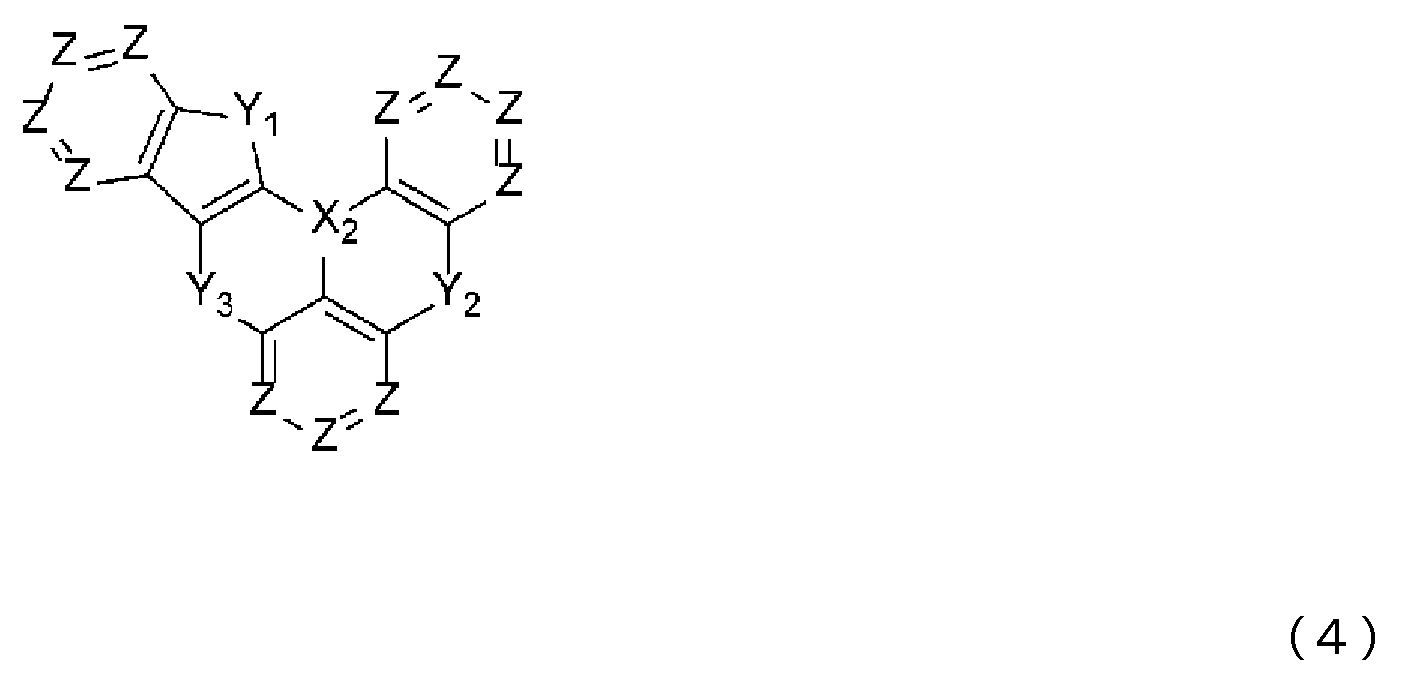

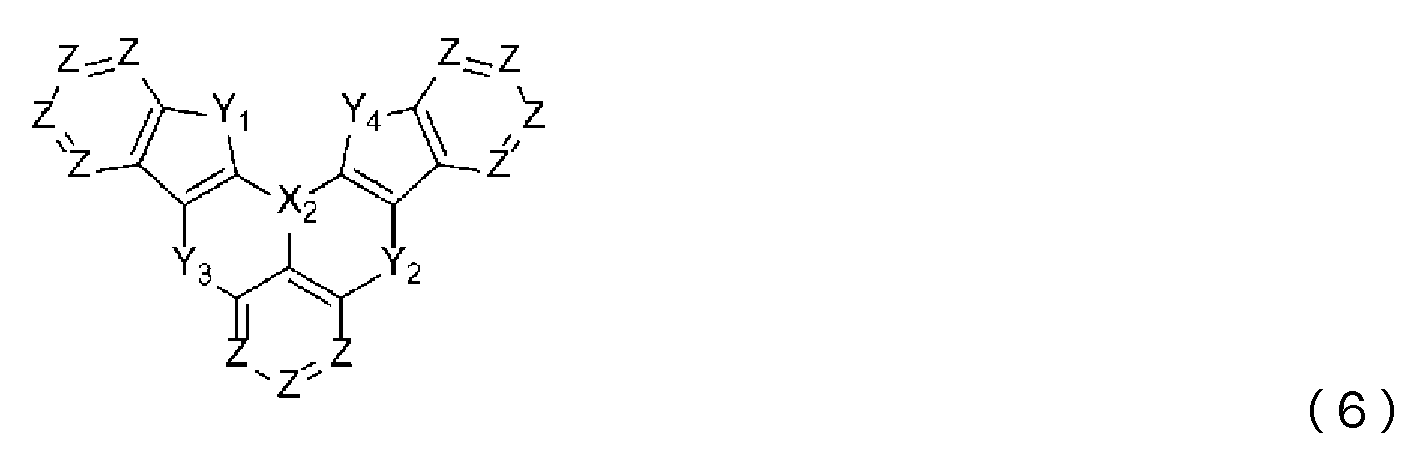
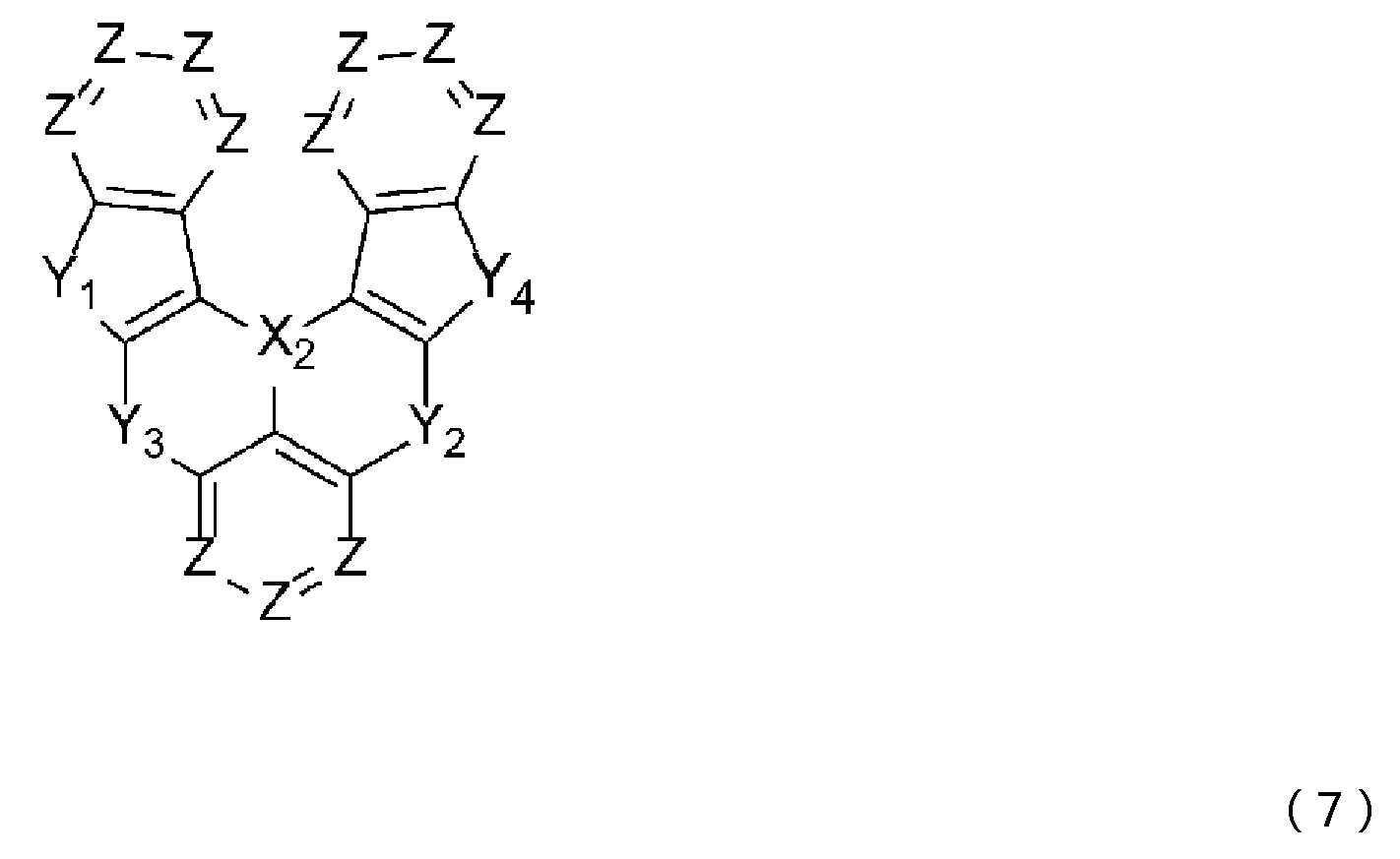
일반식 (4) 내지 일반식 (7) 중, X2, Y1, Y2, Y3은, 상기 일반식 (2) 및 일반식 (3) 중의 정의와 동일하다.In General Formulas (4) to (7), X 2 , Y 1 , Y 2 , and Y 3 have the same definitions as in General Formulas (2) and (3) above.
일반식 (6) 내지 일반식 (7) 중, Y4는 N-R8, CR9R10, O, S, Se 또는 SiR11R12 중에서 선택되는 어느 하나이고, R8 내지 R12는 상기 일반식 (2) 및 일반식 (3) 중의 정의와 동일하다.In Formulas (6) to (7), Y 4 is any one selected from NR 8 , CR 9 R 10 , O, S, Se, or SiR 11 R 12 , and R 8 to R 12 are It is the same as the definition in (2) and general formula (3).
일반식 (4) 내지 일반식 (7) 중, Z는 각각이 서로 동일해도 되고 달라도 되며, CR13 또는 N(질소 원자)이고, 각각의 R13은 서로 동일해도 되고 달라도 되며, 수소 원자, 중수소 원자, 할로겐 원자, 시아노기, 니트로기, 치환기를 갖고 있어도 되는 탄소 원자수 1 내지 6의 직쇄상 혹은 분지상의 알킬기, 치환기를 갖고 있어도 되는 탄소 원자수 5 내지 10의 시클로알킬기, 치환기를 갖고 있어도 되는 탄소 원자수 1 내지 6의 직쇄상 혹은 분지상의 알킬옥시기, 치환기를 갖고 있어도 되는 탄소 원자수 1 내지 6의 직쇄상 혹은 분지상의 알킬티옥시기, 치환기를 갖고 있어도 되는 탄소 원자수 1 내지 6의 직쇄상 혹은 분지상의 알킬아미노기, 치환기를 갖고 있어도 되는 탄소 원자수 3 내지 10의 직쇄상 혹은 분지상의 알킬실릴기, 치환 혹은 비치환의 방향족 탄화수소기, 치환 혹은 비치환의 방향족 복소환기, 치환 혹은 비치환의 아릴옥시기, 치환 혹은 비치환의 아릴티옥시기, 치환 혹은 비치환의 아릴아미노기, 치환 혹은 비치환의 아릴실릴기를 나타낸다. 또한, 각각의 R13은 각각의 기끼리 서로 결합하거나, 인접하는 치환기와 결합하여 지환족, 방향족의 단일환 또는 다환을 형성하거나 할 수 있고, 상기 지환족, 방향족의 단일환 또는 다환의 탄소 원자는 N, S 및 O 중에서 선택된 어느 하나 또는 복수의 복소 원자로 치환될 수 있다.In Formulas (4) to (7), each Z may be the same as or different from each other, CR 13 or N (nitrogen atom), each R 13 may be the same as or different from each other, a hydrogen atom, deuterium atom, halogen atom, cyano group, nitro group, linear or branched alkyl group having 1 to 6 carbon atoms which may have a substituent, cycloalkyl group having 5 to 10 carbon atoms which may have a substituent, even if it has a substituent a straight-chain or branched alkyloxy group having 1 to 6 carbon atoms, or a straight-chain or branched alkylthioxy group having 1 to 6 carbon atoms, which may have a substituent, or 1 to 6 carbon atoms which may have a substituent 6 straight-chain or branched alkylamino group, C3-C10 straight-chain or branched alkylsilyl group which may have a substituent, substituted or unsubstituted aromatic hydrocarbon group, substituted or unsubstituted aromatic heterocyclic group, substituted Or an unsubstituted aryloxy group, a substituted or unsubstituted arylthioxy group, a substituted or unsubstituted arylamino group, or a substituted or unsubstituted arylsilyl group. In addition, each R 13 may be bonded to each other or bonded to an adjacent substituent to form an alicyclic or aromatic monocyclic or polycyclic carbon atom. may be substituted with any one or a plurality of heteroatoms selected from N, S and O.
일반식 (4) 내지 일반식 (7) 중의, R13으로 표시되는 「치환기를 갖고 있어도 되는 탄소 원자수 1 내지 6의 직쇄상 혹은 분지상의 알킬기」 또는 「치환기를 갖고 있어도 되는 탄소 원자수 5 내지 10의 시클로알킬기」에 있어서의 「탄소 원자수 1 내지 6의 직쇄상 혹은 분지상의 알킬기」 또는 「탄소 원자수 5 내지 10의 시클로알킬기」로서는, 구체적으로 메틸기, 에틸기, n-프로필기, 이소프로필기, n-부틸기, 이소부틸기, tert-부틸기, n-펜틸기, 이소펜틸기, 네오펜틸기, n-헥실기, 시클로펜틸기, 시클로헥실기, 1-아다만틸기, 2-아다만틸기 등을 들 수 있다.In general formulas (4) to (7), R 13 represents "straight-chain or branched alkyl group having 1 to 6 carbon atoms which may have a substituent" or "5 carbon atoms which may have a substituent" The "straight-chain or branched alkyl group having 1 to 6 carbon atoms" or the "cycloalkyl group having 5 to 10 carbon atoms" in the "cycloalkyl group having 5 to 10 carbon atoms" includes, specifically, a methyl group, an ethyl group, an n-propyl group, isopropyl group, n-butyl group, isobutyl group, tert-butyl group, n-pentyl group, isopentyl group, neopentyl group, n-hexyl group, cyclopentyl group, cyclohexyl group, 1-adamantyl group, A 2-adamantyl group etc. are mentioned.
또한, 이것들은 치환기를 갖고 있어도 되며, 치환기로서, 상기 일반식 (1) 중의 R1 내지 R7로 표시되는 「치환기를 갖는 탄소수 1 내지 6의 직쇄상 혹은 분지상의 알킬기」에 있어서의 「치환기」로서 나타낸 것과 마찬가지의 것을 들 수 있다.In addition, these may have a substituent, and as a substituent, in the "C1-C6 linear or branched alkyl group having a substituent" represented by R 1 to R 7 in the above general formula (1), the "substituent The same things as those shown as "can be cited.
일반식 (4) 내지 일반식 (7) 중의, R13으로 표시되는 「치환기를 갖고 있어도 되는 탄소 원자수 1 내지 6의 직쇄상 혹은 분지상의 알킬옥시기」에 있어서의 「탄소 원자수 1 내지 6의 직쇄상 혹은 분지상의 알킬옥시기」로서는, 구체적으로 메틸옥시기, 에틸옥시기, n-프로필옥시기, 이소프로필옥시기, n-부틸옥시기, tert-부틸옥시기, n-펜틸옥시기, n-헥실옥시기 등을 들 수 있다."C1-C6 straight-chain or branched alkyloxy group having 1-6 carbon atoms" represented by R 13 in formulas (4) to (7) [0043] Examples of the straight-chain or branched alkyloxy group of 6" include methyloxy, ethyloxy, n-propyloxy, isopropyloxy, n-butyloxy, tert-butyloxy, n-phen A tyloxy group, n-hexyloxy group, etc. are mentioned.
또한, 이것들은 치환기를 갖고 있어도 되며, 치환기로서, 상기 일반식 (1) 중의 R1 내지 R7로 표시되는 「치환기를 갖는 탄소수 1 내지 6의 직쇄상 혹은 분지상의 알킬기」에 있어서의 「치환기」로서 나타낸 것과 마찬가지의 것을 들 수 있다.In addition, these may have a substituent, and as a substituent, in the "C1-C6 linear or branched alkyl group having a substituent" represented by R 1 to R 7 in the above general formula (1), the "substituent The same things as those shown as "can be cited.
일반식 (4) 내지 일반식 (7) 중의, R13으로 표시되는 「치환기를 갖고 있어도 되는 탄소 원자수 1 내지 6의 직쇄상 혹은 분지상의 알킬티옥시기」에 있어서의 「탄소 원자수 1 내지 6의 직쇄상 혹은 분지상의 알킬티옥시기」로서는, 구체적으로 메틸티옥시기, 에틸티옥시기, n-프로필티옥시기, 이소프로필티옥시기, n-부틸티옥시기, 이소부틸티옥시기, tert-부틸티옥시기, n-펜틸티옥시기, 이소펜틸티옥시기, 네오펜틸티옥시기, n-헥실티옥시기 등을 들 수 있다.“C1-C6 straight-chain or branched alkylthioxy group having 1 to 6 carbon atoms” represented by R 13 in the general formulas (4) to (7) Examples of the straight-chain or branched alkylthioxy group of 6" include methylthioxy group, ethylthioxy group, n-propylthioxy group, isopropylthioxy group, n-butylthioxy group, isobutylthioxy group, and tert-butylthioxyl group. Group, n-pentylthioxy group, isopentylthioxy group, neopentylthioxy group, n-hexylthioxy group, etc. are mentioned.
또한, 이것들은 치환기를 갖고 있어도 되며, 치환기로서, 상기 일반식 (1) 중의 R1 내지 R7로 표시되는 「치환기를 갖는 탄소수 1 내지 6의 직쇄상 혹은 분지상의 알킬기」에 있어서의 「치환기」로서 나타낸 것과 마찬가지의 것을 들 수 있다.In addition, these may have a substituent, and as a substituent, in the "C1-C6 linear or branched alkyl group having a substituent" represented by R 1 to R 7 in the above general formula (1), the "substituent The same things as those shown as "can be cited.
일반식 (4) 내지 일반식 (7) 중의, R13으로 표시되는 「치환기를 갖고 있어도 되는 탄소 원자수 1 내지 6의 직쇄상 혹은 분지상의 알킬아미노기」에 있어서의 「탄소 원자수 1 내지 6의 직쇄상 혹은 분지상의 알킬아미노기」로서는, 구체적으로 메틸아민기, 에틸아민기, n-프로필아민기, 이소프로필아민기, n-부틸아민기, 이소부틸아민기, tert-부틸아민기, n-펜틸아민기, 이소펜틸아민기, 네오펜틸아민기, n-헥실아민기 등을 들 수 있다."C1-6 atoms" in "straight-chain or branched alkylamino group having 1-6 carbon atoms which may have a substituent" represented by R13 in Formulas (4) to ( 7 ) As the linear or branched alkylamino group of ", specifically, a methylamine group, an ethylamine group, an n-propylamine group, an isopropylamine group, an n-butylamine group, an isobutylamine group, a tert-butylamine group, n-pentylamine group, isopentylamine group, neopentylamine group, n-hexylamine group, etc. are mentioned.
또한, 이것들은 치환기를 갖고 있어도 되며, 치환기로서, 상기 일반식 (1) 중의 R1 내지 R7로 표시되는 「치환기를 갖는 탄소수 1 내지 6의 직쇄상 혹은 분지상의 알킬기」에 있어서의 「치환기」로서 나타낸 것과 마찬가지의 것을 들 수 있다.In addition, these may have a substituent, and as a substituent, in the "C1-C6 linear or branched alkyl group having a substituent" represented by R 1 to R 7 in the above general formula (1), the "substituent The same things as those shown as "can be cited.
일반식 (4) 내지 일반식 (7) 중의, R13으로 표시되는 「치환기를 갖고 있어도 되는 탄소 원자수 3 내지 10의 직쇄상 혹은 분지상의 알킬실릴기」에 있어서의 「탄소 원자수 3 내지 10의 직쇄상 혹은 분지상의 알킬실릴기」로서는, 구체적으로 트리메틸실릴기, 트리에틸실릴기, 트리-n-프로필실릴기, 트리이소프로필실릴기, n-부틸디메틸실릴기, 이소부틸디메틸실릴기, tert-부틸디메틸실릴기 등을 들 수 있다.“C3-C10 straight-chain or branched alkylsilyl group having 3-10 C atoms” represented by R 13 in Formulas (4) to (7) 10 linear or branched alkylsilyl group", specifically trimethylsilyl group, triethylsilyl group, tri-n-propylsilyl group, triisopropylsilyl group, n-butyldimethylsilyl group, isobutyldimethylsilyl group group, tert-butyldimethylsilyl group, etc. are mentioned.
또한, 이것들은 치환기를 갖고 있어도 되며, 치환기로서, 상기 일반식 (1) 중의 R1 내지 R7로 표시되는 「치환기를 갖는 탄소수 1 내지 6의 직쇄상 혹은 분지상의 알킬기」에 있어서의 「치환기」로서 나타낸 것과 마찬가지의 것을 들 수 있다.In addition, these may have a substituent, and as a substituent, in the "C1-C6 linear or branched alkyl group having a substituent" represented by R 1 to R 7 in the above general formula (1), the "substituent The same things as those shown as "can be cited.
일반식 (4) 내지 일반식 (7) 중의, R13으로 표시되는 「치환 혹은 비치환의 방향족 탄화수소기」 또는 「치환 혹은 비치환의 방향족 복소환기」에 있어서의 「방향족 탄화수소기」 또는 「방향족 복소환기」로서는, 구체적으로 페닐기, 비페닐릴기, 터페닐릴기, 나프틸기, 안트라세닐기, 페난트레닐기, 피리딜기, 피리미디닐기, 트리아지닐기, 푸릴기, 피롤릴기, 티에닐기 등을 들 수 있다."Aromatic hydrocarbon group" or "aromatic heterocyclic group" in "substituted or unsubstituted aromatic hydrocarbon group" or "substituted or unsubstituted aromatic heterocyclic group" represented by R 13 in formulas (4) to (7) Examples of "" include a phenyl group, a biphenylyl group, a terphenylyl group, a naphthyl group, anthracenyl group, a phenanthrenyl group, a pyridyl group, a pyrimidinyl group, a triazinyl group, a furyl group, a pyrrolyl group, a thienyl group, and the like. .
또한, 이것들은 치환기를 갖고 있어도 되며, 치환기로서, 상기 일반식 (1) 중의 R1 내지 R4로 표시되는 「치환기를 갖는 실릴기」, 「치환기를 갖는 포스피노기」, 「치환기를 갖는 포스핀옥사이드기」, 또는 「치환기를 갖는 환 형성 탄소 원자수 6 내지 25의 방향족 탄화수소기」에 있어서의 「치환기」로서 나타낸 것과 마찬가지의 것을 들 수 있다.In addition, these may have a substituent, and as a substituent, "silyl group having a substituent" represented by R 1 to R 4 in the above general formula (1), "phosphino group having a substituent", "phosphino group having a substituent" Pinoxide group" or "substituent-forming aromatic hydrocarbon group having 6 to 25 ring carbon atoms".
일반식 (4) 내지 일반식 (7) 중의, R13으로 표시되는 「치환 혹은 비치환의 아릴옥시기」에 있어서의 「아릴옥시기」로서는, 구체적으로 페닐옥시기, 비페닐릴옥시기, 터페닐릴옥시기, 나프틸옥시기, 안트라세닐옥시기, 페난트레닐옥시기, 플루오레닐옥시기, 인데닐옥시기, 피레닐옥시기, 페릴레닐옥시기 등을 들 수 있다.Specifically, as the "aryloxy group" in the "substituted or unsubstituted aryloxy group" represented by R 13 in Formulas (4) to (7), a phenyloxy group, a biphenylyloxy group, a terphenyl Reloxy group, naphthyloxy group, anthracenyloxy group, phenanthrenyloxy group, fluorenyloxy group, indenyloxy group, pyrenyloxy group, perylenyloxy group, etc. are mentioned.
또한, 이것들은 치환기를 갖고 있어도 되며, 치환기로서, 상기 일반식 (1) 중의 R1 내지 R4로 표시되는 「치환기를 갖는 실릴기」, 「치환기를 갖는 포스피노기」, 「치환기를 갖는 포스핀옥사이드기」 또는 「치환기를 갖는 환 형성 탄소 원자수 6 내지 25의 방향족 탄화수소기」에 있어서의 「치환기」로서 나타낸 것과 마찬가지의 것을 들 수 있다.In addition, these may have a substituent, and as a substituent, "silyl group having a substituent" represented by R 1 to R 4 in the above general formula (1), "phosphino group having a substituent", "phosphino group having a substituent" Examples include the same ones as those indicated as the "substituent" in "a pinoxide group" or "an aromatic hydrocarbon group having 6 to 25 ring carbon atoms having a substituent".
일반식 (4) 내지 일반식 (7) 중의, R13으로 표시되는 「치환 혹은 비치환의 아릴티옥시기」에 있어서의 「아릴티옥시기」로서는, 구체적으로 페닐티옥시기, 비페닐릴티옥시기, 터페닐릴티옥시기, 나프틸티옥시기, 안트라세닐티옥시기, 페난트레닐티옥시기, 플루오레닐티옥시기, 인데닐티옥시기, 피레닐티옥시기, 페릴레닐티옥시기 등을 들 수 있다.Specifically, as the "arylthioxy group" in the "substituted or unsubstituted arylthioxy group" represented by R 13 in Formulas (4) to (7), a phenylthioxy group, a biphenylthioxy group, Phenylylthioxy group, naphthylthioxy group, anthracenylthioxy group, phenanthrenylthioxy group, fluorenylthioxy group, indenylthioxy group, pyrenylthioxy group, perylenylthioxy group, etc. are mentioned.
또한, 이것들은 치환기를 갖고 있어도 되며, 치환기로서, 상기 일반식 (1) 중의 R1 내지 R4로 표시되는 「치환기를 갖는 실릴기」, 「치환기를 갖는 포스피노기」, 「치환기를 갖는 포스핀옥사이드기」, 또는 「치환기를 갖는 환 형성 탄소 원자수 6 내지 25의 방향족 탄화수소기」에 있어서의 「치환기」로서 나타낸 것과 마찬가지의 것을 들 수 있다.In addition, these may have a substituent, and as a substituent, "silyl group having a substituent" represented by R 1 to R 4 in the above general formula (1), "phosphino group having a substituent", "phosphino group having a substituent" Pinoxide group" or "substituent-forming aromatic hydrocarbon group having 6 to 25 ring carbon atoms".
일반식 (4) 내지 일반식 (7) 중의, R13으로 표시되는 「치환 혹은 비치환의 아릴아미노기」에 있어서의 「아릴아미노기」로서는, 구체적으로 페닐아미노기, 비페닐릴아미노기, 터페닐릴아미노기, 나프틸아미노기, 안트라세닐아미노기, 페난트레닐아미노기, 플루오레닐아미노기, 인데닐아미노기, 피레닐아미노기, 페릴레닐아미노기 등을 들 수 있다.Specifically, as the "arylamino group" in the "substituted or unsubstituted arylamino group" represented by R 13 in Formulas (4) to (7), a phenylamino group, a biphenylylamino group, a terphenylylamino group, Naphthylamino group, anthracenylamino group, phenanthrenylamino group, fluorenylamino group, indenylamino group, pyrenylamino group, perylenylamino group, etc. are mentioned.
또한, 이것들은 치환기를 갖고 있어도 되며, 치환기로서, 상기 일반식 (1) 중의 R1 내지 R4로 표시되는 「치환기를 갖는 실릴기」, 「치환기를 갖는 포스피노기」, 「치환기를 갖는 포스핀옥사이드기」, 또는 「치환기를 갖는 환 형성 탄소 원자수 6 내지 25의 방향족 탄화수소기」에 있어서의 「치환기」로서 나타낸 것과 마찬가지의 것을 들 수 있다.In addition, these may have a substituent, and as a substituent, "silyl group having a substituent" represented by R 1 to R 4 in the above general formula (1), "phosphino group having a substituent", "phosphino group having a substituent" Pinoxide group" or "substituent-forming aromatic hydrocarbon group having 6 to 25 ring carbon atoms".
일반식 (4) 내지 일반식 (7) 중의, R13으로 표시되는 「치환 혹은 비치환의 아릴실릴기」에 있어서의 「아릴실릴기」로서는, 구체적으로 트리페닐실릴기, 트리나프틸실릴기, 터페닐릴실릴기 등을 들 수 있다.Specifically, as the "arylsilyl group" in the "substituted or unsubstituted arylsilyl group" represented by R 13 in Formulas (4) to (7), a triphenylsilyl group, a trinaphthylsilyl group, A terphenylylsilyl group etc. are mentioned.
또한, 이것들은 치환기를 갖고 있어도 되며, 치환기로서, 상기 일반식 (1) 중의 R1 내지 R4로 표시되는 「치환기를 갖는 실릴기」, 「치환기를 갖는 포스피노기」, 「치환기를 갖는 포스핀옥사이드기」, 또는 「치환기를 갖는 환 형성 탄소 원자수 6 내지 25의 방향족 탄화수소기」에 있어서의 「치환기」로서 나타낸 것과 마찬가지의 것을 들 수 있다.In addition, these may have a substituent, and as a substituent, "silyl group having a substituent" represented by R 1 to R 4 in the above general formula (1), "phosphino group having a substituent", "phosphino group having a substituent" Pinoxide group" or "substituent-forming aromatic hydrocarbon group having 6 to 25 ring carbon atoms".
본 발명에 관한 상기 일반식 (1)로 표시되는 아릴아민 화합물은, 종래의 정공 수송 재료보다 정공의 이동도가 크고, 우수한 전자의 저지 능력 및 비정질성을 가지며, 안정된 박막 상태이기 때문에, 이것들을 정공 수송층의 구성 재료로서 사용한 본 발명의 유기 EL 소자는, 고효율, 저구동 전압, 장수명의 유기 EL 소자를 실현할 수 있다.The arylamine compound represented by the general formula (1) according to the present invention has a higher hole mobility than conventional hole transport materials, has excellent electron blocking ability and amorphous properties, and is in a stable thin film state. The organic EL device of the present invention used as a constituent material of the hole transport layer can realize an organic EL device with high efficiency, low driving voltage and long life.
또한, 본 발명에 있어서는, 정공 수송층을 제1 정공 수송층과 제2 정공 수송층의 2층 구조로 하고, 발광층측에 위치하는 제2 정공 수송층을, 상기 일반식 (1)의 아릴아민 화합물에 의해 형성함으로써, 해당 아릴아민 화합물이 갖는 전자 저지 성능을 최대한 활용할 수 있고, 보다 고효율로 장수명의 유기 EL 소자를 실현할 수 있다.In the present invention, the hole transport layer has a two-layer structure of the first hole transport layer and the second hole transport layer, and the second hole transport layer located on the side of the light emitting layer is formed of the arylamine compound of the general formula (1) By doing so, the electron blocking performance of the arylamine compound can be maximally utilized, and an organic EL device with a longer lifespan can be realized with higher efficiency.
도 1은 일반식 (1)로 표시되는 아릴아민 화합물의 예시로서, 화합물 (1-1) 내지 (1-15)의 구조식을 도시하는 도면이다.
도 2는 일반식 (1)로 표시되는 아릴아민 화합물의 예시로서, 화합물 (1-16) 내지 (1-27)의 구조식을 도시하는 도면이다.
도 3은 일반식 (1)로 표시되는 아릴아민 화합물의 예시로서, 화합물 (1-28) 내지 (1-39)의 구조식을 도시하는 도면이다.
도 4는 일반식 (1)로 표시되는 아릴아민 화합물의 예시로서, 화합물 (1-40) 내지 (1-51)의 구조식을 도시하는 도면이다.
도 5는 일반식 (1)로 표시되는 아릴아민 화합물의 예시로서, 화합물 (1-52) 내지 (1-63)의 구조식을 도시하는 도면이다.
도 6은 일반식 (1)로 표시되는 아릴아민 화합물의 예시로서, 화합물 (1-64) 내지 (1-76)의 구조식을 도시하는 도면이다.
도 7은 일반식 (2)로 표시되는 화합물의 예시로서, 화합물 (2-1) 내지 (2-11)의 구조식을 도시하는 도면이다.
도 8은 일반식 (2)로 표시되는 화합물의 예시로서, 화합물 (2-12) 내지 (2-26)의 구조식을 도시하는 도면이다.
도 9는 일반식 (3)으로 표시되는 화합물의 예시로서, 화합물 (3-1) 내지 (3-12)의 구조식을 도시하는 도면이다.
도 10은 본 발명의 실시예와 비교예의 유기 EL 소자 구성을 도시하는 도면이다.1 is a diagram showing structural formulas of compounds (1-1) to (1-15) as examples of arylamine compounds represented by the general formula (1).
Fig. 2 is a diagram showing structural formulas of compounds (1-16) to (1-27) as examples of arylamine compounds represented by the general formula (1).
3 is a diagram showing structural formulas of compounds (1-28) to (1-39) as examples of arylamine compounds represented by the general formula (1).
4 is a diagram showing structural formulas of compounds (1-40) to (1-51) as examples of arylamine compounds represented by the general formula (1).
5 is a diagram showing structural formulas of compounds (1-52) to (1-63) as examples of arylamine compounds represented by the general formula (1).
6 is a diagram showing structural formulas of compounds (1-64) to (1-76) as examples of arylamine compounds represented by the general formula (1).
Fig. 7 is a diagram showing structural formulas of compounds (2-1) to (2-11) as examples of compounds represented by the general formula (2).
Fig. 8 is a diagram showing structural formulas of compounds (2-12) to (2-26) as examples of compounds represented by the general formula (2).
Fig. 9 is a diagram showing structural formulas of compounds (3-1) to (3-12) as examples of compounds represented by the general formula (3).
Fig. 10 is a diagram showing configurations of organic EL elements of an embodiment of the present invention and a comparative example.
본 발명의 유기 EL 소자에 적합하게 사용되는, 상기 일반식 (1)로 표시되는 아릴아민 화합물 중에서, 바람직한 화합물의 구체예를 도 1 내지 도 6에 도시하지만, 이들 화합물에 한정되는 것은 아니다.Among the arylamine compounds represented by the general formula (1), which are suitably used in the organic EL device of the present invention, specific examples of preferable compounds are shown in Figs. 1 to 6, but are not limited to these compounds.
본 발명의 유기 EL 소자에 적합하게 사용되는, 상기 일반식 (2)로 표시되는 화합물 중에서, 바람직한 화합물의 구체예를 도 7 내지 도 8에 도시하지만, 본 발명은 이들 화합물에 한정되는 것은 아니다.Among the compounds represented by the general formula (2) used suitably for the organic EL device of the present invention, specific examples of preferred compounds are shown in Figs. 7 to 8, but the present invention is not limited to these compounds.
본 발명의 유기 EL 소자에 적합하게 사용되는, 상기 일반식 (3)으로 표시되는 화합물 중에서, 바람직한 화합물의 구체예를 도 9에 도시하지만, 본 발명은 이들 화합물에 한정되는 것은 아니다.Among the compounds represented by the general formula (3) used suitably for the organic EL device of the present invention, specific examples of preferred compounds are shown in Fig. 9, but the present invention is not limited to these compounds.
일반식 (1)로 표시되는 아릴아민 화합물의 정제는 칼럼 크로마토그래프에 의한 정제, 실리카 겔, 활성탄, 활성 백토 등에 의한 흡착 정제, 용매에 의한 재결정이나 정석법, 승화 정제법 등에 의해 행하였다. 화합물의 동정은, NMR 분석에 의해 행하였다. 물성값으로서, 유리 전이점(Tg)과 일함수의 측정을 행하였다. 유리 전이점(Tg)은 박막 상태의 안정성의 지표가 되고, 일함수는 정공 수송성이나 정공 저지성의 지표가 되는 것이다. 그 밖에, 본 발명의 유기 EL 소자에 사용되는 화합물은, 칼럼 크로마토그래프에 의한 정제, 실리카 겔, 활성탄, 활성 백토 등에 의한 흡착 정제, 용매에 의한 재결정이나 정석법 등에 의해 정제를 행한 후, 마지막에 승화 정제법에 의해 정제한 것을 사용하였다.Purification of the arylamine compound represented by the general formula (1) was carried out by column chromatography, adsorption purification using silica gel, activated carbon, activated clay, etc., recrystallization or crystallization using a solvent, sublimation purification, or the like. Identification of the compound was performed by NMR analysis. As physical property values, the glass transition point (Tg) and work function were measured. The glass transition point (Tg) is an index of the stability of the thin film state, and the work function is an index of hole transport or hole blocking properties. In addition, the compound used in the organic EL device of the present invention is purified by column chromatography, adsorption purification using silica gel, activated carbon, activated clay, etc., recrystallization or crystallization using a solvent, and finally What was purified by the sublimation purification method was used.
유리 전이점(Tg)은, 분체를 사용하여 고감도 시차 주사 열량계(브루커ㆍAXS제, DSC3100SA)에 의해 측정하였다.The glass transition point (Tg) was measured with a highly sensitive differential scanning calorimeter (DSC3100SA manufactured by Bruker AXS) using powder.
일함수는, ITO 기판 상에 100nm의 박막을 제작하여, 이온화 포텐셜 측정 장치(스미토모 쥬키카이 고교 가부시키가이샤제, PYS-202)에 의해 구하였다.The work function was obtained by fabricating a 100 nm thin film on an ITO substrate and using an ionization potential measuring device (PYS-202, manufactured by Sumitomo Jukikai Kogyo Co., Ltd.).
본 발명의 유기 EL 소자의 구조로서는, 기판 상에 순차적으로, 양극, 정공 수송층, 발광층, 전자 수송층 및 음극으로 이루어지는 것, 또한 양극과 정공 수송층 사이에 정공 주입층을 갖는 것, 발광층과 전자 수송층 사이에 정공 저지층을 갖는 것, 전자 수송층과 음극 사이에 전자 주입층을 갖는 것을 들 수 있다. 이들 다층 구조에 있어서는 유기층을 몇 층인가 생략 혹은 겸하는 것이 가능하며, 예를 들어 정공 주입층과 정공 수송층을 겸한 구성으로 하는 것, 전자 주입층과 전자 수송층을 겸한 구성으로 하는 것 등도 가능하다. 또한, 동일한 기능을 갖는 유기층을 2층 이상 적층한 구성으로 하는 것이 가능하며, 정공 수송층을 2층 적층한 구성, 발광층을 2층 적층한 구성, 전자 수송층을 2층 적층한 구성 등도 가능하다. 본 발명의 유기 EL 소자의 구조로서, 정공 수송층이 제1 정공 수송층과 제2 정공 수송층의 2층 구조인 것이 바람직하며, 이 경우의 제2 정공 수송층은 발광층에 인접해 있는 것이 바람직하고, 이 경우, 전자 저지층으로서 기능할 수 있다.The structure of the organic EL device of the present invention consists of an anode, a hole transport layer, a light emitting layer, an electron transport layer and a cathode sequentially on a substrate, further comprising a hole injection layer between the anode and the hole transport layer, and between the light emitting layer and the electron transport layer. What has a hole blocking layer in it, and what has an electron injection layer between an electron carrying layer and a cathode are mentioned. In these multilayer structures, it is possible to omit or combine several layers of organic layers. For example, a hole injection layer and a hole transport layer may be combined, or an electron injection layer and an electron transport layer may be combined. In addition, it is possible to have a configuration in which two or more layers of organic layers having the same function are laminated, and a configuration in which two hole transport layers are laminated, a configuration in which two light emitting layers are laminated, and an electron transport layer are laminated in two layers are also possible. As the structure of the organic EL device of the present invention, it is preferable that the hole transport layer has a two-layer structure of a first hole transport layer and a second hole transport layer, and in this case, the second hole transport layer is preferably adjacent to the light emitting layer, in this case , can function as an electron blocking layer.
본 발명의 유기 EL 소자의 양극으로서는, ITO나 금과 같은 일함수가 큰 전극 재료가 사용된다. 본 발명의 유기 EL 소자의 정공 주입층으로서, 스타버스트형의 트리페닐아민 유도체, 여러 가지의 트리페닐아민 4량체 등의 재료; 구리 프탈로시아닌으로 대표되는 포르피린 화합물; 헥사시아노아자트리페닐렌과 같은 억셉터성의 복소환 화합물이나 도포형의 고분자 재료 등을 사용할 수 있다. 이들 재료는 증착법 외에, 스핀 코트법이나 잉크젯법 등의 공지의 방법에 의해 박막 형성을 행할 수 있다.As the anode of the organic EL device of the present invention, an electrode material having a large work function such as ITO or gold is used. Materials such as starburst type triphenylamine derivatives and various triphenylamine tetramers as the hole injection layer of the organic EL device of the present invention; porphyrin compounds typified by copper phthalocyanine; An acceptor-like heterocyclic compound such as hexacyanoazatriphenylene or a coating-type polymeric material can be used. These materials can be formed into a thin film by a known method such as a spin coat method or an inkjet method other than a vapor deposition method.
본 발명의 유기 EL 소자의 정공 수송층으로서 사용할 수 있는 정공 수송성의 재료로서는, N,N'-디페닐-N,N'-디(m-톨릴)벤지딘(TPD), NPD, N,N,N',N'-테트라비페닐릴벤지딘 등의 벤지딘 유도체, 1,1-비스[4-(디-4-톨릴아미노)페닐]시클로헥산(TAPC), 특히 분자 중에 트리페닐아민 구조를 2개, 단결합 또는 헤테로 원자를 포함하지 않는 2가 기로 연결한 구조를 갖는 아릴아민 화합물, 예를 들어 N,N,N',N'-테트라비페닐릴벤지딘 등이나, 상기 일반식 (1)로 표시되는 트리페닐아민 유도체 등의, 분자 중에 트리페닐아민 구조를 1개만 갖는 아릴아민 화합물을 사용하는 것이 바람직하다. 또한, 분자 중에 트리페닐아민 구조를 3개 이상, 단결합 또는 헤테로 원자를 포함하지 않는 2가 기로 연결한 구조를 갖는 아릴아민 화합물, 예를 들어 여러 가지의 트리페닐아민 3량체 및 4량체 등, 여러 가지의 트리페닐아민 유도체 등의 유기 아민 화합물을 사용할 수 있다. 이것들은 단독으로 성막해도 되지만, 다른 재료와 함께 혼합하여 성막한 단층으로서 사용해도 되고, 단독으로 성막한 층끼리, 혼합하여 성막한 층끼리, 또는 단독으로 성막한 층과 혼합하여 성막한 층의 적층 구조로 해도 된다. 이들 재료는 증착법 외에, 스핀 코트법이나 잉크젯법 등의 공지의 방법에 의해 박막 형성을 행할 수 있다.As a hole-transporting material that can be used as the hole-transporting layer of the organic EL device of the present invention, N,N'-diphenyl-N,N'-di(m-tolyl)benzidine (TPD), NPD, N,N,N Benzidine derivatives such as ',N'-tetrabiphenylylbenzidine, 1,1-bis[4-(di-4-tolylamino)phenyl]cyclohexane (TAPC), especially two triphenylamine structures in the molecule, An arylamine compound having a structure connected by a divalent group not containing a single bond or a hetero atom, for example, N, N, N', N'-tetrabiphenylylbenzidine, etc., represented by the above general formula (1) It is preferable to use an arylamine compound having only one triphenylamine structure in the molecule, such as a triphenylamine derivative to be used. In addition, arylamine compounds having a structure in which three or more triphenylamine structures are connected in a molecule by a divalent group not containing a single bond or a hetero atom, such as various triphenylamine trimers and tetramers, Organic amine compounds such as various triphenylamine derivatives can be used. These may be formed independently, but may be used as a single layer formed by mixing with other materials, and stacking of layers formed by mixing with each other, layers formed by mixing, or layers formed by mixing with layers formed alone. You can do it as a structure. These materials can be formed into a thin film by a known method such as a spin coat method or an inkjet method other than a vapor deposition method.
또한, 정공 주입층 혹은 정공 수송층에 있어서, 해당 층에 통상 사용되는 재료에 대하여, 추가로 트리스브로모페닐아민헥사클로로안티몬, 라디알렌 유도체(예를 들어, 특허문헌 6 참조) 등을 P 도핑한 것이나, TPD 등의 벤지딘 유도체의 구조를 그의 부분 구조에 갖는 고분자 화합물 등을 사용할 수 있다.Further, in the hole injection layer or the hole transport layer, trisbromophenylamine hexachloroantimony, a radialene derivative (for example, see Patent Document 6), or the like is further P-doped with respect to materials normally used in the layer. However, a polymeric compound having a structure of a benzidine derivative such as TPD in its partial structure can be used.
본 발명의 유기 EL 소자의, 발광층측에 위치하는 제2 정공 수송층으로서는, 상기 일반식 (1)로 표시되는 아릴아민 화합물이 사용된다. 상기 일반식 (1)로 표시되는 아릴아민 화합물과 혼합 혹은 동시에 사용할 수 있는, 정공 수송성의 재료로서는, 4,4',4"-트리(N-카르바졸릴)트리페닐아민(TCTA), 9,9-비스[4-(카르바졸-9-일)페닐]플루오렌, 1,3-비스(카르바졸-9-일)벤젠(mCP), 2,2-비스(4-카르바졸-9-일페닐)아다만탄(Ad-Cz) 등의 카르바졸 유도체, 9-[4-(카르바졸-9-일)페닐]-9-[4-(트리페닐실릴)페닐]-9H-플루오렌으로 대표되는 트리페닐실릴기와 트리아릴아민 구조를 갖는 화합물 등의 전자 저지 작용을 갖는 화합물을 들 수 있다.As the second hole transport layer located on the light emitting layer side of the organic EL device of the present invention, an arylamine compound represented by the general formula (1) is used. Examples of the hole-transporting material that can be used in combination or simultaneously with the arylamine compound represented by the general formula (1) include 4,4',4"-tri(N-carbazolyl)triphenylamine (TCTA), 9 ,9-bis[4-(carbazol-9-yl)phenyl]fluorene, 1,3-bis(carbazol-9-yl)benzene (mCP), 2,2-bis(4-carbazole-9 Carbazole derivatives such as -ylphenyl)adamantane (Ad-Cz), 9-[4-(carbazol-9-yl)phenyl]-9-[4-(triphenylsilyl)phenyl]-9H-flu Compounds having an electron blocking action, such as compounds having a triphenylsilyl group represented by orene and a triarylamine structure, are exemplified.
이것들은 단독으로 성막해도 되지만, 다른 재료와 함께 혼합하여 성막한 단층으로서 사용해도 되고, 단독으로 성막한 층끼리, 혼합하여 성막한 층끼리, 또는 단독으로 성막한 층과 혼합하여 성막한 층의 적층 구조로 해도 된다. 이들 재료는 증착법 외에, 스핀 코트법이나 잉크젯법 등의 공지의 방법에 의해 박막 형성을 행할 수 있다.These may be formed independently, but may be used as a single layer formed by mixing with other materials, and stacking of layers formed by mixing with each other, layers formed by mixing, or layers formed by mixing with layers formed alone. You can do it as a structure. These materials can be formed into a thin film by a known method such as a spin coat method or an inkjet method other than a vapor deposition method.
본 발명의 유기 EL 소자의 발광층으로서, 분자 중에 피렌 골격을 갖는 피렌 유도체, 상기 일반식 (2) 또는 일반식 (3)으로 표시되는 화합물 등의 청색 발광성 도펀트가 바람직하게 사용된다. 그 밖에, Alq3을 비롯한 퀴놀리놀 유도체의 금속 착체 외에, 각종 금속 착체, 안트라센 유도체, 비스스티릴벤젠 유도체, 피렌 유도체, 옥사졸 유도체, 폴리파라페닐렌비닐렌 유도체 등을 사용할 수 있다. 또한, 발광층을 호스트 재료와 도펀트 재료로 구성해도 되며, 그 경우, 호스트 재료로서, 분자 중에 안트라센 골격을 갖는 안트라센 유도체가 바람직하게 사용되지만, 그 밖에, 상기 발광 재료에 추가하여, 인돌환을 축합환의 부분 구조로서 갖는 복소환 화합물, 카르바졸환을 축합환의 부분 구조로서 갖는 복소환 화합물, 카르바졸 유도체, 티아졸 유도체, 벤즈이미다졸 유도체, 폴리디알킬플루오렌 유도체 등을 사용할 수 있다. 또한 도펀트 재료로서는, 분자 중에 피렌 골격을 갖는 피렌 유도체, 상기 일반식 (2) 또는 일반식 (3)으로 표시되는 화합물이 바람직하게 사용되지만, 그 밖에, 인돌환을 축합환의 부분 구조로서 갖는 복소환 화합물, 카르바졸환을 축합환의 부분 구조로서 갖는 복소환 화합물, 카르바졸 유도체, 티아졸 유도체, 벤즈이미다졸 유도체, 폴리디알킬플루오렌 유도체, 퀴나크리돈, 쿠마린, 루브렌, 페릴렌 및 그것들의 유도체, 벤조피란 유도체, 인데노페난트렌 유도체, 로다민 유도체, 아미노스티릴 유도체 등을 사용할 수 있다. 이것들은 단독으로 성막해도 되지만, 다른 재료와 함께 혼합하여 성막한 단층으로서 사용해도 되고, 단독으로 성막한 층끼리, 혼합하여 성막한 층끼리, 또는 단독으로 성막한 층과 혼합하여 성막한 층의 적층 구조로 해도 된다.As the light emitting layer of the organic EL device of the present invention, a blue light emitting dopant such as a pyrene derivative having a pyrene skeleton in a molecule or a compound represented by the above general formula (2) or general formula (3) is preferably used. Besides metal complexes of quinolinol derivatives such as Alq 3 , various metal complexes, anthracene derivatives, bisstyrylbenzene derivatives, pyrene derivatives, oxazole derivatives, polyparaphenylenevinylene derivatives, and the like can be used. In addition, the light emitting layer may be composed of a host material and a dopant material. In that case, an anthracene derivative having an anthracene skeleton in the molecule is preferably used as the host material. Heterocyclic compounds having a partial structure, heterocyclic compounds having a carbazole ring as a partial structure of a condensed ring, carbazole derivatives, thiazole derivatives, benzimidazole derivatives, polydialkylfluorene derivatives and the like can be used. As the dopant material, a pyrene derivative having a pyrene skeleton in the molecule and a compound represented by the above general formula (2) or general formula (3) are preferably used, but other heterocycles having an indole ring as a partial structure of the condensed ring compounds, heterocyclic compounds having a carbazole ring as a partial structure of a condensed ring, carbazole derivatives, thiazole derivatives, benzimidazole derivatives, polydialkylfluorene derivatives, quinacridone, coumarin, rubrene, perylene and those derivatives, benzopyran derivatives, indenophenantrene derivatives, rhodamine derivatives, aminostyryl derivatives and the like can be used. These may be formed independently, but may be used as a single layer formed by mixing with other materials, and stacking of layers formed by mixing with each other, layers formed by mixing, or layers formed by mixing with layers formed alone. You can do it as a structure.
또한, 발광 재료로서 인광 발광체를 사용하는 것도 가능하다. 인광 발광체로서는, 이리듐이나 백금 등의 금속 착체의 인광 발광체를 사용할 수 있다. FIrpic, FIr6 등의 청색의 인광 발광체가 사용되며, 이때의 호스트 재료로서는 정공 주입ㆍ수송성의 호스트 재료로서 4,4'-디(N-카르바졸릴)비페닐(CBP)이나 TCTA, mCP 등의 카르바졸 유도체 등을 사용할 수 있다. 전자 수송성의 호스트 재료로서, p-비스(트리페닐실릴)벤젠(UGH2)이나 2,2',2"-(1,3,5-페닐렌)-트리스(1-페닐-1H-벤즈이미다졸)(TPBI) 등을 사용할 수 있으며, 고성능의 유기 EL 소자를 제작할 수 있다.It is also possible to use a phosphorescent light emitting body as the light emitting material. As the phosphorescent emitter, a phosphorescent emitter of a metal complex such as iridium or platinum can be used. Blue phosphorescence emitters such as FIrpic and FIr6 are used, and as a host material at this time, 4,4'-di(N-carbazolyl)biphenyl (CBP), TCTA, mCP, etc. carbazole derivatives and the like can be used. As an electron-transporting host material, p-bis(triphenylsilyl)benzene (UGH2) or 2,2',2"-(1,3,5-phenylene)-tris(1-phenyl-1H-benzimidazole ) (TPBI) or the like, and a high-performance organic EL device can be manufactured.
인광성의 발광 재료의 호스트 재료에 대한 도프는 농도 소광을 피하기 위해, 발광층 전체에 대하여 1 내지 30중량%의 범위에서, 공증착에 의해 도프하는 것이 바람직하다.It is preferable to dope the host material of the phosphorescent light emitting material in the range of 1 to 30% by weight with respect to the entire light emitting layer by co-evaporation in order to avoid concentration quenching.
또한, 발광 재료로서 PIC-TRZ, CC2TA, PXZ-TRZ, 4CzIPN 등의 CDCB 유도체 등의 지연 형광을 방사하는 재료를 사용하는 것도 가능하다(예를 들어, 비특허문헌 3 참조).In addition, it is also possible to use a material that emits delayed fluorescence, such as CDCB derivatives such as PIC-TRZ, CC2TA, PXZ-TRZ, and 4CzIPN, as the light emitting material (see, for example, Non-Patent Document 3).
이들 재료는 증착법 외에, 스핀 코트법이나 잉크젯법 등의 공지의 방법에 의해 박막 형성을 행할 수 있다.These materials can be formed into a thin film by a known method such as a spin coat method or an inkjet method other than a vapor deposition method.
본 발명의 유기 EL 소자의 정공 저지층으로서, 바소큐프로인(BCP) 등의 페난트롤린 유도체나, 알루미늄(III)비스(2-메틸-8-퀴놀리나토)-4-페닐페놀레이트(BAlq) 등의 퀴놀리놀 유도체의 금속 착체 외에, 각종 희토류 착체, 트리아졸 유도체, 트리아진 유도체, 옥사디아졸 유도체 등, 정공 저지 작용을 갖는 화합물을 사용할 수 있다. 이들 재료는 전자 수송층의 재료를 겸해도 된다. 이것들은 단독으로 성막해도 되지만, 다른 재료와 함께 혼합하여 성막한 단층으로서 사용해도 되고, 단독으로 성막한 층끼리, 혼합하여 성막한 층끼리, 또는 단독으로 성막한 층과 혼합하여 성막한 층의 적층 구조로 해도 된다. 이들 재료는 증착법 외에, 스핀 코트법이나 잉크젯법 등의 공지의 방법에 의해 박막 형성을 행할 수 있다.As the hole-blocking layer of the organic EL device of the present invention, phenanthroline derivatives such as bassocuproin (BCP) and aluminum (III) bis(2-methyl-8-quinolinato)-4-phenylphenolate ( In addition to metal complexes of quinolinol derivatives such as BAlq), compounds having a hole blocking action such as various rare earth complexes, triazole derivatives, triazine derivatives, and oxadiazole derivatives can be used. These materials may serve as materials for the electron transport layer. These may be formed independently, but may be used as a single layer formed by mixing with other materials, and stacking of layers formed by mixing with each other, layers formed by mixing, or layers formed by mixing with layers formed alone. You can do it as a structure. These materials can be formed into a thin film by a known method such as a spin coat method or an inkjet method other than a vapor deposition method.
본 발명의 유기 EL 소자의 전자 수송층으로서, Alq3, BAlq를 비롯한 퀴놀리놀 유도체의 금속 착체, 각종 금속 착체, 트리아졸 유도체, 트리아진 유도체, 옥사디아졸 유도체, 피리딘 유도체, 피리미딘 유도체, 벤즈이미다졸 유도체, 티아디아졸 유도체, 안트라센 유도체, 카르보디이미드 유도체, 퀴녹살린 유도체, 피리도인돌 유도체, 페난트롤린 유도체, 실롤 유도체 등을 사용할 수 있다. 이것들은 단독으로 성막해도 되지만, 다른 재료와 함께 혼합하여 성막한 단층으로서 사용해도 되고, 단독으로 성막한 층끼리, 혼합하여 성막한 층끼리, 또는 단독으로 성막한 층과 혼합하여 성막한 층의 적층 구조로 해도 된다. 이들 재료는 증착법 외에, 스핀 코트법이나 잉크젯법 등의 공지의 방법에 의해 박막 형성을 행할 수 있다.As an electron transport layer of the organic EL device of the present invention, metal complexes of quinolinol derivatives including Alq 3 and BAlq, various metal complexes, triazole derivatives, triazine derivatives, oxadiazole derivatives, pyridine derivatives, pyrimidine derivatives, benz Imidazole derivatives, thiadiazole derivatives, anthracene derivatives, carbodiimide derivatives, quinoxaline derivatives, pyridoindole derivatives, phenanthroline derivatives, silol derivatives and the like can be used. These may be formed independently, but may be used as a single layer formed by mixing with other materials, and stacking of layers formed by mixing with each other, layers formed by mixing, or layers formed by mixing with layers formed alone. You can do it as a structure. These materials can be formed into a thin film by a known method such as a spin coat method or an inkjet method other than a vapor deposition method.
본 발명의 유기 EL 소자의 전자 주입층으로서, 불화리튬, 불화세슘 등의 알칼리 금속염, 불화마그네슘 등의 알칼리 토류 금속염, 리튬퀴놀리놀 등의 퀴놀리놀 유도체의 금속 착체, 산화알루미늄 등의 금속 산화물, 혹은 이테르븀(Yb), 사마륨(Sm), 칼슘(Ca), 스트론튬(Sr), 세슘(Cs) 등의 금속 등을 사용할 수 있지만, 전자 수송층과 음극의 바람직한 선택에 있어서는, 이것을 생략할 수 있다.As the electron injection layer of the organic EL device of the present invention, alkali metal salts such as lithium fluoride and cesium fluoride, alkaline earth metal salts such as magnesium fluoride, metal complexes of quinolinol derivatives such as lithium quinolinol, and metal oxides such as aluminum oxide , or metals such as ytterbium (Yb), samarium (Sm), calcium (Ca), strontium (Sr), or cesium (Cs), etc. .
또한, 전자 주입층 혹은 전자 수송층에 있어서, 해당 층에 통상 사용되는 재료에 대하여, 추가로 세슘 등의 금속을 N 도핑한 것을 사용할 수 있다.Further, in the electron injection layer or the electron transport layer, a material obtained by N-doping a metal such as cesium may be used in addition to a material normally used for the layer.
본 발명의 유기 EL 소자의 음극으로서, 알루미늄과 같은 일함수가 낮은 전극 재료나, 마그네슘은 합금, 마그네슘인듐 합금, 알루미늄마그네슘 합금과 같은, 보다 일함수가 낮은 합금이 전극 재료로서 사용된다.As the cathode of the organic EL device of the present invention, an electrode material having a low work function such as aluminum or an alloy having a lower work function such as a magnesium silver alloy, magnesium indium alloy, and aluminum magnesium alloy is used as the electrode material.
본 발명의 유기 EL 소자의 캐핑층으로서, 분자 중에 트리페닐아민 구조를 2 내지 6개, 단결합 또는 헤테로 원자를 포함하지 않는 2가 기로 연결한 구조를 갖는 아릴아민 화합물, 벤조아졸환 구조를 갖는 아민 화합물, 분자 중에 방향족 복소환기를 갖는 아민 화합물 등을 사용하는 것이 바람직하다. 이것들은 단독으로 성막해도 되지만, 다른 재료끼리 혼합하여 성막한 단층으로서 사용해도 되고, 단독으로 성막한 층끼리, 혼합하여 성막한 층끼리, 또는 단독으로 성막한 층과 혼합하여 성막한 층의 적층 구조로 해도 된다. 이들 재료는 증착법 외에, 스핀 코트법이나 잉크젯법 등의 공지의 방법에 의해 박막 형성을 행할 수 있다.As a capping layer of the organic EL device of the present invention, an arylamine compound having a structure in which 2 to 6 triphenylamine structures are connected in a molecule by a divalent group not containing a single bond or a hetero atom, and a benzoazole ring structure It is preferable to use an amine compound, an amine compound having an aromatic heterocyclic group in the molecule, or the like. These may be formed independently, but may be used as a single layer formed by mixing different materials, and a laminated structure of layers formed independently, layers formed by mixing, or layers formed by mixing with layers formed independently. can be done with These materials can be formed into a thin film by a known method such as a spin coat method or an inkjet method other than a vapor deposition method.
이하, 본 발명의 실시 형태에 대하여, 실시예에 의해 구체적으로 설명하지만, 본 발명은 이하의 실시예에 한정되는 것은 아니다.Hereinafter, embodiments of the present invention will be specifically described with reference to examples, but the present invention is not limited to the following examples.
실시예 1Example 1
<([1,1':4',1"]터페닐-4-일)-(4-나프탈렌-1-일-페닐)-[1,1':2',1"]터페닐-4'-일-아민(1-13)의 합성><([1,1':4',1"]terphenyl-4-yl)-(4-naphthalen-1-yl-phenyl)-[1,1':2',1"]terphenyl-4 Synthesis of '-yl-amine (1-13)>
질소 치환한 반응 용기에 [1,1':2',1"]터페닐-4'-일-아민 33.8g, 1-(4-브로모페닐)나프탈렌 30.0g, tert-부토시키나트륨 12.2g, 톨루엔 300mL를 첨가하여, 30분간 초음파를 조사하면서 질소 가스를 통기하였다. 트리스(디벤질리덴아세톤)디팔라듐(0) 1.9g, 2,2'-비스(디페닐포스피노)-1,1'-비나프틸 2.6g을 첨가하여 가열하고, 14시간 환류 교반하였다. 80℃까지 냉각하여, 열 여과에 의해 무기물을 제거한 후, 여액을 농축하였다. 잔사를 톨루엔, 헵탄을 사용한 재결정을 행함으로써, (4-나프탈렌-1-일-페닐)-[1,1';2',1"]터페닐-4'-일-아민의 갈색 고체 37.0g(수율 78.1%)을 얻었다.In a nitrogen-purged reaction vessel, 33.8 g of [1,1': 2', 1"] terphenyl-4'-yl-amine, 30.0 g of 1- (4-bromophenyl) naphthalene, and 12.2 g of tert-butoshiki sodium , 300 mL of toluene was added, and nitrogen gas was aerated while irradiating ultrasonic waves for 30 minutes Tris (dibenzylideneacetone) dipalladium (0) 1.9 g, 2,2'-bis (diphenylphosphino) -1,1 2.6 g of "-binaphthyl was added, heated, and stirred under reflux for 14 hours. Cooled to 80° C., and after removing inorganic substances by thermal filtration, the filtrate was concentrated. The residue was recrystallized using toluene and heptane. , (4-naphthalen-1-yl-phenyl)-[1,1';2',1"]terphenyl-4'-yl-amine to obtain 37.0 g (78.1% yield) of a brown solid.
얻어진 (4-나프탈렌-1-일-페닐)-[1,1';2',1"]터페닐-4'-일-아민 8.0g을 질소 치환한 반응 용기에 첨가하고, 계속해서 4-브로모-[1,1':4',1"]터페닐 5.0g, tert-부토시키나트륨 2.3g, 톨루엔 50mL를 첨가하여, 30분간 초음파를 조사하면서 질소 가스를 통기하였다. 아세트산팔라듐 0.07g, 트리(tert-부틸포스핀)의 50% 톨루엔 용액 0.30g을 첨가하여 가열하고, 4시간 환류 교반하였다. 80℃까지 냉각하여, 열 여과에 의해 무기물을 제거한 후, 여액을 농축하였다. 잔사를 톨루엔, 아세톤을 사용한 재결정을 행함으로써, ([1,1':4',1"]터페닐-4-일)-(4-나프탈렌-1-일-페닐)-[1,1':2',1"]터페닐-4'-일-아민(1-13)의 백색 고체 13.8g(수율 78.8%)을 얻었다.8.0 g of the obtained (4-naphthalen-1-yl-phenyl)-[1,1';2',1"]terphenyl-4'-yl-amine was added to a nitrogen-purged reaction vessel, followed by 4- 5.0 g of bromo-[1,1':4',1"] terphenyl, 2.3 g of sodium tert-butoshiki, and 50 mL of toluene were added, and nitrogen gas was ventilated while irradiating ultrasonic waves for 30 minutes. 0.07 g of palladium acetate and 0.30 g of a 50% toluene solution of tri(tert-butylphosphine) were added and heated, followed by refluxing and stirring for 4 hours. After cooling to 80° C. and removal of inorganic substances by hot filtration, the filtrate was concentrated. The residue was recrystallized using toluene and acetone to obtain ([1,1':4',1"]terphenyl-4-yl)-(4-naphthalen-1-yl-phenyl)-[1,1' 13.8 g (yield: 78.8%) of a white solid of 2',1"]terphenyl-4'-yl-amine (1-13) was obtained.

얻어진 백색 고체에 대하여 NMR을 사용하여 구조를 동정하였다.The structure of the obtained white solid was identified using NMR.
1H-NMR(CDCl3)에서 이하의 37개의 수소의 시그널을 검출하였다.The following 37 hydrogen signals were detected by 1 H-NMR (CDCl 3 ).
δ(ppm)=8.03-8.06(1H), 7.82-7.90(2H), 7.58-7.69(8H), 7.42-7.53(8H), 7.13-7.27(18H).δ (ppm) = 8.03-8.06 (1H), 7.82-7.90 (2H), 7.58-7.69 (8H), 7.42-7.53 (8H), 7.13-7.27 (18H).
실시예 2Example 2
<([1,1':4',1"]터페닐-4-일)-(4-나프탈렌-2-일-페닐)-[1,1':2',1"]터페닐-4'-일-아민(1-17)의 합성><([1,1':4',1"]terphenyl-4-yl)-(4-naphthalen-2-yl-phenyl)-[1,1':2',1"]terphenyl-4 Synthesis of '-yl-amine (1-17)>
실시예 1에 있어서, 1-(4-브로모페닐)나프탈렌을 2-(4-브로모페닐)나프탈렌으로 바꾸고, 마찬가지의 조작을 행하여 ([1,1':4',1"]터페닐-4-일)-(4-나프탈렌-2-일-페닐)-[1,1':2',1"]터페닐-4'-일-아민(1-17)의 담황색 고체 5.6g(수율 57%)을 얻었다.In Example 1, 1-(4-bromophenyl)naphthalene was replaced with 2-(4-bromophenyl)naphthalene, and the same operation was performed to ([1,1':4',1"]terphenyl -4-yl)-(4-naphthalen-2-yl-phenyl)-[1,1':2',1"]terphenyl-4'-yl-amine (1-17) of pale yellow solid 5.6 g ( Yield 57%) was obtained.
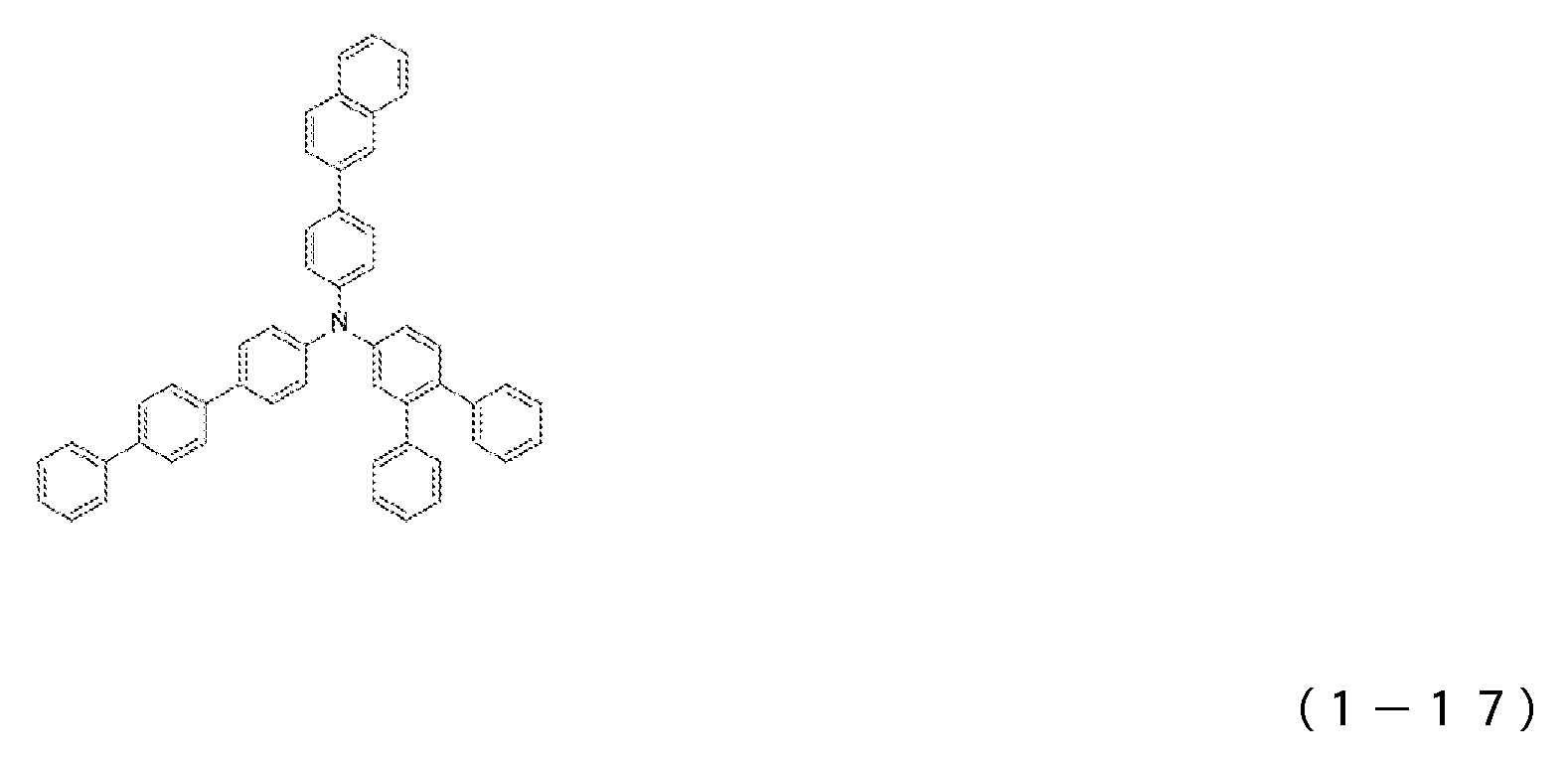
얻어진 담황색 고체에 대하여 NMR을 사용하여 구조를 동정하였다.The structure of the obtained pale yellow solid was identified using NMR.
1H-NMR(CDCl3)에서 이하의 37개의 수소의 시그널을 검출하였다.The following 37 hydrogen signals were detected by 1 H-NMR (CDCl 3 ).
δ(ppm)=7.82-8.05(3H), 7.52-7.70(8H), 7.39-7.51(8H), 7.10-7.29(18H).δ (ppm) = 7.82-8.05 (3H), 7.52-7.70 (8H), 7.39-7.51 (8H), 7.10-7.29 (18H).
실시예 3Example 3
<(비페닐-4-일)-(4-나프탈렌-2-일-페닐)-[1,1':2',1":4",1'":4'":1""]-퀸케페닐-5'-일-아민(1-30)의 합성><(biphenyl-4-yl)-(4-naphthalen-2-yl-phenyl)-[1,1':2',1":4",1'":4'":1""]- Synthesis of quinkephenyl-5'-yl-amine (1-30)>
반응 용기에 (6-브로모-비페닐-3-일)-(4-나프탈렌-2-일-페닐)-비페닐-4-일-아민 8.0g, 2-([1,1':4,1"]터페닐-4-일)-4,4,5,5-테트라메틸-1,3,2-디옥사보롤란 5.7g, 탄산수소나트륨 1.7g, 테트라히드로푸란 100mL, 물 30mL를 첨가하여, 30분간 초음파를 조사하면서 질소 가스를 통기하였다. 디페닐포스피노페로센팔라듐 디클로라이드 0.2g을 첨가하여 12시간 환류 교반하였다. 냉각한 후, 반응액에 메탄올 200mL를 첨가하고, 1시간 교반한 후, 석출된 고체를 여과에 의해 채취하였다. 얻어진 고체에 톨루엔 100mL를 첨가한 후, 80℃로 가열하고, 실리카 겔, 활성 백토를 사용한 흡착 정제를 행하였다. 고체를 여과에 의해 제거하고, 여액을 농축한 후, 잔사를 톨루엔, 아세톤을 사용한 재결정을 행함으로써, (비페닐-4-일)-(4-나프탈렌-2-일-페닐)-[1,1':2',1":4",1'":4'":1""]-퀸케페닐-5'-일-아민(1-30)의 백색 고체 8.4g(수율 84%)을 얻었다.To the reaction vessel was added 8.0 g of (6-bromo-biphenyl-3-yl)-(4-naphthalen-2-yl-phenyl)-biphenyl-4-yl-amine, 2-([1,1′:4 ,1 "] terphenyl-4-yl) -4,4,5,5-tetramethyl-1,3,2-dioxaborolane 5.7g, sodium bicarbonate 1.7g, tetrahydrofuran 100mL, water 30mL After addition, nitrogen gas was blown while irradiating ultrasonic waves for 30 minutes.Added 0.2 g of diphenylphosphinoferrocene palladium dichloride and stirred under reflux for 12 hours.After cooling, 200mL of methanol was added to the reaction solution and stirred for 1 hour. After that, the precipitated solid was collected by filtration.Toluene 100mL was added to the obtained solid, then heated to 80 ° C, and adsorption purification using silica gel and activated clay was carried out.Solid was removed by filtration, After concentrating the filtrate, the residue was recrystallized using toluene and acetone to obtain (biphenyl-4-yl)-(4-naphthalen-2-yl-phenyl)-[1,1':2',1" :4",1'":4'":1""]-Quinquephenyl-5'-yl-amine (1-30) to obtain 8.4 g (84% yield) of a white solid.

얻어진 백색 고체에 대하여 NMR을 사용하여 구조를 동정하였다.The structure of the obtained white solid was identified using NMR.
1H-NMR(CDCl3)에서 이하의 41개의 수소의 시그널을 검출하였다.The following 41 hydrogen signals were detected by 1 H-NMR (CDCl 3 ).
δ(ppm)=8.03(1H), 7.83-7.90(3H), 7.73-7.76(1H), 7.29-7.67(28H), 7.15-7.24(8H).δ (ppm) = 8.03 (1H), 7.83-7.90 (3H), 7.73-7.76 (1H), 7.29-7.67 (28H), 7.15-7.24 (8H).
실시예 4Example 4
<(4-나프탈렌-1-일-페닐)-(5'-페닐-[1,1':3',1"]-터페닐-4-일)-[1,1':2',1"]터페닐-4'-일-아민(1-32)의 합성><(4-naphthalen-1-yl-phenyl)-(5'-phenyl-[1,1':3',1"]-terphenyl-4-yl)-[1,1':2',1 "Synthesis of] terphenyl-4'-yl-amine (1-32)>
실시예 1에 있어서, 4-브로모-[1,1':4',1"]터페닐을 4-클로로-5'-페닐-[1,1':3',1"]터페닐로 바꾸고, 마찬가지의 조작을 행하여 (4-나프탈렌-1-일-페닐)-(5'-페닐-[1,1':3',1"]터페닐-4-일)-[1,1':2',1"]터페닐-4'-일-아민(1-32)의 백색 고체 3.7g(수율 37%)을 얻었다.In Example 1, 4-bromo-[1,1':4',1"]terphenyl was converted to 4-chloro-5'-phenyl-[1,1':3',1"]terphenyl (4-naphthalen-1-yl-phenyl)-(5'-phenyl-[1,1':3',1"]terphenyl-4-yl)-[1,1' : 2', 1"] terphenyl-4'-yl-amine (1-32) to obtain 3.7 g (yield: 37%) of a white solid.
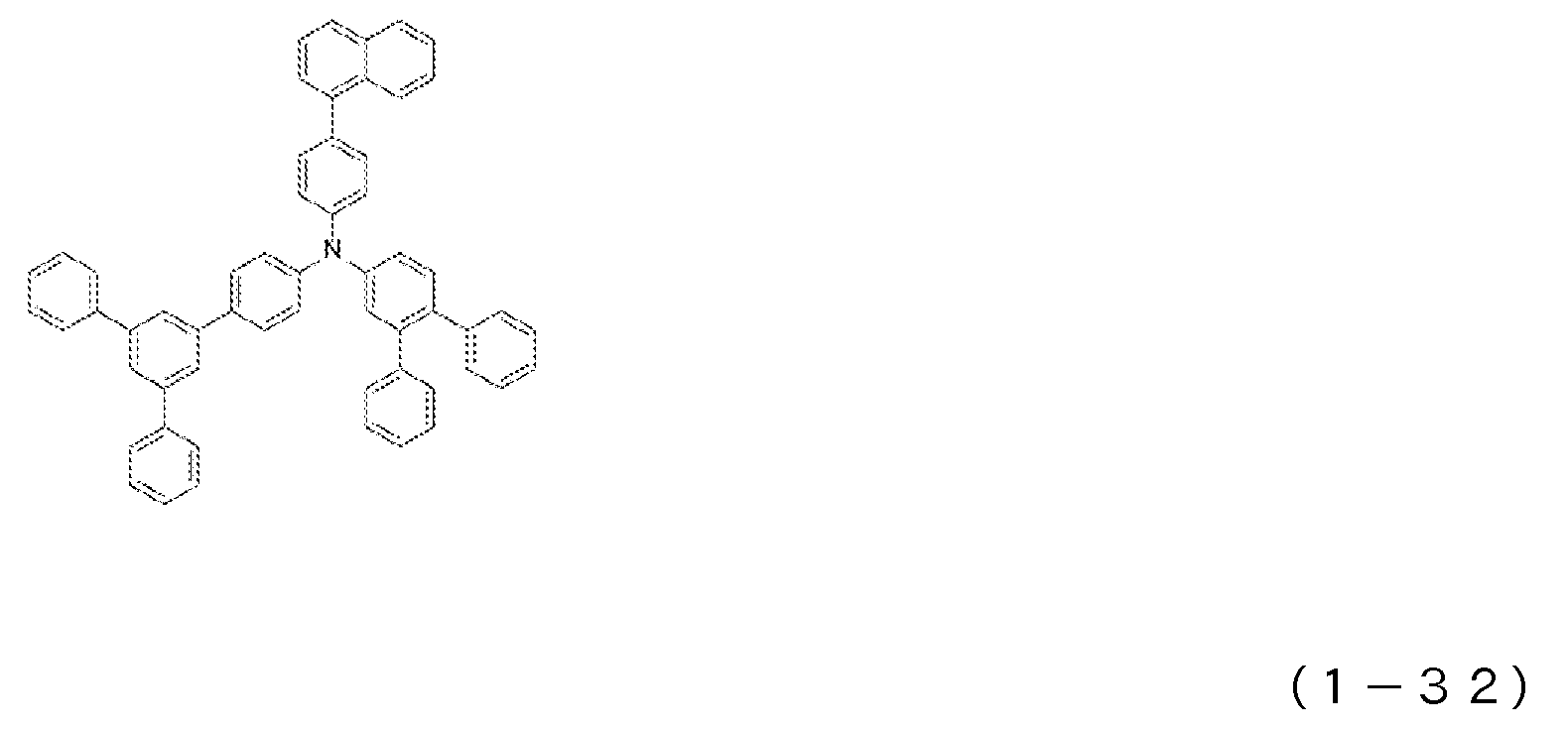
얻어진 백색 고체에 대하여 NMR을 사용하여 구조를 동정하였다.The structure of the obtained white solid was identified using NMR.
1H-NMR(CDCl3)에서 이하의 41개의 수소의 시그널을 검출하였다.The following 41 hydrogen signals were detected by 1 H-NMR (CDCl 3 ).
δ(ppm)=8.04-8.06(1H), 7.64-7.91(11H), 7.32-7.53(18H), 7.12-7.29(11H).δ (ppm) = 8.04-8.06 (1H), 7.64-7.91 (11H), 7.32-7.53 (18H), 7.12-7.29 (11H).
실시예 5Example 5
<([1,1':4,',1"]터페닐-4-일)-{4-(3-페닐나프탈렌-1-일)페닐}-[1,1';2',1"]터페닐-4'-일-아민(1-41)의 합성><([1,1':4,',1"]terphenyl-4-yl)-{4-(3-phenylnaphthalen-1-yl)phenyl}-[1,1';2',1" Synthesis of ]terphenyl-4'-ylamine (1-41)>
실시예 1에 있어서, 1-(4-브로모페닐)나프탈렌을 1-(4-클로로페닐)-3-페닐나프탈렌으로 바꾸고, 마찬가지의 조작을 행하여, ([1,1':4,',1"]터페닐-4-일)-{4-(3-페닐나프탈렌-1-일)페닐}-[1,1';2',1"]터페닐-4'-일-아민(1-41)의 백색 고체 5.0g(수율 47%)을 얻었다.In Example 1, 1-(4-bromophenyl)naphthalene was replaced with 1-(4-chlorophenyl)-3-phenylnaphthalene, and the same operation was performed to obtain ([1,1':4,', 1"]terphenyl-4-yl)-{4-(3-phenylnaphthalen-1-yl)phenyl}-[1,1';2',1"]terphenyl-4'-yl-amine (1 -41) to obtain 5.0 g (yield: 47%) of a white solid.

얻어진 백색 고체에 대하여 NMR을 사용하여 구조를 동정하였다.The structure of the obtained white solid was identified using NMR.
1H-NMR(CDCl3)에서 이하의 41개의 수소의 시그널을 검출하였다.The following 41 hydrogen signals were detected by 1 H-NMR (CDCl 3 ).
δ(ppm)=8.04-8.05(2H), 7.94-7.96(1H), 7.76-7.78(3H), 7.59-7.67(8H), 7.43-7.52(8H), 7.12-7.22(19H).δ (ppm) = 8.04-8.05 (2H), 7.94-7.96 (1H), 7.76-7.78 (3H), 7.59-7.67 (8H), 7.43-7.52 (8H), 7.12-7.22 (19H).
실시예 6Example 6
<(4'-나프탈렌-1-일-비페닐-4-일)-(4-나프탈렌-1-일-페닐)-[1,1':2',1"]터페닐-4'-일-아민(1-44)의 합성><(4'-naphthalen-1-yl-biphenyl-4-yl)-(4-naphthalen-1-yl-phenyl)-[1,1':2',1"]terphenyl-4'-yl -Synthesis of amine (1-44)>
실시예 1에 있어서, 4-브로모-[1,1':4',1"]터페닐을 1-(4'-브로모-비페닐-4-일)나프탈렌으로 바꾸고, 마찬가지의 조작을 행하여 (4'-나프탈렌-1-일-비페닐-4-일)-(4-나프탈렌-1-일-페닐)-[1,1':2',1"]터페닐-4'-일-아민(1-44)의 백색 고체 4.5g(수율 48%)을 얻었다.In Example 1, 4-bromo-[1,1':4',1"]terphenyl was replaced with 1-(4'-bromo-biphenyl-4-yl)naphthalene, and the same operation was performed. (4'-naphthalen-1-yl-biphenyl-4-yl)-(4-naphthalen-1-yl-phenyl)-[1,1':2',1"]terphenyl-4'-yl - 4.5 g (yield 48%) of white solid of amine (1-44) was obtained.

얻어진 백색 고체에 대하여 NMR을 사용하여 구조를 동정하였다.The structure of the obtained white solid was identified using NMR.
1H-NMR(CDCl3)에서 이하의 39개의 수소의 시그널을 검출하였다.Signals of the following 39 hydrogens were detected by 1 H-NMR (CDCl 3 ).
δ(ppm)=8.05-8.07(1H), 7.98-8.00(1H), 7.83-7.91(4H), 7.71-7.73(2H), 7.63-7.65(2H), 7.33-7.57(19H), 7.12-7.21(10H).δ (ppm) = 8.05-8.07 (1H), 7.98-8.00 (1H), 7.83-7.91 (4H), 7.71-7.73 (2H), 7.63-7.65 (2H), 7.33-7.57 (19H), 7.12-7.21 (10H).
실시예 7Example 7
<(4-나프탈렌-1-일-페닐)-{4-(4-페닐나프탈렌-1-일)페닐}-[1,1':2',1"]터페닐-4'-일-아민(1-58)의 합성><(4-naphthalen-1-yl-phenyl)-{4-(4-phenylnaphthalen-1-yl)phenyl}-[1,1':2',1"]terphenyl-4'-ylamine Synthesis of (1-58)>
실시예 1에 있어서, 4-브로모-[1,1':4',1"]터페닐을 1-(4-클로로페닐)-4-페닐나프탈렌으로 바꾸고, 마찬가지의 조작을 행하여 (4-나프탈렌-1-일-페닐)-{4-(4-페닐나프탈렌-1-일)페닐}-[1,1':2',1"]터페닐-4'-일-아민(1-58)의 백색 고체 4.2g(수율 57%)을 얻었다.In Example 1, 4-bromo-[1,1':4',1"] terphenyl was replaced with 1-(4-chlorophenyl)-4-phenylnaphthalene, and the same operation was performed to (4- Naphthalen-1-yl-phenyl)-{4-(4-phenylnaphthalen-1-yl)phenyl}-[1,1':2',1"]terphenyl-4'-yl-amine (1-58 ) to obtain 4.2 g (57% yield) of a white solid.
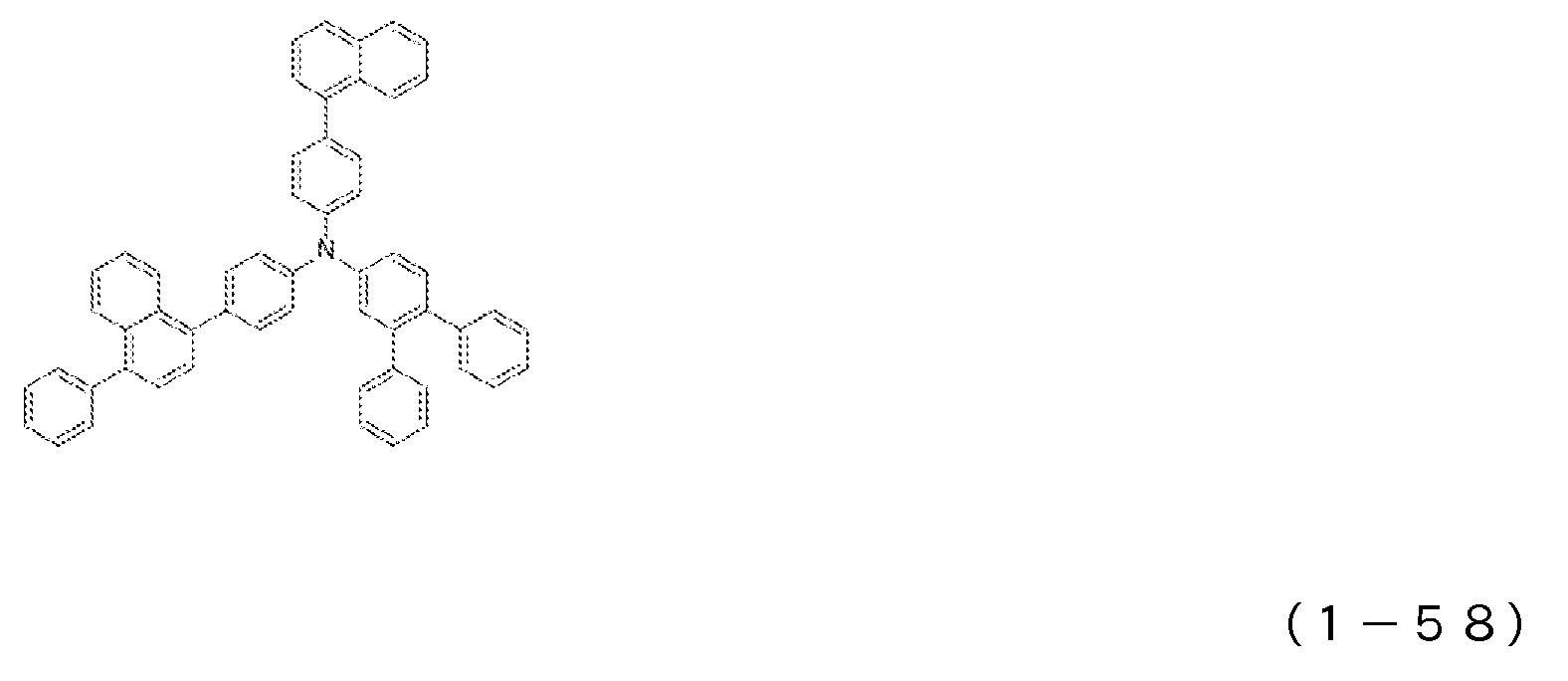
얻어진 백색 고체에 대하여 NMR을 사용하여 구조를 동정하였다.The structure of the obtained white solid was identified using NMR.
1H-NMR(CDCl3)에서 이하의 39개의 수소의 시그널을 검출하였다.Signals of the following 39 hydrogens were detected by 1 H-NMR (CDCl 3 ).
δ(ppm)=8.12-8.14(1H), 8.05-8.07(1H), 7.96-7.98(1H), 7.89-7.91(1H), 7.83-7.85(1H), 7.32-7.55(24H), 7.14-7.23(10H).δ (ppm) = 8.12-8.14 (1H), 8.05-8.07 (1H), 7.96-7.98 (1H), 7.89-7.91 (1H), 7.83-7.85 (1H), 7.32-7.55 (24H), 7.14-7.23 (10H).
실시예 8Example 8
<([1,1':4',1"]터페닐-4-일)-(4-나프탈렌-1-일-페닐)-[1,1':2',1":4",1"']쿼터페닐-5'-일-아민(1-14)의 합성><([1,1':4',1"]terphenyl-4-yl)-(4-naphthalen-1-yl-phenyl)-[1,1':2',1":4",1 Synthesis of "'] quaterphenyl-5'-yl-amine (1-14)>
반응 용기에 (4-나프탈렌-1-일-페닐)-(6-브로모-비페닐-3-일)아민 12.5g, 4-비페닐붕소산 6.6g, 탄산수소나트륨 3.5g, 테트라히드로푸란 100mL, 물 50mL를 첨가하였다. 디페닐포스피노페로센팔라듐 디클로라이드 0.5g을 첨가하여 12시간 환류 교반하였다. 냉각한 후, 아세트산에틸을 사용하여 추출하고, 유기층을 농축하였다. 잔사에 톨루엔 150mL를 첨가하여 가열 교반한 후, 80℃에서 실리카 겔 8g을 첨가하여 1시간 교반하고, 고체를 열 여과에 의해 제거하였다. 여액을 농축하고, 잔사를 디클로로메탄, 헵탄을 사용한 재결정을 2회 반복하여 행함으로써, (4-나프탈렌-1-일-페닐)-[1,1':2',1":4",1"']쿼터페닐-5'-일-아민의 백색 고체 14.2g(수율 97.9%)을 얻었다.In a reaction vessel, 12.5 g of (4-naphthalen-1-yl-phenyl)-(6-bromo-biphenyl-3-yl)amine, 6.6 g of 4-biphenylboronic acid, 3.5 g of sodium bicarbonate, tetrahydrofuran 100 mL, 50 mL of water was added. After adding 0.5 g of diphenylphosphinoferrocene palladium dichloride, the mixture was stirred under reflux for 12 hours. After cooling, extraction was performed with ethyl acetate, and the organic layer was concentrated. After adding 150 mL of toluene to the residue and stirring with heating, 8 g of silica gel was added at 80°C, followed by stirring for 1 hour, and the solid was removed by hot filtration. The filtrate was concentrated, and the residue was recrystallized twice using dichloromethane and heptane to obtain (4-naphthalen-1-yl-phenyl)-[1,1':2',1":4",1 14.2 g (yield: 97.9%) of "']quaterphenyl-5'-yl-amine was obtained as a white solid.
얻어진 (4-나프탈렌-1-일-페닐)-[1,1':2',1":4",1"']쿼터페닐-5'-일-아민 14.2g을 질소 치환한 반응 용기에 첨가하고, 계속해서 4-브로모-[1,1':4',1"]터페닐 9.2g, tert-부토시키나트륨 3.9g, 톨루엔 140mL를 첨가하였다. 아세트산팔라듐 0.12g, 트리(tert-부틸포스핀)의 50% 톨루엔 용액 0.50g을 첨가하여 가열하고, 4시간 환류 교반하였다. 실온까지 냉각한 후, 반응액에 메탄올 140mL를 첨가하여 1시간 교반하고, 석출된 고체를 여과에 의해 채취하였다. 고체에 톨루엔 200mL를 첨가하여 80℃까지 가열한 후, 활성 백토 10g, 실리카 겔 10g을 첨가하여 1시간 교반하고, 열 여과에 의해 고체를 제거하였다. 여액을 농축하고, 잔사를 톨루엔, 아세톤을 사용한 재결정을 행함으로써, ([1,1':4',1"]터페닐-4-일)-(4-나프탈렌-1-일-페닐)-[1,1':2',1":4",1"']쿼터페닐-5'-일-아민(1-14)의 백색 고체 16.9g(수율 82.8%)을 얻었다.14.2 g of the obtained (4-naphthalen-1-yl-phenyl)-[1,1':2',1":4",1"']quaterphenyl-5'-yl-amine was placed in a nitrogen-purged reaction vessel. 9.2 g of 4-bromo-[1,1':4',1"] terphenyl, 3.9 g of sodium tert-butoshiki, and 140 mL of toluene were added. 0.12 g of palladium acetate and 0.50 g of a 50% toluene solution of tri(tert-butylphosphine) were added and heated, followed by refluxing and stirring for 4 hours. After cooling to room temperature, 140 mL of methanol was added to the reaction solution, followed by stirring for 1 hour, and the precipitated solid was collected by filtration. After adding 200 mL of toluene to the solid and heating it to 80°C, 10 g of activated clay and 10 g of silica gel were added and stirred for 1 hour, and the solid was removed by hot filtration. The filtrate was concentrated, and the residue was recrystallized using toluene and acetone to obtain ([1,1':4',1"]terphenyl-4-yl)-(4-naphthalen-1-yl-phenyl)- 16.9 g (yield: 82.8%) of [1,1':2',1":4",1"']quaterphenyl-5'-yl-amine (1-14) as a white solid was obtained.

얻어진 백색 고체에 대하여 NMR을 사용하여 구조를 동정하였다.The structure of the obtained white solid was identified using NMR.
1H-NMR(CDCl3)에서 이하의 41개의 수소의 시그널을 검출하였다.The following 41 hydrogen signals were detected by 1 H-NMR (CDCl 3 ).
δ(ppm)=8.03-8.06(1H), 7.89-7.91(1H), 7.83-7.85(1H), 7.57-7.67(10H), 7.27-7.52(21H), 7.16-7.23(7H).δ (ppm) = 8.03-8.06 (1H), 7.89-7.91 (1H), 7.83-7.85 (1H), 7.57-7.67 (10H), 7.27-7.52 (21H), 7.16-7.23 (7H).
실시예 9Example 9
<([1,1':4',1"]터페닐-4-일)-(4-나프탈렌-1-일-페닐)-[1,1':2',1":4",1"']쿼터페닐-4'-일-아민(1-27)의 합성><([1,1':4',1"]terphenyl-4-yl)-(4-naphthalen-1-yl-phenyl)-[1,1':2',1":4",1 Synthesis of "'] quaterphenyl-4'-yl-amine (1-27)>
질소 치환한 반응 용기에 (4-나프탈렌-1-일-페닐)-[1,1':4',1"]터페닐-3-일-아민 9.2g, 4-브로모-[1,1':4',1"]터페닐 5.8g, tert-부토시키나트륨 2.2g, 톨루엔 90mL를 첨가하였다. 트리스(디벤질리덴아세톤)디팔라듐(0) 0.1g, 트리(tert-부틸포스핀)의 50% 톨루엔 용액 0.2g을 첨가하여 가열하고, 4시간 환류 교반하였다. 80℃까지 냉각하고, 열 여과에 의해 무기물을 제거한 후, 여액을 농축하였다. 잔사에 톨루엔 130mL를 첨가하여 가열 교반하고, 80℃에서 실리카 겔 6g, 활성 백토 6g을 첨가하여 1시간 교반하였다. 열 여과에 의해 고체를 제거하고, 여액을 농축하였다. 잔사를 디클로로메탄, 아세톤을 사용한 재결정을 행함으로써, ([1,1':4',1"]터페닐-4-일)-(4-나프탈렌-1-일-페닐)-[1,1':4',1"]터페닐-3-일-아민의 백색 고체 11.4g(수율 89.8%)을 얻었다.9.2 g of (4-naphthalen-1-yl-phenyl)-[1,1':4',1"]terphenyl-3-yl-amine, 4-bromo-[1,1 5.8 g of ':4',1"] terphenyl, 2.2 g of sodium tert-butoshiki, and 90 mL of toluene were added. 0.1 g of tris(dibenzylideneacetone)dipalladium(0) and 0.2 g of a 50% toluene solution of tris(tert-butylphosphine) were added and heated, followed by refluxing and stirring for 4 hours. After cooling to 80° C. and removal of minerals by hot filtration, the filtrate was concentrated. 130 mL of toluene was added to the residue, and the mixture was heated and stirred, and 6 g of silica gel and 6 g of activated clay were added at 80°C, followed by stirring for 1 hour. Solids were removed by hot filtration and the filtrate was concentrated. The residue was recrystallized using dichloromethane and acetone to obtain ([1,1':4',1"]terphenyl-4-yl)-(4-naphthalen-1-yl-phenyl)-[1,1 11.4 g (yield: 89.8%) of a white solid of ':4',1"]terphenyl-3-yl-amine was obtained.
얻어진 ([1,1':4',1"]터페닐-4-일)-(4-나프탈렌-1-일-페닐)-[1,1':4',1"]터페닐-3-일-아민 11.4g을 질소 치환한 반응 용기에 첨가하고, 계속해서 디메틸포름아미드 114mL를 첨가하여, 0℃로 냉각하였다. N-브로모숙신이미드 3.0g을 천천히 첨가하고, 0℃에서 1시간 교반한 후, 실온까지 천천히 승온하고, 3시간 교반하였다. 반응액을 물 360mL에 첨가하고, 석출된 고체를 여과에 의해 채취하였다. 고체에 톨루엔 130mL를 첨가하고, 교반 가열한 후, 80℃에서 실리카 겔 6g을 첨가하여, 1시간 교반하였다. 고체를 열 여과에 의해 제거하고, 여액을 농축하였다. 잔사를 디클로로메탄, 아세톤으로 재결정함으로써, ([1,1':4',1"]터페닐-4-일)-(4-나프탈렌-1-일-페닐)-(6-브로모-[1,1':4',1"]터페닐-3-일)아민의 백색 고체 8.7g(수율 69%)을 얻었다.Obtained ([1,1':4',1"]terphenyl-4-yl)-(4-naphthalen-1-yl-phenyl)-[1,1':4',1"]terphenyl-3 11.4 g of -yl-amine was added to a reaction vessel purged with nitrogen, followed by addition of 114 mL of dimethylformamide, followed by cooling to 0°C. After adding 3.0 g of N-bromosuccinimide slowly and stirring at 0 degreeC for 1 hour, it heated up slowly to room temperature and stirred for 3 hours. The reaction liquid was added to 360 mL of water, and the precipitated solid was collected by filtration. After adding 130 mL of toluene to the solid, stirring and heating, 6 g of silica gel was added at 80°C, and the mixture was stirred for 1 hour. Solids were removed by hot filtration and the filtrate was concentrated. The residue was recrystallized from dichloromethane and acetone to obtain ([1,1':4',1"]terphenyl-4-yl)-(4-naphthalen-1-yl-phenyl)-(6-bromo-[ 8.7 g (yield: 69%) of 1,1':4',1"]terphenyl-3-yl)amine was obtained as a white solid.
얻어진 ([1,1':4',1"]터페닐-4-일)-(4-나프탈렌-1-일-페닐)-(6-브로모-[1,1':4',1"]터페닐-3-일)아민 8.7g을 질소 치환한 반응 용기에 첨가하고, 계속해서 페닐보론산 1.6g, 탄산수소나트륨 1.5g, 테트라히드로푸란 100mL, 물 35mL를 첨가하였다. 디페닐포스피노페로센팔라듐 디클로라이드 0.2g을 첨가하고, 12시간 환류 교반하였다. 냉각한 후, 아세트산에틸을 사용하여 추출하고, 유기층을 농축하였다. 잔사에 톨루엔 100mL를 첨가하고, 가열 교반한 후, 80℃에서 실리카 겔 5g을 첨가하여 1시간 교반하고, 고체를 열 여과에 의해 제거하였다. 여액을 농축하고, 잔사를 디클로로메탄, 아세톤을 사용한 재결정을 2회 반복하여 행함으로써, ([1,1':4',1"]터페닐-4-일)-(4-나프탈렌-1-일-페닐)-[1,1':2',1":4",1"']쿼터페닐-4'-일-아민(1-27)의 백색 고체 6.8g(수율 78%)을 얻었다.Obtained ([1,1':4',1"]terphenyl-4-yl)-(4-naphthalen-1-yl-phenyl)-(6-bromo-[1,1':4',1 8.7 g of "]terphenyl-3-yl)amine was added to a reaction vessel purged with nitrogen, followed by addition of 1.6 g of phenylboronic acid, 1.5 g of sodium bicarbonate, 100 mL of tetrahydrofuran, and 35 mL of water. 0.2 g of diphenylphosphinoferrocene palladium dichloride was added, and the mixture was refluxed and stirred for 12 hours. After cooling, extraction was performed with ethyl acetate, and the organic layer was concentrated. After adding 100 mL of toluene to the residue and stirring with heating, 5 g of silica gel was added at 80°C, followed by stirring for 1 hour, and the solid was removed by hot filtration. The filtrate was concentrated, and the residue was recrystallized twice using dichloromethane and acetone to obtain ([1,1':4',1"]terphenyl-4-yl)-(4-naphthalen-1- 6.8 g (78% yield) of yl-phenyl)-[1,1':2',1":4",1"']quaterphenyl-4'-yl-amine (1-27) was obtained .
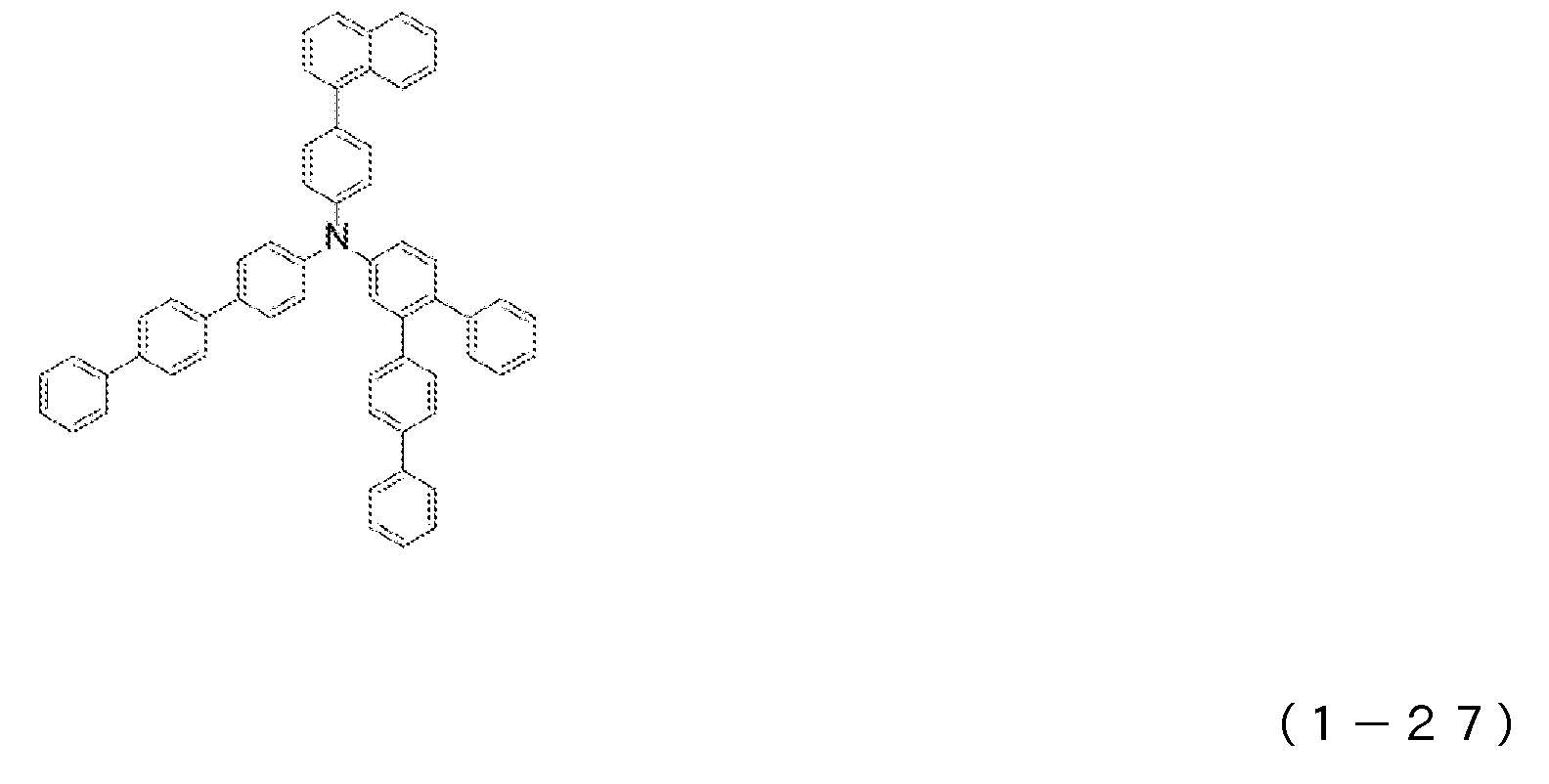
얻어진 백색 고체에 대하여 NMR을 사용하여 구조를 동정하였다.The structure of the obtained white solid was identified using NMR.
1H-NMR(CDCl3)에서 이하의 41개의 수소의 시그널을 검출하였다.The following 41 hydrogen signals were detected by 1 H-NMR (CDCl 3 ).
δ(ppm)=8.04-8.06(1H), 7.89-7.91(1H), 7.83-7.85(1H), 7.60-7.70(8H), 7.27-7.55(23H), 7.18-7.23(7H).δ (ppm) = 8.04-8.06 (1H), 7.89-7.91 (1H), 7.83-7.85 (1H), 7.60-7.70 (8H), 7.27-7.55 (23H), 7.18-7.23 (7H).
실시예 10Example 10
<(비페닐-4-일)-(4'-트리페닐실릴-비페닐-4-일)-[1,1':2',1"]터페닐-4'-일-아민(1-62)의 합성><(biphenyl-4-yl)-(4'-triphenylsilyl-biphenyl-4-yl)-[1,1':2',1"]terphenyl-4'-yl-amine (1- 62) Synthesis of >
반응 용기에 4-브로모트리페닐실란 20.0g, 4-클로로페닐보론산 9.0g, 탄산칼륨 10.0g, 톨루엔 160mL, 에탄올 80mL, 물 60mL를 첨가하였다. 테트라키스트리페닐포스핀팔라듐 1.1g을 첨가하여 12시간 환류 교반하였다. 냉각한 후, 분액하고, 유기층을 물, 계속해서 포화 식염수로 세정하고, 무수 황산마그네슘으로 건조하였다. 건조제를 여과에 의해 제거하고, 여액을 가열 교반한 후, 80℃에서 실리카 겔 10g을 첨가하였다. 1시간 교반하고, 열 여과에 의해 고체를 제거하고, 여액을 농축하였다. 잔사를 톨루엔, 헵탄을 사용한 재결정을 행함으로써, 4-클로로-4'-트리페닐실릴-비페닐의 황백색 고체 12.7g(수율 59.0%)을 얻었다.20.0 g of 4-bromotriphenylsilane, 9.0 g of 4-chlorophenylboronic acid, 10.0 g of potassium carbonate, 160 mL of toluene, 80 mL of ethanol, and 60 mL of water were added to the reaction vessel. 1.1 g of tetrakistriphenylphosphine palladium was added, and the mixture was refluxed and stirred for 12 hours. After cooling, liquid separation was carried out, and the organic layer was washed with water and then with saturated brine, and dried over anhydrous magnesium sulfate. After the desiccant was removed by filtration and the filtrate was heated and stirred, 10 g of silica gel was added at 80°C. After stirring for 1 hour, solids were removed by hot filtration and the filtrate was concentrated. The residue was recrystallized using toluene and heptane to obtain 12.7 g (yield: 59.0%) of a yellowish-white solid of 4-chloro-4'-triphenylsilyl-biphenyl.
얻어진 4-클로로-4'-트리페닐실릴-비페닐 6.0g을, (비페닐-4-일)-[1,1':2',1"]터페닐-4-일-아민 6.6g과 함께 질소 치환한 반응 용기에 첨가하고, 계속해서 tert-부토시키나트륨 2.6g, 톨루엔 60mL를 첨가하였다. 비스[트리(tert-부틸포스핀)]팔라듐 0.14g을 첨가하여 가열하고, 3시간 환류 교반하였다. 80℃까지 냉각하고, 반응액에 실리카 겔 6g을 첨가한 후, 30분 교반하고, 열 여과에 의해 고체를 제거하였다. 여액을 농축하고, 잔사를 칼럼 크로마토그래피(실리카 겔 200g; 헵탄:디클로로메탄=3:1)로 정제함으로써, (비페닐-4-일)-(4'-트리페닐실릴-비페닐-4-일)-[1,1':2',1"]터페닐-4'-일-아민(1-62)의 백색 고체 3.5g(수율 30%)을 얻었다.6.0 g of the obtained 4-chloro-4'-triphenylsilyl-biphenyl was mixed with 6.6 g of (biphenyl-4-yl)-[1,1':2',1"]terphenyl-4-yl-amine Together, they were added to a reaction vessel purged with nitrogen, followed by the addition of 2.6 g of sodium tert-butoshiki and 60 mL of toluene, the addition of 0.14 g of bis[tri(tert-butylphosphine)]palladium, and heating under reflux for 3 hours. After cooling to 80 ° C., adding 6 g of silica gel to the reaction solution, stirring for 30 minutes, and removing solids by thermal filtration. The filtrate was concentrated, and the residue was subjected to column chromatography (silica gel 200 g; heptane: By purification with dichloromethane = 3: 1), (biphenyl-4-yl) - (4'-triphenylsilyl-biphenyl-4-yl) - [1,1': 2', 1"] terphenyl 3.5 g (yield: 30%) of a white solid of -4'-yl-amine (1-62) was obtained.

얻어진 백색 고체에 대하여 NMR을 사용하여 구조를 동정하였다.The structure of the obtained white solid was identified using NMR.
1H-NMR(CDCl3)에서 이하의 47개의 수소의 시그널을 검출하였다.Signals of the following 47 hydrogens were detected by 1 H-NMR (CDCl 3 ).
δ(ppm)=8.03(1H), 7.83-7.90(3H), 7.72-7.75(1H), 7.55-7.67(14H), 7.26-7.47(17H), 7.07-7.23(11H).δ (ppm) = 8.03 (1H), 7.83-7.90 (3H), 7.72-7.75 (1H), 7.55-7.67 (14H), 7.26-7.47 (17H), 7.07-7.23 (11H).
실시예 11Example 11
<([1,1':2',1"]터페닐-4'-일)-(4-나프탈렌-1-일-페닐)-[1,1':4',1":4",1'"]쿼터페닐-4-일-아민(1-68)의 합성><([1,1':2',1"]terphenyl-4'-yl)-(4-naphthalen-1-yl-phenyl)-[1,1':4',1":4", Synthesis of 1'"]quaterphenyl-4-yl-amine (1-68)>
질소 치환한 반응 용기에 (4-나프탈렌-1-일-페닐)-[1,1':2',1"]터페닐-4'-일-아민 25.0g, 1-브로모-4-요오도벤젠 17.4g, tert-부토시키나트륨 7.7g, 톨루엔 375mL를 첨가하였다. 아세트산팔라듐 0.13g, 4,5'-비스(디페닐포스피노)-9,9-디메틸크산텐 0.32g을 첨가하여 가열하고, 14시간 환류 교반하였다. 80℃까지 냉각하고, 열 여과에 의해 무기물을 제거하고, 여액을 농축하였다. 잔사를 칼럼 크로마토그래피(실리카 겔 200g; 헵탄:디클로로메탄=3:1)로 정제함으로써, (4-브로모페닐)-(4-나프탈렌-1-일-페닐)-[1,1':2',1"]터페닐-4'-일-아민의 황백색 고체 28.0g(수율 83.1%)을 얻었다.25.0 g of (4-naphthalen-1-yl-phenyl)-[1,1':2',1"]terphenyl-4'-yl-amine, 1-bromo-4-io 17.4 g of dobenzene, 7.7 g of sodium tert-butoshiki, and 375 mL of toluene were added, and 0.13 g of palladium acetate and 0.32 g of 4,5'-bis(diphenylphosphino)-9,9-dimethylxanthene were added and heated. and stirred under reflux for 14 hours.Cooled to 80°C, removed inorganic matter by thermal filtration, and concentrated the filtrate.The residue was purified by column chromatography (silica gel 200g; heptane:dichloromethane=3:1) 28.0 g of (4-bromophenyl)-(4-naphthalen-1-yl-phenyl)-[1,1':2',1"]terphenyl-4'-yl-amine as a yellowish-white solid (yield: 83.1 %) was obtained.
얻어진 (4-브로모페닐)-(4-나프탈렌-1-일-페닐)-[1,1':2',1"]터페닐-4'-일-아민 8.0g을 반응 용기에 첨가하고, 계속해서 2-([1,1':4',1"]터페닐-4-일)-4,4,5,5-테트라메틸-1,3,2-디옥사보롤란 5.2g, 탄산수소나트륨 1.7g, 테트라히드로푸란 96mL, 물 32mL를 첨가하였다. 디페닐포스피노페로센팔라듐 디클로라이드 0.22g을 첨가하여 4시간 환류 교반하였다. 냉각한 후, 아세트산에틸을 사용하여 추출하고, 유기층을 물, 계속해서 포화 식염수로 세정하고, 무수 황산마그네슘으로 건조하였다. 건조제를 여과에 의해 제거하고, 여액을 농축하였다. 잔사에 톨루엔 100mL를 첨가한 후, 80℃에서 실리카 겔 5g을 첨가하였다. 1시간 교반한 후, 열 여과에 의해 고체를 제거하고, 여액을 농축하였다. 잔사를 테트라히드로푸란, 아세톤을 사용한 재결정을 행함으로써, ([1,1':2',1"]터페닐-4'-일)-(4-나프탈렌-1-일-페닐)-[1,1':4',1":4",1"']쿼터페닐-4-일-아민(1-67)의 황백색 고체 4.6g(수율 46%)을 얻었다.8.0 g of the obtained (4-bromophenyl)-(4-naphthalen-1-yl-phenyl)-[1,1':2',1"]terphenyl-4'-yl-amine was added to the reaction vessel , followed by 2-([1,1':4',1"]terphenyl-4-yl)-4,4,5,5-tetramethyl-1,3,2-dioxaborolane 5.2g, 1.7 g of sodium bicarbonate, 96 mL of tetrahydrofuran, and 32 mL of water were added. After adding 0.22 g of diphenylphosphinoferrocene palladium dichloride, the mixture was stirred under reflux for 4 hours. After cooling, extraction was performed using ethyl acetate, and the organic layer was washed with water and then saturated brine, and dried over anhydrous magnesium sulfate. The drying agent was removed by filtration and the filtrate was concentrated. After adding 100 mL of toluene to the residue, 5 g of silica gel was added at 80°C. After stirring for 1 hour, solids were removed by hot filtration, and the filtrate was concentrated. The residue was recrystallized using tetrahydrofuran and acetone to obtain ([1,1':2',1"]terphenyl-4'-yl)-(4-naphthalen-1-yl-phenyl)-[1 ,1':4',1":4",1"']quaterphenyl-4-yl-amine (1-67) was obtained in 4.6 g (yield: 46%) as a yellowish-white solid.
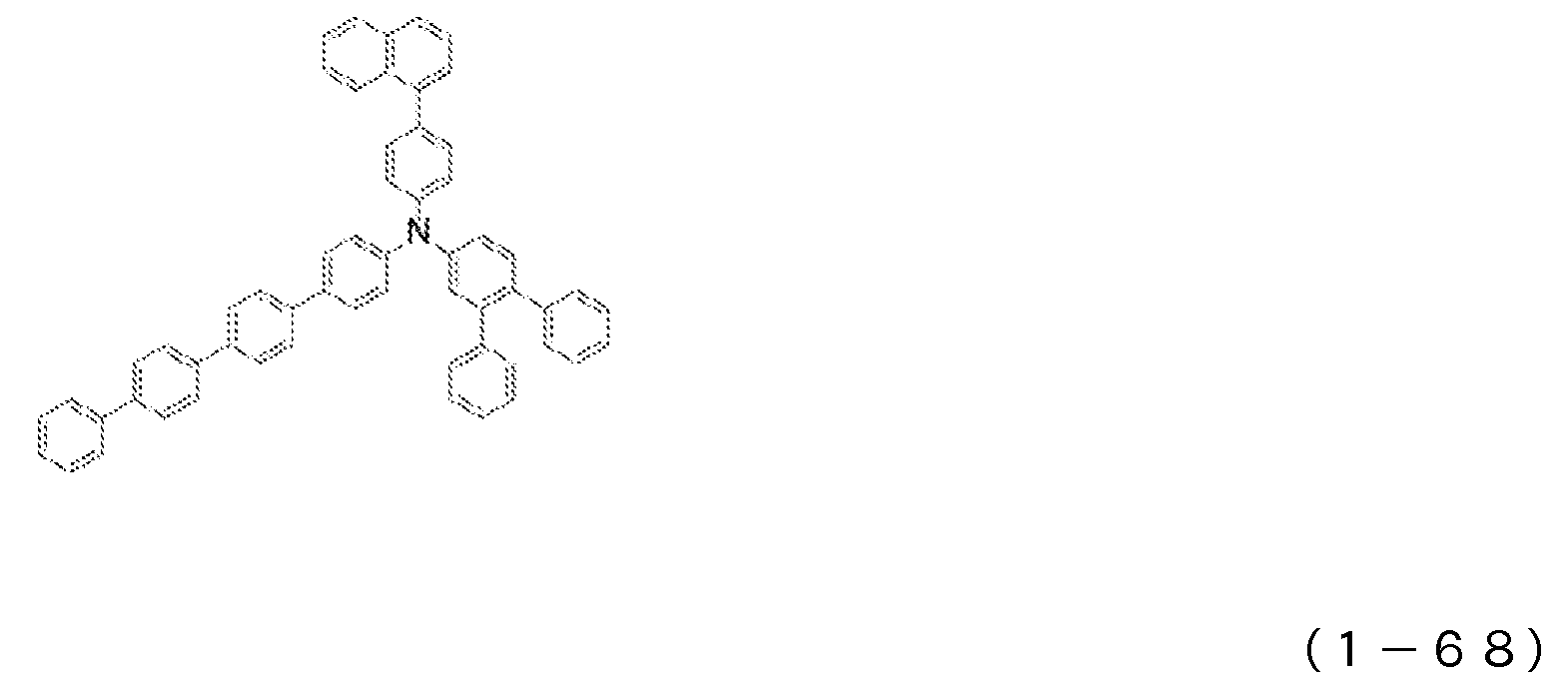
얻어진 황백색 고체에 대하여 NMR을 사용하여 구조를 동정하였다.The structure of the obtained yellowish-white solid was identified using NMR.
1H-NMR(CDCl3)에서 이하의 41개의 수소의 시그널을 검출하였다.The following 41 hydrogen signals were detected by 1 H-NMR (CDCl 3 ).
δ(ppm)=8.04-8.06(1H), 7.83-7.91(2H), 7.60-7.73(12H), 7.43-7.52(8H), 7.13-7.38(18H).δ (ppm) = 8.04-8.06 (1H), 7.83-7.91 (2H), 7.60-7.73 (12H), 7.43-7.52 (8H), 7.13-7.38 (18H).
실시예 12Example 12
<화합물 (2-11)의 합성><Synthesis of compound (2-11)>
반응 용기에 1-브로모벤젠(D-치환): 45.0g, 4-tert-부틸아닐린: 58.0g, 아세트산팔라듐(II): 1.0g, tert-부토시키나트륨: 30.0g, 비스(디페닐포스피노)-1,1'-비나프틸: 2.0g, 톨루엔: 450mL를 첨가하여 24시간 환류 교반하였다. 방랭한 후, 농축하고 칼럼 크로마토그래프에 의한 정제를 행함으로써, 하기 화합물 (2-11a)의 분체: 49.9g(수율 78%)을 얻었다.In a reaction vessel, 1-bromobenzene (D-substituted): 45.0 g, 4-tert-butylaniline: 58.0 g, palladium(II) acetate: 1.0 g, sodium tert-butoshiki: 30.0 g, bis(diphenylphos) Pino) -1,1'-binaphthyl: 2.0 g, toluene: 450 mL were added, and the mixture was refluxed and stirred for 24 hours. After cooling, it was concentrated and purified by column chromatography to obtain 49.9 g (yield: 78%) of powder of the following compound (2-11a).
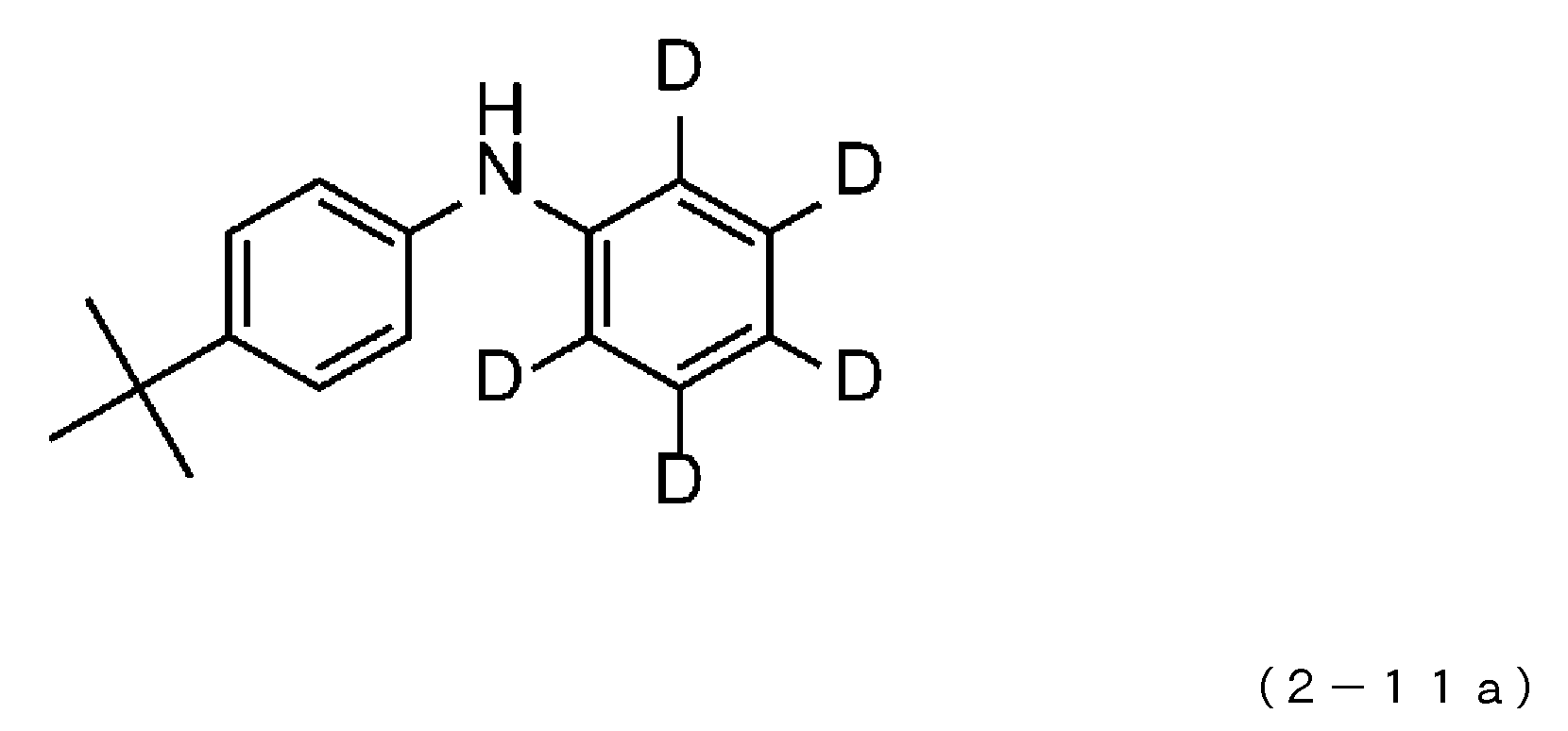
반응 용기에 상기 화합물 (2-11a): 20.0g, 하기 화합물 (2-11b): 18.4g, 아세트산팔라듐(II): 0.5g, tert-부토시키나트륨: 18.9g, 트리(tert-부틸)포스핀: 0.8g, 톨루엔: 200mL를 첨가하여 24시간 환류 교반하였다. 방랭한 후, 농축하고 칼럼 크로마토그래프에 의한 정제를 행함으로써, 하기 화합물 (2-11c)의 분체: 21.5g(수율 84%)을 얻었다.In a reaction vessel, the above compound (2-11a): 20.0 g, the following compound (2-11b): 18.4 g, palladium(II) acetate: 0.5 g, tert-butoshiki sodium: 18.9 g, tri(tert-butyl)phos Pin: 0.8 g and toluene: 200 mL were added, and the mixture was refluxed and stirred for 24 hours. After standing to cool, it was concentrated and purified by column chromatography to obtain 21.5 g (yield: 84%) of powder of the following compound (2-11c).


반응 용기에 상기 화합물 (2-11c): 12.0g, tert-부틸벤젠 120mL를 첨가하고 -78℃에서 n-부틸리튬 42.5mL를 적하한 후, 60℃에서 3시간 교반하면서 질소 가스를 통기하였다. 다음으로, -78℃에서 보론 트리브로마이드 11.3g을 적하한 후, 상온에서 1시간 교반하고, 또한 0℃에서 N,N-디이소프로필에틸아민 5.9g을 적하한 후, 120℃에서 2시간 교반하였다. 방랭한 후, 아세트산나트륨 수용액을 넣어 교반하고, 아세트산에틸로 추출하여, 유기층을 농축한 후, 칼럼 크로마토그래프에 의한 정제를 행함으로써, 하기 화합물 (2-11)의 분체: 1.7g(수율 11%)을 얻었다.12.0 g of the above compound (2-11c) and 120 mL of tert-butylbenzene were added to the reaction vessel, and 42.5 mL of n-butyllithium was added dropwise at -78°C, followed by nitrogen gas ventilation at 60°C for 3 hours with stirring. Next, after adding 11.3 g of boron tribromide dropwise at -78°C, stirring at room temperature for 1 hour, further adding dropwise 5.9 g of N,N-diisopropylethylamine at 0°C, followed by stirring at 120°C for 2 hours. did After cooling, an aqueous solution of sodium acetate was added, stirred, extracted with ethyl acetate, the organic layer was concentrated, and then purified by column chromatography to obtain a powder of the following compound (2-11): 1.7 g (yield: 11%) ) was obtained.
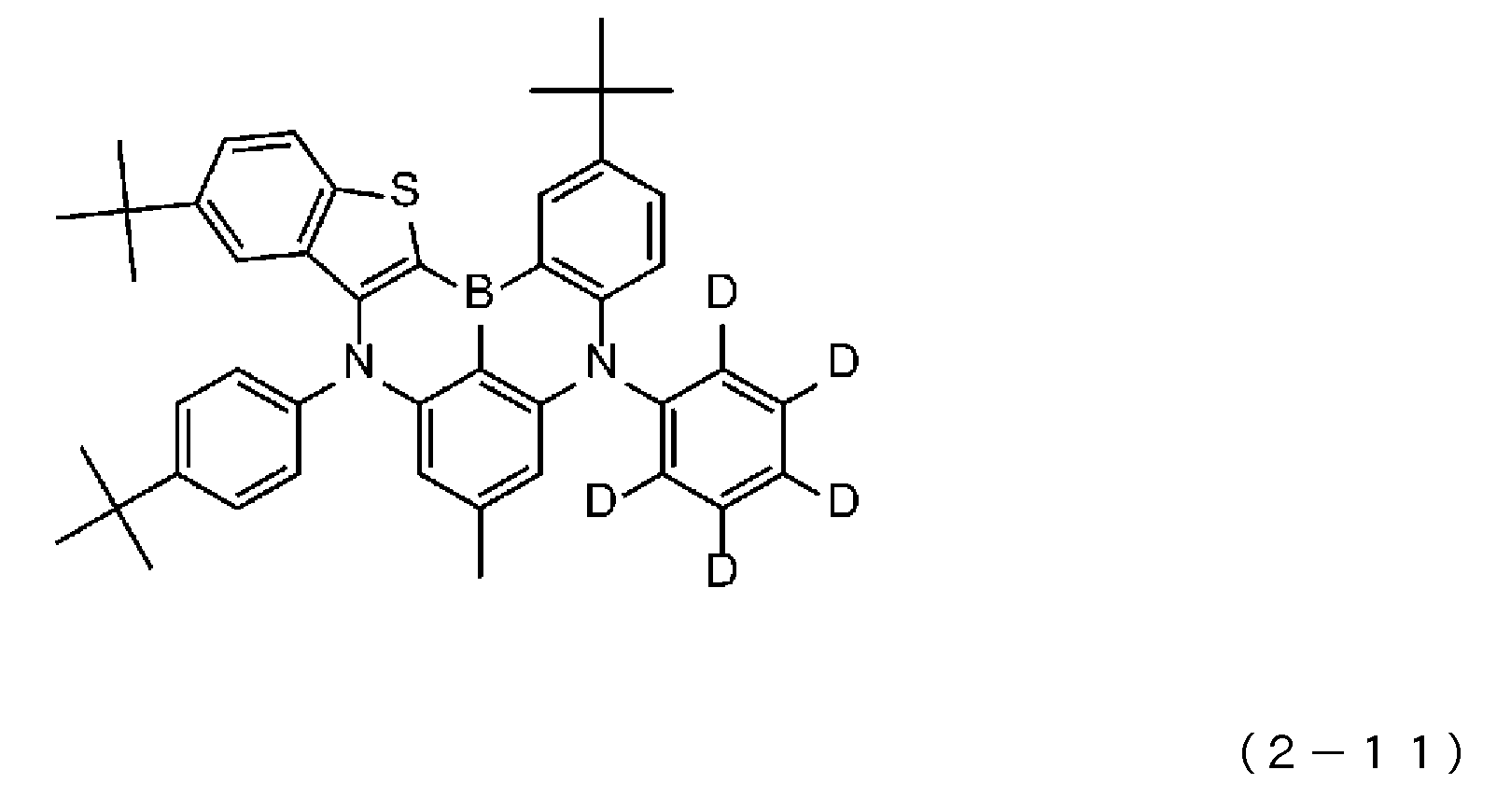
실시예 13Example 13
일반식 (1)로 표시되는 아릴아민 화합물에 대하여, 고감도 시차 주사 열량계(브루커ㆍAXS제, DSC3100SA)에 의해 유리 전이점(Tg)을 측정하였다. 측정 결과를 하기에 나타내었다.Regarding the arylamine compound represented by General formula (1), the glass transition point (Tg) was measured with the highly sensitive differential scanning calorimeter (Bruker AXS make, DSC3100SA). The measurement results are shown below.
유리 전이점(Tg) Glass transition point (Tg)
실시예 1의 화합물 (1-13) 111.1℃Compound of Example 1 (1-13) 111.1℃
실시예 2의 화합물 (1-17) 109.7℃Compound (1-17) of Example 2 109.7℃
실시예 3의 화합물 (1-30) 123.7℃Compound of Example 3 (1-30) 123.7℃
실시예 4의 화합물 (1-32) 121.0℃Compound of Example 4 (1-32) 121.0℃
실시예 5의 화합물 (1-41) 125.2℃Compound of Example 5 (1-41) 125.2℃
실시예 6의 화합물 (1-44) 118.7℃Compound of Example 6 (1-44) 118.7℃
실시예 7의 화합물 (1-58) 120.7℃Compound of Example 7 (1-58) 120.7℃
실시예 8의 화합물 (1-14) 120.4℃Compound (1-14) of Example 8 120.4℃
실시예 9의 화합물 (1-27) 123.3℃Compound of Example 9 (1-27) 123.3℃
실시예 10의 화합물 (1-62) 124.0℃Compound of Example 10 (1-62) 124.0℃
실시예 11의 화합물 (1-68) 120.6℃Compound of Example 11 (1-68) 120.6℃
일반식 (1)로 표시되는 아릴아민 화합물은 100℃ 이상의 유리 전이점(Tg)을 갖고 있으며, 박막 상태가 안정된 것을 나타내는 것이다.The arylamine compound represented by the general formula (1) has a glass transition point (Tg) of 100°C or higher, indicating that the thin film state is stable.
실시예 14Example 14
일반식 (1)로 표시되는 아릴아민 화합물을 사용하여, ITO 기판 상에 막 두께 100nm의 증착막을 제작하고, 이온화 포텐셜 측정 장치(스미토모 쥬키카이 고교 가부시키가이샤제, PYS-202)에 의해 일함수를 측정하였다. 측정 결과를 하기에 나타내었다.Using the arylamine compound represented by the general formula (1), a deposited film having a film thickness of 100 nm was prepared on an ITO substrate, and the work function was measured by an ionization potential measuring device (PYS-202, manufactured by Sumitomo Jukikai Kogyo Co., Ltd.). was measured. The measurement results are shown below.
일함수 work function
실시예 1의 화합물 (1-13) 5.69eVCompound of Example 1 (1-13) 5.69eV
실시예 2의 화합물 (1-17) 5.65eVCompound (1-17) of Example 2 5.65eV
실시예 3의 화합물 (1-30) 5.69eVCompound of Example 3 (1-30) 5.69eV
실시예 4의 화합물 (1-32) 5.75eVCompound of Example 4 (1-32) 5.75eV
실시예 5의 화합물 (1-41) 5.69eVCompound of Example 5 (1-41) 5.69eV
실시예 6의 화합물 (1-44) 5.71eVCompound of Example 6 (1-44) 5.71eV
실시예 7의 화합물 (1-58) 5.75eVCompound of Example 7 (1-58) 5.75eV
실시예 8의 화합물 (1-14) 5.71eVCompound (1-14) of Example 8 5.71eV
실시예 9의 화합물 (1-27) 5.72eVCompound of Example 9 (1-27) 5.72eV
실시예 10의 화합물 (1-62) 5.71eVCompound of Example 10 (1-62) 5.71eV
실시예 11의 화합물 (1-68) 5.69eVCompound of Example 11 (1-68) 5.69eV
일반식 (1)로 표시되는 아릴아민 화합물은 NPD, TPD 등의 일반적인 정공 수송 재료가 갖는 일함수 5.4eV와 비교하여, 적합한 에너지 준위를 나타내고 있으며, 양호한 정공 수송 능력을 갖고, 우수한 전자의 저지 능력을 갖는 것을 알 수 있다.The arylamine compound represented by Formula (1) shows a suitable energy level compared to the work function of 5.4 eV of general hole transport materials such as NPD and TPD, has good hole transport ability, and has excellent electron blocking ability It can be seen that it has
실시예 15Example 15
유기 EL 소자는, 도 10에 도시하는 바와 같이, 유리 기판(1) 상에 투명 양극(2)으로서 반사 ITO 전극을 미리 형성한 것 위에, 정공 주입층(3), 제1 정공 수송층(4), 제2 정공 수송층(5), 발광층(6), 전자 수송층(7), 전자 주입층(8), 음극(9), 캐핑층(10)의 순으로 증착하여 제작하였다.As shown in FIG. 10, the organic EL element comprises a hole injection layer 3 and a first hole transport layer 4 formed on a glass substrate 1 in advance as a transparent anode 2 with a reflective ITO electrode. , the second hole transport layer 5, the light emitting layer 6, the electron transport layer 7, the electron injection layer 8, the cathode 9, and the capping layer 10 were deposited in that order.
구체적으로는, 유리 기판(1) 상에 투명 양극(2)으로서, 막 두께 50nm의 ITO, 막 두께 100nm의 은 합금의 반사막, 막 두께 5nm의 ITO를 순서대로 제막하고, 이소프로필알코올 중에서 초음파 세정을 20분간 행한 후, 250℃로 가열한 핫 플레이트 상에서 10분간 건조를 행하였다. 그 후, UV 오존 처리를 15분간 행한 후, 이 ITO 구비 유리 기판을 진공 증착기 내에 설치하여, 0.001Pa 이하까지 감압하였다. 계속해서, 투명 양극(2)을 덮도록 정공 주입층(3)으로서, 하기 구조식의 전자 억셉터 (Acceptor-1)와 하기 구조식의 화합물 (HTM-1)을, 증착 속도비가 Acceptor-1:화합물 (HTM-1)=3:97이 되는 증착 속도로 2원 증착을 행하여, 막 두께 10nm가 되도록 형성하였다. 이 정공 주입층(3) 상에, 제1 정공 수송층(4)으로서 하기 구조식의 화합물 (HTM-1)을 막 두께 140nm가 되도록 형성하였다. 이 제1 정공 수송층(4) 상에, 제2 정공 수송층(5)으로서 실시예 1의 화합물 (1-13)을 막 두께 5nm가 되도록 형성하였다. 이 제2 정공 수송층(5) 상에, 발광층(6)으로서 실시예 12의 화합물 (2-11)과 하기 구조식의 화합물 (EMH-1)을, 증착 속도비가 화합물 (2-11):화합물 (EMH-1)=5:95가 되는 증착 속도로 2원 증착을 행하여, 막 두께 20nm가 되도록 형성하였다. 이 발광층(6) 상에, 전자 수송층(7)으로서 하기 구조식의 화합물 (ETM-1)과 하기 구조식의 화합물 (ETM-2)를, 증착 속도비가 화합물 (ETM-1):화합물 (ETM-2)=50:50이 되는 증착 속도로 2원 증착을 행하여, 막 두께 30nm가 되도록 형성하였다. 이 전자 수송층(7) 상에, 전자 주입층(8)으로서 불화리튬을 막 두께 1nm가 되도록 형성하였다. 이 전자 주입층(8) 상에, 음극(9)으로서 마그네슘은 합금을 막 두께 12nm가 되도록 형성하였다. 마지막으로, 캐핑층(10)으로서 하기 구조식의 화합물 (CPL-1)을 막 두께 60nm가 되도록 형성하였다. 제작한 유기 EL 소자에 대하여, 대기 중, 상온에서 직류 전압을 인가한 발광 특성의 측정을 행하였다. 그 결과를 표 1에 종합하여 나타내었다.Specifically, as a transparent anode 2, on a glass substrate 1, ITO with a film thickness of 50 nm, a silver alloy reflective film with a film thickness of 100 nm, and ITO with a film thickness of 5 nm were sequentially formed into films, followed by ultrasonic cleaning in isopropyl alcohol. After performing for 20 minutes, drying was performed for 10 minutes on a hot plate heated at 250°C. Then, after performing UV ozone treatment for 15 minutes, this glass substrate with ITO was installed in a vacuum evaporation machine and pressure was reduced to 0.001 Pa or less. Subsequently, as the hole injection layer 3 so as to cover the transparent anode 2, an electron acceptor (Acceptor-1) of the following structural formula and a compound (HTM-1) of the following structural formula were used at a deposition rate ratio of Acceptor-1:compound Binary deposition was performed at a deposition rate of (HTM-1) = 3:97 to form a film thickness of 10 nm. On this hole injection layer 3, as the first hole transport layer 4, a compound of the following structural formula (HTM-1) was formed to a film thickness of 140 nm. On this first hole transport layer 4, as a second hole transport layer 5, the compound (1-13) of Example 1 was formed so as to have a film thickness of 5 nm. On this second hole transport layer 5, as the light emitting layer 6, the compound (2-11) of Example 12 and the compound (EMH-1) of the following structural formula were deposited at a deposition rate ratio of compound (2-11):compound ( Binary vapor deposition was performed at a deposition rate of EMH-1) = 5:95 to form a film thickness of 20 nm. On this light-emitting layer 6, as the electron transport layer 7, a compound (ETM-1) of the following structural formula and a compound (ETM-2) of the following structural formula were deposited at a deposition rate ratio of compound (ETM-1):compound (ETM-2). ) = 50:50 by performing binary deposition to form a film thickness of 30 nm. On the electron transport layer 7, as an electron injection layer 8, lithium fluoride was formed to a film thickness of 1 nm. On this electron injection layer 8, a magnesium silver alloy was formed as a cathode 9 so as to have a film thickness of 12 nm. Finally, as the capping layer 10, a compound of the following structural formula (CPL-1) was formed to a film thickness of 60 nm. The organic EL device thus produced was subjected to measurement of light emission characteristics in air at room temperature by applying a DC voltage. The results are summarized and shown in Table 1.


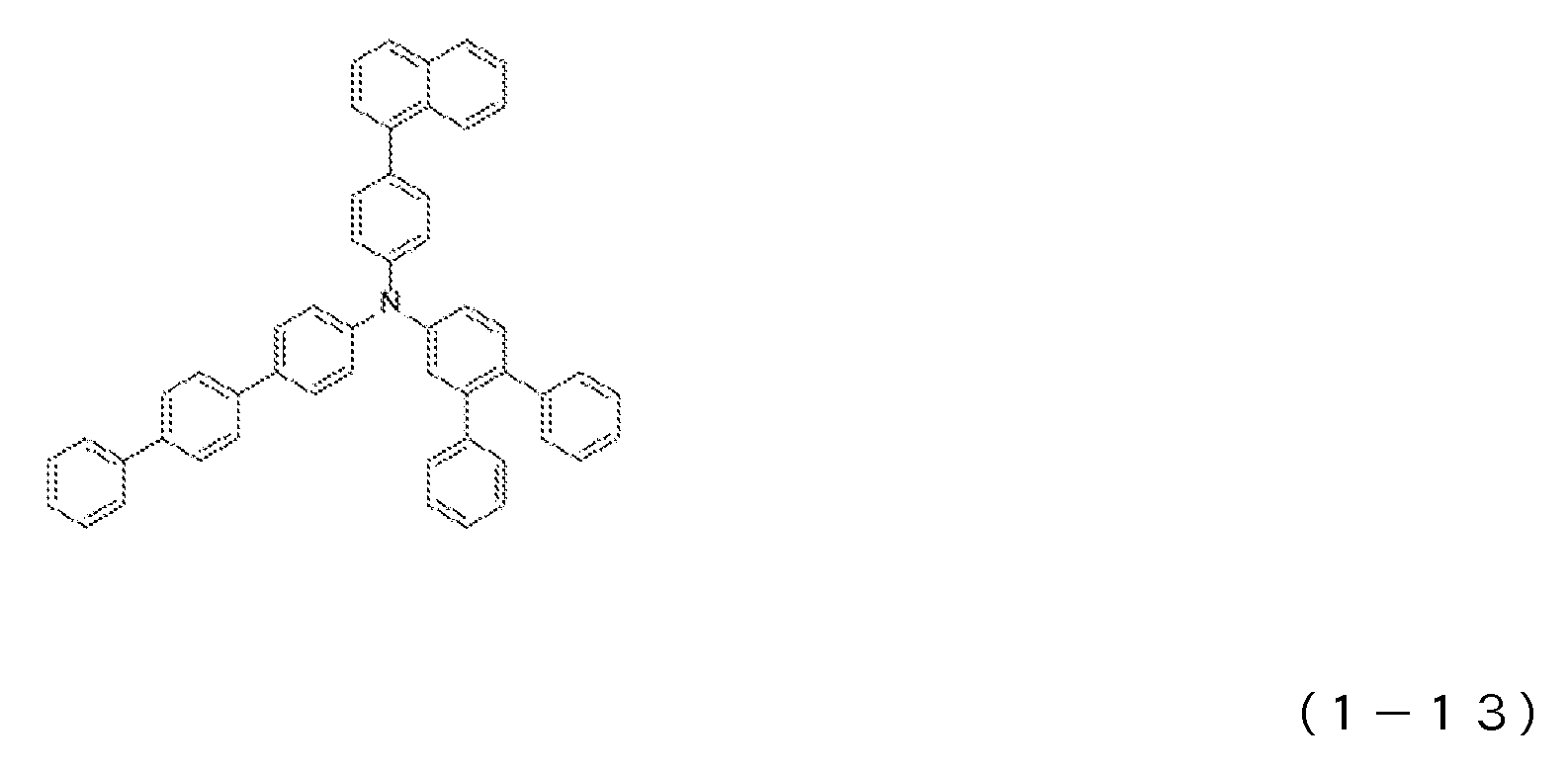


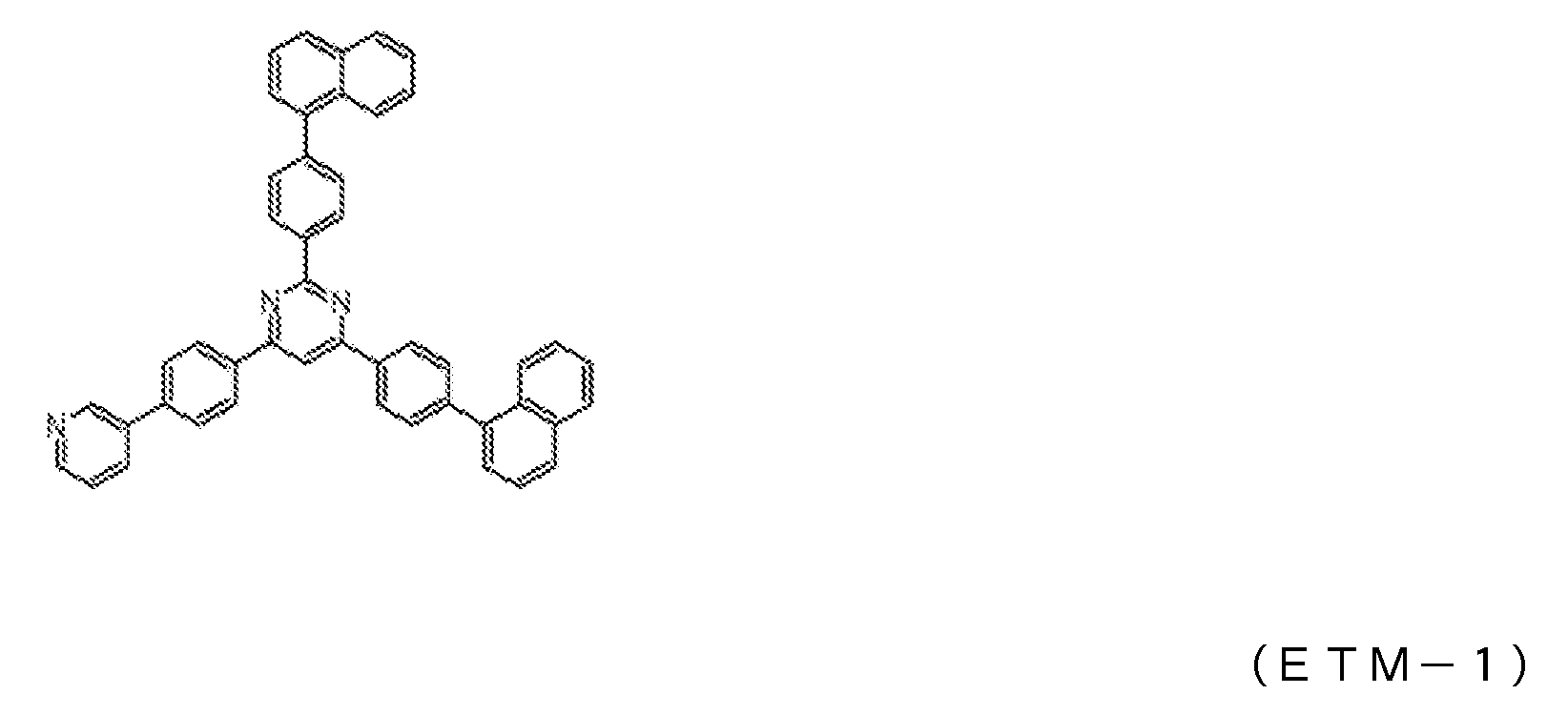

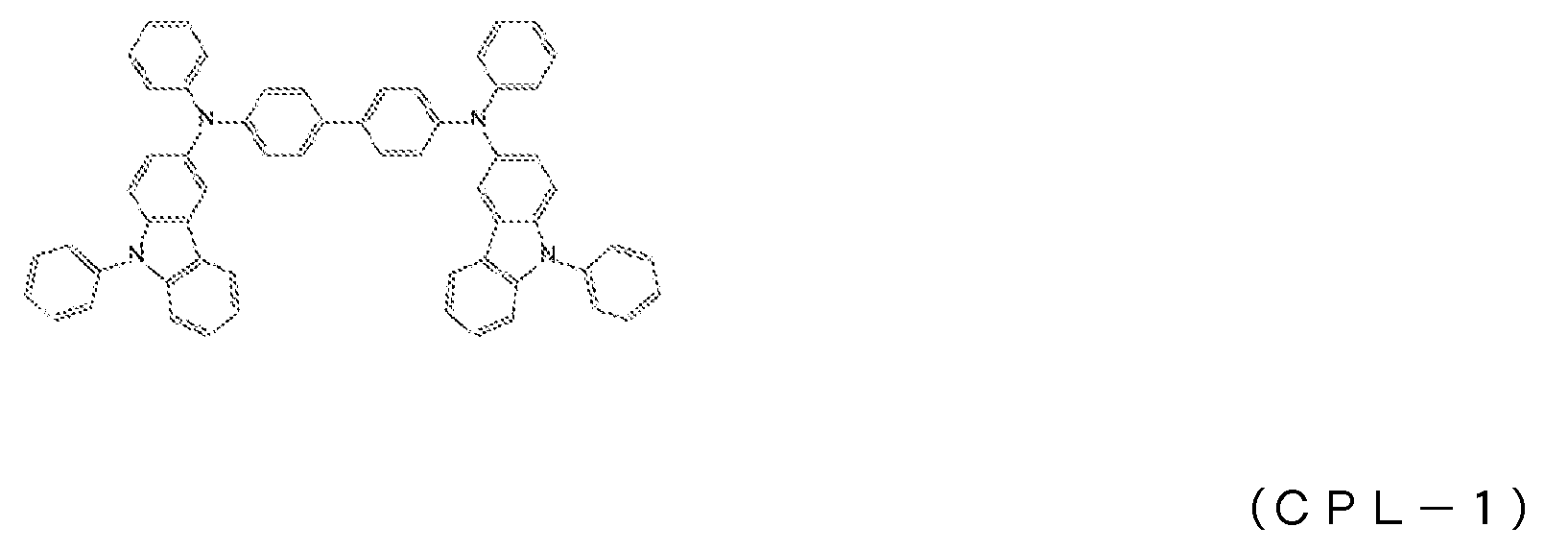
실시예 16Example 16
실시예 15에 있어서, 제2 정공 수송층(5)의 재료로서 실시예 1의 화합물 (1-13) 대신에 실시예 2의 화합물 (1-17)을 사용한 것 이외에는, 마찬가지의 조건에서 유기 EL 소자를 제작하였다. 제작한 유기 EL 소자에 대하여, 대기 중, 상온에서 특성 측정을 행하였다. 제작한 유기 EL 소자에 직류 전압을 인가하였을 때의 발광 특성의 측정 결과를 표 1에 종합하여 나타내었다.In Example 15, the organic EL device under the same conditions except that the compound (1-17) of Example 2 was used instead of the compound (1-13) of Example 1 as the material of the second hole transport layer 5. was produced. The characteristics of the fabricated organic EL device were measured in air at room temperature. Table 1 summarizes the measurement results of light emission characteristics when a DC voltage is applied to the fabricated organic EL device.
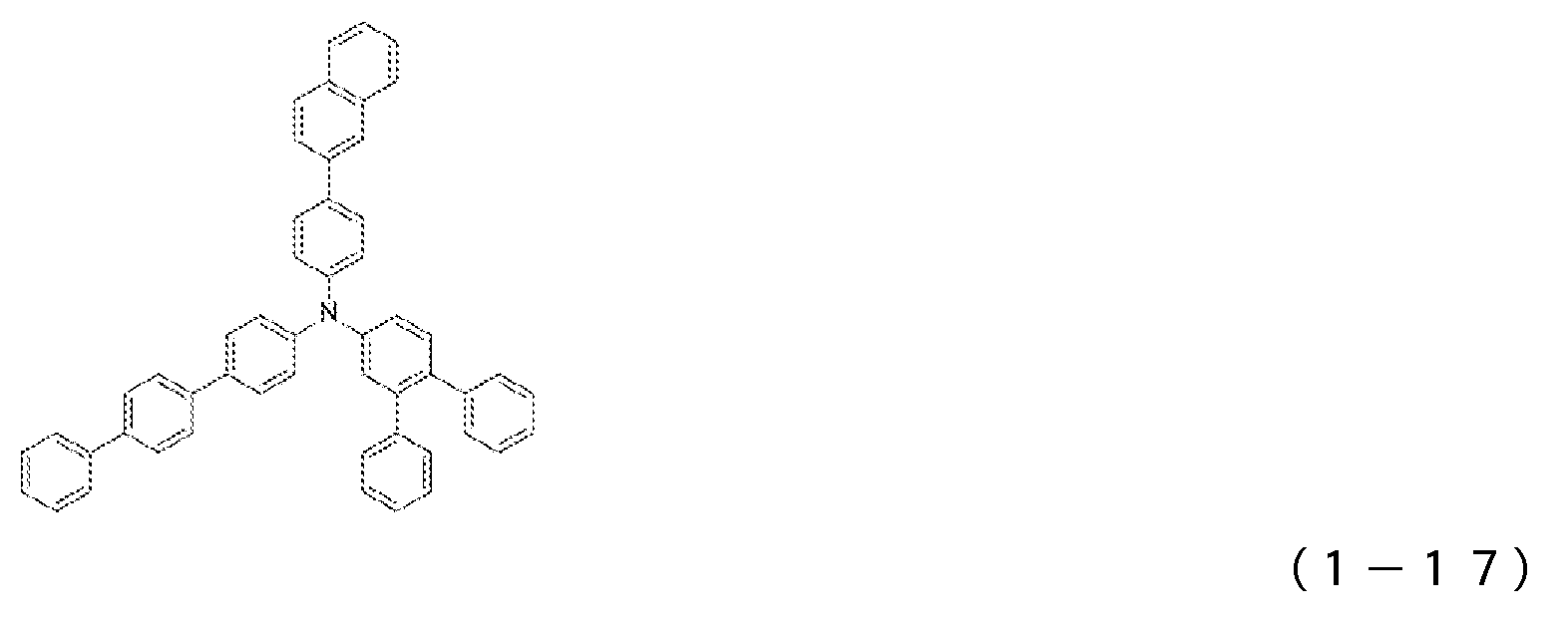
실시예 17Example 17
실시예 15에 있어서, 제2 정공 수송층(5)의 재료로서 실시예 1의 화합물 (1-13) 대신에 실시예 3의 화합물 (1-30)을 사용한 것 이외에는, 마찬가지의 조건에서 유기 EL 소자를 제작하였다. 제작한 유기 EL 소자에 대하여, 대기 중, 상온에서 특성 측정을 행하였다. 제작한 유기 EL 소자에 직류 전압을 인가하였을 때의 발광 특성의 측정 결과를 표 1에 종합하여 나타내었다.In Example 15, the organic EL device under the same conditions except that the compound (1-30) of Example 3 was used instead of the compound (1-13) of Example 1 as the material of the second hole transport layer 5. was produced. The characteristics of the fabricated organic EL device were measured in air at room temperature. Table 1 summarizes the measurement results of light emission characteristics when a DC voltage is applied to the fabricated organic EL device.

실시예 18Example 18
실시예 15에 있어서, 제2 정공 수송층(5)의 재료로서 실시예 1의 화합물 (1-13) 대신에 실시예 4의 화합물 (1-32)를 사용한 것 이외에는, 마찬가지의 조건에서 유기 EL 소자를 제작하였다. 제작한 유기 EL 소자에 대하여, 대기 중, 상온에서 특성 측정을 행하였다. 제작한 유기 EL 소자에 직류 전압을 인가하였을 때의 발광 특성의 측정 결과를 표 1에 종합하여 나타내었다.In Example 15, the organic EL device under the same conditions except that the compound (1-32) of Example 4 was used instead of the compound (1-13) of Example 1 as the material of the second hole transport layer 5. was produced. The characteristics of the fabricated organic EL device were measured in air at room temperature. Table 1 summarizes the measurement results of light emission characteristics when a DC voltage is applied to the fabricated organic EL device.
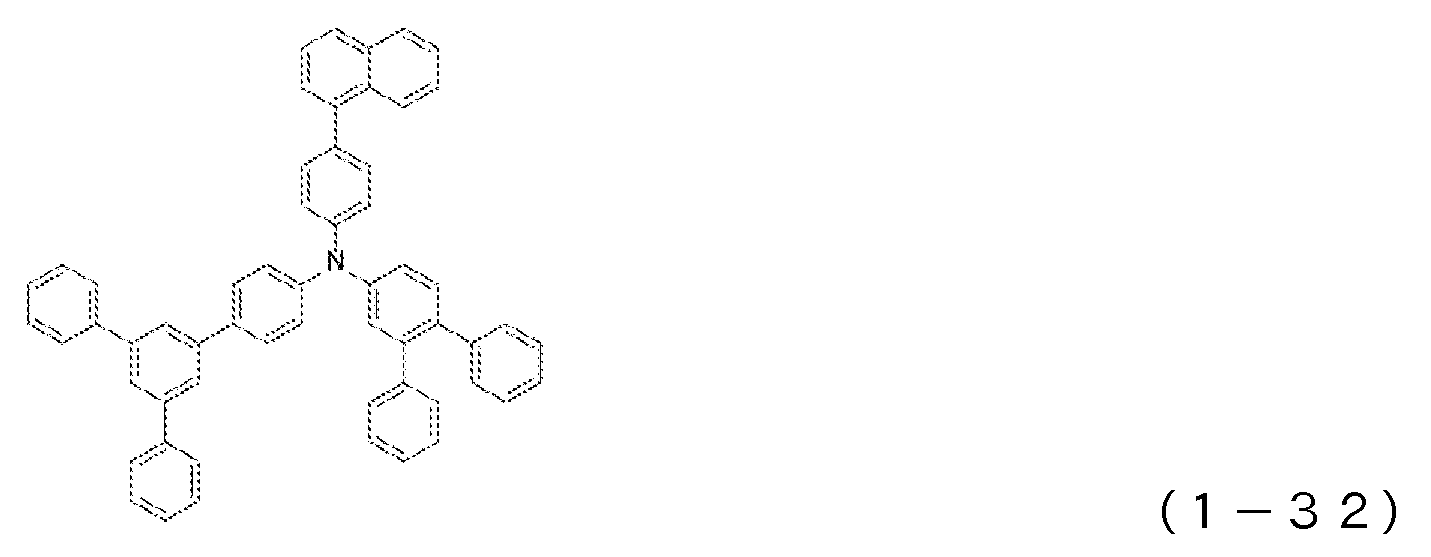
실시예 19Example 19
실시예 15에 있어서, 제2 정공 수송층(5)의 재료로서 실시예 1의 화합물 (1-13) 대신에 실시예 5의 화합물 (1-41)을 사용한 것 이외에는, 마찬가지의 조건에서 유기 EL 소자를 제작하였다. 제작한 유기 EL 소자에 대하여, 대기 중, 상온에서 특성 측정을 행하였다. 제작한 유기 EL 소자에 직류 전압을 인가하였을 때의 발광 특성의 측정 결과를 표 1에 종합하여 나타내었다.In Example 15, the organic EL device under the same conditions except that the compound (1-41) of Example 5 was used instead of the compound (1-13) of Example 1 as the material of the second hole transport layer 5. was produced. The characteristics of the fabricated organic EL device were measured in air at room temperature. Table 1 summarizes the measurement results of light emission characteristics when a DC voltage is applied to the fabricated organic EL device.

실시예 20Example 20
실시예 15에 있어서, 제2 정공 수송층(5)의 재료로서 실시예 1의 화합물 (1-13) 대신에 실시예 6의 화합물 (1-44)를 사용한 것 이외에는, 마찬가지의 조건에서 유기 EL 소자를 제작하였다. 제작한 유기 EL 소자에 대하여, 대기 중, 상온에서 특성 측정을 행하였다. 제작한 유기 EL 소자에 직류 전압을 인가하였을 때의 발광 특성의 측정 결과를 표 1에 종합하여 나타내었다.In Example 15, the organic EL device under the same conditions except that the compound (1-44) of Example 6 was used instead of the compound (1-13) of Example 1 as the material of the second hole transport layer 5. was produced. The characteristics of the fabricated organic EL device were measured in air at room temperature. Table 1 summarizes the measurement results of light emission characteristics when a DC voltage is applied to the fabricated organic EL device.

실시예 21Example 21
실시예 15에 있어서, 제2 정공 수송층(5)의 재료로서 실시예 1의 화합물 (1-13) 대신에 실시예 7의 화합물 (1-58)을 사용한 것 이외에는, 마찬가지의 조건에서 유기 EL 소자를 제작하였다. 제작한 유기 EL 소자에 대하여, 대기 중, 상온에서 특성 측정을 행하였다. 제작한 유기 EL 소자에 직류 전압을 인가하였을 때의 발광 특성의 측정 결과를 표 1에 종합하여 나타내었다.In Example 15, the organic EL device under the same conditions except that the compound (1-58) of Example 7 was used instead of the compound (1-13) of Example 1 as the material of the second hole transport layer 5. was produced. The characteristics of the fabricated organic EL device were measured in air at room temperature. Table 1 summarizes the measurement results of light emission characteristics when a DC voltage is applied to the fabricated organic EL device.
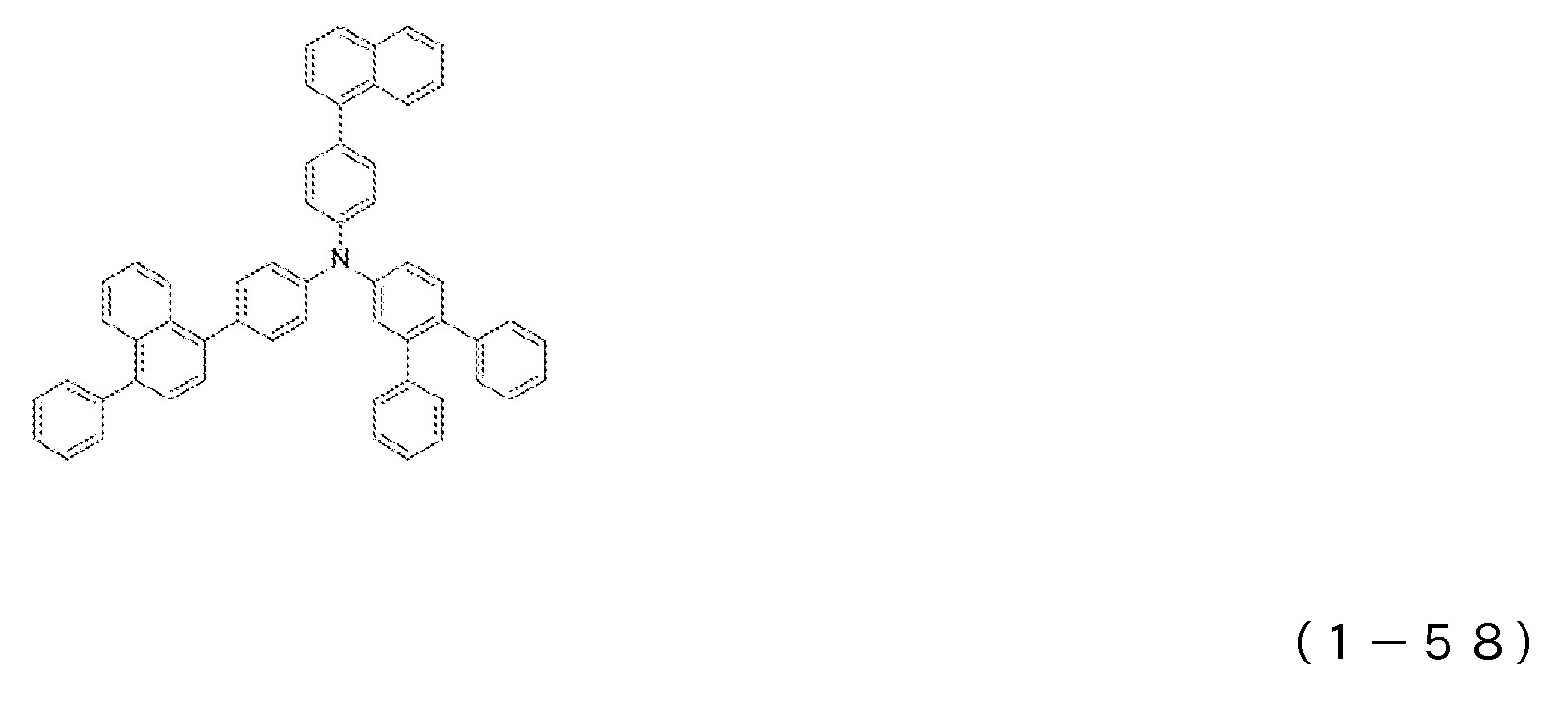
실시예 22Example 22
실시예 15에 있어서, 제2 정공 수송층(5)의 재료로서 실시예 1의 화합물 (1-13) 대신에 실시예 7의 화합물 (1-14)를 사용한 것 이외에는, 마찬가지의 조건에서 유기 EL 소자를 제작하였다. 제작한 유기 EL 소자에 대하여, 대기 중, 상온에서 특성 측정을 행하였다. 제작한 유기 EL 소자에 직류 전압을 인가하였을 때의 발광 특성의 측정 결과를 표 1에 종합하여 나타내었다.In Example 15, the organic EL device under the same conditions except that the compound (1-14) of Example 7 was used instead of the compound (1-13) of Example 1 as the material of the second hole transport layer 5. was produced. The characteristics of the fabricated organic EL device were measured in air at room temperature. Table 1 summarizes the measurement results of light emission characteristics when a DC voltage is applied to the fabricated organic EL device.
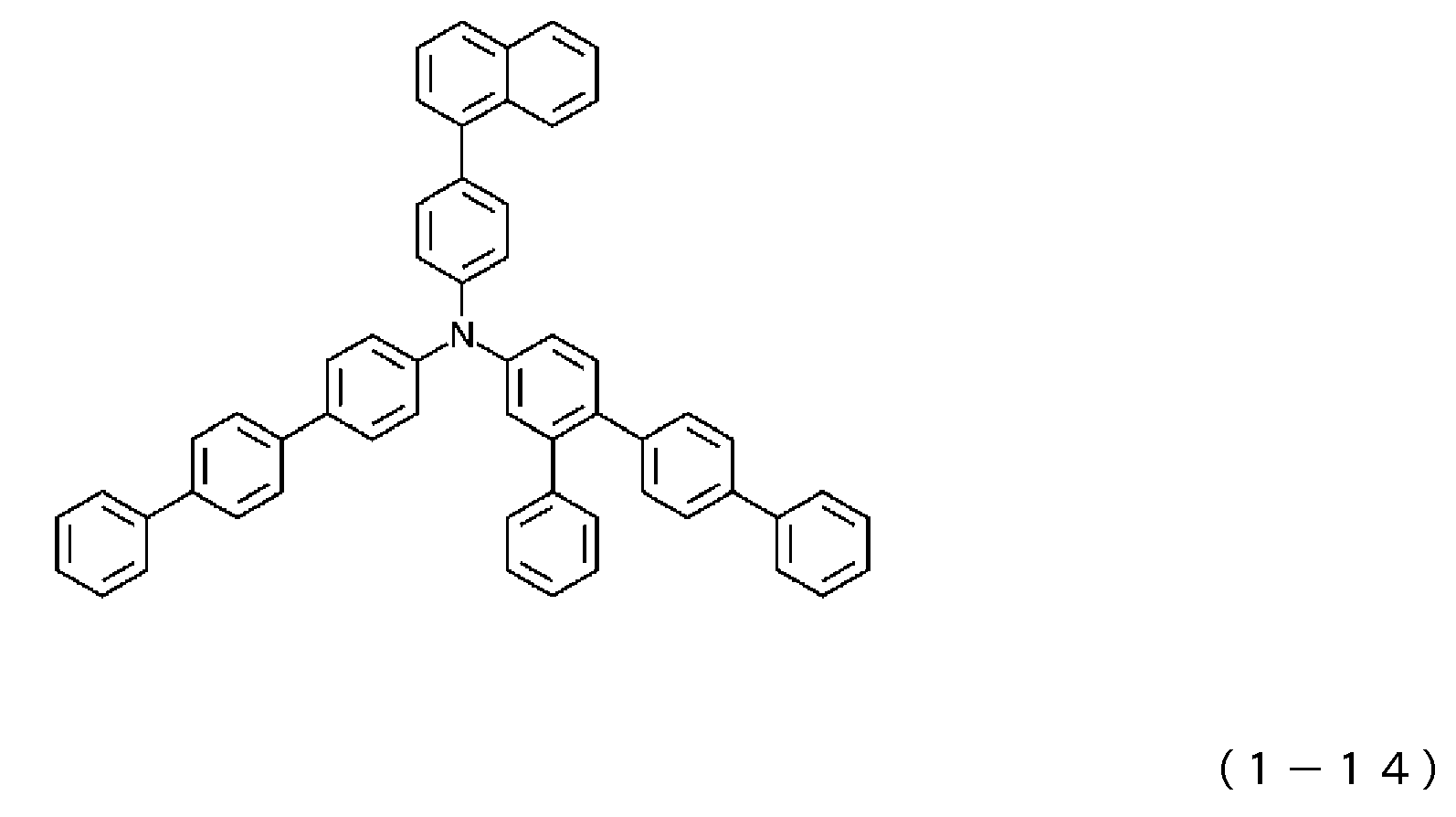
실시예 23Example 23
실시예 15에 있어서, 제2 정공 수송층(5)의 재료로서 실시예 1의 화합물 (1-13) 대신에 실시예 7의 화합물 (1-27)을 사용한 것 이외에는, 마찬가지의 조건에서 유기 EL 소자를 제작하였다. 제작한 유기 EL 소자에 대하여, 대기 중, 상온에서 특성 측정을 행하였다. 제작한 유기 EL 소자에 직류 전압을 인가하였을 때의 발광 특성의 측정 결과를 표 1에 종합하여 나타내었다.In Example 15, the organic EL device under the same conditions except that the compound (1-27) of Example 7 was used instead of the compound (1-13) of Example 1 as the material of the second hole transport layer 5. was produced. The characteristics of the fabricated organic EL device were measured in air at room temperature. Table 1 summarizes the measurement results of light emission characteristics when a DC voltage is applied to the fabricated organic EL device.
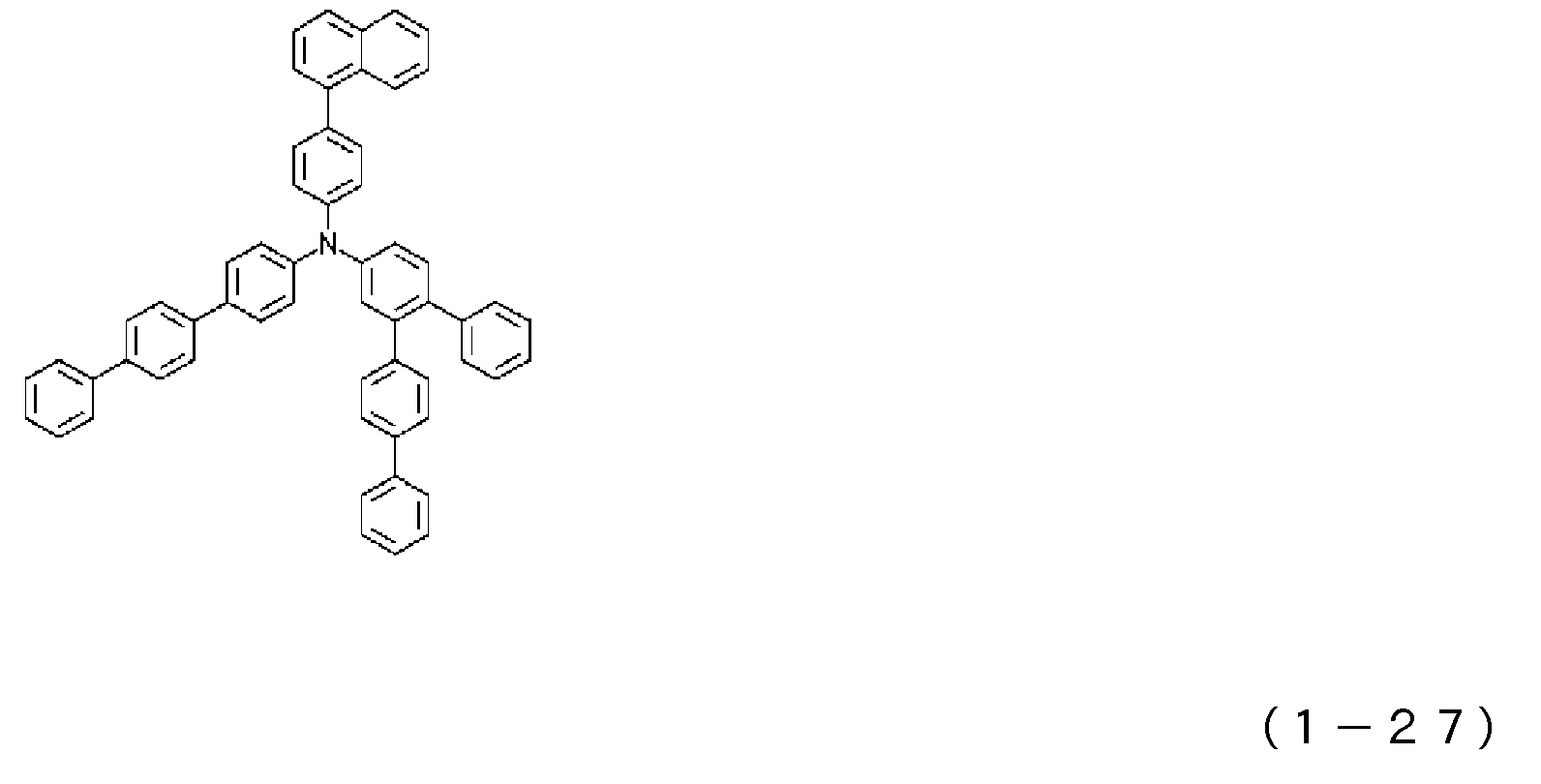
실시예 24Example 24
실시예 15에 있어서, 제2 정공 수송층(5)의 재료로서 실시예 1의 화합물 (1-13) 대신에 실시예 7의 화합물 (1-62)를 사용한 것 이외에는, 마찬가지의 조건에서 유기 EL 소자를 제작하였다. 제작한 유기 EL 소자에 대하여, 대기 중, 상온에서 특성 측정을 행하였다. 제작한 유기 EL 소자에 직류 전압을 인가하였을 때의 발광 특성의 측정 결과를 표 1에 종합하여 나타내었다.In Example 15, the organic EL device under the same conditions except that the compound (1-62) of Example 7 was used instead of the compound (1-13) of Example 1 as the material of the second hole transport layer 5. was produced. The characteristics of the fabricated organic EL device were measured in air at room temperature. Table 1 summarizes the measurement results of light emission characteristics when a DC voltage is applied to the fabricated organic EL device.

실시예 25Example 25
실시예 15에 있어서, 제2 정공 수송층(5)의 재료로서 실시예 1의 화합물 (1-13) 대신에 실시예 7의 화합물 (1-68)을 사용한 것 이외에는, 마찬가지의 조건에서 유기 EL 소자를 제작하였다. 제작한 유기 EL 소자에 대하여, 대기 중, 상온에서 특성 측정을 행하였다. 제작한 유기 EL 소자에 직류 전압을 인가하였을 때의 발광 특성의 측정 결과를 표 1에 종합하여 나타내었다.In Example 15, the organic EL device under the same conditions except that the compound (1-68) of Example 7 was used instead of the compound (1-13) of Example 1 as the material of the second hole transport layer 5. was produced. The characteristics of the fabricated organic EL device were measured in air at room temperature. Table 1 summarizes the measurement results of light emission characteristics when a DC voltage is applied to the fabricated organic EL device.

[비교예 1][Comparative Example 1]
비교를 위해, 실시예 15에 있어서, 제2 정공 수송층(5)의 재료로서 실시예 1의 화합물 (1-13) 대신에 하기 구조식의 화합물 (HTM-2)를 사용한 것 이외에는, 마찬가지의 조건에서 유기 EL 소자를 제작하였다. 제작한 유기 EL 소자에 대하여, 대기 중, 상온에서 특성 측정을 행하였다. 제작한 유기 EL 소자에 직류 전압을 인가하였을 때의 발광 특성의 측정 결과를 표 1에 종합하여 나타내었다.For comparison, in Example 15, the compound (HTM-2) of the following structural formula was used instead of the compound (1-13) of Example 1 as the material of the second hole transport layer 5, but under the same conditions. An organic EL device was fabricated. The characteristics of the fabricated organic EL device were measured in air at room temperature. Table 1 summarizes the measurement results of light emission characteristics when a DC voltage is applied to the fabricated organic EL device.

[비교예 2][Comparative Example 2]
비교를 위해, 실시예 15에 있어서, 제2 정공 수송층(5)의 재료로서 실시예 1의 화합물 (1-13) 대신에 하기 구조식의 화합물 (HTM-3)을 사용한 것 이외에는, 마찬가지의 조건에서 유기 EL 소자를 제작하였다. 제작한 유기 EL 소자에 대하여, 대기 중, 상온에서 특성 측정을 행하였다. 제작한 유기 EL 소자에 직류 전압을 인가하였을 때의 발광 특성의 측정 결과를 표 1에 종합하여 나타내었다.For comparison, in Example 15, the compound (HTM-3) of the following structural formula was used instead of the compound (1-13) of Example 1 as the material of the second hole transport layer 5, but under the same conditions. An organic EL device was fabricated. The characteristics of the fabricated organic EL device were measured in air at room temperature. Table 1 summarizes the measurement results of light emission characteristics when a DC voltage is applied to the fabricated organic EL device.

[비교예 3][Comparative Example 3]
비교를 위해, 실시예 15에 있어서, 제2 정공 수송층(5)의 재료로서 실시예 1의 화합물 (1-13) 대신에 하기 구조식의 화합물 (HTM-4)를 사용한 것 이외에는, 마찬가지의 조건에서 유기 EL 소자를 제작하였다. 제작한 유기 EL 소자에 대하여, 대기 중, 상온에서 특성 측정을 행하였다. 제작한 유기 EL 소자에 직류 전압을 인가하였을 때의 발광 특성의 측정 결과를 표 1에 종합하여 나타내었다.For comparison, in Example 15, the compound (HTM-4) of the following structural formula was used instead of the compound (1-13) of Example 1 as the material of the second hole transport layer 5, but under the same conditions. An organic EL device was fabricated. The characteristics of the fabricated organic EL device were measured in air at room temperature. Table 1 summarizes the measurement results of light emission characteristics when a DC voltage is applied to the fabricated organic EL device.
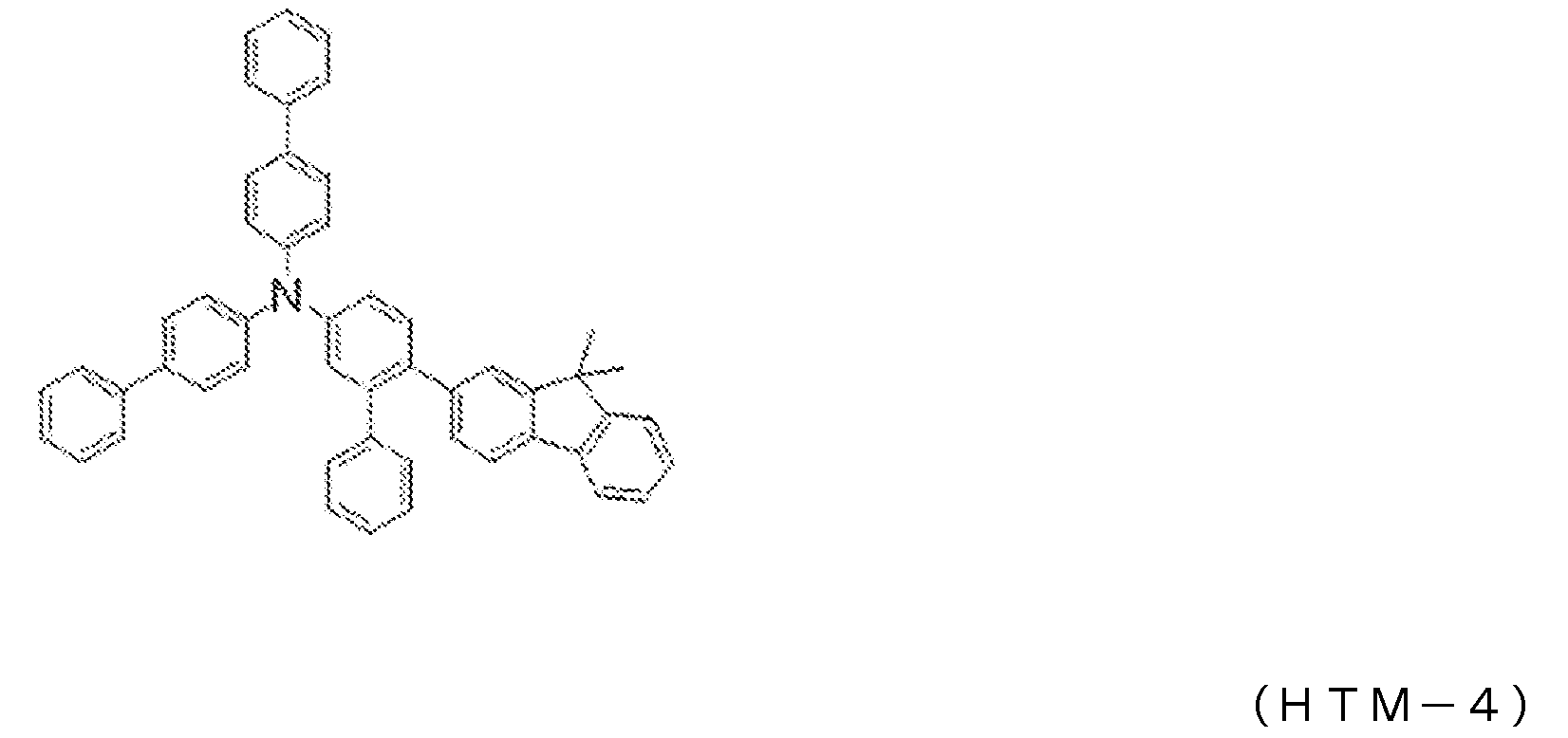
실시예 15 내지 25 및 비교예 1 내지 3에서 제작한 유기 EL 소자를 사용하여, 소자 수명을 측정하였다. 그 결과를 표 1에 종합하여 나타내었다. 소자 수명은, 발광 개시 시의 발광 휘도(초기 휘도)를 2000cd/㎡로 하여 정전류 구동을 행하였을 때, 발광 휘도가 1900cd/㎡(초기 휘도를 100%로 하였을 때의 95%에 상당: 95% 감쇠)로 감쇠할 때까지의 시간으로서 측정하였다.Using the organic EL devices fabricated in Examples 15 to 25 and Comparative Examples 1 to 3, device life was measured. The results are summarized and shown in Table 1. The life of the device is 1900 cd/m 2 (equivalent to 95% when the initial luminance is 100%: 95% Attenuation) was measured as the time until attenuation.

표 1에 나타내는 바와 같이, 전류 밀도 10mA/㎠의 전류를 흐르게 하였을 때의 발광 효율은, 비교예 1 내지 3의 유기 EL 소자의 7.94 내지 9.34cd/A에 비해, 실시예 15 내지 25의 유기 EL 소자에서는 9.68 내지 10.75cd/A로 고효율이었다. 또한, 전력 효율에 있어서도, 비교예 1 내지 3의 유기 EL 소자의 7.30 내지 8.61lm/W에 비해, 실시예 15 내지 25의 유기 EL 소자에서는 8.94 내지 9.78lm/W로 고효율이었다. 또한, 소자 수명(95% 감쇠)에 있어서는, 비교예 1 내지 3의 유기 EL 소자의 306 내지 335시간에 비해, 실시예 15 내지 25의 유기 EL 소자에서는 345 내지 627시간으로 대폭 장수명화되어 있는 것을 알 수 있다.As shown in Table 1, the luminous efficiency when a current having a current density of 10 mA/cm 2 was passed was 7.94 to 9.34 cd/A of the organic EL devices of Comparative Examples 1 to 3, compared to the organic EL of Examples 15 to 25. The device had a high efficiency of 9.68 to 10.75 cd/A. Also, in terms of power efficiency, the organic EL devices of Examples 15 to 25 had high efficiencies of 8.94 to 9.78 lm/W compared to 7.30 to 8.61 lm/W for the organic EL devices of Comparative Examples 1 to 3. In addition, in terms of device lifetime (95% attenuation), compared to 306 to 335 hours of the organic EL devices of Comparative Examples 1 to 3, the organic EL devices of Examples 15 to 25 have a significantly longer lifetime of 345 to 627 hours. Able to know.
이상의 결과로부터 명확한 바와 같이, 본 발명에 관한 일반식 (1)로 표시되는 특정의 구조를 갖는 아릴아민 화합물은, 종래의 정공 수송 재료로 하는 아릴아민 화합물과 비교하여, 정공의 이동도가 크고, 우수한 전자의 저지 능력을 갖고 있기 때문에, 본 발명의 청색 발광층과 함께 사용하고 있는 유기 EL 소자는, 종래의 유기 EL 소자와 비교하여, 고발광 효율이며, 또한 장수명의 유기 EL 소자를 실현할 수 있는 것을 알 수 있었다.As is clear from the above results, the arylamine compound having a specific structure represented by the general formula (1) according to the present invention has a higher hole mobility than an arylamine compound used as a conventional hole transport material, Since it has excellent electron blocking ability, the organic EL element used together with the blue light emitting layer of the present invention can realize an organic EL element with high luminous efficiency and long life compared to conventional organic EL elements. Could know.
본 발명의, 특정의 구조를 갖는 아릴아민 화합물을 사용한 유기 EL 소자는, 발광 효율이 향상됨과 함께, 유기 EL 소자의 내구성을 개선시킬 수 있어, 예를 들어 가정 전화 제품이나 조명 용도로의 전개가 가능하게 되었다.The organic EL device using the arylamine compound having a specific structure of the present invention can improve the durability of the organic EL device while improving the luminous efficiency, and can be developed for, for example, home appliances and lighting applications. It became possible.
1: 유리 기판
2: 투명 양극
3: 정공 주입층
4: 제1 정공 수송층
5: 제2 정공 수송층
6: 발광층
7: 전자 수송층
8: 전자 주입층
9: 음극
10: 캐핑층1: glass substrate
2: transparent anode
3: hole injection layer
4: first hole transport layer
5: second hole transport layer
6: light emitting layer
7: electron transport layer
8: electron injection layer
9: cathode
10: capping layer
Claims (10)

(식 중, R1 내지 R4는 서로 동일해도 되고 달라도 되며, 수소 원자, 중수소 원자, 카르보닐기, 시아노기, 치환기를 갖고 있어도 되는 실릴기, 치환기를 갖고 있어도 되는 포스피노기, 치환기를 갖고 있어도 되는 포스핀옥사이드기, 치환기를 갖고 있어도 되는 탄소 원자수 1 내지 6의 직쇄상 혹은 분지상의 알킬기, 치환 혹은 비치환의 환 형성 탄소 원자수 6 내지 25의 방향족 탄화수소기를 나타낸다. L은 치환 혹은 비치환의 환 형성 탄소 원자수 6 내지 20의 방향족 탄화수소의 2가 기, 또는 단결합을 나타낸다. R5 내지 R7은 수소 원자, 중수소 원자, 치환기를 갖고 있어도 되는 탄소 원자수 1 내지 6의 직쇄상 혹은 분지상의 알킬기, 할로겐 원자, 시아노기를 나타낸다.)An organic electroluminescent device having at least an anode, a first hole transport layer, a second hole transport layer, a blue light emitting layer, an electron transport layer and a cathode in this order, wherein the second hole transport layer is an aryl represented by the following general formula (1) An organic electroluminescent element characterized by containing an amine compound.
(In the formula, R 1 to R 4 may be the same as or different from each other, and a hydrogen atom, a deuterium atom, a carbonyl group, a cyano group, a silyl group which may have a substituent, a phosphino group which may have a substituent, a phosphino group which may have a substituent A phosphine oxide group, a linear or branched alkyl group having 1 to 6 carbon atoms which may have a substituent, and a substituted or unsubstituted ring-forming aromatic hydrocarbon group having 6 to 25 carbon atoms. Represents a divalent group or a single bond of an aromatic hydrocarbon having 6 to 20 carbon atoms, R 5 to R 7 are hydrogen atoms, deuterium atoms, or linear or branched carbon atoms having 1 to 6 carbon atoms which may have substituents. represents an alkyl group, a halogen atom, or a cyano group.)
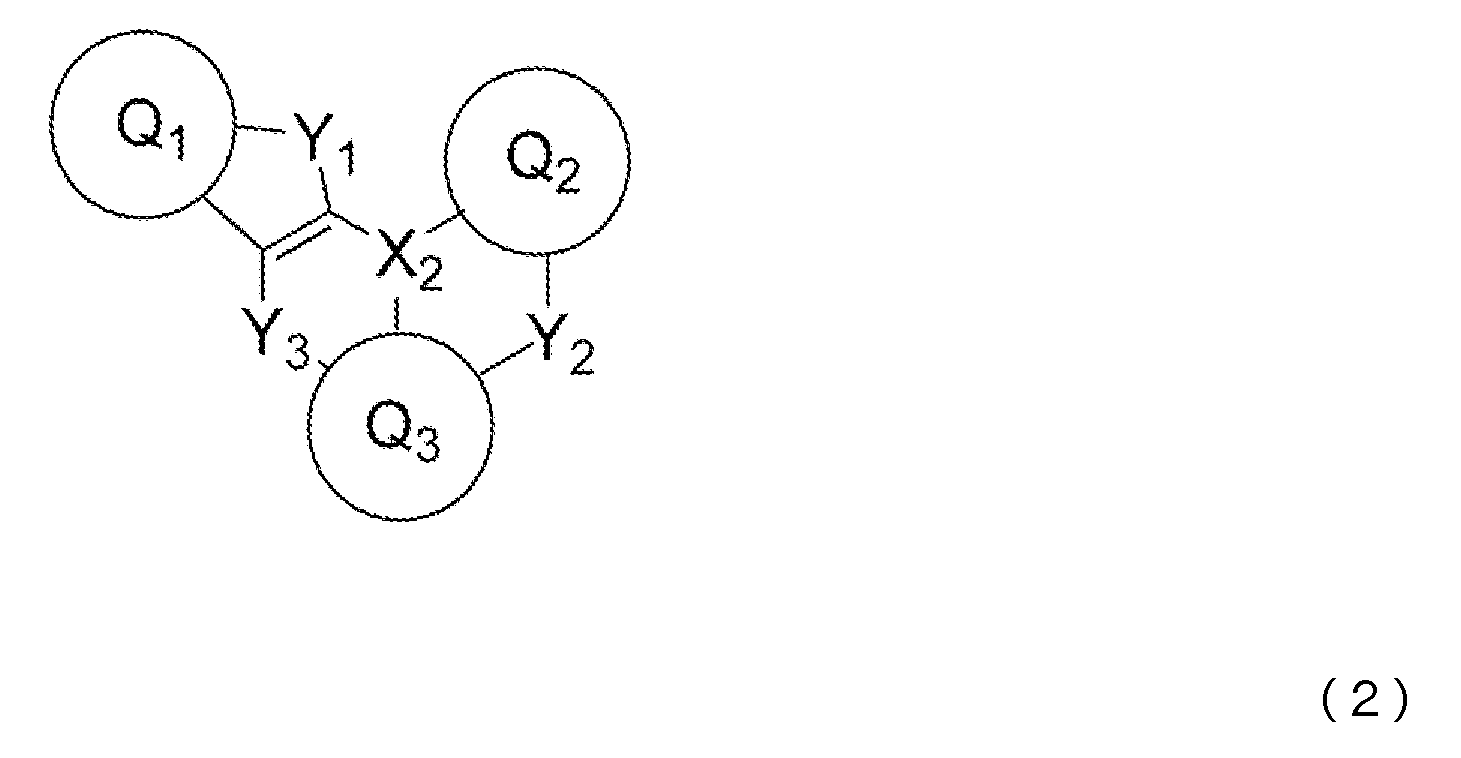
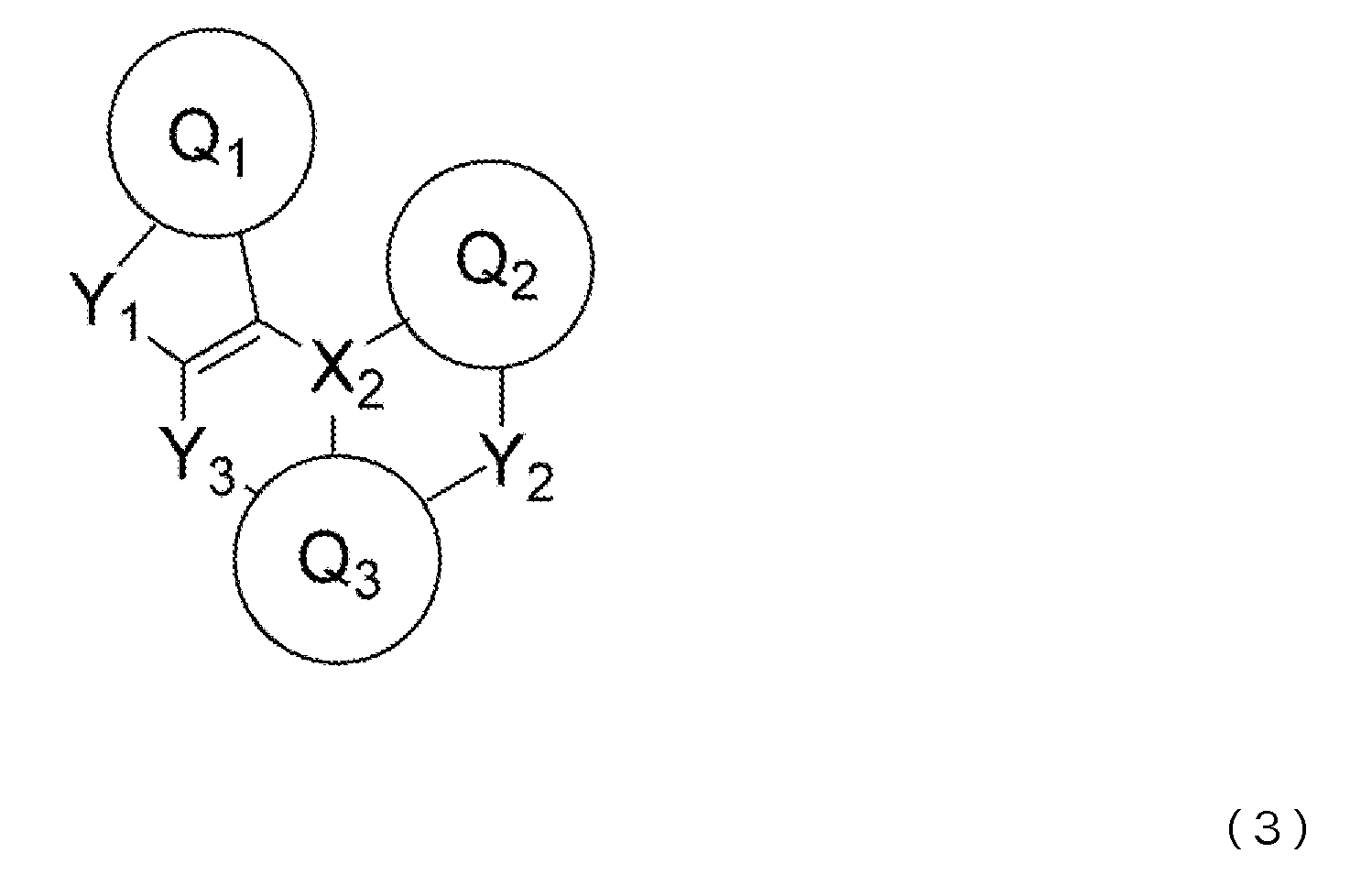
(일반식 (2) 및 일반식 (3) 중, Q1 내지 Q3은 서로 동일해도 되고 달라도 되며, 치환 혹은 비치환의 방향족 탄화수소, 또는 치환 혹은 비치환의 방향족 복소환을 나타낸다. X2는 B, P, P=O 또는 P=S를 나타낸다. Y1 내지 Y3은 서로 동일해도 되고 달라도 되며, N-R8, CR9R10, O, S, Se 또는 SiR11R12 중에서 선택되는 어느 하나이고, 그 R8 내지 R12는 서로 동일해도 되고 달라도 되며, 수소 원자, 중수소 원자, 불소 원자, 염소 원자, 시아노기, 니트로기, 치환기를 갖고 있어도 되는 탄소 원자수 1 내지 6의 직쇄상 혹은 분지상의 알킬기, 치환기를 갖고 있어도 되는 탄소 원자수 5 내지 10의 시클로알킬기, 치환기를 갖고 있어도 되는 탄소 원자수 2 내지 6의 직쇄상 혹은 분지상의 알케닐기, 치환기를 갖고 있어도 되는 탄소 원자수 1 내지 6의 직쇄상 혹은 분지상의 알킬옥시기, 치환기를 갖고 있어도 되는 탄소 원자수 5 내지 10의 시클로알킬옥시기, 치환 혹은 비치환의 방향족 탄화수소기, 치환 혹은 비치환의 방향족 복소환기, 또는 치환 혹은 비치환의 아릴옥시기를 나타낸다. 또한, R9와 R10, R11과 R12는 각각의 기끼리 단결합, 치환 혹은 비치환의 메틸렌기, 산소 원자 또는 황 원자, 1치환 아미노기를 통하여 서로 결합하여 환을 형성해도 된다. 단, Y1 내지 Y3이 N-R8, CR9R10 또는 SiR11R12인 경우, R8 내지 R12는 각각 인접하는 Q1 내지 Q3과, 단결합, 치환 혹은 비치환의 메틸렌기, 산소 원자, 황 원자, 1치환 아미노기 등의 연결기를 통하여 서로 결합하여 환을 형성해도 된다.)The organic electroluminescence according to any one of claims 1 to 7, wherein the blue light emitting layer contains a compound represented by the following general formula (2) or general formula (3) as a blue light emitting dopant. Nessence Element.
(In Formula (2) and Formula (3), Q 1 to Q 3 may be the same as or different from each other, and represent a substituted or unsubstituted aromatic hydrocarbon or a substituted or unsubstituted aromatic heterocycle. X 2 is B, Represents P, P=O, or P=S. Y 1 to Y 3 may be the same as or different from each other, and are any one selected from NR 8 , CR 9 R 10 , O, S, Se, or SiR 11 R 12 , R 8 to R 12 , which may be the same or different, are a hydrogen atom, a deuterium atom, a fluorine atom, a chlorine atom, a cyano group, a nitro group, or a linear or branched chain having 1 to 6 carbon atoms which may have substituents. An alkyl group, a cycloalkyl group of 5 to 10 carbon atoms which may have a substituent, a linear or branched alkenyl group of 2 to 6 carbon atoms which may have a substituent, and a cycloalkyl group of 1 to 6 carbon atoms which may have a substituent Linear or branched alkyloxy group, cycloalkyloxy group having 5 to 10 carbon atoms which may have a substituent, substituted or unsubstituted aromatic hydrocarbon group, substituted or unsubstituted aromatic heterocyclic group, or substituted or unsubstituted aryloxy group Further, R 9 and R 10 , R 11 and R 12 may be bonded to each other through a single bond, a substituted or unsubstituted methylene group, an oxygen atom or a sulfur atom, or a monosubstituted amino group to form a ring. However, when Y 1 to Y 3 are NR 8 , CR 9 R 10 or SiR 11 R 12 , R 8 to R 12 are each adjacent to Q 1 to Q 3 and a single bond, a substituted or unsubstituted methylene group, They may be bonded to each other through a linking group such as an oxygen atom, a sulfur atom, or a monosubstituted amino group to form a ring.)
The organic electroluminescent device according to any one of claims 1 to 9, wherein the blue light emitting layer contains an anthracene derivative having an anthracene skeleton in its molecule.
Applications Claiming Priority (3)
| Application Number | Priority Date | Filing Date | Title |
|---|---|---|---|
| JPJP-P-2020-137612 | 2020-08-17 | ||
| JP2020137612 | 2020-08-17 | ||
| PCT/JP2021/029801 WO2022039106A1 (en) | 2020-08-17 | 2021-08-13 | Organic electroluminescent element |
Publications (1)
| Publication Number | Publication Date |
|---|---|
| KR20230051663A true KR20230051663A (en) | 2023-04-18 |
Family
ID=80322792
Family Applications (1)
| Application Number | Title | Priority Date | Filing Date |
|---|---|---|---|
| KR1020237004531A Ceased KR20230051663A (en) | 2020-08-17 | 2021-08-13 | organic electroluminescent element |
Country Status (6)
| Country | Link |
|---|---|
| US (1) | US20230345817A1 (en) |
| EP (1) | EP4198104A4 (en) |
| JP (1) | JP7771065B2 (en) |
| KR (1) | KR20230051663A (en) |
| CN (1) | CN115885022A (en) |
| WO (1) | WO2022039106A1 (en) |
Families Citing this family (1)
| Publication number | Priority date | Publication date | Assignee | Title |
|---|---|---|---|---|
| CN116217409B (en) * | 2022-03-24 | 2023-12-22 | 江苏三月科技股份有限公司 | Aromatic amine compound and organic electroluminescent device prepared from same |
Citations (6)
| Publication number | Priority date | Publication date | Assignee | Title |
|---|---|---|---|---|
| JPS4943840B1 (en) | 1970-12-25 | 1974-11-25 | ||
| JPH0848656A (en) | 1994-02-08 | 1996-02-20 | Tdk Corp | Compound for organic EL device and organic EL device |
| JP3194657B2 (en) | 1993-11-01 | 2001-07-30 | 松下電器産業株式会社 | EL device |
| JP2006151979A (en) | 2004-11-29 | 2006-06-15 | Samsung Sdi Co Ltd | Phenylcarbazole compound, method for producing the same, and organic electroluminescent device |
| WO2008062636A1 (en) | 2006-11-24 | 2008-05-29 | Idemitsu Kosan Co., Ltd. | Aromatic amine derivative and organic electroluminescent element using the same |
| WO2014009310A1 (en) | 2012-07-09 | 2014-01-16 | Novaled Ag | Doped organic semiconductive matrix material |
Family Cites Families (9)
| Publication number | Priority date | Publication date | Assignee | Title |
|---|---|---|---|---|
| CN105378964B (en) * | 2013-07-12 | 2018-01-09 | 保土谷化学工业株式会社 | Organic Electroluminescent Devices |
| US10818844B2 (en) * | 2014-07-09 | 2020-10-27 | Hodogaya Chemical Co., Ltd. | Organic electroluminescent device |
| US10593884B2 (en) * | 2015-01-06 | 2020-03-17 | Hodogaya Chemical Co., Ltd. | Organic electroluminescent device |
| DE102018125307A1 (en) * | 2018-10-12 | 2020-04-16 | Novaled Gmbh | Organic light emitting device |
| US20210399224A1 (en) * | 2018-11-29 | 2021-12-23 | Hodogaya Chemical Co., Ltd. | Organic electroluminescence element |
| KR102094830B1 (en) * | 2018-11-30 | 2020-03-30 | 에스에프씨 주식회사 | Polycyclic aromatic compound and organoelectroluminescent device using the same |
| KR102169567B1 (en) * | 2018-12-21 | 2020-10-23 | 엘지디스플레이 주식회사 | Organic Light Emitting Device |
| CN118742080A (en) * | 2019-05-15 | 2024-10-01 | 株式会社Lg化学 | Organic light-emitting devices |
| CN111029477B (en) * | 2019-12-10 | 2022-10-18 | 昆山国显光电有限公司 | Organic light-emitting device, display panel and display device |
-
2021
- 2021-08-13 CN CN202180050636.5A patent/CN115885022A/en active Pending
- 2021-08-13 EP EP21858253.4A patent/EP4198104A4/en active Pending
- 2021-08-13 JP JP2022543924A patent/JP7771065B2/en active Active
- 2021-08-13 KR KR1020237004531A patent/KR20230051663A/en not_active Ceased
- 2021-08-13 US US18/021,251 patent/US20230345817A1/en active Pending
- 2021-08-13 WO PCT/JP2021/029801 patent/WO2022039106A1/en not_active Ceased
Patent Citations (6)
| Publication number | Priority date | Publication date | Assignee | Title |
|---|---|---|---|---|
| JPS4943840B1 (en) | 1970-12-25 | 1974-11-25 | ||
| JP3194657B2 (en) | 1993-11-01 | 2001-07-30 | 松下電器産業株式会社 | EL device |
| JPH0848656A (en) | 1994-02-08 | 1996-02-20 | Tdk Corp | Compound for organic EL device and organic EL device |
| JP2006151979A (en) | 2004-11-29 | 2006-06-15 | Samsung Sdi Co Ltd | Phenylcarbazole compound, method for producing the same, and organic electroluminescent device |
| WO2008062636A1 (en) | 2006-11-24 | 2008-05-29 | Idemitsu Kosan Co., Ltd. | Aromatic amine derivative and organic electroluminescent element using the same |
| WO2014009310A1 (en) | 2012-07-09 | 2014-01-16 | Novaled Ag | Doped organic semiconductive matrix material |
Non-Patent Citations (4)
| Title |
|---|
| Appl. Phys. Let., 98, 083302(2011) |
| 유기 EL 토론회 제3회 정례회 예고집 13 내지 14페이지(2006) |
| 응용 물리학회 제9회 강습회 예고집 23 내지 31페이지(2001) |
| 응용 물리학회 제9회 강습회 예고집 55 내지 61페이지(2001) |
Also Published As
| Publication number | Publication date |
|---|---|
| CN115885022A (en) | 2023-03-31 |
| US20230345817A1 (en) | 2023-10-26 |
| JPWO2022039106A1 (en) | 2022-02-24 |
| EP4198104A1 (en) | 2023-06-21 |
| EP4198104A4 (en) | 2024-07-24 |
| TW202219244A (en) | 2022-05-16 |
| JP7771065B2 (en) | 2025-11-17 |
| WO2022039106A1 (en) | 2022-02-24 |
Similar Documents
| Publication | Publication Date | Title |
|---|---|---|
| TWI646097B (en) | Spiro compound having azaindole ring structure, luminescent material and organic electroluminescent element | |
| CN107709285B (en) | Arylamine compound and organic electroluminescent device | |
| JP7406486B2 (en) | Compounds with triarylamine structure and organic electroluminescent devices | |
| KR20130112850A (en) | Compounds with acridan ring structures and organic electroluminescence elements | |
| JP7217320B2 (en) | Material for organic electroluminescence device and organic electroluminescence device | |
| JP7149263B2 (en) | organic electroluminescence element | |
| CN113396200A (en) | Organic electroluminescent element | |
| JP7784992B2 (en) | organic electroluminescence element | |
| EP4398696A1 (en) | Organic electroluminescent element | |
| JP7592020B2 (en) | Organic electroluminescence element | |
| WO2022080490A1 (en) | Arylamine compound, organic electroluminescent element, and electronic device | |
| JP7771065B2 (en) | organic electroluminescence element | |
| KR20240114741A (en) | Arylamine compounds, organic electroluminescence devices and electronic devices | |
| EP4243105A1 (en) | Organic electroluminescent element | |
| JP2025156207A (en) | Compound, organic electroluminescent element, and electronic device | |
| CN114867713A (en) | Arylamine compound and organic electroluminescent element |
Legal Events
| Date | Code | Title | Description |
|---|---|---|---|
| PA0105 | International application |
St.27 status event code: A-0-1-A10-A15-nap-PA0105 |
|
| PG1501 | Laying open of application |
St.27 status event code: A-1-1-Q10-Q12-nap-PG1501 |
|
| A201 | Request for examination | ||
| P11-X000 | Amendment of application requested |
St.27 status event code: A-2-2-P10-P11-nap-X000 |
|
| P13-X000 | Application amended |
St.27 status event code: A-2-2-P10-P13-nap-X000 |
|
| PA0201 | Request for examination |
St.27 status event code: A-1-2-D10-D11-exm-PA0201 |
|
| E902 | Notification of reason for refusal | ||
| PE0902 | Notice of grounds for rejection |
St.27 status event code: A-1-2-D10-D21-exm-PE0902 |
|
| P11 | Amendment of application requested |
Free format text: ST27 STATUS EVENT CODE: A-2-2-P10-P11-NAP-X000 (AS PROVIDED BY THE NATIONAL OFFICE) |
|
| P11-X000 | Amendment of application requested |
St.27 status event code: A-2-2-P10-P11-nap-X000 |
|
| B15 | Application refused following examination |
Free format text: ST27 STATUS EVENT CODE: N-2-6-B10-B15-EXM-PE0601 (AS PROVIDED BY THE NATIONAL OFFICE) |
|
| PE0601 | Decision on rejection of patent |
St.27 status event code: N-2-6-B10-B15-exm-PE0601 |