RU2425185C2 - Elastic tape made from silicon rubber - Google Patents
Elastic tape made from silicon rubber Download PDFInfo
- Publication number
- RU2425185C2 RU2425185C2 RU2008122348/05A RU2008122348A RU2425185C2 RU 2425185 C2 RU2425185 C2 RU 2425185C2 RU 2008122348/05 A RU2008122348/05 A RU 2008122348/05A RU 2008122348 A RU2008122348 A RU 2008122348A RU 2425185 C2 RU2425185 C2 RU 2425185C2
- Authority
- RU
- Russia
- Prior art keywords
- elastic
- rubber
- fibers
- tape
- layer
- Prior art date
Links
- 229920002379 silicone rubber Polymers 0.000 title claims abstract description 28
- 239000000835 fiber Substances 0.000 claims abstract description 49
- 229920001971 elastomer Polymers 0.000 claims abstract description 44
- 239000005060 rubber Substances 0.000 claims abstract description 44
- 238000000034 method Methods 0.000 claims abstract description 17
- 239000007788 liquid Substances 0.000 claims abstract 3
- 239000004744 fabric Substances 0.000 claims description 33
- 239000004945 silicone rubber Substances 0.000 claims description 24
- 210000004177 elastic tissue Anatomy 0.000 claims description 12
- 238000004519 manufacturing process Methods 0.000 claims description 12
- 229920002334 Spandex Polymers 0.000 claims description 6
- 239000013013 elastic material Substances 0.000 claims description 6
- 229920003052 natural elastomer Polymers 0.000 claims description 6
- 229920001194 natural rubber Polymers 0.000 claims description 6
- 239000011248 coating agent Substances 0.000 claims description 5
- 238000000576 coating method Methods 0.000 claims description 5
- 244000043261 Hevea brasiliensis Species 0.000 claims description 3
- 229920000459 Nitrile rubber Polymers 0.000 claims description 3
- 239000002318 adhesion promoter Substances 0.000 claims description 3
- GQSGZTBDVNUIQS-DGCLKSJQSA-N ciclonicate Chemical compound C1C(C)(C)C[C@H](C)C[C@H]1OC(=O)C1=CC=CN=C1 GQSGZTBDVNUIQS-DGCLKSJQSA-N 0.000 claims description 3
- 239000004759 spandex Substances 0.000 claims description 3
- 239000011230 binding agent Substances 0.000 claims 2
- 239000000126 substance Substances 0.000 abstract description 4
- 239000004753 textile Substances 0.000 description 16
- 238000009998 heat setting Methods 0.000 description 6
- 238000004043 dyeing Methods 0.000 description 4
- 238000005516 engineering process Methods 0.000 description 4
- 210000001519 tissue Anatomy 0.000 description 4
- 238000004804 winding Methods 0.000 description 4
- 238000010073 coating (rubber) Methods 0.000 description 3
- 230000032798 delamination Effects 0.000 description 3
- 229920003051 synthetic elastomer Polymers 0.000 description 3
- 239000005061 synthetic rubber Substances 0.000 description 3
- 229910000831 Steel Inorganic materials 0.000 description 2
- 238000004061 bleaching Methods 0.000 description 2
- 238000012986 modification Methods 0.000 description 2
- 230000004048 modification Effects 0.000 description 2
- 239000010959 steel Substances 0.000 description 2
- 229920002994 synthetic fiber Polymers 0.000 description 2
- 239000012209 synthetic fiber Substances 0.000 description 2
- 229920000742 Cotton Polymers 0.000 description 1
- 239000000853 adhesive Substances 0.000 description 1
- 230000001070 adhesive effect Effects 0.000 description 1
- 230000002411 adverse Effects 0.000 description 1
- 238000009940 knitting Methods 0.000 description 1
- 239000000463 material Substances 0.000 description 1
- 239000000203 mixture Substances 0.000 description 1
- 238000004806 packaging method and process Methods 0.000 description 1
- 238000006116 polymerization reaction Methods 0.000 description 1
- 230000003014 reinforcing effect Effects 0.000 description 1
- 229920001169 thermoplastic Polymers 0.000 description 1
- 239000004416 thermosoftening plastic Substances 0.000 description 1
- -1 wool Polymers 0.000 description 1
- 210000002268 wool Anatomy 0.000 description 1
Images
Classifications
-
- D—TEXTILES; PAPER
- D06—TREATMENT OF TEXTILES OR THE LIKE; LAUNDERING; FLEXIBLE MATERIALS NOT OTHERWISE PROVIDED FOR
- D06C—FINISHING, DRESSING, TENTERING OR STRETCHING TEXTILE FABRICS
- D06C7/00—Heating or cooling textile fabrics
-
- B—PERFORMING OPERATIONS; TRANSPORTING
- B29—WORKING OF PLASTICS; WORKING OF SUBSTANCES IN A PLASTIC STATE IN GENERAL
- B29D—PRODUCING PARTICULAR ARTICLES FROM PLASTICS OR FROM SUBSTANCES IN A PLASTIC STATE
- B29D29/00—Producing belts or bands
-
- D—TEXTILES; PAPER
- D06—TREATMENT OF TEXTILES OR THE LIKE; LAUNDERING; FLEXIBLE MATERIALS NOT OTHERWISE PROVIDED FOR
- D06C—FINISHING, DRESSING, TENTERING OR STRETCHING TEXTILE FABRICS
- D06C21/00—Shrinking by compressing
-
- D—TEXTILES; PAPER
- D06—TREATMENT OF TEXTILES OR THE LIKE; LAUNDERING; FLEXIBLE MATERIALS NOT OTHERWISE PROVIDED FOR
- D06C—FINISHING, DRESSING, TENTERING OR STRETCHING TEXTILE FABRICS
- D06C21/00—Shrinking by compressing
- D06C21/005—Compacting belts
-
- B—PERFORMING OPERATIONS; TRANSPORTING
- B29—WORKING OF PLASTICS; WORKING OF SUBSTANCES IN A PLASTIC STATE IN GENERAL
- B29K—INDEXING SCHEME ASSOCIATED WITH SUBCLASSES B29B, B29C OR B29D, RELATING TO MOULDING MATERIALS OR TO MATERIALS FOR MOULDS, REINFORCEMENTS, FILLERS OR PREFORMED PARTS, e.g. INSERTS
- B29K2083/00—Use of polymers having silicon, with or without sulfur, nitrogen, oxygen, or carbon only, in the main chain, as moulding material
- B29K2083/005—LSR, i.e. liquid silicone rubbers, or derivatives thereof
Landscapes
- Engineering & Computer Science (AREA)
- Textile Engineering (AREA)
- Mechanical Engineering (AREA)
- Treatments For Attaching Organic Compounds To Fibrous Goods (AREA)
- Laminated Bodies (AREA)
- Belt Conveyors (AREA)
- Dry Development In Electrophotography (AREA)
- Devices For Conveying Motion By Means Of Endless Flexible Members (AREA)
- Prostheses (AREA)
- Woven Fabrics (AREA)
Abstract
Description
ПРЕДПОСЫЛКИ СОЗДАНИЯ ИЗОБРЕТЕНИЯ BACKGROUND OF THE INVENTION
Область техникиTechnical field
Настоящее изобретение в целом относится к производству текстильных изделий. В частности, настоящее изобретение относится к ленте ткацкого станка, используемой при финишной обработке текстильного изделия.The present invention generally relates to the production of textiles. In particular, the present invention relates to a tape of a loom used in finishing a textile product.
Уровень техникиState of the art
Во время предварительной обработки кругловязаных тканей, вырабатываемых на кругловязальных машинах, крашения таких тканей, их финишной обработки и нанесения на них декоративного рисунка они при необходимости могут быть подвергнуты различным последовательным операциям, причем указанные операции могут быть выполнены как над замкнутыми в трубчатую форму тканями, так и над открытой тканью, получаемой путем разрезания замкнутой в трубчатую форму ткани вдоль одной из ее боковых краев. Как правило, перед влажной обработкой, например, перед крашением, в зависимости от типа или типов волокон, формирующих ткань, ее подвергают термофиксации. В частности, выполняют термофиксацию тканей, полностью или частично состоящих из синтетических волокон, таких как термопластичные волокна. Термофиксацию проводят для фиксации размеров ткани, плоскостности ее поверхностей и обеспечения в результате этого ее прочности. Термофиксация также устраняет в ткани постоянные складки или деформации, возникающие при ее обработке в отбеливающей или красильной машине.During the pretreatment of circular knitted fabrics produced on circular knitting machines, dyeing such fabrics, finishing them and applying a decorative pattern to them, they can, if necessary, be subjected to various sequential operations, and these operations can be performed both on closed fabrics in a tubular form, so and above an open tissue obtained by cutting a tubularly closed tissue along one of its side edges. As a rule, before wet processing, for example, before dyeing, depending on the type or types of fibers forming the fabric, it is subjected to heat setting. In particular, thermofixing of fabrics consisting entirely or partially of synthetic fibers such as thermoplastic fibers is performed. Thermofixing is carried out to fix the size of the fabric, the flatness of its surfaces and, as a result, ensure its strength. Thermofixing also eliminates permanent creases or deformations in the fabric that occur during processing in a bleaching or dyeing machine.
В известных термофиксирующих машинах невозможно по-разному обрабатывать ткани с прямоугольной тканой структурой, т.е. уточно-основного типа, и в целом трикотажные ткани. Это приводит к увеличению продолжительности обработки за счет разрезания и раскрытия замкнутой в трубчатую форму ткани для термофиксации и иногда за счет операций повторного сшивания ткани в трубчатую форму для отбеливания/крашения с последующим повторным раскрытием для финишной обработки и нанесения декоративного рисунка. Кроме того, указанными машинами нельзя выполнять термофиксацию кругловязаных тканей, которые при обработке должны сохранять трубчатую форму по техническим, финансовым или маркетинговым соображениям.In known heat-fixing machines, it is impossible to treat fabrics with a rectangular woven structure in different ways, i.e. weft-basic type, and in general knitted fabrics. This leads to an increase in the processing time by cutting and opening the fabric closed in a tubular form for heat setting and sometimes due to the operations of re-stitching the fabric into a tubular form for bleaching / dyeing, followed by re-opening for finishing and applying a decorative pattern. In addition, these machines cannot heat-fix circular knitted fabrics that must be tubular during processing for technical, financial or marketing reasons.
Обработка замкнутых в трубчатую форму тканей без термофиксации может отрицательно сказаться на качестве и осуществляется лишь в исключительных случаях. Ранее предпринимались попытки разработать специальные машины для термофиксации тканей, замкнутых в трубчатую форму. Однако полученные результаты оказались недостаточно удовлетворительными. Основными характеристиками известных машин являются способ перемещения и направления ткани, замкнутой в трубчатую форму, и система передачи в ткань тепла.Processing closed in a tubular form of tissue without heat setting can adversely affect the quality and is carried out only in exceptional cases. Previously, attempts were made to develop special machines for the heat setting of tissues closed in a tubular form. However, the results were not satisfactory. The main characteristics of the known machines are a method for moving and directing fabric closed in a tubular form, and a system for transferring heat to the fabric.
В некоторых машинах ткани направляются плоско растягивающим приспособлением и в плоской форме подаются между поверхностью нагретого стального цилиндра и бесконечной войлочной лентой. К основным недостаткам этих машин относятся сплющивание боковых краев указанной ткани и неравномерный теплообмен ее двух поверхностей. В других машинах плоско растягивающее приспособление направляет выровненную указанную ткань и сопровождает ее в горизонтальной или вертикальной камере до выхода из последней. Внутри камеры обе поверхности указанной ткани подвергаются воздействию потоков горячего воздуха. Однако теплообмен с обеими поверхностями указанной ткани недостаточен.In some machines, fabrics are guided by a flat tensile device and fed flat between the surface of a heated steel cylinder and an endless felt tape. The main disadvantages of these machines include the flattening of the side edges of the fabric and the uneven heat transfer of its two surfaces. In other machines, a flat tensile device guides the aligned specified fabric and accompanies it in a horizontal or vertical chamber until it leaves the latter. Inside the chamber, both surfaces of the fabric are exposed to hot air. However, heat exchange with both surfaces of said fabric is insufficient.
При производстве текстиля по новой технологии используют эластичную ленту определенной длины. При этом на участке машины, предназначенном для термофиксации получаемого текстиля или ткани, эластичная лента заданной длины удлиняется на 50-70% ее начальной длины. В настоящее время согласно указанной новой технологии используют ленты из резины на основе каучука и нитрильного каучука, усиленные нитями или волокнами стандартной эластичности. Кроме того, также используют ленты, выполненные только из резины на основе каучука. Однако ленты указанных типов при их использовании для производства текстиля по новой технологии имеют короткий срок службы. Срок службы указанных известных лент еще меньше, если они в машине для производства текстиля на участке термофиксации подвергаются воздействию повышенных температур. Поэтому диапазон температур, которые могут быть использованы в производственном процессе, ограничен. Кроме того, при удлинении известных лент в машинном направлении они чрезмерно сужаются в направлении поперек движения ткани в машине, что затрудняет производственный процесс.In the manufacture of textiles using the new technology, elastic tape of a certain length is used. At the same time, in the area of the machine intended for thermofixing the resulting textile or fabric, an elastic tape of a given length is extended by 50-70% of its initial length. Currently, according to this new technology, rubber bands based on rubber and nitrile rubber are used, reinforced with threads or fibers of standard elasticity. In addition, tapes made only of rubber based on rubber are also used. However, the tapes of these types, when used for the production of textiles using new technology, have a short service life. The service life of these known tapes is even shorter if they are exposed to elevated temperatures in a textile machine in a heat setting area. Therefore, the temperature range that can be used in the production process is limited. In addition, when elongating known tapes in the machine direction, they excessively taper in the direction transverse to the movement of the fabric in the machine, which complicates the production process.
Ранее были предприняты попытки решить указанные проблемы путем использования лент, покрытых эластичным материалом. Однако эти попытки оказались неудачными, так как покрытие отслаивалось от ленты.Earlier attempts were made to solve these problems by using tapes coated with elastic material. However, these attempts were unsuccessful, since the coating exfoliated from the tape.
В связи с этим, существует потребность в ленте, которая при удлинении в машинном направлении на 50-70% незначительно сужается в направлении поперек движения ткани в машине. Кроме того, существует потребность в усиленной ленте из резины на основе каучука, характеризующейся низкой вероятностью отслаивания резиновой части от усиливающей части при удлинении ленты в машинном направлении. Настоящее изобретение направлено на преодоление указанных недостатков уровня техники.In this regard, there is a need for a tape, which when elongated in the machine direction by 50-70%, slightly narrows in the direction transverse to the movement of the fabric in the machine. In addition, there is a need for a reinforced rubber tape based on rubber, characterized by a low probability of peeling of the rubber part from the reinforcing part when the tape is elongated in the machine direction. The present invention aims to overcome these drawbacks of the prior art.
СУЩНОСТЬ ИЗОБРЕТЕНИЯSUMMARY OF THE INVENTION
Таким образом, главной задачей изобретения является создание ленты на основе резины, выполненной с возможностью использования при производстве текстиля по новой технологии.Thus, the main objective of the invention is the creation of a tape based on rubber, made with the possibility of use in the manufacture of textiles using new technology.
Еще одной задачей изобретения является создание ленты на основе резины, выполненной с возможностью использования при повышенных температурах, подобных тем, что имеют место на участке термофиксации текстильной машины.Another objective of the invention is the creation of a tape based on rubber, made with the possibility of use at elevated temperatures, similar to those that take place in the heat-setting area of a textile machine.
Еще одной задачей изобретения является создание ленты на основе резины, выполненной с возможностью удлинения на 50-70% ее начальной длины.Another objective of the invention is the creation of a tape based on rubber, made with the possibility of elongation by 50-70% of its initial length.
Еще одной задачей изобретения является создание ленты на основе резины, которая при удлинении в машинном направлении незначительно сужается в направлении поперек движения ткани в машине.Another objective of the invention is the creation of a tape based on rubber, which when elongated in the machine direction slightly narrows in the direction transverse to the movement of fabric in the machine.
Еще одной задачей изобретения является создание ленты на основе резины, которая устойчива к расслоению при удлинении.Another objective of the invention is the creation of a tape based on rubber, which is resistant to delamination during elongation.
Еще одной задачей изобретения является создание ленты на основе резины, выполненной с возможностью использования при производстве текстильных изделий различных видов.Another objective of the invention is the creation of a tape based on rubber, made with the possibility of use in the manufacture of textile products of various kinds.
Еще одной задачей настоящего изобретения является создание ленты на основе резины, которая имеет повышенную прочность и, следовательно, увеличенный срок службы.Another objective of the present invention is to provide a tape based on rubber, which has increased strength and, consequently, increased service life.
В настоящем изобретении решены эти и другие задачи. В этом отношении изобретение относится к машинной ленте, используемой при производстве текстильных изделий. Предлагаемая лента представляет собой ленту из резины на основе каучука, содержащую по меньшей мере один слой плотно упакованных эластичных нитей или волокон и слой силиконовой резины. Эластичные нити или волокна плотно упакованы для того, чтобы при удлинении ленты в машинном направлении обеспечить практически неизменную ширину ленты в направлении поперек движения ткани в машине.In the present invention, these and other problems are solved. In this regard, the invention relates to a machine tape used in the manufacture of textiles. The proposed tape is a rubber-based rubber tape containing at least one layer of tightly packed elastic threads or fibers and a layer of silicone rubber. The elastic yarns or fibers are tightly packed so that when the tape is extended in the machine direction, the tape width is almost constant in the direction transverse to the movement of the fabric in the machine.
Кроме того, настоящее изобретение относится к способу производства ленты на основе резины. Согласно указанному способу на барабан или вокруг двух по существу параллельных валиков наматывают по меньшей мере одну эластичную нить или по меньшей мере одно эластичное волокно, которая или которое формирует на барабане или на двух по существу параллельных валиках по меньшей мере один слой, после этого на указанный по меньшей мере один слой наносят высоковязкий силиконовый каучук, а затем барабан или два по существу параллельных валика и нанесенный силиконовый каучук нагревают для полимеризации с получением силиконовой резины.In addition, the present invention relates to a method for manufacturing a rubber-based tape. According to the aforementioned method, at least one elastic thread or at least one elastic fiber is wound onto the drum or around two essentially parallel rollers, which or which forms at least one layer on the drum or on two essentially parallel rollers, after which at least one layer is applied with highly viscous silicone rubber, and then a drum or two essentially parallel rollers and the applied silicone rubber are heated for polymerization to obtain silicone rubber.
Различные отличительные признаки, характеризующие настоящее изобретение, указаны подробно в прилагаемой формуле, которая является частью описания настоящего изобретения. Для лучшего понимания сущности изобретения, полученных технических результатов и задач, решаемых его использованием, описание приведено со ссылками на прилагаемые чертежи, иллюстрирующие предпочтительные варианты реализации, причем на чертежах соответствующие компоненты имеют аналогичные числовые обозначения.Various distinguishing features characterizing the present invention are indicated in detail in the attached claims, which are part of the description of the present invention. For a better understanding of the essence of the invention, the obtained technical results and the problems solved by its use, the description is given with reference to the accompanying drawings illustrating preferred embodiments, and in the drawings the corresponding components have similar numerical designations.
КРАТКОЕ ОПИСАНИЕ ЧЕРТЕЖЕЙBRIEF DESCRIPTION OF THE DRAWINGS
Нижеследующее подробное описание, являющееся примером и не ограничивающее настоящее изобретение, будет более понятным при его рассмотрении вместе с прилагаемыми чертежами, на которых аналогичные элементы имеют аналогичные числовые обозначения и среди которых:The following detailed description, which is an example and not limiting the present invention, will be better understood when considered in conjunction with the accompanying drawings, in which similar elements have similar numerical designations and among which:
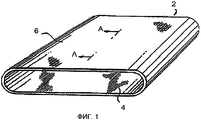
фиг.1 - перспективный вид ленты согласно настоящему изобретению;figure 1 is a perspective view of a tape according to the present invention;
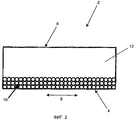
фиг.2 - сечение предлагаемой ленты по линии А-А фиг.1 согласно одному варианту реализации настоящего изобретения;figure 2 is a cross section of the proposed tape along the line aa of figure 1 according to one embodiment of the present invention;
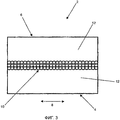
фиг.3 - сечение предлагаемой ленты по линии А-А фиг.1 согласно еще одному варианту реализации настоящего изобретения; иfigure 3 is a cross section of the proposed tape along the line aa of figure 1 according to another embodiment of the present invention; and
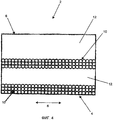
фиг.4 - сечение предлагаемой ленты по линии А-А фиг.1 согласно еще одному варианту реализации настоящего изобретения.figure 4 is a section of the proposed tape along the line aa of figure 1 according to another embodiment of the present invention.
ПОДРОБНОЕ ОПИСАНИЕ ПРЕДПОЧТИТЕЛЬНЫХ ВАРИАНТОВ РЕАЛИЗАЦИИ ИЗОБРЕТЕНИЯDETAILED DESCRIPTION OF THE PREFERRED EMBODIMENTS
Ниже приведено более подробное описание настоящего изобретения со ссылками на прилагаемые чертежи, на которых показаны предпочтительные варианты его реализации. Однако возможны и другие варианты реализации изобретения, и изображенные примеры не следует считать ограничением. Напротив, изображенные варианты реализации имеют целью лишь обеспечить точность и полноту настоящего описания и раскрытие им объема изобретения для специалистов в данной области. В нижеследующем описании одинаковые или соответствующие компоненты на всех фигурах имеют одинаковые числовые обозначения.The following is a more detailed description of the present invention with reference to the accompanying drawings, in which preferred embodiments are shown. However, other embodiments of the invention are possible, and the examples depicted should not be considered a limitation. On the contrary, the illustrated embodiments are intended only to ensure the accuracy and completeness of the present description and the disclosure by him of the scope of the invention for specialists in this field. In the following description, the same or corresponding components in all figures have the same numerical designations.
Настоящее изобретение относится к ленте из силиконовой резины, которая усилена структурой, содержащей эластичные нити или волокна. В настоящем описании под эластичной нитью или волокном понимается нить или волокно, удлинение которой или которого в точке разрыва составляет 40-400% ее или его начальной длины.The present invention relates to a silicone rubber tape that is reinforced with a structure comprising elastic threads or fibers. In the present description, an elastic thread or fiber is understood to be a thread or fiber, the elongation of which or of which at the break point is 40-400% of its or its initial length.
В настоящее время известны ленты из резины на основе каучука, выполненные из натуральных или синтетических каучуков и усиленные нитями или волокнами стандартной эластичности. Также известны ленты только из резины на основе натурального, синтетического и силиконового каучука. Ленты из резины на основе натурального и синтетического каучука имеют хорошую эластичность, но низкую термо- и химическую стойкость. Напротив, ленты из резины на основе силиконового каучука имеют высокую термо- и химическую стойкость, но низкие механические свойства. Для удовлетворения потребности в ленте с хорошей термо- и химической стойкостью, а также механическими свойствами, настоящим изобретением предлагается лента из усиленной резины на основе силиконового каучука.Rubber tapes based on rubber made of natural or synthetic rubbers and reinforced with threads or fibers of standard elasticity are currently known. Also known are tapes made only of rubber based on natural, synthetic and silicone rubber. Rubber tapes based on natural and synthetic rubber have good elasticity, but low thermal and chemical resistance. In contrast, silicone rubber-based tapes have high thermal and chemical resistance, but low mechanical properties. To meet the need for a tape with good thermal and chemical resistance, as well as mechanical properties, the present invention proposes a tape made of reinforced rubber based on silicone rubber.
Для создания требуемой усиленной ленты на основе резины была использована система для нанесения покрытий. Иными словами, было создано бесконечное основное полотно, которое было покрыто резиной на основе силиконового каучука. Для обеспечения хороших механических свойств основное полотно было выполнено двух- или трехслойным. Однако лента такой структуры представляет собой структуру, подверженную опасности отслоения покрытия из силиконовой резины от тканой основы, особенно при растяжении ленты с большим удлинением.A coating system was used to create the required reinforced rubber-based tape. In other words, an endless main fabric was created, which was coated with rubber based on silicone rubber. To ensure good mechanical properties, the main fabric was made in two or three layers. However, a tape of such a structure is a structure at risk of delamination of the silicone rubber coating from the woven base, especially when stretching the tape with a large elongation.
Настоящее изобретение решает проблемы, связанные с известными имеющими покрытие лентами, благодаря созданию более прочной и более эластичной ленты на основе резины. В предпочтительном варианте реализации настоящее изобретение получают намоткой на цилиндр или барабан эластичных нитей или волокон, полученных, помимо прочего, из таких материалов, как резина на натурального каучука, LYCRA® и ELASTAN®. Длина наружной поверхности барабана должна быть близка к длине получаемой эластичной ленты. Эластичные нити или волокна наворачивают на барабан по меньшей мере в один слой. Количество слоев эластичных нитей зависит от требуемой устойчивости ленты к удлинению. По меньшей мере один слой эластичных нитей или волокон может быть получен путем непрерывной намотки одной эластичной нити или одного эластичного волокна на барабан с формированием указанного по меньшей мере одного слоя, причем в каждом слое соседние нити или волокна оказываются плотно набиты. Кроме того, для формирования по меньшей мере одного слоя плотно набитых эластичных нитей или волокон может быть осуществлена намотка на барабан нескольких эластичных нитей или волокон.The present invention solves the problems associated with known coated tapes by providing a more durable and more flexible rubber-based tape. In a preferred embodiment, the present invention is obtained by winding on a cylinder or drum elastic yarns or fibers obtained, inter alia, from materials such as natural rubber, LYCRA ® and ELASTAN ® . The length of the outer surface of the drum should be close to the length of the resulting elastic tape. Elastic threads or fibers are wound onto the drum in at least one layer. The number of layers of elastic threads depends on the required resistance of the tape to elongation. At least one layer of elastic filaments or fibers can be obtained by continuously winding one elastic filament or one elastic fiber onto a drum to form said at least one layer, with adjacent filaments or fibers being densely packed in each layer. In addition, to form at least one layer of densely packed elastic yarns or fibers, several elastic yarns or fibers may be wound onto the drum.
После намотки или наложения на барабан эластичных нитей или волокон поверх слоев указанных нитей или волокон наносят высоковязкий силиконовый каучук для получения требуемой толщины ленты и для формирования поверхности, контактирующей с текстильным изделием. Указанная поверхность может быть предназначена для гладкой или текстурной финишной обработки формируемого на ней текстильного изделия.After winding or applying elastic threads or fibers to the drum, highly viscous silicone rubber is applied over the layers of said threads or fibers to obtain the desired thickness of the tape and to form a surface in contact with the textile product. The specified surface can be designed for smooth or texture finishing of the textile product formed on it.
Эластичные нити или волокна обработаны специальным связующим покрытием или промотором, усиливающим адгезию, чтобы обеспечить отличную адгезию покрытия из силиконовой резины к указанным нитям или волокнам, благодаря чему снижается вероятность расслоения ленты во время удлинения. Адгезия между нитями и покрытием из силиконовой резины может быть также усилена путем использования крученых и комплексных нитей.The elastic yarns or fibers are treated with a special adhesive coating or adhesion promoter to provide excellent adhesion of the silicone rubber coating to said yarns or fibers, thereby reducing the likelihood of delamination of the tape during elongation. The adhesion between the threads and the silicone rubber coating can also be enhanced by using twisted and multifilament yarns.
Затем для полимеризации нанесенного силиконового каучука барабан нагревают. Полученная таким способом лента во время удлинения в машинном направлении незначительно сужается в направлении поперек движения ткани в машине, причем указанная лента может удлиняться в машинном направлении на 50-70% относительно ее начальной длины. Готовая лента может быть использована для финишной обработки, например, текстильных изделий из хлопковых, шерстяных, синтетических волокон, а также смеси различных волокон.Then, the drum is heated to polymerize the applied silicone rubber. The tape obtained in this way during elongation in the machine direction slightly narrows in the direction transverse to the movement of the fabric in the machine, and this tape can be extended in the machine direction by 50-70% relative to its initial length. The finished tape can be used for finishing, for example, textiles made of cotton, wool, synthetic fibers, as well as a mixture of various fibers.
Другой способ получения предлагаемой ленты аналогичен описанному выше, но вместо барабана в нем используют два по существу параллельных валика, размещенных на некотором расстоянии друг от друга. Расстояние между двумя по существу параллельными валиками соответствует общей длине готовой ленты. Согласно этому способу эластичные нити или волокна наматывают вокруг двух по существу параллельных валиков. После намотки эластичных нитей на указанные валики изготовление ленты аналогично описанному выше способу с использованием барабана.Another method of obtaining the proposed tape is similar to that described above, but instead of a drum, it uses two essentially parallel rollers placed at a certain distance from each other. The distance between two essentially parallel rollers corresponds to the total length of the finished tape. According to this method, elastic filaments or fibers are wound around two essentially parallel rollers. After winding the elastic threads on these rollers, the manufacture of the tape is similar to the method described above using a drum.
На фиг.1 показан перспективный вид эластичной ленты из силиконовой резины согласно настоящему изобретению. Лента 2 имеет внутреннюю, или нижнюю, поверхность 4 и наружную, или верхнюю, поверхность 6. Поверхность 6 контактирует с текстильным изделием. Поверхность 4 ленты 2 находится в контакте со стальными цилиндрами машины для производства текстильного изделия.Figure 1 shows a perspective view of an elastic band of silicone rubber according to the present invention. The
На фиг.2 показано поперечное сечение по линии А-А (фиг.1) варианта реализации ленты 2. Направление поперек движения ткани в машине показано стрелкой 8. Вблизи поверхности 4 ленты 2 расположен по меньшей мере один слой эластичных нитей или волокон 10. Как видно из фиг.2, нити или волокна 10 упакованы очень плотно. Плотная упаковка гарантирует, что лента при ее использовании в машине для производства текстильных изделий во время удлинения по существу не будет сужаться в направлении поперек движения ткани в машине. Поверх нитей или волокон 10 вблизи поверхности 6 ленты 2 имеется слой 12 силиконовой резины.Figure 2 shows a cross section along line AA (figure 1) of an embodiment of
На фиг.3 и 4 показано поперечное сечение по линии А-А (фиг.1) других вариантов реализации ленты 2. На фиг.3 по меньшей мере один слой нитей или волокон 10 размещен между слоями 12. На фиг.4 слои нитей или волокон 10 чередуются со слоями 12. В такой структуре вблизи поверхности 4 ленты 2 находится слой нитей или волокон 10, а вблизи поверхности 6 ленты 2 находится слой 12. Для специалистов в данной области понятно, что имеется множество способов размещения слоев нитей или волокон 10 и слоев 12 в ленте согласно настоящему изобретению.Figures 3 and 4 show a cross section along line AA (figure 1) of other embodiments of
Несмотря на то что в тексте настоящего описания раскрыт предпочтительный вариант реализации настоящего изобретения и его модификации, необходимо понимать, что настоящее изобретение не ограничено указанным вариантом реализации и его модификациями и что специалистами в данной области могут быть внесены различные изменения без выхода за рамки сущности и объема изобретения, которые определены прилагаемой формулой. Сфера применения предлагаемой ленты не ограничена машинами, в которых требуется отсутствие поперечного сужения ленты. Иными словами, предлагаемая лента может быть использована в любых областях, где имеются указанные выше требования к качеству и сроку службы.Despite the fact that the preferred embodiment of the present invention and its modifications are disclosed in the text of the present description, it should be understood that the present invention is not limited to this embodiment and its modifications, and that various changes can be made by specialists in this field without going beyond the essence and scope inventions as defined by the appended claims. The scope of the proposed tape is not limited to machines that require the absence of transverse narrowing of the tape. In other words, the proposed tape can be used in any areas where there are the above requirements for quality and durability.
Claims (23)
Applications Claiming Priority (2)
| Application Number | Priority Date | Filing Date | Title |
|---|---|---|---|
| US11/320,989 | 2005-12-29 | ||
| US11/320,989 US9222208B2 (en) | 2005-12-29 | 2005-12-29 | Elastic silicone rubber belt |
Publications (2)
| Publication Number | Publication Date |
|---|---|
| RU2008122348A RU2008122348A (en) | 2010-02-10 |
| RU2425185C2 true RU2425185C2 (en) | 2011-07-27 |
Family
ID=38107991
Family Applications (1)
| Application Number | Title | Priority Date | Filing Date |
|---|---|---|---|
| RU2008122348/05A RU2425185C2 (en) | 2005-12-29 | 2006-12-21 | Elastic tape made from silicon rubber |
Country Status (18)
| Country | Link |
|---|---|
| US (1) | US9222208B2 (en) |
| EP (1) | EP1974081B1 (en) |
| JP (1) | JP5033812B2 (en) |
| KR (1) | KR101383026B1 (en) |
| CN (1) | CN101346504B (en) |
| AT (1) | ATE464418T1 (en) |
| AU (1) | AU2006332887A1 (en) |
| BR (1) | BRPI0620746B1 (en) |
| CA (1) | CA2632474C (en) |
| DE (1) | DE602006013716D1 (en) |
| ES (1) | ES2345360T3 (en) |
| NO (1) | NO20083312L (en) |
| PL (1) | PL1974081T3 (en) |
| PT (1) | PT1974081E (en) |
| RU (1) | RU2425185C2 (en) |
| TW (1) | TWI428487B (en) |
| WO (1) | WO2007079029A2 (en) |
| ZA (1) | ZA200804819B (en) |
Families Citing this family (5)
| Publication number | Priority date | Publication date | Assignee | Title |
|---|---|---|---|---|
| EP2440828A4 (en) * | 2009-06-12 | 2017-11-15 | Federal-Mogul Powertrain, Inc. | Textile sleeve with high temperature abrasion resistant coating and methods of assembly, construction and curing thereof |
| DE202013000165U1 (en) * | 2013-01-09 | 2013-04-02 | Hübner GmbH | Bellows a transition of an articulated vehicle and articulated vehicle of public transport with such a bellows |
| CN105179439A (en) * | 2015-09-29 | 2015-12-23 | 上海和为科技有限公司 | Weft-free ring |
| CN110565310A (en) * | 2019-08-30 | 2019-12-13 | 安徽省通信产业服务有限公司 | Anti-aging method for insulating adhesive tape |
| CN110747631B (en) * | 2019-10-12 | 2022-03-01 | 陕西科技大学 | Preparation method of flexible and stretchable silicon rubber-based wearable strain sensing fiber |
Citations (5)
| Publication number | Priority date | Publication date | Assignee | Title |
|---|---|---|---|---|
| GB1030354A (en) * | 1964-02-14 | 1966-05-18 | James Dawson & Son Ltd | An improved endless conveyor band and a method for the production thereof |
| GB1088066A (en) * | 1964-12-02 | 1967-10-18 | Albany Felt Co | Fabric material |
| US4940047A (en) * | 1987-06-24 | 1990-07-10 | Bayer Aktiengesellschaft | Textile sheet-like structure with reactive resin |
| US5233733A (en) * | 1990-04-12 | 1993-08-10 | Rollin S.A. | Sheet material shrinkage apparatus |
| RU2139378C1 (en) * | 1995-01-31 | 1999-10-10 | Курт Мюллер Др. | Method and apparatus for drying and shrinkage of textile product |
Family Cites Families (32)
| Publication number | Priority date | Publication date | Assignee | Title |
|---|---|---|---|---|
| US2021975A (en) * | 1931-02-10 | 1935-11-26 | Cluett Peabody & Co Inc | Method of and means for treating woven and the like fabrics and yarns |
| US3469001A (en) * | 1965-10-08 | 1969-09-23 | Du Pont | Process for making polyester cord for no-reset v-belts |
| US3792621A (en) * | 1972-10-11 | 1974-02-19 | T Smith | Drive belt |
| IT973167B (en) * | 1972-12-29 | 1974-06-10 | Pirelli | ANULAR ELEMENTS ACCESSORIES FOR TES SILE INDUSTRY MACHINERY AND MANUFACTURING PROCESS RELATED CAUTION |
| US4183986A (en) * | 1978-12-14 | 1980-01-15 | Timex Corporation | Method for making straps |
| JPS5842444U (en) * | 1981-09-17 | 1983-03-22 | 三ツ星ベルト株式会社 | V-belt for power transmission |
| JPS58118332U (en) * | 1982-02-05 | 1983-08-12 | 三ツ星ベルト株式会社 | Power transmission belt |
| US4674622A (en) * | 1985-08-14 | 1987-06-23 | Bridgestone Corporation | Conveyor belt |
| DE3880710T2 (en) * | 1987-02-27 | 1993-12-02 | Nitta Kk | Manufacturing process for endless belts. |
| US4987030A (en) * | 1987-10-07 | 1991-01-22 | Toray Industries, Inc. | High-tenacity conjugated fiber and process for preparation thereof |
| US5261473A (en) * | 1988-09-28 | 1993-11-16 | Compagnie Generale Des Etablissements Michelin-Michelin & Cie | Assembly of concentric layers of filaments |
| JP3007371B2 (en) * | 1990-02-23 | 2000-02-07 | バンドー化学株式会社 | Fiber reinforced rubber products |
| US5208087A (en) * | 1991-10-08 | 1993-05-04 | Albany International Corp. | Spiral construction for a long nip press belt |
| US5171389A (en) * | 1991-11-08 | 1992-12-15 | Albany International Corp. | Spiral construction of grooved long nip press |
| US5744237A (en) * | 1993-02-19 | 1998-04-28 | Hoechst Celanese Corporation | Heterofilaments for cord reinforcement in rubber goods |
| US5731059A (en) * | 1993-04-07 | 1998-03-24 | Wangner Systems Corporation | Dryer fabric having an abrasion resistant edge |
| US5360379A (en) * | 1993-10-25 | 1994-11-01 | Alliedsignal Inc. | Packaging machinery belt with non-directional splice |
| US5846654A (en) * | 1995-06-02 | 1998-12-08 | Hercules Incorporated | High tenacity, high elongation polypropylene fibers, their manufacture, and use |
| JPH09109283A (en) * | 1995-10-13 | 1997-04-28 | Kureha Elastomer Kk | Endless rubber belt and its manufacture |
| JP3634952B2 (en) * | 1997-11-18 | 2005-03-30 | 株式会社金陽社 | Manufacturing method of transfer belt for electronic equipment |
| JPH11231699A (en) * | 1998-02-16 | 1999-08-27 | Kin Yosha Kk | Belt type fixing device |
| US6228448B1 (en) * | 1999-02-24 | 2001-05-08 | Day International, Inc. | Endless belt for use in digital imaging systems |
| JP3488397B2 (en) * | 1999-04-26 | 2004-01-19 | 市川毛織株式会社 | Shoe press belt and method of manufacturing the same |
| CN1230636C (en) * | 1999-11-12 | 2005-12-07 | 盖茨公司 | Power transmission belts using open mesh textile materials |
| ES2278641T3 (en) * | 1999-11-12 | 2007-08-16 | The Gates Corporation | POWER DRIVE BELT WITH TUBULAR TUBULAR CASE. |
| US6630223B2 (en) * | 2001-01-26 | 2003-10-07 | Albany International Corp. | Spirally wound shaped yarns for paper machine clothing and industrial belts |
| JP2003090376A (en) * | 2001-07-13 | 2003-03-28 | Toray Ind Inc | Impact energy absorbing member |
| WO2004072368A1 (en) | 2003-02-12 | 2004-08-26 | Huyck Austria Ges.M.B.H. | Fabric belt |
| DE10327027A1 (en) | 2003-06-16 | 2005-01-05 | Brückner Trockentechnik GmbH & Co. KG | Device for compacting textile webs |
| US7303656B2 (en) * | 2003-07-02 | 2007-12-04 | Albany International Corp. | Low permeability textile substrate for a two-sided coated product |
| DE102004021524A1 (en) * | 2004-05-03 | 2005-12-08 | Arntz Beteiligungs Gmbh & Co. Kg | Power transmission belt and method for its manufacture |
| EP1657340A1 (en) * | 2004-11-15 | 2006-05-17 | Sperotto Rimar S.R.L. | Apparatus and method for shrinking textile substrates |
-
2005
- 2005-12-29 US US11/320,989 patent/US9222208B2/en active Active
-
2006
- 2006-12-21 AU AU2006332887A patent/AU2006332887A1/en not_active Abandoned
- 2006-12-21 PT PT06848036T patent/PT1974081E/en unknown
- 2006-12-21 DE DE602006013716T patent/DE602006013716D1/en active Active
- 2006-12-21 WO PCT/US2006/049038 patent/WO2007079029A2/en not_active Ceased
- 2006-12-21 CA CA2632474A patent/CA2632474C/en active Active
- 2006-12-21 ZA ZA200804819A patent/ZA200804819B/en unknown
- 2006-12-21 JP JP2008548652A patent/JP5033812B2/en not_active Expired - Fee Related
- 2006-12-21 RU RU2008122348/05A patent/RU2425185C2/en active
- 2006-12-21 AT AT06848036T patent/ATE464418T1/en active
- 2006-12-21 CN CN2006800493394A patent/CN101346504B/en not_active Expired - Fee Related
- 2006-12-21 ES ES06848036T patent/ES2345360T3/en active Active
- 2006-12-21 KR KR1020087018583A patent/KR101383026B1/en active Active
- 2006-12-21 EP EP06848036A patent/EP1974081B1/en active Active
- 2006-12-21 BR BRPI0620746A patent/BRPI0620746B1/en active IP Right Grant
- 2006-12-21 PL PL06848036T patent/PL1974081T3/en unknown
- 2006-12-27 TW TW095149162A patent/TWI428487B/en not_active IP Right Cessation
-
2008
- 2008-07-28 NO NO20083312A patent/NO20083312L/en not_active Application Discontinuation
Patent Citations (5)
| Publication number | Priority date | Publication date | Assignee | Title |
|---|---|---|---|---|
| GB1030354A (en) * | 1964-02-14 | 1966-05-18 | James Dawson & Son Ltd | An improved endless conveyor band and a method for the production thereof |
| GB1088066A (en) * | 1964-12-02 | 1967-10-18 | Albany Felt Co | Fabric material |
| US4940047A (en) * | 1987-06-24 | 1990-07-10 | Bayer Aktiengesellschaft | Textile sheet-like structure with reactive resin |
| US5233733A (en) * | 1990-04-12 | 1993-08-10 | Rollin S.A. | Sheet material shrinkage apparatus |
| RU2139378C1 (en) * | 1995-01-31 | 1999-10-10 | Курт Мюллер Др. | Method and apparatus for drying and shrinkage of textile product |
Also Published As
| Publication number | Publication date |
|---|---|
| JP2009522135A (en) | 2009-06-11 |
| TWI428487B (en) | 2014-03-01 |
| AU2006332887A1 (en) | 2007-07-12 |
| US9222208B2 (en) | 2015-12-29 |
| CN101346504B (en) | 2012-11-28 |
| DE602006013716D1 (en) | 2010-05-27 |
| NO20083312L (en) | 2008-09-25 |
| ATE464418T1 (en) | 2010-04-15 |
| WO2007079029A2 (en) | 2007-07-12 |
| ZA200804819B (en) | 2009-11-25 |
| TW200736436A (en) | 2007-10-01 |
| PL1974081T3 (en) | 2010-11-30 |
| CN101346504A (en) | 2009-01-14 |
| KR101383026B1 (en) | 2014-04-08 |
| BRPI0620746A2 (en) | 2011-11-22 |
| JP5033812B2 (en) | 2012-09-26 |
| CA2632474C (en) | 2014-08-12 |
| BRPI0620746B1 (en) | 2016-10-11 |
| PT1974081E (en) | 2010-07-06 |
| CA2632474A1 (en) | 2007-07-12 |
| EP1974081B1 (en) | 2010-04-14 |
| KR20080081357A (en) | 2008-09-09 |
| US20070155565A1 (en) | 2007-07-05 |
| RU2008122348A (en) | 2010-02-10 |
| ES2345360T3 (en) | 2010-09-21 |
| WO2007079029A3 (en) | 2007-08-23 |
| EP1974081A2 (en) | 2008-10-01 |
Similar Documents
| Publication | Publication Date | Title |
|---|---|---|
| JP4817662B2 (en) | Method for manufacturing a dry cloth and a dry cloth with air flow on the back for improved sheet stability | |
| JP4829500B2 (en) | Method for controlling selective polymer deposition on industrial fabrics and industrial fabrics | |
| FI95824C (en) | Improved loop structure in press fabrics | |
| KR930006253A (en) | LNP Belt Coating Name Reinforcement | |
| JP4768268B2 (en) | Method for manufacturing a resin impregnated endless belt structure for papermaking and paper processing applications and the belt | |
| NZ242337A (en) | Endless belt for dewatering press; fibrous material dispersed throughout | |
| RU2394119C2 (en) | Semipermeable materials for transport belts and press cloths | |
| RU2288985C2 (en) | Industrial fabric with wear controlling means | |
| KR101383026B1 (en) | Elastic silicone rubber belt | |
| RU2405872C2 (en) | Stitched with fibrous web fillet of heavy gauge with large elasticity | |
| JP2021533278A (en) | Press covers, use of press covers, and press rolls, and shoe presses | |
| RU2408756C2 (en) | Spiral-stitch fabric with improved flexibility | |
| JP3189698B2 (en) | Twister belt | |
| TW201703932A (en) | Friction with abrasive products | |
| WO2025211417A1 (en) | Belt | |
| CN102839514B (en) | Press felts for machines used to shrinkproof textiles | |
| WO2007034904A1 (en) | Belt for shoe press |