RU2553473C2 - Method for producing and purifying fatty acids - Google Patents
Method for producing and purifying fatty acids Download PDFInfo
- Publication number
- RU2553473C2 RU2553473C2 RU2012136070/04A RU2012136070A RU2553473C2 RU 2553473 C2 RU2553473 C2 RU 2553473C2 RU 2012136070/04 A RU2012136070/04 A RU 2012136070/04A RU 2012136070 A RU2012136070 A RU 2012136070A RU 2553473 C2 RU2553473 C2 RU 2553473C2
- Authority
- RU
- Russia
- Prior art keywords
- fatty acid
- acid
- formula
- residue
- fatty
- Prior art date
Links
- 150000004665 fatty acids Chemical class 0.000 title claims abstract description 131
- 239000000194 fatty acid Substances 0.000 title claims abstract description 126
- 235000014113 dietary fatty acids Nutrition 0.000 title claims abstract description 125
- 229930195729 fatty acid Natural products 0.000 title claims abstract description 125
- 238000004519 manufacturing process Methods 0.000 title abstract description 5
- 238000000034 method Methods 0.000 claims abstract description 51
- -1 fatty acid lithium salt Chemical class 0.000 claims abstract description 27
- 238000000746 purification Methods 0.000 claims abstract description 27
- 229910003002 lithium salt Inorganic materials 0.000 claims abstract description 24
- 239000010410 layer Substances 0.000 claims abstract description 23
- 159000000002 lithium salts Chemical class 0.000 claims abstract description 23
- 238000006243 chemical reaction Methods 0.000 claims abstract description 19
- 239000002244 precipitate Substances 0.000 claims abstract description 16
- 239000012044 organic layer Substances 0.000 claims abstract description 14
- 238000001704 evaporation Methods 0.000 claims abstract description 7
- 238000001556 precipitation Methods 0.000 claims abstract description 3
- 125000004432 carbon atom Chemical group C* 0.000 claims description 25
- HOBAELRKJCKHQD-UHFFFAOYSA-N (8Z,11Z,14Z)-8,11,14-eicosatrienoic acid Natural products CCCCCC=CCC=CCC=CCCCCCCC(O)=O HOBAELRKJCKHQD-UHFFFAOYSA-N 0.000 claims description 19
- 235000021298 Dihomo-γ-linolenic acid Nutrition 0.000 claims description 19
- 150000002690 malonic acid derivatives Chemical class 0.000 claims description 18
- LFQSCWFLJHTTHZ-UHFFFAOYSA-N Ethanol Chemical compound CCO LFQSCWFLJHTTHZ-UHFFFAOYSA-N 0.000 claims description 17
- HOBAELRKJCKHQD-QNEBEIHSSA-N dihomo-γ-linolenic acid Chemical compound CCCCC\C=C/C\C=C/C\C=C/CCCCCCC(O)=O HOBAELRKJCKHQD-QNEBEIHSSA-N 0.000 claims description 16
- 235000021294 Docosapentaenoic acid Nutrition 0.000 claims description 15
- WMFOQBRAJBCJND-UHFFFAOYSA-M Lithium hydroxide Chemical group [Li+].[OH-] WMFOQBRAJBCJND-UHFFFAOYSA-M 0.000 claims description 15
- 239000000047 product Substances 0.000 claims description 15
- YUFFSWGQGVEMMI-JLNKQSITSA-N (7Z,10Z,13Z,16Z,19Z)-docosapentaenoic acid Chemical compound CC\C=C/C\C=C/C\C=C/C\C=C/C\C=C/CCCCCC(O)=O YUFFSWGQGVEMMI-JLNKQSITSA-N 0.000 claims description 14
- 125000000217 alkyl group Chemical group 0.000 claims description 14
- 125000003118 aryl group Chemical group 0.000 claims description 14
- 235000020660 omega-3 fatty acid Nutrition 0.000 claims description 12
- JAZBEHYOTPTENJ-JLNKQSITSA-N all-cis-5,8,11,14,17-icosapentaenoic acid Chemical compound CC\C=C/C\C=C/C\C=C/C\C=C/C\C=C/CCCC(O)=O JAZBEHYOTPTENJ-JLNKQSITSA-N 0.000 claims description 9
- 235000020673 eicosapentaenoic acid Nutrition 0.000 claims description 9
- 229960005135 eicosapentaenoic acid Drugs 0.000 claims description 9
- JAZBEHYOTPTENJ-UHFFFAOYSA-N eicosapentaenoic acid Natural products CCC=CCC=CCC=CCC=CCC=CCCCC(O)=O JAZBEHYOTPTENJ-UHFFFAOYSA-N 0.000 claims description 9
- 235000020664 gamma-linolenic acid Nutrition 0.000 claims description 9
- 235000020665 omega-6 fatty acid Nutrition 0.000 claims description 9
- 229940033080 omega-6 fatty acid Drugs 0.000 claims description 9
- 230000002378 acidificating effect Effects 0.000 claims description 8
- 238000006114 decarboxylation reaction Methods 0.000 claims description 8
- VZCCETWTMQHEPK-UHFFFAOYSA-N gamma-Linolensaeure Natural products CCCCCC=CCC=CCC=CCCCCC(O)=O VZCCETWTMQHEPK-UHFFFAOYSA-N 0.000 claims description 8
- VZCCETWTMQHEPK-QNEBEIHSSA-N gamma-linolenic acid Chemical compound CCCCC\C=C/C\C=C/C\C=C/CCCCC(O)=O VZCCETWTMQHEPK-QNEBEIHSSA-N 0.000 claims description 8
- 229960002733 gamolenic acid Drugs 0.000 claims description 8
- 229940012843 omega-3 fatty acid Drugs 0.000 claims description 8
- 238000000926 separation method Methods 0.000 claims description 8
- 125000004169 (C1-C6) alkyl group Chemical group 0.000 claims description 7
- IQLUYYHUNSSHIY-HZUMYPAESA-N eicosatetraenoic acid Chemical compound CCCCCCCCCCC\C=C\C=C\C=C\C=C\C(O)=O IQLUYYHUNSSHIY-HZUMYPAESA-N 0.000 claims description 7
- DTOSIQBPPRVQHS-PDBXOOCHSA-N alpha-linolenic acid Chemical compound CC\C=C/C\C=C/C\C=C/CCCCCCCC(O)=O DTOSIQBPPRVQHS-PDBXOOCHSA-N 0.000 claims description 6
- 230000015572 biosynthetic process Effects 0.000 claims description 6
- 238000004090 dissolution Methods 0.000 claims description 6
- 239000012280 lithium aluminium hydride Substances 0.000 claims description 6
- IYXGSMUGOJNHAZ-UHFFFAOYSA-N Ethyl malonate Chemical class CCOC(=O)CC(=O)OCC IYXGSMUGOJNHAZ-UHFFFAOYSA-N 0.000 claims description 5
- BDHFUVZGWQCTTF-UHFFFAOYSA-M sulfonate Chemical compound [O-]S(=O)=O BDHFUVZGWQCTTF-UHFFFAOYSA-M 0.000 claims description 5
- OPGOLNDOMSBSCW-CLNHMMGSSA-N Fursultiamine hydrochloride Chemical compound Cl.C1CCOC1CSSC(\CCO)=C(/C)N(C=O)CC1=CN=C(C)N=C1N OPGOLNDOMSBSCW-CLNHMMGSSA-N 0.000 claims description 4
- OFOBLEOULBTSOW-UHFFFAOYSA-N Malonic acid Chemical class OC(=O)CC(O)=O OFOBLEOULBTSOW-UHFFFAOYSA-N 0.000 claims description 4
- JIWBIWFOSCKQMA-UHFFFAOYSA-N stearidonic acid Natural products CCC=CCC=CCC=CCC=CCCCCC(O)=O JIWBIWFOSCKQMA-UHFFFAOYSA-N 0.000 claims description 4
- 235000020661 alpha-linolenic acid Nutrition 0.000 claims description 3
- 229960004488 linolenic acid Drugs 0.000 claims description 3
- XSXIVVZCUAHUJO-AVQMFFATSA-N (11e,14e)-icosa-11,14-dienoic acid Chemical compound CCCCC\C=C\C\C=C\CCCCCCCCCC(O)=O XSXIVVZCUAHUJO-AVQMFFATSA-N 0.000 claims description 2
- 235000021297 Eicosadienoic acid Nutrition 0.000 claims description 2
- OYHQOLUKZRVURQ-HZJYTTRNSA-N Linoleic acid Chemical compound CCCCC\C=C/C\C=C/CCCCCCCC(O)=O OYHQOLUKZRVURQ-HZJYTTRNSA-N 0.000 claims description 2
- AHANXAKGNAKFSK-PDBXOOCHSA-N all-cis-icosa-11,14,17-trienoic acid Chemical compound CC\C=C/C\C=C/C\C=C/CCCCCCCCCC(O)=O AHANXAKGNAKFSK-PDBXOOCHSA-N 0.000 claims description 2
- 238000004140 cleaning Methods 0.000 claims description 2
- PRHHYVQTPBEDFE-UHFFFAOYSA-N eicosatrienoic acid Natural products CCCCCC=CCC=CCCCCC=CCCCC(O)=O PRHHYVQTPBEDFE-UHFFFAOYSA-N 0.000 claims description 2
- 230000003301 hydrolyzing effect Effects 0.000 claims description 2
- 235000020778 linoleic acid Nutrition 0.000 claims description 2
- OYHQOLUKZRVURQ-IXWMQOLASA-N linoleic acid Natural products CCCCC\C=C/C\C=C\CCCCCCCC(O)=O OYHQOLUKZRVURQ-IXWMQOLASA-N 0.000 claims description 2
- 238000002425 crystallisation Methods 0.000 claims 1
- 230000008025 crystallization Effects 0.000 claims 1
- 238000011084 recovery Methods 0.000 claims 1
- 239000000243 solution Substances 0.000 abstract description 15
- 230000008020 evaporation Effects 0.000 abstract description 4
- 239000011260 aqueous acid Substances 0.000 abstract description 2
- 230000000694 effects Effects 0.000 abstract description 2
- 239000000126 substance Substances 0.000 abstract description 2
- 238000010790 dilution Methods 0.000 abstract 2
- 239000012895 dilution Substances 0.000 abstract 2
- 238000004062 sedimentation Methods 0.000 abstract 1
- 239000000203 mixture Substances 0.000 description 18
- IJGRMHOSHXDMSA-UHFFFAOYSA-N Atomic nitrogen Chemical compound N#N IJGRMHOSHXDMSA-UHFFFAOYSA-N 0.000 description 16
- VLKZOEOYAKHREP-UHFFFAOYSA-N n-Hexane Chemical compound CCCCCC VLKZOEOYAKHREP-UHFFFAOYSA-N 0.000 description 15
- 239000002904 solvent Substances 0.000 description 15
- WYURNTSHIVDZCO-UHFFFAOYSA-N Tetrahydrofuran Chemical compound C1CCOC1 WYURNTSHIVDZCO-UHFFFAOYSA-N 0.000 description 14
- CSCPPACGZOOCGX-UHFFFAOYSA-N Acetone Chemical compound CC(C)=O CSCPPACGZOOCGX-UHFFFAOYSA-N 0.000 description 12
- XLYOFNOQVPJJNP-UHFFFAOYSA-N water Substances O XLYOFNOQVPJJNP-UHFFFAOYSA-N 0.000 description 11
- 125000001183 hydrocarbyl group Chemical group 0.000 description 9
- 238000002360 preparation method Methods 0.000 description 9
- 125000004178 (C1-C4) alkyl group Chemical group 0.000 description 8
- CURLTUGMZLYLDI-UHFFFAOYSA-N Carbon dioxide Chemical compound O=C=O CURLTUGMZLYLDI-UHFFFAOYSA-N 0.000 description 8
- VEXZGXHMUGYJMC-UHFFFAOYSA-N Hydrochloric acid Chemical compound Cl VEXZGXHMUGYJMC-UHFFFAOYSA-N 0.000 description 8
- AFVFQIVMOAPDHO-UHFFFAOYSA-N Methanesulfonic acid Chemical compound CS(O)(=O)=O AFVFQIVMOAPDHO-UHFFFAOYSA-N 0.000 description 8
- RTZKZFJDLAIYFH-UHFFFAOYSA-N ether Substances CCOCC RTZKZFJDLAIYFH-UHFFFAOYSA-N 0.000 description 8
- 229910052757 nitrogen Inorganic materials 0.000 description 8
- 239000003921 oil Substances 0.000 description 8
- 238000003756 stirring Methods 0.000 description 8
- 125000001424 substituent group Chemical group 0.000 description 8
- KWYUFKZDYYNOTN-UHFFFAOYSA-M Potassium hydroxide Chemical class [OH-].[K+] KWYUFKZDYYNOTN-UHFFFAOYSA-M 0.000 description 7
- 125000002837 carbocyclic group Chemical group 0.000 description 7
- 125000002496 methyl group Chemical group [H]C([H])([H])* 0.000 description 7
- 239000012299 nitrogen atmosphere Substances 0.000 description 7
- 235000019198 oils Nutrition 0.000 description 7
- JUJWROOIHBZHMG-UHFFFAOYSA-N Pyridine Chemical compound C1=CC=NC=C1 JUJWROOIHBZHMG-UHFFFAOYSA-N 0.000 description 6
- YXFVVABEGXRONW-UHFFFAOYSA-N Toluene Chemical compound CC1=CC=CC=C1 YXFVVABEGXRONW-UHFFFAOYSA-N 0.000 description 6
- 239000002253 acid Substances 0.000 description 6
- 125000003342 alkenyl group Chemical group 0.000 description 6
- 125000001495 ethyl group Chemical group [H]C([H])([H])C([H])([H])* 0.000 description 6
- 125000005843 halogen group Chemical group 0.000 description 6
- 229910052739 hydrogen Inorganic materials 0.000 description 6
- 239000012535 impurity Substances 0.000 description 6
- GLXDVVHUTZTUQK-UHFFFAOYSA-M lithium;hydroxide;hydrate Chemical compound [Li+].O.[OH-] GLXDVVHUTZTUQK-UHFFFAOYSA-M 0.000 description 6
- YLQBMQCUIZJEEH-UHFFFAOYSA-N tetrahydrofuran Natural products C=1C=COC=1 YLQBMQCUIZJEEH-UHFFFAOYSA-N 0.000 description 6
- UFHFLCQGNIYNRP-UHFFFAOYSA-N Hydrogen Chemical compound [H][H] UFHFLCQGNIYNRP-UHFFFAOYSA-N 0.000 description 5
- BZLVMXJERCGZMT-UHFFFAOYSA-N Methyl tert-butyl ether Chemical group COC(C)(C)C BZLVMXJERCGZMT-UHFFFAOYSA-N 0.000 description 5
- 239000003638 chemical reducing agent Substances 0.000 description 5
- 235000004626 essential fatty acids Nutrition 0.000 description 5
- 150000002148 esters Chemical class 0.000 description 5
- 238000001914 filtration Methods 0.000 description 5
- 239000001257 hydrogen Substances 0.000 description 5
- 125000002887 hydroxy group Chemical group [H]O* 0.000 description 5
- 150000003839 salts Chemical class 0.000 description 5
- HEMHJVSKTPXQMS-UHFFFAOYSA-M sodium hydroxide Inorganic materials [OH-].[Na+] HEMHJVSKTPXQMS-UHFFFAOYSA-M 0.000 description 5
- 239000007787 solid Substances 0.000 description 5
- PMZURENOXWZQFD-UHFFFAOYSA-L Sodium Sulfate Chemical compound [Na+].[Na+].[O-]S([O-])(=O)=O PMZURENOXWZQFD-UHFFFAOYSA-L 0.000 description 4
- 125000003545 alkoxy group Chemical group 0.000 description 4
- YZXBAPSDXZZRGB-DOFZRALJSA-N arachidonic acid Chemical compound CCCCC\C=C/C\C=C/C\C=C/C\C=C/CCCC(O)=O YZXBAPSDXZZRGB-DOFZRALJSA-N 0.000 description 4
- 239000002585 base Substances 0.000 description 4
- 239000001569 carbon dioxide Substances 0.000 description 4
- 229910002092 carbon dioxide Inorganic materials 0.000 description 4
- 239000011203 carbon fibre reinforced carbon Substances 0.000 description 4
- 238000001816 cooling Methods 0.000 description 4
- 230000007062 hydrolysis Effects 0.000 description 4
- 238000006460 hydrolysis reaction Methods 0.000 description 4
- 239000011734 sodium Substances 0.000 description 4
- 239000007858 starting material Substances 0.000 description 4
- YMWUJEATGCHHMB-UHFFFAOYSA-N Dichloromethane Chemical compound ClCCl YMWUJEATGCHHMB-UHFFFAOYSA-N 0.000 description 3
- DGAQECJNVWCQMB-PUAWFVPOSA-M Ilexoside XXIX Chemical compound C[C@@H]1CC[C@@]2(CC[C@@]3(C(=CC[C@H]4[C@]3(CC[C@@H]5[C@@]4(CC[C@@H](C5(C)C)OS(=O)(=O)[O-])C)C)[C@@H]2[C@]1(C)O)C)C(=O)O[C@H]6[C@@H]([C@H]([C@@H]([C@H](O6)CO)O)O)O.[Na+] DGAQECJNVWCQMB-PUAWFVPOSA-M 0.000 description 3
- 239000012359 Methanesulfonyl chloride Substances 0.000 description 3
- OKKJLVBELUTLKV-UHFFFAOYSA-N Methanol Chemical compound OC OKKJLVBELUTLKV-UHFFFAOYSA-N 0.000 description 3
- VYPSYNLAJGMNEJ-UHFFFAOYSA-N Silicium dioxide Chemical compound O=[Si]=O VYPSYNLAJGMNEJ-UHFFFAOYSA-N 0.000 description 3
- ZMANZCXQSJIPKH-UHFFFAOYSA-N Triethylamine Chemical compound CCN(CC)CC ZMANZCXQSJIPKH-UHFFFAOYSA-N 0.000 description 3
- YIYBQIKDCADOSF-ARJAWSKDSA-N cis-pent-2-enoic acid Chemical compound CC\C=C/C(O)=O YIYBQIKDCADOSF-ARJAWSKDSA-N 0.000 description 3
- 125000000623 heterocyclic group Chemical group 0.000 description 3
- 235000020978 long-chain polyunsaturated fatty acids Nutrition 0.000 description 3
- QARBMVPHQWIHKH-UHFFFAOYSA-N methanesulfonyl chloride Chemical compound CS(Cl)(=O)=O QARBMVPHQWIHKH-UHFFFAOYSA-N 0.000 description 3
- 239000006014 omega-3 oil Substances 0.000 description 3
- 125000004430 oxygen atom Chemical group O* 0.000 description 3
- 125000001997 phenyl group Chemical group [H]C1=C([H])C([H])=C(*)C([H])=C1[H] 0.000 description 3
- 235000011118 potassium hydroxide Nutrition 0.000 description 3
- UMJSCPRVCHMLSP-UHFFFAOYSA-N pyridine Natural products COC1=CC=CN=C1 UMJSCPRVCHMLSP-UHFFFAOYSA-N 0.000 description 3
- 239000011541 reaction mixture Substances 0.000 description 3
- 229920006395 saturated elastomer Polymers 0.000 description 3
- 239000000741 silica gel Substances 0.000 description 3
- 229910002027 silica gel Inorganic materials 0.000 description 3
- 229910052717 sulfur Inorganic materials 0.000 description 3
- 125000006656 (C2-C4) alkenyl group Chemical group 0.000 description 2
- AZUYLZMQTIKGSC-UHFFFAOYSA-N 1-[6-[4-(5-chloro-6-methyl-1H-indazol-4-yl)-5-methyl-3-(1-methylindazol-5-yl)pyrazol-1-yl]-2-azaspiro[3.3]heptan-2-yl]prop-2-en-1-one Chemical compound ClC=1C(=C2C=NNC2=CC=1C)C=1C(=NN(C=1C)C1CC2(CN(C2)C(C=C)=O)C1)C=1C=C2C=NN(C2=CC=1)C AZUYLZMQTIKGSC-UHFFFAOYSA-N 0.000 description 2
- BWZVCCNYKMEVEX-UHFFFAOYSA-N 2,4,6-Trimethylpyridine Chemical compound CC1=CC(C)=NC(C)=C1 BWZVCCNYKMEVEX-UHFFFAOYSA-N 0.000 description 2
- 125000002853 C1-C4 hydroxyalkyl group Chemical group 0.000 description 2
- ZAMOUSCENKQFHK-UHFFFAOYSA-N Chlorine atom Chemical compound [Cl] ZAMOUSCENKQFHK-UHFFFAOYSA-N 0.000 description 2
- 229920000064 Ethyl eicosapentaenoic acid Polymers 0.000 description 2
- PXGOKWXKJXAPGV-UHFFFAOYSA-N Fluorine Chemical compound FF PXGOKWXKJXAPGV-UHFFFAOYSA-N 0.000 description 2
- WQDUMFSSJAZKTM-UHFFFAOYSA-N Sodium methoxide Chemical compound [Na+].[O-]C WQDUMFSSJAZKTM-UHFFFAOYSA-N 0.000 description 2
- QAOWNCQODCNURD-UHFFFAOYSA-N Sulfuric acid Chemical compound OS(O)(=O)=O QAOWNCQODCNURD-UHFFFAOYSA-N 0.000 description 2
- 125000003302 alkenyloxy group Chemical group 0.000 description 2
- 125000004414 alkyl thio group Chemical group 0.000 description 2
- 239000007864 aqueous solution Substances 0.000 description 2
- 235000021342 arachidonic acid Nutrition 0.000 description 2
- 229940114079 arachidonic acid Drugs 0.000 description 2
- SIPUZPBQZHNSDW-UHFFFAOYSA-N bis(2-methylpropyl)aluminum Chemical compound CC(C)C[Al]CC(C)C SIPUZPBQZHNSDW-UHFFFAOYSA-N 0.000 description 2
- 125000002843 carboxylic acid group Chemical group 0.000 description 2
- 239000003795 chemical substances by application Substances 0.000 description 2
- 239000000460 chlorine Substances 0.000 description 2
- 229910052801 chlorine Inorganic materials 0.000 description 2
- 150000001875 compounds Chemical class 0.000 description 2
- 239000012043 crude product Substances 0.000 description 2
- 125000000113 cyclohexyl group Chemical group [H]C1([H])C([H])([H])C([H])([H])C([H])(*)C([H])([H])C1([H])[H] 0.000 description 2
- 125000001511 cyclopentyl group Chemical group [H]C1([H])C([H])([H])C([H])([H])C([H])(*)C1([H])[H] 0.000 description 2
- SSQPWTVBQMWLSZ-AAQCHOMXSA-N ethyl (5Z,8Z,11Z,14Z,17Z)-icosapentaenoate Chemical compound CCOC(=O)CCC\C=C/C\C=C/C\C=C/C\C=C/C\C=C/CC SSQPWTVBQMWLSZ-AAQCHOMXSA-N 0.000 description 2
- 229910052731 fluorine Inorganic materials 0.000 description 2
- 239000011737 fluorine Substances 0.000 description 2
- 125000000524 functional group Chemical group 0.000 description 2
- 125000000262 haloalkenyl group Chemical group 0.000 description 2
- 125000005291 haloalkenyloxy group Chemical group 0.000 description 2
- 125000004438 haloalkoxy group Chemical group 0.000 description 2
- 125000001188 haloalkyl group Chemical group 0.000 description 2
- 238000010438 heat treatment Methods 0.000 description 2
- 238000001727 in vivo Methods 0.000 description 2
- 229910052740 iodine Inorganic materials 0.000 description 2
- XGZVUEUWXADBQD-UHFFFAOYSA-L lithium carbonate Chemical compound [Li+].[Li+].[O-]C([O-])=O XGZVUEUWXADBQD-UHFFFAOYSA-L 0.000 description 2
- 229910052808 lithium carbonate Inorganic materials 0.000 description 2
- HQRPHMAXFVUBJX-UHFFFAOYSA-M lithium;hydrogen carbonate Chemical group [Li+].OC([O-])=O HQRPHMAXFVUBJX-UHFFFAOYSA-M 0.000 description 2
- 235000020777 polyunsaturated fatty acids Nutrition 0.000 description 2
- AOJFQRQNPXYVLM-UHFFFAOYSA-N pyridin-1-ium;chloride Chemical compound [Cl-].C1=CC=[NH+]C=C1 AOJFQRQNPXYVLM-UHFFFAOYSA-N 0.000 description 2
- 238000006722 reduction reaction Methods 0.000 description 2
- 229910052708 sodium Inorganic materials 0.000 description 2
- 235000011121 sodium hydroxide Nutrition 0.000 description 2
- 238000003786 synthesis reaction Methods 0.000 description 2
- 125000001544 thienyl group Chemical group 0.000 description 2
- RBPHBLDGMYKMKY-BDVNFPICSA-N (2R,3R,4R,5S)-6-(methoxyamino)hexane-1,2,3,4,5-pentol Chemical compound CONC[C@H](O)[C@@H](O)[C@H](O)[C@H](O)CO RBPHBLDGMYKMKY-BDVNFPICSA-N 0.000 description 1
- DVSZKTAMJJTWFG-SKCDLICFSA-N (2e,4e,6e,8e,10e,12e)-docosa-2,4,6,8,10,12-hexaenoic acid Chemical compound CCCCCCCCC\C=C\C=C\C=C\C=C\C=C\C=C\C(O)=O DVSZKTAMJJTWFG-SKCDLICFSA-N 0.000 description 1
- OYHQOLUKZRVURQ-NTGFUMLPSA-N (9Z,12Z)-9,10,12,13-tetratritiooctadeca-9,12-dienoic acid Chemical compound C(CCCCCCC\C(=C(/C\C(=C(/CCCCC)\[3H])\[3H])\[3H])\[3H])(=O)O OYHQOLUKZRVURQ-NTGFUMLPSA-N 0.000 description 1
- 125000004767 (C1-C4) haloalkoxy group Chemical group 0.000 description 1
- 125000004765 (C1-C4) haloalkyl group Chemical group 0.000 description 1
- LHTVMBMETNGEAN-PLNGDYQASA-N (z)-pent-1-en-1-ol Chemical compound CCC\C=C/O LHTVMBMETNGEAN-PLNGDYQASA-N 0.000 description 1
- LTMRRSWNXVJMBA-UHFFFAOYSA-L 2,2-diethylpropanedioate Chemical compound CCC(CC)(C([O-])=O)C([O-])=O LTMRRSWNXVJMBA-UHFFFAOYSA-L 0.000 description 1
- 125000004974 2-butenyl group Chemical group C(C=CC)* 0.000 description 1
- 125000004975 3-butenyl group Chemical group C(CC=C)* 0.000 description 1
- YYROPELSRYBVMQ-UHFFFAOYSA-N 4-toluenesulfonyl chloride Chemical class CC1=CC=C(S(Cl)(=O)=O)C=C1 YYROPELSRYBVMQ-UHFFFAOYSA-N 0.000 description 1
- 125000002373 5 membered heterocyclic group Chemical group 0.000 description 1
- 125000004070 6 membered heterocyclic group Chemical group 0.000 description 1
- GZJLLYHBALOKEX-UHFFFAOYSA-N 6-Ketone, O18-Me-Ussuriedine Natural products CC=CCC=CCC=CCC=CCC=CCC=CCCCC(O)=O GZJLLYHBALOKEX-UHFFFAOYSA-N 0.000 description 1
- 125000003341 7 membered heterocyclic group Chemical group 0.000 description 1
- ZCYVEMRRCGMTRW-UHFFFAOYSA-N 7553-56-2 Chemical compound [I] ZCYVEMRRCGMTRW-UHFFFAOYSA-N 0.000 description 1
- WKBOTKDWSSQWDR-UHFFFAOYSA-N Bromine atom Chemical compound [Br] WKBOTKDWSSQWDR-UHFFFAOYSA-N 0.000 description 1
- ZMYWWEPYUKOTNF-WAYWQWQTSA-N CS(=O)(=O)O\C=C/CCC Chemical compound CS(=O)(=O)O\C=C/CCC ZMYWWEPYUKOTNF-WAYWQWQTSA-N 0.000 description 1
- OYPRJOBELJOOCE-UHFFFAOYSA-N Calcium Chemical compound [Ca] OYPRJOBELJOOCE-UHFFFAOYSA-N 0.000 description 1
- OKTJSMMVPCPJKN-UHFFFAOYSA-N Carbon Chemical group [C] OKTJSMMVPCPJKN-UHFFFAOYSA-N 0.000 description 1
- 239000004215 Carbon black (E152) Substances 0.000 description 1
- BWLUMTFWVZZZND-UHFFFAOYSA-N Dibenzylamine Chemical compound C=1C=CC=CC=1CNCC1=CC=CC=C1 BWLUMTFWVZZZND-UHFFFAOYSA-N 0.000 description 1
- 206010061218 Inflammation Diseases 0.000 description 1
- ODKSFYDXXFIFQN-BYPYZUCNSA-N L-arginine Chemical compound OC(=O)[C@@H](N)CCCN=C(N)N ODKSFYDXXFIFQN-BYPYZUCNSA-N 0.000 description 1
- 229930064664 L-arginine Natural products 0.000 description 1
- 235000014852 L-arginine Nutrition 0.000 description 1
- WHXSMMKQMYFTQS-UHFFFAOYSA-N Lithium Chemical compound [Li] WHXSMMKQMYFTQS-UHFFFAOYSA-N 0.000 description 1
- HTLZVHNRZJPSMI-UHFFFAOYSA-N N-ethylpiperidine Chemical compound CCN1CCCCC1 HTLZVHNRZJPSMI-UHFFFAOYSA-N 0.000 description 1
- 239000007983 Tris buffer Substances 0.000 description 1
- RNJCXDJXPXWMDK-UHFFFAOYSA-N [AlH3].COCCO[Na] Chemical compound [AlH3].COCCO[Na] RNJCXDJXPXWMDK-UHFFFAOYSA-N 0.000 description 1
- 150000007513 acids Chemical class 0.000 description 1
- 150000008044 alkali metal hydroxides Chemical class 0.000 description 1
- 229910001860 alkaline earth metal hydroxide Inorganic materials 0.000 description 1
- 150000001336 alkenes Chemical group 0.000 description 1
- 125000005108 alkenylthio group Chemical group 0.000 description 1
- 125000005907 alkyl ester group Chemical group 0.000 description 1
- HSFWRNGVRCDJHI-UHFFFAOYSA-N alpha-acetylene Natural products C#C HSFWRNGVRCDJHI-UHFFFAOYSA-N 0.000 description 1
- 150000004945 aromatic hydrocarbons Chemical class 0.000 description 1
- 229910052788 barium Inorganic materials 0.000 description 1
- DSAJWYNOEDNPEQ-UHFFFAOYSA-N barium atom Chemical compound [Ba] DSAJWYNOEDNPEQ-UHFFFAOYSA-N 0.000 description 1
- CSKNSYBAZOQPLR-UHFFFAOYSA-N benzenesulfonyl chloride Chemical compound ClS(=O)(=O)C1=CC=CC=C1 CSKNSYBAZOQPLR-UHFFFAOYSA-N 0.000 description 1
- 238000004061 bleaching Methods 0.000 description 1
- 239000008280 blood Substances 0.000 description 1
- 210000004369 blood Anatomy 0.000 description 1
- 230000036772 blood pressure Effects 0.000 description 1
- GDTBXPJZTBHREO-UHFFFAOYSA-N bromine Substances BrBr GDTBXPJZTBHREO-UHFFFAOYSA-N 0.000 description 1
- 229910052794 bromium Inorganic materials 0.000 description 1
- 239000011575 calcium Substances 0.000 description 1
- 229910052791 calcium Inorganic materials 0.000 description 1
- 125000004452 carbocyclyl group Chemical group 0.000 description 1
- 150000001721 carbon Chemical group 0.000 description 1
- 229910052799 carbon Inorganic materials 0.000 description 1
- 239000007795 chemical reaction product Substances 0.000 description 1
- 239000003153 chemical reaction reagent Substances 0.000 description 1
- 229960001231 choline Drugs 0.000 description 1
- OEYIOHPDSNJKLS-UHFFFAOYSA-N choline Chemical compound C[N+](C)(C)CCO OEYIOHPDSNJKLS-UHFFFAOYSA-N 0.000 description 1
- 238000004587 chromatography analysis Methods 0.000 description 1
- 238000005352 clarification Methods 0.000 description 1
- 238000005345 coagulation Methods 0.000 description 1
- 230000015271 coagulation Effects 0.000 description 1
- 125000004093 cyano group Chemical group *C#N 0.000 description 1
- 125000000392 cycloalkenyl group Chemical group 0.000 description 1
- 125000000753 cycloalkyl group Chemical group 0.000 description 1
- 125000001995 cyclobutyl group Chemical group [H]C1([H])C([H])([H])C([H])(*)C1([H])[H] 0.000 description 1
- 125000001559 cyclopropyl group Chemical group [H]C1([H])C([H])([H])C1([H])* 0.000 description 1
- 238000000354 decomposition reaction Methods 0.000 description 1
- CYQFCXCEBYINGO-IAGOWNOFSA-N delta1-THC Chemical group C1=C(C)CC[C@H]2C(C)(C)OC3=CC(CCCCC)=CC(O)=C3[C@@H]21 CYQFCXCEBYINGO-IAGOWNOFSA-N 0.000 description 1
- 235000015872 dietary supplement Nutrition 0.000 description 1
- 125000004852 dihydrofuranyl group Chemical group O1C(CC=C1)* 0.000 description 1
- 125000005879 dioxolanyl group Chemical group 0.000 description 1
- 238000002845 discoloration Methods 0.000 description 1
- UZUODNWWWUQRIR-UHFFFAOYSA-L disodium;3-aminonaphthalene-1,5-disulfonate Chemical compound [Na+].[Na+].C1=CC=C(S([O-])(=O)=O)C2=CC(N)=CC(S([O-])(=O)=O)=C21 UZUODNWWWUQRIR-UHFFFAOYSA-L 0.000 description 1
- 125000005411 dithiolanyl group Chemical group S1SC(CC1)* 0.000 description 1
- 235000020669 docosahexaenoic acid Nutrition 0.000 description 1
- KAUVQQXNCKESLC-UHFFFAOYSA-N docosahexaenoic acid (DHA) Natural products COC(=O)C(C)NOCC1=CC=CC=C1 KAUVQQXNCKESLC-UHFFFAOYSA-N 0.000 description 1
- 125000001033 ether group Chemical group 0.000 description 1
- 150000002170 ethers Chemical class 0.000 description 1
- 125000002534 ethynyl group Chemical group [H]C#C* 0.000 description 1
- 150000002191 fatty alcohols Chemical class 0.000 description 1
- 239000000706 filtrate Substances 0.000 description 1
- 239000012467 final product Substances 0.000 description 1
- 235000013305 food Nutrition 0.000 description 1
- 125000002541 furyl group Chemical group 0.000 description 1
- 125000001072 heteroaryl group Chemical group 0.000 description 1
- 238000004128 high performance liquid chromatography Methods 0.000 description 1
- 150000004678 hydrides Chemical class 0.000 description 1
- 229930195733 hydrocarbon Natural products 0.000 description 1
- 150000002430 hydrocarbons Chemical class 0.000 description 1
- XLYOFNOQVPJJNP-UHFFFAOYSA-M hydroxide Chemical compound [OH-] XLYOFNOQVPJJNP-UHFFFAOYSA-M 0.000 description 1
- 125000005020 hydroxyalkenyl group Chemical group 0.000 description 1
- 125000002632 imidazolidinyl group Chemical group 0.000 description 1
- 125000002636 imidazolinyl group Chemical group 0.000 description 1
- 125000002883 imidazolyl group Chemical group 0.000 description 1
- 239000012442 inert solvent Substances 0.000 description 1
- 230000004054 inflammatory process Effects 0.000 description 1
- 229910052500 inorganic mineral Inorganic materials 0.000 description 1
- 229910003480 inorganic solid Inorganic materials 0.000 description 1
- 239000011630 iodine Substances 0.000 description 1
- 125000000959 isobutyl group Chemical group [H]C([H])([H])C([H])(C([H])([H])[H])C([H])([H])* 0.000 description 1
- 238000002955 isolation Methods 0.000 description 1
- 125000001449 isopropyl group Chemical group [H]C([H])([H])C([H])(*)C([H])([H])[H] 0.000 description 1
- 125000004628 isothiazolidinyl group Chemical group S1N(CCC1)* 0.000 description 1
- 125000005969 isothiazolinyl group Chemical group 0.000 description 1
- 125000001786 isothiazolyl group Chemical group 0.000 description 1
- 125000003965 isoxazolidinyl group Chemical group 0.000 description 1
- 125000003971 isoxazolinyl group Chemical group 0.000 description 1
- 125000000842 isoxazolyl group Chemical group 0.000 description 1
- 150000002576 ketones Chemical class 0.000 description 1
- 150000002632 lipids Chemical class 0.000 description 1
- 229910052744 lithium Inorganic materials 0.000 description 1
- VTHJTEIRLNZDEV-UHFFFAOYSA-L magnesium dihydroxide Chemical class [OH-].[OH-].[Mg+2] VTHJTEIRLNZDEV-UHFFFAOYSA-L 0.000 description 1
- 235000012254 magnesium hydroxide Nutrition 0.000 description 1
- 229910052751 metal Inorganic materials 0.000 description 1
- 239000002184 metal Substances 0.000 description 1
- 229910000000 metal hydroxide Inorganic materials 0.000 description 1
- 150000004692 metal hydroxides Chemical class 0.000 description 1
- IZXGZAJMDLJLMF-UHFFFAOYSA-N methylaminomethanol Chemical compound CNCO IZXGZAJMDLJLMF-UHFFFAOYSA-N 0.000 description 1
- 239000011707 mineral Substances 0.000 description 1
- 235000010755 mineral Nutrition 0.000 description 1
- 238000002156 mixing Methods 0.000 description 1
- UXDAWVUDZLBBAM-UHFFFAOYSA-N n,n-diethylbenzeneacetamide Chemical compound CCN(CC)C(=O)CC1=CC=CC=C1 UXDAWVUDZLBBAM-UHFFFAOYSA-N 0.000 description 1
- 125000004108 n-butyl group Chemical group [H]C([H])([H])C([H])([H])C([H])([H])C([H])([H])* 0.000 description 1
- 125000004123 n-propyl group Chemical group [H]C([H])([H])C([H])([H])C([H])([H])* 0.000 description 1
- 125000001624 naphthyl group Chemical group 0.000 description 1
- 125000000449 nitro group Chemical group [O-][N+](*)=O 0.000 description 1
- 150000007530 organic bases Chemical class 0.000 description 1
- 125000005880 oxathiolanyl group Chemical group 0.000 description 1
- 125000000160 oxazolidinyl group Chemical group 0.000 description 1
- 125000005968 oxazolinyl group Chemical group 0.000 description 1
- 125000002971 oxazolyl group Chemical group 0.000 description 1
- 229910052760 oxygen Inorganic materials 0.000 description 1
- 239000002245 particle Substances 0.000 description 1
- 125000003072 pyrazolidinyl group Chemical group 0.000 description 1
- 125000002755 pyrazolinyl group Chemical group 0.000 description 1
- 125000003226 pyrazolyl group Chemical group 0.000 description 1
- 125000000719 pyrrolidinyl group Chemical group 0.000 description 1
- 125000001422 pyrrolinyl group Chemical group 0.000 description 1
- 125000000168 pyrrolyl group Chemical group 0.000 description 1
- 230000001105 regulatory effect Effects 0.000 description 1
- 229930195734 saturated hydrocarbon Natural products 0.000 description 1
- WPLOVIFNBMNBPD-ATHMIXSHSA-N subtilin Chemical compound CC1SCC(NC2=O)C(=O)NC(CC(N)=O)C(=O)NC(C(=O)NC(CCCCN)C(=O)NC(C(C)CC)C(=O)NC(=C)C(=O)NC(CCCCN)C(O)=O)CSC(C)C2NC(=O)C(CC(C)C)NC(=O)C1NC(=O)C(CCC(N)=O)NC(=O)C(CC(C)C)NC(=O)C(NC(=O)C1NC(=O)C(=C/C)/NC(=O)C(CCC(N)=O)NC(=O)C(CC(C)C)NC(=O)C(C)NC(=O)CNC(=O)C(NC(=O)C(NC(=O)C2NC(=O)CNC(=O)C3CCCN3C(=O)C(NC(=O)C3NC(=O)C(CC(C)C)NC(=O)C(=C)NC(=O)C(CCC(O)=O)NC(=O)C(NC(=O)C(CCCCN)NC(=O)C(N)CC=4C5=CC=CC=C5NC=4)CSC3)C(C)SC2)C(C)C)C(C)SC1)CC1=CC=CC=C1 WPLOVIFNBMNBPD-ATHMIXSHSA-N 0.000 description 1
- 238000006277 sulfonation reaction Methods 0.000 description 1
- 125000004434 sulfur atom Chemical group 0.000 description 1
- 125000000999 tert-butyl group Chemical group [H]C([H])([H])C(*)(C([H])([H])[H])C([H])([H])[H] 0.000 description 1
- 125000003718 tetrahydrofuranyl group Chemical group 0.000 description 1
- 125000003507 tetrahydrothiofenyl group Chemical group 0.000 description 1
- 125000001984 thiazolidinyl group Chemical group 0.000 description 1
- 125000002769 thiazolinyl group Chemical group 0.000 description 1
- 125000000335 thiazolyl group Chemical group 0.000 description 1
- 235000015112 vegetable and seed oil Nutrition 0.000 description 1
- 235000019871 vegetable fat Nutrition 0.000 description 1
- 239000001993 wax Substances 0.000 description 1
Classifications
-
- C—CHEMISTRY; METALLURGY
- C07—ORGANIC CHEMISTRY
- C07C—ACYCLIC OR CARBOCYCLIC COMPOUNDS
- C07C51/00—Preparation of carboxylic acids or their salts, halides or anhydrides
- C07C51/42—Separation; Purification; Stabilisation; Use of additives
- C07C51/487—Separation; Purification; Stabilisation; Use of additives by treatment giving rise to chemical modification
-
- C—CHEMISTRY; METALLURGY
- C07—ORGANIC CHEMISTRY
- C07C—ACYCLIC OR CARBOCYCLIC COMPOUNDS
- C07C51/00—Preparation of carboxylic acids or their salts, halides or anhydrides
- C07C51/347—Preparation of carboxylic acids or their salts, halides or anhydrides by reactions not involving formation of carboxyl groups
- C07C51/377—Preparation of carboxylic acids or their salts, halides or anhydrides by reactions not involving formation of carboxyl groups by splitting-off hydrogen or functional groups; by hydrogenolysis of functional groups
- C07C51/38—Preparation of carboxylic acids or their salts, halides or anhydrides by reactions not involving formation of carboxyl groups by splitting-off hydrogen or functional groups; by hydrogenolysis of functional groups by decarboxylation
-
- C—CHEMISTRY; METALLURGY
- C07—ORGANIC CHEMISTRY
- C07C—ACYCLIC OR CARBOCYCLIC COMPOUNDS
- C07C51/00—Preparation of carboxylic acids or their salts, halides or anhydrides
- C07C51/41—Preparation of salts of carboxylic acids
-
- C—CHEMISTRY; METALLURGY
- C07—ORGANIC CHEMISTRY
- C07C—ACYCLIC OR CARBOCYCLIC COMPOUNDS
- C07C51/00—Preparation of carboxylic acids or their salts, halides or anhydrides
- C07C51/41—Preparation of salts of carboxylic acids
- C07C51/412—Preparation of salts of carboxylic acids by conversion of the acids, their salts, esters or anhydrides with the same carboxylic acid part
-
- C—CHEMISTRY; METALLURGY
- C07—ORGANIC CHEMISTRY
- C07C—ACYCLIC OR CARBOCYCLIC COMPOUNDS
- C07C51/00—Preparation of carboxylic acids or their salts, halides or anhydrides
- C07C51/42—Separation; Purification; Stabilisation; Use of additives
-
- C—CHEMISTRY; METALLURGY
- C07—ORGANIC CHEMISTRY
- C07C—ACYCLIC OR CARBOCYCLIC COMPOUNDS
- C07C51/00—Preparation of carboxylic acids or their salts, halides or anhydrides
- C07C51/42—Separation; Purification; Stabilisation; Use of additives
- C07C51/48—Separation; Purification; Stabilisation; Use of additives by liquid-liquid treatment
Landscapes
- Chemical & Material Sciences (AREA)
- Organic Chemistry (AREA)
- Engineering & Computer Science (AREA)
- Oil, Petroleum & Natural Gas (AREA)
- Chemical Kinetics & Catalysis (AREA)
- General Chemical & Material Sciences (AREA)
- Organic Low-Molecular-Weight Compounds And Preparation Thereof (AREA)
- Fats And Perfumes (AREA)
Abstract
Description
Предшествующий уровень техникиState of the art
Настоящее изобретение касается получения и очистки жирных кислот. Жирные кислоты - это алифатические монокарбоновые кислоты, имеющие, как правило, животное или растительное происхождение. Помимо того, что они являются источником энергии, жирные кислоты играют множество других ключевых ролей в организме. Они могут принимать участие в регуляции нормального уровня липидов, а также участвуют в воспалительной реакции. Кроме того, они играют важную роль в крови, регулируя процесс свертывания и кровяное давление.The present invention relates to the preparation and purification of fatty acids. Fatty acids are aliphatic monocarboxylic acids, usually of animal or plant origin. In addition to being a source of energy, fatty acids play many other key roles in the body. They can take part in the regulation of the normal level of lipids, and also participate in the inflammatory reaction. In addition, they play an important role in the blood by regulating the coagulation process and blood pressure.
Многие жирные кислоты могут быть синтезированы организмом in vivo. Однако некоторые из них, так называемые «незаменимые жирные кислоты», не синтезируются организмом. Незаменимые жирные кислоты включают короткоцепочечные полиненасыщенные жирные кислоты (SC-PUFAs): линолевую кислоту и α-линоленовую кислоту, а также длинноцепочечные полиненасыщенные жирные кислоты (LC-PUFAs), которые можно получить из этих SC-PUFAs. Эти две группы, как правило, далее подразделяют еще на две группы, ω-3 (или "Омега 3") жирные кислоты и ω-6 (или "Омега 6") жирные кислоты. Представителями LC-PUFAs ω-3 жирных кислот являются эйкозапентаеновая кислота (ЕРА) и докозагексаеновая кислота (DHA), а представителями ω-6 жирных кислот - гамма-линоленовая кислота (GLA), дигомо-гамма-линоленовая кислота (DGLA) и арахидоновая кислота (АА).Many fatty acids can be synthesized by the body in vivo. However, some of them, the so-called "essential fatty acids", are not synthesized by the body. Essential fatty acids include short chain polyunsaturated fatty acids (SC-PUFAs): linoleic acid and α-linolenic acid, as well as long chain polyunsaturated fatty acids (LC-PUFAs), which can be obtained from these SC-PUFAs. These two groups, as a rule, are further subdivided into two groups, ω-3 (or "Omega 3") fatty acids and ω-6 (or "Omega 6") fatty acids. Representatives of LC-PUFAs of ω-3 fatty acids are eicosapentaenoic acid (EPA) and docosahexaenoic acid (DHA), while representatives of ω-6 fatty acids are gamma-linolenic acid (GLA), dihomo-gamma-linolenic acid (DGLA) and arachidonic acid (AA).
Поскольку незаменимые жирные кислоты не могут быть синтезированы организмом in vivo, они должны поступать с пищей. Поэтому существует необходимость в разработке и улучшении способов и методик выделения и очистки этих незаменимых жирных кислот. Существует также необходимость в разработке и улучшении способов превращения незаменимых жирных кислот в другие жирные кислоты, с тем чтобы обеспечить широкий спектр соединений и пищевых добавок, необходимых для удовлетворения индивидуальных потребностей. Кроме того, некоторые продукты PUFA необходимо получать в чистом виде, в связи с тем, что они обладают фармацевтической активностью.Since essential fatty acids cannot be synthesized by the body in vivo, they must come from food. Therefore, there is a need to develop and improve methods and techniques for the isolation and purification of these essential fatty acids. There is also a need to develop and improve methods for converting essential fatty acids to other fatty acids in order to provide the wide range of compounds and nutritional supplements needed to meet individual needs. In addition, some PUFA products need to be obtained in pure form, due to the fact that they have pharmaceutical activity.
Были найдены новые способы очистки жирных кислот, которые позволяют упростить получение, и/или повысить степень чистоты, и/или облегчить масштабирование процесса. Эти новые способы очистки можно применять для выделения полученной жирной кислоты или внедрять в более сложные способы получения указанной жирной кислоты. Эти способы позволяют удалить некислотные примеси из жирных кислот.New methods have been found for the purification of fatty acids, which simplify the preparation and / or increase the degree of purity and / or facilitate the scaling of the process. These new purification methods can be used to isolate the resulting fatty acid or incorporate into more complex methods for producing said fatty acid. These methods remove non-acidic impurities from fatty acids.
Сущность изобретенияSUMMARY OF THE INVENTION
Настоящее изобретение предлагает применение соли лития для очистки жирной кислоты.The present invention provides the use of a lithium salt for purification of a fatty acid.
Кроме того, настоящее изобретение предлагает способ очистки жирной кислоты, включающий:In addition, the present invention provides a method for purifying a fatty acid, comprising:
(a) введение жирной кислоты в реакцию с солью лития в первом растворе в условиях, обеспечивающих образование осадка литиевой соли жирной кислоты;(a) introducing a fatty acid into a reaction with a lithium salt in a first solution under conditions providing a precipitate of a lithium salt of a fatty acid;
(b) выделение осадка;(b) precipitation;
(c) растворение осадка во втором растворе, способном образовывать два несмешивающихся слоя при растворении данного осадка, представляющие собой органический слой и водный кислотный слой;(c) dissolving the precipitate in a second solution capable of forming two immiscible layers upon dissolution of the precipitate, which is an organic layer and an aqueous acidic layer;
(d) разделение двух несмешивающихся слоев, образованных при растворении осадка; и(d) the separation of two immiscible layers formed by dissolution of the precipitate; and
(e) выпаривание органического слоя для выделения очищенной жирной кислоты.(e) evaporating the organic layer to isolate the purified fatty acid.
Предлагается также способ получения жирной кислоты, включающий:A method for producing a fatty acid is also provided, comprising:
(a) декарбоксилирование производного малоновой кислоты формулы R-CH2CH(CO2H)2, в которой R представляет собой остаток жирной кислоты, с получением жирной кислоты формулы RCH2CH2CO2H;(a) decarboxylation of a malonic acid derivative of the formula R-CH 2 CH (CO 2 H) 2 in which R is a fatty acid residue to produce a fatty acid of the formula RCH 2 CH 2 CO 2 H;
(b) обработка жирной кислоты, полученной таким путем, согласно способу очистки жирной кислоты, описанному выше.(b) treating the fatty acid obtained in this way according to the method for purifying a fatty acid described above.
Кроме того, предлагается способ увеличения длины жирной кислоты, включающий:In addition, a method for increasing the length of a fatty acid is provided, including:
(a) восстановление жирной кислоты формулы R-CO2H или эфира жирной кислоты формулы R-CO2R1, в которых R представляет собой остаток жирной кислоты, а R1 представляет собой C1-6-алкильную группу, до спирта формулы R-CH2OH;(a) reducing a fatty acid of the formula R-CO 2 H or a fatty acid ester of the formula R-CO 2 R 1 in which R represents a fatty acid residue and R 1 represents a C 1-6 alkyl group to an alcohol of formula R -CH 2 OH;
(b) сульфонирование спирта с образованием сульфоната формулы R-CH2OSO2R2, в которой R2 представляет собой C1-6-алкильную или С6-10-арильную группу;(b) sulfonating the alcohol to form a sulfonate of the formula R-CH 2 OSO 2 R 2 in which R 2 is a C 1-6 alkyl or C 6-10 aryl group;
(c) введение сульфоната в реакцию с производным малонового эфира и гидролиз полученного продукта с образованием производного малоновой кислоты формулы R-CH2CH(CO2H)2;(c) reacting the sulfonate with a malonic ester derivative and hydrolyzing the resulting product to form a malonic acid derivative of the formula R-CH 2 CH (CO 2 H) 2 ;
(d) декарбоксилирование производного малоновой кислоты с образованием жирной кислоты формулы R-CH2CH2CO2H; и(d) decarboxylation of a malonic acid derivative to form a fatty acid of the formula R-CH 2 CH 2 CO 2 H; and
(e) обработку жирной кислоты, полученной таким путем, согласно способу очистки жирной кислоты, описанному выше.(e) treating the fatty acid obtained in this way according to the method for purifying a fatty acid described above.
Подробное описание изобретенияDETAILED DESCRIPTION OF THE INVENTION
Используемый в данном тексте термин «C1-6-алкильная группа» обозначает линейную или разветвленную алкильную группу, содержащую от 1 до 6 атомов углерода, например C1-4-алкильную группу, содержащую от 1 до 4 атомов углерода. Примеры C1-4-алкильных групп включают метил, этил, н-пропил, изопропил, н-бутил, изобутил и трет-бутил. Во избежание разночтений в тех случаях, когда присутствуют две алкильные группы, они могут быть одинаковыми или различными.As used herein, the term “C 1-6 alkyl group” means a linear or branched alkyl group containing from 1 to 6 carbon atoms, for example a C 1-4 alkyl group containing from 1 to 4 carbon atoms. Examples of C 1-4 alkyl groups include methyl, ethyl, n-propyl, isopropyl, n-butyl, isobutyl and tert-butyl. For the avoidance of doubt, when two alkyl groups are present, they may be the same or different.
Используемый в данном тексте термин «С2-С4-алкенильная группа» представляет собой линейную или разветвленную алкенильную группу, содержащую по меньшей мере одну двойную связь, имеющую цис- либо транс-конфигурации, в тех случаях, когда это применимо, и содержащую от 2 до 4 атомов углерода, например -СН=СН2 или -СН2-CH=СН2, -СН2-СН2-CH=СН2, -СН2-СН=СН-СН3, -СН=С(СН3)-СН3 и -СН2-С(СН3)=СН2, предпочтительно С2-алкенильную группу, содержащую 2 атома углерода. Во избежание разночтений, в тех случаях когда в соединении по настоящему изобретению присутствуют две алкенильные группы, они могут быть одинаковыми или различными.As used herein, the term “C 2 -C 4 alkenyl group” is a linear or branched alkenyl group containing at least one double bond having cis or trans configurations, when applicable, and containing from 2 to 4 carbon atoms, for example, -CH = CH 2 or -CH 2 -CH = CH 2 , -CH 2 -CH 2 -CH = CH 2 , -CH 2 -CH = CH-CH 3 , -CH = C ( CH 3 ) —CH 3 and —CH 2 —C (CH 3 ) = CH 2 , preferably a C 2 alkenyl group containing 2 carbon atoms. For the avoidance of doubt, when two alkenyl groups are present in the compound of the present invention, they may be the same or different.
Используемый в данном тексте термин «атом галогена» обозначает, как правило, хлор, фтор, бром или йод.Used in this text, the term "halogen atom" means, as a rule, chlorine, fluorine, bromine or iodine.
Используемый в данном тексте термин «С1-С4-алкокси-группа» или «С2-С4-алкенилокси-группа» обозначает, как правило, указанную С1-С4-алкильную группу или указанную С2-С4-алкенильную группу, соответственно, которая присоединена к атому кислорода.As used herein, the term “C 1 -C 4 alkoxy group” or “C 2 -C 4 alkenyloxy group” means, as a rule, said C 1 -C 4 alkyl group or said C 2 -C 4 - an alkenyl group, respectively, which is attached to an oxygen atom.
Галоалкил-, галоалкенил-, галоалкокси- или галоалкенилокси-группа, как правило, представляет собой указанную алкил-, алкенил-, алкокси- или алкенилокси-группу, соответственно, которая замещена одним или более атомов галогена. Как правило, она замещена одним, двумя или тремя указанными атомами галогена. Предпочтительные галоалкил- и галоалкокси-группы включают пергалоалкил- и пергалоалкокси-группы, такие как -СХ3 и -ОСХ3, в которых Х представляет собой указанный атом галогена, например хлор и фтор.The haloalkyl, haloalkenyl, haloalkoxy or haloalkenyloxy group is typically the indicated alkyl, alkenyl, alkoxy or alkenyloxy group, respectively, which is substituted with one or more halogen atoms. As a rule, it is substituted by one, two or three of the indicated halogen atoms. Preferred haloalkyl and haloalkoxy groups include perhaloalkyl and perhaloalkoxy groups such as —CX 3 and —OX 3 , in which X represents said halogen atom, for example chlorine and fluorine.
В данном тексте С1-С4-алкилтио или С2-С4-алкенилтио- группа обычно представляет собой С1-С4-алкильную группу или С2-С4-алкенильную группу, соответственно, которая присоединена к атому серы, например -S-СН3.In this text, a C 1 -C 4 alkylthio or C 2 -C 4 alkenylthio group is usually a C 1 -C 4 alkyl group or a C 2 -C 4 alkenyl group, respectively, which is attached to a sulfur atom, for example -S-CH 3 .
В данном тексте C1-C4 гидроксиалкильная группа представляет собой С1-С4-алкильную группу, замещенную одной или более гидрокси-групп. Как правило, она замещена одной, двумя или тремя гидрокси-группами. Предпочтительно она замещена единственной гидрокси-группой.As used herein, a C 1 -C 4 hydroxyalkyl group is a C 1 -C 4 alkyl group substituted with one or more hydroxy groups. As a rule, it is substituted by one, two or three hydroxy groups. Preferably, it is substituted with a single hydroxy group.
В данном тексте С6-10-арильная группа представляет собой фенил или нафтил. Во избежание разночтений в тех случаях, когда присутствуют две арильные группы, они могут быть одинаковыми или различными.In this text, the C 6-10 aryl group is phenyl or naphthyl. To avoid discrepancies in cases where two aryl groups are present, they may be the same or different.
Если не указано иное, С6-10-арильные группы могут быть незамещенными или содержать 1, 2, 3 или 4 заместителя, одинаковых или различных, которые выбирают из атомов галогена и C1-4-алкильной, С2-4-алкенильной, C1-4-алкокси-, С2-4-алкенилокси-, C1-4-галоалкильной, С2-4-галоалкенильной, C1-4-галоалкокси-, С2-4-галоалкенилокси-, гидрокси-, меркапто-, циано-, нитро-, C1-4-гидроксиалкильной, С2-4-гидроксиалкенильной, С1-4-алкилтио-, С2-4-алкенилтио- и -NR'R" - групп, в которых R' и R" одинаковы или различны и каждый из них представляет собой водород или C1-4-алкил. В тех случаях, когда заместитель арильной группы выбирают из следующих: фенил, карбоциклил, гетероциклил, гетероарил, -CORA, -SO2RA, -CONH2, -SO2NH2, -CONHRA, -SO2NHRA, -CONRARB и -SO2NRARB, предпочтительно, чтобы присутствовал только один такой заместитель. Предпочтительно С6-10-арильные группы незамещены или содержат от 1 до 2 заместителей, предпочтительно 1 незамещенный заместитель. Предпочтительные заместители включают C1-4-алкильную, C1-4-алкокси-, С1-4-алкилтио- и гидрокси-группы. Более предпочтительные заместители включают атомы галогенов, а также C1-4-алкильные, C1-2-алкокси- и гидрокси-группы. Более предпочтительны незамещенные арильные группы.Unless otherwise indicated, C 6-10 aryl groups may be unsubstituted or contain 1, 2, 3 or 4 substituents, identical or different, which are selected from halogen atoms and C 1-4 alkyl, C 2-4 alkenyl, C 1-4 alkoxy, C 2-4 alkenyloxy, C 1-4 haloalkyl, C 2-4 haloalkenyl, C 1-4 haloalkoxy, C 2-4 haloalkenyloxy, hydroxy, mercapto -, cyano, nitro, C 1-4 hydroxyalkyl, C 2-4 hydroxyalkenyl, C 1-4 alkylthio, C 2-4 alkenylthio and —NR′R ″ - groups in which R ′ and R ″ are the same or different and each represents hydrogen or C 1-4 alkyl. In cases where the substituent of the aryl group is selected from the following: phenyl, carbocyclyl, heterocyclyl, heteroaryl, —COR A , —SO 2 R A , —CONH 2 , —SO 2 NH 2 , —CONHR A , —SO 2 NHR A , —CONR A R B and —SO 2 NR A R B , it is preferred that only one such substituent is present. Preferably, the C 6-10 aryl groups are unsubstituted or contain from 1 to 2 substituents, preferably 1 unsubstituted substituent. Preferred substituents include C 1-4 alkyl, C 1-4 alkoxy, C 1-4 alkylthio and hydroxy groups. More preferred substituents include halogen atoms, as well as C 1-4 alkyl, C 1-2 alkoxy and hydroxy groups. Unsubstituted aryl groups are more preferred.
В данном тексте термин С3-7-карбоциклическая группа представляет собой неароматическое насыщенное углеводородное кольцо, содержащее от 3 до 7 атомов углерода. Предпочтительно, чтобы это было насыщенное или мононенасыщенное углеводородное кольцо (т.е. циклоалкильная группа или циклоалкенильная группа), содержащее от 3 до 7 атомов углерода, более предпочтительно, содержащее от 3 до 6 атомов углерода. Примерами являются циклопропил, циклобутил, циклопентил и циклогексил и их моно-ненасыщенные варианты, в частности циклопентил и циклогексил. С3-7-карбоциклическая группа или функциональная группа включает также С3-7-карбоциклические группы или функциональные группы, описанные выше, но в которых один или более атомов углерода в кольце замещены группой -С(O)-. Предпочтительно, чтобы карбоциклические группы не содержали атомов углерода в кольце, замещенных группой -С(O)-.In this text, the term C 3-7 carbocyclic group is a non-aromatic saturated hydrocarbon ring containing from 3 to 7 carbon atoms. Preferably, it is a saturated or monounsaturated hydrocarbon ring (i.e., cycloalkyl group or cycloalkenyl group) containing from 3 to 7 carbon atoms, more preferably containing from 3 to 6 carbon atoms. Examples are cyclopropyl, cyclobutyl, cyclopentyl and cyclohexyl and their mono-unsaturated variants, in particular cyclopentyl and cyclohexyl. A C 3-7 carbocyclic group or functional group also includes C 3-7 carbocyclic groups or functional groups described above, but in which one or more carbon atoms in the ring are substituted with a —C (O) - group. Preferably, the carbocyclic groups do not contain carbon atoms in the ring, substituted by a group -C (O) -.
В данном тексте термин 5- или 6-членная гетероциклическая группа представляет собой неароматическое, ненасыщенное или насыщенное Cs-e-карбоциклическое кольцо, в котором один или более, например 1,2,3 или 4, атомов углерода замещены группой, выбранной из N, О, S, S(O) и S(O)2, и в которой один или более из оставшихся атомов углерода может быть замещен группой -С(O)- или -C(S)-. В тех случаях, когда один или более из оставшихся атомов углерода замещен группой -С(O)- или -C(S)-, предпочтительно, чтобы только один или два (более предпочтительно - два) таких атомов углерода были замещены. Подходящие гетероциклические группы включают пирролидинил, пирролинил, пирролил, тетрагидрофуранил, дигидрофуранил, фуранил, тетрагидротиофенил, дигидротиофенил, тиофенил, имидазолидинил, пиразолидинил, имидазолил, имидазолинил, пиразолил, пиразолинил, оксазолидинил, изоксазолидинил, оксазолил, оксазолинил, изоксазолил, изоксазолинил, тиазолидинил, изотиазолидинил, тиазолил, тиазолинил, изотиазолил, изотиазолинил, диоксоланил, оксатиоланил, дитиоланил и тиофенил.In this text, the term 5- or 6-membered heterocyclic group is a non-aromatic, unsaturated or saturated Cs-e carbocyclic ring in which one or more, for example, 1,2,3 or 4, carbon atoms are substituted by a group selected from N, O, S, S (O) and S (O) 2 , and in which one or more of the remaining carbon atoms may be substituted with a group —C (O) - or —C (S) -. In cases where one or more of the remaining carbon atoms is substituted with a group —C (O) - or —C (S) -, it is preferred that only one or two (more preferably two) of such carbon atoms are substituted. Suitable heterocyclic groups include pyrrolidinyl, pyrrolinyl, pyrrolyl, tetrahydrofuranyl, dihydrofuranyl, furanyl, tetrahydrothiophenyl, digidrotiofenil, thiophenyl, imidazolidinyl, pyrazolidinyl, imidazolyl, imidazolinyl, pyrazolyl, pyrazolinyl, oxazolidinyl, isoxazolidinyl, oxazolyl, oxazolinyl, isoxazolyl, isoxazolinyl, thiazolidinyl, isothiazolidinyl, thiazolyl, thiazolinyl, isothiazolyl, isothiazolinyl, dioxolanyl, oxathiolanyl, dithiolanyl and thiophenyl.
Используемый в данном тексте термин "соль" включает соли, образованные добавлением основания, кислоты, а также четвертичные соли. Примеры солей включают соли, образованные основаниями, такими как гидроксиды щелочных металлов, например гидроксиды лития, натрия и калия; гидроксиды щелочноземельных металлов, например гидроксиды кальция, бария и магния; с органическими основаниями, такими как Н-метил-О-глюкамин, холин трис(гидроксиметил)амино-метан, L-аргинин, L-лизин, Н-этил пиперидин, дибензиламин и т.п.As used herein, the term “salt” includes salts formed by the addition of a base, an acid, and also quaternary salts. Examples of salts include salts formed with bases, such as alkali metal hydroxides, for example lithium, sodium and potassium hydroxides; alkaline earth metal hydroxides, for example, calcium, barium and magnesium hydroxides; with organic bases such as N-methyl-O-glucamine, tris choline (hydroxymethyl) amino-methane, L-arginine, L-lysine, N-ethyl piperidine, dibenzylamine and the like.
Если не указано иное, используемый в данном тексте термин "жирная кислота" обозначает С4-26-алифатическую монокарбоновую кислоту, более предпочтительно С10-24-алифатическую монокарбоновую кислоту, более предпочтительно С14-24-алифатическую монокарбоновую кислоту. Жирные кислоты, которые являются продуктами, полученными упомянутыми в данном описании способами, предпочтительно содержат от 16 до 24 атомов углерода. Жирные кислоты имеют множество источников получения или содержания. Например, их можно получить из животных или растительных жиров, масел или восков или же они могут содержаться в этих источниках в форме эфиров. Они также могут быть получены из других, более короткоцепочечных жирных кислот согласно одному из способов по настоящему изобретению.Unless otherwise indicated, the term “fatty acid” as used herein means C 4-26 aliphatic monocarboxylic acid, more preferably C 10-24 aliphatic monocarboxylic acid, more preferably C 14-24 aliphatic monocarboxylic acid. Fatty acids, which are products obtained by the methods mentioned herein, preferably contain from 16 to 24 carbon atoms. Fatty acids have many sources of preparation or content. For example, they can be obtained from animal or vegetable fats, oils or waxes, or they can be contained in these sources in the form of esters. They can also be obtained from other, shorter chain fatty acids according to one of the methods of the present invention.
Жирные кислоты, которые применяются в настоящем изобретении, имеют линейные или разветвленные углеводородные цепи. Предпочтительны линейные углеводородные цепи. Углеводородные цепи также могут содержать внутри себя С3-7-карбоциклическое или от 3- до 7-членного гетероциклическое кольцо. Однако предпочтительно, чтобы углеводородные цепи не содержали карбоциклические или гетероциклические кольца. Углеводородные цепи могут также включать в свой углеродный скелет один или более, предпочтительно один, атом кислорода. Тем не менее, предпочтительно, чтобы углеводородные цепи не содержали атомы кислорода.The fatty acids used in the present invention have linear or branched hydrocarbon chains. Linear hydrocarbon chains are preferred. Hydrocarbon chains may also contain a C 3-7 carbocyclic or 3 to 7 membered heterocyclic ring within themselves. However, it is preferred that the hydrocarbon chains do not contain carbocyclic or heterocyclic rings. Hydrocarbon chains may also include one or more, preferably one, oxygen atoms in their carbon skeleton. However, it is preferred that the hydrocarbon chains do not contain oxygen atoms.
Используемый в данном тексте термин "эфир жирной кислоты" представляет собой эфир жирной кислоты, описанной выше. Предпочтительно эфир жирной кислоты является алкильным эфиром, содержащим алкильную группу, которая представляет собой C1-6-алкильную группу. Предпочтительные эфиры жирной кислоты, таким образом, включают эфиры формулы R-CO2R1, в которых R представляет собой остаток жирной кислоты, a R1 представляет собой C1-6-алкильную группу. Предпочтительно, чтобы R1 была незамещенной. Предпочтительно R1 представляет собой C1-4-алкильную группу, более предпочтительно метил или этил, наиболее предпочтительно - этил.As used herein, the term “fatty acid ester” is a fatty acid ester as described above. Preferably, the fatty acid ester is an alkyl ester containing an alkyl group that is a C 1-6 alkyl group. Preferred fatty acid esters thus include esters of the formula R-CO 2 R 1 in which R is a fatty acid residue and R 1 is a C 1-6 alkyl group. R 1 is preferably unsubstituted. Preferably R 1 represents a C 1-4 alkyl group, more preferably methyl or ethyl, most preferably ethyl.
Используемый в данном тексте термин "остаток жирной кислоты" относится к углеводородному «хвосту» жирной кислоты, описанной выше. Конкретнее, остаток жирной кислоты соответствует жирной кислоте, не включающей концевую карбоксильную кислотную группу. Соответственно, жирная кислота формулы R-CO2H содержит остаток жирной кислоты R. В нижеследующем обсуждении остаток жирной кислоты будет описан со ссылкой на жирную кислоту, от которой он образован. Во избежание противоречий, указанный остаток жирной кислоты может быть также образован от эфира жирной кислоты формулы R-CO2R1, в которой R1 является алкильной группой эфира.As used herein, the term “fatty acid residue” refers to the hydrocarbon tail of the fatty acid described above. More specifically, the fatty acid residue corresponds to a fatty acid that does not include a terminal carboxylic acid group. Accordingly, a fatty acid of the formula R-CO 2 H contains a fatty acid residue R. In the following discussion, the fatty acid residue will be described with reference to the fatty acid from which it is derived. In order to avoid contradictions, said fatty acid residue can also be formed from a fatty acid ester of the formula R-CO 2 R 1 in which R 1 is an alkyl group of an ester.
Предпочтительно R представляет собой остаток жирной кислоты, образованный от жирной кислоты, содержащей от 14 до 22 атомов углерода, более предпочтительно от 16 до 22 атомов углерода, наиболее предпочтительно от 18 до 20 атомов углерода.Preferably R is a fatty acid residue formed from a fatty acid containing from 14 to 22 carbon atoms, more preferably from 16 to 22 carbon atoms, most preferably from 18 to 20 carbon atoms.
Предпочтительно R представляет собой остаток жирной кислоты, образованный от жирной кислоты, которая полностью насыщена или содержит от 1 до 6 центров неконъюгированной ненасыщенности. Центры неконъюгированной ненасыщенности представляют собой олефиновые (-СН=СН-) и/или ацетиленовые (-С≡С-) группы, которые расположены таким образом, что их делокализованные электроны не конъюгированы с другим центром ненасыщенности. Предпочтительная жирная кислота содержит 2, 3, 4, 5 или 6, более предпочтительно 2, 3, 4 или 5, более предпочтительно 2, 3 или 4, наиболее предпочтительно 3 или 4 центров неконъюгированной ненасыщенности. Центры неконъюгированной ненасыщенности предпочтительно являются олефиновыми группами. Следует понимать, что для гидрокарбильной цепи заданной длины может существовать множество вариантов расположения неконъюгированной ненасыщенности вдоль цепи. Например, жирные кислоты, обозначаемые как ω-3 (или "Омега 3") жирные кислоты, содержат концевую углерод-углеродную двойную связь в n-3 положении, т.е. третья связь от метильного конца жирной кислоты представляет собой углерод-углеродную двойную связь. Жирные кислоты, обозначаемые как ω-6 (или "Омега 6") жирные кислоты, содержат концевую углерод-углеродную двойную связь в n-6 положении, т.е. шестая связь от метильного конца жирной кислоты представляет собой углерод-углеродную двойную связь. Предпочтительно R представляет собой остаток жирной кислоты, образованный от ω-3 или ω-6 жирной кислоты, также обозначаемый как остаток ω-3 жирных кислот или остаток ω-6 жирных кислот.Preferably, R is a fatty acid residue formed from a fatty acid that is fully saturated or contains from 1 to 6 centers of unconjugated unsaturation. Unconjugated unsaturation centers are olefinic (—CH = CH—) and / or acetylene (—C≡C—) groups that are arranged in such a way that their delocalized electrons are not conjugated to another unsaturation center. A preferred fatty acid contains 2, 3, 4, 5 or 6, more preferably 2, 3, 4 or 5, more preferably 2, 3 or 4, most preferably 3 or 4, centers of unconjugated unsaturation. Unconjugated unsaturation centers are preferably olefinic groups. It should be understood that for a hydrocarbyl chain of a given length, there may be many options for the location of unconjugated unsaturation along the chain. For example, fatty acids, referred to as ω-3 (or "Omega 3") fatty acids, contain a terminal carbon-carbon double bond in the n-3 position, i.e. the third bond from the methyl end of the fatty acid is a carbon-carbon double bond. Fatty acids, designated as ω-6 (or "Omega 6") fatty acids, contain a terminal carbon-carbon double bond in the n-6 position, i.e. the sixth bond from the methyl end of the fatty acid is a carbon-carbon double bond. Preferably, R is a fatty acid residue derived from ω-3 or ω-6 fatty acid, also referred to as ω-3 fatty acid residue or ω-6 fatty acid residue.
Наиболее предпочтительными группами R являются те, которые происходят от ω-3 или ω-6 жирных кислот, содержащих от 16 до 22 атомов углерода, более предпочтительно от 18 до 20 атомов углерода, и содержащих от 2 до 5, более предпочтительно от 2 до 4, наиболее предпочтительно 3 или 4, неконъюгированных олефиновых групп. Примеры остатков жирных кислот включают C17H29-остаток гамма-линоленовой кислоты, C19H29-остаток эйкозапентаеновой кислоты, C17H27-остаток стеаридоновой кислоты, C17H31-остаток линолевой кислоты и C17H29-остаток альфа-линоленовой кислоты. Предпочтительными остатками жирных кислот являются С17Н29-остаток гамма-линоленовой кислоты, С19Н29-остаток эйкозапентаеновой кислоты и С17Н27-остаток стеаридоновой кислоты. Наиболее предпочтительными остатками жирных кислот являются С17Н29-остаток гамма-линоленовой кислоты и С19Н29-остаток эйкозапентаеновой кислоты. Во избежание противоречий, структуры гамма-линоленовой кислоты, эйкозапентаеновой кислоты и стеаридоновой кислоты таковы, как показано ниже:Most preferred R groups are those derived from ω-3 or ω-6 fatty acids containing from 16 to 22 carbon atoms, more preferably from 18 to 20 carbon atoms, and containing from 2 to 5, more preferably from 2 to 4 most preferably 3 or 4, unconjugated olefin groups. Examples of fatty acid residues include a C 17 H 29 residue of gamma-linolenic acid, a C 19 H 29 residue of eicosapentaenoic acid, a C 17 H 27 residue of stearidonic acid, a C 17 H 31 residue of linoleic acid, and a C 17 H 29 residue of alpha -linolenic acid. Preferred fatty acid residues are the C 17 H 29 residue of gamma-linolenic acid, the C 19 H 29 residue of eicosapentaenoic acid and the C 17 H 27 residue of stearidonic acid. The most preferred fatty acid residues are the C 17 H 29 residue of gamma-linolenic acid and the C 19 H 29 residue of eicosapentaenoic acid. In order to avoid contradictions, the structures of gamma-linolenic acid, eicosapentaenoic acid and stearidonic acid are as follows:
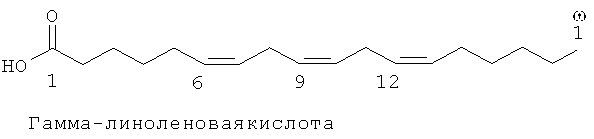


Жирные кислоты, которые очищают в соответствии со способом по настоящему изобретению, предпочтительно представляют собой С16-24-жирные кислоты. Их предпочтительно получают в ходе процесса наращивания цепи (например, в ходе наращивания цепи малоната) жирных кислот формулы R-CO2H, в которой R представляет собой остаток жирной кислоты, описанной выше. Соответственно, жирные кислоты, которые очищают в соответствии с настоящим изобретением, предпочтительно являются кислотами формулы R-CH2-CH2-CO2H, полученными путем наращивания цепи жирных кислот формулы R-CO2H. Предпочтительная группа R у жирных кислот формулы R-СН2-СН2-CO2H такова, как описано выше.Fatty acids are purified in accordance with the method of the present invention preferably are C 16 - 24 -fatty acid. They are preferably obtained during the chain extension process (for example, during malonate chain extension) of the fatty acids of the formula R-CO 2 H, in which R is the fatty acid residue described above. Accordingly, the fatty acids that are purified in accordance with the present invention are preferably acids of the formula R-CH 2 —CH 2 —CO 2 H, obtained by chain extension of the fatty acids of the formula R-CO 2 H. —CH 2 —CH 2 —CO 2 H is as described above.
Такие жирные кислоты, которые подвергают очистке в соответствии со способом очистки по настоящему изобретению, предпочтительно представляют собой ω-3 или ω-6 жирные кислоты, содержащие от 16 до 24 атомов углерода, более предпочтительно от 20 до 22 атомов углерода, и содержащие 2, 3, 4, 5 или 6, более предпочтительно 2, 3, 4 или 5, более предпочтительно 2, 3 или 4, наиболее предпочтительно 3 или 4, неконъюгированных олефиновых групп. Примеры жирных кислот включают ω-6 жирные кислоты: дигомо-гамма-линоленовую кислоту (DGLA) и эйкозадиеновую кислоту, а также ω-3 жирные кислоты: докозапентаеновую кислоту (DPA, иногда обозначаемую как DEPA), эйкозатетраеновую кислоту (ЕТА) и эйкозатриеновую кислоту. Предпочтительной ω-6 жирной кислотой является дигомо-гамма-линоленовая кислота (DGLA). Предпочтительными ω-3 жирными кислотами являются докозапентаеновая кислота (DPA) и эйкозатетраеновая кислота (ЕТА), более предпочтительно докозапентаеновая кислота (DPA). Во избежание противоречий структуры DGLA (ω-6), DPA (ω-3) и ЕТА (ω-3) таковы, как показано ниже, причем нумерация атомов углерода включена для пояснения:Such fatty acids that are purified in accordance with the cleaning method of the present invention are preferably ω-3 or ω-6 fatty acids containing from 16 to 24 carbon atoms, more preferably from 20 to 22 carbon atoms, and containing 2, 3, 4, 5 or 6, more preferably 2, 3, 4 or 5, more preferably 2, 3 or 4, most preferably 3 or 4, unconjugated olefinic groups. Examples of fatty acids include ω-6 fatty acids: dihomo-gamma-linolenic acid (DGLA) and eicosadienoic acid, as well as ω-3 fatty acids: docosapentaenoic acid (DPA, sometimes referred to as DEPA), eicosatetraenoic acid (ETA) and eicosatrienoic acid . A preferred ω-6 fatty acid is dihomo-gamma-linolenic acid (DGLA). Preferred ω-3 fatty acids are docosapentaenoic acid (DPA) and eicosatetraenoic acid (ETA), more preferably docosapentaenoic acid (DPA). In order to avoid contradictions, the structures of DGLA (ω-6), DPA (ω-3), and ETA (ω-3) are as shown below, with carbon atom numbering included for clarification:



Как было описано ранее, настоящее изобретение предлагает применение соли лития для очистки жирной кислоты.As described previously, the present invention provides the use of a lithium salt for purification of a fatty acid.
Как правило, указанная соль лития представляет собой вещество, отличное от алюмогидрида лития. Предпочтительная соль лития не является источником гидрида.Typically, said lithium salt is a substance other than lithium aluminum hydride. A preferred lithium salt is not a hydride source.
Обычно указанная жирная кислота представляет собой единственную жирную кислоту, согласно приведенному выше определению, т.е. эта жирная кислота не является смесью жирных кислот. Поэтому обычно соль лития добавляют к смеси единственной жирной кислоты и примесей не-кислотной природы. Эти примеси не-кислотной природы обычно образуются при осуществлении синтеза жирной кислоты, например такого, как раскрытый в настоящем описании. Таким образом, настоящее изобретение, как правило, не включает разделение жирных кислот между собой.Typically, said fatty acid is the only fatty acid as defined above, i.e. This fatty acid is not a mixture of fatty acids. Therefore, usually a lithium salt is added to a mixture of a single fatty acid and non-acidic impurities. These non-acidic impurities are typically formed by the synthesis of a fatty acid, for example, such as that disclosed herein. Thus, the present invention, as a rule, does not include the separation of fatty acids among themselves.
Обычно соль лития представляет собой бикарбонат лития, карбонат лития или гидроксид лития. Предпочтительно, чтобы соль лития представляла собой гидроксид лития, более предпочтительно - гидрат гидроксида лития.Typically, the lithium salt is lithium bicarbonate, lithium carbonate or lithium hydroxide. Preferably, the lithium salt is lithium hydroxide, more preferably lithium hydroxide hydrate.
Обычно указанная жирная кислота содержит от 1 до 6 центров неконъюгированной ненасыщенности, определенных в данном описании. Предпочтительная жирная кислота представляет собой ω-3 или ω-6 жирную кислоту.Typically, said fatty acid contains from 1 to 6 centers of unconjugated unsaturation as defined herein. A preferred fatty acid is ω-3 or ω-6 fatty acid.
Предпочтительно процесс очистки осуществляют по окончании последней из четырех стадий синтеза:Preferably, the purification process is carried out at the end of the last of the four stages of synthesis:
Стадия 1:Stage 1:
Соль лития и неочищенную жирную кислоту объединяют в первом растворе и выдерживают при условиях, позволяющих образование осадка литиевой соли жирной кислоты. Подходящие соли лития включают бикарбонат лития, карбонат лития и гидроксид лития. Предпочтительная соль лития представляет собой гидроксид лития. Соль лития может быть предоставлена в форме гидрата, например гидрата гидроксида лития. Ее можно добавлять к первому раствору в ее гидратной форме, но предпочтительно, чтобы ее сначала растворяли в подходящем растворителе, например в воде. Предпочтительно, чтобы первый раствор содержал кетон, более предпочтительно ацетон. Предпочтительная температура реакции находится в интервале от -30 до примерно 30°С.Lithium salt and crude fatty acid are combined in the first solution and maintained under conditions allowing the formation of a precipitate of the lithium salt of a fatty acid. Suitable lithium salts include lithium bicarbonate, lithium carbonate and lithium hydroxide. A preferred lithium salt is lithium hydroxide. Lithium salt may be provided in the form of a hydrate, for example lithium hydroxide hydrate. It can be added to the first solution in its hydrated form, but it is preferred that it is first dissolved in a suitable solvent, for example in water. Preferably, the first solution contains ketone, more preferably acetone. The preferred reaction temperature is in the range from -30 to about 30 ° C.
Стадия 2:Stage 2:
Затем осажденную соль лития выделяют. Можно применять любой подходящий способ для выделения твердого осадка, например фильтрование. Осадок, возможно, промывают еще одним растворителем (например тем же растворителем, который используют на Стадии 1, предпочтительно ацетоном), и в любом случае растворитель выпаривают.Then the precipitated lithium salt is isolated. Any suitable method can be used to isolate the solid precipitate, for example, filtration. The precipitate may be washed with another solvent (for example, the same solvent used in Step 1, preferably acetone), and in any case, the solvent is evaporated.
Стадия 3:Stage 3:
Выделенный осадок затем растворяют во втором растворе. Второй раствор выбирают таким образом, чтобы при растворении осадка образовывались два несмешивающихся слоя. Два несмешивающихся слоя представляют собой полярный слой, который представляет собой водный кислотный слой, и неполярный органический слой. Водный кислотный слой предпочтительно представляет собой водный раствор сильной минеральной кислоты, например хлороводородной кислоты. Подходящим неполярным органическим слоем является простой эфир. Подходящим простым эфиром для неполярного слоя является трет-бутил-метиловый эфир.The separated precipitate is then dissolved in a second solution. The second solution is chosen so that upon dissolution of the precipitate two immiscible layers are formed. The two immiscible layers are a polar layer, which is an aqueous acid layer, and a non-polar organic layer. The aqueous acidic layer is preferably an aqueous solution of a strong mineral acid, for example, hydrochloric acid. A suitable non-polar organic layer is ether. A suitable ether for the non-polar layer is tert-butyl methyl ether.
Стадия 4:Stage 4:
На этой стадии разделают два несмешивающихся слоя, образовавшихся при растворении осадка. Можно применять обычные методики разделения, например использовать обычную делительную воронку. После разделения двух несмешивающихся слоев получаемый органический слой можно, по желанию, промыть водой и высушить (например, с помощью Na2SO4 с последующей фильтрацией).At this stage, two immiscible layers formed upon dissolution of the precipitate are separated. Conventional separation techniques may be used, for example, using a conventional separation funnel. After separation of the two immiscible layers, the resulting organic layer can, if desired, be washed with water and dried (for example, using Na 2 SO 4 followed by filtration).
Стадия 5:Stage 5:
Растворитель удаляют из органического слоя выпариванием для того, чтобы выделить очищенную жирную кислоту. Такая очищенная жирная кислота имеет более высокую степень чистоты, по сравнению с неочищенным продуктом. Например, степень чистоты можно повысить примерно на 1% или больше, предпочтительно примерно на 2% или больше, более предпочтительно примерно на 5% или больше. Продукт, получаемый на этой стадии может быть бесцветным или окрашенным. Например, может быть получено светло-желтое масло. Этот продукт, возможно, далее обесцвечивают, применяя надлежащим образом хроматографический силикагель в подходящем растворителе. Например, обесцвечивание можно достичь путем перемешивания с 10-20% по массе хроматографического силикагеля в гексане.The solvent was removed from the organic layer by evaporation in order to isolate the purified fatty acid. Such a purified fatty acid has a higher degree of purity than a crude product. For example, the degree of purity can be increased by about 1% or more, preferably by about 2% or more, more preferably by about 5% or more. The product obtained in this step may be colorless or colored. For example, a light yellow oil may be obtained. This product may be further discolored by appropriate use of chromatographic silica gel in a suitable solvent. For example, bleaching can be achieved by mixing with 10-20% by weight of chromatographic silica gel in hexane.
Неочищенная жирная кислота, которую используют в вышеописанном процессе очистки, может иметь множество источников происхождения. Один из подходящих способов получения жирной кислоты осуществляют посредством декарбоксилирования производного малоновой кислоты. Например производное малоновой кислоты формулы RCH2CH(CO2H)2 можно декарбоксилировать с получением жирной кислоты формулы RCH2CH2CO2H. Полученную жирную кислоту формулы RCH2CH2CO2H можно затем очищать с помощью способа очистки, описанного выше.The crude fatty acid that is used in the above purification process can have many sources of origin. One suitable method for producing a fatty acid is carried out by decarboxylation of a malonic acid derivative. For example, a malonic acid derivative of the formula RCH 2 CH (CO 2 H) 2 can be decarboxylated to produce a fatty acid of the formula RCH 2 CH 2 CO 2 H. The resulting fatty acid of the formula RCH 2 CH 2 CO 2 H can then be purified using the purification method described above .
Производное малоновой кислоты, описанное выше, может иметь несколько источников происхождения. Например, оно может быть предоставлено в кристаллической форме, выделенной и, возможно, очищенной после предыдущей стадии. Тем не менее, предпочтительно его предоставляют в виде неочищенного продукта реакции, не подвергавшегося процедуре очистки. Например, его можно получить в результате реакции сульфоната с получением производного малонового эфира, соответственно, через интермедиат эфира малоновой кислоты и последующий гидролиз.The malonic acid derivative described above may have several sources of origin. For example, it may be provided in crystalline form, isolated and possibly purified after the previous step. However, it is preferably provided as a crude reaction product that has not undergone a purification procedure. For example, it can be obtained by the reaction of a sulfonate to produce a malonic ester derivative, respectively, via an intermediate of malonic acid ester and subsequent hydrolysis.
Настоящее изобретение также предлагает способ увеличения длины жирной кислоты. В частности, этот способ можно применять для удлинения жирной кислоты на два атома углерода. Эти два атома углерода можно с хорошей эффективностью внедрить между остатком жирной кислоты R и карбоксильной кислотной группой. Данный способ наращивания включает четыре отдельных стадии:The present invention also provides a method for increasing the length of a fatty acid. In particular, this method can be used to lengthen a fatty acid by two carbon atoms. These two carbon atoms can be introduced with good efficiency between the residue of the fatty acid R and the carboxylic acid group. This method of building includes four separate stages:
Стадия IStage I
Исходят из жирной кислоты формулы R-CO2H. Или же можно использовать соответствующий эфир жирной кислоты формулы R-CO2R1, в которой R представляет собой остаток жирной кислоты, а R1 представляет собой C1-6-алкильную группу. Предпочтительными группами R1 являются C1-4-алкильные группы, более предпочтительными - метил или этил, наиболее предпочтительной - этил.Starting from a fatty acid of the formula R-CO 2 H. Alternatively, you can use the corresponding fatty acid ester of the formula R-CO 2 R 1 in which R represents a fatty acid residue and R 1 represents a C 1-6 alkyl group. Preferred R 1 groups are C 1-4 alkyl groups, more preferred methyl or ethyl, most preferred ethyl.
Указанную жирную кислоту или эфир жирной кислоты восстанавливают с получением соответствующего спирта жирного ряда формулы R-CH2OH. Подходящие методики восстановления хорошо известны, и специалист в данной области техники легко сможет подобрать подходящие восстанавливающие агенты и условия реакции. Восстанавливающие агенты включают Red-AI (бис(2-метоксиэтокси)алюмогидрид натрия), DIBAL (гидрид диизобутилалюминия) и алюмогидрид лития. Восстанавливающие агенты применяют совместно с подходящим растворителем, причем подходящие инертные растворители включают простые эфиры и ароматические углеводороды, а также их производные. Предпочтительные растворители включают диэтиловый эфир, тетрагидрофуран и толуол. Температуру реакции можно варьировать, при этом подходящий температурный диапазон составляет от 0 до 35°С. Если исходным веществом является жирная кислота, то в процессе реакции восстановления выделяется водород. Водород следует тщательно и осторожно удалять. Использование эфира жирной кислоты в качестве исходного вещества снижает количество выделяемого водорода, поскольку образование водорода происходит только за счет разложения избытка восстанавливающего агента.Said fatty acid or fatty acid ester is reduced to give the corresponding fatty alcohol of the formula R-CH 2 OH. Suitable reduction techniques are well known, and one skilled in the art can readily select suitable reducing agents and reaction conditions. Reducing agents include Red-AI (bis (2-methoxyethoxy) sodium aluminum hydride), DIBAL (diisobutylaluminum hydride) and lithium aluminum hydride. Reducing agents are used in conjunction with a suitable solvent, and suitable inert solvents include ethers and aromatic hydrocarbons, as well as their derivatives. Preferred solvents include diethyl ether, tetrahydrofuran and toluene. The reaction temperature can be varied, while a suitable temperature range is from 0 to 35 ° C. If the starting material is fatty acid, then hydrogen is released during the reduction reaction. Hydrogen should be carefully and carefully removed. The use of a fatty acid ester as a starting material reduces the amount of hydrogen released, since the formation of hydrogen occurs only due to the decomposition of the excess reducing agent.
Предпочтительным восстанавливающим агентом является алюмогидрид лития. Его можно добавлять в реакцию в различных формах, например в виде твердого вещества или в растворе. Внесение в форме твердого вещества может подойти для мелкомасштабного производства. Для крупномасштабных процессов предпочтительно вводить алюмогидрид лития в растворе, что обеспечивает более удобное и безопасное обращение.A preferred reducing agent is lithium aluminum hydride. It can be added to the reaction in various forms, for example, as a solid or in solution. Application in the form of a solid may be suitable for small-scale production. For large-scale processes, it is preferable to introduce lithium aluminum hydride in solution, which provides more convenient and safe handling.
Стадия IIStage II
Спирт, полученный на стадии I, далее сульфонируют с получением сульфоната жирной кислоты формулы R-CH2OSO2R2, в которой R2 представляет собой C1-6-алкил или С6-10-арильную группу. Предпочтительно R2 представляет собой C1-6-алкил, более предпочтительно C1-4 алкил, наиболее предпочтительно метил. Если R2 представляет собой С6-10-арильную группу, данная арильная группа предпочтительно представляет собой фенил. Данные арильные группы могут быть незамещенными или замещенными, как описано ранее. Наиболее предпочтительным заместителем является метил. Подходящие сульфонирующие агенты выбирают надлежащим образом, например метансульфонил хлорид, фенилсульфонил хлорид и 4-метилфенилсульфонил хлориды являются предпочтительными сульфонирующими агентами, при этом особенно предпочтителен метансульфонил хлорид. Предпочтительно реакция протекает в присутствии четвертичного основания, такого как пиридин, 2,4,6-триметилпиридин или триэтиламин. Предпочтительная температура реакции находится примерно между 0 и 40°С.The alcohol obtained in stage I is then sulfonated to obtain a fatty acid sulfonate of the formula R-CH 2 OSO 2 R 2 in which R 2 is a C 1-6 alkyl or a C 6-10 aryl group. Preferably R 2 is C 1-6 alkyl, more preferably C 1-4 alkyl, most preferably methyl. If R 2 is a C 6-10 aryl group, this aryl group is preferably phenyl. These aryl groups may be unsubstituted or substituted as previously described. The most preferred substituent is methyl. Suitable sulfonating agents are appropriately selected, for example methanesulfonyl chloride, phenylsulfonyl chloride and 4-methylphenylsulfonyl chlorides are preferred sulfonating agents, with methanesulfonyl chloride being particularly preferred. Preferably, the reaction proceeds in the presence of a quaternary base such as pyridine, 2,4,6-trimethylpyridine or triethylamine. The preferred reaction temperature is between about 0 and 40 ° C.
Реакцию, возможно, проводят в подходящем растворителе. Обычно в реакциях сульфонирования такого типа используют хлорированные растворители (например, дихлорметан). Тем не менее, предпочтительно минимизировать или избегать применения хлорированных растворителей. Одним из путей, которые позволяют снизить или избежать применения хлорированного растворителя, является использование пиридина в качестве основания.The reaction may be carried out in a suitable solvent. Chlorinated solvents (e.g. dichloromethane) are typically used in sulfonation reactions of this type. However, it is preferable to minimize or avoid the use of chlorinated solvents. One way to reduce or avoid the use of a chlorinated solvent is to use pyridine as a base.
Стадия IIIStage III
Сульфонат жирной кислоты, полученный в Стадии II, далее вводят в реакцию с производным малонового эфира, и ее продукт гидролизуют с получением производного малоновой кислоты формулы R-CH2CH(CO2H)2. Исходную реакцию предпочтительно проводят в безводном спирте, например в абсолютном этаноле. Предпочтительная температура реакции составляет примерно 60-90°С. Гидролиз можно проводить в любых подходящих для гидролиза условиях, например в водном спирте в присутствии гидроксидов металлов I группы. Предпочтительная температура реакции составляет примерно 15-50°С.The fatty acid sulfonate obtained in Step II is then reacted with a malonic ester derivative, and its product is hydrolyzed to give a malonic acid derivative of the formula R-CH 2 CH (CO 2 H) 2 . The initial reaction is preferably carried out in anhydrous alcohol, for example in absolute ethanol. The preferred reaction temperature is about 60-90 ° C. Hydrolysis can be carried out under any conditions suitable for hydrolysis, for example, in aqueous alcohol in the presence of group I metal hydroxides. The preferred reaction temperature is about 15-50 ° C.
Подходящими производными малонового эфира являются металло-малонаты I группы, включая диалкилмалонаты натрия, NaCH(CO2R3)2, где R3 представляет собой C1-6-алкильную группу. Предпочтительно R3 представляет собой C1-4-алкильную группу, более предпочтительно - этил. Продуктом этой реакции сначала является сложный эфир формулы R-CH2CH(CO2R3)2, который далее гидролизуют с получением производного малоновой кислоты формулы R-СН2СН(CO2H)2. Реагенты и условия для гидролиза хорошо известны. Например, указанное производное малоновой кислоты может давать реакция с подходящим гидроксидом (например, гидроксидом натрия или калия).Suitable malonic ester derivatives are Group I metal malonates, including sodium dialkyl malonates, NaCH (CO 2 R 3 ) 2 , where R 3 is a C 1-6 alkyl group. Preferably R 3 represents a C 1-4 alkyl group, more preferably ethyl. The product of this reaction is first an ester of the formula R-CH 2 CH (CO 2 R 3 ) 2 , which is then hydrolyzed to give the malonic acid derivative of the formula R-CH 2 CH (CO 2 H) 2 . Reagents and conditions for hydrolysis are well known. For example, said malonic acid derivative may react with a suitable hydroxide (e.g., sodium or potassium hydroxide).
Данное производное малоновой кислоты формулы R-СН2СН(CO2H)2, в зависимости от природы R, можно выделять и кристаллизовать. Однако некоторые производные малоновой кислоты с трудом поддаются кристаллизации или не кристаллизуются совсем. Например, производное малоновой кислоты, образованное от ЕРА или ее сложного эфира (т.е. R представляет собой Н3С-(СН2-СН=СН)5-(СН2)3-) не является легко кристаллизуемым. При таких обстоятельствах, когда процесс очистки нельзя легко осуществить с некристаллизуемым продуктом, способ очистки с применением соли лития, описанный выше, предлагает удобный способ повышения чистоты конечной жирной кислоты. Данный способ очистки с применением соли лития позволяет избежать необходимости кристаллизовать и очищать производное малоновой кислоты формулы R-CH2CH(CO2H)2, а вместо этого позволяет осуществлять очистку конечного продукта жирной кислоты. Соответственно, способ увеличения длины жирной кислоты, описанный ранее, предпочтительно задействует неочищенный продукт, получаемый на Стадии III, который используется в качестве исходного вещества для Стадии IV, без предварительной очистки продукта Стадии III.This malonic acid derivative of the formula R-CH 2 CH (CO 2 H) 2 , depending on the nature of R, can be isolated and crystallized. However, some derivatives of malonic acid are difficult to crystallize or do not crystallize at all. For example, a malonic acid derivative formed from EPA or its ester (i.e., R represents H 3 C- (CH 2 —CH = CH) 5 - (CH 2 ) 3 -) is not readily crystallizable. Under such circumstances, when the purification process cannot be easily carried out with the non-crystallizable product, the purification process using lithium salt described above offers a convenient way to increase the purity of the final fatty acid. This purification method using a lithium salt avoids the need to crystallize and purify a malonic acid derivative of the formula R-CH 2 CH (CO 2 H) 2 , and instead allows purification of the final fatty acid product. Accordingly, the method of increasing the length of a fatty acid described previously preferably involves the crude product obtained in Stage III, which is used as the starting material for Stage IV, without first purifying the product of Stage III.
Стадия IVStage IV
Производное малоновой кислоты, полученной на Стадии III, далее декарбоксилируют с получением жирной кислоты формулы R-CH2CH2CO2H. Можно использовать стандартные методики декарбоксилирования, с удалением выделяемого диоксида углерода (например с помощью вакуума) в ходе реакции. Например, декарбоксилирование можно осуществить простым нагреванием. Подходящие температуры нагревания могут варьироваться, но, как правило, они попадают в интервал 120-180°С, например 130-170°С, предпочтительно 140-160°С. Данную температуру следует поддерживать до тех пор, пока реакция не будет полностью завершена, что можно наблюдать по уменьшению и, в конечном счете, прекращению выделения диоксида углерода. Можно применять также вакуум, например подходящим является вакуум менее чем примерно 30 мбар.The malonic acid derivative obtained in Step III is then decarboxylated to give a fatty acid of the formula R-CH 2 CH 2 CO 2 H. Standard decarboxylation procedures can be used to remove the carbon dioxide (for example, by vacuum) during the reaction. For example, decarboxylation can be carried out by simple heating. Suitable heating temperatures may vary, but as a rule, they fall in the range of 120-180 ° C, for example 130-170 ° C, preferably 140-160 ° C. This temperature should be maintained until the reaction is complete, which can be observed by reducing and, ultimately, stopping the emission of carbon dioxide. A vacuum may also be used, for example a vacuum of less than about 30 mbar is suitable.
Стадия VStage V
Жирную кислоту, полученную на Стадии IV, далее очищают, применяя способ очистки жирной кислоты, описанный выше. Очищением с помощью этого способа удаляют не-кислотные примеси из жирной кислоты. Конечный продукт жирной кислоты имеет более высокую степень чистоты, по сравнению с жирной кислотой, полученной на Стадии IV. Степень чистоты конечной жирной кислоты может быть такой же, как у исходной жирной кислоты, используемой на Стадии I, т.е. жирной кислоты формулы R-СО2Н. Если исходная жирная кислота содержала не-кислотные примеси, то степень чистоты конечной жирной кислоты будет выше.The fatty acid obtained in Step IV is further purified using the fatty acid purification method described above. By purification using this method, non-acidic impurities are removed from the fatty acid. The final fatty acid product has a higher degree of purity than the fatty acid obtained in Stage IV. The degree of purity of the final fatty acid may be the same as the original fatty acid used in Stage I, i.e. fatty acid of the formula R-CO 2 N. If the original fatty acid contained non-acidic impurities, then the purity of the final fatty acid will be higher.
ПримерыExamples
Пример 1: Получение и очистка DGLA (эйкоза-8(Z), 11(Z), 14(Z)-триеновой кислоты)Example 1: Preparation and purification of DGLA (eicosa-8 (Z), 11 (Z), 14 (Z) -trienoic acid)
Пример 1а: получение GL-спирта (октадека-6(Z), 9(Z), 12(Z)-триенол)Example 1a: Preparation of GL-alcohol (Octadec-6 (Z), 9 (Z), 12 (Z) -trienol)
Для осушения свежего тетрагидрофурана (12000 частей, об.) в атмосфере азота добавляют алюмогидрид лития в тетрагидрофуране (2.4 М, 1620 частей, об.). Смесь охлаждают до 0-5°С и добавляют GLA (гамма-линоленовую кислоту, 95-98%, 1112 частей, вес.) в сухом тетрагидрофуране (2000 частей, об.) в течение 30-40 мин, поддерживая температуру около 3-7°С, при перемешивании и в токе азота. Затем смесь перемешивают при 8-12°С в течение 1 ч и при 12-18°С в течение 2 ч в атмосфере азота. После охлаждения до 3-5°С добавляют раствор воды (152 частей, об.) в тетрагидрофуране (500 частей, об.) под сильным током азота в течение 15-20 мин. Затем добавляют водный раствор гидроксида натрия (2 М, 456 частей, об.) в течение 10-15 мин. Смесь перемешивают при 10-15°С в укупоренном сосуде в атмосфере азота в течение ночи и затем добавляют безводный сульфат натрия (500 частей, вес.) и смесь перемешивают еще в течение 30 мин. После фильтрации неорганические твердые вещества промывают с помощью тетрагидрофурана (2000 частей, об.). Конечный раствор THF выпаривают под вакуумом. Малейшие примеси воды в продукте удаляют путем выпаривания совместно с 2×2000 частями (об.) толуола. Получают GL-спирт (1029 частей, вес., 97,4%) в виде светло-желтого масла.To drain fresh tetrahydrofuran (12000 parts, vol.) In a nitrogen atmosphere, lithium aluminum hydride in tetrahydrofuran (2.4 M, 1620 parts, vol.) Is added. The mixture is cooled to 0-5 ° C and GLA (gamma-linolenic acid, 95-98%, 1112 parts, weight.) Is added in dry tetrahydrofuran (2000 parts, vol.) For 30-40 minutes, maintaining the temperature at about 3- 7 ° C, with stirring and in a stream of nitrogen. Then the mixture is stirred at 8-12 ° C for 1 h and at 12-18 ° C for 2 h in a nitrogen atmosphere. After cooling to 3-5 ° C, add a solution of water (152 parts, vol.) In tetrahydrofuran (500 parts, vol.) Under a strong stream of nitrogen for 15-20 minutes Then add an aqueous solution of sodium hydroxide (2 M, 456 parts, vol.) For 10-15 minutes The mixture was stirred at 10-15 ° C. in a sealed vessel under nitrogen overnight and then anhydrous sodium sulfate (500 parts, wt.) Was added and the mixture was stirred for another 30 minutes. After filtration, inorganic solids are washed with tetrahydrofuran (2000 parts, vol.). The final THF solution was evaporated in vacuo. The smallest impurities of water in the product are removed by evaporation together with 2 × 2000 parts (vol.) Of toluene. Get GL-alcohol (1029 parts, weight., 97.4%) as a pale yellow oil.
Пример 1b: получение метан сульфоната GL-спирта (октадека-6(Z), 9(Z), 12(Z)-триенил метан сульфонат)Example 1b: Preparation of GL-alcohol methane sulfonate (octadeca-6 (Z), 9 (Z), 12 (Z) -trienyl methane sulfonate)
К перемешанной смеси GL-спирта (1000 частей, вес.) и метансульфонил хлорида (456 частей, вес.) в атмосфере азота, при 8-12°С добавляют сухой пиридин (307 частей, вес.) в течение 30-40 мин, поддерживая температуру не выше 15°С. Смесь перемешивают при этой температуре в течение 3-5 ч и затем дают нагреться до комнатной температуры и перемешивают в течение 24-48 ч. В смеси происходит осаждение гидрохлорида пиридина. Реакционную смесь затем разводят в гексане (4000 частей, об.), добавляют безводный сульфат натрия (200 частей, вес.) и полученную смесь перемешивают в течение 1 ч. Осажденные твердые вещества отфильтровывают и промывают гексаном. Гексан удаляют из фильтрата в вакууме с образованием неочищенного метан сульфоната (~1300 частей, вес.), который можно использовать для следующей стадии.To a mixed mixture of GL-alcohol (1000 parts, weight.) And methanesulfonyl chloride (456 parts, weight.) In a nitrogen atmosphere, dry pyridine (307 parts, weight.) Is added over a period of 30-40 minutes, keeping the temperature no higher than 15 ° С. The mixture is stirred at this temperature for 3-5 hours and then allowed to warm to room temperature and stirred for 24-48 hours. Pyridine hydrochloride precipitates in the mixture. The reaction mixture was then diluted in hexane (4000 parts, vol.), Anhydrous sodium sulfate (200 parts, vol.) Was added and the resulting mixture was stirred for 1 h. The precipitated solids were filtered off and washed with hexane. Hexane was removed from the filtrate in vacuo to give crude methane sulfonate (~ 1300 parts, wt.), Which could be used for the next step.
Альтернативный способ очистки (дающий более чистый продукт и менее окрашенный конечный продукт на последующих стадиях) описан далее. Реакционную смесь разводят в трет-бутил-метиловом эфире (4000 частей, об.) и охлаждают до 5-10°С. Добавляют воду (2000 частей, об.) при перемешивании, в атмосфере азота, и pH водного слоя доводят до 1-2 с помощью концентрированной хлороводородной кислоты. Через 15 мин слои разделяют, водный слой экстрагируют трет-бутил-метиловым эфиром (500 частей, об.). Объединенные органические слои затем промывают с помощью 1М хлороводородной кислоты (1000 частей, об.) и воды (4×500 частей, об.). Органический слой сушат (безводный сульфат натрия, 300 частей, вес.), фильтруют и выпаривают в вакууме с образованием более чистого метан сульфоната для использования на следующей стадии.An alternative purification method (giving a cleaner product and a less colored final product in subsequent steps) is described below. The reaction mixture was diluted in tert-butyl methyl ether (4000 parts, vol.) And cooled to 5-10 ° C. Water (2000 parts, vol.) Was added with stirring under nitrogen, and the pH of the aqueous layer was adjusted to 1-2 with concentrated hydrochloric acid. After 15 min, the layers were separated, the aqueous layer was extracted with tert-butyl methyl ether (500 parts, vol.). The combined organic layers are then washed with 1M hydrochloric acid (1000 parts, vol.) And water (4 × 500 parts, vol.). The organic layer was dried (anhydrous sodium sulfate, 300 parts, wt.), Filtered and evaporated in vacuo to give pure methane sulfonate for use in the next step.
Пример 1с: получение 2-карбокси DGLA (2-карбокси-изокса-8(Z), 11(Z), 14(Z)-триеновой кислоты)Example 1c: Preparation of 2-carboxy DGLA (2-carboxy-isox-8 (Z), 11 (Z), 14 (Z) -trienic acid)
К абсолютному этанолу (10000 частей, об.) добавляют метоксид натрия 30% вес/об, в метаноле (1370 частей, об.). Добавляют диэтилмалонат (1520 частей, вес.) при комнатной температуре в атмосфере азота, в сильном токе, в течение 10-15 мин, и смесь перемешивают еще в течение 10-15 мин. Добавляют неочищенный метан сульфонат GL-спирта (1300 частей) в сильном токе в течение 10-15 мин и смесь перемешивают и нагревают с помощью обратного холодильника в течение 3,5-4,0 ч в атмосфере азота. После охлаждения до комнатной температуры добавляют в атмосфере азота раствор, приготовленный путем растворения гидроксида калия 85% (1900 частей, вес.) в воде (1000 частей, об.) и последующего добавления 95% этанола (13000 частей, об.). Происходит выделение тепла, температура реакции достигает 30-40°С. Смесь перемешивают при комнатной температуре в течение 4-5 ч в атмосфере азота. Суммарную реакционную смесь выпаривают в ротационном испарителе для удаления этанола. Остаток после выпаривания растворяют в воде (10000 частей, об.) и добавляют трет-бутил-метиловый эфир (10000 частей, об.). Смесь перемешивают и подкисляют в атмосфере азота с помощью 20% серной кислоты (ок. 6000 частей, об.) (макс. темп. 20°С). После разделения слоев органический слой промывают водой (4×2000 частей, об.), сушат (безводный сульфат натрия) и выпаривают в вакууме с получением масла, которое кристаллизуется при трении с образованием неочищенной 2-карбокси DGLA (1170-1220 частей, вес., 88-92%).To absolute ethanol (10,000 parts, vol.) Add sodium methoxide 30% w / v, in methanol (1370 parts, vol.). Diethyl malonate (1520 parts, wt.) Was added at room temperature in a nitrogen atmosphere, under high current, for 10-15 minutes, and the mixture was stirred for another 10-15 minutes. The crude methane sulfonate of GL alcohol (1300 parts) was added under high current for 10-15 minutes, and the mixture was stirred and refluxed for 3.5-4.0 hours under nitrogen. After cooling to room temperature, a solution prepared by dissolving 85% potassium hydroxide (1900 parts, weight.) In water (1000 parts, vol.) And then adding 95% ethanol (13000 parts, vol.) Is added in a nitrogen atmosphere. Heat is generated, the reaction temperature reaches 30-40 ° C. The mixture was stirred at room temperature for 4-5 hours under nitrogen. The total reaction mixture was evaporated in a rotary evaporator to remove ethanol. The evaporation residue is dissolved in water (10000 parts, vol.) And tert-butyl methyl ether (10000 parts, vol.) Is added. The mixture is stirred and acidified under nitrogen with 20% sulfuric acid (approx. 6000 parts, vol.) (Max. Temperature. 20 ° C). After separation of the layers, the organic layer is washed with water (4 × 2000 parts, vol.), Dried (anhydrous sodium sulfate) and evaporated in vacuum to obtain an oil, which crystallizes upon friction with the formation of crude 2-carboxy DGLA (1170-1220 parts, weight. , 88-92%).
Пример 1d: получение DGLA (изокса-8(Z), 11(Z), 14(Z)-триеновой кислоты)Example 1d: Preparation of DGLA (Isox-8 (Z), 11 (Z), 14 (Z) -trienoic acid)
Неочищенную 2-карбокси DGLA (1200 частей, вес.) нагревают при перемешивании в вакууме с давлением менее 30 мбар при 140-160°С. Диоксид углерода выделяется и удаляется с помощью вакуума. Через 3-5 ч выделение диоксида углерода прекращается. Колбу охлаждают до комнатной температуры, и в реакционный сосуд запускают азот, в результате чего получают масло (1000-1030 частей, вес., 95-98%).The crude 2-carboxy DGLA (1200 parts, weight.) Is heated with stirring in vacuum with a pressure of less than 30 mbar at 140-160 ° C. Carbon dioxide is released and removed by vacuum. After 3-5 hours, the emission of carbon dioxide ceases. The flask was cooled to room temperature, and nitrogen was introduced into the reaction vessel, resulting in an oil (1000-1030 parts, weight, 95-98%).
Пример 1е: очистка DGLAExample 1e: DGLA Purification
Продукт, полученный в Примере 1d (1000 частей, вес.), растворяют в ацетоне для HPLC (или эквивалентной степени чистоты) (3550-3600 частей, об.), при хорошем перемешивании, в атмосфере азота, и медленно добавляют раствор гидрата гидроксида лития (150 частей, вес.) в воде (975 частей, об.) в течение 30 мин. Смесь перемешивают еще в течение 10 мин. Затем добавляют ацетон (3500-3600 частей, об.) в течение 30 мин, при перемешивании, и продолжают перемешивать с охлаждением в интервале от 0 до -5°С в течение 2-3 ч. Смесь оставляют перемешиваться в течение ночи при этой температуре. Осаждаемую соль лития отфильтровывают, промывают предварительно охлажденным ацетоном и отсасывают досуха. Полученное твердое вещество добавляют порциями к перемешанной охлажденной (0-10°С) смеси трет-бутил-метилового эфира (6000 частей, об.) и 1М хлороводородной кислоты (6000 частей, об.) в атмосфере азота. Образующийся органический слой отделяют, промывают водой (4×500-750 частей, об.) и высушивают (Na2SO4). После фильтрации растворитель выпаривают и полученное масло нагревают в высоком вакууме (50-60°С, 0,1-1,0 мбар) в течение нескольких часов для удаления следов растворителя. Получают DGLA в виде светло-желтого масла (760-800 частей, вес., 76-80%). Обесцвечивания до прозрачного масла можно достичь путем перемешивания DGLA в 10 объемах гексана в присутствии силикагеля для хроматографии, с размером частиц 35-70 мкм (20% по весу) в течение 1 ч, фильтрации и выпаривания растворителя.The product obtained in Example 1d (1000 parts, weight.), Dissolved in acetone for HPLC (or equivalent purity) (3550-3600 parts, vol.), With good stirring, in a nitrogen atmosphere, and a solution of lithium hydroxide hydrate is slowly added. (150 parts, weight.) In water (975 parts, vol.) For 30 minutes The mixture was stirred for another 10 minutes. Then acetone (3500-3600 parts, vol.) Was added over 30 minutes while stirring, and stirring was continued with cooling in the range from 0 to -5 ° C for 2-3 hours. The mixture was allowed to stir overnight at this temperature. . The precipitated lithium salt is filtered off, washed with pre-cooled acetone and filtered off with suction to dryness. The resulting solid was added portionwise to a mixed chilled (0-10 ° C.) mixture of tert-butyl methyl ether (6000 parts, vol.) And 1M hydrochloric acid (6000 parts, vol.) In a nitrogen atmosphere. The resulting organic layer was separated, washed with water (4 × 500-750 parts, vol.) And dried (Na 2 SO 4 ). After filtration, the solvent was evaporated and the resulting oil was heated under high vacuum (50-60 ° C, 0.1-1.0 mbar) for several hours to remove traces of the solvent. Get DGLA in the form of a light yellow oil (760-800 parts, weight., 76-80%). Discoloration to a clear oil can be achieved by stirring DGLA in 10 volumes of hexane in the presence of silica gel for chromatography, with a particle size of 35-70 μm (20% by weight) for 1 h, filtering and evaporating the solvent.
Пример 2: получение и очистка DPA (докоза-7(Z), 10(Z), 13(Z), 16(Z), 19(Z)-пентаеновая кислота)Example 2: preparation and purification of DPA (docosa-7 (Z), 10 (Z), 13 (Z), 16 (Z), 19 (Z) -pentaenoic acid)
DPA получали таким же образом, как DGLA в Примере 1, но в качестве исходного вещества брали этиловый эфир ЕРА (этиловый эфир эйкозапентаеновой кислоты).DPA was obtained in the same manner as the DGLA in Example 1, but EPA ethyl ester (eicosapentaenoic acid ethyl ester) was taken as starting material.
На первой стадии получали ЕР-спирт (изокса-5(Z), 8(Z), 11(Z), 14(Z), 17(Z)-пентаенол) таким же образом, как в Примере 1а, с заменой GLA на ЕРА этиловый эфир (1320 частей, вес.).In the first step, EP alcohol (isoxa-5 (Z), 8 (Z), 11 (Z), 14 (Z), 17 (Z) -pentaenol) was obtained in the same manner as in Example 1a, with GLA replaced by EPA ethyl ether (1320 parts, weight.).
На второй стадии метан сульфонат ЕР-спирта (изокса-5(Z), 8(Z), 11(Z), 14(Z), 17(Z)-пентаенил метан сульфонат) получали таким же образом, как в Примере 1b, с заменой GL-спирта на указанный ЕР-спирт (1091 частей, вес.).In the second stage, methane sulfonate EP-alcohol (isoxa-5 (Z), 8 (Z), 11 (Z), 14 (Z), 17 (Z) -pentaenyl methane sulfonate) was obtained in the same manner as in Example 1b, with the replacement of GL-alcohol on the specified EP-alcohol (1091 parts, weight.).
На третьей стадии 2-карбокси DPA (2-карбокси-докоза-7(Z), 10(Z), 13(Z), 16(Z), 19(Z)-пентаеновая кислота) получали таким же образом, как в Примере 1с, с заменой метан сульфоната GL-спирта на указанный метан сульфонат ЕР-спирта (1391 частей, вес.).In the third stage, 2-carboxy DPA (2-carboxy-docosa-7 (Z), 10 (Z), 13 (Z), 16 (Z), 19 (Z) -pentaenoic acid) was obtained in the same manner as in Example 1c, with the replacement of methane sulfonate of GL alcohol with the indicated methane sulfonate of EP alcohol (1391 parts, weight.).
На четвертой стадии DPA (докоза-7(Z), 10(Z), 13(Z), 16(Z), 19(Z)-пентаеновая кислота) получали таким же образом, как в Примере 1d, с заменой 2-карбокси-DGLA на указанную 2-карбокси-DPA, при охлаждении смеси с ацетоном в интервале от -15 до -20°С.In the fourth stage, DPA (docosa-7 (Z), 10 (Z), 13 (Z), 16 (Z), 19 (Z) -pentaenoic acid) was obtained in the same manner as in Example 1d, with the replacement of 2-carboxy -DGLA to the specified 2-carboxy-DPA, while cooling the mixture with acetone in the range from -15 to -20 ° C.
На пятой стадии DPA очищали с применением такого же способа очистки с помощью соли лития, как в Примере 1е, но с заменой DGLA на указанную DPA.In a fifth step, DPA was purified using the same purification method using a lithium salt as in Example 1e, but with the replacement of DGLA with said DPA.
Claims (13)
(a) введение в реакцию жирной кислоты, содержащей от 1 до 6 центров неконъюгированной ненасыщенности, с солью лития в первом растворе и в условиях, позволяющих образование осадка литиевой соли жирной кислоты;
(b) выделение осадка;
(c) растворение осадка во втором растворе, который способен давать два несмешивающихся слоя при растворении осадка, причем указанные два несмешивающихся слоя представляют собой органический слой и водный кислотный слой;
(d) разделение двух несмешивающихся слоев, образовавшихся при растворении осадка; и
(e) выпаривание органического слоя для выделения очищенной жирной кислоты, где способ очистки не включает разделения жирных кислот между собой.1. The method of purification of a fatty acid containing from 1 to 6 centers of unconjugated unsaturation, including:
(a) introducing into the reaction a fatty acid containing from 1 to 6 centers of unconjugated unsaturation with a lithium salt in the first solution and under conditions allowing the formation of a precipitate of a lithium salt of a fatty acid;
(b) precipitation;
(c) dissolving the precipitate in a second solution which is capable of producing two immiscible layers upon dissolution of the precipitate, said two immiscible layers being an organic layer and an aqueous acidic layer;
(d) separation of two immiscible layers formed upon dissolution of the precipitate; and
(e) evaporating the organic layer to isolate the purified fatty acid, wherein the purification method does not include the separation of the fatty acids among themselves.
(a) декарбоксилирование производного малоновой кислоты формулы R-СН2СН(CO2H)2, в которой R представляет собой остаток жирной кислоты, содержащей от 1 до 6 центров неконъюгированной ненасыщенности, с получением жирной кислоты формулы RCH2CH2CO2H;
(b) обработка жирной кислоты, полученной таким путем, согласно способу очистки жирной кислоты, определенному в пп.1-4.5. A method of obtaining a fatty acid containing from 1 to 6 centers of unconjugated unsaturation, including:
(a) decarboxylation of a malonic acid derivative of the formula R-CH 2 CH (CO 2 H) 2 , in which R is a fatty acid residue containing from 1 to 6 centers of unconjugated unsaturation, to obtain a fatty acid of the formula RCH 2 CH 2 CO 2 H ;
(b) treating a fatty acid obtained in this way according to a method for purifying a fatty acid as defined in claims 1-4.
(a) восстановление жирной кислоты формулы R-CO2H или эфира жирной кислоты формулы R-CO2R1, в которых R представляет собой остаток жирной кислоты, содержащей от 1 до 6 центров неконъюгированной ненасыщенности, а R1 представляет собой C1-6-алкильную группу, до спирта формулы R-СН2ОН;
(b) сульфонирование указанного спирта с получением сульфоната формулы R-CH2OSO2R2, в которой R2 представляет собой C1-6-алкильную или С6-10-арильную группу;
(c) введение сульфоната в реакцию с производным малонового эфира и гидролиз полученного продукта с образованием производного малоновой кислоты формулы R-СН2СН(CO2H)2;
(d) декарбоксилирование данного производного малоновой кислоты с получением жирной кислоты формулы R-CH2CH2CO2H; и
(e) обработка жирной кислоты, полученной таким путем, согласно способу очистки жирной кислоты, определенному в пп.1-4.6. A method of increasing the length of a fatty acid containing from 1 to 6 centers of unconjugated unsaturation, including:
(a) reduction of a fatty acid of the formula R-CO 2 H or a fatty acid ester of the formula R-CO 2 R 1 in which R is a fatty acid residue containing from 1 to 6 centers of unconjugated unsaturation, and R 1 represents C 1- 6- alkyl group, to an alcohol of the formula R-CH 2 OH;
(b) sulfonating said alcohol to obtain a sulfonate of the formula R-CH 2 OSO 2 R 2 in which R 2 is a C 1-6 alkyl or C 6-10 aryl group;
(c) reacting the sulfonate with a malonic ester derivative and hydrolyzing the resulting product to form a malonic acid derivative of the formula R — CH 2 CH (CO 2 H) 2 ;
(d) decarboxylation of a given malonic acid derivative to obtain a fatty acid of the formula R-CH 2 CH 2 CO 2 H; and
(e) treating a fatty acid obtained in this way according to a method for purifying a fatty acid as defined in claims 1-4.
Applications Claiming Priority (3)
| Application Number | Priority Date | Filing Date | Title |
|---|---|---|---|
| GB1001345.6 | 2010-01-27 | ||
| GBGB1001345.6A GB201001345D0 (en) | 2010-01-27 | 2010-01-27 | Process for preparing and purifying fatty acids |
| PCT/GB2011/000104 WO2011092467A1 (en) | 2010-01-27 | 2011-01-27 | Process for preparing and purifying fatty acids |
Publications (2)
| Publication Number | Publication Date |
|---|---|
| RU2012136070A RU2012136070A (en) | 2014-03-10 |
| RU2553473C2 true RU2553473C2 (en) | 2015-06-20 |
Family
ID=42084065
Family Applications (1)
| Application Number | Title | Priority Date | Filing Date |
|---|---|---|---|
| RU2012136070/04A RU2553473C2 (en) | 2010-01-27 | 2011-01-27 | Method for producing and purifying fatty acids |
Country Status (18)
| Country | Link |
|---|---|
| US (1) | US9079847B2 (en) |
| EP (1) | EP2528889B1 (en) |
| JP (1) | JP5706446B2 (en) |
| KR (1) | KR101782187B1 (en) |
| CN (1) | CN102844289B (en) |
| AU (1) | AU2011209584B2 (en) |
| BR (1) | BR112012018681B1 (en) |
| CA (1) | CA2787875C (en) |
| DK (1) | DK2528889T3 (en) |
| ES (1) | ES2703280T3 (en) |
| GB (1) | GB201001345D0 (en) |
| HU (1) | HUE041867T2 (en) |
| PE (1) | PE20121824A1 (en) |
| PL (1) | PL2528889T3 (en) |
| PT (1) | PT2528889T (en) |
| RU (1) | RU2553473C2 (en) |
| TR (1) | TR201816300T4 (en) |
| WO (1) | WO2011092467A1 (en) |
Families Citing this family (14)
| Publication number | Priority date | Publication date | Assignee | Title |
|---|---|---|---|---|
| WO2013192109A1 (en) | 2012-06-17 | 2013-12-27 | Matinas Biopharma, Inc. | Omega-3 pentaenoic acid compositions and methods of use |
| CN103012100B (en) * | 2012-12-28 | 2016-05-25 | 李赛荣 | The purification process of tetradecylic acid |
| CN104098461B (en) * | 2013-04-12 | 2017-06-16 | 江阴技源药业有限公司 | A kind of purification process of β hydroxyls β methylbutanoic acids |
| FR3014436B1 (en) * | 2013-12-11 | 2016-10-21 | Novasep Process | PROCESS FOR THE CHROMATOGRAPHIC PURIFICATION OF A FATTY ACID |
| EP3103787B1 (en) * | 2014-02-03 | 2020-03-04 | Bizen Chemical Co., Ltd. | Method for chemical conversion of unsaturated fatty acid by carbon chain extension reaction |
| PE20170265A1 (en) * | 2014-04-07 | 2017-03-26 | Epax Norway As | COMPOSITION OF LONG CHAIN MONOINSATURATED FATTY ACIDS AND METHOD FOR THE PRODUCTION OF THE SAME |
| JP6162646B2 (en) * | 2014-05-27 | 2017-07-12 | 信越化学工業株式会社 | Method for producing 3,5-dimethyldodecanoic acid |
| MX375328B (en) | 2014-06-04 | 2025-03-06 | Ds Biopharma Ltd | Pharmaceutical compositions comprising dgla and use of same |
| JPWO2017002353A1 (en) * | 2015-06-30 | 2018-04-12 | 備前化成株式会社 | Synthesis of long-chain unsaturated fatty acids by chemical carbon chain extension reaction. |
| ES3000673T3 (en) * | 2015-08-31 | 2025-03-03 | Nissui Corp | Free-polyunsaturated-fatty-acid-containing composition and method for manufacturing same |
| KR102052708B1 (en) | 2015-12-22 | 2019-12-09 | 주식회사 엘지화학 | Catalyst for dehydration of glycerin, preparing method thereof and production method of acrolein using the catalyst |
| CN108281637B (en) * | 2018-01-29 | 2020-07-14 | 蒋央芳 | A kind of preparation method of lithium nickel cobalt manganate |
| WO2020018581A1 (en) * | 2018-07-16 | 2020-01-23 | Provivi, Inc. | Synthesis of straight-chain lepidopteran pheromones through one- or two- carbon homologation of fatty alkenes |
| US20210315851A1 (en) | 2020-04-03 | 2021-10-14 | Afimmune Limited | Compositions comprising 15-hepe and methods of treating or preventing hematologic disorders, and/or related diseases |
Citations (6)
| Publication number | Priority date | Publication date | Assignee | Title |
|---|---|---|---|---|
| US2228925A (en) * | 1937-11-27 | 1941-01-14 | Jasco Inc | Recovery of fatty acids and alkali salts from soaps |
| GB942452A (en) * | 1959-12-10 | 1963-11-20 | Gernot Grimmer | Unsaturated fatty acids and salts thereof and a process for their preparation |
| SU739058A1 (en) * | 1978-01-30 | 1980-06-05 | Предприятие П/Я А-1785 | Method of isolating synthetic aliphatic acids |
| SU1766904A1 (en) * | 1990-06-07 | 1992-10-07 | Matushkin Karp M | Method of synthetic fatty acids isolation |
| US5252333A (en) * | 1987-04-27 | 1993-10-12 | Scotia Holdings Plc | Lithium salt-containing pharmaceutical compositions |
| WO2005095565A1 (en) * | 2004-03-29 | 2005-10-13 | Cargill Incorporated | Soapstock treatment |
Family Cites Families (19)
| Publication number | Priority date | Publication date | Assignee | Title |
|---|---|---|---|---|
| FR1552860A (en) | 1967-08-01 | 1969-01-10 | ||
| DE2355856A1 (en) | 1972-11-21 | 1974-05-22 | Akzona Inc | METHOD FOR CLEANING UP NEUTRALIZED FATTY ACID AMIDES |
| FR2338327A1 (en) | 1976-01-13 | 1977-08-12 | Ugine Kuhlmann | PROCESS FOR SEPARATING LINEAR CHAIN SOAPS, BRANCHED CHAIN SOAPS AND THEIR ACIDS |
| US4452994A (en) * | 1981-03-02 | 1984-06-05 | G. D. Searle & Co. | Process for isolating organic compounds and lithium salt complexes useful in said process |
| FI67229C (en) | 1982-08-17 | 1985-02-11 | Oulu Oy | FOERFARANDE FOER ATT FOERBAETTRA FAERGEN OCH FAERGSTABILITETENHOS EN CARBOXYLSYRA ELLER DESS BLANDNING |
| JPS60142940A (en) | 1983-12-28 | 1985-07-29 | Otsuka Pharmaceut Co Ltd | Separation of z-9-hexadecenoic acid from e-9-hexadecenoic acid |
| DE3863678D1 (en) * | 1987-04-27 | 1991-08-22 | Efamol Holdings | PHARMACEUTICAL PREPARATIONS CONTAINING LITHIUM SALTS. |
| DE4215478A1 (en) * | 1992-05-11 | 1993-11-18 | Solvay Deutschland | Lactobionic acid amide compositions and their use |
| DE4304468A1 (en) | 1993-02-15 | 1994-08-18 | Henkel Kgaa | Process for the production of light colored polyol esters |
| US6310227B1 (en) | 1997-01-31 | 2001-10-30 | The Procter & Gamble Co. | Reduced calorie cooking and frying oils having improved hydrolytic stability, and process for preparing |
| JP4079516B2 (en) * | 1998-06-19 | 2008-04-23 | サントリー株式会社 | Method for producing triglyceride |
| CA2273570A1 (en) | 1999-05-31 | 2000-11-30 | Jfs Envirohealth Ltd. | Concentration and purification of polyunsaturated fatty acid esters by distillation-enzymatic transesterification coupling |
| CN100358987C (en) | 2005-08-05 | 2008-01-02 | 鞍山海华油脂化学有限公司 | High extreme pressure lithium base lubricating grease |
| EP1981836B1 (en) | 2006-01-12 | 2013-07-17 | Alfa Laval Corporate AB | Process for purification of fatty acid alkyl esters and use of agents to facilitate such purification |
| US7524621B2 (en) | 2007-09-21 | 2009-04-28 | Carestream Health, Inc. | Method of preparing silver carboxylate soaps |
| CN101481637B (en) | 2008-01-09 | 2012-09-05 | 中国石油化工股份有限公司 | Process for preparing composite lithium base grease |
| GB0800875D0 (en) | 2008-01-17 | 2008-02-27 | Pharma Marine As | Process |
| EP2100910A1 (en) | 2008-03-14 | 2009-09-16 | Solvay Solexis S.p.A. | Process for the purification of polyol PFPE derivative |
| CL2009001343A1 (en) * | 2009-06-02 | 2009-07-10 | Golden Omega S A | Process of obtaining concentrated esters of epa and dha from marine oil, which includes adding to the alkali oil and water at less than 100 degrees Celsius, adding solvent, separating refining phase, adding acid, separating the non-aqueous phase and adding alcohol and a catalyst at less than 150 degrees Celsius, desolventilize and distill. |
-
2010
- 2010-01-27 GB GBGB1001345.6A patent/GB201001345D0/en not_active Ceased
-
2011
- 2011-01-27 DK DK11702490.1T patent/DK2528889T3/en active
- 2011-01-27 AU AU2011209584A patent/AU2011209584B2/en not_active Ceased
- 2011-01-27 TR TR2018/16300T patent/TR201816300T4/en unknown
- 2011-01-27 JP JP2012550509A patent/JP5706446B2/en not_active Expired - Fee Related
- 2011-01-27 US US13/574,634 patent/US9079847B2/en not_active Expired - Fee Related
- 2011-01-27 RU RU2012136070/04A patent/RU2553473C2/en not_active IP Right Cessation
- 2011-01-27 CN CN201180007253.6A patent/CN102844289B/en not_active Expired - Fee Related
- 2011-01-27 HU HUE11702490A patent/HUE041867T2/en unknown
- 2011-01-27 EP EP11702490.1A patent/EP2528889B1/en not_active Not-in-force
- 2011-01-27 PT PT11702490T patent/PT2528889T/en unknown
- 2011-01-27 CA CA2787875A patent/CA2787875C/en active Active
- 2011-01-27 PE PE2012001069A patent/PE20121824A1/en not_active Application Discontinuation
- 2011-01-27 BR BR112012018681A patent/BR112012018681B1/en not_active IP Right Cessation
- 2011-01-27 ES ES11702490T patent/ES2703280T3/en active Active
- 2011-01-27 WO PCT/GB2011/000104 patent/WO2011092467A1/en not_active Ceased
- 2011-01-27 KR KR1020127022269A patent/KR101782187B1/en not_active Expired - Fee Related
- 2011-01-27 PL PL11702490T patent/PL2528889T3/en unknown
Patent Citations (6)
| Publication number | Priority date | Publication date | Assignee | Title |
|---|---|---|---|---|
| US2228925A (en) * | 1937-11-27 | 1941-01-14 | Jasco Inc | Recovery of fatty acids and alkali salts from soaps |
| GB942452A (en) * | 1959-12-10 | 1963-11-20 | Gernot Grimmer | Unsaturated fatty acids and salts thereof and a process for their preparation |
| SU739058A1 (en) * | 1978-01-30 | 1980-06-05 | Предприятие П/Я А-1785 | Method of isolating synthetic aliphatic acids |
| US5252333A (en) * | 1987-04-27 | 1993-10-12 | Scotia Holdings Plc | Lithium salt-containing pharmaceutical compositions |
| SU1766904A1 (en) * | 1990-06-07 | 1992-10-07 | Matushkin Karp M | Method of synthetic fatty acids isolation |
| WO2005095565A1 (en) * | 2004-03-29 | 2005-10-13 | Cargill Incorporated | Soapstock treatment |
Non-Patent Citations (2)
| Title |
|---|
| MEYER, HANS, BROD, L AND SOYKA, W: "Uber die Lignocerinsaure", MONATSHEFTE FUER CHEMIE, vol. 34, 1913, pages 1113-1142. * |
| WERNER BLEYBERG et al. "Synthese hochmolekularer FettsÄuren und ihrer Anhydride", CHEMISCHE BERICHTE, vol. 64, no. 9, 1931, pages 2504-2413. JOHN M. SCHWAB, ASIF. HABIB, JOHN B. KLASSEN: "A thorough study of the stereochemical consequences of the hydration/dehydration reaction catalyzed by beta-hydroxydecanoyl thioester dehydrase", JOURNAL OF THE AMERICAN CHEMICAL SOCIETY, vol. 108, no. 17, 1986, pages 5304-5308. * |
Also Published As
| Publication number | Publication date |
|---|---|
| AU2011209584A1 (en) | 2012-08-16 |
| PL2528889T3 (en) | 2019-06-28 |
| PE20121824A1 (en) | 2013-01-28 |
| AU2011209584B2 (en) | 2014-02-06 |
| CA2787875C (en) | 2017-10-03 |
| CN102844289A (en) | 2012-12-26 |
| US20130150602A1 (en) | 2013-06-13 |
| KR20120132627A (en) | 2012-12-06 |
| GB201001345D0 (en) | 2010-03-17 |
| BR112012018681B1 (en) | 2018-10-16 |
| EP2528889A1 (en) | 2012-12-05 |
| RU2012136070A (en) | 2014-03-10 |
| KR101782187B1 (en) | 2017-09-26 |
| WO2011092467A1 (en) | 2011-08-04 |
| BR112012018681A2 (en) | 2016-05-03 |
| EP2528889B1 (en) | 2018-10-31 |
| CA2787875A1 (en) | 2011-08-04 |
| JP2013518088A (en) | 2013-05-20 |
| DK2528889T3 (en) | 2019-01-07 |
| JP5706446B2 (en) | 2015-04-22 |
| HUE041867T2 (en) | 2019-06-28 |
| US9079847B2 (en) | 2015-07-14 |
| CN102844289B (en) | 2016-01-20 |
| PT2528889T (en) | 2019-01-28 |
| TR201816300T4 (en) | 2018-11-21 |
| ES2703280T3 (en) | 2019-03-07 |
Similar Documents
| Publication | Publication Date | Title |
|---|---|---|
| EP2528889B1 (en) | Process for preparing and purifying fatty acids | |
| KR20110031497A (en) | New sulfur-containing lipids used as food additives or pharmaceuticals | |
| WO2001018161A2 (en) | Process for the preparation of conjugated linoleic acid (cla) | |
| RU2006121479A (en) | METHOD FOR PRODUCING A COMPOSITION CONTAINING UNSATURATED COMPOUNDS | |
| US8957231B2 (en) | Concentrate of omega 3 | |
| EP1844131A1 (en) | Process for the preparation of fatty acids | |
| SU679146A3 (en) | Method of producing fusidine acid derivatives or salts thereof | |
| CA2393403A1 (en) | Method for commercial preparation of linoleic acid | |
| JP2022186937A (en) | Synthesis of long chain unsaturated aliphatic acid by chemical carbon chain extension reaction | |
| CN102229527B (en) | Process | |
| US2709712A (en) | Synthesis of vitamin a-active polyenes | |
| EP1957063B1 (en) | Process for preparing conjugated linoleic acid and derivatives thereof from ricinoleic acid | |
| ITMI962752A1 (en) | PROCEDURE FOR THE PREPARATION OF ACID 13, CIS-RETINOIC | |
| FR2581997A1 (en) | PROSTAGLANDIN-SUBSTITUTED THIABICYCLOHEPTANE ANALOGUES WITH THERAPEUTIC PROPERTIES | |
| CA2812126C (en) | Method for the synthesis of dha | |
| US3282985A (en) | Method for producing dextro-trans-pyrethric acid | |
| JPS62153253A (en) | Production of oleic acid ester | |
| SU413141A1 (en) | ||
| SU311909A1 (en) | OBTAINING p-SULFOLANILKAL- (Aryl) -SULPHONES | |
| RU2021113725A (en) | Method for producing high-purity pentaerythritol tetraisobutyrates and tetrapivalates | |
| WO2015115032A1 (en) | Method for chemical conversion of unsaturated fatty acid by carbon chain extension reaction | |
| JPS63162651A (en) | Production of unsaturated fatty acid or esterified substance thereof | |
| CS225987B1 (en) | Optically active alkylesters of 2-oxo-5-halogen-bicyclo(2,2,1)heptan-7-carboxylic acid and method of preparing same | |
| WO2011131619A1 (en) | Method of synthesizing a 5-oxo-conjugated fatty acid | |
| HU204885B (en) | Process for alcoholysis of natural triglycerides |
Legal Events
| Date | Code | Title | Description |
|---|---|---|---|
| MM4A | The patent is invalid due to non-payment of fees |
Effective date: 20200128 |