TW202000435A - Method of manufacturing resin film manufacturing a resin film containing at least one of a polyimide-based resin or a polyamide-based resin - Google Patents
Method of manufacturing resin film manufacturing a resin film containing at least one of a polyimide-based resin or a polyamide-based resin Download PDFInfo
- Publication number
- TW202000435A TW202000435A TW108121549A TW108121549A TW202000435A TW 202000435 A TW202000435 A TW 202000435A TW 108121549 A TW108121549 A TW 108121549A TW 108121549 A TW108121549 A TW 108121549A TW 202000435 A TW202000435 A TW 202000435A
- Authority
- TW
- Taiwan
- Prior art keywords
- film
- resin
- resin film
- raw material
- manufacturing
- Prior art date
Links
- 229920005989 resin Polymers 0.000 title claims abstract description 229
- 239000011347 resin Substances 0.000 title claims abstract description 229
- 238000004519 manufacturing process Methods 0.000 title claims abstract description 75
- 229920001721 polyimide Polymers 0.000 title claims abstract description 59
- 239000004642 Polyimide Substances 0.000 title claims abstract description 42
- 229920002647 polyamide Polymers 0.000 title claims abstract description 15
- 239000002994 raw material Substances 0.000 claims abstract description 99
- 238000010438 heat treatment Methods 0.000 claims abstract description 78
- 238000007664 blowing Methods 0.000 claims abstract description 63
- 238000000034 method Methods 0.000 claims description 42
- 230000003749 cleanliness Effects 0.000 claims description 17
- 230000003287 optical effect Effects 0.000 abstract description 19
- 230000000704 physical effect Effects 0.000 abstract description 8
- 230000007547 defect Effects 0.000 abstract description 7
- 239000010408 film Substances 0.000 description 391
- -1 amide imine Chemical class 0.000 description 55
- VYPSYNLAJGMNEJ-UHFFFAOYSA-N Silicium dioxide Chemical compound O=[Si]=O VYPSYNLAJGMNEJ-UHFFFAOYSA-N 0.000 description 49
- 239000010410 layer Substances 0.000 description 33
- 239000002966 varnish Substances 0.000 description 32
- GTDPSWPPOUPBNX-UHFFFAOYSA-N ac1mqpva Chemical compound CC12C(=O)OC(=O)C1(C)C1(C)C2(C)C(=O)OC1=O GTDPSWPPOUPBNX-UHFFFAOYSA-N 0.000 description 30
- 239000002904 solvent Substances 0.000 description 28
- 238000000576 coating method Methods 0.000 description 24
- 239000002245 particle Substances 0.000 description 22
- 238000001035 drying Methods 0.000 description 21
- OKKJLVBELUTLKV-UHFFFAOYSA-N Methanol Chemical compound OC OKKJLVBELUTLKV-UHFFFAOYSA-N 0.000 description 18
- 239000011248 coating agent Substances 0.000 description 18
- 239000000463 material Substances 0.000 description 18
- 239000000377 silicon dioxide Substances 0.000 description 17
- 239000013585 weight reducing agent Substances 0.000 description 17
- 238000005259 measurement Methods 0.000 description 15
- 239000009719 polyimide resin Substances 0.000 description 15
- 238000003756 stirring Methods 0.000 description 14
- 150000004985 diamines Chemical class 0.000 description 13
- 150000002430 hydrocarbons Chemical group 0.000 description 13
- 239000012071 phase Substances 0.000 description 13
- 235000012239 silicon dioxide Nutrition 0.000 description 13
- 125000006158 tetracarboxylic acid group Chemical group 0.000 description 13
- 239000012790 adhesive layer Substances 0.000 description 12
- 150000001875 compounds Chemical class 0.000 description 12
- 238000006243 chemical reaction Methods 0.000 description 10
- 125000000962 organic group Chemical group 0.000 description 10
- 229920000139 polyethylene terephthalate Polymers 0.000 description 10
- 239000005020 polyethylene terephthalate Substances 0.000 description 10
- 229920000642 polymer Polymers 0.000 description 10
- 230000001681 protective effect Effects 0.000 description 10
- WFDIJRYMOXRFFG-UHFFFAOYSA-N Acetic anhydride Chemical compound CC(=O)OC(C)=O WFDIJRYMOXRFFG-UHFFFAOYSA-N 0.000 description 9
- ZMXDDKWLCZADIW-UHFFFAOYSA-N N,N-Dimethylformamide Chemical compound CN(C)C=O ZMXDDKWLCZADIW-UHFFFAOYSA-N 0.000 description 9
- 239000006096 absorbing agent Substances 0.000 description 9
- 239000007921 spray Substances 0.000 description 9
- 125000001931 aliphatic group Chemical group 0.000 description 8
- 125000003118 aryl group Chemical group 0.000 description 8
- 239000000203 mixture Substances 0.000 description 8
- UHOVQNZJYSORNB-UHFFFAOYSA-N Benzene Chemical compound C1=CC=CC=C1 UHOVQNZJYSORNB-UHFFFAOYSA-N 0.000 description 7
- FXHOOIRPVKKKFG-UHFFFAOYSA-N N,N-Dimethylacetamide Chemical compound CN(C)C(C)=O FXHOOIRPVKKKFG-UHFFFAOYSA-N 0.000 description 7
- 239000000654 additive Substances 0.000 description 7
- 239000003795 chemical substances by application Substances 0.000 description 7
- 239000011342 resin composition Substances 0.000 description 7
- NAWXUBYGYWOOIX-SFHVURJKSA-N (2s)-2-[[4-[2-(2,4-diaminoquinazolin-6-yl)ethyl]benzoyl]amino]-4-methylidenepentanedioic acid Chemical compound C1=CC2=NC(N)=NC(N)=C2C=C1CCC1=CC=C(C(=O)N[C@@H](CC(=C)C(O)=O)C(O)=O)C=C1 NAWXUBYGYWOOIX-SFHVURJKSA-N 0.000 description 6
- OKTJSMMVPCPJKN-UHFFFAOYSA-N Carbon Chemical compound [C] OKTJSMMVPCPJKN-UHFFFAOYSA-N 0.000 description 6
- LFQSCWFLJHTTHZ-UHFFFAOYSA-N Ethanol Chemical compound CCO LFQSCWFLJHTTHZ-UHFFFAOYSA-N 0.000 description 6
- WETWJCDKMRHUPV-UHFFFAOYSA-N acetyl chloride Chemical compound CC(Cl)=O WETWJCDKMRHUPV-UHFFFAOYSA-N 0.000 description 6
- 239000000853 adhesive Substances 0.000 description 6
- 150000004984 aromatic diamines Chemical class 0.000 description 6
- 230000015572 biosynthetic process Effects 0.000 description 6
- 229910052799 carbon Inorganic materials 0.000 description 6
- CEIPQQODRKXDSB-UHFFFAOYSA-N ethyl 3-(6-hydroxynaphthalen-2-yl)-1H-indazole-5-carboximidate dihydrochloride Chemical compound Cl.Cl.C1=C(O)C=CC2=CC(C3=NNC4=CC=C(C=C43)C(=N)OCC)=CC=C21 CEIPQQODRKXDSB-UHFFFAOYSA-N 0.000 description 6
- 125000001153 fluoro group Chemical group F* 0.000 description 6
- 239000000049 pigment Substances 0.000 description 6
- 239000000047 product Substances 0.000 description 6
- RMAQACBXLXPBSY-UHFFFAOYSA-N silicic acid Chemical compound O[Si](O)(O)O RMAQACBXLXPBSY-UHFFFAOYSA-N 0.000 description 6
- 239000000243 solution Substances 0.000 description 6
- 239000000758 substrate Substances 0.000 description 6
- 230000001070 adhesive effect Effects 0.000 description 5
- 150000001408 amides Chemical class 0.000 description 5
- 229910052731 fluorine Inorganic materials 0.000 description 5
- 238000005227 gel permeation chromatography Methods 0.000 description 5
- 125000005843 halogen group Chemical group 0.000 description 5
- 239000002346 layers by function Substances 0.000 description 5
- 238000000691 measurement method Methods 0.000 description 5
- 229910052751 metal Inorganic materials 0.000 description 5
- 239000002184 metal Substances 0.000 description 5
- 229920006122 polyamide resin Polymers 0.000 description 5
- 238000002360 preparation method Methods 0.000 description 5
- 239000007787 solid Substances 0.000 description 5
- PJANXHGTPQOBST-UHFFFAOYSA-N stilbene Chemical group C=1C=CC=CC=1C=CC1=CC=CC=C1 PJANXHGTPQOBST-UHFFFAOYSA-N 0.000 description 5
- LXEJRKJRKIFVNY-UHFFFAOYSA-N terephthaloyl chloride Chemical compound ClC(=O)C1=CC=C(C(Cl)=O)C=C1 LXEJRKJRKIFVNY-UHFFFAOYSA-N 0.000 description 5
- 229920001187 thermosetting polymer Polymers 0.000 description 5
- 230000002087 whitening effect Effects 0.000 description 5
- NVKGJHAQGWCWDI-UHFFFAOYSA-N 4-[4-amino-2-(trifluoromethyl)phenyl]-3-(trifluoromethyl)aniline Chemical compound FC(F)(F)C1=CC(N)=CC=C1C1=CC=C(N)C=C1C(F)(F)F NVKGJHAQGWCWDI-UHFFFAOYSA-N 0.000 description 4
- FKNQCJSGGFJEIZ-UHFFFAOYSA-N 4-methylpyridine Chemical compound CC1=CC=NC=C1 FKNQCJSGGFJEIZ-UHFFFAOYSA-N 0.000 description 4
- 239000004925 Acrylic resin Substances 0.000 description 4
- 229920000178 Acrylic resin Polymers 0.000 description 4
- 229920002799 BoPET Polymers 0.000 description 4
- PJANXHGTPQOBST-VAWYXSNFSA-N Stilbene Natural products C=1C=CC=CC=1/C=C/C1=CC=CC=C1 PJANXHGTPQOBST-VAWYXSNFSA-N 0.000 description 4
- XLOMVQKBTHCTTD-UHFFFAOYSA-N Zinc monoxide Chemical compound [Zn]=O XLOMVQKBTHCTTD-UHFFFAOYSA-N 0.000 description 4
- 230000008859 change Effects 0.000 description 4
- 125000004122 cyclic group Chemical group 0.000 description 4
- 239000006185 dispersion Substances 0.000 description 4
- 239000000945 filler Substances 0.000 description 4
- 238000002347 injection Methods 0.000 description 4
- 239000007924 injection Substances 0.000 description 4
- 239000007788 liquid Substances 0.000 description 4
- 239000002244 precipitate Substances 0.000 description 4
- 239000011164 primary particle Substances 0.000 description 4
- 235000021286 stilbenes Nutrition 0.000 description 4
- 125000001424 substituent group Chemical group 0.000 description 4
- GEWWCWZGHNIUBW-UHFFFAOYSA-N 1-(4-nitrophenyl)propan-2-one Chemical compound CC(=O)CC1=CC=C([N+]([O-])=O)C=C1 GEWWCWZGHNIUBW-UHFFFAOYSA-N 0.000 description 3
- MXPYJVUYLVNEBB-UHFFFAOYSA-N 2-[2-(2-carboxybenzoyl)oxycarbonylbenzoyl]oxycarbonylbenzoic acid Chemical compound OC(=O)C1=CC=CC=C1C(=O)OC(=O)C1=CC=CC=C1C(=O)OC(=O)C1=CC=CC=C1C(O)=O MXPYJVUYLVNEBB-UHFFFAOYSA-N 0.000 description 3
- YEJRWHAVMIAJKC-UHFFFAOYSA-N 4-Butyrolactone Chemical compound O=C1CCCO1 YEJRWHAVMIAJKC-UHFFFAOYSA-N 0.000 description 3
- 229920000089 Cyclic olefin copolymer Polymers 0.000 description 3
- KFZMGEQAYNKOFK-UHFFFAOYSA-N Isopropanol Chemical compound CC(C)O KFZMGEQAYNKOFK-UHFFFAOYSA-N 0.000 description 3
- 238000005481 NMR spectroscopy Methods 0.000 description 3
- 239000004820 Pressure-sensitive adhesive Substances 0.000 description 3
- GWEVSGVZZGPLCZ-UHFFFAOYSA-N Titan oxide Chemical compound O=[Ti]=O GWEVSGVZZGPLCZ-UHFFFAOYSA-N 0.000 description 3
- 239000012346 acetyl chloride Substances 0.000 description 3
- 150000008065 acid anhydrides Chemical class 0.000 description 3
- XECAHXYUAAWDEL-UHFFFAOYSA-N acrylonitrile butadiene styrene Chemical compound C=CC=C.C=CC#N.C=CC1=CC=CC=C1 XECAHXYUAAWDEL-UHFFFAOYSA-N 0.000 description 3
- 229920000122 acrylonitrile butadiene styrene Polymers 0.000 description 3
- 239000004676 acrylonitrile butadiene styrene Substances 0.000 description 3
- WPYMKLBDIGXBTP-UHFFFAOYSA-N benzoic acid Chemical compound OC(=O)C1=CC=CC=C1 WPYMKLBDIGXBTP-UHFFFAOYSA-N 0.000 description 3
- 238000005266 casting Methods 0.000 description 3
- 238000009826 distribution Methods 0.000 description 3
- 239000000975 dye Substances 0.000 description 3
- 238000011156 evaluation Methods 0.000 description 3
- 239000011521 glass Substances 0.000 description 3
- 239000012528 membrane Substances 0.000 description 3
- 238000002156 mixing Methods 0.000 description 3
- 239000003921 oil Substances 0.000 description 3
- 239000012788 optical film Substances 0.000 description 3
- 125000000843 phenylene group Chemical group C1(=C(C=CC=C1)*)* 0.000 description 3
- 229920003207 poly(ethylene-2,6-naphthalate) Polymers 0.000 description 3
- 239000011112 polyethylene naphthalate Substances 0.000 description 3
- 239000000843 powder Substances 0.000 description 3
- BDERNNFJNOPAEC-UHFFFAOYSA-N propan-1-ol Chemical compound CCCO BDERNNFJNOPAEC-UHFFFAOYSA-N 0.000 description 3
- 239000002356 single layer Substances 0.000 description 3
- OGIDPMRJRNCKJF-UHFFFAOYSA-N titanium oxide Inorganic materials [Ti]=O OGIDPMRJRNCKJF-UHFFFAOYSA-N 0.000 description 3
- 238000002834 transmittance Methods 0.000 description 3
- XLYOFNOQVPJJNP-UHFFFAOYSA-N water Substances O XLYOFNOQVPJJNP-UHFFFAOYSA-N 0.000 description 3
- 238000004804 winding Methods 0.000 description 3
- JYYNAJVZFGKDEQ-UHFFFAOYSA-N 2,4-Dimethylpyridine Chemical compound CC1=CC=NC(C)=C1 JYYNAJVZFGKDEQ-UHFFFAOYSA-N 0.000 description 2
- BSKHPKMHTQYZBB-UHFFFAOYSA-N 2-methylpyridine Chemical compound CC1=CC=CC=N1 BSKHPKMHTQYZBB-UHFFFAOYSA-N 0.000 description 2
- MFEIKQPHQINPRI-UHFFFAOYSA-N 3-Ethylpyridine Chemical compound CCC1=CC=CN=C1 MFEIKQPHQINPRI-UHFFFAOYSA-N 0.000 description 2
- ITQTTZVARXURQS-UHFFFAOYSA-N 3-methylpyridine Chemical compound CC1=CC=CN=C1 ITQTTZVARXURQS-UHFFFAOYSA-N 0.000 description 2
- LJMPOXUWPWEILS-UHFFFAOYSA-N 3a,4,4a,7a,8,8a-hexahydrofuro[3,4-f][2]benzofuran-1,3,5,7-tetrone Chemical compound C1C2C(=O)OC(=O)C2CC2C(=O)OC(=O)C21 LJMPOXUWPWEILS-UHFFFAOYSA-N 0.000 description 2
- HYDATEKARGDBKU-UHFFFAOYSA-N 4-[4-[4-(4-aminophenoxy)phenyl]phenoxy]aniline Chemical group C1=CC(N)=CC=C1OC1=CC=C(C=2C=CC(OC=3C=CC(N)=CC=3)=CC=2)C=C1 HYDATEKARGDBKU-UHFFFAOYSA-N 0.000 description 2
- VTYYLEPIZMXCLO-UHFFFAOYSA-L Calcium carbonate Chemical compound [Ca+2].[O-]C([O-])=O VTYYLEPIZMXCLO-UHFFFAOYSA-L 0.000 description 2
- IAZDPXIOMUYVGZ-UHFFFAOYSA-N Dimethylsulphoxide Chemical compound CS(C)=O IAZDPXIOMUYVGZ-UHFFFAOYSA-N 0.000 description 2
- YCKRFDGAMUMZLT-UHFFFAOYSA-N Fluorine atom Chemical compound [F] YCKRFDGAMUMZLT-UHFFFAOYSA-N 0.000 description 2
- OFOBLEOULBTSOW-UHFFFAOYSA-N Malonic acid Chemical compound OC(=O)CC(O)=O OFOBLEOULBTSOW-UHFFFAOYSA-N 0.000 description 2
- 239000004743 Polypropylene Substances 0.000 description 2
- 239000004793 Polystyrene Substances 0.000 description 2
- JUJWROOIHBZHMG-UHFFFAOYSA-N Pyridine Chemical compound C1=CC=NC=C1 JUJWROOIHBZHMG-UHFFFAOYSA-N 0.000 description 2
- XUIMIQQOPSSXEZ-UHFFFAOYSA-N Silicon Chemical compound [Si] XUIMIQQOPSSXEZ-UHFFFAOYSA-N 0.000 description 2
- 238000010521 absorption reaction Methods 0.000 description 2
- 125000002015 acyclic group Chemical group 0.000 description 2
- 230000000996 additive effect Effects 0.000 description 2
- 125000003368 amide group Chemical group 0.000 description 2
- 125000003277 amino group Chemical group 0.000 description 2
- 150000008064 anhydrides Chemical class 0.000 description 2
- PYKYMHQGRFAEBM-UHFFFAOYSA-N anthraquinone Natural products CCC(=O)c1c(O)c2C(=O)C3C(C=CC=C3O)C(=O)c2cc1CC(=O)OC PYKYMHQGRFAEBM-UHFFFAOYSA-N 0.000 description 2
- 239000003963 antioxidant agent Substances 0.000 description 2
- TZCXTZWJZNENPQ-UHFFFAOYSA-L barium sulfate Chemical compound [Ba+2].[O-]S([O-])(=O)=O TZCXTZWJZNENPQ-UHFFFAOYSA-L 0.000 description 2
- 235000010233 benzoic acid Nutrition 0.000 description 2
- KCXMKQUNVWSEMD-UHFFFAOYSA-N benzyl chloride Chemical compound ClCC1=CC=CC=C1 KCXMKQUNVWSEMD-UHFFFAOYSA-N 0.000 description 2
- 229940073608 benzyl chloride Drugs 0.000 description 2
- 239000007844 bleaching agent Substances 0.000 description 2
- 239000003054 catalyst Substances 0.000 description 2
- 239000008199 coating composition Substances 0.000 description 2
- 239000003086 colorant Substances 0.000 description 2
- 238000007796 conventional method Methods 0.000 description 2
- 239000012024 dehydrating agents Substances 0.000 description 2
- ZUOUZKKEUPVFJK-UHFFFAOYSA-N diphenyl Chemical group C1=CC=CC=C1C1=CC=CC=C1 ZUOUZKKEUPVFJK-UHFFFAOYSA-N 0.000 description 2
- USIUVYZYUHIAEV-UHFFFAOYSA-N diphenyl ether Chemical compound C=1C=CC=CC=1OC1=CC=CC=C1 USIUVYZYUHIAEV-UHFFFAOYSA-N 0.000 description 2
- 239000003822 epoxy resin Substances 0.000 description 2
- 239000000835 fiber Substances 0.000 description 2
- 239000011737 fluorine Substances 0.000 description 2
- GAEKPEKOJKCEMS-UHFFFAOYSA-N gamma-valerolactone Chemical compound CC1CCC(=O)O1 GAEKPEKOJKCEMS-UHFFFAOYSA-N 0.000 description 2
- NAQMVNRVTILPCV-UHFFFAOYSA-N hexane-1,6-diamine Chemical compound NCCCCCCN NAQMVNRVTILPCV-UHFFFAOYSA-N 0.000 description 2
- 125000004435 hydrogen atom Chemical group [H]* 0.000 description 2
- 238000007689 inspection Methods 0.000 description 2
- AWJUIBRHMBBTKR-UHFFFAOYSA-N isoquinoline Chemical compound C1=NC=CC2=CC=CC=C21 AWJUIBRHMBBTKR-UHFFFAOYSA-N 0.000 description 2
- 150000002596 lactones Chemical class 0.000 description 2
- AMXOYNBUYSYVKV-UHFFFAOYSA-M lithium bromide Chemical compound [Li+].[Br-] AMXOYNBUYSYVKV-UHFFFAOYSA-M 0.000 description 2
- BKIMMITUMNQMOS-UHFFFAOYSA-N nonane Chemical compound CCCCCCCCC BKIMMITUMNQMOS-UHFFFAOYSA-N 0.000 description 2
- BPUBBGLMJRNUCC-UHFFFAOYSA-N oxygen(2-);tantalum(5+) Chemical compound [O-2].[O-2].[O-2].[O-2].[O-2].[Ta+5].[Ta+5] BPUBBGLMJRNUCC-UHFFFAOYSA-N 0.000 description 2
- RVTZCBVAJQQJTK-UHFFFAOYSA-N oxygen(2-);zirconium(4+) Chemical compound [O-2].[O-2].[Zr+4] RVTZCBVAJQQJTK-UHFFFAOYSA-N 0.000 description 2
- 125000001997 phenyl group Chemical group [H]C1=C([H])C([H])=C(*)C([H])=C1[H] 0.000 description 2
- 229920000962 poly(amidoamine) Polymers 0.000 description 2
- 229920000647 polyepoxide Polymers 0.000 description 2
- 229920001225 polyester resin Polymers 0.000 description 2
- 239000004645 polyester resin Substances 0.000 description 2
- 229920005672 polyolefin resin Polymers 0.000 description 2
- 229920001155 polypropylene Polymers 0.000 description 2
- 229920001296 polysiloxane Polymers 0.000 description 2
- 229920002223 polystyrene Polymers 0.000 description 2
- 238000012545 processing Methods 0.000 description 2
- 238000001226 reprecipitation Methods 0.000 description 2
- 229910052710 silicon Inorganic materials 0.000 description 2
- 239000010703 silicon Substances 0.000 description 2
- 229910052814 silicon oxide Inorganic materials 0.000 description 2
- 239000000126 substance Substances 0.000 description 2
- 229910001936 tantalum oxide Inorganic materials 0.000 description 2
- XOLBLPGZBRYERU-UHFFFAOYSA-N tin dioxide Chemical compound O=[Sn]=O XOLBLPGZBRYERU-UHFFFAOYSA-N 0.000 description 2
- 229910001887 tin oxide Inorganic materials 0.000 description 2
- 125000002023 trifluoromethyl group Chemical group FC(F)(F)* 0.000 description 2
- ARCGXLSVLAOJQL-UHFFFAOYSA-N trimellitic acid Chemical compound OC(=O)C1=CC=C(C(O)=O)C(C(O)=O)=C1 ARCGXLSVLAOJQL-UHFFFAOYSA-N 0.000 description 2
- 239000006097 ultraviolet radiation absorber Substances 0.000 description 2
- 239000011787 zinc oxide Substances 0.000 description 2
- 229910001928 zirconium oxide Inorganic materials 0.000 description 2
- OLQWMCSSZKNOLQ-ZXZARUISSA-N (3s)-3-[(3r)-2,5-dioxooxolan-3-yl]oxolane-2,5-dione Chemical compound O=C1OC(=O)C[C@H]1[C@@H]1C(=O)OC(=O)C1 OLQWMCSSZKNOLQ-ZXZARUISSA-N 0.000 description 1
- YJTKZCDBKVTVBY-UHFFFAOYSA-N 1,3-Diphenylbenzene Chemical compound C1=CC=CC=C1C1=CC=CC(C=2C=CC=CC=2)=C1 YJTKZCDBKVTVBY-UHFFFAOYSA-N 0.000 description 1
- GRJWOKACBGZOKT-UHFFFAOYSA-N 1,3-bis(chloromethyl)benzene Chemical compound ClCC1=CC=CC(CCl)=C1 GRJWOKACBGZOKT-UHFFFAOYSA-N 0.000 description 1
- XNFGDDFDPXGEGL-UHFFFAOYSA-N 1,3-dioxobenzo[f][2]benzofuran-6-carboxylic acid Chemical compound C1=C2C(=O)OC(=O)C2=CC2=CC(C(=O)O)=CC=C21 XNFGDDFDPXGEGL-UHFFFAOYSA-N 0.000 description 1
- WZCQRUWWHSTZEM-UHFFFAOYSA-N 1,3-phenylenediamine Chemical compound NC1=CC=CC(N)=C1 WZCQRUWWHSTZEM-UHFFFAOYSA-N 0.000 description 1
- CBCKQZAAMUWICA-UHFFFAOYSA-N 1,4-phenylenediamine Chemical compound NC1=CC=C(N)C=C1 CBCKQZAAMUWICA-UHFFFAOYSA-N 0.000 description 1
- JVCBVWTTXCNJBJ-UHFFFAOYSA-N 1-azabicyclo[2.2.1]heptane Chemical compound C1CC2CCN1C2 JVCBVWTTXCNJBJ-UHFFFAOYSA-N 0.000 description 1
- STHHLVCQSLRQNI-UHFFFAOYSA-N 1-azabicyclo[3.2.1]octane Chemical compound C1C2CCN1CCC2 STHHLVCQSLRQNI-UHFFFAOYSA-N 0.000 description 1
- AXWLKJWVMMAXBD-UHFFFAOYSA-N 1-butylpiperidine Chemical compound CCCCN1CCCCC1 AXWLKJWVMMAXBD-UHFFFAOYSA-N 0.000 description 1
- JSHASCFKOSDFHY-UHFFFAOYSA-N 1-butylpyrrolidine Chemical compound CCCCN1CCCC1 JSHASCFKOSDFHY-UHFFFAOYSA-N 0.000 description 1
- QLEIDMAURCRVCX-UHFFFAOYSA-N 1-propylpiperazine Chemical compound CCCN1CCNCC1 QLEIDMAURCRVCX-UHFFFAOYSA-N 0.000 description 1
- VTDIWMPYBAVEDY-UHFFFAOYSA-N 1-propylpiperidine Chemical compound CCCN1CCCCC1 VTDIWMPYBAVEDY-UHFFFAOYSA-N 0.000 description 1
- PGZVFRAEAAXREB-UHFFFAOYSA-N 2,2-dimethylpropanoyl 2,2-dimethylpropanoate Chemical compound CC(C)(C)C(=O)OC(=O)C(C)(C)C PGZVFRAEAAXREB-UHFFFAOYSA-N 0.000 description 1
- VOZKAJLKRJDJLL-UHFFFAOYSA-N 2,4-diaminotoluene Chemical compound CC1=CC=C(N)C=C1N VOZKAJLKRJDJLL-UHFFFAOYSA-N 0.000 description 1
- IYAZLDLPUNDVAG-UHFFFAOYSA-N 2-(benzotriazol-2-yl)-4-(2,4,4-trimethylpentan-2-yl)phenol Chemical compound CC(C)(C)CC(C)(C)C1=CC=C(O)C(N2N=C3C=CC=CC3=N2)=C1 IYAZLDLPUNDVAG-UHFFFAOYSA-N 0.000 description 1
- NRGGMCIBEHEAIL-UHFFFAOYSA-N 2-ethylpyridine Chemical compound CCC1=CC=CC=N1 NRGGMCIBEHEAIL-UHFFFAOYSA-N 0.000 description 1
- TWBPWBPGNQWFSJ-UHFFFAOYSA-N 2-phenylaniline Chemical group NC1=CC=CC=C1C1=CC=CC=C1 TWBPWBPGNQWFSJ-UHFFFAOYSA-N 0.000 description 1
- HUWXDEQWWKGHRV-UHFFFAOYSA-N 3,3'-Dichlorobenzidine Chemical compound C1=C(Cl)C(N)=CC=C1C1=CC=C(N)C(Cl)=C1 HUWXDEQWWKGHRV-UHFFFAOYSA-N 0.000 description 1
- RGBSGRUHELUMOF-UHFFFAOYSA-N 3,4-cyclopentenopyridine Natural products C1=NC=C2CCCC2=C1 RGBSGRUHELUMOF-UHFFFAOYSA-N 0.000 description 1
- GWHLJVMSZRKEAQ-UHFFFAOYSA-N 3-(2,3-dicarboxyphenyl)phthalic acid Chemical compound OC(=O)C1=CC=CC(C=2C(=C(C(O)=O)C=CC=2)C(O)=O)=C1C(O)=O GWHLJVMSZRKEAQ-UHFFFAOYSA-N 0.000 description 1
- LXJLFVRAWOOQDR-UHFFFAOYSA-N 3-(3-aminophenoxy)aniline Chemical compound NC1=CC=CC(OC=2C=C(N)C=CC=2)=C1 LXJLFVRAWOOQDR-UHFFFAOYSA-N 0.000 description 1
- ZBMISJGHVWNWTE-UHFFFAOYSA-N 3-(4-aminophenoxy)aniline Chemical compound C1=CC(N)=CC=C1OC1=CC=CC(N)=C1 ZBMISJGHVWNWTE-UHFFFAOYSA-N 0.000 description 1
- TYKLCAKICHXQNE-UHFFFAOYSA-N 3-[(2,3-dicarboxyphenyl)methyl]phthalic acid Chemical compound OC(=O)C1=CC=CC(CC=2C(=C(C(O)=O)C=CC=2)C(O)=O)=C1C(O)=O TYKLCAKICHXQNE-UHFFFAOYSA-N 0.000 description 1
- UCFMKTNJZCYBBJ-UHFFFAOYSA-N 3-[1-(2,3-dicarboxyphenyl)ethyl]phthalic acid Chemical compound C=1C=CC(C(O)=O)=C(C(O)=O)C=1C(C)C1=CC=CC(C(O)=O)=C1C(O)=O UCFMKTNJZCYBBJ-UHFFFAOYSA-N 0.000 description 1
- UCPOEBHXOCKECV-UHFFFAOYSA-N 3-[2-(2,3-dicarboxyphenyl)ethyl]phthalic acid Chemical compound OC(=O)C1=CC=CC(CCC=2C(=C(C(O)=O)C=CC=2)C(O)=O)=C1C(O)=O UCPOEBHXOCKECV-UHFFFAOYSA-N 0.000 description 1
- PAHZZOIHRHCHTH-UHFFFAOYSA-N 3-[2-(2,3-dicarboxyphenyl)propan-2-yl]phthalic acid Chemical compound C=1C=CC(C(O)=O)=C(C(O)=O)C=1C(C)(C)C1=CC=CC(C(O)=O)=C1C(O)=O PAHZZOIHRHCHTH-UHFFFAOYSA-N 0.000 description 1
- NYRFBMFAUFUULG-UHFFFAOYSA-N 3-[4-[2-[4-(3-aminophenoxy)phenyl]propan-2-yl]phenoxy]aniline Chemical compound C=1C=C(OC=2C=C(N)C=CC=2)C=CC=1C(C)(C)C(C=C1)=CC=C1OC1=CC=CC(N)=C1 NYRFBMFAUFUULG-UHFFFAOYSA-N 0.000 description 1
- FREZLSIGWNCSOQ-UHFFFAOYSA-N 3-methylbutanoyl 3-methylbutanoate Chemical compound CC(C)CC(=O)OC(=O)CC(C)C FREZLSIGWNCSOQ-UHFFFAOYSA-N 0.000 description 1
- YBRVSVVVWCFQMG-UHFFFAOYSA-N 4,4'-diaminodiphenylmethane Chemical compound C1=CC(N)=CC=C1CC1=CC=C(N)C=C1 YBRVSVVVWCFQMG-UHFFFAOYSA-N 0.000 description 1
- QYIMZXITLDTULQ-UHFFFAOYSA-N 4-(4-amino-2-methylphenyl)-3-methylaniline Chemical compound CC1=CC(N)=CC=C1C1=CC=C(N)C=C1C QYIMZXITLDTULQ-UHFFFAOYSA-N 0.000 description 1
- HLBLWEWZXPIGSM-UHFFFAOYSA-N 4-Aminophenyl ether Chemical compound C1=CC(N)=CC=C1OC1=CC=C(N)C=C1 HLBLWEWZXPIGSM-UHFFFAOYSA-N 0.000 description 1
- IWXCYYWDGDDPAC-UHFFFAOYSA-N 4-[(3,4-dicarboxyphenyl)methyl]phthalic acid Chemical compound C1=C(C(O)=O)C(C(=O)O)=CC=C1CC1=CC=C(C(O)=O)C(C(O)=O)=C1 IWXCYYWDGDDPAC-UHFFFAOYSA-N 0.000 description 1
- DZIHTWJGPDVSGE-UHFFFAOYSA-N 4-[(4-aminocyclohexyl)methyl]cyclohexan-1-amine Chemical compound C1CC(N)CCC1CC1CCC(N)CC1 DZIHTWJGPDVSGE-UHFFFAOYSA-N 0.000 description 1
- IJJNNSUCZDJDLP-UHFFFAOYSA-N 4-[1-(3,4-dicarboxyphenyl)ethyl]phthalic acid Chemical compound C=1C=C(C(O)=O)C(C(O)=O)=CC=1C(C)C1=CC=C(C(O)=O)C(C(O)=O)=C1 IJJNNSUCZDJDLP-UHFFFAOYSA-N 0.000 description 1
- APXJLYIVOFARRM-UHFFFAOYSA-N 4-[2-(3,4-dicarboxyphenyl)-1,1,1,3,3,3-hexafluoropropan-2-yl]phthalic acid Chemical compound C1=C(C(O)=O)C(C(=O)O)=CC=C1C(C(F)(F)F)(C(F)(F)F)C1=CC=C(C(O)=O)C(C(O)=O)=C1 APXJLYIVOFARRM-UHFFFAOYSA-N 0.000 description 1
- DDVYLSFEKWFRFS-UHFFFAOYSA-N 4-[2-(3,4-dicarboxyphenyl)ethyl]phthalic acid Chemical compound C1=C(C(O)=O)C(C(=O)O)=CC=C1CCC1=CC=C(C(O)=O)C(C(O)=O)=C1 DDVYLSFEKWFRFS-UHFFFAOYSA-N 0.000 description 1
- GEYAGBVEAJGCFB-UHFFFAOYSA-N 4-[2-(3,4-dicarboxyphenyl)propan-2-yl]phthalic acid Chemical compound C=1C=C(C(O)=O)C(C(O)=O)=CC=1C(C)(C)C1=CC=C(C(O)=O)C(C(O)=O)=C1 GEYAGBVEAJGCFB-UHFFFAOYSA-N 0.000 description 1
- JYZPDAUOQGFBKT-UHFFFAOYSA-N 4-[2-[2-[2-(3,4-dicarboxyphenoxy)phenyl]propan-2-yl]phenoxy]phthalic acid Chemical compound C=1C=CC=C(OC=2C=C(C(C(O)=O)=CC=2)C(O)=O)C=1C(C)(C)C1=CC=CC=C1OC1=CC=C(C(O)=O)C(C(O)=O)=C1 JYZPDAUOQGFBKT-UHFFFAOYSA-N 0.000 description 1
- WUPRYUDHUFLKFL-UHFFFAOYSA-N 4-[3-(4-aminophenoxy)phenoxy]aniline Chemical compound C1=CC(N)=CC=C1OC1=CC=CC(OC=2C=CC(N)=CC=2)=C1 WUPRYUDHUFLKFL-UHFFFAOYSA-N 0.000 description 1
- JCRRFJIVUPSNTA-UHFFFAOYSA-N 4-[4-(4-aminophenoxy)phenoxy]aniline Chemical compound C1=CC(N)=CC=C1OC(C=C1)=CC=C1OC1=CC=C(N)C=C1 JCRRFJIVUPSNTA-UHFFFAOYSA-N 0.000 description 1
- KMKWGXGSGPYISJ-UHFFFAOYSA-N 4-[4-[2-[4-(4-aminophenoxy)phenyl]propan-2-yl]phenoxy]aniline Chemical compound C=1C=C(OC=2C=CC(N)=CC=2)C=CC=1C(C)(C)C(C=C1)=CC=C1OC1=CC=C(N)C=C1 KMKWGXGSGPYISJ-UHFFFAOYSA-N 0.000 description 1
- VJXRKZJMGVSXPX-UHFFFAOYSA-N 4-ethylpyridine Chemical compound CCC1=CC=NC=C1 VJXRKZJMGVSXPX-UHFFFAOYSA-N 0.000 description 1
- WXAIEIRYBSKHDP-UHFFFAOYSA-N 4-phenyl-n-(4-phenylphenyl)-n-[4-[4-(4-phenyl-n-(4-phenylphenyl)anilino)phenyl]phenyl]aniline Chemical compound C1=CC=CC=C1C1=CC=C(N(C=2C=CC(=CC=2)C=2C=CC=CC=2)C=2C=CC(=CC=2)C=2C=CC(=CC=2)N(C=2C=CC(=CC=2)C=2C=CC=CC=2)C=2C=CC(=CC=2)C=2C=CC=CC=2)C=C1 WXAIEIRYBSKHDP-UHFFFAOYSA-N 0.000 description 1
- YGYCECQIOXZODZ-UHFFFAOYSA-N 4415-87-6 Chemical compound O=C1OC(=O)C2C1C1C(=O)OC(=O)C12 YGYCECQIOXZODZ-UHFFFAOYSA-N 0.000 description 1
- HTMGQIXFZMZZKD-UHFFFAOYSA-N 5,6,7,8-tetrahydroisoquinoline Chemical compound N1=CC=C2CCCCC2=C1 HTMGQIXFZMZZKD-UHFFFAOYSA-N 0.000 description 1
- VQVIHDPBMFABCQ-UHFFFAOYSA-N 5-(1,3-dioxo-2-benzofuran-5-carbonyl)-2-benzofuran-1,3-dione Chemical compound C1=C2C(=O)OC(=O)C2=CC(C(C=2C=C3C(=O)OC(=O)C3=CC=2)=O)=C1 VQVIHDPBMFABCQ-UHFFFAOYSA-N 0.000 description 1
- QQGYZOYWNCKGEK-UHFFFAOYSA-N 5-[(1,3-dioxo-2-benzofuran-5-yl)oxy]-2-benzofuran-1,3-dione Chemical compound C1=C2C(=O)OC(=O)C2=CC(OC=2C=C3C(=O)OC(C3=CC=2)=O)=C1 QQGYZOYWNCKGEK-UHFFFAOYSA-N 0.000 description 1
- QHHKLPCQTTWFSS-UHFFFAOYSA-N 5-[2-(1,3-dioxo-2-benzofuran-5-yl)-1,1,1,3,3,3-hexafluoropropan-2-yl]-2-benzofuran-1,3-dione Chemical compound C1=C2C(=O)OC(=O)C2=CC(C(C=2C=C3C(=O)OC(=O)C3=CC=2)(C(F)(F)F)C(F)(F)F)=C1 QHHKLPCQTTWFSS-UHFFFAOYSA-N 0.000 description 1
- NIXOWILDQLNWCW-UHFFFAOYSA-M Acrylate Chemical compound [O-]C(=O)C=C NIXOWILDQLNWCW-UHFFFAOYSA-M 0.000 description 1
- 238000004438 BET method Methods 0.000 description 1
- 239000005711 Benzoic acid Substances 0.000 description 1
- UMRZSTCPUPJPOJ-UHFFFAOYSA-N C(C1)C2CC1CC2 Chemical compound C(C1)C2CC1CC2 UMRZSTCPUPJPOJ-UHFFFAOYSA-N 0.000 description 1
- 229920001651 Cyanoacrylate Polymers 0.000 description 1
- MQJKPEGWNLWLTK-UHFFFAOYSA-N Dapsone Chemical compound C1=CC(N)=CC=C1S(=O)(=O)C1=CC=C(N)C=C1 MQJKPEGWNLWLTK-UHFFFAOYSA-N 0.000 description 1
- KMTRUDSVKNLOMY-UHFFFAOYSA-N Ethylene carbonate Chemical compound O=C1OCCO1 KMTRUDSVKNLOMY-UHFFFAOYSA-N 0.000 description 1
- 229920002430 Fibre-reinforced plastic Polymers 0.000 description 1
- BDAGIHXWWSANSR-UHFFFAOYSA-M Formate Chemical compound [O-]C=O BDAGIHXWWSANSR-UHFFFAOYSA-M 0.000 description 1
- 239000004640 Melamine resin Substances 0.000 description 1
- 229920000877 Melamine resin Polymers 0.000 description 1
- MWCLLHOVUTZFKS-UHFFFAOYSA-N Methyl cyanoacrylate Chemical compound COC(=O)C(=C)C#N MWCLLHOVUTZFKS-UHFFFAOYSA-N 0.000 description 1
- HTLZVHNRZJPSMI-UHFFFAOYSA-N N-ethylpiperidine Chemical compound CCN1CCCCC1 HTLZVHNRZJPSMI-UHFFFAOYSA-N 0.000 description 1
- ABTLLKINSDJQHL-UHFFFAOYSA-N NC1=CC=C(OC2=CC=C(C=C2)C2=C(C=3C=CC4=CC=CC=C4C3C=C2)C2=CC=C(C=C2)OC2=CC=C(C=C2)N)C=C1 Chemical compound NC1=CC=C(OC2=CC=C(C=C2)C2=C(C=3C=CC4=CC=CC=C4C3C=C2)C2=CC=C(C=C2)OC2=CC=C(C=C2)N)C=C1 ABTLLKINSDJQHL-UHFFFAOYSA-N 0.000 description 1
- NYZFNIUYLPDHPL-UHFFFAOYSA-N NC=1C=C(OC2=CC=C(C=C2)C2=C(C=3C=CC4=CC=CC=C4C3C=C2)C2=CC=C(C=C2)OC2=CC(=CC=C2)N)C=CC1 Chemical compound NC=1C=C(OC2=CC=C(C=C2)C2=C(C=3C=CC4=CC=CC=C4C3C=C2)C2=CC=C(C=C2)OC2=CC(=CC=C2)N)C=CC1 NYZFNIUYLPDHPL-UHFFFAOYSA-N 0.000 description 1
- SJEYSFABYSGQBG-UHFFFAOYSA-M Patent blue Chemical compound [Na+].C1=CC(N(CC)CC)=CC=C1C(C=1C(=CC(=CC=1)S([O-])(=O)=O)S([O-])(=O)=O)=C1C=CC(=[N+](CC)CC)C=C1 SJEYSFABYSGQBG-UHFFFAOYSA-M 0.000 description 1
- LGRFSURHDFAFJT-UHFFFAOYSA-N Phthalic anhydride Natural products C1=CC=C2C(=O)OC(=O)C2=C1 LGRFSURHDFAFJT-UHFFFAOYSA-N 0.000 description 1
- 239000004698 Polyethylene Substances 0.000 description 1
- NRCMAYZCPIVABH-UHFFFAOYSA-N Quinacridone Chemical compound N1C2=CC=CC=C2C(=O)C2=C1C=C1C(=O)C3=CC=CC=C3NC1=C2 NRCMAYZCPIVABH-UHFFFAOYSA-N 0.000 description 1
- 229910000831 Steel Inorganic materials 0.000 description 1
- NINIDFKCEFEMDL-UHFFFAOYSA-N Sulfur Chemical compound [S] NINIDFKCEFEMDL-UHFFFAOYSA-N 0.000 description 1
- RTAQQCXQSZGOHL-UHFFFAOYSA-N Titanium Chemical compound [Ti] RTAQQCXQSZGOHL-UHFFFAOYSA-N 0.000 description 1
- NRTOMJZYCJJWKI-UHFFFAOYSA-N Titanium nitride Chemical compound [Ti]#N NRTOMJZYCJJWKI-UHFFFAOYSA-N 0.000 description 1
- QLBRROYTTDFLDX-UHFFFAOYSA-N [3-(aminomethyl)cyclohexyl]methanamine Chemical compound NCC1CCCC(CN)C1 QLBRROYTTDFLDX-UHFFFAOYSA-N 0.000 description 1
- FDLQZKYLHJJBHD-UHFFFAOYSA-N [3-(aminomethyl)phenyl]methanamine Chemical compound NCC1=CC=CC(CN)=C1 FDLQZKYLHJJBHD-UHFFFAOYSA-N 0.000 description 1
- OXIKYYJDTWKERT-UHFFFAOYSA-N [4-(aminomethyl)cyclohexyl]methanamine Chemical compound NCC1CCC(CN)CC1 OXIKYYJDTWKERT-UHFFFAOYSA-N 0.000 description 1
- ISKQADXMHQSTHK-UHFFFAOYSA-N [4-(aminomethyl)phenyl]methanamine Chemical compound NCC1=CC=C(CN)C=C1 ISKQADXMHQSTHK-UHFFFAOYSA-N 0.000 description 1
- 239000002250 absorbent Substances 0.000 description 1
- 230000002745 absorbent Effects 0.000 description 1
- 239000002253 acid Substances 0.000 description 1
- 239000000980 acid dye Substances 0.000 description 1
- NIXOWILDQLNWCW-UHFFFAOYSA-N acrylic acid group Chemical group C(C=C)(=O)O NIXOWILDQLNWCW-UHFFFAOYSA-N 0.000 description 1
- 239000005456 alcohol based solvent Substances 0.000 description 1
- 150000001335 aliphatic alkanes Chemical class 0.000 description 1
- 229910052782 aluminium Inorganic materials 0.000 description 1
- XAGFODPZIPBFFR-UHFFFAOYSA-N aluminium Chemical compound [Al] XAGFODPZIPBFFR-UHFFFAOYSA-N 0.000 description 1
- 150000001412 amines Chemical class 0.000 description 1
- 125000005577 anthracene group Chemical group 0.000 description 1
- 239000001000 anthraquinone dye Substances 0.000 description 1
- 150000004056 anthraquinones Chemical class 0.000 description 1
- 239000002519 antifouling agent Substances 0.000 description 1
- 229910000410 antimony oxide Inorganic materials 0.000 description 1
- 230000003078 antioxidant effect Effects 0.000 description 1
- 150000004982 aromatic amines Chemical class 0.000 description 1
- 125000000732 arylene group Chemical group 0.000 description 1
- IRERQBUNZFJFGC-UHFFFAOYSA-L azure blue Chemical compound [Na+].[Na+].[Na+].[Na+].[Na+].[Na+].[Na+].[Na+].[Al+3].[Al+3].[Al+3].[Al+3].[Al+3].[Al+3].[S-]S[S-].[O-][Si]([O-])([O-])[O-].[O-][Si]([O-])([O-])[O-].[O-][Si]([O-])([O-])[O-].[O-][Si]([O-])([O-])[O-].[O-][Si]([O-])([O-])[O-].[O-][Si]([O-])([O-])[O-] IRERQBUNZFJFGC-UHFFFAOYSA-L 0.000 description 1
- 239000000981 basic dye Substances 0.000 description 1
- 238000005452 bending Methods 0.000 description 1
- FYXKZNLBZKRYSS-UHFFFAOYSA-N benzene-1,2-dicarbonyl chloride Chemical compound ClC(=O)C1=CC=CC=C1C(Cl)=O FYXKZNLBZKRYSS-UHFFFAOYSA-N 0.000 description 1
- 150000001559 benzoic acids Chemical class 0.000 description 1
- RWCCWEUUXYIKHB-UHFFFAOYSA-N benzophenone Chemical compound C=1C=CC=CC=1C(=O)C1=CC=CC=C1 RWCCWEUUXYIKHB-UHFFFAOYSA-N 0.000 description 1
- 239000012965 benzophenone Substances 0.000 description 1
- QRUDEWIWKLJBPS-UHFFFAOYSA-N benzotriazole Chemical compound C1=CC=C2N[N][N]C2=C1 QRUDEWIWKLJBPS-UHFFFAOYSA-N 0.000 description 1
- 239000012964 benzotriazole Substances 0.000 description 1
- BKDVBBSUAGJUBA-UHFFFAOYSA-N bicyclo[2.2.2]oct-7-ene-2,3,5,6-tetracarboxylic acid Chemical compound C1=CC2C(C(O)=O)C(C(=O)O)C1C(C(O)=O)C2C(O)=O BKDVBBSUAGJUBA-UHFFFAOYSA-N 0.000 description 1
- 230000005540 biological transmission Effects 0.000 description 1
- 235000010290 biphenyl Nutrition 0.000 description 1
- 239000004305 biphenyl Substances 0.000 description 1
- WKDNYTOXBCRNPV-UHFFFAOYSA-N bpda Chemical compound C1=C2C(=O)OC(=O)C2=CC(C=2C=C3C(=O)OC(C3=CC=2)=O)=C1 WKDNYTOXBCRNPV-UHFFFAOYSA-N 0.000 description 1
- YHASWHZGWUONAO-UHFFFAOYSA-N butanoyl butanoate Chemical compound CCCC(=O)OC(=O)CCC YHASWHZGWUONAO-UHFFFAOYSA-N 0.000 description 1
- JHIWVOJDXOSYLW-UHFFFAOYSA-N butyl 2,2-difluorocyclopropane-1-carboxylate Chemical compound CCCCOC(=O)C1CC1(F)F JHIWVOJDXOSYLW-UHFFFAOYSA-N 0.000 description 1
- UFWIBTONFRDIAS-UHFFFAOYSA-N c1cc2ccccc2cc1 Chemical compound c1cc2ccccc2cc1 UFWIBTONFRDIAS-UHFFFAOYSA-N 0.000 description 1
- 229910000019 calcium carbonate Inorganic materials 0.000 description 1
- 125000004432 carbon atom Chemical group C* 0.000 description 1
- 239000006229 carbon black Substances 0.000 description 1
- 239000003660 carbonate based solvent Substances 0.000 description 1
- 239000012295 chemical reaction liquid Substances 0.000 description 1
- 125000001309 chloro group Chemical group Cl* 0.000 description 1
- 230000000052 comparative effect Effects 0.000 description 1
- 239000002131 composite material Substances 0.000 description 1
- 238000010924 continuous production Methods 0.000 description 1
- 238000005336 cracking Methods 0.000 description 1
- 238000001723 curing Methods 0.000 description 1
- 150000001924 cycloalkanes Chemical class 0.000 description 1
- UKJLNMAFNRKWGR-UHFFFAOYSA-N cyclohexatrienamine Chemical group NC1=CC=C=C[CH]1 UKJLNMAFNRKWGR-UHFFFAOYSA-N 0.000 description 1
- WOSVXXBNNCUXMT-UHFFFAOYSA-N cyclopentane-1,2,3,4-tetracarboxylic acid Chemical compound OC(=O)C1CC(C(O)=O)C(C(O)=O)C1C(O)=O WOSVXXBNNCUXMT-UHFFFAOYSA-N 0.000 description 1
- 230000003247 decreasing effect Effects 0.000 description 1
- 238000000151 deposition Methods 0.000 description 1
- 238000011161 development Methods 0.000 description 1
- CRHLEZORXKQUEI-UHFFFAOYSA-N dialuminum;cobalt(2+);oxygen(2-) Chemical compound [O-2].[O-2].[O-2].[O-2].[O-2].[Al+3].[Al+3].[Co+2].[Co+2] CRHLEZORXKQUEI-UHFFFAOYSA-N 0.000 description 1
- 150000001991 dicarboxylic acids Chemical class 0.000 description 1
- QUFHSZWWLQQDCL-UHFFFAOYSA-N dichloromethane;naphthalene Chemical compound ClCCl.C1=CC=CC2=CC=CC=C21 QUFHSZWWLQQDCL-UHFFFAOYSA-N 0.000 description 1
- 238000007607 die coating method Methods 0.000 description 1
- 125000000118 dimethyl group Chemical group [H]C([H])([H])* 0.000 description 1
- 239000002270 dispersing agent Substances 0.000 description 1
- 238000004090 dissolution Methods 0.000 description 1
- 230000000694 effects Effects 0.000 description 1
- 238000001227 electron beam curing Methods 0.000 description 1
- 239000003480 eluent Substances 0.000 description 1
- 239000003759 ester based solvent Substances 0.000 description 1
- 239000004210 ether based solvent Substances 0.000 description 1
- 238000001704 evaporation Methods 0.000 description 1
- 230000008020 evaporation Effects 0.000 description 1
- 239000011151 fibre-reinforced plastic Substances 0.000 description 1
- 238000007667 floating Methods 0.000 description 1
- 125000000524 functional group Chemical group 0.000 description 1
- 239000007789 gas Substances 0.000 description 1
- 108010025899 gelatin film Proteins 0.000 description 1
- 239000003365 glass fiber Substances 0.000 description 1
- 238000007756 gravure coating Methods 0.000 description 1
- LNEPOXFFQSENCJ-UHFFFAOYSA-N haloperidol Chemical compound C1CC(O)(C=2C=CC(Cl)=CC=2)CCN1CCCC(=O)C1=CC=C(F)C=C1 LNEPOXFFQSENCJ-UHFFFAOYSA-N 0.000 description 1
- 229930195733 hydrocarbon Natural products 0.000 description 1
- 125000002887 hydroxy group Chemical group [H]O* 0.000 description 1
- 125000005462 imide group Chemical group 0.000 description 1
- 230000006872 improvement Effects 0.000 description 1
- 229910003437 indium oxide Inorganic materials 0.000 description 1
- PJXISJQVUVHSOJ-UHFFFAOYSA-N indium(iii) oxide Chemical compound [O-2].[O-2].[O-2].[In+3].[In+3] PJXISJQVUVHSOJ-UHFFFAOYSA-N 0.000 description 1
- 239000003999 initiator Substances 0.000 description 1
- 239000011256 inorganic filler Substances 0.000 description 1
- 229910003475 inorganic filler Inorganic materials 0.000 description 1
- 229910010272 inorganic material Inorganic materials 0.000 description 1
- 239000011147 inorganic material Substances 0.000 description 1
- 239000001023 inorganic pigment Substances 0.000 description 1
- LSACYLWPPQLVSM-UHFFFAOYSA-N isobutyric acid anhydride Chemical compound CC(C)C(=O)OC(=O)C(C)C LSACYLWPPQLVSM-UHFFFAOYSA-N 0.000 description 1
- PXZQEOJJUGGUIB-UHFFFAOYSA-N isoindolin-1-one Chemical compound C1=CC=C2C(=O)NCC2=C1 PXZQEOJJUGGUIB-UHFFFAOYSA-N 0.000 description 1
- YWXYYJSYQOXTPL-SLPGGIOYSA-N isosorbide mononitrate Chemical compound [O-][N+](=O)O[C@@H]1CO[C@@H]2[C@@H](O)CO[C@@H]21 YWXYYJSYQOXTPL-SLPGGIOYSA-N 0.000 description 1
- 239000005453 ketone based solvent Substances 0.000 description 1
- 239000005001 laminate film Substances 0.000 description 1
- 239000000314 lubricant Substances 0.000 description 1
- 229940018564 m-phenylenediamine Drugs 0.000 description 1
- 229910044991 metal oxide Inorganic materials 0.000 description 1
- 150000002739 metals Chemical class 0.000 description 1
- NYGZLYXAPMMJTE-UHFFFAOYSA-M metanil yellow Chemical group [Na+].[O-]S(=O)(=O)C1=CC=CC(N=NC=2C=CC(NC=3C=CC=CC=3)=CC=2)=C1 NYGZLYXAPMMJTE-UHFFFAOYSA-M 0.000 description 1
- 125000002496 methyl group Chemical group [H]C([H])([H])* 0.000 description 1
- 239000003094 microcapsule Substances 0.000 description 1
- 125000002950 monocyclic group Chemical group 0.000 description 1
- 239000000178 monomer Substances 0.000 description 1
- 239000000983 mordant dye Substances 0.000 description 1
- BBDGYADAMYMJNO-UHFFFAOYSA-N n-butyl-n-ethylbutan-1-amine Chemical compound CCCCN(CC)CCCC BBDGYADAMYMJNO-UHFFFAOYSA-N 0.000 description 1
- VEBPYKMCKZTFPJ-UHFFFAOYSA-N n-butyl-n-propylbutan-1-amine Chemical compound CCCCN(CCC)CCCC VEBPYKMCKZTFPJ-UHFFFAOYSA-N 0.000 description 1
- KQSABULTKYLFEV-UHFFFAOYSA-N naphthalene-1,5-diamine Chemical compound C1=CC=C2C(N)=CC=CC2=C1N KQSABULTKYLFEV-UHFFFAOYSA-N 0.000 description 1
- GOGZBMRXLADNEV-UHFFFAOYSA-N naphthalene-2,6-diamine Chemical compound C1=C(N)C=CC2=CC(N)=CC=C21 GOGZBMRXLADNEV-UHFFFAOYSA-N 0.000 description 1
- 125000001624 naphthyl group Chemical group 0.000 description 1
- 150000004767 nitrides Chemical class 0.000 description 1
- 239000012299 nitrogen atmosphere Substances 0.000 description 1
- 239000012860 organic pigment Substances 0.000 description 1
- 239000003960 organic solvent Substances 0.000 description 1
- TWNQGVIAIRXVLR-UHFFFAOYSA-N oxo(oxoalumanyloxy)alumane Chemical compound O=[Al]O[Al]=O TWNQGVIAIRXVLR-UHFFFAOYSA-N 0.000 description 1
- VTRUBDSFZJNXHI-UHFFFAOYSA-N oxoantimony Chemical compound [Sb]=O VTRUBDSFZJNXHI-UHFFFAOYSA-N 0.000 description 1
- 238000005192 partition Methods 0.000 description 1
- HVNWRBWNOPYOER-UHFFFAOYSA-N pentane-1,2,3,4-tetracarboxylic acid Chemical compound OC(=O)C(C)C(C(O)=O)C(C(O)=O)CC(O)=O HVNWRBWNOPYOER-UHFFFAOYSA-N 0.000 description 1
- 125000002080 perylenyl group Chemical group C1(=CC=C2C=CC=C3C4=CC=CC5=CC=CC(C1=C23)=C45)* 0.000 description 1
- CSHWQDPOILHKBI-UHFFFAOYSA-N peryrene Natural products C1=CC(C2=CC=CC=3C2=C2C=CC=3)=C3C2=CC=CC3=C1 CSHWQDPOILHKBI-UHFFFAOYSA-N 0.000 description 1
- 239000005011 phenolic resin Substances 0.000 description 1
- IEQIEDJGQAUEQZ-UHFFFAOYSA-N phthalocyanine Chemical compound N1C(N=C2C3=CC=CC=C3C(N=C3C4=CC=CC=C4C(=N4)N3)=N2)=C(C=CC=C2)C2=C1N=C1C2=CC=CC=C2C4=N1 IEQIEDJGQAUEQZ-UHFFFAOYSA-N 0.000 description 1
- 239000001007 phthalocyanine dye Substances 0.000 description 1
- 229920003023 plastic Polymers 0.000 description 1
- 239000004033 plastic Substances 0.000 description 1
- 229920005575 poly(amic acid) Polymers 0.000 description 1
- 229920000768 polyamine Polymers 0.000 description 1
- 229920001707 polybutylene terephthalate Polymers 0.000 description 1
- 229920005668 polycarbonate resin Polymers 0.000 description 1
- 239000004431 polycarbonate resin Substances 0.000 description 1
- 125000003367 polycyclic group Chemical group 0.000 description 1
- 229920000573 polyethylene Polymers 0.000 description 1
- 229920006290 polyethylene naphthalate film Polymers 0.000 description 1
- 229920013716 polyethylene resin Polymers 0.000 description 1
- 239000004800 polyvinyl chloride Substances 0.000 description 1
- 229920000915 polyvinyl chloride Polymers 0.000 description 1
- 238000007781 pre-processing Methods 0.000 description 1
- 238000003825 pressing Methods 0.000 description 1
- WYVAMUWZEOHJOQ-UHFFFAOYSA-N propionic anhydride Chemical compound CCC(=O)OC(=O)CC WYVAMUWZEOHJOQ-UHFFFAOYSA-N 0.000 description 1
- RUOJZAUFBMNUDX-UHFFFAOYSA-N propylene carbonate Chemical compound CC1COC(=O)O1 RUOJZAUFBMNUDX-UHFFFAOYSA-N 0.000 description 1
- 238000000746 purification Methods 0.000 description 1
- UMJSCPRVCHMLSP-UHFFFAOYSA-N pyridine Natural products COC1=CC=CN=C1 UMJSCPRVCHMLSP-UHFFFAOYSA-N 0.000 description 1
- IZMJMCDDWKSTTK-UHFFFAOYSA-N quinoline yellow Chemical compound C1=CC=CC2=NC(C3C(C4=CC=CC=C4C3=O)=O)=CC=C21 IZMJMCDDWKSTTK-UHFFFAOYSA-N 0.000 description 1
- SBYHFKPVCBCYGV-UHFFFAOYSA-N quinuclidine Chemical compound C1CC2CCN1CC2 SBYHFKPVCBCYGV-UHFFFAOYSA-N 0.000 description 1
- 230000035484 reaction time Effects 0.000 description 1
- 238000007665 sagging Methods 0.000 description 1
- 229920002050 silicone resin Polymers 0.000 description 1
- 238000001179 sorption measurement Methods 0.000 description 1
- 238000005507 spraying Methods 0.000 description 1
- 239000003381 stabilizer Substances 0.000 description 1
- 229910001220 stainless steel Inorganic materials 0.000 description 1
- 239000010935 stainless steel Substances 0.000 description 1
- 239000010959 steel Substances 0.000 description 1
- 229910052717 sulfur Inorganic materials 0.000 description 1
- 239000011593 sulfur Substances 0.000 description 1
- 230000001629 suppression Effects 0.000 description 1
- 238000004381 surface treatment Methods 0.000 description 1
- 239000004094 surface-active agent Substances 0.000 description 1
- 238000003786 synthesis reaction Methods 0.000 description 1
- 229920003002 synthetic resin Polymers 0.000 description 1
- 239000000057 synthetic resin Substances 0.000 description 1
- 150000000000 tetracarboxylic acids Chemical class 0.000 description 1
- 229920002803 thermoplastic polyurethane Polymers 0.000 description 1
- 239000010409 thin film Substances 0.000 description 1
- 229910052719 titanium Inorganic materials 0.000 description 1
- 239000010936 titanium Substances 0.000 description 1
- 239000001003 triarylmethane dye Substances 0.000 description 1
- YFTHZRPMJXBUME-UHFFFAOYSA-N tripropylamine Chemical compound CCCN(CCC)CCC YFTHZRPMJXBUME-UHFFFAOYSA-N 0.000 description 1
- 235000013799 ultramarine blue Nutrition 0.000 description 1
- 239000012808 vapor phase Substances 0.000 description 1
- 125000000391 vinyl group Chemical group [H]C([*])=C([H])[H] 0.000 description 1
- 229920002554 vinyl polymer Polymers 0.000 description 1
- 238000005406 washing Methods 0.000 description 1
- 230000037303 wrinkles Effects 0.000 description 1
- 238000004383 yellowing Methods 0.000 description 1
Images


Classifications
-
- B—PERFORMING OPERATIONS; TRANSPORTING
- B29—WORKING OF PLASTICS; WORKING OF SUBSTANCES IN A PLASTIC STATE IN GENERAL
- B29C—SHAPING OR JOINING OF PLASTICS; SHAPING OF MATERIAL IN A PLASTIC STATE, NOT OTHERWISE PROVIDED FOR; AFTER-TREATMENT OF THE SHAPED PRODUCTS, e.g. REPAIRING
- B29C71/00—After-treatment of articles without altering their shape; Apparatus therefor
- B29C71/02—Thermal after-treatment
-
- C—CHEMISTRY; METALLURGY
- C08—ORGANIC MACROMOLECULAR COMPOUNDS; THEIR PREPARATION OR CHEMICAL WORKING-UP; COMPOSITIONS BASED THEREON
- C08J—WORKING-UP; GENERAL PROCESSES OF COMPOUNDING; AFTER-TREATMENT NOT COVERED BY SUBCLASSES C08B, C08C, C08F, C08G or C08H
- C08J5/00—Manufacture of articles or shaped materials containing macromolecular substances
- C08J5/18—Manufacture of films or sheets
-
- B—PERFORMING OPERATIONS; TRANSPORTING
- B29—WORKING OF PLASTICS; WORKING OF SUBSTANCES IN A PLASTIC STATE IN GENERAL
- B29C—SHAPING OR JOINING OF PLASTICS; SHAPING OF MATERIAL IN A PLASTIC STATE, NOT OTHERWISE PROVIDED FOR; AFTER-TREATMENT OF THE SHAPED PRODUCTS, e.g. REPAIRING
- B29C35/00—Heating, cooling or curing, e.g. crosslinking or vulcanising; Apparatus therefor
- B29C35/02—Heating or curing, e.g. crosslinking or vulcanizing during moulding, e.g. in a mould
- B29C35/04—Heating or curing, e.g. crosslinking or vulcanizing during moulding, e.g. in a mould using liquids, gas or steam
- B29C35/045—Heating or curing, e.g. crosslinking or vulcanizing during moulding, e.g. in a mould using liquids, gas or steam using gas or flames
- B29C2035/046—Heating or curing, e.g. crosslinking or vulcanizing during moulding, e.g. in a mould using liquids, gas or steam using gas or flames dried air
-
- B—PERFORMING OPERATIONS; TRANSPORTING
- B29—WORKING OF PLASTICS; WORKING OF SUBSTANCES IN A PLASTIC STATE IN GENERAL
- B29C—SHAPING OR JOINING OF PLASTICS; SHAPING OF MATERIAL IN A PLASTIC STATE, NOT OTHERWISE PROVIDED FOR; AFTER-TREATMENT OF THE SHAPED PRODUCTS, e.g. REPAIRING
- B29C55/00—Shaping by stretching, e.g. drawing through a die; Apparatus therefor
- B29C55/02—Shaping by stretching, e.g. drawing through a die; Apparatus therefor of plates or sheets
-
- C—CHEMISTRY; METALLURGY
- C08—ORGANIC MACROMOLECULAR COMPOUNDS; THEIR PREPARATION OR CHEMICAL WORKING-UP; COMPOSITIONS BASED THEREON
- C08J—WORKING-UP; GENERAL PROCESSES OF COMPOUNDING; AFTER-TREATMENT NOT COVERED BY SUBCLASSES C08B, C08C, C08F, C08G or C08H
- C08J2377/00—Characterised by the use of polyamides obtained by reactions forming a carboxylic amide link in the main chain; Derivatives of such polymers
-
- C—CHEMISTRY; METALLURGY
- C08—ORGANIC MACROMOLECULAR COMPOUNDS; THEIR PREPARATION OR CHEMICAL WORKING-UP; COMPOSITIONS BASED THEREON
- C08J—WORKING-UP; GENERAL PROCESSES OF COMPOUNDING; AFTER-TREATMENT NOT COVERED BY SUBCLASSES C08B, C08C, C08F, C08G or C08H
- C08J2379/00—Characterised by the use of macromolecular compounds obtained by reactions forming in the main chain of the macromolecule a linkage containing nitrogen with or without oxygen, or carbon only, not provided for in groups C08J2361/00 - C08J2377/00
- C08J2379/04—Polycondensates having nitrogen-containing heterocyclic rings in the main chain; Polyhydrazides; Polyamide acids or similar polyimide precursors
- C08J2379/08—Polyimides; Polyester-imides; Polyamide-imides; Polyamide acids or similar polyimide precursors
Landscapes
- Chemical & Material Sciences (AREA)
- Engineering & Computer Science (AREA)
- Manufacturing & Machinery (AREA)
- Chemical Kinetics & Catalysis (AREA)
- Polymers & Plastics (AREA)
- Physics & Mathematics (AREA)
- Materials Engineering (AREA)
- Health & Medical Sciences (AREA)
- Organic Chemistry (AREA)
- Medicinal Chemistry (AREA)
- Thermal Sciences (AREA)
- Manufacture Of Macromolecular Shaped Articles (AREA)
- Mechanical Engineering (AREA)
- Polarising Elements (AREA)
- Processing And Handling Of Plastics And Other Materials For Molding In General (AREA)
- Heating, Cooling, Or Curing Plastics Or The Like In General (AREA)
- Moulding By Coating Moulds (AREA)
Abstract
Description
本發明係關於一種至少含有聚醯亞胺系樹脂或聚醯胺系樹脂之任一者之樹脂膜之製造方法。The present invention relates to a method for producing a resin film containing at least either a polyimide-based resin or a polyamide-based resin.
近年來,要求圖像顯示裝置之薄型化、輕量化及可撓性化,但先前使用之玻璃基材或玻璃前面板不具有可應對上述要求之充分之材質特性。故而,代替玻璃之材料或基材之開發得以進展。其中之一為含有聚醯亞胺樹脂之樹脂膜。就柔軟性、透明性及耐熱性之觀點而言,含有聚醯亞胺樹脂之樹脂膜可用於各種用途。(專利文獻1)。 [先前技術文獻] [專利文獻]In recent years, image display devices have been required to be thinner, lighter, and more flexible. However, previously used glass substrates or glass front panels do not have sufficient material characteristics to meet the above requirements. Therefore, the development of materials or substrates to replace glass has progressed. One of them is a resin film containing polyimide resin. From the viewpoint of flexibility, transparency, and heat resistance, a resin film containing a polyimide resin can be used for various purposes. (Patent Literature 1). [Prior Technical Literature] [Patent Literature]
[專利文獻1]日本專利特開2009-286826號公報[Patent Document 1] Japanese Patent Laid-Open No. 2009-286826
[發明所欲解決之問題][Problems to be solved by the invention]
於將含有聚醯亞胺系樹脂之膜用作圖像顯示裝置之前面板之情形時,出於表面硬度之提高等目的,進行將膜於高溫條件下加熱之步驟。然而,存在因高溫條件下之加熱而導致膜黃變從而損害膜品質之問題。又,前面板係配置於圖像顯示裝置之視認側,故而要求無可對視認性產生影響之損傷等缺陷,又具有前面板所要求之光學性質及物理性質。 進而,就製造之觀點而言,亦需求一種可高效地製造此種物性之樹脂膜之方法。 [解決問題之技術手段]When a film containing a polyimide-based resin is used as a front panel of an image display device, a step of heating the film under high-temperature conditions is performed for the purpose of improving surface hardness. However, there is a problem that the yellowing of the film due to heating under high temperature conditions impairs the film quality. In addition, the front panel is arranged on the viewing side of the image display device, so it is required to have no defects such as damage that can affect the visibility, and also have the optical and physical properties required by the front panel. Furthermore, from a manufacturing point of view, there is also a need for a method for efficiently manufacturing resin films of such physical properties. [Technical means to solve the problem]
本發明係鑒於上述課題而完成者,提供一種抑制因製造過程中之膜之晃動而引起之損傷等缺陷,具備前面板所要求之光學性質與物理性質之樹脂膜之製造方法。又,提供一種可高效地製造此種樹脂膜之製造方法。即,本發明提供以下態樣之樹脂膜之製造方法。 [1]一種樹脂膜之製造方法,其係至少含有聚醯亞胺系樹脂或聚醯胺系樹脂之任一者之樹脂膜之製造方法,並且 具有以熱風加熱原料膜之加熱步驟, 上述加熱步驟係藉由來自相互對向之一對噴嘴之吹出口之熱風而進行, 關於上述噴嘴,吹出口之吹出風速為2 m/秒以上25 m/秒以下,來自每一個噴嘴之吹出口之吹出風量於沿上述原料膜之寬度方向之噴嘴之每1 m長度中為0.1~3 m3 /秒。 [2]如[1]之樹脂膜之製造方法,其中上述吹出口之吹出風速為2 m/秒以上且未達25 m/秒。 [3]如[1]或[2]之樹脂膜之製造方法,其中上述噴嘴係具有於上述原料膜之寬度方向上延伸之狹縫狀之吹出口之噴嘴、或具有於上述原料膜之搬送方向及上述原料膜之寬度方向上分別配置有複數個開口之吹出口之噴嘴。 [4]如[1]至[3]中任一項之樹脂膜之製造方法,其中於上述加熱步驟中,對上述原料膜吹送熱風之各個上述噴嘴之吹出口之熱風之於上述膜之寬度方向上之最大吹出風速與最小吹出風速之差為4 m/秒以下。 [5]如[1]至[4]中任一項之樹脂膜之製造方法,其中上述加熱步驟係於無塵室內進行。 [6]如[1]至[5]中任一項之樹脂膜之製造方法,其中上述加熱步驟係於清潔度等級為1,000以下之潔淨度之烘箱中進行。 [發明之效果]The present invention has been completed in view of the above-mentioned problems, and provides a method for manufacturing a resin film that suppresses defects such as damage caused by the shaking of the film during the manufacturing process and has the optical properties and physical properties required by the front panel. Moreover, a manufacturing method capable of efficiently manufacturing such a resin film is provided. That is, the present invention provides the following method of manufacturing a resin film. [1] A method for manufacturing a resin film, which is a method for manufacturing a resin film containing at least either a polyimide-based resin or a polyamido-based resin, and has a heating step of heating the raw material film with hot air, the above heating The step is performed by the hot air from the blowing outlet of a pair of nozzles facing each other. With respect to the above nozzles, the blowing air velocity of the blowing outlet is 2 m/sec or more and 25 m/sec or less, and the blowout from each nozzle The air volume is 0.1 to 3 m 3 /sec per 1 m length of the nozzle along the width direction of the raw material film. [2] The method for producing a resin film according to [1], wherein the blowing wind speed of the outlet is 2 m/sec or more and less than 25 m/sec. [3] The method for producing a resin film according to [1] or [2], wherein the nozzle is a nozzle having a slit-shaped blowing port extending in the width direction of the raw material film, or is provided with a transport in the raw material film In the direction and the width direction of the raw material film, a plurality of nozzles with openings for the blowout openings are arranged. [4] The method for producing a resin film according to any one of [1] to [3], wherein in the heating step, the hot air blown from each of the nozzles of the nozzles to which hot air is blown to the raw material film is to the width of the film The difference between the maximum blowing wind speed and the minimum blowing wind speed in the direction is 4 m/sec or less. [5] The method for producing a resin film according to any one of [1] to [4], wherein the above heating step is performed in a clean room. [6] The method for manufacturing a resin film according to any one of [1] to [5], wherein the heating step is performed in an oven with a cleanliness level of 1,000 or less. [Effect of invention]
根據本發明,提供一種抑制損傷等缺陷,具備前面板所要求之光學性質(均勻之面內相位差及較低之黃度等)與物理性質(均勻之厚度及較高之撓曲性等)之樹脂膜之製造方法。又,提供一種可高效地製造此種樹脂膜之製造方法。 藉由本發明而獲得之樹脂膜可用作可撓性顯示器之前面板等光學膜。According to the present invention, a defect such as damage suppression is provided, having the optical properties required by the front panel (uniform in-plane phase difference and low yellowness, etc.) and physical properties (uniform thickness and high flexibility, etc.) The manufacturing method of the resin film. Moreover, a manufacturing method capable of efficiently manufacturing such a resin film is provided. The resin film obtained by the present invention can be used as an optical film such as a front panel of a flexible display.
以下,詳細說明本發明之實施形態。再者,本發明之範圍並不限定於此處說明之實施形態,可於不脫離本發明之主旨之範圍內進行各種變更。Hereinafter, embodiments of the present invention will be described in detail. In addition, the scope of the present invention is not limited to the embodiments described herein, and various changes can be made without departing from the gist of the present invention.
<樹脂膜之製造方法> 本實施形態之樹脂膜之製造方法具有以熱風加熱原料膜之加熱步驟,加熱步驟係利用藉由來自相互對向之一對噴嘴之吹出口之熱風而進行膜之加熱之方法而進行。關於上述噴嘴,吹出口之吹出風速為2 m/秒以上25 m/秒以下,來自每一個噴嘴之吹出口之吹出風量於沿上述原料膜之寬度方向之噴嘴之每1 m長度中為0.1~3 m3 /秒。 上述吹出口之吹出風速較佳為2 m/秒以上且未達25 m/秒。<Manufacturing method of resin film> The manufacturing method of the resin film of this embodiment has a heating step of heating the raw material film with hot air, and the heating step uses the hot air from the outlet of a pair of nozzles facing each other to heat the film Method. Regarding the above nozzles, the blowing air velocity of the blowing outlet is 2 m/sec or more and 25 m/sec or less, and the blowing air volume from the blowing outlet of each nozzle is 0.1 to 1 m per length of the nozzle along the width direction of the raw material film 3 m 3 /sec. The blowing wind speed of the blowing outlet is preferably 2 m/sec or more and less than 25 m/sec.
加熱步驟可於設置有相互對向之一對噴嘴之加熱區域中進行,例如可於烘箱內進行。於本說明書中,所謂烘箱係指可對膜進行加熱之機器,包含加熱爐、乾燥爐及拉幅爐(將膜寬度方向之兩端固定而進行加熱之爐)。加熱爐可為熱風處理或輻射熱線處理之任一種,亦可為併用該等之加熱爐。The heating step may be performed in a heating area provided with a pair of nozzles facing each other, for example, in an oven. In this specification, the so-called oven refers to a machine that can heat the film, including a heating furnace, a drying furnace, and a tenter furnace (furnace that fixes both ends in the width direction of the film to heat). The heating furnace may be either hot air treatment or radiant heat treatment, or a combination of these heating furnaces.
關於本實施形態之樹脂膜之製造方法,參照附圖而加以說明。圖1係模式地表示本發明之樹脂膜之製造方法之較佳實施形態之步驟剖視圖。參照圖1,至少含有聚醯亞胺系樹脂或聚醯胺系樹脂之任一者之原料膜20被搬入至烘箱100,於烘箱100內之加熱區域中加熱,其後自烘箱100搬出。於本說明書中,將經過加熱步驟之前與存在溶劑量等之經時變化之加熱步驟中或搬送至烘箱中之膜稱為原料膜,將經過加熱步驟並自烘箱搬出之膜稱為樹脂膜。The manufacturing method of the resin film of this embodiment will be described with reference to the drawings. FIG. 1 is a step cross-sectional view schematically showing a preferred embodiment of the method for manufacturing a resin film of the present invention. Referring to FIG. 1, a
原料膜20可自捲取有原料膜之捲筒捲出而搬入至烘箱,亦可自其之前最近之步驟連續地搬入至烘箱。圖2係模式地表示本發明之樹脂膜之製造方法中之加熱步驟之較佳實施形態之步驟剖視圖。參照圖2,原料膜20較佳為與膜之搬送方向(亦稱為MD方向)垂直之方向(亦稱為TD方向、寬度方向)之膜之兩端被固定而於烘箱內搬送。The
兩端之固定可使用針板、夾具及膜夾盤等通常於膜之製造裝置中使用之固持裝置而進行。固定之兩端可根據所使用之固持裝置而適宜調整,較佳為於自膜端部起50 cm以內之距離固定。參照圖2,可一面以複數個固持裝置18將膜之兩端固持,一面進行搬送。作為設置於膜之一端之複數個固持裝置18,其鄰接之固持裝置間之距離較佳為可抑制因膜之晃動或加熱所導致之尺寸變化而引起之破裂等缺陷之距離。鄰接之固持裝置間之距離較佳為1~50 mm,更佳為3~25 mm,進而較佳為5~10 mmm。又,固持裝置較佳為以如下方式設置:於與膜搬送軸正交之直線與膜之一端之任意之固持裝置之固持部中央對齊時,該直線和膜之另一端之交點、與離該交點最近之固持裝置之固持部中央之距離較佳為3 mm以下,更佳為2 mm以下,進而較佳為1 mm以下。藉此,可減小對抗之膜兩端部之各自之應力之差,故而所得之樹脂膜可抑制光學性質產生不均。The fixing of both ends can be performed using a holding device such as a needle plate, a jig, and a film chuck, which are usually used in a film manufacturing device. Both ends of the fixation can be adjusted appropriately according to the holding device used, preferably fixed within 50 cm from the end of the membrane. Referring to FIG. 2, a plurality of
作為以固持裝置固定膜之兩端之操作例,可列舉如下方法:於搬入至烘箱前或搬入至烘箱後之適當時機,於膜之寬度方向上,藉由以對向之方式設置之複數個膜夾盤將膜之寬度方向之兩端固定。藉由該等操作,可抑制膜之晃動等,獲得厚度不均或損傷等缺陷得到充分抑制之樹脂膜。於進行了加熱步驟之後適時解除膜兩端之固定即可,可於烘箱內進行,亦可自烘箱搬出後進行。As an example of the operation of fixing the two ends of the film with a holding device, the following methods can be cited: at an appropriate time before or after being transferred to the oven, in the width direction of the film, by a plurality of oppositely arranged The film chuck fixes both ends of the film in the width direction. Through these operations, it is possible to suppress the shaking of the film, etc., and obtain a resin film in which defects such as uneven thickness or damage are sufficiently suppressed. After the heating step is performed, the fixing of both ends of the film may be released in a timely manner, which may be carried out in the oven, or after being carried out from the oven.
加熱步驟中所使用之烘箱之膜搬送方向之全長可為10~100 m,較佳為15~80 m,更佳為15~60 m。關於烘箱,其內部可為一個空間,亦可分為複數個空間。上述空間可為可控制溫度條件或風速條件等之空間,可不具有間隔板等物理性邊界。於烘箱之內部分為複數個空間之情形時,可與膜之搬送方向垂直或平行地分為複數個空間。空間數可為2~20個,較佳為3~18個,更佳為4~15個,進而較佳為5~10個。不依賴於烘箱之內部構造,可為烘箱整體成為加熱區域,亦可為內部之一部分成為加熱區域。參照圖1,可為區域10、12及14之3個全部成為加熱區域,亦可為該等中之1個,例如區域14成為加熱區域。The total length of the film transport direction of the oven used in the heating step may be 10 to 100 m, preferably 15 to 80 m, and more preferably 15 to 60 m. Regarding the oven, the interior can be a space or a plurality of spaces. The above space may be a space that can control temperature conditions, wind speed conditions, etc., and may not have physical boundaries such as partition plates. When the inside of the oven is divided into a plurality of spaces, it can be divided into a plurality of spaces perpendicular or parallel to the film transport direction. The number of spaces may be 2-20, preferably 3-18, more preferably 4-15, and still more preferably 5-10. Independent of the internal structure of the oven, the entire oven can be the heating area, or a part of the interior can be the heating area. Referring to FIG. 1, all three of the
烘箱亦可使用複數個。該情形時之烘箱數並無特別限定,例如可為2~12個。各烘箱之內部可為之前所述之構造。複數個烘箱可以膜不與外部氣體接觸而搬送之方式連續設置。於使用複數個烘箱之情形時,可為全部烘箱成為加熱區域,亦可為一部分烘箱成為加熱區域。A plurality of ovens can also be used. In this case, the number of ovens is not particularly limited, and may be 2 to 12, for example. The inside of each oven may be of the aforementioned structure. A plurality of ovens can be set up continuously in such a way that the film is transported without contact with external air. In the case of using a plurality of ovens, all of the ovens may become the heating area, or a part of the ovens may become the heating area.
關於烘箱內部之空氣循環與排氣,於烘箱之內部分為複數個空間之情形時,較佳為於各空間中進行,於具有複數個烘箱之情形時,較佳為於各烘箱中進行。烘箱內部之溫度(烘箱中之環境溫度)較佳為可對每個烘箱進行調整,於烘箱之內部分為複數個空間之情形時,較佳為可於各空間中獨立調整溫度。各個空間之溫度設定可相同,亦可不同。但各個烘箱或空間之溫度較佳為滿足下述溫度範圍。Regarding the air circulation and exhaust inside the oven, when the interior of the oven is divided into a plurality of spaces, it is preferably performed in each space, and when there are a plurality of ovens, it is preferably performed in each oven. The temperature inside the oven (ambient temperature in the oven) is preferably adjustable for each oven. When the inside of the oven is divided into a plurality of spaces, it is preferable to adjust the temperature independently in each space. The temperature setting of each space can be the same or different. However, the temperature of each oven or space preferably satisfies the following temperature range.
參照圖1,作為烘箱100,於其內部之上表面100a設置有複數個上側噴嘴30,於其內部之下表面100b設置有複數個下側噴嘴32。上側噴嘴30與下側噴嘴32係以於上下方向對向之方式設置。噴嘴例如可如圖1之區域14,設置4對噴嘴(共計8個),亦可如圖1之區域12,設置有10對噴嘴(共計20個),可根據烘箱之構造而適宜設置。作為鄰接之噴嘴之間隔,就使烘箱之構造簡單化並且均勻加熱原料膜之觀點而言,較佳為0.1~1 m,更佳為0.1~0.5 m,進而較佳為0.1~0.3 m。Referring to FIG. 1, as the
於烘箱之內部劃分為複數個區間之情形時,設置於各空間之熱風吹出用之噴嘴之個數通常可為5~30個。就獲得光學均勻性更優異之樹脂膜之觀點而言,噴嘴之個數較佳為8~20個。若噴嘴個數為上述範圍,則存在浮動之膜之曲率不易變得過大之傾向,又存在膜容易於噴嘴間浮起,即易於浮動之傾向。In the case where the inside of the oven is divided into a plurality of sections, the number of hot air blowing nozzles installed in each space can usually be 5-30. From the viewpoint of obtaining a resin film having more excellent optical uniformity, the number of nozzles is preferably 8-20. If the number of nozzles is within the above range, the curvature of the floating film tends not to become too large, and the film tends to float between the nozzles, that is, it tends to float.
設置於烘箱100之上表面100a之上側噴嘴30於下部具有吹出口,可向下方向(箭頭B方向)吹出熱風。另一方面,分別設置於烘箱100之下表面之下側噴嘴32於上部具有吹出口,可向上方向(箭頭C方向)吹出熱風。再者,上側噴嘴30及下側噴嘴32以可於寬度方向均勻加熱原料膜之方式於與圖1之紙面垂直之方向上具有特定尺寸之深度,但未示於圖1。The
於本實施形態之樹脂膜之製造方法中,於沿原料膜之寬度方向之噴嘴之每1 m長度中,來自每一個噴嘴30或32之吹出口之吹出風量為0.1~3 m3
/秒。作為吹出風速,就獲得光學均勻性進一步更優異之樹脂膜之觀點而言,較佳為2~23 m/秒,更佳為8~20 m/秒。又,作為吹出風量,就獲得光學均勻性進一步更優異之樹脂膜之觀點而言,於沿膜之寬度方向之噴嘴之每1 m長度中,較佳為0.1~2.5 m3
/秒,更佳為0.2~2 m3
/秒。In the method for manufacturing a resin film of this embodiment, the air volume from the outlet of each
若來自噴嘴之吹出風速及風量為上述範圍內,則可均勻地進行原料膜之加熱,故而存在易於獲得膜整個面成為光學及物理上均勻物性之膜之傾向,故而較佳。具體而言,若於上述條件下進行加熱步驟,則膜寬度方向之面內相位差值之不均變小,易於獲得膜整個面具有更均勻之面內相位差值之樹脂膜。因此,於應用於顯示裝置時,對比度之不均得以抑制,成為視認性更優異之前面板。 又,若於上述條件下進行加熱步驟,則得以均勻加熱,故而膜中殘存之溶劑量之不均變小,故而易於獲得膜整個面為更均勻之彈性模數之樹脂膜。因此,膜整個面不易產生撓曲性之不均,可抑制因膜面之撓曲性之不同而引起之破損之產生。If the blowing air velocity and air volume from the nozzle are within the above-mentioned range, the raw material film can be uniformly heated, so that the entire surface of the film tends to be easily obtained as a film with optically and physically uniform physical properties, which is preferable. Specifically, if the heating step is performed under the above conditions, the unevenness of the in-plane retardation value in the film width direction becomes small, and it is easy to obtain a resin film having a more uniform in-plane retardation value over the entire surface of the film. Therefore, when applied to a display device, the unevenness of contrast is suppressed, and it becomes a front panel with better visibility. In addition, if the heating step is performed under the above conditions, uniform heating can be achieved, so that the unevenness of the amount of solvent remaining in the film becomes small, so that it is easy to obtain a resin film having a more uniform elastic modulus over the entire surface of the film. Therefore, the unevenness of the flexibility of the entire surface of the film is unlikely to occur, and the occurrence of damage due to the difference in the flexibility of the film surface can be suppressed.
於烘箱內,原料膜20自室溫被加熱至原料膜中所含之溶劑蒸發之溫度,但以原料膜之寬度方向之長度幾乎不變之方式被固持裝置18保持,故而存在因熱膨脹而易於下垂之傾向。若吹出風速及吹出風量為上述範圍,則可充分加熱原料膜20,且可抑制原料膜20之下垂或晃動。In the oven, the
熱風之吹出風速可於噴嘴30、32之熱風吹出口中,使用市售之熱式風速計而測定。又,來自吹出口之吹出風量可藉由吹出風速與吹出口面積之乘積而求得。再者,作為熱風之吹出風速,就測定精度之觀點而言,較佳為於各噴嘴之吹出口進行10點左右之測定,取其平均值。The blowing speed of the hot air can be measured at the hot air blowing outlets of the
熱風之吹出風速及吹出風量可根據所製造之樹脂膜之物性(光學特性、機械物性等)而適宜調整,較佳為於任一形態中均為上述範圍內。藉此,可獲得相位差更充分均勻,具有更充分高之軸精度之樹脂膜。於加熱區域中,於所有加熱區域中,吹出風速為2 m/秒以上25 m/秒以下,較佳為2 m/秒以上且未達25 m/秒,又,吹出風量於沿原料膜之寬度方向之噴嘴之每1 m長度中為0.1~3 m3 /秒,較佳為0.1 m3 /秒以上2 m3 /秒以下。The blowing air speed and the blowing air volume of the hot air can be appropriately adjusted according to the physical properties (optical characteristics, mechanical properties, etc.) of the resin film to be produced, and it is preferably within the above-mentioned range in any form. By this, a resin film with a more uniform phase difference and a sufficiently high axis accuracy can be obtained. In the heating area, in all heating areas, the blowing wind speed is 2 m/sec or more and 25 m/sec or less, preferably 2 m/sec or more and less than 25 m/sec, and the amount of air blown is along the raw material film The nozzle in the width direction is 0.1 to 3 m 3 /sec per 1 m length, preferably 0.1 m 3 /sec or more and 2 m 3 /sec or less.
於本實施形態中,於未於烘箱100內導入原料膜20之狀態下,應保持原料膜20之位置之熱風之風速較佳為5 m/秒以下,更佳為至少於加熱區域中為此種風速。藉由使用此種熱風加熱原料膜20,可獲得光學均勻性更充分優異之樹脂膜。In this embodiment, in a state where the
於加熱區域中,各個噴嘴30、32之吹出口之熱風之吹出風速之寬度方向(與圖1之紙面垂直之方向)之最大值與最小值之差較佳為4 m/秒以下。藉由如此使用寬度方向上風速之不均較少之熱風,可獲得寬度方向之光學均勻性更高之樹脂膜。藉由如此使用風速之不均較少之熱風,可獲得光學均勻性進一步更高之樹脂膜。In the heating area, the difference between the maximum value and the minimum value of the width direction (direction perpendicular to the paper surface of FIG. 1) of the hot air blowing speed of the
於烘箱100之加熱區域中,相互對向之上側噴嘴30與下側噴嘴32之間隔L(最短距離)較佳為150 mm以上,更佳為150~600 mm,進而較佳為150~400 mm。藉由以此種間隔L配置上側噴嘴與下側噴嘴,可進一步確實地抑制各步驟中之膜之晃動。In the heating area of the
又,加熱區域中設置之各個噴嘴30、32之吹出口之熱風之寬度方向(與圖1之紙面垂直之方向)之最高溫度與最低溫度之差(ΔT)較佳為全部2℃以下,更佳為全部1℃以下。藉由如此使用寬度方向之溫度差充分小之熱風對膜進行加熱,可進一步抑制寬度方向之配向性之不均。再者,熱風之溫度較佳為150~400℃,更佳為150~300℃,進而較佳為150~250℃。In addition, the difference between the maximum temperature and the minimum temperature (ΔT) of the hot air in the width direction (the direction perpendicular to the paper surface of FIG. 1) of each
作為樹脂膜之製造方法中可使用之噴嘴之例,可列舉:具有於原料膜之寬度方向上延伸之狹縫狀之吹出口之噴嘴、及具有於原料膜之搬送方向及原料膜之寬度方向分別配置有複數個開口之吹出口之噴嘴。於本說明書中,將具有於原料膜之寬度方向上延伸之狹縫狀之吹出口之噴嘴稱為噴射噴嘴(狹縫噴嘴),將具有於原料膜之搬送方向及原料膜之寬度方向分別配置有複數個開口之吹出口之噴嘴稱為穿孔噴嘴(多孔噴嘴)。Examples of nozzles that can be used in the method of manufacturing a resin film include nozzles having slit-shaped blowout ports extending in the width direction of the raw material film, and transport directions of the raw material film and the width direction of the raw material film. Each is equipped with a plurality of nozzles with openings for blowing. In this specification, a nozzle having a slit-shaped blowing outlet extending in the width direction of the raw material film is referred to as a spray nozzle (slit nozzle), and is arranged in the transport direction of the raw material film and the width direction of the raw material film Nozzles with multiple openings are called perforated nozzles (multi-hole nozzles).
圖3係表示本發明之樹脂膜之製造方法中較佳使用之噴射噴嘴之形狀之一例之模式剖視圖。圖4係表示本發明之樹脂膜之製造方法中較佳使用之穿孔噴嘴之形狀之一例之模式剖視圖。圖5係表示本發明之樹脂膜之製造方法中較佳使用之穿孔噴嘴之形狀之其他例之模式剖視圖。本實施形態中之烘箱100較佳為具備如圖3所示之噴射噴嘴與如圖4及圖5所示之穿孔噴嘴之一者或兩者。3 is a schematic cross-sectional view showing an example of the shape of a spray nozzle preferably used in the method of manufacturing a resin film of the present invention. 4 is a schematic cross-sectional view showing an example of the shape of a perforated nozzle preferably used in the method of manufacturing a resin film of the present invention. 5 is a schematic cross-sectional view showing another example of the shape of the perforated nozzle preferably used in the method of manufacturing a resin film of the present invention. The
圖3表示噴射噴嘴34,圖4及圖5分別表示穿孔噴嘴36、38。再者,圖3之噴射噴嘴34、圖4之穿孔噴嘴36、圖5之穿孔噴嘴38成為設置於烘箱100內之上表面100a並向下(箭頭B方向)吹出熱風之構造。又,噴射噴嘴34、穿孔噴嘴36、穿孔噴嘴38成為設置於烘箱100內之下表面100b並向上(圖3中箭頭C方向)吹出熱風之構成。噴嘴34、36、38於與圖1之紙面垂直之方向上具有特定尺寸之深度,但未示於圖3~4。深度之長度較佳為長於原料膜20之寬之長度。FIG. 3 shows the
噴射噴嘴34具有於膜之寬度方向上延伸之狹縫40作為熱風之吹出口。狹縫40之狹縫寬D較佳為5 mm以上,更佳為5~20 mm。藉由將狹縫寬D設為上述範圍,可更進一步提高所得樹脂膜之光學均勻性。再者,每一個噴射噴嘴34之吹出口之面積可藉由噴射噴嘴34之噴嘴之寬度方向(圖3之深度方向)之長度與狹縫寬D之乘積而求得。該每一個噴嘴之吹出口之面積與吹出風速之乘積成為每一個噴嘴之熱風之吹出風量。藉由將該熱風之吹出風量除以沿膜之寬度方向之狹縫40之長度,可求出沿膜之寬度方向之噴嘴之每1 m長度之熱風之吹出風量。The
關於穿孔噴嘴36,如圖4中所示與其長度方向垂直之剖面,為長方形之形狀。穿孔噴嘴36於作為與原料膜20對向之面之下側之面36a具有複數個開口(例如圓形之開口)42。穿孔噴嘴36之熱風之吹出口係包含設置於面36a之複數個開口42。複數個開口42為熱風之吹出口,熱風自開口42以特定風速吹出。開口42於原料膜20之搬送方向上配置有複數個,並且於寬度方向上亦配置有複數個。開口42例如可以鋸齒狀配置。再者,每一個穿孔噴嘴36之吹出口之面積可藉由設置於一個穿孔噴嘴36之全部之開口42之面積之和而求出。該每一個噴嘴之吹出口之面積與吹出風速之乘積成為每一個噴嘴之熱風之吹出風量。藉由將該熱風之吹出風量除以沿膜之寬度方向之狹縫之長度,可求出沿膜之寬度方向之噴嘴之每1 m長度之熱風之吹出風量。The
關於穿孔噴嘴38,如圖5中所示與其長度方向垂直之剖面,為作為朝向與原料膜20對向之面38a逐漸擴大狀之梯形形狀。穿孔噴嘴38於作為與膜對向之面之下側之面38a具有複數個開口(例如圓形之開口)44。穿孔噴嘴38之熱風之吹出口係包含設置於面38a之複數個開口44。複數個開口44為熱風之吹出口,熱風自開口44以特定風速吹出。開口44於原料膜20之搬送方向上配置有複數個,並且於寬度方向上亦配置有複數個。開口44例如可以鋸齒狀配置。再者,每一個穿孔噴嘴38之吹出口之面積可藉由設置於一個穿孔噴嘴38之全部之開口44之面積之和而求出。該每一個噴嘴之吹出口之面積與吹出風速之乘積成為每一個噴嘴之熱風之吹出風量。沿膜之寬度方向之噴嘴之每1 m長度之熱風之吹出風量可藉由與穿孔噴嘴36相同之方法而求得。As shown in FIG. 5, the cross section perpendicular to the longitudinal direction of the perforated nozzle 38 has a trapezoidal shape that gradually expands toward a
於使用穿孔噴嘴36或38之情形時,噴嘴之吹出口之熱風之寬度方向之最大吹出風速與最小吹出風速之差可作為自設置於同一噴嘴36或38上之複數個開口42或44吹出之熱風之最大吹出速度與最小吹出速度之差而求得。噴嘴之吹出口之熱風之寬度方向之最高溫度與最低溫度之差亦可以相同之方式求得。In the case of using a
若設置於烘箱100內之噴嘴全部為穿孔噴嘴36或38,則可增大烘箱100整體之熱風吹出口之總面積。故而可減小吹至原料膜20上之熱風之風壓,可進一步減小原料膜20之晃動。藉此,可進一步提高所得樹脂膜之光學均勻性。於烘箱內或加熱區域中,原料膜20自室溫被加熱至原料膜中所含之溶劑蒸發之溫度,但以原料膜之寬度方向之長度幾乎不變之方式被固持裝置18保持,故而存在因熱膨脹而易於下垂之傾向。藉由於加熱區域10中使用穿孔噴嘴36或38,可進一步抑制原料膜20之下垂或晃動。If all the nozzles installed in the
穿孔噴嘴36、38之面36a、38a上設置之開口42、44之各自之尺寸及數量可於如下範圍內適宜調整:各開口42、44之熱風之吹出風速成為2 m/秒以上且未達25 m/秒,且來自各個噴嘴之吹出風量於沿膜之寬度方向之噴嘴之每1 m長度中成為0.1~3 m3
/秒。The size and number of the
就使來自穿孔噴嘴36、38之各開口之吹出風速變得更均勻之觀點而言,開口42、44之形狀較佳為圓形。於該情形時,開口42、44之直徑較佳為2~10 mm,更佳為3~8 mm。From the viewpoint of making the blowing wind speeds from the openings of the
於使用穿孔噴嘴36、38之情形時,每一個噴嘴之面36a、38a之膜搬送方向之長度較佳為50~300 mm。進而鄰接之穿孔噴嘴之間隔較佳為0.3 m以下。又,穿孔噴嘴36、38之開口42、44之面積之總和(吹出口之面積)相對於穿孔噴嘴36、38之膜寬度方向之長度之比(穿孔噴嘴之開口之面積之總和(m2
)/穿孔噴嘴之膜寬度方向之長度(m))較佳為0.008 m以上。When the
藉由使用此種穿孔噴嘴36、38,可增大熱風之吹出口之面積。藉此,可充分降低熱風之風速且以充分之風量吹出熱風,可進一步更均勻地加熱膜。因此,可製造相位差進一步更均勻,且具有進一步更高軸精度之膜。By using such
除上述噴射噴嘴及穿孔噴嘴外,亦可併用IR(Infrared,紅外線)加熱器(輻射熱線處理)。IR加熱器可設置於烘箱內或加熱區域,亦可將IR加熱器爐用作一個烘箱。In addition to the aforementioned spray nozzles and perforated nozzles, IR (Infrared, Infrared) heaters (radiant heat treatment) can also be used in combination. The IR heater can be installed in the oven or in the heating area, and the IR heater furnace can also be used as an oven.
於本實施形態中,吹送至膜之熱風之風速較佳為剛搬入烘箱後之風速大於烘箱內之其他搬送路徑之風速。所謂剛搬入烘箱後(以下,稱為搬送路徑1),於烘箱之內部未分隔為複數個之情形時,係指自烘箱搬入口未達烘箱長度(自烘箱之搬入口至搬出口之長度)之1/10之距離。於烘箱之內部分為複數個空間之情形時,搬送路徑1係指膜最初通過之空間。於使用複數個烘箱之情形時,可根據最初使用之烘箱之內部構造而與之前之記載相同,亦可設定為最初通過之烘箱內之風速大於第2個以後之烘箱內之風速。In this embodiment, the wind speed of the hot air blown to the film is preferably the wind speed immediately after being transported into the oven greater than the wind speed of other transport paths in the oven. The so-called just after being transferred into the oven (hereinafter referred to as the conveying path 1), when the inside of the oven is not divided into plural, it means that the length of the oven from the oven entrance is not reached (the length from the oven entrance to the exit) 1/10 of the distance. When the inside of the oven is divided into a plurality of spaces, the conveying path 1 refers to the space through which the film initially passes. When a plurality of ovens are used, it can be the same as the previous description according to the internal structure of the oven used initially, or it can be set so that the wind speed in the initially passed oven is greater than the wind speed in the second and subsequent ovens.
所謂其他搬送路徑,於烘箱之內部未分隔為複數個之情形時,係指自烘箱搬入口至烘箱長度之1/10以後之搬送路徑部。於烘箱之內部分為複數個空間之情形時,係指膜通過之第2個以後之任意空間。於使用複數個烘箱之情形時,可根據最初使用之烘箱之內部構造而與之前之記載相同,亦可設定為第2個以後之烘箱中任意之烘箱內之風速小於最初通過之烘箱內之風速。The so-called other conveying paths refer to the conveying path from the oven inlet to 1/10 of the length of the oven when the inside of the oven is not divided into plural. When the inside of the oven is divided into a plurality of spaces, it refers to any space after the second through the membrane. In the case of using multiple ovens, it can be the same as the previous description according to the internal structure of the initially used oven, or it can be set to the wind speed in any oven in the second and subsequent ovens is less than the wind speed in the originally passed oven .
搬送路徑1之風速與烘箱內之其他搬送路徑之風速之差較佳為0.1以上,更佳為0.2以上,較佳為15以下,更佳為8以下,進而較佳為5以下,尤佳為3以下。上述上限與下限可任意組合。若以風速之差成為上述範圍之方式使剛搬入烘箱後之風速大於烘箱內之其他搬送路徑之風速,則存在可更高效地去除膜中之溶劑之傾向。若風速之差為上述範圍,則存在不易產生因風速差而引起之膜之晃動,所得樹脂膜之表面形狀之缺陷或相位差等光學特性之不均變小之傾向。The difference between the wind speed of the conveying path 1 and the wind speed of other conveying paths in the oven is preferably 0.1 or more, more preferably 0.2 or more, preferably 15 or less, more preferably 8 or less, and further preferably 5 or less, particularly preferably 3 or less. The above upper limit and lower limit can be arbitrarily combined. If the wind speed immediately after being transported into the oven is greater than the wind speed of other conveying paths in the oven so that the difference in wind speed becomes the above range, there is a tendency that the solvent in the film can be more efficiently removed. If the difference in wind speed is within the above range, there is a tendency that the film sway due to the difference in wind speed is less likely to occur, and defects in the surface shape of the resulting resin film or unevenness in optical characteristics such as phase difference tend to become smaller.
搬送路徑1之風速與烘箱內之其他搬送路徑之風速之差可作為來自設置於搬送路徑1之噴嘴之熱風之吹出風速與來自設置於其他搬送路徑之噴嘴之熱風之吹出風速之差而求得。於吹送至膜之熱風之風速與來自噴嘴之熱風之吹出風速存在2 m/秒以上之差之情形時,亦可作為搬送路徑1及其他搬送路徑之各自之膜附近之熱風之風速之差而求得。The difference between the wind speed of the conveying path 1 and the wind speed of the other conveying paths in the oven can be obtained as the difference between the blowing speed of the hot air from the nozzles provided in the conveying path 1 and the hot air from the nozzles provided in the other conveying paths . When there is a difference between the wind speed of the hot air blown to the film and the blown air speed of the hot air from the nozzle of 2 m/sec or more, it can also be used as the difference between the wind speed of the hot air near the respective films of the conveying path 1 and other conveying paths Obtained.
其他搬送路徑較佳為位於搬送路徑1之下一個之搬送路徑(稱為搬送路徑2)。作為搬送路徑2,於烘箱之內部未分隔為複數個之情形時,係指位於自烘箱搬入口至烘箱長度之2/10之搬送路徑部。作為搬送路徑2,於烘箱之內部分為複數個空間之情形時,係指膜通過之第2個空間。於使用複數個烘箱之情形時,可根據最初使用之烘箱之內部構造而與之前之記載相同,亦可設定為第2個烘箱之風速小於最初通過之烘箱之風速。The other transport path is preferably a transport path located below the transport path 1 (referred to as transport path 2). As the conveying path 2, when the inside of the oven is not divided into plurals, it refers to the conveying path portion located from the oven inlet to 2/10 of the length of the oven. As the conveying path 2, when the inside of the oven is divided into a plurality of spaces, it refers to the second space through which the film passes. In the case of using multiple ovens, it can be the same as the previous description according to the internal structure of the initially used oven, or it can be set that the wind speed of the second oven is less than the wind speed of the originally passed oven.
於如上述般設定搬送路徑1與搬送路徑2之風速之差之情形時,搬送路徑2以後之搬送路徑之風速只要為上述熱風之吹出風速之範圍內即可。搬送路徑2以後之搬送路徑之風速與搬送路徑1或搬送路徑2之各自之風速之差較佳為0.1~12 m/秒,更佳為0.2~8 m/秒。若為此種範圍之風速之差,則存在可抑制因風速差而引起之膜之晃動,又易於將所得樹脂膜之重量減少率調整為所期望之範圍之傾向。When the difference in the wind speed between the conveying path 1 and the conveying path 2 is set as described above, the wind speed of the conveying path after the conveying path 2 may be within the range of the blowing air speed of the hot air. The difference between the wind speed of the transport path after the transport path 2 and the respective wind speed of the transport path 1 or the transport path 2 is preferably 0.1 to 12 m/sec, more preferably 0.2 to 8 m/sec. If it is such a difference in wind speed, there is a tendency to suppress the shaking of the film caused by the difference in wind speed, and it is easy to adjust the weight reduction rate of the resulting resin film to a desired range.
作為上述風速之差,於烘箱之內部未分為複數個空間之情形時,可藉由調整設置噴嘴之位置、噴嘴之熱風之吹出速度及風量、烘箱內之氣流之流動等而調整。於烘箱之內部分為複數個空間之情形時,可於最初之空間與其以後之空間中,藉由調整設置噴嘴之位置、噴嘴之熱風之吹出速度及風量、烘箱內之氣流之流動等而調整。於使用複數個烘箱之情形時,可根據最初之烘箱之構造而以與之前之記載相同之方式進行,亦可以最初之烘箱與第2個以後之烘箱中風速不同之方式設定設置噴嘴之位置、噴嘴之熱風之吹出速度及風量、烘箱內之氣流等。As the difference of the above-mentioned wind speed, when the inside of the oven is not divided into a plurality of spaces, it can be adjusted by adjusting the position of the installed nozzle, the blowing speed and air volume of the hot air of the nozzle, the flow of the airflow in the oven, etc. When the inside of the oven is divided into a plurality of spaces, it can be adjusted in the initial space and the following space by adjusting the position of the nozzle, the blowing speed and volume of the hot air of the nozzle, the flow of the airflow in the oven, etc. . When using a plurality of ovens, it can be done in the same way as the previous description according to the structure of the original oven, or the position of the nozzle can be set in a way that the wind speed in the first oven and the second and subsequent ovens are different. The blowing speed and air volume of the hot air from the nozzle, the air flow in the oven, etc.
於本實施形態中,加熱步驟通常於150~350℃之範圍內進行,較佳為170℃以上,進而較佳為180℃以上,又較佳為300℃以下,更佳為250℃以下,進而較佳為230℃以下。於本發明之實施形態中若加熱步驟為該溫度範圍,則存在易於以原料膜成為下述重量減少率M之方式進行調整之傾向,又,存在所得樹脂膜之黃度不易成為3以上之傾向。作為進行加熱步驟之烘箱內之溫度,只要加熱區域為上述範圍即可。於具有複數個烘箱之情形及烘箱內分為複數個空間之情形時,可適宜調整,較佳為全部烘箱或空間為上述範圍內。In this embodiment, the heating step is usually performed in the range of 150 to 350°C, preferably 170°C or higher, more preferably 180°C or higher, still more preferably 300°C or lower, more preferably 250°C or lower, and It is preferably 230°C or lower. In the embodiment of the present invention, if the heating step is in this temperature range, the raw material film tends to be adjusted so that the weight reduction rate M described below tends to occur, and the yellowness of the resulting resin film tends to be less than 3 or more. . As the temperature in the oven in which the heating step is performed, the heating area may be within the above range. In the case where there are plural ovens and the case where the oven is divided into plural spaces, it can be adjusted appropriately, and it is preferable that all the ovens or spaces are within the above range.
烘箱100內之原料膜20之移動速度通常可於0.1~50 m/分鐘之範圍內適宜調整。上述移動速度較佳為20 m/分鐘以下,更佳為15 m/分鐘以下,較佳為0.2 m/分鐘以上,更佳為0.5 m/分鐘以上,進而較佳為0.7 m/分鐘以上,尤佳為0.8 m/分鐘以上。若移動速度為上述範圍,則存在不會為確保所期望之乾燥時間而使烘箱長度變得過長、設備變得過大之傾向,又,存在易於以原料膜成為下述重量減少率M之方式進行調整之傾向,進而存在膜之晃動得以抑制,從而可抑制膜面產生損傷之傾向。The moving speed of the
加熱步驟之處理時間通常於60秒~2小時之範圍內調整即可,較佳為於10分鐘~1小時之範圍內調整。處理時間可考慮上述烘箱之溫度、移動速度、熱風之風速及風量等條件而適宜調整。The treatment time in the heating step is usually adjusted within the range of 60 seconds to 2 hours, preferably within the range of 10 minutes to 1 hour. The processing time can be adjusted appropriately considering the conditions of the temperature, moving speed, hot air speed and air volume of the above-mentioned oven.
本實施形態之樹脂膜之製造方法可於加熱步驟中進行改變膜寬之操作或保持膜寬而搬送之操作。作為改變膜寬之操作之例,可列舉:使膜之寬度方向延伸之操作。於使膜之寬度方向延伸之操作中,延伸倍率較佳為0.7~1.3倍,更佳為0.8~1.2倍,進而較佳為0.8~1.1倍。作為保持膜寬而搬送之操作之例,可列舉:以膜之寬度方向之長度幾乎不變之方式保持之操作。進行有該等操作之樹脂膜可具有相對於原料膜之寬度方向之長度為0.7~1.3倍左右之長度,可為自原料膜之寬度方向之長度延伸、等倍或收縮之長度。延伸倍率可作為延伸後之膜寬(除固持部分外)相對於除固持部分外之膜寬之比而求出。 再者,圖2中,將於使膜之寬度方向延伸之操作中延伸倍率超過1倍之情形以實線表示,將延伸倍率為等倍或未達1倍之情形以虛線表示。The manufacturing method of the resin film of this embodiment can perform the operation of changing the film width or the operation of keeping the film width and transporting in the heating step. As an example of the operation of changing the film width, an operation of extending the width direction of the film can be mentioned. In the operation of extending the film in the width direction, the stretching ratio is preferably 0.7 to 1.3 times, more preferably 0.8 to 1.2 times, and still more preferably 0.8 to 1.1 times. As an example of the operation of conveying while maintaining the width of the film, an operation of maintaining the film in such a manner that the length in the width direction of the film is almost constant can be cited. The resin film in which such operations are performed may have a length of about 0.7 to 1.3 times relative to the length of the width direction of the raw material film, and may be a length extending, equal, or contracted from the length of the width direction of the raw material film. The stretching magnification can be obtained as the ratio of the film width after stretching (excluding the holding portion) to the film width excluding the holding portion. In addition, in FIG. 2, the case where the stretch magnification exceeds 1 times in the operation of stretching the width direction of the film is indicated by a solid line, and the case where the stretch magnification is equal to or less than 1 times is indicated by a broken line.
樹脂膜可用於可撓性顯示裝置等圖像顯示裝置之前面板等光學用途中,故而較佳為異物等之附著量較少。故而,加熱步驟之潔淨度較佳為10000以下,更佳為1,000以下。具體而言,較佳為進行加熱步驟之烘箱100設置於無塵室內,較佳為烘箱100之內部之潔淨度高於無塵室內之潔淨度(空氣中之異物較少)。無塵室較佳為10,000之潔淨度。又,烘箱100中之潔淨度較佳為清潔度等級1,000以下。本說明書中之所謂「清潔度等級」係指美國聯邦標準(USA FED.STD)209D中規定之清潔度等級,所謂「清潔度等級1000」係指空氣中所含之粒徑0.5 μm以下之微粒子於每1立方英尺(1 ft3
)中不超過1,000個之環境。附帶一提,美國聯邦標準209D中規定之清潔度等級1,000係相當於JIS B9920「無塵室之空氣清浄度之評價方法」中規定之清潔度等級6。The resin film can be used for optical applications such as a front panel of an image display device such as a flexible display device. Therefore, it is preferable that the adhesion amount of foreign matter or the like is small. Therefore, the cleanliness of the heating step is preferably 10,000 or less, and more preferably 1,000 or less. Specifically, it is preferable that the
經過加熱步驟之樹脂膜自烘箱搬出後,可連續供給至下一步驟,亦可捲取為卷狀而供給至下一步驟。於將樹脂膜捲取為捲筒之情形時,可積層表面保護膜及其他光學膜等其他膜而捲取。作為積層於樹脂膜之表面保護膜,可使用與下述積層於原料膜之表面保護膜相同者。積層於樹脂膜之表面保護膜之厚度通常為10~100 μm,較佳為10~80 μm。After the resin film after the heating step is carried out from the oven, it can be continuously fed to the next step, or it can be wound into a roll and fed to the next step. In the case of winding the resin film into a reel, the surface protective film and other optical films and other films may be stacked and wound. As the surface protective film laminated on the resin film, the same as the surface protective film laminated on the raw material film described below can be used. The thickness of the surface protective film deposited on the resin film is usually 10 to 100 μm, preferably 10 to 80 μm.
<原料膜> 供給至加熱步驟之原料膜至少含有聚醯亞胺系樹脂或聚醯胺系樹脂之任一者。原料膜較佳為含有與下述原料膜之形成中所使用之清漆中所含之成分相同之成分,但由於可發生成分之結構變化或溶劑之一部分之蒸發,故而可不相同。原料膜可為自支撐膜,亦可為凝膠膜。<raw film> The raw material film supplied to the heating step contains at least either a polyimide-based resin or a polyamide-based resin. The raw material film preferably contains the same components as those contained in the varnish used in the formation of the raw material film described below. However, since the structural changes of the components or the evaporation of a part of the solvent may occur, they may be different. The raw material film may be a self-supporting film or a gel film.
原料膜無論含不含無機材料,藉由熱重量-示差熱測定(以下有時稱為「TG-DTA測定」)而求得之自120℃至250℃之重量減少率M較佳為1~40%左右,更佳為3~20%,進而較佳為5~15%,尤佳為5~12%。原料膜之重量減少率M可使用市售之TG-DTA之測定裝置藉由以下方法而測定。作為TG-DTA之測定裝置,可使用Hitachi High-Tech Science(股)製造之TG/DTA6300。Whether the raw material film contains or does not contain an inorganic material, the weight reduction rate M from 120°C to 250°C obtained by thermogravimetric-differential thermal measurement (hereinafter sometimes referred to as "TG-DTA measurement") is preferably 1 to It is about 40%, more preferably 3 to 20%, further preferably 5 to 15%, and particularly preferably 5 to 12%. The weight reduction rate M of the raw material film can be measured by the following method using a commercially available TG-DTA measuring device. As a measuring device for TG-DTA, TG/DTA6300 manufactured by Hitachi High-Tech Science Co., Ltd. can be used.
首先,自原料膜獲取約20 mg之試樣,一面將試樣於以10℃/分鐘之升溫速度自室溫升溫至120℃,於120℃下保持5分鐘後,以10℃/分鐘之升溫速度升溫至400℃之條件下加熱,一面測定試樣之重量變化。其次,自TG-DTA測定之結果,藉由下述式算出自120℃至250℃之重量減少率M(%)即可。於下述式中,W0 表示於120℃下保持5分鐘後之試樣之重量,W1 表示250℃下之試樣之重量。 M(%)=100-(W1 /W0 )×100First, about 20 mg of the sample was taken from the raw material film, while the sample was heated from room temperature to 120°C at a temperature increase rate of 10°C/min, and after being held at 120°C for 5 minutes, at a temperature increase rate of 10°C/min When heated to 400°C, the weight change of the sample is measured. Next, from the measurement result of TG-DTA, the weight reduction rate M (%) from 120°C to 250°C may be calculated by the following formula. In the following formula, W 0 represents the weight of the sample held at 120°C for 5 minutes, and W 1 represents the weight of the sample at 250°C. M(%)=100-(W 1 /W 0 )×100
若原料膜之重量減少率M大到某程度,則將原料膜作為與基材或表面保護膜之積層體而捲取時,存在積層體之彎曲等變形得以抑制,積層體之捲取性提高之傾向。If the weight reduction rate M of the raw material film is large to a certain extent, when the raw material film is wound as a laminate with the base material or the surface protection film, the deformation of the laminate, such as bending, is suppressed, and the rollability of the laminate is improved The tendency.
若原料膜之重量減少率M小到某程度,則將原料膜作為與基材或表面保護膜之積層體而捲取時,存在原料膜難以貼附於基材或表面保護膜之傾向。故而,可維持原料膜之均勻之透明性,並且可將積層體自捲筒容易地捲出。If the weight reduction rate M of the raw material film is small to a certain extent, when the raw material film is wound up as a laminate with the base material or surface protection film, the raw material film tends to be difficult to stick to the base material or surface protection film. Therefore, the uniform transparency of the raw material film can be maintained, and the laminate can be easily rolled out from the reel.
(聚醯亞胺系樹脂及聚醯胺系樹脂) 所謂原料膜及樹脂膜中所含之聚醯亞胺系樹脂,係指選自由含有包含醯亞胺基之重複結構單元之聚合物(以下,有時記為聚醯亞胺)、以及含有包含醯亞胺基及醯胺基之兩者之重複結構單元之聚合物(以下,有時記為聚醯胺醯亞胺)所組成之群中之至少一種聚合物。又,所謂聚醯胺系樹脂係指含有包含醯胺基之重複結構單元之聚合物。(Polyimide resin and polyimide resin) The polyimide-based resin contained in the raw material film and the resin film refers to a polymer selected from the group consisting of repeating structural units containing an imide group (hereinafter, sometimes referred to as polyimide), and containing At least one polymer in the group consisting of a polymer of repeating structural units of both an iminium group and an amide group (hereinafter, sometimes referred to as a polyimide amide imine). In addition, the polyamide resin refers to a polymer containing a repeating structural unit containing an amide group.
聚醯亞胺系樹脂較佳為具有式(10)所表示之重複結構單元。此處,G為4價之有機基,A為2價之有機基。聚醯亞胺系樹脂可含有G及/或A不同之兩種以上之式(10)所表示之重複結構單元。The polyimide-based resin preferably has a repeating structural unit represented by formula (10). Here, G is a tetravalent organic group, and A is a divalent organic group. The polyimide-based resin may contain two or more types of repeating structural units represented by formula (10) in which G and/or A are different.
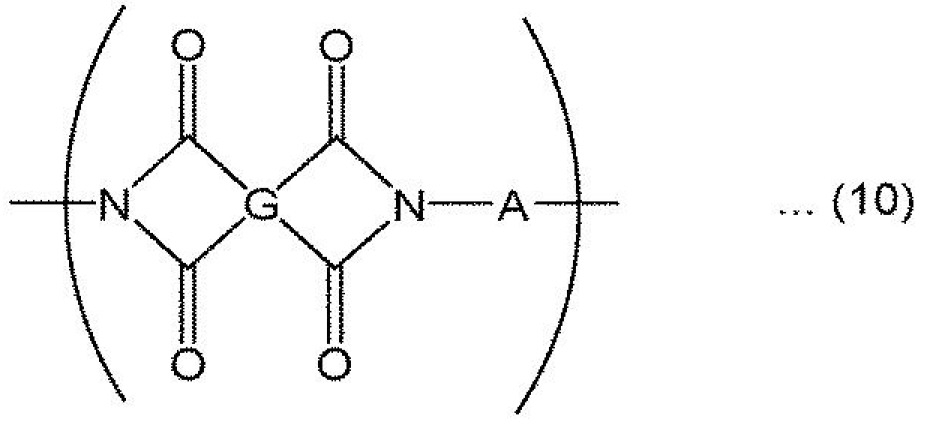
聚醯亞胺系樹脂可於不損害樹脂膜之各種物性之範圍內,含有選自由式(11)、式(12)及式(13)所表示之重複結構單元所組成之群中之一種以上。The polyimide-based resin may contain one or more types selected from the group consisting of repeating structural units represented by formula (11), formula (12), and formula (13) within a range that does not damage various physical properties of the resin film .
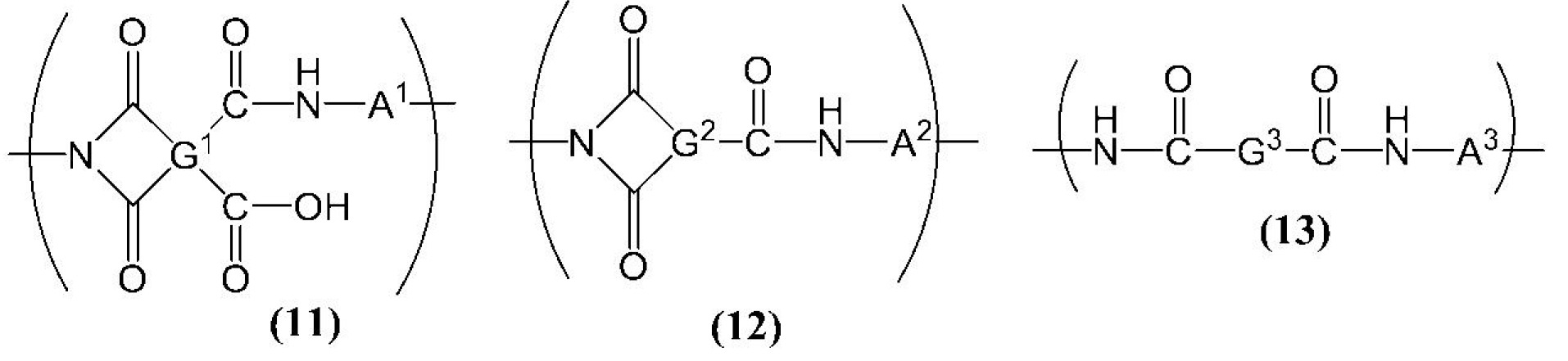
式(10)及式(11)中,G及G1 分別獨立為4價之有機基,較佳為可經烴基或氟取代烴基取代之有機基。作為G及G1 ,可例示:式(20)、式(21)、式(22)、式(23)、式(24)、式(25)、式(26)、式(27)、式(28)或式(29)所表示之基以及4價之碳數6以下之鏈式烴基。就易於抑制樹脂膜之黃度(YI值)之方面而言,其中,較佳為式(20)、式(21)、式(22)、式(23)、式(24)、式(25)、式(26)或式(27)所表示之基。In formula (10) and formula (11), G and G 1 are each independently a tetravalent organic group, preferably an organic group that may be substituted with a hydrocarbon group or a fluorine-substituted hydrocarbon group. As G and G 1 , there can be exemplified: formula (20), formula (21), formula (22), formula (23), formula (24), formula (25), formula (26), formula (27), formula (28) or a group represented by formula (29) and a chain hydrocarbon group having a carbon number of 4 or less and a carbon number of 6 or less. In terms of easily suppressing the yellowness (YI value) of the resin film, among them, formula (20), formula (21), formula (22), formula (23), formula (24), and formula (25) are preferred ), formula (26) or formula (27).
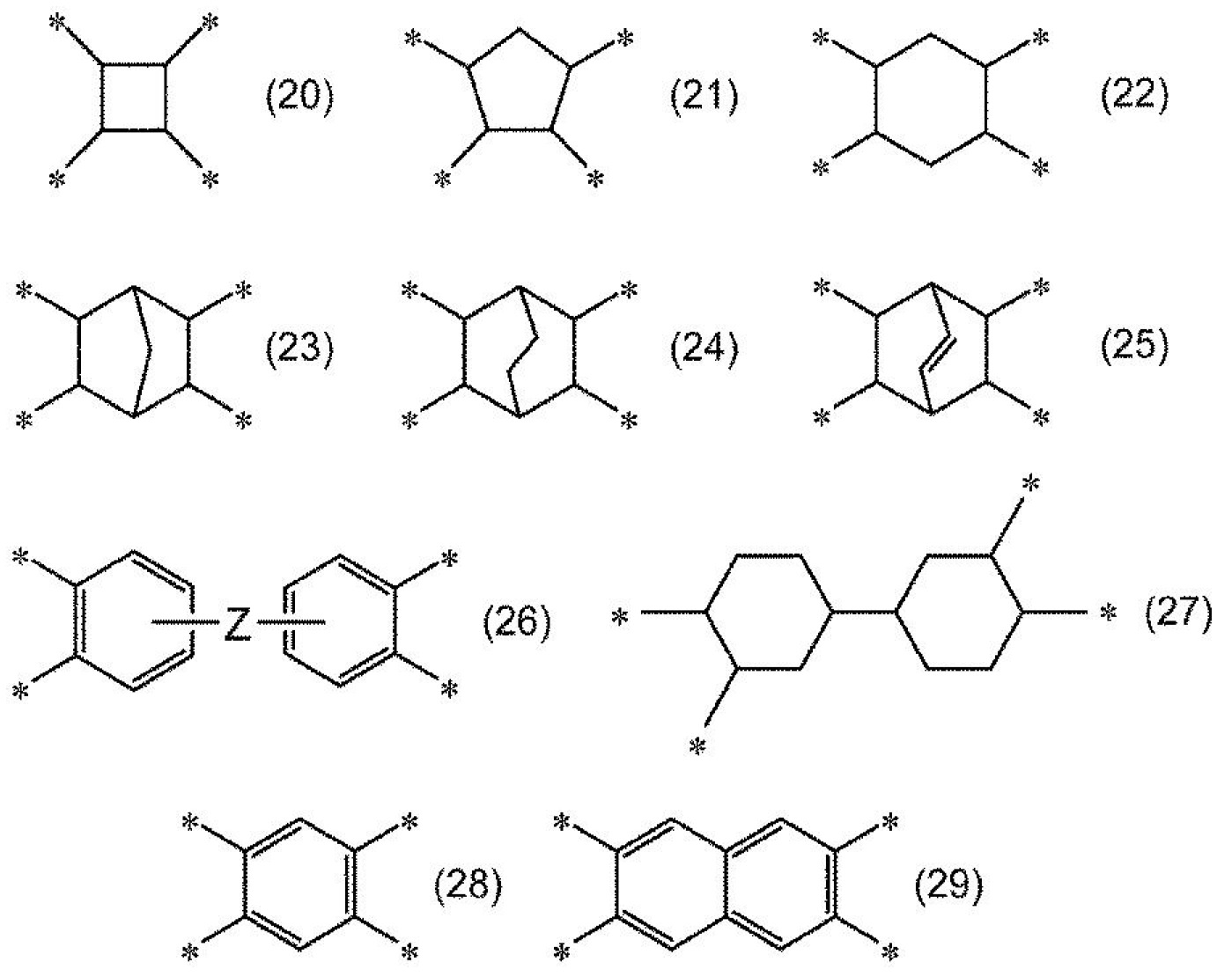
式(20)~式(29)中, *表示鍵結鍵, Z表示單鍵、-O-、-CH2 -、-CH2 -CH2 -、-CH(CH3 )-、-C(CH3 )2 -、-C(CF3 )2 -、-Ar-、-SO2 -、-CO-、-O-Ar-O-、-Ar-O-Ar-、-Ar-CH2 -Ar-、-Ar-C(CH3 )2 -Ar-或-Ar-SO2 -Ar-。Ar表示可經氟原子取代之碳數6~20之伸芳基,作為具體例,可列舉伸苯基。In formula (20) to formula (29), * represents a bonding bond, and Z represents a single bond, -O-, -CH 2 -, -CH 2 -CH 2 -, -CH(CH 3 )-, -C( CH 3 ) 2 -, -C(CF 3 ) 2 -, -Ar-, -SO 2 -, -CO-, -O-Ar-O-, -Ar-O-Ar-, -Ar-CH 2- Ar-, -Ar-C(CH 3 ) 2 -Ar- or -Ar-SO 2 -Ar-. Ar represents a C 6-20 arylene group which may be substituted by a fluorine atom, and specific examples include phenylene group.
式(12)中,G2 為3價之有機基,較佳為可經烴基或氟取代烴基取代之有機基。作為G2 ,可例示:式(20)、式(21)、式(22)、式(23)、式(24)、式(25)、式(26)、式(27)、式(28)或式(29)所表示之基之鍵結鍵之任一個被氫原子取代而成之基以及3價之碳數6以下之鏈式烴基。In formula (12), G 2 is a trivalent organic group, preferably an organic group that may be substituted with a hydrocarbon group or a fluorine-substituted hydrocarbon group. As G 2 , there can be exemplified: formula (20), formula (21), formula (22), formula (23), formula (24), formula (25), formula (26), formula (27), formula (28) ) Or any one of the bonding bonds of the group represented by formula (29) is substituted with a hydrogen atom and a trivalent chain hydrocarbon group having a carbon number of 6 or less.
式(13)中,G3 為2價之有機基,較佳為可經烴基或氟取代烴基取代之有機基。作為G3 ,可例示:式(20)、式(21)、式(22)、式(23)、式(24)、式(25)、式(26)、式(27)、式(28)或式(29)所表示之基之鍵結鍵中不鄰接之兩個被氫原子取代而成之基及碳數6以下之鏈式烴基。In formula (13), G 3 is a divalent organic group, preferably an organic group that may be substituted with a hydrocarbon group or a fluorine-substituted hydrocarbon group. As G 3 , there can be exemplified: formula (20), formula (21), formula (22), formula (23), formula (24), formula (25), formula (26), formula (27), formula (28) ) Or the bonding bond of the group represented by formula (29), two groups that are not adjacent to each other and are substituted by hydrogen atoms and a chain hydrocarbon group having 6 or less carbon atoms.
式(10)~式(13)中,A、A1 、A2 及A3 分別獨立為2價之有機基,較佳為可經烴基或氟取代烴基取代之有機基。作為A、A1 、A2 及A3 ,可列舉:式(30)、式(31)、式(32)、式(33)、式(34)、式(35)、式(36)、式(37)或式(38)所表示之基;該等經甲基、氟基、氯基或三氟甲基取代而成之基;以及碳數6以下之鏈式烴基。In formula (10) to formula (13), A, A 1 , A 2 and A 3 are each independently a divalent organic group, preferably an organic group that may be substituted with a hydrocarbon group or a fluorine-substituted hydrocarbon group. Examples of A, A 1 , A 2 and A 3 include formula (30), formula (31), formula (32), formula (33), formula (34), formula (35), formula (36), Groups represented by formula (37) or formula (38); those substituted with methyl, fluoro, chloro or trifluoromethyl; and chain hydrocarbon groups with a carbon number of 6 or less.
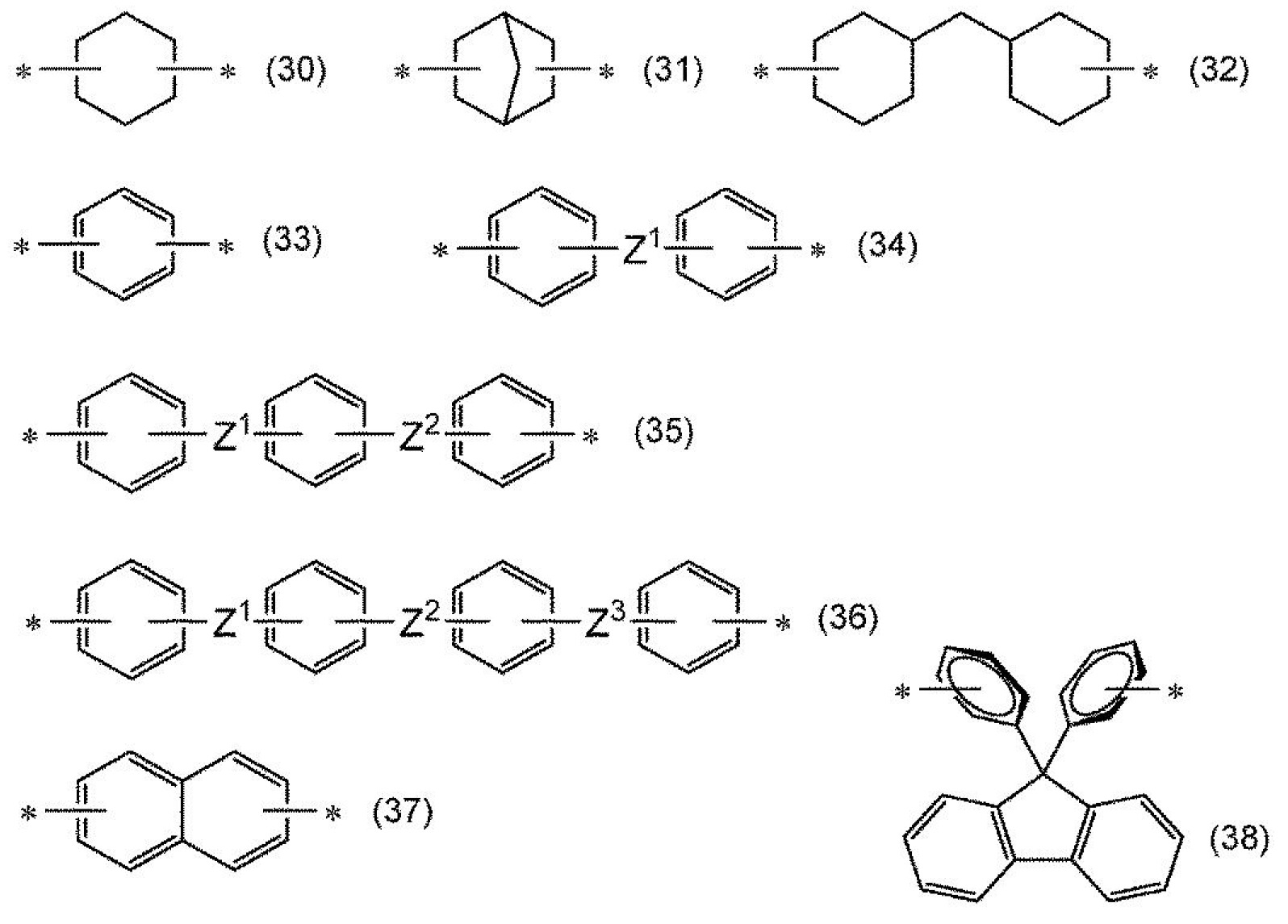
式(30)~式(38)中, *表示鍵結鍵, Z1 、Z2 及Z3 分別獨立表示單鍵、-O-、-CH2 -、-CH2 -CH2 -、-CH(CH3 )-、-C(CH3 )2 -、-C(CF3 )2 -、-SO2 -或-CO-。 一個例為:Z1 及Z3 為-O-,且Z2 為-CH2 -、-C(CH3 )2 -、-C(CF3 )2 -或-SO2 -。Z1 與Z2 之對各環之鍵結位置、及Z2 與Z3 之對各環之鍵結位置分別較佳為對各環為間位或對位。In formula (30) to formula (38), * represents a bonding bond, and Z 1 , Z 2 and Z 3 independently represent a single bond, -O-, -CH 2 -, -CH 2 -CH 2 -, -CH (CH 3 )-, -C(CH 3 ) 2 -, -C(CF 3 ) 2 -, -SO 2 -or -CO-. An example is: Z 1 and Z 3 are -O-, and Z 2 is -CH 2 -, -C(CH 3 ) 2 -, -C(CF 3 ) 2 -, or -SO 2 -. The bonding positions of Z 1 and Z 2 to each ring, and the bonding positions of Z 2 and Z 3 to each ring are preferably meta or para to each ring, respectively.
作為聚醯亞胺系樹脂,就易於提高視認性之觀點而言,較佳為至少具有式(10)所表示之重複結構單元與式(13)所表示之重複結構單元之聚醯胺醯亞胺。又,聚醯胺系樹脂較佳為至少具有式(13)所表示之重複結構單元。As the polyimide-based resin, from the viewpoint of easily improving visibility, a polyamidoamide having at least a repeating structural unit represented by formula (10) and a repeating structural unit represented by formula (13) is preferred amine. In addition, the polyamide resin preferably has at least a repeating structural unit represented by formula (13).
於本發明之一實施態樣中,聚醯亞胺系樹脂係使二胺及四羧酸化合物(醯氯化合物、四羧酸二酐等四羧酸化合物相關物)、以及視需要之二羧酸化合物(醯氯化合物等二羧酸化合物相關物)、三羧酸化合物(醯氯化合物、三羧酸酐等三羧酸化合物相關物)等進行反應(縮聚)而獲得之縮合型高分子。式(10)或式(11)所表示之重複結構單元通常係自二胺及四羧酸化合物衍生。式(12)所表示之重複結構單元通常係自二胺及三羧酸化合物衍生。式(13)所表示之重複結構單元通常係自二胺及二羧酸化合物衍生。In one embodiment of the present invention, the polyimide-based resin system uses a diamine and a tetracarboxylic acid compound (a related compound of a tetracarboxylic acid compound such as an acetyl chloride compound and a tetracarboxylic dianhydride), and a dicarboxylic acid if necessary Condensed polymer obtained by reacting (polycondensing) acid compounds (dicarboxylic acid compounds such as acetyl chloride compounds) and tricarboxylic acid compounds (tricarboxylic acid compounds such as acetyl chloride compounds and tricarboxylic anhydrides), etc. The repeating structural unit represented by formula (10) or formula (11) is usually derived from a diamine and a tetracarboxylic acid compound. The repeating structural unit represented by formula (12) is usually derived from diamine and tricarboxylic acid compounds. The repeating structural unit represented by formula (13) is usually derived from a diamine and a dicarboxylic acid compound.
於本發明之一實施態樣中,聚醯胺系樹脂係使二胺與二羧酸化合物進行反應(縮聚)而獲得之縮合型高分子。即,式(13)所表示之重複結構單元通常係自二胺及二羧酸化合物衍生。In one embodiment of the present invention, the polyamide resin is a condensation-type polymer obtained by reacting (condensing) a diamine and a dicarboxylic acid compound. That is, the repeating structural unit represented by formula (13) is usually derived from a diamine and a dicarboxylic acid compound.
作為四羧酸化合物,可列舉:芳香族四羧酸二酐等芳香族四羧酸化合物;及脂肪族四羧酸二酐等脂肪族四羧酸化合物。四羧酸化合物可單獨使用,亦可併用兩種以上。四羧酸化合物除二酐外,亦可為醯氯化合物等四羧酸化合物相關物。Examples of the tetracarboxylic acid compound include aromatic tetracarboxylic acid compounds such as aromatic tetracarboxylic dianhydride; and aliphatic tetracarboxylic acid compounds such as aliphatic tetracarboxylic dianhydride. The tetracarboxylic acid compound may be used alone or in combination of two or more. In addition to the dianhydride, the tetracarboxylic acid compound may also be a tetracarboxylic acid compound related compound such as an acetyl chloride compound.
作為芳香族四羧酸二酐之具體例,可列舉:4,4'-氧二鄰苯二甲酸二酐、3,3',4,4'-二苯甲酮四羧酸二酐、2,2',3,3'-二苯甲酮四羧酸二酐、3,3',4,4'-聯苯四羧酸二酐、2,2',3,3'-聯苯四羧酸二酐、3,3',4,4'-二苯碸四羧酸二酐、2,2-雙(3,4-二羧基苯基)丙烷二酐、2,2-雙(2,3-二羧基苯基)丙烷二酐、2,2-雙(3,4-二羧基苯氧基苯基)丙烷二酐、4,4'-(六氟亞異丙基)二鄰苯二甲酸二酐(6FDA)、1,2-雙(2,3-二羧基苯基)乙烷二酐、1,1-雙(2,3-二羧基苯基)乙烷二酐、1,2-雙(3,4-二羧基苯基)乙烷二酐、1,1-雙(3,4-二羧基苯基)乙烷二酐、雙(3,4-二羧基苯基)甲烷二酐、雙(2,3-二羧基苯基)甲烷二酐及4,4'-(對伸苯基二氧基)二鄰苯二甲酸二酐及4,4'-(間伸苯基二氧基)二鄰苯二甲酸二酐。該等可單獨使用或組合兩種以上使用。Specific examples of the aromatic tetracarboxylic dianhydride include: 4,4'-oxydiphthalic dianhydride, 3,3',4,4'-benzophenone tetracarboxylic dianhydride, 2 ,2',3,3'-benzophenone tetracarboxylic dianhydride, 3,3',4,4'-biphenyl tetracarboxylic dianhydride, 2,2',3,3'-biphenyl tetra Carboxylic dianhydride, 3,3',4,4'-diphenylene tetracarboxylic dianhydride, 2,2-bis(3,4-dicarboxyphenyl)propane dianhydride, 2,2-bis(2 ,3-dicarboxyphenyl)propane dianhydride, 2,2-bis(3,4-dicarboxyphenoxyphenyl) propane dianhydride, 4,4'-(hexafluoroisopropylidene) di-o-benzene Dicarboxylic dianhydride (6FDA), 1,2-bis(2,3-dicarboxyphenyl)ethane dianhydride, 1,1-bis(2,3-dicarboxyphenyl)ethane dianhydride, 1, 2-bis(3,4-dicarboxyphenyl)ethane dianhydride, 1,1-bis(3,4-dicarboxyphenyl)ethane dianhydride, bis(3,4-dicarboxyphenyl)methane Dianhydride, bis(2,3-dicarboxyphenyl)methane dianhydride and 4,4'-(p-phenylene dioxy) diphthalic dianhydride and 4,4'-(m-phenylene Dioxy) diphthalic dianhydride. These can be used alone or in combination of two or more.
作為脂肪族四羧酸二酐,可列舉:環式或非環式之脂肪族四羧酸二酐。所謂環式脂肪族四羧酸二酐係指具有脂環式烴結構之四羧酸二酐,作為其具體例,可列舉:1,2,4,5-環己烷四羧酸二酐、1,2,3,4-環丁烷四羧酸二酐、1,2,3,4-環戊烷四羧酸二酐等環烷烴四羧酸二酐、雙環[2.2.2]辛-7-烯-2,3,5,6-四羧酸二酐、二環己基-3,3',4,4'-四羧酸二酐及該等之位置異構體。該等可單獨使用或組合兩種以上使用。作為非環式脂肪族四羧酸二酐之具體例,可列舉:1,2,3,4-丁烷四羧酸二酐、1,2,3,4-戊烷四羧酸二酐等,該等可單獨使用或組合兩種以上使用。又,可組合使用環式脂肪族四羧酸二酐及非環式脂肪族四羧酸二酐。Examples of the aliphatic tetracarboxylic dianhydride include cyclic or acyclic aliphatic tetracarboxylic dianhydride. The cycloaliphatic tetracarboxylic dianhydride refers to a tetracarboxylic dianhydride having an alicyclic hydrocarbon structure. Specific examples thereof include: 1,2,4,5-cyclohexanetetracarboxylic dianhydride, Cycloalkane tetracarboxylic dianhydride such as 1,2,3,4-cyclobutane tetracarboxylic dianhydride, 1,2,3,4-cyclopentane tetracarboxylic dianhydride, bicyclo[2.2.2]octane- 7-ene-2,3,5,6-tetracarboxylic dianhydride, dicyclohexyl-3,3',4,4'-tetracarboxylic dianhydride and positional isomers of these. These can be used alone or in combination of two or more. Specific examples of the non-cyclic aliphatic tetracarboxylic dianhydride include 1,2,3,4-butane tetracarboxylic dianhydride, 1,2,3,4-pentane tetracarboxylic dianhydride, etc. , These can be used alone or in combination of two or more. In addition, cyclic aliphatic tetracarboxylic dianhydride and non-cyclic aliphatic tetracarboxylic dianhydride can be used in combination.
上述四羧酸二酐中,就高透明性及低著色性之觀點而言,較佳為1,2,4,5-環己烷四羧酸二酐、雙環[2.2.2]辛-7-烯-2,3,5,6-四羧酸二酐及4,4'-(六氟亞異丙基)二鄰苯二甲酸二酐、以及該等之混合物。又,作為四羧酸,可使用上述四羧酸化合物之酸酐之水加成物。Among the above-mentioned tetracarboxylic dianhydrides, from the viewpoint of high transparency and low colorability, 1,2,4,5-cyclohexanetetracarboxylic dianhydride and bicyclo[2.2.2]octan-7 are preferred -Ene-2,3,5,6-tetracarboxylic dianhydride and 4,4'-(hexafluoroisopropylidene) diphthalic dianhydride, and mixtures thereof. In addition, as the tetracarboxylic acid, a water adduct of the acid anhydride of the above-mentioned tetracarboxylic acid compound can be used.
作為三羧酸化合物,可列舉:芳香族三羧酸、脂肪族三羧酸及該等之相關之醯氯化合物、酸酐等,可併用兩種以上。 作為具體例,可列舉:1,2,4-苯三羧酸之酸酐;2,3,6-萘三羧酸-2,3-酐;鄰苯二甲酸酐與苯甲酸以單鍵、-CH2 -、-C(CH3 )2 -、-C(CF3 )2 -、-SO2 -或伸苯基連結而成之化合物。Examples of the tricarboxylic acid compound include aromatic tricarboxylic acids, aliphatic tricarboxylic acids, and related acetyl chloride compounds, acid anhydrides, and the like, and two or more kinds may be used in combination. Specific examples include: anhydride of 1,2,4-benzenetricarboxylic acid; 2,3,6-naphthalenetricarboxylic acid-2,3-anhydride; a single bond between phthalic anhydride and benzoic acid,- A compound formed by connecting CH 2 -, -C(CH 3 ) 2 -, -C(CF 3 ) 2 -, -SO 2 -or phenylene.
作為二羧酸化合物,可列舉:芳香族二羧酸、脂肪族二羧酸及該等之相關之醯氯化合物、酸酐等,可將該等併用兩種以上。 作為該等之具體例,可列舉:對苯二甲醯二氯(對苯二甲醯氯(TPC));間苯二甲醯二氯;萘二甲醯二氯;4,4'-聯苯二甲醯二氯;3,3'-聯苯二甲醯二氯;4,4'-氧基雙(苯甲醯氯)(OBBC);碳數8以下之鏈式烴之二羧酸化合物及2個苯甲酸以單鍵、-CH2 -、-C(CH3 )2 -、-C(CF3 )2 -、-SO2 -或伸苯基連結而成之化合物。Examples of the dicarboxylic acid compound include aromatic dicarboxylic acids, aliphatic dicarboxylic acids, and related acetyl chloride compounds, acid anhydrides, and the like, and two or more of them may be used in combination. As specific examples of these, terephthaloyl dichloride (terephthaloyl dichloride (TPC)); m-xylylene dichloride; naphthalene dichloromethane; 4,4'-linked Phthaloyl dichloride; 3,3'-biphenyl dimethyl dichloride; 4,4'-oxybis(benzoyl chloro) (OBBC); dicarboxylic acid of chain hydrocarbons with carbon number below 8 The compound and the two benzoic acids are connected by a single bond, -CH 2 -, -C(CH 3 ) 2 -, -C(CF 3 ) 2 -, -SO 2 -or phenylene.
作為二胺,例如可列舉:脂肪族二胺、芳香族二胺或該等之混合物。再者,於本實施形態中所謂「芳香族二胺」係指胺基直接鍵結於芳香環之二胺,其結構之一部分中可含有脂肪族基或其他取代基。芳香環可為單環亦可為縮合環,可例示苯環、萘環、蒽環及茀環等,但並不限定於該等。該等之中,較佳為芳香環為苯環。又,所謂「脂肪族二胺」係指胺基直接鍵結於脂肪族基之二胺,其結構之一部分中可含有芳香環或其他取代基。Examples of diamines include aliphatic diamines, aromatic diamines, and mixtures of these. In addition, in this embodiment, the "aromatic diamine" refers to a diamine in which an amine group is directly bonded to an aromatic ring, and a part of its structure may contain an aliphatic group or other substituents. The aromatic ring may be a single ring or a condensed ring, and examples thereof include a benzene ring, a naphthalene ring, an anthracene ring, and a stilbene ring, but are not limited thereto. Among these, the aromatic ring is preferably a benzene ring. The "aliphatic diamine" refers to a diamine in which an amine group is directly bonded to an aliphatic group, and a part of its structure may contain an aromatic ring or other substituents.
作為脂肪族二胺,例如可列舉:己二胺等非環式脂肪族二胺及1,3-雙(胺基甲基)環己烷、1,4-雙(胺基甲基)環己烷、降𦯉烷二胺、4,4'-二胺基二環己基甲烷等環式脂肪族二胺等。該等可單獨使用或組合兩種以上使用。Examples of the aliphatic diamine include non-cyclic aliphatic diamines such as hexamethylene diamine, 1,3-bis(aminomethyl)cyclohexane, and 1,4-bis(aminomethyl)cyclohexane. Cyclic aliphatic diamines such as alkanes, norane diamines, 4,4'-diaminodicyclohexylmethane, etc. These can be used alone or in combination of two or more.
作為芳香族二胺,例如可列舉:對苯二胺、間苯二胺、2,4-甲苯二胺、間苯二甲胺、對苯二甲胺、1,5-二胺基萘、2,6-二胺基萘等具有1個芳香環之芳香族二胺;4,4'-二胺基二苯基甲烷、4,4'-二胺基二苯基丙烷、4,4'-二胺基二苯醚、3,4'-二胺基二苯醚、3,3'-二胺基二苯醚、4,4'-二胺基二苯碸、3,4'-二胺基二苯碸、3,3'-二胺基二苯碸、1,4-雙(4-胺基苯氧基)苯、1,3-雙(4-胺基苯氧基)苯、4,4'-二胺基二苯碸、雙[4-(4-胺基苯氧基)苯基]碸、雙[4-(3-胺基苯氧基)苯基]碸、2,2-雙[4-(4-胺基苯氧基)苯基]丙烷、2,2-雙[4-(3-胺基苯氧基)苯基]丙烷、2,2'-二甲基聯苯胺、2,2'-雙(三氟甲基)聯苯胺(2,2'-雙(三氟甲基)-4,4'-二胺基聯苯(TFMB))、4,4'-雙(4-胺基苯氧基)聯苯、9,9-雙(4-胺基苯基)茀、9,9-雙(4-胺基-3-甲基苯基)茀、9,9-雙(4-胺基-3-氯苯基)茀、9,9-雙(4-胺基-3-氟苯基)茀等具有2個以上芳香環之芳香族二胺。該等可單獨使用或組合兩種以上使用。Examples of aromatic diamines include p-phenylenediamine, m-phenylenediamine, 2,4-toluenediamine, m-xylylenediamine, p-xylylenediamine, 1,5-diaminonaphthalene, and 2 , 6-diaminonaphthalene and other aromatic diamines with one aromatic ring; 4,4'-diaminodiphenylmethane, 4,4'-diaminodiphenylpropane, 4,4'- Diaminodiphenyl ether, 3,4'-diaminodiphenyl ether, 3,3'-diaminodiphenyl ether, 4,4'-diaminodiphenylbenzene, 3,4'-diamine Diphenyl benzene, 3,3'-diaminodiphenyl benzene, 1,4-bis(4-aminophenoxy)benzene, 1,3-bis(4-aminophenoxy)benzene, 4 ,4'-diaminodiphenyl sulfone, bis[4-(4-aminophenoxy)phenyl] phenanthrene, bis[4-(3-aminophenoxy)phenyl] phenanthrene, 2,2 -Bis[4-(4-aminophenoxy)phenyl]propane, 2,2-bis[4-(3-aminophenoxy)phenyl]propane, 2,2'-dimethyl Aniline, 2,2'-bis(trifluoromethyl) benzidine (2,2'-bis(trifluoromethyl)-4,4'-diaminobiphenyl (TFMB)), 4,4'- Bis(4-aminophenoxy)biphenyl, 9,9-bis(4-aminophenyl) stilbene, 9,9-bis(4-amino-3-methylphenyl) stilbene, 9, 9-bis(4-amino-3-chlorophenyl) stilbene, 9,9-bis(4-amino-3-fluorophenyl) stilbene and other aromatic diamines having two or more aromatic rings. These can be used alone or in combination of two or more.
上述二胺之中,就高透明性及低著色性之觀點而言,較佳為使用選自由具有聯苯結構之芳香族二胺所組成之群中之一種以上,更佳為使用選自由2,2'-二甲基聯苯胺、2,2'-雙(三氟甲基)聯苯胺、4,4'-雙(4-胺基苯氧基)聯苯及4,4'-二胺基二苯醚所組成之群中之一種以上,進而較佳為使用2,2'-雙(三氟甲基)聯苯胺。Among the above diamines, from the viewpoint of high transparency and low colorability, it is preferable to use one or more selected from the group consisting of aromatic diamines having a biphenyl structure, and it is more preferable to use one selected from the group consisting of 2 ,2'-dimethylbenzidine, 2,2'-bis(trifluoromethyl)benzidine, 4,4'-bis(4-aminophenoxy)biphenyl and 4,4'-diamine More than one of the group consisting of diphenyl ether is further preferably 2,2'-bis(trifluoromethyl)benzidine.
聚醯亞胺系樹脂係藉由如下方式獲得:藉由慣用之方法,例如攪拌等方法將上述二胺、四羧酸化合物、三羧酸化合物、二羧酸化合物等各原料混合後,於醯亞胺化觸媒及視需要之脫水劑之存在下將所得中間物進行醯亞胺化。聚醯胺系樹脂係藉由如下方式獲得:藉由慣用之方法,例如攪拌等方法將上述二胺、二羧酸化合物等各原料混合。The polyimide-based resin is obtained by mixing the above raw materials such as the diamine, the tetracarboxylic acid compound, the tricarboxylic acid compound, and the dicarboxylic acid compound by conventional methods such as stirring, etc. The resulting intermediate is subjected to imidization in the presence of an imidization catalyst and optionally a dehydrating agent. The polyamide resin is obtained by mixing the raw materials such as the above-mentioned diamine and dicarboxylic acid compound by a conventional method such as stirring.
作為醯亞胺化步驟中所使用之醯亞胺化觸媒,並無特別限定,例如可列舉:三丙基胺、二丁基丙基胺、乙基二丁基胺等脂肪族胺;N-乙基哌啶、N-丙基哌啶、N-丁基吡咯啶、N-丁基哌啶及N-丙基六氫氮呯等脂環式胺(單環式);氮雜雙環[2.2.1]庚烷、氮雜雙環[3.2.1]辛烷、氮雜雙環[2.2.2]辛烷及氮雜雙環[3.2.2]壬烷等脂環式胺(多環式);以及2-甲基吡啶、3-甲基吡啶、4-甲基吡啶、2-乙基吡啶、3-乙基吡啶、4-乙基吡啶、2,4-二甲基吡啶、2,4,6-三甲基吡啶、3,4-環戊烯并吡啶、5,6,7,8-四氫異喹啉及異喹啉等芳香族胺。The imidate catalyst used in the imidate step is not particularly limited, and examples thereof include aliphatic amines such as tripropylamine, dibutylpropylamine, and ethyldibutylamine; N -Alicyclic amines (monocyclic) such as ethyl piperidine, N-propyl piperidine, N-butyl pyrrolidine, N-butyl piperidine, and N-propyl hexahydropyrazine; azabicyclo[ 2.2.1] Heptane, azabicyclo[3.2.1]octane, azabicyclo[2.2.2]octane and azabicyclo[3.2.2]nonane and other alicyclic amines (polycyclic); And 2-picoline, 3-picoline, 4-picoline, 2-ethylpyridine, 3-ethylpyridine, 4-ethylpyridine, 2,4-lutidine, 2,4, Aromatic amines such as 6-trimethylpyridine, 3,4-cyclopentenopyridine, 5,6,7,8-tetrahydroisoquinoline and isoquinoline.
作為醯亞胺化步驟中所使用之脫水劑,並無特別限定,例如可列舉:乙酸酐、丙酸酐、異丁酸酐、三甲基乙酸酐、丁酸酐、異戊酸酐等。The dehydrating agent used in the amide imidization step is not particularly limited, and examples thereof include acetic anhydride, propionic anhydride, isobutyric anhydride, trimethylacetic anhydride, butyric anhydride, and isovaleric anhydride.
於各原料之混合及醯亞胺化步驟中,反應溫度並無特別限定,例如為15~350℃,較佳為20~100℃。反應時間亦無特別限定,例如為10分鐘~10小時左右。視需要,可於惰性環境或減壓之條件下進行反應。又,反應可於溶劑中進行,作為溶劑,例如可列舉作為清漆之製備中所使用之溶劑而例示者。反應後精製聚醯亞胺系樹脂或聚醯胺系樹脂。作為精製方法,例如可列舉如下方法等:於反應液中添加不良溶劑,藉由再沈澱法而使樹脂析出,加以乾燥並取出沈澱物,視需要以甲醇等溶劑清洗沈澱物並使之乾燥。 再者,聚醯亞胺系樹脂之製造例如可參照日本專利特開2006-199945號公報或日本專利特開2008-163107號公報中記載之製造方法。又,聚醯亞胺系樹脂亦可使用市售品,作為其具體例,可列舉:三菱瓦斯化學(股)製造之Neopulim(註冊商標)、河村產業(股)製造之KPI-MX300F等。In the mixing of each raw material and the amide imidization step, the reaction temperature is not particularly limited, for example, 15 to 350°C, preferably 20 to 100°C. The reaction time is also not particularly limited, and is, for example, about 10 minutes to 10 hours. If necessary, the reaction can be carried out under an inert environment or under reduced pressure. In addition, the reaction can be carried out in a solvent, and examples of the solvent include, for example, the solvent used in the preparation of varnish. After the reaction, the polyimide resin or the polyimide resin is refined. Examples of the purification method include a method such as adding a poor solvent to the reaction solution, depositing the resin by the reprecipitation method, drying and taking out the precipitate, and washing and drying the precipitate with a solvent such as methanol as necessary. In addition, for the production of the polyimide-based resin, for example, the production method described in Japanese Patent Laid-Open No. 2006-199945 or Japanese Patent Laid-Open No. 2008-163107 can be referred to. In addition, commercially available products may be used for the polyimide-based resin. Specific examples thereof include Neopulim (registered trademark) manufactured by Mitsubishi Gas Chemical Co., Ltd., and KPI-MX300F manufactured by Kawamura Industries (Co., Ltd.).
聚醯亞胺系樹脂或聚醯胺系樹脂之重量平均分子量較佳為200,000以上,更佳為250,000以上,進而較佳為300,000以上,較佳為600,000以下,更佳為500,000以下。聚醯亞胺系樹脂或聚醯胺系樹脂之重量平均分子量越大,越存在易於表現膜化時之較高之耐撓曲性之傾向。故而,就提高樹脂膜之耐撓曲性之觀點而言,重量平均分子量較佳為上述下限以上。另一方面,聚醯亞胺系樹脂或聚醯胺系樹脂之重量平均分子量越小,越存在易於降低清漆之黏度,易於提高加工性之傾向。又,存在易於提高聚醯亞胺系樹脂或聚醯胺系樹脂之延伸性之傾向。故而,就加工性及延伸性之觀點而言,重量平均分子量較佳為上述上限以下。再者,於本案中,重量平均分子量可進行凝膠滲透層析(GPC)測定,藉由標準聚苯乙烯換算而求得,例如可藉由實施例中記載之方法而算出。The weight average molecular weight of the polyimide-based resin or the polyamidoamine-based resin is preferably 200,000 or more, more preferably 250,000 or more, and further preferably 300,000 or more, preferably 600,000 or less, and more preferably 500,000 or less. The greater the weight-average molecular weight of the polyimide-based resin or the polyamide-based resin, the greater the tendency to exhibit higher flex resistance during film formation. Therefore, from the viewpoint of improving the flex resistance of the resin film, the weight average molecular weight is preferably at least the above lower limit. On the other hand, the smaller the weight average molecular weight of the polyimide-based resin or the polyamide-based resin, the easier it is to lower the viscosity of the varnish and to improve the processability. In addition, there is a tendency to easily improve the extensibility of the polyimide-based resin or the polyamide-based resin. Therefore, from the viewpoint of processability and extensibility, the weight average molecular weight is preferably equal to or less than the above upper limit. In addition, in this case, the weight average molecular weight can be measured by gel permeation chromatography (GPC), and can be calculated by standard polystyrene conversion, for example, by the method described in the examples.
聚醯亞胺系樹脂之醯亞胺化率較佳為95~100%,更佳為97~100%,進而較佳為98~100%,尤佳為100%。就清漆之穩定性、所得樹脂膜之機械物性之觀點而言,醯亞胺化率較佳為上述下限以上。再者,醯亞胺化率可藉由IR法、NMR(nuclear magnetic resonance,核磁共振)法等而求得。就上述觀點而言,清漆中所含之聚醯亞胺系樹脂之醯亞胺化率較佳為上述範圍內。The imidate ratio of the polyimide-based resin is preferably 95 to 100%, more preferably 97 to 100%, still more preferably 98 to 100%, and particularly preferably 100%. From the viewpoints of the stability of the varnish and the mechanical properties of the resulting resin film, the imidate ratio is preferably at least the above lower limit. Furthermore, the imidate ratio can be obtained by IR method, NMR (nuclear magnetic resonance, nuclear magnetic resonance) method, or the like. From the above viewpoint, the polyimide-based resin contained in the varnish preferably has an imidization ratio within the above range.
於本發明之較佳之一實施形態中,本發明之樹脂膜中所含之聚醯亞胺系樹脂或聚醯胺系樹脂可含有例如可藉由上述含氟取代基等而導入之氟原子等鹵素原子。於聚醯亞胺系樹脂或聚醯胺系樹脂含有鹵素原子之情形時,易於提高樹脂膜之彈性模數且減低黃度(YI值)。若樹脂膜之彈性模數較高,則易於抑制該膜之損傷及皺褶等之發生,又,若樹脂膜之黃度較低,則易於提高該膜之透明性。鹵素原子較佳為氟原子。作為用以使氟原子含有於聚醯亞胺系樹脂或聚醯胺系樹脂中之較佳含氟取代基,例如可列舉氟基及三氟甲基。In a preferred embodiment of the present invention, the polyimide-based resin or the polyamide-based resin contained in the resin film of the present invention may contain, for example, fluorine atoms that can be introduced through the above-mentioned fluorine-containing substituents, etc. Halogen atom. When the polyimide-based resin or the polyamide-based resin contains halogen atoms, it is easy to increase the elastic modulus of the resin film and reduce the yellowness (YI value). If the elastic modulus of the resin film is high, it is easy to suppress the occurrence of damage and wrinkles of the film, and if the yellowness of the resin film is low, it is easy to improve the transparency of the film. The halogen atom is preferably a fluorine atom. Examples of preferred fluorine-containing substituents for containing a fluorine atom in the polyimide-based resin or polyamidoamine-based resin include a fluorine group and a trifluoromethyl group.
作為聚醯亞胺系樹脂或聚醯胺系樹脂中之鹵素原子之含量,以聚醯亞胺系樹脂或聚醯胺系樹脂之質量為基準,較佳為1~40質量%,更佳為5~40質量%,進而較佳為5~30質量%。若鹵素原子之含量為上述範圍,則易於進一步提高膜化時之彈性模數,降低吸水率,進一步減低黃度(YI值),進一步提高透明性,又,有時合成變得容易。The content of halogen atoms in the polyimide resin or polyimide resin is based on the mass of the polyimide resin or polyimide resin, preferably 1 to 40% by mass, more preferably 5 to 40% by mass, more preferably 5 to 30% by mass. If the content of halogen atoms is within the above range, it is easy to further increase the elastic modulus at the time of film formation, reduce the water absorption rate, further reduce the yellowness (YI value), further improve the transparency, and sometimes the synthesis becomes easy.
於本發明之一實施形態中,作為樹脂膜中之聚醯亞胺系樹脂及/或聚醯胺系樹脂之含量,以樹脂膜之總質量為基準,較佳為40質量%以上,更佳為50質量%以上,進而較佳為70質量%以上。就易於提高耐撓曲性等之觀點而言,較佳為聚醯亞胺系樹脂及/或聚醯胺系樹脂之含量為上述下限以上。再者,作為樹脂膜中之聚醯亞胺系樹脂及/或聚醯胺系樹脂之含量,以樹脂膜之總質量為基準,通常為100質量%以下。In one embodiment of the present invention, as the content of the polyimide-based resin and/or the polyamide-based resin in the resin film, based on the total mass of the resin film, it is preferably 40% by mass or more, more preferably It is 50% by mass or more, and more preferably 70% by mass or more. From the viewpoint of easy improvement of flex resistance and the like, the content of the polyimide-based resin and/or the polyamide-based resin is preferably at least the above lower limit. In addition, the content of the polyimide-based resin and/or the polyamide-based resin in the resin film is generally 100% by mass or less based on the total mass of the resin film.
(添加劑) 本發明之樹脂膜可進而含有添加劑。作為此種添加劑,例如可列舉:二氧化矽粒子、紫外線吸收劑、增白劑、二氧化矽分散劑、抗氧化劑、pH值調整劑及調平劑。(additive) The resin film of the present invention may further contain additives. Examples of such additives include silicon dioxide particles, ultraviolet absorbers, whitening agents, silicon dioxide dispersants, antioxidants, pH adjusters, and leveling agents.
(二氧化矽粒子) 本發明之樹脂膜可進而含有二氧化矽粒子作為添加劑。作為二氧化矽粒子之含量,以該樹脂膜之總質量為基準,較佳為1質量%以上,更佳為3質量%以上,進而較佳為5質量%以上,較佳為60質量%以下,更佳為50質量%以下,進而較佳為45質量%以下。又,二氧化矽粒子之含量可於該等上限值及下限值中,選擇組合任意之下限值與上限值。若二氧化矽粒子之含量為上述上限值及/或下限值之數值範圍,則存在於本發明之樹脂膜中,二氧化矽粒子不易凝集,以一次粒子之狀態均勻分散之傾向,故而可抑制本發明之樹脂膜之視認性之下降。(Silica particles) The resin film of the present invention may further contain silica particles as additives. The content of silicon dioxide particles is preferably 1% by mass or more, more preferably 3% by mass or more, further preferably 5% by mass or more, and preferably 60% by mass based on the total mass of the resin film. It is more preferably 50% by mass or less, and further preferably 45% by mass or less. In addition, the content of silicon dioxide particles can be any combination of the lower limit and the upper limit among the upper limit and the lower limit. If the content of silica particles is within the numerical range of the upper limit and/or the lower limit, the resin film of the present invention tends not to aggregate, and the silica particles tend to be uniformly dispersed in the state of primary particles. The decrease in visibility of the resin film of the present invention can be suppressed.
二氧化矽粒子之粒徑較佳為1 nm以上,更佳為3 nm以上,進而較佳為5 nm以上,尤佳為8 nm以上,較佳為30 nm以下,更佳為28 nm以下,進而較佳為25 nm以下,尤佳為20 nm以下。二氧化矽粒子之粒徑可於該等上限值及下限值中,選擇組合任意之下限值與上限值。若二氧化矽粒子之含量為上述上限值及/或下限值之數值範圍,則於本發明之樹脂膜中,不易與白色光中之特定波長之光相互作用,故而可抑制本發明之樹脂膜之視認性之下降。於本說明書中,二氧化矽粒子之粒徑表示平均一次粒徑。樹脂膜內之二氧化矽粒子之粒徑可自使用有穿透式電子顯微鏡(TEM)之攝像而測定。製作樹脂膜之前(例如,添加至清漆之前)之二氧化矽粒子之粒徑可藉由雷射繞射式粒度分佈計而測定。二氧化矽粒子之粒徑之測定方法於實施例中詳細說明。The particle size of the silicon dioxide particles is preferably 1 nm or more, more preferably 3 nm or more, and further preferably 5 nm or more, particularly preferably 8 nm or more, preferably 30 nm or less, more preferably 28 nm or less, Furthermore, it is preferably 25 nm or less, and particularly preferably 20 nm or less. The particle size of the silica particles can be any combination of the lower limit and the upper limit among the upper limit and the lower limit. If the content of silicon dioxide particles is within the numerical range of the upper limit and/or lower limit, the resin film of the present invention is less likely to interact with light of a specific wavelength in white light, so the present invention can be suppressed The visibility of the resin film is reduced. In this specification, the particle size of silica particles means the average primary particle size. The particle size of the silicon dioxide particles in the resin film can be measured from a camera using a transmission electron microscope (TEM). The particle size of the silica particles before the production of the resin film (for example, before addition to the varnish) can be measured by a laser diffraction particle size distribution meter. The method for measuring the particle size of silicon dioxide particles is described in detail in the examples.
作為二氧化矽粒子之形態,例如可列舉:二氧化矽粒子分散於有機溶劑等中之矽溶膠、及藉由氣相法而製備之二氧化矽粉末。該等之中,就作業性之觀點而言,較佳為矽溶膠。Examples of the form of the silica particles include silica sol in which silica particles are dispersed in an organic solvent and the like, and silica powder prepared by a vapor phase method. Among these, from the viewpoint of workability, silica sol is preferred.
二氧化矽粒子可實施表面處理,例如,可為自水溶性醇分散矽溶膠進行溶劑(更具體而言,γ-丁內酯等)置換所得之二氧化矽粒子。水溶性醇係於該水溶性醇分子1個中每1個羥基之碳數為3以下之醇,可列舉:甲醇、乙醇、1-丙醇及2-丙醇等。通常,若二氧化矽粒子經表面處理,則存在與樹脂膜中所含之聚醯亞胺系樹脂之相溶性提高,二氧化矽粒子之分散性提高之傾向,故而可抑制本發明之視認性之下降,但亦依存於二氧化矽粒子與聚醯亞胺系樹脂或聚醯胺系樹脂之種類之親和性。The silicon dioxide particles may be subjected to surface treatment. For example, the silicon dioxide particles may be replaced with a solvent (more specifically, γ-butyrolactone, etc.) from a water-soluble alcohol-dispersed silica sol. The water-soluble alcohol is an alcohol having a carbon number of 3 or less per hydroxyl group in one molecule of the water-soluble alcohol, and examples thereof include methanol, ethanol, 1-propanol, and 2-propanol. Generally, if the silica particles are surface-treated, the compatibility with the polyimide-based resin contained in the resin film increases, and the dispersibility of the silica particles tends to increase, so the visibility of the present invention can be suppressed The decrease, but also depends on the affinity of the silica particles and the type of polyimide resin or polyimide resin.
(紫外線吸收劑) 本發明之樹脂膜可進而含有紫外線吸收劑。例如可列舉;三𠯤系紫外線吸收劑、二苯甲酮系紫外線吸收劑、苯并三唑系紫外線吸收劑、苯甲酸酯系紫外線吸收劑及氰基丙烯酸酯系紫外線吸收劑等。該等可單獨使用,亦可併用兩種以上。作為較佳之市售之紫外線吸收劑,例如可列舉:Sumika Chemtex(股)製造之Sumisorb(註冊商標)340、ADEKA(股)製造之Adekastab(註冊商標)LA-31、及BASF JAPAN(股)製造之TINUVIN(註冊商標)1577等。作為紫外線吸收劑之含量,以本發明之樹脂膜之質量為基準,較佳為1 phr以上10 phr以下,更佳為3 phr以上6 phr以下。(UV absorber) The resin film of the present invention may further contain an ultraviolet absorber. For example, three types of ultraviolet absorbers, benzophenone-based ultraviolet absorbers, benzotriazole-based ultraviolet absorbers, benzoate-based ultraviolet absorbers, cyanoacrylate-based ultraviolet absorbers, etc. can be cited. These can be used alone or in combination of two or more. Preferred commercially available ultraviolet absorbers include, for example, Sumika Chemtex (registered trademark) Sumisorb (registered trademark) 340, ADEKA (registered trademark) Adekastab (registered trademark) LA-31, and BASF JAPAN (shared) The TINUVIN (registered trademark) 1577 and so on. The content of the ultraviolet absorber is preferably 1 phr or more and 10 phr or less, more preferably 3 phr or more and 6 phr or less, based on the mass of the resin film of the present invention.
(增白劑) 本發明之樹脂膜可進而含有增白劑。增白劑例如於添加有增白劑以外之添加劑之情形時,可以調整色調為目的而添加。作為增白劑,可列舉:單偶氮系染料、三芳基甲烷系染料、酞菁系染料及蒽醌系染料。該等之中,較佳為蒽醌系染料。作為較佳之市售之增白劑,例如可列舉:Lanxess公司製造之MACROLEX(註冊商標)Violet B、Sumika Chemtex(股)製造之Sumiplast(註冊商標)Violet B、及三菱化學(股)製造之Diaresin(註冊商標)Blue G等。該等可單獨使用,亦可併用兩種以上。於含有增白劑之情形時,其含量以本發明之樹脂膜之質量為基準,較佳為1~50 ppm,更佳為1~45 ppm,進而較佳為3~40 ppm,尤佳為5~35 ppm。(Brightener) The resin film of the present invention may further contain a whitening agent. The whitening agent can be added for the purpose of adjusting the color tone when, for example, an additive other than the whitening agent is added. Examples of the whitening agent include monoazo dyes, triarylmethane dyes, phthalocyanine dyes, and anthraquinone dyes. Among these, anthraquinone-based dyes are preferred. Examples of preferred commercially available whitening agents include MACROLEX (registered trademark) Violet B manufactured by Lanxess, Sumiplast (registered trademark) Violet B manufactured by Sumika Chemtex (share), and Diaresin manufactured by Mitsubishi Chemical (share) (Registered trademark) Blue G, etc. These can be used alone or in combination of two or more. When the whitening agent is contained, its content is based on the mass of the resin film of the present invention, preferably 1 to 50 ppm, more preferably 1 to 45 ppm, further preferably 3 to 40 ppm, particularly preferably 5 to 35 ppm.
(原料膜之製造方法) 原料膜並無特別限定,例如可藉由包含以下步驟之方法而製造。 (a)製備含有上述樹脂及上述填料之液體(以下,有時記為清漆)之清漆製備步驟; (b)將清漆塗佈於基材而形成塗膜之塗佈步驟;及 (c)使上述塗膜乾燥,形成原料膜之形成步驟。(Method of manufacturing raw material film) The raw material film is not particularly limited, and for example, it can be produced by a method including the following steps. (a) Preparation steps for preparing a varnish containing the above resin and the above filler liquid (hereinafter sometimes referred to as varnish); (b) The coating step of applying varnish to the substrate to form a coating film; and (c) The step of forming the raw material film by drying the coating film.
於清漆製備步驟中,將上述樹脂溶解於溶劑,添加上述填料及視需要之其他添加劑並加以攪拌混合,藉此製備清漆。再者,於使用二氧化矽作為填料之情形時,可將以上述樹脂可溶解之溶劑,例如下述清漆之製備中所使用之溶劑將含有二氧化矽之矽溶膠之分散液進行置換所得之矽溶膠添加至樹脂。In the varnish preparation step, the above resin is dissolved in a solvent, the above filler and other additives as needed are added and mixed with stirring, thereby preparing a varnish. Furthermore, in the case of using silica as a filler, the above-mentioned resin-soluble solvent, such as the solvent used in the preparation of the following varnish, can be replaced by a dispersion of silica-containing silica sol Silica sol is added to the resin.
清漆之製備中所使用之溶劑只要可溶解上述樹脂,則並無特別限定。作為該溶劑,例如可列舉:N,N-二甲基乙醯胺(DMAc)、N,N-二甲基甲醯胺(DMF)等醯胺系溶劑;γ-丁內酯(GBL)、γ-戊內酯等內酯系溶劑;二甲基碸、二甲基亞碸、環丁碸等含硫系溶劑;碳酸乙二酯、碳酸丙二酯等碳酸酯系溶劑;及該等之組合。該等之中,較佳為醯胺系溶劑或內酯系溶劑。該等溶劑可單獨使用或組合兩種以上使用。又,清漆中可含有水、醇系溶劑、酮系溶劑、非環狀酯系溶劑、醚系溶劑等。清漆之固形物成分濃度較佳為1~25質量%,更佳為5~20質量%。The solvent used in the preparation of the varnish is not particularly limited as long as it can dissolve the above resin. Examples of the solvent include: amide-based solvents such as N,N-dimethylacetamide (DMAc) and N,N-dimethylformamide (DMF); γ-butyrolactone (GBL), Lactone-based solvents such as γ-valerolactone; sulfur-based solvents such as dimethyl ash, dimethyl sulfoxide, and ciprool; carbonate-based solvents such as ethylene carbonate and propylene carbonate; and the like combination. Among these, an amide-based solvent or a lactone-based solvent is preferred. These solvents can be used alone or in combination of two or more. In addition, the varnish may contain water, alcohol solvents, ketone solvents, acyclic ester solvents, ether solvents, and the like. The solid content concentration of the varnish is preferably 1 to 25% by mass, more preferably 5 to 20% by mass.
於塗佈步驟中,藉由公知之塗佈方法,將清漆塗佈於基材上而形成塗膜。作為公知之塗佈方法,例如可列舉:線棒塗佈法、反向塗佈、凹版塗佈等輥塗法、模嘴塗佈法、卡馬(comma)塗佈法、模唇塗佈法、網版塗佈法、噴注式塗佈法、噴霧法、流延成形法等。In the coating step, the varnish is coated on the substrate by a known coating method to form a coating film. Known coating methods include, for example, roll coating methods such as wire bar coating, reverse coating, and gravure coating, die coating methods, comma coating methods, and die lip coating methods. , Screen coating method, spray coating method, spray method, casting method, etc.
於形成步驟中,將塗膜乾燥,自基材剝離,藉此可形成原料膜。塗膜之乾燥通常可於50~350℃之溫度下進行。視需要,可於惰性環境或減壓之條件下進行塗膜之乾燥。所得原料膜供給至上述加熱步驟,可連續搬送而供給至加熱步驟,亦可暫時捲取後供給。In the forming step, the coating film is dried and peeled from the base material, whereby a raw material film can be formed. The drying of the coating film can usually be carried out at a temperature of 50 to 350°C. If necessary, the coating film can be dried under an inert environment or under reduced pressure. The obtained raw material film is supplied to the above-mentioned heating step, and may be continuously transported and supplied to the heating step, or may be provisionally wound up and supplied.
作為基材之例,若為金屬系,則可列舉:SUS(Steel Use Stainless,日本不鏽鋼標準)環帶,若為樹脂系,則可列舉:PET(polyethylene terephthalate,聚對苯二甲酸乙二酯)膜、PEN(polyethylene naphthalate,聚萘二甲酸乙二酯)膜、其他聚醯亞胺系樹脂或聚醯胺系樹脂膜、環烯烴系聚合物(COP)膜、丙烯酸系膜等。其中,就平滑性、耐熱性優異之觀點而言,較佳為PET膜、COP膜等,進而就與樹脂膜之密接性及成本之觀點而言,更佳為PET膜。As an example of the base material, if it is a metal type, it may include: SUS (Steel Use Stainless, Japanese stainless steel standard) endless belt, if it is a resin type, it may include: PET (polyethylene terephthalate, polyethylene terephthalate ) Film, PEN (polyethylene naphthalate, polyethylene naphthalate) film, other polyimide resin or polyamide resin film, cycloolefin polymer (COP) film, acrylic film, etc. Among them, from the viewpoint of excellent smoothness and heat resistance, PET films, COP films, and the like are preferable, and further, from the viewpoint of adhesion to resin films and cost, PET films are more preferable.
原料膜可於其表面積層表面保護膜而製為積層體,積層之表面保護膜於進行加熱步驟前剝離即可。表面保護膜積層於原料膜之與基材相反側之面。於積層體捲取為卷狀時,存在黏連等捲取性之問題之情形時,可進而於基材之與原料膜相反側之面追加積層表面保護膜。貼合於原料膜之表面保護膜係用以暫時保護原料膜之表面之膜,只要為可保護原料膜之表面且可剝離之膜,則並無特別限定。例如,可列舉:聚對苯二甲酸乙二酯、聚對苯二甲酸丁二酯、聚萘二甲酸乙二酯等聚酯系樹脂膜;聚乙烯、聚丙烯膜等聚烯烴系樹脂膜、丙烯酸系樹脂膜等,較佳為自由聚烯烴系樹脂膜、聚對苯二甲酸乙二酯系樹脂膜及丙烯酸系樹脂膜所組成之群中選擇。於積層體之兩面貼合表面保護膜之情形時,各面之表面保護膜相互可相同,亦可不同。The raw material film can be formed as a laminate on the surface protection layer of its surface area, and the laminated surface protection film can be peeled off before the heating step. The surface protection film is laminated on the surface of the raw material film opposite to the substrate. When the laminated body is wound in a roll shape, if there is a problem such as sticking, it is possible to add a layered surface protective film on the surface of the substrate opposite to the raw material film. The surface protective film attached to the raw material film is a film for temporarily protecting the surface of the raw material film, and it is not particularly limited as long as it can protect the surface of the raw material film and can be peeled off. For example, polyester resin films such as polyethylene terephthalate, polybutylene terephthalate, and polyethylene naphthalate; polyolefin resin films such as polyethylene and polypropylene films; The acrylic resin film and the like are preferably selected from the group consisting of polyolefin resin film, polyethylene terephthalate resin film and acrylic resin film. When the surface protection films are attached to both sides of the laminate, the surface protection films on each side may be the same or different.
表面保護膜之厚度並無特別限定,通常為10~100 μm,較佳為10~80 μm,更佳為10~50 μm。於積層體之兩面貼合表面保護膜之情形時,各面之表面保護膜之厚度可相同,亦可不同。The thickness of the surface protective film is not particularly limited, but it is usually 10 to 100 μm, preferably 10 to 80 μm, and more preferably 10 to 50 μm. When the surface protection film is attached to both sides of the laminate, the thickness of the surface protection film on each side may be the same or different.
將上述積層體(基材、原料膜及視需要之表面保護膜)以卷狀捲繞於捲芯者稱為積層體膜卷。積層體膜卷於連續製造中,由於空間之其他制約,暫時以膜卷之形態保管之情形較多,積層體膜卷亦為其之一。The layered product (the base material, the raw material film, and the surface protective film as needed) wound around the core in a roll is called a layered film roll. In the continuous production of laminated film rolls, due to other constraints of space, it is often stored temporarily in the form of a film roll, and the laminated film roll is also one of them.
作為構成積層體膜卷之捲芯之材料,例如可列舉:聚乙烯樹脂、聚丙烯樹脂、聚氯乙烯樹脂、聚酯樹脂、環氧樹脂、酚系樹脂、三聚氰胺樹脂、矽樹脂、聚胺基甲酸酯樹脂、聚碳酸酯樹脂、ABS(acrylonitrile-butadiene-styrene resin,丙烯腈-丁二烯-苯乙烯樹脂)樹脂等合成樹脂;鋁等金屬;纖維強化塑膠(FRP(fiber reinforced plastice):使玻璃纖維等纖維含有於塑膠中從而提高強度之複合材料)等。捲芯形成為圓筒狀或圓柱狀等形狀,其直徑例如為80~170 mm。又,膜卷之捲取後之直徑並無特別限定,通常為200~800 mm。Examples of the material constituting the core of the laminate film roll include polyethylene resin, polypropylene resin, polyvinyl chloride resin, polyester resin, epoxy resin, phenol resin, melamine resin, silicone resin, and polyamine group. Formate resin, polycarbonate resin, ABS (acrylonitrile-butadiene-styrene resin) resin and other synthetic resins; aluminum and other metals; fiber reinforced plastic (FRP (fiber reinforced plastice): Composite materials that contain fibers such as glass fibers in plastic to increase strength) etc. The winding core is formed into a cylindrical shape or a cylindrical shape, and the diameter thereof is, for example, 80 to 170 mm. In addition, the diameter of the film roll after winding is not particularly limited, but is usually 200 to 800 mm.
<樹脂膜> 本發明之製造方法中所得之樹脂膜至少含有聚醯亞胺系樹脂或聚醯胺系樹脂之任一者。樹脂膜之厚度較佳為10 μm以上,更佳為20 μm以上,進而較佳為30 μm以上,較佳為120 μm以下,更佳為100 μm以下,進而較佳為80 μm以下,尤佳為60 μm以下。若厚度為上述範圍,則就將樹脂膜組入顯示裝置時之內部之保護之觀點而言有利,又,就耐折性、成本、透明性等觀點而言有利。測定方法於實施例中詳細說明。<Resin film> The resin film obtained in the production method of the present invention contains at least either a polyimide-based resin or a polyamide-based resin. The thickness of the resin film is preferably 10 μm or more, more preferably 20 μm or more, further preferably 30 μm or more, preferably 120 μm or less, more preferably 100 μm or less, still more preferably 80 μm or less, particularly preferably Below 60 μm. If the thickness is within the above range, it is advantageous from the viewpoint of protection of the interior when the resin film is incorporated into the display device, and from the viewpoint of folding resistance, cost, transparency, and the like. The measurement method is described in detail in the examples.
經過加熱步驟之樹脂膜之藉由TG-DTA測定而求得之自120℃至250℃之重量減少率M較佳為3%以下,更佳為2%以下,進而較佳為1.5%以下,尤佳為1%以下。又,重量減少率M之下限值並無特別限定,例如可為0.1%。 若樹脂膜之重量減少率M為上述範圍,則可獲得具有可撓性顯示裝置之前面板所要求之充分之硬度及撓曲性之兩者之膜,又,膜表面不會過於柔軟,不易產生損傷,故而存在於後續步驟中膜之操作變得容易之情形。The weight reduction rate M of the resin film subjected to the heating step determined by TG-DTA measurement from 120°C to 250°C is preferably 3% or less, more preferably 2% or less, and further preferably 1.5% or less, Especially preferred is below 1%. In addition, the lower limit of the weight reduction rate M is not particularly limited, and may be 0.1%, for example. If the weight reduction rate M of the resin film is in the above range, a film having both the sufficient hardness and flexibility required by the front panel of the flexible display device can be obtained, and the film surface is not too soft and is not easily generated Damage, so there is a case where the operation of the film becomes easy in the subsequent steps.
作為樹脂膜之霧度,就視認性之觀點而言,較佳為1%以下,更佳為0.8%以下,進而較佳為0.5%以下,尤佳為0.3%以下。樹脂膜之霧度可依據JIS K 7136:2000而測定。測定方法於實施例中詳細說明。若樹脂膜之霧度為上述範圍內,則可較佳用於可撓性顯示裝置之前面板。The haze of the resin film is preferably 1% or less, more preferably 0.8% or less, further preferably 0.5% or less, and particularly preferably 0.3% or less from the viewpoint of visibility. The haze of the resin film can be measured in accordance with JIS K 7136:2000. The measurement method is described in detail in the examples. If the haze of the resin film is within the above range, it can be preferably used for the front panel of the flexible display device.
樹脂膜之全光線透過率較佳為85%以上,更佳為87%以上,進而較佳為89%以上。樹脂膜之全光線透過率可依據JIS K 7361-1:1997而測定。測定方法於實施例中詳細說明。若樹脂膜之全光線透過率為上述數值範圍,則組入於圖像顯示裝置中時,可確保充分之膜外觀。The total light transmittance of the resin film is preferably 85% or more, more preferably 87% or more, and still more preferably 89% or more. The total light transmittance of the resin film can be measured in accordance with JIS K 7361-1:1997. The measurement method is described in detail in the examples. If the total light transmittance of the resin film is in the above numerical range, when incorporated in an image display device, a sufficient film appearance can be ensured.
樹脂膜之黃度較佳為3.0以下,更佳為2.7以下,進而較佳為2.5以下。樹脂膜之黃度可依據JIS K 7373:2006而測定。測定方法於實施例中詳細說明。若為該範圍,則視認性優異,可較佳用作前面板等顯示器構件。The yellowness of the resin film is preferably 3.0 or less, more preferably 2.7 or less, and further preferably 2.5 or less. The yellowness of the resin film can be measured in accordance with JIS K 7373:2006. The measurement method is described in detail in the examples. Within this range, visibility is excellent, and it can be preferably used as a display member such as a front panel.
作為樹脂膜之面內相位差,以波長590 nm測定之面內相位差值之比Re(P1/P2)及比Re(P1/P3)分別較佳為0.75以上。Re(P1/P2)及比Re(P1/P3)係藉由如下方法而算出。首先,將樹脂膜於膜寬度方向均分為5份,將膜寬度方向之中心點設為P1,將P1之兩側之點分別設為P2及P3。其次,測定各個點之面內相位差值,可將P1之面內相位差值相對於P2或P3之面內相位差值之比分別作為Re(P1/P2)及Re(P1/P3)而算出。比Re(P1/P2)及比Re(P1/P3)分別較佳為0.80以上。若該等比為上述範圍,則存在樹脂膜之相位差值之不均進一步減低,膜之相位差值變得更均勻之傾向。 樹脂膜之面內相位差可藉由市售之裝置而測定。作為市售之裝置之例,可列舉:大塚電子(股)製造之相位差膜・光學材料檢查裝置(商品名“RETS100”)。As the in-plane retardation of the resin film, the ratio Re(P1/P2) and the ratio Re(P1/P3) of the in-plane retardation value measured at a wavelength of 590 nm are preferably 0.75 or more. Re(P1/P2) and ratio Re(P1/P3) were calculated by the following method. First, the resin film is equally divided into 5 parts in the film width direction, the center point in the film width direction is set to P1, and the points on both sides of P1 are set to P2 and P3, respectively. Secondly, the in-plane phase difference value of each point is measured, and the ratio of the in-plane phase difference value of P1 to the in-plane phase difference value of P2 or P3 can be regarded as Re(P1/P2) and Re(P1/P3), respectively. Figure it out. The ratio Re(P1/P2) and the ratio Re(P1/P3) are preferably 0.80 or more. If the ratio is within the above range, the unevenness of the retardation value of the resin film is further reduced, and the retardation value of the film becomes more uniform. The in-plane phase difference of the resin film can be measured by a commercially available device. Examples of commercially available devices include a retardation film and optical material inspection device (trade name "RETS100") manufactured by Otsuka Electronics Co., Ltd.
藉由本發明之製造方法而製造之樹脂膜可以樹脂膜之單層使用,亦可以積層有其他層之積層體而使用。該樹脂膜或包含其之積層體具有優異之品質,故而作為圖像顯示裝置等中之光學膜,尤其可撓性顯示器之前面板(視窗膜(window film))而有用。The resin film produced by the production method of the present invention can be used as a single layer of the resin film, or can be used as a laminate in which other layers are laminated. The resin film or the laminate containing it has excellent quality, so it is useful as an optical film in an image display device, etc., particularly a flexible display front panel (window film).
作為可積層於樹脂膜之其他層,可列舉:硬塗層、紫外線吸收層、黏著層、折射率調整層、底塗層等具有各種功能之層(功能層)。樹脂膜可具備單數或複數之功能層。又,一個功能層可具有複數個功能。 又,作為功能層以外之其他層,可列舉:偏光膜、偏光板、觸控感測器、包圍具有單層或複數層之形態之框而印刷之有色之遮光圖案等顯示裝置所具備之光學構件。Examples of other layers that can be laminated on the resin film include layers (functional layers) having various functions such as a hard coat layer, an ultraviolet absorption layer, an adhesive layer, a refractive index adjustment layer, and an undercoat layer. The resin film may have a singular or plural functional layers. Also, one functional layer may have multiple functions. In addition, as other layers than the functional layer, a polarizing film, a polarizing plate, a touch sensor, a colored light-shielding pattern printed around a frame having a single layer or a plurality of layers, and the like are included in the display device. member.
硬塗層較佳為配置於膜之視認側表面。硬塗層可為單層構造,亦可為多層構造。硬塗層可藉由含有照射光或熱能而形成交聯結構之反應性材料之硬塗用組合物之硬化而形成。The hard coat layer is preferably arranged on the visible side surface of the film. The hard coat layer may have a single-layer structure or a multi-layer structure. The hard coat layer can be formed by hardening a hard coating composition containing a reactive material that forms a cross-linked structure by irradiation of light or heat energy.
作為反應性材料,可列舉光或熱硬化性樹脂。作為其例,可列舉:(甲基)丙烯酸酯單體及低聚物等丙烯酸系樹脂、環氧系樹脂、胺基甲酸酯系樹脂、苄基氯系樹脂、乙烯系樹脂,聚矽氧系樹脂或該等之混合樹脂等紫外線硬化型、電子束硬化型或熱硬化型之樹脂。就表面硬度等機械物性及工業上之觀點而言,硬塗用組合物較佳為含有丙烯酸系樹脂。Examples of the reactive material include light or thermosetting resin. Examples thereof include acrylic resins such as (meth)acrylate monomers and oligomers, epoxy resins, urethane resins, benzyl chloride resins, vinyl resins, and polysiloxanes. It is a resin or mixed resin such as ultraviolet curing type, electron beam curing type or thermosetting type resin. From the viewpoint of mechanical properties such as surface hardness and industrial viewpoints, the composition for hard coating preferably contains an acrylic resin.
硬塗用組合物除上述樹脂外,亦可視需要含有溶劑、光聚合起始劑。又,可於不損害發明之效果之範圍內於硬塗用組合物中含有無機填料、調平劑材料、穩定劑、抗氧化劑、UV(ultraviolet,紫外線)吸收劑、界面活性劑、潤滑劑、防污劑等添加劑。In addition to the above resin, the composition for hard coating may contain a solvent and a photopolymerization initiator as needed. In addition, the inorganic filler, leveling agent material, stabilizer, antioxidant, UV (ultraviolet) absorber, surfactant, lubricant, Additives such as antifouling agents.
硬塗層可藉由將硬塗用組合物塗佈於藉由本發明而獲得之樹脂膜之至少一面並使之硬化而形成。硬塗層之厚度並無特別限定,例如可為5~100 μm。若硬塗層之厚度為上述範圍,則可確保充分之表面硬度,又存在耐撓曲性良好,不易發生因硬化收縮而發生捲縮之問題之傾向。The hard coat layer can be formed by applying the hard coating composition to at least one side of the resin film obtained by the present invention and hardening it. The thickness of the hard coat layer is not particularly limited, and may be 5 to 100 μm, for example. If the thickness of the hard coat layer is within the above range, sufficient surface hardness can be ensured, and there is a tendency that the problem of curling due to hardening shrinkage is unlikely to occur due to good flex resistance.
紫外線吸收層係具有紫外線吸收之功能之層,例如包含選自紫外線硬化型之透明樹脂、電子束硬化型之透明樹脂及熱硬化型之透明樹脂中之主材料、以及分散於該主材料之紫外線吸收劑。藉由設置紫外線吸收層作為功能層,可容易地抑制因光照射而導致之黃度之變化。The ultraviolet absorbing layer is a layer having a function of absorbing ultraviolet rays. For example, it includes a main material selected from the group consisting of a UV-curable transparent resin, an electron beam-curable transparent resin, and a thermosetting transparent resin, and ultraviolet rays dispersed in the main material Absorbent. By providing an ultraviolet absorbing layer as a functional layer, the change in yellowness due to light irradiation can be easily suppressed.
黏著層係具有黏著性之功能之層,具有使本發明之膜接著於其他構件之功能。作為黏著層之形成材料,可使用通常已知者。例如可使用熱硬化性樹脂組合物或光硬化性樹脂組合物。The adhesive layer is a layer having an adhesive function, and has a function of attaching the film of the present invention to other components. As the material for forming the adhesive layer, generally known ones can be used. For example, a thermosetting resin composition or a photocurable resin composition can be used.
黏著層可包含含有具有聚合性官能基之成分之樹脂組合物。於該情形時,可於使膜密接於其他構件後進而使構成黏著層之樹脂組合物聚合,藉此實現牢固之接著。本發明之膜與黏著層之接著強度可為0.1 N/cm以上或0.5 N/cm以上。The adhesive layer may contain a resin composition containing a component having a polymerizable functional group. In this case, the resin composition constituting the adhesive layer can be polymerized after the film is closely adhered to other members, thereby achieving a firm adhesion. The adhesive strength of the film and the adhesive layer of the present invention may be 0.1 N/cm or more or 0.5 N/cm or more.
黏著層可含有熱硬化性樹脂組合物或光硬化性樹脂組合物作為材料。於該情形時,可藉由於事後供給能量而使樹脂組合物高分子化從而硬化。The adhesive layer may contain a thermosetting resin composition or a photocurable resin composition as a material. In this case, the resin composition can be polymerized and hardened by supplying energy afterwards.
黏著層亦可為包含被稱為感壓型接著劑(Pressure Sensitive Adhesive,PSA)之藉由按壓而貼合於對象物上之接著劑之層。感壓型接著劑可為黏著劑,即「於常溫下具有黏著性,以較輕之壓力接著於被接著體上之物質」(JIS K 6800),亦可為膠囊型接著劑,即「特定成分容納於保護覆膜(微膠囊)中,直至藉由適當之方法(壓力、熱等)將覆膜破壞為止均可保持穩定性之接著劑」(JIS K 6800)。The adhesive layer may also be a layer containing an adhesive called Pressure Sensitive Adhesive (PSA) that is attached to the object by pressing. Pressure-sensitive adhesives can be adhesives, that is, "substances that have adhesiveness at room temperature and adhere to the adherend with lighter pressure" (JIS K 6800), or capsule-type adhesives, that is, "specific The component is contained in a protective film (microcapsule), and an adhesive agent that can maintain stability until the film is broken by an appropriate method (pressure, heat, etc.) (JIS K 6800).
色相調整層係具有色相調整功能之層,其係可將本發明之膜調整為目標色相之層。色相調整層例如為含有樹脂及著色劑之層。作為該著色劑,例如可列舉:氧化鈦、氧化鋅、紅丹、氧鈦系煅燒顏料、群青、鋁酸鈷及碳黑等無機顏料;偶氮系化合物、喹吖啶酮系化合物、蒽醌系化合物、苝系化合物、異吲哚啉酮系化合物、酞菁系化合物、喹酞酮系化合物、士林(threne)系化合物及吡咯并吡咯二酮系化合物等有機顏料;硫酸鋇及碳酸鈣等體質顏料;以及鹼性染料、酸性染料及媒染染料等染料。The hue adjustment layer is a layer having a hue adjustment function, which can adjust the film of the present invention to a target hue. The hue adjustment layer is, for example, a layer containing resin and coloring agent. Examples of the colorant include inorganic pigments such as titanium oxide, zinc oxide, red lead, oxytitanium-based calcined pigments, ultramarine blue, cobalt aluminate, and carbon black; azo-based compounds, quinacridone-based compounds, and anthraquinone Organic compounds, perylene-based compounds, isoindolinone-based compounds, phthalocyanine-based compounds, quinophthalone-based compounds, threne-based compounds, and pyrrolopyrrole-diketone-based organic pigments; barium sulfate and calcium carbonate Other body pigments; and dyes such as basic dyes, acid dyes and mordant dyes
折射率調整層係具有折射率調整功能之層,其係具有與本發明之膜中之含有聚醯胺醯亞胺樹脂A之層不同之折射率,可對本發明之膜賦予特定折射率之層。折射率調整層例如可為含有適宜選擇之樹脂、及視情況進而含有顏料之樹脂層,亦可為金屬之薄膜。The refractive index adjustment layer is a layer having a refractive index adjustment function, which has a refractive index different from that of the layer containing polyimide amide imide resin A in the film of the present invention, and can impart a specific refractive index to the film of the present invention . The refractive index adjustment layer may be, for example, a resin layer containing a suitably selected resin, and optionally a pigment, or a metal thin film.
作為調整折射率之顏料,例如可列舉:氧化矽、氧化鋁、氧化銻、氧化錫、氧化鈦、氧化鋯及氧化鉭。顏料之平均一次粒徑可為0.1 μm以下。藉由將顏料之平均一次粒徑設為0.1 μm以下,可防止透過折射率調整層之光之漫反射,防止透明度下降。Examples of the pigments for adjusting the refractive index include silicon oxide, aluminum oxide, antimony oxide, tin oxide, titanium oxide, zirconium oxide, and tantalum oxide. The average primary particle size of the pigment can be 0.1 μm or less. By setting the average primary particle diameter of the pigment to 0.1 μm or less, it is possible to prevent diffuse reflection of light passing through the refractive index adjustment layer, and to prevent transparency from decreasing.
作為折射率調整層中所使用之金屬,例如可列舉:氧化鈦、氧化鉭、氧化鋯、氧化鋅、氧化錫、氧化矽、氧化銦、氮氧化鈦、氮化鈦、氮氧化矽、氮化矽等金屬氧化物或金屬氮化物。Examples of the metal used in the refractive index adjustment layer include titanium oxide, tantalum oxide, zirconium oxide, zinc oxide, tin oxide, silicon oxide, indium oxide, titanium oxynitride, titanium nitride, silicon oxynitride, and nitride Metal oxides or metal nitrides such as silicon.
積層於樹脂膜上之光學構件可經由黏著層或接著層而積層於樹脂膜上,亦可並不經由黏著層或接著層而積層。 [實施例]The optical member laminated on the resin film may be laminated on the resin film through the adhesive layer or the adhesive layer, or may not be laminated on the resin film through the adhesive layer or the adhesive layer. [Example]
以下,藉由實施例進而詳細說明本發明。例中之「%」及「份」若無特別記載,則表示質量%及質量份。於實施例中,各項目之測定方法及評價方法係藉由以下方法進行。Hereinafter, the present invention will be described in detail by examples. In the example, "%" and "parts", unless otherwise specified, indicate mass% and mass parts. In the examples, the measurement method and evaluation method of each item were performed by the following methods.
(樹脂膜之厚度) 使用測微計(Mitutoyo(股)製造之「ID-C112XBS」),測定10點以上之樹脂膜之厚度,算出其平均值。(Thickness of resin film) Using a micrometer ("ID-C112XBS" manufactured by Mitutoyo Co., Ltd.), the thickness of the resin film of 10 points or more is measured, and the average value thereof is calculated.
(熱重量-示差熱(TG-DTA)測定) TG-DTA之測定裝置使用Hitachi High-Tech Science(股)製造之TG/DTA6300。自所製作之透明樹脂膜(聚醯亞胺膜)獲取約20 mg之試樣。一面於如下條件下試樣進行加熱,一面測定試樣之重量變化,即,以10℃/分鐘之升溫速度自室溫升溫至120℃,於120℃下保持5分鐘後,以10℃/分鐘之升溫速度升溫至400℃。圖1係表示下述實施例1中所製作之聚醯亞胺膜之TG-DTA測定結果。(Thermogravimetric-differential thermal (TG-DTA) measurement) TG/DTA6300 manufactured by Hitachi High-Tech Science Co., Ltd. was used as the measuring device for TG-DTA. A sample of about 20 mg was obtained from the produced transparent resin film (polyimide film). While the sample was heated under the following conditions, the weight change of the sample was measured, that is, the temperature was increased from room temperature to 120°C at a heating rate of 10°C/min, and after maintaining at 120°C for 5 minutes, the temperature was measured at 10°C/min. The heating rate is increased to 400°C. FIG. 1 shows the TG-DTA measurement results of the polyimide film produced in Example 1 below.
根據TG-DTA測定結果,藉由下述式算出自120℃至250℃之重量減少率M(%)。 M(%)=100-(W1/W0)×100 此處,W0表示於120℃下保持5分鐘後之試樣之重量,W1表示250℃下之試樣之重量。Based on the TG-DTA measurement results, the weight reduction rate M (%) from 120°C to 250°C was calculated by the following formula. M(%)=100-(W1/W0)×100 Here, W0 represents the weight of the sample held at 120°C for 5 minutes, and W1 represents the weight of the sample at 250°C.
(樹脂膜之面內相位差值之測定) 樹脂膜之面內相位差係使用大塚電子(股)製造之相位差膜・光學材料檢查裝置(商品名“RETS100”),測定波長590 nm之面內相位差值Re。測定係對以樹脂膜之寬度方向中央為中心取寬700 mm之範圍,以其20 mm間隔進行分割之合計36點進行,作為該等值之平均值而算出。 表2中之面內相位差值之比係藉由如下方式算出之值。首先,將樹脂膜之膜寬之中心點設為P1,將自P1朝向膜兩端離開120 mm之點分別設為P2及P3。其次,測定各個點之面內相位差值,將P1之面內相位差值相對於P2或P3之面內相位差值之比分別作為Re(P1/P2)及Re(P1/P3)而求出。(Measurement of in-plane retardation value of resin film) The in-plane retardation of the resin film is an in-plane retardation value Re measuring a wavelength of 590 nm using a retardation film and optical material inspection device (trade name "RETS100") manufactured by Otsuka Electronics Co., Ltd. The measurement was performed on a total of 36 points with a width of 700 mm centered on the center of the resin film in the width direction, divided at 20 mm intervals, and calculated as the average of these values. The ratio of the in-plane phase difference value in Table 2 is calculated by the following method. First, let the center point of the film width of the resin film be P1, and set the points 120 mm away from P1 toward the ends of the film as P2 and P3, respectively. Next, measure the in-plane phase difference value of each point, and calculate the ratio of the in-plane phase difference value of P1 to the in-plane phase difference value of P2 or P3 as Re(P1/P2) and Re(P1/P3), respectively. Out.
(清漆之黏度) 清漆之黏度(cps)係依據JIS K 8803:2011,使用E型黏度計,於25℃下測定。又,清漆之樹脂濃度係表示於清漆中含有之樹脂之濃度(質量%),係根據基於清漆之總質量之於清漆中含有之樹脂之質量而算出。(Viscosity of varnish) The viscosity (cps) of the varnish is based on JIS K 8803:2011, measured using an E-type viscometer at 25°C. In addition, the resin concentration of the varnish means the concentration (mass %) of the resin contained in the varnish, which is calculated based on the mass of the resin contained in the varnish based on the total mass of the varnish.
(二氧化矽粒子之粒徑) 二氧化矽粒子之粒徑係依據JIS Z 8830,根據藉由BET(Brunauer-Emmett-Teller,布厄特)吸附法所得之比表面積測定值而算出。使用比表面積測定裝置(Yuasa-ionics(股)製造之「Monosorb(註冊商標)MS-16」),測定使矽溶膠於300℃下乾燥而成之粉末之比表面積。(Particle size of silica particles) The particle diameter of the silicon dioxide particles is calculated based on the measured value of specific surface area by the BET (Brunauer-Emmett-Teller, Buert) adsorption method according to JIS Z 8830. Using a specific surface area measuring device ("Monosorb (registered trademark) MS-16" manufactured by Yuasa-ionics Co., Ltd.), the specific surface area of the powder obtained by drying the silica sol at 300°C was measured.
(重量平均分子量) 凝膠滲透層析(GPC)測定 (1)前處理方法 使試樣溶解於γ-丁內酯(GBL)製為20質量%溶液後,藉由DMF溶離液稀釋至100倍,將以0.45 μm膜濾器進行過濾者作為測定溶液。 (2)測定條件 管柱:TSKgel SuperAWM-H×2+SuperAW2500×1(6.0 mm I.D.×150 mm×3根) 溶離液:DMF(添加10 mmol/L之溴化鋰) 流量:0.6 mL/分鐘 檢測器:RI檢測器 管柱溫度:40℃ 注入量:20 μL 分子量標準:標準聚苯乙烯(Weight average molecular weight) Gel permeation chromatography (GPC) determination (1) Pre-processing method After dissolving the sample in γ-butyrolactone (GBL) to make a 20% by mass solution, it was diluted to 100 times with a DMF eluent, and a filter using a 0.45 μm membrane filter was used as the measurement solution. (2) Measurement conditions Column: TSKgel SuperAWM-H×2+SuperAW2500×1 (6.0 mm I.D.×150 mm×3 pieces) Dissolution solution: DMF (addition of 10 mmol/L lithium bromide) Flow rate: 0.6 mL/min Detector: RI detector Column temperature: 40℃ Injection volume: 20 μL Molecular weight standard: standard polystyrene
(樹脂膜之搬送性之評價方法) 自拉幅式乾燥爐入口至乾燥爐出口,以目視確認有無膜之晃動(縱方向之振動)。(Evaluation method of resin film transportability) From the entrance of the tenter drying furnace to the exit of the drying furnace, visually check whether there is any shaking of the film (vibration in the vertical direction).
(樹脂膜外觀不良) 確認所得膜之夾具部未產生破裂、及對膜照射LED(light-emitting diode,發光二極體)光確認於乾燥爐前後是否有損傷之增加。(Poor appearance of resin film) It was confirmed that the jig portion of the obtained film was not cracked, and the film was irradiated with LED (light-emitting diode) light to confirm whether there was an increase in damage before and after the drying furnace.
<製造例1:聚醯亞胺系樹脂1之製造> 準備於可分離式燒瓶中安裝有矽膠管、攪拌裝置及溫度計之燒瓶、及油浴。於該燒瓶內投入4,4'-(六氟亞異丙基)二鄰苯二甲酸酐(6FDA)75.6 g、及2,2'-雙(三氟甲基)-4,4'-二胺基聯苯(TFMB)54.5 g。一面以400 rpm對其進行攪拌一面添加N,N-二甲基乙醯胺(DMAc)530 g,持續攪拌直至燒瓶之內容物成為均勻之溶液。繼而,一面使用油浴以容器內溫度成為20~30℃之範圍之方式進行調整一面進而持續攪拌20小時,使之反應而生成聚醯胺酸。30分鐘後,將攪拌速度變更為100 rpm。攪拌20小時後,將反應系溫度返回至室溫,添加DMAc 650 g,以聚合物濃度成為10質量%之方式進行調整。進而,添加吡啶32.3 g、乙酸酐41.7 g,於室溫下攪拌10.5小時進行醯亞胺化。自反應容器取出聚醯亞胺清漆。將所得之聚醯亞胺清漆滴加至甲醇中進行再沈澱,將所得之粉體加熱乾燥而去除溶劑,獲得作為固形物成分之聚醯亞胺系樹脂1。對所得之聚醯亞胺系樹脂1進行GPC測定,結果重量平均分子量為365,000。又,聚醯亞胺之醯亞胺化率為99.0%。<Production Example 1: Production of Polyimide Resin 1> Prepare a flask equipped with a silicone tube, a stirring device and a thermometer, and an oil bath in a separable flask. Put 4,4'-(hexafluoroisopropylidene) diphthalic anhydride (6FDA) 75.6 g and 2,2'-bis(trifluoromethyl)-4,4'-di in the flask Aminobiphenyl (TFMB) 54.5 g. While stirring it at 400 rpm, 530 g of N,N-dimethylacetamide (DMAc) was added, and stirring was continued until the contents of the flask became a uniform solution. Then, while using an oil bath, the temperature in the container was adjusted so as to be in the range of 20 to 30° C., and the stirring was continued for 20 hours to cause the reaction to produce polyamic acid. After 30 minutes, the stirring speed was changed to 100 rpm. After stirring for 20 hours, the temperature of the reaction system was returned to room temperature, 650 g of DMAc was added, and adjusted so that the polymer concentration became 10% by mass. Furthermore, 32.3 g of pyridine and 41.7 g of acetic anhydride were added, and the mixture was stirred at room temperature for 10.5 hours to perform amide imidization. Remove the polyimide varnish from the reaction vessel. The obtained polyimide varnish was added dropwise to methanol for reprecipitation, and the obtained powder was heated and dried to remove the solvent to obtain polyimide-based resin 1 as a solid component. GPC measurement was performed on the obtained polyimide-based resin 1, and the weight average molecular weight was 365,000. In addition, the imidate ratio of polyimide was 99.0%.
<製造例2:聚醯亞胺系樹脂2之製造) 於氮氣環境下,於具備攪拌葉之1 L可分離式燒瓶中添加TFMB 45 g(140.52 mmol)及DMAc 768.55 g,一面於室溫下攪拌一面使TFMB溶解於DMAc。其次,於燒瓶中添加6FDA 18.92 g(42.58 mmol),於室溫下攪拌3小時。其後,於燒瓶中添加4,4'-氧基雙(苯甲醯氯)(OBBC)4.19 g(14.19 mmol),繼而添加對苯二甲醯氯(TPC)17.29 g(85.16 mmol),於室溫下攪拌1小時。繼而,於燒瓶中添加4-甲基吡啶4.63 g(49.68 mmol)與乙酸酐13.04 g(127.75 mmol),於室溫下攪拌30分鐘後,使用油浴升溫至70℃,進而攪拌3.5小時,獲得反應液。 將所得反應液冷卻至室溫,以線狀投入至大量之甲醇中,取出所析出之沈澱物,以甲醇浸漬6小時後,以甲醇清洗。其次,於100℃下進行沈澱物之減壓乾燥,獲得聚醯亞胺系樹脂2。聚醯亞胺系樹脂2之重量平均分子量為455,000。聚醯亞胺之醯亞胺化率為98.9%。<Production Example 2: Production of Polyimide Resin 2) Under a nitrogen atmosphere, 45 g (140.52 mmol) of TFMB and 768.55 g of DMAc were added to a 1 L separable flask equipped with a stirring blade, and TFMB was dissolved in DMAc while stirring at room temperature. Next, 6FDA 18.92 g (42.58 mmol) was added to the flask and stirred at room temperature for 3 hours. Thereafter, 4.4'-oxybis(benzyl chloride) (OBBC) 4.19 g (14.19 mmol) was added to the flask, followed by terephthaloyl chloride (TPC) 17.29 g (85.16 mmol), in Stir at room temperature for 1 hour. Then, 4.63 g (49.68 mmol) of 4-methylpyridine and 13.04 g (127.75 mmol) of acetic anhydride were added to the flask, and after stirring at room temperature for 30 minutes, the temperature was raised to 70°C using an oil bath, and the mixture was further stirred for 3.5 hours to obtain The reaction solution. The obtained reaction liquid was cooled to room temperature, poured into a large amount of methanol in a linear form, and the deposited precipitate was taken out, immersed in methanol for 6 hours, and then washed with methanol. Next, the precipitate was dried under reduced pressure at 100°C to obtain polyimide-based resin 2. The weight average molecular weight of the polyimide-based resin 2 is 455,000. The polyimide has an imidization rate of 98.9%.
<製造例3:分散液1之製造> 將甲醇分散有機化處理二氧化矽(以BET法測定之粒徑:27 nm)置換為γ-丁內酯(GBL),獲得GBL分散有機化處理二氧化矽(固形物成分30.3質量%)。將該分散液作為分散液1。<Production Example 3: Production of Dispersion Liquid 1> The methanol-dispersed organic silicon dioxide (particle size measured by BET method: 27 nm) was replaced with γ-butyrolactone (GBL) to obtain GBL-dispersed organic silicon dioxide (solid content 30.3% by mass). This dispersion liquid is referred to as dispersion liquid 1.
<製造例4:清漆(1)之製造> 清漆(1)係以表1所示之組成,將聚合物溶解於溶劑中,獲得根據添加量算出之固形物成分為15.5質量%,25℃下之黏度為36,500 cps之清漆(1)。<Production Example 4: Production of varnish (1)> The varnish (1) was obtained by dissolving a polymer in a solvent with the composition shown in Table 1, and obtained a varnish (1) having a solid content of 15.5% by mass calculated according to the addition amount and a viscosity of 36,500 cps at 25°C.
<製造例5:清漆(2)之製造> 清漆(2)係於室溫下於GBL溶劑中以聚合物與填料之組成比成為60:40之方式混合,於其中以相對於聚合物與二氧化矽之總質量成為5.7 phr或35 ppm之方式添加Sumisorb 340(UVA)、Sumiplast Violet B(BA),攪拌直至均勻。獲得自添加量算出之固形物成分為10.3質量%,25℃下之黏度為38,500 cps之清漆(2)。<Production Example 5: Production of varnish (2)> The varnish (2) is mixed in a GBL solvent at room temperature in such a way that the composition ratio of the polymer and the filler becomes 60:40, in which the relative mass of the polymer and the silica becomes 5.7 phr or 35 ppm Add Sumisorb 340 (UVA) and Sumiplast Violet B (BA) in a manner and stir until uniform. A varnish (2) having a solid content calculated from the added amount of 10.3% by mass and a viscosity of 25,500 °C of 38,500 cps.
[表1]
<製造例6:原料膜1之製膜> 將清漆(1)於PET(聚對苯二甲酸乙二酯)膜(東洋紡(股)製造之「COSMOSHINE(註冊商標)A4100」,厚度188 μm,厚度分佈±2 μm)上藉由流延成形而形成塗膜。此時,線速度為0.4 m/分鐘,於如下條件下乾燥塗膜:於70℃下加熱8分鐘後,於100℃下加熱10分鐘,繼而於90℃下加熱8分鐘,最後於80℃下加熱8分鐘。其後,自PET膜剝離塗膜,獲得寬度700 mm、厚度86 μm之原料膜1。原料膜1之重量減少率M為9.6%。<Production Example 6: Film formation of the raw material film 1> Cast varnish (1) on PET (polyethylene terephthalate) film ("COSMOSHINE (registered trademark) A4100" manufactured by Toyobo Co., Ltd., thickness 188 μm, thickness distribution ±2 μm) by casting Instead, a coating film is formed. At this time, the line speed was 0.4 m/min, and the coating film was dried under the following conditions: after heating at 70°C for 8 minutes, at 100°C for 10 minutes, then at 90°C for 8 minutes, and finally at 80°C Heat for 8 minutes. Thereafter, the coating film was peeled from the PET film to obtain a raw material film 1 having a width of 700 mm and a thickness of 86 μm. The weight reduction rate M of the raw material film 1 is 9.6%.
<製造例7:原料膜2之製膜> 將清漆(2)於PET(聚對苯二甲酸乙二酯)膜(東洋紡(股)製造之「COSMOSHINE(註冊商標)A4100」,厚度188 μm,厚度分佈±2 μm)上藉由流延成形而形成塗膜。此時,線速度為0.3 m/分鐘。又,於如下條件下乾燥塗膜:於80℃下加熱10分鐘後,於100℃下加熱10分鐘,繼而於90℃下加熱10分鐘,最後於80℃下加熱10分鐘。其後,自PET膜剝離塗膜,獲得寬度700 mm、厚度58 μm之原料膜2。原料膜2之重量減少率M為9.2%。<Production Example 7: Film formation of the raw material film 2> Cast varnish (2) on PET (polyethylene terephthalate) film ("COSMOSHINE (registered trademark) A4100" manufactured by Toyobo Co., Ltd., thickness 188 μm, thickness distribution ±2 μm) by casting Instead, a coating film is formed. At this time, the linear velocity is 0.3 m/min. Furthermore, the coating film was dried under the following conditions: after heating at 80°C for 10 minutes, at 100°C for 10 minutes, then at 90°C for 10 minutes, and finally at 80°C for 10 minutes. Thereafter, the coating film was peeled from the PET film to obtain a raw material film 2 having a width of 700 mm and a thickness of 58 μm. The weight reduction rate M of the raw material film 2 was 9.2%.
<實施例1:樹脂膜1之製作> 對製造例6中獲得之原料膜1利用使用夾具作為固持裝置之圖1所示之拉幅式乾燥爐(內部分為共6室之構成),加熱原料膜,於爐內之共6室中,分別使用噴射噴嘴。拉幅式乾燥爐之開口部面積為0.0055 m2 。去除溶劑獲得厚度79 μm之樹脂膜1。此時,乾燥爐內之條件為:乾燥爐內之溫度為200℃,夾具之固持寬度為25 mm,膜之搬送速度為1.1 m/分鐘,乾燥爐入口之膜寬(夾具間距離)與乾燥爐出口之膜寬之比為1.0,及表2所示之風速。其後,撕去(切斷)夾具部,於該膜貼合PET系表面保護膜,捲取至ABS製造之6英吋之捲芯,獲得卷膜。此時之搬送性、拉幅式乾燥爐後之膜之外觀及所得樹脂膜1之重量減少率M示於表2。<Example 1: Production of resin film 1> The raw material film 1 obtained in Production Example 6 was heated using a tenter drying furnace (a structure divided into six chambers in total) shown in FIG. 1 using a jig as a holding device. For the raw material film, spray nozzles were used in a total of 6 chambers in the furnace. The opening area of the tenter drying furnace is 0.0055 m 2 . The solvent was removed to obtain a resin film 1 with a thickness of 79 μm. At this time, the conditions in the drying furnace are: the temperature in the drying furnace is 200°C, the holding width of the jig is 25 mm, the conveying speed of the film is 1.1 m/min, the film width (distance between the jigs) at the entrance of the drying furnace and drying The ratio of the film width at the furnace outlet is 1.0 and the wind speed shown in Table 2. After that, the clip part was torn off (cut), a PET-based surface protective film was stuck to the film, and wound up to a 6-inch core made by ABS to obtain a rolled film. The conveyability at this time, the appearance of the film after the tenter drying furnace, and the weight reduction rate M of the obtained resin film 1 are shown in Table 2.
<實施例2:樹脂膜2之製作> 除使用製造例7中獲得之原料膜2,分別將膜搬送速度變更為0.9 m/分鐘,將乾燥爐入口之膜寬(夾具間距離)與乾燥爐出口之膜寬之比變更為0.98倍,及將風速變更為表2所示之條件以外,於與實施例1相同之條件下進行加工,獲得厚度49.5 μm之樹脂膜2。此時之搬送性、拉幅式乾燥爐後之膜之外觀及所得樹脂膜2之重量減少率M示於表2。<Example 2: Production of resin film 2> In addition to using the raw material film 2 obtained in Manufacturing Example 7, the film conveying speed was changed to 0.9 m/min, and the ratio of the film width at the entrance of the drying furnace (distance between fixtures) to the film width at the outlet of the drying furnace was changed to 0.98 times In addition to changing the wind speed to the conditions shown in Table 2, processing was performed under the same conditions as in Example 1 to obtain a resin film 2 having a thickness of 49.5 μm. Table 2 shows the transportability at this time, the appearance of the film after the tenter drying furnace, and the weight reduction rate M of the resulting resin film 2.
<比較例1:樹脂膜3之製作> 除將風速變更為表2所示之條件以外,以與實施例2相同之方法,自原料膜2獲得厚度49 μm之樹脂膜3。此時之搬送性、拉幅式乾燥爐後之膜之外觀及所得樹脂膜3之重量減少率M示於表2。因存在損傷或破裂,故而未進行面內相位差之測定。<Comparative Example 1: Production of resin film 3> A resin film 3 having a thickness of 49 μm was obtained from the raw material film 2 in the same manner as in Example 2 except that the wind speed was changed to the conditions shown in Table 2. The conveyability at this time, the appearance of the film after the tenter drying furnace, and the weight reduction rate M of the obtained resin film 3 are shown in Table 2. Due to damage or cracking, the in-plane phase difference measurement was not performed.
[表2]
10、12、14‧‧‧區域
18‧‧‧固持裝置
20‧‧‧原料膜
30‧‧‧上側噴嘴(噴嘴)
32‧‧‧下側噴嘴(噴嘴)
34‧‧‧噴射噴嘴
36、38‧‧‧穿孔噴嘴
36a、38a‧‧‧面
40‧‧‧狹縫
42、44‧‧‧開口
100‧‧‧烘箱
100a‧‧‧上表面
100b‧‧‧下表面
A‧‧‧膜之搬送方向10, 12, 14‧‧‧
圖1係模式地表示本發明之樹脂膜之製造方法之較佳實施形態之步驟剖視圖。 圖2係模式地表示本發明之樹脂膜之製造方法之加熱步驟之較佳實施形態之步驟剖視圖。 圖3係表示本發明之樹脂膜之製造方法中較佳使用之噴射噴嘴之形狀之一例之模式剖視圖。 圖4係表示本發明之樹脂膜之製造方法中較佳使用之穿孔噴嘴之形狀之一例之模式剖視圖。 圖5係表示本發明之樹脂膜之製造方法中較佳使用之穿孔噴嘴之形狀之其他例之模式剖視圖。FIG. 1 is a step cross-sectional view schematically showing a preferred embodiment of the method for manufacturing a resin film of the present invention. 2 is a step cross-sectional view schematically showing a preferred embodiment of the heating step of the method for manufacturing a resin film of the present invention. 3 is a schematic cross-sectional view showing an example of the shape of a spray nozzle preferably used in the method of manufacturing a resin film of the present invention. 4 is a schematic cross-sectional view showing an example of the shape of a perforated nozzle preferably used in the method of manufacturing a resin film of the present invention. 5 is a schematic cross-sectional view showing another example of the shape of the perforated nozzle preferably used in the method of manufacturing a resin film of the present invention.
10、12、14‧‧‧區域 10, 12, 14‧‧‧ region
20‧‧‧原料膜 20‧‧‧raw film
30‧‧‧上側噴嘴(噴嘴) 30‧‧‧Upper nozzle (nozzle)
32‧‧‧下側噴嘴(噴嘴) 32‧‧‧Lower nozzle (nozzle)
100‧‧‧烘箱 100‧‧‧Oven
100a‧‧‧上表面 100a‧‧‧upper surface
100b‧‧‧下表面 100b‧‧‧Lower surface
A‧‧‧膜之搬送方向 A‧‧‧Moving direction of film
Claims (11)
Applications Claiming Priority (2)
| Application Number | Priority Date | Filing Date | Title |
|---|---|---|---|
| JP2018118554 | 2018-06-22 | ||
| JP2018-118554 | 2018-06-22 |
Publications (1)
| Publication Number | Publication Date |
|---|---|
| TW202000435A true TW202000435A (en) | 2020-01-01 |
Family
ID=69098269
Family Applications (1)
| Application Number | Title | Priority Date | Filing Date |
|---|---|---|---|
| TW108121549A TW202000435A (en) | 2018-06-22 | 2019-06-20 | Method of manufacturing resin film manufacturing a resin film containing at least one of a polyimide-based resin or a polyamide-based resin |
Country Status (3)
| Country | Link |
|---|---|
| JP (1) | JP2020001383A (en) |
| KR (1) | KR20200000360A (en) |
| TW (1) | TW202000435A (en) |
Families Citing this family (2)
| Publication number | Priority date | Publication date | Assignee | Title |
|---|---|---|---|---|
| CN217094252U (en) * | 2022-01-25 | 2022-08-02 | 宁德时代新能源科技股份有限公司 | Drying device and pole piece manufacturing equipment |
| CN119800656B (en) * | 2025-02-14 | 2025-12-23 | Tcl家用电器(合肥)有限公司 | Laundry appliance control method and device, washing machine and computer readable storage medium |
Family Cites Families (6)
| Publication number | Priority date | Publication date | Assignee | Title |
|---|---|---|---|---|
| JPH04292934A (en) * | 1991-03-22 | 1992-10-16 | Toray Ind Inc | Manufacture of thermoplastic resin film |
| JPH0820655A (en) * | 1994-07-06 | 1996-01-23 | Nippon Paint Co Ltd | Surface melting treatment equipment |
| JP2002240048A (en) * | 2001-02-16 | 2002-08-28 | Asuriito Fa Kk | Resin curing method and apparatus therefor |
| US20100276826A1 (en) * | 2007-09-21 | 2010-11-04 | Hiroaki Takahata | Process for producing retardation film |
| JP5228834B2 (en) * | 2008-03-28 | 2013-07-03 | 東レ株式会社 | Air jet nozzle and tenter oven using the same |
| US10829601B2 (en) * | 2015-06-18 | 2020-11-10 | Kaneka Corporation | Process for producing polymer film |
-
2019
- 2019-05-28 JP JP2019099152A patent/JP2020001383A/en active Pending
- 2019-06-20 KR KR1020190073431A patent/KR20200000360A/en not_active Withdrawn
- 2019-06-20 TW TW108121549A patent/TW202000435A/en unknown
Also Published As
| Publication number | Publication date |
|---|---|
| JP2020001383A (en) | 2020-01-09 |
| KR20200000360A (en) | 2020-01-02 |
Similar Documents
| Publication | Publication Date | Title |
|---|---|---|
| TWI813705B (en) | Resin film and its manufacturing method | |
| JP7120819B2 (en) | Laminate of polyimide film and flexible glass | |
| CN111267433A (en) | Laminate and method for producing same | |
| JPWO2017010178A1 (en) | Polarizing plate, manufacturing method thereof, liquid crystal display device, and organic electroluminescence display device | |
| TW202010641A (en) | A laminate and a method for producing the same | |
| CN112817069A (en) | Optical film and flexible display device | |
| TW202000435A (en) | Method of manufacturing resin film manufacturing a resin film containing at least one of a polyimide-based resin or a polyamide-based resin | |
| CN110154474A (en) | Film roll | |
| TW202200672A (en) | Optical film and flexible display device to provide an optical film with excellent visual recognition of wide-angle direction, visual recognition of projection image, and low in-plane phase difference | |
| CN110039867B (en) | Laminate and method for producing same | |
| KR102103487B1 (en) | Method for producing transparent resin film | |
| KR102096323B1 (en) | Method for producing resin film roll | |
| TW202146532A (en) | Optical film and flexible display device providing an optical film which has excellent visibility in a wide-angle direction even after repeated bending operations | |
| CN110628065B (en) | Method for producing transparent resin film | |
| TW202010776A (en) | Method for manufacturing transparent resin film wherein the transparent resin film has good quality even when a heat treatment is performed | |
| TW202124119A (en) | System for detecting film defects including an irradiating part for irradiating ultraviolet light and a sensor part for sensing the ultraviolet light | |
| JP2020196249A (en) | Method for producing transparent resin film | |
| JP2023132813A (en) | Manufacturing method of polyimide film | |
| TW202126466A (en) | Method for manufacturing dried film roll | |
| TW201930400A (en) | Method for producing resin film implementing an improvement in the drying process of a resin film in order to prevent small scratches from occurring on the resin film |