TW202128704A - Method for producing bicyclic phosphoramidite - Google Patents
Method for producing bicyclic phosphoramidite Download PDFInfo
- Publication number
- TW202128704A TW202128704A TW109135908A TW109135908A TW202128704A TW 202128704 A TW202128704 A TW 202128704A TW 109135908 A TW109135908 A TW 109135908A TW 109135908 A TW109135908 A TW 109135908A TW 202128704 A TW202128704 A TW 202128704A
- Authority
- TW
- Taiwan
- Prior art keywords
- group
- compound
- formula
- salt
- general formula
- Prior art date
Links
- 238000004519 manufacturing process Methods 0.000 title claims abstract description 87
- -1 bicyclic phosphoramidite Chemical class 0.000 title claims description 303
- 239000000178 monomer Substances 0.000 claims abstract description 18
- 150000001875 compounds Chemical class 0.000 claims description 383
- 238000000034 method Methods 0.000 claims description 310
- 238000006243 chemical reaction Methods 0.000 claims description 187
- 239000002904 solvent Substances 0.000 claims description 127
- 125000002887 hydroxy group Chemical group [H]O* 0.000 claims description 122
- 239000003153 chemical reaction reagent Substances 0.000 claims description 109
- 150000003839 salts Chemical class 0.000 claims description 109
- 125000003118 aryl group Chemical group 0.000 claims description 102
- 125000002496 methyl group Chemical group [H]C([H])([H])* 0.000 claims description 95
- 125000001797 benzyl group Chemical group [H]C1=C([H])C([H])=C(C([H])=C1[H])C([H])([H])* 0.000 claims description 87
- 125000002252 acyl group Chemical group 0.000 claims description 75
- ZMANZCXQSJIPKH-UHFFFAOYSA-N Triethylamine Chemical compound CCN(CC)CC ZMANZCXQSJIPKH-UHFFFAOYSA-N 0.000 claims description 70
- WFDIJRYMOXRFFG-UHFFFAOYSA-N Acetic anhydride Chemical group CC(=O)OC(C)=O WFDIJRYMOXRFFG-UHFFFAOYSA-N 0.000 claims description 69
- 239000003795 chemical substances by application Substances 0.000 claims description 67
- 239000003054 catalyst Substances 0.000 claims description 62
- 239000002585 base Substances 0.000 claims description 60
- JUJWROOIHBZHMG-UHFFFAOYSA-N Pyridine Chemical compound C1=CC=NC=C1 JUJWROOIHBZHMG-UHFFFAOYSA-N 0.000 claims description 56
- HEMHJVSKTPXQMS-UHFFFAOYSA-M Sodium hydroxide Chemical group [OH-].[Na+] HEMHJVSKTPXQMS-UHFFFAOYSA-M 0.000 claims description 54
- 125000003545 alkoxy group Chemical group 0.000 claims description 52
- KDLHZDBZIXYQEI-UHFFFAOYSA-N Palladium Chemical group [Pd] KDLHZDBZIXYQEI-UHFFFAOYSA-N 0.000 claims description 51
- 239000012190 activator Substances 0.000 claims description 50
- 125000001931 aliphatic group Chemical group 0.000 claims description 48
- 125000000217 alkyl group Chemical group 0.000 claims description 46
- 125000002221 trityl group Chemical group [H]C1=C([H])C([H])=C([H])C([H])=C1C([*])(C1=C(C(=C(C(=C1[H])[H])[H])[H])[H])C1=C([H])C([H])=C([H])C([H])=C1[H] 0.000 claims description 37
- 125000003277 amino group Chemical group 0.000 claims description 35
- 229910052799 carbon Inorganic materials 0.000 claims description 35
- DTQVDTLACAAQTR-UHFFFAOYSA-N Trifluoroacetic acid Chemical compound OC(=O)C(F)(F)F DTQVDTLACAAQTR-UHFFFAOYSA-N 0.000 claims description 34
- 229910052751 metal Inorganic materials 0.000 claims description 33
- 239000002184 metal Substances 0.000 claims description 33
- 125000006239 protecting group Chemical group 0.000 claims description 33
- 230000001681 protective effect Effects 0.000 claims description 33
- 238000010511 deprotection reaction Methods 0.000 claims description 32
- 229910052736 halogen Inorganic materials 0.000 claims description 32
- 125000004435 hydrogen atom Chemical group [H]* 0.000 claims description 32
- QAOWNCQODCNURD-UHFFFAOYSA-N sulfuric acid group Chemical group S(O)(O)(=O)=O QAOWNCQODCNURD-UHFFFAOYSA-N 0.000 claims description 32
- QGZKDVFQNNGYKY-UHFFFAOYSA-N Ammonia Chemical group N QGZKDVFQNNGYKY-UHFFFAOYSA-N 0.000 claims description 29
- 239000002777 nucleoside Substances 0.000 claims description 29
- AFVFQIVMOAPDHO-UHFFFAOYSA-N Methanesulfonic acid Chemical compound CS(O)(=O)=O AFVFQIVMOAPDHO-UHFFFAOYSA-N 0.000 claims description 28
- CDBYLPFSWZWCQE-UHFFFAOYSA-L Sodium Carbonate Chemical compound [Na+].[Na+].[O-]C([O-])=O CDBYLPFSWZWCQE-UHFFFAOYSA-L 0.000 claims description 28
- 125000004093 cyano group Chemical group *C#N 0.000 claims description 28
- UMJSCPRVCHMLSP-UHFFFAOYSA-N pyridine Natural products COC1=CC=CN=C1 UMJSCPRVCHMLSP-UHFFFAOYSA-N 0.000 claims description 28
- CSRZQMIRAZTJOY-UHFFFAOYSA-N trimethylsilyl iodide Chemical compound C[Si](C)(C)I CSRZQMIRAZTJOY-UHFFFAOYSA-N 0.000 claims description 28
- 125000005843 halogen group Chemical group 0.000 claims description 27
- JOXIMZWYDAKGHI-UHFFFAOYSA-N toluene-4-sulfonic acid Chemical compound CC1=CC=C(S(O)(=O)=O)C=C1 JOXIMZWYDAKGHI-UHFFFAOYSA-N 0.000 claims description 27
- NOGFHTGYPKWWRX-UHFFFAOYSA-N 2,2,6,6-tetramethyloxan-4-one Chemical compound CC1(C)CC(=O)CC(C)(C)O1 NOGFHTGYPKWWRX-UHFFFAOYSA-N 0.000 claims description 26
- GQHTUMJGOHRCHB-UHFFFAOYSA-N 2,3,4,6,7,8,9,10-octahydropyrimido[1,2-a]azepine Chemical compound C1CCCCN2CCCN=C21 GQHTUMJGOHRCHB-UHFFFAOYSA-N 0.000 claims description 26
- 239000003638 chemical reducing agent Substances 0.000 claims description 26
- 125000002103 4,4'-dimethoxytriphenylmethyl group Chemical group [H]C1=C([H])C([H])=C(C([H])=C1[H])C(*)(C1=C([H])C([H])=C(OC([H])([H])[H])C([H])=C1[H])C1=C([H])C([H])=C(OC([H])([H])[H])C([H])=C1[H] 0.000 claims description 25
- 239000002808 molecular sieve Substances 0.000 claims description 24
- BASFCYQUMIYNBI-UHFFFAOYSA-N platinum Chemical compound [Pt] BASFCYQUMIYNBI-UHFFFAOYSA-N 0.000 claims description 24
- URGAHOPLAPQHLN-UHFFFAOYSA-N sodium aluminosilicate Chemical group [Na+].[Al+3].[O-][Si]([O-])=O.[O-][Si]([O-])=O URGAHOPLAPQHLN-UHFFFAOYSA-N 0.000 claims description 24
- 108091034117 Oligonucleotide Proteins 0.000 claims description 23
- 239000002253 acid Substances 0.000 claims description 23
- VHUUQVKOLVNVRT-UHFFFAOYSA-N Ammonium hydroxide Chemical compound [NH4+].[OH-] VHUUQVKOLVNVRT-UHFFFAOYSA-N 0.000 claims description 22
- 125000002777 acetyl group Chemical group [H]C([H])([H])C(*)=O 0.000 claims description 22
- IJOOHPMOJXWVHK-UHFFFAOYSA-N chlorotrimethylsilane Chemical group C[Si](C)(C)Cl IJOOHPMOJXWVHK-UHFFFAOYSA-N 0.000 claims description 21
- 150000003833 nucleoside derivatives Chemical class 0.000 claims description 21
- 229910052763 palladium Inorganic materials 0.000 claims description 21
- YYROPELSRYBVMQ-UHFFFAOYSA-N 4-toluenesulfonyl chloride Chemical group CC1=CC=C(S(Cl)(=O)=O)C=C1 YYROPELSRYBVMQ-UHFFFAOYSA-N 0.000 claims description 18
- XYFCBTPGUUZFHI-UHFFFAOYSA-N Phosphine Chemical compound P XYFCBTPGUUZFHI-UHFFFAOYSA-N 0.000 claims description 18
- IQFYYKKMVGJFEH-XLPZGREQSA-N Thymidine Chemical compound O=C1NC(=O)C(C)=CN1[C@@H]1O[C@H](CO)[C@@H](O)C1 IQFYYKKMVGJFEH-XLPZGREQSA-N 0.000 claims description 18
- 125000000051 benzyloxy group Chemical group [H]C1=C([H])C([H])=C(C([H])=C1[H])C([H])([H])O* 0.000 claims description 18
- 229910052739 hydrogen Inorganic materials 0.000 claims description 18
- 239000001257 hydrogen Substances 0.000 claims description 18
- BDAGIHXWWSANSR-UHFFFAOYSA-N methanoic acid Natural products OC=O BDAGIHXWWSANSR-UHFFFAOYSA-N 0.000 claims description 18
- 239000002773 nucleotide Substances 0.000 claims description 18
- 125000003729 nucleotide group Chemical group 0.000 claims description 18
- VEXZGXHMUGYJMC-UHFFFAOYSA-N Hydrochloric acid Chemical compound Cl VEXZGXHMUGYJMC-UHFFFAOYSA-N 0.000 claims description 17
- 235000011114 ammonium hydroxide Nutrition 0.000 claims description 17
- 239000005977 Ethylene Substances 0.000 claims description 16
- DRUIESSIVFYOMK-UHFFFAOYSA-N Trichloroacetonitrile Chemical compound ClC(Cl)(Cl)C#N DRUIESSIVFYOMK-UHFFFAOYSA-N 0.000 claims description 16
- NXJCBFBQEVOTOW-UHFFFAOYSA-L palladium(2+);dihydroxide Chemical compound O[Pd]O NXJCBFBQEVOTOW-UHFFFAOYSA-L 0.000 claims description 16
- NLXLAEXVIDQMFP-UHFFFAOYSA-N Ammonium chloride Substances [NH4+].[Cl-] NLXLAEXVIDQMFP-UHFFFAOYSA-N 0.000 claims description 15
- WVDDGKGOMKODPV-UHFFFAOYSA-N Benzyl alcohol Chemical compound OCC1=CC=CC=C1 WVDDGKGOMKODPV-UHFFFAOYSA-N 0.000 claims description 15
- 239000003377 acid catalyst Substances 0.000 claims description 15
- OIRDTQYFTABQOQ-KQYNXXCUSA-N adenosine Chemical compound C1=NC=2C(N)=NC=NC=2N1[C@@H]1O[C@H](CO)[C@@H](O)[C@H]1O OIRDTQYFTABQOQ-KQYNXXCUSA-N 0.000 claims description 15
- 150000002367 halogens Chemical group 0.000 claims description 15
- 239000003446 ligand Substances 0.000 claims description 15
- 229910052698 phosphorus Inorganic materials 0.000 claims description 15
- NYHBQMYGNKIUIF-UUOKFMHZSA-N Guanosine Chemical compound C1=NC=2C(=O)NC(N)=NC=2N1[C@@H]1O[C@H](CO)[C@@H](O)[C@H]1O NYHBQMYGNKIUIF-UUOKFMHZSA-N 0.000 claims description 14
- 125000005604 azodicarboxylate group Chemical group 0.000 claims description 14
- 230000002140 halogenating effect Effects 0.000 claims description 14
- 229910000029 sodium carbonate Inorganic materials 0.000 claims description 14
- RIOQSEWOXXDEQQ-UHFFFAOYSA-N triphenylphosphine Chemical group C1=CC=CC=C1P(C=1C=CC=CC=1)C1=CC=CC=C1 RIOQSEWOXXDEQQ-UHFFFAOYSA-N 0.000 claims description 14
- KDCGOANMDULRCW-UHFFFAOYSA-N 7H-purine Chemical group N1=CNC2=NC=NC2=C1 KDCGOANMDULRCW-UHFFFAOYSA-N 0.000 claims description 13
- KCXMKQUNVWSEMD-UHFFFAOYSA-N benzyl chloride Chemical group ClCC1=CC=CC=C1 KCXMKQUNVWSEMD-UHFFFAOYSA-N 0.000 claims description 13
- 229940098779 methanesulfonic acid Drugs 0.000 claims description 13
- XGDRLCRGKUCBQL-UHFFFAOYSA-N 1h-imidazole-4,5-dicarbonitrile Chemical compound N#CC=1N=CNC=1C#N XGDRLCRGKUCBQL-UHFFFAOYSA-N 0.000 claims description 12
- OAICVXFJPJFONN-UHFFFAOYSA-N Phosphorus Chemical compound [P] OAICVXFJPJFONN-UHFFFAOYSA-N 0.000 claims description 12
- DRTQHJPVMGBUCF-XVFCMESISA-N Uridine Chemical compound O[C@@H]1[C@H](O)[C@@H](CO)O[C@H]1N1C(=O)NC(=O)C=C1 DRTQHJPVMGBUCF-XVFCMESISA-N 0.000 claims description 12
- 239000011574 phosphorus Substances 0.000 claims description 12
- 229910052697 platinum Inorganic materials 0.000 claims description 12
- USFZMSVCRYTOJT-UHFFFAOYSA-N Ammonium acetate Chemical compound N.CC(O)=O USFZMSVCRYTOJT-UHFFFAOYSA-N 0.000 claims description 11
- 239000005695 Ammonium acetate Substances 0.000 claims description 11
- BHIIGRBMZRSDRI-UHFFFAOYSA-N [chloro(phenoxy)phosphoryl]oxybenzene Chemical compound C=1C=CC=CC=1OP(=O)(Cl)OC1=CC=CC=C1 BHIIGRBMZRSDRI-UHFFFAOYSA-N 0.000 claims description 11
- 125000003668 acetyloxy group Chemical group [H]C([H])([H])C(=O)O[*] 0.000 claims description 11
- 235000019257 ammonium acetate Nutrition 0.000 claims description 11
- 229940043376 ammonium acetate Drugs 0.000 claims description 11
- PFKFTWBEEFSNDU-UHFFFAOYSA-N carbonyldiimidazole Chemical compound C1=CN=CN1C(=O)N1C=CN=C1 PFKFTWBEEFSNDU-UHFFFAOYSA-N 0.000 claims description 11
- 229910052801 chlorine Inorganic materials 0.000 claims description 11
- PSHKMPUSSFXUIA-UHFFFAOYSA-N n,n-dimethylpyridin-2-amine Chemical group CN(C)C1=CC=CC=N1 PSHKMPUSSFXUIA-UHFFFAOYSA-N 0.000 claims description 11
- ATRRKUHOCOJYRX-UHFFFAOYSA-N Ammonium bicarbonate Chemical compound [NH4+].OC([O-])=O ATRRKUHOCOJYRX-UHFFFAOYSA-N 0.000 claims description 10
- 241000208340 Araliaceae Species 0.000 claims description 10
- OKTJSMMVPCPJKN-UHFFFAOYSA-N Carbon Chemical compound [C] OKTJSMMVPCPJKN-UHFFFAOYSA-N 0.000 claims description 10
- 235000005035 Panax pseudoginseng ssp. pseudoginseng Nutrition 0.000 claims description 10
- 235000003140 Panax quinquefolius Nutrition 0.000 claims description 10
- 229940073608 benzyl chloride Drugs 0.000 claims description 10
- IYYIVELXUANFED-UHFFFAOYSA-N bromo(trimethyl)silane Chemical compound C[Si](C)(C)Br IYYIVELXUANFED-UHFFFAOYSA-N 0.000 claims description 10
- 125000001309 chloro group Chemical group Cl* 0.000 claims description 10
- 239000002274 desiccant Substances 0.000 claims description 10
- 235000008434 ginseng Nutrition 0.000 claims description 10
- 108020004707 nucleic acids Proteins 0.000 claims description 10
- 102000039446 nucleic acids Human genes 0.000 claims description 10
- OSWFIVFLDKOXQC-UHFFFAOYSA-N 4-(3-methoxyphenyl)aniline Chemical compound COC1=CC=CC(C=2C=CC(N)=CC=2)=C1 OSWFIVFLDKOXQC-UHFFFAOYSA-N 0.000 claims description 9
- DWRXFEITVBNRMK-UHFFFAOYSA-N Beta-D-1-Arabinofuranosylthymine Natural products O=C1NC(=O)C(C)=CN1C1C(O)C(O)C(CO)O1 DWRXFEITVBNRMK-UHFFFAOYSA-N 0.000 claims description 9
- 239000001099 ammonium carbonate Substances 0.000 claims description 9
- 235000012501 ammonium carbonate Nutrition 0.000 claims description 9
- VZTDIZULWFCMLS-UHFFFAOYSA-N ammonium formate Chemical compound [NH4+].[O-]C=O VZTDIZULWFCMLS-UHFFFAOYSA-N 0.000 claims description 9
- 125000000440 benzylamino group Chemical group [H]N(*)C([H])([H])C1=C([H])C([H])=C([H])C([H])=C1[H] 0.000 claims description 9
- IQFYYKKMVGJFEH-UHFFFAOYSA-N beta-L-thymidine Natural products O=C1NC(=O)C(C)=CN1C1OC(CO)C(O)C1 IQFYYKKMVGJFEH-UHFFFAOYSA-N 0.000 claims description 9
- 235000019253 formic acid Nutrition 0.000 claims description 9
- 229910000073 phosphorus hydride Inorganic materials 0.000 claims description 9
- 125000003808 silyl group Chemical group [H][Si]([H])([H])[*] 0.000 claims description 9
- 229940104230 thymidine Drugs 0.000 claims description 9
- JAPYIBBSTJFDAK-UHFFFAOYSA-N 2,4,6-tri(propan-2-yl)benzenesulfonyl chloride Chemical compound CC(C)C1=CC(C(C)C)=C(S(Cl)(=O)=O)C(C(C)C)=C1 JAPYIBBSTJFDAK-UHFFFAOYSA-N 0.000 claims description 8
- RKVHNYJPIXOHRW-UHFFFAOYSA-N 3-bis[di(propan-2-yl)amino]phosphanyloxypropanenitrile Chemical group CC(C)N(C(C)C)P(N(C(C)C)C(C)C)OCCC#N RKVHNYJPIXOHRW-UHFFFAOYSA-N 0.000 claims description 8
- 239000002126 C01EB10 - Adenosine Substances 0.000 claims description 8
- 239000012445 acidic reagent Substances 0.000 claims description 8
- 229960005305 adenosine Drugs 0.000 claims description 8
- 239000004305 biphenyl Substances 0.000 claims description 8
- 235000010290 biphenyl Nutrition 0.000 claims description 8
- 125000004432 carbon atom Chemical group C* 0.000 claims description 8
- 150000002243 furanoses Chemical class 0.000 claims description 8
- YJVFFLUZDVXJQI-UHFFFAOYSA-L palladium(ii) acetate Chemical compound [Pd+2].CC([O-])=O.CC([O-])=O YJVFFLUZDVXJQI-UHFFFAOYSA-L 0.000 claims description 8
- ZUOUZKKEUPVFJK-UHFFFAOYSA-N phenylbenzene Natural products C1=CC=CC=C1C1=CC=CC=C1 ZUOUZKKEUPVFJK-UHFFFAOYSA-N 0.000 claims description 8
- UHDGCWIWMRVCDJ-UHFFFAOYSA-N 1-beta-D-Xylofuranosyl-NH-Cytosine Natural products O=C1N=C(N)C=CN1C1C(O)C(O)C(CO)O1 UHDGCWIWMRVCDJ-UHFFFAOYSA-N 0.000 claims description 7
- ZCYVEMRRCGMTRW-UHFFFAOYSA-N 7553-56-2 Chemical group [I] ZCYVEMRRCGMTRW-UHFFFAOYSA-N 0.000 claims description 7
- MIKUYHXYGGJMLM-GIMIYPNGSA-N Crotonoside Natural products C1=NC2=C(N)NC(=O)N=C2N1[C@H]1O[C@@H](CO)[C@H](O)[C@@H]1O MIKUYHXYGGJMLM-GIMIYPNGSA-N 0.000 claims description 7
- UHDGCWIWMRVCDJ-PSQAKQOGSA-N Cytidine Natural products O=C1N=C(N)C=CN1[C@@H]1[C@@H](O)[C@@H](O)[C@H](CO)O1 UHDGCWIWMRVCDJ-PSQAKQOGSA-N 0.000 claims description 7
- NYHBQMYGNKIUIF-UHFFFAOYSA-N D-guanosine Natural products C1=2NC(N)=NC(=O)C=2N=CN1C1OC(CO)C(O)C1O NYHBQMYGNKIUIF-UHFFFAOYSA-N 0.000 claims description 7
- 125000004849 alkoxymethyl group Chemical group 0.000 claims description 7
- 229910021529 ammonia Inorganic materials 0.000 claims description 7
- UHDGCWIWMRVCDJ-ZAKLUEHWSA-N cytidine Chemical compound O=C1N=C(N)C=CN1[C@H]1[C@H](O)[C@@H](O)[C@H](CO)O1 UHDGCWIWMRVCDJ-ZAKLUEHWSA-N 0.000 claims description 7
- 125000001495 ethyl group Chemical group [H]C([H])([H])C([H])([H])* 0.000 claims description 7
- 229940029575 guanosine Drugs 0.000 claims description 7
- 229910052740 iodine Inorganic materials 0.000 claims description 7
- 125000002467 phosphate group Chemical group [H]OP(=O)(O[H])O[*] 0.000 claims description 7
- FTVLMFQEYACZNP-UHFFFAOYSA-N trimethylsilyl trifluoromethanesulfonate Chemical group C[Si](C)(C)OS(=O)(=O)C(F)(F)F FTVLMFQEYACZNP-UHFFFAOYSA-N 0.000 claims description 7
- MARUHZGHZWCEQU-UHFFFAOYSA-N 5-phenyl-2h-tetrazole Chemical compound C1=CC=CC=C1C1=NNN=N1 MARUHZGHZWCEQU-UHFFFAOYSA-N 0.000 claims description 6
- HMFHBZSHGGEWLO-SOOFDHNKSA-N D-ribofuranose Chemical compound OC[C@H]1OC(O)[C@H](O)[C@@H]1O HMFHBZSHGGEWLO-SOOFDHNKSA-N 0.000 claims description 6
- 229910052770 Uranium Inorganic materials 0.000 claims description 6
- DRTQHJPVMGBUCF-PSQAKQOGSA-N beta-L-uridine Natural products O[C@H]1[C@@H](O)[C@H](CO)O[C@@H]1N1C(=O)NC(=O)C=C1 DRTQHJPVMGBUCF-PSQAKQOGSA-N 0.000 claims description 6
- 125000000484 butyl group Chemical group [H]C([*])([H])C([H])([H])C([H])([H])C([H])([H])[H] 0.000 claims description 6
- FJDQFPXHSGXQBY-UHFFFAOYSA-L caesium carbonate Chemical compound [Cs+].[Cs+].[O-]C([O-])=O FJDQFPXHSGXQBY-UHFFFAOYSA-L 0.000 claims description 6
- 229910000024 caesium carbonate Inorganic materials 0.000 claims description 6
- 238000006317 isomerization reaction Methods 0.000 claims description 6
- VVWRJUBEIPHGQF-UHFFFAOYSA-N propan-2-yl n-propan-2-yloxycarbonyliminocarbamate Chemical compound CC(C)OC(=O)N=NC(=O)OC(C)C VVWRJUBEIPHGQF-UHFFFAOYSA-N 0.000 claims description 6
- DRTQHJPVMGBUCF-UHFFFAOYSA-N uracil arabinoside Natural products OC1C(O)C(CO)OC1N1C(=O)NC(=O)C=C1 DRTQHJPVMGBUCF-UHFFFAOYSA-N 0.000 claims description 6
- 229940045145 uridine Drugs 0.000 claims description 6
- KZPYGQFFRCFCPP-UHFFFAOYSA-N 1,1'-bis(diphenylphosphino)ferrocene Chemical compound [Fe+2].C1=CC=C[C-]1P(C=1C=CC=CC=1)C1=CC=CC=C1.C1=CC=C[C-]1P(C=1C=CC=CC=1)C1=CC=CC=C1 KZPYGQFFRCFCPP-UHFFFAOYSA-N 0.000 claims description 5
- OVRNDRQMDRJTHS-KEWYIRBNSA-N N-acetyl-D-galactosamine Chemical group CC(=O)N[C@H]1C(O)O[C@H](CO)[C@H](O)[C@@H]1O OVRNDRQMDRJTHS-KEWYIRBNSA-N 0.000 claims description 5
- 235000019445 benzyl alcohol Nutrition 0.000 claims description 5
- FAMRKDQNMBBFBR-BQYQJAHWSA-N diethyl azodicarboxylate Substances CCOC(=O)\N=N\C(=O)OCC FAMRKDQNMBBFBR-BQYQJAHWSA-N 0.000 claims description 5
- FAMRKDQNMBBFBR-UHFFFAOYSA-N ethyl n-ethoxycarbonyliminocarbamate Chemical group CCOC(=O)N=NC(=O)OCC FAMRKDQNMBBFBR-UHFFFAOYSA-N 0.000 claims description 5
- 238000006460 hydrolysis reaction Methods 0.000 claims description 5
- 125000001424 substituent group Chemical group 0.000 claims description 5
- TUQOTMZNTHZOKS-UHFFFAOYSA-N tributylphosphine Chemical compound CCCCP(CCCC)CCCC TUQOTMZNTHZOKS-UHFFFAOYSA-N 0.000 claims description 5
- QFMZQPDHXULLKC-UHFFFAOYSA-N 1,2-bis(diphenylphosphino)ethane Chemical compound C=1C=CC=CC=1P(C=1C=CC=CC=1)CCP(C=1C=CC=CC=1)C1=CC=CC=C1 QFMZQPDHXULLKC-UHFFFAOYSA-N 0.000 claims description 4
- WIKNOSQXZNVMEG-UHFFFAOYSA-N 1-methyl-1h-imidazol-1-ium;2,2,2-trifluoroacetate Chemical compound C[NH+]1C=CN=C1.[O-]C(=O)C(F)(F)F WIKNOSQXZNVMEG-UHFFFAOYSA-N 0.000 claims description 4
- QHYFBUJBVQBFPG-UHFFFAOYSA-N FC(C(=O)O)(F)F.C(C)(C)N1C=NC=C1 Chemical compound FC(C(=O)O)(F)F.C(C)(C)N1C=NC=C1 QHYFBUJBVQBFPG-UHFFFAOYSA-N 0.000 claims description 4
- FKTKIEPXXDOVLP-UHFFFAOYSA-N chloroform;1,5-diphenylpenta-1,4-dien-3-one Chemical compound ClC(Cl)Cl.C=1C=CC=CC=1C=CC(=O)C=CC1=CC=CC=C1 FKTKIEPXXDOVLP-UHFFFAOYSA-N 0.000 claims description 4
- 238000006880 cross-coupling reaction Methods 0.000 claims description 4
- 230000007062 hydrolysis Effects 0.000 claims description 4
- NRTYMEPCRDJMPZ-UHFFFAOYSA-N pyridine;2,2,2-trifluoroacetic acid Chemical group C1=CC=NC=C1.OC(=O)C(F)(F)F NRTYMEPCRDJMPZ-UHFFFAOYSA-N 0.000 claims description 4
- IBXMKLPFLZYRQZ-UHFFFAOYSA-N 1,5-diphenylpenta-1,4-dien-3-one;palladium Chemical compound [Pd].[Pd].C=1C=CC=CC=1C=CC(=O)C=CC1=CC=CC=C1 IBXMKLPFLZYRQZ-UHFFFAOYSA-N 0.000 claims description 3
- ZEMZPXWZVTUONV-UHFFFAOYSA-N 2-(2-dicyclohexylphosphanylphenyl)-n,n-dimethylaniline Chemical group CN(C)C1=CC=CC=C1C1=CC=CC=C1P(C1CCCCC1)C1CCCCC1 ZEMZPXWZVTUONV-UHFFFAOYSA-N 0.000 claims description 3
- 125000004423 acyloxy group Chemical group 0.000 claims description 3
- 125000003282 alkyl amino group Chemical group 0.000 claims description 3
- QVGXLLKOCUKJST-UHFFFAOYSA-N atomic oxygen Chemical compound [O] QVGXLLKOCUKJST-UHFFFAOYSA-N 0.000 claims description 3
- 125000000118 dimethyl group Chemical group [H]C([H])([H])* 0.000 claims description 3
- 150000002009 diols Chemical class 0.000 claims description 3
- 231100000219 mutagenic Toxicity 0.000 claims description 3
- 230000003505 mutagenic effect Effects 0.000 claims description 3
- 229910052760 oxygen Inorganic materials 0.000 claims description 3
- 239000001301 oxygen Substances 0.000 claims description 3
- 125000001436 propyl group Chemical group [H]C([*])([H])C([H])([H])C([H])([H])[H] 0.000 claims description 3
- 125000004545 purin-9-yl group Chemical group N1=CN=C2N(C=NC2=C1)* 0.000 claims description 3
- 230000002194 synthesizing effect Effects 0.000 claims description 3
- 125000005233 alkylalcohol group Chemical group 0.000 claims description 2
- 229910052796 boron Inorganic materials 0.000 claims description 2
- 230000004048 modification Effects 0.000 claims description 2
- 238000012986 modification Methods 0.000 claims description 2
- KAESVJOAVNADME-UHFFFAOYSA-N Pyrrole Chemical compound C=1C=CNC=1 KAESVJOAVNADME-UHFFFAOYSA-N 0.000 claims 2
- 125000005278 alkyl sulfonyloxy group Chemical group 0.000 claims 2
- 229930182470 glycoside Natural products 0.000 claims 2
- 150000002338 glycosides Chemical class 0.000 claims 2
- 125000003172 aldehyde group Chemical group 0.000 claims 1
- HHSARRMUXPDGJD-UHFFFAOYSA-N butyl(dimethyl)silicon Chemical group CCCC[Si](C)C HHSARRMUXPDGJD-UHFFFAOYSA-N 0.000 claims 1
- 125000000101 thioether group Chemical group 0.000 claims 1
- RYYWUUFWQRZTIU-UHFFFAOYSA-K thiophosphate Chemical compound [O-]P([O-])([O-])=S RYYWUUFWQRZTIU-UHFFFAOYSA-K 0.000 claims 1
- 230000000707 stereoselective effect Effects 0.000 abstract description 2
- YXFVVABEGXRONW-UHFFFAOYSA-N Toluene Chemical compound CC1=CC=CC=C1 YXFVVABEGXRONW-UHFFFAOYSA-N 0.000 description 465
- 239000000243 solution Substances 0.000 description 222
- WEVYAHXRMPXWCK-UHFFFAOYSA-N Acetonitrile Chemical compound CC#N WEVYAHXRMPXWCK-UHFFFAOYSA-N 0.000 description 204
- XEKOWRVHYACXOJ-UHFFFAOYSA-N Ethyl acetate Chemical compound CCOC(C)=O XEKOWRVHYACXOJ-UHFFFAOYSA-N 0.000 description 180
- YMWUJEATGCHHMB-UHFFFAOYSA-N Dichloromethane Chemical compound ClCCl YMWUJEATGCHHMB-UHFFFAOYSA-N 0.000 description 171
- IMNFDUFMRHMDMM-UHFFFAOYSA-N N-Heptane Chemical compound CCCCCCC IMNFDUFMRHMDMM-UHFFFAOYSA-N 0.000 description 105
- OKKJLVBELUTLKV-UHFFFAOYSA-N Methanol Chemical compound OC OKKJLVBELUTLKV-UHFFFAOYSA-N 0.000 description 90
- WYURNTSHIVDZCO-UHFFFAOYSA-N Tetrahydrofuran Chemical compound C1CCOC1 WYURNTSHIVDZCO-UHFFFAOYSA-N 0.000 description 88
- UHOVQNZJYSORNB-UHFFFAOYSA-N Benzene Chemical compound C1=CC=CC=C1 UHOVQNZJYSORNB-UHFFFAOYSA-N 0.000 description 81
- XLYOFNOQVPJJNP-UHFFFAOYSA-N water Substances O XLYOFNOQVPJJNP-UHFFFAOYSA-N 0.000 description 73
- 238000003756 stirring Methods 0.000 description 64
- 239000010410 layer Substances 0.000 description 62
- HEDRZPFGACZZDS-UHFFFAOYSA-N Chloroform Chemical compound ClC(Cl)Cl HEDRZPFGACZZDS-UHFFFAOYSA-N 0.000 description 54
- 239000013078 crystal Substances 0.000 description 50
- 239000007788 liquid Substances 0.000 description 48
- 239000007864 aqueous solution Substances 0.000 description 47
- 238000000926 separation method Methods 0.000 description 46
- 239000007787 solid Substances 0.000 description 44
- 238000000655 nuclear magnetic resonance spectrum Methods 0.000 description 40
- 239000012044 organic layer Substances 0.000 description 40
- 238000010898 silica gel chromatography Methods 0.000 description 37
- VLKZOEOYAKHREP-UHFFFAOYSA-N n-Hexane Chemical compound CCCCCC VLKZOEOYAKHREP-UHFFFAOYSA-N 0.000 description 36
- BDERNNFJNOPAEC-UHFFFAOYSA-N propan-1-ol Chemical compound CCCO BDERNNFJNOPAEC-UHFFFAOYSA-N 0.000 description 36
- 230000035484 reaction time Effects 0.000 description 36
- YLQBMQCUIZJEEH-UHFFFAOYSA-N tetrahydrofuran Natural products C=1C=COC=1 YLQBMQCUIZJEEH-UHFFFAOYSA-N 0.000 description 36
- 206010013801 Duchenne Muscular Dystrophy Diseases 0.000 description 34
- UIIMBOGNXHQVGW-UHFFFAOYSA-M Sodium bicarbonate Chemical compound [Na+].OC([O-])=O UIIMBOGNXHQVGW-UHFFFAOYSA-M 0.000 description 32
- 238000001953 recrystallisation Methods 0.000 description 32
- LCGLNKUTAGEVQW-UHFFFAOYSA-N Dimethyl ether Chemical compound COC LCGLNKUTAGEVQW-UHFFFAOYSA-N 0.000 description 31
- LFQSCWFLJHTTHZ-UHFFFAOYSA-N Ethanol Chemical compound CCO LFQSCWFLJHTTHZ-UHFFFAOYSA-N 0.000 description 30
- 239000011541 reaction mixture Substances 0.000 description 30
- KWYUFKZDYYNOTN-UHFFFAOYSA-M Potassium hydroxide Chemical compound [OH-].[K+] KWYUFKZDYYNOTN-UHFFFAOYSA-M 0.000 description 27
- 239000012295 chemical reaction liquid Substances 0.000 description 27
- KRKNYBCHXYNGOX-UHFFFAOYSA-N citric acid Chemical compound OC(=O)CC(O)(C(O)=O)CC(O)=O KRKNYBCHXYNGOX-UHFFFAOYSA-N 0.000 description 27
- 229930195733 hydrocarbon Natural products 0.000 description 27
- 150000002430 hydrocarbons Chemical class 0.000 description 27
- 229940125782 compound 2 Drugs 0.000 description 26
- 238000006206 glycosylation reaction Methods 0.000 description 25
- 150000008282 halocarbons Chemical class 0.000 description 25
- QTBSBXVTEAMEQO-UHFFFAOYSA-N Acetic acid Chemical compound CC(O)=O QTBSBXVTEAMEQO-UHFFFAOYSA-N 0.000 description 24
- CSCPPACGZOOCGX-UHFFFAOYSA-N Acetone Chemical compound CC(C)=O CSCPPACGZOOCGX-UHFFFAOYSA-N 0.000 description 24
- 150000002170 ethers Chemical class 0.000 description 24
- 239000000203 mixture Substances 0.000 description 24
- VYPSYNLAJGMNEJ-UHFFFAOYSA-N Silicium dioxide Chemical compound O=[Si]=O VYPSYNLAJGMNEJ-UHFFFAOYSA-N 0.000 description 23
- WSLDOOZREJYCGB-UHFFFAOYSA-N 1,2-Dichloroethane Chemical compound ClCCCl WSLDOOZREJYCGB-UHFFFAOYSA-N 0.000 description 21
- 239000000543 intermediate Substances 0.000 description 21
- 238000005481 NMR spectroscopy Methods 0.000 description 18
- 125000005129 aryl carbonyl group Chemical group 0.000 description 17
- RWQNBRDOKXIBIV-UHFFFAOYSA-N thymine Chemical compound CC1=CNC(=O)NC1=O RWQNBRDOKXIBIV-UHFFFAOYSA-N 0.000 description 17
- ZXEKIIBDNHEJCQ-UHFFFAOYSA-N isobutanol Chemical compound CC(C)CO ZXEKIIBDNHEJCQ-UHFFFAOYSA-N 0.000 description 16
- 230000003472 neutralizing effect Effects 0.000 description 16
- 229910000030 sodium bicarbonate Inorganic materials 0.000 description 16
- 235000017557 sodium bicarbonate Nutrition 0.000 description 16
- ZMXDDKWLCZADIW-UHFFFAOYSA-N N,N-Dimethylformamide Chemical compound CN(C)C=O ZMXDDKWLCZADIW-UHFFFAOYSA-N 0.000 description 15
- 125000004448 alkyl carbonyl group Chemical group 0.000 description 15
- AOSZTAHDEDLTLQ-AZKQZHLXSA-N (1S,2S,4R,8S,9S,11S,12R,13S,19S)-6-[(3-chlorophenyl)methyl]-12,19-difluoro-11-hydroxy-8-(2-hydroxyacetyl)-9,13-dimethyl-6-azapentacyclo[10.8.0.02,9.04,8.013,18]icosa-14,17-dien-16-one Chemical compound C([C@@H]1C[C@H]2[C@H]3[C@]([C@]4(C=CC(=O)C=C4[C@@H](F)C3)C)(F)[C@@H](O)C[C@@]2([C@@]1(C1)C(=O)CO)C)N1CC1=CC=CC(Cl)=C1 AOSZTAHDEDLTLQ-AZKQZHLXSA-N 0.000 description 13
- 125000004172 4-methoxyphenyl group Chemical group [H]C1=C([H])C(OC([H])([H])[H])=C([H])C([H])=C1* 0.000 description 13
- 229940126657 Compound 17 Drugs 0.000 description 13
- 150000001721 carbon Chemical group 0.000 description 13
- 125000001181 organosilyl group Chemical group [SiH3]* 0.000 description 13
- MXZNUGFCDVAXLG-CHWSQXEVSA-N [(2S)-1-[(2R)-3-methyl-2-(pyridine-4-carbonylamino)butanoyl]pyrrolidin-2-yl]boronic acid Chemical compound CC(C)[C@@H](NC(=O)c1ccncc1)C(=O)N1CCC[C@@H]1B(O)O MXZNUGFCDVAXLG-CHWSQXEVSA-N 0.000 description 12
- 229940126208 compound 22 Drugs 0.000 description 12
- 238000001914 filtration Methods 0.000 description 12
- 229940035429 isobutyl alcohol Drugs 0.000 description 12
- 238000005406 washing Methods 0.000 description 12
- FXHOOIRPVKKKFG-UHFFFAOYSA-N N,N-Dimethylacetamide Chemical compound CN(C)C(C)=O FXHOOIRPVKKKFG-UHFFFAOYSA-N 0.000 description 11
- FAPWRFPIFSIZLT-UHFFFAOYSA-M Sodium chloride Chemical compound [Na+].[Cl-] FAPWRFPIFSIZLT-UHFFFAOYSA-M 0.000 description 11
- 150000001412 amines Chemical class 0.000 description 11
- 125000000956 methoxy group Chemical group [H]C([H])([H])O* 0.000 description 11
- 125000001997 phenyl group Chemical group [H]C1=C([H])C([H])=C(*)C([H])=C1[H] 0.000 description 11
- 238000001816 cooling Methods 0.000 description 10
- 230000013595 glycosylation Effects 0.000 description 10
- 150000007530 organic bases Chemical class 0.000 description 10
- 238000000746 purification Methods 0.000 description 10
- 239000011780 sodium chloride Substances 0.000 description 10
- GEHJYWRUCIMESM-UHFFFAOYSA-L sodium sulfite Chemical compound [Na+].[Na+].[O-]S([O-])=O GEHJYWRUCIMESM-UHFFFAOYSA-L 0.000 description 10
- FANCTJAFZSYTIS-IQUVVAJASA-N (1r,3s,5z)-5-[(2e)-2-[(1r,3as,7ar)-7a-methyl-1-[(2r)-4-(phenylsulfonimidoyl)butan-2-yl]-2,3,3a,5,6,7-hexahydro-1h-inden-4-ylidene]ethylidene]-4-methylidenecyclohexane-1,3-diol Chemical compound C([C@@H](C)[C@@H]1[C@]2(CCCC(/[C@@H]2CC1)=C\C=C\1C([C@@H](O)C[C@H](O)C/1)=C)C)CS(=N)(=O)C1=CC=CC=C1 FANCTJAFZSYTIS-IQUVVAJASA-N 0.000 description 9
- IWZSHWBGHQBIML-ZGGLMWTQSA-N (3S,8S,10R,13S,14S,17S)-17-isoquinolin-7-yl-N,N,10,13-tetramethyl-2,3,4,7,8,9,11,12,14,15,16,17-dodecahydro-1H-cyclopenta[a]phenanthren-3-amine Chemical compound CN(C)[C@H]1CC[C@]2(C)C3CC[C@@]4(C)[C@@H](CC[C@@H]4c4ccc5ccncc5c4)[C@@H]3CC=C2C1 IWZSHWBGHQBIML-ZGGLMWTQSA-N 0.000 description 9
- JBWYRBLDOOOJEU-UHFFFAOYSA-N 1-[chloro-(4-methoxyphenyl)-phenylmethyl]-4-methoxybenzene Chemical compound C1=CC(OC)=CC=C1C(Cl)(C=1C=CC(OC)=CC=1)C1=CC=CC=C1 JBWYRBLDOOOJEU-UHFFFAOYSA-N 0.000 description 9
- UFHFLCQGNIYNRP-UHFFFAOYSA-N Hydrogen Chemical compound [H][H] UFHFLCQGNIYNRP-UHFFFAOYSA-N 0.000 description 9
- 239000005289 controlled pore glass Substances 0.000 description 9
- 239000000741 silica gel Substances 0.000 description 9
- 229910002027 silica gel Inorganic materials 0.000 description 9
- JBWKIWSBJXDJDT-UHFFFAOYSA-N triphenylmethyl chloride Chemical compound C=1C=CC=CC=1C(C=1C=CC=CC=1)(Cl)C1=CC=CC=C1 JBWKIWSBJXDJDT-UHFFFAOYSA-N 0.000 description 9
- YNAVUWVOSKDBBP-UHFFFAOYSA-N Morpholine Chemical compound C1COCCN1 YNAVUWVOSKDBBP-UHFFFAOYSA-N 0.000 description 8
- ISAKRJDGNUQOIC-UHFFFAOYSA-N Uracil Chemical compound O=C1C=CNC(=O)N1 ISAKRJDGNUQOIC-UHFFFAOYSA-N 0.000 description 8
- OPTASPLRGRRNAP-UHFFFAOYSA-N cytosine Chemical group NC=1C=CNC(=O)N=1 OPTASPLRGRRNAP-UHFFFAOYSA-N 0.000 description 8
- 150000007529 inorganic bases Chemical class 0.000 description 8
- LULXBAGMGMJJRW-UHFFFAOYSA-N n,2-bis(trimethylsilyl)acetamide Chemical compound C[Si](C)(C)CC(=O)N[Si](C)(C)C LULXBAGMGMJJRW-UHFFFAOYSA-N 0.000 description 8
- 150000007523 nucleic acids Chemical class 0.000 description 8
- IOLCXVTUBQKXJR-UHFFFAOYSA-M potassium bromide Chemical compound [K+].[Br-] IOLCXVTUBQKXJR-UHFFFAOYSA-M 0.000 description 8
- OPFJDXRVMFKJJO-ZHHKINOHSA-N N-{[3-(2-benzamido-4-methyl-1,3-thiazol-5-yl)-pyrazol-5-yl]carbonyl}-G-dR-G-dD-dD-dD-NH2 Chemical compound S1C(C=2NN=C(C=2)C(=O)NCC(=O)N[C@H](CCCN=C(N)N)C(=O)NCC(=O)N[C@H](CC(O)=O)C(=O)N[C@H](CC(O)=O)C(=O)N[C@H](CC(O)=O)C(N)=O)=C(C)N=C1NC(=O)C1=CC=CC=C1 OPFJDXRVMFKJJO-ZHHKINOHSA-N 0.000 description 7
- 229940126086 compound 21 Drugs 0.000 description 7
- 238000012790 confirmation Methods 0.000 description 7
- 150000002148 esters Chemical class 0.000 description 7
- 150000004678 hydrides Chemical class 0.000 description 7
- 150000002431 hydrogen Chemical group 0.000 description 7
- 239000011259 mixed solution Substances 0.000 description 7
- YKYONYBAUNKHLG-UHFFFAOYSA-N n-Propyl acetate Natural products CCCOC(C)=O YKYONYBAUNKHLG-UHFFFAOYSA-N 0.000 description 7
- GVOISEJVFFIGQE-YCZSINBZSA-N n-[(1r,2s,5r)-5-[methyl(propan-2-yl)amino]-2-[(3s)-2-oxo-3-[[6-(trifluoromethyl)quinazolin-4-yl]amino]pyrrolidin-1-yl]cyclohexyl]acetamide Chemical compound CC(=O)N[C@@H]1C[C@H](N(C)C(C)C)CC[C@@H]1N1C(=O)[C@@H](NC=2C3=CC(=CC=C3N=CN=2)C(F)(F)F)CC1 GVOISEJVFFIGQE-YCZSINBZSA-N 0.000 description 7
- 229940090181 propyl acetate Drugs 0.000 description 7
- 239000000377 silicon dioxide Substances 0.000 description 7
- HPALAKNZSZLMCH-UHFFFAOYSA-M sodium;chloride;hydrate Chemical compound O.[Na+].[Cl-] HPALAKNZSZLMCH-UHFFFAOYSA-M 0.000 description 7
- 229940113082 thymine Drugs 0.000 description 7
- NQPDZGIKBAWPEJ-UHFFFAOYSA-N valeric acid Chemical compound CCCCC(O)=O NQPDZGIKBAWPEJ-UHFFFAOYSA-N 0.000 description 7
- ONBQEOIKXPHGMB-VBSBHUPXSA-N 1-[2-[(2s,3r,4s,5r)-3,4-dihydroxy-5-(hydroxymethyl)oxolan-2-yl]oxy-4,6-dihydroxyphenyl]-3-(4-hydroxyphenyl)propan-1-one Chemical compound O[C@@H]1[C@H](O)[C@@H](CO)O[C@H]1OC1=CC(O)=CC(O)=C1C(=O)CCC1=CC=C(O)C=C1 ONBQEOIKXPHGMB-VBSBHUPXSA-N 0.000 description 6
- 238000005160 1H NMR spectroscopy Methods 0.000 description 6
- KFZMGEQAYNKOFK-UHFFFAOYSA-N Isopropanol Chemical compound CC(C)O KFZMGEQAYNKOFK-UHFFFAOYSA-N 0.000 description 6
- BZLVMXJERCGZMT-UHFFFAOYSA-N Methyl tert-butyl ether Chemical compound COC(C)(C)C BZLVMXJERCGZMT-UHFFFAOYSA-N 0.000 description 6
- XUIMIQQOPSSXEZ-UHFFFAOYSA-N Silicon Chemical compound [Si] XUIMIQQOPSSXEZ-UHFFFAOYSA-N 0.000 description 6
- 125000005103 alkyl silyl group Chemical group 0.000 description 6
- 239000012267 brine Substances 0.000 description 6
- 229940126142 compound 16 Drugs 0.000 description 6
- 229940125810 compound 20 Drugs 0.000 description 6
- JAXFJECJQZDFJS-XHEPKHHKSA-N gtpl8555 Chemical compound OC(=O)C[C@H](N)C(=O)N[C@@H](CCC(O)=O)C(=O)N[C@@H](C(C)C)C(=O)N[C@@H](C(C)C)C(=O)N1CCC[C@@H]1C(=O)N[C@H](B1O[C@@]2(C)[C@H]3C[C@H](C3(C)C)C[C@H]2O1)CCC1=CC=C(F)C=C1 JAXFJECJQZDFJS-XHEPKHHKSA-N 0.000 description 6
- RBTARNINKXHZNM-UHFFFAOYSA-K iron trichloride Chemical compound Cl[Fe](Cl)Cl RBTARNINKXHZNM-UHFFFAOYSA-K 0.000 description 6
- WFKAJVHLWXSISD-UHFFFAOYSA-N isobutyramide Chemical compound CC(C)C(N)=O WFKAJVHLWXSISD-UHFFFAOYSA-N 0.000 description 6
- 230000007935 neutral effect Effects 0.000 description 6
- 125000003835 nucleoside group Chemical group 0.000 description 6
- 229910052710 silicon Inorganic materials 0.000 description 6
- 239000010703 silicon Substances 0.000 description 6
- 239000002002 slurry Substances 0.000 description 6
- PHDIJLFSKNMCMI-ITGJKDDRSA-N (3R,4S,5R,6R)-6-(hydroxymethyl)-4-(8-quinolin-6-yloxyoctoxy)oxane-2,3,5-triol Chemical compound OC[C@@H]1[C@H]([C@@H]([C@H](C(O1)O)O)OCCCCCCCCOC=1C=C2C=CC=NC2=CC=1)O PHDIJLFSKNMCMI-ITGJKDDRSA-N 0.000 description 5
- 125000006283 4-chlorobenzyl group Chemical group [H]C1=C([H])C(=C([H])C([H])=C1Cl)C([H])([H])* 0.000 description 5
- GXGKKIPUFAHZIZ-UHFFFAOYSA-N 5-benzylsulfanyl-2h-tetrazole Chemical compound C=1C=CC=CC=1CSC=1N=NNN=1 GXGKKIPUFAHZIZ-UHFFFAOYSA-N 0.000 description 5
- XBDQKXXYIPTUBI-UHFFFAOYSA-M Propionate Chemical compound CCC([O-])=O XBDQKXXYIPTUBI-UHFFFAOYSA-M 0.000 description 5
- UIIMBOGNXHQVGW-DEQYMQKBSA-M Sodium bicarbonate-14C Chemical compound [Na+].O[14C]([O-])=O UIIMBOGNXHQVGW-DEQYMQKBSA-M 0.000 description 5
- JLCPHMBAVCMARE-UHFFFAOYSA-N [3-[[3-[[3-[[3-[[3-[[3-[[3-[[3-[[3-[[3-[[3-[[5-(2-amino-6-oxo-1H-purin-9-yl)-3-[[3-[[3-[[3-[[3-[[3-[[5-(2-amino-6-oxo-1H-purin-9-yl)-3-[[5-(2-amino-6-oxo-1H-purin-9-yl)-3-hydroxyoxolan-2-yl]methoxy-hydroxyphosphoryl]oxyoxolan-2-yl]methoxy-hydroxyphosphoryl]oxy-5-(5-methyl-2,4-dioxopyrimidin-1-yl)oxolan-2-yl]methoxy-hydroxyphosphoryl]oxy-5-(6-aminopurin-9-yl)oxolan-2-yl]methoxy-hydroxyphosphoryl]oxy-5-(6-aminopurin-9-yl)oxolan-2-yl]methoxy-hydroxyphosphoryl]oxy-5-(6-aminopurin-9-yl)oxolan-2-yl]methoxy-hydroxyphosphoryl]oxy-5-(6-aminopurin-9-yl)oxolan-2-yl]methoxy-hydroxyphosphoryl]oxyoxolan-2-yl]methoxy-hydroxyphosphoryl]oxy-5-(5-methyl-2,4-dioxopyrimidin-1-yl)oxolan-2-yl]methoxy-hydroxyphosphoryl]oxy-5-(4-amino-2-oxopyrimidin-1-yl)oxolan-2-yl]methoxy-hydroxyphosphoryl]oxy-5-(5-methyl-2,4-dioxopyrimidin-1-yl)oxolan-2-yl]methoxy-hydroxyphosphoryl]oxy-5-(5-methyl-2,4-dioxopyrimidin-1-yl)oxolan-2-yl]methoxy-hydroxyphosphoryl]oxy-5-(6-aminopurin-9-yl)oxolan-2-yl]methoxy-hydroxyphosphoryl]oxy-5-(6-aminopurin-9-yl)oxolan-2-yl]methoxy-hydroxyphosphoryl]oxy-5-(4-amino-2-oxopyrimidin-1-yl)oxolan-2-yl]methoxy-hydroxyphosphoryl]oxy-5-(4-amino-2-oxopyrimidin-1-yl)oxolan-2-yl]methoxy-hydroxyphosphoryl]oxy-5-(4-amino-2-oxopyrimidin-1-yl)oxolan-2-yl]methoxy-hydroxyphosphoryl]oxy-5-(6-aminopurin-9-yl)oxolan-2-yl]methoxy-hydroxyphosphoryl]oxy-5-(4-amino-2-oxopyrimidin-1-yl)oxolan-2-yl]methyl [5-(6-aminopurin-9-yl)-2-(hydroxymethyl)oxolan-3-yl] hydrogen phosphate Polymers Cc1cn(C2CC(OP(O)(=O)OCC3OC(CC3OP(O)(=O)OCC3OC(CC3O)n3cnc4c3nc(N)[nH]c4=O)n3cnc4c3nc(N)[nH]c4=O)C(COP(O)(=O)OC3CC(OC3COP(O)(=O)OC3CC(OC3COP(O)(=O)OC3CC(OC3COP(O)(=O)OC3CC(OC3COP(O)(=O)OC3CC(OC3COP(O)(=O)OC3CC(OC3COP(O)(=O)OC3CC(OC3COP(O)(=O)OC3CC(OC3COP(O)(=O)OC3CC(OC3COP(O)(=O)OC3CC(OC3COP(O)(=O)OC3CC(OC3COP(O)(=O)OC3CC(OC3COP(O)(=O)OC3CC(OC3COP(O)(=O)OC3CC(OC3COP(O)(=O)OC3CC(OC3COP(O)(=O)OC3CC(OC3COP(O)(=O)OC3CC(OC3CO)n3cnc4c(N)ncnc34)n3ccc(N)nc3=O)n3cnc4c(N)ncnc34)n3ccc(N)nc3=O)n3ccc(N)nc3=O)n3ccc(N)nc3=O)n3cnc4c(N)ncnc34)n3cnc4c(N)ncnc34)n3cc(C)c(=O)[nH]c3=O)n3cc(C)c(=O)[nH]c3=O)n3ccc(N)nc3=O)n3cc(C)c(=O)[nH]c3=O)n3cnc4c3nc(N)[nH]c4=O)n3cnc4c(N)ncnc34)n3cnc4c(N)ncnc34)n3cnc4c(N)ncnc34)n3cnc4c(N)ncnc34)O2)c(=O)[nH]c1=O JLCPHMBAVCMARE-UHFFFAOYSA-N 0.000 description 5
- KXKVLQRXCPHEJC-UHFFFAOYSA-N acetic acid trimethyl ester Natural products COC(C)=O KXKVLQRXCPHEJC-UHFFFAOYSA-N 0.000 description 5
- PNEYBMLMFCGWSK-UHFFFAOYSA-N aluminium oxide Inorganic materials [O-2].[O-2].[O-2].[Al+3].[Al+3] PNEYBMLMFCGWSK-UHFFFAOYSA-N 0.000 description 5
- 239000012141 concentrate Substances 0.000 description 5
- 239000000706 filtrate Substances 0.000 description 5
- GBMDVOWEEQVZKZ-UHFFFAOYSA-N methanol;hydrate Chemical compound O.OC GBMDVOWEEQVZKZ-UHFFFAOYSA-N 0.000 description 5
- 230000003647 oxidation Effects 0.000 description 5
- 238000007254 oxidation reaction Methods 0.000 description 5
- 125000006503 p-nitrobenzyl group Chemical group [H]C1=C([H])C(=C([H])C([H])=C1[N+]([O-])=O)C([H])([H])* 0.000 description 5
- 238000001556 precipitation Methods 0.000 description 5
- 125000002924 primary amino group Chemical group [H]N([H])* 0.000 description 5
- 235000010265 sodium sulphite Nutrition 0.000 description 5
- XHFLOLLMZOTPSM-UHFFFAOYSA-M sodium;hydrogen carbonate;hydrate Chemical compound [OH-].[Na+].OC(O)=O XHFLOLLMZOTPSM-UHFFFAOYSA-M 0.000 description 5
- FAQYAMRNWDIXMY-UHFFFAOYSA-N trichloroborane Chemical compound ClB(Cl)Cl FAQYAMRNWDIXMY-UHFFFAOYSA-N 0.000 description 5
- GLGNXYJARSMNGJ-VKTIVEEGSA-N (1s,2s,3r,4r)-3-[[5-chloro-2-[(1-ethyl-6-methoxy-2-oxo-4,5-dihydro-3h-1-benzazepin-7-yl)amino]pyrimidin-4-yl]amino]bicyclo[2.2.1]hept-5-ene-2-carboxamide Chemical compound CCN1C(=O)CCCC2=C(OC)C(NC=3N=C(C(=CN=3)Cl)N[C@H]3[C@H]([C@@]4([H])C[C@@]3(C=C4)[H])C(N)=O)=CC=C21 GLGNXYJARSMNGJ-VKTIVEEGSA-N 0.000 description 4
- KQZLRWGGWXJPOS-NLFPWZOASA-N 1-[(1R)-1-(2,4-dichlorophenyl)ethyl]-6-[(4S,5R)-4-[(2S)-2-(hydroxymethyl)pyrrolidin-1-yl]-5-methylcyclohexen-1-yl]pyrazolo[3,4-b]pyrazine-3-carbonitrile Chemical compound ClC1=C(C=CC(=C1)Cl)[C@@H](C)N1N=C(C=2C1=NC(=CN=2)C1=CC[C@@H]([C@@H](C1)C)N1[C@@H](CCC1)CO)C#N KQZLRWGGWXJPOS-NLFPWZOASA-N 0.000 description 4
- QSSXJPIWXQTSIX-UHFFFAOYSA-N 1-bromo-2-methylbenzene Chemical compound CC1=CC=CC=C1Br QSSXJPIWXQTSIX-UHFFFAOYSA-N 0.000 description 4
- IHCCLXNEEPMSIO-UHFFFAOYSA-N 2-[4-[2-(2,3-dihydro-1H-inden-2-ylamino)pyrimidin-5-yl]piperidin-1-yl]-1-(2,4,6,7-tetrahydrotriazolo[4,5-c]pyridin-5-yl)ethanone Chemical compound C1C(CC2=CC=CC=C12)NC1=NC=C(C=N1)C1CCN(CC1)CC(=O)N1CC2=C(CC1)NN=N2 IHCCLXNEEPMSIO-UHFFFAOYSA-N 0.000 description 4
- 125000004080 3-carboxypropanoyl group Chemical group O=C([*])C([H])([H])C([H])([H])C(O[H])=O 0.000 description 4
- ZAFNJMIOTHYJRJ-UHFFFAOYSA-N Diisopropyl ether Chemical compound CC(C)OC(C)C ZAFNJMIOTHYJRJ-UHFFFAOYSA-N 0.000 description 4
- TWRXJAOTZQYOKJ-UHFFFAOYSA-L Magnesium chloride Chemical compound [Mg+2].[Cl-].[Cl-] TWRXJAOTZQYOKJ-UHFFFAOYSA-L 0.000 description 4
- SJRJJKPEHAURKC-UHFFFAOYSA-N N-Methylmorpholine Chemical compound CN1CCOCC1 SJRJJKPEHAURKC-UHFFFAOYSA-N 0.000 description 4
- OFBQJSOFQDEBGM-UHFFFAOYSA-N Pentane Chemical compound CCCCC OFBQJSOFQDEBGM-UHFFFAOYSA-N 0.000 description 4
- 239000005708 Sodium hypochlorite Substances 0.000 description 4
- WETWJCDKMRHUPV-UHFFFAOYSA-N acetyl chloride Chemical compound CC(Cl)=O WETWJCDKMRHUPV-UHFFFAOYSA-N 0.000 description 4
- 239000012346 acetyl chloride Substances 0.000 description 4
- 150000001298 alcohols Chemical class 0.000 description 4
- 125000004453 alkoxycarbonyl group Chemical group 0.000 description 4
- WPYMKLBDIGXBTP-UHFFFAOYSA-N benzoic acid Chemical compound OC(=O)C1=CC=CC=C1 WPYMKLBDIGXBTP-UHFFFAOYSA-N 0.000 description 4
- HRYZWHHZPQKTII-UHFFFAOYSA-N chloroethane Chemical compound CCCl HRYZWHHZPQKTII-UHFFFAOYSA-N 0.000 description 4
- 229940125758 compound 15 Drugs 0.000 description 4
- 229940125877 compound 31 Drugs 0.000 description 4
- 229940104302 cytosine Drugs 0.000 description 4
- WBKFWQBXFREOFH-UHFFFAOYSA-N dichloromethane;ethyl acetate Chemical compound ClCCl.CCOC(C)=O WBKFWQBXFREOFH-UHFFFAOYSA-N 0.000 description 4
- 229960003750 ethyl chloride Drugs 0.000 description 4
- FFUAGWLWBBFQJT-UHFFFAOYSA-N hexamethyldisilazane Chemical compound C[Si](C)(C)N[Si](C)(C)C FFUAGWLWBBFQJT-UHFFFAOYSA-N 0.000 description 4
- JIMAEIUQOBHHIA-UHFFFAOYSA-N n,n-dimethylpyridin-2-amine;1-methylimidazole Chemical compound CN1C=CN=C1.CN(C)C1=CC=CC=N1 JIMAEIUQOBHHIA-UHFFFAOYSA-N 0.000 description 4
- 125000001820 oxy group Chemical group [*:1]O[*:2] 0.000 description 4
- SCVFZCLFOSHCOH-UHFFFAOYSA-M potassium acetate Chemical compound [K+].CC([O-])=O SCVFZCLFOSHCOH-UHFFFAOYSA-M 0.000 description 4
- 239000000047 product Substances 0.000 description 4
- 238000011160 research Methods 0.000 description 4
- SUKJFIGYRHOWBL-UHFFFAOYSA-N sodium hypochlorite Chemical compound [Na+].Cl[O-] SUKJFIGYRHOWBL-UHFFFAOYSA-N 0.000 description 4
- 238000003419 tautomerization reaction Methods 0.000 description 4
- JABYJIQOLGWMQW-UHFFFAOYSA-N undec-4-ene Chemical compound CCCCCCC=CCCC JABYJIQOLGWMQW-UHFFFAOYSA-N 0.000 description 4
- 229940035893 uracil Drugs 0.000 description 4
- 229910052727 yttrium Inorganic materials 0.000 description 4
- UAOUIVVJBYDFKD-XKCDOFEDSA-N (1R,9R,10S,11R,12R,15S,18S,21R)-10,11,21-trihydroxy-8,8-dimethyl-14-methylidene-4-(prop-2-enylamino)-20-oxa-5-thia-3-azahexacyclo[9.7.2.112,15.01,9.02,6.012,18]henicosa-2(6),3-dien-13-one Chemical compound C([C@@H]1[C@@H](O)[C@@]23C(C1=C)=O)C[C@H]2[C@]12C(N=C(NCC=C)S4)=C4CC(C)(C)[C@H]1[C@H](O)[C@]3(O)OC2 UAOUIVVJBYDFKD-XKCDOFEDSA-N 0.000 description 3
- SZUVGFMDDVSKSI-WIFOCOSTSA-N (1s,2s,3s,5r)-1-(carboxymethyl)-3,5-bis[(4-phenoxyphenyl)methyl-propylcarbamoyl]cyclopentane-1,2-dicarboxylic acid Chemical compound O=C([C@@H]1[C@@H]([C@](CC(O)=O)([C@H](C(=O)N(CCC)CC=2C=CC(OC=3C=CC=CC=3)=CC=2)C1)C(O)=O)C(O)=O)N(CCC)CC(C=C1)=CC=C1OC1=CC=CC=C1 SZUVGFMDDVSKSI-WIFOCOSTSA-N 0.000 description 3
- WZZBNLYBHUDSHF-DHLKQENFSA-N 1-[(3s,4s)-4-[8-(2-chloro-4-pyrimidin-2-yloxyphenyl)-7-fluoro-2-methylimidazo[4,5-c]quinolin-1-yl]-3-fluoropiperidin-1-yl]-2-hydroxyethanone Chemical compound CC1=NC2=CN=C3C=C(F)C(C=4C(=CC(OC=5N=CC=CN=5)=CC=4)Cl)=CC3=C2N1[C@H]1CCN(C(=O)CO)C[C@@H]1F WZZBNLYBHUDSHF-DHLKQENFSA-N 0.000 description 3
- UNILWMWFPHPYOR-KXEYIPSPSA-M 1-[6-[2-[3-[3-[3-[2-[2-[3-[[2-[2-[[(2r)-1-[[2-[[(2r)-1-[3-[2-[2-[3-[[2-(2-amino-2-oxoethoxy)acetyl]amino]propoxy]ethoxy]ethoxy]propylamino]-3-hydroxy-1-oxopropan-2-yl]amino]-2-oxoethyl]amino]-3-[(2r)-2,3-di(hexadecanoyloxy)propyl]sulfanyl-1-oxopropan-2-yl Chemical compound O=C1C(SCCC(=O)NCCCOCCOCCOCCCNC(=O)COCC(=O)N[C@@H](CSC[C@@H](COC(=O)CCCCCCCCCCCCCCC)OC(=O)CCCCCCCCCCCCCCC)C(=O)NCC(=O)N[C@H](CO)C(=O)NCCCOCCOCCOCCCNC(=O)COCC(N)=O)CC(=O)N1CCNC(=O)CCCCCN\1C2=CC=C(S([O-])(=O)=O)C=C2CC/1=C/C=C/C=C/C1=[N+](CC)C2=CC=C(S([O-])(=O)=O)C=C2C1 UNILWMWFPHPYOR-KXEYIPSPSA-M 0.000 description 3
- MEKOFIRRDATTAG-UHFFFAOYSA-N 2,2,5,8-tetramethyl-3,4-dihydrochromen-6-ol Chemical compound C1CC(C)(C)OC2=C1C(C)=C(O)C=C2C MEKOFIRRDATTAG-UHFFFAOYSA-N 0.000 description 3
- XDLJIIILKATPAQ-UHFFFAOYSA-N 2,8-dichloro-7h-purine Chemical compound ClC1=NC=C2NC(Cl)=NC2=N1 XDLJIIILKATPAQ-UHFFFAOYSA-N 0.000 description 3
- VWVRASTUFJRTHW-UHFFFAOYSA-N 2-[3-(azetidin-3-yloxy)-4-[2-(2,3-dihydro-1H-inden-2-ylamino)pyrimidin-5-yl]pyrazol-1-yl]-1-(2,4,6,7-tetrahydrotriazolo[4,5-c]pyridin-5-yl)ethanone Chemical compound O=C(CN1C=C(C(OC2CNC2)=N1)C1=CN=C(NC2CC3=C(C2)C=CC=C3)N=C1)N1CCC2=C(C1)N=NN2 VWVRASTUFJRTHW-UHFFFAOYSA-N 0.000 description 3
- JQMFQLVAJGZSQS-UHFFFAOYSA-N 2-[4-[2-(2,3-dihydro-1H-inden-2-ylamino)pyrimidin-5-yl]piperazin-1-yl]-N-(2-oxo-3H-1,3-benzoxazol-6-yl)acetamide Chemical compound C1C(CC2=CC=CC=C12)NC1=NC=C(C=N1)N1CCN(CC1)CC(=O)NC1=CC2=C(NC(O2)=O)C=C1 JQMFQLVAJGZSQS-UHFFFAOYSA-N 0.000 description 3
- YSUIQYOGTINQIN-UZFYAQMZSA-N 2-amino-9-[(1S,6R,8R,9S,10R,15R,17R,18R)-8-(6-aminopurin-9-yl)-9,18-difluoro-3,12-dihydroxy-3,12-bis(sulfanylidene)-2,4,7,11,13,16-hexaoxa-3lambda5,12lambda5-diphosphatricyclo[13.2.1.06,10]octadecan-17-yl]-1H-purin-6-one Chemical compound NC1=NC2=C(N=CN2[C@@H]2O[C@@H]3COP(S)(=O)O[C@@H]4[C@@H](COP(S)(=O)O[C@@H]2[C@@H]3F)O[C@H]([C@H]4F)N2C=NC3=C2N=CN=C3N)C(=O)N1 YSUIQYOGTINQIN-UZFYAQMZSA-N 0.000 description 3
- TVTJUIAKQFIXCE-HUKYDQBMSA-N 2-amino-9-[(2R,3S,4S,5R)-4-fluoro-3-hydroxy-5-(hydroxymethyl)oxolan-2-yl]-7-prop-2-ynyl-1H-purine-6,8-dione Chemical compound NC=1NC(C=2N(C(N(C=2N=1)[C@@H]1O[C@@H]([C@H]([C@H]1O)F)CO)=O)CC#C)=O TVTJUIAKQFIXCE-HUKYDQBMSA-N 0.000 description 3
- 125000006280 2-bromobenzyl group Chemical group [H]C1=C([H])C(Br)=C(C([H])=C1[H])C([H])([H])* 0.000 description 3
- QBWKPGNFQQJGFY-QLFBSQMISA-N 3-[(1r)-1-[(2r,6s)-2,6-dimethylmorpholin-4-yl]ethyl]-n-[6-methyl-3-(1h-pyrazol-4-yl)imidazo[1,2-a]pyrazin-8-yl]-1,2-thiazol-5-amine Chemical compound N1([C@H](C)C2=NSC(NC=3C4=NC=C(N4C=C(C)N=3)C3=CNN=C3)=C2)C[C@H](C)O[C@H](C)C1 QBWKPGNFQQJGFY-QLFBSQMISA-N 0.000 description 3
- 125000006281 4-bromobenzyl group Chemical group [H]C1=C([H])C(=C([H])C([H])=C1Br)C([H])([H])* 0.000 description 3
- 125000004217 4-methoxybenzyl group Chemical group [H]C1=C([H])C(=C([H])C([H])=C1OC([H])([H])[H])C([H])([H])* 0.000 description 3
- 125000006181 4-methyl benzyl group Chemical group [H]C1=C([H])C(=C([H])C([H])=C1C([H])([H])[H])C([H])([H])* 0.000 description 3
- GFFGJBXGBJISGV-UHFFFAOYSA-N Adenine Chemical compound NC1=NC=NC2=C1N=CN2 GFFGJBXGBJISGV-UHFFFAOYSA-N 0.000 description 3
- KCBAMQOKOLXLOX-BSZYMOERSA-N CC1=C(SC=N1)C2=CC=C(C=C2)[C@H](C)NC(=O)[C@@H]3C[C@H](CN3C(=O)[C@H](C(C)(C)C)NC(=O)CCCCCCCCCCNCCCONC(=O)C4=C(C(=C(C=C4)F)F)NC5=C(C=C(C=C5)I)F)O Chemical compound CC1=C(SC=N1)C2=CC=C(C=C2)[C@H](C)NC(=O)[C@@H]3C[C@H](CN3C(=O)[C@H](C(C)(C)C)NC(=O)CCCCCCCCCCNCCCONC(=O)C4=C(C(=C(C=C4)F)F)NC5=C(C=C(C=C5)I)F)O KCBAMQOKOLXLOX-BSZYMOERSA-N 0.000 description 3
- RTZKZFJDLAIYFH-UHFFFAOYSA-N Diethyl ether Chemical compound CCOCC RTZKZFJDLAIYFH-UHFFFAOYSA-N 0.000 description 3
- WSFSSNUMVMOOMR-UHFFFAOYSA-N Formaldehyde Chemical compound O=C WSFSSNUMVMOOMR-UHFFFAOYSA-N 0.000 description 3
- 229910021578 Iron(III) chloride Inorganic materials 0.000 description 3
- 208000007976 Ketosis Diseases 0.000 description 3
- MKYBYDHXWVHEJW-UHFFFAOYSA-N N-[1-oxo-1-(2,4,6,7-tetrahydrotriazolo[4,5-c]pyridin-5-yl)propan-2-yl]-2-[[3-(trifluoromethoxy)phenyl]methylamino]pyrimidine-5-carboxamide Chemical compound O=C(C(C)NC(=O)C=1C=NC(=NC=1)NCC1=CC(=CC=C1)OC(F)(F)F)N1CC2=C(CC1)NN=N2 MKYBYDHXWVHEJW-UHFFFAOYSA-N 0.000 description 3
- NWBJYWHLCVSVIJ-UHFFFAOYSA-N N-benzyladenine Chemical compound N=1C=NC=2NC=NC=2C=1NCC1=CC=CC=C1 NWBJYWHLCVSVIJ-UHFFFAOYSA-N 0.000 description 3
- KEAYESYHFKHZAL-UHFFFAOYSA-N Sodium Chemical compound [Na] KEAYESYHFKHZAL-UHFFFAOYSA-N 0.000 description 3
- LJOOWESTVASNOG-UFJKPHDISA-N [(1s,3r,4ar,7s,8s,8as)-3-hydroxy-8-[2-[(4r)-4-hydroxy-6-oxooxan-2-yl]ethyl]-7-methyl-1,2,3,4,4a,7,8,8a-octahydronaphthalen-1-yl] (2s)-2-methylbutanoate Chemical compound C([C@H]1[C@@H](C)C=C[C@H]2C[C@@H](O)C[C@@H]([C@H]12)OC(=O)[C@@H](C)CC)CC1C[C@@H](O)CC(=O)O1 LJOOWESTVASNOG-UFJKPHDISA-N 0.000 description 3
- LNUFLCYMSVYYNW-ZPJMAFJPSA-N [(2r,3r,4s,5r,6r)-2-[(2r,3r,4s,5r,6r)-6-[(2r,3r,4s,5r,6r)-6-[(2r,3r,4s,5r,6r)-6-[[(3s,5s,8r,9s,10s,13r,14s,17r)-10,13-dimethyl-17-[(2r)-6-methylheptan-2-yl]-2,3,4,5,6,7,8,9,11,12,14,15,16,17-tetradecahydro-1h-cyclopenta[a]phenanthren-3-yl]oxy]-4,5-disulfo Chemical compound O([C@@H]1[C@@H](COS(O)(=O)=O)O[C@@H]([C@@H]([C@H]1OS(O)(=O)=O)OS(O)(=O)=O)O[C@@H]1[C@@H](COS(O)(=O)=O)O[C@@H]([C@@H]([C@H]1OS(O)(=O)=O)OS(O)(=O)=O)O[C@@H]1[C@@H](COS(O)(=O)=O)O[C@H]([C@@H]([C@H]1OS(O)(=O)=O)OS(O)(=O)=O)O[C@@H]1C[C@@H]2CC[C@H]3[C@@H]4CC[C@@H]([C@]4(CC[C@@H]3[C@@]2(C)CC1)C)[C@H](C)CCCC(C)C)[C@H]1O[C@H](COS(O)(=O)=O)[C@@H](OS(O)(=O)=O)[C@H](OS(O)(=O)=O)[C@H]1OS(O)(=O)=O LNUFLCYMSVYYNW-ZPJMAFJPSA-N 0.000 description 3
- JEDZLBFUGJTJGQ-UHFFFAOYSA-N [Na].COCCO[AlH]OCCOC Chemical compound [Na].COCCO[AlH]OCCOC JEDZLBFUGJTJGQ-UHFFFAOYSA-N 0.000 description 3
- HXYXTCJDWHHCBW-UHFFFAOYSA-N acetonitrile;toluene Chemical compound CC#N.CC1=CC=CC=C1 HXYXTCJDWHHCBW-UHFFFAOYSA-N 0.000 description 3
- 229960000643 adenine Drugs 0.000 description 3
- 125000004414 alkyl thio group Chemical group 0.000 description 3
- XRWSZZJLZRKHHD-WVWIJVSJSA-N asunaprevir Chemical compound O=C([C@@H]1C[C@H](CN1C(=O)[C@@H](NC(=O)OC(C)(C)C)C(C)(C)C)OC1=NC=C(C2=CC=C(Cl)C=C21)OC)N[C@]1(C(=O)NS(=O)(=O)C2CC2)C[C@H]1C=C XRWSZZJLZRKHHD-WVWIJVSJSA-N 0.000 description 3
- 125000004063 butyryl group Chemical group O=C([*])C([H])([H])C([H])([H])C([H])([H])[H] 0.000 description 3
- 125000002915 carbonyl group Chemical group [*:2]C([*:1])=O 0.000 description 3
- 239000000460 chlorine Substances 0.000 description 3
- 229940126543 compound 14 Drugs 0.000 description 3
- 229940125833 compound 23 Drugs 0.000 description 3
- 229940125961 compound 24 Drugs 0.000 description 3
- 229940125846 compound 25 Drugs 0.000 description 3
- 229940125851 compound 27 Drugs 0.000 description 3
- 229940127204 compound 29 Drugs 0.000 description 3
- 229940125898 compound 5 Drugs 0.000 description 3
- 230000000694 effects Effects 0.000 description 3
- 239000006260 foam Substances 0.000 description 3
- 239000008098 formaldehyde solution Substances 0.000 description 3
- 125000002485 formyl group Chemical group [H]C(*)=O 0.000 description 3
- 125000003843 furanosyl group Chemical group 0.000 description 3
- UYTPUPDQBNUYGX-UHFFFAOYSA-N guanine Chemical class O=C1NC(N)=NC2=C1N=CN2 UYTPUPDQBNUYGX-UHFFFAOYSA-N 0.000 description 3
- RAXXELZNTBOGNW-UHFFFAOYSA-N imidazole Natural products C1=CNC=N1 RAXXELZNTBOGNW-UHFFFAOYSA-N 0.000 description 3
- 125000004184 methoxymethyl group Chemical group [H]C([H])([H])OC([H])([H])* 0.000 description 3
- 238000007069 methylation reaction Methods 0.000 description 3
- 229910052757 nitrogen Inorganic materials 0.000 description 3
- 125000006505 p-cyanobenzyl group Chemical group [H]C1=C([H])C(=C([H])C([H])=C1C#N)C([H])([H])* 0.000 description 3
- 125000001037 p-tolyl group Chemical group [H]C1=C([H])C(=C([H])C([H])=C1*)C([H])([H])[H] 0.000 description 3
- 125000000913 palmityl group Chemical group [H]C([*])([H])C([H])([H])C([H])([H])C([H])([H])C([H])([H])C([H])([H])C([H])([H])C([H])([H])C([H])([H])C([H])([H])C([H])([H])C([H])([H])C([H])([H])C([H])([H])C([H])([H])C([H])([H])[H] 0.000 description 3
- 235000015497 potassium bicarbonate Nutrition 0.000 description 3
- 229910000028 potassium bicarbonate Inorganic materials 0.000 description 3
- 239000011736 potassium bicarbonate Substances 0.000 description 3
- TYJJADVDDVDEDZ-UHFFFAOYSA-M potassium hydrogencarbonate Chemical compound [K+].OC([O-])=O TYJJADVDDVDEDZ-UHFFFAOYSA-M 0.000 description 3
- 229940086066 potassium hydrogencarbonate Drugs 0.000 description 3
- NLKNQRATVPKPDG-UHFFFAOYSA-M potassium iodide Chemical compound [K+].[I-] NLKNQRATVPKPDG-UHFFFAOYSA-M 0.000 description 3
- 125000001501 propionyl group Chemical group O=C([*])C([H])([H])C([H])([H])[H] 0.000 description 3
- 150000003222 pyridines Chemical class 0.000 description 3
- 239000012419 sodium bis(2-methoxyethoxy)aluminum hydride Substances 0.000 description 3
- 239000012312 sodium hydride Substances 0.000 description 3
- 229910000104 sodium hydride Inorganic materials 0.000 description 3
- FVAUCKIRQBBSSJ-UHFFFAOYSA-M sodium iodide Chemical compound [Na+].[I-] FVAUCKIRQBBSSJ-UHFFFAOYSA-M 0.000 description 3
- 239000000126 substance Substances 0.000 description 3
- DPKBAXPHAYBPRL-UHFFFAOYSA-M tetrabutylazanium;iodide Chemical compound [I-].CCCC[N+](CCCC)(CCCC)CCCC DPKBAXPHAYBPRL-UHFFFAOYSA-M 0.000 description 3
- 125000003396 thiol group Chemical group [H]S* 0.000 description 3
- 125000002889 tridecyl group Chemical group [H]C([*])([H])C([H])([H])C([H])([H])C([H])([H])C([H])([H])C([H])([H])C([H])([H])C([H])([H])C([H])([H])C([H])([H])C([H])([H])C([H])([H])C([H])([H])[H] 0.000 description 3
- ITMCEJHCFYSIIV-UHFFFAOYSA-N triflic acid Chemical compound OS(=O)(=O)C(F)(F)F ITMCEJHCFYSIIV-UHFFFAOYSA-N 0.000 description 3
- 125000003774 valeryl group Chemical group O=C([*])C([H])([H])C([H])([H])C([H])([H])C([H])([H])[H] 0.000 description 3
- GHYOCDFICYLMRF-UTIIJYGPSA-N (2S,3R)-N-[(2S)-3-(cyclopenten-1-yl)-1-[(2R)-2-methyloxiran-2-yl]-1-oxopropan-2-yl]-3-hydroxy-3-(4-methoxyphenyl)-2-[[(2S)-2-[(2-morpholin-4-ylacetyl)amino]propanoyl]amino]propanamide Chemical compound C1(=CCCC1)C[C@@H](C(=O)[C@@]1(OC1)C)NC([C@H]([C@@H](C1=CC=C(C=C1)OC)O)NC([C@H](C)NC(CN1CCOCC1)=O)=O)=O GHYOCDFICYLMRF-UTIIJYGPSA-N 0.000 description 2
- QFLWZFQWSBQYPS-AWRAUJHKSA-N (3S)-3-[[(2S)-2-[[(2S)-2-[5-[(3aS,6aR)-2-oxo-1,3,3a,4,6,6a-hexahydrothieno[3,4-d]imidazol-4-yl]pentanoylamino]-3-methylbutanoyl]amino]-3-(4-hydroxyphenyl)propanoyl]amino]-4-[1-bis(4-chlorophenoxy)phosphorylbutylamino]-4-oxobutanoic acid Chemical compound CCCC(NC(=O)[C@H](CC(O)=O)NC(=O)[C@H](Cc1ccc(O)cc1)NC(=O)[C@@H](NC(=O)CCCCC1SC[C@@H]2NC(=O)N[C@H]12)C(C)C)P(=O)(Oc1ccc(Cl)cc1)Oc1ccc(Cl)cc1 QFLWZFQWSBQYPS-AWRAUJHKSA-N 0.000 description 2
- OHVLMTFVQDZYHP-UHFFFAOYSA-N 1-(2,4,6,7-tetrahydrotriazolo[4,5-c]pyridin-5-yl)-2-[4-[2-[[3-(trifluoromethoxy)phenyl]methylamino]pyrimidin-5-yl]piperazin-1-yl]ethanone Chemical compound N1N=NC=2CN(CCC=21)C(CN1CCN(CC1)C=1C=NC(=NC=1)NCC1=CC(=CC=C1)OC(F)(F)F)=O OHVLMTFVQDZYHP-UHFFFAOYSA-N 0.000 description 2
- KZEVSDGEBAJOTK-UHFFFAOYSA-N 1-(2,4,6,7-tetrahydrotriazolo[4,5-c]pyridin-5-yl)-2-[5-[2-[[3-(trifluoromethoxy)phenyl]methylamino]pyrimidin-5-yl]-1,3,4-oxadiazol-2-yl]ethanone Chemical compound N1N=NC=2CN(CCC=21)C(CC=1OC(=NN=1)C=1C=NC(=NC=1)NCC1=CC(=CC=C1)OC(F)(F)F)=O KZEVSDGEBAJOTK-UHFFFAOYSA-N 0.000 description 2
- HMUNWXXNJPVALC-UHFFFAOYSA-N 1-[4-[2-(2,3-dihydro-1H-inden-2-ylamino)pyrimidin-5-yl]piperazin-1-yl]-2-(2,4,6,7-tetrahydrotriazolo[4,5-c]pyridin-5-yl)ethanone Chemical compound C1C(CC2=CC=CC=C12)NC1=NC=C(C=N1)N1CCN(CC1)C(CN1CC2=C(CC1)NN=N2)=O HMUNWXXNJPVALC-UHFFFAOYSA-N 0.000 description 2
- MCTWTZJPVLRJOU-UHFFFAOYSA-N 1-methyl-1H-imidazole Chemical compound CN1C=CN=C1 MCTWTZJPVLRJOU-UHFFFAOYSA-N 0.000 description 2
- UTQNKKSJPHTPBS-UHFFFAOYSA-N 2,2,2-trichloroethanone Chemical group ClC(Cl)(Cl)[C]=O UTQNKKSJPHTPBS-UHFFFAOYSA-N 0.000 description 2
- RKMGAJGJIURJSJ-UHFFFAOYSA-N 2,2,6,6-tetramethylpiperidine Chemical compound CC1(C)CCCC(C)(C)N1 RKMGAJGJIURJSJ-UHFFFAOYSA-N 0.000 description 2
- PUABNAWFNOFZPZ-UHFFFAOYSA-N 2,3,5,6,7,8,9,9a-octahydro-1h-benzo[7]annulene Chemical compound C1CCCCC2CCCC=C21 PUABNAWFNOFZPZ-UHFFFAOYSA-N 0.000 description 2
- VZSRBBMJRBPUNF-UHFFFAOYSA-N 2-(2,3-dihydro-1H-inden-2-ylamino)-N-[3-oxo-3-(2,4,6,7-tetrahydrotriazolo[4,5-c]pyridin-5-yl)propyl]pyrimidine-5-carboxamide Chemical compound C1C(CC2=CC=CC=C12)NC1=NC=C(C=N1)C(=O)NCCC(N1CC2=C(CC1)NN=N2)=O VZSRBBMJRBPUNF-UHFFFAOYSA-N 0.000 description 2
- LDXJRKWFNNFDSA-UHFFFAOYSA-N 2-(2,4,6,7-tetrahydrotriazolo[4,5-c]pyridin-5-yl)-1-[4-[2-[[3-(trifluoromethoxy)phenyl]methylamino]pyrimidin-5-yl]piperazin-1-yl]ethanone Chemical compound C1CN(CC2=NNN=C21)CC(=O)N3CCN(CC3)C4=CN=C(N=C4)NCC5=CC(=CC=C5)OC(F)(F)F LDXJRKWFNNFDSA-UHFFFAOYSA-N 0.000 description 2
- SXAMGRAIZSSWIH-UHFFFAOYSA-N 2-[3-[2-(2,3-dihydro-1H-inden-2-ylamino)pyrimidin-5-yl]-1,2,4-oxadiazol-5-yl]-1-(2,4,6,7-tetrahydrotriazolo[4,5-c]pyridin-5-yl)ethanone Chemical compound C1C(CC2=CC=CC=C12)NC1=NC=C(C=N1)C1=NOC(=N1)CC(=O)N1CC2=C(CC1)NN=N2 SXAMGRAIZSSWIH-UHFFFAOYSA-N 0.000 description 2
- WWSJZGAPAVMETJ-UHFFFAOYSA-N 2-[4-[2-(2,3-dihydro-1H-inden-2-ylamino)pyrimidin-5-yl]-3-ethoxypyrazol-1-yl]-1-(2,4,6,7-tetrahydrotriazolo[4,5-c]pyridin-5-yl)ethanone Chemical compound C1C(CC2=CC=CC=C12)NC1=NC=C(C=N1)C=1C(=NN(C=1)CC(=O)N1CC2=C(CC1)NN=N2)OCC WWSJZGAPAVMETJ-UHFFFAOYSA-N 0.000 description 2
- YJLUBHOZZTYQIP-UHFFFAOYSA-N 2-[5-[2-(2,3-dihydro-1H-inden-2-ylamino)pyrimidin-5-yl]-1,3,4-oxadiazol-2-yl]-1-(2,4,6,7-tetrahydrotriazolo[4,5-c]pyridin-5-yl)ethanone Chemical compound C1C(CC2=CC=CC=C12)NC1=NC=C(C=N1)C1=NN=C(O1)CC(=O)N1CC2=C(CC1)NN=N2 YJLUBHOZZTYQIP-UHFFFAOYSA-N 0.000 description 2
- YLZOPXRUQYQQID-UHFFFAOYSA-N 3-(2,4,6,7-tetrahydrotriazolo[4,5-c]pyridin-5-yl)-1-[4-[2-[[3-(trifluoromethoxy)phenyl]methylamino]pyrimidin-5-yl]piperazin-1-yl]propan-1-one Chemical compound N1N=NC=2CN(CCC=21)CCC(=O)N1CCN(CC1)C=1C=NC(=NC=1)NCC1=CC(=CC=C1)OC(F)(F)F YLZOPXRUQYQQID-UHFFFAOYSA-N 0.000 description 2
- VHYFNPMBLIVWCW-UHFFFAOYSA-N 4-Dimethylaminopyridine Chemical compound CN(C)C1=CC=NC=C1 VHYFNPMBLIVWCW-UHFFFAOYSA-N 0.000 description 2
- MSHFRERJPWKJFX-UHFFFAOYSA-N 4-Methoxybenzyl alcohol Chemical compound COC1=CC=C(CO)C=C1 MSHFRERJPWKJFX-UHFFFAOYSA-N 0.000 description 2
- 125000006189 4-phenyl benzyl group Chemical group [H]C1=C([H])C([H])=C(C([H])=C1[H])C1=C([H])C([H])=C(C([H])=C1[H])C([H])([H])* 0.000 description 2
- ZAYHVCMSTBRABG-UHFFFAOYSA-N 5-Methylcytidine Natural products O=C1N=C(N)C(C)=CN1C1C(O)C(O)C(CO)O1 ZAYHVCMSTBRABG-UHFFFAOYSA-N 0.000 description 2
- ZAYHVCMSTBRABG-JXOAFFINSA-N 5-methylcytidine Chemical compound O=C1N=C(N)C(C)=CN1[C@H]1[C@H](O)[C@H](O)[C@@H](CO)O1 ZAYHVCMSTBRABG-JXOAFFINSA-N 0.000 description 2
- LRSASMSXMSNRBT-UHFFFAOYSA-N 5-methylcytosine Chemical compound CC1=CNC(=O)N=C1N LRSASMSXMSNRBT-UHFFFAOYSA-N 0.000 description 2
- WTFUTSCZYYCBAY-SXBRIOAWSA-N 6-[(E)-C-[[4-[2-(2,3-dihydro-1H-inden-2-ylamino)pyrimidin-5-yl]piperazin-1-yl]methyl]-N-hydroxycarbonimidoyl]-3H-1,3-benzoxazol-2-one Chemical compound C1C(CC2=CC=CC=C12)NC1=NC=C(C=N1)N1CCN(CC1)C/C(=N/O)/C1=CC2=C(NC(O2)=O)C=C1 WTFUTSCZYYCBAY-SXBRIOAWSA-N 0.000 description 2
- DFGKGUXTPFWHIX-UHFFFAOYSA-N 6-[2-[4-[2-(2,3-dihydro-1H-inden-2-ylamino)pyrimidin-5-yl]piperazin-1-yl]acetyl]-3H-1,3-benzoxazol-2-one Chemical compound C1C(CC2=CC=CC=C12)NC1=NC=C(C=N1)N1CCN(CC1)CC(=O)C1=CC2=C(NC(O2)=O)C=C1 DFGKGUXTPFWHIX-UHFFFAOYSA-N 0.000 description 2
- RYYIULNRIVUMTQ-UHFFFAOYSA-N 6-chloroguanine Chemical group NC1=NC(Cl)=C2N=CNC2=N1 RYYIULNRIVUMTQ-UHFFFAOYSA-N 0.000 description 2
- 229930024421 Adenine Natural products 0.000 description 2
- WKBOTKDWSSQWDR-UHFFFAOYSA-N Bromine atom Chemical group [Br] WKBOTKDWSSQWDR-UHFFFAOYSA-N 0.000 description 2
- JGLMVXWAHNTPRF-CMDGGOBGSA-N CCN1N=C(C)C=C1C(=O)NC1=NC2=CC(=CC(OC)=C2N1C\C=C\CN1C(NC(=O)C2=CC(C)=NN2CC)=NC2=CC(=CC(OCCCN3CCOCC3)=C12)C(N)=O)C(N)=O Chemical compound CCN1N=C(C)C=C1C(=O)NC1=NC2=CC(=CC(OC)=C2N1C\C=C\CN1C(NC(=O)C2=CC(C)=NN2CC)=NC2=CC(=CC(OCCCN3CCOCC3)=C12)C(N)=O)C(N)=O JGLMVXWAHNTPRF-CMDGGOBGSA-N 0.000 description 2
- IAZDPXIOMUYVGZ-WFGJKAKNSA-N Dimethyl sulfoxide Chemical compound [2H]C([2H])([2H])S(=O)C([2H])([2H])[2H] IAZDPXIOMUYVGZ-WFGJKAKNSA-N 0.000 description 2
- SNRUBQQJIBEYMU-UHFFFAOYSA-N Dodecane Natural products CCCCCCCCCCCC SNRUBQQJIBEYMU-UHFFFAOYSA-N 0.000 description 2
- DHMQDGOQFOQNFH-UHFFFAOYSA-N Glycine Chemical compound NCC(O)=O DHMQDGOQFOQNFH-UHFFFAOYSA-N 0.000 description 2
- WGCNASOHLSPBMP-UHFFFAOYSA-N Glycolaldehyde Chemical compound OCC=O WGCNASOHLSPBMP-UHFFFAOYSA-N 0.000 description 2
- KWYHDKDOAIKMQN-UHFFFAOYSA-N N,N,N',N'-tetramethylethylenediamine Chemical compound CN(C)CCN(C)C KWYHDKDOAIKMQN-UHFFFAOYSA-N 0.000 description 2
- NIPNSKYNPDTRPC-UHFFFAOYSA-N N-[2-oxo-2-(2,4,6,7-tetrahydrotriazolo[4,5-c]pyridin-5-yl)ethyl]-2-[[3-(trifluoromethoxy)phenyl]methylamino]pyrimidine-5-carboxamide Chemical compound O=C(CNC(=O)C=1C=NC(=NC=1)NCC1=CC(=CC=C1)OC(F)(F)F)N1CC2=C(CC1)NN=N2 NIPNSKYNPDTRPC-UHFFFAOYSA-N 0.000 description 2
- AFCARXCZXQIEQB-UHFFFAOYSA-N N-[3-oxo-3-(2,4,6,7-tetrahydrotriazolo[4,5-c]pyridin-5-yl)propyl]-2-[[3-(trifluoromethoxy)phenyl]methylamino]pyrimidine-5-carboxamide Chemical compound O=C(CCNC(=O)C=1C=NC(=NC=1)NCC1=CC(=CC=C1)OC(F)(F)F)N1CC2=C(CC1)NN=N2 AFCARXCZXQIEQB-UHFFFAOYSA-N 0.000 description 2
- 229910019142 PO4 Inorganic materials 0.000 description 2
- GLUUGHFHXGJENI-UHFFFAOYSA-N Piperazine Chemical compound C1CNCCN1 GLUUGHFHXGJENI-UHFFFAOYSA-N 0.000 description 2
- CZPWVGJYEJSRLH-UHFFFAOYSA-N Pyrimidine Chemical compound C1=CN=CN=C1 CZPWVGJYEJSRLH-UHFFFAOYSA-N 0.000 description 2
- DTQVDTLACAAQTR-UHFFFAOYSA-M Trifluoroacetate Chemical compound [O-]C(=O)C(F)(F)F DTQVDTLACAAQTR-UHFFFAOYSA-M 0.000 description 2
- JGJBTOUVZMRNGR-UHFFFAOYSA-N [(4-cyano-2-methylbutan-2-yl)-propan-2-ylamino]phosphonous acid Chemical compound C(#N)CCC(C)(C)N(P(O)O)C(C)C JGJBTOUVZMRNGR-UHFFFAOYSA-N 0.000 description 2
- JAWMENYCRQKKJY-UHFFFAOYSA-N [3-(2,4,6,7-tetrahydrotriazolo[4,5-c]pyridin-5-ylmethyl)-1-oxa-2,8-diazaspiro[4.5]dec-2-en-8-yl]-[2-[[3-(trifluoromethoxy)phenyl]methylamino]pyrimidin-5-yl]methanone Chemical compound N1N=NC=2CN(CCC=21)CC1=NOC2(C1)CCN(CC2)C(=O)C=1C=NC(=NC=1)NCC1=CC(=CC=C1)OC(F)(F)F JAWMENYCRQKKJY-UHFFFAOYSA-N 0.000 description 2
- IRMNIXXVOOMKKP-UHFFFAOYSA-N [methoxy(diphenyl)methyl]benzene Chemical compound C=1C=CC=CC=1C(C=1C=CC=CC=1)(OC)C1=CC=CC=C1 IRMNIXXVOOMKKP-UHFFFAOYSA-N 0.000 description 2
- AUALQMFGWLZREY-UHFFFAOYSA-N acetonitrile;methanol Chemical compound OC.CC#N AUALQMFGWLZREY-UHFFFAOYSA-N 0.000 description 2
- 239000003513 alkali Substances 0.000 description 2
- 125000004390 alkyl sulfonyl group Chemical group 0.000 description 2
- 239000002168 alkylating agent Substances 0.000 description 2
- 229940100198 alkylating agent Drugs 0.000 description 2
- 125000001204 arachidyl group Chemical group [H]C([*])([H])C([H])([H])C([H])([H])C([H])([H])C([H])([H])C([H])([H])C([H])([H])C([H])([H])C([H])([H])C([H])([H])C([H])([H])C([H])([H])C([H])([H])C([H])([H])C([H])([H])C([H])([H])C([H])([H])C([H])([H])C([H])([H])C([H])([H])[H] 0.000 description 2
- 125000005098 aryl alkoxy carbonyl group Chemical group 0.000 description 2
- 125000005161 aryl oxy carbonyl group Chemical group 0.000 description 2
- 239000012298 atmosphere Substances 0.000 description 2
- JPYQFYIEOUVJDU-UHFFFAOYSA-N beclamide Chemical compound ClCCC(=O)NCC1=CC=CC=C1 JPYQFYIEOUVJDU-UHFFFAOYSA-N 0.000 description 2
- PASDCCFISLVPSO-UHFFFAOYSA-N benzoyl chloride Chemical compound ClC(=O)C1=CC=CC=C1 PASDCCFISLVPSO-UHFFFAOYSA-N 0.000 description 2
- SIPUZPBQZHNSDW-UHFFFAOYSA-N bis(2-methylpropyl)aluminum Chemical compound CC(C)C[Al]CC(C)C SIPUZPBQZHNSDW-UHFFFAOYSA-N 0.000 description 2
- 125000006297 carbonyl amino group Chemical group [H]N([*:2])C([*:1])=O 0.000 description 2
- 239000003426 co-catalyst Substances 0.000 description 2
- 229940125904 compound 1 Drugs 0.000 description 2
- 229940125773 compound 10 Drugs 0.000 description 2
- 229940125797 compound 12 Drugs 0.000 description 2
- FPUGCISOLXNPPC-IOSLPCCCSA-N cordysinin B Chemical compound CO[C@@H]1[C@H](O)[C@@H](CO)O[C@H]1N1C2=NC=NC(N)=C2N=C1 FPUGCISOLXNPPC-IOSLPCCCSA-N 0.000 description 2
- 238000004132 cross linking Methods 0.000 description 2
- 238000002425 crystallisation Methods 0.000 description 2
- 230000008025 crystallization Effects 0.000 description 2
- 125000003074 decanoyl group Chemical group [H]C([H])([H])C([H])([H])C([H])([H])C([H])([H])C([H])([H])C([H])([H])C([H])([H])C([H])([H])C([H])([H])C(*)=O 0.000 description 2
- WMKGGPCROCCUDY-PHEQNACWSA-N dibenzylideneacetone Chemical compound C=1C=CC=CC=1\C=C\C(=O)\C=C\C1=CC=CC=C1 WMKGGPCROCCUDY-PHEQNACWSA-N 0.000 description 2
- WCGGWVOVFQNRRS-UHFFFAOYSA-N dichloroacetamide Chemical compound NC(=O)C(Cl)Cl WCGGWVOVFQNRRS-UHFFFAOYSA-N 0.000 description 2
- LIKFHECYJZWXFJ-UHFFFAOYSA-N dimethyldichlorosilane Chemical compound C[Si](C)(Cl)Cl LIKFHECYJZWXFJ-UHFFFAOYSA-N 0.000 description 2
- 125000005982 diphenylmethyl group Chemical group [H]C1=C([H])C([H])=C(C([H])=C1[H])C([H])(*)C1=C([H])C([H])=C([H])C([H])=C1[H] 0.000 description 2
- 125000003438 dodecyl group Chemical group [H]C([H])([H])C([H])([H])C([H])([H])C([H])([H])C([H])([H])C([H])([H])C([H])([H])C([H])([H])C([H])([H])C([H])([H])C([H])([H])C([H])([H])* 0.000 description 2
- 125000003754 ethoxycarbonyl group Chemical group C(=O)(OCC)* 0.000 description 2
- 125000005745 ethoxymethyl group Chemical group [H]C([H])([H])C([H])([H])OC([H])([H])* 0.000 description 2
- 238000004128 high performance liquid chromatography Methods 0.000 description 2
- 238000005984 hydrogenation reaction Methods 0.000 description 2
- 125000000959 isobutyl group Chemical group [H]C([H])([H])C([H])(C([H])([H])[H])C([H])([H])* 0.000 description 2
- 125000005929 isobutyloxycarbonyl group Chemical group [H]C([H])([H])C([H])(C([H])([H])[H])C([H])([H])OC(*)=O 0.000 description 2
- 125000004491 isohexyl group Chemical group C(CCC(C)C)* 0.000 description 2
- ZLVXBBHTMQJRSX-VMGNSXQWSA-N jdtic Chemical compound C1([C@]2(C)CCN(C[C@@H]2C)C[C@H](C(C)C)NC(=O)[C@@H]2NCC3=CC(O)=CC=C3C2)=CC=CC(O)=C1 ZLVXBBHTMQJRSX-VMGNSXQWSA-N 0.000 description 2
- 125000005647 linker group Chemical group 0.000 description 2
- 239000012280 lithium aluminium hydride Substances 0.000 description 2
- 229910001629 magnesium chloride Inorganic materials 0.000 description 2
- 230000014759 maintenance of location Effects 0.000 description 2
- 125000002960 margaryl group Chemical group [H]C([*])([H])C([H])([H])C([H])([H])C([H])([H])C([H])([H])C([H])([H])C([H])([H])C([H])([H])C([H])([H])C([H])([H])C([H])([H])C([H])([H])C([H])([H])C([H])([H])C([H])([H])C([H])([H])C([H])([H])[H] 0.000 description 2
- 125000001160 methoxycarbonyl group Chemical group [H]C([H])([H])OC(*)=O 0.000 description 2
- 125000004170 methylsulfonyl group Chemical group [H]C([H])([H])S(*)(=O)=O 0.000 description 2
- 239000003607 modifier Substances 0.000 description 2
- BQJCRHHNABKAKU-KBQPJGBKSA-N morphine Chemical compound O([C@H]1[C@H](C=C[C@H]23)O)C4=C5[C@@]12CCN(C)[C@@H]3CC5=CC=C4O BQJCRHHNABKAKU-KBQPJGBKSA-N 0.000 description 2
- 125000001421 myristyl group Chemical group [H]C([*])([H])C([H])([H])C([H])([H])C([H])([H])C([H])([H])C([H])([H])C([H])([H])C([H])([H])C([H])([H])C([H])([H])C([H])([H])C([H])([H])C([H])([H])C([H])([H])[H] 0.000 description 2
- 125000002347 octyl group Chemical group [H]C([*])([H])C([H])([H])C([H])([H])C([H])([H])C([H])([H])C([H])([H])C([H])([H])C([H])([H])[H] 0.000 description 2
- 239000007800 oxidant agent Substances 0.000 description 2
- 230000001590 oxidative effect Effects 0.000 description 2
- 125000004043 oxo group Chemical group O=* 0.000 description 2
- BSCHIACBONPEOB-UHFFFAOYSA-N oxolane;hydrate Chemical compound O.C1CCOC1 BSCHIACBONPEOB-UHFFFAOYSA-N 0.000 description 2
- 125000004430 oxygen atom Chemical group O* 0.000 description 2
- 125000002958 pentadecyl group Chemical group [H]C([*])([H])C([H])([H])C([H])([H])C([H])([H])C([H])([H])C([H])([H])C([H])([H])C([H])([H])C([H])([H])C([H])([H])C([H])([H])C([H])([H])C([H])([H])C([H])([H])C([H])([H])[H] 0.000 description 2
- 239000012071 phase Substances 0.000 description 2
- WVDDGKGOMKODPV-ZQBYOMGUSA-N phenyl(114C)methanol Chemical class O[14CH2]C1=CC=CC=C1 WVDDGKGOMKODPV-ZQBYOMGUSA-N 0.000 description 2
- 239000010452 phosphate Chemical class 0.000 description 2
- 235000011056 potassium acetate Nutrition 0.000 description 2
- BWHMMNNQKKPAPP-UHFFFAOYSA-L potassium carbonate Chemical compound [K+].[K+].[O-]C([O-])=O BWHMMNNQKKPAPP-UHFFFAOYSA-L 0.000 description 2
- LJCNRYVRMXRIQR-OLXYHTOASA-L potassium sodium L-tartrate Chemical compound [Na+].[K+].[O-]C(=O)[C@H](O)[C@@H](O)C([O-])=O LJCNRYVRMXRIQR-OLXYHTOASA-L 0.000 description 2
- 125000005767 propoxymethyl group Chemical group [H]C([H])([H])C([H])([H])C([H])([H])[#8]C([H])([H])* 0.000 description 2
- 239000002994 raw material Substances 0.000 description 2
- 239000012279 sodium borohydride Substances 0.000 description 2
- 229910000033 sodium borohydride Inorganic materials 0.000 description 2
- 125000004079 stearyl group Chemical group [H]C([*])([H])C([H])([H])C([H])([H])C([H])([H])C([H])([H])C([H])([H])C([H])([H])C([H])([H])C([H])([H])C([H])([H])C([H])([H])C([H])([H])C([H])([H])C([H])([H])C([H])([H])C([H])([H])C([H])([H])C([H])([H])[H] 0.000 description 2
- 229910052717 sulfur Inorganic materials 0.000 description 2
- RUPAXCPQAAOIPB-UHFFFAOYSA-N tert-butyl formate Chemical group CC(C)(C)OC=O RUPAXCPQAAOIPB-UHFFFAOYSA-N 0.000 description 2
- VZCYOOQTPOCHFL-UHFFFAOYSA-N trans-butenedioic acid Natural products OC(=O)C=CC(O)=O VZCYOOQTPOCHFL-UHFFFAOYSA-N 0.000 description 2
- WJKHJLXJJJATHN-UHFFFAOYSA-N triflic anhydride Chemical compound FC(F)(F)S(=O)(=O)OS(=O)(=O)C(F)(F)F WJKHJLXJJJATHN-UHFFFAOYSA-N 0.000 description 2
- 125000004044 trifluoroacetyl group Chemical group FC(C(=O)*)(F)F 0.000 description 2
- 125000000025 triisopropylsilyl group Chemical group C(C)(C)[Si](C(C)C)(C(C)C)* 0.000 description 2
- 125000000026 trimethylsilyl group Chemical group [H]C([H])([H])[Si]([*])(C([H])([H])[H])C([H])([H])[H] 0.000 description 2
- 125000002948 undecyl group Chemical group [H]C([*])([H])C([H])([H])C([H])([H])C([H])([H])C([H])([H])C([H])([H])C([H])([H])C([H])([H])C([H])([H])C([H])([H])C([H])([H])[H] 0.000 description 2
- 229920001285 xanthan gum Polymers 0.000 description 2
- LODDFDHPSIYCTK-UHFFFAOYSA-N (2,4,6-trimethylphenyl)methanol Chemical compound CC1=CC(C)=C(CO)C(C)=C1 LODDFDHPSIYCTK-UHFFFAOYSA-N 0.000 description 1
- RUPONURESHSCBM-UHFFFAOYSA-N (3,4,5-trimethylphenyl)methanol Chemical compound CC1=CC(CO)=CC(C)=C1C RUPONURESHSCBM-UHFFFAOYSA-N 0.000 description 1
- PTHGDVCPCZKZKR-UHFFFAOYSA-N (4-chlorophenyl)methanol Chemical compound OCC1=CC=C(Cl)C=C1 PTHGDVCPCZKZKR-UHFFFAOYSA-N 0.000 description 1
- 239000001211 (E)-4-phenylbut-3-en-2-one Substances 0.000 description 1
- JUDOLRSMWHVKGX-UHFFFAOYSA-N 1,1-dioxo-1$l^{6},2-benzodithiol-3-one Chemical compound C1=CC=C2C(=O)SS(=O)(=O)C2=C1 JUDOLRSMWHVKGX-UHFFFAOYSA-N 0.000 description 1
- 125000005918 1,2-dimethylbutyl group Chemical group 0.000 description 1
- YIWGJFPJRAEKMK-UHFFFAOYSA-N 1-(2H-benzotriazol-5-yl)-3-methyl-8-[2-[[3-(trifluoromethoxy)phenyl]methylamino]pyrimidine-5-carbonyl]-1,3,8-triazaspiro[4.5]decane-2,4-dione Chemical compound CN1C(=O)N(c2ccc3n[nH]nc3c2)C2(CCN(CC2)C(=O)c2cnc(NCc3cccc(OC(F)(F)F)c3)nc2)C1=O YIWGJFPJRAEKMK-UHFFFAOYSA-N 0.000 description 1
- LOSXTWDYAWERDB-UHFFFAOYSA-N 1-[chloro(diphenyl)methyl]-2,3-dimethoxybenzene Chemical compound COC1=CC=CC(C(Cl)(C=2C=CC=CC=2)C=2C=CC=CC=2)=C1OC LOSXTWDYAWERDB-UHFFFAOYSA-N 0.000 description 1
- OBOHMJWDFPBPKD-UHFFFAOYSA-N 1-[chloro(diphenyl)methyl]-4-methoxybenzene Chemical compound C1=CC(OC)=CC=C1C(Cl)(C=1C=CC=CC=1)C1=CC=CC=C1 OBOHMJWDFPBPKD-UHFFFAOYSA-N 0.000 description 1
- DURPTKYDGMDSBL-UHFFFAOYSA-N 1-butoxybutane Chemical group CCCCOCCCC DURPTKYDGMDSBL-UHFFFAOYSA-N 0.000 description 1
- FPUGCISOLXNPPC-UHFFFAOYSA-N 2'-O-Methyladenosine Natural products COC1C(O)C(CO)OC1N1C2=NC=NC(N)=C2N=C1 FPUGCISOLXNPPC-UHFFFAOYSA-N 0.000 description 1
- RFCQJGFZUQFYRF-UHFFFAOYSA-N 2'-O-Methylcytidine Natural products COC1C(O)C(CO)OC1N1C(=O)N=C(N)C=C1 RFCQJGFZUQFYRF-UHFFFAOYSA-N 0.000 description 1
- OVYNGSFVYRPRCG-UHFFFAOYSA-N 2'-O-Methylguanosine Natural products COC1C(O)C(CO)OC1N1C(NC(N)=NC2=O)=C2N=C1 OVYNGSFVYRPRCG-UHFFFAOYSA-N 0.000 description 1
- SXUXMRMBWZCMEN-UHFFFAOYSA-N 2'-O-methyl uridine Natural products COC1C(O)C(CO)OC1N1C(=O)NC(=O)C=C1 SXUXMRMBWZCMEN-UHFFFAOYSA-N 0.000 description 1
- RFCQJGFZUQFYRF-ZOQUXTDFSA-N 2'-O-methylcytidine Chemical compound CO[C@@H]1[C@H](O)[C@@H](CO)O[C@H]1N1C(=O)N=C(N)C=C1 RFCQJGFZUQFYRF-ZOQUXTDFSA-N 0.000 description 1
- OVYNGSFVYRPRCG-KQYNXXCUSA-N 2'-O-methylguanosine Chemical compound CO[C@@H]1[C@H](O)[C@@H](CO)O[C@H]1N1C(N=C(N)NC2=O)=C2N=C1 OVYNGSFVYRPRCG-KQYNXXCUSA-N 0.000 description 1
- UPQQXPKAYZYUKO-UHFFFAOYSA-N 2,2,2-trichloroacetamide Chemical compound OC(=N)C(Cl)(Cl)Cl UPQQXPKAYZYUKO-UHFFFAOYSA-N 0.000 description 1
- 125000000453 2,2,2-trichloroethyl group Chemical group [H]C([H])(*)C(Cl)(Cl)Cl 0.000 description 1
- NRKYWOKHZRQRJR-UHFFFAOYSA-N 2,2,2-trifluoroacetamide Chemical group NC(=O)C(F)(F)F NRKYWOKHZRQRJR-UHFFFAOYSA-N 0.000 description 1
- SPSPIUSUWPLVKD-UHFFFAOYSA-N 2,3-dibutyl-6-methylphenol Chemical compound CCCCC1=CC=C(C)C(O)=C1CCCC SPSPIUSUWPLVKD-UHFFFAOYSA-N 0.000 description 1
- YHGKEORTCHVBQH-UHFFFAOYSA-M 2,4,6-tri(propan-2-yl)benzenesulfonate Chemical compound CC(C)C1=CC(C(C)C)=C(S([O-])(=O)=O)C(C(C)C)=C1 YHGKEORTCHVBQH-UHFFFAOYSA-M 0.000 description 1
- RMFWVOLULURGJI-UHFFFAOYSA-N 2,6-dichloro-7h-purine Chemical compound ClC1=NC(Cl)=C2NC=NC2=N1 RMFWVOLULURGJI-UHFFFAOYSA-N 0.000 description 1
- WJSVJNDMOQTICG-UHFFFAOYSA-N 2-amino-1-[(2-methyl-4-methylidene-5-oxooxolan-2-yl)methyl]-7h-purin-6-one Chemical compound NC1=NC=2N=CNC=2C(=O)N1CC1(C)CC(=C)C(=O)O1 WJSVJNDMOQTICG-UHFFFAOYSA-N 0.000 description 1
- OZVMOEUWPMYRQU-JUQFDLSGSA-N 2-amino-9-[(1r,4s,6r,7s)-7-hydroxy-4-(hydroxymethyl)-2,5-dioxabicyclo[2.2.1]heptan-6-yl]-3h-purin-6-one Chemical compound C1=NC(C(NC(N)=N2)=O)=C2N1[C@@H]1O[C@@]2(CO)CO[C@]1([H])[C@@H]2O OZVMOEUWPMYRQU-JUQFDLSGSA-N 0.000 description 1
- GZCIUTGUKIDCEK-BQIHAETKSA-N 2-amino-9-[(2R,3R,4S,5R)-5-ethyl-3,4-dihydroxy-5-(hydroxymethyl)oxolan-2-yl]-1H-purin-6-one Chemical compound CC[C@]1(CO)O[C@H]([C@H](O)[C@@H]1O)N1C=NC2=C1N=C(N)NC2=O GZCIUTGUKIDCEK-BQIHAETKSA-N 0.000 description 1
- XKVATRYEPITAPH-UHFFFAOYSA-N 2-chloro-6-phenylmethoxy-7h-purine Chemical compound C=12NC=NC2=NC(Cl)=NC=1OCC1=CC=CC=C1 XKVATRYEPITAPH-UHFFFAOYSA-N 0.000 description 1
- HBJGQJWNMZDFKL-UHFFFAOYSA-N 2-chloro-7h-purin-6-amine Chemical compound NC1=NC(Cl)=NC2=C1NC=N2 HBJGQJWNMZDFKL-UHFFFAOYSA-N 0.000 description 1
- 125000001731 2-cyanoethyl group Chemical group [H]C([H])(*)C([H])([H])C#N 0.000 description 1
- 125000006176 2-ethylbutyl group Chemical group [H]C([H])([H])C([H])([H])C([H])(C([H])([H])*)C([H])([H])C([H])([H])[H] 0.000 description 1
- 125000004493 2-methylbut-1-yl group Chemical group CC(C*)CC 0.000 description 1
- 125000005916 2-methylpentyl group Chemical group 0.000 description 1
- JHYNEQNPKGIOQF-UHFFFAOYSA-N 3,4-dihydro-2h-phosphole Chemical class C1CC=PC1 JHYNEQNPKGIOQF-UHFFFAOYSA-N 0.000 description 1
- LJFFAOJTTGMNKP-UHFFFAOYSA-N 3-[bis(propan-2-ylamino)phosphoryl-chloroamino]propanenitrile Chemical compound CC(C)NP(=O)(NC(C)C)N(Cl)CCC#N LJFFAOJTTGMNKP-UHFFFAOYSA-N 0.000 description 1
- QWTBDIBOOIAZEF-UHFFFAOYSA-N 3-[chloro-[di(propan-2-yl)amino]phosphanyl]oxypropanenitrile Chemical compound CC(C)N(C(C)C)P(Cl)OCCC#N QWTBDIBOOIAZEF-UHFFFAOYSA-N 0.000 description 1
- 125000005917 3-methylpentyl group Chemical group 0.000 description 1
- MYYYOBVDIRECDX-UHFFFAOYSA-N 4,5-dibromo-1h-imidazole Chemical compound BrC=1N=CNC=1Br MYYYOBVDIRECDX-UHFFFAOYSA-N 0.000 description 1
- BFEYPVSPIWUAEE-UHFFFAOYSA-N 4-amino-4-benzyl-5-methyl-1,3-dihydropyrimidin-2-one Chemical compound CC1=CNC(=O)NC1(N)CC1=CC=CC=C1 BFEYPVSPIWUAEE-UHFFFAOYSA-N 0.000 description 1
- XAASLEJRGFPHEV-UHFFFAOYSA-N 4-cyanobenzyl alcohol Chemical compound OCC1=CC=C(C#N)C=C1 XAASLEJRGFPHEV-UHFFFAOYSA-N 0.000 description 1
- KMTDMTZBNYGUNX-UHFFFAOYSA-N 4-methylbenzyl alcohol Chemical compound CC1=CC=C(CO)C=C1 KMTDMTZBNYGUNX-UHFFFAOYSA-N 0.000 description 1
- TXLINXBIWJYFNR-UHFFFAOYSA-N 4-phenylpyridine-2-carbonitrile Chemical compound C1=NC(C#N)=CC(C=2C=CC=CC=2)=C1 TXLINXBIWJYFNR-UHFFFAOYSA-N 0.000 description 1
- GAHCNYHAKKGGHF-UHFFFAOYSA-N 5,5-dimethylhexan-1-amine Chemical class CC(C)(C)CCCCN GAHCNYHAKKGGHF-UHFFFAOYSA-N 0.000 description 1
- CONKBQPVFMXDOV-QHCPKHFHSA-N 6-[(5S)-5-[[4-[2-(2,3-dihydro-1H-inden-2-ylamino)pyrimidin-5-yl]piperazin-1-yl]methyl]-2-oxo-1,3-oxazolidin-3-yl]-3H-1,3-benzoxazol-2-one Chemical compound C1C(CC2=CC=CC=C12)NC1=NC=C(C=N1)N1CCN(CC1)C[C@H]1CN(C(O1)=O)C1=CC2=C(NC(O2)=O)C=C1 CONKBQPVFMXDOV-QHCPKHFHSA-N 0.000 description 1
- MSSXOMSJDRHRMC-UHFFFAOYSA-N 9H-purine-2,6-diamine Chemical group NC1=NC(N)=C2NC=NC2=N1 MSSXOMSJDRHRMC-UHFFFAOYSA-N 0.000 description 1
- GJCOSYZMQJWQCA-UHFFFAOYSA-N 9H-xanthene Chemical class C1=CC=C2CC3=CC=CC=C3OC2=C1 GJCOSYZMQJWQCA-UHFFFAOYSA-N 0.000 description 1
- QTBSBXVTEAMEQO-UHFFFAOYSA-M Acetate Chemical compound CC([O-])=O QTBSBXVTEAMEQO-UHFFFAOYSA-M 0.000 description 1
- QGZKDVFQNNGYKY-UHFFFAOYSA-O Ammonium Chemical class [NH4+] QGZKDVFQNNGYKY-UHFFFAOYSA-O 0.000 description 1
- 239000004475 Arginine Substances 0.000 description 1
- NADTUDXSPFPHPK-UHFFFAOYSA-N B.[Na] Chemical compound B.[Na] NADTUDXSPFPHPK-UHFFFAOYSA-N 0.000 description 1
- 239000005711 Benzoic acid Substances 0.000 description 1
- DKPFZGUDAPQIHT-UHFFFAOYSA-N Butyl acetate Natural products CCCCOC(C)=O DKPFZGUDAPQIHT-UHFFFAOYSA-N 0.000 description 1
- AUUGOABOFBHQTL-UHFFFAOYSA-N C(C(C)C)(=O)OC(C(C)C)=O.C(C(C)C)Cl Chemical compound C(C(C)C)(=O)OC(C(C)C)=O.C(C(C)C)Cl AUUGOABOFBHQTL-UHFFFAOYSA-N 0.000 description 1
- TZQKSUVUQRSZQN-UHFFFAOYSA-N C(C)(=O)OCC.C.ClCCl Chemical compound C(C)(=O)OCC.C.ClCCl TZQKSUVUQRSZQN-UHFFFAOYSA-N 0.000 description 1
- LNMXAQDYIPHBOF-UHFFFAOYSA-N C1C(C2)C3CC2NC1C3 Chemical compound C1C(C2)C3CC2NC1C3 LNMXAQDYIPHBOF-UHFFFAOYSA-N 0.000 description 1
- VEXZGXHMUGYJMC-UHFFFAOYSA-M Chloride anion Chemical compound [Cl-] VEXZGXHMUGYJMC-UHFFFAOYSA-M 0.000 description 1
- ZAMOUSCENKQFHK-UHFFFAOYSA-N Chlorine atom Chemical compound [Cl] ZAMOUSCENKQFHK-UHFFFAOYSA-N 0.000 description 1
- KRKNYBCHXYNGOX-UHFFFAOYSA-K Citrate Chemical compound [O-]C(=O)CC(O)(CC([O-])=O)C([O-])=O KRKNYBCHXYNGOX-UHFFFAOYSA-K 0.000 description 1
- 125000000824 D-ribofuranosyl group Chemical group [H]OC([H])([H])[C@@]1([H])OC([H])(*)[C@]([H])(O[H])[C@]1([H])O[H] 0.000 description 1
- FEWJPZIEWOKRBE-JCYAYHJZSA-N Dextrotartaric acid Chemical compound OC(=O)[C@H](O)[C@@H](O)C(O)=O FEWJPZIEWOKRBE-JCYAYHJZSA-N 0.000 description 1
- BWLUMTFWVZZZND-UHFFFAOYSA-N Dibenzylamine Chemical class C=1C=CC=CC=1CNCC1=CC=CC=C1 BWLUMTFWVZZZND-UHFFFAOYSA-N 0.000 description 1
- XBPCUCUWBYBCDP-UHFFFAOYSA-N Dicyclohexylamine Chemical class C1CCCCC1NC1CCCCC1 XBPCUCUWBYBCDP-UHFFFAOYSA-N 0.000 description 1
- PIICEJLVQHRZGT-UHFFFAOYSA-N Ethylenediamine Chemical class NCCN PIICEJLVQHRZGT-UHFFFAOYSA-N 0.000 description 1
- KRHYYFGTRYWZRS-UHFFFAOYSA-N Fluorane Chemical compound F KRHYYFGTRYWZRS-UHFFFAOYSA-N 0.000 description 1
- VZCYOOQTPOCHFL-OWOJBTEDSA-N Fumaric acid Chemical compound OC(=O)\C=C\C(O)=O VZCYOOQTPOCHFL-OWOJBTEDSA-N 0.000 description 1
- 239000004471 Glycine Substances 0.000 description 1
- CPELXLSAUQHCOX-UHFFFAOYSA-N Hydrogen bromide Chemical compound Br CPELXLSAUQHCOX-UHFFFAOYSA-N 0.000 description 1
- VQTUBCCKSQIDNK-UHFFFAOYSA-N Isobutene Chemical group CC(C)=C VQTUBCCKSQIDNK-UHFFFAOYSA-N 0.000 description 1
- PWKSKIMOESPYIA-BYPYZUCNSA-N L-N-acetyl-Cysteine Chemical compound CC(=O)N[C@@H](CS)C(O)=O PWKSKIMOESPYIA-BYPYZUCNSA-N 0.000 description 1
- AHLPHDHHMVZTML-BYPYZUCNSA-N L-Ornithine Chemical compound NCCC[C@H](N)C(O)=O AHLPHDHHMVZTML-BYPYZUCNSA-N 0.000 description 1
- ODKSFYDXXFIFQN-BYPYZUCNSA-P L-argininium(2+) Chemical compound NC(=[NH2+])NCCC[C@H]([NH3+])C(O)=O ODKSFYDXXFIFQN-BYPYZUCNSA-P 0.000 description 1
- CKLJMWTZIZZHCS-REOHCLBHSA-N L-aspartic acid Chemical compound OC(=O)[C@@H](N)CC(O)=O CKLJMWTZIZZHCS-REOHCLBHSA-N 0.000 description 1
- WHUUTDBJXJRKMK-VKHMYHEASA-N L-glutamic acid Chemical compound OC(=O)[C@@H](N)CCC(O)=O WHUUTDBJXJRKMK-VKHMYHEASA-N 0.000 description 1
- KDXKERNSBIXSRK-YFKPBYRVSA-N L-lysine Chemical compound NCCCC[C@H](N)C(O)=O KDXKERNSBIXSRK-YFKPBYRVSA-N 0.000 description 1
- 239000002841 Lewis acid Substances 0.000 description 1
- KDXKERNSBIXSRK-UHFFFAOYSA-N Lysine Natural products NCCCCC(N)C(O)=O KDXKERNSBIXSRK-UHFFFAOYSA-N 0.000 description 1
- 239000004472 Lysine Substances 0.000 description 1
- 239000012359 Methanesulfonyl chloride Substances 0.000 description 1
- VCUFZILGIRCDQQ-KRWDZBQOSA-N N-[[(5S)-2-oxo-3-(2-oxo-3H-1,3-benzoxazol-6-yl)-1,3-oxazolidin-5-yl]methyl]-2-[[3-(trifluoromethoxy)phenyl]methylamino]pyrimidine-5-carboxamide Chemical compound O=C1O[C@H](CN1C1=CC2=C(NC(O2)=O)C=C1)CNC(=O)C=1C=NC(=NC=1)NCC1=CC(=CC=C1)OC(F)(F)F VCUFZILGIRCDQQ-KRWDZBQOSA-N 0.000 description 1
- MBLBDJOUHNCFQT-UHFFFAOYSA-N N-acetyl-D-galactosamine Natural products CC(=O)NC(C=O)C(O)C(O)C(O)CO MBLBDJOUHNCFQT-UHFFFAOYSA-N 0.000 description 1
- MBBZMMPHUWSWHV-BDVNFPICSA-N N-methylglucamine Chemical class CNC[C@H](O)[C@@H](O)[C@H](O)[C@H](O)CO MBBZMMPHUWSWHV-BDVNFPICSA-N 0.000 description 1
- 229910002651 NO3 Inorganic materials 0.000 description 1
- NHNBFGGVMKEFGY-UHFFFAOYSA-N Nitrate Chemical class [O-][N+]([O-])=O NHNBFGGVMKEFGY-UHFFFAOYSA-N 0.000 description 1
- AHLPHDHHMVZTML-UHFFFAOYSA-N Orn-delta-NH2 Natural products NCCCC(N)C(O)=O AHLPHDHHMVZTML-UHFFFAOYSA-N 0.000 description 1
- UTJLXEIPEHZYQJ-UHFFFAOYSA-N Ornithine Natural products OC(=O)C(C)CCCN UTJLXEIPEHZYQJ-UHFFFAOYSA-N 0.000 description 1
- MUBZPKHOEPUJKR-UHFFFAOYSA-N Oxalic acid Chemical compound OC(=O)C(O)=O MUBZPKHOEPUJKR-UHFFFAOYSA-N 0.000 description 1
- 229930040373 Paraformaldehyde Natural products 0.000 description 1
- QAOWNCQODCNURD-UHFFFAOYSA-L Sulfate Chemical class [O-]S([O-])(=O)=O QAOWNCQODCNURD-UHFFFAOYSA-L 0.000 description 1
- NINIDFKCEFEMDL-UHFFFAOYSA-N Sulfur Chemical compound [S] NINIDFKCEFEMDL-UHFFFAOYSA-N 0.000 description 1
- 239000007983 Tris buffer Chemical group 0.000 description 1
- UATOFRZSCHRPBG-UHFFFAOYSA-N acetamide;hydrate Chemical compound O.CC(N)=O UATOFRZSCHRPBG-UHFFFAOYSA-N 0.000 description 1
- 125000000738 acetamido group Chemical group [H]C([H])([H])C(=O)N([H])[*] 0.000 description 1
- XEFCWBLINXJUIV-UHFFFAOYSA-N acetic acid;iodobenzene Chemical compound CC(O)=O.CC(O)=O.IC1=CC=CC=C1 XEFCWBLINXJUIV-UHFFFAOYSA-N 0.000 description 1
- PBCJIPOGFJYBJE-UHFFFAOYSA-N acetonitrile;hydrate Chemical compound O.CC#N PBCJIPOGFJYBJE-UHFFFAOYSA-N 0.000 description 1
- 230000003213 activating effect Effects 0.000 description 1
- 125000004442 acylamino group Chemical group 0.000 description 1
- 238000005917 acylation reaction Methods 0.000 description 1
- 125000005426 adeninyl group Chemical group N1=C(N=C2N=CNC2=C1N)* 0.000 description 1
- 150000001299 aldehydes Chemical class 0.000 description 1
- 150000001335 aliphatic alkanes Chemical class 0.000 description 1
- 150000008431 aliphatic amides Chemical class 0.000 description 1
- 229910052783 alkali metal Inorganic materials 0.000 description 1
- 229910052784 alkaline earth metal Inorganic materials 0.000 description 1
- 150000001336 alkenes Chemical class 0.000 description 1
- 125000005092 alkenyloxycarbonyl group Chemical group 0.000 description 1
- 238000007083 alkoxycarbonylation reaction Methods 0.000 description 1
- 125000004848 alkoxyethyl group Chemical group 0.000 description 1
- 150000003973 alkyl amines Chemical class 0.000 description 1
- AZDRQVAHHNSJOQ-UHFFFAOYSA-N alumane Chemical class [AlH3] AZDRQVAHHNSJOQ-UHFFFAOYSA-N 0.000 description 1
- 238000005576 amination reaction Methods 0.000 description 1
- 229940024606 amino acid Drugs 0.000 description 1
- 125000004103 aminoalkyl group Chemical group 0.000 description 1
- 150000003863 ammonium salts Chemical class 0.000 description 1
- 238000004458 analytical method Methods 0.000 description 1
- RDOXTESZEPMUJZ-UHFFFAOYSA-N anisole Chemical compound COC1=CC=CC=C1 RDOXTESZEPMUJZ-UHFFFAOYSA-N 0.000 description 1
- 125000001124 arachidoyl group Chemical group O=C([*])C([H])([H])C([H])([H])C([H])([H])C([H])([H])C([H])([H])C([H])([H])C([H])([H])C([H])([H])C([H])([H])C([H])([H])C([H])([H])C([H])([H])C([H])([H])C([H])([H])C([H])([H])C([H])([H])C([H])([H])C([H])([H])C([H])([H])[H] 0.000 description 1
- ODKSFYDXXFIFQN-UHFFFAOYSA-N arginine Natural products OC(=O)C(N)CCCNC(N)=N ODKSFYDXXFIFQN-UHFFFAOYSA-N 0.000 description 1
- 150000008430 aromatic amides Chemical class 0.000 description 1
- 150000004982 aromatic amines Chemical class 0.000 description 1
- 125000005228 aryl sulfonate group Chemical group 0.000 description 1
- 125000005110 aryl thio group Chemical group 0.000 description 1
- 238000006254 arylation reaction Methods 0.000 description 1
- 229940009098 aspartate Drugs 0.000 description 1
- UPABQMWFWCMOFV-UHFFFAOYSA-N benethamine Chemical class C=1C=CC=CC=1CNCCC1=CC=CC=C1 UPABQMWFWCMOFV-UHFFFAOYSA-N 0.000 description 1
- JUHORIMYRDESRB-UHFFFAOYSA-N benzathine Chemical class C=1C=CC=CC=1CNCCNCC1=CC=CC=C1 JUHORIMYRDESRB-UHFFFAOYSA-N 0.000 description 1
- GSSJSUKUYXXPME-UHFFFAOYSA-N benzene;chloromethane Chemical group ClC.C1=CC=CC=C1 GSSJSUKUYXXPME-UHFFFAOYSA-N 0.000 description 1
- 150000008107 benzenesulfonic acids Chemical class 0.000 description 1
- 235000010233 benzoic acid Nutrition 0.000 description 1
- 229930008407 benzylideneacetone Natural products 0.000 description 1
- 125000001584 benzyloxycarbonyl group Chemical group C(=O)(OCC1=CC=CC=C1)* 0.000 description 1
- 238000010170 biological method Methods 0.000 description 1
- 230000015572 biosynthetic process Effects 0.000 description 1
- 125000006267 biphenyl group Chemical group 0.000 description 1
- 125000004369 butenyl group Chemical group C(=CCC)* 0.000 description 1
- 125000004106 butoxy group Chemical group [*]OC([H])([H])C([H])([H])C(C([H])([H])[H])([H])[H] 0.000 description 1
- GTXRYQGMNAPQDP-UHFFFAOYSA-N butyl-chloro-diphenylsilane Chemical group C=1C=CC=CC=1[Si](Cl)(CCCC)C1=CC=CC=C1 GTXRYQGMNAPQDP-UHFFFAOYSA-N 0.000 description 1
- 235000010354 butylated hydroxytoluene Nutrition 0.000 description 1
- 159000000007 calcium salts Chemical class 0.000 description 1
- 125000002668 chloroacetyl group Chemical group ClCC(=O)* 0.000 description 1
- LHRSMZZXPVKEKR-UHFFFAOYSA-N chloromethane;ethyl acetate Chemical compound ClC.CCOC(C)=O LHRSMZZXPVKEKR-UHFFFAOYSA-N 0.000 description 1
- VDANGULDQQJODZ-UHFFFAOYSA-N chloroprocaine Chemical class CCN(CC)CCOC(=O)C1=CC=C(N)C=C1Cl VDANGULDQQJODZ-UHFFFAOYSA-N 0.000 description 1
- 150000001868 cobalt Chemical class 0.000 description 1
- 230000000295 complement effect Effects 0.000 description 1
- 238000007796 conventional method Methods 0.000 description 1
- 150000001879 copper Chemical class 0.000 description 1
- 238000000354 decomposition reaction Methods 0.000 description 1
- 125000002704 decyl group Chemical group [H]C([H])([H])C([H])([H])C([H])([H])C([H])([H])C([H])([H])C([H])([H])C([H])([H])C([H])([H])C([H])([H])C([H])([H])* 0.000 description 1
- 230000018044 dehydration Effects 0.000 description 1
- 238000006297 dehydration reaction Methods 0.000 description 1
- 238000001514 detection method Methods 0.000 description 1
- 125000003963 dichloro group Chemical group Cl* 0.000 description 1
- ZBCBWPMODOFKDW-UHFFFAOYSA-N diethanolamine Chemical class OCCNCCO ZBCBWPMODOFKDW-UHFFFAOYSA-N 0.000 description 1
- 150000005332 diethylamines Chemical class 0.000 description 1
- 238000004821 distillation Methods 0.000 description 1
- 229940079593 drug Drugs 0.000 description 1
- 239000003814 drug Substances 0.000 description 1
- 238000001035 drying Methods 0.000 description 1
- 238000005868 electrolysis reaction Methods 0.000 description 1
- 239000008393 encapsulating agent Substances 0.000 description 1
- 238000005516 engineering process Methods 0.000 description 1
- CCIVGXIOQKPBKL-UHFFFAOYSA-M ethanesulfonate Chemical compound CCS([O-])(=O)=O CCIVGXIOQKPBKL-UHFFFAOYSA-M 0.000 description 1
- DLFVBJFMPXGRIB-UHFFFAOYSA-M ethanimidate Chemical group CC([O-])=N DLFVBJFMPXGRIB-UHFFFAOYSA-M 0.000 description 1
- 125000001301 ethoxy group Chemical group [H]C([H])([H])C([H])([H])O* 0.000 description 1
- 125000004494 ethyl ester group Chemical group 0.000 description 1
- PCIBVZXUNDZWRL-UHFFFAOYSA-N ethylene glycol monophosphate Chemical group OCCOP(O)(O)=O PCIBVZXUNDZWRL-UHFFFAOYSA-N 0.000 description 1
- 125000000816 ethylene group Chemical group [H]C([H])([*:1])C([H])([H])[*:2] 0.000 description 1
- 125000006125 ethylsulfonyl group Chemical group 0.000 description 1
- 125000004705 ethylthio group Chemical group C(C)S* 0.000 description 1
- 229910052731 fluorine Inorganic materials 0.000 description 1
- 125000001153 fluoro group Chemical group F* 0.000 description 1
- 229930195712 glutamate Natural products 0.000 description 1
- 125000003976 glyceryl group Chemical group [H]C([*])([H])C(O[H])([H])C(O[H])([H])[H] 0.000 description 1
- 150000002357 guanidines Chemical class 0.000 description 1
- 238000010438 heat treatment Methods 0.000 description 1
- YEMWINDXAKRPBK-UHFFFAOYSA-N heptane;2-methoxy-2-methylpropane Chemical compound COC(C)(C)C.CCCCCCC YEMWINDXAKRPBK-UHFFFAOYSA-N 0.000 description 1
- 125000004836 hexamethylene group Chemical group [H]C([H])([*:2])C([H])([H])C([H])([H])C([H])([H])C([H])([H])C([H])([H])[*:1] 0.000 description 1
- FUZZWVXGSFPDMH-UHFFFAOYSA-N hexanoic acid Chemical compound CCCCCC(O)=O FUZZWVXGSFPDMH-UHFFFAOYSA-N 0.000 description 1
- OAKJQQAXSVQMHS-UHFFFAOYSA-N hydrazine Substances NN OAKJQQAXSVQMHS-UHFFFAOYSA-N 0.000 description 1
- XMBWDFGMSWQBCA-UHFFFAOYSA-N hydrogen iodide Chemical compound I XMBWDFGMSWQBCA-UHFFFAOYSA-N 0.000 description 1
- 238000007327 hydrogenolysis reaction Methods 0.000 description 1
- 230000003301 hydrolyzing effect Effects 0.000 description 1
- 125000002768 hydroxyalkyl group Chemical group 0.000 description 1
- 125000000879 imine group Chemical group 0.000 description 1
- 238000009776 industrial production Methods 0.000 description 1
- 229910017053 inorganic salt Inorganic materials 0.000 description 1
- XJTQJERLRPWUGL-UHFFFAOYSA-N iodomethylbenzene Chemical compound ICC1=CC=CC=C1 XJTQJERLRPWUGL-UHFFFAOYSA-N 0.000 description 1
- 150000002505 iron Chemical class 0.000 description 1
- 235000013847 iso-butane Nutrition 0.000 description 1
- 238000002955 isolation Methods 0.000 description 1
- 125000001972 isopentyl group Chemical group [H]C([H])([H])C([H])(C([H])([H])[H])C([H])([H])C([H])([H])* 0.000 description 1
- 125000003253 isopropoxy group Chemical group [H]C([H])([H])C([H])(O*)C([H])([H])[H] 0.000 description 1
- 125000001449 isopropyl group Chemical group [H]C([H])([H])C([H])(*)C([H])([H])[H] 0.000 description 1
- 125000000400 lauroyl group Chemical group O=C([*])C([H])([H])C([H])([H])C([H])([H])C([H])([H])C([H])([H])C([H])([H])C([H])([H])C([H])([H])C([H])([H])C([H])([H])C([H])([H])[H] 0.000 description 1
- 150000007517 lewis acids Chemical class 0.000 description 1
- 238000004811 liquid chromatography Methods 0.000 description 1
- 229910003002 lithium salt Inorganic materials 0.000 description 1
- 159000000002 lithium salts Chemical class 0.000 description 1
- 210000004185 liver Anatomy 0.000 description 1
- 159000000003 magnesium salts Chemical class 0.000 description 1
- 229940049920 malate Drugs 0.000 description 1
- VZCYOOQTPOCHFL-UPHRSURJSA-N maleic acid Chemical compound OC(=O)\C=C/C(O)=O VZCYOOQTPOCHFL-UPHRSURJSA-N 0.000 description 1
- BJEPYKJPYRNKOW-UHFFFAOYSA-N malic acid Chemical compound OC(=O)C(O)CC(O)=O BJEPYKJPYRNKOW-UHFFFAOYSA-N 0.000 description 1
- 125000000628 margaroyl group Chemical group O=C([*])C([H])([H])C([H])([H])C([H])([H])C([H])([H])C([H])([H])C([H])([H])C([H])([H])C([H])([H])C([H])([H])C([H])([H])C([H])([H])C([H])([H])C([H])([H])C([H])([H])C([H])([H])C([H])([H])[H] 0.000 description 1
- QARBMVPHQWIHKH-UHFFFAOYSA-N methanesulfonyl chloride Chemical compound CS(Cl)(=O)=O QARBMVPHQWIHKH-UHFFFAOYSA-N 0.000 description 1
- 125000000250 methylamino group Chemical group [H]N(*)C([H])([H])[H] 0.000 description 1
- IZXGZAJMDLJLMF-UHFFFAOYSA-N methylaminomethanol Chemical class CNCO IZXGZAJMDLJLMF-UHFFFAOYSA-N 0.000 description 1
- 230000001035 methylating effect Effects 0.000 description 1
- 230000011987 methylation Effects 0.000 description 1
- UIUXUFNYAYAMOE-UHFFFAOYSA-N methylsilane Chemical compound [SiH3]C UIUXUFNYAYAMOE-UHFFFAOYSA-N 0.000 description 1
- 125000002816 methylsulfanyl group Chemical group [H]C([H])([H])S[*] 0.000 description 1
- 229910000402 monopotassium phosphate Inorganic materials 0.000 description 1
- 235000019796 monopotassium phosphate Nutrition 0.000 description 1
- 229960005181 morphine Drugs 0.000 description 1
- 125000004108 n-butyl group Chemical group [H]C([H])([H])C([H])([H])C([H])([H])C([H])([H])* 0.000 description 1
- 125000001280 n-hexyl group Chemical group C(CCCCC)* 0.000 description 1
- 125000000740 n-pentyl group Chemical group [H]C([H])([H])C([H])([H])C([H])([H])C([H])([H])C([H])([H])* 0.000 description 1
- 125000004123 n-propyl group Chemical group [H]C([H])([H])C([H])([H])C([H])([H])* 0.000 description 1
- 125000001971 neopentyl group Chemical group [H]C([*])([H])C(C([H])([H])[H])(C([H])([H])[H])C([H])([H])[H] 0.000 description 1
- 238000006386 neutralization reaction Methods 0.000 description 1
- 150000002815 nickel Chemical class 0.000 description 1
- 125000000449 nitro group Chemical group [O-][N+](*)=O 0.000 description 1
- 239000012299 nitrogen atmosphere Substances 0.000 description 1
- 125000001402 nonanoyl group Chemical group O=C([*])C([H])([H])C([H])([H])C([H])([H])C([H])([H])C([H])([H])C([H])([H])C([H])([H])C([H])([H])[H] 0.000 description 1
- 125000001400 nonyl group Chemical group [H]C([*])([H])C([H])([H])C([H])([H])C([H])([H])C([H])([H])C([H])([H])C([H])([H])C([H])([H])C([H])([H])[H] 0.000 description 1
- 229940127073 nucleoside analogue Drugs 0.000 description 1
- 125000002801 octanoyl group Chemical group C(CCCCCCC)(=O)* 0.000 description 1
- 238000002515 oligonucleotide synthesis Methods 0.000 description 1
- 229960003104 ornithine Drugs 0.000 description 1
- 101150032584 oxy-4 gene Proteins 0.000 description 1
- 125000005740 oxycarbonyl group Chemical group [*:1]OC([*:2])=O 0.000 description 1
- LXNAVEXFUKBNMK-UHFFFAOYSA-N palladium(II) acetate Substances [Pd].CC(O)=O.CC(O)=O LXNAVEXFUKBNMK-UHFFFAOYSA-N 0.000 description 1
- VEDDBHYQWFOITD-UHFFFAOYSA-N para-bromobenzyl alcohol Chemical compound OCC1=CC=C(Br)C=C1 VEDDBHYQWFOITD-UHFFFAOYSA-N 0.000 description 1
- 125000003538 pentan-3-yl group Chemical group [H]C([H])([H])C([H])([H])C([H])(*)C([H])([H])C([H])([H])[H] 0.000 description 1
- 125000004894 pentylamino group Chemical group C(CCCC)N* 0.000 description 1
- VLTRZXGMWDSKGL-UHFFFAOYSA-M perchlorate Inorganic materials [O-]Cl(=O)(=O)=O VLTRZXGMWDSKGL-UHFFFAOYSA-M 0.000 description 1
- VLTRZXGMWDSKGL-UHFFFAOYSA-N perchloric acid Chemical class OCl(=O)(=O)=O VLTRZXGMWDSKGL-UHFFFAOYSA-N 0.000 description 1
- UYWQUFXKFGHYNT-UHFFFAOYSA-N phenylmethyl ester of formic acid Natural products O=COCC1=CC=CC=C1 UYWQUFXKFGHYNT-UHFFFAOYSA-N 0.000 description 1
- NBIIXXVUZAFLBC-UHFFFAOYSA-K phosphate Chemical class [O-]P([O-])([O-])=O NBIIXXVUZAFLBC-UHFFFAOYSA-K 0.000 description 1
- 150000008300 phosphoramidites Chemical class 0.000 description 1
- PJNZPQUBCPKICU-UHFFFAOYSA-N phosphoric acid;potassium Chemical compound [K].OP(O)(O)=O PJNZPQUBCPKICU-UHFFFAOYSA-N 0.000 description 1
- 125000004437 phosphorous atom Chemical group 0.000 description 1
- 238000006303 photolysis reaction Methods 0.000 description 1
- 230000015843 photosynthesis, light reaction Effects 0.000 description 1
- 229920006324 polyoxymethylene Polymers 0.000 description 1
- XAEFZNCEHLXOMS-UHFFFAOYSA-M potassium benzoate Chemical compound [K+].[O-]C(=O)C1=CC=CC=C1 XAEFZNCEHLXOMS-UHFFFAOYSA-M 0.000 description 1
- 229910000027 potassium carbonate Inorganic materials 0.000 description 1
- 235000011181 potassium carbonates Nutrition 0.000 description 1
- 239000002244 precipitate Substances 0.000 description 1
- MFDFERRIHVXMIY-UHFFFAOYSA-N procaine Chemical class CCN(CC)CCOC(=O)C1=CC=C(N)C=C1 MFDFERRIHVXMIY-UHFFFAOYSA-N 0.000 description 1
- KIDBBTHHMJOMAU-UHFFFAOYSA-N propan-1-ol;hydrate Chemical compound O.CCCO KIDBBTHHMJOMAU-UHFFFAOYSA-N 0.000 description 1
- XTUSEBKMEQERQV-UHFFFAOYSA-N propan-2-ol;hydrate Chemical compound O.CC(C)O XTUSEBKMEQERQV-UHFFFAOYSA-N 0.000 description 1
- 125000002572 propoxy group Chemical group [*]OC([H])([H])C(C([H])([H])[H])([H])[H] 0.000 description 1
- VTGOHKSTWXHQJK-UHFFFAOYSA-N pyrimidin-2-ol Chemical compound OC1=NC=CC=N1 VTGOHKSTWXHQJK-UHFFFAOYSA-N 0.000 description 1
- 125000000714 pyrimidinyl group Chemical group 0.000 description 1
- 238000011084 recovery Methods 0.000 description 1
- 238000007363 ring formation reaction Methods 0.000 description 1
- 238000004904 shortening Methods 0.000 description 1
- 238000005475 siliconizing Methods 0.000 description 1
- 235000009518 sodium iodide Nutrition 0.000 description 1
- 239000001476 sodium potassium tartrate Substances 0.000 description 1
- 235000011006 sodium potassium tartrate Nutrition 0.000 description 1
- 159000000000 sodium salts Chemical class 0.000 description 1
- 125000003696 stearoyl group Chemical group O=C([*])C([H])([H])C([H])([H])C([H])([H])C([H])([H])C([H])([H])C([H])([H])C([H])([H])C([H])([H])C([H])([H])C([H])([H])C([H])([H])C([H])([H])C([H])([H])C([H])([H])C([H])([H])C([H])([H])C([H])([H])[H] 0.000 description 1
- 238000006467 substitution reaction Methods 0.000 description 1
- KDYFGRWQOYBRFD-UHFFFAOYSA-L succinate(2-) Chemical compound [O-]C(=O)CCC([O-])=O KDYFGRWQOYBRFD-UHFFFAOYSA-L 0.000 description 1
- 125000000472 sulfonyl group Chemical group *S(*)(=O)=O 0.000 description 1
- 239000011593 sulfur Substances 0.000 description 1
- 125000004434 sulfur atom Chemical group 0.000 description 1
- 238000003786 synthesis reaction Methods 0.000 description 1
- 239000008399 tap water Substances 0.000 description 1
- 235000020679 tap water Nutrition 0.000 description 1
- 229940095064 tartrate Drugs 0.000 description 1
- BCNZYOJHNLTNEZ-UHFFFAOYSA-N tert-butyldimethylsilyl chloride Chemical group CC(C)(C)[Si](C)(C)Cl BCNZYOJHNLTNEZ-UHFFFAOYSA-N 0.000 description 1
- JRMUNVKIHCOMHV-UHFFFAOYSA-M tetrabutylammonium bromide Chemical compound [Br-].CCCC[N+](CCCC)(CCCC)CCCC JRMUNVKIHCOMHV-UHFFFAOYSA-M 0.000 description 1
- 125000004192 tetrahydrofuran-2-yl group Chemical group [H]C1([H])OC([H])(*)C([H])([H])C1([H])[H] 0.000 description 1
- 125000003718 tetrahydrofuranyl group Chemical group 0.000 description 1
- 125000001412 tetrahydropyranyl group Chemical group 0.000 description 1
- 125000005958 tetrahydrothienyl group Chemical group 0.000 description 1
- QEMXHQIAXOOASZ-UHFFFAOYSA-N tetramethylammonium Chemical class C[N+](C)(C)C QEMXHQIAXOOASZ-UHFFFAOYSA-N 0.000 description 1
- 125000000383 tetramethylene group Chemical group [H]C([H])([*:1])C([H])([H])C([H])([H])C([H])([H])[*:2] 0.000 description 1
- BWHOZHOGCMHOBV-BQYQJAHWSA-N trans-benzylideneacetone Chemical compound CC(=O)\C=C\C1=CC=CC=C1 BWHOZHOGCMHOBV-BQYQJAHWSA-N 0.000 description 1
- ITMCEJHCFYSIIV-UHFFFAOYSA-M triflate Chemical compound [O-]S(=O)(=O)C(F)(F)F ITMCEJHCFYSIIV-UHFFFAOYSA-M 0.000 description 1
- 125000001889 triflyl group Chemical group FC(F)(F)S(*)(=O)=O 0.000 description 1
- QZCCVLMMVYJZTD-UHFFFAOYSA-N trimethyl(trifluoromethylsulfonyl)silane Chemical compound C[Si](C)(C)S(=O)(=O)C(F)(F)F QZCCVLMMVYJZTD-UHFFFAOYSA-N 0.000 description 1
- 125000003258 trimethylene group Chemical group [H]C([H])([*:2])C([H])([H])C([H])([H])[*:1] 0.000 description 1
- NNPPMTNAJDCUHE-UHFFFAOYSA-N trimethylmethane Natural products CC(C)C NNPPMTNAJDCUHE-UHFFFAOYSA-N 0.000 description 1
- 125000000297 undecanoyl group Chemical group O=C([*])C([H])([H])C([H])([H])C([H])([H])C([H])([H])C([H])([H])C([H])([H])C([H])([H])C([H])([H])C([H])([H])C([H])([H])[H] 0.000 description 1
- 239000003021 water soluble solvent Substances 0.000 description 1
- 239000000230 xanthan gum Substances 0.000 description 1
- 229940082509 xanthan gum Drugs 0.000 description 1
- 235000010493 xanthan gum Nutrition 0.000 description 1
- 150000003751 zinc Chemical class 0.000 description 1
Classifications
-
- C—CHEMISTRY; METALLURGY
- C07—ORGANIC CHEMISTRY
- C07H—SUGARS; DERIVATIVES THEREOF; NUCLEOSIDES; NUCLEOTIDES; NUCLEIC ACIDS
- C07H19/00—Compounds containing a hetero ring sharing one ring hetero atom with a saccharide radical; Nucleosides; Mononucleotides; Anhydro-derivatives thereof
- C07H19/02—Compounds containing a hetero ring sharing one ring hetero atom with a saccharide radical; Nucleosides; Mononucleotides; Anhydro-derivatives thereof sharing nitrogen
- C07H19/04—Heterocyclic radicals containing only nitrogen atoms as ring hetero atom
- C07H19/16—Purine radicals
-
- C—CHEMISTRY; METALLURGY
- C07—ORGANIC CHEMISTRY
- C07D—HETEROCYCLIC COMPOUNDS
- C07D493/00—Heterocyclic compounds containing oxygen atoms as the only ring hetero atoms in the condensed system
- C07D493/02—Heterocyclic compounds containing oxygen atoms as the only ring hetero atoms in the condensed system in which the condensed system contains two hetero rings
- C07D493/08—Bridged systems
-
- C—CHEMISTRY; METALLURGY
- C07—ORGANIC CHEMISTRY
- C07H—SUGARS; DERIVATIVES THEREOF; NUCLEOSIDES; NUCLEOTIDES; NUCLEIC ACIDS
- C07H1/00—Processes for the preparation of sugar derivatives
-
- C—CHEMISTRY; METALLURGY
- C07—ORGANIC CHEMISTRY
- C07H—SUGARS; DERIVATIVES THEREOF; NUCLEOSIDES; NUCLEOTIDES; NUCLEIC ACIDS
- C07H13/00—Compounds containing saccharide radicals esterified by carbonic acid or derivatives thereof, or by organic acids, e.g. phosphonic acids
- C07H13/02—Compounds containing saccharide radicals esterified by carbonic acid or derivatives thereof, or by organic acids, e.g. phosphonic acids by carboxylic acids
- C07H13/04—Compounds containing saccharide radicals esterified by carbonic acid or derivatives thereof, or by organic acids, e.g. phosphonic acids by carboxylic acids having the esterifying carboxyl radicals attached to acyclic carbon atoms
-
- C—CHEMISTRY; METALLURGY
- C07—ORGANIC CHEMISTRY
- C07H—SUGARS; DERIVATIVES THEREOF; NUCLEOSIDES; NUCLEOTIDES; NUCLEIC ACIDS
- C07H19/00—Compounds containing a hetero ring sharing one ring hetero atom with a saccharide radical; Nucleosides; Mononucleotides; Anhydro-derivatives thereof
- C07H19/02—Compounds containing a hetero ring sharing one ring hetero atom with a saccharide radical; Nucleosides; Mononucleotides; Anhydro-derivatives thereof sharing nitrogen
- C07H19/04—Heterocyclic radicals containing only nitrogen atoms as ring hetero atom
- C07H19/06—Pyrimidine radicals
-
- C—CHEMISTRY; METALLURGY
- C07—ORGANIC CHEMISTRY
- C07H—SUGARS; DERIVATIVES THEREOF; NUCLEOSIDES; NUCLEOTIDES; NUCLEIC ACIDS
- C07H21/00—Compounds containing two or more mononucleotide units having separate phosphate or polyphosphate groups linked by saccharide radicals of nucleoside groups, e.g. nucleic acids
-
- C—CHEMISTRY; METALLURGY
- C07—ORGANIC CHEMISTRY
- C07H—SUGARS; DERIVATIVES THEREOF; NUCLEOSIDES; NUCLEOTIDES; NUCLEIC ACIDS
- C07H3/00—Compounds containing only hydrogen atoms and saccharide radicals having only carbon, hydrogen, and oxygen atoms
- C07H3/10—Anhydrosugars, e.g. epoxides
-
- C—CHEMISTRY; METALLURGY
- C12—BIOCHEMISTRY; BEER; SPIRITS; WINE; VINEGAR; MICROBIOLOGY; ENZYMOLOGY; MUTATION OR GENETIC ENGINEERING
- C12N—MICROORGANISMS OR ENZYMES; COMPOSITIONS THEREOF; PROPAGATING, PRESERVING, OR MAINTAINING MICROORGANISMS; MUTATION OR GENETIC ENGINEERING; CULTURE MEDIA
- C12N15/00—Mutation or genetic engineering; DNA or RNA concerning genetic engineering, vectors, e.g. plasmids, or their isolation, preparation or purification; Use of hosts therefor
- C12N15/09—Recombinant DNA-technology
- C12N15/11—DNA or RNA fragments; Modified forms thereof; Non-coding nucleic acids having a biological activity
-
- C—CHEMISTRY; METALLURGY
- C07—ORGANIC CHEMISTRY
- C07B—GENERAL METHODS OF ORGANIC CHEMISTRY; APPARATUS THEREFOR
- C07B2200/00—Indexing scheme relating to specific properties of organic compounds
- C07B2200/13—Crystalline forms, e.g. polymorphs
-
- Y—GENERAL TAGGING OF NEW TECHNOLOGICAL DEVELOPMENTS; GENERAL TAGGING OF CROSS-SECTIONAL TECHNOLOGIES SPANNING OVER SEVERAL SECTIONS OF THE IPC; TECHNICAL SUBJECTS COVERED BY FORMER USPC CROSS-REFERENCE ART COLLECTIONS [XRACs] AND DIGESTS
- Y02—TECHNOLOGIES OR APPLICATIONS FOR MITIGATION OR ADAPTATION AGAINST CLIMATE CHANGE
- Y02P—CLIMATE CHANGE MITIGATION TECHNOLOGIES IN THE PRODUCTION OR PROCESSING OF GOODS
- Y02P20/00—Technologies relating to chemical industry
- Y02P20/50—Improvements relating to the production of bulk chemicals
- Y02P20/55—Design of synthesis routes, e.g. reducing the use of auxiliary or protecting groups
Landscapes
- Chemical & Material Sciences (AREA)
- Organic Chemistry (AREA)
- Health & Medical Sciences (AREA)
- Life Sciences & Earth Sciences (AREA)
- Engineering & Computer Science (AREA)
- Genetics & Genomics (AREA)
- Molecular Biology (AREA)
- Biochemistry (AREA)
- Biotechnology (AREA)
- General Health & Medical Sciences (AREA)
- Biomedical Technology (AREA)
- General Engineering & Computer Science (AREA)
- Bioinformatics & Cheminformatics (AREA)
- Wood Science & Technology (AREA)
- Zoology (AREA)
- Physics & Mathematics (AREA)
- Biophysics (AREA)
- Plant Pathology (AREA)
- Microbiology (AREA)
- Organic Low-Molecular-Weight Compounds And Preparation Thereof (AREA)
- Low-Molecular Organic Synthesis Reactions Using Catalysts (AREA)
- Compounds Of Unknown Constitution (AREA)
Abstract
根據本發明,可提供有用於製造複數之ENA單體之結晶性之2,4-交聯的共通中間體、該中間體之立體選擇性的製造方法、及使用該中間體的各ENA單體之有效率的製造方法。According to the present invention, it is possible to provide a crystalline 2,4-crosslinked common intermediate for the production of plural ENA monomers, a stereoselective production method of the intermediate, and each ENA monomer using the intermediate Its efficient manufacturing method.
Description
本發明係關於用以製造複數個2’-O,4’-C-伸乙基交聯核酸(ENA)單體的新穎結晶性之共通中間體、於使用該中間體之醣基化中立體選擇性地合成β-加成體的方法、該製造中間體之製法、及使用該製造中間體的ENA單體之製法,該共通中間體包含成為含有2’-O,4’-C-伸乙基交聯核酸(ENA)的寡核苷酸的原料的A、G、T、C等嘧啶鹼基或嘌呤鹼基。The present invention relates to a common intermediate for the production of novel crystallinity of a plurality of 2'-O,4'-C-ethylene cross-linked nucleic acid (ENA) monomers, which are used in the glycosylation of the intermediates. The method for selectively synthesizing β-adducts, the method for preparing the intermediates, and the method for preparing ENA monomers using the intermediates, the common intermediates include those containing 2'-O,4'-C- Pyrimidine bases or purine bases such as A, G, T, and C, which are the raw materials of oligonucleotides of ethyl cross-linked nucleic acid (ENA).
ENA單體係於製造修飾核酸醫藥及診斷藥上重要的化合物。The ENA single system is used to manufacture important compounds in modified nucleic acid medicines and diagnostics.
ENA製造中的重要步驟為用以形成基本骨架之2,4-交聯化反應及醣基化反應。The important steps in the manufacture of ENA are the 2,4-crosslinking reaction and glycosylation reaction to form the basic skeleton.
已知一般而言,於醣基化反應,於2位有醯氧基存在的情形,藉由鄰基效應控制立體結構,獲得β體之核苷(參照專利文獻1),但於2,4-交聯體及2-去氧體等之2位不存有醯氧基的情形,優先獲得α體之核苷(參照專利文獻2)。It is known that in general, in the glycosylation reaction, when there is an oxo group at the 2-position, the nucleoside of the beta body is obtained by controlling the three-dimensional structure by the neighbor effect (refer to Patent Document 1), but in 2,4 -When there is no acyloxy group at the 2-position such as crosslinked body and 2-deoxy body, α body nucleosides are preferentially obtained (refer to Patent Document 2).
因此,於製造β體之ENA的情形,使用於進行2,4-伸乙基氧基化之前,於2位具有醯氧基的狀態下導入鹼基的方法(參照專利文獻3~4、非專利文獻1~2)。Therefore, in the case of producing β-body ENA, a method of introducing a base in a state with an oxo group at the 2-position prior to 2,4-ethyleneoxylation is used (refer to Patent Documents 3 to 4, non- Patent Documents 1 to 2).
然而,習用方法由於包含2,4-交聯前之醣基化前的共通中間體(2位有羥基或乙醯基氧基、5位有保護基-O-伸乙基的化合物)之許多中間體為油狀化合物,而必須進行管柱純化,由共通中間體至各ENA單體的步驟過程長,因而並非工業上可滿足的製造方法(參照非專利文獻2)。 [先前技術文獻] [專利文獻]However, the conventional method contains many common intermediates before glycosylation before 2,4-crosslinking (compounds with a hydroxyl group or acetoxy group at position 2 and a protective group -O-ethylene group at position 5). The intermediate is an oily compound, and column purification is required. The step from the common intermediate to each ENA monomer is long, and therefore it is not an industrially satisfactory manufacturing method (see Non-Patent Document 2). [Prior Technical Literature] [Patent Literature]
[專利文獻1] WO98/39352 [專利文獻2] WO99/14226 [專利文獻3] WO00/47599 [專利文獻4] WO2013/191129 [非專利文獻][Patent Document 1] WO98/39352 [Patent Document 2] WO99/14226 [Patent Document 3] WO00/47599 [Patent Document 4] WO2013/191129 [Non-Patent Literature]
[非專利文獻1] Bioorganic & Medicinal Chemistry Letters 12 (2002) 73-76 [非專利文獻2] Bioorganic & Medicinal Chemistry Letters 11 (2003) 2211-2226[Non-Patent Document 1] Bioorganic & Medicinal Chemistry Letters 12 (2002) 73-76 [Non-Patent Document 2] Bioorganic & Medicinal Chemistry Letters 11 (2003) 2211-2226
[發明欲解決之課題][The problem to be solved by the invention]
本發明之目的係提供一種用以製造各ENA單體之有用的結晶性之2,4-交聯的共通中間體,提供一種該中間體之立體選擇性的製造方法,及提供一種使用該中間體的各ENA單體之有效率的製造方法。 [用以解決課題之手段]The purpose of the present invention is to provide a useful crystalline 2,4-crosslinked common intermediate for the production of each ENA monomer, to provide a stereoselective production method for the intermediate, and to provide a method for using the intermediate Efficient manufacturing method for each ENA monomer of the body. [Means to solve the problem]
本發明人等,針對ENA單體之有效率的製造方法深入鑽研的結果,發現新穎的結晶性之2,4-交聯的共通中間體、該共通中間體之製造方法、使用該共通中間體的ENA單體之製造方法,遂而完成本發明。該共通中間體為結晶,因能藉由晶析而純化,而適用於工業的製造。又,該共通中間體之製造方法由於利用取得容易的便宜原料,不需單離而實施複數步驟,故可藉由少數步驟且高產率獲得該共通中間體。又,藉由使用該共通中間體,可於將2,4-交聯的骨架進行醣基化步驟前構築,因而縮短鹼基導入後之步驟而改善產率,有效率地分別製作複數個ENA單體。再者,於使用該中間體的醣基化,藉由將1位之羥基以碘原子或溴原子取代,即使沒有2位之醯基之鄰基效應,亦可控制立體結構而選擇性地製造β體。於ENA單體製造中的最終步驟的AMIDITE化,藉由使用特定之活化劑及乾燥劑,可削減AMIDITE試藥之當量,有效率地製造ENA單體。As a result of intensive research on the efficient production method of ENA monomer, the present inventors discovered a novel crystalline 2,4-crosslinked common intermediate, a method of manufacturing the common intermediate, and the use of the common intermediate The manufacturing method of ENA monomer, thus completed the present invention. This common intermediate is a crystal, which can be purified by crystallization and is suitable for industrial production. In addition, the manufacturing method of the common intermediate utilizes cheap raw materials that are easy to obtain and does not require separate isolation and multiple steps. Therefore, the common intermediate can be obtained in a few steps and with high yield. In addition, by using this common intermediate, the 2,4-crosslinked backbone can be constructed before the glycosylation step, thus shortening the step after base introduction, improving the yield, and efficiently producing multiple ENAs. monomer. Furthermore, in the glycosylation using this intermediate, by substituting the hydroxyl group at the 1-position with an iodine atom or a bromine atom, even if there is no adjacent group effect of the 2-position acyl group, the three-dimensional structure can be controlled and the production can be selectively made. β body. In the final step of AMIDITE in the manufacture of ENA monomers, by using specific activators and desiccants, the equivalent of AMIDITE reagents can be reduced and ENA monomers can be produced efficiently.
即,本發明包含以下之發明。That is, the present invention includes the following inventions.
(1)一種通式(I)所表示的化合物,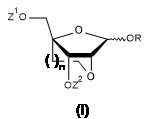
(2)如(1)記載之化合物,其中R為氫原子或乙醯基;(2) The compound described in (1), wherein R is a hydrogen atom or an acetyl group;
(3)如(1)或(2)記載之化合物,其中Z1 及Z2 為相同或相異,為脂肪族醯基、芳香族醯基、經1至3個之芳基取代的甲基、低級烷基、低級烷氧基、芳基被鹵素或氰基取代之經1至3個之芳基取代的甲基或矽基;(3) The compound described in (1) or (2), wherein Z 1 and Z 2 are the same or different, and are an aliphatic acyl group, an aromatic acyl group, or a methyl group substituted with 1 to 3 aryl groups , Lower alkyl, lower alkoxy, aryl substituted by halogen or cyano, substituted by 1 to 3 aryl groups, methyl or silyl groups;
(4)如(1)或(2)記載之化合物,其中Z1 及Z2 為相同或相異,為苄基、對甲氧基苄基、三級丁基二苯基矽基或三級丁基二甲基矽基;(4) The compound described in (1) or (2), wherein Z 1 and Z 2 are the same or different, and are benzyl, p-methoxybenzyl, tertiary butyl diphenylsilyl or tertiary Butyldimethylsilyl;
(5)如(1)或(2)記載之化合物,其中Z1 及Z2 為苄基;(5) The compound described in (1) or (2), wherein Z 1 and Z 2 are benzyl;
(6)如(1)至(5)中任一項記載之化合物,其中n為1;(6) The compound according to any one of (1) to (5), wherein n is 1;
(7)一種式(I’)所表示的化合物,
(8)一種式(I’’)所表示的化合物,
(9a)一種製造通式(III)所表示的化合物之方法,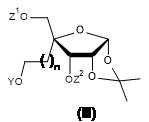

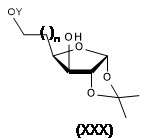
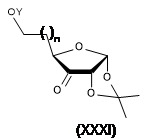
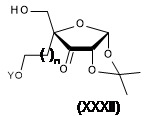
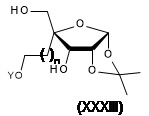
(10a)如(9a)記載之方法,其中Z1 及Z2 為相同或相異,為脂肪族醯基、芳香族醯基、經1至3個之芳基取代的甲基、低級烷基、低級烷氧基、芳基被鹵素或氰基取代之經1至3個之芳基取代的甲基或矽基。(10a) The method described in (9a), wherein Z 1 and Z 2 are the same or different, and are aliphatic acyl groups, aromatic acyl groups, methyl groups substituted with 1 to 3 aryl groups, and lower alkyl groups , Lower alkoxy, methyl or silyl substituted with 1 to 3 aryl groups in which the aryl group is substituted by halogen or cyano.
(11a)如(9a)記載之方法,其中Z1 及Z2 為相同或相異,為苄基、對甲氧基苄基、三級丁基二苯基矽基或三級丁基二甲基矽基。(11a) The method described in (9a), wherein Z 1 and Z 2 are the same or different, and are benzyl, p-methoxybenzyl, tertiary butyl diphenyl silyl or tertiary butyl dimethyl Base silicon base.
(12a)如(9a)記載之方法,其中Z1 及Z2 為苄基。(12a) The method described in (9a), wherein Z 1 and Z 2 are benzyl groups.
(13a)如(9a)至(12a)中任一項記載之方法,其中Y為三級丁基二苯基矽基、三級丁基二甲基矽基、四氫哌喃-2-基或三苯甲基。(13a) The method described in any one of (9a) to (12a), wherein Y is tertiary butyl diphenylsilyl, tertiary butyl dimethylsilyl, tetrahydropiperan-2-yl Or trityl.
(14a)如(9a)至(12a)中任一項記載之方法,其中Y為三苯甲基。(14a) The method according to any one of (9a) to (12a), wherein Y is a trityl group.
(15a)如(9a)至(14a)中任一項記載之方法,其中n為1。(15a) The method described in any one of (9a) to (14a), wherein n is 1.
(16a)如(9a)至(15a)中任一項記載之方法,其特徵為:於步驟(i)至(v)之各步驟中,將包含反應後之目的化合物的溶液之有機層進行水洗,將獲得的有機層直接使用於各後續步驟。(16a) The method described in any one of (9a) to (15a), characterized in that: in each of steps (i) to (v), an organic layer containing a solution of the target compound after the reaction is performed Wash with water, and use the obtained organic layer directly in each subsequent step.
(9)一種製造通式(II)所表示的化合物之方法,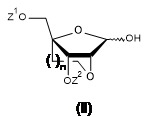
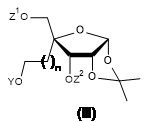


(10)如(9)記載之方法,其中Z1 及Z2 為相同或相異,為脂肪族醯基、芳香族醯基、經1至3個之芳基取代的甲基、低級烷基、低級烷氧基、芳基被鹵素或氰基取代之經1至3個之芳基取代的甲基或矽基;(10) The method described in (9), wherein Z 1 and Z 2 are the same or different, and are an aliphatic acyl group, an aromatic acyl group, a methyl group substituted with 1 to 3 aryl groups, and a lower alkyl group , Lower alkoxy, methyl or silyl substituted with 1 to 3 aryl groups in which the aryl group is substituted by halogen or cyano;
(11)如(9)記載之方法,其中Z1 及Z2 為相同或相異,為苄基、對甲氧基苄基、三級丁基二苯基矽基或三級丁基二甲基矽基;(11) The method described in (9), wherein Z 1 and Z 2 are the same or different, and are benzyl, p-methoxybenzyl, tertiary butyl diphenylsilyl or tertiary butyl dimethyl Base silicon base
(12)如(9)記載之方法,其中Z1 及Z2 為苄基;(12) The method described in (9), wherein Z 1 and Z 2 are benzyl groups;
(13)如(9)至(12)中任一項記載之方法,其中A為甲基、乙基或丙基;(13) The method according to any one of (9) to (12), wherein A is methyl, ethyl or propyl;
(14)如(9)至(12)中任一項記載之方法,其中A為甲基;(14) The method described in any one of (9) to (12), wherein A is methyl;
(15)如(9)至(14)中任一項記載之方法,其中Y為三級丁基二苯基矽基、三級丁基二甲基矽基、四氫哌喃-2-基或三苯甲基;(15) The method described in any one of (9) to (14), wherein Y is tertiary butyl diphenylsilyl, tertiary butyl dimethylsilyl, tetrahydropiperan-2-yl Or trityl
(16)如(9)至(14)中任一項記載之方法,其中Y為三苯甲基;(16) The method described in any one of (9) to (14), wherein Y is a trityl group;
(17)如(9)至(16)中任一項記載之方法,其中n為1;(17) The method described in any one of (9) to (16), wherein n is 1;
(18)如(9)至(17)中任一項記載之方法,其中酸觸媒為硫酸、對甲苯磺酸或甲磺酸;(18) The method according to any one of (9) to (17), wherein the acid catalyst is sulfuric acid, p-toluenesulfonic acid or methanesulfonic acid;
(19)如(9)至(18)中任一項記載之方法,其中步驟(ii)使用三價磷試藥及偶氮二甲酸酯進行;(19) The method described in any one of (9) to (18), wherein step (ii) is performed using trivalent phosphorus reagent and azodicarboxylate;
(20)如(19)記載之方法,其中三價磷試藥為三苯基膦或三(正丁基)膦;(20) The method described in (19), wherein the trivalent phosphorus reagent is triphenylphosphine or tris(n-butyl)phosphine;
(21)如(19)或(20)記載之方法,其中偶氮二甲酸酯為偶氮二甲酸二乙酯、偶氮二甲酸二異丙酯或偶氮二甲酸二(三級丁酯);(21) The method described in (19) or (20), wherein the azodicarboxylate is diethyl azodicarboxylate, diisopropyl azodicarboxylate or di(tertiary butyl azodicarboxylate) );
(22)如(9)至(21)中任一項記載之方法,其中步驟(iii)使用酸進行;(22) The method according to any one of (9) to (21), wherein step (iii) is carried out using an acid;
(23)如(22)記載之方法,其中酸為鹽酸、硫酸、三氟乙酸、甲磺酸或對甲苯磺酸;(23) The method described in (22), wherein the acid is hydrochloric acid, sulfuric acid, trifluoroacetic acid, methanesulfonic acid or p-toluenesulfonic acid;
(9b)如(9)記載之方法,其中Z1 及Z2 為苄基, A為甲基, Y為三苯甲基, n為1;(9b) The method described in (9), wherein Z 1 and Z 2 are benzyl, A is methyl, Y is trityl, and n is 1;
(9c)如(9)記載之方法,其中酸觸媒為硫酸、對甲苯磺酸或甲磺酸, 步驟(ii)使用三價磷試藥及偶氮二甲酸酯進行, 步驟(iii)使用酸進行;(9c) The method described in (9), wherein the acid catalyst is sulfuric acid, p-toluenesulfonic acid or methanesulfonic acid, Step (ii) is carried out using trivalent phosphorus reagent and azodicarboxylate, Step (iii) is carried out using acid;
(9d)如(9)記載之方法,其中酸觸媒為硫酸、對甲苯磺酸或甲磺酸, 步驟(ii)使用三價磷試藥及偶氮二甲酸酯進行, 步驟(ii)所使用的三價磷試藥為三苯基膦或三(正丁基)膦, 步驟(ii)所使用的偶氮二甲酸酯為偶氮二甲酸二乙酯、偶氮二甲酸二異丙酯或偶氮二甲酸二(三級丁酯), 步驟(iii)使用酸進行, 步驟(iii)所使用的酸為鹽酸、硫酸、三氟乙酸、甲磺酸或對甲苯磺酸;(9d) The method described in (9), wherein the acid catalyst is sulfuric acid, p-toluenesulfonic acid or methanesulfonic acid, Step (ii) is carried out using trivalent phosphorus reagent and azodicarboxylate, The trivalent phosphorus reagent used in step (ii) is triphenylphosphine or tris(n-butyl)phosphine, The azodicarboxylate used in step (ii) is diethyl azodicarboxylate, diisopropyl azodicarboxylate or di(tertiary butyl) azodicarboxylate, Step (iii) is carried out using acid, The acid used in step (iii) is hydrochloric acid, sulfuric acid, trifluoroacetic acid, methanesulfonic acid or p-toluenesulfonic acid;
(9e)如(9)記載之方法,其中Z1 及Z2 為苄基, A為甲基, Y為三苯甲基, n為1, 酸觸媒為硫酸、對甲苯磺酸或甲磺酸, 步驟(ii)使用三價磷試藥及偶氮二甲酸酯進行, 步驟(ii)所使用的三價磷試藥為三苯基膦或三(正丁基)膦, 步驟(ii)所使用的偶氮二甲酸酯為偶氮二甲酸二乙酯、偶氮二甲酸二異丙酯或偶氮二甲酸二(三級丁酯), 步驟(iii)使用酸進行, 步驟(iii)所使用的酸為鹽酸、硫酸、三氟乙酸、甲磺酸或對甲苯磺酸;(9e) The method described in (9), wherein Z 1 and Z 2 are benzyl, A is methyl, Y is trityl, n is 1, and the acid catalyst is sulfuric acid, p-toluenesulfonic acid or methanesulfonate Acid, step (ii) uses trivalent phosphorus reagent and azodicarbonate to carry out, step (ii) uses trivalent phosphorus reagent is triphenylphosphine or tri(n-butyl)phosphine, step (ii) ) The azodicarboxylate used is diethyl azodicarboxylate, diisopropyl azodicarboxylate or di(tertiary butyl) azodicarboxylate, step (iii) is carried out using an acid, step ( iii) The acid used is hydrochloric acid, sulfuric acid, trifluoroacetic acid, methanesulfonic acid or p-toluenesulfonic acid;
(24)一種製造通式(VI)所表示的化合物或其鹽之方法,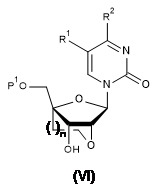

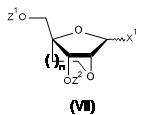
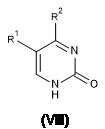
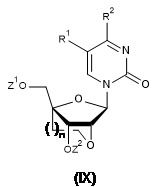
(25)如(24)記載之方法,其中Z1 及Z2 為相同或相異,為脂肪族醯基、芳香族醯基、經1至3個之芳基取代的甲基、低級烷基、低級烷氧基、芳基環被鹵素或氰基取代之經1至3個之芳基取代的甲基或矽基;(25) The method described in (24), wherein Z 1 and Z 2 are the same or different, and are aliphatic acyl groups, aromatic acyl groups, methyl groups substituted with 1 to 3 aryl groups, and lower alkyl groups , Lower alkoxy, methyl or silyl substituted with 1 to 3 aryl groups in which the aryl ring is substituted by halogen or cyano;
(26)如(24)記載之方法,其中Z1 及Z2 為相同或相異,為苄基、對甲氧基苄基、三級丁基二苯基矽基或三級丁基二甲基矽基;(26) The method described in (24), wherein Z 1 and Z 2 are the same or different, and are benzyl, p-methoxybenzyl, tertiary butyl diphenylsilyl or tertiary butyl dimethyl Base silicon base
(27)如(24)記載之方法,其中Z1 及Z2 為苄基;(27) The method described in (24), wherein Z 1 and Z 2 are benzyl groups;
(28)如(24)至(27)中任一項記載之方法,其中P1 為4,4’-二甲氧基三苯甲基;(28) The method according to any one of (24) to (27), wherein P 1 is 4,4'-dimethoxytrityl;
(29)如(24)至(28)中任一項記載之方法,其中X1 為鹵素原子、脂肪族醯氧基、鹵素取代的低級烷基亞胺氧基或鹵素取代的低級烷基磺醯氧基;(29) The method according to any one of (24) to (28), wherein X 1 is a halogen atom, an aliphatic oxy group, a halogen-substituted lower alkyliminooxy group, or a halogen-substituted lower alkyl sulfonate Oxo
(30)如(24)至(28)中任一項記載之方法,其中X1 為碘原子、乙醯氧基或三氯乙醯亞胺氧基;(30) The method described in any one of (24) to (28), wherein X 1 is an iodine atom, an acetoxy group, or a trichloroacetiminooxy group;
(31)如(24)至(30)中任一項記載之方法,其中n為1;(31) The method described in any one of (24) to (30), wherein n is 1;
(32)如(24)至(31)中任一項記載之方法,其中R1 為甲基或氫原子;(32) The method according to any one of (24) to (31), wherein R 1 is a methyl group or a hydrogen atom;
(33)如(24)至(32)中任一項記載之方法,其中R2 為羥基或苄醯基胺基;(33) The method according to any one of (24) to (32), wherein R 2 is a hydroxyl group or a benzylamino group;
(34)如(24)至(31)中任一項記載之方法,其中R1 為甲基,R2 為羥基;(34) The method according to any one of (24) to (31), wherein R 1 is a methyl group and R 2 is a hydroxyl group;
(35)如(24)至(31)中任一項記載之方法,其中R1 為甲基,R2 為苄醯基胺基;(35) The method according to any one of (24) to (31), wherein R 1 is a methyl group and R 2 is a benzylamino group;
(36)如(24)至(35)中任一項記載之方法,其包含:
(iii)使步驟(ii)中所獲得的通式(IX)所表示的化合物或其鹽,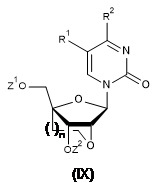
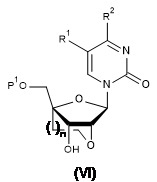
(37)如(24)至(36)中任一項記載之方法,其中活化劑為乙酸酐、苯甲酸酐、三氯乙腈、羰基二咪唑或氯磷酸二苯酯;(37) The method according to any one of (24) to (36), wherein the activator is acetic anhydride, benzoic anhydride, trichloroacetonitrile, carbonyl diimidazole or diphenyl chlorophosphate;
(38)如(24)至(37)中任一項記載之方法,其中鹵化劑為氯三甲基矽烷、溴三甲基矽烷或碘三甲基矽烷;(38) The method according to any one of (24) to (37), wherein the halogenating agent is chlorotrimethylsilane, bromotrimethylsilane or iodotrimethylsilane;
(24a)如(24)記載之方法,其中Z1 及Z2 為苄基, P1 為4,4’-二甲氧基三苯甲基, n為1, R1 為甲基,R2 為苄醯基胺基;(24a) The method described in (24), wherein Z 1 and Z 2 are benzyl, P 1 is 4,4'-dimethoxytrityl, n is 1, R 1 is methyl, and R 2 Is benzylamino;
(24b)如(24)記載之方法,其中Z1 及Z2 為苄基, P1 為4,4’-二甲氧基三苯甲基, X1 為碘原子、乙醯氧基或三氯乙醯亞胺氧基, n為1, R1 為甲基,R2 為苄醯基胺基;(24b) The method described in (24), wherein Z 1 and Z 2 are benzyl groups, P 1 is 4,4'-dimethoxytrityl, and X 1 is an iodine atom, an acetoxy group, or a trityl group. Chloroacetiminooxy, n is 1, R 1 is methyl, R 2 is benzylamino;
(24c)如(24)記載之方法,其中活化劑為乙酸酐、苯甲酸酐、三氯乙腈、羰基二咪唑或氯磷酸二苯酯, 鹵化劑為氯三甲基矽烷、溴三甲基矽烷或碘三甲基矽烷;(24c) The method described in (24), wherein the activator is acetic anhydride, benzoic anhydride, trichloroacetonitrile, carbonyl diimidazole or diphenyl chlorophosphate, The halogenating agent is chlorotrimethylsilane, bromotrimethylsilane or iodotrimethylsilane;
(24d)如(24)記載之方法,其中Z1 及Z2 為苄基, P1 為4,4’-二甲氧基三苯甲基, X1 為碘原子、乙醯氧基或三氯乙醯亞胺氧基, n為1, R1 為甲基,R2 為苄醯基胺基, 活化劑為乙酸酐、苯甲酸酐、三氯乙腈、羰基二咪唑或氯磷酸二苯酯, 鹵化劑為氯三甲基矽烷、溴三甲基矽烷或碘三甲基矽烷;(24d) The method described in (24), wherein Z 1 and Z 2 are benzyl groups, P 1 is 4,4'-dimethoxytrityl group, and X 1 is an iodine atom, an acetoxy group or a trityl group. Chloroacetiminooxy, n is 1, R 1 is methyl, R 2 is benzylamino, activator is acetic anhydride, benzoic anhydride, trichloroacetonitrile, carbonyl diimidazole or diphenyl chlorophosphate , The halogenating agent is chlorotrimethylsilane, bromotrimethylsilane or iodotrimethylsilane;
(39)一種製造通式(X)所表示的化合物或其鹽之方法,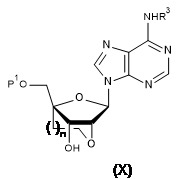
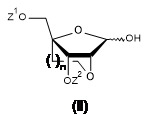
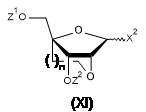
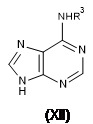
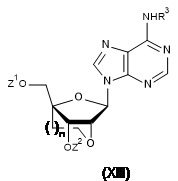
(39a)如(39)記載之方法,其中於步驟(iii),藉由加熱而使異構物化;(39a) The method described in (39), wherein in step (iii), isomerization is performed by heating;
(40)如(39)記載之方法,其中Z1 及Z2 為相同或相異,為脂肪族醯基、芳香族醯基、經1至3個之芳基取代的甲基、低級烷基、低級烷氧基、芳基環被鹵素或氰基取代之經1至3個之芳基取代的甲基或矽基;(40) The method described in (39), wherein Z 1 and Z 2 are the same or different, and are an aliphatic acyl group, an aromatic acyl group, a methyl group substituted with 1 to 3 aryl groups, and a lower alkyl group , Lower alkoxy, methyl or silyl substituted with 1 to 3 aryl groups in which the aryl ring is substituted by halogen or cyano;
(41)如(39)記載之方法,其中Z1 及Z2 為相同或相異,為苄基、對甲氧基苄基、三級丁基二苯基矽基或三級丁基二甲基矽基;(41) The method described in (39), wherein Z 1 and Z 2 are the same or different, and are benzyl, p-methoxybenzyl, tertiary butyl diphenylsilyl or tertiary butyl dimethyl Base silicon base
(42)如(39)記載之方法,其中Z1 及Z2 為苄基;(42) The method described in (39), wherein Z 1 and Z 2 are benzyl groups;
(43)如(39)至(42)中任一項記載之方法,其中P1 為4,4’-二甲氧基三苯甲基;(43) The method described in any one of (39) to (42), wherein P 1 is 4,4'-dimethoxytrityl;
(44)如(39)至(43)中任一項記載之方法,其中X2 為鹵素原子、脂肪族醯氧基、鹵素取代的低級烷基亞胺氧基或鹵素取代的低級烷基磺醯氧基;(44) The method according to any one of (39) to (43), wherein X 2 is a halogen atom, an aliphatic oxy group, a halogen-substituted lower alkyliminooxy group, or a halogen-substituted lower alkyl sulfonate Oxo
(45)如(39)至(43)中任一項記載之方法,其中X2 為乙醯氧基;(45) The method described in any one of (39) to (43), wherein X 2 is an acetoxy group;
(46)如(39)至(45)中任一項記載之方法,其中n為1;(46) The method described in any one of (39) to (45), wherein n is 1;
(47)如(39)至(46)中任一項記載之方法,其中R3 為乙醯基或苄醯基;(47) The method described in any one of (39) to (46), wherein R 3 is acetyl or benzyl;
(48)如(39)至(46)中任一項記載之方法,其中R3 為苄醯基;(48) The method described in any one of (39) to (46), wherein R 3 is benzyl;
(49)如(39)至(48)中任一項記載之方法,其包含:
(iv)使步驟(iii)中所獲得的通式(XIII)所表示的化合物或其鹽,
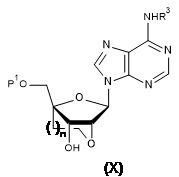
(50)如(39)至(49)中任一項記載之方法,其中活化劑為乙酸酐、苯甲酸酐、三氯乙腈、羰基二咪唑或氯磷酸二苯酯;(50) The method according to any one of (39) to (49), wherein the activator is acetic anhydride, benzoic anhydride, trichloroacetonitrile, carbonyl diimidazole or diphenyl chlorophosphate;
(51)如(39)至(50)中任一項記載之方法,其中酸試藥為三氟甲磺酸三甲基矽酯及三氟乙酸;(51) The method according to any one of (39) to (50), wherein the acid reagent is trimethylsilyl trifluoromethanesulfonate and trifluoroacetic acid;
(39b)如(39)記載之方法,其中Z1 及Z2 為苄基, P1 為4,4’-二甲氧基三苯甲基, n為1, R3 為苄醯基;(39b) The method described in (39), wherein Z 1 and Z 2 are benzyl, P 1 is 4,4'-dimethoxytrityl, n is 1, and R 3 is benzyl;
(39c)如(39)記載之方法,其中Z1 及Z2 為苄基, P1 為4,4’-二甲氧基三苯甲基, X2 為乙醯氧基, n為1, R3 為苄醯基;(39c) The method described in (39), wherein Z 1 and Z 2 are benzyl, P 1 is 4,4'-dimethoxytrityl, X 2 is acetoxy, n is 1, R 3 is benzyl;
(39d)如(39)記載之方法,其中活化劑為乙酸酐、苯甲酸酐、三氯乙腈、羰基二咪唑或氯磷酸二苯酯, 酸試藥為三氟甲磺酸三甲基矽酯及三氟乙酸;(39d) The method described in (39), wherein the activator is acetic anhydride, benzoic anhydride, trichloroacetonitrile, carbonyl diimidazole or diphenyl chlorophosphate, The acid reagents are trimethylsilyl trifluoromethanesulfonate and trifluoroacetic acid;
(39e)如(39)記載之方法,其中Z1 及Z2 為苄基, P1 為4,4’-二甲氧基三苯甲基, X2 為乙醯氧基, n為1, R3 為苄醯基, 活化劑為乙酸酐、苯甲酸酐、三氯乙腈、羰基二咪唑或氯磷酸二苯酯, 酸試藥為三氟甲磺酸三甲基矽酯及三氟乙酸;(39e) The method described in (39), wherein Z 1 and Z 2 are benzyl, P 1 is 4,4'-dimethoxytrityl, X 2 is acetoxy, n is 1, R 3 is a benzyl group, the activator is acetic anhydride, benzoic anhydride, trichloroacetonitrile, carbonyl diimidazole or diphenyl chlorophosphate, and the acid reagent is trimethylsilyl trifluoromethanesulfonate and trifluoroacetic acid;
(52)一種通式(XIV)所表示的化合物或其鹽,
(53)如(52)記載之化合物或其鹽,其中Z1 及Z2 為相同或相異,為脂肪族醯基、芳香族醯基、經1至3個之芳基取代的甲基、低級烷基、低級烷氧基、芳基環被鹵素或氰基取代之經1至3個之芳基取代的甲基或矽基;(53) The compound described in (52) or a salt thereof, wherein Z 1 and Z 2 are the same or different, and are aliphatic acyl groups, aromatic acyl groups, methyl groups substituted with 1 to 3 aryl groups, Lower alkyl, lower alkoxy, methyl or silyl substituted with 1 to 3 aryl groups in which the aryl ring is substituted by halogen or cyano;
(54)如(52)記載之化合物或其鹽,其中Z1 及Z2 為相同或相異,為苄基、對甲氧基苄基、三級丁基二苯基矽基或三級丁基二甲基矽基;(54) The compound or salt thereof according to (52), wherein Z 1 and Z 2 are the same or different, and are benzyl, p-methoxybenzyl, tertiary butyl diphenylsilyl or tertiary butyl Dimethylsilyl
(55)如(52)記載之化合物或其鹽,其中Z1 及Z2 為苄基;(55) The compound or salt thereof according to (52), wherein Z 1 and Z 2 are benzyl;
(56)如(52)至(55)中任一項記載之化合物或其鹽,其中n為1;(56) The compound or salt thereof according to any one of (52) to (55), wherein n is 1;
(57)一種通式(XIV’)所表示的化合物或其鹽,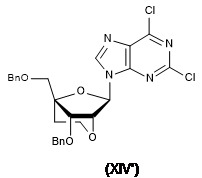
(58)一種製造通式(X)所表示的化合物或其鹽之方法,
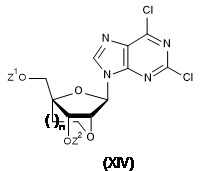
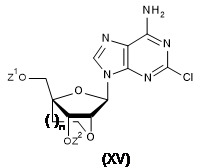
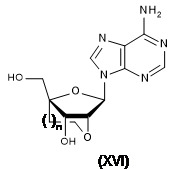
(58b)如(58)記載之方法,其中金屬觸媒為承載於碳上的金屬觸媒;(58b) The method described in (58), wherein the metal catalyst is a metal catalyst carried on carbon;
(59)如(58)記載之化合物或其鹽,其中Z1 及Z2 為相同或相異,為脂肪族醯基、芳香族醯基、經1至3個之芳基取代的甲基、低級烷基、低級烷氧基、芳基環被鹵素或氰基取代之經1至3個之芳基取代的甲基或矽基;(59) The compound or salt thereof according to (58), wherein Z 1 and Z 2 are the same or different, and are aliphatic acyl groups, aromatic acyl groups, methyl groups substituted with 1 to 3 aryl groups, Lower alkyl, lower alkoxy, methyl or silyl substituted with 1 to 3 aryl groups in which the aryl ring is substituted by halogen or cyano;
(60)如(58)記載之方法,其中Z1 及Z2 為相同或相異,為苄基、對甲氧基苄基、三級丁基二苯基矽基或三級丁基二甲基矽基;(60) The method described in (58), wherein Z 1 and Z 2 are the same or different, and are benzyl, p-methoxybenzyl, tertiary butyl diphenylsilyl or tertiary butyl dimethyl Base silicon base
(61)如(58)記載之方法,其中Z1 及Z2 為苄基;(61) The method described in (58), wherein Z 1 and Z 2 are benzyl groups;
(62)如(58)至(61)中任一項記載之方法,其中P1 為4,4’-二甲氧基三苯甲基;(62) The method described in any one of (58) to (61), wherein P 1 is 4,4'-dimethoxytrityl;
(63)如(58)至(62)中任一項記載之方法,其中n為1;(63) The method described in any one of (58) to (62), wherein n is 1;
(64)如(58)至(63)中任一項記載之方法,其中R3 為乙醯基或苄醯基;(64) The method described in any one of (58) to (63), wherein R 3 is acetyl or benzyl;
(65)如(58)至(63)中任一項記載之方法,其中R3 為苄醯基;(65) The method described in any one of (58) to (63), wherein R 3 is benzyl;
(66)如(58)至(65)中任一項記載之方法,其包含:
(iii)使步驟(ii)中所獲得的通式(XVI)所表示的化合物或其鹽與1級羥基之保護試藥反應,
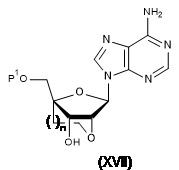
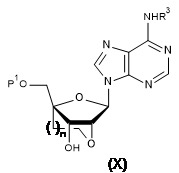
(67)如(58)至(66)中任一項記載之方法,其中胺基化劑為氨、氨水溶液、碳酸銨或乙酸銨。(67) The method according to any one of (58) to (66), wherein the aminating agent is ammonia, an aqueous ammonia solution, ammonium carbonate, or ammonium acetate.
(68)如(58)至(67)中任一項記載之方法,其中金屬觸媒為鈀、氫氧化鈀或鉑;(68) The method according to any one of (58) to (67), wherein the metal catalyst is palladium, palladium hydroxide or platinum;
(69)如(58)至(68)中任一項記載之方法,其中還原劑為氫、甲酸或甲酸銨;(69) The method according to any one of (58) to (68), wherein the reducing agent is hydrogen, formic acid or ammonium formate;
(70)如(66)至(69)中任一項記載之方法,其中醯化劑為苯甲醯氯或苯甲酸酐;(70) The method according to any one of (66) to (69), wherein the acylating agent is benzyl chloride or benzoic anhydride;
(58a)如(58)記載之方法,其包含:
(iii-a)使(58)中的步驟(ii)中所獲得的通式(XVI)所表示的化合物或其鹽,
(71)一種製造通式(XVIII)所表示的化合物或其鹽之方法,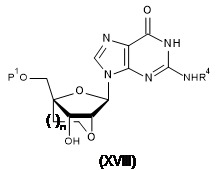

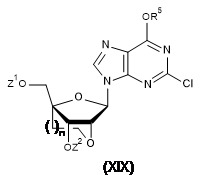
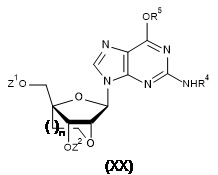
(72)如(71)記載之方法,其中Z1 及Z2 為相同或相異,為脂肪族醯基、芳香族醯基、經1至3個之芳基取代的甲基、低級烷基、低級烷氧基、芳基環被鹵素或氰基取代之經1至3個之芳基取代的甲基或矽基;(72) The method described in (71), wherein Z 1 and Z 2 are the same or different, and are an aliphatic acyl group, an aromatic acyl group, a methyl group substituted with 1 to 3 aryl groups, and a lower alkyl group , Lower alkoxy, methyl or silyl substituted with 1 to 3 aryl groups in which the aryl ring is substituted by halogen or cyano;
(73)如(71)記載之方法,其中Z1 及Z2 為相同或相異,為苄基、對甲氧基苄基、三級丁基二苯基矽基或三級丁基二甲基矽基;(73) The method described in (71), wherein Z 1 and Z 2 are the same or different, and are benzyl, p-methoxybenzyl, tertiary butyl diphenylsilyl or tertiary butyl dimethyl Base silicon base
(74)如(71)記載之方法,其中Z1 及Z2 為苄基;(74) The method described in (71), wherein Z 1 and Z 2 are benzyl groups;
(75)如(71)至(74)中任一項記載之方法,其中P1 為4,4’-二甲氧基三苯甲基;(75) The method according to any one of (71) to (74), wherein P 1 is 4,4'-dimethoxytrityl;
(76)如(71)至(75)中任一項記載之方法,其中n為1;(76) The method described in any one of (71) to (75), wherein n is 1;
(77)如(71)至(76)中任一項記載之方法,其中R4 為異丁醯;(77) The method described in any one of (71) to (76), wherein R 4 is isobutylene;
(78)如(71)至(77)中任一項記載之方法,其中R5 為苄基;(78) The method according to any one of (71) to (77), wherein R 5 is benzyl;
(79)如(71)至(78)中任一項記載之方法,其包含:
(iii)使步驟(ii)中所獲得的通式(XX)所表示的化合物或其鹽,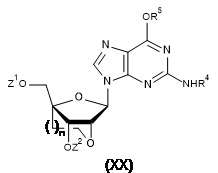
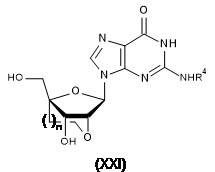
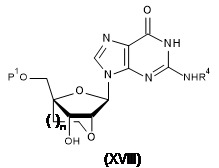
(80)如(71)至(79)中任一項記載之方法,其中鹼為氫氧化鈉、碳酸鈉、碳酸銫、三乙基胺、吡啶或1,8-二氮雜雙環[5.4.0]十一-7-烯;(80) The method described in any one of (71) to (79), wherein the base is sodium hydroxide, sodium carbonate, cesium carbonate, triethylamine, pyridine or 1,8-diazabicyclo [5.4. 0] Undec-7-ene;
(81)如(71)至(80)中任一項記載之方法,其中鈀觸媒為參(二亞苄基丙酮)(氯仿)二鈀、乙酸鈀(II)或參(二亞苄基丙酮)二鈀(0);(81) The method according to any one of (71) to (80), wherein the palladium catalyst is ginseng (dibenzylidene acetone) (chloroform) dipalladium, palladium acetate (II) or ginseng (dibenzylidene Acetone) two palladium (0);
(82)如(71)至(81)中任一項記載之方法,其中膦配位子為4,5’-雙(二苯基膦基)-9,9’二甲基𠮿
(83)如(71)至(82)中任一項記載之方法,其中醯胺化劑為乙醯基醯胺、苄醯基醯胺或異丁基醯胺;(83) The method according to any one of (71) to (82), wherein the aminating agent is acetylamide, benzylamide or isobutylamide;
(84)如(79)至(83)中任一項記載之方法,其中羥基之去保護試藥為金屬觸媒及還原劑;(84) The method described in any one of (79) to (83), wherein the deprotection reagent for the hydroxyl group is a metal catalyst and a reducing agent;
(84a)如(79)至(83)中任一項記載之方法,其中羥基之去保護試藥為承載於碳上的金屬觸媒及氫;(84a) The method described in any one of (79) to (83), wherein the deprotection reagent for the hydroxyl group is a metal catalyst and hydrogen carried on carbon;
(85)如(84)記載之方法,其中金屬觸媒為鈀、氫氧化鈀或鉑;(85) The method described in (84), wherein the metal catalyst is palladium, palladium hydroxide or platinum;
(86)如(84)或(85)記載之方法,其中還原劑為氫、甲酸或甲酸銨;(86) The method described in (84) or (85), wherein the reducing agent is hydrogen, formic acid or ammonium formate;
(71a)如(71)記載之方法,其包含:
(iii-a)使(71)中的步驟(ii)中所獲得的通式(XX)所表示的化合物或其鹽,
(87)一種製造通式(XXII)所表示的化合物或其鹽之方法,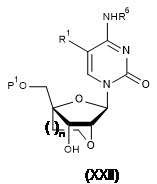
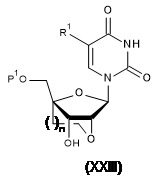
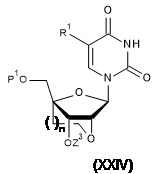
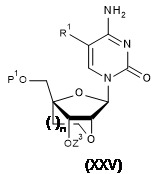
(88)如(87)記載之方法,其中P1 為三苯甲基;(88) The method described in (87), wherein P 1 is trityl;
(89)如(87)或(88)記載之方法,其中Z3 為乙醯基;(89) The method described in (87) or (88), wherein Z 3 is acetyl;
(90)如(87)至(89)中任一項記載之方法,其中n為1;(90) The method described in any one of (87) to (89), wherein n is 1;
(91)如(87)至(90)中任一項記載之方法,其中R1 為甲基或氫原子;(91) The method according to any one of (87) to (90), wherein R 1 is a methyl group or a hydrogen atom;
(92)如(87)至(91)中任一項記載之方法,其中R6 為乙醯基或苄醯基;(92) The method described in any one of (87) to (91), wherein R 6 is acetyl or benzyl;
(93)如(87)至(91)中任一項記載之方法,其中R6 為苄醯基;(93) The method described in any one of (87) to (91), wherein R 6 is benzyl;
(94)如(87)至(93)中任一項記載之方法,其包含:
(iv)使步驟(iii)中所獲得的通式(XXV)所表示的化合物或其鹽,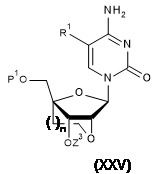
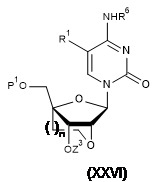
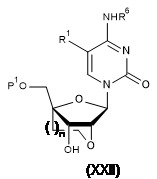
(95)如(87)至(94)中任一項記載之方法,其中觸媒為N,N-二甲基胺基吡啶或1,8-二氮雜雙環[5.4.0]十一-7-烯;(95) The method described in any one of (87) to (94), wherein the catalyst is N,N-dimethylaminopyridine or 1,8-diazabicyclo[5.4.0]undec- 7-ene;
(96)如(87)至(95)中任一項記載之方法,其中活化劑為對甲苯磺醯氯或2,4,6-三異丙基苯磺醯氯;(96) The method according to any one of (87) to (95), wherein the activator is p-toluenesulfonyl chloride or 2,4,6-triisopropylbenzenesulfonyl chloride;
(97)如(87)至(96)中任一項記載之方法,其中胺基化劑為氨、氨水溶液、碳酸銨或乙酸銨;(97) The method according to any one of (87) to (96), wherein the aminating agent is ammonia, aqueous ammonia solution, ammonium carbonate or ammonium acetate;
(98)如(94)至(97)中任一項記載之方法,其中醯化劑為苯甲醯氯或苯甲酸酐;(98) The method according to any one of (94) to (97), wherein the acylating agent is benzyl chloride or benzoic anhydride;
(87a)如(87)記載之方法,其中P1 為三苯甲基, Z3 為乙醯基, n為1, R1 為甲基或氫原子, R6 為苄醯基;(87a) The method described in (87), wherein P 1 is a trityl group, Z 3 is an acetyl group, n is 1, R 1 is a methyl group or a hydrogen atom, and R 6 is a benzyl group;
(87b)如(87)記載之方法,其包含:
(iv-b)使(87)中的步驟(iii)中所獲得的通式(XXV)所表示的化合物或其鹽,
(87c)如(87)記載之方法,其包含:
(iv-c)使(87)中的步驟(iii)中所獲得的通式(XXV)所表示的化合物或其鹽,
(99)一種製造通式(XXVIII)所表示的化合物或其鹽之方法,
其使通式(XXVII)所表示的化合物或其鹽,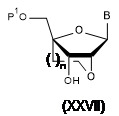
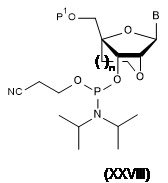
(100)如(99)記載之方法,其中P1 為4,4’-二甲氧基三苯甲基;(100) The method described in (99), wherein P 1 is 4,4'-dimethoxytrityl;
(101)如(99)或(100)記載之方法,其中B為2-側氧基-4-羥基-5-甲基嘧啶-1-基、胺基經保護的2-側氧基-4-胺基-嘧啶-1-基、胺基經保護的4-胺基-5-甲基-2-側氧基-嘧啶-1-基、胺基經保護的6-胺基嘌呤-9-基或胺基經保護的2-胺基-6-羥基嘌呤-9-基;(101) The method described in (99) or (100), wherein B is 2-side oxy-4-hydroxy-5-methylpyrimidin-1-yl, 2-side oxy-4 with protected amino group -Amino-pyrimidin-1-yl, 4-amino-5-methyl-2-oxo-pyrimidin-1-yl with protected amino group, 6-aminopurine-9- with protected amino group 2-amino-6-hydroxypurin-9-yl with protected group or amino group;
(102)如(99)或(100)記載之方法,其中B為2-側氧基-4-羥基-5-甲基嘧啶-1-基、2-側氧基-4-苄醯基胺基-嘧啶-1-基、4-苄醯基胺基-5-甲基-2-側氧基-嘧啶-1-基、6-苄醯基胺基嘌呤-9-基、或2-異丁醯基胺基-6-羥基嘌呤-9-基;(102) The method described in (99) or (100), wherein B is 2-side oxy-4-hydroxy-5-methylpyrimidin-1-yl, 2-side oxy-4-benzylamine Base-pyrimidin-1-yl, 4-benzylamino-5-methyl-2-oxo-pyrimidin-1-yl, 6-benzylaminopurin-9-yl, or 2-iso Butyrylamino-6-hydroxypurin-9-yl;
(103)如(99)至(102)中任一項記載之方法,其中n為1;(103) The method described in any one of (99) to (102), wherein n is 1;
(104)如(99)至(103)中任一項記載之方法,其中活化劑為吡啶三氟乙酸鹽、N-甲基咪唑三氟乙酸鹽、N-異丙基咪唑三氟乙酸鹽、5-苄硫基四唑、5-苯基四唑、4,5-二氰基咪唑或2,4,5-四溴咪唑;(104) The method according to any one of (99) to (103), wherein the activator is pyridine trifluoroacetate, N-methylimidazole trifluoroacetate, N-isopropylimidazole trifluoroacetate, 5-benzylthiotetrazole, 5-phenyltetrazole, 4,5-dicyanoimidazole or 2,4,5-tetrabromoimidazole;
(105)如(99)至(103)中任一項記載之方法,其中活化劑為4,5-二氰基咪唑;(105) The method according to any one of (99) to (103), wherein the activator is 4,5-dicyanoimidazole;
(106)如(99)至(105)中任一項記載之方法,其中AMIDITE化試藥為2-氰基乙基N,N,N’,N’-四異丙基亞磷醯二胺(2-cyanoethyl N, N, N’, N’-tetraisopropyl phosphorodiamidite)或2-氰基乙基二異丙基氯亞磷醯胺(2-cyanoethyl diisopropyl chlorophosphoroamidide);(106) The method described in any one of (99) to (105), wherein the AMIDITE chemical reagent is 2-cyanoethyl N,N,N',N'-tetraisopropylphosphatidamide (2-cyanoethyl N, N, N', N'-tetraisopropyl phosphorodiamidite) or 2-cyanoethyl diisopropyl chlorophosphoroamidide;
(107)如(99)至(105)中任一項記載之方法,其中AMIDITE化試藥為2-氰基乙基N,N,N’,N’-四異丙基亞磷醯二胺;(107) The method described in any one of (99) to (105), wherein the AMIDITE chemical reagent is 2-cyanoethyl N,N,N',N'-tetraisopropylphosphatidamide ;
(108)如(99)至(107)中任一項記載之方法,其中乾燥劑為分子篩3A、分子篩4A、或分子篩5A;(108) The method described in any one of (99) to (107), wherein the desiccant is molecular sieve 3A, molecular sieve 4A, or molecular sieve 5A;
(99a)如(99)記載之方法,其中P1 為4,4’-二甲氧基三苯甲基, B為2-側氧基-4-羥基-5-甲基嘧啶-1-基、2-側氧基-4-苄醯基胺基-嘧啶-1-基、4-苄醯基胺基-5-甲基-2-側氧基-嘧啶-1-基、6-苄醯基胺基嘌呤-9-基、或2-異丁醯基胺基-6-羥基嘌呤-9-基, n為1;(99a) The method described in (99), wherein P 1 is 4,4'-dimethoxytrityl and B is 2-side oxy-4-hydroxy-5-methylpyrimidin-1-yl , 2-Pendant 4-benzylamino-pyrimidin-1-yl, 4-benzylamino-5-methyl-2-Pyrimidine-1-yl, 6-benzylamino Aminopurin-9-yl or 2-isobutyrylamino-6-hydroxypurin-9-yl, n is 1;
(99b)如(99)記載之方法,其中活化劑為吡啶三氟乙酸鹽、N-甲基咪唑三氟乙酸鹽、N-異丙基咪唑三氟乙酸鹽、5-苄硫基四唑、5-苯基四唑、4,5-二氰基咪唑或2,4,5-四溴咪唑, AMIDITE化試藥為2-氰基乙基N,N,N’,N’-四異丙基亞磷醯二胺或2-氰基乙基二異丙基氯亞磷醯胺, 乾燥劑為分子篩3A、分子篩4A、或分子篩5A;(99b) The method described in (99), wherein the activator is pyridine trifluoroacetate, N-methylimidazole trifluoroacetate, N-isopropylimidazole trifluoroacetate, 5-benzylthiotetrazole, 5-phenyltetrazole, 4,5-dicyanoimidazole or 2,4,5-tetrabromoimidazole, The chemical reagent of AMIDITE is 2-cyanoethyl N,N,N’,N’-tetraisopropylphosphoramidite or 2-cyanoethyldiisopropylphosphoramidite, The desiccant is molecular sieve 3A, molecular sieve 4A, or molecular sieve 5A;
(99c)如(99)記載之方法,其中P1 為4,4’-二甲氧基三苯甲基, B為2-側氧基-4-羥基-5-甲基嘧啶-1-基、2-側氧基-4-苄醯基胺基-嘧啶-1-基、4-苄醯基胺基-5-甲基-2-側氧基-嘧啶-1-基、6-苄醯基胺基嘌呤-9-基、或2-異丁醯基胺基-6-羥基嘌呤-9-基, n為1, 活化劑為吡啶三氟乙酸鹽、N-甲基咪唑三氟乙酸鹽、N-異丙基咪唑三氟乙酸鹽、5-苄硫基四唑、5-苯基四唑、4,5-二氰基咪唑或2,4,5-四溴咪唑, AMIDITE化試藥為2-氰基乙基N,N,N’,N’-四異丙基亞磷醯二胺或2-氰基乙基二異丙基氯亞磷醯胺, 乾燥劑為分子篩3A、分子篩4A、或分子篩5A;(99c) The method described in (99), wherein P 1 is 4,4'-dimethoxytrityl and B is 2-side oxy-4-hydroxy-5-methylpyrimidin-1-yl , 2-Pendant 4-benzylamino-pyrimidin-1-yl, 4-benzylamino-5-methyl-2-Pyrimidine-1-yl, 6-benzylamino Aminopurin-9-yl or 2-isobutyrylamino-6-hydroxypurin-9-yl, n is 1, the activator is pyridine trifluoroacetate, N-methylimidazole trifluoroacetate, N -Isopropylimidazole trifluoroacetate, 5-benzylthiotetrazole, 5-phenyltetrazole, 4,5-dicyanoimidazole or 2,4,5-tetrabromoimidazole, AMIDITE chemical reagent is 2 -Cyanoethyl N,N,N',N'-Tetraisopropylphosphoramidite or 2-cyanoethyldiisopropylchlorophosphoramidite, the desiccant is molecular sieve 3A, molecular sieve 4A, Or molecular sieve 5A;
(109)一種寡核苷酸之製造方法,其包含以下之步驟: (A)藉由如(99)至(108)中任一項記載之方法而合成ENA單體的步驟,及 (B)使用步驟(A)中所獲得的ENA單體、其他之核酸之亞磷醯胺化合物及/或配位體之亞磷醯胺化合物,依據所期望的序列而使核苷酸鏈延長的步驟。(109) A manufacturing method of oligonucleotide, which comprises the following steps: (A) The step of synthesizing ENA monomer by the method described in any one of (99) to (108), and (B) Use the ENA monomer, other nucleic acid phosphoramidite compounds and/or ligand phosphoramidite compounds obtained in step (A) to extend the nucleotide chain according to the desired sequence A step of.
(110)如(109)記載之方法,其特徵為寡核苷酸係選自以下之DMD AO01~DMD AO15的任一者之式所表示的序列, (DMD AO01) HO-Ce2s -Am1s -Gm1s -Te2s -Te2s -Um1s -Gm1s -Ce2s -Ce2s -Gm1s -Ce2s -Te2s -Gm1s -Ce2s -Ce2s -Ce2s -Am1s -Am1s - CH2 CH2 OH(序列識別號1) (DMD AO02) HO-Te2s -Gm1s -Te2s -Te2s -Ce2s -Te2s -Gm1s -Am1s -Ce2s -Am1s -Am1s -Ce2s -Am1s -Gm1s -Te2s -Te2s -Te2s -Gm1s - CH2 CH2 OH(序列識別號2) (DMD AO03) HO-Ce2s -Gm1s -Ce2s -Te2s -Gm1s -Cm1s -Ce2s -Ce2s -Am1s -Am1s -Te2s -Gm1s -Ce2s -Ce2s -Am1s -Um1s -Ce2s -Ce2s - CH2 CH2 OH(序列識別號3) (DMD AO04) HO-Ce2s -Am1s -Te2s -Am1s -Am1s -Te2s -Gm1s -Am1s -Ae2s -Am1s -Am1s -Ce2s -Gm1s -Cm1s -Ce2s -Gm1s -Ce2s -Ce2s - CH2 CH2 OH(序列識別號4) (DMD AO05) HO-Te2s -Um1s -Ce2s -Cm1s -Ce2s -Am1s -Am1s -Te2s -Um1s -Cm1s -Te2s -Ce2s -Am1s -Gm1s -Gm1s -Ae2s -Am1s -Te2s - CH2 CH2 OH(序列識別號5) (DMD AO06) HO-Ce2s -Ce2s -Am1s -Um1s -Te2s -Um1s -Gm1s -Te2s -Am1s -Um1s -Te2s -Te2s -Am1s -Gm1s -Ce2s -Am1s -Te2s -Gm1s - CH2 CH2 OH(序列識別號6) (DMD AO07) HO-Gm1s -Gm1s -Ce2s -Te2s -Gm1s -Cm1s -Te2s -Te2s -Um1s -Gm1s -Ce2s -Cm1s -Cm1s -Te2s -Ce2s -Am1s -Gm1s -Ce2s -CH2 CH2 OH(序列識別號7) (DMD AO08) HO-Gm1s -Ce2s -Te2s -Am1s -Gm1s -Gm1s -Te2s -Ce2s -Am1s -Gm1s -Gm1s -Te2s -Gm1s -Cm1s -Te2s -Te2s -Um1s -CH2 CH2 OH(序列識別號8) (DMD AO09) HO-Am1s -Ce2s -Ce2s -Gm1s -Cm1s -Ce2s -Te2s -Um1s -Cm1s -Ce2s -Am1s -Cm1s -Te2s -Ce2s -Am1s -Gm1s -Ae2s -Gm1s -CH2 CH2 OH; (序列識別號9) (DMD AO10) HO-Ge2s -Ge2s -Ce2s -Ae2s -Te2s -Um1s -Um1s -Cm1s -Um1s -Am1s -Gm1s -Um1s -Um1s -Te2s -Ge2s -Ge2s -Ae2s -Ge2s - CH2 CH2 OH(序列識別號10) (DMD AO11) HO-Gm1s -Gm1s -Ce2s -Am1s -Te2s -Te2s -Um1s -Ce2s -Te2s -Am1s -Gm1s -Um1s -Te2s -Te2s -Gm1s -Gm1s -Ae2s -Gm1s - CH2 CH2 OH(序列識別號11) (DMD AO12) HO-Ae2s -Gm1s -Te2s -Um1s -Te2s -Gm1s -Gm1s -Ae2s -Gm1s -Am1s -Te2s -Gm1s -Gm1s -Ce2s -Ae2s -Gm1s -Te2s -Te2s - CH2 CH2 OH(序列識別號12) (DMD AO13) HO-Ce2s -Te2s -Cm1s -Ce2s -Te2s -Um1s -Ce2s -Ce2s -Am1s -Te2s -Gm1s -Am1s -Ce2s -Te2s -Ce2s -Am1s -Am1s -Gm1s - CH2 CH2 OH(序列識別號13) (DMD AO14) HO-Ce2s -Te2s -Gm1s -Am1s -Am1s -Gm1s -Gm1s -Te2s -Gm1s -Te2s -Te2s -Ce2s -Te2s -Te2s -Gm1s -Te2s -Am1s -Ce2s - CH2 CH2 OH(序列識別號14) (DMD AO15) HO-Te2s -Te2s -Cm1s -Ce2s -Am1s -Gm1s -Ce2s -Ce2s -Am1s -Te2s -Te2s -Gm1s -Te2s -Gm1s -Te2s -Te2s -Gm1s -Am1s -CH2 CH2 OH(序列識別號15) [於上述式中,左側表示5’末端,右側表示3’末端,A、G、C、U及T各自表示D-核呋喃糖經修飾且5’位之碳原子與左側所表示的結構單元進行硫代磷酸酯(phosphorothioate)鍵結而成的腺苷、鳥苷、胞苷、尿苷及胸苷;附於各核苷酸或核苷之e2s表示D-核呋喃糖經2’-O,4’-C-伸乙基交聯,3’位以-OP(=S)(-OH)-O-與右側鄰接的核苷酸或核苷的5’位碳原子鍵結,e2t表示D-核呋喃糖經2’-O,4’-C-伸乙基交聯,3’位以-O-與3’末端之氫原子鍵結,m1s表示D-核呋喃糖經2’-O-甲基化,3’位以-OP(=S)(-OH)-O-與右側鄰接的核苷酸或核苷之5’位碳原子鍵結,m1t表示D-核呋喃糖經2’-O-甲基化,3’位以-O-與3’末端之氫原子鍵結]。(110) The method described in (109), characterized in that the oligonucleotide is selected from the sequence represented by any one of the following DMD AO01 to DMD AO15, (DMD AO01) HO-C e2s -A m1s -G m1s -T e2s -T e2s -U m1s -G m1s -C e2s -C e2s -G m1s -C e2s -T e2s -G m1s -C e2s -C e2s -C e2s -A m1s -A m1s -CH 2 CH 2 OH (serial identification number 1) (DMD AO02) HO-T e2s -G m1s -T e2s -T e2s -C e2s -T e2s -G m1s -A m1s -C e2s -A m1s -A m1s -C e2s -A m1s -G m1s -T e2s -T e2s -T e2s -G m1s -CH 2 CH 2 OH (serial identification number 2) (DMD AO03) HO-C e2s -G m1s -C e2s -T e2s -G m1s -C m1s -C e2s -C e2s -A m1s -A m1s -T e2s -G m1s -C e2s -C e2s -A m1s -U m1s -C e2s -C e2s -CH 2 CH 2 OH (serial identification number 3) (DMD AO04) HO-C e2s -A m1s -T e2s -A m1s -A m1s -T e2s -G m1s -A m1s -A e2s -A m1s -A m1s -C e2s -G m1s -C m1s- C e2s -G m1s -C e2s -C e2s -CH 2 CH 2 OH (serial identification number 4) (DMD AO05) HO-T e2s -U m1s -C e2s -C m1s -C e2s -A m1s -A m1s- T e2s -U m1s -C m1s -T e2s -C e2s -A m1s -G m1s -G m1s -A e2s -A m1s -T e2s -CH 2 CH 2 OH (serial identification number 5) (DMD AO06) HO- C e2s -C e2s -A m1s -U m1s -T e2s -U m1s -G m1s -T e2s -A m1s -U m1s -T e2s -T e2s -A m1s -G m1s -C e2s -A m1s -T e2s -G m1s -CH 2 CH 2 OH (serial identification number 6) (DMD AO07) HO-G m1s -G m1s -C e2s -T e2s -G m1s -C m1s -T e2s -T e2s -U m1s -G m1s -C e2s -C m1s -C m1s -T e2s -C e2s -A m1s -G m1s -C e2s -CH 2 CH 2 OH (serial identification number 7) (DMD AO08) HO-G m1s -C e2s -T e2s -A m1s -G m1s -G m1s -T e2s -C e2s -A m1s -G m1s -G m1s -T e2s -G m1s -C m1s -T e2s -T e2s -U m1s -CH 2 CH 2 OH( Serial identification number 8) (DMD AO09) HO-A m1s -C e2s -C e2s -G m1s -C m1s -C e2s -T e2s -U m1s -C m1s -C e2s -A m1s -C m1s -T e2s- C e2s -A m1s -G m1s -A e2s -G m1s -CH 2 CH 2 OH; (serial identification number 9) (DMD AO10) HO-G e2s -G e2s -C e2s -A e2s -T e2s -U m1s -U m1s -C m1s -U m1s -A m1s -G m1s -U m1s -U m1s -T e2s -G e2s -G e2s -A e2s -G e2s -CH 2 CH 2 OH (serial identification number 10) (DMD AO11) HO-G m1s -G m1s -C e2s -A m1s -T e2s -T e2s -U m1s -C e2s -T e2s -A m1s -G m1s -U m1s -T e2s -T e2s -G m1s -G m1s -A e2s -G m1s -CH 2 CH 2 OH (serial identification number 11) (DMD AO12 ) HO-A e2s -G m1s -T e2s -U m1s -T e2s -G m1s -G m1s -A e2s -G m1s -A m1s -T e2s -G m1s -G m1s -C e2s -A e2s -G m1s -T e2s -T e2s -CH 2 CH 2 OH (serial identification number 12) (DMD AO13) HO-C e2s -T e2s -C m1s -C e2s -T e2s -U m1s -C e2s -C e2s -A m1s -T e2s -G m1s -A m1s -C e2s -T e2s -C e2s -A m1s -A m1s -G m1s -CH 2 CH 2 OH (serial identification number 13) (DMD AO14) HO-C e2s -T e2s -G m1s -A m1s -A m1s -G m1s -G m1s -T e2s -G m1s -T e2s -T e2s -C e2s -T e2s -T e2s -G m1s -T e2s -A m1s -C e2s -CH 2 CH 2 OH (serial identification number 14) (DMD AO15) HO-T e2s -T e2s -C m1s -C e2s -A m1s -G m1s -C e2s -C e2s -A m1s -T e2s -T e2s -G m1s -T e2s -G m1s -T e2s -T e2s -G m1s -A m1s -CH 2 CH 2 OH (Sequence ID 15) [In the above formula, the left side represents the 5'end, the right side represents the 3'end, and each of A, G, C, U, and T represents D-ribofuranose modified and Adenosine, guanosine, cytidine, uridine and thymidine formed by phosphorothioate bonding between the carbon atom at the 5'position and the structural unit shown on the left; attached to each nucleotide or nucleoside The e2s represents the D-ribofuranose cross-linked by 2'-O,4'-C-ethylene, and the 3'position is -OP(=S)(-OH)-O- and the nucleotide adjacent to the right side or The 5'carbon atom of the nucleoside is bonded, e2t means that the D-nucleofuranose is cross-linked by 2'-O,4'-C-ethylene, and the 3'position is bonded with the hydrogen atom at the 3'end with -O- Result, m1s means that D-ribofuranose is 2'-O-methylated, and the 3'position is -OP(=S)(-OH)-O- and the 5'position of the nucleotide or nucleoside adjacent to the right side The carbon atoms are bonded, m1t means that the D-nuclear furanose is 2'-O-methylated, and the 3'position is bonded with the hydrogen atom at the 3'end with -O-].
(111)如(109)記載之方法,其特徵為寡核苷酸為包含選自以下之GSD AO01~GSD AO16的任一式所表示的序列,配位體為下述式之X18
或X20
所表示者,
(GSDAO01)
X18
-Am1s
-Ae2s
-Um1s
-Cm1s
-Ce2s
-Gm1s
-Am1s
-Te2s
-Gm1s
-Gm1s
-Ce2s
-Gm1s
-Am1s
-Ae2s
-Gm1t
-H(序列識別號16)
(GSD AO02)
X18
-Ae2s
-Um1s
-Cm1s
-Ce2s
-Gm1s
-Am1s
-Te2s
-Gm1s
-Gm1s
-Ce2s
-Gm1s
-Am1s
-Ae2s
-Gm1s
-Ce2t
-H(序列識別號17)
(GSD AO03)
X18
-Um1s
-Cm1s
-Ce2s
-Gm1s
-Am1s
-Te2s
-Gm1s
-Gm1s
-Ce2s
-Gm1s
-Am1s
-Ae2s
-Gm1s
-Ce2s
-Um1t
-H(序列識別號18)
(GSD AO04)
X18
-Am1s
-Am1s
-Ae2s
-Um1s
-Cm1s
-Ce2s
-Gm1s
-Am1s
-Te2s
-Gm1s
-Gm1s
-Ce2s
-Gm1s
-Am1s
-Ae2s
-Gm1t
-H(序列識別號19)
(GSD AO05)
X18
-Am1s
-Ae2s
-Um1s
-Cm1s
-Ce2s
-Gm1s
-Am1s
-Te2s
-Gm1s
-Gm1s
-Ce2s
-Gm1s
-Am1s
-Ae2s
-Gm1s
-Ce2t
-H(序列識別號20)
(GSD AO06)
X18
-Ae2s
-Um1s
-Cm1s
-Ce2s
-Gm1s
-Am1s
-Te2s
-Gm1s
-Gm1s
-Ce2s
-Gm1s
-Am1s
-Ae2s
-Gm1s
-Ce2s
-Um1t
-H(序列識別號21)
(GSD AO07)
X18
-Am1s
-Ae2s
-Um1s
-Cm1s
-Ce2s
-Gm1s
-Ae2s
-Um1s
-Gm1s
-Gm1s
-Ce2s
-Gm1s
-Am1s
-Ae2s
-Gm1t
-H(序列識別號22)
(GSD AO08)
X18
-Ae2s
-Um1s
-Cm1s
-Ce2s
-Gm1s
-Ae2s
-Um1s
-Gm1s
-Gm1s
-Ce2s
-Gm1s
-Am1s
-Ae2s
-Gm1s
-Ce2t
-H(序列識別號23)
(GSD AO09)
X18
-Um1s
-Cm1s
-Ce2s
-Gm1s
-Ae2s
-Um1s
-Gm1s
-Gm1s
-Ce2s
-Gm1s
-Am1s
-Ae2s
-Gm1s
-Ce2s
-Um1t
-H(序列識別號24)
(GSD AO10)
X18
-Am1s
-Am1s
-Ae2s
-Um1s
-Cm1s
-Ce2s
-Gm1s
-Ae2s
-Um1s
-Gm1s
-Gm1s
-Ce2s
-Gm1s
-Am1s
-Ae2s
-Gm1t
-H(序列識別號25)
(GSD AO11)
X18
-Am1s
-Ae2s
-Um1s
-Cm1s
-Ce2s
-Gm1s
-Ae2s
-Um1s
-Gm1s
-Gm1s
-Ce2s
-Gm1s
-Am1s
-Ae2s
-Gm1s
-Ce2t
-H1(序列識別號26)
(GSD AO12)
X18
-Ae2s
-Um1s
-Cm1s
-Ce2s
-Gm1s
-Ae2s
-Um1s
-Gm1s
-Gm1s
-Ce2s
-Gm1s
-Am1s
-Ae2s
-Gm1s
-Ce2s
-Um1t
-H(序列識別號27)
(GSD AO13)
X20
-Am1s
-Ae2s
-Um1s
-Cm1s
-Ce2s
-Gm1s
-Ae2s
-Um1s
-Gm1s
-Gm1s
-Ce2s
-Gm1s
-Am1s
-Ae2s
-Gm1t
-H(序列識別號28)
(GSD AO14)
X20
-Ae2s
-Um1s
-Cm1s
-Ce2s
-Gm1s
-Ae2s
-Um1s
-Gm1s
-Gm1s
-Ce2s
-Gm1s
-Am1s
-Ae2s
-Gm1s
-Ce2t
-H(序列識別號29)
(GSD AO15)
X20
-Am1s
-Am1s
-Ae2s
-Um1s
-Cm1s
-Ce2s
-Gm1s
-Ae2s
-Um1s
-Gm1s
-Gm1s
-Ce2s
-Gm1s
-Am1s
-Ae2s
-Gm1t
-H(序列識別號30)
(GSD AO16)
X20
-Am1s
-Ae2s
-Um1s
-Cm1s
-Ce2s
-Gm1s
-Ae2s
-Um1s
-Gm1s
-Gm1s
-Ce2s
-Gm1s
-Am1s
-Ae2s
-Gm1s
-Ce2t
-H(序列識別號31)
[於上述式中,左側表示5’末端,右側表示3’末端,A、G、C、U及T各自表示D-核呋喃糖經修飾且5’位之碳原子與左側所表示的結構單元進行硫代磷酸酯鍵結而成的腺苷、鳥苷、胞苷、尿苷及胸苷;附於各核苷酸或核苷之e2s表示D-核呋喃糖經2’-O,4’-C-伸乙基交聯,3’位以-OP(=S)(-OH)-O-與右側鄰接的核苷酸或核苷的5’位碳原子鍵結,e2t表示D-核呋喃糖經2’-O,4’-C-伸乙基交聯,3’位以-O-與3’末端之氫原子鍵結,m1s表示D-核呋喃糖經2’-O-甲基化,3’位以-OP(=S)(-OH)-O-與右側鄰接的核苷酸或核苷之5’位碳原子鍵結,m1t表示D-核呋喃糖經2’-O-甲基化,3’位以-O-與3’末端之氫原子鍵結。
於上述式中,X18
及X20
表示下述之式所表示的GalNAc單元。於下述之式中,與磷酸基鍵結的鍵結肢係表示與寡核苷酸之5’末端的碳原子鍵結,而形成磷酸二酯鍵。]
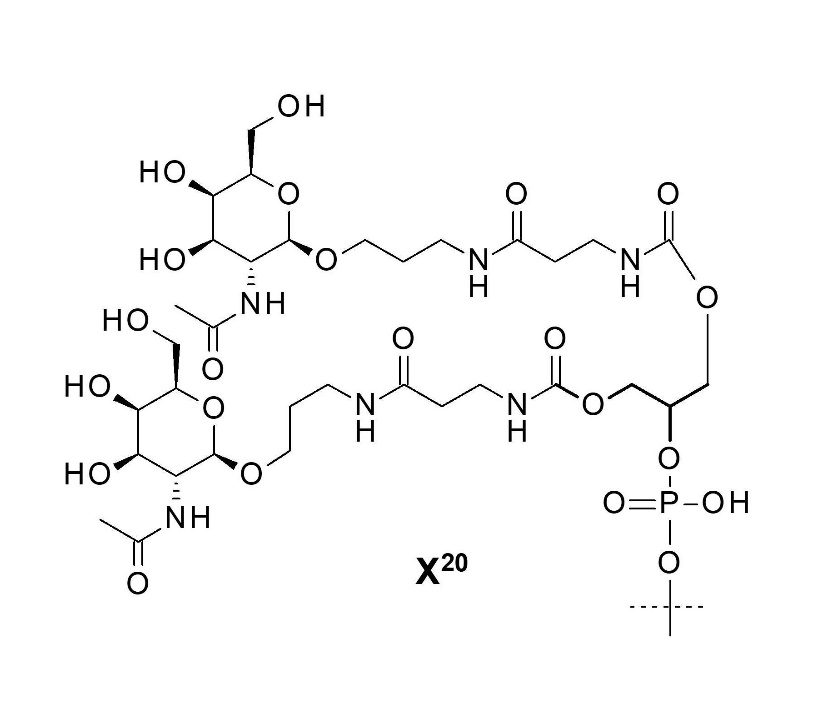
依據本發明,能夠有效率地分別製作複數之ENA單體。According to the present invention, a plurality of ENA monomers can be separately produced efficiently.
[用以實施發明的形態][Form to implement the invention]
進一步詳細說明本發明。The present invention will be described in further detail.
於本發明,Z1 及Z2 之「羥基的保護基」,以及α群組之「經保護的羥基」之保護基,係指能夠藉由如氫解、水解、電分解及光分解的化學方法或於人體內藉由水解等之生物學的方法而裂解的保護基。就此種保護基而言,可列舉例如,如甲醯基、乙醯基、丙醯基、丁醯基、異丁醯基、戊醯基、三甲基乙醯基、纈草醯基、異纈草醯基、辛醯基、壬醯基、癸醯基、3-甲基壬醯基、8-甲基壬醯基、3-乙基辛醯基、3,7-二甲基辛醯基、十一醯基、十二醯基、十三醯基、十四醯基、十五醯基、十六醯基、1-甲基十五醯基、14-甲基十五醯基、13,13-二甲基十四醯基、十七醯基、15-甲基十六醯基、十八醯基、1-甲基十七醯基、十九醯基、二十醯基及二十一醯基的烷基羰基;如琥珀醯基、戊二醯基、己二醯基的羧基化烷基羰基、氯乙醯基、二氯乙醯基、三氯乙醯基、三氟乙醯基的鹵低級烷基羰基;如甲氧基乙醯基的低級烷氧基低級烷基羰基,如(E)-2-甲基-2-丁烯醯基的不飽和烷基羰基之「脂肪族醯基」; 如苄醯基、α-萘甲醯基、β-萘甲醯基的芳基羰基;如2-溴苄醯基、4-氯苄醯基的鹵芳基羰基;如2,4,6-三甲基苄醯基、4-甲苯甲醯基的低級烷基化芳基羰基;如4-大茴香醯基的低級烷氧基化芳基羰基、2-羧基苄醯基、3-羧基苄醯基、4-羧基苄醯基的羧基化芳基羰基;如4-硝基苄醯基、2-硝基苄醯基的硝基化芳基羰基;如2-(甲氧基羰基)苄醯基的低級烷氧基羰基化芳基羰基;如4-苯基苄醯基的芳基化芳基羰基的「芳香族醯基」; 如四氫哌喃-2-基、3-溴四氫哌喃-2-基、4-甲氧基四氫哌喃-4-基、四氫噻喃-2-基、4-甲氧基四氫噻喃-4-基的「四氫哌喃基或四氫噻喃基」;如四氫呋喃-2-基、四氫噻吩-2-基的「四氫呋喃基或四氫噻吩基」; 如三甲基矽基、三乙基矽基、異丙基二甲基矽基、三級丁基二甲基矽基、甲基二異丙基矽基、甲基二-三級丁基矽基、三異丙基矽基的三低級烷基矽基;如二苯基甲基矽基、二苯基丁基矽基、二苯基異丙基矽基、苯基二異丙基矽基的經1至2個芳基取代的三低級烷基矽基之類的「矽基」; 如甲氧基甲基、1,1-二甲基-1-甲氧基甲基、乙氧基甲基、丙氧基甲基、異丙氧基甲基、丁氧基甲基、三級丁氧基甲基的「低級烷氧基甲基」; 如2-甲氧基乙氧基甲基的「低級烷氧基化低級烷氧基甲基」; 如2,2,2-三氯乙氧基甲基、雙(2-氯乙氧基)甲基的「鹵低級烷氧基甲基」; 如1-乙氧基乙基、1-(異丙氧基)乙基的「低級烷氧基乙基」; 如2,2,2-三氯乙基的「鹵化乙基」; 如苄基、α-萘基甲基、β-萘基甲基、二苯基甲基、三苯基甲基、α-萘基二苯基甲基、9-蒽基甲基的「經1至3個之芳基取代的甲基」; 如4-甲基苄基、2,4,6-三甲基苄基、3,4,5-三甲基苄基、4-甲氧基苄基、4-甲氧基苯基二苯基甲基、4,4’-二甲氧基三苯基甲基、2-硝基苄基、4-硝基苄基、4-氯苄基、4-溴苄基、4-氰基苄基的「芳基環被低級烷基、低級烷氧基、鹵素、氰基取代的經1至3個之芳基取代的甲基」; 如甲氧基羰基、乙氧基羰基、三級丁氧基羰基、異丁氧基羰基的「低級烷氧基羰基」; 如2,2,2-三氯乙氧基羰基、2-三甲基矽基乙氧基羰基的「經鹵素或三低級烷基矽基取代的低級烷氧基羰基」; 如乙烯氧基羰基、芳氧基羰基的「烯氧基羰基」; 如苄氧基羰基、4-甲氧基苄氧基羰基、3,4-二甲氧基苄氧基羰基、2-硝基苄氧基羰基、4-硝基苄氧基羰基的1至2個之「芳基環可經低級烷氧基或硝基取代的芳烷基氧基羰基」。In the present invention, the "protecting group of the hydroxyl group" of Z 1 and Z 2 and the "protected hydroxyl group" of the α group refer to chemical methods such as hydrogenolysis, hydrolysis, electrolysis, and photolysis. Methods or protective groups that are cleaved by biological methods such as hydrolysis in the human body. With regard to such protective groups, for example, formyl, acetyl, propionyl, butyryl, isobutyryl, pentamyl, trimethyl acetyl, valeryl, isovaleryl, , Octanoyl, nonanoyl, decanoyl, 3-methylnonanoyl, 8-methylnonanoyl, 3-ethyloctanoyl, 3,7-dimethyloctanoyl, undecanoyl, dodecanoyl Base, tridecyl Alkyl carbonyl groups of hexadecyl group, heptadecyl group, 15-methylhexadecyl group, octadecyl group, 1-methylheptadecanyl group, nonadecanyl group, arachidyl group and 21 acyl group; Such as carboxylated alkyl carbonyl groups such as succinyl, glutaryl, and hexamethylene diacyl groups, chloroacetinyl, dichloroacetinyl, trichloroacetinyl, and trifluoroacetinyl halo lower alkylcarbonyl groups; For example, the lower alkoxy lower alkylcarbonyl group of methoxyacetyl group, the "aliphatic acyl group" of unsaturated alkylcarbonyl group such as (E)-2-methyl-2-butenyl group; such as benzyl group Aryl carbonyl group, α-naphthocarboxyl, β-naphthocarboxyl; such as 2-bromobenzyl and 4-chlorobenzyl haloarylcarbonyl; like 2,4,6-trimethyl Benzyl, 4-tolyl lower alkylated arylcarbonyl; such as 4-anisyl lower alkoxylated arylcarbonyl, 2-carboxybenzyl, 3-carboxybenzyl, The carboxylated arylcarbonyl group of 4-carboxybenzyl; such as 4-nitrobenzyl, the nitroated arylcarbonyl of 2-nitrobenzyl; such as 2-(methoxycarbonyl)benzyl Lower alkoxycarbonylation arylcarbonyl; such as 4-phenylbenzyl arylcarbonyl "aromatic acyl"; such as tetrahydropiperan-2-yl, 3-bromotetrahydropiperan -2-yl, 4-methoxytetrahydropiperan-4-yl, tetrahydrothiopyran-2-yl, 4-methoxytetrahydrothiopyran-4-yl "tetrahydropiperanyl or tetrahydropyranyl Hydrothiopyranyl"; such as tetrahydrofuran-2-yl and tetrahydrothiophen-2-yl "tetrahydrofuranyl or tetrahydrothienyl"; such as trimethylsilyl, triethylsilyl, isopropyldimethylsilyl Tri-lower alkyl silyl groups of silyl, tertiary butyl dimethyl silyl, methyl diisopropyl silyl, methyl di-tertiary butyl silyl, triisopropyl silyl; such as diphenyl Tri-lower alkyl silyl substituted with 1 to 2 aryl groups such as methyl silyl, diphenyl butyl silyl, diphenyl isopropyl silyl, phenyl diisopropyl silyl, etc. "Silyl"; such as methoxymethyl, 1,1-dimethyl-1-methoxymethyl, ethoxymethyl, propoxymethyl, isopropoxymethyl, butoxy Methyl, tertiary butoxymethyl "lower alkoxymethyl"; such as 2-methoxyethoxymethyl "lower alkoxylated lower alkoxymethyl"; such as 2,2 ,2-Trichloroethoxymethyl, bis(2-chloroethoxy)methyl "halogen lower alkoxymethyl"; such as 1-ethoxyethyl, 1-(isopropoxy) Ethyl "lower alkoxyethyl"; such as 2,2,2-trichloroethyl "halogenated ethyl"; such as benzyl, α-naphthylmethyl, β-naphthylmethyl, diphenyl Methyl, triphenylmethyl, α-naphthyldiphenylmethyl, 9-anthracenyl Methyl "methyl substituted with 1 to 3 aryl groups"; such as 4-methylbenzyl, 2,4,6-trimethylbenzyl, 3,4,5-trimethylbenzyl, 4-methoxybenzyl, 4-methoxyphenyldiphenylmethyl, 4,4'-dimethoxytriphenylmethyl, 2-nitrobenzyl, 4-nitrobenzyl, 4-chlorobenzyl, 4-bromobenzyl, 4-cyanobenzyl, the aryl ring of which is substituted by lower alkyl, lower alkoxy, halogen, cyano, and 1 to 3 aryl groups. "Group"; such as methoxycarbonyl, ethoxycarbonyl, tertiary butoxycarbonyl, isobutoxycarbonyl "lower alkoxycarbonyl"; such as 2,2,2-trichloroethoxycarbonyl, 2 -"Lower alkoxycarbonyl substituted with halogen or tri-lower alkylsilyl" of trimethylsilylethoxycarbonyl; such as vinyloxycarbonyl, "alkenyloxycarbonyl" of aryloxycarbonyl; such as benzyl One or two of oxycarbonyl, 4-methoxybenzyloxycarbonyl, 3,4-dimethoxybenzyloxycarbonyl, 2-nitrobenzyloxycarbonyl, 4-nitrobenzyloxycarbonyl "Aralkyloxycarbonyl in which the aryl ring may be substituted with a lower alkoxy or nitro group".
於Z1 、Z2 之「羥基的保護基」,適合地為「脂肪族醯基」、「芳香族醯基」、「經1至3個之芳基取代的甲基」、「芳基環被低級烷基、低級烷氧基、鹵素、氰基取代之經1至3個之芳基取代的甲基」或「矽基」,更適合地為乙醯基、苄醯基、苄基、對甲氧基苄醯基、二甲氧基三苯甲基、單甲氧基三苯甲基或三級丁基二苯基矽基,進一步適合地為苄基。The "protective group of hydroxyl group" in Z 1 and Z 2 is suitably "aliphatic acyl group", "aromatic acyl group", "methyl substituted with 1 to 3 aryl groups", "aryl ring "Methyl" or "silyl" substituted with 1 to 3 aryl groups substituted by lower alkyl, lower alkoxy, halogen, cyano, and more suitably acetyl, benzyl, benzyl, P-methoxybenzyl, dimethoxytrityl, monomethoxytrityl or tertiary butyldiphenylsilyl, further suitably benzyl.
於α群組之「經保護的羥基」,為「脂肪族醯基」或「芳香族醯基」,更適合地為苄醯基。The "protected hydroxyl group" in the α group is an "aliphatic acyl group" or an "aromatic acyl group", and is more suitably a benzyl group.
於本發明,A、R1 及α群組之「低級烷基」係表示碳數1~6之直鏈或分支鏈狀的烷基,可列舉例如,甲基、乙基、正丙基、異丙基、正丁基、異丁基、二級丁基、三級丁基、正戊基、異戊基、2-甲基丁基、新戊基、1-乙基丙基、正己基、異己基、4-甲基戊基、3-甲基戊基、2-甲基戊基、1-甲基戊基、3,3-二甲基丁基、2,2-二甲基丁基、1,1-二甲基丁基、1,2-二甲基丁基、1,3-二甲基丁基、2,3-二甲基丁基、2-乙基丁基。In the present invention, the "lower alkyl group" of the group A, R 1 and α means a linear or branched alkyl group having 1 to 6 carbon atoms, for example, methyl, ethyl, n-propyl, Isopropyl, n-butyl, isobutyl, secondary butyl, tertiary butyl, n-pentyl, isopentyl, 2-methylbutyl, neopentyl, 1-ethylpropyl, n-hexyl , Isohexyl, 4-methylpentyl, 3-methylpentyl, 2-methylpentyl, 1-methylpentyl, 3,3-dimethylbutyl, 2,2-dimethylbutyl Group, 1,1-dimethylbutyl, 1,2-dimethylbutyl, 1,3-dimethylbutyl, 2,3-dimethylbutyl, 2-ethylbutyl.
就A之「低級烷基」而言,適合地為甲基、乙基或丙基,更適合地為甲基。As far as the "lower alkyl group" of A is concerned, it is suitably methyl, ethyl or propyl, and more suitably methyl.
就R1 之「低級烷基」而言,適合地為甲基。As for the "lower alkyl group" of R 1 , it is suitably a methyl group.
於本發明,α群組之「低級烷氧基」係表示上述「低級烷基」與氧原子結合的基,可列舉例如,甲氧基、乙氧基、正丙氧基、異丙氧基、正丁氧基、異丁氧基、二級丁氧基或三級丁氧基,適合地為甲氧基或乙氧基。In the present invention, the "lower alkoxy group" in the α group means the group in which the above-mentioned "lower alkyl group" is bonded to an oxygen atom, and examples include methoxy, ethoxy, n-propoxy, and isopropoxy. , N-butoxy, isobutoxy, secondary butoxy or tertiary butoxy, suitably methoxy or ethoxy.
於本發明,就α群組之「經保護的巰基」之保護基而言,可列舉例如,除上述羥基的保護基所列舉者之外,如甲硫基、乙硫基、三級丁硫基的烷硫基;如苄硫基的芳硫基等之「形成二硫化物(disulfide)的基」,適合地為「脂肪族醯基」或「芳香族醯基」,更適合地為苄醯基。In the present invention, as for the protecting group of the "protected mercapto group" of the α group, for example, in addition to those listed above for the protecting group of the hydroxyl group, such as methylthio, ethylthio, tertiary butylthio The alkylthio group of the benzylthio group; the "disulfide-forming group" such as the arylthio group of the benzylthio group, is suitably an "aliphatic acyl group" or an "aromatic acyl group", and is more suitably benzyl醯基.
於本發明,α群組之「低級烷硫基」係表示上述「低級烷基」與硫原子鍵結的基,可列舉例如,甲硫基、乙硫基、丙硫基、異丙硫基、丁硫基、異丁硫基、二級丁硫基、三級丁硫基,適合地為甲硫基或乙硫基。In the present invention, the "lower alkylthio group" in the α group means the group to which the aforementioned "lower alkyl group" is bonded to a sulfur atom, and examples include methylthio, ethylthio, propylthio, and isopropylthio , Butylthio, isobutylthio, secondary butylthio, tertiary butylthio, suitably methylthio or ethylthio.
於本發明,就α群組之「經保護的胺基」之保護基而言,可列舉例如,如甲醯基、乙醯基、丙醯基、丁醯基、異丁醯基、戊醯基、三甲基乙醯基、纈草醯基、異纈草醯基、辛醯基、壬醯基、癸醯基、3-甲基壬醯基、8-甲基壬醯基、3-乙基辛醯基、3,7-二甲基辛醯基、十一醯基、十二醯基、十三醯基、十四醯基、十五醯基、十六醯基、1-甲基十五醯基、14-甲基十五醯基、13,13-二甲基十四醯基、十七醯基、15-甲基十六醯基、十八醯基、1-甲基十七醯基、十九醯基、二十醯基及二十一醯基的烷基羰基;如琥珀醯基、戊二醯基、己二醯基的羧基化烷基羰基;如氯乙醯基、二氯乙醯基、三氯乙醯基、三氟乙醯基的鹵低級烷基羰基;如甲氧基乙醯基的低級烷氧基低級烷基羰基;如(E)-2-甲基-2-丁烯醯基的不飽和烷基羰基等之「脂肪族醯基」; 如苄醯基、α-萘甲醯基、β-萘甲醯基的芳基羰基;如2-溴苄醯基、4-氯苄醯基的鹵芳基羰基;如2,4,6-三甲基苄醯基、4-甲苯甲醯基的低級烷基化芳基羰基;如4-大茴香醯基的低級烷氧基化芳基羰基;如2-羧基苄醯基、3-羧基苄醯基、4-羧基苄醯基的羧基化芳基羰基;如4-硝基苄醯基、2-硝基苄醯基的硝基化芳基羰基;如2-(甲氧基羰基)苄醯基的低級烷氧基羰基化芳基羰基;如4-苯基苄醯基的芳基化芳基羰基等之「芳香族醯基」; 如甲氧基羰基、乙氧基羰基、三級丁氧基羰基、異丁氧基羰基的「低級烷氧基羰基」; 如2,2,2-三氯乙氧基羰基、2-三甲基矽基乙氧基羰基的「經鹵素或三低級烷基矽基取代的低級烷氧基羰基」; 如乙烯氧基羰基、芳氧基羰基的「烯氧基羰基」; 如苄氧基羰基、4-甲氧基苄氧基羰基、3,4-二甲氧基苄氧基羰基、2-硝基苄氧基羰基、4-硝基苄氧基羰基的可經1至2個之「低級烷氧基或硝基取代芳基環的芳烷氧基羰基」,適合地為「脂肪族醯基」或「芳香族醯基」,更適合地為苄醯基。In the present invention, as for the protecting group of the "protected amino group" of the α group, for example, for example, formyl, acetyl, propionyl, butyryl, isobutyryl, pentamyl, trimethyl Acetyl, valeryl, isovaleryl, octyl, nonyl, decyl, 3-methylnonyl, 8-methylnonyl, 3-ethyloctyl, 3, 7-Dimethyloctyl, undecyl, dodecyl, tridecyl, tetradecyl, pentadecyl, hexadecyl, 1-methylpentadecyl, 14-methyl Pentadecyl, 13,13-dimethyltetradecyl, heptadecyl, 15-methylhexadecyl, octadecyl, 1-methyl heptadecyl, nonadenosyl, Alkylcarbonyl groups of eicosanyl and icosanoyl; carboxylated alkylcarbonyl groups such as succinyl, pentanedionyl, and hexadioic acid; such as chloroacetoxy, dichloroacetoxy, trichloro Acetyl, halogen lower alkylcarbonyl of trifluoroacetyl; lower alkoxy lower alkylcarbonyl such as methoxyacetyl; such as (E)-2-methyl-2-butenyl "Aliphatic acyl groups" such as unsaturated alkylcarbonyl groups; Such as benzyl, α-naphthoyl, β-naphthoyl arylcarbonyl; such as 2-bromobenzyl, 4-chlorobenzyl haloaryl carbonyl; such as 2,4,6- Trimethylbenzyl, 4-tolyl lower alkylated arylcarbonyl; such as 4-anisyl lower alkoxylated arylcarbonyl; such as 2-carboxybenzyl, 3-carboxyl Carboxylated arylcarbonyl group of benzyl and 4-carboxybenzyl; such as 4-nitrobenzyl and nitroated arylcarbonyl of 2-nitrobenzyl; such as 2-(methoxycarbonyl) The lower alkoxycarbonylated arylcarbonyl group of the benzyl group; such as the "aromatic acyl group" such as the arylated arylcarbonyl group of the 4-phenylbenzyl group; Such as methoxycarbonyl, ethoxycarbonyl, tertiary butoxycarbonyl, isobutoxycarbonyl "lower alkoxycarbonyl"; Such as 2,2,2-trichloroethoxycarbonyl, 2-trimethylsilylethoxycarbonyl "lower alkoxycarbonyl substituted with halogen or tri-lower alkylsilyl"; Such as vinyloxycarbonyl, aryloxycarbonyl "alkenoxycarbonyl"; Such as benzyloxycarbonyl, 4-methoxybenzyloxycarbonyl, 3,4-dimethoxybenzyloxycarbonyl, 2-nitrobenzyloxycarbonyl, 4-nitrobenzyloxycarbonyl can pass 1 Up to two "aralkyloxycarbonyl groups with lower alkoxy or nitro substituted aryl rings" are suitably "aliphatic acyl groups" or "aromatic acyl groups", and more suitably benzyl groups.
於本發明,α群組之「低級烷基胺基」係表示胺基之1個或2個之氫原子經上述「低級烷基」取代的基,可列舉例如,甲基胺基、乙基胺基、丙基胺基、異丙基胺基、丁基胺基、異丁基胺基、二級丁基胺基、三級丁基胺基、二甲基胺基、二乙基胺基、二丙基胺基、二異丙基胺基、二丁基胺基、二異丁基胺基、二(二級丁基)胺基、二(三級丁基)胺基,適合地為甲基胺基、乙基胺基、二甲基胺基、二乙基胺基或二異丙基胺基。In the present invention, the "lower alkylamino group" in the α group means a group in which one or two hydrogen atoms of the amino group are substituted by the above-mentioned "lower alkyl group", and examples include methylamino and ethyl Amino, propylamino, isopropylamino, butylamino, isobutylamino, secondary butylamino, tertiary butylamino, dimethylamino, diethylamino , Dipropylamino, diisopropylamino, dibutylamino, diisobutylamino, di(secondarybutyl)amino, di(tertiarybutyl)amino, suitably Methylamino, ethylamino, dimethylamino, diethylamino or diisopropylamino.
於本發明,就X1 、X2 及α群組之「鹵素原子」而言,可列舉例如,氟原子、氯原子、溴原子或碘原子。In the present invention, the "halogen atom" of the group X 1 , X 2 and α includes, for example, a fluorine atom, a chlorine atom, a bromine atom, or an iodine atom.
於本發明,就X1 及X2 之「形成脫離基的基」而言,可列舉例如,鹵素原子、脂肪族醯氧基、鹵素取代的低級烷基亞胺氧基或鹵素取代的低級烷基磺醯氧基。In the present invention, the "group forming a leaving group" of X 1 and X 2 includes, for example, a halogen atom, an aliphatic oxy group, a halogen-substituted lower alkyliminooxy group, or a halogen-substituted lower alkyl group. Sulfonoxy.
於X1 之「形成脫離基的基」中,適合地為碘原子、乙醯氧基或三氯乙醯亞胺氧基。X 1 in the "group formed from the group of" medium, suitably an iodine atom, an acetyl group, an imine group or trichloromethyl acetyl.
於X2 之「形成脫離基的基」中,適合地為乙醯氧基。In the "group forming a leaving group" of X 2, it is suitably an acetoxy group.
於本發明,就Y之「經1至3個之芳基取代的甲基」而言,可列舉例如,苄基、α-萘基甲基、β-萘基甲基、二苯基甲基、三苯甲基、α-萘基二苯基甲基或9-蒽基甲基,適合地為三苯甲基。In the present invention, the "methyl substituted with 1 to 3 aryl groups" of Y includes, for example, benzyl, α-naphthylmethyl, β-naphthylmethyl, and diphenylmethyl , Trityl, α-naphthyldiphenylmethyl or 9-anthrylmethyl, suitably trityl.
於本發明,Y之「低級烷基、低級烷氧基、芳基環被鹵素或氰基取代之經1至3個之芳基取代的甲基」,可列舉例如,4-甲基苄基、2,4,6-三甲基苄基、3,4,5-三甲基苄基、4-甲氧基苄基、4-甲氧基苯基二苯基甲基、4、4’-二甲氧基三苯基甲基(4、4’-二甲氧基三苯甲基)、2-硝基苄基、4-硝基苄基、4-氯苄基、4-溴苄基或4-氰基苄基。In the present invention, the "lower alkyl group, lower alkoxy group, aryl ring substituted by halogen or cyano group substituted by 1 to 3 aryl groups of the methyl group", for example, 4-methylbenzyl , 2,4,6-trimethylbenzyl, 3,4,5-trimethylbenzyl, 4-methoxybenzyl, 4-methoxyphenyldiphenylmethyl, 4, 4' -Dimethoxytriphenylmethyl (4, 4'-dimethoxytrityl), 2-nitrobenzyl, 4-nitrobenzyl, 4-chlorobenzyl, 4-bromobenzyl Or 4-cyanobenzyl.
於本發明,Y之「低級烷氧基甲基」係指甲基與上述「低級烷氧基」結合的基。可列舉例如,甲氧基甲基、1,1-二甲基-1-甲氧基甲基、乙氧基甲基、丙氧基甲基、異丙氧基甲基、丁氧基甲基、三級丁氧基甲基,適合地為甲氧基甲基。In the present invention, the "lower alkoxymethyl group" of Y refers to a group in which a methyl group is combined with the aforementioned "lower alkoxy group". For example, methoxymethyl, 1,1-dimethyl-1-methoxymethyl, ethoxymethyl, propoxymethyl, isopropoxymethyl, butoxymethyl , Tertiary butoxymethyl, suitably methoxymethyl.
於本發明,就Y之「四氫哌喃基」而言,可列舉例如,四氫哌喃-2-基、3-溴四氫哌喃-2-基或4-甲氧基四氫哌喃-4-基,適合地為四氫哌喃-2-基。In the present invention, the "tetrahydropiperanyl" of Y includes, for example, tetrahydropiperan-2-yl, 3-bromotetrahydropiperan-2-yl or 4-methoxytetrahydropiperanyl Pyran-4-yl, suitably tetrahydropiperan-2-yl.
於本發明,就Y之「矽基」而言,可列舉例如,如三甲基矽基、三乙基矽基、異丙基二甲基矽基、三級丁基二甲基矽基、甲基二異丙基矽基、甲基二-三級丁基矽基、三異丙基矽基的三低級烷基矽基;如二苯基甲基矽基、二苯基丁基矽基、二苯基異丙基矽基、苯基二異丙基矽基的經1至2個之芳基取代的三低級烷基矽基,適合地為三級丁基二苯基矽基或三級丁基二甲基矽基。In the present invention, the "silyl" of Y includes, for example, trimethylsilyl, triethylsilyl, isopropyldimethylsilyl, tertiary butyldimethylsilyl, Tri-lower alkyl silyl groups of methyl diisopropyl silyl, methyl di-tertiary butyl silyl, triisopropyl silyl; such as diphenyl methyl silyl, diphenyl butyl silyl , Diphenylisopropylsilyl, phenyldiisopropylsilyl, tri-lower alkylsilyl substituted with 1 to 2 aryl groups, suitably tertiary butyldiphenylsilyl or tris Grade butyl dimethyl silyl.
P1 之「可經1至3個之低級烷氧基取代的三苯甲基」係指三苯甲基中的苯基之1至3個氫原子經上述「低級烷氧基」取代的基,可列舉例如,三苯甲基、單甲氧基三苯甲基或二甲氧基三苯甲基,適合地為4,4’-二甲氧基三苯甲基。The "trityl group which may be substituted by 1 to 3 lower alkoxy groups" in P 1 refers to a group in which 1 to 3 hydrogen atoms of the phenyl group in the trityl group are substituted by the aforementioned "lower alkoxy groups" , For example, trityl, monomethoxytrityl or dimethoxytrityl, suitably 4,4'-dimethoxytrityl.
於本發明,就R、R3 、R4 、R6 及Z3 之「脂肪族醯基」而言,可列舉例如,如甲醯基、乙醯基、丙醯基、丁醯基、異丁醯基、戊醯基、三甲基乙醯基、纈草醯基、異纈草醯基、辛醯基、壬醯基、癸醯基、3-甲基壬醯基、8-甲基壬醯基、3-乙基辛醯基、3,7-二甲基辛醯基、十一醯基、十二醯基、十三醯基、十四醯基、十五醯基、十六醯基、1-甲基十五醯基、14-甲基十五醯基、13,13-二甲基十四醯基、十七醯基、15-甲基十六醯基、十八醯基、1-甲基十七醯基、十九醯基、二十醯基及二十一醯基的烷基羰基;如琥珀醯基、戊二醯基、己二醯基的羧基化烷基羰基;如氯乙醯基、二氯乙醯基、三氯乙醯基、三氟乙醯基的鹵低級烷基羰基;如甲氧基乙醯基的低級烷氧基低級烷基羰基;如(E)-2-甲基-2-丁烯醯基的不飽和烷基羰基。In the present invention, as for the "aliphatic aliphatic group" of R, R 3 , R 4 , R 6 and Z 3 , for example, for example, formyl, acetyl, propionyl, butyryl, isobutyryl, Pentanyl, trimethylacetyl, valeryl, isovaleryl, octyl, nonanyl, decanoyl, 3-methylnonanyl, 8-methylnonanyl, 3- Ethyl octyl, 3,7-dimethyl octyl, undecyl, dodecyl, tridecyl, tetradecyl, pentadecyl, hexadecyl, 1-methylpentadecyl Group, 14-methylpentadecanoyl, 13,13-dimethyl tetradecanoyl, heptadecanoyl, 15-methylhexadecanoyl, octadecanoyl, 1-methylheptadecanyl Alkyl carbonyl groups such as succinyl, pentane and hexadioic acid groups; such as carboxylated alkyl carbonyl groups of succinyl, pentane, and hexadioic acid groups; such as chloroacetyl and dichloro Halo-lower alkylcarbonyl groups such as acetyl, trichloroacetyl and trifluoroacetyl; lower alkoxy lower alkylcarbonyl such as methoxyacetyl; such as (E)-2-methyl-2 -Unsaturated alkyl carbonyl of butenyl.
就R、R3 、R6 及Z3 之「脂肪族醯基」而言,適合地為乙醯基。As far as the "aliphatic acyl groups" of R, R 3 , R 6 and Z 3 are concerned, they are suitably acetyl groups.
就R4 之「脂肪族醯基」而言,適合地為異丁醯基。As far as the "aliphatic acyl group" of R 4 is concerned, it is suitably an isobutyl acyl group.
於本發明,就R3 、R4 、R6 及Z3 之「芳香族醯基」而言,可列舉例如,如苄醯基、α-萘甲醯基、β-萘甲醯基的芳基羰基;如2-溴苄醯基、4-氯苄醯基的鹵芳基羰基;如2,4,6-三甲基苄醯基、4-甲苯甲醯基的低級烷基化芳基羰基;如4-大茴香醯基的低級烷氧基化芳基羰基;如2-羧基苄醯基、3-羧基苄醯基、4-羧基苄醯基的羧基化芳基羰基;如4-硝基苄醯基、2-硝基苄醯基的硝基化芳基羰基;如2-(甲氧基羰基) 苄醯基的低級烷氧基羰基化芳基羰基;如4-苯基苄醯基的芳基化芳基羰基。In the present invention, with regard to the "aromatic acyl groups" of R 3 , R 4 , R 6 and Z 3 , for example, aromatic groups such as benzyl, α-naphthyl and β-naphthyl Carbonyl; such as 2-bromobenzyl, 4-chlorobenzyl and haloarylcarbonyl; such as 2,4,6-trimethylbenzyl, 4-tolyl and lower alkylated aryl groups Carbonyl; such as the lower alkoxylated arylcarbonyl group of 4-anisyl; such as 2-carboxybenzyl, 3-carboxybenzyl, and carboxylated arylcarbonyl of 4-carboxybenzyl; such as 4- Nitrobenzyl, 2-nitrobenzyl nitrated arylcarbonyl; such as 2-(methoxycarbonyl) benzyl lower alkoxycarbonylated arylcarbonyl; such as 4-phenylbenzyl Arylation of an acyl group is an arylcarbonyl group.
就R3 、R4 、R6 及Z3 之「芳香族醯基」而言,適合地為苄醯基。As for the "aromatic acyl group" of R 3 , R 4 , R 6 and Z 3 , it is suitably a benzyl group.
於本發明,R2 之「經脂肪族醯基或芳香族醯基保護的胺基」係表示胺基經上述「脂肪族醯基」或「芳香族醯基」取代的基。就R2 之「經脂肪族醯基保護的胺基」而言,可列舉例如,甲醯基胺基、乙醯基胺基、丙醯基胺基、丁醯基胺基、異丁醯基胺基、戊醯基胺基、三甲基乙醯基胺基、纈草醯基胺基、氯乙醯基胺基、二氯乙醯基胺基、三氯乙醯基胺基、三氟乙醯基胺基、甲氧基乙醯基胺基或(E)-2-甲基-2-丁烯醯基胺基。就R2 之「經芳香族醯基保護的胺基」而言,可列舉例如,苄醯基胺基、α-萘甲醯基胺基、β-萘甲醯基胺基、2-溴苄醯基胺基、4-氯苄醯基胺基、2,4,6-三甲基苄醯基胺基、4-甲苯甲醯基胺基、4-大茴香醯基胺基、2-羧基苄醯基胺基、3-羧基苄醯基胺基、4-羧基苄醯基胺基、4-硝基苄醯基胺基、2-硝基苄醯基胺基、2-(甲氧基羰基)苄醯基胺基或4-苯基苄醯基胺基,適合地為苄醯基胺基。In the present invention, the "amino group protected with an aliphatic acyl group or an aromatic acyl group" in R 2 means a group in which the amine group is substituted with the aforementioned "aliphatic acyl group" or "aromatic acyl group". With regard to the "aliphatic acylamino group protected by R 2 ", for example, formylamino group, acetylamino group, propionylamino group, butyrylamino group, isobutyrylamino group, pentylamino group can be enumerated. Acetylamino, trimethylacetylamino, valerianylamino, chloroacetamide, dichloroacetamide, trichloroacetamide, trifluoroacetamide Group, methoxyacetamido or (E)-2-methyl-2-butenamido. As for the "amino group protected by an aromatic acyl group" of R 2 , for example, benzylamino, α-naphthylamino, β-naphthylamino, 2-bromobenzyl Amino, 4-chlorobenzylamino, 2,4,6-trimethylbenzylamino, 4-tolylamino, 4-anisylamino, 2-carboxyl Benzylamino, 3-carboxybenzylamino, 4-carboxybenzylamino, 4-nitrobenzylamino, 2-nitrobenzylamino, 2-(methoxy Carbonyl) benzylamino or 4-phenylbenzylamino, suitably benzylamino.
於本發明,就R5 之「可經低級烷基、低級烷氧基、鹵素或氰基取代的苄基」而言,可列舉例如,苄基、4-甲基苄基、2,4,6-三甲基苄基、3,4,5-三甲基苄基、4-甲氧基苄基、4-氯苄基、4-溴苄基或4-氰基苄基,適合地為苄基。In the present invention, the "benzyl group which may be substituted with lower alkyl, lower alkoxy, halogen or cyano" of R 5 includes, for example, benzyl, 4-methylbenzyl, 2,4, 6-trimethylbenzyl, 3,4,5-trimethylbenzyl, 4-methoxybenzyl, 4-chlorobenzyl, 4-bromobenzyl or 4-cyanobenzyl, suitably Benzyl.
上述通式(XXVII)及(XXVIII)中,B之「可具有選自α群組的1或2個以上之取代基的嘌呤-9-基」,適合地為6-胺基嘌呤-9-基(即,腺嘌呤基)、胺基經保護的6-胺基嘌呤-9-基、2,6-二胺基嘌呤-9-基、2-胺基-6-氯嘌呤-9-基、胺基經保護的2-胺基-6-氯嘌呤-9-基、2-胺基-6-氟嘌呤-9-基、胺基經保護的2-胺基-6-氟嘌呤-9-基、2-胺基-6-溴嘌呤-9-基、胺基經保護的2-胺基-6-溴嘌呤-9-基、2-胺基-6-羥基嘌呤-9-基(即,鳥嘌呤基)、胺基經保護的2-胺基-6-羥基嘌呤-9-基、胺基及羥基經保護的2-胺基-6-羥基嘌呤-9-基、6-胺基-2-甲氧基嘌呤-9-基、6-胺基-2-氯嘌呤-9-基、6-胺基-2-氟嘌呤-9-基、2,6-二甲氧基嘌呤-9-基、2,6-二氯嘌呤-9-基或6-巰基嘌呤-9-基,更適合地為胺基經保護的6-胺基嘌呤-9-基或胺基經保護的2-胺基-6-羥基嘌呤-9-基,進一步更適合地為6-苄醯基胺基嘌呤-9-基或2-異丁醯基胺基-6-羥基嘌呤-9-基。In the above general formulas (XXVII) and (XXVIII), the "purin-9-yl group which may have 1 or 2 or more substituents selected from the α group" of B is suitably 6-aminopurin-9- Group (ie, adeninyl), 6-aminopurin-9-yl with protected amine group, 2,6-diaminopurin-9-yl, 2-amino-6-chloropurin-9-yl , 2-amino-6-chloropurin-9-yl with protected amino group, 2-amino-6-fluoropurin-9-yl, 2-amino-6-fluoropurin-9 with protected amino group -Group, 2-amino-6-bromopurin-9-yl, amine protected 2-amino-6-bromopurin-9-yl, 2-amino-6-hydroxypurin-9-yl ( That is, guaninyl), 2-amino-6-hydroxypurin-9-yl with protected amine group, 2-amino-6-hydroxypurin-9-yl with protected amine and hydroxyl group, 6-amine 2-methoxypurin-9-yl, 6-amino-2-chloropurin-9-yl, 6-amino-2-fluoropurin-9-yl, 2,6-dimethoxypurine -9-yl, 2,6-dichloropurin-9-yl or 6-mercaptopurin-9-yl, more suitably 6-aminopurin-9-yl or amino-protected amino group The 2-amino-6-hydroxypurin-9-yl group is further more suitably 6-benzylaminopurin-9-yl or 2-isobutyrylamino-6-hydroxypurin-9-yl.
上述通式(XXVII)及(XXVIII)中,B之「可具有選自α群組的1或2個以上之取代基的2-側氧基-嘧啶-1-基」,適合地為2-側氧基-4-胺基-嘧啶-1-基(即,胞嘧啶基)、胺基經保護的2-側氧基-4-胺基-嘧啶-1-基、2-側氧基-4-胺基-5-氟-嘧啶-1-基、胺基經保護的2-側氧基-4-胺基-5-氟-嘧啶-1-基、4-胺基-2-側氧基-5-氯-嘧啶-1-基、2-側氧基-4-甲氧基-嘧啶-1-基、2-側氧基-4-巰基-嘧啶-1-基、2-側氧基-4-羥基-嘧啶-1-基(即,尿嘧啶基)、2-側氧基-4-羥基-5-甲基嘧啶-1-基(即,胸腺嘧啶基)、4-胺基-5-甲基-2-側氧基-嘧啶-1-基(即,5-甲基胞嘧啶基)、胺基經保護的4-胺基-5-甲基-2-側氧基-嘧啶-1-基,更適合地為2-側氧基-4-羥基-5-甲基嘧啶-1-基、胺基經保護的2-側氧基-4-胺基-嘧啶-1-基或胺基經保護的4-胺基-5-甲基-2-側氧基-嘧啶-1-基,進一步更適合地為2-側氧基-4-羥基-5-甲基嘧啶-1-基、2-側氧基-4-苄醯基胺基-嘧啶-1-基或4-苄醯基胺基-5-甲基-2-側氧基-嘧啶-1-基。In the above general formulas (XXVII) and (XXVIII), the "2-side oxy-pyrimidin-1-yl group which may have 1 or 2 or more substituents selected from the α group" of B is suitably 2- Pendant oxy-4-amino group-pyrimidin-1-yl (ie, cytosine group), amine protected 2-side oxy-4-amino group-pyrimidin-1-yl, 2-side oxy group- 4-amino-5-fluoro-pyrimidin-1-yl, amino group protected 2-side oxy-4-amino-5-fluoro-pyrimidin-1-yl, 4-amino-2-side oxygen Group-5-chloro-pyrimidin-1-yl, 2-side oxy-4-methoxy-pyrimidin-1-yl, 2-side oxy-4-mercapto-pyrimidin-1-yl, 2-side oxy 4-hydroxy-pyrimidin-1-yl (ie, uracil), 2-side oxy-4-hydroxy-5-methylpyrimidin-1-yl (ie, thymine), 4-amino -5-methyl-2-pendant oxy-pyrimidin-1-yl (ie, 5-methylcytosine), 4-amino-5-methyl-2-pendant protected amine group- Pyrimidine-1-yl, more suitably 2-lateral oxy-4-hydroxy-5-methylpyrimidin-1-yl, 2-side oxy-4-amino-pyrimidine-1- with protected amino group Group or amino group protected 4-amino-5-methyl-2-oxo-pyrimidin-1-yl, further more suitably 2-oxo-4-hydroxy-5-methylpyrimidine- 1-yl, 2-pendant 4-benzylamino-pyrimidin-1-yl or 4-benzylamino-5-methyl-2-pendant-pyrimidin-1-yl.
於本發明,n為0至4之整數,適合地為0或1,更適合地為1。In the present invention, n is an integer from 0 to 4, suitably 0 or 1, more suitably 1.
「其鹽」係指因本發明之化合物可作成鹽,故稱其鹽,就如此的鹽而言,適合地可列舉如鈉鹽、鉀鹽、鋰鹽的鹼金屬鹽;如鈣鹽、鎂鹽的鹼土金屬鹽;如鋁鹽、鐵鹽、鋅鹽、銅鹽、鎳鹽、鈷鹽等之金屬鹽;如銨鹽的無機鹽;如三級辛基胺鹽、二苄基胺鹽、

於本發明,胸腺嘧碇衍生物、或鳥嘌呤衍生物之羰基可為「互變異構物」。互變異構物係指以平衡狀態存在的2種以上之結構異構物的1種,由某一異構物容易轉化成另一種異構物,且呈溶液中之互變異構物組的混合物而存在。於互變異構化為可能的條件下,達到互變異構物之化學平衡,但其正確比率受到包含溫度、溶媒及pH的數個要因左右。藉由互變異構物化而可相互轉換的互變異構物的概念,稱為互變異構性。In the present invention, the carbonyl group of a thymine derivative or a guanine derivative may be a "tautomer". Tautomers refer to one of two or more structural isomers that exist in an equilibrium state, which is easily converted from one isomer to another isomer, and is a mixture of tautomeric groups in solution And exist. Under the condition that tautomerization is possible, the chemical equilibrium of tautomers is reached, but the correct ratio is influenced by several factors including temperature, solvent and pH. The concept of tautomers that can be converted into each other through tautomerization is called tautomerism.
胸腺嘧碇衍生物及鳥嘌呤衍生物中的醯胺-醯亞胺酸互變異構之例,如以下所示。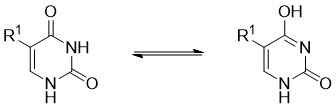
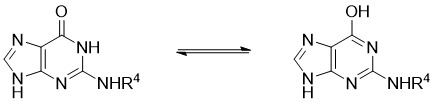
於本發明,「羥基之保護試藥」係指對核苷類似物及其製造中間體所具有的羥基,用以導入前述「羥基之保護基」的試藥。例如,「羥基之保護基」為: (1)苄基之情形:氯甲苯、溴甲苯、苄基碘、三氯乙醯亞胺苄酯(benzyl trichloroacetimidate) (2)三苯甲基之情形:三苯氯甲烷(trityl chloride)、三苯甲基三氟磺酸酯、 (3)三級丁基二甲基矽基之情形:氯化三級丁基二甲基矽基、 (4)乙醯基之情形:乙酸酐、乙醯氯。In the present invention, the "hydroxyl protective reagent" refers to the reagent used to introduce the aforementioned "hydroxyl protective group" to the hydroxyl group of the nucleoside analog and its production intermediates. For example, the "protecting group of hydroxyl group" is: (1) In the case of benzyl: chlorotoluene, bromotoluene, benzyl iodide, benzyl trichloroacetimidate (benzyl trichloroacetimidate) (2) In the case of trityl: trityl chloride, trityl trifluorosulfonate, (3) In the case of tertiary butyl dimethyl silyl: chloride tertiary butyl dimethyl silyl, (4) The case of acetyl group: acetic anhydride, acetyl chloride.
於本發明,「1級羥基之保護試藥」係指用於對核苷類似物之5位的糖羥基導入上述「可經1至3個之低級烷氧基取代的三苯甲基」的試藥,可列舉例如,三苯氯甲烷、三苯甲基三氟磺酸酯、4-單甲氧基三苯氯甲烷、4,4’-二甲氧基三苯氯甲烷、4,4’-二甲氧基三苯甲基三氟磺酸酯,適合地為4,4’-二甲氧基三苯氯甲烷。In the present invention, the "reagent for protecting the first-order hydroxyl group" refers to the "trityl group that can be substituted with 1 to 3 lower alkoxy groups" to the sugar hydroxyl group at the 5-position of nucleoside analogues. The reagents include, for example, triphenylchloromethane, trityl trifluorosulfonate, 4-monomethoxytriphenylchloromethane, 4,4'-dimethoxytriphenylchloromethane, 4,4 '-Dimethoxytrityl trifluorosulfonate is suitably 4,4'-dimethoxytrityl chloride.
於本發明,「羥基之去保護試藥」係指為了使上述「羥基之保護基」脫離而添加的反應助劑,可列舉例如,「羥基之保護基」為 (1)苄基之情形:鈀、氫氧化鈀、鉑等之金屬觸媒及氫、甲酸、甲酸銨等之還原劑、氯化鐵(III)、三氯化硼 (2)三苯甲基之情形:硫酸、對甲苯磺酸、甲磺酸等之酸觸媒 (3)乙醯基之情形:氫氧化鈉、氫氧化鉀、碳酸鈉等之無機鹼、氨、烷基胺等之有機鹼。In the present invention, the "reagent for deprotection of hydroxyl group" refers to a reaction aid added in order to detach the above-mentioned "protective group of hydroxyl group". For example, the "protective group of hydroxyl group" is (1) In the case of benzyl: metal catalysts such as palladium, palladium hydroxide, platinum, and reducing agents such as hydrogen, formic acid, ammonium formate, iron (III) chloride, and boron trichloride (2) In the case of trityl: acid catalysts such as sulfuric acid, p-toluenesulfonic acid, methanesulfonic acid, etc. (3) In the case of acetyl groups: inorganic bases such as sodium hydroxide, potassium hydroxide, and sodium carbonate, and organic bases such as ammonia and alkylamines.
於本發明,金屬觸媒可為承載於載體(適合地為碳)或未承載於載體上的金屬觸媒,適合地為承載於碳上的金屬觸媒(適合地為承載於碳上的鈀、氫氧化鈀、或鉑,更適合地為承載於碳上的鈀)。In the present invention, the metal catalyst may be a metal catalyst carried on a carrier (suitably carbon) or not carried on a carrier, and suitably a metal catalyst carried on carbon (suitably a palladium carried on carbon). , Palladium hydroxide, or platinum, more suitably palladium on carbon).
於本發明,「醯化劑」係指用以對核苷類似物之胺基導入上述「胺基之保護基」所使用的試藥,例如, (1)乙醯基之情形:乙酸酐、乙醯氯 (2)苄醯基之情形:苯甲醯氯、苯甲酸酐、苯甲酸 (3)異丁醯基之情形:氯異丁烷異丁酸酐。In the present invention, the "acylating agent" refers to a reagent used to introduce the above-mentioned "protecting group of amine group" to the amine group of a nucleoside analog, for example, (1) In the case of acetyl group: acetic anhydride, acetyl chloride (2) The case of benzyl group: benzoic acid chloride, benzoic anhydride, benzoic acid (3) In the case of isobutyryl: chloroisobutane isobutyric anhydride.
於本發明,「胺基化劑」係指用以將嘌呤環之6位之氯原子或嘧啶環之4位之羰基取代為胺基所使用的試藥,例如,氨、氨水溶液或如碳酸銨、乙酸銨的氨鹽類,適合地為氨水溶液。In the present invention, "aminating agent" refers to a reagent used to replace the chlorine atom at the 6 position of the purine ring or the carbonyl group at the 4 position of the pyrimidine ring with an amine group, such as ammonia, aqueous ammonia solution, or carbonic acid Ammonia salts of ammonium and ammonium acetate are suitably an aqueous ammonia solution.
於本發明,「醯胺化劑」係指於交叉偶合反應中用於將嘌呤環之6位之氯原子轉換為脂肪族醯胺或芳香族醯胺所使用的試藥,例如,乙醯基醯胺、苄醯基醯胺、異丁基醯胺,適合地為異丁基醯胺。In the present invention, the "aminated agent" refers to a reagent used in the cross-coupling reaction to convert the 6-position chlorine atom of the purine ring into aliphatic or aromatic amides, for example, acetyl group Amide, benzylamide, isobutylamide, suitably isobutylamide.
於本發明,醣基化反應中的「活化劑」係指用以將糖之1位之羥基轉換為上述「形成脫離基的基」所使用的試藥,例如,乙酸酐、苯甲酸酐、三氯乙腈、羰基二咪唑、氯磷酸二苯酯,適合地為乙酸酐或三氯乙腈。In the present invention, the "activator" in the glycosylation reaction refers to the reagent used to convert the hydroxyl group at the 1-position of the sugar into the aforementioned "group forming a leaving group", such as acetic anhydride, benzoic anhydride, Trichloroacetonitrile, carbonyldiimidazole, diphenyl chlorophosphate, suitably acetic anhydride or trichloroacetonitrile.
於本發明,醣基化反應中的「鹵化劑」係指為了使立體選擇性地進行醣基化反應、為了將上述「形成脫離基的基」鹵化而使用的試藥,可列舉例如氯三甲基矽烷(TMSCl)、溴三甲基矽烷(TMSBr)、碘三甲基矽烷(TMSI),適合地為TMSI。In the present invention, the "halogenating agent" in the glycosylation reaction refers to a reagent used in order to stereoselectively perform the glycosylation reaction and to halogenate the above-mentioned "group forming a leaving group". Methylsilane (TMSCl), bromotrimethylsilane (TMSBr), iodotrimethylsilane (TMSI) are suitably TMSI.
於本發明,胺基化反應中的「活化劑」係指用以將羥基轉換為脫離基所使用的試藥,例如,對甲苯磺醯氯、2,4,6-三異丙基苯磺醯氯,適合地為2,4,6-三異丙基苯磺醯氯。In the present invention, the "activator" in the amination reaction refers to the reagent used to convert the hydroxyl group into the leaving group, for example, p-toluenesulfonyl chloride, 2,4,6-triisopropylbenzenesulfonate The chlorine is suitably 2,4,6-triisopropylbenzenesulfonyl chloride.
於本發明,AMIDITE化反應中的「活化劑」係用以形成AMIDITE試藥之活性中間體所使用的試藥,可列舉例如,5-苄硫基四唑、5-苯基四唑、二溴咪唑、二氰基咪唑、N-烷基咪唑三氟乙酸鹽等,適合地為4,5-二氰基咪唑。使用的活化劑之量,相對於通式(XXVII)之化合物,為0.01~1.0當量,較佳為0.1~0.5當量。In the present invention, the "activator" in the AMIDITE reaction is the reagent used to form the active intermediate of the AMIDITE reagent. Examples include 5-benzylthiotetrazole, 5-phenyltetrazole, and two Bromidazole, dicyanoimidazole, N-alkylimidazole trifluoroacetate, etc. are suitably 4,5-dicyanoimidazole. The amount of the activator used is 0.01 to 1.0 equivalent, preferably 0.1 to 0.5 equivalent relative to the compound of the general formula (XXVII).
於本發明,AMIDITE化反應中的「AMIDITE化試藥」係指用以於核苷類似物之3位之糖羥基,導入含有用以形成核苷間鍵結的磷原子的基的試藥,可列舉例如,2-氰基乙基N,N,N’,N’-四異丙基亞磷醯二胺、2-氰基乙基二異丙基氯亞磷醯胺,適合地為2-氰基乙基N,N,N’,N’-四異丙基亞磷醯二胺。使用的AMIDITE化試藥之量,相對於通式(XXVII)之化合物,為1.0~1.5當量,較佳為1.1~1.3當量。In the present invention, the "AMIDITE chemical reagent" in the AMIDITE chemical reaction refers to a chemical used to introduce a group containing a phosphorus atom to form an internucleoside bond into the sugar hydroxyl group at the 3 position of a nucleoside analog. For example, 2-cyanoethyl N,N,N',N'-tetraisopropylphosphoridine, 2-cyanoethyldiisopropylchlorophosphoramide, suitably 2 -Cyanoethyl N,N,N',N'-tetraisopropylphosphatidamide. The amount of AMIDITE chemical reagent used is 1.0 to 1.5 equivalents, preferably 1.1 to 1.3 equivalents, relative to the compound of general formula (XXVII).
於本發明,AMIDITE化反應中的「乾燥劑」係指用以吸收反應溶液中之水分所使用的試藥,例如,分子篩3A、分子篩4A、或分子篩5A,適合地為分子篩4A。In the present invention, the "desiccant" in the AMIDITE reaction refers to a reagent used to absorb water in the reaction solution, for example, molecular sieve 3A, molecular sieve 4A, or molecular sieve 5A, suitably molecular sieve 4A.
本發明之化合物(2A)可藉由以下所述的A法而製造。The compound (2A) of the present invention can be produced by the method A described below.
(A法)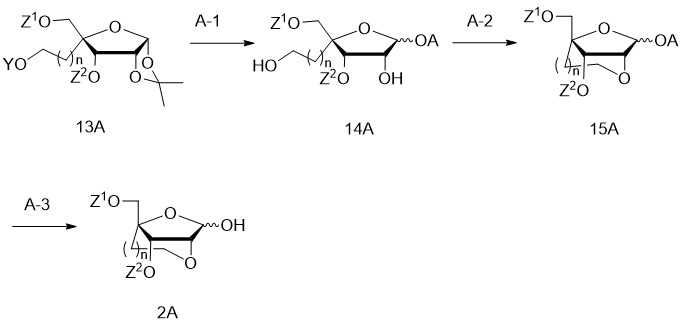
A法中,A、Y、Z1 及Z2 表示與前述同意義。Z1 、Z2 表示於Y之去保護條件下安定的羥基之保護基。In the A method, A, Y, Z 1 and Z 2 have the same meaning as above. Z 1 and Z 2 represent the protective group of the hydroxyl group that is stable under the deprotection condition of Y.
以下,對於A法之各步驟進行詳細說明。Hereinafter, each step of Method A will be described in detail.
(A-1步驟)(Step A-1)
本步驟係於醇溶媒中、酸觸媒存在下,進行可藉由後述C法、D法而製造的化合物(13A)之1,2位羥基的保護基及Y的去保護,而製造化合物(14A)的步驟。又,n=0之情形,省略本步驟,使用藉由後述B法所製造的化合物(14A’)而進行A-2步驟即可。In this step, in an alcohol solvent and in the presence of an acid catalyst, the protective group of the 1,2 hydroxyl group and Y of the compound (13A) which can be produced by the method C and D described below are deprotected to produce the compound ( Step 14A). In the case of n=0, this step can be omitted, and step A-2 can be performed using the compound (14A') produced by the method B described later.
就使用的醇溶媒而言,可列舉例如,甲醇、乙醇、丙醇等之醇類,但適合地為甲醇。The alcohol solvent used includes, for example, alcohols such as methanol, ethanol, and propanol, but methanol is suitably used.
就使用的酸觸媒而言,可列舉硫酸、對甲苯磺酸、甲磺酸等,但適合地為硫酸。As for the acid catalyst used, sulfuric acid, p-toluenesulfonic acid, methanesulfonic acid, etc. can be cited, but sulfuric acid is suitably used.
反應溫度,通常為0℃至100℃,適合地為40至60℃。The reaction temperature is usually 0°C to 100°C, suitably 40 to 60°C.
反應時間雖依酸觸媒的種類及使用量而不同,但通常為1小時至48小時,適合地為10小時至24小時。Although the reaction time varies depending on the type and amount of acid catalyst used, it is usually 1 hour to 48 hours, and suitably 10 hours to 24 hours.
反應結束後,本反應之目的化合物(14A)的醇溶液,例如可將反應液以三乙基胺中和,添加水,藉此使為共生成物的甲氧基三苯基甲烷結晶化,藉由濾除而將含有目的化合物的含水醇溶液分離。再者,藉由以正庚烷進行分液洗淨而獲得的含水醇溶液中添加水、甲苯而分液,可藉由將獲得的有機層進行濃縮而獲得的甲苯溶液直接利用於下一步驟。After the completion of the reaction, the alcohol solution of the target compound (14A) of the present reaction, for example, can neutralize the reaction solution with triethylamine and add water to crystallize methoxytriphenylmethane which is a co-product. The aqueous alcohol solution containing the target compound is separated by filtration. Furthermore, the aqueous alcohol solution obtained by separating and washing with n-heptane is separated by adding water and toluene, and the toluene solution obtained by concentrating the obtained organic layer can be directly used in the next step .
獲得的化合物,若需要,可藉由通常方法,例如再結晶、矽膠層析等而進一步純化。The obtained compound can be further purified by usual methods, such as recrystallization, silica gel chromatography, etc., if necessary.
(A-2步驟)(Step A-2)
本步驟係於溶媒中,使用三價磷試藥、偶氮二甲酸酯,進行A-1步驟所製造的化合物(14A)之二醇部位的環化反應,而製造化合物(15A)的步驟。This step is a step of producing compound (15A) by carrying out the cyclization reaction of the diol site of compound (14A) produced in step A-1 using trivalent phosphorus reagent and azodicarboxylate in a solvent .
就使用的溶媒而言,可列舉例如,二氯甲烷、氯仿、1,2-二氯乙烷之類的鹵化烴類、苯、甲苯等之烴類、四氫呋喃、二甲基醚之類的醚類,但適合地為甲苯。The solvent used includes, for example, halogenated hydrocarbons such as dichloromethane, chloroform, 1,2-dichloroethane, hydrocarbons such as benzene, toluene, and ethers such as tetrahydrofuran and dimethyl ether. Class, but suitably toluene.
就使用的三價磷試藥而言,可列舉三苯基膦、三(正丁基)膦等,但適合地為三苯基膦。As for the trivalent phosphorus reagent to be used, triphenylphosphine, tri(n-butyl)phosphine, etc. can be cited, but it is suitably triphenylphosphine.
就使用的偶氮二甲酸酯而言,可列舉偶氮二甲酸二乙酯、偶氮二甲酸二異丙酯、偶氮二甲酸二(三級丁酯)等,但適合地為偶氮二甲酸二異丙酯。As for the azodicarboxylate used, diethyl azodicarboxylate, diisopropyl azodicarboxylate, bis(tertiary butyl) azodicarboxylate, etc. can be cited, but it is suitably azo Diisopropyl dicarboxylate.
反應溫度通常為0℃至50℃,適合地為10至40℃。The reaction temperature is usually 0°C to 50°C, suitably 10 to 40°C.
反應時間雖依三價磷試藥的種類及使用量而不同,但通常為1小時至24小時,適合地為1小時至3小時。Although the reaction time varies depending on the type and amount of trivalent phosphorus reagent, it is usually 1 hour to 24 hours, and suitably 1 hour to 3 hours.
反應結束後,本反應之目的化合物(15A)之甲苯溶液,可藉由例如於反應液中添加氯化鎂,藉由攪拌使形成難溶性之膦錯體,而藉由過濾去除為共生成物的氧化膦。又,與為另一種之共生成物的肼酯有關,使用甲醇水而將甲苯層洗淨,亦可有效果地去除。藉由將獲得的有機層進行濃縮而獲得的甲苯溶液可直接利用於下一步驟。After the completion of the reaction, the toluene solution of the target compound (15A) of the present reaction can be formed by adding magnesium chloride to the reaction solution and stirring to form a poorly soluble phosphine complex, which can be filtered to remove the oxidation of the co-product. phosphine. In addition, in connection with the hydrazine ester, which is another co-product, the toluene layer can also be effectively removed by washing the toluene layer with methanol water. The toluene solution obtained by concentrating the obtained organic layer can be directly used in the next step.
獲得的化合物,若需要,可藉由通常方法,例如再結晶、矽膠層析等而進一步純化。The obtained compound can be further purified by usual methods, such as recrystallization, silica gel chromatography, etc., if necessary.
(A-3步驟)(Step A-3)
本步驟係於溶媒中,藉由使酸作用,進行A-2步驟所製造的化合物(15A)之變旋異構物位的水解反應,而製造化合物(2A)的步驟。This step is a step of producing compound (2A) by subjecting the compound (15A) produced in step A-2 to the hydrolysis reaction of the mutagenic position of the compound (15A) by the action of an acid in a solvent.
就使用的溶媒而言,可列舉例如,乙酸、水、醇等之水溶性溶媒、二氯甲烷、氯仿、1,2-二氯乙烷之類的鹵化烴類、苯、甲苯等之烴類、四氫呋喃、二甲基醚之類的醚類,但適合地為乙酸。The solvent used includes, for example, water-soluble solvents such as acetic acid, water and alcohol, halogenated hydrocarbons such as dichloromethane, chloroform, 1,2-dichloroethane, and hydrocarbons such as benzene and toluene. Ethers such as tetrahydrofuran, dimethyl ether, but suitably acetic acid.
就使用的酸而言,可列舉鹽酸、硫酸、三氟乙酸、甲磺酸、對甲苯磺酸等,但適合地為鹽酸。As for the acid used, hydrochloric acid, sulfuric acid, trifluoroacetic acid, methanesulfonic acid, p-toluenesulfonic acid, etc. can be cited, but it is suitably hydrochloric acid.
反應溫度通常為0℃至50℃,適合地為20至30℃。The reaction temperature is usually 0°C to 50°C, suitably 20 to 30°C.
反應時間依酸的種類及使用量而不同,但通常為1小時至24小時,適合地為1小時至3小時。The reaction time varies depending on the type and amount of acid used, but is usually 1 hour to 24 hours, suitably 1 hour to 3 hours.
反應結束後,本反應之目的化合物(2A)係例如可於反應液中添加水,冷卻後藉由攪拌而使結晶化。After the completion of the reaction, the target compound (2A) of the present reaction can be crystallized by adding water to the reaction liquid, for example, and stirring after cooling.
獲得的化合物,若需要,可藉由通常方法,例如再結晶、矽膠層析等而進一步純化。The obtained compound can be further purified by usual methods, such as recrystallization, silica gel chromatography, etc., if necessary.
前述之化合物(14A)(n=0之情形)係可利用以下所述的B法而製造。The aforementioned compound (14A) (in the case of n=0) can be produced by the method B described below.
(B法)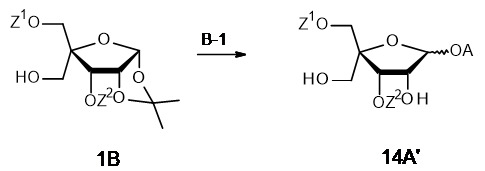
以下,對於B法之步驟進行詳細說明。Hereinafter, the steps of Method B will be described in detail.
(B-1步驟)(Step B-1)
本步驟係使用依據WO00/47599之化合物(7)之製造方法而製造的化合物(1B),而製造化合物(14A’)的步驟。化合物(14A’)係可藉由將依據A法A-1步驟而將化合物(1B)之1,2位羥基之保護基加以去保護而製造。This step is a step of producing compound (14A') using compound (1B) produced in accordance with the method of producing compound (7) of WO00/47599. The compound (14A') can be produced by deprotecting the protecting group of the hydroxyl group at the 1, 2 position of the compound (1B) according to the step A-1 of Method A.
前述之化合物(13A)(n=1之情形)係可利用以下所述的C法而製造。The aforementioned compound (13A) (in the case of n=1) can be produced by the method C described below.
(C法)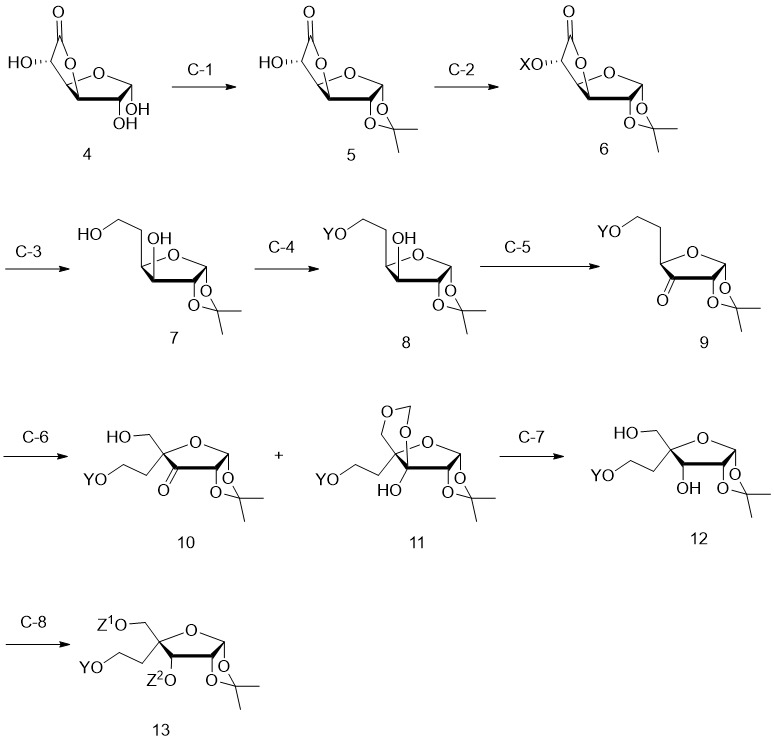
C法中,X係與氧原子一起形成脫離基的基。Y、Z1 及Z2 表示與前述同意義。In the C method, the X system and the oxygen atom form a group leaving the group. Y, Z 1 and Z 2 have the same meaning as described above.
就X而言,可列舉例如,甲磺醯基、乙磺醯基之類的低級烷基磺醯基;三氟甲磺醯基之類的鹵素取代的低級烷基磺醯基;對甲苯磺醯基之類的芳基磺醯基;惟適合地為甲磺醯基或對甲苯磺醯基。As for X, for example, lower alkylsulfonyl groups such as methylsulfonyl and ethylsulfonyl; lower alkylsulfonyl groups substituted with halogen such as trifluoromethanesulfonyl; p-toluenesulfonyl Arylsulfonyl such as sulfonyl; however, it is suitably methanesulfonyl or p-toluenesulfonyl.
以下,對於C法之步驟進行詳細說明。Hereinafter, the steps of the C method will be described in detail.
(C-1步驟)(Step C-1)
本步驟係於酸觸媒存在下,使化合物(4)於丙酮溶媒中反應,而製造化合物(5)的步驟。This step is a step of reacting compound (4) in an acetone solvent in the presence of an acid catalyst to produce compound (5).
就使用的酸觸媒而言,可列舉硫酸、對甲苯磺酸、甲磺酸等,但適合地為硫酸。As for the acid catalyst used, sulfuric acid, p-toluenesulfonic acid, methanesulfonic acid, etc. can be cited, but sulfuric acid is suitably used.
反應溫度雖依使用的酸觸媒而不同,但通常為0℃至50℃,適合地為30至40℃。Although the reaction temperature varies depending on the acid catalyst used, it is usually 0°C to 50°C, and suitably 30 to 40°C.
反應時間雖依酸觸媒的種類及使用量而不同,但通常為10分鐘至24小時,適合地為10小時至20小時。Although the reaction time varies depending on the type and amount of acid catalyst used, it is usually 10 minutes to 24 hours, and suitably 10 hours to 20 hours.
反應結束後,本反應之目的化合物(5)係藉由例如將反應液中和,將反應混合物濃縮,餾除溶媒而獲得。After the completion of the reaction, the target compound (5) of this reaction is obtained by, for example, neutralizing the reaction liquid, concentrating the reaction mixture, and distilling off the solvent.
獲得的化合物,若需要,可藉由通常方法,例如再結晶、矽膠層析等而進一步純化。The obtained compound can be further purified by usual methods, such as recrystallization, silica gel chromatography, etc., if necessary.
(C-2步驟)(Step C-2)
本步驟係於溶媒中,鹼存在下,使C-1步驟所製造的化合物(5),與脫離基導入試藥反應,而製造化合物(6)的步驟。This step is a step of reacting the compound (5) produced in step C-1 with the leaving group introduction reagent in a solvent in the presence of a base to produce compound (6).
就使用的溶媒而言,可列舉例如,二甲基乙醯胺、二甲基甲醯胺之類的醯胺類;二氯甲烷、氯仿、1,2-二氯乙烷之類的鹵化烴類;苯、甲苯等之烴類;四氫呋喃、二甲基醚之類的醚類;乙酸甲酯、乙酸乙酯、乙酸丙酯之類的酯類,但適合地為二甲基乙醯胺。As for the solvent used, for example, amines such as dimethylacetamide and dimethylformamide; halogenated hydrocarbons such as dichloromethane, chloroform, and 1,2-dichloroethane Classes; hydrocarbons such as benzene and toluene; ethers such as tetrahydrofuran and dimethyl ether; esters such as methyl acetate, ethyl acetate, and propyl acetate, but suitably dimethylacetamide.
就使用的鹼而言,可列舉例如,三乙基胺、吡啶、二甲基胺基吡啶1-甲基咪唑之類的鹼,但適合地為1-甲基咪唑。As for the base to be used, for example, bases such as triethylamine, pyridine, and dimethylaminopyridine 1-methylimidazole can be cited, but 1-methylimidazole is suitable.
就使用的脫離基導入試藥而言,可列舉例如,對甲苯磺醯氯、甲磺醯氯、三氟甲磺酸酐等,但適合地為對甲苯磺醯氯。The leaving group introduction reagent used includes, for example, p-toluenesulfonyl chloride, methanesulfonyl chloride, trifluoromethanesulfonic anhydride, etc., but it is suitably p-toluenesulfonyl chloride.
反應溫度雖依使用的脫離基導入試藥而不同,但通常為0℃至50℃,適合地為20至30℃。Although the reaction temperature varies depending on the leaving group introduction reagent used, it is usually 0°C to 50°C, and suitably 20 to 30°C.
反應時間雖依使用的脫離基導入試藥之種類及使用量而不同,但通常為10分鐘至24小時,適合地為1小時至5小時。Although the reaction time differs depending on the type and amount of the de-radical introduction reagent used, it is usually 10 minutes to 24 hours, and suitably 1 hour to 5 hours.
反應結束後,本反應之目的化合物(6)係藉由例如於反應液中添加水,使結晶化而獲得。After the completion of the reaction, the target compound (6) of the present reaction is obtained by, for example, adding water to the reaction solution to crystallize it.
獲得的化合物,若需要,可藉由通常方法,例如再結晶、矽膠層析等而進一步純化。The obtained compound can be further purified by usual methods, such as recrystallization, silica gel chromatography, etc., if necessary.
(C-3步驟)(Step C-3)
本步驟係於溶媒中,使C-2步驟所製造的化合物(6)與氫化物還原劑反應,而製造化合物(7)的步驟。This step is a step of reacting compound (6) produced in step C-2 with a hydride reducing agent in a solvent to produce compound (7).
就使用的溶媒而言,可列舉例如,二氯甲烷、氯仿、1,2-二氯乙烷之類的鹵化烴類;苯、甲苯等之烴類;四氫呋喃、二甲基醚之類的醚類;但適合地為四氫呋喃。As for the solvent used, for example, halogenated hydrocarbons such as dichloromethane, chloroform and 1,2-dichloroethane; hydrocarbons such as benzene and toluene; ethers such as tetrahydrofuran and dimethyl ether Class; but suitably tetrahydrofuran.
就使用的氫化物還原劑而言,可列舉例如,雙(2-甲氧基乙氧基)氫化鋁鈉、氫化鋰鋁、二異丁基氫化鋁,但適合地為雙(2-甲氧基乙氧基)氫化鋁鈉。As for the hydride reducing agent used, for example, sodium bis(2-methoxyethoxy)aluminum hydride, lithium aluminum hydride, diisobutylaluminum hydride, but suitably bis(2-methoxy) aluminum hydride Ethoxy) sodium aluminum hydride.
反應時間雖依氫化物還原劑的種類及使用量而不同,但通常為10分鐘至24小時,適合地為1小時至3小時。Although the reaction time varies depending on the type and amount of the hydride reducing agent, it is usually 10 minutes to 24 hours, and suitably 1 hour to 3 hours.
反應結束後,本反應之目的化合物(7)係可藉由例如於反應液中添加丙酮、L-酒石酸鈉鉀水溶液後,將含有目的化合物的有機層分離,水洗後,餾除溶媒而獲得。After the completion of the reaction, the target compound (7) of this reaction can be obtained by, for example, adding acetone and an aqueous solution of sodium potassium L-tartrate to the reaction solution, separating the organic layer containing the target compound, washing with water, and distilling off the solvent.
獲得的化合物,若需要,可藉由通常方法,例如再結晶、矽膠層析等而進一步純化。The obtained compound can be further purified by usual methods, such as recrystallization, silica gel chromatography, etc., if necessary.
(C-4步驟)(Step C-4)
本步驟係於溶媒中,鹼存在下,將保護基選擇性地導入C-3步驟所製造的化合物(7)之1級羥基,而製造化合物(8)的步驟。This step is a step of producing compound (8) by selectively introducing a protecting group into the primary hydroxyl group of compound (7) produced in step C-3 in the presence of a base in a solvent.
就使用的溶媒而言,可列舉例如,二甲基乙醯胺、二甲基甲醯胺之類的醯胺類;苯、甲苯等之烴類;二氯甲烷、氯仿、1,2-二氯乙烷之類的鹵化烴類;四氫呋喃、二甲基醚之類的醚類;乙酸甲酯、乙酸乙酯、乙酸丙酯之類的酯類,但適合地為甲苯。Regarding the solvent used, for example, amines such as dimethylacetamide and dimethylformamide; hydrocarbons such as benzene and toluene; dichloromethane, chloroform, 1,2-bis Halogenated hydrocarbons such as ethyl chloride; ethers such as tetrahydrofuran and dimethyl ether; esters such as methyl acetate, ethyl acetate, and propyl acetate, but suitably toluene.
就使用的鹼而言,可列舉例如,三乙基胺、吡啶、二甲基胺基吡啶1-甲基咪唑、4-甲基
使用的1級羥基之保護試藥而言,可列舉例如,三苯氯甲烷、4,4’-二甲氧基三苯氯甲烷等,但適合地為三苯氯甲烷。As for the protective reagent of the first-grade hydroxyl group used, for example, triphenylchloromethane, 4,4'-dimethoxytriphenylchloromethane, etc. can be exemplified, but it is suitably triphenylchloromethane.
反應溫度雖依使用的保護試藥而不同,但通常為0℃至50℃,適合地為20至30℃。Although the reaction temperature varies depending on the protective reagent used, it is usually 0°C to 50°C, suitably 20 to 30°C.
反應時間雖依1級羥基之保護試藥的種類及使用量而不同,但通常為10分鐘至24小時,適合地為1小時至5小時。Although the reaction time varies depending on the type and amount of the reagent for protecting the first-grade hydroxyl group, it is usually 10 minutes to 24 hours, and suitably 1 hour to 5 hours.
反應結束後,本反應之目的化合物(8)可藉由例如於反應液中添加水,將含有目的化合物的有機層分離,水洗後,餾除溶媒而獲得。After the completion of the reaction, the target compound (8) of the present reaction can be obtained, for example, by adding water to the reaction solution, separating the organic layer containing the target compound, washing with water, and distilling off the solvent.
獲得的化合物,若需要,可藉由通常方法,例如再結晶、矽膠層析等而進一步純化。The obtained compound can be further purified by usual methods, such as recrystallization, silica gel chromatography, etc., if necessary.
(C-5步驟)(Step C-5)
本步驟係於溶媒中,鹼、氧化劑、氧化觸媒及輔觸媒存在下,將C-4步驟所製造的化合物(8)之3位的2級羥基氧化,而製造化合物(9)之步驟。This step is a step of oxidizing the secondary hydroxyl group at the 3-position of compound (8) produced in step C-4 in the presence of alkali, oxidizing agent, oxidation catalyst and co-catalyst in a solvent to produce compound (9) .
就使用的溶媒而言,可列舉例如,二甲基乙醯胺、二甲基甲醯胺之類的醯胺類;苯、甲苯等之烴類;二氯甲烷、氯仿、1,2-二氯乙烷之類的鹵化烴類;四氫呋喃、二甲基醚之類的醚類;乙酸甲酯、乙酸乙酯、乙酸丙酯之類的酯類,但適合地為甲苯。Regarding the solvent used, for example, amines such as dimethylacetamide and dimethylformamide; hydrocarbons such as benzene and toluene; dichloromethane, chloroform, 1,2-bis Halogenated hydrocarbons such as ethyl chloride; ethers such as tetrahydrofuran and dimethyl ether; esters such as methyl acetate, ethyl acetate, and propyl acetate, but suitably toluene.
就使用的鹼而言,可列舉例如,氫氧化鈉、氫氧化鉀、碳酸氫鈉、碳酸鈉等之無機鹼;三乙基胺、吡啶、二甲基胺基吡啶1-甲基咪唑、4-甲基
就使用的氧化觸媒而言,可列舉例如,2,2,6,6-四甲基哌啶1-氧基、2-氮雜金剛烷-N-氧基、9-氮雜降金剛烷-N-氧基等,但適合地為9-氮雜降金剛烷-N-氧基。As for the oxidation catalyst used, for example, 2,2,6,6-tetramethylpiperidine 1-oxy, 2-azaadamantane-N-oxy, 9-azanoradamantane -N-oxy and the like, but suitably 9-azanoradamantane-N-oxy.
就使用的輔觸媒而言,可列舉溴化鉀、四丁基溴化銨等,但適合地為溴化鉀。As for the co-catalyst used, potassium bromide, tetrabutylammonium bromide, etc. can be cited, but it is suitably potassium bromide.
就使用的氧化劑而言,可列舉次氯酸鈉、碘苯二乙酸等,但適合地為次氯酸鈉。As for the oxidizing agent used, sodium hypochlorite, iodobenzene diacetic acid, etc. can be cited, but sodium hypochlorite is suitably used.
反應溫度雖依使用的氧化觸媒及輔觸媒而不同,但通常為0℃至50℃,適合地為0至10℃。Although the reaction temperature varies depending on the oxidation catalyst and auxiliary catalyst used, it is usually 0°C to 50°C, and suitably 0 to 10°C.
反應時間雖依氧化觸媒及輔觸媒的種類及使用量而不同,但通常為10分鐘至24小時,適合地為1小時至3小時。Although the reaction time varies depending on the type and amount of the oxidation catalyst and the auxiliary catalyst, it is usually 10 minutes to 24 hours, and suitably 1 hour to 3 hours.
反應結束後,本反應之目的化合物(9)之甲苯溶液係可例如將反應液靜置後,藉由移除水層,將包含目的化合物的有機層分離,經由水洗而獲得,並直接用於下一步驟。After the completion of the reaction, the toluene solution of the target compound (9) of the present reaction can be obtained by, for example, leaving the reaction liquid to stand still, removing the water layer, separating the organic layer containing the target compound, washing with water, and directly using it Next step.
獲得的化合物,若需要,可藉由通常方法,例如再結晶、矽膠層析等而進一步純化。The obtained compound can be further purified by usual methods, such as recrystallization, silica gel chromatography, etc., if necessary.
(C-6步驟)(Step C-6)
本步驟係於溶媒中,鹼及烷基化劑存在下,藉由將C-5步驟所製造的化合物(9)之4位的碳,一邊伴隨表異構物化(epimerisation)一邊立體選擇性地羥基甲基化,而製造化合物(10)的步驟。This step is based on the presence of a base and an alkylating agent in a solvent, and stereoselectively by removing the carbon at the 4-position of the compound (9) produced in the C-5 step with epimerisation. The step of producing compound (10) by methylation of the hydroxyl group.
就使用的溶媒而言,可列舉例如,二甲基乙醯胺、二甲基甲醯胺之類的醯胺類;苯、甲苯等之烴類;二氯甲烷、氯仿、1,2-二氯乙烷之類的鹵化烴類;四氫呋喃、二甲基醚之類的醚類;乙酸甲酯、乙酸乙酯、乙酸丙酯之類的酯類,但適合地為甲苯。Regarding the solvent used, for example, amines such as dimethylacetamide and dimethylformamide; hydrocarbons such as benzene and toluene; dichloromethane, chloroform, 1,2-bis Halogenated hydrocarbons such as ethyl chloride; ethers such as tetrahydrofuran and dimethyl ether; esters such as methyl acetate, ethyl acetate, and propyl acetate, but suitably toluene.
就使用的鹼而言,可列舉例如,氫氧化鈉、氫氧化鉀、碳酸氫鈉、碳酸鈉等之無機鹼;三乙基胺、吡啶、1,8-二氮雜雙環[5.4.0]十一-7-烯之類的有機鹼,但適合地為1,8-二氮雜雙環[5.4.0]十一-7-烯。As for the base used, for example, inorganic bases such as sodium hydroxide, potassium hydroxide, sodium bicarbonate, sodium carbonate, etc.; triethylamine, pyridine, 1,8-diazabicyclo[5.4.0] An organic base such as undec-7-ene, but suitably 1,8-diazabicyclo[5.4.0]undec-7-ene.
就使用的烷基化劑而言,可列舉例如,聚甲醛、甲醛水溶液等,但適合地為甲醛水溶液。Regarding the alkylating agent used, for example, polyoxymethylene, an aqueous formaldehyde solution, etc. can be cited, but it is suitably an aqueous formaldehyde solution.
反應溫度雖依使用的鹼而不同,但通常為0℃至50℃,適合地為20至30℃。Although the reaction temperature differs depending on the base used, it is usually 0°C to 50°C, suitably 20 to 30°C.
反應時間雖依鹼的種類及使用量而不同,但通常為10分鐘至24小時,適合地為1小時至3小時。Although the reaction time varies depending on the type and amount of the base used, it is usually 10 minutes to 24 hours, and suitably 1 hour to 3 hours.
反應結束後,本反應之目的化合物(10)之甲苯溶液可藉由例如將反應液靜置後,藉由去除水層,將含目的化合物的有機層分離,經水洗而獲得,且可直接利用於下一步驟。又,此時一部分生成的環化體(11)係於下一步驟中轉換為化合物(12)。After the completion of the reaction, the toluene solution of the target compound (10) of this reaction can be obtained by, for example, allowing the reaction solution to stand still, removing the water layer, separating the organic layer containing the target compound, and washing with water, and can be directly used In the next step. In addition, a part of the cyclized body (11) generated at this time is converted into the compound (12) in the next step.
獲得的化合物,若需要,可藉由通常方法,例如再結晶、矽膠層析等而進一步純化。The obtained compound can be further purified by usual methods, such as recrystallization, silica gel chromatography, etc., if necessary.
(C-7步驟)(Step C-7)
本步驟係於溶媒中,使C-6步驟所製造的化合物(10),與氫化物還原劑反應,而製造3位之羥基經立體控制的化合物(12)的步驟。This step is a step of reacting the compound (10) produced in the step C-6 with a hydride reducing agent in a solvent to produce a compound (12) in which the hydroxyl group at the 3-position is stereo-controlled.
就使用的溶媒而言,可列舉例如,二氯甲烷、氯仿、1,2-二氯乙烷之類的鹵化烴類;苯、甲苯等之烴類;四氫呋喃、二甲基醚之類的醚類;但適合地為甲苯。As for the solvent used, for example, halogenated hydrocarbons such as dichloromethane, chloroform and 1,2-dichloroethane; hydrocarbons such as benzene and toluene; ethers such as tetrahydrofuran and dimethyl ether Class; but suitably toluene.
就使用的氫化物還原劑而言,可列舉例如,雙(2-甲氧基乙氧基)氫化鋁鈉、氫化鋰鋁、二異丁基氫化鋁、氫化硼鈉,但適合地為氫化硼鈉。As for the hydride reducing agent used, for example, sodium bis(2-methoxyethoxy)aluminum hydride, lithium aluminum hydride, diisobutylaluminum hydride, sodium borohydride, but suitably boron hydride sodium.
反應溫度雖依使用的氫化物還原劑而不同,但通常為0℃至50℃,適合地為20至30℃。Although the reaction temperature varies depending on the hydride reducing agent used, it is usually 0°C to 50°C, and suitably 20 to 30°C.
反應時間雖依氫化物還原劑的種類及使用量而不同,但通常為10分鐘至24小時,適合地為1小時至3小時。Although the reaction time varies depending on the type and amount of the hydride reducing agent, it is usually 10 minutes to 24 hours, and suitably 1 hour to 3 hours.
反應結束後,本反應之目的化合物(12)之甲苯溶液係可例如將反應液靜置後,藉由去除水層,將含目的化合物的有機層分離,經由水洗而獲得,且可直接利用於下一步驟。After the completion of the reaction, the toluene solution of the target compound (12) of this reaction can be obtained by, for example, allowing the reaction solution to stand still, removing the water layer, separating the organic layer containing the target compound, and washing with water, and can be directly used in Next step.
獲得的化合物,若需要,可藉由通常方法,例如再結晶、矽膠層析等而進一步純化。The obtained compound can be further purified by usual methods, such as recrystallization, silica gel chromatography, etc., if necessary.
(C-8步驟)(Step C-8)
本步驟係於溶媒中,鹼及觸媒存在下,使羥基之保護試藥反應,將C-7步驟所製造的化合物(12)之2個羥基加以保護,而製造化合物(13)的步驟。This step is a step of reacting the protective reagent of the hydroxyl group in a solvent in the presence of a base and a catalyst to protect the two hydroxyl groups of the compound (12) produced in step C-7 to produce the compound (13).
就使用的溶媒而言,可列舉例如,二氯甲烷、氯仿、1,2-二氯乙烷之類的鹵化烴類;苯、甲苯等之烴類;四氫呋喃、二甲基醚之類的醚類;但適合地為甲苯。As for the solvent used, for example, halogenated hydrocarbons such as dichloromethane, chloroform and 1,2-dichloroethane; hydrocarbons such as benzene and toluene; ethers such as tetrahydrofuran and dimethyl ether Class; but suitably toluene.
就使用的羥基之保護試藥而言,可列舉例如,三苯氯甲烷、三級丁基二苯基矽基氯、三級丁基二甲基矽基氯、乙酸酐、苯甲醯氯等,但適合地為氯甲苯或溴甲苯,更適合地為溴甲苯。Regarding the protective reagents for the hydroxyl groups used, for example, triphenylchloromethane, tertiary butyl diphenylsilyl chloride, tertiary butyl dimethylsilyl chloride, acetic anhydride, benzyl chloride, etc. , But suitably chlorotoluene or bromotoluene, more suitably bromotoluene.
就使用的觸媒而言,可列舉例如四丁基碘化銨、碘化鉀、碘化鈉等,但適合地為四丁基碘化銨。As for the catalyst used, for example, tetrabutylammonium iodide, potassium iodide, sodium iodide, etc. can be mentioned, but it is suitably tetrabutylammonium iodide.
就使用的鹼而言,可列舉例如,氫氧化鈉、氫氧化鉀、碳酸氫鈉、碳酸鈉等之無機鹼;三乙基胺、吡啶、1,8-二氮雜雙環[5.4.0]十一-7-烯之類的有機鹼,但適合地為氫氧化鉀。As for the base used, for example, inorganic bases such as sodium hydroxide, potassium hydroxide, sodium bicarbonate, sodium carbonate, etc.; triethylamine, pyridine, 1,8-diazabicyclo[5.4.0] An organic base such as undec-7-ene, but suitably potassium hydroxide.
反應溫度雖依使用的羥基之保護試藥而不同,但通常為20℃至100℃,適合地為60至80℃。Although the reaction temperature varies depending on the protective reagent of the hydroxyl group used, it is usually 20°C to 100°C, and suitably 60 to 80°C.
反應時間雖依羥基之保護試藥的種類及使用量而不同,但通常為1小時至48小時,適合地為10小時至24小時。Although the reaction time varies depending on the type and amount of the protective reagent for the hydroxyl group, it is usually 1 hour to 48 hours, and suitably 10 hours to 24 hours.
反應結束後,本反應之目的化合物(13)之甲苯溶液,可例如將反應液靜置後,藉由去除水層,將含目的化合物的有機層分離,藉由水洗而獲得,且可將獲得的甲苯層溶媒取代為1-丙醇而使結晶化。After the completion of the reaction, the toluene solution of the target compound (13) of the present reaction can be obtained by, for example, allowing the reaction solution to stand still, removing the water layer, separating the organic layer containing the target compound, and washing with water, and can be obtained The solvent in the toluene layer was replaced with 1-propanol to crystallize.
獲得的化合物,若需要,可藉由通常方法,例如再結晶、矽膠層析等而進一步純化。The obtained compound can be further purified by usual methods, such as recrystallization, silica gel chromatography, etc., if necessary.
前述之化合物(13A)(n=2至4之情形),可藉由以下所述的D法而製造。The aforementioned compound (13A) (in the case of n=2 to 4) can be produced by the method D described below.
(D法)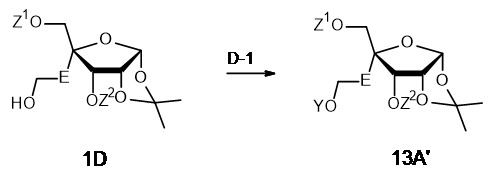
D法中,E為伸乙基、三亞甲基或四亞甲基,Y、Z1 及Z2 表示與前述同意義。In the D method, E is an ethylene group, a trimethylene group or a tetramethylene group, and Y, Z 1 and Z 2 have the same meanings as mentioned above.
以下,對於D法之各步驟詳細說明。Hereinafter, each step of the D method will be explained in detail.
(D-1步驟)(Step D-1)
本步驟係於溶媒中,鹼存在下,使按照WO00/47599之化合物(3b)之製造方法而製造的化合物(1D),與羥基之保護試藥反應,而製造化合物(13A’)的步驟。This step is a step of reacting compound (1D) produced according to the method of producing compound (3b) of WO00/47599 with a protective reagent for hydroxyl group in a solvent in the presence of a base to produce compound (13A').
就使用的溶媒而言,可列舉例如,二甲基乙醯胺、二甲基甲醯胺之類的醯胺類;苯、甲苯等之烴類;二氯甲烷、氯仿、1,2-二氯乙烷之類的鹵化烴類;四氫呋喃、二甲基醚之類的醚類;乙酸甲酯、乙酸乙酯、乙酸丙酯之類的酯類;但適合地為甲苯。Regarding the solvent used, for example, amines such as dimethylacetamide and dimethylformamide; hydrocarbons such as benzene and toluene; dichloromethane, chloroform, 1,2-bis Halogenated hydrocarbons such as ethyl chloride; ethers such as tetrahydrofuran and dimethyl ether; esters such as methyl acetate, ethyl acetate, and propyl acetate; but suitably toluene.
就使用的鹼而言,可列舉例如,三乙基胺、吡啶、二甲基胺基吡啶1-甲基咪唑、4-甲基
就使用的羥基之保護試藥而言,可列舉例如,三苯氯甲烷、4,4’-二甲氧基三苯氯甲烷等,但適合地為三苯氯甲烷。Regarding the protective reagent for the hydroxyl group used, for example, triphenylchloromethane, 4,4'-dimethoxytriphenylchloromethane, etc. can be cited, but it is suitably triphenylchloromethane.
反應溫度雖依使用的保護試藥而不同,但通常為0℃至50℃,適合地為20至30℃。Although the reaction temperature varies depending on the protective reagent used, it is usually 0°C to 50°C, suitably 20 to 30°C.
反應時間雖依保護試藥的種類及使用量而不同,但通常為10分鐘至24小時,適合地為1小時至5小時。Although the reaction time varies depending on the type and dosage of the protective reagent, it is usually 10 minutes to 24 hours, and suitably 1 hour to 5 hours.
反應結束後,本反應之目的化合物(13A’)係可例如於反應液中添加水,將含目的化合物的有機層分離,水洗後,藉由餾除溶媒而獲得。After the completion of the reaction, the target compound (13A') of this reaction can be obtained by adding water to the reaction solution, separating the organic layer containing the target compound, washing with water, and removing the solvent by distillation.
獲得的化合物,若需要,可藉由通常方法,例如再結晶、矽膠層析等而進一步純化。The obtained compound can be further purified by usual methods, such as recrystallization, silica gel chromatography, etc., if necessary.
本發明之化合物(5E)係可藉由以下所述的E法而製造。The compound (5E) of the present invention can be produced by the E method described below.
(E法)
E法中,R1 、R2 、X1 、Z1 、Z2 及P1 表示與前述同意義。In the E method, R 1 , R 2 , X 1 , Z 1 , Z 2 and P 1 have the same meaning as described above.
以下,對於E法之步驟詳細說明。Hereinafter, the steps of the E method are explained in detail.
(E-1步驟)(Step E-1)
本步驟係藉由使用化合物(2A),於溶媒中,鹼存在下,使與活化劑反應,而製造化合物(2E)的步驟。This step is a step of producing compound (2E) by using compound (2A) in a solvent in the presence of a base to react with an activator.
就使用的溶媒而言,可列舉例如,二氯甲烷、氯仿、1,2-二氯乙烷之類的鹵化烴類;苯、甲苯等之烴類;四氫呋喃、二甲基醚之類的醚類;乙腈;但適合地為甲苯或乙腈。As for the solvent used, for example, halogenated hydrocarbons such as dichloromethane, chloroform and 1,2-dichloroethane; hydrocarbons such as benzene and toluene; ethers such as tetrahydrofuran and dimethyl ether Class; Acetonitrile; but suitably toluene or acetonitrile.
使用的活化劑可列舉乙酸酐、苯甲酸酐、三氯乙腈、羰基二咪唑、氯磷酸二苯酯,但適合地為乙酸酐或三氯乙腈。The activator used may be acetic anhydride, benzoic anhydride, trichloroacetonitrile, carbonyldiimidazole, diphenyl chlorophosphate, but is suitably acetic anhydride or trichloroacetonitrile.
使用的鹼雖依活化劑而不同,但可列舉三乙基胺、吡啶、1,8-二氮雜雙環[5.4.0]十一-7-烯之類的有機鹼,適合地為吡啶、1,8-二氮雜雙環[5.4.0]十一-7-烯。反應結束後,本反應之目的化合物(2E),例如可用於直接醣基化,或將反應液中和,並將反應混合物濃縮,藉由餾除溶媒而獲得。Although the base used varies depending on the activator, organic bases such as triethylamine, pyridine, 1,8-diazabicyclo[5.4.0]undec-7-ene, etc. can be cited, and pyridine, 1,8-diazabicyclo[5.4.0]undec-7-ene. After the completion of the reaction, the target compound (2E) of the present reaction can be used for direct glycosylation, for example, or neutralization of the reaction solution, and concentration of the reaction mixture, which can be obtained by distilling off the solvent.
反應溫度雖依使用的活化劑而不同,但通常為0℃至50℃,適合地為0℃至30℃。Although the reaction temperature varies depending on the activator used, it is usually 0°C to 50°C, suitably 0°C to 30°C.
反應時間雖依活化劑的種類及使用量而不同,但通常為10分鐘至24小時,適合地為1小時至3小時。Although the reaction time varies depending on the type and amount of the activator used, it is usually 10 minutes to 24 hours, and suitably 1 hour to 3 hours.
獲得的化合物,若需要,可藉由通常方法,例如再結晶、矽膠層析等而進一步純化。The obtained compound can be further purified by usual methods, such as recrystallization, silica gel chromatography, etc., if necessary.
(E-2步驟)(Step E-2)
本步驟係製造化合物(3E)的步驟,其係藉由將E-1步驟所獲得的化合物(2E),於溶媒中,鹵化劑存在下,與藉由矽化反應而經矽化的嘧啶鹼基(胸腺嘧碇或經醯基保護的胞嘧啶等)之醣基化反應而製造。This step is a step of producing compound (3E) by combining the compound (2E) obtained in step E-1 with a pyrimidine base ( Thymine or cytosine protected by thymine group, etc.) are produced by the glycosylation reaction.
就於矽化反應及醣基化反應所使用的溶媒而言,可列舉例如,二氯甲烷、氯仿、1,2-二氯乙烷之類的鹵化烴類;苯、甲苯等之烴類;四氫呋喃、二甲基醚之類的醚類;乙腈,但適合地為乙腈。As for the solvent used in the silicification reaction and glycosylation reaction, for example, halogenated hydrocarbons such as dichloromethane, chloroform, and 1,2-dichloroethane; hydrocarbons such as benzene and toluene; tetrahydrofuran , Ethers such as dimethyl ether; acetonitrile, but suitably acetonitrile.
使用的矽化劑可列舉N,O-雙三甲基矽基乙醯胺、六甲基二矽氮烷等,但適合地為N,O-雙三甲基矽基乙醯胺。The siliconizing agent used may be N,O-bistrimethylsilylacetamide, hexamethyldisilazane, etc., but is suitably N,O-bistrimethylsilylacetamide.
嘧啶鹼基之矽化反應之溫度雖依矽化劑而不同,但通常為0℃至50℃,適合地為20℃至40℃。Although the temperature of the silicidation reaction of the pyrimidine base varies depending on the silicifying agent, it is usually 0°C to 50°C, suitably 20°C to 40°C.
矽化反應之反應時間雖依矽化劑的種類及使用量而不同,但通常為10分鐘至24小時,適合地為1小時至10小時。Although the reaction time of the silicification reaction varies depending on the type and amount of the silicifying agent, it is usually 10 minutes to 24 hours, and suitably 1 hour to 10 hours.
醣基化反應所使用的鹵化劑可列舉氯三甲基矽烷(TMSCl)、溴三甲基矽烷(TMSBr)、碘三甲基矽烷(TMSI),但適合地為TMSI。The halogenating agent used in the glycosylation reaction can be exemplified by chlorotrimethylsilane (TMSCl), bromotrimethylsilane (TMSBr), and iodotrimethylsilane (TMSI), but is suitably TMSI.
醣基化反應之反應溫度雖依化合物(2E)之結構或使用的鹵化劑而不同,但通常為0℃至50℃,適合地為20℃至40℃。Although the reaction temperature of the glycosylation reaction varies depending on the structure of the compound (2E) or the halogenating agent used, it is usually 0°C to 50°C, suitably 20°C to 40°C.
醣基化反應之反應時間雖依鹵化劑的種類及使用量而不同,但通常為10分鐘至24小時,適合地為10小時至20小時。Although the reaction time of the glycosylation reaction varies depending on the type and amount of the halogenating agent, it is usually 10 minutes to 24 hours, and suitably 10 hours to 20 hours.
反應結束後,本反應之目的化合物(3E),例如藉由將反應液中和,並將反應混合物濃縮,餾除溶媒而獲得。After the completion of the reaction, the target compound (3E) of the present reaction can be obtained, for example, by neutralizing the reaction liquid, concentrating the reaction mixture, and distilling off the solvent.
獲得的化合物,若需要,可藉由通常方法,例如再結晶、矽膠層析等而進一步純化。The obtained compound can be further purified by usual methods, such as recrystallization, silica gel chromatography, etc., if necessary.
(E-3步驟)(Step E-3)
本步驟係使化合物(3E),於溶媒中,與羥基之去保護試藥反應,藉由去保護反應而製造化合物(4E)的步驟。This step is a step in which compound (3E) is reacted with a reagent for deprotection of the hydroxyl group in a solvent to produce compound (4E) through a deprotection reaction.
(i)R2 為羥基,Z1 及Z2 為苄基之情形,去保護試藥為承載於碳上的金屬觸媒及還原劑。(i) When R 2 is a hydroxyl group and Z 1 and Z 2 are benzyl groups, the deprotection reagent is a metal catalyst and a reducing agent supported on carbon.
就使用的溶媒而言,可列舉例如,苯、甲苯等之烴類;四氫呋喃、二甲基醚之類的醚類;甲醇、乙醇、丙醇等之醇類;惟適合地為甲醇。As for the solvent used, for example, hydrocarbons such as benzene and toluene; ethers such as tetrahydrofuran and dimethyl ether; alcohols such as methanol, ethanol, and propanol; but methanol is suitable.
使用的金屬觸媒可列舉鈀、氫氧化鈀、鉑等,但適合地為鈀。The metal catalyst used may be palladium, palladium hydroxide, platinum, etc., but is suitably palladium.
使用的還原劑可列舉氫、甲酸、甲酸銨等,但適合地為氫。The reducing agent used may be hydrogen, formic acid, ammonium formate, etc., but is suitably hydrogen.
反應溫度雖依金屬觸媒而不同,但通常為0℃至70℃,適合地為40℃至60℃。Although the reaction temperature varies depending on the metal catalyst, it is usually 0°C to 70°C, and suitably 40°C to 60°C.
反應時間雖依金屬觸媒、還原劑的種類及使用量而不同,但通常為10分鐘至24小時,適合地為1小時至5小時。Although the reaction time varies depending on the type and amount of the metal catalyst and reducing agent, it is usually 10 minutes to 24 hours, and suitably 1 hour to 5 hours.
反應結束後,本反應之目的化合物(4E),例如藉由將反應液過濾而去除金屬觸媒,將反應混合物濃縮,餾除溶媒而獲得。After the completion of the reaction, the target compound (4E) of the present reaction can be obtained, for example, by filtering the reaction liquid to remove the metal catalyst, concentrating the reaction mixture, and distilling off the solvent.
獲得的化合物,若需要,可藉由通常方法,例如再結晶、矽膠層析等而進一步純化。The obtained compound can be further purified by usual methods, such as recrystallization, silica gel chromatography, etc., if necessary.
(ii)R2 為經醯基經保護的胺基,Z1 及Z2 為苄基之情形,使用去保護試藥而進行去保護反應。(ii) In the case where R 2 is an amino group protected by an acyl group, and Z 1 and Z 2 are benzyl groups, a deprotection reaction is performed using a deprotection reagent.
就使用的溶媒而言,可列舉例如,二氯甲烷、氯仿、1,2-二氯乙烷之類的鹵化烴類;苯、甲苯等之烴類;惟適合地為二氯甲烷。As for the solvent to be used, for example, halogenated hydrocarbons such as dichloromethane, chloroform, and 1,2-dichloroethane; hydrocarbons such as benzene and toluene; but dichloromethane is suitable.
使用的去保護試藥,可列舉氯化鐵(III)、三氯化硼等,適合地為三氯化硼。The deprotection reagent used includes iron (III) chloride, boron trichloride, etc., and is suitably boron trichloride.
反應溫度雖依去保護試藥而不同,但通常為-20℃至30℃,適合地為-20℃至20℃。Although the reaction temperature varies depending on the deprotection reagent, it is usually -20°C to 30°C, suitably -20°C to 20°C.
反應時間雖依去保護試藥而不同,但通常為10分鐘至10小時,適合地為1小時至5小時。Although the reaction time varies depending on the deprotection reagent, it is usually 10 minutes to 10 hours, and suitably 1 hour to 5 hours.
反應結束後,本反應之目的化合物(4E),例如藉由將反應液中和,並將反應混合物濃縮,餾除溶媒而獲得。After the completion of the reaction, the target compound (4E) of this reaction can be obtained, for example, by neutralizing the reaction liquid, concentrating the reaction mixture, and distilling off the solvent.
獲得的化合物,若需要,可藉由通常方法,例如再結晶、矽膠層析等而進一步純化。The obtained compound can be further purified by usual methods, such as recrystallization, silica gel chromatography, etc., if necessary.
(E-4步驟)(Step E-4)
本步驟係藉由使化合物(4E),於溶媒中,鹼存在下,與1級羥基之保護試藥反應,而製造化合物(5E)的步驟。This step is a step of producing compound (5E) by reacting compound (4E) with a protective reagent of the first-order hydroxyl group in a solvent in the presence of a base.
就使用的溶媒而言,可列舉例如,二氯甲烷、氯仿、1,2-二氯乙烷之類的鹵化烴類;苯、甲苯等之烴類;四氫呋喃、二甲基醚之類的醚類;乙酸乙酯、乙酸丙酯之類的酯類;乙腈;惟適合地為四氫呋喃、或乙酸乙酯。As for the solvent used, for example, halogenated hydrocarbons such as dichloromethane, chloroform and 1,2-dichloroethane; hydrocarbons such as benzene and toluene; ethers such as tetrahydrofuran and dimethyl ether Classes; esters such as ethyl acetate and propyl acetate; acetonitrile; but suitably tetrahydrofuran or ethyl acetate.
就使用的1級羥基之保護試藥而言,可列舉例如,三苯氯甲烷、4-甲氧基三苯氯甲烷、4,4’-二甲氧基三苯氯甲烷等,適合地為4,4’-二甲氧基三苯氯甲烷。Regarding the protective reagent for the first-grade hydroxyl group used, for example, triphenylchloromethane, 4-methoxytriphenylchloromethane, 4,4'-dimethoxytriphenylchloromethane, etc., are suitably 4,4'-Dimethoxytriphenylchloromethane.
使用的鹼可列舉三乙基胺、N-甲基
反應之溫度雖依保護試藥而不同,但通常為0℃至50℃,適合地為0℃至20℃。Although the reaction temperature varies depending on the protective reagent, it is usually 0°C to 50°C, suitably 0°C to 20°C.
反應時間雖依保護試藥而不同,但通常為10分鐘至10小時,適合地為1小時至5小時。Although the reaction time varies depending on the protective reagent, it is usually 10 minutes to 10 hours, and suitably 1 hour to 5 hours.
反應結束後,本反應之目的化合物(5E),例如藉由將反應液中和,並將反應混合物濃縮,餾除溶媒而獲得。After the completion of the reaction, the target compound (5E) of the present reaction can be obtained, for example, by neutralizing the reaction liquid, concentrating the reaction mixture, and distilling off the solvent.
獲得的化合物,若需要,可藉由通常方法,例如再結晶、矽膠層析等而進一步純化。The obtained compound can be further purified by usual methods, such as recrystallization, silica gel chromatography, etc., if necessary.
本發明之化合物(4F)可藉由以下所述的F法而製造。The compound (4F) of the present invention can be produced by the F method described below.
(F法)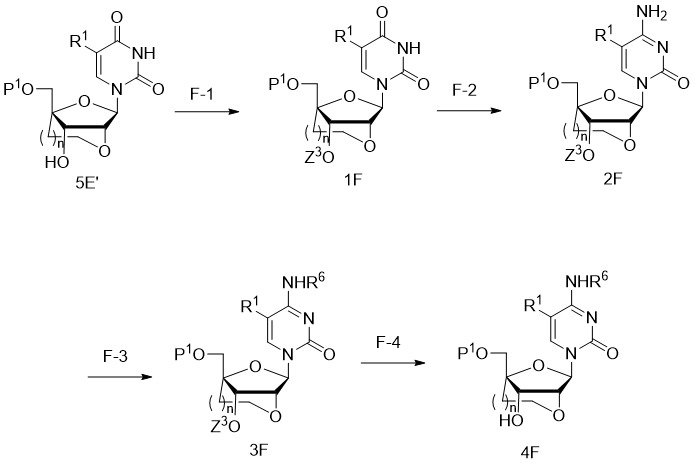
以下,對於F法之各步驟進行詳細說明。Hereinafter, each step of the F method will be described in detail.
(F-1步驟)(Step F-1)
本步驟係藉由使化合物(5E’),於溶媒中,鹼、觸媒存在下,與羥基之保護試藥反應,而製造化合物(1F)的步驟。This step is a step for producing compound (1F) by reacting compound (5E') with a protective reagent for hydroxyl group in a solvent in the presence of a base and a catalyst.
就使用的溶媒而言,可列舉例如,二氯甲烷、氯仿、1,2-二氯乙烷之類的鹵化烴類;苯、甲苯等之烴類;四氫呋喃、二甲基醚之類的醚類;乙腈;惟適合地為乙腈。As for the solvent used, for example, halogenated hydrocarbons such as dichloromethane, chloroform and 1,2-dichloroethane; hydrocarbons such as benzene and toluene; ethers such as tetrahydrofuran and dimethyl ether Class; Acetonitrile; but suitably acetonitrile.
就使用的羥基之保護試藥而言,可列舉乙酸酐、乙醯氯、苯甲酸酐、苯甲醯氯等,適合地為乙酸酐。Regarding the protective reagent for the hydroxyl group used, acetic anhydride, acetyl chloride, benzoic anhydride, benzyl chloride, etc. can be cited, and acetic anhydride is suitably used.
使用的鹼雖依活化劑而不同,但可列舉三乙基胺、吡啶之類的有機鹼,適合地為三乙基胺。Although the base used varies depending on the activator, organic bases such as triethylamine and pyridine can be cited, and triethylamine is suitably used.
就使用的觸媒而言,可列舉N,N-二甲基胺基吡啶、1,8-二氮雜雙環[5.4.0]十一-7-烯等,適合地為N,N-二甲基胺基吡啶。反應溫度雖依使用的鹼而不同,但通常為0℃至50℃,適合地為0℃至30℃。As for the catalyst used, N,N-dimethylaminopyridine, 1,8-diazabicyclo[5.4.0]undec-7-ene, etc. can be cited, and N,N-di Methylaminopyridine. Although the reaction temperature differs depending on the base used, it is usually 0°C to 50°C, suitably 0°C to 30°C.
反應時間雖依保護試藥的種類及使用量而不同,但通常為10分鐘至24小時,適合地為1小時至3小時。Although the reaction time varies depending on the type and amount of the protective reagent, it is usually 10 minutes to 24 hours, and suitably 1 hour to 3 hours.
反應結束後,本反應之目的化合物(1F),例如藉由將反應液中和,並將反應混合物濃縮,餾除溶媒而獲得。After the completion of the reaction, the target compound (1F) of the present reaction can be obtained, for example, by neutralizing the reaction liquid, concentrating the reaction mixture, and distilling off the solvent.
獲得的化合物,若需要,可藉由通常方法,例如再結晶、矽膠層析等而進一步純化。The obtained compound can be further purified by usual methods, such as recrystallization, silica gel chromatography, etc., if necessary.
(F-2步驟)(Step F-2)
本步驟係將化合物(1F),於溶媒中,鹼、觸媒存在下,使用活化劑而將羥基活性化,接著藉由使與胺基化劑反應,而獲得化合物(2F)的步驟。This step is a step of activating the hydroxyl group of the compound (1F) in a solvent, a base and a catalyst in the presence of an activator, and then reacting with an aminating agent to obtain the compound (2F).
就使用的溶媒而言,可列舉例如,二氯甲烷、氯仿、1,2-二氯乙烷之類的鹵化烴類;苯、甲苯等之烴類;四氫呋喃、二甲基醚之類的醚類;乙腈;惟適合地為乙腈。As for the solvent used, for example, halogenated hydrocarbons such as dichloromethane, chloroform and 1,2-dichloroethane; hydrocarbons such as benzene and toluene; ethers such as tetrahydrofuran and dimethyl ether Class; Acetonitrile; but suitably acetonitrile.
使用的鹼雖依活化劑而不同,但可列舉三乙基胺、吡啶之類的有機鹼,適合地為三乙基胺。Although the base used varies depending on the activator, organic bases such as triethylamine and pyridine can be cited, and triethylamine is suitably used.
就使用的觸媒而言,可列舉N,N-二甲基胺基吡啶、1,8-二氮雜雙環[5.4.0]十一-7-烯等,適合地為N,N-二甲基胺基吡啶。As for the catalyst used, N,N-dimethylaminopyridine, 1,8-diazabicyclo[5.4.0]undec-7-ene, etc. can be cited, and N,N-di Methylaminopyridine.
就使用的活化劑而言,可列舉對甲苯磺醯氯、2,4,6-三異丙基苯磺醯氯等,適合地為2,4,6-三異丙基苯磺醯氯。The activator used includes p-toluenesulfonyl chloride, 2,4,6-triisopropylbenzenesulfonyl chloride, etc., and 2,4,6-triisopropylbenzenesulfonyl chloride is suitably used.
反應溫度雖依使用的活化劑而不同,但通常為0℃至50℃,適合地為0℃至30℃。Although the reaction temperature varies depending on the activator used, it is usually 0°C to 50°C, suitably 0°C to 30°C.
反應時間雖依活化劑的種類及使用量而不同,但通常為10分鐘至8小時,適合地為1小時至3小時。Although the reaction time varies depending on the type and amount of the activator used, it is usually 10 minutes to 8 hours, and suitably 1 hour to 3 hours.
就使用的胺基化劑而言,可列舉氨、氨水溶液或碳酸銨或乙酸銨之類的氨鹽類,適合地為氨水溶液。As for the aminating agent used, ammonia, an aqueous ammonia solution, or an ammonia salt such as ammonium carbonate or ammonium acetate, is suitably an aqueous ammonia solution.
反應溫度雖依使用的胺基化劑而不同,但通常為0℃至50℃,適合地為0℃至30℃。Although the reaction temperature varies depending on the aminating agent used, it is usually 0°C to 50°C, and suitably 0°C to 30°C.
反應時間雖依胺基化劑的種類及使用量而不同,但通常為10分鐘至8小時,適合地為1小時至3小時。Although the reaction time varies depending on the type and amount of the aminating agent, it is usually 10 minutes to 8 hours, and suitably 1 hour to 3 hours.
反應結束後,本反應之目的化合物(2F),例如藉由將反應液中和,並將反應混合物濃縮,餾除溶媒而獲得。After the completion of the reaction, the target compound (2F) of the present reaction can be obtained, for example, by neutralizing the reaction liquid, concentrating the reaction mixture, and distilling off the solvent.
獲得的化合物,若需要,可藉由通常方法,例如再結晶、矽膠層析等而進一步純化。The obtained compound can be further purified by usual methods, such as recrystallization, silica gel chromatography, etc., if necessary.
(F-3步驟)(Step F-3)
本步驟係藉由將化合物(2F),於溶媒中,鹼存在下,使用醯化劑而將胺基進行醯化,而製造化合物(3F)的步驟。This step is a step of producing compound (3F) by acylating compound (2F) in a solvent in the presence of a base with an acylating agent.
就使用的溶媒而言,可列舉例如,二氯甲烷、氯仿、1,2-二氯乙烷之類的鹵化烴類;苯、甲苯等之烴類;四氫呋喃、二甲基醚之類的醚類;乙腈;惟適合地為乙腈。As for the solvent used, for example, halogenated hydrocarbons such as dichloromethane, chloroform and 1,2-dichloroethane; hydrocarbons such as benzene and toluene; ethers such as tetrahydrofuran and dimethyl ether Class; Acetonitrile; but suitably acetonitrile.
就使用的鹼而言,可列舉例如,氫氧化鈉、氫氧化鉀、碳酸氫鈉、碳酸鈉等之無機鹼;三乙基胺、吡啶、1,8-二氮雜雙環[5.4.0]十一-7-烯之類的有機鹼;惟適合地為氫氧化鈉。As for the base used, for example, inorganic bases such as sodium hydroxide, potassium hydroxide, sodium bicarbonate, sodium carbonate, etc.; triethylamine, pyridine, 1,8-diazabicyclo[5.4.0] An organic base such as undec-7-ene; but suitably sodium hydroxide.
就使用的醯化劑而言,可列舉苯甲醯氯、苯甲酸酐等,適合地為苯甲酸酐。As for the acylating agent used, benzoic acid chloride, benzoic anhydride, etc. are mentioned, and benzoic anhydride is suitable.
反應溫度雖依使用的醯化劑而不同,但通常為0℃至50℃,適合地為10℃至40℃。Although the reaction temperature differs depending on the acylating agent used, it is usually 0°C to 50°C, and suitably 10°C to 40°C.
反應時間雖依醯化劑的種類及使用量而不同,但通常為1至48小時,適合地為2小時至20小時。Although the reaction time varies depending on the type and amount of the encapsulating agent, it is usually 1 to 48 hours, and suitably 2 hours to 20 hours.
反應結束後,本反應之目的化合物(3F),例如藉由將反應液中和,並將反應混合物濃縮,餾除溶媒而獲得。After the completion of the reaction, the target compound (3F) of the present reaction can be obtained, for example, by neutralizing the reaction liquid, concentrating the reaction mixture, and distilling off the solvent.
獲得的化合物,若需要,可藉由通常方法,例如再結晶、矽膠層析等而進一步純化。The obtained compound can be further purified by usual methods, such as recrystallization, silica gel chromatography, etc., if necessary.
(F-4步驟)(Step F-4)
本步驟係將化合物(3F),於溶媒中,藉由鹼將3位之醯基選擇性地水解,而製造化合物(4F)的步驟。This step is a step of producing compound (4F) by selectively hydrolyzing compound (3F) in a solvent with a base at the 3-position.
就使用的溶媒而言,可列舉例如,甲醇、乙醇、丙醇等之醇類、水、乙腈;惟適合地為水、乙腈。As for the solvent used, for example, alcohols such as methanol, ethanol, and propanol, water, and acetonitrile; however, water and acetonitrile are suitable.
就使用的鹼而言,可列舉例如,氫氧化鈉、氫氧化鉀、碳酸氫鈉、碳酸鈉等之無機鹼,適合地為氫氧化鈉。As for the base used, for example, inorganic bases such as sodium hydroxide, potassium hydroxide, sodium bicarbonate, sodium carbonate, etc. can be cited, and sodium hydroxide is suitably used.
反應溫度雖依使用的鹼而不同,但通常為0℃至50℃,適合地為0℃至30℃。Although the reaction temperature differs depending on the base used, it is usually 0°C to 50°C, suitably 0°C to 30°C.
反應時間雖依使用的鹼而不同,但通常為10分鐘至24小時,適合地為1小時至3小時。Although the reaction time varies depending on the base used, it is usually 10 minutes to 24 hours, and suitably 1 hour to 3 hours.
反應結束後,本反應之目的化合物(4F),例如藉由將反應液中和,並將反應混合物濃縮,餾除溶媒而獲得。After the completion of the reaction, the target compound (4F) of this reaction can be obtained, for example, by neutralizing the reaction liquid, concentrating the reaction mixture, and distilling off the solvent.
獲得的化合物,若需要,可藉由通常方法,例如再結晶、矽膠層析等而進一步純化。The obtained compound can be further purified by usual methods, such as recrystallization, silica gel chromatography, etc., if necessary.
本發明之化合物(3G)可藉由以下所述的G法而製造。The compound (3G) of the present invention can be produced by the method G described below.
(G法)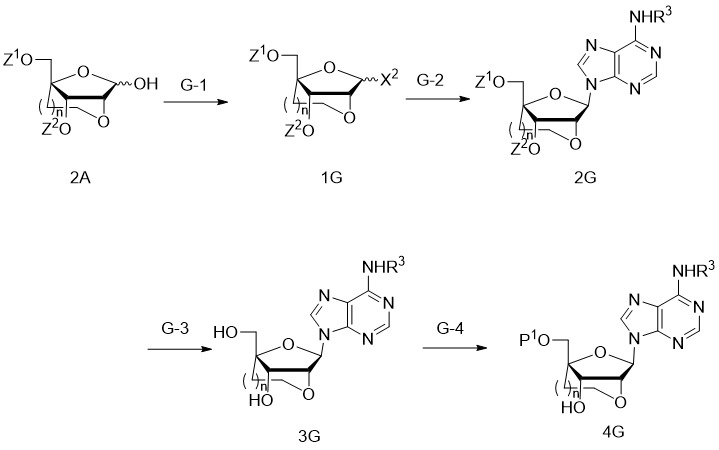
以下,對於G法之步驟進行詳細說明。Hereinafter, the steps of the G method will be described in detail.
(G-1步驟)(Step G-1)
本步驟係藉由使用化合物(2A),於溶媒中,鹼存在下,使活化劑反應,而製造化合物(1G)的步驟。This step is a step of producing compound (1G) by using compound (2A) in a solvent in the presence of a base to react an activator.
就使用的溶媒而言,可列舉例如,二氯甲烷、氯仿、1,2-二氯乙烷之類的鹵化烴類;苯、甲苯等之烴類;四氫呋喃、二甲基醚之類的醚類;乙腈;惟適合地為甲苯、乙腈。As for the solvent used, for example, halogenated hydrocarbons such as dichloromethane, chloroform and 1,2-dichloroethane; hydrocarbons such as benzene and toluene; ethers such as tetrahydrofuran and dimethyl ether Class; Acetonitrile; but suitably toluene, acetonitrile.
反應溫度雖依使用的活化劑而不同,但通常為0℃至50℃,適合地為0℃至30℃。Although the reaction temperature varies depending on the activator used, it is usually 0°C to 50°C, suitably 0°C to 30°C.
使用的活化劑可列舉乙酸酐、苯甲酸酐、三氯乙腈、羰基二咪唑、氯磷酸二苯酯,適合地為乙酸酐、苯甲酸酐。Examples of the activator used include acetic anhydride, benzoic anhydride, trichloroacetonitrile, carbonyl diimidazole, and diphenyl chlorophosphate, and acetic anhydride and benzoic anhydride are suitably used.
使用的鹼雖依活化劑而不同,但可列舉三乙基胺、吡啶、N,N-二甲基胺基吡啶、1,8-二氮雜雙環[5.4.0]十一-7-烯之類的有機鹼,適合地為N,N-二甲基胺基吡啶。Although the base used depends on the activator, triethylamine, pyridine, N,N-dimethylaminopyridine, 1,8-diazabicyclo[5.4.0]undec-7-ene can be mentioned. Such organic bases are suitably N,N-dimethylaminopyridine.
反應溫度雖依使用的活化劑而不同,但通常為0℃至50℃,適合地為0℃至30℃。Although the reaction temperature varies depending on the activator used, it is usually 0°C to 50°C, suitably 0°C to 30°C.
反應時間雖依活化劑的種類及使用量而不同,但通常為10分鐘至8小時,適合地為1小時至3小時。Although the reaction time varies depending on the type and amount of the activator used, it is usually 10 minutes to 8 hours, and suitably 1 hour to 3 hours.
反應結束後,本反應之目的化合物(1G),例如可用於直接醣基化,或將反應液中和,並將反應混合物濃縮,餾除溶媒而獲得。After the completion of the reaction, the target compound (1G) of this reaction can be obtained, for example, by direct glycosylation, or by neutralizing the reaction liquid, concentrating the reaction mixture, and distilling off the solvent.
獲得的化合物,若需要,可藉由通常方法,例如再結晶、矽膠層析等而進一步純化。The obtained compound can be further purified by usual methods, such as recrystallization, silica gel chromatography, etc., if necessary.
(G-2步驟)(Step G-2)
本步驟係對化合物(1G),於溶媒中,酸試藥存在下,進行與胺基經保護的6-胺基嘌呤-9-基的醣基化反應,之後伴隨異構物化之製造化合物(2G)的步驟。This step is to carry out the glycosylation reaction of the compound (1G) with the amino group protected 6-aminopurin-9-yl group in a solvent and the presence of an acid reagent, followed by the isomerization of the compound ( 2G) steps.
就使用的溶媒而言,可列舉例如,二氯甲烷、氯仿、1,2-二氯乙烷之類的鹵化烴類;苯、甲苯等之烴類;四氫呋喃之類的醚類;乙腈;惟適合地為乙腈。As for the solvent used, for example, halogenated hydrocarbons such as dichloromethane, chloroform, and 1,2-dichloroethane; hydrocarbons such as benzene and toluene; ethers such as tetrahydrofuran; acetonitrile; Suitably acetonitrile.
使用的酸試藥可列舉二氯二甲基矽烷與三氟甲磺酸、三氟甲磺酸三甲基矽酯與三氟甲磺酸、甲磺酸、三氟乙酸等,適合地為三氟甲磺酸三甲基矽酯與三氟乙酸。The acid reagent used can include dichlorodimethylsilane and trifluoromethanesulfonic acid, trimethylsilyl trifluoromethanesulfonate and trifluoromethanesulfonic acid, methanesulfonic acid, trifluoroacetic acid, etc., suitably trifluoromethanesulfonic acid Trimethylsilyl fluoromethanesulfonate and trifluoroacetic acid.
醣基化及異構物化之反應溫度雖依化合物(1G)之結構或使用的酸試藥而不同,但通常為30℃至70℃,適合地為40℃至60℃。Although the reaction temperature of glycosylation and isomerization varies depending on the structure of the compound (1G) or the acid reagent used, it is usually 30°C to 70°C, suitably 40°C to 60°C.
反應時間雖依路易士酸試藥的種類及使用量而不同,但通常為10分鐘至24小時,適合地為1小時至5小時。Although the reaction time varies depending on the type and dosage of Lewis acid reagent, it is usually 10 minutes to 24 hours, and suitably 1 hour to 5 hours.
反應結束後,本反應之目的化合物(2G),例如藉由將反應液中和,並將反應混合物濃縮,餾除溶媒而獲得。After the completion of the reaction, the target compound (2G) of this reaction can be obtained, for example, by neutralizing the reaction liquid, concentrating the reaction mixture, and distilling off the solvent.
獲得的化合物,若需要,可藉由通常方法,例如再結晶、矽膠層析等而進一步純化。The obtained compound can be further purified by usual methods, such as recrystallization, silica gel chromatography, etc., if necessary.
(G-3步驟)(Step G-3)
本步驟係使化合物(2G),於溶媒中,與去保護試藥反應,藉由將Z1 及Z2 去保護而製造化合物(3G)的步驟。This step is a step in which compound (2G) is reacted with a deprotection reagent in a solvent, and Z 1 and Z 2 are deprotected to produce compound (3G).
就使用的溶媒而言,可列舉例如,二氯甲烷、氯仿、1,2-二氯乙烷之類的鹵化烴類;苯、甲苯等之烴類;惟適合地為二氯甲烷。As for the solvent to be used, for example, halogenated hydrocarbons such as dichloromethane, chloroform, and 1,2-dichloroethane; hydrocarbons such as benzene and toluene; but dichloromethane is suitable.
Z1 及Z2 為苄基之情形之去保護試藥可列舉氯化鐵(III)、三氯化硼等,適合地為三氯化硼。In the case where Z 1 and Z 2 are benzyl groups, the deprotection reagent may include iron (III) chloride, boron trichloride, etc., and is suitably boron trichloride.
反應溫度雖依去保護試藥而不同,但通常為-20℃至30℃,適合地為-20℃至20℃。Although the reaction temperature varies depending on the deprotection reagent, it is usually -20°C to 30°C, suitably -20°C to 20°C.
反應時間雖依去保護試藥而不同,但通常為10分鐘至10小時,適合地為1小時至5小時。Although the reaction time varies depending on the deprotection reagent, it is usually 10 minutes to 10 hours, and suitably 1 hour to 5 hours.
反應結束後,本反應之目的化合物(3G),例如藉由將反應液中和,並將反應混合物濃縮,餾除溶媒而獲得。After the completion of the reaction, the target compound (3G) of the present reaction can be obtained, for example, by neutralizing the reaction liquid, concentrating the reaction mixture, and distilling off the solvent.
獲得的化合物,若需要,可藉由通常方法,例如再結晶、矽膠層析等而進一步純化。The obtained compound can be further purified by usual methods, such as recrystallization, silica gel chromatography, etc., if necessary.
(G-4步驟)(Step G-4)
本步驟之目的化合物(4G)可按照E法E-4步驟,藉由保護化合物(3G)之1級羥基而製造。The target compound (4G) in this step can be produced by protecting the first-order hydroxyl group of the compound (3G) according to the step E-4 of Method E.
又,本發明之化合物(5H),亦可藉由以下所述的H法(使用二氯嘌呤的醣基化)而製造。In addition, the compound (5H) of the present invention can also be produced by the H method (glycosylation using dichloropurine) described below.
(H法)
以下,對於H法之步驟進行詳細說明。Hereinafter, the steps of the H method will be described in detail.
(H-1步驟)(Step H-1)
本步驟係藉由使化合物(1G),於溶媒中,鹵化劑存在下,與藉由矽化反應而經矽化的二氯嘌呤與醣基化反應,而製造化合物(1H)的步驟。This step is a step of producing compound (1H) by reacting compound (1G) with dichloropurine silicified by silicification reaction and glycosylation in a solvent in the presence of a halogenating agent.
就醣基化反應及矽化反應所使用的溶媒而言,可列舉例如,二氯甲烷、氯仿、1,2-二氯乙烷之類的鹵化烴類;苯、甲苯等之烴類;四氫呋喃之類的醚類;乙腈;適合地為乙腈。As for the solvent used in the glycosylation reaction and the silicification reaction, for example, halogenated hydrocarbons such as dichloromethane, chloroform, and 1,2-dichloroethane; hydrocarbons such as benzene and toluene; and tetrahydrofuran Class ethers; acetonitrile; suitably acetonitrile.
矽化反應所使用的矽化劑可列舉N,O-雙三甲基矽基乙醯胺、六甲基二矽氮烷等,適合地為N,O-雙三甲基矽基乙醯胺。The silicifying agent used in the silicification reaction includes N,O-bistrimethylsilylacetamide, hexamethyldisilazane, etc., and is suitably N,O-bistrimethylsilylacetamide.
二氯嘌呤之矽化反應之反應溫度雖依矽化劑而不同,但通常為0℃至90℃,適合地為50℃至80℃。Although the reaction temperature of the silicification reaction of dichloropurine differs depending on the silicifying agent, it is usually 0°C to 90°C, and suitably 50°C to 80°C.
矽化反應之反應時間雖依矽化劑的種類及使用量而不同,但通常為10分鐘至24小時,適合地為1小時至10小時。Although the reaction time of the silicification reaction varies depending on the type and amount of the silicifying agent, it is usually 10 minutes to 24 hours, and suitably 1 hour to 10 hours.
醣基化反應所使用的鹵化劑可列舉氯三甲基矽烷(TMSCl)、溴三甲基矽烷(TMSBr)、碘三甲基矽烷(TMSI),適合地為TMSI。醣基化反應之反應溫度雖依化合物(2B)之結構或使用的鹵化劑而不同,但通常為0℃至90℃,適合地為50℃至80℃。The halogenating agent used in the glycosylation reaction may be exemplified by chlorotrimethylsilane (TMSCl), bromotrimethylsilane (TMSBr), and iodotrimethylsilane (TMSI), and is suitably TMSI. Although the reaction temperature of the glycosylation reaction varies depending on the structure of the compound (2B) or the halogenating agent used, it is usually 0°C to 90°C, and suitably 50°C to 80°C.
醣基化反應之反應時間雖依鹵化劑的種類及使用量而不同,但通常為10分鐘至24小時,適合地為10小時至5小時。Although the reaction time of the glycosylation reaction varies depending on the type and amount of the halogenating agent, it is usually 10 minutes to 24 hours, and suitably 10 hours to 5 hours.
反應結束後,本反應之目的化合物(1H),例如藉由將反應液中和,並將反應混合物濃縮,餾除溶媒而獲得。After the completion of the reaction, the target compound (1H) of the present reaction can be obtained, for example, by neutralizing the reaction liquid, concentrating the reaction mixture, and distilling off the solvent.
獲得的化合物,若需要,可藉由通常方法,例如再結晶、矽膠層析等而進一步純化。The obtained compound can be further purified by usual methods, such as recrystallization, silica gel chromatography, etc., if necessary.
(H-2步驟)(H-2 step)
本步驟為藉由使化合物(1H),於溶媒中,與胺基化劑反應,而製造化合物(2H)的步驟。This step is a step of producing compound (2H) by reacting compound (1H) with an aminating agent in a solvent.
就使用的溶媒而言,可列舉例如,二氯甲烷、氯仿、1,2-二氯乙烷之類的鹵化烴類;苯、甲苯等之烴類;四氫呋喃、二甲基醚之類的醚類;乙腈;惟適合地為四氫呋喃。As for the solvent used, for example, halogenated hydrocarbons such as dichloromethane, chloroform and 1,2-dichloroethane; hydrocarbons such as benzene and toluene; ethers such as tetrahydrofuran and dimethyl ether Class; Acetonitrile; but suitably tetrahydrofuran.
就使用的胺基化劑而言,可列舉氨、氨水溶液或碳酸銨或乙酸銨之類的氨鹽類,適合地為氨水溶液。As for the aminating agent used, ammonia, an aqueous ammonia solution, or an ammonia salt such as ammonium carbonate or ammonium acetate, is suitably an aqueous ammonia solution.
反應溫度通常為0℃至90℃,適合地為30℃至60℃。The reaction temperature is usually 0°C to 90°C, suitably 30°C to 60°C.
反應時間雖依溶媒及胺基化劑之使用量而不同,但通常為10分鐘至24小時,適合地為1小時至10小時。Although the reaction time varies depending on the amount of solvent and aminating agent used, it is usually 10 minutes to 24 hours, and suitably 1 hour to 10 hours.
反應結束後,本反應之目的化合物(2H),例如藉由將反應液中和,並將反應混合物濃縮,餾除溶媒而獲得。After the completion of the reaction, the target compound (2H) of this reaction can be obtained, for example, by neutralizing the reaction liquid, concentrating the reaction mixture, and distilling off the solvent.
獲得的化合物,若需要,可藉由通常方法,例如再結晶、矽膠層析等而進一步純化。The obtained compound can be further purified by usual methods, such as recrystallization, silica gel chromatography, etc., if necessary.
(H-3步驟)(Step H-3)
本步驟係於溶媒中,藉由化合物(2H)之Z1 及Z2 之去保護反應及嘌呤環之2位之氯原子之氫化反應,而製造化合物(3H)的步驟。This step is a step of producing compound (3H) in a solvent through the deprotection reaction of Z 1 and Z 2 of compound (2H) and the hydrogenation reaction of the chlorine atom at position 2 of the purine ring.
就使用的溶媒而言,可列舉例如,水、甲醇、乙醇、1-丙醇、2-丙醇等之醇類;苯、甲苯等之烴類;四氫呋喃、二乙基醚之類的醚類;乙腈;惟適合地為乙醇。As for the solvent used, for example, alcohols such as water, methanol, ethanol, 1-propanol, and 2-propanol; hydrocarbons such as benzene and toluene; ethers such as tetrahydrofuran and diethyl ether ; Acetonitrile; but suitably ethanol.
Z1 及Z2 為苄基之情形,於金屬觸媒存在下,使用還原劑,可同時進行Z1 及Z2 之去保護反應與嘌呤環之2位之氫化反應。When Z 1 and Z 2 are benzyl groups, in the presence of a metal catalyst, using a reducing agent can simultaneously perform the deprotection reaction of Z 1 and Z 2 and the hydrogenation reaction of the 2-position of the purine ring.
使用的金屬觸媒可列舉鈀、氫氧化鈀、鉑(特別是承載於碳上的鈀、氫氧化鈀、或鉑)等,適合地為鈀(特別是承載於碳上的鈀)。The metal catalyst used may include palladium, palladium hydroxide, platinum (especially palladium on carbon, palladium hydroxide, or platinum), etc., and is suitably palladium (especially palladium on carbon).
使用的還原劑可列舉氫、甲酸、甲酸銨等,適合地為氫。The reducing agent used includes hydrogen, formic acid, ammonium formate, etc., and is suitably hydrogen.
反應溫度可依金屬觸媒而不同,但通常為0℃至70℃,適合地為40℃至60℃。The reaction temperature may vary depending on the metal catalyst, but is usually 0°C to 70°C, suitably 40°C to 60°C.
反應時間可依金屬觸媒、還原劑的種類及使用量而不同,但通常為10分鐘至24小時,適合地為1小時至10小時。The reaction time may vary depending on the type and amount of the metal catalyst and reducing agent, but is usually 10 minutes to 24 hours, and suitably 1 hour to 10 hours.
反應結束後,本反應之目的化合物(3H),例如藉由將反應液過濾而去除金屬觸媒,將反應混合物濃縮,並餾除溶媒而獲得。After the completion of the reaction, the target compound (3H) of the present reaction can be obtained, for example, by filtering the reaction liquid to remove the metal catalyst, concentrating the reaction mixture, and distilling off the solvent.
獲得的化合物,若需要,可藉由通常方法,例如再結晶、矽膠層析等而進一步純化。The obtained compound can be further purified by usual methods, such as recrystallization, silica gel chromatography, etc., if necessary.
(H-4步驟)(Step H-4)
本步驟係化合物(3H),於溶媒中,將羥基以羥基之保護試藥保護後,將嘌呤環上之胺基以醯化劑進行醯化,接著藉由氨使羥基上之保護基脫離,而製造化合物(4H)的步驟。This step is compound (3H). After protecting the hydroxyl group with a protective reagent for the hydroxyl group in a solvent, the amine group on the purine ring is acylated with an acylating agent, and then the protective group on the hydroxyl group is removed by ammonia. And the step of producing compound (4H).
就使用的溶媒而言,可列舉例如,吡啶、乙腈;惟適合地為吡啶。As for the solvent used, for example, pyridine and acetonitrile can be cited; however, pyridine is suitable.
就使用的羥基之保護試藥而言,可列舉氯三甲基矽烷、三氟甲磺醯基三甲基矽烷等,適合地為氯三甲基矽烷。As for the protective reagent for the hydroxyl group to be used, chlorotrimethylsilane, trifluoromethanesulfonyltrimethylsilane, etc. can be cited, and chlorotrimethylsilane is suitably used.
反應之溫度通常為0℃至90℃,適合地為0℃至30℃。The temperature of the reaction is usually 0°C to 90°C, suitably 0°C to 30°C.
反應時間雖依羥基之保護試藥的種類及使用量而不同,但通常為10分鐘至2小時,適合地為30分鐘至1小時。Although the reaction time varies depending on the type and amount of the protective reagent for the hydroxyl group, it is usually 10 minutes to 2 hours, and suitably 30 minutes to 1 hour.
就使用的醯化劑而言,可列舉乙酸酐、乙醯氯、苯甲酸酐、苯甲醯氯等,適合地為苯甲醯氯。The acylating agent used includes acetic anhydride, acetyl chloride, benzoic anhydride, benzyl chloride, etc., and benzyl chloride is suitable.
醯化反應之溫度通常為0℃至90℃,適合地為0℃至30℃。The temperature of the acylation reaction is usually 0°C to 90°C, suitably 0°C to 30°C.
反應時間雖依羥基之保護試藥的種類及使用量而不同,但通常為1小時至8小時,適合地為1小時至3小時。Although the reaction time varies according to the type and amount of the protective reagent for the hydroxyl group, it is usually 1 hour to 8 hours, and suitably 1 hour to 3 hours.
本反應之目的化合物(4H),例如藉由於反應液中添加氨水後,將反應混合物濃縮,餾除溶媒而獲得。The target compound (4H) of this reaction can be obtained, for example, by adding ammonia water to the reaction solution, then concentrating the reaction mixture and distilling off the solvent.
獲得的化合物,若需要,可藉由通常方法,例如再結晶、矽膠層析等而進一步純化。The obtained compound can be further purified by usual methods, such as recrystallization, silica gel chromatography, etc., if necessary.
(H-5步驟)(H-5 step)
本步驟之目的化合物(5H)可按照E法E-4步驟,藉由將化合物(4H)之1級羥基加以保護而製造。The objective compound (5H) in this step can be produced by protecting the first-order hydroxyl group of compound (4H) according to step E-4 of Method E.
本發明之化合物(4I)可藉由以下所述的I法而製造。The compound (4I) of the present invention can be produced by the method I described below.
(I法)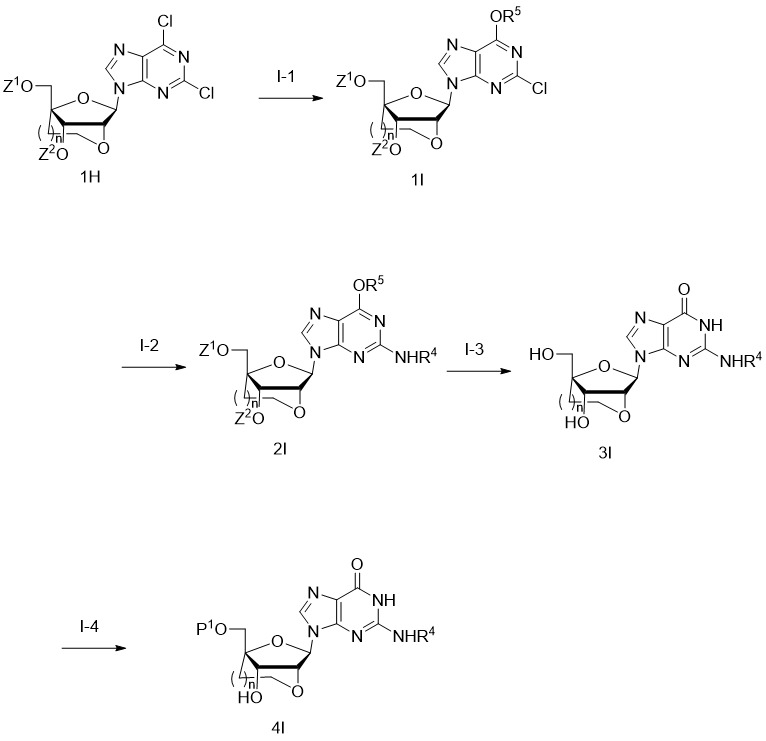
以下,對於I法之各步驟進行詳細說明。Hereinafter, each step of the I method will be described in detail.
(I-1步驟)(Step I-1)
本步驟係將化合物(1H),於溶媒中,鹼存在下,藉由與可具有取代基的芐醇之取代反應而製造化合物(1I)的步驟。This step is a step of producing compound (1I) by substitution reaction of compound (1H) with optionally substituted benzyl alcohol in the presence of a base in a solvent.
就可具有取代基的芐醇而言,可列舉例如,芐醇、4-甲基芐醇、2,4,6-三甲基芐醇、3,4,5-三甲基芐醇、4-甲氧基芐醇、4-氯芐醇、4-溴芐醇或4-氰基芐醇,適合地為芐醇。As for the benzyl alcohol which may have a substituent, for example, benzyl alcohol, 4-methylbenzyl alcohol, 2,4,6-trimethylbenzyl alcohol, 3,4,5-trimethylbenzyl alcohol, 4 -Methoxybenzyl alcohol, 4-chlorobenzyl alcohol, 4-bromobenzyl alcohol or 4-cyanobenzyl alcohol, suitably benzyl alcohol.
就使用的溶媒而言,可列舉例如,二氯甲烷、氯仿、1,2-二氯乙烷之類的鹵化烴類;苯、甲苯等之烴類;四氫呋喃、二甲基醚之類的醚類;乙腈;惟適合地為四氫呋喃。As for the solvent used, for example, halogenated hydrocarbons such as dichloromethane, chloroform and 1,2-dichloroethane; hydrocarbons such as benzene and toluene; ethers such as tetrahydrofuran and dimethyl ether Class; Acetonitrile; but suitably tetrahydrofuran.
就使用的鹼而言,可列舉例如,氫化鈉、碳酸鈉等之無機鹼;三乙基胺、吡啶、1,8-二氮雜雙環[5.4.0]十一-7-烯之類的有機鹼;惟適合地為氫化鈉。As for the base used, for example, inorganic bases such as sodium hydride and sodium carbonate; triethylamine, pyridine, 1,8-diazabicyclo[5.4.0]undec-7-ene and the like Organic base; but suitably sodium hydride.
反應溫度通常為0℃至90℃,適合地為0℃至30℃。The reaction temperature is usually 0°C to 90°C, suitably 0°C to 30°C.
反應時間雖依溶媒及鹼之使用量而不同,但通常為10分鐘至24小時,適合地為1小時至10小時。Although the reaction time varies depending on the amount of solvent and alkali used, it is usually 10 minutes to 24 hours, and suitably 1 hour to 10 hours.
反應結束後,本反應之目的化合物(1I),例如藉由將反應液中和,並將反應混合物濃縮,餾除溶媒而獲得。After the completion of the reaction, the target compound (1I) of the present reaction can be obtained, for example, by neutralizing the reaction liquid, concentrating the reaction mixture, and distilling off the solvent.
獲得的化合物,若需要,可藉由通常方法,例如再結晶、矽膠層析等而進一步純化。The obtained compound can be further purified by usual methods, such as recrystallization, silica gel chromatography, etc., if necessary.
(I-2步驟)(Step I-2)
本步驟係將化合物(1I),於溶媒中,鹼、鈀觸媒、膦配位子存在下,藉由與醯胺化劑之交叉偶合反應,而製造化合物(2I)的步驟。This step is a step of preparing compound (2I) by cross-coupling reaction with an aminating agent in the presence of a base, a palladium catalyst, and a phosphine ligand in a solvent.
就使用的溶媒而言,可列舉例如,二氯甲烷、氯仿、1,2-二氯乙烷之類的鹵化烴類;苯、甲苯等之烴類;四氫呋喃、二甲基醚之類的醚類;乙腈;惟適合地為甲苯。As for the solvent used, for example, halogenated hydrocarbons such as dichloromethane, chloroform and 1,2-dichloroethane; hydrocarbons such as benzene and toluene; ethers such as tetrahydrofuran and dimethyl ether Class; Acetonitrile; but suitably toluene.
就使用的鹼而言,可列舉例如,氫氧化鈉、碳酸鈉、碳酸銫等之無機鹼;三乙基胺、吡啶、1,8-二氮雜雙環[5.4.0]十一-7-烯之類的有機鹼;惟適合地為碳酸銫。As for the base used, for example, inorganic bases such as sodium hydroxide, sodium carbonate, cesium carbonate, etc.; triethylamine, pyridine, 1,8-diazabicyclo[5.4.0]undec-7- Organic bases such as alkenes; the only suitable one is cesium carbonate.
就使用的鈀觸媒而言,可列舉參(二亞苄基丙酮)(氯仿)二鈀、乙酸鈀(II)、參(二亞苄基丙酮)二鈀(0)等,適合地為參(二亞苄基丙酮)(氯仿)二鈀。Regarding the palladium catalyst used, ginseng (dibenzylidene acetone) (chloroform) dipalladium, palladium acetate (II), ginseng (dibenzylidene acetone) dipalladium (0), etc. can be cited, suitably (Dibenzylideneacetone)(chloroform)dipalladium.
就使用的膦配位子而言,可列舉4,5’-雙(二苯基膦基)-9,9’-二甲基𠮿
就使用的醯胺化劑而言,可列舉乙醯基醯胺、苄醯基醯胺、異丁基醯胺等,適合地為異丁基醯胺。Examples of the aminating agent used include acetamido, benzamido, isobutylamido, and the like, and isobutylamido is suitable.
反應溫度通常為20℃至150℃,適合地為90℃至110℃。The reaction temperature is usually 20°C to 150°C, suitably 90°C to 110°C.
反應時間雖依溶媒及鈀觸媒之使用量而不同,但通常為10分鐘至24小時,適合地為5小時至15小時。Although the reaction time varies depending on the amount of solvent and palladium catalyst used, it is usually 10 minutes to 24 hours, and suitably 5 hours to 15 hours.
反應結束後,本反應之目的化合物(2I),例如藉由將反應液中和,並將反應混合物濃縮,餾除溶媒而獲得。After the completion of the reaction, the target compound (2I) of the present reaction can be obtained, for example, by neutralizing the reaction liquid, concentrating the reaction mixture, and distilling off the solvent.
獲得的化合物,若需要,可藉由通常方法,例如再結晶、矽膠層析等而進一步純化。The obtained compound can be further purified by usual methods, such as recrystallization, silica gel chromatography, etc., if necessary.
(I-3步驟)(Step I-3)
本步驟係使化合物(2I),於溶媒中,與羥基之去保護試藥反應,藉由Z1 、Z2 及R5 之去保護而製造化合物(3I)的步驟。This step is a step of preparing compound (3I) by reacting compound (2I) with the deprotection reagent of the hydroxyl group in a solvent and deprotecting Z 1 , Z 2 and R 5.
Z1 及Z2 為苄基之情形,去保護試藥為承載於碳上的金屬觸媒及還原劑。When Z 1 and Z 2 are benzyl groups, the deprotection reagent is a metal catalyst and a reducing agent supported on carbon.
使用的金屬觸媒可列舉鈀、氫氧化鈀、鉑等,適合地為氫氧化鈀。The metal catalyst used may be palladium, palladium hydroxide, platinum, etc., and is suitably palladium hydroxide.
使用的還原劑可列舉氫、甲酸、甲酸銨等,適合地為氫。The reducing agent used includes hydrogen, formic acid, ammonium formate, etc., and is suitably hydrogen.
反應溫度雖依金屬觸媒而不同,但通常為0℃至70℃,適合地為40℃至60℃。Although the reaction temperature varies depending on the metal catalyst, it is usually 0°C to 70°C, and suitably 40°C to 60°C.
反應時間雖依金屬觸媒、還原劑的種類及使用量而不同,但通常為10分鐘至24小時,適合地為1小時至10小時。Although the reaction time varies depending on the type and amount of the metal catalyst and reducing agent, it is usually 10 minutes to 24 hours, and suitably 1 hour to 10 hours.
反應結束後,本反應之目的化合物(3I),例如藉由將反應液過濾而去除金屬觸媒,將反應混合物濃縮,並餾除溶媒而獲得。After the completion of the reaction, the target compound (3I) of the present reaction can be obtained, for example, by filtering the reaction solution to remove the metal catalyst, concentrating the reaction mixture, and distilling off the solvent.
獲得的化合物,若需要,可藉由通常方法,例如再結晶、矽膠層析等而進一步純化。The obtained compound can be further purified by usual methods, such as recrystallization, silica gel chromatography, etc., if necessary.
(I-4步驟)(Step I-4)
本步驟之目的化合物(4I)可藉由按照E法E-4步驟將化合物(3I)之1級羥基加以保護製造。The target compound (4I) in this step can be produced by protecting the first-order hydroxyl group of compound (3I) according to step E-4 of Method E.
化合物(2J)可藉由以下所述的J法而製造。Compound (2J) can be produced by the method J described below.
(J法)
以下,對於J法之步驟進行詳細說明。Hereinafter, the steps of the J method will be described in detail.
(J-1步驟)(Step J-1)
本步驟係使化合物(1J),於溶媒中,乾燥劑、活化劑存在下,與AMIDITE化試藥反應,並藉由AMIDITE化反應,而製造化合物(2J)的步驟。This step is a step of reacting compound (1J) with AMIDITE chemical reagent in a solvent, in the presence of a desiccant and activator, and producing compound (2J) through the AMIDITE chemical reaction.
就使用的溶媒而言,可列舉例如,二氯甲烷、氯仿、1,2-二氯乙烷之類的鹵化烴類;乙酸乙酯、乙酸丙酯、乙酸丁基等之酯類;苯、甲苯等之烴類;四氫呋喃之類的醚類;乙腈;惟適合地為二氯甲烷。As for the solvent used, for example, halogenated hydrocarbons such as dichloromethane, chloroform and 1,2-dichloroethane; esters such as ethyl acetate, propyl acetate, and butyl acetate; benzene, Hydrocarbons such as toluene; ethers such as tetrahydrofuran; acetonitrile; but dichloromethane is suitable.
使用的乾燥劑可列舉分子篩3A、分子篩4A、或分子篩5A,適合地為分子篩4A。The desiccant used may be molecular sieve 3A, molecular sieve 4A, or molecular sieve 5A, and molecular sieve 4A is suitable.
使用的活化劑可列舉5-苄硫基四唑、5-苯基四唑、二溴咪唑、二氰基咪唑、N-烷基咪唑三氟乙酸鹽等,適合地為4,5-二氰基咪唑。The activator used can include 5-benzylthiotetrazole, 5-phenyltetrazole, dibromoimidazole, dicyanimidazole, N-alkylimidazole trifluoroacetate, etc., suitably 4,5-dicyano Gimidazole.
使用的AMIDITE化試藥可列舉2-氰基乙基N,N,N’,N’-四異丙基亞磷醯二胺、2-氰基乙基二異丙基氯亞磷醯胺,適合地為2-氰基乙基N,N,N’,N’-四異丙基亞磷醯二胺。The AMIDITE chemical reagents used include 2-cyanoethyl N,N,N',N'-tetraisopropylphosphoramidite, 2-cyanoethyldiisopropylphosphoramidite, Suitably it is 2-cyanoethyl N,N,N',N'-tetraisopropylphosphoridine.
反應溫度雖依使用的AMIDITE化試藥而不同,但通常為0℃至50℃,適合地為0℃至30℃。Although the reaction temperature varies depending on the AMIDITE chemical reagent used, it is usually 0°C to 50°C, and suitably 0°C to 30°C.
反應時間雖依使用的AMIDITE化試藥而不同,但通常為10分鐘至24小時,適合地為1小時至16小時。Although the reaction time varies depending on the AMIDITE chemical reagent used, it is usually 10 minutes to 24 hours, and suitably 1 hour to 16 hours.
反應結束後,本反應之目的化合物(2J),例如藉由將反應液中和,並將反應混合物濃縮,餾除溶媒而獲得。After the completion of the reaction, the target compound (2J) of the present reaction can be obtained, for example, by neutralizing the reaction liquid, concentrating the reaction mixture, and distilling off the solvent.
獲得的化合物,若需要,可藉由通常方法,例如再結晶、矽膠層析等而進一步純化。The obtained compound can be further purified by usual methods, such as recrystallization, silica gel chromatography, etc., if necessary.
本發明,作為一個態樣,提供一種製造寡核苷酸之方法,以上述之方法所製造的各ENA單體及市售之核酸或對應修飾核酸的核苷之亞磷醯胺化合物、及將配位體單元之亞磷醯胺化合物藉由磷酸二酯鍵或硫代磷酸酯鍵而連結,使單元鏈伸長,而具有所期望的序列・結構。此種寡核苷酸之製造,可藉由使用市售之合成機(例如,Perkin Elmer公司之利用亞磷醯胺法的模型392)等,依據文獻(Nucleic Acids Research, 12, 4539 (1984))記載之方法合成而進行。此時所使用的各ENA之核苷(即,2’-O,4’-C-伸乙基交聯鳥苷、2’-O,4’-C-伸乙基交聯腺苷、2’-O,4’-C-伸乙基交聯胞苷、2’-O,4’-C-伸乙基交聯胸苷)之亞磷醯胺化合物可藉由上述之方法而被製造的化合物。關於天然型之核苷及2’-O-甲基核苷(即,2’-O-甲基鳥苷、2’-O-甲基腺苷、2’-O-甲基胞苷、2’-O-甲基尿苷)之亞磷醯胺化合物,可使用市售之試藥而製造。The present invention, as one aspect, provides a method for manufacturing oligonucleotides, each ENA monomer manufactured by the above method and commercially available nucleic acids or phosphoramidite compounds corresponding to nucleosides of modified nucleic acids, and The phosphoramidite compound of the ligand unit is connected by a phosphodiester bond or a phosphorothioate bond to extend the unit chain and have a desired sequence and structure. The manufacture of such oligonucleotides can be achieved by using a commercially available synthesizer (for example, Perkin Elmer's model 392 using the phosphoramidite method), etc., according to the literature (Nucleic Acids Research, 12, 4539 (1984) ) The method described in the synthesis is carried out. The nucleosides of each ENA used at this time (ie, 2'-O,4'-C-ethylene cross-linked guanosine, 2'-O,4'-C-ethylene cross-linked adenosine, 2 '-O,4'-C-ethylene cross-linked cytidine, 2'-O,4'-C-ethylene cross-linked thymidine) phosphoramidite compounds can be produced by the above-mentioned method compound of. Regarding natural nucleosides and 2'-O-methyl nucleosides (ie, 2'-O-methylguanosine, 2'-O-methyladenosine, 2'-O-methylcytidine, 2' The phosphoramidite compound of'-O-methyluridine) can be manufactured using commercially available reagents.
於本發明,核酸鹼基序列係可各自將腺嘌呤記載為(A)或(a),將鳥嘌呤記載為(G)或(g),將胞嘧啶記載為(C)或(c),將胸腺嘧碇記載為(T)或(t),及將尿嘧啶記載為(U)或(u)。可使用5-甲基胞嘧啶替代胞嘧啶。核酸鹼之中,尿嘧啶(U)或(u)與胸腺嘧碇(T)或(t)有互換性。尿嘧啶(U)或(u)與胸腺嘧碇(T)或(t)任一者皆可使用於與互補鏈的腺嘌呤(A)或(a)進行鹼基配對。In the present invention, the nucleic acid base sequence system can each describe adenine as (A) or (a), guanine as (G) or (g), and cytosine as (C) or (c), respectively, Thymine is described as (T) or (t), and uracil is described as (U) or (u). 5-methylcytosine can be used instead of cytosine. Among nucleobases, uracil (U) or (u) is interchangeable with thymine (T) or (t). Either uracil (U) or (u) and thymine (T) or (t) can be used for base pairing with adenine (A) or (a) of the complementary chain.
將亞磷醯胺化合物偶合後,藉由使硫、二硫化四乙基秋蘭姆(tetraethylthiuram disulfide(TETD),Applied Biosystems公司)、Beaucage試藥(Glen Research公司)、或氫化黃原膠(xanthan hydride)等之試藥反應,可合成具有硫代磷酸酯鍵的寡核苷酸(Tetrahedron Letters, 32, 3005 (1991), J. Am. Chem. Soc. 112, 1253 (1990), PCT/WO98/54198)。After the phosphamidite compound is coupled, sulfur, tetraethylthiuram disulfide (TETD) (Applied Biosystems), Beaucage reagent (Glen Research), or hydrogenated xanthan gum (xanthan hydride) and other reagent reactions, can synthesize oligonucleotides with phosphorothioate bonds (Tetrahedron Letters, 32, 3005 (1991), J. Am. Chem. Soc. 112, 1253 (1990), PCT/WO98 /54198).
就於合成機所使用的定孔玻璃珠(Controlled pore glass(CPG))而言,2’-O-甲基核苷之鍵結者可利用市售者。又,對於2’-O,4’-C-亞甲基鳥苷、腺苷、5-甲基胞苷及胸苷,按照WO99/14226記載之方法,對於上述之方法所製造的2’-O, 4’-C-伸乙基鳥苷、腺苷、5-甲基胞苷及胸苷,按照文獻(Oligonucleotide Synthesis, Edited by M.J.Gait, Oxford University Press, 1984),可與CPG結合。藉由使用經修飾的CPG(記載於日本特開平7-87982之實施例12b),可合成於3’末端鍵結有2-羥基乙基磷酸基的寡核苷酸。又,若使用3’-amino-Modifier C3 CPG、3’-amino-Modifier C7 CPG, Glyceryl CPG (Glen Research)、3’-specer C3 SynBase CPG 1000、3’-specer C9 SynBase CPG 1000(link technologies),可合成於3’末端鍵結有羥基烷基磷酸基、或胺基烷基磷酸基的寡核苷酸。Regarding the controlled pore glass (CPG) used in the synthesizer, the 2'-O-methyl nucleoside bond can be commercially available. In addition, for 2'-O,4'-C-methyleneguanosine, adenosine, 5-methylcytidine and thymidine, according to the method described in WO99/14226, for the 2'- O, 4'-C-Ethylguanosine, adenosine, 5-methylcytidine and thymidine can be combined with CPG according to the literature (Oligonucleotide Synthesis, Edited by MJ Gait, Oxford University Press, 1984). By using a modified CPG (described in Example 12b of JP 7-87982), an oligonucleotide having a 2-hydroxyethyl phosphate group bonded to the 3'end can be synthesized. Also, if you use 3'-amino-Modifier C3 CPG, 3'-amino-Modifier C7 CPG, Glyceryl CPG (Glen Research), 3'-specer C3 SynBase CPG 1000, 3'-specer C9 SynBase CPG 1000 (link technologies) , Can synthesize oligonucleotides with hydroxyalkyl phosphate groups or aminoalkyl phosphate groups bonded to the 3'end.
藉由本發明所製造的寡核苷酸,亦可含有適合對核酸之組織進行輸送的配位體單元。配位體單元係,配位體部透過連接子(linker)而合成包含磷酸部的AMIDITE化合物,藉此藉由與核苷酸之伸長同樣的方法,可與寡核苷酸之5’末端結合。於對肝臓的輸送,使用GalNAc藉由連接子與磷酸部結合的寡核苷酸,於該寡核苷酸之製造,使用對應以下之X18
或X20
等的亞磷醯胺化合物。可各自使用:
為GalNAc單元的對應X18
的亞磷醯胺化合物,WO2019/172286之參考例39之化合物39D ([(2R,3R,4R,5R,6R)-5-乙醯胺-6-[3-[[2-[[3-[[2-[3-[(2R,3R,4R,5R,6R)-3-乙醯胺-4,5-二乙醯氧基-6-[[雙(4-甲氧基苯基)-苯基-甲氧基]甲基]四氫哌喃-2-基]氧基丙基胺基]-2-側氧基-乙基]胺甲醯氧基]-2-[2-氰基乙氧基-(二異丙基胺基)磷烷基]氧基-丙氧基]羰基胺基]乙醯基]胺基]丙氧基]-4-乙醯氧基-2-[[雙(4-甲氧基苯基)-苯基-甲氧基]甲基]四氫哌喃-3-基] 乙酸酯)、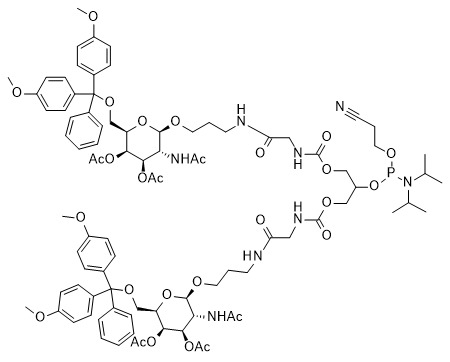
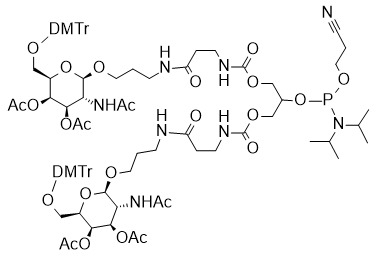
就本發明之方法所製造的寡核苷酸之一個態樣而言,可例示具有以下之式所表示的序列及結構,且有用於杜興氏肌肉失養症(Duchenne muscular dystrophy)之治療的寡核苷酸(參照WO2004/048570)。As for one aspect of the oligonucleotide produced by the method of the present invention, it can be exemplified that it has the sequence and structure represented by the following formula, and is useful for the treatment of Duchenne muscular dystrophy (Duchenne muscular dystrophy) Oligonucleotide (refer to WO2004/048570).
(DMD AO01) HO-Ce2s -Am1s -Gm1s -Te2s -Te2s -Um1s -Gm1s -Ce2s -Ce2s -Gm1s -Ce2s -Te2s -Gm1s -Ce2s -Ce2s -Ce2s -Am1s -Am1s - CH2 CH2 OH(序列識別號1) (DMD AO02) HO-Te2s -Gm1s -Te2s -Te2s -Ce2s -Te2s -Gm1s -Am1s -Ce2s -Am1s -Am1s -Ce2s -Am1s -Gm1s -Te2s -Te2s -Te2s -Gm1s - CH2 CH2 OH(序列識別號2) (DMD AO03) HO-Ce2s -Gm1s -Ce2s -Te2s -Gm1s -Cm1s -Ce2s -Ce2s -Am1s -Am1s -Te2s -Gm1s -Ce2s -Ce2s -Am1s -Um1s -Ce2s -Ce2s - CH2 CH2 OH(序列識別號3) (DMD AO04) HO-Ce2s -Am1s -Te2s -Am1s -Am1s -Te2s -Gm1s -Am1s -Ae2s -Am1s -Am1s -Ce2s -Gm1s -Cm1s -Ce2s -Gm1s -Ce2s -Ce2s - CH2 CH2 OH(序列識別號4) (DMD AO05) HO-Te2s -Um1s -Ce2s -Cm1s -Ce2s -Am1s -Am1s -Te2s -Um1s -Cm1s -Te2s -Ce2s -Am1s -Gm1s -Gm1s -Ae2s -Am1s -Te2s - CH2 CH2 OH(序列識別號5) (DMD AO06) HO-Ce2s -Ce2s -Am1s -Um1s -Te2s -Um1s -Gm1s -Te2s -Am1s -Um1s -Te2s -Te2s -Am1s -Gm1s -Ce2s -Am1s -Te2s -Gm1s - CH2 CH2 OH(序列識別號6) (DMD AO07) HO-Gm1s -Gm1s -Ce2s -Te2s -Gm1s -Cm1s -Te2s -Te2s -Um1s -Gm1s -Ce2s -Cm1s -Cm1s -Te2s -Ce2s -Am1s -Gm1s -Ce2s -CH2 CH2 OH(序列識別號7) (DMD AO08) HO-Gm1s -Ce2s -Te2s -Am1s -Gm1s -Gm1s -Te2s -Ce2s -Am1s -Gm1s -Gm1s -Te2s -Gm1s -Cm1s -Te2s -Te2s -Um1s -CH2 CH2 OH(序列識別號8) (DMD AO09) HO-Am1s -Ce2s -Ce2s -Gm1s -Cm1s -Ce2s -Te2s -Um1s -Cm1s -Ce2s -Am1s -Cm1s -Te2s -Ce2s -Am1s -Gm1s -Ae2s -Gm1s -CH2 CH2 OH; (序列識別號9) (DMD AO10) HO-Ge2s -Ge2s -Ce2s -Ae2s -Te2s -Um1s -Um1s -Cm1s -Um1s -Am1s -Gm1s -Um1s -Um1s -Te2s -Ge2s -Ge2s -Ae2s -Ge2s - CH2 CH2 OH(序列識別號10) (DMD AO11) HO-Gm1s -Gm1s -Ce2s -Am1s -Te2s -Te2s -Um1s -Ce2s -Te2s -Am1s -Gm1s -Um1s -Te2s -Te2s -Gm1s -Gm1s -Ae2s -Gm1s - CH2 CH2 OH(序列識別號11) (DMD AO12) HO-Ae2s -Gm1s -Te2s -Um1s -Te2s -Gm1s -Gm1s -Ae2s -Gm1s -Am1s -Te2s -Gm1s -Gm1s -Ce2s -Ae2s -Gm1s -Te2s -Te2s - CH2 CH2 OH(序列識別號12) (DMD AO13) HO-Ce2s -Te2s -Cm1s -Ce2s -Te2s -Um1s -Ce2s -Ce2s -Am1s -Te2s -Gm1s -Am1s -Ce2s -Te2s -Ce2s -Am1s -Am1s -Gm1s - CH2 CH2 OH(序列識別號13) (DMD AO14) HO-Ce2s -Te2s -Gm1s -Am1s -Am1s -Gm1s -Gm1s -Te2s -Gm1s -Te2s -Te2s -Ce2s -Te2s -Te2s -Gm1s -Te2s -Am1s -Ce2s - CH2 CH2 OH(序列識別號14) (DMD AO15) HO-Te2s -Te2s -Cm1s -Ce2s -Am1s -Gm1s -Ce2s -Ce2s -Am1s -Te2s -Te2s -Gm1s -Te2s -Gm1s -Te2s -Te2s -Gm1s -Am1s - CH2 CH2 OH(序列識別號15)(DMD AO01) HO-C e2s -A m1s -G m1s -T e2s -T e2s -U m1s -G m1s -C e2s -C e2s -G m1s -C e2s -T e2s -G m1s -C e2s -C e2s -C e2s -A m1s -A m1s -CH 2 CH 2 OH (serial identification number 1) (DMD AO02) HO-T e2s -G m1s -T e2s -T e2s -C e2s -T e2s -G m1s -A m1s -C e2s -A m1s -A m1s -C e2s -A m1s -G m1s -T e2s -T e2s -T e2s -G m1s -CH 2 CH 2 OH (serial identification number 2) (DMD AO03) HO-C e2s -G m1s -C e2s -T e2s -G m1s -C m1s -C e2s -C e2s -A m1s -A m1s -T e2s -G m1s -C e2s -C e2s -A m1s -U m1s -C e2s -C e2s -CH 2 CH 2 OH (serial identification number 3) (DMD AO04) HO-C e2s -A m1s -T e2s -A m1s -A m1s -T e2s -G m1s -A m1s -A e2s -A m1s -A m1s -C e2s -G m1s -C m1s -C e2s -G m1s -C e2s -C e2s -CH 2 CH 2 OH (serial identification number 4) (DMD AO05) HO-T e2s -U m1s -C e2s -C m1s -C e2s -A m1s -A m1s -T e2s -U m1s -C m1s -T e2s -C e2s -A m1s -G m1s -G m1s -A e2s -A m1s -T e2s -CH 2 CH 2 OH( Serial identification number 5) (DMD AO06) HO-C e2s -C e2s -A m1s -U m1s -T e2s -U m1s -G m1s -T e2s -A m1s -U m1s -T e2s -T e2s -A m1s- G m1s -C e2s -A m1s -T e2s -G m1s -CH 2 CH 2 OH (serial identification number 6) (DMD AO07) HO-G m1s -G m1s- C e2s -T e2s -G m1s -C m1s -T e2s -T e2s -U m1s -G m1s -C e2s -C m1s -C m1s -T e2s -C e2s -A m1s -G m1s -C e2s -CH 2 CH 2 OH (serial identification number 7) (DMD AO08) HO-G m1s -C e2s -T e2s -A m1s -G m1s -G m1s -T e2s -C e2s -A m1s -G m1s -G m1s -T e2s -G m1s -C m1s -T e2s -T e2s -U m1s -CH 2 CH 2 OH (serial identification number 8) (DMD AO09) HO-A m1s -C e2s -C e2s -G m1s -C m1s -C e2s -T e2s -U m1s -C m1s -C e2s -A m1s -C m1s -T e2s -C e2s -A m1s -G m1s -A e2s -G m1s -CH 2 CH 2 OH; (serial identification number 9) ( DMD AO10) HO-G e2s -G e2s -C e2s -A e2s -T e2s -U m1s -U m1s -C m1s -U m1s -A m1s -G m1s -U m1s -U m1s -T e2s -G e2s- G e2s -A e2s -G e2s -CH 2 CH 2 OH (serial identification number 10) (DMD AO11) HO-G m1s -G m1s -C e2s -A m1s -T e2s -T e2s -U m1s -C e2s- T e2s -A m1s -G m1s -U m1s -T e2s -T e2s -G m1s -G m1s -A e2s -G m1s -CH 2 CH 2 OH (serial identification number 11) (DMD AO12) HO-A e2s- G m1s -T e2s -U m1s -T e2s -G m1s -G m1s -A e2s -G m1s -A m1s -T e2s -G m1s -G m1s -C e2s -A e2s -G m1s -T e2s -T e2s -CH 2 CH 2 OH (serial identification number 12) (DMD AO13) HO-C e2s -T e2s -C m1s -C e2s -T e2s -U m1s -C e2s -C e2s -A m1s -T e2s -G m1s -A m1s -C e2s -T e2s -C e2s -A m1s -A m1s -G m1s -CH 2 CH 2 OH (serial identification number 13) (DMD AO14) HO -C e2s -T e2s -G m1s -A m1s -A m1s -G m1s -G m1s -T e2s -G m1s -T e2s -T e2s -C e2s -T e2s -T e2s -G m1s -T e2s -A m1s -C e2s -CH 2 CH 2 OH (serial identification number 14) (DMD AO15) HO-T e2s -T e2s -C m1s -C e2s -A m1s -G m1s -C e2s -C e2s -A m1s -T e2s -T e2s -G m1s -T e2s -G m1s -T e2s -T e2s -G m1s -A m1s -CH 2 CH 2 OH (serial identification number 15)
[於上述式中,左側表示5’末端,右側表示3’末端,A、G、C、U及T各自表示D-核呋喃糖經修飾且5’位之碳原子與左側所表示的結構單元進行硫代磷酸酯鍵結而成的腺苷、鳥苷、胞苷、尿苷及胸苷。附於各核苷酸或核苷之e2s表示D-核呋喃糖經2’-O,4’-C-伸乙基交聯且3’位以-OP(=S)(-OH)-O-與右側鄰接的核苷酸或核苷的5’位碳原子鍵結,e2t表示D-核呋喃糖經2’-O,4’-C-伸乙基交聯且3’位以-O-與3’末端之氫原子鍵結,m1s表示D-核呋喃糖經2’-O-甲基化且3’位以-OP(=S)(-OH)-O-與右側鄰接的核苷酸或核苷之5’位碳原子鍵結,m1t表示D-核呋喃糖經2’-O-甲基化且3’位以-O-與3’末端之氫原子鍵結。][In the above formula, the left side represents the 5'end, the right side represents the 3'end, and A, G, C, U and T each represent the D-nucleofuranose modified and the carbon atom at the 5'position and the structural unit represented on the left Adenosine, guanosine, cytidine, uridine and thymidine formed by phosphorothioate bonding. The e2s attached to each nucleotide or nucleoside means that the D-nucleofuranose is cross-linked by 2'-O,4'-C-ethylene and the 3'position is -OP(=S)(-OH)-O -Bonded to the 5'carbon atom of the adjacent nucleotide or nucleoside on the right side, e2t indicates that the D-nucleofuranose is cross-linked by 2'-O,4'-C-ethylene and the 3'position is -O -Bonded to the hydrogen atom at the 3'end, m1s represents the nucleus adjacent to the right side of the 3'position with -OP(=S)(-OH)-O- after 2'-O-methylation of D-nuclear furanose The carbon atom at the 5'position of the nucleoside acid or nucleoside is bonded, and m1t means that the D-nucleofuranose is 2'-O-methylated and the 3'position is bonded with the hydrogen atom at the 3'end by -O-. ]
又,就本發明之方法所製造的寡核苷酸之一個態樣而言,可例示具有以下之式所表示的序列及結構,且有用於肝醣貯積病1a型之治療的寡核苷酸(參照WO2019/172286)。In addition, with regard to one aspect of the oligonucleotide produced by the method of the present invention, there can be exemplified an oligonucleotide having the sequence and structure represented by the following formula and used for the treatment of glycosidosis type 1a Acid (refer to WO2019/172286).
(GSD AO01) X18 -Am1s -Ae2s -Um1s -Cm1s -Ce2s -Gm1s -Am1s -Te2s -Gm1s -Gm1s -Ce2s -Gm1s -Am1s -Ae2s -Gm1t -H(序列識別號16) (GSD AO02) X18 -Ae2s -Um1s -Cm1s -Ce2s -Gm1s -Am1s -Te2s -Gm1s -Gm1s -Ce2s -Gm1s -Am1s -Ae2s -Gm1s -Ce2t -H(序列識別號17) (GSD AO03) X18 -Um1s -Cm1s -Ce2s -Gm1s -Am1s -Te2s -Gm1s -Gm1s -Ce2s -Gm1s -Am1s -Ae2s -Gm1s -Ce2s -Um1t -H(序列識別號18) (GSD AO04) X18 -Am1s -Am1s -Ae2s -Um1s -Cm1s -Ce2s -Gm1s -Am1s -Te2s -Gm1s -Gm1s -Ce2s -Gm1s -Am1s -Ae2s -Gm1t -H(序列識別號19) (GSD AO05) X18 -Am1s -Ae2s -Um1s -Cm1s -Ce2s -Gm1s -Am1s -Te2s -Gm1s -Gm1s -Ce2s -Gm1s -Am1s -Ae2s -Gm1s -Ce2t -H(序列識別號20) (GSD AO06) X18 -Ae2s -Um1s -Cm1s -Ce2s -Gm1s -Am1s -Te2s -Gm1s -Gm1s -Ce2s -Gm1s -Am1s -Ae2s -Gm1s -Ce2s -Um1t -H(序列識別號21) (GSD AO07) X18 -Am1s -Ae2s -Um1s -Cm1s -Ce2s -Gm1s -Ae2s -Um1s -Gm1s -Gm1s -Ce2s -Gm1s -Am1s -Ae2s -Gm1t -H(序列識別號22) (GSD AO08) X18 -Ae2s -Um1s -Cm1s -Ce2s -Gm1s -Ae2s -Um1s -Gm1s -Gm1s -Ce2s -Gm1s -Am1s -Ae2s -Gm1s -Ce2t -H(序列識別號23) (GSD AO09) X18 -Um1s -Cm1s -Ce2s -Gm1s -Ae2s -Um1s -Gm1s -Gm1s -Ce2s -Gm1s -Am1s -Ae2s -Gm1s -Ce2s -Um1t -H(序列識別號24) (GSD AO10) X18 -Am1s -Am1s -Ae2s -Um1s -Cm1s -Ce2s -Gm1s -Ae2s -Um1s -Gm1s -Gm1s -Ce2s -Gm1s -Am1s -Ae2s -Gm1t -H(序列識別號25) (GSD AO11) X18 -Am1s -Ae2s -Um1s -Cm1s -Ce2s -Gm1s -Ae2s -Um1s -Gm1s -Gm1s -Ce2s -Gm1s -Am1s -Ae2s -Gm1s -Ce2t -H1(序列識別號26) (GSD AO12) X18 -Ae2s -Um1s -Cm1s -Ce2s -Gm1s -Ae2s -Um1s -Gm1s -Gm1s -Ce2s -Gm1s -Am1s -Ae2s -Gm1s -Ce2s -Um1t -H(序列識別號27) (GSD AO13) X20 -Am1s -Ae2s -Um1s -Cm1s -Ce2s -Gm1s -Ae2s -Um1s -Gm1s -Gm1s -Ce2s -Gm1s -Am1s -Ae2s -Gm1t -H(序列識別號28) (GSD AO14) X20 -Ae2s -Um1s -Cm1s -Ce2s -Gm1s -Ae2s -Um1s -Gm1s -Gm1s -Ce2s -Gm1s -Am1s -Ae2s -Gm1s -Ce2t -H(序列識別號29) (GSD AO15) X20 -Am1s -Am1s -Ae2s -Um1s -Cm1s -Ce2s -Gm1s -Ae2s -Um1s -Gm1s -Gm1s -Ce2s -Gm1s -Am1s -Ae2s -Gm1t -H(序列識別號30) (GSD AO16) X20 -Am1s -Ae2s -Um1s -Cm1s -Ce2s -Gm1s -Ae2s -Um1s -Gm1s -Gm1s -Ce2s -Gm1s -Am1s -Ae2s -Gm1s -Ce2t -H(序列識別號31)(GSD AO01) X 18 -A m1s -A e2s -U m1s -C m1s -C e2s -G m1s -A m1s -T e2s -G m1s -G m1s -C e2s -G m1s -A m1s -A e2s -G m1t -H (serial identification number 16) (GSD AO02) X 18 -A e2s -U m1s -C m1s -C e2s -G m1s -A m1s -T e2s -G m1s -G m1s -C e2s -G m1s -A m1s -A e2s -G m1s -C e2t -H (serial identification number 17) (GSD AO03) X 18 -U m1s -C m1s -C e2s -G m1s -A m1s -T e2s -G m1s -G m1s -C e2s -G m1s -A m1s -A e2s -G m1s -C e2s -U m1t -H (serial identification number 18) (GSD AO04) X 18 -A m1s -A m1s -A e2s -U m1s -C m1s -C e2s -G m1s -A m1s -T e2s -G m1s -G m1s -C e2s -G m1s -A m1s -A e2s -G m1t -H (serial identification number 19) (GSD AO05) X 18 -A m1s -A e2s -U m1s -C m1s -C e2s -G m1s -A m1s -T e2s -G m1s -G m1s -C e2s -G m1s -A m1s -A e2s -G m1s -C e2t -H (serial identification number 20 ) (GSD AO06) X 18 -A e2s -U m1s -C m1s -C e2s -G m1s -A m1s -T e2s -G m1s -G m1s -C e2s -G m1s -A m1s -A e2s -G m1s- C e2s -U m1t -H (serial identification number 21) (GSD AO07) X 18 -A m1s -A e2s -U m1s -C m1s -C e2s -G m1s -A e2s -U m1s -G m1s -G m1s- C e2s -G m1s -A m1s -A e2s -G m1t -H (serial identification number 22) (GSD AO08) X 18 -A e2s -U m1s -C m1s -C e2s -G m 1s -A e2s -U m1s -G m1s -G m1s -C e2s -G m1s -A m1s -A e2s -G m1s -C e2t -H (serial identification number 23) (GSD AO09) X 18 -U m1s -C m1s -C e2s -G m1s -A e2s -U m1s -G m1s -G m1s -C e2s -G m1s -A m1s -A e2s -G m1s -C e2s -U m1t -H (serial identification number 24) (GSD AO10) X 18 -A m1s -A m1s -A e2s -U m1s -C m1s -C e2s -G m1s -A e2s -U m1s -G m1s -G m1s -C e2s -G m1s -A m1s -A e2s- G m1t -H (serial identification number 25) (GSD AO11) X 18 -A m1s -A e2s -U m1s -C m1s -C e2s -G m1s -A e2s -U m1s -G m1s -G m1s -C e2s- G m1s -A m1s -A e2s -G m1s -C e2t -H1 (serial identification number 26) (GSD AO12 ) X 18 -A e2s -U m1s -C m1s -C e2s -G m1s -A e2s -U m1s- G m1s -G m1s -C e2s -G m1s -A m1s -A e2s -G m1s -C e2s -U m1t -H (serial identification number 27) (GSD AO13) X 20 -A m1s -A e2s -U m1s- C m1s -C e2s -G m1s -A e2s -U m1s -G m1s -G m1s -C e2s -G m1s -A m1s -A e2s -G m1t -H (serial identification number 28) (GSD AO14) X 20- A e2s -U m1s -C m1s -C e2s -G m1s -A e2s -U m1s -G m1s -G m1s -C e2s -G m1s -A m1s -A e2s -G m1s -C e2t -H (serial identification number 29) (GSD AO15) X 20 -A m1s -A m1s -A e2s -U m1s -C m1s -C e2s -G m1s -A e2s -U m1s -G m1s -G m1s -C e2s -G m1s -A m1s -A e2s -G m1t -H (serial identification number 30) (GSD AO16) X 20 -A m1s -A e2s -U m1s -C m1s -C e2s -G m1s -A e2s -U m1s -G m1s -G m1s -C e2s -G m1s -A m1s -A e2s -G m1s -C e2t -H (serial identification number 31)
[於上述式中,左側表示5’末端,右側表示3’末端,A、G、C、U及T各自表示D-核呋喃糖經修飾且5’位之碳原子與左側所表示的結構單元進行硫代磷酸酯鍵結而成的腺苷、鳥苷、胞苷、尿苷及胸苷。附於各核苷酸或核苷之e2s表示D-核呋喃糖經2’-O,4’-C-伸乙基交聯且3’位以-OP(=S)(-OH)-O-與右側鄰接的核苷酸或核苷的5’位碳原子鍵結,e2t表示D-核呋喃糖經2’-O,4’-C-伸乙基交聯且3’位以-O-與3’末端之氫原子鍵結,m1s表示D-核呋喃糖經2’-O-甲基化且3’位以-OP(=S)(-OH)-O-與右側鄰接的核苷酸或核苷之5’位碳原子鍵結,m1t表示D-核呋喃糖經2’-O-甲基化且3’位以-O-與3’末端之氫原子鍵結。
於上述式中,X18
及X20
表示下述之式所表示的GalNAc單元。於下述之式中,與磷酸基鍵結的鍵結肢係表示與寡核苷酸之5’末端的碳原子鍵結,而形成磷酸二酯鍵。]
以下參照實施例同時進一步具體地說明本發明,但本發明之範圍並未受彼等實施例限制。Hereinafter, the present invention will be further explained in detail with reference to the embodiments, but the scope of the present invention is not limited by these embodiments.
(實施例1)2,6-脫水-3-O-苄基-4-[(苄氧基)甲基]-5-去氧-α-L-來蘇-己呋喃糖(2,6-anhydro-3-O-benzyl-4-[(benzyloxy)methyl]-5-deoxy-α-L-lyxo-hexofuranose)化合物2之製造(Example 1) 2,6-Anhydro-3-O-benzyl-4-[(benzyloxy)methyl]-5-deoxy-α-L-lyso-hexfuranose (2,6- Production of anhydro-3-O-benzyl-4-[(benzyloxy)methyl]-5-deoxy-α-L-lyxo-hexofuranose) compound 2
(實施例1-1)(3aR,3bR,6S,6aS,7aR)-6-羥基-2,2-二甲基四氫-2H-呋喃并[2’,3’:4,5]呋喃并[2,3-d][1,3]二氧呃-5(3bH)-酮(化合物5)之二甲基乙醯胺溶液之製造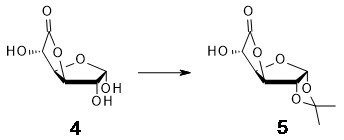
於丙酮(11.9kg)中依序添加市售之(2R)-2-[(2S,3R,4S)-3,4-二羥基-5-側氧基-四氫呋喃-2-基]-2-羥基-乙醛(化合物4)(1.00kg、5.678 mol)及濃硫酸(114g、1.162 mol),於40~50℃攪拌17小時。將反應液冷卻至20~30℃,添加碳酸氫鈉(0.19kg、2.271 mol)而攪拌2小時後,濾除生成的白色固體,將該白色固體以丙酮(2.37kg)洗淨,將洗淨液加至濾液中。重複2次於如此獲得的溶液中添加二甲基乙醯胺(7.50kg)及甲苯(4.34kg)並進行減壓濃縮,進一步添加甲苯(4.34kg)並進行減壓濃縮的操作,獲得化合物5之二甲基乙醯胺溶液。Add commercially available (2R)-2-[(2S,3R,4S)-3,4-dihydroxy-5-oxo-tetrahydrofuran-2-yl]-2-in acetone (11.9kg) sequentially Hydroxy-acetaldehyde (compound 4) (1.00 kg, 5.678 mol) and concentrated sulfuric acid (114 g, 1.162 mol) were stirred at 40-50°C for 17 hours. The reaction solution was cooled to 20-30°C, sodium bicarbonate (0.19 kg, 2.271 mol) was added and stirred for 2 hours, the white solid produced was filtered off, and the white solid was washed with acetone (2.37 kg). The liquid is added to the filtrate. The operation of adding dimethylacetamide (7.50 kg) and toluene (4.34 kg) to the solution thus obtained was repeated twice, followed by concentration under reduced pressure, and further adding toluene (4.34 kg) and concentration under reduced pressure to obtain compound 5 The dimethylacetamide solution.
結構的確認係實施部分矽膠管柱純化(己烷/乙酸乙酯),並以NMR確認。1 H NMR (CDCl3 ):δ = 1.36 (3H, s), 1.53 (3H, s), 2.72 (1H, d, J = 9.5 Hz), 4.50 (1H, dd, J = 4.5, 9.5 Hz),4.84 (2H, d, J = 2.5 Hz), 4.95 (1H, dd, J = 2.5, 4.5 Hz), 5.99 (1H, d, J = 3.5 Hz).The confirmation of the structure was performed by partial silica column purification (hexane/ethyl acetate) and confirmed by NMR. 1 H NMR (CDCl 3 ): δ = 1.36 (3H, s), 1.53 (3H, s), 2.72 (1H, d, J = 9.5 Hz), 4.50 (1H, dd, J = 4.5, 9.5 Hz), 4.84 (2H, d, J = 2.5 Hz), 4.95 (1H, dd, J = 2.5, 4.5 Hz), 5.99 (1H, d, J = 3.5 Hz).
(實施例1-2)(3aR,3bR,6S,6aR,7aR)-2,2-二甲基-5-側氧基六氫-2H-呋喃并[2’,3’:4,5]呋喃并[2,3-d][1,3]二氧呃-6-基=4-甲基苯-1-磺酸酯(化合物6)之製造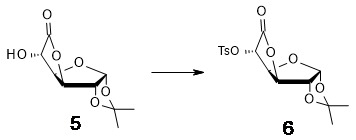
於實施例1-1所獲得的化合物5之二甲基乙醯胺溶液中,依序添加1-甲基咪唑(0.56kg、6.814 mol)及對甲苯磺醯氯(1.24kg、6.530 mol),於20~30℃攪拌3小時。於反應溶液中添加水(5kg)而攪拌3小時後,冷卻至0~5℃而進一步攪拌2小時。濾取於反應溶液中生成的白色固體,依序以水/二甲基乙醯胺(1/1、4kg)及水(8kg)洗淨。將獲得的固體進行減壓乾燥(40℃),而獲得化合物6(1.66kg、產率79.4%)。1 H NMR (CDCl3 ):δ = 1.33 (3H, s), 1.49 (3H, s), 2.45 (3H, s), 4.78 (1H, d, J = 3.5 Hz), 4.83 (1H, d, J = 3.0 Hz), 4.97 (1H, dd, J = 3.0, 4.5 Hz), 5.22 (1H, d, J = 4.5 Hz), 5.97 (1H, d, J = 3.5 Hz), 7.37 (2H, d, J = 8.0 Hz), 7.89 (2H, m).To the dimethylacetamide solution of compound 5 obtained in Example 1-1, 1-methylimidazole (0.56kg, 6.814 mol) and p-toluenesulfonyl chloride (1.24kg, 6.530 mol) were sequentially added, Stir at 20-30°C for 3 hours. After adding water (5 kg) to the reaction solution and stirring for 3 hours, it was cooled to 0 to 5°C and further stirred for 2 hours. The white solid formed in the reaction solution was filtered, and washed with water/dimethylacetamide (1/1, 4kg) and water (8kg) in sequence. The obtained solid was dried under reduced pressure (40° C.) to obtain compound 6 (1.66 kg, yield 79.4%). 1 H NMR (CDCl 3 ): δ = 1.33 (3H, s), 1.49 (3H, s), 2.45 (3H, s), 4.78 (1H, d, J = 3.5 Hz), 4.83 (1H, d, J = 3.0 Hz), 4.97 (1H, dd, J = 3.0, 4.5 Hz), 5.22 (1H, d, J = 4.5 Hz), 5.97 (1H, d, J = 3.5 Hz), 7.37 (2H, d, J = 8.0 Hz), 7.89 (2H, m).
(實施例1-3)5-去氧-1,2-O-(1-甲基亞乙基)-α-D-木-己呋喃糖(化合物7)之甲苯溶液之製造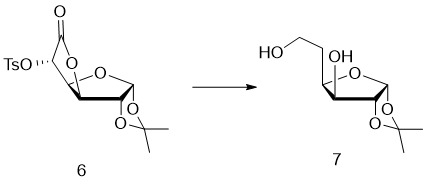
於調節至0~10℃的四氫呋喃(22.1kg、15.0v/w)中,依序添加雙(2-甲氧基乙氧基)氫化鋁鈉(4.53kg、15.69 mol)及實施例1-2所獲得的化合物6(1.66kg、4.48 mol),攪拌30分鐘後,再於20~30℃攪拌1.5小時。反應後,將反應液冷卻至0~10℃,滴加丙酮(1.05kg、0.8v/w)及50%L-酒石酸鈉鉀水溶液(17.0kg、8.0v/w),將反應液升高至40~50℃,攪拌14小時後,於40~50℃進行分液。於獲得的有機層中,於40~50℃,添加20%食鹽水(3.81kg、2.0v/w),藉由分液而獲得四氫呋喃層。藉由重複進行2次相同的分液操作,於獲得的溶液中添加甲苯(7.20kg、5.0v/w),進行減壓濃縮直到容積成為3.3L。於藉由進行3次同樣的減壓濃縮操作所獲得的溶液中添加甲苯(20.0kg、13.6w/w),而獲得化合物7之甲苯溶液。To tetrahydrofuran (22.1kg, 15.0v/w) adjusted to 0~10℃, add sodium bis(2-methoxyethoxy)aluminum hydride (4.53kg, 15.69 mol) and Example 1-2 in sequence The obtained compound 6 (1.66 kg, 4.48 mol) was stirred for 30 minutes, and then stirred at 20 to 30°C for 1.5 hours. After the reaction, the reaction solution was cooled to 0~10°C, and acetone (1.05kg, 0.8v/w) and 50% L-sodium potassium tartrate aqueous solution (17.0kg, 8.0v/w) were added dropwise to raise the reaction solution to After stirring for 14 hours at 40-50°C, liquid separation is performed at 40-50°C. To the obtained organic layer, 20% salt water (3.81 kg, 2.0 v/w) was added at 40-50° C., and the tetrahydrofuran layer was obtained by liquid separation. By repeating the same liquid separation operation twice, toluene (7.20 kg, 5.0 v/w) was added to the obtained solution, and concentrated under reduced pressure until the volume became 3.3 L. Toluene (20.0 kg, 13.6 w/w) was added to the solution obtained by performing the same reduced-pressure concentration operation three times to obtain a toluene solution of compound 7.
結構的確認係實施部分矽膠管柱純化(己烷/乙酸乙酯),並以NMR確認。1 H NMR (CDCl3 ):δ = 1.32 (3H, s), 1.51 (3H, s), 1.94-2.06 (2H, m), 2.46 (1H, br), 3.26 (1H, br), 3.75 (1H, td, J = 3.5, 9.5 Hz), 3.87-3.91 (1H, m), 4.11 (1H, d, J = 7.5 Hz), 4.26 (1H, td, J = 3.0, 6.0 Hz), 4.55 (1H, d, J = 4.0 Hz), 5.91 (1H, d, J = 4.0 Hz).The confirmation of the structure was performed by partial silica column purification (hexane/ethyl acetate) and confirmed by NMR. 1 H NMR (CDCl 3 ): δ = 1.32 (3H, s), 1.51 (3H, s), 1.94-2.06 (2H, m), 2.46 (1H, br), 3.26 (1H, br), 3.75 (1H) , td, J = 3.5, 9.5 Hz), 3.87-3.91 (1H, m), 4.11 (1H, d, J = 7.5 Hz), 4.26 (1H, td, J = 3.0, 6.0 Hz), 4.55 (1H, d, J = 4.0 Hz), 5.91 (1H, d, J = 4.0 Hz).
(實施例1-4)5-去氧-1,2-O-(1-甲基亞乙基)-6-O-(三苯基甲基)-α-D-木-己呋喃糖(化合物8)之甲苯溶液之製造
於實施例1-3所獲得的化合物7之甲苯溶液中,依序添加三苯氯甲烷(0.87 kg、3.14 mol)及4-甲基
結構的確認係實施部分矽膠管柱純化(己烷/乙酸乙酯),並以NMR確認。1 H NMR (CDCl3 ):δ = 1.31 (3H, s), 1.48 (3H, s), 1.99-2.02 (2H, m), 2.77 (1H, d, J = 4.0 Hz), 3.15-3.19 (1H, m), 3.40 (1H, ddd, J = 4.5, 5.0, 10.0 Hz), 4.08 (1H, t, J = 2.5 Hz), 4.25 (1H, ddd, J = 2.5, 7.0, 7.5 Hz), 4.53 (1H, d, J = 3.5 Hz), 5.88 (1H, d, J = 3.5 Hz), 7.23-7.26 (3H, m), 7.29-7.32 (6H, m), 7.39-7.41 (6H, m).The confirmation of the structure was performed by partial silica column purification (hexane/ethyl acetate) and confirmed by NMR. 1 H NMR (CDCl 3 ): δ = 1.31 (3H, s), 1.48 (3H, s), 1.99-2.02 (2H, m), 2.77 (1H, d, J = 4.0 Hz), 3.15-3.19 (1H , m), 3.40 (1H, ddd, J = 4.5, 5.0, 10.0 Hz), 4.08 (1H, t, J = 2.5 Hz), 4.25 (1H, ddd, J = 2.5, 7.0, 7.5 Hz), 4.53 ( 1H, d, J = 3.5 Hz), 5.88 (1H, d, J = 3.5 Hz), 7.23-7.26 (3H, m), 7.29-7.32 (6H, m), 7.39-7.41 (6H, m).
(實施例1-5a)5-去氧-1,2-O-(1-甲基亞乙基)-6-O-(三苯基甲基)-α-D-赤蘚-己呋喃-3-酮糖(化合物9)之甲苯溶液之製造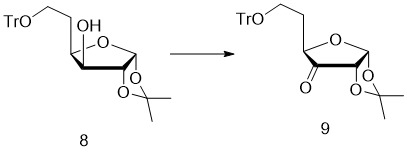
實施例1-4所獲得的化合物8之甲苯溶液中,於室溫添加8%碳酸氫鈉水(5.13kg、3.0v/w)、溴化鉀(53.0 g、0.45 mol)及9-氮雜降金剛烷-N-氧基(6.2 g、44.82 mmol),將此液溫度調節至0~10℃後,添加次氯酸鈉・5水合物(2.21 kg、13.45 mol),進行攪拌1.5小時。反應後,將反應液分液並獲得甲苯層。將獲得的甲苯層,重複2次依序藉由5%亞硫酸鈉水溶液(5.22 kg、3.0v/w)及20%食鹽水(3.80 kg、2.0v/w)進行洗淨的操作,而獲得化合物9之甲苯溶液。To the toluene solution of compound 8 obtained in Example 1-4, 8% sodium bicarbonate water (5.13kg, 3.0v/w), potassium bromide (53.0 g, 0.45 mol) and 9-aza were added at room temperature. Normantane-N-oxy group (6.2 g, 44.82 mmol), after adjusting the temperature of this solution to 0-10°C, sodium hypochlorite 5-hydrate (2.21 kg, 13.45 mol) was added, and stirring was performed for 1.5 hours. After the reaction, the reaction liquid was separated to obtain a toluene layer. The obtained toluene layer was washed twice sequentially with 5% sodium sulfite aqueous solution (5.22 kg, 3.0v/w) and 20% saline solution (3.80 kg, 2.0v/w) to obtain compound 9 The toluene solution.
結構的確認係實施部分矽膠管柱純化(己烷/乙酸乙酯),並以NMR確認。1 H NMR (CDCl3 ):δ = 1.36 (3H, s), 1.44 (3H, s), 1.96-2.01 (1H, m), 2.21-2.28 (1H, m), 3.06 (1H, ddd, J = 3.0, 4.5, 10.0 Hz), 3.30 (1H, ddd, J = 4.0, 4.5, 9.0 Hz), 4.33 (1H, dd, J = 1.0, 4.5 Hz), 4.49 (1H, dd, J = 3.5, 5.5 Hz), 5.60 (1H, d, J = 4.5), 7.21-7.25 (3H, m), 7.29-7.32 (6H, m), 7.35-7.37 (6H, m).The confirmation of the structure was performed by partial silica column purification (hexane/ethyl acetate) and confirmed by NMR. 1 H NMR (CDCl 3 ): δ = 1.36 (3H, s), 1.44 (3H, s), 1.96-2.01 (1H, m), 2.21-2.28 (1H, m), 3.06 (1H, ddd, J = 3.0, 4.5, 10.0 Hz), 3.30 (1H, ddd, J = 4.0, 4.5, 9.0 Hz), 4.33 (1H, dd, J = 1.0, 4.5 Hz), 4.49 (1H, dd, J = 3.5, 5.5 Hz) ), 5.60 (1H, d, J = 4.5), 7.21-7.25 (3H, m), 7.29-7.32 (6H, m), 7.35-7.37 (6H, m).
高速液體層析(HPLC)分析條件 管柱:Xbridge C18 3.5 ⌠m, 4.6x150 mm、管柱溫度:40℃ 移動相A:10 mM 乙酸銨水溶液、移動相B:乙腈 梯度條件:B(%) 30% (0-3 min), 30→95% (3-20 min), 95% (20-23 min) 流速:1.0 mL/min、檢測波長:210 nm 化合物9之滯留時間:13.9 min及17.5 minHigh-speed liquid chromatography (HPLC) analysis conditions Column: Xbridge C18 3.5 ⌠m, 4.6x150 mm, column temperature: 40℃ Mobile phase A: 10 mM ammonium acetate aqueous solution, mobile phase B: acetonitrile Gradient conditions: B(%) 30% (0-3 min), 30→95% (3-20 min), 95% (20-23 min) Flow rate: 1.0 mL/min, detection wavelength: 210 nm Residence time of compound 9: 13.9 min and 17.5 min
(實施例1-5b)5-去氧-1,2-O-(1-甲基亞乙基)-6-O-(三苯基甲基)-α-D-赤蘚-己呋喃-3-酮糖(化合物9)之甲苯溶液之製造(Example 1-5b) 5-Deoxy-1,2-O-(1-methylethylene)-6-O-(triphenylmethyl)-α-D-erythrosin-hexafuran- Production of toluene solution of 3-ketose (compound 9)
於實施例1-4所獲得的化合物8之甲苯溶液(30 mL)中,於室溫添加8%碳酸氫鈉水(6.0 mL、3.0v/w)、溴化鉀(60.0 mg、0.54 mmol)及9-氮雜降金剛烷-N-氧基(3.7 mg、0.03 mmol),將此液溫度調節成0~10℃後,於10℃以下添加次氯酸鈉水溶液(6.48 g、10.80 mmol),於0℃進行攪拌2小時。反應結束後,添加15%亞硫酸鈉水溶液(12.0 mL、6.0v/w),於室溫攪拌1小時。將反應液分液並獲得甲苯層。將獲得的甲苯層,以20%食鹽水(4.0 mL、2.0v/w)洗淨,獲得化合物9之甲苯溶液。 獲得的化合物之HPLC分析的滯留時間係與(實施例1-5a)所獲得的化合物之HPLC分析的滯留時間一致。To the toluene solution (30 mL) of compound 8 obtained in Example 1-4, 8% sodium bicarbonate water (6.0 mL, 3.0 v/w) and potassium bromide (60.0 mg, 0.54 mmol) were added at room temperature And 9-azanoradamantane-N-oxy group (3.7 mg, 0.03 mmol), adjust the temperature of this solution to 0~10℃, add sodium hypochlorite aqueous solution (6.48 g, 10.80 mmol) below 10℃, Stir at °C for 2 hours. After the reaction was completed, a 15% sodium sulfite aqueous solution (12.0 mL, 6.0 v/w) was added, and the mixture was stirred at room temperature for 1 hour. The reaction liquid was separated to obtain a toluene layer. The obtained toluene layer was washed with 20% saline (4.0 mL, 2.0 v/w) to obtain a toluene solution of compound 9. The retention time of the HPLC analysis of the obtained compound was consistent with the retention time of the HPLC analysis of the compound obtained (Example 1-5a).
(實施例1-6)5-去氧-4-(羥基甲基)-1,2-O-(1-甲基亞乙基)-6-O-(三苯基甲基)-β-L-蘇-己呋喃-3-酮糖(化合物10)及(3aS,3bR,7aR,8aR)-2,2-二甲基-7a-[2-(三苯基甲氧基)乙基]四氫-2H,3bH,5H-[1,3]二氧呃并[4,5]呋喃并[3,2-d][1,3]二
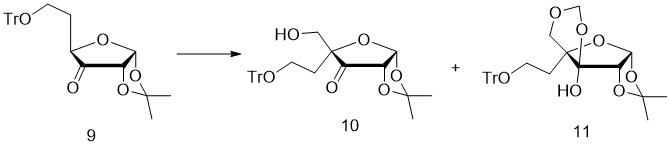
於實施例1-5所獲得的化合物9之甲苯溶液中,添加37%甲醛水溶液(1.81 kg、1.0v/w)及1,8-二氮雜雙環[5.4.0]十一-7-烯(2.05 kg、13.45 mol),於20~30℃進行1.5小時攪拌。反應後,將反應液分液並獲得甲苯層。於獲得的甲苯層中添加20%檸檬酸水溶液(3.59 kg、2.0v/w)並進行分液,獲得甲苯層。於獲得的甲苯層中添加8%碳酸氫鈉水(1.71 kg,1.0v/w)並進行分液,獲得化合物10及11之甲苯溶液。To the toluene solution of compound 9 obtained in Example 1-5, 37% aqueous formaldehyde solution (1.81 kg, 1.0v/w) and 1,8-diazabicyclo[5.4.0]undec-7-ene were added (2.05 kg, 13.45 mol), stirring at 20-30°C for 1.5 hours. After the reaction, the reaction liquid was separated to obtain a toluene layer. To the obtained toluene layer, a 20% citric acid aqueous solution (3.59 kg, 2.0 v/w) was added and liquid-separated to obtain a toluene layer. To the obtained toluene layer, 8% sodium bicarbonate water (1.71 kg, 1.0 v/w) was added and liquid separation was performed to obtain toluene solutions of compounds 10 and 11.
(實施例1-7)5-去氧-4-(羥基甲基)-1,2-O-(1-甲基亞乙基)-6-O-(三苯基甲基)-β-L-來蘇-己呋喃糖(化合物12)之甲苯溶液之製造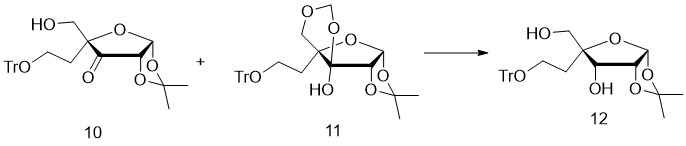
實施例1-6所獲得的化合物10及11之甲苯溶液中,於20~30℃,添加水(4.98 kg、3.0v/w)及氫化硼鈉(0.34 kg、8.96 mol),進行攪拌2小時。反應後,將反應液冷卻至0~10℃,於相同溫度下添加20%檸檬酸水溶液(5.37 kg、3.0v/w)並進行分液,獲得甲苯層。於獲得的甲苯層中添加8%碳酸氫鈉水(3.42 kg、2.0v/w)而進行分液,獲得化合物12之甲苯溶液。To the toluene solution of compound 10 and 11 obtained in Example 1-6, add water (4.98 kg, 3.0v/w) and sodium borohydride (0.34 kg, 8.96 mol) at 20 to 30°C, and stir for 2 hours . After the reaction, the reaction liquid was cooled to 0 to 10°C, and a 20% citric acid aqueous solution (5.37 kg, 3.0 v/w) was added at the same temperature and liquid separation was performed to obtain a toluene layer. To the obtained toluene layer, 8% sodium bicarbonate water (3.42 kg, 2.0 v/w) was added for liquid separation, and a toluene solution of compound 12 was obtained.
結構的確認係實施部分矽膠管柱純化(己烷/乙酸乙酯),並以NMR確認。。1 H NMR (CDCl3 ):δ = 1.33 (3H, s), 1.55 (3H, s), 1.99 (1H, ddd, J = 6.5, 8.0, 14.0 Hz), 2.20 (1H, dt, J = 6.0, 14.5 Hz), 2.85 (1H, br), 3.20-3.25 (1H, m), 3.35-3.42 (2H, m), 3.51 (1H, d, J = 12.0 Hz), 4.21 (1H, d, J = 6.0 Hz), 4.63 (1H, dd, J = 4.0, 6.0 Hz), 5.73 (1H, d, J = 4.0), 7.21-7.25 (3H, m), 7.27-7.30 (6H, m), 7.41-7.44 (6H, m).The confirmation of the structure was performed by partial silica column purification (hexane/ethyl acetate) and confirmed by NMR. . 1 H NMR (CDCl 3 ): δ = 1.33 (3H, s), 1.55 (3H, s), 1.99 (1H, ddd, J = 6.5, 8.0, 14.0 Hz), 2.20 (1H, dt, J = 6.0, 14.5 Hz), 2.85 (1H, br), 3.20-3.25 (1H, m), 3.35-3.42 (2H, m), 3.51 (1H, d, J = 12.0 Hz), 4.21 (1H, d, J = 6.0 Hz), 4.63 (1H, dd, J = 4.0, 6.0 Hz), 5.73 (1H, d, J = 4.0), 7.21-7.25 (3H, m), 7.27-7.30 (6H, m), 7.41-7.44 ( 6H, m).
(實施例1-8)3-O-苄基-4-[(苄氧基)甲基]-5-去氧-1,2-O-(1-甲基亞乙基)-6-O-(三苯基甲基)-β-L-來蘇-己呋喃糖(化合物13)之製造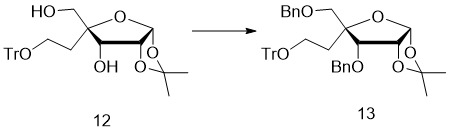
於實施例1-7所獲得的甲苯溶液中,添加48%氫氧化鉀水溶液(7.27 kg、3.0v/w)、四丁基碘化銨(0.20 kg、0.54 mol)及溴甲苯(1.53 kg、8.96 mol),於65~75℃進行攪拌23小時。反應後,於45~55℃,於反應液中添加水(6.64 kg、4.0v/w)及N-乙醯基-L-半胱胺酸(0.50 kg、0.3w/w)並攪拌2小時。將反應液冷卻至20~30℃後,添加水(4.98 kg、3.0v/w)並進行分液而獲得甲苯層。於獲得的甲苯層中添加8%碳酸氫鈉水(3.42 kg、2.0v/w)而進行分液,獲得甲苯層。於獲得的甲苯溶液中添加10%食鹽水(3.55 kg、2.0v/w)並分液,獲得甲苯層。將獲得的甲苯層濃縮直到成為3.3L,添加1-丙醇(5.34 kg、4.0v/w)並過濾不溶物,進一步減壓濃縮至成為3.0L,再添加1-丙醇(0.60 kg)後,於45~55℃攪拌0.5小時,藉此確認結晶的析出。接著於20~30℃攪拌12.5小時及於0~10℃攪拌2小時後,濾取析出的結晶。獲得的結晶使用預先冷卻至0℃的1-丙醇(4.00 kg、3.0v/w)而進行洗淨,藉由進行減壓乾燥(40℃),獲得化合物13(1.25 kg、1.90 mol、產率42.5%)。1 H NMR (CDCl3 ):δ = 1.29 (3H, s), 1.51 (3H, s), 1.90-1.96 (1H, m), 2.43-2.49 (1H, m), 3.21-3.32 (3H, m), 3.47 (1H, d, J = 10.5 Hz), 4.10 (1H, d, J = 5.5 Hz), 4.30 (1H, d, J = 12.0 Hz), 4.42 (1H, d, J = 11.5 Hz), 4.47 (1H, d, J = 12.0 Hz), 4.57 (1H, dd, J = 5.5, 4.0 Hz), 4.69 (1H, d, J = 12.0 Hz), 5.69 (1H, d, J = 4.0 Hz), 7.15-7.34 (19H, m), 7.39-7.41 (6H, m).To the toluene solution obtained in Examples 1-7, 48% potassium hydroxide aqueous solution (7.27 kg, 3.0v/w), tetrabutylammonium iodide (0.20 kg, 0.54 mol) and bromotoluene (1.53 kg, 8.96 mol) and stirring at 65~75°C for 23 hours. After the reaction, add water (6.64 kg, 4.0v/w) and N-acetyl-L-cysteine (0.50 kg, 0.3w/w) to the reaction solution at 45~55°C and stir for 2 hours . After cooling the reaction liquid to 20 to 30°C, water (4.98 kg, 3.0 v/w) was added and liquid separation was performed to obtain a toluene layer. To the obtained toluene layer, 8% sodium hydrogen carbonate water (3.42 kg, 2.0 v/w) was added and liquid-separated to obtain a toluene layer. To the obtained toluene solution, 10% brine (3.55 kg, 2.0 v/w) was added and liquid separation was performed to obtain a toluene layer. The obtained toluene layer was concentrated until it became 3.3L, 1-propanol (5.34 kg, 4.0v/w) was added, the insoluble matter was filtered, and concentrated under reduced pressure to 3.0L, and then 1-propanol (0.60 kg) was added. It was stirred at 45-55°C for 0.5 hours to confirm the precipitation of crystals. Then, after stirring for 12.5 hours at 20 to 30°C and for 2 hours at 0 to 10°C, the precipitated crystals were collected by filtration. The obtained crystals were washed with 1-propanol (4.00 kg, 3.0 v/w) pre-cooled to 0°C, and dried under reduced pressure (40°C) to obtain compound 13 (1.25 kg, 1.90 mol, yield). Rate 42.5%). 1 H NMR (CDCl 3 ): δ = 1.29 (3H, s), 1.51 (3H, s), 1.90-1.96 (1H, m), 2.43-2.49 (1H, m), 3.21-3.32 (3H, m) , 3.47 (1H, d, J = 10.5 Hz), 4.10 (1H, d, J = 5.5 Hz), 4.30 (1H, d, J = 12.0 Hz), 4.42 (1H, d, J = 11.5 Hz), 4.47 (1H, d, J = 12.0 Hz), 4.57 (1H, dd, J = 5.5, 4.0 Hz), 4.69 (1H, d, J = 12.0 Hz), 5.69 (1H, d, J = 4.0 Hz), 7.15 -7.34 (19H, m), 7.39-7.41 (6H, m).
(實施例1-9)甲基=3-O-苄基-4-[(苄氧基)甲基]-5-去氧-α-L-來蘇-己呋喃糖苷(化合物14)之甲苯溶液之製造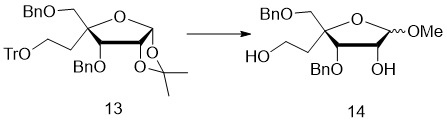
於實施例1-8所獲得的化合物13(250.0 g、380.6 mmol)之甲醇(1250 mL)溶液中添加濃硫酸(3.73 g、0.0380 mmol),將反應液於40~50℃攪拌20小時。將反應液冷卻至20~30℃,添加甲氧基三苯基甲烷(25 mg)及三乙基胺(13.56 g、134.0 mmol)而攪拌2小時後,歷經1.5小時滴加水(250 mL)。將反應液攪拌50分鐘後,濾除生成的白色固體,以甲醇/水(5/1、500 mL)進行洗淨。於獲得的溶液中添加正庚烷(1250 mL)而進行分液後,將正庚烷(500 mL)加至下層(水層)而進行分液。對下層添加20%食鹽水(1250 mL)及甲苯(1250 mL)而分液,獲得甲苯層及水層後,於水層中添加甲苯(1250 mL)而進行分液,合併獲得的甲苯層,減壓濃縮而獲得化合物14之甲苯溶液(625 mL)。Concentrated sulfuric acid (3.73 g, 0.0380 mmol) was added to the methanol (1250 mL) solution of compound 13 (250.0 g, 380.6 mmol) obtained in Example 1-8, and the reaction solution was stirred at 40-50°C for 20 hours. The reaction solution was cooled to 20 to 30°C, methoxytriphenylmethane (25 mg) and triethylamine (13.56 g, 134.0 mmol) were added and stirred for 2 hours, and then water (250 mL) was added dropwise over 1.5 hours. After stirring the reaction solution for 50 minutes, the white solid produced was filtered off, and washed with methanol/water (5/1, 500 mL). After adding n-heptane (1250 mL) to the obtained solution for liquid separation, n-heptane (500 mL) was added to the lower layer (aqueous layer) to perform liquid separation. To the lower layer, 20% brine (1250 mL) and toluene (1250 mL) were added to separate the layers. After obtaining a toluene layer and an aqueous layer, toluene (1250 mL) was added to the aqueous layer to separate the layers, and the obtained toluene layers were combined. Concentrate under reduced pressure to obtain a toluene solution of compound 14 (625 mL).
結構的確認係實施部分矽膠管柱純化(己烷/乙酸乙酯),並以NMR確認。1 H NMR (β體, CDCl3 ):δ = 2.00-2.05 (1H, m), 2.10-2.16 (1H, m), 3.29 (3H, s), 3.35 (1H, d, J = 9.0 Hz), 3.55 (1H, d, J = 9.0 Hz), 3.76-381 (1H, m), 3.85-3.90 (1H, m), 4.08 (2H, dd, J = 5.0, 15.0 Hz), 4.54 (2H, s), 4.63 (2H, s), 4.87 (1H, s), 7.26-7.36 (10H, m).The confirmation of the structure was performed by partial silica column purification (hexane/ethyl acetate) and confirmed by NMR. 1 H NMR (β body, CDCl 3 ): δ = 2.00-2.05 (1H, m), 2.10-2.16 (1H, m), 3.29 (3H, s), 3.35 (1H, d, J = 9.0 Hz), 3.55 (1H, d, J = 9.0 Hz), 3.76-381 (1H, m), 3.85-3.90 (1H, m), 4.08 (2H, dd, J = 5.0, 15.0 Hz), 4.54 (2H, s) , 4.63 (2H, s), 4.87 (1H, s), 7.26-7.36 (10H, m).
(實施例1-10)甲基=2,6-脫水-3-O-苄基-4-[(苄氧基)甲基]-5-去氧-α-L-來蘇-己呋喃糖苷(化合物15)之甲苯溶液之製造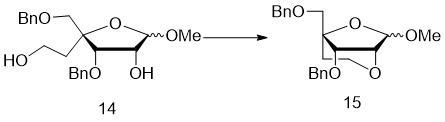
於實施例1-9所獲得的化合物14之甲苯溶液中添加三苯基膦(89.85 g、342.6 mmol),冷卻至0~5℃後,歷經20分鐘滴加偶氮二甲酸二異丙酯(69.27 g、342.6 mmol)之甲苯(180.3 mL)溶液,於20~30℃攪拌反應液3小時。於反應液中添加氯化鎂(90.60 g、951.6 mmol)而攪拌6小時後,添加正庚烷(1500 mL)而攪拌23小時,冷卻至0~5℃而攪拌2小時。濾除生成的白色固體,以甲苯/正庚烷(1/2、750 mL)洗淨後,於獲得的溶液中添加甲醇/水(3/2、750 mL)而進行分液。於獲得的有機層中添加甲醇/水(3/2、750 mL)而進行分液後,將有機層減壓濃縮而調製化合物15之甲苯溶液(625 mL)。Triphenylphosphine (89.85 g, 342.6 mmol) was added to the toluene solution of compound 14 obtained in Examples 1-9, and after cooling to 0 to 5°C, diisopropyl azodicarboxylate ( 69.27 g, 342.6 mmol) in toluene (180.3 mL), and the reaction solution was stirred at 20-30°C for 3 hours. After adding magnesium chloride (90.60 g, 951.6 mmol) to the reaction solution and stirring for 6 hours, n-heptane (1500 mL) was added and stirred for 23 hours, cooled to 0 to 5°C and stirred for 2 hours. The generated white solid was filtered off, washed with toluene/n-heptane (1/2, 750 mL), and methanol/water (3/2, 750 mL) was added to the obtained solution for liquid separation. After methanol/water (3/2, 750 mL) was added to the obtained organic layer and liquid separation was performed, the organic layer was concentrated under reduced pressure to prepare a toluene solution (625 mL) of compound 15.
結構的確認係實施部分矽膠管柱純化(己烷/乙酸乙酯),並以NMR確認。1 H NMR (β體, CDCl3 ):δ = 1.51 (1H, dd, J = 3.5, 13.0 Hz), 2.19 (1H, ddd, J = 7.5, 11.0, 13.5 Hz), 3.41 (3H, s), 3.53 (2H, dd, J = 10.5, 30.5 Hz), 3.86-3.95 (3H, m), 4.08 (1H, d, J = 3.0 Hz), 4.53 (1H, d, J = 11.5 Hz), 4.61 (2H, dd, J = 12.0, 27.5 Hz), 4.71 (1H, d, J = 6.5 Hz), 5.10 (1H, s), 7.26-7.35 (10H, m).The confirmation of the structure was performed by partial silica column purification (hexane/ethyl acetate) and confirmed by NMR. 1 H NMR (β body, CDCl 3 ): δ = 1.51 (1H, dd, J = 3.5, 13.0 Hz), 2.19 (1H, ddd, J = 7.5, 11.0, 13.5 Hz), 3.41 (3H, s), 3.53 (2H, dd, J = 10.5, 30.5 Hz), 3.86-3.95 (3H, m), 4.08 (1H, d, J = 3.0 Hz), 4.53 (1H, d, J = 11.5 Hz), 4.61 (2H , dd, J = 12.0, 27.5 Hz), 4.71 (1H, d, J = 6.5 Hz), 5.10 (1H, s), 7.26-7.35 (10H, m).
(實施例1-11)化合物2之製造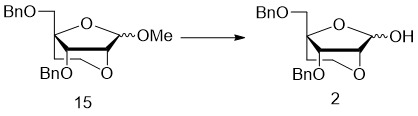
於實施例1-10所獲得的化合物15之甲苯溶液(625 mL)中添加水(625 mL)後,進行減壓濃縮而獲得化合物15之水混合物(625 mL)。於此混合物中依序添加乙酸(750 mL)及濃鹽酸(125 mL),於20~30℃攪拌3小時後,添加化合物2(25 mg),冷卻至0~5℃而攪拌17小時。於此混合物中添加水(750 mL),於0~5℃攪拌17小時後,濾取析出的結晶,依序以預先冷卻至0~5℃的乙酸/水(1/2、500 mL)及水(500 mL)洗淨,獲得粗化合物2之濕產物。使獲得的粗化合物2於35~45℃溶解於甲苯(1250 mL),將生成的水層進行分液而去除。將獲得的有機層減壓濃縮而作成化合物2之甲苯溶液(750 mL)後,添加正庚烷(375 mL)而冷卻至20~30℃。於此溶液中,添加化合物2之晶種(25 mg),於20~30℃攪拌2小時後,添加正庚烷(1125 mL),於0~5℃攪拌19小時。濾取析出的結晶,以甲苯/正庚烷(1/2、750 mL)洗淨後,以正庚烷(750 mL)進行洗淨。將獲得的結晶減壓乾燥(40℃)而獲得化合物2(76.84 g、215.6 mmol、產率56.6%)。After adding water (625 mL) to the toluene solution (625 mL) of compound 15 obtained in Examples 1-10, it was concentrated under reduced pressure to obtain a water mixture of compound 15 (625 mL). Acetic acid (750 mL) and concentrated hydrochloric acid (125 mL) were sequentially added to this mixture, and after stirring at 20-30°C for 3 hours, compound 2 (25 mg) was added, cooled to 0-5°C and stirred for 17 hours. Water (750 mL) was added to this mixture, and after stirring at 0~5℃ for 17 hours, the precipitated crystals were filtered out, followed by acetic acid/water (1/2, 500 mL) cooled to 0~5℃ and Wash with water (500 mL) to obtain a wet product of crude compound 2. The obtained crude compound 2 was dissolved in toluene (1250 mL) at 35 to 45°C, and the resulting aqueous layer was separated and removed. The obtained organic layer was concentrated under reduced pressure to prepare a toluene solution (750 mL) of compound 2, and then n-heptane (375 mL) was added and cooled to 20-30°C. To this solution, seed crystals of compound 2 (25 mg) were added, and after stirring at 20-30°C for 2 hours, n-heptane (1125 mL) was added, and the mixture was stirred at 0-5°C for 19 hours. The precipitated crystals were collected by filtration, washed with toluene/n-heptane (1/2, 750 mL), and then washed with n-heptane (750 mL). The obtained crystals were dried under reduced pressure (40°C) to obtain compound 2 (76.84 g, 215.6 mmol, yield 56.6%).
實施例1-11所使用的化合物2之晶種係由以下方法獲得。藉由與實施例1-11之前半步驟同樣的方法而獲得呈結晶之粗化合物2。使用獲得的粗化合物2,藉由與實施例1-11之後半步驟同樣的方法而獲得呈結晶之化合物2。於此,使用先前獲得的粗化合物2之結晶作為化合物2之晶種。將上述之方法所獲得的化合物2之結晶作為實施例1-11中的化合物2之晶種而使用。1 H NMR (CDCl3 ):δ = 1.30 (0.39H, d, J = 10.8 Hz), 1.45 (0.59H, dd, J = 10.6, 3.2 Hz), 1.97-2.07 (0.39H, m), 2.13-2.22 (0.64H, m), 2.60 (0.34H, d, J = 1.2 Hz), 2.80 (0.49H, brs), 3.22 (0.36H, d, J = 7.2 Hz), 3.45-3.59 (1.41H, m), 3.71 (0.37H, d, J = 7.2 Hz), 3.78 (0.37H, brs), 3.82 (0.37H, ddd, J = 9.2, 4.0, 1.6 Hz), 3.85-3.95 (1.23H, m), 4.01-4.13 (1.30H, m), 4.16-4.27 (0.83H, m), 4.44-4.75 (4.24H, m), 5.36 (0.07H, dd, J = 7.0, 1.6 Hz), 5.57 (0.57H, s), 7.24-7.39 (10H, m), 9.89 (0.36H, s).The seed crystal system of compound 2 used in Examples 1-11 was obtained by the following method. The crude compound 2 in the form of crystals was obtained by the same method as the previous half step of Example 1-11. Using the obtained crude compound 2, a crystalline compound 2 was obtained by the same method as in the latter half of the steps in Examples 1-11. Here, the crystal of crude compound 2 obtained previously was used as the seed crystal of compound 2. The crystal of compound 2 obtained by the above method was used as the seed crystal of compound 2 in Examples 1-11. 1 H NMR (CDCl 3 ): δ = 1.30 (0.39H, d, J = 10.8 Hz), 1.45 (0.59H, dd, J = 10.6, 3.2 Hz), 1.97-2.07 (0.39H, m), 2.13- 2.22 (0.64H, m), 2.60 (0.34H, d, J = 1.2 Hz), 2.80 (0.49H, brs), 3.22 (0.36H, d, J = 7.2 Hz), 3.45-3.59 (1.41H, m ), 3.71 (0.37H, d, J = 7.2 Hz), 3.78 (0.37H, brs), 3.82 (0.37H, ddd, J = 9.2, 4.0, 1.6 Hz), 3.85-3.95 (1.23H, m), 4.01-4.13 (1.30H, m), 4.16-4.27 (0.83H, m), 4.44-4.75 (4.24H, m), 5.36 (0.07H, dd, J = 7.0, 1.6 Hz), 5.57 (0.57H, s), 7.24-7.39 (10H, m), 9.89 (0.36H, s).
(實施例1-12)化合物2之純化(Example 1-12) Purification of Compound 2
使實施例1-11所獲得的粗化合物2(50 g)溶解於甲苯(300 mL),添加正庚烷(300 mL)而於20~30℃攪拌3小時後,再添加正庚烷(300 mL)而攪拌16小時。濾取析出的結晶,以甲苯/正庚烷(1/2、250 mL)洗淨後,以正庚烷(250 mL)進行洗淨。將獲得的結晶減壓乾燥(40℃)而獲得化合物2(40.06 g、產率80.1%)。The crude compound 2 (50 g) obtained in Example 1-11 was dissolved in toluene (300 mL), n-heptane (300 mL) was added and stirred at 20-30°C for 3 hours, and then n-heptane (300 mL) was added. mL) and stirred for 16 hours. The precipitated crystals were collected by filtration, washed with toluene/n-heptane (1/2, 250 mL), and then washed with n-heptane (250 mL). The obtained crystals were dried under reduced pressure (40° C.) to obtain compound 2 (40.06 g, yield 80.1%).
(實施例2)1-(2,6-脫水-4-{[雙(4-甲氧基苯基)(苯基)甲氧基]甲基}-3-O-{(2-氰基乙氧基)[二(丙烷-2-基)胺基]磷烷基}-5-去氧-α-L-來蘇-己呋喃糖基)-5-甲基嘧啶-2,4(1H,3H)-二酮(化合物1t)之製造(Example 2) 1-(2,6-Anhydro-4-{[bis(4-methoxyphenyl)(phenyl)methoxy]methyl)-3-O-{(2-cyano Ethoxy)[bis(propan-2-yl)amino]phosphoranyl)-5-deoxy-α-L-lyso-hexfuranosyl)-5-methylpyrimidine-2,4(1H ,3H)-Diketone (Compound 1t) Manufacturing
(實施例2-1)1-{2,6-脫水-3-O-苄基-4-[(苄氧基)甲基]-5-去氧-α-L-來蘇-己呋喃糖基}-5-甲基嘧啶-2,4(1H,3H)-二酮(化合物3t)之甲醇溶液之製造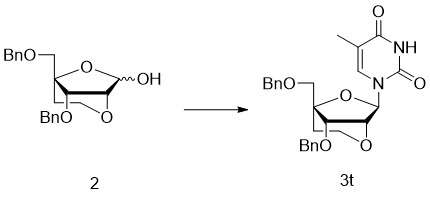
於乙腈(50 mL)中添加胸腺嘧碇(8.85 g、70.18 mmol)及N,O-雙三甲基矽基乙醯胺(28.6 g、140.6 mmol),於20~30℃攪拌1小時,作為溶液A。於另外的反應容器於乙腈(100 mL)中添加實施例1所獲得的化合物2(20.00 g、56.12 mmol)及三氯乙腈(15.20 g、105.27 mmol)後,添加1,8-二氮雜雙環[5.4.0]十一-7-烯(1.07 g、7.02 mmol),於20~30℃攪拌1小時,作為溶液B。於溶液B中添加溶液A後,添加碘三甲基矽烷(17.55 g、87.73 mmol)而於20~30℃攪拌2小時。於反應液中滴加於5%碳酸氫鈉水溶液(160 mL)溶解亞硫酸鈉(17.68 g、175.45 mmol)而成的水溶液後,添加甲苯(200 mL)及甲醇(80 mL),於35~45℃攪拌後,並進行分液。於獲得的有機層中添加40%甲醇水(200 mL),於35~45℃攪拌後,進行分液。再次以40%甲醇水(200 mL)之分液操作後,將獲得的有機層減壓濃縮而作成甲醇溶液(50 mL)後,添加甲醇(200 mL),再次減壓濃縮而作為化合物3t之甲醇溶液(50 mL)。Add thymine (8.85 g, 70.18 mmol) and N,O-bistrimethylsilylacetamide (28.6 g, 140.6 mmol) to acetonitrile (50 mL), stir at 20~30℃ for 1 hour, as Solution A. After adding compound 2 (20.00 g, 56.12 mmol) and trichloroacetonitrile (15.20 g, 105.27 mmol) obtained in Example 1 to acetonitrile (100 mL) in another reaction vessel, 1,8-diazabicyclo [5.4.0] Undec-7-ene (1.07 g, 7.02 mmol), stirred at 20-30°C for 1 hour, and used as solution B. After adding solution A to solution B, iodotrimethylsilane (17.55 g, 87.73 mmol) was added, and the mixture was stirred at 20 to 30°C for 2 hours. Add dropwise an aqueous solution of sodium sulfite (17.68 g, 175.45 mmol) in 5% sodium bicarbonate aqueous solution (160 mL) to the reaction solution, then add toluene (200 mL) and methanol (80 mL) at 35~45℃ After stirring, liquid separation was performed. 40% methanol water (200 mL) was added to the obtained organic layer, and after stirring at 35-45 degreeC, liquid separation was performed. After the separation operation with 40% methanol water (200 mL) again, the obtained organic layer was concentrated under reduced pressure to prepare a methanol solution (50 mL), methanol (200 mL) was added, and the mixture was concentrated under reduced pressure again to obtain the compound 3t Methanol solution (50 mL).
獲得的化合物之NMR譜與WO00/47599之實施例6記載之化合物的NMR譜一致。The NMR spectrum of the obtained compound is consistent with the NMR spectrum of the compound described in Example 6 of WO00/47599.
(實施例2-2)1-[2,6-脫水-5-去氧-4-(羥基甲基)-α-L-來蘇-己呋喃糖基]-5-甲基嘧啶-2,4(1H,3H)-二酮(化合物16)之製造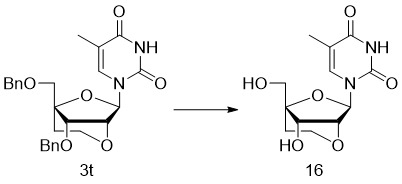
於實施例2-1所獲得的化合物3t之甲醇溶液(50 mL)中,進一步添加甲醇(50 mL)及氫氧化鈀(1.0 g),氫氣環境下於55~65℃攪拌2小時後,於相同溫度下過濾觸媒,將獲得的濾液減壓濃縮而作成甲醇溶液(50 mL)後,添加丙酮(200 mL)而減壓濃縮成50 mL。進一步添加丙酮(100 mL),冷卻至0~5℃而攪拌2小時。濾取生成的結晶,將獲得的結晶以丙酮(50 mL)進行洗淨。將獲得的結晶減壓乾燥(40℃)而獲得化合物16(9.95 g、產率62.4%(來自化合物2))。To the methanol solution (50 mL) of compound 3t obtained in Example 2-1, methanol (50 mL) and palladium hydroxide (1.0 g) were further added, and after stirring at 55-65°C for 2 hours in a hydrogen atmosphere, The catalyst was filtered at the same temperature, and the obtained filtrate was concentrated under reduced pressure to prepare a methanol solution (50 mL), and then acetone (200 mL) was added and concentrated under reduced pressure to 50 mL. Furthermore, acetone (100 mL) was added, and it cooled to 0-5 degreeC, and stirred for 2 hours. The formed crystals were collected by filtration, and the obtained crystals were washed with acetone (50 mL). The obtained crystals were dried under reduced pressure (40° C.) to obtain compound 16 (9.95 g, yield 62.4% (from compound 2)).
獲得的化合物之NMR譜與WO00/47599之實施例7記載的化合物的NMR譜一致。The NMR spectrum of the obtained compound is consistent with the NMR spectrum of the compound described in Example 7 of WO00/47599.
(實施例2-3)1-(2,6-脫水-4-{[雙(4-甲氧基苯基)(苯基)甲氧基]甲基}-5-去氧-α-L-來蘇-己呋喃糖基)-5-甲基嘧啶-2,4(1H,3H)-二酮(化合物17)之製造
於四氫呋喃(47.5 mL)中添加實施例2-2所獲得的化合物16(9.50 g、33.42 mmol)及吡啶(10.57 g、133.68 mmol),接著添加4,4’-二甲氧基三苯氯甲烷(13.59 g、40.10 mmol),將反應液於20~30℃攪拌2小時。於反應液中添加甲醇(1.62 mL、40.10 mmol),並依序添加15%碳酸鈉水溶液(28.5 mL)、乙酸乙酯(133 mL)及水(67 mL),進行分液洗淨後,將獲得的有機層以20%檸檬酸水溶液(47.5 mL)進行二次洗淨,進一步依序以15%碳酸鈉水溶液(47.5 mL)及水(47.5 mL)進行洗淨後,進行減壓濃縮至47.5 mL。於獲得的濃縮物中添加乙酸乙酯(100 mL),進行減壓濃縮至100 mL。將獲得的濃縮物於55~65℃攪拌16小時,進一步於20~30℃攪拌5小時,添加正庚烷(50 mL),再攪拌16小時後,濾取析出的固體。將獲得的固體,以乙酸乙酯/正庚烷(2/1、47.5 mL)洗淨後,進行減壓乾燥(40℃),藉此獲得化合物17(17.35 g、88.5%)。Compound 16 (9.50 g, 33.42 mmol) and pyridine (10.57 g, 133.68 mmol) obtained in Example 2-2 were added to tetrahydrofuran (47.5 mL), followed by 4,4'-dimethoxytriphenylchloromethane (13.59 g, 40.10 mmol), the reaction solution was stirred at 20-30°C for 2 hours. Methanol (1.62 mL, 40.10 mmol) was added to the reaction solution, and 15% sodium carbonate aqueous solution (28.5 mL), ethyl acetate (133 mL) and water (67 mL) were added in sequence. After separation and washing, the The obtained organic layer was washed twice with 20% citric acid aqueous solution (47.5 mL), and further washed with 15% sodium carbonate aqueous solution (47.5 mL) and water (47.5 mL) in sequence, and then concentrated under reduced pressure to 47.5 mL. Ethyl acetate (100 mL) was added to the obtained concentrate, and concentrated under reduced pressure to 100 mL. The obtained concentrate was stirred at 55 to 65°C for 16 hours, and further stirred at 20 to 30°C for 5 hours, n-heptane (50 mL) was added, and after stirring for another 16 hours, the precipitated solid was collected by filtration. The obtained solid was washed with ethyl acetate/n-heptane (2/1, 47.5 mL), and dried under reduced pressure (40° C.) to obtain compound 17 (17.35 g, 88.5%).
獲得的化合物之NMR譜與WO00/47599之實施例8記載的化合物的NMR譜一致。The NMR spectrum of the obtained compound is consistent with the NMR spectrum of the compound described in Example 8 of WO00/47599.
(實施例2-4)化合物1t之製造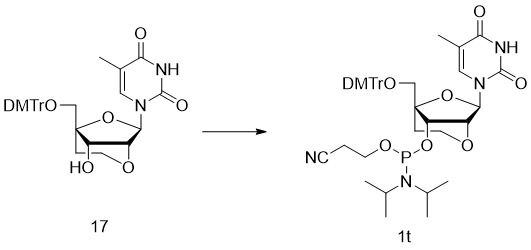
於實施例2-3所獲得的化合物17(5.00 g、8.17 mmol)之乙酸乙酯(40 mL)溶液中,添加2-氰基乙基 N,N,N’,N’-四異丙基亞磷醯二胺(2.96 g、9.82 mmol)及三氟乙酸・吡啶鹽(1.74 g、9.01 mmol),於20~30℃攪拌24小時。於獲得的溶液中,添加20%食鹽水(17.5 mL)而進行分液後,於獲得的有機層中添加5%碳酸氫鈉水溶液(12.5 mL)及20%食鹽水(10 mL)而進行分液。將獲得的有機層冷卻至0~5℃,添加10%磷酸二氫鉀水溶液(20 mL)而進行分液。於獲得的有機層中添加5%碳酸氫鈉水溶液(12.5 mL)及20%食鹽水(10 mL)而進行分液,於獲得的有機層中添加20%食鹽水(17.5 mL)而進行分液。將獲得的有機層減壓濃縮,溶解於乙酸乙酯(15 mL),於此溶液中添加乙酸乙酯(25 mL)及鹼性氧化鋁(10.00 g),於20~30℃攪拌2小時。自反應混合物濾除氧化鋁,氧化鋁以乙酸乙酯(25 mL)進行洗淨後,將濾液與洗淨液合併而獲得的溶液進行減壓濃縮,將濃縮物溶解於乙酸乙酯(15 mL),將獲得的乙酸乙酯溶液於20~30℃,歷經35分鐘滴加至正庚烷(45 mL)及二異丙基醚(80 mL)之混合溶液後,添加正庚烷(90 mL),於相同溫度下攪拌30分鐘。濾取析出的固體,將獲得的固體以正庚烷(25 mL)洗淨,進行減壓乾燥(40℃、12小時之後,50℃、8小時),藉此獲得標題化合物1t(5.18 g、6.58 mmol、80.6%)。In the ethyl acetate (40 mL) solution of compound 17 (5.00 g, 8.17 mmol) obtained in Example 2-3, 2-cyanoethyl N,N,N',N'-tetraisopropyl group was added Phosphonodiamine (2.96 g, 9.82 mmol) and trifluoroacetic acid and pyridine salt (1.74 g, 9.01 mmol) were stirred at 20-30°C for 24 hours. After adding 20% saline (17.5 mL) to the obtained solution for liquid separation, add 5% sodium bicarbonate aqueous solution (12.5 mL) and 20% saline (10 mL) to the obtained organic layer for separation. liquid. The obtained organic layer was cooled to 0 to 5°C, and a 10% potassium dihydrogen phosphate aqueous solution (20 mL) was added for liquid separation. Add 5% sodium bicarbonate aqueous solution (12.5 mL) and 20% saline (10 mL) to the obtained organic layer for liquid separation, and add 20% saline (17.5 mL) to the obtained organic layer for liquid separation . The obtained organic layer was concentrated under reduced pressure, dissolved in ethyl acetate (15 mL), ethyl acetate (25 mL) and basic alumina (10.00 g) were added to the solution, and the mixture was stirred at 20-30°C for 2 hours. The alumina was filtered off from the reaction mixture. After the alumina was washed with ethyl acetate (25 mL), the solution obtained by combining the filtrate and the washing liquid was concentrated under reduced pressure, and the concentrate was dissolved in ethyl acetate (15 mL). ), the ethyl acetate solution obtained was added dropwise to the mixed solution of n-heptane (45 mL) and diisopropyl ether (80 mL) at 20-30°C over 35 minutes, and then n-heptane (90 mL) ), stir at the same temperature for 30 minutes. The precipitated solid was collected by filtration, the obtained solid was washed with n-heptane (25 mL), and dried under reduced pressure (40° C., 12 hours later, 50° C., 8 hours) to obtain the title compound 1t (5.18 g, 6.58 mmol, 80.6%).
獲得的化合物之NMR譜與WO00/47599之實施例9記載之化合物的NMR譜一致。The NMR spectrum of the obtained compound is consistent with the NMR spectrum of the compound described in Example 9 of WO00/47599.
(實施例3)1-(2,6-脫水-4-{[雙(4-甲氧基苯基)(苯基)甲氧基]甲基}-3-O-{(2-氰基乙氧基)[二(丙烷-2-基)胺基]磷烷基}-5-去氧-α-L-來蘇-己呋喃糖基)-4-苯甲醯胺-5-甲基嘧啶-2(1H)-酮(化合物1c)之製造(Example 3) 1-(2,6-Anhydro-4-{[bis(4-methoxyphenyl)(phenyl)methoxy]methyl)-3-O-{(2-cyano Ethoxy)[bis(propan-2-yl)amino]phosphoranyl)-5-deoxy-α-L-lyxo-hexofuranosyl)-4-benzamide-5-methyl Production of pyrimidine-2(1H)-one (compound 1c)
(實施例3-1)1-{2,6-脫水-3-O-苄基-4-[(苄氧基)甲基]-5-去氧-α-L-來蘇-己呋喃糖基}-4-苯甲醯胺-5-甲基嘧啶-2(1H)-酮(化合物3c)之製造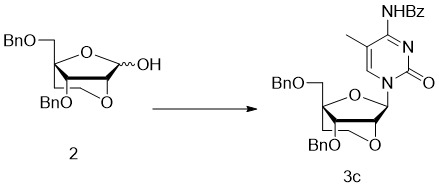
於乙腈(25 mL)中添加N4 -苄醯基-5-甲基胞嘧啶(8.04 g、35.08 mmol)、N,O-雙三甲基矽基乙醯胺(14.27 g、70.16 mmol),於20~30℃攪拌1小時,作為溶液A。於另外的反應容器,於乙腈(50 mL)中添加實施例1所獲得的化合物2(10.00 g、28.06 mmol)、三氯乙腈(6.08 g、42.09 mmol)後,添加1,8-二氮雜雙環[5.4.0]十一-7-烯(0.41 g、2.81 mmol),並於20~30℃攪拌1小時,作為溶液B。於溶液B中添加溶液A後,添加碘三甲基矽烷(7.02 g、35.08 mmol)而於5~15℃攪拌16小時。於反應液中滴加將亞硫酸鈉(8.84 g、87.73 mmol)溶解於5%碳酸氫鈉水溶液(80 mL)而成的水溶液後,添加甲苯(100 mL),分液後,濾除少量的固體。對於獲得的有機層,以50%甲醇水(50 mL)進行二次洗淨。將獲得的有機層減壓濃縮而作成甲醇溶液(50 mL)後,於20~30℃攪拌16小時後,將析出的固體過濾,以甲醇(50 mL)進行洗淨。將獲得的固體進行減壓乾燥(40℃)而獲得化合物3c(9.35 g、58.7%)。 Add N 4 -benzyl-5-methylcytosine (8.04 g, 35.08 mmol), N,O-bistrimethylsilylacetamide (14.27 g, 70.16 mmol) to acetonitrile (25 mL), It was stirred at 20-30°C for 1 hour, and was used as solution A. In another reaction vessel, compound 2 (10.00 g, 28.06 mmol) obtained in Example 1 and trichloroacetonitrile (6.08 g, 42.09 mmol) were added to acetonitrile (50 mL), and then 1,8-diazepine was added Bicyclo[5.4.0]undec-7-ene (0.41 g, 2.81 mmol), stirred at 20-30°C for 1 hour, and used as solution B. After adding solution A to solution B, iodotrimethylsilane (7.02 g, 35.08 mmol) was added, and the mixture was stirred at 5 to 15°C for 16 hours. After dissolving sodium sulfite (8.84 g, 87.73 mmol) in 5% sodium bicarbonate aqueous solution (80 mL) was added dropwise to the reaction solution, toluene (100 mL) was added, and after liquid separation, a small amount of solid was filtered off. The obtained organic layer was washed twice with 50% methanol water (50 mL). The obtained organic layer was concentrated under reduced pressure to prepare a methanol solution (50 mL), and after stirring at 20 to 30°C for 16 hours, the precipitated solid was filtered and washed with methanol (50 mL). The obtained solid was dried under reduced pressure (40°C) to obtain compound 3c (9.35 g, 58.7%).
獲得的化合物之NMR譜與WO00/47599之實施例19記載之化合物的NMR譜一致。The NMR spectrum of the obtained compound is consistent with the NMR spectrum of the compound described in Example 19 of WO00/47599.
(實施例3-2)1-[2,6-脫水-5-去氧-4-(羥基甲基)-α-L-來蘇-己呋喃糖基]-4-苯甲醯胺-5-甲基嘧啶-2(1H)-酮(化合物18)之製造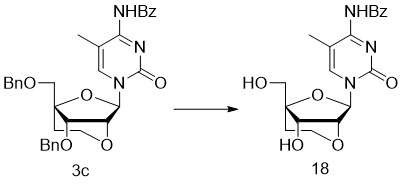
於二氯甲烷(20 mL)中添加實施例3-1所獲得的化合物3c(5.00 g、8.81 mmol),於-20~-10℃滴加1M-三氯化硼/二氯甲烷溶液(40.0 mL、39.65 mmol),並攪拌16小時。於反應液中滴加50%羅謝爾鹽(Rochelle salt)水溶液(20.0 mL),並添加乙酸乙酯(20 mL)、水(20 mL),於20~30℃攪拌16小時後,將析出的固體過濾,以水(20 mL)、乙酸乙酯(20 mL)洗淨。將獲得的固體進行減壓乾燥(40℃)而獲得化合物18(1.59 g、46.6%)。Compound 3c (5.00 g, 8.81 mmol) obtained in Example 3-1 was added to dichloromethane (20 mL), and 1M-boron trichloride/dichloromethane solution (40.0 mL, 39.65 mmol) and stirred for 16 hours. Add 50% Rochelle salt aqueous solution (20.0 mL) dropwise to the reaction solution, add ethyl acetate (20 mL) and water (20 mL), and stir at 20-30°C for 16 hours, and then precipitate The solid was filtered and washed with water (20 mL) and ethyl acetate (20 mL). The obtained solid was dried under reduced pressure (40°C) to obtain compound 18 (1.59 g, 46.6%).
獲得的化合物之NMR譜與WO00/47599之實施例11記載之化合物的NMR譜一致。The NMR spectrum of the obtained compound is consistent with the NMR spectrum of the compound described in Example 11 of WO00/47599.
(實施例3-3)1-(2,6-脫水-4-{[雙(4-甲氧基苯基)(苯基)甲氧基]甲基}-5-去氧-α-L-來蘇-己呋喃糖基)-4-苯甲醯胺-5-甲基嘧啶-2(1H)-酮(化合物19)之製造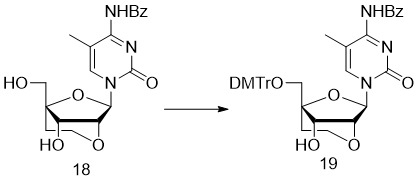
於乙酸乙酯(40 mL)中添加實施例3-2所獲得的化合物18(1.00 g、2.581 mmol),減壓濃縮至10 mL後,添加吡啶(0.815 g、10.324 mmol),添加4,4’-二甲氧基三苯氯甲烷(1.05 g、3.098 mmol),於20~30℃攪拌16小時。於反應液中添加甲醇(1.0 mL)後,添加水(10 mL)、甲醇(10 mL),並於20~30℃攪拌16小時後,將析出的固體過濾,以水(5 mL)、乙酸乙酯(5 mL)進行洗淨。將獲得的固體進行減壓乾燥(40℃)而獲得化合物19之水合物結晶(1.53 g、86.0%)。Compound 18 (1.00 g, 2.581 mmol) obtained in Example 3-2 was added to ethyl acetate (40 mL), and after concentration under reduced pressure to 10 mL, pyridine (0.815 g, 10.324 mmol) was added, and 4,4 were added. '-Dimethoxytriphenylchloromethane (1.05 g, 3.098 mmol) was stirred at 20-30°C for 16 hours. After adding methanol (1.0 mL) to the reaction solution, adding water (10 mL) and methanol (10 mL), and stirring at 20-30°C for 16 hours, the precipitated solid was filtered, and the mixture was filtered with water (5 mL) and acetic acid. Wash with ethyl ester (5 mL). The obtained solid was dried under reduced pressure (40° C.) to obtain compound 19 hydrate crystals (1.53 g, 86.0%).
獲得的化合物之NMR譜與WO00/47599之實施例21記載之化合物的NMR譜一致。The NMR spectrum of the obtained compound is consistent with the NMR spectrum of the compound described in Example 21 of WO00/47599.
(實施例3-4)化合物1c之製造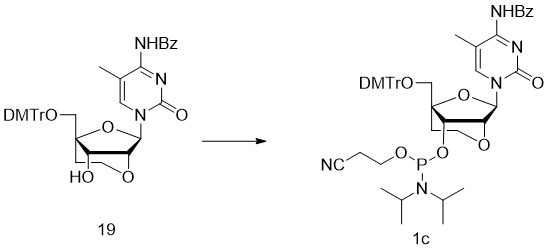
於實施例3-3所獲得的化合物19之水合物(3.00 g、4.24 mmol)中添加二氯甲烷(30 mL),減壓濃縮而作成二氯甲烷溶液(9 mL)。重複二次於獲得的溶液中添加二氯甲烷(30 mL)並進行減壓濃縮而作成二氯甲烷溶液(9 mL)的操作。於獲得的溶液中添加二氯甲烷(15 mL)、N,N,N’,N’-四異丙基亞磷醯二胺(1.54 g、5.11 mmol)、三氟乙酸・吡啶鹽(0.902 g、4.67 mmol),於20~30℃攪拌7小時。將獲得的溶液以5%碳酸氫鈉水溶液(10.5 mL)洗淨二次後,以5%食鹽水(12 mL)洗淨二次,進行減壓濃縮而獲得二氯甲烷溶液(9 mL)。於獲得的溶液中添加二氯甲烷(15 mL)、鹼性氧化鋁(6.00 g),並於20~30℃攪拌30分鐘。濾除氧化鋁,以二氯甲烷(15 mL)進行洗淨後,將獲得的溶液進行減壓濃縮而獲得化合物1c之二氯甲烷溶液(9 mL)。將獲得的溶液於20~30℃歷經35分鐘滴加至正庚烷(66 mL)與二異丙基醚(15.6 mL)之混合溶液中。直接於此溫度下攪拌2小時後,將析出的固體過濾,以正庚烷(15 mL)進行洗淨。將獲得的固體進行減壓乾燥(40℃)而獲得化合物1c(3.33 g、3.74 mmol、88.3%)。Dichloromethane (30 mL) was added to the hydrate (3.00 g, 4.24 mmol) of compound 19 obtained in Example 3-3, and it was concentrated under reduced pressure to prepare a dichloromethane solution (9 mL). The operation of adding dichloromethane (30 mL) to the obtained solution and concentrating under reduced pressure was repeated twice to prepare a dichloromethane solution (9 mL). Add dichloromethane (15 mL), N,N,N',N'-tetraisopropylphosphoridine (1.54 g, 5.11 mmol), trifluoroacetic acid, pyridine salt (0.902 g) to the obtained solution , 4.67 mmol) and stirring at 20-30°C for 7 hours. The obtained solution was washed twice with 5% sodium bicarbonate aqueous solution (10.5 mL), washed twice with 5% saline (12 mL), and concentrated under reduced pressure to obtain a dichloromethane solution (9 mL). Dichloromethane (15 mL) and basic alumina (6.00 g) were added to the obtained solution, and the mixture was stirred at 20 to 30°C for 30 minutes. The alumina was filtered off and washed with dichloromethane (15 mL), and the obtained solution was concentrated under reduced pressure to obtain a dichloromethane solution (9 mL) of compound 1c. The obtained solution was added dropwise to a mixed solution of n-heptane (66 mL) and diisopropyl ether (15.6 mL) at 20-30°C over 35 minutes. After stirring directly at this temperature for 2 hours, the precipitated solid was filtered and washed with n-heptane (15 mL). The obtained solid was dried under reduced pressure (40° C.) to obtain compound 1c (3.33 g, 3.74 mmol, 88.3%).
獲得的化合物之NMR譜與WO00/47599之實施例6記載之化合物的NMR譜一致。The NMR spectrum of the obtained compound is consistent with the NMR spectrum of the compound described in Example 6 of WO00/47599.
(實施例4)9-(2,6-脫水-4-{[雙(4-甲氧基苯基)(苯基)甲氧基]甲基}-3-O-{(2-氰基乙氧基)[二(丙烷-2-基)胺基]磷烷基}-5-去氧-α-L-來蘇-己呋喃糖基)-N-苄醯基-9H-嘌呤-6-胺(化合物1a)之製造(Example 4) 9-(2,6-Anhydro-4-{[bis(4-methoxyphenyl)(phenyl)methoxy]methyl)-3-O-{(2-cyano Ethoxy)[bis(propan-2-yl)amino]phosphoranyl}-5-deoxy-α-L-lyso-hexofuranosyl)-N-benzyl-9H-purine-6 -Production of amine (compound 1a)
(實施例4-1-1)9-{2,6-脫水-3-O-苄基-4-[(苄氧基)甲基]-5-去氧-α-L-來蘇-己呋喃糖基}-N-苄醯基-9H-嘌呤-6-胺(化合物3a)之製造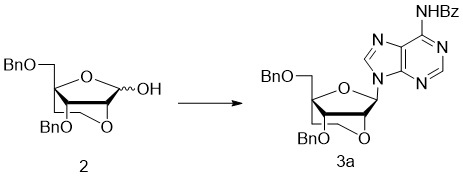
於三氟甲磺酸(7.44 mL、84.18 mmol)中添加二氯二甲基矽烷(5.44 g、42.09 mmol),並於20~30℃攪拌0.5小時後,添加乙腈(80 mL)、N-苄醯基腺嘌呤(10.06 g、42.09 mmol),於20~30℃攪拌3小時,作為溶液A。於另外的反應容器,於乙腈(40 mL)中添加實施例1所獲得的化合物2(10.00 g、28.06 mmol)、三氯乙腈(4.2 mL、42.09 mmol)後,添加1,8-二氮雜雙環[5.4.0]十一-7-烯(0.22 g、1.40 mmol),於20~30℃攪拌1小時,作為溶液B。於溶液A中添加溶液B後,於45~55℃攪拌2小時。將溫度調整至0-10℃後,於反應液中添加甲苯(100 mL)、20%碳酸氫鉀水溶液(70 mL)並進行分液,獲得甲苯層。於獲得的甲苯層中添加20%檸檬酸水溶液(50 mL)並進行分液,獲得甲苯層。藉由重複進行2次相同的分液操作,於獲得的甲苯層中添加水(30 mL)、20%碳酸氫鉀水溶液(25 mL),分液並獲得甲苯層。於獲得的甲苯層中添加50%甲醇水溶液(100 mL),進行分液並獲得甲苯層。將獲得的甲苯層進行減壓濃縮,作成甲苯溶液(80 mL)。於獲得的溶液中添加異丁基醇(100 mL),進行減壓濃縮,藉此獲得甲苯-異丁基醇溶液(100 mL)。於獲得的溶液中添加異丁基醇(50 mL),進行減壓濃縮,藉此獲得甲苯-異丁基醇溶液(50 mL)。於獲得的溶液中,添加異丁基醇(50 mL)後,於20~30℃攪拌2小時,藉此確認結晶之析出。歷經0.5小時將溫度調整至0-10℃後,攪拌1小時,過濾析出的結晶,使用預先冷卻至0℃的異丁基醇(50 mL)而進行洗淨,並進行減壓乾燥(40℃),藉此獲得化合物3a(7.82 g、13.54 mmol、產率48.3%)。Add dichlorodimethylsilane (5.44 g, 42.09 mmol) to trifluoromethanesulfonic acid (7.44 mL, 84.18 mmol) and stir at 20-30°C for 0.5 hours, then add acetonitrile (80 mL) and N-benzyl Adenine (10.06 g, 42.09 mmol) was stirred at 20-30°C for 3 hours, and the solution A was obtained. In another reaction vessel, compound 2 (10.00 g, 28.06 mmol) obtained in Example 1 and trichloroacetonitrile (4.2 mL, 42.09 mmol) were added to acetonitrile (40 mL), and then 1,8-diazepine was added Bicyclo[5.4.0]undec-7-ene (0.22 g, 1.40 mmol) was stirred at 20-30°C for 1 hour, and was used as solution B. After adding solution B to solution A, it was stirred at 45 to 55°C for 2 hours. After adjusting the temperature to 0-10°C, toluene (100 mL) and a 20% potassium hydrogen carbonate aqueous solution (70 mL) were added to the reaction solution and separated to obtain a toluene layer. To the obtained toluene layer, a 20% citric acid aqueous solution (50 mL) was added and liquid-separated to obtain a toluene layer. By repeating the same liquid separation operation twice, water (30 mL) and a 20% potassium hydrogen carbonate aqueous solution (25 mL) were added to the obtained toluene layer, and the liquid was separated to obtain a toluene layer. A 50% methanol aqueous solution (100 mL) was added to the obtained toluene layer, and liquid separation was performed to obtain a toluene layer. The obtained toluene layer was concentrated under reduced pressure to prepare a toluene solution (80 mL). Isobutyl alcohol (100 mL) was added to the obtained solution, and concentrated under reduced pressure, thereby obtaining a toluene-isobutyl alcohol solution (100 mL). Isobutyl alcohol (50 mL) was added to the obtained solution, and concentrated under reduced pressure, thereby obtaining a toluene-isobutyl alcohol solution (50 mL). After adding isobutyl alcohol (50 mL) to the obtained solution, it was stirred at 20-30°C for 2 hours to confirm the precipitation of crystals. After adjusting the temperature to 0-10°C for 0.5 hours, stirring for 1 hour, the precipitated crystals were filtered, washed with isobutyl alcohol (50 mL) pre-cooled to 0°C, and dried under reduced pressure (40°C) ), thereby obtaining compound 3a (7.82 g, 13.54 mmol, yield 48.3%).
獲得的化合物之NMR譜與WO00/47599之實施例6記載之化合物的NMR譜一致。The NMR spectrum of the obtained compound is consistent with the NMR spectrum of the compound described in Example 6 of WO00/47599.
(實施例4-1-2)1-O-乙醯基-2,6-脫水-3-O-苄基-4-[(苄氧基)甲基]-5-去氧-α-L-甘油-己呋喃糖(化合物22)之製造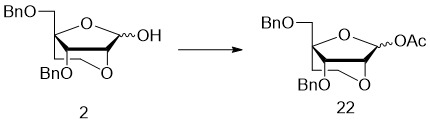
添加甲苯(1497 mL)、實施例1所獲得的化合物2(149.73 g、375.78 mmol)、乙酸酐(64.33 g、563.67 mmol)、吡啶(49.85 g、563.67 mmol)、4-二甲基胺基吡啶(2.57 g、18.79 mmol),於20~30°C攪拌2小時後,於反應液中添加水(749 mL),進行分液並獲得甲苯層。於獲得的甲苯層中添加20%檸檬酸水溶液(749 mL)並進行分液,獲得甲苯層。藉由再次重複同樣的分液操作,於獲得的甲苯層中添加8%碳酸氫鉀水溶液(449 mL),進行分液並獲得甲苯層。於獲得的甲苯層中添加5%食鹽水(449 mL),進行分液並獲得甲苯層。將獲得的甲苯層減壓濃縮,作成甲苯溶液(449 mL)。於獲得的溶液中加入乙腈(1497 mL),並進行減壓濃縮,藉此獲得甲苯-乙腈溶液(449 mL)。於獲得的溶液中添加乙腈(1497 mL),並進行減壓濃縮,藉此獲得化合物22之甲苯-乙腈溶液(449 mL)。Add toluene (1497 mL), compound 2 (149.73 g, 375.78 mmol) obtained in Example 1, acetic anhydride (64.33 g, 563.67 mmol), pyridine (49.85 g, 563.67 mmol), 4-dimethylaminopyridine (2.57 g, 18.79 mmol), after stirring at 20 to 30°C for 2 hours, water (749 mL) was added to the reaction solution, and liquid separation was performed to obtain a toluene layer. To the obtained toluene layer, a 20% citric acid aqueous solution (749 mL) was added and liquid-separated to obtain a toluene layer. By repeating the same liquid separation operation again, an 8% potassium hydrogen carbonate aqueous solution (449 mL) was added to the obtained toluene layer, and liquid separation was performed to obtain a toluene layer. 5% brine (449 mL) was added to the obtained toluene layer, and liquid separation was performed to obtain a toluene layer. The obtained toluene layer was concentrated under reduced pressure to prepare a toluene solution (449 mL). Acetonitrile (1497 mL) was added to the obtained solution, and concentrated under reduced pressure, thereby obtaining a toluene-acetonitrile solution (449 mL). Acetonitrile (1497 mL) was added to the obtained solution, and concentrated under reduced pressure, thereby obtaining a toluene-acetonitrile solution (449 mL) of compound 22.
(實施例4-1-3a)9-{2,6-脫水-3-O-苄基-4-[(苄氧基)甲基]-5-去氧-α-L-來蘇-己呋喃糖基}-N-苄醯基-9H-嘌呤-6-胺(化合物3a)之製造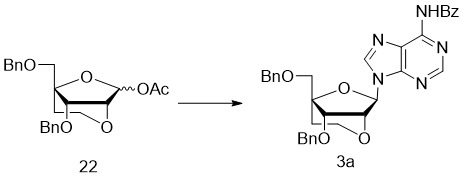
添加乙腈(51 mL)、N-苄醯基腺嘌呤(5.09 g、21.30 mmol)、三氟甲磺酸三甲基矽酯(9.78 g、44.01 mmol),於20~30°C攪拌40分鐘。添加包含實施例4-1-2所獲得的化合物22的甲苯-乙腈溶液(11.65 g、14.20 mmol)後,於20~30°C攪拌16小時。接著,添加三氟乙酸(2.43 g、21.30 mmol),於20~30°C攪拌1小時後,使升溫至45~55°C並攪拌3小時。將溫度調整至20-30℃後,於反應液中添加甲苯(51 mL)、25%氫氧化鈉(10 mL)、8%碳酸氫鈉水溶液(10 mL),並於20~30°C攪拌1小時。接著,添加10%三氟乙酸水溶液(25 mL),進行分液並獲得甲苯層。於藉由重複3次同樣的分液操作所獲得的甲苯層中,添加8%碳酸氫鈉水溶液(51 mL),進行分液並獲得甲苯層。於獲得的甲苯層中添加50%甲醇水溶液(20 mL)、20%食鹽水(5 mL),進行分液並獲得甲苯層。將藉由重複1次同樣的分液操作所獲得的甲苯層進行減壓濃縮,作成甲苯溶液(15 mL)。於獲得的溶液中添加異丁基醇(40 mL),進行減壓濃縮,藉此獲得甲苯-異丁基醇溶液(40 mL)。於獲得的溶液中添加異丁基醇(15 mL),接種化合物3a之結晶(0.1 wt%),於35~45℃攪拌30分鐘,藉此確認結晶的析出。接著,進行減壓濃縮並作成甲苯-異丁基醇溶液(40 mL)後,添加異丁基醇(5 mL),歷經2小時將溫度調整至0-10℃,並攪拌17.5小時。過濾析出的結晶,使用預先冷卻至0℃的異丁基醇(25 mL)加以洗淨,進行減壓乾燥(40℃),藉此獲得化合物3a(6.37 g、11.03 mmol、產率77.7 %)。Add acetonitrile (51 mL), N-benzyladenine (5.09 g, 21.30 mmol), trimethylsilyl trifluoromethanesulfonate (9.78 g, 44.01 mmol), and stir at 20-30°C for 40 minutes. After adding the toluene-acetonitrile solution (11.65 g, 14.20 mmol) containing the compound 22 obtained in Example 4-1-2, it stirred at 20-30 degreeC for 16 hours. Next, trifluoroacetic acid (2.43 g, 21.30 mmol) was added, and after stirring at 20 to 30°C for 1 hour, the temperature was raised to 45 to 55°C and stirred for 3 hours. After adjusting the temperature to 20-30°C, add toluene (51 mL), 25% sodium hydroxide (10 mL), and 8% sodium bicarbonate aqueous solution (10 mL) to the reaction solution, and stir at 20-30°C 1 hour. Next, a 10% trifluoroacetic acid aqueous solution (25 mL) was added, liquid separation was performed, and a toluene layer was obtained. To the toluene layer obtained by repeating the same liquid separation operation three times, an 8% sodium bicarbonate aqueous solution (51 mL) was added to perform liquid separation to obtain a toluene layer. To the obtained toluene layer, a 50% methanol aqueous solution (20 mL) and a 20% brine (5 mL) were added, and liquid separation was performed to obtain a toluene layer. The toluene layer obtained by repeating the same liquid separation operation once was concentrated under reduced pressure to prepare a toluene solution (15 mL). Isobutyl alcohol (40 mL) was added to the obtained solution, and concentrated under reduced pressure, thereby obtaining a toluene-isobutyl alcohol solution (40 mL). Isobutyl alcohol (15 mL) was added to the obtained solution, and the crystal of compound 3a (0.1 wt%) was inoculated, and stirred at 35 to 45° C. for 30 minutes to confirm the precipitation of the crystal. Then, after concentrating under reduced pressure to prepare a toluene-isobutyl alcohol solution (40 mL), isobutyl alcohol (5 mL) was added, the temperature was adjusted to 0-10°C over 2 hours, and the mixture was stirred for 17.5 hours. The precipitated crystals were filtered, washed with isobutyl alcohol (25 mL) previously cooled to 0°C, and dried under reduced pressure (40°C) to obtain compound 3a (6.37 g, 11.03 mmol, yield 77.7%) .
(實施例4-1-3b) 9-{2,6-脫水-3-O-苄基-4-[(苄氧基)甲基]-5-去氧-α-L-來蘇-己呋喃糖基}-N-苄醯基-9H-嘌呤-6-胺(化合物3a)之製造(Example 4-1-3b) 9-{2,6-Anhydro-3-O-benzyl-4-[(benzyloxy)methyl]-5-deoxy-α-L-lyso-hexyl Production of furanosyl)-N-benzyl-9H-purin-6-amine (compound 3a)
於乙腈(30 mL)中添加N-苄醯基腺嘌呤(3.02 g、12.63 mmol)、三氟甲磺酸三甲基矽酯(5.61 g、25.25 mmol),將反應混合物於20~30°C攪拌30分鐘。於獲得的反應混合物中,添加含有實施例4-1-2所獲得的化合物22的乙腈溶液(6 mL)及乙腈(3 mL),將反應混合物於20~30℃攪拌2小時。接著,添加三氟乙酸(1.44 g、12.63 mmol),於35~45℃將反應混合物攪拌6小時。將獲得的反應混合物冷卻至0℃後,將反應液使用25%氫氧化鈉(3 mL)調整至pH6.5~7.5。之後,於反應混合物中,於20~30℃,添加水(9 mL),接種化合物3a之結晶(0.1 wt%),於20~30℃將反應混合物攪拌19小時後,進一步添加水(27 mL),並於20~30℃攪拌4小時。過濾析出的結晶,使用50%乙腈水(15 mL)進行洗淨,並進行減壓乾燥(40℃),藉此獲得化合物3a(3.59 g、6.21 mmol、產率73.8 %)。Add N-benzyladenine (3.02 g, 12.63 mmol) and trimethylsilyl trifluoromethanesulfonate (5.61 g, 25.25 mmol) to acetonitrile (30 mL), and heat the reaction mixture at 20-30°C Stir for 30 minutes. To the obtained reaction mixture, the acetonitrile solution (6 mL) and acetonitrile (3 mL) containing the compound 22 obtained in Example 4-1-2 were added, and the reaction mixture was stirred at 20-30°C for 2 hours. Next, trifluoroacetic acid (1.44 g, 12.63 mmol) was added, and the reaction mixture was stirred at 35 to 45°C for 6 hours. After cooling the obtained reaction mixture to 0°C, the reaction solution was adjusted to pH 6.5-7.5 using 25% sodium hydroxide (3 mL). Then, add water (9 mL) to the reaction mixture at 20-30°C to inoculate the crystals of compound 3a (0.1 wt%). After stirring the reaction mixture at 20-30°C for 19 hours, add water (27 mL) ) And stirred at 20-30°C for 4 hours. The precipitated crystals were filtered, washed with 50% acetonitrile water (15 mL), and dried under reduced pressure (40° C.) to obtain compound 3a (3.59 g, 6.21 mmol, 73.8% yield).
獲得的化合物之NMR譜與WO00/47599之實施例6記載之化合物的NMR譜一致。The NMR spectrum of the obtained compound is consistent with the NMR spectrum of the compound described in Example 6 of WO00/47599.
(實施例4-2)9-[2,6-脫水-5-去氧-4-(羥基甲基)-α-L-來蘇-己呋喃糖基]-N-苄醯基-9H-嘌呤-6-胺(化合物20)之製造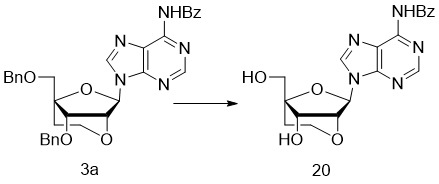
於-20~-10℃,於1M-三氯化硼/二氯甲烷溶液(50.0 mL、51.94 mmol)中添加實施例4-1-3所獲得的化合物3a(2.00 g、3.46 mmol),並攪拌0.5小時。確認反應結束後,藉由減壓濃縮,獲得二氯甲烷溶液(20 mL)。Add the compound 3a (2.00 g, 3.46 mmol) obtained in Example 4-1-3 to 1M-boron trichloride/dichloromethane solution (50.0 mL, 51.94 mmol) at -20~-10°C, and Stir for 0.5 hour. After confirming the completion of the reaction, it was concentrated under reduced pressure to obtain a dichloromethane solution (20 mL).
於獲得的溶液中滴加50%氫氧化鉀水溶液(6.0 mL),添加正庚烷(6 mL),於20~30℃攪拌15分鐘後,將析出的固體過濾,以二氯甲烷/正庚烷(5/1、4 mL)進行洗淨。於獲得的固體中添加乙腈(30 mL)、水(4 mL)。攪拌0.5小時後,將固體過濾,以乙腈(4 mL)進行洗淨。於獲得的固體中添加甲醇(30 mL)後,濾除固體,使用甲醇(10 mL)而進行洗淨,獲得甲醇溶液。將獲得的溶液進行減壓濃縮,調整於甲醇溶液(10 mL)。對於獲得的溶液中,添加乙腈(20 mL),進行減壓濃縮,藉此獲得乙腈-甲醇混合溶液(10 mL)。進行2次同樣之減壓濃縮操作,對獲得的乙腈-甲醇混合溶液(10 mL)添加乙腈(10 mL),攪拌16小時後,過濾固體,並以乙腈(6 mL)進行洗淨。將獲得的固體進行減壓乾燥(40℃)而獲得化合物20(0.61 g、44.3%)。50% potassium hydroxide aqueous solution (6.0 mL) was added dropwise to the obtained solution, n-heptane (6 mL) was added, and after stirring at 20-30°C for 15 minutes, the precipitated solid was filtered and the mixture was filtered with dichloromethane/n-heptane. Wash with alkane (5/1, 4 mL). Acetonitrile (30 mL) and water (4 mL) were added to the obtained solid. After stirring for 0.5 hour, the solid was filtered and washed with acetonitrile (4 mL). After adding methanol (30 mL) to the obtained solid, the solid was filtered off and washed with methanol (10 mL) to obtain a methanol solution. The obtained solution was concentrated under reduced pressure and adjusted to a methanol solution (10 mL). To the obtained solution, acetonitrile (20 mL) was added and concentrated under reduced pressure to obtain an acetonitrile-methanol mixed solution (10 mL). The same vacuum concentration operation was performed twice, acetonitrile (10 mL) was added to the obtained acetonitrile-methanol mixed solution (10 mL), and after stirring for 16 hours, the solid was filtered and washed with acetonitrile (6 mL). The obtained solid was dried under reduced pressure (40°C) to obtain compound 20 (0.61 g, 44.3%).
獲得的化合物之NMR譜與WO00/47599之實施例11記載之化合物的NMR譜一致。The NMR spectrum of the obtained compound is consistent with the NMR spectrum of the compound described in Example 11 of WO00/47599.
(實施例4-3)9-(2,6-脫水-4-{[雙(4-甲氧基苯基)(苯基)甲氧基]甲基}-5-去氧-α-L-來蘇-己呋喃糖基)-N-苄醯基-9H-嘌呤-6-胺(化合物21)之製造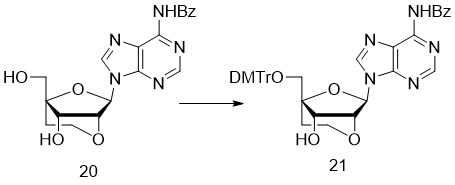
於四氫呋喃(7.5 mL)中添加實施例4-2所獲得的化合物20(0.50 g、1.26 mmol)、4,4’-二甲氧基三苯氯甲烷(0.64 g、1.89 mmol),添加吡啶(0.60 g、7.55 mmol),並於50℃攪拌2小時。於反應液中添加甲苯(5.0 mL)、水(2.5 mL),進行分液並獲得甲苯層。將獲得的甲苯層以20%檸檬酸水溶液(2.5 mL)進行三次分液,添加20%碳酸鉀水溶液(1.0 mL)而進行分液並獲得甲苯層。於獲得的甲苯層中添加水(2.5 mL)而進行分液洗淨後,進行減壓濃縮,藉此獲得甲苯溶液(2.5 mL)。於獲得的溶液中添加甲苯(5.0 mL),並進行減壓濃縮,藉此獲得甲苯溶液(2.5 mL)。藉由重複二次同樣的操作,獲得甲苯溶液(2.5 mL)。於獲得的溶液中添加甲苯(2.5 mL)、水(50μL),並於20~30℃攪拌3小時後,將析出的固體過濾,以甲苯(2.5 mL)進行洗淨。將獲得的固體進行減壓乾燥(40℃)而獲得粗化合物21(0.51 g、58.0%)。Compound 20 (0.50 g, 1.26 mmol), 4,4'-dimethoxytriphenylchloromethane (0.64 g, 1.89 mmol) obtained in Example 4-2 were added to tetrahydrofuran (7.5 mL), and pyridine ( 0.60 g, 7.55 mmol), and stirred at 50°C for 2 hours. Toluene (5.0 mL) and water (2.5 mL) were added to the reaction liquid, and liquid separation was performed to obtain a toluene layer. The obtained toluene layer was separated three times with a 20% citric acid aqueous solution (2.5 mL), and a 20% potassium carbonate aqueous solution (1.0 mL) was added and separated to obtain a toluene layer. Water (2.5 mL) was added to the obtained toluene layer to perform liquid separation and washing, and then concentrated under reduced pressure to obtain a toluene solution (2.5 mL). Toluene (5.0 mL) was added to the obtained solution, and concentrated under reduced pressure, thereby obtaining a toluene solution (2.5 mL). By repeating the same operation twice, a toluene solution (2.5 mL) was obtained. Toluene (2.5 mL) and water (50 μL) were added to the obtained solution, and after stirring at 20 to 30°C for 3 hours, the precipitated solid was filtered and washed with toluene (2.5 mL). The obtained solid was dried under reduced pressure (40° C.) to obtain crude compound 21 (0.51 g, 58.0%).
於2-丙醇(1.8 mL)中添加粗化合物21(0.36 g、0.51 mmol)、水(1.8 mL)並於20~30℃攪拌0.5小時。再添加水(1.8 mL),攪拌15分鐘後,過濾固體,以2-丙醇-水(1/3、1.8 mL)進行洗淨。將獲得的固體進行減壓乾燥(40℃)而獲得化合物21之水合物(0.31 g、86.1%)。Crude compound 21 (0.36 g, 0.51 mmol) and water (1.8 mL) were added to 2-propanol (1.8 mL) and stirred at 20-30°C for 0.5 hours. Water (1.8 mL) was added again, and after stirring for 15 minutes, the solid was filtered and washed with 2-propanol-water (1/3, 1.8 mL). The obtained solid was dried under reduced pressure (40° C.) to obtain a hydrate of compound 21 (0.31 g, 86.1%).
獲得的化合物之NMR譜與WO00/47599之實施例13記載之化合物的NMR譜一致。The NMR spectrum of the obtained compound is consistent with the NMR spectrum of the compound described in Example 13 of WO00/47599.
(實施例4-4)化合物1a之製造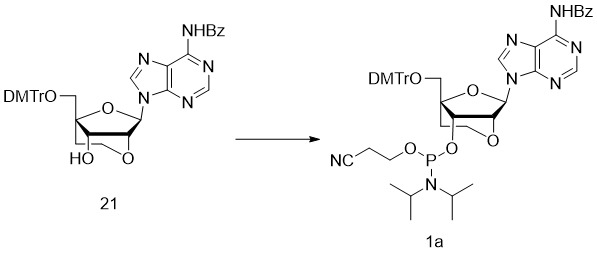
於實施例4-3所獲得的化合物21之水合物(150 mg、0.209 mmol)中添加二氯甲烷(1.5 mL),進行減壓濃縮而乾固。於獲得的泡沫中添加二氯甲烷(1.5 mL),進行減壓濃縮而乾固後,添加二氯甲烷(1.2 mL)、N,N,N’,N’-四異丙基亞磷醯二胺(77.9 mg、0.258 mmol)、三氟乙酸・吡啶鹽(44.4 mg、0.230 mmol),於20~30℃攪拌4小時。獲得的溶液以5%碳酸氫鈉水溶液(0.525 mL)洗淨二次後,以5%食鹽水(0.600 mL)洗淨二次,進行減壓濃縮而乾固。於獲得的泡沫中添加乙酸乙酯(1.2 mL)、中性矽膠(300 mg),於20~30℃攪拌1小時。濾除矽膠,以乙酸乙酯(6 mL)進行洗淨後,將獲得的溶液進行減壓濃縮而乾固。將獲得的泡沫之乙酸乙酯(0.600 mL)溶液於20~30℃歷經20分鐘滴加至正庚烷(1.35 mL)與二異丙基醚(2.4 mL)之混合溶液中。添加正庚烷(3.15 mL)而直接於此溫度下攪拌1小時後,將析出的固體過濾,以正庚烷(6 mL)進行洗淨。將獲得的固體進行減壓乾燥(40℃)而獲得化合物1a(132.5 mg、0.147 mmol、70.4%)。Dichloromethane (1.5 mL) was added to the hydrate (150 mg, 0.209 mmol) of compound 21 obtained in Example 4-3, and the mixture was concentrated under reduced pressure and dried. Add dichloromethane (1.5 mL) to the obtained foam, concentrate under reduced pressure and dry it, then add dichloromethane (1.2 mL), N,N,N',N'-tetraisopropylphosphatidite Amine (77.9 mg, 0.258 mmol), trifluoroacetic acid and pyridine salt (44.4 mg, 0.230 mmol), stirred at 20-30°C for 4 hours. The obtained solution was washed twice with 5% sodium bicarbonate aqueous solution (0.525 mL), washed twice with 5% saline (0.600 mL), and concentrated under reduced pressure to dry. Add ethyl acetate (1.2 mL) and neutral silica gel (300 mg) to the obtained foam, and stir at 20-30°C for 1 hour. The silica gel was filtered off, washed with ethyl acetate (6 mL), and the obtained solution was concentrated under reduced pressure to dryness. The ethyl acetate (0.600 mL) solution of the obtained foam was added dropwise to the mixed solution of n-heptane (1.35 mL) and diisopropyl ether (2.4 mL) at 20-30°C over 20 minutes. After adding n-heptane (3.15 mL) and directly stirring at this temperature for 1 hour, the precipitated solid was filtered and washed with n-heptane (6 mL). The obtained solid was dried under reduced pressure (40°C) to obtain compound 1a (132.5 mg, 0.147 mmol, 70.4%).
獲得的化合物之NMR譜與WO00/47599之實施例14記載之化合物的NMR譜一致。The NMR spectrum of the obtained compound is consistent with the NMR spectrum of the compound described in Example 14 of WO00/47599.
(實施例5)化合物20之製造(Example 5) Production of compound 20
(實施例5-1)化合物22之純化(Example 5-1) Purification of Compound 22
將實施例4-1-2所獲得的溶液濃縮乾固而獲得的化合物22之粗體混合物(6.57 g),以矽膠管柱層析純化(己烷:乙酸乙酯=94:6~50:50),獲得化合物22之β體(4.68 g)。1 H NMR (β體, CDCl3 ):δ = 1.43 (1H, dd, J = 3.5, 13.5 Hz), 2.01 (3H, s), 2.17-2.24 (1H, m), 3.57 (2H, dd, J = 11.5, 22.0 Hz), 3.94-3.97 (2H, m), 4.07 (1H, d, J = 3.0 Hz), 4.14 (1H, d, J = 3.0 Hz), 4.54 (1H, d, J = 12.5 Hz), 4.61 (2H, dd, J = 12.5, 18.0 Hz), 4.74 (1H, d, J = 11.5 Hz), 6.33 (1H, s), 7.26-7.37 (10H, m).The crude mixture of compound 22 (6.57 g) obtained by concentrating and drying the solution obtained in Example 4-1-2 was purified by silica gel column chromatography (hexane: ethyl acetate = 94: 6-50: 50) to obtain the β body of compound 22 (4.68 g). 1 H NMR (β body, CDCl 3 ): δ = 1.43 (1H, dd, J = 3.5, 13.5 Hz), 2.01 (3H, s), 2.17-2.24 (1H, m), 3.57 (2H, dd, J = 11.5, 22.0 Hz), 3.94-3.97 (2H, m), 4.07 (1H, d, J = 3.0 Hz), 4.14 (1H, d, J = 3.0 Hz), 4.54 (1H, d, J = 12.5 Hz ), 4.61 (2H, dd, J = 12.5, 18.0 Hz), 4.74 (1H, d, J = 11.5 Hz), 6.33 (1H, s), 7.26-7.37 (10H, m).
(實施例5-2)9-{2,6-脫水-3-O-苄基-4-[(苄氧基)甲基]-5-去氧-α-L-來蘇-己呋喃糖基}-2,6-二氯-9H-嘌呤(化合物23)之製造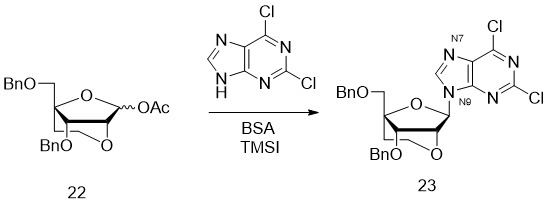
於實施例5-1-2所獲得的化合物22(60.0 mg, 150.58 ⌠mol)之甲苯溶液(0.6 mL)中添加N,O-雙三甲基矽基乙醯胺(40.5 ⌠L, 165.64 ⌠mol)、2,6-二氯嘌呤(31.3 mg, 165.64 ⌠mol),於75℃攪拌1小時後,添加碘三甲基矽烷(22.5 ⌠L, 165.64 ⌠mol)並攪拌3小時。確認反應結束後,冷卻至室溫,添加乙酸乙酯(18.0 mL)5%碳酸氫鈉水(3.0 mL)並進行分液。將獲得的有機層濃縮乾固後,將殘渣以矽膠層析(己烷: 乙酸乙酯= 2:1)純化,進行減壓濃縮,藉此取得呈無色油狀化合物之化合物23(52.0 mg, 65.4%)。1 H-NMR (CDCl3 ):δ = 8.79 (1H, s), 7.23-7.39 (10H, m), 6.43 (1H, s), 4.57-4.65 (2H, m), 4.42-4.45 (1H, m), 4.15 (1H, d, J = 3.0 Hz), 4.06-4.09 (2H, m), 3.71 (1H, d, J = 10.5 Hz), 3.56 (1H, d, J = 10.5 Hz), 2.27-2.36 (2H, m), 1.41-1.44 (2H, m)To the toluene solution (0.6 mL) of compound 22 (60.0 mg, 150.58 ⌠mol) obtained in Example 5-1-2 was added N,O-bistrimethylsilylacetamide (40.5 ⌠L, 165.64 ⌠) mol), 2,6-dichloropurine (31.3 mg, 165.64 ⌠mol), after stirring at 75°C for 1 hour, add iodotrimethylsilane (22.5 ⌠L, 165.64 ⌠mol) and stir for 3 hours. Confirm that the reaction is complete Then, it was cooled to room temperature, ethyl acetate (18.0 mL) 5% sodium bicarbonate water (3.0 mL) was added and liquid separation was performed. After the organic layer obtained was concentrated to dryness, the residue was chromatographed with silica gel (hexane: Ethyl acetate = 2:1) was purified and concentrated under reduced pressure to obtain compound 23 (52.0 mg, 65.4%) as a colorless oily compound. 1 H-NMR (CDCl 3 ): δ = 8.79 (1H, s) ), 7.23-7.39 (10H, m), 6.43 (1H, s), 4.57-4.65 (2H, m), 4.42-4.45 (1H, m), 4.15 (1H, d, J = 3.0 Hz), 4.06- 4.09 (2H, m), 3.71 (1H, d, J = 10.5 Hz), 3.56 (1H, d, J = 10.5 Hz), 2.27-2.36 (2H, m), 1.41-1.44 (2H, m)
(實施例5-3) 9-{2,6-脫水-3-O-苄基-4-[(苄氧基)甲基]-5-去氧-α-L-來蘇-己呋喃糖基}-2-氯-9H-嘌呤-6-胺(化合物24)之製造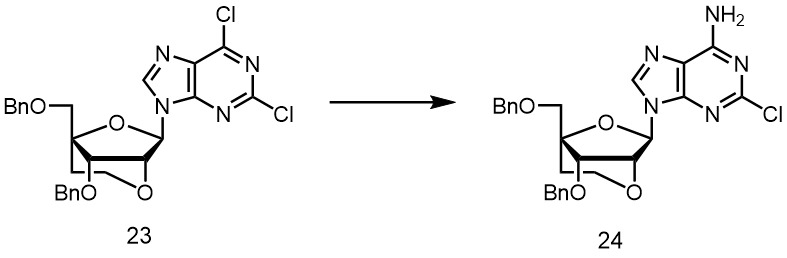
於實施例5-2所獲得的化合物23(52.0 mg, 98.60 ⌠mol)之四氫呋喃溶液(0.75 mL)中添加28%氨水溶液(0.5 mL),並於50℃攪拌7小時。確認反應結束後,冷卻至室溫,添加乙酸乙酯(2.0 mL)並進行分液。獲得的有機層以20%食鹽水(1.0 mL)進行洗淨後,進行濃縮乾固。將殘渣以矽膠層析(己烷: 乙酸乙酯= 4:6)純化,並進行減壓濃縮,藉此取得呈白色結晶之化合物24(44.7 mg, 89.2%)。1 H-NMR (CDCl3 ):δ = 8.36 (1H, s), 7.27-7.38 (10H, m), 6.39 (1H, s), 5.69 (2H, brs), 4.56-4.68 (2H, m), 4.44-4.48 (1H, m), 4.20 (1H, d, J = 2.5 Hz), 4.05-4.14 (2H, m), 3.70 (1H, d, J = 10.8 Hz), 3.57 (1H, d, J = 10.8 Hz), 2.28-2.36 (1H, m), 1.53 (1H, m), 1.42-1.44 (1H, m), 1.25-1.27 (1H, m)To the tetrahydrofuran solution (0.75 mL) of compound 23 (52.0 mg, 98.60 ⌠mol) obtained in Example 5-2 was added 28% ammonia solution (0.5 mL), and stirred at 50°C for 7 hours. After confirming the completion of the reaction, After cooling to room temperature, ethyl acetate (2.0 mL) was added and liquid separation was performed. The obtained organic layer was washed with 20% brine (1.0 mL) and then concentrated to dryness. The residue was subjected to silica gel chromatography (hexane : Ethyl acetate = 4:6) and concentrated under reduced pressure to obtain compound 24 (44.7 mg, 89.2%) as white crystals. 1 H-NMR (CDCl 3 ): δ = 8.36 (1H, s) ), 7.27-7.38 (10H, m), 6.39 (1H, s), 5.69 (2H, brs), 4.56-4.68 (2H, m), 4.44-4.48 (1H, m), 4.20 (1H, d, J = 2.5 Hz), 4.05-4.14 (2H, m), 3.70 (1H, d, J = 10.8 Hz), 3.57 (1H, d, J = 10.8 Hz), 2.28-2.36 (1H, m), 1.53 (1H , m), 1.42-1.44 (1H, m), 1.25-1.27 (1H, m)
(實施例5-4) 9-{2,6-脫水-3-O-苄基-4-[(苄氧基)甲基]-5-去氧-α-L-來蘇-己呋喃糖基}-9H-嘌呤-6-胺(化合物25)之製造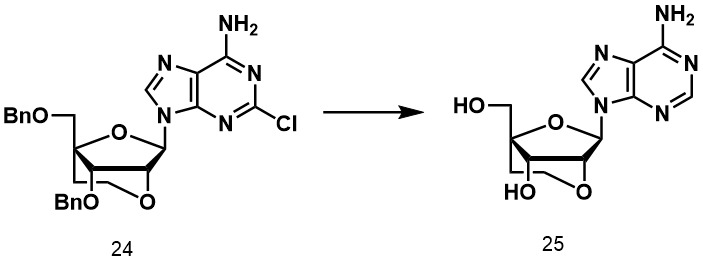
於實施例5-3所獲得的化合物24(26.2 mg, 51.58 ⌠mol)之乙醇溶液(2.0 mL)中添加20%氫氧化鈀碳(20.0 mg)、1N氫氧化鈉水溶液(103.2 ⌠L, 103.16 ⌠mol),3.5 bar之氫壓下,於50℃攪拌5小時。反應後,冷卻至室溫,添加1N鹽酸水溶液(51.6 ⌠L, 51.58 ⌠mol)並進行過濾。於濾液中添加乙醇(10 mL),並進行濃縮乾固,藉此取得呈白色結晶之化合物25(9.7 mg, 64.1%)。1 H-NMR (CD3 OD):δ = 8.72 (1H, s), 8.35 (1H, s), 6.48 (1H, s), 4.37 (1H, d, J = 3.5 Hz), 4.32 (1H, d, J = 3.0 Hz), 4.01-4.13 (2H, m), 3.78 (1H, d, J = 12.5 Hz), 3.72 (1H, d, J = 12.0 Hz), 2.17-2.24 (1H, m), 1.44 (1H, dd, J = 13.0 Hz, 4.0 Hz)To the ethanol solution (2.0 mL) of compound 24 (26.2 mg, 51.58 ⌠mol) obtained in Example 5-3 was added 20% palladium hydroxide on carbon (20.0 mg), 1N sodium hydroxide aqueous solution (103.2 ⌠L, 103.16) ⌠mol), under a hydrogen pressure of 3.5 bar, stir at 50°C for 5 hours. After the reaction, cool to room temperature, add 1N hydrochloric acid aqueous solution (51.6 ⌠L, 51.58 ⌠mol) and filter. Add ethanol (10 mL), and concentrated and dried to obtain compound 25 (9.7 mg, 64.1%) as white crystals. 1 H-NMR (CD 3 OD): δ = 8.72 (1H, s), 8.35 (1H, s) ), 6.48 (1H, s), 4.37 (1H, d, J = 3.5 Hz), 4.32 (1H, d, J = 3.0 Hz), 4.01-4.13 (2H, m), 3.78 (1H, d, J = 12.5 Hz), 3.72 (1H, d, J = 12.0 Hz), 2.17-2.24 (1H, m), 1.44 (1H, dd, J = 13.0 Hz, 4.0 Hz)
(實施例5-5) 化合物20之製造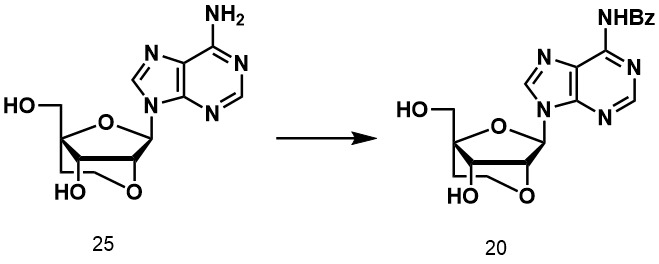
於實施例5-4所獲得的化合物25之吡啶溶液(30v/w)中添加氯三甲基矽烷(5當量),攪拌30分鐘,添加苯甲醯氯(5當量),於室溫使反應2小時。反應後,冷卻至0℃,添加氨水使成為2M-氨溶液。30分鐘後,進行減壓濃縮,添加乙腈(30v/w)並濃縮至(3v/w),並濾取析出的結晶,藉此獲得化合物20。To the pyridine solution (30v/w) of compound 25 obtained in Example 5-4 was added chlorotrimethylsilane (5 equivalents), stirred for 30 minutes, added benzyl chloride (5 equivalents), and allowed to react at room temperature 2 hours. After the reaction, it was cooled to 0°C, and ammonia water was added to make it into a 2M-ammonia solution. After 30 minutes, it was concentrated under reduced pressure, acetonitrile (30v/w) was added and concentrated to (3v/w), and the precipitated crystals were filtered out, thereby obtaining compound 20.
(實施例6)9-(2,6-脫水-4-{[雙(4-甲氧基苯基)(苯基)甲氧基]甲基}-3-O-{(2-氰基乙氧基)[二(丙烷-2-基)胺基]磷烷基}-5-去氧-α-L-來蘇-己呋喃糖基)-2-(2-甲基丙烷醯胺) -1,9-二氫-6H-嘌呤-6-酮(化合物1 g)之製造(Example 6) 9-(2,6-anhydro-4-{[bis(4-methoxyphenyl)(phenyl)methoxy]methyl)-3-O-{(2-cyano Ethoxy)[bis(propane-2-yl)amino]phosphoranyl)-5-deoxy-α-L-lyxo-hexofuranosyl)-2-(2-methylpropane amide) Manufacture of -1,9-dihydro-6H-purin-6-one (compound 1 g)
(實施例6-1)9-{2,6-脫水-3-O-苄基-4-[(苄氧基)甲基]-5-去氧-α-L-來蘇-己呋喃糖基}-6-(苄氧基)-2-氯-9H-嘌呤(化合物26)之製造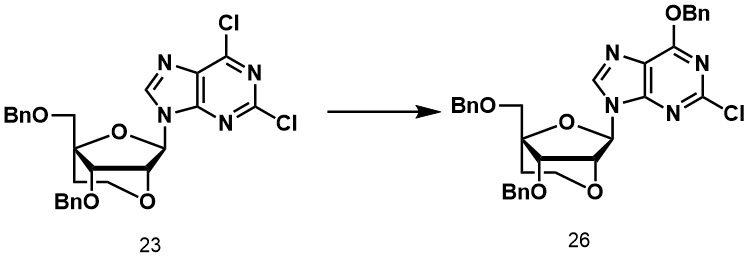
於四氫呋喃(0.5 mL)中添加芐醇(4.63 ⌠L, 66.84 ⌠mol)、氫化鈉(2.5 mg, 57.93 ⌠mol),並於0℃攪拌30分鐘後,添加實施例5-2所獲得的化合物23(23.5 mg, 44.56 ⌠mol)並攪拌3小時。確認反應結束後,添加乙酸(3.6 ⌠L, 62.38 ⌠mol)、20%食鹽水(0.5 mL)、乙酸乙酯(2.0 mL)並進行分液。將獲得的有機層濃縮乾固後,將殘渣以矽膠層析(己烷: 乙酸乙酯= 2:1)純化,並進行減壓濃縮,藉此取得呈無色油狀化合物之化合物26(20.9 mg, 78.3%)。1 H-NMR (CD3 Cl):δ = 8.50 (1H, s), 7.55-7.60 (2H, m), 7.24-7.40 (13H, m), 6.42 (1H, s), 5.68 (1H, d, J = 12.0 Hz), 5.63 (1H, d, J = 11.5 Hz), 4.55-4.64 (3H, m), 4.43-4.44 (2H, m), 4.17 (1H, d, J = 2.5 Hz), 4.06-4.08 (2H, m), 3.69 (1H, d, J = 10.0 Hz), 3.55 (1H, d, J = 10.5 Hz), 2.26-2.32 (1H, m), 1.41-1.44 (1H, m)Benzyl alcohol (4.63 ⌠L, 66.84 ⌠mol) and sodium hydride (2.5 mg, 57.93 ⌠mol) were added to tetrahydrofuran (0.5 mL), and after stirring at 0°C for 30 minutes, the compound obtained in Example 5-2 was added 23 (23.5 mg, 44.56 ⌠mol) and stirred for 3 hours. After confirming the completion of the reaction, add acetic acid (3.6 ⌠L, 62.38 ⌠mol), 20% saline (0.5 mL), ethyl acetate (2.0 mL) and separate After concentrating the obtained organic layer to dryness, the residue was purified by silica gel chromatography (hexane: ethyl acetate = 2:1) and concentrated under reduced pressure to obtain compound 26 as a colorless oily compound. 20.9 mg, 78.3%). 1 H-NMR (CD 3 Cl): δ = 8.50 (1H, s), 7.55-7.60 (2H, m), 7.24-7.40 (13H, m), 6.42 (1H, s) , 5.68 (1H, d, J = 12.0 Hz), 5.63 (1H, d, J = 11.5 Hz), 4.55-4.64 (3H, m), 4.43-4.44 (2H, m), 4.17 (1H, d, J = 2.5 Hz), 4.06-4.08 (2H, m), 3.69 (1H, d, J = 10.0 Hz), 3.55 (1H, d, J = 10.5 Hz), 2.26-2.32 (1H, m), 1.41-1.44 (1H, m)
(實施例6-2) 9-{2,6-脫水-3-O-苄基-4-[(苄氧基)甲基]-5-去氧-α-L-來蘇-己呋喃糖基}-6-(苄氧基)-N-(2-甲基丙醯基)-9H-嘌呤-2-胺(化合物27)之製造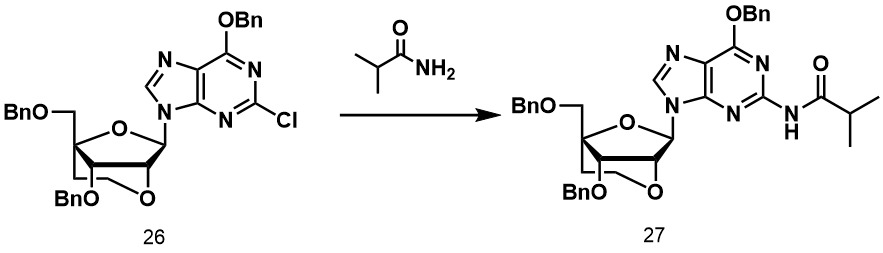
將實施例6-1所獲得的化合物26(34.9 mg, 58.26 ⌠mol)、異丁基醯胺(7.6 mg, 87.39 ⌠mol)、參(二亞苄基丙酮)(氯仿)二鈀(3.0 mg, 2.91 ⌠mol)、4,5’-雙(二苯基膦基)-9,9’-二甲基𠮿
(實施例6-3) 9-[2,6-脫水-5-去氧-4-(羥基甲基)-α-L-來蘇-己呋喃糖基]-2-(2-甲基丙烷醯胺)-1,9-二氫-6H-嘌呤-6-酮(化合物28)之製造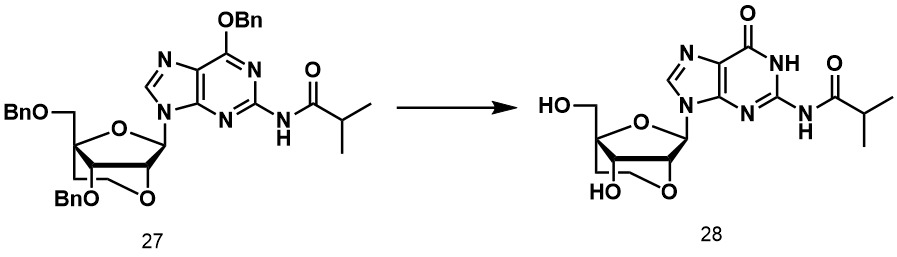
於實施例6-2所獲得的化合物27(17.7 mg, 27.24 ⌠mol)之乙醇溶液(2.0 mL)中,添加20%氫氧化鈀碳(18.0 mg),3.5 bar之氫壓下,於45℃攪拌3小時。確認反應結束後,冷卻至室溫,並進行過濾。藉由將濾液濃縮乾固,取得呈白色結晶之化合物28(11.7 mg, 101.0%)。1 H-NMR (DMSO-d6):δ = 12.10 (1H, s), 11.79 (1H, s), 8.31 (1H, s), 6.21 (1H, s), 5.39 (1H, brs), 5.25 (1H, brs), 4.14 (1H, d, J = 3.5 Hz), 4.10 (1H, d, J = 3.0 Hz), 3.88-3.90 (2H, m), 3.61 (1H, d, J = 12.5 Hz), 2.75-2.81 (1H, m), 2.00-2.07 (1H, m), 1.12 (6H, d, J = 6.5 Hz)In the ethanol solution (2.0 mL) of compound 27 (17.7 mg, 27.24 ⌠mol) obtained in Example 6-2, 20% palladium hydroxide on carbon (18.0 mg) was added under a hydrogen pressure of 3.5 bar at 45°C Stir for 3 hours. After confirming the completion of the reaction, cool to room temperature and filter. The filtrate was concentrated to dryness to obtain compound 28 (11.7 mg, 101.0%) as white crystals. 1 H-NMR (DMSO-d6) :δ = 12.10 (1H, s), 11.79 (1H, s), 8.31 (1H, s), 6.21 (1H, s), 5.39 (1H, brs), 5.25 (1H, brs), 4.14 (1H, d) , J = 3.5 Hz), 4.10 (1H, d, J = 3.0 Hz), 3.88-3.90 (2H, m), 3.61 (1H, d, J = 12.5 Hz), 2.75-2.81 (1H, m), 2.00 -2.07 (1H, m), 1.12 (6H, d, J = 6.5 Hz)
(實施例6-4)9-(2,6-脫水-4-{[雙(4-甲氧基苯基)(苯基)甲氧基]甲基}-5-去氧-α-L-來蘇-己呋喃糖基)-2-(2-甲基丙烷醯胺)-1,9-二氫-6H-嘌呤-6-酮(化合物29)之製造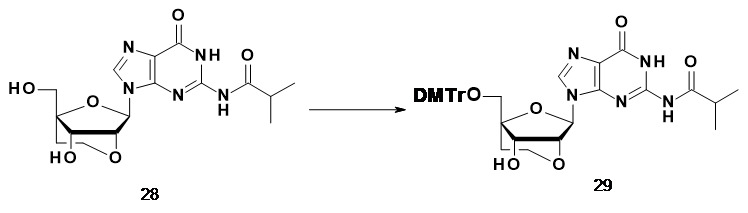
使實施例6-3所獲得的化合物28之四氫呋喃溶液(5v/w)與二甲氧基三苯基氯甲烷(1.5當量)反應。於反應液中添加甲苯(10v/w)、水(5v/w),分液後濃縮,並以矽膠管柱層析進行純化,藉此獲得化合物29。The tetrahydrofuran solution (5v/w) of compound 28 obtained in Example 6-3 was reacted with dimethoxytriphenylchloromethane (1.5 equivalents). Toluene (10v/w) and water (5v/w) were added to the reaction solution, separated and concentrated, and purified by silica gel column chromatography to obtain compound 29.
(實施例6-5)化合物1 g之製造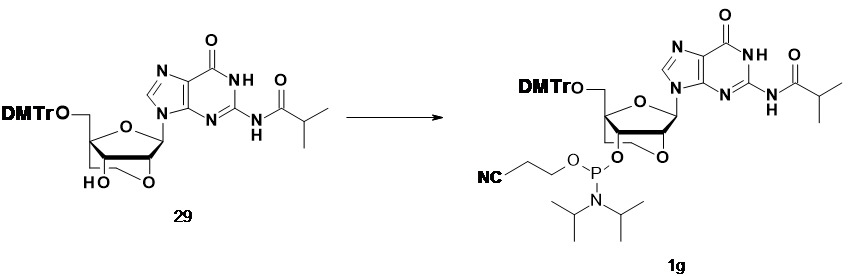
於實施例6-4所獲得的化合物29中添加二氯甲烷(10v/w)、分子篩4A(0.5w/w)、2-氰基乙基N, N, N’, N’-四異丙基磷醯二胺(1.5當量)、4, 5-二氰基咪唑(0.5當量),並於室溫攪拌24小時。於反應液中添加乙酸乙酯(900 mL)水(5v/w),分液後濃縮,並以矽膠管柱層析進行純化,藉此獲得化合物1 g。To the compound 29 obtained in Example 6-4, dichloromethane (10v/w), molecular sieve 4A (0.5w/w), 2-cyanoethyl N, N, N', N'-tetraisopropyl were added Phosphate diamine (1.5 equivalents), 4,5-dicyanoimidazole (0.5 equivalents), and stirred at room temperature for 24 hours. Ethyl acetate (900 mL) and water (5v/w) were added to the reaction solution, separated and concentrated, and purified by silica gel column chromatography to obtain 1 g of compound.
(實施例7) 化合物17之製造(經由化合物22的醣基化)(Example 7) Production of compound 17 (through glycosylation of compound 22)
(實施例7-1) 化合物22之乙腈溶液之製造
於化合物2(3.00 g、8.42mmol)之甲苯(30 mL)溶液中,添加N,N-二甲基胺基吡啶(0.05 g、0.42 mmol)、吡啶(1.02 mL、12.63 mmol)及乙酸酐(1.20 mL、12.63 mmol),於20~30℃攪拌1小時後,添加水(15 mL)並進行分液,將獲得的有機層各以20%檸檬酸水溶液(15 mL)2次、以8%碳酸氫鈉水溶液(9 mL)及水(9 mL)1次進行分液洗淨。將獲得的有機層減壓濃縮至6 mL為止後,進行2次以乙腈(30 mL)利用減壓濃縮的溶媒取代,獲得化合物22之乙腈溶液(6 mL)。To the toluene (30 mL) solution of compound 2 (3.00 g, 8.42 mmol), add N,N-dimethylaminopyridine (0.05 g, 0.42 mmol), pyridine (1.02 mL, 12.63 mmol) and acetic anhydride ( 1.20 mL, 12.63 mmol), stirred at 20~30°C for 1 hour, added water (15 mL) and separated liquids, and the obtained organic layer was divided into 20% citric acid aqueous solution (15 mL) twice, with 8% Wash with sodium bicarbonate aqueous solution (9 mL) and water (9 mL) once. After the obtained organic layer was concentrated under reduced pressure to 6 mL, it was replaced twice with acetonitrile (30 mL) using a solvent concentrated under reduced pressure to obtain an acetonitrile solution (6 mL) of compound 22.
(化合物7-2) 化合物3t之1-丙醇溶液之製造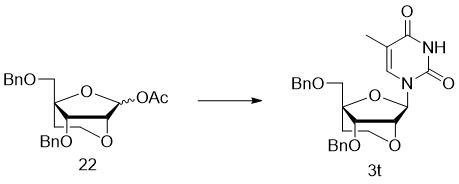
於乙腈(7.5 mL)中添加胸腺嘧碇(1.33 g、10.52 mmol)及N,O-雙三甲基矽基乙醯胺(5.15 mL、21.04 mmol),於20~30℃攪拌1小時的溶液中,添加實施例7-1所獲得的化合物22之乙腈溶液(6 mL)、乙腈(9 mL)及碘三甲基矽烷(1.50 mL、10.52 mmol),而於45~55℃攪拌4小時。於反應液中添加8%碳酸氫鈉水溶液(24 mL)及亞硫酸鈉(1.20 g)後,添加甲苯(30 mL),於20~30℃攪拌30分鐘後,進行分液。將獲得的有機層以20%甲醇水(18 mL)分液洗淨3次後,將獲得的有機層減壓濃縮至成為9 mL為止。於獲得的濃縮液中添加1-丙醇(30 mL),再次減壓濃縮而獲得化合物3t之1-丙醇溶液(9 mL)。Add thymine (1.33 g, 10.52 mmol) and N,O-bistrimethylsilylacetamide (5.15 mL, 21.04 mmol) to acetonitrile (7.5 mL), and stir the solution at 20~30℃ for 1 hour In, the acetonitrile solution (6 mL), acetonitrile (9 mL) and iodotrimethylsilane (1.50 mL, 10.52 mmol) of the compound 22 obtained in Example 7-1 were added, and the mixture was stirred at 45-55°C for 4 hours. After adding 8% sodium bicarbonate aqueous solution (24 mL) and sodium sulfite (1.20 g) to the reaction solution, toluene (30 mL) was added, and after stirring for 30 minutes at 20 to 30°C, liquid separation was performed. After the obtained organic layer was partitioned and washed with 20% methanol water (18 mL) three times, the obtained organic layer was concentrated under reduced pressure until it became 9 mL. 1-propanol (30 mL) was added to the obtained concentrated solution, and concentrated under reduced pressure again to obtain a 1-propanol solution (9 mL) of compound 3t.
獲得的化合物之NMR譜與WO00/47599之實施例6記載之化合物的NMR譜一致。The NMR spectrum of the obtained compound is consistent with the NMR spectrum of the compound described in Example 6 of WO00/47599.
(實施例7-3)化合物16之製造
於化合物3t之1-丙醇溶液(9 mL)中,進一步添加1-丙醇(15 mL)、水(6 mL)及5%鈀碳(0.67 g),氫氣環境下於55~65℃攪拌2小時後,於相同溫度下過濾觸媒,以80%1-丙醇水(6 mL)將觸媒洗淨。將獲得的濾液減壓濃縮而作為1-丙醇溶液(9 mL)後,添加乙腈(30 mL)而對9 mL之乙腈溶液(A)進行減壓濃縮。進一步添加乙腈(6 mL),於20~30℃攪拌2小時。濾取生成的結晶,將獲得的結晶以乙腈(9 mL)洗淨。將獲得的固體進行減壓乾燥(40℃)而獲得化合物16(1.57 g、產率65.6%(來自化合物2))。於上述順序,乙腈溶液(A)中之水分含量超過4%的情形,追加乙腈而重複濃縮的操作直到9 mL,藉由將水分含量控制在4%以下,可維持利用晶析的回收的再現性。又,水分含量係利用卡爾-費雪法(Carl Fischer method)而確認。To the 1-propanol solution (9 mL) of compound 3t, further add 1-propanol (15 mL), water (6 mL) and 5% palladium on carbon (0.67 g), and stir at 55~65℃ under hydrogen atmosphere After 2 hours, filter the catalyst at the same temperature and wash the catalyst with 80% 1-propanol water (6 mL). After concentrating the obtained filtrate under reduced pressure to obtain a 1-propanol solution (9 mL), acetonitrile (30 mL) was added, and 9 mL of the acetonitrile solution (A) was concentrated under reduced pressure. Acetonitrile (6 mL) was further added, and the mixture was stirred at 20-30°C for 2 hours. The formed crystals were collected by filtration, and the obtained crystals were washed with acetonitrile (9 mL). The obtained solid was dried under reduced pressure (40°C) to obtain compound 16 (1.57 g, yield 65.6% (from compound 2)). In the above sequence, when the moisture content in the acetonitrile solution (A) exceeds 4%, add acetonitrile and repeat the concentration operation until 9 mL. By controlling the moisture content below 4%, the recovery by crystallization can be maintained sex. In addition, the moisture content was confirmed by the Carl Fischer method.
獲得的化合物之NMR譜與WO00/47599之實施例7記載的化合物的NMR譜一致。The NMR spectrum of the obtained compound is consistent with the NMR spectrum of the compound described in Example 7 of WO00/47599.
(實施例7-4a) 化合物17之製造
於化合物16(30 g)之四氫呋喃溶液(150 mL)中,添加吡啶(33.39 g)及4,4’-二甲氧基三苯氯甲烷(42.91 g),並於20~30℃攪拌3小時後,添加甲醇(6 mL),進一步於20~30℃攪拌30分鐘。於獲得的溶液中添加15%碳酸鈉水溶液(150 mL)、乙酸乙酯(300 mL)及水(210 mL),並進行分液。將獲得的有機層以20%檸檬酸水溶液(150 mL)2次、各以5%碳酸氫鈉水溶液(150 mL)及水(150 mL)1次進行分液洗淨。減壓濃縮獲得的有機層至成為150 mL為止後,以乙酸乙酯(300 mL)進行利用減壓濃縮的溶媒取代2次,添加乙酸乙酯(90 mL)並獲得化合物17之乙酸乙酯溶液(240 mL)。於獲得的溶液中添加正庚烷(90 mL),並升溫至50℃後,添加晶種(30 m g),於相同溫度攪拌2小時。將獲得的漿液冷卻至20~30℃後,於相同溫度攪拌15小時。於獲得的漿液中添加正庚烷(120 mL),於相同溫度進一步攪拌1小時。濾取析出的結晶,將獲得的結晶以乙酸乙酯與正庚烷之1:1混合液(100 mL)洗淨。將獲得的結晶減壓乾燥(50℃)而獲得化合物17(60.7 g、產率98%)。To the tetrahydrofuran solution (150 mL) of compound 16 (30 g), add pyridine (33.39 g) and 4,4'-dimethoxytriphenylchloromethane (42.91 g), and stir at 20~30℃ for 3 hours After that, methanol (6 mL) was added, and the mixture was further stirred at 20 to 30°C for 30 minutes. Add 15% sodium carbonate aqueous solution (150 mL), ethyl acetate (300 mL), and water (210 mL) to the obtained solution, and perform liquid separation. The obtained organic layer was separated and washed with 20% citric acid aqueous solution (150 mL) twice, and 5% sodium hydrogen carbonate aqueous solution (150 mL) and water (150 mL) once each. After concentrating the obtained organic layer under reduced pressure until it became 150 mL, it was replaced twice with ethyl acetate (300 mL) using a solvent concentrated under reduced pressure, ethyl acetate (90 mL) was added to obtain an ethyl acetate solution of compound 17 (240 mL). After adding n-heptane (90 mL) to the obtained solution and raising the temperature to 50° C., seed crystals (30 mg) were added, and the mixture was stirred at the same temperature for 2 hours. After cooling the obtained slurry to 20-30°C, it was stirred at the same temperature for 15 hours. To the obtained slurry, n-heptane (120 mL) was added, and the mixture was further stirred at the same temperature for 1 hour. The precipitated crystals were collected by filtration, and the obtained crystals were washed with a 1:1 mixture (100 mL) of ethyl acetate and n-heptane. The obtained crystals were dried under reduced pressure (50°C) to obtain compound 17 (60.7 g, yield 98%).
獲得的化合物之NMR譜與WO00/47599之實施例8記載的化合物的NMR譜一致。The NMR spectrum of the obtained compound is consistent with the NMR spectrum of the compound described in Example 8 of WO00/47599.
又,化合物17之晶種係使用將實施例2-3所獲得的化合物17之乙酸乙酯溶液靜置而析出者。In addition, the seed crystal of compound 17 was prepared by allowing the ethyl acetate solution of compound 17 obtained in Example 2-3 to stand still to precipitate.
(實施例8a) 化合物1a之製造
於二氯甲烷(675 mL)中添加實施例4-3所獲得的化合物21之水合物(45.00 g、64.31 mmol),藉由減壓濃縮而獲得二氯甲烷溶液(225 mL)。於獲得的二氯甲烷溶液中添加二氯甲烷(450 mL),並進行減壓濃縮,藉此獲得二氯甲烷溶液(225 mL)。再次進行相同的操作,於獲得的二氯甲烷溶液(225 mL)中添加二氯甲烷(225 mL)、分子篩4A(22.50 g)、二丁基羥基甲苯(1.42 g、6.44 mmol)、2-氰基乙基N,N,N’,N’-四異丙基亞磷醯二胺(21.32 g、70.73 mmol)、4, 5-二氰基咪唑(0.91 g、7.71 mmol),於20~30℃攪拌16.5小時。確認反應結束後,於反應液中添加乙酸乙酯(900 mL),於-5~5℃添加中性矽膠(67.50 g),攪拌15分鐘後,進行中性矽膠的濾除,並以二氯甲烷-乙酸乙酯(1/2, 225 mL)進行洗淨,藉此獲得二氯甲烷-乙酸乙酯溶液。將獲得的二氯甲烷-乙酸乙酯溶液減壓濃縮,作成乙酸乙酯溶液(225 mL)。藉由於獲得的溶液中添加甲基三級丁基醚(135 mL),獲得溶液A(360 mL)。於另外的反應容器中添加甲基三級丁基醚(315 mL)、正庚烷(1350 mL),於-5~5°C添加溶液A(360 mL),藉此確認固體的析出。以乙酸乙酯(23 mL)進行洗淨,攪拌0.5小時後,將析出的固體過濾,以預先冷卻至0℃的甲基三級丁基醚-正庚烷(1/3, 225 mL)、正庚烷(225 mL)將固體洗淨。藉由將獲得的固體進行減壓乾燥(40℃)而獲得化合物1a(48.69 g、84.1%)。The hydrate (45.00 g, 64.31 mmol) of compound 21 obtained in Example 4-3 was added to dichloromethane (675 mL), and the dichloromethane solution (225 mL) was obtained by concentration under reduced pressure. Dichloromethane (450 mL) was added to the obtained dichloromethane solution, and concentrated under reduced pressure, thereby obtaining a dichloromethane solution (225 mL). Perform the same operation again, add dichloromethane (225 mL), molecular sieve 4A (22.50 g), dibutylhydroxytoluene (1.42 g, 6.44 mmol), 2-cyanide to the obtained dichloromethane solution (225 mL) Ethyl N,N,N',N'-tetraisopropylphosphoridine (21.32 g, 70.73 mmol), 4,5-dicyanoimidazole (0.91 g, 7.71 mmol), in 20~30 Stir at °C for 16.5 hours. After confirming the completion of the reaction, add ethyl acetate (900 mL) to the reaction solution, add neutral silica gel (67.50 g) at -5 to 5°C, stir for 15 minutes, filter out the neutral silica gel, and dilute with dichloromethane Methane-ethyl acetate (1/2, 225 mL) was washed to obtain a dichloromethane-ethyl acetate solution. The obtained dichloromethane-ethyl acetate solution was concentrated under reduced pressure to prepare an ethyl acetate solution (225 mL). By adding methyl tertiary butyl ether (135 mL) to the obtained solution, solution A (360 mL) was obtained. In another reaction vessel, methyl tertiary butyl ether (315 mL) and n-heptane (1350 mL) were added, and solution A (360 mL) was added at -5 to 5°C to confirm the precipitation of solids. Wash with ethyl acetate (23 mL), and after stirring for 0.5 hours, filter the precipitated solid and use methyl tertiary butyl ether-n-heptane (1/3, 225 mL) cooled to 0°C in advance, Wash the solid with n-heptane (225 mL). The obtained solid was dried under reduced pressure (40° C.) to obtain compound 1a (48.69 g, 84.1%).
獲得的化合物之NMR譜與WO00/47599之實施例14記載之化合物的NMR譜一致。The NMR spectrum of the obtained compound is consistent with the NMR spectrum of the compound described in Example 14 of WO00/47599.
(實施例8b)化合物1a之製造(Example 8b) Production of compound 1a
於二氯甲烷(45 mL)中添加實施例4-3所獲得的化合物21之水合物(3.57 g),並進行減壓濃縮,藉此獲得二氯甲烷溶液(15 mL)。於獲得的二氯甲烷溶液中添加二氯甲烷(15 mL)、分子篩4A(22.50 g)、2-氰基乙基N,N,N’,N’-四異丙基亞磷醯二胺(1.42 g)、及4,5-二氰基咪唑(100 mg),將反應混合物於20~30℃攪拌24小時。確認反應結束後,於反應液中添加乙酸乙酯(60 mL)。將獲得的溶液冷卻至-5~5℃後,使通過填充中性矽膠(4.5 g)的管柱內,藉由以二氯甲烷-乙酸乙酯(1/2, 30 mL)洗滌,獲得二氯甲烷-乙酸乙酯溶液。將獲得的二氯甲烷-乙酸乙酯溶液減壓濃縮,作成乙酸乙酯溶液(15 mL)後,添加甲苯(60 mL),再次進行濃縮而獲得甲苯溶液(15 mL)。藉由於獲得的溶液中添加甲基三級丁基醚(9 mL)而獲得溶液A(24 mL)。於另外的反應容器中添加甲基三級丁基醚(6 mL)、正庚烷(90 mL),於-5~5°C滴加溶液A(24 mL),藉此確認固體之析出。將於滴加使用的器具以甲苯(1.5 mL)洗滌,攪拌2小時後,將析出的固體過濾,以正庚烷(24 mL)將固體洗淨。藉由將獲得的固體進行減壓乾燥(40℃)而獲得化合物1a(3.97 g、86.5%)。The hydrate (3.57 g) of compound 21 obtained in Example 4-3 was added to dichloromethane (45 mL) and concentrated under reduced pressure to obtain a dichloromethane solution (15 mL). To the obtained dichloromethane solution, dichloromethane (15 mL), molecular sieve 4A (22.50 g), 2-cyanoethyl N,N,N',N'-tetraisopropylphosphoramidite ( 1.42 g), and 4,5-dicyanoimidazole (100 mg), and the reaction mixture was stirred at 20-30°C for 24 hours. After confirming the completion of the reaction, ethyl acetate (60 mL) was added to the reaction solution. After cooling the obtained solution to -5~5°C, it was passed through a column filled with neutral silica gel (4.5 g) and washed with dichloromethane-ethyl acetate (1/2, 30 mL) to obtain two Methyl chloride-ethyl acetate solution. The obtained dichloromethane-ethyl acetate solution was concentrated under reduced pressure to make an ethyl acetate solution (15 mL), toluene (60 mL) was added, and concentration was performed again to obtain a toluene solution (15 mL). Solution A (24 mL) was obtained by adding methyl tertiary butyl ether (9 mL) to the obtained solution. Add methyl tertiary butyl ether (6 mL) and n-heptane (90 mL) to another reaction vessel, and add solution A (24 mL) dropwise at -5 to 5°C to confirm the precipitation of solids. The utensils used for dropping were washed with toluene (1.5 mL), and after stirring for 2 hours, the precipitated solid was filtered, and the solid was washed with n-heptane (24 mL). The obtained solid was dried under reduced pressure (40° C.) to obtain compound 1a (3.97 g, 86.5%).
獲得的化合物之NMR譜與WO00/47599之實施例14記載之化合物的NMR譜一致。The NMR spectrum of the obtained compound is consistent with the NMR spectrum of the compound described in Example 14 of WO00/47599.
(實施例9) 化合物1t之製造
於乙酸乙酯(40 mL)中添加實施例2-3所獲得的化合物17(5.00 g、8.52 mmol),添加分子篩4A(2.5 g)、2-氰基乙基N,N,N’,N’-四異丙基亞磷醯二胺(2.83 g、9.38 mmol)、4,5-二氰基咪唑(0.20 g、1.70 mmol),並於20~30℃攪拌24小時。確認反應結束後,於反應液中添加中性矽膠(10.00 g),攪拌30分鐘後,進行中性矽膠的濾除,並以乙酸乙酯(100 mL)進行洗淨,藉此獲得乙酸乙酯溶液。將獲得的乙酸乙酯溶液減壓濃縮,作成乙酸乙酯溶液(35 mL)。於獲得的乙酸乙酯溶液中添加三級丁基醚(100 mL),並進行減壓濃縮,藉此獲得甲基三級丁基醚溶液(35 mL)。於獲得的甲基三級丁基醚溶液中添加化合物1t之晶種(2.5 mg),攪拌2小時後,添加正庚烷(100 mL)並冷卻至0~5℃而進一步攪拌2小時。將析出的固體過濾,以預先冷卻至0℃的正庚烷(100 mL)將固體洗淨。將獲得的固體進行減壓乾燥(40℃)而獲得化合物1t(6.12 g、91.3%)。Compound 17 (5.00 g, 8.52 mmol) obtained in Example 2-3 was added to ethyl acetate (40 mL), molecular sieve 4A (2.5 g), 2-cyanoethyl N,N,N',N were added '-Tetraisopropylphosphatidamide (2.83 g, 9.38 mmol), 4,5-dicyanoimidazole (0.20 g, 1.70 mmol), and stirred at 20-30°C for 24 hours. After confirming the completion of the reaction, add neutral silica gel (10.00 g) to the reaction solution. After stirring for 30 minutes, filter the neutral silica gel and wash with ethyl acetate (100 mL) to obtain ethyl acetate Solution. The obtained ethyl acetate solution was concentrated under reduced pressure to prepare an ethyl acetate solution (35 mL). Tertiary butyl ether (100 mL) was added to the obtained ethyl acetate solution, and concentrated under reduced pressure, thereby obtaining a methyl tertiary butyl ether solution (35 mL). To the obtained methyl tertiary butyl ether solution, seed crystals (2.5 mg) of compound 1t were added, and after stirring for 2 hours, n-heptane (100 mL) was added and cooled to 0 to 5°C and stirred for further 2 hours. The precipitated solid was filtered, and the solid was washed with n-heptane (100 mL) previously cooled to 0°C. The obtained solid was dried under reduced pressure (40°C) to obtain compound 1t (6.12 g, 91.3%).
獲得的化合物之NMR譜與WO00/47599之實施例9記載之化合物的NMR譜一致。The NMR spectrum of the obtained compound is consistent with the NMR spectrum of the compound described in Example 9 of WO00/47599.
又,化合物1t之晶種係使用將於實施例2-4獲得的化合物1t之乙酸乙酯、二異丙基醚及正庚烷之混合溶液靜置而析出者。In addition, the seed crystal of compound 1t was obtained by using the mixed solution of ethyl acetate, diisopropyl ether, and n-heptane of compound 1t obtained in Example 2-4 to be precipitated.
(實施例10) 化合物1c之製造(Example 10) Production of compound 1c
(實施例10-1) 1-(3-O-乙醯基-2,6-脫水-4-{[雙(4-甲氧基苯基)(苯基)甲氧基]甲基}-5-去氧-α-L-來蘇-己呋喃糖基)-5-甲基嘧啶-2,4(1H,3H)-二酮(化合物30)之製造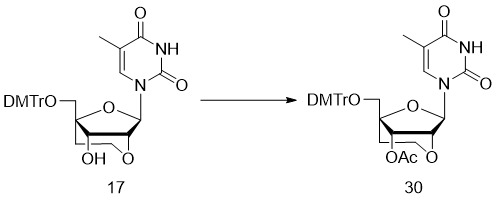
於乙酸乙酯(320 mL)中添加實施例2-3所獲得的化合物17(80.00 g、136.37 mmol)、N,N-二甲基胺基吡啶(1.67 g、13.64 mmol)及三乙基胺(27.60 g、272.74 mmol),冷卻至0~5℃後,於相同溫度下添加乙酸酐(16.71 g、163.64 mmol)。於0~5℃攪拌1小時後,添加水(160 mL)並進行分液,將獲得的有機層以10%檸檬酸水溶液(160 mL)、5%碳酸氫鈉水溶液(160 mL)及10%食鹽水(160 mL)進行分液洗淨。將獲得的有機層減壓濃縮至成為240 mL後,以乙腈(400 mL)進行2次利用減壓濃縮的溶媒取代,獲得化合物30之乙腈溶液(240 mL)。Compound 17 (80.00 g, 136.37 mmol), N,N-dimethylaminopyridine (1.67 g, 13.64 mmol) and triethylamine obtained in Example 2-3 were added in ethyl acetate (320 mL) (27.60 g, 272.74 mmol), after cooling to 0 to 5°C, acetic anhydride (16.71 g, 163.64 mmol) was added at the same temperature. After stirring at 0~5℃ for 1 hour, water (160 mL) was added and liquid separation was performed. The obtained organic layer was divided into 10% citric acid aqueous solution (160 mL), 5% sodium bicarbonate aqueous solution (160 mL) and 10% Saline (160 mL) was separated and washed. After the obtained organic layer was concentrated under reduced pressure to 240 mL, it was replaced with acetonitrile (400 mL) twice with a solvent concentrated under reduced pressure to obtain an acetonitrile solution (240 mL) of compound 30.
(實施例10-2)1-(3-O-乙醯基-2,6-脫水-4-{[雙(4-甲氧基苯基)(苯基)甲氧基]甲基}-5-去氧-α-L-來蘇-己呋喃糖基)-4-胺基-5-甲基嘧啶-2(1H)-酮(化合物31)之製造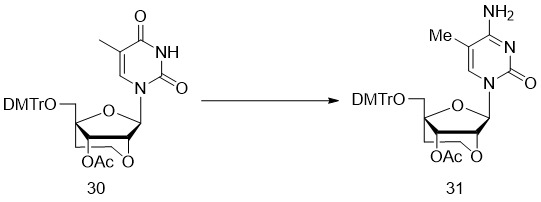
於實施例10-1所獲得的化合物30之溶液中添加乙腈(160 mL)、N,N-二甲基胺基吡啶(3.33 g、27.27 mmol)及三乙基胺(55.20 g、545.51 mmol),冷卻至5~15℃後,於相同溫度添加2,4,6-三異丙基苯磺醯氯(47.50 g、156.83 mmol)。於10℃攪拌2小時後,添加25%氨水(100 kg、156.83 mmol),並於20℃攪拌2小時。將獲得的溶液減壓濃縮至成為約320 mL為止後,添加乙酸乙酯(400 mL)及水(120 mL)進行分液。將獲得的有機層以10%食鹽水(160 mL)進行2次分液洗淨後,添加乙腈(400 mL),並減壓濃縮至成為約320 mL為止。於獲得的濃縮液中添加乙腈(400 mL)並減壓濃縮,獲得化合物31之乙腈溶液(B)(240 mL)。又,於上述步驟,於乙腈溶液(B)中之水分含量超過0.4%的情形,藉由重複實施於乙腈溶液(B)中添加乙腈而濃縮脫水的步驟使乙腈溶液(B)中之水分含量成為0.4%以下,可使下一反應快速地進行。To the solution of compound 30 obtained in Example 10-1, acetonitrile (160 mL), N,N-dimethylaminopyridine (3.33 g, 27.27 mmol) and triethylamine (55.20 g, 545.51 mmol) were added After cooling to 5-15°C, 2,4,6-triisopropylbenzenesulfonyl chloride (47.50 g, 156.83 mmol) was added at the same temperature. After stirring at 10°C for 2 hours, 25% ammonia water (100 kg, 156.83 mmol) was added, and the mixture was stirred at 20°C for 2 hours. After concentrating the obtained solution under reduced pressure until it became about 320 mL, ethyl acetate (400 mL) and water (120 mL) were added for liquid separation. After the obtained organic layer was separated and washed with 10% saline (160 mL) twice, acetonitrile (400 mL) was added, and it was concentrated under reduced pressure until it became approximately 320 mL. Acetonitrile (400 mL) was added to the obtained concentrated solution and concentrated under reduced pressure to obtain an acetonitrile solution (B) (240 mL) of compound 31. In addition, in the above steps, when the moisture content in the acetonitrile solution (B) exceeds 0.4%, repeat the steps of adding acetonitrile to the acetonitrile solution (B) for concentration and dehydration to make the moisture content in the acetonitrile solution (B) When it becomes 0.4% or less, the next reaction can proceed quickly.
又,水分含量係利用卡爾-費雪法而確認。In addition, the moisture content was confirmed by Karl Fischer method.
(實施例10-3a) 化合物19之製造
於實施例10-2所獲得的化合物31之乙腈溶液中添加THF(80 mL)及苯甲酸酐(67.87 g、300.01 mmol),並於40℃攪拌5小時後,冷卻至25℃並進一步攪拌15小時。將獲得的漿液,於5~15°C歷經1小時以上滴加至水(80 mL)、25%氫氧化鈉水溶液(176 kg)及THF(80 mL)之混合液。於獲得的混合液中添加THF(160 mL),於20°C攪拌2小時後,使用乙酸而將溶液之pH調整為6.8。於獲得的溶液中添加作為晶種之實施例3-3所獲得的化合物19之水合物結晶(80 mg),並攪拌10小時後,於15~25°C歷經2小時以上滴加水(400 mL)。將獲得的漿液於20℃攪拌1小時後,過濾析出的結晶,以40%THF水(400 mL)將結晶洗淨。將獲得的結晶於50℃減壓乾燥,獲得化合物19(78.35 g、83.3%G/G(來自化合物17))。THF (80 mL) and benzoic anhydride (67.87 g, 300.01 mmol) were added to the acetonitrile solution of compound 31 obtained in Example 10-2, and after stirring at 40°C for 5 hours, it was cooled to 25°C and further stirred 15 Hour. The obtained slurry was added dropwise to a mixture of water (80 mL), 25% sodium hydroxide aqueous solution (176 kg) and THF (80 mL) at 5-15°C over 1 hour. THF (160 mL) was added to the obtained mixed solution, and after stirring at 20°C for 2 hours, the pH of the solution was adjusted to 6.8 using acetic acid. The hydrate crystals (80 mg) of compound 19 obtained in Example 3-3 as seed crystals were added to the obtained solution, and after stirring for 10 hours, water (400 mL) was added dropwise at 15~25°C over 2 hours ). After the obtained slurry was stirred at 20°C for 1 hour, the precipitated crystals were filtered, and the crystals were washed with 40% THF water (400 mL). The obtained crystals were dried under reduced pressure at 50°C to obtain compound 19 (78.35 g, 83.3% G/G (from compound 17)).
獲得的化合物之NMR譜與WO00/47599之實施例21記載之化合物的NMR譜一致。The NMR spectrum of the obtained compound is consistent with the NMR spectrum of the compound described in Example 21 of WO00/47599.
(實施例10-3b)化合物19之製造(Example 10-3b) Production of compound 19
於實施例10-2所獲得的化合物31之乙腈溶液(90 mL)中添加THF(80 mL)及苯甲酸酐(23.14 g、102.3 mmol),並於40℃攪拌5小時後,冷卻至25℃並進一步攪拌20小時。於獲得的漿液中,添加THF(30 mL)及乙酸鉀(23.09 g、235.3 mmol),攪拌1小時後,添加8%食鹽水(135 mL)並進行分液。於獲得的有機層中添加THF(15 mL)、水(15 mL)及25%氫氧化鈉水溶液(33 g),冷卻至0~10℃後,進一步添加25%氫氧化鈉水溶液(15 g)及水(6 mL),並於0~10℃攪拌4小時。確認反應結束後,使用乙酸調整獲得的溶液溶液之pH為6.5。於獲得的溶液中添加食鹽(6.0 g)及THF(60 mL)並進行分液,於獲得的有機層中添加THF(30 mL)、水(45 mL)及作為晶種之實施例3-3所獲得的化合物19之水合物結晶(30 mg),攪拌16小時後,於20~30℃歷經2小時以上滴加水(180 mL)。將獲得的漿液於20~30℃攪拌3小時後,過濾析出的結晶,使用40%THF水(150 mL)而將結晶洗淨。獲得的結晶於50℃減壓乾燥,獲得化合物19(28.48 g、80.7%G/G(來自化合物17))。THF (80 mL) and benzoic anhydride (23.14 g, 102.3 mmol) were added to the acetonitrile solution (90 mL) of compound 31 obtained in Example 10-2, stirred at 40°C for 5 hours, and then cooled to 25°C And further stirred for 20 hours. To the obtained slurry, THF (30 mL) and potassium acetate (23.09 g, 235.3 mmol) were added, and after stirring for 1 hour, 8% brine (135 mL) was added and liquid separation was performed. Add THF (15 mL), water (15 mL) and 25% sodium hydroxide aqueous solution (33 g) to the obtained organic layer, and after cooling to 0~10°C, further add 25% sodium hydroxide aqueous solution (15 g) And water (6 mL), and stir at 0~10℃ for 4 hours. After confirming the completion of the reaction, the pH of the obtained solution solution was adjusted to 6.5 with acetic acid. Add salt (6.0 g) and THF (60 mL) to the obtained solution and perform liquid separation. Add THF (30 mL), water (45 mL) and the seed crystal in Example 3-3 to the obtained organic layer The obtained compound 19 hydrate crystals (30 mg) were stirred for 16 hours, and water (180 mL) was added dropwise over 2 hours at 20-30°C. After the obtained slurry was stirred at 20 to 30°C for 3 hours, the precipitated crystals were filtered, and the crystals were washed with 40% THF water (150 mL). The obtained crystals were dried under reduced pressure at 50°C to obtain compound 19 (28.48 g, 80.7% G/G (from compound 17)).
於上述步驟,藉由使用乙酸鉀,可將晶析時於pH調整所使用的乙酸之量控制為小於實施例10-3a記載之步驟的情形,因而可更縮短晶析所需要的時間。In the above steps, by using potassium acetate, the amount of acetic acid used in pH adjustment during crystallization can be controlled to be less than the case of the step described in Example 10-3a, so the time required for crystallization can be further shortened.
獲得的化合物之NMR譜與WO00/47599之實施例21記載之化合物的NMR譜一致。The NMR spectrum of the obtained compound is consistent with the NMR spectrum of the compound described in Example 21 of WO00/47599.
(實施例11) 化合物1c之製造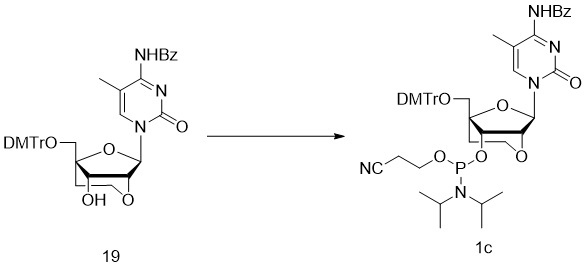
於二氯甲烷(400 mL)中添加實施例10-3所獲得的化合物19(20.00 g、29.00 mmol),並進行減壓濃縮,藉此獲得二氯甲烷溶液(200 mL)。於獲得的二氯甲烷溶液中添加二氯甲烷(200 mL),並進行減壓濃縮,藉此獲得二氯甲烷溶液(200 mL)。再次進行相同的操作,於獲得的二氯甲烷溶液(200 mL)中添加分子篩4A(10.00 g)、二丁基羥基甲苯(0.64 g、2.90 mmol)、2-氰基乙基N,N,N’,N’-四異丙基亞磷醯二胺(9.61 g、31.89 mmol)、4, 5-二氰基咪唑(1.03 g、8.70 mmol),於20~30°C攪拌4小時。確認反應結束後,於反應液中添加乙酸乙酯(100 mL),並於-5~5°C添加中性矽膠(40.00 g),攪拌30分鐘後,進行中性矽膠的濾除,並以二氯甲烷-乙酸乙酯(2/1, 100 mL)進行洗淨,藉此獲得二氯甲烷-乙酸乙酯溶液。將獲得的二氯甲烷-乙酸乙酯溶液減壓濃縮,作成二氯甲烷-乙酸乙酯溶液(100 mL)。於獲得的二氯甲烷-乙酸乙酯溶液中添加乙酸乙酯(100 mL),並進行減壓濃縮,藉此獲得乙酸乙酯溶液(100 mL)。再次進行同樣的操作,於獲得的溶液中添加甲基三級丁基醚(100 mL),並進行減壓濃縮,藉此作成乙酸乙酯-甲基三級丁基醚溶液(100 mL)。於獲得的乙酸乙酯-甲基三級丁基醚溶液中添加甲基三級丁基醚(100 mL),並進行減壓濃縮,藉此獲得甲基三級丁基醚溶液(100 mL)。再次進行同樣的操作,於獲得的溶液中添加正庚烷(200 mL)並攪拌1.5小時後,進一步添加正庚烷(100 mL)並攪拌1小時後,再次添加正庚烷(200 mL)而攪拌1.5小時,並確認固體的析出。將析出的固體過濾,以預先冷卻至0℃的正庚烷(200 mL)將固體洗淨。藉由將獲得的固體進行減壓乾燥(40℃),而獲得化合物1c(22.40 g、86.8%)。The compound 19 (20.00 g, 29.00 mmol) obtained in Example 10-3 was added to dichloromethane (400 mL), and concentrated under reduced pressure to obtain a dichloromethane solution (200 mL). Dichloromethane (200 mL) was added to the obtained dichloromethane solution, and concentrated under reduced pressure, thereby obtaining a dichloromethane solution (200 mL). Perform the same operation again, add molecular sieve 4A (10.00 g), dibutylhydroxytoluene (0.64 g, 2.90 mmol), 2-cyanoethyl N,N,N to the obtained dichloromethane solution (200 mL) ',N'-Tetraisopropylphosphoridine (9.61 g, 31.89 mmol), 4,5-dicyanoimidazole (1.03 g, 8.70 mmol), stirred at 20-30°C for 4 hours. After confirming the completion of the reaction, add ethyl acetate (100 mL) to the reaction solution, and add neutral silica gel (40.00 g) at -5 to 5°C. After stirring for 30 minutes, filter the neutral silica gel and remove it with Dichloromethane-ethyl acetate (2/1, 100 mL) was washed to obtain a dichloromethane-ethyl acetate solution. The obtained dichloromethane-ethyl acetate solution was concentrated under reduced pressure to prepare a dichloromethane-ethyl acetate solution (100 mL). Ethyl acetate (100 mL) was added to the obtained dichloromethane-ethyl acetate solution, and concentrated under reduced pressure, thereby obtaining an ethyl acetate solution (100 mL). The same operation was performed again, methyl tertiary butyl ether (100 mL) was added to the obtained solution, and the mixture was concentrated under reduced pressure to prepare an ethyl acetate-methyl tertiary butyl ether solution (100 mL). To the obtained ethyl acetate-methyl tertiary butyl ether solution, methyl tertiary butyl ether (100 mL) was added, and concentrated under reduced pressure, thereby obtaining a methyl tertiary butyl ether solution (100 mL) . The same operation was repeated again. After adding n-heptane (200 mL) to the obtained solution and stirring for 1.5 hours, further n-heptane (100 mL) was added and stirred for 1 hour, and then n-heptane (200 mL) was added again. After stirring for 1.5 hours, the precipitation of a solid was confirmed. The precipitated solid was filtered, and the solid was washed with n-heptane (200 mL) previously cooled to 0°C. The obtained solid was dried under reduced pressure (40° C.) to obtain compound 1c (22.40 g, 86.8%).
獲得的化合物之NMR譜與WO00/47599之實施例6記載的化合物之NMR譜一致。The NMR spectrum of the obtained compound is consistent with the NMR spectrum of the compound described in Example 6 of WO00/47599.
(實施例12) 化合物22之立體選擇性的醣基化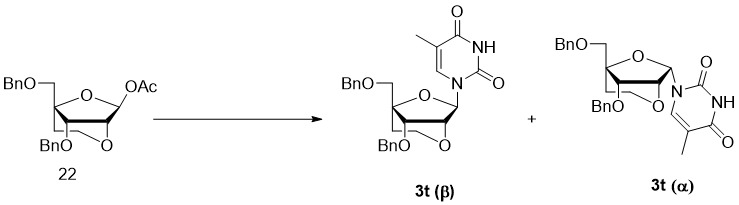
於實施例5-1所獲得的化合物22(30 mg、0.075 mmol)、雙三甲基矽基胸腺嘧碇(40.8 mg、0.151 mmol)中,添加1,2-二氯乙烷(0.3 mL),並於室溫進行攪拌。之後,各自添加相對於原料為2.0當量(0.151 mmol)之作為活化劑之氯三甲基矽烷(TMSCl)、溴三甲基矽烷(TMSBr)、碘三甲基矽烷(TMSI)、三氟甲磺酸三甲基矽酯(TMSOTf),以表中所示溫度進行攪拌。將反應液取樣,以HPLC實施原料、α-加成體、β-加成體之分析。將結果示於表1。To the compound 22 (30 mg, 0.075 mmol) and bistrimethylsilylthymidine (40.8 mg, 0.151 mmol) obtained in Example 5-1, 1,2-dichloroethane (0.3 mL) was added , And stir at room temperature. Afterwards, each added 2.0 equivalents (0.151 mmol) of chlorotrimethylsilane (TMSCl), bromotrimethylsilane (TMSBr), iodotrimethylsilane (TMSI), trifluoromethyl silane (TMSCl) as an activator relative to the raw material. Trimethylsilyl sulfonate (TMSOTf) was stirred at the temperature shown in the table. The reaction solution was sampled, and the raw materials, α-adducts, and β-adducts were analyzed by HPLC. The results are shown in Table 1.
[表1]
研討的結果,於使用TMSOTf的條件,立體選擇性地獲得α-加成體,但於使用TMSBr及TMSI的條件下,立體選擇性地獲得β-加成體。其中尤以使用TMSI時,即使於室溫,反應亦良好地進行。As a result of the study, under the conditions of using TMSOTf, α-adducts were obtained stereoselectively, but under the conditions of using TMSBr and TMSI, β-adducts were obtained stereoselectively. Especially when TMSI is used, the reaction proceeds well even at room temperature.
(實施例13) AMIDITE化步驟活化劑篩選
於二氯甲烷(1 mL)中,各自添加相對於原料為1.15當量(0.16 mmol)之實施例4-3所獲得的化合物21水合物(100 mg、0.14 mmol)、2-氰基乙基N,N,N’,N’-四異丙基亞磷醯二胺(51.7 mg、0.17 mmol),作為活化劑之5-苄硫基四唑、5-苯基四唑、4,5-二氰基咪唑、2,4,5-四溴咪唑,於20~30℃進行攪拌。將以HPLC確認反應結束的結果示於表2。In dichloromethane (1 mL), 1.15 equivalents (0.16 mmol) of the compound 21 hydrate (100 mg, 0.14 mmol) obtained in Example 4-3 and 2-cyanoethyl N ,N,N',N'-Tetraisopropylphosphatidite (51.7 mg, 0.17 mmol), 5-benzylthiotetrazole, 5-phenyltetrazole, 4,5-diamine as activator Cyanoimidazole and 2,4,5-tetrabromoimidazole are stirred at 20-30°C. Table 2 shows the results of confirming the completion of the reaction by HPLC.
[表2]
研討的結果,於使用4,5-二氰基咪唑、2,4,5-三溴咪唑的條件獲得良好的結果。As a result of the study, good results were obtained under the conditions of using 4,5-dicyanoimidazole and 2,4,5-tribromoimidazole.
(實施例14) 分子篩效果之驗證
於二氯甲烷(10 v/w)中添加實施例2-3所獲得的化合物17、二丁基羥基甲苯(0.10當量)、2-氰基乙基N,N,N’,N’-四異丙基亞磷醯二胺(1.10當量)、4,5-二氰基咪唑(1.0當量),於分子篩4A(0.5 wt %)存在下或非存在下,於20~30℃進行攪拌。將以HPLC確認反應之進行的結果示於表3。In dichloromethane (10 v/w), compound 17 obtained in Example 2-3, dibutylhydroxytoluene (0.10 equivalent), 2-cyanoethyl N,N,N',N'-tetra Isopropylphosphatidamide (1.10 equivalent), 4,5-dicyanoimidazole (1.0 equivalent), in the presence or absence of molecular sieve 4A (0.5 wt %), stir at 20-30°C. Table 3 shows the results of confirming the progress of the reaction by HPLC.
[表3]
藉由使用分子篩,化合物17不殘留地將其轉換成化合物1t。By using molecular sieves, compound 17 is converted into compound 1t without leaving any residue.
(實施例15)寡核苷酸之合成(Example 15) Synthesis of oligonucleotides
包含期望的序列及結構的寡核苷酸可利用以下之方法而合成。Oligonucleotides containing the desired sequence and structure can be synthesized by the following method.
使用核酸自動合成機(「ABI 394 DNA/RNA Synthesizer」Applied Biosystems製),並使用亞磷醯胺法(Nucleic Acids Research, 12, 4539 (1984))而進行合成。就試藥而言,使用活化劑溶液-3(0.25 mol/L 5-苄硫基-1H-四唑・乙腈溶液、和光純藥工業製、產品編號013-20011)、AKTA用CAP A(1-甲基咪唑・乙腈溶液、Sigma-Aldrich製、產品編號L040050)、AKTA用Cap B1(乙酸酐・乙腈溶液、Sigma-Aldrich製、產品編號L050050)、AKTA用Cap B2(吡啶・乙腈溶液、Sigma-Aldrich製、產品編號L050150)、或DCA Deblock(二氯乙酸・甲苯溶液、Sigma-Aldrich製、產品編號L023050)。作為用以形成硫代磷酸酯鍵的硫化試藥,以成為0.2 M之方式使用乙腈(脫水、關東化學製、產品編號01837-05)、及吡啶(脫水、關東化學製、產品編號11339-05)1:1(v/v)溶液溶解苯基乙醯基二硫醚(CARBOSYNTH製、產品編號FP07495)而使用。就AMIDITE試藥而言,使用2’-O-Me核苷之亞磷醯胺(腺苷體產品編號ANP-5751,胞苷體產品編號ANP-5752;鳥苷體產品編號ANP-5753,尿苷體產品編號ANP-5754)係使用ChemGenes製者。ENA單體 9-(2,6-脫水-4-{[雙(4-甲氧基苯基)(苯基)甲氧基]甲基}-3-O-{(2-氰基乙氧基)[二(丙烷-2-基)胺基]磷烷基}-5-去氧-α-L-來蘇-己呋喃糖基)-N-苄醯基-9H-嘌呤-6-胺(化合物1a)、1-(2,6-脫水-4-{[雙(4-甲氧基苯基)(苯基)甲氧基]甲基}-3-O-{(2-氰基乙氧基)[二(丙烷-2-基)胺基]磷烷基}-5-去氧-α-L-來蘇-己呋喃糖基)-4-苯甲醯胺-5-甲基嘧啶-2(1H)-酮(化合物1c)、及1-(2,6-脫水-4-{[雙(4-甲氧基苯基)(苯基)甲氧基]甲基}-3-O-{(2-氰基乙氧基)[二(丙烷-2-基)胺基]磷烷基}-5-去氧-α-L-來蘇-己呋喃糖基)-5-甲基嘧啶-2,4(1H,3H)-二酮(化合物1t)係使用於上述之實施例所合成的化合物。作為固相載體,使用Glen Unysupport 0.1μmol(GlenResearch製),可合成具有期望之序列的寡核苷酸。程序為使用附屬於核酸自動合成機的0.2μmol規模用,但AMIDITE體之縮合所需時間設為600秒,硫化所需時間設為150秒。The synthesis was performed using an automatic nucleic acid synthesizer (manufactured by "ABI 394 DNA/RNA Synthesizer" Applied Biosystems), and using the phosphamidite method (Nucleic Acids Research, 12, 4539 (1984)). For reagents, activator solution-3 (0.25 mol/L 5-benzylthio-1H-tetrazole·acetonitrile solution, manufactured by Wako Pure Chemical Industries, Ltd., product number 013-20011), CAP A for AKTA (1 -Methylimidazole and acetonitrile solution, manufactured by Sigma-Aldrich, product number L040050), Cap B1 for AKTA (acetic anhydride and acetonitrile solution, manufactured by Sigma-Aldrich, product number L050050), Cap B2 for AKTA (pyridine and acetonitrile solution, Sigma -Aldrich product, product number L050150), or DCA Deblock (dichloroacetic acid and toluene solution, Sigma-Aldrich product, product number L023050). As a vulcanization reagent to form a phosphorothioate bond, acetonitrile (dehydrated, manufactured by Kanto Chemical Co., product number 01837-05) and pyridine (dehydrated, manufactured by Kanto Chemical Co., product number 11339-05) are used to become 0.2 M ) A 1:1 (v/v) solution is used to dissolve phenyl acetyl disulfide (manufactured by CARBOSYNTH, product number FP07495). For the AMIDITE reagent, the 2'-O-Me nucleoside phosphoramidite (adenosine product number ANP-5751, cytidine product number ANP-5752; guanosine product number ANP-5753, urine Glycoside product number ANP-5754) is manufactured by ChemGenes. ENA monomer 9-(2,6-anhydro-4-{[bis(4-methoxyphenyl)(phenyl)methoxy]methyl}-3-O-{(2-cyanoethoxy Yl)[bis(propane-2-yl)amino]phosphoranyl}-5-deoxy-α-L-lyxo-hexofuranosyl)-N-benzyl-9H-purin-6-amine (Compound 1a), 1-(2,6-anhydro-4-{[bis(4-methoxyphenyl)(phenyl)methoxy]methyl)-3-O-{(2-cyano Ethoxy)[bis(propan-2-yl)amino]phosphoranyl)-5-deoxy-α-L-lyxo-hexofuranosyl)-4-benzamide-5-methyl Pyrimidine-2(1H)-one (compound 1c), and 1-(2,6-anhydro-4-{[bis(4-methoxyphenyl)(phenyl)methoxy]methyl}-3 -O-{(2-cyanoethoxy)[bis(propan-2-yl)amino]phosphoranyl}-5-deoxy-α-L-lyso-hexfuranosyl)-5- Methylpyrimidine-2,4(1H,3H)-dione (Compound 1t) is a compound synthesized in the above-mentioned example. As a solid phase carrier, Glen Unysupport 0.1 µmol (manufactured by Glen Research) is used, and oligonucleotides having a desired sequence can be synthesized. The program uses the 0.2 μmol scale attached to the automatic nucleic acid synthesizer, but the time required for condensation of the AMIDITE body is set to 600 seconds, and the time required for vulcanization is set to 150 seconds.
於5’末端具有配位體單元的寡核苷酸係可按照WO2019/172286記載的方法,接續核苷酸鏈的合成,使配位體單元的亞磷醯胺,同樣地反應而藉此進行合成。對應為GalNAc單元的X18 及X20 的亞磷醯胺化合物係各自使用WO2019/172286之參考例39之化合物39D、及參考例41之化合物41D。Oligonucleotides having a ligand unit at the 5'end can be followed by the synthesis of a nucleotide chain according to the method described in WO2019/172286, and the phosphoramidite of the ligand unit can be reacted in the same way. synthesis. The phosphoramidite compounds of X 18 and X 20 corresponding to the GalNAc unit use the compound 39D of Reference Example 39 of WO2019/172286 and the compound 41D of Reference Example 41, respectively.
藉由將具有目的序列的經保護的寡核苷酸類似物以300μL之濃氨水進行處理,而將寡聚物自支持體切出的同時,移除磷原子上之保護基氰基乙基與核酸鹼上之保護基。使用Clarity QSP(Phenomenex製),按照所附步驟準則進行純化。 [產業上利用之可能性]By treating the protected oligonucleotide analogue with the target sequence with 300 μL of concentrated ammonia water, the oligomer is cut out from the support while removing the protecting group cyanoethyl and the phosphorous atom. Protecting groups on nucleobases. Purification was performed using Clarity QSP (manufactured by Phenomenex) according to the attached procedure guidelines. [Possibility of Industrial Use]
根據本發明,藉由用以製造各種ENA單體之有用的結晶性之2,4-交聯的共通中間體、及該中間體之立體選擇性的製造方法,成為可有效率地製造各種ENA單體。According to the present invention, the useful crystalline 2,4-crosslinked common intermediate for the production of various ENA monomers and the stereoselective production method of the intermediates can be used to efficiently produce various ENA monomer.
無。without.
無。without.


無。without.
Claims (111)
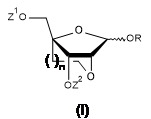
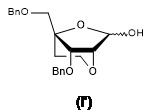

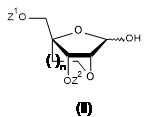
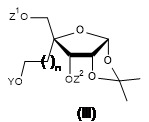


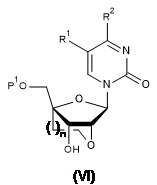
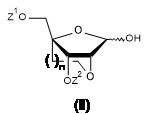
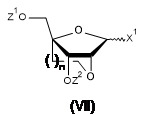


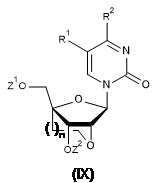
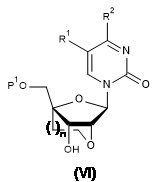
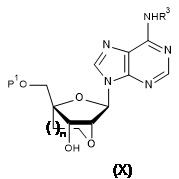


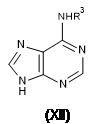
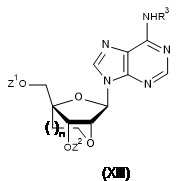
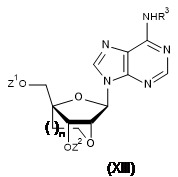
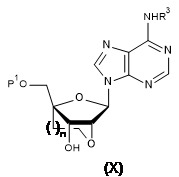
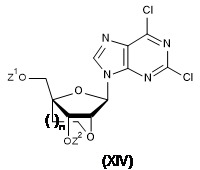
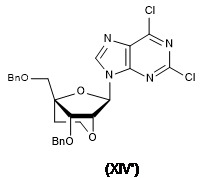
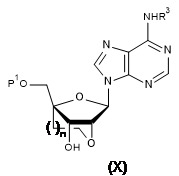
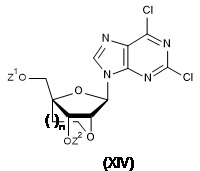

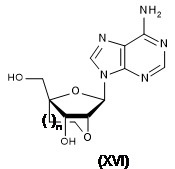
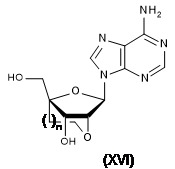
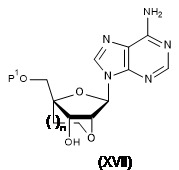
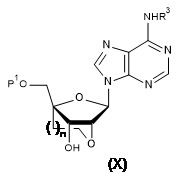

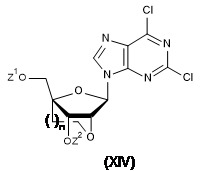
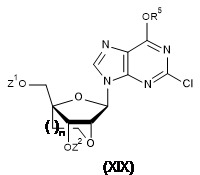
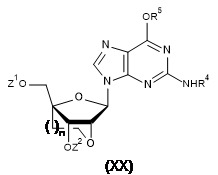
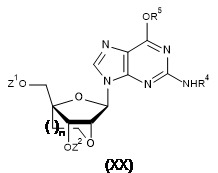

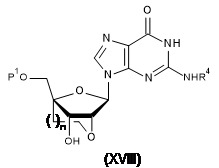
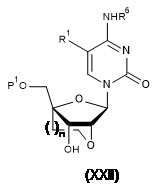
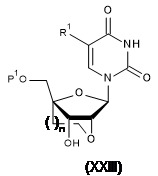
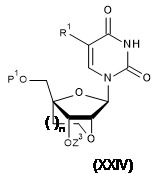
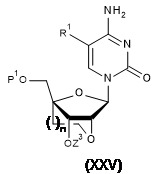

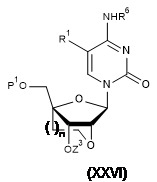
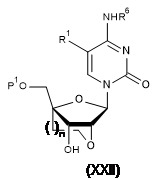

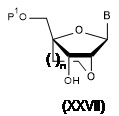
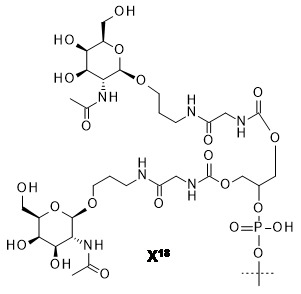
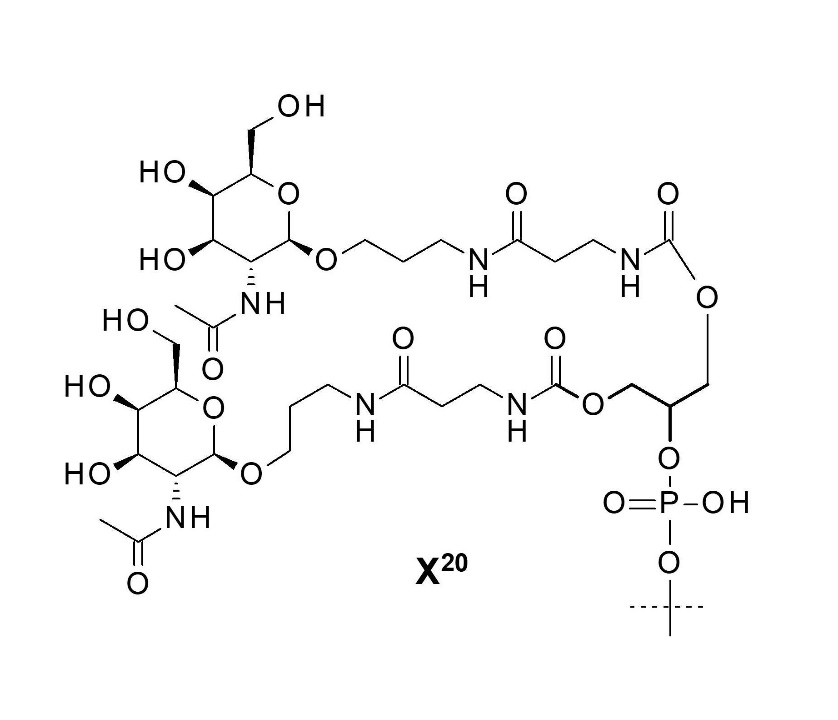
Applications Claiming Priority (2)
| Application Number | Priority Date | Filing Date | Title |
|---|---|---|---|
| JP2019191053 | 2019-10-18 | ||
| JP2019-191053 | 2019-10-18 |
Publications (1)
| Publication Number | Publication Date |
|---|---|
| TW202128704A true TW202128704A (en) | 2021-08-01 |
Family
ID=75538087
Family Applications (1)
| Application Number | Title | Priority Date | Filing Date |
|---|---|---|---|
| TW109135908A TW202128704A (en) | 2019-10-18 | 2020-10-16 | Method for producing bicyclic phosphoramidite |
Country Status (10)
| Country | Link |
|---|---|
| US (1) | US20230348522A1 (en) |
| EP (1) | EP4047005A4 (en) |
| JP (1) | JP7641905B2 (en) |
| KR (1) | KR20220083707A (en) |
| CN (1) | CN114502565A (en) |
| BR (1) | BR112022007437A2 (en) |
| CA (1) | CA3155028A1 (en) |
| IL (1) | IL292286A (en) |
| TW (1) | TW202128704A (en) |
| WO (1) | WO2021075538A1 (en) |
Families Citing this family (2)
| Publication number | Priority date | Publication date | Assignee | Title |
|---|---|---|---|---|
| IL291251B1 (en) * | 2019-09-10 | 2026-02-01 | Daiichi Sankyo Co Ltd | Conjugate of galnac-oligonucleotide for delivery to liver and manufacturing method thereof |
| CN116178196B (en) * | 2021-11-26 | 2025-07-25 | 中国科学院大连化学物理研究所 | Method for preparing amide compounds by multiphase catalysis of olefin and amine |
Family Cites Families (18)
| Publication number | Priority date | Publication date | Assignee | Title |
|---|---|---|---|---|
| US62519A (en) * | 1867-03-05 | Improved peat machine | ||
| JPH0787982A (en) | 1993-01-29 | 1995-04-04 | Sankyo Co Ltd | Modified oligodeoxyribonucleotide |
| JP3756313B2 (en) | 1997-03-07 | 2006-03-15 | 武 今西 | Novel bicyclonucleosides and oligonucleotide analogues |
| US6096881A (en) | 1997-05-30 | 2000-08-01 | Hybridon, Inc. | Sulfur transfer reagents for oligonucleotide synthesis |
| JP4236812B2 (en) | 1997-09-12 | 2009-03-11 | エクシコン エ/エス | Oligonucleotide analogues |
| ES2234563T5 (en) * | 1999-02-12 | 2018-01-17 | Daiichi Sankyo Company, Limited | New nucleoside and oligonucleotide analogs |
| US6525191B1 (en) * | 1999-05-11 | 2003-02-25 | Kanda S. Ramasamy | Conformationally constrained L-nucleosides |
| JP2001247596A (en) * | 2000-03-07 | 2001-09-11 | Univ Nagoya | Oligonucleotide sugar conjugate, method for producing oligonucleotide sugar conjugate |
| JP2002322192A (en) * | 2000-08-10 | 2002-11-08 | Sankyo Co Ltd | 2'-o,4'-crosslinked nucleoside triphosphate |
| ATE287413T1 (en) * | 2001-07-12 | 2005-02-15 | Santaris Pharma As | METHOD FOR PRODUCING THE LNA PHOSPHORAMIDITE |
| EP1481983A4 (en) * | 2002-02-13 | 2008-04-02 | Takeshi Imanishi | Nucleoside analogues and oligonucleotide derivative comprising nucleotide analogue thereof |
| EP2392660A3 (en) * | 2002-11-25 | 2012-03-28 | Masafumi Matsuo | ENA Nucleic Acid Drugs Modifying Splicing in mRNA Precursor |
| JP4616175B2 (en) * | 2003-09-02 | 2011-01-19 | 株式会社キラルジェン | Method for producing 5'-phosphitylated monomer and H-phosphonate oligonucleotide derivative |
| DE19216461T1 (en) * | 2011-10-03 | 2021-10-07 | Modernatx, Inc. | MODIFIED NUCLEOSIDES, NUCLEOTIDES AND NUCLEIC ACIDS AND USES THEREOF |
| EP2862868B1 (en) | 2012-06-18 | 2020-04-08 | Daiichi Sankyo Company, Limited | Intermediate for production of nucleoside analogue, and method for producing same |
| WO2018049534A1 (en) * | 2016-09-16 | 2018-03-22 | Lcb Pharma Inc. | Nucleoside and nucleotide analogues bearing a quaternary all-carbon stereogenic center at the 2' position and methods of use as a cardioprotective agent |
| KR102398295B1 (en) * | 2018-03-09 | 2022-05-17 | 다이이찌 산쿄 가부시키가이샤 | Glycogen disease type Ia treatment |
| WO2019224172A1 (en) * | 2018-05-25 | 2019-11-28 | Roche Innovation Center Copenhagen A/S | Novel process for making allofuranose from glucofuranose |
-
2020
- 2020-10-16 IL IL292286A patent/IL292286A/en unknown
- 2020-10-16 CA CA3155028A patent/CA3155028A1/en active Pending
- 2020-10-16 CN CN202080072429.5A patent/CN114502565A/en active Pending
- 2020-10-16 TW TW109135908A patent/TW202128704A/en unknown
- 2020-10-16 EP EP20877640.1A patent/EP4047005A4/en active Pending
- 2020-10-16 US US17/769,483 patent/US20230348522A1/en active Pending
- 2020-10-16 WO PCT/JP2020/039050 patent/WO2021075538A1/en not_active Ceased
- 2020-10-16 JP JP2021552461A patent/JP7641905B2/en active Active
- 2020-10-16 BR BR112022007437A patent/BR112022007437A2/en not_active Application Discontinuation
- 2020-10-16 KR KR1020227012762A patent/KR20220083707A/en not_active Withdrawn
Also Published As
| Publication number | Publication date |
|---|---|
| JPWO2021075538A1 (en) | 2021-04-22 |
| EP4047005A4 (en) | 2024-03-06 |
| BR112022007437A2 (en) | 2022-10-11 |
| IL292286A (en) | 2022-06-01 |
| CN114502565A (en) | 2022-05-13 |
| CA3155028A1 (en) | 2021-04-22 |
| EP4047005A1 (en) | 2022-08-24 |
| JP7641905B2 (en) | 2025-03-07 |
| KR20220083707A (en) | 2022-06-20 |
| US20230348522A1 (en) | 2023-11-02 |
| WO2021075538A1 (en) | 2021-04-22 |
Similar Documents
| Publication | Publication Date | Title |
|---|---|---|
| US8859755B2 (en) | Method for preparing ribonucleoside phosphorothioate | |
| AU737902B2 (en) | Anti-viral pyrimidine nucleoside analogues | |
| AU780879B2 (en) | Anti-viral pyrimidine nucleoside analogues | |
| CN108137638B (en) | Bridged nucleic acid GuNA, method for producing same, and intermediate compound | |
| JP2025138846A (en) | Convergent liquid-phase synthesis of oligonucleotides | |
| WO2001007455A1 (en) | Novel bicyclonucleoside analogues | |
| EP1745573A2 (en) | METHODS OF MANUFACTURE OF 2 -DEOXY-&bgr;-L-NUCLEOSIDES | |
| WO2009143369A2 (en) | Method of preparing nucleosides and analogs thereof without using chromatography | |
| CN116003496A (en) | Modified mRNA5' -cap analogues | |
| MXPA05006865A (en) | Process for the production of 3'-nucleoside prodrugs. | |
| US20170073368A1 (en) | Synthesis of bicyclic nucleosides | |
| JP2019508438A (en) | Compounds and methods of synthesis of 5- (N-protected-triptaminocarboxamide) -2'-deoxyuridine phosphoramidites for incorporation into nuclear sequences | |
| TW202128704A (en) | Method for producing bicyclic phosphoramidite | |
| JP7478660B2 (en) | Modified Nucleoside Phosphoramidites | |
| US20040033967A1 (en) | Alkylated hexitol nucleoside analogues and oligomers thereof | |
| CN116178468A (en) | 5’S-LNA Nucleotides and Oligonucleotides | |
| CN115151555B (en) | Bridged nucleosides and nucleotides using these bridged nucleosides | |
| Czechtizky et al. | Oligonucleotide Analogues with a Nucleobase‐Including Backbone:, Part 6, 2‐Deoxy‐D‐erythrose‐Derived Phosphoramidites: Synthesis and Incorporation into 14‐Mer DNA Strands | |
| KR20070073958A (en) | Difluoronucleosides and preparation methods thereof | |
| HK40078619A (en) | Method for producing bicyclic phosphoramidite | |
| JP7818760B2 (en) | Method for producing nucleoside derivatives | |
| EP0850248B1 (en) | Compositions and methods for the synthesis of organophosphorus derivatives | |
| TW202434611A (en) | Methods of synthesizing a targeting ligand-conjugated nucleotide phosphoramidite | |
| KR20240131337A (en) | Method for producing polynucleotides | |
| BR112020005067B1 (en) | NUCLEOSIDE-MODIFIED PHOSPHORAMIDITES, COMPOSITION, AND METHODS FOR PRODUCING AN OLIGONUCLEOTIDE |