TWI615406B - Antibody specifically binding to erbb3 and use thereof - Google Patents
Antibody specifically binding to erbb3 and use thereof Download PDFInfo
- Publication number
- TWI615406B TWI615406B TW105140259A TW105140259A TWI615406B TW I615406 B TWI615406 B TW I615406B TW 105140259 A TW105140259 A TW 105140259A TW 105140259 A TW105140259 A TW 105140259A TW I615406 B TWI615406 B TW I615406B
- Authority
- TW
- Taiwan
- Prior art keywords
- antibody
- cancer
- erbb3
- antigen
- binding fragment
- Prior art date
Links
Classifications
-
- A—HUMAN NECESSITIES
- A61—MEDICAL OR VETERINARY SCIENCE; HYGIENE
- A61K—PREPARATIONS FOR MEDICAL, DENTAL OR TOILETRY PURPOSES
- A61K31/00—Medicinal preparations containing organic active ingredients
-
- A—HUMAN NECESSITIES
- A61—MEDICAL OR VETERINARY SCIENCE; HYGIENE
- A61K—PREPARATIONS FOR MEDICAL, DENTAL OR TOILETRY PURPOSES
- A61K31/00—Medicinal preparations containing organic active ingredients
- A61K31/33—Heterocyclic compounds
- A61K31/335—Heterocyclic compounds having oxygen as the only ring hetero atom, e.g. fungichromin
- A61K31/337—Heterocyclic compounds having oxygen as the only ring hetero atom, e.g. fungichromin having four-membered rings, e.g. taxol
-
- A—HUMAN NECESSITIES
- A61—MEDICAL OR VETERINARY SCIENCE; HYGIENE
- A61K—PREPARATIONS FOR MEDICAL, DENTAL OR TOILETRY PURPOSES
- A61K39/00—Medicinal preparations containing antigens or antibodies
- A61K39/395—Antibodies; Immunoglobulins; Immune serum, e.g. antilymphocytic serum
- A61K39/39533—Antibodies; Immunoglobulins; Immune serum, e.g. antilymphocytic serum against materials from animals
- A61K39/39558—Antibodies; Immunoglobulins; Immune serum, e.g. antilymphocytic serum against materials from animals against tumor tissues, cells, antigens
-
- A—HUMAN NECESSITIES
- A61—MEDICAL OR VETERINARY SCIENCE; HYGIENE
- A61K—PREPARATIONS FOR MEDICAL, DENTAL OR TOILETRY PURPOSES
- A61K45/00—Medicinal preparations containing active ingredients not provided for in groups A61K31/00 - A61K41/00
- A61K45/06—Mixtures of active ingredients without chemical characterisation, e.g. antiphlogistics and cardiaca
-
- A—HUMAN NECESSITIES
- A61—MEDICAL OR VETERINARY SCIENCE; HYGIENE
- A61P—SPECIFIC THERAPEUTIC ACTIVITY OF CHEMICAL COMPOUNDS OR MEDICINAL PREPARATIONS
- A61P35/00—Antineoplastic agents
-
- A—HUMAN NECESSITIES
- A61—MEDICAL OR VETERINARY SCIENCE; HYGIENE
- A61P—SPECIFIC THERAPEUTIC ACTIVITY OF CHEMICAL COMPOUNDS OR MEDICINAL PREPARATIONS
- A61P35/00—Antineoplastic agents
- A61P35/02—Antineoplastic agents specific for leukemia
-
- C—CHEMISTRY; METALLURGY
- C07—ORGANIC CHEMISTRY
- C07K—PEPTIDES
- C07K16/00—Immunoglobulins [IG], e.g. monoclonal or polyclonal antibodies
- C07K16/18—Immunoglobulins [IG], e.g. monoclonal or polyclonal antibodies against material from animals or humans
- C07K16/28—Immunoglobulins [IG], e.g. monoclonal or polyclonal antibodies against material from animals or humans against receptors, cell surface antigens or cell surface determinants
- C07K16/2863—Immunoglobulins [IG], e.g. monoclonal or polyclonal antibodies against material from animals or humans against receptors, cell surface antigens or cell surface determinants against receptors for growth factors, growth regulators
-
- C—CHEMISTRY; METALLURGY
- C07—ORGANIC CHEMISTRY
- C07K—PEPTIDES
- C07K16/00—Immunoglobulins [IG], e.g. monoclonal or polyclonal antibodies
- C07K16/18—Immunoglobulins [IG], e.g. monoclonal or polyclonal antibodies against material from animals or humans
- C07K16/32—Immunoglobulins [IG], e.g. monoclonal or polyclonal antibodies against material from animals or humans against translation products of oncogenes
-
- A—HUMAN NECESSITIES
- A61—MEDICAL OR VETERINARY SCIENCE; HYGIENE
- A61K—PREPARATIONS FOR MEDICAL, DENTAL OR TOILETRY PURPOSES
- A61K39/00—Medicinal preparations containing antigens or antibodies
- A61K2039/505—Medicinal preparations containing antigens or antibodies comprising antibodies
-
- A—HUMAN NECESSITIES
- A61—MEDICAL OR VETERINARY SCIENCE; HYGIENE
- A61K—PREPARATIONS FOR MEDICAL, DENTAL OR TOILETRY PURPOSES
- A61K39/00—Medicinal preparations containing antigens or antibodies
- A61K2039/505—Medicinal preparations containing antigens or antibodies comprising antibodies
- A61K2039/507—Comprising a combination of two or more separate antibodies
-
- A—HUMAN NECESSITIES
- A61—MEDICAL OR VETERINARY SCIENCE; HYGIENE
- A61K—PREPARATIONS FOR MEDICAL, DENTAL OR TOILETRY PURPOSES
- A61K39/00—Medicinal preparations containing antigens or antibodies
- A61K2039/545—Medicinal preparations containing antigens or antibodies characterised by the dose, timing or administration schedule
-
- C—CHEMISTRY; METALLURGY
- C07—ORGANIC CHEMISTRY
- C07K—PEPTIDES
- C07K2317/00—Immunoglobulins specific features
- C07K2317/20—Immunoglobulins specific features characterized by taxonomic origin
- C07K2317/21—Immunoglobulins specific features characterized by taxonomic origin from primates, e.g. man
-
- C—CHEMISTRY; METALLURGY
- C07—ORGANIC CHEMISTRY
- C07K—PEPTIDES
- C07K2317/00—Immunoglobulins specific features
- C07K2317/50—Immunoglobulins specific features characterized by immunoglobulin fragments
- C07K2317/56—Immunoglobulins specific features characterized by immunoglobulin fragments variable (Fv) region, i.e. VH and/or VL
- C07K2317/565—Complementarity determining region [CDR]
-
- C—CHEMISTRY; METALLURGY
- C07—ORGANIC CHEMISTRY
- C07K—PEPTIDES
- C07K2317/00—Immunoglobulins specific features
- C07K2317/70—Immunoglobulins specific features characterized by effect upon binding to a cell or to an antigen
- C07K2317/73—Inducing cell death, e.g. apoptosis, necrosis or inhibition of cell proliferation
-
- C—CHEMISTRY; METALLURGY
- C07—ORGANIC CHEMISTRY
- C07K—PEPTIDES
- C07K2317/00—Immunoglobulins specific features
- C07K2317/70—Immunoglobulins specific features characterized by effect upon binding to a cell or to an antigen
- C07K2317/76—Antagonist effect on antigen, e.g. neutralization or inhibition of binding
-
- C—CHEMISTRY; METALLURGY
- C07—ORGANIC CHEMISTRY
- C07K—PEPTIDES
- C07K2317/00—Immunoglobulins specific features
- C07K2317/90—Immunoglobulins specific features characterized by (pharmaco)kinetic aspects or by stability of the immunoglobulin
- C07K2317/92—Affinity (KD), association rate (Ka), dissociation rate (Kd) or EC50 value
Landscapes
- Health & Medical Sciences (AREA)
- Chemical & Material Sciences (AREA)
- Medicinal Chemistry (AREA)
- Life Sciences & Earth Sciences (AREA)
- General Health & Medical Sciences (AREA)
- Organic Chemistry (AREA)
- Animal Behavior & Ethology (AREA)
- Pharmacology & Pharmacy (AREA)
- Public Health (AREA)
- Veterinary Medicine (AREA)
- Immunology (AREA)
- Epidemiology (AREA)
- Oncology (AREA)
- Engineering & Computer Science (AREA)
- Proteomics, Peptides & Aminoacids (AREA)
- Molecular Biology (AREA)
- Genetics & Genomics (AREA)
- Biophysics (AREA)
- Biochemistry (AREA)
- General Chemical & Material Sciences (AREA)
- Chemical Kinetics & Catalysis (AREA)
- Nuclear Medicine, Radiotherapy & Molecular Imaging (AREA)
- Mycology (AREA)
- Microbiology (AREA)
- Bioinformatics & Cheminformatics (AREA)
- Biomedical Technology (AREA)
- Hematology (AREA)
- Peptides Or Proteins (AREA)
- Medicines Containing Antibodies Or Antigens For Use As Internal Diagnostic Agents (AREA)
- Medicines That Contain Protein Lipid Enzymes And Other Medicines (AREA)
- Pharmaceuticals Containing Other Organic And Inorganic Compounds (AREA)
- Acyclic And Carbocyclic Compounds In Medicinal Compositions (AREA)
- Medicinal Preparation (AREA)
- Preparation Of Compounds By Using Micro-Organisms (AREA)
Abstract
提供一種特異性結合ErbB3之抗體或其抗原結合片段及其用途。該特異性結合ErbB3之抗體或其抗原結合片段可有效地用於預防或治療一種與ErbB3蛋白活化或過度表現相關的疾病。 An antibody or antigen-binding fragment thereof that specifically binds ErbB3 and uses thereof are provided. The antibody or antigen-binding fragment thereof that specifically binds ErbB3 can be effectively used for preventing or treating a disease associated with activation or excessive expression of ErbB3 protein.
Description
相關申請案之交叉引述 Cross-reference to related applications
此申請案主張於2015年12月7日向韓國智慧財產局提申之韓國專利申請案第10-2015-00173281號的利益,其之整體內容被併入本文中以作為參考資料。 The benefit of the Korean Patent Application No. 10-2015-00173281, filed on Dec. 7, 2015, to the Korean Intellectual Property Office, is hereby incorporated by reference.
發明領域 Field of invention
一或更多實例具體例係有關於一種特異性結合受體酪胺酸激酶ErbB3蛋白之抗體或該抗體的抗原結合片段,其之製備方法及其用途。 One or more specific examples relate to an antibody that specifically binds to the receptor tyrosine kinase ErbB3 protein or an antigen-binding fragment thereof, a process for the preparation thereof, and uses thereof.
發明背景 Background of the invention
相關技藝之說明 Description of related skills
受體酪胺酸激酶之表皮生長因子受體(EGFR或ErbB)家族包括ErbB1(亦稱為表皮生長因子受體(EGFR))、ErbB2(亦稱為人類表皮生長因子受體(HER2))、ErbB3(亦稱為HER3),及ErbB4(亦稱為HER4)。ErbB之受體酪胺酸激酶家族可與配體組合形成同型二聚體(homodimer)或異二聚體,以及可以使得促分裂原活化蛋白激酶(MAP2K、MEK或MAPKK)/促分裂原活化蛋白激酶 (MAPK)之訊息傳遞途徑活化,或是磷脂肌醇-3-激酶(phosphoinositide 3-kinase)(PI3K)/蛋白質激酶B(PKB或Akt)之訊息傳遞途徑活化。據報導ErbB蛋白家族與癌症的發生、進展或預後有關。 The epidermal growth factor receptor (EGFR or ErbB) family of receptor tyrosine kinases includes ErbB1 (also known as epidermal growth factor receptor (EGFR)), ErbB2 (also known as human epidermal growth factor receptor (HER2)), ErbB3 (also known as HER3), and ErbB4 (also known as HER4). The ErbB receptor tyrosine kinase family can be combined with a ligand to form a homodimer or a heterodimer, and can cause a mitogen-activated protein kinase (MAP2K, MEK or MAPKK)/mitogen-activated protein Kinase (MAPK) signaling pathway activation, or activation of the signaling pathway of phosphoinositide 3-kinase (PI3K)/protein kinase B (PKB or Akt). The ErbB protein family has been reported to be involved in the development, progression or prognosis of cancer.
ErbB1抑制劑爾必得舒®(Erbitux®)(西妥昔單抗(Cetuximab))或得舒緩®(Tarceva®)(埃羅替尼(Erlotinib))以及ErbB2抑制劑賀癌平®(Herceptin®)(曲妥珠單抗(Trastuzumab))或泰嘉錠®(Tyverb®)(拉帕替尼(Lapatinib)),為市場上可買到的抗癌藥。然而,許多病人對此等抗癌藥反應遲鈍,並且此等抗癌藥伴隨著發展出耐藥性(resistance)。市場上尚未可買到ErbB3或ErbB4之特異性抑制劑抗體。 ErbB1 inhibitor Erbitux® (Cetuximab) or Tarceva® (Erlotinib) and ErbB2 inhibitor Herceptin® (Trastuzumab) or Tyverb® (Lapatinib) is a commercially available anticancer drug. However, many patients are slow to respond to these anticancer drugs, and these anticancer drugs are accompanied by the development of resistance. Specific inhibitor antibodies to ErbB3 or ErbB4 are not yet available on the market.
因此,對於可以應付癌症的遺傳多樣性及克服抗癌藥耐藥性之新的抗癌藥有需求。 Therefore, there is a need for new anticancer drugs that can cope with the genetic diversity of cancer and overcome the resistance of anticancer drugs.
發明概要 Summary of invention
一或更多實例具體例包括一種特異性結合ErbB3之抗體或其抗原結合片段。 One or more specific examples include an antibody or antigen-binding fragment thereof that specifically binds to ErbB3.
一或更多實例具體例包括一種用於預防或治療一種與ErbB3蛋白活化或過度表現相關的疾病之藥學組成物。 One or more example specific examples include a pharmaceutical composition for preventing or treating a disease associated with activation or overexpression of ErbB3 protein.
一或更多實例具體例包括一種預防或治療一個體體內與ErbB3蛋白活化或過度表現相關的疾病之方法。 One or more example specific examples include a method of preventing or treating a disease associated with activation or overexpression of ErbB3 protein in a body.
隨後的說明中將部分地列舉額外的態樣,以及在某種程度上,從說明中將會顯而易見,或者可以通過實施所提出的實例具體例來學習。 Additional aspects will be partially enumerated in the following description, and to some extent, will be apparent from the description, or may be learned by the practice of the example embodiments.
從下列實例具體例之說明結合附圖,此等及/或其他的態樣會變得明顯和更容易理解,其中:圖1A及1B闡釋領導抗體(lead antibody)及其修飾抗體之重鏈(圖1A)及輕鏈(圖1B)的可變異區域之胺基酸序列及互補性決定區域(CDRs);圖2為一圖,其顯示於抗-ErbB3抗體存在下,ErbB3蛋白及HRG之結合親和性(%);圖3為一圖,其顯示於抗-ErbB3抗體存在下,ErbB2蛋白及ErbB3蛋白之結合親和性(%);圖4A及4B為圖,其分別顯示於抗-ErbB3抗體存在下,ErbB3及Akt之磷酸化比率(%);圖5為於抗-ErbB3抗體存在下,BxPC3胰腺癌細胞之相對增殖(%)的圖;圖6為BT474乳癌異種移植模型,於投與抗-ErbB3抗體之後的腫瘤體積(立方毫米(mm3))的圖;圖7為MDA-MB-468乳癌異種移植模型,於投與抗-ErbB3抗體之後的腫瘤體積(mm3)的圖;圖8為A431皮膚癌異種移植模型,於投與抗-ErbB3抗體之後的腫瘤體積(mm3)的圖;圖9為FaDu頭頸部癌異種移植模型,於投與 抗-ErbB3抗體或組合投與抗-ErbB3抗體及西妥昔單抗(Cetuximab)之後,腫瘤體積(mm3)的圖;圖10為組合投與紫杉醇(paclitaxel)、HRG及抗-ErbB3抗體之後,乳癌細胞內之半胱天冬酶3/7(caspase3/7)之活性(以相對發光強度單位(RLU)計)的圖;圖11為組合投與西妥昔單抗(Cetuximab)、HRG及抗-ErbB3抗體之後,結腸直腸癌細胞之癌細胞增殖速度(%)的圖;以及圖12為耐西妥昔單抗(Cetuximab-resistant)異種移植模型,於組合投與西妥昔單抗及抗-ErbB3抗體之後,腫瘤體積(mm3)的圖。 These and/or other aspects will become apparent and more readily understood from the following description of the specific examples, in which: FIG. 1A and 1B illustrate the heavy chain of the lead antibody and its modified antibody ( Figure 1A) and the amino acid sequence and complementarity determining regions (CDRs) of the variable region of the light chain (Fig. 1B); Figure 2 is a diagram showing the binding of ErbB3 protein and HRG in the presence of an anti-ErbB3 antibody Affinity (%); Figure 3 is a graph showing the binding affinity (%) of ErbB2 protein and ErbB3 protein in the presence of anti-ErbB3 antibody; Figures 4A and 4B are graphs showing anti-ErbB3 antibodies, respectively Phosphorylation ratio (%) of ErbB3 and Akt in the presence; Figure 5 is a graph showing the relative proliferation (%) of BxPC3 pancreatic cancer cells in the presence of anti-ErbB3 antibody; Figure 6 is a BT474 breast cancer xenograft model, Figure of tumor volume (cubic millimeters (mm 3 )) after anti-ErbB3 antibody; Figure 7 is a graph of tumor volume (mm 3 ) after administration of anti-ErbB3 antibody in MDA-MB-468 breast cancer xenograft model; 8 is a skin cancer A431 xenograft model, administration of anti -ErbB3 in tumor volume (mm 3) after antibody; Figure 9 is a FaDu Neck cancer xenograft model, in the anti -ErbB3 after administration or administered in combination with an anti-antibody antibody and -ErbB3 cetuximab (Cetuximab,), tumor volume (mm 3) of FIG.; FIG. 10 is administered in combination with paclitaxel ( The activity of caspase 3/7 (caspase 3/7) in breast cancer cells (in terms of relative luminescence intensity units (RLU)) after paclitaxel), HRG and anti-ErbB3 antibodies; Figure 11 is a combination of administration Figure of cancer cell proliferation rate (%) of colorectal cancer cells after Cetuximab, HRG and anti-ErbB3 antibodies; and Figure 12 shows Cetuximab-resistant xenograft model , a graph of tumor volume (mm 3 ) after administration of cetuximab and anti-ErbB3 antibodies in combination.
較佳實施例之詳細說明 Detailed description of the preferred embodiment
現在將更詳盡地參考附圖所示的實例具體例,其中相同的參考數字始終提及相同的元件。在這方面,本實例具體例可以有不同的形式,以及不應解釋為限制本文列舉的說明內容。因此,該等實例具體例僅僅參考圖示說明如下,來解釋本說明的態樣。當使用於本文中,術語“及/或”包括一種或更多種相關列舉的項目之任一者或全體。當像是“之至少一者”之措辭在一份元件清單之前時,係修飾完整的元件清單且不是修飾清單之個別元件。 Reference will now be made in detail to the exemplary embodiments illustrated embodiments In this regard, the specific examples of the examples may have different forms and should not be construed as limiting the description herein. Therefore, the specific examples of the examples are merely explained below to explain the aspects of the present description. As used herein, the term "and/or" includes any or all of one or more of the associated listed items. When the wording "at least one of" is preceded by a list of components, the complete list of components is modified and is not an individual component of the list.
依據本揭示的一態樣,一種特異性結合ErbB3之抗體或該抗體的抗原結合片段包括: 一重鏈可變異區域,其包括選自於序列辨識編號:61至85所構成的群組之至少一胺基酸序列;一輕鏈可變異區域,其包括選自於序列辨識編號:86至101所構成的群組之至少一胺基酸序列;或是該重鏈可變異區域及該輕鏈可變異區域。 According to one aspect of the present disclosure, an antibody that specifically binds to ErbB3 or an antigen-binding fragment of the antibody comprises: a heavy chain variable region comprising at least one amino acid sequence selected from the group consisting of sequence identification numbers: 61 to 85; a light chain variable region comprising: selected from the sequence identification number: 86 to 101 At least one amino acid sequence of the formed group; or the heavy chain variable region and the light chain variable region.
有五種類型的重鏈,用γ、δ、α、μ及ε表示。重鏈的類型定義了抗體種類。重鏈類型α及γ各鏈由大概450個胺基酸組成,而μ及ε各鏈由大概550個胺基酸組成。各個重鏈有二個區域,亦即可變異區域及恆定區域。 There are five types of heavy chains, denoted by γ, δ, α, μ, and ε. The type of heavy chain defines the type of antibody. The heavy chain types α and γ each consist of approximately 450 amino acids, while the μ and ε chains consist of approximately 550 amino acids. Each heavy chain has two regions, that is, a variable region and a constant region.
有二種類型的輕鏈,用λ及κ表示。各輕鏈由大概211至217個胺基酸組成。各個人類抗體只含一種類型的輕鏈。各個輕鏈含有二個連續的領域,包括一個恆定區域及一個可變異區域。 There are two types of light chains, denoted by λ and κ. Each light chain consists of approximately 211 to 217 amino acids. Each human antibody contains only one type of light chain. Each light chain contains two consecutive domains, including a constant region and a variable region.
可變異區域係指抗體與抗原結合的一區域。 A variability region refers to a region where an antibody binds to an antigen.
重鏈可變異區域可包括:一互補性決定區域-H1(CDR-H1),其包括選自於序列辨識編號:61至68所構成的群組之胺基酸序列;一CDR-H2,其包括選自於序列辨識編號:69至77的胺基酸序列;以及一CDR-H3,其包括選自於序列辨識編號:78至85的胺基酸序列。舉例而言,該重鏈可變異區域可包括選自於序列辨識編號:1至30所構成的群組之胺基酸序列。術語"互補性決定區域(CDR)"係指一抗體的可變異區域的一個部位,該部位賦予抗體或其抗原結合片段對抗原的結合特異性。 The heavy chain variable region may comprise: a complementarity determining region -H1 (CDR-H1) comprising an amino acid sequence selected from the group consisting of sequence identification numbers: 61 to 68; a CDR-H2, An amino acid sequence selected from the group consisting of sequence identification numbers: 69 to 77; and a CDR-H3 comprising an amino acid sequence selected from the group consisting of: 78 to 85. For example, the heavy chain variable region may comprise an amino acid sequence selected from the group consisting of sequence identification numbers: 1 to 30. The term "complementarity determining region (CDR)" refers to a portion of a variable region of an antibody that confers binding specificity to an antigen for an antibody or antigen-binding fragment thereof.
輕鏈可變異區域可包括:一CDR-L1,其包 括選自於序列辨識編號:86及87所構成的群組之胺基酸序列;一CDR-L2,其包括選自於序列辨識編號:88至93所構成的群組之胺基酸序列;以及一CDR-L3,其包括選自於序列辨識編號:94至101所構成的群組之胺基酸序列。舉例而言,該輕鏈可變異區域可包括選自於序列辨識編號:31至60所構成的群組之胺基酸序列。 The light chain variability region may include: a CDR-L1, which is packaged An amino acid sequence selected from the group consisting of sequence identification numbers: 86 and 87; a CDR-L2 comprising an amino acid sequence selected from the group consisting of sequence identification numbers: 88 to 93; And a CDR-L3 comprising an amino acid sequence selected from the group consisting of sequence identification numbers: 94 to 101. For example, the light chain variable region can include an amino acid sequence selected from the group consisting of sequence identification numbers: 31 to 60.
該抗體或其抗原結合片段可以包括一重鏈可變異區域,其係選自於重鏈可變異區域CDR-H1、CDR-H2及CDR-H3所構成的群組,其表示表5中列出的胺基酸序列。 The antibody or antigen-binding fragment thereof may comprise a heavy chain variable region selected from the group consisting of CDR-H1, CDR-H2 and CDR-H3 of the heavy chain variable region, which represents the ones listed in Table 5. Amino acid sequence.


舉例而言,該抗體或其抗原結合片段可以包括一重鏈可變異區域,其包括一含括序列辨識編號:61之胺基酸序列的CDR-H1、一含括序列辨識編號:69之胺基酸序列的CDR-H2,及一含括序列辨識編號:78之胺基酸序列的CDR-H3。 For example, the antibody or antigen-binding fragment thereof can comprise a heavy chain variable region comprising a CDR-H1 comprising an amino acid sequence of sequence identification number: 61, an amino group comprising a sequence identification number: 69 The CDR-H2 of the acid sequence, and a CDR-H3 comprising the amino acid sequence of Sequence Identification Number: 78.
該抗體或其抗原結合片段可以包括一輕鏈可變異區域,其係選自於輕鏈可變異區域CDR-L1、CDR-L2及CDR-L3所構成的群組,其表示表6中列出的胺基酸序列。 The antibody or antigen-binding fragment thereof may comprise a light chain variable region selected from the group consisting of CDR-L1, CDR-L2 and CDR-L3 of the light chain variable region, which is represented in Table 6. Amino acid sequence.

舉例而言,該抗體或其抗原結合片段可以包括包括一輕鏈可變異區域,其包括一含括序列辨識編號:86之胺基酸序列的CDR-L1、一含括序列辨識編號:88之胺基酸序列的CDR-L2,及一含括序列辨識編號:94之胺基酸序列的CDR-L3。 For example, the antibody or antigen-binding fragment thereof can include a light chain variable region comprising a CDR-L1 comprising an amino acid sequence of sequence identification number: 86, and a sequence identification number: 88 The CDR-L2 of the amino acid sequence, and a CDR-L3 comprising the amino acid sequence of Sequence Identification Number: 94.
ErbB3可以為ErbB3多肽或其片段。ErbB3多肽可以為Genbank存取編號NP_001005915之人類胺基酸序列,或是Genbank存取編號NP_034283之小鼠胺基酸序列。ErbB3多肽之片段可以為一種多肽,其包括ErbB3多肽之部分胺基酸序列。ErbB3為一種表皮生長因子受體(EGFR或ErbB)家族之受體酪胺酸激酶,並且亦稱為HER3。 ErbB3 can be an ErbB3 polypeptide or a fragment thereof. The ErbB3 polypeptide may be the human amino acid sequence of Genbank accession number NP_001005915 or the mouse amino acid sequence of Genbank accession number NP_034283. A fragment of the ErbB3 polypeptide can be a polypeptide comprising a portion of the amino acid sequence of the ErbB3 polypeptide. ErbB3 is a receptor tyrosine kinase of the epidermal growth factor receptor (EGFR or ErbB) family and is also known as HER3.
特異性結合ErbB3之抗體或其抗原結合片段可以具有對ErbB3多肽或其片段之親和性。 An antibody or antigen-binding fragment thereof that specifically binds to ErbB3 may have an affinity for an ErbB3 polypeptide or a fragment thereof.
該抗體或其抗原結合片段可以抑制ErbB3蛋白與特異性結合ErbB3蛋白之材料的結合,ErbB1蛋白與ErbB3蛋白之二聚合作用,ErbB1蛋白與ErbB3蛋白之二聚合作用,ErbB2蛋白與ErbB3蛋白之二聚合作用,ErbB3或Akt之磷酸化,或其等之組合。特異性結合ErbB3蛋白之材料可以為賀瑞谷林(heregulin)(HRG)。 The antibody or antigen-binding fragment thereof can inhibit the binding of ErbB3 protein to a material which specifically binds ErbB3 protein, the dimerization of ErbB1 protein to ErbB3 protein, the dimerization of ErbB1 protein to ErbB3 protein, and the polymerization of ErbB2 protein and ErbB3 protein. Role, phosphorylation of ErbB3 or Akt, or a combination thereof. The material that specifically binds to the ErbB3 protein may be heregulin (HRG).
術語"抗體"與"免疫球蛋白(Ig)"可以交替使用。整個抗體具有含括2個全長輕鏈與2個全長重鏈的結構,其等由雙硫鍵(SS)連接。抗體可以為舉例而言,IgA、IgD、IgE、IgG或IgM。抗體可以為單株抗體或多株抗體。 抗體可以為動物衍生的抗體、小鼠-人類嵌合抗體、人化的抗體,或人類抗體。 The terms "antibody" and "immunoglobulin (Ig)" can be used interchangeably. The entire antibody has a structure comprising two full-length light chains and two full-length heavy chains, which are linked by a disulfide bond (SS). The antibody can be, for example, IgA, IgD, IgE, IgG or IgM. The antibody may be a single antibody or a plurality of antibodies. The antibody may be an animal derived antibody, a mouse-human chimeric antibody, a humanized antibody, or a human antibody.
術語"抗原結合片段"係指整個抗體結構的片段,其可以為含括抗原結合位址之多肽部分。舉例而言,該抗原結合片段可以為scFv、(scFv)2、Fv、Fab、Fab'、Fv F(ab')2,或其等之組合。 The term "antigen-binding fragment" refers to a fragment of the entire antibody structure which may be part of a polypeptide comprising an antigen binding site. For example, the antigen-binding fragment can be a scFv, (scFv) 2 , Fv, Fab, Fab', Fv F(ab') 2 , or a combination thereof.
該抗體或其抗原結合片段可以予以修飾。舉例而言,該抗體或其抗原結合片段可以透過複合(conjugation)或結合、醣化、標籤附接(tag attachment)或其等之組合予以修飾。該抗體可以與其他藥物複合,例如抗癌藥。舉例而言,該抗體或其抗原結合片段可以與下列複合:山葵過氧化酶(HRP)、鹼性磷酸酶、不完全抗原、生物素、鏈黴親合素(streptavidin)、螢光材料、放射性材料、量子點、聚乙二醇(PEG)、組胺酸標籤,或其等之組合。螢光材料可以為Alexa Fluor®532、Alexa Fluor®546、Alexa Fluor®568、Alexa Fluor®680、Alexa Fluor®750、Alexa Fluor®790,或Alexa FluorTM350。 The antibody or antigen-binding fragment thereof can be modified. For example, the antibody or antigen-binding fragment thereof can be modified by conjugation or binding, saccharification, tag attachment, or the like. The antibody can be complexed with other drugs, such as anticancer drugs. For example, the antibody or antigen-binding fragment thereof can be complexed with: wasabi peroxidase (HRP), alkaline phosphatase, incomplete antigen, biotin, streptavidin, fluorescent material, radioactivity Materials, quantum dots, polyethylene glycol (PEG), histidine tags, or combinations thereof. Phosphor material may Alexa Fluor®532, Alexa Fluor®546, Alexa Fluor®568 , Alexa Fluor®680, Alexa Fluor®750, Alexa Fluor®790, or Alexa Fluor TM 350.
依據本揭示的另一態樣,一種用於預防或治療一種與ErbB3蛋白活化或過度表現相關的疾病之藥學組成物,包括如以上所述之任一實例具體例之抗體或其抗原結合片段。 According to another aspect of the present disclosure, a pharmaceutical composition for preventing or treating a disease associated with activation or overexpression of ErbB3 protein, comprising an antibody or antigen-binding fragment thereof according to any of the specific examples described above.
該抗體、抗原結合片段及ErbB3蛋白係與如上所述者相同。 The antibody, antigen-binding fragment and ErbB3 protein line are the same as described above.
與ErbB3蛋白活化或過度表現相關的該疾病 可以為癌症。癌症可以為實性(solid)癌症或非實性癌症。實性癌症係指癌性腫瘤發病於實體器官內,例如肝臟、肺臟、乳房或皮膚,而非實性癌症係指癌影響血液,所以稱為血癌(blood cancer)。舉例而言,癌症可以選自於下列所構成的群組:乳癌、皮膚癌、頭頸部癌、胰腺癌、肺癌、結腸癌、結腸直腸癌、胃癌、卵巢癌、前列腺癌、膀胱癌、子宮癌、肝癌、腎臟癌、明亮細胞肉瘤、黑色素瘤、腦脊髓腫瘤、腦癌、胸腺瘤、間皮瘤、食道癌、膽道癌、睪丸癌、胚癌(germinal cancer)、甲狀腺癌、副甲狀腺癌、子宮頸癌、子宮內膜癌、淋巴瘤、骨髓發育不良症候群(myelodysplastic syndrome)(MDS)、骨髓纖維化(myelofibrosis)、急性白血病、慢性白血病、多發性骨髓瘤、何杰金氏疾病(Hodgkin's disease)、內分泌癌,以及肉瘤。 The disease associated with ErbB3 protein activation or overexpression Can be cancer. The cancer can be a solid cancer or a non-solid cancer. Solid cancer refers to cancerous tumors that occur in solid organs, such as the liver, lungs, breasts, or skin. Non-solid cancers refer to cancers that affect blood, so they are called blood cancers. For example, the cancer can be selected from the group consisting of breast cancer, skin cancer, head and neck cancer, pancreatic cancer, lung cancer, colon cancer, colorectal cancer, stomach cancer, ovarian cancer, prostate cancer, bladder cancer, uterine cancer. , liver cancer, kidney cancer, bright cell sarcoma, melanoma, cerebrospinal tumor, brain cancer, thymoma, mesothelioma, esophageal cancer, biliary tract cancer, testicular cancer, germ cancer, thyroid cancer, parathyroid cancer , cervical cancer, endometrial cancer, lymphoma, myelodysplastic syndrome (MDS), myelofibrosis, acute leukemia, chronic leukemia, multiple myeloma, Hodgkin's disease Disease), endocrine cancer, and sarcoma.
術語"預防"係指藉由投與該藥學組成物,來抑止或延遲一種與ErbB3蛋白活化或過度表現相關的疾病發生之任何行為。術語"治療"係指藉由投與該藥學組成物,使一種與ErbB3蛋白活化或過度表現相關的疾病之症狀減輕的任何行為。 The term "prevention" refers to any behavior that inhibits or delays the onset of a disease associated with the activation or overexpression of ErbB3 protein by administering the pharmaceutical composition. The term "treating" refers to any behavior that alleviates the symptoms of a disease associated with activation or overexpression of ErbB3 protein by administering the pharmaceutical composition.
該藥學組成物可以包括一種藥學上可接受的載劑。載劑可以理解成意指賦形劑、稀釋劑或佐劑。舉例而言,載劑可以選自於下列所構成的群組:乳糖、右旋糖、蔗糖、山梨糖醇、甘露糖醇、木糖醇、赤藻糖醇、氫化麥芽糖、澱粉、阿拉伯膠橡膠、藻酸鹽、明膠、磷酸鈣、 矽酸鈣、纖維素、甲基纖維素、聚乙烯氫吡咯酮(polyvinylpyrrolidone)、水、生理食鹽水、緩衝液例如磷酸鹽緩衝食鹽水(PBS)、羥苯甲酸甲酯、羥苯甲酸丙酯、滑石、硬脂酸鎂、甘胺酸、組胺酸、絲胺酸、聚山梨醇酯,以及礦油。該藥學組成物可以包括填料、抗凝劑、潤滑劑、潤濕劑、調味劑、乳化劑、防腐劑,或其等之組合。 The pharmaceutical composition can include a pharmaceutically acceptable carrier. A carrier is understood to mean an excipient, diluent or adjuvant. For example, the carrier can be selected from the group consisting of lactose, dextrose, sucrose, sorbitol, mannitol, xylitol, erythritol, hydrogenated maltose, starch, gum arabic rubber Alginate, gelatin, calcium phosphate, Calcium citrate, cellulose, methyl cellulose, polyvinylpyrrolidone, water, physiological saline, buffer such as phosphate buffered saline (PBS), methyl paraben, propyl paraben , talc, magnesium stearate, glycine, histidine, serine, polysorbate, and mineral oil. The pharmaceutical composition may include a filler, an anticoagulant, a lubricant, a wetting agent, a flavoring agent, an emulsifier, a preservative, or a combination thereof.
該藥學組成物可以使用本技藝任何共同方法予以調配成任何的形式。舉例而言,該藥學組成物可以予以調配成口服劑量形式(舉例而言,粉末、錠劑、膠囊、糖漿劑、藥片,或顆粒),或是非經口的劑量形式(舉例而言注射)。該藥學組成物可以製備成供全身性投遞的調配物,或是製備成供局部投遞的調配物。 The pharmaceutical composition can be formulated into any form using any of the common methods of the art. For example, the pharmaceutical composition can be formulated in an oral dosage form (for example, a powder, a lozenge, a capsule, a syrup, a tablet, or a granule), or a parenteral dosage form (for example, an injection). The pharmaceutical composition can be prepared as a formulation for systemic delivery or as a formulation for topical delivery.
該藥學組成物可以進一步包括一種抗癌藥。抗癌藥可以為西妥昔單抗、帕尼單抗(Panitumumab)、埃羅替尼(Erlotinib)、吉非替尼(Gefitinib)、曲妥珠單抗(Trastuzumab)、T-DM1、帕妥珠單抗(Pertuzumab)、拉帕替尼(Lapatinib)、紫杉醇、他莫昔芬(Tamoxifene)、順鉑、抗-CTLA-4抗體、抗-PD-1抗體、抗-PDL-1抗體、5-氟尿嘧啶(5FU)、吉西他濱(Gemcitabine),或其等之組合。該藥學組成物可以包括單一組成物或個別的(separate)組成物。舉例而言,該藥學組成物之抗體或其抗原結合片段可以為一種非經口的劑量形式的組成物,以及抗癌藥可以為一種口服劑量形式的組成物。 The pharmaceutical composition may further comprise an anticancer drug. The anticancer drug can be cetuximab, panitumumab, erlotinib, gefitinib, trastuzumab, T-DM1, and patol. Pertuzumab, Lapatinib, paclitaxel, Tamoxifene, cisplatin, anti-CTLA-4 antibody, anti-PD-1 antibody, anti-PDL-1 antibody, 5 - Fluorouracil (5FU), Gemcitabine, or a combination thereof. The pharmaceutical composition may comprise a single composition or a separate composition. For example, the antibody or antigen-binding fragment thereof of the pharmaceutical composition can be a composition in a parenteral dosage form, and the anticancer drug can be a composition in an oral dosage form.
該藥學組成物可以包括有效量的該抗體或 其抗原結合片段、抗癌藥,或其等之組合。本文中使用之術語"有效量"係指足以預防或治療一種與ErbB3蛋白活化或過度表現相關的疾病的量,當投與至需要此預防或治療的一個體時。有效量可以取決於熟習此藝者選擇的細胞或個體而適當地選擇。舉例而言,有效量可以取決於下列因素而適當地選擇:疾病嚴重性、病人的年齡、體重、健康狀況、性別、病人的藥物敏感性、投與的期間、投與的途徑、排泄率、治療期間,及其他的因素,包括一藥物與該藥學組成物組合使用或同時使用,以及醫療領域已知的其他因素。有效量可以為大約0.5微克(μg)至大約2公克(g)、大約1μg至大約1g、大約10μg至大約500毫克(mg)、大約100μg至大約100mg,或是大約1mg至大約50mg的藥學組成物。 The pharmaceutical composition can include an effective amount of the antibody or antigen-binding fragment thereof, an anticancer drug, or a combination thereof. The term "effective amount" as used herein refers to an amount sufficient to prevent or treat a disease associated with activation or overexpression of ErbB3 protein when administered to a subject in need of such prevention or treatment. The effective amount may be appropriately selected depending on the cells or individuals selected by the artist. For example, an effective amount may be appropriately selected depending on factors such as the severity of the disease, the age, weight, health status, sex of the patient, the drug sensitivity of the patient, the period of administration, the route of administration, the rate of excretion, During treatment, and other factors, including the use or simultaneous use of a drug with the pharmaceutical composition, as well as other factors known in the medical arts. Effective amount can be about 0.5 micrograms (μ g) to about 2 grams (g), about 1 μ g to about 1g, about 10 μ g to about 500 milligrams (mg), about 100 μ g to about 100mg, or about 1 mg to about 50 mg of the pharmaceutical composition.
該藥學組成物之劑量當投與至一成人時,可以為舉例而言,大約0.001毫克/公斤(mg/kg)至大約100mg/kg、大約0.01mg/kg至大約10mg/kg,或是大約0.1mg/kg至大約1mg/kg。投與的數量可以為舉例而言,一天一次或多次、一週一次、二週一次、三週一次、四週一次,或是一年一次。 The dosage of the pharmaceutical composition, when administered to an adult, can be, for example, from about 0.001 mg/kg (mg/kg) to about 100 mg/kg, from about 0.01 mg/kg to about 10 mg/kg, or about From 0.1 mg/kg to about 1 mg/kg. The number of contributions can be, for example, one or more times a day, once a week, once every two weeks, once every three weeks, once every four weeks, or once a year.
依據本揭示的另一態樣,一種預防或治療一個體體內與ErbB3蛋白活化或過度表現相關的疾病之方法,包括投與如以上所述之任一實例具體例之抗原或其抗原結合片段至該個體。 According to another aspect of the present disclosure, a method for preventing or treating a disease associated with activation or overexpression of ErbB3 protein in a body comprises administering an antigen or antigen-binding fragment thereof according to any of the specific examples described above to The individual.
該抗體、抗原結合片段、ErbB3蛋白、與 ErbB3蛋白活化或過度表現相關的疾病、預防或治療,可以與如上所述者相同。 The antibody, antigen-binding fragment, ErbB3 protein, and The disease, prevention or treatment associated with ErbB3 protein activation or overexpression may be the same as described above.
個體可以為一種哺乳動物,舉例而言人類、母牛、馬、豬、犬、綿羊、山羊或貓。個體可以為罹患與ErbB3蛋白活化或過度表現相關的疾病,或是易患該疾病的一個體,該疾病可以為癌症。 The individual can be a mammal, such as a human, cow, horse, pig, dog, sheep, goat or cat. An individual may be a disease associated with activation or overexpression of ErbB3 protein, or a body susceptible to the disease, which may be cancer.
該方法可以進一步包括投與抗癌藥至該個體。抗癌藥可以與如以上所述之任一實例具體例之抗原或其抗原結合片段,同時、分開或相繼地投與。 The method can further comprise administering an anticancer drug to the individual. The anticancer drug can be administered simultaneously, separately or sequentially with the antigen or antigen-binding fragment thereof according to any of the specific examples described above.
舉例而言,該抗體或其抗原結合片段、抗癌藥或其等之組合,可以透過任一方法直接投與至該個體,舉例而言透過口服、靜脈內、肌肉內、經皮的、黏膜的、鼻內、氣管內或皮下投與。該抗體或其抗原結合片段、抗癌藥或其等之組合可以全身或局部投與。該抗體或其抗原結合片段、抗癌藥或其等之組合,可以單獨或與一種藥物活性化合物一起投與。 For example, the antibody or antigen-binding fragment thereof, anticancer drug or a combination thereof can be directly administered to the individual by any method, for example, by oral, intravenous, intramuscular, transdermal, mucosal Intranasal, intratracheal or subcutaneous administration. The antibody or antigen-binding fragment thereof, anticancer drug or a combination thereof may be administered systemically or locally. The antibody or antigen-binding fragment thereof, anticancer drug, or a combination thereof, may be administered alone or in combination with a pharmaceutically active compound.
該抗體或其抗原結合片段、抗癌藥或其等之組合的劑量,可以取決於病人的病況、體重、疾病嚴重性、藥物調配物、投與的途徑,及投與的期間,以及可以由熟悉此藝者予以適當地選擇。舉例而言,當投與至一成人時,該抗體或其抗原結合片段、抗癌藥或其等之組合的劑量,可以為大約0.001mg/kg至大約100mg/kg、大約0.01mg/kg至大約10mg/kg,或是大約0.1mg/kg至大約1mg/kg。投與的數量可以為舉例而言,一天一次或多次、一週一次、二 週一次、三週一次、四週一次,或是一年一次。 The dose of the antibody or antigen-binding fragment thereof, anticancer drug, or the like, may depend on the condition of the patient, body weight, disease severity, drug formulation, route of administration, and duration of administration, and may be Those who are familiar with this art will be appropriately selected. For example, when administered to an adult, the dose of the antibody or antigen-binding fragment thereof, anticancer drug, or the like, may be from about 0.001 mg/kg to about 100 mg/kg, about 0.01 mg/kg to About 10 mg/kg, or about 0.1 mg/kg to about 1 mg/kg. The number of contributions can be, for example, one or more times a day, once a week, two Once a week, once every three weeks, once every four weeks, or once a year.
依據本揭示的另一態樣,一種預防或治療一個體體內癌症耐藥性之方法,包括投與如請求項1至10中任一項之抗體或抗原結合片段至該個體。 According to another aspect of the present disclosure, a method of preventing or treating cancer resistance in a body comprises administering the antibody or antigen-binding fragment of any one of claims 1 to 10 to the individual.
本揭示的一或更多具體例現在將參照下列實施例更詳盡地說明。然而,此等實施例僅僅是作說明用途,且不打算本揭示的一或更多具體例之範疇。 One or more specific examples of the present disclosure will now be described in more detail with reference to the following examples. However, the examples are for illustrative purposes only and are not intended to be within the scope of one or more specific embodiments of the disclosure.
實施例1.抗-ErbB3抗體之製備Example 1. Preparation of anti-ErbB3 antibody
1.領導抗體之篩選1. Leading antibody screening
為了獲得人類抗-ErbB3抗體,人類合成scFv-噬菌體展示庫(由韓國梨花女子大學之H.B.SHIM提供)對ErbB3蛋白(R&D systems)進行篩選,以獲得展示與ErbB3結合的scFv片段之噬菌體。 To obtain a human anti-ErbB3 antibody, a human synthetic scFv-phage display library (provided by H. B. SHIM of Ewha Women's University, Korea) was screened for ErbB3 protein (R&D systems) to obtain phage displaying an scFv fragment that binds to ErbB3.
編碼獲得的噬菌體之scFv片段的核酸序列進行分析,以及結合ErbB3之scFv片段的VH及VL領域之胺基酸序列係藉由胺基酸序列分析予以辨識。獲得結合ErbB3之scFv片段的序列之後,VH及VL領域係使用編碼IgG1之Selexis 085載體(Selexis)予以再建構,由此組裝整個抗體基因。編碼IgG1之再建構的表現載體係予以轉形,以及小規模地表現於中國倉鼠卵巢(CHO)細胞株內。表現的抗-ErbB3抗體進行對ErbB3之結合親和性測量及細胞為基的分析,由此篩選抗-ErbB3領導抗體442P、472P及451P,其等抑制賀瑞谷林(HRG)-依賴性ErbB3訊息傳遞。 The nucleic acid sequence encoding the obtained scFv fragment of the phage was analyzed, and the amino acid sequence of the VH and VL domains which bind to the scFv fragment of ErbB3 was identified by amino acid sequence analysis. After obtaining the sequence of the scFv fragment that binds ErbB3, the VH and VL domains were reconstituted using the Selexis 085 vector (Selexis) encoding IgG1, thereby assembling the entire antibody gene. The reconstituted expression vector encoding IgG1 was transformed and displayed on a small scale in a Chinese hamster ovary (CHO) cell line. The expressed anti-ErbB3 antibody was subjected to binding affinity measurement and cell-based analysis to ErbB3, thereby screening anti-ErbB3-led antibodies 442P, 472P and 451P, which inhibited the horiglutinine (HRG)-dependent ErbB3 signaling.
2.從領導抗體篩選修飾的抗體2. Screening modified antibodies from leading antibodies
Fab-噬菌體展示庫係藉由隨機突變誘發,使突變導入至實施例1.1之篩選的抗-ErbB3領導抗體442P、472P及451P之六個CDR位址予以建構。Fab-噬菌體展示庫係用(由Integrated DNA Technologies,Inc.)定做的引子以及Phusion聚合酶(New England Biolabs),藉由聚合酶連鎖反應(PCR)予以擴增。 The Fab-phage display library was constructed by random mutagenesis and introduced into the six CDR sites of the anti-ErbB3 leader antibodies 442P, 472P and 451P screened in Example 1.1. The Fab-phage display library was amplified by polymerase chain reaction (PCR) using primers (manufactured by Integrated DNA Technologies, Inc.) and Phusion polymerase (New England Biolabs).
建構的Fab-噬菌體展示庫對重組型人類ErbB3蛋白(R&D systems)進行篩選,以篩選與領導抗體比較,對重組型人類ErbB3具有改善的結合親和性之抗體。篩選的抗體係如實施例1.1中所述對IgG予以再建構,以及轉形且小規模地表現於CHO細胞株內。 The constructed Fab-phage display library screens recombinant human ErbB3 proteins (R&D systems) to screen for antibodies with improved binding affinity for recombinant human ErbB3 compared to the leader antibody. The screened anti-system was reconstituted as described in Example 1.1, and transformed and displayed on a small scale in CHO cell lines.
抗ErbB3抗體之結合親和性係利用Octet® QK384系統(Pall Life Sciences)予以測量。根據結果來篩選與領導抗體比較之下,具有改善的結合親和性之抗體,並且進行細胞為基的分析以驗證效能。分析抗ErbB3領導抗體及修飾抗體的可變異區域之胺基酸序列,以及根據Kabat定義來判定互補性決定區域(CDRs)。圖1A及1B中呈現篩選的抗體之重鏈及輕鏈的各種區域之胺基酸序列(序列辨識編號:1至60),以及表1及2中分別顯示重鏈及輕鏈的CDRs內之胺基酸序列。 The binding affinity of the anti-ErbB3 antibody was measured using the Octet® QK384 system (Pall Life Sciences). Antibodies with improved binding affinity were compared based on the results, and cell-based assays were performed to verify potency. The amino acid sequence of the mutable region of the anti-ErbB3 leader antibody and the modified antibody was analyzed, and the complementarity determining regions (CDRs) were determined according to the Kabat definition. The amino acid sequences (SEQ ID NO: 1 to 60) of the various regions of the heavy and light chains of the screened antibodies are presented in Figures 1A and 1B, and in the CDRs of the heavy and light chains, respectively, in Tables 1 and 2. Amino acid sequence.


實施例2.抗-ErbB3抗體之活體外效應Example 2. In vitro effect of anti-ErbB3 antibody
1.抗-ErbB3抗體對人類ErbB3蛋白之結合親和性1. Binding affinity of anti-ErbB3 antibody to human ErbB3 protein
測量篩選的抗體(實施例1.2)對ErbB3蛋白(抗原)之結合親和性。 The binding affinity of the screened antibody (Example 1.2) to the ErbB3 protein (antigen) was measured.
特別地,抗-ErbB3抗體對重組型人類ErbB3蛋白(R&D systems)之結合親和性,以及抗原-抗體相互作用動力學係利用Octet® QK384系統(Pall Life Sciences)予以測量。於AR2G感測器(ForteBio)上之20毫莫耳(mM)的1-乙基-3-(3-二甲基胺基丙基)碳化二亞胺鹽酸鹽(EDC)及40mM的N-羥基磺基琥珀醯亞胺(磺基-NHS)溶液的羧基活化之後,添加用10mM的醋酸鈉(pH 4.0)(ForteBio)稀釋的10微克/毫升(μg/mL)人類ErbB3蛋白溶液以使人類ErbB3蛋白固定於AR2G感測器上。使人類ErbB3蛋白固定至AR2G感測器以及用1M的乙醇胺(ForteBio)處理以去活性剩餘未反應的羧基。12.5納莫耳(nM)、25nM及50nM抗體溶液各自添加至AR2G感測器上,然後觀察反應產物的結合相大約900秒。接著,添加1x動力學緩衝液(ForteBio)至反應產物,以及觀察反應產物的解離相大約1200秒,繼而用Octet®分析軟體(Pall Life® Sciences)判定各類抗體的締合常數(ka)、解離常數(kd)及平衡解離常數(KD)。 In particular, the binding affinity of anti-ErbB3 antibodies to recombinant human ErbB3 proteins (R&D systems), as well as antigen-antibody interaction kinetics, was measured using the Octet® QK384 system (Pall Life Sciences). 20 millimolar (mM) 1-ethyl-3-(3-dimethylaminopropyl)carbodiimide hydrochloride (EDC) and 40 mM N on an AR2G sensor (ForteBio) - after hydroxy sulfosuccinic (PEI) (sulfo-NHS) of a carboxyl group activating solution, add diluted with 10mM of sodium acetate (pH 4.0) (ForteBio) 10 [mu] g / ml (μ g / mL) solution of human ErbB3 protein The human ErbB3 protein was immobilized on an AR2G sensor. The human ErbB3 protein was immobilized to an AR2G sensor and treated with 1 M ethanolamine (ForteBio) to deactivate the remaining unreacted carboxyl groups. 12.5 nanomolar (nM), 25 nM and 50 nM antibody solutions were each added to the AR2G sensor and the binding phase of the reaction product was observed for approximately 900 seconds. Next, 1x kinetic buffer (ForteBio) was added to the reaction product, and the dissociation phase of the reaction product was observed for about 1200 seconds, and then the association constant (ka) of each antibody was determined by Octet® analysis software (Pall Life® Sciences). Dissociation constant (kd) and equilibrium dissociation constant (KD).

參見表3,發現選擇的抗體具有大約0.1nM至大約0.1微微莫耳(pM)之平衡解離常數(KD),表示對重組型人類ErbB3蛋白高的結合親和性。 Referring to Table 3, the selected antibodies were found to have an equilibrium dissociation constant (KD) of from about 0.1 nM to about 0.1 picomolar (pM), indicating a high binding affinity for the recombinant human ErbB3 protein.
2.抗-ErbB3抗體之ErbB3蛋白-HRG結合抑制能力2. Anti-ErbB3 antibody ErbB3 protein-HRG binding inhibition ability
調查實施例1.2之選擇的抗體是否抑制ErbB3蛋白與作為其配體的HRG之結合。 The selected antibody of Example 1.2 was investigated for inhibition of binding of the ErbB3 protein to HRG as its ligand.
特別地,HRG(R&D systems)對人類ErbB3蛋白(R&D systems)之結合親和性係利用Octet® QK384系統(Pall Life Sciences)予以測量。以如實施例2.1中使用的相同方法使10μg/mL的HRG蛋白固定於AR2G感測器上以後,使用1M乙醇胺(ForteBio)以去活性剩餘未反應的羧基。接著,添加5μg/mL的人類ErbB3蛋白(R&D systems)及10nM或100nM的抗-ErbB3抗體之混合溶液至有HRG蛋白固定於其上的Ar2G感測器之上,然後觀察結合相大約900秒。使用沒有添加抗-ErbB3抗體之反應產物作為陰性對照組。測量固定於AR2G感測器之HRG蛋白所結合之剩餘的人類ErbB3蛋白的量。計算ErbB3蛋白及HRG於抗-ErbB3抗體存在下,相對於陰性對照組之結合親和性(%)。結果顯示於圖2內,其中Y軸表示相對於陰性對照組之結合親和性(%),以及X軸表示不同濃度0nM、10nM及100nM的抗體。 In particular, the binding affinity of HRG (R&D systems) to human ErbB3 protein (R&D systems) was measured using the Octet® QK384 system (Pall Life Sciences). In the same manner as in Example 2.1 are used in embodiments to make 10 μ g / mL of HRG protein was immobilized on the sensor after AR2G using 1M ethanolamine (a ForteBio) deactivated the remaining carboxyl groups unreacted. Subsequently, 5 μ g / mL of human ErbB3 protein (R & D systems) or 100nM and 10nM anti -ErbB3 antibody to the mixed solution with a sensor on the Ar2G HRG protein fixed thereto, and then binding was observed with about 900 second. The reaction product without the addition of the anti-ErbB3 antibody was used as a negative control group. The amount of remaining human ErbB3 protein bound by the HRG protein immobilized to the AR2G sensor was measured. The binding affinity (%) of ErbB3 protein and HRG in the presence of anti-ErbB3 antibody relative to the negative control group was calculated. The results are shown in Figure 2, in which the Y axis represents the binding affinity (%) relative to the negative control group, and the X axis represents the antibodies at different concentrations of 0 nM, 10 nM and 100 nM.
參見圖2,發現選擇的抗體根據抗體的濃度會抑制人類ErbB3蛋白與HRG蛋白之結合,而hIgG對照組 顯示出對於ErbB3與HRG之結合沒有效應。 Referring to Figure 2, it was found that the selected antibody inhibited the binding of human ErbB3 protein to HRG protein depending on the concentration of the antibody, while the hIgG control group It showed no effect on the binding of ErbB3 to HRG.
3.抗-ErbB3抗體之ErbB2-ErbB3二聚合抑制能力3. Anti-ErbB3 antibody ErbB2-ErbB3 dimerization inhibition ability
進行調查以評估實施例1.2之選擇的抗體抑制ErbB2蛋白與ErbB3蛋白二聚合之能力。 An investigation was conducted to evaluate the ability of the selected antibody of Example 1.2 to inhibit the dimerization of the ErbB2 protein with the ErbB3 protein.
特別地,將100微升(μl)的重組型人類ErbB2蛋白(1μg/mL)施用至一種多陣列96孔平盤(Thermo scientific),以及於4℃孵育歷時大約16小時以使ErbB2蛋白塗覆至多陣列96孔平盤上。將200μl的5%(w/v)BSA/PBS溶液施用至塗覆的平盤,以及於37℃孵育歷時大約1小時。將50μl重組型人類ErbB3蛋白(0.6μg/mL)及50μl選擇的抗-ErbB3抗體(0.2μg/mL)的混合物施用至平盤,以及反應混合物係於37℃孵育歷時大約2小時。產生的平盤係用0.05%(v/v)妥文(Tween)/PBS溶液來清洗三次。將100μl的山羊-抗-ErbB3多株抗體(1μg/mL,R&D systems)施用至清洗的平盤,以及於37℃孵育歷時大約1小時。接而用0.05%(v/v)妥文/PBS溶液清洗平盤三次。將用5%(w/v)BSA/PBS溶液以1:5000稀釋的100μl的抗-山羊Fc-山葵過氧化酶(HRP)(Jackson Immunoresearch)施用至平盤,然後於37℃孵育歷時大約1小時。平盤繼而用0.05%(v/v)妥文/PBS溶液來清洗三次。將作為基質之100μl的3,3',5,5'-四甲基聯苯胺(TMB)施用至各孔,以及於室溫下孵育歷時大約5分鐘,繼而用100μl的2N硫酸溶液使反應終止。使用沒有添加抗-ErbB3 抗體之反應混合物作為陰性對照組。測量平盤於450奈米(nm)波長之吸光度。從測得的吸光度計算ErbB2蛋白及ErbB3蛋白於抗-ErbB3抗體存在下之結合親和性。使用不會與ErbB3結合的人類IgG作為另一陰性對照組。 Specifically, 100 microliters ([mu] l) of recombinant human ErbB2 protein (1 μ g / mL) is administered to a multiple array of 96-well flat plate (Thermo scientific), and incubated at 4 ℃ takes about 16 hours to make the ErbB2 protein Coated onto a multi-array 96-well flat plate. 200 μl of a 5% (w/v) BSA/PBS solution was applied to the coated pan and incubated at 37 ° C for approximately 1 hour. 50 μl mixture of recombinant human ErbB3 protein (0.6 μ g / mL) and 50 μl anti -ErbB3 selected antibody (0.2 μ g / mL) is administered to a flat plate, and based on the reaction mixture over a period of 37 ℃ for about 2 hours . The resulting flat plate was washed three times with 0.05% (v/v) Tween/PBS solution. 100 μl of the goat anti - -ErbB3 polyclonal antibody (1 μ g / mL, R & D systems) applied to the cleaning of the flat plate, and incubated at 37 [deg.] C over a period of about 1 hour. The plate was then washed three times with 0.05% (v/v) toluene/PBS solution. 100 μl of anti-goat Fc-salt peroxidase (HRP) (Jackson Immunoresearch) diluted 1:5000 in 5% (w/v) BSA/PBS solution was applied to the plate and then incubated at 37 ° C for approximately 1 hour. The plate was then washed three times with 0.05% (v/v) Towen/PBS solution. 100 μl of 3,3',5,5'-tetramethylbenzidine (TMB) as a substrate was applied to each well, and incubated at room temperature for about 5 minutes, followed by 100 μl of 2N sulfuric acid solution. The reaction is terminated. A reaction mixture in which no anti-ErbB3 antibody was added was used as a negative control group. The absorbance of the flat disk at a wavelength of 450 nm (nm) was measured. The binding affinity of ErbB2 protein and ErbB3 protein in the presence of anti-ErbB3 antibody was calculated from the measured absorbance. Human IgG that did not bind to ErbB3 was used as another negative control group.
計算ErbB2蛋白及ErbB3蛋白於抗-ErbB3抗體存在下,相對於陰性對照組之結合親和性(%)。結果顯示於圖3內,其中Y軸表示相對於陰性對照組之結合親和性(%),以及hIgG表示人類IgG。 The binding affinity (%) of ErbB2 protein and ErbB3 protein in the presence of anti-ErbB3 antibody relative to the negative control group was calculated. The results are shown in Figure 3, in which the Y axis represents binding affinity (%) relative to the negative control group, and hIgG represents human IgG.
參見圖3,發現選擇的抗體會抑制ErbB2蛋白與ErbB3蛋白之二聚合,而hIgG對照組沒有展現出任何的二聚合抑制。 Referring to Figure 3, it was found that the selected antibody inhibited the dimerization of ErbB2 protein and ErbB3 protein, while the hIgG control group did not exhibit any dimerization inhibition.
4.抗-ErbB3抗體之ErbB3或Akt磷酸化抑制的能力4. Anti-ErbB3 antibody's ability to inhibit ErbB3 or Akt phosphorylation
進行調查以評估實施例1.2之選擇的抗體抑制ErbB3蛋白及Akt磷酸化的能力。 A survey was conducted to evaluate the ability of the selected antibodies of Example 1.2 to inhibit ErbB3 protein and Akt phosphorylation.
特別地,使大約5x10⁵個MCF7乳癌細胞(來自國立衛生研究院(National Institutes of Health))接種至24孔平盤之上,以及添加含括青黴素-鏈黴素抗生素(Invitrogen)及10%(v/v)胎牛血清(FBS)之羅斯威爾公園紀念研究所(Roswell Park Memorial Institute)(RPMI)-1640培養基(Invitrogen),至24孔平盤上的細胞,以及於5% CO2條件下、在37℃孵育歷時大約24小時。接著,把培養基換成新鮮的RPMI-1640培養基,以及於血清饑餓條件下培養細胞歷時大約24小時。接著, 將選擇的抗-ErbB3抗體添加至細胞,以及於5% CO2條件下、在37℃孵育歷時大約2小時。抗體442P抗體及472P係以大約67nM、13nM、3nM、534pM、107pM、21pM及4pM的濃度各自添加至細胞,而抗體442S1、442S5、442M6及472S2係以13nM、3nM、834pM、208pM、52pM及13pM的濃度添加至細胞。在1小時45分鐘之後,添加HRG至細胞,以及於5% CO2條件下、在37℃下孵育歷時大約15分鐘以刺激細胞(總抗體處理時間:2小時)。細胞係用冷的PBS來清洗,以及添加細胞溶解溶液(Cell Signaling Technology),以由此收集細胞。在選擇的細胞內的蛋白質以BCA分析法執行定量之後,分析ErbB3或Akt的磷酸化位準。 Specifically, approximately 5× 10 5 MCF7 breast cancer cells (from the National Institutes of Health) were inoculated onto a 24-well plate, and the inclusion of the penicillin-streptomycin-containing antibiotic (Invitrogen) and 10% ( v/v) Roswell Park Memorial Institute (RPMI)-1640 medium (Invitrogen) for fetal bovine serum (FBS), cells on a 24-well plate, and conditions at 5% CO 2 Incubation at 37 ° C for approximately 24 hours. Next, the medium was changed to fresh RPMI-1640 medium, and the cells were cultured under serum starvation conditions for about 24 hours. Next, the selected anti-ErbB3 antibody was added to the cells and incubated at 37 ° C for approximately 2 hours under 5% CO 2 conditions. Antibody 442P antibody and 472P were each added to cells at concentrations of approximately 67 nM, 13 nM, 3 nM, 534 pM, 107 pM, 21 pM, and 4 pM, while antibodies 442S1, 442S5, 442M6, and 472S2 were at 13 nM, 3 nM, 834 pM, 208 pM, 52 pM, and 13 pM. The concentration is added to the cells. After 1 hour and 45 minutes, HRG was added to the cells, and incubation was carried out at 37 ° C for about 15 minutes under 5% CO 2 conditions to stimulate the cells (total antibody treatment time: 2 hours). The cell line was washed with cold PBS, and a cell lysis solution (Cell Signaling Technology) was added to collect cells therefrom. The phosphorylation level of ErbB3 or Akt was analyzed after the protein in the selected cells was quantified by BCA assay.
ErbB3的磷酸化位準係使用一種Phospho-ErbB3偵測套組(Cell Signaling Technology)予以分析。在細胞蛋白質結合至ErbB3抗體-塗覆的ELISA平盤之後,使ELISA平盤上的磷酸酪胺酸(phosphotyrosine)小鼠偵測抗體及HRP-複合的抗小鼠抗體顯影(developed)。接著,添加四甲基聯苯胺(TMB)基質至反應產物,用套組的反應終止溶液停止反應,以及用平盤讀數器測量吸光度。 The phosphorylation level of ErbB3 was analyzed using a Phospho-ErbB3 detection kit (Cell Signaling Technology). After binding of the cellular protein to the ErbB3 antibody-coated ELISA plate, the phosphotyrosine mouse detection antibody and the HRP-complex anti-mouse antibody on the ELISA plate were developed. Next, a tetramethylbenzidine (TMB) matrix was added to the reaction product, the reaction was stopped with a set of reaction termination solutions, and the absorbance was measured with a flat disk reader.
Akt1的磷酸化位準係利用一種Phospho-Akt1偵測套組(Cell Signaling Technology)予以分析。在細胞蛋白質結合至抗-磷酸絲胺酸(phosphoserine)-塗覆的ELISA平盤之後,使ELISA平盤 上的Akt1-特異性偵測抗體及HRP-複合抗體顯影。接著,在以TMB基質反應之後,用套組的反應終止溶液停止反應,以及用平盤讀數器測量吸光度。 The phosphorylation level of Akt1 was analyzed using a Phospho-Akt1 detection kit (Cell Signaling Technology). ELISA plate after cell protein binding to an anti-phosphoserine-coated ELISA plate Akt1-specific detection antibody and HRP-complex antibody were visualized. Next, after reacting with the TMB substrate, the reaction was stopped with a set of reaction termination solutions, and the absorbance was measured with a flat disk reader.
圖4A及4B為基於測得的吸光度繪製的圖,其分別為相對於抗體濃度,ErbB3及Akt之磷酸化比率。計算抗體之半最大抑制濃度(IC50)。結果顯示於表4內。 4A and 4B are graphs based on the measured absorbance, which are the phosphorylation ratios of ErbB3 and Akt, respectively, relative to antibody concentration. Half-maximal inhibitory concentration (IC 50) is calculated antibody. The results are shown in Table 4.

參見圖4A及4B以及表4,發現選擇的抗體會抑制ErbB3及Akt之磷酸化。 Referring to Figures 4A and 4B and Table 4, it was found that the selected antibodies inhibit the phosphorylation of ErbB3 and Akt.
同樣地,也發現到選擇的抗體會抑制下列之內的ErbB3及Akt之磷酸化:乳癌細胞株MDA-MB-468與BT474、皮膚癌細胞株A431、胰腺癌細胞株BxPC3、頭頸部癌細胞株FaDu、肺癌細胞株A549、結腸直腸癌細胞 株LoVo、黑色素瘤細胞株MALME-3M、卵巢癌細胞株OVCAR-8,以及前列腺癌細胞株DU145。 Similarly, it was also found that the selected antibodies inhibit the phosphorylation of ErbB3 and Akt in the following breast cancer cell lines MDA-MB-468 and BT474, skin cancer cell line A431, pancreatic cancer cell line BxPC3, and head and neck cancer cell lines. FaDu, lung cancer cell line A549, colorectal cancer cell Plant LoVo, melanoma cell line MALME-3M, ovarian cancer cell line OVCAR-8, and prostate cancer cell line DU145.
5.抗-ErbB3抗體之胰腺癌細胞株BxPC3增殖抑制能力5. Anti-ErbB3 antibody pancreatic cancer cell line BxPC3 proliferation inhibition ability
進行調查以評估實施例1.2之選擇的抗體抑制BxPC3胰腺癌細胞增殖之能力。 A survey was conducted to evaluate the ability of the selected antibodies of Example 1.2 to inhibit the proliferation of BxPC3 pancreatic cancer cells.
特別地,使大約1x10⁴個BxPC3胰腺癌細胞(美國菌種保存中心(American Type Culture Collection))接種至96孔平盤之上,以及添加含括10% FBS之RPMI-1640培養基(Invitrogen)至96孔平盤的細胞上,並且於5% CO2條件下、在37℃下孵育歷時大約24小時。接著,把培養基換成含括0.1%(v/v)FBS的RPMI-1640培養基。添加0.02μg/mL、0.2μg/mL、2μg/mL,及20μg/mL的442S1抗體或442M6抗體至孵育的細胞,以及於5% CO2條件下、在37℃下培養歷時大約2小時。進一步添加50奈克/毫升(ng/mL)的HRG至培養的細胞,以及於5% CO2條件下、在37℃下孵育歷時大約120小時。使用沒有添加抗體之培養的細胞作為陰性對照組。活細胞的數目係利用一種CellTiter-Glo發光細胞生存力分析法(CellTiter-Glo Luminescent Cell Viability Assay)(Promega)予以測量。根據測得的結果來計算相對增殖速度。結果顯示於圖5。 Specifically, approximately 1×10 4 BxPC3 pancreatic cancer cells (American Type Culture Collection) were inoculated onto a 96-well plate, and RPMI-1640 medium (Invitrogen) containing 10% FBS was added to The cells were plated on 96 well plates and incubated at 37 ° C for approximately 24 hours under 5% CO 2 conditions. Next, the medium was changed to RPMI-1640 medium containing 0.1% (v/v) FBS. Add 0.02 μ g / mL, 442S1 antibody 0.2 μ g / mL, 2 μ g / mL, and 20 μ g / mL or 442M6 antibody to the cells incubated and cultured at 37 [deg.] C under 5% CO 2 conditions It lasted about 2 hours. Further, 50 ng/ml (ng/mL) of HRG was added to the cultured cells, and incubation was carried out at 37 ° C under 5% CO 2 for about 120 hours. The cultured cells without the added antibody were used as a negative control group. The number of viable cells was measured using a CellTiter-Glo Luminescent Cell Viability Assay (Promega). The relative proliferation rate was calculated based on the measured results. The results are shown in Figure 5.
參見圖5,發現選擇的抗體係以濃度依賴性的方式抑制BxPC3胰腺癌細胞之增殖。 Referring to Figure 5, the selected anti-system was found to inhibit proliferation of BxPC3 pancreatic cancer cells in a concentration-dependent manner.
實施例3.抗-ErbB3抗體之活體內效應Example 3. In vivo effects of anti-ErbB3 antibodies
1.使用BT474乳癌異種移植模型之腫瘤生長抑制1. Tumor growth inhibition using the BT474 breast cancer xenograft model
進行調查以評估實施例1.2之選擇的抗體抑制乳癌細胞異種移植動物模型之腫瘤生長。 An investigation was conducted to evaluate the antibody selected in Example 1.2 to inhibit tumor growth in a breast cancer xenograft animal model.
特別地,於人類乳癌BT474細胞(美國菌種保存中心)係培養於含括10% FBS之杜貝可氏改良的依格氏培養基(Dulbecco's Modified Eagle's medium)培養基(Hyclone)內。於癌細胞接種前一天將17 β-雌二醇-緩釋小丸(0.36mg/60天,美國創新研究(Innovative Research of America))皮下接種至雌性NOD/SCID小鼠(HFK Bio-Technology Co.Ltd.)內,以維持血液的雌激素(estrogen)位準。使大約1x10⁷個BT474癌細胞懸浮於含50%基底膜基質(Matrigel)之100μl的PBS內,以及將懸浮的癌細胞注射至每隻小鼠乳頭下的脂肪組織內。一週測量小鼠的重量二次,以及利用"0.5 a x b 2 "的方程式來計算腫瘤體積,a與b分別為腫瘤的長及短徑。當癌細胞接種7天之後腫瘤體積達到大約210mm3時,將小鼠隨機分配成7組,每組包括10隻小鼠。以10mg/kg體重的劑量,將PBS(陰性對照組)、抗體442P、442S1、442S5、442M6、472S2及472M1投與至各組小鼠的尾靜脈一週二次歷時4週。於接種癌細胞之後,投與抗體然後計算腫瘤體積。結果顯示於圖6內。 Specifically, human breast cancer BT474 cells (American Culture Preservation Center) were cultured in Dulbecco's Modified Eagle's medium (Hyclone) containing 10% FBS. 17 β-estradiol-release pellets (0.36 mg/60 days, Innovative Research of America) were subcutaneously inoculated into female NOD/SCID mice (HFK Bio-Technology Co.) one day prior to cancer cell inoculation. In Ltd.), to maintain the blood estrogen (estrogen) level. About 1x10 7 th make cancer cells BT474 were suspended in PBS 100 μl containing 50% matrigel (of Matrigel), the cancer cells and the suspension is injected into the adipose tissue of each mouse nipple. The weight of the mice was measured twice a week, and the tumor volume was calculated using the equation of "0.5 a x b 2 ", where a and b are the long and short diameters of the tumor, respectively. When the tumor volume reached approximately 210 mm 3 7 days after the cancer cells were inoculated, the mice were randomly assigned into 7 groups, each group including 10 mice. PBS (negative control group), antibodies 442P, 442S1, 442S5, 442M6, 472S2, and 472M1 were administered to the tail vein of each group of mice twice a week for 4 weeks at a dose of 10 mg/kg body weight. After inoculation of the cancer cells, the antibody is administered and the tumor volume is calculated. The results are shown in Figure 6.
參見圖6,發現相對於陰性對照組而言,投 與抗體會使腫瘤體積減小,以及選擇的抗體會抑制腫瘤生長。 Referring to Figure 6, it was found that compared to the negative control group, With antibodies, tumor volume is reduced, and selected antibodies inhibit tumor growth.
2.使用MDA-MB-468乳癌異種移植模型之腫瘤生長抑制2. Tumor growth inhibition using MDA-MB-468 breast cancer xenograft model
人類乳癌細胞MDA-MB-468(美國菌種保存中心)係於含括10% μl胎牛血清之L-15培養基(Hyclone)內孵育。使大約5x10⁶個癌細胞懸浮於含50%基底膜基質之100μl的PBS內,以及皮下注射至雌性Nu/Nu小鼠(Vital River laboratories,Ltd)的腹脇區內。一週測量小鼠的重量二次,以及利用"0.5 a x b 2 "的方程式來計算腫瘤體積,a與b分別為腫瘤的長及短徑。當癌細胞注射7天之後腫瘤體積達到大約210mm3時,將小鼠隨機分配成7組,每組包括10隻小鼠。以10mg/kg體重的劑量,將PBS(陰性對照組)、抗體442P、442S1、442S5、442M6、472S2及472M1投與至各組小鼠的尾靜脈一週二次歷時4週。於接種癌細胞之後,投與抗體然後計算腫瘤體積。結果顯示於圖7內。 Human breast cancer cell line MDA-MB-468 (American Type Culture Collection) was incubated in L-15 medium (Hyclone) containing 10% μl fetal calf serum. So that about 5x10 6 cancer cells suspended in PBS 100 μl containing 50% of matrigel, and injected subcutaneously into female Nu / Nu mice (Vital River laboratories, Ltd) in the region bellies. The weight of the mice was measured twice a week, and the tumor volume was calculated using the equation of "0.5 a x b 2 ", where a and b are the long and short diameters of the tumor, respectively. When the tumor volume reached approximately 210 mm 3 after 7 days of cancer cell injection, the mice were randomly assigned into 7 groups, each group including 10 mice. PBS (negative control group), antibodies 442P, 442S1, 442S5, 442M6, 472S2, and 472M1 were administered to the tail vein of each group of mice twice a week for 4 weeks at a dose of 10 mg/kg body weight. After inoculation of the cancer cells, the antibody is administered and the tumor volume is calculated. The results are shown in Figure 7.
參見圖7,發現相對於陰性對照組而言,投與抗體會使腫瘤體積減小,以及選擇的抗體會抑制腫瘤生長。 Referring to Figure 7, it was found that administration of antibodies reduced tumor volume relative to the negative control group, and that selected antibodies inhibited tumor growth.
3.使用A431皮膚癌異種移植模型之腫瘤生長抑制3. Tumor growth inhibition using the A431 skin cancer xenograft model
人類皮膚癌A431細胞(美國菌種保存中心)係於含括10% FBS之DMEM培養基(Hyclone)內孵育。使大約5x10⁶個癌細胞懸浮於含50%基底膜基質之100μl的 PBS內,以及皮下注射至雌性Balb/c裸鼠(HFK Bio-Technology Co.Ltd.)的腹脇區內。一週測量小鼠的重量二次,以及利用"0.5 a x b 2 "的方程式來計算腫瘤體積,a與b分別為腫瘤的長及短徑。當癌細胞接種7天之後腫瘤體積達到大約160mm3時,將小鼠隨機分配成7組,每組包括10隻小鼠。以10mg/kg體重的劑量,將PBS(陰性對照組)、抗體442P、442S1、442S5、442M6、472S2及472M1投與至各組小鼠的尾靜脈一週二次歷時4週。於接種癌細胞之後,投與抗體然後計算腫瘤體積。結果顯示於圖8內。 Human skin cancer A431 cells (American Type Culture Collection) were incubated in DMEM medium (Hyclone) containing 10% FBS. So that about 5x10 6 cancer cells suspended in PBS 100 μl containing 50% of matrigel, and injected subcutaneously into female Balb / c nude mice (HFK Bio-Technology Co.Ltd.) The area bellies. The weight of the mice was measured twice a week, and the tumor volume was calculated using the equation of "0.5 a x b 2 ", where a and b are the long and short diameters of the tumor, respectively. When the tumor volume reached approximately 160 mm 3 7 days after the cancer cells were inoculated, the mice were randomly assigned into 7 groups, each group including 10 mice. PBS (negative control group), antibodies 442P, 442S1, 442S5, 442M6, 472S2, and 472M1 were administered to the tail vein of each group of mice twice a week for 4 weeks at a dose of 10 mg/kg body weight. After inoculation of the cancer cells, the antibody is administered and the tumor volume is calculated. The results are shown in Figure 8.
參見圖8,發現相對於陰性對照組而言,投與抗體會使腫瘤體積減小,以及選擇的抗體會抑制腫瘤生長。 Referring to Figure 8, it was found that administration of antibodies reduced tumor volume relative to the negative control group, and that selected antibodies inhibited tumor growth.
4.使用腫瘤異種移植模型之腫瘤生長抑制4. Tumor growth inhibition using a tumor xenograft model
以實施例2.1至2.3內所述相同的方式,將抗體442S1投與至FaDu頭頸部癌、胰腺癌或是肺癌動物模型內,以及將抗體442P或472P抗體投與至胃癌動物模型。結果,發現相對於陰性對照組而言,投與抗體會使腫瘤體積減小,以及選擇的抗體會抑制腫瘤生長。 Antibody 442S1 was administered to FaDu head and neck cancer, pancreatic cancer or an animal model of lung cancer in the same manner as described in Examples 2.1 to 2.3, and antibody 442P or 472P antibody was administered to an animal model of gastric cancer. As a result, it was found that administration of the antibody reduced the tumor volume relative to the negative control group, and the selected antibody inhibited tumor growth.
實施例4.抗癌藥及抗-ErbB3抗體之組合投與的效應Example 4. Effect of combination administration of anticancer drug and anti-ErbB3 antibody
進行調查以評估抗體442S1及西妥昔單抗之組合使用,於FaDu頭頸部癌模型內改善抗癌效應之能力。 A survey was conducted to evaluate the combined use of antibody 442S1 and cetuximab to improve the anticancer effect in the FaDu head and neck cancer model.
人類頭頸部癌FaDu細胞(Shanghai Institutes for Biological Sciences)係於含括10% FBS之EMEM培養基(Hyclone)內孵育。使大約5x10⁶個癌細胞懸浮於含50%基底膜基質之100μl的PBS內,以及皮下注射至雌性NOD/SCID小鼠(HFK Bio-Technology Co.Ltd)的腹脇區內。一週測量小鼠的重量二次,以及利用"0.5 a x b 2 "的方程式來計算腫瘤體積,a與b分別為腫瘤的長及短徑。當癌細胞接種7天之後腫瘤體積達到大約150mm3時,將小鼠隨機分配成7組,每組包括10隻小鼠。以5mg/kg體重的劑量,將PBS(陰性對照組)、抗體442S1及西妥昔單抗(Merck)投與至各組小鼠的尾靜脈內一週二次歷時4週。於組合使用治療組中,抗體442S1及西妥昔單抗係以5mg/kg體重的劑量,投與至小鼠的尾靜脈一週二次歷時4週。繼而,一週不投與抗體。一週測量腫瘤尺寸二次。計算抗體投與或組合投與之後的腫瘤體積。結果顯示於圖9內,其中向下箭頭(↓)表示注射癌細胞的時間,以及***表示單因子變異數分析(one-way ANOVA)後之塔基多重比較檢定(Tukey’s multiple comparisontest)的結果(p<0.001)。 Human head and neck cancer FaDu cells (Shanghai Institutes for Biological Sciences) were incubated in EMEM medium (Hyclone) containing 10% FBS. So that about 5x10 6 cancer cells were suspended in 100 μl containing within the of PBS 50% matrigel, and injected subcutaneously into female NOD / SCID mice (HFK Bio-Technology Co.Ltd) the area bellies. The weight of the mice was measured twice a week, and the tumor volume was calculated using the equation of "0.5 a x b 2 ", where a and b are the long and short diameters of the tumor, respectively. When the tumor volume reached approximately 150 mm 3 7 days after the cancer cells were inoculated, the mice were randomly assigned into 7 groups, each group including 10 mice. PBS (negative control group), antibody 442S1, and cetuximab (Merck) were administered to the tail vein of each group of mice twice a week for 4 weeks at a dose of 5 mg/kg body weight. In the combination treatment group, antibody 442S1 and cetuximab were administered to the tail vein of the mouse twice a week for 4 weeks at a dose of 5 mg/kg body weight. Then, no antibodies were administered for one week. The tumor size was measured twice a week. The tumor volume after antibody administration or combination administration was calculated. The results are shown in Figure 9, where the downward arrow (↓) indicates the time of injection of cancer cells, and *** indicates the one-way ANOVA after Tukey's multiple comparison test. Results (p < 0.001).
參見圖9,於抗體442S1及西妥昔單抗之組合使用治療組中,腫瘤體積從起始的投與階段下降,以及在測試結束時為平均大約68mm3(n=10/組)。因此,發現選擇的抗體與西妥昔單抗之組合投與會改善抗癌效能。 Referring to Figure 9, in the combination treatment with antibody 442S1 and cetuximab, tumor volume decreased from the initial administration phase and averaged approximately 68 mm 3 (n = 10/group) at the end of the test. Therefore, it was found that the combination of the selected antibody and cetuximab improved the anticancer efficacy.
實施例5.抗-ErbB3抗體之抗癌藥耐藥性的改善效應Example 5. Improved effect of anti-ErbB3 antibody against cancer drug resistance
1. 乳癌的紫杉醇耐藥性的改善效應1. Improvement effect of paclitaxel resistance in breast cancer
紫杉醇於乳癌細胞株ZR-75-30之細胞凋亡效應,可以於HRG存在下、由於ErbB3訊息傳遞途徑之活化而下降(Wang S等人,Oncogene,29,4225-4236,2010)。進行調查以評估篩選的抗體使對於使用作為抗癌藥之紫杉醇的耐藥性改善之能力,且賦予抗癌效應之能力。 The apoptotic effect of paclitaxel on breast cancer cell line ZR-75-30 can be reduced in the presence of HRG due to activation of the ErbB3 message transduction pathway ( Wang S et al, Oncogene, 29, 4225-4236, 2010). A survey was conducted to evaluate the ability of the screened antibody to improve the resistance to the use of paclitaxel as an anticancer drug, and to confer an anticancer effect.
使大約1x10⁴個ZR-75-30細胞(美國菌種保存中心)接種於一平盤上,以及於5% CO2條件下、在37℃下於含括10%(v/v)FBS之RPMI 1640培養基(Invitrogen)內孵育歷時大約24小時。接著把培養基換成含括0.1%(v/v)FBS之新鮮的培養基(添加100ng/mL HRG),以及於5% CO2條件下、在37℃下執行進一步的孵育歷時大約24小時。添加10nM的紫杉醇(Bristol-Myers Squibb)與25μg/mL的抗體442S1至培養的細胞,以及於5% CO2條件下、在37℃下予以孵育歷時大約72小時。收集培養的細胞,以及使用半胱天冬酶3/7基質分析法(Promega)來測量作為細胞凋亡標誌之半胱天冬酶3/7的活性。圖10顯示測得的半胱天冬酶3/7活性,其中RLU表示相對發光強度單位,以及**表示t檢定的結果(p<0.01)。 Approximately 1×10 4 ZR-75-30 cells (American Type Culture Preservation Center) were inoculated on a flat plate, and RPMI containing 10% (v/v) FBS at 37 ° C under 5% CO 2 conditions. Incubation in 1640 medium (Invitrogen) lasted approximately 24 hours. The medium was then changed to fresh medium (containing 100 ng/mL HRG) containing 0.1% (v/v) FBS, and further incubation was carried out at 37 ° C for approximately 24 hours under 5% CO 2 conditions. Add 10nM paclitaxel (Bristol-Myers Squibb) and 25 μ g / mL antibody 442S1 to cultured cells, and under a condition of 5% CO 2, to be about 72 hours incubation period at 37 ℃. The cultured cells were collected, and the activity of caspase 3/7, which is a marker of apoptosis, was measured using a caspase 3/7 matrix assay (Promega). Figure 10 shows measured caspase 3/7 activity, where RLU represents the unit of relative luminescence intensity, and ** represents the result of the t assay (p < 0.01).
參見圖10,紫杉醇降低半胱天冬酶3/7的活性,但是與紫杉醇單獨治療(n=3)相比,紫杉醇與抗體442S1之組合治療會改善半胱天冬酶3/7的活性。因此,發現到紫杉醇之凋亡標誌效應可於HRG存在下而降低,但會由於投與抗體442S1而恢復。 Referring to Figure 10, paclitaxel reduced the activity of caspase 3/7, but the combination treatment of paclitaxel and antibody 442S1 improved the activity of caspase 3/7 compared to paclitaxel alone (n=3). Therefore, it was found that the apoptotic marker effect of paclitaxel can be lowered in the presence of HRG, but it is restored by administration of antibody 442S1.
2.結腸直腸癌的西妥昔單抗耐藥性之改善效應2. The improvement effect of cetuximab resistance in colorectal cancer
西妥昔單抗於抑止DiFi結腸直腸癌細胞之癌細胞增殖是有效的,但是於HRG存在下、由於ErbB3訊息傳遞途徑之活化而喪失其效能。進行調查以評估篩選的抗體克服對西妥昔單抗耐藥性之能力,以及賦予癌細胞增殖的抑止效應之能力。 Cetuximab is effective in inhibiting cancer cell proliferation in DiFi colorectal cancer cells, but loses its potency in the presence of HRG due to activation of the ErbB3 signaling pathway. A survey was conducted to assess the ability of the screened antibodies to overcome resistance to cetuximab and to inhibit the proliferation of cancer cells.
特別地,DiFi結腸癌細胞係以含括抗生素(青黴素-鏈黴素,Invitrogen)及10% FBS之RPMI-1640培養基(Invitrogen)予以孵育。使大約1x10⁴個DiFi細胞接種於96孔平盤之上,以及於5% CO2條件下、在37℃下予以孵育歷時大約24小時。西妥昔單抗及抗-ErbB3抗體係以200μg/mL的等濃度一起混合,以獲得西妥昔單抗/抗-ErbB3抗體溶液,其繼而與等量的HRG(40ng/mL)混合。將西妥昔單抗/抗-ErbB3抗體/HRG溶液施用至96孔平盤,以及於5% CO2條件下、在37℃下予以孵育歷時大約72小時。沒有抗體及HRG培養的細胞係用作為陰性對照組。活細胞的數目係利用一種CellTiter-Glo發光細胞生存力分析法(Promega)予以測量。根據測得的結果來計算細胞增殖速度。結果顯示於圖11內,其中***表示t檢定的結果(p<0.001)。 In particular, DiFi colon cancer cell lines were incubated with RPMI-1640 medium (Invitrogen) containing antibiotics (penicillin-streptomycin, Invitrogen) and 10% FBS. Approximately 1×10 4 DiFi cells were seeded on a 96-well plate and incubated at 37° C. for approximately 24 hours under 5% CO 2 . Cetuximab and anti -ErbB3 antibody is mixed together at a concentration of 200 μ g / mL and the like, to obtain cetuximab / anti -ErbB3 antibody solution, which in turn with an equal amount of HRG (40ng / mL) Mixed . The cetuximab/anti-ErbB3 antibody/HRG solution was applied to a 96-well plate and incubated at 37 ° C for approximately 72 hours under 5% CO 2 . Cell lines without antibody and HRG culture were used as a negative control group. The number of viable cells was measured using a CellTiter-Glo Luminescent Cell Viability Assay (Promega). The rate of cell proliferation was calculated based on the measured results. The results are shown in Figure 11, where *** represents the result of the t assay (p < 0.001).
參見圖11,西妥昔單抗之細胞增殖的抑止效應於HRG存在下而降低,但於接受西妥昔單抗及442S1抗體組合之治療組會恢復。因此,發現到西妥昔單抗細胞增 殖的抑止效應可以於HRG,即ErbB3配體存在下而降低,但是可以透過442S1抗體封阻HRG-ErbB3傳訊途徑而恢復。 Referring to Figure 11, the inhibitory effect of cetuximab on cell proliferation was reduced in the presence of HRG, but it was restored in the treatment group receiving cetuximab and the 442S1 antibody combination. Therefore, it was found that cetuximab cells increased The inhibitory effect of colonization can be reduced in the presence of HRG, the ErbB3 ligand, but can be restored by blocking the HRG-ErbB3 signaling pathway by the 442S1 antibody.
3.耐西妥昔單抗(Cetuximab resistant)異種移植模型中對西妥昔單抗耐藥性的改善3. Improvement of resistance to cetuximab in a Cetuximab resistant xenograft model
FaDu人類頭頸部癌細胞(Shanghai Institutes of Biological Sciences)係於EMEM培養基(Hyclone)內孵育,EMEM培養基含括10% FBS(Invitrogen)、0.01mM NEAA(非必需胺基酸,Hyclone),以及2mM左旋麩醯胺酸(Invitrogen)。使大約5x10⁶個FaDu癌細胞懸浮於100μl的PBS內,然後皮下注射至雌性NOD SCID小鼠(HFK Bio-Technology Co.,Ltd.)的腹脇區內。一週測量小鼠的重量二次,以及利用"0.5 a x b 2 "的方程式來計算腫瘤體積,a與b分別為腫瘤的長及短徑。當癌細胞接種8天之後腫瘤體積達到大約165mm3時,隨機選擇小鼠。以5mg/kg重量的劑量,將PBS(陰性對照組)或西妥昔單抗投與至各組小鼠的尾靜脈一週二次歷時6.5週。當西妥昔單抗沒有維持腫瘤生長的抑止效應,而使腫瘤體積增加至大約840mm3時,從各組隨機選擇10隻小鼠,並且將5mg/kg的西妥昔單抗、10mg/kg的抗體442S1或是5mg/kg的西妥昔單抗及10mg/kg的抗體442S1之組合投與至小鼠一週二次歷時2週。一週測量腫瘤體積二次。結果顯示於圖12內。 FaDu human head and neck cancer cells (Shanghai Institutes of Biological Sciences) were incubated in EMEM medium (Hyclone) containing 10% FBS (Invitrogen), 0.01 mM NEAA (non-essential amino acid, Hyclone), and 2 mM left-handed Glutenin (Invitrogen). Approximately 5× 10 6 FaDu cancer cells were suspended in 100 μl of PBS, and then subcutaneously injected into the ventral region of female NOD SCID mice (HFK Bio-Technology Co., Ltd.). The weight of the mice was measured twice a week, and the tumor volume was calculated using the equation of "0.5 a x b 2 ", where a and b are the long and short diameters of the tumor, respectively. Mice were randomly selected when the tumor volume reached approximately 165 mm 3 after 8 days of cancer cell inoculation. PBS (negative control group) or cetuximab was administered to the tail vein of each group of mice twice a week for 6.5 weeks at a dose of 5 mg/kg. When cetuximab did not maintain the inhibitory effect of tumor growth and increased the tumor volume to approximately 840 mm 3 , 10 mice were randomly selected from each group, and 5 mg/kg of cetuximab, 10 mg/kg Antibody 442S1 or a combination of 5 mg/kg cetuximab and 10 mg/kg antibody 442S1 was administered to mice twice a week for 2 weeks. Tumor volume was measured twice a week. The results are shown in Figure 12.
參見圖12,發現到於接受抗體442S1單獨或 是抗體442S1及西妥昔單抗組合之治療組,與接受西妥昔單抗單獨之治療組相比,觀察到顯著的腫瘤抑止效應,表示抗體442S1可以克服對西妥昔單抗的耐藥性並且抑止腫瘤生長。 Referring to Figure 12, it was found that the antibody 442S1 was received alone or In the treatment group of the combination of antibody 442S1 and cetuximab, a significant tumor suppressive effect was observed compared with the treatment group treated with cetuximab alone, indicating that antibody 442S1 can overcome resistance to cetuximab. Sex and inhibit tumor growth.
如上所述,依據一或更多實例具體例,提供一種特異性結合ErbB3之抗體或其抗原結合片段及其用途。該特異性結合ErbB3之抗體或其抗原結合片段可有效地用於預防或治療一種與ErbB3蛋白活化或過度表現相關的疾病。 As described above, according to one or more specific examples, an antibody or antigen-binding fragment thereof that specifically binds to ErbB3 and use thereof are provided. The antibody or antigen-binding fragment thereof that specifically binds ErbB3 can be effectively used for preventing or treating a disease associated with activation or excessive expression of ErbB3 protein.
應該瞭解到本文所述的實例具體例應被認為僅僅是描述性的意義,以及不是為了限制的目的。每個實例具體例中特徵或態樣之說明典型地認為可用於其他的具體例之其他相似的特徵或態樣。 It should be understood that the specific examples of the examples described herein are to be considered as illustrative only and not limiting. Descriptions of features or aspects of each example embodiment are typically considered to be applicable to other similar features or aspects of other specific embodiments.
縱然已經參照附圖來說明一或更多實例具體例,熟悉此藝者會明瞭在不背離下列申請專利範圍所定義之本發明構思的精神與範疇之下,其可以做出各種形式及細節的變化。 While the invention has been described with reference to the embodiments of the embodiments of the embodiments of the invention Variety.
<110> 梨樹愛博思股份有限公司 <110> Pear Tree Aibosi Co., Ltd.
<120> 特異性結合ERBB3之抗體及其用途 <120> Antibodies that specifically bind to ERBB3 and uses thereof
<130> PX-53072-PCT <130> PX-53072-PCT
<160> 101 <160> 101
<170> KopatentIn 2.0 <170> KopatentIn 2.0
<210> 1 <210> 1
<211> 121 <211> 121
<212> PRT <212> PRT
<213> 人工序列 <213> Artificial sequence
<220> <220>
<223> 抗體442P之重鏈可變異區域 <223> Heavy chain variability region of antibody 442P
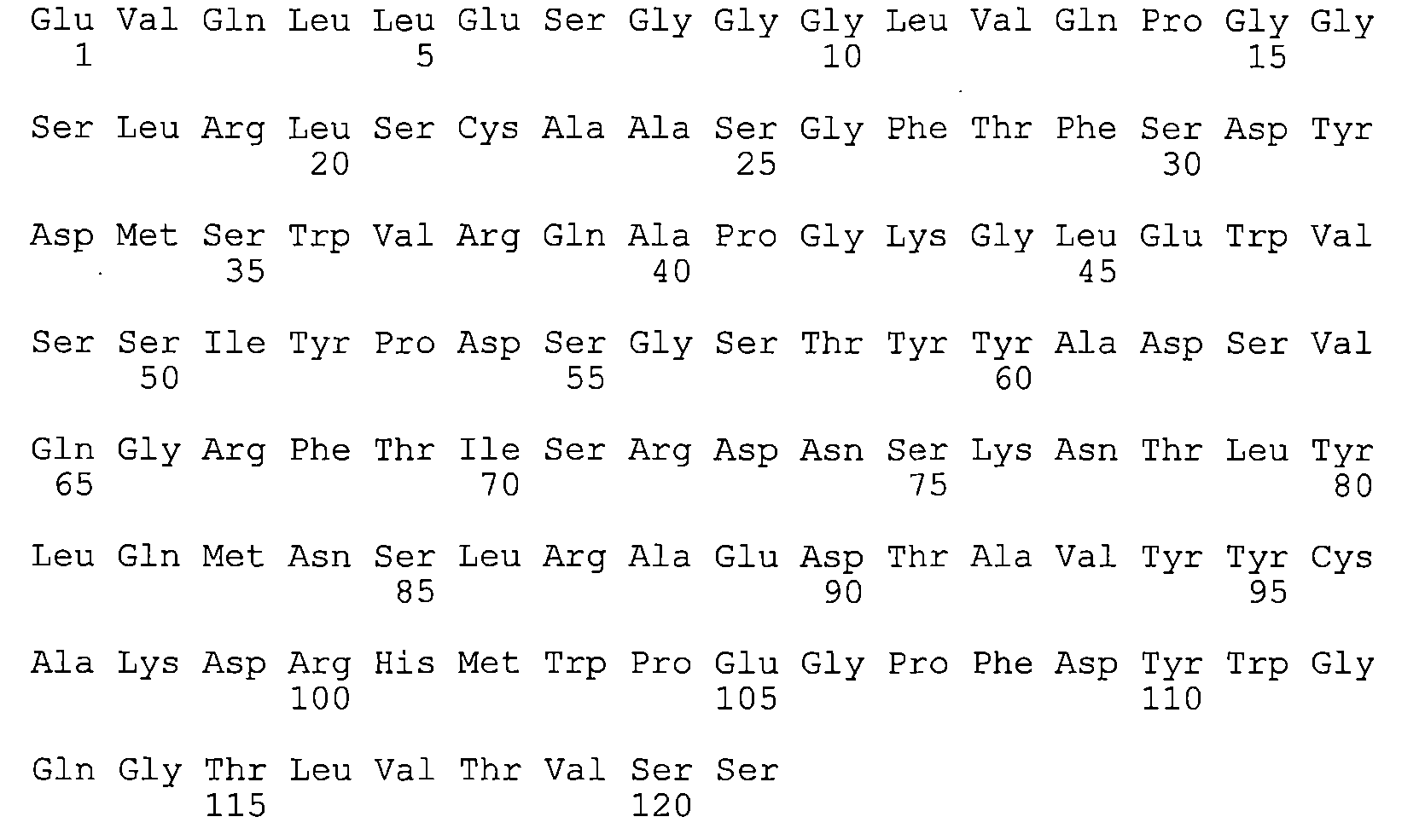
<400> 1

<210> 2 <210> 2
<211> 121 <211> 121
<212> PRT <212> PRT
<213> 人工序列 <213> Artificial sequence
<220> <220>
<223> 抗體442S1之重鏈可變異區域 <223> Heavy chain variability region of antibody 442S1
<400> 2


<210> 3 <210> 3
<211> 121 <211> 121
<212> PRT <212> PRT
<213> 人工序列 <213> Artificial sequence
<220> <220>
<223> 抗體442S2之重鏈可變異區域 <223> Heavy chain variability region of antibody 442S2
<400> 3

<210> 4 <210> 4
<211> 121 <211> 121
<212> PRT <212> PRT
<213> 人工序列 <213> Artificial sequence
<220> <220>
<223> 抗體442S4之重鏈可變異區域 <223> Heavy chain variability region of antibody 442S4
<400> 4


<210> 5 <210> 5
<211> 121 <211> 121
<212> PRT <212> PRT
<213> 人工序列 <213> Artificial sequence
<220> <220>
<223> 抗體442S5之重鏈可變異區域 <223> Heavy chain variability region of antibody 442S5
<400> 5

<210> 6 <210> 6
<211> 121 <211> 121
<212> PRT <212> PRT
<213> 人工序列 <213> Artificial sequence
<220> <220>
<223> 抗體442S6之重鏈可變異區域 <223> Heavy chain variability region of antibody 442S6
<400> 6


<210> 7 <210> 7
<211> 121 <211> 121
<212> PRT <212> PRT
<213> 人工序列 <213> Artificial sequence
<220> <220>
<223> 抗體442S9之重鏈可變異區域 <223> Heavy chain variability region of antibody 442S9
<400> 7
<210> 8 <210> 8
<211> 121 <211> 121
<212> PRT <212> PRT
<213> 人工序列 <213> Artificial sequence
<220> <220>
<223> 抗體442S10之重鏈可變異區域 <223> Heavy chain variability region of antibody 442S10
<400> 8


<210> 9 <210> 9
<211> 121 <211> 121
<212> PRT <212> PRT
<213> 人工序列 <213> Artificial sequence
<220> <220>
<223> 抗體442M3之重鏈可變異區域 <223> Heavy chain variability region of antibody 442M3
<400> 9

<210> 10 <210> 10
<211> 121 <211> 121
<212> PRT <212> PRT
<213> 人工序列 <213> Artificial sequence
<220> <220>
<223> 抗體442M4之重鏈可變異區域 <223> Heavy chain variability region of antibody 442M4
<400> 10


<210> 11 <210> 11
<211> 121 <211> 121
<212> PRT <212> PRT
<213> 人工序列 <213> Artificial sequence
<220> <220>
<223> 抗體442M5之重鏈可變異區域 <223> Heavy chain variability region of antibody 442M5
<400> 11

<210> 12 <210> 12
<211> 121 <211> 121
<212> PRT <212> PRT
<213> 人工序列 <213> Artificial sequence
<220> <220>
<223> 抗體442M6之重鏈可變異區域 <223> Heavy chain variability region of antibody 442M6
<400> 12


<210> 13 <210> 13
<211> 121 <211> 121
<212> PRT <212> PRT
<213> 人工序列 <213> Artificial sequence
<220> <220>
<223> 抗體442M7之重鏈可變異區域 <223> Heavy chain variability region of antibody 442M7
<400> 13

<210> 14 <210> 14
<211> 121 <211> 121
<212> PRT <212> PRT
<213> 人工序列 <213> Artificial sequence
<220> <220>
<223> 抗體442M8之重鏈可變異區域 <223> Heavy chain variability region of antibody 442M8
<400> 14


<210> 15 <210> 15
<211> 121 <211> 121
<212> PRT <212> PRT
<213> 人工序列 <213> Artificial sequence
<220> <220>
<223> 抗體442M10之重鏈可變異區域 <223> Heavy chain variability region of antibody 442M10
<400> 15

<210> 16 <210> 16
<211> 121 <211> 121
<212> PRT <212> PRT
<213> 人工序列 <213> Artificial sequence
<220> <220>
<223> 抗體442M11之重鏈可變異區域 <223> Heavy chain variability region of antibody 442M11
<400> 16


<210> 17 <210> 17
<211> 127 <211> 127
<212> PRT <212> PRT
<213> 人工序列 <213> Artificial sequence
<220> <220>
<223> 抗體472P之重鏈可變異區域 <223> Heavy chain variability region of antibody 472P
<400> 17

<210> 18 <210> 18
<211> 127 <211> 127
<212> PRT <212> PRT
<213> 人工序列 <213> Artificial sequence
<220> <220>
<223> 抗體472S1之重鏈可變異區域 <223> Heavy chain variability region of antibody 472S1
<400> 18


<210> 19 <210> 19
<211> 127 <211> 127
<212> PRT <212> PRT
<213> 人工序列 <213> Artificial sequence
<220> <220>
<223> 抗體472S2之重鏈可變異區域 <223> Heavy chain variability region of antibody 472S2
<400> 19

<210> 20 <210> 20
<211> 127 <211> 127
<212> PRT <212> PRT
<213> 人工序列 <213> Artificial sequence
<220> <220>
<223> 抗體472S3之重鏈可變異區域 <223> Heavy chain variability region of antibody 472S3
<400> 20


<210> 21 <210> 21
<211> 127 <211> 127
<212> PRT <212> PRT
<213> 人工序列 <213> Artificial sequence
<220> <220>
<223> 抗體472S4之重鏈可變異區域 <223> Heavy chain variability region of antibody 472S4
<400> 21

<210> 22 <210> 22
<211> 127 <211> 127
<212> PRT <212> PRT
<213> 人工序列 <213> Artificial sequence
<220> <220>
<223> 抗體472M1之重鏈可變異區域 <223> Heavy chain variability region of antibody 472M1
<400> 22


<210> 23 <210> 23
<211> 121 <211> 121
<212> PRT <212> PRT
<213> 人工序列 <213> Artificial sequence
<220> <220>
<223> 抗體451P之重鏈可變異區域 <223> Heavy chain variability region of antibody 451P
<400> 23

<210> 24 <210> 24
<211> 121 <211> 121
<212> PRT <212> PRT
<213> 人工序列 <213> Artificial sequence
<220> <220>
<223> 抗體451M1之重鏈可變異區域 <223> Heavy chain variability region of antibody 451M1
<400> 24


<210> 25 <210> 25
<211> 121 <211> 121
<212> PRT <212> PRT
<213> 人工序列 <213> Artificial sequence
<220> <220>
<223> 抗體451M2之重鏈可變異區域 <223> Heavy chain variability region of antibody 451M2
<400> 25

<210> 26 <210> 26
<211> 121 <211> 121
<212> PRT <212> PRT
<213> 人工序列 <213> Artificial sequence
<220> <220>
<223> 抗體451M3之重鏈可變異區域 <223> Heavy chain variability region of antibody 451M3
<400> 26


<210> 27 <210> 27
<211> 121 <211> 121
<212> PRT <212> PRT
<213> 人工序列 <213> Artificial sequence
<220> <220>
<223> 抗體451M4之重鏈可變異區域 <223> Heavy chain variability region of antibody 451M4
<400> 27

<210> 28 <210> 28
<211> 121 <211> 121
<212> PRT <212> PRT
<213> 人工序列 <213> Artificial sequence
<220> <220>
<223> 抗體451M5之重鏈可變異區域 <223> Heavy chain variability region of antibody 451M5
<400> 28


<210> 29 <210> 29
<211> 121 <211> 121
<212> PRT <212> PRT
<213> 人工序列 <213> Artificial sequence
<220> <220>
<223> 抗體451M6之重鏈可變異區域 <223> Heavy chain variability region of antibody 451M6
<400> 29

<210> 30 <210> 30
<211> 121 <211> 121
<212> PRT <212> PRT
<213> 人工序列 <213> Artificial sequence
<220> <220>
<223> 抗體451M7之重鏈可變異區域 <223> Heavy chain variability region of antibody 451M7
<400> 30


<210> 31 <210> 31
<211> 111 <211> 111
<212> PRT <212> PRT
<213> 人工序列 <213> Artificial sequence
<220> <220>
<223> 抗體442P之輕鏈可變異區域 <223> Light chain variable region of antibody 442P
<400> 31

<210> 32 <210> 32
<211> 111 <211> 111
<212> PRT <212> PRT
<213> 人工序列 <213> Artificial sequence
<220> <220>
<223> 抗體442S1之輕鏈可變異區域 <223> Light chain variable region of antibody 442S1
<400> 32


<210> 33 <210> 33
<211> 111 <211> 111
<212> PRT <212> PRT
<213> 人工序列 <213> Artificial sequence
<220> <220>
<223> 抗體442S2之輕鏈可變異區域 <223> Light chain variability region of antibody 442S2
<400> 33

<210> 34 <210> 34
<211> 111 <211> 111
<212> PRT <212> PRT
<213> 人工序列 <213> Artificial sequence
<220> <220>
<223> 抗體442S4之輕鏈可變異區域 <223> Light chain variable region of antibody 442S4
<400> 34

<210> 35 <210> 35
<211> 111 <211> 111
<212> PRT <212> PRT
<213> 人工序列 <213> Artificial sequence
<220> <220>
<223> 抗體442S5之輕鏈可變異區域 <223> Light chain variability region of antibody 442S5
<400> 35

<210> 36 <210> 36
<211> 111 <211> 111
<212> PRT <212> PRT
<213> 人工序列 <213> Artificial sequence
<220> <220>
<223> 抗體442S6之輕鏈可變異區域 <223> Light chain variable region of antibody 442S6
<400> 36

<210> 37 <210> 37
<211> 111 <211> 111
<212> PRT <212> PRT
<213> 人工序列 <213> Artificial sequence
<220> <220>
<223> 抗體442S9之輕鏈可變異區域 <223> Light chain variable region of antibody 442S9
<400> 37

<210> 38 <210> 38
<211> 111 <211> 111
<212> PRT <212> PRT
<213> 人工序列 <213> Artificial sequence
<220> <220>
<223> 抗體442S10之輕鏈可變異區域 <223> Light chain variability region of antibody 442S10
<400> 38

<210> 39 <210> 39
<211> 111 <211> 111
<212> PRT <212> PRT
<213> 人工序列 <213> Artificial sequence
<220> <220>
<223> 抗體442M3之輕鏈可變異區域 <223> Light chain variability region of antibody 442M3
<400> 39

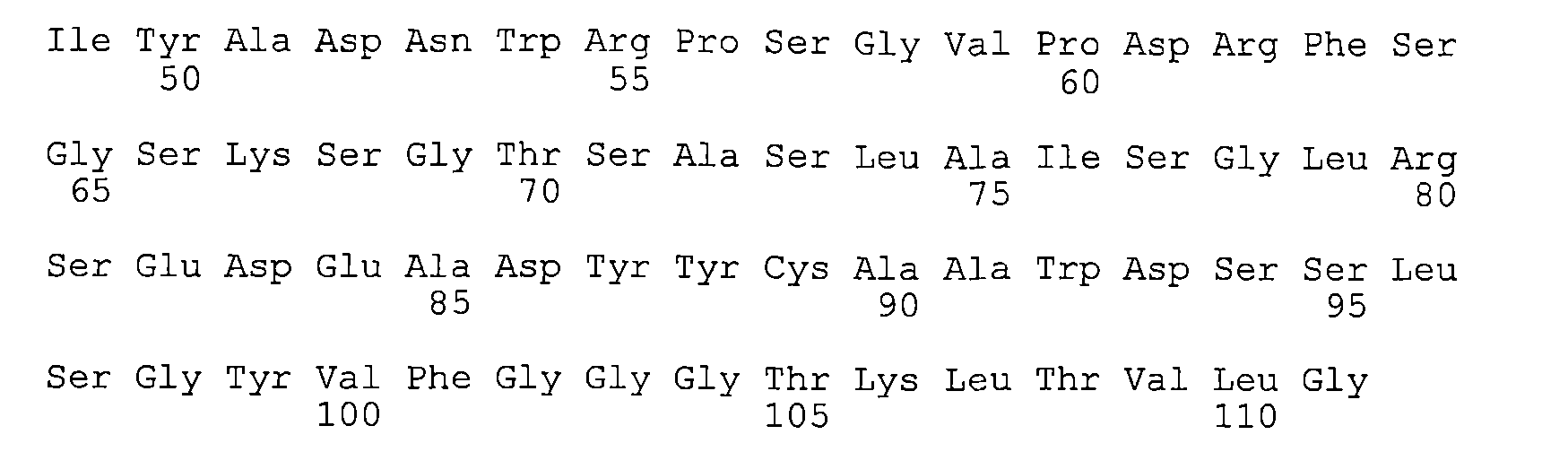
<210> 40 <210> 40
<211> 111 <211> 111
<212> PRT <212> PRT
<213> 人工序列 <213> Artificial sequence
<220> <220>
<223> 抗體442M4之輕鏈可變異區域 <223> Light chain variability region of antibody 442M4
<400> 40

<210> 41 <210> 41
<211> 111 <211> 111
<212> PRT <212> PRT
<213> 人工序列 <213> Artificial sequence
<220> <220>
<223> 抗體442M5之輕鏈可變異區域 <223> Light chain variability region of antibody 442M5
<400> 41


<210> 42 <210> 42
<211> 111 <211> 111
<212> PRT <212> PRT
<213> 人工序列 <213> Artificial sequence
<220> <220>
<223> 抗體442M6之輕鏈可變異區域 <223> Light chain variability region of antibody 442M6
<400> 42

<210> 43 <210> 43
<211> 111 <211> 111
<212> PRT <212> PRT
<213> 人工序列 <213> Artificial sequence
<220> <220>
<223> 抗體442M7之輕鏈可變異區域 <223> Light chain variable region of antibody 442M7
<400> 43

<210> 44 <210> 44
<211> 111 <211> 111
<212> PRT <212> PRT
<213> 人工序列 <213> Artificial sequence
<220> <220>
<223> 抗體442M8之輕鏈可變異區域 <223> Light chain variable region of antibody 442M8
<400> 44

<210> 45 <210> 45
<211> 111 <211> 111
<212> PRT <212> PRT
<213> 人工序列 <213> Artificial sequence
<220> <220>
<223> 抗體442M10之輕鏈可變異區域 <223> Light chain variable region of antibody 442M10
<400> 45

<210> 46 <210> 46
<211> 111 <211> 111
<212> PRT <212> PRT
<213> 人工序列 <213> Artificial sequence
<220> <220>
<223> 抗體442M11之輕鏈可變異區域 <223> Light chain variable region of antibody 442M11
<400> 46

<210> 47 <210> 47
<211> 111 <211> 111
<212> PRT <212> PRT
<213> 人工序列 <213> Artificial sequence
<220> <220>
<223> 抗體472P之輕鏈可變異區域 <223> Light chain variable region of antibody 472P
<400> 47

<210> 48 <210> 48
<211> 111 <211> 111
<212> PRT <212> PRT
<213> 人工序列 <213> Artificial sequence
<220> <220>
<223> 抗體472S1之輕鏈可變異區域 <223> Light chain variability region of antibody 472S1
<400> 48


<210> 49 <210> 49
<211> 111 <211> 111
<212> PRT <212> PRT
<213> 人工序列 <213> Artificial sequence
<220> <220>
<223> 抗體472S2之輕鏈可變異區域 <223> Light chain variable region of antibody 472S2
<400> 49

<210> 50 <210> 50
<211> 111 <211> 111
<212> PRT <212> PRT
<213> 人工序列 <213> Artificial sequence
<220> <220>
<223> 抗體472S3之輕鏈可變異區域 <223> Light chain variable region of antibody 472S3
<400> 50


<210> 51 <210> 51
<211> 111 <211> 111
<212> PRT <212> PRT
<213> 人工序列 <213> Artificial sequence
<220> <220>
<223> 抗體472S4之輕鏈可變異區域 <223> Light chain variability region of antibody 472S4
<400> 51

<210> 52 <210> 52
<211> 111 <211> 111
<212> PRT <212> PRT
<213> 人工序列 <213> Artificial sequence
<220> <220>
<223> 抗體472M1之輕鏈可變異區域 <223> Light chain variable region of antibody 472M1
<400> 52


<210> 53 <210> 53
<211> 111 <211> 111
<212> PRT <212> PRT
<213> 人工序列 <213> Artificial sequence
<220> <220>
<223> 抗體451P之輕鏈可變異區域 <223> Light chain variable region of antibody 451P
<400> 53

<210> 54 <210> 54
<211> 111 <211> 111
<212> PRT <212> PRT
<213> 人工序列 <213> Artificial sequence
<220> <220>
<223> 抗體451M1之輕鏈可變異區域 <223> Light chain variable region of antibody 451M1
<400> 54

<210> 55 <210> 55
<211> 111 <211> 111
<212> PRT <212> PRT
<213> 人工序列 <213> Artificial sequence
<220> <220>
<223> 抗體451M2之輕鏈可變異區域 <223> Light chain variable region of antibody 451M2
<400> 55
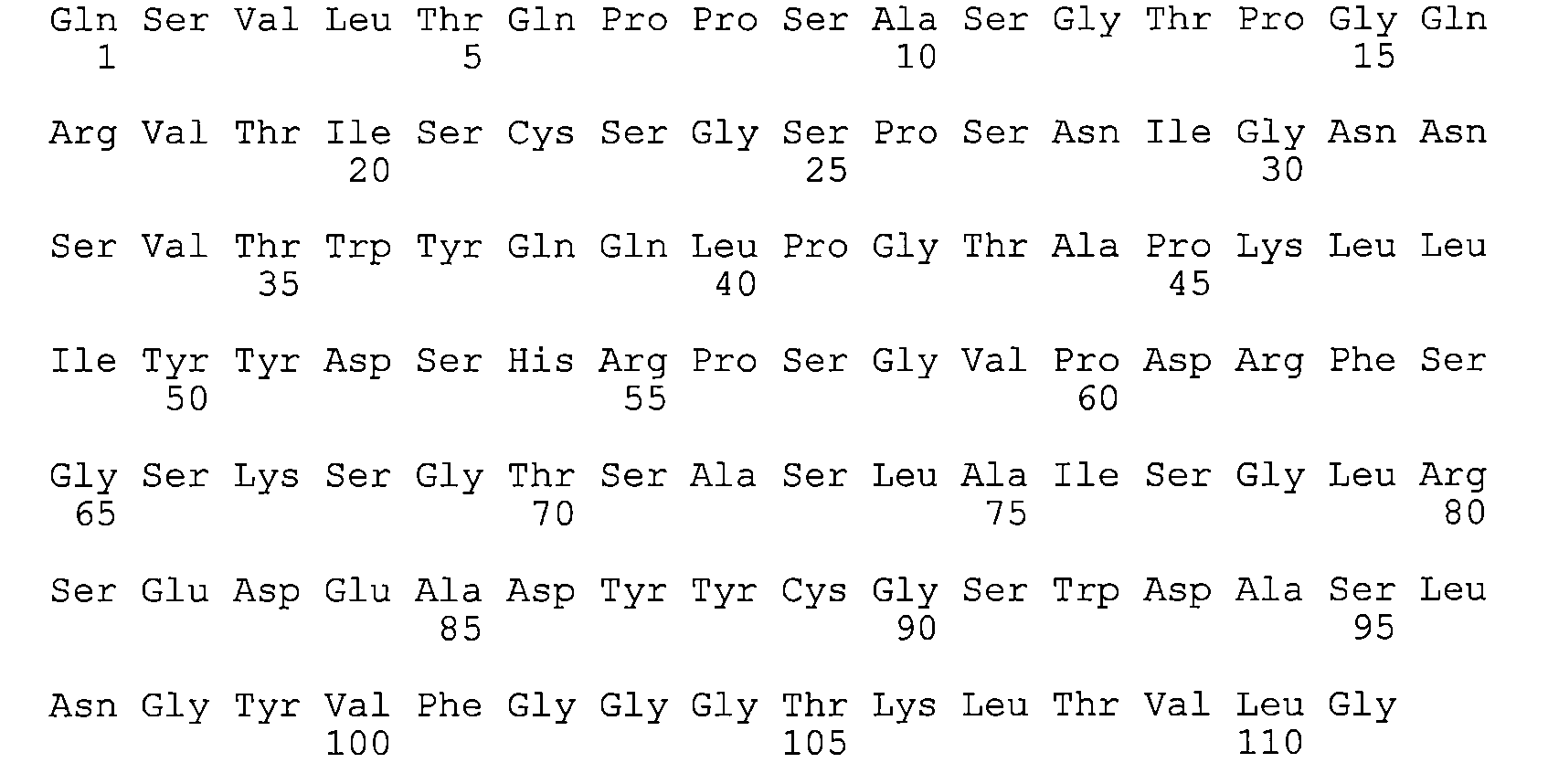
<210> 56 <210> 56
<211> 111 <211> 111
<212> PRT <212> PRT
<213> 人工序列 <213> Artificial sequence
<223> 抗體451M3之輕鏈可變異區域 <223> Light chain variable region of antibody 451M3
<400> 56

<210> 57 <210> 57
<211> 111 <211> 111
<212> PRT <212> PRT
<213> 人工序列 <213> Artificial sequence
<220> <220>
<223> 抗體451M4之輕鏈可變異區域 <223> Light chain variable region of antibody 451M4
<400> 57

<210> 58 <210> 58
<211> 111 <211> 111
<212> PRT <212> PRT
<213> 人工序列 <213> Artificial sequence
<220> <220>
<223> 抗體451M5之輕鏈可變異區域 <223> Light chain variable region of antibody 451M5
<400> 58
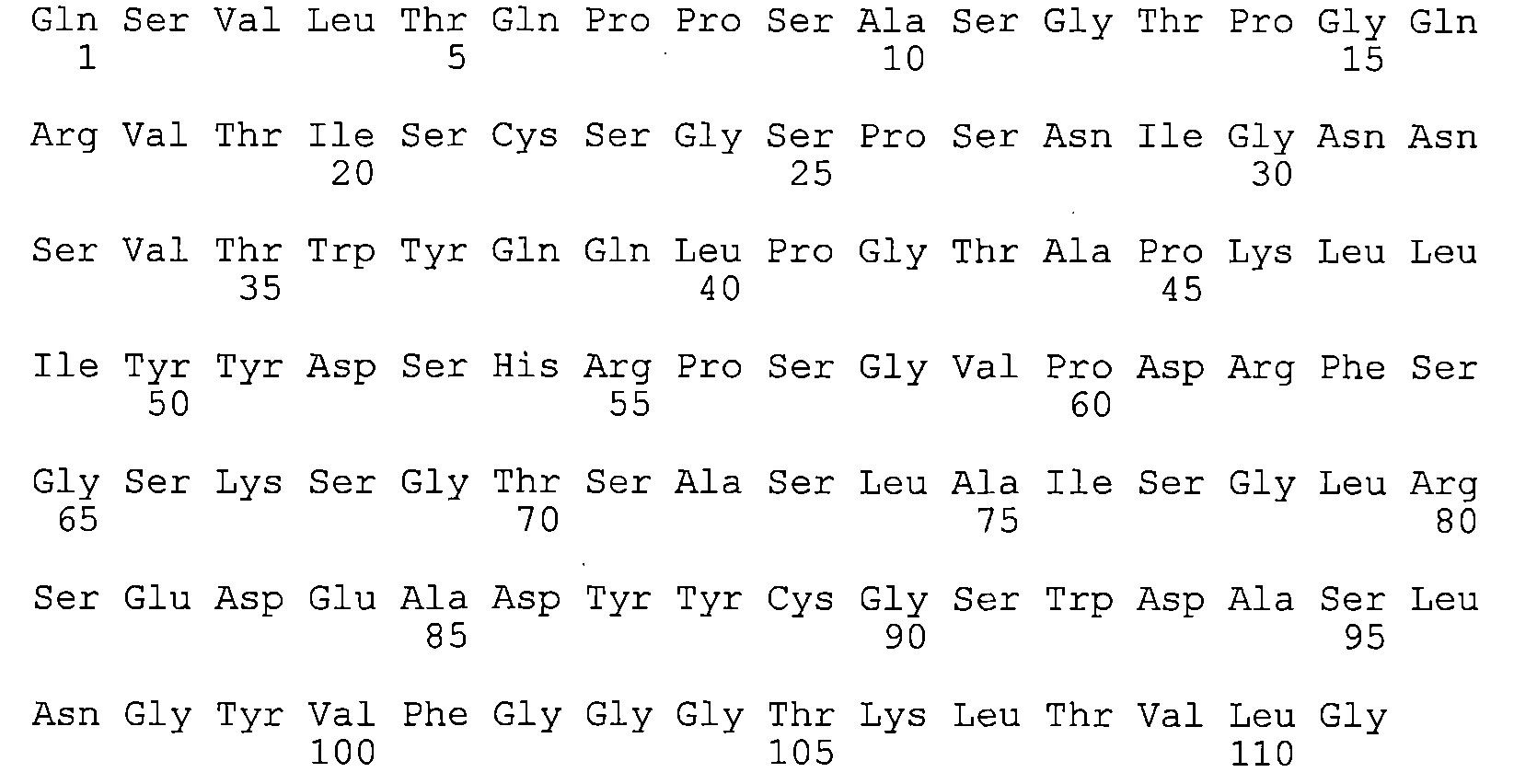
<210> 59 <210> 59
<211> 111 <211> 111
<212> PRT <212> PRT
<213> 人工序列 <213> Artificial sequence
<220> <220>
<223> 抗體451M6之輕鏈可變異區域 <223> Light chain variable region of antibody 451M6
<400> 59


<210> 60 <210> 60
<211> 111 <211> 111
<212> PRT <212> PRT
<213> 人工序列 <213> Artificial sequence
<220> <220>
<223> 抗體451M7之輕鏈可變異區域 <223> Light chain variable region of antibody 451M7
<400> 60

<210> 61 <210> 61
<211> 5 <211> 5
<212> PRT <212> PRT
<213> 人工序列 <213> Artificial sequence
<220> <220>
<223> 重鏈CDR1 <223> Heavy chain CDR1
<400> 61

<210> 62 <210> 62
<211> 5 <211> 5
<212> PRT <212> PRT
<213> 人工序列 <213> Artificial sequence
<220> <220>
<223> 重鏈CDR1 <223> Heavy chain CDR1
<400> 62

<210> 63 <210> 63
<211> 5 <211> 5
<212> PRT <212> PRT
<213> 人工序列 <213> Artificial sequence
<220> <220>
<223> 重鏈CDR1 <223> Heavy chain CDR1
<400> 63

<210> 64 <210> 64
<211> 5 <211> 5
<212> PRT <212> PRT
<213> 人工序列 <213> Artificial sequence
<220> <220>
<223> 重鏈CDR1 <223> Heavy chain CDR1
<400> 64

<210> 65 <210> 65
<211> 5 <211> 5
<212> PRT <212> PRT
<213> 人工序列 <213> Artificial sequence
<220> <220>
<223> 重鏈CDR1 <223> Heavy chain CDR1
<400> 65

<210> 66 <210> 66
<211> 5 <211> 5
<212> PRT <212> PRT
<213> 人工序列 <213> Artificial sequence
<220> <220>
<223> 重鏈CDR1 <223> Heavy chain CDR1
<400> 66

<210> 67 <210> 67
<211> 5 <211> 5
<212> PRT <212> PRT
<213> 人工序列 <213> Artificial sequence
<220> <220>
<223> 重鏈CDR1 <223> Heavy chain CDR1
<400> 67

<210> 68 <210> 68
<211> 5 <211> 5
<212> PRT <212> PRT
<213> 人工序列 <213> Artificial sequence
<220> <220>
<223> 重鏈CDR1 <223> Heavy chain CDR1
<400> 68

<210> 69 <210> 69
<211> 17 <211> 17
<212> PRT <212> PRT
<213> 人工序列 <213> Artificial sequence
<220> <220>
<223> 重鏈CDR2 <223> Heavy chain CDR2
<400> 69

<210> 70 <210> 70
<211> 17 <211> 17
<212> PRT <212> PRT
<213> 人工序列 <213> Artificial sequence
<220> <220>
<223> 重鏈CDR2 <223> Heavy chain CDR2
<400> 70

<210> 71 <210> 71
<211> 17 <211> 17
<212> PRT <212> PRT
<213> 人工序列 <213> Artificial sequence
<220> <220>
<223> 重鏈CDR2 <223> Heavy chain CDR2
<400> 71

<210> 72 <210> 72
<211> 17 <211> 17
<212> PRT <212> PRT
<213> 人工序列 <213> Artificial sequence
<220> <220>
<223> 重鏈CDR2 <223> Heavy chain CDR2
<400> 72

<210> 73 <210> 73
<211> 17 <211> 17
<212> PRT <212> PRT
<213> 人工序列 <213> Artificial sequence
<220> <220>
<223> 重鏈CDR2 <223> Heavy chain CDR2
<400> 73

<210> 74 <210> 74
<211> 17 <211> 17
<212> PRT <212> PRT
<213> 人工序列 <213> Artificial sequence
<220> <220>
<223> 重鏈CDR2 <223> Heavy chain CDR2
<400> 74

<210> 75 <210> 75
<211> 17 <211> 17
<212> PRT <212> PRT
<213> 人工序列 <213> Artificial sequence
<220> <220>
<223> 重鏈CDR2 <223> Heavy chain CDR2
<400> 75

<210> 76 <210> 76
<211> 17 <211> 17
<212> PRT <212> PRT
<213> 人工序列 <213> Artificial sequence
<220> <220>
<223> 重鏈CDR2 <223> Heavy chain CDR2
<400> 76

<210> 77 <210> 77
<211> 17 <211> 17
<212> PRT <212> PRT
<213> 人工序列 <213> Artificial sequence
<220> <220>
<223> 重鏈CDR2 <223> Heavy chain CDR2
<400> 77

<210> 78 <210> 78
<211> 12 <211> 12
<212> PRT <212> PRT
<213> 人工序列 <213> Artificial sequence
<220> <220>
<223> 重鏈CDR3 <223> Heavy chain CDR3
<400> 78

<210> 79 <210> 79
<211> 12 <211> 12
<212> PRT <212> PRT
<213> 人工序列 <213> Artificial sequence
<220> <220>
<223> 重鏈CDR3 <223> Heavy chain CDR3
<400> 79

<210> 80 <210> 80
<211> 12 <211> 12
<212> PRT <212> PRT
<213> 人工序列 <213> Artificial sequence
<220> <220>
<223> 重鏈CDR3 <223> Heavy chain CDR3
<400> 80

<210> 81 <210> 81
<211> 18 <211> 18
<212> PRT <212> PRT
<213> 人工序列 <213> Artificial sequence
<220> <220>
<223> 重鏈CDR3 <223> Heavy chain CDR3
<400> 81

<210> 82 <210> 82
<211> 12 <211> 12
<212> PRT <212> PRT
<213> 人工序列 <213> Artificial sequence
<220> <220>
<223> 重鏈CDR3 <223> Heavy chain CDR3
<400> 82

<210> 83 <210> 83
<211> 12 <211> 12
<212> PRT <212> PRT
<213> 人工序列 <213> Artificial sequence
<220> <220>
<223> 重鏈CDR3 <223> Heavy chain CDR3
<400> 83

<210> 84 <210> 84
<211> 12 <211> 12
<212> PRT <212> PRT
<213> 人工序列 <213> Artificial sequence
<220> <220>
<223> 重鏈CDR3 <223> Heavy chain CDR3
<400> 84

<210> 85 <210> 85
<211> 12 <211> 12
<212> PRT <212> PRT
<213> 人工序列 <213> Artificial sequence
<220> <220>
<223> 重鏈CDR3 <223> Heavy chain CDR3
<400> 85

<210> 86 <210> 86
<211> 13 <211> 13
<212> PRT <212> PRT
<213> 人工序列 <213> Artificial sequence
<220> <220>
<223> 輕鏈CDR1 <223> Light Chain CDR1
<400> 86

<210> 87 <210> 87
<211> 13 <211> 13
<212> PRT <212> PRT
<213> 人工序列 <213> Artificial sequence
<220> <220>
<223> 輕鏈CDR1 <223> Light Chain CDR1
<400> 87

<210> 88 <210> 88
<211> 7 <211> 7
<212> PRT <212> PRT
<213> 人工序列 <213> Artificial sequence
<220> <220>
<223> 輕鏈CDR2 <223> Light Chain CDR2
<400> 88

<210> 89 <210> 89
<211> 7 <211> 7
<212> PRT <212> PRT
<213> 人工序列 <213> Artificial sequence
<220> <220>
<223> 輕鏈CDR2 <223> Light Chain CDR2
<400> 89

<210> 90 <210> 90
<211> 7 <211> 7
<212> PRT <212> PRT
<213> 人工序列 <213> Artificial sequence
<220> <220>
<223> 輕鏈CDR2 <223> Light Chain CDR2
<400> 90

<210> 91 <210> 91
<211> 7 <211> 7
<212> PRT <212> PRT
<213> 人工序列 <213> Artificial sequence
<220> <220>
<223> 輕鏈CDR2 <223> Light Chain CDR2
<400> 91

<210> 92 <210> 92
<211> 7 <211> 7
<212> PRT <212> PRT
<213> 人工序列 <213> Artificial sequence
<220> <220>
<223> 輕鏈CDR2 <223> Light Chain CDR2
<400> 92

<210> 93 <210> 93
<211> 7 <211> 7
<212> PRT <212> PRT
<213> 人工序列 <213> Artificial sequence
<220> <220>
<223> 輕鏈CDR2 <223> Light Chain CDR2
<400> 93

<210> 94 <210> 94
<211> 11 <211> 11
<212> PRT <212> PRT
<213> 人工序列 <213> Artificial sequence
<220> <220>
<223> 輕鏈CDR3 <223> Light Chain CDR3
<400> 94

<210> 95 <210> 95
<211> 11 <211> 11
<212> PRT <212> PRT
<213> 人工序列 <213> Artificial sequence
<220> <220>
<223> 輕鏈CDR3 <223> Light Chain CDR3
<400> 95

<210> 96 <210> 96
<211> 11 <211> 11
<212> PRT <212> PRT
<213> 人工序列 <213> Artificial sequence
<220> <220>
<223> 輕鏈CDR3 <223> Light Chain CDR3
<400> 96

<210> 97 <210> 97
<211> 11 <211> 11
<212> PRT <212> PRT
<213> 人工序列 <213> Artificial sequence
<220> <220>
<223> 輕鏈CDR3 <223> Light Chain CDR3
<400> 97

<210> 98 <210> 98
<211> 11 <211> 11
<212> PRT <212> PRT
<213> 人工序列 <213> Artificial sequence
<220> <220>
<223> 輕鏈CDR3 <223> Light Chain CDR3
<400> 98

<210> 99 <210> 99
<211> 11 <211> 11
<212> PRT <212> PRT
<213> 人工序列 <213> Artificial sequence
<223> 輕鏈CDR3 <223> Light Chain CDR3
<400> 99

<210> 100 <210> 100
<211> 11 <211> 11
<212> PRT <212> PRT
<213> 人工序列 <213> Artificial sequence
<223> 輕鏈CDR3 <223> Light Chain CDR3
<400> 100

<210> 101 <210> 101
<211> 11 <211> 11
<212> PRT <212> PRT
<213> 人工序列 <213> Artificial sequence
<223> 輕鏈CDR3 <223> Light Chain CDR3
<400> 101

Claims (18)
Applications Claiming Priority (2)
| Application Number | Priority Date | Filing Date | Title |
|---|---|---|---|
| KR1020150173281A KR101746152B1 (en) | 2015-12-07 | 2015-12-07 | Antibody specifically binding to ErbB3 and use thereof |
| ??10-2015-0173281 | 2015-12-07 |
Publications (2)
| Publication Number | Publication Date |
|---|---|
| TW201726742A TW201726742A (en) | 2017-08-01 |
| TWI615406B true TWI615406B (en) | 2018-02-21 |
Family
ID=59013461
Family Applications (1)
| Application Number | Title | Priority Date | Filing Date |
|---|---|---|---|
| TW105140259A TWI615406B (en) | 2015-12-07 | 2016-12-06 | Antibody specifically binding to erbb3 and use thereof |
Country Status (14)
| Country | Link |
|---|---|
| US (1) | US10413607B2 (en) |
| EP (2) | EP3362480B1 (en) |
| JP (2) | JP6982574B2 (en) |
| KR (1) | KR101746152B1 (en) |
| CN (2) | CN107683292B (en) |
| AR (1) | AR107012A1 (en) |
| AU (1) | AU2016365506B2 (en) |
| CA (1) | CA3000835C (en) |
| ES (1) | ES2891990T3 (en) |
| MX (1) | MX394911B (en) |
| PL (1) | PL3362480T3 (en) |
| RU (1) | RU2707121C9 (en) |
| TW (1) | TWI615406B (en) |
| WO (1) | WO2017099362A1 (en) |
Families Citing this family (2)
| Publication number | Priority date | Publication date | Assignee | Title |
|---|---|---|---|---|
| KR102302393B1 (en) * | 2018-10-17 | 2021-09-16 | 주식회사 굳티셀 | Binding molecule specific to lrig-1 protein and use thereof |
| US12551584B1 (en) | 2020-12-07 | 2026-02-17 | Actinium Pharmaceuticals, Inc. | Lewis Y radioimmunotherapy for the treatment of cancer |
Citations (1)
| Publication number | Priority date | Publication date | Assignee | Title |
|---|---|---|---|---|
| TW201329103A (en) * | 2011-09-30 | 2013-07-16 | Regeneron Pharma | anti-ErbB3 antibody and use thereof |
Family Cites Families (10)
| Publication number | Priority date | Publication date | Assignee | Title |
|---|---|---|---|---|
| KR0173281B1 (en) | 1996-11-30 | 1999-02-18 | 양재신 | Lamp angle control device |
| KR101598229B1 (en) * | 2007-02-16 | 2016-02-26 | 메리맥 파마슈티컬즈, 인크. | Antibodies to ERBB3 and uses thereof |
| MX2010011145A (en) * | 2008-04-11 | 2011-04-11 | Merrimack Pharmaceuticals Inc | Human serum albumin linkers and conjugates thereof. |
| WO2010059315A1 (en) | 2008-11-18 | 2010-05-27 | Merrimack Pharmaceuticals, Inc. | Human serum albumin linkers and conjugates thereof |
| KR101798679B1 (en) | 2010-03-11 | 2017-11-16 | 메리맥 파마슈티컬즈, 인크. | Use of erbb3 inhibitors in the treatment of triple negative and basal-like breast cancers |
| MX343227B (en) * | 2010-04-09 | 2016-10-28 | Aveo Pharmaceuticals Inc | ANTI-ERBB3 ANTIBODIES. |
| AU2011290672B2 (en) | 2010-08-20 | 2015-07-09 | Novartis Ag | Antibodies for epidermal growth factor receptor 3 (HER3) |
| JPWO2012176779A1 (en) | 2011-06-20 | 2015-02-23 | 協和発酵キリン株式会社 | Anti-erbB3 antibody |
| US9273143B2 (en) | 2011-09-30 | 2016-03-01 | Regeneron Pharmaceuticals, Inc. | Methods and compositions comprising a combination of an anti-ErbB3 antibody and an anti-EGFR antibody |
| US11305012B2 (en) | 2013-09-24 | 2022-04-19 | Medimmune, Llc | Binding molecules specific for HER3 and uses thereof |
-
2015
- 2015-12-07 KR KR1020150173281A patent/KR101746152B1/en active Active
-
2016
- 2016-11-02 AU AU2016365506A patent/AU2016365506B2/en active Active
- 2016-11-02 EP EP16873228.7A patent/EP3362480B1/en active Active
- 2016-11-02 PL PL16873228T patent/PL3362480T3/en unknown
- 2016-11-02 JP JP2018542089A patent/JP6982574B2/en active Active
- 2016-11-02 MX MX2018004228A patent/MX394911B/en unknown
- 2016-11-02 CN CN201680021403.1A patent/CN107683292B/en active Active
- 2016-11-02 CA CA3000835A patent/CA3000835C/en active Active
- 2016-11-02 EP EP20196712.2A patent/EP3778647B1/en active Active
- 2016-11-02 CN CN202011145330.1A patent/CN112472804B/en active Active
- 2016-11-02 US US15/563,227 patent/US10413607B2/en active Active
- 2016-11-02 WO PCT/KR2016/012545 patent/WO2017099362A1/en not_active Ceased
- 2016-11-02 RU RU2018113269A patent/RU2707121C9/en active
- 2016-11-02 ES ES16873228T patent/ES2891990T3/en active Active
- 2016-12-06 TW TW105140259A patent/TWI615406B/en active
- 2016-12-07 AR ARP160103758A patent/AR107012A1/en unknown
-
2020
- 2020-03-19 JP JP2020049129A patent/JP6989645B2/en active Active
Patent Citations (1)
| Publication number | Priority date | Publication date | Assignee | Title |
|---|---|---|---|---|
| TW201329103A (en) * | 2011-09-30 | 2013-07-16 | Regeneron Pharma | anti-ErbB3 antibody and use thereof |
Also Published As
| Publication number | Publication date |
|---|---|
| US20180085455A1 (en) | 2018-03-29 |
| MX394911B (en) | 2025-03-24 |
| WO2017099362A1 (en) | 2017-06-15 |
| CA3000835A1 (en) | 2017-06-15 |
| CN112472804B (en) | 2024-07-23 |
| AU2016365506B2 (en) | 2019-06-20 |
| RU2707121C9 (en) | 2020-06-16 |
| RU2018113269A (en) | 2019-10-18 |
| AR107012A1 (en) | 2018-03-14 |
| EP3778647A1 (en) | 2021-02-17 |
| ES2891990T3 (en) | 2022-02-01 |
| JP6982574B2 (en) | 2021-12-17 |
| EP3362480B1 (en) | 2021-08-04 |
| JP2018536026A (en) | 2018-12-06 |
| AU2016365506A1 (en) | 2018-04-12 |
| CN112472804A (en) | 2021-03-12 |
| KR101746152B1 (en) | 2017-06-13 |
| PL3362480T3 (en) | 2022-01-03 |
| JP2020117512A (en) | 2020-08-06 |
| EP3362480A4 (en) | 2019-06-05 |
| RU2018113269A3 (en) | 2019-10-18 |
| US10413607B2 (en) | 2019-09-17 |
| MX2018004228A (en) | 2018-05-15 |
| CN107683292A (en) | 2018-02-09 |
| CA3000835C (en) | 2020-06-09 |
| TW201726742A (en) | 2017-08-01 |
| AU2016365506A9 (en) | 2018-11-01 |
| JP6989645B2 (en) | 2022-01-05 |
| EP3778647B1 (en) | 2026-02-25 |
| RU2707121C2 (en) | 2019-11-22 |
| CN107683292B (en) | 2021-06-08 |
| EP3362480A1 (en) | 2018-08-22 |
| BR112018006900A2 (en) | 2018-10-16 |
Similar Documents
| Publication | Publication Date | Title |
|---|---|---|
| JP6967853B2 (en) | Antibodies that bind to ErbB-2 and ErbB-3 | |
| US9994632B2 (en) | Humanized or affinity-matured anti Ang-2 antibody and uses thereof | |
| Ko et al. | Combination of novel HER2-targeting antibody 1E11 with trastuzumab shows synergistic antitumor activity in HER2-positive gastric cancer | |
| US20230398229A1 (en) | Antibody drug conjugates comprising sting agonists, combinations and methods of use | |
| US12053530B2 (en) | Plectin-1 binding antibodies and uses thereof | |
| TWI615406B (en) | Antibody specifically binding to erbb3 and use thereof | |
| JP2021500320A (en) | Combination drug for the treatment of cancer | |
| CN119587691A (en) | Anti-HER2 antibody-drug conjugate combined with anti-HER2 antibody for the treatment of tumors | |
| JP7304815B2 (en) | ERBB-2 targeting agents comprising antigen binding sites that bind to epitopes on the extracellular portion of ERB-2 and ERBB-3 for the treatment of individuals with ERBB-2, ERBB-2/ERBB-3 positive tumors and bispecific antibodies | |
| KR101927732B1 (en) | Pharmaceutical composition including antibody specifically binding to ErbB3 for preventing or treating drug-resistance cancer and method using the same | |
| BR112018006900B1 (en) | ANTIBODY OR AN ANTIGEN-LIGANT FRAGMENT THEREOF THAT SPECIFICALLY BIDS TO ERBB3, AND PHARMACEUTICAL COMPOSITION FOR THE TREATMENT OF A DISEASE RELATED TO THE ACTIVATION OR OVEREXPRESSION OF THE ERBB3 PROTEIN | |
| WO2024213081A1 (en) | Use of antibody-drug conjugate in preparation of drug for preventing and/or treating cancer | |
| WO2022144025A1 (en) | Anti-erbb3 receptor antibody or antigen-binding fragment thereof, and medical use thereof |