TWI867066B - Antibodies targeting flt3 and use thereof - Google Patents
Antibodies targeting flt3 and use thereof Download PDFInfo
- Publication number
- TWI867066B TWI867066B TW109135527A TW109135527A TWI867066B TW I867066 B TWI867066 B TW I867066B TW 109135527 A TW109135527 A TW 109135527A TW 109135527 A TW109135527 A TW 109135527A TW I867066 B TWI867066 B TW I867066B
- Authority
- TW
- Taiwan
- Prior art keywords
- seq
- amino acid
- antigen binding
- binding site
- cdr3
- Prior art date
Links
Classifications
-
- C—CHEMISTRY; METALLURGY
- C07—ORGANIC CHEMISTRY
- C07K—PEPTIDES
- C07K16/00—Immunoglobulins [IG], e.g. monoclonal or polyclonal antibodies
- C07K16/18—Immunoglobulins [IG], e.g. monoclonal or polyclonal antibodies against material from animals or humans
- C07K16/28—Immunoglobulins [IG], e.g. monoclonal or polyclonal antibodies against material from animals or humans against receptors, cell surface antigens or cell surface determinants
- C07K16/2863—Immunoglobulins [IG], e.g. monoclonal or polyclonal antibodies against material from animals or humans against receptors, cell surface antigens or cell surface determinants against receptors for growth factors, growth regulators
-
- A—HUMAN NECESSITIES
- A61—MEDICAL OR VETERINARY SCIENCE; HYGIENE
- A61P—SPECIFIC THERAPEUTIC ACTIVITY OF CHEMICAL COMPOUNDS OR MEDICINAL PREPARATIONS
- A61P35/00—Antineoplastic agents
-
- A—HUMAN NECESSITIES
- A61—MEDICAL OR VETERINARY SCIENCE; HYGIENE
- A61P—SPECIFIC THERAPEUTIC ACTIVITY OF CHEMICAL COMPOUNDS OR MEDICINAL PREPARATIONS
- A61P35/00—Antineoplastic agents
- A61P35/02—Antineoplastic agents specific for leukemia
-
- C—CHEMISTRY; METALLURGY
- C07—ORGANIC CHEMISTRY
- C07K—PEPTIDES
- C07K14/00—Peptides having more than 20 amino acids; Gastrins; Somatostatins; Melanotropins; Derivatives thereof
- C07K14/435—Peptides having more than 20 amino acids; Gastrins; Somatostatins; Melanotropins; Derivatives thereof from animals; from humans
- C07K14/705—Receptors; Cell surface antigens; Cell surface determinants
- C07K14/70503—Immunoglobulin superfamily
- C07K14/7051—T-cell receptor (TcR)-CD3 complex
-
- A—HUMAN NECESSITIES
- A61—MEDICAL OR VETERINARY SCIENCE; HYGIENE
- A61K—PREPARATIONS FOR MEDICAL, DENTAL OR TOILETRY PURPOSES
- A61K39/00—Medicinal preparations containing antigens or antibodies
- A61K2039/505—Medicinal preparations containing antigens or antibodies comprising antibodies
-
- C—CHEMISTRY; METALLURGY
- C07—ORGANIC CHEMISTRY
- C07K—PEPTIDES
- C07K2317/00—Immunoglobulins specific features
- C07K2317/20—Immunoglobulins specific features characterized by taxonomic origin
- C07K2317/24—Immunoglobulins specific features characterized by taxonomic origin containing regions, domains or residues from different species, e.g. chimeric, humanized or veneered
-
- C—CHEMISTRY; METALLURGY
- C07—ORGANIC CHEMISTRY
- C07K—PEPTIDES
- C07K2317/00—Immunoglobulins specific features
- C07K2317/30—Immunoglobulins specific features characterized by aspects of specificity or valency
- C07K2317/31—Immunoglobulins specific features characterized by aspects of specificity or valency multispecific
-
- C—CHEMISTRY; METALLURGY
- C07—ORGANIC CHEMISTRY
- C07K—PEPTIDES
- C07K2317/00—Immunoglobulins specific features
- C07K2317/30—Immunoglobulins specific features characterized by aspects of specificity or valency
- C07K2317/33—Crossreactivity, e.g. for species or epitope, or lack of said crossreactivity
-
- C—CHEMISTRY; METALLURGY
- C07—ORGANIC CHEMISTRY
- C07K—PEPTIDES
- C07K2317/00—Immunoglobulins specific features
- C07K2317/50—Immunoglobulins specific features characterized by immunoglobulin fragments
- C07K2317/56—Immunoglobulins specific features characterized by immunoglobulin fragments variable (Fv) region, i.e. VH and/or VL
-
- C—CHEMISTRY; METALLURGY
- C07—ORGANIC CHEMISTRY
- C07K—PEPTIDES
- C07K2317/00—Immunoglobulins specific features
- C07K2317/50—Immunoglobulins specific features characterized by immunoglobulin fragments
- C07K2317/56—Immunoglobulins specific features characterized by immunoglobulin fragments variable (Fv) region, i.e. VH and/or VL
- C07K2317/565—Complementarity determining region [CDR]
-
- C—CHEMISTRY; METALLURGY
- C07—ORGANIC CHEMISTRY
- C07K—PEPTIDES
- C07K2317/00—Immunoglobulins specific features
- C07K2317/60—Immunoglobulins specific features characterized by non-natural combinations of immunoglobulin fragments
- C07K2317/62—Immunoglobulins specific features characterized by non-natural combinations of immunoglobulin fragments comprising only variable region components
- C07K2317/622—Single chain antibody (scFv)
-
- C—CHEMISTRY; METALLURGY
- C07—ORGANIC CHEMISTRY
- C07K—PEPTIDES
- C07K2317/00—Immunoglobulins specific features
- C07K2317/70—Immunoglobulins specific features characterized by effect upon binding to a cell or to an antigen
- C07K2317/73—Inducing cell death, e.g. apoptosis, necrosis or inhibition of cell proliferation
-
- C—CHEMISTRY; METALLURGY
- C07—ORGANIC CHEMISTRY
- C07K—PEPTIDES
- C07K2317/00—Immunoglobulins specific features
- C07K2317/70—Immunoglobulins specific features characterized by effect upon binding to a cell or to an antigen
- C07K2317/76—Antagonist effect on antigen, e.g. neutralization or inhibition of binding
-
- C—CHEMISTRY; METALLURGY
- C07—ORGANIC CHEMISTRY
- C07K—PEPTIDES
- C07K2317/00—Immunoglobulins specific features
- C07K2317/70—Immunoglobulins specific features characterized by effect upon binding to a cell or to an antigen
- C07K2317/77—Internalization into the cell
-
- C—CHEMISTRY; METALLURGY
- C07—ORGANIC CHEMISTRY
- C07K—PEPTIDES
- C07K2317/00—Immunoglobulins specific features
- C07K2317/90—Immunoglobulins specific features characterized by (pharmaco)kinetic aspects or by stability of the immunoglobulin
- C07K2317/92—Affinity (KD), association rate (Ka), dissociation rate (Kd) or EC50 value
Landscapes
- Health & Medical Sciences (AREA)
- Chemical & Material Sciences (AREA)
- Organic Chemistry (AREA)
- Life Sciences & Earth Sciences (AREA)
- Immunology (AREA)
- General Health & Medical Sciences (AREA)
- Medicinal Chemistry (AREA)
- Proteomics, Peptides & Aminoacids (AREA)
- Molecular Biology (AREA)
- Genetics & Genomics (AREA)
- Biophysics (AREA)
- Biochemistry (AREA)
- Nuclear Medicine, Radiotherapy & Molecular Imaging (AREA)
- General Chemical & Material Sciences (AREA)
- Veterinary Medicine (AREA)
- Animal Behavior & Ethology (AREA)
- Public Health (AREA)
- Chemical Kinetics & Catalysis (AREA)
- Pharmacology & Pharmacy (AREA)
- Hematology (AREA)
- Oncology (AREA)
- Toxicology (AREA)
- Gastroenterology & Hepatology (AREA)
- Zoology (AREA)
- Cell Biology (AREA)
- Peptides Or Proteins (AREA)
- Medicines Containing Antibodies Or Antigens For Use As Internal Diagnostic Agents (AREA)
- Medicines That Contain Protein Lipid Enzymes And Other Medicines (AREA)
- Micro-Organisms Or Cultivation Processes Thereof (AREA)
Abstract
Description
本發明提供具有抗體重鏈及輕鏈可變結構域之蛋白質,該等可變結構域可配對以形成靶向細胞上的FLT3之抗原結合位點;包含此等蛋白質之醫藥組合物;及使用此等蛋白質及醫藥組合物之治療方法,包括用於治療癌症。The present invention provides proteins having variable heavy and light chain domains of antibodies, which can be paired to form antigen binding sites targeting FLT3 on cells; pharmaceutical compositions comprising these proteins; and therapeutic methods using these proteins and pharmaceutical compositions, including for the treatment of cancer.
儘管文獻中已報導大量的用於治療癌症之研究成果和科學進展,但此疾病仍係重大的健康問題。在成人中最常診斷出之一些癌症包括前列腺癌、乳癌及肺癌。血液惡性病雖然不如實體癌症常見,但其存活率較低。目前對該等癌症之治療選擇並非對所有患者均有效且/或可具有顯著不良副作用。使用現有治療選擇治療其他類型之癌症亦仍具有挑戰性。Despite the numerous research findings and scientific advances reported in the literature for the treatment of cancer, the disease remains a significant health problem. Some of the most commonly diagnosed cancers in adults include prostate cancer, breast cancer, and lung cancer. Although less common than solid cancers, hematologic malignancies have lower survival rates. Current treatment options for these cancers are not effective for all patients and/or may have significant adverse side effects. Treating other types of cancers also remains challenging using existing treatment options.
Fms相關之酪胺酸激酶3 (FLT3)亦稱為FLK2、STK1或CD135,其係III類受體酪胺酸激酶。FLT3係跨膜蛋白質,其在細胞外區中包括5個免疫球蛋白樣結構域。FLT3可藉由結合FLT3LG而活化,其誘導FLT3同二聚化及自磷酸化。經活化之FLT3隨後使諸如Akt、Erk及mTOR等多種細胞質效應分子磷酸化並活化,藉此促進細胞增殖且減少細胞凋亡。已在急性骨髓性白血病及急性淋巴母細胞性白血病中觀察到導致FLT3之組成型活化之突變。Fms-related tyrosine kinase 3 (FLT3), also known as FLK2, STK1 or CD135, is a class III receptor tyrosine kinase. FLT3 is a transmembrane protein that includes five immunoglobulin-like domains in the extracellular region. FLT3 can be activated by binding to FLT3LG, which induces FLT3 homodimerization and autophosphorylation. Activated FLT3 then phosphorylates and activates a variety of cytoplasmic effector molecules such as Akt, Erk and mTOR, thereby promoting cell proliferation and reducing cell apoptosis. Mutations that lead to constitutive activation of FLT3 have been observed in acute myeloid leukemia and acute lymphoblastic leukemia.
儘管結合FLT3之抗體正在開發中,但該領域中仍需要新的及可用的用於FLT3相關癌症之治療。Although antibodies that bind FLT3 are under development, there remains a need in the art for new and available treatments for FLT3-associated cancers.
本發明提供結合人類FLT3且視情況結合食蟹猴FLT3之抗原結合位點。該等抗原結合位點結合FLT3之細胞外結構域中之各種抗原決定基,且其中一些不與FLT3配位體(FLT3L)競爭此結合。與此項技術中之一或多種已知抗FLT3抗體所靶向之抗原決定基相比,本文所揭示之一些抗原結合位點結合獨特的抗原決定基。含有此等抗原結合位點之蛋白質及蛋白質偶聯物如抗體、抗體-藥物偶聯物、雙特異性T細胞銜接體(BiTE)及免疫細胞介素以及表現含有此一抗原結合位點之蛋白質(例如嵌合抗原受體(CAR))之免疫效應細胞(例如T細胞)可用於治療FLT3相關之疾病,諸如癌症。The present invention provides antigen binding sites that bind to human FLT3 and, optionally, cynomolgus monkey FLT3. These antigen binding sites bind to various antigenic determinants in the extracellular domain of FLT3, and some of them do not compete with FLT3 ligand (FLT3L) for such binding. Some of the antigen binding sites disclosed herein bind to unique antigenic determinants compared to the antigenic determinants targeted by one or more known anti-FLT3 antibodies in the art. Proteins and protein conjugates containing such antigen binding sites, such as antibodies, antibody-drug conjugates, bispecific T cell engagers (BiTEs) and immunocytokines, and immune effector cells (such as T cells) expressing proteins containing such antigen binding sites (such as chimeric antigen receptors (CARs)) can be used to treat FLT3-related diseases, such as cancer.
因此,在一態樣中,本發明提供結合FLT3之抗原結合位點,其包含: (a) 重鏈可變結構域(VH),其包含有分別包含SEQ ID NO: 11、4及55之胺基酸序列之互補決定區1 (CDR1)、互補決定區2 (CDR2)及互補決定區3 (CDR3);及 (b) 輕鏈可變結構域(VL),其包含有分別包含SEQ ID NO: 6、7及8之胺基酸序列之CDR1、CDR2及CDR3。Therefore, in one embodiment, the present invention provides an antigen binding site that binds to FLT3, comprising: (a) a heavy chain variable domain (VH) comprising complementary determining region 1 (CDR1), complementary determining region 2 (CDR2) and complementary determining region 3 (CDR3) comprising the amino acid sequences of SEQ ID NOs: 11, 4 and 55, respectively; and (b) a light chain variable domain (VL) comprising CDR1, CDR2 and CDR3 comprising the amino acid sequences of SEQ ID NOs: 6, 7 and 8, respectively.
在某些實施例中,該VH之CDR3包含SEQ ID NO:5之胺基酸序列。在某些實施例中,該VH之CDR3包含SEQ ID NO:50之胺基酸序列。在某些實施例中,該VH包含與SEQ ID NO:37至少90%一致之胺基酸序列,且該VL包含與SEQ ID NO:38至少90%一致之胺基酸序列。在某些實施例中,該VH包含SEQ ID NO:53之胺基酸序列,且該VL包含SEQ ID NO:42之胺基酸序列。在某些實施例中,該VH及該VL分別包含SEQ ID NO: 9及10;13及10;17及10;9及22;9及26;9及30;9及34;37及38;41及42;45及42;或49及42之胺基酸序列。In certain embodiments, the CDR3 of the VH comprises the amino acid sequence of SEQ ID NO:5. In certain embodiments, the CDR3 of the VH comprises the amino acid sequence of SEQ ID NO:50. In certain embodiments, the VH comprises an amino acid sequence that is at least 90% identical to SEQ ID NO:37, and the VL comprises an amino acid sequence that is at least 90% identical to SEQ ID NO:38. In certain embodiments, the VH comprises the amino acid sequence of SEQ ID NO:53, and the VL comprises the amino acid sequence of SEQ ID NO:42. In certain embodiments, the VH and the VL comprise the amino acid sequences of SEQ ID NO: 9 and 10; 13 and 10; 17 and 10; 9 and 22; 9 and 26; 9 and 30; 9 and 34; 37 and 38; 41 and 42; 45 and 42; or 49 and 42, respectively.
在另一態樣中,本發明提供結合FLT3之抗原結合位點,其包含: (a) VH,其包含有分別包含SEQ ID NO: 59、63及54之胺基酸序列之CDR1、CDR2及CDR3;及 (b) VL,其包含有分別包含SEQ ID NO: 86、66及67之胺基酸序列之CDR1、CDR2及CDR3。In another aspect, the present invention provides an antigen binding site that binds to FLT3, comprising: (a) VH, comprising CDR1, CDR2 and CDR3 comprising the amino acid sequences of SEQ ID NOs: 59, 63 and 54, respectively; and (b) VL, comprising CDR1, CDR2 and CDR3 comprising the amino acid sequences of SEQ ID NOs: 86, 66 and 67, respectively.
在某些實施例中,該VH分別包含SEQ ID NO: 78、63、79之CDR1、CDR2及CDR3,且該VL分別包含SEQ ID NO: 80、66、67之CDR1、CDR2及CDR3。在某些實施例中,該VH分別包含SEQ ID NO: 62、63、64之CDR1、CDR2及CDR3,且該VL分別包含SEQ ID NO: 65、66、67之CDR1、CDR2及CDR3。在某些實施例中,該VH包含與SEQ ID NO:76至少90%一致之胺基酸序列,且該VL包含與SEQ ID NO:77至少90%一致之胺基酸序列。在某些實施例中,該VH包含SEQ ID NO:29之胺基酸序列,且該VL包含SEQ ID NO:84之胺基酸序列。在某些實施例中,該VH及該VL分別包含SEQ ID NO: 68及69;72及73;或76及77之胺基酸序列。In certain embodiments, the VH comprises CDR1, CDR2 and CDR3 of SEQ ID NOs: 78, 63, 79, respectively, and the VL comprises CDR1, CDR2 and CDR3 of SEQ ID NOs: 80, 66, 67, respectively. In certain embodiments, the VH comprises CDR1, CDR2 and CDR3 of SEQ ID NOs: 62, 63, 64, respectively, and the VL comprises CDR1, CDR2 and CDR3 of SEQ ID NOs: 65, 66, 67, respectively. In certain embodiments, the VH comprises an amino acid sequence that is at least 90% identical to SEQ ID NO: 76, and the VL comprises an amino acid sequence that is at least 90% identical to SEQ ID NO: 77. In certain embodiments, the VH comprises an amino acid sequence of SEQ ID NO: 29, and the VL comprises an amino acid sequence of SEQ ID NO: 84. In certain embodiments, the VH and the VL comprise the amino acid sequences of SEQ ID NOs: 68 and 69; 72 and 73; or 76 and 77, respectively.
在另一態樣中,本發明提供結合FLT3之抗原結合位點,其包含: (a) VH,其包含有分別包含SEQ ID NO: 87、88及89之胺基酸序列之CDR1、CDR2及CDR3;及 (b) VL,其包含有分別包含SEQ ID NO: 91、92及93之胺基酸序列之CDR1、CDR2及CDR3。In another aspect, the present invention provides an antigen binding site that binds to FLT3, comprising: (a) VH, comprising CDR1, CDR2 and CDR3 comprising the amino acid sequences of SEQ ID NOs: 87, 88 and 89, respectively; and (b) VL, comprising CDR1, CDR2 and CDR3 comprising the amino acid sequences of SEQ ID NOs: 91, 92 and 93, respectively.
在另一態樣中,本發明提供結合FLT3之抗原結合位點,其包含: (a) VH,其包含有分別包含SEQ ID NO: 97、99及100之胺基酸序列之CDR1、CDR2及CDR3;及 (b) VL,其包含有分別包含SEQ ID NO: 101、102及103之胺基酸序列之CDR1、CDR2及CDR3。In another aspect, the present invention provides an antigen binding site that binds to FLT3, comprising: (a) VH, comprising CDR1, CDR2 and CDR3 comprising the amino acid sequences of SEQ ID NOs: 97, 99 and 100, respectively; and (b) VL, comprising CDR1, CDR2 and CDR3 comprising the amino acid sequences of SEQ ID NOs: 101, 102 and 103, respectively.
在另一態樣中,本發明提供結合FLT3之抗原結合位點,其包含: (a) VH,其包含有分別包含SEQ ID NO: 87、98及89之胺基酸序列之CDR1、CDR2及CDR3;及 (b) VL,其包含有分別包含SEQ ID NO: 106、92及93之胺基酸序列之CDR1、CDR2及CDR3。In another aspect, the present invention provides an antigen binding site that binds to FLT3, comprising: (a) VH, comprising CDR1, CDR2 and CDR3 comprising the amino acid sequences of SEQ ID NOs: 87, 98 and 89, respectively; and (b) VL, comprising CDR1, CDR2 and CDR3 comprising the amino acid sequences of SEQ ID NOs: 106, 92 and 93, respectively.
在另一態樣中,本發明提供結合FLT3之抗原結合位點,其包含: (a) VH,其包含有分別包含SEQ ID NO: 109、110及111之胺基酸序列之CDR1、CDR2及CDR3;及 (b) VL,其包含有分別包含SEQ ID NO: 112、113及114之胺基酸序列之CDR1、CDR2及CDR3。In another aspect, the present invention provides an antigen binding site that binds to FLT3, comprising: (a) VH, comprising CDR1, CDR2 and CDR3 comprising the amino acid sequences of SEQ ID NOs: 109, 110 and 111, respectively; and (b) VL, comprising CDR1, CDR2 and CDR3 comprising the amino acid sequences of SEQ ID NOs: 112, 113 and 114, respectively.
在另一態樣中,本發明提供結合FLT3之抗原結合位點,其包含: (a) VH,其包含有分別包含SEQ ID NO: 117、118及119之胺基酸序列之CDR1、CDR2及CDR3;及 (b) VL,其包含有分別包含SEQ ID NO: 120、121及122之胺基酸序列之CDR1、CDR2及CDR3。In another aspect, the present invention provides an antigen binding site that binds to FLT3, comprising: (a) VH, comprising CDR1, CDR2 and CDR3 comprising the amino acid sequences of SEQ ID NOs: 117, 118 and 119, respectively; and (b) VL, comprising CDR1, CDR2 and CDR3 comprising the amino acid sequences of SEQ ID NOs: 120, 121 and 122, respectively.
在另一態樣中,本發明提供結合FLT3之抗原結合位點,其包含: (a) VH,其包含有分別包含SEQ ID NO: 87、98及89之胺基酸序列之CDR1、CDR2及CDR3;及 (b) VL,其包含有分別包含SEQ ID NO: 106、92及93之胺基酸序列之CDR1、CDR2及CDR3。In another aspect, the present invention provides an antigen binding site that binds to FLT3, comprising: (a) VH, comprising CDR1, CDR2 and CDR3 comprising the amino acid sequences of SEQ ID NOs: 87, 98 and 89, respectively; and (b) VL, comprising CDR1, CDR2 and CDR3 comprising the amino acid sequences of SEQ ID NOs: 106, 92 and 93, respectively.
在另一態樣中,本發明提供結合FLT3之抗原結合位點,其包含: (a) VH,其包含有分別包含SEQ ID NO: 62、33及127之胺基酸序列之CDR1、CDR2及CDR3;及 (b) VL,其包含有分別包含SEQ ID NO: 128、129及130之胺基酸序列之CDR1、CDR2及CDR3。In another aspect, the present invention provides an antigen binding site that binds to FLT3, comprising: (a) VH, comprising CDR1, CDR2 and CDR3 comprising the amino acid sequences of SEQ ID NOs: 62, 33 and 127, respectively; and (b) VL, comprising CDR1, CDR2 and CDR3 comprising the amino acid sequences of SEQ ID NOs: 128, 129 and 130, respectively.
在另一態樣中,本發明提供結合FLT3之抗原結合位點,其包含: (a) VH,其包含有分別包含SEQ ID NO: 132、133及134之胺基酸序列之CDR1、CDR2及CDR3;及 (b) VL,其包含有分別包含SEQ ID NO: 65、66及46之胺基酸序列之CDR1、CDR2及CDR3。In another aspect, the present invention provides an antigen binding site that binds to FLT3, comprising: (a) VH, comprising CDR1, CDR2 and CDR3 comprising the amino acid sequences of SEQ ID NOs: 132, 133 and 134, respectively; and (b) VL, comprising CDR1, CDR2 and CDR3 comprising the amino acid sequences of SEQ ID NOs: 65, 66 and 46, respectively.
在另一態樣中,本發明提供與上文所揭示之抗原結合位點競爭之抗原結合位點。In another aspect, the present invention provides antigen binding sites that compete with the antigen binding sites disclosed above.
在前述態樣之某些實施例中,如藉由表面電漿子共振(SPR)所量測,抗原結合位點以小於或等於20 nM之解離常數(KD )結合人類FLT3。在某些實施例中,如藉由SPR所量測,抗原結合位點以小於或等於10 nM之KD 結合人類FLT3。在某些實施例中,抗原結合位點結合包含SEQ ID NO:25之胺基酸序列之人類FLT3變異體。在某些實施例中,抗原結合位點結合包含SEQ ID NO:18之胺基酸序列之人類FLT3變異體。在某些實施例中,抗原結合位點結合食蟹猴FLT3。在某些實施例中,抗原結合位點不與FLT3L競爭結合FLT3。In certain embodiments of the foregoing aspects, the antigen binding site binds to human FLT3 with a dissociation constant ( KD ) less than or equal to 20 nM as measured by surface plasmon resonance (SPR). In certain embodiments, the antigen binding site binds to human FLT3 with a KD less than or equal to 10 nM as measured by SPR. In certain embodiments, the antigen binding site binds to a human FLT3 variant comprising the amino acid sequence of SEQ ID NO: 25. In certain embodiments, the antigen binding site binds to a human FLT3 variant comprising the amino acid sequence of SEQ ID NO: 18. In certain embodiments, the antigen binding site binds to cynomolgus monkey FLT3. In certain embodiments, the antigen binding site does not compete with FLT3L for binding to FLT3.
在某些實施例中,抗原結合位點係以單鏈可變區片段(scFv)形式存在。在某些實施例中,該scFv包含選自SEQ ID NO: 3、12、15、16、19、20、23、24、27、28、31、32、35、36、39、40、43、44、47、48、51、52、70、71、74、75、81及82之胺基酸序列。In some embodiments, the antigen binding site is present in the form of a single chain variable region fragment (scFv). In some embodiments, the scFv comprises an amino acid sequence selected from SEQ ID NO: 3, 12, 15, 16, 19, 20, 23, 24, 27, 28, 31, 32, 35, 36, 39, 40, 43, 44, 47, 48, 51, 52, 70, 71, 74, 75, 81 and 82.
在另一態樣中,本發明提供包含本文所揭示之抗原結合位點之蛋白質。在某些實施例中,該蛋白質進一步包含抗體重鏈恆定區。在某些實施例中,抗體重鏈恆定區係人類IgG重鏈恆定區。在某些實施例中,抗體重鏈恆定區係人類IgG1重鏈恆定區。在某些實施例中,抗體重鏈恆定區之每一多肽鏈包含與SEQ ID NO:21至少90%一致之胺基酸序列。In another aspect, the present invention provides a protein comprising an antigen binding site disclosed herein. In certain embodiments, the protein further comprises an antibody heavy chain constant region. In certain embodiments, the antibody heavy chain constant region is a human IgG heavy chain constant region. In certain embodiments, the antibody heavy chain constant region is a human IgG1 heavy chain constant region. In certain embodiments, each polypeptide chain of the antibody heavy chain constant region comprises an amino acid sequence that is at least 90% identical to SEQ ID NO: 21.
在某些實施例中,抗體重鏈恆定區之至少一條多肽鏈相對於SEQ ID NO:21在一或多個選自Q347、Y349、L351、S354、E356、E357、K360、Q362、S364、T366、L368、K370、N390、K392、T394、D399、S400、D401、F405、Y407、K409、T411及K439之位置處包含一或多個突變,該等位置係根據EU編號系統進行編號。在某些實施例中,抗體重鏈恆定區之至少一條多肽鏈相對於SEQ ID NO:21包含一或多個選自Q347E、Q347R、Y349S、Y349K、Y349T、Y349D、Y349E、Y349C、L351K、L351D、L351Y、S354C、E356K、E357Q、E357L、E357W、K360E、K360W、Q362E、S364K、S364E、S364H、S364D、T366V、T366I、T366L、T366M、T366K、T366W、T366S、L368E、L368A、L368D、K370S、N390D、N390E、K392L、K392M、K392V、K392F、K392D、K392E、T394F、D399R、D399K、D399V、S400K、S400R、D401K、F405A、F405T、Y407A、Y407I、Y407V、K409F、K409W、K409D、T411D、T411E、K439D及K439E之突變,該等突變係根據EU編號系統進行編號。在某些實施例中,抗體重鏈恆定區之一條多肽鏈相對於SEQ ID NO:21在一或多個選自Q347、Y349、L351、S354、E356、E357、K360、Q362、S364、T366、L368、K370、K392、T394、D399、S400、D401、F405、Y407、K409、T411及K439之位置處包含一或多個突變;且抗體重鏈恆定區之另一條多肽鏈相對於SEQ ID NO:21在一或多個選自Q347、Y349、L351、S354、E356、E357、S364、T366、L368、K370、N390、K392、T394、D399、D401、F405、Y407、K409、T411及K439之位置處包含一或多個突變,該等位置係根據EU編號系統進行編號。在某些實施例中,抗體重鏈恆定區之一條多肽鏈相對於SEQ ID NO:21包含K360E及K409W取代;且抗體重鏈恆定區之另一條多肽鏈相對於SEQ ID NO:21包含Q347R、D399V及F405T取代,該等取代係根據EU編號系統進行編號。在某些實施例中,抗體重鏈恆定區之一條多肽鏈相對於SEQ ID NO:21包含Y349C取代;且抗體重鏈恆定區之另一條多肽鏈相對於SEQ ID NO:21包含S354C取代,該等取代係根據EU編號系統進行編號。In certain embodiments, at least one polypeptide chain of the antibody heavy chain constant region comprises one or more mutations at one or more positions selected from Q347, Y349, L351, S354, E356, E357, K360, Q362, S364, T366, L368, K370, N390, K392, T394, D399, S400, D401, F405, Y407, K409, T411 and K439 relative to SEQ ID NO: 21, wherein the positions are numbered according to the EU numbering system. In certain embodiments, at least one polypeptide chain of the antibody heavy chain constant region comprises one or more mutations at one or more positions selected from Q347, Y349, L351, S354, E356, E357, K360, Q362, S364, T366, L368, K370, N390, K392, T394, D399, S400, D401, F405, Y407, K409, T411 and K439 relative to SEQ ID NO: 21, wherein the positions are numbered according to the EU numbering system. NO:21 includes one or more selected from Q347E, Q347R, Y349S, Y349K, Y349T, Y349D, Y349E, Y349C, L351K, L351D, L351Y, S354C, E356K, E357Q, E357L, E357W, K360E, K360W, Q362E, S364K, S364E, S364H, S364D, T366V, T366I, T366L, T366M, T366K, T366W, T366S, L368E, L 92E, K392L, K392M, K392V, K392F, K392D, K392E, T394F, D399R, D399K, D399V, S400K, S400R, D401K, F405A, F405T, Y407A, Y407I, Y407V, K409F, K409W, K409D, T411D, T411E, K439D and K439E mutations, which are numbered according to the EU numbering system. In certain embodiments, one polypeptide chain of the antibody heavy chain constant region comprises one or more mutations at one or more positions selected from Q347, Y349, L351, S354, E356, E357, K360, Q362, S364, T366, L368, K370, K392, T394, D399, S400, D401, F405, Y407, K409, T411 and K439 relative to SEQ ID NO: 21; and another polypeptide chain of the antibody heavy chain constant region comprises one or more mutations at one or more positions selected from Q347, Y349, L351, S354, E356, E357, K360, Q362, S364, T366, L368, K370, K392, T394, D399, S400, D401, F405, Y407, K409, T411 and K439 relative to SEQ ID NO: NO: 21 comprises one or more mutations at one or more positions selected from Q347, Y349, L351, S354, E356, E357, S364, T366, L368, K370, N390, K392, T394, D399, D401, F405, Y407, K409, T411 and K439, which positions are numbered according to the EU numbering system. In certain embodiments, one polypeptide chain of the antibody heavy chain constant region comprises K360E and K409W substitutions relative to SEQ ID NO: 21; and another polypeptide chain of the antibody heavy chain constant region comprises Q347R, D399V and F405T substitutions relative to SEQ ID NO: 21, and the substitutions are numbered according to the EU numbering system. In certain embodiments, one polypeptide chain of the antibody heavy chain constant region comprises Y349C substitution relative to SEQ ID NO: 21; and another polypeptide chain of the antibody heavy chain constant region comprises S354C substitution relative to SEQ ID NO: 21, and the substitutions are numbered according to the EU numbering system.
在另一態樣中,本發明提供抗體-藥物偶聯物,其包含本文所揭示之蛋白質及藥物部分。在某些實施例中,藥物部分係選自由以下組成之群:奧裡斯他汀(auristatin)、N-乙醯基-γ卡奇黴素(N-acetyl-γ calicheamicin)、類美登素(maytansinoid)、吡咯并苯并二氮呯及SN-38。In another aspect, the present invention provides an antibody-drug conjugate comprising a protein disclosed herein and a drug moiety. In certain embodiments, the drug moiety is selected from the group consisting of auristatin, N-acetyl-γ calicheamicin, maytansinoid, pyrrolobenzodiazepine, and SN-38.
在另一態樣中,本發明提供免疫細胞介素,其包含本文所揭示之抗原結合位點及細胞介素。在某些實施例中,細胞介素係選自由以下組成之群:IL-2、IL-4、IL-10、IL-12、IL-15、TNF及IFNα。In another aspect, the present invention provides an immunocytokine comprising an antigen binding site disclosed herein and a cytokine. In certain embodiments, the cytokine is selected from the group consisting of IL-2, IL-4, IL-10, IL-12, IL-15, TNF and IFNα.
在另一態樣中,本發明提供雙特異性T細胞銜接體,其包含本文所揭示之抗原結合位點及結合CD3之抗原結合位點。In another aspect, the present invention provides a bispecific T cell adaptor comprising an antigen binding site disclosed herein and an antigen binding site that binds CD3.
在另一態樣中,本發明提供嵌合抗原受體(CAR),其包含: (a) 本文所揭示之抗原結合位點; (b) 跨膜結構域;及 (c) 細胞內信號傳導結構域。In another aspect, the present invention provides a chimeric antigen receptor (CAR) comprising: (a) an antigen binding site disclosed herein; (b) a transmembrane domain; and (c) an intracellular signaling domain.
在某些實施例中,跨膜結構域係選自T細胞受體CD28、CD3 ε、CD45、CD4、CD5、CD8、CD9、CD16、CD22、FLT3、CD37、CD64、CD80、CD86、CD134、CD137、CD152及CD154之α、β或ζ鏈之跨膜區。在某些實施例中,細胞內信號傳導結構域包含初級信號傳導結構域,該初級信號傳導結構域包含CD3 ζ、常見FcR γ (FCER1G)、Fc γ RIIa、FcR β (Fc ε R1b)、CD3 γ、CD3 δ、CD3 ε、CD79a、CD79b、DAP10及DAP12之功能性信號傳導結構域。在某些實施例中,細胞內信號傳導結構域進一步包含共刺激信號傳導結構域,該共刺激信號傳導結構域包含共刺激受體之功能性信號傳導結構域。在某些實施例中,共刺激受體係選自由以下組成之群:OX40、CD27、CD28、CD30、CD40、PD-1、CD2、CD7、CD258、NKG2C、B7-H3、結合至CD83之配位體、ICAM-1、LFA-1 (CD11a/CD18)、ICOS及4-1BB (CD137)或其任一組合。In some embodiments, the transmembrane domain is selected from the transmembrane region of the α, β or ζ chain of T cell receptors CD28, CD3ε, CD45, CD4, CD5, CD8, CD9, CD16, CD22, FLT3, CD37, CD64, CD80, CD86, CD134, CD137, CD152 and CD154. In some embodiments, the intracellular signaling domain comprises a primary signaling domain comprising a functional signaling domain of CD3ζ, common FcRγ (FCER1G), FcγRIIa, FcRβ (FcεR1b), CD3γ, CD3δ, CD3ε, CD79a, CD79b, DAP10 and DAP12. In some embodiments, the intracellular signaling domain further comprises a costimulatory signaling domain, which comprises a functional signaling domain of a costimulatory receptor. In some embodiments, the costimulatory receptor is selected from the group consisting of: OX40, CD27, CD28, CD30, CD40, PD-1, CD2, CD7, CD258, NKG2C, B7-H3, a ligand bound to CD83, ICAM-1, LFA-1 (CD11a/CD18), ICOS, and 4-1BB (CD137), or any combination thereof.
在另一態樣中,本發明提供編碼本文所揭示之CAR之經分離核酸。In another aspect, the invention provides an isolated nucleic acid encoding a CAR disclosed herein.
在另一態樣中,本發明提供包含本文所揭示之經分離核酸之表現載體。In another aspect, the present invention provides an expression vector comprising the isolated nucleic acid disclosed herein.
在另一態樣中,本發明提供包含本文所揭示之核酸或表現載體之免疫效應細胞。In another aspect, the present invention provides immune effector cells comprising the nucleic acid or expression vector disclosed herein.
在另一態樣中,本發明提供表現本文所揭示之CAR之免疫效應細胞。在某些實施例中,免疫效應細胞係T細胞。在某些實施例中,T細胞係CD8+ T細胞、CD4+ T細胞或NKT細胞。在某些實施例中,免疫效應細胞係NK細胞。In another aspect, the present invention provides immune effector cells expressing the CAR disclosed herein. In certain embodiments, the immune effector cells are T cells. In certain embodiments, the T cells are CD8 + T cells, CD4 + T cells, or NKT cells. In certain embodiments, the immune effector cells are NK cells.
在另一態樣中,本發明提供醫藥組合物,其包含本文所揭示之蛋白質、抗體-藥物偶聯物、免疫細胞介素、雙特異性T細胞銜接體或免疫效應細胞;及醫藥學上可接受之載劑。In another aspect, the present invention provides a pharmaceutical composition comprising the protein, antibody-drug conjugate, immunocytokine, bispecific T cell receptor or immune effector cell disclosed herein; and a pharmaceutically acceptable carrier.
在另一態樣中,本發明提供治療癌症之方法,該方法包括向有需要之個體投與有效量之本文所揭示之蛋白質、抗體-藥物偶聯物、免疫細胞介素、雙特異性T細胞銜接體、免疫效應細胞或醫藥組合物。In another aspect, the present invention provides a method for treating cancer, comprising administering to a subject in need thereof an effective amount of a protein, antibody-drug conjugate, immunocytokine, bispecific T cell adaptor, immune effector cell or pharmaceutical composition disclosed herein.
在某些實施例中,癌症係血液惡性病。在某些實施例中,血液惡性病係白血病。在某些實施例中,癌症係選自由以下組成之群:急性骨髓性白血病(AML)、急性淋巴母細胞性白血病(ALL)、骨髓發育不良、急性T淋巴母細胞性白血病及急性前骨髓細胞性白血病。在某些實施例中,癌症表現FLT3。In some embodiments, the cancer is a blood malignancy. In some embodiments, the blood malignancy is a leukemia. In some embodiments, the cancer is selected from the group consisting of acute myeloid leukemia (AML), acute lymphoblastic leukemia (ALL), myelodysplasia, acute T-lymphoblastic leukemia, and acute promyelocytic leukemia. In some embodiments, the cancer expresses FLT3.
本發明之該等及其他態樣及優點由以下各圖、詳細說明及申請專利範圍來闡明。These and other aspects and advantages of the present invention are illustrated by the following figures, detailed description and claims.
本申請案主張於2019年10月15日提出申請之美國臨時申請案第62/915,120號之優先權,該臨時申請案之全部內容係以引用的方式併入本文中。 序列表This application claims priority to U.S. Provisional Application No. 62/915,120 filed on October 15, 2019, the entire contents of which are incorporated herein by reference. Sequence Listing
本申請案以全文引用的方式併入呈ASCII文本格式之序列表之電腦可讀形式(CRF)。該序列表文本檔案之標題為「14247-473-888_SEQ_LISTING」,其於2020年10月5日創建且大小為152,327個位元組。This application incorporates by reference in its entirety a computer readable form (CRF) of a sequence listing in ASCII text format. The sequence listing text file is titled "14247-473-888_SEQ_LISTING", was created on October 5, 2020, and is 152,327 bytes in size.
本發明提供結合人類FLT3且視情況結合食蟹猴FLT3之抗原結合位點。該等抗原結合位點結合FLT3細胞外結構域中之各種抗原決定基,且該等抗原結合位點中有一些不與FLT3配位體(FLT3L)競爭此結合。含有此等抗原結合位點之蛋白質及蛋白質偶聯物如抗體、抗體-藥物偶聯物、雙特異性T細胞銜接體(BiTE)及免疫細胞介素以及表現含有此一抗原結合位點之蛋白質(例如嵌合抗原受體(CAR))之免疫效應細胞(例如T細胞)可用於治療FLT3相關之疾病,諸如癌症。The present invention provides antigen binding sites that bind to human FLT3 and, optionally, cynomolgus monkey FLT3. The antigen binding sites bind to various antigenic determinants in the extracellular domain of FLT3, and some of the antigen binding sites do not compete with FLT3 ligand (FLT3L) for such binding. Proteins and protein conjugates containing these antigen binding sites, such as antibodies, antibody-drug conjugates, bispecific T cell engagers (BiTEs) and immunocytokines, and immune effector cells (e.g., T cells) expressing proteins containing such antigen binding sites (e.g., chimeric antigen receptors (CARs)) can be used to treat FLT3-related diseases, such as cancer.
本發明提供結合癌細胞上之FLT3之抗原結合蛋白及包含此等蛋白質之醫藥組合物以及使用此等蛋白質及醫藥組合物之治療方法,包括用於治療癌症。下文部分中陳述本發明之各個態樣;然而,不應將在一個特定部分中所闡述的本發明之態樣限於任何特定部分。The present invention provides antigen binding proteins that bind to FLT3 on cancer cells and pharmaceutical compositions comprising such proteins and therapeutic methods using such proteins and pharmaceutical compositions, including for the treatment of cancer. Various aspects of the present invention are set forth in the following sections; however, the aspects of the present invention described in a particular section should not be limited to any particular section.
為有助於理解本發明,下文定義多條術語及片語。To facilitate understanding of the present invention, various terms and phrases are defined below.
如本文所用之術語「一(a及an)」意指「一或多種」,且除非上下文不合適,否則包括複數。As used herein, the terms "a" and "an" mean "one or more" and include the plural unless the context is inappropriate.
如本文所用,術語「抗原結合位點」係指免疫球蛋白分子中參與抗原結合之部分。在人類抗體中,抗原結合位點係由重(「H」)及輕(「L」)鏈之N末端可變(「V」)區之胺基酸殘基形成。重鏈及輕鏈之V區內的三個高度趨異區段(stretch)稱為「超變區」,其插入在稱為「框架區」或「FR」之更保守的側翼區段之間。因此,術語「FR」係指天然存在於免疫球蛋白中之超變區之間及其附近之胺基酸序列。在人類抗體分子中,輕鏈之三個超變區及重鏈之三個超變區相對於彼此佈置於三維空間中以形成抗原結合表面。抗原結合表面與所結合抗原之三維表面互補,且重鏈及輕鏈中之每一者之三個超變區稱為「互補決定區」或「CDR」。在某些動物(諸如駱駝及軟骨魚類)中,抗原結合位點係由提供「單一結構域抗體」之單一抗體鏈形成。抗原結合位點可存在於完整抗體中、存在於抗體中保留抗原結合表面之抗原結合片段中或存在於使用肽連接體將重鏈可變結構域連結至單一多肽中之輕鏈可變結構域之重組多肽(諸如scFv)中。本文所揭示之重鏈或輕鏈可變區中之所有胺基酸位置均係根據Kabat編號進行編號。As used herein, the term "antigen binding site" refers to the portion of an immunoglobulin molecule that is involved in antigen binding. In human antibodies, the antigen binding site is formed by the amino acid residues of the N-terminal variable ("V") regions of the heavy ("H") and light ("L") chains. The three highly divergent stretches within the V regions of the heavy and light chains are called "hypervariable regions," which are inserted between more conserved flanking stretches called "framework regions" or "FRs." Thus, the term "FR" refers to the amino acid sequences that naturally occur between and near the hypervariable regions in immunoglobulins. In human antibody molecules, the three hypervariable regions of the light chain and the three hypervariable regions of the heavy chain are arranged in three-dimensional space relative to each other to form an antigen binding surface. The antigen binding surface is complementary to the three-dimensional surface of the bound antigen, and the three hypervariable regions of each of the heavy and light chains are called "complementary determining regions" or "CDRs." In certain animals, such as camels and cartilaginous fish, the antigen binding site is formed by a single antibody chain providing a "single domain antibody." The antigen binding site may be present in an intact antibody, in an antigen binding fragment of an antibody that retains the antigen binding surface, or in a recombinant polypeptide (such as scFv) in which a heavy chain variable domain is linked to a light chain variable domain in a single polypeptide using a peptide linker. All amino acid positions in the heavy or light chain variable regions disclosed herein are numbered according to the Kabat numbering.
抗原結合位點之CDR可藉由Kabat等人,J. Biol. Chem. 252, 6609-6616 (1977)及Kabat等人,Sequences of protein of immunological interest. (1991)、Chothia等人,J. Mol. Biol. 196:901-917 (1987)及MacCallum等人,J. Mol. Biol. 262:732-745 (1996)中所闡述之方法來確定。根據該等定義確定之CDR在彼此進行比較時通常包括重疊胺基酸殘基或胺基酸殘基之子集。在某些實施例中,術語「CDR」係如由MacCallum等人,J. Mol. Biol. 262:732-745 (1996)及Martin A., Protein Sequence and Structure Analysis of Antibody Variable Domains, Antibody Engineering,Kontermann及Dubel編輯,第31章,第422-439頁,Springer-Verlag, Berlin (2001)所定義之CDR。在某些實施例中,術語「CDR」係如由Kabat等人,J. Biol. Chem. 252, 6609-6616 (1977)及Kabat等人,Sequences of protein of immunological interest. (1991)所定義之CDR。在某些實施例中,使用不同慣例定義抗體之重鏈CDR及輕鏈CDR。舉例而言,在某些實施例中,重鏈CDR係根據MacCallum (上文文獻)來定義,且輕鏈CDR係根據Kabat (上文文獻)來定義。CDRH1、CDRH2及CDRH3表示重鏈CDR,且CDRL1、CDRL2及CDRL3表示輕鏈CDR。The CDRs of the antigen binding site can be determined by the methods described in Kabat et al., J. Biol. Chem. 252, 6609-6616 (1977) and Kabat et al., Sequences of protein of immunological interest. (1991), Chothia et al., J. Mol. Biol. 196:901-917 (1987) and MacCallum et al., J. Mol. Biol. 262:732-745 (1996). CDRs determined according to these definitions generally include overlapping amino acid residues or subsets of amino acid residues when compared to each other. In certain embodiments, the term "CDR" is a CDR as defined by MacCallum et al., J. Mol. Biol. 262:732-745 (1996) and Martin A., Protein Sequence and Structure Analysis of Antibody Variable Domains, Antibody Engineering, Kontermann and Dubel, eds., Chapter 31, pp. 422-439, Springer-Verlag, Berlin (2001). In certain embodiments, the term "CDR" is a CDR as defined by Kabat et al., J. Biol. Chem. 252, 6609-6616 (1977) and Kabat et al., Sequences of protein of immunological interest. (1991). In certain embodiments, different conventions are used to define the heavy chain CDR and light chain CDR of an antibody. For example, in certain embodiments, the heavy chain CDRs are defined according to MacCallum (supra) and the light chain CDRs are defined according to Kabat (supra). CDRH1, CDRH2, and CDRH3 represent heavy chain CDRs, and CDRL1, CDRL2, and CDRL3 represent light chain CDRs.
如本文所用,術語「個體」及「患者」係指欲藉由本文所闡述之方法及組合物進行治療之生物體。此等生物體較佳包括(但不限於)哺乳動物(例如鼠類、猿猴、馬、牛、豬、犬、貓及諸如此類),且更佳包括人類。As used herein, the terms "subject" and "patient" refer to an organism to be treated by the methods and compositions described herein. Such organisms preferably include (but are not limited to) mammals (e.g., rodents, monkeys, horses, cows, pigs, dogs, cats, and the like), and more preferably include humans.
如本文所用,術語「有效量」係指化合物(例如本發明之化合物)足以產生有益或期望結果之量。有效量可以一或多次投與、施加或劑量來投與,且不意欲限於特定調配物或投與途徑。如本文所用,術語「治療」包括任何效應,例如減輕、減少、調節、改善或消除,其使得疾患、疾病、病症及諸如此類得以改良或其症狀得以改善。As used herein, the term "effective amount" refers to an amount of a compound (e.g., a compound of the present invention) sufficient to produce a beneficial or desired result. An effective amount can be administered in one or more administrations, applications, or dosages, and is not intended to be limited to a particular formulation or route of administration. As used herein, the term "treating" includes any effect, such as alleviation, reduction, regulation, improvement, or elimination, which results in an improvement in a disorder, disease, condition, and the like, or an improvement in its symptoms.
如本文所用,術語「醫藥組合物」係指活性劑與惰性或活性載劑之組合,其使得組合物尤其適於活體內或離體之診斷或治療用途。As used herein, the term "pharmaceutical composition" refers to the combination of an active agent with an inert or active carrier which renders the composition particularly suitable for diagnostic or therapeutic use in vivo or ex vivo.
如本文所用,術語「醫藥學上可接受之載劑」係指任何標準醫藥載劑,諸如磷酸鹽緩衝鹽水溶液、水、乳液(例如油/水或水/油乳液)及各種類型之潤濕劑。組合物亦可包括穩定劑及防腐劑。關於載劑、穩定劑及佐劑之實例,參見(例如) Martin, Remington's Pharmaceutical Sciences,第15版,Mack Publ. Co., Easton, PA [1975]。As used herein, the term "pharmaceutically acceptable carrier" refers to any standard pharmaceutical carrier, such as phosphate-buffered saline solutions, water, emulsions (e.g., oil/water or water/oil emulsions), and various types of wetting agents. The composition may also include stabilizers and preservatives. For examples of carriers, stabilizers, and adjuvants, see, e.g., Martin, Remington's Pharmaceutical Sciences, 15th Edition, Mack Publ. Co., Easton, PA [1975].
如本文所用,術語「醫藥學上可接受之鹽」係指本發明化合物之任何醫藥學上可接受之鹽(例如酸或鹼),其在投與給個體後能夠提供本發明之化合物或其活性代謝物或殘餘物。如熟習此項技術者所已知,本發明化合物之「鹽」可源自無機或有機酸及鹼。例示性酸包括(但不限於)鹽酸、氫溴酸、硫酸、硝酸、過氯酸、富馬酸、馬來酸、磷酸、乙醇酸、乳酸、柳酸、琥珀酸、甲苯對磺酸、酒石酸、乙酸、檸檬酸、甲磺酸、乙磺酸、甲酸、苯甲酸、丙二酸、萘-2-磺酸、苯磺酸及諸如此類。其他酸(諸如草酸)雖然自身不係醫藥學上可接受的,但可用於製備可用作獲得本發明化合物及其醫藥學上可接受之酸加成鹽之中間體之鹽。As used herein, the term "pharmaceutically acceptable salt" refers to any pharmaceutically acceptable salt (e.g., acid or base) of a compound of the present invention, which is capable of providing a compound of the present invention or its active metabolite or residue after administration to a subject. As known to those skilled in the art, the "salts" of the compounds of the present invention can be derived from inorganic or organic acids and bases. Exemplary acids include, but are not limited to, hydrochloric acid, hydrobromic acid, sulfuric acid, nitric acid, perchloric acid, fumaric acid, maleic acid, phosphoric acid, glycolic acid, lactic acid, salicylic acid, succinic acid, toluenesulfonic acid, tartaric acid, acetic acid, citric acid, methanesulfonic acid, ethanesulfonic acid, formic acid, benzoic acid, malonic acid, naphthalene-2-sulfonic acid, benzenesulfonic acid, and the like. Other acids, such as oxalic acid, while not in themselves pharmaceutically acceptable, may be employed in the preparation of salts useful as intermediates in obtaining the compounds of the invention and their pharmaceutically acceptable acid addition salts.
例示性鹼包括(但不限於)鹼金屬(例如鈉)氫氧化物、鹼土金屬(例如鎂)氫氧化物、氨及式NW4 + 化合物(其中W係C1-4 烷基)及諸如此類。Exemplary bases include, but are not limited to, alkali metal (eg, sodium) hydroxides, alkali earth metal (eg, magnesium) hydroxides, ammonia, and compounds of the formula NW 4 + (wherein W is C 1-4 alkyl), and the like.
例示性鹽包括(但不限於):乙酸鹽、己二酸鹽、海藻酸鹽、天冬胺酸鹽、苯甲酸鹽、苯磺酸鹽、硫酸氫鹽、丁酸鹽、檸檬酸鹽、樟腦酸鹽、樟腦磺酸鹽、環戊烷丙酸鹽、二葡萄糖酸鹽、十二烷基硫酸鹽、乙磺酸鹽、富馬酸鹽、葡庚酸鹽(flucoheptanoate)、甘油磷酸鹽、半硫酸鹽、庚酸鹽、已酸鹽、鹽酸鹽、氫溴酸鹽、氫碘酸鹽、2-羥基乙磺酸鹽、乳酸鹽、馬來酸鹽、甲磺酸鹽、2-萘磺酸鹽、菸酸鹽、草酸鹽、棕櫚酸鹽、果膠酸鹽、過硫酸鹽、苯基丙酸鹽、苦味酸鹽、新戊酸鹽、丙酸鹽、琥珀酸鹽、酒石酸鹽、硫氰酸鹽、甲苯磺酸鹽、十一烷酸鹽及諸如此類。鹽之其他實例包括本發明化合物之陰離子與諸如Na+ 、NH4 + 及NW4 + (其中W係C1-4 烷基)及諸如此類等適宜陽離子之複合物。Exemplary salts include, but are not limited to, acetate, adipate, alginate, aspartate, benzoate, benzenesulfonate, hydrogen sulfate, butyrate, citrate, camphorate, camphorsulfonate, cyclopentanepropionate, digluconate, dodecyl sulfate, ethanesulfonate, fumarate, flucoheptanoate, glycerophosphate, hemisulfate, and the like. acid salt, heptanoate salt, caproate salt, hydrochloride salt, hydrobromide salt, hydroiodide salt, 2-hydroxyethanesulfonate salt, lactate salt, maleate salt, methanesulfonate salt, 2-naphthalenesulfonate salt, nicotinate salt, oxalate salt, palmitate salt, pectinate salt, persulfate salt, phenylpropionate salt, picrate salt, pivalate salt, propionate salt, succinate salt, tartaric acid salt, thiocyanate salt, toluenesulfonate salt, undecanoate salt and the like. Other examples of salts include complexes of anions of the compounds of the present invention with suitable cations such as Na + , NH 4 + and NW 4 + (wherein W is C 1-4 alkyl) and the like.
對於治療用途,經審慎考慮,本發明化合物之鹽係醫藥學上可接受的。然而,非醫藥學上可接受之酸及鹼之鹽亦可用於(例如)醫藥學上可接受之化合物之製備或純化中。For therapeutic use, the salts of the compounds of the invention are considered to be pharmaceutically acceptable. However, salts of non-pharmaceutically acceptable acids and bases may also be used, for example, in the preparation or purification of pharmaceutically acceptable compounds.
如本文所用,「FLT3」(亦稱為FLK2、STK1或CD135)係指Uniprot登錄號P36888之蛋白質及相關同種型。As used herein, "FLT3" (also known as FLK2, STK1 or CD135) refers to the protein with Uniprot Accession No. P36888 and related isoforms.
如本文所用,「FLT3L」(亦稱為FLT3配位體)係指Uniprot登錄號P49771之蛋白質及相關同種型。As used herein, "FLT3L" (also referred to as FLT3 ligand) refers to the protein with Uniprot Accession No. P49771 and related isoforms.
在整個本說明書中,倘若將組合物闡述為具有、包括或包含特定組分或倘若將製程及方法闡述為具有、包括或包含特定步驟,則經審慎考慮,另外存在基本上由所列舉之組分組成或由其組成的本發明組合物且存在基本上由所列舉之處理步驟組成或由其組成的本發明製程及方法。Throughout this specification, if compositions are described as having, including, or comprising specific components or if processes and methods are described as having, including, or comprising specific steps, it is contemplated that there are also compositions of the invention that consist essentially of or consist of the recited components and there are processes and methods of the invention that consist essentially of or consist of the recited processing steps.
一般而言,除非另外規定,否則指定百分比之組合物係以重量計。此外,若變數不伴有定義,則以該變數之先前定義為準。Generally, compositions specifying percentages are by weight unless otherwise specified. In addition, if a variable is not accompanied by a definition, the preceding definition of the variable prevails.
下文更詳細地論述本發明之各個特徵及態樣。I. 抗原結合位點 The various features and aspects of the present invention are discussed in more detail below. I. Antigen Binding Site
在一態樣中,本發明提供結合人類FLT3之抗原結合位點。例示性抗原結合位點之VH、VL、CDR及scFv序列列示於表1中。根據Chothia編號方案鑑別CDR序列。
表1:結合FLT3之例示性抗原結合位點之序列
在某些實施例中,本發明之抗原結合位點包含抗體重鏈可變結構域(VH),該VH包含與表1中所揭示抗體之VH至少90% (例如至少91%、至少92%、至少93%、至少94%、至少95%、至少96%、至少97%、至少98%、至少99%或100%)一致之胺基酸序列;及抗體輕鏈可變結構域(VL),該VL包含與表1中所揭示之同一抗體之VL至少90% (例如至少91%、至少92%、至少93%、至少94%、至少95%、至少96%、至少97%、至少98%、至少99%或100%)一致之胺基酸序列。在某些實施例中,該抗原結合位點包含表1中所揭示抗體之VH及VL序列之重鏈CDR1、CDR2及CDR3及輕鏈CDR1、CDR2及CDR3,其係根據Kabat (參見Kabat等人(1991) Sequences of Proteins of Immunological Interest,NIH出版號91-3242,Bethesda)、Chothia (例如,參見Chothia C及Lesk A M, (1987),J Mol Biol 196: 901-917)、MacCallum (參見MacCallum R M等人(1996) J Mol Biol 262: 732-745)或此項技術中已知之任何其他CDR確定方法確定。在某些實施例中,該抗原結合位點包含表1中所揭示抗體之重鏈CDR1、CDR2及CDR3及輕鏈CDR1、CDR2及CDR3。In certain embodiments, the antigen binding site of the present invention comprises an antibody heavy chain variable domain (VH) comprising an amino acid sequence that is at least 90% (e.g., at least 91%, at least 92%, at least 93%, at least 94%, at least 95%, at least 96%, at least 97%, at least 98%, at least 99%, or 100%) identical to the VH of an antibody disclosed in Table 1; and an antibody light chain variable domain (VL) comprising an amino acid sequence that is at least 90% (e.g., at least 91%, at least 92%, at least 93%, at least 94%, at least 95%, at least 96%, at least 97%, at least 98%, at least 99%, or 100%) identical to the VL of the same antibody disclosed in Table 1. In certain embodiments, the antigen binding site comprises heavy chain CDR1, CDR2 and CDR3 and light chain CDR1, CDR2 and CDR3 of the VH and VL sequences of the antibodies disclosed in Table 1, which are determined according to Kabat (see Kabat et al. (1991) Sequences of Proteins of Immunological Interest, NIH Publication No. 91-3242, Bethesda), Chothia (e.g., see Chothia C and Lesk AM, (1987), J Mol Biol 196: 901-917), MacCallum (see MacCallum RM et al. (1996) J Mol Biol 262: 732-745), or any other CDR determination method known in the art. In certain embodiments, the antigen binding site comprises heavy chain CDR1, CDR2 and CDR3 and light chain CDR1, CDR2 and CDR3 of the antibodies disclosed in Table 1.
在某些實施例中,本發明之抗原結合位點與12H10.G7有關。舉例而言,在某些實施例中,本發明之抗原結合位點包含VH,該VH包含與SEQ ID NO:1之胺基酸序列至少90% (例如至少91%、至少92%、至少93%、至少94%、至少95%、至少96%、至少97%、至少98%、至少99%或100%)一致之胺基酸序列;及VL,該VL包含與SEQ ID NO:2至少90% (例如至少91%、至少92%、至少93%、至少94%、至少95%、至少96%、至少97%、至少98%、至少99%或100%)一致之胺基酸序列。在某些實施例中,該VH包含有分別包含SEQ ID NO: 11、4及5之胺基酸序列之CDR1、CDR2及CDR3。在某些實施例中,該VL包含有分別包含SEQ ID NO: 6、7及8之胺基酸序列之CDR1、CDR2及CDR3。在某些實施例中,該抗原結合位點包含(a) VH,該VH包含有分別包含SEQ ID NO: 11、4及5之胺基酸序列之CDR1、CDR2及CDR3;及(b) VL,該VL包含有分別包含SEQ ID NO: 6、7及8之胺基酸序列之CDR1、CDR2及CDR3。In some embodiments, the antigen binding site of the present invention is related to 12H10.G7. For example, in some embodiments, the antigen binding site of the present invention comprises a VH comprising an amino acid sequence that is at least 90% (e.g., at least 91%, at least 92%, at least 93%, at least 94%, at least 95%, at least 96%, at least 97%, at least 98%, at least 99% or 100%) identical to the amino acid sequence of SEQ ID NO: 1; and a VL comprising an amino acid sequence that is at least 90% (e.g., at least 91%, at least 92%, at least 93%, at least 94%, at least 95%, at least 96%, at least 97%, at least 98%, at least 99% or 100%) identical to SEQ ID NO: 2. In some embodiments, the VH comprises CDR1, CDR2 and CDR3 comprising the amino acid sequences of SEQ ID NO: 11, 4 and 5, respectively. In certain embodiments, the VL comprises CDR1, CDR2 and CDR3 comprising the amino acid sequences of SEQ ID NOs: 6, 7 and 8, respectively. In certain embodiments, the antigen binding site comprises (a) a VH comprising CDR1, CDR2 and CDR3 comprising the amino acid sequences of SEQ ID NOs: 11, 4 and 5, respectively; and (b) a VL comprising CDR1, CDR2 and CDR3 comprising the amino acid sequences of SEQ ID NOs: 6, 7 and 8, respectively.
在某些實施例中,本發明之抗原結合位點與GB87或GB95有關。舉例而言,在某些實施例中,本發明之抗原結合位點包含VH,該VH包含與SEQ ID NO:9之胺基酸序列至少90% (例如至少91%、至少92%、至少93%、至少94%、至少95%、至少96%、至少97%、至少98%、至少99%或100%)一致之胺基酸序列;及VL,該VL包含與SEQ ID NO:10至少90% (例如至少91%、至少92%、至少93%、至少94%、至少95%、至少96%、至少97%、至少98%、至少99%或100%)一致之胺基酸序列。在某些實施例中,該VH包含有分別包含SEQ ID NO: 11、4及5之胺基酸序列之CDR1、CDR2及CDR3。在某些實施例中,該VL包含有分別包含SEQ ID NO: 6、7及8之胺基酸序列之CDR1、CDR2及CDR3。在某些實施例中,該抗原結合位點包含(a) VH,該VH包含有分別包含SEQ ID NO: 11、4及5之胺基酸序列之CDR1、CDR2及CDR3;及(b) VL,該VL包含有分別包含SEQ ID NO: 6、7及8之胺基酸序列之CDR1、CDR2及CDR3。在某些實施例中,該抗原結合位點係以scFv形式存在,其中該scFv包含與SEQ ID NO: 3或12至少90% (例如至少91%、至少92%、至少93%、至少94%、至少95%、至少96%、至少97%、至少98%、至少99%或100%)一致之胺基酸序列。In some embodiments, the antigen binding site of the present invention is related to GB87 or GB95. For example, in some embodiments, the antigen binding site of the present invention comprises a VH comprising an amino acid sequence that is at least 90% (e.g., at least 91%, at least 92%, at least 93%, at least 94%, at least 95%, at least 96%, at least 97%, at least 98%, at least 99% or 100%) identical to the amino acid sequence of SEQ ID NO: 9; and a VL comprising an amino acid sequence that is at least 90% (e.g., at least 91%, at least 92%, at least 93%, at least 94%, at least 95%, at least 96%, at least 97%, at least 98%, at least 99% or 100%) identical to SEQ ID NO: 10. In some embodiments, the VH comprises CDR1, CDR2 and CDR3 comprising the amino acid sequences of SEQ ID NO: 11, 4 and 5, respectively. In certain embodiments, the VL comprises CDR1, CDR2 and CDR3 comprising the amino acid sequences of SEQ ID NOs: 6, 7 and 8, respectively. In certain embodiments, the antigen binding site comprises (a) a VH comprising CDR1, CDR2 and CDR3 comprising the amino acid sequences of SEQ ID NOs: 11, 4 and 5, respectively; and (b) a VL comprising CDR1, CDR2 and CDR3 comprising the amino acid sequences of SEQ ID NOs: 6, 7 and 8, respectively. In certain embodiments, the antigen binding site is in the form of a scFv, wherein the scFv comprises an amino acid sequence that is at least 90% (e.g., at least 91%, at least 92%, at least 93%, at least 94%, at least 95%, at least 96%, at least 97%, at least 98%, at least 99% or 100%) identical to SEQ ID NOs: 3 or 12.
在某些實施例中,本發明之抗原結合位點與GB88或GB96有關。舉例而言,在某些實施例中,本發明之抗原結合位點包含VH,該VH包含與SEQ ID NO:13之胺基酸序列至少90% (例如至少91%、至少92%、至少93%、至少94%、至少95%、至少96%、至少97%、至少98%、至少99%或100%)一致之胺基酸序列;及VL,該VL包含與SEQ ID NO:10至少90% (例如至少91%、至少92%、至少93%、至少94%、至少95%、至少96%、至少97%、至少98%、至少99%或100%)一致之胺基酸序列。在某些實施例中,該VH包含有分別包含SEQ ID NO: 11、4及5之胺基酸序列之CDR1、CDR2及CDR3。在某些實施例中,該VL包含有分別包含SEQ ID NO: 6、7及8之胺基酸序列之CDR1、CDR2及CDR3。在某些實施例中,該抗原結合位點包含(a) VH,該VH包含有分別包含SEQ ID NO: 11、4及5之胺基酸序列之CDR1、CDR2及CDR3;及(b) VL,該VL包含有分別包含SEQ ID NO: 6、7及8之胺基酸序列之CDR1、CDR2及CDR3。在某些實施例中,該抗原結合位點係以scFv形式存在,其中該scFv包含與SEQ ID NO: 15或16至少90% (例如至少91%、至少92%、至少93%、至少94%、至少95%、至少96%、至少97%、至少98%、至少99%或100%)一致之胺基酸序列。In some embodiments, the antigen binding site of the present invention is related to GB88 or GB96. For example, in some embodiments, the antigen binding site of the present invention comprises a VH comprising an amino acid sequence that is at least 90% (e.g., at least 91%, at least 92%, at least 93%, at least 94%, at least 95%, at least 96%, at least 97%, at least 98%, at least 99% or 100%) identical to the amino acid sequence of SEQ ID NO: 13; and a VL comprising an amino acid sequence that is at least 90% (e.g., at least 91%, at least 92%, at least 93%, at least 94%, at least 95%, at least 96%, at least 97%, at least 98%, at least 99% or 100%) identical to SEQ ID NO: 10. In some embodiments, the VH comprises CDR1, CDR2 and CDR3 comprising the amino acid sequences of SEQ ID NO: 11, 4 and 5, respectively. In certain embodiments, the VL comprises CDR1, CDR2 and CDR3 comprising the amino acid sequences of SEQ ID NOs: 6, 7 and 8, respectively. In certain embodiments, the antigen binding site comprises (a) a VH comprising CDR1, CDR2 and CDR3 comprising the amino acid sequences of SEQ ID NOs: 11, 4 and 5, respectively; and (b) a VL comprising CDR1, CDR2 and CDR3 comprising the amino acid sequences of SEQ ID NOs: 6, 7 and 8, respectively. In certain embodiments, the antigen binding site is in the form of a scFv, wherein the scFv comprises an amino acid sequence that is at least 90% (e.g., at least 91%, at least 92%, at least 93%, at least 94%, at least 95%, at least 96%, at least 97%, at least 98%, at least 99% or 100%) identical to SEQ ID NOs: 15 or 16.
在某些實施例中,本發明之抗原結合位點與GB89或GB97有關。舉例而言,在某些實施例中,本發明之抗原結合位點包含VH,該VH包含與SEQ ID NO:17之胺基酸序列至少90% (例如至少91%、至少92%、至少93%、至少94%、至少95%、至少96%、至少97%、至少98%、至少99%或100%)一致之胺基酸序列;及VL,該VL包含與SEQ ID NO:10至少90% (例如至少91%、至少92%、至少93%、至少94%、至少95%、至少96%、至少97%、至少98%、至少99%或100%)一致之胺基酸序列。在某些實施例中,該VH包含有分別包含SEQ ID NO: 11、4及5之胺基酸序列之CDR1、CDR2及CDR3。在某些實施例中,該VL包含有分別包含SEQ ID NO: 6、7及8之胺基酸序列之CDR1、CDR2及CDR3。在某些實施例中,該抗原結合位點包含(a) VH,該VH包含有分別包含SEQ ID NO: 11、4及5之胺基酸序列之CDR1、CDR2及CDR3;及(b) VL,該VL包含有分別包含SEQ ID NO: 6、7及8之胺基酸序列之CDR1、CDR2及CDR3。在某些實施例中,該抗原結合位點係以scFv形式存在,其中該scFv包含與SEQ ID NO: 19或20至少90% (例如至少91%、至少92%、至少93%、至少94%、至少95%、至少96%、至少97%、至少98%、至少99%或100%)一致之胺基酸序列。In some embodiments, the antigen binding site of the present invention is related to GB89 or GB97. For example, in some embodiments, the antigen binding site of the present invention comprises a VH comprising an amino acid sequence that is at least 90% (e.g., at least 91%, at least 92%, at least 93%, at least 94%, at least 95%, at least 96%, at least 97%, at least 98%, at least 99% or 100%) identical to the amino acid sequence of SEQ ID NO: 17; and a VL comprising an amino acid sequence that is at least 90% (e.g., at least 91%, at least 92%, at least 93%, at least 94%, at least 95%, at least 96%, at least 97%, at least 98%, at least 99% or 100%) identical to SEQ ID NO: 10. In some embodiments, the VH comprises CDR1, CDR2 and CDR3 comprising the amino acid sequences of SEQ ID NO: 11, 4 and 5, respectively. In certain embodiments, the VL comprises CDR1, CDR2 and CDR3 comprising the amino acid sequences of SEQ ID NOs: 6, 7 and 8, respectively. In certain embodiments, the antigen binding site comprises (a) a VH comprising CDR1, CDR2 and CDR3 comprising the amino acid sequences of SEQ ID NOs: 11, 4 and 5, respectively; and (b) a VL comprising CDR1, CDR2 and CDR3 comprising the amino acid sequences of SEQ ID NOs: 6, 7 and 8, respectively. In certain embodiments, the antigen binding site is in the form of a scFv, wherein the scFv comprises an amino acid sequence that is at least 90% (e.g., at least 91%, at least 92%, at least 93%, at least 94%, at least 95%, at least 96%, at least 97%, at least 98%, at least 99% or 100%) identical to SEQ ID NOs: 19 or 20.
在某些實施例中,本發明之抗原結合位點與GB90及GB98有關。舉例而言,在某些實施例中,本發明之抗原結合位點包含VH,該VH包含與SEQ ID NO:9之胺基酸序列至少90% (例如至少91%、至少92%、至少93%、至少94%、至少95%、至少96%、至少97%、至少98%、至少99%或100%)一致之胺基酸序列;及VL,該VL包含與SEQ ID NO:22至少90% (例如至少91%、至少92%、至少93%、至少94%、至少95%、至少96%、至少97%、至少98%、至少99%或100%)一致之胺基酸序列。在某些實施例中,該VH包含有分別包含SEQ ID NO: 11、4及5之胺基酸序列之CDR1、CDR2及CDR3。在某些實施例中,該VL包含有分別包含SEQ ID NO: 6、7及8之胺基酸序列之CDR1、CDR2及CDR3。在某些實施例中,該抗原結合位點包含(a) VH,該VH包含有分別包含SEQ ID NO: 11、4及5之胺基酸序列之CDR1、CDR2及CDR3;及(b) VL,該VL包含有分別包含SEQ ID NO: 6、7及8之胺基酸序列之CDR1、CDR2及CDR3。在某些實施例中,該抗原結合位點係以scFv形式存在,其中該scFv包含與SEQ ID NO: 23或24至少90% (例如至少91%、至少92%、至少93%、至少94%、至少95%、至少96%、至少97%、至少98%、至少99%或100%)一致之胺基酸序列。In some embodiments, the antigen binding site of the present invention is related to GB90 and GB98. For example, in some embodiments, the antigen binding site of the present invention comprises a VH comprising an amino acid sequence that is at least 90% (e.g., at least 91%, at least 92%, at least 93%, at least 94%, at least 95%, at least 96%, at least 97%, at least 98%, at least 99% or 100%) identical to the amino acid sequence of SEQ ID NO: 9; and a VL comprising an amino acid sequence that is at least 90% (e.g., at least 91%, at least 92%, at least 93%, at least 94%, at least 95%, at least 96%, at least 97%, at least 98%, at least 99% or 100%) identical to SEQ ID NO: 22. In some embodiments, the VH comprises CDR1, CDR2 and CDR3 comprising the amino acid sequences of SEQ ID NO: 11, 4 and 5, respectively. In certain embodiments, the VL comprises CDR1, CDR2 and CDR3 comprising the amino acid sequences of SEQ ID NOs: 6, 7 and 8, respectively. In certain embodiments, the antigen binding site comprises (a) a VH comprising CDR1, CDR2 and CDR3 comprising the amino acid sequences of SEQ ID NOs: 11, 4 and 5, respectively; and (b) a VL comprising CDR1, CDR2 and CDR3 comprising the amino acid sequences of SEQ ID NOs: 6, 7 and 8, respectively. In certain embodiments, the antigen binding site is in the form of a scFv, wherein the scFv comprises an amino acid sequence that is at least 90% (e.g., at least 91%, at least 92%, at least 93%, at least 94%, at least 95%, at least 96%, at least 97%, at least 98%, at least 99% or 100%) identical to SEQ ID NOs: 23 or 24.
在某些實施例中,本發明之抗原結合位點與GB91及GB99有關。舉例而言,在某些實施例中,本發明之抗原結合位點包含VH,該VH包含與SEQ ID NO:9之胺基酸序列至少90% (例如至少91%、至少92%、至少93%、至少94%、至少95%、至少96%、至少97%、至少98%、至少99%或100%)一致之胺基酸序列;及VL,該VL包含與SEQ ID NO:26至少90% (例如至少91%、至少92%、至少93%、至少94%、至少95%、至少96%、至少97%、至少98%、至少99%或100%)一致之胺基酸序列。在某些實施例中,該VH包含有分別包含SEQ ID NO: 11、4及5之胺基酸序列之CDR1、CDR2及CDR3。在某些實施例中,該VL包含有分別包含SEQ ID NO: 6、7及8之胺基酸序列之CDR1、CDR2及CDR3。在某些實施例中,該抗原結合位點包含(a) VH,該VH包含有分別包含SEQ ID NO: 11、4及5之胺基酸序列之CDR1、CDR2及CDR3;及(b) VL,該VL包含有分別包含SEQ ID NO: 6、7及8之胺基酸序列之CDR1、CDR2及CDR3。在某些實施例中,該抗原結合位點係以scFv形式存在,其中該scFv包含與SEQ ID NO: 27或28至少90% (例如至少91%、至少92%、至少93%、至少94%、至少95%、至少96%、至少97%、至少98%、至少99%或100%)一致之胺基酸序列。In some embodiments, the antigen binding site of the present invention is related to GB91 and GB99. For example, in some embodiments, the antigen binding site of the present invention comprises a VH comprising an amino acid sequence that is at least 90% (e.g., at least 91%, at least 92%, at least 93%, at least 94%, at least 95%, at least 96%, at least 97%, at least 98%, at least 99% or 100%) identical to the amino acid sequence of SEQ ID NO: 9; and a VL comprising an amino acid sequence that is at least 90% (e.g., at least 91%, at least 92%, at least 93%, at least 94%, at least 95%, at least 96%, at least 97%, at least 98%, at least 99% or 100%) identical to SEQ ID NO: 26. In some embodiments, the VH comprises CDR1, CDR2 and CDR3 comprising the amino acid sequences of SEQ ID NO: 11, 4 and 5, respectively. In certain embodiments, the VL comprises CDR1, CDR2 and CDR3 comprising the amino acid sequences of SEQ ID NOs: 6, 7 and 8, respectively. In certain embodiments, the antigen binding site comprises (a) a VH comprising CDR1, CDR2 and CDR3 comprising the amino acid sequences of SEQ ID NOs: 11, 4 and 5, respectively; and (b) a VL comprising CDR1, CDR2 and CDR3 comprising the amino acid sequences of SEQ ID NOs: 6, 7 and 8, respectively. In certain embodiments, the antigen binding site is in the form of a scFv, wherein the scFv comprises an amino acid sequence that is at least 90% (e.g., at least 91%, at least 92%, at least 93%, at least 94%, at least 95%, at least 96%, at least 97%, at least 98%, at least 99% or 100%) identical to SEQ ID NOs: 27 or 28.
在某些實施例中,本發明之抗原結合位點與GB92或GB100有關。舉例而言,在某些實施例中,本發明之抗原結合位點包含VH,該VH包含與SEQ ID NO:9之胺基酸序列至少90% (例如至少91%、至少92%、至少93%、至少94%、至少95%、至少96%、至少97%、至少98%、至少99%或100%)一致之胺基酸序列;及VL,該VL包含與SEQ ID NO:30至少90% (例如至少91%、至少92%、至少93%、至少94%、至少95%、至少96%、至少97%、至少98%、至少99%或100%)一致之胺基酸序列。在某些實施例中,該VH包含有分別包含SEQ ID NO: 11、4及5之胺基酸序列之CDR1、CDR2及CDR3。在某些實施例中,該VL包含有分別包含SEQ ID NO: 6、7及8之胺基酸序列之CDR1、CDR2及CDR3。在某些實施例中,該抗原結合位點包含(a) VH,該VH包含有分別包含SEQ ID NO: 11、4及5之胺基酸序列之CDR1、CDR2及CDR3;及(b) VL,該VL包含有分別包含SEQ ID NO: 6、7及8之胺基酸序列之CDR1、CDR2及CDR3。在某些實施例中,該抗原結合位點係以scFv形式存在,其中該scFv包含與SEQ ID NO: 31或32至少90% (例如至少91%、至少92%、至少93%、至少94%、至少95%、至少96%、至少97%、至少98%、至少99%或100%)一致之胺基酸序列。In some embodiments, the antigen binding site of the present invention is related to GB92 or GB100. For example, in some embodiments, the antigen binding site of the present invention comprises a VH comprising an amino acid sequence that is at least 90% (e.g., at least 91%, at least 92%, at least 93%, at least 94%, at least 95%, at least 96%, at least 97%, at least 98%, at least 99% or 100%) identical to the amino acid sequence of SEQ ID NO: 9; and a VL comprising an amino acid sequence that is at least 90% (e.g., at least 91%, at least 92%, at least 93%, at least 94%, at least 95%, at least 96%, at least 97%, at least 98%, at least 99% or 100%) identical to SEQ ID NO: 30. In some embodiments, the VH comprises CDR1, CDR2 and CDR3 comprising the amino acid sequences of SEQ ID NO: 11, 4 and 5, respectively. In certain embodiments, the VL comprises CDR1, CDR2 and CDR3 comprising the amino acid sequences of SEQ ID NOs: 6, 7 and 8, respectively. In certain embodiments, the antigen binding site comprises (a) a VH comprising CDR1, CDR2 and CDR3 comprising the amino acid sequences of SEQ ID NOs: 11, 4 and 5, respectively; and (b) a VL comprising CDR1, CDR2 and CDR3 comprising the amino acid sequences of SEQ ID NOs: 6, 7 and 8, respectively. In certain embodiments, the antigen binding site is in the form of a scFv, wherein the scFv comprises an amino acid sequence that is at least 90% (e.g., at least 91%, at least 92%, at least 93%, at least 94%, at least 95%, at least 96%, at least 97%, at least 98%, at least 99% or 100%) identical to SEQ ID NOs: 31 or 32.
在某些實施例中,本發明之抗原結合位點與GB93或GB101有關。舉例而言,在某些實施例中,本發明之抗原結合位點包含VH,該VH包含與SEQ ID NO:9之胺基酸序列至少90% (例如至少91%、至少92%、至少93%、至少94%、至少95%、至少96%、至少97%、至少98%、至少99%或100%)一致之胺基酸序列;及VL,該VL包含與SEQ ID NO:34至少90% (例如至少91%、至少92%、至少93%、至少94%、至少95%、至少96%、至少97%、至少98%、至少99%或100%)一致之胺基酸序列。在某些實施例中,該VH包含有分別包含SEQ ID NO: 11、4及5之胺基酸序列之CDR1、CDR2及CDR3。在某些實施例中,該VL包含有分別包含SEQ ID NO: 6、7及8之胺基酸序列之CDR1、CDR2及CDR3。在某些實施例中,該抗原結合位點包含(a) VH,該VH包含有分別包含SEQ ID NO: 11、4及5之胺基酸序列之CDR1、CDR2及CDR3;及(b) VL,該VL包含有分別包含SEQ ID NO: 6、7及8之胺基酸序列之CDR1、CDR2及CDR3。在某些實施例中,該抗原結合位點係以scFv形式存在,其中該scFv包含與SEQ ID NO: 35或36至少90% (例如至少91%、至少92%、至少93%、至少94%、至少95%、至少96%、至少97%、至少98%、至少99%或100%)一致之胺基酸序列。In some embodiments, the antigen binding site of the present invention is related to GB93 or GB101. For example, in some embodiments, the antigen binding site of the present invention comprises a VH comprising an amino acid sequence that is at least 90% (e.g., at least 91%, at least 92%, at least 93%, at least 94%, at least 95%, at least 96%, at least 97%, at least 98%, at least 99% or 100%) identical to the amino acid sequence of SEQ ID NO: 9; and a VL comprising an amino acid sequence that is at least 90% (e.g., at least 91%, at least 92%, at least 93%, at least 94%, at least 95%, at least 96%, at least 97%, at least 98%, at least 99% or 100%) identical to SEQ ID NO: 34. In some embodiments, the VH comprises CDR1, CDR2 and CDR3 comprising the amino acid sequences of SEQ ID NO: 11, 4 and 5, respectively. In certain embodiments, the VL comprises CDR1, CDR2 and CDR3 comprising the amino acid sequences of SEQ ID NOs: 6, 7 and 8, respectively. In certain embodiments, the antigen binding site comprises (a) a VH comprising CDR1, CDR2 and CDR3 comprising the amino acid sequences of SEQ ID NOs: 11, 4 and 5, respectively; and (b) a VL comprising CDR1, CDR2 and CDR3 comprising the amino acid sequences of SEQ ID NOs: 6, 7 and 8, respectively. In certain embodiments, the antigen binding site is in the form of a scFv, wherein the scFv comprises an amino acid sequence that is at least 90% (e.g., at least 91%, at least 92%, at least 93%, at least 94%, at least 95%, at least 96%, at least 97%, at least 98%, at least 99% or 100%) identical to SEQ ID NOs: 35 or 36.
在某些實施例中,本發明之抗原結合位點與GB94或GB102有關。舉例而言,在某些實施例中,本發明之抗原結合位點包含VH,該VH包含與SEQ ID NO:37之胺基酸序列至少90% (例如至少91%、至少92%、至少93%、至少94%、至少95%、至少96%、至少97%、至少98%、至少99%或100%)一致之胺基酸序列;及VL,該VL包含與SEQ ID NO:38至少90% (例如至少91%、至少92%、至少93%、至少94%、至少95%、至少96%、至少97%、至少98%、至少99%或100%)一致之胺基酸序列。在某些實施例中,該VH包含有分別包含SEQ ID NO: 11、4及5之胺基酸序列之CDR1、CDR2及CDR3。在某些實施例中,該VL包含有分別包含SEQ ID NO: 6、7及8之胺基酸序列之CDR1、CDR2及CDR3。在某些實施例中,該抗原結合位點包含(a) VH,該VH包含有分別包含SEQ ID NO: 11、4及5之胺基酸序列之CDR1、CDR2及CDR3;及(b) VL,該VL包含有分別包含SEQ ID NO: 6、7及8之胺基酸序列之CDR1、CDR2及CDR3。在某些實施例中,該抗原結合位點係以scFv形式存在,其中該scFv包含與SEQ ID NO: 39或40至少90% (例如至少91%、至少92%、至少93%、至少94%、至少95%、至少96%、至少97%、至少98%、至少99%或100%)一致之胺基酸序列。In some embodiments, the antigen binding site of the present invention is related to GB94 or GB102. For example, in some embodiments, the antigen binding site of the present invention comprises a VH comprising an amino acid sequence that is at least 90% (e.g., at least 91%, at least 92%, at least 93%, at least 94%, at least 95%, at least 96%, at least 97%, at least 98%, at least 99% or 100%) identical to the amino acid sequence of SEQ ID NO: 37; and a VL comprising an amino acid sequence that is at least 90% (e.g., at least 91%, at least 92%, at least 93%, at least 94%, at least 95%, at least 96%, at least 97%, at least 98%, at least 99% or 100%) identical to SEQ ID NO: 38. In some embodiments, the VH comprises CDR1, CDR2 and CDR3 comprising the amino acid sequences of SEQ ID NO: 11, 4 and 5, respectively. In certain embodiments, the VL comprises CDR1, CDR2 and CDR3 comprising the amino acid sequences of SEQ ID NOs: 6, 7 and 8, respectively. In certain embodiments, the antigen binding site comprises (a) a VH comprising CDR1, CDR2 and CDR3 comprising the amino acid sequences of SEQ ID NOs: 11, 4 and 5, respectively; and (b) a VL comprising CDR1, CDR2 and CDR3 comprising the amino acid sequences of SEQ ID NOs: 6, 7 and 8, respectively. In certain embodiments, the antigen binding site is in the form of a scFv, wherein the scFv comprises an amino acid sequence that is at least 90% (e.g., at least 91%, at least 92%, at least 93%, at least 94%, at least 95%, at least 96%, at least 97%, at least 98%, at least 99% or 100%) identical to SEQ ID NOs: 39 or 40.
在某些實施例中,本發明之抗原結合位點與GB102 D101E有關。舉例而言,在某些實施例中,本發明之抗原結合位點包含VH,該VH包含與SEQ ID NO:41之胺基酸序列至少90% (例如至少91%、至少92%、至少93%、至少94%、至少95%、至少96%、至少97%、至少98%、至少99%或100%)一致之胺基酸序列;及VL,該VL包含與SEQ ID NO:42至少90% (例如至少91%、至少92%、至少93%、至少94%、至少95%、至少96%、至少97%、至少98%、至少99%或100%)一致之胺基酸序列。在某些實施例中,該VH包含有分別包含SEQ ID NO: 11、4及5之胺基酸序列之CDR1、CDR2及CDR3。在某些實施例中,該VL包含有分別包含SEQ ID NO: 6、7及8之胺基酸序列之CDR1、CDR2及CDR3。在某些實施例中,該抗原結合位點包含(a) VH,該VH包含有分別包含SEQ ID NO: 11、4及5之胺基酸序列之CDR1、CDR2及CDR3;及(b) VL,該VL包含有分別包含SEQ ID NO: 6、7及8之胺基酸序列之CDR1、CDR2及CDR3。在某些實施例中,該抗原結合位點係以scFv形式存在,其中該scFv包含與SEQ ID NO: 43或44至少90% (例如至少91%、至少92%、至少93%、至少94%、至少95%、至少96%、至少97%、至少98%、至少99%或100%)一致之胺基酸序列。In certain embodiments, the antigen binding site of the present invention is related to GB102 D101E. For example, in certain embodiments, the antigen binding site of the present invention comprises a VH comprising an amino acid sequence that is at least 90% (e.g., at least 91%, at least 92%, at least 93%, at least 94%, at least 95%, at least 96%, at least 97%, at least 98%, at least 99% or 100%) identical to the amino acid sequence of SEQ ID NO: 41; and a VL comprising an amino acid sequence that is at least 90% (e.g., at least 91%, at least 92%, at least 93%, at least 94%, at least 95%, at least 96%, at least 97%, at least 98%, at least 99% or 100%) identical to SEQ ID NO: 42. In certain embodiments, the VH comprises CDR1, CDR2 and CDR3 comprising the amino acid sequences of SEQ ID NO: 11, 4 and 5, respectively. In certain embodiments, the VL comprises CDR1, CDR2 and CDR3 comprising the amino acid sequences of SEQ ID NOs: 6, 7 and 8, respectively. In certain embodiments, the antigen binding site comprises (a) a VH comprising CDR1, CDR2 and CDR3 comprising the amino acid sequences of SEQ ID NOs: 11, 4 and 5, respectively; and (b) a VL comprising CDR1, CDR2 and CDR3 comprising the amino acid sequences of SEQ ID NOs: 6, 7 and 8, respectively. In certain embodiments, the antigen binding site is in the form of a scFv, wherein the scFv comprises an amino acid sequence that is at least 90% (e.g., at least 91%, at least 92%, at least 93%, at least 94%, at least 95%, at least 96%, at least 97%, at least 98%, at least 99% or 100%) identical to SEQ ID NOs: 43 or 44.
在某些實施例中,本發明之抗原結合位點與GB102 M34I有關。舉例而言,在某些實施例中,本發明之抗原結合位點包含VH,該VH包含與SEQ ID NO:45之胺基酸序列至少90% (例如至少91%、至少92%、至少93%、至少94%、至少95%、至少96%、至少97%、至少98%、至少99%或100%)一致之胺基酸序列;及VL,該VL包含與SEQ ID NO:42至少90% (例如至少91%、至少92%、至少93%、至少94%、至少95%、至少96%、至少97%、至少98%、至少99%或100%)一致之胺基酸序列。在某些實施例中,該VH包含有分別包含SEQ ID NO: 11、4及5之胺基酸序列之CDR1、CDR2及CDR3。在某些實施例中,該VL包含有分別包含SEQ ID NO: 6、7及8之胺基酸序列之CDR1、CDR2及CDR3。在某些實施例中,該抗原結合位點包含(a) VH,該VH包含有分別包含SEQ ID NO: 11、4及5之胺基酸序列之CDR1、CDR2及CDR3;及(b) VL,該VL包含有分別包含SEQ ID NO: 6、7及8之胺基酸序列之CDR1、CDR2及CDR3。在某些實施例中,該抗原結合位點係以scFv形式存在,其中該scFv包含與SEQ ID NO: 47或48至少90% (例如至少91%、至少92%、至少93%、至少94%、至少95%、至少96%、至少97%、至少98%、至少99%或100%)一致之胺基酸序列。In certain embodiments, the antigen binding site of the present invention is related to GB102 M34I. For example, in certain embodiments, the antigen binding site of the present invention comprises a VH comprising an amino acid sequence that is at least 90% (e.g., at least 91%, at least 92%, at least 93%, at least 94%, at least 95%, at least 96%, at least 97%, at least 98%, at least 99% or 100%) identical to the amino acid sequence of SEQ ID NO: 45; and a VL comprising an amino acid sequence that is at least 90% (e.g., at least 91%, at least 92%, at least 93%, at least 94%, at least 95%, at least 96%, at least 97%, at least 98%, at least 99% or 100%) identical to SEQ ID NO: 42. In certain embodiments, the VH comprises CDR1, CDR2 and CDR3 comprising the amino acid sequences of SEQ ID NO: 11, 4 and 5, respectively. In certain embodiments, the VL comprises CDR1, CDR2 and CDR3 comprising the amino acid sequences of SEQ ID NOs: 6, 7 and 8, respectively. In certain embodiments, the antigen binding site comprises (a) a VH comprising CDR1, CDR2 and CDR3 comprising the amino acid sequences of SEQ ID NOs: 11, 4 and 5, respectively; and (b) a VL comprising CDR1, CDR2 and CDR3 comprising the amino acid sequences of SEQ ID NOs: 6, 7 and 8, respectively. In certain embodiments, the antigen binding site is in the form of a scFv, wherein the scFv comprises an amino acid sequence that is at least 90% (e.g., at least 91%, at least 92%, at least 93%, at least 94%, at least 95%, at least 96%, at least 97%, at least 98%, at least 99% or 100%) identical to SEQ ID NOs: 47 or 48.
在某些實施例中,本發明之抗原結合位點與GB102 M34I/D101E有關。舉例而言,在某些實施例中,本發明之抗原結合位點包含VH,該VH包含與SEQ ID NO:49之胺基酸序列至少90% (例如至少91%、至少92%、至少93%、至少94%、至少95%、至少96%、至少97%、至少98%、至少99%或100%)一致之胺基酸序列;及VL,該VL包含與SEQ ID NO:42至少90% (例如至少91%、至少92%、至少93%、至少94%、至少95%、至少96%、至少97%、至少98%、至少99%或100%)一致之胺基酸序列。在某些實施例中,該VH包含有分別包含SEQ ID NO: 11、4及50之胺基酸序列之CDR1、CDR2及CDR3。在某些實施例中,該VL包含有分別包含SEQ ID NO: 6、7及8之胺基酸序列之CDR1、CDR2及CDR3。在某些實施例中,該抗原結合位點包含(a) VH,該VH包含有分別包含SEQ ID NO: 11、4及50之胺基酸序列之CDR1、CDR2及CDR3;及(b) VL,該VL包含有分別包含SEQ ID NO: 6、7及8之胺基酸序列之CDR1、CDR2及CDR3。在某些實施例中,該抗原結合位點係以scFv形式存在,其中該scFv包含與SEQ ID NO: 51或52至少90% (例如至少91%、至少92%、至少93%、至少94%、至少95%、至少96%、至少97%、至少98%、至少99%或100%)一致之胺基酸序列。In certain embodiments, the antigen binding site of the present invention is related to GB102 M34I/D101E. For example, in certain embodiments, the antigen binding site of the present invention comprises a VH comprising an amino acid sequence that is at least 90% (e.g., at least 91%, at least 92%, at least 93%, at least 94%, at least 95%, at least 96%, at least 97%, at least 98%, at least 99% or 100%) identical to the amino acid sequence of SEQ ID NO: 49; and a VL comprising an amino acid sequence that is at least 90% (e.g., at least 91%, at least 92%, at least 93%, at least 94%, at least 95%, at least 96%, at least 97%, at least 98%, at least 99% or 100%) identical to SEQ ID NO: 42. In certain embodiments, the VH comprises CDR1, CDR2 and CDR3 comprising the amino acid sequences of SEQ ID NO: 11, 4 and 50, respectively. In certain embodiments, the VL comprises CDR1, CDR2 and CDR3 comprising the amino acid sequences of SEQ ID NOs: 6, 7 and 8, respectively. In certain embodiments, the antigen binding site comprises (a) a VH comprising CDR1, CDR2 and CDR3 comprising the amino acid sequences of SEQ ID NOs: 11, 4 and 50, respectively; and (b) a VL comprising CDR1, CDR2 and CDR3 comprising the amino acid sequences of SEQ ID NOs: 6, 7 and 8, respectively. In certain embodiments, the antigen binding site is in the form of a scFv, wherein the scFv comprises an amino acid sequence that is at least 90% (e.g., at least 91%, at least 92%, at least 93%, at least 94%, at least 95%, at least 96%, at least 97%, at least 98%, at least 99% or 100%) identical to SEQ ID NOs: 51 or 52.
在某些實施例中,本發明之抗原結合位點與人類化12H10.G7有關。舉例而言,在某些實施例中,本發明之抗原結合位點包含VH,該VH包含與SEQ ID NO:53之胺基酸序列至少90% (例如至少91%、至少92%、至少93%、至少94%、至少95%、至少96%、至少97%、至少98%、至少99%或100%)一致之胺基酸序列;及VL,該VL包含與SEQ ID NO:42至少90% (例如至少91%、至少92%、至少93%、至少94%、至少95%、至少96%、至少97%、至少98%、至少99%或100%)一致之胺基酸序列。在某些實施例中,該VH包含有分別包含SEQ ID NO: 11、4及55之胺基酸序列之CDR1、CDR2及CDR3。在某些實施例中,該VL包含有分別包含SEQ ID NO: 6、7及8之胺基酸序列之CDR1、CDR2及CDR3。在某些實施例中,該抗原結合位點包含(a) VH,該VH包含有分別包含SEQ ID NO: 11、4及55之胺基酸序列之CDR1、CDR2及CDR3;及(b) VL,該VL包含有分別包含SEQ ID NO: 6、7及8之胺基酸序列之CDR1、CDR2及CDR3。In some embodiments, the antigen binding site of the present invention is related to humanized 12H10.G7. For example, in some embodiments, the antigen binding site of the present invention comprises a VH comprising an amino acid sequence that is at least 90% (e.g., at least 91%, at least 92%, at least 93%, at least 94%, at least 95%, at least 96%, at least 97%, at least 98%, at least 99% or 100%) identical to the amino acid sequence of SEQ ID NO: 53; and a VL comprising an amino acid sequence that is at least 90% (e.g., at least 91%, at least 92%, at least 93%, at least 94%, at least 95%, at least 96%, at least 97%, at least 98%, at least 99% or 100%) identical to SEQ ID NO: 42. In some embodiments, the VH comprises CDR1, CDR2 and CDR3 comprising the amino acid sequences of SEQ ID NO: 11, 4 and 55, respectively. In certain embodiments, the VL comprises CDR1, CDR2 and CDR3 comprising the amino acid sequences of SEQ ID NOs: 6, 7 and 8, respectively. In certain embodiments, the antigen binding site comprises (a) a VH comprising CDR1, CDR2 and CDR3 comprising the amino acid sequences of SEQ ID NOs: 11, 4 and 55, respectively; and (b) a VL comprising CDR1, CDR2 and CDR3 comprising the amino acid sequences of SEQ ID NOs: 6, 7 and 8, respectively.
在某些實施例中,本發明之抗原結合位點與人類化12H10.G7有關。舉例而言,在某些實施例中,本發明之抗原結合位點包含VH,該VH包含與SEQ ID NO:56之胺基酸序列至少90% (例如至少91%、至少92%、至少93%、至少94%、至少95%、至少96%、至少97%、至少98%、至少99%或100%)一致之胺基酸序列;及VL,該VL包含與SEQ ID NO:57至少90% (例如至少91%、至少92%、至少93%、至少94%、至少95%、至少96%、至少97%、至少98%、至少99%或100%)一致之胺基酸序列。在某些實施例中,該VH包含有分別包含SEQ ID NO: 11、4及5之胺基酸序列之CDR1、CDR2及CDR3。在某些實施例中,該VL包含有分別包含SEQ ID NO: 6、7及8之胺基酸序列之CDR1、CDR2及CDR3。在某些實施例中,該抗原結合位點包含(a) VH,該VH包含有分別包含SEQ ID NO: 11、4及5之胺基酸序列之CDR1、CDR2及CDR3;及(b) VL,該VL包含有分別包含SEQ ID NO: 6、7及8之胺基酸序列之CDR1、CDR2及CDR3。In certain embodiments, the antigen binding site of the present invention is related to humanized 12H10.G7. For example, in certain embodiments, the antigen binding site of the present invention comprises a VH comprising an amino acid sequence that is at least 90% (e.g., at least 91%, at least 92%, at least 93%, at least 94%, at least 95%, at least 96%, at least 97%, at least 98%, at least 99%, or 100%) identical to the amino acid sequence of SEQ ID NO: 56; and a VL comprising an amino acid sequence that is at least 90% (e.g., at least 91%, at least 92%, at least 93%, at least 94%, at least 95%, at least 96%, at least 97%, at least 98%, at least 99%, or 100%) identical to SEQ ID NO: 57. In certain embodiments, the VH comprises CDR1, CDR2, and CDR3 comprising the amino acid sequences of SEQ ID NO: 11, 4, and 5, respectively. In certain embodiments, the VL comprises CDR1, CDR2 and CDR3 comprising the amino acid sequences of SEQ ID NOs: 6, 7 and 8, respectively. In certain embodiments, the antigen binding site comprises (a) a VH comprising CDR1, CDR2 and CDR3 comprising the amino acid sequences of SEQ ID NOs: 11, 4 and 5, respectively; and (b) a VL comprising CDR1, CDR2 and CDR3 comprising the amino acid sequences of SEQ ID NOs: 6, 7 and 8, respectively.
在某些實施例中,本發明之抗原結合位點與人類化12H10.G7有關。舉例而言,在某些實施例中,本發明之抗原結合位點包含VH,該VH包含與SEQ ID NO:58之胺基酸序列至少90% (例如至少91%、至少92%、至少93%、至少94%、至少95%、至少96%、至少97%、至少98%、至少99%或100%)一致之胺基酸序列;及VL,該VL包含與SEQ ID NO:42至少90% (例如至少91%、至少92%、至少93%、至少94%、至少95%、至少96%、至少97%、至少98%、至少99%或100%)一致之胺基酸序列。在某些實施例中,該VH包含有分別包含SEQ ID NO: 11、4及55之胺基酸序列之CDR1、CDR2及CDR3。在某些實施例中,該VL包含有分別包含SEQ ID NO: 6、7及8之胺基酸序列之CDR1、CDR2及CDR3。在某些實施例中,該抗原結合位點包含(a) VH,該VH包含有分別包含SEQ ID NO: 11、4及55之胺基酸序列之CDR1、CDR2及CDR3;及(b) VL,該VL包含有分別包含SEQ ID NO: 6、7及8之胺基酸序列之CDR1、CDR2及CDR3。In certain embodiments, the antigen binding site of the present invention is related to humanized 12H10.G7. For example, in certain embodiments, the antigen binding site of the present invention comprises a VH comprising an amino acid sequence that is at least 90% (e.g., at least 91%, at least 92%, at least 93%, at least 94%, at least 95%, at least 96%, at least 97%, at least 98%, at least 99%, or 100%) identical to the amino acid sequence of SEQ ID NO: 58; and a VL comprising an amino acid sequence that is at least 90% (e.g., at least 91%, at least 92%, at least 93%, at least 94%, at least 95%, at least 96%, at least 97%, at least 98%, at least 99%, or 100%) identical to SEQ ID NO: 42. In certain embodiments, the VH comprises CDR1, CDR2, and CDR3 comprising the amino acid sequences of SEQ ID NOs: 11, 4, and 55, respectively. In certain embodiments, the VL comprises CDR1, CDR2 and CDR3 comprising the amino acid sequences of SEQ ID NOs: 6, 7 and 8, respectively. In certain embodiments, the antigen binding site comprises (a) a VH comprising CDR1, CDR2 and CDR3 comprising the amino acid sequences of SEQ ID NOs: 11, 4 and 55, respectively; and (b) a VL comprising CDR1, CDR2 and CDR3 comprising the amino acid sequences of SEQ ID NOs: 6, 7 and 8, respectively.
在某些實施例中,本發明之抗原結合位點與14A5.E8有關。舉例而言,在某些實施例中,本發明之抗原結合位點包含VH,該VH包含與SEQ ID NO:60之胺基酸序列至少90% (例如至少91%、至少92%、至少93%、至少94%、至少95%、至少96%、至少97%、至少98%、至少99%或100%)一致之胺基酸序列;及VL,該VL包含與SEQ ID NO:61至少90% (例如至少91%、至少92%、至少93%、至少94%、至少95%、至少96%、至少97%、至少98%、至少99%或100%)一致之胺基酸序列。在某些實施例中,該VH包含有分別包含SEQ ID NO: 62、63及64之胺基酸序列之CDR1、CDR2及CDR3。在某些實施例中,該VL包含有分別包含SEQ ID NO: 65、66及67之胺基酸序列之CDR1、CDR2及CDR3。在某些實施例中,該抗原結合位點包含(a) VH,該VH包含有分別包含SEQ ID NO: 62、63及64之胺基酸序列之CDR1、CDR2及CDR3;及(b) VL,該VL包含有分別包含SEQ ID NO:65、66及67之胺基酸序列之CDR1、CDR2及CDR3。In some embodiments, the antigen binding site of the present invention is related to 14A5.E8. For example, in some embodiments, the antigen binding site of the present invention comprises a VH comprising an amino acid sequence that is at least 90% (e.g., at least 91%, at least 92%, at least 93%, at least 94%, at least 95%, at least 96%, at least 97%, at least 98%, at least 99% or 100%) identical to the amino acid sequence of SEQ ID NO: 60; and a VL comprising an amino acid sequence that is at least 90% (e.g., at least 91%, at least 92%, at least 93%, at least 94%, at least 95%, at least 96%, at least 97%, at least 98%, at least 99% or 100%) identical to SEQ ID NO: 61. In some embodiments, the VH comprises CDR1, CDR2 and CDR3 comprising the amino acid sequences of SEQ ID NO: 62, 63 and 64, respectively. In certain embodiments, the VL comprises CDR1, CDR2 and CDR3 comprising the amino acid sequences of SEQ ID NOs: 65, 66 and 67, respectively. In certain embodiments, the antigen binding site comprises (a) a VH comprising CDR1, CDR2 and CDR3 comprising the amino acid sequences of SEQ ID NOs: 62, 63 and 64, respectively; and (b) a VL comprising CDR1, CDR2 and CDR3 comprising the amino acid sequences of SEQ ID NOs: 65, 66 and 67, respectively.
在某些實施例中,本發明之抗原結合位點與mAb 1551或1552有關。舉例而言,在某些實施例中,本發明之抗原結合位點包含VH,該VH包含與SEQ ID NO:68之胺基酸序列至少90% (例如至少91%、至少92%、至少93%、至少94%、至少95%、至少96%、至少97%、至少98%、至少99%或100%)一致之胺基酸序列;及VL,該VL包含與SEQ ID NO:69至少90% (例如至少91%、至少92%、至少93%、至少94%、至少95%、至少96%、至少97%、至少98%、至少99%或100%)一致之胺基酸序列。在某些實施例中,該VH包含有分別包含SEQ ID NO: 62、63及64之胺基酸序列之CDR1、CDR2及CDR3。在某些實施例中,該VL包含有分別包含SEQ ID NO: 65、66及67之胺基酸序列之CDR1、CDR2及CDR3。在某些實施例中,該抗原結合位點包含(a) VH,該VH包含有分別包含SEQ ID NO: 62、63及64之胺基酸序列之CDR1、CDR2及CDR3;及(b) VL,該VL包含有分別包含SEQ ID NO:65、66及67之胺基酸序列之CDR1、CDR2及CDR3。在某些實施例中,該抗原結合位點係以scFv形式存在,其中該scFv包含與SEQ ID NO: 70或71至少90% (例如至少91%、至少92%、至少93%、至少94%、至少95%、至少96%、至少97%、至少98%、至少99%或100%)一致之胺基酸序列。In certain embodiments, the antigen binding site of the present invention is associated with mAb 1551 or 1552. For example, in certain embodiments, the antigen binding site of the present invention comprises a VH comprising an amino acid sequence that is at least 90% (e.g., at least 91%, at least 92%, at least 93%, at least 94%, at least 95%, at least 96%, at least 97%, at least 98%, at least 99%, or 100%) identical to the amino acid sequence of SEQ ID NO: 68; and a VL comprising an amino acid sequence that is at least 90% (e.g., at least 91%, at least 92%, at least 93%, at least 94%, at least 95%, at least 96%, at least 97%, at least 98%, at least 99%, or 100%) identical to SEQ ID NO: 69. In certain embodiments, the VH comprises CDR1, CDR2, and CDR3 comprising the amino acid sequences of SEQ ID NOs: 62, 63, and 64, respectively. In certain embodiments, the VL comprises CDR1, CDR2 and CDR3 comprising the amino acid sequences of SEQ ID NOs: 65, 66 and 67, respectively. In certain embodiments, the antigen binding site comprises (a) a VH comprising CDR1, CDR2 and CDR3 comprising the amino acid sequences of SEQ ID NOs: 62, 63 and 64, respectively; and (b) a VL comprising CDR1, CDR2 and CDR3 comprising the amino acid sequences of SEQ ID NOs: 65, 66 and 67, respectively. In certain embodiments, the antigen binding site is in the form of a scFv, wherein the scFv comprises an amino acid sequence that is at least 90% (e.g., at least 91%, at least 92%, at least 93%, at least 94%, at least 95%, at least 96%, at least 97%, at least 98%, at least 99% or 100%) identical to SEQ ID NOs: 70 or 71.
在某些實施例中,本發明之抗原結合位點與mAb 1553或1554有關。舉例而言,在某些實施例中,本發明之抗原結合位點包含VH,該VH包含與SEQ ID NO:72之胺基酸序列至少90% (例如至少91%、至少92%、至少93%、至少94%、至少95%、至少96%、至少97%、至少98%、至少99%或100%)一致之胺基酸序列;及VL,該VL包含與SEQ ID NO:73至少90% (例如至少91%、至少92%、至少93%、至少94%、至少95%、至少96%、至少97%、至少98%、至少99%或100%)一致之胺基酸序列。在某些實施例中,該VH包含有分別包含SEQ ID NO: 62、63及64之胺基酸序列之CDR1、CDR2及CDR3。在某些實施例中,該VL包含有分別包含SEQ ID NO: 65、66及67之胺基酸序列之CDR1、CDR2及CDR3。在某些實施例中,該抗原結合位點包含(a) VH,該VH包含有分別包含SEQ ID NO: 62、63及64之胺基酸序列之CDR1、CDR2及CDR3;及(b) VL,該VL包含有分別包含SEQ ID NO:65、66及67之胺基酸序列之CDR1、CDR2及CDR3。在某些實施例中,該抗原結合位點係以scFv形式存在,其中該scFv包含與SEQ ID NO: 74或75至少90% (例如至少91%、至少92%、至少93%、至少94%、至少95%、至少96%、至少97%、至少98%、至少99%或100%)一致之胺基酸序列。In certain embodiments, the antigen binding site of the present invention is associated with mAb 1553 or 1554. For example, in certain embodiments, the antigen binding site of the present invention comprises a VH comprising an amino acid sequence that is at least 90% (e.g., at least 91%, at least 92%, at least 93%, at least 94%, at least 95%, at least 96%, at least 97%, at least 98%, at least 99%, or 100%) identical to the amino acid sequence of SEQ ID NO: 72; and a VL comprising an amino acid sequence that is at least 90% (e.g., at least 91%, at least 92%, at least 93%, at least 94%, at least 95%, at least 96%, at least 97%, at least 98%, at least 99%, or 100%) identical to SEQ ID NO: 73. In certain embodiments, the VH comprises CDR1, CDR2, and CDR3 comprising the amino acid sequences of SEQ ID NOs: 62, 63, and 64, respectively. In certain embodiments, the VL comprises CDR1, CDR2 and CDR3 comprising the amino acid sequences of SEQ ID NOs: 65, 66 and 67, respectively. In certain embodiments, the antigen binding site comprises (a) a VH comprising CDR1, CDR2 and CDR3 comprising the amino acid sequences of SEQ ID NOs: 62, 63 and 64, respectively; and (b) a VL comprising CDR1, CDR2 and CDR3 comprising the amino acid sequences of SEQ ID NOs: 65, 66 and 67, respectively. In certain embodiments, the antigen binding site is in the form of a scFv, wherein the scFv comprises an amino acid sequence that is at least 90% (e.g., at least 91%, at least 92%, at least 93%, at least 94%, at least 95%, at least 96%, at least 97%, at least 98%, at least 99% or 100%) identical to SEQ ID NOs: 74 or 75.
在某些實施例中,本發明之抗原結合位點與mAb 1689有關。舉例而言,在某些實施例中,本發明之抗原結合位點包含VH,該VH包含與SEQ ID NO:76之胺基酸序列至少90% (例如至少91%、至少92%、至少93%、至少94%、至少95%、至少96%、至少97%、至少98%、至少99%或100%)一致之胺基酸序列;及VL,該VL包含與SEQ ID NO:77至少90% (例如至少91%、至少92%、至少93%、至少94%、至少95%、至少96%、至少97%、至少98%、至少99%或100%)一致之胺基酸序列。在某些實施例中,該VH包含有分別包含SEQ ID NO: 78、63及79之胺基酸序列之CDR1、CDR2及CDR3。在某些實施例中,該VL包含有分別包含SEQ ID NO: 80、66及67之胺基酸序列之CDR1、CDR2及CDR3。在某些實施例中,該抗原結合位點包含(a) VH,該VH包含有分別包含SEQ ID NO: 78、63及79之胺基酸序列之CDR1、CDR2及CDR3;及(b) VL,該VL包含有分別包含SEQ ID NO: 80、66及67之胺基酸序列之CDR1、CDR2及CDR3。在某些實施例中,該抗原結合位點係以scFv形式存在,其中該scFv包含與SEQ ID NO: 81或82至少90% (例如至少91%、至少92%、至少93%、至少94%、至少95%、至少96%、至少97%、至少98%、至少99%或100%)一致之胺基酸序列。In certain embodiments, the antigen binding sites of the present invention are associated with mAb 1689. For example, in certain embodiments, the antigen binding sites of the present invention comprise a VH comprising an amino acid sequence that is at least 90% (e.g., at least 91%, at least 92%, at least 93%, at least 94%, at least 95%, at least 96%, at least 97%, at least 98%, at least 99%, or 100%) identical to the amino acid sequence of SEQ ID NO: 76; and a VL comprising an amino acid sequence that is at least 90% (e.g., at least 91%, at least 92%, at least 93%, at least 94%, at least 95%, at least 96%, at least 97%, at least 98%, at least 99%, or 100%) identical to SEQ ID NO: 77. In certain embodiments, the VH comprises CDR1, CDR2, and CDR3 comprising the amino acid sequences of SEQ ID NOs: 78, 63, and 79, respectively. In certain embodiments, the VL comprises CDR1, CDR2 and CDR3 comprising the amino acid sequences of SEQ ID NOs: 80, 66 and 67, respectively. In certain embodiments, the antigen binding site comprises (a) a VH comprising CDR1, CDR2 and CDR3 comprising the amino acid sequences of SEQ ID NOs: 78, 63 and 79, respectively; and (b) a VL comprising CDR1, CDR2 and CDR3 comprising the amino acid sequences of SEQ ID NOs: 80, 66 and 67, respectively. In certain embodiments, the antigen binding site is in the form of a scFv, wherein the scFv comprises an amino acid sequence that is at least 90% (e.g., at least 91%, at least 92%, at least 93%, at least 94%, at least 95%, at least 96%, at least 97%, at least 98%, at least 99% or 100%) identical to SEQ ID NOs: 81 or 82.
在某些實施例中,本發明之抗原結合位點與人類化14A5.E8有關。舉例而言,在某些實施例中,本發明之抗原結合位點包含VH,該VH包含與SEQ ID NO:29之胺基酸序列至少90% (例如至少91%、至少92%、至少93%、至少94%、至少95%、至少96%、至少97%、至少98%、至少99%或100%)一致之胺基酸序列;及VL,該VL包含與SEQ ID NO:84至少90% (例如至少91%、至少92%、至少93%、至少94%、至少95%、至少96%、至少97%、至少98%、至少99%或100%)一致之胺基酸序列。在某些實施例中,該VH包含有分別包含SEQ ID NO: 59、63及54之胺基酸序列之CDR1、CDR2及CDR3。在某些實施例中,該VL包含有分別包含SEQ ID NO: 86、66及67之胺基酸序列之CDR1、CDR2及CDR3。在某些實施例中,該抗原結合位點包含(a) VH,該VH包含有分別包含SEQ ID NO: 59、63及54之胺基酸序列之CDR1、CDR2及CDR3;及(b) VL,該VL包含有分別包含SEQ ID NO: 86、66及67之胺基酸序列之CDR1、CDR2及CDR3。In certain embodiments, the antigen binding site of the present invention is associated with humanized 14A5.E8. For example, in certain embodiments, the antigen binding site of the present invention comprises a VH comprising an amino acid sequence that is at least 90% (e.g., at least 91%, at least 92%, at least 93%, at least 94%, at least 95%, at least 96%, at least 97%, at least 98%, at least 99%, or 100%) identical to the amino acid sequence of SEQ ID NO: 29; and a VL comprising an amino acid sequence that is at least 90% (e.g., at least 91%, at least 92%, at least 93%, at least 94%, at least 95%, at least 96%, at least 97%, at least 98%, at least 99%, or 100%) identical to SEQ ID NO: 84. In certain embodiments, the VH comprises CDR1, CDR2, and CDR3 comprising the amino acid sequences of SEQ ID NOs: 59, 63, and 54, respectively. In certain embodiments, the VL comprises CDR1, CDR2 and CDR3 comprising the amino acid sequences of SEQ ID NOs: 86, 66 and 67, respectively. In certain embodiments, the antigen binding site comprises (a) a VH comprising CDR1, CDR2 and CDR3 comprising the amino acid sequences of SEQ ID NOs: 59, 63 and 54, respectively; and (b) a VL comprising CDR1, CDR2 and CDR3 comprising the amino acid sequences of SEQ ID NOs: 86, 66 and 67, respectively.
在某些實施例中,本發明之抗原結合位點與11F4.B9有關。舉例而言,在某些實施例中,本發明之抗原結合位點包含VH,該VH包含與SEQ ID NO:85之胺基酸序列至少90% (例如至少91%、至少92%、至少93%、至少94%、至少95%、至少96%、至少97%、至少98%、至少99%或100%)一致之胺基酸序列;及VL,該VL包含與SEQ ID NO:90至少90% (例如至少91%、至少92%、至少93%、至少94%、至少95%、至少96%、至少97%、至少98%、至少99%或100%)一致之胺基酸序列。在某些實施例中,該VH包含有分別包含SEQ ID NO: 87、88及89之胺基酸序列之CDR1、CDR2及CDR3。在某些實施例中,該VL包含有分別包含SEQ ID NO: 91、92及93之胺基酸序列之CDR1、CDR2及CDR3。在某些實施例中,該抗原結合位點包含(a) VH,該VH包含有分別包含SEQ ID NO: 87、88及89之胺基酸序列之CDR1、CDR2及CDR3;及(b) VL,該VL包含有分別包含SEQ ID NO: 91、92及93之胺基酸序列之CDR1、CDR2及CDR3。In some embodiments, the antigen binding site of the present invention is related to 11F4.B9. For example, in some embodiments, the antigen binding site of the present invention comprises a VH comprising an amino acid sequence that is at least 90% (e.g., at least 91%, at least 92%, at least 93%, at least 94%, at least 95%, at least 96%, at least 97%, at least 98%, at least 99% or 100%) identical to the amino acid sequence of SEQ ID NO: 85; and a VL comprising an amino acid sequence that is at least 90% (e.g., at least 91%, at least 92%, at least 93%, at least 94%, at least 95%, at least 96%, at least 97%, at least 98%, at least 99% or 100%) identical to SEQ ID NO: 90. In some embodiments, the VH comprises CDR1, CDR2 and CDR3 comprising the amino acid sequences of SEQ ID NO: 87, 88 and 89, respectively. In certain embodiments, the VL comprises CDR1, CDR2 and CDR3 comprising the amino acid sequences of SEQ ID NOs: 91, 92 and 93, respectively. In certain embodiments, the antigen binding site comprises (a) a VH comprising CDR1, CDR2 and CDR3 comprising the amino acid sequences of SEQ ID NOs: 87, 88 and 89, respectively; and (b) a VL comprising CDR1, CDR2 and CDR3 comprising the amino acid sequences of SEQ ID NOs: 91, 92 and 93, respectively.
在某些實施例中,本發明之抗原結合位點與人類化11F4.B9有關。舉例而言,在某些實施例中,本發明之抗原結合位點包含VH,該VH包含與SEQ ID NO:14之胺基酸序列至少90% (例如至少91%、至少92%、至少93%、至少94%、至少95%、至少96%、至少97%、至少98%、至少99%或100%)一致之胺基酸序列;及VL,該VL包含與SEQ ID NO:94至少90% (例如至少91%、至少92%、至少93%、至少94%、至少95%、至少96%、至少97%、至少98%、至少99%或100%)一致之胺基酸序列。在某些實施例中,該VH包含有分別包含SEQ ID NO: 87、88及89之胺基酸序列之CDR1、CDR2及CDR3。在某些實施例中,該VL包含有分別包含SEQ ID NO: 91、92及93之胺基酸序列之CDR1、CDR2及CDR3。在某些實施例中,該抗原結合位點包含(a) VH,該VH包含有分別包含SEQ ID NO: 87、88及89之胺基酸序列之CDR1、CDR2及CDR3;及(b) VL,該VL包含有分別包含SEQ ID NO: 91、92及93之胺基酸序列之CDR1、CDR2及CDR3。In some embodiments, the antigen binding site of the present invention is related to humanized 11F4.B9. For example, in some embodiments, the antigen binding site of the present invention comprises a VH comprising an amino acid sequence that is at least 90% (e.g., at least 91%, at least 92%, at least 93%, at least 94%, at least 95%, at least 96%, at least 97%, at least 98%, at least 99% or 100%) identical to the amino acid sequence of SEQ ID NO: 14; and a VL comprising an amino acid sequence that is at least 90% (e.g., at least 91%, at least 92%, at least 93%, at least 94%, at least 95%, at least 96%, at least 97%, at least 98%, at least 99% or 100%) identical to SEQ ID NO: 94. In some embodiments, the VH comprises CDR1, CDR2 and CDR3 comprising the amino acid sequences of SEQ ID NO: 87, 88 and 89, respectively. In certain embodiments, the VL comprises CDR1, CDR2 and CDR3 comprising the amino acid sequences of SEQ ID NOs: 91, 92 and 93, respectively. In certain embodiments, the antigen binding site comprises (a) a VH comprising CDR1, CDR2 and CDR3 comprising the amino acid sequences of SEQ ID NOs: 87, 88 and 89, respectively; and (b) a VL comprising CDR1, CDR2 and CDR3 comprising the amino acid sequences of SEQ ID NOs: 91, 92 and 93, respectively.
在某些實施例中,本發明之抗原結合位點與4A4.A3有關。舉例而言,在某些實施例中,本發明之抗原結合位點包含VH,該VH包含與SEQ ID NO:95之胺基酸序列至少90% (例如至少91%、至少92%、至少93%、至少94%、至少95%、至少96%、至少97%、至少98%、至少99%或100%)一致之胺基酸序列;及VL,該VL包含與SEQ ID NO:96至少90% (例如至少91%、至少92%、至少93%、至少94%、至少95%、至少96%、至少97%、至少98%、至少99%或100%)一致之胺基酸序列。在某些實施例中,該VH包含有分別包含SEQ ID NO: 97、99及100之胺基酸序列之CDR1、CDR2及CDR3。在某些實施例中,該VL包含有分別包含SEQ ID NO: 101、102及103之胺基酸序列之CDR1、CDR2及CDR3。在某些實施例中,該抗原結合位點包含(a) VH,該VH包含有分別包含SEQ ID NO: 97、99及100之胺基酸序列之CDR1、CDR2及CDR3;及(b) VL,該VL包含有分別包含SEQ ID NO: 101、102及103之胺基酸序列之CDR1、CDR2及CDR3。In some embodiments, the antigen binding site of the present invention is related to 4A4.A3. For example, in some embodiments, the antigen binding site of the present invention comprises a VH comprising an amino acid sequence that is at least 90% (e.g., at least 91%, at least 92%, at least 93%, at least 94%, at least 95%, at least 96%, at least 97%, at least 98%, at least 99%, or 100%) identical to the amino acid sequence of SEQ ID NO: 95; and a VL comprising an amino acid sequence that is at least 90% (e.g., at least 91%, at least 92%, at least 93%, at least 94%, at least 95%, at least 96%, at least 97%, at least 98%, at least 99%, or 100%) identical to SEQ ID NO: 96. In some embodiments, the VH comprises CDR1, CDR2, and CDR3 comprising the amino acid sequences of SEQ ID NOs: 97, 99, and 100, respectively. In certain embodiments, the VL comprises CDR1, CDR2 and CDR3 comprising the amino acid sequences of SEQ ID NOs: 101, 102 and 103, respectively. In certain embodiments, the antigen binding site comprises (a) a VH comprising CDR1, CDR2 and CDR3 comprising the amino acid sequences of SEQ ID NOs: 97, 99 and 100, respectively; and (b) a VL comprising CDR1, CDR2 and CDR3 comprising the amino acid sequences of SEQ ID NOs: 101, 102 and 103, respectively.
在某些實施例中,本發明之抗原結合位點與4A4.H7有關。舉例而言,在某些實施例中,本發明之抗原結合位點包含VH,該VH包含與SEQ ID NO:104之胺基酸序列至少90% (例如至少91%、至少92%、至少93%、至少94%、至少95%、至少96%、至少97%、至少98%、至少99%或100%)一致之胺基酸序列;及VL,該VL包含與SEQ ID NO:105至少90% (例如至少91%、至少92%、至少93%、至少94%、至少95%、至少96%、至少97%、至少98%、至少99%或100%)一致之胺基酸序列。在某些實施例中,該VH包含有分別包含SEQ ID NO: 87、98及89之胺基酸序列之CDR1、CDR2及CDR3。在某些實施例中,該VL包含有分別包含SEQ ID NO: 106、92及93之胺基酸序列之CDR1、CDR2及CDR3。在某些實施例中,該抗原結合位點包含(a) VH,該VH包含有分別包含SEQ ID NO: 87、98及89之胺基酸序列之CDR1、CDR2及CDR3;及(b) VL,該VL包含有分別包含SEQ ID NO: 106、92及93之胺基酸序列之CDR1、CDR2及CDR3。In some embodiments, the antigen binding site of the present invention is related to 4A4.H7. For example, in some embodiments, the antigen binding site of the present invention comprises a VH comprising an amino acid sequence that is at least 90% (e.g., at least 91%, at least 92%, at least 93%, at least 94%, at least 95%, at least 96%, at least 97%, at least 98%, at least 99%, or 100%) identical to the amino acid sequence of SEQ ID NO: 104; and a VL comprising an amino acid sequence that is at least 90% (e.g., at least 91%, at least 92%, at least 93%, at least 94%, at least 95%, at least 96%, at least 97%, at least 98%, at least 99%, or 100%) identical to SEQ ID NO: 105. In some embodiments, the VH comprises CDR1, CDR2, and CDR3 comprising the amino acid sequences of SEQ ID NOs: 87, 98, and 89, respectively. In certain embodiments, the VL comprises CDR1, CDR2 and CDR3 comprising the amino acid sequences of SEQ ID NOs: 106, 92 and 93, respectively. In certain embodiments, the antigen binding site comprises (a) a VH comprising CDR1, CDR2 and CDR3 comprising the amino acid sequences of SEQ ID NOs: 87, 98 and 89, respectively; and (b) a VL comprising CDR1, CDR2 and CDR3 comprising the amino acid sequences of SEQ ID NOs: 106, 92 and 93, respectively.
在某些實施例中,本發明之抗原結合位點與15A11.C8有關。舉例而言,在某些實施例中,本發明之抗原結合位點包含VH,該VH包含與SEQ ID NO:107之胺基酸序列至少90% (例如至少91%、至少92%、至少93%、至少94%、至少95%、至少96%、至少97%、至少98%、至少99%或100%)一致之胺基酸序列;及VL,該VL包含與SEQ ID NO:108至少90% (例如至少91%、至少92%、至少93%、至少94%、至少95%、至少96%、至少97%、至少98%、至少99%或100%)一致之胺基酸序列。在某些實施例中,該VH包含有分別包含SEQ ID NO: 109、110及111之胺基酸序列之CDR1、CDR2及CDR3。在某些實施例中,該VL包含有分別包含SEQ ID NO: 112、113及114之胺基酸序列之CDR1、CDR2及CDR3。在某些實施例中,該抗原結合位點包含(a) VH,該VH包含有分別包含SEQ ID NO: 109、110及111之胺基酸序列之CDR1、CDR2及CDR3;及(b) VL,該VL包含有分別包含SEQ ID NO: 112、113及114之胺基酸序列之CDR1、CDR2及CDR3。In some embodiments, the antigen binding site of the present invention is related to 15A11.C8. For example, in some embodiments, the antigen binding site of the present invention comprises a VH comprising an amino acid sequence that is at least 90% (e.g., at least 91%, at least 92%, at least 93%, at least 94%, at least 95%, at least 96%, at least 97%, at least 98%, at least 99% or 100%) identical to the amino acid sequence of SEQ ID NO: 107; and a VL comprising an amino acid sequence that is at least 90% (e.g., at least 91%, at least 92%, at least 93%, at least 94%, at least 95%, at least 96%, at least 97%, at least 98%, at least 99% or 100%) identical to SEQ ID NO: 108. In some embodiments, the VH comprises CDR1, CDR2 and CDR3 comprising the amino acid sequences of SEQ ID NOs: 109, 110 and 111, respectively. In certain embodiments, the VL comprises CDR1, CDR2 and CDR3 comprising the amino acid sequences of SEQ ID NOs: 112, 113 and 114, respectively. In certain embodiments, the antigen binding site comprises (a) a VH comprising CDR1, CDR2 and CDR3 comprising the amino acid sequences of SEQ ID NOs: 109, 110 and 111, respectively; and (b) a VL comprising CDR1, CDR2 and CDR3 comprising the amino acid sequences of SEQ ID NOs: 112, 113 and 114, respectively.
在某些實施例中,本發明之抗原結合位點與12C9.E5有關。舉例而言,在某些實施例中,本發明之抗原結合位點包含VH,該VH包含與SEQ ID NO:115之胺基酸序列至少90% (例如至少91%、至少92%、至少93%、至少94%、至少95%、至少96%、至少97%、至少98%、至少99%或100%)一致之胺基酸序列;及VL,該VL包含與SEQ ID NO:116至少90% (例如至少91%、至少92%、至少93%、至少94%、至少95%、至少96%、至少97%、至少98%、至少99%或100%)一致之胺基酸序列。在某些實施例中,該VH包含有分別包含SEQ ID NO: 117、118及119之胺基酸序列之CDR1、CDR2及CDR3。在某些實施例中,該VL包含有分別包含SEQ ID NO: 120、121及122之胺基酸序列之CDR1、CDR2及CDR3。在某些實施例中,該抗原結合位點包含(a) VH,該VH包含有分別包含SEQ ID NO: 117、118及119之胺基酸序列之CDR1、CDR2及CDR3;及(b) VL,該VL包含有分別包含SEQ ID NO: 120、121及122之胺基酸序列之CDR1、CDR2及CDR3。In some embodiments, the antigen binding site of the present invention is related to 12C9.E5. For example, in some embodiments, the antigen binding site of the present invention comprises a VH comprising an amino acid sequence that is at least 90% (e.g., at least 91%, at least 92%, at least 93%, at least 94%, at least 95%, at least 96%, at least 97%, at least 98%, at least 99% or 100%) identical to the amino acid sequence of SEQ ID NO: 115; and a VL comprising an amino acid sequence that is at least 90% (e.g., at least 91%, at least 92%, at least 93%, at least 94%, at least 95%, at least 96%, at least 97%, at least 98%, at least 99% or 100%) identical to SEQ ID NO: 116. In some embodiments, the VH comprises CDR1, CDR2 and CDR3 comprising the amino acid sequences of SEQ ID NO: 117, 118 and 119, respectively. In certain embodiments, the VL comprises CDR1, CDR2 and CDR3 comprising the amino acid sequences of SEQ ID NOs: 120, 121 and 122, respectively. In certain embodiments, the antigen binding site comprises (a) a VH comprising CDR1, CDR2 and CDR3 comprising the amino acid sequences of SEQ ID NOs: 117, 118 and 119, respectively; and (b) a VL comprising CDR1, CDR2 and CDR3 comprising the amino acid sequences of SEQ ID NOs: 120, 121 and 122, respectively.
在某些實施例中,本發明之抗原結合位點與1A2.A3有關。舉例而言,在某些實施例中,本發明之抗原結合位點包含VH,該VH包含與SEQ ID NO:123之胺基酸序列至少90% (例如至少91%、至少92%、至少93%、至少94%、至少95%、至少96%、至少97%、至少98%、至少99%或100%)一致之胺基酸序列;及VL,該VL包含與SEQ ID NO:124至少90% (例如至少91%、至少92%、至少93%、至少94%、至少95%、至少96%、至少97%、至少98%、至少99%或100%)一致之胺基酸序列。在某些實施例中,該VH包含有分別包含SEQ ID NO: 87、98、89之胺基酸序列之CDR1、CDR2及CDR3。在某些實施例中,該VL包含有分別包含SEQ ID NO: 106、92、93之胺基酸序列之CDR1、CDR2及CDR3。在某些實施例中,該抗原結合位點包含(a) VH,該VH包含有分別包含SEQ ID NO: 87、98、89之胺基酸序列之CDR1、CDR2及CDR3;及(b) VL,該VL包含有分別包含SEQ ID NO: 106、92、93之胺基酸序列之CDR1、CDR2及CDR3。In some embodiments, the antigen binding site of the present invention is related to 1A2.A3. For example, in some embodiments, the antigen binding site of the present invention comprises a VH comprising an amino acid sequence that is at least 90% (e.g., at least 91%, at least 92%, at least 93%, at least 94%, at least 95%, at least 96%, at least 97%, at least 98%, at least 99% or 100%) identical to the amino acid sequence of SEQ ID NO: 123; and a VL comprising an amino acid sequence that is at least 90% (e.g., at least 91%, at least 92%, at least 93%, at least 94%, at least 95%, at least 96%, at least 97%, at least 98%, at least 99% or 100%) identical to SEQ ID NO: 124. In some embodiments, the VH comprises CDR1, CDR2 and CDR3 comprising the amino acid sequences of SEQ ID NO: 87, 98, 89, respectively. In some embodiments, the VL comprises CDR1, CDR2 and CDR3 comprising the amino acid sequences of SEQ ID NOs: 106, 92 and 93, respectively. In some embodiments, the antigen binding site comprises (a) a VH comprising CDR1, CDR2 and CDR3 comprising the amino acid sequences of SEQ ID NOs: 87, 98 and 89, respectively; and (b) a VL comprising CDR1, CDR2 and CDR3 comprising the amino acid sequences of SEQ ID NOs: 106, 92 and 93, respectively.
在某些實施例中,本發明之抗原結合位點與4H2.E3有關。舉例而言,在某些實施例中,本發明之抗原結合位點包含VH,該VH包含與SEQ ID NO:125之胺基酸序列至少90% (例如至少91%、至少92%、至少93%、至少94%、至少95%、至少96%、至少97%、至少98%、至少99%或100%)一致之胺基酸序列;及VL,該VL包含與SEQ ID NO:126至少90% (例如至少91%、至少92%、至少93%、至少94%、至少95%、至少96%、至少97%、至少98%、至少99%或100%)一致之胺基酸序列。在某些實施例中,該VH包含有分別包含SEQ ID NO: 62、33及127之胺基酸序列之CDR1、CDR2及CDR3。在某些實施例中,該VL包含有分別包含SEQ ID NO: 128、129及130之胺基酸序列之CDR1、CDR2及CDR3。在某些實施例中,該抗原結合位點包含(a) VH,該VH包含有分別包含SEQ ID NO: 62、33及127之胺基酸序列之CDR1、CDR2及CDR3;及(b) VL,該VL包含有分別包含SEQ ID NO: 128、129及130之胺基酸序列之CDR1、CDR2及CDR3。In some embodiments, the antigen binding site of the present invention is related to 4H2.E3. For example, in some embodiments, the antigen binding site of the present invention comprises a VH comprising an amino acid sequence that is at least 90% (e.g., at least 91%, at least 92%, at least 93%, at least 94%, at least 95%, at least 96%, at least 97%, at least 98%, at least 99% or 100%) identical to the amino acid sequence of SEQ ID NO: 125; and a VL comprising an amino acid sequence that is at least 90% (e.g., at least 91%, at least 92%, at least 93%, at least 94%, at least 95%, at least 96%, at least 97%, at least 98%, at least 99% or 100%) identical to SEQ ID NO: 126. In some embodiments, the VH comprises CDR1, CDR2 and CDR3 comprising the amino acid sequences of SEQ ID NOs: 62, 33 and 127, respectively. In certain embodiments, the VL comprises CDR1, CDR2 and CDR3 comprising the amino acid sequences of SEQ ID NOs: 128, 129 and 130, respectively. In certain embodiments, the antigen binding site comprises (a) a VH comprising CDR1, CDR2 and CDR3 comprising the amino acid sequences of SEQ ID NOs: 62, 33 and 127, respectively; and (b) a VL comprising CDR1, CDR2 and CDR3 comprising the amino acid sequences of SEQ ID NOs: 128, 129 and 130, respectively.
在某些實施例中,本發明之抗原結合位點與14H8.E7有關。舉例而言,在某些實施例中,本發明之抗原結合位點包含VH,該VH包含與SEQ ID NO:131之胺基酸序列至少90% (例如至少91%、至少92%、至少93%、至少94%、至少95%、至少96%、至少97%、至少98%、至少99%或100%)一致之胺基酸序列;及VL,該VL包含與SEQ ID NO:83至少90% (例如至少91%、至少92%、至少93%、至少94%、至少95%、至少96%、至少97%、至少98%、至少99%或100%)一致之胺基酸序列。在某些實施例中,該VH包含有分別包含SEQ ID NO: 132、133及134之胺基酸序列之CDR1、CDR2及CDR3。在某些實施例中,該VL包含有分別包含SEQ ID NO: 65、66及46之胺基酸序列之CDR1、CDR2及CDR3。在某些實施例中,該抗原結合位點包含(a) VH,該VH包含有分別包含SEQ ID NO: 132、133及134之胺基酸序列之CDR1、CDR2及CDR3;及(b) VL,該VL包含有分別包含SEQ ID NO: 65、66及46之胺基酸序列之CDR1、CDR2及CDR3。In some embodiments, the antigen binding site of the present invention is related to 14H8.E7. For example, in some embodiments, the antigen binding site of the present invention comprises a VH comprising an amino acid sequence that is at least 90% (e.g., at least 91%, at least 92%, at least 93%, at least 94%, at least 95%, at least 96%, at least 97%, at least 98%, at least 99% or 100%) identical to the amino acid sequence of SEQ ID NO: 131; and a VL comprising an amino acid sequence that is at least 90% (e.g., at least 91%, at least 92%, at least 93%, at least 94%, at least 95%, at least 96%, at least 97%, at least 98%, at least 99% or 100%) identical to SEQ ID NO: 83. In some embodiments, the VH comprises CDR1, CDR2 and CDR3 comprising the amino acid sequences of SEQ ID NOs: 132, 133 and 134, respectively. In certain embodiments, the VL comprises CDR1, CDR2 and CDR3 comprising the amino acid sequences of SEQ ID NOs: 65, 66 and 46, respectively. In certain embodiments, the antigen binding site comprises (a) a VH comprising CDR1, CDR2 and CDR3 comprising the amino acid sequences of SEQ ID NOs: 132, 133 and 134, respectively; and (b) a VL comprising CDR1, CDR2 and CDR3 comprising the amino acid sequences of SEQ ID NOs: 65, 66 and 46, respectively.
在前述實施例中之每一者中,經審慎考慮,一起結合FLT3之VH及/或VL序列可在VH及/或VL之框架區中含有胺基酸改變(例如至少1、2、3、4、5或10個胺基酸取代、缺失或增加),而不顯著地影響其結合至FLT3之能力。In each of the foregoing embodiments, it is contemplated that the VH and/or VL sequences that bind FLT3 together may contain amino acid changes (e.g., at least 1, 2, 3, 4, 5, or 10 amino acid substitutions, deletions, or additions) in the framework regions of VH and/or VL without significantly affecting their ability to bind to FLT3.
在某些實施例中,如藉由表面電漿子共振(SPR) (例如使用下文實例1中所闡述之方法)或藉由生物層干涉術(BLI)所量測,本發明之抗原結合位點以1 nM或更低、5 nM或更低、或10 nM或更低、15 nM或更低或20 nM或更低之KD (亦即解離常數)結合FLT3 (例如人類FLT3),及/或結合來自個體之體液、組織及/或細胞之FLT3。在某些實施例中,如藉由SPR (例如使用下文實例1中所闡述之方法)或藉由BLI所量測,前述經分離抗體中之任一者之Kd (亦即解離速率,亦稱為K解離 )等於或低於1 × 10⁻⁵ 1/s、1 × 10-4 1/s、1 × 10-3 1/s、5 × 10-3 1/s、0.01 1/s、0.02 1/s或0.05 1/s。In certain embodiments, an antigen binding site of the invention binds FLT3 (e.g., human FLT3) and/or binds FLT3 from body fluids, tissues and/or cells of an individual with a KD (i.e., dissociation constant) of 1 nM or less, 5 nM or less, or 10 nM or less, 15 nM or less, or 20 nM or less, as measured by surface plasmon resonance ( SPR ) (e.g., using the methods described in Example 1, below) or by biolayer interferometry (BLI). In certain embodiments, the Kd (i.e., dissociation rate, also referred to as Koff) of any of the aforementioned isolated antibodies, as measured by SPR (e.g., using the method described in Example 1 below) or by BLI , is equal to or lower than 1× 10⁻⁵ 1/s, 1× 10⁻⁴ 1/s, 1× 10⁻³ 1/s, 5× 10⁻³ 1/s, 0.01 1/s, 0.02 1/s or 0.05 1/s.
在某些實施例中,本發明之抗原結合位點(例如與上文所揭示之12H10.G7、GB87、GB88、GB89、GB90、GB91、GB92、GB93、GB94、GB95、GB96、GB97、GB98、GB99、GB100、GB101、GB102、GB102 M34I、GB102 D101E、GB102 M34I/D101E或人類化12H10.G7有關之抗原結合位點)結合具有T227M突變之人類FLT3變異體或其細胞外區。hFLT3-T227M之細胞外區之胺基酸序列係NQDLPVIKCVLINHKNNDSSVGKSSSYPMVSESPEDLGCALRPQSSGTVYEAAAVEVDVSASITLQVLVDAPGNISCLWVFKHSSLNCQPHFDLQNRGVVSMVILKMTETQAGEYLLFIQSEATNYTILFTVSIRNTLLYTLRRPYFRKMENQDALVCISESVPEPIVEWVLCDSQGESCKEESPAVVKKEEKVLHELFGMDIRCCARNELGRECTRLFTIDLNQTPQTTLPQLFLKVGEPLWIRCKAVHVNHGFGLTWELENKALEEGNYFEMSTYSTNRTMIRILFAFVSSVARNDTGYYTCSSSKHPSQSALVTIVEKGFINATNSSEDYEIDQYEEFCFSVRFKAYPQIRCTWTFSRKSFPCEQKGLDNGYSISKFCNHKHQPGEYIFHAENDDAQFTKMFTLNIRRKPQVLAEASASQASCFSDGYPLPSWTWKKCSDKSPNCTEEITEGVWNRKANRKVFGQWVSSSTLNMSEAIKGFLVKCCAYNSLGTSCETILLNSPGPFPFIQDNIS (SEQ ID NO:25)。In certain embodiments, the antigen binding site of the present invention (e.g., an antigen binding site associated with 12H10.G7, GB87, GB88, GB89, GB90, GB91, GB92, GB93, GB94, GB95, GB96, GB97, GB98, GB99, GB100, GB101, GB102, GB102 M34I, GB102 D101E, GB102 M34I/D101E, or humanized 12H10.G7 disclosed above) binds to a human FLT3 variant having a T227M mutation or an extracellular region thereof. The amino acid sequence of the extracellular region of hFLT3-T227M is NQDLPVIKCVLINHKNNDSSVGKSSSYPMVSESPEDLGCALRPQSSGTVYEAAAVEVDVSASITLQVLVDAPGNISCLWVFKHSSLNCQPHFDLQNRGVVSMVILKMTETQAGEYLLFIQSEATNYTILFTVSIRNTLLYTLRRPYFRKMENQDALVCISESVPEPIVEWVLCDSQGESCKEESPAVVKKEEKVLHELFGMDIRCCARNELGRECTRLFTIDLNQTPQTTLPQLFLKVGEPLWIRCK AVHVNHGFGLTWELENKALEEGNYFEMSTYSTNRTMIRILFAFVSSVARNDTGYYTCSSSKHPSQSALVTIVEKGFINATNSSEDYEIDQYEEFCFSVRFKAYPQIRCTWTFSRKSFPCEQKGLDNGYSISKFCN HKHQPGEYIFHAENDDAQFTKMFTLNIRRKPQVLAEASASQASCFSDGYPLPSWTWKKCSDKSPNCTEEITEGVWNRKANRKVFGQWVSSSTLNMSEAIKGFLVKCCAYNSLGTSCETILLNSPGPFPFIQDNIS (SEQ ID NO:25).
在某些實施例中,本發明之抗原結合位點(例如與上文所揭示之12H10.G7、GB87、GB88、GB89、GB90、GB91、GB92、GB93、GB94、GB95、GB96、GB97、GB98、GB99、GB100、GB101、GB102、GB102 M34I、GB102 D101E、GB102 M34I/D101E或人類化12H10.G7有關之抗原結合位點)結合具有ITD突變之人類FLT3變異體或其細胞外區。hFLT3-ITD之細胞外區之胺基酸序列係NQDLPVIKCVLINHKNNDSSVGKSSSYPMVSESPEDLGCALRPQSSGTVYEAAAVEVDVSASITLQVLVDAPGNISCLWVFKHSSLNCQPHFDLQNRGVVSMVILKMTETQAGEYLLFIQSEATNYTILFTVSIRNTLLYTLRRPYFRKMENQDALVCISESVPEPIVEWVLCDSQGESCKEESPAVVKKEEKVLHELFGTDIRCCARNELGRECTRLFTIDLNQTPQTTLPQLFLKVGEPLWIRCKAVHVNHGFGLTWELENKALEEGNYFEMSTYSTNRTMIRILFAFVSSVARNDTGYYTCSSSKHPSQSALVTIVEKGFINATNSSEDYEIDQYEEFCFSVRFKAYPQIRCTWTFSRKSFPCEQKGLDNGYSISKFCNHKHQPGEYIFHAENDDAQFTKMFTLNIRRKPQVLAEASASQASCFSDGYPLPSWTWKKCSDKSPNCTEEITEGVWNRKANRKVFGQWVSSSTLNMSEAIKGFLVKCCAYNSLGTSCETILLNSPGPFPFIQDNIS (SEQ ID NO:18)。In certain embodiments, the antigen binding sites of the present invention (e.g., antigen binding sites associated with 12H10.G7, GB87, GB88, GB89, GB90, GB91, GB92, GB93, GB94, GB95, GB96, GB97, GB98, GB99, GB100, GB101, GB102, GB102 M34I, GB102 D101E, GB102 M34I/D101E, or humanized 12H10.G7 disclosed above) bind to human FLT3 variants having ITD mutations or their extracellular regions. The amino acid sequence of the extracellular region of hFLT3-ITD is NQDLPVIKCVLINHKNNDSSVGKSSSYPMVSESPEDLGCALRPQSSGTVYEAAAVEVDVSASITLQVLVDAPGNISCLWVFKHSSLNCQPHFDLQNRGVVSMVILKMTETQAG EYLLFIQSEATNYTILFTVSIRNTLLYTLRRPYFRKMENQDALVCISESVPEPIVEWVLCDSQGESCKEESPAVVKKEEKVLHELFGTDIRCCARNELGRECTRLFTIDLNQTPQTTLPQLFLKVGEPLWIRCKA VHVNHGFGLTWELENKALEEGNYFEMSTYSTNRTMIRILFAFVSSVARNDTGYYTCSSSKHPSQSALVTIVEKGFINATNSSEDYEIDQYEEFCFSVRFKAYPQIRCTWTFSRKSFPCEQKGLDNGYSISKFCN HKHQPGEYIFHAENDDAQFTKMFTLNIRRKPQVLAEASASQASCFSDGYPLPSWTWKKCSDKSPNCTEEITEGVWNRKANRKVFGQWVSSSTLNMSEAIKGFLVKCCAYNSLGTSCETILLNSPGPFPFIQDNIS (SEQ ID NO:18).
在某些實施例中,本發明之抗原結合位點(例如與上文所揭示之12H10.G7、GB87、GB88、GB89、GB90、GB91、GB92、GB93、GB94、GB95、GB96、GB97、GB98、GB99、GB100、GB101、GB102、GB102 M34I、GB102 D101E、GB102 M34I/D101E、人類化12H10.G7、14A5.E8、1551、1552、1553、1554、1689、人類化14A5.E8、11F4.B9、4A4.A3、4A4.H7、15A11.C8、1A2.A3、4H2.E3或14H8.E7有關之抗原結合位點)結合食蟹猴FLT3。In certain embodiments, the antigen binding site of the present invention (e.g., the same as 12H10.G7, GB87, GB88, GB89, GB90, GB91, GB92, GB93, GB94, GB95, GB96, GB97, GB98, GB99, GB100, GB101, GB102, GB102 M34I, GB102 D101E, GB102 M34I/D101E, humanized 12H10.G7, 14A5.E8, 1551, 1552, 1553, 1554, 1689, humanized 14A5.E8, 11F4.B9, 4A4.A3, 4A4.H7, 15A11.C8, 1A2.A3, 4H2.E3 or 14H8.E7) binds to cynomolgus monkey FLT3.
在某些實施例中,本發明之抗原結合位點(例如與上文所揭示之12H10.G7、GB87、GB88、GB89、GB90、GB91、GB92、GB93、GB94、GB95、GB96、GB97、GB98、GB99、GB100、GB101、GB102、GB102 M34I、GB102 D101E、GB102 M34I/D101E、人類化12H10.G7、14A5.E8、1551、1552、1553、1554、1689、人類化14A5.E8、11F4.B9、4A4.A3、4A4.H7、12C9.E5、1A2.A3、4H2.E3或14H8.E7有關之抗原結合位點)不與FLT3L競爭結合FLT3。In certain embodiments, the antigen binding site of the present invention (e.g., the same as 12H10.G7, GB87, GB88, GB89, GB90, GB91, GB92, GB93, GB94, GB95, GB96, GB97, GB98, GB99, GB100, GB101, GB102, GB102 M34I, GB102 D101E, GB102 M34I/D101E, humanized 12H10.G7, 14A5.E8, 1551, 1552, 1553, 1554, 1689, humanized 14A5.E8, 11F4.B9, 4A4.A3, 4A4.H7, 12C9.E5, 1A2.A3, 4H2.E3, or 14H8.E7) do not compete with FLT3L for binding to FLT3.
在另一態樣中,本發明提供與上文所闡述之抗原結合位點競爭結合至FLT3 (例如人類FLT3、食蟹猴FLT3)之抗原結合位點。在某些實施例中,本發明之抗原結合位點與上文所揭示之與1A2.A3有關之抗原結合位點競爭結合至FLT3。在一個實施例中,該抗原結合位點與1A2.A3競爭結合至FLT3。在某些實施例中,本發明之抗原結合位點與上文所揭示之與4A4.A3有關之抗原結合位點競爭結合至FLT3。在一個實施例中,該抗原結合位點與4A4.A3競爭結合至FLT3。在某些實施例中,本發明之抗原結合位點與上文所揭示之與4H2.E3有關之抗原結合位點競爭結合至FLT3。在一個實施例中,該抗原結合位點與4H2.E3競爭結合至FLT3。在某些實施例中,本發明之抗原結合位點與上文所揭示之與11F4.B9有關之抗原結合位點競爭結合至FLT3。在一個實施例中,該抗原結合位點與11F4.B9競爭結合至FLT3。 具有抗原結合位點之蛋白質 In another aspect, the present invention provides an antigen binding site that competes with the antigen binding site described above for binding to FLT3 (e.g., human FLT3, cynomolgus monkey FLT3). In certain embodiments, the antigen binding site of the present invention competes with the antigen binding site disclosed above associated with 1A2.A3 for binding to FLT3. In one embodiment, the antigen binding site competes with 1A2.A3 for binding to FLT3. In certain embodiments, the antigen binding site of the present invention competes with the antigen binding site disclosed above associated with 4A4.A3 for binding to FLT3. In one embodiment, the antigen binding site competes with 4A4.A3 for binding to FLT3. In certain embodiments, the antigen binding site of the present invention competes with the antigen binding site associated with 4H2.E3 disclosed above for binding to FLT3. In one embodiment, the antigen binding site competes with 4H2.E3 for binding to FLT3. In certain embodiments, the antigen binding site of the present invention competes with the antigen binding site associated with 11F4.B9 disclosed above for binding to FLT3. In one embodiment, the antigen binding site competes with 11F4.B9 for binding to FLT3. Proteins having antigen binding sites
本文所揭示之抗原結合位點可存在於抗體或其抗原結合片段中。抗體可為單株抗體、嵌合抗體、雙價抗體、Fab片段、Fab’片段或F(ab’)2 片段、Fv、雙特異性抗體、雙特異性Fab2、雙特異性(mab)2、人類化抗體、人工產生之人類抗體、雙特異性T細胞銜接體、雙特異性NK細胞銜接體、單鏈抗體(例如單鏈Fv片段或scFv)、triomab、具有常見輕鏈之杵臼結構(kih) IgG、crossmab、正交Fab IgG、DVD-Ig、2合1-IgG、IgG-scFv、sdFv2-Fc、雙特異性奈米抗體(bi-nanobody)、tandAb、雙親和力重靶向抗體(DART)、DART-Fc、scFv-HSA-scFv (其中HSA =人類血清白蛋白)或對接及鎖定(dock-and-lock, DNL)-Fab3。The antigen binding site disclosed herein may be present in an antibody or an antigen binding fragment thereof. The antibody may be a monoclonal antibody, a chimeric antibody, a bivalent antibody, a Fab fragment, a Fab' fragment or a F(ab') 2 fragment, Fv, a bispecific antibody, a bispecific Fab2, a bispecific (mab)2, a humanized antibody, an artificially produced human antibody, a bispecific T cell adaptor, a bispecific NK cell adaptor, a single chain antibody (e.g., a single chain Fv fragment or scFv), a triomab, a knob-in-hole (kih) IgG with a common light chain, a crossmab, an orthogonal Fab IgG, DVD-Ig, 2-in-1-IgG, IgG-scFv, sdFv2-Fc, bi-nanobody, tandAb, dual affinity retargeting antibody (DART), DART-Fc, scFv-HSA-scFv (where HSA = human serum albumin), or dock-and-lock (DNL)-Fab3.
在某些實施例中,本文所揭示之抗原結合位點連接至與抗體恆定區(例如IgG1、IgG2、IgG3、IgG4、IgM、IgA1、IgA2、IgD及IgE之重鏈恆定區;特定而言,選自例如IgG1、IgG2、IgG3及IgG4之(例如人類)重鏈恆定區)至少90% (例如90%、91%、92%、93%、94%、95%、96%、97%、98%、99%或100%)一致之胺基酸序列。在另一實施例中,本文所揭示之抗原結合位點可連接至選自例如κ或λ之(例如人類)輕鏈恆定區之輕鏈恆定區。恆定區可經改變(例如經突變)以修改抗體之性質(例如增加或減少以下中之一或多者:Fc受體結合、抗體糖基化、半胱胺酸殘基數、效應細胞功能及/或補體功能)。在一個實施例中,抗體具有效應功能且可固定補體。在其他實施例中,抗體不募集效應細胞或固定補體。在另一實施例中,抗體具有降低的或不具有結合Fc受體之能力。舉例而言,抗體為同型或亞型、片段或其他突變體,其並不支持與Fc受體之結合,例如其具有誘變或缺失之Fc受體結合區。In certain embodiments, the antigen binding sites disclosed herein are linked to an amino acid sequence that is at least 90% (e.g., 90%, 91%, 92%, 93%, 94%, 95%, 96%, 97%, 98%, 99% or 100%) identical to an antibody constant region (e.g., a heavy chain constant region of IgG1, IgG2, IgG3, IgG4, IgM, IgA1, IgA2, IgD and IgE; specifically, a heavy chain constant region selected from, for example, IgG1, IgG2, IgG3 and IgG4 (e.g., human). In another embodiment, the antigen binding sites disclosed herein may be linked to a light chain constant region selected from, for example, a light chain constant region of κ or λ (e.g., human). The constant region can be altered (e.g., mutated) to modify the properties of the antibody (e.g., to increase or decrease one or more of the following: Fc receptor binding, antibody glycosylation, cysteine residues, effector cell function and/or complement function). In one embodiment, the antibody has effector function and can fix complement. In other embodiments, the antibody does not recruit effector cells or fix complement. In another embodiment, the antibody has reduced or no ability to bind to Fc receptors. For example, the antibody is an isotype or subtype, fragment or other mutant that does not support binding to Fc receptors, for example, it has a mutated or deleted Fc receptor binding region.
在某些實施例中,抗原結合位點連接至包括鉸鏈、CH2及CH3結構域、具有或不具有CH1結構域之IgG恆定區。在一些實施例中,恆定區之胺基酸序列與諸如人類IgG1恆定區、人類IgG2恆定區、人類IgG3恆定區或人類IgG4恆定區等人類抗體恆定區至少90% (例如90%、91%、92%、93%、94%、95%、96%、97%、98%、99%或100%)一致。在一個實施例中,抗體Fc結構域或其足以結合CD16之部分包含與野生型人類IgG1 Fc序列DKTHTCPPCPAPELLGGPSVFLFPPKPKDTLMI SRTPEVTCVVVDVSHEDPEVKFNWYVDGVEVHNAKTKPREEQYNSTYRVVSVLTVLHQDWLNGKEYKCKVSNKALPAPIEKTISKAKGQPREPQVYTLPPSRDELTKNQVSLTCLVKGFYPSDIAVEWESNGQPENNYKTTPPVLDSDGSFFLYSKLTVDKSRWQQGNVFSCSVMHEALHNHYTQKSLSLSPG (SEQ ID NO:21)至少90% (例如至少91%、至少92%、至少93%、至少94%、至少95%、至少96%、至少97%、至少98%、至少99%或100%)一致之胺基酸序列。在一些其他實施例中,恆定區之胺基酸序列與來自諸如兔、狗、貓、小鼠或馬等另一哺乳動物之抗體恆定區至少90% (例如至少91%、至少92%、至少93%、至少94%、至少95%、至少96%、至少97%、至少98%、至少99%或100%)一致。與人類IgG1恆定區相比,可將一或多個突變併入至恆定區中,例如在Q347、Y349、L351、S354、E356、E357、K360、Q362、S364、T366、L368、K370、N390、K392、T394、D399、S400、D401、F405、Y407、K409、T411及/或K439處。例示性取代包括(例如) Q347E、Q347R、Y349S、Y349K、Y349T、Y349D、Y349E、Y349C、T350V、L351K、L351D、L351Y、S354C、E356K、E357Q、E357L、E357W、K360E、K360W、Q362E、S364K、S364E、S364H、S364D、T366V、T366I、T366L、T366M、T366K、T366W、T366S、L368E、L368A、L368D、K370S、N390D、N390E、K392L、K392M、K392V、K392F、K392D、K392E、T394F、T394W、D399R、D399K、D399V、S400K、S400R、D401K、F405A、F405T、Y407A、Y407I 、Y407V、K409F、K409W、K409D、T411D、T411E、K439D及K439E。In certain embodiments, the antigen binding site is linked to an IgG constant region including hinges, CH2 and CH3 domains, with or without a CH1 domain. In some embodiments, the amino acid sequence of the constant region is at least 90% (e.g., 90%, 91%, 92%, 93%, 94%, 95%, 96%, 97%, 98%, 99% or 100%) identical to a human antibody constant region such as a human IgG1 constant region, a human IgG2 constant region, a human IgG3 constant region or a human IgG4 constant region. In one embodiment, the antibody Fc domain, or a portion thereof sufficient to bind CD16, comprises an amino acid sequence that is at least 90% (e.g., at least 91%, at least 92%, at least 93%, at least 94%, at least 95%, at least 96%, at least 97%, at least 98%, at least 99%, or 100%) identical to the wild-type human IgG1 Fc sequence DKTHTCPPCPAPELLGGPSVFLFPPKPKDTLMI SRTPEVTCVVVDVSHEDPEVKFNWYVDGVEVHNAKTKPREEQYNSTYRVVSVLTVLHQDWLNGKEYKCKVSNKALPAPIEKTISKAKGQPREPQVYTLPPSRDELTKNQVSLTCLVKGFYPSDIAVEWESNGQPENNYKTTPPVLDSDGSFFLYSKLTVDKSRWQQGNVFSCSVMHEALHNHYTQKSLSLSPG). In some other embodiments, the amino acid sequence of the constant region is at least 90% (e.g., at least 91%, at least 92%, at least 93%, at least 94%, at least 95%, at least 96%, at least 97%, at least 98%, at least 99%, or 100%) identical to the constant region of an antibody from another mammal, such as rabbit, dog, cat, mouse, or horse. Compared to the human IgG1 constant region, one or more mutations can be incorporated into the constant region, for example, at Q347, Y349, L351, S354, E356, E357, K360, Q362, S364, T366, L368, K370, N390, K392, T394, D399, S400, D401, F405, Y407, K409, T411 and/or K439. Exemplary substitutions include, for example Q347E, Q347R, Y349S, Y349K, Y349T, Y349D, Y349E, Y349C, T350V, L351K, L351D, L351Y, S354C, E356 K, E357Q, E357L, E357W, K360E, K360W, Q362E, S364K, S364E, S364H, S364D, T366V, T366I, T366L, T3 96M, T366K, T366W, T366S, L368E, L368A, L368D, K370S, N390D, N390E, K392L, K392M, K392V, K392F, K392D, K392E, T394F, T394W, D399R, D399K, D399V, S400K, S400R, D401K, F405A, F405T, Y407A, Y407I, Y407V, K409F, K409W, K409D, T411D, T411E, K439D and K439E.
在某些實施例中,抗原結合位點連接至抗體Fc結構域中足以結合CD16之部分。在Fc結構域內,藉由鉸鏈區及CH2結構域調介CD16結合。舉例而言,在人類IgG1內,與CD16之相互作用主要集中在CH2結構域中之胺基酸殘基Asp 265 - Glu 269、Asn 297 - Thr 299、Ala 327 - Ile 332、Leu 234 - Ser 239及碳水化合物殘基N-乙醯基-D-葡糖胺上(參見,Sondermann等人,Nature, 406 (6793):267-273)。基於已知結構域,可選擇突變以增強或降低與CD16之結合親和力,諸如藉由使用噬菌體展示文庫或酵母表面展示cDNA文庫,或可基於相互作用之已知三維結構設計突變。In certain embodiments, the antigen binding site is linked to a portion of the antibody Fc domain sufficient to bind CD16. Within the Fc domain, CD16 binding is mediated by the hinge region and the CH2 domain. For example, in human IgG1, the interaction with CD16 is mainly concentrated on the amino acid residues Asp 265 - Glu 269, Asn 297 - Thr 299, Ala 327 - Ile 332, Leu 234 - Ser 239 and the carbohydrate residue N-acetyl-D-glucosamine in the CH2 domain (see, Sondermann et al., Nature, 406 (6793): 267-273). Based on known structural domains, mutations can be selected to increase or decrease binding affinity to CD16, such as by using phage display libraries or yeast surface display cDNA libraries, or mutations can be designed based on the known three-dimensional structure of the interaction.
在某些實施例中,可併入至人類IgG1恆定區之CH1中之突變可在胺基酸V125、F126、P127、T135、T139、A140、F170、P171及/或V173處。在某些實施例中,可併入至人類IgG1恆定區之Cκ中之突變可在胺基酸E123、F116、S176、V163、S174及/或T164處。In certain embodiments, the mutations that can be incorporated into the CH1 of the human IgG1 constant region can be at amino acids V125, F126, P127, T135, T139, A140, F170, P171 and/or V173. In certain embodiments, the mutations that can be incorporated into the CK of the human IgG1 constant region can be at amino acids E123, F116, S176, V163, S174 and/or T164.
在一些實施例中,抗體恆定結構域包含IgG抗體(例如人類IgG1抗體)之CH2結構域及CH3結構域。在一些實施例中,在抗體恆定結構域中引入突變以使得能夠與另一抗體恆定結構域異二聚化。舉例而言,若抗體恆定結構域源自人類IgG1之恆定結構域,則該抗體恆定結構域可包含與人類IgG1抗體之胺基酸234-332至少90% (例如至少91%、至少92%、至少93%、至少94%、至少95%、至少96%、至少97%、至少98%、至少99%或100%)一致之胺基酸序列,且在一或多個選自由Q347、Y349、L351、S354、E356、E357、K360、Q362、S364、T366、L368、K370、N390、K392、T394、D399、S400、D401、F405、Y407、K409、T411及K439組成之群之位置處有所不同。本文所揭示之Fc結構域或鉸鏈區中之所有胺基酸位置均係根據EU編號進行編號。In some embodiments, the antibody constant domain comprises the CH2 domain and the CH3 domain of an IgG antibody (e.g., a human IgG1 antibody). In some embodiments, mutations are introduced into the antibody constant domain to enable heterodimerization with another antibody constant domain. For example, if the antibody constant domain is derived from the constant domain of human IgG1, the antibody constant domain may comprise an amino acid sequence that is at least 90% (e.g., at least 91%, at least 92%, at least 93%, at least 94%, at least 95%, at least 96%, at least 97%, at least 98%, at least 99% or 100%) identical to amino acids 234-332 of a human IgG1 antibody, and differs at one or more positions selected from the group consisting of Q347, Y349, L351, S354, E356, E357, K360, Q362, S364, T366, L368, K370, N390, K392, T394, D399, S400, D401, F405, Y407, K409, T411 and K439. All amino acid positions in the Fc domain or hinge region disclosed herein are numbered according to the EU numbering.
為有助於不對稱蛋白質之形成,審慎考慮Fc結構域異二聚化。Fc結構域中促進異二聚化之突變(例如胺基酸取代)闡述於(例如)國際申請公開案第WO2019157366號中,該公開案未以引用的方式併入本文中。To facilitate the formation of asymmetric proteins, Fc domain heterodimerization is carefully considered. Mutations (e.g., amino acid substitutions) in the Fc domain that promote heterodimerization are described, for example, in International Application Publication No. WO2019157366, which is not incorporated herein by reference.
上文所闡述之蛋白質可使用熟習此項技術者所熟知之重組DNA技術來製得。舉例而言,可將編碼第一免疫球蛋白重鏈之第一核酸序列選殖至第一表現載體中;可將編碼第二免疫球蛋白重鏈之第二核酸序列選殖至第二表現載體中;可將編碼第一免疫球蛋白輕鏈之第三核酸序列選殖至第三表現載體中;可將編碼第二免疫球蛋白輕鏈之第四核酸序列選殖至第四表現載體中;可將該等第一、第二、第三及第四表現載體一起穩定地轉染至宿主細胞中以產生多聚蛋白質。The proteins described above can be produced using recombinant DNA techniques well known to those skilled in the art. For example, a first nucleic acid sequence encoding a first immunoglobulin heavy chain can be cloned into a first expression vector; a second nucleic acid sequence encoding a second immunoglobulin heavy chain can be cloned into a second expression vector; a third nucleic acid sequence encoding a first immunoglobulin light chain can be cloned into a third expression vector; a fourth nucleic acid sequence encoding a second immunoglobulin light chain can be cloned into a fourth expression vector; these first, second, third and fourth expression vectors can be stably transfected together into a host cell to produce a multimeric protein.
為達成蛋白質之最高產率,可探索不同比率之第一、第二、第三及第四表現載體以確定用於轉染至宿主細胞中之最佳比率。轉染後,可使用此項技術中已知之方法(諸如有限稀釋、ELISA、FACS、顯微鏡術或Clonepix)分離出單一純系以供產生細胞庫。To achieve the highest yield of protein, different ratios of the first, second, third, and fourth expression vectors may be explored to determine the optimal ratio for transfection into host cells. Following transfection, single clones may be isolated using methods known in the art (e.g., limiting dilution, ELISA, FACS, microscopy, or Clonepix) for the generation of cell banks.
純系可在適於生物反應器放大且維持包含本文所揭示之抗原結合位點的蛋白質之表現之條件下培養。可使用此項技術中已知之方法分離並純化蛋白質,該等方法包括離心、深層過濾、細胞溶解、均質化、冷凍-解凍、親和純化、凝膠過濾、離子交換層析、疏水相互作用交換層析及混合模式層析。The purified system can be cultured under conditions suitable for bioreactor scale-up and maintaining expression of the protein comprising the antigen binding site disclosed herein. The protein can be isolated and purified using methods known in the art, including centrifugation, deep filtration, cell lysis, homogenization, freeze-thaw, affinity purification, gel filtration, ion exchange chromatography, hydrophobic interaction exchange chromatography, and mixed mode chromatography.
因此,在另一態樣中,本發明提供一或多種經分離核酸,其包含編碼前述抗體中之任一者之免疫球蛋白重鏈及/或免疫球蛋白輕鏈可變區之序列。本發明提供一或多種表現載體,其表現前述抗體中之任一者之免疫球蛋白重鏈及/或免疫球蛋白輕鏈可變區。類似地,本發明提供宿主細胞,其包含前述表現載體及/或經分離核酸中之一或多者。Therefore, in another aspect, the present invention provides one or more isolated nucleic acids comprising sequences encoding the immunoglobulin heavy chain and/or immunoglobulin light chain variable regions of any of the aforementioned antibodies. The present invention provides one or more expression vectors expressing the immunoglobulin heavy chain and/or immunoglobulin light chain variable regions of any of the aforementioned antibodies. Similarly, the present invention provides host cells comprising one or more of the aforementioned expression vectors and/or isolated nucleic acids.
在某些實施例中,如使用標準結合分析(例如表面電漿子共振或生物層干涉術)所量測,抗體以20 nM、15 nM、10 nM、9 nM、8 nM、7 nM、6 nM、5 nM、4 nM、3 nM、2 nM、1 nM或更低之KD 結合FLT3。在某些實施例中,抗體結合來自個體體液、組織及/或細胞之EBI3。In certain embodiments, the antibody binds FLT3 with a KD of 20 nM, 15 nM, 10 nM, 9 nM, 8 nM, 7 nM, 6 nM, 5 nM, 4 nM, 3 nM, 2 nM, 1 nM or less as measured using a standard binding assay (e.g., surface plasmon resonance or biolayer interferometry). In certain embodiments, the antibody binds EBI3 from an individual's body fluids, tissues and/or cells.
確定一種抗體是否與所揭示抗體結合至相同抗原決定基或是否與所揭示抗體競爭結合之競爭分析為此項技術中所已知。例示性競爭分析包括免疫分析(例如ELISA分析、RIA分析)、表面電漿子共振(例如BIAcore分析)、生物層干涉術及流式細胞術。Competition assays to determine whether an antibody binds to the same antigenic determinant as a disclosed antibody or competes for binding with a disclosed antibody are known in the art. Exemplary competition assays include immunoassays (e.g., ELISA assays, RIA assays), surface plasmon resonance (e.g., BIAcore assays), bio-interferometry, and flow cytometry.
通常,競爭分析涉及使用結合至固體表面或在細胞表面上表現之抗原(例如人類FLT3蛋白或其片段)、測試FLT3結合抗體及參考抗體。參考抗體經標記且測試抗體未經標記。藉由測定在測試抗體存在下結合至固體表面或細胞的經標記之參考抗體之量來量測競爭性抑制。通常,測試抗體過量存在(例如1×、5×、10×、20×或100×)。藉由競爭分析所鑑別之抗體(例如競爭性抗體)包括與參考抗體結合至相同抗原決定基或相似(例如重疊)抗原決定基之抗體,及因出現立體阻礙而結合至足夠靠近參考抗體所結合的抗原決定基之毗鄰抗原決定基之抗體。Typically, a competitive assay involves the use of an antigen (e.g., human FLT3 protein or fragment thereof) bound to a solid surface or expressed on a cell surface, a test FLT3 binding antibody, and a reference antibody. The reference antibody is labeled and the test antibody is unlabeled. Competitive inhibition is measured by determining the amount of labeled reference antibody bound to a solid surface or cell in the presence of the test antibody. Typically, the test antibody is present in excess (e.g., 1×, 5×, 10×, 20×, or 100×). Antibodies identified by competition analysis (e.g., competitive antibodies) include antibodies that bind to the same epitope or a similar (e.g., overlapping) epitope as the reference antibody, and antibodies that bind to an epitope that is adjacent to the epitope bound by the reference antibody due to steric hindrance.
可在兩個方向上進行競爭分析以確保標記之存在不會干擾或以其他方式抑制結合。舉例而言,在第一方向上,參考抗體經標記且測試抗體未經標記,且在第二方向上,測試抗體經標記且參考抗體未經標記。Competition analysis can be performed in two directions to ensure that the presence of the label does not interfere or otherwise inhibit binding. For example, in the first direction, the reference antibody is labeled and the test antibody is not labeled, and in the second direction, the test antibody is labeled and the reference antibody is not labeled.
若過量之一種抗體(例如1×、5×、10×、20×或100×)抑制另一抗體之結合(例如,如在競爭性結合分析中所量測抑制至少50%、75%、90%、95%或99%),則測試抗體與參考抗體競爭特異性結合至抗原。If an excess of one antibody (e.g., 1×, 5×, 10×, 20×, or 100×) inhibits binding of the other antibody (e.g., by at least 50%, 75%, 90%, 95%, or 99% as measured in a competitive binding assay), then the test antibody competes with the reference antibody for specific binding to the antigen.
若抗原中降低或消除一種抗體之結合的基本上所有之胺基酸突變降低或消除另一抗體之結合,則可確定該兩種抗體結合至相同的抗原決定基。若降低或消除一種抗體之結合的胺基酸突變中僅有一個子集降低或消除另一抗體之結合,則可確定該兩種抗體結合至重疊抗原決定基。If substantially all of the amino acid mutations in the antigen that reduce or eliminate binding of one antibody reduce or eliminate binding of the other antibody, then the two antibodies can be determined to bind to the same antigenic determinant. If only a subset of the amino acid mutations that reduce or eliminate binding of one antibody reduce or eliminate binding of the other antibody, then the two antibodies can be determined to bind to overlapping antigenic determinants.
本文所揭示之抗體可經進一步最佳化(例如親和力成熟)以改良生物化學特徵(包括親和力及/或特異性)、改良生物物理性質(包括聚集、穩定性、沈澱及/或非特異性相互作用)及/或降低免疫原性。親和力成熟程序為熟習此項技術者所已知。舉例而言,可藉由DNA改組、鏈改組、CDR改組、隨機誘變及/或位點特異性誘變將多樣性引入至免疫球蛋白重鏈及/或免疫球蛋白輕鏈中。The antibodies disclosed herein can be further optimized (e.g., affinity maturation) to improve biochemical characteristics (including affinity and/or specificity), improve biophysical properties (including aggregation, stability, precipitation and/or non-specific interactions) and/or reduce immunogenicity. Affinity maturation procedures are known to those skilled in the art. For example, diversity can be introduced into immunoglobulin heavy chains and/or immunoglobulin light chains by DNA shuffling, chain shuffling, CDR shuffling, random mutagenesis and/or site-specific mutagenesis.
在某些實施例中,經分離之人類抗體含有一或多種體細胞突變。在該等情形中,可將抗體修飾成人類生殖系序列以使抗體最佳化(例如藉由稱為生殖系化之過程)。In certain embodiments, the isolated human antibodies contain one or more somatic mutations. In such cases, the antibodies can be modified to human germline sequences to optimize the antibodies (e.g., by a process known as germlineization).
通常,最佳化抗體與其所源自之非最佳化(或親代)抗體對抗原具有至少相同或實質上相同之親和力。較佳地,當與親代抗體相比時,最佳化抗體對抗原具有更高之親和力。Typically, an optimized antibody has at least the same or substantially the same affinity for the antigen as the non-optimized (or parent) antibody from which it is derived. Preferably, the optimized antibody has a higher affinity for the antigen when compared to the parent antibody.
若抗體用作治療劑,則可使用標準活體外結合化學使其結合至諸如小分子毒素或放射性核種等效應劑。若效應劑係多肽,則可使抗體化學偶聯至效應物或與效應物連接為融合蛋白。融合蛋白之構築為熟習此項技術者所已知。If the antibody is used as a therapeutic agent, it can be conjugated to an effector such as a small molecule toxin or a radionuclide using standard in vitro conjugation chemistry. If the effector is a polypeptide, the antibody can be chemically coupled to the effector or linked to the effector as a fusion protein. The construction of fusion proteins is known to those skilled in the art.
可使用標準活體外結合化學使抗體結合至諸如小分子毒素或放射性核種等效應部分。若效應部分係多肽,則可使抗體化學偶聯至效應物或與效應物連接為融合蛋白。融合蛋白之構築為熟習此項技術者所已知。The antibody can be conjugated to an effector moiety such as a small molecule toxin or a radionuclide using standard in vitro conjugation chemistry. If the effector moiety is a polypeptide, the antibody can be chemically coupled to the effector or linked to the effector as a fusion protein. The construction of fusion proteins is known to those skilled in the art.
在某些實施例中,本揭示案之蛋白質(例如抗體)並未實質上由FLT3表現細胞內化。低水準之內化可改良蛋白質之藥物動力學,藉此降低使表現FLT3之靶細胞與效應細胞(例如NK細胞)接合所需之劑量。可藉由此項技術中已知之任何方法來量測內化,例如本揭示案之實例7中所闡述之方法。舉例而言,在某些實施例中,如藉由本文所揭示之方法所評價,在2小時培育後,ROH或EOL-1細胞對蛋白質之內化低於10%、15%、20%、25%、30%、35%、40%、45%或50%。 CAR T 細胞、 FLT3/CD3 定向之雙特異性 T 細胞銜接體、免疫細胞介素、 抗體 - 藥物偶聯物及免疫毒素 In certain embodiments, the protein (e.g., antibody) of the disclosure is not substantially internalized by FLT3-expressing cells. Low levels of internalization can improve the pharmacokinetic of the protein, thereby reducing the dose required to engage target cells expressing FLT3 with effector cells (e.g., NK cells). Internalization can be measured by any method known in the art, such as the method described in Example 7 of the disclosure. For example, in certain embodiments, as evaluated by the methods disclosed herein, internalization of the protein by ROH or EOL-1 cells after 2 hours of incubation is less than 10%, 15%, 20%, 25%, 30%, 35%, 40%, 45%, or 50%. CAR T cells, FLT3/CD3- directed bispecific T cell receptors, immunocytokines, antibody - drug conjugates, and immunotoxins
本發明之另一態樣提供包含如本文所揭示之結合FLT3之抗原結合位點之分子或複合物。例示性分子或複合物包括(但不限於)嵌合抗原受體(CAR)、T細胞銜接體(例如FLT3/CD3定向之雙特異性T細胞銜接體)、免疫細胞介素、抗體-藥物偶聯物及免疫毒素。Another aspect of the present invention provides a molecule or complex comprising an antigen binding site that binds to FLT3 as disclosed herein. Exemplary molecules or complexes include (but are not limited to) chimeric antigen receptors (CARs), T cell receptors (e.g., bispecific T cell receptors directed to FLT3/CD3), immunocytokines, antibody-drug conjugates, and immunotoxins.
可使用如本文所揭示之結合FLT3之任何抗原結合位點。在某些實施例中,結合FLT3之抗原結合位點之VH、VL及/或CDR序列提供於表1中。在某些實施例中,結合FLT3之抗原結合位點係scFv。在某些實施例中,該scFv包含與選自SEQ ID NO: 3、12、15、16、19、20、23、24、27、28、31、32、35、36、39、40、43、44、47、48、51、52、70、71、74、75、81及82之胺基酸序列至少90% (例如至少91%、至少92%、至少93%、至少94%、至少95%、至少96%、至少97%、至少98%、至少99%或100%)一致之胺基酸序列。在某些實施例中,該scFv包含選自SEQ ID NO: 3、12、15、16、19、20、23、24、27、28、31、32、35、36、39、40、43、44、47、48、51、52、70、71、74、75、81及82之胺基酸序列。Can use any antigen binding site in conjunction with FLT3 as disclosed herein.In certain embodiments, VH, VL and/or CDR sequence in conjunction with the antigen binding site of FLT3 are provided in Table 1.In certain embodiments, the antigen binding site in conjunction with FLT3 is scFv.In certain embodiments, the scFv comprises and is selected from SEQ ID NO:3,12,15,16,19,20,23,24,27,28,31,32,35,36,39,40,43,44,47,48,51,52,70,71,74,75,81 and 82 amino acid sequence at least 90% (for example at least 91%, at least 92%, at least 93%, at least 94%, at least 95%, at least 96%, at least 97%, at least 98%, at least 99% or 100%) consistent amino acid sequence. In certain embodiments, the scFv comprises an amino acid sequence selected from SEQ ID NO: 3, 12, 15, 16, 19, 20, 23, 24, 27, 28, 31, 32, 35, 36, 39, 40, 43, 44, 47, 48, 51, 52, 70, 71, 74, 75, 81, and 82.
在某些實施例中,結合FLT3之抗原結合位點包含重鏈可變結構域,該重鏈可變結構域包含分別由SEQ ID NO: 11、4及5之胺基酸序列表示之CDR1、CDR2及CDR3序列;及輕鏈可變結構域,該輕鏈可變結構域包含分別由SEQ ID NO: 6、7及8之胺基酸序列表示之CDR1、CDR2及CDR3序列。在某些實施例中,抗原結合位點包含重鏈可變結構域,該重鏈可變結構域具有與SEQ ID NO:37之胺基酸序列至少90% (例如至少91%、至少92%、至少93%、至少94%、至少95%、至少96%、至少97%、至少98%、至少99%或100%)一致之胺基酸序列;及輕鏈可變結構域,該輕鏈可變結構域具有與SEQ ID NO:38之胺基酸序列至少90% (例如至少91%、至少92%、至少93%、至少94%、至少95%、至少96%、至少97%、至少98%、至少99%或100%)一致之胺基酸序列。在某些實施例中,抗原結合位點包含scFv,該scFv包含與SEQ ID NO:40或SEQ ID NO:39至少90% (例如至少91%、至少92%、至少93%、至少94%、至少95%、至少96%、至少97%、至少98%、至少99%或100%)一致之胺基酸序列。 嵌合抗原受體 (CAR) In certain embodiments, the antigen binding site that binds to FLT3 comprises a heavy chain variable domain comprising CDR1, CDR2, and CDR3 sequences represented by the amino acid sequences of SEQ ID NOs: 11, 4, and 5, respectively; and a light chain variable domain comprising CDR1, CDR2, and CDR3 sequences represented by the amino acid sequences of SEQ ID NOs: 6, 7, and 8, respectively. In certain embodiments, the antigen binding site comprises a heavy chain variable domain having an amino acid sequence that is at least 90% (e.g., at least 91%, at least 92%, at least 93%, at least 94%, at least 95%, at least 96%, at least 97%, at least 98%, at least 99%, or 100%) identical to the amino acid sequence of SEQ ID NO: 37; and a light chain variable domain having an amino acid sequence that is at least 90% (e.g., at least 91%, at least 92%, at least 93%, at least 94%, at least 95%, at least 96%, at least 97%, at least 98%, at least 99%, or 100%) identical to the amino acid sequence of SEQ ID NO: 38. In certain embodiments, the antigen binding site comprises a scFv comprising an amino acid sequence that is at least 90% (e.g., at least 91%, at least 92%, at least 93%, at least 94%, at least 95%, at least 96%, at least 97%, at least 98%, at least 99%, or 100%) identical to SEQ ID NO:40 or SEQ ID NO:39. Chimeric Antigen Receptor (CAR)
在某些實施例中,本發明提供FLT3靶向CAR,其包含如本文所揭示之結合FLT3之抗原結合位點(例如,參見表1)。該FLT3靶向CAR可包含Fab片段或scFv。In certain embodiments, the present invention provides a FLT3-targeted CAR comprising an antigen binding site that binds to FLT3 as disclosed herein (e.g., see Table 1). The FLT3-targeted CAR may comprise a Fab fragment or a scFv.
術語「嵌合抗原受體」或替代地「CAR」係指至少包含細胞外抗原結合結構域、跨膜結構域及細胞內信號傳導結構域之重組多肽構築體,該細胞內信號傳導結構域包含源自刺激分子之功能性信號傳導結構域(在本文中亦稱為「初級信號傳導結構域」)。The term "chimeric antigen receptor" or alternatively "CAR" refers to a recombinant polypeptide construct comprising at least an extracellular antigen binding domain, a transmembrane domain, and an intracellular signaling domain, wherein the intracellular signaling domain comprises a functional signaling domain derived from a stimulatory molecule (also referred to herein as a "primary signaling domain").
因此,在某些實施例中,CAR包含如本文所揭示之結合FLT3之細胞外抗原結合位點、跨膜結構域及包含初級信號傳導結構域之細胞內信號傳導結構域。在某些實施例中,CAR進一步包含一或多個源自至少一種共刺激分子之功能性信號傳導結構域(亦稱為「共刺激信號傳導結構域」)。Therefore, in certain embodiments, CAR comprises an extracellular antigen binding site, a transmembrane domain, and an intracellular signaling domain comprising a primary signaling domain as disclosed herein that binds to FLT3. In certain embodiments, CAR further comprises one or more functional signaling domains derived from at least one costimulatory molecule (also referred to as "costimulatory signaling domain").
在一個實施例中,CAR包含有包含以下之嵌合融合蛋白:作為細胞外抗原結合結構域之FLT3結合結構域(例如結合FLT3之scFv結構域),其包含表1中所列示之重鏈可變結構域之CDR1、CDR2及CDR3以及輕鏈可變結構域之CDR1、CDR2及CDR3;跨膜結構域;及細胞內信號傳導結構域,其包含初級信號傳導結構域。在一個實施例中,CAR包含有包含以下之嵌合融合蛋白:作為細胞外抗原結合結構域之FLT3結合結構域(例如結合FLT3之scFv結構域),其包含表1中所列示之重鏈可變結構域之CDR1、CDR2及CDR3以及輕鏈可變結構域之CDR1、CDR2及CDR3;跨膜結構域;及細胞內信號傳導結構域,其包含共刺激信號傳導結構域及初級信號傳導結構域。在一態樣中,CAR包含有包含以下之嵌合融合蛋白:作為細胞外抗原結合結構域之FLT3結合結構域(例如結合FLT3之scFv結構域),其包含表1中所列示之重鏈可變結構域之CDR1、CDR2及CDR3以及輕鏈可變結構域之CDR1、CDR2及CDR3;跨膜結構域;及細胞內信號傳導結構域,其包含兩個共刺激信號傳導結構域及一個初級信號傳導結構域。在一個實施例中,CAR包含有包含以下之嵌合融合蛋白:作為細胞外抗原結合結構域之FLT3結合結構域,其包含表1中所列示之重鏈可變結構域之CDR1、CDR2及CDR3以及輕鏈可變結構域之CDR1、CDR2及CDR3;跨膜結構域;及細胞內信號傳導結構域,其包含至少兩個共刺激信號傳導結構域及一個初級信號傳導結構域。In one embodiment, the CAR comprises a chimeric fusion protein comprising: a FLT3 binding domain (e.g., a scFv domain that binds to FLT3) as an extracellular antigen binding domain, which comprises CDR1, CDR2 and CDR3 of the heavy chain variable domain and CDR1, CDR2 and CDR3 of the light chain variable domain listed in Table 1; a transmembrane domain; and an intracellular signaling domain, which comprises a primary signaling domain. In one embodiment, the CAR comprises a chimeric fusion protein comprising: a FLT3 binding domain (e.g., a scFv domain that binds to FLT3) as an extracellular antigen binding domain, which comprises CDR1, CDR2 and CDR3 of the heavy chain variable domain and CDR1, CDR2 and CDR3 of the light chain variable domain listed in Table 1; a transmembrane domain; and an intracellular signaling domain, which comprises a co-stimulatory signaling domain and a primary signaling domain. In one embodiment, the CAR comprises a chimeric fusion protein comprising: a FLT3 binding domain (e.g., a scFv domain that binds to FLT3) as an extracellular antigen binding domain, which comprises CDR1, CDR2 and CDR3 of the heavy chain variable domain and CDR1, CDR2 and CDR3 of the light chain variable domain listed in Table 1; a transmembrane domain; and an intracellular signaling domain, which comprises two co-stimulatory signaling domains and one primary signaling domain. In one embodiment, the CAR comprises a chimeric fusion protein comprising: a FLT3 binding domain as an extracellular antigen binding domain, which comprises CDR1, CDR2 and CDR3 of the heavy chain variable domain and CDR1, CDR2 and CDR3 of the light chain variable domain listed in Table 1; a transmembrane domain; and an intracellular signaling domain, which comprises at least two co-stimulatory signaling domains and one primary signaling domain.
舉例而言,在某些實施例中,細胞外抗原結合結構域構成包含以下之抗原結合位點(例如scFv):重鏈可變結構域,其包含分別由SEQ ID NO: 11、4及5之胺基酸序列表示之CDR1、CDR2及CDR3序列;及輕鏈可變結構域,其包含分別由SEQ ID NO: 6、7及8之胺基酸序列表示之CDR1、CDR2及CDR3序列。在某些實施例中,抗原結合位點包含重鏈可變結構域,該重鏈可變結構域具有與SEQ ID NO:37之胺基酸序列至少90% (例如至少91%、至少92%、至少93%、至少94%、至少95%、至少96%、至少97%、至少98%、至少99%或100%)一致之胺基酸序列;及輕鏈可變結構域,該輕鏈可變結構域具有與SEQ ID NO:38之胺基酸序列至少90% (例如至少91%、至少92%、至少93%、至少94%、至少95%、至少96%、至少97%、至少98%、至少99%或100%)一致之胺基酸序列。在某些實施例中,抗原結合位點包含scFv,該scFv包含與SEQ ID NO:40或SEQ ID NO:39至少90% (例如至少91%、至少92%、至少93%、至少94%、至少95%、至少96%、至少97%、至少98%、至少99%或100%)一致之胺基酸序列。For example, in certain embodiments, the extracellular antigen-binding domain constitutes an antigen-binding site (e.g., scFv) comprising: a heavy chain variable domain comprising CDR1, CDR2, and CDR3 sequences represented by the amino acid sequences of SEQ ID NOs: 11, 4, and 5, respectively; and a light chain variable domain comprising CDR1, CDR2, and CDR3 sequences represented by the amino acid sequences of SEQ ID NOs: 6, 7, and 8, respectively. In certain embodiments, the antigen binding site comprises a heavy chain variable domain having an amino acid sequence that is at least 90% (e.g., at least 91%, at least 92%, at least 93%, at least 94%, at least 95%, at least 96%, at least 97%, at least 98%, at least 99%, or 100%) identical to the amino acid sequence of SEQ ID NO: 37; and a light chain variable domain having an amino acid sequence that is at least 90% (e.g., at least 91%, at least 92%, at least 93%, at least 94%, at least 95%, at least 96%, at least 97%, at least 98%, at least 99%, or 100%) identical to the amino acid sequence of SEQ ID NO: 38. In certain embodiments, the antigen binding site comprises a scFv comprising an amino acid sequence that is at least 90% (e.g., at least 91%, at least 92%, at least 93%, at least 94%, at least 95%, at least 96%, at least 97%, at least 98%, at least 99%, or 100%) identical to SEQ ID NO:40 or SEQ ID NO:39.
關於跨膜結構域,在各個實施例中,CAR經設計以包含與CAR之細胞外結構域融合之跨膜結構域。在一個實施例中,跨膜結構域係天然地與CAR中之該等結構域中之一者締合的結構域。在一些情況下,可藉由胺基酸取代來選擇或修飾跨膜結構域,以避免此等結構域與相同或不同表面膜蛋白質之跨膜結構域結合,從而使與受體複合物之其他成員的相互作用最小化。在另一實施例中,跨膜結構域能夠與CAR T細胞表面上之另一CAR同二聚化。在另一實施例中,跨膜結構域之胺基酸序列可經修飾或取代,以使與存在於同一CAR T細胞中的天然結合搭配物之結合結構域的相互作用最小化。With respect to the transmembrane domain, in various embodiments, the CAR is designed to include a transmembrane domain fused to the extracellular domain of the CAR. In one embodiment, the transmembrane domain is a domain that naturally associates with one of the domains in the CAR. In some cases, the transmembrane domain can be selected or modified by amino acid substitution to avoid binding of these domains to the transmembrane domains of the same or different surface membrane proteins, thereby minimizing the interaction with other members of the receptor complex. In another embodiment, the transmembrane domain is capable of homodimerization with another CAR on the surface of the CAR T cell. In another embodiment, the amino acid sequence of the transmembrane domain can be modified or substituted to minimize the interaction with the binding domain of the natural binding partner present in the same CAR T cell.
跨膜結構域可源自任何天然膜結合蛋白質或跨膜蛋白質。在一個實施例中,每當CAR已結合至靶標,跨膜區即能夠信號傳導至細胞內結構域。在一些實施例中,跨膜結構域包含選自由以下組成之群的一或多種蛋白質之跨膜區:TCR α鏈、TCR β鏈、TCR ζ鏈、CD28、CD3ε、CD45、CD4、CD5、CD8、CD9、CD16、CD22、FLT3、CD37、CD64、CD80、CD86、CD134、CD137及CD154。在一些實施例中,跨膜結構域包含選自由以下組成之群的一或多種蛋白質之跨膜區:KIRDS2、OX40、CD2、CD27、LFA-1 (CD11a、CD18)、ICOS (CD278)、4-1BB (CD137)、GITR、CD40、BAFFR、HVEM (LIGHTR)、SLAMF7、NKp80 (KLRF1)、NKp44、NKp30、NKp46、CD160、CD19、IL2Rβ、IL2Rγ、IL7Rα、ITGA1、VLA1、CD49a、ITGA4、IA4、CD49D、ITGA6、VLA-6、CD49f、ITGAD、CD11d、ITGAE、CD103、ITGAL、CD11a、LFA-1、ITGAM、CD11b、ITGAX、CD11c、ITGB1、CD29、ITGB2、CD18、LFA-1、ITGB7、TNFR2、DNAM1 (CD226)、SLAMF4 (CD244、2B4)、CD84、CD96 (Tactile)、CEACAM1、CRTAM、Ly9 (CD229)、CD160 (BY55)、PSGL1、CD100 (SEMA4D)、SLAMF6 (NTB-A、Ly108)、SLAM (SLAMF1、CD150、IPO-3)、BLAME (SLAMF8)、SELPLG (CD162)、LTBR、PAG/Cbp、NKG2D及NKG2C。The transmembrane domain can be derived from any natural membrane-bound protein or transmembrane protein. In one embodiment, whenever the CAR has bound to the target, the transmembrane region can transmit signals to the intracellular domain. In some embodiments, the transmembrane domain comprises a transmembrane region of one or more proteins selected from the group consisting of: TCR α chain, TCR β chain, TCR ζ chain, CD28, CD3ε, CD45, CD4, CD5, CD8, CD9, CD16, CD22, FLT3, CD37, CD64, CD80, CD86, CD134, CD137 and CD154. In some embodiments, the transmembrane domain comprises a transmembrane region of one or more proteins selected from the group consisting of KIRDS2, OX40, CD2, CD27, LFA-1 (CD11a, CD18), ICOS (CD278), 4-1BB (CD137), GITR, CD40, BAFFR, HVEM (LIGHTR), SLAMF7, NKp80. (KLRF1), NKp44, NKp30, NKp46, CD160, CD19, IL2Rβ, IL2Rγ, IL7Rα, ITGA1, VLA1, CD49a, ITGA4, IA4, CD49D, ITGA6, VLA-6, CD49f, IT GAD, CD11d, ITGAE, CD103, ITGAL, CD11a, LFA-1, ITGAM, CD11b, ITGAX, CD11c, ITGB1, CD29, ITGB2, CD18, LFA-1, ITGB7, TNFR2, DNAM1 (CD226), SLAMF4 (CD244, 2B4), CD84, CD96 (Tactile), CEACAM1, CRTAM, Ly9 (CD229), CD160 (BY55), PSGL1, CD100 (SEMA4D), SLAMF6 (NTB-A, Ly108), SLAM (SLAMF1, CD150, IPO-3), BLAME (SLAMF8), SELPLG (CD162), LTBR, PAG/Cbp, NKG2D and NKG2C.
細胞外FLT3結合結構域(例如結合FLT3之scFv結構域)結構域可藉由鉸鏈區連結至跨膜結構域。可採用多種鉸鏈,包括(但不限於)人類Ig (免疫球蛋白)鉸鏈(例如IgG4鉸鏈、IgD鉸鏈)、Gly-Ser連接體、(G4 S)4 連接體、KIR2DS2鉸鏈及CD8α鉸鏈。The extracellular FLT3 binding domain (e.g., a scFv domain that binds FLT3) can be linked to the transmembrane domain via a hinge region. A variety of hinges can be used, including (but not limited to) human Ig (immunoglobulin) hinges (e.g., IgG4 hinge, IgD hinge), Gly-Ser linker, (G 4 S) 4 linker, KIR2DS2 hinge, and CD8α hinge.
本發明CAR之細胞內信號傳導結構域負責CAR所置於其中的免疫細胞之專門功能中之至少一者的活化(例如T細胞之細胞溶解活性或輔助活性,包括細胞介素之分泌)。因此,如本文所用,術語「細胞內信號傳導結構域」係指轉導效應功能信號且引導細胞實施專門功能之蛋白質部分。儘管通常可採用整個細胞內信號傳導結構域,但在許多情形下無需使用整條鏈。就使用細胞內信號傳導結構域之截短部分而言,可使用此截短部分來替代完整鏈,只要其轉導效應功能信號即可。因此,術語細胞內信號傳導結構域意欲包括細胞內信號傳導結構域中足以轉導效應功能信號之任何截短部分。The intracellular signaling domain of the CAR of the present invention is responsible for the activation of at least one of the specialized functions of the immune cell in which the CAR is placed (e.g., the cytolytic activity or auxiliary activity of T cells, including the secretion of interleukins). Therefore, as used herein, the term "intracellular signaling domain" refers to a protein portion that transduces effector function signals and guides cells to perform specialized functions. Although the entire intracellular signaling domain can usually be used, in many cases it is not necessary to use the entire chain. In terms of using a truncated portion of the intracellular signaling domain, this truncated portion can be used instead of the complete chain as long as it transduces the effector function signal. Thus, the term intracellular signaling domain is intended to include any truncated portion of the intracellular signaling domain that is sufficient to transduce the effector function signal.
CAR之細胞內信號傳導結構域包含初級信號傳導結構域(亦即源自刺激分子之功能性信號傳導結構域)及一或多個共刺激信號傳導結構域(亦即源自至少一種共刺激分子之功能性信號傳導結構域)。The intracellular signaling domain of CAR includes a primary signaling domain (i.e., a functional signaling domain derived from a stimulatory molecule) and one or more co-stimulatory signaling domains (i.e., a functional signaling domain derived from at least one co-stimulatory molecule).
如本文所用,術語「刺激分子」係指由提供細胞質信號傳導序列之免疫細胞(例如T細胞、NK細胞或B細胞)表現之分子,該(等)細胞質信號傳導序列以刺激免疫細胞信號傳導路徑之至少一些態樣的方式來調控免疫細胞之活化。在一個實施例中,信號係藉由例如TCR/CD3複合物與負載有肽之MHC分子結合起始之初級信號,且此可調介T細胞反應,包括(但不限於)增殖、活化、分化及諸如此類。As used herein, the term "stimulatory molecule" refers to a molecule expressed by an immune cell (e.g., a T cell, a NK cell, or a B cell) that provides a cytoplasmic signaling sequence that regulates the activation of the immune cell in a manner that stimulates at least some aspects of the immune cell signaling pathway. In one embodiment, the signal is a primary signal initiated by, for example, binding of a TCR/CD3 complex to an MHC molecule loaded with a peptide, and this can mediate T cell responses, including, but not limited to, proliferation, activation, differentiation, and the like.
以刺激方式起作用之初級信號傳導結構域可含有信號傳導基元,該等信號傳導基元稱為基於免疫受體酪胺酸之活化基元或ITAM。在本發明中具有特定用途之含有ITAM之細胞質信號傳導序列之實例包括源自以下之彼等序列:CD3ζ、共有FcRγ (FCER1G)、Fc γ RIIa、FcR β (Fc ε R1b)、CD3 γ、CD3 δ、CD3 ε、CD79a、CD79b、DAP10及DAP12。在一個實施例中,本發明之任一或多個CAR中之初級信號傳導結構域包含源自CD3-ζ之細胞質信號傳導序列。The primary signaling domain that acts in a stimulatory manner may contain a signaling motif, which is called an activation motif based on immunoreceptor tyrosine or ITAM. Examples of cytoplasmic signaling sequences containing ITAMs that have specific uses in the present invention include those derived from the following: CD3ζ, shared FcRγ (FCER1G), FcγRIIa, FcRβ (FcεR1b), CD3γ, CD3δ, CD3ε, CD79a, CD79b, DAP10 and DAP12. In one embodiment, the primary signaling domain in any one or more CARs of the present invention comprises a cytoplasmic signaling sequence derived from CD3-ζ.
在一些實施例中,初級信號傳導結構域係TCR ζ、FcR γ、FcR β、CD3 γ、CD3 δ、CD3 ε、CD5、CD22、CD79a、CD79b、CD66d、4-1BB及/或CD3-ζ之功能性信號傳導結構域。在一實施例中,細胞內信號傳導結構域包含CD3 ζ、共有FcR γ (FCER1G)、Fc γ RIIa、FcR β (Fc ε R1b)、CD3 γ、CD3 δ、CD3 ε、CD79a、CD79b、DAP10及/或DAP12之功能性信號傳導結構域。在特定實施例中,初級信號傳導結構域係與T細胞受體複合物締合之ζ鏈之功能性信號傳導結構域。In some embodiments, the primary signaling domain is a functional signaling domain of TCR ζ, FcR γ, FcR β, CD3 γ, CD3 δ, CD3 ε, CD5, CD22, CD79a, CD79b, CD66d, 4-1BB and/or CD3-ζ. In one embodiment, the intracellular signaling domain comprises a functional signaling domain of CD3 ζ, shared FcR γ (FCER1G), Fc γ RIIa, FcR β (Fc ε R1b), CD3 γ, CD3 δ, CD3 ε, CD79a, CD79b, DAP10 and/or DAP12. In certain embodiments, the primary signaling domain is a functional signaling domain of the zeta chain associated with a T cell receptor complex.
如本文所用,術語「共刺激分子」係指在T細胞上與共刺激配位體特異性結合,藉此調介T細胞之共刺激反應(諸如(但不限於)增殖)之同源結合搭配物。共刺激分子係淋巴球對抗原之有效反應所需的除抗原受體或其配位體以外之細胞表面分子。此等分子之實例包括CD27、CD28、4-1BB (CD137)、OX40、CD30、CD40、PD-1、ICOS、淋巴球功能相關抗原-1 (LFA-1、CD11a/CD18)、CD2、CD7、CD258 (LIGHT)、NKG2C、B7-H3及與CD83特異性結合之配位體及諸如此類。此等共刺激分子之其他實例包括CD5、ICAM-1、GITR、BAFFR、HVEM (LIGHTR)、SLAMF7、NKp80 (KLRF1)、NKp44、NKp30、NKp46、CD160、CD19、CD4、CD8α、CD8β、IL2R β、IL2R γ、IL7R α、ITGA4、VLA1、CD49a、ITGA4、IA4、CD49D、ITGA6、VLA-6、CD49f、ITGAD、CD11d、ITGAE、CD103、ITGAL、CD11a、LFA-1、ITGAM、CD11b、ITGAX、CD11c、ITGB1、CD29、ITGB2、CD18、LFA-1、ITGB7、NKG2D、NKG2C、TNFR2、TRANCE/RANKL、DNAM1 (CD226)、SLAMF4 (CD244、2B4)、CD84、CD96 (Tactile)、CEACAM1、CRTAM、Ly9 (CD229)、CD160 (BY55)、PSGL1、CD100 (SEMA4D)、CD69、SLAMF6 (NTB-A、Ly108)、SLAM (SLAMF1、CD150、IPO-3)、BLAME (SLAMF8)、SELPLG (CD162)、LTBR、LAT、GADS、SLP-76、PAG/Cbp及與CD83特異性結合之配位體。在一些實施例中,CAR之共刺激信號傳導結構域係本文所闡述之共刺激分子之功能性信號傳導結構域,例如OX40、CD27、CD28、CD30、CD40、PD-1、CD2、CD7、CD258、NKG2C、B7-H3、結合至CD83之配位體、ICAM-1、LFA-1 (CD11a/CD18)、ICOS及4-1BB (CD137)或其任一組合。As used herein, the term "costimulatory molecule" refers to a cognate binding partner that specifically binds to a costimulatory ligand on a T cell, thereby mediating a costimulatory response of the T cell (such as, but not limited to, proliferation). Costimulatory molecules are cell surface molecules other than antigen receptors or their ligands that are required for an effective response of lymphocytes to antigens. Examples of such molecules include CD27, CD28, 4-1BB (CD137), OX40, CD30, CD40, PD-1, ICOS, lymphocyte function-associated antigen-1 (LFA-1, CD11a/CD18), CD2, CD7, CD258 (LIGHT), NKG2C, B7-H3, and ligands that specifically bind to CD83, and the like. Other examples of such co-stimulatory molecules include CD5, ICAM-1, GITR, BAFFR, HVEM (LIGHTR), SLAMF7, NKp80 (KLRF1), NKp44, NKp30, NKp46, CD160, CD19, CD4, CD8α, CD8β, IL2R β, IL2R γ, IL7R α, ITGA4, VLA1, CD49a, ITGA4, IA4, CD49D, ITGA6, VLA-6, CD49f, ITGAD, CD11d, ITGAE, CD103, ITGAL, CD11a, LFA-1, ITGAM, CD11b, ITGAX, CD11c, ITGB1, CD29, ITGB2, CD18, LFA-1, ITGB7, NKG2D, NKG2C, TNFR2, TRANCE/RANKL, DNAM1 (CD226), SLAMF4 (CD244, 2B4), CD84, CD96 (Tactile), CEACAM1, CRTAM, Ly9 (CD229), CD160 (BY55), PSGL1, CD100 (SEMA4D), CD69, SLAMF6 (NTB-A, Ly108), SLAM (SLAMF1, CD150, IPO-3), BLAME (SLAMF8), SELPLG (CD162), LTBR, LAT, GADS, SLP-76, PAG/Cbp, and ligands that specifically bind to CD83. In some embodiments, the costimulatory signaling domain of the CAR is a functional signaling domain of a costimulatory molecule described herein, such as OX40, CD27, CD28, CD30, CD40, PD-1, CD2, CD7, CD258, NKG2C, B7-H3, a ligand bound to CD83, ICAM-1, LFA-1 (CD11a/CD18), ICOS, and 4-1BB (CD137), or any combination thereof.
如本文所用,術語「信號傳導結構域」係指蛋白質之功能部分,其藉由在細胞內傳送資訊以經由所定義之信號傳導路徑藉由產生第二信使或藉由因應此等信使發揮效應作用調控細胞活性而起作用。As used herein, the term "signaling domain" refers to a functional portion of a protein that acts by transmitting information within a cell to regulate cellular activity via defined signaling pathways, either by generating second messengers or by exerting effects in response to such messengers.
在本發明之CAR之細胞質信號傳導部分內的細胞質信號傳導序列可以隨機或指定之次序彼此連接。視情況,長度例如介於2個與10個胺基酸之間的短寡肽或多肽連接體可形成鍵聯。The cytoplasmic signaling sequences in the cytoplasmic signaling portion of the CAR of the present invention can be linked to each other in a random or specified order. Optionally, a short oligopeptide or polypeptide linker with a length of, for example, between 2 and 10 amino acids can form a bond.
本發明之另一態樣提供編碼本文所揭示之FLT3靶向CAR之核酸。藉由將核酸引入至細胞,該核酸可用於在效應細胞(例如T細胞)中表現該CAR。Another aspect of the present invention provides a nucleic acid encoding the FLT3 targeting CAR disclosed herein. By introducing the nucleic acid into cells, the nucleic acid can be used to express the CAR in effector cells (e.g., T cells).
可在序列中進行修飾以產生本發明之等效或經改良之變異體,例如藉由根據密碼子簡併性表改變該等密碼子中之一或多者來實施。DNA密碼子簡併性表提供於表2中。
在某些實施例中,該核酸係DNA分子(例如cDNA分子)。在某些實施例中,該核酸進一步包含可操作地連接至CAR編碼序列之表現控制序列(例如啟動子及/或增強子)。在某些實施例中,本發明提供包含該核酸之載體。該載體可為病毒載體(例如AAV載體、慢病毒載體或腺病毒載體)或非病毒載體(例如質體)。In certain embodiments, the nucleic acid is a DNA molecule (e.g., a cDNA molecule). In certain embodiments, the nucleic acid further comprises an expression control sequence (e.g., a promoter and/or enhancer) operably linked to the CAR coding sequence. In certain embodiments, the present invention provides a vector comprising the nucleic acid. The vector may be a viral vector (e.g., an AAV vector, a lentiviral vector, or an adenoviral vector) or a non-viral vector (e.g., a plasmid).
在某些實施例中,該核酸係RNA分子(例如mRNA分子)。產生用於轉染的mRNA之方法可涉及利用專門設計之引子在活體外轉錄模板,之後添加聚A,以產生長度通常為50-2000個鹼基的含有以下各項之RNA構築體:3'及5'未轉譯序列、5'帽及/或內部核糖體進入位點(IRES)、欲表現之核酸及聚A尾。可進一步修飾RNA分子以提高轉譯效率及/或穩定性,例如如美國專利第8,278,036號、第8,883,506號及第8,716,465號中所揭示。如此產生之RNA分子可有效地轉染不同種類之細胞。In certain embodiments, the nucleic acid is an RNA molecule (e.g., an mRNA molecule). Methods for producing mRNA for transfection may involve in vitro transcription of a template using specially designed primers, followed by the addition of poly A to produce an RNA construct typically 50-2000 bases in length containing: 3' and 5' untranslated sequences, a 5' cap and/or internal ribosome entry site (IRES), the nucleic acid to be expressed, and a poly A tail. The RNA molecule may be further modified to increase translation efficiency and/or stability, for example as disclosed in U.S. Patents Nos. 8,278,036, 8,883,506, and 8,716,465. The RNA molecules so produced can effectively transfect different types of cells.
在一個實施例中,該核酸編碼在CAR之胺基末端處包含信號肽之胺基酸序列。此信號肽在效應細胞中表現時可有助於CAR之細胞表面定位,且其在細胞處理期間自CAR裂解。在一個實施例中,該核酸編碼在細胞外FLT3結合結構域(例如結合FLT3之scFv結構域)之N末端處包含信號肽之胺基酸序列。In one embodiment, the nucleic acid encodes an amino acid sequence comprising a signal peptide at the amino terminus of the CAR. This signal peptide can contribute to the cell surface localization of the CAR when expressed in effector cells, and it is cleaved from the CAR during cell treatment. In one embodiment, the nucleic acid encodes an amino acid sequence comprising a signal peptide at the N terminus of an extracellular FLT3 binding domain (e.g., a scFv domain that binds FLT3).
可使用多種不同方法(例如市售方法)中之任一者將RNA或DNA引入至靶細胞中,該等方法包括(但不限於)電穿孔、使用脂轉染之陽離子脂質體介導之轉染、聚合物囊封、肽介導之轉染或生物彈射粒子遞送系統(諸如「基因槍」) (例如,參見Nishikawa等人,Hum Gene Ther., 12(8):861-70 (2001))。RNA or DNA can be introduced into target cells using any of a variety of different methods (e.g., commercially available methods), including but not limited to electroporation, cationic liposome-mediated transfection using lipofection, polymer encapsulation, peptide-mediated transfection, or biolistic particle delivery systems (e.g., "gene guns") (e.g., see Nishikawa et al., Hum Gene Ther., 12(8):861-70 (2001)).
本發明之另一態樣提供表現FLT3靶向CAR之免疫效應細胞。亦提供包含編碼該FLT3靶向CAR之核酸之免疫效應細胞。該等免疫效應細胞包括(但不限於) T細胞及NK細胞。在某些實施例中,T細胞係選自CD8+ T細胞、CD4+ T細胞及NKT細胞。T細胞或NK細胞可為原代細胞或細胞株。Another aspect of the present invention provides immune effector cells expressing FLT3 targeting CAR. Also provided are immune effector cells comprising a nucleic acid encoding the FLT3 targeting CAR. Such immune effector cells include (but are not limited to) T cells and NK cells. In certain embodiments, T cells are selected from CD8 + T cells, CD4 + T cells and NKT cells. T cells or NK cells may be primary cells or cell lines.
藉由此項技術中已知之方法,可自多種來源獲得免疫效應細胞,該等來源包括外周血單核細胞、骨髓、淋巴結組織、臍帶血、胸腺組織、來自感染部位之組織、腹水、胸膜滲出液、脾組織及腫瘤。免疫效應細胞亦可在活體外自多潛能或多能細胞(例如造血幹細胞)分化。在一些實施例中,本發明提供表現FLT3靶向CAR (例如在質膜上表現CAR)或包含本文所揭示核酸之多潛能或多能細胞(例如造血幹細胞)。By methods known in the art, immune effector cells can be obtained from a variety of sources, including peripheral blood mononuclear cells, bone marrow, lymph node tissue, umbilical cord blood, thymus tissue, tissue from the site of infection, ascites, pleural effusion, spleen tissue and tumors. Immune effector cells can also be differentiated from multipotent or pluripotent cells (e.g., hematopoietic stem cells) in vitro. In some embodiments, the present invention provides multipotent or pluripotent cells (e.g., hematopoietic stem cells) expressing FLT3 targeting CAR (e.g., expressing CAR on the plasma membrane) or comprising nucleic acids disclosed herein.
在某些實施例中,免疫效應細胞經分離及/或純化。舉例而言,可使用CD25結合配位體自T細胞群體中去除調控性T細胞。可藉由類似方法去除表現檢查點蛋白(例如PD-1、LAG-3或TIM-3)之效應細胞。在某些實施例中,藉由正向選擇步驟分離效應細胞。舉例而言,藉由與抗CD3/抗CD28結合珠粒一起培育來分離T細胞群體。諸如IFN-7、TNF-α、IL-17A、IL-2、IL-3、IL-4、GM-CSF、IL-10、IL-13、顆粒酶B及穿孔蛋白等其他細胞表面標記物亦可用於正向選擇。In certain embodiments, immune effector cells are isolated and/or purified. For example, regulatory T cells can be removed from a T cell population using a CD25 binding ligand. Effector cells expressing checkpoint proteins (e.g., PD-1, LAG-3, or TIM-3) can be removed by similar methods. In certain embodiments, effector cells are isolated by a positive selection step. For example, T cell populations are isolated by incubation with anti-CD3/anti-CD28 binding beads. Other cell surface markers such as IFN-7, TNF-α, IL-17A, IL-2, IL-3, IL-4, GM-CSF, IL-10, IL-13, granzyme B, and perforin can also be used for positive selection.
通常可使用此項技術中已知之方法使免疫效應細胞活化並擴增,該等方法例如如美國專利第6,352,694號;第6,534,055號;第6,905,680號;第6,692,964號;第5,858,358號;第6,887,466號;第6,905,681號;第7,144,575號;第7,067,318號;第7,172,869號;第7,232,566號;第7,175,843號;第5,883,223號;第6,905,874號;第6,797,514號;第6,867,041號;及美國專利申請公開案第2006/0121005號及第2016/0340406號中所闡述。舉例而言,在某些實施例中,可在適於刺激T細胞增殖之條件下,藉由與抗CD3抗體及抗CD28抗體接觸使T細胞擴增及/或活化。可使細胞在培養物中擴增若干小時(例如約2小時、3小時、4小時、5小時、6小時、7小時、8小時、9小時、10小時、15小時、18小時、21小時)至約14天(例如1天、2天、3天、4天、5天、6天、7天、8天、9天、10天、11天、12天、13天或14天)之時段。在一個實施例中,使細胞擴增4天至9天之時段。對於延長之細胞培養(例如培養60天或更長時段),多個刺激週期可為合意的。在某些實施例中,細胞培養物包含血清(例如胎牛或人類血清)、介白素-2 (IL-2)、胰島素、IFN-γ、IL-4、IL-7、GM-CSF、IL-10、IL-12、IL-15、TGFβ、TNF-α或其組合。熟習此項技術者已知之用於細胞生長之其他添加劑(例如表面活性劑、人血漿蛋白粉及諸如N-乙醯基-半胱胺酸及2-巰基乙醇等還原劑)亦可包括在細胞培養物中。在某些實施例中,本發明之免疫效應細胞係自活體外擴增獲得之細胞。Immune effector cells may generally be activated and expanded using methods known in the art, such as those described in U.S. Patent Nos. 6,352,694; 6,534,055; 6,905,680; 6,692,964; 5,858,358; 6,887,466; 6,905,681; 7,144,575; 7 ,067,318; 7,172,869; 7,232,566; 7,175,843; 5,883,223; 6,905,874; 6,797,514; 6,867,041; and U.S. Patent Application Publication Nos. 2006/0121005 and 2016/0340406. For example, in certain embodiments, T cells can be expanded and/or activated by contacting with anti-CD3 antibodies and anti-CD28 antibodies under conditions suitable for stimulating T cell proliferation. The cells can be expanded in culture for a period of several hours (e.g., about 2 hours, 3 hours, 4 hours, 5 hours, 6 hours, 7 hours, 8 hours, 9 hours, 10 hours, 15 hours, 18 hours, 21 hours) to about 14 days (e.g., 1 day, 2 days, 3 days, 4 days, 5 days, 6 days, 7 days, 8 days, 9 days, 10 days, 11 days, 12 days, 13 days, or 14 days). In one embodiment, the cells are expanded for a period of 4 days to 9 days. For extended cell cultures (e.g., cultures for 60 days or longer), multiple stimulation cycles may be desirable. In some embodiments, the cell culture medium comprises serum (e.g., fetal bovine or human serum), interleukin-2 (IL-2), insulin, IFN-γ, IL-4, IL-7, GM-CSF, IL-10, IL-12, IL-15, TGFβ, TNF-α, or a combination thereof. Other additives known to those skilled in the art for cell growth (e.g., surfactant, human plasma protein powder, and reducing agents such as N-acetyl-cysteine and 2-hydroxyethanol) may also be included in the cell culture medium. In some embodiments, the immune effector cells of the present invention are cells obtained by in vitro expansion.
FLT3靶向CAR (例如可調控CAR)、編碼該CAR之核酸及表現該CAR或包含該核酸之效應細胞之其他實施例提供於美國專利第7,446,190號及第9,181,527號、美國專利申請公開案第2016/0340406號及第2017/0049819號以及國際專利申請公開案第WO2018/140725號中。 FLT3/CD3 定向之雙特異性 T 細胞銜接體 Other embodiments of FLT3-targeted CARs (e.g., regulatable CARs), nucleic acids encoding the CARs, and effector cells expressing the CARs or comprising the nucleic acids are provided in U.S. Patent Nos. 7,446,190 and 9,181,527, U.S. Patent Application Publication Nos. 2016/0340406 and 2017/0049819, and International Patent Application Publication No. WO2018/140725. FLT3/CD3 -directed bispecific T cell receptors
在某些實施例中,本發明提供FLT3/CD3定向之雙特異性T細胞銜接體,其包含本文所揭示之結合FLT3之抗原結合位點。在某些實施例中,該FLT3/CD3定向之雙特異性T細胞銜接體包含與選自SEQ ID NO: 3、12、15、16、19、20、23、24、27、28、31、32、35、36、39、40、43、44、47、48、51、52、70、71、74、75、81及82之胺基酸序列至少90% (例如至少91%、至少92%、至少93%、至少94%、至少95%、至少96%、至少97%、至少98%、至少99%或100%)一致之胺基酸序列。在某些實施例中,細胞介素直接地或經由連接體連結至Fc結構域。In certain embodiments, the present invention provides a FLT3/CD3 directed bispecific T cell adapter comprising an antigen binding site that binds to FLT3 disclosed herein. In certain embodiments, the FLT3/CD3 directed bispecific T cell adapter comprises an amino acid sequence that is at least 90% (e.g., at least 91%, at least 92%, at least 93%, at least 94%, at least 95%, at least 96%, at least 97%, at least 98%, at least 99%, or 100%) identical to an amino acid sequence selected from SEQ ID NO: 3, 12, 15, 16, 19, 20, 23, 24, 27, 28, 31, 32, 35, 36, 39, 40, 43, 44, 47, 48, 51, 52, 70, 71, 74, 75, 81, and 82. In certain embodiments, the interleukin is linked to the Fc domain directly or via a linker.
在某些實施例中,該FLT3/CD3定向之雙特異性T細胞銜接體進一步包含結合CD3之抗原結合位點。結合CD3之例示性抗原結合位點揭示於國際專利申請公開案第WO2014/051433號及第WO2017/097723號中。In certain embodiments, the FLT3/CD3 directed bispecific T cell receptor further comprises an antigen binding site that binds to CD3. Exemplary antigen binding sites that bind to CD3 are disclosed in International Patent Application Publications Nos. WO2014/051433 and WO2017/097723.
本發明之另一態樣提供編碼FLT3/CD3定向之雙特異性T細胞銜接體之至少一種多肽之核酸,其中該多肽包含結合FLT3之抗原結合位點。在某些實施例中,該核酸進一步包含編碼信號肽之核苷酸序列,該信號肽在表現時係在該FLT3/CD3定向之雙特異性T細胞銜接體之一或多種多肽之N末端處。亦提供包含該核酸之載體(例如病毒載體)、包含該核酸或載體之生產細胞及表現該FLT3/CD3定向之雙特異性T細胞銜接體之生產細胞。 免疫細胞介素 Another aspect of the present invention provides a nucleic acid encoding at least one polypeptide of a FLT3/CD3-directed bispecific T cell receptor, wherein the polypeptide comprises an antigen binding site that binds to FLT3. In certain embodiments, the nucleic acid further comprises a nucleotide sequence encoding a signal peptide, which, when expressed, is at the N-terminus of one or more polypeptides of the FLT3/CD3-directed bispecific T cell receptor. Also provided are vectors (e.g., viral vectors) comprising the nucleic acid, production cells comprising the nucleic acid or vector, and production cells expressing the FLT3/CD3-directed bispecific T cell receptor. Immunocytokine
在某些實施例中,本發明提供免疫細胞介素,其包含本文所揭示之結合FLT3之抗原結合位點及細胞介素。可使用此項技術中已知之任何細胞介素(例如促發炎細胞介素),包括(但不限於) IL-2、IL-4、IL-10、IL-12、IL-15、TNF、IFNα、IFNγ及GM-CSF。更多的例示性細胞介素揭示於美國專利第9,567,399號中。在某些實施例中,抗原結合位點藉由化學偶聯(例如共價或非共價化學偶聯)連結至細胞介素。在某些實施例中,抗原結合位點藉由多肽之融合連結至細胞介素。該免疫細胞介素可進一步包含連結至結合FLT3之抗原結合位點之Fc結構域。在某些實施例中,該免疫細胞介素包含與選自SEQ ID NO: 3、12、15、16、19、20、23、24、27、28、31、32、35、36、39、40、43、44、47、48、51、52、70、71、74、75、81及82之胺基酸序列至少90% (例如至少91%、至少92%、至少93%、至少94%、至少95%、至少96%、至少97%、至少98%、至少99%或100%)一致之胺基酸序列。在某些實施例中,細胞介素直接地或經由連接體連結至Fc結構域。In certain embodiments, the present invention provides immunocytokines, which include an antigen binding site that binds to FLT3 disclosed herein and a cytokine. Any cytokine known in the art (e.g., a proinflammatory cytokine) can be used, including (but not limited to) IL-2, IL-4, IL-10, IL-12, IL-15, TNF, IFNα, IFNγ, and GM-CSF. More exemplary cytokines are disclosed in U.S. Patent No. 9,567,399. In certain embodiments, the antigen binding site is linked to the cytokine by chemical coupling (e.g., covalent or non-covalent chemical coupling). In certain embodiments, the antigen binding site is linked to the cytokine by fusion of a polypeptide. The immunocytokine may further comprise an Fc domain linked to an antigen binding site that binds to FLT3. In certain embodiments, the immunocytokine comprises an amino acid sequence that is at least 90% (e.g., at least 91%, at least 92%, at least 93%, at least 94%, at least 95%, at least 96%, at least 97%, at least 98%, at least 99% or 100%) identical to an amino acid sequence selected from SEQ ID NO: 3, 12, 15, 16, 19, 20, 23, 24, 27, 28, 31, 32, 35, 36, 39, 40, 43, 44, 47, 48, 51, 52, 70, 71, 74, 75, 81 and 82. In certain embodiments, the cytokine is linked to the Fc domain directly or via a linker.
本發明之另一態樣提供編碼免疫細胞介素之至少一種多肽之核酸,其中該多肽包含結合FLT3之抗原結合位點。在某些實施例中,該核酸進一步包含編碼信號肽之核苷酸序列,該信號肽在表現時係在該免疫細胞介素之一或多種多肽之N末端處。亦提供包含該核酸之載體(例如病毒載體)、包含該核酸或載體之生產細胞及表現該免疫細胞介素之生產細胞。 抗體 - 藥物偶聯物 Another aspect of the present invention provides a nucleic acid encoding at least one polypeptide of an immunocytokine, wherein the polypeptide comprises an antigen binding site that binds to FLT3. In certain embodiments, the nucleic acid further comprises a nucleotide sequence encoding a signal peptide, which, when expressed, is at the N-terminus of one or more polypeptides of the immunocytokine. Also provided are vectors (e.g., viral vectors) comprising the nucleic acid, production cells comprising the nucleic acid or the vector, and production cells expressing the immunocytokine. Antibody - drug conjugates
在某些實施例中,本發明提供抗體-藥物偶聯物,其包含本文所揭示之結合FLT3之抗原結合位點及細胞毒性藥物部分。例示性細胞毒性藥物部分揭示於國際專利申請公開案第WO2014/160160號及第WO2015/143382號中。在某些實施例中,細胞毒性藥物部分係選自奧裡斯他汀、N-乙醯基-γ卡奇黴素、類美登素、吡咯并苯并二氮呯及SN-38。抗原結合位點可藉由化學偶聯(例如共價或非共價化學偶聯)連結至細胞毒性藥物部分。在某些實施例中,該抗體-藥物偶聯物進一步包含連結至結合FLT3之抗原結合位點之Fc結構域。在某些實施例中,該抗體-藥物偶聯物包含與選自SEQ ID NO: 3、12、15、16、19、20、23、24、27、28、31、32、35、36、39、40、43、44、47、48、51、52、70、71、74、75、81及82之胺基酸序列至少90% (例如至少91%、至少92%、至少93%、至少94%、至少95%、至少96%、至少97%、至少98%、至少99%或100%)一致之胺基酸序列。在某些實施例中,細胞毒性藥物部分直接地或經由連接體連結至Fc結構域。 免疫毒素 In certain embodiments, the present invention provides an antibody-drug conjugate comprising an antigen binding site that binds FLT3 disclosed herein and a cytotoxic drug portion. Exemplary cytotoxic drug portions are disclosed in International Patent Application Publications Nos. WO2014/160160 and WO2015/143382. In certain embodiments, the cytotoxic drug portion is selected from auristatin, N-acetyl-γ-kacinomycin, maytansine, pyrrolobenzodiazepine, and SN-38. The antigen binding site can be linked to the cytotoxic drug portion by chemical coupling (e.g., covalent or non-covalent chemical coupling). In certain embodiments, the antibody-drug conjugate further comprises an Fc domain linked to the antigen binding site that binds FLT3. In certain embodiments, the antibody-drug conjugate comprises an amino acid sequence that is at least 90% (e.g., at least 91%, at least 92%, at least 93%, at least 94%, at least 95%, at least 96%, at least 97%, at least 98%, at least 99%, or 100%) identical to an amino acid sequence selected from SEQ ID NO: 3, 12, 15, 16, 19, 20, 23, 24, 27, 28, 31, 32, 35, 36, 39, 40, 43, 44, 47, 48, 51, 52, 70, 71, 74, 75, 81, and 82. In certain embodiments, the cytotoxic drug moiety is linked to the Fc domain directly or via a linker. Immunotoxins
在某些實施例中,本發明提供免疫毒素,其包含本文所揭示之結合FLT3之抗原結合位點及細胞毒性肽部分。可使用此項技術中已知之任何細胞毒性肽部分,包括(但不限於)蓖麻毒蛋白、白喉毒素(Diphtheria toxin)及假單胞菌外毒素A (Pseudomonas exotoxin A)。更多的例示性細胞毒性肽揭示於國際專利申請公開案第WO2012/154530號及第WO2014/164680號中。在某些實施例中,細胞毒性肽部分藉由化學偶聯(例如共價或非共價化學偶聯)連結至蛋白質。在某些實施例中,細胞毒性肽部分藉由多肽之融合連結至蛋白質。該免疫毒素可進一步包含連結至結合FLT3之抗原結合位點之Fc結構域。在某些實施例中,該免疫毒素包含與選自SEQ ID NO: 3、12、15、16、19、20、23、24、27、28、31、32、35、36、39、40、43、44、47、48、51、52、70、71、74、75、81及82之胺基酸序列至少90% (例如至少91%、至少92%、至少93%、至少94%、至少95%、至少96%、至少97%、至少98%、至少99%或100%)一致之胺基酸序列。在某些實施例中,細胞毒性肽部分直接地或經由連接體連結至Fc結構域。In certain embodiments, the present invention provides immunotoxins comprising an antigen binding site that binds to FLT3 disclosed herein and a cytotoxic peptide portion. Any cytotoxic peptide portion known in the art may be used, including, but not limited to, ricin, diphtheria toxin, and Pseudomonas exotoxin A. More exemplary cytotoxic peptides are disclosed in International Patent Application Publications Nos. WO2012/154530 and WO2014/164680. In certain embodiments, the cytotoxic peptide portion is linked to a protein by chemical coupling (e.g., covalent or non-covalent chemical coupling). In certain embodiments, the cytotoxic peptide portion is linked to a protein by fusion of a polypeptide. The immunotoxin may further comprise an Fc domain linked to an antigen binding site that binds to FLT3. In certain embodiments, the immunotoxin comprises an amino acid sequence that is at least 90% (e.g., at least 91%, at least 92%, at least 93%, at least 94%, at least 95%, at least 96%, at least 97%, at least 98%, at least 99%, or 100%) identical to an amino acid sequence selected from SEQ ID NO: 3, 12, 15, 16, 19, 20, 23, 24, 27, 28, 31, 32, 35, 36, 39, 40, 43, 44, 47, 48, 51, 52, 70, 71, 74, 75, 81, and 82. In certain embodiments, the cytotoxic peptide portion is linked to the Fc domain directly or via a linker.
本發明之另一態樣提供編碼免疫毒素之至少一種多肽之核酸,其中該多肽包含結合FLT3之抗原結合位點。在某些實施例中,該核酸進一步包含編碼信號肽之核苷酸序列,該信號肽在表現時係在該免疫毒素之一或多種多肽之N末端處。亦提供包含該核酸之載體(例如病毒載體)、包含該核酸或載體之生產細胞及表現該免疫毒素之生產細胞。II. 治療性組合物及其用途 Another aspect of the invention provides a nucleic acid encoding at least one polypeptide of an immunotoxin, wherein the polypeptide comprises an antigen binding site that binds to FLT3. In certain embodiments, the nucleic acid further comprises a nucleotide sequence encoding a signal peptide, which, when expressed, is at the N-terminus of one or more polypeptides of the immunotoxin. Also provided are vectors (e.g., viral vectors) comprising the nucleic acid, production cells comprising the nucleic acid or vector, and production cells expressing the immunotoxin. II. Therapeutic compositions and uses thereof
本發明提供使用包含本文所揭示之抗原結合位點之蛋白質、偶聯物或細胞及/或本文所闡述之醫藥組合物治療癌症之方法。該等方法可用於治療表現FLT3之多種癌症,其係藉由向有需要之患者投與治療有效量之包含本文所揭示之抗原結合位點之蛋白質、偶聯物或細胞來實施。The present invention provides methods for treating cancer using proteins, conjugates or cells comprising the antigen binding sites disclosed herein and/or pharmaceutical compositions described herein. These methods can be used to treat a variety of cancers expressing FLT3 by administering a therapeutically effective amount of a protein, conjugate or cell comprising the antigen binding sites disclosed herein to a patient in need thereof.
治療方法可根據欲治療之癌症來表徵。舉例而言,在某些實施例中,癌症係血液惡性病或白血病。在某些實施例中,癌症係急性骨髓性白血病(AML)、急性淋巴母細胞性白血病(ALL)、骨髓發育不良、骨髓發育不良症候群、急性T淋巴母細胞性白血病或急性前骨髓細胞性白血病、慢性骨髓單核球性白血病或慢性骨髓性白血病之骨髓樣原始細胞危象。The treatment method can be characterized according to the cancer to be treated. For example, in some embodiments, the cancer is a blood malignancy or leukemia. In some embodiments, the cancer is acute myeloid leukemia (AML), acute lymphoblastic leukemia (ALL), myelodysplasia, myelodysplastic syndrome, acute T lymphoblastic leukemia or acute promyelocytic leukemia, chronic myelomonocytic leukemia or myeloid blast crisis of chronic myeloid leukemia.
在某些實施例中,AML係微量殘存疾病(MRD)。在某些實施例中,MRD之特徵在於存在或不存在選自以下之突變:FLT3-ITD ((Fms樣酪胺酸激酶3)-內部串聯重複(ITD))、NPM1 (核仁磷酸蛋白1)、DNMT3A (DNA甲基轉移酶基因DNMT3A)及IDH (異檸檬酸去氫酶1及2 (IDH1及IDH2))。在某些實施例中,MDS係選自MDS伴多系發育不良(MDS-MLD)、MDS伴單系發育不良(MDS-SLD)、MDS伴環形鐵粒幼紅血球(MDS-RS)、MDS伴原始細胞增多(MDS-EB)、MDS伴孤立之del(5q)及不可歸類之MDS (MDS-U)。在某些實施例中,MDS係原發性MDS或繼發性MDS。In some embodiments, AML is minimal residual disease (MRD). In some embodiments, MRD is characterized by the presence or absence of mutations selected from the following: FLT3-ITD ((Fms-like tyrosine kinase 3)-internal tandem duplication (ITD)), NPM1 (nucleolar phosphatidylcholine 1), DNMT3A (DNA methyltransferase gene DNMT3A) and IDH (isocitrate dehydrogenase 1 and 2 (IDH1 and IDH2)). In some embodiments, MDS is selected from MDS with multilineage dysplasia (MDS-MLD), MDS with unilineage dysplasia (MDS-SLD), MDS with ring sideroblasts (MDS-RS), MDS with blasts (MDS-EB), MDS with isolated del (5q) and unclassifiable MDS (MDS-U). In certain embodiments, the MDS is primary MDS or secondary MDS.
在某些實施例中,ALL係選自B細胞急性淋巴母細胞性白血病(B-ALL)及T細胞急性淋巴母細胞性白血病(T-ALL)。在某些實施例中,MPN係選自真性紅血球增多症、原發性血小板過多症(ET)及骨髓纖維化。在某些實施例中,非霍奇金氏淋巴瘤(non-Hodgkin lymphoma)係選自B細胞淋巴瘤及T細胞淋巴瘤。在某些實施例中,淋巴瘤係選自慢性淋巴球性白血病(CLL)、淋巴母細胞性淋巴瘤(LPL)、瀰漫性大B細胞淋巴瘤(DLBCL)、柏基特淋巴瘤(Burkitt lymphoma, BL)、原發性縱膈大B細胞淋巴瘤(PMBL)、濾泡性淋巴瘤、外套細胞淋巴瘤、毛細胞白血病、漿細胞骨髓瘤(PCM)或多發性骨髓瘤(MM)、成熟T/NK贅瘤及組織細胞性贅瘤。In some embodiments, ALL is selected from B-cell acute lymphoblastic leukemia (B-ALL) and T-cell acute lymphoblastic leukemia (T-ALL). In some embodiments, MPN is selected from polycythemia vera, essential thrombocythemia (ET) and myelofibrosis. In some embodiments, non-Hodgkin lymphoma is selected from B-cell lymphoma and T-cell lymphoma. In certain embodiments, the lymphoma is selected from chronic lymphocytic leukemia (CLL), lymphoblastic lymphoma (LPL), diffuse large B-cell lymphoma (DLBCL), Burkitt lymphoma (BL), primary ventricular large B-cell lymphoma (PMBL), follicular lymphoma, mantle cell lymphoma, hairy cell leukemia, plasma cell myeloma (PCM) or multiple myeloma (MM), mature T/NK neoplasms, and histiocytic neoplasms.
在某些實施例中,癌症係實體腫瘤。在某些其他實施例中,癌症係腦癌、膀胱癌、乳癌、子宮頸癌、結腸癌、結腸直腸癌、子宮內膜癌、食管癌、白血病、肺癌、肝癌、黑色素瘤、卵巢癌、胰臟癌、前列腺癌、直腸癌、腎癌、胃癌、睪丸癌或子宮癌。在其他實施例中,癌症係血管化腫瘤、鱗狀細胞癌、腺癌、小細胞癌、黑色素瘤、膠質瘤、神經胚細胞瘤、肉瘤(例如血管肉瘤或軟骨肉瘤)、喉癌、腮腺癌、膽道癌、甲狀腺癌、肢端著色斑性黑色素瘤、光化性角化病、急性淋巴球性白血病、急性骨髓性白血病、腺樣囊性癌、腺瘤、腺肉瘤、腺鱗狀癌、肛管癌、肛門癌、肛門直腸癌、星形細胞瘤、前庭大腺癌、基底細胞癌、膽管癌、骨癌、骨髓癌、支氣管癌、支氣管腺癌、類癌、膽道癌、軟骨肉瘤、脈絡叢乳頭狀瘤/癌、慢性淋巴球性白血病、慢性骨髓性白血病、透明細胞癌、結締組織癌、囊腺瘤、消化系統癌症、十二指腸癌、內分泌系統癌症、內胚竇瘤、子宮內膜增生、子宮內膜間質肉瘤、子宮內膜樣腺癌、內皮細胞癌、室管膜癌、上皮細胞癌、尤恩氏肉瘤(Ewing's sarcoma)、眼及眼眶癌、女性生殖器癌症、局灶性結節性增生、膽囊癌、胃竇癌、胃底癌、胃泌素瘤、神經膠母細胞瘤、升糖素瘤、心臟癌、血管母細胞瘤、血管內皮瘤、血管瘤、肝腺瘤、肝腺瘤病、肝膽管癌、肝細胞癌、霍奇金氏病、迴腸癌、胰島素瘤、上皮內贅瘤形成、上皮間鱗狀細胞贅瘤形成、肝內膽管癌、侵襲性鱗狀細胞癌、空腸癌、關節癌、卡波西氏肉瘤(Kaposi's sarcoma)、盆腔癌、大細胞癌、大腸癌、平滑肌肉瘤、惡性雀斑樣黑色素瘤、淋巴瘤、男性生殖器癌症、惡性黑色素瘤、惡性間皮瘤、髓母細胞瘤、髓上皮瘤、腦膜癌、間皮癌、轉移性癌、口癌、黏液表皮樣癌、多發性骨髓瘤、肌肉癌、鼻道癌、神經系統癌症、神經上皮腺癌結節性黑色素瘤、非上皮皮膚癌、非霍奇金氏淋巴瘤、燕麥細胞癌、寡樹突膠質細胞癌、口腔癌、骨肉瘤、乳頭狀漿液性腺癌、陰莖癌、咽癌、垂體瘤、漿細胞瘤、假肉瘤、肺母細胞瘤、直腸癌、腎細胞癌、呼吸系統癌症、視網膜母細胞瘤、橫紋肌肉瘤、肉瘤、漿液性癌、竇癌、皮膚癌、小細胞癌、小腸癌、平滑肌癌、軟組織癌、體抑素分泌性腫瘤、脊柱癌、鱗狀細胞癌、橫紋肌癌、間皮下癌、表淺性擴散性黑色素瘤、T細胞白血病、舌癌、未分化癌、輸尿管癌、尿道癌、膀胱癌、泌尿系統癌症、子宮頸癌、子宮體癌、眼色素層黑色素瘤、陰道癌、疣狀癌、血管活性腸肽瘤(VIPoma)、外陰癌、高度分化癌或威爾姆氏瘤(Wilms tumor)。In some embodiments, the cancer is a solid tumor. In certain other embodiments, the cancer is brain cancer, bladder cancer, breast cancer, cervical cancer, colon cancer, colorectal cancer, endometrial cancer, esophageal cancer, leukemia, lung cancer, liver cancer, melanoma, ovarian cancer, pancreatic cancer, prostate cancer, rectal cancer, kidney cancer, stomach cancer, testicular cancer, or uterine cancer. In other embodiments, the cancer is an vascular tumor, squamous cell carcinoma, adenocarcinoma, small cell carcinoma, melanoma, glioma, neuroblastoma, sarcoma (e.g., angiosarcoma or chondrosarcoma), laryngeal cancer, parotid cancer, gallbladder cancer, thyroid cancer, acral melanoma, actinic keratosis, acute lymphocytic leukemia, acute myeloid leukemia, adenoid cystic carcinoma, adenoma, adenosarcoma, adenosquamous carcinoma, anal canal cancer, anal cancer, anorectal cancer, astrocytoma, Bartholin's gland carcinoma, basal Cell carcinoma, bile duct carcinoma, bone cancer, bone marrow cancer, bronchial carcinoma, bronchial adenocarcinoma, carcinoid, biliary carcinoma, chondrosarcoma, choroidal papilloma/carcinoma, chronic lymphocytic leukemia, chronic myeloid leukemia, clear cell carcinoma, connective tissue carcinoma, cystadenoma, digestive system cancer, duodenal cancer, endocrine system cancer, endodermal sinus tumor, endometrial hyperplasia, endometrial stromal sarcoma, endometrioid adenocarcinoma, endothelial cell carcinoma, ependymal carcinoma, epithelial cell carcinoma, Ewing's sarcoma sarcoma), eye and orbital cancer, female genital cancer, focal nodular hyperplasia, gallbladder cancer, gastric sinus cancer, gastric fundus cancer, gastrinoma, neuroglioblastoma, glucagonoma, heart cancer, hemangioblastoma, hemangioendothelioma, hemangioma, hepatic adenoma, hepatocellular adenomatosis, hepatobiliary carcinoma, hepatocellular carcinoma, Hodgkin's disease, ileal cancer, insulinoma, intraepithelial neoplasia, epithelial-mesenchymal squamous cell neoplasia, intrahepatic bile duct carcinoma, invasive squamous cell carcinoma, jejunal cancer, joint cancer, Kaposi's sarcoma sarcoma), pelvic cancer, large cell carcinoma, colorectal cancer, leiomyosarcoma, malignant lentigo melanoma, lymphoma, male genital cancer, malignant melanoma, malignant mesothelioma, medulloblastoma, medullary epithelioma, meningeal cancer, mesothelioma, metastatic cancer, oral cancer, mucoepidermoid carcinoma, multiple myeloma, muscle cancer, nasal passage cancer, nervous system cancer, neuroepithelial adenocarcinoma nodular melanoma, non-epitheliocyte cancer, non-Hodgkin's lymphoma, oat cell carcinoma, oligodendroglial carcinoma, oral cancer, osteosarcoma, papillary serous adenocarcinoma, penile cancer, pharyngeal cancer, pituitary tumor, plasma cell carcinoma, pseudosarcoma, pulmonary blast tumor, rectal cancer, kidney cell cancer, respiratory cancer, retinoblastoma, rhabdomyosarcoma, sarcoma, serous carcinoma, sinus cancer, skin cancer, small cell carcinoma, small intestine cancer, leiomyoma, soft tissue cancer, somatostatin-secreting tumor, spinal cancer, squamous cell carcinoma, rhabdomyosarcoma, submesothelial carcinoma, superficial diffuse melanoma, T-cell leukemia, tongue cancer, undifferentiated carcinoma, ureteral cancer, urethral cancer, bladder cancer, urinary system cancer, cervical cancer, uterine corpus cancer, uveal melanoma, vaginal cancer, verrucous carcinoma, VIPoma, vulvar cancer, well-differentiated carcinoma, or Wilms tumor.
在某些其他實施例中,癌症係非霍奇金氏淋巴瘤,諸如B細胞淋巴瘤或T細胞淋巴瘤。在某些實施例中,非霍奇金氏淋巴瘤係B細胞淋巴瘤,諸如瀰漫性大B細胞淋巴瘤、原發性縱膈B細胞淋巴瘤、濾泡性淋巴瘤、小淋巴球性淋巴瘤、外套細胞淋巴瘤、邊緣區B細胞淋巴瘤、淋巴結外邊緣區B細胞淋巴瘤、淋巴結邊緣區B細胞淋巴瘤、脾邊緣區B細胞淋巴瘤、柏基特淋巴瘤、淋巴漿細胞淋巴瘤、毛細胞白血病或原發性中樞神經系統(CNS)淋巴瘤。在某些其他實施例中,非霍奇金氏淋巴瘤係T細胞淋巴瘤,諸如前體T淋巴母細胞性淋巴瘤、外周T細胞淋巴瘤、皮膚T細胞淋巴瘤、血管免疫母細胞T細胞淋巴瘤、淋巴結外天然殺手/T細胞淋巴瘤、腸病變型T細胞淋巴瘤、皮下脂膜炎樣T細胞淋巴瘤、間變性大細胞淋巴瘤或外周T細胞淋巴瘤。In certain other embodiments, the cancer is non-Hodgkin's lymphoma, such as B cell lymphoma or T cell lymphoma. In certain embodiments, the non-Hodgkin's lymphoma is a B cell lymphoma, such as diffuse large B cell lymphoma, primary diaphragmatic B cell lymphoma, follicular lymphoma, small lymphocytic lymphoma, mantle cell lymphoma, marginal zone B cell lymphoma, extranodal marginal zone B cell lymphoma, nodal marginal zone B cell lymphoma, splenic marginal zone B cell lymphoma, Burkitt's lymphoma, lymphoplasmic cell lymphoma, hairy cell leukemia, or primary central nervous system (CNS) lymphoma. In certain other embodiments, the non-Hodgkin's lymphoma is a T-cell lymphoma, such as precursor T-lymphoblastic lymphoma, peripheral T-cell lymphoma, cutaneous T-cell lymphoma, angioimmunoblastic T-cell lymphoma, extranodal natural killer/T-cell lymphoma, enteropathic variant T-cell lymphoma, subcutaneous panniculitis-like T-cell lymphoma, anaplastic large cell lymphoma, or peripheral T-cell lymphoma.
欲治療之癌症可根據在癌細胞表面上表現的特定抗原之存在來表徵。在某些實施例中,除FLT3以外,癌細胞亦可表現以下中之一或多者:CD2、CD19、CD20、CD30、CD38、CD40、CD52、CD70、EGFR/ERBB1、IGF1R、HER3/ERBB3、HER4/ERBB4、MUC1、TROP2、cMET、SLAMF7、PSCA、MICA、MICB、TRAILR1、TRAILR2、MAGE-A3、B7.1、B7.2、CTLA4及PD1。The cancer to be treated can be characterized by the presence of specific antigens expressed on the surface of cancer cells. In certain embodiments, in addition to FLT3, the cancer cells may also express one or more of the following: CD2, CD19, CD20, CD30, CD38, CD40, CD52, CD70, EGFR/ERBB1, IGF1R, HER3/ERBB3, HER4/ERBB4, MUC1, TROP2, cMET, SLAMF7, PSCA, MICA, MICB, TRAILR1, TRAILR2, MAGE-A3, B7.1, B7.2, CTLA4, and PD1.
在本發明之實施例中,欲治療之癌症係選自急性骨髓性白血病(AML)、骨髓發育不良症候群(MDS)、急性淋巴母細胞性白血病(ALL)、骨髓增殖性贅瘤(MPN)、淋巴瘤、非霍奇金氏淋巴瘤及經典型霍奇金氏淋巴瘤。In the embodiments of the present invention, the cancer to be treated is selected from acute myeloid leukemia (AML), myelodysplastic syndrome (MDS), acute lymphoblastic leukemia (ALL), myeloproliferative neoplasm (MPN), lymphoma, non-Hodgkin's lymphoma and classical Hodgkin's lymphoma.
在本發明之一些實施例中,欲治療之癌症係AML。在本發明之一些實施例中,AML係選自未分化型急性骨髓母細胞性白血病、急性骨髓母細胞性白血病伴微量成熟、急性骨髓母細胞性白血病伴成熟、急性前骨髓細胞性白血病(APL)、急性骨髓單核球性白血病、急性骨髓單核球性白血病伴嗜酸性球增多症、急性單核球性白血病、急性紅白血病、急性巨核母細胞性白血病(AMKL)、急性嗜鹼性球性白血病、急性全骨髓增生伴纖維化及母細胞性漿細胞樣樹突細胞贅瘤(BPDCN)。在本發明之一些實施例中,AML之特徵在於在AML白血病幹細胞(LSC)上表現CLL-1。在本發明之一些實施例中,AML個體中之LSC進一步表現選自CD34、CD38、CD123、TIM3、CD25、CD32及CD96之膜標記物。在本發明之一些實施例中,AML之特徵為微量殘存疾病(MRD)。在本發明之一些實施例中,AML之MRD之特徵在於存在或不存在選自以下之突變:FLT3-ITD ((Fms樣酪胺酸激酶3)-內部串聯重複(ITD))、NPM1 (核仁磷酸蛋白1)、DNMT3A (DNA甲基轉移酶基因DNMT3A)及IDH (異檸檬酸去氫酶1及2 (IDH1及IDH2))。In some embodiments of the present invention, the cancer to be treated is AML. In some embodiments of the present invention, AML is selected from undifferentiated acute myeloblastic leukemia, acute myeloblastic leukemia with minimal maturation, acute myeloblastic leukemia with maturation, acute promyelocytic leukemia (APL), acute myelomonocytic leukemia, acute myelomonocytic leukemia with eosinophilia, acute monocytic leukemia, acute erythroleukemia, acute megakaryoblastic leukemia (AMKL), acute basophilic leukemia, acute panmyelosis with fibrosis, and blastic plasmacytoid dendritic cell neoplasm (BPDCN). In some embodiments of the present invention, AML is characterized by the expression of CLL-1 on AML leukemic stem cells (LSC). In some embodiments of the present invention, LSC in AML individuals further express membrane markers selected from CD34, CD38, CD123, TIM3, CD25, CD32 and CD96. In some embodiments of the present invention, AML is characterized by minimal residual disease (MRD). In some embodiments of the present invention, the MRD of AML is characterized by the presence or absence of mutations selected from the following: FLT3-ITD ((Fms-like tyrosine kinase 3)-internal tandem duplication (ITD)), NPM1 (nucleolar phosphatidylcholine 1), DNMT3A (DNA methyltransferase gene DNMT3A) and IDH (isocitrate dehydrogenase 1 and 2 (IDH1 and IDH2)).
在本發明之某些實施例中,癌症係選自以下之MDS:MDS伴多系發育不良(MDS-MLD)、MDS伴單系發育不良(MDS-SLD)、MDS伴環形鐵粒幼紅血球(MDS-RS)、MDS伴原始細胞增多(MDS-EB)、MDS伴孤立之del(5q)及不可歸類之MDS (MDS-U)。In certain embodiments of the present invention, the cancer is selected from the following MDS: MDS with multilineage dysplasia (MDS-MLD), MDS with unilineage dysplasia (MDS-SLD), MDS with ring sideroblasts (MDS-RS), MDS with excess blasts (MDS-EB), MDS with isolated del(5q) and unclassifiable MDS (MDS-U).
經審慎考慮,本揭示案之蛋白質、偶聯物、細胞及/或醫藥組合物可用於治療多種癌症,而不限於其中癌細胞表現FLT3之癌症。舉例而言,在某些實施例中,本文所揭示之蛋白質、偶聯物、細胞及/或醫藥組合物可用於治療與表現FLT3之免疫細胞相關之癌症。FLT3在多種髓系上表現,且腫瘤浸潤性骨髓樣細胞(例如腫瘤相關巨噬細胞)可有助於癌症進展及轉移。因此,本文所揭示之方法可用於治療多種其中表現FLT3之癌症,無論是在癌細胞上還是在免疫細胞上表現。III. 組合療法 After careful consideration, the proteins, conjugates, cells and/or pharmaceutical compositions of the present disclosure can be used to treat a variety of cancers, not limited to cancers in which cancer cells express FLT3. For example, in certain embodiments, the proteins, conjugates, cells and/or pharmaceutical compositions disclosed herein can be used to treat cancers associated with immune cells expressing FLT3. FLT3 is expressed on multiple myeloid lineages, and tumor-infiltrating myeloid cells (such as tumor-associated macrophages) can contribute to cancer progression and metastasis. Therefore, the methods disclosed herein can be used to treat a variety of cancers in which FLT3 is expressed, whether on cancer cells or on immune cells. III. Combination Therapy
本發明之另一態樣提供組合療法。包含本文所闡述之抗原結合位點之蛋白質、偶聯物及細胞可與額外治療劑組合使用以治療癌症。Another aspect of the invention provides combination therapy. Proteins, conjugates and cells comprising the antigen binding sites described herein can be used in combination with additional therapeutic agents to treat cancer.
可用作治療癌症之組合療法的一部分之例示性治療劑包括(例如)輻射、絲裂黴素、維A酸(tretinoin)、瑞博姆汀(ribomustin)、吉西他濱(gemcitabine)、長春新鹼(vincristine)、依託泊苷(etoposide)、克拉屈濱(cladribine)、二溴甘露醇、胺甲喋呤(methotrexate)、多柔比星(doxorubicin)、卡波醌(carboquone)、噴司他汀(pentostatin)、二胺硝吖啶(nitracrine)、淨司他汀(zinostatin)、西曲瑞克(cetrorelix)、來曲唑(letrozole)、雷替曲塞(raltitrexed)、道諾黴素(daunorubicin)、法曲唑(fadrozole)、福莫司汀(fotemustine)、胸腺法新(thymalfasin)、索布佐生(sobuzoxane)、奈達鉑(nedaplatin)、阿糖胞苷(cytarabine)、比卡魯胺(bicalutamide)、長春瑞濱(vinorelbine)、維納啉酮(vesnarinone)、胺魯米特(aminoglutethimide)、安吖啶(amsacrine)、丙麩胺(proglumide)、依利醋銨(elliptinium acetate)、酮色林(ketanserin)、去氧氟尿苷、依曲替酯(etretinate)、異維A酸(isotretinoin)、鏈脲黴素(streptozocin)、尼莫司汀(nimustine)、長春地辛(vindesine)、氟他胺(flutamide)、佐吉能(drogenil)、布縮宮素(butocin)、卡莫氟(carmofur)、雷佐生(razoxane)、裂襇多糖(sizofilan)、卡鉑(carboplatin)、二溴衛矛醇、替加氟(tegafur)、異環磷醯胺、潑尼莫司汀(prednimustine)、溶鏈菌素(picibanil)、左旋咪唑(levamisole)、替尼泊苷(teniposide)、英丙舒凡(improsulfan)、依諾他濱(enocitabine)、麥角乙脲(lisuride)、羥甲烯龍(oxymetholone)、他莫昔芬(tamoxifen)、助孕酮(progesterone)、美雄烷(mepitiostane)、環硫雄醇(epitiostanol)、福美坦(formestane)、干擾素-α、干擾素-2α、干擾素-β、干擾素-γ、群落刺激因子-1、群落刺激因子-2、地尼白介素(denileukin diftitox)、介白素-2、黃體促素釋放因子及可能展現與其同源受體之差異結合以及延長或縮短的血清半衰期之上文所提及劑之變化形式。Exemplary therapeutic agents that can be used as part of a combination therapy for treating cancer include, for example, radiation, mitomycin, tretinoin, ribomustin, gemcitabine, vincristine, etoposide, cladribine, dibromomannitol, methotrexate, doxorubicin, carboquone, pentostatin, nitracrine, zinostatin, cetrorelix, letrozole, and sirolimus. trozole, raltitrexed, daunorubicin, fadrozole, fotemustine, thymalfasin, sobuzoxane, nedaplatin, cytarabine, bicalutamide, vinorelbine, vesnarinone, aminoglutethimide, amsacrine, proglumide, elliptinium acetate), ketanserin, doxifluridine, etretinate, isotretinoin, streptozocin, nimustine, vindesine, flutamide, drogenil, butocin, carmofur, razoxane, sizofilan, carboplatin, dibromosuccinol, tegafur, isocyclophosphamide, prednimustine , picibanil, levamisole, teniposide, improsulfan, enocitabine, lisuride, oxymetholone, tamoxifen, progesterone, mepitiostane, epitiostanol, formestane, interferon-α, interferon-2α, interferon-β, interferon-γ, colony stimulating factor-1, colony stimulating factor-2, denileukin diftitox), interleukin-2, luteinizing hormone-releasing factor, and variants of the above-mentioned agents that may exhibit differential binding to their cognate receptors and prolonged or shortened serum half-lives.
可用作治療癌症之組合療法的一部分之另一類劑係免疫檢查點抑制劑。例示性免疫檢查點抑制劑包括抑制以下中之一或多者之劑:(i)細胞毒性T淋巴球相關抗原4 (CTLA4)、(ii)程式性細胞死亡蛋白1 (PD1)、(iii) PDL1、(iv) LAG3、(v) B7-H3、(vi) B7-H4及(vii) TIM3。CTLA4抑制劑伊匹單抗(ipilimumab)已經美國食品藥品管理局(United States Food and Drug Administration)批准用於治療黑色素瘤。Another class of agents that can be used as part of a combination therapy for treating cancer is an immune checkpoint inhibitor. Exemplary immune checkpoint inhibitors include agents that inhibit one or more of the following: (i) cytotoxic T lymphocyte-associated antigen 4 (CTLA4), (ii) programmed cell death protein 1 (PD1), (iii) PDL1, (iv) LAG3, (v) B7-H3, (vi) B7-H4, and (vii) TIM3. The CTLA4 inhibitor ipilimumab has been approved by the United States Food and Drug Administration for the treatment of melanoma.
可用作治療癌症之組合療法的一部分之其他劑係靶向非檢查點靶標之單株抗體劑(例如賀癌平(herceptin))及非細胞毒性劑(例如酪胺酸激酶抑制劑)。Other agents that may be used as part of a combination therapy for treating cancer are monoclonal antibodies directed against non-checkpoint targets (e.g., herceptin) and non-cytotoxic agents (e.g., tyrosine kinase inhibitors).
抗癌劑之其他類別包括(例如):(i)選自ALK抑制劑、ATR抑制劑、A2A拮抗劑、鹼基切除修復抑制劑、Bcr-Abl酪胺酸激酶抑制劑、布魯頓氏酪胺酸激酶抑制劑(Bruton's Tyrosine Kinase Inhibitor)、CDC7抑制劑、CHK1抑制劑、週期蛋白依賴性激酶抑制劑、DNA-PK抑制劑、DNA-PK及mTOR二者之抑制劑、DNMT1抑制劑、DNMT1抑制劑加2-氯-去氧腺苷、HDAC抑制劑、Hedgehog信號傳導路徑抑制劑、IDO抑制劑、JAK抑制劑、mTOR抑制劑、MEK抑制劑、MELK抑制劑、MTH1抑制劑、PARP抑制劑、磷酸肌醇3-激酶抑制劑、PARP1及DHODH二者之抑制劑、蛋白酶體抑制劑、拓撲異構酶-II抑制劑、酪胺酸激酶抑制劑、VEGFR抑制劑及WEE1抑制劑之抑制劑;(ii) OX40、CD137、CD40、GITR、CD27、HVEM、TNFRSF25或ICOS之促效劑;及(iii)選自IL-12、IL-15、GM-CSF及G-CSF之細胞介素。Other classes of anticancer agents include, for example: (i) an inhibitor selected from ALK inhibitors, ATR inhibitors, A2A antagonists, base excision repair inhibitors, Bcr-Abl tyrosine kinase inhibitors, Bruton's Tyrosine Kinase inhibitors, (ii) (iii) an agonist of OX40, CD137, CD40, GITR, CD27, HVEM, TNFRSF25 or ICOS; and (iv) an interleukin selected from IL-12, IL-15, GM-CSF and G-CSF.
本發明之蛋白質亦可用作手術去除原發性病灶之輔助。The protein of the present invention can also be used as an adjunct to surgical removal of primary lesions.
可選擇本文所揭示之蛋白質、偶聯物或細胞及額外治療劑之量以及相對投與時間以達成期望之組合治療效應。舉例而言,在向需要此投與之患者投與組合療法時,組合中之治療劑或包含該等治療劑之一或多種醫藥組合物可以任何次序來投與,諸如依序、並行、一起、同時及諸如此類。此外,舉例而言,本文所揭示之蛋白質、偶聯物或細胞可在額外治療劑發揮其預防性或治療效應之時期期間投與,或反之亦然。IV. 醫藥組合物 The amounts of the proteins, conjugates or cells disclosed herein and the additional therapeutic agents and the relative times of administration can be selected to achieve the desired effect of the combination therapy. For example, when administering the combination therapy to a patient in need of such administration, the therapeutic agents in the combination or one or more pharmaceutical compositions comprising such therapeutic agents can be administered in any order, such as sequentially, concurrently, together, simultaneously, and the like. In addition, for example, the proteins, conjugates or cells disclosed herein can be administered during the period when the additional therapeutic agent exerts its prophylactic or therapeutic effect, or vice versa. IV. Pharmaceutical Compositions
本揭示案亦係關於含有治療有效量之本文所闡述蛋白質之醫藥組合物。該組合物可經調配以用於多種藥物遞送系統中。該組合物中亦可包括一或多種生理學上可接受之賦形劑或載劑用於適當調配。用於本揭示案中之適宜調配物參見Remington's Pharmaceutical Sciences, Mack Publishing Company, Philadelphia, Pa.,第17版,1985。關於藥物遞送方法之簡短綜述,參見(例如) Langer (Science 249:1527-1533, 1990)。The present disclosure also relates to pharmaceutical compositions containing a therapeutically effective amount of a protein described herein. The compositions can be formulated for use in a variety of drug delivery systems. The compositions can also include one or more physiologically acceptable excipients or carriers for appropriate formulation. Suitable formulations for use in the present disclosure are described in Remington's Pharmaceutical Sciences, Mack Publishing Company, Philadelphia, Pa., 17th edition, 1985. For a brief review of drug delivery methods, see, for example, Langer (Science 249:1527-1533, 1990).
在一態樣中,本揭示案提供蛋白質之調配物,其含有本文所闡述之FLT3結合位點及醫藥學上可接受之載劑。In one aspect, the present disclosure provides a protein formulation comprising a FLT3 binding site as described herein and a pharmaceutically acceptable carrier.
在某些實施例中,該醫藥組合物包括有包括抗原結合位點之蛋白質,該抗原結合位點含有重鏈可變結構域,該重鏈可變結構域具有與SEQ ID NO:1之胺基酸序列至少90% (例如91%、92%、93%、94%、95%、96%、97%、98%、99%或100%)一致之胺基酸序列,且含有輕鏈可變結構域,該輕鏈可變結構域具有與SEQ ID NO:2之胺基酸序列至少90% (例如91%、92%、93%、94%、95%、96%、97%、98%、99%或100%)一致之胺基酸序列。在某些實施例中,該調配物包括有包括抗原結合位點之蛋白質,該抗原結合位點含有重鏈可變結構域,該重鏈可變結構域具有與SEQ ID NO:9之胺基酸序列至少90% (例如91%、92%、93%、94%、95%、96%、97%、98%、99%或100%)一致之胺基酸序列,且含有輕鏈可變結構域,該輕鏈可變結構域具有與SEQ ID NO:10之胺基酸序列至少90% (例如91%、92%、93%、94%、95%、96%、97%、98%、99%或100%)一致之胺基酸序列。在某些實施例中,該調配物包括有包括抗原結合位點之蛋白質,該抗原結合位點含有重鏈可變結構域,該重鏈可變結構域具有與SEQ ID NO:13之胺基酸序列至少90% (例如91%、92%、93%、94%、95%、96%、97%、98%、99%或100%)一致之胺基酸序列,且含有輕鏈可變結構域,該輕鏈可變結構域具有與SEQ ID NO:10之胺基酸序列至少90% (例如91%、92%、93%、94%、95%、96%、97%、98%、99%或100%)一致之胺基酸序列。在某些實施例中,該調配物包括有包括抗原結合位點之蛋白質,該抗原結合位點含有重鏈可變結構域,該重鏈可變結構域具有與SEQ ID NO:17之胺基酸序列至少90% (例如91%、92%、93%、94%、95%、96%、97%、98%、99%或100%)一致之胺基酸序列,且含有輕鏈可變結構域,該輕鏈可變結構域具有與SEQ ID NO:10之胺基酸序列至少90% (例如91%、92%、93%、94%、95%、96%、97%、98%、99%或100%)一致之胺基酸序列。在某些實施例中,該調配物包括有包括抗原結合位點之蛋白質,該抗原結合位點含有重鏈可變結構域,該重鏈可變結構域具有與SEQ ID NO:9之胺基酸序列至少90% (例如91%、92%、93%、94%、95%、96%、97%、98%、99%或100%)一致之胺基酸序列,且含有輕鏈可變結構域,該輕鏈可變結構域具有與SEQ ID NO:22之胺基酸序列至少90% (例如91%、92%、93%、94%、95%、96%、97%、98%、99%或100%)一致之胺基酸序列。在某些實施例中,該調配物包括有包括抗原結合位點之蛋白質,該抗原結合位點含有重鏈可變結構域,該重鏈可變結構域具有與SEQ ID NO:9之胺基酸序列至少90% (例如91%、92%、93%、94%、95%、96%、97%、98%、99%或100%)一致之胺基酸序列,且含有輕鏈可變結構域,該輕鏈可變結構域具有與SEQ ID NO:26之胺基酸序列至少90% (例如91%、92%、93%、94%、95%、96%、97%、98%、99%或100%)一致之胺基酸序列。在某些實施例中,該調配物包括有包括抗原結合位點之蛋白質,該抗原結合位點含有重鏈可變結構域,該重鏈可變結構域具有與SEQ ID NO:9之胺基酸序列至少90% (例如91%、92%、93%、94%、95%、96%、97%、98%、99%或100%)一致之胺基酸序列,且含有輕鏈可變結構域,該輕鏈可變結構域具有與SEQ ID NO:30之胺基酸序列至少90% (例如91%、92%、93%、94%、95%、96%、97%、98%、99%或100%)一致之胺基酸序列。在某些實施例中,該調配物包括有包括抗原結合位點之蛋白質,該抗原結合位點含有重鏈可變結構域,該重鏈可變結構域具有與SEQ ID NO:9之胺基酸序列至少90% (例如91%、92%、93%、94%、95%、96%、97%、98%、99%或100%)一致之胺基酸序列,且含有輕鏈可變結構域,該輕鏈可變結構域具有與SEQ ID NO:34之胺基酸序列至少90% (例如91%、92%、93%、94%、95%、96%、97%、98%、99%或100%)一致之胺基酸序列。在某些實施例中,該調配物包括有包括抗原結合位點之蛋白質,該抗原結合位點含有重鏈可變結構域,該重鏈可變結構域具有與SEQ ID NO:37之胺基酸序列至少90% (例如91%、92%、93%、94%、95%、96%、97%、98%、99%或100%)一致之胺基酸序列,且含有輕鏈可變結構域,該輕鏈可變結構域具有與SEQ ID NO:38之胺基酸序列至少90% (例如91%、92%、93%、94%、95%、96%、97%、98%、99%或100%)一致之胺基酸序列。在某些實施例中,該調配物包括有包括抗原結合位點之蛋白質,該抗原結合位點含有重鏈可變結構域,該重鏈可變結構域具有與SEQ ID NO:41之胺基酸序列至少90% (例如91%、92%、93%、94%、95%、96%、97%、98%、99%或100%)一致之胺基酸序列,且含有輕鏈可變結構域,該輕鏈可變結構域具有與SEQ ID NO:42之胺基酸序列至少90% (例如91%、92%、93%、94%、95%、96%、97%、98%、99%或100%)一致之胺基酸序列。在某些實施例中,該調配物包括有包括抗原結合位點之蛋白質,該抗原結合位點含有重鏈可變結構域,該重鏈可變結構域具有與SEQ ID NO:45之胺基酸序列至少90% (例如91%、92%、93%、94%、95%、96%、97%、98%、99%或100%)一致之胺基酸序列,且含有輕鏈可變結構域,該輕鏈可變結構域具有與SEQ ID NO:42之胺基酸序列至少90% (例如91%、92%、93%、94%、95%、96%、97%、98%、99%或100%)一致之胺基酸序列。在某些實施例中,該調配物包括有包括抗原結合位點之蛋白質,該抗原結合位點含有重鏈可變結構域,該重鏈可變結構域具有與SEQ ID NO:49之胺基酸序列至少90% (例如91%、92%、93%、94%、95%、96%、97%、98%、99%或100%)一致之胺基酸序列,且含有輕鏈可變結構域,該輕鏈可變結構域具有與SEQ ID NO:42之胺基酸序列至少90% (例如91%、92%、93%、94%、95%、96%、97%、98%、99%或100%)一致之胺基酸序列。在某些實施例中,該調配物包括有包括抗原結合位點之蛋白質,該抗原結合位點含有重鏈可變結構域,該重鏈可變結構域具有與SEQ ID NO:60之胺基酸序列至少90% (例如91%、92%、93%、94%、95%、96%、97%、98%、99%或100%)一致之胺基酸序列,且含有輕鏈可變結構域,該輕鏈可變結構域具有與SEQ ID NO:61之胺基酸序列至少90% (例如91%、92%、93%、94%、95%、96%、97%、98%、99%或100%)一致之胺基酸序列。在某些實施例中,該調配物包括有包括抗原結合位點之蛋白質,該抗原結合位點含有重鏈可變結構域,該重鏈可變結構域具有與SEQ ID NO:68之胺基酸序列至少90% (例如91%、92%、93%、94%、95%、96%、97%、98%、99%或100%)一致之胺基酸序列,且含有輕鏈可變結構域,該輕鏈可變結構域具有與SEQ ID NO:69之胺基酸序列至少90% (例如91%、92%、93%、94%、95%、96%、97%、98%、99%或100%)一致之胺基酸序列。在某些實施例中,該調配物包括有包括抗原結合位點之蛋白質,該抗原結合位點含有重鏈可變結構域,該重鏈可變結構域具有與SEQ ID NO:72之胺基酸序列至少90% (例如91%、92%、93%、94%、95%、96%、97%、98%、99%或100%)一致之胺基酸序列,且含有輕鏈可變結構域,該輕鏈可變結構域具有與SEQ ID NO:73之胺基酸序列至少90% (例如91%、92%、93%、94%、95%、96%、97%、98%、99%或100%)一致之胺基酸序列。在某些實施例中,該調配物包括有包括抗原結合位點之蛋白質,該抗原結合位點含有重鏈可變結構域,該重鏈可變結構域具有與SEQ ID NO:76之胺基酸序列至少90% (例如91%、92%、93%、94%、95%、96%、97%、98%、99%或100%)一致之胺基酸序列,且含有輕鏈可變結構域,該輕鏈可變結構域具有與SEQ ID NO:77之胺基酸序列至少90% (例如91%、92%、93%、94%、95%、96%、97%、98%、99%或100%)一致之胺基酸序列。在某些實施例中,該調配物包括有包括抗原結合位點之蛋白質,該抗原結合位點含有重鏈可變結構域,該重鏈可變結構域具有與SEQ ID NO:85之胺基酸序列至少90% (例如91%、92%、93%、94%、95%、96%、97%、98%、99%或100%)一致之胺基酸序列,且含有輕鏈可變結構域,該輕鏈可變結構域具有與SEQ ID NO:90之胺基酸序列至少90% (例如91%、92%、93%、94%、95%、96%、97%、98%、99%或100%)一致之胺基酸序列。在某些實施例中,該調配物包括有包括抗原結合位點之蛋白質,該抗原結合位點含有重鏈可變結構域,該重鏈可變結構域具有與SEQ ID NO:14之胺基酸序列至少90% (例如91%、92%、93%、94%、95%、96%、97%、98%、99%或100%)一致之胺基酸序列,且含有輕鏈可變結構域,該輕鏈可變結構域具有與SEQ ID NO:94之胺基酸序列至少90% (例如91%、92%、93%、94%、95%、96%、97%、98%、99%或100%)一致之胺基酸序列。在某些實施例中,該調配物包括有包括抗原結合位點之蛋白質,該抗原結合位點含有重鏈可變結構域,該重鏈可變結構域具有與SEQ ID NO:95之胺基酸序列至少90% (例如91%、92%、93%、94%、95%、96%、97%、98%、99%或100%)一致之胺基酸序列,且含有輕鏈可變結構域,該輕鏈可變結構域具有與SEQ ID NO:96之胺基酸序列至少90% (例如91%、92%、93%、94%、95%、96%、97%、98%、99%或100%)一致之胺基酸序列。在某些實施例中,該調配物包括有包括抗原結合位點之蛋白質,該抗原結合位點含有重鏈可變結構域,該重鏈可變結構域具有與SEQ ID NO:104之胺基酸序列至少90% (例如91%、92%、93%、94%、95%、96%、97%、98%、99%或100%)一致之胺基酸序列,且含有輕鏈可變結構域,該輕鏈可變結構域具有與SEQ ID NO:105之胺基酸序列至少90% (例如91%、92%、93%、94%、95%、96%、97%、98%、99%或100%)一致之胺基酸序列。在某些實施例中,該調配物包括有包括抗原結合位點之蛋白質,該抗原結合位點含有重鏈可變結構域,該重鏈可變結構域具有與SEQ ID NO:107之胺基酸序列至少90% (例如91%、92%、93%、94%、95%、96%、97%、98%、99%或100%)一致之胺基酸序列,且含有輕鏈可變結構域,該輕鏈可變結構域具有與SEQ ID NO:108之胺基酸序列至少90% (例如91%、92%、93%、94%、95%、96%、97%、98%、99%或100%)一致之胺基酸序列。在某些實施例中,該調配物包括有包括抗原結合位點之蛋白質,該抗原結合位點含有重鏈可變結構域,該重鏈可變結構域具有與SEQ ID NO:115之胺基酸序列至少90% (例如91%、92%、93%、94%、95%、96%、97%、98%、99%或100%)一致之胺基酸序列,且含有輕鏈可變結構域,該輕鏈可變結構域具有與SEQ ID NO:116之胺基酸序列至少90% (例如91%、92%、93%、94%、95%、96%、97%、98%、99%或100%)一致之胺基酸序列。在某些實施例中,該調配物包括有包括抗原結合位點之蛋白質,該抗原結合位點含有重鏈可變結構域,該重鏈可變結構域具有與SEQ ID NO:123之胺基酸序列至少90% (例如91%、92%、93%、94%、95%、96%、97%、98%、99%或100%)一致之胺基酸序列,且含有輕鏈可變結構域,該輕鏈可變結構域具有與SEQ ID NO:124之胺基酸序列至少90% (例如91%、92%、93%、94%、95%、96%、97%、98%、99%或100%)一致之胺基酸序列。在某些實施例中,該調配物包括有包括抗原結合位點之蛋白質,該抗原結合位點含有重鏈可變結構域,該重鏈可變結構域具有與SEQ ID NO:125之胺基酸序列至少90% (例如91%、92%、93%、94%、95%、96%、97%、98%、99%或100%)一致之胺基酸序列,且含有輕鏈可變結構域,該輕鏈可變結構域具有與SEQ ID NO:126之胺基酸序列至少90% (例如91%、92%、93%、94%、95%、96%、97%、98%、99%或100%)一致之胺基酸序列。在某些實施例中,該調配物包括有包括抗原結合位點之蛋白質,該抗原結合位點含有重鏈可變結構域,該重鏈可變結構域具有與SEQ ID NO:131之胺基酸序列至少90% (例如91%、92%、93%、94%、95%、96%、97%、98%、99%或100%)一致之胺基酸序列,且含有輕鏈可變結構域,該輕鏈可變結構域具有與SEQ ID NO:83之胺基酸序列至少90% (例如91%、92%、93%、94%、95%、96%、97%、98%、99%或100%)一致之胺基酸序列。In certain embodiments, the pharmaceutical composition includes a protein comprising an antigen binding site, the antigen binding site comprising a heavy chain variable domain having an amino acid sequence that is at least 90% (e.g., 91%, 92%, 93%, 94%, 95%, 96%, 97%, 98%, 99%, or 100%) identical to the amino acid sequence of SEQ ID NO: 1, and a light chain variable domain having an amino acid sequence that is at least 90% (e.g., 91%, 92%, 93%, 94%, 95%, 96%, 97%, 98%, 99%, or 100%) identical to the amino acid sequence of SEQ ID NO: 2. In certain embodiments, the formulation includes a protein comprising an antigen binding site comprising a heavy chain variable domain having an amino acid sequence that is at least 90% (e.g., 91%, 92%, 93%, 94%, 95%, 96%, 97%, 98%, 99%, or 100%) identical to the amino acid sequence of SEQ ID NO: 9, and a light chain variable domain having an amino acid sequence that is at least 90% (e.g., 91%, 92%, 93%, 94%, 95%, 96%, 97%, 98%, 99%, or 100%) identical to the amino acid sequence of SEQ ID NO: 10. In certain embodiments, the formulation includes a protein comprising an antigen binding site comprising a heavy chain variable domain having an amino acid sequence that is at least 90% (e.g., 91%, 92%, 93%, 94%, 95%, 96%, 97%, 98%, 99%, or 100%) identical to the amino acid sequence of SEQ ID NO: 13, and a light chain variable domain having an amino acid sequence that is at least 90% (e.g., 91%, 92%, 93%, 94%, 95%, 96%, 97%, 98%, 99%, or 100%) identical to the amino acid sequence of SEQ ID NO: 10. In certain embodiments, the formulation includes a protein comprising an antigen binding site comprising a heavy chain variable domain having an amino acid sequence that is at least 90% (e.g., 91%, 92%, 93%, 94%, 95%, 96%, 97%, 98%, 99%, or 100%) identical to the amino acid sequence of SEQ ID NO: 17, and a light chain variable domain having an amino acid sequence that is at least 90% (e.g., 91%, 92%, 93%, 94%, 95%, 96%, 97%, 98%, 99%, or 100%) identical to the amino acid sequence of SEQ ID NO: 10. In certain embodiments, the formulation includes a protein comprising an antigen binding site comprising a heavy chain variable domain having an amino acid sequence that is at least 90% (e.g., 91%, 92%, 93%, 94%, 95%, 96%, 97%, 98%, 99%, or 100%) identical to the amino acid sequence of SEQ ID NO: 9, and a light chain variable domain having an amino acid sequence that is at least 90% (e.g., 91%, 92%, 93%, 94%, 95%, 96%, 97%, 98%, 99%, or 100%) identical to the amino acid sequence of SEQ ID NO: 22. In certain embodiments, the formulation includes a protein comprising an antigen binding site comprising a heavy chain variable domain having an amino acid sequence that is at least 90% (e.g., 91%, 92%, 93%, 94%, 95%, 96%, 97%, 98%, 99%, or 100%) identical to the amino acid sequence of SEQ ID NO:9, and a light chain variable domain having an amino acid sequence that is at least 90% (e.g., 91%, 92%, 93%, 94%, 95%, 96%, 97%, 98%, 99%, or 100%) identical to the amino acid sequence of SEQ ID NO:26. In certain embodiments, the formulation includes a protein comprising an antigen binding site comprising a heavy chain variable domain having an amino acid sequence that is at least 90% (e.g., 91%, 92%, 93%, 94%, 95%, 96%, 97%, 98%, 99%, or 100%) identical to the amino acid sequence of SEQ ID NO: 9, and a light chain variable domain having an amino acid sequence that is at least 90% (e.g., 91%, 92%, 93%, 94%, 95%, 96%, 97%, 98%, 99%, or 100%) identical to the amino acid sequence of SEQ ID NO: 30. In certain embodiments, the formulation includes a protein comprising an antigen binding site comprising a heavy chain variable domain having an amino acid sequence that is at least 90% (e.g., 91%, 92%, 93%, 94%, 95%, 96%, 97%, 98%, 99%, or 100%) identical to the amino acid sequence of SEQ ID NO: 9, and a light chain variable domain having an amino acid sequence that is at least 90% (e.g., 91%, 92%, 93%, 94%, 95%, 96%, 97%, 98%, 99%, or 100%) identical to the amino acid sequence of SEQ ID NO: 34. In certain embodiments, the formulation includes a protein comprising an antigen binding site comprising a heavy chain variable domain having an amino acid sequence that is at least 90% (e.g., 91%, 92%, 93%, 94%, 95%, 96%, 97%, 98%, 99%, or 100%) identical to the amino acid sequence of SEQ ID NO: 37, and a light chain variable domain having an amino acid sequence that is at least 90% (e.g., 91%, 92%, 93%, 94%, 95%, 96%, 97%, 98%, 99%, or 100%) identical to the amino acid sequence of SEQ ID NO: 38. In certain embodiments, the formulation includes a protein comprising an antigen binding site, which contains a heavy chain variable domain having an amino acid sequence that is at least 90% (e.g., 91%, 92%, 93%, 94%, 95%, 96%, 97%, 98%, 99%, or 100%) identical to the amino acid sequence of SEQ ID NO:41, and a light chain variable domain having an amino acid sequence that is at least 90% (e.g., 91%, 92%, 93%, 94%, 95%, 96%, 97%, 98%, 99%, or 100%) identical to the amino acid sequence of SEQ ID NO:42. In certain embodiments, the formulation includes a protein comprising an antigen binding site comprising a heavy chain variable domain having an amino acid sequence that is at least 90% (e.g., 91%, 92%, 93%, 94%, 95%, 96%, 97%, 98%, 99%, or 100%) identical to the amino acid sequence of SEQ ID NO:45, and a light chain variable domain having an amino acid sequence that is at least 90% (e.g., 91%, 92%, 93%, 94%, 95%, 96%, 97%, 98%, 99%, or 100%) identical to the amino acid sequence of SEQ ID NO:42. In certain embodiments, the formulation includes a protein comprising an antigen binding site comprising a heavy chain variable domain having an amino acid sequence that is at least 90% (e.g., 91%, 92%, 93%, 94%, 95%, 96%, 97%, 98%, 99%, or 100%) identical to the amino acid sequence of SEQ ID NO:49, and a light chain variable domain having an amino acid sequence that is at least 90% (e.g., 91%, 92%, 93%, 94%, 95%, 96%, 97%, 98%, 99%, or 100%) identical to the amino acid sequence of SEQ ID NO:42. In certain embodiments, the formulation includes a protein comprising an antigen binding site comprising a heavy chain variable domain having an amino acid sequence that is at least 90% (e.g., 91%, 92%, 93%, 94%, 95%, 96%, 97%, 98%, 99%, or 100%) identical to the amino acid sequence of SEQ ID NO:60, and a light chain variable domain having an amino acid sequence that is at least 90% (e.g., 91%, 92%, 93%, 94%, 95%, 96%, 97%, 98%, 99%, or 100%) identical to the amino acid sequence of SEQ ID NO:61. In certain embodiments, the formulation includes a protein comprising an antigen binding site comprising a heavy chain variable domain having an amino acid sequence that is at least 90% (e.g., 91%, 92%, 93%, 94%, 95%, 96%, 97%, 98%, 99%, or 100%) identical to the amino acid sequence of SEQ ID NO:68, and a light chain variable domain having an amino acid sequence that is at least 90% (e.g., 91%, 92%, 93%, 94%, 95%, 96%, 97%, 98%, 99%, or 100%) identical to the amino acid sequence of SEQ ID NO:69. In certain embodiments, the formulation includes a protein comprising an antigen binding site comprising a heavy chain variable domain having an amino acid sequence that is at least 90% (e.g., 91%, 92%, 93%, 94%, 95%, 96%, 97%, 98%, 99%, or 100%) identical to the amino acid sequence of SEQ ID NO:72, and a light chain variable domain having an amino acid sequence that is at least 90% (e.g., 91%, 92%, 93%, 94%, 95%, 96%, 97%, 98%, 99%, or 100%) identical to the amino acid sequence of SEQ ID NO:73. In certain embodiments, the formulation includes a protein comprising an antigen binding site comprising a heavy chain variable domain having an amino acid sequence that is at least 90% (e.g., 91%, 92%, 93%, 94%, 95%, 96%, 97%, 98%, 99%, or 100%) identical to the amino acid sequence of SEQ ID NO:76, and a light chain variable domain having an amino acid sequence that is at least 90% (e.g., 91%, 92%, 93%, 94%, 95%, 96%, 97%, 98%, 99%, or 100%) identical to the amino acid sequence of SEQ ID NO:77. In certain embodiments, the formulation includes a protein comprising an antigen binding site comprising a heavy chain variable domain having an amino acid sequence that is at least 90% (e.g., 91%, 92%, 93%, 94%, 95%, 96%, 97%, 98%, 99%, or 100%) identical to the amino acid sequence of SEQ ID NO: 85, and a light chain variable domain having an amino acid sequence that is at least 90% (e.g., 91%, 92%, 93%, 94%, 95%, 96%, 97%, 98%, 99%, or 100%) identical to the amino acid sequence of SEQ ID NO: 90. In certain embodiments, the formulation includes a protein comprising an antigen binding site comprising a heavy chain variable domain having an amino acid sequence that is at least 90% (e.g., 91%, 92%, 93%, 94%, 95%, 96%, 97%, 98%, 99%, or 100%) identical to the amino acid sequence of SEQ ID NO: 14, and a light chain variable domain having an amino acid sequence that is at least 90% (e.g., 91%, 92%, 93%, 94%, 95%, 96%, 97%, 98%, 99%, or 100%) identical to the amino acid sequence of SEQ ID NO: 94. In certain embodiments, the formulation includes a protein comprising an antigen binding site comprising a heavy chain variable domain having an amino acid sequence that is at least 90% (e.g., 91%, 92%, 93%, 94%, 95%, 96%, 97%, 98%, 99%, or 100%) identical to the amino acid sequence of SEQ ID NO: 95, and a light chain variable domain having an amino acid sequence that is at least 90% (e.g., 91%, 92%, 93%, 94%, 95%, 96%, 97%, 98%, 99%, or 100%) identical to the amino acid sequence of SEQ ID NO: 96. In certain embodiments, the formulation includes a protein comprising an antigen binding site comprising a heavy chain variable domain having an amino acid sequence that is at least 90% (e.g., 91%, 92%, 93%, 94%, 95%, 96%, 97%, 98%, 99%, or 100%) identical to the amino acid sequence of SEQ ID NO: 104, and a light chain variable domain having an amino acid sequence that is at least 90% (e.g., 91%, 92%, 93%, 94%, 95%, 96%, 97%, 98%, 99%, or 100%) identical to the amino acid sequence of SEQ ID NO: 105. In certain embodiments, the formulation includes a protein comprising an antigen binding site comprising a heavy chain variable domain having an amino acid sequence that is at least 90% (e.g., 91%, 92%, 93%, 94%, 95%, 96%, 97%, 98%, 99%, or 100%) identical to the amino acid sequence of SEQ ID NO: 107, and a light chain variable domain having an amino acid sequence that is at least 90% (e.g., 91%, 92%, 93%, 94%, 95%, 96%, 97%, 98%, 99%, or 100%) identical to the amino acid sequence of SEQ ID NO: 108. In certain embodiments, the formulation includes a protein comprising an antigen binding site comprising a heavy chain variable domain having an amino acid sequence that is at least 90% (e.g., 91%, 92%, 93%, 94%, 95%, 96%, 97%, 98%, 99%, or 100%) identical to the amino acid sequence of SEQ ID NO: 115, and a light chain variable domain having an amino acid sequence that is at least 90% (e.g., 91%, 92%, 93%, 94%, 95%, 96%, 97%, 98%, 99%, or 100%) identical to the amino acid sequence of SEQ ID NO: 116. In certain embodiments, the formulation includes a protein comprising an antigen binding site comprising a heavy chain variable domain having an amino acid sequence that is at least 90% (e.g., 91%, 92%, 93%, 94%, 95%, 96%, 97%, 98%, 99%, or 100%) identical to the amino acid sequence of SEQ ID NO: 123, and a light chain variable domain having an amino acid sequence that is at least 90% (e.g., 91%, 92%, 93%, 94%, 95%, 96%, 97%, 98%, 99%, or 100%) identical to the amino acid sequence of SEQ ID NO: 124. In certain embodiments, the formulation includes a protein comprising an antigen binding site comprising a heavy chain variable domain having an amino acid sequence that is at least 90% (e.g., 91%, 92%, 93%, 94%, 95%, 96%, 97%, 98%, 99%, or 100%) identical to the amino acid sequence of SEQ ID NO: 125, and a light chain variable domain having an amino acid sequence that is at least 90% (e.g., 91%, 92%, 93%, 94%, 95%, 96%, 97%, 98%, 99%, or 100%) identical to the amino acid sequence of SEQ ID NO: 126. In certain embodiments, the formulation includes a protein comprising an antigen binding site comprising a heavy chain variable domain having an amino acid sequence that is at least 90% (e.g., 91%, 92%, 93%, 94%, 95%, 96%, 97%, 98%, 99%, or 100%) identical to the amino acid sequence of SEQ ID NO: 131, and a light chain variable domain having an amino acid sequence that is at least 90% (e.g., 91%, 92%, 93%, 94%, 95%, 96%, 97%, 98%, 99%, or 100%) identical to the amino acid sequence of SEQ ID NO: 83.
該組合物可經調配以用於多種藥物遞送系統中。該組合物中可包括一或多種生理學上可接受之賦形劑或載劑用於適當調配。用於本揭示案中之適宜調配物參見Remington's Pharmaceutical Sciences, Mack Publishing Company, Philadelphia, Pa.,第17版,1985。關於藥物遞送方法之簡短綜述,參見(例如) Langer (Science 249:1527-1533, 1990)。The composition can be formulated for use in a variety of drug delivery systems. One or more physiologically acceptable excipients or carriers may be included in the composition for appropriate formulation. Suitable formulations for use in the present disclosure are described in Remington's Pharmaceutical Sciences, Mack Publishing Company, Philadelphia, Pa., 17th edition, 1985. For a brief review of drug delivery methods, see, e.g., Langer (Science 249:1527-1533, 1990).
舉例而言,本揭示案可以水性醫藥調配物存在,該水性醫藥調配物在形成調配物之緩衝溶液中包括治療有效量之蛋白質。水性載劑可包括注射用無菌水(SWFI)、注射用抑菌水(BWFI)、pH緩衝溶液(例如磷酸鹽緩衝鹽水)、無菌鹽水溶液、林格氏溶液(Ringer's solution)或右旋糖溶液。在某些實施例中,製備在pH緩衝溶液中包括本文所揭示蛋白質之水性調配物。製劑之pH通常將介於3與11之間,更佳介於5與9之間或介於6與8之間,且最佳介於7與8之間,諸如7至7.5。在以上所列舉pH中間之範圍亦意欲為本揭示案之一部分。舉例而言,意欲包括使用以上所列舉值中之任一者之組合作為上限及/或下限之值的範圍。將pH控制在此範圍內之緩衝液之實例包括乙酸鹽(例如乙酸鈉)、琥珀酸鹽(諸如琥珀酸鈉)、葡萄糖酸鹽、組胺酸、檸檬酸鹽及其他有機酸緩衝液。在某些實施例中,緩衝系統包括檸檬酸一水合物、檸檬酸鈉、磷酸氫二鈉二水合物及/或磷酸二氫鈉二水合物。在某些實施例中,緩衝系統包括約1.3 mg/mL檸檬酸(例如1.305 mg/mL)、約0.3 mg/mL檸檬酸鈉(例如0.305 mg/mL)、約1.5 mg/mL磷酸氫二鈉二水合物(例如1.53 mg/mL)、約0.9 mg/mL磷酸二氫鈉二水合物(例如0.86)及約6.2 mg/mL氯化鈉(例如6.165 mg/mL)。在某些實施例中,緩衝系統包括1-1.5 mg/mL檸檬酸、0.25至0.5 mg/mL檸檬酸鈉、1.25至1.75 mg/ml磷酸氫二鈉二水合物、0.7至1.1 mg/mL磷酸二氫鈉二水合物及6.0至6.4 mg/mL氯化鈉。可藉由添加醫藥學上可接受之酸及/或鹼來設定液體調配物之pH。在某些實施例中,醫藥學上可接受之酸可為鹽酸。在某些實施例中,鹼可為氫氧化鈉。For example, the present disclosure may be present in an aqueous pharmaceutical formulation comprising a therapeutically effective amount of a protein in a buffered solution forming the formulation. The aqueous carrier may include sterile water for injection (SWFI), bacteriostatic water for injection (BWFI), a pH buffered solution (e.g., phosphate buffered saline), a sterile saline solution, Ringer's solution, or a dextrose solution. In certain embodiments, an aqueous formulation comprising a protein disclosed herein in a pH buffered solution is prepared. The pH of the formulation will typically be between 3 and 11, more preferably between 5 and 9 or between 6 and 8, and most preferably between 7 and 8, such as 7 to 7.5. Ranges intermediate to the pHs listed above are also intended to be part of the present disclosure. For example, it is intended to include a range of values using a combination of any of the above listed values as the upper and/or lower limits. Examples of buffers that control the pH within this range include acetates (e.g., sodium acetate), succinates (e.g., sodium succinate), gluconates, histidine, citrates, and other organic acid buffers. In certain embodiments, the buffer system includes citric acid monohydrate, sodium citrate, sodium dihydrogen phosphate dihydrate, and/or sodium dihydrogen phosphate dihydrate. In certain embodiments, the buffer system includes about 1.3 mg/mL citric acid (e.g., 1.305 mg/mL), about 0.3 mg/mL sodium citrate (e.g., 0.305 mg/mL), about 1.5 mg/mL sodium dihydrogen phosphate dihydrate (e.g., 1.53 mg/mL), about 0.9 mg/mL sodium dihydrogen phosphate dihydrate (e.g., 0.86), and about 6.2 mg/mL sodium chloride (e.g., 6.165 mg/mL). In some embodiments, the buffer system includes 1-1.5 mg/mL citric acid, 0.25 to 0.5 mg/mL sodium citrate, 1.25 to 1.75 mg/mL sodium dihydrogen phosphate dihydrate, 0.7 to 1.1 mg/mL sodium dihydrogen phosphate dihydrate, and 6.0 to 6.4 mg/mL sodium chloride. The pH of the liquid formulation can be set by adding a pharmaceutically acceptable acid and/or base. In some embodiments, the pharmaceutically acceptable acid can be hydrochloric acid. In some embodiments, the base can be sodium hydroxide.
在一些實施例中,該調配物包括水性載劑,其在醫藥學上可接受(對於投與給人類而言安全且無毒)且可用於製備液體調配物。說明性載劑包括注射用無菌水(SWFI)、注射用抑菌水(BWFI)、pH緩衝溶液(例如磷酸鹽緩衝鹽水)、無菌鹽水溶液、林格氏溶液或右旋糖溶液。In some embodiments, the formulation includes an aqueous carrier that is pharmaceutically acceptable (safe and non-toxic for administration to humans) and can be used to prepare liquid formulations. Illustrative carriers include sterile water for injection (SWFI), bacteriostatic water for injection (BWFI), pH buffered solutions (e.g., phosphate buffered saline), sterile saline solutions, Ringer's solution, or dextrose solution.
調配物中亦可包括用作張力調節劑(tonicifier)且可穩定抗體之多元醇。將多元醇添加至調配物,其量可相對於調配物之期望等滲性而變化。在某些實施例中,水性調配物可為等滲的。所添加多元醇之量亦可相對於多元醇之分子量而改變。舉例而言,與二糖(諸如海藻糖)相比,可添加較低量之單糖(例如甘露醇)。在某些實施例中,可作為張力劑用於調配物中之多元醇係甘露醇。在某些實施例中,甘露醇濃度可為約5 mg/mL至約20 mg/mL。在某些實施例中,甘露醇之濃度可為約7.5 mg/mL至約15 mg/mL。在某些實施例中,甘露醇之濃度可為約10 mg/mL至約14 mg/mL。在某些實施例中,甘露醇之濃度可為約12 mg/mL。在某些實施例中,多元醇山梨醇可包括在調配物中。The formulation may also include a polyol that acts as a tonicifier and stabilizes the antibody. The polyol is added to the formulation in an amount that can vary relative to the desired isotonicity of the formulation. In certain embodiments, the aqueous formulation may be isotonic. The amount of the added polyol may also vary relative to the molecular weight of the polyol. For example, a lower amount of a monosaccharide (e.g., mannitol) may be added compared to a disaccharide (e.g., trehalose). In certain embodiments, the polyol that can be used in the formulation as a tonicifier is mannitol. In certain embodiments, the concentration of mannitol may be about 5 mg/mL to about 20 mg/mL. In certain embodiments, the concentration of mannitol may be about 7.5 mg/mL to about 15 mg/mL. In certain embodiments, the concentration of mannitol may be about 10 mg/mL to about 14 mg/mL. In certain embodiments, the concentration of mannitol may be about 12 mg/mL. In certain embodiments, the polyol sorbitol may be included in the formulation.
亦可將清潔劑或表面活性劑添加至調配物中。例示性清潔劑包括非離子性清潔劑,諸如聚山梨醇酯(例如聚山梨醇酯20、80等)或泊洛沙姆(poloxamer)(例如泊洛沙姆188)。所添加清潔劑之量使得所調配抗體之聚集降低及/或使調配物中微粒之形成最小化及/或降低吸附。在某些實施例中,調配物可包括表面活性劑,其係聚山梨醇酯。在某些實施例中,調配物可含有清潔劑聚山梨醇酯80或Tween 80。Tween 80係用以描述聚氧乙烯(20)去水山梨醇單油酸酯之術語(參見Fiedler, Lexikon der Hilfsstoffe, Editio Cantor Verlag Aulendorf,第4版,1996)。在某些實施例中,調配物可含有介於約0.1 mg/mL與約10 mg/mL之間或介於約0.5 mg/mL與約5 mg/mL之間的聚山梨醇酯80。在某些實施例中,可將約0.1%聚山梨醇酯80添加於調配物中。A detergent or surfactant may also be added to the formulation. Exemplary detergents include nonionic detergents such as polysorbates (e.g., polysorbate 20, 80, etc.) or poloxamer (e.g., poloxamer 188). The amount of detergent added reduces aggregation of the formulated antibody and/or minimizes the formation of microparticles in the formulation and/or reduces adsorption. In certain embodiments, the formulation may include a surfactant that is a polysorbate. In certain embodiments, the formulation may contain the detergent polysorbate 80 or Tween 80. Tween 80 is a term used to describe polyoxyethylene (20) sorbitan monooleate (see Fiedler, Lexikon der Hilfsstoffe, Editio Cantor Verlag Aulendorf, 4th edition, 1996). In certain embodiments, the formulation may contain between about 0.1 mg/mL and about 10 mg/mL or between about 0.5 mg/mL and about 5 mg/mL of polysorbate 80. In certain embodiments, about 0.1% polysorbate 80 may be added to the formulation.
在某些實施例中,可將本揭示案之液體調配物製備為與穩定水準之糖組合的10 mg/mL濃度溶液。在某些實施例中,可在水性載劑中製備液體調配物。在某些實施例中,可以不大於可能造成黏度不期望或不適於靜脈內投與之量添加穩定劑。在某些實施例中,糖可為二糖,例如蔗糖。在某些實施例中,液體調配物亦可包括緩衝劑、表面活性劑及防腐劑中之一或多者,其添加至本文調配物中以減少細菌作用。添加防腐劑可(例如)有助於產生多用途(多劑量)調配物。In certain embodiments, the liquid formulations of the present disclosure may be prepared as 10 mg/mL solutions in combination with a stable level of sugar. In certain embodiments, the liquid formulations may be prepared in an aqueous vehicle. In certain embodiments, stabilizers may be added in an amount that is not likely to cause viscosity that is undesirable or unsuitable for intravenous administration. In certain embodiments, the sugar may be a disaccharide, such as sucrose. In certain embodiments, the liquid formulations may also include one or more of a buffer, a surfactant, and a preservative, which is added to the formulation herein to reduce bacterial action. Adding a preservative may, for example, help produce a multi-purpose (multi-dose) formulation.
在一些實施例中,本揭示案提供具有延長儲放壽命之調配物,其包括本揭示案之蛋白質與甘露醇、檸檬酸一水合物、檸檬酸鈉、磷酸氫二鈉二水合物、磷酸二氫鈉二水合物、氯化鈉、聚山梨醇酯80、水及氫氧化鈉之組合。In some embodiments, the present disclosure provides formulations with extended shelf life comprising a protein of the present disclosure in combination with mannitol, citric acid monohydrate, sodium citrate, sodium hydrogen phosphate dihydrate, sodium dihydrogen phosphate dihydrate, sodium chloride, polysorbate 80, water, and sodium hydroxide.
去醯胺係肽及蛋白質之常見產物變異體,其可在發酵、收穫/細胞澄清、純化、原料藥/藥物產品儲存期間及樣品分析期間發生。去醯胺係自蛋白質損失NH3,從而形成琥珀醯亞胺中間體,其可經歷水解。琥珀醯亞胺中間體使得母體肽之質量減少17道耳頓。隨後之水解使得質量增加18道耳頓。由於在水性條件下不穩定,故難以分離琥珀醯亞胺中間體。因此,去醯胺通常可根據1道耳頓質量增加而偵測到。天冬醯胺之去醯胺產生天冬胺酸或異天冬胺酸。影響去醯胺速率之參數包括pH、溫度、溶劑介電常數、離子強度、一級序列、局部多肽構形及三級結構。肽鏈中毗鄰Asn之胺基酸殘基影響去醯胺速率。蛋白質序列中Asn後之Gly及Ser使得更易於發生去醯胺。在某些實施例中,本揭示案之液體調配物可在防止蛋白質產品去醯胺之pH及濕度條件下保藏。Deamidation is a common product variant of peptides and proteins that can occur during fermentation, harvest/cell clarification, purification, storage of drug substance/drug product, and sample analysis. Deamidation is the loss of NH3 from protein, forming a succinimide intermediate, which can undergo hydrolysis. The succinimide intermediate causes a 17 dalton mass loss from the parent peptide. Subsequent hydrolysis results in an 18 dalton mass increase. The succinimide intermediate is difficult to isolate due to its instability under aqueous conditions. Therefore, deamidation can usually be detected by a 1 dalton mass increase. Deamidation of asparagine produces aspartic acid or isoaspartic acid. Parameters that affect the rate of deamination include pH, temperature, solvent dielectric constant, ionic strength, primary sequence, local polypeptide conformation, and tertiary structure. Amino acid residues adjacent to Asn in the peptide chain affect the rate of deamination. Gly and Ser after Asn in the protein sequence make deamination more likely to occur. In certain embodiments, the liquid formulations of the present disclosure can be stored under pH and humidity conditions that prevent deamination of the protein product.
在一些實施例中,調配物係凍乾調配物。在某些實施例中,調配物經冷凍乾燥(凍乾)且含於約12至60個小瓶中。在某些實施例中,調配物經冷凍乾燥,且45 mg之冷凍乾燥調配物可含於一個小瓶中。在某些實施例中,約40 mg至約100 mg之冷凍乾燥調配物含於一個小瓶中。在某些實施例中,將來自12個、27個或45個小瓶之冷凍乾燥調配物合併以在靜脈內藥物調配物中獲得治療劑量之蛋白質。調配物可為液體調配物。在一些實施例中,液體調配物以約250 mg/小瓶至約1000 mg/小瓶儲存。在某些實施例中,液體調配物以約600 mg/小瓶儲存。在某些實施例中,液體調配物以約250 mg/小瓶儲存。In some embodiments, the formulation is a lyophilized formulation. In certain embodiments, the formulation is freeze-dried (lyophilized) and contained in about 12 to 60 vials. In certain embodiments, the formulation is freeze-dried and 45 mg of the freeze-dried formulation may be contained in one vial. In certain embodiments, about 40 mg to about 100 mg of the freeze-dried formulation is contained in one vial. In certain embodiments, freeze-dried formulations from 12, 27, or 45 vials are combined to obtain a therapeutic dose of protein in an intravenous drug formulation. The formulation may be a liquid formulation. In some embodiments, the liquid formulation is stored at about 250 mg/vial to about 1000 mg/vial. In certain embodiments, the liquid formulation is stored at about 600 mg/vial. In certain embodiments, the liquid formulation is stored at about 250 mg/vial.
在一些實施例中,凍乾調配物包括本文所闡述之蛋白質及凍乾保護劑。凍乾保護劑可為糖,例如二糖。在某些實施例中,凍乾保護劑可為蔗糖或麥芽糖。凍乾調配物亦可包括緩衝劑、表面活性劑、增積劑及/或防腐劑中之一或多者。可用於穩定凍乾藥物產品之蔗糖或麥芽糖的量可為至少1:2之蛋白質對蔗糖或麥芽糖之重量比。在某些實施例中,蛋白質對蔗糖或麥芽糖之重量比可為1:2至1:5。In some embodiments, the lyophilized formulation includes the protein and lyoprotectant described herein. The lyoprotectant may be a sugar, such as a disaccharide. In certain embodiments, the lyoprotectant may be sucrose or maltose. The lyoprotectant may also include one or more of a buffer, a surfactant, a bulking agent and/or a preservative. The amount of sucrose or maltose that can be used to stabilize the lyophylline drug product may be at least a 1:2 weight ratio of protein to sucrose or maltose. In certain embodiments, the weight ratio of protein to sucrose or maltose may be 1:2 to 1:5.
在某些實施例中,在凍乾之前,可藉由添加醫藥學上可接受之酸及/或鹼來設定調配物之pH。在某些實施例中,醫藥學上可接受之酸可為鹽酸。在某些實施例中,醫藥學上可接受之鹼可為氫氧化鈉。在凍乾之前,可將含有本揭示案之蛋白質之溶液pH調整為介於6至8之間。在某些實施例中,凍乾藥物產品之pH範圍可為7至約8。In certain embodiments, the pH of the formulation may be set by adding a pharmaceutically acceptable acid and/or base prior to lyophilization. In certain embodiments, the pharmaceutically acceptable acid may be hydrochloric acid. In certain embodiments, the pharmaceutically acceptable base may be sodium hydroxide. Prior to lyophilization, the pH of the solution containing the protein of the present disclosure may be adjusted to between 6 and 8. In certain embodiments, the pH range of the lyophilized drug product may be 7 to about 8.
在某些實施例中,可添加「增積劑」。「增積劑」係增加凍乾混合物之質量且促成凍乾餅之物理結構(例如有助於產生維持開孔結構的基本上均勻之凍乾餅)之化合物。說明性增積劑包括甘露醇、甘胺酸、聚乙二醇及山梨醇。本發明之凍乾調配物可含有此等增積劑。In certain embodiments, a "bulking agent" may be added. A "bulking agent" is a compound that increases the mass of the lyophilized mixture and contributes to the physical structure of the lyophilized cookie (e.g., helps to produce a substantially uniform lyophilized cookie that maintains an open-cell structure). Illustrative bulking agents include mannitol, glycine, polyethylene glycol, and sorbitol. The lyophilized formulations of the present invention may contain such bulking agents.
在某些實施例中,利用水性載劑組構凍乾之蛋白質產品。本文之相關水性載劑係在醫藥學上可接受(例如對於投與給人類而言安全且無毒)且在凍乾後可用於製備液體調配物者。說明性稀釋劑包括注射用無菌水(SWFI)、注射用抑菌水(BWFI)、pH緩衝溶液(例如磷酸鹽緩衝鹽水)、無菌鹽水溶液、林格氏溶液或右旋糖溶液。在某些實施例中,利用注射用無菌水USP (SWFI)或0.9%氯化鈉注射液USP重構本揭示案之凍乾藥物產品。在重構期間,將凍乾粉末溶解至溶液中。在某些實施例中,將本揭示案之凍乾蛋白質產品組構至約4.5 mL注射用水中且用0.9%鹽水溶液(氯化鈉溶液)稀釋。In certain embodiments, the lyophilized protein product is reconstituted with an aqueous carrier. The relevant aqueous carriers herein are those that are pharmaceutically acceptable (e.g., safe and non-toxic for administration to humans) and can be used to prepare liquid formulations after lyophilization. Illustrative diluents include sterile water for injection (SWFI), bacteriostatic water for injection (BWFI), pH buffered solutions (e.g., phosphate buffered saline), sterile saline solutions, Ringer's solution, or dextrose solution. In certain embodiments, the lyophilized drug product of the present disclosure is reconstituted with sterile water for injection USP (SWFI) or 0.9% sodium chloride injection USP. During reconstitution, the lyophilized powder is dissolved into the solution. In certain embodiments, the lyophilized protein product of the present disclosure is reconstituted into approximately 4.5 mL of water for injection and diluted with 0.9% aqueous saline solution (sodium chloride solution).
蛋白質組合物可藉由習用滅菌技術來滅菌,或可經無菌過濾。所得水溶液可經包裝以按原樣使用或凍乾,在投與之前將凍乾製劑與無菌水性載劑合併。可將呈固體形式之所得組合物包裝於多個單一劑量單元中,每一單元含有固定量之上文所提及之一或多種劑。亦可將呈固體形式之組合物包裝於容器中以獲得靈活量。The protein composition can be sterilized by customary sterilization techniques, or can be aseptically filtered. The resulting aqueous solution can be packaged for use as is or lyophilized, and the lyophilized preparation is combined with a sterile aqueous carrier before administration. The resulting composition in solid form can be packaged in multiple single dosage units, each unit containing a fixed amount of one or more of the above-mentioned agents. The composition in solid form can also be packaged in containers to obtain flexible amounts.
可改變本發明之醫藥組合物中活性成分之實際劑量水準,以獲得對於特定患者、組合物及投與模式有效達成期望治療反應而對患者無毒性之活性成分量。Actual dosage levels of the active ingredients in the pharmaceutical compositions of the invention may be varied so as to obtain an amount of the active ingredient that is effective to achieve the desired therapeutic response for a particular patient, composition, and mode of administration without being toxic to the patient.
具體劑量可為用於每一患者之統一劑量,例如50-5000 mg蛋白質。或者,可針對患者之近似體重或表面積調整患者之劑量。確定適當劑量之其他因素可包括欲治療或預防之疾病或疾患、疾病之嚴重程度、投與途徑以及患者之年齡、性別及醫學狀況。熟習此項技術者以常規方式、尤其根據本文所揭示之劑量資訊及分析對為確定用於治療之適當劑量所必需的計算進行進一步精緻化(refinement)。亦可經由使用與適當劑量-反應資料結合使用的確定劑量之已知分析來確定劑量。可在監測疾病之進展時調整個別患者之劑量。可量測患者中可靶向構築體或複合物之血液水準,以瞭解是否需要調整劑量以達到或維持有效濃度。可使用藥物基因體學來確定哪些可靶向構築體及/或複合物及其劑量最有可能對給定個體有效(Schmitz等人,Clinica. Chimica. Acta. 308: 43-53, 2001;Steimer等人,Clinica. Chimica. Acta. 308: 33-41, 2001)。The specific dosage may be a uniform dosage for each patient, such as 50-5000 mg of protein. Alternatively, the dosage for a patient may be adjusted for the patient's approximate weight or surface area. Other factors in determining the appropriate dosage may include the disease or disorder to be treated or prevented, the severity of the disease, the route of administration, and the age, sex, and medical condition of the patient. The calculations necessary to determine the appropriate dosage for treatment are further refined by one skilled in the art in a conventional manner, particularly based on the dosage information and analysis disclosed herein. The dosage may also be determined by using known assays for determining dosage used in conjunction with appropriate dose-response data. The dosage for an individual patient may be adjusted as the progression of the disease is monitored. Blood levels of targetable constructs or complexes can be measured in patients to understand whether dosage adjustments are needed to achieve or maintain effective concentrations. Pharmacogenomics can be used to determine which targetable constructs and/or complexes and their dosages are most likely to be effective for a given individual (Schmitz et al., Clinica. Chimica. Acta. 308: 43-53, 2001; Steimer et al., Clinica. Chimica. Acta. 308: 33-41, 2001).
一般而言,基於體重之劑量為約0.01 μg/kg體重至約100 mg/kg體重,諸如約0.01 μg/kg體重至約100 mg/kg體重、約0.01 μg/kg體重至約50 mg/kg體重、約0.01 μg/kg體重至約10 mg/kg體重、約0.01 μg/kg體重至約1 mg/kg體重、約0.01 μg/kg體重至約100 μg/kg體重、約0.01 μg/kg體重至約 50 μg/kg體重、約0.01 μg/kg體重至約10 μg/kg體重、約0.01 μg/kg體重至約1 μg/kg體重、約0.01 μg/kg體重至約0.1 μg/kg體重、約0.1 μg/kg體重至約100 mg/kg體重、約 0.1 μg/kg體重至約50 mg/kg體重、約0.1 μg/kg體重至約10 mg/kg體重、約0.1 μg/kg體重至約1 mg/kg體重、約0.1 μg/kg體重至約100 μg/kg體重、約0.1 μg/kg體重至約10 μg/kg體重、約0.1 μg/kg體重至約1 μg/kg體重、約1 μg/kg體重至約100 mg/kg體重、約1 μg/kg體重至約50 mg/kg體重、約1 μg/kg體重至約10 mg/kg體重、約1 μg/kg體重至約1 mg/kg體重、約1 μg/kg體重至約100 μg/kg體重、約1 μg/kg體重至約50 μg/kg體重、約1 μg/kg體重至約10 μg/kg體重、約10 μg/kg體重至約100 mg/kg體重、約10 μg/kg體重至約50 mg/kg體重、約10 μg/kg體重至約10 mg/kg體重、約10 μg/kg體重至約1 mg/kg體重、約10 μg/kg體重至約100 μg/kg體重、約10 μg/kg體重至約50 μg/kg體重、約50 μg/kg體重至約100 mg/kg體重、約50 μg/kg體重至約50 mg/kg體重、約50 μg/kg體重至約10 mg/kg體重、約50 μg/kg體重至約1 mg/kg體重、約50 μg/kg體重至約100 μg/kg體重、約100 μg/kg體重至約100 mg/kg體重、約100 μg/kg體重至約50 mg/kg體重、約100 μg/kg體重至約10 mg/kg體重、約100 μg/kg體重至約1 mg/kg體重、約1 mg/kg體重至約100 mg/kg體重、約1 mg/kg體重至約50 mg/kg體重、約1 mg/kg體重至約10 mg/kg體重、約10 mg/kg體重至約100 mg/kg體重、約10 mg/kg體重至約50 mg/kg體重、約50 mg/kg體重至約100 mg/kg體重。 劑量可每天、每週、每月或每年給予一次或多次,或甚至每2至20年給予一次。熟習此項技術者基於所量測之可靶向構築體或複合物在體液或組織中之滯留時間及濃度可容易地估計投藥之重複率。本發明之投與可為靜脈內、動脈內、腹膜內、肌內、皮下、胸膜內、鞘內、腔內、藉由經由導管灌注或藉由直接病灶內注射。此可每天投與一次或多次、每週投與一次或多次、每月投與一次或多次且每年投與一次或多次。Generally, the dosage based on body weight is from about 0.01 μg/kg to about 100 mg/kg, such as from about 0.01 μg/kg to about 100 mg/kg, from about 0.01 μg/kg to about 50 mg/kg, from about 0.01 μg/kg to about 10 mg/kg, from about 0.01 μg/kg to about 1 mg/kg, from about 0.01 μg/kg to about 100 μg/kg, from about 0.01 μg/kg to about 50 μg/kg, from about 0.01 μg/kg to about 10 μg/kg, from about 0.01 μg/kg to about 1 μg/kg, from about 0.01 μg/kg to about 0.1 μg/kg, from about 0.1 μg/kg to about 100 mg/kg, about 0.1 μg/kg to about 50 mg/kg, about 0.1 μg/kg to about 10 mg/kg, about 0.1 μg/kg to about 1 mg/kg, about 0.1 μg/kg to about 100 μg/kg, about 0.1 μg/kg to about 10 μg/kg, about 0.1 μg/kg to about 1 μg/kg, about 1 μg/kg to about 100 mg/kg, about 1 μg/kg to about 50 mg/kg, about 1 μg/kg to about 10 mg/kg, about 1 μg/kg to about 1 mg/kg, about 1 μg/kg to about 100 μg/kg, about 1 μg/kg to about 50 μg/kg body weight, about 1 μg/kg to about 10 μg/kg, about 10 μg/kg to about 100 mg/kg, about 10 μg/kg to about 50 mg/kg, about 10 μg/kg to about 10 mg/kg, about 10 μg/kg to about 1 mg/kg, about 10 μg/kg to about 100 μg/kg, about 10 μg/kg to about 50 μg/kg, about 50 μg/kg to about 100 mg/kg, about 50 μg/kg to about 50 mg/kg, about 50 μg/kg to about 10 mg/kg, about 50 μg/kg to about 100 μg/kg, about 100 μg/kg to about 100 mg/kg, about 100 μg/kg to about 50 mg/kg, about 100 μg/kg to about 10 mg/kg, about 100 μg/kg to about 1 mg/kg, about 1 mg/kg to about 100 mg/kg, about 1 mg/kg to about 50 mg/kg, about 1 mg/kg to about 10 mg/kg, about 10 mg/kg to about 100 mg/kg, about 10 mg/kg to about 50 mg/kg, about 50 mg/kg to about 100 mg/kg. Doses can be administered once or more daily, weekly, monthly, or yearly, or even once every 2 to 20 years. Those skilled in the art can easily estimate the repetition rate of administration based on the measured residence time and concentration of the targetable construct or complex in the body fluid or tissue. The administration of the present invention can be intravenous, intraarterial, intraperitoneal, intramuscular, subcutaneous, intrapleural, intrathecal, intracavitary, by infusion through a catheter or by direct intralesional injection. This can be administered once or more per day, once or more per week, once or more per month, and once or more per year.
上述說明闡述本發明之多個態樣及實施例。本專利申請案明確地審慎考慮該等態樣及實施例之所有組合及排列。The above description describes various aspects and embodiments of the present invention. This patent application expressly contemplates all combinations and permutations of such aspects and embodiments.
在整個本說明書中,倘若將組合物闡述為具有、包括或包含特定組分或倘若將製程及方法闡述為具有、包括或包含特定步驟,則經審慎考慮,另外存在基本上由所列舉之組分組成或由其組成的本發明組合物且存在基本上由所列舉之處理步驟組成或由其組成的本發明製程及方法。Throughout this specification, if compositions are described as having, including, or comprising specific components or if processes and methods are described as having, including, or comprising specific steps, it is contemplated that there are also compositions of the invention that consist essentially of or consist of the recited components and there are processes and methods of the invention that consist essentially of or consist of the recited processing steps.
在本申請案中,倘若稱要素或組分包括在所列舉之要素或組分之列表中及/或選自其中,則應理解,該要素或組分可為所列舉要素或組分中之任一者,或該要素或組分可選自由所列舉之要素或組分中之兩者或更多者組成之群。In the present application, if an element or component is said to be included in a list of listed elements or components and/or selected therefrom, it should be understood that the element or component may be any one of the listed elements or components, or the element or component may be selected from a group consisting of two or more of the listed elements or components.
此外,應理解,在不背離本發明之精神及範圍的情形下,本文所闡述之組合物或方法之要素及/或特徵可以多種方式組合,無論其在本文中係明確的還是隱含的。舉例而言,在提及特定化合物之情形下,除非自上下文中另有理解,否則該化合物可用於本發明之組合物之各個實施例及/或本發明之方法中。換言之,在本申請案內,已以能夠寫出並繪製清晰且簡明申請案之方式闡述並繪示實施例,但意欲且應瞭解的是,可在不脫離本教示及一或多個發明之情形下對實施例進行各種組合或分離。舉例而言,應瞭解,本文所闡述並繪示之所有特徵均可適用於本文所闡述並繪示之該(等)發明之所有態樣。In addition, it should be understood that the elements and/or features of the compositions or methods described herein can be combined in a variety of ways, whether explicitly or implicitly herein, without departing from the spirit and scope of the present invention. For example, where a particular compound is mentioned, that compound can be used in each embodiment of the compositions of the present invention and/or in the methods of the present invention unless otherwise understood from the context. In other words, within the present application, the embodiments have been described and illustrated in a manner that enables a clear and concise application to be written and illustrated, but it is intended and understood that the embodiments can be combined or separated in various ways without departing from the present teachings and one or more inventions. For example, it should be understood that all features described and illustrated herein may be applicable to all aspects of the invention(s) described and illustrated herein.
應理解,除非自上下文及使用中另有理解,否則表述「……中之至少一者」個別地包括在該表述之後的所列舉對象中之每一者及所列舉對象中之兩者或更多者之各種組合。除非自上下文中另有理解,否則連接三種或更多種所列舉對象之表述「及/或」應理解為具有相同含義。It should be understood that, unless otherwise understood from the context and usage, the expression "at least one of..." includes individually each of the listed objects following the expression and various combinations of two or more of the listed objects. Unless otherwise understood from the context, the expression "and/or" connecting three or more listed objects should be understood to have the same meaning.
除非自上下文中另有明確說明或理解,否則使用術語「包括(include、includes、including)」、「具有(have、has、having)」、「含有(contain、contains或containing)」、包括其文法等效形式應通常理解為開放式的及非限制性的,例如不排除其他未列舉之要素或步驟。Unless otherwise clearly stated or understood from the context, the use of the terms "include, include, including", "have, has, having", "contain, contains or containing", including their grammatical equivalents should generally be understood as open and non-limiting, for example, not excluding other unlisted elements or steps.
除非另有明確說明,否則倘若在定量值前面使用術語「約」,則本發明亦包括該具體定量值自身。除非另有指示或推斷,否則如本文所用,術語「約」係指自標稱值之±10%變化。Unless expressly stated otherwise, if the term "about" is used before a quantitative value, the present invention also includes the specific quantitative value itself. Unless otherwise indicated or inferred, as used herein, the term "about" refers to a variation of ±10% from the nominal value.
應理解,只要本發明保持可操作,則各步驟之次序或執行某些動作之次序並不重要。此外,可同時進行兩個或更多個步驟或動作。It should be understood that the order of the steps or the order in which certain actions are performed are not important as long as the present invention remains operable. In addition, two or more steps or actions may be performed simultaneously.
本文中使用任何及所有實例或例示性語言(例如「諸如」或「包括」)僅意欲更佳地闡明本發明,且除非主張,否則不對本發明之範圍加以限制。本說明書中之語言均不應解釋為指示任何未主張之要素對於本發明之實踐係必不可少的。 實例The use of any and all examples or exemplary language (such as "such as" or "including") herein is intended only to better illustrate the present invention and does not limit the scope of the present invention unless otherwise claimed. No language in this specification should be construed as indicating that any non-claimed element is essential to the practice of the present invention. Examples
以下實例僅為說明性的且不意欲以任何方式限制本發明之範圍或內容。實例 1. 對所選雜交瘤純系上清液之表徵 The following examples are illustrative only and are not intended to limit the scope or content of the present invention in any way. Example 1. Characterization of selected hybridoma isotype supernatants
藉由利用hFLT3-His融合蛋白對小鼠實施免疫來產生FLT3特異性抗體。藉由酶聯免疫吸附分析(ELISA)評價228種雜交瘤之上清液的FLT3結合,且96種雜交瘤非共價地結合至hFLT3-His蛋白質。基於初步生物層干涉術(BLI)結合親和力估計、與表現FLT3之人類及食蟹猴細胞之結合及抗原決定基之多樣性選擇11種純系。藉由高解析度表面電漿子共振(SPR)進一步分析該11種純系結合hFLT3-His之能力。使用Biacore 8K儀器在37℃下實施實驗以模擬生理溫度。Biacore感測圖及動力學參數呈現於表4中且原始資料及擬合示於圖 1 中。11種雜交瘤中有7種以小於10 nM之KD 結合,且5種展示緩慢解離速率常數(k d <5 × 10⁻⁴ s-1 )。FLT3-specific antibodies were generated by immunizing mice with hFLT3-His fusion protein. Supernatants of 228 hybridomas were evaluated for FLT3 binding by enzyme-linked immunosorbent assay (ELISA), and 96 hybridomas bound non-covalently to the hFLT3-His protein. Eleven clones were selected based on preliminary biolayer interferometry (BLI) binding affinity estimates, binding to human and cynomolgus monkey cells expressing FLT3, and diversity of antigenic determinants. The ability of the 11 clones to bind hFLT3-His was further analyzed by high-resolution surface plasmon resonance (SPR). Experiments were performed at 37°C using a Biacore 8K instrument to simulate physiological temperature. Biacore sensorgrams and kinetic parameters are presented in Table 4 and raw data and fits are shown in Figure 1. Seven of the 11 hybridomas bound with a KD less than 10 nM, and five displayed slow dissociation rate constants ( kd < 5 x 10⁻⁴ s -1 ).
由BLI使用OctetRed384 (ForteBio)實施雜交瘤融合物與參考mAb之分倉。簡言之,將雜交瘤上清液裝載至抗小鼠IgG捕獲感測器尖端上達15分鐘且於PBSF中平衡5分鐘。將感測器浸入200 nM hFLT3-His中且使其締合180秒,之後浸入100 nM對照IgG或200 nM FTL3配位體溶液中。反應單位之增加指示雜交瘤不為參考mAb之競爭者,而信號不增加則指示雜交瘤確實與參考mAb競爭。FL23 (Amgen)及FL39 (Amgen)結合至結構域1。EB10 (ImClone)係已知之FLT3配位體阻斷劑,其結合至結構域3。FL61 (Amgen)亦結合至結構域3,但不為FLT3配位體阻斷劑。4G8 (Synimmune)結合至結構域4。NC7 (Imclone)結合至結構域5。該等參考抗體之VH及VL序列提供於表3中。
表3. 參考抗體
據觀察,自五種雜交瘤(亦即4A4、11F4、1A2、4H2及13C9)產生之抗體不與任一參考抗體競爭結合至hFLT3-His。藉由量測抗體與表現cFLT3之同基因型RMA細胞之結合評估與食蟹猴FLT3 (cFLT3)之交叉反應性。It was observed that antibodies produced from five hybridomas (i.e., 4A4, 11F4, 1A2, 4H2, and 13C9) did not compete with any of the reference antibodies for binding to hFLT3-His. Cross-reactivity with cynomolgus FLT3 (cFLT3) was assessed by measuring antibody binding to isogenic RMA cells expressing cFLT3.
簡言之,利用編碼cFLT3或人類FLT3 (hFLT3)之反轉錄病毒載體轉導RMA細胞。如下實施來自粗製雜交瘤收穫物之α-FLT3 mAb與hFLT3或cFLT3同基因型細胞株以及FLT3+癌細胞株之結合。在96孔圓底板之每孔中添加100,000個RMA、REH或SEM細胞。使細胞旋轉沈降且藉由渦旋使團粒輕輕解離。在每孔中添加50 µL Zombie活/死染料(PBS + 1:2000染料)且在室溫下於黑暗中培育20分鐘。用200 µL FACS緩衝液(PBS + 2% FBS)洗滌細胞。將50 µL雜交瘤上清液添加至經洗滌細胞中,且使混合物在冰上於黑暗中培育30分鐘。將細胞洗滌一次,且接著添加50 µL抗小鼠Fc-PE二級試劑(1:200稀釋)並在冰上於黑暗中培育20分鐘。洗滌細胞並用50 µL之4%多聚甲醛在冰上固定15分鐘。再次洗滌細胞,且接著重新懸浮於200 µL FACS緩衝液中並在4℃下儲存直至準備採集。在裝配有HTS (高通量進樣器)之BD FACSCelesta上運行樣品。Briefly, RMA cells were transduced with retroviral vectors encoding cFLT3 or human FLT3 (hFLT3). Binding of α-FLT3 mAbs from crude hybridoma harvests to hFLT3 or cFLT3 isogenic cell lines and FLT3+ cancer cell lines was performed as follows. 100,000 RMA, REH, or SEM cells were added per well of a 96-well round-bottom plate. Cells were spun down and the pellet was gently dissociated by vortexing. 50 µL of Zombie Live/Dead Dye (PBS + 1:2000 dye) was added to each well and incubated in the dark at room temperature for 20 minutes. Cells were washed with 200 µL of FACS buffer (PBS + 2% FBS). 50 µL of hybridoma supernatant was added to the washed cells and the mixture was incubated on ice in the dark for 30 minutes. The cells were washed once and then 50 µL of anti-mouse Fc-PE secondary reagent (1:200 dilution) was added and incubated on ice in the dark for 20 minutes. The cells were washed and fixed with 50 µL of 4% paraformaldehyde on ice for 15 minutes. The cells were washed again and then resuspended in 200 µL of FACS buffer and stored at 4°C until ready for acquisition. The samples were run on a BD FACSCelesta equipped with an HTS (high throughput sampler).
亦量測雜交瘤上清液與REH癌細胞(ATCC目錄號CRL-8286,一種據報導表現FLT3之人類ALL細胞株)之結合親和力。如表4中所示,大多數純系展示與表現hFLT3之癌細胞之結合親和力及與cFLT3之交叉反應性。未收集14A5及15A11之食蟹猴FLT3結合資料。表 4. FLT3-His 與自候選雜交瘤所產生抗體之結合動力學參數及親和力
基於上文所呈現之分析,選擇8種雜交瘤(4A4、11F4、12H10、15A11、12C09、1A2、14A5、4H2)用於亞選殖及測序。自每一親代雜交瘤產生兩種亞純系並對其進行分析。確定來自每一雜交瘤之序列係唯一的。自雜交瘤培養物純化每一亞純系,且如圖 2
中所示藉由SPR確認與hFLT3-His之結合。hFLT3與經純化之鼠類亞選殖mAb之動力學常數及結合親和力示於表5中。使用實例1中所闡述之方法進行與參考抗體之分倉,且四種抗體(亦即4A4.A3、11F4.B9、1A2.A3及4H2.E3)不與任一參考抗體競爭結合至hFLT3-His。表 5 : hFLT3 與經純化之鼠類亞純系之結合動力學參數及親和力
利用表現人類及食蟹猴FLT3之同基因型RMA細胞株確認經純化之亞選殖mAb之細胞結合。除12C9.E5外,所有純系均結合至細胞表面表現之人類及食蟹猴FLT3 (表6)。類似地,所有亞純系均以高親和力結合至SEM (DSMZ目錄號ACC 546,一種據報導表現FLT3之人類ALL細胞株)。表 6 :經純化之小鼠 mAb 與人類及食蟹猴 FLT3 RMA 細胞株之細胞結合確認
此實例經設計以表徵所選抗FLT3鼠類抗體阻斷FLT3與FLT3配位體之相互作用之能力。在添加飽和濃度之可溶性FLT3配位體之前及之後測試α-FLT3 mAb結合表現FLT3之EOL-1癌細胞(DSMZ目錄號ACC 386)之能力。對於每一抗體,將其配位體阻斷值百分比計算為相對於在不存在所指示FLT3配位體之情形下所獲得的mAb結合信號,在存在FLT3配位體之情形下所獲得的mAb結合信號之降低。使用已知FLT3配位體阻斷劑EB10 mAb作為陽性對照。如圖 3 中所示,12H10.G7、11F4.B9及4A4.A3、14A5.E8抗體不干擾FLT3與FLT3配位體之結合,而15A11.C8抗體則阻斷FLT3配位體與FLT3之結合。實例 4. 假定序列不利因素分析 This example is designed to characterize the ability of selected anti-FLT3 murine antibodies to block the interaction of FLT3 with FLT3 ligands. The ability of α-FLT3 mAbs to bind to EOL-1 cancer cells expressing FLT3 (DSMZ Catalog No. ACC 386) was tested before and after the addition of saturating concentrations of soluble FLT3 ligand. For each antibody, its percent ligand blockade value was calculated as the reduction in mAb binding signal obtained in the presence of FLT3 ligand relative to the mAb binding signal obtained in the absence of the indicated FLT3 ligand. EB10 mAb, a known FLT3 ligand blocker, was used as a positive control. As shown in Figure 3 , 12H10.G7, 11F4.B9, 4A4.A3, 14A5.E8 antibodies do not interfere with the binding of FLT3 to FLT3 ligand, while 15A11.C8 antibody blocks the binding of FLT3 ligand to FLT3. Example 4. Analysis of hypothetical sequence disadvantages
檢查12H10.G7、11F4.B9及4A4.A3、14A5.E8抗體之CDR (根據Chothia鑑別)中之潛在序列不利因素。考慮以下潛在不利因素:M (潛在氧化位點);NG、NS及NT序列基元(潛在去醯胺位點);DG、DS及DT序列基元(潛在異構化位點);DP序列基元(化學水解之潛在位點)。結果彙總於表7中。表 7. 所選鼠類 mAb 之 CDR 中之假定序列不利因素
另外,亦鑑別出根據Kabat屬於12H10.G7之CDRH1內的M34處之假定序列不利因素。設計該等抗體之變異體以去除假定序列不利因素基元。實例 5. 人類化及親和力成熟 In addition, a putative sequence unfavorable factor at M34 within CDRH1 of 12H10.G7 according to Kabat was identified. Variants of these antibodies were designed to remove the putative sequence unfavorable factor motif. Example 5. Humanization and affinity maturation
基於所收集的關於重組hFLT3蛋白之動力學及親和力、與表現人類及食蟹猴FLT3之細胞株之結合、與不同AML及ALL癌細胞之結合、分倉特性以及不抑制人類FLT3配位體結合之資料,選擇四種小鼠雜交瘤亞純系(亦即12H10.G7、11F4.B9、4A4.A3及14A5.E8)進行人類化。儘管4A4.A3及14A5.E8顯示對hFLT3之親和力略低於12H10.G7及11F4.B9,但該等抗體似乎分別結合至獨特抗原決定基(不與參考抗體交叉阻斷)及FLT3之結構域1,且因此對其進一步分析以探索抗原決定基多樣性。Based on the data collected on the kinetics and affinity of the recombinant hFLT3 protein, binding to cell lines expressing human and cynomolgus FLT3, binding to different AML and ALL cancer cells, segregation properties, and lack of inhibition of human FLT3 ligand binding, four mouse hybridoma sublines (i.e., 12H10.G7, 11F4.B9, 4A4.A3, and 14A5.E8) were selected for humanization. Although 4A4.A3 and 14A5.E8 showed slightly lower affinity for hFLT3 than 12H10.G7 and 11F4.B9, these antibodies appear to bind to unique epitopes (not cross-blocked with the reference antibody) and domain 1 of FLT3, respectively, and were therefore further analyzed to explore epitope diversity.
使12H10.G7抗體人類化以產生如上文所闡述之GB94及GB102,其共有相同之VH及VL序列。將回復突變引入框架區中以產生變異體GB87至GB93及GB95至GB101。The 12H10.G7 antibody was humanized to generate GB94 and GB102 as described above, which share identical VH and VL sequences. Back mutations were introduced into the framework regions to generate variants GB87 to GB93 and GB95 to GB101.
使11F4.B9抗體人類化以產生如上文所闡述之1153及1154,其共有相同之VH及VL序列。將回復突變引入框架區中以產生變異體1151及1152。亦使1153抗體經受親和力成熟。簡言之,設計針對1553 FLT3 scFv之CDR之文庫且在酵母表面上展示。藉由使酵母與生物素化之人類FLT3-His抗原一起培育實施兩次FACS選擇。將FACS富集之輸出樣品與其他CDR突變體合併以得到第二文庫。藉由利用生物素化之人類FLT3-His自100 nM滴定至1 nM再實施兩輪FACS選擇。在10 nM下實施分選,其中與親代相比,觀察到文庫之信號明顯增加。將經分選之酵母純系平鋪並進行篩選。實例 6. 抗體與表現人類癌症抗原之細胞的結合之評價 The 11F4.B9 antibody was humanized to produce 1153 and 1154 as described above, which share the same VH and VL sequences. Back mutations were introduced into the framework region to produce variants 1151 and 1152. The 1153 antibody was also subjected to affinity maturation. In brief, a library of CDRs for 1553 FLT3 scFv was designed and displayed on the yeast surface. Two FACS selections were performed by incubating yeast with biotinylated human FLT3-His antigen. The output samples of FACS enrichment were combined with other CDR mutants to obtain a second library. Two more rounds of FACS selections were performed by titrating biotinylated human FLT3-His from 100 nM to 1 nM. Sorting was performed at 10 nM, where a significant increase in signal was observed for the library compared to the parental. Sorted yeast clones were plated and screened. Example 6. Evaluation of antibody binding to cells expressing human cancer antigens
使用異位表現人類及食蟹猴FLT3之同基因型細胞株評價人類與食蟹猴FLT3之間的交叉反應性。使用表現hFLT3或cFLT3之人類癌細胞株RMA評價FLT3結合抗體之腫瘤抗原結合。使用人類AML細胞株MOLM-13及MV4-11以及人類ALL細胞株REH評價抗體之結合能力。特定而言,使用表現FLT3-T227M之MOLM-13細胞評價抗FLT3抗體結合突變FLT3之能力。Cross-reactivity between human and cynomolgus FLT3 was evaluated using isogenic cell lines that heterotopically express human and cynomolgus FLT3. Tumor antigen binding of FLT3-binding antibodies was evaluated using human cancer cell line RMA expressing hFLT3 or cFLT3. Binding ability of antibodies was evaluated using human AML cell lines MOLM-13 and MV4-11 and human ALL cell line REH. Specifically, the ability of anti-FLT3 antibodies to bind mutant FLT3 was evaluated using MOLM-13 cells expressing FLT3-T227M.
將1158 mAb (呈人類IgG1形式的自12H10.G7人類化之單株抗體)稀釋且與各別細胞一起培育。接著使細胞與螢光團結合之抗人類IgG二級抗體一起培育且藉由流式細胞術進行分析。針對僅二級抗體對照對平均螢光強度(MFI)值進行正規化,以獲得背景倍數(FOB)值。1158 mAb (a monoclonal antibody humanized from 12H10.G7 in human IgG1 format) was diluted and incubated with each cell. The cells were then incubated with a fluorophore-conjugated anti-human IgG secondary antibody and analyzed by flow cytometry. Mean fluorescence intensity (MFI) values were normalized to the secondary antibody-only control to obtain background multiple (FOB) values.
如圖 4A 及圖 4B 中所示,1158 mAb以等效功效結合異位表現人類及食蟹猴FLT3之RMA細胞。如圖 4C 中所示,1158 mAb結合REH細胞,該等細胞係人類ALL細胞。如圖 5 中所示,1158 mAb結合MOLM-13細胞,該等細胞表現FLT3-T227M。 As shown in Figures 4A and 4B , 1158 mAb binds to RMA cells that ectopically express human and cynomolgus monkey FLT3 with equivalent efficacy. As shown in Figure 4C , 1158 mAb binds to REH cells, which are human ALL cells. As shown in Figure 5 , 1158 mAb binds to MOLM-13 cells, which express FLT3-T227M.
亦使用類似方法,使用表現FLT3-ITD之MV4-11細胞評價抗FLT3抗體結合突變FLT3之能力。據觀察,源自1158 mAb之含有呈scFv形式的抗原結合位點之雙特異性抗體結合MV4-11細胞。實例 7. 抗體內化之評價 A similar approach was also used to evaluate the ability of anti-FLT3 antibodies to bind to mutant FLT3 using MV4-11 cells expressing FLT3-ITD. It was observed that bispecific antibodies derived from 1158 mAb containing the antigen binding site in scFv format bound to MV4-11 cells. Example 7. Evaluation of Antibody Internalization
使用源自嗜酸性球性白血病之EOL-1人類癌細胞株評價在與1158 mAb一起培育後對FLT3之內化。使一式兩份板中之EOL-1細胞與1158 mAb或hIgG1同型對照抗體一起在37℃下培育2小時。培育後,洗滌細胞且使用非競爭性抗FLT3抗體對總FLT3進行染色。如下計算FLT3之內化: 內化%= (1-(2小時樣品MFI /2小時hIgG1同型MFI)) × 100%Internalization of FLT3 after incubation with 1158 mAb was evaluated using the EOL-1 human carcinoma cell line derived from eosinophilic leukemia. EOL-1 cells in duplicate plates were incubated with 1158 mAb or hIgG1 isotype control antibody for 2 hours at 37°C. After incubation, cells were washed and stained for total FLT3 using a non-competitive anti-FLT3 antibody. Internalization of FLT3 was calculated as follows: Internalization % = (1-(2 hour sample MFI /2 hour hIgG1 isotype MFI)) × 100%
如使用上述方法所量測,在與1158 mAb一起培育後,REH細胞對FLT3之內化為約8.27%。如使用上述方法所量測,在與1158 mAb一起培育後,EOL-1細胞對FLT3之內化為約8.30%。實例 8. 原代人類 NK 細胞細胞毒性分析 As measured using the above method, the internalization of FLT3 by REH cells after incubation with 1158 mAb was about 8.27%. As measured using the above method, the internalization of FLT3 by EOL-1 cells after incubation with 1158 mAb was about 8.30%. Example 8. Primary human NK cell cytotoxicity assay
藉由DELFIA細胞毒性分析量測靶細胞之溶解。簡言之,自培養物中收穫表現FLT3之人類癌細胞株,用HBS洗滌,且以106 /mL重新懸浮於生長培養基中以用BATDA試劑(Perkin Elmer C136-100)進行標記。遵循製造商說明書來標記靶細胞。標記後,將細胞用HBS洗滌三次,且以0.5-1.0×10⁵ /mL重新懸浮於培養基中。將100 µl BATDA標記之細胞添加至96孔板之每一孔中。於培養基中稀釋1158 mAb,且將50 µl經稀釋之mAb添加至每一孔中。Lysis of target cells was measured by DELFIA cytotoxicity assay. Briefly, human cancer cell lines expressing FLT3 were harvested from culture, washed with HBS, and resuspended in growth medium at 10 6 /mL for labeling with BATDA reagent (Perkin Elmer C136-100). The manufacturer's instructions were followed for labeling of target cells. After labeling, cells were washed three times with HBS and resuspended in medium at 0.5-1.0×10 5 /mL. 100 µl of BATDA-labeled cells were added to each well of a 96-well plate. 1158 mAb was diluted in medium, and 50 µl of the diluted mAb was added to each well.
為製備NK細胞,使用密度梯度離心自人類外周血膚色血球層中分離PBMC,洗滌且準備用於NK細胞分離。利用磁珠使用負向選擇技術分離NK細胞。所分離之NK細胞之純度通常>90% CD3-CD56+。使經分離之NK細胞靜置隔夜且自培養物中收穫。接著將該等細胞洗滌且以105 -2.0×10⁶ /mL之濃度重新懸浮於培養基中以達到5:1之效應物對靶標(E:T)比率。將50 µl NK細胞添加至板之每一孔中以達到總計200 µl之培養體積。使板在37℃及5% CO2 下培育2-3小時。To prepare NK cells, PBMCs were isolated from human peripheral blood chromatocytes using density gradient centrifugation, washed and prepared for NK cell isolation. NK cells were isolated using negative selection using magnetic beads. The purity of isolated NK cells was typically >90% CD3-CD56+. The isolated NK cells were allowed to stand overnight and harvested from the culture. The cells were then washed and resuspended in medium at a concentration of 10 5 -2.0×10 6 /mL to achieve an effector to target (E:T) ratio of 5:1. Add 50 µl of NK cells to each well of the plate for a total culture volume of 200 µl. Incubate the plate at 37°C and 5% CO2 for 2-3 hours.
培育後,將板自培育器中移除且藉由在200 ×g下離心5分鐘使細胞團粒化。將20 µl培養上清液轉移至清潔微量板中,且將200 µl室溫銪溶液(Perkin Elmer C135-100)添加至每一孔中。使板避光且在板振盪器上以250 rpm培育15分鐘,接著使用SpectraMax i3X儀器讀取。After incubation, the plates were removed from the incubator and the cells were pelleted by centrifugation at 200 × g for 5 minutes. 20 μl of the culture supernatant was transferred to a clean microplate and 200 μl of room temperature iodine solution (Perkin Elmer C135-100) was added to each well. The plates were protected from light and incubated on a plate shaker at 250 rpm for 15 minutes before reading using a SpectraMax i3X instrument.
在不存在NK細胞之情形下培育的靶細胞中量測與銪形成螢光螯合物之物質之自發釋放。在經1% Triton-X溶解之靶細胞中量測此物質之最大釋放。如下計算特異性溶解%: 特異性溶解%= ((實驗釋放- 自發釋放) / (最大釋放-自發釋放)) * 100%。Spontaneous release of a substance that forms a fluorescent chelate with ibnium is measured in target cells cultured in the absence of NK cells. Maximum release of this substance is measured in target cells lysed with 1% Triton-X. Specific lysis % is calculated as follows: Specific lysis % = ((experimental release - spontaneous release) / (maximum release - spontaneous release)) * 100%.
圖 6A 至圖 6D 顯示1158 mAb增強原代NK細胞介導之殺死人類AML或ALL細胞株EOL-1 (圖 6A )、Reh (圖 6B )、RS4-11 (圖 6C )及MV4-11 (圖 6D )之活性。1158 mAb以劑量依賴性方式提高NK細胞殺死靶細胞之能力。實例 9. TriNKET 或 mAb 與全人類血之結合之評價 Figures 6A to 6D show that 1158 mAb enhances the activity of primary NK cell-mediated killing of human AML or ALL cell lines EOL-1 ( Figure 6A ), Reh ( Figure 6B ), RS4-11 ( Figure 6C ) and MV4-11 ( Figure 6D ). 1158 mAb enhances the ability of NK cells to kill target cells in a dose-dependent manner. Example 9. Evaluation of TriNKET or mAb binding to whole human blood
評價1158 mAb結合不同類型的血球之能力。簡言之,使人類全血與1158 mAb或人類IgG1同型對照抗體一起培育。藉由流式細胞術分析血球且使用螢光團結合之抗人類IgG二級抗體偵測1158 mAb或同型對照抗體之結合。The ability of 1158 mAb to bind to different types of blood cells was evaluated. Briefly, human whole blood was incubated with 1158 mAb or human IgG1 isotype control antibody. Blood cells were analyzed by flow cytometry and binding of 1158 mAb or isotype control antibody was detected using a fluorophore-conjugated anti-human IgG secondary antibody.
未觀察到1158 mAb 與血液中之顆粒球、單核球、B細胞、NK細胞、CD8+ T細胞及CD4+ T細胞之顯著結合。實例 10. FLT3 信號傳導之活化 No significant binding of 1158 mAb to granulocytes, monocytes, B cells, NK cells, CD8+ T cells, and CD4+ T cells in the blood was observed. Example 10. Activation of FLT3 signaling
藉由pFLT3 ELISA (R&D Systems DYC368)量測FLT3之磷酸化,其為FLT3信號傳導之標誌。將EOL-1細胞平鋪於96孔圓底板中。添加1158 mAb及/或FLT3L。使樣品在室溫下培育5分鐘且立即在300 ×g下團粒化5分鐘。將細胞用PBS洗滌兩次。使細胞團粒重新懸浮於200 µL 9號溶解緩衝液中且在冰上培育15分鐘。使樣品在2000 ×g下團粒化5分鐘,且將上清液轉移至清潔試管中。使用BCA總蛋白質分析對蛋白質濃度進行量化。若適當,將樣品稀釋於12號IC稀釋劑中。根據製造商之說明書量測溶解物。藉由自所導出之標準曲線中內插值確定每一樣品中之pFLT3濃度。將已知標準品之光學密度值對其各別濃度進行作圖且將數據擬合至線性回歸模型。 Phosphorylation of FLT3, a marker of FLT3 signaling, was measured by pFLT3 ELISA (R&D Systems DYC368). EOL-1 cells were plated in 96-well round-bottom plates. 1158 mAb and/or FLT3L were added. Samples were incubated at room temperature for 5 minutes and immediately pelleted at 300 × g for 5 minutes. Cells were washed twice with PBS. Cell pellets were resuspended in 200 µL of No. 9 Lysis Buffer and incubated on ice for 15 minutes. Samples were pelleted at 2000 × g for 5 minutes and the supernatant was transferred to a clean tube. Protein concentrations were quantified using the BCA Total Protein Assay. Samples were diluted in No. 12 IC Diluent, if appropriate. Lysates were measured according to the manufacturer's instructions. The pFLT3 concentration in each sample was determined by interpolation from a derived standard curve. The optical density values of known standards were plotted against their respective concentrations and the data were fit to a linear regression model .
如圖 7A 中所示,FLT3L使pFLT3水準增加至3倍,而1158 mAb不誘導顯著之FLT3磷酸化。圖 7B 顯示,當使細胞同1158 mAb與FLT3L之組合一起培育時,1158 mAb不抑制FLT3L誘導之FLT3磷酸化。該等結果與1158 mAb不與FLT3L競爭結合FLT3之觀察結果一致。 以引用方式併入As shown in Figure 7A , FLT3L increased pFLT3 levels by 3-fold, while 1158 mAb did not induce significant FLT3 phosphorylation. Figure 7B shows that when cells were incubated with a combination of 1158 mAb and FLT3L, 1158 mAb did not inhibit FLT3L-induced FLT3 phosphorylation. These results are consistent with the observation that 1158 mAb does not compete with FLT3L for binding to FLT3. Incorporated by Reference
除非說明相反情形,否則本文所提及之每一專利文件及科學論文之全部揭示內容出於所有目的均係以引用的方式併入。 等效內容Unless otherwise indicated, the entire disclosure of each patent document and scientific article mentioned herein is incorporated by reference for all purposes. Equivalents
在不背離本發明之精神或基本特徵之情形下,本發明可以其他具體形式體現。因此,應在所有方面將前述實施例視為說明性而非限制本文所闡述之本發明。本發明之範圍由此由隨附申請專利範圍而非由前述說明來指示,且本發明意欲囊括歸屬於申請專利範圍之等效內容的含義及範圍內之所有變化。Without departing from the spirit or essential features of the present invention, the present invention may be embodied in other specific forms. Therefore, the foregoing embodiments should be considered in all respects as illustrative rather than limiting the present invention described herein. The scope of the present invention is thus indicated by the scope of the attached patent application rather than by the foregoing description, and the present invention is intended to encompass all changes within the meaning and scope of equivalent content belonging to the scope of the patent application.
參考以下圖式可更全面地理解本發明。The present invention may be more fully understood with reference to the following drawings.
圖 1 係一組感測圖,其顯示自與hFLT3結合之鼠類雜交瘤上清液收集的抗體之SPR譜。圖 2 係一組感測圖,其顯示自與hFLT3結合之鼠類mAb亞純系收集的抗體之SPR譜。圖 3 係條形圖,其繪示飽和濃度之可溶性FLT3配位體降低候選抗體結合表現FLT3之EOL-1癌細胞之能力。圖 4A 至圖 4C 係線形圖,其顯示抗FLT3抗體1158與表現FLT3之細胞株RMA-hFLT3 (圖 4A )、RMA-cFLT3 (圖 4B )及REH (圖 4C )之結合。圖 5 係線形圖,其顯示抗FLT3抗體1158與表現帶有T227M突變的FLT3之MOLM-13細胞之結合。圖 6A 至圖 6D 係條形圖,其顯示在TriNKET F3’-1158及其親代單株抗體存在下,NK細胞介導的對表現FLT3之癌細胞株EOL-1 (圖 6A )、REH (圖 6B )、RS4-11 (圖 6C )及MV4-11 (圖 6D )之溶解。圖 7A 至圖 7B 係條形圖,其顯示在FLT3配位體不存在(圖 7A )或存在(圖 7B )下,TriNKET F3’-1158及其親代單株抗體所引起之FLT3磷酸化。圖7A中之FLT3配位體樣品用作陽性對照。 FIG. 1 is a set of sensorgrams showing SPR spectra of antibodies collected from murine hybridoma supernatants that bind to hFLT3. FIG. 2 is a set of sensorgrams showing SPR spectra of antibodies collected from murine mAb subclones that bind to hFLT3. FIG. 3 is a bar graph showing the ability of saturated concentrations of soluble FLT3 ligands to reduce the ability of candidate antibodies to bind to EOL-1 cancer cells expressing FLT3. FIG. 4A to FIG. 4C are line graphs showing the binding of anti-FLT3 antibody 1158 to the cell lines RMA-hFLT3 ( FIG. 4A ), RMA-cFLT3 ( FIG. 4B ), and REH ( FIG. 4C ) expressing FLT3. FIG. 5 is a line graph showing the binding of anti-FLT3 antibody 1158 to MOLM-13 cells expressing FLT3 with T227M mutation. FIG. 6A to FIG. 6D are bar graphs showing NK cell-mediated dissolution of FLT3-expressing cancer cell lines EOL-1 ( FIG. 6A ), REH ( FIG. 6B ), RS4-11 ( FIG. 6C ) and MV4-11 ( FIG. 6D ) in the presence of TriNKET F3'-1158 and its parental monoclonal antibody. FIG. 7A to FIG. 7B are bar graphs showing the phosphorylation of FLT3 caused by TriNKET F3'-1158 and its parental monoclonal antibody in the absence ( FIG . 7A ) or presence ( FIG. 7B ) of FLT3 ligand. The FLT3 ligand sample in FIG. 7A was used as a positive control.


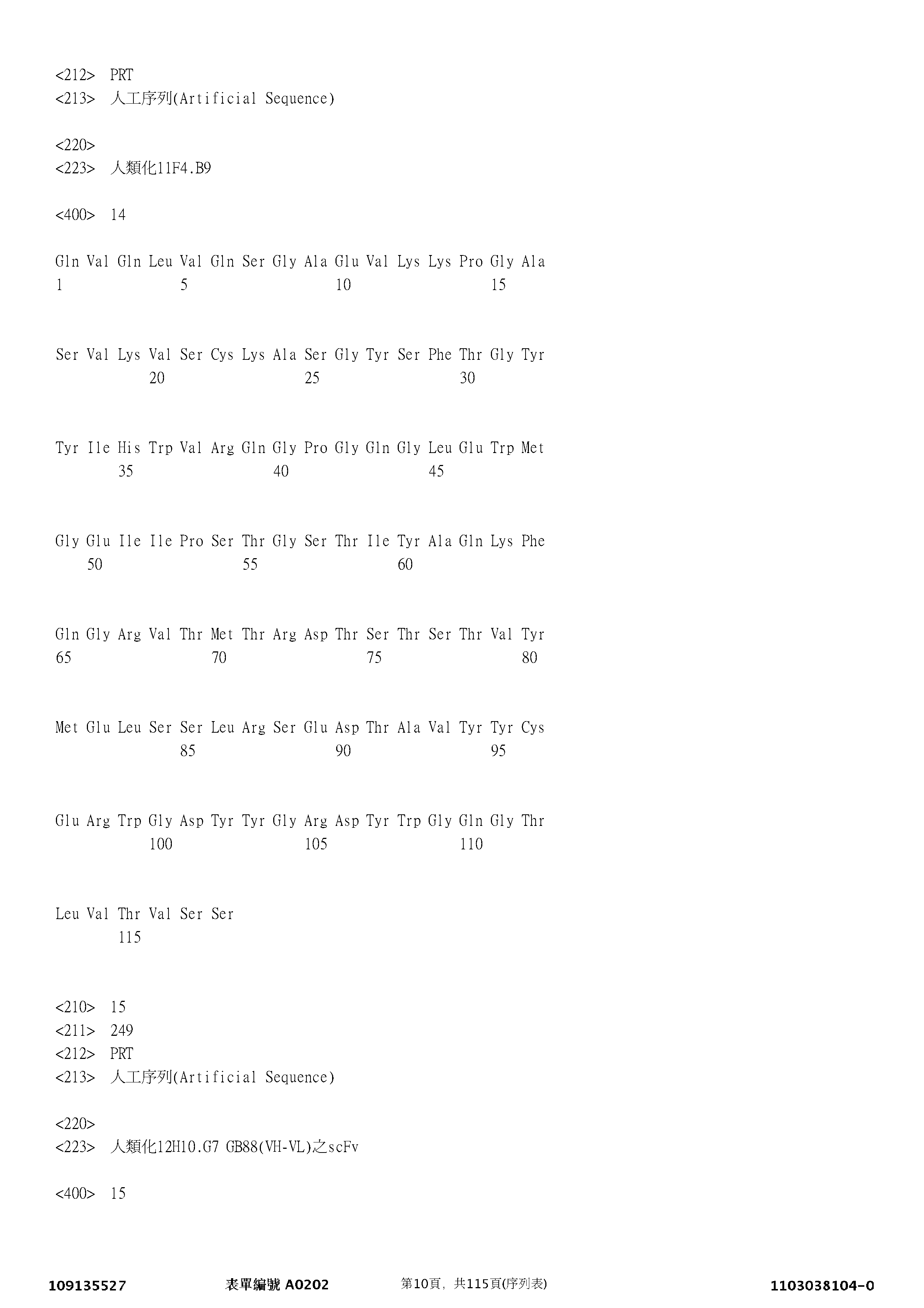


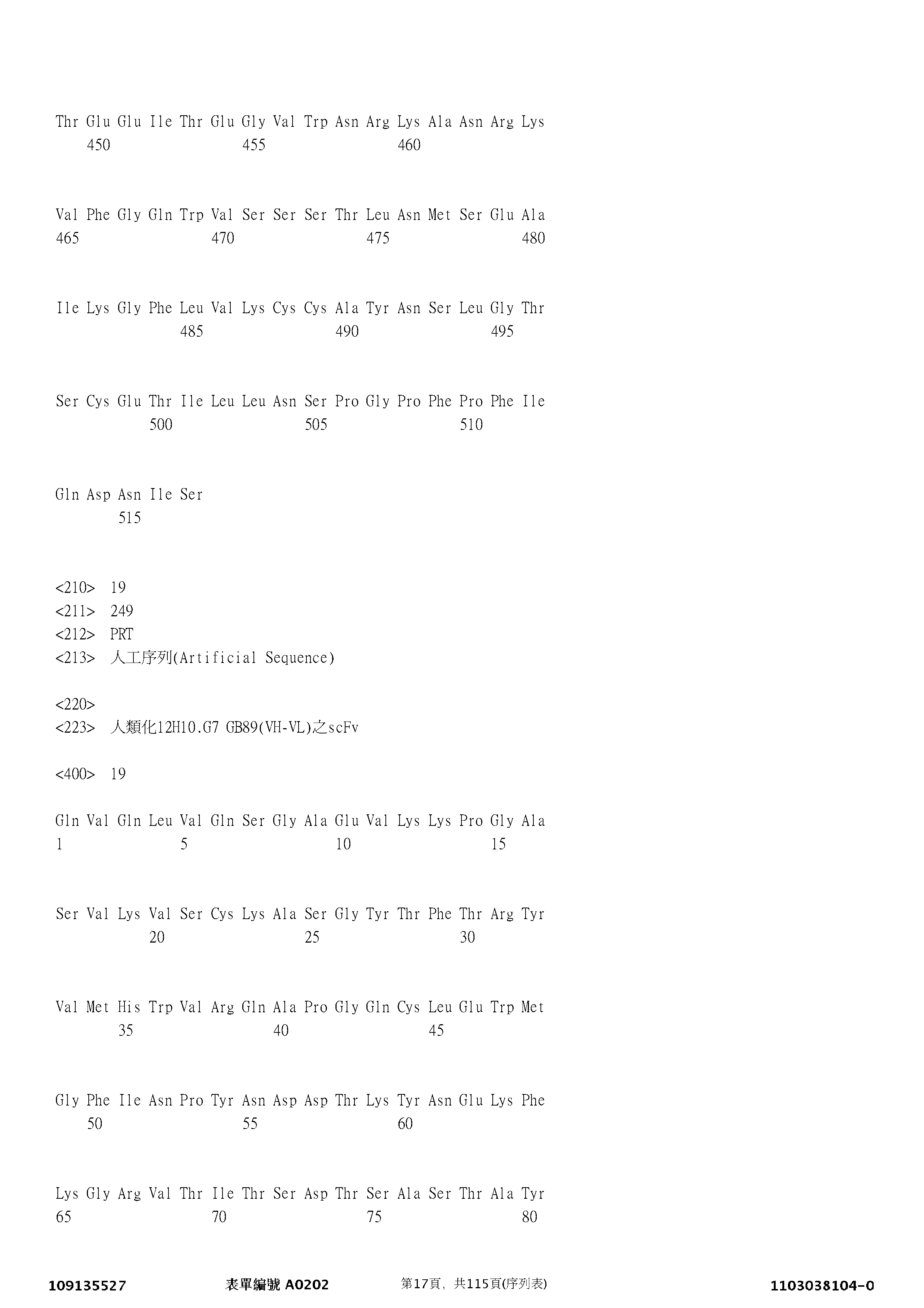


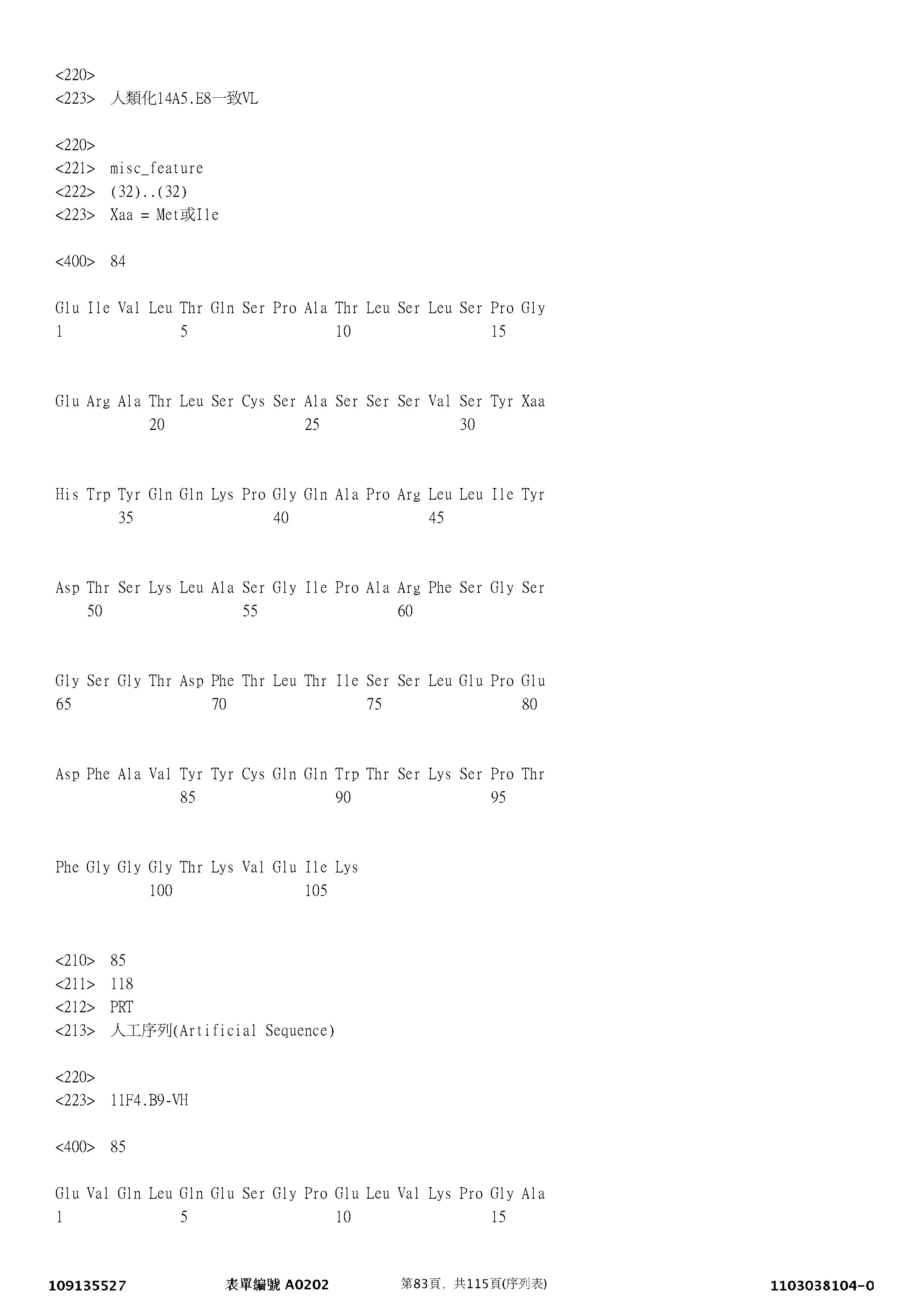


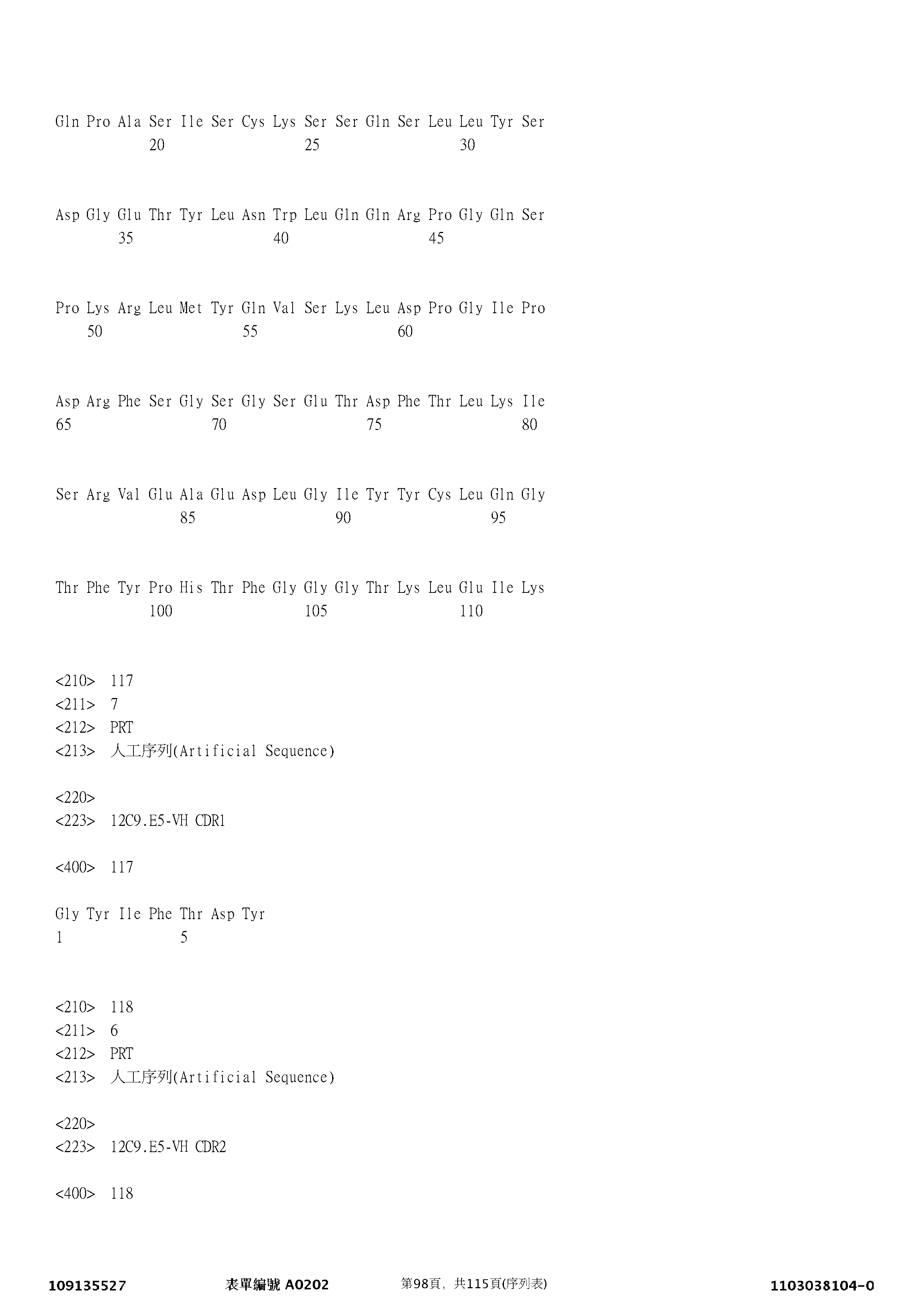


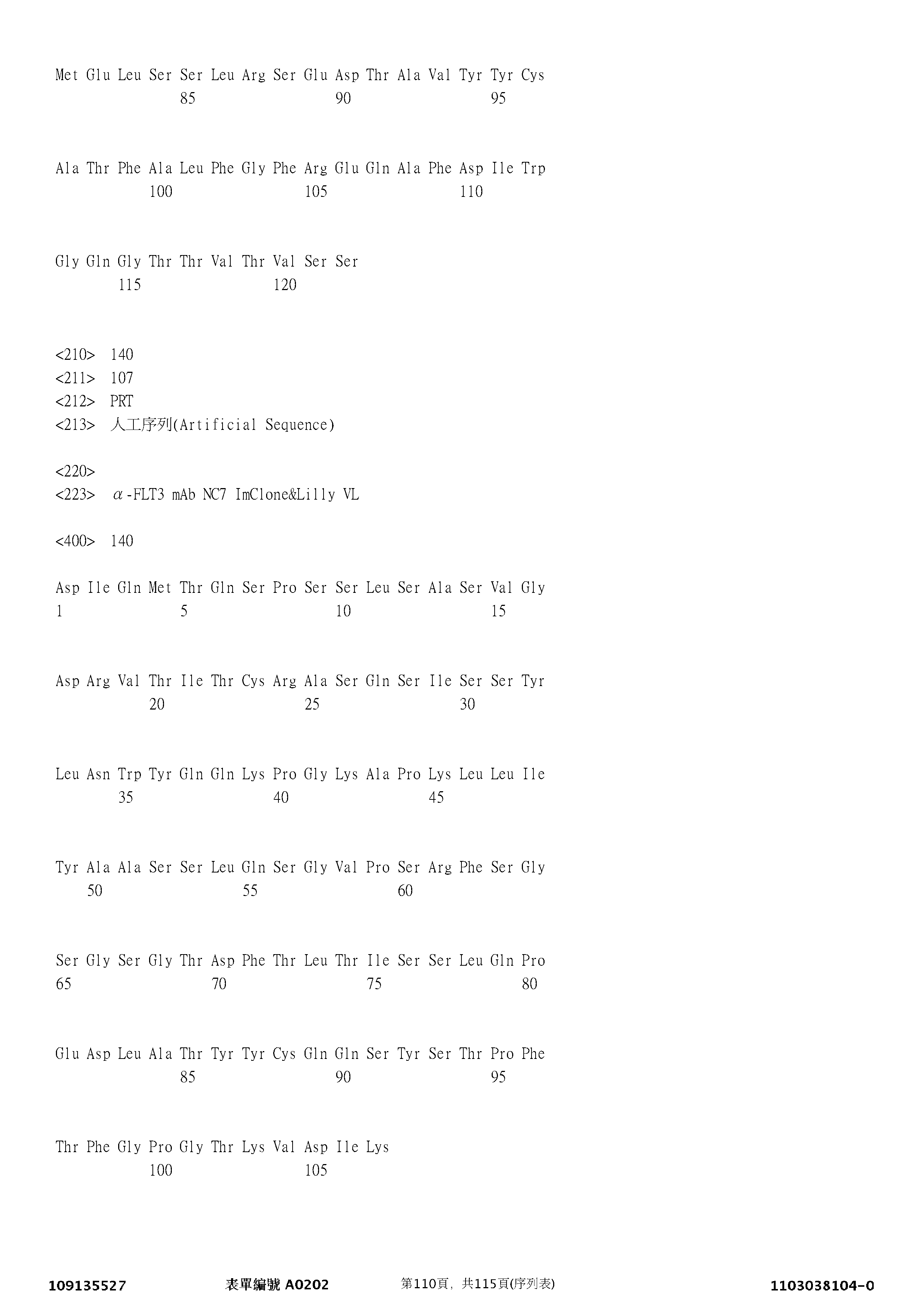


Claims (41)
Applications Claiming Priority (2)
| Application Number | Priority Date | Filing Date | Title |
|---|---|---|---|
| US201962915120P | 2019-10-15 | 2019-10-15 | |
| US62/915,120 | 2019-10-15 |
Publications (2)
| Publication Number | Publication Date |
|---|---|
| TW202124449A TW202124449A (en) | 2021-07-01 |
| TWI867066B true TWI867066B (en) | 2024-12-21 |
Family
ID=75538063
Family Applications (1)
| Application Number | Title | Priority Date | Filing Date |
|---|---|---|---|
| TW109135527A TWI867066B (en) | 2019-10-15 | 2020-10-14 | Antibodies targeting flt3 and use thereof |
Country Status (16)
| Country | Link |
|---|---|
| US (1) | US20240228628A9 (en) |
| EP (1) | EP4045537A4 (en) |
| JP (1) | JP2022551757A (en) |
| KR (1) | KR20220082882A (en) |
| CN (1) | CN115348972A (en) |
| AR (1) | AR120222A1 (en) |
| AU (1) | AU2020366000A1 (en) |
| BR (1) | BR112022006817A2 (en) |
| CA (1) | CA3153801A1 (en) |
| CL (1) | CL2022000927A1 (en) |
| CO (1) | CO2022004743A2 (en) |
| IL (1) | IL292259A (en) |
| MX (1) | MX2022004291A (en) |
| PE (1) | PE20221256A1 (en) |
| TW (1) | TWI867066B (en) |
| WO (1) | WO2021076554A1 (en) |
Families Citing this family (10)
| Publication number | Priority date | Publication date | Assignee | Title |
|---|---|---|---|---|
| BR112020015994A2 (en) | 2018-02-08 | 2020-12-15 | Dragonfly Therapeutics, Inc. | CANCER COMBINATION THERAPY INVOLVING MULTI-SPECIFIC BINDING PROTEINS THAT ACTIVATE NATURAL KILLER CELLS |
| CA3237846A1 (en) | 2018-02-08 | 2019-08-15 | Dragonfly Therapeutics, Inc. | Antibody variable domains targeting the nkg2d receptor |
| KR102835308B1 (en) | 2018-08-08 | 2025-07-21 | 드래곤플라이 쎄라퓨틱스, 인크. | Proteins that bind to NKG2D, CD16, and tumor-associated antigens |
| EA202091888A1 (en) | 2018-08-08 | 2020-10-23 | Драгонфлай Терапьютикс, Инк. | VARIABLE ANTIBODY DOMAINS TARGETED ON THE NKG2D RECEPTOR |
| EP3833392A4 (en) | 2018-08-08 | 2022-05-18 | Dragonfly Therapeutics, Inc. | MULTI-SPECIFIC BINDING PROTEINS BINDING TO BCMA, NKG2D AND CD16, AND METHODS OF USE |
| EP4291233A4 (en) * | 2021-02-10 | 2025-05-21 | Wugen, Inc. | Polypeptides and their use in treatment of disease |
| EP4301774A4 (en) | 2021-03-03 | 2025-08-13 | Dragonfly Therapeutics Inc | Methods for treating cancer with multispecific binding proteins for binding NKG2D, CD16, and a tumor-associated antigen |
| IL308258A (en) | 2021-05-05 | 2024-01-01 | Immatics Biotechnologies Gmbh | BMA031 antigen-binding polypeptides |
| AU2022330106A1 (en) * | 2021-08-16 | 2024-03-21 | Hemogenyx Pharmaceuticals Llc | Anti-flt3 antibodies, cars, car t cells and methods of use |
| WO2023105087A1 (en) * | 2021-12-10 | 2023-06-15 | Tubulis Gmbh | Novel flt3 antibodies and antibody-drug-conjugates based thereon, therapeutic methods and uses thereof in combination with tyrosine kinase inhibitors |
Citations (1)
| Publication number | Priority date | Publication date | Assignee | Title |
|---|---|---|---|---|
| US20110008355A1 (en) * | 2008-05-30 | 2011-01-13 | Imclone Llc | Anti-flt3 antibodies |
Family Cites Families (7)
| Publication number | Priority date | Publication date | Assignee | Title |
|---|---|---|---|---|
| NL2014108B1 (en) * | 2015-01-09 | 2016-09-30 | Aduro Biotech Holdings Europe B V | Altered april binding antibodies. |
| EP3268038B1 (en) * | 2015-03-09 | 2021-05-05 | Agensys, Inc. | Antibody drug conjugates (adc) that bind to flt3 proteins |
| WO2017011803A1 (en) * | 2015-07-16 | 2017-01-19 | Cellerant Therapeutics, Inc. | Cysteine-substituted immunoglobulins |
| MY201312A (en) * | 2017-06-02 | 2024-02-16 | Pfizer | Antibodies specific for flt3 and their uses |
| SG10202108528QA (en) * | 2017-06-02 | 2021-09-29 | Pfizer | Chimeric antigen receptors targeting flt3 |
| WO2019023097A1 (en) * | 2017-07-26 | 2019-01-31 | Smet Pharmaceutical Inc | Asymmetric bispecific antibodies and their use |
| TW201930344A (en) * | 2018-01-12 | 2019-08-01 | 美商安進公司 | Anti-PD-1 antibodies and methods of treatment |
-
2020
- 2020-10-14 AU AU2020366000A patent/AU2020366000A1/en active Pending
- 2020-10-14 EP EP20876423.3A patent/EP4045537A4/en active Pending
- 2020-10-14 TW TW109135527A patent/TWI867066B/en active
- 2020-10-14 BR BR112022006817A patent/BR112022006817A2/en not_active Application Discontinuation
- 2020-10-14 WO PCT/US2020/055480 patent/WO2021076554A1/en not_active Ceased
- 2020-10-14 US US17/769,257 patent/US20240228628A9/en active Pending
- 2020-10-14 CA CA3153801A patent/CA3153801A1/en active Pending
- 2020-10-14 MX MX2022004291A patent/MX2022004291A/en unknown
- 2020-10-14 KR KR1020227016159A patent/KR20220082882A/en active Pending
- 2020-10-14 CN CN202080072320.1A patent/CN115348972A/en active Pending
- 2020-10-14 JP JP2022522653A patent/JP2022551757A/en not_active Ceased
- 2020-10-14 AR ARP200102839A patent/AR120222A1/en unknown
- 2020-10-14 PE PE2022000635A patent/PE20221256A1/en unknown
-
2022
- 2022-04-12 CL CL2022000927A patent/CL2022000927A1/en unknown
- 2022-04-13 CO CONC2022/0004743A patent/CO2022004743A2/en unknown
- 2022-04-13 IL IL292259A patent/IL292259A/en unknown
Patent Citations (1)
| Publication number | Priority date | Publication date | Assignee | Title |
|---|---|---|---|---|
| US20110008355A1 (en) * | 2008-05-30 | 2011-01-13 | Imclone Llc | Anti-flt3 antibodies |
Also Published As
| Publication number | Publication date |
|---|---|
| TW202124449A (en) | 2021-07-01 |
| JP2022551757A (en) | 2022-12-13 |
| PE20221256A1 (en) | 2022-08-16 |
| CA3153801A1 (en) | 2021-04-22 |
| AR120222A1 (en) | 2022-02-02 |
| CO2022004743A2 (en) | 2022-07-08 |
| BR112022006817A2 (en) | 2022-07-05 |
| MX2022004291A (en) | 2022-05-10 |
| AU2020366000A1 (en) | 2022-05-12 |
| WO2021076554A1 (en) | 2021-04-22 |
| EP4045537A4 (en) | 2024-07-17 |
| EP4045537A1 (en) | 2022-08-24 |
| IL292259A (en) | 2022-06-01 |
| US20240132598A1 (en) | 2024-04-25 |
| US20240228628A9 (en) | 2024-07-11 |
| WO2021076554A8 (en) | 2022-04-21 |
| CN115348972A (en) | 2022-11-15 |
| KR20220082882A (en) | 2022-06-17 |
| CL2022000927A1 (en) | 2022-10-28 |
Similar Documents
| Publication | Publication Date | Title |
|---|---|---|
| TWI867066B (en) | Antibodies targeting flt3 and use thereof | |
| US20250154261A1 (en) | Multi-specific binding proteins that bind cd33, nkg2d, and cd16, and methods of use | |
| JP7539840B2 (en) | CD33-targeting antibody variable domains and uses thereof | |
| US20220025037A1 (en) | Antibody variable domains targeting dll3, and use thereof | |
| US20240228645A1 (en) | Antibodies targeting baff-r and use thereof | |
| US20230220084A1 (en) | Antibodies Targeting CLEC12A and Use Thereof | |
| US20230279121A1 (en) | Antibodies targeting egfr and use thereof | |
| EA049630B1 (en) | MULTISPECIFIC BINDING PROTEINS THAT BIND CD33, NKG2D, AND CD16 AND METHODS OF ADMINISTRATION |