US10053617B2 - Method of chemically increasing the efficiency of peroxygen based viscosity reduction reactions - Google Patents
Method of chemically increasing the efficiency of peroxygen based viscosity reduction reactions Download PDFInfo
- Publication number
- US10053617B2 US10053617B2 US15/301,302 US201515301302A US10053617B2 US 10053617 B2 US10053617 B2 US 10053617B2 US 201515301302 A US201515301302 A US 201515301302A US 10053617 B2 US10053617 B2 US 10053617B2
- Authority
- US
- United States
- Prior art keywords
- fluid
- viscosity
- viscosified
- solution
- mixture
- Prior art date
- Legal status (The legal status is an assumption and is not a legal conclusion. Google has not performed a legal analysis and makes no representation as to the accuracy of the status listed.)
- Active
Links
Images




Classifications
-
- C—CHEMISTRY; METALLURGY
- C09—DYES; PAINTS; POLISHES; NATURAL RESINS; ADHESIVES; COMPOSITIONS NOT OTHERWISE PROVIDED FOR; APPLICATIONS OF MATERIALS NOT OTHERWISE PROVIDED FOR
- C09K—MATERIALS FOR MISCELLANEOUS APPLICATIONS, NOT PROVIDED FOR ELSEWHERE
- C09K8/00—Compositions for drilling of boreholes or wells; Compositions for treating boreholes or wells, e.g. for completion or for remedial operations
- C09K8/60—Compositions for stimulating production by acting on the underground formation
- C09K8/62—Compositions for forming crevices or fractures
-
- C—CHEMISTRY; METALLURGY
- C09—DYES; PAINTS; POLISHES; NATURAL RESINS; ADHESIVES; COMPOSITIONS NOT OTHERWISE PROVIDED FOR; APPLICATIONS OF MATERIALS NOT OTHERWISE PROVIDED FOR
- C09K—MATERIALS FOR MISCELLANEOUS APPLICATIONS, NOT PROVIDED FOR ELSEWHERE
- C09K8/00—Compositions for drilling of boreholes or wells; Compositions for treating boreholes or wells, e.g. for completion or for remedial operations
- C09K8/60—Compositions for stimulating production by acting on the underground formation
- C09K8/80—Compositions for reinforcing fractures, e.g. compositions of proppants used to keep the fractures open
-
- E—FIXED CONSTRUCTIONS
- E21—EARTH OR ROCK DRILLING; MINING
- E21B—EARTH OR ROCK DRILLING; OBTAINING OIL, GAS, WATER, SOLUBLE OR MELTABLE MATERIALS OR A SLURRY OF MINERALS FROM WELLS
- E21B21/00—Methods or apparatus for flushing boreholes, e.g. by use of exhaust air from motor
- E21B21/06—Arrangements for treating drilling fluids outside the borehole
- E21B21/062—Arrangements for treating drilling fluids outside the borehole by mixing components
-
- E—FIXED CONSTRUCTIONS
- E21—EARTH OR ROCK DRILLING; MINING
- E21B—EARTH OR ROCK DRILLING; OBTAINING OIL, GAS, WATER, SOLUBLE OR MELTABLE MATERIALS OR A SLURRY OF MINERALS FROM WELLS
- E21B43/00—Methods or apparatus for obtaining oil, gas, water, soluble or meltable materials or a slurry of minerals from wells
- E21B43/25—Methods for stimulating production
- E21B43/26—Methods for stimulating production by forming crevices or fractures
-
- E—FIXED CONSTRUCTIONS
- E21—EARTH OR ROCK DRILLING; MINING
- E21B—EARTH OR ROCK DRILLING; OBTAINING OIL, GAS, WATER, SOLUBLE OR MELTABLE MATERIALS OR A SLURRY OF MINERALS FROM WELLS
- E21B43/00—Methods or apparatus for obtaining oil, gas, water, soluble or meltable materials or a slurry of minerals from wells
- E21B43/25—Methods for stimulating production
- E21B43/26—Methods for stimulating production by forming crevices or fractures
- E21B43/267—Methods for stimulating production by forming crevices or fractures reinforcing fractures by propping
-
- C—CHEMISTRY; METALLURGY
- C09—DYES; PAINTS; POLISHES; NATURAL RESINS; ADHESIVES; COMPOSITIONS NOT OTHERWISE PROVIDED FOR; APPLICATIONS OF MATERIALS NOT OTHERWISE PROVIDED FOR
- C09K—MATERIALS FOR MISCELLANEOUS APPLICATIONS, NOT PROVIDED FOR ELSEWHERE
- C09K2208/00—Aspects relating to compositions of drilling or well treatment fluids
- C09K2208/26—Gel breakers other than bacteria or enzymes
Definitions
- the present invention relates to a method of reducing the viscosity and molecular weight of a viscosified fluids and other polymer containing fluids used in subsurface hydraulic fracturing and stimulation operations, and more specifically relates to a method of reducing the viscosity and molecular weight of a viscosified fluids and other polymer containing fluids used in subsurface hydraulic fracturing and stimulation operations through the administration of a chelated transition metal.
- Hydraulic fracturing is a well-stimulation technique in which subsurface rock formations are fractured by the introduction of a hydraulically pressurized liquid. As a result of the cracks or fractures that are formed in rock formations, natural gas and/or petroleum flow and extraction from a well may be increased. Additional solid material additive components, commonly referred to as hydraulic fracturing proppants, may also be added to the hydraulic fracturing fluid to hold the fractures open.
- viscosified fluids such as slick water, linear gels and cross-linked gels. While such viscous fluids are capable of carrying more concentrated proppant into subsurface rock formations, these viscofied fluids do present various drawbacks.
- One shortcoming regarding the use of viscosified fluids for stimulation and fracturing applications is the difficulty in effectively removing or extracting the viscofied fluid from the formation without removing the proppant from the fractures.
- Prior attempts to remove the viscosified hydraulic fracturing fluids have included the introduction of chemicals to reduce the viscosity of the fracturing fluids, commonly known as breakers.
- break systems include the use of oxidative chemistries in various forms, as well as other methods that utilize chelants, surfactants, etc.
- oxidative breaker systems do not achieve the desired degree of reduction in fluid viscosity and/or the desired degree of reduction in polymer molecular weight.
- oxidative breaker systems cannot perform the desired reduction in fluid viscosity and/or the desired reduction in polymer molecular weight in a delayed manner.
- Equation 1 a ferrous ion, Fe(II), rapidly reduces hydrogen peroxide to primarily hydroxyl radicals, which can react with and degrade a target contaminant.
- the reaction involves hydrogen peroxide and a ferrous iron catalyst.
- the peroxide is broken down into a hydroxide ion and a hydroxyl free radical.
- the hydroxyl free radical is the primary oxidizing species and can be used to oxidize and break apart organic molecules.
- ferrous ion In the classic Fenton reaction, a ferrous ion, Fe(II), is required in stoichiometric amounts. Peroxide demand, and therefore, ferrous ion demand can be high due to the required viscosity reduction. Ferrous ions also can be oxidized by the hydroxyl radicals, and therefore can compete with the target compounds unless its concentration is kept low by gradual addition in dilute form which may require undesirable or costly encapsulation in breaking applications. Accordingly, a method for introducing iron ions without substantial dilution or encapsulation is needed.
- Ferric ion, Fe(III) can also produce hydroxyl radicals from peroxide, albeit at a slower rate than ferrous ion, Fe(II).
- the use of ferric ions typically requires acidic conditions to keep the iron soluble, therefore, the classic Fenton reaction has an optimum pH of about 3.
- acidification i.e., a low pH level, can cause undesirable issues with the performance of certain viscosifying agents and other fracturing fluid additives. Accordingly, a method for introducing ferric ions in a less acidic or non acidic environment is needed.
- ferric MGDA is an efficient catalyst and redox promoting agent over a wide pH range when compared to transition metals, transition metal salts, and other chelating agent/transition metal complexes.
- the present invention provides a method of catalyzing peroxygen based viscosity and/or molecular weight reduction reactions of viscosified fluids, for example, hydraulic fracturing fluids
- a viscosity breaker system used to reduce the viscosity and molecular weight of viscosity increasing polymers to desired viscosity values and molecular weight distributions is presented.
- the viscosity breaker system comprises a highly efficient catalyzing and redox initiating agent, specifically, ferric methylglycine diacetate (ferric MGDA).
- a highly efficient catalyzing and redox initiating agent specifically, ferric methylglycine diacetate (ferric MGDA).
- the present invention includes a method of reducing the viscosity of a viscosified fluid in an underground drilling operation comprising the steps of: combining an uninhibited viscosified fluid with a chelated transition metal to form a mixture; introducing the mixture through a well into an underground formation at high pressure to fracture the underground formation; after fracturing the underground formation, the chelated transition metal catalyzing a conversion of a volume of the viscosified fluid in the mixture to a reduced viscosity fluid having a viscosity lower than the viscosified fluid; and extracting the reduced viscosity fluid from the well.
- the viscosity breaker system comprises a per oxygen compound such as peroxides, persulfate salts, percarbonate salts, etc. or combination thereof and a highly efficient peroxygen catalyzing agent, specifically, ferric methylglycine diacetate (ferric MGDA).
- a per oxygen compound such as peroxides, persulfate salts, percarbonate salts, etc. or combination thereof
- a highly efficient peroxygen catalyzing agent specifically, ferric methylglycine diacetate (ferric MGDA).
- the present invention includes a method of reducing the viscosity of a viscosified fluid in an underground drilling operation comprising the steps of: combining an uninhibited viscosified fluid with a ferric methylglycinediacetate and an uninhibited oxidizing agent to form a mixture; introducing the mixture through a well into a subsurface; after introducing the mixture into the subsurface, the ferric methylglycinediacetate and the uninhibited oxidizing agent catalyzing a conversion of a volume of the viscosified fluid in the mixture to a reduced viscosity fluid having a viscosity lower than the viscosified fluid; and extracting the reduced viscosity fluid from the well.
- the present invention includes a method of reducing the viscosity of a viscosified fluid in an underground hydraulic fracturing operation comprising the steps of: combining a viscosified fluid, a proppant material, ferric methylglycinediacetate, and uninhibited hydrogen peroxide to form a mixture; introducing the mixture through a well into an underground formation at high pressure to fracture the underground formation; introducing the proppant material into the underground formation after the underground formation has fractured; after fracturing the underground formation, the ferric methylglycinediacetate and the uninhibited hydrogen peroxide catalyzing a conversion of a volume of the viscosified fluid in the mixture to a reduced viscosity fluid having a viscosity lower than the viscosified fluid; and extracting the reduced viscosity fluid from the well while the proppant material remains in the underground formation.
- method of present invention results in a reduced viscosity fluid that has a viscosity approximately equal that of water.
- the method of the present invention also includes the step of reducing the molecular weight of one or more polymers contained in the viscosified fluid.
- the chelated transition metal of the present invention is a solution having a pH of between 4.0 and 6.0.
- the chelated ferric ion of the present invention has a logarithmic stability constant value of between 20.0 and 15.0.
- FIG. 1 is a flow chart showing the steps of a method of breaking a viscosified fluid according to one embodiment of the present invention
- FIG. 2 is a flow chart showing the steps of an alternative method of breaking a viscosified fluid according to one embodiment of the present invention
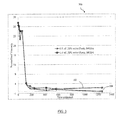
- FIG. 3 is a plot showing the relative normalized fluid viscosities over time of two polyacrylamide viscosified fluid solution samples, where the two samples include different volumes of ferric MGDA;
- FIG. 4 is a plot showing the relative normalized fluid viscosities over time of three polyacrylamide viscosified fluid solution samples, where the first sample received a dose hydrogen peroxide, the second sample received a dose of hydrogen peroxide and ferric MGDA, and the third sample receive a dose of sodium persulfate and ferric MGDA;
- FIG. 5 is four chromatogram plots depicting the results of performing a gel permeable chromatograph analysis of a reference polyethylene glycol standard, a control polyacrylamide solution, a first treated polyacrylamide solution, and a second treated polyacrylamide solution, in accordance with one embodiment of the invention.
- FIG. 6 is three chromatogram plots depicting the results of performing a gel permeable chromatograph analysis of a control polyacrylamide solution, a polyacrylamide solution identified as “treatment a”, and a polyacrylamide solution identified as “treatment b,” in accordance with one embodiment of the invention.
- the present invention is directed to a method of catalyzing the breaking a viscosified fluid, i.e. reducing viscosity and/or reducing the molecular weight of polymers within the viscosified fluid, through the use of a ferric methylglycinediacetate (Fe-MGDA).
- Fe-MGDA ferric methylglycinediacetate
- the inventors have discovered that Fe-MGDA is more efficient catalyst and redox promoting agent over a wide pH range when compared to transition metals, transition metal salts, and other chelating agent/transition metal complexes for breaking viscosified fluids used in oil and gas drilling applications.
- logarithmic stability constants for MGDA which are shown in Table 2, indicate that the stability constant, identified as “log K,” of complexes formed with chelating agent MGDA are markedly lower relative to the stability constants for complexes of EDTA listed previously in Table 1.
- the relatively lower stability constants for MGDA is indicative of a more catalytically available transition metal complex. Accordingly, MGDA demonstrates an increase activity toward catalyzing and/or promotion of redox reactions in viscosified fluids, which results in relatively quicker viscosity reductions.
- ferric chelate means any one of a number of organic and inorganic polydentate ligands complexed with ferric ion, Fe(III).
- An “active” ferric chelate is one that exhibits activity toward catalyzation and/or promotion of redox reactions with the viscosifying agent to be degraded.
- An “active” ferric chelate may also be one that exhibits activity toward oxidation of the viscosifying agent to be degraded, i.e., is capable of generating free radicals or other reactive oxidants from an oxidant (also referred to as an “oxidizing agent” herein), such as a peroxide or a persulfate in the presence of a viscosified fracturing fluid.
- an oxidant also referred to as an “oxidizing agent” herein
- the chemical reactions that are facilitated by the ferric chelate and result in the changes to chemical bonds that reduce viscosity of the viscosified fluid may include, but are not limited to electron addition, electron removal, hydrogenation, and dehydrogenation.
- Viscosified fluids may consist of any high viscosity solution such as slick water, gel frac, friction reducer, etc.
- Such viscosified fluids as are considered within the scope of this invention may be prepared by adding a quantity of a viscosifier such as polymer, polyacrylamides (PAM), PAM co-polymers, xanthan gum, guar gum, or other viscosifiers to a given amount of water or other liquid dilutent.
- This water dilutent can be fresh water or a brine solution made from any number of salts such as sodium chloride, calcium chloride, potassium chloride, seawater, produced water or others.
- Some embodiments of the present invention are based, at least in part, on the unexpected discovery that a particular novel active ferric chelate, Fe-MGDA, unpredictably demonstrates a significant ability to reduce the viscosity of fluids viscosified with various viscosifying polymers, and particularly more so than other chelated transition metals.
- one embodiment of the present invention is directed towards reducing the viscosity of a viscosified fracture fluid associated with the stimulation of tight formations in oil and gas production, comprising treating the viscosified fluid with Fe-MDGA in amounts effective to reduce the viscosity and/or molecular weight to a desired level.
- hydrogen peroxide is a relatively powerful oxidant. Also shown in Table 3 is the much more powerful hydroxyl radical, a type of free radical, which is second in the list only to fluorine in its oxidation potential.
- method 200 is directed towards reducing the viscosity of a viscosified fracture fluid associated with the stimulation of tight formations in oil and gas production, comprising treating the viscosified fluid with Fe-MDGA and an oxidizing agent in amounts effective to reduce the viscosity and/or molecular weight to a desired level.
- the viscofied fluid may be a viscosified fluid such as slick water, linear gels, or cross-linked gels, which are commonly used in drilling operations such as hydraulic fracturing; however, other oil or gas drilling related operations are considered well within the scope of this invention.
- the first step of the method 100 is to combine a volume of a chelating agent methylglycinediacetate (MGDA), e.g. trisodium methylglycinediacetate, with a volume of water to form a diluted solution of MGDA, shown at block 102 .
- MGDA methylglycinediacetate
- MGDA may be purchased from BASF Corp, of Mount Olive, N.J., under their product name, Trilon M at a 39% concentrated liquid having a density of 1.29-1.33 g/cm3, a pH of about 10.0 to about 12.0, and a molecular weight of MGDA-Na3: 271.
- MGDA 52.3 mL of MGDA, or approximately 27 g of Trilon M was combined with approximately 800 mL of water, with the resultant diluted solution of MGDA having a pH of preferably between 10.0 and 12.0.
- the diluted solution of MGDA is then mixed at block 104 , such as with a mechanical stir bar or alternative mechanical agitation techniques.
- liquid ferric chloride is added to the diluted solution of MGDA.
- ferric chloride is added to the diluted solution of MGDA until the resultant solution has a pH of preferably between 4.0 and 8.0, and more preferably a pH of 5.0.
- additional water may be added to the Fe-MGDA solution until the final fluid volume of the solution is 1000 mL.
- various volumes of solutions used in method 100 are considered within the scope of this invention, and the volumes identified above are provided by of example, not to be consisted exclusive of exhaustive thereof.
- the Fe-MGDA solution is added to a viscosified fluid that is to be used in an oil or gas drilling related operation, i.e. hydraulic fracturing fluid.
- the Fe-MGDA solution is added directly to the viscosified fluid, which may or may not contain proppants after viscosifier hydration.
- Metering pumps may alternatively be used in order to achieve specific concentrations of the Fe-MGDA solution in the viscosified fluids as they are being injected into the subsurface.
- the Fe-MGDA solution can be poured or transferred directly into containers of viscosified fluid such as frac tanks, storage tanks, hydration mixers, etc. Mixing may be achieved by any number of static or mechanical mixing techniques.
- the viscosified fluid including the Fe-MGDA solution and possible proppants is then injected into the subsurface.
- injection of the fluid at block 112 may result in the hydraulic fracturing of the subsurface or underground formation in order to stimulate the release of any number of fluids or gasses form the subsurface formation.
- the Fe-MGDA solution reduces the viscosity of the viscosified fluid, and reduces the molecular weight of viscosity increasing polymers contained within the viscosified fluid.
- the Fe-MGDA solution After the Fe-MGDA solution has reduced the viscosity of the viscosified fluid through catalyzing redox reactions therein and possibly alternative chemical interactions, i.e., converted the viscosified fluid to a reduced viscosity fluid, the reduced viscosity fluid is extracted from the well, at block 116 .
- a method 200 for reducing the viscosity of a viscosified fluid, in accordance with a second embodiment of the present invention.
- the viscofied fluid of method 200 may employ a viscosified fluid such as slick water, linear gels, or cross-linked gels, which are commonly used in drilling operations such as hydraulic fracturing; however, other oil or gas drilling related operations are considered well within the scope of this invention.
- the viscosified fluid on method 200 may be prepared by adding a quantify of a viscosifier such as polyacrylamide, xanthan gum, guar gum, or other viscosifiers to a given amount of water.
- This water dilutent can be fresh water or a brine solution made from any number of salts such as sodium chloride, calcium chloride, potassium chloride, seawater, produced water or others.
- the first step of the method 200 is to combine a volume of a chelating agent methylglycinediacetate (MGDA), e.g. trisodium methylglycinediacetate, with a volume of water to form a diluted solution of MGDA, shown at block 202 .
- MGDA chelating agent methylglycinediacetate
- a final volume of 1 L of the FE-MGDA was produced, 52.3 mL of MGDA, or approximately 27 g of Triton M, was combined with approximately 800 mL of water, with the resultant diluted solution of MGDA having a pH of preferably between 10.0 and 12.0.
- the diluted solution of MGDA is then mixed at block 204 , such as with a mechanical stir bar or alternative mechanical agitation techniques.
- liquid ferric chloride is added to the diluted solution of MGDA.
- ferric chloride is added to the diluted solution of MGDA until the resultant solution has a pH of preferably between 4.0 and 8.0, and more preferably a pH of 5.0.
- additional water may be added to the Fe-MGDA solution until the final fluid volume of the solution is 1000 mL.
- various volumes of solutions described in method 200 are considered within the scope of this invention, and the volumes identified above are provided by of example, not to be consisted exclusive of exhaustive thereof.
- the Fe-MGDA solution is added to an uninhibited viscosified fluid that is to be used in an oil or gas drilling related operation.
- the Fe-MGDA solution is added directly to the viscosified fluid, which may or may not contain proppants after viscosifier hydration.
- Metering pumps may alternatively be used in order to achieve specific concentrations of the Fe-MGDA solution in the viscosified fluids as they are being injected into the subsurface.
- the Fe-MGDA solution can be poured or transferred directly into containers of viscosified fluid such as frac tanks, storage tanks, hydration mixers, etc. Mixing may be achieved by any number of static or mechanical mixing techniques.
- an uninhibited oxidizing agent is then added to the mixture of viscosified fluid and Fe-MGDA.
- the uninhibited oxidizing agents added at block 212 may be a peroxygen compound selected from a group including hydrogen peroxide, calcium peroxide, and/or magnesium peroxide, a persulphate, such as, but not limited to sodium persulphate, potassium persulphate, and/or ammonium persulphate, etc., ozone; a permanganate, such as but not limited to sodium permanganate, potassium permanganate, etc., chlorine dioxide, a halogen, such as but not limited to chlorine, bromine, iodine, fluorine, etc., and combinations thereof.
- the uninhibited oxidizing agent may be either added in dry form, or alternatively dissolved in water.
- the oxidizing agent may be introduced via metering pumps as to achieve specific concentrations of the oxidizing agent in the resultant solution.
- the Fe-oxidizing agent can be poured or transferred directly into containers of viscosified fluid such as frac tanks, storage tanks, hydration mixers, etc. Mixing may be achieved by any number of static or mechanical mixing techniques. Additionally, variations in the order of chemical additions or methods of mixing are considered within the scope of the present invention.
- the viscosified fluid including the uninhibited oxidizing agent and the Fe-MGDA solution, as well as optional proppants is then injected into the subsurface.
- injection of the fluid at block 112 may result in the hydraulic fracturing of the subsurface formation in order to stimulate the release of any number of fluids or gasses form the subsurface formation.
- the uninhibited oxidizing agent and the Fe-MGDA solution reduces the viscosity of the viscosified fluid, and reduces the molecular weight of viscosity increasing polymers contained within the viscosified fluid.
- the reduced viscosity fluid is extracted, at block 218 .
- FIGS. 3 through 6 various embodiments of the present invention are described below.
- fluid viscosities were tested using a Marsh funnel. All result flow times shown FIGS. 3 through 6 were normalized using tap water as a basis. The time for water to pass through the funnel was normalized to a value of 1, depicted along the y-axis of plots 300 and 400 . Initial time for the viscosified fluid was normalized using the same scale, depicted along the x-axis of plots 300 and 400 . Temperatures were held constant throughout the test period.
- the viscosifying agents used were a polyacrylamide, guar, and a polyacrylamide (PAM). A 0.5% by volume viscosifying agent solution was made using a 6% by weight NaCl brine solution or tap water as the dilutent.
- PAM polyacrylamide
- plot 300 shows the relative normalized fluid viscosities over time of two polyacrylamide viscosified fluid solution samples, where the two samples include different volumes of a ferric MGDA (Fe-MGDA).
- Fe-MGDA ferric MGDA
- two 500 mL viscosified fluid samples composed of 0.5% by volume polyacrylamide solution were made using tap water.
- One sample received a 0.5 mL dose of 20% by weight ferric MGDA (Fe-MGDA) solution.
- the second sample received a 1.0 mL dose of 20% by weight ferric MGDA (Fe-MGDA) solution.
- Fe-MGDA ferric MGDA
- the viscosity of the viscosified fluid is reduced to the same approximate viscosity was tap water, a normalized viscosity of 1.0, when 1.0 mL of the catalyzing and redox initiating agent ferric MGDA is added to the viscosified fluid.
- trend line 304 shows that the viscosity of the viscosified fluid is also reduced to the same approximate viscosity was tap water, i.e., a normalized viscosity of 1.0, when 0.5 mL of the catalyzing and redox initiating agent ferric MGDA is added to the viscosified fluid.
- plot 300 demonstrates the ability of a catalyzing and redox initiating agent according to the present invention to initiate a viscosity reduction in a polyacrylamide solution in the absence of an oxidizing agent.
- plot 400 shows the relative normalized fluid viscosities over time of three polyacrylamide viscosified fluid solution samples, where the first sample received a 5.0 mL dose of 35% by weight hydrogen peroxide, the second sample received a 0.25 mL dose of 35% by weight hydrogen peroxide and a 0.25 mL does of 20% by weight ferric MGDA, and the third sample receive a 600 mg dose of sodium persulfate and a 1 mL does of 20% by weight ferric MGDA.
- three 500 mL viscosified fluid samples composed of 0.5% by volume polyacrylamide solution were made using aqueous 6% by weight NaCl brim solution.
- the first sample corresponding to trend line 402 , received a 5.0 mL dose of 35% by weight hydrogen peroxide.
- the second sample corresponding to trend line 404 , received a 0.25 mL dose of 35% by weight hydrogen peroxide and a 0.25 mL does of 20% by weight ferric MGDA.
- the ferric MGDA solution was added to the viscosified fluid and mixed thoroughly followed by the hydrogen peroxide.
- the third sample receive a 600 mg dose of sodium persulfate and a 1 mL does of 20% by weight ferric MGDA.
- ferric MGDA solution was added to the viscosified fluid and mixed thoroughly followed by the sodium persulfate.
- the viscosity of the viscosified fluid in the first sample is reduced at much slower rate, relative to the samples corresponding to trend lines 404 and 404 . That is to say that the sample including only an oxidizing agent and lacking a catalyzing and redox initiating agent, namely Fe-MGDA, exhibits a slower viscosity reduction than those samples containing a catalyzing and redox initiating agent, namely Fe-MGDA, according to the present invention.
- the sample that include both the sodium persulfate oxidizing agent and the Fe-MGDA catalyzing and redox initiating agent, identified by trend line 406 also achieved a normalized viscosity plateau in approximately 100 minutes, however its final reduction in normalized viscosity was not as low as seen in trend line 404 .
- the sodium persulfate breaking times i.e., viscosity reduction times, can be expected to be similar or longer than that of hydrogen peroxide.
- chromatograms 500 , 502 , 504 , and 506 are shown as the results of performing a gel permeable chromatograph (GPC) analysis of a reference polyethylene glycol standard shown in chromatograph 500 , a control polyacrylamide solution identified as “Sample A (Control)” shown in chromatograph 506 , a treated polyacrylamide solution identified as “Sample B” shown in chromatograph 504 , and a treated polyacrylamide solution identified as “Sample C” shown in chromatograph 502 .
- GPC gel permeable chromatograph
- FIG. 5 illustrates the change in molecular weight detected using a gel permeable chromatograph (GPC).
- GPC gel permeable chromatograph
- a control polyacrylamide solution was created by diluting a polyacrylamide with tap water.
- Treatments B and C were conducted using a non inhibited Fe-MGDA catalyzed peroxide viscosity breaking composition applied to a viscosified fluid.
- a reference standard using polyethylene glycol was utilized to illustrate the molecular weight ranges of the polyacrylamide solutions. Units are measured in Daltons.
- FIG. 6 three chromatograms 600 , 602 , and 604 are shown as the results of performing a gel permeable chromatograph (GPC) analysis of a control polyacrylamide solution, a polyacrylamide solution identified as “Treatment A”, and a polyacrylamide solution identified as “Treatment B”.
- GPC gel permeable chromatograph
- FIG. 6 illustrates the change in molecular weight detected using a gel permeable chromatograph.
- a control polyacrylamide solution identified as “CONTROL” and depicted in chromatogram 600 was created by diluting a polyacrylamide with tap water.
- Treatments A and B were conducted using a non-inhibited, Fe-MGDA catalyzed peroxide viscosity breaking composition applied to a viscosified fluid.
Landscapes
- Engineering & Computer Science (AREA)
- Life Sciences & Earth Sciences (AREA)
- Mining & Mineral Resources (AREA)
- Geology (AREA)
- General Life Sciences & Earth Sciences (AREA)
- Chemical & Material Sciences (AREA)
- Geochemistry & Mineralogy (AREA)
- Fluid Mechanics (AREA)
- Physics & Mathematics (AREA)
- Environmental & Geological Engineering (AREA)
- Materials Engineering (AREA)
- Organic Chemistry (AREA)
- Mechanical Engineering (AREA)
- Lubricants (AREA)
- Treatment Of Water By Oxidation Or Reduction (AREA)
- Organic Low-Molecular-Weight Compounds And Preparation Thereof (AREA)
- Physical Or Chemical Processes And Apparatus (AREA)
Priority Applications (1)
| Application Number | Priority Date | Filing Date | Title |
|---|---|---|---|
| US15/301,302 US10053617B2 (en) | 2014-04-03 | 2015-04-03 | Method of chemically increasing the efficiency of peroxygen based viscosity reduction reactions |
Applications Claiming Priority (4)
| Application Number | Priority Date | Filing Date | Title |
|---|---|---|---|
| US201461974551P | 2014-04-03 | 2014-04-03 | |
| US201562128612P | 2015-03-05 | 2015-03-05 | |
| PCT/US2015/024193 WO2015153937A1 (fr) | 2014-04-03 | 2015-04-03 | Procédé permettant d'augmenter chimiquement l'efficacité de réactions de réduction de viscosité |
| US15/301,302 US10053617B2 (en) | 2014-04-03 | 2015-04-03 | Method of chemically increasing the efficiency of peroxygen based viscosity reduction reactions |
Publications (2)
| Publication Number | Publication Date |
|---|---|
| US20170022409A1 US20170022409A1 (en) | 2017-01-26 |
| US10053617B2 true US10053617B2 (en) | 2018-08-21 |
Family
ID=54241305
Family Applications (1)
| Application Number | Title | Priority Date | Filing Date |
|---|---|---|---|
| US15/301,302 Active US10053617B2 (en) | 2014-04-03 | 2015-04-03 | Method of chemically increasing the efficiency of peroxygen based viscosity reduction reactions |
Country Status (4)
| Country | Link |
|---|---|
| US (1) | US10053617B2 (fr) |
| CA (1) | CA2944508C (fr) |
| MX (1) | MX2016012884A (fr) |
| WO (1) | WO2015153937A1 (fr) |
Families Citing this family (7)
| Publication number | Priority date | Publication date | Assignee | Title |
|---|---|---|---|---|
| US11286415B2 (en) * | 2017-12-21 | 2022-03-29 | Halliburton Energy Services, Inc. | Downhole fluid for removing scales and methods thereof |
| CN110259427B (zh) * | 2019-07-10 | 2023-05-26 | 河南理工大学 | 水力压裂液、瓦斯抽采系统及瓦斯抽采方法 |
| US20220098472A1 (en) * | 2020-09-29 | 2022-03-31 | Cnpc Usa Corporation | Composition and Method for Breaking Synthetic-Polymer-Type Stimulation Fluids |
| US12123267B2 (en) * | 2022-02-22 | 2024-10-22 | Petróleo Brasileiro S. A.—Petrobras | Method of application of low salinity viscous fluid in drilling saline formations |
| CN115851255B (zh) * | 2023-02-28 | 2023-05-02 | 成都理工大学 | 一种磁性纳米催化型支撑剂及其制备方法和应用 |
| CN116376529B (zh) * | 2023-03-27 | 2024-08-30 | 长江大学 | 一种稠油降粘剂及稠油降粘方法 |
| CN118308081B (zh) * | 2024-03-11 | 2026-01-02 | 长江大学 | 一种高熵催化乳液降黏体系及降黏方法 |
Citations (6)
| Publication number | Priority date | Publication date | Assignee | Title |
|---|---|---|---|---|
| US20080173452A1 (en) * | 2007-01-23 | 2008-07-24 | Halliburton Energy Services, Inc. | Compositions and methods for breaking a viscosity increasing polymer at very low temperature used in downhole well applications |
| US20110259592A1 (en) | 2010-04-21 | 2011-10-27 | Halliburton Energy Services Inc. | Method and composition for treating fluids before injection into subterranean zones |
| US20130168095A1 (en) | 2011-12-30 | 2013-07-04 | Halliburton Energy Services, Inc. | Iodide stabilizer for viscosified fluid containing iron |
| US20130213657A1 (en) * | 2012-02-22 | 2013-08-22 | Texas United Chemical Company, Llc | Hybrid Aqueous-Based Suspensions for Hydraulic Fracturing Operations |
| US8567499B2 (en) * | 2009-08-04 | 2013-10-29 | Schlumberger Technology Corporation | Gelled liquid hydrocarbon treatment fluids and their associated methods of use |
| US8575073B2 (en) * | 2008-06-20 | 2013-11-05 | Schlumberger Technology Corporation | Slickwater treatment fluid and method |
-
2015
- 2015-04-03 US US15/301,302 patent/US10053617B2/en active Active
- 2015-04-03 WO PCT/US2015/024193 patent/WO2015153937A1/fr not_active Ceased
- 2015-04-03 MX MX2016012884A patent/MX2016012884A/es unknown
- 2015-04-03 CA CA2944508A patent/CA2944508C/fr active Active
Patent Citations (8)
| Publication number | Priority date | Publication date | Assignee | Title |
|---|---|---|---|---|
| US20080173452A1 (en) * | 2007-01-23 | 2008-07-24 | Halliburton Energy Services, Inc. | Compositions and methods for breaking a viscosity increasing polymer at very low temperature used in downhole well applications |
| US8575073B2 (en) * | 2008-06-20 | 2013-11-05 | Schlumberger Technology Corporation | Slickwater treatment fluid and method |
| US8567499B2 (en) * | 2009-08-04 | 2013-10-29 | Schlumberger Technology Corporation | Gelled liquid hydrocarbon treatment fluids and their associated methods of use |
| US20110259592A1 (en) | 2010-04-21 | 2011-10-27 | Halliburton Energy Services Inc. | Method and composition for treating fluids before injection into subterranean zones |
| US8584757B2 (en) | 2010-04-21 | 2013-11-19 | Halliburton Energy Services, Inc. | Method and composition for treating fluids before injection into subterranean zones |
| US20130168095A1 (en) | 2011-12-30 | 2013-07-04 | Halliburton Energy Services, Inc. | Iodide stabilizer for viscosified fluid containing iron |
| US8720569B2 (en) | 2011-12-30 | 2014-05-13 | Halliburton Energy Services, Inc. | Iodide stabilizer for viscosified fluid containing iron |
| US20130213657A1 (en) * | 2012-02-22 | 2013-08-22 | Texas United Chemical Company, Llc | Hybrid Aqueous-Based Suspensions for Hydraulic Fracturing Operations |
Also Published As
| Publication number | Publication date |
|---|---|
| CA2944508C (fr) | 2022-06-21 |
| MX2016012884A (es) | 2017-07-14 |
| WO2015153937A8 (fr) | 2016-10-13 |
| CA2944508A1 (fr) | 2015-10-08 |
| WO2015153937A1 (fr) | 2015-10-08 |
| US20170022409A1 (en) | 2017-01-26 |
Similar Documents
| Publication | Publication Date | Title |
|---|---|---|
| CA2944508C (fr) | Procede permettant d'augmenter chimiquement l'efficacite de reactions de reduction de viscosite | |
| US10526529B2 (en) | Treatment fluids comprising viscosifying agents and methods of using the same | |
| CN101595199B (zh) | 用于井下用途的使增粘聚合物在极低温度破胶的组合物和方法 | |
| JPS61114794A (ja) | 浸透性地下層の汚染物質除去法 | |
| US10526530B2 (en) | Flooding operations employing chlorine dioxide | |
| CN109641768B (zh) | 对增强的油和/或气体回收方法中的生产用水进行处理的方法 | |
| CN105626028B (zh) | 增加页岩气井压裂改造缝网密度的方法 | |
| US20090318313A1 (en) | Slickwater Treatment Fluid and Method | |
| NL2025333B1 (en) | Hydraulic fracturing fluid, gas extraction system and gas extraction method | |
| US10035947B2 (en) | Method for chemically controlling delay time for breaking polymers | |
| JPH0363599B2 (fr) | ||
| CN103642478A (zh) | 一种用于解除聚合物污染物的解堵剂 | |
| CN102559163A (zh) | 二氧化氯复合解堵剂,其制备方法以及其使用方法 | |
| CN105462573B (zh) | 一种油田注聚井增注用解堵剂 | |
| US4567947A (en) | Gellation of pure methyl alcohol | |
| US7998906B2 (en) | Methods and compositions for treating subterranean formations | |
| US3952806A (en) | Method for altering permeability of a hydrocarbon-containing formation | |
| US10767460B2 (en) | Method of chemically delaying peroxygen based viscosity reduction reactions | |
| EP2121869A1 (fr) | Compositions et procédés destinés à rompre un polymère de viscosité croissante à très basse température, utilisés dans des applications en fond de puits de forage | |
| RU2758828C1 (ru) | Жидкость для гидроразрыва пласта на высокоминерализованной воде, способ её приготовления и способ обработки пласта с её использованием | |
| EP3447106A1 (fr) | Procédé de récupération d'huile améliorée | |
| US20220259487A1 (en) | Compositions and methods using chlorate to break polyacrylamide | |
| US12516238B2 (en) | Enhanced treatment of kerogen with formate-based slickwater fluids |
Legal Events
| Date | Code | Title | Description |
|---|---|---|---|
| AS | Assignment |
Owner name: ORIN TECHNOLOGIES, LLC, WISCONSIN Free format text: ASSIGNMENT OF ASSIGNORS INTEREST;ASSIGNORS:MOHS, ADAM;BAURES, MARC;KINSMAN, LARRY;SIGNING DATES FROM 20160915 TO 20170828;REEL/FRAME:043554/0387 |
|
| STCF | Information on status: patent grant |
Free format text: PATENTED CASE |
|
| MAFP | Maintenance fee payment |
Free format text: PAYMENT OF MAINTENANCE FEE, 4TH YR, SMALL ENTITY (ORIGINAL EVENT CODE: M2551); ENTITY STATUS OF PATENT OWNER: SMALL ENTITY Year of fee payment: 4 |
|
| MAFP | Maintenance fee payment |
Free format text: PAYMENT OF MAINTENANCE FEE, 8TH YR, SMALL ENTITY (ORIGINAL EVENT CODE: M2552); ENTITY STATUS OF PATENT OWNER: SMALL ENTITY Year of fee payment: 8 |