US10065888B2 - Method of enhancing the latent hydraulic and/or pozzolanic reactivity of materials - Google Patents
Method of enhancing the latent hydraulic and/or pozzolanic reactivity of materials Download PDFInfo
- Publication number
- US10065888B2 US10065888B2 US14/787,012 US201414787012A US10065888B2 US 10065888 B2 US10065888 B2 US 10065888B2 US 201414787012 A US201414787012 A US 201414787012A US 10065888 B2 US10065888 B2 US 10065888B2
- Authority
- US
- United States
- Prior art keywords
- starting material
- water
- fly ash
- calcium
- opc
- Prior art date
- Legal status (The legal status is an assumption and is not a legal conclusion. Google has not performed a legal analysis and makes no representation as to the accuracy of the status listed.)
- Active
Links
Images




Classifications
-
- C—CHEMISTRY; METALLURGY
- C04—CEMENTS; CONCRETE; ARTIFICIAL STONE; CERAMICS; REFRACTORIES
- C04B—LIME, MAGNESIA; SLAG; CEMENTS; COMPOSITIONS THEREOF, e.g. MORTARS, CONCRETE OR LIKE BUILDING MATERIALS; ARTIFICIAL STONE; CERAMICS; REFRACTORIES; TREATMENT OF NATURAL STONE
- C04B22/00—Use of inorganic materials as active ingredients for mortars, concrete or artificial stone, e.g. accelerators or shrinkage compensating agents
- C04B22/0093—Aluminates
-
- C—CHEMISTRY; METALLURGY
- C04—CEMENTS; CONCRETE; ARTIFICIAL STONE; CERAMICS; REFRACTORIES
- C04B—LIME, MAGNESIA; SLAG; CEMENTS; COMPOSITIONS THEREOF, e.g. MORTARS, CONCRETE OR LIKE BUILDING MATERIALS; ARTIFICIAL STONE; CERAMICS; REFRACTORIES; TREATMENT OF NATURAL STONE
- C04B14/00—Use of inorganic materials as fillers, e.g. pigments, for mortars, concrete or artificial stone; Treatment of inorganic materials specially adapted to enhance their filling properties in mortars, concrete or artificial stone
- C04B14/02—Granular materials, e.g. microballoons
- C04B14/04—Silica-rich materials; Silicates
- C04B14/043—Alkaline-earth metal silicates, e.g. wollastonite
-
- C—CHEMISTRY; METALLURGY
- C04—CEMENTS; CONCRETE; ARTIFICIAL STONE; CERAMICS; REFRACTORIES
- C04B—LIME, MAGNESIA; SLAG; CEMENTS; COMPOSITIONS THEREOF, e.g. MORTARS, CONCRETE OR LIKE BUILDING MATERIALS; ARTIFICIAL STONE; CERAMICS; REFRACTORIES; TREATMENT OF NATURAL STONE
- C04B28/00—Compositions of mortars, concrete or artificial stone, containing inorganic binders or the reaction product of an inorganic and an organic binder, e.g. polycarboxylate cements
- C04B28/02—Compositions of mortars, concrete or artificial stone, containing inorganic binders or the reaction product of an inorganic and an organic binder, e.g. polycarboxylate cements containing hydraulic cements other than calcium sulfates
- C04B28/04—Portland cements
-
- C—CHEMISTRY; METALLURGY
- C04—CEMENTS; CONCRETE; ARTIFICIAL STONE; CERAMICS; REFRACTORIES
- C04B—LIME, MAGNESIA; SLAG; CEMENTS; COMPOSITIONS THEREOF, e.g. MORTARS, CONCRETE OR LIKE BUILDING MATERIALS; ARTIFICIAL STONE; CERAMICS; REFRACTORIES; TREATMENT OF NATURAL STONE
- C04B28/00—Compositions of mortars, concrete or artificial stone, containing inorganic binders or the reaction product of an inorganic and an organic binder, e.g. polycarboxylate cements
- C04B28/02—Compositions of mortars, concrete or artificial stone, containing inorganic binders or the reaction product of an inorganic and an organic binder, e.g. polycarboxylate cements containing hydraulic cements other than calcium sulfates
- C04B28/08—Slag cements
-
- C—CHEMISTRY; METALLURGY
- C04—CEMENTS; CONCRETE; ARTIFICIAL STONE; CERAMICS; REFRACTORIES
- C04B—LIME, MAGNESIA; SLAG; CEMENTS; COMPOSITIONS THEREOF, e.g. MORTARS, CONCRETE OR LIKE BUILDING MATERIALS; ARTIFICIAL STONE; CERAMICS; REFRACTORIES; TREATMENT OF NATURAL STONE
- C04B40/00—Processes, in general, for influencing or modifying the properties of mortars, concrete or artificial stone compositions, e.g. their setting or hardening ability
- C04B40/0028—Aspects relating to the mixing step of the mortar preparation
-
- C—CHEMISTRY; METALLURGY
- C04—CEMENTS; CONCRETE; ARTIFICIAL STONE; CERAMICS; REFRACTORIES
- C04B—LIME, MAGNESIA; SLAG; CEMENTS; COMPOSITIONS THEREOF, e.g. MORTARS, CONCRETE OR LIKE BUILDING MATERIALS; ARTIFICIAL STONE; CERAMICS; REFRACTORIES; TREATMENT OF NATURAL STONE
- C04B7/00—Hydraulic cements
- C04B7/14—Cements containing slag
-
- C—CHEMISTRY; METALLURGY
- C04—CEMENTS; CONCRETE; ARTIFICIAL STONE; CERAMICS; REFRACTORIES
- C04B—LIME, MAGNESIA; SLAG; CEMENTS; COMPOSITIONS THEREOF, e.g. MORTARS, CONCRETE OR LIKE BUILDING MATERIALS; ARTIFICIAL STONE; CERAMICS; REFRACTORIES; TREATMENT OF NATURAL STONE
- C04B7/00—Hydraulic cements
- C04B7/24—Cements from oil shales, residues or waste other than slag
- C04B7/26—Cements from oil shales, residues or waste other than slag from raw materials containing flue dust, i.e. fly ash
-
- C—CHEMISTRY; METALLURGY
- C04—CEMENTS; CONCRETE; ARTIFICIAL STONE; CERAMICS; REFRACTORIES
- C04B—LIME, MAGNESIA; SLAG; CEMENTS; COMPOSITIONS THEREOF, e.g. MORTARS, CONCRETE OR LIKE BUILDING MATERIALS; ARTIFICIAL STONE; CERAMICS; REFRACTORIES; TREATMENT OF NATURAL STONE
- C04B7/00—Hydraulic cements
- C04B7/345—Hydraulic cements not provided for in one of the groups C04B7/02 - C04B7/34
-
- C—CHEMISTRY; METALLURGY
- C04—CEMENTS; CONCRETE; ARTIFICIAL STONE; CERAMICS; REFRACTORIES
- C04B—LIME, MAGNESIA; SLAG; CEMENTS; COMPOSITIONS THEREOF, e.g. MORTARS, CONCRETE OR LIKE BUILDING MATERIALS; ARTIFICIAL STONE; CERAMICS; REFRACTORIES; TREATMENT OF NATURAL STONE
- C04B7/00—Hydraulic cements
- C04B7/36—Manufacture of hydraulic cements in general
- C04B7/43—Heat treatment, e.g. precalcining, burning, melting; Cooling
-
- C—CHEMISTRY; METALLURGY
- C04—CEMENTS; CONCRETE; ARTIFICIAL STONE; CERAMICS; REFRACTORIES
- C04B—LIME, MAGNESIA; SLAG; CEMENTS; COMPOSITIONS THEREOF, e.g. MORTARS, CONCRETE OR LIKE BUILDING MATERIALS; ARTIFICIAL STONE; CERAMICS; REFRACTORIES; TREATMENT OF NATURAL STONE
- C04B2103/00—Function or property of ingredients for mortars, concrete or artificial stone
- C04B2103/10—Accelerators; Activators
- C04B2103/12—Set accelerators
-
- C—CHEMISTRY; METALLURGY
- C04—CEMENTS; CONCRETE; ARTIFICIAL STONE; CERAMICS; REFRACTORIES
- C04B—LIME, MAGNESIA; SLAG; CEMENTS; COMPOSITIONS THEREOF, e.g. MORTARS, CONCRETE OR LIKE BUILDING MATERIALS; ARTIFICIAL STONE; CERAMICS; REFRACTORIES; TREATMENT OF NATURAL STONE
- C04B2103/00—Function or property of ingredients for mortars, concrete or artificial stone
- C04B2103/10—Accelerators; Activators
- C04B2103/14—Hardening accelerators
-
- Y—GENERAL TAGGING OF NEW TECHNOLOGICAL DEVELOPMENTS; GENERAL TAGGING OF CROSS-SECTIONAL TECHNOLOGIES SPANNING OVER SEVERAL SECTIONS OF THE IPC; TECHNICAL SUBJECTS COVERED BY FORMER USPC CROSS-REFERENCE ART COLLECTIONS [XRACs] AND DIGESTS
- Y02—TECHNOLOGIES OR APPLICATIONS FOR MITIGATION OR ADAPTATION AGAINST CLIMATE CHANGE
- Y02P—CLIMATE CHANGE MITIGATION TECHNOLOGIES IN THE PRODUCTION OR PROCESSING OF GOODS
- Y02P40/00—Technologies relating to the processing of minerals
- Y02P40/10—Production of cement, e.g. improving or optimising the production methods; Cement grinding
-
- Y02P40/148—
Definitions
- the present invention relates to a method of enhancing the latent hydraulic and/or pozzolanic reactivity of materials, especially waste and by-products to obtain useful supplementary cementitious materials that can be used as components in hydraulic binders.
- the cement industry is one of the industries with a high energy demand. Clinker production as well as grinding are processes with high power consumption. Furthermore, natural raw materials are nowadays recognized as valuable and finite resources that should be preserved as much as possible. Last but not least, the total amount of CO 2 released by cement manufacturing accounts for 5-8% from the total man-made CO 2 emissions due to the huge amount of cement produced.
- Several approaches to reduce energy and raw material consumption as well as CO 2 emissions while covering the ever increasing demand for cement, concrete and other hydraulically setting building materials and products made therefrom are known.
- SCM supplementary cementitious materials
- Latent hydraulic materials specifically ground granulated blast furnace slag, as well as natural and artificial pozzolans are widely used. Their use leads to a decreased amount of clinker being required. Thus, they are able to reduce both the energy and the natural raw materials consumption required per unit of building material. They reduce CO 2 emissions considerably, since decarbonation of limestone for clinker production is one of the steps mainly contributing to that.
- the problem with composite binders comprising SCMs is a retardation of strength development compared with the binder from “pure” clinker.
- the quality of materials used as SCM can vary significantly, especially as far as fly-ashes are concerned. For this reason, the amount of SCM in a composite binder is restricted. Lots of wastes and by-products are not suitable as SCM at all due to an insufficient pozzolanic or latent hydraulic reactivity, respectively. Thus, there is a need to optimize this approach both in respect of reactivity of the binders made with the cement as well as in the scope of materials used as SCM.
- wastes and by-products instead of the natural raw materials for producing clinker.
- the saving of natural resources is the primary advantage of that approach.
- using e.g. waste concrete as raw material also reduces the energy demand, since decarbonation of limestone is one of the chemical processes contributing significantly to the high overall energy demand.
- decarbonation of limestone is one of the chemical processes contributing significantly to the high overall energy demand.
- the energy required in a use as raw material is much higher, which is undesirable.
- the invention thus solves the above object by a method of enhancing the latent hydraulic and/or pozzolanic reactivity of materials, especially wastes and by-products, comprising the steps:
- “reactive” means a hydraulic, latent hydraulic or pozzolanic reactivity, unless indicated otherwise.
- a material has hydraulic reactivity when a paste made from the finely ground material by mixing it with water sets and hardens because of hydration reactions wherein the hardened product retains its soundness, strength and durability in air and under water.
- a material has latent hydraulic reactivity when it is able to undergo hydration reaction upon mixing with water, but needs an activation to harden hydraulically in a commercially acceptable period of time.
- a material has pozzolanic reacitivity, when upon mixing with water at normal temperatures it can only set and harden in the presence of an activator e.g.
- a cement is used herein to designate a finely ground material that shows hydraulic reactivity.
- a cement can be used as such as a binder, typically a binder contains cement and further components like SCM and/or additives.
- a binder comprising a cement and one or more SCM(s) is designated composite binder.
- a binder can also be made of an SCM and an activator, in this instance the combination of the SCM and the activator is a cement.
- a material can be used as latent hydraulic or pozzolanic component in a cement or binder. Generally, it is only the glassy part of a material that shows reactivity, so a high crystallinity renders a material less useful or unusable.
- the chemical composition also underlies restrictions, e.g. organic components should not be contained. According to Ullmann, 7 th Edition, WILEY VCH Verlag GmbH & Co KGaA, a slag has to have at least two thirds glass content and the ratio by mass (CaO+MgO)/SiO 2 shall exceed 1, a natural pozzolan shall have not less than 25% reactive silica content.
- strength activity index is the strength activity index, which can be determined according to ASTM C 311-05.
- heat flow measurements are used as indicator for reactivity.
- a fast heat development and/or high cumulative heat release within short times indicates a high reactivity that correlates with fast strength development.
- the materials, especially wastes and by-products, that can be provided with enhanced reactivity according to the invention are numerous. Especially low quality by-products e.g crystalline and/or having low hydration activity indices can now be used. There are numerous materials that are less useful as SCM or even not usable as SCM at all in the form they occur. SCMs that are useful also benefit from an enhanced reactivity, they can be used in bigger amounts or the binder shows improved reactivity, for example.
- Typical examples for starting materials are high-calcium fly ash, low-calcium fly ash, incineration ash from combustion of municipal wastes both solid and liquid, bottom ash, slag, quartz, sand, gravel, used concrete, asbestos and mixtures of two or more of them.
- the starting materials ideally contain SiO 2 and CaO, and may contain Al 2 O 3 and/or Fe 2 O 3 . Other compounds of these elements are likewise possible.
- the molar ratio of calcium (and magnesium if present) to the sum of silica, alumina, and iron oxide should preferably range from 1.0 to 3.5, more preferred from 1.5 to 2.5 and most preferred be about 2. If present, the ratio of the sum of aluminium and iron to silicon ranges from 0.01 to 100. For a high aluminium content a ratio of 100 to 10 is preferred, for a medium aluminium content from 1 to 20 and for a low aluminium content from 0.01 to 2. Compounds that are inert during the method are taken into account for calculation of the ratios.
- a raw material could have the desired composition on its own, if not, the desired ratios can be adjusted by adding further reaction partners before treatment begins.
- the desired ratios can be adjusted by adding further reaction partners before treatment begins.
- For increasing CaO content e.g., but not exclusively, portlandite, or burned limestone, ashes with high CaO content (either free lime or chemically bound Ca), as well as granulated blast furnace slag are suitable.
- the starting materials are optimized with regard to particle size and particle size distribution.
- mechanical and thermal treatments are useful, wherein thermal treatments can also improve/optimize the (chemical) mineralogical composition.
- thermal treatments are burning of carbon (e.g. in ashes) or conversion of non reactive phases to reactive compounds, like SiO 2 or C 2 AS into C 2 S, which in turn can improve conversion within the autoclave.
- a thermal pre-treatment is applied to change the hazardous particle form into non-hazardous forms.
- a starting material is chosen or provided by pre-treatment that has a maximum grain size of 0.1 mm or below.
- a finer starting material is beneficial with regard to conversion rate as well as with regard to grinding effort for the SCM according to the invention.
- With a sufficiently fine starting material a grinding after the hydrothermal treatment (and tempering, if applicable) can be superfluous. An activating by intensive grinding is not necessary and does not take place.
- further elements or oxides in an amount of 0.1 to 30% by weight are added while mixing the starting materials or in a subsequent step.
- Sodium, potassium, boron, sulphur, phosphorous or a combination thereof are preferred as further elements/oxides, wherein further elements/oxides are together also designated foreign oxides.
- alkaline and/or earth alkaline salts and/or hydroxides for example, but not exclusively, CaSO 4 .2H 2 O, CaSO 4 .1 ⁇ 2H 2 O, CaSO 4 , CaHPO 2 .2H 2 O, Ca 3 P 2 O 8 , NaOH, KOH, Na 2 CO 3 , Na 2 HCO 3 , K 2 CO 3 , MgCO 3 , MgSO 4 , Na 2 Al 2 O 4 , Na 3 PO 4 , K 3 PO 4 , Na 2 [B 4 O 5 (OH) 4 ].8H 2 O, CaCl 2 , Ca(NO 3 ) 2 , MgCl 2 , Mg(NO 3 ) 2 , AlCl 3 , Al(NO 3 ) 3 , FeCl 3 , Fe(NO 3 ) 3 , Ca(CH 3 COO) 2 , Mg(CH 3 COO) 2 , Al(CH 3 COO) 3 , Ca(HCOO) 2 , Mg(HCOO) 2
- the starting material mixture can optionally be mixed, i.e. seeded, with seed crystals, which e.g. contain calcium silicate hydrate, Portland clinker, granulated blast furnace slag, magnesium silicates, calcium sulphate aluminate (belite) cement, sodium silicate, glass powder and so on.
- seed crystals which e.g. contain calcium silicate hydrate, Portland clinker, granulated blast furnace slag, magnesium silicates, calcium sulphate aluminate (belite) cement, sodium silicate, glass powder and so on.
- seed crystals which e.g. contain calcium silicate hydrate, Portland clinker, granulated blast furnace slag, magnesium silicates, calcium sulphate aluminate (belite) cement, sodium silicate, glass powder and so on.
- seed crystals which e.g. contain calcium silicate hydrate, Portland clinker, granulated blast furnace slag, magnesium silicates, calcium sulphate
- the produced starting material mixture which is optionally seeded as described above, is subsequently subjected to a hydrothermal treatment in an autoclave at a temperature from 100 to 300° C., preferably from 150 to 250° C.
- a water solids ratio from 0.1 to 100, preferably from 2 to 20 is chosen.
- the residence time is preferably 0.1 to 50 hours, preferred are 10 to 40 hours, most preferred 16 to 32 hours.
- Hydrothermal treatment converts the starting mixture into an autoclaved product containing calcium silicate hydrates or calcium aluminium hydrates, and optionally calcium aluminium silicate hydrate or magnesium silicate hydrate or calcium magnesium silicate hydrate or magnesium (aluminium, iron) silicate hydrate or magnesium (calcium, aluminium, iron) silicate and other compounds.
- the autoclaved product contains at least one, usually several of the mentioned calcium and/or magnesium silicate or aluminate hydrates, typically:
- the amorphous and ill crystalline phases are a precursor of the crystalline phases, for example calcium silicates (belite), calcium aluminates (mono calcium aluminates, mayenite), magnesium (aluminium, iron) silicates (serpentine, talc), and so on, which have no or only a low atomic (short-range) order. This is reflected in a lack of forming X-ray reflexes or the formation of very much broadened reflexes with low intensity. A good example for this is granulated blast furnace slag with high amorphous content (>95%).
- Glassy hill A very pronounced so called glassy hill (“Glasbuckel”) over a 2 ⁇ range on which the main peak(s) of the crystalline phases, e.g. akermannite or gehlenite, are situated, depending on chemical composition.
- the degree of crystallinity depends from several parameters, like for example the kind of starting material, the temperature, the pressure and the built-in foreign ions.
- the autoclaved product is preferably subsequently tempered at a temperature from 350 to 600° C. Heating rates are from 10 to 6000° C./minute, preferably from 20 to 100° C./minute and especially preferred about 40° C./minute. Residence times from 0.01 to 600 minute, preferably from 1 to 120 minutes and especially preferred from 5 to 60 minutes are applied. No high intensity grinding takes place.
- the temperature for tempering is preferably 400 to 550° C., especially preferred 400 to 495° C.
- the tempering temperature and time should be chosen such that as much autoclaved material as possible is converted. On the other hand, the temperature should be as low as possible, since reactivity of the product is higher and this also restricts the necessary energy and thereby the cost and the environmental impact.
- the product obtained comprises at least one calcium silicate or at least one calcium aluminate and at least one X-ray amorphous phase.
- the product comprises the following components:
- the fineness of the autoclaved or autoclaved and tempered product is already sufficient (use of fine raw materials with suitable particle size distribution), this product is already the desired activated SCM. If the fineness is insufficient or a binder with exceptionally high fineness is desired, the product can be ground in a manner known per se, with or without additions, to the desired fineness or particle size distribution, respectively.
- a suitable fineness is e.g. from 2000 to 10.000 cm 2 /g (Blaine).
- the product is especially useful as SCM for composite binders. It can also be used for other cements/binders containing latent hydraulic and/or pozzolanic materials, like supersulphated cement, geopolymer binders.
- a composite binder contains the SCM according to the invention and one or more ground clinker(s), preferably Portland cement or Portland cement clinker. It can further contain fly-ash or ground granulated blast furnace slag according to the prior art (i.e. not activated according to the invention), metakaolin and/or limestone.
- the components can be mixed in finely ground form or mixed and then ground together.
- the amount of the one or more SCMs preferably ranges from 1 to 99% by weight, more preferred from 5 to 70% by weight, and most preferred from 10 to 30% by weight.
- the amount of Portland cement and/or Portland cement clinker preferably ranges from 1 to 99% by weight, more preferred from 30 to 95% by weight, and most preferred from 70 to 90% by weight. Both relate to the sum of SCM(s) and Portland cement (clinker).
- a super sulphated cement contains the SCM, sulphate and an alkaline compound, typically OPC. Generally it contains about 80% by weight SCM, 15% by weight sulfate and 5% by weight OPC.
- the BET surface of the SCM according to the invention and/or of the binder should range from 1 to 30 m 2 /g.
- the water content of the SCM according to the invention is typically 20% by weight or less, preferably less than 15% by weight and especially preferred less than 10% by weight.
- the binder can be used in combination with all admixtures such as water-reducers and set controlling admixtures e.g. polycarboxylate ether-based superplasticizers, corrosion-inhibiting admixtures, shrinkage-reducing admixtures, air-entraining admixtures etc. in the usual amounts. Also additives like fibres, stone dust and so on can be comprised.
- admixtures such as water-reducers and set controlling admixtures e.g. polycarboxylate ether-based superplasticizers, corrosion-inhibiting admixtures, shrinkage-reducing admixtures, air-entraining admixtures etc. in the usual amounts.
- additives like fibres, stone dust and so on can be comprised.
- the binder can be used for concrete making, for pre-cast units, such as panels, beams, road furniture, or cast-in situ concrete such as building superstructures, roads, dams.
- the binder can also be used in mortars, for plasters and screeds, and in grouts (consolidate foundations, road-beds, etc.).
- the method according to the invention provides SCMs with high amounts of hydraulically reactive phases like C 2 S, C 12 A 7 , magnesium silicates and amorphous phases. They are characterized by comprising highly reactive polymorphs of C 2 S, highly reactive magnesium (calcium, aluminium, iron) silicates, C 12 A 7 and X-ray amorphous as well as ill crystalline phases.
- the temperature during tempering is restricted to below 600° C., preferably to below 550° C. and especially preferred to below 500° C., so that very reactive polymorphs of C 2 S, Mg containing phases, C 12 A 7 and others are obtained as well as X-ray amorphous phases.
- very reactive polymorphs of C 2 S, Mg containing phases, C 12 A 7 and others are obtained as well as X-ray amorphous phases.
- the invention further includes all combinations of described and especially of preferred features that do not exclude each other.
- a characterization as “approximately”, “around” and similar expression in relation to a numerical value means that up to 10% higher and lower values are included, preferably up to 5% higher and lower values, and in any case at least up to 1% higher and lower values, the exact value being the most preferred value or limit.
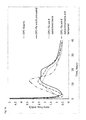
- FIG. 1 a shows measured heat flow according to Example 1,
- FIG. 1 b shows cumulative heat flow according to Example 1,
- FIG. 2 a shows measured heat flow according to Example 2
- FIG. 2 b shows cumulative heat flow according to Example 2
- FIG. 3 a shows measured heat flow according to Example 3
- FIG. 3 b shows cumulative heat flow according to Example 3,
- FIG. 4 a shows measured heat flow according to Example 4,
- FIG. 4 b shows cumulative heat flow according to Example 4,
- FIG. 5 a shows measured heat flow according to Example 5
- FIG. 5 b shows cumulative heat flow according to Example 5
- FIG. 6 a shows measured heat flow according to Example 6,
- FIG. 6 b shows cumulative heat flow according to Example 6,
- FIG. 7 a shows measured heat flow according to Example 7,
- FIG. 7 b shows cumulative heat flow according to Example 7,
- FIG. 8 a shows measured heat flow according to Example 8,
- FIG. 8 b shows cumulative heat flow according to Example 8,
- FIG. 9 a shows measured heat flow according to Example 9,
- FIG. 9 b shows cumulative heat flow according to Example 9,
- FIG. 10 a shows measured heat flow according to Example 10,
- FIG. 10 b shows cumulative heat flow according to Example 10,
- FIG. 11 a shows measured heat flow according to Example 11,
- FIG. 11 b shows cumulative heat flow according to Example 11.
- the heat evolution curves indicate a significant accelerating effect for blends of OPC and hydrothermally treated material compared to blends of OPC with untreated material.
- Mixes of OPC with hydrothermally treated slag show a maximum rate of the heat release shifted to the left and a faster onset of the acceleration period.
- Subsequent tempering further increases the reactivity of the hydrothermally treated product and results in greater maximal values for the main heat peak release.
- the heat output for the blends of OPC with hydrothermally treated and tempered slag are three fold higher compared to blends of OPC with untreated slag. The values remain greater after 7 days. This clearly shows the benefit that hydrothermal treatment and hydrothermal treatment followed by tempering has on the poorly reactive slags.
- the heat evolution curves indicate a significant accelerating effect for blends of OPC with treated material compared to blends of OPC with untreated material.
- Mixes of OPC with hydrothermally treated and tempered slags show a maximum rate of the heat release shifted to the left and a faster onset of the acceleration period. The maximum rate of the heat release shifts to the left with extended duration of the hydrothermal step.
- the heat evolution curves indicate a significant accelerating effect compared to blends of OPC with untreated material.
- Mixes of OPC with hydrothermally treated slag with subsequent tempering show a maximum rate of the heat release shifted to the left and a faster onset of the acceleration period.
- the cumulative heat output for the blend of OPC with hydrothermally treated and tempered slag is 52% higher compared to the blend of OPC with non-treated slag and by 25% higher at 16 h. The values remain greater after 7 days. This clearly shows the benefit that hydrothermal treatment followed by tempering has on the fairly reactive slags.
- the heat evolution curves indicate a significant accelerating effect for the blend of OPC and treated material compared to the blend of OPC with untreated material.
- the mix of OPC with hydrothermally treated and tempered slag shows a maximum rate of the heat release shifted to the left and a faster onset of the acceleration period.
- the cumulative heat output for the blend of OPC with hydrothermally treated and tempered slag are 64% higher compared to blends of OPC with non-treated slag and by 27% higher at 16 h. The values remain greater after 7 days. This clearly shows the benefit that hydrothermal treatment followed by tempering has on fairly reactive slags.
- the heat evolution curves indicate a significant accelerating effect for blends of OPC with autoclaved and tempered material compared to blends of OPC with untreated material.
- the mixes of OPC with hydrothermally treated slag with subsequent tempering show the maximum rate of the heat release shifted to the left and a faster onset of the acceleration period.
- the cumulative heat output for the blend of OPC with hydrothermally treated and tempered slag are 125% higher compared to blends of OPC with non-treated slag and by 43% higher at 16 h. The values remain greater after 7 days. This clearly shows the benefit that hydrothermal treatment followed by tempering has on reactive slags.
- the chemical composition including the loss on ignition at 1050° C. (LOI) of the used fly ash designated “F” is given in table 6.
- This fly ash has a high free lime content and a high crystalline content so that it is not suitable to be used as SCM.
- Blends of 70% OPC and 30% hydrothermally treated fly ash and hydrothermally treated fly ash with subsequent tempering were mixed with water (water-to solid ratio of 0.5) and the heat flow development was measured by isothermal calorimetry (TAM Air, TA Instruments, Sweden). The results were compared to the heat flow recorded for mixes of 70% OPC and 30% non-treated fly ash and 70% OPC and 30% quartz. The measured heat flow and cumulative heat flow are shown in FIGS. 6 a and 6 b.
- the heat evolution curves indicate an accelerating effect for blends of OPC with treated material compared to blends of OPC with untreated material.
- the mixes of OPC with hydrothermally treated fly ash show the maximum rate of the heat release shifted to the left and a faster onset of the acceleration period.
- Subsequent tempering leads to further acceleration compared to OPC.
- the cumulative heat output for the blend of OPC with hydrothermally treated and tempered fly ash are 14% higher compared to blends of OPC with non-treated fly ash.
- the values are 10% higher.
- the values remain 11% greater after 7 days. This clearly shows the benefit that hydrothermal treatment followed by tempering has on the low reactive fly ashes.
- the chemical composition including the loss on ignition at 1050° C. (LOI) of the used fly ash designated “B” is given in table 7.
- This fly ash has a high CaO content rendering its use as SCM problematic.
- Blends of 70% OPC and 30% twice hydrothermally treated fly ash and twice hydrothermally treated fly ash with subsequent tempering were mixed with water (water-to solid ratio of 0.5) and the heat flow development was measured by isothermal calorimetry (TAM Air, TA Instruments, Sweden). The results were compared to the heat flow recorded for mixes of 70% OPC and 30% non-treated fly ash and 70% OPC and 30% quartz. The measured heat flow and cumulative heat flow are shown in FIGS. 7 a and 7 b.
- the heat evolution curves indicate an accelerating effect for blends of OPC and treated material compared to blends of OPC with untreated material.
- the mixes of OPC with hydrothermally treated fly ash show the maximum rate of the heat release shifted to the left and a faster onset of the acceleration period. Subsequent tempering leads to further acceleration and to an increase in the rate of the maximum heat release compared to OPC.
- the cumulative heat output for the blend of OPC with hydrothermally treated and tempered fly ash are 35% higher compared to blends of OPC with non-treated fly ash. At 16 h the values are 31% higher. The values are not higher after 7 days. This clearly shows the benefit that hydrothermal treatment followed by tempering has on the low reactive fly ashes.
- Blends of 70% OPC and 30% hydrothermally treated mixes of fly ashes with subsequent tempering were mixed with water (water-to solid ratio of 0.5) and the heat flow development was measured by isothermal calorimetry (TAM Air, TA Instruments, Sweden). The results were compared to the heat flow recorded for blends of 70% OPC and 30% non-treated individual fly ash and 70% OPC and 30% quartz. The measured heat flow and cumulative heat flow are shown in FIGS. 8 a and 8 b.
- the heat evolution curves indicate an accelerating effect for blends of OPC and treated material compared to blends of OPC with untreated material.
- the mixes of OPC with hydrothermally treated and tempered fly ashes show a higher maximum rate of the heat release which is additionally shifted to the left and a faster onset of the acceleration period.
- the cumulative heat output for the blend of OPC with hydrothermally treated and tempered fly ashes are from 30 to 59% higher compared to blends of OPC with non-treated fly ash.
- the values are 19 to 37% higher. The values remain greater after 7 days. This clearly shows the benefit that hydrothermal treatment followed by tempering has on the low reactive fly ashes.
- a mix 1 consisting of 30.77% portlandite, 19.18% brucite and 50.06% fly ash was added to water (water-to-solid (w/s) of 10) and hydrothermally treated at 185° C. for 16 h and 1.1 MPa in a stainless steel autoclave.
- the autoclaved product was tempered for 1 h directly at 500° C.
- the autoclaved and tempered mixes of fly ash, slag and portlandite were mixed with water (water-to solid ratio of 0.5) and the heat flow development was measured by isothermal calorimetry (TAM Air, TA Instruments, Sweden). The measured heat flow and cumulative heat flow are shown in FIGS. 10 a and 10 b . It can be seen that the autoclaved and tempered products show a high reactivity.
- a raw meal consisting of 44.55% brucite and 55.46% fly ash K was added to water (water-to-solid (w/s) of 10) and hydrothermally treated at 185° C. for 16 h and 1.1 MPa in a stainless steel autoclave.
- the autoclaved product was tempered for 1 h directly at 500° C.
- the chemical composition and loss on ignition (LOI) at 1050° C. of the starting materials fly ash and brucite is found in table 10.
Landscapes
- Chemical & Material Sciences (AREA)
- Engineering & Computer Science (AREA)
- Ceramic Engineering (AREA)
- Structural Engineering (AREA)
- Materials Engineering (AREA)
- Organic Chemistry (AREA)
- Inorganic Chemistry (AREA)
- Chemical Kinetics & Catalysis (AREA)
- Physics & Mathematics (AREA)
- Thermal Sciences (AREA)
- Silicates, Zeolites, And Molecular Sieves (AREA)
- Curing Cements, Concrete, And Artificial Stone (AREA)
- Processing Of Solid Wastes (AREA)
- Civil Engineering (AREA)
- Treatment Of Sludge (AREA)
Applications Claiming Priority (10)
| Application Number | Priority Date | Filing Date | Title |
|---|---|---|---|
| EP13002496.1 | 2013-05-11 | ||
| EP13002496 | 2013-05-11 | ||
| EP13002496.1A EP2801557B9 (de) | 2013-05-11 | 2013-05-11 | Verfahren zur Herstellung eines Magnesiumsilikat-Belit-Calciumaluminatzements |
| EP13005291.3 | 2013-11-11 | ||
| EP13005291.3A EP2801558B2 (de) | 2013-05-11 | 2013-11-11 | Verwendung von belit-calciumaluminat als additiv |
| EP13005291 | 2013-11-11 | ||
| EP13005528 | 2013-11-28 | ||
| EP13005528.8A EP2801559B1 (de) | 2013-05-11 | 2013-11-28 | Verfahren zur verbesserung der latent hydraulischen und/oder puzzolanischen reaktivität von materialien |
| EP13005528.8 | 2013-11-28 | ||
| PCT/EP2014/001216 WO2014183846A1 (en) | 2013-05-11 | 2014-05-07 | Method of enhancing the latent hydraulic and/or pozzolanic reactivity of materials |
Publications (2)
| Publication Number | Publication Date |
|---|---|
| US20160075598A1 US20160075598A1 (en) | 2016-03-17 |
| US10065888B2 true US10065888B2 (en) | 2018-09-04 |
Family
ID=48366108
Family Applications (3)
| Application Number | Title | Priority Date | Filing Date |
|---|---|---|---|
| US14/787,012 Active US10065888B2 (en) | 2013-05-11 | 2014-05-07 | Method of enhancing the latent hydraulic and/or pozzolanic reactivity of materials |
| US14/787,006 Active US9604879B2 (en) | 2013-05-11 | 2014-05-07 | Belite-calcium aluminate as an additive |
| US14/787,024 Expired - Fee Related US9718731B2 (en) | 2013-05-11 | 2014-05-07 | Method for producing magnesium silicate-belite-calcium aluminate cement |
Family Applications After (2)
| Application Number | Title | Priority Date | Filing Date |
|---|---|---|---|
| US14/787,006 Active US9604879B2 (en) | 2013-05-11 | 2014-05-07 | Belite-calcium aluminate as an additive |
| US14/787,024 Expired - Fee Related US9718731B2 (en) | 2013-05-11 | 2014-05-07 | Method for producing magnesium silicate-belite-calcium aluminate cement |
Country Status (15)
| Country | Link |
|---|---|
| US (3) | US10065888B2 (de) |
| EP (3) | EP2801557B9 (de) |
| CN (2) | CN105143138B (de) |
| AU (3) | AU2014267719B2 (de) |
| BR (2) | BR112015026454A2 (de) |
| CA (3) | CA2907893C (de) |
| DK (3) | DK2801557T3 (de) |
| EA (3) | EA028010B1 (de) |
| ES (3) | ES2553241T3 (de) |
| HK (1) | HK1213238A1 (de) |
| MA (1) | MA38557B1 (de) |
| PL (3) | PL2801557T3 (de) |
| PT (1) | PT2801557E (de) |
| UA (2) | UA112149C2 (de) |
| WO (3) | WO2014183844A1 (de) |
Cited By (1)
| Publication number | Priority date | Publication date | Assignee | Title |
|---|---|---|---|---|
| US11001527B2 (en) | 2017-06-14 | 2021-05-11 | Hconnect 2 Gmbh | Composite cement and method of manufacturing composite cement |
Families Citing this family (40)
| Publication number | Priority date | Publication date | Assignee | Title |
|---|---|---|---|---|
| DK2801557T3 (en) | 2013-05-11 | 2015-12-14 | Heidelbergcement Ag | A process for the preparation of the magnesium silicate-cement-belitcalciumaluminat |
| US10968108B2 (en) | 2015-05-29 | 2021-04-06 | Fundacion Tecnalia Research & Innovation | Method for the manufacture of calcium silicate hydrate used as hardening accelerator in concrete and cement-based materials, calcium silicate hydrate manufactured with said method |
| EP3310737B1 (de) * | 2015-06-16 | 2019-10-30 | HeidelbergCement AG | Anreger mit niedrigem ph-wert für klinkerersatzmaterialien |
| ES2693394T5 (es) * | 2015-06-16 | 2021-12-02 | Heidelbergcement Ag | Procedimiento para la producción de cementos altamente reactivos |
| EP3109215B1 (de) | 2015-06-22 | 2020-04-22 | HeidelbergCement AG | Mineralisator für calciumsulfoaluminat-ternesit-zemente |
| EP3319923B1 (de) * | 2015-07-06 | 2021-08-11 | HeidelbergCement AG | Verfahren zur bindung von kohlendioxid |
| CN108883988B (zh) | 2015-10-28 | 2021-09-10 | 索里迪亚科技公司 | 金属硅酸盐水泥组合物及其蒸汽辅助生产方法 |
| US11667569B2 (en) | 2017-02-22 | 2023-06-06 | Basf Se | Composition containing a semi-ordered calcium silicate hydrate |
| WO2018154013A1 (de) | 2017-02-22 | 2018-08-30 | Cirkel Gmbh & Co. Kg | Oxidische Zusammensetzung mit einem Gehalt an semigeordnetem Calcium-Silikat-Hydrat |
| BR112021013144A2 (pt) | 2019-01-16 | 2021-09-08 | Massachusetts Institute Of Technology | Método e sistema para produzir cimento, e, reator |
| US11873250B2 (en) | 2019-01-18 | 2024-01-16 | Venator Germany Gmbh | Rapid curing mineral binder mixture |
| US12084384B2 (en) | 2019-01-18 | 2024-09-10 | Venator Germany Gmbh | Rapid-hardening mineral binder mixture |
| CA3133424A1 (en) | 2019-03-14 | 2020-09-17 | Massachusetts Institute Of Technology | Chemical reaction devices involving acid and/or base, and related systems and methods |
| FR3094712B1 (fr) * | 2019-04-03 | 2023-04-28 | Bostik Sa | Composition de liant hydraulique |
| US11180412B2 (en) | 2019-04-17 | 2021-11-23 | United States Gypsum Company | Aluminate-enhanced type I Portland cements with short setting times and cement boards produced therefrom |
| US10759697B1 (en) | 2019-06-11 | 2020-09-01 | MSB Global, Inc. | Curable formulations for structural and non-structural applications |
| GB2586951B (en) * | 2019-06-12 | 2024-01-31 | Ardex Group Gmbh | A method and apparatus for processing water treatment residuals |
| CN110963724A (zh) * | 2019-11-28 | 2020-04-07 | 谭纪林 | 一种利用工业废渣垃圾焚烧固化的飞灰生产水泥超细粉的方法 |
| US11466192B2 (en) | 2020-06-26 | 2022-10-11 | Saudi Arabian Oil Company | Cements for oil and gas cementing applications |
| CN111943238A (zh) * | 2020-08-21 | 2020-11-17 | 西南科技大学 | 一种多孔绒球状氧化镁的制备方法 |
| WO2022073961A1 (en) | 2020-10-09 | 2022-04-14 | Basf Se | Process for producing calcium silicate hydrate |
| CN112374784A (zh) * | 2020-11-23 | 2021-02-19 | 广西交科集团有限公司 | 一种低温下碱激发材料的促凝剂及其使用方法 |
| EP4011624A1 (de) | 2020-12-08 | 2022-06-15 | Imertech | Hydraulisches bindemittel mit geringem kohlenstofffussabdruck und hoher früher festigkeit |
| EP4137323A1 (de) | 2021-08-18 | 2023-02-22 | Imertech | Hydraulisches bindemittel mit geringem kohlenstofffussabdruck und hoher früher festigkeit |
| WO2022136620A1 (en) | 2020-12-23 | 2022-06-30 | Construction Research & Technology Gmbh | A ternary hydraulic binder composition |
| EP4308294A4 (de) | 2021-03-17 | 2025-10-15 | Electrasteel Inc | Kohlenstoffabscheidung mit elektrochemisch erzeugter säure und base |
| CN113060962B (zh) * | 2021-03-18 | 2022-03-18 | 西南石油大学 | 适用于盐膏层固井的油井水泥防腐型早强剂及其制备方法 |
| EP4313906A4 (de) | 2021-03-22 | 2025-02-19 | Sublime Systems, Inc. | Entkohlte zementmischungen |
| DE102021108322A1 (de) | 2021-04-01 | 2022-10-06 | EEW Energy from Waste GmbH | Bindemittel für Baustoffe, Herstellungsverfahren dafür und Anlage zur Ausführung dieses Verfahrens |
| CN112919484A (zh) * | 2021-04-25 | 2021-06-08 | 西南科技大学 | 一种以石英砂为硅质原料制备的硅酸镁及其方法 |
| EP4095110A1 (de) | 2021-05-26 | 2022-11-30 | HeidelbergCement AG | Verfahren zur herstellung von ergänzendem zementmaterial |
| CN113526884B (zh) * | 2021-08-03 | 2022-09-02 | 敦煌研究院 | 一种水硬性石灰材料、制备方法及其应用 |
| EP4155279A1 (de) * | 2021-09-22 | 2023-03-29 | HeidelbergCement AG | Verfahren zur herstellung von ergänzendem zementmaterial |
| CA3203524A1 (en) | 2021-12-23 | 2023-06-23 | Graymont Western Canada Inc. | Lime-based cement extender compositions, and associated systems and methods |
| CN114959286B (zh) * | 2022-05-30 | 2023-05-12 | 金川镍钴研究设计院有限责任公司 | 一种降低物料熔点和粘度的复合添加剂的制备方法 |
| CN115448624B (zh) * | 2022-09-08 | 2023-07-21 | 中国建筑材料科学研究总院有限公司 | 一种高地热环境耐受型低热硅酸盐熟料的制备方法及应用 |
| CN115465869A (zh) * | 2022-10-31 | 2022-12-13 | 陕西科技大学 | 一种煤气化渣制备聚硅酸铝铁钙的方法 |
| PE20252263A1 (es) | 2022-12-20 | 2025-09-15 | Graymont Western Canada Inc | Sistemas y metodos para almacenamiento y mineralizacion de dioxido de carbono con cal |
| WO2024180429A1 (en) * | 2023-02-27 | 2024-09-06 | King Abdullah University Of Science And Technology | Cementitious, self-binding material with reduced or no cement |
| CN121800444A (zh) * | 2026-03-11 | 2026-04-07 | 中科镁基(北京)科技有限公司 | 一种利用石棉尾矿制备建筑材料的方法 |
Citations (14)
| Publication number | Priority date | Publication date | Assignee | Title |
|---|---|---|---|---|
| CN1232000A (zh) | 1998-04-16 | 1999-10-20 | 北京市海淀区博奥新材料技术研究所 | 人工合成的水泥、混凝土掺合料的制造方法及其产品和应用 |
| CN1420003A (zh) | 2002-09-24 | 2003-05-28 | 莱州祥云防火隔热材料有限公司 | 一种硅酸钙隔热防火板的制法及装置 |
| ES2223275A1 (es) | 2003-06-27 | 2005-02-16 | Consejo Sup. De Invest. Cientificas. | Nuevos clinker de cemento belitico de cenizas volantes, de la combustion del carbon de alto contenido en cal y cemento belitico. |
| EP1719741A1 (de) | 2004-02-26 | 2006-11-08 | Fundacion Labein | Bauzement und herstellungsverfahren dafür |
| WO2007017142A2 (de) | 2005-08-10 | 2007-02-15 | Forschungszentrum Karlsruhe Gmbh | Verfahren zur herstellung von belit-bindemittel |
| CN1958499A (zh) | 2006-09-28 | 2007-05-09 | 贵州省遵义碱厂 | 一种硬硅钙石保温隔热材料及其制备方法 |
| WO2009015771A1 (de) | 2007-07-27 | 2009-02-05 | Forschungszentrum Karlsruhe Gmbh | Einphasiges hydraulisches bindemittel, herstellungsverfahren und damit hergestellter baustoff |
| WO2009015769A1 (de) | 2007-07-27 | 2009-02-05 | Forschungszentrum Karlsruhe Gmbh | Einphasiges hydraulisches bindemittel, herstellungsverfahren und damit hergestellter baustoff |
| WO2009015770A1 (de) | 2007-07-27 | 2009-02-05 | Forschungszentrum Karlsruhe Gmbh | Einphasiges hydraulisches bindemittel, herstellungsverfahren und damit hergestellter baustoff |
| US20100151157A1 (en) * | 2007-05-17 | 2010-06-17 | Petracem S.R.L. | Manufactured item for the building industry |
| FR2940274A1 (fr) | 2008-12-19 | 2010-06-25 | Lafarge Sa | Liant hydraulique a base de clinker sulfoalumineux et de clinker portland |
| EP2243754A1 (de) | 2009-04-23 | 2010-10-27 | Karlsruher Institut für Technologie | Verfahren zur Herstellung eines belithaltigen Bindemittels |
| EP2676943A1 (de) | 2012-06-20 | 2013-12-25 | HeidelbergCement AG | Verfahren zur Herstellung eines Belitzements mit hoher Reaktivitaet und geringem Calcium/Silicat-Verhaeltnis |
| EP2878585A1 (de) | 2013-11-27 | 2015-06-03 | Fundacíon Tecnalia Research & Innovation | Verfahren zur Herstellung von zementartigen C-S-H-Samen |
Family Cites Families (11)
| Publication number | Priority date | Publication date | Assignee | Title |
|---|---|---|---|---|
| DE2548687A1 (de) | 1975-10-30 | 1977-05-05 | Ullrich Fritz | Zusatzmittel fuer moertel und beton zum beschleunigen des erstarrungsbeginnes |
| DD138197B1 (de) | 1978-02-06 | 1981-02-25 | Richard Schrader | Verfahren zur herstellung von zement |
| CH648272A5 (de) | 1981-10-12 | 1985-03-15 | Sika Ag | Alkalifreier abbinde- und erhaertungsbeschleuniger sowie verfahren zur beschleunigung des abbindens und erhaertens eines hydraulischen bindemittels. |
| DE3414196A1 (de) | 1984-04-14 | 1985-10-31 | Paul Ensle Stiftung & Co KG, 7100 Heilbronn | Alkaliaktivierter belitzement |
| US5509962A (en) | 1994-05-20 | 1996-04-23 | Construction Technology Laboratories, Inc. | Cement containing activated belite |
| DE29624624U1 (de) | 1996-10-25 | 2005-07-14 | Bk Giulini Gmbh | Erstarrungs- und Erhärtungsbeschleuniger für hydraulische Bindemittel |
| FR2873366B1 (fr) * | 2004-07-20 | 2006-11-24 | Lafarge Sa | Clinker sulfoalumineux a haute teneur en belite, procede de fabrication d'un tel clinker et son utilisation pour la preparation de liants hydrauliques. |
| CN100357209C (zh) * | 2006-07-17 | 2007-12-26 | 济南大学 | 贝利特-硫铝酸钡钙水泥 |
| EP2105419A1 (de) * | 2008-03-28 | 2009-09-30 | Lafarge | Zusätze für Zement |
| IT1402754B1 (it) * | 2010-11-15 | 2013-09-18 | Italcementi Spa | Clinker solfoalluminoso ad elevate prestazioni |
| DK2801557T3 (en) | 2013-05-11 | 2015-12-14 | Heidelbergcement Ag | A process for the preparation of the magnesium silicate-cement-belitcalciumaluminat |
-
2013
- 2013-05-11 DK DK13002496.1T patent/DK2801557T3/en active
- 2013-05-11 ES ES13002496.1T patent/ES2553241T3/es active Active
- 2013-05-11 PT PT130024961T patent/PT2801557E/pt unknown
- 2013-05-11 EP EP13002496.1A patent/EP2801557B9/de not_active Revoked
- 2013-05-11 PL PL13002496T patent/PL2801557T3/pl unknown
- 2013-11-11 ES ES13005291.3T patent/ES2559469T5/es active Active
- 2013-11-11 EP EP13005291.3A patent/EP2801558B2/de active Active
- 2013-11-11 PL PL13005291T patent/PL2801558T5/pl unknown
- 2013-11-11 DK DK13005291.3T patent/DK2801558T3/en active
- 2013-11-28 PL PL13005528T patent/PL2801559T3/pl unknown
- 2013-11-28 DK DK13005528.8T patent/DK2801559T3/en active
- 2013-11-28 EP EP13005528.8A patent/EP2801559B1/de not_active Revoked
- 2013-11-28 ES ES13005528.8T patent/ES2564432T3/es active Active
-
2014
- 2014-05-07 EA EA201592152A patent/EA028010B1/ru not_active IP Right Cessation
- 2014-05-07 US US14/787,012 patent/US10065888B2/en active Active
- 2014-05-07 BR BR112015026454A patent/BR112015026454A2/pt not_active IP Right Cessation
- 2014-05-07 HK HK16101321.0A patent/HK1213238A1/zh unknown
- 2014-05-07 EA EA201592158A patent/EA201592158A1/ru unknown
- 2014-05-07 WO PCT/EP2014/001214 patent/WO2014183844A1/de not_active Ceased
- 2014-05-07 AU AU2014267719A patent/AU2014267719B2/en not_active Ceased
- 2014-05-07 MA MA38557A patent/MA38557B1/fr unknown
- 2014-05-07 WO PCT/EP2014/001215 patent/WO2014183845A1/de not_active Ceased
- 2014-05-07 CN CN201480022078.1A patent/CN105143138B/zh not_active Expired - Fee Related
- 2014-05-07 WO PCT/EP2014/001216 patent/WO2014183846A1/en not_active Ceased
- 2014-05-07 EA EA201592154A patent/EA029898B1/ru not_active IP Right Cessation
- 2014-05-07 US US14/787,006 patent/US9604879B2/en active Active
- 2014-05-07 AU AU2014267717A patent/AU2014267717C1/en not_active Ceased
- 2014-05-07 US US14/787,024 patent/US9718731B2/en not_active Expired - Fee Related
- 2014-05-07 BR BR112015026029A patent/BR112015026029A2/pt not_active IP Right Cessation
- 2014-05-07 CN CN201480022115.9A patent/CN105143139B/zh not_active Expired - Fee Related
- 2014-05-07 CA CA2907893A patent/CA2907893C/en not_active Expired - Fee Related
- 2014-05-07 CA CA2908543A patent/CA2908543C/en not_active Expired - Fee Related
- 2014-05-07 CA CA2911192A patent/CA2911192C/en not_active Expired - Fee Related
- 2014-05-07 AU AU2014267718A patent/AU2014267718B2/en not_active Ceased
- 2014-07-05 UA UAA201512261A patent/UA112149C2/uk unknown
- 2014-07-05 UA UAA201512262A patent/UA113253C2/uk unknown
Patent Citations (17)
| Publication number | Priority date | Publication date | Assignee | Title |
|---|---|---|---|---|
| CN1232000A (zh) | 1998-04-16 | 1999-10-20 | 北京市海淀区博奥新材料技术研究所 | 人工合成的水泥、混凝土掺合料的制造方法及其产品和应用 |
| CN1420003A (zh) | 2002-09-24 | 2003-05-28 | 莱州祥云防火隔热材料有限公司 | 一种硅酸钙隔热防火板的制法及装置 |
| ES2223275A1 (es) | 2003-06-27 | 2005-02-16 | Consejo Sup. De Invest. Cientificas. | Nuevos clinker de cemento belitico de cenizas volantes, de la combustion del carbon de alto contenido en cal y cemento belitico. |
| EP1719741A1 (de) | 2004-02-26 | 2006-11-08 | Fundacion Labein | Bauzement und herstellungsverfahren dafür |
| US20060260513A1 (en) | 2004-02-26 | 2006-11-23 | Antonio Porro Guiterrez | Construction cement and method for the producing thereof |
| WO2007017142A2 (de) | 2005-08-10 | 2007-02-15 | Forschungszentrum Karlsruhe Gmbh | Verfahren zur herstellung von belit-bindemittel |
| DE102005037771B4 (de) | 2005-08-10 | 2007-08-30 | Forschungszentrum Karlsruhe Gmbh | Verfahren zur Herstellung von Belit-Bindemittel |
| CN1958499A (zh) | 2006-09-28 | 2007-05-09 | 贵州省遵义碱厂 | 一种硬硅钙石保温隔热材料及其制备方法 |
| US20100151157A1 (en) * | 2007-05-17 | 2010-06-17 | Petracem S.R.L. | Manufactured item for the building industry |
| WO2009015771A1 (de) | 2007-07-27 | 2009-02-05 | Forschungszentrum Karlsruhe Gmbh | Einphasiges hydraulisches bindemittel, herstellungsverfahren und damit hergestellter baustoff |
| WO2009015770A1 (de) | 2007-07-27 | 2009-02-05 | Forschungszentrum Karlsruhe Gmbh | Einphasiges hydraulisches bindemittel, herstellungsverfahren und damit hergestellter baustoff |
| WO2009015769A1 (de) | 2007-07-27 | 2009-02-05 | Forschungszentrum Karlsruhe Gmbh | Einphasiges hydraulisches bindemittel, herstellungsverfahren und damit hergestellter baustoff |
| FR2940274A1 (fr) | 2008-12-19 | 2010-06-25 | Lafarge Sa | Liant hydraulique a base de clinker sulfoalumineux et de clinker portland |
| EP2243754A1 (de) | 2009-04-23 | 2010-10-27 | Karlsruher Institut für Technologie | Verfahren zur Herstellung eines belithaltigen Bindemittels |
| DE102009018632B4 (de) | 2009-04-23 | 2011-11-24 | Karlsruher Institut für Technologie | Verfahren zur Herstellung eines belithaltigen Bindemittels |
| EP2676943A1 (de) | 2012-06-20 | 2013-12-25 | HeidelbergCement AG | Verfahren zur Herstellung eines Belitzements mit hoher Reaktivitaet und geringem Calcium/Silicat-Verhaeltnis |
| EP2878585A1 (de) | 2013-11-27 | 2015-06-03 | Fundacíon Tecnalia Research & Innovation | Verfahren zur Herstellung von zementartigen C-S-H-Samen |
Non-Patent Citations (32)
| Title |
|---|
| Barnes et al., "Composition of Portland Cement Belites", Cement and Concrete Research, vol. 8 (1978), pp. 559-564, Pergamon Press, Inc. |
| Berechnungsblätter zur Berechnung molarer Verhaltnisse aus chemischen Zusammensetzungen in Locher, Fylak, Barnes und Schneider, Oct. 27, 2016, 5 pgs. |
| EPO communication pursuant to Rule 114(2) EPC, Appl. No. 13005528.8, Jul. 20, 2015, 15 pgs. |
| EPO Opposition, Appl. No. EP2801559, Nov. 2, 2016, 39 pgs. |
| Fylak, "Untersuchungen zum frühen Hydratationsverhalten von Portland- und Portlandkompositzementen", Dissertation Martin-Luther-Universität Halle-Wittenberg (2011), 225 pgs. |
| Garbev et al, "First Observation of α-Ca2[SiO3(OH)](OH)-Ca6[Si2O7][SiO4](OH)2Phase Transformation upon Thermal Treatment in Air", J. Am. Ceram. Soc., vol. 91, No. 1 (2008), pp. 263-271. |
| Ghosh, "Hydration of Polymorphs of Dicalcium Silicate", ii cement, vol. 3 (1985), pp. 139-146. |
| Goni et al., "An Eco-Efficient Method to Valorization of Solid Wastes: Hydrothermal Treatment", 1st Spanish National Conference on Advances in Materials Recycling and in Eco-Energy, Madrid, Nov. 12-13, 2009, pp. 119-122. |
| Goni et al., "SEM/EDX characterization of the hydration products of belite cements from class C coal fly ash", J. Am. Ceram. Soc., vol. 90, No. 12 (2007), pp. 3915-3922. |
| Goni et al., "Study of alkaline hydrothermal activation of belite cements by thermal ananlysis", J. Am. Chem. Soc., vol. 90 (2007), pp. 3915-3922. |
| Gu et al., "A conduction calorimetric study of early hydration of ordinary Portland cement/high alumina cement pastes", J. Materials Science, vol. 32 (1997), pp. 3875-3881. |
| Guerrero et al., "Microstructure and Mechanical Performance of Belite Cements form High Calcium Coal Fly Ash", J. Am. Ceram. Soc., vol. 88, No. 7 (2005), pp. 1845-1853. |
| Hjorth et al, "Belite in Portland Cement", Cement and Concrete Research, vol. 1 (1971), pp. 27-40, Pergamon Press, Inc. |
| International Search Report, PCT/EP2014/001216, Jun. 18, 2014, 2 pgs. |
| Ishida et al, "Innovative Processing for Cement Materials", Mrs Bulletin, Nov. 2001, pp. 895-898. |
| Ishida et al., "A-Dicalcium Silicate Hydrate: Preparation, Decomposed Phase, and Its Hydration", J. Am. Ceram. Soc., vol. 76, No. 7 (1993), pp. 1707-1712. |
| Jernejcic et al, "Thermal Decomposition of a-Dicalcium Silicate Hydrate", Thermochimica Acta, Vo;. 20 (1977), pp. 237-247. |
| Jiang et al., "Hydrothermal Processing of New Fly Ash Cement", Ceramic Bulletin, vol. 71, No. 4 (1992), pp. 642-647. |
| Kacimi et al., "Synthesis of α′L - C2S cement from fly-ash using the hydrothermal method at low temperature and atmoshpheric pressure", Journal of Hazardous Materials, vol. 181 (2010), pp. 593-601. |
| Kim et al., "Influence of Minor Ions on the Stability and Hydration Rates of β-Dicalcium Silicate", J. Am. Ceram. Soc., vol. 87, No. 5 (2004), pp. 900-905. |
| Locher, "Zement: Grundlagen der Herstellung und Verwendung", Verlag Bau und Technik, Düsseldorf, (2000), p. 31 (Section 3.1), 2000. |
| Mazouzi et al., "Synthese d'un clinker belitique reactif a partir d'un melange de dechets industriels", XXIXe Rencontres Universitaires de Genie Civil, Tlemcen, May 29-31, 2011, pp. 411-418. |
| Miyazaki et al., "Crystallographic Data of a New Phase of Dicalcium Silicate", J. Am. Ceram. Soc., vol. 81, No. 5 (1998), pp. 1339-1343. |
| Pimraksa et al., "Synthesis of belite cement from lignite fly ash", Ceram. Int., vol. 35 (2009), pp. 2415-2425. |
| Reschke et al, "EinfluB der Granulometrie und Reaktivität von Zement und Zusatzstoffen auf die Festigkeits-und Geügeentwicklung von Mörtel und Beton", Betontechnische Berichte, Concrete Technology Reports 1998-2000, Verlag Bau+ Technik, Dusseldorf (2001), pp. 25-38. |
| Reschke et al, "EinfluB der Granulometrie und Reaktivität von Zement und Zusatzstoffen auf die Festigkeits—und Geügeentwicklung von Mörtel und Beton", Betontechnische Berichte, Concrete Technology Reports 1998-2000, Verlag Bau+ Technik, Dusseldorf (2001), pp. 25-38. |
| Research Results Digest 382, "Measuring Cement Particle Size and Surface Area by Laser Diffraction", National Cooperative Highway Research Program, Apr. 2013, 24 pgs. |
| Schneider, "Charakterisierung von Zementbestandteilen", Conference Paper, Conference: Forschungskolloquium des Deutschen Ausschusses für Stahlbeton (DAfStb), Dusseldorf, vol. 41, Jul. 2002, 14 pgs. |
| Stevulova et al., "Coal fly ash as raw material for low-energy belite cement preparing", Proc. of the 11th Int. Conf. on Environmental Science and Technology, Chania, Crete, Greece, Sep. 3-5, 2009, pp. B-908-B-914. |
| Stevulova et al., "Influence of Hydrothermal Pre-Treatment of Coal Fly on the Synthesis of Belite Phase", Journal of Environmental Science and Engineering, vol. 5 (2011), pp. 816-823. |
| Toraya et al., "Simulated annealing structure solution of a new phase of dicalcium silicate Ca 2 SiO4 and the mechanism of structural changes from α-dicalcium silicat hydrate to αL -dicalcium silicate via the new phase", Acta Cryst. vol. B58 (2002), pp. 613-621. |
| Zement-Taschenbuch, vol. 51 (2008), pp. 18-27 and 112-123, Düsseldorf, Verlag Bau+ Technik GmbH. |
Cited By (1)
| Publication number | Priority date | Publication date | Assignee | Title |
|---|---|---|---|---|
| US11001527B2 (en) | 2017-06-14 | 2021-05-11 | Hconnect 2 Gmbh | Composite cement and method of manufacturing composite cement |
Also Published As
Similar Documents
| Publication | Publication Date | Title |
|---|---|---|
| EP2801559B1 (de) | Verfahren zur verbesserung der latent hydraulischen und/oder puzzolanischen reaktivität von materialien | |
| CA2922773C (en) | Calcium sulfoaluminate composite binders | |
| AU2014317428B2 (en) | Binder comprising calcium sulfoaluminate cement and a magnesium compound | |
| WO2018228839A1 (en) | Composite cement and method of manufacturing composite cement | |
| AU2014317429A2 (en) | Calcium sulfoaluminate composite binders | |
| Liu et al. | Utilization of carbonated alkaline solid wastes in ordinary Portland cement-metakaolin-limestone ternary mixture: Underlying the role of low grade-sustainable calcium carbonate sources | |
| Heidari et al. | Reusing waste ceramic and waste sanitary ware in concrete as pozzolans with nano-silica and metakaolin | |
| EP2842924A1 (de) | Verbundbindemittel mit Calciumsulfoaluminatzement und Calciumnitrat oder Calciumnitrid | |
| JP7181355B1 (ja) | セメント混和材、セメント混和材の製造方法及びセメント組成物 | |
| WO2025132807A1 (en) | High-fluidity cementitious composition with a reduced water demand | |
| WO2026022264A1 (en) | Cementitious binder composition comprising autoclaved aerated concrete | |
| WO2026022263A1 (en) | CEMENTITIOUS BINDER COMPOSITION COMPRISING Si-SLAG AND CaCO3-SOURCE | |
| Boakye et al. | Physicochemical and Mineralogical Analysis of Steel-Slag Blended Cements |
Legal Events
| Date | Code | Title | Description |
|---|---|---|---|
| AS | Assignment |
Owner name: HEIDELBERGCEMENT AG, GERMANY Free format text: ASSIGNMENT OF ASSIGNORS INTEREST;ASSIGNORS:SCHMITT, DIRK;BEN HAHA, MOHSEN;ITUL, ANCA;AND OTHERS;REEL/FRAME:036911/0655 Effective date: 20151023 |
|
| STCF | Information on status: patent grant |
Free format text: PATENTED CASE |
|
| AS | Assignment |
Owner name: HCONNECT 2 GMBH, GERMANY Free format text: ASSIGNMENT OF ASSIGNORS INTEREST;ASSIGNOR:HEIDELBERGCEMENT AG;REEL/FRAME:052242/0962 Effective date: 20200323 |
|
| MAFP | Maintenance fee payment |
Free format text: PAYMENT OF MAINTENANCE FEE, 4TH YEAR, LARGE ENTITY (ORIGINAL EVENT CODE: M1551); ENTITY STATUS OF PATENT OWNER: LARGE ENTITY Year of fee payment: 4 |
|
| AS | Assignment |
Owner name: HSUSTAINABILITY GMBH, GERMANY Free format text: CHANGE OF NAME;ASSIGNOR:HCONNECT 2 GMBH;REEL/FRAME:068376/0917 Effective date: 20240620 |
|
| FEPP | Fee payment procedure |
Free format text: MAINTENANCE FEE REMINDER MAILED (ORIGINAL EVENT CODE: REM.); ENTITY STATUS OF PATENT OWNER: LARGE ENTITY |