US10126257B2 - Device and method for non-invasive detection of hazardous materials in the aquatic environment - Google Patents
Device and method for non-invasive detection of hazardous materials in the aquatic environment Download PDFInfo
- Publication number
- US10126257B2 US10126257B2 US15/509,013 US201515509013A US10126257B2 US 10126257 B2 US10126257 B2 US 10126257B2 US 201515509013 A US201515509013 A US 201515509013A US 10126257 B2 US10126257 B2 US 10126257B2
- Authority
- US
- United States
- Prior art keywords
- guide
- gamma quanta
- neutron
- detector
- gamma
- Prior art date
- Legal status (The legal status is an assumption and is not a legal conclusion. Google has not performed a legal analysis and makes no representation as to the accuracy of the status listed.)
- Expired - Fee Related
Links
Images



Classifications
-
- G—PHYSICS
- G01—MEASURING; TESTING
- G01N—INVESTIGATING OR ANALYSING MATERIALS BY DETERMINING THEIR CHEMICAL OR PHYSICAL PROPERTIES
- G01N23/00—Investigating or analysing materials by the use of wave or particle radiation, e.g. X-rays or neutrons, not covered by groups G01N3/00 – G01N17/00, G01N21/00 or G01N22/00
- G01N23/22—Investigating or analysing materials by the use of wave or particle radiation, e.g. X-rays or neutrons, not covered by groups G01N3/00 – G01N17/00, G01N21/00 or G01N22/00 by measuring secondary emission from the material
- G01N23/221—Investigating or analysing materials by the use of wave or particle radiation, e.g. X-rays or neutrons, not covered by groups G01N3/00 – G01N17/00, G01N21/00 or G01N22/00 by measuring secondary emission from the material by activation analysis
- G01N23/222—Investigating or analysing materials by the use of wave or particle radiation, e.g. X-rays or neutrons, not covered by groups G01N3/00 – G01N17/00, G01N21/00 or G01N22/00 by measuring secondary emission from the material by activation analysis using neutron activation analysis [NAA]
-
- G01V5/0016—
-
- G—PHYSICS
- G01—MEASURING; TESTING
- G01V—GEOPHYSICS; GRAVITATIONAL MEASUREMENTS; DETECTING MASSES OR OBJECTS; TAGS
- G01V5/00—Prospecting or detecting by the use of ionising radiation, e.g. of natural or induced radioactivity
- G01V5/20—Detecting prohibited goods, e.g. weapons, explosives, hazardous substances, contraband or smuggled objects
- G01V5/22—Active interrogation, i.e. by irradiating objects or goods using external radiation sources, e.g. using gamma rays or cosmic rays
-
- G—PHYSICS
- G01—MEASURING; TESTING
- G01N—INVESTIGATING OR ANALYSING MATERIALS BY DETERMINING THEIR CHEMICAL OR PHYSICAL PROPERTIES
- G01N2223/00—Investigating materials by wave or particle radiation
- G01N2223/60—Specific applications or type of materials
- G01N2223/637—Specific applications or type of materials liquid
-
- G—PHYSICS
- G01—MEASURING; TESTING
- G01N—INVESTIGATING OR ANALYSING MATERIALS BY DETERMINING THEIR CHEMICAL OR PHYSICAL PROPERTIES
- G01N2223/00—Investigating materials by wave or particle radiation
- G01N2223/60—Specific applications or type of materials
- G01N2223/652—Specific applications or type of materials impurities, foreign matter, trace amounts
-
- G—PHYSICS
- G01—MEASURING; TESTING
- G01N—INVESTIGATING OR ANALYSING MATERIALS BY DETERMINING THEIR CHEMICAL OR PHYSICAL PROPERTIES
- G01N33/00—Investigating or analysing materials by specific methods not covered by groups G01N1/00 - G01N31/00
- G01N33/18—Water
Definitions
- the present disclosure relates to a device and method for non-invasive detection of hazardous substances, such as war remnants, mines, war gases, etc., in the underwater environment.
- the presented apparatus and method are based on neutron activation and the measurement of characteristic gamma quanta spectra of substance created after neutron beam irradiation.
- Remnants of war sunk at the bottom of seas, oceans and rivers are still a big problem, especially in areas of intense military operations and shallow bodies of water.
- Drowned munitions and mines used during World War II are a serious threat at sea and toxic substances contained in some shells, for example war gases, are a major environmental problem.
- the main known contaminated areas are Little Belt, Bornholm Deep (east of Bornholm) and the southwestern part of the Gotland Deep.
- Apart from known underwater stockyard there is an unknown amount of dangerous war remnants spread over the whole Baltic, especially along maritime convoy paths and in the vicinity of the coasts.
- US Patent application 20060227920 A1 describes a device which in addition to the fast neutron interactions also uses gamma quanta produced in the process of thermal neutrons capture produced in the test object after multiple scatterings of neutrons from the incident beam. This allows one to determine the hydrogen content and increases sensitivity of the method.
- the technical problem posed prior to the present invention is to provide such an apparatus and method for non-invasive detection of hazardous materials in an aquatic environment, which is characterized by higher sensitivity and lower noise (background reduction), and which will allow for more accurate detection of dangerous substance, also located deep in the bottom of the water reservoir, and in addition will allow determination of the dangerous substance density distribution in the tested object.
- the first subject of the invention is a device for non-invasive detection of hazardous materials in an aquatic environment comprising a sealed housing, in which there is a fast neutron generator surrounded by an ⁇ particle detector and a gamma quantum detector, wherein the fast neutron generator emits neutrons in the direction of the tested object and the gamma quanta detector registers gamma quanta emitted by nuclei building the object under examination, characterized in that it contains also neutrons and/or gamma quanta guides connected to the fast neutron generator and gamma quanta detector, respectively.
- the neutrons and/or gamma quanta guides are in the form of a cylinder with closed bases, preferably telescopic.
- the neutrons and/or gamma quanta guides there is a vacuum or they are filled with a gas, preferably air, helium, argon.
- the neutrons and/or gamma quanta guides are made of a material like: stainless steel, aluminum or carbon fibers.
- the neutrons and/or gamma quanta guides are covered from inside with a thin layer of neutron-reflecting material, preferably graphite.
- the distance between the neutron guide connected to the fast neutron generator and gamma quanta guide connected to the gamma quanta detector is variable, wherein the angle between the neutron guide and gamma quanta guide is in the range of 0 to 90 degrees.
- the gamma quanta detector is a semiconductor detector system or scintillation detector.
- fast neutron generator has in a position opposed to the neutron guide the ⁇ particle detector, and in a position perpendicular to the guide the ⁇ particle detectors.
- the second subject of the invention is a method for non-invasive detection of hazardous materials in an aquatic environment comprising the following steps:
- step b) collimation of fast neutrons generated in step a) in the direction of the interrogated object
- the generated fast neutrons and emitted gamma quanta are transmitted in neutrons and/or gamma quanta guides.
- the gamma quanta are detected in coincidence with ⁇ particles by a detector placed opposite to the guide.
- the position of neutrons and/or gamma quanta guides and the time of gamma quanta registration in the gamma quanta detector with respect to the signal from the ⁇ particle detector are measured.
- the device and method for non-invasive detection of hazardous materials in an aquatic environment by using specially designed fast neutrons and/or gamma quanta guides which enable one to detect dangerous substances with greater precision, allows for the detection of objects hidden deep in the bottom of the water reservoir.
- Telescopic guide structures allow for the adjusting of its length in a wide range, thereby to perform the detection in water reservoirs of different depths.
- the use of moving gamma quanta guide connected to the gamma quanta detector allows for changing of the angle between the guides, and thus enables detection at different depths and variable area which makes it possible to determine the density distribution of the tested item.
- Measurement of gamma quanta in coincidence with signals registered by the ⁇ particle detector located just opposite to the neutron guide can significantly reduce the background and further enhance the sensitivity and resolution of the used measurement method.
- FIG. 1 shows a scheme of an apparatus for non-invasive detection of hazardous materials in an aquatic environment
- FIG. 2 shows a scheme of the device shown in FIG. 1 with the first settings of guides
- FIG. 3 shows a diagram of the device shown in FIG. 1 with the second settings of guides
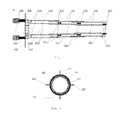
- FIG. 4 shows a cross-section of the gamma quanta and/or neutrons guide
- FIG. 5 shows a front view of the gamma quanta and/or neutrons guide
- FIG. 6 shows a scheme of a system for changing the position of the gamma quanta and/or neutrons guide.
- FIG. 1 shows a general scheme of an apparatus for non-invasive detection of hazardous materials in an aquatic environment 100 which is the subject of the invention.
- Neutron generator 101 collides deuterium ions 102 with a tritium target 103 in the reaction: D+T ⁇ +n. Because of the much higher energy released in this reaction compared to the energy of deuterium, both ⁇ particle 104 and neutron 105 are produced almost isotropically in space and move almost back-to-back.
- the ⁇ particle 104 emerging from the neutron generation is recorded by the detector system 106 a , 106 b , 106 c placed on the walls of the generator 101 . It may consist of a silicon or scintillation detector with dimensions of a few cm.
- Selected neutrons move towards the interrogated item 107 within the guide 108 of specified dimensions, e.g. with a diameter of 30 cm and a maximum length of 3 m with the air pumped out.
- the guide may be filled with air or another gas, for example Helium. This prevents the absorption and slowing down of neutrons in the water.
- the guide 108 is a telescopic tube constructed of stainless steel with a thickness of approx. 1 mm, ending on both sides with a significantly thinner sheet, for example: 0.5 mm.
- Fast neutrons travelling inside the examined item are absorbed and/or scattered inelastically on atomic nuclei of the tested subject exciting them, e.g. in the following reaction: neutron+nucleus ⁇ excited nucleus+neutron ⁇ nucleus+neutron+gamma quantum.
- Nuclei while deexciting to the ground state emit gamma quanta 109 , which energy is specific to each nuclei. Part of the gamma quanta emitted by the nuclei move towards the gamma quanta detector within the guide 110 of a certain size, from which the air was pumped out.
- the guide may alternatively be filled with air or another gas, e.g. Helium. This prevents the absorption of gamma quanta and their scattering in water.
- the guide 110 is also made of a telescopic tube constructed of stainless steel with a thickness of approx. 1 mm and ending on both sides with a significantly thinner sheet, for example 0.5 mm.
- Detector 111 performs the measurement of energy of the recorded gamma quanta 109 . In addition, one determines the impact position of gamma quantum 109 in the detector 111 and the time elapsed between the registration of ⁇ particle 104 and the registration of signals in the gamma quanta detector 111 .
- the measurement of time and the location of ⁇ particle 104 and gamma quantum 109 interaction together with the known location of the target 103 and changing of the relative distance and angle of the gamma quanta guide 110 relative to the neutron guide 108 allows for the determination of the density distribution of the dangerous substance in the interrogated object.
- FIGS. 2 and 3 illustrate schematically how the reconfiguration of the guides provide determination of the depth beneath the bed (e.g.
- t ⁇ is the time of flight of generated ⁇ particle 204 from the target 203 to the detector 206 c , t′n and to denote respectively the time of flight of neutron 205 from the target in the guide 208 over a well-known distance ln and the time of flight of neutron 205 from the end of the neutron guide 208 to the reaction site 212 in the tested object 207 .
- t ⁇ is time of flight of gamma quantum 209 in the guide 210 of a known and fixed length l ⁇
- t′ ⁇ denotes the time of flight of the gamma quantum 209 from the reaction site 212 of neutron 205 inside the tested object 207 to the entry 213 of the guide 210 .
- Velocities of ⁇ particle 204 and neutron 205 are fixed and determined by their known energies and gamma quanta fly at the speed of light c.
- ⁇ is the angle between the axes of the guides 208 and 210 , which can be changed. This allows one to determine at what distance from the entry 214 of guide 208 the reaction took place:
- measuring the time ⁇ t allows one to determine the depth x at which the neutron 205 has interacted by looking for such a place in area 215 common for both guides 208 and 210 , for which the sum of the time of flight of neutron 205 from target 203 to that point and the time of flight of the gamma quantum 209 from this place to the detector 211 is nearest to the measured time ⁇ t.
- Additional information on the depth can be obtained by changing the relative position of guides 208 and 210 and by changing the angle between them. Changing distances d 1 and d 2 ( FIG. 2 ) between guides 208 and 210 allows for the registration of the gamma quanta emitted from different parts of object 207 , and also at various depths. This creates the possibility to determine the density distribution of the dangerous substance in the object 207 .
- Neutrons and gamma quanta guides are made of telescopic tubes consisting of several segments with a length of 50 cm connected to a rubber gasket ( FIG. 4 ). Changing the length of the guides can be carried out manually, before placing the entire device in the water, or by means of a mechanical system controlled from the module 118 . An example of such a system is shown in FIG. 4 .
- the guide modules 302 , 303 and 304 are connected in a telescopic way so that module 302 can be put inside section 301 and module 304 can be put inside module 303 . Rubber seals 305 , 306 and 307 in the shape of rings, as shown in FIG. 5 , make the whole construction hermetic.
- the length of guide 300 may be adjusted by means of a system of tapped rods 310 , 311 and 312 with thickness of e.g. 10 mm mounted on the support rails 314 , 315 , 316 and 317 .
- Rotation of rod 310 drives another element 311 , which in turn causes movement of rod 312 .
- the system for guide 300 length adjustment may consist of e.g. four sets of rods 318 , 319 , 320 and 321 arranged as shown in FIG. 3 b . Each set is driven by a motor 309 .
- the connection of guide 300 with engines is performed with flange 301 to seal and covers the entire system from water.
- Each part of guide 300 is lined with a thin (approx. 1 mm) layer of material with good neutron reflective capabilities, e.g. with graphite.
- the changes in relative position of the neutron guide 208 and gamma quanta guide 210 preserving the hermeticity of the device 200 may be implemented as in FIG. 6 , where one changes only the position of gamma quanta guide 210 .
- the guide 400 is connected to the flange 401 , which in turn is connected hermetically to the bottom 402 of the device 200 . It is made of a material that can be easily compressed and stretched, allowing the guide 400 to move together with the gamma quanta detector 403 . This can be a thin corrugated sheet metal, corrugated plastic layer or leather.
- the guide 400 together with motors 404 , a system for changing the angle 405 and gamma quantum detector 403 are connected to a driving system 406 based on e.g. linear traverse providing changes of position of the guide 400 and the detector 403 .
- Gamma quanta detector 111 shown in FIG. 1 may be constructed based on known prior art solutions for gamma quanta detection, using, e.g. a scintillation crystal or a semiconductor. Inside the device 100 the position of the detector can be changed. Signals from ⁇ particle detectors 106 a , 106 b , 106 c and gamma quanta 111 are transmitted through signal lines 112 and 113 to a signals sampling module which performs data acquisition 114 .
- Module 114 sends the data using a cable or radio signal to a processor module 120 located on the vessel 117 , from which device 100 is controlled by the control module 118 .
- the signals from this module are transmitted by wire 119 or radio waves to the receiving module 120 which controls modules 101 , 106 , 111 , 114 and motor 121 which allows the device 100 movement.
- Identification of the substance 107 is performed by module 117 . It is performed on the basis of the number of registered characteristic gamma quanta coming from the 12C nuclei (energy 4.43 MeV), 16O (6.13 MeV energy), 14N (energies 2.31 MeV and 5.11 MeV) and other elements constituting the test substances, such as 19F (energy 1.5 MeV and 3.9 MeV), 32S (3.8 MeV energy and 35Cl (3.0 MeV energy). Taking into account different probabilities of neutron reactions with different nuclides and detection efficiency of gamma quanta with different energies the number of atoms of each of the elements that build the tested item is reconstructed and then it is compared with the known stoichiometry of hazardous substances stored in the database of module 117 .
Landscapes
- Physics & Mathematics (AREA)
- General Physics & Mathematics (AREA)
- Life Sciences & Earth Sciences (AREA)
- Immunology (AREA)
- Analytical Chemistry (AREA)
- Biochemistry (AREA)
- General Health & Medical Sciences (AREA)
- Chemical & Material Sciences (AREA)
- Health & Medical Sciences (AREA)
- Pathology (AREA)
- High Energy & Nuclear Physics (AREA)
- General Life Sciences & Earth Sciences (AREA)
- Geophysics (AREA)
- Analysing Materials By The Use Of Radiation (AREA)
- Measurement Of Radiation (AREA)
- Geophysics And Detection Of Objects (AREA)
Applications Claiming Priority (4)
| Application Number | Priority Date | Filing Date | Title |
|---|---|---|---|
| PL409388 | 2014-09-07 | ||
| PLP.409388 | 2014-09-07 | ||
| PL409388A PL225474B1 (pl) | 2014-09-07 | 2014-09-07 | Urządzenie oraz sposób do nieinwazyjnego wykrywania materiałów niebezpiecznych w środowisku wodnym |
| PCT/PL2015/050021 WO2016036264A1 (en) | 2014-09-07 | 2015-06-08 | Device and method for non-invasive detection of hazardous materials in the aquatic environment |
Publications (2)
| Publication Number | Publication Date |
|---|---|
| US20170254763A1 US20170254763A1 (en) | 2017-09-07 |
| US10126257B2 true US10126257B2 (en) | 2018-11-13 |
Family
ID=53610960
Family Applications (1)
| Application Number | Title | Priority Date | Filing Date |
|---|---|---|---|
| US15/509,013 Expired - Fee Related US10126257B2 (en) | 2014-09-07 | 2015-06-08 | Device and method for non-invasive detection of hazardous materials in the aquatic environment |
Country Status (5)
| Country | Link |
|---|---|
| US (1) | US10126257B2 (pl) |
| EP (1) | EP3189356B1 (pl) |
| JP (1) | JP6580675B2 (pl) |
| PL (1) | PL225474B1 (pl) |
| WO (1) | WO2016036264A1 (pl) |
Cited By (2)
| Publication number | Priority date | Publication date | Assignee | Title |
|---|---|---|---|---|
| US20210033542A1 (en) * | 2018-04-12 | 2021-02-04 | Riken | Nondestructive inspection method and apparatus |
| US20220128489A1 (en) * | 2019-02-27 | 2022-04-28 | Topcon Corporation | Nondestructive test system and nondestructive test method |
Families Citing this family (2)
| Publication number | Priority date | Publication date | Assignee | Title |
|---|---|---|---|---|
| CH713761A2 (fr) | 2017-05-08 | 2018-11-15 | Mircea Tudor Scan Tech Sa | Système et méthode pour l'inspection non intrusive des embarcations. |
| RU195097U1 (ru) * | 2019-08-23 | 2020-01-15 | Федеральное Государственное Унитарное Предприятие "Всероссийский Научно-Исследовательский Институт Автоматики Им.Н.Л.Духова" (Фгуп "Внииа") | Устройство для обнаружения взрывчатых, отравляющих и делящихся веществ на морском дне |
Citations (9)
| Publication number | Priority date | Publication date | Assignee | Title |
|---|---|---|---|---|
| US20020175288A1 (en) * | 2001-05-24 | 2002-11-28 | Rusi Taleyarkhan | Probe for contamination detection in recyclable materials |
| US20050220251A1 (en) * | 2004-02-19 | 2005-10-06 | Kabushiki Kaisha Toshiba | Fast reactor having reflector control system and neutron reflector thereof |
| WO2006067464A2 (en) | 2004-12-22 | 2006-06-29 | Eg & G Middle East | Vessel scanning system |
| US20070241283A1 (en) * | 2005-04-13 | 2007-10-18 | University Of Houston | Explosives detection by directional fast neutron beams scan with associated particles |
| US20080002810A1 (en) * | 2004-04-23 | 2008-01-03 | The Regents Of The University Of California | Neutron interrogation system using high gamma ray signature to detect contraband special nuclear materials in cargo |
| US20090225923A1 (en) * | 2008-03-07 | 2009-09-10 | Neeley Gary W | Combinatorial heterogeneous-homogeneous reactor |
| US20120181435A1 (en) * | 2011-01-07 | 2012-07-19 | Brookhaven Science Associates, Llc | Detection System for High-Resolution Gamma Radiation Spectroscopy with Neutron Time-of-Flight Filtering |
| US20130327948A1 (en) * | 2012-06-01 | 2013-12-12 | Rapiscan Systems, Inc. | Methods and Systems for Time-of-Flight Neutron Interrogation for Material Discrimination |
| US20150060686A1 (en) * | 2012-09-27 | 2015-03-05 | Nuclear Applications, Llc | Radiation-monitoring system with correlated hodoscopes |
Family Cites Families (11)
| Publication number | Priority date | Publication date | Assignee | Title |
|---|---|---|---|---|
| JPS6418107A (en) * | 1987-07-13 | 1989-01-20 | Kaneo Hirabayashi | Underwater optical waveguide |
| US5326970A (en) * | 1991-11-12 | 1994-07-05 | Bayless John R | Method and apparatus for logging media of a borehole |
| US20030165213A1 (en) | 1998-02-18 | 2003-09-04 | Maglich Bogdan C. | Method and apparatus for neutron microscopy with stoichiometric imaging |
| EP1071948A2 (en) * | 1998-02-18 | 2001-01-31 | Hienergy Microdevices, Inc. | Method and apparatus for detecting, locating, and analyzing chemical compounds using subatomic particle activation (atometry) |
| US20030165212A1 (en) | 1998-02-18 | 2003-09-04 | Maglich Bogdan C. | Method and apparatus for detecting, locating, and analyzing chemical compounds using subatomic particle activation |
| JP2004028824A (ja) * | 2002-06-26 | 2004-01-29 | Hitachi Ltd | 地殻変動モニタリング装置と地殻変動モニタリングシステム |
| JP2004108912A (ja) * | 2002-09-18 | 2004-04-08 | Hitachi Ltd | 中性子を用いた検知装置および検知方法 |
| JP4587769B2 (ja) * | 2004-10-20 | 2010-11-24 | 日立Geニュークリア・エナジー株式会社 | 放射線損傷量計測装置 |
| US8338777B2 (en) * | 2009-09-09 | 2012-12-25 | Bake Hughes Incorporated | Apparatus and method for well logging utilizing associate particle imaging |
| DE102010056517A1 (de) * | 2010-12-29 | 2012-07-05 | Atlas Elektronik Gmbh | Erkennungsvorrichtung und Erkennungsverfahren zum Erkennen eines in einem Gewässer angeordneten und einen chemischen Stoff aufweisenden Unterwasserkörpers sowie System mit Unterwasserfahrzeug und Erkennungsvorrichtung |
| US9392681B2 (en) * | 2012-08-03 | 2016-07-12 | Schlumberger Technology Corporation | Borehole power amplifier |
-
2014
- 2014-09-07 PL PL409388A patent/PL225474B1/pl unknown
-
2015
- 2015-06-08 JP JP2017513058A patent/JP6580675B2/ja active Active
- 2015-06-08 US US15/509,013 patent/US10126257B2/en not_active Expired - Fee Related
- 2015-06-08 WO PCT/PL2015/050021 patent/WO2016036264A1/en not_active Ceased
- 2015-06-08 EP EP15738491.8A patent/EP3189356B1/en active Active
Patent Citations (9)
| Publication number | Priority date | Publication date | Assignee | Title |
|---|---|---|---|---|
| US20020175288A1 (en) * | 2001-05-24 | 2002-11-28 | Rusi Taleyarkhan | Probe for contamination detection in recyclable materials |
| US20050220251A1 (en) * | 2004-02-19 | 2005-10-06 | Kabushiki Kaisha Toshiba | Fast reactor having reflector control system and neutron reflector thereof |
| US20080002810A1 (en) * | 2004-04-23 | 2008-01-03 | The Regents Of The University Of California | Neutron interrogation system using high gamma ray signature to detect contraband special nuclear materials in cargo |
| WO2006067464A2 (en) | 2004-12-22 | 2006-06-29 | Eg & G Middle East | Vessel scanning system |
| US20070241283A1 (en) * | 2005-04-13 | 2007-10-18 | University Of Houston | Explosives detection by directional fast neutron beams scan with associated particles |
| US20090225923A1 (en) * | 2008-03-07 | 2009-09-10 | Neeley Gary W | Combinatorial heterogeneous-homogeneous reactor |
| US20120181435A1 (en) * | 2011-01-07 | 2012-07-19 | Brookhaven Science Associates, Llc | Detection System for High-Resolution Gamma Radiation Spectroscopy with Neutron Time-of-Flight Filtering |
| US20130327948A1 (en) * | 2012-06-01 | 2013-12-12 | Rapiscan Systems, Inc. | Methods and Systems for Time-of-Flight Neutron Interrogation for Material Discrimination |
| US20150060686A1 (en) * | 2012-09-27 | 2015-03-05 | Nuclear Applications, Llc | Radiation-monitoring system with correlated hodoscopes |
Non-Patent Citations (3)
| Title |
|---|
| Carasco et al., "Data Acquisition and Analysis of the UNCOSS Underwater Explosive Neutron Sensor," Advancements in Nuclear Instrumentation Measurement Methods and Their Applications (ANIMMA), 2011 2nd International Conference on, IEEE, Jun. 6, 2011, (5 pages). |
| International Search Report and Written Opinion issued in corresponding International Patent Application No. PCT/PL2015/050021 dated Oct. 21, 2015 (10 pages). |
| Valkovic et al., Inspection of the Objects on the Sea Floor by using 14 MeV Tagged Neutrons, Advancements in Nuclear Instrumentation Measurement Methods and Their Applications (ANIMMA), 2011 2nd International Conference on, IEEE, Jun. 6, 2011, (8 pages). |
Cited By (4)
| Publication number | Priority date | Publication date | Assignee | Title |
|---|---|---|---|---|
| US20210033542A1 (en) * | 2018-04-12 | 2021-02-04 | Riken | Nondestructive inspection method and apparatus |
| US11841335B2 (en) * | 2018-04-12 | 2023-12-12 | Riken | Nondestructive inspection method and apparatus comprising a neutron source and a gamma-ray detection device for determining a depth of a target component in an inspection target |
| US20220128489A1 (en) * | 2019-02-27 | 2022-04-28 | Topcon Corporation | Nondestructive test system and nondestructive test method |
| US11754516B2 (en) * | 2019-02-27 | 2023-09-12 | Topcon Corporation | Nondestructive test system comprising a neutron emission unit for emitting fast neutrons and a neutron detection unit for detecting thermal neutrons, and nondestructive test method |
Also Published As
| Publication number | Publication date |
|---|---|
| JP2017526928A (ja) | 2017-09-14 |
| EP3189356B1 (en) | 2019-10-30 |
| PL225474B1 (pl) | 2017-04-28 |
| EP3189356A1 (en) | 2017-07-12 |
| US20170254763A1 (en) | 2017-09-07 |
| JP6580675B2 (ja) | 2019-09-25 |
| WO2016036264A1 (en) | 2016-03-10 |
| PL409388A1 (pl) | 2016-03-14 |
Similar Documents
| Publication | Publication Date | Title |
|---|---|---|
| US4918315A (en) | Neutron scatter method and apparatus for the noninvasive interrogation of objects | |
| US20030165213A1 (en) | Method and apparatus for neutron microscopy with stoichiometric imaging | |
| EP3189356B1 (en) | Device and method for non-invasive detection of hazardous materials in the aquatic environment | |
| US8124935B2 (en) | Procedure for the detection of ionizing radiation | |
| JP2009047559A (ja) | 窒素含有化合物の検知方法および装置 | |
| Wajid et al. | X-ray backscattering: design, applications, and prospects in non-destructive evaluation | |
| Aleksakhin et al. | Use of the tagged neutron technique for detecting dangerous underwater substances | |
| Silarski et al. | Monte Carlo simulations of the underwater detection of illicit war remnants with neutron-based sensors | |
| JPH08271636A (ja) | 海・湖底の自然ガンマ線量の測定方法と測定容器 | |
| Vanini et al. | Cultural heritage investigations using cosmic muons | |
| Nebbia et al. | Detection of hidden explosives in different scenarios with the use of nuclear probes | |
| Valkovic | New/future approaches to explosive/chemicals detection | |
| Silarski | Hazardous substance detection in water environments using neutron beams: the SABAT project | |
| JP2009236635A (ja) | 窒素含有物質の検知方法およびその検知装置 | |
| Perot et al. | Materials characterisation with the associated particle technique | |
| Faust et al. | Feasibility of fast neutron analysis for the detection of explosives buried in soil | |
| Silarski et al. | Underwater detection of dangerous substances: status the SABAT project | |
| Vostrukhin et al. | Test facility for nuclear planetology instruments | |
| RU86012U1 (ru) | Переносное устройство для идентификации скрытых веществ | |
| McFee et al. | Defence Research and Development Canada: Suffield research on nuclear methods for detection of buried bulk explosives | |
| Lichorobiec et al. | Advanced Methods of Detecting Explosives in Improvised Explosives Devices | |
| CA2321063A1 (en) | Method and apparatus for detecting, locating, and analyzing chemical compounds using subatomic particle activation (atometry) | |
| Gozani | Elemental imaging for contraband detection | |
| Marleau et al. | Fast neutron resonance tomography using double scatter spectroscopy for materials identification | |
| WO2012102766A2 (en) | System for remote and fast detection and location of explosive substances |
Legal Events
| Date | Code | Title | Description |
|---|---|---|---|
| AS | Assignment |
Owner name: UNIWERSYTET JAGIELLONSKI, POLAND Free format text: ASSIGNMENT OF ASSIGNORS INTEREST;ASSIGNORS:SILARSKI, MICHAL;MOSKAL, PAWEL;REEL/FRAME:041980/0795 Effective date: 20170316 |
|
| STCF | Information on status: patent grant |
Free format text: PATENTED CASE |
|
| CC | Certificate of correction | ||
| FEPP | Fee payment procedure |
Free format text: MAINTENANCE FEE REMINDER MAILED (ORIGINAL EVENT CODE: REM.); ENTITY STATUS OF PATENT OWNER: SMALL ENTITY |
|
| LAPS | Lapse for failure to pay maintenance fees |
Free format text: PATENT EXPIRED FOR FAILURE TO PAY MAINTENANCE FEES (ORIGINAL EVENT CODE: EXP.); ENTITY STATUS OF PATENT OWNER: SMALL ENTITY |
|
| STCH | Information on status: patent discontinuation |
Free format text: PATENT EXPIRED DUE TO NONPAYMENT OF MAINTENANCE FEES UNDER 37 CFR 1.362 |
|
| FP | Lapsed due to failure to pay maintenance fee |
Effective date: 20221113 |