US10174404B2 - Hydrometallurgical process using multi-stage nanofiltration - Google Patents
Hydrometallurgical process using multi-stage nanofiltration Download PDFInfo
- Publication number
- US10174404B2 US10174404B2 US14/422,922 US201314422922A US10174404B2 US 10174404 B2 US10174404 B2 US 10174404B2 US 201314422922 A US201314422922 A US 201314422922A US 10174404 B2 US10174404 B2 US 10174404B2
- Authority
- US
- United States
- Prior art keywords
- stream
- solution
- metal
- nanofiltration
- permeate
- Prior art date
- Legal status (The legal status is an assumption and is not a legal conclusion. Google has not performed a legal analysis and makes no representation as to the accuracy of the status listed.)
- Active, expires
Links
Images




Classifications
-
- C—CHEMISTRY; METALLURGY
- C22—METALLURGY; FERROUS OR NON-FERROUS ALLOYS; TREATMENT OF ALLOYS OR NON-FERROUS METALS
- C22B—PRODUCTION AND REFINING OF METALS; PRETREATMENT OF RAW MATERIALS
- C22B60/00—Obtaining metals of atomic number 87 or higher, i.e. radioactive metals
- C22B60/02—Obtaining thorium, uranium, or other actinides
- C22B60/0204—Obtaining thorium, uranium, or other actinides obtaining uranium
- C22B60/0217—Obtaining thorium, uranium, or other actinides obtaining uranium by wet processes
- C22B60/0221—Obtaining thorium, uranium, or other actinides obtaining uranium by wet processes by leaching
- C22B60/0226—Obtaining thorium, uranium, or other actinides obtaining uranium by wet processes by leaching using acidic solutions or liquors
- C22B60/0234—Obtaining thorium, uranium, or other actinides obtaining uranium by wet processes by leaching using acidic solutions or liquors sulfurated ion as active agent
-
- C—CHEMISTRY; METALLURGY
- C22—METALLURGY; FERROUS OR NON-FERROUS ALLOYS; TREATMENT OF ALLOYS OR NON-FERROUS METALS
- C22B—PRODUCTION AND REFINING OF METALS; PRETREATMENT OF RAW MATERIALS
- C22B3/00—Extraction of metal compounds from ores or concentrates by wet processes
- C22B3/02—Apparatus therefor
-
- C—CHEMISTRY; METALLURGY
- C22—METALLURGY; FERROUS OR NON-FERROUS ALLOYS; TREATMENT OF ALLOYS OR NON-FERROUS METALS
- C22B—PRODUCTION AND REFINING OF METALS; PRETREATMENT OF RAW MATERIALS
- C22B3/00—Extraction of metal compounds from ores or concentrates by wet processes
- C22B3/04—Extraction of metal compounds from ores or concentrates by wet processes by leaching
-
- C—CHEMISTRY; METALLURGY
- C22—METALLURGY; FERROUS OR NON-FERROUS ALLOYS; TREATMENT OF ALLOYS OR NON-FERROUS METALS
- C22B—PRODUCTION AND REFINING OF METALS; PRETREATMENT OF RAW MATERIALS
- C22B3/00—Extraction of metal compounds from ores or concentrates by wet processes
- C22B3/04—Extraction of metal compounds from ores or concentrates by wet processes by leaching
- C22B3/06—Extraction of metal compounds from ores or concentrates by wet processes by leaching in inorganic acid solutions, e.g. with acids generated in situ; in inorganic salt solutions other than ammonium salt solutions
- C22B3/08—Sulfuric acid, other sulfurated acids or salts thereof
-
- C—CHEMISTRY; METALLURGY
- C22—METALLURGY; FERROUS OR NON-FERROUS ALLOYS; TREATMENT OF ALLOYS OR NON-FERROUS METALS
- C22B—PRODUCTION AND REFINING OF METALS; PRETREATMENT OF RAW MATERIALS
- C22B3/00—Extraction of metal compounds from ores or concentrates by wet processes
- C22B3/20—Treatment or purification of solutions, e.g. obtained by leaching
- C22B3/22—Treatment or purification of solutions, e.g. obtained by leaching by physical processes, e.g. by filtration, by magnetic means, or by thermal decomposition
-
- C—CHEMISTRY; METALLURGY
- C22—METALLURGY; FERROUS OR NON-FERROUS ALLOYS; TREATMENT OF ALLOYS OR NON-FERROUS METALS
- C22B—PRODUCTION AND REFINING OF METALS; PRETREATMENT OF RAW MATERIALS
- C22B3/00—Extraction of metal compounds from ores or concentrates by wet processes
- C22B3/20—Treatment or purification of solutions, e.g. obtained by leaching
- C22B3/44—Treatment or purification of solutions, e.g. obtained by leaching by chemical processes
-
- C—CHEMISTRY; METALLURGY
- C22—METALLURGY; FERROUS OR NON-FERROUS ALLOYS; TREATMENT OF ALLOYS OR NON-FERROUS METALS
- C22B—PRODUCTION AND REFINING OF METALS; PRETREATMENT OF RAW MATERIALS
- C22B4/00—Electrothermal treatment of ores or metallurgical products for obtaining metals or alloys
-
- C—CHEMISTRY; METALLURGY
- C22—METALLURGY; FERROUS OR NON-FERROUS ALLOYS; TREATMENT OF ALLOYS OR NON-FERROUS METALS
- C22B—PRODUCTION AND REFINING OF METALS; PRETREATMENT OF RAW MATERIALS
- C22B60/00—Obtaining metals of atomic number 87 or higher, i.e. radioactive metals
- C22B60/02—Obtaining thorium, uranium, or other actinides
- C22B60/0204—Obtaining thorium, uranium, or other actinides obtaining uranium
- C22B60/0217—Obtaining thorium, uranium, or other actinides obtaining uranium by wet processes
- C22B60/0252—Obtaining thorium, uranium, or other actinides obtaining uranium by wet processes treatment or purification of solutions or of liquors or of slurries
-
- C—CHEMISTRY; METALLURGY
- C22—METALLURGY; FERROUS OR NON-FERROUS ALLOYS; TREATMENT OF ALLOYS OR NON-FERROUS METALS
- C22B—PRODUCTION AND REFINING OF METALS; PRETREATMENT OF RAW MATERIALS
- C22B60/00—Obtaining metals of atomic number 87 or higher, i.e. radioactive metals
- C22B60/02—Obtaining thorium, uranium, or other actinides
- C22B60/0204—Obtaining thorium, uranium, or other actinides obtaining uranium
- C22B60/0217—Obtaining thorium, uranium, or other actinides obtaining uranium by wet processes
- C22B60/0252—Obtaining thorium, uranium, or other actinides obtaining uranium by wet processes treatment or purification of solutions or of liquors or of slurries
- C22B60/026—Obtaining thorium, uranium, or other actinides obtaining uranium by wet processes treatment or purification of solutions or of liquors or of slurries liquid-liquid extraction with or without dissolution in organic solvents
-
- C—CHEMISTRY; METALLURGY
- C22—METALLURGY; FERROUS OR NON-FERROUS ALLOYS; TREATMENT OF ALLOYS OR NON-FERROUS METALS
- C22B—PRODUCTION AND REFINING OF METALS; PRETREATMENT OF RAW MATERIALS
- C22B7/00—Working up raw materials other than ores, e.g. scrap, to produce non-ferrous metals and compounds thereof; Methods of a general interest or applied to the winning of more than two metals
- C22B7/006—Wet processes
- C22B7/007—Wet processes by acid leaching
-
- C—CHEMISTRY; METALLURGY
- C25—ELECTROLYTIC OR ELECTROPHORETIC PROCESSES; APPARATUS THEREFOR
- C25C—PROCESSES FOR THE ELECTROLYTIC PRODUCTION, RECOVERY OR REFINING OF METALS; APPARATUS THEREFOR
- C25C1/00—Electrolytic production, recovery or refining of metals by electrolysis of solutions
- C25C1/22—Electrolytic production, recovery or refining of metals by electrolysis of solutions of metals not provided for in groups C25C1/02 - C25C1/20
-
- C—CHEMISTRY; METALLURGY
- C22—METALLURGY; FERROUS OR NON-FERROUS ALLOYS; TREATMENT OF ALLOYS OR NON-FERROUS METALS
- C22B—PRODUCTION AND REFINING OF METALS; PRETREATMENT OF RAW MATERIALS
- C22B60/00—Obtaining metals of atomic number 87 or higher, i.e. radioactive metals
- C22B60/02—Obtaining thorium, uranium, or other actinides
-
- Y—GENERAL TAGGING OF NEW TECHNOLOGICAL DEVELOPMENTS; GENERAL TAGGING OF CROSS-SECTIONAL TECHNOLOGIES SPANNING OVER SEVERAL SECTIONS OF THE IPC; TECHNICAL SUBJECTS COVERED BY FORMER USPC CROSS-REFERENCE ART COLLECTIONS [XRACs] AND DIGESTS
- Y02—TECHNOLOGIES OR APPLICATIONS FOR MITIGATION OR ADAPTATION AGAINST CLIMATE CHANGE
- Y02P—CLIMATE CHANGE MITIGATION TECHNOLOGIES IN THE PRODUCTION OR PROCESSING OF GOODS
- Y02P10/00—Technologies related to metal processing
- Y02P10/20—Recycling
-
- Y02P10/234—
Definitions
- the present invention pertains to hydrometallurgical processes in which lixiviant leaching is used to extract valuable metals from ore and tailings. In particular, it pertains to improving such processes via appropriate use of nanofiltration.
- Hydrometallurgical processes are commonly used to obtain valuable base metals as well as other metals from ores and tailings containing these metals.
- a leaching of the crushed ore or tailings is performed using a lixiviant (e.g. using an aqueous acidic solution such as sulphuric acid solution) to dissolve the metal content from crushed ore or tailings and provide a leach solution comprising the desired metal or metals.
- the leach solution of course generally also comprises unwanted liquid and solid impurities which are desirably removed. Further, the leach solution is generally quite dilute.
- solution concentration and purification operations are performed to produce a more concentrated, purified solution known in the art as pregnant solution stream.
- operations are performed to recover the desired metals from the pregnant solution stream.
- a variety of lixiviants may be considered for such hydrometallurgical processing and the selection depends on the metal to be extracted and the type of ore or tailings involved.
- Aqueous acid solutions are perhaps most commonly employed as lixiviants and include solutions of such acids as sulfuric acid, hydrochloric acid, and nitric acid. Further, various arrangements are commonly considered in order to accomplish the leaching process including heap leaching, dump leaching, tank leaching and in-situ leaching arrangements.
- chemistries and equipment involved in the solution concentration and purification operations can also be quite diverse and depend on the metals and ores or tailings involved.
- a solvent extraction step is frequently employed in which an organic solvent is used to selectively extract the desired metal content from the impure leach solution to the organic phase. This is followed by a stripping of the desired metal content from the organic phase using strong acid to produce the pregnant solution stream which is a strong electrolyte or concentrated metal solution.
- the solvent extraction step also results in a raffinate stream or waste stream which is an aqueous solution containing low metal content with appreciable amount of residual acidity and traces of organics.
- the raffinate stream is commonly divided into two portions in which one portion is recycled to the leaching circuit and the other is sent to neutralization where it is treated with lime to neutralize the acidity and to precipitate the metal contents prior to discharge as effluent in order to meet environmental regulatory requirements.
- the metal recovery operations separate the desired metals from the concentrated pregnant solution stream.
- Typical metal recovery processes include electrolytic processing (e.g. “electrowinning” or “electrorefining”), chemical precipitation, and gaseous reduction.
- electrolytic processing e.g. “electrowinning” or “electrorefining”
- chemical precipitation e.g., sodium bicarbonate
- gaseous reduction e.g. “electrowinning” or “electrorefining”
- the pregnant solution stream serves as electrolyte in the associated electrolysis.
- electrolyte there is generally a need to continuously bleed a proportion of the tankhouse inventory however, as “spent electrolyte”, in order to prevent excess build-up of contaminants transferred from the primary leach solution and to maintain the purity of the recovered metal product.
- This bleed stream is commonly “disposed of” in several ways: (i) is added to the primary feed of the solvent extracting circuit where the desired metal is recovered and sent around again to the electrolytic operation; (ii) is taken directly back to the leaching circuit and cycles back through an even longer path; and/or (iii) is sent as a purge stream for metal recovery and acid neutralization prior to disposal as effluent.
- Nanofiltration is an example of a pressure driven membrane separation process in which organic molecules or inorganic ionic solutes in aqueous solutions are concentrated or separated to various degrees by the application of a positive osmotic pressure to one side of a filtration membrane.
- a pressure driven membrane process employs a cross-flow mode of operation in which only a portion of a feed stream solution is collected as a permeate solution and the rest is collected as a retentate solution.
- the exiting process stream which has not passed through the nanofiltration membrane is referred to as the “retentate” stream and the exiting process stream which has passed through the membrane is referred to as the “permeate” stream.
- NF membranes reject ionic species according to the charge density of the ions and the surface charges of the membrane. Accordingly, divalent anions, such as SO 4 2 ⁇ , are more strongly rejected than monovalent ones, such as Cl ⁇ , and divalent cations, such as Cu 2+ , are more strongly rejected than monovalent ones, such as Na + . And therefore, nanofiltration can be particularly suitable for processes requiring separation of multivalent anions from monovalent ones.
- NF membranes are available from known suppliers of reverse osmosis and other pressure driven membranes.
- the NF membranes are, typically, packaged as membrane modules.
- a so-called “spiral wound” module is most popular, but other membrane module configurations, such as tubular membranes enclosed in a shell or plate- and -frame type, are also known.
- a minimum pressure equal to the osmotic pressure difference between the feed/retentate liquor on one side and the permeate liquor on the other side of the membrane must be applied since osmotic pressure is a function of the ionic strengths of the two streams.
- osmotic pressure difference is moderated by the low NaCl rejection.
- a pressure in excess of the osmotic pressure difference is employed to achieve practical permeate flux.
- nanofiltration subsystems which have been configured in accordance with the invention can provide for greater recovery of lixiviant from a concentrated waste stream in a hydrometallurgical process. This is achieved by diluting the concentrated stream supplied to one nanofiltration subsystem in the process using the dilute permeate from another nanofiltration subsystem.
- the invention can be used to recover more acid in hydrometallurgical processes involving acid leaching or for instance to recover more sodium carbonate in certain processes involving alkaline leaching. Further advantages include possible reductions in the amount of raw materials required, in the effluent produced, in the size of plant, and in overall cost.
- the hydrometallurgical process requires at least two nanofiltration subsystems in which raffinate from a solvent extraction process is treated in a first nanofiltration subsystem, after which permeate therefrom is combined with a pregnant solution stream and is treated in a second nanofiltration subsystem.
- the process is for extracting a valuable metal from a material, e.g.
- ore or tailings comprises the usual steps of leaching the material with a lixiviant to produce a leach solution of the metal and impurity solids, concentrating and purifying the leach solution to produce a pregnant solution stream in which the step of concentrating and purifying the leach solution comprises solvent extracting the leach solution to produce a metal-rich organic solution and a metal-poor raffinate, and then recovering the metal from the pregnant solution stream.
- the hydrometallurgical process comprises directing at least a portion of the raffinate from the solvent extracting to the inlet of a first nanofiltration subsystem to produce a first retentate stream and a first permeate stream, then combining the first permeate stream from the first nanofiltration subsystem with the pregnant solution stream obtained either before or after recovering the metal therefrom, directing at least a portion of the combined first permeate stream and pregnant solution stream to the inlet of a second nanofiltration subsystem to produce a second retentate stream and a second permeate stream, and employing the second permeate stream in either the leaching or the concentrating and purifying the leach solution steps.
- the process of the invention is suitable for operations in which the lixiviant is an aqueous acid solution. It is also suitable for extracting metals including but not limited to any base metal or combination of base metals, such as copper, nickel, cobalt, zinc, iron, lead, uranium, and radium.
- the first permeate stream is used to dilute the pregnant solution stream
- the first retentate stream can be neutralized (e.g. if acidic, with lime) and the metal content precipitated for recovery after which the stream can be discharged as effluent.
- One advantageous embodiment relates to a process for extracting uranium from ore using sulfuric acid in which the metal recovery operation involves chemical precipitation.
- the hydrometallurgical process comprises counter current decanting the leach solution and impurity solids with a counter current decanting mixture comprising sulfuric acid and water to remove the solids.
- the first permeate stream from the first nanofiltration subsystem is then combined with the pregnant solution stream obtained before the metal recovery operation.
- the second permeate stream is employed in the counter current decanting mixture.
- uranium is chemically precipitated from the retentate stream of the second nanofiltration subsystem, thus recovering and purifying the uranium.
- a second advantageous embodiment relates to a general process in which the metal recovery operation involves electrolytic processing (e.g. electrowinning or electrorefining).
- the hydrometallurgical process comprises combining the first permeate stream from the first nanofiltration subsystem with the pregnant solution stream obtained after the metal recovery operation.
- the second retentate stream is combined with the leach solution prior to the concentrating and purifying the leach solution step.
- the second permeate stream is combined with the aqueous acid solution in the leaching step.
- the invention includes both the aforementioned hydrometallurgical processes along with systems appropriately configured to accomplish such processes.
- FIG. 1 shows a simplified schematic of a typical prior art hydrometallurgical process for extracting uranium from ore.
- FIG. 2 shows a simplified schematic of a hydrometallurgical process of the invention for extracting uranium from ore.
- FIG. 2 a shows a simplified schematic of a second nanofiltration subsystem comprising multiple nanofiltration modules for use in the second nanofiltration step of the hydrometallurgical process of FIG. 2 .
- FIG. 2 b shows a simplified schematic of a complex nanofiltration subsystem comprising multiple nanofiltration modules for use in the second nanofiltration subsystem of FIG. 2 a.
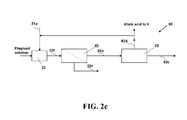
- FIG. 2 c shows a simplified schematic of a portion of the hydrometallurgical process of FIG. 2 comprising an optional additional step for concentrating the permeate from the second nanofiltration subsystem.
- FIG. 3 shows a simplified schematic of a typical prior art hydrometallurgical process which involves recovering metal via electrowinning.
- FIG. 4 a shows a simplified schematic of a hydrometallurgical process of the invention which involves recovering metal via electrowinning.
- FIG. 4 b shows a simplified schematic of an alternative hydrometallurgical process of the invention which involves recovering metal via electrowinning.
- the words “comprise”, “comprising” and the like are to be construed in an open, inclusive sense.
- the words “a”, “an”, and the like are to be considered as meaning at least one and are not limited to just one.
- the words “a”, “an”, and the like are to be considered as meaning at least one portion of such a stream or raffinate and are not limited to just one such portion.
- a raffinate for instance should be construed as “at least one portion of raffinate”, “at least one portion of first permeate stream”, and “at least one portion of pregnant solution stream” respectively.
- pregnant solution stream refers to the process stream in a hydrometallurgical process after the solution concentration and purification operations.
- Electrolytic processing is intended to include any metals recovery process involving electrolysis, including for instance electrowinning and electrorefining.
- pregnant solution stream after recovering the metal therefrom refers to what is also commonly known as the spent electrolyte after electrolytic processing.
- feed stream refers to the solution to be subjected to nanofiltration and which is supplied to a nanofiltration module.
- Retentate stream refers to the process stream exiting a nanofiltration module which has not passed through the nanofiltration membrane.
- permeate stream refers to the process stream exiting a nanofiltration module which has passed through the nanofiltration membrane.
- a “nanofiltration module” is an independent component comprising one or more nanofiltration membranes and ports for such feed, permeate, and retentate streams.
- nanofiltration arrays comprising multiple nanofiltration modules
- multiple modules are considered to belong to a single “stage” if they are supplied in parallel with a common feed stream.
- An array is considered to be “multi-stage” when the retentate stream from an upstream module is supplied as the feed stream for another module downstream.
- the number of stages in such an array is given by the number of modules connected in series in this manner (i.e. connected such that the retentate stream from an upstream module in the series is supplied as the feed stream to a downstream module in the series).
- An array is considered to be “multi-pass” when the permeate stream from an upstream module is supplied as the feed stream for another module.
- the number of passes in such an array is given by the number of modules connected in series in this manner (i.e. with the permeate stream from an upstream module in a series supplied as the feed stream to a downstream module in the series). More complicated arrays can be created however which incorporate elements of both of these arrangements.
- the following description exemplifies several alternative embodiments of the invention.
- the first involves recovering lixiviant (in this case, acid) and water from the raffinate waste stream arising from a solvent extraction step and then using this dilute aqueous acid solution as a diluent to recover additional acid content from the pregnant solution stream.
- the other embodiments again involve recovering acid lixiviant and water from the raffinate waste stream arising from a solvent extraction step and then using this dilute aqueous acid solution as a diluent to recover additional acid content from the spent electrolyte stream from electrolytic processing.
- FIG. 1 A typical prior art hydrometallurgical process for extracting uranium from ore is shown in the simplified schematic of FIG. 1 .
- sulphuric acid is added in multiple stages to the process liquor stream to promote leaching and purification of the valuable metals with a portion of this acid stream being continuously directed to a neutralization step where it is treated with lime before final disposal as effluent.
- Recovery of the sulphuric acid is only performed via return of part of the raffinate stream resulting from solvent extraction to a counter current decanting stage.
- process 1 involves subjecting an appropriate ore to crushing 2 and then to acid leaching 3 using sulphuric acid in the presence of sodium chlorate oxidant to create a leach solution comprising dissolved uranium and other liquid and solid impurities.
- the leach solution is then purified and concentrated in several steps. Initially, counter current decantation 4 is performed using supplies of sulphuric acid, water, and raffinate from a later solvent extraction step 6 .
- the decanted leach solution is filtered in a clarification sand filtering step 5 in which flocculant is supplied to promote agglomeration of fines to enhance separation of certain impurity solids for removal.
- the filtered leach solution is then directed to solvent extraction step 6 .
- the organic phase of the leach solution after solvent extraction 6 is then subjected to a stripping step 7 which again involves the addition of sulphuric acid and creates pregnant solution stream comprising concentrated uranium in solution.
- the leach solution is brought into intimate contact with an immiscible organic phase containing an extractant selective to the uranium metal, such as tertiary amine in kerosene (not shown in FIG. 1 ).
- an extractant selective to the uranium metal such as tertiary amine in kerosene (not shown in FIG. 1 ).
- phase separation occurs between the organic phase loaded with the uranium metal (also called “pregnant extract”) and the aqueous phase with low metal value (also called “barren solution”).
- the purified pregnant extract is then introduced to the stripping stage at step 7 , where it is contacted with another aqueous solution of selected chemical composition, such as sulphuric acid, to promote transfer of the uranium metal into the aqueous phase, and thereby producing a stream called “pregnant solution stream”.
- Solvent extraction step 6 and stripping step 7 thus produce a pregnant solution stream and a raffinate stream.
- the raffinate stream is then either treated for recovery of other valuable by-products, if any (not shown in FIG. 1 ), or recycled to a point upstream or downstream of the solvent extraction process (recycling upstream of the solvent extraction process is shown in FIG. 1 ), or discharged as waste after suitable effluent treatment in neutralization step 8 (in which the raffinate is neutralized via addition of an appropriate amount of lime).
- a first impurity precipitation step 9 is performed which involves the addition of lime, ferric sulphate, and air to the pregnant process stream.
- a second impurity precipitation step 10 is performed, after which the uranium is itself precipitated out in uranium precipitation step 11 .
- the uranium metal is dried and packed at step 12 and is ready for shipping to a refinery or other.
- FIG. 2 shows an improved version 20 of the process of FIG. 1 for purposes of extracting uranium from ore.
- two nanofiltration steps 21 , 22 are employed.
- all the raffinate from solvent extraction step 6 is supplied as feed stream 21 f and subjected to nanofiltration at step 21 .
- the retentate stream 21 r is then disposed of after neutralizing at step 8 .
- the permeate stream 21 p from nanofiltration step 21 is combined and mixed with the pregnant solution stream at combining/mixing step 23 , and thereby substantially dilutes the pregnant solution stream to produce a mixture of lower acid and metal contents.
- the diluted pregnant solution stream is supplied as feed stream 22 f and undergoes nanofiltration at step 22 .
- the retentate stream 22 r from nanofiltration step 22 continues on to the metal recovery operations while the permeate stream 22 p is recovered and used as fluid in the counter current decanting step 4 and/or as a supply of sulphuric acid for stripping step 7 .
- FIG. 2 shows a simplified schematic of an optional second nanofiltration subsystem comprising multiple nanofiltration modules for use in nanofiltration step 22 .
- like numerals have been used to denote elements in common with FIG.
- nanofiltration step 22 (dashed box in FIG. 2 a ) is accomplished by a somewhat complex array of nanofiltration modules 67 , 68 and 69 each having their own respective feed streams 67 f , 68 f , and 69 f , their own respective permeate streams 67 p , 68 p , and 69 p , and their own respective retentate streams 67 r , 68 r , and 69 r .
- nanofiltration modules 67 and 69 are arranged in a double-pass configuration, and nanofiltration modules 67 and 68 are arranged in a double-stage configuration (since retentate stream 67 r is supplied as feed stream 68 f ).
- permeate stream 68 p , a portion of permeate stream 69 p , and retentate stream 69 r may optionally be recycled to permeate stream 21 p.
- FIG. 2 b shows a simplified schematic of an optional complex nanofiltration subsystem comprising multiple nanofiltration modules which serve the function of nanofiltration module 67 in FIG. 2 a .
- nanofiltration module 67 dashed box in FIG.
- nanofiltration modules 71 , 72 and 73 are a somewhat complex array of nanofiltration modules 71 , 72 and 73 each having their own respective feed streams 71 f , 72 f , and 73 f , their own respective permeate streams 71 p , 72 p , and 73 p , and their own respective retentate streams 71 r , 72 r , and 73 r .
- nanofiltration modules 71 , 72 and 73 can be viewed as arranged in a triple-stage configuration since retentate stream 71 r is supplied as a portion of feed stream 72 f , and retentate stream 72 r is supplied as a portion of feed stream 73 f .
- feed streams 71 f (equivalent to 220 , 72 f , and 73 f also comprise a portion of pregnant solution and a portion of 21 p , thus the nanofiltration modules 71 , 72 , and 73 presented here are part of a complex system which could be viewed either as a multi-stage or a multi-pass configuration.
- retentate stream 73 r is equivalent to retentate stream 67 r from nanofiltration module 67 in FIG. 2 a .
- permeate streams 71 p , 72 p , and 73 p are combined to become permeate stream 67 p in FIG. 2 a.
- permeate 22 p may have a lower acid concentration than desired and thus a concentration step might be employed to increase the acid concentration of the stream before recycling back to counter current decantation 4 or stripping step 7 .
- FIG. 2 c shows a simplified schematic of a portion of the hydrometallurgical process of FIG. 2 comprising such an optional additional step.
- the undesirably dilute permeate 22 p is supplied to concentrator 82 which outputs a higher concentration sulphuric acid stream 82 c to be directed to counter current decantation 4 or stripping step 7 and a very dilute stream 82 d (mainly water) which may be returned to the main process as water make-up (e.g. for counter current decantation 4 ) or may be recycled to combining/mixing step 23 as a diluent stream mixing with the pregnant solution.
- Concentrator 82 may for instance be a conventional sulphuric acid concentrator unit or alternatively a water removal subsystem, such as an osmotic membrane distillation or membrane distillation unit.
- nanofiltration modules or units may be operated at higher pressures than a conventional 600 psi operating range.
- Certain chemically stable nanofiltration membrane types may be used for this step which can operate at pressures up to 1070 psi and temperatures up to 80° C.
- steps may be taken to recover valuable components (e.g. metals) therein if their concentration is high enough, such as treating the solids precipitated during neutralizing to recover the valuable solids content before discharging the rest as sludge.
- valuable components e.g. metals
- it too may be directed back for counter current decanting at step 4 to improve plant efficiency.
- anti-scalant may be added to the raffinate stream upstream of nanofiltration step 21 in order to increase recovery and reduce the fouling of the nanofiltration membranes.
- this permeate stream may also be used elsewhere in overall process 20 as desired.
- the arrangement in FIG. 2 thus not only provides for recovery of sulphuric acid and water from the raffinate stream, but also for recovery of sulphuric acid from the pregnant solution stream. Due to the high concentration of uranium and sulphuric acid in the pregnant solution stream after stripping 7 , and thus the high osmotic pressure of the pregnant solution stream, using nanofiltration on the pregnant solution stream may not hitherto have been considered to be practical. However here, the permeate stream 21 p from raffinate nanofiltration step 21 is advantageously employed to dilute the pregnant solution stream, thereby reducing the osmotic pressure and thus making nanofiltration of the pregnant solution stream practical.
- FIG. 3 shows a simplified schematic of a typical prior art hydrometallurgical process 30 which involves recovering metal via electrowinning.
- process 30 involves subjecting an appropriate crushed ore or tailings to acid leaching 31 using supplied dilute sulphuric acid to create a leach solution comprising dissolved valuable metals and other liquid and solid impurities.
- the leach solution then undergoes a solvent extraction step 32 .
- the solvent extracted leach solution known as “pregnant extract” is then subjected to a stripping step 33 which again involves the addition of sulphuric acid and creates pregnant solution stream comprising concentrated valuable metals in solution.
- a portion of the raffinate from solvent extraction step 32 may be returned to the leaching step and part to neutralization step 34 for subsequent effluent treatment and disposal.
- the raffinate is first neutralized via addition of an appropriate amount of lime at neutralization step 34 , and results in precipitated solids and an effluent liquid stream.
- the metals in the pregnant solution stream are recovered via electrowinning 35 .
- the products of electrowinning 35 are the desired product metal and spent pregnant solution stream, also commonly referred to as spent electrolyte.
- a portion of the spent pregnant solution stream may be recycled for use in stripping step 33 .
- spent pregnant solution stream may be used as purge or may be treated further in order to recover other metals therefrom.
- FIGS. 4 a and 4 b show alternative improved versions 40 , 50 of the process of FIG. 3 in which two nanofiltration steps 41 , 42 are employed.
- the process steps common to FIG. 3 are identified with the same numerals.
- a portion of the raffinate from solvent extraction step 32 is supplied as feed stream 41 f and subjected to nanofiltration at step 41 , while the remaining portion is recycled to leaching step 31 .
- the ratio of the raffinate stream portions sent to these two steps may vary depending on the process design and equipment.
- the retentate streams 41 r from nanofiltration step 41 are disposed of after first neutralizing them with lime at step 34 .
- a portion of the permeate stream 41 p from nanofiltration step 41 is combined and mixed with the spent pregnant solution stream after electrowinning at combining/mixing step 45 , and thereby substantially dilutes the spent pregnant solution stream.
- the diluted spent pregnant solution stream then is supplied as feed stream 42 f and undergoes nanofiltration at step 42 .
- Another portion of the permeate stream 41 p from nanofiltration step 41 is combined with the acid supplied to leaching step 31 and thus is used in leaching step 31 .
- the retentate stream 42 r from nanofiltration step 42 is directed back in process 40 and is combined with the leach solution upstream of solvent extracting step 32 .
- the permeate stream 42 p from nanofiltration step 42 is combined with the portion of the permeate stream 41 p from nanofiltration 41 which is being directed back and used in leaching step 31 .
- FIG. 4 b shows an alternative embodiment to that shown in FIG. 4 a and instead employs multiple nanofiltration steps to treat the diluted spent pregnant solution stream.
- the embodiment of FIG. 4 b differs from that in FIG. 4 a in that the retentate stream 42 r from nanofiltration step 42 undergoes a subsequent nanofiltration at step 43 .
- the retentate stream 43 r from nanofiltration step 43 is directed back in process 50 and is combined with the leach solution upstream of solvent extracting step 32 .
- the permeate stream 43 p from nanofiltration step 43 is combined with the portion of the permeate stream 41 p from nanofiltration 41 which is being directed back and used in leaching step 31 .
- the permeate stream 42 p from nanofiltration step 42 is now combined with the acid supply used in stripping step 33 .
- a final difference is that a portion of the permeate stream 41 p from nanofiltration step 41 is combined with the retentate stream 42 r from nanofiltration step 42 upstream of additional nanofiltration step 43 .
- An advantage of this embodiment is that by adding permeate from nanofiltration step 41 to the spent pregnant solution stream in stages as shown, an acid concentration profile can be generated in the permeates produced. For instance, higher acid concentration can be produced in the initial stage and lower concentrations in the later stage in the multiple nanofiltration process.
- process 40 , 50 exemplified in FIGS. 4 a and 4 b implified schematic of process 20 shown in FIG. 2 .
- the permeate stream 41 p from nanofiltration step 41 may instead be considered for use in leaching step 31 .
- additional nanofiltration steps downstream of step 41 may be considered to treat the retentate stream 41 r from nanofiltration step 41 to recover additional acid and water content therefrom.
- FIGS. 4 a and 4 b thus provide for recovery of sulphuric acid and water from the raffinate stream and from the spent pregnant solution stream from electrolytic processing and thus reduce the acid requirement for the overall process. Further advantages again include the potential for significant reduction in lime usage, in production of gypsum waste, and in the amount of effluent and hazardous waste discharged to the environment. Also, they offer potential benefits with regards to the size of neutralization and other apparatus and associated cost.
Landscapes
- Chemical & Material Sciences (AREA)
- Engineering & Computer Science (AREA)
- General Life Sciences & Earth Sciences (AREA)
- Life Sciences & Earth Sciences (AREA)
- Organic Chemistry (AREA)
- Metallurgy (AREA)
- Materials Engineering (AREA)
- Geology (AREA)
- Manufacturing & Machinery (AREA)
- Mechanical Engineering (AREA)
- Environmental & Geological Engineering (AREA)
- Geochemistry & Mineralogy (AREA)
- Chemical Kinetics & Catalysis (AREA)
- Electrochemistry (AREA)
- General Chemical & Material Sciences (AREA)
- Inorganic Chemistry (AREA)
- Manufacture And Refinement Of Metals (AREA)
Priority Applications (1)
| Application Number | Priority Date | Filing Date | Title |
|---|---|---|---|
| US14/422,922 US10174404B2 (en) | 2012-08-23 | 2013-08-14 | Hydrometallurgical process using multi-stage nanofiltration |
Applications Claiming Priority (3)
| Application Number | Priority Date | Filing Date | Title |
|---|---|---|---|
| US201261692233P | 2012-08-23 | 2012-08-23 | |
| PCT/CA2013/050623 WO2014029017A1 (fr) | 2012-08-23 | 2013-08-14 | Procédé hydrométallurgique mettant en œuvre une nanofiltration à étages multiples |
| US14/422,922 US10174404B2 (en) | 2012-08-23 | 2013-08-14 | Hydrometallurgical process using multi-stage nanofiltration |
Publications (2)
| Publication Number | Publication Date |
|---|---|
| US20150247218A1 US20150247218A1 (en) | 2015-09-03 |
| US10174404B2 true US10174404B2 (en) | 2019-01-08 |
Family
ID=50149312
Family Applications (1)
| Application Number | Title | Priority Date | Filing Date |
|---|---|---|---|
| US14/422,922 Active 2035-05-30 US10174404B2 (en) | 2012-08-23 | 2013-08-14 | Hydrometallurgical process using multi-stage nanofiltration |
Country Status (8)
| Country | Link |
|---|---|
| US (1) | US10174404B2 (fr) |
| AU (1) | AU2013305441B2 (fr) |
| CA (1) | CA2880355C (fr) |
| CL (1) | CL2015000353A1 (fr) |
| PE (1) | PE20150571A1 (fr) |
| RU (1) | RU2626112C2 (fr) |
| WO (1) | WO2014029017A1 (fr) |
| ZA (1) | ZA201500380B (fr) |
Families Citing this family (4)
| Publication number | Priority date | Publication date | Assignee | Title |
|---|---|---|---|---|
| US11427886B2 (en) | 2015-04-21 | 2022-08-30 | Excir Works Corp. | Methods for simultaneous leaching and extraction of precious metals |
| CN110438353B (zh) * | 2019-08-29 | 2021-08-06 | 中广核铀业新疆发展有限公司 | 一种强风化强氧化型砂砾岩铀矿水冶方法 |
| CN111074084A (zh) * | 2019-12-20 | 2020-04-28 | 核工业北京化工冶金研究院 | 一种地浸采铀全流程循环实验装置 |
| AU2023408419A1 (en) | 2022-12-22 | 2025-09-25 | Joint Stock Company "National Atomic Company "Kazatomprom" | Method for concentrating uranium in a uranium-containing solution |
Citations (8)
| Publication number | Priority date | Publication date | Assignee | Title |
|---|---|---|---|---|
| US4944882A (en) * | 1989-04-21 | 1990-07-31 | Bend Research, Inc. | Hybrid membrane separation systems |
| WO1995030471A1 (fr) | 1994-05-05 | 1995-11-16 | Harrison Western Environmental Services, Inc. | Procede et systeme de traitement de liquide |
| CA2307500A1 (fr) * | 1997-10-30 | 1999-05-14 | Hw Process Technologies, Inc. | Procede pour eliminer des contaminants de liquides a traiter dans des procedes de rendement metal |
| US20080069748A1 (en) | 2006-09-20 | 2008-03-20 | Hw Advanced Technologies, Inc. | Multivalent iron ion separation in metal recovery circuits |
| WO2008140625A1 (fr) | 2006-12-27 | 2008-11-20 | Hw Advanced Technologies, Inc. | Procédé de séparation par membrane pour séparer des complexes métalliques ayant des états d'oxydation différents |
| WO2011132138A1 (fr) | 2010-04-19 | 2011-10-27 | Andrew Bassil | Extraction industrielle d'uranium par utilisation de carbonate d'ammonium et d'une séparation sur membrane |
| WO2012077610A1 (fr) | 2010-12-06 | 2012-06-14 | 東レ株式会社 | Procédé de séparation et de récupération de métal alcalin, et appareil de séparation et de récupération de métal alcalin |
| WO2012156894A2 (fr) | 2011-05-13 | 2012-11-22 | Synexus (Pty) Ltd | Procédé d'extraction par solvant à membrane |
Family Cites Families (4)
| Publication number | Priority date | Publication date | Assignee | Title |
|---|---|---|---|---|
| JPS5839897B2 (ja) * | 1978-03-22 | 1983-09-02 | 工業技術院長 | ウラン及びストロンチウムの脱着方法 |
| GB9021264D0 (en) * | 1990-09-29 | 1990-11-14 | British Nuclear Fuels Plc | Cleaning of solutions |
| RU2259412C1 (ru) * | 2004-01-13 | 2005-08-27 | Федеральное государственное унитарное предприятие "Всероссийский научно-исследовательский институт химической технологии" | Способ ионообменного извлечения урана из сернокислых растворов и пульп |
| RU2398903C1 (ru) * | 2009-03-30 | 2010-09-10 | Российская Федерация, от имени которой выступает государственный заказчик- Государственная корпорация по атомной энергии "Росатом" | Способ переработки упорных урановых содержащих пирит и благородные металлы материалов для извлечения урана и получения концентрата благородных металлов |
-
2013
- 2013-08-14 CA CA2880355A patent/CA2880355C/fr active Active
- 2013-08-14 AU AU2013305441A patent/AU2013305441B2/en active Active
- 2013-08-14 WO PCT/CA2013/050623 patent/WO2014029017A1/fr not_active Ceased
- 2013-08-14 PE PE2015000225A patent/PE20150571A1/es active IP Right Grant
- 2013-08-14 RU RU2015110046A patent/RU2626112C2/ru active
- 2013-08-14 US US14/422,922 patent/US10174404B2/en active Active
-
2015
- 2015-01-19 ZA ZA2015/00380A patent/ZA201500380B/en unknown
- 2015-02-13 CL CL2015000353A patent/CL2015000353A1/es unknown
Patent Citations (9)
| Publication number | Priority date | Publication date | Assignee | Title |
|---|---|---|---|---|
| US4944882A (en) * | 1989-04-21 | 1990-07-31 | Bend Research, Inc. | Hybrid membrane separation systems |
| WO1995030471A1 (fr) | 1994-05-05 | 1995-11-16 | Harrison Western Environmental Services, Inc. | Procede et systeme de traitement de liquide |
| CA2307500A1 (fr) * | 1997-10-30 | 1999-05-14 | Hw Process Technologies, Inc. | Procede pour eliminer des contaminants de liquides a traiter dans des procedes de rendement metal |
| US20080069748A1 (en) | 2006-09-20 | 2008-03-20 | Hw Advanced Technologies, Inc. | Multivalent iron ion separation in metal recovery circuits |
| WO2008140625A1 (fr) | 2006-12-27 | 2008-11-20 | Hw Advanced Technologies, Inc. | Procédé de séparation par membrane pour séparer des complexes métalliques ayant des états d'oxydation différents |
| WO2011132138A1 (fr) | 2010-04-19 | 2011-10-27 | Andrew Bassil | Extraction industrielle d'uranium par utilisation de carbonate d'ammonium et d'une séparation sur membrane |
| US20130039823A1 (en) | 2010-04-19 | 2013-02-14 | Andrew Bassil | Industrial Extraction of Uranium Using Ammonium Carbonate and Membrane Separation |
| WO2012077610A1 (fr) | 2010-12-06 | 2012-06-14 | 東レ株式会社 | Procédé de séparation et de récupération de métal alcalin, et appareil de séparation et de récupération de métal alcalin |
| WO2012156894A2 (fr) | 2011-05-13 | 2012-11-22 | Synexus (Pty) Ltd | Procédé d'extraction par solvant à membrane |
Non-Patent Citations (1)
| Title |
|---|
| International Search Report for Application No. PCT/CA2013/050623, dated Oct. 10, 2013, 3 pages. |
Also Published As
| Publication number | Publication date |
|---|---|
| AU2013305441A1 (en) | 2015-02-12 |
| US20150247218A1 (en) | 2015-09-03 |
| CA2880355A1 (fr) | 2014-02-27 |
| WO2014029017A1 (fr) | 2014-02-27 |
| RU2626112C2 (ru) | 2017-07-21 |
| CA2880355C (fr) | 2020-09-15 |
| PE20150571A1 (es) | 2015-05-08 |
| CL2015000353A1 (es) | 2015-05-08 |
| AU2013305441B2 (en) | 2017-07-13 |
| RU2015110046A (ru) | 2016-10-10 |
| ZA201500380B (en) | 2019-09-25 |
Similar Documents
| Publication | Publication Date | Title |
|---|---|---|
| JP7031263B2 (ja) | リチウムの回収方法 | |
| CA2796325C (fr) | Extraction industrielle d'uranium par utilisation de carbonate d'ammonium et d'une separation sur membrane | |
| JP7115123B2 (ja) | リチウムの精製方法 | |
| CN115108673B (zh) | 一种氧化法生产磷酸铁母液资源化处理的工艺 | |
| WO2008067594A1 (fr) | Elimination des impuretés de la bauxite | |
| EP4245869A1 (fr) | Procédé de traitement de masse noire pour obtenir des produits chimiques de batterie | |
| AU2011243991A1 (en) | Industrial extraction of uranium using ammonium carbonate and membrane separation | |
| AU2013305441B2 (en) | Hydrometallurgical process using multi-stage nanofiltration | |
| CN120019175A (zh) | 从电池制造和回收出口料流中电化学生产碱金属氢氧化物和硫酸 | |
| CN109437444B (zh) | 沉钒母液与洗水资源化处理装置及其方法 | |
| US11897794B2 (en) | Processes and systems for treating sour water | |
| WO2014167534A1 (fr) | Récupération de composés d'yttrium et d'europium | |
| WO1996022153A1 (fr) | Procede et appareil de purification continue d'acides contamines | |
| CN106396164B (zh) | 一种工业酸性废水处理工艺 | |
| WO2013026093A1 (fr) | Procédé de traitement de liqueurs lixiviantes acides | |
| CN218404350U (zh) | 一种以锂矿石为原料进行回收提锂的装置 | |
| EP2794495B1 (fr) | Suppression de constituants d'une matière première | |
| JP7031264B2 (ja) | リチウムの回収方法 | |
| US7217366B2 (en) | Purification of ammonium metallate solutions | |
| WO2019046027A1 (fr) | Solubilisation de scandium à partir de matériaux contenant des fluorures | |
| Scheiner et al. | Extraction and recovery of molybdenum and rhenium from molybdenite concentrates by electrooxidation: process demonstration | |
| AU2013231161B2 (en) | Industrial extraction of uranium using ammonium carbonate and membrane separation | |
| WO2024259211A2 (fr) | Compositions, systèmes et procédés pour récupérer un métal présent dans une solution aqueuse | |
| Angelov et al. | Ionexchange operations for copper and zinc recovery and arsenic removal at the Devnya Waste Treatment Plant, Bulgaria | |
| MXPA00004222A (en) | Method for removing contaminants from process streams in metal recovery processes |
Legal Events
| Date | Code | Title | Description |
|---|---|---|---|
| AS | Assignment |
Owner name: CHEMETICS INC., CANADA Free format text: ASSIGNMENT OF ASSIGNORS INTEREST;ASSIGNORS:LASHKARI, SIAMAK;MOK, FELIX;RAMASUBBU, GANAPATHY;AND OTHERS;SIGNING DATES FROM 20150316 TO 20150317;REEL/FRAME:036120/0001 |
|
| STCF | Information on status: patent grant |
Free format text: PATENTED CASE |
|
| CC | Certificate of correction | ||
| MAFP | Maintenance fee payment |
Free format text: PAYMENT OF MAINTENANCE FEE, 4TH YEAR, LARGE ENTITY (ORIGINAL EVENT CODE: M1551); ENTITY STATUS OF PATENT OWNER: LARGE ENTITY Year of fee payment: 4 |
|
| MAFP | Maintenance fee payment |
Free format text: PAYMENT OF MAINTENANCE FEE, 8TH YEAR, LARGE ENTITY (ORIGINAL EVENT CODE: M1552); ENTITY STATUS OF PATENT OWNER: LARGE ENTITY Year of fee payment: 8 |