US20030191055A1 - Inhibiting development of microvessels withins coronary or peripheral vessel walls for restenosis/atherosclerosis prevention or therapy - Google Patents
Inhibiting development of microvessels withins coronary or peripheral vessel walls for restenosis/atherosclerosis prevention or therapy Download PDFInfo
- Publication number
- US20030191055A1 US20030191055A1 US09/478,621 US47862100A US2003191055A1 US 20030191055 A1 US20030191055 A1 US 20030191055A1 US 47862100 A US47862100 A US 47862100A US 2003191055 A1 US2003191055 A1 US 2003191055A1
- Authority
- US
- United States
- Prior art keywords
- vegf
- ang
- restenosis
- agent
- compositions
- Prior art date
- Legal status (The legal status is an assumption and is not a legal conclusion. Google has not performed a legal analysis and makes no representation as to the accuracy of the status listed.)
- Abandoned
Links
- 208000037803 restenosis Diseases 0.000 title claims abstract description 61
- 201000001320 Atherosclerosis Diseases 0.000 title claims abstract description 53
- 230000002401 inhibitory effect Effects 0.000 title claims abstract description 42
- 238000002560 therapeutic procedure Methods 0.000 title claims abstract description 19
- 230000002265 prevention Effects 0.000 title abstract description 10
- 238000011161 development Methods 0.000 title description 38
- 210000004088 microvessel Anatomy 0.000 title description 13
- 230000002093 peripheral effect Effects 0.000 title description 5
- 102000005789 Vascular Endothelial Growth Factors Human genes 0.000 claims abstract description 93
- 108010019530 Vascular Endothelial Growth Factors Proteins 0.000 claims abstract description 93
- 239000000203 mixture Substances 0.000 claims abstract description 84
- 238000000034 method Methods 0.000 claims abstract description 78
- 230000035800 maturation Effects 0.000 claims abstract description 43
- 230000001939 inductive effect Effects 0.000 claims abstract description 18
- 108091008601 sVEGFR Proteins 0.000 claims abstract description 17
- 239000003795 chemical substances by application Substances 0.000 claims description 92
- 230000014509 gene expression Effects 0.000 claims description 51
- 239000013612 plasmid Substances 0.000 claims description 16
- 239000000411 inducer Substances 0.000 claims description 10
- 239000002525 vasculotropin inhibitor Substances 0.000 claims description 9
- 241000701447 unidentified baculovirus Species 0.000 claims description 6
- 241000701161 unidentified adenovirus Species 0.000 claims description 4
- 108010073929 Vascular Endothelial Growth Factor A Proteins 0.000 description 90
- 102000005962 receptors Human genes 0.000 description 42
- 108020003175 receptors Proteins 0.000 description 42
- 108090000623 proteins and genes Proteins 0.000 description 39
- 230000018109 developmental process Effects 0.000 description 37
- 230000000694 effects Effects 0.000 description 32
- 230000019491 signal transduction Effects 0.000 description 29
- 102000004169 proteins and genes Human genes 0.000 description 27
- 230000033115 angiogenesis Effects 0.000 description 26
- 238000002399 angioplasty Methods 0.000 description 24
- 108020004414 DNA Proteins 0.000 description 23
- 239000013598 vector Substances 0.000 description 21
- 230000002491 angiogenic effect Effects 0.000 description 20
- 230000008569 process Effects 0.000 description 20
- 238000011282 treatment Methods 0.000 description 19
- 230000004913 activation Effects 0.000 description 17
- 210000004027 cell Anatomy 0.000 description 16
- 108091008605 VEGF receptors Proteins 0.000 description 14
- 102000009484 Vascular Endothelial Growth Factor Receptors Human genes 0.000 description 14
- 210000004204 blood vessel Anatomy 0.000 description 14
- 210000004351 coronary vessel Anatomy 0.000 description 13
- 238000003364 immunohistochemistry Methods 0.000 description 13
- 238000011321 prophylaxis Methods 0.000 description 13
- 101100481410 Mus musculus Tek gene Proteins 0.000 description 12
- 102000004022 Protein-Tyrosine Kinases Human genes 0.000 description 11
- 108090000412 Protein-Tyrosine Kinases Proteins 0.000 description 11
- 230000001772 anti-angiogenic effect Effects 0.000 description 11
- 230000026731 phosphorylation Effects 0.000 description 11
- 238000006366 phosphorylation reaction Methods 0.000 description 11
- 238000001727 in vivo Methods 0.000 description 10
- 238000001262 western blot Methods 0.000 description 10
- 238000013258 ApoE Receptor knockout mouse model Methods 0.000 description 9
- 101100481408 Danio rerio tie2 gene Proteins 0.000 description 9
- 210000002889 endothelial cell Anatomy 0.000 description 9
- 239000003446 ligand Substances 0.000 description 9
- 230000004044 response Effects 0.000 description 9
- 101150021185 FGF gene Proteins 0.000 description 8
- 230000006698 induction Effects 0.000 description 8
- 239000003112 inhibitor Substances 0.000 description 8
- 108010048154 Angiopoietin-1 Proteins 0.000 description 7
- 102000009088 Angiopoietin-1 Human genes 0.000 description 7
- 208000037260 Atherosclerotic Plaque Diseases 0.000 description 7
- 208000027418 Wounds and injury Diseases 0.000 description 7
- 230000036523 atherogenesis Effects 0.000 description 7
- 230000006378 damage Effects 0.000 description 7
- 208000014674 injury Diseases 0.000 description 7
- 210000000329 smooth muscle myocyte Anatomy 0.000 description 7
- 208000024891 symptom Diseases 0.000 description 7
- 230000003827 upregulation Effects 0.000 description 7
- 241000699670 Mus sp. Species 0.000 description 6
- 238000003745 diagnosis Methods 0.000 description 6
- 230000003902 lesion Effects 0.000 description 6
- 102000009075 Angiopoietin-2 Human genes 0.000 description 5
- 108010048036 Angiopoietin-2 Proteins 0.000 description 5
- 102400001047 Endostatin Human genes 0.000 description 5
- 108010079505 Endostatins Proteins 0.000 description 5
- 102100024785 Fibroblast growth factor 2 Human genes 0.000 description 5
- 108090000379 Fibroblast growth factor 2 Proteins 0.000 description 5
- 108091061960 Naked DNA Proteins 0.000 description 5
- 230000004087 circulation Effects 0.000 description 5
- 230000001276 controlling effect Effects 0.000 description 5
- 238000001361 intraarterial administration Methods 0.000 description 5
- 230000006641 stabilisation Effects 0.000 description 5
- 238000011105 stabilization Methods 0.000 description 5
- 230000002792 vascular Effects 0.000 description 5
- 239000013603 viral vector Substances 0.000 description 5
- 230000003612 virological effect Effects 0.000 description 5
- 206010028980 Neoplasm Diseases 0.000 description 4
- 206010029113 Neovascularisation Diseases 0.000 description 4
- 241000282887 Suidae Species 0.000 description 4
- 108700019146 Transgenes Proteins 0.000 description 4
- 108010073923 Vascular Endothelial Growth Factor C Proteins 0.000 description 4
- 102000009520 Vascular Endothelial Growth Factor C Human genes 0.000 description 4
- 102100033177 Vascular endothelial growth factor receptor 2 Human genes 0.000 description 4
- RJURFGZVJUQBHK-UHFFFAOYSA-N actinomycin D Natural products CC1OC(=O)C(C(C)C)N(C)C(=O)CN(C)C(=O)C2CCCN2C(=O)C(C(C)C)NC(=O)C1NC(=O)C1=C(N)C(=O)C(C)=C2OC(C(C)=CC=C3C(=O)NC4C(=O)NC(C(N5CCCC5C(=O)N(C)CC(=O)N(C)C(C(C)C)C(=O)OC4C)=O)C(C)C)=C3N=C21 RJURFGZVJUQBHK-UHFFFAOYSA-N 0.000 description 4
- 239000002870 angiogenesis inducing agent Substances 0.000 description 4
- 239000005557 antagonist Substances 0.000 description 4
- 230000003143 atherosclerotic effect Effects 0.000 description 4
- 230000001687 destabilization Effects 0.000 description 4
- 230000000368 destabilizing effect Effects 0.000 description 4
- 239000003085 diluting agent Substances 0.000 description 4
- 238000009472 formulation Methods 0.000 description 4
- 230000012010 growth Effects 0.000 description 4
- 238000010191 image analysis Methods 0.000 description 4
- 238000002513 implantation Methods 0.000 description 4
- 238000000338 in vitro Methods 0.000 description 4
- 230000001965 increasing effect Effects 0.000 description 4
- 238000005259 measurement Methods 0.000 description 4
- 230000007246 mechanism Effects 0.000 description 4
- 239000013600 plasmid vector Substances 0.000 description 4
- 238000010186 staining Methods 0.000 description 4
- 210000001604 vasa vasorum Anatomy 0.000 description 4
- 102400000068 Angiostatin Human genes 0.000 description 3
- 108010079709 Angiostatins Proteins 0.000 description 3
- 208000032594 Vascular Remodeling Diseases 0.000 description 3
- 241000700605 Viruses Species 0.000 description 3
- FZCSTZYAHCUGEM-UHFFFAOYSA-N aspergillomarasmine B Natural products OC(=O)CNC(C(O)=O)CNC(C(O)=O)CC(O)=O FZCSTZYAHCUGEM-UHFFFAOYSA-N 0.000 description 3
- 230000004663 cell proliferation Effects 0.000 description 3
- 238000007887 coronary angioplasty Methods 0.000 description 3
- 230000001419 dependent effect Effects 0.000 description 3
- 239000013604 expression vector Substances 0.000 description 3
- 230000007946 glucose deprivation Effects 0.000 description 3
- 238000001802 infusion Methods 0.000 description 3
- 230000005764 inhibitory process Effects 0.000 description 3
- 238000007918 intramuscular administration Methods 0.000 description 3
- 238000007912 intraperitoneal administration Methods 0.000 description 3
- 230000035755 proliferation Effects 0.000 description 3
- 230000005855 radiation Effects 0.000 description 3
- 238000007634 remodeling Methods 0.000 description 3
- 238000007920 subcutaneous administration Methods 0.000 description 3
- 230000009466 transformation Effects 0.000 description 3
- 238000012800 visualization Methods 0.000 description 3
- MZOFCQQQCNRIBI-VMXHOPILSA-N (3s)-4-[[(2s)-1-[[(2s)-1-[[(1s)-1-carboxy-2-hydroxyethyl]amino]-4-methyl-1-oxopentan-2-yl]amino]-5-(diaminomethylideneamino)-1-oxopentan-2-yl]amino]-3-[[2-[[(2s)-2,6-diaminohexanoyl]amino]acetyl]amino]-4-oxobutanoic acid Chemical compound OC[C@@H](C(O)=O)NC(=O)[C@H](CC(C)C)NC(=O)[C@H](CCCN=C(N)N)NC(=O)[C@H](CC(O)=O)NC(=O)CNC(=O)[C@@H](N)CCCCN MZOFCQQQCNRIBI-VMXHOPILSA-N 0.000 description 2
- BJHCYTJNPVGSBZ-YXSASFKJSA-N 1-[4-[6-amino-5-[(Z)-methoxyiminomethyl]pyrimidin-4-yl]oxy-2-chlorophenyl]-3-ethylurea Chemical compound CCNC(=O)Nc1ccc(Oc2ncnc(N)c2\C=N/OC)cc1Cl BJHCYTJNPVGSBZ-YXSASFKJSA-N 0.000 description 2
- TYIRBZOAKBEYEJ-UHFFFAOYSA-N 2-(1,3-dimethyl-2,6-dioxopurin-7-yl)ethyl 2-[1-methyl-5-(4-methylbenzoyl)pyrrol-2-yl]acetate Chemical compound C1=CC(C)=CC=C1C(=O)C(N1C)=CC=C1CC(=O)OCCN1C(C(=O)N(C)C(=O)N2C)=C2N=C1 TYIRBZOAKBEYEJ-UHFFFAOYSA-N 0.000 description 2
- 102000009840 Angiopoietins Human genes 0.000 description 2
- 108010009906 Angiopoietins Proteins 0.000 description 2
- 239000002083 C09CA01 - Losartan Substances 0.000 description 2
- 108010041986 DNA Vaccines Proteins 0.000 description 2
- 229940021995 DNA vaccine Drugs 0.000 description 2
- 108010092160 Dactinomycin Proteins 0.000 description 2
- WQZGKKKJIJFFOK-GASJEMHNSA-N Glucose Natural products OC[C@H]1OC(O)[C@H](O)[C@@H](O)[C@@H]1O WQZGKKKJIJFFOK-GASJEMHNSA-N 0.000 description 2
- 101000851007 Homo sapiens Vascular endothelial growth factor receptor 2 Proteins 0.000 description 2
- 102000019149 MAP kinase activity proteins Human genes 0.000 description 2
- 108040008097 MAP kinase activity proteins Proteins 0.000 description 2
- 102000004278 Receptor Protein-Tyrosine Kinases Human genes 0.000 description 2
- 108090000873 Receptor Protein-Tyrosine Kinases Proteins 0.000 description 2
- 241000700584 Simplexvirus Species 0.000 description 2
- 108060008682 Tumor Necrosis Factor Proteins 0.000 description 2
- 102000000852 Tumor Necrosis Factor-alpha Human genes 0.000 description 2
- 108010053096 Vascular Endothelial Growth Factor Receptor-1 Proteins 0.000 description 2
- 108010053099 Vascular Endothelial Growth Factor Receptor-2 Proteins 0.000 description 2
- 102100033178 Vascular endothelial growth factor receptor 1 Human genes 0.000 description 2
- RJURFGZVJUQBHK-IIXSONLDSA-N actinomycin D Chemical compound C[C@H]1OC(=O)[C@H](C(C)C)N(C)C(=O)CN(C)C(=O)[C@@H]2CCCN2C(=O)[C@@H](C(C)C)NC(=O)[C@H]1NC(=O)C1=C(N)C(=O)C(C)=C2OC(C(C)=CC=C3C(=O)N[C@@H]4C(=O)N[C@@H](C(N5CCC[C@H]5C(=O)N(C)CC(=O)N(C)[C@@H](C(C)C)C(=O)O[C@@H]4C)=O)C(C)C)=C3N=C21 RJURFGZVJUQBHK-IIXSONLDSA-N 0.000 description 2
- 230000009471 action Effects 0.000 description 2
- 239000013543 active substance Substances 0.000 description 2
- 230000003527 anti-angiogenesis Effects 0.000 description 2
- 238000011122 anti-angiogenic therapy Methods 0.000 description 2
- 210000001367 artery Anatomy 0.000 description 2
- 230000008901 benefit Effects 0.000 description 2
- 230000015572 biosynthetic process Effects 0.000 description 2
- 230000017531 blood circulation Effects 0.000 description 2
- 201000011510 cancer Diseases 0.000 description 2
- 230000001413 cellular effect Effects 0.000 description 2
- 230000007248 cellular mechanism Effects 0.000 description 2
- 230000002860 competitive effect Effects 0.000 description 2
- 150000001875 compounds Chemical class 0.000 description 2
- 238000002591 computed tomography Methods 0.000 description 2
- 210000002808 connective tissue Anatomy 0.000 description 2
- 229960000640 dactinomycin Drugs 0.000 description 2
- 230000007423 decrease Effects 0.000 description 2
- 230000003467 diminishing effect Effects 0.000 description 2
- 201000010099 disease Diseases 0.000 description 2
- 208000037265 diseases, disorders, signs and symptoms Diseases 0.000 description 2
- 239000003814 drug Substances 0.000 description 2
- 230000003511 endothelial effect Effects 0.000 description 2
- 238000001415 gene therapy Methods 0.000 description 2
- 239000008103 glucose Substances 0.000 description 2
- 239000003102 growth factor Substances 0.000 description 2
- 238000002649 immunization Methods 0.000 description 2
- 230000003053 immunization Effects 0.000 description 2
- 230000006872 improvement Effects 0.000 description 2
- 230000003993 interaction Effects 0.000 description 2
- 230000008611 intercellular interaction Effects 0.000 description 2
- 238000001990 intravenous administration Methods 0.000 description 2
- 238000011835 investigation Methods 0.000 description 2
- 238000002955 isolation Methods 0.000 description 2
- KJJZZJSZUJXYEA-UHFFFAOYSA-N losartan Chemical compound CCCCC1=NC(Cl)=C(CO)N1CC1=CC=C(C=2C(=CC=CC=2)C=2[N]N=NN=2)C=C1 KJJZZJSZUJXYEA-UHFFFAOYSA-N 0.000 description 2
- 229960004773 losartan Drugs 0.000 description 2
- 238000012423 maintenance Methods 0.000 description 2
- 238000004519 manufacturing process Methods 0.000 description 2
- 230000000051 modifying effect Effects 0.000 description 2
- 230000009456 molecular mechanism Effects 0.000 description 2
- 230000007310 pathophysiology Effects 0.000 description 2
- 230000037361 pathway Effects 0.000 description 2
- 238000007888 peripheral angioplasty Methods 0.000 description 2
- 230000003389 potentiating effect Effects 0.000 description 2
- 238000002360 preparation method Methods 0.000 description 2
- 238000000746 purification Methods 0.000 description 2
- 238000001959 radiotherapy Methods 0.000 description 2
- 230000007115 recruitment Effects 0.000 description 2
- 230000002829 reductive effect Effects 0.000 description 2
- 230000000087 stabilizing effect Effects 0.000 description 2
- 239000000126 substance Substances 0.000 description 2
- 239000000725 suspension Substances 0.000 description 2
- 229940124597 therapeutic agent Drugs 0.000 description 2
- 230000001225 therapeutic effect Effects 0.000 description 2
- 238000012250 transgenic expression Methods 0.000 description 2
- 238000002255 vaccination Methods 0.000 description 2
- 230000007998 vessel formation Effects 0.000 description 2
- XLYOFNOQVPJJNP-UHFFFAOYSA-N water Chemical compound O XLYOFNOQVPJJNP-UHFFFAOYSA-N 0.000 description 2
- NYLLADZYPUKUTH-UHFFFAOYSA-N 8-(3,4,5-trihydroxy-6-oxoxanthen-9-yl)naphthalene-1-carboxylic acid Chemical compound C12=CC=C(O)C(O)=C2OC2=C(O)C(=O)C=CC2=C1C1=C2C(C(=O)O)=CC=CC2=CC=C1 NYLLADZYPUKUTH-UHFFFAOYSA-N 0.000 description 1
- 241000710929 Alphavirus Species 0.000 description 1
- 206010002388 Angina unstable Diseases 0.000 description 1
- 102000005862 Angiotensin II Human genes 0.000 description 1
- 101800000733 Angiotensin-2 Proteins 0.000 description 1
- 238000013279 ApoE knockout mouse model Methods 0.000 description 1
- 102100022717 Atypical chemokine receptor 1 Human genes 0.000 description 1
- 208000003174 Brain Neoplasms Diseases 0.000 description 1
- 102000004190 Enzymes Human genes 0.000 description 1
- 108090000790 Enzymes Proteins 0.000 description 1
- 241000588724 Escherichia coli Species 0.000 description 1
- 108010037362 Extracellular Matrix Proteins Proteins 0.000 description 1
- 102000010834 Extracellular Matrix Proteins Human genes 0.000 description 1
- 108050007372 Fibroblast Growth Factor Proteins 0.000 description 1
- 102000018233 Fibroblast Growth Factor Human genes 0.000 description 1
- 108090000386 Fibroblast Growth Factor 1 Proteins 0.000 description 1
- 102100031706 Fibroblast growth factor 1 Human genes 0.000 description 1
- 102000003886 Glycoproteins Human genes 0.000 description 1
- 108090000288 Glycoproteins Proteins 0.000 description 1
- 241000238631 Hexapoda Species 0.000 description 1
- 101000678879 Homo sapiens Atypical chemokine receptor 1 Proteins 0.000 description 1
- 108090000144 Human Proteins Proteins 0.000 description 1
- 102000003839 Human Proteins Human genes 0.000 description 1
- 241000701074 Human alphaherpesvirus 2 Species 0.000 description 1
- 241000701044 Human gammaherpesvirus 4 Species 0.000 description 1
- CZGUSIXMZVURDU-JZXHSEFVSA-N Ile(5)-angiotensin II Chemical compound C([C@@H](C(=O)N[C@@H]([C@@H](C)CC)C(=O)N[C@@H](CC=1NC=NC=1)C(=O)N1[C@@H](CCC1)C(=O)N[C@@H](CC=1C=CC=CC=1)C([O-])=O)NC(=O)[C@@H](NC(=O)[C@H](CCCNC(N)=[NH2+])NC(=O)[C@@H]([NH3+])CC([O-])=O)C(C)C)C1=CC=C(O)C=C1 CZGUSIXMZVURDU-JZXHSEFVSA-N 0.000 description 1
- 102000003996 Interferon-beta Human genes 0.000 description 1
- 108090000467 Interferon-beta Proteins 0.000 description 1
- YTAOBBFIOAEMLL-REQDGWNSSA-N Luliconazole Chemical compound ClC1=CC(Cl)=CC=C1[C@H](CS\1)SC/1=C(\C#N)N1C=NC=C1 YTAOBBFIOAEMLL-REQDGWNSSA-N 0.000 description 1
- 102000043136 MAP kinase family Human genes 0.000 description 1
- 108091054455 MAP kinase family Proteins 0.000 description 1
- HQRSUIDICNOLPX-UHFFFAOYSA-M Mersalyl acid Chemical group O[Hg]CC(OC)CNC(=O)C1=CC=CC=C1OCC(O)=O HQRSUIDICNOLPX-UHFFFAOYSA-M 0.000 description 1
- 102000004232 Mitogen-Activated Protein Kinase Kinases Human genes 0.000 description 1
- 108090000744 Mitogen-Activated Protein Kinase Kinases Proteins 0.000 description 1
- 208000034827 Neointima Diseases 0.000 description 1
- 206010035148 Plague Diseases 0.000 description 1
- 206010038934 Retinopathy proliferative Diseases 0.000 description 1
- 108010090091 TIE-2 Receptor Proteins 0.000 description 1
- 102000012753 TIE-2 Receptor Human genes 0.000 description 1
- 208000007814 Unstable Angina Diseases 0.000 description 1
- 208000024248 Vascular System injury Diseases 0.000 description 1
- 208000012339 Vascular injury Diseases 0.000 description 1
- 241000607479 Yersinia pestis Species 0.000 description 1
- 230000009692 acute damage Effects 0.000 description 1
- 238000004458 analytical method Methods 0.000 description 1
- 239000004037 angiogenesis inhibitor Substances 0.000 description 1
- 230000006427 angiogenic response Effects 0.000 description 1
- 229950006323 angiotensin ii Drugs 0.000 description 1
- 238000010171 animal model Methods 0.000 description 1
- 230000003466 anti-cipated effect Effects 0.000 description 1
- 238000013459 approach Methods 0.000 description 1
- 210000003719 b-lymphocyte Anatomy 0.000 description 1
- 230000009286 beneficial effect Effects 0.000 description 1
- WQZGKKKJIJFFOK-VFUOTHLCSA-N beta-D-glucose Chemical compound OC[C@H]1O[C@@H](O)[C@H](O)[C@@H](O)[C@@H]1O WQZGKKKJIJFFOK-VFUOTHLCSA-N 0.000 description 1
- 230000004071 biological effect Effects 0.000 description 1
- 230000033228 biological regulation Effects 0.000 description 1
- 230000036770 blood supply Effects 0.000 description 1
- 239000007975 buffered saline Substances 0.000 description 1
- 239000000969 carrier Substances 0.000 description 1
- 230000003197 catalytic effect Effects 0.000 description 1
- 230000034303 cell budding Effects 0.000 description 1
- 230000032341 cell morphogenesis Effects 0.000 description 1
- 230000008859 change Effects 0.000 description 1
- 230000035605 chemotaxis Effects 0.000 description 1
- 238000010367 cloning Methods 0.000 description 1
- VNFPBHJOKIVQEB-UHFFFAOYSA-N clotrimazole Chemical compound ClC1=CC=CC=C1C(N1C=NC=C1)(C=1C=CC=CC=1)C1=CC=CC=C1 VNFPBHJOKIVQEB-UHFFFAOYSA-N 0.000 description 1
- 229960004022 clotrimazole Drugs 0.000 description 1
- 239000011248 coating agent Substances 0.000 description 1
- 238000000576 coating method Methods 0.000 description 1
- 230000000295 complement effect Effects 0.000 description 1
- 208000029078 coronary artery disease Diseases 0.000 description 1
- 230000000120 cytopathologic effect Effects 0.000 description 1
- 230000003247 decreasing effect Effects 0.000 description 1
- 230000006735 deficit Effects 0.000 description 1
- 230000003292 diminished effect Effects 0.000 description 1
- 230000007646 directional migration Effects 0.000 description 1
- 239000002552 dosage form Substances 0.000 description 1
- -1 e.g. Substances 0.000 description 1
- 239000000839 emulsion Substances 0.000 description 1
- 238000005516 engineering process Methods 0.000 description 1
- 210000002744 extracellular matrix Anatomy 0.000 description 1
- 238000001476 gene delivery Methods 0.000 description 1
- 230000002068 genetic effect Effects 0.000 description 1
- 238000010353 genetic engineering Methods 0.000 description 1
- 210000004392 genitalia Anatomy 0.000 description 1
- 230000035876 healing Effects 0.000 description 1
- 230000000260 hypercholesteremic effect Effects 0.000 description 1
- 230000036039 immunity Effects 0.000 description 1
- 239000007924 injection Substances 0.000 description 1
- 238000002347 injection Methods 0.000 description 1
- 201000004332 intermediate coronary syndrome Diseases 0.000 description 1
- 230000002427 irreversible effect Effects 0.000 description 1
- 230000000302 ischemic effect Effects 0.000 description 1
- 229940043355 kinase inhibitor Drugs 0.000 description 1
- 239000007788 liquid Substances 0.000 description 1
- 210000004185 liver Anatomy 0.000 description 1
- 229960000224 mersalyl Drugs 0.000 description 1
- 108020004999 messenger RNA Proteins 0.000 description 1
- 230000005012 migration Effects 0.000 description 1
- 238000013508 migration Methods 0.000 description 1
- 230000003278 mimic effect Effects 0.000 description 1
- 230000009826 neoplastic cell growth Effects 0.000 description 1
- 230000036963 noncompetitive effect Effects 0.000 description 1
- 230000002018 overexpression Effects 0.000 description 1
- 230000008289 pathophysiological mechanism Effects 0.000 description 1
- 239000000546 pharmaceutical excipient Substances 0.000 description 1
- 239000003757 phosphotransferase inhibitor Substances 0.000 description 1
- 239000002504 physiological saline solution Substances 0.000 description 1
- 229920000642 polymer Polymers 0.000 description 1
- 239000003755 preservative agent Substances 0.000 description 1
- 230000002335 preservative effect Effects 0.000 description 1
- 230000000069 prophylactic effect Effects 0.000 description 1
- 230000001681 protective effect Effects 0.000 description 1
- 239000012268 protein inhibitor Substances 0.000 description 1
- 229940121649 protein inhibitor Drugs 0.000 description 1
- 238000001742 protein purification Methods 0.000 description 1
- 230000002797 proteolythic effect Effects 0.000 description 1
- 238000003751 purification from natural source Methods 0.000 description 1
- 230000000637 radiosensitizating effect Effects 0.000 description 1
- 238000009790 rate-determining step (RDS) Methods 0.000 description 1
- 230000009467 reduction Effects 0.000 description 1
- 230000001105 regulatory effect Effects 0.000 description 1
- 230000010076 replication Effects 0.000 description 1
- 230000002441 reversible effect Effects 0.000 description 1
- 238000012216 screening Methods 0.000 description 1
- 238000011125 single therapy Methods 0.000 description 1
- 239000000243 solution Substances 0.000 description 1
- 238000010561 standard procedure Methods 0.000 description 1
- 239000008223 sterile water Substances 0.000 description 1
- 238000003860 storage Methods 0.000 description 1
- 230000002195 synergetic effect Effects 0.000 description 1
- 235000020357 syrup Nutrition 0.000 description 1
- 239000006188 syrup Substances 0.000 description 1
- 238000012360 testing method Methods 0.000 description 1
- 230000036962 time dependent Effects 0.000 description 1
- 210000001519 tissue Anatomy 0.000 description 1
- 238000010361 transduction Methods 0.000 description 1
- 230000026683 transduction Effects 0.000 description 1
- 230000004614 tumor growth Effects 0.000 description 1
- 241001529453 unidentified herpesvirus Species 0.000 description 1
- 230000006459 vascular development Effects 0.000 description 1
- 208000019553 vascular disease Diseases 0.000 description 1
- 230000006426 vascular sprouting Effects 0.000 description 1
- 210000003462 vein Anatomy 0.000 description 1
Images

Classifications
-
- A—HUMAN NECESSITIES
- A61—MEDICAL OR VETERINARY SCIENCE; HYGIENE
- A61K—PREPARATIONS FOR MEDICAL, DENTAL OR TOILETRY PURPOSES
- A61K45/00—Medicinal preparations containing active ingredients not provided for in groups A61K31/00 - A61K41/00
- A61K45/06—Mixtures of active ingredients without chemical characterisation, e.g. antiphlogistics and cardiaca
-
- A—HUMAN NECESSITIES
- A61—MEDICAL OR VETERINARY SCIENCE; HYGIENE
- A61K—PREPARATIONS FOR MEDICAL, DENTAL OR TOILETRY PURPOSES
- A61K38/00—Medicinal preparations containing peptides
- A61K38/16—Peptides having more than 20 amino acids; Gastrins; Somatostatins; Melanotropins; Derivatives thereof
- A61K38/17—Peptides having more than 20 amino acids; Gastrins; Somatostatins; Melanotropins; Derivatives thereof from animals; from humans
- A61K38/177—Receptors; Cell surface antigens; Cell surface determinants
- A61K38/179—Receptors; Cell surface antigens; Cell surface determinants for growth factors; for growth regulators
-
- A—HUMAN NECESSITIES
- A61—MEDICAL OR VETERINARY SCIENCE; HYGIENE
- A61K—PREPARATIONS FOR MEDICAL, DENTAL OR TOILETRY PURPOSES
- A61K38/00—Medicinal preparations containing peptides
- A61K38/16—Peptides having more than 20 amino acids; Gastrins; Somatostatins; Melanotropins; Derivatives thereof
- A61K38/17—Peptides having more than 20 amino acids; Gastrins; Somatostatins; Melanotropins; Derivatives thereof from animals; from humans
- A61K38/18—Growth factors; Growth regulators
- A61K38/1891—Angiogenesic factors; Angiogenin
-
- A—HUMAN NECESSITIES
- A61—MEDICAL OR VETERINARY SCIENCE; HYGIENE
- A61P—SPECIFIC THERAPEUTIC ACTIVITY OF CHEMICAL COMPOUNDS OR MEDICINAL PREPARATIONS
- A61P9/00—Drugs for disorders of the cardiovascular system
- A61P9/14—Vasoprotectives; Antihaemorrhoidals; Drugs for varicose therapy; Capillary stabilisers
Definitions
- the present invention relates to compositions and methods for the preventing and/or treatment of restenosis and/or atherosclerosis.
- the present invention further relates to compositions and methods for inhibiting the development of microvessels within the wall of coronary and/or peripheral vessels.
- Microvessels can develop in response to angioplasty procedures and/or stent implantation, and develop during the development of atherosclerosis; and thus, the present invention relates to compositions and methods for inhibiting the development of microvessels within the wall of coronary and/or peripheral vessels in response to angioplasty procedures and/or stent implantation, and during the development of atherosclerosis
- the present invention further relates to compositions and methods for inhibiting the development of microvessels within the wall of coronary and/or peripheral vessels in response to angioplasty procedures and/or stent implantation, and during the development of atherosclerosis, for preventing and/or treating restenosis and/or atherosclerosis.
- the present invention further relates to compositions and methods containing or employing agents having anti-angiogenic effects, such as endostatin, angiostatin, thallidamide or other agents which either bind to the angiogenic agent or to its receptor or by inhibiting any aspect of the signaling cascade initiated by the binding of the angiogenic ligand to its receptor.
- agents having anti-angiogenic effects such as endostatin, angiostatin, thallidamide or other agents which either bind to the angiogenic agent or to its receptor or by inhibiting any aspect of the signaling cascade initiated by the binding of the angiogenic ligand to its receptor.
- the agent can be a protein or a gene; for instance a gene which expresses a protein in vivo; the gene could be delivered by a vector, e.g., plasmid or viral vector; and, targets of anti-angiogenic strategies can include VEGF and/or its receptors and/or its signalling cascade, bFGF and/or its receptors and/or its signalling cascade, any of the other members of the family of FGFs and their signalling cascades, angiopoeitin-1 (ang-1) and/or its receptor and/or its signalling cascade, angiopoeitin-2 (ang-2) and/or its receptor and/or its signalling cascade.
- the present invention also relates to any or all of: microvascular angiogenesis (expansion of the vasovasorum) occurring during both atherogenesis and during restenosis; expression of VEGF and ang-1, e.g., coordinated sequential expression of VEGF and ang-1, with activation of their signaling cascades, which are consistent components of post-embryonic microvascular angiogenic processes that occur during restenosis and atherosclerosis; upregulation of VEGF, which is necessary for the angiogenic process; and upregulation of either ang-1 and/or ang-2, which are necessary for the induction and maturation of new vessels, and upregulation of members of the family of FGFs and their signalling cascades.
- the present invention relates to methods and compositions for inhibiting VEGF, e.g., the soluble VEGF receptor, for inhibiting expression of VEGF and/or VEGF activity, for inducing ang-1, or for inhibiting ang-2 and/or inhibiting members of the family of FGFs and their signalling cascades, that is, methods and compositions to reduce microangiogenesis and/or inhibit atherosclerosis and/or restenosis.
- VEGF e.g., the soluble VEGF receptor
- the present invention further relates to methods and compositions for administering an agent which inhibits VEGF, e.g., the soluble VEGF receptor, and which inhibits the family of FGFs and their signalling cascades.
- an agent which inhibits VEGF e.g., the soluble VEGF receptor, and which inhibits the family of FGFs and their signalling cascades.
- the present invention also relates to methods and compositions for administering an agent which induces vessel maturation, and which thereby may inhibit the development of vessel sprouting and thereby the development of new vessels e.g., ang-1.
- the present invention yet further relates to methods and compositions for administering an agent which inhibits VEGF, e.g., the soluble VEGF receptor, which inhibits the family of FGFs and their signalling cascades, and an agent which induces vessel maturation, e.g., ang-1.
- the administration can be sequential, simultaneous, or separated by a desired time period and can be by any suitable means.
- the present invention relates to protein delivery, including by in vivo expression methods, to prevent or treat restenosis and/or atherosclerosis.
- the present invention relates to such protein delivery to inhibit the development of microvessels (vasovasorum).
- the present invention relates to such protein delivery for anti-angiogenesis, e.g., to suppress angiogenesis; for instance, to thereby inhibit or prevent or prolong the onset of restenosis and/or atherosclerosis.
- SMCs smooth muscle cells
- vasovasorum As a determinant of atherosclerotic plaque mass was first raised by the studies of Barger et al., 1984 (Barger et al., “Hypothesis: vasavasorum and neovascularization of human coronary arteries. A possible role in the pathophysiology of atherosclerosis.” N Eng J Med 310(3):175-7 (January 1984)). These investigators demonstrated that atherosclerotic plaques were highly vascularized. In particular, the mass of vasovasorum microvessels present in the wall of the coronary artery at the site of atherosclerotic plaque was found to be increased. roughly in proportion to plaque mass.
- Angiogenesis involves the sprouting of capillaries from preexisting blood vessels and/or the development of new vessels. This process is controlled by the action of several angiogenic growth factors and their tyrosine kinase receptors. Currently, the basic mechanisms responsible for angiogenesis are not fully understood.
- VEGF vascular endothelial growth factor
- angiopoietin-1/angiopoietin-2 ligands along with their specific receptors (VEGF-R1, VEGF-R2 and Tie-2 respectively), seem to seem to have a unique and specific roll in the induction and maintenance of new blood vessel formation.
- VEGF and angopoietin-1 act in sequence; 1) VEGF, through VEGF-R1, induces endothelial cell-cell interaction, proliferation, and tube formation; 2) angiopoietin-1, through binding to its receptor Tie-2, elicits recruitment and interaction with peri-endothelial support cells, thus maintaining vessel integrity and stabilizing newly formed blood vessels.
- Angiopoietin-2 appears to be a functional antagonist of antiopoietin-1, and its expression may be a necessary step in destabilizing an existing vessel, thereby allowing it to initiate new vascular buds and branches.
- WO 98/33510 relates to restenosis and/or atherosclerosis diagnosis, prevention and therapy, e.g., by decreasing viral load; and, the reader is respectfully directed to that document for information and literature citations involving restenosis and/or atherosclerosis diagnosis, prevention and therapy.
- the Kwon et al articles provide a visualization and quantitation of three-dimensional spacial patterns of vaso vasorum in normal and balloon injured or hypercholesterolemic porcine coronary arteries.
- Asahara et al. relates to the effects of angiopoietin on postnatal neovascularization.
- Inoue et al. is directed to VEGF expression in atherosclerotic lesions.
- the present invention addresses restenosis and/or atherosclerosis prevention and/or therapy by inhibiting the specific ligands, receptors, and/or their signalling cascades that have been identified as the natural pathways by which new vessels develop.
- the present invention inhibits microvessel development; for instance, by inhibiting VEGF or its activity or its receptors and/or by inducing vessel maturation, e.g., by administering ang-1 or that which stimulates or induces its activity.
- This invention in its totality, is seen as providing improvements in the therapy, prophylaxis and diagnosis of restenosis and/or atherosclerosis, especially in providing compositions therefor and methods thereof; and thus, the present invention is seen as an advance over the state of the art.
- an agent for inducing vessel maturation e.g., ang-1 or its activity or its receptors.
- an agent for inhibiting the induction of vessel destabilization e.g., an inhibitor of ang-2, e.g. ang-1.
- the present invention thus provides methods and compositions for the diagnosis of, prophylaxis of and/or therapy for restenosis and/or atherosclerosis.
- the present invention further provides such methods and compositions for prophylaxis and/or therapy which comprise an agent for inhibiting VEGF or its activity or its receptors, e.g., the soluble VEGF receptor.
- the present invention further provides such methods and compositions for prophylaxis and/or therapy which comprise an agent for inhibiting members of the family of FGFs and their signaling cascades.
- the present invention also provides such methods and compositions for prophylaxis and/or therapy which comprise an agent for inducing vessel maturation, e.g., ang-1 or its activity or its receptors.
- an agent for inducing vessel maturation e.g., ang-1 or its activity or its receptors.
- the present invention also provides such methods and compositions for prophylaxis and/or therapy which comprise an agent for inhibiting the induction of vessel destabilization (inhibiting the transformation of a mature into an immature vessel), e.g., an inhibitor of ang-2, e.g. ang-1.
- an agent for inhibiting the induction of vessel destabilization e.g., an inhibitor of ang-2, e.g. ang-1.
- the present invention still further provides such methods and compositions from in vitro and/or in vivo expression from plasmid DNA, or a vector system, such as a recombinant viral and/or DNA expression system; or from isolation from other sources, or from the administration of the protein itself.
- the administration can be after angioplasty, coronary and/or peripheral angioplasty, to prevent the development of, or to provide treatment for, atherosclerosis and/or restenosis.
- the angioplasty procedure could involve any of the types of angioplasty (e.g. balloon, atherectomy, laser) employed either with or without a stent.
- the invention provides a therapeutic method for treatment of atherosclerosis and/or restenosis, and compositions therefor.
- compositions of the invention can be administered before, during, or after any type of angioplasty procedure; before angioplasty, to prevent, i.e., as a prophylaxis against, restenosis and/or atherosclerosis. They can also be administered any time during the lifetime of the individual, from childhood to adulthood, to prevent the development or progression of atherosclerosis.
- Recombinant viral vectors such as replication incompetent adenovirus, expressing either or both of the VEGF inhibiting agent or the vessel maturation inducing agent, or expressing an agent that inhibits a vessel destabilizing agent (e.g. inhibits ang-2) can be administered in an amount of about 10 7 pfu; thus, the inventive compositions can contain, and the inventive methods involve, administering a composition containing recombinant(s), at least this amount; more preferably about 10 4 pfu to about 10 10 pfu, e.g., about 10 5 pfu to about 10 9 pfu, for instance about 10 6 pfu to about 10 8 pfu.
- each recombinant can be administered in these amounts; or, each recombinant can be administered such that there is, in combination, a sum of recombinants comprising these amounts.
- the dosage should be a sufficient amount of naked DNA or DNA plasmid to elicit a response analogous to compositions containing the VEGF inhibiting agent, the vessel maturation agent, or an inhibitor of vessel stabilization, or any combination; or to have expression analogous to dosages in such compositions; or to have expression analogous to expression obtained in vivo by other, e.g., viral, recombinant compositions.
- suitable quantities of naked DNA or plasmid DNA in naked DNA or DNA plasmid compositions can be 1 ug to 100 mg, preferably 0.1 to 10 mg, e.g., 500 ug, but lower levels such as 0.1 to 2 mg or even 1-10 ug, may be employed.
- each recombinant and/or DNA system can be administered in these amounts; or, each recombinant and/or DNA system can be administered such that there is, in combination, a sum of recombinants and/or DNA comprising these amounts.
- the dosage should be a sufficient amount of naked DNA or DNA plasmid to elicit a response analogous to compositions containing the VEGF inhibiting agent, the vessel maturation agent, or an inhibitor of vessel destabilization, or any combination; or to have amount of protein analogous to dosages in such compositions; or to have amount of protein analogous to expression obtained in vivo by other, e.g., viral, recombinant compositions.
- suitable quantities of protein can be 1 ug to 100 mg, preferably 0.1 to 10 mg, e.g., 500 ug, but lower levels such as 0.1 to 2 mg or even 1-10 ug, may be employed.
- each protein can be administered in these amounts; or, each protein can be administered such that there is, in combination, a sum of proteins comprising these amounts.
- Subcutaneous, intradermal or intramuscular administration are presently preferred.
- Direct administration to blood vessels are also encompassed within the invention (see, e.g., Epstein et al., JACC Vol. 23, No. 6, 1994:1278-88 (and documents cited therein, incorporated herein by reference); Chang et al., Science 267:518-22 (January 27, 1995) (and documents cited therein, incorporated herein by reference)) and; French Patent Application 2723697).
- the invention further comprehends methods for preparing the compositions of the invention, as well as kits for compositions and methods of the invention.
- the invention comprehends a kit comprising an agent for inhibiting VEGF or its receptors or activity, an agent for inducing vessel maturation, and an agent inhibiting vessel destabilization; the agents can be in separate containers; the agents can be in separate containers contained in a package; and, the kit can optionally include instructions for the storage and/or use and/or administration of the agents.
- FIG. 1 shows the microvascular angiogenic processes that occur during restenosis and atherosclerosis
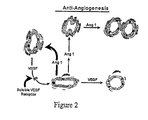
- FIG. 2 shows the reduction of microangiogenesis by the compositions and methods of the invention.
- This invention is designed to employ gene therapy or protein delivery to prevent or treat restenosis, by inhibiting the development of microvessels (vasovasorum) in the injured vessel, insofar as angiogenesis occurring within the vessel wall is an important permissive determinant of neointimal development, and or vessel remodeling.
- the invention uses various anti-angiogenesis strategies to suppress angiogenesis, and thereby inhibit the development of restenosis and/or atherosclerosis.
- Angiogenesis involves the sprouting of capillaries from preexisting blood vessels and/or the development of new vessels. This process is controlled by the action of several angiogenic growth factors and their tyrosine kinase receptors.
- VEGF-R1, VEGF-R2 and Tie-2 Two systems involving vascular endothelial growth factor (VEGF) and the angiopoietin-1 ligands, along with their specific receptors (VEGF-R1, VEGF-R2 and Tie-2 respectively), seem to have a unique and specific roll in the induction and maintenance of new blood vessel formation.
- the angiopoietin-2 ligand also appears to play an important role in
- VEGF and angiopoietin-1 act in sequence: 1) VEGF, through VEGF-R1, induces endothelial cell-cell interaction, proliferation, and tube formation; 2) angiopoietin-1, through binding to its receptor Tie-2, elicits recruitment and interaction with peri-endothelial support cells, thus maintaining vessel integrity and stabilizing newly formed blood vessels.
- Angiopoietin-2 appears to be a functional antagonist of antiopoietin-1; ang-2 expression may be a necessary step in destabilizing an existing vessel, thereby allowing it to initiate new vascular buds and branches.
- a strategy employed by the present invention is based on the concept that a critical rate-limiting step in restenosis development is the vascular supply of the injured vessel; that neointimal growth, and possibly the amount of negative vascular remodeling, are dependent on the development of a greater number of the blood vessels constituting the vasovasorum, an angiogenic process that can be modulated by anti-angiogenic interventions.
- a part of this strategy is based on the concept that most, if not all, therapeutic attempts to inhibit the development of restenosis will carry some immediate or long-tem risk. If, however, the “dose” of the intervention could be reduced because of a beneficial effect produced by an anti-agiogenic intervention, then the incidence of side-effects should be substantially diminished.
- One example of this would be the prevention of restenosis by radiation treatment.
- Administering anti-angiogenic therapy in conjunction with radiation therapy would, in effect, be a “radiosensitizing” intervention, permitting lower doses of radiation to be administered to achieve the same anti-restenosis effects as achieved by higher radiation doses when administered as single therapy.
- the strategy herein has the benefits of substantially reducing the incidence of restenosis with minimal incidence of untoward complications, a result that has been achieved to only a limited extent (or, as with radiation therapy, carrying unknown future risk) with other anti-restenosis strategies.
- the major intervention strategy of the present invention is to specifically inhibit the molecular cascades of those ligands and/or their receptors that are known to be critically important components of the angiogenesis process
- any agent that has anti-angiogenic effects can be used in the practice of the invention.
- Examples include endostatin, angiostatin, thallidamide, or other agents with broad anti-angiogenic effects.
- Such other examples include, but are not limited to, agents that inhibit the effects of angiogenic agents, by either binding to the angiogenic agent and preventing its activity, by binding to its receptor, or by inhibiting any aspect of the signaling cascade initiated by the binding of the angiogenic ligand to its receptor.
- the therapeutic agent could be in the form of a protein, or of a gene which expresses the protein.
- the gene could be delivered to the patient in a plasmid, or in any other vector, including a viral vector.
- targets for anti-angiogenic strategies include, but need not be limited to VEGF, its receptors, and its signaling cascade, bFGF its receptors, and its signalling cascade; and angiopoeitin-1, its receptor, and its signaling cascade, angiopoeitin-2, its receptor, and its signaling cascade.
- the anti-angiogenic factor could be administered systemically, either orally or intravenously. It could also be administered directly into the coronary artery in patients undergoing coronary angioplasty, or into the artery supplying the leg in patients undergoing peripheral vessel angioplasty.
- the anti-angiogenic factor could be applied directly to the wall of the injured vessel via either: 1. a ballon catheter that allows administration of the anti-angiogenic factor directly into the media and/or adventitia, or 2. a stent that has been deployed and which releases the factor into the vessel wall.
- the present invention includes compositions and methods for preventing or treating restenosis and/or atherosclerosis.
- the present invention includes compositions comprising an agent which inhibits VEGF, e.g., the soluble VEGF receptor, and/or an agent that inhibits angiopoietin-2 (which appears to be a functional antagonist of antiopoietin-1, the expression of which may be a necessary step in destabilizing an existing vessel, thereby allowing it to initiate new vascular buds and branches) and/or an agent which induces vessel maturation, e.g., ang-1; as well as methods comprising the administration of such agent(s), e.g., individually, or separately, or sequentially or the like.
- an agent which inhibits VEGF e.g., the soluble VEGF receptor
- an agent that inhibits angiopoietin-2 which appears to be a functional antagonist of antiopoietin-1, the expression of which may be a necessary step in destabilizing an existing
- the anti-angiogenic factor in the foregoing discussion can be a composition comprising an agent which inhibits VEGF, an agent which inhibits a factor (such as ang-1) causing vessel stabilization and maturation, and an agent which induces vessel maturation. Any or all of these agents can be present in the composition by way of a vector which expresses the agent in vivo.
- Angioplasty represents an acute injury model and the present invention is based on findings that many of the processes leading to neointimal development following angioplasty are the same that lead to atherosclerotic plaque development.
- Studies of cadaver hearts revealed marked development of the vasovasorum of the walls of coronary arteries contiguous to atherosclerotic plaque.
- angiogenesis in apoE knockout mice a considerable number of plaque microvessels were observed in growing atheromata.
- Administration of endostatin to apoE knockout mice retarded the progression of plague growth, a change associated with a decrease in the amount of microvessels present in the plaque.
- the inventors have reviewed many specimens of balloon injured porcine coronary arteries and stented porcine coronary arteries and have found that there is a marked angiogenic response involving microvessels of both the adventitia and the neointimal at the site of the vessel injury.
- microvascular angiogenesis (expansion of the vasovasorum) occurs during both atherogenesis and during restenosis.
- the coordinated sequential expression of VEGF and ang-1, and perhaps ang-2, with activation of their signaling cascades, are consistent components of the post embryonic microvascular angiogenic processes that occur during restenosis and atherosclerosis (note for instance FIG. 1: upregulation of VEGF is necessary to destabilize a mature vessel to enable it to begin the angiogenic process, and upregulation of angiopoietin 1 (ang-1) induces vessel maturation).
- an agent inhibiting VEGF e.g., the soluble VEGF receptor
- an agent inducing vessel maturation e.g., ang-1 or an agent which induces ang-1
- an agent that inhibits ang-2 ang-2 inhibits ang-1, thereby preventing the vessel stabilization and maturation effects of ang-1
- FIG. 2 microangiogenesis
- atherosclerosis e.g., as shown by the apoE knockout mouse model
- restenosis e.g., by the porcine coronary artery injury model
- VEGF and angiopoietins are important regulators (Koblizek et al. Curr Biol 8(9):529-32 (April 1998)).
- Ang-1 and ang-2 modulate VEGF (Asahara et al. Cir Res 83(3):23340 (March 1998)).
- Ang-2 has been recognized as an antagonist for ang-1 and Tie-2 (Maisonpierre et al. Science 277(5322):55-60 (July 1997)).
- ang-1 has been cloned and plays a mediating role; for instance, mice engineered to lack ang-1 display angiogenic deficits (Suri et al. Cell 87(7):1171-80 (December 1996)). Transgenic expression, e.g., overexpression of ang-1 in mice has been demonstrated (Suri et al., Science 282(5388):468-71 (October 1998)). And, ang-1 and ang-2 genes have been localized to human genes 8q22.3-q23 and 8p23 (Cheung et al. Genomics 48(3):389-91 (March 1998)).
- the invention comprehends administration of ang-1 or an agent which stimulates expression or the activity of ang-1.
- VEGF induces angiogenesis by binding to VEGF-receptor-2 tyrosine kinase or VEGFR2 TK.
- VEGFR2 TK catalytic domain has been cloned and expressed via a baculovirus expression system; Cd2+was found to be an inhibitor of the enzyme, with inhibition competitive with respect to Mg2+and non competitive with respect to MgATP (Parast et al. Biochemistry 37(47):16788-801 (November 1998); see also Pepper et al.
- VEGF-C has a potent synergistic effect on the induction of angiogenesis and VEGF, bFGF and VEGF-C are capable of altering endothelial cell extracellular proteolytic activity).
- VEGF and its receptors are key transduction systems involved in the regulation of embryonic vascular development; and, inhibition of the VEGF signal transduction resulted in inhibition of neovascularization in angiogenesis-dependent diseases such as proliferative retinopathy or solid tumor growth and the VEGF signal transduction system is useful as anti-angiogenic therapy (Breier et al. Thromb Haemost 78(1):678-83 (July 1997); see also Metais et al. Am J. Physiol 275(4 Pt 2):H1411-8 (October 1998) (effects of coronary artery disease on expression and microvascular response to VEGF)).
- actinomycin D blocked the induction; and Losartan abolished the induction (Chua et al. Biochim Biophys Acta 1401(2):187-94 (February 1998)).
- actinomycin D and Losartan may also inhibit VEGF or its activity.
- An alternative approach to inhibiting VEGF or its activity can be to inhibit, reduce or diminish the effect or presence of inducers of VEGF or its activity.
- VEGF or its expression has been said to be upregulated by glucose deprivation (Satake et al. Biol Cell 90(2):161-8 (March 1998)) by Mersalyl, an organomercurial compound (Agani et al. Mol Pharmacol 54(5):749-54 (March 1998)) or by H 2 O 2 (Chua et al.
- TNF-alpha has been said to upregulate in a dose and time dependent manner the expression and function of VEGF receptor-2 (Giraudo et al. J Biol Chem 273(34):22128-35 (March 1998)).
- VEGF vascular endothelial growth factor receptor
- one can inhibit the expression or function of the VEGF receptor, or that which upregulates e.g., by inhibiting, controlling, modifying, altering, reducing, or diminishing the activity or presence of TNF-alpha.
- one can inhibit VEGF by inhibiting, controlling, modifying, altering, reducing, or diminishing the activity or presence of substances which upregulate or induce VEGF such as glucose, H 2 O 2 , certain organomercury compounds, and the like. For instance, if glucose deprivation stimulates VEGF activity, then preventing glucose deprivation can be used towards inhibiting VEGF.
- the invention comprehends administration of an agent which inhibits VEGF such as an agent which mimics VEGF receptors with respect to binding to VEGF (for instance, an agent which includes a binding region of a VEGF receptor but not regions imparting VEGF receptor activity to the agent) to thereby reduce the amount of VEGF present.
- an agent which mimics VEGF with respect to binding to VEGF receptors for instance, an agent which includes a binding region of a VEGF receptor but not regions imparting VEGF receptor activity to the agent
- the invention also comprehends administration of an agent which mimics VEGF with respect to binding to VEGF receptors, but does not further activate those receptors, e.g., to tie-up the receptors so that VEGF cannot bind to them.
- the binding envisioned by these agents can be competitive, reversible or irreversible.
- the invention also comprehends administration of an agent which inhibits VEGF expression or expression of VEGF receptors.
- An agent which inhibits VEGF can comprise a plurality of such agents; for instance, agents which bind to different VEGF receptors or which mimic VEGF receptors or which inhibit VEGF and VEGF receptor(s) expression.
- agents which inhibit VEGF are envisioned by the invention.
- an agent which induces vessel maturation can comprise a plurality of such agents, e.g., ang-1, in combination with an agent which induces ang-1 activity and/or ang-1 expression. And thus, combinations of agents which induce vessel maturation are envisioned by the invention.
- any or all of the agents inhibiting VEGF or its activity e.g., soluble VEGF receptor
- these agents can be administered by any suitable means, and such means can include the proteins, naked plasmid DNA, viral vectors, an angioplasty balloon, a catheter-type device that facilitates delivery of the agent(s) to the vessel wall, or intra-arterial infusion (See Witzenbichler et al.
- An agent for inhibiting VEGF or its activity or its receptors and an agent for inducing vessel maturation can be obtained by purification from natural sources or from purification from recombinant sources; and, techniques for such purifications or for protein purification are generally known and require no undue experimentation by the skilled artisan.
- the expression product generated by vectors or recombinants in this invention can also be isolated from infected or transfected cells and used to prepare compositions for administration to patients.
- compositions for use in the invention can be prepared in accordance with standard techniques well known to those skilled in the pharmaceutical or medical arts. Such compositions can be administered in dosages and by techniques well known to those skilled in the medical arts taking into consideration such factors as the age, sex, weight, and condition of the particular patient, and the route of administration.
- the compositions can be administered alone, or can be co-administered or sequentially administered with other compositions of the invention or with other prophylactic or therapeutic compositions.
- compositions of the invention include liquid preparations for orifice, e.g., oral, nasal, anal, genital (e.g., vaginal), vascular and/or SMC, etc., administration such as suspensions, syrups or elixirs; and, preparations for parenteral, subcutaneous, intradermal, intramuscular, intravenous, intraarterial (e.g., at site of lesion or plaque), intralymphatic, or intraperitoneal administration (e.g., injectable administration) such as sterile suspensions or emulsions.
- the active agent be in admixture with a suitable carrier, diluent, or excipient such as sterile water, physiological saline, glucose or the like.
- compositions of the invention may be packaged in a single dosage form for immunization by parenteral (i.e., intramuscular, intradermal or subcutaneous) administration or orifice administration, e.g., perlingual (i.e., oral), intragastric, mucosal including intraoral, intraanal, intravaginal, intravenous, intralymphatic, intraarterial (e.g., at site of lesion or plaque), intraperitoneal, and the like administration.
- parenteral i.e., intramuscular, intradermal or subcutaneous
- parenteral i.e., intramuscular, intradermal or subcutaneous
- parenteral i.e., intragastric, mucosal including intraoral, intraanal, intravaginal, intravenous, intralymphatic, intraarterial (e.g., at site of lesion or plaque), intraperitoneal, and the like administration.
- parenteral i.e., intramuscular, intradermal or subcutaneous
- Dosages of each active agent can range from a few to a few hundred micrograms, e.g., 5 to 500 ⁇ g.
- An inventive vector or recombinant expressing either or both of the VEGF inhibiting agent and/or the vessel maturation inducing agent can be administered in any suitable amount to achieve expression at these dosage levels.
- the inventive vector or recombinant can be administered to a patient or infected or transfected into cells in an amount of about at least 10 3 pfu; more preferably about 10 4 pfu to about 10 10 pfu, e.g., about 10 5 pfu to about 10 9 pfu, for instance about 10 6 pfu to about 10 8 pfu.
- each recombinant can be administered in these amounts; or, each recombinant can be administered such that there is, in combination, a sum of recombinants comprising these amounts.
- suitable carriers or diluents can be water or a buffered saline, with or without a preservative.
- the expression product or isolated product or vector or recombinant may be lyophilized for resuspension at the time of administration or can be in solution.
- the dosage should be a sufficient amount of plasmid to elicit a response analogous to compositions wherein the agent or agents are directly present; or to have expression analogous to dosages in such compositions; or to have expression analogous to expression obtained in vivo by recombinant compositions.
- suitable quantities of plasmid DNA in plasmid compositions can be 1 ug to 100 mg, preferably 0.1 to 10 mg, e.g., 500 micrograms, but lower levels such as 0.1 to 2 mg or preferably 1-10 ug may be employed.
- Documents cited herein regarding DNA plasmid vectors may be consulted for the skilled artisan to ascertain other suitable dosages for DNA plasmid vector compositions of the invention, without undue experimentation.
- compositions comprising the VEGF inhibiting agent and the vessel maturation inducing agent may be administered as desired by the skilled medical practitioner, from this disclosure and knowledge in the art, e.g., at the first signs or symptoms of restenosis, or as soon thereafter as desired by the skilled medical practitioner, without any undue experimentation required; and, the administration of the compositions, alone or with other treatment, may be continued as a regimen, e.g., monthly, bi-monthly, biannually, annually, or in some other regimen, by the skilled medical practitioner for such time as is necessary to prevent further clogging of blood vessels or further symptoms or signs of restenosis, without any undue experimentation required.
- a regimen e.g., monthly, bi-monthly, biannually, annually, or in some other regimen
- compositions for prevention of restenosis, may be administered at the first indication of the patient being prone to restenosis, or as soon thereafter as desired by the skilled medical practitioner, e.g., within six months prior to, immediately prior to, or at angioplasty, such as within six weeks prior to, immediately prior to, or at angioplasty, in any desired regimen such as a single administration or multiple administrations in a regimen as desired, e.g., monthly, bimonthly, biannually, or any combination thereof, without any undue experimentation required.
- compositions may be administered after or during angioplasty in a regimen of single or multiple administrations as desired by the skilled medical practitioner, such as immediately after, within six weeks after, within six months after, and/or within a year after, e.g., monthly, bi-monthly, biannually, annually, or in some other regimen, by the skilled medical practitioner for such time as is necessary to prevent clogging of blood vessels or symptoms or signs of restenosis, without any undue experimentation required.
- compositions, alone or with other treatment may be administered at the first signs or symptoms of atherosclerosis, or as soon thereafter as desired by the skilled medical practitioner, without any undue experimentation required; and, the administration of the compositions, alone or with other treatment, may be continued as a regimen, e.g., monthly, bi-monthly, biannually, annually, or in some other regimen, by the skilled medical practitioner for such time as is necessary to prevent further clogging of blood vessels or further symptoms or signs of atherosclerosis, without any undue experimentation required.
- a regimen e.g., monthly, bi-monthly, biannually, annually, or in some other regimen
- compositions for prevention of atherosclerosis, may be administered at the first indication of the patient being prone to restenosis and/or atherosclerosis, or as soon thereafter as desired by the skilled medical practitioner, in any desired regimen such as a single administration or multiple administrations in a regimen as desired, e.g., monthly, bi-monthly, biannually, or any combination thereof, without any undue experimentation required, e.g., for such time as is necessary to to prevent clogging of blood vessels or symptoms or signs of atherosclerosis, without any undue experimentation required.
- compositions of the invention can be administered before, during or immediately after the angioplasty to induce maximal responses at the time of angioplasty, since the restenotic process happens quickly.
- Microvascular angiogenesis (expansion of the vasovasorum) occurs during atherogenesis in the apoE knockout mouse, and the coordinated sequential expression of VEGF and ang-1, with activation of their signaling cascades, are consistent components of the microvascular angiogenic process (see FIG. 1).
- Endpoint Measurements To determine whether the VEGF and ang-1 signaling cascades are activated during atherogenesis, vessels are obtained from the parental non-atherosclerotic mice and compared to vessels obtained at various timepoints from apoE knockout mice and analysed for one or more or any or all of:
- ang-1 protein (by immunohistochemistry and/or by Western analysis);
- VEGF protein (by immunohistochemistry and/or by Western analysis);
- tyrosine kinase phosphorylation of one or more of the VEGF receptors (to assess the state of activation of the receptor);
- Atherosclerotic mass (measured by usual computerized image analysis techniques);
- Microvascular angiogenesis (expansion of the vasovasorum) is a critical determinant of the degree of atherosclerosis, and the coordinated sequential expression of VEGF and ang-1, and for their receptors, with activation of their signaling cascades, are necessary components of the angiogenic process occurring during atherogenesis. Moreover, a) upregulation of VEGF is necessary to destabilize a mature vessel to enable it to begin the angiogenic process, and b) increased activity of ang-1 without VEGF causes vessel maturation and stabilization, and therefore inhibits ongoing angiogenesis (FIG. 1).
- VEGF vascular endothelial growth factor
- ang-1 an agent inhibiting VEGF
- VEGF vascular endothelial growth factor
- ang-1 an agent inducing vessel maturation
- ApoE knockout mice are treated by intraperitoneal administration of a protein inhibitor of the VEGF pathway (e.g., the soluble VEGF receptor), and with ang-1. These agents are administered as frequently as possible, with the maximal amount determined by the LD50 and by the availability of protein.
- a protein inhibitor of the VEGF pathway e.g., the soluble VEGF receptor
- mice are treated by administering into the tail vein a vector or vectors such as adenoviral vector(s) expressing the 1) soluble VEGF receptor transgene, and 2) the ang-1 transgene. It is anticipated that most of the virus is taken up by the liver and protein expression continues for 2-4 weeks. Administrations may be repeated to obtain a desired effect or duration of expression.
- a vector or vectors such as adenoviral vector(s) expressing the 1) soluble VEGF receptor transgene, and 2) the ang-1 transgene. It is anticipated that most of the virus is taken up by the liver and protein expression continues for 2-4 weeks. Administrations may be repeated to obtain a desired effect or duration of expression.
- ang-1 protein (by immunohistochemistry and/or by Western analysis);
- VEGF protein (by immunohistochemistry and/or by Western analysis);
- tyrosine kinase phosphorylation of one or more of the VEGF receptors (to assess the state of activation of the receptor);
- Atherosclerotic mass (measured by usual computerized image analysis techniques);
- Microangiogenesis expansion of the vasovasorum occurs during neointimal development following angioplasty (with or without stents), and the coordinated sequential expression of VEGF and ang-1, with activation of their signaling cascades, are consistent components of the microvascular angiogenic process.
- the coronary vessels of pigs are injured by balloon angioplasty with or without stent implantation.
- vessels are obtained from each of 2 pigs sacrificed 2 h, 6 h, 24 h, 14 days and 28 days after injury and analysed.
- Endpoint Measurements are one or more or any or all of:
- ang-1 protein (by immunohistochemistry and/or by Western blot);
- VEGF protein (by immunohistochemistry and/or by Western analysis);
- tyrosine kinase phosphorylation of one or more of the VEGF receptors (to assess the state of activation of the receptor);
- neointimal mass (measured by usual computerized image analysis techniques);
- Microvascular angiogenesis (expansion of the vasovasorum) is a critical determinant of neointimal expansion and therefore of restenosis mass, and the coordinated sequential expression of VEGF and ang-1, and/or their receptors, with activation of their signaling cascades, are necessary components of the restenotic process occurring following vessel injury. Moreover, a) upregulation of VEGF is necessary to destabilize a mature vessel to enable it to begin the angiogenic process, and b) increased activity of ang-1 without VEGF causes vessel maturation and stabilization, and therefore inhibits ongoing angiogenesis (see FIG. 1).
- an agent inhibiting VEGF e.g., the soluble VEGF receptor
- an agent inducing vessel maturation e.g., ang-1
- Protocol Following angioplasty, vectors such as adenoviral vectors expressing the 1) soluble VEGF receptor transgene, and 2) the ang-1 transgene are administered into the vessel wall by a balloon catheter that allows injection through multiple small needles of the therapeutic agent directly into the media (e.g., the Infusate catheter (Interventional Technology)).
- adenoviral vectors expressing the 1) soluble VEGF receptor transgene, and 2) the ang-1 transgene are administered into the vessel wall by a balloon catheter that allows injection through multiple small needles of the therapeutic agent directly into the media (e.g., the Infusate catheter (Interventional Technology)).
- A) Vessels are obtained from each of 2 treated, and each of 2 untreated pigs sacrificed 2 h, 6h, 24 h, and 14 days after injury and analysed for one or more or any or all of:
- ang-1 protein (by immunohistochemistry and/or by Western analysis);
- VEGF protein (by immunohistochemistry and/or by Western analysis);
- tyrosine kinase phosphorylation of one or more of the VEGF receptors (to assess the state of activation of the receptor).
- B) Vessels are obtained from each of 8 treated, and each of 8 untreated pigs sacrificed at 28 days after injury and analyzed for one or more or any or all of:
- ang-1 protein (by immunohistochemistry and/or by Western analysis);
- VEGF protein (by immunohistochemistry and by Western analysis);
- tyrosine kinase phosphorylation of one or more of the VEGF receptors (to assess the state of activation of the receptor);
- neointimal mass (measured by usual computerized image analysis techniques);
- Results confirm that administration of a VEGF inhibitor and a vessel maturation inducer prevent or treat atherosclerosis and/or restenosis.
- the soluble VEGF receptor, and/or other VEGF inhibitors identified in the foregoing text and ang-1 and/or other vessel maturation inducers are admixed with carrier, diluent etc., as herein described in amounts as herein described to obtain formulations.
- DNA encoding VEGF inhibitors such as the soluble VEGF receptor and vessel maturation inducers such as ang-1 are used to generate recombinants and DNA expression systems expressing these agents; and, these recombinants and DNA expression systems are admixed with carrier, diluent, etc., as herein described to obtain formulations.
- Patients are administered the formulations as herein described for the prevention and/or treatment of vascular disease such as atherosclerosis and/or restenosis, including in a manner analogous to gene therapy directed against SMC proliferation, as described in literature cited herein or in documents cited in literature cited herein.
- vascular disease such as atherosclerosis and/or restenosis
Landscapes
- Health & Medical Sciences (AREA)
- Life Sciences & Earth Sciences (AREA)
- Pharmacology & Pharmacy (AREA)
- Veterinary Medicine (AREA)
- Chemical & Material Sciences (AREA)
- Public Health (AREA)
- General Health & Medical Sciences (AREA)
- Medicinal Chemistry (AREA)
- Animal Behavior & Ethology (AREA)
- Engineering & Computer Science (AREA)
- Bioinformatics & Cheminformatics (AREA)
- Epidemiology (AREA)
- Immunology (AREA)
- Proteomics, Peptides & Aminoacids (AREA)
- Gastroenterology & Hepatology (AREA)
- Zoology (AREA)
- Vascular Medicine (AREA)
- Cell Biology (AREA)
- Chemical Kinetics & Catalysis (AREA)
- Heart & Thoracic Surgery (AREA)
- Cardiology (AREA)
- General Chemical & Material Sciences (AREA)
- Nuclear Medicine, Radiotherapy & Molecular Imaging (AREA)
- Organic Chemistry (AREA)
- Medicines That Contain Protein Lipid Enzymes And Other Medicines (AREA)
- Pharmaceuticals Containing Other Organic And Inorganic Compounds (AREA)
- Acyclic And Carbocyclic Compounds In Medicinal Compositions (AREA)
- Hydrogenated Pyridines (AREA)
Priority Applications (2)
| Application Number | Priority Date | Filing Date | Title |
|---|---|---|---|
| US09/478,621 US20030191055A1 (en) | 1999-01-15 | 2000-01-05 | Inhibiting development of microvessels withins coronary or peripheral vessel walls for restenosis/atherosclerosis prevention or therapy |
| US11/295,095 US20060094657A1 (en) | 1999-01-15 | 2005-12-06 | Inhibiting development of microvessels within coronary or peripheral vessel walls for restenosis/atherosclerosis prevention or therapy |
Applications Claiming Priority (2)
| Application Number | Priority Date | Filing Date | Title |
|---|---|---|---|
| US11597799P | 1999-01-15 | 1999-01-15 | |
| US09/478,621 US20030191055A1 (en) | 1999-01-15 | 2000-01-05 | Inhibiting development of microvessels withins coronary or peripheral vessel walls for restenosis/atherosclerosis prevention or therapy |
Related Child Applications (1)
| Application Number | Title | Priority Date | Filing Date |
|---|---|---|---|
| US11/295,095 Continuation US20060094657A1 (en) | 1999-01-15 | 2005-12-06 | Inhibiting development of microvessels within coronary or peripheral vessel walls for restenosis/atherosclerosis prevention or therapy |
Publications (1)
| Publication Number | Publication Date |
|---|---|
| US20030191055A1 true US20030191055A1 (en) | 2003-10-09 |
Family
ID=22364512
Family Applications (2)
| Application Number | Title | Priority Date | Filing Date |
|---|---|---|---|
| US09/478,621 Abandoned US20030191055A1 (en) | 1999-01-15 | 2000-01-05 | Inhibiting development of microvessels withins coronary or peripheral vessel walls for restenosis/atherosclerosis prevention or therapy |
| US11/295,095 Abandoned US20060094657A1 (en) | 1999-01-15 | 2005-12-06 | Inhibiting development of microvessels within coronary or peripheral vessel walls for restenosis/atherosclerosis prevention or therapy |
Family Applications After (1)
| Application Number | Title | Priority Date | Filing Date |
|---|---|---|---|
| US11/295,095 Abandoned US20060094657A1 (en) | 1999-01-15 | 2005-12-06 | Inhibiting development of microvessels within coronary or peripheral vessel walls for restenosis/atherosclerosis prevention or therapy |
Country Status (9)
| Country | Link |
|---|---|
| US (2) | US20030191055A1 (de) |
| EP (1) | EP1146891B1 (de) |
| JP (1) | JP2002534475A (de) |
| AT (1) | ATE348629T1 (de) |
| AU (2) | AU773050B2 (de) |
| CA (1) | CA2359461A1 (de) |
| DE (1) | DE60032459D1 (de) |
| HK (1) | HK1041447A1 (de) |
| WO (1) | WO2000041712A1 (de) |
Cited By (6)
| Publication number | Priority date | Publication date | Assignee | Title |
|---|---|---|---|---|
| US20030144298A1 (en) * | 2000-04-05 | 2003-07-31 | Curwen Jon Owen | Therapeutic combinations of antihypertensive and antiangiogenics agents |
| US20040247597A1 (en) * | 2001-06-20 | 2004-12-09 | Peter Carmeliet | Method of treating atherosclerosis and other inflammatory diseases |
| WO2004087736A3 (en) * | 2003-03-27 | 2005-03-31 | Texase A & M University System | Uses of vascular endothelial growth factor and type i collagen inducible protein (vcip) |
| US20050234225A1 (en) * | 2002-03-04 | 2005-10-20 | Zhenping Zhu | Human antibodies specific to kdr and uses thereof |
| US20060154884A1 (en) * | 2003-06-18 | 2006-07-13 | Arnd Buchwald | Use of a vegf receptor gener or gene product |
| US20090130088A1 (en) * | 2005-09-13 | 2009-05-21 | Rigby William F C | Compositions and methods for regulating RNA translation via CD154 CA-dinucleotide repeat |
Families Citing this family (4)
| Publication number | Priority date | Publication date | Assignee | Title |
|---|---|---|---|---|
| US20060057722A1 (en) * | 1999-03-30 | 2006-03-16 | Myocardial Therapeutics, Inc. | Conditioned medium of autologous or allogenic progenitor cells for angiogenesis treatment |
| WO2002022176A1 (en) | 2000-09-15 | 2002-03-21 | Genvec, Inc. | Method of modulating neovascularization |
| WO2008152507A2 (en) * | 2007-03-16 | 2008-12-18 | Multigene Vascular Systems, Inc. | Compositions and methods for treating ophthalmic disorders |
| WO2023028004A1 (en) * | 2021-08-23 | 2023-03-02 | Avirmax, Inc. | Compositions and methods for transgene expression |
Family Cites Families (4)
| Publication number | Priority date | Publication date | Assignee | Title |
|---|---|---|---|---|
| DE69434115T2 (de) * | 1993-03-25 | 2005-10-27 | Merck & Co., Inc. | Inhibitor des wachstumsfaktors für gefässendothelzellen |
| CA2188575A1 (en) * | 1995-02-28 | 1996-09-06 | H. Kirk Hammond | Gene transfer-mediated angiogenesis therapy |
| US6183752B1 (en) * | 1997-02-05 | 2001-02-06 | Pasteur Merieux Serums Et Vaccins | Restenosis/atherosclerosis diagnosis, prophylaxis and therapy |
| CA2375617A1 (en) * | 1999-06-07 | 2000-12-14 | Edwards Lifesciences Corporation | Targeted angiogenesis |
-
2000
- 2000-01-05 AT AT00903106T patent/ATE348629T1/de not_active IP Right Cessation
- 2000-01-05 WO PCT/US2000/000161 patent/WO2000041712A1/en not_active Ceased
- 2000-01-05 AU AU24902/00A patent/AU773050B2/en not_active Ceased
- 2000-01-05 EP EP00903106A patent/EP1146891B1/de not_active Expired - Lifetime
- 2000-01-05 US US09/478,621 patent/US20030191055A1/en not_active Abandoned
- 2000-01-05 JP JP2000593322A patent/JP2002534475A/ja not_active Abandoned
- 2000-01-05 DE DE60032459T patent/DE60032459D1/de not_active Expired - Fee Related
- 2000-01-05 CA CA002359461A patent/CA2359461A1/en not_active Abandoned
- 2000-01-05 HK HK02103085.8A patent/HK1041447A1/zh unknown
-
2004
- 2004-08-05 AU AU2004203652A patent/AU2004203652A1/en not_active Abandoned
-
2005
- 2005-12-06 US US11/295,095 patent/US20060094657A1/en not_active Abandoned
Cited By (9)
| Publication number | Priority date | Publication date | Assignee | Title |
|---|---|---|---|---|
| US20030144298A1 (en) * | 2000-04-05 | 2003-07-31 | Curwen Jon Owen | Therapeutic combinations of antihypertensive and antiangiogenics agents |
| US7829573B2 (en) * | 2000-04-05 | 2010-11-09 | Astrazeneca Ab | Therapeutic combinations of antihypertensive and antiangiogenics agents |
| US20040247597A1 (en) * | 2001-06-20 | 2004-12-09 | Peter Carmeliet | Method of treating atherosclerosis and other inflammatory diseases |
| US20050234225A1 (en) * | 2002-03-04 | 2005-10-20 | Zhenping Zhu | Human antibodies specific to kdr and uses thereof |
| US7498414B2 (en) | 2002-03-04 | 2009-03-03 | Imclone Systems Incorporated | Human antibodies specific to KDR and uses thereof |
| WO2004087736A3 (en) * | 2003-03-27 | 2005-03-31 | Texase A & M University System | Uses of vascular endothelial growth factor and type i collagen inducible protein (vcip) |
| US20060154884A1 (en) * | 2003-06-18 | 2006-07-13 | Arnd Buchwald | Use of a vegf receptor gener or gene product |
| US20090130088A1 (en) * | 2005-09-13 | 2009-05-21 | Rigby William F C | Compositions and methods for regulating RNA translation via CD154 CA-dinucleotide repeat |
| US9109228B2 (en) * | 2005-09-13 | 2015-08-18 | Trustees Of Dartmouth College | Compositions and methods for regulating RNA translation via CD154 CA-dinucleotide repeat |
Also Published As
| Publication number | Publication date |
|---|---|
| EP1146891B1 (de) | 2006-12-20 |
| JP2002534475A (ja) | 2002-10-15 |
| EP1146891A1 (de) | 2001-10-24 |
| HK1041447A1 (zh) | 2002-07-12 |
| WO2000041712A1 (en) | 2000-07-20 |
| CA2359461A1 (en) | 2000-07-20 |
| ATE348629T1 (de) | 2007-01-15 |
| AU2490200A (en) | 2000-08-01 |
| DE60032459D1 (de) | 2007-02-01 |
| US20060094657A1 (en) | 2006-05-04 |
| AU2004203652A1 (en) | 2004-09-02 |
| EP1146891A4 (de) | 2002-07-17 |
| AU773050B2 (en) | 2004-05-13 |
Similar Documents
| Publication | Publication Date | Title |
|---|---|---|
| Ferrara | Vascular endothelial growth factor: basic science and clinical progress | |
| EP0883343B1 (de) | Zusammensetzungen zur behandlung von ischamischem gewebe | |
| Shawver et al. | Receptor tyrosine kinases as targets for inhibition of angiogenesis | |
| US20080254109A1 (en) | Localized myocardial injection method for treating ischemic myocardium | |
| AU773050B2 (en) | Inhibiting development of microvessels within vascular walls | |
| US20030211988A1 (en) | Enhancing lymph channel development and treatment of lymphatic obstructive disease | |
| Radulescu et al. | Heparin-binding EGF-like growth factor promotes intestinal anastomotic healing | |
| EP1227830A1 (de) | Verfahren zur induzierung der angiogenese | |
| EA019099B1 (ru) | Способ направленной доставки трансгена в миокард пациента с ишемией миокарда | |
| JP2005505510A (ja) | Vegf−bによる血管新生の刺激 | |
| Winlaw | Angiogenesis in the pathobiology and treatment of vascular and malignant diseases | |
| CN102755638A (zh) | Aggf1在制备促进血管形成的药物中的用途 | |
| Huemer et al. | Adenovirus-mediated transforming growth factor-β ameliorates ischemic necrosis of epigastric skin flaps in a rat model1, 2 | |
| EP1551227A2 (de) | Verhinderung eines sekundären lymphödems mit vegf-d-dna | |
| Nikol | Therapeutic angiogenesis for peripheral artery disease: gene therapy | |
| Webster | Therapeutic angiogenesis: a case for targeted, regulated gene delivery | |
| EP1402902A1 (de) | Behandlungsmethode für die gefässregeneration | |
| WO2001051075A1 (en) | Enhancing lymph channel development and treatment of lymphatic obstructive disease | |
| Korpela et al. | Therapeutic angiogenesis: Translational and clinical experience | |
| Rauma-Pinola | Adenovirus endocytosis and adenoviral gene transfer in cardiovascular and dermatologic disease models | |
| Ferrara | 2 Vascular Endothelial Growth Factor: Basic Biology and Clinical Applications | |
| HK1064584A (en) | Method for treatment of vascular regeneration | |
| HK1087343A (en) | Compounds for treating ischemic tissue |
Legal Events
| Date | Code | Title | Description |
|---|---|---|---|
| AS | Assignment |
Owner name: CARDIOVASCULAR RESEARCH FOUNDATION, NEW YORK Free format text: ASSIGNMENT OF ASSIGNORS INTEREST;ASSIGNORS:EPSTEIN, STEPHEN E.;KORNOWSKI, RAN;FUCH, SHMUEL;AND OTHERS;REEL/FRAME:010603/0816 Effective date: 19990115 |
|
| STCB | Information on status: application discontinuation |
Free format text: ABANDONED -- FAILURE TO RESPOND TO AN OFFICE ACTION |