US20180098560A1 - Frozen dumpling and production method therefor, container for frozen dumpling, and packaging for frozen dumpling - Google Patents
Frozen dumpling and production method therefor, container for frozen dumpling, and packaging for frozen dumpling Download PDFInfo
- Publication number
- US20180098560A1 US20180098560A1 US15/837,224 US201715837224A US2018098560A1 US 20180098560 A1 US20180098560 A1 US 20180098560A1 US 201715837224 A US201715837224 A US 201715837224A US 2018098560 A1 US2018098560 A1 US 2018098560A1
- Authority
- US
- United States
- Prior art keywords
- frozen
- gyoza dumpling
- batter liquid
- gyoza
- container
- Prior art date
- Legal status (The legal status is an assumption and is not a legal conclusion. Google has not performed a legal analysis and makes no representation as to the accuracy of the status listed.)
- Abandoned
Links
Images




Classifications
-
- A23L3/364—
-
- A—HUMAN NECESSITIES
- A21—BAKING; EDIBLE DOUGHS
- A21D—TREATMENT OF FLOUR OR DOUGH FOR BAKING, e.g. BY ADDITION OF MATERIALS; BAKING; BAKERY PRODUCTS
- A21D13/00—Finished or partly finished bakery products
- A21D13/30—Filled, to be filled or stuffed products
- A21D13/31—Filled, to be filled or stuffed products filled before baking
-
- A—HUMAN NECESSITIES
- A21—BAKING; EDIBLE DOUGHS
- A21D—TREATMENT OF FLOUR OR DOUGH FOR BAKING, e.g. BY ADDITION OF MATERIALS; BAKING; BAKERY PRODUCTS
- A21D15/00—Improving finished, partly finished or par-baked bakery products
- A21D15/02—Improving finished, partly finished or par-baked bakery products by cooling, e.g. refrigeration or freezing
-
- A—HUMAN NECESSITIES
- A23—FOODS OR FOODSTUFFS; TREATMENT THEREOF, NOT COVERED BY OTHER CLASSES
- A23B—PRESERVATION OF FOODS, FOODSTUFFS OR NON-ALCOHOLIC BEVERAGES; CHEMICAL RIPENING OF FRUIT OR VEGETABLES
- A23B2/00—Preservation of foods or foodstuffs, in general
- A23B2/80—Freezing; Subsequent thawing; Cooling
- A23B2/805—Materials not being transported through or in the apparatus with or without shaping, e.g. in the form of powders, granules or flakes
- A23B2/8055—Materials not being transported through or in the apparatus with or without shaping, e.g. in the form of powders, granules or flakes with packages or with shaping in the form of blocks or portions
-
- A—HUMAN NECESSITIES
- A23—FOODS OR FOODSTUFFS; TREATMENT THEREOF, NOT COVERED BY OTHER CLASSES
- A23L—FOODS, FOODSTUFFS OR NON-ALCOHOLIC BEVERAGES, NOT OTHERWISE PROVIDED FOR; PREPARATION OR TREATMENT THEREOF
- A23L35/00—Foods or foodstuffs not provided for in groups A23L5/00 - A23L33/00; Preparation or treatment thereof
-
- B—PERFORMING OPERATIONS; TRANSPORTING
- B65—CONVEYING; PACKING; STORING; HANDLING THIN OR FILAMENTARY MATERIAL
- B65D—CONTAINERS FOR STORAGE OR TRANSPORT OF ARTICLES OR MATERIALS, e.g. BAGS, BARRELS, BOTTLES, BOXES, CANS, CARTONS, CRATES, DRUMS, JARS, TANKS, HOPPERS, FORWARDING CONTAINERS; ACCESSORIES, CLOSURES, OR FITTINGS THEREFOR; PACKAGING ELEMENTS; PACKAGES
- B65D1/00—Rigid or semi-rigid containers having bodies formed in one piece, e.g. by casting metallic material, by moulding plastics, by blowing vitreous material, by throwing ceramic material, by moulding pulped fibrous material or by deep-drawing operations performed on sheet material
- B65D1/34—Trays or like shallow containers
- B65D1/36—Trays or like shallow containers with moulded compartments or partitions
-
- B—PERFORMING OPERATIONS; TRANSPORTING
- B65—CONVEYING; PACKING; STORING; HANDLING THIN OR FILAMENTARY MATERIAL
- B65D—CONTAINERS FOR STORAGE OR TRANSPORT OF ARTICLES OR MATERIALS, e.g. BAGS, BARRELS, BOTTLES, BOXES, CANS, CARTONS, CRATES, DRUMS, JARS, TANKS, HOPPERS, FORWARDING CONTAINERS; ACCESSORIES, CLOSURES, OR FITTINGS THEREFOR; PACKAGING ELEMENTS; PACKAGES
- B65D25/00—Details of other kinds or types of rigid or semi-rigid containers
- B65D25/02—Internal fittings
- B65D25/10—Devices to locate articles in containers
-
- B—PERFORMING OPERATIONS; TRANSPORTING
- B65—CONVEYING; PACKING; STORING; HANDLING THIN OR FILAMENTARY MATERIAL
- B65D—CONTAINERS FOR STORAGE OR TRANSPORT OF ARTICLES OR MATERIALS, e.g. BAGS, BARRELS, BOTTLES, BOXES, CANS, CARTONS, CRATES, DRUMS, JARS, TANKS, HOPPERS, FORWARDING CONTAINERS; ACCESSORIES, CLOSURES, OR FITTINGS THEREFOR; PACKAGING ELEMENTS; PACKAGES
- B65D75/00—Packages comprising articles or materials partially or wholly enclosed in strips, sheets, blanks, tubes or webs of flexible sheet material, e.g. in folded wrappers
- B65D75/28—Articles or materials wholly enclosed in composite wrappers, i.e. wrappers formed by associating or interconnecting two or more sheets or blanks
- B65D75/30—Articles or materials enclosed between two opposed sheets or blanks having their margins united, e.g. by pressure-sensitive adhesive, crimping, heat-sealing, or welding
- B65D75/32—Articles or materials enclosed between two opposed sheets or blanks having their margins united, e.g. by pressure-sensitive adhesive, crimping, heat-sealing, or welding one or both sheets or blanks being recessed to accommodate contents
- B65D75/36—Articles or materials enclosed between two opposed sheets or blanks having their margins united, e.g. by pressure-sensitive adhesive, crimping, heat-sealing, or welding one or both sheets or blanks being recessed to accommodate contents one sheet or blank being recessed and the other formed of relatively stiff flat sheet material, e.g. blister packages, the recess or recesses being preformed
- B65D75/367—Articles or materials enclosed between two opposed sheets or blanks having their margins united, e.g. by pressure-sensitive adhesive, crimping, heat-sealing, or welding one or both sheets or blanks being recessed to accommodate contents one sheet or blank being recessed and the other formed of relatively stiff flat sheet material, e.g. blister packages, the recess or recesses being preformed and forming several compartments
- B65D75/368—Articles or materials enclosed between two opposed sheets or blanks having their margins united, e.g. by pressure-sensitive adhesive, crimping, heat-sealing, or welding one or both sheets or blanks being recessed to accommodate contents one sheet or blank being recessed and the other formed of relatively stiff flat sheet material, e.g. blister packages, the recess or recesses being preformed and forming several compartments the compartments being interconnected, e.g. by small channels
-
- B—PERFORMING OPERATIONS; TRANSPORTING
- B65—CONVEYING; PACKING; STORING; HANDLING THIN OR FILAMENTARY MATERIAL
- B65D—CONTAINERS FOR STORAGE OR TRANSPORT OF ARTICLES OR MATERIALS, e.g. BAGS, BARRELS, BOTTLES, BOXES, CANS, CARTONS, CRATES, DRUMS, JARS, TANKS, HOPPERS, FORWARDING CONTAINERS; ACCESSORIES, CLOSURES, OR FITTINGS THEREFOR; PACKAGING ELEMENTS; PACKAGES
- B65D77/00—Packages formed by enclosing articles or materials in preformed containers, e.g. boxes, cartons, sacks or bags
- B65D77/003—Articles enclosed in rigid or semi-rigid containers, the whole being wrapped
-
- B—PERFORMING OPERATIONS; TRANSPORTING
- B65—CONVEYING; PACKING; STORING; HANDLING THIN OR FILAMENTARY MATERIAL
- B65D—CONTAINERS FOR STORAGE OR TRANSPORT OF ARTICLES OR MATERIALS, e.g. BAGS, BARRELS, BOTTLES, BOXES, CANS, CARTONS, CRATES, DRUMS, JARS, TANKS, HOPPERS, FORWARDING CONTAINERS; ACCESSORIES, CLOSURES, OR FITTINGS THEREFOR; PACKAGING ELEMENTS; PACKAGES
- B65D85/00—Containers, packaging elements or packages, specially adapted for particular articles or materials
- B65D85/50—Containers, packaging elements or packages, specially adapted for particular articles or materials for living organisms, articles or materials sensitive to changes of environment or atmospheric conditions, e.g. land animals, birds, fish, water plants, non-aquatic plants, flower bulbs, cut flowers or foliage
-
- B—PERFORMING OPERATIONS; TRANSPORTING
- B65—CONVEYING; PACKING; STORING; HANDLING THIN OR FILAMENTARY MATERIAL
- B65D—CONTAINERS FOR STORAGE OR TRANSPORT OF ARTICLES OR MATERIALS, e.g. BAGS, BARRELS, BOTTLES, BOXES, CANS, CARTONS, CRATES, DRUMS, JARS, TANKS, HOPPERS, FORWARDING CONTAINERS; ACCESSORIES, CLOSURES, OR FITTINGS THEREFOR; PACKAGING ELEMENTS; PACKAGES
- B65D85/00—Containers, packaging elements or packages, specially adapted for particular articles or materials
- B65D85/70—Containers, packaging elements or packages, specially adapted for particular articles or materials for materials not otherwise provided for
-
- A—HUMAN NECESSITIES
- A23—FOODS OR FOODSTUFFS; TREATMENT THEREOF, NOT COVERED BY OTHER CLASSES
- A23V—INDEXING SCHEME RELATING TO FOODS, FOODSTUFFS OR NON-ALCOHOLIC BEVERAGES AND LACTIC OR PROPIONIC ACID BACTERIA USED IN FOODSTUFFS OR FOOD PREPARATION
- A23V2002/00—Food compositions, function of food ingredients or processes for food or foodstuffs
Definitions
- the present invention relates to a frozen gyoza dumpling comprising a frozen gyoza dumpling itself and a frozen batter liquid attached thereto, a manufacture method of the frozen gyoza dumpling, a container for containing the frozen gyoza dumpling, and a frozen gyoza dumpling pack comprising the frozen gyoza dumpling contained in said container.
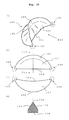
- a typical shape of a gyoza dumpling is a curved three-dimensional shape having a longitudinal direction as exemplarily shown in FIG. 10( a ) .
- the shape of the gyoza dumpling exemplified in this Figure is a most general one and there are many variations including one free of a curve, a thick one and the like.
- the shape of gyoza dumpling seen from the side is expressed by a simple half-moon shape shown in FIG. 10( b )
- the shape of the bottom surface of gyoza dumpling is expressed by a simple crescent moon shape shown in FIG. 10( c )
- a cross sectional shape when the main part of gyoza dumpling is cut perpendicularly to the longitudinal direction is expressed as a simple shape of triangular top part with swollen side surfaces shown in FIG. 10( d ) , which is added with a line segment showing a marginal part 103 .
- a gyoza dumpling 100 having a typical shape exemplified in FIG. 10( a )-( d ) has two side surfaces ( 101 , 102 ), a marginal part (where dough sheet is folded to join in an overlap) 103 , a bottom surface 104 , and two ends ( 105 , 106 ) on the opposite sides in the longitudinal direction.
- Gyoza dumpling baked on a heating plate for cooking (frying pan, etc.) has a burn mark on the bottom surface 104 .
- the bottom surface is also called a “baking surface” since it is a surface to be imparted with a burn mark.
- bottom surface and “side surface” are used to explain each part of gyoza dumpling and do not limit the position or posture of the gyoza dumpling.
- baked gyoza dumpling is generally placed on a dish with the bottom surface having a burn mark facing up.
- Frozen gyoza dumpling is generally manufactured by wrapping the ingredient (filling), which is a mixture of chopped vegetables, ground meat and the like, with dough for gyoza dumpling, and subjecting same to a freezing treatment. Prior to the aforementioned freezing treatment, a preliminary heat treatment such as steaming and the like is applied as necessary.
- a basic cooking method includes placing frozen gyoza dumplings side by side on a heating plate with oil spread therein and the like, adding a given amount of water, putting a lid thereon, and applying predetermined thawing and a heat treatment in a steam-baked state as well as making a burn mark on the bottom surface of gyoza dumplings to give baked gyoza dumplings.
- the aforementioned frozen gyoza dumplings have defects in that since water needs to be added onto a heated plate containing oil at a high temperature, oil splashing occurs and water is scattered, which may be dangerous, and further, how it is cooked up sometimes varies depending on the amount of water added, and making a clean color of baking on the bottom surface of gyoza dumplings requires a skill.
- a frozen gyoza dumpling which is obtained by contacting a gyoza dumpling with a first layer composed of a batter liquid and a second layer composed of water or a seasoning liquid, and subjecting the gyoza dumpling to a freezing treatment, thereby obviating the need for oil and water when heating cooking the gyoza dumpling in a frying pan, and the need for a lid (see, for example, patent document 1).
- frozen gyoza dumpling obtained by attaching a batter liquid (containing starch (or grain flour), oil and/or fat) containing 70-90 wt % water to at least the bottom surface of gyoza dumpling at a particular ratio per one gyoza dumpling and freezing them has also been developed (see, for example, patent document 2 ).
- a batter liquid containing starch (or grain flour), oil and/or fat
- the bottom surface of frozen gyoza dumpling is called a “baking surface” since it is a surface to be imparted with a burn mark.
- a necessary amount for example, about 2 g-about 14 g
- a batter liquid in a frozen state is attached to cover the bottom surface (“baking surface”) and further, the side surface of one gyoza dumpling (for example, about 15 g-about 45 g).
- the batter liquid contains water in an amount necessary for cooking (particularly, treatment to bake and simultaneously steam on a heating plate).
- a drip from the filling does not transfer to the dough easily, even when the time lapses after heating cooking, the amount of juice immediately after baking (juiciness) can be maintained. This also suppresses transfer of water into the dough, which in turn maintains chewiness of the dough and preferable texture of the dough.
- Frozen gyoza dumpling attached with a frozen batter liquid shows the above-mentioned superior characteristics.
- the present inventors have studied a room for improvement to further improve the quality of the frozen gyoza dumpling and found that there is room for improvement in the following two items.
- the first item relates to the shape of the inner bottom surface of a container containing gyoza dumpling (also called a “tray” due to a shallow and wide shape for arranging multiple gyoza dumplings).
- gyoza dumpling also called a “tray” due to a shallow and wide shape for arranging multiple gyoza dumplings.
- a plurality of gyoza dumplings are arranged in a container, which is put in an outer packaging bag and sold.
- the inside of the container is generally divided into gyoza dumpling holding parts for holding each gyoza dumpling by partitioning protrusions and peripheral wall parts.
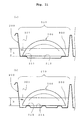
- FIG. 11( a ), ( b ) one gyoza dumpling 100 and a necessary amount of a batter liquid 300 are fed and frozen in each gyoza dumpling holding part 210 in the container 200 .
- a recess part for receiving the batter liquid is formed on the bottom of each gyoza dumpling holding part.
- one recess part 212 for receiving the batter liquid is formed in the center part of the bottom surface 211 of the gyoza dumpling holding part 210 , whereby the batter liquid can attach to the bottom surface of gyoza dumpling.
- a plurality of recess parts 214 for receiving the batter liquid are formed on the bottom surface 213 of the gyoza dumpling holding part 210 , whereby the batter liquid can attach to the bottom surface of gyoza dumpling.
- each gyoza dumpling holding part protrudes relative to the bottom of the recess part ( 212 , 214 ) to support the gyoza dumpling.
- the bottom surface of gyoza dumpling enters into the recess part in the bottom of the gyoza dumpling holding part due to the own weight of the gyoza dumpling.
- the aforementioned unevenness of the container is sometimes transferred onto the bottom surface of gyoza dumpling, which in turn sometimes causes an unburnt residue of the batter liquid on the bottom surface of the baked gyoza dumpling or a failure to produce a uniform burn mark on the bottom surface of each gyoza dumpling.
- the aforementioned unburnt residue of the batter liquid refers to the batter liquid in a viscous paste state and adhering to the gyoza dumpling itself, due to the moisture remaining after insufficient heating of the batter liquid.
- An unburnt residue of the batter liquid unpreferably affects the texture, since it has adhesiveness and sliminess.
- the second item relates to the attachment of the batter liquid to the surface of gyoza dumpling.
- Conventional frozen gyoza dumpling is characterized in that a frozen batter liquid is attached to the bottom surface of gyoza dumpling.
- the batter liquid is fed not only on the bottom surface of gyoza dumpling but also up to height h, which is about half the overall height, as shown in FIG. 11( a ), ( b ) , and the frozen batter liquid attaches thick to a wide area of about 2 ⁇ 3 of the outer surface of the gyoza dumpling (symbol 301 shows the liquid level of the frozen batter liquid).
- the inherent texture (chewiness and the like) of the dough of the gyoza dumpling is sometimes impaired when the dough contacts the batter liquid (particularly when a preliminary heat treatment is applied before freezing to dough while it is in contact with the batter liquid and then they are directly frozen), since the dough is softened. That is, it was found that, to further improve the texture of the dough of gyoza dumpling, it is preferable to reduce the surface area of the gyoza dumpling where the batter liquid is attached thick.
- both the above two items noted by the present inventors to be improved are closely related to the shape of the container.
- the liquid level of the batter liquid increases, and the batter liquid attaches thick up to a part higher than the side surface of the gyoza dumpling.
- the liquid level of the batter liquid needs to be lowered.
- An object of the present invention is to improve the above-mentioned first item, and reduce the unevenness of the bottom surface of the gyoza dumpling due to the effect of the container.
- a further object of the present invention is to improve the above-mentioned second item, preferably simultaneously improve the above-mentioned first item as well, and improve texture of gyoza dumpling by further reducing the part where the frozen batter liquid is attached thick to the surface of the frozen gyoza dumpling.
- a further object of the present invention is to provide a container for achieving the aforementioned object and a manufacture method of the aforementioned frozen gyoza dumpling, and further provide a pack of the aforementioned gyoza dumplings placed in the aforementioned container.
- the present inventors have conducted intensive studies in an attempt to solve the above-mentioned problems and found that the above-mentioned items 1 and 2 can be respectively, preferably simultaneously, improved by attaching the main part of the frozen batter liquid in an amount necessary for one gyoza dumpling to a region including the outer peripheral edge of the bottom surface of gyoza dumpling and the vicinity thereof, wherein the main part of the frozen batter liquid extends downwardly and sidewardly from the aforementioned attached region, and by providing a container capable of affording such state of the main part of the frozen batter liquid, which resulted in the completion of the present invention.
- the main constitutions of the present invention are as follows.
- the container having, in its inside,
- the recess part has an opening part adjacent to a part of or the whole outer peripheral edge of the supporting surface
- an internal space of the recess part is at a height not more than a height of the supporting surface, and the internal space is capable of receiving not less than 35% of the total weight of the frozen batter liquid attached to the gyoza dumpling itself in the frozen gyoza dumpling.
- a plurality of receiving parts for respectively setting a plurality of frozen gyoza dumplings are formed by dividing with partitioning protrusions, and the supporting surface and the recess part are formed inside each receiving part.
- the gyoza dumpling itself which is frozen, is placed with a bottom surface facing downward on a supporting surface in the container, and the frozen batter liquid attached to the gyoza dumpling itself extends in a recess part to fill the recess part.
- (I) not less than 40% of the total weight of the batter liquid to be attached contacts a region including a part of the outer peripheral edge of the bottom surface of the unfrozen gyoza dumpling itself and the vicinity thereof, or a region including the whole outer peripheral edge and the vicinity thereof, and extends downwardly and sidewardly from the contacted region.
- a frozen gyoza dumpling refers to a gyoza dumpling which is frozen and attached with a frozen batter liquid.
- gyoza dumpling is hereinafter referred to as “gyoza dumpling itself”.
- gyoza dumpling itself which is frozen is simply abbreviated as “gyoza dumpling itself”, other state is described with an explanation, for example, “unfrozen gyoza dumpling itself”, “gyoza dumpling itself after baking” and the like.
- a batter liquid without freezing is also referred to simply as “batter liquid”.
- the frozen gyoza dumpling of the present invention is the same as conventional frozen gyoza dumplings in that a frozen batter liquid is attached to the outer surface of one gyoza dumpling itself in an amount necessary for cooking.
- a frozen batter liquid is attached to the outer surface of one gyoza dumpling itself in an amount necessary for cooking.
- the frozen gyoza dumpling of the present invention is completely different from conventional frozen gyoza dumplings in the position of the frozen batter liquid present as a lump (distributing position of frozen batter liquid relative to gyoza dumpling itself).
- conventional frozen gyoza dumplings as shown in FIG. 11( a ), ( b ) , the frozen batter liquid attaches thick to the bottom surface of gyoza dumpling itself and to height h which is about half the total height of the gyoza dumpling itself.
- the frozen gyoza dumpling of the present invention as exemplified in FIG.
- frozen batter liquid parts 2 a, 2 b corresponding to not less than 40% of the total weight of the frozen batter liquid 2 attached to one gyoza dumpling itself 1 are disposed such that they attach to the outer peripheral edge (a part or whole) of the bottom surface of the gyoza dumpling itself and a region in the vicinity thereof, and extend downwardly and sidewardly from the aforementioned attached region.
- a frozen batter liquid part which amounts to not less than 40% of the total weight of the frozen batter liquid attached to one gyoza dumpling itself is also referred to as the main part of the frozen batter liquid.
- the main part of the frozen batter liquid extends downwardly and sidewardly from the outer peripheral edge (a part or whole) of the bottom surface of the gyoza dumpling itself and a region of the vicinity thereof, as in the example of FIG. 1( a ) , at least the above-mentioned first item is improved. That is, since the outer surface (particularly, side surface) of the gyoza dumpling itself where a frozen batter liquid attaches thick decreases, softening of dough caused by thick attachment of the frozen batter liquid is suppressed, and the texture of dough (particularly, chewiness of dough on the side surface, further, inherent flavor of dough, roasted aroma, crispy feel when a burn mark is made on the bottom surface and the like) are improved further.
- the above-mentioned second item is also improved. That is, in the region occupying the most part of the bottom surface of the gyoza dumpling itself, a thin film of a frozen batter liquid may be attached over the whole bottom surface of the gyoza dumpling itself or a frozen batter liquid may not be attached at all in the present invention, which is basically different from the conventional constitution. Therefore, in the present invention, the whole bottom surface of the gyoza dumpling itself can be supported by a flat supporting surface of the container.
- the bottom surface of the gyoza dumpling itself (preferably, whole bottom surface) is supported by a flat supporting surface of the container, and the main part of the frozen batter liquid is placed in surroundings adjacent to the supporting surface and below the supporting surface, the unevenness of the container is not transferred onto the bottom surface of gyoza dumpling, and gyoza dumpling itself having a flatter bottom surface is offered to consumers.
- gyoza dumpling itself baked on a heating plate has a more uniform burn mark on the bottom surface.
- the bottom surface of the gyoza dumpling itself is flat, an unburnt residue of the batter liquid is not produced on the bottom surface of the baked gyoza dumpling itself.
- each gyoza dumpling after cooking can have larger burrs (also called wings, thin dough part burnt with roasted aroma spreading sidewardly from the bottom surface of the gyoza dumpling itself (baked surface)), with expectation of an improved appearance.
- the container of the present invention has an inner shape most preferable and suitable for keeping the frozen gyoza dumplings in the present invention.
- a container 3 has a constitution permitting fitting and extracting the frozen gyoza dumpling 1 of the present invention shown in FIG. 1( a ) , a supporting surface 31 for supporting gyoza dumpling itself on the bottom surface, and a recess part (separated into 32 a and 32 b in the Figure) for receiving the most or all of the main part of the frozen batter liquid attached to the gyoza dumpling itself.
- the frozen gyoza dumpling of the present invention can be preferably offered to consumers.
- the manufacture method of the present invention defines, as one of the methods for preferably manufacturing frozen gyoza dumpling by the present invention, a method utilizing the container of the present invention as a molding die.
- the frozen gyoza dumpling of the present invention fitted tightly inside the container can be obtained by a step of filling a batter liquid in the recess part in the container, and further adding a batter liquid in an amount necessary for connection with the gyoza dumpling itself, a step of placing the gyoza dumpling itself on a supporting surface, and a step of freezing the batter liquid and the gyoza dumpling itself together with the container.
- the frozen gyoza dumpling manufactured in the container constitutes the pack the present invention as it is, preferably sealed in an outer packaging bag (or preferably the opening of the container is further hermetically sealed with a film), and offered to consumers.
- FIG. 1 is a schematic view illustrating the frozen gyoza dumpling, the container, the pack, and the manufacture method of the present invention.
- the gyoza dumpling itself is shown by an outside appearance of the side surface, and the frozen batter liquid and the container are shown by respective cross sections thereof.
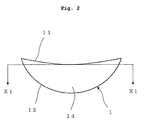
- the cross sections of the frozen batter liquid and the container in FIG. 1 are the cross sections along the vertical plane adjacent to one of the side surfaces (concave side surface) 11 of the gyoza dumpling itself, like the cross sectional line X 1 -X 1 in FIG. 2 .
- FIG. 3 , FIG. 5 The same applies to FIG. 3 , FIG. 5 .
- FIG. 2 shows the bottom surface of the gyoza dumpling itself, as well as the cutting positions of the cross-sectional views of FIG. 1 , FIG. 3 , FIG. 5 .
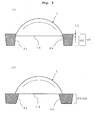
- FIG. 3 is a cross-sectional view schematically showing an example of the distribution of the main part of the frozen batter liquid relative to the gyoza dumpling itself in the present invention.
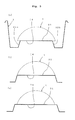
- FIG. 4 is a schematic view exemplarily showing a region of the vicinity of a part of the outer peripheral edge of the bottom surface, as well as the shape of a region of the vicinity of the whole outer peripheral edge, and the shape of the main region, in the bottom surface of the gyoza dumpling itself in the present invention.
- FIG. 5 schematically shows an example of the constitution of the container of the present invention.
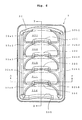
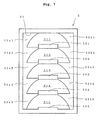
- FIG. 6 shows one example of the container of the present invention, and shows the top surface of the container (i.e., showing the inside of the opening).
- the part at which the planes intersect is drawn with a line to clarify the shape.
- FIG. 7 shows the constitution of FIG. 6 simplified for explanation, in which inclination of all inside side walls is vertical, and the shape of each part is drawn as a simple shape.
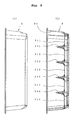
- FIG. 8 is a sectional view of the container of FIG. 6 along arrows A-A.
- FIG. 9 shows a right side surface view ( FIG. 9( a ) ) and a sectional view along arrows B-B ( FIG. 9( b ) ) of the container of FIG. 6 .
- FIG. 10 exemplarily shows a typical shape of gyoza dumpling, in which the shape of each part is simplified to explain the name of each part of the gyoza dumpling.
- FIG. 10( a ) is a perspective view of gyoza dumpling having a typical shape.
- FIG. 10( b ) the shape of the side surface of the gyoza dumpling shown in FIG. 10( a ) is seen along the direction of arrow X 10 therein and schematically expressed as a simple half moon shape.
- FIG. 10( c ) the shape of the bottom surface of the gyoza dumpling shown in FIG. 10( b ) is schematically expressed as a simple crescent shape.
- FIG. 10( a ) is a perspective view of gyoza dumpling having a typical shape.
- FIG. 10( b ) the shape of the side surface of the gyoza dumpling shown in FIG. 10( a ) is seen along the direction of arrow X 10 therein and schematic
- FIG. 10( d ) shows a sectional view on arrows Y 10 -Y 10 of the gyoza dumpling shown in FIG. 10( b ) .
- the filling is not shown and the section is hatched.
- FIG. 11 is a cross-sectional view schematically showing the state in which a conventional frozen gyoza dumpling is fitted in a container.
- FIG. 11 an outer appearance of the side surface of the gyoza dumpling itself is shown, and a cross-section of the container is shown.
- a batter liquid surrounds the gyoza dumpling itself, and a straight line showing the liquid surface is directly drawn on the gyoza dumpling itself for easy showing of the liquid surface 301 .
- the frozen gyoza dumpling in the present invention comprises, as schematically shown in the constitution of one example of FIG. 1( a ) , a frozen gyoza dumpling itself 1 , and a frozen batter liquid 2 attached to the gyoza dumpling itself 1 .
- the shape of the gyoza dumpling itself 1 may be the same as that of a conventional gyoza dumpling 100 shown in FIG. 10( a ) , and may include many variations such as one without a curve, a thick one and the like.
- the gyoza dumpling itself has two side surfaces, a marginal part, a bottom surface and two end parts like each part shown in the typical gyoza dumpling FIG.
- the gyoza dumpling itself 1 is shown by the outer appearance of the side surface, and the frozen batter liquid 2 and container 3 are shown by the cross section.
- the region to which the main part of the frozen batter liquid is attached namely, (partial or whole) outer peripheral edge of the bottom surface of the gyoza dumpling itself and a region of the vicinity thereof are also called an outer peripheral edge region.
- the outer peripheral edge region refers to a region of only a side surface adjacent to (partial or whole) outer peripheral edge, a region of only a bottom surface adjacent to the outer peripheral edge, or a region bridging the side surface and the bottom surface including (partial or whole) outer peripheral edge.
- a region of the rest excluding the outer peripheral edge region is also referred to as a main region.
- the frozen gyoza dumpling of the present invention is characterized in that, as shown in one example of FIG. 1( a ) , when the bottom surface 14 of the gyoza dumpling itself 1 faces downward, not less than 40% of the frozen batter liquid ( 2 a, 2 b ), which is the main part of the total weight of the attached frozen batter liquid 2 , attaches to the outer peripheral edge region of the bottom surface 14 of the gyoza dumpling itself 1 and expands and extends downwardly and sidewardly from the outer peripheral edge.
- the shape of the main part of the frozen batter liquid shown in FIG. 1( a ) is merely one example, and does not limit the present invention.
- the main part ( 2 a, 2 b ) of the frozen batter liquid is separated into two on the left and right. They may be integrated while surrounding the outer peripheral edge of the bottom surface of the gyoza dumpling itself.
- the weight of the frozen batter liquid to be attached to one gyoza dumpling itself is an amount necessary for heat cooking, and is about 18-60 parts by weight per 100 parts by weight of the gyoza dumpling itself.
- the frozen batter liquid to be attached to gyoza dumpling itself may be separated into, as in patent document 1 , a layer of the batter liquid and a layer of water or a seasoning liquid.
- the lower limit of the weight of the main part of the frozen batter liquid is preferably not less than 40%, more preferably not less than 50%, particularly preferably not less than 70%, of the total weight of the frozen batter liquid attached to one gyoza dumpling itself as mentioned above.
- the upper limit of the weight of the main part of the frozen batter liquid may be 100% of the total weight of the frozen batter liquid attached to one gyoza dumpling itself.
- An embodiment in which the main part of the frozen batter liquid is 100% of the total weight of the frozen batter liquid to be attached is an embodiment in which the frozen batter liquid is completely absent in the main region of the bottom surface of the gyoza dumpling itself, and in the part higher than the defined side surface, and is one example of a preferable embodiment.
- the upper limit of the weight of the main part of the frozen batter liquid suitable for the actual manufacture using the container is preferably less than 100%, more preferably not more than 95% in consideration of the inherent unevenness of the bottom surface of unfrozen gyoza dumpling itself, more preferably not more than 90%, further preferably not more than 80%, from the aspect of sufficient attachment of the frozen batter liquid to the gyoza dumpling itself.
- the weight of the main part of the frozen batter liquid can be determined by freely combining the above-mentioned range of the upper limit and the range of the lower limit, such as (not less than 40%, not more than 100%), (not less than 40%, not more than 95%), (not less than 50%, not more than 100%), (not less than 50%, not more than 95%), (not less than 70%, not more than 90%), (not less than 70%, not more than 80%) and the like.
- the outer peripheral edge of the bottom surface of the gyoza dumpling itself is an outline defining the shape (outer circumference shape) of the bottom surface.
- the bottom surface of the gyoza dumpling itself is a surface in contact with the flat surface when the gyoza dumpling itself is set on the flat surface with the bottom surface facing down.
- the bottom surface and both side surfaces are smoothly connected with a roundly curved surface, and often lack a clear outline.
- the main part of the frozen batter liquid attaches to the outer peripheral edge region of the gyoza dumpling itself 1 , and extends downwardly and sidewardly therefrom.
- a plurality of gyoza dumplings themselves are often closely arranged in a container.
- the main part of the frozen batter liquid may attach to a part of the outer peripheral edge of the bottom surface 14 of the gyoza dumpling itself 1 and a region of the vicinity thereof, particularly, regions separated on the both end parts 15 , 16 of the gyoza dumpling itself 1 as in FIG. 1( a ) .
- the main part of the frozen batter liquid may be attached to a biased segment of the outer peripheral edge of the bottom surface of the gyoza dumpling itself such as one end part of the gyoza dumpling itself and the like, and the vicinity thereof.
- the main part of the frozen batter liquid may be biasedly attached to one side of the gyoza dumpling itself.
- the main part of the frozen batter liquid extends downwardly and sidewardly from symmetrical outer peripheral edge regions such as, in the bottom surface of the gyoza dumpling itself, an embodiment in which the outer peripheral edge region extends over the whole periphery, an embodiment in which the outer peripheral edge region is separated into both end parts of the gyoza dumpling itself and the like, the main part of the frozen batter liquid becomes the base that supports the gyoza dumpling itself in a well-balanced manner when the frozen gyoza dumpling is placed on a heating plate. Therefore, even when the frozen batter liquid is melted by heating during heat cooking, the gyoza dumpling itself does not turn over to lie on its side but the bottom surface thereof preferably descends on and contacts the heating plate.
- the main part of the frozen batter liquid may further have a part that expands and extends upwardly from the outer peripheral edge region.
- the upper surface of the main parts 2 a, 2 b of the frozen batter liquid shown in FIG. 1( a ) may further have a part expanding upwardly to avoid contact with the side surface of the gyoza dumpling itself.
- the “part of the outer peripheral edge of the bottom surface of the gyoza dumpling itself and a region of the vicinity thereof”, “the whole outer peripheral edge of the bottom surface of the gyoza dumpling itself and a region of the vicinity thereof” refer to regions adjacent to some or all of the outer peripheral edge of the bottom surface, and are
- the region (outer peripheral edge region) is more preferably less than 10%, further preferably less than 5%, of the area of the bottom surface, and may be 0% in an ideal embodiment, to make the region to which the frozen batter liquid attaches thick smaller and to make the area of the flat region on the bottom surface of the gyoza dumpling itself larger.
- the shape of the outer peripheral edge region on the bottom surface of the gyoza dumpling itself varies, as shown in FIG. 4 , depending on the position of attachment of the main part of the frozen batter liquid.
- the main parts 2 a, 2 b of the frozen batter liquid are preferably attached to the side surface of the gyoza dumpling itself up to a position higher by t 2 than the height of the bottom surface of the gyoza dumpling itself. This aims to bring along the main part of the frozen batter liquid when the gyoza dumpling itself is picked up.
- a part (rest) other than the main part of the frozen batter liquid may not be attached at all to the bottom surface of the gyoza dumpling itself, or attached to the bottom surface as a thin layer of not more than 2 mm.
- FIG. 3( a ) the frozen batter liquid attached to the bottom surface is not shown.
- height t 2 is preferably not more than 5 mm, more preferably not more than 3 mm, particularly preferably about 2 mm 0 mm, to reduce the region of the side surface to which the frozen batter liquid attaches thick.
- the rest other than the main part of the frozen batter liquid may be attached thin at a position higher than 5 mm on the side surface. To enhance the texture of the dough, it is preferable that such attachment should be less.
- An embodiment in which a frozen batter liquid is not attached at all to the side surface of the gyoza dumpling itself (height t 2 0 mm), is one of the preferable embodiments.
- the main parts 2 a, 2 b of the frozen batter liquid are preferably attached sufficiently to the outer peripheral edge region of the gyoza dumpling itself in the bottom surface of the gyoza dumpling itself. This is to ensure that the main part of the frozen batter liquid comes together when the gyoza dumpling itself is held and lifted.
- illustration of the frozen batter liquid attached to the bottom surface is omitted.
- the part other than the main part of the frozen batter liquid may be attached to the bottom surface as a thin layer of not more than 2 mm.
- ranges of the above-mentioned (a) and the range of the outer peripheral edge region of the side surface of the gyoza dumpling itself of the above-mentioned (b) on the bottom surface of the gyoza dumpling itself may be freely combined to set the range of the outer peripheral edge region; for example, (less than 20% of bottom surface area, and not more than 5 mm from bottom surface height), (less than 20% of bottom surface area, and not more than 3 mm from bottom surface height), (less than 10% of bottom surface area, and not more than 5 mm from bottom surface height), (less than 10% of bottom surface area, and not more than 2 mm from bottom surface height), (less than 5% of bottom surface area, and 2 mm-0 mm from bottom surface height), (0% of bottom surface area, and not more than 2 mm from bottom surface height) and the like.
- that the main part of the frozen batter liquid extends downwardly and sidewardly from the aforementioned outer peripheral edge region also includes extension in an oblique downward direction synthesized from the downward direction and the lateral direction.
- the main part of the frozen batter liquid only needs to expand and project from said outer peripheral edge region.
- the downward direction means obliquely downward entering into the lower side of the bottom surface of the gyoza dumpling itself, vertically downward direction, or oblique downward direction having a direction component away from the gyoza dumpling itself to the outside.
- the sideward direction is a direction away in the lateral direction from the gyoza dumpling itself.
- the main part of the frozen batter liquid may extend obliquely downwardly to enter into the lower side of the bottom surface of the gyoza dumpling itself.
- the main part of the frozen batter liquid may extend in a vertically downward direction from the outer peripheral edge region. In this case, also, it is sometimes difficult to take out from the below-mentioned container, related to a draft angle.
- a preferable embodiment as exemplified in FIG.
- the main part of the frozen batter liquid extends toward an oblique downward direction which has a direction component outwardly away from the gyoza dumpling itself and toward lateral direction which is actually away from the gyoza dumpling itself.
- FIG. 4 shows examples of respective shapes of the outer peripheral edge region and main region bottom surface of the gyoza dumpling itself.
- FIG. 4( a ) shows an example of the shape of the outer peripheral edge region 2 d 1 including the whole outer peripheral edge.
- the outer peripheral edge region 2 d 1 spreads throughout the whole circumference of the outer peripheral edge of the bottom surface, forming a single annular region.
- the dashed line P 1 shows a boundary line between the aforementioned outer peripheral edge region 2 d 1 and the main region 2 c 1 .
- FIG. 4( b ) shows an example of a shape of the outer peripheral edge region including a part of the outer peripheral edge.
- the outer peripheral edge regions 2 d 2 , 2 d 3 are divided into two by the boundary lines.
- FIG. 4( c ) shows an example of a shape of the outer peripheral edge region containing a part of the outer peripheral edge.
- outer peripheral edge regions 2 d 4 , 2 d 5 are divided into two by the boundary lines.
- the shape of the outer peripheral edge region and the main region, and the shape of the boundary line exemplified in FIG. 4( a )-( c ) are examples and can be appropriately determined in consideration of the state of the burning surface on the bottom surface of the gyoza dumpling itself.
- the main region of the bottom surface of the gyoza dumpling itself is the rest of the outer peripheral edge region, and corresponds to the region of the supporting surface to support the gyoza dumpling itself with the bottom surface thereof in the below-mentioned container of the present invention.
- the area of the outer peripheral edge region is less than 20%, more preferably less than 10%, further preferably less than 5%, of the total area of the bottom surface, and may be 0% in an ideal embodiment.
- the area of the main region in the bottom surface is not less than 80%, more preferably not less than 90%, further preferably not less than 95%, of the area of the bottom surface, and may be 100% in an ideal embodiment.
- the area of the supporting surface of the below-mentioned container may be larger than the area of the bottom surface of the gyoza dumpling itself.
- the part indicated by a symbol 2 c is the main region of the bottom surface 14 of the gyoza dumpling itself 1 .
- the thickness t 1 of the frozen batter liquid attached to the main region is not particularly limited, since the necessary amount frozen batter liquid is mostly present as the main part outside the main region, the frozen batter liquid does not need to be attached thick in the main region. From this point, the thickness of the frozen batter liquid attached in the main region may be not more than 2 mm, more preferably not more than 1 mm. The lower limit of the thickness of the frozen batter liquid attached in the main region may be 0 mm.
- the supporting surface of the container supports the main region of the bottom surface of the gyoza dumpling itself and the frozen batter liquid enters thick in between the bottom surface and the supporting surface.
- the thickness of the frozen batter liquid attached in the main region may be not more than 2 mm, more preferably not more than 1 mm, in consideration of the inherent unevenness of the bottom surface of the unfrozen gyoza dumpling itself.
- a part of the bottom surface of the gyoza dumpling itself in contact with the supporting surface of the container may contain a part of 0 mm or in a state where the battery liquid is detected although it is thin enough to be unmeasurable.
- the shape and size of the gyoza dumpling itself, material, thickness, size and shape (generally a circular shape) of dough, and components, constitution, amount, and cooking method of filling, which are used for manufacture of gyoza dumpling itself before freezing, are not particularly limited, manufacture method of filling and dough, wrapping manner and the like can be those known to one of ordinary skill in the art.
- the distance between both ends 105 , 106 of the bottom surface of the gyoza dumpling itself shown in FIG. 10( c ) is about 25 mm-110 mm, and the width of the bottom surface at the widest center part is often about 10 mm-40 mm.
- the weight of one gyoza dumpling itself is about 10 g-45 g.
- the component and constitution of the frozen batter liquid are not particularly limited, and a layer of a mixture of fat and/or oil, starch, and grain flour, and a layer of water may be separated.
- the frozen batter liquid is preferably a mixture of 70-90% (wt %, hereinafter the same) of water with fat and/or oil and the like, like the frozen batter liquid attached to the frozen gyoza dumpling described in the above-mentioned patent document 2.
- the freeze batter liquid is attached to a gyoza dumpling itself at a proportion of 18-30 parts by weight per 100 parts by weight of the gyoza dumpling itself.
- the frozen batter liquid melts and moisture is evaporated during heating cooking of the frozen gyoza dumpling itself on a heating plate, whereby the gyoza dumpling itself can be placed in a suitable steam-baked state.
- the amount of the frozen batter liquid relative to a gyoza dumpling itself is determined according to the blending ratio of the frozen batter liquid, particularly the amount of water, which is preferably 18-30 parts by weight, more preferably 24-30 parts by weight, per 100 parts by weight of a gyoza dumpling itself as mentioned above.
- the water content (in ice) of the batter liquid is 70-90 wt %, preferably 70-85 wt %.
- the water content of the batter liquid is less than 70 wt %, burn is easily developed during cooking and a bonded part of dough of a gyoza dumpling itself tends to be hardened.
- the water content of the batter liquid is more than 90 wt %, the crunchy feeling of vegetables in the filling tends to be weak.
- Examples of the main component of the batter liquid other than water include fat and/or oil, starch and grain flour, and emulsifier and emulsifying adjuvant may be further included.
- the batter liquid contains fat and/or oil, unevenness in baking does not occur easily even without using oil during cooking.
- the batter liquid does not contain fat and/or oil, the bottom surface of a gyoza dumpling itself is easily burnt during cooking, or detachment of the gyoza dumpling itself from the heating plate tends to be difficult.
- the content of the fat and/or oil in the batter liquid is preferably 5-29.5 wt %, more preferably 12-23 wt %.
- the content of the starch or grain flour in the batter liquid is generally not more than 5 wt %, preferably 0.5-5 wt %, particularly preferably 2-4.5 wt %.
- the batter liquid is not particularly limited as long as water is contained in a proportion of 70-90 wt %.
- the batter liquid may further contain soy sauce, salts, amino acids, gums, celluloses and the like.
- rapeseed oil canola oil
- soybean oil corn oil, safflower oil, palm oil, lard, shortening, butter, sesame oil, olive oil and the like
- butter sesame oil
- olive oil and the like can be used alone or in combination.
- rapeseed oil, canola oil and soybean oil are preferable.
- the batter liquid can contain starch or grain flour. It is preferable to use grain flour, since grain flour has a lower rate of damaged starch than starch, and therefore, starch particle does not swell with ease and a crispy texture of the baked surface is easily maintained even when the time passes after baking.
- the damaged starch rate refers to the ratio of starch particles damaged by the loading of flour milling or crushing.
- non-glutinous rice starch glutinous rice starch, wheat starch, cornstarch, waxy cornstarch, tapioca starch, sago palm starch, mung bean starch, potato starch, sweet potato starch and the like can be used, and particularly, non-glutinous rice starch and glutinous rice starch are preferable.
- grain flour is not particularly limited, wheat flour, rice flour, corn flour, barley flour, buckwheat flour, potato flour, soybean flour, adzuki bean flour, barnyard millet flour, chestnut flour, millet flour and the like can be used, and particularly, rice flour is preferable since it has a low protein content and can easily confer a crispy texture after baking.
- lecithin derived from soybean, derived from egg etc.
- lecithin derived from soybean, derived from egg etc.
- sugar ester monoglyceride
- polyglycerol ester of fatty acid propylene glycol ester of fatty acid and the like
- lecithin derived from soybean is more preferable.
- a protein can be used, and generally, egg white powder, isolated soy protein, powdered skim milk, wheat protein powder, whole egg powder and the like can be used. Particularly, egg white powder and powdered skim milk are preferable.
- the content of the emulsifier in a batter liquid is not particularly limited, it is generally 0.1-1.0 wt %, preferably 0.15-0.25 wt %.
- the content of the emulsifying adjuvant in the batter liquid is generally 0-1.5 wt %, preferably 0.1-0.5 wt %.
- the batter liquid comes to have an emulsified state, which affords uniform property of the batter liquid, and suppresses unevenness in baking of gyoza dumpling itself after baking, whereby uniform, preferable texture and appearance can be conferred to a gyoza dumpling itself.
- the gyoza dumpling itself may be obtained by freezing the dumpling in a state where the filling is wrapped with dough (raw gyoza dumpling), may be subjected to a necessary treatment before freezing, such as a treatment to deactivate enzymes contained in the vegetables in the filling, a preliminary heat treatment and the like, and the state of the gyoza dumpling itself before freezing is not particularly limited.
- the aforementioned enzyme examples include peroxidase, myrosinase and the like. These are the enzymes relating to browning and development of odor.
- the specific activity of peroxidase reported to have particularly high heat resistance is preferably not more than 5.0 (U/mg or unit/mg). 1 U is defined to mean an enzyme amount that reacts with hydrogen peroxide (1 ⁇ mol) under conditions of pH 8.0, 37° C. for 1 min.
- a treatment to deactivate peroxidase a heat treatment at about 60° C.-100° C. can be mentioned.
- a stage of heating vegetables to deactivate peroxidase for example, a stage of starting material when vegetables are raw vegetables and the like, a stage of filling, a stage of wrapping the filling with dough and the like can be mentioned.
- a preliminary heat treatment before freezing For example, a batter liquid and a gyoza dumpling itself may be received in the container, and heated and steamed about 60° C.-100° C.
- the aforementioned temperature range is one example, and the heating temperature and heating time can be appropriately changed according to the size and weight of gyoza dumpling itself, weight ratio of filling, mixing ratio of meat and vegetable in the filling and the like.
- the preliminary heat treatment may also function as a treatment to deactivate the aforementioned enzymes such as peroxidase and the like.
- the frozen gyoza dumpling of the present invention may be provided without containing in a container, but contained in an outer packaging bag and the like.
- the container of the present invention is now explained.
- the container is used to contain the frozen gyoza dumpling of the present invention (usable as a tray for frozen gyoza dumpling) or manufacture the frozen gyoza dumpling of the present invention therein.
- a frozen gyoza dumpling comprising a frozen batter liquid having a position of attachment and range of amount different from those defined for the frozen gyoza dumpling of the present invention may be contained.
- the container 3 is for containing one or more frozen gyoza dumplings (comprising gyoza dumpling itself 1 and a batter liquid 2 attached thereto) which are frozen.
- the container has, in its inside, a supporting surface 31 to support a region of not less than 60% of the bottom surface of the gyoza dumpling itself 1 with a bottom surface facing downward, and recess parts 32 a, 32 b to receive the aforementioned frozen batter liquid.
- FIG. 1( b ) FIG.
- the recess parts 32 a, 32 b are divided into two; however, they may be integrated surrounding the periphery of the supporting surface.
- the opening part of the recess part is adjacent to some or all of the outer peripheral edge of the supporting surface 3 , and an internal space of the recess part is at a height not more than the height of the supporting surface (which can also be understood to mean that a protrusion to be the supporting surface rises from the bottom surface of the recess part).
- the internal space of the recess part is capable of receiving not less than 35% of the total weight of the frozen batter liquid 2 attached to the gyoza dumpling itself 1 as exemplified in FIG. 1( b ) .
- the container for example, other frozen gyoza dumpling having a frozen batter liquid attached thick to the upper part of the side surface of the gyoza dumpling itself may be contained.
- the container can be used particularly preferably for receiving the above-mentioned frozen gyoza dumpling of the present invention.
- the frozen gyoza dumpling of the present invention can be obtained by merely injecting a batter liquid up to a given height of the container, arranging the unfrozen gyoza dumpling itself on a supporting surface, applying preliminary heating as necessary, and freezing.
- the shape of the supporting surface of the container may be smaller than the shape of the bottom surface 14 of the gyoza dumpling itself 1 as shown in FIG. 5( a ) , or the same as the shape of the bottom surface 14 of the gyoza dumpling itself 1 as shown in FIG. 5( b ) , or larger than the shape of the bottom surface 14 of the gyoza dumpling itself 1 as shown in FIG. 5( c ) .
- the supporting surface is preferably a flat surface since it flattens the bottom surface of the gyoza dumpling itself.
- the supporting surface preferably has an area of 60% -150%, preferably 80%-100%, of the area of the bottom surface of the gyoza dumpling itself to be set.
- the gyoza dumpling When the supporting surface is too small relative to the bottom surface of the gyoza dumpling itself, the gyoza dumpling itself extrudes from the supporting surface, which causes unevenness of the bottom surface, and a nonuniform burning surface.
- the supporting surface is too large relative to the bottom surface of the gyoza dumpling itself, since the recess part is too far from the dumpling itself, it is difficult to be lifted together, and workability during cooking and thawing is unpreferably degraded.
- the shape of the supporting surface is preferably made to substantially match or correspond to the shape of the bottom surface of the gyoza dumpling itself or the shape of the support surface is increased by a trace amount.
- the shape of the supporting surface matches the shape of the bottom surface of the gyoza dumpling itself, since the gyoza dumpling itself is placed on the supporting surface with the bottom surface facing down, the shape of the bottom surface and the shape of the supporting surface are in a mirror image relationship.
- the shape of the bottom surface forms a line symmetry, even if the shape of the supporting surface is in a mirror image relationship with the bottom surface, it is the same as the shape of the bottom surface.
- the shape of the supporting surface is preferably matched with the shape of the main region of the bottom surface of the gyoza dumpling itself in the frozen gyoza dumpling of the present invention mentioned above. That is, it can be referred to as an example of the shape of the supporting surface of the main region in FIG. 4( a )-( c ) . As mentioned above, the shape of the main region of the bottom surface of the gyoza dumpling itself and the shape of the corresponding supporting surface are in a mirror image relationship.
- the shape of the bottom surface of the gyoza dumpling itself is generally a shape having a longitudinal direction as shown in FIG. 10( c ) .
- the shape of the actual bottom surface is not a simple shape and has a comparatively large manufacturing error as a food. Therefore, it is a preferable embodiment with no waste that the shape of the supporting surface is as consistent as possible with the shape of the bottom surface of the gyoza dumpling itself. It may be generally a similar shape, and a similar shape having a longitudinal direction corresponding to the shape of the bottom surface of the gyoza dumpling itself (i.e., shape similar to the shape of the bottom surface) is preferable.
- the recess part is for receiving some or all of the main part of the frozen batter liquid per one gyoza dumpling itself.
- the main part of the frozen batter liquid may extrude upward from the recess part so that it can attach to the gyoza dumpling itself.
- the weight G 3 of the frozen batter liquid that fills a recess part for one gyoza dumpling itself is preferably 35%-100%, more preferably 50%-100%, particularly preferably 80%-100%, of the total weight of the frozen batter liquid G 1 (weight of whole frozen batter liquid shown in FIG. 1( a ) ) attached to the gyoza dumpling itself.
- the weight G 2 (the weight of the main parts 2 a, 2 b of the frozen batter liquid shown in FIG. 3( a ) , which is the total of the weight G 3 and the weight of a part at a position higher than the bottom surface 14 of the gyoza dumpling itself 1 ) of the main part of the frozen batter liquid per one gyoza dumpling itself is not less than 40% of the total weight of the frozen batter liquid G 1 attached to one gyoza dumpling itself. As shown in FIG.
- the frozen batter liquid in the recess part when the weight G 3 of the frozen batter liquid in the recess part is smaller than the weight G 2 of the main part of the frozen batter liquid, to attach to the gyoza dumpling itself, the frozen batter liquid in the recess part not only fills the recess part but also reaches a height above the opening of the recess part, whereby the weight G 2 of the main part is secured, as shown in FIG. 1( b ) .
- the weight G 3 of the frozen batter liquid to be filled in the recess part does not exceed weight G 2 of the main part of the frozen batter liquid in one gyoza dumpling itself. As shown in FIG. 3( b ) , when the weight G 3 is the same as weight G 2 , the main part of the frozen batter liquid attaches only to the outer peripheral edge region of the bottom surface of the gyoza dumpling itself, as shown in said Figure.
- the internal space of the recess part is preferably determined to satisfy the conditions of the frozen batter liquid attached to the frozen gyoza dumpling of the present invention explained above. That is, when the recess part is filled with a frozen batter liquid, the frozen batter liquid is further supplied as necessary to form the main part of the frozen batter liquid, and the main part is attached to the above-mentioned outer peripheral edge region of the gyoza dumpling itself, it is preferable that the outer peripheral edge region satisfies the following conditions.
- the bottom surface of the gyoza dumpling itself is a region of less than 20% of an area of the bottom surface
- the side surface of the gyoza dumpling itself is a region up to a height of not more than 5 mm from the bottom surface.
- weight G 3 of the frozen batter liquid that fills the internal space of the recess part is preferably 54%-100% of the weight G 2 of the main part of the frozen batter liquid.
- the weight G 3 of the frozen batter liquid that fills the recess part is preferably about 49%-95% relative to the weight G 2 of the main part of the frozen batter liquid.
- the ratio of the weight G 3 relative to weight G 2 is smaller than the aforementioned range, the liquid surface of the frozen batter liquid unpreferably needs to be increased than a given height to secure weight G 2 of the main part.
- the ratio of the weight G 3 is larger than the aforementioned range, the weight G 2 of the main part unpreferably becomes larger than the necessary amount.
- the opening part of the recess part of one gyoza dumpling itself may be adjacent and divided into two parts corresponding to the both end parts of the gyoza dumpling itself supported on the supporting surface in the outer peripheral edge of the supporting surface.
- a recess part with an excessively shallow and wide opening makes the opening of the whole container large, makes the frozen batter liquid thin and easy to break, and makes it difficult to take out the gyoza dumpling itself and the frozen batter liquid together.
- a recess part with an excessively deep and narrow opening makes the depth (thickness) of the entire container too large, and it is difficult to take out the frozen batter liquid from such a deep recess part.
- the depth of the recess part of a gyoza dumpling itself having a general size is, for example, preferably about 2 mm-16 mm, more preferably about 4 mm-8 mm.
- the opening area of the recess part in this case varies depending on the gradient of the wall surface. It is, for example, preferably about 1.5 mm 2 -8 mm 2 , more preferably about 3 mm 2 -6 mm 2 . These values may exceed the exemplified range as appropriate, according to the size of the gyoza dumpling itself or when a larger amount of a batter liquid is applied.
- a cross sectional shape of the recess part is drawn as an upside down trapozoid as an example for explanation.
- the opening shape of the recess part and the shape of the internal space are not particularly limited. While the bottom surface of the recess part may be flat, the bottom part may be curved to have a U-shaped cross-section.
- the side walls in the recess part may be side walls exclusively for a recess part, and a part of the side wall of the recess part may also function as a lower part of the outer circumference walls of the container 3 , as exemplified in FIG. 1( b ) , FIG. 5( a ) .
- the side walls of the recess part may be a vertical plane or a plane leaning toward the inside of the recess part (i.e., overhang plane).
- the frozen batter liquid filled in the recess part may be difficult to be removed or, during manufacture of the container, sometimes difficult to be taken out from the molding die. Therefore, it is preferable to form, on the side wall in the recess part, a gradient such as to extend from the bottom surface of the recess part toward the opening of the recess part, as exemplified in FIG. 1( b ) , FIG. 5( a ) .
- a gradient to extract the frozen batter liquid from the recess part a gradient inclining 5 degrees-65 degrees, preferably 5 degrees-25 degrees, from the vertical plane as the reference plane can be mentioned.
- Conventional containers can be referred to as for the angle of gradient of a part that does not contact the frozen batter liquid (parts such as upper part of the side wall of the container and the like) in the side wall of the container and, for example, it may be about 3 degrees-10 degrees.
- FIG. 6 - FIG. 9 show one example of the container of the present invention.
- the shape of each part of the container shown in these Figures is one example of the design along the technical concept of the present invention, and does not limit the shape of the container.
- five gyoza dumplings themselves are received in one container, the outer shape and number of the gyoza dumpling itself to be received are not limited.
- the container is more concretely explained below by referring to FIG. 6 - FIG. 9 .
- the shape of the bottom surface of the gyoza dumpling itself to be arranged is often a half-moon shape or a crescent shape. Therefore, the shape of the supporting surface of the container is, as shown simplified in FIG. 7 , a half-moon shape or a crescent shape corresponding to the shape of the aforementioned bottom surface of the gyoza dumpling itself is preferable.
- an actual container includes partitioning protrusions 331 , 332 , 333 , 334 as shown in FIG. 6 - FIG. 9 .
- the shape of the supporting surface is a similar crescent shape mimicking the crescent shape of the bottom surface of the gyoza dumpling itself.
- a preferable embodiment includes supporting surfaces 311 - 315 facing the same direction, and partitioning protrusions 331 - 334 interposed between respective supporting surfaces, and connected to each other in one row.
- five gyoza dumplings themselves are placed in one row and, for example, a pattern of three rows of four gyoza dumplings themselves per one row, a pattern of four rows of six gyoza dumplings themselves per one row and the like may be employed, and a configuration pattern according to the number to be supplied may be employed.
- a plurality of supporting surfaces may each face a different direction.
- an opening part of the recess part is adjacent to two parts (in the outer peripheral edge of the supporting surface) corresponding to the both ends of gyoza dumpling itself supported on the supporting surface.
- the aforementioned recess part adjacent to one supporting surface is divided into two by a connecting part between supporting surfaces.
- a recess part adjacent to one supporting surface 311 is divided into two recess parts 32 a 1 , 32 b 1 separated from each other.
- a pair of recess part 32 a 1 and recess part 32 a 2 i.e., a pair of recess part 32 b 1 and recess part 32 b 2
- the recess parts 32 a 1 - 32 a 5 on the left side of the Figures communicate with each other to form one recess part.
- the recess parts 32 b 1 - 32 b 5 on the right side of the Figures may communicate with each other to form one recess part.
- the recess parts 32 a 1 - 32 a 5 on the left side of the Figure, and the recess parts 32 b 1 - 32 b 5 on the right side of the Figure may not communicate with each other, divided by extended partitioning protrusions, whereby containing parts for separately placing a plurality of frozen gyoza dumplings (space for each frozen gyoza dumpling) are formed, and the aforementioned supporting surface and recess part may be respectively provided in each containing part.
- the recess parts 32 a 1 - 32 a 5 on the left side, recess parts 32 b 1 - 32 b 5 on the right side may communicate with each other beyond the low partition wall.
- Such embodiment is preferable since, even if all the frozen batter liquids in the container are integrally connected together, it can be easily broken into individual frozen dumplings.
- partitioning protrusions 331 - 334 are formed between respective supporting surfaces 311 - 315 .
- the partitioning protrusion in this example is about 20%-100% of the size in the lateral direction (length) of each supporting surface.
- a protrusion 335 is formed on outer circumference inner wall surface 34 of the container.
- the shape of the partitioning protrusion part may be designed as appropriate.
- the shape of the partitioning protrusion is close to a semicircular shape as shown in FIG. 8 , since the release property is improved when the containers are stacked together.
- the material of the container, molding method, and thickness of each part are not particularly limited, and conventionally-known containers for frozen gyoza dumplings can be referred to.
- the material include plastic such as vinyl chloride, polyethylene terephthalate, polystyrene, polypropylene, polycarbonate and the like, metals such as aluminum and the like, paper and the like
- the molding method include injection molding, blow molding, vacuum forming, pressure forming and the like. While the thickness of each part varies depending on the rigidity of the material and function of the part, it is, for example, about 0.1 mm-2.0 mm.
- the pack of the present invention has a constitution in which the frozen gyoza dumpling itself and a frozen batter liquid attached to the gyoza dumpling itself are set in the above-mentioned container of the present invention.
- the frozen gyoza dumpling of the present invention is most preferably adapted in the container 3 as shown in FIG. 1( b ) , the frozen gyoza dumpling itself 1 is placed on the supporting surface 31 with the bottom surface facing downward, and frozen batter liquid 2 attached to the gyoza dumpling itself extends into recess parts 32 a, 32 b to fill the inside of the recess part.
- the main part of the frozen batter liquid attached to the gyoza dumpling itself 1 attaches to the outer peripheral edge region of the aforementioned gyoza dumpling itself, and extends downwardly and sidewardly, and some or all of the main part extends into the recess part in the aforementioned container to fill the recess part.
- the [some or all of the main part of the frozen batter liquid] is weight G 3 of the frozen batter liquid that fills an internal space of the above-mentioned recess part.
- a preferable range is 54%-100% of the weight G 2 of the main part of the frozen batter liquid.
- the side surface of the gyoza dumpling itself has an outer peripheral edge region, about 49%-95% is preferable.
- the container having frozen gyoza dumplings placed inside is preferably sealed tightly in an outer packaging bag (not shown).
- the opening part of the container is preferably sealed hermetically with a film from the viewpoint of hygiene and to suppress quality deterioration such as freezer burn, fading, oxidation of fats and oils and the like that occur during frozen storage.
- the manufacture method includes the following steps S 1 , S 2 :
- a method of integrating the batter liquid with the bottom surface of the unfrozen gyoza dumpling itself in a frozen state while satisfying the above-mentioned condition (I) may be any and, for example, a method using a die for positioning the batter liquid on the gyoza dumpling itself, a method including applying a batter liquid having increased viscosity by cooling to the gyoza dumpling itself or the like can be used.
- the frozen gyoza dumpling of the present invention can be completed while being contained in the container and can be directly sent to a packaging step.
- step Si is performed by the following step.
- step S 11 A filling is wrapped with dough by a general procedure to form an unfrozen gyoza dumpling itself (raw gyoza dumpling).
- step S 12 A recess part of a separately-formed container is filled with a batter liquid, and the batter liquid is injected into the container to a position higher than the supporting surface of the container as long as the conditions of the above-mentioned (I) are satisfied.
- step S 13 the bottom surface of the unfrozen gyoza dumpling itself facing downward is placed on the supporting surface of the container.
- step S 12 either of the aforementioned (step S 12 ) for injecting the batter liquid into the container and the aforementioned (step S 13 ) for placing the unfrozen gyoza dumpling itself in the container may be performed earlier.
- the aforementioned (step S 12 ) is preferably performed before the aforementioned (step S 13 ).
- the above-mentioned preliminary heat treatment and the like may be appropriately added before freezing, as mentioned above.
- step S 2 the unfrozen gyoza dumpling itself attached with the batter liquid in the container is rapidly frozen together with the container, in which the gyoza dumpling itself and the batter liquid attached together are frozen, whereby the frozen gyoza dumpling of the present invention is obtained.
- t 2 is preferably not more than 5 mm, more preferably not more than 3 mm, not more than 2 mm and higher than 0 mm (for example, height of not more than 2 mm and not less than 0.5 mm) is particularly preferable.
- weight G 3 (not less than 35% of the total weight) frozen batter liquid filling the recess part relative to weight G 2 (not less than 40% of the total weight) of the main part of the frozen batter liquid attached per one gyoza dumpling itself is preferably 49%-95%.
- the unfrozen gyoza dumpling itself may contact the liquid surface of the frozen batter liquid by merely filling the recess part with the batter liquid, as shown in FIG. 3( b ) . Even in such case, to ensure detachment of the frozen batter liquid from the recess part by lifting the gyoza dumpling itself, it is preferable to set the liquid surface of the batter liquid higher than the supporting surface by thickness t 2 shown in FIG. 3( a ) .
- the shape of the supporting surface of the container used in this Example was almost similar to the shape of the bottom surface of the gyoza dumpling itself manufactured for the test, and could support the whole bottom surface of the gyoza dumpling itself.
- An emulsified batter liquid containing water 84 wt %, canola oil 13 wt %, rice flour 2.5 wt %, an emulsifier (lecithin derived from soybean, 0.1 wt %), and an emulsifying adjuvant 0.4 wt % (egg white powder) was prepared.
- Example product using the container of the present invention exemplified in FIG. 6 , the recess part was filled with the batter liquid, and the batter liquid was poured into the container such that the liquid surface of the batter liquid would be 2 mm higher than the supporting surface when the gyoza dumpling itself was set. Then, gyoza dumpling itself was placed with the bottom surface facing down on the supporting surface of the container, with the batter liquid attaching up to a position 2 mm higher than the bottom surface of the gyoza dumpling itself (increase in the liquid surface by setting the gyoza dumpling itself is ignorable), preliminary heating was performed, and rapidly frozen to give the frozen gyoza dumpling of the present invention (Example product).
- the weight of the frozen batter liquid attached to one gyoza dumpling itself was 6 g. That is, the frozen batter liquid attached to 100 parts by weight of gyoza dumpling is about 32 parts by weight.
- the main part of the frozen batter liquid was 70% of the total weight of the frozen batter liquid.
- the weight of the frozen batter liquid attached to one gyoza dumpling itself was 6 g (i.e., the frozen batter liquid attached to 100 parts by weight of gyoza dumpling is about 32 parts by weight).
- Each frozen gyoza dumpling of Example product and Comparative Example product was heat-cooked using a household gas stove and a frying pan having a diameter of 26 cm, in which 12 frozen gyoza dumplings were placed side by side per one testing and a medium heat was used.
- the steam-baking time with the lid put on the frying pan was set to about 8 min, and after the completion of steam-baking time, the lid was removed and baking was continued for about 3 min to manufacture a burn mark (baked color) on the bottom surface.
- the evaluation items were the following three items (a)-(c):
- the “chewiness” as the texture of dough is one of the dente textures upon biting the dough with teeth, and is a texture not too hard and not too soft and affording elasticity within a given range.
- the “highly chewy” is a texture not too hard and not too soft with the highest elasticity within the given range of elasticity.
- the evaluation criteria and the values (evaluation scores) expressing same for the evaluation items (a)-(c) are as shown in the following Table 1.
- the overall evaluation score in the Table is an average evaluation score of each evaluation item (a)-(c) after rounding off.
- evaluation score evaluation criteria (a) texture (chewiness) of dough 5 highly chewy 4 very chewy 3 chewy 2 less chewy 1 scarcely chewy (b) texture (drying of marginal part) of dough 5 no drying, highly soft 4 no drying, very soft 3 almost no drying, soft 2 rather dried, rather hard 1 dried, hard (c) uneven baked color of bottom surface 5 highly thin 4 very thin 3 thin 2 rather thick 1 highly thick
- the evaluation scores (average evaluation scores (rounded off) of 6 judges) of the Example products and Comparative Example products for the above-mentioned evaluation items (a)-(c) are as shown in the following Table 2.
- Example product showed good evaluation results for all the above-mentioned evaluation items (a)-(c) as compared to Comparative Example product, since the amount of the frozen batter liquid attached to the baking surface and side surface of the gyoza dumpling is small.
- frozen gyoza dumpling was manufactured by fixing the total weight of the batter liquid used per one gyoza dumpling itself to 6 g, changing the height of the frozen batter liquid attached to the side surface of the gyoza dumpling itself by varying the depth of the recess part, and changing the weight ratio of the frozen batter liquid present not above the bottom surface of the gyoza dumpling itself, and evaluated against the sample immediately after cooking.
- the amount of the frozen batter liquid that entered between the bottom surface of the gyoza dumpling itself and the supporting surface of the container is disregarded.
- the ratio of the weight not above bottom surface level means, for example, when 60% of the frozen batter liquid is present not above the bottom surface of the gyoza dumpling itself, 40% of the frozen batter liquid attaches thick to the side surface above the bottom surface of the gyoza dumpling itself, and when the ratio of the attached batter liquid present not above the bottom surface of the gyoza dumpling itself is small, the frozen batter liquid attaches to a higher position of the side surface above the bottom surface of the gyoza dumpling itself.
- the evaluation scores (average evaluation scores (rounded off) of 6 judges) of the Example products for the above-mentioned evaluation items (a)-(c) are as shown in the following Table 3.
- the ratio of the weight not above bottom surface level being 95% means that the liquid surface of the batter liquid was raised by about 2 mm above the bottom surface to make the frozen batter liquid attached to the gyoza dumpling itself.
- the evaluation scores (average evaluation scores (rounded off) of 6 judges) of the Example products for the above-mentioned evaluation items (a)-(c) are as shown in the following Table 4.
- the present invention has enabled reduction of unevenness of the frozen bottom surface of gyoza dumpling due to an influence of the container, and reduction of inconsistent burn mark on the bottom surface of the gyoza dumpling itself after baking.
- the present invention has made it possible to provide a more preferable frozen gyoza dumpling by reducing the part where the frozen batter liquid attaches thick to the surface of the frozen gyoza dumpling, while maintaining the superior features of conventional frozen gyoza dumplings.
- the container of the present invention can preferably provide the frozen gyoza dumpling and the pack of the present invention, and the manufacture method of the present invention can be preferably practiced.
Landscapes
- Engineering & Computer Science (AREA)
- Life Sciences & Earth Sciences (AREA)
- Mechanical Engineering (AREA)
- Food Science & Technology (AREA)
- Chemical & Material Sciences (AREA)
- Polymers & Plastics (AREA)
- Health & Medical Sciences (AREA)
- Zoology (AREA)
- Ceramic Engineering (AREA)
- Wood Science & Technology (AREA)
- Nutrition Science (AREA)
- Composite Materials (AREA)
- General Health & Medical Sciences (AREA)
- Evolutionary Biology (AREA)
- Marine Sciences & Fisheries (AREA)
- Toxicology (AREA)
- Seeds, Soups, And Other Foods (AREA)
- Freezing, Cooling And Drying Of Foods (AREA)
- Containers Having Bodies Formed In One Piece (AREA)
- Grain Derivatives (AREA)
- Thermal Sciences (AREA)
- Physics & Mathematics (AREA)
Applications Claiming Priority (3)
| Application Number | Priority Date | Filing Date | Title |
|---|---|---|---|
| JP2015-119063 | 2015-06-12 | ||
| JP2015119063 | 2015-06-12 | ||
| PCT/JP2016/067313 WO2016199882A1 (ja) | 2015-06-12 | 2016-06-10 | 冷凍餃子、その製造方法、該冷凍餃子用の容器および該冷凍餃子の包装体 |
Related Parent Applications (1)
| Application Number | Title | Priority Date | Filing Date |
|---|---|---|---|
| PCT/JP2016/067313 Continuation WO2016199882A1 (ja) | 2015-06-12 | 2016-06-10 | 冷凍餃子、その製造方法、該冷凍餃子用の容器および該冷凍餃子の包装体 |
Publications (1)
| Publication Number | Publication Date |
|---|---|
| US20180098560A1 true US20180098560A1 (en) | 2018-04-12 |
Family
ID=57503997
Family Applications (1)
| Application Number | Title | Priority Date | Filing Date |
|---|---|---|---|
| US15/837,224 Abandoned US20180098560A1 (en) | 2015-06-12 | 2017-12-11 | Frozen dumpling and production method therefor, container for frozen dumpling, and packaging for frozen dumpling |
Country Status (4)
| Country | Link |
|---|---|
| US (1) | US20180098560A1 (de) |
| EP (1) | EP3308656A4 (de) |
| JP (1) | JP6760277B2 (de) |
| WO (1) | WO2016199882A1 (de) |
Cited By (3)
| Publication number | Priority date | Publication date | Assignee | Title |
|---|---|---|---|---|
| CN110933942A (zh) * | 2018-07-19 | 2020-03-27 | Cj第一制糖株式会社 | 速冻饺子包装用盘以及用此的速冻饺子包装方法 |
| US20220079192A1 (en) * | 2020-09-14 | 2022-03-17 | Ajinomoto Co., Inc. | Composition for outer skin of filling-wrapping food |
| US20220151268A1 (en) * | 2020-11-13 | 2022-05-19 | Ajinomoto Co., Inc. | Microwavable frozen dumplings and methods thereof |
Families Citing this family (9)
| Publication number | Priority date | Publication date | Assignee | Title |
|---|---|---|---|---|
| US10421601B2 (en) * | 2017-01-27 | 2019-09-24 | Tekni-Plex, Inc. | Processor tray and method of packing |
| JP7310260B2 (ja) * | 2019-04-19 | 2023-07-19 | 味の素株式会社 | 冷凍餃子及びその製造方法 |
| JP6876858B1 (ja) * | 2019-12-25 | 2021-05-26 | マルハニチロ株式会社 | 容器入り油ちょう用冷凍食品及びその製造方法 |
| JP6876857B1 (ja) * | 2019-12-25 | 2021-05-26 | マルハニチロ株式会社 | 油ちょう用冷凍食品用トレー |
| WO2021132146A1 (ja) * | 2019-12-25 | 2021-07-01 | マルハニチロ株式会社 | 容器入り油ちょう用冷凍食品及びその製造方法並びに油ちょう用冷凍食品用トレー |
| JP6994784B1 (ja) | 2020-10-09 | 2022-01-14 | 株式会社丸善 | 食品の冷凍用容器及び冷凍食品の製造方法 |
| JP2023138088A (ja) * | 2022-03-18 | 2023-09-29 | 味の素株式会社 | 冷凍餃子、その製造方法、該冷凍餃子用のトレイおよび該冷凍餃子の包装体 |
| JP2023160418A (ja) * | 2022-04-22 | 2023-11-02 | 味の素株式会社 | 円盤状に並べるのに適した形状を有する冷凍包餡食品及び該冷凍包餡食品を製造するためのトレイ |
| JP7697084B1 (ja) | 2024-02-28 | 2025-06-23 | 株式会社イートアンドホールディングス | フライパン・ホットプレート(焼成調理)向け整列不要冷凍点心セット |
Citations (5)
| Publication number | Priority date | Publication date | Assignee | Title |
|---|---|---|---|---|
| US3374884A (en) * | 1967-04-13 | 1968-03-26 | Chinkes Sam | Display package |
| JPH1156313A (ja) * | 1997-08-22 | 1999-03-02 | Tenshinno Ie:Kk | 餃子用トレー並びにこれを用いた餃子の製造方法 |
| US6639199B1 (en) * | 2001-07-10 | 2003-10-28 | Samuel R. Ross, Jr. | Seafood microwave cooker |
| JP2013233306A (ja) * | 2012-05-09 | 2013-11-21 | Kenichi Sakamaki | 電子レンジ用加熱容器 |
| WO2014007387A1 (ja) * | 2012-07-02 | 2014-01-09 | 味の素株式会社 | 加熱済み冷凍餃子及びその製造方法 |
Family Cites Families (6)
| Publication number | Priority date | Publication date | Assignee | Title |
|---|---|---|---|---|
| JP4584497B2 (ja) * | 2001-06-18 | 2010-11-24 | 日本たばこ産業株式会社 | トレー入り冷凍餃子 |
| JP4483268B2 (ja) * | 2003-11-07 | 2010-06-16 | 味の素株式会社 | 乳化バッター付き冷凍の連結餃子 |
| JP4340588B2 (ja) * | 2004-06-14 | 2009-10-07 | 株式会社ニチレイフーズ | バッター、揚げ用餃子又は揚げ用焼売、その製造法及び、揚げ餃子又は揚げ焼売 |
| US8357410B2 (en) * | 2005-04-22 | 2013-01-22 | Ajinomoto Frozen Foods Usa, Inc. | Frozen dumplings |
| JP5072735B2 (ja) * | 2008-06-27 | 2012-11-14 | 日本たばこ産業株式会社 | 色むらの低減された焼き餃子 |
| JP6086857B2 (ja) * | 2013-11-15 | 2017-03-01 | ティーエスフーズ株式会社 | 冷凍餃子及び冷凍餃子の製造方法 |
-
2016
- 2016-06-10 WO PCT/JP2016/067313 patent/WO2016199882A1/ja not_active Ceased
- 2016-06-10 EP EP16807587.7A patent/EP3308656A4/de not_active Withdrawn
- 2016-06-10 JP JP2017523709A patent/JP6760277B2/ja active Active
-
2017
- 2017-12-11 US US15/837,224 patent/US20180098560A1/en not_active Abandoned
Patent Citations (5)
| Publication number | Priority date | Publication date | Assignee | Title |
|---|---|---|---|---|
| US3374884A (en) * | 1967-04-13 | 1968-03-26 | Chinkes Sam | Display package |
| JPH1156313A (ja) * | 1997-08-22 | 1999-03-02 | Tenshinno Ie:Kk | 餃子用トレー並びにこれを用いた餃子の製造方法 |
| US6639199B1 (en) * | 2001-07-10 | 2003-10-28 | Samuel R. Ross, Jr. | Seafood microwave cooker |
| JP2013233306A (ja) * | 2012-05-09 | 2013-11-21 | Kenichi Sakamaki | 電子レンジ用加熱容器 |
| WO2014007387A1 (ja) * | 2012-07-02 | 2014-01-09 | 味の素株式会社 | 加熱済み冷凍餃子及びその製造方法 |
Cited By (4)
| Publication number | Priority date | Publication date | Assignee | Title |
|---|---|---|---|---|
| CN110933942A (zh) * | 2018-07-19 | 2020-03-27 | Cj第一制糖株式会社 | 速冻饺子包装用盘以及用此的速冻饺子包装方法 |
| US20220079192A1 (en) * | 2020-09-14 | 2022-03-17 | Ajinomoto Co., Inc. | Composition for outer skin of filling-wrapping food |
| US20220151268A1 (en) * | 2020-11-13 | 2022-05-19 | Ajinomoto Co., Inc. | Microwavable frozen dumplings and methods thereof |
| US12053008B2 (en) * | 2020-11-13 | 2024-08-06 | Ajinomoto Co., Inc. | Microwavable frozen dumplings and methods thereof |
Also Published As
| Publication number | Publication date |
|---|---|
| EP3308656A1 (de) | 2018-04-18 |
| WO2016199882A1 (ja) | 2016-12-15 |
| JPWO2016199882A1 (ja) | 2018-03-29 |
| EP3308656A4 (de) | 2019-02-27 |
| JP6760277B2 (ja) | 2020-09-23 |
Similar Documents
| Publication | Publication Date | Title |
|---|---|---|
| EP3308656A1 (de) | Gefrorene teigtasche und herstellungsverfahren dafür, behälter für gefrorene teigtasche und verpackung für gefrorene teigtasche | |
| US12041942B2 (en) | Soft shaped tortillas | |
| JP6683215B2 (ja) | 冷凍餃子及びその製造方法 | |
| EP0431031B1 (de) | Verfahren zur bereitung von essbaren schälchen zur präsentation von lebensmitteln und auf diese weise erhaltene schälchen | |
| EP2944198B1 (de) | Verfahren zur Herstellung von haltbaren biskuitartigen Backwaren. | |
| US20230292772A1 (en) | Frozen gyoza dumplings and production method therefor, tray for frozen gyoza dumplings, and pack of frozen gyoza dumplings | |
| US20150056336A1 (en) | System and method for manufacture of pizza products | |
| JP2012095573A (ja) | スナック食品 | |
| GB2483392A (en) | Food that is easy to chew and swallow, and process for production of the food | |
| RU2678121C1 (ru) | Мягкий пирог и способ его изготовления | |
| US20070154599A1 (en) | Method of Producing Edible Packaging Container | |
| US8383176B2 (en) | Han-burger and making method thereof | |
| JP7296195B2 (ja) | 焼菓子の製造方法 | |
| JP2024115359A (ja) | 羽根つき餃子の調理セット | |
| ES2286584T3 (es) | Procedimiento para la produccion de galletas. | |
| KR101799375B1 (ko) | 밥, 익힌 죽, 또는 익힌 면을 이용한 와플 및 그 제조방법 | |
| JP4612035B2 (ja) | 複数種類の具材を包容する加工食品の製造方法 | |
| AU2013204375A1 (en) | Soft shaped tortillas | |
| WO2014030205A1 (ja) | 多層構造食品 |
Legal Events
| Date | Code | Title | Description |
|---|---|---|---|
| AS | Assignment |
Owner name: AJINOMOTO CO., INC., JAPAN Free format text: ASSIGNMENT OF ASSIGNORS INTEREST;ASSIGNORS:YAN, SIYUAN;KAMEYAMA, MIE;SIGNING DATES FROM 20170131 TO 20180205;REEL/FRAME:045058/0769 |
|
| STPP | Information on status: patent application and granting procedure in general |
Free format text: DOCKETED NEW CASE - READY FOR EXAMINATION |
|
| STPP | Information on status: patent application and granting procedure in general |
Free format text: NON FINAL ACTION MAILED |
|
| STPP | Information on status: patent application and granting procedure in general |
Free format text: RESPONSE TO NON-FINAL OFFICE ACTION ENTERED AND FORWARDED TO EXAMINER |
|
| STPP | Information on status: patent application and granting procedure in general |
Free format text: DOCKETED NEW CASE - READY FOR EXAMINATION |
|
| STPP | Information on status: patent application and granting procedure in general |
Free format text: NON FINAL ACTION MAILED |
|
| STCB | Information on status: application discontinuation |
Free format text: ABANDONED -- FAILURE TO RESPOND TO AN OFFICE ACTION |