US3893085A - Read mostly memory cell having bipolar and FAMOS transistor - Google Patents
Read mostly memory cell having bipolar and FAMOS transistor Download PDFInfo
- Publication number
- US3893085A US3893085A US419587A US41958773A US3893085A US 3893085 A US3893085 A US 3893085A US 419587 A US419587 A US 419587A US 41958773 A US41958773 A US 41958773A US 3893085 A US3893085 A US 3893085A
- Authority
- US
- United States
- Prior art keywords
- region
- transistor
- memory cell
- bit lines
- conductivity type
- Prior art date
- Legal status (The legal status is an assumption and is not a legal conclusion. Google has not performed a legal analysis and makes no representation as to the accuracy of the status listed.)
- Expired - Lifetime
Links
- 230000015654 memory Effects 0.000 title claims abstract description 84
- XUFQPHANEAPEMJ-UHFFFAOYSA-N famotidine Chemical compound NC(N)=NC1=NC(CSCCC(N)=NS(N)(=O)=O)=CS1 XUFQPHANEAPEMJ-UHFFFAOYSA-N 0.000 title claims description 36
- 238000007667 floating Methods 0.000 claims abstract description 24
- 239000011159 matrix material Substances 0.000 claims abstract description 9
- 239000000758 substrate Substances 0.000 claims description 26
- 239000012535 impurity Substances 0.000 claims description 12
- 239000004065 semiconductor Substances 0.000 claims description 8
- 230000005669 field effect Effects 0.000 claims description 7
- 238000005516 engineering process Methods 0.000 abstract description 7
- 230000015556 catabolic process Effects 0.000 abstract description 5
- 238000003860 storage Methods 0.000 abstract description 4
- 210000004027 cell Anatomy 0.000 description 46
- 238000002955 isolation Methods 0.000 description 6
- 238000010586 diagram Methods 0.000 description 4
- 238000002347 injection Methods 0.000 description 4
- 239000007924 injection Substances 0.000 description 4
- 238000000034 method Methods 0.000 description 4
- 239000002784 hot electron Substances 0.000 description 3
- 210000000352 storage cell Anatomy 0.000 description 3
- 230000005684 electric field Effects 0.000 description 2
- 238000004519 manufacturing process Methods 0.000 description 2
- 239000000463 material Substances 0.000 description 2
- 230000015572 biosynthetic process Effects 0.000 description 1
- 238000012512 characterization method Methods 0.000 description 1
- 239000003795 chemical substances by application Substances 0.000 description 1
- 230000001143 conditioned effect Effects 0.000 description 1
- 239000004020 conductor Substances 0.000 description 1
- 230000008878 coupling Effects 0.000 description 1
- 238000010168 coupling process Methods 0.000 description 1
- 238000005859 coupling reaction Methods 0.000 description 1
- 230000018109 developmental process Effects 0.000 description 1
- 238000009792 diffusion process Methods 0.000 description 1
- 230000006870 function Effects 0.000 description 1
- 230000010354 integration Effects 0.000 description 1
- 238000005468 ion implantation Methods 0.000 description 1
- 230000000737 periodic effect Effects 0.000 description 1
- 230000003334 potential effect Effects 0.000 description 1
- 230000008672 reprogramming Effects 0.000 description 1
- 230000036962 time dependent Effects 0.000 description 1
Images

Classifications
-
- G—PHYSICS
- G11—INFORMATION STORAGE
- G11C—STATIC STORES
- G11C16/00—Erasable programmable read-only memories
- G11C16/02—Erasable programmable read-only memories electrically programmable
- G11C16/04—Erasable programmable read-only memories electrically programmable using variable threshold transistors, e.g. FAMOS
- G11C16/0408—Erasable programmable read-only memories electrically programmable using variable threshold transistors, e.g. FAMOS comprising cells containing floating gate transistors
- G11C16/0433—Erasable programmable read-only memories electrically programmable using variable threshold transistors, e.g. FAMOS comprising cells containing floating gate transistors comprising cells containing a single floating gate transistor and one or more separate select transistors
-
- H—ELECTRICITY
- H10—SEMICONDUCTOR DEVICES; ELECTRIC SOLID-STATE DEVICES NOT OTHERWISE PROVIDED FOR
- H10D—INORGANIC ELECTRIC SEMICONDUCTOR DEVICES
- H10D30/00—Field-effect transistors [FET]
- H10D30/60—Insulated-gate field-effect transistors [IGFET]
- H10D30/68—Floating-gate IGFETs
- H10D30/681—Floating-gate IGFETs having only two programming levels
- H10D30/684—Floating-gate IGFETs having only two programming levels programmed by hot carrier injection
- H10D30/686—Floating-gate IGFETs having only two programming levels programmed by hot carrier injection using hot carriers produced by avalanche breakdown of PN junctions, e.g. floating gate avalanche injection MOS [FAMOS]
-
- H—ELECTRICITY
- H10—SEMICONDUCTOR DEVICES; ELECTRIC SOLID-STATE DEVICES NOT OTHERWISE PROVIDED FOR
- H10D—INORGANIC ELECTRIC SEMICONDUCTOR DEVICES
- H10D84/00—Integrated devices formed in or on semiconductor substrates that comprise only semiconducting layers, e.g. on Si wafers or on GaAs-on-Si wafers
- H10D84/40—Integrated devices formed in or on semiconductor substrates that comprise only semiconducting layers, e.g. on Si wafers or on GaAs-on-Si wafers characterised by the integration of at least one component covered by groups H10D12/00 or H10D30/00 with at least one component covered by groups H10D10/00 or H10D18/00, e.g. integration of IGFETs with BJTs
- H10D84/401—Combinations of FETs or IGBTs with BJTs
- H10D84/403—Combinations of FETs or IGBTs with BJTs and with one or more of diodes, resistors or capacitors
- H10D84/406—Combinations of FETs or IGBTs with vertical BJTs and with one or more of diodes, resistors or capacitors
Definitions
- This invention relates to a read mostly memory array and more particularly to a memory cell useful in such an array.
- the memory cell of this invention incorporates the advantages of a read only storage ROS with the flexibility of personalization on-chip after processing.
- Read mostly digital memories are most frequently utilized as control storage wherein the same information is required for an extended period of time. However. the information is alterable, as desired, by a write cycle that is usually longer than the write cycle for a read write memory. A relatively long write cycle, is significantly faster and more economical than replacement of the unit as is customary with read only memories. At the same time, in read mostly memories, an attempt is made to retain the various advantages of read only memories such as higher density of integration, speed, low power requirements, and DC stability.
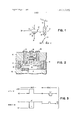
- FIG. 1 is a schematic circuit diagram of the storage cell of the present invention
- FIG. 2 is a cross sectional diagram of the integrated semiconductor structure of the cell of the present invention.
- FIG. 3 is a wave form diagram illustrating the operation of the herein disclosed circuits
- FIG. 4 is a schematic diagram of a memory array or portion thereof constructed in accordance with the memory cells of the present invention.
- each memory cell consists of a bipolar transistor Q1 and a FAMOS device Q2. Accessing lines commonly referred to as bit lines 12 and word lines 38 are orthogonally arranged with the memory cells located at the various crosspoints.
- the FAMOS device has a pair of gated electrodes 20 and 22, one of the gated electrodes 22, being connected to one of the accessing lines such as a word line 38, for example.
- the other gated electrode 20 of the FAMOS is connected to the base region 20 of the bipolar transistor.
- the substrate 14 of the FAMOS device is connected to the collector 14 of the bipolar transistor which is also connected to the other one of the accessing lines such as a bit line 12, also referred to as a bit/sense line.
- substrate 14 and collector 14 are part of the same semiconductor region.
- connecting line 12 formed by a subcollector region 12 (FIG. 2) is the actual collector region of transistor ()1.
- the FAMOS device Q2 has a pair of gating electrodes, a first gate 26 being a floating gate having no direct electrical connection elsewhere in the circuit.
- the second gate 32 also referred to as an erase gate, is connected to an erase line 36.
- the emitter region 24 of the bipolar transistor is connected to a terminal 34.
- the device is shown in cross section as fabricated in accordance with bipolar-PET (BIFET) technology.
- BIFET bipolar-PET
- a p type substrate I0 is provided and an n+ subcollector region I2 is formed therein.
- This subcollector region 12 acts as the collector for transistor O1 and forms the bit line for the memory cell, contacting the substrate 14.
- a layer of n type epitaxial material is grown as a layer 14 causing a portion of the subcollector 12 to outdiffuse as shown.
- P doped isolation regions 16 and 18 together with p regions 20 and 22 are next formed into epitaxial layer l4.
- the formation of such isolation regions 16 and 18 and pockets 20 and 22 are well known in the art and can be accomplished by diflusion. ion implantation, or other related techniques.
- an n+ region 24 is formed into pocket 20 by one of the aforementioned well known techniques such as diffusion, for example. It is noted at this point that pocket 20 forms the base of hi polar transistor Q1 and the pockets 20 and 22 collectively form the gated electrodes (drain and source) of transistor Q2.
- the n+ region 24 forms the emitter region of transistor 01 while the epitaxial N region 14 within the isolation regions 16 and 18 forms the sub strate region of 02.
- a floating gate 26 is than formed over an isolation region 28 in the well known manner of FAMOS fabrication.
- a second isolation layer 30 separates the erase gate 32 from the floating gate 26.
- Conductive connections 34, 36, and 38 are then formed through the isolation material 40 also by well known process techniques. Note that the circuit equivalent of the structure in FIG. 2 has been correspondingly numbered in FIG. 1 insofar as possible.
- the bit line 12 indicated as a conductor in FIG. 1 is actually a highly doped buried subcollector region 12 as noted in FIG. 2.
- FAMOS device O2 For the FAMOS devices under consideration, 25 volts is sufficient to exceed the avalanche potential causing injection of hot electrons into the floating gate 26. For write operations, the emitter electrode 34 is left floating. The hot electrons trapped at the floating gate cause FAMOS device O2 to be conditioned into its low impedance state for an extended period of time. possibly years.
- the foregoing writing phenomenon occasioned by electron injection in the disclosed P channel transistor occurs predominately because of accelerating the electric field across the gate oxide 28.
- the electrons captured at the floating gate 26 act to raise the breakdown voltage and hence, decrease the avalanche efficiency.
- the time dependence is due to the fact that the electric field reduces as the charge on the gate increases and fewer electrons are accellerated to the gate.
- bit line 12 in practice is a bit/sense line through which the state of the cell is sensed.
- the emitter terminal 34 of transistor Q] is coupled to a negative potential such as minus 3 volts.
- the word line 38 is pulsed between this negative potential of minus 3 volts and a positive potential such as ground.
- the information stored in the floating gate is then sensed on the bit/sense line 12.
- a logical l is said to be stored, when the floating gate has been charged such that the transistor 02 is conductive (in its low impedance state) and the signal is transferred from the word line to the bit/sense line.
- an up level signal on word line 38 turns transistor Q! on bringing bit/sense line 12 to a down level. If a logical 0 is stored the floating gate has not been charged, transistor Q2 does not conduct, and the signal from the word line 38 is not transferred to the base of Q1 keeping Q1 off permitting bit/sense line 12 to remain at an up level such as ground.
- an erase gate 32 is provided. In the event a large potential in the order of 30 to 35 volts AC at a frequency such as 60 cycles is applied to the erase gate 32., the cell is erased in less than l0 cycles bringing the charge on the floating gate 26 back to 0 volts.
- FIG. 4 illustrating the arrangement of a plurality of cells in an array.
- Orthogonal accessing lines including the word lines W/L 0, l, and N and bit lines BL 0, l and N are shown connected to each of the cells as in FIG. 1.
- the bit lines are formed by the subcollector. Accordingly, there are absolutely no intersecting lines since the common emitter coupling lines such as 34A, 34B, and 34C run parallel with (or at least in the same direction) as the erase lines 36A, 36B and 36C.
- the various connecting lines have been labeled with alphabetical letters and numerals corresponding to the designation first provided in FIG. 1.
- a memory cell comprising:
- a FAMOS device connected between the base region of said transistor and said input node.
- the substrate of said FAMOS device being connected to a bit line, the emitter region of said transistor being left floating during a write operation, said emitter region being connected to a steady state potential during a read operation.
- a memory array comprising:
- each of said cells having an electrical connection to one of said word lines and one of said bit lines.
- a memory array comprising:
- each of said cells having an electrical connection to one of said word lines and one of said bit lines.
- a memory array comprising:
- each of said cells having an electrical connection to one of said word lines and one of said bit lines.
- a memory array comprising:
- each of said cells having an electrical connection to one of said word lines and one of said bit lines.
- a memory cell as in claim I having a monolithically integrated structure comprising:
- a monolithically integrated memory cell structure comprising:
- a substrate being doped with an impurity of a first conductivity type
- a floating gate formed over a portion of said epitaxial layer between said pockets.
- a monolithically integrated memory structure as in claim 11 further comprising:
- a memory cell comprising:
- a field effect device having drain source and gate regions and adapted to receive trapped charge in the gate region, connected between the base region of said transistor and said input node.
- a memory cell comprising:
- a field effect device having drain source and gate regions connected between the base region of said transistor and said input node, said field effect device having a substrate region electrically common with said collector region.
- Monolithically integrated memory cell structure comprising:
- a first region being doped with an impurity of a first conductivity type
Landscapes
- Engineering & Computer Science (AREA)
- Microelectronics & Electronic Packaging (AREA)
- Non-Volatile Memory (AREA)
- Read Only Memory (AREA)
- Semiconductor Memories (AREA)
Priority Applications (7)
| Application Number | Priority Date | Filing Date | Title |
|---|---|---|---|
| US419587A US3893085A (en) | 1973-11-28 | 1973-11-28 | Read mostly memory cell having bipolar and FAMOS transistor |
| FR7433129A FR2252627B1 (fr) | 1973-11-28 | 1974-09-25 | |
| IT27863/74A IT1022436B (it) | 1973-11-28 | 1974-09-30 | Cella di memoria perfezionata |
| CA74211475A CA1048647A (fr) | 1973-11-28 | 1974-10-16 | Cellule de memoire presque fixe avec transistor bipolaire et famos |
| GB47509/74A GB1480940A (en) | 1973-11-28 | 1974-11-04 | Memory cell |
| DE2455484A DE2455484C2 (de) | 1973-11-28 | 1974-11-23 | Monolithisch integrierte Halbleiter-Speicherschaltung und Verfahren zu ihrer Herstellung |
| JP13564274A JPS543587B2 (fr) | 1973-11-28 | 1974-11-27 |
Applications Claiming Priority (1)
| Application Number | Priority Date | Filing Date | Title |
|---|---|---|---|
| US419587A US3893085A (en) | 1973-11-28 | 1973-11-28 | Read mostly memory cell having bipolar and FAMOS transistor |
Publications (1)
| Publication Number | Publication Date |
|---|---|
| US3893085A true US3893085A (en) | 1975-07-01 |
Family
ID=23662890
Family Applications (1)
| Application Number | Title | Priority Date | Filing Date |
|---|---|---|---|
| US419587A Expired - Lifetime US3893085A (en) | 1973-11-28 | 1973-11-28 | Read mostly memory cell having bipolar and FAMOS transistor |
Country Status (7)
| Country | Link |
|---|---|
| US (1) | US3893085A (fr) |
| JP (1) | JPS543587B2 (fr) |
| CA (1) | CA1048647A (fr) |
| DE (1) | DE2455484C2 (fr) |
| FR (1) | FR2252627B1 (fr) |
| GB (1) | GB1480940A (fr) |
| IT (1) | IT1022436B (fr) |
Cited By (18)
| Publication number | Priority date | Publication date | Assignee | Title |
|---|---|---|---|---|
| US3938108A (en) * | 1975-02-03 | 1976-02-10 | Intel Corporation | Erasable programmable read-only memory |
| US4087795A (en) * | 1974-09-20 | 1978-05-02 | Siemens Aktiengesellschaft | Memory field effect storage device |
| US4161039A (en) * | 1976-12-15 | 1979-07-10 | Siemens Aktiengesellschaft | N-Channel storage FET |
| WO1979000474A1 (fr) * | 1978-01-03 | 1979-07-26 | D Erb | Memoire de charge stratifiee |
| US4169291A (en) * | 1977-02-14 | 1979-09-25 | Siemens Aktiengesellschaft | Eprom using a V-MOS floating gate memory cell |
| US4247861A (en) * | 1979-03-09 | 1981-01-27 | Rca Corporation | High performance electrically alterable read-only memory (EAROM) |
| US4276616A (en) * | 1979-04-23 | 1981-06-30 | Fairchild Camera & Instrument Corp. | Merged bipolar/field-effect bistable memory cell |
| NL8204454A (nl) * | 1981-11-17 | 1983-06-16 | Ricoh Kk | Uitwisbare veld-programmeerbare logische array. |
| EP0055182A3 (en) * | 1980-12-24 | 1983-06-22 | Fairchild Camera & Instrument Corporation | High speed nonvolatile electrically erasable memory cell and system |
| US4395723A (en) * | 1980-05-27 | 1983-07-26 | Eliyahou Harari | Floating substrate dynamic RAM cell with lower punch-through means |
| US4429326A (en) | 1978-11-29 | 1984-01-31 | Hitachi, Ltd. | I2 L Memory with nonvolatile storage |
| US4491859A (en) * | 1979-06-18 | 1985-01-01 | Fujitsu Limited | Semiconductor non-volatile memory device |
| US4694319A (en) * | 1983-05-19 | 1987-09-15 | Nec Corporation | Thyristor having a controllable gate trigger current |
| EP0463623A3 (en) * | 1990-06-27 | 1992-08-12 | Kabushiki Kaisha Toshiba | Nonvolatile semiconductor memory circuit |
| US5471419A (en) * | 1991-12-16 | 1995-11-28 | U.S. Philips Corporation | Semiconductor device having a programmable memory cell |
| US6144077A (en) * | 1997-11-25 | 2000-11-07 | Mitsubishi Denki Kabushiki Kaisha | Semiconductor device comprising a bipolar transistor |
| EP1091419A1 (fr) * | 1999-10-05 | 2001-04-11 | STMicroelectronics SA | Potentiomètre intégré et procédé de fabrication correspondant |
| US8320191B2 (en) | 2007-08-30 | 2012-11-27 | Infineon Technologies Ag | Memory cell arrangement, method for controlling a memory cell, memory array and electronic device |
Families Citing this family (1)
| Publication number | Priority date | Publication date | Assignee | Title |
|---|---|---|---|---|
| DE3900426B4 (de) * | 1988-01-08 | 2006-01-19 | Kabushiki Kaisha Toshiba, Kawasaki | Verfahren zum Betreiben einer Halbleiteranordnung |
Citations (1)
| Publication number | Priority date | Publication date | Assignee | Title |
|---|---|---|---|---|
| US3660819A (en) * | 1970-06-15 | 1972-05-02 | Intel Corp | Floating gate transistor and method for charging and discharging same |
-
1973
- 1973-11-28 US US419587A patent/US3893085A/en not_active Expired - Lifetime
-
1974
- 1974-09-25 FR FR7433129A patent/FR2252627B1/fr not_active Expired
- 1974-09-30 IT IT27863/74A patent/IT1022436B/it active
- 1974-10-16 CA CA74211475A patent/CA1048647A/fr not_active Expired
- 1974-11-04 GB GB47509/74A patent/GB1480940A/en not_active Expired
- 1974-11-23 DE DE2455484A patent/DE2455484C2/de not_active Expired
- 1974-11-27 JP JP13564274A patent/JPS543587B2/ja not_active Expired
Patent Citations (1)
| Publication number | Priority date | Publication date | Assignee | Title |
|---|---|---|---|---|
| US3660819A (en) * | 1970-06-15 | 1972-05-02 | Intel Corp | Floating gate transistor and method for charging and discharging same |
Cited By (24)
| Publication number | Priority date | Publication date | Assignee | Title |
|---|---|---|---|---|
| US4087795A (en) * | 1974-09-20 | 1978-05-02 | Siemens Aktiengesellschaft | Memory field effect storage device |
| US3938108A (en) * | 1975-02-03 | 1976-02-10 | Intel Corporation | Erasable programmable read-only memory |
| US4161039A (en) * | 1976-12-15 | 1979-07-10 | Siemens Aktiengesellschaft | N-Channel storage FET |
| US4169291A (en) * | 1977-02-14 | 1979-09-25 | Siemens Aktiengesellschaft | Eprom using a V-MOS floating gate memory cell |
| WO1979000474A1 (fr) * | 1978-01-03 | 1979-07-26 | D Erb | Memoire de charge stratifiee |
| US4429326A (en) | 1978-11-29 | 1984-01-31 | Hitachi, Ltd. | I2 L Memory with nonvolatile storage |
| US4247861A (en) * | 1979-03-09 | 1981-01-27 | Rca Corporation | High performance electrically alterable read-only memory (EAROM) |
| US4276616A (en) * | 1979-04-23 | 1981-06-30 | Fairchild Camera & Instrument Corp. | Merged bipolar/field-effect bistable memory cell |
| US4491859A (en) * | 1979-06-18 | 1985-01-01 | Fujitsu Limited | Semiconductor non-volatile memory device |
| US4395723A (en) * | 1980-05-27 | 1983-07-26 | Eliyahou Harari | Floating substrate dynamic RAM cell with lower punch-through means |
| US4398338A (en) * | 1980-12-24 | 1983-08-16 | Fairchild Camera & Instrument Corp. | Fabrication of high speed, nonvolatile, electrically erasable memory cell and system utilizing selective masking, deposition and etching techniques |
| EP0055182A3 (en) * | 1980-12-24 | 1983-06-22 | Fairchild Camera & Instrument Corporation | High speed nonvolatile electrically erasable memory cell and system |
| EP0176111A1 (fr) * | 1980-12-24 | 1986-04-02 | FAIRCHILD CAMERA & INSTRUMENT CORPORATION | Système de mémoire rapide non-volatile, électriquement effaçable |
| NL8204454A (nl) * | 1981-11-17 | 1983-06-16 | Ricoh Kk | Uitwisbare veld-programmeerbare logische array. |
| US4694319A (en) * | 1983-05-19 | 1987-09-15 | Nec Corporation | Thyristor having a controllable gate trigger current |
| EP0463623A3 (en) * | 1990-06-27 | 1992-08-12 | Kabushiki Kaisha Toshiba | Nonvolatile semiconductor memory circuit |
| US5350938A (en) * | 1990-06-27 | 1994-09-27 | Kabushiki Kaisha Toshiba | Nonvolatile semiconductor memory circuit with high speed read-out |
| US5471419A (en) * | 1991-12-16 | 1995-11-28 | U.S. Philips Corporation | Semiconductor device having a programmable memory cell |
| US6144077A (en) * | 1997-11-25 | 2000-11-07 | Mitsubishi Denki Kabushiki Kaisha | Semiconductor device comprising a bipolar transistor |
| EP1091419A1 (fr) * | 1999-10-05 | 2001-04-11 | STMicroelectronics SA | Potentiomètre intégré et procédé de fabrication correspondant |
| FR2799885A1 (fr) * | 1999-10-05 | 2001-04-20 | St Microelectronics Sa | Potentiometre integre et procede de fabrication correspondant |
| US6377115B1 (en) | 1999-10-05 | 2002-04-23 | Stmicroelectronics S.A. | Integrated potentiometer and corresponding fabrication process |
| US8320191B2 (en) | 2007-08-30 | 2012-11-27 | Infineon Technologies Ag | Memory cell arrangement, method for controlling a memory cell, memory array and electronic device |
| US9030877B2 (en) | 2007-08-30 | 2015-05-12 | Infineon Technologies Ag | Memory cell arrangement, method for controlling a memory cell, memory array and electronic device |
Also Published As
| Publication number | Publication date |
|---|---|
| CA1048647A (fr) | 1979-02-13 |
| DE2455484C2 (de) | 1983-01-20 |
| FR2252627A1 (fr) | 1975-06-20 |
| GB1480940A (en) | 1977-07-27 |
| DE2455484A1 (de) | 1975-06-05 |
| JPS543587B2 (fr) | 1979-02-24 |
| JPS50107830A (fr) | 1975-08-25 |
| FR2252627B1 (fr) | 1979-06-01 |
| IT1022436B (it) | 1978-03-20 |
Similar Documents
| Publication | Publication Date | Title |
|---|---|---|
| US3893085A (en) | Read mostly memory cell having bipolar and FAMOS transistor | |
| US4300212A (en) | Nonvolatile static random access memory devices | |
| US5586073A (en) | Semiconductor device having a multi-layer channel structure | |
| US4486769A (en) | Dense nonvolatile electrically-alterable memory device with substrate coupling electrode | |
| US7151706B2 (en) | CMIS semiconductor nonvolatile storage circuit | |
| US4263664A (en) | Nonvolatile static random access memory system | |
| US5896315A (en) | Nonvolatile memory | |
| US5465231A (en) | EEPROM and logic LSI chip including such EEPROM | |
| US4980859A (en) | NOVRAM cell using two differential decouplable nonvolatile memory elements | |
| CA1085053A (fr) | Memoire a transistors a effet de champ en mode de depletion | |
| US6034893A (en) | Non-volatile memory cell having dual avalanche injection elements | |
| US5850091A (en) | Semiconductor memory device and method of reading a data therefrom | |
| US4207615A (en) | Non-volatile ram cell | |
| US20040065918A1 (en) | Nonvolatile memory device | |
| US4393481A (en) | Nonvolatile static random access memory system | |
| US4616245A (en) | Direct-write silicon nitride EEPROM cell | |
| US6064590A (en) | Non-volatile static random access memory device | |
| KR100373670B1 (ko) | 불휘발성 반도체 기억 장치 | |
| GB2042296A (en) | Nonvolatile static random access method and memory device | |
| US4590503A (en) | Electrically erasable programmable read only memory | |
| US5267195A (en) | Semiconductor non-volatile memory device | |
| US4446535A (en) | Non-inverting non-volatile dynamic RAM cell | |
| JP3920550B2 (ja) | 不揮発性半導体記憶装置 | |
| JPS608559B2 (ja) | 不揮発性半導体記憶装置 | |
| EP0387102A2 (fr) | Mémoire non volatile à semi-conducteurs et sa méthode d'écriture |