US4257253A - Stamping apparatus with improved ejection mechanism - Google Patents
Stamping apparatus with improved ejection mechanism Download PDFInfo
- Publication number
- US4257253A US4257253A US05/971,028 US97102878A US4257253A US 4257253 A US4257253 A US 4257253A US 97102878 A US97102878 A US 97102878A US 4257253 A US4257253 A US 4257253A
- Authority
- US
- United States
- Prior art keywords
- shaft
- cam
- axis
- angular
- terminal positions
- Prior art date
- Legal status (The legal status is an assumption and is not a legal conclusion. Google has not performed a legal analysis and makes no representation as to the accuracy of the status listed.)
- Expired - Lifetime
Links
- 230000007246 mechanism Effects 0.000 title claims description 28
- 238000006073 displacement reaction Methods 0.000 claims description 7
- 238000007493 shaping process Methods 0.000 claims description 7
- 230000003247 decreasing effect Effects 0.000 claims 2
- 230000004048 modification Effects 0.000 description 4
- 238000012986 modification Methods 0.000 description 4
- 230000006835 compression Effects 0.000 description 3
- 238000007906 compression Methods 0.000 description 3
- 230000000694 effects Effects 0.000 description 2
- 238000007689 inspection Methods 0.000 description 2
- 230000009286 beneficial effect Effects 0.000 description 1
- 230000015556 catabolic process Effects 0.000 description 1
- 230000007423 decrease Effects 0.000 description 1
- 238000010586 diagram Methods 0.000 description 1
- 238000005096 rolling process Methods 0.000 description 1
Images



Classifications
-
- B—PERFORMING OPERATIONS; TRANSPORTING
- B21—MECHANICAL METAL-WORKING WITHOUT ESSENTIALLY REMOVING MATERIAL; PUNCHING METAL
- B21J—FORGING; HAMMERING; PRESSING METAL; RIVETING; FORGE FURNACES
- B21J13/00—Details of machines for forging, pressing, or hammering
- B21J13/08—Accessories for handling work or tools
- B21J13/14—Ejecting devices
-
- Y—GENERAL TAGGING OF NEW TECHNOLOGICAL DEVELOPMENTS; GENERAL TAGGING OF CROSS-SECTIONAL TECHNOLOGIES SPANNING OVER SEVERAL SECTIONS OF THE IPC; TECHNICAL SUBJECTS COVERED BY FORMER USPC CROSS-REFERENCE ART COLLECTIONS [XRACs] AND DIGESTS
- Y10—TECHNICAL SUBJECTS COVERED BY FORMER USPC
- Y10T—TECHNICAL SUBJECTS COVERED BY FORMER US CLASSIFICATION
- Y10T74/00—Machine element or mechanism
- Y10T74/21—Elements
- Y10T74/2101—Cams
- Y10T74/2102—Adjustable
Definitions
- the invention relates to stamping mechanism in which a workpiece is shaped in a fixed die by a reciprocating punch, and particularly to an improved mechanism for ejecting the shaped workpiece from the die.
- the invention will be described in its application to stamping apparatus equipped with a plurality of dies and associated punches and a transfer mechanism which receives the workpiece ejected from each die and automatically transfers it to a juxtaposed set of die and punch for further shaping, but other applications will readily suggest themselves.
- the invention provides a drive mechanism for the ejector pin in which a cam shaft is moved angularly back and forth on the supporting machine frame between two terminal positions which are spaced apart less than 360°.
- a drive cam is mounted on the shaft for angular movement therewith and has a cam face which extends in an arc about the axis of the cam shaft.
- a motion transmitting train sequentially engages or scans respective portions of the cam face during the angular shaft movement and is connected to the ejector pin for moving the same in response to the varying spacing of the engaged cam face portions from the axis, as is known in itself.
- the angular length of the arc defined by the cam face is greater than the angular spacing of the two terminal positions of the cam shaft.
- the mountings for the cam permit the cam to be mounted on the shaft in each of an infinite number of angularly offset positions.
- the spacing of the sequentially scanned cam face portions from the cam shaft axis increases from a minimum value in one of the terminal cam shaft positions during a first portion of the angular cam shaft movement to a maximum value which is reached in an angular cam shaft position spaced intermediate the two terminal positions.
- the stroke of the ejector member during each oscillating angular movement of the cam shaft may thus be varied by angularly shifting the cam on the shaft.
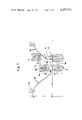
- FIG. 1 shows a stamping mechanism of the invention in fragmentary side-elevational section
- FIGS. 2 and 3 illustrate the mechanism of FIG. 1 in analogous views, but in different operating positions
- FIG. 4 shows a partial modification of the same mechanism in a view approximately corresponding to that of FIG. 2;
- FIG. 5 is a fragmentary top plan view of the apparatus of FIGS. 1 to 3, also representative of the apparatus of FIG. 4;
- FIG. 6 diagrammatically illustrates kinematic relationships between the elements of the stamping mechanism
- FIG. 7 diagrammatically illustrates the movements of a punch and the associated ejector pin in a working cycle of the mechanism, two side elevational, sectional views of the punch and die being superimposed on the diagram for more specific illustration;
- FIG. 8 diagrammatically illustrates the relationship between the movements of the punch and ejector device and the angular position of the cam shaft in the mechanism of FIGS. 1 to 5 for different settings of the drive cam on the drive shaft.
- FIG. 1 there is shown a die 1 having a cavity 2 into which a blank to be shaped is forced by a punch, not specifically illustrated, as indicated by an arrow 3.
- the shaped blank thereafter is to be ejected from the cavity 2 in a direction opposite to that of the arrow 3 so that it may be grasped by a transfer mechanism Z, indicated in phantom view, for sequential transfer to other dies in which it is further shaped, the several dies being juxtaposed in a common plane transverse to that of FIG. 1 on the supporting machine frame 4 as is more specifically shown in FIG. 5.
- the several dies and associated elements differ only in the shapes of the respective cavities 2, further description will be limited to the structure of FIG. 1 which will be understood to be duplicated as many times as there are juxtaposed dies with suitably modified die cavities, not themselves directly relevant to this invention.
- An ejector rod 5 is coaxially guided in a bore 6 of the frame 4 which is of stepped cylindrical shape.
- a wider portion 7 of the bore 6 accomodates a helical compression spring 8 coiled about the rod 5 and axially confined between a shoulder in the bore 6 and a fixed collar 9 on the rod 5 so as to bias the rod rearward, that is, away from the die 1 toward the bore portion 7 until the collar 9 abuts against a transverse, annular end face of an externally threaded sleeve 10 which projects rearwardly out of the bore 6 so that it may be adjusted manually by turning it on threads 11 in the bore 6. More specifically, the rearmost position of the rod 5 may be shifted toward the die 1 by threadedly moving the sleeve 10 in the direction of an arrow 12.
- a guide ring 13 is slidably received in the narrow end portion of the bore 6 for coaxially guiding an ejector pin 14 fixedly attached to the ring and dimensioned for movement with minimal clearance through the ejector port of the die 1 into and out of the cavity 2.
- the ejection movement of the pin 14 is derived from a radial cam 15 by way of a motion transmitting train including a rocker 16 and a striker pin 17 threadedly adjustable on the rocker 16 for engagement with the end portion of the rod 5 which projects rearwardly from the sleeve 10.
- a crankshaft 18 is rotated continuously on the machine frame 4 by a non-illustrated prime mover and carries an eccentric crank pin 18a which may be adjusted along a circle about the axis of crankshaft rotation in a conventional manner.
- the cam 15 is split and releasably fixed to the cam shaft 20 by a clamping screw 21 which bridges the split in the cam 15.
- the cam 15 may be turned on the shaft 20.
- the rocker 16 is pivotally mounted on a stub shaft 23 fixed on the frame 4 and carries a cam follower roller 24 held in rolling engagement with the cam face P of the cam 15 during the oscillating movement of the shaft 20 by a helical compression spring 25 interposed between the rocker 16 and the stationary machine frame 4.
- the cam 15 When the screw 21 is loosened, the cam 15 may be shifted continuously and precisely between respective angular positions on the shaft 20 by an adjustment mechanism mounted on a carrier frame 26 which is fixedly attached on the shaft 20.
- a passage in the frame 26 contains a heavy pin 28 freely rotatable in the recess about its axis which is parallel to that of the shaft 20.
- a threaded transverse bore 29 in the pin 28 receives an externally threaded abutment sleeve 30.
- a screw 27 is received in the sleeve 30 and extends into a recess of the cam 15 for threaded engagement with a pivot pin 31 whose ends are journaled in the side walls of the recess.
- the screw 27 When tightened, the screw 27 holds an annular end face of the sleeve 30 in abutting engagement with the pivot pin 31 so that the angular position of the cam 15 may be varied in a precise, stepless manner by turning the freely accessible sleeve 30, while released by the screw 27, so that the sleeve applies a force to the cam 15 tangentially relative to a circle about the axis of the cam shaft 20, and by thereafter tightening the screw 27.
- the cam follower roller 24 travels along sequential portions of the cam face P of the cam 15 whose radius of curvature increases initially from a minimum value of r min in one angularly terminal position of the shaft 20 along an Archimedes spiral and ultimately to a constant maximum value R.
- the abutment face of the striker pin 17 moves from the initial position shown in FIG. 1 toward the ejector rod 5 by a distance S practically identical for each identical unit of angular movement of the cam 15 with the shaft 20 until it engages the end face of the rod 5 in the position of FIG. 2, and thereafter shifts the rod 5 and thereby the ejector pin 14 into the position of FIG. 3 in which the free end of the pin 14 is flush with the end face of the die 1, and the non-illustrated, shaped workpiece clears the die 1 for transverse movement to the next die.
- the end portion a of the cam face P engaged by the cam follower roller 24 moving away from the cam face portion of minimum radius of curvature r min is curved along an Archimedes spiral.
- the other end portion k of the cam face P is cylindrically arcuate with a radius R greater than any radius of curvature of the spiral portion a or of the transitional cam face portion u which circumferentially connects the portions a and k.
- the ejector pin 14 is moved inward of the die cavity 2 and the bore 6 by a blank pushed into the die 1 by the punch, not itself seen in FIGS. 1 to 3, and the mode of operation may not be affected if the radius of curvature of the cam face portion k decreases again after having reached its maximum R spacedly intermediate the two ends of the face P.
- the drive cam 15' illustrated in FIG. 4 is modified for this purpose by an interchangeable insert E releasably attached to the body of the cam by countersunk screws 37 and imparting to a portion of the cam face P contiguously consecutive to the spiral portion a maximum radius greater than corresponds to the afore-mentioned radius R.
- the ejection stroke of the pin 14 thus terminates in a position in which the free end of the pin projects beyond the front face of the die 1 sufficiently to permit unimpeded lateral displacement of a recessed workpiece.
- the apparatus of FIG. 4 is not otherwise different from that described with reference to FIGS. 1-3, and may be converted to the exact structural and functional equivalent of the first-described embodiment by replacing the insert E by another insert restoring the configuration of the cam face P to that described in the earlier Figures.
- the angle ⁇ which separates the two terminal positions of the cam shaft 20 is constant under all operating conditions of the stamping mechanism, but the angular length of the cam face P is much greater as is best seen in FIG. 6, and the angular position of the cam 15 on the shaft 20 determines which portion of the cam face P is scanned or travelled over by the cam follower 24 while the cam 15 moves through the angle ⁇ .
- the path of the cam follower 24 may thus include a larger or smaller part of the spiraling path portion P and the ejection stroke of the pin 14 varied accordingly. Unless the contour of the cam face P is modified in the manner illustrated in FIG.
- the ejection stroke terminates when the pin 14 is flush with the front face of the die 1 regardless of the actual length of the stroke as set by turning the cam 15 on the shaft 20.
- the end of the outward pin stroke is equally uniquely determined regardless of the length of the stroke which may be varied by modifying the angular position of the cam 15 on the shaft 20.
- the punch 33 is longitudinally movable in a bore of the afore-mentioned slide 32 common to the several punches.
- a collar 34 on the punch 33 is confined in an enlarged portion 35 of the slide bore so as to limit displacement of the punch 33 to a distance b.
- a weak, helical compression spring 36 in the bore biases the punch outward of the slide, but cannot resist the shaping stresses.
- FIG. 8 The effect of an angular shift of the cam 15 on the cam shaft 20 is diagrammatically illustrated in FIG. 8 in which the ordinate indicates displacement s in the direction of movement of the punch 33 and of the ejector pin 14 while the abscissa indicates time in terms of angular displacement ⁇ of the crank shaft 18 during one full revolution of the crankshaft from one fully retracted position HTP of the punch to its fully advanced position VTP and back to the next fully retracted position, as represented by the fully drawn line St.
- crank pin 18a is offset from its position of full synchronization between the punch 33 and the rocker 16 by an angle ⁇ ' so that the rocker reaches the fully retracted position exemplified in FIG. 1 at a time L which slightly precedes termination of the workpiece-shaping stroke by the punch 33.
- Broken lines A 1 to A 4 illustrate the movements of the rocker 16, and more specifically of the striker pin 17 in respective angular positions of the cam 15 on the shaft 20, the striker pin engaging the ejector rod 5 at respective points M 1 to M 5 so that the ejector pin 14 thereafter participates in the movement as indicated by a fully drawn portion of each of the curves A 1 to A 4 .
- a reference line H is drawn parallel to the abscissa at an arbitrarily selected distance s' so as to intersect the curve St in two points from which lines V 1 , V 2 are drawn to intersect the abscissa ⁇ at right angles.
- the line V 1 intersects the broken line A 4 much below its point of intersection with the line V 2 .
- this indicates that an excess path s 2 of the punch 33 is available for shaping the workpiece, the distance s 1 of the line A 4 from the abscissa along the line V 2 being equal to the spacing of the lines A 4 , A 3 along the line V 1 .
- the path of the punch available for shaping the workpiece may be changed steplessly by shifting the cam 15 on the shaft 20, so as to modify the apparatus for workpieces of different lengths.
- the angle value ⁇ ' may be similarly varied by shifting the crank pin 18a on the crank shaft 18, but this is not necessary under many practical conditions, and the value of ⁇ ' may be set during assembly of the stamping mechanism. If greater flexibility is required at the stamping plant, however, a disc coaxially fixed on the shaft 18 may be provided with a circular row of openings for receiving the crank pin 18a in suitable alternative positions.
- the apparatus of the invention may be employed to advantage for deburring workpieces without structural modification. Because of the interval between the reversals of rocker and punch movements at L and VTP respectively, the striker pin 17 already travels at an adequate velocity when the punch starts retracting so that the energy transmitted by the striker pin to the workpiece may be employed for removing burrs from the workpiece in a conventional manner, not shown.
Landscapes
- Engineering & Computer Science (AREA)
- Mechanical Engineering (AREA)
- Forging (AREA)
Applications Claiming Priority (2)
| Application Number | Priority Date | Filing Date | Title |
|---|---|---|---|
| DE2758071 | 1977-12-24 | ||
| DE2758071A DE2758071C2 (de) | 1977-12-24 | 1977-12-24 | Vorrichtung zum matrizenseitigen Auswerfen eines Presslings auf einer automatischen Mehrstufenpresse |
Publications (1)
| Publication Number | Publication Date |
|---|---|
| US4257253A true US4257253A (en) | 1981-03-24 |
Family
ID=6027323
Family Applications (1)
| Application Number | Title | Priority Date | Filing Date |
|---|---|---|---|
| US05/971,028 Expired - Lifetime US4257253A (en) | 1977-12-24 | 1978-12-19 | Stamping apparatus with improved ejection mechanism |
Country Status (11)
| Country | Link |
|---|---|
| US (1) | US4257253A (de) |
| JP (2) | JPS54100970A (de) |
| AT (1) | AT365102B (de) |
| BE (1) | BE873056A (de) |
| CH (1) | CH633463A5 (de) |
| DE (1) | DE2758071C2 (de) |
| FR (1) | FR2412403A1 (de) |
| GB (1) | GB2010715B (de) |
| IT (1) | IT1108293B (de) |
| NL (1) | NL185827C (de) |
| SE (1) | SE430965B (de) |
Cited By (9)
| Publication number | Priority date | Publication date | Assignee | Title |
|---|---|---|---|---|
| US4655071A (en) * | 1985-11-26 | 1987-04-07 | The U.S. Baird Corporation | Transfer press with quick change die set arrangement |
| US4858835A (en) * | 1987-11-26 | 1989-08-22 | Axis S.P.A. | Equipment for the actuation of needles for the realization of electric motors field windings |
| US5732589A (en) * | 1996-05-31 | 1998-03-31 | The National Machinery Company | Automatically adjustable multiple CAM for forging machine |
| GB2360235A (en) * | 2000-03-10 | 2001-09-19 | Platarg Engineering Ltd | Workpiece ejector for transfer press |
| CN101797616B (zh) * | 2007-04-26 | 2011-09-28 | 王瑞峰 | 一种应用于多工位自动拉伸冲床装置中的退料系统 |
| CN104260411A (zh) * | 2014-09-16 | 2015-01-07 | 萍乡九州精密压机有限公司 | 脱模机构 |
| CN109570370A (zh) * | 2018-10-23 | 2019-04-05 | 江苏陆地方舟新能源车辆股份有限公司 | 一种铆接自制平台工装 |
| CN113070382A (zh) * | 2021-03-31 | 2021-07-06 | 江西铭德电器有限公司 | 一种生产电机转子的模具 |
| CN115008726A (zh) * | 2022-05-05 | 2022-09-06 | 浙江翔宇密封件股份有限公司 | 一种耐腐蚀高精密轴承止动垫圈加工用模具 |
Families Citing this family (1)
| Publication number | Priority date | Publication date | Assignee | Title |
|---|---|---|---|---|
| JP2586536Y2 (ja) * | 1992-03-30 | 1998-12-09 | 住友金属工業株式会社 | 回転鍛造機の製品突上げ部構造 |
Citations (5)
| Publication number | Priority date | Publication date | Assignee | Title |
|---|---|---|---|---|
| US2005495A (en) * | 1934-04-18 | 1935-06-18 | Nat Machinery Co | Bolt making machine |
| US2469570A (en) * | 1947-09-29 | 1949-05-10 | Crouse Hinds Co | Adjustable actuating member |
| US3080770A (en) * | 1961-04-18 | 1963-03-12 | Acton Lab Inc | Screw controlled relative positioning unit |
| US3175421A (en) * | 1956-04-02 | 1965-03-30 | James P Watson | Adjustable cam mechanism |
| US3927549A (en) * | 1973-10-24 | 1975-12-23 | Komatsu Mfg Co Ltd | Ejecting device for use in metal forging machine |
Family Cites Families (4)
| Publication number | Priority date | Publication date | Assignee | Title |
|---|---|---|---|---|
| US3053122A (en) * | 1957-05-02 | 1962-09-11 | Ferracute Machine Company | Work-piece ejector for coining presses |
| NL6516468A (de) * | 1965-12-17 | 1967-06-19 | ||
| JPS5125644B2 (de) * | 1974-02-25 | 1976-08-02 | ||
| US4044619A (en) * | 1975-06-23 | 1977-08-30 | Peltzer & Ehlers | Device for controlling auxiliary means arranged in the reciprocating carriage of single or multistage presses |
-
1977
- 1977-12-24 DE DE2758071A patent/DE2758071C2/de not_active Expired
-
1978
- 1978-12-19 US US05/971,028 patent/US4257253A/en not_active Expired - Lifetime
- 1978-12-20 FR FR7835816A patent/FR2412403A1/fr active Granted
- 1978-12-21 SE SE7813185A patent/SE430965B/sv not_active IP Right Cessation
- 1978-12-21 GB GB7849678A patent/GB2010715B/en not_active Expired
- 1978-12-22 CH CH1313978A patent/CH633463A5/de not_active IP Right Cessation
- 1978-12-22 AT AT0923078A patent/AT365102B/de not_active IP Right Cessation
- 1978-12-22 BE BE192553A patent/BE873056A/xx not_active IP Right Cessation
- 1978-12-22 IT IT69939/78A patent/IT1108293B/it active
- 1978-12-22 JP JP16093278A patent/JPS54100970A/ja active Pending
- 1978-12-27 NL NLAANVRAGE7812582,A patent/NL185827C/xx not_active IP Right Cessation
-
1981
- 1981-05-29 JP JP1981080551U patent/JPS577645U/ja active Pending
Patent Citations (5)
| Publication number | Priority date | Publication date | Assignee | Title |
|---|---|---|---|---|
| US2005495A (en) * | 1934-04-18 | 1935-06-18 | Nat Machinery Co | Bolt making machine |
| US2469570A (en) * | 1947-09-29 | 1949-05-10 | Crouse Hinds Co | Adjustable actuating member |
| US3175421A (en) * | 1956-04-02 | 1965-03-30 | James P Watson | Adjustable cam mechanism |
| US3080770A (en) * | 1961-04-18 | 1963-03-12 | Acton Lab Inc | Screw controlled relative positioning unit |
| US3927549A (en) * | 1973-10-24 | 1975-12-23 | Komatsu Mfg Co Ltd | Ejecting device for use in metal forging machine |
Cited By (13)
| Publication number | Priority date | Publication date | Assignee | Title |
|---|---|---|---|---|
| US4655071A (en) * | 1985-11-26 | 1987-04-07 | The U.S. Baird Corporation | Transfer press with quick change die set arrangement |
| US4858835A (en) * | 1987-11-26 | 1989-08-22 | Axis S.P.A. | Equipment for the actuation of needles for the realization of electric motors field windings |
| US5732589A (en) * | 1996-05-31 | 1998-03-31 | The National Machinery Company | Automatically adjustable multiple CAM for forging machine |
| GB2360235A (en) * | 2000-03-10 | 2001-09-19 | Platarg Engineering Ltd | Workpiece ejector for transfer press |
| GB2360235B (en) * | 2000-03-10 | 2002-02-06 | Platarg Engineering Ltd | Workpiece ejector for transfer press |
| CN101797616B (zh) * | 2007-04-26 | 2011-09-28 | 王瑞峰 | 一种应用于多工位自动拉伸冲床装置中的退料系统 |
| CN104260411A (zh) * | 2014-09-16 | 2015-01-07 | 萍乡九州精密压机有限公司 | 脱模机构 |
| CN104260411B (zh) * | 2014-09-16 | 2016-05-11 | 萍乡九州精密压机有限公司 | 脱模机构 |
| CN109570370A (zh) * | 2018-10-23 | 2019-04-05 | 江苏陆地方舟新能源车辆股份有限公司 | 一种铆接自制平台工装 |
| CN113070382A (zh) * | 2021-03-31 | 2021-07-06 | 江西铭德电器有限公司 | 一种生产电机转子的模具 |
| CN113070382B (zh) * | 2021-03-31 | 2022-08-23 | 贵溪广信新能源科技有限公司 | 一种生产电机转子的模具 |
| CN115008726A (zh) * | 2022-05-05 | 2022-09-06 | 浙江翔宇密封件股份有限公司 | 一种耐腐蚀高精密轴承止动垫圈加工用模具 |
| CN115008726B (zh) * | 2022-05-05 | 2024-05-24 | 浙江翔宇密封件股份有限公司 | 一种耐腐蚀高精密轴承止动垫圈加工用模具 |
Also Published As
| Publication number | Publication date |
|---|---|
| DE2758071C2 (de) | 1982-11-11 |
| BE873056A (fr) | 1979-06-22 |
| NL7812582A (nl) | 1979-06-26 |
| NL185827B (nl) | 1990-03-01 |
| GB2010715B (en) | 1982-04-28 |
| CH633463A5 (de) | 1982-12-15 |
| JPS54100970A (en) | 1979-08-09 |
| SE7813185L (sv) | 1979-06-25 |
| FR2412403A1 (fr) | 1979-07-20 |
| ATA923078A (de) | 1981-05-15 |
| IT7869939A0 (it) | 1978-12-22 |
| FR2412403B1 (de) | 1982-08-13 |
| SE430965B (sv) | 1983-12-27 |
| AT365102B (de) | 1981-12-10 |
| IT1108293B (it) | 1985-12-02 |
| DE2758071A1 (de) | 1979-06-28 |
| JPS577645U (de) | 1982-01-14 |
| NL185827C (nl) | 1990-08-01 |
| GB2010715A (en) | 1979-07-04 |
Similar Documents
| Publication | Publication Date | Title |
|---|---|---|
| JPH036853B2 (de) | ||
| US3397799A (en) | Work transfer mechanism | |
| US20050050972A1 (en) | Device connected to a crank for moving a part mounted on a slider relative thereto | |
| US4250730A (en) | Device for the ejection of a shaped workpiece at the male die on a cross-feed press for non-cutting metal shaping | |
| CN104690202A (zh) | 主模回转式高速冷镦机 | |
| US5026336A (en) | Apparatus for controlling the feed of an intermittent web feeding apparatus | |
| US4252009A (en) | Re-rolling attachment for thread rolling machine | |
| US3266071A (en) | Cam-controlled apparatus for throwing out the bolts from the counter punch of bolt presses or the like | |
| US5346055A (en) | Machinery for discontinuously forwarding material or work past or through discontinuously operating tools | |
| GB1476753A (en) | Method and apparatus for producing link chains and chains made by the method | |
| US2204043A (en) | Cold forging machine | |
| US3951003A (en) | Crank mechanism | |
| US3579685A (en) | Mechanism for ejecting workpieces from the matrices of upsetting machines | |
| CN110877084B (zh) | 球销加工的自动冷镦机 | |
| US3452693A (en) | Machine for very rapidly pressing ball pen points and other articles starting from a metallic strip or wire | |
| US6672126B2 (en) | Stepped cam die | |
| SU1041198A1 (ru) | Устройство дл резки пруткового материала | |
| JPH0723085Y2 (ja) | ホーマのダイ部ノックアウト装置 | |
| SU1138213A1 (ru) | Грейферное подающее устройство | |
| US4488426A (en) | Forging machine for producing rivets or the like having running adjustments | |
| SU764804A2 (ru) | Автомат дл изготовлени рыболовных крючков | |
| SU1563818A1 (ru) | Устройство дл изготовлени проволочных разводных шплинтов | |
| SU1558549A1 (ru) | Механизм отрезки заготовок автомата дл объемной штамповки | |
| US5107979A (en) | Finger actuating device in a transfer press | |
| SU124411A1 (ru) | Гибочный автомат дл изготовлени из проволоки, например дужек ведер и подобных изделий |
Legal Events
| Date | Code | Title | Description |
|---|---|---|---|
| STCF | Information on status: patent grant |
Free format text: PATENTED CASE |