US4657667A - Particle classifier - Google Patents
Particle classifier Download PDFInfo
- Publication number
- US4657667A US4657667A US06/596,952 US59695284A US4657667A US 4657667 A US4657667 A US 4657667A US 59695284 A US59695284 A US 59695284A US 4657667 A US4657667 A US 4657667A
- Authority
- US
- United States
- Prior art keywords
- slit
- housing
- classifying
- classifier according
- secondary air
- Prior art date
- Legal status (The legal status is an assumption and is not a legal conclusion. Google has not performed a legal analysis and makes no representation as to the accuracy of the status listed.)
- Expired - Fee Related
Links
- 239000002245 particle Substances 0.000 title claims abstract description 28
- 239000011236 particulate material Substances 0.000 claims abstract description 15
- 230000000694 effects Effects 0.000 claims abstract description 8
- 239000000463 material Substances 0.000 claims description 38
- 238000005192 partition Methods 0.000 claims description 19
- 238000005054 agglomeration Methods 0.000 claims description 2
- 230000002776 aggregation Effects 0.000 claims description 2
- 238000011144 upstream manufacturing Methods 0.000 description 3
- XEEYBQQBJWHFJM-UHFFFAOYSA-N Iron Chemical compound [Fe] XEEYBQQBJWHFJM-UHFFFAOYSA-N 0.000 description 2
- 239000010445 mica Substances 0.000 description 2
- 229910052618 mica group Inorganic materials 0.000 description 2
- 238000010276 construction Methods 0.000 description 1
- 230000001627 detrimental effect Effects 0.000 description 1
- 238000006073 displacement reaction Methods 0.000 description 1
- 230000005484 gravity Effects 0.000 description 1
- 230000002452 interceptive effect Effects 0.000 description 1
- 229910052742 iron Inorganic materials 0.000 description 1
- 230000000717 retained effect Effects 0.000 description 1
- 238000000926 separation method Methods 0.000 description 1
- 229910052710 silicon Inorganic materials 0.000 description 1
- 239000010703 silicon Substances 0.000 description 1
- 230000009747 swallowing Effects 0.000 description 1
Images


Classifications
-
- G—PHYSICS
- G01—MEASURING; TESTING
- G01N—INVESTIGATING OR ANALYSING MATERIALS BY DETERMINING THEIR CHEMICAL OR PHYSICAL PROPERTIES
- G01N15/00—Investigating characteristics of particles; Investigating permeability, pore-volume or surface-area of porous materials
- G01N15/02—Investigating particle size or size distribution
- G01N15/0255—Investigating particle size or size distribution with mechanical, e.g. inertial, classification, and investigation of sorted collections
-
- B—PERFORMING OPERATIONS; TRANSPORTING
- B07—SEPARATING SOLIDS FROM SOLIDS; SORTING
- B07B—SEPARATING SOLIDS FROM SOLIDS BY SIEVING, SCREENING, SIFTING OR BY USING GAS CURRENTS; SEPARATING BY OTHER DRY METHODS APPLICABLE TO BULK MATERIAL, e.g. LOOSE ARTICLES FIT TO BE HANDLED LIKE BULK MATERIAL
- B07B11/00—Arrangement of accessories in apparatus for separating solids from solids using gas currents
- B07B11/04—Control arrangements
-
- B—PERFORMING OPERATIONS; TRANSPORTING
- B07—SEPARATING SOLIDS FROM SOLIDS; SORTING
- B07B—SEPARATING SOLIDS FROM SOLIDS BY SIEVING, SCREENING, SIFTING OR BY USING GAS CURRENTS; SEPARATING BY OTHER DRY METHODS APPLICABLE TO BULK MATERIAL, e.g. LOOSE ARTICLES FIT TO BE HANDLED LIKE BULK MATERIAL
- B07B11/00—Arrangement of accessories in apparatus for separating solids from solids using gas currents
- B07B11/06—Feeding or discharging arrangements
-
- B—PERFORMING OPERATIONS; TRANSPORTING
- B07—SEPARATING SOLIDS FROM SOLIDS; SORTING
- B07B—SEPARATING SOLIDS FROM SOLIDS BY SIEVING, SCREENING, SIFTING OR BY USING GAS CURRENTS; SEPARATING BY OTHER DRY METHODS APPLICABLE TO BULK MATERIAL, e.g. LOOSE ARTICLES FIT TO BE HANDLED LIKE BULK MATERIAL
- B07B4/00—Separating solids from solids by subjecting their mixture to gas currents
- B07B4/02—Separating solids from solids by subjecting their mixture to gas currents while the mixtures fall
-
- B—PERFORMING OPERATIONS; TRANSPORTING
- B07—SEPARATING SOLIDS FROM SOLIDS; SORTING
- B07B—SEPARATING SOLIDS FROM SOLIDS BY SIEVING, SCREENING, SIFTING OR BY USING GAS CURRENTS; SEPARATING BY OTHER DRY METHODS APPLICABLE TO BULK MATERIAL, e.g. LOOSE ARTICLES FIT TO BE HANDLED LIKE BULK MATERIAL
- B07B7/00—Selective separation of solid materials carried by, or dispersed in, gas currents
-
- B—PERFORMING OPERATIONS; TRANSPORTING
- B07—SEPARATING SOLIDS FROM SOLIDS; SORTING
- B07B—SEPARATING SOLIDS FROM SOLIDS BY SIEVING, SCREENING, SIFTING OR BY USING GAS CURRENTS; SEPARATING BY OTHER DRY METHODS APPLICABLE TO BULK MATERIAL, e.g. LOOSE ARTICLES FIT TO BE HANDLED LIKE BULK MATERIAL
- B07B7/00—Selective separation of solid materials carried by, or dispersed in, gas currents
- B07B7/01—Selective separation of solid materials carried by, or dispersed in, gas currents using gravity
-
- B—PERFORMING OPERATIONS; TRANSPORTING
- B07—SEPARATING SOLIDS FROM SOLIDS; SORTING
- B07B—SEPARATING SOLIDS FROM SOLIDS BY SIEVING, SCREENING, SIFTING OR BY USING GAS CURRENTS; SEPARATING BY OTHER DRY METHODS APPLICABLE TO BULK MATERIAL, e.g. LOOSE ARTICLES FIT TO BE HANDLED LIKE BULK MATERIAL
- B07B7/00—Selective separation of solid materials carried by, or dispersed in, gas currents
- B07B7/08—Selective separation of solid materials carried by, or dispersed in, gas currents using centrifugal force
- B07B7/086—Selective separation of solid materials carried by, or dispersed in, gas currents using centrifugal force generated by the winding course of the gas stream
- B07B7/0865—Selective separation of solid materials carried by, or dispersed in, gas currents using centrifugal force generated by the winding course of the gas stream using the coanda effect of the moving gas stream
Definitions
- the present invention relates to devices for classifying particulate material according to the ratio of (drag) air resistance to mass (D/m). of the particle and in particular to such classifiers that utilise a flow of air to separate particles that differ from one another in size, density or shape, any of which leads to differences in D/m.
- D/m ratio of (drag) air resistance to mass
- classifiers that utilise a flow of air to separate particles that differ from one another in size, density or shape, any of which leads to differences in D/m.
- This is known as classifying and enables dissimilar material to be separated such as iron ore from silicon, or a single material separated according to the nominal size or configuration, e.g. mica flakes from mica chunks.
- Classifying may be accomplished in a number of ways but for fine particulate material it is common to rely on differences in aerodynamic drag to achieve the desired classification.
- the material is allowed to fall under the influence of gravity through a generally horizontal air flow, and differential displacements of the material in the direction of the air flow is the factor that separates particles having different ratios of drag to mass.
- Such devices operate satisfactorily for face-flowing materials generally larger than about 500 microns, but for extremely small particles the throughput of the apparatus is limited owing to their low settling speed. It has been proposed to increase the throughput by entraining the material in a secondary airstream and introducing it into the classifier at high speed. However, the introduction of the secondary air flow tends to disturb the classifying airstream and is therefore detrimental to the performance of the classifier.
- a classifier for particulate material comprising a housing having an inlet to receive a classifying air flow, collection means downstream of said inlet to receive material classified by said air flow, and material introduction means intermediate said inlet and said collection means to introduce particles into said housing substantially perpendicular to said classifying air flow, said material introduction means including a material outlet aperture in a wall of said housing extending generally transversely of said air flow, conveying means to convey material entrained in a secondary air flow to said material outlet to introduce material into said housing and diverting means to divert said secondary air flow to a direction generally parallel to said classifying air flow, said diverting means including a surface extending downstream from said outlet and being dimensioned to divert said secondary airstream by a Coanda effect and thereby segregate said secondary airflow from said particles.
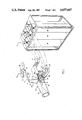
- FIG. 1 is a general perspective view of a particle classifier with portion sectioned for clarity.
- FIG. 2 is a section on the line 2.2, on an enlarged scale, of the classifier of FIG. 1.
- FIG. 3 is a sectional view on an enlarged scale on the line 3.3. of FIG. 1 and
- FIG. 4 is a sectional view on the line 4--4 of FIG. 1.
- a classifier 20 includes an inlet duct 22 that delivers classifying air to the interior 24 of a housing 26.
- the inlet duct is shaped using state of art aerodynamics to provide a uniform and laminar flow pattern to the classifying air to prevent turbulence of the classifying air affecting the performance of the classifier.
- the housing 26 is formed from upper and lower walls 28, 30 respectively and side walls 32.
- the housing 26 has a generally rectangular cross-section and an elongated slit 34 is formed in the upper wall 28 and extends the full width thereof.
- the housing 26 splits into a plurality of discrete passages 36, in this case 5, designated by the suffixes a through e respectively, that provide collection means for the classified material.
- Each of the passages 36 is connected by a conduit 37 to a filter bag 38 of conventional construction so that particulate material entrained in the air entering the passage is retained within the filter bag 38 for subsequent removal.
- the particulate material to be classified is contained within a hopper 40 and is introduced into the interior 24 of housing 2,6 by secondary air supplied through a supply conduit 42 that is connected to the slit 34.
- material from the hopper is entrained within the secondary air and conveyed through the supply conduit 42 to the interior of the housing 26 where it is classified and enters one of the passages 36 for collection in the filter bag 38.
- the slit 34 includes an upstream and downstream edge 44, 46 respectively. These edges extend across the full width of the upper wall 28 of the housing 26.
- a convexly curved surface 48 is positioned adjacent the downstream edge 46 and protrudes into the interior of the housing 26.
- the convex surface 48 extends through an angle of 90° and terminates in an upper partition 50 that serves as a continuation of the upper wall 28.
- the passages 36 are defined downstream of the convex surface 48 by partitions 52 that extend the full width of the housing 26.
- the leading edge 54 of each of the partitions 52 is tapered to provide a knife edge so that a minimum frontal area is presented to the particles that may impinge on it.
- the partitions 52a and 52b define the passages 36a and 36b respectively. These passages are generally aligned with the classifying airstream and therefore present a minimum disturbance to the flow of air through the passages.
- the passages 36 c, d, and e are inclined at an angle to the direction of airflow.
- the partition 52c merges with the partition 52b to provide a nose 56 that has a downwardly curved upper surface 58.
- the partitions 52d and e are parallel to the partition 52c and the lower surface 30 is bent as indicated at 60 so that it extends parallel to the partition 52d.
- the passages 36c, d and e are defined between parallel partitions and have a constant cross-sectional area.
- Air flow through each of the passages 36 is controlled by a butterfly valve 62 located in the conduit 37.
- the valve 62 comprises a plate 64 that is connected to a spindle 66 for movement therewith.
- the mass flow in each passage is measured by a venturi 63 that has a pair of presure taps 65, 67.
- a transducer 61 provides a signal proportional to the differntial pressure at the two taps 65, 67 which forms input into a comparitor 69.
- the second input to the comparitor 69 is derived from a controller 71 and the error signal produced by the comparitor 69 is used to control a servomotor 73 connected to the spindle 66 and thus maintain the air flow at the rate determined by the controller 71.
- the butterfly valves 62 are used to control the mass flow in each of the passages and to provide a condition in which the mass flow through each passage is balanced in the same ratio as the area of the airstream intercepted by each passage. In this way the airstream intercepted by each passage is completely swallowed by that passage and a minimum of disturbance to the laminar air flow upstream of the slit is obtained.
- the particulate material is delivered to the slit 34 through the supply conduit 42 that includes a vertical duct 68 and a generally horizontal rectangular conduit 70.
- the duct 68 is defined between a pair of lateral walls 72, 74 that diverge away from the slit 34.
- the duct 68 is designed to provide a constant area cross-section and therefore as the walls diverge, the edges of the walls also converge toward one another.
- the ducts 68 and 70 are interconnected by an elbow 76 that includes an inclined surface 78 extending from the upstream lateral wall 72. Material is entrained in the secondary air supply provided to the supply conduit 32 by means of the hopper that is best seen in FIG. 3.
- the hopper 40 includes a frusto conical body 80 having a horizontal flange 82 at its upper end.
- the flange 82 receives a cover plate 84 that is connected through a bleed pipe 86 to the secondary air supply.
- the lower end of the body 80 is centered over an aperture 88 in the rectangular duct 70 and flow from the hopper body 80 into the duct 70 is controlled by means of a valve member 90.
- the valve member 90 is mounted upon a threaded stem 92 that is rotatable within a boss 94.
- a handle 96 is provided to rotate the stem within the boss so that rotation of the stem moves the valve member 90 toward or away from the aperture to vary the spacing between the edge of the valve member 90 and the lower portion of the body 80.
- Air bled into the hopper through the bleed pipe 86 ensures an equalization of pressure across the material and so prevents the particulate material being dispersed within the hopper body 80.
- the classifying air flow is fed to the interior of the housing 26 and the secondary air flow supplied to the supply conduit 42.
- the butterfly valves 62 are adjusted so that the mass flow in each of the passages 36 is in the correct ratio and so that the disturbance to the laminar air flow being presented to the interior of the housing is minimal.
- the valve member 90 is then opened to allow particulate material to flow into the supply conduit 42 and be entrained in the secondary air supply.
- the entrained material impinges upon the inclined surface 78 in the elbow 76 and thereby undergoes an abrupt change of direction that will tend to break down any agglomerations that may occur in the material.
- the material is then fed in a uniform fashion through the vertical duct 68 to issue from the slit 34 at relatively high speed in a direction generally perpendicular to the direction of flow of the classifying air.
- the width of the slit and the curvature of the surface 48 are chosen such that the secondary airstream is subject to the Coanda effect which will divert the secondary airstream through 90° so that it flows parallel to the classifying air flow without interfering with it.
- the relatively high velocity of the secondary air stream imparts sufficient momentum to the particles that they segregate from the secondary air stream and are projected into the classifying airstream at a uniform velocity.
- the differences in D/m between the different size particles cause the particles to take different trajectories which will fall into one of the passages 36. From there the particles pass into the filters 38 where the particles are collected as the air is dispersed to the atmosphere.
- the trajectory of the different size particles can be predicted and so it is possible to place the leading edge 54 of each of the partitions 52 at a point that will provide the desired cut size of the particles.
- the partitions 52 are orientated such that they are generally parallel to the trajectory of the particles that will fall within the passages and thus the tendency of the particles to bounce backward out of the passages is minimized.
- the leading edges of the partitions 52c, d and e have been disposed on a common line extending at an included angle of 41° from the lower surface 30.
- the position of the leading edges can be chosen to select the desired cut size or alternatively the mean velocity of either the secondary air or the classifying air may be changed to vary the cut size with fixed partitions.
Landscapes
- Chemical & Material Sciences (AREA)
- Dispersion Chemistry (AREA)
- Physics & Mathematics (AREA)
- Health & Medical Sciences (AREA)
- Life Sciences & Earth Sciences (AREA)
- Analytical Chemistry (AREA)
- Biochemistry (AREA)
- General Health & Medical Sciences (AREA)
- General Physics & Mathematics (AREA)
- Immunology (AREA)
- Pathology (AREA)
- Combined Means For Separation Of Solids (AREA)
Priority Applications (5)
| Application Number | Priority Date | Filing Date | Title |
|---|---|---|---|
| US06/596,952 US4657667A (en) | 1984-04-05 | 1984-04-05 | Particle classifier |
| EP85302292A EP0159163A3 (de) | 1984-04-05 | 1985-04-02 | Vorrichtung zur Teilchenklasseneinteilung |
| CA000478270A CA1250815A (en) | 1984-04-05 | 1985-04-03 | Particle classifier |
| JP60070173A JPS618178A (ja) | 1984-04-05 | 1985-04-04 | 粒子選別装置 |
| AU48162/85A AU4816285A (en) | 1984-04-05 | 1985-10-01 | Particle classifier |
Applications Claiming Priority (1)
| Application Number | Priority Date | Filing Date | Title |
|---|---|---|---|
| US06/596,952 US4657667A (en) | 1984-04-05 | 1984-04-05 | Particle classifier |
Publications (1)
| Publication Number | Publication Date |
|---|---|
| US4657667A true US4657667A (en) | 1987-04-14 |
Family
ID=24389418
Family Applications (1)
| Application Number | Title | Priority Date | Filing Date |
|---|---|---|---|
| US06/596,952 Expired - Fee Related US4657667A (en) | 1984-04-05 | 1984-04-05 | Particle classifier |
Country Status (5)
| Country | Link |
|---|---|
| US (1) | US4657667A (de) |
| EP (1) | EP0159163A3 (de) |
| JP (1) | JPS618178A (de) |
| AU (1) | AU4816285A (de) |
| CA (1) | CA1250815A (de) |
Cited By (21)
| Publication number | Priority date | Publication date | Assignee | Title |
|---|---|---|---|---|
| US4802977A (en) * | 1986-05-12 | 1989-02-07 | Canon Kabushiki Kaisha | Process for size separating toner particles |
| EP0266778A3 (en) * | 1986-11-06 | 1989-05-17 | Kabushiki Kaisha Kobe Seiko Sho Also Known As Kobe Steel Ltd. | Apparatus for classifying particles |
| EP0608902A1 (de) * | 1993-01-29 | 1994-08-03 | Canon Kabushiki Kaisha | Gasstrom-Sichter, Verfahren zum Sichten mittels eines Gasstroms, Verfahren und Vorrichtung zur Tonerherstellung |
| US5348163A (en) * | 1993-01-19 | 1994-09-20 | Cabot Corporation | Method and apparatus for separating fine particles |
| US5351832A (en) * | 1993-03-29 | 1994-10-04 | Stripping Technologies, Inc. | Control system for cleaning systems |
| EP0790495A1 (de) * | 1996-02-15 | 1997-08-20 | Commissariat A L'energie Atomique | Dynamischer Beweglichkeitsselektor für Aerosolteilchen |
| DE19718158A1 (de) * | 1997-04-29 | 1998-11-05 | Kvaerner Panel Sys Gmbh | Verfahren und Vorrichtung zum windsichtenden Separieren |
| US5931306A (en) * | 1994-01-25 | 1999-08-03 | Canon Kabushiki Kaisha | Gas current classifier and process for producing toner |
| US6012343A (en) * | 1996-02-15 | 2000-01-11 | Commissariat A L'energie Atomique | Charged particle selector as a function of particle electrical mobility and relaxation time |
| CN1054554C (zh) * | 1995-07-25 | 2000-07-19 | 佳能株式会社 | 气流分级机和生产调色剂的工艺 |
| CN1054553C (zh) * | 1994-09-21 | 2000-07-19 | 佳能株式会社 | 气流分级器及生产调色剂的方法 |
| US6454098B1 (en) | 2001-06-06 | 2002-09-24 | The United States Of America As Represented By The Secretary Of Agriculture | Mechanical-pneumatic device to meter, condition, and classify chaffy seed |
| WO2004096444A1 (de) * | 2003-04-25 | 2004-11-11 | Siemens Aktiengesellschaft | Mikrofluidische einrichtung zur gesteuerten einleitung eines fluids in einen kanal |
| US20070095726A1 (en) * | 2005-10-28 | 2007-05-03 | Tihiro Ohkawa | Chafftron |
| US20070227591A1 (en) * | 2004-05-25 | 2007-10-04 | Jeroen Wissink | Device for Generating Microspheres From a Fluid, Method of Injecting at Least One First Fluid Into a Second Fluid, and an Injection Plate |
| US20110271739A1 (en) * | 2010-05-10 | 2011-11-10 | Goohs Kevin J | Particulate matter monitor |
| US20140301794A1 (en) * | 2013-02-23 | 2014-10-09 | Phillip Douglas | Material separator for a vertical pneumatic system |
| US9394120B2 (en) | 2013-02-23 | 2016-07-19 | Phillip Douglas | Material separator for a vertical pneumatic system |
| WO2017201136A1 (en) * | 2016-05-17 | 2017-11-23 | Dust Company, Inc. | Sampling probe apparatus for collecting a sample of a gas stream containing particulate matter and method of using the same |
| EP3434379A1 (de) * | 2017-07-24 | 2019-01-30 | Zeppelin Systems GmbH | Verfahren und vorrichtung zur abscheidung von feinen partikeln in einem flachabscheider |
| CN112945823A (zh) * | 2021-02-22 | 2021-06-11 | 浙江浙能嘉华发电有限公司 | 一种用于流场中的颗粒富集装置及富集方法 |
Families Citing this family (2)
| Publication number | Priority date | Publication date | Assignee | Title |
|---|---|---|---|---|
| US11389833B1 (en) * | 2021-09-09 | 2022-07-19 | Tate & Lyle Solutions Usa Llc | Curvilinear surface classification of feed stock |
| EP4174316B1 (de) | 2021-10-29 | 2025-08-13 | Agilent Technologies, Inc. | Vakuumpumpe mit einer gasballastanordnung |
Citations (13)
| Publication number | Priority date | Publication date | Assignee | Title |
|---|---|---|---|---|
| FR828125A (fr) * | 1937-01-21 | 1938-05-11 | Trieur séparateur | |
| US2694492A (en) * | 1954-11-16 | Rumpf ettal | ||
| CA522988A (en) * | 1956-03-20 | Rumpf Hans | Flow separators | |
| US2828011A (en) * | 1953-03-04 | 1958-03-25 | Superior Separator Company | Stratifier and air separator |
| US2846151A (en) * | 1953-08-17 | 1958-08-05 | Bayer Ag | Selective disintegration and separation of pigments |
| CA611838A (en) * | 1961-01-03 | Erdmenger Rudolf | Granulation of pulverous substances | |
| US2999563A (en) * | 1956-10-19 | 1961-09-12 | Bayer Ag | Arrangement for separating out fine solid particles dispersed in gases |
| US3506119A (en) * | 1967-02-21 | 1970-04-14 | Hans Rumpf | Method and apparatus for classifying by gravity a granular material mixture |
| US3952207A (en) * | 1973-02-01 | 1976-04-20 | Leschonski K | Method and means for determination of particle size distributions in a mass flow of a granular material |
| US4132634A (en) * | 1974-09-17 | 1979-01-02 | Hans Rumpf | Method of an apparatus for sifting particulate material in a cross-current |
| US4153541A (en) * | 1975-08-27 | 1979-05-08 | Hans Rumpf | Method and apparatus for the continuous centrifugal classifying of a continuous flow of particulate material in a deflected flow |
| US4213852A (en) * | 1979-01-15 | 1980-07-22 | Bernard Etkin | Method and apparatus for particle classification |
| US4321134A (en) * | 1978-09-28 | 1982-03-23 | Leschonski K | Method of and sorting assembly for dry sorting granular mixtures of two or more polydispersed components |
Family Cites Families (3)
| Publication number | Priority date | Publication date | Assignee | Title |
|---|---|---|---|---|
| GB1161881A (en) * | 1965-11-22 | 1969-08-20 | Ici Ltd | Granulation. |
| ES422623A1 (es) * | 1973-02-01 | 1976-05-01 | Leschonski | Procedimiento y aparato para determinar distribuciones de tamanos de particulas en una corriente cuantitativa de mate-rial granulado. |
| GB1591650A (en) * | 1977-12-28 | 1981-06-24 | Boeing Co | Air classifier |
-
1984
- 1984-04-05 US US06/596,952 patent/US4657667A/en not_active Expired - Fee Related
-
1985
- 1985-04-02 EP EP85302292A patent/EP0159163A3/de not_active Withdrawn
- 1985-04-03 CA CA000478270A patent/CA1250815A/en not_active Expired
- 1985-04-04 JP JP60070173A patent/JPS618178A/ja active Pending
- 1985-10-01 AU AU48162/85A patent/AU4816285A/en not_active Abandoned
Patent Citations (13)
| Publication number | Priority date | Publication date | Assignee | Title |
|---|---|---|---|---|
| US2694492A (en) * | 1954-11-16 | Rumpf ettal | ||
| CA522988A (en) * | 1956-03-20 | Rumpf Hans | Flow separators | |
| CA611838A (en) * | 1961-01-03 | Erdmenger Rudolf | Granulation of pulverous substances | |
| FR828125A (fr) * | 1937-01-21 | 1938-05-11 | Trieur séparateur | |
| US2828011A (en) * | 1953-03-04 | 1958-03-25 | Superior Separator Company | Stratifier and air separator |
| US2846151A (en) * | 1953-08-17 | 1958-08-05 | Bayer Ag | Selective disintegration and separation of pigments |
| US2999563A (en) * | 1956-10-19 | 1961-09-12 | Bayer Ag | Arrangement for separating out fine solid particles dispersed in gases |
| US3506119A (en) * | 1967-02-21 | 1970-04-14 | Hans Rumpf | Method and apparatus for classifying by gravity a granular material mixture |
| US3952207A (en) * | 1973-02-01 | 1976-04-20 | Leschonski K | Method and means for determination of particle size distributions in a mass flow of a granular material |
| US4132634A (en) * | 1974-09-17 | 1979-01-02 | Hans Rumpf | Method of an apparatus for sifting particulate material in a cross-current |
| US4153541A (en) * | 1975-08-27 | 1979-05-08 | Hans Rumpf | Method and apparatus for the continuous centrifugal classifying of a continuous flow of particulate material in a deflected flow |
| US4321134A (en) * | 1978-09-28 | 1982-03-23 | Leschonski K | Method of and sorting assembly for dry sorting granular mixtures of two or more polydispersed components |
| US4213852A (en) * | 1979-01-15 | 1980-07-22 | Bernard Etkin | Method and apparatus for particle classification |
Cited By (32)
| Publication number | Priority date | Publication date | Assignee | Title |
|---|---|---|---|---|
| US4802977A (en) * | 1986-05-12 | 1989-02-07 | Canon Kabushiki Kaisha | Process for size separating toner particles |
| EP0266778A3 (en) * | 1986-11-06 | 1989-05-17 | Kabushiki Kaisha Kobe Seiko Sho Also Known As Kobe Steel Ltd. | Apparatus for classifying particles |
| US4872972A (en) * | 1986-11-06 | 1989-10-10 | Kabushiki Kaisha Kobe Seiko Sho | Apparatus for classifying particles |
| US5348163A (en) * | 1993-01-19 | 1994-09-20 | Cabot Corporation | Method and apparatus for separating fine particles |
| EP0608902A1 (de) * | 1993-01-29 | 1994-08-03 | Canon Kabushiki Kaisha | Gasstrom-Sichter, Verfahren zum Sichten mittels eines Gasstroms, Verfahren und Vorrichtung zur Tonerherstellung |
| US5447275A (en) * | 1993-01-29 | 1995-09-05 | Canon Kabushiki Kaisha | Toner production process |
| US5351832A (en) * | 1993-03-29 | 1994-10-04 | Stripping Technologies, Inc. | Control system for cleaning systems |
| CN1054319C (zh) * | 1994-01-25 | 2000-07-12 | 佳能株式会社 | 气流分选机与生产色粉的方法 |
| US5931306A (en) * | 1994-01-25 | 1999-08-03 | Canon Kabushiki Kaisha | Gas current classifier and process for producing toner |
| CN1054553C (zh) * | 1994-09-21 | 2000-07-19 | 佳能株式会社 | 气流分级器及生产调色剂的方法 |
| CN1054554C (zh) * | 1995-07-25 | 2000-07-19 | 佳能株式会社 | 气流分级机和生产调色剂的工艺 |
| FR2745084A1 (fr) * | 1996-02-15 | 1997-08-22 | Commissariat Energie Atomique | Selecteur de mobilite dynamique des particules d'un aerosol |
| US6012343A (en) * | 1996-02-15 | 2000-01-11 | Commissariat A L'energie Atomique | Charged particle selector as a function of particle electrical mobility and relaxation time |
| US5939649A (en) * | 1996-02-15 | 1999-08-17 | Commissariat A L'energie Atomique | Dynamic mobility selector for aerosol particles |
| EP0790495A1 (de) * | 1996-02-15 | 1997-08-20 | Commissariat A L'energie Atomique | Dynamischer Beweglichkeitsselektor für Aerosolteilchen |
| DE19718158A1 (de) * | 1997-04-29 | 1998-11-05 | Kvaerner Panel Sys Gmbh | Verfahren und Vorrichtung zum windsichtenden Separieren |
| DE19718158C2 (de) * | 1997-04-29 | 2003-04-24 | Kvaerner Panel Sys Gmbh | Verfahren und Vorrichtung zum windsichtenden Separieren |
| US6454098B1 (en) | 2001-06-06 | 2002-09-24 | The United States Of America As Represented By The Secretary Of Agriculture | Mechanical-pneumatic device to meter, condition, and classify chaffy seed |
| WO2004096444A1 (de) * | 2003-04-25 | 2004-11-11 | Siemens Aktiengesellschaft | Mikrofluidische einrichtung zur gesteuerten einleitung eines fluids in einen kanal |
| US20070227591A1 (en) * | 2004-05-25 | 2007-10-04 | Jeroen Wissink | Device for Generating Microspheres From a Fluid, Method of Injecting at Least One First Fluid Into a Second Fluid, and an Injection Plate |
| US8100348B2 (en) * | 2004-05-25 | 2012-01-24 | Nanomi B.V. | Device for generating microspheres from a fluid, method of injecting at least one first fluid into a second fluid, and an injection plate |
| US20070095726A1 (en) * | 2005-10-28 | 2007-05-03 | Tihiro Ohkawa | Chafftron |
| US20110271739A1 (en) * | 2010-05-10 | 2011-11-10 | Goohs Kevin J | Particulate matter monitor |
| US8726720B2 (en) * | 2010-05-10 | 2014-05-20 | Thermo Fisher Scientific Inc. | Particulate matter monitor |
| US20140301794A1 (en) * | 2013-02-23 | 2014-10-09 | Phillip Douglas | Material separator for a vertical pneumatic system |
| US9394120B2 (en) | 2013-02-23 | 2016-07-19 | Phillip Douglas | Material separator for a vertical pneumatic system |
| US10106338B2 (en) * | 2013-02-23 | 2018-10-23 | Phillip Allan Douglas | Material separator for a vertical pneumatic system |
| WO2017201136A1 (en) * | 2016-05-17 | 2017-11-23 | Dust Company, Inc. | Sampling probe apparatus for collecting a sample of a gas stream containing particulate matter and method of using the same |
| US10551284B2 (en) | 2016-05-17 | 2020-02-04 | Dust Company, Inc. | Sampling probe apparatus for collecting a sample of a gas stream containing particulate matter and method of using the same |
| EP3433596B1 (de) * | 2016-05-17 | 2024-08-21 | Dust Company, Inc. | Probenahmevorrichtung zur entnahme einer probe eines gasstroms mit teilchenförmigem material und verfahren zur verwendung davon |
| EP3434379A1 (de) * | 2017-07-24 | 2019-01-30 | Zeppelin Systems GmbH | Verfahren und vorrichtung zur abscheidung von feinen partikeln in einem flachabscheider |
| CN112945823A (zh) * | 2021-02-22 | 2021-06-11 | 浙江浙能嘉华发电有限公司 | 一种用于流场中的颗粒富集装置及富集方法 |
Also Published As
| Publication number | Publication date |
|---|---|
| EP0159163A3 (de) | 1987-03-11 |
| EP0159163A2 (de) | 1985-10-23 |
| CA1250815A (en) | 1989-03-07 |
| JPS618178A (ja) | 1986-01-14 |
| AU4816285A (en) | 1987-04-02 |
Similar Documents
| Publication | Publication Date | Title |
|---|---|---|
| US4657667A (en) | Particle classifier | |
| US4153541A (en) | Method and apparatus for the continuous centrifugal classifying of a continuous flow of particulate material in a deflected flow | |
| EP0266778B1 (de) | Vorrichtung zum Klassieren von Partikeln | |
| US3311234A (en) | Process and apparatus for pneumatically separating solid particles | |
| CN107971224B (zh) | 用于颗粒分级的流场构建方法和分级装置 | |
| US4132634A (en) | Method of an apparatus for sifting particulate material in a cross-current | |
| US7104403B1 (en) | Static two stage air classifier | |
| US4950388A (en) | Separation of mixtures in a wind tunnel | |
| US7328808B2 (en) | Apparatus for sorting wood chips in separate fractions | |
| US3240335A (en) | Classifier with gas flow distributor | |
| JPS59145079A (ja) | 粉体粒子の風力分級装置 | |
| JP5885953B2 (ja) | 粉体分散装置および方法 | |
| US4545897A (en) | Classifier | |
| JP2727245B2 (ja) | 気流分級機及び気流分級方法 | |
| CN206240790U (zh) | 分级装置 | |
| US4759840A (en) | Particle classifier | |
| SU865430A1 (ru) | Устройство дл аэродинамической классификации сыпучих материалов | |
| JP3024923B2 (ja) | 気流搬送装置 | |
| US3288285A (en) | Air classifier | |
| JP3176779B2 (ja) | 気流分級機及び気流分級方法 | |
| JP3510346B2 (ja) | 気流分級方法及び気流分級機並びに該分級機を備えた分級装置 | |
| JP2715325B2 (ja) | 気流式分級機及び気流式分級方法 | |
| JPS64108B2 (de) | ||
| JPH08276159A (ja) | 気流分級方法及び装置 | |
| JP3679163B2 (ja) | 気流分級機 |
Legal Events
| Date | Code | Title | Description |
|---|---|---|---|
| FPAY | Fee payment |
Year of fee payment: 4 |
|
| REMI | Maintenance fee reminder mailed | ||
| LAPS | Lapse for failure to pay maintenance fees | ||
| FP | Lapsed due to failure to pay maintenance fee |
Effective date: 19950419 |
|
| STCH | Information on status: patent discontinuation |
Free format text: PATENT EXPIRED DUE TO NONPAYMENT OF MAINTENANCE FEES UNDER 37 CFR 1.362 |