US4766490A - Method of and device for estimating motion in a sequence of pictures - Google Patents
Method of and device for estimating motion in a sequence of pictures Download PDFInfo
- Publication number
- US4766490A US4766490A US06/934,048 US93404886A US4766490A US 4766490 A US4766490 A US 4766490A US 93404886 A US93404886 A US 93404886A US 4766490 A US4766490 A US 4766490A
- Authority
- US
- United States
- Prior art keywords
- elements
- picture
- displacement
- branches
- group
- Prior art date
- Legal status (The legal status is an assumption and is not a legal conclusion. Google has not performed a legal analysis and makes no representation as to the accuracy of the status listed.)
- Expired - Fee Related
Links
Images



Classifications
-
- H—ELECTRICITY
- H04—ELECTRIC COMMUNICATION TECHNIQUE
- H04N—PICTORIAL COMMUNICATION, e.g. TELEVISION
- H04N5/00—Details of television systems
- H04N5/76—Television signal recording
-
- G—PHYSICS
- G06—COMPUTING OR CALCULATING; COUNTING
- G06T—IMAGE DATA PROCESSING OR GENERATION, IN GENERAL
- G06T7/00—Image analysis
- G06T7/20—Analysis of motion
-
- H—ELECTRICITY
- H04—ELECTRIC COMMUNICATION TECHNIQUE
- H04N—PICTORIAL COMMUNICATION, e.g. TELEVISION
- H04N19/00—Methods or arrangements for coding, decoding, compressing or decompressing digital video signals
- H04N19/50—Methods or arrangements for coding, decoding, compressing or decompressing digital video signals using predictive coding
- H04N19/503—Methods or arrangements for coding, decoding, compressing or decompressing digital video signals using predictive coding involving temporal prediction
- H04N19/51—Motion estimation or motion compensation
-
- H—ELECTRICITY
- H04—ELECTRIC COMMUNICATION TECHNIQUE
- H04N—PICTORIAL COMMUNICATION, e.g. TELEVISION
- H04N5/00—Details of television systems
- H04N5/14—Picture signal circuitry for video frequency region
- H04N5/144—Movement detection
- H04N5/145—Movement estimation
Definitions
- the present invention relates to a method of and a device for estimating motions in a sequence of pictures.
- Such a method is essentially applicable in the field of digital signal processing, for information compression, picture quality improvement, target tracking, etc. and, for example, in digital picture coding devices for the reduction of the rate of information to be transmitted or to be registered when, for example, magnetoscopes are concerned.
- the object of the invention is to propose a method of estimating motion in a sequence of pictures remedying such drawbacks.
- the invention relates to a method which is characterized in that the luminosity of each element is expressed in a digital form and each of these elements is defined by two coordinates (m,n) respectively, indicating the rank row of the picture line in which the element is present, and the row of the element on this m th line and in that it consists of:
- (B) defining three groups for the elements, classified in fixed elements, moving elements and exposed elements in which groups the elements are classified with a delay of L elements according to scanning of the picture by examining a given number of possible group sequences for the L elements succeeding the current element X considered and in accordance with a given classification criterion, said criterion for the fixed and moving elements being the difference in luminosity between two successive pictures taking the displacement of the elements of one picture with respect to the other into account for the moving elements, and being the difference in luminosity between two adjacent lines for the exposed elements;
- (C) constructing a classification tree whose 3 L branches at each successive level are equal in number to those of the possible groups, and which correspond from the first to the L th level to the sequences of possible groups for the L considered successive elements of the picture sequence;
- a second parameter referred to as cumulated distortion representative of the cumulative sum of the classification errors of the preceding elements the groups of these elements being those of the tree branches traversed to arrive at the current branch, each classification error being rendered minimum by taking into account the influence of a displacement estimated for an element on the displacement estimated for the L following elements, said influence being only examined, among the 3 L possible branches of the tree, for M branches of the weakest cumulated distortion referred to as surviving branches, M being a limited number chosen to be substantially smaller than the maximum number of branches 3 L ;
- the method thus proposed is advantageous in the sense that a different, more precise classification is achieved of picture elements involving a category referred to as exposed elements which permits of reinitializing the motion estimation method at the area of the contours of the moving objects.
- exposed elements which permits of reinitializing the motion estimation method at the area of the contours of the moving objects.
- the possible correlation between elements is taken into account by awaiting the appearance of a given number of binary elements for taking a decision about the class of an element.
- FIG. 1 shows an example of the classification tree of picture elements in which a distinction is made for each element between its possible relationship with a first group of fixed elements, a second group of moving elements or a third group referred to as exposed elements;
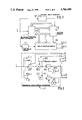
- FIG. 2 shows an embodiment of an estimation device according to the invention
- FIG. 3 shows an embodiment of the recursive displacement estimator provided in the device of FIG. 2;
- FIG. 4 shows the four elements A, B, C, D whose luminosity is utilized for determining that of the element X-DEPi;
- FIG. 5 shows an embodiment of the delay decision circuit provided in the device of FIG. 2;
- FIG. 6 shows an embodiment of a preservation and updating circuit provided in the circuit of FIG.5.
- the method and device for estimating motion which will be described hereinafter is based on a recursive method of displacement estimation with a delay decision in order to initialize the estimator and to improve its performance. It is supposed that for each of the successive pictures, the value of the luminance of each picture element is digitized, and that each of these elements is defined by two coordinates (m, n), m being the row of the picture line and n being the element row on this m th line.
- the elements of this picture are classified with a delay of L elements in one of the three following groups:
- each considered element there is associated with each considered element, a displacement vector whose direction and amplitude are to be corrected from one element to the following as a function of the group of one or several preceding elements and of the classification error caused by this or these elements.
- This error is not defined in an identical manner for the three groups: for the two first groups mentioned it is equal to the difference in luminosity of the element and its homologue element in the preceding picture, taking into account the displacement which has taken place with respect to this preceding picture, while for the elements of the third group, the estimation error is determined by variation of the luminosity of the current picture in the vertical direction, that is to say, from one line to the other.
- the objective classification criterion which will be adopted in this case is deduced from this distribution into three categories of elements, namely the difference in luminosity between two successive pictures for the two first types of elements, taking into account the displacement of the elements for the moving elements and the difference in luminosity between two adjacent lines for the third type of elements.
- the recursive displacement evaluation method proposed is thus to distinguish the three defined element types, and is then to become interactive in an appropriate manner.
- the initialization of the estimation process must permit of ultimately recovering the displacement of the object by starting from an estimation of zero for the elements tracing the contour of the object in motion, that is to say, the displacement vector is not expected at its initialization for the elements forming this contour.
- Such elements should thus be classified in the third category of elements, that of the exposed elements.
- the simplified construction method of the classification tree is thus the following, defining the intersection of the various branches as the node and as a tree comprising L levels, each corresponding to a picture element. If we start from the first picture element it may a priori be associated with one of the three defined groups (the group of fixed elements, that of the moving elements, that of the exposed elements). In the classification tree shown in FIG.1, three branches relating to these three groups are thus created, and two parameters are associated with each branch.
- the first of these parameters is the displacement vector denoted D (tree level; possible group), the level being between 0 and L, and the group being denoted by f, m or d (group of fixed elements, moving elements, exposed elements, respectively).
- D tree level
- f, m or d group of fixed elements, moving elements, exposed elements, respectively.
- this displacement vector is dependent on the one associated with the preceding node (in this case the zero node for the first of the L elements considered) and with respect to this preceding vector, it is re-updated by an estimation error D for distinguishing the classification error.
- the displacement vector is simply equal to the said estimation error, which in this case is understood to mean the initialization of the motion estimator (when there is no preceding displacement vector), and thus in the same principle of the method is understood to mean the existence of a rupture in the recursive estimation character.
- the estimation error is itself proportional to the product of the spatial variation of the luminosity of the homologue element, taking the displacement in the preceding picture into account, and to the difference in luminosity between the current element and its homologue element in the preceding picture.
- the second of these parameters is the cumulated distortion denoted dist (level of the tree, possible group) as described hereinbefore.
- dist level of the tree, possible group
- the groups of these elements are those of the traversed branches in the classification tree to arrive at the current branch.
- a vector D (.,.) and a distortion dist (.,.) are associated with each branch, but in order not to crowd the Figure, not all these indications are shown because the sub-divisions of the tree are numerous.
- this distortion is equal to the squared error of the branches of the first tree levels.
- three branches are constructed in the tree at the extremity of each branch of the preceding level, and the new corresponding parameters (displacement vector, cumulated distortion) are calculated.
- This procedure is repeated for each new picture element, and the number of branches is multiplied by three, at least as long as this global number remains below a limit M of the number of authorized branches, which is substantially smaller than the number of maximum possible branches for each element.
- M branches of the weakest distortion which are those referred to as surviving branches, are in the fact retained in the construction of the tree, whereas the 3 L -M other branches are eliminated, for example, by giving their distortion an infinite value.
- the method permits of determining, at the arrival of each new element, a group and a displacement vector which correspond to the element preceding this new element by L elements. For the L last picture elements or rather for the picture sequence when an entire sequence is chosen (for example, 25 picture in one second if one second of pictures is chosen to be treated), one simply avoids taking a majority decision.
- FIG. 2 shows an embodiment of an estimation device permitting of carrying out the method.
- the device shown comprises an input connection E at which the digital samples constituting the input picture are present, (for example at a sampling frequency of 13.5 MHz in the case of a video picture).
- the input picture is applied at one end to a picture memory 10 which has the function of preserving the preceding picture during the processing of the current picture.
- a picture delay circuit 20 is disposed between the connection E and the input of the picture memory 10.
- the input picture is applied to a line delay circuit 30, which provides access to the corresponding element of the preceding line of the current picture (in the case of exposed elements of the third group).
- the input picture is finally applied to a recursive displacement estimator 40, which updates at each step in the classification tree, the displacement vectors related to the nodes of the tree.
- These M displacement vectors are applied to a delay decision circuit 50, which selects the best vector therefrom according to the majority decision process mentioned hereinbefore as being the displacement estimation of the element in question, which circuit 50 thus determines a group and a displacement vector for each element of the sequence of pictures but this decision occurs with a delay of L elements.
- the picture memory 10 which is intended to provide access to the elements of the preceding picture by taking into account the displacement vector receives from the recursive displacement estimator 40, the M displacement vectors (the same as those applied to the circuit 50) concerning the M successive nodes of the : classification tree and applies them to this estimator, a sampling period later and after an indirect address the luminosity of the homologue elements of the new current element X, the designation X symbolizing the coordinates m, n of the element, that is to say, of the elements X-DEP1, X-DEP1, X-DEP2, . . .,X-DEPM of the preceding picture.
- the memory 10 also provides the circuit 50 with this luminosity of the said homologue elements.
- FIG. 3 shows an embodiment of the recursive displacement estimator 40.
- This estimator 40 comprises M similar circuits each operating at one of the M outputs of the picture memory 10, and thus only one of the circuits composed of the elements 401i to 415i (i varying between 1 and M) is written.
- a subtractor 401i receives at one end, for example, at its positive input, the input picture present at the input connection E and at the other end, at its negative input, the output signal of the picture memory 10, that is to say, the i th luminosity, and supplies as a difference signal, the difference in luminosity between the current element X and the homologue element X-DEPi of the preceding picture.
- This output signal of the subtractor 401i is applied to two multipliers 402i and 412i, making the product by means of the spatial gradient of the luminosity at the element X-DEPi, which spatial gradient itself is supplied in a vectorial form (gradient in the direction m, gradient in the direction n) by a gradient circuit 403i which acts on the luminosity of the neighboring elements A, B, C, D of the element X-DEPi which is read in the picture memory 10.
- the vectors DEP1, DEP2, . . . , DEPM which are thus re-updated, are applied at one end to the picture memory 10 for the purpose of addressing, where they take the place of the preceding vectors and at the other end to the delay decision circuit 50 shown in FIG. 5 in a particular embodiment according to the invention.
- This circuit 50 comprises in the first place (M+2) subtractor circuits 501, 502 and 50(1) to 50(M) which calculate the classification errors by means of estimation of the luminosity difference between the elements of the preceding picture and the elements of the current pictures, except for the subtractor 502, in which this difference is estimated between the elements of the preceding line and those of the current line; the figures between brackets in the references 50(1) to 50(M) designate the nodes of the classification tree. The values thus obtained are then squared in the (M+2) circuits 511, 512 and 51(1) to 51(M).
- the output signal of these squaring circuits is applied to 3M first adders 521(1) to 521(M), 522(1) to 522(M) 523(1) to 523(M) in the following manner: 511 to 521(1) to 521(M), 512 to 522(1) to 522(M), 51(1) to 51(M) to 523(1) to 523(M), respectively.
- the 3M adders receive at their other inputs the distortions of the nodes present at the outputs of the M delay circuits 54(1) to 54(M), which are themselves preceded by M adders 53(1) to 53(M). The role of these adders and delay circuits is described below.
- the output signals of the 3M first adders represent the cumulated distortions of the 3M branches before elimination of 2M branches having the strongest distortion, and are applied to the sorting circuit 590.
- the latter is charged to sort among these 3M received signals those signals which represent the M weakest values of cumulated distortion and to apply them to the first inputs of the M adders 53(1) to 53(M) and to supply additionally these M distortion values and in conformity with each of them an index corresponding to the classification which they have at the input of the sorting circuit.
- This circuit 600 which is shown in a particular embodiment in FIG. 6, comprises in the present case, a decoding circuit 601, which extracts the two data of the number of the branch (from which the group is deduced) and the number of the node, for example, with the aid of a read-only memory programmed to provide for each address between 1 and 3M, a quotient and a rest calculated as indicated hereinafter: after having multiplied each index by 2 and divided each index (thus multiplied) by three, the quotient is deducted (a) which indicates the number of the node (between 1 and M) of the last level of the classification tree and (b) is the rest which is equal to 1/3, 0 or 2/3, which are values made to correspond, respectively, to the group of the branch with which the distortion is associated, that is to said, the first group of the fixed elements, the second group of the moving elements or the third group of the exposed elements.
- a decoding circuit 601 which extracts the two data of the number of the branch (from which the group is deduce
- the preservation and updating circuit comprises also 2M principal registers 602(1), 602(2), . . ., 602(M), 603(1), 603(2), . . ., 603(M) and 2M auxiliary register 612(1), 612(2), . . ., 612(M), 613(1), 613(2), . . ., 613(M).
- These 4M shift registers each comprise L positions for L words with respect to the length (that is to say, to the number of levels) of the classification tree.
- the first of these registers (that is to say, the 2M principal registers) memorize the data which relate to the most recent level (that is to say, the current element X of the picture) and so forth.
- the M principal registers (602(1) to 602(M) and M auxiliary registers 612(1) to 612(M) memorize the displacement vectors for the L successive levels of the classification tree, while the M principal registers 603(1) to 603(M) and the M auxiliary registers 613(1) to 613(M) memorize for the L successive levels the data of the group of surviving branches.
- the contents of these registers permit of a reconfiguration of the classification tree in such a way that the nodes are arranged in a decreasing order of their distortion, which reconfiguration is carried out as will be described in greater detail hereinafter.
- FIG. 6 shows at one end between the multiplier 621 and the principal registers 602(1) to 602(M) and at the other end between the auxiliary registers 612(1) to 612(M) and the same multiplier M respective transfer connections distinguished from the other tracks in the Figure in that they are each represented by means of a thicker arrow.
- M similar connections which would be shown in a manner exactly identical to the M connections mentioned above are are of course also present at one end between the multiplier 622 and the principal registers 603(1) to 603(M) and at the other end between the auxiliary registers 613(1) to 613(M) and this multiplier for permitting the same memorization, preservation, updating functions to be carried out as those authorized by the presence of M first connections.
- these M new connections between the elements 622, 603(1) to 603(M) and 613(1) to 613(M) are voluntarily omitted, and instead of showing these elements in solid lines they are shown in broken lines in the same way as the M connections leading from the decoder 601 to the registers 603(1) to 603(M), the M ⁇ L connections leading from the registers 603(1) to 603(M) to the registers 613(1) to 613(M) and the M connections leading from the registers 613(1) to 613(M) to the majority decision circuit 630.
- the contents of the 2M principal registers 602(1) to 602(M) and 603(1) to 603(M) are transferred in the 2M auxiliary registers 612(1) to 612(M) and 613(1) to 613(M), respectively, intended for preserving the classification tree before its reorganization.
- This transfer renders the 2M principal registers ready to receive the new configuration of the classification tree, without thereby losing the old tree.
- the contents of the 2M auxiliary registers 612(1) to 612(M) and 613(1) to 613(M) are applied by means of the multipliers 621 and 622 (621 for the displacement vectors, 622 for the group data) to the 2M principal registers 602(1) to to 602(M) and 603(1) to 603(M) in order to store the said contents in the principal registers in a decreasing order of the associated distortions.
- the principal registers 602(K) and 603(K) comprise, for example, after these transfer operations the displacement vectors and the groups of the branch of the tree, respectively, whose distortion is the K th in the decreasing order thereof.
- a delay decision is then taken by the majority decision circuit 630.
- This circuit in effect examines the L th words of the M principal registers 603(1) to 603(M) and determines the group whose number of occurrence is the largest (that is to say, the group which returns most frequently). If this is again the register 603(K), for example, which memorizes this group, the contents of the L th word of the principal registers 603(K) and 602(K) are considered as being the group G(X-L) and the displacement vector D(X-L) of the element X-L, respectively. It is these two data which are provided at the output of the majority decision circuit 630, that is to say, in fact at the output of the circuit 50 as indicated in FIG. 2.
- the cumulated distortion is given an infinite value or at least a very large value, for example, by the addition of a value which is higher than the maximum luminosity of the numbered picture.
- Output signals 615(1) to 615(M) of the circuit 600 which are equal to the maximum luminosity for branches to be deleted and are equal to zero for the other branches, are applied to the second respective inputs of the M adders 53(1) to 53(M) succeeded by delay circuits 54(1) to 54(M), respectively. These delay circuits delay the signals which traverse them by one sampling period. With the final decision now taken, the words of the 2M principal registers 602(1) to 602(M) and 603(1) are shifted downwards and these registers are ready for a new delay decision operation, each decision being of course followed by a shift by one unit of the principal and auxiliary registers.
Landscapes
- Engineering & Computer Science (AREA)
- Multimedia (AREA)
- Signal Processing (AREA)
- Computer Vision & Pattern Recognition (AREA)
- Physics & Mathematics (AREA)
- General Physics & Mathematics (AREA)
- Theoretical Computer Science (AREA)
- Compression Or Coding Systems Of Tv Signals (AREA)
- Image Analysis (AREA)
- Closed-Circuit Television Systems (AREA)
- Color Television Systems (AREA)
- Compression, Expansion, Code Conversion, And Decoders (AREA)
Applications Claiming Priority (2)
| Application Number | Priority Date | Filing Date | Title |
|---|---|---|---|
| FR8517303A FR2590701B1 (fr) | 1985-11-22 | 1985-11-22 | Procede et dispositif d'estimation de mouvement dans une sequence d'images |
| FR8517303 | 1985-11-22 |
Publications (1)
| Publication Number | Publication Date |
|---|---|
| US4766490A true US4766490A (en) | 1988-08-23 |
Family
ID=9325082
Family Applications (1)
| Application Number | Title | Priority Date | Filing Date |
|---|---|---|---|
| US06/934,048 Expired - Fee Related US4766490A (en) | 1985-11-22 | 1986-11-24 | Method of and device for estimating motion in a sequence of pictures |
Country Status (9)
| Country | Link |
|---|---|
| US (1) | US4766490A (de) |
| EP (1) | EP0224957B1 (de) |
| JP (1) | JPH0724071B2 (de) |
| KR (1) | KR940011597B1 (de) |
| CN (1) | CN1008874B (de) |
| AT (1) | ATE50877T1 (de) |
| AU (1) | AU6551686A (de) |
| DE (1) | DE3669408D1 (de) |
| FR (1) | FR2590701B1 (de) |
Cited By (6)
| Publication number | Priority date | Publication date | Assignee | Title |
|---|---|---|---|---|
| US4875094A (en) * | 1987-04-10 | 1989-10-17 | U.S. Philips Corporation | Method of and device for estimating motion in a sequence of pictures |
| US4963961A (en) * | 1989-06-16 | 1990-10-16 | Burle Technologies, Inc. | Vertical motion detector |
| US4965666A (en) * | 1987-11-27 | 1990-10-23 | U.S. Philips Corporation | Method of and arrangement for estimating and compensatiing motion in a sequence of pictures and a picture transmission system provided with such an arrangement |
| US5008745A (en) * | 1989-12-21 | 1991-04-16 | Burle Technologies, Inc. | Clock synchronized digital TV motion detector |
| US5089887A (en) * | 1988-09-23 | 1992-02-18 | Thomson Consumer Electronics | Method and device for the estimation of motion in a sequence of moving images |
| US5296925A (en) * | 1990-04-27 | 1994-03-22 | Canon Kabushiki Kaisha | Movement vector detection device |
Families Citing this family (4)
| Publication number | Priority date | Publication date | Assignee | Title |
|---|---|---|---|---|
| EP0294960B1 (de) * | 1987-06-09 | 1994-09-28 | Sony Corporation | Verarbeitung des Bewegungsvektors in Fernsehbildern |
| JP2569219B2 (ja) * | 1990-01-31 | 1997-01-08 | 富士通株式会社 | 動画像予測方式 |
| US5309237A (en) * | 1992-03-31 | 1994-05-03 | Siemens Corporate Research, Inc. | Apparatus and method of compensating image-sequences for motion |
| CN101610516B (zh) * | 2009-08-04 | 2011-12-21 | 华为技术有限公司 | 自组织网络中的入侵检测方法与设备 |
Citations (6)
| Publication number | Priority date | Publication date | Assignee | Title |
|---|---|---|---|---|
| US4218703A (en) * | 1979-03-16 | 1980-08-19 | Bell Telephone Laboratories, Incorporated | Technique for estimation of displacement and/or velocity of objects in video scenes |
| US4245248A (en) * | 1979-04-04 | 1981-01-13 | Bell Telephone Laboratories, Incorporated | Motion estimation and encoding of video signals in the transform domain |
| US4371895A (en) * | 1980-01-18 | 1983-02-01 | Nippon Electric Co., Ltd. | Coded video signal transmitting and receiving system |
| US4691230A (en) * | 1985-03-04 | 1987-09-01 | Kokusai Denshin Denwa Co., Ltd. | Motion vector detection system of a moving object on a screen |
| US4695882A (en) * | 1984-01-30 | 1987-09-22 | Kokusai Denshin Denwa Co., Ltd. | Movement estimation system for video signals using a recursive gradient method |
| US4703350A (en) * | 1985-06-03 | 1987-10-27 | Picturetel Corporation | Method and apparatus for efficiently communicating image sequences |
-
1985
- 1985-11-22 FR FR8517303A patent/FR2590701B1/fr not_active Expired
-
1986
- 1986-11-19 CN CN86107779A patent/CN1008874B/zh not_active Expired
- 1986-11-19 KR KR1019860009768A patent/KR940011597B1/ko not_active Expired - Fee Related
- 1986-11-19 AU AU65516/86A patent/AU6551686A/en not_active Abandoned
- 1986-11-20 EP EP86202058A patent/EP0224957B1/de not_active Expired - Lifetime
- 1986-11-20 DE DE8686202058T patent/DE3669408D1/de not_active Expired - Lifetime
- 1986-11-20 AT AT86202058T patent/ATE50877T1/de active
- 1986-11-21 JP JP61278538A patent/JPH0724071B2/ja not_active Expired - Lifetime
- 1986-11-24 US US06/934,048 patent/US4766490A/en not_active Expired - Fee Related
Patent Citations (6)
| Publication number | Priority date | Publication date | Assignee | Title |
|---|---|---|---|---|
| US4218703A (en) * | 1979-03-16 | 1980-08-19 | Bell Telephone Laboratories, Incorporated | Technique for estimation of displacement and/or velocity of objects in video scenes |
| US4245248A (en) * | 1979-04-04 | 1981-01-13 | Bell Telephone Laboratories, Incorporated | Motion estimation and encoding of video signals in the transform domain |
| US4371895A (en) * | 1980-01-18 | 1983-02-01 | Nippon Electric Co., Ltd. | Coded video signal transmitting and receiving system |
| US4695882A (en) * | 1984-01-30 | 1987-09-22 | Kokusai Denshin Denwa Co., Ltd. | Movement estimation system for video signals using a recursive gradient method |
| US4691230A (en) * | 1985-03-04 | 1987-09-01 | Kokusai Denshin Denwa Co., Ltd. | Motion vector detection system of a moving object on a screen |
| US4703350A (en) * | 1985-06-03 | 1987-10-27 | Picturetel Corporation | Method and apparatus for efficiently communicating image sequences |
Cited By (6)
| Publication number | Priority date | Publication date | Assignee | Title |
|---|---|---|---|---|
| US4875094A (en) * | 1987-04-10 | 1989-10-17 | U.S. Philips Corporation | Method of and device for estimating motion in a sequence of pictures |
| US4965666A (en) * | 1987-11-27 | 1990-10-23 | U.S. Philips Corporation | Method of and arrangement for estimating and compensatiing motion in a sequence of pictures and a picture transmission system provided with such an arrangement |
| US5089887A (en) * | 1988-09-23 | 1992-02-18 | Thomson Consumer Electronics | Method and device for the estimation of motion in a sequence of moving images |
| US4963961A (en) * | 1989-06-16 | 1990-10-16 | Burle Technologies, Inc. | Vertical motion detector |
| US5008745A (en) * | 1989-12-21 | 1991-04-16 | Burle Technologies, Inc. | Clock synchronized digital TV motion detector |
| US5296925A (en) * | 1990-04-27 | 1994-03-22 | Canon Kabushiki Kaisha | Movement vector detection device |
Also Published As
| Publication number | Publication date |
|---|---|
| JPS62131383A (ja) | 1987-06-13 |
| CN1008874B (zh) | 1990-07-18 |
| AU6551686A (en) | 1987-05-28 |
| ATE50877T1 (de) | 1990-03-15 |
| JPH0724071B2 (ja) | 1995-03-15 |
| FR2590701A1 (fr) | 1987-05-29 |
| EP0224957B1 (de) | 1990-03-07 |
| KR940011597B1 (ko) | 1994-12-22 |
| KR870005551A (ko) | 1987-06-09 |
| DE3669408D1 (de) | 1990-04-12 |
| FR2590701B1 (fr) | 1988-01-15 |
| CN86107779A (zh) | 1987-07-15 |
| EP0224957A1 (de) | 1987-06-10 |
Similar Documents
| Publication | Publication Date | Title |
|---|---|---|
| EP0400084B1 (de) | Implementationsschaltung für blockübereinstimmungsalgorithmus | |
| US4937666A (en) | Circuit implementation of block matching algorithm with fractional precision | |
| EP0614312B1 (de) | Videorauschreduktionsystem unter Verwendung einer Mehrbild-Bewegungsabschätzung, Unterdrückung von Abweichungen und Bahnkorrektur | |
| US5471252A (en) | Method and apparatus for estimating motion vector fields by rejecting local outliers | |
| Borshukov et al. | Motion segmentation by multistage affine classification | |
| US5907626A (en) | Method for object tracking and mosaicing in an image sequence using a two-dimensional mesh | |
| US4875094A (en) | Method of and device for estimating motion in a sequence of pictures | |
| AU616986B2 (en) | Maskable bilevel correlator | |
| JPH0520036B2 (de) | ||
| US5696836A (en) | Motion estimation processor architecture for full search block matching | |
| GB2254217A (en) | Edge detection method and apparatus for an image processing system | |
| JPH02278387A (ja) | 動かない背景を有するデイジタル像列内の動く対象物の検出および追跡のための方法 | |
| JPH02138678A (ja) | 電子画像の点の動きを推定するための多重予測方式 | |
| EP0069542B1 (de) | Datenverarbeitungseinrichtung | |
| JPH0724071B2 (ja) | 画像列における動き推定方法及び装置 | |
| KR101014637B1 (ko) | 화상 데이터 처리 장치 및 방법, 및 반도체 기억 장치 | |
| US5710603A (en) | Method for detecting motion vectors | |
| Seed et al. | Background updating for real-time image processing at TV rates | |
| JPH04248789A (ja) | 撮像された画像の中の動きの推定方法 | |
| FI91473B (fi) | DATV-koodaus- ja dekoodausmenetelmä ja -laite | |
| US5953458A (en) | Method and device for motion estimation | |
| RU2159958C1 (ru) | Устройство обработки цветных изображений | |
| US20030059089A1 (en) | Block matching at the fractional pixel level for motion estimation | |
| JP3046689B2 (ja) | 動きベクトル検出方法 | |
| WO1990001750A1 (en) | Intelligent scan image processor |
Legal Events
| Date | Code | Title | Description |
|---|---|---|---|
| AS | Assignment |
Owner name: U.S. PHILLPS CORPORATION, 100 EAST 42ND ST. NEW YO Free format text: ASSIGNMENT OF ASSIGNORS INTEREST.;ASSIGNOR:HAGHIRI, MOHAMMAD-REZA;REEL/FRAME:004673/0847 Effective date: 19870130 |
|
| FEPP | Fee payment procedure |
Free format text: PAYOR NUMBER ASSIGNED (ORIGINAL EVENT CODE: ASPN); ENTITY STATUS OF PATENT OWNER: LARGE ENTITY |
|
| FPAY | Fee payment |
Year of fee payment: 4 |
|
| FPAY | Fee payment |
Year of fee payment: 8 |
|
| REMI | Maintenance fee reminder mailed | ||
| LAPS | Lapse for failure to pay maintenance fees | ||
| FP | Lapsed due to failure to pay maintenance fee |
Effective date: 20000823 |
|
| STCH | Information on status: patent discontinuation |
Free format text: PATENT EXPIRED DUE TO NONPAYMENT OF MAINTENANCE FEES UNDER 37 CFR 1.362 |