US4900241A - Machine for portioning and cutting dough - Google Patents
Machine for portioning and cutting dough Download PDFInfo
- Publication number
- US4900241A US4900241A US07/283,775 US28377588A US4900241A US 4900241 A US4900241 A US 4900241A US 28377588 A US28377588 A US 28377588A US 4900241 A US4900241 A US 4900241A
- Authority
- US
- United States
- Prior art keywords
- dough
- cakes
- machine
- thickness
- frame
- Prior art date
- Legal status (The legal status is an assumption and is not a legal conclusion. Google has not performed a legal analysis and makes no representation as to the accuracy of the status listed.)
- Expired - Fee Related
Links
- 238000005520 cutting process Methods 0.000 title claims description 49
- 238000001125 extrusion Methods 0.000 claims description 11
- 238000001514 detection method Methods 0.000 claims description 7
- 239000006071 cream Substances 0.000 abstract description 15
- 239000000463 material Substances 0.000 abstract description 7
- 238000005259 measurement Methods 0.000 abstract description 7
- 240000004670 Glycyrrhiza echinata Species 0.000 abstract description 2
- 235000001453 Glycyrrhiza echinata Nutrition 0.000 abstract description 2
- 235000006200 Glycyrrhiza glabra Nutrition 0.000 abstract description 2
- 235000017382 Glycyrrhiza lepidota Nutrition 0.000 abstract description 2
- 229940010454 licorice Drugs 0.000 abstract description 2
- 235000009508 confectionery Nutrition 0.000 abstract 1
- 239000007788 liquid Substances 0.000 abstract 1
- 230000033001 locomotion Effects 0.000 description 13
- 239000003638 chemical reducing agent Substances 0.000 description 10
- 235000014510 cooky Nutrition 0.000 description 5
- 230000001276 controlling effect Effects 0.000 description 3
- 238000000034 method Methods 0.000 description 3
- 238000003825 pressing Methods 0.000 description 3
- 230000004308 accommodation Effects 0.000 description 2
- 230000001419 dependent effect Effects 0.000 description 2
- 238000012856 packing Methods 0.000 description 2
- 230000001105 regulatory effect Effects 0.000 description 2
- VVQNEPGJFQJSBK-UHFFFAOYSA-N Methyl methacrylate Chemical compound COC(=O)C(C)=C VVQNEPGJFQJSBK-UHFFFAOYSA-N 0.000 description 1
- 229920005372 Plexiglas® Polymers 0.000 description 1
- 230000003213 activating effect Effects 0.000 description 1
- 235000013351 cheese Nutrition 0.000 description 1
- 238000004140 cleaning Methods 0.000 description 1
- 230000007423 decrease Effects 0.000 description 1
- 230000003247 decreasing effect Effects 0.000 description 1
- 230000001934 delay Effects 0.000 description 1
- 238000009434 installation Methods 0.000 description 1
- 238000004898 kneading Methods 0.000 description 1
- 238000010030 laminating Methods 0.000 description 1
- 238000003475 lamination Methods 0.000 description 1
- 238000004519 manufacturing process Methods 0.000 description 1
- 238000000465 moulding Methods 0.000 description 1
- 238000003908 quality control method Methods 0.000 description 1
- 239000007787 solid Substances 0.000 description 1
- 239000011345 viscous material Substances 0.000 description 1
Images
Classifications
-
- A—HUMAN NECESSITIES
- A21—BAKING; EDIBLE DOUGHS
- A21C—MACHINES OR EQUIPMENT FOR MAKING OR PROCESSING DOUGHS; HANDLING BAKED ARTICLES MADE FROM DOUGH
- A21C11/00—Other machines for forming the dough into its final shape before cooking or baking
- A21C11/16—Extruding machines
-
- A—HUMAN NECESSITIES
- A21—BAKING; EDIBLE DOUGHS
- A21C—MACHINES OR EQUIPMENT FOR MAKING OR PROCESSING DOUGHS; HANDLING BAKED ARTICLES MADE FROM DOUGH
- A21C5/00—Dough-dividing machines
-
- Y—GENERAL TAGGING OF NEW TECHNOLOGICAL DEVELOPMENTS; GENERAL TAGGING OF CROSS-SECTIONAL TECHNOLOGIES SPANNING OVER SEVERAL SECTIONS OF THE IPC; TECHNICAL SUBJECTS COVERED BY FORMER USPC CROSS-REFERENCE ART COLLECTIONS [XRACs] AND DIGESTS
- Y10—TECHNICAL SUBJECTS COVERED BY FORMER USPC
- Y10T—TECHNICAL SUBJECTS COVERED BY FORMER US CLASSIFICATION
- Y10T83/00—Cutting
- Y10T83/202—With product handling means
- Y10T83/2092—Means to move, guide, or permit free fall or flight of product
- Y10T83/2192—Endless conveyor
-
- Y—GENERAL TAGGING OF NEW TECHNOLOGICAL DEVELOPMENTS; GENERAL TAGGING OF CROSS-SECTIONAL TECHNOLOGIES SPANNING OVER SEVERAL SECTIONS OF THE IPC; TECHNICAL SUBJECTS COVERED BY FORMER USPC CROSS-REFERENCE ART COLLECTIONS [XRACs] AND DIGESTS
- Y10—TECHNICAL SUBJECTS COVERED BY FORMER USPC
- Y10T—TECHNICAL SUBJECTS COVERED BY FORMER US CLASSIFICATION
- Y10T83/00—Cutting
- Y10T83/525—Operation controlled by detector means responsive to work
- Y10T83/533—With photo-electric work-sensing means
-
- Y—GENERAL TAGGING OF NEW TECHNOLOGICAL DEVELOPMENTS; GENERAL TAGGING OF CROSS-SECTIONAL TECHNOLOGIES SPANNING OVER SEVERAL SECTIONS OF THE IPC; TECHNICAL SUBJECTS COVERED BY FORMER USPC CROSS-REFERENCE ART COLLECTIONS [XRACs] AND DIGESTS
- Y10—TECHNICAL SUBJECTS COVERED BY FORMER USPC
- Y10T—TECHNICAL SUBJECTS COVERED BY FORMER US CLASSIFICATION
- Y10T83/00—Cutting
- Y10T83/929—Tool or tool with support
- Y10T83/9292—Wire tool
Definitions
- the present invention relates to a machine including a vertical cylinder for dough having a loading opening at the top and with pneumatic pistons for extruding the dough out through a spout at the bottom.
- a vertical cylinder for dough having a loading opening at the top and with pneumatic pistons for extruding the dough out through a spout at the bottom.
- an independent cutting unit which cuts the dough from the spout, a cutting wire in a frame, fixed to a pneumatic piston and a parallel fixed runner.
- a light-beam unit and a photocell Just below the frame and away from the spout there is a light-beam unit and a photocell, directing a continuous light beam under the dough into a mirror reversing the beam into the photocell.
- the photocell When the dough breaks the beam, the photocell will send an electric current to a pneumatic valve 36 of the pneumatic piston, which pens the air-tube and drives the cutting wire through the dough, cuts the cake, and thus measures and controls an equal thickness of the dough-cake, independent of the speed of the dough.
- the thickness is controlled by means of a measuring-scale or a thickness pattern.
- the piston is powered by a pneumatic piston, fixed to the frame of the machine, whereas the cylinder can be turned horizontally from the piston around a vertical axis, on the outside, for loading the opening.
- the pressure on the pneumatic piston is adjustably controlled according to frequency of the cakes.
- the machine includes a cylinder for jam and a cylinder for cream, and respective spouts and respective automatic pressure controls and, in addition, a manually controlled spout.
- the machine is adjustable into a decided number of cakes per minute, independent of the thickness of the cakes.
- the conveyor belt is automatically adjustable for different continuous speeds and for different intermittent motions.
- the machine has an output of up to 200 cakes/min and increases, fourfold, the efficiency of handworkers in cookie making.
- rollers Before baking thin cakes, it is known to form the dough by rollers, either in a plane-roller rolled into thin, endless flat strips or laminations, or formed into holes in a hole-roller, such as by rotary molding. Both roller systems include two rolls, rotating against each other and pulling the dough down from a chamber above and laminating the dough so that the thickness of the cake will be the same as the distance between the rolls in the roller.
- the same apparatus is used to form flat thin cakes, in which even there is arranged below the spout a wire, stretched in a frame and powered horizontally, so that the wire cuts the dough from the spout, referred to as wire-cutting.
- the wire-cutting is controlled by a clock, for example, at 60 cakes per minute. The thickness of the cakes will then become a result of the cutting frequency and the speed of the dough.
- All these known apparatuses have in common a chamber open at the top, well accessible, and having no obstacle and therefore being easy to load dough into it.
- the bottom of the chamber is formed by two rolls, rotating against each other, and they power the dough down between themselves.
- the dough goes down into a pressure chamber, wherein the rolls maintain a pressure in the dough, and from there it issues through a spout, where the dough either forms strips or is cut into separated cakes by means of a frequency-controlled cutting wire.
- the thickness of the cakes is determined by the speed of the dough issuing from the spout and the cutting frequency of the wire.
- the thickness of the cake thus becomes the speed divided by the frequency.
- the frequency is adjustable, but the speed is variable and not measured, with no connection between the speed and the cutting frequency and therefore the thickness of the cakes will be contingent with the speed. Unavoidably, the thickness of the cakes will always be changing. This is a fault requiring extra attention, control and adjustments, and thus reducing the efficiency and the quality of the product.
- An equal size of cakes is not only important for sale by pieces, in that the cakes must be of equal weight, but also for packing and, most important, for the baking process itself. At the same time, thin cakes become more baked than thicker ones, and may even be over-baked, burnt or may be destroyed before the thicker ones are fully baked. The thin cakes must therefore be removed from the oven before the thicker ones.
- a decided and equal thickness of cakes reduces the control work, makes the baking more definite, even automatic, makes the baking time more fixed and increases the quality.
- the feeding by rollers has a drawback in that the speed of the dough from the spout is difficult to adjust. It may be impossible and also it is not expected.
- the rollers have no speed adjustment, and such an adjustment would not serve any purpose without automatic control.
- automatic control there is a need for a single measurable character for measuring and control. That single character does not exist because there are so many factors involved. For reducing the pressure in the pressure chamber and the speed of the dough, the rolls are reversed for awhile.
- the speed of the dough is dependent on the height-pressure, or the height of the dough in the chamber above and the viscosity of the dough, which may be variable for the same dough for the same cakes, and is variable for different doughs.
- dough is often made the day before it is baked, and stored in a cooler to become cool for forming. Then the dough becomes warmer and the viscosity is reduced by friction at the rollers, and becomes cool again. Fat in the dough reduces the friction at the rollers and reduces pressure in the pressure chamber.
- the apparatus needs adjustment, the cutting frequency must be adjusted for a new dough, the height in the chamber must be kept constant, and the dough must be the same consistency. If not, the cakes will become different in thickness, because the wire is cutting at a constant frequency.
- the right frequency is dependent upon the height in the chamber, the viscosity of the dough at each moment, the revolutions of the rollers, adhesion of the dough to the rollers, the dimension of the spout, and the cutting frequency.
- the output of two workers has become 1700 cakes in 40 minutes or 21.25 cakes/min per person, which is a four- to fivefold output in relation to usual handwork, and the machine is capable of cutting for up to ten arranging workers, or over 200 cakes/min.
- the thickness of the cakes There is no control of the thickness of the cakes. Thus the thickness cannot be decided to be, for example, 5 mm.
- the thickness of the cakes is not a measured unit. It is only a result of a variable speed, although the cutting frequency is adjustable.
- the machines are only suitable for doughs, but not for extruding jams or creams. They are made for a single application and are unsuitable in usual bakeries.
- the present invention is directed to an apparatus for:
- the cut will also be independent of a variation in speed of the dough. Therefore the speed of the dough can be increased without changing the thickness of the cake. Therefore the pressure in the dough can be increased or decreased, and thereby the speed of the dough can be increased or reduced according to conditions each time. For example, the speed of the dough can be reduced if one of the two arranging workers must take care of another duty for a moment, and it can be corrected again with a pressing of a button.
- the machine can use to the limit the working power of the place. The elasticity and the ability of accommodation of the machine bring about a better economy of the working power.
- An even thickness of the cakes is a foundation of the quality control in baking processes. It reduces the control and effort involved in attending the baking and removing of single baked cakes which delays the baking of other cakes by opening the oven, which again disarranges the temperature in the oven and the baking process as a whole.
- the present invention is directed to an apparatus for:
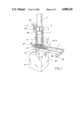
- FIG. 1 is a perspective view of the apparatus according to the present invention.
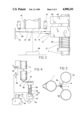
- FIG. 2 is an enlarged partial view of the detection or control unit regulating the thickness of the cut product of the invention
- FIG. 3 is a top plan view illustrating a plurality of cylinders as used for processing different products
- FIG. 4 is a side elevation of the pneumatic system for producing extrusion of the product
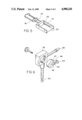
- FIG. 5 is a perspective view of the frame element and its anti-turning element
- FIG. 6 is perspective view of the valved extrusion control mechanism
- FIG. 7 is an elevational view of the apparatus including an automatic control system.
- FIG. 1 shows in perspective a machine for forming cookies according to the invention.
- the cylinder 1 having loading opening 2 comprises the chamber for the dough.
- the pressure in the dough-chamber 1 is formed by means of a piston on the shaft 3, which is forced by the pneumatic piston 4.
- the piston on the shaft 3 is pulled out from the cylinder 1 into the clearance between the cylinder and the pneumatic cylinder 4.
- the rotation lock is opened and the supporting frame and the cylinder 1 rotated 180 degrees around the axis 7 and the dough loaded into it.
- the cylinder 1 is rotated back into the original position and locked in that position by the lock 6.
- the air valve 33 is opened, for the air from the air pump 31,32 in the pump house 8, to pass through the pressure reducer 23 to the valve 33, and by means of the valve 33 the air is directed to the upper end of the pneumatic piston 4, so that it moves downwards and creates a pressure 10 in the dough determined by the pressure control or pressure reducer 23.
- the pressure 10 in the dough determines the speed of the dough 12 issuing through the spout 13.
- a photocell detection or control unit 14-17 for regulating the thickness of the cakes and which is connected to a cutter assembly or unit 18-20, whereby the photocell is measuring and the cutter is cutting equal thicknesses of cakes independent of the speed of the dough.
- the source 14 of light sends a light beam 15 to the mirror 16, which reverses it to the light receiver 17, which is sending no signals of a movement to the pneumatic piston 18.
- the dough 12 breaks the light beam 15 and the receiver 17 is receiving no light, it gives a signal of motion to the pneumatic piston 18, which forces the frame 19 with the cutting wire 20 through the dough 12 and cuts it from the spout 13.
- the light source 14 is fixed to the frame 7 of the machine, for example, by means of a screw and a runner, and is movable up and down to determine smaller or greater thicknesses of cakes.
- FIG. 3 shows the cylinder 1 from above, together with the cylinder 37 for jam and cylinder 38 for cream which, by means of the frame 41, are connected to and rotatable around the post 7, so that a change from dough into jam or cream or another dough can take place momentarily.
- the multiple switch 52 receives a signal from the cylinder under the piston 4. That switch is shown on the axis 7.
- FIG. 4 is a side view of the air pump 31, which is pressing air at 8 kg/sq cm into the air tank 32, which includes an air tube into the pressure reducer 23, where the adjustment is made into the appropriate pressure D for dough, J for jam, C for cream, and that pressure is delivered into the control valve 33, where the air is directed to the upper or lower end of the cylinder 4 and creates a respective pressure in the cylinder 1 for delivering the correct extruding speed from the spout 13.
- the pressure is constant, and the quantity portioned by opening and closing the spouts, whereas for doughs the extruding speed is increased by adjusting the pressure reducer 23 into higher pressure.
- Increased speed of dough has no influence on the thickness of cakes 12, as that is controlled by the light beam 15 in FIG. 2. It is just this character of the machine which is the base for its automation, the economy of labor requirements, its versatility, and its high output.
- the air from the air tank 32 goes also into the air valves 36, which are powered by the electromagnetic coils 35, which open and close according to a pre-adjusted electric circuit control 34.
- the signals for moving the piston 18 are derived from the light receiver 17 in FIG. 2 and go into the circuit control 34, which sends the signals alternately to the electromagnetic coils 35, which open for the compressed air in the direction of motion and release the air out from the opposite end and finally close the same release, for muffling the impact at the end.
- the above-mentioned controls of the air system are each known per se, but not as in the system described hereinabove.
- This other air-controlled system is only controlling the power on one hand for extruding the dough, and on the other hand for the cutting wire, but this power-controlled system does not cut cakes.
- a control is still lacking for determining when to cut.
- Known cake-cutting machines include a control to cut by an adjustably frequency, for example, 50 times per minute. This is frequency control, which is independent of the speed of the dough.
- the present invention includes measuring the thickness of the cake at the spout 13 and sending a message of cutting at a predetermined thickness. According to the present invention this is performed by a light receiver (photoelectric cell) or contact receiver and is called thickness control.
- the air control system becomes independent for deciding the output, and a doubled speed of the dough will double the number of cakes.
- the power-controlled system of the present invention acquires another value and character when connected to a thickness control, and acquires an extended task. It is now able to control the frequency of cakes independently and accommodate the machine to idle working power at the installation, thereby providing an elasticity which did not exist before.
- the photocell does does not control the frequency of the cakes, but the thickness of the cakes only, and it is always controlling the thickness, independent of everything.
- the control is independent.
- the cutting control was controlling the frequency of cakes and at the same time changing the thickness of the cakes
- the power system controlled the thickness of the cakes and changed at the same time the frequency of the cakes. Really the power was uncontrollable.
- no control neither on the frequency nor the thickness of the cakes. By means of the present invention this will be changed.
- the control described above does not include a control of the pressure 23 according to which cylinder is in use, i.e., a cylinder for dough, jam or cream, or no one.
- a control of the pressure 23 according to which cylinder is in use i.e., a cylinder for dough, jam or cream, or no one.
- an increased speed of dough can be adjusted by increasing the pressure 23. This is further shown in FIG. 7.
- the electric control unit there is a clock 57, measuring the frequency.
- the clock is adjustable to a determined frequency, for example 120 cakes/min.
- the clock increases the speed of the dough by increasing the pressure 23 until the predetermined frequency is obtained.
- the machine is adjustable for a predetermined frequency, number of cakes per minute, independent of the viscosity of the dough.
- the receiver 52 selects the respective pressure in the dough.
- the clock is adjusted into 60 cakes/min for three arranging workers and the clock increases or decreases the pressure until that frequency is obtained. This takes place during the first 10 cakes.
- one arranging worker must attend to the oven and leaves the machine, he adjusts the clock into 40 cakes/min for two arranging workers, and again into 60 cakes/min, when he returns.
- the automatic accommodation of the machine to the circumstances at the moment is a great advantage, increasing the output of the place as a whole by using the working power to the limit.
- FIG. 5 is a perspective view. Parallel to to piston 18 is the runner 22, preventing the turning of the frame 19 around the axis of the piston 18.
- the runner is a round bar 22 parallel to the axis of the piston 18 and fixed to the surrounding cylinder itself.
- the runner is running through a bearing 42 in the frame 19.
- FIG. 6 is a perspective view. From the spout for a hose at the cylinder 37,38 a hose 43 is provided to a manual valve 44-50 having the extrusion spout 49. By pushing with a finger the button 44 on a bar into the member 46, the valve 47 is turned in the valve house 50 and the passage 43,48,49 will open and the dough will be extruded.
- FIG. 7 shows the automatic control system 55 of the machine.
- the multiple contact switch 52 sends a signal to the pressure selector 51, which adjusts the motorized pressure reducer 23, according to which cylinder is in use under the piston 3.
- the pressure reducer is connected to the adjustable unit 58 for the output.
- the clock 57 measures the time t between signals from the light receiver 17 and calculates 60/t as the frequency of cakes per minute and illustrates that number digitally, for example 41 cakes/min.
- the control system 55 compares the measured frequency 41 cakes/min to the adjusted frequency 60 cakes/min and increases the pressure if the measurement is lower than the adjustment and vice versa.
- the pressure is increased by signals to the pressure reducer 23.
- the control unit 55 may be a computer.
- the conveyor belt 11 is connected to the control unit 55 and receives signals for intermittent motion or even speed according to signals from it, and receives the adjusted change of speed from the unit 58.
- the air compressor 31 compresses 100 l/min of air into 8 kg/sq cm into the pressure reducer 23, which is reducing that pressure into 3-4 kg/sq cm to the air piston 4 for dough. That piston is 316 sq cm and creates a force of 1200 kg.
- the air-powered piston 18 for the cutting wire is connected direct to the air compressor 31,32. It is 4.5 sq cm and creates a force of more than 100 kg. It operates against an opposite pressure 34 (buffer) for reducing the contact noise at the end of the cylinder.
- a thickness control of the cake 12 may be added to the machines, where the dough is powered out through the spout by means of rollers. On the other hand the speed of the dough will not become adjustable except by means of adjustable force onto the dough.
- a pneumatic piston 4 is one way to do so.
- a pneumatic piston is fast and therefore also suitable for the cutting wire 20.
- the air-compressor can be arranged in a ventilated box under the conveyor belt 11. The air-compressor is sufficient for both pistons 4 and 18 and therefore it is suitable to power the piston 4 also by means of air, although a hydraulic piston would be less voluminous.
- the machine is independent, and to work it needs only electric power for the air-compressor 31, for the motor 24 of the conveyor belt 11 and for the light source 14.
- the conveyor belt 11 is an independent unit, mounted on the frame of the machine by the runner 25. The runner allows elevation and lowering of the conveyor belt.
- the cylinder 1, the rotation lock 6, the cutter assembly or unit 18, 19, 20, 22, the mirror 16, the source of light 14 and the receiver 17 are in the same way each movable along the supporting frame of the machine, that frame consisting of two posts 7 and 26.
- screens 27 are a matter of course, a screen of plexiglass surrounding the interval 5 and in front of and in back of the spout 13 for dough, so that it is impossible to put the hand into the cutting area.
- the screens are turned around the post 26, while the cylinder is not turned around.
- the screens 27 are locked to the post 7 through a switch 54 on the electric wire to the piston 18, so that the piston is ineffective, while the screens are open.
- a machine has a variable frequency of 0-200 cakes/min and is able to cut cakes for one to ten arranging workers.
- a single row includes a double speed of the belt and therefore a long belt, and both workers must remove cakes from the same row.
- Two rows at a single speed is a better arrangement.
- each worker has his own row and the belt is short and occupies a small area. Therefore the cutting direction is perpendicular to the movement and the cut is to and fro, and the machine is cutting the cakes into two rows. This arrangement is thus a result from and in coordination with variable frequency.
- the arrangement according to the invention is a result from the control of the thickness of the cakes and would not have any meaning without it.
- the cylinders may be two or more, even three on each post. In that case one can be loaded while another is in extrusion, and they may contain different doughs.
- the machine is not limited to dough for cakes, it can manage all viscous materials, which is to be cut into slices or portions by volume, for example for cutting and portioning solid cheese into small boxes or other packing, for extruding licorice and cutting it into pieces.
- the machine is also suitable for use as an extruder without a cut and thickness control, for example for extruding jam, cream and such on cakes before or after baking.
- One cylinder 37 for jam and two cylinders 38 for creams in addition to two cylinders 1 for dough is a suitable unit.
- Each cylinder has a suitable spout and the respective pressure is switched by the switch 52 and adjusted by the pressure reducer 23.
- Each spout includes a suitable number of extruding openings, which are closed and can be opened, where the dimension of each opening is determined by the pressure in the opening and the same extruded quantity.
- the conveyor belt For cutting cakes, it is suitable to move the conveyor belt at a constant speed, whereas for extruding jam on cakes, the cakes on the plates are placed on the conveyor belt and moved by hand or the conveyor belt is moved by intermittent motion, being steady while extruding the jam. This is called imtermittent motion.
- the motor of the conveyor belt is working at constant speed, and is coupled to a cogwheel having one tooth, having the same time per revolution as the extruding operation.
- a suitable stud engages into an opposite wheel having respective radial slots. [(Geneva wheel)].
- the stud is outside the motion connected to a switch activating the extrusion. In that way the movement and the extrusion are coordinated.
- the gun includes a turnable valve 47, which opens for the duct from the hose 43 into the spout 49, when turned.
- the valve is indirect, by means of a cogwheel or direct by means of a rod, connected to a button 44 or a trigger, which at a pressure or by motion turns the valve 47 and opens the duct, and then closes it again automatically, for example by means of a coiled or a straight spring.
- the extrusion speed is adjustable as before by means of the pressure reducer 23.
- the invention includes a single automatic machine, which is suitable for extruding dough for cakes of a pre-determined thickness for arrangement by from one to ten arranging workers, is suitable for extruding jam and cream, and able to change over momentarily and be adjusted into a pre-determined speed, all by pushing a button.
Landscapes
- Life Sciences & Earth Sciences (AREA)
- Engineering & Computer Science (AREA)
- Food Science & Technology (AREA)
- Manufacturing And Processing Devices For Dough (AREA)
Applications Claiming Priority (2)
| Application Number | Priority Date | Filing Date | Title |
|---|---|---|---|
| IS3296 | 1987-12-12 | ||
| IS3296A IS3296A7 (is) | 1987-12-14 | 1987-12-14 | Sjálfvirk kökuvél , skammtari og mótari fyrir seigt efni, deig, kökur, krem og slíkt. |
Publications (1)
| Publication Number | Publication Date |
|---|---|
| US4900241A true US4900241A (en) | 1990-02-13 |
Family
ID=36702523
Family Applications (1)
| Application Number | Title | Priority Date | Filing Date |
|---|---|---|---|
| US07/283,775 Expired - Fee Related US4900241A (en) | 1987-12-12 | 1988-12-13 | Machine for portioning and cutting dough |
Country Status (2)
| Country | Link |
|---|---|
| US (1) | US4900241A (is) |
| IS (1) | IS3296A7 (is) |
Cited By (20)
| Publication number | Priority date | Publication date | Assignee | Title |
|---|---|---|---|---|
| US5090859A (en) * | 1990-02-20 | 1992-02-25 | General Binding Corporation | Automatic binding machine using insertion tools |
| US5123830A (en) * | 1991-05-20 | 1992-06-23 | Papalexis Christopher G | Dough portioning machine |
| US5200203A (en) * | 1989-08-28 | 1993-04-06 | Rheon Automatic Machinery Co., Ltd. | Apparatus for quantitatively dividing bread dough |
| WO1994019952A3 (de) * | 1993-03-12 | 1995-01-12 | Dfm Prod Bv | Teigteil-wirkmaschine |
| US5441173A (en) * | 1994-03-02 | 1995-08-15 | Continental Baking Company | Piston depositor |
| WO1996004807A1 (en) * | 1994-08-17 | 1996-02-22 | Wixon-Fontarome, Inc. | Process for a free-flowing food product |
| FR2775670A1 (fr) * | 1998-03-06 | 1999-09-10 | Andre Sala | Appareil pour la distribution de quantites predeterminees de produits liquides et/ou pateux |
| EP1310170A1 (en) * | 2001-11-08 | 2003-05-14 | OEM - Ali S.p.A | Portioning machine |
| US20070172533A1 (en) * | 2004-02-27 | 2007-07-26 | Jmp Industries, Inc. | Extruder system and cutting assembly |
| US20080067192A1 (en) * | 2006-09-15 | 2008-03-20 | Stanton Jennifer L | Viscous material feed system and method |
| US20080087150A1 (en) * | 2006-09-29 | 2008-04-17 | Stanton Jennifer L | Viscous material metering system and method |
| USD586189S1 (en) | 2008-02-15 | 2009-02-10 | Sandra B. Austin | Cutting tool |
| US20100143520A1 (en) * | 2004-02-27 | 2010-06-10 | Jmp Industries, Inc. | Extruder system and cutting assembly |
| EP2289337A3 (de) * | 2009-08-20 | 2014-01-08 | VEMAG Maschinenbau GmbH | Liniensynchronisierung |
| CN103814975A (zh) * | 2014-02-28 | 2014-05-28 | 兰州金东明机电设备有限公司 | 多种面条即时转换型全自动拉面机 |
| CN106182110A (zh) * | 2016-07-26 | 2016-12-07 | 宁波市鄞州风名工业产品设计有限公司 | 一种串联下料式食品切片机 |
| CN106182143A (zh) * | 2016-07-26 | 2016-12-07 | 宁波市鄞州风名工业产品设计有限公司 | 切片机 |
| CN106182142A (zh) * | 2016-07-26 | 2016-12-07 | 宁波市鄞州风名工业产品设计有限公司 | 一种并联下料式食品切片机 |
| KR102028510B1 (ko) * | 2019-03-08 | 2019-10-04 | 홍정혜 | 제빵제과 필링기 |
| CN115823995A (zh) * | 2023-02-16 | 2023-03-21 | 中焙供应链管理武汉有限公司 | 一种蛋挞皮的检测方法 |
Citations (7)
| Publication number | Priority date | Publication date | Assignee | Title |
|---|---|---|---|---|
| US1852855A (en) * | 1931-02-13 | 1932-04-05 | E J Brach & Sons | Candy ornamenting machine |
| US2488344A (en) * | 1944-07-26 | 1949-11-15 | Wall & Sons Ltd T | Distributing and conveying of pieces of extruded plastic materials |
| US3499396A (en) * | 1968-01-11 | 1970-03-10 | Dca Food Ind | Apparatus for the regulated production of shaped pieces of plastic material |
| US3708256A (en) * | 1969-08-16 | 1973-01-02 | Werner & Pfleiderer | Extrusion press |
| US4197072A (en) * | 1978-01-10 | 1980-04-08 | Harten Marvin A | Wax extrusion pen for lost wax patterns |
| GB2030848A (en) * | 1978-09-29 | 1980-04-16 | Sakurazawa H | Food processing apparatus |
| US4737092A (en) * | 1987-04-27 | 1988-04-12 | Dale W. Turman | Automatic dough cutter |
-
1987
- 1987-12-14 IS IS3296A patent/IS3296A7/is unknown
-
1988
- 1988-12-13 US US07/283,775 patent/US4900241A/en not_active Expired - Fee Related
Patent Citations (7)
| Publication number | Priority date | Publication date | Assignee | Title |
|---|---|---|---|---|
| US1852855A (en) * | 1931-02-13 | 1932-04-05 | E J Brach & Sons | Candy ornamenting machine |
| US2488344A (en) * | 1944-07-26 | 1949-11-15 | Wall & Sons Ltd T | Distributing and conveying of pieces of extruded plastic materials |
| US3499396A (en) * | 1968-01-11 | 1970-03-10 | Dca Food Ind | Apparatus for the regulated production of shaped pieces of plastic material |
| US3708256A (en) * | 1969-08-16 | 1973-01-02 | Werner & Pfleiderer | Extrusion press |
| US4197072A (en) * | 1978-01-10 | 1980-04-08 | Harten Marvin A | Wax extrusion pen for lost wax patterns |
| GB2030848A (en) * | 1978-09-29 | 1980-04-16 | Sakurazawa H | Food processing apparatus |
| US4737092A (en) * | 1987-04-27 | 1988-04-12 | Dale W. Turman | Automatic dough cutter |
Cited By (28)
| Publication number | Priority date | Publication date | Assignee | Title |
|---|---|---|---|---|
| US5200203A (en) * | 1989-08-28 | 1993-04-06 | Rheon Automatic Machinery Co., Ltd. | Apparatus for quantitatively dividing bread dough |
| US5090859A (en) * | 1990-02-20 | 1992-02-25 | General Binding Corporation | Automatic binding machine using insertion tools |
| US5123830A (en) * | 1991-05-20 | 1992-06-23 | Papalexis Christopher G | Dough portioning machine |
| WO1994019952A3 (de) * | 1993-03-12 | 1995-01-12 | Dfm Prod Bv | Teigteil-wirkmaschine |
| US5441173A (en) * | 1994-03-02 | 1995-08-15 | Continental Baking Company | Piston depositor |
| WO1996004807A1 (en) * | 1994-08-17 | 1996-02-22 | Wixon-Fontarome, Inc. | Process for a free-flowing food product |
| US5660870A (en) * | 1994-08-17 | 1997-08-26 | Wixon-Fontarome, Inc. | Non-blocking, free-flowing licorice extract |
| US5660871A (en) * | 1994-08-17 | 1997-08-26 | Wixon-Fontarome, Inc. | Method for producing a non-blocking, free flowing licorice extract |
| FR2775670A1 (fr) * | 1998-03-06 | 1999-09-10 | Andre Sala | Appareil pour la distribution de quantites predeterminees de produits liquides et/ou pateux |
| WO1999044427A1 (fr) * | 1998-03-06 | 1999-09-10 | Sala Andre | Appareil pour la distribution de quantites predeterminees de produits liquides et/ou pateux |
| EP1310170A1 (en) * | 2001-11-08 | 2003-05-14 | OEM - Ali S.p.A | Portioning machine |
| US20070172533A1 (en) * | 2004-02-27 | 2007-07-26 | Jmp Industries, Inc. | Extruder system and cutting assembly |
| US8491294B2 (en) | 2004-02-27 | 2013-07-23 | Jmp Industries, Inc. | Extruder system and cutting assembly |
| US7674102B2 (en) * | 2004-02-27 | 2010-03-09 | Jmp Industries, Inc. | Extruder system and cutting assembly |
| US20100143520A1 (en) * | 2004-02-27 | 2010-06-10 | Jmp Industries, Inc. | Extruder system and cutting assembly |
| US8186991B2 (en) | 2004-02-27 | 2012-05-29 | Jmp Industries, Inc. | Extruder system and cutting assembly |
| US20080067192A1 (en) * | 2006-09-15 | 2008-03-20 | Stanton Jennifer L | Viscous material feed system and method |
| US20080087150A1 (en) * | 2006-09-29 | 2008-04-17 | Stanton Jennifer L | Viscous material metering system and method |
| US7784503B2 (en) * | 2006-09-29 | 2010-08-31 | Momentive Performance Materials | Viscous material metering system and method |
| USD586189S1 (en) | 2008-02-15 | 2009-02-10 | Sandra B. Austin | Cutting tool |
| EP2289337A3 (de) * | 2009-08-20 | 2014-01-08 | VEMAG Maschinenbau GmbH | Liniensynchronisierung |
| CN103814975A (zh) * | 2014-02-28 | 2014-05-28 | 兰州金东明机电设备有限公司 | 多种面条即时转换型全自动拉面机 |
| CN103814975B (zh) * | 2014-02-28 | 2015-10-28 | 兰州金东明机电设备有限公司 | 多种面条即时转换型全自动拉面机 |
| CN106182110A (zh) * | 2016-07-26 | 2016-12-07 | 宁波市鄞州风名工业产品设计有限公司 | 一种串联下料式食品切片机 |
| CN106182143A (zh) * | 2016-07-26 | 2016-12-07 | 宁波市鄞州风名工业产品设计有限公司 | 切片机 |
| CN106182142A (zh) * | 2016-07-26 | 2016-12-07 | 宁波市鄞州风名工业产品设计有限公司 | 一种并联下料式食品切片机 |
| KR102028510B1 (ko) * | 2019-03-08 | 2019-10-04 | 홍정혜 | 제빵제과 필링기 |
| CN115823995A (zh) * | 2023-02-16 | 2023-03-21 | 中焙供应链管理武汉有限公司 | 一种蛋挞皮的检测方法 |
Also Published As
| Publication number | Publication date |
|---|---|
| IS3296A7 (is) | 1988-08-31 |
Similar Documents
| Publication | Publication Date | Title |
|---|---|---|
| AU632417B2 (en) | Method and apparatus for manufacturing continuous sheets of bread dough | |
| US5626898A (en) | Masa sheeting process with product length control | |
| CA2033406C (en) | Method and apparatus for stretching dough | |
| US4528900A (en) | High production apparatus for forming filled edible products | |
| KR950012605B1 (ko) | 바아형 빵을 연속 제조하는 방법 및 장치 | |
| US4395427A (en) | Method and apparatus for depositing dough on a conveyor | |
| EP0326404B1 (en) | A method for producing dough for bread or pastry | |
| JPH0330625A (ja) | 生パン及びその類似物のかたまりの分割装置及び分割方法 | |
| US4647467A (en) | Apparatus and process for coextruding a fat and a dough | |
| US20030232103A1 (en) | Tortilla pressing apparatus and method | |
| US4731006A (en) | Apparatus for processing food products | |
| US5204123A (en) | Apparatus for manufacturing continuous sheets of bread dough | |
| US4719117A (en) | High production method for forming filled edible products | |
| US5010807A (en) | Ravioli machine | |
| GB2294380A (en) | A food manufacturing system | |
| US4536146A (en) | Croquette machine | |
| US3347183A (en) | Dough metering apparatus | |
| US9936708B2 (en) | Device for gently producing a pastry strand | |
| US6715519B1 (en) | Apparatus for filling food trays at high speeds | |
| CN213616922U (zh) | 一种馍片胚体的快速切片装置 | |
| WO2025018951A1 (en) | Biscuit machine | |
| EP0501158A1 (en) | Apparatus for forming from a shapeless paste a food intended to be cooked | |
| CN102202513A (zh) | 食品制造设备及有关方法 | |
| KR940006731Y1 (ko) | 떡 제조기 | |
| CN86208358U (zh) | 制作面片的机械装置 |
Legal Events
| Date | Code | Title | Description |
|---|---|---|---|
| REMI | Maintenance fee reminder mailed | ||
| LAPS | Lapse for failure to pay maintenance fees | ||
| FP | Lapsed due to failure to pay maintenance fee |
Effective date: 19940213 |
|
| STCH | Information on status: patent discontinuation |
Free format text: PATENT EXPIRED DUE TO NONPAYMENT OF MAINTENANCE FEES UNDER 37 CFR 1.362 |