US4901365A - Method of searching binary images to find search regions in which straight lines may be found - Google Patents
Method of searching binary images to find search regions in which straight lines may be found Download PDFInfo
- Publication number
- US4901365A US4901365A US07/286,411 US28641188A US4901365A US 4901365 A US4901365 A US 4901365A US 28641188 A US28641188 A US 28641188A US 4901365 A US4901365 A US 4901365A
- Authority
- US
- United States
- Prior art keywords
- scans
- search
- scan
- scanning
- binary
- Prior art date
- Legal status (The legal status is an assumption and is not a legal conclusion. Google has not performed a legal analysis and makes no representation as to the accuracy of the status listed.)
- Expired - Lifetime
Links
Images

Classifications
-
- G—PHYSICS
- G06—COMPUTING OR CALCULATING; COUNTING
- G06V—IMAGE OR VIDEO RECOGNITION OR UNDERSTANDING
- G06V10/00—Arrangements for image or video recognition or understanding
- G06V10/40—Extraction of image or video features
- G06V10/44—Local feature extraction by analysis of parts of the pattern, e.g. by detecting edges, contours, loops, corners, strokes or intersections; Connectivity analysis, e.g. of connected components
-
- G—PHYSICS
- G06—COMPUTING OR CALCULATING; COUNTING
- G06V—IMAGE OR VIDEO RECOGNITION OR UNDERSTANDING
- G06V30/00—Character recognition; Recognising digital ink; Document-oriented image-based pattern recognition
- G06V30/10—Character recognition
Definitions
- This invention relates to a method of searching a matrix of binary data to find search regions in which long straight lines may be found, with the straight lines being those which are perpendicular to the original direction of scanning which produced the matrix of binary data.
- the image data consists of a plurality of pixels or picture elements obtained at a scanning line associated with the scanning device.
- the pixels associated with successive scans obtained at the scanning line comprise the matrix of image data associated with the item or document.
- the image data is processed by conventional circuitry to eliminate "noise” and the like, and to also threshold the image data to produce a binary matrix of data.
- each pixel of image data which may comprise an eight bit gray scale value which is obtained from the scanning line, is reduced, by thresholding, to a binary "1" or a binary "0".
- a binary 1 may indicate the presence of data, while a binary 0 indicates the background or the absence of data.
- the image data about a document is thresholded to a matrix of binary data.
- One of the problems with using a matrix of binary data is that it is often difficult to find what is looked for within the matrix. In other words, there may be a lot of extraneous binary data in the matrix in addition to what is sought. For example, one may look for certain lines in the matrix of data. In this regard, long lines which are parallel to the original direction of scanning are not difficult to find, whereas, long lines which are perpendicular to the original scan line are difficult to find. For example, if the scanning is done along successive columns, long lines which are parallel to the direction of scanning are easy to find. In other words, a long string of binary ones will be found in a particular column or adjacent columns, indicating the presence of a long line. However, if the long line is perpendicular to the original scanning direction, it means that a portion of the line will extend over many columns of data, making the search for this long line difficult.
- An advantage of the present invention is that it facilitates the location of long lines within a matrix of binary pixels associated with an image of a document.
- Another advantage of the present invention is that it facilitates the identification of certain documents. For example, certain lines appearing on certain locations of the document may be indicative of that document being a particular type of business form. The lines may be part of a general quadrilateral box or area, for example, located on the document. These long lines may be parts of "boxes" on a form, "underlines”, or "separators".
- Finding the long lines facilitates optical character recognition (OCR) in that the long lines are generally removed first before character recognition is attempted.
- OCR optical character recognition
- the preferred method according to this invention relates to a method of searching a matrix of binary data to find search regions in which straight lines may be found, with the straight lines being those which are perpendicular to the original direction of scanning which produced the matrix of binary data; said method comprising the steps:
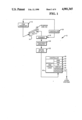
- FIG. 1 is a general schematic diagram showing an apparatus which may be used in carrying out this invention
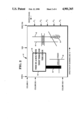
- FIG. 2 is a schematic diagram showing how certain search scans are used in the search for long lines which are perpendicular to the direction of the original scanning which was performed to produce the matrix of binary data shown;
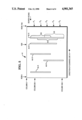
- FIG. 3 is a chart showing the results of certain search scans associated with the method of this invention, and also showing certain AND-scans resulting from ANDing certain search scans;
- FIG. 4 is a chart showing the results of ORing certain AND-scans shown in FIG. 3;
- FIG. 5 is a schematic diagram showing certain search regions used in locating long lines.
- this invention relates to a process for searching a matrix of binary pixel data associated with a document so as to find search regions in which straight lines may be found, with the straight lines being those which are perpendicular to the original direction of scanning which produced the matrix of binary data. Once the search regionsare found, they can be used to focus the searches within the search areas to locate the long lines.
- FIG. 1 shows apparatus 10 which may be used in carrying out the invention.
- the apparatus 10 includes an item transport 12 which moves an item, like a document 14, towards a scanning line 16 where the document 14 is imaged by a scanner 18 as is conventionally done.
- the scanner 18 produces successive scan lines or columns of pixel data or pixels as the item 14 is moved in reading relationship therewith.
- the scanner 18 could also be a hand held scanner, for example, which is moved over a stationary document to effect the reading.
- From the scanner 18, the successive columns of pixel data areprocessed to minimize noise associated with the pixels and to threshold thepixels into a binary "1", for example, which may represent the presence of data and a binary "0" which may represent the absence of data.
- This processing is effected by conventional circuitry shown only as processing circuitry 20.
- the output of the processing circuitry 20 is a matrix 22 of binary data or pixels (not compressed) which corresponds to the image of the associated document 14.
- the matrix 22 of binary data may include about 1700 pixels per column with a resolution of 200 pixels per inch, for example, as just one illustration of a document whose width is about 81/2 inches wide.
- the scanner 18 and the item transport 12 may be controlled by a separate controller 24, for example, or they may be controlled by the controller 26which is used to process the matrix 22 of data or pixels.
- the controller 26 (FIG. 1) is a conventional controller which may be used to process the matrix 22 of pixels according to this invention.
- the controller 26 includes a read only memory (ROM 28), a random access memory(RAM 30), a key board (KB) 32, a display 34, interfaces 36 and 38, and interface and control logic 40 which is used to interconnect all the components shown in a conventional manner.
- ROM 28 read only memory
- RAM 30 random access memory
- KB key board
- display 34 a display 34
- interfaces 36 and 38 interface and control logic 40 which is used to interconnect all the components shown in a conventional manner.
- the form of the controller 26 shown is used to simply facilitate a discussion of the operation of the controller 26; the actual form of the controller 26 is different from thatshown.
- column 0 may start at the top right side of the document 14, as viewed in FIG. 1, while column 1,000 approaches the left side of the document 14.
- row 0 appears at the top ofthe document 14, while row 1700 approaches the bottom of the document 14, as viewed in FIG. 1.
- the upper left hand corner of the matrix41 corresponds to the upper right hand corner of the document 14 shown in FIG. 1.
- the columns and rows may be reversed, depending upon how the documents are scanned, for example.
- the lines and printing shown in FIG. 2 represent the binary ones of data which comprise the matrix 41, with the binary zeros comprising the background of the document 14. It is the lines like lines 42, 44, 46, 48, and 50, for example, which are difficult to find; these are the lines which are perpendicular to the direction of scanning line 16.
- the first step in the process or method according to this invention is to determine a number of search scans which will be used to search the matrix41 of binary data. These search scans will be used to search the matrix 41 in a direction which is parallel to the scanning line 16 which is also shown on FIG. 2. The binary ones found in these search scans, after some processing to be later described herein, may be indicative of the long lines being sought.
- N relates to the number of search scans which are selected to scan thematrix 41 at equal intervals thereon. In the embodiment described, N is equal to 5, with search scans #1 through #5 being shown in FIG. 2. "N” is chosen so that the spacing between successive scans is much less than the minimum length of the line to be detected. Lines like 42 and 44 are the long lines which are to be found.
- P relates to the number of AND-scans which are included in a particular AND-set. In the embodiment described, the number of AND-scans included in an AND-set is two.
- the And-scans relate to the processing of the scans #1 through #5 (FIG. 2) as will be described hereinafter. For example, scan #1 and scan #2 in FIG. 2 are considered an AND-set. P is selected so that the AND-set spans a distance which is somewhat less than the minimum line length anticipated. There are N-P+1 AND-sets.
- N-P+1 "AND-scans" are grouped into overlapping sets containing "Q" adjacent AND-scans.
- AND-scan-1 and AND-scan-2 shown in FIG. 4 comprise an "OR-set".
- Q is chosen so that the distance spanned by the scans is somewhat longer than the maximum line length.
- N-P-Q+2 AND-scan sets in the embodimentdescribed.
- AND-scans making up an "OR-set” are logically “ORed” to produce a single "OR-scan” for each OR-set.
- AND-scan-#1 and AND-scan-#2shown in FIG. 4 are logically ORed to generate "OR-scan-1".
- N-P-Q+2 "OR-scans" there are N-P-Q+2 "OR-scans" in the embodiment described.
- the next step according to this invention is to scan a predetermined area of the matrix 41 of binary data in a direction which isparallel to the original direction of scanning (scanning line 16).
- the predetermined area may be a portion of the matrix 41, or it maybe the entire area of the matrix 41.
- the predetermined area relates to the entire matrix 41.
- N was equal to five.
- the search results for the search scans #1 through #5 shown in FIG. 2 are shown as scans-1 through 5, respectively, in FIG. 3.
- binary data 42-1 shown in FIG. 3 for scan-1 corresponds to a portion of the line 42 shown in FIG. 2.
- binarydata 44-1 corresponds to a portion of line 44.
- lines 46 and 50 are thicker than the lines 42 and 44; correspondingly, the associated binary data 46-1 and 50-1 is "wider", as measured along the search scan #1, than the data 42-1 and 44-1 associated with lines 42 and 44-1. Notice that the printing "THIS IS A BOX WITH" and the printing "TEXT THROUGH" shown in FIG.
- the next step in the method according to this invention is to AND certain of the scans-1 through -5 shown in FIG. 3 in the following manner.
- the scans-1 and -2 which comprise an AND-set are ANDed together to generate the AND-scan-1 shown on line 56 in FIG. 3.
- the digital data 42-1-2 is the result of ANDing digital data 42-1 and 42-2.
- Scans-2 and -3 are similarly ANDed together togenerate AND-scan-2.
- the digital data 42-2-3 is the result of ANDing digital data 42-2 and 42-3.
- Scans-3 and -4 are ANDed together to generate AND-scan-3
- scans-4 and -5 are ANDed together to generate AND-scan-4.
- the next step in the method of this invention is to "OR" the AND-scan-1 through AND-scan-4 data in the embodiment described.
- the digital data (actually binary ls) associated with the AND-scan-1 and AND-scan-2 are ORed together to generate the "OR-scan-1" shown in FIG. 4.
- a function of the OR operation is to catch a long line which may be discontinuous at certain points along its length.
- the AND-scan-1 and the AND-scan-2 comprise an "OR set” alluded to earlier herein.
- AND-scan-2 and AND-scan-3 are ORed together to generate OR-scan-2, and correspondingly, AND-scan-3 and AND-scan-4 are ORed together to generate OR-scan-3.
- This process is repeated for additional AND-scans which may appear in a particular application to be processed. Again, there is some overlapping in the method in that the AND-scan-2 is used in the generation of OR-scan-1 and OR-scan-2.
- the ANDing and ORing operations described may be carried on within the controller 26 shown in FIG. 1. Notice that the binary data 42-1-2 and 42-2-3 associated with AND-scan-1 and AND-scan-2, respectively, are combined by the ORing operation to generate the binary data 42-OR-1 which is associated with the OR-scan-1 shown in FIG. 4. OR-scan-2 and OR-scan-3 are generated in the same manner as described.
- the OR-scans-1 through -3 are used to define search regions in which the controller 26 may look to find the long lines, like lines 42 and 44 for example, which are perpendicular to the direction of scanning line 16.
- the controller 26 keepsa record of the row and column positions for the binary data derived from the search scans #1 through #5 as discussed in relation to FIGS. 2-4.
- the controller 26 then extends the search region associated with OR-scan-1 by extending it to cover a distance including search scans #1-#3 and a little distance on each side of search scan #1 and search scan #3 as shown by bracket 58 shown in FIG. 5.
- OR-scan-2 extends at least over a distance including search scans #2-#4 as indicated by bracket 60.
- OR-scan-3 extends at least over the distance indicated by dashed bracket 62.
- the location of the binary data 42-1 from scan-1 and the location of binary data 42-5 fromscan-5 shown in FIG. 4 are used to establish the row limits for the search region 42-R shown in FIG. 5. Search region 42-R (FIG.
- search region 42-R is made slightly wider than that warranted by the width of the data, like 42-1 (FIG. 3), itself, so as to provide a rectangular search region as shown to make surethat line 42 shown in FIG. 2 is included in the search region 42-R.
- the remaining search regions 44-R, 46-R, 48-R and 50-R shown in FIG. 5 are similarly determined, and they correspond to the long lines 44, 46, 48, and 50, respectively, shown in FIG. 2.
- the search regions, like 42-R are then used to locate the long lines which are perpendicular to the scanningdirection or scanning line 16.
- N A large value of N, as discussed earlier herein, allows the detection ofshort lines.
- N A small value of N allows only long lines to be detected.
Landscapes
- Engineering & Computer Science (AREA)
- Computer Vision & Pattern Recognition (AREA)
- Physics & Mathematics (AREA)
- General Physics & Mathematics (AREA)
- Multimedia (AREA)
- Theoretical Computer Science (AREA)
- Character Input (AREA)
- Image Analysis (AREA)
Priority Applications (5)
| Application Number | Priority Date | Filing Date | Title |
|---|---|---|---|
| US07/286,411 US4901365A (en) | 1988-12-19 | 1988-12-19 | Method of searching binary images to find search regions in which straight lines may be found |
| CA000599525A CA1316605C (fr) | 1988-12-19 | 1989-05-12 | Methode d'exploration d'images binaires a la recherche de regions pouvant contenir des lignes droites |
| JP1326216A JPH02224187A (ja) | 1988-12-19 | 1989-12-18 | 直線に対するサーチ領域を発見するよう2値像をサーチする方法 |
| EP89313265A EP0375352B1 (fr) | 1988-12-19 | 1989-12-19 | Procédé pour chercher une matrice de données binaires |
| DE68913475T DE68913475T2 (de) | 1988-12-19 | 1989-12-19 | Verfahren zum Durchsuchen einer Matrix binärer Daten. |
Applications Claiming Priority (1)
| Application Number | Priority Date | Filing Date | Title |
|---|---|---|---|
| US07/286,411 US4901365A (en) | 1988-12-19 | 1988-12-19 | Method of searching binary images to find search regions in which straight lines may be found |
Publications (1)
| Publication Number | Publication Date |
|---|---|
| US4901365A true US4901365A (en) | 1990-02-13 |
Family
ID=23098486
Family Applications (1)
| Application Number | Title | Priority Date | Filing Date |
|---|---|---|---|
| US07/286,411 Expired - Lifetime US4901365A (en) | 1988-12-19 | 1988-12-19 | Method of searching binary images to find search regions in which straight lines may be found |
Country Status (5)
| Country | Link |
|---|---|
| US (1) | US4901365A (fr) |
| EP (1) | EP0375352B1 (fr) |
| JP (1) | JPH02224187A (fr) |
| CA (1) | CA1316605C (fr) |
| DE (1) | DE68913475T2 (fr) |
Cited By (12)
| Publication number | Priority date | Publication date | Assignee | Title |
|---|---|---|---|---|
| US5048107A (en) * | 1989-06-06 | 1991-09-10 | Ricoh Company, Ltd. | Table region identification method |
| US5048099A (en) * | 1990-05-21 | 1991-09-10 | Eastman Kodak Company | Polygon-based method for automatic extraction of selected text in a digitized document |
| US5058189A (en) * | 1988-02-16 | 1991-10-15 | Ricoh Company, Ltd. | Apparatus and method for area designation on a document |
| US5075895A (en) * | 1989-04-05 | 1991-12-24 | Ricoh Company, Ltd. | Method and apparatus for recognizing table area formed in binary image of document |
| US5165072A (en) * | 1990-04-27 | 1992-11-17 | Canon Kabushiki Kaisha | Image processing apparatus which detects a line image |
| US5268580A (en) * | 1992-09-02 | 1993-12-07 | Ncr Corporation | Bar code enhancement system and method for vision scanners |
| US5444793A (en) * | 1993-06-15 | 1995-08-22 | Ncr Corporation | Method for detecting machine printed monetary amounts in binary images |
| US5524068A (en) * | 1992-08-21 | 1996-06-04 | United Parcel Service Of America, Inc. | Method and apparatus for finding areas of interest in images |
| US20080310685A1 (en) * | 2007-06-18 | 2008-12-18 | Speigle Jon M | Methods and Systems for Refining Text Segmentation Results |
| CN102156884A (zh) * | 2011-04-25 | 2011-08-17 | 中国科学院自动化研究所 | 一种直线段检测和提取方法 |
| CN104751177A (zh) * | 2015-03-26 | 2015-07-01 | 常州大学 | 一种用于标识数字图像中给定模糊数字直线段的方法 |
| CN105513044A (zh) * | 2015-11-20 | 2016-04-20 | 常州大学 | 一种基于统计度量直线特征的数字直线段识别方法 |
Citations (9)
| Publication number | Priority date | Publication date | Assignee | Title |
|---|---|---|---|---|
| US3930237A (en) * | 1974-03-07 | 1975-12-30 | Computervision Corp | Method for automating the production of engineering documentation utilizing an integrated digital data base representation of the documentation |
| US4044327A (en) * | 1973-08-01 | 1977-08-23 | Bunker Ramo Corporation | Trimming potentiometers with coarse and fine adjustment means |
| US4504969A (en) * | 1981-03-12 | 1985-03-12 | Fuji Xerox Co., Ltd. | Rectangular pattern recognition apparatus |
| US4516266A (en) * | 1982-12-17 | 1985-05-07 | International Business Machines Corporation | Entity control for raster displays |
| US4566126A (en) * | 1982-04-30 | 1986-01-21 | Fuji Electric Company, Ltd. | Pattern discriminator |
| US4589144A (en) * | 1981-12-15 | 1986-05-13 | Tokyo Shibaura Denki Kabushiki Kaisha | Character and image processing apparatus |
| US4728784A (en) * | 1987-01-30 | 1988-03-01 | Federal Express Corporation | Apparatus and method of encoding and decoding barcodes |
| US4748678A (en) * | 1985-05-22 | 1988-05-31 | Hitachi, Ltd. | Method of storing and retrieving image data |
| US4776024A (en) * | 1986-05-29 | 1988-10-04 | International Business Machines Corporation | System for segmenting character components |
Family Cites Families (4)
| Publication number | Priority date | Publication date | Assignee | Title |
|---|---|---|---|---|
| JPS61203785A (ja) * | 1985-03-07 | 1986-09-09 | Dainippon Screen Mfg Co Ltd | 2値画像デ−タの平滑化処理方法及びその装置 |
| US4673987A (en) * | 1985-04-22 | 1987-06-16 | Ibm Corporation | Compressed block code for facsimile transmission |
| US4742399A (en) * | 1985-11-01 | 1988-05-03 | Dainippon Screen Mfg. Co., Ltd. | Method of and apparatus for generating high-resolution bilevel image data |
| US4717962A (en) * | 1986-12-17 | 1988-01-05 | Kabushiki Kaisha Toshiba | Method for compressing and reconstructing a data representation of a picture |
-
1988
- 1988-12-19 US US07/286,411 patent/US4901365A/en not_active Expired - Lifetime
-
1989
- 1989-05-12 CA CA000599525A patent/CA1316605C/fr not_active Expired - Fee Related
- 1989-12-18 JP JP1326216A patent/JPH02224187A/ja active Pending
- 1989-12-19 DE DE68913475T patent/DE68913475T2/de not_active Expired - Fee Related
- 1989-12-19 EP EP89313265A patent/EP0375352B1/fr not_active Expired - Lifetime
Patent Citations (9)
| Publication number | Priority date | Publication date | Assignee | Title |
|---|---|---|---|---|
| US4044327A (en) * | 1973-08-01 | 1977-08-23 | Bunker Ramo Corporation | Trimming potentiometers with coarse and fine adjustment means |
| US3930237A (en) * | 1974-03-07 | 1975-12-30 | Computervision Corp | Method for automating the production of engineering documentation utilizing an integrated digital data base representation of the documentation |
| US4504969A (en) * | 1981-03-12 | 1985-03-12 | Fuji Xerox Co., Ltd. | Rectangular pattern recognition apparatus |
| US4589144A (en) * | 1981-12-15 | 1986-05-13 | Tokyo Shibaura Denki Kabushiki Kaisha | Character and image processing apparatus |
| US4566126A (en) * | 1982-04-30 | 1986-01-21 | Fuji Electric Company, Ltd. | Pattern discriminator |
| US4516266A (en) * | 1982-12-17 | 1985-05-07 | International Business Machines Corporation | Entity control for raster displays |
| US4748678A (en) * | 1985-05-22 | 1988-05-31 | Hitachi, Ltd. | Method of storing and retrieving image data |
| US4776024A (en) * | 1986-05-29 | 1988-10-04 | International Business Machines Corporation | System for segmenting character components |
| US4728784A (en) * | 1987-01-30 | 1988-03-01 | Federal Express Corporation | Apparatus and method of encoding and decoding barcodes |
Cited By (16)
| Publication number | Priority date | Publication date | Assignee | Title |
|---|---|---|---|---|
| US5058189A (en) * | 1988-02-16 | 1991-10-15 | Ricoh Company, Ltd. | Apparatus and method for area designation on a document |
| US5075895A (en) * | 1989-04-05 | 1991-12-24 | Ricoh Company, Ltd. | Method and apparatus for recognizing table area formed in binary image of document |
| US5048107A (en) * | 1989-06-06 | 1991-09-10 | Ricoh Company, Ltd. | Table region identification method |
| US5165072A (en) * | 1990-04-27 | 1992-11-17 | Canon Kabushiki Kaisha | Image processing apparatus which detects a line image |
| US5048099A (en) * | 1990-05-21 | 1991-09-10 | Eastman Kodak Company | Polygon-based method for automatic extraction of selected text in a digitized document |
| US5524068A (en) * | 1992-08-21 | 1996-06-04 | United Parcel Service Of America, Inc. | Method and apparatus for finding areas of interest in images |
| US5268580A (en) * | 1992-09-02 | 1993-12-07 | Ncr Corporation | Bar code enhancement system and method for vision scanners |
| US5444793A (en) * | 1993-06-15 | 1995-08-22 | Ncr Corporation | Method for detecting machine printed monetary amounts in binary images |
| US20080310685A1 (en) * | 2007-06-18 | 2008-12-18 | Speigle Jon M | Methods and Systems for Refining Text Segmentation Results |
| US8000535B2 (en) | 2007-06-18 | 2011-08-16 | Sharp Laboratories Of America, Inc. | Methods and systems for refining text segmentation results |
| CN102156884A (zh) * | 2011-04-25 | 2011-08-17 | 中国科学院自动化研究所 | 一种直线段检测和提取方法 |
| CN102156884B (zh) * | 2011-04-25 | 2012-12-12 | 中国科学院自动化研究所 | 一种直线段检测和提取方法 |
| CN104751177A (zh) * | 2015-03-26 | 2015-07-01 | 常州大学 | 一种用于标识数字图像中给定模糊数字直线段的方法 |
| CN104751177B (zh) * | 2015-03-26 | 2018-01-12 | 常州大学 | 一种用于标识数字图像中给定模糊数字直线段的方法 |
| CN105513044A (zh) * | 2015-11-20 | 2016-04-20 | 常州大学 | 一种基于统计度量直线特征的数字直线段识别方法 |
| CN105513044B (zh) * | 2015-11-20 | 2018-07-17 | 常州大学 | 一种基于统计度量直线特征的数字直线段识别方法 |
Also Published As
| Publication number | Publication date |
|---|---|
| CA1316605C (fr) | 1993-04-20 |
| EP0375352A1 (fr) | 1990-06-27 |
| DE68913475D1 (de) | 1994-04-07 |
| JPH02224187A (ja) | 1990-09-06 |
| DE68913475T2 (de) | 1994-10-06 |
| EP0375352B1 (fr) | 1994-03-02 |
Similar Documents
| Publication | Publication Date | Title |
|---|---|---|
| US4932065A (en) | Universal character segmentation scheme for multifont OCR images | |
| JP2986383B2 (ja) | ライン走査画像のためのスキューを補正する方法及びその装置 | |
| US6738154B1 (en) | Locating the position and orientation of multiple objects with a smart platen | |
| US5444793A (en) | Method for detecting machine printed monetary amounts in binary images | |
| US5016118A (en) | Image determining method and apparatus | |
| EP0163377A1 (fr) | Système de reconnaissance de formes | |
| US5915039A (en) | Method and means for extracting fixed-pitch characters on noisy images with complex background prior to character recognition | |
| US4901365A (en) | Method of searching binary images to find search regions in which straight lines may be found | |
| JPS63158678A (ja) | 単語間スペ−ス検出方法 | |
| GB1338867A (en) | System for analysing engineering drawings or like documents | |
| US5553162A (en) | Method for detecting ink jet or dot matrix printing | |
| US4242734A (en) | Image corner detector using Haar coefficients | |
| JPS62254282A (ja) | 重畳するパタ−ンを分離する方法及び装置 | |
| US4408343A (en) | Image enhancement for optical character readers | |
| EP0975146B1 (fr) | Détermination de la position et de l'orientation de plusieurs objets à l'aide d'un plateau d'entrée d'image intelligent | |
| EP0702320A1 (fr) | Détection d'inclinaison | |
| EP0974931A1 (fr) | Procédé et dispositif pour l'identification de plusieurs sous-images dans une image d'entrée | |
| JP3020293B2 (ja) | 属性判別方法 | |
| JP2877548B2 (ja) | 文書画像の属性判別方法 | |
| JPS6343788B2 (fr) | ||
| JPH07111738B2 (ja) | 文書中の領域境界抽出方式 | |
| JP2812705B2 (ja) | 文字切出し装置 | |
| JPH0685186B2 (ja) | 写真領域識別装置 | |
| JPH0685557B2 (ja) | 画像処理方式 | |
| JPH0433074B2 (fr) |
Legal Events
| Date | Code | Title | Description |
|---|---|---|---|
| AS | Assignment |
Owner name: NCR CORPORATION, DAYTON, OH A CORP. OF MD Free format text: ASSIGNMENT OF ASSIGNORS INTEREST.;ASSIGNOR:KELLAND, STEWART B.;REEL/FRAME:004986/0871 Effective date: 19881213 Owner name: NCR CORPORATION, A CORP. OF MD, OHIO Free format text: ASSIGNMENT OF ASSIGNORS INTEREST;ASSIGNOR:KELLAND, STEWART B.;REEL/FRAME:004986/0871 Effective date: 19881213 |
|
| FPAY | Fee payment |
Year of fee payment: 4 |
|
| STCF | Information on status: patent grant |
Free format text: PATENTED CASE |
|
| FPAY | Fee payment |
Year of fee payment: 8 |
|
| FPAY | Fee payment |
Year of fee payment: 12 |