US4915899A - Process for co-sintering conductors of copper or copper-base alloys and their ceramic substrate of cordierite - Google Patents
Process for co-sintering conductors of copper or copper-base alloys and their ceramic substrate of cordierite Download PDFInfo
- Publication number
- US4915899A US4915899A US07/299,335 US29933589A US4915899A US 4915899 A US4915899 A US 4915899A US 29933589 A US29933589 A US 29933589A US 4915899 A US4915899 A US 4915899A
- Authority
- US
- United States
- Prior art keywords
- copper
- process according
- cordierite
- temperature
- powder
- Prior art date
- Legal status (The legal status is an assumption and is not a legal conclusion. Google has not performed a legal analysis and makes no representation as to the accuracy of the status listed.)
- Expired - Fee Related
Links
Images
Classifications
-
- C—CHEMISTRY; METALLURGY
- C04—CEMENTS; CONCRETE; ARTIFICIAL STONE; CERAMICS; REFRACTORIES
- C04B—LIME, MAGNESIA; SLAG; CEMENTS; COMPOSITIONS THEREOF, e.g. MORTARS, CONCRETE OR LIKE BUILDING MATERIALS; ARTIFICIAL STONE; CERAMICS; REFRACTORIES; TREATMENT OF NATURAL STONE
- C04B41/00—After-treatment of mortars, concrete, artificial stone or ceramics; Treatment of natural stone
- C04B41/009—After-treatment of mortars, concrete, artificial stone or ceramics; Treatment of natural stone characterised by the material treated
-
- C—CHEMISTRY; METALLURGY
- C04—CEMENTS; CONCRETE; ARTIFICIAL STONE; CERAMICS; REFRACTORIES
- C04B—LIME, MAGNESIA; SLAG; CEMENTS; COMPOSITIONS THEREOF, e.g. MORTARS, CONCRETE OR LIKE BUILDING MATERIALS; ARTIFICIAL STONE; CERAMICS; REFRACTORIES; TREATMENT OF NATURAL STONE
- C04B41/00—After-treatment of mortars, concrete, artificial stone or ceramics; Treatment of natural stone
- C04B41/45—Coating or impregnating, e.g. injection in masonry, partial coating of green or fired ceramics, organic coating compositions for adhering together two concrete elements
- C04B41/50—Coating or impregnating, e.g. injection in masonry, partial coating of green or fired ceramics, organic coating compositions for adhering together two concrete elements with inorganic materials
- C04B41/51—Metallising, e.g. infiltration of sintered ceramic preforms with molten metal
- C04B41/5127—Cu, e.g. Cu-CuO eutectic
-
- C—CHEMISTRY; METALLURGY
- C04—CEMENTS; CONCRETE; ARTIFICIAL STONE; CERAMICS; REFRACTORIES
- C04B—LIME, MAGNESIA; SLAG; CEMENTS; COMPOSITIONS THEREOF, e.g. MORTARS, CONCRETE OR LIKE BUILDING MATERIALS; ARTIFICIAL STONE; CERAMICS; REFRACTORIES; TREATMENT OF NATURAL STONE
- C04B41/00—After-treatment of mortars, concrete, artificial stone or ceramics; Treatment of natural stone
- C04B41/80—After-treatment of mortars, concrete, artificial stone or ceramics; Treatment of natural stone of only ceramics
- C04B41/81—Coating or impregnation
- C04B41/85—Coating or impregnation with inorganic materials
- C04B41/88—Metals
-
- H—ELECTRICITY
- H10—SEMICONDUCTOR DEVICES; ELECTRIC SOLID-STATE DEVICES NOT OTHERWISE PROVIDED FOR
- H10W—GENERIC PACKAGES, INTERCONNECTIONS, CONNECTORS OR OTHER CONSTRUCTIONAL DETAILS OF DEVICES COVERED BY CLASS H10
- H10W70/00—Package substrates; Interposers; Redistribution layers [RDL]
- H10W70/01—Manufacture or treatment
- H10W70/05—Manufacture or treatment of insulating or insulated package substrates, or of interposers, or of redistribution layers
- H10W70/098—Applying pastes or inks, e.g. screen printing
-
- C—CHEMISTRY; METALLURGY
- C04—CEMENTS; CONCRETE; ARTIFICIAL STONE; CERAMICS; REFRACTORIES
- C04B—LIME, MAGNESIA; SLAG; CEMENTS; COMPOSITIONS THEREOF, e.g. MORTARS, CONCRETE OR LIKE BUILDING MATERIALS; ARTIFICIAL STONE; CERAMICS; REFRACTORIES; TREATMENT OF NATURAL STONE
- C04B2111/00—Mortars, concrete or artificial stone or mixtures to prepare them, characterised by specific function, property or use
- C04B2111/00474—Uses not provided for elsewhere in C04B2111/00
- C04B2111/00844—Uses not provided for elsewhere in C04B2111/00 for electronic applications
-
- H—ELECTRICITY
- H05—ELECTRIC TECHNIQUES NOT OTHERWISE PROVIDED FOR
- H05K—PRINTED CIRCUITS; CASINGS OR CONSTRUCTIONAL DETAILS OF ELECTRIC APPARATUS; MANUFACTURE OF ASSEMBLAGES OF ELECTRICAL COMPONENTS
- H05K1/00—Printed circuits
- H05K1/02—Details
- H05K1/03—Use of materials for the substrate
- H05K1/0306—Inorganic insulating substrates, e.g. ceramic, glass
-
- H—ELECTRICITY
- H05—ELECTRIC TECHNIQUES NOT OTHERWISE PROVIDED FOR
- H05K—PRINTED CIRCUITS; CASINGS OR CONSTRUCTIONAL DETAILS OF ELECTRIC APPARATUS; MANUFACTURE OF ASSEMBLAGES OF ELECTRICAL COMPONENTS
- H05K1/00—Printed circuits
- H05K1/02—Details
- H05K1/09—Use of materials for the conductive, e.g. metallic pattern
- H05K1/092—Dispersed materials, e.g. conductive pastes or inks
-
- H—ELECTRICITY
- H05—ELECTRIC TECHNIQUES NOT OTHERWISE PROVIDED FOR
- H05K—PRINTED CIRCUITS; CASINGS OR CONSTRUCTIONAL DETAILS OF ELECTRIC APPARATUS; MANUFACTURE OF ASSEMBLAGES OF ELECTRICAL COMPONENTS
- H05K3/00—Apparatus or processes for manufacturing printed circuits
- H05K3/46—Manufacturing multilayer circuits
- H05K3/4611—Manufacturing multilayer circuits by laminating two or more circuit boards
- H05K3/4626—Manufacturing multilayer circuits by laminating two or more circuit boards characterised by the insulating layers or materials
- H05K3/4629—Manufacturing multilayer circuits by laminating two or more circuit boards characterised by the insulating layers or materials laminating inorganic sheets comprising printed circuits, e.g. green ceramic sheets
-
- Y—GENERAL TAGGING OF NEW TECHNOLOGICAL DEVELOPMENTS; GENERAL TAGGING OF CROSS-SECTIONAL TECHNOLOGIES SPANNING OVER SEVERAL SECTIONS OF THE IPC; TECHNICAL SUBJECTS COVERED BY FORMER USPC CROSS-REFERENCE ART COLLECTIONS [XRACs] AND DIGESTS
- Y10—TECHNICAL SUBJECTS COVERED BY FORMER USPC
- Y10T—TECHNICAL SUBJECTS COVERED BY FORMER US CLASSIFICATION
- Y10T428/00—Stock material or miscellaneous articles
- Y10T428/12—All metal or with adjacent metals
- Y10T428/12014—All metal or with adjacent metals having metal particles
- Y10T428/12028—Composite; i.e., plural, adjacent, spatially distinct metal components [e.g., layers, etc.]
- Y10T428/12049—Nonmetal component
- Y10T428/12056—Entirely inorganic
Definitions
- the invention concerns a process for co-sintering of copper or a copper-base alloy which is a good conductor of electricity, and an insulating ceramic substrate which undergoes sintering at low temperature (below 1100° C.) of cordierite type. It is applied more particularly but no exclusively to the production of hybrid electronic circuits, interconnection circuits or boxes, using procedures referred to as thick-film and multi-layer arrangements.
- a substrate comprising cordierite-based ceramics for the production of insulating substrates, and carriers for integrated circuits and multi-layer circuits.
- Such ceramics are prepared by sintering a powder which is of a composition that is close to cordierite, at a temperature of the order of 1350° C. and after the addition of sintering agents such as P 2 O 5 .
- Such ceramics are for example described by K.WATANABE and E. GIESS in J. Am. Ceram. Soc. 68(4), C-102, C-103, 1985. It will be recalled that the basic formula of cordierite is 2 MgO, 2 Al 2 O 3 , 5 SiO 2 .
- the conductor materials which are usually employed in hybrid circuits are molten and it is generally necessary to use refractory metals or to operate in two stages: sintering of the ceramic substrate at high temperature and then, after cooling, application of the metal conductors, for example in the form of an "ink” which is produced by dispersing micronic metal powder in a liquid medium, and a fresh baking operation at about 1065°/1070° C. to form the compound Cu/Cu 2 O/Al 2 O 3 which produces the copper-alumina bond. Processes of that kind have been described in particular in U.S. Pat. No.
- the substrate may be a previously sintered ceramic such as alumina (column 5, FIG. 25) and the conductor may be formed of copper bonded to the alumina in a second step by the formation of a copper-copper oxide eutectic.
- alumina column 5, FIG. 25
- the conductor may be formed of copper bonded to the alumina in a second step by the formation of a copper-copper oxide eutectic.
- U.S. Pat. No. 4,413,061 proposes using a carrier for multi-layer circuits, comprising a "vitreous ceramic" which is not porous and which can be sintered at a temperature below 1000° C., selected from ⁇ -spodumene and cordierite ⁇ , the vitrification of which is promoted by small amounts of additives such as P 2 O 5 , ZrO 2 , SnO.sub., LiO 2 and B 2 O 3 . Then, in the course of the sintering operation, those additives then give rise to the occurrence of phases which partly cause a deterioration in the electrical, thermal and mechanical properties of the ceramic material.
- a "vitreous ceramic” which is not porous and which can be sintered at a temperature below 1000° C., selected from ⁇ -spodumene and cordierite ⁇ , the vitrification of which is promoted by small amounts of additives such as P 2 O 5 , ZrO 2 , SnO.sub., LiO 2 and B 2 O 3
- the present invention seeks to remedy the disadvantages of those processes by providing substrates of cordierite which retain the good electrical and thermal characteristics of that type of ceramic and in respect of which the conductors may be co-sintered at the same time as their ceramic carrier, both when the latter are positioned on the outside surface and when they are interposed between two insulating layers (which is the case with multi-layer arrangements).
- the subject of the invention is a process for co-sintering of a nonprecious conductor metal selected from copper and alloys thereof (for example copper-nickel) and a substrate of ceramic which can be sintered at a temperature lower than the melting point of the metal or the alloy (that is to say 1083° C. in the case of pure Cu).
- the conductors have to be secured to their carrier when they are disposed on the outside surface, that is to say in that case there must be a metal-ceramic bond, but it may be advantageous to avoid such a bond when they are in an internal position, in particular for high-frequency uses.
- the substrate of ceramic material which is selected for carrying the invention into effect is of the "cordierite" type, the basic composition of which is (2MgO, 2Al 2 O, 5SiO 2 ), being produced by means of a particular process which makes it sinterable at a temperature which is equal to or lower than 950° C. without any sintering additive or adjuvant, of a usable composition which may be between 2MgO, 2Al 2 O 3 , 5SiO 2 (pure cordierite) and 3Al 2 O 3 , 2SiO 2 (mullite).
- a usable composition which may be between 2MgO, 2Al 2 O 3 , 5SiO 2 (pure cordierite) and 3Al 2 O 3 , 2SiO 2 (mullite).
- the metal or alloy and in particular copper is applied in the form of ink formed by a fine micronic powder dispersed in a liquid medium.
- the cordierite which can be sintered at low temperature ( ⁇ 950° C.) is produced for example by means of the process described in French patent application FR-A-2 585 015 filed on 16th July 1985 in the name of CNRS, the use as an interconnection substrate in turn having been described in French patent application FR-A-2 585 181 filed on the same date in the name of XERAM but in which the products envisaged do not have any external conductors.
- the operation of shaping the substrate may be carried out in two ways:
- the substrate is formed by compression of the powder under a pressure of the order of 150 MPa (between 50 and 400 MPa), and
- a process of the "doctor blade" type is used to cast a slip of said powder in an organic or aqueous medium comprising at least 35% by weight of mineral powder, the remainder being composed of solvents, binding agents, plasticising agents and dispersing agents of the type usually employed in that process. After evaporation of the solvents or water, that gives a strip of a thickness of between 50 and 300 ⁇ m.
- the slip is introduced into a reservoir, one of the sides of which can be displaced vertically so as to form a calibrated opening through which the suspension flows away.
- the reservoir is positioned on a strip of polished metal or on a polymer film (for example nylon or polyethylene) or on a glass plate.
- the reservoir slides over that carrier, wherein the movement can be produced either by displacement of the reservoir or by moving the carrier therepast. Regulation of the opening makes it possible to produce strips, the thickness of which after drying is between 20 and 300 ⁇ m.
- the copper-based conducting ink which is then deposited on the substrate is primarily formed by pigments in powder form which contain copper, a ceramic powder filler, and an organic phase used as a carrier.
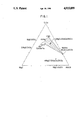
- the copper-containing pigments which after sintering will give the layers their electrical properties are selected from the following three formulae:
- P3 powder of oxides of copper in one of the forms Cu 2 O, CuO or a mixture of the two.
- cupro-nickel containing for example from 0.1 to 10% by weight of nickel has the advantage of having a higher melting point than pure copper, which results in a higher degree of convenience in carrying out the co-sintering heat treatment.
- Those powders containing copper, having a morphology which is as spherical as possible, are of a controlled granulometry such that the mean size of the grains remains between two limits :
- the ceramic powder filler is formed by cordierite having the same characteristics as the powder used for the substrate, the amount introduced being for example between 0.5 and 20% of the mass of copper-based powder and preferably between 1 and 15%.
- the amount of pigments based on copper and cordierite powder is between 45 and 80% of the total mass of ink and preferably between 55 and 70%.
- the organic phase which is composed of solvents, binding agents plasticising agents and dispersing agents of the type usually employed for conducting layers makes it possible to provide the rheological properties necessary for screen printing, it represents from 20 to 55% of the total weight of the ink.
- the process for depositing the ink is not part of the invention.
- the arrangement is subjected to a flow of moist argon (or other inert gas) such as moist N 2 or He (dew point 20° C.) by bubbling argon into water and the temperature is raised to 1070° C. at a rate of 720 K ⁇ h -1
- moist argon or other inert gas
- moist N 2 or He dew point 20° C.
- the addition of water to the inert gas may be replaced by the addition of a small amount of oxygen, which is of the order of a few ppm by volume, for example 5;
- the pigment in the ink is selected from the tree formulae P1 to P3, with preferably an ink of formula P2 for the external conductors and heat treatment of type T2 is used, as follows:
- cordierite has a low dielectric constant (less than 5).
Landscapes
- Chemical & Material Sciences (AREA)
- Engineering & Computer Science (AREA)
- Ceramic Engineering (AREA)
- Materials Engineering (AREA)
- Structural Engineering (AREA)
- Organic Chemistry (AREA)
- Inorganic Chemistry (AREA)
- Production Of Multi-Layered Print Wiring Board (AREA)
- Manufacturing Of Printed Wiring (AREA)
Applications Claiming Priority (2)
| Application Number | Priority Date | Filing Date | Title |
|---|---|---|---|
| FR8801136 | 1988-01-22 | ||
| FR8801136A FR2626270B1 (fr) | 1988-01-22 | 1988-01-22 | Procede de cofrittage, de conducteurs en cuivre ou en alliages a base de cuivre et de leur substrat ceramique en cordierite |
Publications (1)
| Publication Number | Publication Date |
|---|---|
| US4915899A true US4915899A (en) | 1990-04-10 |
Family
ID=9362822
Family Applications (1)
| Application Number | Title | Priority Date | Filing Date |
|---|---|---|---|
| US07/299,335 Expired - Fee Related US4915899A (en) | 1988-01-22 | 1989-01-23 | Process for co-sintering conductors of copper or copper-base alloys and their ceramic substrate of cordierite |
Country Status (4)
| Country | Link |
|---|---|
| US (1) | US4915899A (de) |
| EP (1) | EP0326499A1 (de) |
| JP (1) | JPH0632363B2 (de) |
| FR (1) | FR2626270B1 (de) |
Cited By (4)
| Publication number | Priority date | Publication date | Assignee | Title |
|---|---|---|---|---|
| US5230846A (en) * | 1990-10-11 | 1993-07-27 | The Boc Group, Inc. | Method for preparing multilayered ceramic with internal copper conductor |
| AU644481B2 (en) * | 1990-10-11 | 1993-12-09 | Boc Group, Inc., The | Method for preparing multi-layered ceramic with internal copper conductor |
| US5302181A (en) * | 1991-04-26 | 1994-04-12 | Kubota Corporation | Oxide-dispersion-strengthened heat-resistant chromium-based sintered alloy |
| EP3173392B1 (de) * | 2015-11-27 | 2021-04-21 | maxon international ag | Verfahren zur herstellung von keramikteilen |
Families Citing this family (3)
| Publication number | Priority date | Publication date | Assignee | Title |
|---|---|---|---|---|
| DE4100145A1 (de) * | 1990-01-10 | 1991-07-11 | Murata Manufacturing Co | Substrat fuer die montage von integrierten schaltkreisen und es umfassendes elektronisches bauteil |
| US5682018A (en) * | 1991-10-18 | 1997-10-28 | International Business Machines Corporation | Interface regions between metal and ceramic in a metal/ceramic substrate |
| CN101628195B (zh) * | 2009-07-22 | 2014-01-15 | 河北理工大学 | 一种高温气体过滤器支撑体及其制备方法 |
Citations (2)
| Publication number | Priority date | Publication date | Assignee | Title |
|---|---|---|---|---|
| US3994430A (en) * | 1975-07-30 | 1976-11-30 | General Electric Company | Direct bonding of metals to ceramics and metals |
| US4551357A (en) * | 1984-05-25 | 1985-11-05 | Ngk Insulators, Ltd. | Process of manufacturing ceramic circuit board |
Family Cites Families (6)
| Publication number | Priority date | Publication date | Assignee | Title |
|---|---|---|---|---|
| JPS5826680B2 (ja) * | 1975-10-07 | 1983-06-04 | 富士通株式会社 | セラミツクカイロキバンノセイゾウホウホウ |
| US4340436A (en) * | 1980-07-14 | 1982-07-20 | International Business Machines Corporation | Process for flattening glass-ceramic substrates |
| JPS61292392A (ja) * | 1985-06-20 | 1986-12-23 | 松下電器産業株式会社 | セラミツク配線基板の製造方法 |
| FR2585181B1 (fr) * | 1985-07-16 | 1988-11-18 | Interconnexions Ceramiques | Procede de fabrication d'un substrat d'interconnexion pour composants electroniques, et substrat obtenu par sa mise en oeuvre |
| FR2585015A1 (fr) * | 1985-07-16 | 1987-01-23 | Centre Nat Rech Scient | Poudre ceramique de type cordierite frittable a basse temperature, procede de preparation et composition ceramique obtenue par frittage de cette poudre |
| JPS62113758A (ja) * | 1985-10-25 | 1987-05-25 | 株式会社住友金属セラミックス | 低温焼成セラミツクス |
-
1988
- 1988-01-22 FR FR8801136A patent/FR2626270B1/fr not_active Expired - Fee Related
-
1989
- 1989-01-19 EP EP89420017A patent/EP0326499A1/de not_active Withdrawn
- 1989-01-20 JP JP1011767A patent/JPH0632363B2/ja not_active Expired - Lifetime
- 1989-01-23 US US07/299,335 patent/US4915899A/en not_active Expired - Fee Related
Patent Citations (2)
| Publication number | Priority date | Publication date | Assignee | Title |
|---|---|---|---|---|
| US3994430A (en) * | 1975-07-30 | 1976-11-30 | General Electric Company | Direct bonding of metals to ceramics and metals |
| US4551357A (en) * | 1984-05-25 | 1985-11-05 | Ngk Insulators, Ltd. | Process of manufacturing ceramic circuit board |
Cited By (4)
| Publication number | Priority date | Publication date | Assignee | Title |
|---|---|---|---|---|
| US5230846A (en) * | 1990-10-11 | 1993-07-27 | The Boc Group, Inc. | Method for preparing multilayered ceramic with internal copper conductor |
| AU644481B2 (en) * | 1990-10-11 | 1993-12-09 | Boc Group, Inc., The | Method for preparing multi-layered ceramic with internal copper conductor |
| US5302181A (en) * | 1991-04-26 | 1994-04-12 | Kubota Corporation | Oxide-dispersion-strengthened heat-resistant chromium-based sintered alloy |
| EP3173392B1 (de) * | 2015-11-27 | 2021-04-21 | maxon international ag | Verfahren zur herstellung von keramikteilen |
Also Published As
| Publication number | Publication date |
|---|---|
| FR2626270A1 (fr) | 1989-07-28 |
| FR2626270B1 (fr) | 1992-04-30 |
| JPH0632363B2 (ja) | 1994-04-27 |
| EP0326499A1 (de) | 1989-08-02 |
| JPH01238191A (ja) | 1989-09-22 |
Similar Documents
| Publication | Publication Date | Title |
|---|---|---|
| Wang et al. | Silver‐palladium thick‐film conductors | |
| CN100406166C (zh) | 金属粉末及其制备方法 | |
| EP0164028B1 (de) | Mullit-Cordierit-Keramikverbundwerkstoff | |
| US5145540A (en) | Ceramic composition of matter and its use | |
| EP0202858B1 (de) | Keramische Platte für Mehrschichtschaltungsverbindungen und Verfahren zum Herstellen derselben | |
| US5468445A (en) | Ceramic via composition, multilayer ceramic circuit containing same, and process for using same | |
| US6110596A (en) | Silicon nitride ceramic circuit substrate and semiconductor device using the same | |
| US4935285A (en) | Ceramic substrates for microelectronic circuits and process for producing same | |
| US6818574B2 (en) | Jointed body of glass-ceramic and aluminum nitride sintered compact and method for producing the same | |
| JP3408298B2 (ja) | 高熱伝導性窒化けい素メタライズ基板,その製造方法および窒化けい素モジュール | |
| EP0352211A2 (de) | Entfernen von Kohlenstoff aus keramischen Schichtsubstraten | |
| WO1989001461A1 (en) | Co-sinterable metal-ceramic packages and materials therefor | |
| JPH0632363B2 (ja) | 銅若しくは銅ベース合金の導体とその菫青石セラミック基板との同時焼結方法 | |
| JPH0544840B2 (de) | ||
| JPS6153156A (ja) | ムライト・β‐スポジユーメン複合セラミツク | |
| JP2001294489A (ja) | 結晶化ガラスと窒化アルミニウム焼結体との接合体 | |
| JPS62216983A (ja) | 金属化層を有する窒化アルミニウム焼結体並びにその製造方法 | |
| JP3336176B2 (ja) | ガラスセラミック焼結体 | |
| JP2000151045A (ja) | 配線基板およびその製造方法 | |
| JPH0337758B2 (de) | ||
| JPS61230396A (ja) | 高熱伝導多層セラミツク配線基板の製造方法 | |
| JP2763516B2 (ja) | 窒化アルミニウム基板のメタライズ方法 | |
| JPH10256686A (ja) | セラミック回路基板及び半導体装置並びにセラミック回路基板の製造方法 | |
| JPS61230399A (ja) | 高熱伝導多層セラミツク配線基板の製造方法 | |
| JPS61230398A (ja) | 高熱伝導多層セラミツク配線基板の製造方法 |
Legal Events
| Date | Code | Title | Description |
|---|---|---|---|
| AS | Assignment |
Owner name: PECHINEY RECHERCHE GROUPEMENT D'INTERET ECONOMIQUE Free format text: ASSIGNMENT OF ASSIGNORS INTEREST.;ASSIGNORS:OLIVER, VERONIQUE;GUILLE, JEAN-LOUIS;BERNIER, JEAN-CLAUDE;AND OTHERS;REEL/FRAME:005027/0220;SIGNING DATES FROM 19890203 TO 19890208 |
|
| CC | Certificate of correction | ||
| FEPP | Fee payment procedure |
Free format text: PAYOR NUMBER ASSIGNED (ORIGINAL EVENT CODE: ASPN); ENTITY STATUS OF PATENT OWNER: LARGE ENTITY |
|
| FPAY | Fee payment |
Year of fee payment: 4 |
|
| REMI | Maintenance fee reminder mailed | ||
| LAPS | Lapse for failure to pay maintenance fees | ||
| FP | Lapsed due to failure to pay maintenance fee |
Effective date: 19980415 |
|
| STCH | Information on status: patent discontinuation |
Free format text: PATENT EXPIRED DUE TO NONPAYMENT OF MAINTENANCE FEES UNDER 37 CFR 1.362 |