US4931030A - Flexible belt and relative driving system - Google Patents
Flexible belt and relative driving system Download PDFInfo
- Publication number
- US4931030A US4931030A US07/343,723 US34372389A US4931030A US 4931030 A US4931030 A US 4931030A US 34372389 A US34372389 A US 34372389A US 4931030 A US4931030 A US 4931030A
- Authority
- US
- United States
- Prior art keywords
- belt
- annular body
- elongated elements
- radius
- pulleys
- Prior art date
- Legal status (The legal status is an assumption and is not a legal conclusion. Google has not performed a legal analysis and makes no representation as to the accuracy of the status listed.)
- Expired - Lifetime
Links
- 238000005452 bending Methods 0.000 claims abstract description 13
- 239000013536 elastomeric material Substances 0.000 claims abstract description 10
- 230000007935 neutral effect Effects 0.000 claims abstract description 10
- 238000011161 development Methods 0.000 claims abstract description 8
- 239000004677 Nylon Substances 0.000 claims description 4
- 229920001778 nylon Polymers 0.000 claims description 4
- 229920002302 Nylon 6,6 Polymers 0.000 claims description 2
- 238000012360 testing method Methods 0.000 description 11
- 230000006835 compression Effects 0.000 description 10
- 238000007906 compression Methods 0.000 description 10
- 239000000463 material Substances 0.000 description 4
- 150000001875 compounds Chemical class 0.000 description 3
- 238000010586 diagram Methods 0.000 description 3
- 239000004744 fabric Substances 0.000 description 3
- 238000003780 insertion Methods 0.000 description 3
- 230000037431 insertion Effects 0.000 description 3
- 238000005406 washing Methods 0.000 description 3
- 230000014509 gene expression Effects 0.000 description 2
- 238000012986 modification Methods 0.000 description 2
- 230000004048 modification Effects 0.000 description 2
- 230000003014 reinforcing effect Effects 0.000 description 2
- 238000004073 vulcanization Methods 0.000 description 2
- 229920000297 Rayon Polymers 0.000 description 1
- 241000826860 Trapezium Species 0.000 description 1
- 239000000853 adhesive Substances 0.000 description 1
- 238000005119 centrifugation Methods 0.000 description 1
- 125000004122 cyclic group Chemical group 0.000 description 1
- 230000008030 elimination Effects 0.000 description 1
- 238000003379 elimination reaction Methods 0.000 description 1
- 239000000835 fiber Substances 0.000 description 1
- 238000010348 incorporation Methods 0.000 description 1
- 238000004519 manufacturing process Methods 0.000 description 1
- 238000000034 method Methods 0.000 description 1
- 229920000728 polyester Polymers 0.000 description 1
- 239000002964 rayon Substances 0.000 description 1
- 238000004804 winding Methods 0.000 description 1
Images
Classifications
-
- F—MECHANICAL ENGINEERING; LIGHTING; HEATING; WEAPONS; BLASTING
- F16—ENGINEERING ELEMENTS AND UNITS; GENERAL MEASURES FOR PRODUCING AND MAINTAINING EFFECTIVE FUNCTIONING OF MACHINES OR INSTALLATIONS; THERMAL INSULATION IN GENERAL
- F16G—BELTS, CABLES, OR ROPES, PREDOMINANTLY USED FOR DRIVING PURPOSES; CHAINS; FITTINGS PREDOMINANTLY USED THEREFOR
- F16G1/00—Driving-belts
- F16G1/06—Driving-belts made of rubber
- F16G1/08—Driving-belts made of rubber with reinforcement bonded by the rubber
-
- F—MECHANICAL ENGINEERING; LIGHTING; HEATING; WEAPONS; BLASTING
- F16—ENGINEERING ELEMENTS AND UNITS; GENERAL MEASURES FOR PRODUCING AND MAINTAINING EFFECTIVE FUNCTIONING OF MACHINES OR INSTALLATIONS; THERMAL INSULATION IN GENERAL
- F16G—BELTS, CABLES, OR ROPES, PREDOMINANTLY USED FOR DRIVING PURPOSES; CHAINS; FITTINGS PREDOMINANTLY USED THEREFOR
- F16G1/00—Driving-belts
- F16G1/28—Driving-belts with a contact surface of special shape, e.g. toothed
-
- F—MECHANICAL ENGINEERING; LIGHTING; HEATING; WEAPONS; BLASTING
- F16—ENGINEERING ELEMENTS AND UNITS; GENERAL MEASURES FOR PRODUCING AND MAINTAINING EFFECTIVE FUNCTIONING OF MACHINES OR INSTALLATIONS; THERMAL INSULATION IN GENERAL
- F16G—BELTS, CABLES, OR ROPES, PREDOMINANTLY USED FOR DRIVING PURPOSES; CHAINS; FITTINGS PREDOMINANTLY USED THEREFOR
- F16G5/00—V-belts, i.e. belts of tapered cross-section
- F16G5/04—V-belts, i.e. belts of tapered cross-section made of rubber
- F16G5/06—V-belts, i.e. belts of tapered cross-section made of rubber with reinforcement bonded by the rubber
-
- F—MECHANICAL ENGINEERING; LIGHTING; HEATING; WEAPONS; BLASTING
- F16—ENGINEERING ELEMENTS AND UNITS; GENERAL MEASURES FOR PRODUCING AND MAINTAINING EFFECTIVE FUNCTIONING OF MACHINES OR INSTALLATIONS; THERMAL INSULATION IN GENERAL
- F16G—BELTS, CABLES, OR ROPES, PREDOMINANTLY USED FOR DRIVING PURPOSES; CHAINS; FITTINGS PREDOMINANTLY USED THEREFOR
- F16G5/00—V-belts, i.e. belts of tapered cross-section
- F16G5/20—V-belts, i.e. belts of tapered cross-section with a contact surface of special shape, e.g. toothed
Definitions
- the present invention concerns a flexible belt and the relative driving system and, more precisely, it relates to an elastically extensible belt of elastomeric material, which must be assembled between at least two pulleys with respect to which it transmits, by friction, forces able to generate motion.
- belts made of elastomeric material intended to be assembled around at least two pulleys and to exchange, on appropriate surfaces, friction forces able to transmit motion comprise substantially a ring-shaped body which has embedded therein in a same plane a plurality of tension-resistant elongated elements whose main feature is their inextensibility.
- the belt body is internally and externally limited by a pair of base surfaces and, laterally, by a pair of opposite sides.
- Belts of the above type can have an V-shaped section and can transmit the friction forces by their sides, or a flat section and transmit the friction forces by at least one of their bases.
- they can be of the Poly-V type, identified in cross section by a base surface comprising several V-shaped longitudinal grooves arranged side-by-side.
- belts find application in many fields, and in particular they are mainly used for power drives in which one of the pulleys can have very small take-up diameters, in some cases 70 mm, and often even smaller, ranging between 40 and 50 mm. Moreover, the present technical trend is to use the above belts on pulleys having diameters of 15 or 16 mm.
- the compression of the considered belt portion is greater the greater the pulley curvature, with a consequent high deformation of the elastomeric material which may give rise to substantially undulated configurations in areas corresponding to the joint between the longitudinal elements and the annular elastomeric body.
- An object of the present invention is to provide a flexible belt made of elastomeric material which is intended to transmit friction forces able to generate motion and the relative driving system comprising said belt and at least two pulleys, in which the above-mentioned disadvantages are eliminated.
- an object of the present invention is to provide an elastically extensible belt which comprises a ring-shaped body of elastomeric material and a plurality of tension-resistant elongated elements embedded in said ring-shaped body along a surface substantially corresponding to the position of the neutral axis, said belt, when bent according to a first curvature defined by a circumference having a radius equal to 60% of the radius of the circumferential development of the ring-shaped body at the elongated elements, undergoing a flexion corresponding to a first shrinkage value of its radially innermost surface, and, when bent according to a second curvature defined by a circumference having a radius equal to 35% of the radius of said circumferential development, undergoing a flexion corresponding to a second shrinkage value of said radially innermost surface, the belt being characterized in that each elongated element, at 1/10 of its ultimate tensile stress, has an elongation value which balances a shrinkage value located between said first and said second curva
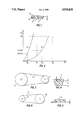
- FIG. 1 is sectional view of a multi-groove belt according to the invention
- FIG. 2 is a qualitative diagram showing the tensile stresses and the elastic elongation of a continuous elongated element of the belt of FIG. 1,
- FIG. 3 shows schematically a driving system comprising a V-shaped belt mounted between two pulleys, one of which is of the expanding type,
- FIG. 4 is a sectional view of the V-shaped belt of FIG. 3, and
- FIGS. 5 and 6 show respectively in section and in side view a flat belt and the relative driving system according to the invention.
- Poly-v belt 1 is formed by a flat portion and, in a position opposite to its back 2, by a plurality of longitudinal V-shaped grooves 3.
- Belt 1 comprises a body of elastomeric material and a plurality of continuous elongated elements 4 in the form of cords or the like, arranged side-by-side, on a cylindrical surface of belt 1, at a distance "h" from the surface defined by points "V" of the grooves.
- the belt body is closed as a ring and the pitch circumferential layout of the belt along cords 4 is obtained by a radius of value R.
- the main feature of belt 1 is its elastic extensibility, which is due to the geometrical structure of the belt itself.
- the inventive principle lies in the fact of inserting in the belt body, on its cylindrical surface, a plurality of continuous elongated elements 4 having a pre-established characteristic able to balance a convenient part of the shrinkage of the belt portion compressed by flexion on a curved surface.
- elongated elements 4 whose elongation value is selected in accordance with two limit shrinkage conditions, obtained by bending the belt along two curvatures represented by two theoretical circumferences of pre-established radius.
- a belt having given geometrical characteristics "R” and "h” is theoretically bent only by flexion on two circumferences, the first having a radius r 2 equal to 0.6 R and the second having a radius r 1 equal to 0.35 R, determining for said configurations the percent shrinkages ⁇ 1 and ⁇ 2 of the innermost base surface of the belt, namely that represented by the points of the grooves.
- the elongated element having pre-established extensibility characteristics is chosen as follows.
- the choice of elongated elements 4 in the form of cords in accordance with curve "b" of FIG. 2 enables the belt to be mounted between two pulleys at an elastic pretension corresponding to 1/10 of the ultimate tensile stress of each element 4 multiplied by the number of elements, so as to balance, by means of elongation ⁇ b of the belt, shrinkage values comprised between ⁇ 1 and ⁇ 2 .
- This parameter can be determined at once, as briefly explained herebelow.
- neutral axis i.e., the locus of the points where the fibers of the body subjected to flexion do not suffer elongation or shrinkage, it will be:
- the elongated element whose elongation at 1/10 of its ultimate tensile stress balances the shrinkage ranging between ⁇ 1 and ⁇ 2 is chosen as a function of the belt parameters R and h.
- the invention is able to achieve all of the above indicated purposes. To demonstrate that said purposes were obtained, the tests carried out on the Poly-V belt of the first embodiment are described herebelow.
- the tests had the objective of evaluating the life of a belt according to the invention after a high number of bendings on pulleys having small radii.
- the equipment used was the following:
- the belt of the first embodiment was mounted between two pulleys situated at such a fixed center distance as to originate an initial assembling elongation of 2%.
- the test was interrupted after 700 work hours and the examination of the belt did not show any detachment between the rubber compound and the cords embedded in the belt body.
- the equipment used was the following:
- the center distance was selected so as to mount the belt with an elongation of approximately 2%.
- the belt was caused to rotate at low and high speed cycles, in both a clockwise and a counterclockwise direction so as to simulate the washing and centrifugation phases of a washing machine.
- the test was interrupted after 2000 working cycles, corresponding to the service life of a household appliance, without ascertaining any detachment between the cords and the rubber compound embedding them.
- the shrinkage values ⁇ 1 , ⁇ 2 resulting from the compression of the innermost surface of the belt bent on the two pulleys of 80 mm and 30 mm are the following:
- the belt was mounted between the two pulleys with a preliminary tension corresponding to an elongation of approximately 2%; in other words, the elongation characteristics of the belt are such that it can balance about 1/3 of the shrinkage originated by its bending on the greatest pulley, but can compensate only in a minimum part the shrinkage due to its bending on the smallest pulley.
- the first test showed surprisingly that the belt according to the first embodiment remained in one piece even if subjected to cyclic bending stresses on a pulley having a diameter of 30 mm.
- the belt under test comprises long portions to be taken up on the pulley having the greatest diameter and very reduced portions being taken up on the smallest pulley.
- the behavior of the belt in particular the phenomena occurring in the material constituting it, would be significantly influenced by the extent of the take up arc on the pulley of greater diameter, so that the fact of having eliminated the majority of the drawbacks, related to shrinkage, which take place on said pulley is by itself a useful contribution to the prolongation of the belt life even if, apparently, there still are phenomena of unbalanced shrinkage by compression in the smallest pulley.
- the largest pulley has a relevant circumferential layout, while the smallest pulley, due to its dimensions, is very critical for the shrinkage originated by compression.
- the results of the tests tend to confirm the validity of the belt features, with elongation values greater than 1/10 and in any case located in the cited range ⁇ 1 and ⁇ 2 .
- the present invention can be applied to belts having a section different from that of the above-described Poly-V belt; as shown in FIG. 3, it can be applied, e.g., to a belt 5 of trapezoidal section for a stepless speed change gear in which, by way of example, the largest pulley 6 has a fixed trapezoidal groove and the smallest pulley 7 a variable trapezoidal groove.
- the invention can be applied according to the same principles, to a flat belt provided with continuous elongated elements able to confer to the belt an elastic extensibility located in the desired range.
- such belt 8 might be mounted (FIG. 5) between two pulleys 9, 10, whose fixed center distance is such as to determine the elongation and therefore the preliminary elastic tension of the belt itself.
- the flat belt might have a rectangular cross section or any other section, inter alia, with a curvilinear shape on one of the two base surfaces or any other shape provided that--whichever solution is adopted--at least one of the two base surfaces is able to transmit, by friction, forces able to generate motion with at least a corresponding outer surface of a pulley.
- the invention is described with reference to the characteristic of extensibility of the belt.
- the elongation of the elongated elements gives rise to the elastic extensibility of the belt; however, it is to be taken into account that the stress/deformation curve of each element is drawn at room temperature and that, in practice, when the element is inserted in the belt and the latter is vulcanized, a modification of the stress/deformation curve might be ascertained when specific materials are used to form the cords.
- the cords inserted in the elastomeric mass may show variations in their elongation characteristics. Further, also when the cords are treated with an adhesive agent, their extensibility characteristics may undergo modifications.
- the Poly-V belt of the first embodiment might comprise elongated elements other than cords, as for example, monofilaments or cords of a material different from nylon, provided that in the various possible solutions said elements--according to their dimensional characteristics and to the treatment undergone after their incorporation in the belt--are able to originate an ultimate tensile stress of 4000 N and, at 1/10 of said ultimate tensile stress, an elongation of the belt ranging from 1.08% to 3.02%.
- elongated elements other than cords as for example, monofilaments or cords of a material different from nylon
- the Poly-V belt according to the invention might be used in a driving system in which one of the pulleys comprises an outer surface grooved like the belt and the other pulley comprises a cylindrical, smooth outer surface.
- the belts can comprise layers of fabric, in particular covering fabric, each prepared and built up with such an extensibility as not to hinder the elastic elongation of the belt determined by the elongated elements present in the elastomeric compound.
- the fabrics present in the belt do not affect the ultimate tensile stress of the belt, which is chiefly determined by the elongated elements embedded in the ring-shaped body on a surface corresponding to the pitch surface.
- the belt might have a cross section different from those indicated above, as for example, a circular section, to be mounted between two pulleys having a V-shaped race.
Landscapes
- Engineering & Computer Science (AREA)
- General Engineering & Computer Science (AREA)
- Mechanical Engineering (AREA)
- Package Frames And Binding Bands (AREA)
- Devices For Conveying Motion By Means Of Endless Flexible Members (AREA)
Applications Claiming Priority (2)
| Application Number | Priority Date | Filing Date | Title |
|---|---|---|---|
| IT20338A/88 | 1988-04-27 | ||
| IT20338/88A IT1217203B (it) | 1988-04-27 | 1988-04-27 | Cinghia flessibile e relativa trasmissione |
Publications (1)
| Publication Number | Publication Date |
|---|---|
| US4931030A true US4931030A (en) | 1990-06-05 |
Family
ID=11165846
Family Applications (1)
| Application Number | Title | Priority Date | Filing Date |
|---|---|---|---|
| US07/343,723 Expired - Lifetime US4931030A (en) | 1988-04-27 | 1989-04-27 | Flexible belt and relative driving system |
Country Status (10)
| Country | Link |
|---|---|
| US (1) | US4931030A (de) |
| EP (1) | EP0339249B1 (de) |
| JP (1) | JPH0211948A (de) |
| AR (1) | AR240507A1 (de) |
| AT (1) | ATE93021T1 (de) |
| BR (1) | BR8902449A (de) |
| CA (1) | CA1317128C (de) |
| DE (1) | DE68908243T2 (de) |
| ES (1) | ES2047052T3 (de) |
| IT (1) | IT1217203B (de) |
Cited By (7)
| Publication number | Priority date | Publication date | Assignee | Title |
|---|---|---|---|---|
| US5181890A (en) * | 1989-12-22 | 1993-01-26 | Pirelli Trasmissioni Industriali S.P.A. | Elastic driving belt and process for identifying and detecting residual elastic elongations in said belt stretched between two pulleys |
| DE4316917A1 (de) * | 1993-05-20 | 1994-11-24 | Gates Rubber Co | Keilriemen oder Keilrippenriemen |
| DE19531281C1 (de) * | 1995-08-25 | 1997-02-20 | Contitech Antriebssysteme Gmbh | Riemen für einen Riemenantrieb |
| WO2002090145A3 (en) * | 2001-05-03 | 2003-11-06 | Dayco Products Llc | Low modulus belt for automotive applications |
| US6896634B2 (en) * | 1996-09-20 | 2005-05-24 | Hutchinson | Striated belt, its manufacturing method and the associated drive system |
| US20080194187A1 (en) * | 2007-02-08 | 2008-08-14 | Alto U.S. Inc. | Elastic drive belt assembly |
| US20240060546A1 (en) * | 2021-01-07 | 2024-02-22 | Compagnie Generale Des Etablissements Michelin | Belt with bimodulus behavior during operation |
Families Citing this family (3)
| Publication number | Priority date | Publication date | Assignee | Title |
|---|---|---|---|---|
| DE4038465A1 (de) * | 1990-12-03 | 1992-06-04 | Continental Ag | Endloser keilriemen oder keilrippenriemen und antriebssystem |
| JP2000304103A (ja) * | 1999-04-21 | 2000-11-02 | Bando Chem Ind Ltd | Vリブドベルト |
| FR2878924B1 (fr) * | 2004-12-08 | 2007-02-23 | Hutchinson Sa | Courroie extensible presentant un cable en polyamide 6.6, notamment pour application automobile |
Citations (8)
| Publication number | Priority date | Publication date | Assignee | Title |
|---|---|---|---|---|
| US2255884A (en) * | 1940-06-28 | 1941-09-16 | Duron Metal Products Company | V belt |
| US2273200A (en) * | 1938-11-01 | 1942-02-17 | Du Pont | Artificial structure |
| US2792319A (en) * | 1953-12-09 | 1957-05-14 | Goodrich Co B F | Drive belts |
| US3160193A (en) * | 1962-09-25 | 1964-12-08 | Monsanto Co | Hollow tire cord |
| GB1104819A (en) * | 1965-10-06 | 1968-02-28 | Dayco Corp | Method and apparatus for treating belts and product resulting therefrom |
| GB1123225A (en) * | 1965-04-19 | 1968-08-14 | Dayco Corp | Multiple rib belt |
| US4571230A (en) * | 1984-09-04 | 1986-02-18 | Dayco Corporation | Endless power transmission belt having a toothed compression section and method of making the same |
| US4822324A (en) * | 1987-01-28 | 1989-04-18 | Hutchinson | Endless power transmission belt |
Family Cites Families (4)
| Publication number | Priority date | Publication date | Assignee | Title |
|---|---|---|---|---|
| US3566706A (en) * | 1968-06-25 | 1971-03-02 | Sidney R Fix | Power transmission belt |
| US3900680A (en) * | 1972-03-08 | 1975-08-19 | Goodyear Tire & Rubber | Cord for extensible belt |
| JPS61167736A (ja) * | 1985-01-18 | 1986-07-29 | Bando Chem Ind Ltd | 動力伝動用ベルト |
| IT1210379B (it) * | 1987-04-01 | 1989-09-14 | Zanussi Elettrodomestici | Cinghia di trasmissione. |
-
1988
- 1988-04-27 IT IT20338/88A patent/IT1217203B/it active
-
1989
- 1989-03-16 AT AT89104933T patent/ATE93021T1/de not_active IP Right Cessation
- 1989-03-16 EP EP89104933A patent/EP0339249B1/de not_active Revoked
- 1989-03-16 DE DE89104933T patent/DE68908243T2/de not_active Revoked
- 1989-03-16 ES ES89104933T patent/ES2047052T3/es not_active Expired - Lifetime
- 1989-04-25 AR AR313754A patent/AR240507A1/es active
- 1989-04-27 JP JP1109021A patent/JPH0211948A/ja active Pending
- 1989-04-27 BR BR898902449A patent/BR8902449A/pt not_active IP Right Cessation
- 1989-04-27 CA CA000597967A patent/CA1317128C/en not_active Expired - Fee Related
- 1989-04-27 US US07/343,723 patent/US4931030A/en not_active Expired - Lifetime
Patent Citations (8)
| Publication number | Priority date | Publication date | Assignee | Title |
|---|---|---|---|---|
| US2273200A (en) * | 1938-11-01 | 1942-02-17 | Du Pont | Artificial structure |
| US2255884A (en) * | 1940-06-28 | 1941-09-16 | Duron Metal Products Company | V belt |
| US2792319A (en) * | 1953-12-09 | 1957-05-14 | Goodrich Co B F | Drive belts |
| US3160193A (en) * | 1962-09-25 | 1964-12-08 | Monsanto Co | Hollow tire cord |
| GB1123225A (en) * | 1965-04-19 | 1968-08-14 | Dayco Corp | Multiple rib belt |
| GB1104819A (en) * | 1965-10-06 | 1968-02-28 | Dayco Corp | Method and apparatus for treating belts and product resulting therefrom |
| US4571230A (en) * | 1984-09-04 | 1986-02-18 | Dayco Corporation | Endless power transmission belt having a toothed compression section and method of making the same |
| US4822324A (en) * | 1987-01-28 | 1989-04-18 | Hutchinson | Endless power transmission belt |
Cited By (12)
| Publication number | Priority date | Publication date | Assignee | Title |
|---|---|---|---|---|
| US5181890A (en) * | 1989-12-22 | 1993-01-26 | Pirelli Trasmissioni Industriali S.P.A. | Elastic driving belt and process for identifying and detecting residual elastic elongations in said belt stretched between two pulleys |
| DE4316917A1 (de) * | 1993-05-20 | 1994-11-24 | Gates Rubber Co | Keilriemen oder Keilrippenriemen |
| DE19531281C1 (de) * | 1995-08-25 | 1997-02-20 | Contitech Antriebssysteme Gmbh | Riemen für einen Riemenantrieb |
| US6896634B2 (en) * | 1996-09-20 | 2005-05-24 | Hutchinson | Striated belt, its manufacturing method and the associated drive system |
| US20050164815A1 (en) * | 1996-09-20 | 2005-07-28 | Hutchinson | Tool for mounting a belt in a groove of a pulley |
| US7247110B2 (en) | 1996-09-20 | 2007-07-24 | Hutchinson | Tool for mounting a belt in a groove of a pulley |
| WO2002090145A3 (en) * | 2001-05-03 | 2003-11-06 | Dayco Products Llc | Low modulus belt for automotive applications |
| US20040038764A1 (en) * | 2001-05-03 | 2004-02-26 | Swope Jay D. | Low modulus belt for automotive applications |
| US6832968B2 (en) * | 2001-05-03 | 2004-12-21 | Dayco Products, Llc | Low modulus belt for automotive applications |
| US7335122B2 (en) * | 2001-05-03 | 2008-02-26 | Dayco Products, Llc | Low modulus belt for automotive applications |
| US20080194187A1 (en) * | 2007-02-08 | 2008-08-14 | Alto U.S. Inc. | Elastic drive belt assembly |
| US20240060546A1 (en) * | 2021-01-07 | 2024-02-22 | Compagnie Generale Des Etablissements Michelin | Belt with bimodulus behavior during operation |
Also Published As
| Publication number | Publication date |
|---|---|
| DE68908243D1 (de) | 1993-09-16 |
| ATE93021T1 (de) | 1993-08-15 |
| EP0339249B1 (de) | 1993-08-11 |
| EP0339249A1 (de) | 1989-11-02 |
| JPH0211948A (ja) | 1990-01-17 |
| CA1317128C (en) | 1993-05-04 |
| IT8820338A0 (it) | 1988-04-27 |
| DE68908243T2 (de) | 1993-12-16 |
| AR240507A1 (es) | 1990-04-30 |
| IT1217203B (it) | 1990-03-14 |
| BR8902449A (pt) | 1990-01-16 |
| ES2047052T3 (es) | 1994-02-16 |
Similar Documents
| Publication | Publication Date | Title |
|---|---|---|
| RU2418212C1 (ru) | Зубчатая втулочная гибкая муфта для соединения валов | |
| US4931030A (en) | Flexible belt and relative driving system | |
| US20060105874A1 (en) | Timing belt | |
| US6293886B1 (en) | Heavy-duty power transmission V-belt | |
| GB2138535A (en) | Drive belt | |
| US4708702A (en) | V-belt of controlled extensibility and relative transmission | |
| CA2047315C (en) | V-ribbed belt | |
| JP2006502349A (ja) | 低モジュラスベルト | |
| JP2609364B2 (ja) | 弾性的ベルトを有する伝達装置、及び該弾性的ベルト | |
| US4022071A (en) | Steel cord belt reinforced transmission belt | |
| EP0246508B1 (de) | Biegsamer Riemen und entsprechender Antrieb | |
| US5876297A (en) | Tension member for a power transmission belt having a braiding pitch to diameter ratio within a specific range to increase the flex fatigue resistance of the belt | |
| JPH0583776B2 (de) | ||
| JPH06249292A (ja) | 歯付ベルト | |
| EP0571178B1 (de) | Keilrippenriemen | |
| JPH063244B2 (ja) | 歯付きベルト | |
| US4595388A (en) | Driving belt | |
| EP0179287A1 (de) | Riemen und einen solchen aufweisendes Riemengetriebe | |
| JPH10153243A (ja) | 歯付ベルト駆動装置 | |
| JPH0139952Y2 (de) | ||
| JPH0562656B2 (de) | ||
| JPH0565943A (ja) | 工業用ベルト | |
| JPS6117742A (ja) | 動力伝達用無端ベルト | |
| JPH0517473Y2 (de) | ||
| KR830002541B1 (ko) | 전동풀리 |
Legal Events
| Date | Code | Title | Description |
|---|---|---|---|
| AS | Assignment |
Owner name: PIRELLI TRASMISSIONI INDUSTRIALI S.P.A. Free format text: ASSIGNMENT OF ASSIGNORS INTEREST.;ASSIGNOR:ROBECCHI, EDOARDO;REEL/FRAME:005069/0172 Effective date: 19890417 |
|
| STCF | Information on status: patent grant |
Free format text: PATENTED CASE |
|
| CC | Certificate of correction | ||
| FEPP | Fee payment procedure |
Free format text: PAYOR NUMBER ASSIGNED (ORIGINAL EVENT CODE: ASPN); ENTITY STATUS OF PATENT OWNER: LARGE ENTITY |
|
| FPAY | Fee payment |
Year of fee payment: 4 |
|
| FPAY | Fee payment |
Year of fee payment: 8 |
|
| FPAY | Fee payment |
Year of fee payment: 12 |