US4979165A - Multiple queue bandwidth reservation packet system - Google Patents
Multiple queue bandwidth reservation packet system Download PDFInfo
- Publication number
- US4979165A US4979165A US07/371,235 US37123589A US4979165A US 4979165 A US4979165 A US 4979165A US 37123589 A US37123589 A US 37123589A US 4979165 A US4979165 A US 4979165A
- Authority
- US
- United States
- Prior art keywords
- packet
- packets
- type
- word
- output
- Prior art date
- Legal status (The legal status is an assumption and is not a legal conclusion. Google has not performed a legal analysis and makes no representation as to the accuracy of the status listed.)
- Expired - Lifetime
Links
Images




Classifications
-
- H—ELECTRICITY
- H04—ELECTRIC COMMUNICATION TECHNIQUE
- H04L—TRANSMISSION OF DIGITAL INFORMATION, e.g. TELEGRAPHIC COMMUNICATION
- H04L12/00—Data switching networks
- H04L12/64—Hybrid switching systems
Definitions
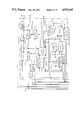
- FIG. 1 shows details, in simplified block diagram form, of a packet network node including aspects of the invention
- each of packetizers 105-1 through 105-Y includes input local packet interface 106 and parity unit 107, and is employed to generate a packet format, in accordance with aspects of the invention, as shown in FIG. 2.
- input local packet interface 106 includes apparatus for interfacing the particular incoming signal in order to delimit it so that the broadband packet words may be formatted in accordance with the instant invention.
- buffer storage is required for the packet being formatted, a transport word generator, counters for counting the number of packet bytes and the number of packet words, apparatus for padding the last packet information word to build it out to the proper number of bytes and multiplex apparatus for combining packet information words and the transport word to form the desired packet.
- the transport word generator can be a register or a read write (RAM) memory unit into which the desired information is inserted. Such apparatus is known in the art.
- the number M of packet information words can be zero (0) to 255, each packet information word includes eight bytes and each byte includes eight bits. Although the bytes of information are shown as being in parallel, it will be apparent that they could also be arranged in series.
- the packet format as shown in FIG. 2 is formed by packetizers 105 in a manner that will be apparent to those skilled in the art.
- bit positions designated VCID (0) through VCID (19) may be used to further identify the final destination of the corresponding packet and represent a so-called virtual circuit identification.
- bit positions VCID (16) through VCID (19) are designated a destination extension (DEST EXT) field. If the destination of the packet is the instant packet network node, the DEST EXT field indicates which one of output ports 110-(X+1) through 110-(X+Y) is to be supplied with the packet. The remaining VCID bits are employed to identify the final destination of the packet and for billing purposes.
- Bit positions BKG (0) through BKG (2) are designated the breakage field and indicate the number of bytes in the last information word M of the packet that do not include user information being transmitted and, hence, have been padded. It will be apparent that bit positions BKG (0) through BKG (2) could equally be used to indicate the number of bytes including user information in the last information word.
- Xref and the number of bits included in Xref is determined by the number of network layers including private networks in a particular system. Additionally, it will also be apparent that the number of prescribed parity checks and the bit patterns used in computing the parity check bits used in practicing the invention is dependent on the degree of robustness desired in the system. In this embodiment of the invention, two prescribed parity checks including 14 parity check bits are used to obtain a desired level of robustness. That is to say, each bit from the bit positions of BYTE (0) through BYTE (6) of the transport word is used in computing at least two different parity check bits.
- a separate parity check bit is generated over each of the vertical columns of BYTE (0) through BYTE (5).
- the first prescribed parity check bits which are generated for BYTE (0) through BYTE (5) are PBYT (0) through PBYT (5), respectively, and form the first prescribed parity pattern which is inserted into the first parity check field in BYTE (6) of the transport word, as shown in FIG. 4.
- the parity for generating the individual parity check bits need not be restricted to a byte but can be computed from bits in any number of bit positions in one or more bytes, or groups of bit positions. For example, parity can be computed from bits in specific ones of the functional fields of the transport word.
- parity check bits are PBIT (0) through PBIT (7), respectively, and form the second prescribed parity check pattern which is inserted into the second parity check field in BYTE (7) of the transport word, as shown in FIG. 4. It is noted, however, that the parity check bits may be computed from bits in any desired pattern of bit positions in the transport word. Indeed, any desired number of parity checks may be employed in practicing aspects of the invention to realize any desired level of robustness.
- each of packetizers 105 generates the packet format as shown in FIG. 2, in a manner which will be apparent to those skilled in the art, by accumulating the number M of information words 202 in the packet and appending the transport word 201 to them.
- each of input local packet interfaces 106 stores the information words and inserts the appropriate information concerning the packet into the fields of the transport word as shown in FIG. 3.
- This information includes the address information to be placed in the address field including the network destination in bit position DEST (0) through DEST (11) (FIG. 3), and the destination extension (DEST EXT) in bit positions VCID (16) through VCID (19) and the final destination in the remaining VCID bits.
- a specific transport user can employ a packetizer essentially identical to packetizer 105 to generate packets or employ packet network nodes essentially identical to packet network node 100 in a private network. Then, a unique reference code word Xref is assigned to the specific transport user to provide a unique network identity. The packets generated with the unique reference code word are assured to be transparent in the public system hierarchy.
- the broadband packets generated in the private network are identical to the broadband packets described above. Consequently, the private network packets including their transport words appear as information to packetizer 105 in packet network node 100 and, therefore, are transparent. Packet network node 100 simply appends a transport word to the supplied information to form packets.
- FIG. 5 shows details, in simplified block diagram form, of input ports 104. Accordingly, shift bytes unit 501 is supplied an ENABLE IN signal, the reference code word Xref and packet bytes in parallel via BYTE IN. ENABLE IN is at an incoming clock rate and indicates that a valid packet byte is available for this input port. ENABLE IN is also supplied to byte counter 502. Shift bytes unit 501 includes a word wide shift register, parity generators and a comparator (not shown). In this example, a word includes eight (8) bytes in series and each byte includes eight (8) parallel bits.
- word latch 503 latches the WORD from shift bytes unit 503; status latch 508 latches the WORD COUNT from word counter 507, Tword from control 506 and lpkTok from control 506; RAM address generator 509 is enabled to be advanced by one address; and scheduler data store 505 is enabled to input data.
- a WC signal is also generated when byte counter 502 is reset.
- Word counter 507 is responsive to the WC output from byte counter 502 to count the number of packet words supplied to input port 104.
- the count of packet words (WORD COUNT) is supplied to status latch 508 and to control 506.
- step 604 yields a YES result after the first word has been supplied to shift bytes unit 501(FIG. 5).
- steps 603 through 607 operate on the incoming packet on a byte-by-byte basis to identify a first transport word candidate.
- steps 608 through 612 operate on the incoming packet also on a byte-by-byte basis to identify a subsequent transport word candidate pointed to by the packet length indicator from the previous transport word candidate.
- the previous transport word candidate is identified as a valid transport word, in accordance with an aspect of the invention.
- operation of input port 104 enters an IN-FRAME mode.
- IN-FRAME mode testing for transport word candidates, in this example, is done on a word wise basis.
- operational block 614 indicates that a packet word has been supplied to shift bytes unit 501.
- Both periodic queue 702 and statistical queue 705 are, in this example, first in first out (FIFO) registers and interface with next packet unit 706.
- REAL QSUM counter 703 is decremented by one packet word in response to a word complete (WC) signal from byte counter 707. This follows because a packet word has been transmitted.
- Time unit 708 generates a refence time T, which is arbitrary time, e.g., now.
- Time unit 708 is also incremented by a packet word interval in response to the WC signal. Since in this packet network node, packets are continuous and contiguous in the byte intervals designated by ENABLE, this is a smooth process.
- Adder 709 combines the REAL QSUM and RESQSUM to obtain TQSUM, namely,
- TQSUM is representative of the queuing delay in the output port.
- TQSUM is supplied to adder 710 and TQBUS.
- Adder 710 is enabled in response to arriving statistical packets at statistical queue 705 to combine TQSUM and time T to obtain the scheduled time of service value STOS for each corresponding statistical packet, namely,
- Address counter 713 supplies the address of the requested packet word to address bus ABUS and, in turn, the identified word in the corresponding one of input ports 104 RAM memory or stuff port 109 is read to data bus DBUS and supplied to word latch 714.
- Byte converter 715 supplies the packet words a byte at a time in response to ENABLE OUT from a corresponding output interface.
- ENABLE OUT is also supplied to byte counter 707 which generates a word complete (WC) signal when the appropriate number of bytes have been transmitted.
- a packet word includes eight bytes in series and each byte includes eight bits in parallel.
- the WC signal is also supplied to word counter 712, address counter 713, word latch 714, byte converter 715 and reservation factor calculator 716.
- the actual service times for the packets are shown in FIG. 8(d), and the actual times of service and departure of the packets are shown in FIG. 8(e).
- statistical packet S1 was scheduled for service immediately upon its arrival and an interval based on the predetermined relationship to the total length of the statistical packet had been reserved, in accordance with an aspect of the invention, to service periodic packets.
- periodic packet P1 presently in the periodic queue is serviced upon completing the transmission of statistical packet S1. Since the transmission of periodic packet P1 is completed prior to the occurrence of the STOS for the next statistical packet S2, and there are no other periodic packets presently in the periodic queue, one or more stuff packets (SP) are transmitted. This is important so that synchronization is maintained in the network and so that information flow is smooth.
- SP stuff packets
- the so-called logical output ports are designated 0 and 9-15 and are, in this example, as follows: 0-stuff, 9-not assigned, 10-conditional source (CSRC), 11-conditional extension (CEXT), 12-destination extension (DEST EXT), 13-control (CTL), 14-not assigned and 15-stuff.
- CSRC 10-conditional source
- CEXT 11-conditional extension
- DEST EXT 12-destination extension
- CTL 13-control
- 14-not assigned and 15-stuff if a primary output port is identified as 1-through 8 it is a "real" output port, i.e., an actual one of output ports 110 in this node to which traffic is being directed and if it is identified as, for example, 13 it is the one of output ports 110 assigned to control.
- the routing RAM is indexed by the DEST field of the packet to yield the stored information.
- operational block 1102 sets the one of input ports 104 to be polled to one (1).
- conditional branch point 1103 tests to determine if the status is good for the particular one of input ports 104-1 through 104-(X+Y) being polled. If the test result in step 1103 is NO, the port is not good, i.e., not functioning properly, and operational block 1104 causes the packet output information to be supplied to statistics port 116. This is achieved by operational block 1105 writing the appropriate packet output information on SBUS identifying statistics port 116 as the output port.
- step 1108 determines whether the test result in step 1108 is NO. If the test result in step 1108 is NO, control is returned to step 1106 and appropriate ones of steps 1102 through 1109 are iterated until step 1109 yields a YES result. Then, operational block 1110 causes the new packet transport information to be obtained from TBUS.
- the routing RAM is indexed by the DEST field to yield the stored information regarding the primary and secondary routes and, hence, the primary and secondary output ports assigned to the packet destination, the delay difference between the routes and the rerouting status or if the output port is a logical output port an indication of appropriate ones of input ports 104 designated for a particular control function.
- the threshold RAM is indexed by the TYPE field to yield values for thresholds TD, TA and TRR.
- CTL output port assigned to control
- conditional branch point 1131 tests to determine if the output port assigned to DEST EXT is assigned to conditional source (CSRC). Again, this is another example of indirect addressing which is used to locate appropriate output ports in this node for packets transmitted from a remote node that does not know the port assignments in this node. If the test result in step 1131 is NO, the output port assigned to DEST EXT is not CSRC, control is returned to step 1125 and appropriate ones of steps 1125-1128 are repeated to determine if the packet is to be supplied to the output port assigned to DEST EXT or to statistics port 116, as described above.
- threshold TRR represents some minimal transmission delay interval at the secondary output port so that if the packet were supplied to the secondary output port it would experience only a minimal delay before being transmitted.
- test result in step 1139 is YES, control is transferred to conditional branch point 1141. If the test result in step 1139 is NO, control is transferred to conditional branch point 1140 (FIG. 15).
- Conditional branch point 1140 also tests to determine if the packet is a type 1, i.e., periodic packet, as described above. If the test result in step 1140 is YES, the packet is periodic and conditional branch point 1147 tests to determine if the primary output port assigned to the packet DEST has a reserved interval for the transmission of periodic packets, in accordance with equation (10). If the test result in step 1147 is YES, step 1143 selects the assigned primary output port to transmit the packet, step 1105 writes the packet output information to SBUS, as described above, and control is returned to step 1106 (FIG. 11). If the test result in step 1147 is NO, conditional branch point 1148 tests to determine if the packet is a minimum delay type, as described above.
- threshold TA is selected to be a value significantly lower than the delay threshold TD and such that the packet is not unnecessarily routed to the secondary route. This minimizes the possibility of the so-called “funeral effect” resulting. Again, the "funeral effect” is a condition that results in lower and lower network throughput because of packets being alternate routed. Consequently, as network loading increases system "good” throughput decreases. If the test result in step 1151 is NO, the primary output port has the least delay, step 1143 selects the primary output port to transmit the packet, step 1105 writes the packet output information to SBUS and control is returned to step 1106 (FIG. 11).
- the SOP signal indicates the beginning of the packet so that it can be properly depacketized.
- the STUFF signal indicates whether the packet could be ignored. Apparatus to be included in individual ones of output local packet interfaces 112 will depend on the particular apparatus or communication link being interfaced and will be apparent to those skilled in the art.
- gateway node 1607 would strip the higher layer network transport word which had been added or if the transport word was replaced dropping the higher layer network transport word and adding a transport word generated with the reference code word Xref assigned to local network 1603. If the packets being transmitted in higher layer network 1605 are destined for local network 1604, they are supplied thereto via gateway node 1608. Gateway node 1608 performs the same functions as gateway node 1607. In local network 1604, the packets are supplied via one or more switching nodes to access node 1609.
Landscapes
- Engineering & Computer Science (AREA)
- Computer Networks & Wireless Communication (AREA)
- Signal Processing (AREA)
- Data Exchanges In Wide-Area Networks (AREA)
Priority Applications (4)
| Application Number | Priority Date | Filing Date | Title |
|---|---|---|---|
| US07/371,235 US4979165A (en) | 1989-06-23 | 1989-06-23 | Multiple queue bandwidth reservation packet system |
| CA002015403A CA2015403C (fr) | 1989-06-23 | 1990-04-25 | Systeme de transmission de paquets a reservation de largeur de bande a files d'attente multiples |
| EP90306507A EP0404442A2 (fr) | 1989-06-23 | 1990-06-14 | Système de paquet de réservation de bande passante à file d'attente multiple |
| JP2163037A JPH03129945A (ja) | 1989-06-23 | 1990-06-22 | 情報パケット出力装置 |
Applications Claiming Priority (1)
| Application Number | Priority Date | Filing Date | Title |
|---|---|---|---|
| US07/371,235 US4979165A (en) | 1989-06-23 | 1989-06-23 | Multiple queue bandwidth reservation packet system |
Publications (1)
| Publication Number | Publication Date |
|---|---|
| US4979165A true US4979165A (en) | 1990-12-18 |
Family
ID=23463095
Family Applications (1)
| Application Number | Title | Priority Date | Filing Date |
|---|---|---|---|
| US07/371,235 Expired - Lifetime US4979165A (en) | 1989-06-23 | 1989-06-23 | Multiple queue bandwidth reservation packet system |
Country Status (4)
| Country | Link |
|---|---|
| US (1) | US4979165A (fr) |
| EP (1) | EP0404442A2 (fr) |
| JP (1) | JPH03129945A (fr) |
| CA (1) | CA2015403C (fr) |
Cited By (24)
| Publication number | Priority date | Publication date | Assignee | Title |
|---|---|---|---|---|
| US5138615A (en) * | 1989-06-22 | 1992-08-11 | Digital Equipment Corporation | Reconfiguration system and method for high-speed mesh connected local area network |
| US5189667A (en) * | 1990-03-01 | 1993-02-23 | Kabushiki Kaisha Toshiba | Method and apparatus for controlling call processing based upon load conditions |
| US5255265A (en) * | 1992-05-05 | 1993-10-19 | At&T Bell Laboratories | Controller for input-queued packet switch |
| US5280474A (en) * | 1990-01-05 | 1994-01-18 | Maspar Computer Corporation | Scalable processor to processor and processor-to-I/O interconnection network and method for parallel processing arrays |
| US5291481A (en) * | 1991-10-04 | 1994-03-01 | At&T Bell Laboratories | Congestion control for high speed packet networks |
| US5293486A (en) * | 1991-06-28 | 1994-03-08 | Digital Equipment Corporation | Deterministic method for allocation of a shared resource |
| US5546379A (en) * | 1993-10-01 | 1996-08-13 | Nec America | Bandwidth-on-demand remote office network apparatus and method |
| US5737626A (en) * | 1994-03-14 | 1998-04-07 | Allen-Bradley Company, Inc. | Deterministic communication network for industrial control |
| US5848055A (en) * | 1996-11-19 | 1998-12-08 | Northern Telecom Limited | Bandwidth correlation means for paths in connection-oriented packet switching networks |
| US5884037A (en) * | 1996-10-21 | 1999-03-16 | International Business Machines Corporation | System for allocation of network resources using an autoregressive integrated moving average method |
| US5920701A (en) * | 1995-01-19 | 1999-07-06 | Starburst Communications Corporation | Scheduling data transmission |
| US6018527A (en) * | 1996-08-13 | 2000-01-25 | Nortel Networks Corporation | Queue service interval based cell scheduler with hierarchical queuing configurations |
| US20020073223A1 (en) * | 1998-09-28 | 2002-06-13 | Raytheon Company, A Delaware Corporation | Method and system for scheduling network communication |
| US6453438B1 (en) | 1995-01-19 | 2002-09-17 | The Fantastic Corporation | System and method for automatically rescheduling a data transmission to members of a group |
| US20030016685A1 (en) * | 2001-07-13 | 2003-01-23 | Arthur Berggreen | Method and apparatus for scheduling message processing |
| US20030043841A1 (en) * | 2001-08-31 | 2003-03-06 | Wavesmith Networks, Inc. | Highly channelized port polling in a telecommunications switch |
| US6625652B1 (en) | 1995-01-19 | 2003-09-23 | The Fantastic Corporation | System and method for host list pruning |
| US6680906B1 (en) | 1999-03-31 | 2004-01-20 | Cisco Technology, Inc. | Regulating packet traffic in an integrated services network |
| US6751194B1 (en) * | 1999-05-31 | 2004-06-15 | Nec Corporation | Packet multiplexer for priority control |
| US6760328B1 (en) * | 1999-10-14 | 2004-07-06 | Synchrodyne Networks, Inc. | Scheduling with different time intervals |
| US6873627B1 (en) | 1995-01-19 | 2005-03-29 | The Fantastic Corporation | System and method for sending packets over a computer network |
| US20070064667A1 (en) * | 2005-01-13 | 2007-03-22 | Samsung Electronics Co., Ltd. | Method and system for polling mobile stations in a wireless network |
| US7274691B2 (en) | 1999-12-23 | 2007-09-25 | Avaya Technology Corp. | Network switch with packet scheduling |
| US20080157745A1 (en) * | 2006-12-28 | 2008-07-03 | Fujitsu Limited | Circuit system, circuit unit, power supply unit, and power supply method |
Citations (9)
| Publication number | Priority date | Publication date | Assignee | Title |
|---|---|---|---|---|
| US4550397A (en) * | 1983-12-16 | 1985-10-29 | At&T Bell Laboratories | Alternate paths in a self-routing packet switching network |
| US4644533A (en) * | 1985-05-06 | 1987-02-17 | American Telephone & Telegraph Company | Packet switch trunk circuit queueing arrangement |
| US4679189A (en) * | 1985-11-27 | 1987-07-07 | American Telephone And Telegraph Company | Alternate routing arrangement |
| US4679190A (en) * | 1986-04-28 | 1987-07-07 | International Business Machines Corporation | Distributed voice-data switching on multi-stage interconnection networks |
| US4704606A (en) * | 1984-11-13 | 1987-11-03 | American Telephone And Telegraph Company And At&T Information Systems Inc. | Variable length packet switching system |
| US4712214A (en) * | 1986-01-10 | 1987-12-08 | International Business Machines Corporation | Protocol for handling transmission errors over asynchronous communication lines |
| US4754451A (en) * | 1986-08-06 | 1988-06-28 | American Telephone And Telegraph Company, At&T Bell Laboratories | N-by-N "knockout" switch for a high-performance packet switching system with variable length packets |
| US4757529A (en) * | 1986-02-28 | 1988-07-12 | American Telephone And Telegraph Company, At&T Bell Laboratories | Call distribution arrangement |
| US4764920A (en) * | 1984-04-04 | 1988-08-16 | Nec Corporation | Packet transmission system |
-
1989
- 1989-06-23 US US07/371,235 patent/US4979165A/en not_active Expired - Lifetime
-
1990
- 1990-04-25 CA CA002015403A patent/CA2015403C/fr not_active Expired - Fee Related
- 1990-06-14 EP EP90306507A patent/EP0404442A2/fr not_active Withdrawn
- 1990-06-22 JP JP2163037A patent/JPH03129945A/ja active Pending
Patent Citations (9)
| Publication number | Priority date | Publication date | Assignee | Title |
|---|---|---|---|---|
| US4550397A (en) * | 1983-12-16 | 1985-10-29 | At&T Bell Laboratories | Alternate paths in a self-routing packet switching network |
| US4764920A (en) * | 1984-04-04 | 1988-08-16 | Nec Corporation | Packet transmission system |
| US4704606A (en) * | 1984-11-13 | 1987-11-03 | American Telephone And Telegraph Company And At&T Information Systems Inc. | Variable length packet switching system |
| US4644533A (en) * | 1985-05-06 | 1987-02-17 | American Telephone & Telegraph Company | Packet switch trunk circuit queueing arrangement |
| US4679189A (en) * | 1985-11-27 | 1987-07-07 | American Telephone And Telegraph Company | Alternate routing arrangement |
| US4712214A (en) * | 1986-01-10 | 1987-12-08 | International Business Machines Corporation | Protocol for handling transmission errors over asynchronous communication lines |
| US4757529A (en) * | 1986-02-28 | 1988-07-12 | American Telephone And Telegraph Company, At&T Bell Laboratories | Call distribution arrangement |
| US4679190A (en) * | 1986-04-28 | 1987-07-07 | International Business Machines Corporation | Distributed voice-data switching on multi-stage interconnection networks |
| US4754451A (en) * | 1986-08-06 | 1988-06-28 | American Telephone And Telegraph Company, At&T Bell Laboratories | N-by-N "knockout" switch for a high-performance packet switching system with variable length packets |
Non-Patent Citations (7)
| Title |
|---|
| I. Cidon et al., "Paris: An Approach To Integrated High-Speed Private Networks", International Journal of Digital and Analog Cabled Systems, vol. 1, No. 2, pp. 77-85, Apr.-Jun. 1988. |
| I. Cidon et al., Paris: An Approach To Integrated High Speed Private Networks , International Journal of Digital and Analog Cabled Systems, vol. 1, No. 2, pp. 77 85, Apr. Jun. 1988. * |
| J. A. McDermid, "Design and Use of Comflex-A Hardware-Controlled Packet Switch", IEEE Proceedings, vol. 127, Pt.E., No. 6, pp. 233-240, Nov. 1980. |
| J. A. McDermid, Design and Use of Comflex A Hardware Controlled Packet Switch , IEEE Proceedings, vol. 127, Pt.E., No. 6, pp. 233 240, Nov. 1980. * |
| U.S. patent application Ser. No. 280,606, K. Sriram. * |
| W. Stallings, "Data and Computer Communications", 2nd edition, Macmillian Publishing Co., 1988, pp. 104-107. |
| W. Stallings, Data and Computer Communications , 2nd edition, Macmillian Publishing Co., 1988, pp. 104 107. * |
Cited By (35)
| Publication number | Priority date | Publication date | Assignee | Title |
|---|---|---|---|---|
| US5138615A (en) * | 1989-06-22 | 1992-08-11 | Digital Equipment Corporation | Reconfiguration system and method for high-speed mesh connected local area network |
| US5280474A (en) * | 1990-01-05 | 1994-01-18 | Maspar Computer Corporation | Scalable processor to processor and processor-to-I/O interconnection network and method for parallel processing arrays |
| US5598408A (en) * | 1990-01-05 | 1997-01-28 | Maspar Computer Corporation | Scalable processor to processor and processor to I/O interconnection network and method for parallel processing arrays |
| US5189667A (en) * | 1990-03-01 | 1993-02-23 | Kabushiki Kaisha Toshiba | Method and apparatus for controlling call processing based upon load conditions |
| US5293486A (en) * | 1991-06-28 | 1994-03-08 | Digital Equipment Corporation | Deterministic method for allocation of a shared resource |
| US5291481A (en) * | 1991-10-04 | 1994-03-01 | At&T Bell Laboratories | Congestion control for high speed packet networks |
| US5255265A (en) * | 1992-05-05 | 1993-10-19 | At&T Bell Laboratories | Controller for input-queued packet switch |
| EP0569172A3 (fr) * | 1992-05-05 | 1995-01-25 | American Telephone & Telegraph | ContrÔleur amélioré pour un commutateur de paquets ayant des files d'attente d'entrée. |
| US5546379A (en) * | 1993-10-01 | 1996-08-13 | Nec America | Bandwidth-on-demand remote office network apparatus and method |
| US5631897A (en) * | 1993-10-01 | 1997-05-20 | Nec America, Inc. | Apparatus and method for incorporating a large number of destinations over circuit-switched wide area network connections |
| US5737626A (en) * | 1994-03-14 | 1998-04-07 | Allen-Bradley Company, Inc. | Deterministic communication network for industrial control |
| US6453438B1 (en) | 1995-01-19 | 2002-09-17 | The Fantastic Corporation | System and method for automatically rescheduling a data transmission to members of a group |
| US5920701A (en) * | 1995-01-19 | 1999-07-06 | Starburst Communications Corporation | Scheduling data transmission |
| US7710961B2 (en) | 1995-01-19 | 2010-05-04 | Miller C Kenneth | System and method for sending packets over a computer network |
| US20050100016A1 (en) * | 1995-01-19 | 2005-05-12 | The Fantastic Corporation | System and method for sending packets over a computer network |
| US8081629B2 (en) | 1995-01-19 | 2011-12-20 | Darby & Mohaine, L.L.C. | System and method for sending packets over a computer network |
| US6625652B1 (en) | 1995-01-19 | 2003-09-23 | The Fantastic Corporation | System and method for host list pruning |
| US6873627B1 (en) | 1995-01-19 | 2005-03-29 | The Fantastic Corporation | System and method for sending packets over a computer network |
| US6810012B1 (en) | 1996-08-13 | 2004-10-26 | Nanying Yin | Queue service interval based cell schedular with hierarchical queuing configurations |
| US6018527A (en) * | 1996-08-13 | 2000-01-25 | Nortel Networks Corporation | Queue service interval based cell scheduler with hierarchical queuing configurations |
| US5884037A (en) * | 1996-10-21 | 1999-03-16 | International Business Machines Corporation | System for allocation of network resources using an autoregressive integrated moving average method |
| US5848055A (en) * | 1996-11-19 | 1998-12-08 | Northern Telecom Limited | Bandwidth correlation means for paths in connection-oriented packet switching networks |
| US7085847B2 (en) * | 1998-09-28 | 2006-08-01 | L-3 Communications Integrated Systems L.P. | Method and system for scheduling network communication |
| US20020073223A1 (en) * | 1998-09-28 | 2002-06-13 | Raytheon Company, A Delaware Corporation | Method and system for scheduling network communication |
| US6680906B1 (en) | 1999-03-31 | 2004-01-20 | Cisco Technology, Inc. | Regulating packet traffic in an integrated services network |
| US6751194B1 (en) * | 1999-05-31 | 2004-06-15 | Nec Corporation | Packet multiplexer for priority control |
| US6760328B1 (en) * | 1999-10-14 | 2004-07-06 | Synchrodyne Networks, Inc. | Scheduling with different time intervals |
| US7274691B2 (en) | 1999-12-23 | 2007-09-25 | Avaya Technology Corp. | Network switch with packet scheduling |
| US20030016685A1 (en) * | 2001-07-13 | 2003-01-23 | Arthur Berggreen | Method and apparatus for scheduling message processing |
| US7170900B2 (en) * | 2001-07-13 | 2007-01-30 | Telefonaktiebolaget Lm Ericsson (Publ) | Method and apparatus for scheduling message processing |
| US7330481B2 (en) | 2001-08-31 | 2008-02-12 | Ciena Corporation | Highly channelized port polling in a telecommunications switch |
| US20030043841A1 (en) * | 2001-08-31 | 2003-03-06 | Wavesmith Networks, Inc. | Highly channelized port polling in a telecommunications switch |
| US20070064667A1 (en) * | 2005-01-13 | 2007-03-22 | Samsung Electronics Co., Ltd. | Method and system for polling mobile stations in a wireless network |
| US7787435B2 (en) * | 2005-01-13 | 2010-08-31 | Samsung Electronics Co., Ltd. | Method and system for polling mobile stations in a wireless network |
| US20080157745A1 (en) * | 2006-12-28 | 2008-07-03 | Fujitsu Limited | Circuit system, circuit unit, power supply unit, and power supply method |
Also Published As
| Publication number | Publication date |
|---|---|
| CA2015403A1 (fr) | 1990-12-23 |
| EP0404442A2 (fr) | 1990-12-27 |
| CA2015403C (fr) | 1993-10-12 |
| JPH03129945A (ja) | 1991-06-03 |
Similar Documents
| Publication | Publication Date | Title |
|---|---|---|
| US5042032A (en) | Packet route scheduling in a packet cross connect switch system for periodic and statistical packets | |
| US5020055A (en) | Multi-length packet format including fixed length information words | |
| US4962498A (en) | Multi-length packet format including check sequence(s) | |
| EP0404442A2 (fr) | Système de paquet de réservation de bande passante à file d'attente multiple | |
| US5001706A (en) | Packet cross connect switch system including improved throughput | |
| US5317562A (en) | Method and apparatus for routing cell messages using delay | |
| US6658016B1 (en) | Packet switching fabric having a segmented ring with token based resource control protocol and output queuing control | |
| US6044091A (en) | Method and apparatus for scheduling cells based on pre-synchronized frames | |
| CA2043600C (fr) | Transmissions a debit binaire constant dans un commutateur de donnees a large bande | |
| US5020054A (en) | Packet format including unique network identity | |
| JPH06197130A (ja) | 高速パケット交換装置およびデータパケットの経路指定方法 | |
| US5003535A (en) | Packet synchronization utilizing a multi-length packet format including check sequences | |
| US5278825A (en) | Method for monitoring and smoothing data streams that are transmitted asynchronously | |
| JP3087123B2 (ja) | 交換回路網 | |
| US7586950B1 (en) | Remote management interface | |
| EP0376597B1 (fr) | Sélection de paquets par des dispositifs de distributions de paquets | |
| EP2323317A1 (fr) | Procédé de commande de bande et dispositif de commande de bande pour dispositif de n ud | |
| US7990882B1 (en) | Adaptively maintaining quality of service (QoS) in distributed PBX networks | |
| US8477602B2 (en) | Adaptively maintaining quality of service (QoS) in distributed PBX networks | |
| CA2184144A1 (fr) | Methode et appareil pour adapter le debit de transmission binaire d'un multiplexeur de donnees fonctionnant en mode de transfert asynchrone | |
| US6195333B1 (en) | Unframed isochronous shaping method to reduce delay and delay variation in a CBR transmission system | |
| US5859850A (en) | Elastic store circuit for composite cells switched through an ATM network | |
| Mills et al. | Highball: a high speed, reserved-access, wide area network | |
| CA2015401C (fr) | Format a sequence(s) de verification pour paquets de longueur variable | |
| US6643702B1 (en) | Traffic scheduler for a first tier switch of a two tier switch |
Legal Events
| Date | Code | Title | Description |
|---|---|---|---|
| AS | Assignment |
Owner name: AMERICAN TELEPHONE AND TELEGRAPH COMPANY, NEW YORK Free format text: ASSIGNMENT OF ASSIGNORS INTEREST.;ASSIGNORS:DIGHE, RAJIV S.;MAY, CARL J. JR.;REEL/FRAME:005096/0090 Effective date: 19890623 Owner name: BELL TELEPHONE LABORATORIES, INCORPORATED, NEW JER Free format text: ASSIGNMENT OF ASSIGNORS INTEREST.;ASSIGNORS:DIGHE, RAJIV S.;MAY, CARL J. JR.;REEL/FRAME:005096/0090 Effective date: 19890623 |
|
| STCF | Information on status: patent grant |
Free format text: PATENTED CASE |
|
| FEPP | Fee payment procedure |
Free format text: PAYOR NUMBER ASSIGNED (ORIGINAL EVENT CODE: ASPN); ENTITY STATUS OF PATENT OWNER: LARGE ENTITY |
|
| FPAY | Fee payment |
Year of fee payment: 4 |
|
| FEPP | Fee payment procedure |
Free format text: PAYOR NUMBER ASSIGNED (ORIGINAL EVENT CODE: ASPN); ENTITY STATUS OF PATENT OWNER: LARGE ENTITY Free format text: PAYER NUMBER DE-ASSIGNED (ORIGINAL EVENT CODE: RMPN); ENTITY STATUS OF PATENT OWNER: LARGE ENTITY |
|
| FEPP | Fee payment procedure |
Free format text: PAYOR NUMBER ASSIGNED (ORIGINAL EVENT CODE: ASPN); ENTITY STATUS OF PATENT OWNER: LARGE ENTITY Free format text: PAYER NUMBER DE-ASSIGNED (ORIGINAL EVENT CODE: RMPN); ENTITY STATUS OF PATENT OWNER: LARGE ENTITY |
|
| FPAY | Fee payment |
Year of fee payment: 8 |
|
| FPAY | Fee payment |
Year of fee payment: 12 |