US5000784A - Method for smelting reduction of iron ore - Google Patents
Method for smelting reduction of iron ore Download PDFInfo
- Publication number
- US5000784A US5000784A US07/276,612 US27661288A US5000784A US 5000784 A US5000784 A US 5000784A US 27661288 A US27661288 A US 27661288A US 5000784 A US5000784 A US 5000784A
- Authority
- US
- United States
- Prior art keywords
- gas
- molten metal
- upgrading
- iron ore
- smelting reduction
- Prior art date
- Legal status (The legal status is an assumption and is not a legal conclusion. Google has not performed a legal analysis and makes no representation as to the accuracy of the status listed.)
- Expired - Lifetime
Links
Images


Classifications
-
- C—CHEMISTRY; METALLURGY
- C21—METALLURGY OF IRON
- C21B—MANUFACTURE OF IRON OR STEEL
- C21B11/00—Making pig-iron other than in blast furnaces
-
- C—CHEMISTRY; METALLURGY
- C21—METALLURGY OF IRON
- C21B—MANUFACTURE OF IRON OR STEEL
- C21B13/00—Making spongy iron or liquid steel, by direct processes
- C21B13/14—Multi-stage processes processes carried out in different vessels or furnaces
- C21B13/143—Injection of partially reduced ore into a molten bath
-
- C—CHEMISTRY; METALLURGY
- C21—METALLURGY OF IRON
- C21B—MANUFACTURE OF IRON OR STEEL
- C21B13/00—Making spongy iron or liquid steel, by direct processes
- C21B13/02—Making spongy iron or liquid steel, by direct processes in shaft furnaces
- C21B13/029—Introducing coolant gas in the shaft furnaces
-
- C—CHEMISTRY; METALLURGY
- C21—METALLURGY OF IRON
- C21B—MANUFACTURE OF IRON OR STEEL
- C21B2100/00—Handling of exhaust gases produced during the manufacture of iron or steel
- C21B2100/40—Gas purification of exhaust gases to be recirculated or used in other metallurgical processes
- C21B2100/44—Removing particles, e.g. by scrubbing, dedusting
-
- C—CHEMISTRY; METALLURGY
- C21—METALLURGY OF IRON
- C21B—MANUFACTURE OF IRON OR STEEL
- C21B2100/00—Handling of exhaust gases produced during the manufacture of iron or steel
- C21B2100/60—Process control or energy utilisation in the manufacture of iron or steel
-
- Y—GENERAL TAGGING OF NEW TECHNOLOGICAL DEVELOPMENTS; GENERAL TAGGING OF CROSS-SECTIONAL TECHNOLOGIES SPANNING OVER SEVERAL SECTIONS OF THE IPC; TECHNICAL SUBJECTS COVERED BY FORMER USPC CROSS-REFERENCE ART COLLECTIONS [XRACs] AND DIGESTS
- Y02—TECHNOLOGIES OR APPLICATIONS FOR MITIGATION OR ADAPTATION AGAINST CLIMATE CHANGE
- Y02P—CLIMATE CHANGE MITIGATION TECHNOLOGIES IN THE PRODUCTION OR PROCESSING OF GOODS
- Y02P10/00—Technologies related to metal processing
- Y02P10/10—Reduction of greenhouse gas [GHG] emissions
- Y02P10/134—Reduction of greenhouse gas [GHG] emissions by avoiding CO2, e.g. using hydrogen
Definitions
- the present invention relates to a method for smelting reduction of iron ore, and particularly to a method wherein carbonaceous material is used as both a fuel and a reducing agent for the iron ore which is being smelted and reduced in a basic oxygen furnace and an apparatus therefor.
- Smelting reduction method has recently been developed as a substitution for a blast furnace iron-making method, to overcome some disadvantages in that the blast furnace iron-making method requires not only an expensive construction cost but also a vast construction site.
- iron ore is prereduced by means of an exhaust gas, and then the prereduced iron ore is charged together with carbonaceous material and flux into a smelting reduction furnace. Furthermore, oxygen gas and stirring gas are blown into the smelting reduction furnace. Thus, the carbonaceous materials are consumed thanks to the precharged molten metal and, at the same time, C contained in the carbonaceous material is oxidized by the oxygen gas. Through the heat produced by this oxidation, the ore is smelted and reduced by means of C contained in the carbonaceous materials. CO gas generating in the molten metal is post-combusted, by in excess of the oxygen gas, into CO 2 gas. The sensible heat of this CO 2 gas is transferred to slag and iron particles in the slag covering the surface of the molten metal, and then, to the molten metal.
- iron ore is reduced to the molten metal.
- iron ore in order to lighten the load of reduction process in a smelting reduction furnace, iron ore is prereduced, for example, at a reduction degree of 60 to 75% before the iron ore is charged into the smelting reduction furnace as disclosed in Japanese Examined Patent Publication No. 43406/86. Resultantly, an exhaust gas from the smelting reduction furnace becomes a with a low degree of oxidation gas which is highly reducing and a large amount of the exhaust gas is required.
- the oxidation degree (hereinafter referred to as "OD") of the exhaust gas from the smelting reduction furnace where the OD is represented by the formula of "(H 2 O+CO 2 )/(H 2 +H 2 O+CO+CO 2 )" is required to be lowered.
- the amount of the exhaust gas is necessarily increased, as shown, for example, in the Japanese Examined Patent Publication No. 43406/86. This increase of the exhaust gas, naturally, increases the production cost.
- a method for smelting reduction of iron ore comprising the steps of:
- stirring gas being at least one selected from the group consisting of Ar, N 2 , CO, CO 2 and a process gas;
- an apparatus for the mentioned method comprising:
- a preheat and prereduction furnace which preheats and prereduces iron ore
- a smelting reduction furnace into which the preheated and prereduced iron ore, carbonaceous material and flux are charged and in which the iron ore is smelted and reduced;
- a top blow oxygen lance having decarburizing nozzles and post-combustion nozzles and blowing oxygen gas into said smelting reduction furnace;
- At least one side tuyere placed at a side wall of the smelting reduction furnace and at least one bottom tuyere placed at a bottom of the smelting reduction furnace through which a stirring gas is respectively blown so that at least a part of said stirring gas introduced through said at least one side tuyere hits a swollen portion of the molten metal by said at least one bottom tuyere.
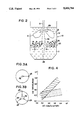
- FIG. 1 is a block diagram illustrating an embodiment of an apparatus for smelting reduction of iron ore of the present invention
- FIG. 2 is a view illustrating a gas flow in a smelting reduction furnace forming a part of the apparatus shown in FIG. 1;
- FIG. 3 is a view illustrating a position relation between side tuyeres and bottom tuyeres of the present invention
- FIG. 4 is a graphic representation showing comparison of OD calculated according to the present invention with OD actually measured
- FIG. 5 is a graphic representation showing a relation of a heat transfer efficiency to a level height of an oxygen lance of the present invention.
- FIG. 6 is a graphic representation showing a relation of a heat transfer efficiency to a side blow gas of the present invention.
- the inventors obtained some findings, based on the study of the mechanism of the smelting reduction furnace and the measures specifically responding to improvement in the heat transfer efficiency and to promotion of the reduction of iron ore.
- the post-combustion ratio cannot be greatly improved due to the technological limit in improving the heat transfer efficiency and damage of the inner walls of the smelting reduction furnace due to the post-combustion super heat.
- oxygen gas is blown into a slag layer and, at the same time, the slag is strongly stirred so that the post-combustion is performed mainly within the slag layer, the high degree of post-combustion can be procured, the high heat transfer efficiency being maintained.
- the present invention enables an efficient reduction operation, setting the following conditions:
- Decarburization nozzles and post-combustion nozzles are placed in a top blow oxygen lance and oxygen gas is blown therethrough so that a predetermined OD level or a high level is procured.
- the oxygen gas through the post-combustion nozzles is introduced into the slag layer to form, in the slag layer, a zone where the post-combustion is carried out.
- the slag layer is strongly stirred by a side blow gas as well as by a top blow gas. Thus, the heat generated by the post-combustion is transferred to iron ore.
- powdery carbonaceous material, fuel oil or steam is blown through an upside wall portion or an upper portion of side walls of the smelting reduction furnace, a gas exhaust pipe for an exhaust gas provided with the reduction furnace or gas upgrading tuyeres at a preheat and prereduction furnace.
- the temperature of the exhaust gas is controlled to the preferred range of 300° to 1,300° C. If the temperature is less than 300° C., the preheat effect is not expected and in addition, it fears that tar trouble occurs during the process of upgrading the gases. Contrarily, if it is over 1,300° C., there is a problem of heat resistance of the equipment. Furthermore, it is also advantageous in the heat resistance of the equipment to lower the temperature by means of upgrading the gases.
- FIG. 1 illustrates a block diagram of an apparatus for smelting reduction of iron ore of the present invention.
- the two M s mean that one of the two M s is connected to the other and two N s mean that one of the two N s is connected to the other.
- smelting reduction furnace 10 molten metal bath 11 and slag layer 12 are formed.
- the smelting reduction furnace has top blow oxygen lance 21 inserted down perpendicularly into it. At the end of the top blow oxygen lance, decarburizing nozzles 22 and post-combustion nozzles 23 are placed to blow oxygen gas into furnace 10.
- side tuyere 25 and bottom tuyere 26 through which a gas is blown as stirring gas.
- the gas is at least one selected from the group consisting of Ar, N 2 , CO, CO 2 and a process gas.
- the process gas is a gas generated from an apparatus for smelting and reducing iron ore according to the present invention.
- first chute 13 and second chute 14 are respectively mounted.
- first chute 13 carbonaceous material and flux which are supplied from an ordinary material feeder (not shown for simplification), and through second chute 14, iron ore which is already prereduced in fluid bed type preheat and prereduction furnace 30, are respectively charged, by gravity, into the smelting reduction furnace.
- Gas exhaust pipe 15 for an exhaust gas discharged from furnace 10 is attached thereto.
- the fluid bed type preheat and prereduction furnace can be alternated by a shaft type furnace having a high heat efficiency or by a rotary kiln type furnace enabling an equipment cost reduction and an easy operation without any obstacle to the performance of the present invention.
- one or more gas upgrading tuyeres 9 are placed, through which powdery carbonaceous material, fuel oil or steam is blown, as a gas upgrading agent which upgrades the exhaust gas into a gas having a low OD value. Furthermore, an exhaust gas is introduced into hot cyclone 31 from smelting reduction furnace 10 and removes dust from the exhaust gas without losing the high heat of the exhaust gas, preheat and prereduction furnace 30, into which the exhaust gas is introduced and which preheats iron ore by means of the introduced exhaust gas, and separator 35 which receives the exhaust gas from the preheat and prereduction furnace and removes fine particles of the iron ore included in the exhaust gas.
- pressure means 27 which mixes the fine particles of the iron ore separated from the iron ore in separator 35 with a carrier gas to form a mixture and applies a pressure to the mixture.
- the mixture is blown into furnace 10 through side tuyeres 25 and bottom tuyeres 26.
- Switch-over valve 41 and shut-off valve 42 are provided to use the exhaust gas generated from separator 35 as a process gas.
- a part of the fine particles of the iron ore can also be returned to preheat and prereduction furnace 30 as iron ore to be preheated and prereduced, although not shown in FIG. 1.
- As the carrier gas a gas selected from the group consisting of Ar, N 2 , CO, CO 2 and a process gas can be used.
- Iron ore as raw material, is charged into preheat and prereduction furnace 30 from said material feeder (not shown) and, after being preheated and prereduced in furnace 30, the iron ore is charged, by gravity, into smelting reduction furnace 10 through second chute 14. Carbonaceous material and fluxes are also charged, by gravity, into furnace 10 through first chute 13.
- molten metal bath 11 and slag layer 12 are formed in the smelting reduction furnace.
- An infurnace gas generated from smelting reduction furnace 10 in the slag layer 12 increases its OD by an infurnace reaction which is hereinafter explained in detail.
- the infurnace gas ascends up through gas exhaust pipe 15, bound for prereduction furnace 30, and this infurnace gas which will become the exhaust gas is mixed with a gas upgrading agent, which is blown into gas exhaust pipe 15 through gas upgrading tuyere 9 arranged at an upper portions of the infurnace gas to form gas exhaust pipe 15.
- This upgrading of the exhaust gas is also hereinafter explained in detail.
- the infurnace gas produced is increased as a result of the reaction with the gas upgrading agent to form the upgraded infurnace gas. This reaction also results in decreasing the OD as expressed in the following equation:
- the infurnace gas thus upgraded is introduced, as an exhaust gas, into preheat and prereduction furnace 30.
- the iron ore is preheated and prereduced in the preheat and prereduction furnace, and then, is charged into the smelting reduction furnace through second chute 14.
- the exhaust gas goes into separator 35 and, after fine particles of iron ore are separated from the exhaust gas in the separator, the exhaust gas proceeds, by means of switch-over valve 41 and shut-off valve 42, on either of two courses.
- the exhaust gas is exhausted through an ordinary gas exhauster, and the other is that the exhaust gas is used as a process gas, which is blown through side tuyeres 25 and bottom tuyeres 26 into furnace 10, to be a stirring gas or a carrier gas. Furthermore, this exhaust gas can be introduced into gas exhaust pipe 15 to be mixed with the infurnace gas exhausted from the smelting reduction furnace and can be used to control a temperature of a gas which is introduced into preheat and prereduction furnace 30.
- FIG. 2 schematically illustrates a behaviour of gas blown through side tuyeres 25 and bottom tuyeres 26 shown in FIG. 1.
- arrows 28 and 29 illustrated below oxygen lance 21, each, show directions of oxygen gas injected respectively through decarburizing nozzles 22 and post-combustion nozzles 23.
- DC O 2 denotes oxygen gas blown through the decarburizing nozzles and PC O 2 oxygen gas blown through the post-combustion nozzles.
- gas blow operation through oxygen lance 21, side tuyere 25 and bottom tuyere 26 is carried out from the beginning to the end of the operation.
- the gas blow through the side tuyeres and the bottom tuyeres is coworked to diffuse molten metal into slag, and resultantly, the gas blow increases drastically the reduction speed.
- the present invention intends to diffuse molten metal actively into the zone where iron ore is floating in a lower portion of the slag layer by means of strong stirring to raise the reduction speed.
- a swollen portion of molten metal (shown by A in FIG. 2) is formed on the surface of the molten metal by blowing a stirring gas through bottom tuyere 26 and simultaneously, a stirring gas is blown in through side tuyere 25 so as to have at least a part of the side blown stirring gas hit portion A.
- the side blowgas hit portion A of the molten metal and for the bottom blow gas and the side blow gas to cross at right angles to each other as much as possible.
- side tuyeres 25 and bottom tuyeres 26 are placed so as to satisfy a positional relation as shown in (a) or (b) of FIG. 3.
- FIG. 3 (a) illustrates a positional relation in case that one side tuyere 25 and one bottom tuyere 26 are used
- FIG. 3 (b) illustrates a positional relation in case that three side tuyeres 25 and three bottom tuyeres 26 are used.
- arrows show directions of gas blown through side tuyeres 25.
- the number and the position of side tuyeres 25 and bottom tuyeres 26 are not always subject soley to those shown in FIG. 3. The number is determined, depending on the capacity of the smelting reduction furnace in use and an amount of production thereof.
- Gas blown-in through side tuyeres 25 and bottom tuyeres 26 is at least one selected from the group consisting of N 2 , Ar, CO, CO 2 and a process gas.
- O 2 gas is never used. The reason is as follows: Firstly, if O 2 gas is used as the side blow gas, this involves a fundamental problem that reduction work of C contained in molten metal which has been splashed into a lower portion of slag layer 12 is impaired. Secondly, if O 2 gas is used as the bottom blow gas, so much CO gas is produced that the molten metal is too strongly stirred.
- the splash of the molten metal goes into a zone of an upper portion of the slag layer and reaches to a post-combustion zone (shown by B in FIG. 2) where combustion by PC O 2 takes place. Consequently, the post-combustion is impaired because C contained in the molten metal reacts with O 2 to be used for the the post-combustion. Furthermore, the use of O 2 gas for the bottom blow raises the temperature of refractory forming bottom tuyeres 26 so high that cooling gas such as C 3 H 3 is required to be added. This addition also increases the amount of the bottom blow gas and accelerates occurrence of the splash of the molten metal excessively.
- FIG. 4 is a graphic representation showing a comparison of examples of the present invention to controls of the prior art, the examples using N 2 gas as the bottom blow gas and the controls using O 2 gas in stead of N 2 gas as the bottom blow gas.
- the OD measured which is represented by the ordinate corresponds to an OD which is obtained from the formula (1) hereinbefore using the analysis of H 2 O, CO 2 , H 2 and CO as found in the exhaust gas.
- the OD which is represented by the abscissa is given by formula (2): ##EQU1## This is based on the assumption that the numerator "PC O 2 " is completely consumed in the post-combustion and that all of O 2 blown in the smelting reduction furnace is discharged, as an exhaust gas, out of the smelting reduction furnace. In case of the controls, O 2 gas introduced by bottom blow is included in DC O 2 . OD determined on a theoretically calculated basis is gained, by means of formula (2), from measured amount of DC O 2 and PC O 2 and amount of O 2 and H 2 included in raw material which is obtained by analysis.
- the post-combustion zone is formed mainly within slag i.e. zone B and the high degree of post-combustion is performed.
- the post-combustion zone is formed and the slag is strongly stirred by the side blow gas, it can be attained that the high degree of post-combustion is procured and still the high heat transfer is obtained. Consequently, the post-combustion oxygen gas needs to be blown mainly into slag existing in the post-combustion area of zone B.
- the level of the top-blow lance be set so as to have an appropriate level height relative to a molten metal level and a slag level.
- the post-combustion zone fails to be formed in the slag layer and the heat transfer efficiency is lowered, while if the nozzles are excessively low, the post-combustion zone fails to be appropriately formed.
- the lowest level of the nozzles of the oxygen lance is equal to the lower side of the slag layer.
- FIG. 5 shows a relation of a height between the top end of oxygen lance and the upper surface level of slag to the heat transfer efficiency according to the present invention this shows that if the top end of the oxygen lance is too high from slag surface, the good heat transfer efficiency cannot be obtained.
- FIG. 6 shows a relation of a side blow gas amount to the heat transfer efficiency. It is recognized from FIG. 6 that a good heat transfer efficiency can be obtained by blowing a large amount of the side blow gas through side tuyeres 25 and stirring strongly the slag layer.
- the results shown in FIGS. 5 and 6 were obtained from an operation wherein a smelting reduction furnace with 50 tons in capacity was employed and molten metal was produced at a rate of 28 t/hour.
- the present invention thanks to the high heat efficiency, a high reduction rate can be gained by means of increasing the OD as mentioned above.
- the addition amount of carbonaceous material can be reduced. Resultantly, a unit consumption of carbonaceous material can be saved and, at the same time, P content in molten metal can be reduced since most of P in the molten metal is brought with the carbonaceous material.
- the OD is set preferably to be 0.5 or more. If the OD is 0.7 or more, the reduction reaction in the smelting reduction furnace is promoted and the prereduction furnace becomes remarkably needless.
- gas with an increased OD i.e., gas of low calories is upgraded, by means of blowing powdery carbonaceous material, which is an upgrading agent, together with a carrier gas through gas upgrading tuyeres 9 placed at an upper portion of gas exhaust pipe 15, into an upgraded gas having a less than 0.5 OD.
- This upgraded gas is introduced into preheat and prereduction furnace 30 and iron ore can be efficiently prereduced.
- the carrier gas is at least one selected from the group consisting of N 2 , Ar, CO, CO 2 and a process gas.
- Powdery carbonaceous material as mentioned above, which is a gas upgrading agent is usually blown in together with a carrier gas.
- gas upgrading tuyeres 9 can be charged, by gravity, into gas upgrading tuyeres 9. This can also apply to charging through an upper portion of the smelting reduction furnace. It is recommendable that as said gas upgrading agent, fuel oil or steam can be used, by taking into consideration conditions such as cost, a structure of the gas upgrading tuyeres and the exhaust gas.
- gas upgrading tuyeres 9 are placed at an upper portion of the smelting reduction furnace.
- This arrangement enables a lot of positions of the blow inlets to freely be selected vertically along the wall of gas exhaust pipe 15, and therefore, amount of blow-in gas can be easily controlled.
- those tuyeres are placed at an upside wall and upper portion side walls of the smelting reduction furnace, those portions of the smelting reduction furnace, gas exhaust pipe and other attachments thereto can be protected from being overheated since the blow-in of the gas upgrading agent lowers the temperature of the exhaust gas.
- the gas upgrading agent When the preheat and prereduction furnace is of fluid bed type, by means of blowing the gas upgrading agent into a wind box, the gas upgrading agent and the exhaust gas from the smelting reduction furnace are well mixed in the wind box, and the upgrading of the exhaust gas is efficiently carried out.
Landscapes
- Engineering & Computer Science (AREA)
- Chemical & Material Sciences (AREA)
- Manufacturing & Machinery (AREA)
- Materials Engineering (AREA)
- Metallurgy (AREA)
- Organic Chemistry (AREA)
- Manufacture Of Iron (AREA)
- Manufacture And Refinement Of Metals (AREA)
- Vertical, Hearth, Or Arc Furnaces (AREA)
Applications Claiming Priority (6)
| Application Number | Priority Date | Filing Date | Title |
|---|---|---|---|
| JP62-303940 | 1987-11-30 | ||
| JP62303940A JP2638861B2 (ja) | 1987-11-30 | 1987-11-30 | 溶融環元法 |
| JP63028584A JPH01205017A (ja) | 1988-02-09 | 1988-02-09 | 溶融還元法 |
| JP2858688A JP2668913B2 (ja) | 1988-02-09 | 1988-02-09 | 溶融還元法 |
| JP63-28586 | 1988-02-09 | ||
| JP63-28584 | 1988-02-09 |
Related Child Applications (1)
| Application Number | Title | Priority Date | Filing Date |
|---|---|---|---|
| US07/520,785 Division US5065985A (en) | 1987-11-30 | 1990-05-08 | Method for smelting reduction of iron ore and apparatus therefor |
Publications (1)
| Publication Number | Publication Date |
|---|---|
| US5000784A true US5000784A (en) | 1991-03-19 |
Family
ID=27286248
Family Applications (2)
| Application Number | Title | Priority Date | Filing Date |
|---|---|---|---|
| US07/276,612 Expired - Lifetime US5000784A (en) | 1987-11-30 | 1988-11-28 | Method for smelting reduction of iron ore |
| US07/520,785 Expired - Lifetime US5065985A (en) | 1987-11-30 | 1990-05-08 | Method for smelting reduction of iron ore and apparatus therefor |
Family Applications After (1)
| Application Number | Title | Priority Date | Filing Date |
|---|---|---|---|
| US07/520,785 Expired - Lifetime US5065985A (en) | 1987-11-30 | 1990-05-08 | Method for smelting reduction of iron ore and apparatus therefor |
Country Status (7)
| Country | Link |
|---|---|
| US (2) | US5000784A (fr) |
| EP (1) | EP0318896B1 (fr) |
| KR (1) | KR910006037B1 (fr) |
| AT (1) | ATE101655T1 (fr) |
| BR (1) | BR8806278A (fr) |
| CA (1) | CA1337241C (fr) |
| DE (1) | DE3887838T2 (fr) |
Cited By (4)
| Publication number | Priority date | Publication date | Assignee | Title |
|---|---|---|---|---|
| US5350434A (en) * | 1992-05-14 | 1994-09-27 | Metallgesellschaft Ag | Process and apparatus for making molten steel |
| US5498277A (en) * | 1991-09-20 | 1996-03-12 | Ausmelt Limited | Process for production of iron |
| US20060228294A1 (en) * | 2005-04-12 | 2006-10-12 | Davis William H | Process and apparatus using a molten metal bath |
| CN116103501A (zh) * | 2023-02-24 | 2023-05-12 | 中国恩菲工程技术有限公司 | 钢烟灰和赤泥的协同冶炼方法 |
Families Citing this family (33)
| Publication number | Priority date | Publication date | Assignee | Title |
|---|---|---|---|---|
| US4995906A (en) * | 1987-12-18 | 1991-02-26 | Nkk Corporation | Method for smelting reduction of iron ore |
| JP2602573B2 (ja) * | 1990-06-29 | 1997-04-23 | 川崎重工業株式会社 | 金属精錬法 |
| JP2918646B2 (ja) * | 1990-07-18 | 1999-07-12 | 川崎重工業株式会社 | 溶融還元炉 |
| US5572544A (en) | 1994-07-21 | 1996-11-05 | Praxair Technology, Inc. | Electric arc furnace post combustion method |
| US5733358A (en) * | 1994-12-20 | 1998-03-31 | Usx Corporation And Praxair Technology, Inc. | Process and apparatus for the manufacture of steel from iron carbide |
| AUPN226095A0 (en) * | 1995-04-07 | 1995-05-04 | Technological Resources Pty Limited | A method of producing metals and metal alloys |
| US5885322A (en) * | 1996-03-22 | 1999-03-23 | Steel Technology Corporation | Method for reducing iron losses in an iron smelting process |
| AUPO426096A0 (en) | 1996-12-18 | 1997-01-23 | Technological Resources Pty Limited | Method and apparatus for producing metals and metal alloys |
| AUPO426396A0 (en) | 1996-12-18 | 1997-01-23 | Technological Resources Pty Limited | A method of producing iron |
| US6214084B1 (en) * | 1997-09-03 | 2001-04-10 | The Boc Group, Inc. | Iron manufacturing process |
| AUPO944697A0 (en) * | 1997-09-26 | 1997-10-16 | Technological Resources Pty Limited | A method of producing metals and metal alloys |
| RU2115743C1 (ru) * | 1997-11-13 | 1998-07-20 | Акционерное общество "Кузнецкий металлургический комбинат" | Способ прямого получения стали из железосодержащих материалов в конвертере |
| US5943360A (en) * | 1998-04-17 | 1999-08-24 | Fuchs Systems, Inc. | Electric arc furnace that uses post combustion |
| AUPP442598A0 (en) | 1998-07-01 | 1998-07-23 | Technological Resources Pty Limited | Direct smelting vessel |
| MY119760A (en) | 1998-07-24 | 2005-07-29 | Tech Resources Pty Ltd | A direct smelting process |
| AUPP483898A0 (en) | 1998-07-24 | 1998-08-13 | Technological Resources Pty Limited | A direct smelting process & apparatus |
| AUPP554098A0 (en) | 1998-08-28 | 1998-09-17 | Technological Resources Pty Limited | A process and an apparatus for producing metals and metal alloys |
| AUPP570098A0 (en) | 1998-09-04 | 1998-10-01 | Technological Resources Pty Limited | A direct smelting process |
| AUPP647198A0 (en) | 1998-10-14 | 1998-11-05 | Technological Resources Pty Limited | A process and an apparatus for producing metals and metal alloys |
| AUPP805599A0 (en) | 1999-01-08 | 1999-02-04 | Technological Resources Pty Limited | A direct smelting process |
| AUPQ083599A0 (en) | 1999-06-08 | 1999-07-01 | Technological Resources Pty Limited | Direct smelting vessel |
| AUPQ152299A0 (en) | 1999-07-09 | 1999-08-05 | Technological Resources Pty Limited | Start-up procedure for direct smelting process |
| AUPQ205799A0 (en) | 1999-08-05 | 1999-08-26 | Technological Resources Pty Limited | A direct smelting process |
| AUPQ213099A0 (en) | 1999-08-10 | 1999-09-02 | Technological Resources Pty Limited | Pressure control |
| AUPQ308799A0 (en) | 1999-09-27 | 1999-10-21 | Technological Resources Pty Limited | A direct smelting process |
| AUPQ346399A0 (en) | 1999-10-15 | 1999-11-11 | Technological Resources Pty Limited | Stable idle procedure |
| AUPQ365799A0 (en) | 1999-10-26 | 1999-11-18 | Technological Resources Pty Limited | A direct smelting apparatus and process |
| US6602321B2 (en) | 2000-09-26 | 2003-08-05 | Technological Resources Pty. Ltd. | Direct smelting process |
| RU2181383C1 (ru) * | 2001-07-12 | 2002-04-20 | ОАО "НОСТА" (ОХМК) - Открытое акционерное общество Орско-Халиловский металлургический комбинат | Способ утилизации фенольных вод |
| US7238222B2 (en) * | 2005-03-01 | 2007-07-03 | Peterson Oren V | Thermal synthesis production of steel |
| CN112011661A (zh) * | 2020-08-07 | 2020-12-01 | 新疆八一钢铁股份有限公司 | 一种欧冶炉风口高效节氮方法 |
| NL2026572B1 (en) * | 2020-09-29 | 2022-05-30 | Petrus Greyling Frederik | Process and system for melting agglomerates |
| CN112325628B (zh) * | 2020-10-24 | 2022-11-11 | 河北小蜜蜂工具集团有限公司 | 一种还原炉 |
Citations (3)
| Publication number | Priority date | Publication date | Assignee | Title |
|---|---|---|---|---|
| US3711275A (en) * | 1969-10-13 | 1973-01-16 | M Johnsson | Method for the production of liquid pig iron or steel directly of dressed ore |
| JPS58144407A (ja) * | 1981-12-09 | 1983-08-27 | アルベツト・ソシエテ・アノニム | 溶融鉄の直接製造方法及び装置 |
| JPS6143406A (ja) * | 1984-08-08 | 1986-03-03 | Mitsubishi Electric Corp | 巻線装置 |
Family Cites Families (5)
| Publication number | Priority date | Publication date | Assignee | Title |
|---|---|---|---|---|
| DE3318005C2 (de) * | 1983-05-18 | 1986-02-20 | Klöckner CRA Technologie GmbH, 4100 Duisburg | Verfahren zur Eisenherstellung |
| DE3418085A1 (de) * | 1984-05-16 | 1985-11-28 | Klöckner CRA Technologie GmbH, 4100 Duisburg | Verfahren zur eisenherstellung |
| AT385051B (de) * | 1986-08-07 | 1988-02-10 | Voest Alpine Ag | Huettenwerk und verfahren zur erzeugung von stahl |
| US4936908A (en) * | 1987-09-25 | 1990-06-26 | Nkk Corporation | Method for smelting and reducing iron ores |
| US4995906A (en) * | 1987-12-18 | 1991-02-26 | Nkk Corporation | Method for smelting reduction of iron ore |
-
1988
- 1988-11-25 CA CA000584123A patent/CA1337241C/fr not_active Expired - Fee Related
- 1988-11-28 DE DE3887838T patent/DE3887838T2/de not_active Expired - Fee Related
- 1988-11-28 EP EP88119803A patent/EP0318896B1/fr not_active Expired - Lifetime
- 1988-11-28 US US07/276,612 patent/US5000784A/en not_active Expired - Lifetime
- 1988-11-28 AT AT88119803T patent/ATE101655T1/de not_active IP Right Cessation
- 1988-11-29 BR BR888806278A patent/BR8806278A/pt not_active IP Right Cessation
- 1988-11-30 KR KR1019880015891A patent/KR910006037B1/ko not_active Expired
-
1990
- 1990-05-08 US US07/520,785 patent/US5065985A/en not_active Expired - Lifetime
Patent Citations (4)
| Publication number | Priority date | Publication date | Assignee | Title |
|---|---|---|---|---|
| US3711275A (en) * | 1969-10-13 | 1973-01-16 | M Johnsson | Method for the production of liquid pig iron or steel directly of dressed ore |
| US4504311A (en) * | 1981-09-12 | 1985-03-12 | Arbed S.A. | Process and apparatus for a direct formation of molten iron |
| JPS58144407A (ja) * | 1981-12-09 | 1983-08-27 | アルベツト・ソシエテ・アノニム | 溶融鉄の直接製造方法及び装置 |
| JPS6143406A (ja) * | 1984-08-08 | 1986-03-03 | Mitsubishi Electric Corp | 巻線装置 |
Cited By (4)
| Publication number | Priority date | Publication date | Assignee | Title |
|---|---|---|---|---|
| US5498277A (en) * | 1991-09-20 | 1996-03-12 | Ausmelt Limited | Process for production of iron |
| US5350434A (en) * | 1992-05-14 | 1994-09-27 | Metallgesellschaft Ag | Process and apparatus for making molten steel |
| US20060228294A1 (en) * | 2005-04-12 | 2006-10-12 | Davis William H | Process and apparatus using a molten metal bath |
| CN116103501A (zh) * | 2023-02-24 | 2023-05-12 | 中国恩菲工程技术有限公司 | 钢烟灰和赤泥的协同冶炼方法 |
Also Published As
| Publication number | Publication date |
|---|---|
| KR900008050A (ko) | 1990-06-02 |
| ATE101655T1 (de) | 1994-03-15 |
| DE3887838D1 (de) | 1994-03-24 |
| EP0318896B1 (fr) | 1994-02-16 |
| AU608091B2 (en) | 1991-03-21 |
| DE3887838T2 (de) | 1994-07-07 |
| AU2491688A (en) | 1989-06-01 |
| BR8806278A (pt) | 1989-08-15 |
| EP0318896A3 (fr) | 1991-03-27 |
| KR910006037B1 (ko) | 1991-08-12 |
| EP0318896A2 (fr) | 1989-06-07 |
| CA1337241C (fr) | 1995-10-10 |
| US5065985A (en) | 1991-11-19 |
Similar Documents
| Publication | Publication Date | Title |
|---|---|---|
| US5065985A (en) | Method for smelting reduction of iron ore and apparatus therefor | |
| CA1336542C (fr) | Methode de fusion et de reduction de minerais de fer, et appareillage utilise | |
| JP2735774B2 (ja) | 冶金反応容器での反応を強化する方法 | |
| JP2008255494A (ja) | 金属酸化物から金属を製造する直接製錬法 | |
| CA1336744C (fr) | Methode de reduction par fusion de minerais de fer, et appareillage utilise | |
| CA2335753C (fr) | Procede de fusion directe | |
| EP0290650B1 (fr) | Procédé de préparation d'acier par la réduction en bain de fusion | |
| EP0905260A1 (fr) | Appareil de reduction par fusion et procede de mise en oeuvre | |
| JP2668913B2 (ja) | 溶融還元法 | |
| JP3286114B2 (ja) | 屑鉄から高炭素溶融鉄を製造する方法 | |
| JP3516793B2 (ja) | 竪型炉へのダスト塊成鉱、自己還元性鉱塊、鉄屑、固体燃料等の原燃料装入方法 | |
| JP2596003B2 (ja) | 溶融還元法 | |
| JPH01162711A (ja) | 溶融還元法 | |
| JP2725466B2 (ja) | 溶融還元製鉄法 | |
| JPH01205015A (ja) | 溶融還元法及び装置 | |
| JPH0196313A (ja) | 溶融還元法 | |
| JPH1121610A (ja) | ガス吹き用ランス及び転炉型精錬炉の操業方法 | |
| JPH0941017A (ja) | 鉄系スクラップの溶解方法 | |
| JPH01104707A (ja) | 溶融還元法 | |
| AU4592899A (en) | A direct smelting process | |
| JPH01104706A (ja) | 溶融還元法 | |
| JPH0499111A (ja) | 溶融還元における生産性向上のための酸素ガス供給方法 | |
| JPH10158707A (ja) | 溶融還元設備の炉体構造 |
Legal Events
| Date | Code | Title | Description |
|---|---|---|---|
| AS | Assignment |
Owner name: NKK CORPORATION, A CORP. OF JAPAN, JAPAN Free format text: ASSIGNMENT OF ASSIGNORS INTEREST;ASSIGNORS:TAKAHASHI, KENJI;IWASAKI, KATSUHIRO;INOUE, SHIGERU;AND OTHERS;SIGNING DATES FROM 19881115 TO 19881124;REEL/FRAME:004978/0829 Owner name: NKK CORPORATION, 1-2, 1-CHOME, MARUNOUCHI, CHIYODA Free format text: ASSIGNMENT OF ASSIGNORS INTEREST.;ASSIGNORS:TAKAHASHI, KENJI;IWASAKI, KATSUHIRO;INOUE, SHIGERU;AND OTHERS;REEL/FRAME:004978/0829;SIGNING DATES FROM 19881115 TO 19881124 |
|
| STCF | Information on status: patent grant |
Free format text: PATENTED CASE |
|
| FPAY | Fee payment |
Year of fee payment: 4 |
|
| FPAY | Fee payment |
Year of fee payment: 8 |
|
| FPAY | Fee payment |
Year of fee payment: 12 |