US5072087A - Process for heating materials by microwave energy - Google Patents
Process for heating materials by microwave energy Download PDFInfo
- Publication number
- US5072087A US5072087A US07/416,840 US41684089A US5072087A US 5072087 A US5072087 A US 5072087A US 41684089 A US41684089 A US 41684089A US 5072087 A US5072087 A US 5072087A
- Authority
- US
- United States
- Prior art keywords
- susceptor
- substance
- process according
- heating step
- converted
- Prior art date
- Legal status (The legal status is an assumption and is not a legal conclusion. Google has not performed a legal analysis and makes no representation as to the accuracy of the status listed.)
- Expired - Fee Related
Links
- 238000010438 heat treatment Methods 0.000 title claims abstract description 66
- 239000000463 material Substances 0.000 title claims abstract description 43
- 238000000034 method Methods 0.000 title claims abstract description 43
- 239000000126 substance Substances 0.000 claims abstract description 33
- 238000011109 contamination Methods 0.000 claims abstract description 10
- 238000005304 joining Methods 0.000 claims abstract description 5
- PNEYBMLMFCGWSK-UHFFFAOYSA-N Alumina Chemical group [O-2].[O-2].[O-2].[Al+3].[Al+3] PNEYBMLMFCGWSK-UHFFFAOYSA-N 0.000 claims description 39
- MCMNRKCIXSYSNV-UHFFFAOYSA-N Zirconium dioxide Chemical group O=[Zr]=O MCMNRKCIXSYSNV-UHFFFAOYSA-N 0.000 claims description 18
- IJGRMHOSHXDMSA-UHFFFAOYSA-N Atomic nitrogen Chemical compound N#N IJGRMHOSHXDMSA-UHFFFAOYSA-N 0.000 claims description 11
- 239000000203 mixture Substances 0.000 claims description 8
- 239000011819 refractory material Substances 0.000 claims description 8
- 238000006243 chemical reaction Methods 0.000 claims description 6
- 229910052757 nitrogen Inorganic materials 0.000 claims description 6
- 239000003153 chemical reaction reagent Substances 0.000 claims description 5
- PMHQVHHXPFUNSP-UHFFFAOYSA-M copper(1+);methylsulfanylmethane;bromide Chemical group Br[Cu].CSC PMHQVHHXPFUNSP-UHFFFAOYSA-M 0.000 claims description 5
- 230000001678 irradiating effect Effects 0.000 claims description 5
- RUDFQVOCFDJEEF-UHFFFAOYSA-N yttrium(III) oxide Inorganic materials [O-2].[O-2].[O-2].[Y+3].[Y+3] RUDFQVOCFDJEEF-UHFFFAOYSA-N 0.000 claims description 4
- 229910045601 alloy Inorganic materials 0.000 claims description 3
- 239000000956 alloy Substances 0.000 claims description 3
- 150000001875 compounds Chemical class 0.000 claims description 3
- 238000000462 isostatic pressing Methods 0.000 claims description 2
- 238000003825 pressing Methods 0.000 claims description 2
- QJGQUHMNIGDVPM-UHFFFAOYSA-N nitrogen group Chemical group [N] QJGQUHMNIGDVPM-UHFFFAOYSA-N 0.000 claims 1
- 239000012467 final product Substances 0.000 abstract description 8
- 239000000919 ceramic Substances 0.000 abstract description 7
- 238000004519 manufacturing process Methods 0.000 abstract description 3
- 238000004377 microelectronic Methods 0.000 abstract description 2
- 239000000758 substrate Substances 0.000 abstract description 2
- 239000000047 product Substances 0.000 description 15
- 239000000843 powder Substances 0.000 description 13
- 238000005245 sintering Methods 0.000 description 9
- 239000000654 additive Substances 0.000 description 7
- 230000000996 additive effect Effects 0.000 description 7
- 230000005855 radiation Effects 0.000 description 6
- RKTYLMNFRDHKIL-UHFFFAOYSA-N copper;5,10,15,20-tetraphenylporphyrin-22,24-diide Chemical compound [Cu+2].C1=CC(C(=C2C=CC([N-]2)=C(C=2C=CC=CC=2)C=2C=CC(N=2)=C(C=2C=CC=CC=2)C2=CC=C3[N-]2)C=2C=CC=CC=2)=NC1=C3C1=CC=CC=C1 RKTYLMNFRDHKIL-UHFFFAOYSA-N 0.000 description 4
- 229910000873 Beta-alumina solid electrolyte Inorganic materials 0.000 description 3
- 238000001816 cooling Methods 0.000 description 3
- 150000004684 trihydrates Chemical class 0.000 description 3
- XLYOFNOQVPJJNP-UHFFFAOYSA-N water Substances O XLYOFNOQVPJJNP-UHFFFAOYSA-N 0.000 description 3
- QGZKDVFQNNGYKY-UHFFFAOYSA-N Ammonia Chemical compound N QGZKDVFQNNGYKY-UHFFFAOYSA-N 0.000 description 2
- 238000005275 alloying Methods 0.000 description 2
- VSCWAEJMTAWNJL-UHFFFAOYSA-K aluminium trichloride Chemical compound Cl[Al](Cl)Cl VSCWAEJMTAWNJL-UHFFFAOYSA-K 0.000 description 2
- 238000002425 crystallisation Methods 0.000 description 2
- 230000008025 crystallization Effects 0.000 description 2
- 238000002474 experimental method Methods 0.000 description 2
- 230000003287 optical effect Effects 0.000 description 2
- 238000013021 overheating Methods 0.000 description 2
- RVTZCBVAJQQJTK-UHFFFAOYSA-N oxygen(2-);zirconium(4+) Chemical compound [O-2].[O-2].[Zr+4] RVTZCBVAJQQJTK-UHFFFAOYSA-N 0.000 description 2
- 239000002243 precursor Substances 0.000 description 2
- 239000010453 quartz Substances 0.000 description 2
- VYPSYNLAJGMNEJ-UHFFFAOYSA-N silicon dioxide Inorganic materials O=[Si]=O VYPSYNLAJGMNEJ-UHFFFAOYSA-N 0.000 description 2
- 229910001928 zirconium oxide Inorganic materials 0.000 description 2
- 229910018404 Al2 O3 Inorganic materials 0.000 description 1
- OKTJSMMVPCPJKN-UHFFFAOYSA-N Carbon Chemical compound [C] OKTJSMMVPCPJKN-UHFFFAOYSA-N 0.000 description 1
- 238000002441 X-ray diffraction Methods 0.000 description 1
- 238000010521 absorption reaction Methods 0.000 description 1
- 229910052782 aluminium Inorganic materials 0.000 description 1
- XAGFODPZIPBFFR-UHFFFAOYSA-N aluminium Chemical compound [Al] XAGFODPZIPBFFR-UHFFFAOYSA-N 0.000 description 1
- 235000011124 aluminium ammonium sulphate Nutrition 0.000 description 1
- WNROFYMDJYEPJX-UHFFFAOYSA-K aluminium hydroxide Chemical group [OH-].[OH-].[OH-].[Al+3] WNROFYMDJYEPJX-UHFFFAOYSA-K 0.000 description 1
- 150000001412 amines Chemical class 0.000 description 1
- 229910021529 ammonia Inorganic materials 0.000 description 1
- LCQXXBOSCBRNNT-UHFFFAOYSA-K ammonium aluminium sulfate Chemical compound [NH4+].[Al+3].[O-]S([O-])(=O)=O.[O-]S([O-])(=O)=O LCQXXBOSCBRNNT-UHFFFAOYSA-K 0.000 description 1
- 238000000137 annealing Methods 0.000 description 1
- 229910052799 carbon Inorganic materials 0.000 description 1
- 229910010293 ceramic material Inorganic materials 0.000 description 1
- GTRGJJDVSJFNTE-UHFFFAOYSA-N chembl2009633 Chemical compound OC1=CC=C2C=C(S(O)(=O)=O)C=CC2=C1N=NC1=CC=CC=C1 GTRGJJDVSJFNTE-UHFFFAOYSA-N 0.000 description 1
- 230000000052 comparative effect Effects 0.000 description 1
- 230000006835 compression Effects 0.000 description 1
- 238000007906 compression Methods 0.000 description 1
- 230000008878 coupling Effects 0.000 description 1
- 238000010168 coupling process Methods 0.000 description 1
- 238000005859 coupling reaction Methods 0.000 description 1
- 239000003989 dielectric material Substances 0.000 description 1
- AJNVQOSZGJRYEI-UHFFFAOYSA-N digallium;oxygen(2-) Chemical compound [O-2].[O-2].[O-2].[Ga+3].[Ga+3] AJNVQOSZGJRYEI-UHFFFAOYSA-N 0.000 description 1
- 230000000694 effects Effects 0.000 description 1
- 229910001195 gallium oxide Inorganic materials 0.000 description 1
- 150000004679 hydroxides Chemical class 0.000 description 1
- 239000012535 impurity Substances 0.000 description 1
- 238000011065 in-situ storage Methods 0.000 description 1
- 238000002844 melting Methods 0.000 description 1
- 230000008018 melting Effects 0.000 description 1
- 229910052751 metal Inorganic materials 0.000 description 1
- 239000002184 metal Substances 0.000 description 1
- 238000002156 mixing Methods 0.000 description 1
- TWNQGVIAIRXVLR-UHFFFAOYSA-N oxo(oxoalumanyloxy)alumane Chemical compound O=[Al]O[Al]=O TWNQGVIAIRXVLR-UHFFFAOYSA-N 0.000 description 1
- 239000002245 particle Substances 0.000 description 1
- 238000001953 recrystallisation Methods 0.000 description 1
- 238000011160 research Methods 0.000 description 1
- KKCBUQHMOMHUOY-UHFFFAOYSA-N sodium oxide Chemical compound [O-2].[Na+].[Na+] KKCBUQHMOMHUOY-UHFFFAOYSA-N 0.000 description 1
- 229910001948 sodium oxide Inorganic materials 0.000 description 1
- 239000007858 starting material Substances 0.000 description 1
- 238000012360 testing method Methods 0.000 description 1
- 238000005979 thermal decomposition reaction Methods 0.000 description 1
- 239000012780 transparent material Substances 0.000 description 1
Images
Classifications
-
- C—CHEMISTRY; METALLURGY
- C04—CEMENTS; CONCRETE; ARTIFICIAL STONE; CERAMICS; REFRACTORIES
- C04B—LIME, MAGNESIA; SLAG; CEMENTS; COMPOSITIONS THEREOF, e.g. MORTARS, CONCRETE OR LIKE BUILDING MATERIALS; ARTIFICIAL STONE; CERAMICS; REFRACTORIES; TREATMENT OF NATURAL STONE
- C04B37/00—Joining burned ceramic articles with other burned ceramic articles or other articles by heating
- C04B37/003—Joining burned ceramic articles with other burned ceramic articles or other articles by heating by means of an interlayer consisting of a combination of materials selected from glass, or ceramic material with metals, metal oxides or metal salts
- C04B37/005—Joining burned ceramic articles with other burned ceramic articles or other articles by heating by means of an interlayer consisting of a combination of materials selected from glass, or ceramic material with metals, metal oxides or metal salts consisting of glass or ceramic material
-
- C—CHEMISTRY; METALLURGY
- C04—CEMENTS; CONCRETE; ARTIFICIAL STONE; CERAMICS; REFRACTORIES
- C04B—LIME, MAGNESIA; SLAG; CEMENTS; COMPOSITIONS THEREOF, e.g. MORTARS, CONCRETE OR LIKE BUILDING MATERIALS; ARTIFICIAL STONE; CERAMICS; REFRACTORIES; TREATMENT OF NATURAL STONE
- C04B35/00—Shaped ceramic products characterised by their composition; Ceramics compositions; Processing powders of inorganic compounds preparatory to the manufacturing of ceramic products
- C04B35/01—Shaped ceramic products characterised by their composition; Ceramics compositions; Processing powders of inorganic compounds preparatory to the manufacturing of ceramic products based on oxide ceramics
- C04B35/10—Shaped ceramic products characterised by their composition; Ceramics compositions; Processing powders of inorganic compounds preparatory to the manufacturing of ceramic products based on oxide ceramics based on aluminium oxide
- C04B35/111—Fine ceramics
-
- C—CHEMISTRY; METALLURGY
- C04—CEMENTS; CONCRETE; ARTIFICIAL STONE; CERAMICS; REFRACTORIES
- C04B—LIME, MAGNESIA; SLAG; CEMENTS; COMPOSITIONS THEREOF, e.g. MORTARS, CONCRETE OR LIKE BUILDING MATERIALS; ARTIFICIAL STONE; CERAMICS; REFRACTORIES; TREATMENT OF NATURAL STONE
- C04B35/00—Shaped ceramic products characterised by their composition; Ceramics compositions; Processing powders of inorganic compounds preparatory to the manufacturing of ceramic products
- C04B35/622—Forming processes; Processing powders of inorganic compounds preparatory to the manufacturing of ceramic products
- C04B35/64—Burning or sintering processes
-
- H—ELECTRICITY
- H05—ELECTRIC TECHNIQUES NOT OTHERWISE PROVIDED FOR
- H05B—ELECTRIC HEATING; ELECTRIC LIGHT SOURCES NOT OTHERWISE PROVIDED FOR; CIRCUIT ARRANGEMENTS FOR ELECTRIC LIGHT SOURCES, IN GENERAL
- H05B6/00—Heating by electric, magnetic or electromagnetic fields
- H05B6/64—Heating using microwaves
- H05B6/80—Apparatus for specific applications
-
- C—CHEMISTRY; METALLURGY
- C04—CEMENTS; CONCRETE; ARTIFICIAL STONE; CERAMICS; REFRACTORIES
- C04B—LIME, MAGNESIA; SLAG; CEMENTS; COMPOSITIONS THEREOF, e.g. MORTARS, CONCRETE OR LIKE BUILDING MATERIALS; ARTIFICIAL STONE; CERAMICS; REFRACTORIES; TREATMENT OF NATURAL STONE
- C04B2235/00—Aspects relating to ceramic starting mixtures or sintered ceramic products
- C04B2235/65—Aspects relating to heat treatments of ceramic bodies such as green ceramics or pre-sintered ceramics, e.g. burning, sintering or melting processes
- C04B2235/66—Specific sintering techniques, e.g. centrifugal sintering
- C04B2235/667—Sintering using wave energy, e.g. microwave sintering
-
- C—CHEMISTRY; METALLURGY
- C04—CEMENTS; CONCRETE; ARTIFICIAL STONE; CERAMICS; REFRACTORIES
- C04B—LIME, MAGNESIA; SLAG; CEMENTS; COMPOSITIONS THEREOF, e.g. MORTARS, CONCRETE OR LIKE BUILDING MATERIALS; ARTIFICIAL STONE; CERAMICS; REFRACTORIES; TREATMENT OF NATURAL STONE
- C04B2237/00—Aspects relating to ceramic laminates or to joining of ceramic articles with other articles by heating
- C04B2237/02—Aspects relating to interlayers, e.g. used to join ceramic articles with other articles by heating
- C04B2237/04—Ceramic interlayers
- C04B2237/06—Oxidic interlayers
- C04B2237/064—Oxidic interlayers based on alumina or aluminates
-
- C—CHEMISTRY; METALLURGY
- C04—CEMENTS; CONCRETE; ARTIFICIAL STONE; CERAMICS; REFRACTORIES
- C04B—LIME, MAGNESIA; SLAG; CEMENTS; COMPOSITIONS THEREOF, e.g. MORTARS, CONCRETE OR LIKE BUILDING MATERIALS; ARTIFICIAL STONE; CERAMICS; REFRACTORIES; TREATMENT OF NATURAL STONE
- C04B2237/00—Aspects relating to ceramic laminates or to joining of ceramic articles with other articles by heating
- C04B2237/30—Composition of layers of ceramic laminates or of ceramic or metallic articles to be joined by heating, e.g. Si substrates
- C04B2237/32—Ceramic
- C04B2237/34—Oxidic
- C04B2237/343—Alumina or aluminates
-
- C—CHEMISTRY; METALLURGY
- C04—CEMENTS; CONCRETE; ARTIFICIAL STONE; CERAMICS; REFRACTORIES
- C04B—LIME, MAGNESIA; SLAG; CEMENTS; COMPOSITIONS THEREOF, e.g. MORTARS, CONCRETE OR LIKE BUILDING MATERIALS; ARTIFICIAL STONE; CERAMICS; REFRACTORIES; TREATMENT OF NATURAL STONE
- C04B2237/00—Aspects relating to ceramic laminates or to joining of ceramic articles with other articles by heating
- C04B2237/30—Composition of layers of ceramic laminates or of ceramic or metallic articles to be joined by heating, e.g. Si substrates
- C04B2237/32—Ceramic
- C04B2237/34—Oxidic
- C04B2237/345—Refractory metal oxides
- C04B2237/348—Zirconia, hafnia, zirconates or hafnates
-
- C—CHEMISTRY; METALLURGY
- C04—CEMENTS; CONCRETE; ARTIFICIAL STONE; CERAMICS; REFRACTORIES
- C04B—LIME, MAGNESIA; SLAG; CEMENTS; COMPOSITIONS THEREOF, e.g. MORTARS, CONCRETE OR LIKE BUILDING MATERIALS; ARTIFICIAL STONE; CERAMICS; REFRACTORIES; TREATMENT OF NATURAL STONE
- C04B2237/00—Aspects relating to ceramic laminates or to joining of ceramic articles with other articles by heating
- C04B2237/30—Composition of layers of ceramic laminates or of ceramic or metallic articles to be joined by heating, e.g. Si substrates
- C04B2237/32—Ceramic
- C04B2237/36—Non-oxidic
- C04B2237/366—Aluminium nitride
-
- C—CHEMISTRY; METALLURGY
- C04—CEMENTS; CONCRETE; ARTIFICIAL STONE; CERAMICS; REFRACTORIES
- C04B—LIME, MAGNESIA; SLAG; CEMENTS; COMPOSITIONS THEREOF, e.g. MORTARS, CONCRETE OR LIKE BUILDING MATERIALS; ARTIFICIAL STONE; CERAMICS; REFRACTORIES; TREATMENT OF NATURAL STONE
- C04B2237/00—Aspects relating to ceramic laminates or to joining of ceramic articles with other articles by heating
- C04B2237/50—Processing aspects relating to ceramic laminates or to the joining of ceramic articles with other articles by heating
- C04B2237/70—Forming laminates or joined articles comprising layers of a specific, unusual thickness
- C04B2237/706—Forming laminates or joined articles comprising layers of a specific, unusual thickness of one or more of the metallic layers or articles
-
- H—ELECTRICITY
- H05—ELECTRIC TECHNIQUES NOT OTHERWISE PROVIDED FOR
- H05B—ELECTRIC HEATING; ELECTRIC LIGHT SOURCES NOT OTHERWISE PROVIDED FOR; CIRCUIT ARRANGEMENTS FOR ELECTRIC LIGHT SOURCES, IN GENERAL
- H05B2206/00—Aspects relating to heating by electric, magnetic, or electromagnetic fields covered by group H05B6/00
- H05B2206/04—Heating using microwaves
- H05B2206/046—Microwave drying of wood, ink, food, ceramic, sintering of ceramic, clothes, hair
Definitions
- This invention relates to processes for heating materials (preferably dielectric ceramic materials) by means of microwave energy. More particularly, the invention relates to a process for preparing a heat-treated body from a material that does not couple well with microwaves but which nevertheless uses microwaves for the heating step.
- microwave energy rather than conventional thermal energy in industrial processes is becoming more widespread because of the rapid and economical heating that can thereby be achieved.
- materials are either transparent to microwave energy or have low coupling efficiencies so that microwave energy cannot be used to heat these materials directly.
- microwave susceptors are sometimes used to make microwave heating possible.
- Susceptors are materials that couple well with microwaves and thus generate heat when irradiated. If the susceptors are positioned close to the non-susceptible material, the latter is heated by conduction and/or radiation.
- the susceptor While this procedure is acceptable in many cases, it is not suitable when products of very high purity are required, e.g. sintered ceramic bodies for use in the electronics industry. If the susceptor is mixed directly within the body of material, it remains in the body after the heat treatment has been carried out. Alternatively, if the susceptor is used in the form of a bed surrounding the body, the susceptor contaminates the surface of the body and may in some cases penetrate into the interior. This can be seen from the prior art references discussed below.
- Nishitani U.S. Pat. No. 4,147,911 issued on Apr. 3, 1979 discloses a method in which a dielectric material is mixed with 0.05 to 10% by weight of metal powder or other susceptor so that the resulting body may be heated and sintered by microwaves.
- the problem of contamination of the resulting product by the susceptor is recognized in this document itself (see column 3, line 64 to column 4, line 4), but the only suggested solution is "to carefully investigate the amount, particle size and quality of the substance to be added.”
- a process for producing a heat-treated body of a desired material from a substance that does not couple well with microwaves comprising: contacting said substance with a microwave susceptor; and irradiating the susceptor with microwaves to heat the susceptor and consequently said substance; wherein said substance, if substantially different from said desired material, and said susceptor, if substantially different from said desired material, are compounds which are at least partially converted, during said heating step, to products which are substantially uncontaminating of said body.
- the improvement which comprises employing as at least one component of said susceptor, a substance which is at least partially converted during said heating step to a product which is substantially the same as said substance in order to reduce contamination of said bodies by said susceptor.
- non-susceptor a material that cannot be heated to suitably high temperatures, either at all or in a reliable manner, when subjected to microwave irradiation at ambient temperatures.
- susceptor is meant a material that couples well with microwaves to the extent that it can be used to raise the temperature of the material to be treated to a desired temperature.
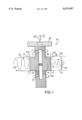
- FIG. 1 of the accompanying drawings is a cross-section of an apparatus used for carrying out a preferred form of one aspect of the invention.
- the susceptors used in the present invention may be mixed with the non-susceptor to be treated or used to form a powder bed surrounding a body of the non-susceptor to be treated.
- the procedure is normally as follows.
- the susceptor and the non-susceptor are obtained in fine powder form, thoroughly mixed together and the resulting mixture is compressed to form a body of any desired shape, after which the body is subjected to the microwave heating and (usually) sintering step.
- the ratio of the susceptor to the non-susceptor depends on a number of factors, e.g. the heating efficiency of the susceptor, the power of the microwave radiation to which the body is subjected, etc.
- sufficient susceptor should be used to achieve the desired heating effect and the body should preferably be completely embedded in the susceptor.
- the ratio of susceptor to non-susceptor in or around the body can be varied at different parts of the body in order to produce different heating characteristics at different locations within the body, or conversely, to avoid uneven heating if the body is not uniformly shaped.
- the microwave equipment used to bring about the heating in the present invention may be entirely conventional and generally consists of a magnetron and a resonant cavity.
- the body to be sintered is held by any convenient means at a suitable position in the cavity. If the susceptor is not used in the form of a bed for the body to be heated, an insulating powder bed may be provided. The body and the bed may then be held in a suitable container made of a microwave-transparent material, e.g. quartz.
- the heating process may be accompanied by compression of the body to be sintered, e.g. isostatic pressing, in order to form a dense shaped product.
- Temperatures which can be achieved by the process of the invention may be up to about 2500° C. and usually fall within the range of 1600°-2200° C., which spans the sintering temperatures of most sinterable refractory materials. These temperatures can usually be reached within about 15-30 minutes in contrast to about 5 hours often required for conventional heating methods.
- An underlying principle of the present invention is to select a non-susceptor and a susceptor and/or conditions during the heating step such that, after the heating step, either the susceptor is converted to the non-susceptor, the non-susceptor is converted to the susceptor or both the non-susceptor and the susceptor are converted to the same final product. In this way contamination can be avoided.
- the final materials all be exactly the same, this is not always necessary in many cases.
- the final products may be chemically the same but physically different (i.e. different isomers or allotropes), the final products may be physically the same (i.e. the same isomers or allotropes) and slightly chemically different (e.g.
- the final products may be slightly different both physically and chemically.
- the overall result should however be that minimal contamination of the final product take place because of the conversion of the majority of one or both of the starting materials into a substance that is substantially uncontaminating of the desired final product.
- the susceptors or non-susceptors which are converted, at least partially, to other products during the heating step include materials that are converted thermally (e.g. decomposed, dehydrated or changed from one isomer to another) and those that are converted chemically (e.g. oxidized, reacted with an available reagent or dissociated from water of crystallization).
- the non-susceptor remains the same during the heating step and the susceptor is at least partially converted to a material similar or identical to the non-susceptor.
- the non-susceptor may be alpha alumina and the susceptor may be sub-alpha alumina.
- Ceramic grade alpha alumina is not sinterable using commonly available microwave frequencies, for example 2.45 GHz or 0.915 GHz. It has one of the lowest loss factors and microwave radiation is not readily absorbed at room temperature (although it begins to absorb at elevated temperatures).
- sub-alpha aluminas are susceptors and are converted to alpha alumina when heated by microwaves to sintering temperatures above 1200° C.
- the alpha-Al 2 O 3 is thermodynamically stable once formed. Consequently, by mixing a small proportion of sub-alpha alumina with a large proportion of alpha alumina and heating the resulting mixture to a suitably high temperature by microwave energy, a sintered body consisting entirely of alpha alumina can be obtained.
- Alumina is commercially available as alpha alumina and beta alumina.
- beta alumina is a microwave susceptor, it is not converted to alpha alumina when heated and is thus not suitable as a susceptor for use in the present invention.
- beta alumina contains several atom percent of other materials, such as sodium oxide, and is therefore not merely a different isomer of aluminum oxide.
- sub-alpha aluminas do not contain substantial amounts of other elements and merely represent different phases of pure alumina.
- the phases of alumina are described in detail in "Oxides and Hydroxides of Aluminum” by Karl Wefers and Gordon M. Bell, Technical Paper No. 19, (1972) by Alcoa Research Laboratories.
- the sub-alpha phases can be prepared by thermal decomposition of aluminum hydroxides or by such other methods as heating ammonium alum or hydrated aluminum chloride.
- the phases included within the term "sub-alpha alumina” include, chi, kappa, gamma, delta, eta and theta phases as described in the above publication.
- the amount of sub-alpha alumina relative to alpha alumina is normally in the range of 5-15% by weight based on the total weight of the mixture. It has been found that a power range of 500-600 watts at 2.45 GHz is required for rapid heating at the 5% level, but that the power can be reduced to around 200 watts at the 15% level.
- susceptors which exhibit phase changes upon microwave heating and which can be used in the first form of the present invention include gallium oxide.
- the conversion of the susceptor may be brought about by chemical means rather than mere thermal means.
- sub-alpha alumina may be used as a susceptor for a body of aluminum nitride. If the microwave heating and sintering step is carried out under an atmosphere of nitrogen or a nitrogen precursor (e.g. ammonia or an amine), the alumina from the susceptor is converted to aluminum nitride and the resulting body then consists entirely of aluminum nitride.
- nitrogen or a nitrogen precursor e.g. ammonia or an amine
- the non-susceptor is converted during the heating step to a material that is similar or identical to the susceptor.
- a material that is similar or identical to the susceptor This is not usually necessary because, if the final body is to consist of a susceptor, it can normally be heated directly without the intervention of another susceptor.
- the susceptor may be expensive and the non-susceptor may be inexpensive.
- zirconium oxide, ZrO 2 in pure form is monoclinic at room temperature, tetragonal at about 1200° C. and cubic at about 1500° C. The tetragonal and cubic forms are suceptors but the monoclinic form is not.
- the alloys can therefore be used as susceptors for the pure zirconia.
- the heating converts the pure zirconia to the tetragonal or cubic form which is identical to the susceptor (which stays the same) except for the few percent of yttria which is found not to diffuse into the pure zirconia body.
- a third form of the invention involves converting both the non-susceptor and the susceptor into a third material that is desired in the final body.
- sub-alpha alumina may be used as a susceptor for alpha alumina and the heating step may be carried out in the presence of nitrogen or a nitrogen precursor and other necessary chemicals, e.g. carbon, so that alumina both from the susceptor and the non-susceptor are converted to aluminum nitride.
- materials intended to be the same after the heating step may contain different minor impurities and materials intended to be fully converted during the heating step may be only partially converted.
- the present invention can reduce contamination during microwave heating acceptable levels even for exacting applications.
- the heat-treated products of the present invention can be used for a variety of purposes.
- sintered products can be used as substrates for micro-electronic chips, sintered tapes, microwave-transparent windows and tool bits.
- the product must have high purity, controlled chemical composition, fine grain size and high density, all of which can be provided by the present invention.
- the invention is not limited merely by sintering ceramic powders and can be used for various other thermal processes such as annealing and recrystallization of glassy phases.
- the present invention may also be used for joining ceramics or other materials that do not couple well with microwaves. This can be achieved by placing (and preferably pressing) together the bodies to be joined, if desired with an intermediary interposed between the items. The items are then surrounded with a susceptor bed comprising a susceptor which is converted to the same material as that used for the bodies and the joint is irradiated with microwaves to raise the temperature of the materials in the vicinity of the joint so that partial melting or sintering takes place and, upon cooling, a satisfactory uncontaminated joint is formed.
- FIG. 1 shows equipment 10 for joining two sintered ceramic bodies 11 and 12 via an intermediary body 13.
- the intermediary body 13 is preferably a compressed sinterable green body made of the same material as the bodies 11 and 12 to be joined.
- the resulting joint area is surrounded by a susceptor bed 14 of a material that is in the manner mentioned above.
- the bodies 11, 12 and 13 are pressed together by means of a load 15.
- the powder bed is contained within a housing 16 which has microwave-transparent windows 17, 18 on opposite sides of the joint area. Waveguides 19 and 20 are aligned with the windows 17, 18.
- a magnetron (not shown) is connected to waveguide 19 and a grounded movable short 21 is positioned in waveguide 20.
- the apparatus is cooled by water pipes 22 and a linear vertical differential transducer 23 is used to measure movements of the load 15.
- the bodies are joined by operating the magnetron and adjusting the position of the short 21 to create standing waves 24 and 25 in the waveguides so that the apparatus forms a resonant cavity with the joint area positioned for maximum microwave absorption.
- the susceptor bed 14 increases in temperature and raises the temperature of the bodies 11, 12 and 13.
- the transducer 23 first registers an upward movement of the load 15 as the bodies expand and then a downward movement as the body 13 compacts, densifies and sinters. When there is no further movement of the load 15, the procedure is complete and the bodies can be allowed to cool.
- ⁇ -alumina and sub-alpha alumina were prepared and subjected to microwave heating.
- the sub-alpha alumina was a trihydrate calcined at 600° C. for four hours (designated H-10).
- Table 1 shows that the addition of the sub-alpha phase of alumina allows the ⁇ -phase to be heated.
- a cylinder of alpha alumina (AM2B) with a 10% addition of sub-alpha alumina (containing theta and gamma phases) was pressed to 5 kpsi.
- the compressed cylinder was 19 mm in diameter, 7 mm thick and 5 g in weight.
- the cylinder was embedded in approximately 15 g of alpha alumina powder in a quartz test tube.
- the assembly was then introduced into the microwave applicator.
- the cylinder was heated for 38 minutes at a power of 400 W.
- a red glow was observed after 18 minutes indicating that the cylinder was heating in the radiation field.
- After 27 minutes the color was white/orange indicating a temperature in excess of 1400° C.
- the alpha alumina surrounding the cylinder showed no visible indication of high temperature.
- the cylinder was found to consist entirely of alpha alumina.
- a cylinder of AM2B alpha alumina similar to that used in Example 3 was embedded in alpha alumina powder and introduced into the single mode applicator.
- the applied power was 1000 W for a period of 30 minutes.
- the temperature did not rise above 185° C. This shows that no appreciable heating occurs without the sub alpha-alumina additive.
- a cylinder 19 mm in diameter, 7 mm thick and 5 g in weight was dry pressed at 5 kpsi.
- the cylinder was embedded in alumina trihydrate which had been previously calcined to 600° C. for 4 hours.
- the assembly was introduced into the single mode applicator.
- the cylinder was heated for 22 minutes at a power of 200 W.
- a bright orange glow was observed after 10 minutes indicating that the cylinder was heating in the radiation field.
- the observed microstructure showed that sintering occurred.
- a powder consisting wholly of ⁇ -alumina a cylinder 19 mm in diameter, 7 mm thick and 5 g in weight was dry pressed at 5 kpsi.
- the cylinder was embedded in alumina trihydrate which had been previously calcined to 600° C. for 4 hours (to form a sub-alpha alumina).
- the assembly was introduced into a single mode applicator.
- the cylinder was heated for 28 minutes at a power of 200 W.
- a bright orange glow was observed after 10 minutes indicating that the cylinder was heating in the radiation field.
- the reduced diameter and thickness of the cylinder after sintering indicated that sintering to greater than 95% had occurred.
- the observed microstructure confirmed this.
- the powder bed was converted to alpha alumina during the heating step.
- the joint area was surrounded by a powder bed of sub-alpha alumina.
- the rods were held together by a slight pressure (5-10 MPa) and the joint area irradiated with microwaves having a powder of about 500 watts for 45-90 minutes.
- the joint strength was 250 MPa compared with a strength of 300 MPa of the parent material.
- the joined body was uncontaminated with sub-alpha alumina.
Landscapes
- Chemical & Material Sciences (AREA)
- Engineering & Computer Science (AREA)
- Ceramic Engineering (AREA)
- Manufacturing & Machinery (AREA)
- Organic Chemistry (AREA)
- Structural Engineering (AREA)
- Materials Engineering (AREA)
- Inorganic Chemistry (AREA)
- Physics & Mathematics (AREA)
- Electromagnetism (AREA)
- Physical Or Chemical Processes And Apparatus (AREA)
- Ceramic Products (AREA)
- Constitution Of High-Frequency Heating (AREA)
- Compositions Of Oxide Ceramics (AREA)
- Furnace Details (AREA)
Applications Claiming Priority (2)
| Application Number | Priority Date | Filing Date | Title |
|---|---|---|---|
| CA000579522A CA1313230C (fr) | 1988-10-06 | 1988-10-06 | Procede de chauffage de materiaux par hyperfrequences |
| CA579522 | 1988-10-06 |
Publications (1)
| Publication Number | Publication Date |
|---|---|
| US5072087A true US5072087A (en) | 1991-12-10 |
Family
ID=4138866
Family Applications (1)
| Application Number | Title | Priority Date | Filing Date |
|---|---|---|---|
| US07/416,840 Expired - Fee Related US5072087A (en) | 1988-10-06 | 1989-10-04 | Process for heating materials by microwave energy |
Country Status (7)
| Country | Link |
|---|---|
| US (1) | US5072087A (fr) |
| EP (1) | EP0363193A3 (fr) |
| JP (1) | JPH02188466A (fr) |
| KR (1) | KR900006258A (fr) |
| CN (1) | CN1041580A (fr) |
| AU (1) | AU4267889A (fr) |
| CA (1) | CA1313230C (fr) |
Cited By (35)
| Publication number | Priority date | Publication date | Assignee | Title |
|---|---|---|---|---|
| US5272216A (en) * | 1990-12-28 | 1993-12-21 | Westinghouse Electric Corp. | System and method for remotely heating a polymeric material to a selected temperature |
| WO1994025207A1 (fr) * | 1993-04-26 | 1994-11-10 | Hoeganaes Corporation | Procedes et appareil utilises pour chauffer des poudres de metaux |
| DE4340652A1 (de) * | 1993-11-30 | 1995-06-01 | Krupp Widia Gmbh | Verbundwerkstoff und Verfahren zu seiner Herstellung |
| US5432325A (en) * | 1994-10-20 | 1995-07-11 | University Of California | Microwave sintering of single plate-shaped articles |
| US5449887A (en) * | 1993-03-25 | 1995-09-12 | Martin Marietta Energy Systems, Inc. | Thermal insulation for high temperature microwave sintering operations and method thereof |
| US5472650A (en) * | 1993-01-11 | 1995-12-05 | Northwestern University | Method of making chemical vapor infiltrated composites |
| US5603795A (en) * | 1994-09-01 | 1997-02-18 | Martin Marietta Energy Systems, Inc. | Joining of thermoplastic substrates by microwaves |
| US5736092A (en) * | 1994-03-31 | 1998-04-07 | Microwear Corporation | Microwave sintering process |
| WO1998046047A1 (fr) * | 1997-04-10 | 1998-10-15 | Nucon Systems, Inc. | Procede et appareil pour assembler par micro-ondes des pieces en ceramique a paroi epaisse |
| US5911941A (en) * | 1997-04-10 | 1999-06-15 | Nucon Systems | Process for the preparation of thick-walled ceramic products |
| US6103812A (en) * | 1997-11-06 | 2000-08-15 | Lambda Technologies, Inc. | Microwave curable adhesive |
| US6197243B1 (en) | 1993-04-16 | 2001-03-06 | Ut Battelle, Llc | Heat distribution ceramic processing method |
| US6312548B1 (en) | 1996-03-29 | 2001-11-06 | Lambda Technologies | Conductive insert for bonding components with microwave energy |
| US6497786B1 (en) | 1997-11-06 | 2002-12-24 | Nike, Inc. | Methods and apparatus for bonding deformable materials having low deformation temperatures |
| US20030071037A1 (en) * | 2001-09-05 | 2003-04-17 | Motoyasu Sato | Microwave sintering furnace and microwave sintering method |
| US20040123896A1 (en) * | 2002-12-31 | 2004-07-01 | General Electric Company | Selective heating and sintering of components of photovoltaic cells with microwaves |
| US20040173304A1 (en) * | 2003-03-07 | 2004-09-09 | Bruce Ralph W. | Microwave assisted reactive brazing of ceramic materials |
| US20050121833A1 (en) * | 2003-12-09 | 2005-06-09 | Jenn-Shing Wang | Processing method for ceramic |
| US20050221017A1 (en) * | 2004-03-30 | 2005-10-06 | Vladislav Sklyarevich | Method of heat treating coatings by using microwave |
| US20080142511A1 (en) * | 2004-11-10 | 2008-06-19 | Ripley Edward B | Apparatus with moderating material for microwave heat treatment of manufactured components |
| US20090079101A1 (en) * | 2007-04-27 | 2009-03-26 | Jurgen Laubersheimer | Densification Process of Ceramics And Apparatus Therefor |
| US20090155625A1 (en) * | 2006-03-29 | 2009-06-18 | Yukihiro Kanechika | Methods of Joining Aluminum Nitride Sinters and Aluminum Nitride Joined Articles |
| US20090173437A1 (en) * | 2006-03-29 | 2009-07-09 | Yukihiro Kanechika | Methods of Joining Ceramics and Ceramic Joined Articles |
| US9277787B2 (en) | 2013-03-15 | 2016-03-08 | Nike, Inc. | Microwave bonding of EVA and rubber items |
| US20160251267A1 (en) * | 2013-10-14 | 2016-09-01 | United Technologies Corporation | Method for pyrolyzing preceramic polymer material using electromagnetic radiation |
| US9469068B2 (en) | 2013-03-15 | 2016-10-18 | The United States Of America As Represented By The Secretary Of The Air Force | Microwave driven diffusion of dielectric nano- and micro-particles into organic polymers |
| US9781778B2 (en) | 2013-03-15 | 2017-10-03 | Nike, Inc. | Customized microwaving energy distribution utilizing slotted wave guides |
| US9955536B2 (en) | 2013-03-15 | 2018-04-24 | Nike, Inc. | Customized microwave energy distribution utilizing slotted cage |
| US10669814B2 (en) | 2017-08-08 | 2020-06-02 | Saudi Arabian Oil Company | In-situ heating fluids with electromagnetic radiation |
| US10857696B2 (en) * | 2015-06-11 | 2020-12-08 | Institute Of Electronics, Chinese Academy Of Sciences | Device and method for heating and curing artificial stone with microwave |
| US11187044B2 (en) | 2019-12-10 | 2021-11-30 | Saudi Arabian Oil Company | Production cavern |
| US11460330B2 (en) | 2020-07-06 | 2022-10-04 | Saudi Arabian Oil Company | Reducing noise in a vortex flow meter |
| US11619097B2 (en) | 2021-05-24 | 2023-04-04 | Saudi Arabian Oil Company | System and method for laser downhole extended sensing |
| US11725504B2 (en) | 2021-05-24 | 2023-08-15 | Saudi Arabian Oil Company | Contactless real-time 3D mapping of surface equipment |
| US12257629B2 (en) | 2020-01-09 | 2025-03-25 | Tundra COmpoistes, LLC | Apparatus and methods for sintering |
Families Citing this family (7)
| Publication number | Priority date | Publication date | Assignee | Title |
|---|---|---|---|---|
| DE4324635A1 (de) * | 1993-07-22 | 1995-01-26 | Abb Patent Gmbh | Einrichtung zur Sinterung keramischer Körper mittels Mikrowellen |
| KR100841039B1 (ko) * | 2007-09-21 | 2008-06-24 | 김문수 | 마이크로파 소결장치 |
| EP2143697A1 (fr) * | 2008-07-11 | 2010-01-13 | Ivoclar Vivadent AG | Processus de densification de céramiques et appareil correspondant |
| FR2976939A1 (fr) * | 2011-06-27 | 2012-12-28 | Air Liquide | Procede d'assemblage de deux composants ceramiques de meme composition chimique elementaire |
| CN105170981B (zh) * | 2015-10-12 | 2017-07-04 | 福州大学 | 一种微波热压烧结与钎焊装置及其使用方法 |
| JP7602785B2 (ja) * | 2019-12-03 | 2024-12-19 | 国立研究開発法人産業技術総合研究所 | 化学反応装置及び化学反応方法 |
| CN113200558B (zh) * | 2021-04-29 | 2023-04-18 | 河南长兴实业有限公司 | 微波煅烧生产微晶α-氧化铝的生产工艺 |
Citations (17)
| Publication number | Priority date | Publication date | Assignee | Title |
|---|---|---|---|---|
| US2622187A (en) * | 1947-01-14 | 1952-12-16 | Raytheon Mfg Co | Microwave pressure cooker |
| US3335253A (en) * | 1963-09-11 | 1967-08-08 | Cryodry Corp | Microwave heating of substances under hydrostatic pressure |
| US3398251A (en) * | 1964-05-04 | 1968-08-20 | Cryodry Corp | Microwave heating of substances under hydrostatic pressure |
| US3469053A (en) * | 1965-10-19 | 1969-09-23 | Melvin L Levinson | Microwave kiln |
| FR2249855A1 (en) * | 1973-10-31 | 1975-05-30 | Automatisme & Technique | Ceramic insulator sintering plant - with vertical chain conveyor in ultrahigh frequency waveguide after preheating furnace |
| US4100386A (en) * | 1975-08-27 | 1978-07-11 | Automatisme & Technique | Process for sintering ceramic products |
| US4147911A (en) * | 1975-08-11 | 1979-04-03 | Nippon Steel Corporation | Method for sintering refractories and an apparatus therefor |
| US4148614A (en) * | 1978-04-13 | 1979-04-10 | Kirkbride Chalmer G | Process for removing sulfur from coal |
| US4219361A (en) * | 1978-06-09 | 1980-08-26 | Special Metals Corporation | Method of improving the susceptibility of a material to microwave energy heating |
| US4307277A (en) * | 1978-08-03 | 1981-12-22 | Mitsubishi Denki Kabushiki Kaisha | Microwave heating oven |
| US4529856A (en) * | 1983-10-04 | 1985-07-16 | The United States Of America As Represented By The United States Department Of Energy | Ceramic-glass-metal seal by microwave heating |
| JPS60221367A (ja) * | 1984-04-12 | 1985-11-06 | 日本マイクロウエ−ブ株式会社 | セラミツク焼結体の製造方法 |
| US4606748A (en) * | 1984-10-10 | 1986-08-19 | The United States Of America As Represented By The Department Of Energy | Method for producing ceramic-glass-ceramic seals by microwave heating |
| US4608473A (en) * | 1982-05-28 | 1986-08-26 | At&T Technologies, Inc. | Modified zirconia induction furnace |
| EP0251256A1 (fr) * | 1986-06-30 | 1988-01-07 | Kabushiki Kaisha Toyota Chuo Kenkyusho | Dispositif pour la liaison des articles céramiques au moyen de micro-ondes |
| US4757172A (en) * | 1986-09-24 | 1988-07-12 | Questech Inc. | Method and apparatus for the microwave joining of nonoxide ceramic items |
| US4938673A (en) * | 1989-01-17 | 1990-07-03 | Adrian Donald J | Isostatic pressing with microwave heating and method for same |
-
1988
- 1988-10-06 CA CA000579522A patent/CA1313230C/fr not_active Expired - Fee Related
-
1989
- 1989-10-04 US US07/416,840 patent/US5072087A/en not_active Expired - Fee Related
- 1989-10-05 EP EP19890310186 patent/EP0363193A3/fr not_active Withdrawn
- 1989-10-06 AU AU42678/89A patent/AU4267889A/en not_active Abandoned
- 1989-10-06 JP JP1262834A patent/JPH02188466A/ja active Pending
- 1989-10-06 KR KR1019890014366A patent/KR900006258A/ko not_active Withdrawn
- 1989-10-06 CN CN89108491A patent/CN1041580A/zh active Pending
Patent Citations (19)
| Publication number | Priority date | Publication date | Assignee | Title |
|---|---|---|---|---|
| US2622187A (en) * | 1947-01-14 | 1952-12-16 | Raytheon Mfg Co | Microwave pressure cooker |
| US3335253A (en) * | 1963-09-11 | 1967-08-08 | Cryodry Corp | Microwave heating of substances under hydrostatic pressure |
| US3398251A (en) * | 1964-05-04 | 1968-08-20 | Cryodry Corp | Microwave heating of substances under hydrostatic pressure |
| US3469053A (en) * | 1965-10-19 | 1969-09-23 | Melvin L Levinson | Microwave kiln |
| US3585258A (en) * | 1965-10-19 | 1971-06-15 | Melvin L Levinson | Method of firing ceramic articles utilizing microwave energy |
| FR2249855A1 (en) * | 1973-10-31 | 1975-05-30 | Automatisme & Technique | Ceramic insulator sintering plant - with vertical chain conveyor in ultrahigh frequency waveguide after preheating furnace |
| US4147911A (en) * | 1975-08-11 | 1979-04-03 | Nippon Steel Corporation | Method for sintering refractories and an apparatus therefor |
| US4100386A (en) * | 1975-08-27 | 1978-07-11 | Automatisme & Technique | Process for sintering ceramic products |
| US4148614A (en) * | 1978-04-13 | 1979-04-10 | Kirkbride Chalmer G | Process for removing sulfur from coal |
| US4219361A (en) * | 1978-06-09 | 1980-08-26 | Special Metals Corporation | Method of improving the susceptibility of a material to microwave energy heating |
| US4307277A (en) * | 1978-08-03 | 1981-12-22 | Mitsubishi Denki Kabushiki Kaisha | Microwave heating oven |
| US4608473A (en) * | 1982-05-28 | 1986-08-26 | At&T Technologies, Inc. | Modified zirconia induction furnace |
| US4529856A (en) * | 1983-10-04 | 1985-07-16 | The United States Of America As Represented By The United States Department Of Energy | Ceramic-glass-metal seal by microwave heating |
| JPS60221367A (ja) * | 1984-04-12 | 1985-11-06 | 日本マイクロウエ−ブ株式会社 | セラミツク焼結体の製造方法 |
| US4606748A (en) * | 1984-10-10 | 1986-08-19 | The United States Of America As Represented By The Department Of Energy | Method for producing ceramic-glass-ceramic seals by microwave heating |
| EP0251256A1 (fr) * | 1986-06-30 | 1988-01-07 | Kabushiki Kaisha Toyota Chuo Kenkyusho | Dispositif pour la liaison des articles céramiques au moyen de micro-ondes |
| US4772770A (en) * | 1986-06-30 | 1988-09-20 | Kabushiki Kaisha Toyota Chuo Kenkyusho | Apparatus for joining ceramics by microwave |
| US4757172A (en) * | 1986-09-24 | 1988-07-12 | Questech Inc. | Method and apparatus for the microwave joining of nonoxide ceramic items |
| US4938673A (en) * | 1989-01-17 | 1990-07-03 | Adrian Donald J | Isostatic pressing with microwave heating and method for same |
Non-Patent Citations (6)
| Title |
|---|
| Chemical Abstracts, vol. 104, No. 24, p. 286, No. 104:211927m (1986), Abstract of JP A 60 221 367. * |
| Chemical Abstracts, vol. 104, No. 24, p. 286, No. 104:211927m (1986), Abstract of JP-A-60-221 367. |
| Meek et al., "Microwave Sintering of Some Oxide Materials Using Sintering Aids," J. Materials Sci. Letters, vol. 6, No. 9, pp. 1060-1062 (1987). |
| Meek et al., Microwave Sintering of Some Oxide Materials Using Sintering Aids, J. Materials Sci. Letters, vol. 6, No. 9, pp. 1060 1062 (1987). * |
| Wefers & Bell Oxides and Hydroxides of Aluminum , Technical Paper No. 19, Alcoa Research Laboratories, 2 73. * |
| Wefers & Bell--"Oxides and Hydroxides of Aluminum", Technical Paper No. 19, Alcoa Research Laboratories, 2-73. |
Cited By (52)
| Publication number | Priority date | Publication date | Assignee | Title |
|---|---|---|---|---|
| US5317045A (en) * | 1990-12-28 | 1994-05-31 | Westinghouse Electric Corp. | System and method for remotely heating a polymeric material to a selected temperature |
| US5391595A (en) * | 1990-12-28 | 1995-02-21 | Westinghouse Electric Corporation | System and method for remotely heating a polymeric material to a selected temperature |
| US5272216A (en) * | 1990-12-28 | 1993-12-21 | Westinghouse Electric Corp. | System and method for remotely heating a polymeric material to a selected temperature |
| US5472650A (en) * | 1993-01-11 | 1995-12-05 | Northwestern University | Method of making chemical vapor infiltrated composites |
| US5449887A (en) * | 1993-03-25 | 1995-09-12 | Martin Marietta Energy Systems, Inc. | Thermal insulation for high temperature microwave sintering operations and method thereof |
| US5536292A (en) * | 1993-03-25 | 1996-07-16 | Martin Marietta Energy Systems, Inc. | Method of preparing thermal insulation for high temperature microwave sintering operations |
| US6197243B1 (en) | 1993-04-16 | 2001-03-06 | Ut Battelle, Llc | Heat distribution ceramic processing method |
| WO1994025207A1 (fr) * | 1993-04-26 | 1994-11-10 | Hoeganaes Corporation | Procedes et appareil utilises pour chauffer des poudres de metaux |
| US5397530A (en) * | 1993-04-26 | 1995-03-14 | Hoeganaes Corporation | Methods and apparatus for heating metal powders |
| US6124040A (en) * | 1993-11-30 | 2000-09-26 | Widia Gmbh | Composite and process for the production thereof |
| DE4340652A1 (de) * | 1993-11-30 | 1995-06-01 | Krupp Widia Gmbh | Verbundwerkstoff und Verfahren zu seiner Herstellung |
| DE4340652C2 (de) * | 1993-11-30 | 2003-10-16 | Widia Gmbh | Verbundwerkstoff und Verfahren zu seiner Herstellung |
| US5808282A (en) * | 1994-03-31 | 1998-09-15 | Microwear Corporation | Microwave sintering process |
| US5736092A (en) * | 1994-03-31 | 1998-04-07 | Microwear Corporation | Microwave sintering process |
| US5874377A (en) * | 1994-03-31 | 1999-02-23 | Microwear Corporation | Sintered silicon nitride product |
| US5603795A (en) * | 1994-09-01 | 1997-02-18 | Martin Marietta Energy Systems, Inc. | Joining of thermoplastic substrates by microwaves |
| US5432325A (en) * | 1994-10-20 | 1995-07-11 | University Of California | Microwave sintering of single plate-shaped articles |
| US6312548B1 (en) | 1996-03-29 | 2001-11-06 | Lambda Technologies | Conductive insert for bonding components with microwave energy |
| US6054700A (en) * | 1997-04-10 | 2000-04-25 | Nucon Systems | Process and apparatus for joining thick-walled ceramic parts |
| WO1998046047A1 (fr) * | 1997-04-10 | 1998-10-15 | Nucon Systems, Inc. | Procede et appareil pour assembler par micro-ondes des pieces en ceramique a paroi epaisse |
| US5911941A (en) * | 1997-04-10 | 1999-06-15 | Nucon Systems | Process for the preparation of thick-walled ceramic products |
| US6103812A (en) * | 1997-11-06 | 2000-08-15 | Lambda Technologies, Inc. | Microwave curable adhesive |
| US6497786B1 (en) | 1997-11-06 | 2002-12-24 | Nike, Inc. | Methods and apparatus for bonding deformable materials having low deformation temperatures |
| US20030071037A1 (en) * | 2001-09-05 | 2003-04-17 | Motoyasu Sato | Microwave sintering furnace and microwave sintering method |
| US20040123896A1 (en) * | 2002-12-31 | 2004-07-01 | General Electric Company | Selective heating and sintering of components of photovoltaic cells with microwaves |
| US7022198B2 (en) * | 2003-03-07 | 2006-04-04 | The United States Of America As Represented By The Secretary Of The Navy | Microwave assisted reactive brazing of ceramic materials |
| US20040173304A1 (en) * | 2003-03-07 | 2004-09-09 | Bruce Ralph W. | Microwave assisted reactive brazing of ceramic materials |
| US20050121833A1 (en) * | 2003-12-09 | 2005-06-09 | Jenn-Shing Wang | Processing method for ceramic |
| US20050221017A1 (en) * | 2004-03-30 | 2005-10-06 | Vladislav Sklyarevich | Method of heat treating coatings by using microwave |
| US20080142511A1 (en) * | 2004-11-10 | 2008-06-19 | Ripley Edward B | Apparatus with moderating material for microwave heat treatment of manufactured components |
| US7939787B2 (en) * | 2004-11-10 | 2011-05-10 | Babcock & Wilcox Technical Services Y-12, Llc | Apparatus with moderating material for microwave heat treatment of manufactured components |
| US20090155625A1 (en) * | 2006-03-29 | 2009-06-18 | Yukihiro Kanechika | Methods of Joining Aluminum Nitride Sinters and Aluminum Nitride Joined Articles |
| US20090173437A1 (en) * | 2006-03-29 | 2009-07-09 | Yukihiro Kanechika | Methods of Joining Ceramics and Ceramic Joined Articles |
| US20090079101A1 (en) * | 2007-04-27 | 2009-03-26 | Jurgen Laubersheimer | Densification Process of Ceramics And Apparatus Therefor |
| US9955536B2 (en) | 2013-03-15 | 2018-04-24 | Nike, Inc. | Customized microwave energy distribution utilizing slotted cage |
| US9469068B2 (en) | 2013-03-15 | 2016-10-18 | The United States Of America As Represented By The Secretary Of The Air Force | Microwave driven diffusion of dielectric nano- and micro-particles into organic polymers |
| US9781778B2 (en) | 2013-03-15 | 2017-10-03 | Nike, Inc. | Customized microwaving energy distribution utilizing slotted wave guides |
| US9277787B2 (en) | 2013-03-15 | 2016-03-08 | Nike, Inc. | Microwave bonding of EVA and rubber items |
| US10239260B2 (en) | 2013-03-15 | 2019-03-26 | Nike, Inc. | Microwave bonding of EVA and rubber items |
| US9751808B2 (en) * | 2013-10-14 | 2017-09-05 | United Technologies Corporation | Method for pyrolyzing preceramic polymer material using electromagnetic radiation |
| US20170369380A1 (en) * | 2013-10-14 | 2017-12-28 | United Technologies Corporation | Method for pyrolyzing preceramic polymer material using electromagnetic radiation |
| US10479731B2 (en) * | 2013-10-14 | 2019-11-19 | United Technologies Corporation | Method for pyrolyzing preceramic polymer material using electromagnetic radiation |
| US20160251267A1 (en) * | 2013-10-14 | 2016-09-01 | United Technologies Corporation | Method for pyrolyzing preceramic polymer material using electromagnetic radiation |
| US10857696B2 (en) * | 2015-06-11 | 2020-12-08 | Institute Of Electronics, Chinese Academy Of Sciences | Device and method for heating and curing artificial stone with microwave |
| US10669814B2 (en) | 2017-08-08 | 2020-06-02 | Saudi Arabian Oil Company | In-situ heating fluids with electromagnetic radiation |
| US10830017B2 (en) | 2017-08-08 | 2020-11-10 | Saudi Arabian Oil Company | In-situ heating fluids with electromagnetic radiation |
| US11401782B2 (en) | 2017-08-08 | 2022-08-02 | Saudi Arabian Oil Company | In-situ heating fluids with electromagnetic radiation |
| US11187044B2 (en) | 2019-12-10 | 2021-11-30 | Saudi Arabian Oil Company | Production cavern |
| US12257629B2 (en) | 2020-01-09 | 2025-03-25 | Tundra COmpoistes, LLC | Apparatus and methods for sintering |
| US11460330B2 (en) | 2020-07-06 | 2022-10-04 | Saudi Arabian Oil Company | Reducing noise in a vortex flow meter |
| US11619097B2 (en) | 2021-05-24 | 2023-04-04 | Saudi Arabian Oil Company | System and method for laser downhole extended sensing |
| US11725504B2 (en) | 2021-05-24 | 2023-08-15 | Saudi Arabian Oil Company | Contactless real-time 3D mapping of surface equipment |
Also Published As
| Publication number | Publication date |
|---|---|
| CA1313230C (fr) | 1993-01-26 |
| AU4267889A (en) | 1990-04-12 |
| CN1041580A (zh) | 1990-04-25 |
| KR900006258A (ko) | 1990-05-07 |
| EP0363193A2 (fr) | 1990-04-11 |
| EP0363193A3 (fr) | 1991-01-16 |
| JPH02188466A (ja) | 1990-07-24 |
Similar Documents
| Publication | Publication Date | Title |
|---|---|---|
| US5072087A (en) | Process for heating materials by microwave energy | |
| US4938673A (en) | Isostatic pressing with microwave heating and method for same | |
| US5063183A (en) | Sinterable aluminum nitride composition, sintered body from this composition and process for producing the sintered body | |
| US5908799A (en) | Apparatus for producing semiconductor using aluminum nitride bodies as substrates | |
| Peelamedu et al. | Microwave-induced reaction sintering of NiAl2O4 | |
| Chen et al. | Sinterability improvement of Ba (Mg1/3Ta2/3) O3 dielectric ceramics | |
| CA2056268A1 (fr) | Methode et appareil servant au traitement de la ceramique | |
| JP2628104B2 (ja) | 酸素含有ガス中での熱処理によって分解および/または酸化されるセラミックスを、マイクロ波加熱によって熱処理する方法およびそれに用いるサスセプター | |
| US4147759A (en) | Method of manufacturing β'SiAlON compounds | |
| AU649252B2 (en) | A method of nitriding refractory metal articles | |
| CA2000109A1 (fr) | Chauffage des materiaux par les micro-ondes | |
| Lee et al. | A novel process for combustion synthesis of AlN powder | |
| Metaxas et al. | Microwave processing of ceramics | |
| US4772575A (en) | Method of manufacturing sintered compact of cubic boron nitride | |
| Yang et al. | Preparation of barium strontium titanate ceramic by sol-gel method and microwave sintering | |
| Boch et al. | Reaction sintering of ceramic materials by microwave heating | |
| Peelamedu et al. | Reaction kinetics and anisothermal effects in microwave fields: System Y2O3–Fe3O4 | |
| Sun et al. | Fabrication and characterization of cordierite/zircon composites by reaction sintering: formation mechanism of zircon | |
| Kimoto et al. | Formation and Sintering of Yttria‐Doped Tetragonal Zirconia with 50 mol% Alumina Prepared by the Hydrazine Method | |
| US3113846A (en) | Titanium ceramic composite bodies | |
| JP2004138327A (ja) | 電磁波加熱装置、電磁波加熱装置に用いる加熱用サヤ及びそれらを用いたセラミックスの製造方法 | |
| Kimrey et al. | Initial results of a high-power microwave sintering experiment at ORNL | |
| CA2028067A1 (fr) | Methode de traitement thermique, par micro-ondes, de ceramiques instables, et materiaux, interactifs utilises pour l'application de ladite methode | |
| Ounaies et al. | Sol-gel and microwave processing of PZT materials for sensor and actuator applications | |
| Samandi et al. | Plasma assisted microwave sintering and joining of ceramics |
Legal Events
| Date | Code | Title | Description |
|---|---|---|---|
| AS | Assignment |
Owner name: ALCAN INTERNATIONAL LIMITED, CANADA Free format text: ASSIGNMENT OF ASSIGNORS INTEREST.;ASSIGNORS:APTE, PRASAD S.;KIMBER, ROBERT M.;PANT, ANIKET;AND OTHERS;REEL/FRAME:005225/0078;SIGNING DATES FROM 19891130 TO 19891213 |
|
| REMI | Maintenance fee reminder mailed | ||
| LAPS | Lapse for failure to pay maintenance fees | ||
| FP | Lapsed due to failure to pay maintenance fee |
Effective date: 19951213 |
|
| STCH | Information on status: patent discontinuation |
Free format text: PATENT EXPIRED DUE TO NONPAYMENT OF MAINTENANCE FEES UNDER 37 CFR 1.362 |