US5128927A - Switching network and switching network control for a transmission system - Google Patents
Switching network and switching network control for a transmission system Download PDFInfo
- Publication number
- US5128927A US5128927A US07/518,889 US51888990A US5128927A US 5128927 A US5128927 A US 5128927A US 51888990 A US51888990 A US 51888990A US 5128927 A US5128927 A US 5128927A
- Authority
- US
- United States
- Prior art keywords
- trunk
- parallel
- switching
- bus
- switching network
- Prior art date
- Legal status (The legal status is an assumption and is not a legal conclusion. Google has not performed a legal analysis and makes no representation as to the accuracy of the status listed.)
- Expired - Fee Related
Links
- 230000005540 biological transmission Effects 0.000 title claims description 15
- 239000000872 buffer Substances 0.000 claims abstract description 49
- 238000012546 transfer Methods 0.000 claims description 18
- 230000003139 buffering effect Effects 0.000 claims description 16
- 238000011161 development Methods 0.000 abstract description 2
- 238000000034 method Methods 0.000 description 9
- 230000001360 synchronised effect Effects 0.000 description 6
- 238000011156 evaluation Methods 0.000 description 4
- 238000006243 chemical reaction Methods 0.000 description 3
- 230000006870 function Effects 0.000 description 3
- 238000004891 communication Methods 0.000 description 2
- 230000003213 activating effect Effects 0.000 description 1
- 230000003466 anti-cipated effect Effects 0.000 description 1
- 230000001934 delay Effects 0.000 description 1
- 238000002474 experimental method Methods 0.000 description 1
- 238000011835 investigation Methods 0.000 description 1
- 239000011159 matrix material Substances 0.000 description 1
- 238000012545 processing Methods 0.000 description 1
- 239000004065 semiconductor Substances 0.000 description 1
- 230000001960 triggered effect Effects 0.000 description 1
Images


Classifications
-
- H—ELECTRICITY
- H04—ELECTRIC COMMUNICATION TECHNIQUE
- H04L—TRANSMISSION OF DIGITAL INFORMATION, e.g. TELEGRAPHIC COMMUNICATION
- H04L49/00—Packet switching elements
- H04L49/25—Routing or path finding in a switch fabric
- H04L49/253—Routing or path finding in a switch fabric using establishment or release of connections between ports
- H04L49/254—Centralised controller, i.e. arbitration or scheduling
-
- H—ELECTRICITY
- H04—ELECTRIC COMMUNICATION TECHNIQUE
- H04L—TRANSMISSION OF DIGITAL INFORMATION, e.g. TELEGRAPHIC COMMUNICATION
- H04L49/00—Packet switching elements
- H04L49/30—Peripheral units, e.g. input or output ports
- H04L49/3018—Input queuing
Definitions
- the invention relates to a switching network and a switching network control for a transmission system in which blocks are transferred according to a time-division multiplex method, specifically an asynchronous time-division multiplex method, and are switched through the transmission system on the basis of the routing information contained in the headers of the blocks.
- circuit switching has been known for a long time, which requires transmission capacity for the total duration of the connection, irrespective of the fact whether messages are actually being transmitted or not.
- two-way transmission paths are made available, although in general only one of the two telephone subscribers is speaking.
- Embodiments for the "Fast Packet Switching" are "Asynchronous Time Division” and “Frame Relaying". With respect to the transfer mode, a distinction is made between “Synchronous Transfer Mode” and “Asynchronous Transfer Mode” as well as the mixing from “Hybrid Configurations”.
- Synchronous Transfer Mode a specific transmission channel is identified only on account of its distance in time from a synchronizing word.
- Asynchronous Transfer Mode each channel is identified by the addresses (headers) of its packets (blocks), especially the beginnings of the blocks can be recognized, so that the headers can be evaluated.
- Flags or an inferior synchronous structure are used supposing a constant block length.
- An example thereof is "Asynchronous Time Division", in which synchronizing words are repeatedly blended into the bit stream as "empty blocks”.
- a wideband transmission system in which the message is segmented into blocks (cells) and transmitted through wideband transmission links according to an asynchronous time-division multiplex method.
- the blocks (cells) can have the same or different lengths.
- the blocks comprise useful as well as address information, whereas the address information is accommodated in a so-called header.
- the number of bits of a block is designated as the block length, whereas the standardization proposals in this context provide values between 120 and 256 bits for the useful information and 32 or 16 bits for the header.
- the time intervals, in which the blocks are transmitted, are designated as frames.
- a frame can comprise a valid block or be empty.
- the switching nodes can be centrally buffered systems (for example, known from the European Patent Specification No. 0 183 592) or decentrally buffered systems. In centrally buffered systems there is only one buffer, to which each incoming line delivers its arriving blocks and which is read again for these blocks by each outgoing line. Systems having a decentralized buffering are further distinguished by whether a buffering of blocks takes place only on the input side (an embodiment thereof is described in the not prepublished German Patent Application with the official file reference P 37 14 385.9 which corresponds to U.S. application Ser. No.
- the arrangement of the switching network requires extensive investigations and careful consideration for a switching node of a wideband transmission system, in order to take account of the multifarious dependence and mutual influences.
- the switching technique for the switching networks under discussion verges on the limits of the present semi-conductor switch times. Bottle-necks in the performance can occur when various blocks are simultaneously transferred through the switching network of an exchange. The blocks can influence each other when in the switching network only few links are available as necessary links. Two types of influencing are especially important in this connection: the conflict and the obstruction.
- Two blocks (or the circuits transferring them) are in a mutually conflicting situation, when for the transmission the same circuit components are to be used. As a rule, one of the blocks will have priority over the other, and the other block either is to wait or be lost.
- a block V is to wait for the processing of a block U, whereas simultaneously, however, U is not processed because there is a conflicting situation between block U and a third block W. Consequently, a normal queueing situation in a queue buffer is no objection, as long as the first block in the buffer is transferred at each frame clock. Only when this buffer is in a conflicting situation and is not served, as a result of which, however, no other block can be simultaneously transferred in this queue buffer, will there be an obstruction.
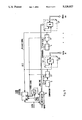
- FIG. 1 is represented a switching network having input buffering, which is described in the not pre-published German Patent Application having the official file reference P 37 14 385.9. The description of this prior German Patent Application is particularly referenced to in this context.
- a switching network is structured in the form of a space-division multiplex switching network.
- Each switching point CP comprises its own evaluation logic for the information contained in the header.
- the blocks supplied through the supply line Z are accepted on the input side to an input buffer B in the switching network.
- the frames received from the subscriber or the preceding switching node are right-aligned in the input buffer B.
- a comparator C assigned to each switching point CP the addresses of the trunk lines A arranged column-by-column, which addresses are stored in the memory SCA, are compared to the routing information contained in the header.
- a decision circuit CA is assigned, which determines the order in which the supply lines Z arranged line-by-line are to be switched in the case of equal routing messages. The order is determined by the spatial arrangement of the supply lines Z, whereas each decision circuit CA cyclically queries all its assigned comparators C.
- a number of shift registers SR corresponding with the number of trunk lines A is connected to an input buffer B, in which registers the routing information is stored.
- Each shift register SR is connected to the switching point CP and also to the comparator C.
- the activating input of the assigned switching point is connected to the comparator C through the decision circuit CA.
- the decision circuit CA controls, by means of a signal provided by a logic circuit L, the acceptance of a new routing message by the shift register SR.
- the signal is released by a release signal ALE applied to the logic circuit L.
- the logic circuit L connected to the input buffer B comprises a first AND gate U1 and a first OR gate O1.
- the first input of the first AND gate U1 and of the first OR gate 01 of the logic circuit L is connected to the decision circuit CA.
- a start signal I produced in the switching node is applied to the second input of the first OR gate O1, whose output is connected to a reset input R of a bistable element RS.
- a data clock signal DC produced in the switching node is applied to the second input of the first AND gate U1, whose output is connected to the first input of a second OR gate O2.
- the inverting output of the bistable element RS is connected to a first input of a second AND gate U2, at whose second input a frame clock signal HC is present produced in the switching node.
- the output of the second AND gate U2 is connected to the second output of the second OR gate, whose output is connected to the input buffer B as well as the shift register SR.
- An inhibit signal DNH derived in the switching node from the frame clock signal HC is present at the set input S of the bistable element RS.
- the bistable element RS produces a switching signal at the inverting output and the frame clock signal HC is present at the second input of the second AND gate U2
- the header of the first frame in the input buffer B is read into the shift register SR.
- the comparator C compares the routing information contained in the header to the addresses of the trunk lines A arranged column-by-column contained in the memory SCA.
- the comparator C applies a signal to the decision circuit CA and, on the basis of the received signals, this decision circuit CA determines the order of the supply lines Z, arranged line-by-line which are to be switched.
- the decision circuit CA applies the release signal ALE to the input buffer B and switches the selected switching point CP through. With the aid of the data clock signal DC the data D are switched through the switching point CP onto the trunk line.
- the routing information stored in the shift register SR is not transferred to the trunk line A.
- the P 37 14 385.9 describes a switching arrangement according to the principle of the asynchronous time-division multiplex method, which is arranged according to a space division multiplex switching network.
- Each switching point CP comprises a comparator C, which compares the address of the trunk line A, arranged column-by-column, to the routing information.
- a decision circuit CA assigned to the trunk line A determines the order in which the switching points are to switch (FIG. 1).
- an input buffer B is connected to each supply line Z in which buffer the blocks are temporarily stored until they reach one of the trunk lines A.
- the decision circuit CA determines in which order the first blocks of the n input buffers B concerned reach the trunk line A i .
- the second block P 2k is to wait in this input buffer B k for n block transfer periods until it reaches its desired output line A j .
- This queue time specifically occurs when the output line A j was free for the duration of n block transfer periods. In this example it will become evident that free channel capacities remain unused, which is then clearly noticeable at high loads.
- the invention has for its object to provide a switching network as well as a switching network control for a transmission system such that the occurrence of bottle-necks in the performance of the switching network is largely avoided.
- a switching network characterized in that the switching network is composed of units (BE) of equal structure according to a space-division multiplex switching network, which units each have a column of switching points (CP) with assigned comparators (C), input buffers (B), decision circuits (CA) and clock signal control circuits (T), in that one interface circuit (JM) is connected to each supply line (Zl, . . . ,Zm), in which interface circuit the blocks are temporarily stored, frame-synchronized and subjected to a serial-to-parallel conversion and which is connected to a bus-like cabling and in that the bus-like cabling is connected to the units (BE).
- CP switching points
- CA decision circuits
- T clock signal control circuits
- Such a switching network is advantageous in that no rather large delays occur when the blocks are switched through the switching network and conflicts are largely avoided.
- a switching network control is characterized in that in a highway system structured according to a space-division multiplex switching network a number of input buffers (B) corresponding with the number of trunk lines (A) are connected to each supply line (Z), in which input buffers the applied blocks are temporarily stored, in that a shift register (SR), in which the routing information is stored, is connected to the input buffers (B), and in that each shift register (SR) is connected to the switching point (CP) and also to a comparator (C) assigned to the switching point (CP), which comparator compares the addresses of the trunk lines (A) arranged column-by-column to the routing information.
- SR shift register
- C comparator
- the input buffers B ik and B jk both contain the blocks P 1k and P 2k .
- the block P 2k intended for the line A j is to wait for only one block transfer period before it can arrive at the free line A j , irrespective of the type of access conflict on the line A i .
- FIG. 1 shows an embodiment for a switching network having input buffering
- FIG. 2a and FIG. 2b show for comparison the allocation of input buffers and switching network as shown in FIG. 1 and FIG. 3,
- FIG. 3 shows an embodiment for a switching network having switching network buffering
- FIG. 4 shows a further embodiment for a switching network having switching network buffering
- FIG. 5 shows a further embodiment for a switching network having input buffering when a deconcentrator is used.
- FIGS. 1 and 2a The embodiments for switching networks having an expansion stage (deconcentrator) as shown in the FIGS. 1 and 2a have already been extensively discussed.
- These switching networks can be built up of identical structural elements BE so that the switching network is segmented "column-by-column".
- the data of the supply lines Z are preferably offered to all units BE in parallel with a bus-like cabling (see FIG. 3).
- the transfer from the supplyline Z to the bus-like cabling is performed by interface circuits JM.
- Each interface circuit JM comprises besides functions for a serial-to-parallel conversion of the data El-Em, a buffer circuit P with which all incoming data are synchronised with a header.
- the interface circuit JM and structural elements BE are preferably designed as plug-in cards for a back wall wiring, with which the bus-like cabling can be realised in a very advantageous way.
- FIG. 4 shows for a switching network with switching network buffering (structural component having input buffering) a switching network control, in which the function of the circuit components used was already extensively discussed with reference to FIG. 1.
- a number of input buffers B corresponding with the number of trunk lines (A) are connected to each supply line Z, in which buffers the supplied blocks are temporarily stored.
- a comparator C assigned to the switching point To the bus line on the output side of an input buffer B is connected a comparator C assigned to the switching point, which comparator compares to the routing information the addresses of the trunk lines A arranged column-by-column and stored in the memory SCA.
- the decision circuit CA connected both to the comparators C and to the switching points CP, determines the order of the supply lines Z arranged line-by-line which have to be switched through.
- Each comparator C is connected to a flipflop FF to whose inverting output the switching point CP and to whose non-inverting output the decision circuit CA is connected.
- the block P 1k is intended for the trunk line A 1 and the trunk line A 1 is assigned thereto by the decision circuit CA. In this case the switching point CP switches and the block P 1k is read from the input buffer B (triggering of line ALE).
- the block P 1k is intended for the trunk line A 1 and the line A 1 has not yet been assigned thereto by the decision circuit CA. This is a condition of queueing until the trunk line A 1 is assigned (compare 1).
- the block P 1k is not intended for the trunk line A 1 . There is no signal from the decision circuit CA. The line ALE is triggered via the inverting output of the flipflop FF. The block P 1k is read out but does not reach the trunk line A 1 via the switching point CP.
- the decision circuits of the FIGS. 3 and 4 define a declining priority of the supply lines 1, 2, . . . with buffers that are not empty.
- a structural element BE can be advantageously used as a concentrator: it then causes the data streams of m lines to be concentrated on one line. For deconcentration a further componet is then used, which is represented in FIG. 5. It allows to transfer the data coming from a supply line Z to n trunk lines A according to their routing information: This corresponds with the function of a demultiplexer.
- the decision circuit CA Since no access conflict can occur, the decision circuit CA is cancelled.
- the components from FIG. 3 can also operate as a statistical multiplexer: In this case the comparator C is to show that one block anyhow is available in the supply line Z concerned.
Landscapes
- Engineering & Computer Science (AREA)
- Computer Networks & Wireless Communication (AREA)
- Signal Processing (AREA)
- Data Exchanges In Wide-Area Networks (AREA)
- Small-Scale Networks (AREA)
- Use Of Switch Circuits For Exchanges And Methods Of Control Of Multiplex Exchanges (AREA)
Applications Claiming Priority (2)
| Application Number | Priority Date | Filing Date | Title |
|---|---|---|---|
| DE19873743685 DE3743685A1 (de) | 1987-12-23 | 1987-12-23 | Koppelfeld und koppelfeldsteuerung fuer ein vermittlungssystem |
| DE3743685 | 1987-12-23 |
Related Parent Applications (1)
| Application Number | Title | Priority Date | Filing Date |
|---|---|---|---|
| US07283419 Continuation | 1988-12-12 |
Publications (1)
| Publication Number | Publication Date |
|---|---|
| US5128927A true US5128927A (en) | 1992-07-07 |
Family
ID=6343345
Family Applications (1)
| Application Number | Title | Priority Date | Filing Date |
|---|---|---|---|
| US07/518,889 Expired - Fee Related US5128927A (en) | 1987-12-23 | 1990-05-04 | Switching network and switching network control for a transmission system |
Country Status (6)
| Country | Link |
|---|---|
| US (1) | US5128927A (fr) |
| EP (1) | EP0322075B1 (fr) |
| JP (1) | JPH024073A (fr) |
| CA (1) | CA1332001C (fr) |
| DE (2) | DE3743685A1 (fr) |
| ES (1) | ES2052692T3 (fr) |
Cited By (5)
| Publication number | Priority date | Publication date | Assignee | Title |
|---|---|---|---|---|
| US5357506A (en) * | 1991-12-13 | 1994-10-18 | Nec Corporation | ATM self-routing switching system having input buffers adaptively controlled by contention test results |
| US5442628A (en) * | 1993-11-15 | 1995-08-15 | Motorola, Inc. | Local area network data processing system containing a quad elastic buffer and layer management (ELM) integrated circuit and method of switching |
| US5493566A (en) * | 1992-12-15 | 1996-02-20 | Telefonaktiebolaget L M. Ericsson | Flow control system for packet switches |
| US5617415A (en) * | 1990-04-02 | 1997-04-01 | U.S. Philips Corporation | Interconnection element for an asynchronous time-division multiplex transmission system |
| US20040258010A1 (en) * | 2003-06-18 | 2004-12-23 | Ladden Gregory C. | Distributed automatically-configuring switching system |
Families Citing this family (3)
| Publication number | Priority date | Publication date | Assignee | Title |
|---|---|---|---|---|
| DE4004889A1 (de) * | 1990-02-16 | 1991-08-22 | Philips Patentverwaltung | Koppelelement fuer ein asynchrones zeitvielfachuebermittlungssystem |
| US5299764A (en) * | 1991-10-23 | 1994-04-05 | Scott David R | In-space servicing of spacecraft employing artificial life robotics |
| US5421540A (en) * | 1992-08-26 | 1995-06-06 | Ting; Paul C. | Method and apparatus for disposal/recovery of orbiting space debris |
Citations (9)
| Publication number | Priority date | Publication date | Assignee | Title |
|---|---|---|---|---|
| US4577311A (en) * | 1980-12-24 | 1986-03-18 | Duquesne Jean F | Packet-based telecommunication system |
| EP0183592A1 (fr) * | 1984-11-08 | 1986-06-04 | LABORATOIRE CENTRAL DE TELECOMMUNICATIONS Société anonyme: | Commutateur de paquets asynchrone |
| US4603416A (en) * | 1982-12-29 | 1986-07-29 | Michel Servel | (Time division multiplex) switching system for routing trains of constant length data packets |
| US4630259A (en) * | 1984-11-14 | 1986-12-16 | At&T Bell Laboratories | Lockup detection and recovery in a packet switching network |
| US4692917A (en) * | 1984-11-27 | 1987-09-08 | Kokusai Denshin Denwa Co., Ltd. | Packet switching system |
| US4731878A (en) * | 1985-11-29 | 1988-03-15 | American Telephone And Telegraph Company, At&T Bell Laboratories | Self-routing switch node combining electronic and photonic switching |
| US4760570A (en) * | 1986-08-06 | 1988-07-26 | American Telephone & Telegraph Company, At&T Bell Laboratories | N-by-N "knockout" switch for a high-performance packet switching system |
| US4780870A (en) * | 1986-09-05 | 1988-10-25 | American Telephone And Telegraph Company, At&T Bell Laboratories | Packet switch |
| US4796254A (en) * | 1986-03-10 | 1989-01-03 | At&T Philips Telecommunications B.V. | Broadband space switching network and parallel-series converter and series-parallel converter for use in such a space switching network |
Family Cites Families (2)
| Publication number | Priority date | Publication date | Assignee | Title |
|---|---|---|---|---|
| JPS62247653A (ja) * | 1986-04-21 | 1987-10-28 | Hitachi Ltd | パケツト交換機の構成方式 |
| JPS6429045A (en) * | 1987-07-23 | 1989-01-31 | Nec Corp | Data switching channel system |
-
1987
- 1987-12-23 DE DE19873743685 patent/DE3743685A1/de not_active Withdrawn
-
1988
- 1988-12-19 EP EP88202963A patent/EP0322075B1/fr not_active Expired - Lifetime
- 1988-12-19 DE DE88202963T patent/DE3888137D1/de not_active Expired - Fee Related
- 1988-12-19 ES ES88202963T patent/ES2052692T3/es not_active Expired - Lifetime
- 1988-12-20 CA CA000586419A patent/CA1332001C/fr not_active Expired - Fee Related
- 1988-12-20 JP JP63319694A patent/JPH024073A/ja active Pending
-
1990
- 1990-05-04 US US07/518,889 patent/US5128927A/en not_active Expired - Fee Related
Patent Citations (9)
| Publication number | Priority date | Publication date | Assignee | Title |
|---|---|---|---|---|
| US4577311A (en) * | 1980-12-24 | 1986-03-18 | Duquesne Jean F | Packet-based telecommunication system |
| US4603416A (en) * | 1982-12-29 | 1986-07-29 | Michel Servel | (Time division multiplex) switching system for routing trains of constant length data packets |
| EP0183592A1 (fr) * | 1984-11-08 | 1986-06-04 | LABORATOIRE CENTRAL DE TELECOMMUNICATIONS Société anonyme: | Commutateur de paquets asynchrone |
| US4630259A (en) * | 1984-11-14 | 1986-12-16 | At&T Bell Laboratories | Lockup detection and recovery in a packet switching network |
| US4692917A (en) * | 1984-11-27 | 1987-09-08 | Kokusai Denshin Denwa Co., Ltd. | Packet switching system |
| US4731878A (en) * | 1985-11-29 | 1988-03-15 | American Telephone And Telegraph Company, At&T Bell Laboratories | Self-routing switch node combining electronic and photonic switching |
| US4796254A (en) * | 1986-03-10 | 1989-01-03 | At&T Philips Telecommunications B.V. | Broadband space switching network and parallel-series converter and series-parallel converter for use in such a space switching network |
| US4760570A (en) * | 1986-08-06 | 1988-07-26 | American Telephone & Telegraph Company, At&T Bell Laboratories | N-by-N "knockout" switch for a high-performance packet switching system |
| US4780870A (en) * | 1986-09-05 | 1988-10-25 | American Telephone And Telegraph Company, At&T Bell Laboratories | Packet switch |
Non-Patent Citations (6)
| Title |
|---|
| Katevenis, "Fast Switching and Fair Control of Congested Flow in Broadband Networks", IEEE J. Sel. Areas Comm. vol. SAC-5, No. 8, 1987 pp. 1315-1326. |
| Katevenis, Fast Switching and Fair Control of Congested Flow in Broadband Networks , IEEE J. Sel. Areas Comm. vol. SAC 5, No. 8, 1987 pp. 1315 1326. * |
| Killat, "Asynchrone Zeitvielfachubermittlung fur Breitbandnetze", ntz B0.40 (1987) Heft 8 pp. 572-577. |
| Killat, Asynchrone Zeitvielfach bermittlung f r Breitbandnetze , ntz B0.40 (1987) Heft 8 pp. 572 577. * |
| Y. S. Yeh, et al. "A Simple Knockout Switch . . . ", IEEE J on Sel. Areas Comm., vol. SAC-5, No. 8, Oct. 1987 pp. 1274-1283. |
| Y. S. Yeh, et al. A Simple Knockout Switch . . . , IEEE J on Sel. Areas Comm., vol. SAC 5, No. 8, Oct. 1987 pp. 1274 1283. * |
Cited By (7)
| Publication number | Priority date | Publication date | Assignee | Title |
|---|---|---|---|---|
| US5617415A (en) * | 1990-04-02 | 1997-04-01 | U.S. Philips Corporation | Interconnection element for an asynchronous time-division multiplex transmission system |
| US5357506A (en) * | 1991-12-13 | 1994-10-18 | Nec Corporation | ATM self-routing switching system having input buffers adaptively controlled by contention test results |
| US5493566A (en) * | 1992-12-15 | 1996-02-20 | Telefonaktiebolaget L M. Ericsson | Flow control system for packet switches |
| US5442628A (en) * | 1993-11-15 | 1995-08-15 | Motorola, Inc. | Local area network data processing system containing a quad elastic buffer and layer management (ELM) integrated circuit and method of switching |
| US5539733A (en) * | 1993-11-15 | 1996-07-23 | Motorola, Inc. | Method for switching data flow in a fiber distributed interface (FDDI) system |
| US20040258010A1 (en) * | 2003-06-18 | 2004-12-23 | Ladden Gregory C. | Distributed automatically-configuring switching system |
| US7701932B2 (en) * | 2003-06-18 | 2010-04-20 | Motorola, Inc. | Distributed automatically-configuring switching system |
Also Published As
| Publication number | Publication date |
|---|---|
| DE3743685A1 (de) | 1989-07-06 |
| DE3888137D1 (de) | 1994-04-07 |
| CA1332001C (fr) | 1994-09-13 |
| EP0322075A2 (fr) | 1989-06-28 |
| ES2052692T3 (es) | 1994-07-16 |
| EP0322075B1 (fr) | 1994-03-02 |
| JPH024073A (ja) | 1990-01-09 |
| EP0322075A3 (fr) | 1991-07-31 |
Similar Documents
| Publication | Publication Date | Title |
|---|---|---|
| US5406556A (en) | Output buffered packet switch with a flexible buffer management scheme | |
| US5008878A (en) | High-speed modular switching apparatus for circuit and packet switched traffic | |
| EP0276349B1 (fr) | Dispositif pour commuter des informations entre des canaux de trafic synchrone et pour commuter des paquets de données asynchrones | |
| CA2153172C (fr) | Commutateur mta a acces controle | |
| US5168492A (en) | Rotating-access ATM-STM packet switch | |
| CA1264081A (fr) | Commutation repartie de paquets de donnees telephoniques et de paquets de donnees informatiques sur les reseaux d'interconnexion multi-etages | |
| EP0256701B1 (fr) | Circuit d'interconnexion pour commutateurs de paquets de données à multiplexage spatial | |
| US5856977A (en) | Distribution network switch for very large gigabit switching architecture | |
| US6931002B1 (en) | Hybrid switching | |
| US4969149A (en) | Switching network for a switching system | |
| US4891802A (en) | Method of and circuit arrangement for controlling a switching network in a switching system | |
| JPH08511927A (ja) | セル交換通信制御装置における待ち行列チャネルの帯域幅および輻輳制御 | |
| KR19980064825A (ko) | 에이.티.엠 스위치의 분산 버퍼링 시스템 | |
| US5285445A (en) | Switching network and switching network control for a switching node in a wideband transmission system | |
| US5742597A (en) | Method and device for multipoint switching and arbitration in output-request packet switch | |
| US5128927A (en) | Switching network and switching network control for a transmission system | |
| EP0339735B1 (fr) | Commutateur de jonction pour commutation de paquets | |
| JP2752116B2 (ja) | 交換ノード | |
| US7345995B2 (en) | Conflict resolution in data stream distribution | |
| JP3036584B2 (ja) | Atmスイッチ | |
| JP3075187B2 (ja) | Atmスイッチ | |
| US5475708A (en) | Circuit arrangement with at least one input and at least one output for forwarding an input signal that can be filtered, parallelized and digitized | |
| JPH0670350A (ja) | スイッチング・システム | |
| Goeldner et al. | Architecture of a New Inhouse Communication System Providing Integrated Circuit and Packet Switching | |
| AU724624B2 (en) | Controlled access ATM switch |
Legal Events
| Date | Code | Title | Description |
|---|---|---|---|
| FEPP | Fee payment procedure |
Free format text: PAYOR NUMBER ASSIGNED (ORIGINAL EVENT CODE: ASPN); ENTITY STATUS OF PATENT OWNER: LARGE ENTITY |
|
| FPAY | Fee payment |
Year of fee payment: 4 |
|
| REMI | Maintenance fee reminder mailed | ||
| LAPS | Lapse for failure to pay maintenance fees | ||
| FP | Lapsed due to failure to pay maintenance fee |
Effective date: 20000707 |
|
| STCH | Information on status: patent discontinuation |
Free format text: PATENT EXPIRED DUE TO NONPAYMENT OF MAINTENANCE FEES UNDER 37 CFR 1.362 |