US5135709A - Method for reducing corrosion of components exposed to high-temperature water - Google Patents
Method for reducing corrosion of components exposed to high-temperature water Download PDFInfo
- Publication number
- US5135709A US5135709A US07/698,885 US69888591A US5135709A US 5135709 A US5135709 A US 5135709A US 69888591 A US69888591 A US 69888591A US 5135709 A US5135709 A US 5135709A
- Authority
- US
- United States
- Prior art keywords
- water
- hydrogen
- potential
- corrosion
- alloy
- Prior art date
- Legal status (The legal status is an assumption and is not a legal conclusion. Google has not performed a legal analysis and makes no representation as to the accuracy of the status listed.)
- Expired - Lifetime
Links
- XLYOFNOQVPJJNP-UHFFFAOYSA-N water Substances O XLYOFNOQVPJJNP-UHFFFAOYSA-N 0.000 title claims abstract description 140
- 230000007797 corrosion Effects 0.000 title claims abstract description 119
- 238000005260 corrosion Methods 0.000 title claims abstract description 119
- 238000000034 method Methods 0.000 title claims abstract description 27
- BASFCYQUMIYNBI-UHFFFAOYSA-N platinum Chemical group [Pt] BASFCYQUMIYNBI-UHFFFAOYSA-N 0.000 claims abstract description 86
- 229910052751 metal Inorganic materials 0.000 claims abstract description 48
- 239000002184 metal Substances 0.000 claims abstract description 48
- 229910045601 alloy Inorganic materials 0.000 claims abstract description 39
- 239000000956 alloy Substances 0.000 claims abstract description 39
- 230000003197 catalytic effect Effects 0.000 claims abstract description 39
- 229910001220 stainless steel Inorganic materials 0.000 claims abstract description 29
- 230000001590 oxidative effect Effects 0.000 claims abstract description 26
- 239000010935 stainless steel Substances 0.000 claims abstract description 25
- PXHVJJICTQNCMI-UHFFFAOYSA-N Nickel Chemical compound [Ni] PXHVJJICTQNCMI-UHFFFAOYSA-N 0.000 claims abstract description 22
- 229910000975 Carbon steel Inorganic materials 0.000 claims abstract description 12
- 239000010962 carbon steel Substances 0.000 claims abstract description 12
- 229910000851 Alloy steel Inorganic materials 0.000 claims abstract description 11
- 229910052759 nickel Inorganic materials 0.000 claims abstract description 11
- 229910000531 Co alloy Inorganic materials 0.000 claims abstract description 9
- 239000001257 hydrogen Substances 0.000 claims description 97
- 229910052739 hydrogen Inorganic materials 0.000 claims description 97
- UFHFLCQGNIYNRP-UHFFFAOYSA-N Hydrogen Chemical compound [H][H] UFHFLCQGNIYNRP-UHFFFAOYSA-N 0.000 claims description 91
- 238000005336 cracking Methods 0.000 claims description 33
- KDLHZDBZIXYQEI-UHFFFAOYSA-N Palladium Chemical compound [Pd] KDLHZDBZIXYQEI-UHFFFAOYSA-N 0.000 description 86
- QVGXLLKOCUKJST-UHFFFAOYSA-N atomic oxygen Chemical compound [O] QVGXLLKOCUKJST-UHFFFAOYSA-N 0.000 description 54
- 239000001301 oxygen Substances 0.000 description 54
- 229910052760 oxygen Inorganic materials 0.000 description 54
- 238000012360 testing method Methods 0.000 description 42
- 229910052763 palladium Inorganic materials 0.000 description 41
- 229910052697 platinum Inorganic materials 0.000 description 33
- 230000035882 stress Effects 0.000 description 31
- 239000000523 sample Substances 0.000 description 24
- 238000000576 coating method Methods 0.000 description 18
- 238000007792 addition Methods 0.000 description 13
- 239000011248 coating agent Substances 0.000 description 13
- 230000002829 reductive effect Effects 0.000 description 11
- 239000000463 material Substances 0.000 description 9
- 150000002739 metals Chemical class 0.000 description 8
- 238000011282 treatment Methods 0.000 description 8
- 239000000203 mixture Substances 0.000 description 7
- 230000005855 radiation Effects 0.000 description 7
- 239000000758 substrate Substances 0.000 description 7
- 239000010963 304 stainless steel Substances 0.000 description 6
- MHAJPDPJQMAIIY-UHFFFAOYSA-N Hydrogen peroxide Chemical compound OO MHAJPDPJQMAIIY-UHFFFAOYSA-N 0.000 description 6
- 229910000589 SAE 304 stainless steel Inorganic materials 0.000 description 6
- 150000002431 hydrogen Chemical class 0.000 description 6
- 238000010348 incorporation Methods 0.000 description 6
- 238000002347 injection Methods 0.000 description 6
- 239000007924 injection Substances 0.000 description 6
- 238000009835 boiling Methods 0.000 description 5
- 229910000619 316 stainless steel Inorganic materials 0.000 description 4
- IJGRMHOSHXDMSA-UHFFFAOYSA-N Atomic nitrogen Chemical compound N#N IJGRMHOSHXDMSA-UHFFFAOYSA-N 0.000 description 4
- QAOWNCQODCNURD-UHFFFAOYSA-N Sulfuric acid Chemical compound OS(O)(=O)=O QAOWNCQODCNURD-UHFFFAOYSA-N 0.000 description 4
- MCMNRKCIXSYSNV-UHFFFAOYSA-N Zirconium dioxide Chemical compound O=[Zr]=O MCMNRKCIXSYSNV-UHFFFAOYSA-N 0.000 description 4
- 230000006399 behavior Effects 0.000 description 4
- 230000015572 biosynthetic process Effects 0.000 description 4
- 238000000354 decomposition reaction Methods 0.000 description 4
- 238000007772 electroless plating Methods 0.000 description 4
- 238000005259 measurement Methods 0.000 description 4
- 238000007747 plating Methods 0.000 description 4
- 238000003466 welding Methods 0.000 description 4
- -1 32 ppb Chemical compound 0.000 description 3
- 229910017052 cobalt Inorganic materials 0.000 description 3
- 239000010941 cobalt Substances 0.000 description 3
- GUTLYIVDDKVIGB-UHFFFAOYSA-N cobalt atom Chemical compound [Co] GUTLYIVDDKVIGB-UHFFFAOYSA-N 0.000 description 3
- 239000002826 coolant Substances 0.000 description 3
- 239000010408 film Substances 0.000 description 3
- 238000004519 manufacturing process Methods 0.000 description 3
- 230000002265 prevention Effects 0.000 description 3
- 230000008569 process Effects 0.000 description 3
- QGZKDVFQNNGYKY-UHFFFAOYSA-N Ammonia Chemical compound N QGZKDVFQNNGYKY-UHFFFAOYSA-N 0.000 description 2
- 102100035437 Ceramide transfer protein Human genes 0.000 description 2
- 101710119334 Ceramide transfer protein Proteins 0.000 description 2
- MYMOFIZGZYHOMD-UHFFFAOYSA-N Dioxygen Chemical compound O=O MYMOFIZGZYHOMD-UHFFFAOYSA-N 0.000 description 2
- OAKJQQAXSVQMHS-UHFFFAOYSA-N Hydrazine Chemical compound NN OAKJQQAXSVQMHS-UHFFFAOYSA-N 0.000 description 2
- 230000032683 aging Effects 0.000 description 2
- 238000005275 alloying Methods 0.000 description 2
- 230000008901 benefit Effects 0.000 description 2
- 239000003054 catalyst Substances 0.000 description 2
- 230000008859 change Effects 0.000 description 2
- 238000006243 chemical reaction Methods 0.000 description 2
- 230000007423 decrease Effects 0.000 description 2
- 238000009792 diffusion process Methods 0.000 description 2
- 229910001882 dioxygen Inorganic materials 0.000 description 2
- 238000006056 electrooxidation reaction Methods 0.000 description 2
- 230000007613 environmental effect Effects 0.000 description 2
- 230000004907 flux Effects 0.000 description 2
- 238000003754 machining Methods 0.000 description 2
- 229910052757 nitrogen Inorganic materials 0.000 description 2
- 238000002161 passivation Methods 0.000 description 2
- 238000010248 power generation Methods 0.000 description 2
- 238000012545 processing Methods 0.000 description 2
- 230000009467 reduction Effects 0.000 description 2
- 239000000126 substance Substances 0.000 description 2
- 229910000838 Al alloy Inorganic materials 0.000 description 1
- OKTJSMMVPCPJKN-UHFFFAOYSA-N Carbon Chemical compound [C] OKTJSMMVPCPJKN-UHFFFAOYSA-N 0.000 description 1
- VYZAMTAEIAYCRO-UHFFFAOYSA-N Chromium Chemical compound [Cr] VYZAMTAEIAYCRO-UHFFFAOYSA-N 0.000 description 1
- MFYSYFVPBJMHGN-ZPOLXVRWSA-N Cortisone Chemical compound O=C1CC[C@]2(C)[C@H]3C(=O)C[C@](C)([C@@](CC4)(O)C(=O)CO)[C@@H]4[C@@H]3CCC2=C1 MFYSYFVPBJMHGN-ZPOLXVRWSA-N 0.000 description 1
- JPVYNHNXODAKFH-UHFFFAOYSA-N Cu2+ Chemical compound [Cu+2] JPVYNHNXODAKFH-UHFFFAOYSA-N 0.000 description 1
- 229910017061 Fe Co Inorganic materials 0.000 description 1
- KJTLSVCANCCWHF-UHFFFAOYSA-N Ruthenium Chemical compound [Ru] KJTLSVCANCCWHF-UHFFFAOYSA-N 0.000 description 1
- 206010070834 Sensitisation Diseases 0.000 description 1
- 229910018540 Si C Inorganic materials 0.000 description 1
- XUIMIQQOPSSXEZ-UHFFFAOYSA-N Silicon Chemical compound [Si] XUIMIQQOPSSXEZ-UHFFFAOYSA-N 0.000 description 1
- 229910021607 Silver chloride Inorganic materials 0.000 description 1
- 229910000831 Steel Inorganic materials 0.000 description 1
- 229910001347 Stellite Inorganic materials 0.000 description 1
- 239000004809 Teflon Substances 0.000 description 1
- 229920006362 Teflon® Polymers 0.000 description 1
- 239000002253 acid Substances 0.000 description 1
- 239000003929 acidic solution Substances 0.000 description 1
- 230000002378 acidificating effect Effects 0.000 description 1
- PNEYBMLMFCGWSK-UHFFFAOYSA-N aluminium oxide Inorganic materials [O-2].[O-2].[O-2].[Al+3].[Al+3] PNEYBMLMFCGWSK-UHFFFAOYSA-N 0.000 description 1
- 229910021529 ammonia Inorganic materials 0.000 description 1
- 230000003466 anti-cipated effect Effects 0.000 description 1
- 239000007864 aqueous solution Substances 0.000 description 1
- 239000012300 argon atmosphere Substances 0.000 description 1
- 230000009286 beneficial effect Effects 0.000 description 1
- 238000005422 blasting Methods 0.000 description 1
- 229910052799 carbon Inorganic materials 0.000 description 1
- 230000015556 catabolic process Effects 0.000 description 1
- 125000002091 cationic group Chemical group 0.000 description 1
- 238000005524 ceramic coating Methods 0.000 description 1
- 238000005229 chemical vapour deposition Methods 0.000 description 1
- 229910052804 chromium Inorganic materials 0.000 description 1
- 239000011651 chromium Substances 0.000 description 1
- AHICWQREWHDHHF-UHFFFAOYSA-N chromium;cobalt;iron;manganese;methane;molybdenum;nickel;silicon;tungsten Chemical compound C.[Si].[Cr].[Mn].[Fe].[Co].[Ni].[Mo].[W] AHICWQREWHDHHF-UHFFFAOYSA-N 0.000 description 1
- 239000013068 control sample Substances 0.000 description 1
- 239000000498 cooling water Substances 0.000 description 1
- 230000003247 decreasing effect Effects 0.000 description 1
- 238000006731 degradation reaction Methods 0.000 description 1
- 230000002939 deleterious effect Effects 0.000 description 1
- 238000000151 deposition Methods 0.000 description 1
- 230000009977 dual effect Effects 0.000 description 1
- 230000000694 effects Effects 0.000 description 1
- 238000002848 electrochemical method Methods 0.000 description 1
- 238000001983 electron spin resonance imaging Methods 0.000 description 1
- 238000009713 electroplating Methods 0.000 description 1
- 230000003628 erosive effect Effects 0.000 description 1
- 238000011156 evaluation Methods 0.000 description 1
- 238000010285 flame spraying Methods 0.000 description 1
- 238000010438 heat treatment Methods 0.000 description 1
- 230000006872 improvement Effects 0.000 description 1
- 239000012535 impurity Substances 0.000 description 1
- 229910001026 inconel Inorganic materials 0.000 description 1
- 229910001055 inconels 600 Inorganic materials 0.000 description 1
- 230000006698 induction Effects 0.000 description 1
- 239000011261 inert gas Substances 0.000 description 1
- 238000007689 inspection Methods 0.000 description 1
- 229910052741 iridium Inorganic materials 0.000 description 1
- GKOZUEZYRPOHIO-UHFFFAOYSA-N iridium atom Chemical compound [Ir] GKOZUEZYRPOHIO-UHFFFAOYSA-N 0.000 description 1
- 238000011068 loading method Methods 0.000 description 1
- 230000007774 longterm Effects 0.000 description 1
- 239000011572 manganese Substances 0.000 description 1
- WPBNNNQJVZRUHP-UHFFFAOYSA-L manganese(2+);methyl n-[[2-(methoxycarbonylcarbamothioylamino)phenyl]carbamothioyl]carbamate;n-[2-(sulfidocarbothioylamino)ethyl]carbamodithioate Chemical compound [Mn+2].[S-]C(=S)NCCNC([S-])=S.COC(=O)NC(=S)NC1=CC=CC=C1NC(=S)NC(=O)OC WPBNNNQJVZRUHP-UHFFFAOYSA-L 0.000 description 1
- 239000000155 melt Substances 0.000 description 1
- 238000002844 melting Methods 0.000 description 1
- 230000008018 melting Effects 0.000 description 1
- 229910001092 metal group alloy Inorganic materials 0.000 description 1
- 239000007769 metal material Substances 0.000 description 1
- QGZKDVFQNNGYKY-NJFSPNSNSA-N nitrogen-16 Chemical compound [16NH3] QGZKDVFQNNGYKY-NJFSPNSNSA-N 0.000 description 1
- 229910000510 noble metal Inorganic materials 0.000 description 1
- 229910052762 osmium Inorganic materials 0.000 description 1
- SYQBFIAQOQZEGI-UHFFFAOYSA-N osmium atom Chemical compound [Os] SYQBFIAQOQZEGI-UHFFFAOYSA-N 0.000 description 1
- 239000007800 oxidant agent Substances 0.000 description 1
- 230000003647 oxidation Effects 0.000 description 1
- 238000007254 oxidation reaction Methods 0.000 description 1
- 238000005240 physical vapour deposition Methods 0.000 description 1
- 238000007750 plasma spraying Methods 0.000 description 1
- 230000010287 polarization Effects 0.000 description 1
- 239000000843 powder Substances 0.000 description 1
- 230000000644 propagated effect Effects 0.000 description 1
- 230000006798 recombination Effects 0.000 description 1
- 238000005215 recombination Methods 0.000 description 1
- 238000011160 research Methods 0.000 description 1
- 230000000717 retained effect Effects 0.000 description 1
- 230000002441 reversible effect Effects 0.000 description 1
- 229910052703 rhodium Inorganic materials 0.000 description 1
- 239000010948 rhodium Substances 0.000 description 1
- MHOVAHRLVXNVSD-UHFFFAOYSA-N rhodium atom Chemical compound [Rh] MHOVAHRLVXNVSD-UHFFFAOYSA-N 0.000 description 1
- 229910052707 ruthenium Inorganic materials 0.000 description 1
- 230000008313 sensitization Effects 0.000 description 1
- 229910052710 silicon Inorganic materials 0.000 description 1
- 239000010703 silicon Substances 0.000 description 1
- 229910052709 silver Inorganic materials 0.000 description 1
- 239000004332 silver Substances 0.000 description 1
- HKZLPVFGJNLROG-UHFFFAOYSA-M silver monochloride Chemical compound [Cl-].[Ag+] HKZLPVFGJNLROG-UHFFFAOYSA-M 0.000 description 1
- 239000000243 solution Substances 0.000 description 1
- 238000004544 sputter deposition Methods 0.000 description 1
- 229910001256 stainless steel alloy Inorganic materials 0.000 description 1
- 238000007655 standard test method Methods 0.000 description 1
- 230000003068 static effect Effects 0.000 description 1
- 239000010959 steel Substances 0.000 description 1
- 230000002459 sustained effect Effects 0.000 description 1
- 238000010998 test method Methods 0.000 description 1
- 230000008719 thickening Effects 0.000 description 1
- 230000007704 transition Effects 0.000 description 1
Images


Classifications
-
- G—PHYSICS
- G21—NUCLEAR PHYSICS; NUCLEAR ENGINEERING
- G21C—NUCLEAR REACTORS
- G21C17/00—Monitoring; Testing ; Maintaining
- G21C17/02—Devices or arrangements for monitoring coolant or moderator
- G21C17/022—Devices or arrangements for monitoring coolant or moderator for monitoring liquid coolants or moderators
- G21C17/0225—Chemical surface treatment, e.g. corrosion
-
- G—PHYSICS
- G21—NUCLEAR PHYSICS; NUCLEAR ENGINEERING
- G21C—NUCLEAR REACTORS
- G21C13/00—Pressure vessels; Containment vessels; Containment in general
- G21C13/08—Vessels characterised by the material; Selection of materials for pressure vessels
- G21C13/087—Metallic vessels
-
- G—PHYSICS
- G21—NUCLEAR PHYSICS; NUCLEAR ENGINEERING
- G21C—NUCLEAR REACTORS
- G21C19/00—Arrangements for treating, for handling, or for facilitating the handling of, fuel or other materials which are used within the reactor, e.g. within its pressure vessel
- G21C19/28—Arrangements for introducing fluent material into the reactor core; Arrangements for removing fluent material from the reactor core
- G21C19/30—Arrangements for introducing fluent material into the reactor core; Arrangements for removing fluent material from the reactor core with continuous purification of circulating fluent material, e.g. by extraction of fission products deterioration or corrosion products, impurities, e.g. by cold traps
- G21C19/307—Arrangements for introducing fluent material into the reactor core; Arrangements for removing fluent material from the reactor core with continuous purification of circulating fluent material, e.g. by extraction of fission products deterioration or corrosion products, impurities, e.g. by cold traps specially adapted for liquids
-
- Y—GENERAL TAGGING OF NEW TECHNOLOGICAL DEVELOPMENTS; GENERAL TAGGING OF CROSS-SECTIONAL TECHNOLOGIES SPANNING OVER SEVERAL SECTIONS OF THE IPC; TECHNICAL SUBJECTS COVERED BY FORMER USPC CROSS-REFERENCE ART COLLECTIONS [XRACs] AND DIGESTS
- Y02—TECHNOLOGIES OR APPLICATIONS FOR MITIGATION OR ADAPTATION AGAINST CLIMATE CHANGE
- Y02E—REDUCTION OF GREENHOUSE GAS [GHG] EMISSIONS, RELATED TO ENERGY GENERATION, TRANSMISSION OR DISTRIBUTION
- Y02E30/00—Energy generation of nuclear origin
- Y02E30/30—Nuclear fission reactors
Definitions
- high-temperature water means water of about 150° C. or greater, steam, or the condensate thereof.
- High-temperature water can be found in a variety of known apparatus, such as water deaerators, nuclear reactors, and in steam driven central station power generation.
- Nuclear reactors are used in central-station electric power generation, research, propulsion, and for dual purposes thereof.
- a reactor pressure vessel contains the reactor coolant, i.e. water, which removes heat from the nuclear core.
- Piping circuits carry the heated water or steam to the steam generators or turbines, and circulated water or feedwater back to the vessel.
- Operating pressures and temperatures for the reactor pressure vessel are about 7 MPa and 288° C. for a boiling water reactor, and about 15 MPa and 320° C. for a pressurized water reactor.
- the materials used in both boiling water and pressurized water reactors must withstand various loading, environmental and radiation conditions.
- Some of the materials exposed to the high-temperature water, steam, or condensate thereof include carbon steel, alloy steel, stainless steel, nickel-base alloys, and cobalt-base alloys. Additional information about such materials can be found in the Metals Handbook Desk Edition, American Society for Metals, 1985, with carbon and alloy steels at pp. 4.1-4.94, stainless steels and nickel-based alloys at pp. 15.1-15.30, and cobalt-base alloys at pp. 17.8-17.10, all incorporated herein by reference. Despite the careful selection and treatment of these materials for use in the systems, corrosion occurs on the materials exposed to the high-temperature water. Such corrosion contributes to a variety of problems, e.g., stress corrosion cracking, sticking of pressure relief valves, buildup of the gamma radiation emitting isotope 60 cobalt, and erosion corrosion.
- problems e.g., stress corrosion cracking, sticking of pressure relief valves, buildup of the gamma radiation emitting isotope 60 cobalt,
- Stress corrosion cracking is a known phenomenon occurring in the components, including structural members, piping, fasteners, and weld deposits, of apparatus exposed to high-temperature water.
- the components in nuclear reactors exposed to high-temperature water are known to undergo stress corrosion cracking.
- stress corrosion cracking means cracking propagated by static or dynamic stressing in combination with corrosion at the crack tip.
- the reactor components are subject to a variety of stresses associated with, e.g., differences in thermal expansion, the operating pressure needed for the containment of the reactor cooling water, and other sources including residual stress from welding, cold work and other asymmetric metal treatments.
- water chemistry, welding, heat treatment, and radiation can increase the susceptibility of a component to stress corrosion cracking of the metal. The factors that lead to stress corrosion cracking have been widely studied and a number of papers have been written concerning it.
- stress corrosion cracking occurs at higher rates when oxygen is present in the reactor water in concentrations of about 5 parts per billion, ppb, or greater. Stress corrosion cracking is further increased in a high radiation flux where oxidizing species, such as oxygen, hydrogen peroxide, and short-lived radicals are produced from radiolytic decomposition of the reactor water. Such oxidizing species increase the electrochemical corrosion potential of metals. Electrochemical corrosion is caused by a flow of electrons from anodic and cathodic areas on metallic surfaces. The corrosion potential is a measure of the thermodynamic tendency for corrosion phenomena to occur, and is a fundamental parameter in determining rates of, e.g., stress corrosion cracking, corrosion fatigue, corrosion film thickening, and general corrosion.
- stress corrosion cracking in boiling water nuclear reactors and the associated water circulation piping has been reduced by injecting hydrogen in the water circulated therein.
- the injected hydrogen reduces oxidizing species in the water, such as dissolved oxygen, and as a result lowers the corrosion potential of metals in the water.
- factors such as variations in water flow rates and the time or intensity of exposure to neutron or gamma radiation result in the production of oxidizing species at different levels in different reactors.
- varying amounts of hydrogen have been required to reduce the level of oxidizing species sufficiently to maintain the corrosion potential below a critical potential required for protection from the stress corrosion cracking in the high-temperature water.
- critical potential means a corrosion potential at or below a range of values of about -230 to -300 mV based on the standard hydrogen electrode (she) scale. Below the critical potential, stress corrosion cracking is markedly reduced or even eliminated as disclosed in references 2-5. Stress corrosion cracking proceeds at an accelerated rate in systems in which the electrochemical potential is above the critical potential, and at a substantially lower rate in systems in which the electrochemical potential is below the critical potential. Water containing oxidizing species such as oxygen increases the corrosion potential of metals exposed to the water above the critical potential, while water with little or no oxidizing species present results in corrosion potentials below the critical potential.
- Corrosion potentials of stainless steels in contact with reactor water containing oxidizing species can be reduced below the critical potential by injection of hydrogen into the water in a concentration of about 50 to 100 ppb or greater.
- Much higher hydrogen injection levels are necessary to reduce the corrosion potential within the high radiation flux of the reactor core, or when oxidizing cationic impurities, e.g., cupric ion are present.
- Such hydrogen injection lowers the concentration of dissolved oxidizing species in the water and also the corrosion potential of the metal.
- high hydrogen additions for example of about 150 ppb or greater, that reduce the corrosion potential below the critical potential can result in a higher radiation level in the steam driven turbine section from incorporation of the short-lived N 16 species.
- the higher radiation requires additional shielding, and radiation exposure control.
- the first of these disclosures deals with the use of pre-oxidation treatments and metallic films to reduce the incorporation of 60 Co in components of the circulatory system of a nuclear reactor that are in contact with the coolant.
- An electroless deposit of palladium was found to be most effective in reducing incorporation of 60 Co in stainless steel exposed to simulated primary water coolant conditions, i.e., water that is not injected with hydrogen.
- the second disclosure deals with the electrochemical behavior and increase in corrosion potential and passivation of stainless steel that is surface alloyed with palladium, and exposed to deaerated acidic solutions at room temperature.
- the increased corrosion potential causes a passive oxide layer to form on the stainless steel that reduces further corrosion.
- One object of this invention is to provide a method for reducing corrosion of a component exposed to high-temperature water.
- Another object is to provide a method for reducing stress corrosion cracking of a component exposed to high-temperature water.
- Another object is to provide a method for reducing corrosion by lowering the corrosion potential of a component exposed to high-temperature water.
- Another object is to provide a method for reducing the amount of hydrogen injected into high-temperature water to reduce the corrosion potential of a component exposed to high-temperature water.
- a catalytic layer means a coating on a substrate, or a solute in an alloy formed into the substrate, the coating or solute being sufficient to catalyze combination of oxidizing and reducing species at the surface of the substrate.
- platinum group metal means metals from the group consisting of platinum, palladium, osmium, ruthenium, iridium, rhodium, and mixtures thereof.
- the method of this invention lowers the corrosion potential of components formed from an alloy from the group consisting of carbon steel, alloy steel, stainless steel, nickel-based alloys, and cobalt-based alloys, and exposed to high-temperature water comprised of oxidizing species such as oxygen or hydrogen peroxide that substantially increase the corrosion potential of the components.
- corrosion potential is further increased by higher levels of oxidizing species, e.g., up to 200 ppb or greater of oxygen in the water, from the radiolytic decomposition of water in the core of the nuclear reactor.
- the method comprises providing a reducing species in the high-temperature water that can combine with the oxidizing species, and forming the component to have a catalytic layer of a platinum group metal that lowers the corrosion potential of the component below the critical potential when exposed to the water.
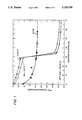
- FIG. 1 is a graph of the corrosion potential of samples of pure platinum, stainless steel, and stainless steel comprised of 1 atomic percent platinum in water at 285° C. with 350 parts per billion oxygen plotted against increasing hydrogen concentration in the water.
- FIG. 2-4 are graphs of the corrosion potential of samples of stainless steel comprised of a platinum or palladium solute versus a platinum electrode in water at 285° C. with 150 parts per billion hydrogen plotted over a period of time.
- FIG. 5 is a graph in which the potential of various electrodes is plotted against oxygen concentration in water. On the left is shown data obtained with 150 ppb hydrogen also in the water. No hydrogen is present in the water used in obtaining the data in the narrow band on the right.
- FIG. 6 is a graph in which corrosion potential is plotted against hydrogen concentration in water with 300 ppb oxygen also in the water.
- FIG. 7 is a graph similar to that in FIG. 5 in which corrosion potential is plotted against oxygen concentration in water with 150 ppb hydrogen also in the water, but following several months of operation after FIG. 5.
- FIG. 8 is a graph similar to that of FIG. 6 above, but obtained after several months of operation of the samples tested and plotted in FIG. 6.
- FIG. 9 is a graph in which corrosion potential relative to the standard hydrogen electrode (SHE) is summarized for a number of stress corrosion tests.
- hydrogen can be added to the feed water of nuclear reactors to decrease the electrochemical potential of components exposed to the water, and thereby reduce the incidence of stress corrosion cracking, corrosion, and incorporation of 60 cobalt in the components.
- High concentrations of hydrogen of about 100 parts per billion or more, must be added to provide adequate protection to materials out of the reactor core, and still higher concentrations are needed to afford protection to materials in the reactor core.
- platinum or palladium can be added to increase the corrosion potential of stainless steel exposed to deaerated acidic aqueous solutions, thereby forming a passive oxide layer on the stainless steel and reducing further corrosion.
- a catalytic layer of a platinum group metal on an alloy from the group consisting of carbon steel, alloy steel, stainless steel, nickel-based alloys, and cobalt-based alloys catalyzes the combination of reducing species, such as hydrogen, with oxidizing species, such as oxygen or hydrogen peroxide, that are present in the water.
- reducing species such as hydrogen
- oxidizing species such as oxygen or hydrogen peroxide
- the metal substrate of such surfaces contains a catalytic layer of a platinum group metal.
- relatively small amounts of the platinum group metal are sufficient to provide the catalytic layer and catalytic activity at the surface of the metal substrate.
- a solute in an alloy of at least about 0.01 weight percent, preferably at least 0.1 weight percent provides a catalytic layer sufficient to lower the corrosion potential of the alloy below the critical potential.
- the solute of a platinum group metal can be present up to an amount that does not substantially impair the metallurgical properties, including strength, ductility, and toughness of the alloy.
- the solute can be provided by methods known in the art, for example by addition to a melt of the alloy, or by surface alloying as shown for example in the reference cited above Increasing the Passivation Ability and Corrosion Resistance of Chromium Steel by Surface Alloying With Palladium," and incorporated herein by reference.
- a coating of the platinum group metal, or a coating of an alloy comprised of a solute of the platinum group metal as described above provides a catalytic layer and catalytic activity at the surface of the metal.
- the catalytic activity can provide a lowering of corrosion potential over coating discontinuities by reducing oxidants over the exposed areas. It is believed that coating discontinuities leaving exposed metal surface up to about 100 microns from the nearest coating are protected by the catalytic layer.
- Suitable coatings can be deposited by methods well known in the art for depositing continuous or substantially continuous coatings on metal substrates, such as; plasma spraying, flame spraying, chemical vapor deposition, physical vapor deposition processes such as sputtering, welding such as metal inert gas welding, electroless plating, and electrolytic plating. Additional information about such coating processes can be found, for example in, "Metallic & Ceramic Coatings: Production, High Temperature Properties & Applications," M. G. Hocking, V. Vasantasree, P. S. Sidky, Longman Scientific & Technical, Essex England, 1989, incorporated herein by reference.
- the corrosion potential of a metal component exposed to water comprised of 200 ppb oxygen can be reduced below the critical potential by the addition of about 100 ppb hydrogen to the water, i.e., an increase of 400 percent in hydrogen that must be added to the water.
- Reducing species that can combine with the oxidizing species in the high temperature water are provided by conventional means known in the art, for example, see “Water Chemistry of Nuclear Power Plants", W. T. Lindsay, Jr., Proceeding Second International Conference on Environmental Degradation of Materials in Nuclear Power Systems-Water Reactors, Monterey, Calif., 1985, pp. 203-210, incorporated herein by reference. Briefly described, reducing species such as hydrogen, ammonia, or hydrazine are injected into the feedwater of the nuclear reactor. Reducing species are also provided within the core of a nuclear reactor by the radiolytic decomposition of water.
- Table 1 gives typical compositions for some of the carbon steel, alloy steel, stainless steel, nickel-based alloys, and cobalt-based alloys exposed to high-temperature water in apparatus such as nuclear reactors, steam driven power generator systems, and deaerators.
- Components formed from carbon steel, alloy steel, stainless steel, nickel-based alloys, and cobalt-based alloys, for example in Table 1 or disclosed in the Metals Handbook discussed above, are improved in resistance to stress corrosion cracking by the method of this invention.
- the presence of a catalytic layer of the platinum group of metals on the components exposed to high-temperature water comprised of oxidizing species is effective in lowering the corrosion potential at the surface and thereby in reducing the stress corrosion cracking which emanates from the surface.
- the catalytic layer is effective at low hydrogen concentrations, i.e., about the ratio of oxygen to hydrogen that forms water, that are below the levels of hydrogen injection previously known for lowering the corrosion potential of metal components below the critical potential. This is now referred to as catalyzed hydrogen water chemistry.
- Test samples were prepared by melting 1.03 or 20 kilogram charges comprised of, in weight percent about 18 percent chromium, 9.5 percent nickel, 1.2 percent manganese, 0.5 percent silicon, and platinum or palladium ranging from about 0.01 to 3.0 percent as shown in Table 2 below.
- the composition of the test samples is similar to the composition of 304 stainless steel in Table 1, but are further comprised of the platinum or palladium solute.
- the charges were vacuum arc melted as cylindrical ingots about 2.1 centimeters long by 8 centimeters in diameter, or vacuum induction melted and poured into ingots having a 10 centimeter tapered square cross section, and about 30 centimeters in length. The ingots were homogenized at 1200° C. for 16 hours, forged at 1000° C.
- Test specimens were fabricated by electro-discharge machining rods about 0.3 centimeter in diameter by 6 centimeters long from the samples. The test specimens were wet ground using 600 grit paper to remove the re-cast layer produced by the electro-discharge machining.
- test specimen prepared from sample number 10 in Table 2 was welded to a Teflon insulated 0.76 millimeter stainless steel wire and mounted in a Conax fitting for placement in an autoclave.
- the test specimen mounted on a Conax fitting was transferred to an autoclave in a test loop which had been set up for a series of water chemistry studies.
- the Conax mounted coupon was placed in the autoclave along with a specimen of 316 stainless steel, and a platinum reference electrode specimen.
- a pump circulated water through the autoclave. The system was brought to a temperature between 280° and 285° C., 1200 psig.
- FIG. 1 is a graph in which the electrical potential is plotted against the concentration of hydrogen in the test water in parts per billion.
- the potentials of the specimens and the platinum electrode, converted to the standard hydrogen electrode (SHE) scale, are shown as the three separate plots representing the three different specimens on FIG. 1.
- the filled squares correspond to the electrical potential of the 316 stainless steel sample with no palladium; the filled triangles to the platinum reference electrode; and the open circles to the stainless steel specimens comprised of 1 atomic percent platinum.
- FIGS. 2-4 are graphs of the corrosion potential measured on the samples as compared to the platinum reference electrode, i.e., 0 is the corrosion potential of the platinum reference electrode.
- the oxygen level was reduced and increased in a step-wise manner over a period of days while hydrogen was maintained at 150 ppb as shown in FIGS. 2-4.
- Two coupons of 316 stainless steel were prepared for testing. Both coupons were 2" long, 3/8" wide, and 1/8" thick. The surfaces of the coupons were cleaned by grit blasting with fine alumina powder and were then etched for one minute in 1:1 HCl immediately prior to a plating operation.
- the plating operation employed was designed to deposit palladium by electroless plating processing onto the grit blasted coupons.
- the electroless plating process employed was a commercial procedure of the Callery Chemical Company, of Callery, Pa., and known as "First Choice" electroless palladium P-83.
- One of the two coupon samples was premounted in a Conax fitting while the other coupon was free.
- the electroless plating treatment was concurrent for both coupons and both were plated concurrently in the same bath.
- a film thickness of 0.4 ⁇ m was estimated for the unmounted sample. This thickness of deposit was assumed to be the same for both samples. The thickness falls within the range anticipated for the electroless palladium plating process.
- tests were made to determine thickness employing a Seiko x-ray thickness gauge which was available for this purpose. A thickness of 0.79 ⁇ m (micrometer) was determined.
- the sample on the Conax fitting was immediately transferred to a test loop as described above in Example 1.
- the Conax mounted coupon was placed in the autoclave along with a second identical but palladium-free sample which had been used in earlier tests, and a platinized platinum electrode.
- the system was brought to a temperature between 280° and 285° C. and water containing 150 ppb (parts per billion) of dissolved hydrogen was circulated to flow over the specimen coupons at a flow rate of 200 milliliters per minute. Following a day's operation in this fashion, oxygen gas was also introduced into the feed water and the level of the oxygen gas was increased incrementally over a period of days.
- FIG. 5 is a graph in which the electrical potential is plotted against the concentration of oxygen in the test water in parts per billion of oxygen.
- the potentials of the two specimens and the platinum electrode, converted to the SHE (standard hydrogen electrode) scale, are shown as points 1-5 on the three separate plots representing the three different specimens on FIG. 5.
- the open circles correspond to the potential of the stainless steel sample with no palladium; the filled circles to the platinum reference electrode; and the open triangles to the stainless samples coated with palladium. Following point 5, problems were encountered with the test system thus necessitating a shut-down for about a month.
- the system was then restarted and operated under simulated normal water chemistry conditions. These normal water chemistry conditions correspond to 200-300 parts/billion of dissolved oxygen with no added hydrogen.
- the system was operated with the normal water chemistry conditions as indicated for two days before reintroducing 150 ppb dissolved hydrogen into the feed water.
- the data points for the system before the introduction of the hydrogen are points 6 of FIG. 5 for the three specimens.
- the oxygen level was then reduced step-wise over a period of several days to zero ppb.
- the step-wise reduction of oxygen is represented by the points 7-13 of FIG. 5 for the three specimens.
- One intermediate step was taken back to normal water chemistry during this period and the data points for this step are points 9 for each of the three specimens.
- the dissolved oxygen level was then again increased to 256 ppb and the data for these changes are data points 14-16 of the figure for each of the three specimens.
- the system was again returned to normal water conditions for a period of 8 days to determine whether the normal water conditions would have a deleterious effect on the palladium treated sample.
- conditions were returned again to hydrogen water chemistry , i.e., to hydrogen in the water at 150 ppb and the oxygen at 325 ppb.
- the electrical potential of the palladium-treated coupon essentially followed that of the platinum electrode as the potential moved to a low value represented by the triangular point 18 for the palladium treated coupon on FIG. 5 while the untreated stainless steel coupon (open circle point 18) did not register a low potential.
- the palladium-treated sample reached low potentials under the catalyzed hydrogen water chemistry conditions and had electrical potential essentially equivalent to the potential of the platinum electrode. Both were below the range of critical potential of -230 mV to -300 mV for the prevention of stress corrosion cracking.
- the palladium-free sample polarized to much more positive potentials even at low levels of oxygen in the presence of hydrogen. The magnitude of this polarization was greater when an operating point was approached from normal water chemistry conditions than when lower oxygen levels were prevalent in the presence of hydrogen.
- the data obtained from this example and plotted in FIG. 5 clearly demonstrate the effectiveness of the palladium treatment.
- the palladium treatment is deemed to be representative of treatment with any of the platinum group metals.
- deposited thicknesses smaller than 0.79 ⁇ m (7900 ⁇ ngstroms) should be effective in reducing the corrosion potential of carbon steel, alloy steel, stainless steel, nickel-base alloys, and cobalt base alloys exposed to high-temperature below the critical potential. It is believed as little as 50 Angstroms of a platinum group metal should be effective in long term exposure in significantly reducing corrosion potential and stress corrosion cracking when used in combination with hydrogen provided in stoichiometric excess of the dissolved oxygen concentration.
- the corrosion potential of the palladium-coated sample is comparable to the electrical potential of the platinized-platinum electrode even with more than 300 parts/billion dissolved oxygen in the feed water. It will be noted that 300 parts/billion of oxygen is equivalent to 38 parts/billion of hydrogen and therefore the hydrogen is still in stoichiometric excess.
- FIG. 6 the effect of palladium treatment is illustrated in a different fashion.
- the tests carried out which resulted in these data involved increasing the amounts of hydrogen which were added to water containing a fixed amount of oxygen rather than the reverse as was the practice in Example 3.
- the concentration of hydrogen that is stoichiometrically equivalent to 300 ppb oxygen for the formation of water is 37.5 ppb or 1.56 times the measured amount.
- the lower observed value for hydrogen is deemed to reflect the fact that the diffusion coefficient of hydrogen in water is considerably higher than that of oxygen.
- the hydrogen and oxygen in this example arrive at the electrode surface in stoichiometric ratios for the formation of water even though the ratio of hydrogen to oxygen in the bulk water is substoichiometric.
- FIGS. 7 and 8 Two additional sets of data analogous to those of FIGS. 5 and 6 are shown in FIGS. 7 and 8. These were obtained after a total of 13 months of operation of sample SS-CONT-Pd and indicate that the behavior produced by the palladization is retained for extended periods.
- the water was equilibrated with a mixture of nitrogen, hydrogen, and/or oxygen.
- a sulfuric acid concentration of 0.3 ⁇ 10 -6 molar was maintained by injection of a more concentrated solution into the main stream at a constant rate. This supply of sulfuric acid established a conductivity of approximately 0.3 microsiemen/centimeter in the feed water to the autoclave.
- the potential of the insulated sample and of the autoclave were monitored against the reference electrode throughout the tests. Before the strain was applied to the test specimens, the specimens were exposed to normal water conditions at an oxygen level of 100 or 200 ppb for about 24 hours and then to the test conditions. The test conditions provided for the same level of oxygen in the water with hydrogen also in the water. The strain rate used in all of the testing was 1 ⁇ 10 -6 per second.
- the oxygen concentration in the water was maintained at a much higher level than would occur under boiling water reactor operating conditions employing hydrogen water chemistry. It is also to be noted that the first two tests, which included the unpalladinized control, were performed at high hydrogen to oxygen ratios. For the remainder, the molar ratio of hydrogen to oxygen at the sample surface was held close to the stoichiometric value (2:1) for the formation of water based upon a ratio of 1.83 for the diffusion coefficients of hydrogen and oxygen. When the molar ratio at the sample surface was >2.0 the potential of the palladinized samples was well below the critical value even with only a 0.03 micrometer thick palladium coating. With a ratio of ⁇ 2.0 the potential of the sample with a 0.77 micrometer thick coating was above the critical value.
Landscapes
- Physics & Mathematics (AREA)
- Engineering & Computer Science (AREA)
- Plasma & Fusion (AREA)
- General Engineering & Computer Science (AREA)
- High Energy & Nuclear Physics (AREA)
- Preventing Corrosion Or Incrustation Of Metals (AREA)
- Catalysts (AREA)
- Prevention Of Electric Corrosion (AREA)
Priority Applications (7)
| Application Number | Priority Date | Filing Date | Title |
|---|---|---|---|
| US07/698,885 US5135709A (en) | 1991-05-13 | 1991-05-13 | Method for reducing corrosion of components exposed to high-temperature water |
| DE0514089T DE514089T1 (de) | 1991-05-13 | 1992-05-08 | Verfahren zur Korrosionverminderung von an Hochtemperaturwasser ausgesetzten Komponenten. |
| ES92304148T ES2118791T3 (es) | 1991-05-13 | 1992-05-08 | Procedimiento para reducir la corrosion de componentes expuestos a agua a alta temperatura. |
| EP92304148A EP0514089B1 (de) | 1991-05-13 | 1992-05-08 | Verfahren zur Korrosionverminderung von an Hochtemperaturwasser ausgesetzten Komponenten |
| DE69226558T DE69226558T2 (de) | 1991-05-13 | 1992-05-08 | Verfahren zur Korrosionverminderung von an Hochtemperaturwasser ausgesetzten Komponenten |
| JP4116556A JP2766422B2 (ja) | 1991-05-13 | 1992-05-11 | 高温の水にさらされる部品の腐蝕を低減する方法 |
| MX9202218A MX9202218A (es) | 1991-05-13 | 1992-05-13 | Metodo para reducir corrosion de componentes expuestos a agua de alta temperatura. |
Applications Claiming Priority (1)
| Application Number | Priority Date | Filing Date | Title |
|---|---|---|---|
| US07/698,885 US5135709A (en) | 1991-05-13 | 1991-05-13 | Method for reducing corrosion of components exposed to high-temperature water |
Publications (1)
| Publication Number | Publication Date |
|---|---|
| US5135709A true US5135709A (en) | 1992-08-04 |
Family
ID=24807065
Family Applications (1)
| Application Number | Title | Priority Date | Filing Date |
|---|---|---|---|
| US07/698,885 Expired - Lifetime US5135709A (en) | 1991-05-13 | 1991-05-13 | Method for reducing corrosion of components exposed to high-temperature water |
Country Status (6)
| Country | Link |
|---|---|
| US (1) | US5135709A (de) |
| EP (1) | EP0514089B1 (de) |
| JP (1) | JP2766422B2 (de) |
| DE (2) | DE514089T1 (de) |
| ES (1) | ES2118791T3 (de) |
| MX (1) | MX9202218A (de) |
Cited By (48)
| Publication number | Priority date | Publication date | Assignee | Title |
|---|---|---|---|---|
| US5285486A (en) * | 1992-11-25 | 1994-02-08 | General Electric Company | Internal passive hydrogen peroxide decomposer for a boiling water reactor |
| US5287392A (en) * | 1992-11-25 | 1994-02-15 | General Electric Company | Internal passive water recombiner/hydrogen peroxide decomposer for a boiling water reactor |
| US5317610A (en) * | 1991-03-26 | 1994-05-31 | Mitsubishi Jukogyo Kabushiki Kaisha | Device for thermal electric and nuclear power plants |
| US5377245A (en) * | 1992-10-20 | 1994-12-27 | Hitachi, Ltd. | Method of operating BWR plant, BWR plant and metal element injecting apparatus |
| US5392325A (en) * | 1993-05-21 | 1995-02-21 | General Electric Company | Method and apparatus for local protection of piping systems from stress corrosion cracking |
| EP0651073A1 (de) * | 1993-10-29 | 1995-05-03 | General Electric Company | Palladium Acetylacetonat-Lösung |
| EP0671485A1 (de) * | 1994-03-10 | 1995-09-13 | General Electric Company | Verfahren zum Verringern des Korrosionspotentials von Bauteilen |
| EP0671486A1 (de) * | 1994-03-10 | 1995-09-13 | General Electric Company | Verfahren zum Datieren oder Beschichten von Rissflächen in Metallteilen mit Edelmetallen zum Schutz von Metallen von Spannungsnisskorrosion |
| US5461648A (en) * | 1994-10-27 | 1995-10-24 | The United States Of America As Represented By The Secretary Of The Navy | Supercritical water oxidation reactor with a corrosion-resistant lining |
| US5465278A (en) * | 1994-05-23 | 1995-11-07 | General Electric Company | Shroud electrochemical potential monitor |
| US5465281A (en) * | 1994-04-11 | 1995-11-07 | General Electric Company | Insulated protective coating for mitigation of stress corrosion cracking of metal components in high-temperature water |
| EP0707319A1 (de) | 1994-10-13 | 1996-04-17 | General Electric Company | Gleichzeitige Palladiumabscheidung während der Oxidschichtzüchtung in Hochtemperatur-Wasser zur Spannungsrisskorrosionserniedrigung |
| US5527471A (en) * | 1995-02-02 | 1996-06-18 | Modar, Inc. | Iridium material for hydrothermal oxidation environments |
| US5579354A (en) * | 1993-12-20 | 1996-11-26 | Hitachi, Ltd. | Method of measuring a corrosion potential, method of simulating potential characteristics of a reaction rate, and plant monitoring system adopting them |
| US5581588A (en) * | 1995-06-23 | 1996-12-03 | General Electric Company | Insulated protective coating doped with a noble metal for mitigation of stress corrosion cracking |
| WO1997002576A1 (en) * | 1995-07-03 | 1997-01-23 | General Electric Company | Metal alloy coating for mitigation of stress corrosion cracking of metal components in high-temperature water |
| US5600692A (en) * | 1993-10-29 | 1997-02-04 | General Electric Company | Method for improving tenacity and loading of palladium on palladium-doped metal surfaces |
| US5602888A (en) * | 1993-10-29 | 1997-02-11 | General Electric Company | Radiation-induced palladium doping of metals to protect against stress corrosion cracking |
| US5625656A (en) * | 1993-10-29 | 1997-04-29 | General Electric Company | Method for monitoring noble metal distribution in reactor circuit during plant application |
| WO1997035319A1 (de) * | 1996-03-20 | 1997-09-25 | Siemens Aktiengesellschaft | Kernreaktor mit katalysatormaterial zum beseitigen von oxidationsmitteln |
| US5774516A (en) * | 1993-10-29 | 1998-06-30 | General Electric Company | Modification of oxide film electrical conductivity to maintain low corrosion potential in high-temperature water |
| US5773096A (en) * | 1993-10-29 | 1998-06-30 | General Electric Company | Method of catalyst preparation by high-temperature hydrothermal incorporation of noble metals onto surfaces and matrices |
| US5818893A (en) * | 1993-10-29 | 1998-10-06 | General Electric Company | In-situ palladium doping or coating of stainless steel surfaces |
| US5991352A (en) * | 1998-03-30 | 1999-11-23 | General Electric Company | Method for determining corrosion susceptibility of nuclear fuel cladding to nodular corrosion |
| US6024805A (en) * | 1997-11-12 | 2000-02-15 | General Electric Company | Metal hydride addition for reducing corrosion potential of structural steel |
| US6128361A (en) * | 1996-03-26 | 2000-10-03 | General Electric Company | Coating for reducing corrosion of zirconium-based alloys induced by . .beta-particle irradiation |
| WO2001052267A3 (en) * | 1999-12-30 | 2002-04-25 | Gen Electric | Method and apparatus for maintaining proper noble metal loading for a noble metal application process for water-cooled nuclear reactors |
| EP1217632A1 (de) * | 2000-12-21 | 2002-06-26 | General Electric Company | Edelmetal-Katalyse zur Reduzierung der Korrosion in einem Druckwasserreaktor |
| US6488782B2 (en) | 2001-01-29 | 2002-12-03 | General Electric Company | Method of reducing corrosion potential and stress corrosion cracking susceptibility in nickel-based alloys |
| US6613153B1 (en) * | 1998-04-27 | 2003-09-02 | Framatome Anp Gmbh | Method for reducing the radioactivity of metal part |
| US6697449B2 (en) * | 1997-11-28 | 2004-02-24 | General Electric Company | Temperature-based method for controlling the amount of metal applied to metal oxide surfaces to reduce corrosion and stress corrosion cracking |
| US20040057549A1 (en) * | 2000-08-08 | 2004-03-25 | Hitachi, Ltd. | Method of operating nuclear reactor |
| US6724854B1 (en) | 2003-06-16 | 2004-04-20 | General Electric Company | Process to mitigate stress corrosion cracking of structural materials in high temperature water |
| US20040258192A1 (en) * | 2003-06-16 | 2004-12-23 | General Electric Company | Mitigation of steam turbine stress corrosion cracking |
| US20050018805A1 (en) * | 2003-07-22 | 2005-01-27 | Kazushige Ishida | Method of stress corrosion cracking mitigation for nuclear power plant structural materials |
| US6888908B1 (en) * | 2002-11-18 | 2005-05-03 | Babcock & Wilcox Canada, Ltd. | Reactor head with integral nozzles |
| US6898259B2 (en) | 2000-03-21 | 2005-05-24 | Framatome Anp Gmbh | Process for reducing the corrosion of a component of a nuclear facility, and component of a nuclear facility |
| US20050194748A1 (en) * | 2004-03-08 | 2005-09-08 | Byers William A. | Film riding shaft seal |
| US20060188056A1 (en) * | 2002-07-31 | 2006-08-24 | Kim Young J | Method for forming coatings on structural components with corrosion-mitigating materials |
| US20060203952A1 (en) * | 2005-03-14 | 2006-09-14 | General Electric Company | Methods of reducing hydrogen absorption in zirconium alloys of nuclear fuel assemblies |
| DE102006009502B3 (de) * | 2006-02-27 | 2007-08-30 | Framatome Anp Gmbh | Verfahren zur Prüfung eines Brennstabhüllrohres sowie zugehörige Vorrichtung |
| US20070263761A1 (en) * | 2001-05-15 | 2007-11-15 | Areva Np | Method for protecting components of a primary system of a boiling water reactor in particular from stress corrosion cracking |
| US20070289368A1 (en) * | 2006-06-16 | 2007-12-20 | Russell Seeman | Method of monitoring deposition of a noble metal in a nuclear reactor and deposition monitor therefor |
| US20100246745A1 (en) * | 2006-12-29 | 2010-09-30 | Samson Hettiarachchi | Methods for operating and methods for reducing post-shutdown radiation levels of nuclear reactors |
| JP2018048831A (ja) * | 2016-09-20 | 2018-03-29 | 日立Geニュークリア・エナジー株式会社 | 原子力プラントの炭素鋼部材への貴金属の付着方法及び原子力プラントの炭素鋼部材への放射性核種の付着抑制方法 |
| JP2018165645A (ja) * | 2017-03-28 | 2018-10-25 | 日立Geニュークリア・エナジー株式会社 | 原子力プラントの炭素鋼部材への貴金属の付着方法、及び原子力プラントの炭素鋼部材への放射性核種の付着抑制方法 |
| US11469006B2 (en) | 2016-08-04 | 2022-10-11 | Dominion Engineering, Inc. | Suppression of radionuclide deposition on nuclear power plant components |
| US20230044742A1 (en) * | 2021-08-04 | 2023-02-09 | POSTECH Research and Business Development Foundation | Metal material having improved corrosion resistance and method of improving corrosion resistance of metal material surface using oxygen reduction catalyst |
Families Citing this family (4)
| Publication number | Priority date | Publication date | Assignee | Title |
|---|---|---|---|---|
| US5164152A (en) * | 1991-08-02 | 1992-11-17 | General Electric Company | Method for reducing flow assisted corrosion of carbon steel components |
| TW241314B (en) * | 1993-10-29 | 1995-02-21 | Gen Electric | In-situ palladium doping or coating of stainless steel surfaces |
| EP1036218B1 (de) * | 1997-11-28 | 2006-06-21 | General Electric Company | Temperaturbasiertes verfahren zum regeln der metallmenge aufgebracht auf metalloxidoberflächen zur verminderung der korrosion und der spannungsrisskorrosion |
| JP2020186453A (ja) * | 2019-05-16 | 2020-11-19 | 三菱重工業株式会社 | 炭素鋼、放射性物質収納容器、遮蔽性能の解析方法及び遮蔽構造の設計方法 |
Citations (10)
| Publication number | Priority date | Publication date | Assignee | Title |
|---|---|---|---|---|
| DE1210496B (de) * | 1964-10-30 | 1966-02-10 | Keller & Knappich Gmbh | Ausfuetterung fuer einen Mantel eines Kernreaktor-Behaelters |
| US3343979A (en) * | 1965-10-22 | 1967-09-26 | Jr Charles E Hamrin | Method for depositing a tungsten-rhenium metal alloy on a substrate |
| US3783005A (en) * | 1972-02-04 | 1974-01-01 | Western Electric Co | Method of depositing a metal on a surface of a nonconductive substrate |
| US4097402A (en) * | 1976-06-29 | 1978-06-27 | General Electric Company | Nuclear fuel assembly and process |
| US4123594A (en) * | 1977-09-22 | 1978-10-31 | General Electric Company | Metallic coated article of improved environmental resistance |
| US4477538A (en) * | 1981-02-17 | 1984-10-16 | The United States Of America As Represented By The Secretary Of The Navy | Platinum underlayers and overlayers for coatings |
| EP0145262A2 (de) * | 1983-11-10 | 1985-06-19 | Westinghouse Electric Corporation | Verfahren zur Entfernung gelösten Sauerstoffes aus einem wässrigen Medium |
| EP0235954A1 (de) * | 1986-02-03 | 1987-09-09 | The Babcock & Wilcox Company | Verbesserung der Korrosionsbeständigkeit von Zirkonlegierungen |
| US4842811A (en) * | 1985-02-05 | 1989-06-27 | Westinghouse Electric Corp. | Method for preventing oxygen corrosion in a boiling water nuclear reactor and improved boiling water reactor system |
| US4917968A (en) * | 1988-04-15 | 1990-04-17 | Ultramet | High temperature corrosion resistant composite structure |
Family Cites Families (8)
| Publication number | Priority date | Publication date | Assignee | Title |
|---|---|---|---|---|
| SE300994B (de) * | 1964-12-22 | 1968-05-20 | Svenska Metallverken Ab | |
| JPS548357A (en) * | 1977-06-22 | 1979-01-22 | Mitsubishi Heavy Ind Ltd | Simple bucket device of fork lift |
| JPS57596A (en) * | 1980-06-02 | 1982-01-05 | Tokyo Shibaura Electric Co | Oxygen concentration control devece of nuclear reactor |
| JPS573086A (en) * | 1980-06-06 | 1982-01-08 | Tokyo Shibaura Electric Co | Method of operating nuclear reactor |
| JPS629696A (ja) * | 1985-07-06 | 1987-01-17 | 株式会社リコー | 可撓性印刷配線基板と印刷配線基板との導体パタ−ンの接続方法 |
| JPS629296A (ja) * | 1985-07-08 | 1987-01-17 | 株式会社東芝 | 原子炉一次冷却系の構造材 |
| US5130081A (en) * | 1990-04-02 | 1992-07-14 | General Electric Company | Operation life of on-life boiling water reactors |
| US5130080A (en) * | 1990-04-02 | 1992-07-14 | General Electric Company | Method of providing extended life expectancy for components of boiling water reactors |
-
1991
- 1991-05-13 US US07/698,885 patent/US5135709A/en not_active Expired - Lifetime
-
1992
- 1992-05-08 EP EP92304148A patent/EP0514089B1/de not_active Expired - Lifetime
- 1992-05-08 DE DE0514089T patent/DE514089T1/de active Pending
- 1992-05-08 DE DE69226558T patent/DE69226558T2/de not_active Expired - Lifetime
- 1992-05-08 ES ES92304148T patent/ES2118791T3/es not_active Expired - Lifetime
- 1992-05-11 JP JP4116556A patent/JP2766422B2/ja not_active Expired - Lifetime
- 1992-05-13 MX MX9202218A patent/MX9202218A/es unknown
Patent Citations (10)
| Publication number | Priority date | Publication date | Assignee | Title |
|---|---|---|---|---|
| DE1210496B (de) * | 1964-10-30 | 1966-02-10 | Keller & Knappich Gmbh | Ausfuetterung fuer einen Mantel eines Kernreaktor-Behaelters |
| US3343979A (en) * | 1965-10-22 | 1967-09-26 | Jr Charles E Hamrin | Method for depositing a tungsten-rhenium metal alloy on a substrate |
| US3783005A (en) * | 1972-02-04 | 1974-01-01 | Western Electric Co | Method of depositing a metal on a surface of a nonconductive substrate |
| US4097402A (en) * | 1976-06-29 | 1978-06-27 | General Electric Company | Nuclear fuel assembly and process |
| US4123594A (en) * | 1977-09-22 | 1978-10-31 | General Electric Company | Metallic coated article of improved environmental resistance |
| US4477538A (en) * | 1981-02-17 | 1984-10-16 | The United States Of America As Represented By The Secretary Of The Navy | Platinum underlayers and overlayers for coatings |
| EP0145262A2 (de) * | 1983-11-10 | 1985-06-19 | Westinghouse Electric Corporation | Verfahren zur Entfernung gelösten Sauerstoffes aus einem wässrigen Medium |
| US4842811A (en) * | 1985-02-05 | 1989-06-27 | Westinghouse Electric Corp. | Method for preventing oxygen corrosion in a boiling water nuclear reactor and improved boiling water reactor system |
| EP0235954A1 (de) * | 1986-02-03 | 1987-09-09 | The Babcock & Wilcox Company | Verbesserung der Korrosionsbeständigkeit von Zirkonlegierungen |
| US4917968A (en) * | 1988-04-15 | 1990-04-17 | Ultramet | High temperature corrosion resistant composite structure |
Non-Patent Citations (24)
| Title |
|---|
| "Alloying Stainless Steels with the Platinum Metals", M. A. Streicher, Platinum Metals Review, 1977, vol. 21, pp. 51-55. |
| "Deposition and Characterization of Electroless Palladium on Austenitic Stainless Steel" H. Ocken, B. G. Pound, D. H. Lister, Thin Solid Films, vol. 177, 1989, pp. 313-322. |
| "Development of Pitting Resistant Fe-Cr-Mo Alloys", M. S. Streicher, Corrosion-Nace, vol. 30, No. 3, Mar. 1974, pp. 77-91. |
| "Effect of Palladium Coatings on the Corrosion Potential of Stainless Steel in High-Temperature Water Containing Dissolved Hydrogen and Oxygen", L. W. Niedrach, Corrosion, vol. 47, No. 3, Mar. 1991, pp. 162-169. |
| "Hydrogen Water Chemistry Technology for BWRs", J. N. Kass, R. L. Cowan, Proceedings of the Second International Symposium on Environmental Degradation of Materials in Nuclear Power Systems-Water Reactors, American Nuclear Society, 1986, pp. 211-217. |
| "Increasing the Passivability and Corrosion Resistance of Stainless Steels by Surface Alloying with Palladium", Chernova, G. P. et al., Plenum Publishing Corporation, UDC 620.197.3 (1982) pp. 406-411. |
| "Increasing the Passivation Ability and Corrosion Resistance of Chromium Steel by Surface Alloying with Palladium", G. P. Chernova, T. A. Fedoseeva, L. P. Kornienko, N. D. Tomashov, Surface Technology, vol. 13, 1981, pp. 241-256. |
| "Palladium Impedes Radionuclide Pick-Up in Steel", Platinum Met. Rev., Oct. 1989, vol. 33(4), p. 185. |
| "Platinum Metals in Stainless Steels", I. R. McGill, Platinum Metals Review, 1990, vol. 34(2), pp. 85-97. |
| "Protective Coatings for Radiation Control in Boiling Water Nuclear Power Reactors", T. V. Rao, R. W. Vook, W. Meyer, and C. Wittwer, J. Vac. Sci. Technol. A 5(4) (Jul./Aug. 1987) pp. 2701-2705. |
| "Thin Films to Impede the Incorporation of Radionuclides in Austenitic Stainless Steels", H. Ocken, C. C. Lin, D. H. Lisher, vol. 171, 1989, pp. 323-334. |
| "Water Chemistry of Nuclear Power Plants", W. T. Lindsey, Jr., Proceedings of the Second International Symposium on Environmental Degradation of Materials in Nuclear Power Systems-Water Reactors, American Nuclear Society, 1986, pp. 203-210. |
| Alloying Stainless Steels with the Platinum Metals , M. A. Streicher, Platinum Metals Review, 1977, vol. 21, pp. 51 55. * |
| Deposition and Characterization of Electroless Palladium on Austenitic Stainless Steel H. Ocken, B. G. Pound, D. H. Lister, Thin Solid Films, vol. 177, 1989, pp. 313 322. * |
| Development of Pitting Resistant Fe Cr Mo Alloys , M. S. Streicher, Corrosion Nace, vol. 30, No. 3, Mar. 1974, pp. 77 91. * |
| Effect of Palladium Coatings on the Corrosion Potential of Stainless Steel in High Temperature Water Containing Dissolved Hydrogen and Oxygen , L. W. Niedrach, Corrosion, vol. 47, No. 3, Mar. 1991, pp. 162 169. * |
| Hydrogen Water Chemistry Technology for BWRs , J. N. Kass, R. L. Cowan, Proceedings of the Second International Symposium on Environmental Degradation of Materials in Nuclear Power Systems Water Reactors, American Nuclear Society, 1986, pp. 211 217. * |
| Increasing the Passivability and Corrosion Resistance of Stainless Steels by Surface Alloying with Palladium , Chernova, G. P. et al., Plenum Publishing Corporation, UDC 620.197.3 (1982) pp. 406 411. * |
| Increasing the Passivation Ability and Corrosion Resistance of Chromium Steel by Surface Alloying with Palladium , G. P. Chernova, T. A. Fedoseeva, L. P. Kornienko, N. D. Tomashov, Surface Technology, vol. 13, 1981, pp. 241 256. * |
| Palladium Impedes Radionuclide Pick Up in Steel , Platinum Met. Rev., Oct. 1989, vol. 33(4), p. 185. * |
| Platinum Metals in Stainless Steels , I. R. McGill, Platinum Metals Review, 1990, vol. 34(2), pp. 85 97. * |
| Protective Coatings for Radiation Control in Boiling Water Nuclear Power Reactors , T. V. Rao, R. W. Vook, W. Meyer, and C. Wittwer, J. Vac. Sci. Technol. A 5(4) (Jul./Aug. 1987) pp. 2701 2705. * |
| Thin Films to Impede the Incorporation of Radionuclides in Austenitic Stainless Steels , H. Ocken, C. C. Lin, D. H. Lisher, vol. 171, 1989, pp. 323 334. * |
| Water Chemistry of Nuclear Power Plants , W. T. Lindsey, Jr., Proceedings of the Second International Symposium on Environmental Degradation of Materials in Nuclear Power Systems Water Reactors, American Nuclear Society, 1986, pp. 203 210. * |
Cited By (73)
| Publication number | Priority date | Publication date | Assignee | Title |
|---|---|---|---|---|
| US5317610A (en) * | 1991-03-26 | 1994-05-31 | Mitsubishi Jukogyo Kabushiki Kaisha | Device for thermal electric and nuclear power plants |
| US5377245A (en) * | 1992-10-20 | 1994-12-27 | Hitachi, Ltd. | Method of operating BWR plant, BWR plant and metal element injecting apparatus |
| US5515406A (en) * | 1992-11-25 | 1996-05-07 | General Electric Company | Internal passive catalytic ammonia converter for reduction of main steam dose rate associated with hydrogen water chemistry |
| US5287392A (en) * | 1992-11-25 | 1994-02-15 | General Electric Company | Internal passive water recombiner/hydrogen peroxide decomposer for a boiling water reactor |
| US5285486A (en) * | 1992-11-25 | 1994-02-08 | General Electric Company | Internal passive hydrogen peroxide decomposer for a boiling water reactor |
| US5392325A (en) * | 1993-05-21 | 1995-02-21 | General Electric Company | Method and apparatus for local protection of piping systems from stress corrosion cracking |
| US5773096A (en) * | 1993-10-29 | 1998-06-30 | General Electric Company | Method of catalyst preparation by high-temperature hydrothermal incorporation of noble metals onto surfaces and matrices |
| US5625656A (en) * | 1993-10-29 | 1997-04-29 | General Electric Company | Method for monitoring noble metal distribution in reactor circuit during plant application |
| US5774516A (en) * | 1993-10-29 | 1998-06-30 | General Electric Company | Modification of oxide film electrical conductivity to maintain low corrosion potential in high-temperature water |
| US5768330A (en) * | 1993-10-29 | 1998-06-16 | General Electric Company | Co-deposition of palladium during oxide film growth in high-temperature water to mitigate stress corrosion cracking |
| US5719911A (en) * | 1993-10-29 | 1998-02-17 | General Electric Company | System for monitoring noble metal distribution in reactor circuit during plant application |
| US5818893A (en) * | 1993-10-29 | 1998-10-06 | General Electric Company | In-situ palladium doping or coating of stainless steel surfaces |
| US5608766A (en) * | 1993-10-29 | 1997-03-04 | General Electric Company | Co-deposition of palladium during oxide film growth in high-temperature water to mitigate stress corrosion cracking |
| US5448605A (en) * | 1993-10-29 | 1995-09-05 | General Electric Company | Palladium acetylacetonate solution and related method of manufacture |
| US5602888A (en) * | 1993-10-29 | 1997-02-11 | General Electric Company | Radiation-induced palladium doping of metals to protect against stress corrosion cracking |
| US5600692A (en) * | 1993-10-29 | 1997-02-04 | General Electric Company | Method for improving tenacity and loading of palladium on palladium-doped metal surfaces |
| EP0651073A1 (de) * | 1993-10-29 | 1995-05-03 | General Electric Company | Palladium Acetylacetonat-Lösung |
| US5904991A (en) * | 1993-10-29 | 1999-05-18 | General Electric Company | In-situ palladium doping or coating of stainless steel surfaces |
| US5600691A (en) * | 1993-10-29 | 1997-02-04 | General Electric Company | Noble metal doping or coating of crack interior for stress corrosion cracking protection of metals |
| US5579354A (en) * | 1993-12-20 | 1996-11-26 | Hitachi, Ltd. | Method of measuring a corrosion potential, method of simulating potential characteristics of a reaction rate, and plant monitoring system adopting them |
| EP0671485A1 (de) * | 1994-03-10 | 1995-09-13 | General Electric Company | Verfahren zum Verringern des Korrosionspotentials von Bauteilen |
| US5805653A (en) * | 1994-03-10 | 1998-09-08 | General Electric Company | Noble metal doping or coating of crack interior for stress corrosion cracking protection of metals |
| EP0671486A1 (de) * | 1994-03-10 | 1995-09-13 | General Electric Company | Verfahren zum Datieren oder Beschichten von Rissflächen in Metallteilen mit Edelmetallen zum Schutz von Metallen von Spannungsnisskorrosion |
| US5465281A (en) * | 1994-04-11 | 1995-11-07 | General Electric Company | Insulated protective coating for mitigation of stress corrosion cracking of metal components in high-temperature water |
| US5465278A (en) * | 1994-05-23 | 1995-11-07 | General Electric Company | Shroud electrochemical potential monitor |
| EP0707319A1 (de) | 1994-10-13 | 1996-04-17 | General Electric Company | Gleichzeitige Palladiumabscheidung während der Oxidschichtzüchtung in Hochtemperatur-Wasser zur Spannungsrisskorrosionserniedrigung |
| US5461648A (en) * | 1994-10-27 | 1995-10-24 | The United States Of America As Represented By The Secretary Of The Navy | Supercritical water oxidation reactor with a corrosion-resistant lining |
| US5527471A (en) * | 1995-02-02 | 1996-06-18 | Modar, Inc. | Iridium material for hydrothermal oxidation environments |
| US5581588A (en) * | 1995-06-23 | 1996-12-03 | General Electric Company | Insulated protective coating doped with a noble metal for mitigation of stress corrosion cracking |
| US5793830A (en) * | 1995-07-03 | 1998-08-11 | General Electric Company | Metal alloy coating for mitigation of stress corrosion cracking of metal components in high-temperature water |
| WO1997002576A1 (en) * | 1995-07-03 | 1997-01-23 | General Electric Company | Metal alloy coating for mitigation of stress corrosion cracking of metal components in high-temperature water |
| WO1997035319A1 (de) * | 1996-03-20 | 1997-09-25 | Siemens Aktiengesellschaft | Kernreaktor mit katalysatormaterial zum beseitigen von oxidationsmitteln |
| US6128361A (en) * | 1996-03-26 | 2000-10-03 | General Electric Company | Coating for reducing corrosion of zirconium-based alloys induced by . .beta-particle irradiation |
| US6024805A (en) * | 1997-11-12 | 2000-02-15 | General Electric Company | Metal hydride addition for reducing corrosion potential of structural steel |
| US6714618B1 (en) * | 1997-11-28 | 2004-03-30 | General Electric Company | Temperature-based method for controlling the amount of metal applied to metal oxide surfaces to reduce corrosion and stress corrosion cracking |
| US6697449B2 (en) * | 1997-11-28 | 2004-02-24 | General Electric Company | Temperature-based method for controlling the amount of metal applied to metal oxide surfaces to reduce corrosion and stress corrosion cracking |
| US5991352A (en) * | 1998-03-30 | 1999-11-23 | General Electric Company | Method for determining corrosion susceptibility of nuclear fuel cladding to nodular corrosion |
| US6613153B1 (en) * | 1998-04-27 | 2003-09-02 | Framatome Anp Gmbh | Method for reducing the radioactivity of metal part |
| US6473480B1 (en) * | 1999-12-30 | 2002-10-29 | General Electric Company | Method and apparatus for maintaining proper noble metal loading for a noble metal application process for water-cooled nuclear reactors |
| WO2001052267A3 (en) * | 1999-12-30 | 2002-04-25 | Gen Electric | Method and apparatus for maintaining proper noble metal loading for a noble metal application process for water-cooled nuclear reactors |
| US6898259B2 (en) | 2000-03-21 | 2005-05-24 | Framatome Anp Gmbh | Process for reducing the corrosion of a component of a nuclear facility, and component of a nuclear facility |
| US20040057549A1 (en) * | 2000-08-08 | 2004-03-25 | Hitachi, Ltd. | Method of operating nuclear reactor |
| EP1217632A1 (de) * | 2000-12-21 | 2002-06-26 | General Electric Company | Edelmetal-Katalyse zur Reduzierung der Korrosion in einem Druckwasserreaktor |
| US6548178B2 (en) * | 2001-01-29 | 2003-04-15 | General Electric Company | Method of reducing corrosion potential and stress corrosion cracking susceptibility in nickel-base alloys |
| US6488782B2 (en) | 2001-01-29 | 2002-12-03 | General Electric Company | Method of reducing corrosion potential and stress corrosion cracking susceptibility in nickel-based alloys |
| US20030029523A1 (en) * | 2001-01-29 | 2003-02-13 | Kim Young Jin | Method of reducing corrosion potential and stress corrosion cracking susceptibility in nickel-base alloys |
| US9879351B2 (en) * | 2001-05-15 | 2018-01-30 | Areva Inc. | Method for protecting components of a primary system of a boiling water reactor in particular from stress corrosion cracking |
| US20070263761A1 (en) * | 2001-05-15 | 2007-11-15 | Areva Np | Method for protecting components of a primary system of a boiling water reactor in particular from stress corrosion cracking |
| US20060188056A1 (en) * | 2002-07-31 | 2006-08-24 | Kim Young J | Method for forming coatings on structural components with corrosion-mitigating materials |
| US6888908B1 (en) * | 2002-11-18 | 2005-05-03 | Babcock & Wilcox Canada, Ltd. | Reactor head with integral nozzles |
| US20050117684A1 (en) * | 2002-11-18 | 2005-06-02 | Klarner Richard G. | Reactor head with integral nozzles |
| US20040258192A1 (en) * | 2003-06-16 | 2004-12-23 | General Electric Company | Mitigation of steam turbine stress corrosion cracking |
| US6724854B1 (en) | 2003-06-16 | 2004-04-20 | General Electric Company | Process to mitigate stress corrosion cracking of structural materials in high temperature water |
| US7864914B2 (en) | 2003-07-22 | 2011-01-04 | Hitachi-Ge Nuclear Energy, Ltd. | Method of stress corrosion cracking mitigation for nuclear power plant structural materials |
| US20050018805A1 (en) * | 2003-07-22 | 2005-01-27 | Kazushige Ishida | Method of stress corrosion cracking mitigation for nuclear power plant structural materials |
| US8175211B2 (en) | 2003-07-22 | 2012-05-08 | Hitachi-Ge Nuclear Energy, Ltd. | Method of stress corrosion cracking mitigation for nuclear power plant structural materials |
| US20090190712A1 (en) * | 2003-07-22 | 2009-07-30 | Kazushige Ishida | Method of stress corrosion cracking mitigation for nuclear power plant structural materials |
| US7869557B2 (en) | 2003-07-22 | 2011-01-11 | Hitachi-Ge Nuclear Energy, Ltd. | Method of stress corrosion cracking mitigating for nuclear power plant structural materials |
| US20050194748A1 (en) * | 2004-03-08 | 2005-09-08 | Byers William A. | Film riding shaft seal |
| US7287756B2 (en) | 2004-03-08 | 2007-10-30 | Westinghouse Electric Co Llc | Film riding shaft seal |
| US20060203952A1 (en) * | 2005-03-14 | 2006-09-14 | General Electric Company | Methods of reducing hydrogen absorption in zirconium alloys of nuclear fuel assemblies |
| US20070201608A1 (en) * | 2006-02-27 | 2007-08-30 | Areva Np Gmbh | Method for testing a fuel rod cladding tube and associated device |
| DE102006009502B3 (de) * | 2006-02-27 | 2007-08-30 | Framatome Anp Gmbh | Verfahren zur Prüfung eines Brennstabhüllrohres sowie zugehörige Vorrichtung |
| US8424395B2 (en) | 2006-06-16 | 2013-04-23 | General Electric Company | Apparatus for monitoring deposition of a noble metal in a nuclear reactor |
| US7430902B2 (en) | 2006-06-16 | 2008-10-07 | General Electric Company | Method of monitoring deposition of a noble metal in a nuclear reactor and deposition monitor therefor |
| US20080063134A1 (en) * | 2006-06-16 | 2008-03-13 | Russell Seeman | Apparatus for monitoring deposition of a noble metal in a nuclear reactor |
| US20070289368A1 (en) * | 2006-06-16 | 2007-12-20 | Russell Seeman | Method of monitoring deposition of a noble metal in a nuclear reactor and deposition monitor therefor |
| US20100246745A1 (en) * | 2006-12-29 | 2010-09-30 | Samson Hettiarachchi | Methods for operating and methods for reducing post-shutdown radiation levels of nuclear reactors |
| US11469006B2 (en) | 2016-08-04 | 2022-10-11 | Dominion Engineering, Inc. | Suppression of radionuclide deposition on nuclear power plant components |
| JP2018048831A (ja) * | 2016-09-20 | 2018-03-29 | 日立Geニュークリア・エナジー株式会社 | 原子力プラントの炭素鋼部材への貴金属の付着方法及び原子力プラントの炭素鋼部材への放射性核種の付着抑制方法 |
| JP2018165645A (ja) * | 2017-03-28 | 2018-10-25 | 日立Geニュークリア・エナジー株式会社 | 原子力プラントの炭素鋼部材への貴金属の付着方法、及び原子力プラントの炭素鋼部材への放射性核種の付着抑制方法 |
| US20230044742A1 (en) * | 2021-08-04 | 2023-02-09 | POSTECH Research and Business Development Foundation | Metal material having improved corrosion resistance and method of improving corrosion resistance of metal material surface using oxygen reduction catalyst |
| US11925922B2 (en) * | 2021-08-04 | 2024-03-12 | POSTECH Research and Business Development Foundation | Metal material having improved corrosion resistance and method of improving corrosion resistance of metal material surface using oxygen reduction catalyst |
Also Published As
| Publication number | Publication date |
|---|---|
| EP0514089A1 (de) | 1992-11-19 |
| DE514089T1 (de) | 1996-10-10 |
| JPH05148674A (ja) | 1993-06-15 |
| JP2766422B2 (ja) | 1998-06-18 |
| DE69226558T2 (de) | 1999-02-11 |
| EP0514089B1 (de) | 1998-08-12 |
| MX9202218A (es) | 1992-11-01 |
| ES2118791T3 (es) | 1998-10-01 |
| DE69226558D1 (de) | 1998-09-17 |
Similar Documents
| Publication | Publication Date | Title |
|---|---|---|
| US5135709A (en) | Method for reducing corrosion of components exposed to high-temperature water | |
| US5130080A (en) | Method of providing extended life expectancy for components of boiling water reactors | |
| US5130081A (en) | Operation life of on-life boiling water reactors | |
| Hänninen | Influence of metallurgical variables on environment-sensitive cracking of austenitic alloys | |
| US5768330A (en) | Co-deposition of palladium during oxide film growth in high-temperature water to mitigate stress corrosion cracking | |
| JP2996890B2 (ja) | 水冷型原子炉又は関連設備の金属構成部の表面における割れの開始又は進展を緩和する方法及び表面に割れを有している金属構成部 | |
| US5164152A (en) | Method for reducing flow assisted corrosion of carbon steel components | |
| US5774516A (en) | Modification of oxide film electrical conductivity to maintain low corrosion potential in high-temperature water | |
| US5602888A (en) | Radiation-induced palladium doping of metals to protect against stress corrosion cracking | |
| EP0515112B1 (de) | Korrosionsbeständige rostfreie Stahllegierung mit hohem Chromgehalt und Verfahren zur Verminderung der Spannungsrisskorrosion | |
| SE524113C2 (sv) | Metallegeringsbeläggning för minskning av spänningskorrosionssprickning hos metallkomponenter i högtemperaturvatten | |
| US20020080906A1 (en) | Noble metal catalysis for mitigation of corrosion, erosion and stress corrosion cracking in pressurized water reactor and related high temperature water environments | |
| JP3145600B2 (ja) | 水冷型原子炉又は関連設備における金属構成部の一般的な腐食と、該金属構成部の表面における割れの開始又は進展とを緩和する方法及び表面に酸化物皮膜を有している金属構成部 | |
| US6024805A (en) | Metal hydride addition for reducing corrosion potential of structural steel | |
| EP0715762A1 (de) | Veränderung der elektrischen leitfähigkeit einer oxyschicht um in hochtemperatur niedriges korrosionspotential zu erhalten | |
| Niu | Corrosion Study Of Interstitially Hardened SS 316L AND IN718 In Simulated Light Water Reactor Conditions | |
| Staehle et al. | Corrosion and corrosion cracking of materials for water-cooled reactors. Final report for period January 1, 1975-December 31, 1977 |
Legal Events
| Date | Code | Title | Description |
|---|---|---|---|
| AS | Assignment |
Owner name: GENERAL ELECTRIC COMPANY Free format text: ASSIGNMENT OF ASSIGNORS INTEREST.;ASSIGNORS:ANDRESEN, PETER L.;NIEDRACH, LEONARD W.;REEL/FRAME:005724/0720 Effective date: 19910509 |
|
| FEPP | Fee payment procedure |
Free format text: PAYOR NUMBER ASSIGNED (ORIGINAL EVENT CODE: ASPN); ENTITY STATUS OF PATENT OWNER: LARGE ENTITY |
|
| STCF | Information on status: patent grant |
Free format text: PATENTED CASE |
|
| FPAY | Fee payment |
Year of fee payment: 4 |
|
| FEPP | Fee payment procedure |
Free format text: PAYOR NUMBER ASSIGNED (ORIGINAL EVENT CODE: ASPN); ENTITY STATUS OF PATENT OWNER: LARGE ENTITY Free format text: PAYER NUMBER DE-ASSIGNED (ORIGINAL EVENT CODE: RMPN); ENTITY STATUS OF PATENT OWNER: LARGE ENTITY |
|
| FPAY | Fee payment |
Year of fee payment: 8 |
|
| FPAY | Fee payment |
Year of fee payment: 12 |