US5328809A - Patterning of semiconductive polymers - Google Patents
Patterning of semiconductive polymers Download PDFInfo
- Publication number
- US5328809A US5328809A US07/748,795 US74879591A US5328809A US 5328809 A US5328809 A US 5328809A US 74879591 A US74879591 A US 74879591A US 5328809 A US5328809 A US 5328809A
- Authority
- US
- United States
- Prior art keywords
- region
- polymer
- precursor polymer
- ppv
- precursor
- Prior art date
- Legal status (The legal status is an assumption and is not a legal conclusion. Google has not performed a legal analysis and makes no representation as to the accuracy of the status listed.)
- Expired - Lifetime
Links
Images




Classifications
-
- H—ELECTRICITY
- H05—ELECTRIC TECHNIQUES NOT OTHERWISE PROVIDED FOR
- H05B—ELECTRIC HEATING; ELECTRIC LIGHT SOURCES NOT OTHERWISE PROVIDED FOR; CIRCUIT ARRANGEMENTS FOR ELECTRIC LIGHT SOURCES, IN GENERAL
- H05B33/00—Electroluminescent light sources
- H05B33/12—Light sources with substantially two-dimensional [2D] radiating surfaces
- H05B33/14—Light sources with substantially two-dimensional [2D] radiating surfaces characterised by the chemical or physical composition or the arrangement of the electroluminescent material, or by the simultaneous addition of the electroluminescent material in or onto the light source
-
- C—CHEMISTRY; METALLURGY
- C07—ORGANIC CHEMISTRY
- C07C—ACYCLIC OR CARBOCYCLIC COMPOUNDS
- C07C43/00—Ethers; Compounds having groups, groups or groups
- C07C43/02—Ethers
- C07C43/20—Ethers having an ether-oxygen atom bound to a carbon atom of a six-membered aromatic ring
- C07C43/205—Ethers having an ether-oxygen atom bound to a carbon atom of a six-membered aromatic ring the aromatic ring being a non-condensed ring
- C07C43/2055—Ethers having an ether-oxygen atom bound to a carbon atom of a six-membered aromatic ring the aromatic ring being a non-condensed ring containing more than one ether bond
-
- C—CHEMISTRY; METALLURGY
- C07—ORGANIC CHEMISTRY
- C07C—ACYCLIC OR CARBOCYCLIC COMPOUNDS
- C07C43/00—Ethers; Compounds having groups, groups or groups
- C07C43/02—Ethers
- C07C43/20—Ethers having an ether-oxygen atom bound to a carbon atom of a six-membered aromatic ring
- C07C43/225—Ethers having an ether-oxygen atom bound to a carbon atom of a six-membered aromatic ring containing halogen
-
- C—CHEMISTRY; METALLURGY
- C08—ORGANIC MACROMOLECULAR COMPOUNDS; THEIR PREPARATION OR CHEMICAL WORKING-UP; COMPOSITIONS BASED THEREON
- C08G—MACROMOLECULAR COMPOUNDS OBTAINED OTHERWISE THAN BY REACTIONS ONLY INVOLVING UNSATURATED CARBON-TO-CARBON BONDS
- C08G61/00—Macromolecular compounds obtained by reactions forming a carbon-to-carbon link in the main chain of the macromolecule
-
- C—CHEMISTRY; METALLURGY
- C09—DYES; PAINTS; POLISHES; NATURAL RESINS; ADHESIVES; COMPOSITIONS NOT OTHERWISE PROVIDED FOR; APPLICATIONS OF MATERIALS NOT OTHERWISE PROVIDED FOR
- C09K—MATERIALS FOR MISCELLANEOUS APPLICATIONS, NOT PROVIDED FOR ELSEWHERE
- C09K11/00—Luminescent materials, e.g. electroluminescent or chemiluminescent
- C09K11/06—Luminescent materials, e.g. electroluminescent or chemiluminescent containing organic luminescent materials
-
- H—ELECTRICITY
- H01—ELECTRIC ELEMENTS
- H01B—CABLES; CONDUCTORS; INSULATORS; SELECTION OF MATERIALS FOR THEIR CONDUCTIVE, INSULATING OR DIELECTRIC PROPERTIES
- H01B1/00—Conductors or conductive bodies characterised by the conductive materials; Selection of materials as conductors
- H01B1/06—Conductors or conductive bodies characterised by the conductive materials; Selection of materials as conductors mainly consisting of other non-metallic substances
- H01B1/12—Conductors or conductive bodies characterised by the conductive materials; Selection of materials as conductors mainly consisting of other non-metallic substances organic substances
- H01B1/124—Intrinsically conductive polymers
- H01B1/127—Intrinsically conductive polymers comprising five-membered aromatic rings in the main chain, e.g. polypyrroles, polythiophenes
-
- H—ELECTRICITY
- H01—ELECTRIC ELEMENTS
- H01B—CABLES; CONDUCTORS; INSULATORS; SELECTION OF MATERIALS FOR THEIR CONDUCTIVE, INSULATING OR DIELECTRIC PROPERTIES
- H01B1/00—Conductors or conductive bodies characterised by the conductive materials; Selection of materials as conductors
- H01B1/06—Conductors or conductive bodies characterised by the conductive materials; Selection of materials as conductors mainly consisting of other non-metallic substances
- H01B1/12—Conductors or conductive bodies characterised by the conductive materials; Selection of materials as conductors mainly consisting of other non-metallic substances organic substances
- H01B1/124—Intrinsically conductive polymers
- H01B1/128—Intrinsically conductive polymers comprising six-membered aromatic rings in the main chain, e.g. polyanilines, polyphenylenes
-
- H—ELECTRICITY
- H10—SEMICONDUCTOR DEVICES; ELECTRIC SOLID-STATE DEVICES NOT OTHERWISE PROVIDED FOR
- H10K—ORGANIC ELECTRIC SOLID-STATE DEVICES
- H10K85/00—Organic materials used in the body or electrodes of devices covered by this subclass
- H10K85/10—Organic polymers or oligomers
- H10K85/111—Organic polymers or oligomers comprising aromatic, heteroaromatic, or aryl chains, e.g. polyaniline, polyphenylene or polyphenylene vinylene
- H10K85/113—Heteroaromatic compounds comprising sulfur or selene, e.g. polythiophene
-
- H—ELECTRICITY
- H10—SEMICONDUCTOR DEVICES; ELECTRIC SOLID-STATE DEVICES NOT OTHERWISE PROVIDED FOR
- H10K—ORGANIC ELECTRIC SOLID-STATE DEVICES
- H10K85/00—Organic materials used in the body or electrodes of devices covered by this subclass
- H10K85/10—Organic polymers or oligomers
- H10K85/111—Organic polymers or oligomers comprising aromatic, heteroaromatic, or aryl chains, e.g. polyaniline, polyphenylene or polyphenylene vinylene
- H10K85/114—Poly-phenylenevinylene; Derivatives thereof
-
- H—ELECTRICITY
- H10—SEMICONDUCTOR DEVICES; ELECTRIC SOLID-STATE DEVICES NOT OTHERWISE PROVIDED FOR
- H10K—ORGANIC ELECTRIC SOLID-STATE DEVICES
- H10K50/00—Organic light-emitting devices
- H10K50/10—OLEDs or polymer light-emitting diodes [PLED]
- H10K50/11—OLEDs or polymer light-emitting diodes [PLED] characterised by the electroluminescent [EL] layers
-
- H—ELECTRICITY
- H10—SEMICONDUCTOR DEVICES; ELECTRIC SOLID-STATE DEVICES NOT OTHERWISE PROVIDED FOR
- H10K—ORGANIC ELECTRIC SOLID-STATE DEVICES
- H10K50/00—Organic light-emitting devices
- H10K50/10—OLEDs or polymer light-emitting diodes [PLED]
- H10K50/11—OLEDs or polymer light-emitting diodes [PLED] characterised by the electroluminescent [EL] layers
- H10K50/125—OLEDs or polymer light-emitting diodes [PLED] characterised by the electroluminescent [EL] layers specially adapted for multicolour light emission, e.g. for emitting white light
-
- H—ELECTRICITY
- H10—SEMICONDUCTOR DEVICES; ELECTRIC SOLID-STATE DEVICES NOT OTHERWISE PROVIDED FOR
- H10K—ORGANIC ELECTRIC SOLID-STATE DEVICES
- H10K71/00—Manufacture or treatment specially adapted for the organic devices covered by this subclass
-
- H—ELECTRICITY
- H10—SEMICONDUCTOR DEVICES; ELECTRIC SOLID-STATE DEVICES NOT OTHERWISE PROVIDED FOR
- H10K—ORGANIC ELECTRIC SOLID-STATE DEVICES
- H10K85/00—Organic materials used in the body or electrodes of devices covered by this subclass
- H10K85/10—Organic polymers or oligomers
- H10K85/151—Copolymers
-
- Y—GENERAL TAGGING OF NEW TECHNOLOGICAL DEVELOPMENTS; GENERAL TAGGING OF CROSS-SECTIONAL TECHNOLOGIES SPANNING OVER SEVERAL SECTIONS OF THE IPC; TECHNICAL SUBJECTS COVERED BY FORMER USPC CROSS-REFERENCE ART COLLECTIONS [XRACs] AND DIGESTS
- Y10—TECHNICAL SUBJECTS COVERED BY FORMER USPC
- Y10T—TECHNICAL SUBJECTS COVERED BY FORMER US CLASSIFICATION
- Y10T428/00—Stock material or miscellaneous articles
- Y10T428/31504—Composite [nonstructural laminate]
- Y10T428/31551—Of polyamidoester [polyurethane, polyisocyanate, polycarbamate, etc.]
- Y10T428/31573—Next to addition polymer of ethylenically unsaturated monomer
- Y10T428/3158—Halide monomer type [polyvinyl chloride, etc.]
-
- Y—GENERAL TAGGING OF NEW TECHNOLOGICAL DEVELOPMENTS; GENERAL TAGGING OF CROSS-SECTIONAL TECHNOLOGIES SPANNING OVER SEVERAL SECTIONS OF THE IPC; TECHNICAL SUBJECTS COVERED BY FORMER USPC CROSS-REFERENCE ART COLLECTIONS [XRACs] AND DIGESTS
- Y10—TECHNICAL SUBJECTS COVERED BY FORMER USPC
- Y10T—TECHNICAL SUBJECTS COVERED BY FORMER US CLASSIFICATION
- Y10T428/00—Stock material or miscellaneous articles
- Y10T428/31504—Composite [nonstructural laminate]
- Y10T428/31551—Of polyamidoester [polyurethane, polyisocyanate, polycarbamate, etc.]
- Y10T428/31573—Next to addition polymer of ethylenically unsaturated monomer
- Y10T428/31587—Hydrocarbon polymer [polyethylene, polybutadiene, etc.]
-
- Y—GENERAL TAGGING OF NEW TECHNOLOGICAL DEVELOPMENTS; GENERAL TAGGING OF CROSS-SECTIONAL TECHNOLOGIES SPANNING OVER SEVERAL SECTIONS OF THE IPC; TECHNICAL SUBJECTS COVERED BY FORMER USPC CROSS-REFERENCE ART COLLECTIONS [XRACs] AND DIGESTS
- Y10—TECHNICAL SUBJECTS COVERED BY FORMER USPC
- Y10T—TECHNICAL SUBJECTS COVERED BY FORMER US CLASSIFICATION
- Y10T428/00—Stock material or miscellaneous articles
- Y10T428/31504—Composite [nonstructural laminate]
- Y10T428/31551—Of polyamidoester [polyurethane, polyisocyanate, polycarbamate, etc.]
- Y10T428/31645—Next to addition polymer from unsaturated monomers
Definitions
- This invention relates to patterning of semiconductive polymers to provide continuous polymer films having different regions of different characteristics.
- poly-p-phenylene vinylene can be prepared via a solution-processible precursor polymer, and although itself intractable and not easily processed, can be prepared in the form of thin films of high quality by thermal conversion of the as-prepared films of the precursor polymer. Details of this general synthesis method are given in "Precursor route poly(p-phenylene vinylene): polymer characterisation and control of electronic properties" D. D. C. Bradley, J. Phys. D: Applied Phys.
- PCT/GB90/00584 films of PPV are disclosed as being useful as the emissive layer in a structure exhibiting electroluminescence (EL).
- EL electroluminescence
- This structure requires injection of electrons and holes from either side of the active (i.e. emissive) region of the film, and various metallic contact layers can be used. In sandwich-like structures, and for emission from the plane of the device, one of these should be semi-transparent.
- the present invention provides of forming in a semiconductive conjugated polymer at least first and second regions having different optical properties, the method comprising: forming a layer of a precursor polymer and permitting the first region to come into contact with a reactant and heat while permitting the second region to come into contact with a lower concentration of the reactant, the reactant affecting the conversion conditions of the precursor polymer in such a way as to control the optical properties of at least the first region so that the optical properties of the first region are different from those of the second region.
- the first and second regions are typically adjacent one another.
- the precursor polymer comprises a poly(arylene-1,2-ethanediyl) polymer, at least some of the ethane groups of which include a modifier group whose susceptibility to elimination is increased in the presence of the reactant.
- the reactant is an acid.
- the acid may be used which assists elimination of the modifier group.
- the acid may be added to the precursor polymer or may be endogenous to the precursor polymer, for example the acid evolved during formation of the precursor polymer. All that is required is that the first region comes into contact with the acid whereas the second region does not.
- the modifier group should be stable at ambient temperatures and should preferably be stable to heat in the absence of the reactant. Typical modifier groups are discussed in more detail below.
- the heating is carried out in the temperature range 100° to 300° C.
- the heating is preferably carried out for 1 to 24 hrs.
- the conjugated polymer is a copolymer comprising at least two different monomer units which in their individual homopolymer forms have different bandgaps.
- the proportion of monomer units in the copolymer may be selected to control the optical properties of the copolymer.
- the wavelength of radiation emitted during luminescence can be selected.
- the quantum efficiency of the copolymer may also be enhanced by controlling the optical properties.
- the refractive index of the copolymer may also be selected by controlling the optical properties thereof.
- Our copending application No. 07/748,777 describes and claims methods of modulating the semiconductor bandgap so as to control the optical properties of the copolymer.
- a semiconductor is a material that is able to accommodate charged excitations which are able to move through this material in response to an applied electrical field.
- Charge excitations are stored in the semiconductor in states which are (or are derived from) conduction band states (in the language of quantum chemisty, lowest unoccupied molecular orbitals, LUMOs) if negatively charged, or valence band states (highest occupied molecular orbitals, HOMOs) if positively charged.
- the semiconductor band gap is the energy difference between valence and conduction bands (or from HOMO to LUMO).
- the present application is primarily concerned with copolymers in which the material is made up of chemically distinct regions of polymer chain.
- a convenient description of the electronic states (molecular orbitals) is one in which the wavefunctions are substantially localised on a region of change of one chemical type. It is useful to define the semiconductor bandgap locally, i.e. as the energy gap between HOMO. and LUMO on a particular sequence of polymer chain to which the HOMO and LUMO wavefunctions are substantially confined.
- the conjugated polymers used here are all examples of semiconductors, and there is some control of bandgap through adjustment of the repeat units of the chain. However, it is also found that it is useful to incorporate some units of non-conjugated polymers to form some of the copolymers.
- the non-conjugated section of the chain would function as a very large gap semiconductor, so that under the conditions of operation found here it would behave as an insulator, i.e. there would be little or no charge storage on or movement through such a region of the chain.
- the material as a whole will still function as a semiconductor so long as there is a path through the bulk of the sample that passes entirely through the semiconducting regions of the chain (those that are conjugated).
- the threshold for the existence of such a path is termed the percolation threshold, and is usually found to be in the region of 20% volume fraction of non-insulating material.
- the percolation threshold is usually found to be in the region of 20% volume fraction of non-insulating material.
- all such co-polymers are well above this percolation threshold and can be termed as semiconductors.
- Quantum efficiency for luminescence may be defined as photons per electronic excited state. For photoluminescence this is identified as photons out per photon absorbed. For electroluminescence this is defined as photons out per electron injected into the structure.
- the step of permitting the first region to come into contact with the reactant comprises applying a coating in a desired pattern to the surface of the layer of the precursor polymer so as to leave unprotected portions of the surface.
- a reactant is applied to those unprotected portions.
- the reactant may be endogenous acid present in the layer of the precursor polymer.
- the step of permitting the first region to come into contact with the reactant comprises trapping the acid during heating by a coating applied in a desired pattern to the surface of the layer of the precursor polymer.
- the coating may be applied in the desired pattern by coating the surface of the layer of the precursor polymer with a layer of the coating.
- a layer of photoresist is applied to the layer of the coating and the layer of photoresist is activated so as to render the coating in the desired pattern protected by the photoresist.
- Any suitable photoresist may be used, such as one with optical or electron-beam sensitivity.
- the unprotected coating is removed, for example by etching and the remaining photoresist is also removed so as to leave the coating. In this way, the coating may be patterned with high resolution.
- the particular material used to form the coating is not critical provided that it can be patterned on top of the layer of the precursor polymer without damaging the polymer underneath.
- the coating must be able to withstand the temperatures used in the heating and must also be subsequently removable without damaging the converted polymer.
- the preferred coating is aluminium although other metals may be usable as may some silicone-containing organic resists. An effective procedure is to apply a film of aluminium through a shadow mask so as to define a pattern. The aluminium is removable with dilute alkali such as sodium hydroxide. A polyimide coating may also be used.
- the resolution achievable is set by the extent of acid diffusion from under the trapping layer. This will be close to the thickness of the layer of polymer. Typical resolutions are around 100 nm.
- the present invention provides a waveguide structure comprising at least first and second regions formed in a semiconductive polymer so as to have different optical properties from one another, the optical properties having been selected to control the refractive index of each region.
- the present invention also provides an electroluminescent device including a layer of polymer comprising at least first and second regions formed in a semiconductive polymer so as to have different optical properties bandgaps from one another, the optical properties having been selected to control the wavelength of radiation emitted by each region.
- the position of the bandgap in the polymer materials described controls the refractive index below the bandgap.
- the refractive index is inversely proportional to the bandgap.
- patterning of the bandgap in the polymer layer permits the definition of structures in which there is a patterning of refractive index.
- fabrication of a wide range of guided-wave structures is enabled.
- a waveguide is formed, for example, by a slab of high refractive index material surrounded by regions of low refractive index material.
- Such waveguides may be used in a passive role, to route optical signal around a circuit, or in an active role in devices in which the electro-optical or optical properties of the polymer are exploited.
- An example of such a device would be a laser diode with charge injection to form excited states in the region of the waveguide.
- a large-area bit-mapped display is one type of electroluminescent device which may be fabricated from the polymers of the present invention.
- the control of colour permitted by controlling the optical properties of the polymers allows fabrication of multicolour displays.
- a resolution of some 10 microns or so is likely to be adequate and this is well within the capability of the present invention.
- Control of the optical properties of the copolymer may be achieved by varying the conversion conditions so that the conjugated copolymer retains some of the modifier groups so as to leave saturated a proportion of the vinylic groups of the copolymer. This has the effect of controlling the extent of conjugation of the copolymer so as to modulate the bandgap.
- the heating conditions are controlled so as to control the extent of elimination of the modifier group.
- the precursor polymer comprises a homopolymer, preferably a poly(para-phenylene-1,2-ethanediyl) polymer, a poly(2,5 dimethoxy para-phenylene-1,2-ethanediyl) polymer, or a poly(thienylene-1,2-ethanediyl) polymer. Partial conversion of the precursor homopolymer yields a partially conjugated copolymer.
- the semiconductive polymer comprises a conjugated poly(arylene vinylene) copolymer, wherein a proportion of the vinylic groups of the copolymer are saturated by inclusion of a modifier group substantially stable to elimination during formation of the film, whereby the proportion of saturated vinylic groups controls the extent of conjugation, thereby modulating the semiconductor ( ⁇ - ⁇ *) bandgap of the copolymer.
- the precursor polymer is formed whereby substantially all the leaving groups are replaced by the modifier groups.
- a suitable method for forming the pre-cursor polymer is to be found in Tokito et al Polymer (1990), vol. 31, P.1137. By replacing the leaving group with a modifier group which is substantially stable at ambient temperatures, a relatively robust precursor polymer is formed. Examples of typical modifier groups are set out in the following discussion.
- the modifier group is an alkoxy group, preferably a methoxy group.
- the extent of conversion to the copolymer By controlling the extent of conversion to the copolymer, the extent of conjugation in the copolymer is controlled. Where the heating of the precursor polymer is carried out in the presence of acid this tends to result in conversion to the fully conjugated polymer.
- the temperature of heating and the time of heating it is possible to control the degree of conversion into the copolymer, thereby modulating the semiconductor bandgap of the copolymer.
- the wavelengths of radiation emitted during luminescence of the material may be selected by controlling the heating conditions. The more conversion to the conjugated copolymer, the more red-shifted the wavelength becomes. The colour of the emissions from blue to red can be controlled in this way.
- the temperature of heating is in the range 200°-300° C. and preferably the heating time is up to 12 hours.
- the precursor polymer comprises a poly(arylene-1,2-ethanediyl) precursor copolymer wherein a proportion of the ethane groups include the modifier group substituent and at least some of the remaining ethane groups include a leaving group substituent, whereby elimination of the leaving group substituents occurs upon heating substantially without elimination of the modifier group substituents so as to form the conjugated poly(arylene vinylene) copolymer.
- the present invention utilizes the feature that the extent of conjugation of conjugated poly(arylene vinylene) copolymers can be tailored by appropriate selection of the arylene constituents of the copolymer and of the modifier group. For example, phenylene moieties incorporating electron-donating substituent groups or arylene moieties with oxidation potentials lower in energy than that of phenylene are found to incorporate the modifier group preferentially as compared with the corresponding unsubstituted arylene moiety. Thus, the proportion of vinylic groups saturated by incorporation of the modifier group can be controlled by selection of the arylene moieties substituents and the extent of conjugation of the copolymer may be concomitantly modulated. The extent of conjugation of the copolymer affects the ⁇ - ⁇ * bandgap of the copolymer. Therefore, selection of appropriate reaction components may be used to modulate the bandgap in different regions of the polymer layer.
- the invention contemplates a method of conversion of the precursor into its copolymer in which the extent of elimination of the leaving group constituents is controlled in different regions to control the colours of luminescence of the resulting copolymer film.
- a method of forming a poly(arylene-1,2-ethanediyl) precursor copolymer as defined above comprises reacting a first monomer component with a second monomer component, in the presence of base and a solvent comprising a modifier group, wherein the first monomer component comprises a first arylene moiety substituted with --CH 2 L 1 and --CH 2 L 2 and the second monomer component comprises a second arylene moiety substituted with --CH 2 L 3 and --CH 2 L 4 , in which L 1 , L 2 , L 3 and L 4 each represents a leaving group substituent which may be the same or different from one another.
- This method may constitute a first step in the formation of a partially conjugated poly(arylene vinylene) copolymer.
- a function of the modifier group is to interrupt the conjugation of the poly(arylene vinylene) copolymer by saturation of the vinylic groups of the copolymer chain.
- the modifier group to be successful in this function it must be relatively stable to elimination during formation of the poly(arylene vinylene) copolymer.
- Typical modifier groups include:
- a preferred modifier group is a C 1 to C 6 alkoxy group, more preferably a methoxy group.
- the poly(arylene-1,2-ethanediyl) precursor copolymer may be formed in a first step by reacting a first monomer component with a second monomer component, in the presence of base and a solvent comprising the modifier group, wherein the first monomer component comprises a first arylene moiety substituted with --CH 2 L 1 and --CH 2 L 2 and the second monomer component comprises a second arylene moiety substituted with --CH 2 L 3 and --CH 2 L 4 in which L 1 , L 2 , L 3 and L 4 each represents a leaving group substituent which may be the same or different from one another.
- the solvent preferably also includes water.
- the modifier group must be present as a water miscible polar solvent/reagent.
- the corresponding solvent or solvent component would therefore be an alcohol.
- the solvent comprises at least 30% modifier group by weight. More preferably the solvent is water: methanol at a ratio of 1:1.
- Modifier groups may be introduced selectively either during formation of the precursor copolymer or by displacement reactions on the precursor copolymer.
- the identity of the leaving groups is not particularly critical provided that the first and second monomer components may react together in the presence of base and provided that the leaving group substituents on the poly(arylene-1,2-ethanediyl) precursor copolymer may eliminate upon heating.
- Typical leaving groups include 'onium salts in general, bearing a non-basic counter anion. Sulphonium salts, halides, sulphonates, phosphates or esters are suitable. Preferably a sulphonium salt such as a tetrahydrothiophenium salt is used.
- arylene is intended to include in its scope all types of arylenes including heteroarylenes as well as arylenes incorporating more than one ring structure, including fused ring structures.
- At least two arylene moieties are present in the copolymer chain and these may be substituted or unsubstituted arylene or heteroarylene moieties.
- Suitable substituents include alkyl, O-alkyl, S-alkyl, O-aryl, S-aryl, halogen, alkyl sulphonyl and aryl sulphonyl.
- Preferred substituents include methyl, methoxy, methyl sulphonyl and bromo, and the arylenes should preferably be substituted symmetrically.
- one of the arylene moieties of the copolymer is unsubstituted and comprises para-phenylene.
- the second component is selected from the group comprising 2,5-dimethoxy-para-phenylene, 2,5-thienylene and 2,5-dimethyl-para-phenylene. More preferably the para-phenylene moiety is present in the copolymer chain in an amount resulting from conversion of a precursor copolymer formed by reaction of at least 70 mole % of the PPV precursor monomer unit.
- this is effected by heating, preferably in a temperature range of 70°-300° C.
- the heating is performed substantially in the absence of oxygen, for example under an inert atmosphere such as that of one or more inert gases or under vacuum.
- reaction temperature is constrained mainly by the temperature range at which the solvent is liquid and typically varies from -30° C. to +70° C. preferably -30° C. to +30° C., more preferably -5° C. to +10° C.
- the reaction time may typically be between 1 minute and 1 day, depending on the temperature and reaction components, preferably not greater than 4 hours.
- the precursor copolymer is formed this may optionally be purified, for example by precipitation with a salt of a non-nucleophilic counter anion (i.e. anion exchange).
- the precursor copolymer is dialysed against an appropriate solvent such as water or a water-alcohol mixture.
- Typical bases include hydroxides or alkoxide derivatives of Group I/II metals and may be present at a ratio of 0.7-1.3 mole equivalents of base per mole of monomer.
- hydroxides of lithium, sodium or potassium are used in equimolar proportions with the monomer.
- At least one of the monomer units of the copolymer comprises an arylene vinylene unit substituted with a solubilizing group in the arylene ring so as to render the copolymer soluble.
- a solubilizing group may be used for this purpose.
- the solubilizing group typically comprises an alkoxy group of at least 4 carbon atoms.
- the alkoxy group may be branched or linear and preferably introduces asymmetry into the arylene rings so as to disrupt the packing of the copolymer chains.
- the alkoxy group is a 2-methylpentyloxy or a 2-ethylhexyloxy group.
- a further alkoxy group such as a methoxy group may be substituted para to the solubilizing group.
- ratios of PPV, dimethoxy-PPV, PTV and dimethyl-PPV monomer units in both precursor and conjugated copolymer structures are defined by the amounts of the corresponding monomer units used in the initial polymerisation reaction.
- FIG. 1 is a diagram showing an example of the steps of a method for producing the copolymers prepared via a soluble precursor
- FIG. 2a is a graph showing the absorption spectra of spin-coated thin films of PPV and copolymers of PPV, as the majority constituent, and dimethoxy-PPV (DMeOPPV) as converted at 220° C. in vacuo for 2 hours
- Curve a is PPV homopolymer
- Curve b is 95% PPV to 5% DMeOPPV
- Curve c is 90% PPV to 10% DMeOPPV
- Curve d is 85% PPV to 15% DMeOPPV
- Curve e is 80% PPV to 20% DMeOPPV
- Curve f is 70% PPV to 30% DMeOPPV
- FIG. 2b is a graph showing the absorption spectrum of a spin-coated thin film of dimethoxy-PPV as converted at 220° C. in the present of acid for two hours;
- FIGS. 3a and 3b are graphs showing respectively the emission spectra for thin spin coated and thick solution cast films of a copolymer produced from a 1:9 molar ratio of dimethoxy-PPV and PPV monomer units respectively, converted at 220° C. in vacuo for two hours;
- FIGS. 4a and 4b are graphs showing respectively the emission spectra for thin spin coated and thick solution cast films of a copolymer produced from a 1:4 molar ratio of dimethoxy PPV and PPV monomer units respectively, converted at 220° C. in vacuo for two hours;
- FIGS. 5a and 5b are graphs showing respectively the photoluminescence spectra for homopolymers of PPV and dimethoxy PPV;
- FIG. 6 are graphs showing respectively the absorption spectra of a homopolymer of PPV (a), and random copolymers of PPV and PTV produced respectively from 19;1 (b) and 9:1 (c) molar ratios of PPV and PTV monomer units, converted at 220° C. in vacuo for two hours;
- FIGS. 7a, b and c are graphs showing respectively the photoluminescence emission spectra for thick free cast films of a homopolymer of PPV; a copolymer produced from a 19:1 molar ratio of PPV and PTV monomer units respectively; and a copolymer produced from a 9:1 molar ratio of PPV and PTV monomer units respectively;
- FIG. 8 are graphs showing the absorption spectra of spin-coated thin films of a homopolymer of PPV (a), and random copolymers of PPV and dimethyl PPV produced respectively from 19;1 (b) and 9:1 (c) molar ratios of PPV and PTV dimethyl monomer units as converted at 220° C. in vacuo for two hours;
- FIGS. 9a, b and c are graphs showing respectively the photoluminescence emission spectra of thick free cast films for the homopolymer of PPV; a copolymer produced from a 19:1 molar ratio of PPV and dimethyl PPV monomer units respectively; and a copolymer produced from a 9:1 molar ratio of PPV and dimethyl-PPV monomer units respectively;
- FIGS. 10a, 11a and 12a are graphs showing the current/voltage characteristics of a thin film of respectively PPV; a copolymer produced from a 9:1 molar ratio of PPV and dimethoxy PPV monomer units respectively; and a copolymer produced from a 9:1 molar ratio of PPV and thienylene vinylene monomer units respectively, the polymer films being spin-coated and converted at 220% for two hours in vacuo with hole injecting electrodes of oxidised aluminium, and with electron injecting electrodes of aluminium;
- FIGS. 10b, 11b and 12b are graphs showing the luminescence/current relationship for a thin film of respectively PPV; a copolymer produced from a 9:1 molar ratio of PPV and dimethoxy PPV monomer units respectively; and a copolymer produced from a 9:1 molar ratio of PPV and thienylene vinylene monomer units respectively, the polymer films being spin-coated and converted at 220° C. for two hours in vacuo with hole injecting electrodes of oxidised aluminium, and with electron injecting electrodes of aluminium;
- FIG. 13 illustrates the electroluminescent quantum yield of random copolymers formed from PPV and dimethoxy-PPV monomer units as measured in thin film structures with hole injecting electrodes of oxidised aluminium, a spin-coated film converted at 220° C. in vacuo for two hours, and with electron injecting electrodes of aluminium;
- FIG. 14 illustrates the electroluminescent quantum yield of random copolymers formed from PPV and PTV monomer units as measured in thin film structures with hole injecting electrodes of oxidised aluminium, a spin-coated film converted at 220° C. in vacuo for two hours, and with electron injecting electrodes of aluminium;
- FIG. 15 illustrates the electroluminescent quantum yield of random copolymers formed from PPV and dimethyl-PPV monomer units as measured in thin film structures with hole injecting electrodes of oxidised aluminium, a spin-coated film converted at 220° C. in vacuo for two hours, and with electron injecting electrodes of aluminium;
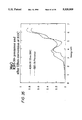
- FIGS. 16 and 17 show the optical absorption spectra and photoluminescent spectra for two areas in a polymer film which have undergone different conversion treatments;
- FIG. 18 are graphs showing the infrared spectra of precursor to random copolymers of PPV and MMP-PPV(2-methoxy-5-(2'-methylpentyloxy)-PPV produced from 80:20 (a), 90:10 (b), and 95:5 (c) w/w ratios of PPV and MMP-PPV monomer units, respectively;
- FIG. 19 are graphs showing the absorption spectra of spin-coated thin films of random copolymers of PPV and MMP-PPV produced from 80:20 (a), 90:10 (b), and 95:5 (c) and 100:0 (d) w/w ratios of PPV and MMP-PPV monomer units, respectively as converted at 220° C. in vacuo for 12 hours;
- FIG. 20 is a graph showing the current/voltage characteristics of a thin film of a random copolymer of PPV and MMP-PPV produced from 90:10 w/w ratio of PPV and MMP-PPV monomer units as converted in vacuo at 220° C. for 12 hours on a substrate of ITO-coated glass and with calcium as a cathode;
- FIG. 21 is a graph showing the luminance/current characteristics of a thin film of a random copolymer of PPV and MMP-PPV produced from 90:10 w/w ratio of PPV and MMP-PPV monomer units as converted in vacuo at 220° C. for 12 hours on a substrate of ITO-coated glass and with calcium as a cathode;
- FIG. 22 are graphs showing the infrared spectra of precursors of random copolymers of PPV and MEH-PPV (2-methoxy-5-(2'-ethylhexyloxy)-PPV produced from 90:10 (a) and 95:5 (b) w/w ratios of PPV and MEH-PPV (2-methoxy-5-(2'-ethlyhexyloxy)-PPV) monomer units respectively;
- FIG. 23 are graphs showing the absorption spectra of spin-coated thin films of random copolymers of PPV and MEH-PPV produced from 80:20 (a), 90:10 (b), 95:5 (c) and 100:0 (d) w/w ratios of PPV and MEH-PPV monomer units, respectively as converted at 220° C. in vacuo for 12 hours;
- FIG. 24 is a 1 H NMR spectrum of the copolymer described in example 11 produced from 5:95 w/w ratio of PPV and MEH-PPV monomer units;
- FIG. 25 are graphs showing the infrared spectra of (c) MEH-PPV and of random copolymers of PPV and MEH-PPV produced from (a) 20:80 and (b) 5:95 w/w ratios of PPV and MEH-PPV monomer units, respectively, by the method described in example 11;
- FIG. 26 is a graph showing the absorption spectra of spin-coated thin films of MEH-PPV and of random copolymers of PPV and MEH-PPV produced from 20:80 and 5:95 w/w ratios of PPV and MEH-PPV monomer units, respectively;
- FIGS. 27a and 27b are graphs showing the photoluminescence emission spectra of random copolymers of PPV and MEH-PPV produced from 20:80 and 5:95 w/w ratios of PPV and MEH-PPV monomer units, respectively;
- FIGS. 28a and 28b are graphs showing the electroluminescence spectra for random copolymers of PPV and MEH-PPV produced from 20:80 and 5:95 w/w ratios of PPV and MEH-PPV monomer units, respectively;
- FIGS. 29a and 29b are graphs showing the current/voltage characteristics and luminance/voltage relationship for a thin film of a random copolymer of PPV and MEH-PPV produced from 20:80 w/w ratio of PPV and MEH-PPV monomer units thin; films were spin-coated onto substates of ITO coated glass and aluminium cathodes were evaporated on top;
- FIGS. 30a and 30b are graphs showing the current/voltage characteristics and luminance/voltage relationship for a thin film of random copolymer of PPV and MEH-PPV produced from 5:95 w/w ratio of PPV and MEH-PPV monomer units: thin films were spin-coated onto substates of ITO coated glass and aluminium cathodes were evaporated on top;
- FIG. 31 is a scatter graph showing the quantum yield of random copolymers formed from PPV and MMP-PPV monomer units as measured in thin film structures with hole injecting electrodes of oxidised aluminium, a spin-coated film converted at 220° C. in vacuo for 12 hours, and with electron injecting electrodes of aluminium;
- FIG. 31a is a graph showing the photoluminescence spectra of MEH-PPV and random copolymers of (a) MEH-PPV and PPV produced from (b) 95:5 and (c) 80:20 w/w ratios of MEH-PPV and PPV monomer units, respectively;
- FIGS. 32 (a to d) show respectively the formal structural formulae of: the THT-leaving PPV precursor; the MeO-leaving PPV precursor; PPV; and partially converted MeO-leaving PPV;
- FIG. 33 is a graph showing the absorption spectra of precursors of THT-leaving PPV (broken) and MeO-leaving PPV (solid);
- FIG. 34 is a graph showing the absorption spectra of THT-leaving PPV (broken) and MeO-leaving PPV (solid) after thermal conversion at 300° C. for 12 hours in vacuo;
- FIG. 35 is a graph showing the absorption spectra of thin spin-coated films of MeO-leaving PPV before (dotted) and after (solid) thermal conversion at 300° C. for 12 hours in vacuo;
- FIGS. 36 (a) and (b) are graphs showing respectively the current-voltage and luminance-current characteristics of THT-leaving PPV as converted in vacuo at 220° for 12 hours on a substrate of ITO-coated glass and with aluminium as a cathode;
- FIGS. 37 (a) and (b) are graphs showing respectively the current-voltage and luminance-current characteristics of MeO-leaving PPV as converted in vacuo at 300° for 12 hours on a substrate of ITO-coated glass and with aluminium as a cathode;
- FIG. 38 is a graph showing the electroluminescence emission spectra of THT-leaving PPV (dotted) and MeO-leaving PPV (solid) after thermal conversion;
- FIG. 39 show respectively the focal structural formulae of the random copolymers of: PPV and DMeOPPV in precursor form; as converted thermally in vacuo; and as converted thermally in the presence of acid;
- FIG. 40 is a graph showing the absorption spectra of spin-coated thin films of random copolymers of PPV and DMeOPPV after thermal conversion as converted in vacuo at 220° C. for 12 hours. The percentages on the figure represent the percentage of DMeOPPV monomer units w/w from which the precursor was formed;
- FIG. 41 is a graph showing the infra red absorption spectra of a 20% random copolymer of DMeOPPV and PPV in which:
- FIG. 42 are graphs showing respectively the infrared absorption spectra of PPV (a) and the random copolymers of PPV, as the major constituent, and DMeOPPV produced from 95:5 (b), 90:10 (c), 80:20 (d) and 70:30 (e) molar ratios of PPV and DMeOPPV monomer units respectively;
- FIG. 43 is a graph showing the absorption spectra of spin-coated thin films of a 20% random copolymer of DMeOPPV and PPV converted in vacuo (a,b) and in the presence of HCl (c,d);
- FIG. 44 is a graph showing the variation of bandgap with different conversion conditions; the higher bandgap material (a) converted for 2 hours at 220° C. in vacuo, the lower bandgap material (b) converted for 12 hours at 100° C. in vacuo and subsequently four hours at 220° C. in a 15% random copolymer of DMeOPPV and PPV;
- FIG. 45 is a graph showing the photoluminescence spectra of a 30% random copolymer of DMeOPPV and PPV;
- FIG. 46 is a graph showing the photoluminescence emision spectra of a 30% random copolymer of DMeOPPV and PPV;
- FIG. 47 is a graph showing the absorption spectra of capped and uncapped 10% random copolymers of DMeOPPV and PPV.
- FIG. 48 is a graph showing the photoluminescence emission spectra of capped and uncapped 10% random copolymers of DMeOPPV and PPV after thermal conversion.
- FIG. 1 illustrates in general terms a process for producing copolymers according to one embodiment of the invention.
- a mixture of two monomeric bis-sulphonium salts in a suitable solvent was polymerised by reaction with a base.
- the resultant soluble precursor copolymer was purified and then converted to a conjugated form by heat treatment.
- the compound of General Formula I represents a precursor copolymer of the compound of General Formula II, which is a poly(para-phenylene vinylene-co-2,5-disubstituted-para phenylene vinylene) copolymer.
- the compound of General Formula III represents a precursor copolymer of the compound of General Formula IV, which is a poly(2,5-thienylene vinylene-co-disubstituted-para-phenylene vinylene) copolymer.
- the present invention is concerned in one aspect with improving the efficiency of radiative decay of excitons by trapping them on local regions of the polymer chain, which have lower energy gaps and thus are regions of lower potential energy for the excitons, so that the excitons are confined for a long enough period that they will decay radiatively.
- This has been achieved by the synthesis of a family of copolymers in which the units which make up the polymer chain are selected from two or more chemically different groups, which possess differing bandgaps in their respective homopolymers.
- Such polymers have been synthesised while still retaining all the desirable processing and materials properties of PPV.
- para-phenylene vinylene is used as one of the components (usually the majority component) together with varying compositions of the following other components or their unconverted precursors, as discussed more fully below: ##STR3##
- the first three of these components are available in the form of their corresponding homopolymers, and the first two possess an energy gap lower than that of PPV.
- PPV shows the onset of ⁇ to ⁇ * optical transitions at 2.5 eV; poly(2,5-dimethoxy-para-phenylene vinylene), PDMOPV, at 2.1 eV and poly(2,5-thienylene vinylene), PTV, at 1.8 eV. It is expected, on the basis of the known inductive effects of its substituents, that poly(2,5-dimethyl-para-phenylene vinylene), PDMPV, will have a bandgap a little lower than that of PPV.
- Dimethyl PPV has a higher bandgap in its homopolymer than does PPV. This is contrary to the argument which runs that the methyl substituents have inductive effects and so will lower the bandgap of DMPPV over PPV.
- the true picture is that due to the steric interaction of the dimethyl groups, the polymer conjugated backbone is distorted decreasing the degree of electron delocalisation along the backbone and thus raising the bandgap with respect to PPV. This is evidenced in electron diffraction studies and quantum chemical calculations.
- the copolymers of PPV and DimethylPPV as prepared via a THT leaving group have a controlled shift in bandgap not because the DMPPV units are saturated giving a copolymer of saturated and unsaturated units but because DMPPV and PPV have genuinely different bandgaps and we are forming a copolymer of the two.
- DMPPV and PPV have genuinely different bandgaps and we are forming a copolymer of the two.
- the reaction was terminated by addition of hydrochloric acid (0.4M, 1.0 ml).
- the viscous solution was then dialyzed against deoxygenated distilled water (3 ⁇ 1000 ml) over 3 days using cellulose membrane dialysis tubing with a molecular weight cut-off of 12,400 (supplied by Sigma Chemical Company Limited, Dorset, U.K.).
- the solvent was completely removed in vacuo at room temperature from the material remaining in the dialysis tubing.
- the residue was dissolved in dry methanol (15 ml).
- the reaction was terminated by addition of hydrochloric acid (0.4M, 0.5 ml).
- the viscous solution was then dialyzed against deoxygenated distilled water (3 ⁇ 1000 ml) over 4 days using cellulose membrane dialysis tubing with a molecular weight cut-off of 12,400 (supplied by Sigma Chemical Company Limited, Dorset, U.K.).
- the solvent was completely removed in vacuo at room temperature from the material remaining in the dialysis tubing.
- the residue was dissolved in dry methanol (10 ml).
- the reaction was terminated by addition of hydrochloric acid (0.4M, 1.0 ml).
- the viscous solution was then dialyzed against deoxygenated distilled water (3 ⁇ 1000 ml) over 4 days using cellulose membrane dialysis tubing with a molecular weight cut-off of 12,400 (supplied by Sigma Chemical Company Limited, Dorset, U.K.).
- the solvent was completely removed in vacuo at room temperature from the material remaining in the dialysis tubing. The residue was dissolved in dry methanol (4 ml).
- Tetrahydrothiophene (20.9 ml, 237 mmol) was added to a suspension of 1,4-bis(chloromethyl)-2-methoxy-5-(2'-methylpentyloxy)benzene(14.5 g, 47.3 mmol) in dry methanol (200 ml). The solid dissolved to form a clear solution within 10 min. This solution was then heated to 50° C. for 17 hours. The solvent was completely removed in vacuo, the residue treated with dry acetone, then filtered under suction and dried to give 12.7 g (56%) of ⁇ , ⁇ -bis(tetrahydrothiophenium chloride)-2-methoxy-5-(2'-methylpentyloxy)-p-xylene.
- Tetrahydrothiophene (6.4 ml, 72 mmol) was added to a suspension of 2,5-bis(chloromethyl)-1-methoxy-4-(2'-ethylhexyloxy)benzene (4.80 g, 14.4 mmol) in dry methanol (75 ml). The mixture was then heated to 50° C. for 22 hours. The solvent was completely removed in vacuo, the residue treated with dry acetone, then filtered under suction and dried to give 4.36 g (59%) of ⁇ , ⁇ '-bis(tetrahydrothiophenium chloride)-2-methoxy-5-(2'-ethylhexyloxy)-p-xylene.
- FIG. 26 The absorption spectra of MEH-PPV, 5% PPV/95% MEH-PPV and 20% PPV/80% MEH-PPV are shown in FIG. 26.
- the photoluminescent spectra (FIGS. 27a, 26b, 31a) show that the luminescence is as expected of higher energy with increasing number of PPV units.
- EL devices were made in a standard configuration with ITO and aluminium contacts and the material showed electroluminescence (FIGS. 29a, 29b, 30a and 30b).
- the corresponding electroluminescence spectra are illustrated in FIGS. 28a and 28b. Both the 5% PPV/95% MEH-PPV and the 20% PPV/80% MEH-PPV had a turn-on voltage of about 8 V.
- the previous PPV EL devices were constructed with PPV prepared via a Tetrahydrothiophenium (THT)-leaving precursor polymer (FIG. 32a) spun from methanolic solution. This precursor is unstable with respect to its conjugated product and is fully converted by heating at 220° C. for 2 hours (FIG. 32c).
- THT Tetrahydrothiophenium
- a more stable precursor (FIG. 32b) is formed.
- This can be easily processed by spin coating from a solution in chloroform (as can the THT-precursor from methanolic solution).
- Thermal conversion of the MeO-leaving PPV precursor at 300° C. in vacuo for 12 hours gives very little thermal elimination leaving a copolymer of conjugated and unconjugated units (FIG. 32d).
- This is clearly seen from the absorption spectra of the THT-leaving PPV and the MeO-leaving PPV (FIG. 33). The absorption spectra of the precursors of both are very similar.
- a device was made with the MeO-leaving PPV.
- An ITO substrate was cleaned in an ultrasound bath, of first acetone and subsequently propan-2-ol.
- the precursor material was then spin-coated on the substrate.
- the device was then thermally converted at 300° C. in vacuo for 12 hours.
- a top contact of Aluminium was then deposited to define an active area by vacuum deposition at a pressure of less than 6.10 -6 torr to a thickness of 2-500 ⁇ .
- the performance of the device shows no deterioration over those made with PPV prepared via a THT leaving group precursor polymer with a turn on voltage below 10V, a diodic current-voltage characteristic and a largely linear current-luminance response and a slightly improved quantum efficiency by at least a factor of 2 (FIGS. 36 and 37).
- the emission spectrum of the MeO-leaving PPV is markedly different with a peak emission at 2.5 eV compared with 2.25 eV in THT-leaving PPV.
- the emission is a bluey-green as opposed to a greeny-yellow in the case of the THT-leaving PPV.
- This is again consistent with the MeO-leaving PPV as converted being a copolymer of conjugated and unconjugated sequences: emission coming from the small conjugated sequences but at a higher energy than in fully conjugated PPV, (FIG. 37).
- the random copolymers of PPV and DMeOPPV give a means to controlling the bandgap of a conjugated polymer and the potential for the construction of multicolour EL devices and channel waveguides.
- the copolymers are prepared initially in a precursor form which is soluble in Methanol and consists of at least 3 distinct monomer units--a PPV precursor monomer unit with a THT-leaving group, a DMeOPPV monomer unit with a THT-leaving group and certainly a DMeOPPV monomer unit with a MeO-leaving group (formed by the methanolic solution substitutionally attacking the DMeOPPV THT-leaving units) as seen by the strong 1094 cm -1 adsorption in the infrared absorption spectra of both the MeO-leaving homopolymer precursor of DMeOPPV and all the copolymer precursor polymers.
- Thin films (of the order of 1000 ⁇ as used in EL devices) of the copolymers can be obtained by spin-coating the precursor solutions. Thermal conversion of the said films gives mechanically and thermally robust films. It is found that by linearly varying the copolymer monomer unit ratio that the absorption edge of the converted copolymers may be accurately controlled (FIG. 40). Typically films are converted at 220° C. for 2 hours. More fully conjugated material has a lower bandgap. The controlled increase in bandgap with additional DMeOPPV to PPV units indicates an associated decrease in conjugation. FTIR data shows that the copolymers are only partially conjugated as converted (FIG. 41).
- any method of controlling the bandgap in these conjugated polymers equally controls the colour of emitted light in an electroluminescent device (or the colour of photoluminescence under optical excitation) as the wavelength of the emitted light largely follows the bandgap of the material (an increase in the bandgap of the material causes a similar decrease in the wavelength of the emitted light).
- the spatial limit for this spatial control of bandgap across the polymer film is of the order of the thickness of the polymer film i.e. 1000 ⁇ .
- the bandgap of the copolymers may again be controlled and moreover in different regions of the same film giving rise to the possibility of multicolour emission from a single EL device.
- Such patterning also has an application in the manufacture of channel waveguides.
- Another such patterned device as above was made (from 10% copolymer) and there were the same associated lowering of bandgap and absorption edge where the aluminium had been etched from (FIG. 47) and lowering in energy of the photoluminescence emission from the same area (FIG. 48).
- the refractive indices of the two regions at 633 nm were measured by coupling light into the first TE modes from a He-Ne laser.
- the refractive index of the less conjugated material was measured to be 1.564 (0.002) and that of the more conjugated material (as converted under the encapsulation of aluminium) was measured to be 1.620 (0.002).
- the patterning of the polymer allows also the spatial control of refractive index across a polymer film to a length scale of the order of 1000 ⁇ .
- typical waveguiding structures such as a channel waveguide
- this method of patterning the copolymers of PPV and DMeOPPV is amenable to making waveguide structures as high refractive index regions can be defined to a size smaller than the wavelength of light which is to be confined in the high index region and guided.
- curve (a) is 100% PPV
- (b) is 95% PPV/5% PDMOPV
- (c) is 90% PPV/10% PDMOPV
- (d) is 85% PPV/15% PDMOPV
- (e) is 80% PPV/20% PDMOPV
- (f) is 70% PPV/30% PDMOPV.
- 95% PPV/5% MMP-PPV 90% PPV/10% MMP-PPV and 80% PPV/20% MMP-PPV
- FIG. 23 shows 95% PPV/5% MEH-PPV
- the electronic structures of the copolymers that are incorporated into device structures may be controlled by the selection of the constituent components present in the copolymer precursor and by the conversion conditions used in device fabrication. Changing some of the units of the precursor to para-phenylene vinylene to units of the precursor to 2,5-dimethoxy-para-phenylene vinylene can have two different effects depending on whether conversion is purely thermal or also involves acid catalysis. For purely thermal conversion there is an incomplete elimination such that the resultant conjugated segments are separated by remnant non-conjugated precursor units, causing the energy gap to increase relative to that of homopolymer PPV and the photoluminescence emission to be blue shifted, occuring at higher energy than in PPV. For acid catalysed thermal conversion the elimination is substantially complete with the result that the energy gap decreases and photoluminescence emission shifts to the red.
- the inventors have trapped some of the acid released from a thin film during thermal conversion by capping a section of a film of the 10% dimethoxy-PPV/90% PPV precursor polymer which had been spin coated onto a glass slide (about 2.5 cm square) with a strip of evaporated aluminium (about 4 mm wide) before heat treatment.
- the precursor was then heated as described above to leave a film of thickness 100 nm and the aluminium was removed using dilute aqueous sodium hydroxide. There was a clear difference in colour between the area previously coated with aluminium (orange) and that where there had been no aluminium (yellow).
- the optical absorption spectra for the two areas are shown in FIG.
- Structures for an EL device require two electrodes to either side of the emissive region.
- devices have been fabricated by deposition of a series of layers onto a transparent substrate (glass), but other structures can also be made, with the active (i.e. emissive) area being defined by patterning within the plane of the polymer film.
- the choice of electrode materials is determined by the need to achieve efficient injection of charge carriers into the polymer film, and it is desirable to choose materials which preferably inject electrons and holes as the negative and positive electrodes respectively.
- International Patent Application No. PCT/GB90/00584 Publication No. PCT/WO9013148
- PPV amorphous silicon
- silver/magnesium alloy as the negative electrode
- aluminium with a thin oxide coating, gold and indium oxide as the positive electrode. Many of these combinations were found to be satisfactory.
- Positive bias was applied to the bottom contact (aluminium with surface oxide coating) using a programmable voltage source (Keithley model 230).
- the current through the device was measured with a Keithley model 195 DVM connected between the top contact and ground.
- the light output was measured with a large area silicon photovoltaic cell (1 cm 2 active area, Radio Spares catalogue number RS 303-674).
- Typical results of the PPV homopolymer, a copolymer obtained by in vacuo thermal conversion of spin-coating thin films of spin coated films of a precursor copolymer synthesised from 90% para-phenylene vinylene/10% 2,5-dimethoxy-para-phenylene vinylene precursor units, a copolymer obtained by in vacuo thermal conversion of spin-coated thin films of a precursor copolymer synthesised from 90% para-phenylene vinylene/10% 2,5-thienylene vinylene precursor units and a copolymer obtained by in vacuo thermal conversion of spin-coated thin films of a precursor copolymer synthesised from 90% para-phenylene vinylene/10% 2-methoxy-5-(2'-methylpentyloxy) -para-phenylene vinylene precursor units are shown in FIGS.
- the bottom contact thickness is 110 ⁇
- the top contact thickness is 1300 521
- the thickness of the electroluminescent layer is 900 ⁇ .
- the corresponding thickness values are 120 ⁇ , 1000 ⁇ and 1450 ⁇ and in FIG. 13 they are 90 ⁇ , 1370 ⁇ and 1070 ⁇ .
- Similar current versus voltage characteristics were found for all devices, with a threshold voltage for current injection of around 25 to 40V. There was also found a broadly linear relation between current and light output (which allows the efficiency of the device to be characterised simply, by the gradient of this plot).
- the light output varies strongly with the choice of copolymer, and that some of the copolymers show very strongly enhanced efficiencies as measured against the efficiency of the PPV homopolymer.
- the variation of the quantum efficiency is shown as actually measured (current in photodetector/current through EL device) in FIGS. 13, 14, 15 and 31 for the copolymers obtained from the in vacuo thermal conversion of spin-coated thin films of precursor copolymers formed between the precursors to PPV and PDMOPV, the precursors to PPV and PTV, the precursors to PPV and PDMPV, and the precursors to PPV and MMP-PPV respectively.
- the plots show some data for a large number of devices, and there is some scatter evident between devices of the same nominal composition. This may be due to inhomogeneities in the devices, such as non-uniform thickness, entrapped dust particles etc. and it is considered that the better values of efficiency at each composition give a true indication of the intrinsic behaviour of the EL structure.
- the PPV/PDMOPV copolymers show a very big improvement in efficiency for PDMOPV in the range 5-15%, with best results at 10%, for which the improvement over that obtained for PPV is by a factor of about 50.
- the PPV/PTV copolymers do not show such behaviour.
- the efficiency for luminescence is in part an intrinsic property of the material (that is to say that it has the same value for all samples), and possibly also dependent on the actual form of the sample and the nature of the interfaces to it.
- the effect, then of restricting the motion of the excited states in the copolymers may be to improve quantum yield both by improving the intrinsic properties of the polymer, and also by reducing the motion of excited states to the interface region.
- the improvements in quantum yield that have been measured in EL for some of the copolymers are by a very large factor ( ⁇ 50), considerably larger than the factor by which the yield for PL is improved.
- copolymers described herein are intractable, insoluble in common solvents and infusible at temperatures below the decomposition temperature, or they are soluble in a few organic solvents.
Landscapes
- Chemical & Material Sciences (AREA)
- Organic Chemistry (AREA)
- Engineering & Computer Science (AREA)
- Materials Engineering (AREA)
- Physics & Mathematics (AREA)
- Spectroscopy & Molecular Physics (AREA)
- Health & Medical Sciences (AREA)
- Chemical Kinetics & Catalysis (AREA)
- Medicinal Chemistry (AREA)
- Polymers & Plastics (AREA)
- Polyoxymethylene Polymers And Polymers With Carbon-To-Carbon Bonds (AREA)
- Electroluminescent Light Sources (AREA)
- Addition Polymer Or Copolymer, Post-Treatments, Or Chemical Modifications (AREA)
- Luminescent Compositions (AREA)
- Macromolecular Compounds Obtained By Forming Nitrogen-Containing Linkages In General (AREA)
- Formation Of Insulating Films (AREA)
- Liquid Deposition Of Substances Of Which Semiconductor Devices Are Composed (AREA)
- Led Devices (AREA)
- Application Of Or Painting With Fluid Materials (AREA)
- Treatments Of Macromolecular Shaped Articles (AREA)
- Laminated Bodies (AREA)
Priority Applications (1)
| Application Number | Priority Date | Filing Date | Title |
|---|---|---|---|
| US08/199,036 US5425125A (en) | 1990-08-24 | 1994-02-18 | Optical device incorporating semiconductive conjugated polymer |
Applications Claiming Priority (2)
| Application Number | Priority Date | Filing Date | Title |
|---|---|---|---|
| GB9018698 | 1990-08-24 | ||
| GB909018698A GB9018698D0 (en) | 1990-08-24 | 1990-08-24 | Semiconductive copolymers for use in electroluminescent devices |
Related Child Applications (1)
| Application Number | Title | Priority Date | Filing Date |
|---|---|---|---|
| US08/199,036 Division US5425125A (en) | 1990-08-24 | 1994-02-18 | Optical device incorporating semiconductive conjugated polymer |
Publications (1)
| Publication Number | Publication Date |
|---|---|
| US5328809A true US5328809A (en) | 1994-07-12 |
Family
ID=10681233
Family Applications (5)
| Application Number | Title | Priority Date | Filing Date |
|---|---|---|---|
| US07/748,795 Expired - Lifetime US5328809A (en) | 1990-08-24 | 1991-08-22 | Patterning of semiconductive polymers |
| US07/748,777 Expired - Lifetime US5401827A (en) | 1990-08-24 | 1991-08-22 | Semiconductive copolymers for use in luminescent devices |
| US08/199,036 Expired - Lifetime US5425125A (en) | 1990-08-24 | 1994-02-18 | Optical device incorporating semiconductive conjugated polymer |
| US08/246,269 Expired - Lifetime US5512654A (en) | 1990-08-24 | 1994-05-19 | Semiconductive copolymers for use in luminescent devices |
| US08/506,201 Expired - Lifetime US5672678A (en) | 1990-08-24 | 1995-09-18 | Semiconductive copolymers for use in luminescent devices |
Family Applications After (4)
| Application Number | Title | Priority Date | Filing Date |
|---|---|---|---|
| US07/748,777 Expired - Lifetime US5401827A (en) | 1990-08-24 | 1991-08-22 | Semiconductive copolymers for use in luminescent devices |
| US08/199,036 Expired - Lifetime US5425125A (en) | 1990-08-24 | 1994-02-18 | Optical device incorporating semiconductive conjugated polymer |
| US08/246,269 Expired - Lifetime US5512654A (en) | 1990-08-24 | 1994-05-19 | Semiconductive copolymers for use in luminescent devices |
| US08/506,201 Expired - Lifetime US5672678A (en) | 1990-08-24 | 1995-09-18 | Semiconductive copolymers for use in luminescent devices |
Country Status (13)
| Country | Link |
|---|---|
| US (5) | US5328809A (ja) |
| EP (2) | EP0544795B2 (ja) |
| JP (3) | JP3242648B2 (ja) |
| AT (2) | ATE135382T1 (ja) |
| AU (2) | AU8501691A (ja) |
| CA (2) | CA2089481A1 (ja) |
| DE (2) | DE69117957T2 (ja) |
| DK (1) | DK0544795T4 (ja) |
| ES (1) | ES2134780T5 (ja) |
| GB (1) | GB9018698D0 (ja) |
| GR (1) | GR3030441T3 (ja) |
| HK (1) | HK24497A (ja) |
| WO (2) | WO1992003491A1 (ja) |
Cited By (66)
| Publication number | Priority date | Publication date | Assignee | Title |
|---|---|---|---|---|
| US5589320A (en) * | 1993-07-21 | 1996-12-31 | Sumitomo Chemical Company, Limited | Polymeric fluorescent substance and organic electroluminescence devices using the same |
| CN1066163C (zh) * | 1994-09-30 | 2001-05-23 | 赫彻斯特股份公司 | 用作电致发光材料的含氮聚合物 |
| US6242076B1 (en) | 1999-02-08 | 2001-06-05 | Michael D. Andriash | Illuminated imageable vision control panels and methods of fabricating |
| US6361917B1 (en) * | 1994-08-29 | 2002-03-26 | Hoechst Aktiengesellschaft | Process for patterning poly(arylenevinylene) polymer films by irradiation with light |
| US6395410B1 (en) | 1998-06-09 | 2002-05-28 | Bayer Aktiengesellschaft | Electroluminescent devices using blend systems |
| US20020075422A1 (en) * | 1996-09-19 | 2002-06-20 | Seiko Epson Corporation | Matrix type display device and manufacturing method thereof |
| US20020084504A1 (en) * | 2001-01-02 | 2002-07-04 | K.S. Narayan | Photo-responsive organic field effect transistor |
| US6503643B1 (en) | 1998-09-02 | 2003-01-07 | Bayer Aktiengesellschaft | Electro-luminescent arrangements with thiophene carboxylate metal complexes |
| US20030019942A1 (en) * | 2001-07-24 | 2003-01-30 | Blossom George W. | System and method for electronically readable card having power source |
| US6534200B1 (en) | 1998-09-02 | 2003-03-18 | Bayer Aktiengesellshaft | Electroluminescent systems with polynulcear metal complexes |
| US20030135462A1 (en) * | 1998-11-17 | 2003-07-17 | Brake Francis B. | Customer activated multi-value (CAM) card |
| US6631849B2 (en) | 2000-12-06 | 2003-10-14 | Bank One, Delaware, National Association | Selectable multi-purpose card |
| WO2004000970A1 (en) * | 2002-06-21 | 2003-12-31 | Case Western Reserve University | Color tunable photoluminescent blends |
| US20040210498A1 (en) * | 2002-03-29 | 2004-10-21 | Bank One, National Association | Method and system for performing purchase and other transactions using tokens with multiple chips |
| US20050154663A1 (en) * | 1999-06-04 | 2005-07-14 | First Usa Bank, N.A. | System and method for card processing with automated payment of club, merchant, and service provider fees |
| US7051925B2 (en) | 2001-08-13 | 2006-05-30 | Bankone Delaware, N.A. | System and method for funding a collective account by use of an electronic tag |
| US7086586B1 (en) | 2003-08-13 | 2006-08-08 | Bank One, Delaware, National Association | System and method for a card payment program providing mutual benefits to card issuers and cardholders based on financial performance |
| US20060210704A1 (en) * | 1996-09-19 | 2006-09-21 | Seiko Epson Corporation | Method of manufacturing a display device |
| US7130828B2 (en) | 1998-06-22 | 2006-10-31 | Jpmorgan Chase Bank, N.A. | Debit purchasing of stored value card for use by and/or delivery to others |
| US20060254098A1 (en) * | 2005-05-10 | 2006-11-16 | Fu Cheung Y | Flower blooming simulative toy flower |
| US7165049B2 (en) | 2000-02-09 | 2007-01-16 | Jpmorgan Chase Bank, N.A. | Sponsor funded stored value card |
| US7260549B2 (en) | 2000-04-07 | 2007-08-21 | Jpmorgan Chase Bank, N.A. | Method and system for managing risk |
| US7306141B1 (en) | 2001-08-13 | 2007-12-11 | Jpmorgan Chase Bank, N.A. | System and method for funding a collective account by use of an electronic tag |
| US20080021841A1 (en) * | 2000-08-01 | 2008-01-24 | First Usa Bank, N.A. | System and method for transponder-enabled account transactions |
| US7401731B1 (en) | 2005-05-27 | 2008-07-22 | Jpmorgan Chase Bank, Na | Method and system for implementing a card product with multiple customized relationships |
| USD576671S1 (en) | 2008-02-21 | 2008-09-09 | Jpmorganchase Bank, N.A. | Overlapping transaction device |
| US7433829B2 (en) | 2000-12-12 | 2008-10-07 | Jpmorgan Chase Bank, N.A. | System and method for managing global risk |
| USD582476S1 (en) | 2008-02-21 | 2008-12-09 | Jpmorgan Chase Bank, N.A. | Pivoting transaction device |
| USD582977S1 (en) | 2008-02-21 | 2008-12-16 | Jpmorgan Chase Bank, N.A. | Transaction device |
| US7505918B1 (en) | 2006-05-26 | 2009-03-17 | Jpmorgan Chase Bank | Method and system for managing risks |
| US7512566B1 (en) | 2001-12-11 | 2009-03-31 | Jpmorgan Chase Bank, N.A. | System and method for using a stored value account having subaccount feature |
| US7526449B1 (en) | 2001-04-17 | 2009-04-28 | Jpmorgan Chase Bank N.A. | Optically encoded card and system and method for using |
| US7593875B2 (en) | 2002-03-08 | 2009-09-22 | Jp Morgan Chase Bank | Financial system for isolated economic environment |
| USD602986S1 (en) | 2009-03-06 | 2009-10-27 | Jpmorgan Chase Bank, N.A. | Metal transaction device |
| US7660763B1 (en) | 1998-11-17 | 2010-02-09 | Jpmorgan Chase Bank, N.A. | Customer activated multi-value (CAM) card |
| US7676425B1 (en) | 2002-07-29 | 2010-03-09 | Jpmorgan Chase Bank, N.A. | Method and system for providing flexible financing |
| US7747463B1 (en) | 1998-06-22 | 2010-06-29 | Jpmorgan Chase Bank, N.A. | Debit purchasing of stored value card for use by and/or delivery to others |
| US7753259B1 (en) | 2006-04-13 | 2010-07-13 | Jpmorgan Chase Bank, N.A. | System and method for granting promotional rewards to both customers and non-customers |
| US7756896B1 (en) | 2002-03-11 | 2010-07-13 | Jp Morgan Chase Bank | System and method for multi-dimensional risk analysis |
| US7784682B2 (en) | 2006-02-08 | 2010-08-31 | Jpmorgan Chase Bank, N.A. | System and method for granting promotional rewards to both customers and non-customers |
| US7801816B2 (en) | 2001-05-23 | 2010-09-21 | Jp Morgan Chase Bank, N.A. | System and method for currency selectable stored value instrument |
| US7809595B2 (en) | 2002-09-17 | 2010-10-05 | Jpmorgan Chase Bank, Na | System and method for managing risks associated with outside service providers |
| US7809641B2 (en) | 2001-07-26 | 2010-10-05 | Jpmorgan Chase Bank, National Association | System and method for funding a collective account |
| US7860789B2 (en) | 2001-07-24 | 2010-12-28 | Jpmorgan Chase Bank, N.A. | Multiple account advanced payment card and method of routing card transactions |
| USD635186S1 (en) | 2008-06-30 | 2011-03-29 | Jpmorgan Chase Bank, N.A. | Metal transaction device |
| USD636020S1 (en) | 2008-07-17 | 2011-04-12 | Jpmorgan Chase Bank, N.A. | Eco-friendly transaction device |
| US7953663B1 (en) | 2003-09-04 | 2011-05-31 | Jpmorgan Chase Bank, N.A. | System and method for financial instrument pre-qualification and offering |
| US8020754B2 (en) | 2001-08-13 | 2011-09-20 | Jpmorgan Chase Bank, N.A. | System and method for funding a collective account by use of an electronic tag |
| US8145549B2 (en) | 2003-05-30 | 2012-03-27 | Jpmorgan Chase Bank, N.A. | System and method for offering risk-based interest rates in a credit instutment |
| US8239323B2 (en) | 2003-09-23 | 2012-08-07 | Jpmorgan Chase Bank, N.A. | Method and system for distribution of unactivated bank account cards |
| US8392301B1 (en) | 2002-03-08 | 2013-03-05 | Jpmorgan Chase Bank, N.A. | Financial system for isolated economic environment |
| US8408455B1 (en) | 2006-02-08 | 2013-04-02 | Jpmorgan Chase Bank, N.A. | System and method for granting promotional rewards to both customers and non-customers |
| US8417601B1 (en) | 2007-10-18 | 2013-04-09 | Jpmorgan Chase Bank, N.A. | Variable rate payment card |
| US8533111B1 (en) | 2004-08-03 | 2013-09-10 | Jpmorgan Chase Bank, N.A. | System and method for providing promotional pricing |
| US8612341B2 (en) | 2000-02-23 | 2013-12-17 | Jpmorgan Chase Bank, N.A. | Computerized funding of a second financial account by a first financial card |
| US8630898B1 (en) | 2005-02-22 | 2014-01-14 | Jpmorgan Chase Bank, N.A. | Stored value card provided with merchandise as rebate |
| US8676642B1 (en) | 2007-07-05 | 2014-03-18 | Jpmorgan Chase Bank, N.A. | System and method for granting promotional rewards to financial account holders |
| US8719085B2 (en) | 2001-01-18 | 2014-05-06 | Jpmorgan Chase Bank, N.A. | System and method for administering a brokerage rebate card program |
| US8793160B2 (en) | 1999-12-07 | 2014-07-29 | Steve Sorem | System and method for processing transactions |
| US8800857B1 (en) | 2001-08-13 | 2014-08-12 | Jpmorgan Chase Bank, N.A. | System and method for crediting loyalty program points and providing loyalty rewards by use of an electronic tag |
| US8859190B1 (en) * | 2012-09-05 | 2014-10-14 | Sandia Corporation | Method to create gradient index in a polymer |
| US9240089B2 (en) | 2002-03-25 | 2016-01-19 | Jpmorgan Chase Bank, N.A. | Systems and methods for time variable financial authentication |
| US9305292B1 (en) | 2008-07-03 | 2016-04-05 | Jpmorgan Chase Bank, N.A. | Systems and methods for providing an adaptable transponder device |
| US9984891B2 (en) * | 2016-04-21 | 2018-05-29 | Shin-Etsu Chemical Co., Ltd. | Method for forming organic film and method for manufacturing substrate for semiconductor apparatus |
| US9990642B2 (en) | 2002-10-11 | 2018-06-05 | Jpmorgan Chase Bank, N.A. | System and method for granting promotional rewards to credit account holders |
| US10726417B1 (en) | 2002-03-25 | 2020-07-28 | Jpmorgan Chase Bank, N.A. | Systems and methods for multifactor authentication |
Families Citing this family (149)
| Publication number | Priority date | Publication date | Assignee | Title |
|---|---|---|---|---|
| US5408109A (en) † | 1991-02-27 | 1995-04-18 | The Regents Of The University Of California | Visible light emitting diodes fabricated from soluble semiconducting polymers |
| GB9215928D0 (en) * | 1992-07-27 | 1992-09-09 | Cambridge Display Tech Ltd | Manufacture of electroluminescent devices |
| GB9215929D0 (en) * | 1992-07-27 | 1992-09-09 | Cambridge Display Tech Ltd | Electroluminescent devices |
| GB9226475D0 (en) * | 1992-12-18 | 1993-02-10 | Cambridge Display Tech Ltd | Chromophoric polymeric compositions |
| US5414069A (en) * | 1993-02-01 | 1995-05-09 | Polaroid Corporation | Electroluminescent polymers, processes for their use, and electroluminescent devices containing these polymers |
| US5376456A (en) * | 1993-05-13 | 1994-12-27 | Polaroid Corporation | Electroluminescent devices comprising polymers, and processes for their use |
| AU6729194A (en) * | 1993-06-10 | 1995-01-03 | Cambridge Display Technology Limited | Polymers for optical devices |
| US5514878A (en) * | 1994-03-18 | 1996-05-07 | Holmes; Andrew B. | Polymers for electroluminescent devices |
| JP3475500B2 (ja) | 1993-07-21 | 2003-12-08 | 住友化学工業株式会社 | 共役系高分子蛍光体と有機el素子 |
| DE4325885A1 (de) * | 1993-08-02 | 1995-02-09 | Basf Ag | Elektrolumineszierende Anordnung |
| US5759709A (en) * | 1994-03-10 | 1998-06-02 | Sumitomo Chemical Company, Limited | Polymeric fluorescent substance and organic electroluminescence device |
| SE506019C2 (sv) * | 1994-05-17 | 1997-11-03 | Forskarpatent I Linkoeping Ab | Ljuskälla av konjugerade polymerer med spänningsstyrd färg samt metod för tillverkning av ljuskällan |
| US5604292A (en) * | 1994-05-31 | 1997-02-18 | The Untied States Of America As Represented By The Secretary Of The Navy | Polymers with electrical and non-linear optical properties |
| US6723811B1 (en) | 1994-12-28 | 2004-04-20 | Cambridge Display Technology Ltd. | Polymers for use in optical device |
| DE19500912A1 (de) * | 1995-01-13 | 1996-07-18 | Basf Ag | Elektrolumineszierende Anordnung |
| TW334474B (en) * | 1995-02-01 | 1998-06-21 | Sumitomo Kagaku Kk | Method for making a polymeric fluorescent substrate and organic electrolumninescent element |
| DE19505942A1 (de) | 1995-02-21 | 1996-08-22 | Bayer Ag | (Co)Polymerisate auf Basis von Vinyl-Einheiten und ihre Verwendung in elektrolumineszierenden Anordnungen |
| DE19509451A1 (de) * | 1995-03-20 | 1996-09-26 | Hoechst Ag | Poly((oligo-p-phenylen)-vinylen)-Derivate, Verfahren zu ihrer Herstellung sowie ihre Verwendung |
| US6075106A (en) * | 1995-03-29 | 2000-06-13 | D-51368 Bayer Ag | (Co)polymers based on vinyl units and use thereof in electroluminescent devices |
| DE19511484A1 (de) * | 1995-03-29 | 1996-10-02 | Bayer Ag | (Co)Polymerisate auf Basis von Vinyl-Einheiten und ihre Verwendung in elektrolumineszierenden Anordnungen |
| GB9507862D0 (en) * | 1995-04-18 | 1995-05-31 | Cambridge Display Tech Ltd | Fabrication of organic light-emitting devices |
| US5629389A (en) * | 1995-06-06 | 1997-05-13 | Hewlett-Packard Company | Polymer-based electroluminescent device with improved stability |
| CN1229415C (zh) * | 1995-07-28 | 2005-11-30 | 陶氏环球技术公司 | 2,7-芳基-9-取代的芴和9-取代的芴的低聚物和聚合物 |
| DE19536843A1 (de) * | 1995-10-02 | 1997-04-03 | Bayer Ag | (Co)Polymerisate auf Basis von Vinyl-Einheiten und ihre Verwendung in elektrolumineszierenden Anordnungen |
| GB2328557A (en) * | 1996-04-10 | 1999-02-24 | Cambridge Display Tech Ltd | Organic light emitting doide colour display |
| US6395328B1 (en) | 1996-04-10 | 2002-05-28 | Cambridge Display Technology Limited | Organic light emitting diode color display |
| KR0176331B1 (ko) * | 1996-05-16 | 1999-04-01 | 박원훈 | 전계 발광 소자용 플로렌계 교대 공중합체 및 이를 발광재료로 사용한 전계 발광 소자 |
| DE19627070A1 (de) | 1996-07-05 | 1998-01-08 | Bayer Ag | Elektrolumineszierende Anordnungen unter Verwendung von Blendsystemen |
| WO1998003566A1 (en) * | 1996-07-19 | 1998-01-29 | The Regents Of The University Of California | Conjugated polymers as materials for solid state lasers |
| EP0915925A1 (en) * | 1996-07-29 | 1999-05-19 | Cambridge Display Technology Limited | Conjugated copolymers for use in luminescent devices |
| DE19632949A1 (de) * | 1996-08-16 | 1998-02-19 | Bayer Ag | (Co)Polymerisate auf Basis von Vinyl-Einheiten und ihre Verwendung in elektrolumineszierenden Anordnungen |
| US6452218B1 (en) | 1997-06-10 | 2002-09-17 | Uniax Corporation | Ultra-thin alkaline earth metals as stable electron-injecting electrodes for polymer light emitting diodes |
| DE19812259A1 (de) | 1998-03-20 | 1999-10-21 | Bayer Ag | EL-Anordnung auf Basis von tert.-Aminen, in Alkohol löslichen Alq3-Derivaten bzw. Mischungen und polymeren Bindern |
| US6127693A (en) * | 1998-07-02 | 2000-10-03 | National Science Council Of Republic Of China | Light emitting diode with blue light and red light emitting polymers |
| US6368731B2 (en) | 1998-07-04 | 2002-04-09 | Bayer Aktiengesellschaft | Electroluminescent assemblies using boron chelates of 8-aminoquinoline derivatives |
| DE19829947A1 (de) | 1998-07-04 | 2000-01-05 | Bayer Ag | Elektrolumineszierende Anordnungen mit Bor-Chelaten |
| US6316130B1 (en) | 1998-07-04 | 2001-11-13 | Bayer Aktiengesellschaft | Electroluminescent assemblies using azomethine-metal complexes |
| DE19832644C1 (de) * | 1998-07-10 | 2000-04-06 | Samsung Display Devices Co Ltd | Organische lichtemittierende Dioden (OLED) mit Poly[2-methoxy-5-(2'-ethylhexyloxy)-1,4-phenylen-1,2-ethenylen-2,5-dimethoxy-1,4-phenylen-1,2-ethenylen] als Elektrolumineszenzmaterial |
| US6635989B1 (en) | 1998-08-03 | 2003-10-21 | E. I. Du Pont De Nemours And Company | Encapsulation of polymer-based solid state devices with inorganic materials |
| US6818153B2 (en) | 1998-10-13 | 2004-11-16 | Peter Burnell-Jones | Photocurable thermosetting luminescent resins |
| US6207077B1 (en) | 2000-02-18 | 2001-03-27 | Orion 21 A.D. Pty Ltd | Luminescent gel coats and moldable resins |
| US6905634B2 (en) | 1998-10-13 | 2005-06-14 | Peter Burnell-Jones | Heat curable thermosetting luminescent resins |
| EP1133803A1 (en) | 1998-10-14 | 2001-09-19 | Uniax Corporation | Thin metal-oxide layer as stable electron-injecting electrode for light emitting diodes |
| US6849869B1 (en) | 1999-07-19 | 2005-02-01 | Dupont Displays, Inc. | Long lifetime polymer light-emitting devices with improved luminous efficiency and improved radiance |
| JP3571977B2 (ja) | 1999-11-12 | 2004-09-29 | キヤノン株式会社 | 有機発光素子 |
| JP3587361B2 (ja) | 2000-01-27 | 2004-11-10 | キヤノン株式会社 | 有機発光素子 |
| JP3754856B2 (ja) | 2000-01-27 | 2006-03-15 | キヤノン株式会社 | 有機発光素子 |
| US6461749B2 (en) | 2000-03-31 | 2002-10-08 | Canon Kabushiki Kaisha | Organic boron compound, process for producing the compound and organic luminescence device using the compound |
| JP2003530476A (ja) | 2000-04-11 | 2003-10-14 | デュポン ディスプレイズ インコーポレイテッド | 可溶性ポリ(フルオレン−オキサジアゾール)共役ポリマー |
| WO2001083410A1 (en) * | 2000-05-03 | 2001-11-08 | The Regents Of The University Of California | Soluble tetrahedral compounds for use in electroluminescent devices |
| US8206838B2 (en) | 2000-06-12 | 2012-06-26 | Sumitomo Chemical Co., Ltd. | Polymer matrix electroluminescent materials and devices |
| CN103087477B (zh) | 2000-06-12 | 2017-04-12 | 住友化学株式会社 | 聚合物基质电致发光材料及装置 |
| US6733904B2 (en) | 2000-07-17 | 2004-05-11 | National Research Council Of Canada | Use of oligo(phenylenevinylene)s in organic light-emitting devices |
| WO2002026856A1 (en) * | 2000-09-26 | 2002-04-04 | Cambridge Display Technology Limited | Twisted polymers, uses thereof and processes for the preparation of statistical copolymers |
| DE10063721A1 (de) * | 2000-12-20 | 2002-07-11 | Merck Patent Gmbh | Organischer Halbleiter, Herstellungsverfahren dazu und Verwendungen |
| JP4404550B2 (ja) | 2001-01-24 | 2010-01-27 | ケンブリッジ ディスプレイ テクノロジー リミテッド | 光学デバイスに使用すべきポリマーの調製に使用するモノマー |
| JP3870102B2 (ja) | 2001-02-22 | 2007-01-17 | キヤノン株式会社 | 有機発光素子 |
| GB0109108D0 (en) | 2001-04-11 | 2001-05-30 | Cambridge Display Tech Ltd | Polymer, its preparation and uses |
| WO2002088223A1 (en) * | 2001-04-27 | 2002-11-07 | Sumitomo Chemical Company, Limited | Block copolymer and polymeric luminescent element |
| JP4240841B2 (ja) | 2001-04-27 | 2009-03-18 | キヤノン株式会社 | 有機発光素子 |
| JP4220253B2 (ja) | 2001-05-18 | 2009-02-04 | ケンブリッジ・ユニバーシティ・テクニカル・サービシズ・リミテッド | エレクトロルミネセンス装置 |
| TWI303533B (en) | 2001-06-15 | 2008-11-21 | Oled T Ltd | Electroluminescent devices |
| US7351788B2 (en) | 2001-06-22 | 2008-04-01 | Cambridge Display Technology Limited | Polymer containing substituted triphenylamine units |
| GB0116644D0 (en) | 2001-07-09 | 2001-08-29 | Elam T Ltd | Electroluminescent materials and devices |
| US7303824B2 (en) | 2001-08-04 | 2007-12-04 | Oled-T Limited | Electroluminescent device |
| WO2003020847A1 (en) * | 2001-09-03 | 2003-03-13 | Canon Kabushiki Kaisha | Organic luminescence device |
| JP4235550B2 (ja) * | 2001-09-28 | 2009-03-11 | キヤノン株式会社 | 有機発光素子 |
| GB0125620D0 (en) | 2001-10-25 | 2001-12-19 | Cambridge Display Tech Ltd | Monomers and low band gap polymers formed therefrom |
| US20100030675A1 (en) * | 2001-12-06 | 2010-02-04 | Hanan Christopher C | Payor focused business to business electronic invoice presentment and accounts payable reconciliation system and method |
| DE10164016B4 (de) * | 2001-12-28 | 2020-01-23 | Osram Opto Semiconductors Gmbh | Organische Leuchtdiode (OLED) und Verfahren zu ihrer Herstellung |
| JP3919583B2 (ja) * | 2002-04-12 | 2007-05-30 | キヤノン株式会社 | 有機発光素子 |
| US20040043140A1 (en) * | 2002-08-21 | 2004-03-04 | Ramesh Jagannathan | Solid state lighting using compressed fluid coatings |
| JP3848224B2 (ja) | 2002-08-27 | 2006-11-22 | キヤノン株式会社 | スピロ化合物及びそれを用いた有機発光素子 |
| JP4585750B2 (ja) * | 2002-08-27 | 2010-11-24 | キヤノン株式会社 | 縮合多環化合物及びそれを用いた有機発光素子 |
| JP3902993B2 (ja) | 2002-08-27 | 2007-04-11 | キヤノン株式会社 | フルオレン化合物及びそれを用いた有機発光素子 |
| JP4311707B2 (ja) * | 2002-08-28 | 2009-08-12 | キヤノン株式会社 | 有機発光素子 |
| JP4164317B2 (ja) * | 2002-08-28 | 2008-10-15 | キヤノン株式会社 | 有機発光素子 |
| JP4125076B2 (ja) * | 2002-08-30 | 2008-07-23 | キヤノン株式会社 | モノアミノフルオレン化合物およびそれを使用した有機発光素子 |
| JP4208526B2 (ja) * | 2002-09-12 | 2009-01-14 | キヤノン株式会社 | 有機elディスプレイ装置及び該ディスプレイ装置を有する電子機器 |
| JP4261855B2 (ja) * | 2002-09-19 | 2009-04-30 | キヤノン株式会社 | フェナントロリン化合物及びそれを用いた有機発光素子 |
| US7811675B2 (en) * | 2002-11-06 | 2010-10-12 | The University Of Hong Kong | Electroluminescent metallo-supramolecules with terpyridine-based groups |
| GB0226010D0 (en) | 2002-11-08 | 2002-12-18 | Cambridge Display Tech Ltd | Polymers for use in organic electroluminescent devices |
| US20050027649A1 (en) * | 2003-02-27 | 2005-02-03 | Richard Cech | Event typer |
| US7514149B2 (en) * | 2003-04-04 | 2009-04-07 | Corning Incorporated | High-strength laminated sheet for optical applications |
| JP3840235B2 (ja) | 2003-06-27 | 2006-11-01 | キヤノン株式会社 | 有機発光素子 |
| JP4035482B2 (ja) * | 2003-06-27 | 2008-01-23 | キヤノン株式会社 | 置換アントリル誘導体およびそれを使用した有機発光素子 |
| JP3848306B2 (ja) * | 2003-06-27 | 2006-11-22 | キヤノン株式会社 | アントリル誘導基置換化合物およびそれを使用した有機発光素子 |
| JP3848307B2 (ja) * | 2003-06-27 | 2006-11-22 | キヤノン株式会社 | アミノアントリル誘導基置換化合物およびそれを使用した有機発光素子 |
| US7652126B2 (en) | 2003-10-07 | 2010-01-26 | General Electric Company | Monomers and polymers comprising conjugated groups and methods for making thereof |
| JP4065547B2 (ja) * | 2004-04-12 | 2008-03-26 | キヤノン株式会社 | フルオレン化合物及びそれを用いた有機発光素子 |
| JP4086817B2 (ja) * | 2004-07-20 | 2008-05-14 | キヤノン株式会社 | 有機el素子 |
| US7985492B2 (en) | 2004-08-07 | 2011-07-26 | Merck Patent Gmbh | Electroluminescent materials and devices |
| EP1627891A1 (en) | 2004-08-11 | 2006-02-22 | Covion Organic Semiconductors GmbH | Polymers for use in organic electroluminescent devices |
| KR101338974B1 (ko) * | 2004-08-19 | 2013-12-10 | 더 유니버시티 오브 아크론 | 광결정, 광결정에 적합한 공액 고분자 및 공액 고분자 합성 방법 |
| JP4541809B2 (ja) * | 2004-09-08 | 2010-09-08 | キヤノン株式会社 | 有機化合物及び有機発光素子 |
| US20060062899A1 (en) * | 2004-09-17 | 2006-03-23 | Eastman Kodak Company | Method of discontinuous stripe coating |
| CN101048884B (zh) * | 2004-10-28 | 2010-12-15 | 皇家飞利浦电子股份有限公司 | 用于光电子器件中电荷传输层的共聚物 |
| EP1812493A4 (en) * | 2004-11-01 | 2008-12-31 | Agency Science Tech & Res | ELECTROLUMINESCENT POLYMERS OF POLY (ARYLENEVINYLENE) AND POLY (HETEROARYLENEVINYLENE) AND POLYMER ELECTROLUMINESCENT DEVICES |
| US7424902B2 (en) | 2004-11-24 | 2008-09-16 | The Boeing Company | In-process vision detection of flaw and FOD characteristics |
| JP4429149B2 (ja) * | 2004-11-26 | 2010-03-10 | キヤノン株式会社 | フルオレン化合物及び有機発光素子 |
| JP4955971B2 (ja) * | 2004-11-26 | 2012-06-20 | キヤノン株式会社 | アミノアントリル誘導基置換ピレン化合物および有機発光素子 |
| JP4599142B2 (ja) * | 2004-11-26 | 2010-12-15 | キヤノン株式会社 | 有機発光素子 |
| GB0428403D0 (en) | 2004-12-24 | 2005-02-02 | Cambridge Display Tech Ltd | Optical devices and their manufacture |
| US7759428B1 (en) | 2004-12-30 | 2010-07-20 | Dupont Displays, Inc. | Conjugated heteroaryl-containing polymers |
| JP2006328223A (ja) | 2005-05-26 | 2006-12-07 | Fuji Xerox Co Ltd | 高分子有機電子材料の製造方法、高分子有機電子材料及び有機電界発光素子 |
| KR101174871B1 (ko) * | 2005-06-18 | 2012-08-17 | 삼성디스플레이 주식회사 | 유기 반도체의 패터닝 방법 |
| US20070027799A1 (en) * | 2005-07-29 | 2007-02-01 | Jpmorgan Chase Bank, N.A. | Universal line of credit having multiple financial product features |
| US7785489B2 (en) | 2005-12-28 | 2010-08-31 | E.I. Du Pont De Nemours And Company | Solvent formulations for solution deposition of organic materials onto low surface energy layers |
| CN101454372B (zh) * | 2006-05-31 | 2012-05-02 | 住友化学株式会社 | 高分子化合物和高分子发光元件 |
| GB2439358B (en) * | 2006-06-19 | 2010-12-15 | Cambridge Display Tech Ltd | Organic electroluminescent optocouplers |
| EP2537874B1 (en) * | 2006-07-21 | 2021-05-19 | Nissan Chemical Corporation | Sulfonation of conducting polymers and oled, photovoltaic, and esd devices |
| JP5186757B2 (ja) * | 2006-11-27 | 2013-04-24 | コニカミノルタホールディングス株式会社 | 有機エレクトロルミネッセンス素子の製造方法、有機エレクトロルミネッセンス素子、表示装置及び照明装置 |
| JP5281801B2 (ja) * | 2007-02-01 | 2013-09-04 | 住友化学株式会社 | ブロック共重合体および高分子発光素子 |
| CN101969974A (zh) * | 2008-01-31 | 2011-02-09 | 范德比尔特大学 | 对于肺部病症的治疗 |
| EP2250207B1 (en) | 2008-02-29 | 2012-01-04 | Plextronics, Inc. | Planarizing agents and devices |
| US8791451B2 (en) * | 2008-03-06 | 2014-07-29 | Solvay Usa, Inc. | Modified planarizing agents and devices |
| CA2720694C (en) | 2008-04-11 | 2017-05-23 | Plextronics, Inc. | Doped conjugated polymers, devices, and methods of making devices |
| WO2010051259A1 (en) * | 2008-10-27 | 2010-05-06 | Plextronics, Inc. | Polyarylamine ketones |
| KR101762964B1 (ko) | 2008-10-27 | 2017-07-28 | 닛산 가가쿠 고교 가부시키 가이샤 | 전하 주입 및 수송 층 |
| DE102008057350A1 (de) | 2008-11-14 | 2010-05-20 | Osram Opto Semiconductors Gmbh | Strahlungsemittierendes Bauelement und Verfahren zu dessen Herstellung |
| US8283002B2 (en) * | 2008-11-18 | 2012-10-09 | Plextronics, Inc. | Aminobenzene compositions and related devices and methods |
| US8461758B2 (en) * | 2008-12-19 | 2013-06-11 | E I Du Pont De Nemours And Company | Buffer bilayers for electronic devices |
| US20100273007A1 (en) * | 2009-04-10 | 2010-10-28 | Plextronics, Inc. | Dehalogenation |
| WO2011002927A2 (en) | 2009-06-30 | 2011-01-06 | Plextronics, Inc. | Novel compositions, methods and polymers |
| EP2467371A2 (en) | 2009-09-04 | 2012-06-27 | Plextronics, Inc. | Organic electronic devices and polymers, including photovoltaic cells and diketone-based polymers |
| CN107104186B (zh) * | 2009-09-29 | 2020-06-30 | 索尔维美国有限公司 | 有机电子器件、组合物和方法 |
| AU2011250658B2 (en) | 2010-05-05 | 2014-04-03 | Commonwealth Scientific And Industrial Research Organisation | Polymer-based organic electroluminescent device |
| US8674047B2 (en) | 2010-05-11 | 2014-03-18 | Plextronics, Inc. | Doping conjugated polymers and devices |
| GB2487342B (en) * | 2010-05-14 | 2013-06-19 | Cambridge Display Tech Ltd | Host polymer comprising conjugated repeat units and non-conjugated repeat units for light-emitting compositions, and organic light-emitting devices |
| US9062152B2 (en) | 2010-09-01 | 2015-06-23 | Solvay Usa, Inc. | Organic electronic devices, including organic photovoltaic devices, polymers, and monomers |
| US20120261650A1 (en) | 2010-10-22 | 2012-10-18 | Commonwealth Scientific And Industrial Research Organisation | Organic electroluminescent device |
| GB2486202A (en) | 2010-12-06 | 2012-06-13 | Cambridge Display Tech Ltd | Adhesion layer for solution-processed transition metal oxides on inert metal contacts of organic thin film transistors. |
| GB2486203A (en) | 2010-12-06 | 2012-06-13 | Cambridge Display Tech Ltd | Transition metal oxide doped interface by deposition and drying of precursor |
| WO2012078517A1 (en) | 2010-12-06 | 2012-06-14 | Plextronics, Inc. | Inks for solar cell inverted structures |
| WO2012082893A2 (en) | 2010-12-15 | 2012-06-21 | Plextronics, Inc. | Fluoro monomers, oligomers, and polymers for inks and organic electronic devices |
| GB201110770D0 (en) | 2011-06-24 | 2011-08-10 | Cambridge Display Tech Ltd | Process for controlling the acceptor strength of solution-processed transition metal oxides for OLED applications |
| KR101936978B1 (ko) | 2011-07-05 | 2019-01-09 | 닛산 가가쿠 가부시키가이샤 | 수직 상-분리 반도체 유기 물질 층 |
| EP2764518A1 (en) | 2011-10-04 | 2014-08-13 | Plextronics, Inc. | Improved doping methods for hole injection and transport layers |
| WO2014039687A1 (en) | 2012-09-06 | 2014-03-13 | Plextronics, Inc. | Electroluminescent devices comprising insulator-free metal grids |
| US10005956B2 (en) | 2014-11-26 | 2018-06-26 | Massachusetts Institute Of Technology | Compositions, articles, and methods for down-converting light and other applications |
| JP6620816B2 (ja) | 2014-12-15 | 2019-12-18 | 日産化学株式会社 | 正孔輸送材料とフルオロポリマーとを含有する組成物及びその使用 |
| KR102499662B1 (ko) | 2015-03-03 | 2023-02-15 | 닛산 가가쿠 가부시키가이샤 | 정공 캐리어 화합물 및 중합체 산을 함유하는 조성물, 및 그의 용도 |
| KR102498647B1 (ko) | 2015-04-22 | 2023-02-10 | 닛산 가가쿠 가부시키가이샤 | 유기 전자장치에 사용하기에 적합한 비-수성 조성물 |
| EP3325560A4 (en) | 2015-07-17 | 2019-03-27 | Nissan Chemical Corporation | Nonaqueous ink compositions containing metal nanoparticles for use in organic electronics |
| CN108463517B (zh) | 2016-01-20 | 2021-09-28 | 日产化学工业株式会社 | 包含过渡金属络合物的非水性油墨组合物及其在有机电子学中的用途 |
| KR102548675B1 (ko) | 2017-01-18 | 2023-06-28 | 닛산 가가쿠 가부시키가이샤 | 술폰화 공액 폴리머를 함유하는 잉크 조성물 |
| WO2018135582A1 (ja) | 2017-01-18 | 2018-07-26 | 日産化学工業株式会社 | インク組成物 |
| KR102677529B1 (ko) | 2017-06-20 | 2024-06-24 | 닛산 가가쿠 가부시키가이샤 | 비수계 잉크 조성물 |
| EP3858927A1 (en) | 2018-09-25 | 2021-08-04 | Nissan Chemical Corporation | Ink composition |
Citations (17)
| Publication number | Priority date | Publication date | Assignee | Title |
|---|---|---|---|---|
| US3002848A (en) * | 1960-02-04 | 1961-10-03 | Dow Corning | Method of selectively coating surfaces |
| US3521321A (en) * | 1967-05-09 | 1970-07-21 | Allinquant Fernand St | Meat tenderising machine |
| US4454307A (en) * | 1982-10-04 | 1984-06-12 | Imperial Chemical Industries Plc | Elimination process |
| EP0182548A2 (en) * | 1984-11-17 | 1986-05-28 | The British Petroleum Company p.l.c. | Novel conductive polymers |
| DE3704411A1 (de) * | 1986-02-18 | 1987-08-20 | Agency Ind Science Techn | Gereckter poly(heteroarylenvinylen)-formling, bei seiner herstellung verwendetes vorlaeufer-polymer, verfahren zu seiner herstellung und diesen enthaltende hochleitfaehige masse |
| WO1988000954A1 (en) * | 1986-08-07 | 1988-02-11 | Allied Corporation | Neutral and electrically conductive poly(heterocyclic vinylenes) and processes for preparing same |
| US4772421A (en) * | 1984-11-30 | 1988-09-20 | Polyplastics Co., Ltd. | Process for producing electroconductive resin composite |
| US4816383A (en) * | 1986-09-26 | 1989-03-28 | Sumitomo Chemical Company, Limited | Method for forming fine patterns of conjugated polymers |
| US4868284A (en) * | 1986-09-18 | 1989-09-19 | Director-General Of The Agency Of Industrial Science And Technology | Process for producing stretched molded articles of conjugated polymers and highly conductive compositions of said polymers |
| US4900782A (en) * | 1988-04-04 | 1990-02-13 | Allied-Signal Inc. | Stabilized polyelectrolyte precursors of poly(aromatic and heteroaromatic vinylenes) |
| EP0373582A1 (en) * | 1988-12-14 | 1990-06-20 | Idemitsu Kosan Company Limited | Electroluminescence device |
| US4950950A (en) * | 1989-05-18 | 1990-08-21 | Eastman Kodak Company | Electroluminescent device with silazane-containing luminescent zone |
| EP0388768A2 (en) * | 1989-03-20 | 1990-09-26 | Idemitsu Kosan Company Limited | Organic electroluminescent device containing aromatic dimethylidyne compounds |
| US5064572A (en) * | 1987-09-22 | 1991-11-12 | Agency Of Industrial Science And Technology | Poly (long-chain nuclear substituted phenylene vinylene), precursor therefor and highly conductive composition thereof |
| US5068060A (en) * | 1986-08-07 | 1991-11-26 | Allied-Signal Inc. | Neutral and electrically conductive poly(heterocyclic vinylenes) and processes for preparing same |
| US5200112A (en) * | 1989-05-26 | 1993-04-06 | International Business Machines Corporation | Electrically conductive polymeric materials and uses thereof |
| US5202061A (en) * | 1989-05-26 | 1993-04-13 | International Business Machines Corporation | Electrically conductive polymeric materials and uses thereof |
Family Cites Families (2)
| Publication number | Priority date | Publication date | Assignee | Title |
|---|---|---|---|---|
| US3621321A (en) * | 1969-10-28 | 1971-11-16 | Canadian Patents Dev | Electroluminescent device with light emitting aromatic, hydrocarbon material |
| GB8909011D0 (en) † | 1989-04-20 | 1989-06-07 | Friend Richard H | Electroluminescent devices |
-
1990
- 1990-08-24 GB GB909018698A patent/GB9018698D0/en active Pending
-
1991
- 1991-08-22 US US07/748,795 patent/US5328809A/en not_active Expired - Lifetime
- 1991-08-22 WO PCT/GB1991/001421 patent/WO1992003491A1/en not_active Ceased
- 1991-08-22 WO PCT/GB1991/001420 patent/WO1992003490A1/en not_active Ceased
- 1991-08-22 EP EP91915877A patent/EP0544795B2/en not_active Expired - Lifetime
- 1991-08-22 DE DE69117957T patent/DE69117957T2/de not_active Expired - Fee Related
- 1991-08-22 DE DE69131180T patent/DE69131180T3/de not_active Expired - Lifetime
- 1991-08-22 AT AT91915529T patent/ATE135382T1/de active
- 1991-08-22 JP JP51459791A patent/JP3242648B2/ja not_active Expired - Lifetime
- 1991-08-22 CA CA002089481A patent/CA2089481A1/en not_active Abandoned
- 1991-08-22 DK DK91915877T patent/DK0544795T4/da active
- 1991-08-22 CA CA002089482A patent/CA2089482C/en not_active Expired - Lifetime
- 1991-08-22 US US07/748,777 patent/US5401827A/en not_active Expired - Lifetime
- 1991-08-22 ES ES91915877T patent/ES2134780T5/es not_active Expired - Lifetime
- 1991-08-22 AT AT91915877T patent/ATE179434T1/de not_active IP Right Cessation
- 1991-08-22 JP JP3514792A patent/JPH06501035A/ja active Pending
- 1991-08-22 EP EP91915529A patent/EP0544771B1/en not_active Expired - Lifetime
- 1991-08-22 AU AU85016/91A patent/AU8501691A/en not_active Abandoned
- 1991-08-22 AU AU84360/91A patent/AU8436091A/en not_active Abandoned
-
1994
- 1994-02-18 US US08/199,036 patent/US5425125A/en not_active Expired - Lifetime
- 1994-05-19 US US08/246,269 patent/US5512654A/en not_active Expired - Lifetime
-
1995
- 1995-09-18 US US08/506,201 patent/US5672678A/en not_active Expired - Lifetime
-
1997
- 1997-02-27 HK HK24497A patent/HK24497A/en not_active IP Right Cessation
-
1999
- 1999-06-09 GR GR990401529T patent/GR3030441T3/el unknown
-
2001
- 2001-07-30 JP JP2001230678A patent/JP3336314B2/ja not_active Expired - Lifetime
Patent Citations (18)
| Publication number | Priority date | Publication date | Assignee | Title |
|---|---|---|---|---|
| US3002848A (en) * | 1960-02-04 | 1961-10-03 | Dow Corning | Method of selectively coating surfaces |
| US3521321A (en) * | 1967-05-09 | 1970-07-21 | Allinquant Fernand St | Meat tenderising machine |
| US4454307A (en) * | 1982-10-04 | 1984-06-12 | Imperial Chemical Industries Plc | Elimination process |
| EP0182548A2 (en) * | 1984-11-17 | 1986-05-28 | The British Petroleum Company p.l.c. | Novel conductive polymers |
| US4772421A (en) * | 1984-11-30 | 1988-09-20 | Polyplastics Co., Ltd. | Process for producing electroconductive resin composite |
| US5053166A (en) * | 1986-02-18 | 1991-10-01 | Agency Of Industrial Science & Technology | Hetero-arylene vinylene polymer and highly conductive composition thereof |
| DE3704411A1 (de) * | 1986-02-18 | 1987-08-20 | Agency Ind Science Techn | Gereckter poly(heteroarylenvinylen)-formling, bei seiner herstellung verwendetes vorlaeufer-polymer, verfahren zu seiner herstellung und diesen enthaltende hochleitfaehige masse |
| WO1988000954A1 (en) * | 1986-08-07 | 1988-02-11 | Allied Corporation | Neutral and electrically conductive poly(heterocyclic vinylenes) and processes for preparing same |
| US5068060A (en) * | 1986-08-07 | 1991-11-26 | Allied-Signal Inc. | Neutral and electrically conductive poly(heterocyclic vinylenes) and processes for preparing same |
| US4868284A (en) * | 1986-09-18 | 1989-09-19 | Director-General Of The Agency Of Industrial Science And Technology | Process for producing stretched molded articles of conjugated polymers and highly conductive compositions of said polymers |
| US4816383A (en) * | 1986-09-26 | 1989-03-28 | Sumitomo Chemical Company, Limited | Method for forming fine patterns of conjugated polymers |
| US5064572A (en) * | 1987-09-22 | 1991-11-12 | Agency Of Industrial Science And Technology | Poly (long-chain nuclear substituted phenylene vinylene), precursor therefor and highly conductive composition thereof |
| US4900782A (en) * | 1988-04-04 | 1990-02-13 | Allied-Signal Inc. | Stabilized polyelectrolyte precursors of poly(aromatic and heteroaromatic vinylenes) |
| EP0373582A1 (en) * | 1988-12-14 | 1990-06-20 | Idemitsu Kosan Company Limited | Electroluminescence device |
| EP0388768A2 (en) * | 1989-03-20 | 1990-09-26 | Idemitsu Kosan Company Limited | Organic electroluminescent device containing aromatic dimethylidyne compounds |
| US4950950A (en) * | 1989-05-18 | 1990-08-21 | Eastman Kodak Company | Electroluminescent device with silazane-containing luminescent zone |
| US5200112A (en) * | 1989-05-26 | 1993-04-06 | International Business Machines Corporation | Electrically conductive polymeric materials and uses thereof |
| US5202061A (en) * | 1989-05-26 | 1993-04-13 | International Business Machines Corporation | Electrically conductive polymeric materials and uses thereof |
Non-Patent Citations (29)
| Title |
|---|
| Ballard et al., "Synthesis of Polyphenylene From a cis-Dihydrocathechol, a Biologically Produced Monomer", Macromolecules, 21:924-304 (1988). |
| Ballard et al., Synthesis of Polyphenylene From a cis Dihydrocathechol, a Biologically Produced Monomer , Macromolecules, 21:924 304 (1988). * |
| Chemistry Letters, No. 7, 1988, pp. 1201 1204. * |
| Chemistry Letters, No. 7, 1988, pp. 1201-1204. |
| Conticello et al., "Ring-Opening Metathesis Polymerization of Substituted Bicyclo[2.2.2]octadienes: A New Precursor Route to Poly(1,4-phenylenevinylene)," J. Am. Chem. Soc., 114:9708-9710 (1992). |
| Conticello et al., Ring Opening Metathesis Polymerization of Substituted Bicyclo 2.2.2 octadienes: A New Precursor Route to Poly(1,4 phenylenevinylene), J. Am. Chem. Soc., 114:9708 9710 (1992). * |
| Electric Phenomena, vol. 111, 1989, pp. 812 813. * |
| Electric Phenomena, vol. 111, 1989, pp. 812-813. |
| Grem et al., "Realization of a Blue-Light-Emitting Device Using Poly(p-phenylene)", Adv. Mater., 4:36-37 (1992). |
| Grem et al., Realization of a Blue Light Emitting Device Using Poly(p phenylene) , Adv. Mater., 4:36 37 (1992). * |
| Hsieh, "Synthesis of Poly(Phenylene Acetylene) from Poly(Phenylene Vinylene)", Polym. Prepr., 32:631 (1991). |
| Hsieh, Synthesis of Poly(Phenylene Acetylene) from Poly(Phenylene Vinylene) , Polym. Prepr., 32:631 (1991). * |
| Journal of Molecular Electronics, vol. 4, No. 1, Jan. Mar. 1988, pp. 37 46. * |
| Journal of Molecular Electronics, vol. 4, No. 1, Jan.-Mar. 1988, pp. 37-46. |
| Makromol. Chem., vol. 190, 1987, pp. 389 397. * |
| Makromol. Chem., vol. 190, 1987, pp. 389-397. |
| Ni et al., "Conductivity, Optical Absorption, Photoluminescence, and X-Band Optically Detected Magnetic Resonance of Novel Poly(2,5-dibutoxyparaphenyleneacetylene) (PDBOPA)", Syn. Metals, 49-50:447-452 (1992). |
| Ni et al., Conductivity, Optical Absorption, Photoluminescence, and X Band Optically Detected Magnetic Resonance of Novel Poly(2,5 dibutoxyparaphenyleneacetylene) (PDBOPA) , Syn. Metals, 49 50:447 452 (1992). * |
| Polymer Bulletin, Spring 1989, No. 4, pp. 409 412. * |
| Polymer Bulletin, Spring 1989, No. 4, pp. 409-412. |
| Polymer Communications, vol. 28 Sep. 1987. * |
| Polymer, 1989, vol. 30, Jun. 1989 (Conf. Issue), pp. 1041 1047. * |
| Polymer, 1989, vol. 30, Jun. 1989 (Conf. Issue), pp. 1041-1047. |
| Polymer, 1990, vol. 31, Jun. 1990, pp. 1137 1141. * |
| Polymer, 1990, vol. 31, Jun. 1990, pp. 1137-1141. |
| Swanson et al., "Photoluminescence, Electroluminescence, and Optically Detected Magnetic Resonance Study of 2,5-dialkoxy Derivatives of Poly(p-phenylene-acetylene) (PPA) and PPA-Based Light-Emitting Diodes", ICSM, Gottenburg Aug. 1992, Synth. Met., in press (1993). |
| Swanson et al., Photoluminescence, Electroluminescence, and Optically Detected Magnetic Resonance Study of 2,5 dialkoxy Derivatives of Poly(p phenylene acetylene) (PPA) and PPA Based Light Emitting Diodes , ICSM, Gottenburg Aug. 1992, Synth. Met., in press (1993). * |
| Yoshino et al., "Optical Recording Utilizing Conducting Polymers, Poly(p-phenylene vinylene) and Its Derivatives", Japan J. App. Physics, 29:1514-1516 (1990). |
| Yoshino et al., Optical Recording Utilizing Conducting Polymers, Poly(p phenylene vinylene) and Its Derivatives , Japan J. App. Physics, 29:1514 1516 (1990). * |
Cited By (124)
| Publication number | Priority date | Publication date | Assignee | Title |
|---|---|---|---|---|
| US5589320A (en) * | 1993-07-21 | 1996-12-31 | Sumitomo Chemical Company, Limited | Polymeric fluorescent substance and organic electroluminescence devices using the same |
| US6361917B1 (en) * | 1994-08-29 | 2002-03-26 | Hoechst Aktiengesellschaft | Process for patterning poly(arylenevinylene) polymer films by irradiation with light |
| CN1066163C (zh) * | 1994-09-30 | 2001-05-23 | 赫彻斯特股份公司 | 用作电致发光材料的含氮聚合物 |
| US8580333B2 (en) | 1996-09-19 | 2013-11-12 | Seiko Epson Corporation | Matrix type display device with optical material at predetermined positions and manufacturing method thereof |
| US20090053396A1 (en) * | 1996-09-19 | 2009-02-26 | Seiko Epson Corporation | Matrix type display device and manufacturing method thereof |
| US20020075422A1 (en) * | 1996-09-19 | 2002-06-20 | Seiko Epson Corporation | Matrix type display device and manufacturing method thereof |
| US20060210704A1 (en) * | 1996-09-19 | 2006-09-21 | Seiko Epson Corporation | Method of manufacturing a display device |
| US8431182B2 (en) | 1996-09-19 | 2013-04-30 | Seiko Epson Corporation | Matrix type display device and manufacturing method thereof |
| US6395410B1 (en) | 1998-06-09 | 2002-05-28 | Bayer Aktiengesellschaft | Electroluminescent devices using blend systems |
| US7174317B2 (en) | 1998-06-22 | 2007-02-06 | Jpmorgan Chase Bank, N.A. | Debit purchasing of stored value card for use by and/or delivery to others |
| US7747463B1 (en) | 1998-06-22 | 2010-06-29 | Jpmorgan Chase Bank, N.A. | Debit purchasing of stored value card for use by and/or delivery to others |
| US7174314B2 (en) | 1998-06-22 | 2007-02-06 | Jpmorgan Chase Bank, N.A. | Debit purchasing of stored value card for use by and/or delivery to others |
| US7174315B2 (en) | 1998-06-22 | 2007-02-06 | Jpmorgan Chase Bank, N.A. | Debit purchasing of stored value card for use by and/or deliveries to others |
| US7363273B2 (en) | 1998-06-22 | 2008-04-22 | Jpmorgan Chase Bank, N.A. | Debit purchasing of stored value card for use by and/or delivery to others |
| US7174316B2 (en) | 1998-06-22 | 2007-02-06 | Jpmorgan Chase Bank, N.A. | Debit purchasing of stored value card for use by and/or delivery to others |
| US7171388B2 (en) | 1998-06-22 | 2007-01-30 | Jpmorgan Chase Bank, N.A. | Debit purchasing of stored value card for use by and/or delivery to others |
| US7130828B2 (en) | 1998-06-22 | 2006-10-31 | Jpmorgan Chase Bank, N.A. | Debit purchasing of stored value card for use by and/or delivery to others |
| US8005756B2 (en) | 1998-06-22 | 2011-08-23 | Jpmorgan Chase Bank, N.A. | Debit purchasing of stored value card for use by and/or delivery to others |
| US7818253B2 (en) | 1998-06-22 | 2010-10-19 | Jpmorgan Chase Bank, N.A. | Debit purchasing of stored value card for use by and/or delivery to others |
| US7809643B2 (en) | 1998-06-22 | 2010-10-05 | Jpmorgan Chase Bank, N.A. | Debit purchasing of stored value card for use by and/or delivery to others |
| US7809642B1 (en) | 1998-06-22 | 2010-10-05 | Jpmorgan Chase Bank, N.A. | Debit purchasing of stored value card for use by and/or delivery to others |
| US7805368B2 (en) | 1998-06-22 | 2010-09-28 | Jpmorgan Chase Bank, N.A. | Debit purchasing of stored value card for use by and/or delivery to others |
| US6503643B1 (en) | 1998-09-02 | 2003-01-07 | Bayer Aktiengesellschaft | Electro-luminescent arrangements with thiophene carboxylate metal complexes |
| US6534200B1 (en) | 1998-09-02 | 2003-03-18 | Bayer Aktiengesellshaft | Electroluminescent systems with polynulcear metal complexes |
| US7707111B2 (en) | 1998-11-17 | 2010-04-27 | Jpmorgan Chase Bank, N.A. | Customer activated multi-value (CAM) card |
| US7801799B1 (en) | 1998-11-17 | 2010-09-21 | Jpmorgan Chase Bank, N.A. | Customer activated multi-value (CAM) card |
| US20030135462A1 (en) * | 1998-11-17 | 2003-07-17 | Brake Francis B. | Customer activated multi-value (CAM) card |
| US7660763B1 (en) | 1998-11-17 | 2010-02-09 | Jpmorgan Chase Bank, N.A. | Customer activated multi-value (CAM) card |
| US7072864B2 (en) | 1998-11-17 | 2006-07-04 | Bank One Deleware, N.A. | Customer activated multi-value (CAM) card |
| US6865547B1 (en) | 1998-11-17 | 2005-03-08 | Bank One Delaware, N.A. | Customer activated multi-value (CAM) card |
| US7263507B1 (en) | 1998-11-17 | 2007-08-28 | Jp Morgan Chase Bank, N.A. | Customer activated multi-value (CAM) card |
| US6242076B1 (en) | 1999-02-08 | 2001-06-05 | Michael D. Andriash | Illuminated imageable vision control panels and methods of fabricating |
| US7676429B2 (en) | 1999-06-04 | 2010-03-09 | Jpmorgan Chase Bank, N.A. | Credit instrument and system providing multiple services including access to credit services and access to a service provider club |
| US8645265B2 (en) | 1999-06-04 | 2014-02-04 | Jpmorgan Chase Bank, N.A. | System and method for card processing with automated payment of club, merchant, and service provider fees |
| US7499887B2 (en) | 1999-06-04 | 2009-03-03 | Jpmorgan Chase Bank, N.A. | System and method for card processing with automated payment of club, merchant, and service provider fees |
| US20050154663A1 (en) * | 1999-06-04 | 2005-07-14 | First Usa Bank, N.A. | System and method for card processing with automated payment of club, merchant, and service provider fees |
| US8793160B2 (en) | 1999-12-07 | 2014-07-29 | Steve Sorem | System and method for processing transactions |
| US7165049B2 (en) | 2000-02-09 | 2007-01-16 | Jpmorgan Chase Bank, N.A. | Sponsor funded stored value card |
| US8612341B2 (en) | 2000-02-23 | 2013-12-17 | Jpmorgan Chase Bank, N.A. | Computerized funding of a second financial account by a first financial card |
| US8700529B2 (en) | 2000-02-23 | 2014-04-15 | Jpmorgan Chase Bank, N.A. | Mutual fund card method and system |
| US7260549B2 (en) | 2000-04-07 | 2007-08-21 | Jpmorgan Chase Bank, N.A. | Method and system for managing risk |
| US7603283B1 (en) | 2000-04-07 | 2009-10-13 | Jpmorgan Chase Bank, N.A. | Method and system for managing risk |
| US7702538B2 (en) | 2000-08-01 | 2010-04-20 | Jpmorgan Chase Bank, N.A. | System and method for transponder-enabled account transactions |
| US8781905B2 (en) | 2000-08-01 | 2014-07-15 | Jpmorgan Chase Bank, N.A. | System and method for transponder-enabled account transactions |
| US20080021841A1 (en) * | 2000-08-01 | 2008-01-24 | First Usa Bank, N.A. | System and method for transponder-enabled account transactions |
| US8781904B2 (en) | 2000-08-01 | 2014-07-15 | Jpmorgan Chase Bank, N.A. | System and method for transponder-enabled account transactions |
| US7357331B2 (en) | 2000-12-06 | 2008-04-15 | Jpmorgan Chase Bank, N.A. | Selectable multi-purpose card |
| US20050092830A1 (en) * | 2000-12-06 | 2005-05-05 | George Blossom | Selectable multi-purpose card |
| US7163153B2 (en) | 2000-12-06 | 2007-01-16 | Jpmorgan Chase Bank N.A. | Selectable multi-purpose card |
| US7191952B2 (en) | 2000-12-06 | 2007-03-20 | Jpmorgan Chase Bank, N.A. | Selectable multi-purpose card |
| US7591416B2 (en) | 2000-12-06 | 2009-09-22 | Jpmorgan Chase Bank, N.A. | Selectable multi-purpose card |
| US6631849B2 (en) | 2000-12-06 | 2003-10-14 | Bank One, Delaware, National Association | Selectable multi-purpose card |
| US7433829B2 (en) | 2000-12-12 | 2008-10-07 | Jpmorgan Chase Bank, N.A. | System and method for managing global risk |
| US6992322B2 (en) | 2001-01-02 | 2006-01-31 | Kavassery Sureswaran Narayan | Photo-responsive organic field effect transistor |
| US20050269564A1 (en) * | 2001-01-02 | 2005-12-08 | Narayan K S | Light dependent polymeric field effect transistor |
| US20020084504A1 (en) * | 2001-01-02 | 2002-07-04 | K.S. Narayan | Photo-responsive organic field effect transistor |
| US8719085B2 (en) | 2001-01-18 | 2014-05-06 | Jpmorgan Chase Bank, N.A. | System and method for administering a brokerage rebate card program |
| US7526449B1 (en) | 2001-04-17 | 2009-04-28 | Jpmorgan Chase Bank N.A. | Optically encoded card and system and method for using |
| US7801816B2 (en) | 2001-05-23 | 2010-09-21 | Jp Morgan Chase Bank, N.A. | System and method for currency selectable stored value instrument |
| US7860789B2 (en) | 2001-07-24 | 2010-12-28 | Jpmorgan Chase Bank, N.A. | Multiple account advanced payment card and method of routing card transactions |
| US7890422B1 (en) | 2001-07-24 | 2011-02-15 | Jpmorgan Chase Bank, N.A. | Multiple account advanced payment card and method of routing card transactions |
| US20030019942A1 (en) * | 2001-07-24 | 2003-01-30 | Blossom George W. | System and method for electronically readable card having power source |
| US7809641B2 (en) | 2001-07-26 | 2010-10-05 | Jpmorgan Chase Bank, National Association | System and method for funding a collective account |
| US7311244B1 (en) | 2001-08-13 | 2007-12-25 | Jpmorgan Chase Bank, N.A. | System and method for funding a collective account by use of an electronic tag |
| US7051925B2 (en) | 2001-08-13 | 2006-05-30 | Bankone Delaware, N.A. | System and method for funding a collective account by use of an electronic tag |
| US8020754B2 (en) | 2001-08-13 | 2011-09-20 | Jpmorgan Chase Bank, N.A. | System and method for funding a collective account by use of an electronic tag |
| US8800857B1 (en) | 2001-08-13 | 2014-08-12 | Jpmorgan Chase Bank, N.A. | System and method for crediting loyalty program points and providing loyalty rewards by use of an electronic tag |
| US8033451B2 (en) | 2001-08-13 | 2011-10-11 | Jpmorgan Chase Bank, National Association | System and method for funding a collective account by use of an electronic tag |
| US7349866B2 (en) | 2001-08-13 | 2008-03-25 | Jpmorgan Chase Bank, N.A. | System and method for funding a collective account by use of an electronic tag |
| US7306141B1 (en) | 2001-08-13 | 2007-12-11 | Jpmorgan Chase Bank, N.A. | System and method for funding a collective account by use of an electronic tag |
| US7512566B1 (en) | 2001-12-11 | 2009-03-31 | Jpmorgan Chase Bank, N.A. | System and method for using a stored value account having subaccount feature |
| US8392301B1 (en) | 2002-03-08 | 2013-03-05 | Jpmorgan Chase Bank, N.A. | Financial system for isolated economic environment |
| US7593875B2 (en) | 2002-03-08 | 2009-09-22 | Jp Morgan Chase Bank | Financial system for isolated economic environment |
| US7756896B1 (en) | 2002-03-11 | 2010-07-13 | Jp Morgan Chase Bank | System and method for multi-dimensional risk analysis |
| US9240089B2 (en) | 2002-03-25 | 2016-01-19 | Jpmorgan Chase Bank, N.A. | Systems and methods for time variable financial authentication |
| US10726417B1 (en) | 2002-03-25 | 2020-07-28 | Jpmorgan Chase Bank, N.A. | Systems and methods for multifactor authentication |
| US20040210498A1 (en) * | 2002-03-29 | 2004-10-21 | Bank One, National Association | Method and system for performing purchase and other transactions using tokens with multiple chips |
| US10282536B1 (en) | 2002-03-29 | 2019-05-07 | Jpmorgan Chase Bank, N.A. | Method and system for performing purchase and other transactions using tokens with multiple chips |
| WO2004000970A1 (en) * | 2002-06-21 | 2003-12-31 | Case Western Reserve University | Color tunable photoluminescent blends |
| US7223988B2 (en) | 2002-06-21 | 2007-05-29 | Case Western Reserve University | Color tunable photoluminescent blends |
| US20060108564A1 (en) * | 2002-06-21 | 2006-05-25 | Christiane Lowe | Color tunable photoluminescent blends |
| US7676425B1 (en) | 2002-07-29 | 2010-03-09 | Jpmorgan Chase Bank, N.A. | Method and system for providing flexible financing |
| US8239304B1 (en) | 2002-07-29 | 2012-08-07 | Jpmorgan Chase Bank, N.A. | Method and system for providing pre-approved targeted products |
| US8095459B2 (en) | 2002-07-29 | 2012-01-10 | Jpmorgan Chase Bank, N.A. | Method and system for providing flexible financing |
| US7809595B2 (en) | 2002-09-17 | 2010-10-05 | Jpmorgan Chase Bank, Na | System and method for managing risks associated with outside service providers |
| US10007923B1 (en) | 2002-10-11 | 2018-06-26 | Jpmorgan Chase Bank, N.A. | System and method for granting promotional rewards to credit account holders |
| US9990642B2 (en) | 2002-10-11 | 2018-06-05 | Jpmorgan Chase Bank, N.A. | System and method for granting promotional rewards to credit account holders |
| US8306907B2 (en) | 2003-05-30 | 2012-11-06 | Jpmorgan Chase Bank N.A. | System and method for offering risk-based interest rates in a credit instrument |
| US8145549B2 (en) | 2003-05-30 | 2012-03-27 | Jpmorgan Chase Bank, N.A. | System and method for offering risk-based interest rates in a credit instutment |
| US7360693B1 (en) | 2003-08-13 | 2008-04-22 | Jpmorgan Chase Bank, N.A. | System and method for a card benefit program providing benefits to program members based on program performance |
| US7086586B1 (en) | 2003-08-13 | 2006-08-08 | Bank One, Delaware, National Association | System and method for a card payment program providing mutual benefits to card issuers and cardholders based on financial performance |
| US7953663B1 (en) | 2003-09-04 | 2011-05-31 | Jpmorgan Chase Bank, N.A. | System and method for financial instrument pre-qualification and offering |
| US8239323B2 (en) | 2003-09-23 | 2012-08-07 | Jpmorgan Chase Bank, N.A. | Method and system for distribution of unactivated bank account cards |
| US8463681B2 (en) | 2003-09-23 | 2013-06-11 | Jpmorgan Chase Bank, N.A. | Method and system for distribution of unactivated bank account cards |
| US8533111B1 (en) | 2004-08-03 | 2013-09-10 | Jpmorgan Chase Bank, N.A. | System and method for providing promotional pricing |
| US8630898B1 (en) | 2005-02-22 | 2014-01-14 | Jpmorgan Chase Bank, N.A. | Stored value card provided with merchandise as rebate |
| US20060254098A1 (en) * | 2005-05-10 | 2006-11-16 | Fu Cheung Y | Flower blooming simulative toy flower |
| US8752759B1 (en) | 2005-05-27 | 2014-06-17 | Jpmorgan Chase Bank, N.A. | Method and system for implementing a card product with multiple customized relationships |
| US8925802B1 (en) | 2005-05-27 | 2015-01-06 | Jpmorgan Chase Bank, N.A. | Method and system for implementing a card product with multiple customized relationships |
| US8469265B2 (en) | 2005-05-27 | 2013-06-25 | Jpmorgan Chase Bank, N.A. | Method and system for implementing a card product with multiple customized relationships |
| US8245909B2 (en) | 2005-05-27 | 2012-08-21 | Jpmorgan Chase Bank, Na | Method and system for implementing a card product with multiple customized relationships |
| US7941355B1 (en) | 2005-05-27 | 2011-05-10 | Jpmorgan Chase Bank, N.A. | Universal payment protection |
| US7401731B1 (en) | 2005-05-27 | 2008-07-22 | Jpmorgan Chase Bank, Na | Method and system for implementing a card product with multiple customized relationships |
| US8517258B2 (en) | 2006-02-08 | 2013-08-27 | Jpmorgan Chase Bank, N.A. | System and method for granting promotional rewards to both customers and non-customers |
| US8408455B1 (en) | 2006-02-08 | 2013-04-02 | Jpmorgan Chase Bank, N.A. | System and method for granting promotional rewards to both customers and non-customers |
| US7784682B2 (en) | 2006-02-08 | 2010-08-31 | Jpmorgan Chase Bank, N.A. | System and method for granting promotional rewards to both customers and non-customers |
| US7926711B2 (en) | 2006-02-08 | 2011-04-19 | Jpmorgan Chase Bank, N.A. | System and method for granting promotional rewards to both customers and non-customers |
| US7753259B1 (en) | 2006-04-13 | 2010-07-13 | Jpmorgan Chase Bank, N.A. | System and method for granting promotional rewards to both customers and non-customers |
| US7505918B1 (en) | 2006-05-26 | 2009-03-17 | Jpmorgan Chase Bank | Method and system for managing risks |
| US8676642B1 (en) | 2007-07-05 | 2014-03-18 | Jpmorgan Chase Bank, N.A. | System and method for granting promotional rewards to financial account holders |
| US8533086B1 (en) | 2007-10-18 | 2013-09-10 | Jpmorgan Chase Bank, N.A. | Variable rate payment card |
| US8417601B1 (en) | 2007-10-18 | 2013-04-09 | Jpmorgan Chase Bank, N.A. | Variable rate payment card |
| USD582476S1 (en) | 2008-02-21 | 2008-12-09 | Jpmorgan Chase Bank, N.A. | Pivoting transaction device |
| USD582977S1 (en) | 2008-02-21 | 2008-12-16 | Jpmorgan Chase Bank, N.A. | Transaction device |
| USD602522S1 (en) | 2008-02-21 | 2009-10-20 | Jpmorgan Chase Bank, N.A. | Transaction device |
| USD576671S1 (en) | 2008-02-21 | 2008-09-09 | Jpmorganchase Bank, N.A. | Overlapping transaction device |
| USD635186S1 (en) | 2008-06-30 | 2011-03-29 | Jpmorgan Chase Bank, N.A. | Metal transaction device |
| USD643062S1 (en) | 2008-06-30 | 2011-08-09 | Jpmorgan Chase Bank, N.A. | Metal transaction device |
| US9305292B1 (en) | 2008-07-03 | 2016-04-05 | Jpmorgan Chase Bank, N.A. | Systems and methods for providing an adaptable transponder device |
| USD636020S1 (en) | 2008-07-17 | 2011-04-12 | Jpmorgan Chase Bank, N.A. | Eco-friendly transaction device |
| USD636021S1 (en) | 2008-07-17 | 2011-04-12 | Jpmorgan Chase Bank, N.A. | Eco-friendly transaction device |
| USD602986S1 (en) | 2009-03-06 | 2009-10-27 | Jpmorgan Chase Bank, N.A. | Metal transaction device |
| US8859190B1 (en) * | 2012-09-05 | 2014-10-14 | Sandia Corporation | Method to create gradient index in a polymer |
| US9984891B2 (en) * | 2016-04-21 | 2018-05-29 | Shin-Etsu Chemical Co., Ltd. | Method for forming organic film and method for manufacturing substrate for semiconductor apparatus |
Also Published As
Similar Documents
| Publication | Publication Date | Title |
|---|---|---|
| US5328809A (en) | Patterning of semiconductive polymers | |
| EP0707021B1 (en) | Preparation of poly(phenylene vinylene) derivatives via soluble precursor polymers | |
| US7396571B2 (en) | Polymeric fluorescent substance and polymer light-emitting device | |
| US5679757A (en) | Highly organic solvent soluble, water insoluble electroluminescent polyphenylene vinylenes having pendant steroid groups and products and uses thereof | |
| TWI460162B (zh) | 雙咔唑單體及聚合物 | |
| EP1372360B1 (en) | Organic photoluminescent polymers with improved stability | |
| DE4442052A1 (de) | Konjugierte Polymere mit Hetero-Spiroatomen und ihre Verwendung als Elektrolumineszenzmaterialien | |
| KR20010050214A (ko) | Dpp-함유 결합된 중합체 및 전기발광 장치 | |
| KR20020015279A (ko) | 고분자 형광체 및 고분자 발광 소자 | |
| JP2001351785A (ja) | 有機エレクトロルミネッセンス素子 | |
| HK1010381B (en) | Semiconductive copolymers for use in luminescent devices | |
| KR100517357B1 (ko) | 발광 고분자 | |
| Cho et al. | Synthesis and characterization of a light‐emitting diode from an alternating copolymer |
Legal Events
| Date | Code | Title | Description |
|---|---|---|---|
| AS | Assignment |
Owner name: CAMBRIDGE CAPITAL MANAGEMENT LIMITED, A CORP. OF T Free format text: ASSIGNMENT OF ASSIGNORS INTEREST.;ASSIGNORS:HOLMES, ANDREW;BRADLEY, DONAL D. C.;FRIEND, RICHARD H.;AND OTHERS;REEL/FRAME:006013/0896;SIGNING DATES FROM 19910829 TO 19910912 Owner name: CAMBRIDGE RESEARCH AND INNOVATION LIMITED, A CORP. Free format text: ASSIGNMENT OF ASSIGNORS INTEREST.;ASSIGNORS:HOLMES, ANDREW;BRADLEY, DONAL D. C.;FRIEND, RICHARD H.;AND OTHERS;REEL/FRAME:006013/0896;SIGNING DATES FROM 19910829 TO 19910912 Owner name: LYNXVALE LIMITED, UNITED KINGDOM Free format text: ASSIGNMENT OF ASSIGNORS INTEREST.;ASSIGNORS:HOLMES, ANDREW;BRADLEY, DONAL D. C.;FRIEND, RICHARD H.;AND OTHERS;REEL/FRAME:006013/0896;SIGNING DATES FROM 19910829 TO 19910912 |
|
| AS | Assignment |
Owner name: CAMBRIDGE DISPLAY TECHNOLOGY LIMITED, UNITED KINGD Free format text: ASSIGNMENT OF ASSIGNORS INTEREST;ASSIGNOR:CAMBRIDGE RESEARCH AND INNOVATION LTD.;REEL/FRAME:006836/0324 Effective date: 19940110 |
|
| STCF | Information on status: patent grant |
Free format text: PATENTED CASE |
|
| CC | Certificate of correction | ||
| FEPP | Fee payment procedure |
Free format text: PAYOR NUMBER ASSIGNED (ORIGINAL EVENT CODE: ASPN); ENTITY STATUS OF PATENT OWNER: LARGE ENTITY |
|
| FPAY | Fee payment |
Year of fee payment: 4 |
|
| FEPP | Fee payment procedure |
Free format text: PAT HOLDER NO LONGER CLAIMS SMALL ENTITY STATUS, ENTITY STATUS SET TO UNDISCOUNTED (ORIGINAL EVENT CODE: STOL); ENTITY STATUS OF PATENT OWNER: LARGE ENTITY |
|
| FEPP | Fee payment procedure |
Free format text: PAYOR NUMBER ASSIGNED (ORIGINAL EVENT CODE: ASPN); ENTITY STATUS OF PATENT OWNER: LARGE ENTITY Free format text: PAYER NUMBER DE-ASSIGNED (ORIGINAL EVENT CODE: RMPN); ENTITY STATUS OF PATENT OWNER: LARGE ENTITY |
|
| FEPP | Fee payment procedure |
Free format text: PAYOR NUMBER ASSIGNED (ORIGINAL EVENT CODE: ASPN); ENTITY STATUS OF PATENT OWNER: LARGE ENTITY Free format text: PAYER NUMBER DE-ASSIGNED (ORIGINAL EVENT CODE: RMPN); ENTITY STATUS OF PATENT OWNER: LARGE ENTITY |
|
| FPAY | Fee payment |
Year of fee payment: 8 |
|
| REMI | Maintenance fee reminder mailed | ||
| AS | Assignment |
Owner name: IPIFS GUARANTEE CORP., NORTH CAROLINA Free format text: CONDITIONAL ASSIGNMENT;ASSIGNOR:CAMBRIDGE DISPLAY TECHNOLOGY LIMITED;REEL/FRAME:015541/0504 Effective date: 20040701 Owner name: IPIFS GUARANTEE CORP.,NORTH CAROLINA Free format text: CONDITIONAL ASSIGNMENT;ASSIGNOR:CAMBRIDGE DISPLAY TECHNOLOGY LIMITED;REEL/FRAME:015541/0504 Effective date: 20040701 |
|
| FPAY | Fee payment |
Year of fee payment: 12 |
|
| AS | Assignment |
Owner name: CAMBRIDGE DISPLAY TECHNOLOGY LIMITED,GREAT BRITAIN Free format text: CANCELLATION OF CONDITIONAL ASSIGNMENT;ASSIGNOR:IPIFS GUARANTEE CORP.;REEL/FRAME:017776/0220 Effective date: 20060606 Owner name: CAMBRIDGE DISPLAY TECHNOLOGY LIMITED, GREAT BRITAIN Free format text: CANCELLATION OF CONDITIONAL ASSIGNMENT;ASSIGNOR:IPIFS GUARANTEE CORP.;REEL/FRAME:017776/0220 Effective date: 20060606 Owner name: CAMBRIDGE DISPLAY TECHNOLOGY LIMITED, GREAT BRITAI Free format text: CANCELLATION OF CONDITIONAL ASSIGNMENT;ASSIGNOR:IPIFS GUARANTEE CORP.;REEL/FRAME:017776/0220 Effective date: 20060606 |