US5582629A - Treatment process of sponge titanium powder - Google Patents
Treatment process of sponge titanium powder Download PDFInfo
- Publication number
- US5582629A US5582629A US08/392,090 US39209095A US5582629A US 5582629 A US5582629 A US 5582629A US 39209095 A US39209095 A US 39209095A US 5582629 A US5582629 A US 5582629A
- Authority
- US
- United States
- Prior art keywords
- powder
- titanium
- mill
- sponge
- pots
- Prior art date
- Legal status (The legal status is an assumption and is not a legal conclusion. Google has not performed a legal analysis and makes no representation as to the accuracy of the status listed.)
- Expired - Fee Related
Links
- RTAQQCXQSZGOHL-UHFFFAOYSA-N Titanium Chemical compound [Ti] RTAQQCXQSZGOHL-UHFFFAOYSA-N 0.000 title claims abstract description 78
- 238000000034 method Methods 0.000 title claims abstract description 57
- 230000008569 process Effects 0.000 title claims abstract description 34
- 238000011282 treatment Methods 0.000 title claims abstract description 21
- 239000010936 titanium Substances 0.000 claims abstract description 50
- 229910052719 titanium Inorganic materials 0.000 claims abstract description 49
- 239000002245 particle Substances 0.000 claims abstract description 35
- 239000000843 powder Substances 0.000 claims abstract description 27
- 229910001069 Ti alloy Inorganic materials 0.000 claims abstract description 12
- 239000007858 starting material Substances 0.000 claims abstract description 10
- 238000004663 powder metallurgy Methods 0.000 claims abstract description 9
- 238000005520 cutting process Methods 0.000 claims abstract description 5
- 238000002407 reforming Methods 0.000 claims abstract description 3
- 230000001133 acceleration Effects 0.000 claims description 16
- 239000002131 composite material Substances 0.000 claims description 12
- 239000000463 material Substances 0.000 abstract description 10
- 238000000465 moulding Methods 0.000 abstract description 7
- 238000010438 heat treatment Methods 0.000 abstract description 5
- 238000005245 sintering Methods 0.000 abstract description 4
- 238000003756 stirring Methods 0.000 abstract description 3
- 230000005484 gravity Effects 0.000 abstract description 2
- 238000004381 surface treatment Methods 0.000 abstract description 2
- 239000007789 gas Substances 0.000 description 13
- 239000000047 product Substances 0.000 description 13
- 238000010586 diagram Methods 0.000 description 8
- 238000004519 manufacturing process Methods 0.000 description 6
- 230000008859 change Effects 0.000 description 5
- 239000010419 fine particle Substances 0.000 description 5
- 230000009467 reduction Effects 0.000 description 5
- 238000001513 hot isostatic pressing Methods 0.000 description 4
- 230000008901 benefit Effects 0.000 description 3
- 239000006227 byproduct Substances 0.000 description 3
- 238000006243 chemical reaction Methods 0.000 description 3
- 238000004090 dissolution Methods 0.000 description 3
- 230000006872 improvement Effects 0.000 description 3
- 230000002093 peripheral effect Effects 0.000 description 3
- VEXZGXHMUGYJMC-UHFFFAOYSA-M Chloride anion Chemical compound [Cl-] VEXZGXHMUGYJMC-UHFFFAOYSA-M 0.000 description 2
- UFHFLCQGNIYNRP-UHFFFAOYSA-N Hydrogen Chemical compound [H][H] UFHFLCQGNIYNRP-UHFFFAOYSA-N 0.000 description 2
- FYYHWMGAXLPEAU-UHFFFAOYSA-N Magnesium Chemical compound [Mg] FYYHWMGAXLPEAU-UHFFFAOYSA-N 0.000 description 2
- 229910000831 Steel Inorganic materials 0.000 description 2
- 229910045601 alloy Inorganic materials 0.000 description 2
- 239000000956 alloy Substances 0.000 description 2
- 230000015572 biosynthetic process Effects 0.000 description 2
- 239000002801 charged material Substances 0.000 description 2
- 150000001805 chlorine compounds Chemical class 0.000 description 2
- 230000000052 comparative effect Effects 0.000 description 2
- 238000007596 consolidation process Methods 0.000 description 2
- 238000005260 corrosion Methods 0.000 description 2
- 230000007797 corrosion Effects 0.000 description 2
- 238000005336 cracking Methods 0.000 description 2
- 238000000280 densification Methods 0.000 description 2
- 230000006866 deterioration Effects 0.000 description 2
- 238000011049 filling Methods 0.000 description 2
- 239000012467 final product Substances 0.000 description 2
- 238000005242 forging Methods 0.000 description 2
- 239000001257 hydrogen Substances 0.000 description 2
- 229910052739 hydrogen Inorganic materials 0.000 description 2
- 239000011777 magnesium Substances 0.000 description 2
- 229910052749 magnesium Inorganic materials 0.000 description 2
- 238000005551 mechanical alloying Methods 0.000 description 2
- 230000005226 mechanical processes and functions Effects 0.000 description 2
- 229910052751 metal Inorganic materials 0.000 description 2
- 239000002184 metal Substances 0.000 description 2
- 238000005272 metallurgy Methods 0.000 description 2
- 150000002739 metals Chemical class 0.000 description 2
- 238000007670 refining Methods 0.000 description 2
- 238000005096 rolling process Methods 0.000 description 2
- 239000010959 steel Substances 0.000 description 2
- XJDNKRIXUMDJCW-UHFFFAOYSA-J titanium tetrachloride Chemical compound Cl[Ti](Cl)(Cl)Cl XJDNKRIXUMDJCW-UHFFFAOYSA-J 0.000 description 2
- 238000004438 BET method Methods 0.000 description 1
- KZBUYRJDOAKODT-UHFFFAOYSA-N Chlorine Chemical compound ClCl KZBUYRJDOAKODT-UHFFFAOYSA-N 0.000 description 1
- 235000015842 Hesperis Nutrition 0.000 description 1
- 235000012633 Iberis amara Nutrition 0.000 description 1
- DGAQECJNVWCQMB-PUAWFVPOSA-M Ilexoside XXIX Chemical compound C[C@@H]1CC[C@@]2(CC[C@@]3(C(=CC[C@H]4[C@]3(CC[C@@H]5[C@@]4(CC[C@@H](C5(C)C)OS(=O)(=O)[O-])C)C)[C@@H]2[C@]1(C)O)C)C(=O)O[C@H]6[C@@H]([C@H]([C@@H]([C@H](O6)CO)O)O)O.[Na+] DGAQECJNVWCQMB-PUAWFVPOSA-M 0.000 description 1
- GWEVSGVZZGPLCZ-UHFFFAOYSA-N Titan oxide Chemical compound O=[Ti]=O GWEVSGVZZGPLCZ-UHFFFAOYSA-N 0.000 description 1
- 238000005299 abrasion Methods 0.000 description 1
- 229910052782 aluminium Inorganic materials 0.000 description 1
- XAGFODPZIPBFFR-UHFFFAOYSA-N aluminium Chemical compound [Al] XAGFODPZIPBFFR-UHFFFAOYSA-N 0.000 description 1
- 239000011324 bead Substances 0.000 description 1
- 238000005266 casting Methods 0.000 description 1
- 239000000919 ceramic Substances 0.000 description 1
- 238000010273 cold forging Methods 0.000 description 1
- 238000010276 construction Methods 0.000 description 1
- 230000007423 decrease Effects 0.000 description 1
- 230000002542 deteriorative effect Effects 0.000 description 1
- 238000011161 development Methods 0.000 description 1
- 230000018109 developmental process Effects 0.000 description 1
- 238000009792 diffusion process Methods 0.000 description 1
- 239000006185 dispersion Substances 0.000 description 1
- 230000002349 favourable effect Effects 0.000 description 1
- 238000000227 grinding Methods 0.000 description 1
- 239000011261 inert gas Substances 0.000 description 1
- 238000007689 inspection Methods 0.000 description 1
- 230000001788 irregular Effects 0.000 description 1
- 238000004898 kneading Methods 0.000 description 1
- 229910052743 krypton Inorganic materials 0.000 description 1
- DNNSSWSSYDEUBZ-UHFFFAOYSA-N krypton atom Chemical compound [Kr] DNNSSWSSYDEUBZ-UHFFFAOYSA-N 0.000 description 1
- 230000013011 mating Effects 0.000 description 1
- 238000005259 measurement Methods 0.000 description 1
- 238000002844 melting Methods 0.000 description 1
- 230000008018 melting Effects 0.000 description 1
- 239000007769 metal material Substances 0.000 description 1
- 230000003647 oxidation Effects 0.000 description 1
- 238000007254 oxidation reaction Methods 0.000 description 1
- 238000012545 processing Methods 0.000 description 1
- 239000013535 sea water Substances 0.000 description 1
- 238000010008 shearing Methods 0.000 description 1
- 239000011734 sodium Substances 0.000 description 1
- 229910052708 sodium Inorganic materials 0.000 description 1
- 238000001179 sorption measurement Methods 0.000 description 1
- 239000010935 stainless steel Substances 0.000 description 1
- 229910001220 stainless steel Inorganic materials 0.000 description 1
- 238000006467 substitution reaction Methods 0.000 description 1
- -1 titanium hydride Chemical compound 0.000 description 1
- 229910000048 titanium hydride Inorganic materials 0.000 description 1
- 230000009466 transformation Effects 0.000 description 1
Images




Classifications
-
- B—PERFORMING OPERATIONS; TRANSPORTING
- B02—CRUSHING, PULVERISING, OR DISINTEGRATING; PREPARATORY TREATMENT OF GRAIN FOR MILLING
- B02C—CRUSHING, PULVERISING, OR DISINTEGRATING IN GENERAL; MILLING GRAIN
- B02C17/00—Disintegrating by tumbling mills, i.e. mills having a container charged with the material to be disintegrated with or without special disintegrating members such as pebbles or balls
- B02C17/04—Disintegrating by tumbling mills, i.e. mills having a container charged with the material to be disintegrated with or without special disintegrating members such as pebbles or balls with unperforated container
- B02C17/08—Disintegrating by tumbling mills, i.e. mills having a container charged with the material to be disintegrated with or without special disintegrating members such as pebbles or balls with unperforated container with containers performing a planetary movement
-
- B—PERFORMING OPERATIONS; TRANSPORTING
- B22—CASTING; POWDER METALLURGY
- B22F—WORKING METALLIC POWDER; MANUFACTURE OF ARTICLES FROM METALLIC POWDER; MAKING METALLIC POWDER; APPARATUS OR DEVICES SPECIALLY ADAPTED FOR METALLIC POWDER
- B22F9/00—Making metallic powder or suspensions thereof
- B22F9/02—Making metallic powder or suspensions thereof using physical processes
- B22F9/04—Making metallic powder or suspensions thereof using physical processes starting from solid material, e.g. by crushing, grinding or milling
-
- B—PERFORMING OPERATIONS; TRANSPORTING
- B22—CASTING; POWDER METALLURGY
- B22F—WORKING METALLIC POWDER; MANUFACTURE OF ARTICLES FROM METALLIC POWDER; MAKING METALLIC POWDER; APPARATUS OR DEVICES SPECIALLY ADAPTED FOR METALLIC POWDER
- B22F9/00—Making metallic powder or suspensions thereof
- B22F9/02—Making metallic powder or suspensions thereof using physical processes
- B22F9/04—Making metallic powder or suspensions thereof using physical processes starting from solid material, e.g. by crushing, grinding or milling
- B22F2009/041—Making metallic powder or suspensions thereof using physical processes starting from solid material, e.g. by crushing, grinding or milling by mechanical alloying, e.g. blending, milling
Definitions
- the present invention relates to a process for treating a sponge titanium powder to be used in a power metallurgy process as a starting material of a compact having titanium or titanium alloy.
- Titanium or titanium alloy is an ideal metallic material to be used as a structural material because of its high toughness and superior specific intensity among metals practically used, in spite of a smaller specific gravity than steel. Furthermore, titanium or titanium alloy is also superior in corrosion resistance particularly to seawater and, therefore, this material has been widely employed not only for military weapons, aircraft and space rockets but also for private uses such as spectacle frames, golf goods, fishing rods, etc. In view of the superior characteristics such as light weight, toughness, corrosion resistance, titanium or titanium alloy is a material which is further expected in the future to play a more important role in modern industry.
- titanium and titanium alloy products can be broadly classified into two processes, i.e., a refining process which yields a sponge titanium and a later working process.
- a refining process which yields a sponge titanium
- the former process after producing a titanium tetrachloride by reaction between titanium ore (rutile) and chlorine gas and refining it, the titanium tetrachloride is reduced using metallic magnesium or sodium to obtain a sponge titanium.
- This metallic titanium is generally a sponge-like porous mass and, therefore, it is referred to as sponge titanium.
- the reduction method using metallic magnesium is called the Kroll process which is now most popularly employed.
- the obtained massive sponge titanium is then subjected to a crusher to be supplied in the form of grains to the next step, and in this crushing step, a fine powder thereof is selected as a by-product called sponge fine to be separately utilized.
- the reason for the sharp rise in price of finished titanium products amountings to 10 times as much as sponge titanium consists in the fact that titanium is by nature a material which is physically and chemically very active and, therefore, reaction thereof when contacting other components is very active throughout all the steps for forming a final product including dissolution, casting, forging, rolling and heat treatment, and that certain equipment for preventing pollution due to such active reaction and complicated procedures are essentially required, eventually resulting in abnormally high cost.
- a molding by powder metallurgy not requiring any dissolution comes to attract one's attention, and in which so-called near-net-shape molding is possible to obtain a shape similar to that of the final product.
- This molding method has advantages such as improvement in material yield, large reduction in cutting and grinding cost, and therefore various developments have been designated to the application of this method for the purpose of largely reducing the production cost of titanium products to be put in practical use from an economical point of view.
- the molding by powder metallurgy is classified into the blended element method and the pre-alloyed method.
- the starting material is a fine powder of titanium or titanium alloy and, therefore, the step for processing from a sponge titanium to a fine powder is indispensable.
- the mentioned by-product obtained at the time of crushing a sponge is also a fine powder, but if using this by-product as it is as a starting material of the powder metallurgy method, there arises a disadvantage in a deterioration of material properties of the product, particularly a remarkable deterioration in the fatigue resistance characteristic. It has been acknowledged that such a decline in fatigue strength is caused by residual holes formed due to a chloride compound included in the powder material.
- a hydrogeneration-dehydrogeneration method (HDH method) is also a popular method in which, utilizing the mentioned characteristic, a titanium hydride embrittled by hydrogeneration is crushed into a powder, which is then dehydrogenerated.
- This HDH method is widely adopted in this field of industry as one of the processes for efficiently obtaining a desired particle size of titanium or titanium alloy powder.
- a sponge titanium is transformed into a powder by the HDH method, and after sintering the power, a hot isostatic pressing (HIP) process is introduced for the purpose of collapsing the voids.
- HIP hot isostatic pressing
- the process of the HDH method comprises the steps of hydrogenerating a sponge titanium; crushing; dehydrogenerating by heating and vacuum suction; sintering by heating; and cracking.
- a, large-scale equipmemt, long time, and much labor are required as a matter of course.
- the mentioned HIP process must be performed for applying a very strong pressure so as to collapse residual voids remaining in the mentioned powder. It is not an ignorable burden that such an intermediate process also requires large-scale equipment, a long time, and much labor. After all, it seems quite difficult to accomplish the object of sharply reducing the cost of titanium products and, therefore, it may be said that a primary factor of high cost restricting the usefulness of titanium still remains unsolved.
- the Japanese Laid-Open Patent Publication No. Hei 5-163508 discloses that, in the process for producing a titanium powder by the HDH method, an apparatus provided with some crushing means such as hammer crusher, hammer breaker, hammer mill is disposed, in substitution for a cutter mill conventionally disposed for cracking a sintered titanium mass after dehydrogeneration, to cut off sharp corner portions of every fine particle thereby obtaining a powder of desirable fluidity and high density suitable as a starting material for powder metallurgy.
- this process employs the HDH method, it is doubtful that this process can bring about a remarkable cost reduction, i.e., it may be said that this prior method is yet insufficient for solving the mentioned problem of high production cost for titanium products.
- the present invention was made to solve the above-discussed problems and has an object of providing a treatment process in which a very strong mechanical treatment is applied to all powder obtained from sponge titanium including sponge fine irrespective of any intermediate process, so as to be transformed into a powder mass suitable as a starting material for subsequent processes.
- a treatment process of sponge titanium powder comprises the steps of: charging a sponge titanium powder in mill pots of a planetary ball mill together with crushing mediums: collapsing particles of the powder to be consolidated forming a squamation under an inert atmosphere in the mill pots: and adjusting particle size and particle diameter by cutting the squamated powder particle under an inert atmosphere in a crushing media agitating mill, thereby reforming the sponge titanium powder into intermediate titanium fine particles suitable as a starting material of titanium or titanium alloy product to be produced by powder metallurgy.
- the planetary ball mill employed in the mentioned treatment process is a batch type planetary ball mill in which a composite crushing acceleration ratio G applied to an internal part of the mill pot, and expressed below, is at least not less than 30, and the angular velocity ratio R of rotation and revolution is not more than 1.9:
- G is the composite centrifugal acceleration ratio
- a max is the composite centrifugal acceleration (m/s 2 ),
- g is the gravitational acceleration (m/s 2 )
- ⁇ 1 is the revolutionary angular velocity (1/s)
- N is the mill pot internal diameter (m)
- ⁇ 2 is the rotational angular velocity relative to revolution
- the inert atmosphere is established either by filling the mill pot with Ar gas or He gas or by using an atmosphere controlling means for causing a gas to flow through inside.
- Conventional sponge titanium powder such as sponge fine obtained by mechanically crushing a sponge titanium has disadvantages in that the shape of the particles is complicated and possess voids inside resulting in poor charging characteristic and, moreover, bulky inclusion (chloride) may be mixed into the obtained sponge titanium powder, thus deteriorating the molded powder product in its fatigue strength aspect.
- the titanium powder according to the present invention is subject to a strong mechanical treatment peculiar to the planetary ball mill.
- a plurality of mill pots revolving according to the rotation of a main shaft are disposed round the main shaft evenly (i.e., symmetrically in case of two mill pots, or radially from the main shaft with equal distance in case of three mill pots), and these mill pots themselves rotate round their own axis.
- the mill pots are caused to rotate and revolve, and the crushing mediums start their proper motion by centrifugal acceleration to collapse the sponge titanium powder to to be flattened forming a squamation, whereby the voids remaining in the powder particles are broken and, at the same time, the mentioned bulky inclusions (chloride) are crushed into fine particles to be dispersed.
- the ball-shaped crushing mediums and the charged material perform a cascade motion in a rolling cylinder, whereby the sponge titanium powder is crushed by collapse and abrasion due to a gravitational drop of the crushing mediums.
- the planetary ball mill individual sponge titanium particles are rapidly collapsed and consolidated by mutual cooperation between the centrifugal force due to high speed revolution and rotation at a high speed and the Coriolis force.
- the centrifugal acceleration applied to the charged material is no more than 1 G and the crushing thereof is carried out by an impact force due to gravitational drop thereof.
- a complicated shape incidental to sponge titanium is rolled to be a flat aquamation and, then, the voids remaining in the powder are collapsed. Further in the media agitating mill, particle shape is corrected to be nearly spherical, and particle size becomes more fine by cutting and diffusion of the particles. In this manner, as a result of two consecutive different mechanical functions performed by combining the planetary ball mill and the media agitating mill, a favorable performance is assured in the adjustment of particle size and shape.
- One of the most significant features of the present invention consists in the employment of the planetary ball mill for the treatment of sponge titanium powder.
- the planetary ball mill itself has been widely used in various industrial fields, and because of the remarkable mechanical function thereof, varieties of possibilities beyond the conventional scope of the crusher are further expected at present.
- a so-called mechanical alloying is now possible, in which a plurality of metals composing a hydrogen adsorption alloy are charged in a mill pot to produce a new alloy without dissolution. It is said that in such mechanical alloying, the charged grains are subject to the steps of flattening, flaking, cold forging (kneading), formation of lamellar structure, dispersion, and randomization.
- a desirable performance sufficiently substitutable for the known combined performance of conventional HDH method and HIP treatment is accomplished.
- FIG. 1 is a diagram showing a relationship between the operating time of the planetary ball mill and the change in increasing rate of bulk density
- FIG. 2 is a diagram showing a relationship between the operating time of the planetary ball mill and the change in the reduction rate of the angle of repose;
- FIG. 3 is a diagram showing a relationship between the operating time of the planetary ball mill and the change in specific surface area
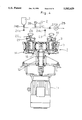
- FIG. 4 is a longitudinal sectional view of the planetary ball mill for use in carrying out the present invention.
- FIG. 5 is a partially longitudinal sectional view showing the operation of the mill pots.
- FIGS. 6 (A), (B) and (C) are sectional views respectively showing the change in operating conditions and the change in behavior in the mill pots.
- FIG. 4 shows an example of a planetary ball mill 1 used in the treatment process of sponge titanium powder according to an embodiment of the present invention.
- a plurality of mill pots 13 revolve due to rotation of a main shaft 12 driven by a motor 2.
- the mill pots 13 are evenly (i.e., symmetrically in case of two pots, or radially from the main shaft 12 with equal distance in case of three mill pots disposed around the main shaft 12, and these mill pots 13 themselves rotate round their own axis.
- a planetary gear 14 is disposed around each mill pot 13 rotating together with the main shaft 12, and a sun gear 15 mating with the planetary gears 14 is separately rotated or suspended (FIG.
- the planetary ball mill l has sufficient strength capable of being operated at high speed in which the composite acceleration ratio G exceeds 30 when calculated by the foregoing expression.
- the crushing balls B, serving as crushing mediums, and the sponge titanium powder M are placed in the mill pots 13, and the internal atmosphere of the mill pots 13 is filled with an inert gas such as Ar gas for preventing oxidation of the treated sponge titanium.
- a pipe 21 is mounted on a cap of each mill pot 13, and a couple of one-touch couplers are mounted on the top end thereof.
- the mill pots 13 are connected to a vacuum pump 25 through pipes 23, 26 and a valve 24A, to a pressure gauge 27 through a valve 24C and a pipe 28, and to an Ar gas charging bomb 3 through the pipe 26 and a valve 24B.
- a vacuum suction is performed by means of the vacuum pump 25 to remove the air from the mill pots 13.
- the mill pots 13 After reaching a required degree of vacuum degree, the mill pots 13 are filled with Ar gas from the Ar gas charging bomb 3 by completely closing the valve 24A while opening the valves 24B, 24d. Then, after the charged Ar gas pressure has reached a required pressure which is the same as atmospheric pressure or more, the valves 24B and 24d are completely closed so as to disconnect the pipe 21 from the pipe 23 at the one-touch coupler section 22.
- the Ar gas in the mill pots 13 is kept by either of the one-touch couplers 22.
- FIGS. 6 (A), (B) and (C) show a relation between motional conditions of the crushing medium (balls) B in a mill pot 13 and the angular velocity of revolution and rotation.
- ⁇ 1 indicates a revolutionary angular velocity
- ⁇ 2 indicates a rotational angular velocity relative to revolution
- the ratio R ⁇ 2 /107 1
- FIG. 6(A) shows a condition in the mill pot when R is 0.5.
- the balls B surge in a group along the inner periphery of the mill pot, thereby applying an effective compressive force and shearing force to the charged metallic powder between the inner peripheral surface and the balls or between one ball and another; thus the entire sponge titanium powder is effectively collapsed and densified or consolidated.
- the angular velocity ratio R between revolution and rotation was uniformly set to 0.5 in this example, and it was found preferable to set the ratio R in the range of 1.5 to 0.3.
- FIG. 2 is a diagram showing a relation of the same sample between the reduction rate of the angle of repose and the operating time of the planetary ball mill. In both FIGS.
- FIG. 3 is a diagram showing a relation between operating time of the ball mill and specific surface of the same sample during the passage of ten minutes, and in which measurement was performed by the BET method using a krypton gas.
- the curve in FIG. 3 is quite different from those in FIGS. 1 and 2. That is, the sponge fine is comprised of irregular and porous particles like a sponge at the initial stage of charging it into the mill pots of the planetary ball mill. At the first collapse stage, the voids of the fine particles are hardly collapsed and the entire shape of each particle spreads out to become flat and, therefore, the specific surface area itself is increased.
Landscapes
- Engineering & Computer Science (AREA)
- Food Science & Technology (AREA)
- Manufacture Of Metal Powder And Suspensions Thereof (AREA)
- Powder Metallurgy (AREA)
Applications Claiming Priority (2)
| Application Number | Priority Date | Filing Date | Title |
|---|---|---|---|
| JP6270628A JP2885098B2 (ja) | 1994-10-07 | 1994-10-07 | スポンジチタン粉の処理方法 |
| JP6-270628 | 1994-10-07 |
Publications (1)
| Publication Number | Publication Date |
|---|---|
| US5582629A true US5582629A (en) | 1996-12-10 |
Family
ID=17488742
Family Applications (1)
| Application Number | Title | Priority Date | Filing Date |
|---|---|---|---|
| US08/392,090 Expired - Fee Related US5582629A (en) | 1994-10-07 | 1995-02-22 | Treatment process of sponge titanium powder |
Country Status (2)
| Country | Link |
|---|---|
| US (1) | US5582629A (ja) |
| JP (1) | JP2885098B2 (ja) |
Cited By (6)
| Publication number | Priority date | Publication date | Assignee | Title |
|---|---|---|---|---|
| WO2004038048A1 (de) * | 2002-10-22 | 2004-05-06 | Plath Peter Joerg | Verfahren und vorrichtung zum durchführen einer tribochemischen reaktion |
| RU2634110C2 (ru) * | 2016-03-16 | 2017-10-23 | Российская Федерация, от имени которой выступает Государственная корпорация по атомной энергии "Росатом" (Госкорпорация "Росатом") | Способ получения металлического порошка |
| CN110237904A (zh) * | 2019-06-18 | 2019-09-17 | 湖南天欣科技股份有限公司 | 一种湿式球磨机的节能方法 |
| EP3561091A1 (en) * | 2011-12-22 | 2019-10-30 | Universal Achemetal Titanium, LLC | A method for extraction and refining of titanium |
| US10471512B2 (en) | 2014-06-16 | 2019-11-12 | Commonwealth Scientific And Industrial Research Organisation | Method of producing a powder product |
| CN116037935A (zh) * | 2023-02-16 | 2023-05-02 | 华中科技大学 | 一种金属汽车漆用近片状钛合金粉末、其制备方法和应用 |
Families Citing this family (10)
| Publication number | Priority date | Publication date | Assignee | Title |
|---|---|---|---|---|
| JP4766931B2 (ja) * | 2005-06-16 | 2011-09-07 | Ntn株式会社 | 誘電体セラミックスおよびその製造方法 |
| US7767151B2 (en) * | 2005-08-03 | 2010-08-03 | Wildcat Discovery Technologies, Inc. | High throughput mechanical alloying and screening |
| CN102896321B (zh) * | 2012-10-26 | 2016-03-02 | 攀钢集团攀枝花钢铁研究院有限公司 | 一种钛及钛合金碎料的处理方法 |
| CN105108160A (zh) * | 2015-09-08 | 2015-12-02 | 孙炜炜 | 一种铁钴基合金微波吸收材料及其制备方法 |
| CN105108161A (zh) * | 2015-09-09 | 2015-12-02 | 孙炜炜 | 一种Fe-Co-Al-Tb型合金吸波微粉及其制备工艺 |
| CN105057686A (zh) * | 2015-09-09 | 2015-11-18 | 孙炜炜 | 一种Fe-Co-Al-Ho型合金吸波微粉及其制备工艺 |
| CN105057685A (zh) * | 2015-09-09 | 2015-11-18 | 孙炜炜 | 一种添加Ce、Al的铁钴基合金吸波微粉的制备方法 |
| CN105108159A (zh) * | 2015-09-09 | 2015-12-02 | 孙炜炜 | 一种铁钴基吸波材料 |
| CN105033267A (zh) * | 2015-09-11 | 2015-11-11 | 孙炜炜 | 一种新型Fe-Co基吸波微粉及其制备方法 |
| CN105583403B (zh) * | 2016-01-21 | 2017-10-20 | 中核(天津)科技发展有限公司 | 一种铜镍合金粉料的制粒方法 |
Citations (3)
| Publication number | Priority date | Publication date | Assignee | Title |
|---|---|---|---|---|
| US3930841A (en) * | 1972-12-18 | 1976-01-06 | The International Nickel Company, Inc. | Thermoplastic prealloyed powder |
| US4761263A (en) * | 1985-05-24 | 1988-08-02 | Kernforschungszentrum Karlsruhe Gmbh | Process for producing formed amorphous bodies with improved, homogeneous properties |
| US4934610A (en) * | 1989-10-16 | 1990-06-19 | Westinghouse Electric Corp. | Method of comminuting reactive metals |
-
1994
- 1994-10-07 JP JP6270628A patent/JP2885098B2/ja not_active Expired - Fee Related
-
1995
- 1995-02-22 US US08/392,090 patent/US5582629A/en not_active Expired - Fee Related
Patent Citations (3)
| Publication number | Priority date | Publication date | Assignee | Title |
|---|---|---|---|---|
| US3930841A (en) * | 1972-12-18 | 1976-01-06 | The International Nickel Company, Inc. | Thermoplastic prealloyed powder |
| US4761263A (en) * | 1985-05-24 | 1988-08-02 | Kernforschungszentrum Karlsruhe Gmbh | Process for producing formed amorphous bodies with improved, homogeneous properties |
| US4934610A (en) * | 1989-10-16 | 1990-06-19 | Westinghouse Electric Corp. | Method of comminuting reactive metals |
Cited By (10)
| Publication number | Priority date | Publication date | Assignee | Title |
|---|---|---|---|---|
| WO2004038048A1 (de) * | 2002-10-22 | 2004-05-06 | Plath Peter Joerg | Verfahren und vorrichtung zum durchführen einer tribochemischen reaktion |
| CN100493784C (zh) * | 2002-10-22 | 2009-06-03 | 彼得·J·普拉思 | 用于实施摩擦化学反应的方法和设备 |
| EP3561091A1 (en) * | 2011-12-22 | 2019-10-30 | Universal Achemetal Titanium, LLC | A method for extraction and refining of titanium |
| US11280013B2 (en) | 2011-12-22 | 2022-03-22 | Universal Achemetal Titanium, Llc | System and method for extraction and refining of titanium |
| US10471512B2 (en) | 2014-06-16 | 2019-11-12 | Commonwealth Scientific And Industrial Research Organisation | Method of producing a powder product |
| US11224916B2 (en) | 2014-06-16 | 2022-01-18 | Commonwealth Scientific And Industrial Research Organisation | Method of producing a powder product |
| RU2634110C2 (ru) * | 2016-03-16 | 2017-10-23 | Российская Федерация, от имени которой выступает Государственная корпорация по атомной энергии "Росатом" (Госкорпорация "Росатом") | Способ получения металлического порошка |
| CN110237904A (zh) * | 2019-06-18 | 2019-09-17 | 湖南天欣科技股份有限公司 | 一种湿式球磨机的节能方法 |
| CN116037935A (zh) * | 2023-02-16 | 2023-05-02 | 华中科技大学 | 一种金属汽车漆用近片状钛合金粉末、其制备方法和应用 |
| CN116037935B (zh) * | 2023-02-16 | 2024-04-19 | 华中科技大学 | 一种金属汽车漆用近片状钛合金粉末、其制备方法和应用 |
Also Published As
| Publication number | Publication date |
|---|---|
| JPH08109406A (ja) | 1996-04-30 |
| JP2885098B2 (ja) | 1999-04-19 |
Similar Documents
| Publication | Publication Date | Title |
|---|---|---|
| US5582629A (en) | Treatment process of sponge titanium powder | |
| US6902699B2 (en) | Method for preparing cryomilled aluminum alloys and components extruded and forged therefrom | |
| US4066449A (en) | Method for processing and densifying metal powder | |
| JP4894008B2 (ja) | MoNb系焼結スパッタリングターゲット材の製造方法 | |
| US8728389B2 (en) | Fabrication of L12 aluminum alloy tanks and other vessels by roll forming, spin forming, and friction stir welding | |
| JP2860064B2 (ja) | Ti−Al合金ターゲット材の製造方法 | |
| JPH0776413B2 (ja) | 侵徹式弾丸を成形する方法 | |
| US5101547A (en) | Method and system for manufacturing superalloy disk | |
| NO760312L (ja) | ||
| US9194027B2 (en) | Method of forming high strength aluminum alloy parts containing L12 intermetallic dispersoids by ring rolling | |
| US4710345A (en) | Manufacturing method of super-heat-resisting alloy material | |
| CN115505814A (zh) | 一种Y-Ti-O氧化物颗粒增强FeCrNi中熵合金复合材料及其制备方法 | |
| JP2560565B2 (ja) | 水素吸蔵合金の製造方法 | |
| US4410488A (en) | Powder metallurgical process for producing a copper-based shape-memory alloy | |
| EP4620597A1 (en) | Method for manufacturing an article from a consolidated metallic powder composition | |
| JP3884741B2 (ja) | マグネシウム合金顆粒状粉体原料の製造方法 | |
| EP1779946B1 (en) | Supersolvus hot isostatic pressing and ring rolling of hollow powder forms | |
| AU2023407190A1 (en) | A method of producing spheroidal metallic particles | |
| JP2560566B2 (ja) | 水素吸蔵合金の製造方法 | |
| JP2560567B2 (ja) | 水素吸蔵合金の製造方法 | |
| WO2019140048A1 (en) | Methods for making titanium aluminide materials | |
| WO2002077299A2 (en) | Method for producing semifinished products from metals and alloys of a pseudopowder metallurgy | |
| RU2676126C1 (ru) | Способ получения прутковых заготовок из интерметаллидных сплавов для центробежного плазменного распыления | |
| JP2017141492A (ja) | チタン粉末製造用スポンジチタンの集合体およびその製造法 | |
| KR100268971B1 (ko) | 가역적 마르텐사이트 변태 거동을 나타내는 티탄계 형상기억 합금분말의 제조방법 |
Legal Events
| Date | Code | Title | Description |
|---|---|---|---|
| AS | Assignment |
Owner name: KURIMOTO, LTD., JAPAN Free format text: ASSIGNMENT OF ASSIGNORS INTEREST;ASSIGNORS:NAKAI, SANDAO;ARAKAWA, KAZUAKI;REEL/FRAME:007528/0168 Effective date: 19950213 |
|
| FPAY | Fee payment |
Year of fee payment: 4 |
|
| REMI | Maintenance fee reminder mailed | ||
| LAPS | Lapse for failure to pay maintenance fees | ||
| LAPS | Lapse for failure to pay maintenance fees |
Free format text: PATENT EXPIRED FOR FAILURE TO PAY MAINTENANCE FEES (ORIGINAL EVENT CODE: EXP.); ENTITY STATUS OF PATENT OWNER: LARGE ENTITY |
|
| STCH | Information on status: patent discontinuation |
Free format text: PATENT EXPIRED DUE TO NONPAYMENT OF MAINTENANCE FEES UNDER 37 CFR 1.362 |
|
| FP | Lapsed due to failure to pay maintenance fee |
Effective date: 20041210 |