US5629067A - Ceramic honeycomb structure with grooves and outer coating, process of producing the same, and coating material used in the honeycomb structure - Google Patents
Ceramic honeycomb structure with grooves and outer coating, process of producing the same, and coating material used in the honeycomb structure Download PDFInfo
- Publication number
- US5629067A US5629067A US08/008,313 US831393A US5629067A US 5629067 A US5629067 A US 5629067A US 831393 A US831393 A US 831393A US 5629067 A US5629067 A US 5629067A
- Authority
- US
- United States
- Prior art keywords
- honeycomb structure
- ceramic
- honeycomb body
- coating
- matrix
- Prior art date
- Legal status (The legal status is an assumption and is not a legal conclusion. Google has not performed a legal analysis and makes no representation as to the accuracy of the status listed.)
- Expired - Lifetime
Links
Images
Classifications
-
- C—CHEMISTRY; METALLURGY
- C04—CEMENTS; CONCRETE; ARTIFICIAL STONE; CERAMICS; REFRACTORIES
- C04B—LIME, MAGNESIA; SLAG; CEMENTS; COMPOSITIONS THEREOF, e.g. MORTARS, CONCRETE OR LIKE BUILDING MATERIALS; ARTIFICIAL STONE; CERAMICS; REFRACTORIES; TREATMENT OF NATURAL STONE
- C04B41/00—After-treatment of mortars, concrete, artificial stone or ceramics; Treatment of natural stone
- C04B41/009—After-treatment of mortars, concrete, artificial stone or ceramics; Treatment of natural stone characterised by the material treated
-
- C—CHEMISTRY; METALLURGY
- C04—CEMENTS; CONCRETE; ARTIFICIAL STONE; CERAMICS; REFRACTORIES
- C04B—LIME, MAGNESIA; SLAG; CEMENTS; COMPOSITIONS THEREOF, e.g. MORTARS, CONCRETE OR LIKE BUILDING MATERIALS; ARTIFICIAL STONE; CERAMICS; REFRACTORIES; TREATMENT OF NATURAL STONE
- C04B41/00—After-treatment of mortars, concrete, artificial stone or ceramics; Treatment of natural stone
- C04B41/45—Coating or impregnating, e.g. injection in masonry, partial coating of green or fired ceramics, organic coating compositions for adhering together two concrete elements
- C04B41/50—Coating or impregnating, e.g. injection in masonry, partial coating of green or fired ceramics, organic coating compositions for adhering together two concrete elements with inorganic materials
- C04B41/5024—Silicates
-
- C—CHEMISTRY; METALLURGY
- C04—CEMENTS; CONCRETE; ARTIFICIAL STONE; CERAMICS; REFRACTORIES
- C04B—LIME, MAGNESIA; SLAG; CEMENTS; COMPOSITIONS THEREOF, e.g. MORTARS, CONCRETE OR LIKE BUILDING MATERIALS; ARTIFICIAL STONE; CERAMICS; REFRACTORIES; TREATMENT OF NATURAL STONE
- C04B41/00—After-treatment of mortars, concrete, artificial stone or ceramics; Treatment of natural stone
- C04B41/80—After-treatment of mortars, concrete, artificial stone or ceramics; Treatment of natural stone of only ceramics
- C04B41/81—Coating or impregnation
- C04B41/85—Coating or impregnation with inorganic materials
-
- F—MECHANICAL ENGINEERING; LIGHTING; HEATING; WEAPONS; BLASTING
- F01—MACHINES OR ENGINES IN GENERAL; ENGINE PLANTS IN GENERAL; STEAM ENGINES
- F01N—GAS-FLOW SILENCERS OR EXHAUST APPARATUS FOR MACHINES OR ENGINES IN GENERAL; GAS-FLOW SILENCERS OR EXHAUST APPARATUS FOR INTERNAL-COMBUSTION ENGINES
- F01N3/00—Exhaust or silencing apparatus having means for purifying, rendering innocuous, or otherwise treating exhaust
- F01N3/08—Exhaust or silencing apparatus having means for purifying, rendering innocuous, or otherwise treating exhaust for rendering innocuous
- F01N3/10—Exhaust or silencing apparatus having means for purifying, rendering innocuous, or otherwise treating exhaust for rendering innocuous by thermal or catalytic conversion of noxious components of exhaust
- F01N3/24—Exhaust or silencing apparatus having means for purifying, rendering innocuous, or otherwise treating exhaust for rendering innocuous by thermal or catalytic conversion of noxious components of exhaust characterised by constructional aspects of converting apparatus
- F01N3/28—Construction of catalytic reactors
- F01N3/2803—Construction of catalytic reactors characterised by structure, by material or by manufacturing of catalyst support
- F01N3/2825—Ceramics
- F01N3/2828—Ceramic multi-channel monoliths, e.g. honeycombs
-
- F—MECHANICAL ENGINEERING; LIGHTING; HEATING; WEAPONS; BLASTING
- F01—MACHINES OR ENGINES IN GENERAL; ENGINE PLANTS IN GENERAL; STEAM ENGINES
- F01N—GAS-FLOW SILENCERS OR EXHAUST APPARATUS FOR MACHINES OR ENGINES IN GENERAL; GAS-FLOW SILENCERS OR EXHAUST APPARATUS FOR INTERNAL-COMBUSTION ENGINES
- F01N2330/00—Structure of catalyst support or particle filter
- F01N2330/06—Ceramic, e.g. monoliths
-
- F—MECHANICAL ENGINEERING; LIGHTING; HEATING; WEAPONS; BLASTING
- F02—COMBUSTION ENGINES; HOT-GAS OR COMBUSTION-PRODUCT ENGINE PLANTS
- F02B—INTERNAL-COMBUSTION PISTON ENGINES; COMBUSTION ENGINES IN GENERAL
- F02B1/00—Engines characterised by fuel-air mixture compression
- F02B1/02—Engines characterised by fuel-air mixture compression with positive ignition
- F02B1/04—Engines characterised by fuel-air mixture compression with positive ignition with fuel-air mixture admission into cylinder
-
- Y—GENERAL TAGGING OF NEW TECHNOLOGICAL DEVELOPMENTS; GENERAL TAGGING OF CROSS-SECTIONAL TECHNOLOGIES SPANNING OVER SEVERAL SECTIONS OF THE IPC; TECHNICAL SUBJECTS COVERED BY FORMER USPC CROSS-REFERENCE ART COLLECTIONS [XRACs] AND DIGESTS
- Y10—TECHNICAL SUBJECTS COVERED BY FORMER USPC
- Y10T—TECHNICAL SUBJECTS COVERED BY FORMER US CLASSIFICATION
- Y10T428/00—Stock material or miscellaneous articles
- Y10T428/24—Structurally defined web or sheet [e.g., overall dimension, etc.]
- Y10T428/24149—Honeycomb-like
-
- Y—GENERAL TAGGING OF NEW TECHNOLOGICAL DEVELOPMENTS; GENERAL TAGGING OF CROSS-SECTIONAL TECHNOLOGIES SPANNING OVER SEVERAL SECTIONS OF THE IPC; TECHNICAL SUBJECTS COVERED BY FORMER USPC CROSS-REFERENCE ART COLLECTIONS [XRACs] AND DIGESTS
- Y10—TECHNICAL SUBJECTS COVERED BY FORMER USPC
- Y10T—TECHNICAL SUBJECTS COVERED BY FORMER US CLASSIFICATION
- Y10T428/00—Stock material or miscellaneous articles
- Y10T428/24—Structurally defined web or sheet [e.g., overall dimension, etc.]
- Y10T428/24149—Honeycomb-like
- Y10T428/24157—Filled honeycomb cells [e.g., solid substance in cavities, etc.]
-
- Y—GENERAL TAGGING OF NEW TECHNOLOGICAL DEVELOPMENTS; GENERAL TAGGING OF CROSS-SECTIONAL TECHNOLOGIES SPANNING OVER SEVERAL SECTIONS OF THE IPC; TECHNICAL SUBJECTS COVERED BY FORMER USPC CROSS-REFERENCE ART COLLECTIONS [XRACs] AND DIGESTS
- Y10—TECHNICAL SUBJECTS COVERED BY FORMER USPC
- Y10T—TECHNICAL SUBJECTS COVERED BY FORMER US CLASSIFICATION
- Y10T428/00—Stock material or miscellaneous articles
- Y10T428/24—Structurally defined web or sheet [e.g., overall dimension, etc.]
- Y10T428/24174—Structurally defined web or sheet [e.g., overall dimension, etc.] including sheet or component perpendicular to plane of web or sheet
-
- Y—GENERAL TAGGING OF NEW TECHNOLOGICAL DEVELOPMENTS; GENERAL TAGGING OF CROSS-SECTIONAL TECHNOLOGIES SPANNING OVER SEVERAL SECTIONS OF THE IPC; TECHNICAL SUBJECTS COVERED BY FORMER USPC CROSS-REFERENCE ART COLLECTIONS [XRACs] AND DIGESTS
- Y10—TECHNICAL SUBJECTS COVERED BY FORMER USPC
- Y10T—TECHNICAL SUBJECTS COVERED BY FORMER US CLASSIFICATION
- Y10T428/00—Stock material or miscellaneous articles
- Y10T428/24—Structurally defined web or sheet [e.g., overall dimension, etc.]
- Y10T428/24744—Longitudinal or transverse tubular cavity or cell
Definitions
- the present invention relates generally to a ceramic honeycomb structure, a process of producing the honeycomb structure, and a coating material used in the structure.
- the invention is particularly concerned with a technique for effectively reinforcing the ceramic honeycomb structure and facilitating production thereof, assuring easy and wide application of the honeycomb structure produced.
- a catalytic converter having a ceramic honeycomb structure as a catalyst substrate or support is utilized for purifying automobile exhaust gas or emissions.
- the ceramic honeycomb structure is formed by extrusion as an integral body with a multiplicity of through-holes or cells defined by honeycomb thin walls.
- honeycomb structures are connected in series to thereby increase the total volume of the honeycomb structures, the resistance to flow of exhaust gas from an automobile engine is undesirably increased with a result of a reduced engine power, for example.
- exhaust gases emitted by a diesel engine car are purified in terms of particulates emitted particularly from the diesel engine, as well as NOx, CO, and HC which are also emitted from an ordinary gasoline engine car.
- a diesel particulate filter DPF
- the honeycomb structure is employed to remove NOx and others by a three-way catalytic conversion. Since a relatively large amount and high concentration of exhaust gases are emitted by the type of vehicles, such as large-sized buses and trucks, in which diesel engines are installed, a sufficiently large-sized honeycomb structure having an outside diameter of as large as 300 mm is needed to purify the exhaust gases in the manner as described above.
- the thus extruded honeycomb body has a low mechanical strength and may therefore suffer from breakage or deformation of the cells due to its own weight, which results in lowered dimensional accuracy of the resulting honeycomb product. Since a portion of the honeycomb structure having such defective cells is likely to be broken at the early period of use of the structure, due to the lower mechanical strength thereof compared to the other portions, it is necessary to remove the defects in the cells to assure a sufficiently high strength of the thin-walled honeycomb structure as a whole.
- the thin-walled honeycomb structure consists of normal cells which do not include distorted or deformed cells of low mechanical strength and has an integrally formed outer wall which is free from cracks, such a honeycomb structure is still unsatisfactory in its isostatic strength (i.e., strength to endure uniform gripping force exerted on the outer wall) when the structure is subjected to canning. This makes it necessary to provide a reinforcing member on the outer wall of the structure.
- JP-B2-51-44713 it is proposed in JP-B2-51-44713 to cover the outer periphery of the honeycomb structure with a mixture of sodium silicate and zirconium silicate, in order to reinforce the structure.
- a water-repellent reinforcing refractories may be provided on the outer circumferential surface of the honeycomb structure, as disclosed in Publication No. 50-48858 of unexamined Japanese Utility Model Application (JP-U-50-48858). It is also proposed to provide a glaze coating on the outer circumferential surface of the honeycomb structure, as disclosed in JP-U-53-133860.
- JP-A-56-129042 assigned to the assignee of the present application to fill passages or through-holes in an outer peripheral portion of a honeycomb support with a suitable ceramic material, so as to strengthen the outer peripheral portion.
- JP-U-63-144836 also assigned to the present assignee, it is proposed to provide a covering layer as reinforcing means on the outer wall of the honeycomb structure so as to compensate for a difference between the actual diameter and an intended diameter of the structure.
- the known reinforcing means provided on the outer periphery of the honeycomb structure may be unsatisfactory in their reinforcing effects, or may have poor heat-resistance properties.
- the covering layer indicated just above tends to peel off or form cracks therein, for example.
- none of the known honeycomb structures is satisfactory in all terms of its mechanical strength, heat-resistance, thermal shock resistance and operating reliability, to the extent required for the structure to appropriately serve as a honeycomb catalyst support for purifying automobile exhaust gases.
- the first object may be accomplished according to a first aspect of the present invention, which provides a ceramic honeycomb structure comprising: a ceramic honeycomb body having a matrix of partition walls forming a multiplicity of cells extending in an axial direction of the honeycomb body, a radially outermost array of the multiplicity of cells being open to an outside of the honeycomb body in radial directions thereof, to provide a plurality of grooves formed in an outer periphery of the honeycomb body so as to extend in the axial direction; and an outer coating which fills at least the grooves to cover the outer periphery of the ceramic honeycomb body, so as to provide an outer surface of the honeycomb structure.
- the ceramic honeycomb body is formed at its outer periphery with axial grooves, which are filled with a coating material for forming the outer coating which gives an outer surface of the honeycomb structure.
- the thus constructed honeycomb structure is effectively reinforced by the outer coating, without suffering from reduction of the strength during its use due to peeling-off of the coating. Further, the thermal shock resistance of the honeycomb structure is not deteriorated even if the outer coating is provided for reinforcing the honeycomb body.
- the present honeycomb structure thus reinforced is free from peeling of the outer coating, crack formation and others, assuring significantly improved heat resistance and thermal shock resistance.
- the honeycomb structure having such characteristics may be easily produced with effectively enhanced dimensional accuracy, to achieve a desired outside diameter and cylindricity.
- the thus obtained honeycomb structure is suitably used for a catalytic converter or exhaust gas purifying apparatus.
- the second object may be accomplished according to a second aspect of the present invention, which provides a process of producing a ceramic honeycomb structure comprising the steps of: (a) preparing a ceramic honeycomb body having a matrix of partition walls forming a multiplicity of cells extending in an axial direction of the honeycomb body, a radially outermost array of the multiplicity of cells being open to an outside of the honeycomb body in radial directions thereof, to provide a plurality of grooves formed in an outer periphery of the honeycomb body to extend in the axial direction; (b) preparing a coating material comprising as major components cordierite particles and/or ceramic fibers, and a colloidal oxide; (c) applying the coating material to the outer periphery of the ceramic honeycomb body to fill the grooves, so as to form an outer coating which gives an outer surface of the honeycomb structure; and (d) drying or firing the outer coating formed on the outer periphery of the ceramic honeycomb body so that the outer coating is secured to the ceramic honeycomb body.
- the third object may be accomplished according to a third aspect of the invention, which provides a coating material used for forming an outer coating of a ceramic honeycomb structure, comprising as major components cordierite particles and/or ceramic fibers, and a colloidal oxide.
- the coating material including the cordierite particles and/or ceramic fibers as an aggregate and the colloidal oxide as an inorganic binder is advantageously used for forming the outer coating which forms an outer surface of the ceramic honeycomb structure.
- the honeycomb structure with the thus formed outer coating exhibits an effectively increased isostatic strength and an excellent thermal shock resistance.
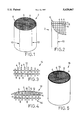
- FIG. 1 is a perspective view showing a honeycomb body formed by extrusion, which has distorted cells and cracks in its outer peripheral portion;
- FIG. 2 is a fragmentary enlarged view showing the distorted cells and cracks in the honeycomb body of FIG. 1;
- FIG. 3 is an enlarged view showing an outer peripheral portion of a ceramic honeycomb body used in the present invention.
- FIG. 4 is a view corresponding to that of FIG. 3, in which an outer coating is formed on the outer periphery of the ceramic honeycomb body of FIG. 3;
- FIG. 5 is a perspective view of one embodiment of a ceramic honeycomb structure of the present invention, in which the ceramic honeycomb body of FIG. 3 has grooves at its outer periphery, which are filled with a coating material which gives the outer coating.
- the ceramic honeycomb body which constitutes the ceramic honeycomb structure of the present invention is usually formed using a cordierite ceramic material by extrusion, drying and firing.
- a cordierite ceramic material by extrusion, drying and firing.
- the honeycomb body produced suffers from deformation or distortion of the cells in its outer peripheral portion, and from cracks which may occur in the outer wall (outer circumferential surface).
- a honeycomb body 2 which is integrally formed by extrusion using a cordierite ceramic material, has a matrix of partition walls 4 forming a multiplicity of through-holes or cells 6 whose size is determined depending upon its specific application.
- the cells 6 of the honeycomb body 2 are defined or partitioned by the walls 4, and extend from one axial end of the body 2 to the other.
- the partition walls 4 in an outer peripheral portion of the honeycomb body 2 are deformed, giving rise to a distorted cell portion 8 in which the cells 6 are distorted or deformed, while some cracks 10 are formed in the outer wall of the honeycomb body 2.
- a three-way catalytic converter or diesel particulate filter (DPF) using a ceramic honeycomb structure is installed on an automobile such that the honeycomb structure provided with a wire mesh wound on its outer circumference is accommodated in a casing. If the honeycomb body 2 having the distorted cell portion 8 and cracks 10 as described above is used as the ceramic honeycomb structure, the honeycomb body 2 will be broken within the casing, due to a compressive force exerted on its outer periphery, and thus fails to serve as a catalytic converter or filter.
- the honeycomb body 2 needs to be reinforced, it is no use providing the known reinforcing means on the outer periphery of the honeycomb body 2 with its radially outer portion suffering cracks or defects (e.g., distortion) of the cells, since the breakage takes place upon insertion of the honeycomb body 2 into the casing, at a portion of the body 2 which has the lowest mechanical strength. While the honeycomb body 2 thus reinforced may have an increased mechanical strength at its outer peripheral portion including the reinforcing means, the distorted cell portion 8 provided with no reinforcing means has the lowest mechanical strength, and is therefore most likely to be broken. Thus, providing reinforcing means on the outer periphery of the honeycomb body 2 does not yield sufficient reinforcing effects, in the presence of the cells being distorted or deformed.
- cracks or defects e.g., distortion
- the honeycomb body 2 suffering no distortion of the cells 6 in its outer peripheral portion still suffers from a considerably low mechanical strength (which is represented by the isostatic strength as indicated above) as the thickness of the walls 4 is reduced, making it necessary to reinforce the honeycomb body 2. If a reinforcing layer is provided on the outer periphery of the honeycomb body 2 with its outer wall left as it is, the thickness of the outer wall is inevitably increased, with a result of an increased difference between the thicknesses of the partition walls 4 and the outer wall.
- the honeycomb structure is subject to increased thermal stresses when it expands or contracts at a high temperature of exhaust gas during its use, or upon baking of the catalyst on the ceramic support during its manufacture, whereby cracks are likely to be formed in the structure, i.e., the thermal shock resistance is deteriorated.
- the contact area between the reinforcing layer and the honeycomb body is relatively small if the honeycomb body is reinforced with the reinforcing layer covering or coating the outer wall. Therefore, the reinforcing layer is likely to peel off, and fails to provide a sufficiently high reinforcing effect.
- the ceramic honeycomb body of the ceramic honeycomb structure according to the present invention does not have an integrally formed outer wall.
- the honeycomb body has a plurality of axial grooves formed at its outer periphery and defined by the partition walls forming the cells. More specifically described referring to FIG. 3, a ceramic honeycomb body 14 has a matrix of thin partition walls 4 forming a multiplicity of cells 6 which extend in the axial direction of the body 14, and a plurality of axial grooves 12 corresponding to a radially outermost array of the cells 6 which are not separated by walls 4 from the outside of the body 14, i.e., which are open to the outside in the radial directions.
- This honeycomb body 14 with the grooves 12 may be easily produced by grinding the outer peripheral portion of the honeycomb body 2 (FIG. 1) produced by the known extrusion method and having an integral outer wall, until the outer wall and the distorted cell portion are removed from the honeycomb body 2.
- the honeycomb body 14 may be also formed by extrusion without an outer wall, with its outer peripheral portion being shaped as shown in FIG. 3. In the latter case, it is easy to control the extruding rate for the honeycomb body consisting solely of a relatively uniform honeycombed portion, taking no account of the extruding rate for the outer wall which needs a different amount of material batch from the honeycombed portion. Accordingly, distortion or deformation of the cells in the outer peripheral portion is effectively limited or avoided.
- the ceramic honeycomb body 14 of the present invention does not include distorted cells in its outer peripheral portion, whereby a honeycomb structure using the honeycomb body 14 does not include a portion having an excessively low mechanical strength. Accordingly, the honeycomb structure is given a significantly improved isostatic strength by providing an outer coating 16 (which will be described) on the outer periphery of the honeycomb body 14.
- the outer coating 16 having a suitable thickness is formed such that at least the grooves 12 are filled with a reinforcing coating material which gives the coating 16, whereby an intended ceramic honeycomb structure is obtained which is reinforced at its outer periphery.
- a suitable coating material is applied to the outer peripheral portion of the honeycomb body 14 as shown in FIG. 3, so as to fill at least the axial grooves 12 which are open to the outside, as shown in FIGS. 4 and 5, to thereby provide a ceramic honeycomb structure 18 having the outer coating 16 as its outer wall.
- the honeycomb structure 18 whose outer surface is provided by the coating 16 has a suitably controlled outer diameter and cylindricity, and assures an effectively improved isostatic strength.
- the honeycomb body 14 does not have an integrally formed outer wall, and thus may be formed with a relatively thin outer wall given by the outer coating 16, while assuring a similarly high degree of mechanical strength as the known honeycomb body with a reinforcing layer formed on its integral outer wall.
- the difference in the thicknesses of the honeycomb partition walls 4 and the outer wall (outer coating) 16 can be advantageously reduced, thereby alleviating the thermal stresses which occur between the outer wall 16 and the honeycomb body 14, and making the honeycomb structure 18 highly resistant to thermal shock.
- the thermal expansion and contraction of the reinforcing coating material applied to the honeycomb body 14 are generally greater than those of the honeycomb body 14, such expansion and contraction may be effectively alleviated by the partition walls 4 which define the axial grooves 12 and the cells 6, resulting in reduction in the strains which occur in the outer wall (16) formed of the coating material. Consequently, the honeycomb structure 18 whose outer surface is provided by the outer coating 16 filling the axial grooves 12 ensures a sufficiently high mechanical strength upon its installation on an automobile, and displays an excellent thermal shock resistance with high reliability during its use.
- the outer coating 16 which gives the outer wall of the structure 18 is generally formed by using an aggregate and an inorganic binder for bonding the aggregate together.
- Particularly used as the aggregate is cordierite in the form of particles (sintered powder) which has a small coefficient of thermal expansion and whose crystal phase has not been changed due to its heat history.
- the outer coating 16 has a primary crystal phase which consists of cordierite.
- the cordierite particles are preferably used as the aggreagate for the following reason. Namely, upon heating and cooling of the honeycomb structure, thermal stresses occurring in various portions of the structure are concentrated to the interface between the honeycomb body and outer coating. Such thermal stresses are minimized when the honeycomb body and outer coating have the same degree of thermal expansion.
- the lower thermal expansion of the outer coating is preferred for effectively preventing cracks and other defects in the outer coating (outer wall) due to the thermal stresses.
- it is effective to reduce the thermal expansion of the aggregate, to be lower than that of a matrix provided by the inorganic binder having a relatively high coefficient of thermal expansion. Accordingly, cordierite having a small coefficient of thermal expansion is favorably used as the aggregate, to thereby reduce the thermal expansion of the outer coating, and make the resultant honeycomb structure highly resistant to thermal stresses.
- the cordierite used as the aggregate is generally in the form of a sintered powder having the average particle size of 50 ⁇ m or smaller.
- the cordierite powder is a blend of relatively minute particles and relatively coarse particles.
- the cordierite powder is a mixture of first particles of the average particle size of 15 ⁇ m or smaller, and second particles of the average particle size of 30 ⁇ m or larger.
- the cordierite particles may be wholly or partially replaced by ceramic fibers formed of amorphous mullite or amorphous silica alumina, for example. The use of such ceramic fibers is advantageous in avoiding cracks in the outer coating and effectively preventing peeling-off of the coating.
- the ceramic fibers have a fiber length of 10-15 ⁇ m and a fiber diameter of about 2-3 ⁇ m.
- the aggregate such as the cordierite particles or ceramic fibers as described above, is bonded together by the above-indicated matrix provided by an inorganic binder which constitutes the outer coating.
- the matrix is generally an amorphous oxide matrix, which is preferably formed by using colloidal silica or colloidal alumina as the inorganic binder. While known inorganic binders, such as water glass or alumina cement, may be used as the inorganic binder according to the present invention, the use of colloidal silica or colloidal alumina in particular leads to significantly enhanced heat resistance of the outer coating 16 as the outer wall of the honeycomb body 14, and significantly improved thermal shock resistance of the honeycomb structure 18 thus obtained.
- the outer coating 16 desirably contains 3-35 parts by weight of the solid portion of the colloidal oxides per 100 parts by weight of the cordierite particles and/or ceramic fibers.
- the colloidal oxides need to be used in a proportion of at least 3 parts so as to provide an adequate strength of the outer coating and appropriately bond the cordierite particles or ceramic fibers together. Too large proportion of the use of the colloidal oxides results in deterioration of the thermal properties of the outer coating, and consequently, those of the honeycomb structure as a whole.
- a coating material is favorably used which contains the above-indicated cordierite particles and/or ceramic fibers and colloidal oxides as major components.
- the coating material forms the outer coating which gives the outer peripheral portion of the honeycomb structure.
- a suitable aid such as an organic binder, for adjusting its viscosity, in view of the work efficiency in coating the honeycomb body with the coating material.
- the thus prepared coating material is applied to the outer periphery of the honeycomb body 14 as shown in FIG. 3, which has the axial grooves 12 formed in the outer periphery according to the invention.
- the coating material thus applied fill the grooves 12 of the honeycomb body 14, and provide the outer coating 16 having a suitable thickness.
- the honeycomb body 14 is coated with the coating material by various known coating methods, which include brush coating, dipping, spray coating, flow coating or slushing.
- the spray coating is carried out with the viscosity of the coating material suitably reduced.
- the outer coating 16 thus formed on the outer surface of the honeycomb body 14 is then dried or fired as needed, depending upon the kind of the coating material used, whereby the outer coating 16 is secured to the ceramic honeycomb body 14.
- the honeycomb body 14 may be fired upon the firing of the outer coating 16.
- the present ceramic honeycomb structure 18 is obtained by filling with the coating material at least the axial grooves 12 formed in the outer periphery of the ceramic honeycomb body 14, so as to provide the outer coating (reinforcing layer) 16 which serves as the outer wall that gives the outer surface of the structure 18.
- the thus obtained honeycomb structure 18 is excellent in its heat resistance and thermal shock resistance, assuring a high strength sufficient for its practical use.
- the honeycomb structure 18 has an isostatic strength of 3 kg/cm 2 or higher, is resistant to thermal shock of 700° C. or higher, and suffer from cracks at 800° C. or higher. While the honeycomb structure 18 having these properties may be advantageously used as a catalyst support for purifying exhaust gases, the same structure may be favorably used as a diesel particulate filter (DPF) or a rotary heat regenerator, for example.
- DPF diesel particulate filter
- a first group of cordierite honeycomb bodies were prepared, each having an outside diameter of 300 mm, a length of 300 mm, a honeycomb wall thickness of 150 ⁇ m, and 62 cells per 1 cm 2 of cross sectional area, and being formed integrally with an outer circumferential wall.
- These cordierite honeycomb bodies had distorted cell portions (8) in respective outer peripheral portions, as shown in FIGS. 1 and 2. The distortion or deformation of the cells in the portion (8) was inevitably caused by the weight of the honeycomb body per se having the outside diameter as large as 300 mm.
- a second group of cordierite honeycomb bodies were prepared each having an outside diameter of 310 mm, a length of 300 mm, a honeycomb wall thickness of 150 ⁇ m, and 62 cells per 1 cm 2 of cross sectional area.
- Each of these honeycomb bodies had an integrally formed outer wall, and distorted cells in its outer peripheral portion.
- the outer peripheral portion was ground to eliminate the distorted cells, to thereby provide a 300 mm-diameter honeycomb body (as shown in FIG. 3) having axial grooves (12) which are open on its outer circumferential surface.
- coating materials No. 1 through No. 5 were prepared using a cordierite powder A and an inorganic binder A, B or C as indicated in TABLE 1, which were mixed together in the proportions as indicated in TABLE 2. The mixture was kneaded with water, into a paste which can be applied to the ceramic honeycomb body. In this manner, the coating materials Nos. 1-5 having respective compositions as indicated in TABLE 2 were prepared.
- the coating materials as indicated in TABLE 2 were applied to the outer peripheries of the first group of non-grooved honeycomb bodies each having the integral outer wall and the second group of grooved honeycomb bodies (without outer walls) having axial grooves in their outer peripheral portions.
- the honeycomb bodies were then exposed to the atmosphere for 24 hours, and dried for two hours at 90° C., to thereby provide various cordierite honeycomb structures provided with respective outer coatings.
- the thickness of the outer coatings thus formed were in a range of about 0.1-1 mm.
- Various performance tests were effected to determine the properties of the respective cordierite honeycomb structures with the outer coatings.
- a cordierite honeycomb structure formed integrally with an outer wall and having an outside diameter of 300 mm, a length of 300 mm, a honeycomb wall thickness of 150 ⁇ m, and 62 cells per 1 cm 2 of cross sectional area.
- This comparative example had no axial grooves and no outer coating at the outer periphery thereof. Similar performance tests were effected on this honeycomb structure, and the results of the tests are indicated in TABLE 3 below.
- the isostatic strength was tested in the following manner, using four test specimens (i.e., honeycomb structures) for each item in TABLE 3. Initially, each test specimen was sealed with about 20 mm-thickness aluminum sheets applied to the upper and lower end faces of the specimen via about 0.5 mm-thickness urethane sheets, and with a 0.5 mm-thickness urethane sheet surrounding the outer circumferential surface of the specimen. Then, the specimen was put into a pressure vessel filled with water, and the pressure in the vessel was raised incrementally, until the noise of crack formation took place when the pressure was measured as the isostatic strength.
- test specimen i.e., honeycomb structures
- the thermal shock resistance and crack-forming temperature were measured in the following manner, using three test specimens (i.e., honeycomb structures) for each item in TABLE 3.
- the test results as indicated in TABLE 3 are of the average of the three test specimens. Initially, a honeycomb structure as a test specimen was disposed on a metal screen in a frame, heated in an electric furnace held at 700° C., and then took out of the furnace after one hour. Then, the appearance of the honeycomb structure was visually observed, and the outer wall of the structure was lightly tapped with a thin metal stick.
- the honeycomb structure was held out of the furnace for an hour and cooled down to the room temperature, and then reheated in the electric furnace held at a temperature which is 25° C. or 50° C. higher than the previous heating temperature. These steps were repeated until the honeycomb structure was broken. The breakage was detected when any crack was found or the tapping sound was dull.
- the thermal shock resistance as indicated in TABLE 3 is represented by the maximum temperature at which the honeycomb structure was not broken. In this test, if no crack was found in the outer coating when the honeycomb structure was broken, the above heating steps were repeated until any crack was found in the coating. In TABLE 3, the temperature of crack formation is represented by the heating temperature at which a crack was first found.
- the peel-off strength was tested in the following manner. Initially, a test specimen of 30 mm-length honeycomb body was cut out of each honeycomb structure, which specimen is provided at one of its opposite end faces with an outer coating of 10 mm ⁇ 10 mm. Then, metal sheets of 30 mm ⁇ 30 mm ⁇ 10 mm were bonded to the one end face (with the coating) and the other end face of the specimen, and were pulled away from each other until the coating was peeled off, and a pulling force upon peeling of the coating was measured as the peel-off strength.
- the vibration test was conducted by winding a wire mesh around the outer periphery of each honeycomb structure, canning or inserting the structure into a casing, and subjecting the canned structure to vibrations of 200 Hz at an acceleration of 20 G for 100 hours, to determine whether the outer coating was peeled off or not.
- the result of this test is also indicated in TABLE 3.
- the honeycomb structure with the axial grooves does not include such distorted cell portion, and can therefore be effectively reinforced by the outer coating.
- the reduction of the thermal shock resistance and the low temperature of crack formation in the outer coating are considered to be related with the overall thickness of the outer wall of the structure and the area of contact between the coating and the honeycomb body. Namely, the thickness of the outer wall of the honeycomb structure is increased with the outer coating formed on the outer wall portion of the honeycomb body which is integral with the honeycombed body portion, whereby the tensile stress occuring in the outer wall is increased due to a difference in the coefficient of contraction between the honeycombed body portion and the outer wall of the structure.
- the outer wall of the structure does not include the outer wall portion of the honeycomb body but consists solely of the outer coating filling the grooves. Since the tensile stress occuring in the outer coating is absorbed by the partition walls defining the grooves, which receive the tensile strain as contraction stress acting thereon, the reduction of the thermal shock resistance can be prevented or alleviated. These phenomena have no relation with the presence of a distorted cell portion in the honeycomb body.
- the honeycomb structure While the isostatic strength may be increased by providing the outer coating on a non-grooved honeycomb body having an integrally formed outer wall portion and no distorted cell portion, the honeycomb structure still suffers from reduction in the thermal shock resistance and the low temperature of crack formation. This makes substantially no difference from the honeycomb structure having a non-grooved honeycomb body with an integrally formed outer wall portion and a distorted cell portion.
- the honeycomb structure using the non-grooved honeycomb body exhibits a relatively low peel-off strength with respect to the outer coating formed on the honeycomb body, with a result of peeling of the coating in the vibration test.
- the honeycomb structure in which the outer coating is provided on the grooved honeycomb body exhibits a relatively high peel-off strength, causing no peeling of the coating in the vibration test.
- the honeycomb structure with the grooves formed at its outer periphery and filled with the coating material has excellent characteristics, such as higher degrees of the isostatic strength and thermal shock resistance and no peeling of the outer coating from the honeycomb body, compared to the structure having a non-grooved honeycomb body. While the honeycomb structure having no outer coating has a poor isostatic strength and cannot be used as a catalyst support or for other practical use, the honeycomb structure of the present invention, which has the grooves and outer coating as described above, exhibits enhanced isostatic strength and thermal shock resistance, and can therefore be favorably employed in practical use.
- Various coating materials Nos. 1-3 and 6-23 as indicated in TABLE 4 through TABLE 7 were prepared using the raw materials having properties as shown in TABLE 1, and the prepared material batches were mixed and kneaded with water, and formed into respective masses of paste adapted for coating on honeycomb bodies.
- Each of the coating materials was applied to the cordierite honeycomb body 12 with the axial grooves as shown in FIG. 3, exposed to the atmosphere for 24 hours, and then dried at 90° C. for two hours, to provide a cordierite honeycomb structure with the corresponding outer coating.
- the thus obtained honeycomb structures were evaluated in terms of the isostatic strength, thermal shock resistance and temperature of crack formation in the outer coating, and the results are indicated in TABLE 8.
- the honeycomb structure has a remarkably increased isostatic strength when a water glass or alumina cement is used as the inorganic binder of the outer coating while the structure has considerably high degrees of both of the isostatic strength and thermal shock resistance when colloidal silica or colloidal alumina is used as the inorganic binder. Accordingly, it is preferred to employ colloidal oxides, such as colloidal silica or colloidal alumina, as the inorganic binder of the outer coating, rather than water glass or alumina cement, so as to assure excellent properties of the resultant honeycomb structure provided with the outer coating.
- colloidal oxides such as colloidal silica or colloidal alumina
- the isostatic strength is more or less increased when the conventionally used zirconium silicate powder is used as the aggregate of the coating material, as compared with when a cordierite powder is used, the use of the cordierite powder leads to significant improvements in the thermal shock resistance and temperature of crack formation in the outer coating. Presumably, this is due to the higher coefficient of thermal expansion of cordierite than zirconium silicate.
- the increased isostatic strength is considered to be derived from the fact that the inorganic binder effectively acts on the zirconium silicate powder which has the lower porosity than the cordierite powder used in this example.
- the use of either powder assures the same level of isostatic strength. Namely, when the material used as the aggregate has a relatively high porosity, the inorganic binder tends to intrude into the aggregate particles, making it difficult for the binder to effectively function to bond the particles together. Accordingly, it is preferable to use an aggregate, particularly cordierite particles, having a relatively low porosity.
- the cordierite powder used as the aggregate of the outer coating is preferably a mixture of minute particles (having the average particle size of 10 ⁇ m) and coarse particles (having the average particle size of 30 ⁇ m), since the use of such mixture leads to a higher isostatic strength as compared with when the cordierite powder consists solely of the minute particles, coarse particles, or intermediate particles (having the average particle size of 20 ⁇ m). This is because the cordierite particles having a two-step particle size distribution are closely packed together, thereby enabling the outer coating to effectively function as a reinforcing wall for the honeycomb body.
- the total amount or a part of the cordierite powder may be favorably replaced by ceramic fibers to provide the aggregate, assuring the same degrees of thermal shock resistance and isostatic strength as when only the cordierite powder is used as the aggregate. Further, the use of the ceramic fibers leads to a relatively high crack-forming temperature at which cracks are formed in the outer coating.
Landscapes
- Chemical & Material Sciences (AREA)
- Engineering & Computer Science (AREA)
- Ceramic Engineering (AREA)
- Organic Chemistry (AREA)
- Materials Engineering (AREA)
- Structural Engineering (AREA)
- Chemical Kinetics & Catalysis (AREA)
- Inorganic Chemistry (AREA)
- Health & Medical Sciences (AREA)
- Toxicology (AREA)
- Combustion & Propulsion (AREA)
- Mechanical Engineering (AREA)
- General Engineering & Computer Science (AREA)
- Catalysts (AREA)
Applications Claiming Priority (4)
| Application Number | Priority Date | Filing Date | Title |
|---|---|---|---|
| JP4010392 | 1992-01-30 | ||
| JP4-40103 | 1992-01-30 | ||
| JP4351934A JP2613729B2 (ja) | 1992-01-30 | 1992-12-09 | セラミックハニカム構造体及びその製造法並びにそのためのコート材 |
| JP4-351934 | 1992-12-09 |
Publications (1)
| Publication Number | Publication Date |
|---|---|
| US5629067A true US5629067A (en) | 1997-05-13 |
Family
ID=26379536
Family Applications (1)
| Application Number | Title | Priority Date | Filing Date |
|---|---|---|---|
| US08/008,313 Expired - Lifetime US5629067A (en) | 1992-01-30 | 1993-01-25 | Ceramic honeycomb structure with grooves and outer coating, process of producing the same, and coating material used in the honeycomb structure |
Country Status (3)
| Country | Link |
|---|---|
| US (1) | US5629067A (de) |
| EP (1) | EP0554104B1 (de) |
| DE (1) | DE69306820T2 (de) |
Cited By (98)
| Publication number | Priority date | Publication date | Assignee | Title |
|---|---|---|---|---|
| US5846899A (en) * | 1996-03-29 | 1998-12-08 | Ngk Insulators, Ltd. | Ceramic honeycomb catalyst having excellent thermal shock resistance |
| US6015285A (en) * | 1998-01-30 | 2000-01-18 | Gas Research Institute | Catalytic combustion process |
| US6156698A (en) * | 1997-06-06 | 2000-12-05 | Mitsubishi Heavy Industries, Ltd. | Honeycomb catalyst and manufacturing method therefor |
| US20010036427A1 (en) * | 2000-03-31 | 2001-11-01 | Ngk Insulators, Ltd. | Cell structure mounting container and assembly thereof |
| US20020197193A1 (en) * | 2000-01-13 | 2002-12-26 | Takashi Harada | Honeycomb structure |
| US6551535B2 (en) * | 2001-01-30 | 2003-04-22 | Acs Industries, Inc. | Extrusion coating process for catalytic monoliths |
| WO2003076047A1 (en) * | 2002-03-08 | 2003-09-18 | Ngk Insulators, Ltd. | Honeycomb structural body, method of manufacturing the structural body, and exhaust emission control system |
| US6667012B1 (en) * | 1999-03-26 | 2003-12-23 | Cabot Corporation | Catalytic converter |
| US6710014B2 (en) * | 2000-05-13 | 2004-03-23 | Dmc2 Degussa Metals Catalysts Cerdec Ag | Honeycomb body made of material with improved radial pressure resistance |
| US6726977B2 (en) * | 2000-10-12 | 2004-04-27 | Ngk Insulators, Ltd. | Cordierite honeycomb structure and manufacturing method thereof |
| WO2004063125A1 (ja) | 2003-01-09 | 2004-07-29 | Ngk Insulators, Ltd. | コート材、セラミックスハニカム構造体及びその製造方法 |
| US20050120691A1 (en) * | 2002-03-13 | 2005-06-09 | Ngk Insulators, Ltd. | Exhaust gas purifying filter |
| US20050147791A1 (en) * | 2003-12-29 | 2005-07-07 | Gulati Suresh T. | High-strength thin-walled honeycombs |
| US6946013B2 (en) | 2002-10-28 | 2005-09-20 | Geo2 Technologies, Inc. | Ceramic exhaust filter |
| US20050250391A1 (en) * | 2002-11-16 | 2005-11-10 | Phoenix Contact Gmbh & Co. Kg | Tension spring clip comprising symmetrical tension springs |
| US20050255288A1 (en) * | 2002-04-26 | 2005-11-17 | Ngk Insulators, Ltd. | Honeycomb structure producing method, and honeycomb structure |
| US20050255021A1 (en) * | 2004-05-04 | 2005-11-17 | Difrancesco Chris E | Catalyst systems advantageous for high particulate matter environments |
| US20050261128A1 (en) * | 2002-09-25 | 2005-11-24 | Ngk Insulators, Ltd. | Honeycomb catalyst carrier and method for production thereof |
| US20060083935A1 (en) * | 2004-03-11 | 2006-04-20 | Carre Alain R E | Ceramic composition with silsesquioxane polymer |
| US20060105139A1 (en) * | 2002-06-17 | 2006-05-18 | Hitachi Metals, Ltd. | Ceramic honeycomb structure, process for producing the same and coat material for use in the production |
| US20060169384A1 (en) * | 2003-01-20 | 2006-08-03 | Ngk Insulators, Ltd | Method of producing honeycomb structure body |
| US20060168908A1 (en) * | 2003-09-12 | 2006-08-03 | Ngk Insulators, Ltd. | Honeycomb structural body and method of manufacturing the same |
| US20060228519A1 (en) * | 2004-03-05 | 2006-10-12 | Ngk Insulators, Ltd. | Honeycomb structure and method of producing the same |
| US20060272306A1 (en) * | 2005-06-01 | 2006-12-07 | Kirk Brian S | Ceramic wall flow filter manufacture |
| FR2886869A1 (fr) * | 2005-06-14 | 2006-12-15 | Saint Gobain Ct Recherches | Structure et filtre catalytique pour la filtration d'un gaz comprenant un ciment hydrophobe ou oleophobe |
| US20070009707A1 (en) * | 2005-07-07 | 2007-01-11 | Ngk Insulators, Ltd. | Honeycomb structure |
| US20070039298A1 (en) * | 2003-09-29 | 2007-02-22 | Shinya Tokumaru | Ceramic honeycomb filter, its production method, and plugging material for ceramic honeycomb filter |
| US7211232B1 (en) | 2005-11-07 | 2007-05-01 | Geo2 Technologies, Inc. | Refractory exhaust filtering method and apparatus |
| US20070108647A1 (en) * | 2005-11-16 | 2007-05-17 | Bilal Zuberi | Method of forming a porous substrate having inorganic bonds |
| US20070141255A1 (en) * | 2005-12-21 | 2007-06-21 | Bilal Zuberi | Method and apparatus for strengthening a porous substrate |
| US20070169451A1 (en) * | 2003-12-24 | 2007-07-26 | Saint-Gobain Centre De Recherches Et D'etudes Euro | Block for filtering particles contained in exchaust gases of an internal combustion engine |
| US20070184240A1 (en) * | 2006-02-03 | 2007-08-09 | Ngk Insulators, Ltd. | Method of manufacturing plugged honeycomb structure and plugged honeycomb structure |
| US20070220871A1 (en) * | 2005-11-16 | 2007-09-27 | Bilal Zuberi | Method and Apparatus for Filtration of a Two-Stroke Engine Exhaust |
| US20070243357A1 (en) * | 2006-03-30 | 2007-10-18 | Ngk Insulators, Ltd. | Honeycomb structure and method of producing the same |
| CN100344587C (zh) * | 2003-03-05 | 2007-10-24 | 日本碍子株式会社 | 蜂窝状结构体及其制造方法 |
| US20080031793A1 (en) * | 2006-08-01 | 2008-02-07 | Difrancesco Chris E | Compositions and methods for treating exhaust gases |
| US20080083201A1 (en) * | 2005-05-27 | 2008-04-10 | Ibiden Co., Ltd. | Honeycomb filter |
| US20080086992A1 (en) * | 2006-10-09 | 2008-04-17 | Manngmbh | Filter Device |
| US20080090087A1 (en) * | 2004-09-13 | 2008-04-17 | Toru Shoji | Coating Material For Platinum Material, Platinum Material Coated With Such Coating Material, And Glass Manufacturing Apparatus |
| US20080176029A1 (en) * | 2006-07-03 | 2008-07-24 | Ngk Insulators, Ltd. | Honeycomb structure and method for manufacturing the same |
| US20080202087A1 (en) * | 2007-02-28 | 2008-08-28 | Ibiden Co., Ltd. | Honeycomb structure |
| US20080220203A1 (en) * | 2004-01-15 | 2008-09-11 | Ngk Insulators, Ltd. | Cell Structure And Method Of Manufacturing The Same |
| US7427309B2 (en) | 1999-09-29 | 2008-09-23 | Ibiden Co., Ltd. | Honeycomb filter and ceramic filter assembly |
| US20080241014A1 (en) * | 2005-11-16 | 2008-10-02 | Geo2 Technologies, Inc. | Low coefficient of thermal expansion materials including modified aluminosilicate fibers and methods of manufacture |
| US20080242530A1 (en) * | 2005-11-16 | 2008-10-02 | Geo2 Technologies, Inc. | Low coefficient of thermal expansion materials including nonstoichiometric cordierite fibers and methods of manufacture |
| US7444805B2 (en) | 2005-12-30 | 2008-11-04 | Geo2 Technologies, Inc. | Substantially fibrous refractory device for cleaning a fluid |
| US7451849B1 (en) | 2005-11-07 | 2008-11-18 | Geo2 Technologies, Inc. | Substantially fibrous exhaust screening system for motor vehicles |
| US20090000260A1 (en) * | 2005-11-16 | 2009-01-01 | Geo2 Technologies, Inc. | Fibrous Cordierite Materials |
| US20090010523A1 (en) * | 2006-03-16 | 2009-01-08 | Ngk Insulators, Ltd. | Method of inspecting outer wall of honeycomb structure body |
| US20090019770A1 (en) * | 2007-07-20 | 2009-01-22 | Pall Corporation | Catalytic element |
| US20090035511A1 (en) * | 2007-07-31 | 2009-02-05 | Geo2 Technologies, Inc. | Fiber-Based Ceramic Substrate and Method of Fabricating the Same |
| US20090110875A1 (en) * | 2007-10-31 | 2009-04-30 | Earl David A | Low Thermal Expansion High Strength Honeycomb Cement And Method Therefor |
| US20090113863A1 (en) * | 2007-11-05 | 2009-05-07 | Yanxia Lu | Low Expansion Cement Compositions for Ceramic Monoliths |
| US20090136710A1 (en) * | 2006-06-23 | 2009-05-28 | Ngk Insulators, Ltd. | Honeycomb structure and method for manufacturing same |
| US20090142544A1 (en) * | 2007-11-30 | 2009-06-04 | Earl David A | Honeycomb Cement With Ceramic-Forming Crystallizable Glass And Method Therefor |
| US20090166910A1 (en) * | 2005-11-16 | 2009-07-02 | Geo2 Technologies, Inc. | System and Method for Twin Screw Extrusion of a Fibrous Porous Substrate |
| US7563415B2 (en) | 2006-03-03 | 2009-07-21 | Geo2 Technologies, Inc | Catalytic exhaust filter device |
| US7572311B2 (en) | 2002-10-28 | 2009-08-11 | Geo2 Technologies, Inc. | Highly porous mullite particulate filter substrate |
| US7574796B2 (en) | 2002-10-28 | 2009-08-18 | Geo2 Technologies, Inc. | Nonwoven composites and related products and methods |
| US7582270B2 (en) | 2002-10-28 | 2009-09-01 | Geo2 Technologies, Inc. | Multi-functional substantially fibrous mullite filtration substrates and devices |
| US20090217524A1 (en) * | 2008-02-28 | 2009-09-03 | Jeffrey John Domey | Method and apparatus for manufacturing a honeycomb article |
| US20090220699A1 (en) * | 2008-02-28 | 2009-09-03 | Ngk Insulators, Ltd. | Method for manufacturing ceramic honeycomb structure and coating material used for the method |
| US20090239032A1 (en) * | 2007-03-27 | 2009-09-24 | Ngk Insulators, Ltd. | Plugged honeycomb structure |
| US20090239031A1 (en) * | 2007-03-27 | 2009-09-24 | Ngk Insulators, Ltd. | Plugged honeycomb structure |
| US20090324455A1 (en) * | 2008-02-05 | 2009-12-31 | Ngk Insulators, Ltd. | Honeycomb filter and method for manufacturing the same |
| US20100009117A1 (en) * | 2006-12-27 | 2010-01-14 | Shunji Okazaki | Ceramic honeycomb structure and its production method |
| US20100048374A1 (en) * | 2005-11-16 | 2010-02-25 | James Jenq Liu | System and Method for Fabricating Ceramic Substrates |
| US7682577B2 (en) | 2005-11-07 | 2010-03-23 | Geo2 Technologies, Inc. | Catalytic exhaust device for simplified installation or replacement |
| US7682578B2 (en) | 2005-11-07 | 2010-03-23 | Geo2 Technologies, Inc. | Device for catalytically reducing exhaust |
| US20100080930A1 (en) * | 2007-03-28 | 2010-04-01 | Hitachi Metals, Ltd. | Method for producing ceramic honeycomb structure |
| US20100112280A1 (en) * | 2007-07-26 | 2010-05-06 | Ngk Insulators, Ltd. | Coating material for honeycomb structure |
| US20100119719A1 (en) * | 2008-11-10 | 2010-05-13 | Ngk Insulators, Ltd. | Method for manufacturing ceramic honeycomb structure and coating material for the ceramic honeycomb structure |
| US7722828B2 (en) | 2005-12-30 | 2010-05-25 | Geo2 Technologies, Inc. | Catalytic fibrous exhaust system and method for catalyzing an exhaust gas |
| US20100151185A1 (en) * | 2007-05-18 | 2010-06-17 | Hatachi Metals, Ltd. | Ceramic honeycomb structure and its production method |
| US20100218596A1 (en) * | 2009-02-27 | 2010-09-02 | David Lewin Poff | Methods and apparatus for testing a honeycomb body |
| US7807110B2 (en) | 2004-03-12 | 2010-10-05 | Cormetech Inc. | Catalyst systems |
| US20110094419A1 (en) * | 2008-12-15 | 2011-04-28 | Fernando Joseph A | Ceramic Honeycomb Structure Skin Coating |
| US20110126973A1 (en) * | 2009-11-30 | 2011-06-02 | Andrewlavage Jr Edward Francis | Apparatus And Method For Manufacturing A Honeycomb Article |
| US20110224071A1 (en) * | 2010-03-12 | 2011-09-15 | Ngk Insulators, Ltd. | Outer periphery-coating material, outer periphery-coated honeycomb structure and process for production thereof |
| CN101147882B (zh) * | 2002-06-17 | 2012-07-18 | 日立金属株式会社 | 陶瓷蜂窝构造体及其制造方法、及其制造中所用的涂材 |
| US8334043B2 (en) | 2008-03-20 | 2012-12-18 | Dow Global Technologies Llc | Cement to make thermal shock resistant ceramic honeycomb structures and method to make them |
| US20140041349A1 (en) * | 2012-08-13 | 2014-02-13 | Ngk Insulators, Ltd. | Plugged honeycomb structure |
| US9028946B2 (en) | 2009-06-29 | 2015-05-12 | Dow Global Technologies Llc | Ceramic honeycomb structure with applied inorganic skin |
| US9840444B2 (en) | 2011-10-11 | 2017-12-12 | Hitachi Metals, Ltd. | Production method of ceramic honeycomb structure, and ceramic honeycomb structure |
| US20180065275A1 (en) * | 2015-03-25 | 2018-03-08 | Corning Incorporated | Systems for and methods of drying the skin of a cellular ceramic ware |
| US9950964B2 (en) | 2011-10-11 | 2018-04-24 | Hitachi Metals Ltd. | Ceramic honeycomb structure and its production method |
| US10195814B2 (en) * | 2016-03-25 | 2019-02-05 | Ngk Insulators, Ltd. | Honeycomb structure |
| US10472527B2 (en) | 2015-03-25 | 2019-11-12 | Ngk Insulators, Ltd. | Circumference coating material, bonding material, honeycomb structure, and method of producing honeycomb structure |
| CN110922212A (zh) * | 2018-09-20 | 2020-03-27 | 日本碍子株式会社 | 外周涂层材料、外周涂层蜂窝结构体以及集尘用过滤器 |
| US10603633B2 (en) | 2012-02-24 | 2020-03-31 | Corning Incorporated | Honeycomb structure comprising a cement skin composition with crystalline inorganic fibrous material |
| US10633297B2 (en) | 2018-03-16 | 2020-04-28 | Ngk Insulators, Ltd. | Method of manufacturing honeycomb structure |
| CN111744286A (zh) * | 2019-03-27 | 2020-10-09 | 日本碍子株式会社 | 蜂窝结构体的制造方法 |
| US11046859B2 (en) | 2019-02-28 | 2021-06-29 | Ngk Insulators, Ltd. | Coating material for honeycomb structure, outer peripheral coating of honeycomb structure, and honeycomb structure with outer peripheral coating |
| US11142485B2 (en) | 2017-03-22 | 2021-10-12 | Ngk Insulators, Ltd. | Circumferential coating material, circumferential coated honeycomb structure |
| US20220176368A1 (en) * | 2019-04-18 | 2022-06-09 | Corning Incorporated | Low bulk density, high geometric surface area honeycomb bodies |
| US11884598B2 (en) | 2019-03-12 | 2024-01-30 | Corning, Incorporated | Ceramic honeycomb body with skin |
| US11890609B2 (en) | 2019-09-12 | 2024-02-06 | Corning Incorporated | Honeycomb bodies with improved skin CTE and isostatic strength and methods of making the same |
| US12060305B2 (en) | 2018-06-29 | 2024-08-13 | Corning Incorporated | Ceramic honeycomb bodies having high-strength skin and manufacturing methods thereof |
Families Citing this family (24)
| Publication number | Priority date | Publication date | Assignee | Title |
|---|---|---|---|---|
| JP3768550B2 (ja) * | 1994-03-11 | 2006-04-19 | 日本碍子株式会社 | セラミックハニカム構造体 |
| WO1996016000A1 (en) * | 1994-11-18 | 1996-05-30 | Du Pont Lanxide Composites Inc. | High temperature, thermal shock resistant ceramic structures |
| JP4159155B2 (ja) * | 1998-01-22 | 2008-10-01 | 株式会社日本自動車部品総合研究所 | セラミックハニカム構造体および押出金型 |
| JP3553424B2 (ja) * | 1999-06-22 | 2004-08-11 | 日本碍子株式会社 | セラミックハニカム構造体、セラミックハニカム触媒担体及びこれらを用いたセラミックハニカム触媒コンバータ |
| JP2001261428A (ja) * | 2000-03-14 | 2001-09-26 | Ngk Insulators Ltd | セラミックハニカム構造体 |
| FR2853258A3 (fr) * | 2003-04-03 | 2004-10-08 | Faurecia Systemes Dechappement | Systeme de maintien d'un substrat ceramique "skinless" |
| US7083842B2 (en) * | 2003-07-28 | 2006-08-01 | Ngk Insulators, Ltd. | Honeycomb structure and process for production thereof |
| JP4504660B2 (ja) * | 2003-11-13 | 2010-07-14 | 日本碍子株式会社 | セラミックハニカム構造体 |
| EP1699554A4 (de) | 2003-12-31 | 2007-12-26 | Corning Inc | Keramikstrukturen mit hydrophoben überzügen |
| JP4358662B2 (ja) * | 2004-03-23 | 2009-11-04 | 日本碍子株式会社 | コーディエライト質ハニカム構造体の製造方法 |
| JP2006255542A (ja) * | 2005-03-16 | 2006-09-28 | Ngk Insulators Ltd | セラミックハニカム構造体 |
| JP2006298745A (ja) | 2005-03-24 | 2006-11-02 | Ngk Insulators Ltd | ハニカム構造体の製造方法及びハニカム構造体 |
| DE102008004036B3 (de) * | 2008-01-11 | 2009-07-09 | Audi Ag | Verfahren zur Herstellung eines Wabenstrukturkörpers für einen Katalysator eines Kraftfahrzeuges sowie Wabenstrukturkörper-Rohling |
| WO2009118810A1 (ja) * | 2008-03-24 | 2009-10-01 | イビデン株式会社 | ハニカム構造体 |
| WO2009141891A1 (ja) * | 2008-05-20 | 2009-11-26 | イビデン株式会社 | ハニカム構造体 |
| CN101678348B (zh) * | 2008-05-20 | 2012-07-18 | 揖斐电株式会社 | 蜂窝结构体 |
| US10052792B2 (en) | 2011-03-17 | 2018-08-21 | Corning Incorporated | Method and system for control of an axial skinning apparatus |
| US9670809B2 (en) | 2011-11-29 | 2017-06-06 | Corning Incorporated | Apparatus and method for skinning articles |
| US9139479B2 (en) | 2012-02-24 | 2015-09-22 | Corning Incorporated | Honeycomb structure comprising a cement skin composition with crystalline inorganic fibrous material |
| US9239296B2 (en) | 2014-03-18 | 2016-01-19 | Corning Incorporated | Skinning of ceramic honeycomb bodies |
| US10611051B2 (en) | 2013-10-15 | 2020-04-07 | Corning Incorporated | Systems and methods for skinning articles |
| CN105170194A (zh) * | 2015-09-17 | 2015-12-23 | 山东奥福环保科技股份有限公司 | 催化剂载体保护套及其应用 |
| CN105503235A (zh) * | 2015-12-15 | 2016-04-20 | 凯龙蓝烽新材料科技有限公司 | 一种外皮牢固度高、抗热震性强的蜂窝陶瓷的制备方法 |
| CN111170709A (zh) * | 2019-12-26 | 2020-05-19 | 南京柯瑞特种陶瓷股份有限公司 | 蜂窝陶瓷外表皮植皮泥料的制备方法及制得的植皮泥料 |
Citations (21)
| Publication number | Priority date | Publication date | Assignee | Title |
|---|---|---|---|---|
| JPS5048858A (de) * | 1973-09-01 | 1975-05-01 | ||
| JPS5144713A (de) * | 1974-08-16 | 1976-04-16 | Gen Motors Corp | |
| US3983283A (en) * | 1974-03-18 | 1976-09-28 | Corning Glass Works | Honeycombed structures having open-ended cells formed by interconnected walls with longitudinally extending discontinuities |
| JPS53133860A (en) * | 1977-04-22 | 1978-11-22 | Komatsu Ltd | Robbot control system |
| GB2071640A (en) * | 1980-03-14 | 1981-09-23 | Ngk Insulators Ltd | Ceramic honeycomb body |
| JPS56129043A (en) * | 1980-03-14 | 1981-10-08 | Ngk Insulators Ltd | Honeycomb structure of ceramic |
| US4335023A (en) * | 1980-01-24 | 1982-06-15 | Engelhard Corporation | Monolithic catalyst member and support therefor |
| US4451517A (en) * | 1981-07-18 | 1984-05-29 | Nippon Soken, Inc. | Ceramic honeycomb catalyst support coated with activated alumina |
| JPS63144836A (ja) * | 1986-12-09 | 1988-06-17 | Mitsubishi Electric Corp | 成型装置 |
| US4756976A (en) * | 1983-09-30 | 1988-07-12 | Kabushiki Kaisha Toshiba | Ceramic with anisotropic heat conduction |
| JPS6467262A (en) * | 1987-09-07 | 1989-03-13 | Toto Kagaku Kogyo Kk | Wire mesh with ceramic heat buffer |
| US4840827A (en) * | 1987-03-16 | 1989-06-20 | Ngk Insulators, Ltd. | Ceramic honeycomb structural bodies and method of producing the same |
| JPH01192764A (ja) * | 1988-01-29 | 1989-08-02 | Ibiden Co Ltd | 炭化ケイ素質ハニカム構造体の製造方法 |
| US4869944A (en) * | 1987-02-12 | 1989-09-26 | Ngk Insulators, Ltd. | Cordierite honeycomb-structural body and a method for producing the same |
| US4877670A (en) * | 1985-12-27 | 1989-10-31 | Ngk Insulators, Ltd. | Cordierite honeycomb structural body and method of producing the same |
| JPH0286847A (ja) * | 1988-09-22 | 1990-03-27 | Ngk Insulators Ltd | ハニカム構造体およびその製造法 |
| EP0449556A2 (de) * | 1990-03-27 | 1991-10-02 | Ngk Insulators, Ltd. | Herstellung von keramischen Körpern mit Wabenstruktur |
| US5063029A (en) * | 1990-04-12 | 1991-11-05 | Ngk Insulators, Ltd. | Resistance adjusting type heater and catalytic converter |
| US5073432A (en) * | 1988-08-02 | 1991-12-17 | Ngk Insulators, Ltd. | Honeycomb structure and method of producing the same |
| US5207989A (en) * | 1991-03-22 | 1993-05-04 | Acs Industries, Inc. | Seal for catalytic converter and method therefor |
| US5514446A (en) * | 1994-03-11 | 1996-05-07 | Ngk Insulators, Ltd. | Ceramic honeycomb structural body |
-
1993
- 1993-01-25 US US08/008,313 patent/US5629067A/en not_active Expired - Lifetime
- 1993-01-29 EP EP93300657A patent/EP0554104B1/de not_active Expired - Lifetime
- 1993-01-29 DE DE69306820T patent/DE69306820T2/de not_active Expired - Lifetime
Patent Citations (24)
| Publication number | Priority date | Publication date | Assignee | Title |
|---|---|---|---|---|
| JPS5048858A (de) * | 1973-09-01 | 1975-05-01 | ||
| US3983283A (en) * | 1974-03-18 | 1976-09-28 | Corning Glass Works | Honeycombed structures having open-ended cells formed by interconnected walls with longitudinally extending discontinuities |
| JPS5144713A (de) * | 1974-08-16 | 1976-04-16 | Gen Motors Corp | |
| JPS53133860A (en) * | 1977-04-22 | 1978-11-22 | Komatsu Ltd | Robbot control system |
| US4335023A (en) * | 1980-01-24 | 1982-06-15 | Engelhard Corporation | Monolithic catalyst member and support therefor |
| JPS56129043A (en) * | 1980-03-14 | 1981-10-08 | Ngk Insulators Ltd | Honeycomb structure of ceramic |
| JPS56129042A (en) * | 1980-03-14 | 1981-10-08 | Ngk Insulators Ltd | Honeycomb structure of ceramic |
| US4455336A (en) * | 1980-03-14 | 1984-06-19 | Ngk Insulators, Ltd. | Ceramic honeycomb structural bodies |
| GB2071640A (en) * | 1980-03-14 | 1981-09-23 | Ngk Insulators Ltd | Ceramic honeycomb body |
| US4451517A (en) * | 1981-07-18 | 1984-05-29 | Nippon Soken, Inc. | Ceramic honeycomb catalyst support coated with activated alumina |
| US4756976A (en) * | 1983-09-30 | 1988-07-12 | Kabushiki Kaisha Toshiba | Ceramic with anisotropic heat conduction |
| US4877670A (en) * | 1985-12-27 | 1989-10-31 | Ngk Insulators, Ltd. | Cordierite honeycomb structural body and method of producing the same |
| JPS63144836A (ja) * | 1986-12-09 | 1988-06-17 | Mitsubishi Electric Corp | 成型装置 |
| US4869944A (en) * | 1987-02-12 | 1989-09-26 | Ngk Insulators, Ltd. | Cordierite honeycomb-structural body and a method for producing the same |
| US4840827A (en) * | 1987-03-16 | 1989-06-20 | Ngk Insulators, Ltd. | Ceramic honeycomb structural bodies and method of producing the same |
| JPS6467262A (en) * | 1987-09-07 | 1989-03-13 | Toto Kagaku Kogyo Kk | Wire mesh with ceramic heat buffer |
| JPH01192764A (ja) * | 1988-01-29 | 1989-08-02 | Ibiden Co Ltd | 炭化ケイ素質ハニカム構造体の製造方法 |
| US5073432A (en) * | 1988-08-02 | 1991-12-17 | Ngk Insulators, Ltd. | Honeycomb structure and method of producing the same |
| JPH0286847A (ja) * | 1988-09-22 | 1990-03-27 | Ngk Insulators Ltd | ハニカム構造体およびその製造法 |
| EP0449556A2 (de) * | 1990-03-27 | 1991-10-02 | Ngk Insulators, Ltd. | Herstellung von keramischen Körpern mit Wabenstruktur |
| US5188779A (en) * | 1990-03-27 | 1993-02-23 | Ngk Insulators, Ltd. | Production of ceramic honeycomb structural bodies |
| US5063029A (en) * | 1990-04-12 | 1991-11-05 | Ngk Insulators, Ltd. | Resistance adjusting type heater and catalytic converter |
| US5207989A (en) * | 1991-03-22 | 1993-05-04 | Acs Industries, Inc. | Seal for catalytic converter and method therefor |
| US5514446A (en) * | 1994-03-11 | 1996-05-07 | Ngk Insulators, Ltd. | Ceramic honeycomb structural body |
Non-Patent Citations (4)
| Title |
|---|
| Database WPI, Section Ch, Week 8916, Derwent Publications Ltd., London, GB; Class L02, An 89 119916 & JP A 1 067 262 (Toto Kagaku Kogyo K Kiriyama Seisakusho KK) 13 Mar. 1989. * |
| Database WPI, Section Ch, Week 8916, Derwent Publications Ltd., London, GB; Class L02, An 89-119916 & JP-A-1 067 262 (Toto Kagaku Kogyo K Kiriyama Seisakusho KK) 13 Mar. 1989. |
| Patent Abstracts of Japan, vol. 013, No. 491 (C 650) 7 Nov. 1989 & JP A 01 192 764 (Ibiden Co Ltd) 2 Aug. 1989. * |
| Patent Abstracts of Japan, vol. 013, No. 491 (C-650) 7 Nov. 1989 & JP-A-01 192 764 (Ibiden Co Ltd) 2 Aug. 1989. |
Cited By (176)
| Publication number | Priority date | Publication date | Assignee | Title |
|---|---|---|---|---|
| US5846899A (en) * | 1996-03-29 | 1998-12-08 | Ngk Insulators, Ltd. | Ceramic honeycomb catalyst having excellent thermal shock resistance |
| US6156698A (en) * | 1997-06-06 | 2000-12-05 | Mitsubishi Heavy Industries, Ltd. | Honeycomb catalyst and manufacturing method therefor |
| US6015285A (en) * | 1998-01-30 | 2000-01-18 | Gas Research Institute | Catalytic combustion process |
| US6667012B1 (en) * | 1999-03-26 | 2003-12-23 | Cabot Corporation | Catalytic converter |
| US7427309B2 (en) | 1999-09-29 | 2008-09-23 | Ibiden Co., Ltd. | Honeycomb filter and ceramic filter assembly |
| US8080082B2 (en) | 1999-09-29 | 2011-12-20 | Ibiden Co., Ltd. | Honeycomb filter and method for producing the honeycomb filter |
| US20110070129A1 (en) * | 1999-09-29 | 2011-03-24 | Ibiden Co., Ltd. | Honeycomb filter and method for producing the honeycomb filter |
| US20100209310A1 (en) * | 1999-09-29 | 2010-08-19 | Ibiden Co., Ltd. | Honeycomb filter and method for producing the honeycomb filter |
| US8083826B2 (en) | 1999-09-29 | 2011-12-27 | Ibiden Co., Ltd. | Honeycomb filter and method for producing the honeycomb filter |
| US7749458B2 (en) | 2000-01-13 | 2010-07-06 | Ngk Insulators, Ltd. | Honeycomb structure |
| US20020197193A1 (en) * | 2000-01-13 | 2002-12-26 | Takashi Harada | Honeycomb structure |
| US20010036427A1 (en) * | 2000-03-31 | 2001-11-01 | Ngk Insulators, Ltd. | Cell structure mounting container and assembly thereof |
| US6710014B2 (en) * | 2000-05-13 | 2004-03-23 | Dmc2 Degussa Metals Catalysts Cerdec Ag | Honeycomb body made of material with improved radial pressure resistance |
| US6726977B2 (en) * | 2000-10-12 | 2004-04-27 | Ngk Insulators, Ltd. | Cordierite honeycomb structure and manufacturing method thereof |
| US6551535B2 (en) * | 2001-01-30 | 2003-04-22 | Acs Industries, Inc. | Extrusion coating process for catalytic monoliths |
| US20050095179A1 (en) * | 2002-03-08 | 2005-05-05 | Ngk Insulators, Ltd | Honeycomb structural body, method of manufacturing the structural body, and exhaust emission control system |
| WO2003076047A1 (en) * | 2002-03-08 | 2003-09-18 | Ngk Insulators, Ltd. | Honeycomb structural body, method of manufacturing the structural body, and exhaust emission control system |
| US7867456B2 (en) | 2002-03-08 | 2011-01-11 | Ngk Insulators, Ltd. | Honeycomb structure, method of manufacturing the structure, and exhaust emission control system |
| US7297175B2 (en) * | 2002-03-13 | 2007-11-20 | Ngk Insulators, Ltd. | Exhaust gas purifying filter |
| US20050120691A1 (en) * | 2002-03-13 | 2005-06-09 | Ngk Insulators, Ltd. | Exhaust gas purifying filter |
| US20050255288A1 (en) * | 2002-04-26 | 2005-11-17 | Ngk Insulators, Ltd. | Honeycomb structure producing method, and honeycomb structure |
| US7276276B2 (en) * | 2002-04-26 | 2007-10-02 | Ngk Insulators, Ltd. | Honeycomb structure producing method, and honeycomb structure |
| CN101147882B (zh) * | 2002-06-17 | 2012-07-18 | 日立金属株式会社 | 陶瓷蜂窝构造体及其制造方法、及其制造中所用的涂材 |
| US7727613B2 (en) | 2002-06-17 | 2010-06-01 | Hitachi Metals, Ltd. | Ceramic honeycomb structure, process for producing the same and coat material for use in the production |
| US20060105139A1 (en) * | 2002-06-17 | 2006-05-18 | Hitachi Metals, Ltd. | Ceramic honeycomb structure, process for producing the same and coat material for use in the production |
| US7591918B2 (en) | 2002-06-17 | 2009-09-22 | Hitachi Metals, Ltd. | Ceramic honeycomb structure and its production method and coating material used therefor |
| CN100341623C (zh) * | 2002-06-17 | 2007-10-10 | 日立金属株式会社 | 陶瓷蜂窝构造体及其制造方法、及其制造中所用的涂材 |
| US20070158879A1 (en) * | 2002-06-17 | 2007-07-12 | Hitachi Metals, Ltd. | Ceramic honeycomb structure and its production method and coating material used therefor |
| US20050261128A1 (en) * | 2002-09-25 | 2005-11-24 | Ngk Insulators, Ltd. | Honeycomb catalyst carrier and method for production thereof |
| US7572311B2 (en) | 2002-10-28 | 2009-08-11 | Geo2 Technologies, Inc. | Highly porous mullite particulate filter substrate |
| US7574796B2 (en) | 2002-10-28 | 2009-08-18 | Geo2 Technologies, Inc. | Nonwoven composites and related products and methods |
| US7582270B2 (en) | 2002-10-28 | 2009-09-01 | Geo2 Technologies, Inc. | Multi-functional substantially fibrous mullite filtration substrates and devices |
| US6946013B2 (en) | 2002-10-28 | 2005-09-20 | Geo2 Technologies, Inc. | Ceramic exhaust filter |
| US20050250391A1 (en) * | 2002-11-16 | 2005-11-10 | Phoenix Contact Gmbh & Co. Kg | Tension spring clip comprising symmetrical tension springs |
| US20060121240A1 (en) * | 2003-01-09 | 2006-06-08 | Ngk Insulators, Ltd. | Coating material, ceramic honeycomb structure and method for production thereof |
| WO2004063125A1 (ja) | 2003-01-09 | 2004-07-29 | Ngk Insulators, Ltd. | コート材、セラミックスハニカム構造体及びその製造方法 |
| EP1586547A4 (de) * | 2003-01-09 | 2008-04-23 | Ngk Insulators Ltd | Beschichtungsmaterial, keramikwabenstruktur und herstellungsverfahren dafür |
| US20060169384A1 (en) * | 2003-01-20 | 2006-08-03 | Ngk Insulators, Ltd | Method of producing honeycomb structure body |
| US8398799B2 (en) * | 2003-01-20 | 2013-03-19 | Ngk Insulators, Ltd. | Method of manufacturing honeycomb structure |
| CN100344587C (zh) * | 2003-03-05 | 2007-10-24 | 日本碍子株式会社 | 蜂窝状结构体及其制造方法 |
| US20060168908A1 (en) * | 2003-09-12 | 2006-08-03 | Ngk Insulators, Ltd. | Honeycomb structural body and method of manufacturing the same |
| US7695796B2 (en) | 2003-09-12 | 2010-04-13 | Ngk, Insulators, Ltd. | Honeycomb structural body and method of manufacturing the same |
| US7691167B2 (en) * | 2003-09-29 | 2010-04-06 | Hitachi Metals, Ltd. | Ceramic honeycomb filter, its production method, and plugging material for ceramic honeycomb filter |
| KR101123173B1 (ko) * | 2003-09-29 | 2012-03-19 | 히타치 긴조쿠 가부시키가이샤 | 세라믹 허니컴 필터 및 그 제조 방법 |
| US20070039298A1 (en) * | 2003-09-29 | 2007-02-22 | Shinya Tokumaru | Ceramic honeycomb filter, its production method, and plugging material for ceramic honeycomb filter |
| US8007556B2 (en) * | 2003-12-24 | 2011-08-30 | Saint-Gobain Centre De Recherches Et D'etudes Europeen | Block for filtering particles contained in exhaust gases of an internal combustion engine |
| US20070169451A1 (en) * | 2003-12-24 | 2007-07-26 | Saint-Gobain Centre De Recherches Et D'etudes Euro | Block for filtering particles contained in exchaust gases of an internal combustion engine |
| US20050147791A1 (en) * | 2003-12-29 | 2005-07-07 | Gulati Suresh T. | High-strength thin-walled honeycombs |
| US7279213B2 (en) * | 2003-12-29 | 2007-10-09 | Corning Incorporated | High-strength thin-walled honeycombs |
| CN100431663C (zh) * | 2004-01-15 | 2008-11-12 | 日本碍子株式会社 | 多孔结构体及其制造方法 |
| US7615273B2 (en) | 2004-01-15 | 2009-11-10 | Ngk Insulators, Ltd. | Cell structure and method of manufacturing the same |
| US20080220203A1 (en) * | 2004-01-15 | 2008-09-11 | Ngk Insulators, Ltd. | Cell Structure And Method Of Manufacturing The Same |
| US20060228519A1 (en) * | 2004-03-05 | 2006-10-12 | Ngk Insulators, Ltd. | Honeycomb structure and method of producing the same |
| US7585569B2 (en) | 2004-03-11 | 2009-09-08 | Corning Incorporated | Ceramic composition with silsesquioxane polymer |
| US20060083935A1 (en) * | 2004-03-11 | 2006-04-20 | Carre Alain R E | Ceramic composition with silsesquioxane polymer |
| US7807110B2 (en) | 2004-03-12 | 2010-10-05 | Cormetech Inc. | Catalyst systems |
| US20050255021A1 (en) * | 2004-05-04 | 2005-11-17 | Difrancesco Chris E | Catalyst systems advantageous for high particulate matter environments |
| US7776786B2 (en) * | 2004-05-04 | 2010-08-17 | Cormetech, Inc. | Catalyst systems advantageous for high particulate matter environments |
| US20080090087A1 (en) * | 2004-09-13 | 2008-04-17 | Toru Shoji | Coating Material For Platinum Material, Platinum Material Coated With Such Coating Material, And Glass Manufacturing Apparatus |
| US7559967B2 (en) * | 2005-05-27 | 2009-07-14 | Ibiden Co., Ltd. | Honeycomb filter |
| US20080083201A1 (en) * | 2005-05-27 | 2008-04-10 | Ibiden Co., Ltd. | Honeycomb filter |
| US20060272306A1 (en) * | 2005-06-01 | 2006-12-07 | Kirk Brian S | Ceramic wall flow filter manufacture |
| US20090297407A1 (en) * | 2005-06-14 | 2009-12-03 | Saint-Gobain Centre De Recherches Et D'etudes Europeen | Structure and catalytic filter for filtering a gas comprising a hydrophobic or oleophobic cement |
| WO2006134303A3 (fr) * | 2005-06-14 | 2007-02-22 | Saint Gobain Ct Recherches | Structure et filtre catalytique pour la filtration d'un gaz comprenant un ciment hydrophobe ou oleophobe |
| FR2886869A1 (fr) * | 2005-06-14 | 2006-12-15 | Saint Gobain Ct Recherches | Structure et filtre catalytique pour la filtration d'un gaz comprenant un ciment hydrophobe ou oleophobe |
| EP1741479A3 (de) * | 2005-07-07 | 2007-10-17 | Ngk Insulators, Ltd. | Wabenstruktur |
| US7691466B2 (en) | 2005-07-07 | 2010-04-06 | Ngk Insulators, Ltd. | Honeycomb structure |
| US20070009707A1 (en) * | 2005-07-07 | 2007-01-11 | Ngk Insulators, Ltd. | Honeycomb structure |
| US7211232B1 (en) | 2005-11-07 | 2007-05-01 | Geo2 Technologies, Inc. | Refractory exhaust filtering method and apparatus |
| US7682578B2 (en) | 2005-11-07 | 2010-03-23 | Geo2 Technologies, Inc. | Device for catalytically reducing exhaust |
| US7682577B2 (en) | 2005-11-07 | 2010-03-23 | Geo2 Technologies, Inc. | Catalytic exhaust device for simplified installation or replacement |
| US7451849B1 (en) | 2005-11-07 | 2008-11-18 | Geo2 Technologies, Inc. | Substantially fibrous exhaust screening system for motor vehicles |
| US7640732B2 (en) | 2005-11-16 | 2010-01-05 | Geo2 Technologies, Inc. | Method and apparatus for filtration of a two-stroke engine exhaust |
| US7486962B2 (en) | 2005-11-16 | 2009-02-03 | Geo2 Technologies, Inc. | Extruded porous substrate having inorganic bonds |
| US20090173687A1 (en) * | 2005-11-16 | 2009-07-09 | Geo2 Technologies, Inc. | Extruded Porous Substrate and Products Using The Same |
| US7938876B2 (en) | 2005-11-16 | 2011-05-10 | GE02 Technologies, Inc. | Low coefficient of thermal expansion materials including nonstoichiometric cordierite fibers and methods of manufacture |
| US8057568B2 (en) | 2005-11-16 | 2011-11-15 | Geo2 Technologies, Inc. | Extruded porous substrate and products using the same |
| US7901480B2 (en) | 2005-11-16 | 2011-03-08 | Geo2 Technologies, Inc. | Extruded porous substrate having inorganic bonds |
| US20090000260A1 (en) * | 2005-11-16 | 2009-01-01 | Geo2 Technologies, Inc. | Fibrous Cordierite Materials |
| US7578865B2 (en) | 2005-11-16 | 2009-08-25 | Geo2 Technologies, Inc. | Method of forming a porous substrate having inorganic bonds |
| US20070152364A1 (en) * | 2005-11-16 | 2007-07-05 | Bilal Zuberi | Process for extruding a porous substrate |
| US7862641B2 (en) | 2005-11-16 | 2011-01-04 | Geo2 Technologies, Inc. | Extruded porous substrate and products using the same |
| US20070108647A1 (en) * | 2005-11-16 | 2007-05-17 | Bilal Zuberi | Method of forming a porous substrate having inorganic bonds |
| US20090166910A1 (en) * | 2005-11-16 | 2009-07-02 | Geo2 Technologies, Inc. | System and Method for Twin Screw Extrusion of a Fibrous Porous Substrate |
| US20080242530A1 (en) * | 2005-11-16 | 2008-10-02 | Geo2 Technologies, Inc. | Low coefficient of thermal expansion materials including nonstoichiometric cordierite fibers and methods of manufacture |
| US20080199369A1 (en) * | 2005-11-16 | 2008-08-21 | Geo2 Technologies, Inc. | Extruded porous substrate and products using the same |
| US20070111878A1 (en) * | 2005-11-16 | 2007-05-17 | Bilal Zuberi | Extrudable mixture for forming a porous block |
| US20080241014A1 (en) * | 2005-11-16 | 2008-10-02 | Geo2 Technologies, Inc. | Low coefficient of thermal expansion materials including modified aluminosilicate fibers and methods of manufacture |
| US20070220871A1 (en) * | 2005-11-16 | 2007-09-27 | Bilal Zuberi | Method and Apparatus for Filtration of a Two-Stroke Engine Exhaust |
| US20070110645A1 (en) * | 2005-11-16 | 2007-05-17 | Bilal Zuberi | Extruded porous substrate having inorganic bonds |
| US7938877B2 (en) | 2005-11-16 | 2011-05-10 | Geo2 Technologies, Inc. | Low coefficient of thermal expansion materials including modified aluminosilicate fibers and methods of manufacture |
| US20070107395A1 (en) * | 2005-11-16 | 2007-05-17 | Bilal Zuberi | Extruded porous substrate and products using the same |
| US8038759B2 (en) | 2005-11-16 | 2011-10-18 | Geoz Technologies, Inc. | Fibrous cordierite materials |
| US20100048374A1 (en) * | 2005-11-16 | 2010-02-25 | James Jenq Liu | System and Method for Fabricating Ceramic Substrates |
| US20090136709A1 (en) * | 2005-11-16 | 2009-05-28 | Bilal Zuberi | Extruded Porous Substrate having Inorganic Bonds |
| US8039050B2 (en) | 2005-12-21 | 2011-10-18 | Geo2 Technologies, Inc. | Method and apparatus for strengthening a porous substrate |
| US20070141255A1 (en) * | 2005-12-21 | 2007-06-21 | Bilal Zuberi | Method and apparatus for strengthening a porous substrate |
| US7444805B2 (en) | 2005-12-30 | 2008-11-04 | Geo2 Technologies, Inc. | Substantially fibrous refractory device for cleaning a fluid |
| US7722828B2 (en) | 2005-12-30 | 2010-05-25 | Geo2 Technologies, Inc. | Catalytic fibrous exhaust system and method for catalyzing an exhaust gas |
| US20070184240A1 (en) * | 2006-02-03 | 2007-08-09 | Ngk Insulators, Ltd. | Method of manufacturing plugged honeycomb structure and plugged honeycomb structure |
| US7563415B2 (en) | 2006-03-03 | 2009-07-21 | Geo2 Technologies, Inc | Catalytic exhaust filter device |
| US20090010523A1 (en) * | 2006-03-16 | 2009-01-08 | Ngk Insulators, Ltd. | Method of inspecting outer wall of honeycomb structure body |
| US8090143B2 (en) * | 2006-03-16 | 2012-01-03 | Ngk Insulators, Ltd. | Method of inspecting outer wall of honeycomb structure body |
| US20070243357A1 (en) * | 2006-03-30 | 2007-10-18 | Ngk Insulators, Ltd. | Honeycomb structure and method of producing the same |
| US7981497B2 (en) | 2006-03-30 | 2011-07-19 | Ngk Insulators, Ltd. | Honeycomb structure and method of producing the same |
| US20090136710A1 (en) * | 2006-06-23 | 2009-05-28 | Ngk Insulators, Ltd. | Honeycomb structure and method for manufacturing same |
| US8158202B2 (en) | 2006-06-23 | 2012-04-17 | Ngk Insulators, Ltd. | Honeycomb structure and method for manufacturing same |
| US20080176029A1 (en) * | 2006-07-03 | 2008-07-24 | Ngk Insulators, Ltd. | Honeycomb structure and method for manufacturing the same |
| US20080031793A1 (en) * | 2006-08-01 | 2008-02-07 | Difrancesco Chris E | Compositions and methods for treating exhaust gases |
| US7658898B2 (en) | 2006-08-01 | 2010-02-09 | Cormetech, Inc. | Compositions and methods for treating exhaust gases |
| US20080086992A1 (en) * | 2006-10-09 | 2008-04-17 | Manngmbh | Filter Device |
| US8728607B2 (en) * | 2006-12-27 | 2014-05-20 | Hitachi Metals, Ltd. | Ceramic honeycomb structure and its production method |
| US20100009117A1 (en) * | 2006-12-27 | 2010-01-14 | Shunji Okazaki | Ceramic honeycomb structure and its production method |
| EP2098497B1 (de) * | 2006-12-27 | 2018-07-25 | Hitachi Metals, Ltd. | Keramikwabenstruktur und herstellungsverfahren dafür |
| US20080202087A1 (en) * | 2007-02-28 | 2008-08-28 | Ibiden Co., Ltd. | Honeycomb structure |
| US8172921B2 (en) * | 2007-02-28 | 2012-05-08 | Ibiden Co., Ltd. | Honeycomb structure |
| US7972677B2 (en) | 2007-03-27 | 2011-07-05 | Ngk Insulators, Ltd. | Plugged honeycomb structure |
| US20090239032A1 (en) * | 2007-03-27 | 2009-09-24 | Ngk Insulators, Ltd. | Plugged honeycomb structure |
| US20090239031A1 (en) * | 2007-03-27 | 2009-09-24 | Ngk Insulators, Ltd. | Plugged honeycomb structure |
| US8048508B2 (en) | 2007-03-27 | 2011-11-01 | Ngk Insulators, Ltd. | Plugged honeycomb structure |
| US8551579B2 (en) * | 2007-03-28 | 2013-10-08 | Hitachi Metals, Ltd. | Method for producing ceramic honeycomb structure |
| US20100080930A1 (en) * | 2007-03-28 | 2010-04-01 | Hitachi Metals, Ltd. | Method for producing ceramic honeycomb structure |
| US8642137B2 (en) * | 2007-05-18 | 2014-02-04 | Hitachi Metals, Ltd. | Ceramic honeycomb structure and its production method |
| US20100151185A1 (en) * | 2007-05-18 | 2010-06-17 | Hatachi Metals, Ltd. | Ceramic honeycomb structure and its production method |
| US7981274B2 (en) * | 2007-07-20 | 2011-07-19 | Pall Corporation | Catalytic element |
| US20090019770A1 (en) * | 2007-07-20 | 2009-01-22 | Pall Corporation | Catalytic element |
| US8147952B2 (en) | 2007-07-26 | 2012-04-03 | Ngk Insulators, Ltd. | Coating material for honeycomb structure |
| US20100112280A1 (en) * | 2007-07-26 | 2010-05-06 | Ngk Insulators, Ltd. | Coating material for honeycomb structure |
| US7781372B2 (en) | 2007-07-31 | 2010-08-24 | GE02 Technologies, Inc. | Fiber-based ceramic substrate and method of fabricating the same |
| US20090035511A1 (en) * | 2007-07-31 | 2009-02-05 | Geo2 Technologies, Inc. | Fiber-Based Ceramic Substrate and Method of Fabricating the Same |
| US8242038B2 (en) | 2007-10-31 | 2012-08-14 | Corning Incorporated | Low thermal expansion high strength honeycomb cement and method therefor |
| US20090110875A1 (en) * | 2007-10-31 | 2009-04-30 | Earl David A | Low Thermal Expansion High Strength Honeycomb Cement And Method Therefor |
| US20090113863A1 (en) * | 2007-11-05 | 2009-05-07 | Yanxia Lu | Low Expansion Cement Compositions for Ceramic Monoliths |
| US20090142544A1 (en) * | 2007-11-30 | 2009-06-04 | Earl David A | Honeycomb Cement With Ceramic-Forming Crystallizable Glass And Method Therefor |
| US8143180B2 (en) | 2007-11-30 | 2012-03-27 | Corning Incorporated | Honeycomb cement with ceramic-forming crystallizable glass and method therefor |
| US20090324455A1 (en) * | 2008-02-05 | 2009-12-31 | Ngk Insulators, Ltd. | Honeycomb filter and method for manufacturing the same |
| US8329111B2 (en) * | 2008-02-05 | 2012-12-11 | Ngk Insulators, Ltd. | Honeycomb filter and method for manufacturing the same |
| US20090220699A1 (en) * | 2008-02-28 | 2009-09-03 | Ngk Insulators, Ltd. | Method for manufacturing ceramic honeycomb structure and coating material used for the method |
| US20090217524A1 (en) * | 2008-02-28 | 2009-09-03 | Jeffrey John Domey | Method and apparatus for manufacturing a honeycomb article |
| US8334043B2 (en) | 2008-03-20 | 2012-12-18 | Dow Global Technologies Llc | Cement to make thermal shock resistant ceramic honeycomb structures and method to make them |
| US20100119719A1 (en) * | 2008-11-10 | 2010-05-13 | Ngk Insulators, Ltd. | Method for manufacturing ceramic honeycomb structure and coating material for the ceramic honeycomb structure |
| US20120225768A1 (en) * | 2008-11-10 | 2012-09-06 | Ngk Insulators, Ltd. | Method for manufacturing ceramic honeycomb structure and coating material for the ceramic honeycomb structure |
| US8562732B2 (en) * | 2008-11-10 | 2013-10-22 | Ngk Insulators, Ltd. | Method for manufacturing ceramic honeycomb structure and coating material for the ceramic honeycomb structure |
| US8277895B2 (en) | 2008-11-10 | 2012-10-02 | Ngk Insulators, Ltd. | Method for manufacturing ceramic honeycomb structure and coating material for the ceramic honeycomb structure |
| US9163148B2 (en) | 2008-12-15 | 2015-10-20 | Unifrax I Llc | Ceramic honeycomb structure skin coating |
| US8679615B2 (en) | 2008-12-15 | 2014-03-25 | Unifrax I Llc | Ceramic honeycomb structure skin coating |
| US8263512B2 (en) | 2008-12-15 | 2012-09-11 | Unifrax I Llc | Ceramic honeycomb structure skin coating |
| US20110094419A1 (en) * | 2008-12-15 | 2011-04-28 | Fernando Joseph A | Ceramic Honeycomb Structure Skin Coating |
| US8696807B2 (en) | 2008-12-15 | 2014-04-15 | Unifrax I Llc | Ceramic honeycomb structure skin coating |
| US8051703B2 (en) * | 2009-02-27 | 2011-11-08 | Corning Incorporated | Methods for using a fluid stream to test a honeycomb body |
| US20100218596A1 (en) * | 2009-02-27 | 2010-09-02 | David Lewin Poff | Methods and apparatus for testing a honeycomb body |
| US9028946B2 (en) | 2009-06-29 | 2015-05-12 | Dow Global Technologies Llc | Ceramic honeycomb structure with applied inorganic skin |
| US20110126973A1 (en) * | 2009-11-30 | 2011-06-02 | Andrewlavage Jr Edward Francis | Apparatus And Method For Manufacturing A Honeycomb Article |
| US20110224071A1 (en) * | 2010-03-12 | 2011-09-15 | Ngk Insulators, Ltd. | Outer periphery-coating material, outer periphery-coated honeycomb structure and process for production thereof |
| US9950964B2 (en) | 2011-10-11 | 2018-04-24 | Hitachi Metals Ltd. | Ceramic honeycomb structure and its production method |
| US10377673B2 (en) | 2011-10-11 | 2019-08-13 | Hitachi Metals, Ltd. | Production method of ceramic honeycomb structure, and ceramic honeycomb structure |
| US9840444B2 (en) | 2011-10-11 | 2017-12-12 | Hitachi Metals, Ltd. | Production method of ceramic honeycomb structure, and ceramic honeycomb structure |
| US10603633B2 (en) | 2012-02-24 | 2020-03-31 | Corning Incorporated | Honeycomb structure comprising a cement skin composition with crystalline inorganic fibrous material |
| US9168479B2 (en) * | 2012-08-13 | 2015-10-27 | Ngk Insulators, Ltd. | Plugged honeycomb structure |
| US20140041349A1 (en) * | 2012-08-13 | 2014-02-13 | Ngk Insulators, Ltd. | Plugged honeycomb structure |
| US20180065275A1 (en) * | 2015-03-25 | 2018-03-08 | Corning Incorporated | Systems for and methods of drying the skin of a cellular ceramic ware |
| US10472527B2 (en) | 2015-03-25 | 2019-11-12 | Ngk Insulators, Ltd. | Circumference coating material, bonding material, honeycomb structure, and method of producing honeycomb structure |
| US10960572B2 (en) * | 2015-03-25 | 2021-03-30 | Corning Incorporated | Systems for and methods of drying the skin of a cellular ceramic ware |
| US10195814B2 (en) * | 2016-03-25 | 2019-02-05 | Ngk Insulators, Ltd. | Honeycomb structure |
| DE102017002710B4 (de) | 2016-03-25 | 2019-12-19 | Ngk Insulators, Ltd. | Wabenstruktur |
| US11142485B2 (en) | 2017-03-22 | 2021-10-12 | Ngk Insulators, Ltd. | Circumferential coating material, circumferential coated honeycomb structure |
| US10633297B2 (en) | 2018-03-16 | 2020-04-28 | Ngk Insulators, Ltd. | Method of manufacturing honeycomb structure |
| US12060305B2 (en) | 2018-06-29 | 2024-08-13 | Corning Incorporated | Ceramic honeycomb bodies having high-strength skin and manufacturing methods thereof |
| CN110922212A (zh) * | 2018-09-20 | 2020-03-27 | 日本碍子株式会社 | 外周涂层材料、外周涂层蜂窝结构体以及集尘用过滤器 |
| CN110922212B (zh) * | 2018-09-20 | 2022-07-19 | 日本碍子株式会社 | 外周涂层材料、外周涂层蜂窝结构体以及集尘用过滤器 |
| US11046859B2 (en) | 2019-02-28 | 2021-06-29 | Ngk Insulators, Ltd. | Coating material for honeycomb structure, outer peripheral coating of honeycomb structure, and honeycomb structure with outer peripheral coating |
| US11884598B2 (en) | 2019-03-12 | 2024-01-30 | Corning, Incorporated | Ceramic honeycomb body with skin |
| CN111744286A (zh) * | 2019-03-27 | 2020-10-09 | 日本碍子株式会社 | 蜂窝结构体的制造方法 |
| US20220176368A1 (en) * | 2019-04-18 | 2022-06-09 | Corning Incorporated | Low bulk density, high geometric surface area honeycomb bodies |
| US12194449B2 (en) * | 2019-04-18 | 2025-01-14 | Corning Incorporated | Low bulk density, high geometric surface area honeycomb bodies |
| US11890609B2 (en) | 2019-09-12 | 2024-02-06 | Corning Incorporated | Honeycomb bodies with improved skin CTE and isostatic strength and methods of making the same |
Also Published As
| Publication number | Publication date |
|---|---|
| DE69306820T2 (de) | 1997-05-28 |
| EP0554104A3 (en) | 1994-07-20 |
| DE69306820D1 (de) | 1997-02-06 |
| EP0554104A2 (de) | 1993-08-04 |
| EP0554104B1 (de) | 1996-12-27 |
Similar Documents
| Publication | Publication Date | Title |
|---|---|---|
| US5629067A (en) | Ceramic honeycomb structure with grooves and outer coating, process of producing the same, and coating material used in the honeycomb structure | |
| JP2613729B2 (ja) | セラミックハニカム構造体及びその製造法並びにそのためのコート材 | |
| US4455336A (en) | Ceramic honeycomb structural bodies | |
| US5055435A (en) | Ceramic materials to be insert-cast | |
| US6077483A (en) | Coated catalytic converter substrates and mounts | |
| US4953627A (en) | Ceramic heat exchangers and production thereof | |
| EP1586547A1 (de) | Beschichtungsmaterial, keramikwabenstruktur und herstellungsverfahren dafür | |
| US5514446A (en) | Ceramic honeycomb structural body | |
| EP0037868B1 (de) | Verfahren zur Herstellung keramischer Materialien mit geringer Wärmedehnung | |
| US5463206A (en) | Heater unit | |
| US4598054A (en) | Ceramic material for a honeycomb structure | |
| US4276331A (en) | Metal-ceramic composite and method for making same | |
| US3568723A (en) | Metal-ceramic composite structures | |
| EP0278750B1 (de) | Kordierit-Körper mit einer Honigwaben-Struktur | |
| US7510755B2 (en) | Honeycomb structure and method for producing same | |
| EP0449556A2 (de) | Herstellung von keramischen Körpern mit Wabenstruktur | |
| EP0036052A1 (de) | Wabenstruktur zur Verwendung als Katalysatorträger für Autoauspuffgase | |
| EP1535664B1 (de) | Keramischer Wabenkörper | |
| US4059712A (en) | Metal-ceramic composite and method for making same | |
| JPWO2008126305A1 (ja) | 触媒担持体および排気ガス処理装置 | |
| GB2071640A (en) | Ceramic honeycomb body | |
| JPH0121111B2 (de) | ||
| US20040037998A1 (en) | Honeycomb structural body and method of manufacturing the structural body | |
| US5260116A (en) | Ceramicm port liners | |
| ZA200505527B (en) | Coating material, ceramic honeycomb structure and method for production thereof |
Legal Events
| Date | Code | Title | Description |
|---|---|---|---|
| AS | Assignment |
Owner name: NGK INSULATORS, LTD., JAPAN Free format text: ASSIGNMENT OF ASSIGNORS INTEREST.;ASSIGNORS:KOTANI, WATARU;HAMAGUCHI, KUNIKAZU;KASAI, YOSHIYUKI;REEL/FRAME:006410/0318 Effective date: 19930119 |
|
| STCF | Information on status: patent grant |
Free format text: PATENTED CASE |
|
| FEPP | Fee payment procedure |
Free format text: PAYOR NUMBER ASSIGNED (ORIGINAL EVENT CODE: ASPN); ENTITY STATUS OF PATENT OWNER: LARGE ENTITY |
|
| FPAY | Fee payment |
Year of fee payment: 4 |
|
| FPAY | Fee payment |
Year of fee payment: 8 |
|
| FPAY | Fee payment |
Year of fee payment: 12 |