US5669799A - Vehicle seat, in particular for aircraft - Google Patents
Vehicle seat, in particular for aircraft Download PDFInfo
- Publication number
- US5669799A US5669799A US08/191,519 US19151994A US5669799A US 5669799 A US5669799 A US 5669799A US 19151994 A US19151994 A US 19151994A US 5669799 A US5669799 A US 5669799A
- Authority
- US
- United States
- Prior art keywords
- combination
- threads
- layer
- supporting body
- fibrous web
- Prior art date
- Legal status (The legal status is an assumption and is not a legal conclusion. Google has not performed a legal analysis and makes no representation as to the accuracy of the status listed.)
- Expired - Lifetime
Links
- 239000000835 fiber Substances 0.000 claims abstract description 79
- 239000000463 material Substances 0.000 claims abstract description 50
- 239000002984 plastic foam Substances 0.000 claims abstract description 26
- 229920002994 synthetic fiber Polymers 0.000 claims description 32
- 239000004744 fabric Substances 0.000 claims description 12
- -1 polypropylene Polymers 0.000 claims description 9
- 241000531908 Aramides Species 0.000 claims description 8
- 239000004952 Polyamide Substances 0.000 claims description 8
- 229920003235 aromatic polyamide Polymers 0.000 claims description 8
- 229920002647 polyamide Polymers 0.000 claims description 8
- 239000004743 Polypropylene Substances 0.000 claims description 7
- 239000006260 foam Substances 0.000 claims description 7
- 229920000728 polyester Polymers 0.000 claims description 7
- 239000011521 glass Substances 0.000 claims description 6
- 229920000058 polyacrylate Polymers 0.000 claims description 6
- 229920001155 polypropylene Polymers 0.000 claims description 6
- 229910052751 metal Inorganic materials 0.000 claims description 5
- 239000002184 metal Substances 0.000 claims description 5
- 239000005445 natural material Substances 0.000 claims description 5
- OKTJSMMVPCPJKN-UHFFFAOYSA-N Carbon Chemical compound [C] OKTJSMMVPCPJKN-UHFFFAOYSA-N 0.000 claims description 4
- 239000004698 Polyethylene Substances 0.000 claims description 4
- 238000002844 melting Methods 0.000 claims description 4
- 230000008018 melting Effects 0.000 claims description 4
- 229910052799 carbon Inorganic materials 0.000 claims description 3
- 239000000919 ceramic Substances 0.000 claims description 3
- 229920000573 polyethylene Polymers 0.000 claims description 3
- 239000004721 Polyphenylene oxide Substances 0.000 claims description 2
- 229910010272 inorganic material Inorganic materials 0.000 claims description 2
- 239000011147 inorganic material Substances 0.000 claims description 2
- 229920000570 polyether Polymers 0.000 claims description 2
- 229920005992 thermoplastic resin Polymers 0.000 claims description 2
- 239000004745 nonwoven fabric Substances 0.000 abstract description 59
- 239000010410 layer Substances 0.000 description 204
- 238000010276 construction Methods 0.000 description 13
- 230000008901 benefit Effects 0.000 description 8
- 238000005304 joining Methods 0.000 description 8
- 238000004519 manufacturing process Methods 0.000 description 7
- 239000000853 adhesive Substances 0.000 description 6
- 230000001070 adhesive effect Effects 0.000 description 6
- 239000003063 flame retardant Substances 0.000 description 6
- 230000006835 compression Effects 0.000 description 5
- 238000007906 compression Methods 0.000 description 5
- 239000004033 plastic Substances 0.000 description 5
- 229920003023 plastic Polymers 0.000 description 5
- 238000005728 strengthening Methods 0.000 description 5
- 230000009471 action Effects 0.000 description 4
- 239000004760 aramid Substances 0.000 description 4
- 239000002131 composite material Substances 0.000 description 4
- 238000000034 method Methods 0.000 description 4
- 229920002480 polybenzimidazole Polymers 0.000 description 4
- 238000003825 pressing Methods 0.000 description 4
- 239000000779 smoke Substances 0.000 description 4
- 229920000742 Cotton Polymers 0.000 description 3
- 239000004693 Polybenzimidazole Substances 0.000 description 3
- 239000012790 adhesive layer Substances 0.000 description 3
- 238000005273 aeration Methods 0.000 description 3
- 238000002485 combustion reaction Methods 0.000 description 3
- 238000005187 foaming Methods 0.000 description 3
- 239000012815 thermoplastic material Substances 0.000 description 3
- 210000002268 wool Anatomy 0.000 description 3
- 241000208202 Linaceae Species 0.000 description 2
- 235000004431 Linum usitatissimum Nutrition 0.000 description 2
- 241001494479 Pecora Species 0.000 description 2
- 239000013590 bulk material Substances 0.000 description 2
- 239000012876 carrier material Substances 0.000 description 2
- 230000000694 effects Effects 0.000 description 2
- 238000009950 felting Methods 0.000 description 2
- 239000003365 glass fiber Substances 0.000 description 2
- 238000003780 insertion Methods 0.000 description 2
- 230000037431 insertion Effects 0.000 description 2
- 230000035515 penetration Effects 0.000 description 2
- 230000035699 permeability Effects 0.000 description 2
- 230000008569 process Effects 0.000 description 2
- RNFJDJUURJAICM-UHFFFAOYSA-N 2,2,4,4,6,6-hexaphenoxy-1,3,5-triaza-2$l^{5},4$l^{5},6$l^{5}-triphosphacyclohexa-1,3,5-triene Chemical compound N=1P(OC=2C=CC=CC=2)(OC=2C=CC=CC=2)=NP(OC=2C=CC=CC=2)(OC=2C=CC=CC=2)=NP=1(OC=1C=CC=CC=1)OC1=CC=CC=C1 RNFJDJUURJAICM-UHFFFAOYSA-N 0.000 description 1
- 239000004640 Melamine resin Substances 0.000 description 1
- 229920000877 Melamine resin Polymers 0.000 description 1
- 239000004677 Nylon Substances 0.000 description 1
- 230000006978 adaptation Effects 0.000 description 1
- 230000002411 adverse Effects 0.000 description 1
- WNROFYMDJYEPJX-UHFFFAOYSA-K aluminium hydroxide Chemical compound [OH-].[OH-].[OH-].[Al+3] WNROFYMDJYEPJX-UHFFFAOYSA-K 0.000 description 1
- 229910021502 aluminium hydroxide Inorganic materials 0.000 description 1
- 230000008859 change Effects 0.000 description 1
- 239000012459 cleaning agent Substances 0.000 description 1
- 230000001427 coherent effect Effects 0.000 description 1
- 239000000470 constituent Substances 0.000 description 1
- 238000013016 damping Methods 0.000 description 1
- 238000000151 deposition Methods 0.000 description 1
- 238000009792 diffusion process Methods 0.000 description 1
- 238000009826 distribution Methods 0.000 description 1
- 230000002349 favourable effect Effects 0.000 description 1
- 230000010006 flight Effects 0.000 description 1
- 239000006261 foam material Substances 0.000 description 1
- 230000008014 freezing Effects 0.000 description 1
- 238000007710 freezing Methods 0.000 description 1
- 229910002804 graphite Inorganic materials 0.000 description 1
- 239000010439 graphite Substances 0.000 description 1
- 230000005484 gravity Effects 0.000 description 1
- 230000012447 hatching Effects 0.000 description 1
- 238000009434 installation Methods 0.000 description 1
- 230000033001 locomotion Effects 0.000 description 1
- 230000005923 long-lasting effect Effects 0.000 description 1
- 239000000203 mixture Substances 0.000 description 1
- 229920001778 nylon Polymers 0.000 description 1
- 230000000149 penetrating effect Effects 0.000 description 1
- 229920000915 polyvinyl chloride Polymers 0.000 description 1
- 239000004800 polyvinyl chloride Substances 0.000 description 1
- 230000000750 progressive effect Effects 0.000 description 1
- 239000011241 protective layer Substances 0.000 description 1
- 238000005086 pumping Methods 0.000 description 1
- 230000002787 reinforcement Effects 0.000 description 1
- 230000003014 reinforcing effect Effects 0.000 description 1
- 238000007493 shaping process Methods 0.000 description 1
- 239000011343 solid material Substances 0.000 description 1
- 230000003746 surface roughness Effects 0.000 description 1
- 230000031068 symbiosis, encompassing mutualism through parasitism Effects 0.000 description 1
- 238000004227 thermal cracking Methods 0.000 description 1
- 238000009827 uniform distribution Methods 0.000 description 1
- 238000009423 ventilation Methods 0.000 description 1
- 238000005406 washing Methods 0.000 description 1
- 239000002699 waste material Substances 0.000 description 1
- XLYOFNOQVPJJNP-UHFFFAOYSA-N water Substances O XLYOFNOQVPJJNP-UHFFFAOYSA-N 0.000 description 1
- 230000003313 weakening effect Effects 0.000 description 1
- 230000004580 weight loss Effects 0.000 description 1
- 238000009736 wetting Methods 0.000 description 1
- 239000002759 woven fabric Substances 0.000 description 1
Images



Classifications
-
- A—HUMAN NECESSITIES
- A47—FURNITURE; DOMESTIC ARTICLES OR APPLIANCES; COFFEE MILLS; SPICE MILLS; SUCTION CLEANERS IN GENERAL
- A47C—CHAIRS; SOFAS; BEDS
- A47C7/00—Parts, details, or accessories of chairs or stools
- A47C7/02—Seat parts
- A47C7/18—Seat parts having foamed material included in cushioning part
-
- A—HUMAN NECESSITIES
- A47—FURNITURE; DOMESTIC ARTICLES OR APPLIANCES; COFFEE MILLS; SPICE MILLS; SUCTION CLEANERS IN GENERAL
- A47C—CHAIRS; SOFAS; BEDS
- A47C7/00—Parts, details, or accessories of chairs or stools
- A47C7/02—Seat parts
- A47C7/24—Upholstered seats
- A47C7/26—Upholstered seats with reinforcement of the external layer of the upholstery, e.g. vandal resistant
-
- Y—GENERAL TAGGING OF NEW TECHNOLOGICAL DEVELOPMENTS; GENERAL TAGGING OF CROSS-SECTIONAL TECHNOLOGIES SPANNING OVER SEVERAL SECTIONS OF THE IPC; TECHNICAL SUBJECTS COVERED BY FORMER USPC CROSS-REFERENCE ART COLLECTIONS [XRACs] AND DIGESTS
- Y10—TECHNICAL SUBJECTS COVERED BY FORMER USPC
- Y10T—TECHNICAL SUBJECTS COVERED BY FORMER US CLASSIFICATION
- Y10T442/00—Fabric [woven, knitted, or nonwoven textile or cloth, etc.]
- Y10T442/60—Nonwoven fabric [i.e., nonwoven strand or fiber material]
- Y10T442/647—Including a foamed layer or component
- Y10T442/652—Nonwoven fabric is coated, impregnated, or autogenously bonded
-
- Y—GENERAL TAGGING OF NEW TECHNOLOGICAL DEVELOPMENTS; GENERAL TAGGING OF CROSS-SECTIONAL TECHNOLOGIES SPANNING OVER SEVERAL SECTIONS OF THE IPC; TECHNICAL SUBJECTS COVERED BY FORMER USPC CROSS-REFERENCE ART COLLECTIONS [XRACs] AND DIGESTS
- Y10—TECHNICAL SUBJECTS COVERED BY FORMER USPC
- Y10T—TECHNICAL SUBJECTS COVERED BY FORMER US CLASSIFICATION
- Y10T442/00—Fabric [woven, knitted, or nonwoven textile or cloth, etc.]
- Y10T442/60—Nonwoven fabric [i.e., nonwoven strand or fiber material]
- Y10T442/682—Needled nonwoven fabric
-
- Y—GENERAL TAGGING OF NEW TECHNOLOGICAL DEVELOPMENTS; GENERAL TAGGING OF CROSS-SECTIONAL TECHNOLOGIES SPANNING OVER SEVERAL SECTIONS OF THE IPC; TECHNICAL SUBJECTS COVERED BY FORMER USPC CROSS-REFERENCE ART COLLECTIONS [XRACs] AND DIGESTS
- Y10—TECHNICAL SUBJECTS COVERED BY FORMER USPC
- Y10T—TECHNICAL SUBJECTS COVERED BY FORMER US CLASSIFICATION
- Y10T442/00—Fabric [woven, knitted, or nonwoven textile or cloth, etc.]
- Y10T442/60—Nonwoven fabric [i.e., nonwoven strand or fiber material]
- Y10T442/69—Autogenously bonded nonwoven fabric
Definitions
- the invention concerns a vehicle seat, in particular for aircraft, with a seat cushion comprising a supporting body of an open-cell, resilient plastic foam, the plastic foam having a first relative density, a covering material, and a middle layer arranged between the supporting body and the covering material, the middle layer being connected to the supporting body, and a second relative density differing from the first relative density.
- the seat cushion may further comprise a flame-resistant intermediate layer arranged between the supporting body and the covering material, the intermediate layer being comprised of a mesh or woven or knitted fabric of temperature-resistant threads.
- a known seat with a cushion made of foam plastic--according to WO-A1-87/06894 by the same applicant-- consists of a foam plastic with a supporting body made of an open-cell, resilient plastic foam with a first relative density, and a flame-resistant layer made of an open-cell, resilient foam plastic provided with flame retardants with a second relative density different to the first one.
- the plastic foam and the flame-resistant layer are bonded together, in particular by a foaming process, and surrounded with a low-inflammability covering material.
- To obtain sufficient air permeability of a cushion of this kind it has also been proposed, after finishing the cushion, that preferably heated needles be pushed through this cushion, so that an appropriate exchange of air is possible.
- These cushions have proved to be inherently very good in practice, but it turned out that, particularly under extreme weather conditions or under different climatic conditions, the seating comfort of the vehicle seats was not adequate for the planned purpose of use in vehicles.
- seats for means of public transport are already known--according to DE-U-8 506 816--comprising a seat cushion which is covered with a seat covering, the seat covering and the seat cushion being made of a low-inflammability, low-fuming material.
- the procedure here is such that between the low-inflammability seat covering and the seat cushion, which is usually made of plastic foam, there is arranged a glass fibre mat which is intended to prevent the seat covering from being burnt through in the direction of the seat cushion.
- seat cushions made of different open-cell, resilient, soft foam materials provided with flame retardants, with different relative densities, were bonded together.
- a known vehicle seat of this kind--according to EP-A1 190 064-- consists of several layers of needled nonwoven fabric, which are sheathed in a flame-resistant covering material. Between the covering material and the individual layers of needled nonwoven fabric are arranged reinforcing mats of metal or glass fibres for reducing damage by vandals. Due to bonding of the individual layers and the many intermediate layers of this vandal-proof layer, adequate aeration is even more difficult to obtain in the case of the known vehicle seat.
- the supporting body is formed from a part which is treated with flame retardants and foamed in one piece in a mould and of which the surface is covered with a flameproofing layer and then with a flame-resistant covering material.
- nonwoven fabrics can be made by applying layers of individual fibres or threads made of synthetic or natural materials preferably to a carrier material and joining them together by needling or thermal stamping.
- These nonwoven fabrics have the advantage that with correspondingly strong bonding by using suitable carrier materials or by needling or thermal stamping they form mats capable of being subjected to a correspondingly high load and having a substantially lower relative density than solid materials.
- the disadvantage is that natural or synthetic fibres are used and these fibres, particularly if they are synthetic fibres, must first be made endless and then shortened to the desired thread length.
- a middle layer connected to the supporting body and being comprised of a nonwoven fibrous web of at least one layer of firmly interconnected fibers or threads, the nonwoven fibrous web having a second relative density differing from the first relative density.
- the fibers or threads may be needled together. At least some of the fibers or threads may be comprised of natural materials or synthetic materials.
- the synthetic materials may comprise thermoplastic resins, the fibers or threads being at least partially thermally bonded to each other.
- the seat cushion further may comprise a carrier layer, the nonwoven fibrous web being needled to the carrier layer.
- the advantage with this design of the seat and with using a nonwoven fabric designed according to the invention is that the forces of gravity or the steady load by a user is taken up by the supporting body or, if occasion arises, a spring core integrated in the latter, while the nonwoven fabric layer facing towards the user and arranged between the covering material and the supporting body allows pleasant seating comfort due to the fleecy form of the nonwoven fabric.
- the surprising advantage of this solution lies in that, due to the loose bonding of fibres in a nonwoven fabric of this kind, a high air throughput is possible and hence also good conduction of heat away from the region of the seat surface.
- a carrier layer comprised of a mesh of threads and having a weight of 50 to 90 g/sq.m., because as a result the resistance to tearing is increased and the elongation of the whole composite of fibre layer and carrier layer, brought about under the influence of force, can be adapted to different properties of elongation. Furthermore, by fixing the weight of the carrier layer from 50 to 90 g/m 2 , a good mean value is achieved between the weight and the capacity of the carrier layer to withstand mechanical load.
- the carrier layer is comprised of a woven or knitted fabric including threads of a synthetic material selected from the group consisting of preoxygenated polyacrylate and polyamide, or of glass or a natural material, because due to the composition and the design as a woven or knitted fabric, the carrier layer can very rapidly be adapted to different strength and resistance conditions, such as for example correspondingly high flame resistance.
- the carrier layer is comprised of a mesh of polyester fibers or threads having a thickness of 0.5 mm, it is possible, in case of flame action on the seat, to reduce the fire load on the supporting body underneath, due to the mesh structures; on account of the thickness of the mesh threads or fibres, a corresponding combustion resistance or a prescribed duration of flame action can be obtained without the mesh or lattice being burnt through.
- the carrier layer is comprised of a mesh of threads, the mesh having a density of 12 openings/dm, it is ensured by the corresponding mesh density that the extent of burning, in case of flame action on the nonwoven fabric or its carrier layer, is such that the plastic foam of the supporting body cannot ignite or penetration occurring by burning is kept low in volume.
- the smoke load when the synthetic materials are charred is lower and the corresponding regulations on the manufacture of seats, in particular for aircraft, can be observed.
- a carrier layer comprised of a mesh of threads and has a longitudinal and transverse elongation between 30 and 50%, because the elongation of the carrier layer is sufficient to produce a pleasant feeling while sitting, but on the other hand overloading of the supporting body underneath is reliably avoided by narrowly limited overloading.
- the carrier layer is comprised of a mesh of threads and has a maximum tensile strength between 200 and 50 N, it is an advantage that even in case of high tensile forces such as may arise for example when kneeling on cushions or when depositing heavy cases, the nonwoven fabric and in particular the carrier layer does not tear through.
- the carrier layer is comprised of a mesh of threads and has a tear resistance between 240 and 280 N/cm, by means of the carrier layer the cushion can also be attached to the supporting frame or the like under high walking loads, without additional fastening means having to be provided, and so in particular weight can be saved with seats of this kind.
- the nonwoven fibrous web comprises mainly fibers or threads of a natural material and between 5 and 20% fibers or threads of a synthetic material selected from the group of polypropylene, polyethylene and polyacrylate, easy adaptation to climatic conditions of the nonwoven fabric manufactured therefrom can be made.
- nonwoven fibrous web comprised mainly of fibers or threads of a synthetic material and the synthetic material of at least a portion of the fibers or threads has a melting temperature above 1000° C., because fire retardation or flame retardation can easily be achieved by the nonwoven fabric itself.
- thermoplastic material If on the other hand synthetic fibres or threads of a thermoplastic material are used according to patent claim 11, then there is the simple possibility of thermally bonding and strengthening the nonwoven fabric by applying pressure and at the same time supplying heat.
- a nonwoven fibrous web comprises mainly fibers or threads of a synthetic material and the synthetic material of at least a portion of the fibers or threads has a softening point between 100° C. and 150° C. proves advantageous, because at relatively low temperatures the fibres or threads do not yet change their basic structure, and so thermal compression or, in the heated state, adhesion of the threads can be achieved; in maintaining the shape obtained under pressure until the fibres or threads cool down to below freezing point, the shape produced under pressure can also be maintained in the cooled state.
- a high tear-out resistance and stability under load of the nonwoven fabric or fibre layer is achieved with a nonwoven fibrous web comprising filaments of a synthetic material selected from the group consisting of polypropylene, aramide and polyamide, the filaments having a length of 40-80 mm and a titre between 2 and 8 dtex.
- a nonwoven fibrous web having a thickness between 3 and 30 mm may be used as a soft layer.
- the nonwoven fibrous web or each layer thereof has opposite surfaces, and it is advantageous if at least one of the surfaces is thermally stamped, because due to thermal stamping, extremely firm bonding with adjacent layers becomes possible.
- a high resistance of the nonwoven fabric and strengthening of the surface zones thereof is achieved if the nonwoven fibrous web is needled to the carrier layer.
- the elasticity properties of the fibre layer can be influenced advantageously if the nonwoven fibrous web has several superposed layers, and the seat cushion further comprises a carrier layer interposed between each two superposed layers, because the strength can be selected to increase in the direction of the supporting body, for example from fibre layer to fibre layer, so that an increasing resistance builds up on sitting down, which is not perceived to be unpleasant.
- Strengthening of the nonwoven fabric is promoted by bonding at least one nonwoven fibrous web layer more strongly to the other layers than one or all of the layers therebetween, because as a result a higher tear-out resistance of the fibre layer is obtained in the region of the surface which is provided for bonding to other components of the seat.
- nonwoven fibrous web is thermally compressed to a surface density of 300 to 500 g/sq.m., because thermal compression also causes stiffening of the fibres and threads and hence a high resistance to being pulled out.
- the relative density of a middle layer according to the invention can be kept low by needling the intermediate layer to the nonwoven fibrous web or by arranging it in a surface region of the nonwoven fibrous web opposite the carrier layer, because an additional adhesive layer for bonding the intermediate layer to the fibres or threads of the fibre layer of the nonwoven fabric can be saved.
- the seat cushion comprises a carrier layer arranged between the nonwoven fibrous web and the covering material, and the intermediate layer is arranged between the nonwoven fibrous web and the supporting body, because here in case of pumping loads a distribution of load over the intermediate layer utilising the elastic properties of the nonwoven fabric over a larger surface area is obtained.
- the elasticity properties of the middle layer of the covering material and in the direction of the supporting body can be advantageously affected by the construction wherein the intermediate layer is arranged in a central region of the nonwoven fibrous web, or the seat cushion comprises a carrier layer arranged between the nonwoven fibrous web and the covering material, and another carrier layer is arranged between the nonwoven fibrous layer and the supporting body, the intermediate layer being arranged in the nonwoven fibrous web between the carrier layers, or the seat cushion comprises a carrier layer arranged between the nonwoven fibrous web and the covering material, and another carrier layer arranged between the nonwoven fibrous layer and the supporting body, the intermediate layer being arranged between the other carrier layer and the supporting body.
- the high temperature-resistant threads are comprised of an inorganic material selected from the group consisting of glass, metal, ceramic and carbon, because in combination with the carrier layers, penetration of flames is counteracted by a very high, long-lasting resistance.
- FIG. 1 a double bench seat with two seats according to the invention for two persons in diagrammatic representation
- FIG. 2 a cushion for a seat surface of the seat according to FIG. 1 in a side view, with the covering material partially removed;
- FIG. 3 the cushion for the seat surface according to FIG. 2 in a front view in section along the lines III--III in FIG. 2;
- FIG. 4 a nonwoven fabric for use with the seat according to the invention in a highly simplified schematic front view in section;
- FIG. 5 the nonwoven fabric for the seat according to the invention as in FIG. 4 with carrier layers arranged in the region by the surfaces of the fibre layer;
- FIG. 6 part of a seat according to the invention with a nonwoven fabric, in which a carrier layer is arranged in each case in the region of the opposed surfaces of the fibre layer;
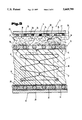
- FIG. 7 the nonwoven fabric according to FIG. 6 with the protective layer secured thereto by threads, in a front view in section;
- FIG. 8 a cushion for a back rest of the seat according to FIG. 1 in a side view, in which different layers such as the covering material, the carrier layer and fibre layer are partially removed, in a side view.
- FIG. 1 a double bench seat 1 with two vehicle seats 2, 3.
- Each vehicle seat 2, 3 consists of a cushion 4 for a back rest and a cushion 5 for a seat surface.
- the cushions 4 and 5 of the two vehicle seats 2 and 3 are of identical construction, but inversely symmetrical. But they can also be used for a single seat or a multiple bench seat.
- a vehicle seat 2 or 3 can also consist of a single or several cushions.
- the cushions 4 and 5 are inserted in a supporting frame marked 6 in general.
- the supporting frame 6 can also have any shape other than the one shown.
- the cushion 5 for a seat surface is shown on a larger scale and partly in section.
- the cushion 5 includes a supporting body 7 which is preferably made of a cold moulded foam and manufactured in a mould matching the desired external dimensions of the supporting body 7. It is usually made of a resilient, open-cell plastic foam 8. Preferably it is constructed in one piece.
- the plastic foam 8 can, as shown schematically by short strokes in the region of hatching, be treated with a powdered flame retardant 9, e.g. with melamine resin and/or aluminium hydroxide.
- a spring core 10 can be embedded in the supporting body 7 during foaming. Furthermore, for better aeration of the supporting body or for conducting heat and moisture away from the region of a seat surface 11, recesses 12 or cavities can be provided, which extend from a lower side 13 opposite the seat surface 11, to near a surface 14 of the supporting body 7 facing towards the seat surface 11.
- an intermediate layer 15 for example a woven or knitted fabric, mesh or lattice of high temperature-resistant fibres or threads 16 made of glass or plastic and/or metal and/or ceramics and/or graphite and/or carbon, which has a mesh size between 0.5 and 8 mm, preferably 3 mm.
- This intermediate layer which is bonded to the supporting body 7 by means of adhesives 17 in regions distributed over the surface 14, is at the same time also bonded to a middle layer 18 in force-locking and form-locking relationship by means of the adhesive 17.
- the adhesive 17 in this case penetrates the fibre layer 21 of a nonwoven fabric 22, consisting of fibres or threads 19, 20, and thus provides an intensive, force-locking bond between the supporting body 7 and the fibre layer 21.
- the intermediate layer 15 it is also possible, as shown schematically below, for the intermediate layer 15 to be bonded to the fibres or threads 19, 20 of the fibre layer 21 by needling.
- the threads 20 can, according to the invention, also be made from a plurality of fibres 19, as shown schematically for one of the threads 20 in FIG. 3.
- these threads 20 can be composed of filaments, as a result of which they have high resistance values and a correspondingly high surface roughness for good bonding in case of interweaving or needling, but are limp or flexible and therefore only low resiliency forces occur. As a result, a resilient whole body with more or less standard deformation behaviour is achieved, which has a high capacity for snug fitting.
- the fibres or threads 19, 20 of the fibre layer 21 can be made mainly of natural material, e.g. wool or cotton. But on the other hand it is also possible to use exclusively fibres or threads 19, 20 made of synthetic material or to mix the fibres or threads 19, 20 of synthetic and natural materials as desired. If the fibres and threads are made of natural materials, then they can be formed from cotton, sheep's wool, flax or the like, while the fibres or threads 19, 20 of synthetic material are made of polypropylene and/or polyethylene and/or polyacrylate, but for example also from polybenzimidazole and/or aramides or formed from filaments.
- the proportion of fibres or threads 19, 20 made of synthetic materials is preferably between 5% and 20%, preferably 10%.
- the fibres or threads 19, 20 of the fibre layer are to be strengthened for example by thermal cracking or thermal bonding
- these fibres or threads 19, 20 are made of thermoplastic materials.
- thermoplastic materials have most likely a plasticisation or softening point between 100° and 150° C., preferably between 100° and 120° C., which promotes thermal bonding of the fibres or threads 19, 20 or thermal strengthening of the nonwoven fabric 22.
- fibres or threads 19, 20 for the fibre layer 21 which are made from polyamides.
- the fibres or threads 19, 20 of the fibre layer 21 it is further recommended, particularly if they are made of polypropylene or aramide or polyamide, that they have a titre, that is, a weight-to-length ratio, of 2 to 8 dtex, preferably 3.5 dtex.
- the fibre layer 21 is made by adhering the individual fibres or threads 19, 20 together just by needling or felting and in some particular cases by thermal bonding, that is, by the simultaneous action of pressure and temperature, and holding them in the loose mat forming the nonwoven fabric 22, in order to achieve a high tensile strength and tear resistance, particularly where such a nonwoven fabric has a low relative density, it is also important to use the correct length of the fibres or threads 19, 20 for manufacture of the fibre layer 21, and here a length of 40 to 80 mm proved to be particularly advantageous.
- the fibres or threads 19, 20 e.g. made of cotton, sheep's wool, flax or from polyamide, polyester, PVC, PP, PE or nylon or aramides and the like are applied as loose bulk material, for example to a carrier layer serving as a conveyor belt.
- this randomly oriented layer of fibres or threads 19, 20 is needled or felted by means of usually hook-shaped needles, in order thus to form a coherent, internally bonded body.
- This bonding does not depend on whether the carrier layer is bonded to the fibre layer by the fibres and threads 19, 20 or whether the carrier belt is an endlessly rotating machine part.
- the fibre layer of the nonwoven fabric can have a square meter weight of between 60 and 390 g/m 2 , preferably 70 g/m 2 .
- Another advantage of producing a nonwoven fabric of this kind is, apart from the low relative density or surface density, particularly in case of use in vehicles and aircraft, that without extra layers and hence without extra weight it can be bonded to a carrier layer 23 arranged in particular in the surface regions for reinforcement thereof.
- This fibre layer 21 is further designed as a nonwoven fabric by needling or by thermal pressing, and at the same time dynamically bonded to a carrier layer 23 which likewise consists of for example a mesh or lattice or knitted fabric or the like of synthetic material, for example polyamide or polyester.
- a carrier layer 23 which likewise consists of for example a mesh or lattice or knitted fabric or the like of synthetic material, for example polyamide or polyester.
- threads 24 which are formed from e.g. 100% polyester and have a diameter 25 of e.g. 0.5 mm. But it is also possible to use natural materials for the carrier layer 23.
- a mesh of this kind which can form the carrier layer 23 can have e.g. a weight between 50 and 90 g/m 2 , preferably 70 g/m 2 .
- this mesh has a mesh density of 12 openings/dm.
- the carrier layer is intended to withstand a tensile force of about 200 to 500 N, and the tear resistance of the carrier layer is to be between 240 and 500 N/cm, preferably 240 to 280 N/cm.
- the fibres or threads of the carrier layer 23 may also be formed from filaments such as e.g. glass filaments; in this case it is also possible for at least single filaments to be made of preoxygenated polyacrylate, aramide or polybenzimidazole.
- the carrier layer 23 is flexible or limp and has a resiliency value as low as possible. This prevents the carrier layer 23, which reinforces the nonwoven fabric 22 according to the invention, from impairing seating comfort or from abrading or destroying the covering material 26 in the bend region between horizontal and vertical surfaces of the cushion 5 of the vehicle seat 2, 3.
- the attachment of the covering material 26 to the cushion 5 for the seat can be inferred from the different applications or a plurality of prior publications, owing to which these details are not considered further here.
- a covering material 26 which is bonded to a bearing surface 31 of the plastic foam 8 of the supporting body 7 by a bonding layer 29, e.g. an adhesive or an intermediate layer, with the interposition of an additional intermediate layer 30.
- the intermediate layer 30 can be constructed for example identically with the intermediate layer 15, but it is also possible, according to the different specifications, for differently designed intermediate layers 15 and 30 to be used.
- the capacity of the lower side 13 of the cushion 5 to withstand loads is increased without the seating comfort suffering, because the whole cross-section of the cushion 5 is available for passage of the waste body heat or body moisture penetrating the seat surface 11 of the cushion 5, and hence the removal of body heat and body moisture through a lower side 13 constructed in this way is no longer impeded.
- the nonwoven fabric 22 comprises, apart from the carrier layer 23 which is bonded to the fibre layer 21 by the needling operation, an additional carrier layer which in the present case is formed by the intermediate layer 15.
- This intermediate layer 15 constructed as a mesh, lattice or knitted or woven fabric can, like the carrier layer 23, be bonded to the nonwoven fabric 22 in the process of needling and interweaving the individual fibres or threads 19, 20, so that a nonwoven fabric 22 strengthened at both surfaces by the intermediate layer 15 and the carrier layer 23 is produced.
- a nonwoven fabric 22 of this kind can have for example a total weight between 220 and 400 g/m 2 if the carrier layer 23 has for example a weight of 70 g/m 2 , the fibre layer 21 about 60 to 250 g/m 2 and the intermediate layer 15 about 80 to 185 g/m 2 , preferably 120 g/m 2 .
- a nonwoven fabric 22 constructed in this way with the corresponding surface densities may also have a correspondingly high elasticity and already sufficient tear resistance for the field of use, in particular as a top layer underneath a covering material 26 in a cushion 5 for an aircraft seat.
- nonwoven fabrics 22 formed from fibres or threads with the associated carrier layers lies in that these can be cleaned substantially more easily by appropriate washing operations than for example open-cell plastic foams, because wetting through, particularly with cleaning agents, can be improved considerably by the fibre structure and hence also dirt can be washed out more easily.
- FIG. 4 is shown a variant of the construction of a middle layer 18 between the covering material 26 and the supporting body 7, in which a fibre layer 21 is applied to a carrier layer 23.
- the intermediate layer 15 which can be constructed according to variants described in detail with the aid of FIGS. 2 and 3, can be incorporated into this fibre layer 21 and anchored in the nonwoven fabric 22.
- a fibre layer 21 is simply applied to the carrier layer 23 and then, applying an additional fibre layer 32, the intermediate layer 15 is bonded to the fibre layer 21 to form a middle layer 18.
- the fibres 19 and threads 20 used for production of the fibre layers 21 and 32 can, as shown in great detail with the aid of FIGS. 2 and 3, be selected different according to the conditions of use.
- FIG. 5 An additional resistant middle layer for insertion, in particular for insertion between the covering material 26 and the supporting body 7 in aircraft seats, is shown in FIG. 5.
- This middle layer 18 can for example be in several layers again, by either bonding the carrier layer 23 simultaneously to the intermediate layer 15 by the fibres or threads 19, 20 during manufacture of the fibre layer 21.
- An additional fibre layer 32 can then be applied for example to the intermediate layer 15, if occasion arises at the same time incorporating an additional carrier layer 33.
- the advantage of the arrangement of carrier layers 23 and 33 or the intermediate layer 15 as a carrier layer lies in that surface strengthening of the nonwoven fabric 22 is achieved and hence the conditions of joining or the force-locking bond of the middle layer 18, particularly with the supporting body 7, is improved. This means above all better tear-out resistance or positioning on the supporting body 7.
- connecting points are attached to the supporting body 7 as preferred between the middle layer 18 and the supporting body 7 not over the whole surface, but only at certain points, in order to allow better heat exchange and air exchange in a direction perpendicular to the seat surface 11.
- FIG. 6 Another variant of a middle layer 18 constructed according to the invention is shown in FIG. 6.
- a fibre layer 21 is enclosed on both sides by carrier layers 23 or 33.
- the carrier layers 23 and 33 are advantageously bonded to the fibre layer 21 during interweaving and felting, in particular during needling or thermal stamping or pressing of the middle layer 18.
- Bonding to the supporting body 7 then takes place with the interposition of the intermediate layer 15 by a bonding layer 29, for example a continuous adhesive layer or a backing layer made of soft plastic foam such as e.g. polyether or polyester foam with mainly open cells. If an adhesive layer is used, care should be taken that the adhesive of the bonding layer 29 has sufficient air permeability or water vapour diffusion. In the event that an adhesive which does not meet these requirements is used for the bonding layer 29, then the bond between the middle layer 18 and the supporting body 7 is to be produced by bonding layers 29 distributed over the surface at certain points.
- FIG. 7 Another variant of the nonwoven fabric 22 according to the invention for forming the middle layer 18 is shown in FIG. 7.
- the nonwoven fabric again consists of a fibre layer 21 to which the two carrier layers 23 and 33 are attached by the needling operation or by thermal pressing or stamping.
- the intermediate layer 15 is stitched fast to the carrier layer 33 by threads 34, 35 shown schematically.
- These threads 34, 35 can be formed from natural or synthetic materials, in particular also threads composed of high temperature-resistant fibres.
- the supporting body 7 is made of a plastic foam with a standard relative density. 15 to 80 kg/m 3 is advantageous as the relative density for this plastic foam.
- a supporting device e.g. the spring core 10 shown in FIG. 3, in the region of the zones subject to more stress.
- a top surface 36 of the spring core 10 is spaced apart from the surface 14 of the supporting body 7, preferably at a distance between 5 and 70 mm, because as a result uniform distribution of the load acting from the seat surface 11 over the whole cushion 5 is obtained on the one hand, and on the other hand overloading of the plastic, in particular the plastic foam 8 of the supporting body 7 in the region of the spring core 10, is prevented.
- a height of the spring core embedded in the supporting body 7 during foaming is less than a thickness of the spring core in the unloaded state.
- the middle layer 18 and the intermediate layer 15 extend not only over the seat surface 11, but also over side surfaces 37 or a rear surface 38 of the cushion 5. Hence the intermediate and/or the middle layer can also overlap inlet openings leading to the recesses 12.
- the joining device formed by a hook and pile fastening band 28 is arranged between the nonwoven fabric 22 or carrier layer 23 or 33 and the covering material 26. While one part of the hook and pile fastening band is firmly adhered for example to the carrier layer 23 or 33 or the nonwoven fabric 22, the other part of the band is firmly stitched for example to the covering material 26.
- joining devices are also possible to distribute the joining devices thereof in spaced-apart regions and join them to the intermediate layer 15, in order to allow as high as possible a tear-out resistance of the joining device, in particular the hook and pile fastening band 28.
- the joining device can additionally be joined by threads and/or fibres to the middle layer 18 and/or intermediate layer 15.
- the cushions 4 for the back rest of the vehicle seats 2 and 3 can also be provided with a nonwoven fabric 22 according to the invention or a middle layer 18 at least in the region of a supporting surface 39 facing towards the user's body as well as in the region of the side surface 40.
- the construction of the middle layer 18 or nonwoven fabric 22 can in this case be according to any of the variants shown in FIGS. 2 to 7 and does not depend on whether the intermediate layer 15 is arranged as a carrier layer in a central region of the fibre layer of fibres or threads of the nonwoven fabric 22 or in a surface region of the nonwoven fabric 22 opposite the carrier layer 23.
- the middle layer 18 or nonwoven fabric 22 or the fibre layer 21 may be thermally bonded or thermally compressed or stamped in one or both opposed surface regions, at least one of which has a carrier layer 23 or 33 associated with it.
- the middle layer 18 or nonwoven fabric 22 or the fibre layer 21 in order to increase the tear resistance or the resistance to being torn out or detached it is advantageous to bind or weave more strongly the fibre layer 21, 32 closest to one of the two surfaces. It may also be advantageous in these surface regions to compress the fibre layer 21 or 32 thermally to a higher relative or surface density. Thus it may prove advantageous to perform compression to a surface density between 300 or 500 g/m 2 .
- FIGS. 1, 2, 3, 4, 5, 6, 7 and 8 can form the subject of independent solutions according to the invention.
- the objects and solutions according to the invention in this respect can be inferred from the detailed descriptions of these figures.
Landscapes
- Laminated Bodies (AREA)
- Acyclic And Carbocyclic Compounds In Medicinal Compositions (AREA)
- Nonwoven Fabrics (AREA)
- Chair Legs, Seat Parts, And Backrests (AREA)
- Mattresses And Other Support Structures For Chairs And Beds (AREA)
- Organic Low-Molecular-Weight Compounds And Preparation Thereof (AREA)
Applications Claiming Priority (2)
| Application Number | Priority Date | Filing Date | Title |
|---|---|---|---|
| AT0020593A ATA20593A (de) | 1993-02-05 | 1993-02-05 | Fahrzeugsitz, insbesondere für flugzeuge |
| AT205/93 | 1993-02-05 |
Publications (1)
| Publication Number | Publication Date |
|---|---|
| US5669799A true US5669799A (en) | 1997-09-23 |
Family
ID=3484274
Family Applications (1)
| Application Number | Title | Priority Date | Filing Date |
|---|---|---|---|
| US08/191,519 Expired - Lifetime US5669799A (en) | 1993-02-05 | 1994-02-03 | Vehicle seat, in particular for aircraft |
Country Status (6)
| Country | Link |
|---|---|
| US (1) | US5669799A (de) |
| EP (1) | EP0609715B1 (de) |
| JP (1) | JPH06269332A (de) |
| AT (2) | ATA20593A (de) |
| DE (2) | DE59401288D1 (de) |
| IT (1) | IT1269501B (de) |
Cited By (35)
| Publication number | Priority date | Publication date | Assignee | Title |
|---|---|---|---|---|
| US6333280B1 (en) * | 1996-09-04 | 2001-12-25 | Sumitomo Bakelite Company, Ltd. | Flame-retardant or incombustible decorative laminated sheet |
| US20010055682A1 (en) * | 1998-09-14 | 2001-12-27 | Ortega Albert E. | Novel nonwoven fabrics with advantageous properties |
| WO2000071341A3 (de) * | 1999-05-20 | 2002-10-03 | Magna Eybl Gmbh | Kaschierverfahren |
| US20030049988A1 (en) * | 1998-09-14 | 2003-03-13 | Ortega Albert E. | Nonwoven fabrics with two or more filament cross sections |
| US20030142868A1 (en) * | 1999-04-15 | 2003-07-31 | Tannenbaum Allen Robert | Curvature based system for the segmentation and analysis of image data |
| US20040145230A1 (en) * | 2001-05-16 | 2004-07-29 | Etsunori Fujita | Seat |
| US20040166353A1 (en) * | 2002-08-29 | 2004-08-26 | Owens Jerry W. | Wool-based textile of flame resistant character and articles formed therefrom |
| US20040216828A1 (en) * | 2001-08-17 | 2004-11-04 | Ortega Albert E. | Nonwoven fabrics with two or more filament cross sections |
| US20080018162A1 (en) * | 2006-07-20 | 2008-01-24 | Lear Corporation | Environmentally friendly layered seating assembly |
| USD583579S1 (en) | 2004-06-18 | 2008-12-30 | Virgin Atlantic Airways Limited | Airplane seating unit |
| US7469861B2 (en) | 2001-08-09 | 2008-12-30 | Virgin Atlantic Airways Limited | Seating system and a passenger accommodation unit for a vehicle |
| US20090108494A1 (en) * | 2006-03-31 | 2009-04-30 | Mika Ito | Cushion body, seat, and method of manufacturing the same |
| US20100181796A1 (en) * | 2009-01-21 | 2010-07-22 | Lear Corporation | Vehicle seat assembly having layered seating system |
| US20110041246A1 (en) * | 2009-08-20 | 2011-02-24 | Hong Kong Applied Science And Technology Research Institute Co., Ltd. | Systems and methods providing temperature regulated cushion structure |
| US20110278901A1 (en) * | 2007-12-27 | 2011-11-17 | Delta Tooling Co., Ltd. | Impact absorbing structural body, shell type frame member and seat structure |
| US8215714B2 (en) | 2010-05-17 | 2012-07-10 | Lear Corporation | Vehicle seat assembly with interlocking layered seating system |
| US20130161998A1 (en) * | 2011-12-22 | 2013-06-27 | Grammer Ag | Vehicle seat and method for producing an upholstered vehicle seat part |
| US20150121626A1 (en) * | 2013-11-04 | 2015-05-07 | John Raymond Carver | Self-Adjusting Neck Brace Pillow For Back Sleepers |
| US20160083097A1 (en) * | 2014-09-24 | 2016-03-24 | B/E Aerospace, Inc. | Seat pan assembly with encased comfort spring |
| US20190055023A1 (en) * | 2016-02-26 | 2019-02-21 | Greiner Aerospace Gmbh | Seat Cushion for a Vehicle Seat, in Particular an Aircraft Seat |
| US11013340B2 (en) * | 2018-05-23 | 2021-05-25 | L&P Property Management Company | Pocketed spring assembly having dimensionally stabilizing substrate |
| US11584105B2 (en) | 2017-03-29 | 2023-02-21 | Neveon Austria Gmbh | Flame protection fabric for vehicle seats, in particular for aircraft seats |
| US20230270262A1 (en) * | 2018-05-23 | 2023-08-31 | L&P Property Management Company | Method Of Disassembling Pocketed Spring Assembly With Dimensionally Stabilizing Substrate |
| US20240008655A1 (en) * | 2018-05-23 | 2024-01-11 | L&P Property Management Company | Pocketed Spring Assembly Having Dimensionally Stabilizing Substrate |
| DK202370426A1 (en) * | 2022-12-23 | 2024-08-06 | Lear Corp | Cushion assembly |
| US12269384B2 (en) | 2021-03-31 | 2025-04-08 | Lear Corporation | Seat support |
| US12286044B2 (en) | 2023-05-12 | 2025-04-29 | Lear Corporation | Method and apparatus for producing a vehicle interior component |
| US12286045B2 (en) | 2021-12-02 | 2025-04-29 | Lear Corporation | Vehicle seating system and method for producing same |
| US12319183B2 (en) | 2021-03-31 | 2025-06-03 | Lear Corporation | Seat support |
| US12325624B2 (en) | 2023-03-06 | 2025-06-10 | Lear Corporation | Seat assembly, cushion, and tool and method of forming |
| US12325168B2 (en) | 2021-12-20 | 2025-06-10 | Lear Corporation | System and method of making a mesh cushion |
| US12384094B2 (en) | 2022-03-08 | 2025-08-12 | Lear Corporation | Method for producing a vehicle interior component |
| US12454111B2 (en) | 2022-05-11 | 2025-10-28 | Lear Corporation | Tool to manufacture a cushion |
| US12479143B2 (en) | 2021-12-20 | 2025-11-25 | Lear Corporation | System and method of making a mesh cushion |
| US12509343B2 (en) | 2023-02-28 | 2025-12-30 | Lear Corporation | Automated trench manufacturing and assembly for attaching trim covers to a cushion assembly |
Families Citing this family (3)
| Publication number | Priority date | Publication date | Assignee | Title |
|---|---|---|---|---|
| EP0801162A1 (de) * | 1996-03-22 | 1997-10-15 | Fabricas Lucia Antonio Betere S.A. (Flabesa) | Verfahren für personbezogene Steifigkeit, Widerstand und Beständigkeit von Stütze oder Sitze, so hergestellte Stütze und Sitze und Gerät dafür |
| ES2140256B1 (es) * | 1996-03-22 | 2000-09-01 | Betere Fab Lucia Antonio | Procedimiento de personalizacion de la dureza, resistencia y durabilidad de estructuras de apoyo o asiento y estructura de apoyo o asiento asi obtenida. |
| FR2766071B1 (fr) * | 1997-07-21 | 1999-10-08 | Duflot Ind | Procede de fabrication d'un materiau composite pour la protection anti-vandalisme, notamment pour sieges, et materiau composite obtenu |
Citations (6)
| Publication number | Priority date | Publication date | Assignee | Title |
|---|---|---|---|---|
| DE2365243A1 (de) * | 1973-12-21 | 1975-07-03 | Vysoka Skola Strojni Textilni | Verfahren zur verbesserung der formstabilitaet und mechanischer eigenschaften von nadel-vliesstoffen |
| DE3003081A1 (de) * | 1979-01-30 | 1980-07-31 | Ichikawa Woolen Textile | Mehrschichtiges, genadeltes, filzartiges polstermaterial und verfahren zum herstellen desselben |
| DE8506816U1 (de) * | 1985-03-08 | 1985-07-25 | Hamburger Hochbahn Ag, 2000 Hamburg | Sitz für den öffentlichen Personenverkehr |
| EP0190064A1 (de) * | 1985-01-21 | 1986-08-06 | Sofanor | Verkleidung gegen Vandalismus für Sitze |
| US4980228A (en) * | 1989-09-22 | 1990-12-25 | The Haartz Corporation | Flame and puncture resistant fabric sheet material and method of manufacturing same |
| US5085487A (en) * | 1987-06-02 | 1992-02-04 | Schaumstoffwerk Greiner Gesellschaft Mbh | Seat with foamed plastic padding and process for its manufacture |
Family Cites Families (4)
| Publication number | Priority date | Publication date | Assignee | Title |
|---|---|---|---|---|
| DE3512790A1 (de) * | 1985-04-10 | 1986-10-23 | Sigri GmbH, 8901 Meitingen | Flammfester sitz |
| DD249630A1 (de) * | 1986-06-03 | 1987-09-16 | Komb Schienenfahrzeugbau Stamm | Schwerbrennbare polstermoebel |
| DE3940713A1 (de) * | 1989-12-09 | 1991-06-13 | Hoechst Ag | Flammhemmendes vlies mit bindefilamenten |
| DE59109203D1 (de) * | 1990-01-18 | 2000-12-28 | Greiner Purtec Gmbh Kremsmuens | Sitz, insbesondere für Fahrzeuge |
-
1993
- 1993-02-05 AT AT0020593A patent/ATA20593A/de not_active IP Right Cessation
-
1994
- 1994-01-21 DE DE59401288T patent/DE59401288D1/de not_active Revoked
- 1994-01-21 EP EP94100829A patent/EP0609715B1/de not_active Revoked
- 1994-01-21 AT AT94100829T patent/ATE146342T1/de not_active IP Right Cessation
- 1994-01-27 DE DE4402381A patent/DE4402381A1/de not_active Withdrawn
- 1994-02-03 IT ITMI940190A patent/IT1269501B/it active IP Right Grant
- 1994-02-03 US US08/191,519 patent/US5669799A/en not_active Expired - Lifetime
- 1994-02-04 JP JP6012829A patent/JPH06269332A/ja active Pending
Patent Citations (6)
| Publication number | Priority date | Publication date | Assignee | Title |
|---|---|---|---|---|
| DE2365243A1 (de) * | 1973-12-21 | 1975-07-03 | Vysoka Skola Strojni Textilni | Verfahren zur verbesserung der formstabilitaet und mechanischer eigenschaften von nadel-vliesstoffen |
| DE3003081A1 (de) * | 1979-01-30 | 1980-07-31 | Ichikawa Woolen Textile | Mehrschichtiges, genadeltes, filzartiges polstermaterial und verfahren zum herstellen desselben |
| EP0190064A1 (de) * | 1985-01-21 | 1986-08-06 | Sofanor | Verkleidung gegen Vandalismus für Sitze |
| DE8506816U1 (de) * | 1985-03-08 | 1985-07-25 | Hamburger Hochbahn Ag, 2000 Hamburg | Sitz für den öffentlichen Personenverkehr |
| US5085487A (en) * | 1987-06-02 | 1992-02-04 | Schaumstoffwerk Greiner Gesellschaft Mbh | Seat with foamed plastic padding and process for its manufacture |
| US4980228A (en) * | 1989-09-22 | 1990-12-25 | The Haartz Corporation | Flame and puncture resistant fabric sheet material and method of manufacturing same |
Non-Patent Citations (1)
| Title |
|---|
| WO 87/06894, publ. Nov. 1987. * |
Cited By (68)
| Publication number | Priority date | Publication date | Assignee | Title |
|---|---|---|---|---|
| US6333280B1 (en) * | 1996-09-04 | 2001-12-25 | Sumitomo Bakelite Company, Ltd. | Flame-retardant or incombustible decorative laminated sheet |
| US8088696B2 (en) | 1998-09-14 | 2012-01-03 | The Procter & Gamble Company | Nonwoven fabrics with advantageous properties |
| US20010055682A1 (en) * | 1998-09-14 | 2001-12-27 | Ortega Albert E. | Novel nonwoven fabrics with advantageous properties |
| US20030049988A1 (en) * | 1998-09-14 | 2003-03-13 | Ortega Albert E. | Nonwoven fabrics with two or more filament cross sections |
| US20030104747A1 (en) * | 1998-09-14 | 2003-06-05 | Ortega Albert E. | Novel nonwoven fabrics with advantageous properties |
| US7060149B2 (en) * | 1998-09-14 | 2006-06-13 | The Procter & Gamble Company | Nonwoven fabrics with advantageous properties |
| US20060252332A9 (en) * | 1998-09-14 | 2006-11-09 | Ortega Albert E | Nonwoven fabrics with two or more filament cross sections |
| US20030142868A1 (en) * | 1999-04-15 | 2003-07-31 | Tannenbaum Allen Robert | Curvature based system for the segmentation and analysis of image data |
| US6721450B2 (en) * | 1999-04-15 | 2004-04-13 | Allen Robert Tannenbaum | Curvature based system for the segmentation and analysis of image data |
| WO2000071341A3 (de) * | 1999-05-20 | 2002-10-03 | Magna Eybl Gmbh | Kaschierverfahren |
| US20040145230A1 (en) * | 2001-05-16 | 2004-07-29 | Etsunori Fujita | Seat |
| US7275793B2 (en) * | 2001-05-16 | 2007-10-02 | Delta Tooling Co., Ltd. | Seat |
| US7469861B2 (en) | 2001-08-09 | 2008-12-30 | Virgin Atlantic Airways Limited | Seating system and a passenger accommodation unit for a vehicle |
| US8720821B2 (en) | 2001-08-09 | 2014-05-13 | Virgin Atlantic Airways Limited | Seating system and passenger accommodation unit for a vehicle |
| US7472957B2 (en) | 2001-08-09 | 2009-01-06 | Virgin Atlantic Airways Limited | Seating system and a passenger accommodation unit for a vehicle |
| US7523888B2 (en) | 2001-08-09 | 2009-04-28 | Virgin Atlantic Airways Limited | Seating system and a passenger accommodation unit for a vehicle |
| US8313059B2 (en) | 2001-08-09 | 2012-11-20 | Virgin Atlantic Airways Limited | Seating system and a passenger accommodation unit for a vehicle |
| US7997654B2 (en) | 2001-08-09 | 2011-08-16 | Virgin Atlantic Airways Limited | Seating system and a passenger accommodation unit for a vehicle |
| US9403597B2 (en) | 2001-08-09 | 2016-08-02 | Virgin Atlantic Airways Limited | Seating system and a passenger accommodation unit for a vehicle |
| US20040216828A1 (en) * | 2001-08-17 | 2004-11-04 | Ortega Albert E. | Nonwoven fabrics with two or more filament cross sections |
| US20040166353A1 (en) * | 2002-08-29 | 2004-08-26 | Owens Jerry W. | Wool-based textile of flame resistant character and articles formed therefrom |
| USD583579S1 (en) | 2004-06-18 | 2008-12-30 | Virgin Atlantic Airways Limited | Airplane seating unit |
| US20090108494A1 (en) * | 2006-03-31 | 2009-04-30 | Mika Ito | Cushion body, seat, and method of manufacturing the same |
| US7874624B2 (en) * | 2006-03-31 | 2011-01-25 | Ts Tech Co., Ltd. | Cushion body, seat, and method of manufacturing the same |
| US20110068498A1 (en) * | 2006-03-31 | 2011-03-24 | Mika Ito | Method of manufacturing and forming a cushion body |
| US8657383B2 (en) | 2006-07-20 | 2014-02-25 | Lear Corporation | Environmentally friendly layered seating assembly |
| US7905552B2 (en) | 2006-07-20 | 2011-03-15 | Lear Corporation | Environmentally friendly layered seating assembly |
| US20110140500A1 (en) * | 2006-07-20 | 2011-06-16 | Lear Corporation | Environmentally friendly layered seating assembly |
| US20090302664A1 (en) * | 2006-07-20 | 2009-12-10 | Lear Corporation | Environmentally friendly layered seating assembly |
| US7585030B2 (en) | 2006-07-20 | 2009-09-08 | Galbreath Ashford A | Environmentally friendly layered seating assembly |
| US20080018162A1 (en) * | 2006-07-20 | 2008-01-24 | Lear Corporation | Environmentally friendly layered seating assembly |
| US8376456B2 (en) * | 2007-12-27 | 2013-02-19 | Delta Tooling Co., Ltd. | Impact absorbing structural body, shell type frame member and seat structure |
| US20110278901A1 (en) * | 2007-12-27 | 2011-11-17 | Delta Tooling Co., Ltd. | Impact absorbing structural body, shell type frame member and seat structure |
| US20100181796A1 (en) * | 2009-01-21 | 2010-07-22 | Lear Corporation | Vehicle seat assembly having layered seating system |
| US7967389B2 (en) * | 2009-01-21 | 2011-06-28 | Lear Corporation | Vehicle seat assembly having layered seating system |
| US7837271B2 (en) | 2009-01-21 | 2010-11-23 | Lear Corporation | Vehicle seat assembly having layered seating system |
| US20110041246A1 (en) * | 2009-08-20 | 2011-02-24 | Hong Kong Applied Science And Technology Research Institute Co., Ltd. | Systems and methods providing temperature regulated cushion structure |
| US8215714B2 (en) | 2010-05-17 | 2012-07-10 | Lear Corporation | Vehicle seat assembly with interlocking layered seating system |
| US20130161998A1 (en) * | 2011-12-22 | 2013-06-27 | Grammer Ag | Vehicle seat and method for producing an upholstered vehicle seat part |
| US9381839B2 (en) * | 2011-12-22 | 2016-07-05 | Grammer Ag | Vehicle seat and method for producing an upholstered vehicle seat part |
| US20150121626A1 (en) * | 2013-11-04 | 2015-05-07 | John Raymond Carver | Self-Adjusting Neck Brace Pillow For Back Sleepers |
| US20160083097A1 (en) * | 2014-09-24 | 2016-03-24 | B/E Aerospace, Inc. | Seat pan assembly with encased comfort spring |
| US10189570B2 (en) * | 2014-09-24 | 2019-01-29 | B/E Aerospace, Inc. | Seat pan assembly with encased comfort spring |
| US20190055023A1 (en) * | 2016-02-26 | 2019-02-21 | Greiner Aerospace Gmbh | Seat Cushion for a Vehicle Seat, in Particular an Aircraft Seat |
| US10647434B2 (en) | 2016-02-26 | 2020-05-12 | Greiner Aerospace Gmbh | Seat cushion for a vehicle seat, in particular an aircraft seat |
| US11584105B2 (en) | 2017-03-29 | 2023-02-21 | Neveon Austria Gmbh | Flame protection fabric for vehicle seats, in particular for aircraft seats |
| US11771235B2 (en) * | 2018-05-23 | 2023-10-03 | L&P Property Management Company | Pocketed spring assembly having dimensionally stabilizing substrate |
| US20210244193A1 (en) * | 2018-05-23 | 2021-08-12 | L&P Property Management Company | Method Of Making Pocketed Spring Assembly With Substrate |
| US20210235882A1 (en) * | 2018-05-23 | 2021-08-05 | L&P Property Management Company | Pocketed Spring Assembly Having Dimensionally Stabilizing Substrate |
| US20230270262A1 (en) * | 2018-05-23 | 2023-08-31 | L&P Property Management Company | Method Of Disassembling Pocketed Spring Assembly With Dimensionally Stabilizing Substrate |
| US11013340B2 (en) * | 2018-05-23 | 2021-05-25 | L&P Property Management Company | Pocketed spring assembly having dimensionally stabilizing substrate |
| US11812860B2 (en) * | 2018-05-23 | 2023-11-14 | L&P Property Management Company | Method of making pocketed spring assembly with substrate |
| US20230389711A1 (en) * | 2018-05-23 | 2023-12-07 | L&P Property Management Company | Pocketed Spring Assembly Having Dimensionally Stabilizing Substrate |
| US20240008655A1 (en) * | 2018-05-23 | 2024-01-11 | L&P Property Management Company | Pocketed Spring Assembly Having Dimensionally Stabilizing Substrate |
| US12369722B2 (en) * | 2018-05-23 | 2025-07-29 | L&P Property Management Company | Method of disassembling pocketed spring assembly with dimensionally stabilizing substrate |
| US12137813B2 (en) * | 2018-05-23 | 2024-11-12 | L&P Property Management Company | Pocketed spring assembly having dimensionally stabilizing substrate |
| US20250031862A1 (en) * | 2018-05-23 | 2025-01-30 | L&P Property Management Company | Pocketed Spring Assembly Having Dimensionally Stabilizing Substrate |
| US12269384B2 (en) | 2021-03-31 | 2025-04-08 | Lear Corporation | Seat support |
| US12319183B2 (en) | 2021-03-31 | 2025-06-03 | Lear Corporation | Seat support |
| US12286045B2 (en) | 2021-12-02 | 2025-04-29 | Lear Corporation | Vehicle seating system and method for producing same |
| US12325168B2 (en) | 2021-12-20 | 2025-06-10 | Lear Corporation | System and method of making a mesh cushion |
| US12479143B2 (en) | 2021-12-20 | 2025-11-25 | Lear Corporation | System and method of making a mesh cushion |
| US12384094B2 (en) | 2022-03-08 | 2025-08-12 | Lear Corporation | Method for producing a vehicle interior component |
| US12454111B2 (en) | 2022-05-11 | 2025-10-28 | Lear Corporation | Tool to manufacture a cushion |
| DK202370426A1 (en) * | 2022-12-23 | 2024-08-06 | Lear Corp | Cushion assembly |
| US12509343B2 (en) | 2023-02-28 | 2025-12-30 | Lear Corporation | Automated trench manufacturing and assembly for attaching trim covers to a cushion assembly |
| US12325624B2 (en) | 2023-03-06 | 2025-06-10 | Lear Corporation | Seat assembly, cushion, and tool and method of forming |
| US12286044B2 (en) | 2023-05-12 | 2025-04-29 | Lear Corporation | Method and apparatus for producing a vehicle interior component |
Also Published As
| Publication number | Publication date |
|---|---|
| EP0609715B1 (de) | 1996-12-18 |
| ITMI940190A1 (it) | 1995-08-03 |
| ITMI940190A0 (it) | 1994-02-03 |
| IT1269501B (it) | 1997-04-01 |
| EP0609715A1 (de) | 1994-08-10 |
| ATE146342T1 (de) | 1997-01-15 |
| JPH06269332A (ja) | 1994-09-27 |
| DE4402381A1 (de) | 1994-08-11 |
| DE59401288D1 (de) | 1997-01-30 |
| ATA20593A (de) | 1998-08-15 |
Similar Documents
| Publication | Publication Date | Title |
|---|---|---|
| US5564144A (en) | Vehicle seat with a seat padding, in particular for an aircraft seat | |
| JPH06269332A (ja) | 乗物用座席 | |
| US5477572A (en) | Vehicle seat cushion | |
| US8506865B2 (en) | Composite fabric product and production process therefor | |
| JPH05503023A (ja) | 座席、特に乗物用の座席 | |
| JPH03502530A (ja) | 発泡プラスチック製クッションを有した椅子及びその製造方法 | |
| CN115209766B (zh) | 缓冲材料 | |
| US11993027B2 (en) | Self-rising board molding | |
| JP5052680B2 (ja) | カーペット、それに用いる繊維質バッキング、並びにズレ防止性を付与する編物 | |
| CN105874119A (zh) | 双层地毯 | |
| JP5317526B2 (ja) | 複合クッション体及びその製造方法 | |
| EP1170170A1 (de) | Polsterartikel für Kraftfahrzeug | |
| US20070152488A1 (en) | Arm rest using vertical lapped fiber | |
| JP3255424B2 (ja) | 複合成形体シ−トパッド | |
| JP3431098B2 (ja) | 難燃性補強網状体と製法及びそれを用いた製品 | |
| JP3048435B2 (ja) | 発泡成形品用補強材 | |
| JP4500506B2 (ja) | 繊維弾性体及び腰掛け | |
| JP3079036B2 (ja) | タフテッドカ−ペット用基布 | |
| JP2003125902A (ja) | クッション材及びその製造方法 | |
| JPH09294649A (ja) | 耐火腰掛け |
Legal Events
| Date | Code | Title | Description |
|---|---|---|---|
| AS | Assignment |
Owner name: C. A. GREINER & SOHNE GESELLSCHAFT M.B.H., AUSTRIA Free format text: ASSIGNMENT OF ASSIGNORS INTEREST;ASSIGNORS:MOSENEDER, JOHANN;WEINGARTNER, RUDOLF;REEL/FRAME:006899/0653 Effective date: 19940222 |
|
| STCF | Information on status: patent grant |
Free format text: PATENTED CASE |
|
| CC | Certificate of correction | ||
| FPAY | Fee payment |
Year of fee payment: 4 |
|
| FPAY | Fee payment |
Year of fee payment: 8 |
|
| FPAY | Fee payment |
Year of fee payment: 12 |