US5916381A - Magnesium mechanical alloys for thermal hydrogen storage - Google Patents
Magnesium mechanical alloys for thermal hydrogen storage Download PDFInfo
- Publication number
- US5916381A US5916381A US08/730,274 US73027496A US5916381A US 5916381 A US5916381 A US 5916381A US 73027496 A US73027496 A US 73027496A US 5916381 A US5916381 A US 5916381A
- Authority
- US
- United States
- Prior art keywords
- sub
- hydrogen
- hydrogen storage
- magnesium
- sample
- Prior art date
- Legal status (The legal status is an assumption and is not a legal conclusion. Google has not performed a legal analysis and makes no representation as to the accuracy of the status listed.)
- Expired - Fee Related
Links
Images




Classifications
-
- B—PERFORMING OPERATIONS; TRANSPORTING
- B22—CASTING; POWDER METALLURGY
- B22F—WORKING METALLIC POWDER; MANUFACTURE OF ARTICLES FROM METALLIC POWDER; MAKING METALLIC POWDER; APPARATUS OR DEVICES SPECIALLY ADAPTED FOR METALLIC POWDER
- B22F9/00—Making metallic powder or suspensions thereof
- B22F9/002—Making metallic powder or suspensions thereof amorphous or microcrystalline
- B22F9/004—Making metallic powder or suspensions thereof amorphous or microcrystalline by diffusion, e.g. solid state reaction
- B22F9/005—Transformation into amorphous state by milling
-
- C—CHEMISTRY; METALLURGY
- C01—INORGANIC CHEMISTRY
- C01B—NON-METALLIC ELEMENTS; COMPOUNDS THEREOF; METALLOIDS OR COMPOUNDS THEREOF NOT COVERED BY SUBCLASS C01C
- C01B3/00—Hydrogen; Gaseous mixtures containing hydrogen; Separation of hydrogen from mixtures containing it; Purification of hydrogen; Reversible storage of hydrogen
- C01B3/0005—Reversible storage of hydrogen, e.g. by hydrogen getters or electrodes
- C01B3/001—Reversible storage of hydrogen, e.g. by hydrogen getters or electrodes characterised by the uptaking media; Treatment thereof
- C01B3/0018—Inorganic elements or compounds, e.g. oxides, nitrides, borohydrides or zeolites; Solutions thereof
- C01B3/0031—Intermetallic compounds; Metal alloys
-
- C—CHEMISTRY; METALLURGY
- C01—INORGANIC CHEMISTRY
- C01B—NON-METALLIC ELEMENTS; COMPOUNDS THEREOF; METALLOIDS OR COMPOUNDS THEREOF NOT COVERED BY SUBCLASS C01C
- C01B3/00—Hydrogen; Gaseous mixtures containing hydrogen; Separation of hydrogen from mixtures containing it; Purification of hydrogen; Reversible storage of hydrogen
- C01B3/0005—Reversible storage of hydrogen, e.g. by hydrogen getters or electrodes
- C01B3/001—Reversible storage of hydrogen, e.g. by hydrogen getters or electrodes characterised by the uptaking media; Treatment thereof
- C01B3/0018—Inorganic elements or compounds, e.g. oxides, nitrides, borohydrides or zeolites; Solutions thereof
- C01B3/0031—Intermetallic compounds; Metal alloys
- C01B3/0047—Intermetallic compounds; Metal alloys containing a rare earth metal
- C01B3/0057—Intermetallic compounds; Metal alloys containing a rare earth metal and nickel
-
- C—CHEMISTRY; METALLURGY
- C01—INORGANIC CHEMISTRY
- C01B—NON-METALLIC ELEMENTS; COMPOUNDS THEREOF; METALLOIDS OR COMPOUNDS THEREOF NOT COVERED BY SUBCLASS C01C
- C01B3/00—Hydrogen; Gaseous mixtures containing hydrogen; Separation of hydrogen from mixtures containing it; Purification of hydrogen; Reversible storage of hydrogen
- C01B3/0005—Reversible storage of hydrogen, e.g. by hydrogen getters or electrodes
- C01B3/001—Reversible storage of hydrogen, e.g. by hydrogen getters or electrodes characterised by the uptaking media; Treatment thereof
- C01B3/0078—Composite solid storage media, e.g. mixtures of polymers and metal hydrides, coated solid compounds or structurally heterogeneous solid compounds
-
- C—CHEMISTRY; METALLURGY
- C22—METALLURGY; FERROUS OR NON-FERROUS ALLOYS; TREATMENT OF ALLOYS OR NON-FERROUS METALS
- C22C—ALLOYS
- C22C1/00—Making non-ferrous alloys
- C22C1/04—Making non-ferrous alloys by powder metallurgy
- C22C1/0408—Light metal alloys
-
- C—CHEMISTRY; METALLURGY
- C22—METALLURGY; FERROUS OR NON-FERROUS ALLOYS; TREATMENT OF ALLOYS OR NON-FERROUS METALS
- C22C—ALLOYS
- C22C23/00—Alloys based on magnesium
-
- H—ELECTRICITY
- H01—ELECTRIC ELEMENTS
- H01M—PROCESSES OR MEANS, e.g. BATTERIES, FOR THE DIRECT CONVERSION OF CHEMICAL ENERGY INTO ELECTRICAL ENERGY
- H01M4/00—Electrodes
- H01M4/02—Electrodes composed of, or comprising, active material
- H01M4/36—Selection of substances as active materials, active masses, active liquids
- H01M4/38—Selection of substances as active materials, active masses, active liquids of elements or alloys
- H01M4/383—Hydrogen absorbing alloys
-
- H—ELECTRICITY
- H01—ELECTRIC ELEMENTS
- H01M—PROCESSES OR MEANS, e.g. BATTERIES, FOR THE DIRECT CONVERSION OF CHEMICAL ENERGY INTO ELECTRICAL ENERGY
- H01M8/00—Fuel cells; Manufacture thereof
- H01M8/06—Combination of fuel cells with means for production of reactants or for treatment of residues
- H01M8/0606—Combination of fuel cells with means for production of reactants or for treatment of residues with means for production of gaseous reactants
- H01M8/065—Combination of fuel cells with means for production of reactants or for treatment of residues with means for production of gaseous reactants by dissolution of metals or alloys; by dehydriding metallic substances
-
- B—PERFORMING OPERATIONS; TRANSPORTING
- B22—CASTING; POWDER METALLURGY
- B22F—WORKING METALLIC POWDER; MANUFACTURE OF ARTICLES FROM METALLIC POWDER; MAKING METALLIC POWDER; APPARATUS OR DEVICES SPECIALLY ADAPTED FOR METALLIC POWDER
- B22F9/00—Making metallic powder or suspensions thereof
- B22F9/02—Making metallic powder or suspensions thereof using physical processes
- B22F9/04—Making metallic powder or suspensions thereof using physical processes starting from solid material, e.g. by crushing, grinding or milling
- B22F2009/041—Making metallic powder or suspensions thereof using physical processes starting from solid material, e.g. by crushing, grinding or milling by mechanical alloying, e.g. blending, milling
-
- B—PERFORMING OPERATIONS; TRANSPORTING
- B22—CASTING; POWDER METALLURGY
- B22F—WORKING METALLIC POWDER; MANUFACTURE OF ARTICLES FROM METALLIC POWDER; MAKING METALLIC POWDER; APPARATUS OR DEVICES SPECIALLY ADAPTED FOR METALLIC POWDER
- B22F9/00—Making metallic powder or suspensions thereof
- B22F9/02—Making metallic powder or suspensions thereof using physical processes
- B22F9/04—Making metallic powder or suspensions thereof using physical processes starting from solid material, e.g. by crushing, grinding or milling
- B22F2009/043—Making metallic powder or suspensions thereof using physical processes starting from solid material, e.g. by crushing, grinding or milling by ball milling
-
- B—PERFORMING OPERATIONS; TRANSPORTING
- B22—CASTING; POWDER METALLURGY
- B22F—WORKING METALLIC POWDER; MANUFACTURE OF ARTICLES FROM METALLIC POWDER; MAKING METALLIC POWDER; APPARATUS OR DEVICES SPECIALLY ADAPTED FOR METALLIC POWDER
- B22F2998/00—Supplementary information concerning processes or compositions relating to powder metallurgy
-
- Y—GENERAL TAGGING OF NEW TECHNOLOGICAL DEVELOPMENTS; GENERAL TAGGING OF CROSS-SECTIONAL TECHNOLOGIES SPANNING OVER SEVERAL SECTIONS OF THE IPC; TECHNICAL SUBJECTS COVERED BY FORMER USPC CROSS-REFERENCE ART COLLECTIONS [XRACs] AND DIGESTS
- Y02—TECHNOLOGIES OR APPLICATIONS FOR MITIGATION OR ADAPTATION AGAINST CLIMATE CHANGE
- Y02E—REDUCTION OF GREENHOUSE GAS [GHG] EMISSIONS, RELATED TO ENERGY GENERATION, TRANSMISSION OR DISTRIBUTION
- Y02E60/00—Enabling technologies; Technologies with a potential or indirect contribution to GHG emissions mitigation
- Y02E60/10—Energy storage using batteries
-
- Y—GENERAL TAGGING OF NEW TECHNOLOGICAL DEVELOPMENTS; GENERAL TAGGING OF CROSS-SECTIONAL TECHNOLOGIES SPANNING OVER SEVERAL SECTIONS OF THE IPC; TECHNICAL SUBJECTS COVERED BY FORMER USPC CROSS-REFERENCE ART COLLECTIONS [XRACs] AND DIGESTS
- Y02—TECHNOLOGIES OR APPLICATIONS FOR MITIGATION OR ADAPTATION AGAINST CLIMATE CHANGE
- Y02E—REDUCTION OF GREENHOUSE GAS [GHG] EMISSIONS, RELATED TO ENERGY GENERATION, TRANSMISSION OR DISTRIBUTION
- Y02E60/00—Enabling technologies; Technologies with a potential or indirect contribution to GHG emissions mitigation
- Y02E60/30—Hydrogen technology
- Y02E60/32—Hydrogen storage
-
- Y—GENERAL TAGGING OF NEW TECHNOLOGICAL DEVELOPMENTS; GENERAL TAGGING OF CROSS-SECTIONAL TECHNOLOGIES SPANNING OVER SEVERAL SECTIONS OF THE IPC; TECHNICAL SUBJECTS COVERED BY FORMER USPC CROSS-REFERENCE ART COLLECTIONS [XRACs] AND DIGESTS
- Y02—TECHNOLOGIES OR APPLICATIONS FOR MITIGATION OR ADAPTATION AGAINST CLIMATE CHANGE
- Y02E—REDUCTION OF GREENHOUSE GAS [GHG] EMISSIONS, RELATED TO ENERGY GENERATION, TRANSMISSION OR DISTRIBUTION
- Y02E60/00—Enabling technologies; Technologies with a potential or indirect contribution to GHG emissions mitigation
- Y02E60/30—Hydrogen technology
- Y02E60/50—Fuel cells
-
- Y—GENERAL TAGGING OF NEW TECHNOLOGICAL DEVELOPMENTS; GENERAL TAGGING OF CROSS-SECTIONAL TECHNOLOGIES SPANNING OVER SEVERAL SECTIONS OF THE IPC; TECHNICAL SUBJECTS COVERED BY FORMER USPC CROSS-REFERENCE ART COLLECTIONS [XRACs] AND DIGESTS
- Y02—TECHNOLOGIES OR APPLICATIONS FOR MITIGATION OR ADAPTATION AGAINST CLIMATE CHANGE
- Y02P—CLIMATE CHANGE MITIGATION TECHNOLOGIES IN THE PRODUCTION OR PROCESSING OF GOODS
- Y02P20/00—Technologies relating to chemical industry
- Y02P20/10—Process efficiency
- Y02P20/129—Energy recovery, e.g. by cogeneration, H2recovery or pressure recovery turbines
-
- Y—GENERAL TAGGING OF NEW TECHNOLOGICAL DEVELOPMENTS; GENERAL TAGGING OF CROSS-SECTIONAL TECHNOLOGIES SPANNING OVER SEVERAL SECTIONS OF THE IPC; TECHNICAL SUBJECTS COVERED BY FORMER USPC CROSS-REFERENCE ART COLLECTIONS [XRACs] AND DIGESTS
- Y10—TECHNICAL SUBJECTS COVERED BY FORMER USPC
- Y10S—TECHNICAL SUBJECTS COVERED BY FORMER USPC CROSS-REFERENCE ART COLLECTIONS [XRACs] AND DIGESTS
- Y10S420/00—Alloys or metallic compositions
- Y10S420/90—Hydrogen storage
Definitions
- the present invention relates to mechanical alloys for hydrogen storage and more specifically to magnesium mechanical alloys for hydrogen storage. Most specifically, the present invention relates to ternary magnesium mechanical alloys of the Mg--Ni--Mo and Mg--Fe--Ti systems and their use as hydrogen storage materials.
- Hydrogen may be used, for example, as fuel for internal-combustion engines in place of hydrocarbons. In this case it has the advantage of eliminating atmospheric pollution through the formation of oxides of carbon or of sulfur upon combustion of the hydrocarbons. Hydrogen may also be used to fuel hydrogen-air fuel cells for production of the electricity needed for electric motors.
- Hydrogen may be stored under high pressure in steel cylinders, but this approach has the drawback of requiring hazardous and heavy containers which are difficult to handle (in addition to having a low storage capacity of about 1% by weight). Hydrogen may also be stored in cryogenic containers, but this entails the disadvantages associated with the use of cryogenic liquids; such as, for example, the high cost of the containers, which also require careful handling. There are also "boil off" losses of about 2-5% per day.
- Another method of storing hydrogen is to store it in the form of a hydride, which then is decomposed at the proper time to furnish hydrogen.
- the hydrides of iron-titanium, lanthanum-nickel, vanadium, and magnesium have been used in this manner, as described in French Pat. No. 1,529,371.
- the MgH 2 --Mg system is the most appropriate of all known metal-hydride and metal systems that can be used as reversible hydrogen-storage systems because it has the highest percentage by weight (7.65% by weight) of theoretical capacity for hydrogen storage and hence the highest theoretical energy density (2332 Wh/kg; Reilly & Sandrock, Spektrum dermaschine, April 1980, 53) per unit of storage material.
- the hydrogen storage capacity of a magnesium reserve diminishes during the decomposition-reconstitution cycles. This phenomenon may be explained by a progressive poisoning of the surface, which during the reconstitution renders the magnesium atoms located in the interior of the reserve inaccessible to the hydrogen.
- U.S. Pat. No. 4,111,689 has disclosed a storage alloy which comprises 31 to 46% by weight of titanium, 5 to 33% by weight of vanadium and 36 to 53% by weight of iron and/or manganese.
- alloys of this type have a greater storage capacity for hydrogen than the alloy according to U.S. Pat. No. 4,160,014, hereby incorporated by reference, they have the disadvantage that temperatures of at least 250° C. are necessary in order to completely expel the hydrogen. At temperatures of up to about 100° C., about 80% of the hydrogen content can be discharged in the best case.
- a high discharge capacity, particularly at low temperatures is frequently necessary in industry because the heat required for liberating the hydrogen from the hydride stores is often available only at a low temperature level.
- magnesium is preferred for the storage of hydrogen not only because of its lower material costs, but above all, because of its lower specific weight as a storage material.
- magnesium is, in general, more difficult to achieve with magnesium, inasmuch as the surface of the magnesium will rapidly oxidize in air so as to form stable MgO and/or Mg(OH) 2 surface layers. These layers inhibit the dissociation of hydrogen molecules, as well as the absorption of produced hydrogen atoms and their diffusion from the surface of the granulate particles into the magnesium storage mass.
- magnesium and magnesium alloys can also be enhanced by the addition of materials which may help to break up stable oxides of magnesium.
- Mg 2 Ni in which the Ni appears to form unstable oxides.
- thermodynamic examinations indicated that the surface reaction Mg 2 Ni+O 2 ⁇ 2MgO+Ni extended over nickel metal inclusions which catalyze the hydrogen dissociation-absorption reaction. Reference may be had to A. Seiler et al., Journal of Less-Common Metals 73, 1980, pages 193 et seq.
- Laid-open Japanese Patent Application No. 55-167401 "Hydrogen Storage Material,” in the name of Matsumato et al, discloses bi or tri-element hydrogen storage materials of at least 50 volume percent amorphous structure.
- the first element is chosen from the group Ca, Mg, Ti, Zr, Hf, V, Nb, Ta, Y and lanthanides, and the second from the group Al, Cr, Fe, Co, Ni, Cu, Mn and Si.
- a third element from the group B, C, P and Ge can optionally be present.
- the amorphous structure is needed to overcome the problem of the unfavorably high desorption temperature characteristic of most crystalline systems.
- a high desorption temperature (above, for example, 150° C.) severely limits the uses to which the system may be put.
- the material of at least 50% amorphous structure will be able to desorb at least some hydrogen at relatively low temperatures because the bonding energies of the individual atoms are not uniform, as is the case with crystalline material, but are distributed over a wide range.
- Matsumoto et al claims a material of at least 50% amorphous structure. While Matsumoto et al does not provide any further teaching about the meaning of the term "amorphous,” the scientifically accepted definition of the term encompasses a maximum short range order of about 20 Angstroms or less.
- disordered metastable hydrogen storage materials characterized by a chemically modified, thermodynamically metastable structure, can be tailor-made to possess all the hydrogen storage characteristics desirable for a wide range of commercial applications.
- the modified hydrogen storage material can be made to have greater hydrogen storage capacity than do the single phase crystalline host materials.
- the bonding strengths between the hydrogen and the storage sites in these modified materials can be tailored to provide a spectrum of bonding possibilities thereby to obtain desired absorption and desorption characteristics.
- Disordered hydrogen storage materials having a chemically modified, thermodynamically metastable structure also have a greatly increased density of catalytically active sites for improved hydrogen storage kinetics and increased resistance to poisoning.
- the synergistic combination of selected modifiers incorporated in a selected host matrix provides a degree and quality of structural and chemical modification that stabilizes chemical, physical, and electronic structures and conformations amenable to hydrogen storage.
- the framework for the modified hydrogen storage materials is a lightweight host matrix.
- the host matrix is structurally modified with selected modifier elements to provide a disordered material with local chemical environments which result in the required hydrogen storage properties.
- Another advantage of the host matrix described by Ovshinsky, et al. is that it can be modified in a substantially continuous range of varying percentages of modifier elements. This ability allows the host matrix to be manipulated by modifiers to tailor-make or engineer hydrogen storage materials with characteristics suitable for particular applications. This is in contrast to multi-component single phase host crystalline materials which generally have a very limited range of stoichiometry available. A continuous range of control of chemical and structural modification of the thermodynamics and kinetics of such crystalline materials therefore is not possible.
- a still further advantage of these disordered hydrogen storage materials is that they are much more resistant to poisoning. As stated before, these materials have a much greater density of catalytically active sites. Thus, a certain number of such sites can be sacrificed to the effects of poisonous species, while the large number of non-poisoned active sites still remain to continue to provide the desired hydrogen storage kinetics.
- disordered materials can be designed to be mechanically more flexible than single phase crystalline materials.
- the disordered materials are thus capable of more distortion during expansion and contraction allowing for greater mechanical stability during the absorption and desorption cycles.
- the second of the two groups was a team of Russian scientists which investigated the hydrogen storage properties of binary mechanical alloys of magnesium and other metals. See Ivanov, et al., "Mechanical Alloys of Magnesium--New Materials For Hydrogen Energy", Doklady Physical Chemistry (English Translation) vol. 286:1-3, 1986, pp. 55-57, (binary mechanical alloys of Mg with Ni, Ce, Nb, Ti, Fe, Co, Si and C); also, Ivanov, et al. "Magnesium Mechanical Alloys for Hydrogen Storage", Journal of the Less-Common Metals, vol.
- Khrussanova, et al. "Hydriding of Mechanically Alloyed Mixtures of Magnesium With MnO 2 , Fe 2 O 3 , and NiO", Materials Research Bulletin, vol. 26, 1991, pp. 561-567 (investigating the hydrogen storage properties of a binary mechanical alloys of Mg with and MnO 2 , Fe 2 O 3 , and NiO).
- Khrussanova, et al. "The Effect of the d-Electron Concentration on the Absorption Capacity of Some Systems for Hydrogen Storage", Materials Research Bulletin, vol.
- the present inventors have continued the investigation of mechanical alloys of Mg with other metals for use as hydrogen storage materials and have achieved outstanding results with the magnesium mechanical alloys disclosed herein.
- the instant invention discloses mechanically alloyed hydrogen storage materials having a major atomic percentage of magnesium and a minor atomic percentage of at least two elements selected from the group consisting of nickel, molybdenum, iron and titanium.
- the mechanical alloy comprises a multi-phase material, including at least one amorphous phase.
- the at least two elements are nickel and molybdenum or iron and titanium.
- the magnesium comprises from 80 to 95 at. % of the mechanical alloy
- the nickel comprises from 5 to 15 at. % of the mechanical alloy
- the molybdenum comprises from 0.5 to 5 at. % of the mechanical alloy.
- the magnesium comprises from 75 to 95 at. % of the mechanical alloy
- the iron comprises from 5 to 15 at. % of the mechanical alloy
- the titanium comprises from 5 to 15 at. % of the mechanical alloy.
- the hydrogen storage materials were created by mechanical alloying in a ball milling apparatus under an inert atmosphere such as argon. The speed and length of the milling are varied.
- FIG. 1 is an SEM photomicrograph of the as prepared sample MA-2, which was prepared by grinding Mg and Ni--Mo in an attritor mill at 300 RPM for 72 hr.;
- FIG. 2 is an X-ray diffraction pattern of the as-prepared sample MA-2;
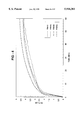
- FIG. 3 is a plot of the hydriding kinetics of sample MA-2 under 50 psig at various temperatures
- FIG. 4 is a plot of the hydriding kinetics of sample MA-2 at 160° C. at various pressures
- FIG. 5 is a plot of the hydriding kinetics of sample MA-2 at 26° C. at about one atmosphere pressure
- FIG. 6 is a plot of the dehydriding kinetics of sample MA-2 at various temperatures under a vacuum
- FIG. 7 is a plot of the dehydriding kinetics of sample MA-2 at various temperatures at about one atmosphere pressure
- FIG. 8 is a plot of the dehydriding kinetics of sample MA-2 at 350° C. at various pressures
- FIG. 9 is a plot of the desorption pressure-composition isotherms of sample MA-2.
- FIG. 10 is a Van't Hoff plot for desorption of sample MA-2
- FIG. 11 is a plot of the dehydriding kinetics of sample MA-2 after various numbers of hydriding/dehydriding cycles
- FIG. 12 is an SEM photomicrograph of sample MA-2 after 2017 hydriding/dehydriding cycles
- FIG. 13 is an X-ray diffraction pattern of sample MA-2 after 2017 hydriding/dehydriding cycles
- FIG. 14 is a plot of the dehydriding kinetics of sample MA-2, specifically showing the influence of 0.1% CO in H 2 poisoning upon the sample and the cleaning effect of ultra-pure hydrogen on the poisoned sample;
- FIG. 15 is a plot of the dehydriding kinetics of sample MA-8a, specifically showing the influence of CH 4 in H 2 poisoning upon the dehydriding kinetics the of sample and the cleaning effect of ultra-pure hydrogen on the poisoned sample;
- FIG. 16 is a plot of the dehydriding kinetics of sample MA-8a, specifically showing the influence of 0.1% CO in H 2 poisoning upon the dehydriding kinetics the of sample and the cleaning effect of ultra-pure hydrogen on the poisoned sample;
- FIG. 17 is a plot comparing of the dehydriding kinetics of a mechanically alloyed hydrogen storage material prepared by mechanical alloying in an attritor at 600 RPM for six hours using elemental powders of Mg, Ni and Mo under a 5 vol. % H 2 --Ar mixed atmosphere, MA-45, and MA-2 at a temperature of 360° C. and a pressure of about one atmosphere.
- the particular materials developed are mechanical alloys which include a majority atomic percentage of magnesium and also include at least two elements selected from the group consisting of nickel, molybdenum, iron and titanium. Particularly useful combinations of these metals are the Mg--Ni--Mo and Mg--Fe--Ti systems.
- the hydrogen storage materials are made by a mechanical alloy process.
- the starting materials for the Mg--Ni--Mo system were pure Mg granules (>99.9% pure, -20+100 mesh) and a Ni--Mo binary alloy powder (85 wt. % Ni, -325 mesh) or individual Ni and Mo powders or an FeTi binary alloy (50 at. %, -325 mesh).
- the starting materials were ground in a ball milling apparatus for varied times at different speeds under an argon atmosphere.
- One process uses high energy ball milling where the attrition is carried out in a stainless steel jar with 3/16 inch stainless steel balls (medium) under argon atmosphere.
- the mass ratio of the medium to the charge to be alloyed was about 100:1.
- 4 lbs. of medium is used in a jar of volume 750 cc.
- the second method involved the use of a planetary ball mill. Unlike the attritor in which the jar is stationary, in the planetary ball mill the jars rotate on a horizontal plane about their own central axis. Preliminary experiments indicate that to alloy samples that are brittle and in the form of large chunks (5-10 mm in size), it is preferable to use tungsten carbide grinding media of about 3 mm in diameter. When the starting material is of smaller particle size (0.01 mm or less), stainless steel grinding media of about 3/16 inch or less works better.
- the mechanically alloyed samples do not need any crushing since the final product is in powder form. However, in order to eliminate the effects due to particle size the materials were put through a sieve to obtain particles of fairly uniform size.
- the samples were typically exposed to hydrogen gas at 600-800 psi at temperatures between 350° C. and 380° C. overnight after the reactor had been evacuated to 10 -3 Torr. To completely activate samples, they were subjected to at least three absorption/desorption cycles.
- Hydrogen storage capacity, hydriding and dehydriding kinetics and pressure-composition isotherms were determined by combinations of volumetric and manometric methods. The pressure change versus time during hydriding and dehydriding process was dynamically read using a computer.
- a poisoning study was done to determine the effects of a trace amount of impurities such as CO, and CH 4 in the hydrogen on hydrogen storage properties of the alloy. After testing the samples under normal conditions, they were exposed to the hydrogen/poison mixture for 24 hours and then re-tested for desorption kinetics. To determine if the samples could be reactivated, they were then subjected to pure hydrogen and cycled five times before measuring the desorption kinetics once again.
- phase analysis in a scanning electron microscope (SEM) was performed on a mounted and polished sample to minimize the effect of topography.
- the sample was photographed in secondary electron image (SEI) mode which shows primarily topography, and backscattered electron image (BEI) mode which shows contrast by atomic number.
- SEI secondary electron image
- BEI backscattered electron image
- a spot chemical analysis is performed by energy dispersive X-ray spectroscopy (EDS). All EDS results were analyzed with pure elemental standards. X-ray diffraction was done for structural determination.
- Table 1 summarizes the experimental conditions used to produce some example alloys in the Mg--Ni--Mo and Mg--Fe--Ti systems, as well as their nominal composition, and the maximum hydrogen storage capacity obtained therefrom.
- the samples, prepared by mechanically alloying, are typically multi-phase with at least one major amorphous phase as revealed by XRD study.
- FIG. 1 is an SEM photomicrograph which shows the morphological features of sample MA-2 in Table 1. SEM analysis indicates that there are three phases, all of which contain Mg, Ni, and Mo. All samples show that alloying has taken place and that the major phases in each case contain all alloying elements. Analysis of the mechanical alloys indicate that some impurities (such as iron, chromium, silicon, tungsten etc.) become incorporated into the alloys from the grinding media (i.e. stainless steel balls, WC balls etc.).
- the grinding media i.e. stainless steel balls, WC balls etc.
- FIG. 2 is a graphical depiction of the X-ray diffraction pattern of the MA-2 sample. All as-prepared samples show broad X-ray diffraction peaks, indicative of amorphous structural phases.
- FIGS. 3-8 are graphical depictions of the hydrogen absorption and desorption kinetics of sample MA-2 measured at various temperatures and pressures.
- FIG. 3 plots the weight percentage of absorbed hydrogen versus time of sample MA-2 at a hydrogen pressure of 50 psig at various temperature.
- FIG. 4 shows a similar plot of the H-absorption kinetics of sample MA-2 at 160° C. at different temperatures.
- FIG. 5 shows that sample MA-2 is capable of absorbing hydrogen even at room temperature.
- FIG. 6 shows that a maximum hydrogen storage of 5.2 wt. % was obtained for sample MA-2 at 250° C.
- FIG. 7 shows the dehydriding kinetics of MA-2 determined at various temperatures at a pressure of about one atmosphere.
- FIG. 3 plots the weight percentage of absorbed hydrogen versus time of sample MA-2 at a hydrogen pressure of 50 psig at various temperature.
- FIG. 4 shows a similar plot of the H-absorption kinetics of sample MA-2 at 160° C. at different temperatures.
- Sample MA-6c had a storage capacity of 4.2 wt. %.
- the XRD pattern for this sample shows highly disordered/amorphous features. Upon sintering at 660° C. for 3 hours the storage capacity dropped to 3.3 wt. % and the corresponding XRD shows the formation of crystalline phases not previously present. While this is a very important result.
- sample MA-2 was subjected to a mixtures of methane (0.5% by volume) and hydrogen, and carbon monoxide (0.1% by volume) and hydrogen.
- the desorption kinetics after subjecting the alloys to these gas mixtures are given in FIGS. 14-16.
- FIG. 14 shows the influence of CO in H 2 on the dehydriding kinetics of sample MA-2
- FIG. 15 shows the influence of CH 4 in H 2 on the dehydriding kinetics of sample MA-8a
- FIG. 16 shows the influence of 0.1% CO in H 2 on the dehydriding kinetics of sample MA-8a.
- the curve indicated by the blackened squares shows the dehydriding kinetics prior to poisoning
- the curve indicated by the open squares shows the dehydriding kinetics right after poisoning
- the curve indicated by the blackened diamonds shows the dehydriding kinetics after the sample is poisoned and cleaned by 5 cycles in 99.9995% H 2 .
- these materials are relatively immune to poisoning by these impurity gases at these levels.
- the nominal chemical composition of this sample is nearly identical to that of MA-2.
- a comparison of the dehydriding kinetics of MA-45 and MA-2 at a temperature of 360° C. and a pressure of about one atmosphere are shown in FIG. 17.
- the mechanically alloyed sample made from pure elemental powders under a H 2 --Ar atmosphere i.e. MA-45
- has both better kinetics and a higher capacity that made from Mg and a Ni--Mo alloy under an Argon atmosphere i.e. MA-2).
Landscapes
- Chemical & Material Sciences (AREA)
- Organic Chemistry (AREA)
- Engineering & Computer Science (AREA)
- Chemical Kinetics & Catalysis (AREA)
- Combustion & Propulsion (AREA)
- Inorganic Chemistry (AREA)
- Electrochemistry (AREA)
- Materials Engineering (AREA)
- Mechanical Engineering (AREA)
- Metallurgy (AREA)
- Life Sciences & Earth Sciences (AREA)
- General Chemical & Material Sciences (AREA)
- Manufacturing & Machinery (AREA)
- Sustainable Energy (AREA)
- Sustainable Development (AREA)
- Environmental & Geological Engineering (AREA)
- General Life Sciences & Earth Sciences (AREA)
- Geology (AREA)
- Crystallography & Structural Chemistry (AREA)
- Hydrogen, Water And Hydrids (AREA)
- Powder Metallurgy (AREA)
- Battery Electrode And Active Subsutance (AREA)
Priority Applications (3)
| Application Number | Priority Date | Filing Date | Title |
|---|---|---|---|
| US08/730,274 US5916381A (en) | 1994-12-22 | 1996-10-15 | Magnesium mechanical alloys for thermal hydrogen storage |
| US09/066,247 US6103024A (en) | 1994-12-22 | 1998-04-24 | Magnesium mechanical alloys for thermal hydrogen storage |
| US09/066,185 US5976276A (en) | 1994-12-22 | 1998-04-24 | Magnesium mechanical alloys for thermal hydrogen storage |
Applications Claiming Priority (2)
| Application Number | Priority Date | Filing Date | Title |
|---|---|---|---|
| US36320594A | 1994-12-22 | 1994-12-22 | |
| US08/730,274 US5916381A (en) | 1994-12-22 | 1996-10-15 | Magnesium mechanical alloys for thermal hydrogen storage |
Related Parent Applications (1)
| Application Number | Title | Priority Date | Filing Date |
|---|---|---|---|
| US36320594A Continuation | 1994-12-22 | 1994-12-22 |
Related Child Applications (2)
| Application Number | Title | Priority Date | Filing Date |
|---|---|---|---|
| US09/066,247 Continuation-In-Part US6103024A (en) | 1994-12-22 | 1998-04-24 | Magnesium mechanical alloys for thermal hydrogen storage |
| US09/066,185 Continuation US5976276A (en) | 1994-12-22 | 1998-04-24 | Magnesium mechanical alloys for thermal hydrogen storage |
Publications (1)
| Publication Number | Publication Date |
|---|---|
| US5916381A true US5916381A (en) | 1999-06-29 |
Family
ID=23429266
Family Applications (2)
| Application Number | Title | Priority Date | Filing Date |
|---|---|---|---|
| US08/730,274 Expired - Fee Related US5916381A (en) | 1994-12-22 | 1996-10-15 | Magnesium mechanical alloys for thermal hydrogen storage |
| US09/066,185 Expired - Lifetime US5976276A (en) | 1994-12-22 | 1998-04-24 | Magnesium mechanical alloys for thermal hydrogen storage |
Family Applications After (1)
| Application Number | Title | Priority Date | Filing Date |
|---|---|---|---|
| US09/066,185 Expired - Lifetime US5976276A (en) | 1994-12-22 | 1998-04-24 | Magnesium mechanical alloys for thermal hydrogen storage |
Country Status (6)
| Country | Link |
|---|---|
| US (2) | US5916381A (fr) |
| EP (1) | EP0799324B1 (fr) |
| AU (1) | AU4469196A (fr) |
| CA (1) | CA2206252A1 (fr) |
| DE (1) | DE69522471T2 (fr) |
| WO (1) | WO1996019594A1 (fr) |
Cited By (11)
| Publication number | Priority date | Publication date | Assignee | Title |
|---|---|---|---|---|
| WO1999055926A1 (fr) * | 1998-04-24 | 1999-11-04 | Energy Conversion Devices, Inc. | Alliages de magnesium obtenus par procede mecanique et destines a un stockage thermique d'hydrogene |
| WO2001038591A3 (fr) * | 1999-11-22 | 2001-11-22 | Energy Conversion Devices Inc | Alliages modifies a base de magnesium pour le stockage d'hydrogene |
| US6332908B1 (en) * | 1999-11-19 | 2001-12-25 | Korea Advanced Institute Of Science And Technology | Method for modifying surface of hydrogen storage alloy for NI/MH secondary battery using flake type metal |
| WO2002002835A1 (fr) * | 2000-07-05 | 2002-01-10 | Energy Conversion Devices, Inc. | Alliages de stockage d'hydrogene possedant une capacite de stockage elevee, une cinetique rapide et un long cycle de vie |
| WO2001048837A3 (fr) * | 1999-12-13 | 2002-01-31 | Energy Conversion Devices Inc | Procede de fabrication d'un alliage de stockage d'hydrogene |
| US20020194960A1 (en) * | 2000-03-24 | 2002-12-26 | Mitsui Mining & Smelting Co., Ltd. | Process of recovering valuable metal |
| US20030135283A1 (en) * | 2001-12-21 | 2003-07-17 | Etex Corporation | Machinable preformed calcium phosphate bone substitute material implants |
| US6689193B1 (en) * | 1999-06-24 | 2004-02-10 | Honda Giken Kogyo Kabushiki Kaisha | Hydrogen storage alloy powder and method for producing the same |
| US20160194201A1 (en) * | 2013-09-05 | 2016-07-07 | South China University Of Technology | Magnesium-based hydrogen storage material and method for preparing the same |
| CN112265957A (zh) * | 2020-09-21 | 2021-01-26 | 武汉船用电力推进装置研究所(中国船舶重工集团公司第七一二研究所) | 一种高储氢密度镁基储氢材料的制备方法 |
| CN114438386A (zh) * | 2022-03-15 | 2022-05-06 | 北京氢冉新能源科技有限公司 | 一种单金属元素掺杂的镁基储氢材料及其制备方法 |
Families Citing this family (13)
| Publication number | Priority date | Publication date | Assignee | Title |
|---|---|---|---|---|
| CA2217095A1 (fr) * | 1997-10-22 | 1999-04-22 | Hydro-Quebec | Nanocomposites a interfaces activees prepares par broyage mecanique d'hydrures de magnesium et usage de ceux-ci pour le stockage d'hydrogene |
| US6461766B1 (en) * | 1998-08-27 | 2002-10-08 | Ovonic Battery Company, Inc. | Hydrogen storage powder and process for preparing the same |
| US6193929B1 (en) * | 1999-11-06 | 2001-02-27 | Energy Conversion Devices, Inc. | High storage capacity alloys enabling a hydrogen-based ecosystem |
| US6726783B1 (en) * | 2000-05-18 | 2004-04-27 | Energy Conversion Devices, Inc. | High storage capacity alloys having excellent kinetics and a long cycle life |
| US6521278B1 (en) | 2000-09-12 | 2003-02-18 | Mars, Incorporated | Food materials with improved flavor and functionality due to size reduction in a modified atmosphere |
| JP3677220B2 (ja) * | 2001-04-26 | 2005-07-27 | 日本重化学工業株式会社 | マグネシウム系水素吸蔵合金 |
| US20050126663A1 (en) * | 2003-12-11 | 2005-06-16 | Fetcenko Michael A. | Catalyzed hydrogen desorption in Mg-based hydrogen storage material and methods for production thereof |
| US7211541B2 (en) * | 2003-12-11 | 2007-05-01 | Ovonic Hydrogen Systems Llc | Mg—Ni hydrogen storage composite having high storage capacity and excellent room temperature kinetics |
| ZA200704897B (en) | 2004-12-07 | 2008-09-25 | Univ Queensland | Magnesium alloys for hydrogen storage |
| CN101709396B (zh) * | 2009-11-23 | 2011-01-05 | 广西大学 | 一种镁钛基储氢合金的制备方法 |
| US9435489B2 (en) | 2010-02-24 | 2016-09-06 | Hydrexia Pty Ltd | Hydrogen release system |
| EP3325190A4 (fr) | 2015-07-23 | 2019-08-14 | Hydrexia Pty Ltd | Alliage à base de mg pour stockage d'hydrogène |
| CN108226438B (zh) * | 2017-12-21 | 2020-06-26 | 江西江钨浩运科技有限公司 | 一种快速测试储氢合金粉吸放氢性能活化方式 |
Citations (5)
| Publication number | Priority date | Publication date | Assignee | Title |
|---|---|---|---|---|
| JPS5637202A (en) * | 1979-08-31 | 1981-04-10 | Agency Of Ind Science & Technol | Hydrogen storing metallic material |
| US4431561A (en) * | 1982-04-28 | 1984-02-14 | Energy Conversion Devices, Inc. | Hydrogen storage materials and method of making same |
| US4728580A (en) * | 1985-03-29 | 1988-03-01 | The Standard Oil Company | Amorphous metal alloy compositions for reversible hydrogen storage |
| JPH0247238A (ja) * | 1988-08-08 | 1990-02-16 | Nippon Telegr & Teleph Corp <Ntt> | 制振合金およびその製造方法 |
| US4902579A (en) * | 1985-03-29 | 1990-02-20 | The Standard Oil Company | Amorphous metal alloy compositions for reversible hydrogen storage |
Family Cites Families (3)
| Publication number | Priority date | Publication date | Assignee | Title |
|---|---|---|---|---|
| GB463224A (en) * | 1935-05-15 | 1937-03-24 | Fritz Christen | An improved magnesium alloy |
| JP2560565B2 (ja) * | 1991-04-23 | 1996-12-04 | 株式会社栗本鐵工所 | 水素吸蔵合金の製造方法 |
| US5506069A (en) * | 1993-10-14 | 1996-04-09 | Ovonic Battery Company, Inc. | Electrochemical hydrogen storage alloys and batteries fabricated from Mg containing base alloys |
-
1995
- 1995-12-15 CA CA002206252A patent/CA2206252A1/fr not_active Abandoned
- 1995-12-15 EP EP95943418A patent/EP0799324B1/fr not_active Expired - Lifetime
- 1995-12-15 DE DE69522471T patent/DE69522471T2/de not_active Expired - Fee Related
- 1995-12-15 AU AU44691/96A patent/AU4469196A/en not_active Abandoned
- 1995-12-15 WO PCT/US1995/016201 patent/WO1996019594A1/fr not_active Ceased
-
1996
- 1996-10-15 US US08/730,274 patent/US5916381A/en not_active Expired - Fee Related
-
1998
- 1998-04-24 US US09/066,185 patent/US5976276A/en not_active Expired - Lifetime
Patent Citations (5)
| Publication number | Priority date | Publication date | Assignee | Title |
|---|---|---|---|---|
| JPS5637202A (en) * | 1979-08-31 | 1981-04-10 | Agency Of Ind Science & Technol | Hydrogen storing metallic material |
| US4431561A (en) * | 1982-04-28 | 1984-02-14 | Energy Conversion Devices, Inc. | Hydrogen storage materials and method of making same |
| US4728580A (en) * | 1985-03-29 | 1988-03-01 | The Standard Oil Company | Amorphous metal alloy compositions for reversible hydrogen storage |
| US4902579A (en) * | 1985-03-29 | 1990-02-20 | The Standard Oil Company | Amorphous metal alloy compositions for reversible hydrogen storage |
| JPH0247238A (ja) * | 1988-08-08 | 1990-02-16 | Nippon Telegr & Teleph Corp <Ntt> | 制振合金およびその製造方法 |
Cited By (23)
| Publication number | Priority date | Publication date | Assignee | Title |
|---|---|---|---|---|
| US6103024A (en) * | 1994-12-22 | 2000-08-15 | Energy Conversion Devices, Inc. | Magnesium mechanical alloys for thermal hydrogen storage |
| EP1082469A4 (fr) * | 1998-04-24 | 2005-02-02 | Energy Conversion Devices Inc | Alliages de magnesium obtenus par procede mecanique et destines a un stockage thermique d'hydrogene |
| WO1999055926A1 (fr) * | 1998-04-24 | 1999-11-04 | Energy Conversion Devices, Inc. | Alliages de magnesium obtenus par procede mecanique et destines a un stockage thermique d'hydrogene |
| AU752500B2 (en) * | 1998-04-24 | 2002-09-19 | Energy Conversion Devices Inc. | Magnesium mechanical alloys for thermal hydrogen storage |
| US6689193B1 (en) * | 1999-06-24 | 2004-02-10 | Honda Giken Kogyo Kabushiki Kaisha | Hydrogen storage alloy powder and method for producing the same |
| US6746645B2 (en) * | 1999-11-06 | 2004-06-08 | Energy Conversion Devices, Inc. | High storage capacity, fast kinetics, long cycle-life, hydrogen storage alloys |
| US20020179194A1 (en) * | 1999-11-06 | 2002-12-05 | Ovshinsky Stanford R. | High storage capacity, fast kinetics, long cycle-life, hydrogen storage alloys |
| US6491866B1 (en) * | 1999-11-06 | 2002-12-10 | Energy Conversion Devices, Inc. | High storage capacity, fast kinetics, long cycle-life, hydrogen storage alloys |
| US6332908B1 (en) * | 1999-11-19 | 2001-12-25 | Korea Advanced Institute Of Science And Technology | Method for modifying surface of hydrogen storage alloy for NI/MH secondary battery using flake type metal |
| WO2001038591A3 (fr) * | 1999-11-22 | 2001-11-22 | Energy Conversion Devices Inc | Alliages modifies a base de magnesium pour le stockage d'hydrogene |
| WO2001048837A3 (fr) * | 1999-12-13 | 2002-01-31 | Energy Conversion Devices Inc | Procede de fabrication d'un alliage de stockage d'hydrogene |
| US6478844B1 (en) * | 1999-12-13 | 2002-11-12 | Energy Conversion Devices, Inc. | Method for making hydrogen storage alloy |
| US20020194960A1 (en) * | 2000-03-24 | 2002-12-26 | Mitsui Mining & Smelting Co., Ltd. | Process of recovering valuable metal |
| WO2002002835A1 (fr) * | 2000-07-05 | 2002-01-10 | Energy Conversion Devices, Inc. | Alliages de stockage d'hydrogene possedant une capacite de stockage elevee, une cinetique rapide et un long cycle de vie |
| US20030135283A1 (en) * | 2001-12-21 | 2003-07-17 | Etex Corporation | Machinable preformed calcium phosphate bone substitute material implants |
| US6840961B2 (en) | 2001-12-21 | 2005-01-11 | Etex Corporation | Machinable preformed calcium phosphate bone substitute material implants |
| US20050147551A1 (en) * | 2001-12-21 | 2005-07-07 | Etex Corporation | Synthesis of calcium phosphates by mechano-chemical process |
| US7318841B2 (en) | 2001-12-21 | 2008-01-15 | Etex Corporation | Synthesis of calcium phosphates by mechano-chemical process |
| US7686239B2 (en) | 2001-12-21 | 2010-03-30 | Etex Corportation | Synthesis of calcium phosphates by mechano-chemical process |
| US20160194201A1 (en) * | 2013-09-05 | 2016-07-07 | South China University Of Technology | Magnesium-based hydrogen storage material and method for preparing the same |
| US9764951B2 (en) * | 2013-09-05 | 2017-09-19 | South China University Of Technology | Magnesium-based hydrogen storage material and method for preparing the same |
| CN112265957A (zh) * | 2020-09-21 | 2021-01-26 | 武汉船用电力推进装置研究所(中国船舶重工集团公司第七一二研究所) | 一种高储氢密度镁基储氢材料的制备方法 |
| CN114438386A (zh) * | 2022-03-15 | 2022-05-06 | 北京氢冉新能源科技有限公司 | 一种单金属元素掺杂的镁基储氢材料及其制备方法 |
Also Published As
| Publication number | Publication date |
|---|---|
| DE69522471T2 (de) | 2002-05-29 |
| CA2206252A1 (fr) | 1996-06-27 |
| EP0799324B1 (fr) | 2001-08-29 |
| US5976276A (en) | 1999-11-02 |
| EP0799324A4 (fr) | 1998-05-06 |
| DE69522471D1 (de) | 2001-10-04 |
| AU4469196A (en) | 1996-07-10 |
| EP0799324A1 (fr) | 1997-10-08 |
| WO1996019594A1 (fr) | 1996-06-27 |
Similar Documents
| Publication | Publication Date | Title |
|---|---|---|
| US5916381A (en) | Magnesium mechanical alloys for thermal hydrogen storage | |
| CN100471557C (zh) | 具有高存储容量和优良室温动力学的Mg-Ni储氢复合材料 | |
| US6103024A (en) | Magnesium mechanical alloys for thermal hydrogen storage | |
| EP0815273B1 (fr) | Materiaux nanocristallises a base de mg et leur utilisation pour le transport et le stockage de l'hydrogene | |
| CA1189499A (fr) | Materiaux accumulateurs d'hydrogene, et leur fabrication | |
| US20050126663A1 (en) | Catalyzed hydrogen desorption in Mg-based hydrogen storage material and methods for production thereof | |
| US6328821B1 (en) | Modified magnesium based hydrogen storage alloys | |
| EP0996183B1 (fr) | Alliage ternaire de stockage d'hydrogène et procédé d'obtention de celui-ci | |
| US20040206424A1 (en) | Hydrogen storage material including a modified Ti-Mn2 alloy | |
| US4832913A (en) | Hydrogen storage materials useful for heat pump applications | |
| CA2209777C (fr) | Materiaux nanocristallises a base de mg et leur utilisation pour le transport et le stockage de l'hydrogene | |
| MXPA00010011A (en) | Magnesium mechanical alloys for thermal hydrogen storage | |
| EP0220678A1 (fr) | Matériaux pour le stockage d'hydrogène utilisables dans des pompes à chaleur | |
| Jurczyk et al. | 9 RE-Mg-Ni hydrogen storage alloys | |
| KESKINEN et al. | NANOCRYSTALLINE Mg2Ni |
Legal Events
| Date | Code | Title | Description |
|---|---|---|---|
| FPAY | Fee payment |
Year of fee payment: 4 |
|
| FPAY | Fee payment |
Year of fee payment: 8 |
|
| REMI | Maintenance fee reminder mailed | ||
| LAPS | Lapse for failure to pay maintenance fees | ||
| STCH | Information on status: patent discontinuation |
Free format text: PATENT EXPIRED DUE TO NONPAYMENT OF MAINTENANCE FEES UNDER 37 CFR 1.362 |
|
| FP | Lapsed due to failure to pay maintenance fee |
Effective date: 20110629 |
|
| AS | Assignment |
Owner name: OVONIC HYDROGEN SYSTEMS LLC, MICHIGAN Free format text: ASSIGNMENT OF ASSIGNORS INTEREST;ASSIGNOR:ENERGY CONVERSION DEVICES, INC.;REEL/FRAME:027267/0232 Effective date: 20110812 |