US6107781A - Power supply unit for supplying electric power to an electronic apparatus, and system comprising the power supply unit and the electronic apparatus - Google Patents
Power supply unit for supplying electric power to an electronic apparatus, and system comprising the power supply unit and the electronic apparatus Download PDFInfo
- Publication number
- US6107781A US6107781A US09/219,600 US21960098A US6107781A US 6107781 A US6107781 A US 6107781A US 21960098 A US21960098 A US 21960098A US 6107781 A US6107781 A US 6107781A
- Authority
- US
- United States
- Prior art keywords
- power
- electronic apparatus
- switch
- battery
- supply unit
- Prior art date
- Legal status (The legal status is an assumption and is not a legal conclusion. Google has not performed a legal analysis and makes no representation as to the accuracy of the status listed.)
- Expired - Lifetime
Links
Images


Classifications
-
- H—ELECTRICITY
- H02—GENERATION; CONVERSION OR DISTRIBUTION OF ELECTRIC POWER
- H02J—ELECTRIC POWER NETWORKS; CIRCUIT ARRANGEMENTS OR SYSTEMS FOR SUPPLYING OR DISTRIBUTING ELECTRIC POWER; SYSTEMS FOR STORING ELECTRIC ENERGY
- H02J7/00—Circuit arrangements for charging or discharging batteries or for supplying loads from batteries
- H02J7/60—Circuit arrangements for charging or discharging batteries or for supplying loads from batteries including safety or protection arrangements
- H02J7/663—Circuit arrangements for charging or discharging batteries or for supplying loads from batteries including safety or protection arrangements using battery or load disconnect circuits
-
- G—PHYSICS
- G06—COMPUTING OR CALCULATING; COUNTING
- G06F—ELECTRIC DIGITAL DATA PROCESSING
- G06F1/00—Details not covered by groups G06F3/00 - G06F13/00 and G06F21/00
- G06F1/26—Power supply means, e.g. regulation thereof
-
- H—ELECTRICITY
- H02—GENERATION; CONVERSION OR DISTRIBUTION OF ELECTRIC POWER
- H02J—ELECTRIC POWER NETWORKS; CIRCUIT ARRANGEMENTS OR SYSTEMS FOR SUPPLYING OR DISTRIBUTING ELECTRIC POWER; SYSTEMS FOR STORING ELECTRIC ENERGY
- H02J7/00—Circuit arrangements for charging or discharging batteries or for supplying loads from batteries
- H02J7/60—Circuit arrangements for charging or discharging batteries or for supplying loads from batteries including safety or protection arrangements
- H02J7/61—Circuit arrangements for charging or discharging batteries or for supplying loads from batteries including safety or protection arrangements against overcharge
-
- H—ELECTRICITY
- H02—GENERATION; CONVERSION OR DISTRIBUTION OF ELECTRIC POWER
- H02J—ELECTRIC POWER NETWORKS; CIRCUIT ARRANGEMENTS OR SYSTEMS FOR SUPPLYING OR DISTRIBUTING ELECTRIC POWER; SYSTEMS FOR STORING ELECTRIC ENERGY
- H02J7/00—Circuit arrangements for charging or discharging batteries or for supplying loads from batteries
- H02J7/60—Circuit arrangements for charging or discharging batteries or for supplying loads from batteries including safety or protection arrangements
- H02J7/62—Circuit arrangements for charging or discharging batteries or for supplying loads from batteries including safety or protection arrangements against overcurrent
-
- H—ELECTRICITY
- H02—GENERATION; CONVERSION OR DISTRIBUTION OF ELECTRIC POWER
- H02J—ELECTRIC POWER NETWORKS; CIRCUIT ARRANGEMENTS OR SYSTEMS FOR SUPPLYING OR DISTRIBUTING ELECTRIC POWER; SYSTEMS FOR STORING ELECTRIC ENERGY
- H02J7/00—Circuit arrangements for charging or discharging batteries or for supplying loads from batteries
- H02J7/60—Circuit arrangements for charging or discharging batteries or for supplying loads from batteries including safety or protection arrangements
- H02J7/63—Circuit arrangements for charging or discharging batteries or for supplying loads from batteries including safety or protection arrangements against overdischarge
Definitions
- the present invention relates to a power supply unit for supplying electric power to an electronic apparatus connected to the power supply unit, and a system comprising the power supply unit and the electronic apparatus.
- the present invention relates to a power supply unit which is connected to an electronic apparatus such as a recording apparatus, incorporates a battery or cells, and can selectively effect supply and cutoff of power to the electronic apparatus.
- the present invention also relates to a system comprising the power supply unit and the electronic apparatus.
- the so-called secondary cells which can be recharged repeatedly, have been employed as power sources for many of those electronic apparatuses.
- the secondary cells are nickel cadmium cells, nickel hydrogen cells, lithium ion cells, etc.
- the power source comprises a single cell.
- a plurality of cells are combined in series or parallel and housed in a case to construct a dedicated battery pack which is incorporated in or connected to the electronic apparatus.
- lithium ion cells are advantageous in having a higher energy density per predetermined unit of volume and a higher energy density per predetermined unit of weight than other secondary cells such as nickel cadmium cells and nickel hydrogen cells.
- FIG. 3 is a circuit block diagram of a conventional battery-driven system comprising a power supply unit which incorporates a battery (cells) therein to supply electric power, and a main unit which operates with the power supplied as a drive source from the power supply unit.
- reference numeral 10 on the left side denotes a battery pack constituting the power supply unit.
- Three lithium ion cells 11 are housed in the battery pack 10 and connected in series.
- a discharge switch 12 and a charge switch 13 are provided in the battery pack 10. As shown in FIG. 3, the discharge switch 12 and the charge switch 13 are disposed in a current path through which the cells are charged and discharged, and are connected in series. Additionally, the battery pack 10 is provided with output terminals V and E for outputting the power.
- the battery pack 10 further includes a protection circuit for maintaining safety of the cells.
- the protection circuit functions such that if there occurs any situation affecting safety of the cells, such as overdischarge, overcurrent, overvoltage or overcharge, the discharge switch 12 and the charge switch 13 are turned off by a control circuit 14 to cut off the power outputted across the output terminals V-E.
- Reference numeral 20 on the right side of FIG. 3 denotes the main unit working with the battery pack 10 used as a power supply for the work.
- the power supplied from the battery pack 10 is applied to a DC--DC converter 22 through an FET (Field Effect Transistor) 21 for conversion into a source voltage Vcc adapted for logics.
- the main unit 20 comprises a microprocessor (MPU) 23, a ROM 24 for storing a control program used for control executed by the MPU 23, and a RAM 25 serving as a work area for execution of the control program.
- the operation of the entire main unit 20 is controlled by the MPU 23.
- the main unit 20 includes a power switch 26 for selectively turning on/off the source power.
- the power switch 26 comprises, for example, a tactile switch.
- a gate of the FET 21 is controlled to close or open upon the power switch 26 being turned on/off.
- An on/off state of the source power of the main unit 20 is controlled corresponding to control of the gate of the FET 21.
- An output signal from the power switch 26 is read into the MPU 23 through an input port 27, while the on/off state of the FET 21 is controlled in response to an output signal from an output port 28 through a transistor 30.
- the FET 21 serving as a switch for turning on/off the source power of the main unit 20 is inserted in a power line in series. Looking from the battery side, therefore, FETs are inserted double in the power line because the discharge switch 12 and the charge switch 13 incorporated in the battery pack 10 each usually comprise an FET and the FET 21 is provided in the main unit 20. With such a construction, resistance developed at the time of turning on the FETs is increased and ineffective Joule heat is generated. Also, an increase of the resistance produces a voltage drop, thus resulting in a reduction of battery efficiency and shortening of battery life.
- Another problem in the conventional battery-driven system having the above-described construction is that it has been difficult to reduce the apparatus size and cut down the cost because the FET 21 or the like must be provided as a switch on the side of the main unit 20.
- the present invention has been made with the view of solving the problems set forth above, and an object of the present invention is to provide a power supply unit and a system comprising the power supply unit and an electronic apparatus, with which a battery can be used with higher efficiency.
- Another object of the present invention is to provide a power supply unit and a system comprising the power supply unit and an electronic apparatus, with which a reduction in both size and cost can be realized.
- a power supply unit is constructed as follows.
- the power supply unit resides in a power supply unit for supplying electric power to an electronic apparatus connected to the power supply unit, the power supply unit comprising a battery, an output terminal for outputting output power of the battery to the electronic apparatus, a switch for selectively turning on/off the output power supplied from the battery to the electronic apparatus, a control circuit for controlling changeover of the switch, and a control signal line electrically connected to the electronic apparatus through a control terminal for receiving a signal corresponding to an operation made on the electronic apparatus, the control circuit changing over the switch in accordance with the signal received through the control signal line corresponding to an operation made on the electronic apparatus.
- the control circuit changes over the switch so that the output power of the battery is outputted to the output terminal.
- a system according to the present invention is constructed as follows.
- the system according to the present invention resides in a system made up of a power supply unit for supplying electric power and an electronic apparatus operating with the power supplied from the power supply unit, the power supply unit comprising a battery, an output terminal for outputting output power of the battery to the electronic apparatus, a switch for selectively turning on/off the output power supplied from the battery to the electronic apparatus, a control circuit for controlling changeover of the switch, and a control signal line connected to the control circuit, the electronic apparatus including a power switch electrically connected to the control signal line in the power supply unit, the power switch being operated by an operator, the control circuit changing over the switch in accordance with a state of a signal transmitted through the control signal line corresponding to an operation of the power switch, thereby controlling supply of the output power from the battery to the electronic apparatus.
- one end of the power switch is connected to the ground, and the control circuit changes over the switch to turn on when the control signal line is transited upon the operation of the power switch to a low level from a condition in which the control signal line is held at a high level by the output power of the battery.
- the power switch provided on the electronic apparatus is a switch turned on when depressed by the operator, the control signal line in the power supply unit is transited to a low-level state upon the power switch being depressed in a condition in which the control signal line is held in a high-level state by the output power of the battery, and the control circuit changes over the switch to allow supply of the output power of the battery to the output terminal when the control signal line is in the low-level state.
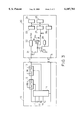
- FIG. 1 is a circuit block diagram showing a principal construction of a system comprising an ink jet recording apparatus and a battery pack as a power supply unit, and a manner of connecting them.
- FIG. 2 is a timing chart showing level transition of main signals generated in the construction of FIG. 1.
- FIG. 3 a circuit block diagram showing a construction of a conventional system comprising a power supply unit and a main unit.
- FIG. 1 is a circuit block diagram showing a construction of a battery-driven system comprising a battery pack as a power supply unit and an electronic apparatus connected to the battery pack. Note that this embodiment will be described in connection with an ink jet recording apparatus which is connected as one example of electronic apparatus to the battery pack.
- the ink jet recording apparatus is constructed to be capable of operating with the battery pack used as a power supply for the operation.
- FIG. 1 illustrates only a principal part of the system construction that is essential for describing the present invention.
- a block demarcated by a one-dot chain line on the left side denotes a battery pack 10.
- a block demarcated by a one-dot chain line on the right side denotes an ink jet recording apparatus 20 operating with source power supplied from the battery pack 10.
- the battery pack 10 and the ink jet recording apparatus 20 can be constructed separately and electrically connected to each other through external terminals provided on them.
- the battery pack 10 and the ink jet recording apparatus 20 may be installed in one housing and electrically connected to each other in the housing.
- the battery pack 10 may be installed in a space within the ink jet recording apparatus 20 and electrically connected to the latter in such an internal space of the apparatus 20.
- the internal construction of the battery pack 10 will be first described in detail.
- the battery pack 10 employs a lithium ion cell 11 as a unit cell of an entire battery. Three lithium ion cells 11 are incorporated in the battery pack 10 and connected in series.
- a discharge switch 12 and a charge switch 13, each comprising an FET or the like, are connected in series in an electrical path through which the cells 11 are charged and discharged.
- One signal line leading from the charge switch 13 is connected to an output terminal V of the battery pack 10.
- the discharge switch 12 and the charge switch 13 are also both turned on. In this case, however, a current for charging the cells is supplied from a charging circuit (not shown), which is prepared outside the battery pack 10, through a path made up of the output terminal V of the battery pack 10, the charge switch 13, the discharge switch 12, and the plus (+) terminal of the lithium ion cells 11 in this order.
- a charging circuit (not shown), which is prepared outside the battery pack 10, through a path made up of the output terminal V of the battery pack 10, the charge switch 13, the discharge switch 12, and the plus (+) terminal of the lithium ion cells 11 in this order.
- the discharge switch 12 and the charge switch 13 are controlled by a control circuit 14. As shown, terminal signals 1a-1c from the respective plus (+) terminals of the lithium ion cells 11 and an output signal 1d of the battery pack 10 are inputted to the control circuit 14. Based on the input signals, the control circuit 14 determines a state of overdischarge or overcurrent, and controls the switches 12, 13 in accordance with a result of the determination.
- the control circuit 14 determines that an overdischarge state has occurred. Also, if a potential difference between the discharge switch 12 and the charge switch 13 exceeds a prescribed voltage, the control circuit 14 determines that an overcurrent state has occurred. In the event of the battery pack being determined to be in the overdischarge or overcurrent state, the control circuit 14 sets a discharge switch control signal 1e to a high level and cuts off the discharge path, thereby securing safety of the cells 11.
- the control circuit 14 determines that an overcharge state has occurred. In the event of the battery pack being determined to be in the overcharge state, the control circuit 14 sets a charge switch control signal if to a high level and cuts off the charge path, thereby securing safety of the cells 11.
- a signal line for applying a charge/discharge switch control signal 1g is connected at one end to the control circuit 14.
- the other end of the signal line for the control signal 1g is connected to an external terminal C of the battery pack 10 so that the control circuit 14 can turn on/off the charge switch 12 and the discharge switch 13 in accordance with control made from the side of the ink jet recording apparatus (main unit) 20 which is connected to the battery pack 10.
- the illustrated system comprises the battery pack 10 as the power supply unit, and the ink jet recording apparatus 20 as the main unit.
- the ink jet recording apparatus 20 is employed as one example of an electronic apparatus.
- an ink jet recording system is made up of the battery pack 10 and the ink jet recording apparatus 20.
- the output terminal V (charge/discharge terminal) of the battery pack 10 is connected to a power source terminal V' of the main unit 20, and a negative contact terminal E of the battery pack 10 is connected to a GND terminal E' of the main unit 20. Also, the control signal output terminal C connected to the signal line 1g used for control of the charge switch 12 and the discharge switch 13 is connected to a power on/off control terminal C' of the main unit 20.
- the power outputted from the battery pack 10 is applied to the power source terminal V' of the main unit 20.
- the battery output applied to the main unit 20 is converted into a logic voltage Vcc for the main unit 20 by a DC--DC converter 22 which is provided in the main unit 20.
- the main unit 20 includes a microprocessor (MPU) 23 as control means for controlling the main unit 20.
- a ROM 24 for storing a control program used for control executed by the MPU 23 and a RAM 25 serving as a work area memory are provided in the main unit 20.
- a power switch 26 is provided in the main unit 20, and an output signal produced from the power switch 26 is read by the MPU 23 through an input port 27.
- An output signal 2c from an output port 28 controls an on/off state of a transistor 30.
- a recording head 41 is driven by a recording head control circuit 40.
- a paper feed motor 42, a carriage motor 43, etc. are driven by respective signals issued from the output port 28.
- Source power Vh for driving the recording head 41, the paper feed motor 42, the carriage motor 43, etc. is supplied from a DC--DC converter 44.
- the DC--DC converter 44 is connected to the power source terminal V' separately from the above-mentioned DC--DC converter 22 to generate a different voltage from that generated by the DC--DC converter 22.
- the output of the battery pack 10 is turned on/off in response to turn-on/off of the power switch 26. This switching operation will now be described in detail with reference to FIG. 2.
- FIG. 2 is a timing chart showing level transition of main signals generated in the construction of FIG. 1.
- a charge/discharge switch control signal 2a i.e., a signal applied to a signal line 2a through the signal line 1g
- a current flows through a path made up of the signal line 1g, the signal line 2a, the diode 31, the power switch 26 and the ground in this order because one terminal of the power switch 26 is connected to the ground.
- the control circuit 14 is designed to turn on the charge switch 12 and the discharge switch 13 in response to the current flowing into the main unit 20 from the signal line 1g.
- a reset circuit 29 holds a reset signal 2b at a low level for a prescribed time T to perform the reset operation of the MPU 23.
- the MPU 23 starts control of the main unit 20 in accordance with the control program stored in the ROM 24.
- the output signal 2c from the output port 28 is controlled to transit to a high level, whereby the transistor 30 is turned on.
- the charge/discharge switch control signal 2a i.e., the signal through the signal line 1g, is kept fixed to a low level even after the power switch 26 is released.
- the main unit 20 is held in an operated state.
- a power switch output signal 2d is separated from the charge/discharge switch control signal 2a by a diode 31, the signal 2d rises to a high level in accordance with the time constant of a filter made up of a resistance and a capacitor, after the power switch 26 has been released.
- the charge/discharge switch control signal 2a is kept fixed to a low level because the transistor 30 is held turned on in response to the output signal 2c from the output port 28.
- the power switch output signal 2d is issued in the form of a pulse as shown in FIG. 2. Also, the power switch output signal 2d is applied in the form of such a pulse to the input port 27.
- the MPU 23 Upon detecting the depression of the power switch 26 in response to the pulse signal 2d applied to the input port 27, the MPU 23 executes the operation for protecting the recording head 41 of the ink jet recording apparatus 20.
- the operation for protecting the recording head 41 is well known in the art of ink jet recording apparatus.
- the capping operation is performed to prevent a failure of ink ejection due to drying of ejection orifices formed in the recording head. More specifically, under the control of the MPU 23, the carriage motor 43 is driven to move the recording head 41 to a capping position (not shown) and to cap ejection orifice surfaces of the recording head by a cap member (not shown). After the above capping operation, the MPU 23 shifts to a power-off sequence.
- the MPU 23 first transits the output signal from the output port 28 to a low level. Upon the output signal changing to a low level, the transistor 30 is brought into an off state, whereupon the charge switch 12 and the discharge switch 13 are both turned off. Accordingly, the output of the source power from the battery pack 10 is cut off.
- the logic voltage Vcc in the main unit 20, which is provided as the output of the DC--DC converter 22, is also lowered correspondingly.
- the output signals 2b, 2c of the reset circuit 29 transit to a low level.
- the output signal from the output port 28 is avoided from becoming unstable, and a malfunction of the transistor 30 is prevented.
- a control terminal for controlling the switches, which are incorporated in the battery pack 10 and turn on/off the battery output, is provided on the battery pack 10, and those switches in the battery pack 10 can be controlled from the side of the main unit 20 in response to a trigger signal from the power switch which is provided in the main unit 20 to turn on/off the source power of the main unit 20.
- the battery pack comprises, by way of example, lithium ion cells in the above embodiment, it may comprise any other type of cells (or battery) than lithium ion cells.
- the power switch comprises, by way of example, a tactile switch, it may comprise any other type of switch such as a slide switch.
- main unit 20 is described as an ink jet recording apparatus, by way of example, in the above embodiment, the present invention is not limited to the construction described above as the embodiment, and the main unit may comprise any suitable one of various electronic apparatuses.
- a switch for turning on/off an output of source power supplied to a main unit is incorporated in a battery pack, i.e., a battery unit (power supply unit), which contains cells as a power source for operating the main unit, and control means for controlling turn-on/off of that switch is provided on the side of the main unit, a switch for cutting off the battery output, which comprises an FET or the like and is inserted in series in a power supply line on the side of the main unit, is no longer required. Therefore, the present invention can provide advantages of realizing more efficient use of a battery and prolonging the battery life.
Landscapes
- Engineering & Computer Science (AREA)
- Power Engineering (AREA)
- Theoretical Computer Science (AREA)
- Physics & Mathematics (AREA)
- General Engineering & Computer Science (AREA)
- General Physics & Mathematics (AREA)
- Charge And Discharge Circuits For Batteries Or The Like (AREA)
Applications Claiming Priority (4)
| Application Number | Priority Date | Filing Date | Title |
|---|---|---|---|
| JP36023497 | 1997-12-26 | ||
| JP9-360234 | 1997-12-26 | ||
| JP10-370244 | 1998-12-25 | ||
| JP10370244A JPH11262193A (ja) | 1997-12-26 | 1998-12-25 | 電池駆動装置、電力供給ユニット及びシステム |
Publications (1)
| Publication Number | Publication Date |
|---|---|
| US6107781A true US6107781A (en) | 2000-08-22 |
Family
ID=26581090
Family Applications (1)
| Application Number | Title | Priority Date | Filing Date |
|---|---|---|---|
| US09/219,600 Expired - Lifetime US6107781A (en) | 1997-12-26 | 1998-12-23 | Power supply unit for supplying electric power to an electronic apparatus, and system comprising the power supply unit and the electronic apparatus |
Country Status (2)
| Country | Link |
|---|---|
| US (1) | US6107781A (fr) |
| JP (1) | JPH11262193A (fr) |
Cited By (1)
| Publication number | Priority date | Publication date | Assignee | Title |
|---|---|---|---|---|
| US10300694B2 (en) | 2016-10-18 | 2019-05-28 | Canon Kabushiki Kaisha | Printing apparatus and printing method |
Families Citing this family (3)
| Publication number | Priority date | Publication date | Assignee | Title |
|---|---|---|---|---|
| JP5151502B2 (ja) * | 2008-01-23 | 2013-02-27 | 日本電気株式会社 | 電源制御システム、電池パック、本体装置及び電源制御方法 |
| JP2010104216A (ja) * | 2008-10-21 | 2010-05-06 | Kazumasa Sakakibara | 電池パックシステム |
| JP2012010441A (ja) * | 2010-06-22 | 2012-01-12 | Nec Aerospace Syst Ltd | 携帯端末 |
Citations (3)
| Publication number | Priority date | Publication date | Assignee | Title |
|---|---|---|---|---|
| US3599071A (en) * | 1968-10-15 | 1971-08-10 | Accumulateurs Fixes | Thermally-responsive controlled charging arrangement for storage batteries |
| US3864617A (en) * | 1973-07-12 | 1975-02-04 | Esb Inc | Charge control means for motive power battery charger |
| US4641042A (en) * | 1984-05-25 | 1987-02-03 | Kabushiki Kaisha Toshiba | Power supply system and a control method thereof |
-
1998
- 1998-12-23 US US09/219,600 patent/US6107781A/en not_active Expired - Lifetime
- 1998-12-25 JP JP10370244A patent/JPH11262193A/ja active Pending
Patent Citations (3)
| Publication number | Priority date | Publication date | Assignee | Title |
|---|---|---|---|---|
| US3599071A (en) * | 1968-10-15 | 1971-08-10 | Accumulateurs Fixes | Thermally-responsive controlled charging arrangement for storage batteries |
| US3864617A (en) * | 1973-07-12 | 1975-02-04 | Esb Inc | Charge control means for motive power battery charger |
| US4641042A (en) * | 1984-05-25 | 1987-02-03 | Kabushiki Kaisha Toshiba | Power supply system and a control method thereof |
Cited By (1)
| Publication number | Priority date | Publication date | Assignee | Title |
|---|---|---|---|---|
| US10300694B2 (en) | 2016-10-18 | 2019-05-28 | Canon Kabushiki Kaisha | Printing apparatus and printing method |
Also Published As
| Publication number | Publication date |
|---|---|
| JPH11262193A (ja) | 1999-09-24 |
Similar Documents
| Publication | Publication Date | Title |
|---|---|---|
| JP6881707B2 (ja) | Bmsウェイクアップ装置、それを含むbms及びバッテリーパック | |
| US6172482B1 (en) | Battery protection circuit and electronic device | |
| US7667350B2 (en) | Electric power source apparatus using fuel cell and method of controlling the same | |
| US6222341B1 (en) | Dual battery charge maintenance system and method | |
| JP7039773B2 (ja) | バッテリーパックを含む電力システム | |
| EP2219280B1 (fr) | Dispositif de commande pour un chargeur | |
| JP2001190032A (ja) | 電力供給制御回路及び電力供給制御方法 | |
| JPH05501992A (ja) | 少なくとも1つの再充電可能な電池から給電される記録装置の作動方法 | |
| JP2009303406A (ja) | 充電制御回路 | |
| JP2005131770A (ja) | 電池パック、電動工具及び電動工具システム | |
| JPH07192770A (ja) | 電圧コンバータを有する電池ユニット | |
| US6107781A (en) | Power supply unit for supplying electric power to an electronic apparatus, and system comprising the power supply unit and the electronic apparatus | |
| JPH1141828A (ja) | 二次電池の充放電方法および充放電装置 | |
| US6837558B2 (en) | Ink-jet printer performing power source control, and control method of ink-jet printer | |
| JP5505678B2 (ja) | 電池パックおよび電池パックを用いた電動工具 | |
| JP3277871B2 (ja) | 二次電池パック | |
| KR100389163B1 (ko) | 배터리 전압 검출 회로 | |
| JP3235082B2 (ja) | 蓄電池ユニット及び蓄電池内蔵機器 | |
| US5825157A (en) | Camera using solar battery | |
| KR102244124B1 (ko) | 스위칭 디바이스를 제어하기 위한 시스템 | |
| US11355789B2 (en) | Bypass circuit at a rechargeable battery | |
| KR100459423B1 (ko) | 이동통신단말기의 배터리 보호회로 | |
| JP4189987B2 (ja) | 電池パック及び該電池パックを電源とする外部ホスト機器システム | |
| GB2309360A (en) | Portable terminal power supply with primary and secondary cells | |
| JPH0287942A (ja) | 電圧供給装置 |
Legal Events
| Date | Code | Title | Description |
|---|---|---|---|
| AS | Assignment |
Owner name: CANON KABUSHIKI KAISHA, JAPAN Free format text: ASSIGNMENT OF ASSIGNORS INTEREST;ASSIGNOR:KABURAGI, YOSHIAKI;REEL/FRAME:009786/0750 Effective date: 19990121 |
|
| STCF | Information on status: patent grant |
Free format text: PATENTED CASE |
|
| FEPP | Fee payment procedure |
Free format text: PAYOR NUMBER ASSIGNED (ORIGINAL EVENT CODE: ASPN); ENTITY STATUS OF PATENT OWNER: LARGE ENTITY |
|
| FPAY | Fee payment |
Year of fee payment: 4 |
|
| FPAY | Fee payment |
Year of fee payment: 8 |
|
| FPAY | Fee payment |
Year of fee payment: 12 |