US6130266A - Pre-expanded particles of propylene resin, process for preparing the same and flow-restricting device - Google Patents
Pre-expanded particles of propylene resin, process for preparing the same and flow-restricting device Download PDFInfo
- Publication number
- US6130266A US6130266A US09/495,329 US49532900A US6130266A US 6130266 A US6130266 A US 6130266A US 49532900 A US49532900 A US 49532900A US 6130266 A US6130266 A US 6130266A
- Authority
- US
- United States
- Prior art keywords
- temperature
- expanded particles
- particles
- resin
- weight
- Prior art date
- Legal status (The legal status is an assumption and is not a legal conclusion. Google has not performed a legal analysis and makes no representation as to the accuracy of the status listed.)
- Expired - Fee Related
Links
Images

Classifications
-
- C—CHEMISTRY; METALLURGY
- C08—ORGANIC MACROMOLECULAR COMPOUNDS; THEIR PREPARATION OR CHEMICAL WORKING-UP; COMPOSITIONS BASED THEREON
- C08J—WORKING-UP; GENERAL PROCESSES OF COMPOUNDING; AFTER-TREATMENT NOT COVERED BY SUBCLASSES C08B, C08C, C08F, C08G or C08H
- C08J9/00—Working-up of macromolecular substances to porous or cellular articles or materials; After-treatment thereof
- C08J9/16—Making expandable particles
- C08J9/18—Making expandable particles by impregnating polymer particles with the blowing agent
-
- C—CHEMISTRY; METALLURGY
- C08—ORGANIC MACROMOLECULAR COMPOUNDS; THEIR PREPARATION OR CHEMICAL WORKING-UP; COMPOSITIONS BASED THEREON
- C08L—COMPOSITIONS OF MACROMOLECULAR COMPOUNDS
- C08L23/00—Compositions of homopolymers or copolymers of unsaturated aliphatic hydrocarbons having only one carbon-to-carbon double bond; Compositions of derivatives of such polymers
- C08L23/02—Compositions of homopolymers or copolymers of unsaturated aliphatic hydrocarbons having only one carbon-to-carbon double bond; Compositions of derivatives of such polymers not modified by chemical after-treatment
- C08L23/10—Homopolymers or copolymers of propene
-
- C—CHEMISTRY; METALLURGY
- C08—ORGANIC MACROMOLECULAR COMPOUNDS; THEIR PREPARATION OR CHEMICAL WORKING-UP; COMPOSITIONS BASED THEREON
- C08J—WORKING-UP; GENERAL PROCESSES OF COMPOUNDING; AFTER-TREATMENT NOT COVERED BY SUBCLASSES C08B, C08C, C08F, C08G or C08H
- C08J2203/00—Foams characterized by the expanding agent
- C08J2203/06—CO2, N2 or noble gases
-
- C—CHEMISTRY; METALLURGY
- C08—ORGANIC MACROMOLECULAR COMPOUNDS; THEIR PREPARATION OR CHEMICAL WORKING-UP; COMPOSITIONS BASED THEREON
- C08J—WORKING-UP; GENERAL PROCESSES OF COMPOUNDING; AFTER-TREATMENT NOT COVERED BY SUBCLASSES C08B, C08C, C08F, C08G or C08H
- C08J2323/00—Characterised by the use of homopolymers or copolymers of unsaturated aliphatic hydrocarbons having only one carbon-to-carbon double bond; Derivatives of such polymers
- C08J2323/02—Characterised by the use of homopolymers or copolymers of unsaturated aliphatic hydrocarbons having only one carbon-to-carbon double bond; Derivatives of such polymers not modified by chemical after treatment
- C08J2323/16—Ethene-propene or ethene-propene-diene copolymers
-
- C—CHEMISTRY; METALLURGY
- C08—ORGANIC MACROMOLECULAR COMPOUNDS; THEIR PREPARATION OR CHEMICAL WORKING-UP; COMPOSITIONS BASED THEREON
- C08L—COMPOSITIONS OF MACROMOLECULAR COMPOUNDS
- C08L23/00—Compositions of homopolymers or copolymers of unsaturated aliphatic hydrocarbons having only one carbon-to-carbon double bond; Compositions of derivatives of such polymers
- C08L23/02—Compositions of homopolymers or copolymers of unsaturated aliphatic hydrocarbons having only one carbon-to-carbon double bond; Compositions of derivatives of such polymers not modified by chemical after-treatment
- C08L23/04—Homopolymers or copolymers of ethene
- C08L23/08—Copolymers of ethene
- C08L23/0846—Copolymers of ethene with unsaturated hydrocarbons containing atoms other than carbon or hydrogen
- C08L23/0869—Copolymers of ethene with unsaturated hydrocarbons containing atoms other than carbon or hydrogen with unsaturated acids, e.g. [meth]acrylic acid; with unsaturated esters, e.g. [meth]acrylic acid esters
- C08L23/0876—Salts thereof, i.e. ionomers
-
- Y—GENERAL TAGGING OF NEW TECHNOLOGICAL DEVELOPMENTS; GENERAL TAGGING OF CROSS-SECTIONAL TECHNOLOGIES SPANNING OVER SEVERAL SECTIONS OF THE IPC; TECHNICAL SUBJECTS COVERED BY FORMER USPC CROSS-REFERENCE ART COLLECTIONS [XRACs] AND DIGESTS
- Y10—TECHNICAL SUBJECTS COVERED BY FORMER USPC
- Y10S—TECHNICAL SUBJECTS COVERED BY FORMER USPC CROSS-REFERENCE ART COLLECTIONS [XRACs] AND DIGESTS
- Y10S521/00—Synthetic resins or natural rubbers -- part of the class 520 series
- Y10S521/917—Specialized mixing apparatus utilized in cell forming process
Definitions
- the present invention relates to pre-expanded particles of a propylene resin and a process for preparing the same. More particularly, the present invention relates to pre-expanded particles of a propylene resin, which can be suitably used, for example, as a raw material for in-mold foamed articles, and a process for preparing the same. And the present invention relates to a flow-restricting device, which is used for a releasing part at preparing expanded particles by dispersing thermoplastic resin particles into an aqueous dispersion medium in a pressure vessel, impregnating a blowing agent and releasing the mixture into a lower atmosphere, and a drawing machine having the flow-restricting device.
- a process for preparing pre-expanded particles of a propylene resin has been conventionally known, wherein an inorganic gas such as carbon dioxide gas, nitrogen or air is used as a blowing agent (disclosed in, for example, Japanese Unexamined Patent Publication Nos.221440/1985, 229936/1985, and 259724/1996).
- pre-expanded particles are prepared by using a propylene resin such as a random copolymer of ethylene and propylene and the above-mentioned inorganic gas as a blowing agent, it becomes impossible to expand the pre-expanded particles in a high expansion ratio. Since an expansion force of the blowing agent becomes insufficient due to a lack of solubility of an inorganic gas used as a blowing agent into a resin, or it becomes impossible to use an expansion force effectively as an expansion ratio of the pre-expanded particles due to a high transparency.
- a propylene resin such as a random copolymer of ethylene and propylene and the above-mentioned inorganic gas
- the present inventors developed and filed an excellent method for preparing pre-expanded particles having desired properties by dispersing the propylene resin and resin particles, wherein a hydrophilic polymer is a base resin, into an aqueous dispersion medium, heating the mixture to at least a softening temperature of the propylene resin to obtain water-containing resin particles having a water content of 1 to 50%, and then releasing the mixture into a low atmosphere to expand the water-containing resin particles, by using water of a solvent as a blowing agent without a volatile blowing agent and/or an inorganic gas blowing agent (Japanese Patent Application No.84124/1996 specification).
- the method is an excellent process, since it is inflammable and safety, the blowing agent is cheap, it is gentle to environment and it becomes easy to increase an expansion ratio compared with the case in using an inorganic gas blowing agent such as air or nitrogen. But it has a drawback that it is difficult to increase the expansion ratio if a difference between the inside and outside pressure of the pressure vessel (expansion pressure) is not comparatively high, since it has a high boiling temperature and a high latent heat of vaporization compared with the conventional blowing agent.
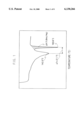
- the drawback is caused by the phenomenon wherein among the two melting temperatures shown in FIG. 1 an endothermic amount ⁇ H at the higher melting temperature closely relates to an expansion ratio of pre-expanded particles, and the expansion ratio of the pre-expanded particles decreases linearly with increasing the endothermic amount ⁇ H of the higher melting temperature. It is the same knowledge of the case in using an inorganic blowing agent such as carbon dioxide disclosed in Japanese Unexamined Patent Publication No.259724/1996.
- Japanese Unexamined Patent Publication No.176336/1984 discloses that moldability for in-mold becomes excellent by increasing a temperature difference ⁇ T of two melting temperatures of the pre-expanded particles of a propylene resin in a DSC curve measured by a differential scanning calorimeter. It is described that the temperature difference corresponding to ⁇ T is preferably at least 5° C. But in the publication there is no brief description of pre-expanded particles having ⁇ T of above 13° C. and a process for preparing the pre-expanded particles.
- pre-expanded particles are generally prepared by heating particles of a thermoplastic resin dispersed into an aqueous dispersion medium in a pressure vessel, immersing a blowing agent, and releasing the mixture into a lower atmosphere to expand particles of a thermoplastic resin.
- Releasing of particles of a thermoplastic resin is usually carried out by passing it through an opening provided at a flow-restricting device having an orifice type or nozzle type (disclosed in Japanese Unexamined Patent Publication No.197027/1983).
- the releasing is also carried out by passing it several times through an opening provided at a plurality of flow-restricting devices arranged in series toward releasing direction (disclosed in Japanese Unexamined Patent Publication No.4909/1988).
- thermoplastic resin examples are a styrene resin, a vinyl chloride resin, a polyamide resin, a polyester resin, a polyolefin resin and the like. Particles having a desired shape such as sphere, column, elliptical column or cube are prepared by using these resins.
- a volatile blowing agent, an inorganic gas or water is used as the blowing agent (disclosed in WO97/38048 pamphlet).
- the plate having 1 to 10 slits of which width is 4 to 20 mm, height is 4 to 20 mm, and depth at the narrowest part is 5 to 200 mm, or the plate having 1 to 10 holes, of which area is 10 to 400 mm 2 , and depth at the narrowest part is 5 to 200 mm. If an expansion ratio of expanded particles is increased by the above-mentioned method, it is carried out by increasing an inner pressure in a pressure vessel.
- expanded particles are prepared by using an inorganic gas or water as a blowing agent, it becomes disadvantageous in economy to obtain expanded particles having a desired high expansion ratio by increasing an inner pressure in a pressure vessel since the cost of the equipment becomes high.
- Increasing an expansion ratio is investigated by maintaining the mixture for a long time at a temperature range, which is comparatively near the expansion temperature and not more than the expansion temperature, without increasing an expansion pressure.
- a temperature range of the expansion temperature to the expansion temperature -1° C. the temperature at the higher peak is increased, the temperature at the lower peak is decreased, and it is found that a temperature difference ⁇ T of two melting temperatures becomes at least 20° C.
- the present invention relates to pre-expanded particles of a propylene resin comprising a propylene resin composition containing 100 parts by weight of (A) a random copolymer of ethylene and propylene having an ethylene content of 1.5 to 4.5% by weight and 0.001 to 10 parts by weight of (B) an alkali metal salt of a copolymer of ethylene and (meth)acrylic acid; said pre-expanded particles having two melting temperatures in a DSC curve measured by a differential scanning calorimeter, and a temperature difference ⁇ T between these two melting temperatures being at least 20° C., and a process for preparing pre-expanded particles of a propylene resin comprising dispersing resin particles, comprising a propylene resin composition, which contains 100 parts by weight of (A) a random copolymer of ethylene and propylene having an ethylene content of 1.5 to 4.5% by weight and 0.001 to 10 parts by weight of (B) an alkali metal salt of a copo
- expanded particles having a high expansion ratio can be obtained in case of using a volatile blowing agent as a blowing agent, even if an inner pressure before releasing is adjusted at a low level and an amount of the blowing agent decreases.
- the present invention relates to a flow-restricting device, which is used for a releasing part at preparing expanded particles by dispersing thermoplastic resin particles into an aqueous dispersion medium in a pressure vessel, impregnating a blowing agent and releasing the mixture into a lower atmosphere; said plate is equipped with at least one opening satisfying either of the following two conditions,
- a front width or a long diameter of the opening attached to the flow-restricting device is L
- a height or a short diameter is Hf
- a height or a short diameter at the narrowest part in the opening is Hn
- an area at the narrowest part in the opening is S
- a depth (land length) is d.
- FIG. 1 shows a DSC curve of the pre-expanded particles obtained in Example 1.
- the DSC curve is used as explanation for a temperature difference ⁇ T of two melting temperatures, and an endothermic amount ⁇ H of the higher melting temperature.
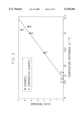
- FIG. 2 shows an explanatory graph for an improving ratio obtained by the tropics estimated from an endothermic amount ⁇ H of the higher melting temperature and the expansion ratio of the pre-expanded particles in Comparative Examples 1 to 4, which are not maintained at the foaming temperature to the foaming temperature -1° C. for a long time.
- FIG. 3 shows a graph for relationship between a temperature difference ⁇ T of two melting temperatures and an improving ratio.
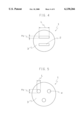
- FIG. 4 shows an explanatory figure for a flow-restricting device containing slits, which is seen from the front thereof.
- FIG. 5 shows an explanatory figure for a flow-restricting device containing holes, which is seen from the front thereof.
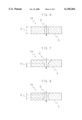
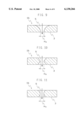
- FIG. 6 shows a cross sectional view of an opening in a flow-restricting device having an orifice type at d>0 in an axial direction.
- FIG. 7 shows another cross sectional view of an opening in a flow-restricting device having an orifice type at d>0 in an axial direction.
- FIG. 8 shows another cross sectional view of an opening in a flow-restricting device having an orifice type at d>0 in an axial direction.
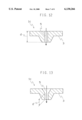
- FIG. 12 shows a cross sectional view of an opening in a flow-restricting device having a nozzle type in an axial direction.
- FIG. 13 shows another cross sectional view of an opening in a flow-restricting device having a nozzle type in an axial direction.
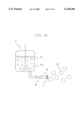
- FIG. 14 shows an explanatory view of preparation machine of expanded particles equipped with the flow-restricting device of the present invention.
- pre-expanded particles of a propylene resin of the present invention (hereinafter referred to as "pre-expanded particles of PP") from a propylene resin composition (hereinafter referred to as "PP resin composition")
- a random copolymer of ethylene and propylene (hereinafter referred to as "a random copolymer of EP (A))
- (A) component a random copolymer of EP (A) component. If the ethylene content is less than 1.5% by weight, a melting temperature of PP resin composition becomes higher and heat resistance and mechanical strength of the molded article obtained by in-molding pre-expanded particles of PP are improved.
- MI (melt index, 230° C., 0.212 MPa) of the random copolymer of EP (A) is preferably 0.5 to 40 g/10 minutes, more preferably 3 to 30 g/10 minutes. If the MI is less than 0.5 g/10 minutes, it is difficult to obtain pre-expanded particles having a high expansion ratio, since a melt viscosity is too high. If the MI is more than 40 g/10 minutes, it is difficult to obtain pre-expanded particles having a high expansion ratio, since a melt viscosity is low against elongation of a resin at expansion and it is easy to break cells.
- a melting temperature of a random copolymer of EP (A) is usually 130 to 165° C., preferably 135 to 160° C., which depends on not only an ethylene content but also MI, since a random copolymer of EP (A)having an ethylene content of 1.5 to 4.5% by weight is used in the present invention. If the temperature is less than 130° C., ⁇ T tends to become large due to a large amount of ethylene, but heat resistance and mechanical strength of the molded article tend to become small. If the temperature is more than 165° C., heat resistance and mechanical strength of the molded article are improved, but it tends to become difficult to increase ⁇ T.
- an alkali metal salt of a copolymer of ethylene and (meth)acrylic acid (hereinafter referred to as “ethylenically ionomer (B)" is used as the (B) component.
- An ethylenically ionomer (B) is used for increasing an absorbing amount of the blowing agent into particles of a resin (hereinafter referred to as "particles of a PP resin”) from PP resin composition.
- the ethylenically ionomer (B) is preferably a copolymer comprising 70 to 97% by weight, preferably 80 to 95% by weight, of ethylene and 3 to 30% by weight, preferably 5 to 20% by weight, of (meth)acrylic acid, of which carboxyl groups are salted with an alkali metal ion such as sodium ion, potassium ion or lithium ion to ionically crosslink intermolecularly, from the viewpoint of securing sufficient compatibility with a propylene resin and a sufficient amount of water.
- An ionization ratio is preferably 20 to 100%, more preferably 50 to 100%. The ionization ratio is measured by the introduced metal ion (% by mole) based on 100% by mole of a carboxyl group in a copolymer of ethylene and (meth)acrylic acid.
- Examples of the ethylenically ionomer (B) are "HIMILAN 1601", “HIMILAN 1605", “HIMILAN 1707”, “HIMILAN 1856” available from Mitsui Du Pont Chemical Co., "SURLYN 1601”, “SURLYN 1605", “SURLYN 1707”, “SURLYN 1802", “SURLYN 1901” available from E. I. du Pont de Nemours & Co.Inc., and the like.
- An amount of the ethylenically ionomer (B) is 0.001 to 10 parts by weight, preferably 0.01 to 10 parts by weight, more preferably 0.01 to 5 parts by weight based on 100 parts by weight of the random copolymer of EP (A). If the amount is less than 0.001 part by weight, an effect of improving an expansion ratio is small compared with the case containing no ethylenically ionomer (B) since an amount of water absorbed into PP resin particles in a pressure vessel is decreased.
- the amount is more than 10 parts by weight, an amount of water absorbed into PP resin particles is increased, but production stability at preparation of pre-expanded particles, and properties such as mechanical strength, heat resistance and dimension stability at water absorption of the molded article obtained by in-molding pre-expanded particles are decreased.
- PP resin composition can contain filler.
- An average particle diameter of the filler is preferably at most 50 ⁇ m, more preferably at most 20 ⁇ m, from the viewpoint of obtaining pre-expanded particles having uniform cells and a high expansion ratio, and obtaining a molded article having excellent mechanical strength and flexibility from the pre-expanded particles. Furthermore, it is preferable at least 0.1 ⁇ m, more preferably at least 0.5 ⁇ m from the viewpoint of prevention of insufficient dispersion due to secondary agglomeration and handling workablility.
- the filler there are an inorganic filler and an organic filler.
- the inorganic filler are talc, calcium carbonate, calcium hydroxide, aluminium hydroxide, silica, mica, china cray, diatom earth, rock wool, wollastonite, and the like.
- talc is preferable from the viewpoint of obtaining pre-expanded particles having uniform cells and a high expansion ratio.
- the organic filler there is no particular limitation for the organic filler, as long as it is solid at a temperature higher than a softening point of the random copolymer of EP (A).
- fluororesin powder such as poly(tetrafluoroethylene), silicone resin powder, thermoplastic polyester resin powder and the like. These may be employed solely or in a combination use of two or more thereof.
- An amount of the filler is at least 0.003 part by weight, more preferably at least 0.005 part by weight, based on 100 parts by weight of a random copolymer of EP (A) from the viewpoint of obtaining pre-expanded particles having a high expansion ratio. Furthermore, it is preferably at most 3 parts by weight, more preferably at most 2 parts by weight, from the viewpoint of exhibiting excellent adhesion property at molding of the pre-expanded particles and obtaining a molded article made thereof having excellent mechanical strength and flexibility.
- an organic pigment such as azo, phthalocyanine, quinacridone or perylene
- an inorganic pigment such as carbon black, a ketjen black, titan oxide, cobalt violet, cobalt blue or ultra marine
- a stabilizer such as an antistatic agent, an antioxidant or an optical stabilizer, if necessary.
- the pre-expanded particles of PP of the present invention is pre-expanded particles made from the PP resin composition comprising a random copolymer of EP (A), an ethylenically ionomer (B), and as an optional, a filler, a pigment, a colorant, an antistatic agent and a stabilizer.
- the pre-expanded particles are the pre-expanded particles of PP, which have two melting temperatures in a DSC curve measured by a differential scanning calorimeter, and of which a temperature difference ⁇ T is at least 20° C. Since ⁇ T is at least 20° C., moldability of in-molding is excellent.
- the above-mentioned DSC curve obtained by a differential scanning calorimeter is the DSC curve obtained by heating 4.0 to 6.0 mg of the pre-expanded particles of PP from 40 to 220° C. at a heating rate of 10° C./min by using a differential scanning calorimeter.
- the pre-expanded particles of PP is usually prepared by kneading the PP resin composition by means of an extruder, a kneader, a Banbury mixer, a roll and the like. And then, the composition is formed into resin particles having desired shapes such as cylinder, ellipsoid, sphere, cubic and rectangular parallelepipedic, which are easy to use in pre-expansion.
- the particles obtained by melt kneading in an extruder are, in general, 0.3 to 5 mg/particle.
- particles of PP resin prepared above are dispersed into an aqueous medium in a pressure vessel to obtain a mixture.
- Particles of PP resin are usually dispersed into an aqueous dispersion medium at a room temperature to 90° C.
- the aqueous dispersion medium may be a solvent, which can not dissolve particles of PP resin.
- a solvent which can not dissolve particles of PP resin.
- examples thereof are typically water, and a mixture of water with at least one solvent selected from the group consisting of ethylene glycol, glycerin, methanol, ethanol and isopropanol. Water is preferable from environmental and economical points of view.
- a dispersion agent and a surfactant as a dispersion assistant are usually added into the aqueous dispersion medium in amounts of 0.01 to 1 part by weight and 0.001 to 0.01 part by weight respectively based on 100 parts by weight of the aqueous dispersion medium.
- dispersion agent examples include tricalcium phosphate, basic magnesium carbonate, basic zinc carbonate, calcium carbonate, calcium hydroxide, aluminum oxide, talc, mica, china cray and the like.
- surfactant examples include anionic surfactants such as sodium dodecylbenzene sulfonate, sodium n-paraffin sulfonate and sodium ⁇ -olefin-sulfonate, and the like.
- An amount of PP resin particles dispersed into the aqueous dispersion medium is preferably 3 to 100 parts by weight, more preferably 10 to 80 parts by weight, particularly 10 to 70 parts by weight based on 100 parts by weight of the aqueous dispersion medium. If the amount is less than 3 parts by weight, productivity becomes low, thus being uneconomical. On the other hand, if the amount is more than 100 parts by weight, the PP resin particles tend to be fused together in a vessel during heating.
- the mixture is heated to an expansion temperature higher than a softening temperature of the PP resin particles.
- the mixture is released into an atmosphere of lower pressure than the inner pressure in a pressure vessel to prepare the pre-expanded particles of PP resin.
- An inorganic gas is preferably introduced in order that an expansion pressure need be controlled depending on the required expansion ratio.
- a temperature thereof is preferably about (an expansion temperature ⁇ 5° C.) from the viewpoint that evenness of an expansion ratio of the obtained pre-expanded particles is decreased.
- An expansion temperature higher than the softening temperature of the PP resin particles is usually (melting temperature of the PP resin composition -10° C.) to (melting temperature +30° C.), preferably (melting temperature) to (temperature +20° C. ), more preferably (melting temperature +5° C.) to (melting temperature +15° C.).
- a melting temperature of the PP resin composition means a peak temperature of an endothermic peak in the second heating run, which is obtained by heating PP resin particles to 40 to 220° C. in a heating rate of 10° C./min after heating 4.0 to 6.0 mg of them to 40 to 220° C.
- the expansion temperature is less than (melting temperature -10° C.), it becomes difficult to expand the particles. If the expansion temperature is more than (melting temperature +30° C.), all secondary crystalline of the PP resin particles in a pressure vessel melts, melting temperatures of the obtained pre-expanded particles becomes one, and the resin particles tend to be fused together in the vessel due to a high expansion temperature. If the PP resin composition having a melting temperature of 145° C. is used, the expansion temperature is usually 135 to 175° C., preferably 145 to 165° C., more preferably 150 to -160° C.
- the softening temperature is a value measured according to ASTM D-648 with 0.451 MPa.
- the maintaining at not more than expansion temperature and not less than (expansion temperature -1° C.) for at least 30 minutes means maintaining a temperature of the mixture in a pressure vessel during counting maintaining time of at least 30 minutes from the time reaching the pre-determined temperature (foaming temperature -1° C.) after starting to heat to the expansion temperature.
- This differs from a concept that a maintaining temperature difference between the first step and the second step is 5° C. and the maintaining time at both the first step and the second step is 15 minutes, as disclosed in Example in Japanese Unexamined Patent Publication No.17615/1993, from the viewpoint of heat treating effectively and obtaining pre-expanded particles having higher ⁇ T.
- a temperature of the mixture in a pressure vessel is controlled to be 1 ° C. between (expansion temperature -1° C.) and expansion temperature. But the controlling is not so difficult in spite of volume and shape of the pressure vessel.
- the controlling can be made by feedback controlling, for example, a temperature controlling system in an pressure vessel such as vapor, thermal solvent oil and electric heater.
- the maintaining time is at least 30 minutes. The longer the maintaining time is, the more an effect of the present invention tends to increase. The reason is thought that the secondary crystalline grows sufficiently due to a long maintaining time at about the expansion temperature. But the time is preferably at most 5 hours in consideration of productivity of the pre-expanded particles.
- introducing time of an inorganic gas into a pressure vessel there is no particular limitation for introducing time of an inorganic gas into a pressure vessel. From the viewpoint of decreasing load of the vessel and stability of an expansion pressure, the introducing is usually carried out at the latter half of the maintaining time. At this time a pressuring rate is preferably 0.098 to 0.98 MPa/minute from the viewpoint of small load to device, safety, not disturbing thermodynamic equilibrium in a pressure vessel, and not decreasing productivity.
- the expansion pressure is preferably maintained by maintaining a constant pressure in the pressure vessel during releasing.
- a pressure in a pressure vessel is preferably maintained constant by supplying an inorganic gas into a pressure vessel, and the particles are released.
- a temperature of the above inorganic gas is preferably about (an expansion temperature ⁇ 5° C.).
- the expansion pressure is a pressure difference between an inner pressure in the pressure vessel and an atmosphere of lower pressure. Since the atmosphere of lower pressure is usually an atmospheric pressure, the expansion pressure becomes equal to a gauge pressure.
- the expansion pressure is varied depending on a pre-determined expansion ratio.
- the pressure is usually 0.784 to 5.88 MPa, preferably 0.98 to 4.41 MPa, more preferably 0.98 to 2.94 MPa. If the pressure is not more than 0.784 MPa, an average expansion ratio tends to decrease and the unexpanded resin particles tend to be incorporated into the product. If the pressure is not less than 5.88 MPa, machine load becomes large, a diameter of the obtained foams of the pre-expanded particles become small, a thickness of cell film forming foams becomes thin, it becomes easy to break cells, and a ratio of independent foams of pre-expanded particles is decreased. As a result, it becomes easy to decrease properties such as mechanical strength. Therefore, as mentioned above, the expansion ratio is preferably improved without increasing an expansion pressure.
- the pre-expanded particles of PP are obtained, which have two melting temperatures in a DSC curve measured by a differential scanning calorimeter, and of which temperature difference is at least 20° C.
- the flow-restricting device of the present invention is used for a releasing part, when particles of a thermoplastic resin are dispersed into an aqueous medium in a pressure vessel, the blowing agent is impregnated, and then the resin is released into an atmosphere of lower pressure to prepare the expanded particles.
- a pressure vessel which is used in preparation of the expanded particles of a thermoplastic resin, as long as the flow-restricting device in the vessel is the plate of the present invention.
- the vessel used conventionally can be employed.
- a thermoplastic resin used in the flow-restricting device of the present invention not only a polypropylene resin composition, but also a styrene resin, a vinyl chloride resin, a polyamide resin, a polyester resin, a polyolefin resin and the like.
- polyolefin resin such as the polypropylene resin composition is preferable from the viewpoint of obtaining expanded particles having a high expansion ratio and which are excellent in foamability, moldability and a balance among mechanical strength, heat resistance and flexibility of the obtained molded article.
- the polyolefin resin is a resin containing 50 to 100% by weight, preferably 70 to 100% by weight, of an olefin monomer unit and 0 to 50% by weight, preferably 0 to 30% by weight, of a monomer unit copolymerizable with the olefin monomer. Since the resin contains at least 50% by weight of the olefin monomer unit, the resin is light and excellent in mechanical strength, processability, electric insulation, waterproof resistance and chemical resistance.
- the monomer copolymerizable with the olefin monomer is used for improving adhesion, transparency, impact resistance and gas barrier.
- an amount thereof is preferably at least 2% by weight, more preferably at least 5% by weight.
- olefin monomer examples include an ⁇ -olefin monomer having 2 to 8 carbon atoms such as ethylene, propylene, butene, pentene, hexene, heptene or octene, and a cyclic olefin such as norbornene monomer.
- ethylene and propylene are preferable from the viewpoint that they are cheap and properties of the obtained polymer become excellent. These may be employed solely or in a combination use of two or more thereof.
- Examples of the monomer copolymerizable with the olefin monomer are vinyl alcohol esters such as vinyl acetate, alkyl (meth)acrylate having 1 to 6 alkyl carbon atoms such as methyl methacrylate, ethyl acrylate and hexyl acrylate, vinyl alcohol, methacrylic acid, vinyl chloride and the like.
- vinyl alcohol esters such as vinyl acetate, alkyl (meth)acrylate having 1 to 6 alkyl carbon atoms such as methyl methacrylate, ethyl acrylate and hexyl acrylate, vinyl alcohol, methacrylic acid, vinyl chloride and the like.
- vinyl acetate is preferable from the viewpoints of adhesion, flexibility and properties at a low temperature.
- methyl methacrylate is preferable from the viewpoint of adhesion, flexibility, properties at a low temperature and thermal stability.
- MI of the polyolefin resin is preferably 0.5 to 30 g/10 minutes, more preferably 3 to 25 g/10 minutes.
- flexural modulus (JIS K 7203) thereof is preferably 490 to 1960 MPa, more preferably 784 to 1568 MPa.
- a melting temperature thereof is preferably 125 to 165° C., more preferably 135 to 150° C. If the MI is less than 0.5 g/10 minutes, it is difficult to obtain pre-expanded particles having a high expansion ratio since a melt viscosity is too high. If the MI is more than 30 g/10 minutes, it is difficult to obtain pre-expanded particles having a high expansion ratio since a melt viscosity is low against elongation of a resin at expansion, and it is easy to break cells.
- polystyrene resins examples include polypropylene resins such as a random copolymer of ethylene and propylene, a random terpolymer of ethylene, propylene and butene, a block copolymer of polyethylene and polypropylene and a homopolymer of polypropylene; polyethylene resins such as low density polyethylene, middle density polyethylene, high density polyethylene, linear low density polyethylene, a copolymer of ethylene and vinyl acetate and a copolymer of ethylene and methyl methacrylate; polybutene, polypentene and the like. These polyolefin resins may not be crosslinked, or may be branched or crosslinked by means of peroxides or radiation.
- a polypropylene resin is preferable, since pre-expanded particles having a high expansion ratio are easily obtained, and a molded article made thereof has good balance among mechanical strength and heat resistance compared with the other polyolefin resins.
- These polymers may be employed solely or in a combination use of two or more thereof.
- a size of the particles of a polyolefin resin prepared from the polyolefin resin is usually 0.5 to 5 mg/particle.
- water-containing resin particles having 1 to 50% of water content which is measured by heating at not less than a softening temperature of the polyolefin resin particles, are used.
- the resin particles preferably comprises a polyolefin resin composition containing 0.05 to 20 parts by weight of a hydrophilic polymer based on 100 parts by weight of the polyolefin resin in order to expand easier.
- the hydrophilic polymer means a polymer having a water absorption ratio measured according to ASTM D570 of at least 0.5% by weight. It contains so-called a hygroscopic polymer, a water-absorptive polymer (which is not dissolved into water, absorbs water in an amount of several to several hundred times of its weight, and is not easily dehydrated under pressure) and a water-soluble polymer (which is dissolved into water at a room temperature or a high temperature).
- the hydrophilic polymer (B) can contain hydrophilic groups such as a carboxyl group, a hydroxyl group, an amino group, an amide group, an ester group and a poly(oxyethylene) group in its molecule.
- hygroscopic polymer examples include a polymer containing a carboxyl group, polyamide, thermoplastic polyester elastomer, cellulose derivatives and the like.
- polymer containing a carboxyl group examples include, for instance, a terpolymer of ethylene, acrylic acid and maleic anhydride (water absorption of 0.5 to 0.7% by weight), an ionomer resin (water absorption 0.7 to 1.4% by weight) wherein carboxyl groups of an ethylene-(meth)acrylic acid copolymer are salted with a metal ion, preferably with an alkali metal ion such as sodium ion, potassium ion or lithium ion for intermolecular crosslinking, a copolymer of ethylene and (meth)acrylic acid (water absorption 0.5% by weight) and the like.
- a metal ion preferably with an alkali metal ion such as sodium ion, potassium ion or lithium ion for intermolecular crosslinking
- a copolymer of ethylene and (meth)acrylic acid water absorption 0.5% by weight
- polyamide examples include nylon-6 (water absorption of 1.3 to 1.9% by weight), nylon-66 (water absorption of 1.5% by weight), copolymerized nylon (available from EMS-CHEMIE AG, Griltex; water absorption of 1.5 to 3% by weight) and the like.
- thermoplastic polyester elastomer examples include, for instance, a block copolymer of poly(butylene terephthalate) and poly(tetramethylene glycol) (water absorption of 0.5% by weight) and the like.
- cellulose derivatives examples are cellulose acetate, cellulose propionate and the like. These may be employed solely or in a combination use of two or more thereof.
- the ionomer resin is preferable from the viewpoint of excellent dispersion property into a polyolefin resin and obtaining water-containing polyolefin resin composition having a high water content by using a relatively small amount thereof.
- water-absorptive polymer examples include a crosslinked acrylic acid salt polymer, a graft copolymer of starch and acrylic acid, a crosslinked poly(vinyl alcohol), a crosslinked poly(ethylene oxide), a copolymer of isobutylene and maleic acid, and the like.
- crosslinked acrylic acid salt polymer examples include a crosslinked polymer of sodium acrylate such as Aqualic available from Nippon Shokubai Co., Ltd. or Diawet available from Mitsubishi Chemical Corporation, and the like. These may be employed solely or in a combination use of two or more thereof.
- crosslinked poly(vinyl alcohol) examples include, for instance, various of crosslinked poly(vinyl alcohol) such as Aquareserve GP available from Nippon Gohsei Kagaku Kogyo Kabushiki Kaisha and the like.
- crosslinked poly(ethylene oxide) examples include various crosslinked poly(ethylene oxide) such as Aquacork available from Sumitomo Seika Chemicals and the like.
- copolymer of isobutylene and maleic acid are various copolymers of isobutylene and maleic acid such as KI Gel available from Kuraray Co., Ltd., and the like. These may be employed solely or in a combination use of two or more thereof.
- the crosslinked poly(ethylene oxide) is preferable from the viewpoint of excellent dispersion property into a polyolefin resin and obtaining water-containing polyolefin resin composition having a high water content by using a relatively small amount thereof.
- water-soluble polymer examples include (meth)acrylic acid polymer, (meth)acrylic acid salt polymer, poly(vinyl alcohol), poly(ethylene oxide), water-soluble cellulose derivatives, and the like.
- Examples of the (meth)acrylic acid polymer are poly(acrylic acid), a copolymer of acrylic acid and ethyl acrylate, poly(2-hydroxyethyl methacrylate), and the like. These may be employed solely or in a combination use of two or more thereof.
- Examples of the (meth)acrylic acid salt polymer are, for instance, poly(sodium acrylate), poly(sodium methacrylate), poly(potassium acrylate), poly(potassium methacrylate) and the like.
- Examples of the poly(vinyl alcohol) are, for instance, poly(vinyl alcohol), a copolymer of vinyl alcohol and vinyl acetate, and the like.
- poly(ethylene oxide) examples are, for instance, poly(ethylene oxide) having tens of thousands to millions of a molecular weight and the like.
- water-soluble cellulose derivatives examples are, for instance, carboxymethyl cellulose, hydroxyethyl cellulose and the like. Theses may be employed solely or in a combination use of two or more thereof.
- hygroscopic polymer water-absorptive polymer, and water-soluble polymer may be employed solely or in a combination use of two or more thereof.
- An amount of the hydrophilic polymer is preferably at least 0.001 part by weight, more preferably at least 0.0 1 part by weight based on 100 parts by weight of the polyolefin resin. And it is preferably at most 20 parts by weight, more preferably at most 10 parts by weight from the viewpoint of improving production stability and foaming characteristics in the preparation of pre-expanded particles, imparting excellent mechanical strength and heat resistance to molded articles obtained from the pre-expanded particles, and decreasing the dimensional change of molded articles upon water absorption.
- An average particle diameter of the filler is preferably at most 50 ⁇ m, more preferably at most 10 ⁇ m, from the viewpoint of obtaining pre-expanded particles having uniform cells and a high expansion ratio, and obtaining a molded article having excellent mechanical strength and flexibility from the expanded particles. Furthermore, it is preferable at least 0.1 ⁇ m, more preferably at least 0.5 ⁇ m from the viewpoint of secondary agglomeration and handling workablility.
- the filler there are an inorganic filler and an organic filler.
- inorganic filler examples include talc, calcium carbonate, calcium hydroxide, aluminum hydroxide, silica, mica, china cray, diatom earth, rock wool, wollastonite, and the like.
- talc is preferable from the viewpoint of obtaining pre-expanded particles having uniform cells and a high expansion ratio.
- organic filler there is no particular limitation for the organic filler, as long as it is solid at a temperature higher than a softening point of the polyolefin resin.
- examples thereof are fluororesin powder, silicone resin powder, thermoplastic polyester resin powder and the like.
- the fillers may be employed solely or in a combination use of two or more thereof.
- An amount of the filler is at least 0.003 part by weight, more preferably at least 0.005 part by weight, based on 100 parts by weight of the polyolefin resin from the viewpoint of obtaining pre-expanded particles having a high expansion ratio. Furthermore, it is preferably at most 3 parts by weight, more preferably at most 2 parts by weight, from the viewpoint of exhibiting excellent adhesion property at molding of the pre-expanded particles and obtaining a molded article made thereof having excellent mechanical strength and flexibility.
- the resin particles are dispersed into an aqueous dispersion medium in a pressure vessel, and heated to a temperature higher than a softening temperature of the polyolefin resin to immerse a blowing agent into the resin particles.
- a dispersion agent and a surfactant are the same as described above. And an amount of the resin particles dispersed into the aqueous dispersion medium is also the same as described above.
- a heating temperature after dispersing the resin particles is a temperature higher than the softening temperature of the used polyolefin resin, concretely not less than (the melting temperature thereof -10° C.), preferably not less than (the melting temperature +5° C.), preferably not more than (the melting temperature +20° C. ), more preferably (the melting temperature +15° C.).
- the temperature is preferably 135 to 165° C., more preferably 150 to 160° C. If the temperature is less than 135° C., it becomes difficult to expand the particles. If the temperature is more than 160° C., mechanical strength and heat resistance of the obtained expanded article becomes insufficient, and the resin particles tend to be fused together in a vessel.
- the resin particles are dispersed into an aqueous dispersion medium, heated and stirred for 5 minutes to 12 hours, preferably 30 minutes to 12 hours, to obtain water-containing resin particles having a water content of 1 to 50%.
- the foamed particles of a polyolefin resin are prepared by introducing an inorganic gas into a pressure vessel to be a pressure in the vessel of 0.98 to 7.35 MPa, and releasing the particles into an atmosphere of a lower pressure than the inner pressure in the vessel through the flow-restricting device with maintaining the pressure.
- Adjustment of the water content can be carried out by controlling a heating temperature, a heating time and the like. If the content is less than 1%, an apparent expansion ratio becomes less than 3.2 times even if the flow-restricting device of the present invention is used (in case of using a conventional flow-restricting device the expansion ratio is less than 3 times).
- Preferable water content is at least 3%. If the content is more than 50%, dispersion property of the resin particles into an aqueous dispersion medium becomes small, the resin particles becomes bulk in a pressure vessel at preparation of the expanded particles, and it becomes difficult to expand the particles uniformly. Preferable water content is at most 30%.
- a water absorption ratio of the hydrophilic polymer is a value measured at a room temperature, and the water content is a value measured at a high temperature (melting temperature). If the hydrophilic polymer having a water absorption ratio of at least 0.5% is used, the polymer having a water content of at least 1% is obtained.
- an expansion ratio can become 3.2 to 43 times, particularly 4.2 to 26 times by using the flow-restricting device of the present invention (in case of using a conventional flow-restricting device, the expansion ratio becomes 3 to 33, particularly 4 to 20 times). And the particles do not become bulk and can be formed into uniform expanded particles in an pressure vessel at preparation of expanded particles. If the content is less than 1%, a desired expansion ratio can not be obtained. If the content is more than 50%, dispersion property of the resin particles into an aqueous dispersion medium becomes small, the resin particles becomes bulk in a pressure vessel at preparation of the expanded particles, and it becomes difficult to expand the particles uniformly.
- a softening temperature of the polyolefin resin is estimated by a peak temperature of the melting peak measured by DSC at a heating rate of 10° C. /min.
- the water content is water absorption at a temperature higher than the melting temperature under vapor pressure, and it is estimated by the following method.
- a 300 ml pressure-resistant ampule is charged with 50 g of particles of the polypropylene resin composition, 150 g of water, 0.5 g of basic tricalcium phosphate powder as a dispersion agent, and 0.03 g of sodium n-paraffinsulfonate.
- the ampule was tightly closed, it was thermally treated for three hours in an oil bath adjusted at not less than a melting temperature of the polyolefin resin.
- the ampule is cooled to a room temperature, the content thereof is removed and sufficiently washed with water to remove the dispersion agent.
- Weight (X) of the obtained water-containing particles having no water on the surface thereof is measured. The particles is dried for three hours in an oven adjusted at a temperature 20° C. higher than the melting point of the resin particles.
- weight (Y) of the particles cooled to a room temperature in a desiccator is measured to calculate the water content according to the following equation.
- the water content is the value based on a sum of the polyolefin resin and the hydrophilic polymer.
- an inorganic gas used for controlling a pressure in the pressure vessel there can be used nitrogen, air, or an inorganic gas containing them as a main component (usually at least 50% by volume, particularly at least 70% by volume) and an inert gas such as argon, helium or xenon, vapor, oxygen, hydrogen, and ozone in a small amount (at most 50% by volume, particularly at most 30% by volume).
- nitrogen and air are preferable.
- the maintaining pressure by the inorganic gas is preferably 0.98 to 7.35 MPa, more preferably 2.45 to 7.35 MPa. If the pressure is not more than 0.98 MPa, the expanded particles having a desired expansion ratio can not be obtained. If the pressure is not less than 7.35 MPa, a diameter of foams becomes too fine, and a ratio of independent foams decreases to lose shrinkage, dimension stability, mechanical strength, and heat resistance of the molded article.
- a temperature of the inorganic gas used for controlling and maintaining pressure in the pressure vessel is preferably about (an expansion temperature ⁇ 5° C.) from the viewpoint that evenness of an expansion ratio of the obtained pre-expanded particles is decreased.
- An inner pressure during releasing is preferably maintained at the reaching pressure.
- Low pressure in the atmosphere of lower pressure is a pressure lower than the inner pressure, and the atmospheric pressure is usually selected.
- the atmosphere means a space, which contains a scattering track of a mixture of releasing particles and water.
- the releasing is carried out through the flow-restricting device of the present invention attached to the releasing part.
- a hydrophilic polymer is not necessarily contained since there is no need for polyolefin resin particles' containing water.
- Polyolefin resin particles may be prepared, dispersed into an aqueous dispersion medium, heated, and immersed with a blowing agent in the same manner as mentioned above except for using no hydrophilic polymer.
- a pressure after adding a blowing agent is usually 0.98 to 7.35 MPa, and a maintaining time is usually 5 to 60 minutes.
- blowing agent examples include aliphatic hydrocarbons such as propane, butane, pentane and hexane; alicyclic hydrocarbons such as cyclopentane and cyclobutane; halogenated hydrocarbons such as trichloromonofluoromethane, dichlorodifluoromethane, dichlorotetrafluoroethane, trichlorotrifluoroethane, methyl chloride, methylene chloride and ethyl chloride; and the like. These may be employed solely or in a combination use of two or more thereof. An amount of the blowing agent is usually 5 to 50 parts by weight based on 100 parts by weight of the polyolefin resin.
- Expanded polyolefin resin particles are preferably prepared by releasing the content by passing through the flow-restricting device into an atmosphere having a lower pressure than the inner pressure in the pressure vessel with maintaining the inner pressure in the pressure vessel.
- the flow-restricting device is usually used for controlling the releasing time and uniformity of an expansion ratio.
- the expansion ratio can be improved by using the flow-restricting device having a particular opening.
- an opening means a slit or a hole.
- the thickness is less than 0.5 mm, it becomes easier to break the flow-restricting device due to a pressure inside the pressure vessel. Therefore, it is not preferably too thick, it is more preferably at least 0.8 mm.
- a width or a long diameter of the opening is defined as L
- a height or a short diameter is defined as Hf
- a height or a short diameter at the narrowest part of the opening is defined as Hn
- an area at the narrowest part of the opening is defined as S
- a depth (land length) at the narrowest part of the opening is defined as d
- L/Hf is at least 1.5 mm
- Hn is 1 to 4 mm, preferably 2 to 3.5 mm
- d is 0 to 5 mm, preferably 0.2 to 3 mm.
- S is 0.5 to 10 mm 2 , preferably 3 to 8 mm 2
- d is 0 to 5 mm, preferably 0.2 to 3 mm.
- FIG. 4 shows an explanatory figure for a flow-restricting device containing slits, which is seen from the front
- FIG. 5 shows an explanatory figure for a flow-restricting device containing holes, which is seen from the front
- FIGS. 6 to 8 show cross sectional views of an opening in a flow-restricting device having an orifice type at d>0 in an axial direction
- FIGS. 12 to 13 show cross sectional views of an opening in a flow-restricting device having a nozzle type in axial direction.
- ⁇ shows a releasing direction.
- L/Hf is at least 1.5 mm, since the opening becomes slender, an area thereof becomes large and a releasing amount becomes large, a short-time treatment can be achieved and it becomes difficult to clog up.
- the upper limit of L/Hf is 5, particularly 3 from the viewpoint of uniformity of an expansion ratio. If Hn is more than 4 mm, an expansion ratio becomes low. If Hn is less than 1 mm, it becomes easy to clog up an opening. If d is more than 5 mm, an expansion ratio becomes low. If the narrowest part is a point as shown in FIGS. 9 to 11, d becomes 0 mm. As long as Hn satisfies the above conditions, expanded particles having a high expansion ratio can be obtained.
- L/Hf The lower limit of L/Hf is 1. If L/Hf is near the lower limit, it becomes preferable, since it becomes easier to produce an opening. If S is more than 10 mm 2 , an expansion ratio can not be improved. If S is less than 0.5 mm 2 , it becomes easy to clog up an opening. A depth d is the same as in L/Hf ⁇ 1.5.
- a slit as one of an opening means a hole of a polygon such as a rectangle, a square, a lozenge, a trapezoid, a parallelogram, another quadrangle, a triangle, a pentagon and a hexagon.
- a hole as one of an opening means a circle, an ellipse, rectangle and a shape having a quadrangle with two semicircles at the against lines of the quadrangle, which have a diameter of a length of the quadrangle.
- a width (or a long diameter) of the rectangle and a height (or a short diameter) thereof correspond to a long side and a short side respectively. In case of a square, a long side is the same as a short side.
- a trapezoid among a base and a height, the larger is a width (or a long diameter), and the shorter is a height (or a short diameter).
- the longest is a long diameter and the shortest is a short diameter.
- a long axis and a short axis is a width (or a long diameter) and a height (or a short diameter) respectively.
- segments cut off by a line which passes a center of a gravity of an opening shape the longest is a long diameter and the shortest is a short diameter.
- a height or a short diameter at the narrowest part means a value having the smallest height or the smallest short diameter among openings, which are cut into thin round slices in a releasing direction.
- the area thereof means a value having the smallest value among openings, which are cut into thin round slices in the releasing direction as shown above.
- a depth means a height, a short diameter or a thickness having a minimum area.
- the flow-restricting device has at least one opening, preferably 1 to 10 openings. A plurality of openings are preferable from the viewpoint of production rate.
- all of a plurality of openings may be the same or different, or a part of the openings may be the same or the different.
- flow-restricting device either of orifice type, nozzle type or venturi type can be used. These flow-restricting devices may be employed solely or in a combination use of two or more thereof.
- a combination of at least two flow-restricting devices used as a drawing machine there is no particular limitation for a combination of at least two flow-restricting devices used as a drawing machine.
- these may be used in parallel or series toward a releasing direction.
- parallel combination a releasing rate becomes large and productivity becomes large.
- series combination a diameter of foaming becomes large.
- the flow-restricting device 1 is usually attached to an exit of a releasing plumbing 6 shown in FIG. 14, it may be attached between a bulb 8 at a lower part of a pressure vessel 7 and the pressure vessel 7. Position of the flow-restricting device is not limited to the exit of the releasing plumbing 6, the flow-restricting device may be attached on the way of the releasing plumbing 6.
- 9 shows resin particles
- 10 shows an aqueous dispersion medium
- 11 shows expanded particles.
- the pre-expanded particles of the polyolefin resin particles thus obtained have an expansion ratio of 3.2 to 43, preferably 4.2 to 26 times (in case of a conventional flow-restricting device, 3 to 33 times, particularly 4 to 20 times), a closed cell content of 80 to 100%, preferably 90 to 100%, and an average foam diameter of 10 to 500 ⁇ m, preferably 50 to 300 ⁇ m.
- An expansion ratio increases about 5 to 30% compared with a case of the conventional flow-restricting device.
- the expansion ratio is less than about 3.2 times, flexibility and cushioning property of the obtained molded article become insufficient. On the other hand, if the expansion ratio is more than about 43 times, mechanical strength and heat resistance of a molded article become insufficient. Also, if the closed cell ratio is less than 80%, the pre-expanded particles lack the secondary expanding force, thus fusing failure occurs upon molding to deteriorate the mechanical strength and the like of the obtained molded article. If the average cell diameter is less than 10 ⁇ m, there arises a problem that the shape of molded article obtained from the pre-expanded particles is distorted. On the other hand, if the average cell diameter is more than 500 ⁇ m, mechanical strength of the obtained molded article is lowered.
- the expanded article having the same shape as a mold may be prepared by introducing the pre-expanded particles into a mold after impregnation of air by processing them in a pressure vessel under heating and pressuring for constant time, and then by thermally forming them by the method such as vapor heating, if desired.
- the formed article thus obtained is excellent in flexibility and cushioning property, and has a small shrinkage ratio and a small dimensional distortion, and the commodity value thereof is extremely high.
- the particles After weighing consciously 1 to 3 g of the obtained pre-expanded particles, the particles were completely sunk in a 100 milliliter measuring cylinder, which was filled with an ethanol aqueous solution in half. By using meniscus values of the ethanol aqueous solution before and after sinking, a volume of the pre-expanded particles is obtained. The true density of the pre-expanded particles was calculated by dividing the weight by the volume.
- the density of the pellets of the propylene resin composition (resin particles) used for obtaining the pre-expanded particles was divided by the true density thereof to obtain a value which was adopted as an expansion ratio.
- the endothermic amount ⁇ H at a higher temperature means an endothermic amount calculated by an area of almost triangular region consisting of a tangent line and a peak at a higher temperature in a DSC curve as shown in FIG. 1; the tangent line is drawn from the point having a slope of 0 to a higher temperature between two endothermic peaks in a DSC curve of the pre-expanded particles.
- a DSC curve of the obtained pre-expanded particles is shown in FIG. 1. Measuring an endothermic amount at a higher temperature ⁇ H and a temperature difference ⁇ T (peak temperature difference) between two melting temperatures (peak temperature), ⁇ H was 11.8 mJ/mg, and ⁇ T was 21.1° C. And an expansion ratio was 22.0 times. From ⁇ H of 11.8 mJ/mg, an expected value of an expansion ratio in case without maintaining for a long time was estimated as 15.4 times. Since the particles were not maintained for a long time, an expansion ratio of the obtained pre-expanded particles was 22.0 times. Therefore, an improving ratio was 6.6 times by the difference thereof.
- pre-expanded particles of a propylene resin were obtained in the same manner as in Example 1. ⁇ H of the obtained pre-expanded particles was 14.8 mJ/mg, and ⁇ T was 21.0° C. An expansion ratio was 16.5 times and an improving ratio was 5.2 times.
- pre-expanded particles of a propylene resin were obtained in the same manner as in Example 1.
- ⁇ H of the obtained pre-expanded particles was 15.0 mJ/mg, and ⁇ T was 20.4° C.
- An expansion ratio was 14.0 times and an improving ratio was 3.0 times.
- pre-expanded particles of a propylene resin were obtained in the same manner as in Example 3. ⁇ H of the obtained pre-expanded particles was 16.2 mJ/mg, and ⁇ T was 21.2° C. An expansion ratio was 14.8 times and an improving ratio was 5.5 times.
- pre-expanded particles of a propylene resin were obtained in the same manner as in Example 1. ⁇ H of the obtained pre-expanded particles was 9.7 mJ/mg, and ⁇ T was 19.5° C. An expansion ratio was 18.3 times.
- pre-expanded particles of a propylene resin were obtained in the same manner as in Example 2. ⁇ H of the obtained pre-expanded particles was 12.9 mJ/mg, and ⁇ T was 19.6° C. An expansion ratio was 13.9 times.
- the property was the same as in the conventional method, wherein a maintaining temperature at a second step was 5° C. higher than that at a first step and the respective maintaining times were 15 minutes. Namely, since temperature maintaining for a long time as in the present invention was not carried out in the method having two divided steps, it is thought that secondary crystalline does not sufficiently grow during maintaining a temperature. From this fact, the present invention is proved to be effective.
- pre-expanded particles of a propylene resin were obtained in the same manner as in Example 2.
- ⁇ H of the obtained pre-expanded particles was 14.1 mJ/mg, and ⁇ T was 19.8° C.
- An expansion ratio was 12.6 times.
- pre-expanded particles of a propylene resin were obtained in the same manner as in Example 3. ⁇ H of the obtained pre-expanded particles was 14.6 mJ/mg, and ⁇ T was 19.7° C. An expansion ratio was 11.6 times.
- Each pre-expanded particles obtained in Examples were supplied to molding. All particles were excellent in molding adhesion and the obtained molded articles were excellent in heat resistance, mechanical strength and dimensional stability at water absorption compared with a case using each pre-expanded particles obtained in Comparative Examples.
- the mixture was extruded through a cylindrical die having a diameter of 1.5 mm ⁇ .
- the mixture was cut by a cutter after cooling to obtain the cylindrical particles of polyolefin resin composition (hereinafter referred to as "resin particles").
- a melting temperature of the obtained polyolefin resin composition was 145° C., and a density thereof measured according to JIS K 7112 was 0.90.
- an expansion ratio of the obtained expanded particles was measured according to the above-mentioned method. The results are shown in Table 1.
- an expansion ratio after drying means a ratio after drying at 60° C. for 24 hours and an expansion ratio after impregnation means a ratio in a state of recovering completely shrinkage of the expanded particles by increasing a pressure inside the expanded particles to higher pressure than an atmospheric pressure after leaving under an air pressure of 0.98 MPa for 3 hours. It is thought a maximum ratio of the expanded particles.
- an expansion ratio can be improved without increasing an expansion pressure.
- PP pre-expanded particles of the present invention are excellent in molding adhesion, a molded article can be obtained, which is excellent in heat resistance, mechanical strength and dimensional stability at water absorption.
- a flow-restricting device or a drawing machine of the present invention By using a flow-restricting device or a drawing machine of the present invention, if a volatile blowing agent is used, an expansion pressure is low. In case of using a small amount of the blowing agent, expanded particles having a high expansion ratio can be obtained, processes are simplified, and the process is excellent in economy. And if an inorganic gas or water is used as a blowing agent, expanded particles having a high expansion ratio can be obtained under the same expansion pressure and the process is excellent in economy.
Landscapes
- Chemical & Material Sciences (AREA)
- Health & Medical Sciences (AREA)
- Chemical Kinetics & Catalysis (AREA)
- Medicinal Chemistry (AREA)
- Polymers & Plastics (AREA)
- Organic Chemistry (AREA)
- Engineering & Computer Science (AREA)
- Materials Engineering (AREA)
- Manufacture Of Porous Articles, And Recovery And Treatment Of Waste Products (AREA)
Priority Applications (1)
| Application Number | Priority Date | Filing Date | Title |
|---|---|---|---|
| US09/642,025 US6273347B1 (en) | 1999-02-04 | 2000-08-21 | Pre-expanded particles of propylene resin, process for preparing the same and flow-restricting device |
Applications Claiming Priority (4)
| Application Number | Priority Date | Filing Date | Title |
|---|---|---|---|
| JP11-026817 | 1999-02-04 | ||
| JP2681799A JP3720997B2 (ja) | 1999-02-04 | 1999-02-04 | プロピレン系樹脂予備発泡粒子の製造方法 |
| JP11069184A JP2000263627A (ja) | 1999-03-15 | 1999-03-15 | 絞り盤およびそれを用いた絞り盤装置 |
| JP11-069184 | 1999-03-15 |
Related Child Applications (1)
| Application Number | Title | Priority Date | Filing Date |
|---|---|---|---|
| US09/642,025 Division US6273347B1 (en) | 1999-02-04 | 2000-08-21 | Pre-expanded particles of propylene resin, process for preparing the same and flow-restricting device |
Publications (1)
| Publication Number | Publication Date |
|---|---|
| US6130266A true US6130266A (en) | 2000-10-10 |
Family
ID=26364657
Family Applications (2)
| Application Number | Title | Priority Date | Filing Date |
|---|---|---|---|
| US09/495,329 Expired - Fee Related US6130266A (en) | 1999-02-04 | 2000-02-01 | Pre-expanded particles of propylene resin, process for preparing the same and flow-restricting device |
| US09/642,025 Expired - Fee Related US6273347B1 (en) | 1999-02-04 | 2000-08-21 | Pre-expanded particles of propylene resin, process for preparing the same and flow-restricting device |
Family Applications After (1)
| Application Number | Title | Priority Date | Filing Date |
|---|---|---|---|
| US09/642,025 Expired - Fee Related US6273347B1 (en) | 1999-02-04 | 2000-08-21 | Pre-expanded particles of propylene resin, process for preparing the same and flow-restricting device |
Country Status (2)
| Country | Link |
|---|---|
| US (2) | US6130266A (fr) |
| BE (1) | BE1013721A3 (fr) |
Cited By (28)
| Publication number | Priority date | Publication date | Assignee | Title |
|---|---|---|---|---|
| US6214896B1 (en) * | 1998-12-28 | 2001-04-10 | Kaneka Corporation | Water-containing polypropylene resin composition and pre-expanded particles made thereof |
| US6326409B1 (en) * | 1999-11-05 | 2001-12-04 | Kaneka Corporation | In-mold foaming article of polypropylene resin composition |
| EP1262513A1 (fr) * | 2001-05-31 | 2002-12-04 | Kaneka Corporation | Procédé de préparation de particules préexpansées de polyoléfine |
| US20030034580A1 (en) * | 2001-06-11 | 2003-02-20 | Jsp Corporation | Production method of foamed polypropylene resin beads |
| US6576693B2 (en) * | 2001-08-02 | 2003-06-10 | Kaneka Corporation | Pre-expanded particles of polypropylene resin and inmolded foamed article using the same |
| EP1229070A3 (fr) * | 2001-02-01 | 2003-07-16 | Kaneka Corporation | Particules préexpansées de résine de polyoléfine et leur procédé de préparation |
| US20050100754A1 (en) * | 2003-08-25 | 2005-05-12 | Moncla Brad M. | Aqueous dispersion, its production method, and its use |
| WO2005021638A3 (fr) * | 2003-08-25 | 2005-05-26 | Dow Global Technologies Inc | Dispersion aqueuse, son procede de production et son utilisation |
| US20050167870A1 (en) * | 2002-05-21 | 2005-08-04 | Yutaka Yanagihara | Method of in-mold foam molding for polyolefin based resin foamed article |
| US20050271888A1 (en) * | 2003-08-25 | 2005-12-08 | Dow Global Technologies Inc. | Aqueous polymer dispersions and products from those dispersions |
| US20090215914A1 (en) * | 2005-03-25 | 2009-08-27 | Kaneka Corporation | Foamed thermoplastic resin particles and method of producing the foamed particles |
| US20100240854A1 (en) * | 2007-10-11 | 2010-09-23 | Kaneka Corporation | Pre-expanded polypropylene resin particle, and method for production thereof |
| US20100317753A1 (en) * | 2006-11-30 | 2010-12-16 | Keefe Melinda H | Process of heat treating structured polymer particles |
| US20110171481A1 (en) * | 2003-08-25 | 2011-07-14 | Dow Global Technologies Llc | Coating composition and articles made therefrom |
| AU2008201547B2 (en) * | 2003-08-25 | 2012-01-19 | Dow Global Technologies Llc | Aqueous dispersion, its production method, and its use |
| US8158711B2 (en) | 2003-08-25 | 2012-04-17 | Dow Global Technologies Llc | Aqueous dispersion, its production method, and its use |
| US8357749B2 (en) | 2003-08-25 | 2013-01-22 | Dow Global Technologies Llc | Coating composition and articles made therefrom |
| US20130116352A1 (en) * | 2010-07-15 | 2013-05-09 | Daesang Corporation | Expandable Starch Beads and Method for Preparing the Same |
| AU2012202322B2 (en) * | 2003-08-25 | 2013-09-19 | Dow Global Technologies Llc | Aqueous dispersion, its production method, and its use |
| US8722787B2 (en) | 2003-08-25 | 2014-05-13 | Dow Global Technologies Llc | Coating composition and articles made therefrom |
| US8779053B2 (en) | 2003-08-25 | 2014-07-15 | Dow Global Technologies Llc | Coating compositions |
| US8946329B2 (en) | 2003-08-25 | 2015-02-03 | Dow Global Technologies Llc | Coating compositions |
| US9169406B2 (en) | 2003-08-25 | 2015-10-27 | Dow Global Technologies Llc | Coating compositions |
| US9422444B2 (en) | 2012-12-28 | 2016-08-23 | Dow Global Technologies Llc | Coating compositions |
| US9457499B2 (en) | 2013-03-15 | 2016-10-04 | Herman Miller, Inc. | Particle foam component having a textured surface and method and mold for the manufacture thereof |
| US9938413B2 (en) | 2012-12-28 | 2018-04-10 | Dow Global Technologies Llc | Coating composition and articles made therefrom |
| CN109414853A (zh) * | 2016-07-06 | 2019-03-01 | 株式会社钟化 | 聚烯烃系树脂颗粒的发泡颗粒制造装置和该发泡颗粒的制造方法 |
| CN114228021A (zh) * | 2021-11-26 | 2022-03-25 | 苏州大乘环保新材有限公司 | 一种水性eau预制卷材及其制备方法 |
Citations (3)
| Publication number | Priority date | Publication date | Assignee | Title |
|---|---|---|---|---|
| US4567209A (en) * | 1984-09-24 | 1986-01-28 | The Dow Chemical Company | Foams of ionically associated blends of styrenic and ethylenic polymers |
| US4626555A (en) * | 1984-11-09 | 1986-12-02 | Mitsubishi Yuka Badische Co., Ltd. | Polypropylene foamed particles |
| US4720509A (en) * | 1986-05-27 | 1988-01-19 | Kanegafuchi Kagaku Kogyo Kabushiki Kaisha | Pre-expanded particles of propylene resin |
Family Cites Families (6)
| Publication number | Priority date | Publication date | Assignee | Title |
|---|---|---|---|---|
| DE3821212A1 (de) * | 1988-06-23 | 1989-12-28 | Wagner Gmbh J | Einrichtung zur steuerung der abgabemenge einer duese |
| US5020726A (en) * | 1990-01-05 | 1991-06-04 | Myres Michael J | Two stage fluid valve assembly |
| JP3717942B2 (ja) * | 1996-04-05 | 2005-11-16 | 株式会社カネカ | 含水ポリオレフィン系樹脂組成物、それからなる予備発泡粒子、その製造法および発泡成形品 |
| JP3618525B2 (ja) * | 1997-10-01 | 2005-02-09 | 株式会社カネカ | ポリプロピレン系樹脂組成物からなる予備発泡粒子およびその製法 |
| US5908161A (en) * | 1997-11-18 | 1999-06-01 | The University Of Tennessee Research Corporation | Variable flow control device for precision application |
| DE19756090A1 (de) * | 1997-12-17 | 1999-06-24 | Pfeiffer Erich Gmbh & Co Kg | Spender für Medien |
-
2000
- 2000-02-01 US US09/495,329 patent/US6130266A/en not_active Expired - Fee Related
- 2000-02-03 BE BE2000/0089A patent/BE1013721A3/fr active
- 2000-08-21 US US09/642,025 patent/US6273347B1/en not_active Expired - Fee Related
Patent Citations (3)
| Publication number | Priority date | Publication date | Assignee | Title |
|---|---|---|---|---|
| US4567209A (en) * | 1984-09-24 | 1986-01-28 | The Dow Chemical Company | Foams of ionically associated blends of styrenic and ethylenic polymers |
| US4626555A (en) * | 1984-11-09 | 1986-12-02 | Mitsubishi Yuka Badische Co., Ltd. | Polypropylene foamed particles |
| US4720509A (en) * | 1986-05-27 | 1988-01-19 | Kanegafuchi Kagaku Kogyo Kabushiki Kaisha | Pre-expanded particles of propylene resin |
Cited By (58)
| Publication number | Priority date | Publication date | Assignee | Title |
|---|---|---|---|---|
| US6214896B1 (en) * | 1998-12-28 | 2001-04-10 | Kaneka Corporation | Water-containing polypropylene resin composition and pre-expanded particles made thereof |
| US6326409B1 (en) * | 1999-11-05 | 2001-12-04 | Kaneka Corporation | In-mold foaming article of polypropylene resin composition |
| EP1229070A3 (fr) * | 2001-02-01 | 2003-07-16 | Kaneka Corporation | Particules préexpansées de résine de polyoléfine et leur procédé de préparation |
| EP1262513A1 (fr) * | 2001-05-31 | 2002-12-04 | Kaneka Corporation | Procédé de préparation de particules préexpansées de polyoléfine |
| US6593383B2 (en) | 2001-05-31 | 2003-07-15 | Kaneka Corporation | Process for preparing polyolefin pre-expanded particles |
| US20030034580A1 (en) * | 2001-06-11 | 2003-02-20 | Jsp Corporation | Production method of foamed polypropylene resin beads |
| US6838488B2 (en) * | 2001-06-11 | 2005-01-04 | Jsp Corporation | Production method of foamed polypropylene resin beads |
| US6576693B2 (en) * | 2001-08-02 | 2003-06-10 | Kaneka Corporation | Pre-expanded particles of polypropylene resin and inmolded foamed article using the same |
| US20050167870A1 (en) * | 2002-05-21 | 2005-08-04 | Yutaka Yanagihara | Method of in-mold foam molding for polyolefin based resin foamed article |
| US8163837B2 (en) | 2003-08-25 | 2012-04-24 | Dow Global Technologies Llc | Aqueous polymer dispersions and products from those dispersions |
| CN102432893B (zh) * | 2003-08-25 | 2015-08-12 | 陶氏环球技术有限责任公司 | 水分散体、其生产方法及其用途 |
| US20050271888A1 (en) * | 2003-08-25 | 2005-12-08 | Dow Global Technologies Inc. | Aqueous polymer dispersions and products from those dispersions |
| AU2004269007B2 (en) * | 2003-08-25 | 2008-04-24 | Dow Global Technologies Inc. | Aqueous dispersion, its production method, and its use |
| US9416291B2 (en) | 2003-08-25 | 2016-08-16 | Dow Global Technologies Llc | Coating compositions |
| US20100048784A1 (en) * | 2003-08-25 | 2010-02-25 | Dow Global Technologies Inc. | Aqueous dispersion, its production method, and its use |
| US7763676B2 (en) | 2003-08-25 | 2010-07-27 | Dow Global Technologies Inc. | Aqueous polymer dispersions and products from those dispersions |
| US9169406B2 (en) | 2003-08-25 | 2015-10-27 | Dow Global Technologies Llc | Coating compositions |
| US7803865B2 (en) | 2003-08-25 | 2010-09-28 | Dow Global Technologies Inc. | Aqueous dispersion, its production method, and its use |
| WO2005021638A3 (fr) * | 2003-08-25 | 2005-05-26 | Dow Global Technologies Inc | Dispersion aqueuse, son procede de production et son utilisation |
| EP2264098A1 (fr) * | 2003-08-25 | 2010-12-22 | Dow Global Technologies Inc. | Procédé de production d'une dispersion aqueuse |
| EP2272910A1 (fr) * | 2003-08-25 | 2011-01-12 | Dow Global Technologies Inc. | Dispersion aqueuse |
| US7935755B2 (en) | 2003-08-25 | 2011-05-03 | Dow Global Technologies Llc | Aqueous polymer dispersions and products from those dispersions |
| US20110171481A1 (en) * | 2003-08-25 | 2011-07-14 | Dow Global Technologies Llc | Coating composition and articles made therefrom |
| US8063128B2 (en) | 2003-08-25 | 2011-11-22 | Dow Global Technologies Llc | Aqueous dispersion, its production method, and its use |
| CN102604124B (zh) * | 2003-08-25 | 2015-07-29 | 陶氏环球技术有限责任公司 | 水分散体、其生产方法及其用途 |
| AU2008201547B2 (en) * | 2003-08-25 | 2012-01-19 | Dow Global Technologies Llc | Aqueous dispersion, its production method, and its use |
| US8946329B2 (en) | 2003-08-25 | 2015-02-03 | Dow Global Technologies Llc | Coating compositions |
| US8158711B2 (en) | 2003-08-25 | 2012-04-17 | Dow Global Technologies Llc | Aqueous dispersion, its production method, and its use |
| US20050100754A1 (en) * | 2003-08-25 | 2005-05-12 | Moncla Brad M. | Aqueous dispersion, its production method, and its use |
| CN102432893A (zh) * | 2003-08-25 | 2012-05-02 | 陶氏环球技术有限责任公司 | 水分散体、其生产方法及其用途 |
| US8193275B2 (en) | 2003-08-25 | 2012-06-05 | Dow Global Technologies Llc | Aqueous dispersion, its production method, and its use |
| CN102604124A (zh) * | 2003-08-25 | 2012-07-25 | 陶氏环球技术有限责任公司 | 水分散体、其生产方法及其用途 |
| US8349929B2 (en) | 2003-08-25 | 2013-01-08 | Dow Global Technologies Llc | Coating composition and articles made therefrom |
| US8357749B2 (en) | 2003-08-25 | 2013-01-22 | Dow Global Technologies Llc | Coating composition and articles made therefrom |
| US8809448B2 (en) | 2003-08-25 | 2014-08-19 | Dow Global Technologies Llc | Aqueous polymer dispersions and products from those dispersions |
| AU2012202322B2 (en) * | 2003-08-25 | 2013-09-19 | Dow Global Technologies Llc | Aqueous dispersion, its production method, and its use |
| AU2012202310B2 (en) * | 2003-08-25 | 2013-10-10 | Dow Global Technologies Llc | Aqueous dispersion, its production method, and its use |
| AU2012202316B2 (en) * | 2003-08-25 | 2013-12-05 | Dow Global Technologies Llc | Aqueous dispersion, its production method, and its use |
| AU2012202311B2 (en) * | 2003-08-25 | 2013-12-05 | Dow Global Technologies Llc | Aqueous dispersion, its production method, and its use |
| US8618210B2 (en) | 2003-08-25 | 2013-12-31 | Dow Global Technologies, Llc | Aqueous polymer dispersions and products from those dispersions |
| US8722787B2 (en) | 2003-08-25 | 2014-05-13 | Dow Global Technologies Llc | Coating composition and articles made therefrom |
| US8779053B2 (en) | 2003-08-25 | 2014-07-15 | Dow Global Technologies Llc | Coating compositions |
| US8148439B2 (en) | 2005-03-25 | 2012-04-03 | Meredian, Inc. | Foamed thermoplastic resin particles and method of producing the foamed particles |
| US20090215914A1 (en) * | 2005-03-25 | 2009-08-27 | Kaneka Corporation | Foamed thermoplastic resin particles and method of producing the foamed particles |
| US20100317753A1 (en) * | 2006-11-30 | 2010-12-16 | Keefe Melinda H | Process of heat treating structured polymer particles |
| US8063177B2 (en) * | 2007-10-11 | 2011-11-22 | Kaneka Corporation | Pre-expanded polypropylene resin particle, and method for production thereof |
| US20100240854A1 (en) * | 2007-10-11 | 2010-09-23 | Kaneka Corporation | Pre-expanded polypropylene resin particle, and method for production thereof |
| US9018268B2 (en) * | 2010-07-15 | 2015-04-28 | Daesang Corporation | Expandable starch beads and method for preparing the same |
| US20130116352A1 (en) * | 2010-07-15 | 2013-05-09 | Daesang Corporation | Expandable Starch Beads and Method for Preparing the Same |
| US9938413B2 (en) | 2012-12-28 | 2018-04-10 | Dow Global Technologies Llc | Coating composition and articles made therefrom |
| US9422444B2 (en) | 2012-12-28 | 2016-08-23 | Dow Global Technologies Llc | Coating compositions |
| US9457499B2 (en) | 2013-03-15 | 2016-10-04 | Herman Miller, Inc. | Particle foam component having a textured surface and method and mold for the manufacture thereof |
| CN109414853A (zh) * | 2016-07-06 | 2019-03-01 | 株式会社钟化 | 聚烯烃系树脂颗粒的发泡颗粒制造装置和该发泡颗粒的制造方法 |
| EP3482903A4 (fr) * | 2016-07-06 | 2020-03-04 | Kaneka Corporation | Dispositif de fabrication de particules moussantes à l'aide d'une particule de résine à base de polyoléfine et procédé de fabrication de ladite particule moussante |
| CN109414853B (zh) * | 2016-07-06 | 2022-03-08 | 株式会社钟化 | 聚烯烃系树脂颗粒的发泡颗粒制造装置和该发泡颗粒的制造方法 |
| US11498247B2 (en) * | 2016-07-06 | 2022-11-15 | Kaneka Corporation | Foaming particle manufacturing device using polyolefin-based resin particle and method for manufacturing said foaming particle |
| CN114228021A (zh) * | 2021-11-26 | 2022-03-25 | 苏州大乘环保新材有限公司 | 一种水性eau预制卷材及其制备方法 |
| CN114228021B (zh) * | 2021-11-26 | 2023-08-25 | 苏州大乘环保新材有限公司 | 一种水性eau预制卷材及其制备方法 |
Also Published As
| Publication number | Publication date |
|---|---|
| BE1013721A3 (fr) | 2002-07-02 |
| US6273347B1 (en) | 2001-08-14 |
Similar Documents
| Publication | Publication Date | Title |
|---|---|---|
| US6130266A (en) | Pre-expanded particles of propylene resin, process for preparing the same and flow-restricting device | |
| US6596782B1 (en) | Hydrous polyolefin resin composition, preexpanded particles produced therefrom, process for producing the same, and expanded molding | |
| JPWO1997038048A1 (ja) | 含水ポリオレフィン系樹脂組成物、それからなる予備発泡粒子、その製造法および発泡成形品 | |
| EP2163574B1 (fr) | Particule préexpansée de résine de polyoléfine présentant des propriétés antistatiques et article moulé produit à partir de la particule | |
| JP5528002B2 (ja) | ポリプロピレン系樹脂予備発泡粒子 | |
| JP2001131327A (ja) | ポリプロピレン系樹脂組成物の型内発泡成形体 | |
| EP1262513B1 (fr) | Procédé de préparation de particules préexpansées de polyoléfine | |
| US6214896B1 (en) | Water-containing polypropylene resin composition and pre-expanded particles made thereof | |
| US6627668B2 (en) | Process for preparing polyolefin pre-expanded particles | |
| JP5253123B2 (ja) | 圧縮充填法によるポリプロピレン系樹脂型内発泡成形体の製造方法 | |
| JP5664238B2 (ja) | スチレン改質ポリエチレン系樹脂予備発泡粒子および該スチレン改質ポリエチレン系樹脂予備発泡粒子からなる発泡成形体 | |
| JP4747650B2 (ja) | 改質ポリエチレン系樹脂予備発泡粒子及びその製造方法 | |
| JP2011052167A (ja) | スチレン改質ポリエチレン系樹脂予備発泡粒子、発泡成形体および製造方法 | |
| JP6081266B2 (ja) | 発泡成形体 | |
| JP2003082148A (ja) | ポリオレフィン系樹脂予備発泡粒子の製造方法 | |
| JP4863542B2 (ja) | ポリオレフィン系樹脂予備発泡粒子の製造方法 | |
| JP2003192820A (ja) | ポリオレフィン系予備発泡粒子の製造方法およびその方法により得られる予備発泡粒子 | |
| JP3641098B2 (ja) | ポリオレフィン系樹脂組成物予備発泡粒子、その製法、該予備発泡粒子からなる成形体 | |
| JP4815696B2 (ja) | 筒付き絞り盤 | |
| JP2010173146A (ja) | ポリプロピレン系樹脂型内発泡成形体の製造方法 | |
| JP2002338724A (ja) | ポリオレフィン系樹脂組成物粒子及びそれを用いる予備発泡粒子の製造方法 | |
| JP2002347025A (ja) | ポリオレフィン系樹脂組成物予備発泡粒子の製造方法 | |
| JPH10245437A (ja) | 含水ポリオレフィン系樹脂粒子、それから製造された予備発泡粒子および該予備発泡粒子の製法 | |
| HK1051546B (en) | Process for preparing polyolefin pre-expanded particles |
Legal Events
| Date | Code | Title | Description |
|---|---|---|---|
| AS | Assignment |
Owner name: KANEKA CORPORATION, JAPAN Free format text: ASSIGNMENT OF ASSIGNORS INTEREST;ASSIGNORS:MIHAYASHI, TSUYOSHI;OTA, NOBUHISA;AKAMATSU, NARUHIKO;AND OTHERS;REEL/FRAME:010544/0429 Effective date: 20000114 |
|
| FEPP | Fee payment procedure |
Free format text: PAYOR NUMBER ASSIGNED (ORIGINAL EVENT CODE: ASPN); ENTITY STATUS OF PATENT OWNER: LARGE ENTITY |
|
| REMI | Maintenance fee reminder mailed | ||
| LAPS | Lapse for failure to pay maintenance fees | ||
| LAPS | Lapse for failure to pay maintenance fees |
Free format text: PATENT EXPIRED FOR FAILURE TO PAY MAINTENANCE FEES (ORIGINAL EVENT CODE: EXP.); ENTITY STATUS OF PATENT OWNER: LARGE ENTITY |
|
| STCH | Information on status: patent discontinuation |
Free format text: PATENT EXPIRED DUE TO NONPAYMENT OF MAINTENANCE FEES UNDER 37 CFR 1.362 |
|
| FP | Lapsed due to failure to pay maintenance fee |
Effective date: 20041010 |