US6270016B1 - Radiant floor, wall and ceiling hydronic cooling systems and heating and cooling systems, using metal plates that are heated or cooled by attached tubing that is fed hot or cold water, modular panels hinged together in a set of panels - Google Patents
Radiant floor, wall and ceiling hydronic cooling systems and heating and cooling systems, using metal plates that are heated or cooled by attached tubing that is fed hot or cold water, modular panels hinged together in a set of panels Download PDFInfo
- Publication number
- US6270016B1 US6270016B1 US09/307,540 US30754099A US6270016B1 US 6270016 B1 US6270016 B1 US 6270016B1 US 30754099 A US30754099 A US 30754099A US 6270016 B1 US6270016 B1 US 6270016B1
- Authority
- US
- United States
- Prior art keywords
- panels
- boards
- attached
- cooling system
- radiant heating
- Prior art date
- Legal status (The legal status is an assumption and is not a legal conclusion. Google has not performed a legal analysis and makes no representation as to the accuracy of the status listed.)
- Expired - Lifetime
Links
- 238000010438 heat treatment Methods 0.000 title claims abstract description 53
- 239000002184 metal Substances 0.000 title claims abstract description 44
- 238000001816 cooling Methods 0.000 title claims abstract description 43
- XLYOFNOQVPJJNP-UHFFFAOYSA-N water Substances O XLYOFNOQVPJJNP-UHFFFAOYSA-N 0.000 title claims abstract description 19
- 230000005855 radiation Effects 0.000 claims abstract description 41
- 239000000463 material Substances 0.000 claims description 34
- 238000009413 insulation Methods 0.000 claims description 5
- 238000009434 installation Methods 0.000 description 29
- 239000004744 fabric Substances 0.000 description 16
- 229920002457 flexible plastic Polymers 0.000 description 16
- 239000011231 conductive filler Substances 0.000 description 7
- 239000000945 filler Substances 0.000 description 7
- 238000010276 construction Methods 0.000 description 4
- 238000003780 insertion Methods 0.000 description 4
- 230000037431 insertion Effects 0.000 description 4
- 238000000034 method Methods 0.000 description 4
- 239000008400 supply water Substances 0.000 description 4
- 239000002023 wood Substances 0.000 description 4
- OKKJLVBELUTLKV-UHFFFAOYSA-N Methanol Chemical compound OC OKKJLVBELUTLKV-UHFFFAOYSA-N 0.000 description 3
- 239000000565 sealant Substances 0.000 description 3
- QGZKDVFQNNGYKY-UHFFFAOYSA-N Ammonia Chemical compound N QGZKDVFQNNGYKY-UHFFFAOYSA-N 0.000 description 2
- 230000006978 adaptation Effects 0.000 description 2
- 239000000853 adhesive Substances 0.000 description 2
- 230000001070 adhesive effect Effects 0.000 description 2
- WYTGDNHDOZPMIW-RCBQFDQVSA-N alstonine Natural products C1=CC2=C3C=CC=CC3=NC2=C2N1C[C@H]1[C@H](C)OC=C(C(=O)OC)[C@H]1C2 WYTGDNHDOZPMIW-RCBQFDQVSA-N 0.000 description 2
- 230000005494 condensation Effects 0.000 description 2
- 238000009833 condensation Methods 0.000 description 2
- 230000002349 favourable effect Effects 0.000 description 2
- 239000000203 mixture Substances 0.000 description 2
- 229920002379 silicone rubber Polymers 0.000 description 2
- 239000004945 silicone rubber Substances 0.000 description 2
- VYPSYNLAJGMNEJ-UHFFFAOYSA-N Silicium dioxide Chemical compound O=[Si]=O VYPSYNLAJGMNEJ-UHFFFAOYSA-N 0.000 description 1
- 229910021529 ammonia Inorganic materials 0.000 description 1
- 239000004568 cement Substances 0.000 description 1
- 239000004567 concrete Substances 0.000 description 1
- 230000008602 contraction Effects 0.000 description 1
- 238000010790 dilution Methods 0.000 description 1
- 239000012895 dilution Substances 0.000 description 1
- 238000009408 flooring Methods 0.000 description 1
- 239000008236 heating water Substances 0.000 description 1
- 239000007788 liquid Substances 0.000 description 1
- 238000012986 modification Methods 0.000 description 1
- 230000004048 modification Effects 0.000 description 1
- 239000002245 particle Substances 0.000 description 1
- 239000011505 plaster Substances 0.000 description 1
- 239000011120 plywood Substances 0.000 description 1
- 229920001296 polysiloxane Polymers 0.000 description 1
Images



Classifications
-
- F—MECHANICAL ENGINEERING; LIGHTING; HEATING; WEAPONS; BLASTING
- F24—HEATING; RANGES; VENTILATING
- F24D—DOMESTIC- OR SPACE-HEATING SYSTEMS, e.g. CENTRAL HEATING SYSTEMS; DOMESTIC HOT-WATER SUPPLY SYSTEMS; ELEMENTS OR COMPONENTS THEREFOR
- F24D3/00—Hot-water central heating systems
- F24D3/12—Tube and panel arrangements for ceiling, wall, or underfloor heating
- F24D3/16—Tube and panel arrangements for ceiling, wall, or underfloor heating mounted on, or adjacent to, a ceiling, wall or floor
-
- F—MECHANICAL ENGINEERING; LIGHTING; HEATING; WEAPONS; BLASTING
- F24—HEATING; RANGES; VENTILATING
- F24D—DOMESTIC- OR SPACE-HEATING SYSTEMS, e.g. CENTRAL HEATING SYSTEMS; DOMESTIC HOT-WATER SUPPLY SYSTEMS; ELEMENTS OR COMPONENTS THEREFOR
- F24D3/00—Hot-water central heating systems
- F24D3/12—Tube and panel arrangements for ceiling, wall, or underfloor heating
- F24D3/14—Tube and panel arrangements for ceiling, wall, or underfloor heating incorporated in a ceiling, wall or floor
- F24D3/141—Tube mountings specially adapted therefor
- F24D3/142—Tube mountings specially adapted therefor integrated in prefab construction elements
-
- Y—GENERAL TAGGING OF NEW TECHNOLOGICAL DEVELOPMENTS; GENERAL TAGGING OF CROSS-SECTIONAL TECHNOLOGIES SPANNING OVER SEVERAL SECTIONS OF THE IPC; TECHNICAL SUBJECTS COVERED BY FORMER USPC CROSS-REFERENCE ART COLLECTIONS [XRACs] AND DIGESTS
- Y02—TECHNOLOGIES OR APPLICATIONS FOR MITIGATION OR ADAPTATION AGAINST CLIMATE CHANGE
- Y02B—CLIMATE CHANGE MITIGATION TECHNOLOGIES RELATED TO BUILDINGS, e.g. HOUSING, HOUSE APPLIANCES OR RELATED END-USER APPLICATIONS
- Y02B30/00—Energy efficient heating, ventilation or air conditioning [HVAC]
Definitions
- This invention relates to radiant hydronic systems using metal plates that are heated or cooled by attached tubing that is fed hot or cold water for heating and/or cooling dwellings, offices, etc., the metal plates being held in the floor, walls or ceiling of a room as part of an assembly of modular panels into which the tubing is inserted so that the plates radiate heat to the room when the tubing is fed hot water, to heat the room; or absorbs heat from the room by radiation when the tubing is fed cold water, to cool the room; the tubing being secured in the panels in intimate thermal contact with the radiation plate and covered by a finished floor, wall or ceiling of the room.
- a set of two or more of such modular panels are connected together by hinges so that the set is unfolded for installation by attachment to a floor, wall or ceiling followed by insertion of the tubing for heating and/or cooling.
- Hydronic radiant floor heating RH
- radiant wall heating RWH
- radiant ceiling heating RH
- Typical hydronic heating systems require a supply of hot water from a boiler and means for modulating the temperature of the water from the supply that is fed to the heating loops of the system, which include tubing and heating elements. This is particularly the case where modular panels are used in a dry installation in the floor for RFH, in the wall for RWH or in the ceiling for RCH. For example, if the supply water temperature is 180° F. for laundry, it must be modulated to about 100° F. (or lower) for RFH.
- a suitable system for reducing and controlling the supply water temperature for RFH, RWH and RCH is described in U.S. Pat. No. 5,119,988, issued Jun.
- Modular panel heating elements for RFH, RWH and RCH are described in U.S. Pat. No. 5,292,065, issued Mar. 8, 1994, entitled “Radiant Floor And Wall Hydronic Heating Systems”, to Joachim Fiedrich, the inventor herein.
- the panel elements include a metal radiation plate or sheet attached to two spaced apart boards for holding the tubing between the boards in intimate thermal contact with the radiation plate, so that the plate is heated by conduction of heat from the tubing, and the plate has a substantial radiating surface that radiates heat to the room.
- a mechanical adaptation that increases further the thermal path from the tubing to the plate consists of an undercut in each of the holding boards immediately adjacent the plate and the space for holding the tubing, that is filled with the thermally conductive filler material, providing a greater “thermal footprint” for the tubing on the plate.
- This mechanical adaptation is described in currently pending U.S. patent application Ser. No. 08/500,069, filed Jul. 10, 1995, entitled Radiant Floor And Wall Hydronic Heating System Tubing Attachment To Radiant Plate, also by Joachim Fiedrich, the inventor herein.
- Cooling is done by feeding cool water to the tubing to reduce the temperature of the radiation plate in the modular panel, to below room temperature so that heat is radiated from the room to the plate and conducted from the plate to the cool water in the tubing, heating the water slightly and the water is fed to a heat exchanger where it gives up the heat and is fed back to the panels.
- This circulation of cool water is continuous and may be a closed system.
- two or more modular radiation panels that each contain all or part of the radiation plate, as in the prior art, are hinged together, side by side or end to end, so that the set is installed by unfolding and attaching to the floor, wall or ceiling.
- the panels in a set are the same and when unfolded and laid flat the panels in the set are properly aligned, by virtue of their hinge connections.
- the tubing is inserted after the panels in the set are unfolded and laid flat on the floor, wall or ceiling and can serve for heating or for cooling the room.
- the set of panels can be arranged in line with another set attached to the sub-flooring for RFH/RFC, the wall studs for RWH/RWC and the ceiling rafters, joists or strapping for RCH/RCC.
- the tubing is inserted into the aligned holding spaces or grooves of the panels and may be secured therein by thermally conductive resilient filler material. Following that, the finished floor, wall or ceiling covering is installed over the panels.
- RFH/RFC and RWH/RWC and RCC/RCH are installed “dry” (without wet concrete, cement or plaster embedding the tubing) and can be accessed later by simply removing the finished floor, wall or ceiling covering.
- panels of the First Type consist of two spaced apart boards and a flat metal plate attached to the boards and the tubing is inserted into the space between the boards against the plate. It is preferred that a resilient thermally conductive filler material be inserted in the space before the tubing is inserted, as described in the above mentioned U.S. Pat. No. 5,579,996 and that spaced apart edges of the boards be undercut as described in the above mentioned U.S. patent application Ser. No. 08/500,069 and the radiation plate or sheet be attached to the boards by staking as described in the above mentioned U.S. patent application Ser. No. 08/746,458.
- panels of the Second Type consist of two spaced apart boards and a flat metal plate having a longitudinal groove the length of the plate is attached to the boards with the groove projecting into the space between the boards and the tubing is inserted into the groove in the plate between the boards.
- the tubing is in direct contact with the metal plate in the groove over most of the outer periphery of the tubing. Inserting thermally conductive filler material into the groove before the tubing is inserted is optional.
- the grooved radiation plate or sheet is preferably attached to the boards by staking as described in the above mentioned U.S. patent application Ser. No. 08/746,458.
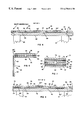
- FIGS. 1 and 2 are cross-section views showing two of the First Type panels connected side by side by a flap hinge that is attached to the top of adjacent boards of the panels, FIG. 1 showing the two panels folded at the hinge for stacking with similarly folded sets of hinged panels; and FIG. 2 showing the two panels unfolded and laid on a sub-floor alongside similar panels;
- FIGS. 3 and 4 are cross-section views showing two of the First Type panels connected side by side by a flap hinge that is attached to the bottom of adjacent boards of the panels on the plates thereof, FIG. 3 showing the two panels folded at the hinge for stacking with similarly folded sets of hinged panels; and FIG. 4 showing the two panels unfolded and laid on a sub-floor alongside similar panels;
- FIGS. 5 and 6 are cross-section views showing three of the First Type panels connected side by side by flap hinges that are attached to the top of adjacent boards of the panels, FIG. 5 showing two of the panels folded as in FIG. 1 and the third panel folded at a right angle thereto, in a way that is suitable for nesting if not for stacking; and FIG. 6 showing the three panels unfolded and laid on a sub-floor alongside similar panels;
- FIGS. 7 and 8 are cross-section views showing four of the First Type panels connected side by side by flap hinges that are attached to the top of adjacent boards of the panels and to the bottom of adjacent boards of the panels on the plates thereof, alternately, FIG. 7 showing the four panels folded at the hinges and in an orderly stack for stacking with similarly folded sets of hinged panels, and FIG. 8 showing the four panels unfolded and laid on a sub-floor alongside similar panels;
- FIGS. 9 and 10 are cross-section views showing two of the First Type panels connected side by side by a piano hinge that is attached to the top of adjacent boards of the panels, FIG. 9 showing the two panels folded at the hinge for stacking with similarly folded sets of hinged panels; and FIG. 10 showing the two panels unfolded and laid on a sub-floor alongside similar panels;
- FIGS. 11 and 12 are cross-section views showing two of the Second Type panels connected side by side by a flap hinge that is attached to the bottom of adjacent boards of the panels on the boards thereof, FIG. 11 showing the two panels folded at the hinge for stacking with similarly folded sets of hinged panels; and FIG. 12 showing the two panels unfolded and laid on a sub-floor alongside similar panels, ready for insertion of the tubing 20 in the slots in the plates;
- FIGS. 13 and 14 are cross-section views showing two of the Second Type panels connected side by side by a flap hinge that is attached to the bottom of adjacent panels, fully covering the whole bottom of both panels on the boards thereof, FIG. 13 showing the two panels folded at the hinge for stacking with similarly folded sets of hinged panels; and FIG. 14 showing the two panels unfolded and laid on a sub-floor alongside similar panels, ready for insertion of the tubing 20 in the slots in the plates;
- FIGS. 15 and 16 are cross-section views showing two of the Second Type panels having contoured matching edges, connected side by side by a flap hinge that is attached to the bottom of adjacent panels, fully covering the whole bottom of both panels on the boards thereof, FIG. 13 showing the two panels folded at the hinge for stacking with similarly folded sets of hinged panels; and FIG. 14 showing the two panels unfolded and laid on a sub-floor alongside similar panels, the contoured edges fitting together and ready for insertion of the tubing 20 in the slots in the plates;
- FIGS. 17, 18 and 19 are edge and end views showing two of the First Type panels connected end to end by flap hinges that attache to the top of adjacent boards of the panels, FIG. 17 showing the side view of the two panels folded at the hinge for stacking with similarly folded sets of hinged panels; FIG. 18 showing the end view of the two panels folded at the hinge; and FIG. 19 showing the two panels unfolded and laid on a sub-floor end to end with similar panels;
- FIGS. 20, 21 and 22 are edge and end views showing two of the First Type panels connected end to end by flap hinges that attache to the bottom of adjacent boards on the plates of the panels, FIG. 20 showing the side view of the two panels folded at the hinge for stacking with similarly folded sets of hinged panels; FIG. 21 showing the end view of the two panels folded at the hinge; and FIG. 22 showing the two panels unfolded and laid on a sub-floor end to end with similar panels;
- FIG. 23 is a perspective view of the RFH/RFC installation shown in FIG. 4 showing several courses of sets of two hinged panels of the First Type, some like in FIG. 2 for straight runs of tubing and some also of the First Type for 180 degree turns of the tubing, arranged side by side and end to end on top of the sub-floor with the tubing 20 installed and ready for installation of the finished floor covering; and
- FIG. 24 is a front view of the RWH/RWC installation of hinged sets of panels of the Second Type, as in any of FIGS. 1 to 16 , showing the wall sole plate, studs and top plate with several horizontal courses of side by side hinged sets of the panels and 180 degree turns (also of the Second Type) with the tubing 20 inserted and ready for installation of the finished wall covering.
- FIGS. 1 and 2 show an embodiment of two modular panels 1 and 6 of the First Type, folded in FIG. 1 at an attached flap hinge 10 on adjacent holder boards 3 and 7 of panels 1 and 6 , respectively, the flap partially covering the boards.
- panels of the First Type consist of two spaced apart boards and a flat metal plate attached to the boards and the tubing is inserted into the space between the boards against the plate and it is preferred that a resilient thermally conductive filler material be inserted in the space before the tubing is inserted and that spaced apart edges of the boards be undercut and the radiation plate or sheet be attached to the boards by staking.
- Panels of the First Type can be installed on top of the sub-floor or under the sub-floor between the floor joists or on wall studs or on ceiling rafters and in all cases there is ready access to the space between the boards into which the tubing is inserted.
- the hinged panels 1 and 6 are connected by a flange hinge 10 that is attached to the top face of the adjacent boards 3 and 7 of the panels.
- the flap may be a strip of flexible plastic or fabric or a suitable strong adhering tape.
- the thickness of the flap is preferably negligible (less than ⁇ fraction (1/16) ⁇ ′′) so that when the panels 1 and 6 are unfolded as shown and laid on a sub-floor 22 supported by floor joists 21 , as shown in FIG. 2, there is no requirement to add compensating layers of material to the top of other parts of the panel boards so that the top of them is even across the floor.
- Panel 1 consists of evenly spaced apart boards 2 and 3 and metal radiation plate or sheet 4 attached thereto by, for example staking
- panel 6 consists of evenly spaced apart boards 7 and 8 and metal radiation plate or sheet 9 attached thereto by staking.
- Flap type hinge 10 that may be a strip of flexible plastic or fabric or a suitable strong adhering tape is attached to the top of adjacent boards 3 and 7 so that the hinged panels 1 and 6 may fold as shown in FIG. 1 or unfold and laid on the db-floor as shown in FIG. 2 alongside other hinged sets of panels such as 11 that consists of boards 12 and 13 and attached plate 14 .
- FIGS. 3 and 4 show another embodiment in cross-section of two modular panels of the First Type, folded at an attached flap type hinge on the radiation plate of each panel, the flap partially covering the plate where the plate is full to the outer edges of the boards.
- the hinged panels 31 and 36 are connected by a flange hinge 40 that is attached to the bottom of the panels on the edges of the adjacent radiation plates 34 and 39 .
- the flap may be a strip of flexible plastic or fabric or a suitable strong adhering tape of negligible thickness so that when the panels 31 and 36 are unfolded as shown and laid on a sub-floor 22 supported by floor joists 21 , as shown in FIG. 4, there is no requirement to add compensating layers of material to the sub-floor so that the top thereof is even across the floor.
- Panel 31 consists of evenly spaced apart boards 32 and 33 and metal radiation plate or sheet 34 attached thereto by, for example staking.
- panel 36 consists of evenly spaced apart boards 37 and 38 and metal radiation plate or sheet 39 attached thereto by staking.
- Flap type hinge 40 that may be a strip of flexible plastic or fabric or a suitable strong adhering tape is attached to the bottom of the adjacent panels so that the hinged may fold as shown in FIG. 3 or unfold and laid on the sub-floor as shown in FIG. 4 alongside other hinged sets of panels such as 41 that consists of boards 42 and 43 and attached plate 44 .
- FIG. 5 shows the another embodiment in cross-section of three modular panels 51 , 56 and 61 of the First Type, folded at an attached flap hinge on top of adjacent holder boards of each panel, the flap partially covering the boards.
- the hinged panels 51 , 56 and 61 are connected by flange hinges 60 ′ and 60 ′′ that are both attached to the top of the panels on the edges of the adjacent boards of the three panels.
- the flap may be a strip of flexible plastic or fabric or a suitable strong adhering tape of negligible thickness so that when the panels 51 . 56 and 61 are unfolded as shown and laid on a sub-floor 22 supported by floor joists 21 , as shown in FIG. 6, there is no requirement to add compensating layers of material to the top of other parts of the panel boards so that the top of them is even across the floor.
- Panel 51 consists of evenly spaced apart boards 52 and 53 and metal radiation plate or sheet 54 attached thereto by, for example, staking
- panel 56 consists of evenly spaced apart boards 57 and 58 and metal radiation plate or sheet 59 attached thereto by staking
- panel 61 consists of evenly spaced apart boards 62 and 63 and metal radiation plate or sheet 64 attached thereto by staking.
- Flap type hinges 60 ′ and 60 ′′ may be strips of flexible plastic or fabric or a suitable strong adhering tape is attached to the top of the adjacent panels so that the hinges may fold as shown in FIG. 5 or unfold and laid on the sub-floor as shown in FIG. 6 alongside other hinged sets of panels.
- folded panels shown in FIG. 5 may not be suitable for stacking set upon set, it is suitable for nesting.
- FIG. 8 shows another embodiment in cross-section of four modular panels 71 , 76 , 81 and 86 of the First Type, folded at attached flap hinges, that are attached alternately to the radiation plates and the boards of the four panels, the flaps fully covering the plates and/or boards.
- the hinged panels 71 , 76 , 81 and 86 are connected by flap hinges 80 ′, 80 ′′ and 80 ′′′ that are attached alternately to the bottom and the top of the panels of the adjacent plates and boards of the four panels.
- the flaps may be strips of flexible plastic or fabric or a suitable strong adhering tape of negligible thickness so that when the panels 71 , 76 , 81 and 86 are unfolded and laid on a sub-floor 22 supported by floor joists 21 , as shown in FIG. 8, there is no requirement to add compensating layers of material to the top or the bottom of other parts of the panels so that the top of them and the sub-floor is even across the floor.
- Panel 71 consists of evenly spaced apart boards 72 and 73 and metal radiation plate or sheet 74 attached thereto by, for example, staking
- panel 76 consists of evenly spaced apart boards 77 and 78 and metal radiation plate or sheet 79 attached thereto by staking
- panel 81 consists of evenly spaced apart boards 82 and 83 and metal radiation plate or sheet 84 attached thereto by staking
- panel 86 consists of evenly spaced apart boards 87 and 88 and metal radiation plate or sheet 89 attached thereto by staking.
- Flap type hinges 80 ′, 80 ′′ and 80 ′′′ may be strips of flexible plastic or fabric or a suitable strong adhering tape is attached to the top or bottom of the adjacent panels so that the hinges may fold as shown in FIG. 7 or unfold and laid on the sub-floor as shown in FIG. 8 alongside other hinged sets of panels.
- the folded panels of such a set shown in FIG. 7, is suitable for stacking set upon set.
- FIGS. 9 and 10 show show another embodiment in cross-section of two modular panels of the First Type, folded at an attached pin hinge (piano hinge) on top of the adjacent boards of panels of the set.
- the hinged panels 91 and 96 are connected by a pin hinge (piano hinge) 100 that is attached to the top of the adjacent boards 93 and 97 of the panels.
- the pin hinge is longitudinally rigid and preferably made of metal and is attached to the boards by staking, screwing or adhesive.
- the thickness of the hinge may or may not be negligible. If not negligible, then when the panels 91 and 96 are unfolded as shown and laid on a sub-floor 22 supported by floor joists 21 , as shown in FIG. 10, there may be the requirement to add compensating layers of material to the top of other parts of the panel boards so that the top is even across the floor.
- Panel 91 consists of evenly spaced apart boards 92 and 93 and metal radiation plate or sheet 94 attached thereto by, for example staking
- panel 96 consists of evenly spaced apart boards 97 and 98 and metal radiation plate or sheet 99 attached thereto by staking.
- Pin hinge 100 is attached to the top of adjacent boards 93 and 97 so that the hinged panels 91 and 96 may fold as shown in FIG. 9 or unfold and laid on the sub-floor as shown in FIG. 10 alongside other hinged sets of panels such as 101 that consists of boards 102 and 103 and attached plate 104 .
- FIGS. 11 and 12 show the another embodiment herein in cross-section of two modular panels 111 and 116 of the Second Type, folded at an attached flap hinge 120 on the bottom edges of the adjacent holder boards 113 and 117 of each panel.
- panels of the Second Type consist of two spaced apart boards and a flat metal plate having a longitudinal groove the length of the plate is attached to the boards with the groove projecting into the space between the boards and the tubing is inserted into the groove in the plate between the boards.
- the tubing is in direct contact with the metal plate in the groove over most of the outer periphery of the tubing. Inserting thermally conductive filler material into the groove before the tubing is inserted is optional.
- the grooved radiation plate or sheet is preferably attached to the boards by staking as described in the above mentioned U.S. patent application Ser. No. 08/746,458.
- the hinged panels 111 and 116 are connected by a flange hinge 120 that is attached to the edges of the bottom face of the adjacent boards 113 and 117 of the panels.
- the flap may be a strip of flexible plastic or fabric or a suitable strong adhering tape.
- the thickness of the flap is preferably negligible (less than ⁇ fraction (1/16) ⁇ ′′) so that when the panels are unfolded as shown and laid on a sub-floor 22 supported by floor joists 21 , as shown in FIG. 12, there is no requirement to add compensating layers of material between the panels and the sub-floor.
- Panel 111 consists of evenly spaced apart boards 112 and 113 and metal radiation plate or sheet 114 attached thereto by, for example staking
- panel 116 consists of evenly spaced apart boards 117 and 118 and metal radiation plate or sheet 119 attached thereto by staking.
- Flap type hinge 100 that may be a strip of flexible plastic or fabric or a suitable strong adhering tape is attached to the bottom of adjacent boards 113 and 117 so that the hinged panels 111 and 116 may fold as shown in FIG. 11 or unfold and laid on the sub-floor as shown in FIG. 12 alongside other hinged sets of panels such as 121 that consists of boards 122 and 123 and attached plate 124 .
- FIGS. 13 and 14 show another embodiment herein in cross-section of two modular panels 131 and 136 of the Second Type, folded at an attached flap hinge 140 ′ on the bottom of the panels, fully covering the boards on the bottom of each panel.
- the hinged panels 131 and 136 are connected by a flange hinge 140 ′ that is attached to the bottom of the panels and fully covers the entire bottom of both boards of each panel.
- the flap may be a strip of flexible plastic or fabric or a suitable strong adhering tape. The thickness of the flap need not be negligible, because it covers the entire bottom of both panels.
- the flap material may be thermally insulating and/or sound insulation as well as a hinge that allows folding the two panels as shown in FIG. 13 and unfolding as shown and laid on a sub-floor 22 supported by floor joists 21 , as shown in FIG. 14 .
- Panel 131 consists of evenly spaced apart boards 132 and 133 and metal radiation plate or sheet 134 attached thereto by, for example staking
- panel 136 consists of evenly spaced apart boards 137 and 138 and metal radiation plate or sheet 139 attached thereto by staking.
- Flap type hinge layer 140 may be thermally insulating and/or sound insulation as well as a hinge that allows folding the two panels to fold as shown in Figure and unfold and laid on the sub-floor as shown in FIG. 14 alongside other hinged sets of panels such as 141 that consists of boards 142 and 143 and attached plate 144 .
- FIGS. 15 and 16 show another embodiment herein in cross-section of two modular panels 151 and 156 of the Second Type, folded at an attached flap hinge 160 ′ on the bottom of the panels, fully covering the boards on the bottom of each panel.
- Both edges of each panel are contoured with matching contours.
- the matching contours are simple bevels and serve to provide an overlap of the panels in a set when they are unfolded.
- the outside edges of each panel are also contoured so that each set edge overlaps the set it is adjacent to.
- the hinged panels 151 and 156 are connected by a flange hinge 160 ′ that is attached to the bottom of the panels and fully covers the entire bottom of both boards of each panel.
- the flap may be a strip of flexible plastic or fabric or a suitable strong adhering tape. The thickness of the flap need not be negligible, because it covers the entire bottom of both panels.
- the flap material may be thermally insulating and/or sound insulation as well as a hinge that allows folding the two panels as shown in FIG. 15 and unfolding as shown and laid on a sub-floor 22 supported by floor joists 21 , as shown in FIG. 16 .
- Panel 151 consists of evenly spaced apart boards 152 and 153 and metal radiation plate or sheet 154 attached thereto by, for example staking
- panel 156 consists of evenly spaced apart boards 157 and 158 and metal radiation plate or sheet 159 attached thereto by staking.
- Flap type hinge layer 160 ′ may be thermally insulating and/or sound insulation as well as a hinge that allows folding the two panels to fold as shown in FIG. 15 and unfold and laid on the sub-floor as shown in FIG. 16 alongside other hinged sets of panels such as 161 that consists of boards 162 and 63 and attached plate 164 .
- the outside edges of all boards are contoured with matching contours.
- the matching contours are simple bevels and serve to provide an overlap of the, panels in a set when they are unfolded.
- the outside edges of each panel are also contoured so that each set edge overlaps the set it is adjacent to.
- the contour could also be matching steps.
- the outside edges of all panel boards could be stepped to fit together when unfolded and to fit side by side with an adjacent set at installation on the sub-floor.
- FIGS. 17, 18 and 19 show an embodiment of two modular panels 171 and 176 of the First Type, folded end to end in side and end edge views of FIGS. 17 and 18 at an attached two part flap hinge 180 ′ and 180 ′′ on top of adjacent holder boards of each panel.
- the hinged panels 171 and 176 are connected by flange hinges 180 ′ and 180 ′′ that are attached to the top at the ends of the adjacent boards 172 and 177 and 173 and 178 of the panels 171 and 176 , respectively.
- the flaps may be a strip of flexible plastic or fabric or a suitable strong adhering tape, the thickness of the flap is preferably negligible (less than ⁇ fraction (1/16) ⁇ ′′) so that when the panels 171 and 176 are unfolded as shown and laid on a sub-floor 22 supported by floor joists 21 , as shown in FIG. 19 and so there is no requirement to add compensating layers of material to the top of other parts of the panel boards so that the top is even across the floor.
- Panel 171 consists of evenly spaced apart boards 172 and 173 and metal radiation plate or sheet 174 attached thereto by, for example staking
- panel 176 consists of evenly spaced apart boards 177 and 178 and metal radiation plate or sheet 179 attached thereto by staking.
- Flap type hinges 180 ′ and 180 ′′ may be a strips of flexible plastic or fabric or a suitable strong adhering tape is attached to the top end of adjacent boards of the end to end hinged panels 171 and 176 so that the hinged panels may fold as shown in FIGS. 17 and 18 or unfold and laid on the sub-floor as shown in FIG. 19 alongside other hinged sets of panels such as 181 that consists of boards 182 and 183 and attached plate 184 .
- FIGS. 20, 21 and 22 show an embodiment of two modular panels 191 and 196 of the First Type, folded end to end in FIGS. 20 and 21 at an attached flap hinge 200 on the bottom of adjacent panels on the plates of the panels.
- the hinged panels 191 and 196 are connected by flange hinge 200 that is attached to the bottom at the ends of the adjacent plates 194 and 199 of the panels 191 and 196 , respectively.
- the flap may be a strip of flexible plastic or fabric or a suitable strong adhering tape, the thickness of the flap is preferably negligible (less than ⁇ fraction (1/16) ⁇ ′′) so that when the panels 191 and 196 are unfolded as shown and laid on a sub-floor 22 supported by floor joists 21 , as shown in FIG. 22 and so there is no requirement to add compensating layers of material between the panels and the sub-floor so that the panels are even across the sub-floor.
- Panel 191 consists of evenly spaced apart boards 192 and 193 and metal radiation plate or sheet 194 attached thereto by, for example staking
- panel 196 consists of evenly spaced apart boards 197 and 198 and metal radiation plate or sheet 199 attached thereto by staking.
- Flap type hinge 200 may be a strip of flexible plastic or fabric or a suitable strong adhering tape is attached to the bottom ends (against the plates) of adjacent boards of the end to end hinged panels 191 and 196 so that the hinged panels may fold as shown in FIGS. 20 and 21 or unfold and laid on the sub-floor as shown in FIG. 22 alongside other hinged sets of panels such as 201 that consists of boards 202 and 203 and attached plate 204 .
- FIG. 23 A typical wood frame construction sub-floor is shown in FIG. 23 . It includes a sub-floor 22 of plywood, particle board or one inch boards on floor joists. The installation of the unfolded side by side hinged sets of modular panels of the First Type and additional kinds (U turn modular panels), also of the First Type, and tubing 20 is all on top of the sub-floor. It includes four courses of the straight run modular panels of the First Type that are each side by side hinged sets of two, like the set of panels 1 and 6 shown in FIGS. 1 and 2, each course being three panels long.
- the four courses are denoted are 211 to 214 and the seven U turn modular panels 216 through 222 are arranged side by side and end to end across the floor, with straight panel sections 222 and 223 providing the tubing entry and exit to the courses, all together providing for eight passes of the tubing 20 inserted into the accommodating tube holding spaces of the panels and ready for covering by a finished floor covering.
- the modular panels in this installation hold tubing 20 as a continuous length laid down serpentine fashion from panel to panel, embedded in the holding spaces of the straight and U turn modular panels and held securely therein by the space structure itself and the filler material therein.
- the radiating plates do not show as they are on the bottom face of the panels
- FIG. 24 A typical wood frame construction wall structure is shown in FIG. 24 . It includes a wall sole plate 240 , studs 241 to 249 and top plate 250 with six hinged sets of the straight run modular panels of the Second Type.
- the installation of the unfolded side by side hinged sets of modular panels of the Second Type and additional kinds (U turn modular panels), also of the Second Type, and tubing 20 is all on top of the wall studs. It includes three courses of the straight run modular panels of the Second Type that are each side by side hinged sets of two, like the set of panels 111 and 116 shown in FIGS. 11 and 12, each course being two panels long.
- the three courses are denoted are 251 , 252 and 253 and the six U turn modular panels 254 through 259 are arranged side by side and end to end across the floor, with straight panel sections 260 and 261 and 262 providing the tubing entry and exit to the courses, all together providing for seven passes of the tubing 20 inserted into the accommodating tube holding spaces of the panels and ready for covering by a finished floor covering.
- the modular panels in this installation hold tubing 20 as a continuous length laid down serpentine fashion from panel to panel, embedded in the holding spaces of the straight and U turn modular panels and held securely therein by the space structure itself and the filler material therein.
- the radiating plates are on top and show as they are denoted.
- Radiant hydronic cooling described herein is effective when installed in the ceiling, because the cooled air against the ceiling falls to the floor creating a convection flow that is favorable to providing even cooling throughout the room.
- the ceiling of a room before the finished ceiling is installed is bare rafters, joists or strapping.
- Such a ceiling installation would be essentially the same as the wall installation shown in FIG. 24, except it would be on the rafters, joists, etc. of the ceiling instead of the wall studs as in FIG. 24 .
- Radiant hydronic cooling described herein is effective when installed in the ceiling, because the cooled air against the ceiling falls to the floor creating a convection flow that is favorable to providing even cooling throughout the room.
- the ceiling of a room before the finished ceiling is installed is bare rafters, joists or strapping.
- Such a ceiling installation would be essentially the same as the wall installation shown in FIG. 18, except it would be on the rafters, joists, etc. of the ceiling instead of the wall studs as in FIG. 24 .
- a compliant filler material around the tubing held in the tubing holding space in any of the embodiments herein is applied to the space before the tubing is inserted or forced into the space.
- a purpose of the filler material is to hold the tubing in the space as an adhesive, while at the same time allowing the tubing to expand and contract longitudinally within the space of successive modular pieces that hold a length of tubing at installation. The tubing must be free to expand and contract, while the modular pieces are fixed by staples, nails, screws, etc. to the sub-floor, wall studs or ceiling rafters.
- Another purpose of the filler material is to reduce noise created by expansions and contractions of the tubing in the space.
- Yet another and important purpose is to provide a medium of thermal conduction from the tubing to the plate.
- a suitable filler material for any of these purposes is silicone rubber.
- a convenient form of silicone rubber that can be used in the installations described herein is available commercially as a sealant or a caulking in viscous liquid form, usually dispensed from a tube by simply forcing it out of a nozzle on the tube.
- a sealant/caulking is usually a prepared mix of silicone dioxide, methanol and ammonia.
- a commercial source of this sealant/caulking mix is a General Electric product called SILICONE II that remains resilient for many years after it is applied.
Landscapes
- Engineering & Computer Science (AREA)
- Physics & Mathematics (AREA)
- Thermal Sciences (AREA)
- Chemical & Material Sciences (AREA)
- Combustion & Propulsion (AREA)
- Mechanical Engineering (AREA)
- General Engineering & Computer Science (AREA)
- Floor Finish (AREA)
- Steam Or Hot-Water Central Heating Systems (AREA)
- Building Environments (AREA)
- Devices For Blowing Cold Air, Devices For Blowing Warm Air, And Means For Preventing Water Condensation In Air Conditioning Units (AREA)
- Heat Treatment Of Articles (AREA)
Priority Applications (7)
| Application Number | Priority Date | Filing Date | Title |
|---|---|---|---|
| US09/307,540 US6270016B1 (en) | 1999-05-07 | 1999-05-07 | Radiant floor, wall and ceiling hydronic cooling systems and heating and cooling systems, using metal plates that are heated or cooled by attached tubing that is fed hot or cold water, modular panels hinged together in a set of panels |
| US09/340,369 US6182903B1 (en) | 1999-05-07 | 1999-06-28 | Radiant floor wall and ceiling hydronic heating and/or cooling systems, using modular panels hinged together in sets of panels, staggering the positions of panels in the sets so that sets are interlocking |
| AT00928965T ATE313763T1 (de) | 1999-05-07 | 2000-05-08 | Boden-, wand- und deckenheiz- oder kühlanlage |
| DE60024978T DE60024978D1 (de) | 1999-05-07 | 2000-05-08 | Boden-, wand- und deckenheiz- oder kühlanlage |
| EP00928965A EP1161642B1 (de) | 1999-05-07 | 2000-05-08 | Boden-, wand- und deckenheiz- oder kühlanlage |
| CA002354556A CA2354556C (en) | 1999-05-07 | 2000-05-08 | Hinged radiant floor panels |
| PCT/US2000/012929 WO2000068617A2 (en) | 1999-05-07 | 2000-05-08 | Hinged radiant floor panels |
Applications Claiming Priority (1)
| Application Number | Priority Date | Filing Date | Title |
|---|---|---|---|
| US09/307,540 US6270016B1 (en) | 1999-05-07 | 1999-05-07 | Radiant floor, wall and ceiling hydronic cooling systems and heating and cooling systems, using metal plates that are heated or cooled by attached tubing that is fed hot or cold water, modular panels hinged together in a set of panels |
Related Child Applications (1)
| Application Number | Title | Priority Date | Filing Date |
|---|---|---|---|
| US09/340,369 Continuation-In-Part US6182903B1 (en) | 1999-05-07 | 1999-06-28 | Radiant floor wall and ceiling hydronic heating and/or cooling systems, using modular panels hinged together in sets of panels, staggering the positions of panels in the sets so that sets are interlocking |
Publications (1)
| Publication Number | Publication Date |
|---|---|
| US6270016B1 true US6270016B1 (en) | 2001-08-07 |
Family
ID=23190194
Family Applications (1)
| Application Number | Title | Priority Date | Filing Date |
|---|---|---|---|
| US09/307,540 Expired - Lifetime US6270016B1 (en) | 1999-05-07 | 1999-05-07 | Radiant floor, wall and ceiling hydronic cooling systems and heating and cooling systems, using metal plates that are heated or cooled by attached tubing that is fed hot or cold water, modular panels hinged together in a set of panels |
Country Status (6)
| Country | Link |
|---|---|
| US (1) | US6270016B1 (de) |
| EP (1) | EP1161642B1 (de) |
| AT (1) | ATE313763T1 (de) |
| CA (1) | CA2354556C (de) |
| DE (1) | DE60024978D1 (de) |
| WO (1) | WO2000068617A2 (de) |
Cited By (29)
| Publication number | Priority date | Publication date | Assignee | Title |
|---|---|---|---|---|
| JP2003509606A (ja) * | 1999-09-17 | 2003-03-11 | ロディン,ホカン | 床暖房または冷房システムのための床エレメントおよび該エレメントの製造方法 |
| US20040045246A1 (en) * | 2002-08-14 | 2004-03-11 | W. Lehbrink Gmbh & Co. Kg | Flexibly connected panel elements |
| US20040055224A1 (en) * | 2001-11-27 | 2004-03-25 | Takeshi Kuga | Foldable heat radiating sheet |
| US6776222B2 (en) * | 2000-04-03 | 2004-08-17 | Mitsubishi Chemical Functional Products, Inc. | Foldable floor heating panel |
| US20050028966A1 (en) * | 2003-05-07 | 2005-02-10 | Pickard Dale H. | Hydronic radiant heat tubing receptacle and heat distribution panel system |
| US20060138279A1 (en) * | 2004-12-23 | 2006-06-29 | Nathan Pisarski | Aircraft floor panel |
| US20070056233A1 (en) * | 2005-09-15 | 2007-03-15 | Se-Chang Kang | Heating floor system |
| USD541396S1 (en) | 2005-10-21 | 2007-04-24 | Createc Corporation | Radiant heat floor panel |
| US20070090231A1 (en) * | 2005-10-26 | 2007-04-26 | Macduff James | Multi-purpose hanger for pipe, tubing, conduit or cable and method of using same |
| US20070095931A1 (en) * | 2005-10-13 | 2007-05-03 | Macduff James | Hydronic heating system, hanger for tubing and method of using same to install the hydronic heating system |
| US20080017725A1 (en) * | 2006-07-19 | 2008-01-24 | Backman James J Jr | Radiant mat grid |
| US20080121254A1 (en) * | 2006-11-23 | 2008-05-29 | Petro-Canada | Heating system for outdoor conveyors in a carwash |
| US20090014152A1 (en) * | 2007-07-11 | 2009-01-15 | Meng Yeow Foo | Hydronic floor heating system with adaptive fluid circuit |
| USD587358S1 (en) | 2007-09-07 | 2009-02-24 | Createc Corporation | Radiant floor panel |
| US20090178717A1 (en) * | 2008-01-15 | 2009-07-16 | Michael Mirchildon | Mixing and pumping system for use with installed hydronic radiant floor heating systems and the like |
| US20090314848A1 (en) * | 2005-09-14 | 2009-12-24 | Uponor, Inc. | Radiant Heating System and Method |
| US20100147503A1 (en) * | 2008-12-16 | 2010-06-17 | Doo Nyun Kim | Method for producing heating panel and heating panel resulting therefrom |
| US20100229481A1 (en) * | 2007-07-23 | 2010-09-16 | Arne Wallin | Modular pre-cast composite flooring tile and floor system |
| US7832159B1 (en) * | 2006-06-06 | 2010-11-16 | Kayhart Paul H | Radiant in-floor heating system |
| US20100313504A1 (en) * | 2009-06-11 | 2010-12-16 | Xinfa Li | Wood Board Connection with Heat Transfer Function |
| US8288689B1 (en) * | 2008-09-02 | 2012-10-16 | Adelman Dean W | Radiant heating and cooling panel |
| US20130099013A1 (en) * | 2001-04-04 | 2013-04-25 | Graftech International Holdings Inc. | Flexible Graphite Flooring Heat Spreader |
| US20140069605A1 (en) * | 2012-09-12 | 2014-03-13 | Michael G. Sullivan | Thermal Transfer Panels With Channel Structures and Method of Using Thermal Transfer Panels |
| US20140367477A1 (en) * | 2013-06-12 | 2014-12-18 | Codi Group, Llc | Impact and/or sound deadening hydronic sub-flooring panel and related system and method |
| US10100517B2 (en) | 2015-12-17 | 2018-10-16 | Nvent Services Gmbh | Floor underlayment for retaining heater cable |
| US20180298611A1 (en) * | 2017-04-17 | 2018-10-18 | David R. Hall | Configurable Hydronic Structural Panel |
| US20190249432A1 (en) * | 2018-02-13 | 2019-08-15 | J&C Trading Co., Ltd. | Self-assembly hot water mat |
| US20200326085A1 (en) * | 2019-04-15 | 2020-10-15 | Ut-Battelle, Llc | Thermally Anisotropic Composites for Thermal Management in Building Environments |
| DE102019125428A1 (de) * | 2019-09-20 | 2021-04-08 | Dallmer Gmbh & Co. Kg | Trägervorrichtung für den Boden einer Dusche |
Families Citing this family (3)
| Publication number | Priority date | Publication date | Assignee | Title |
|---|---|---|---|---|
| GB0602553D0 (en) * | 2006-02-08 | 2006-03-22 | Cooper Lee | Modular flooring |
| GB0619957D0 (en) * | 2006-10-09 | 2006-11-15 | Polypipe Building Products Ltd | Heating system |
| PL2767765T3 (pl) * | 2013-02-19 | 2016-05-31 | Roth Werke Gmbh | Płaski element do podpierania rur, urządzenie grzejne i/lub urządzenie chłodnicze i sposób zbudowania urządzenia grzejnego i/lub urządzenia chłodniczego |
Citations (5)
| Publication number | Priority date | Publication date | Assignee | Title |
|---|---|---|---|---|
| US5078203A (en) | 1990-03-23 | 1992-01-07 | Shigetomo Shiroki | Hot water type floor heating panel |
| US5131458A (en) | 1991-03-25 | 1992-07-21 | Davis Energy Group, Inc. | Modular back side radiant heating panels with spring retention devices |
| US5454428A (en) | 1993-11-22 | 1995-10-03 | Radiant Engineering, Inc. | Hydronic radiant heat distribution panel and system |
| US5579996A (en) | 1992-06-30 | 1996-12-03 | Fiedrich; Joachim | Radiant floor and wall hydronic heating systems |
| US5788152A (en) | 1995-03-15 | 1998-08-04 | Alsberg; Terry Wayne W. | Floor heating system |
Family Cites Families (1)
| Publication number | Priority date | Publication date | Assignee | Title |
|---|---|---|---|---|
| US5119988A (en) | 1990-06-28 | 1992-06-09 | Joachim Fiedrich | Hydronic heating water temperature control system |
-
1999
- 1999-05-07 US US09/307,540 patent/US6270016B1/en not_active Expired - Lifetime
-
2000
- 2000-05-08 EP EP00928965A patent/EP1161642B1/de not_active Expired - Lifetime
- 2000-05-08 AT AT00928965T patent/ATE313763T1/de not_active IP Right Cessation
- 2000-05-08 DE DE60024978T patent/DE60024978D1/de not_active Expired - Lifetime
- 2000-05-08 CA CA002354556A patent/CA2354556C/en not_active Expired - Lifetime
- 2000-05-08 WO PCT/US2000/012929 patent/WO2000068617A2/en not_active Ceased
Patent Citations (5)
| Publication number | Priority date | Publication date | Assignee | Title |
|---|---|---|---|---|
| US5078203A (en) | 1990-03-23 | 1992-01-07 | Shigetomo Shiroki | Hot water type floor heating panel |
| US5131458A (en) | 1991-03-25 | 1992-07-21 | Davis Energy Group, Inc. | Modular back side radiant heating panels with spring retention devices |
| US5579996A (en) | 1992-06-30 | 1996-12-03 | Fiedrich; Joachim | Radiant floor and wall hydronic heating systems |
| US5454428A (en) | 1993-11-22 | 1995-10-03 | Radiant Engineering, Inc. | Hydronic radiant heat distribution panel and system |
| US5788152A (en) | 1995-03-15 | 1998-08-04 | Alsberg; Terry Wayne W. | Floor heating system |
Cited By (45)
| Publication number | Priority date | Publication date | Assignee | Title |
|---|---|---|---|---|
| JP2003509606A (ja) * | 1999-09-17 | 2003-03-11 | ロディン,ホカン | 床暖房または冷房システムのための床エレメントおよび該エレメントの製造方法 |
| US6739097B1 (en) * | 1999-09-17 | 2004-05-25 | Rodin Haakan | Floor element for a floor heating or cooling system, and a process for manufacturing the element |
| US20040250984A1 (en) * | 2000-04-03 | 2004-12-16 | Hitoshi Seki | Foldable floor heating panel |
| US7228886B2 (en) | 2000-04-03 | 2007-06-12 | Mitsubishi Chemical Functional Products, Inc. | Foldable floor heating panel |
| US6776222B2 (en) * | 2000-04-03 | 2004-08-17 | Mitsubishi Chemical Functional Products, Inc. | Foldable floor heating panel |
| US20130099013A1 (en) * | 2001-04-04 | 2013-04-25 | Graftech International Holdings Inc. | Flexible Graphite Flooring Heat Spreader |
| US6926077B2 (en) * | 2001-11-27 | 2005-08-09 | Mitsubishi Chemical Functional Products, Inc. | Foldable heat radiating sheet |
| US20040055224A1 (en) * | 2001-11-27 | 2004-03-25 | Takeshi Kuga | Foldable heat radiating sheet |
| US20040045246A1 (en) * | 2002-08-14 | 2004-03-11 | W. Lehbrink Gmbh & Co. Kg | Flexibly connected panel elements |
| US7377079B2 (en) * | 2002-08-14 | 2008-05-27 | W. Lehbrink Gmbh & Co. Kg, Maschinenfabrik | Flexibly connected panel elements |
| US20050028966A1 (en) * | 2003-05-07 | 2005-02-10 | Pickard Dale H. | Hydronic radiant heat tubing receptacle and heat distribution panel system |
| US7021372B2 (en) | 2003-05-07 | 2006-04-04 | Pickard Dale H | Hydronic radiant heat tubing receptacle and heat distribution panel system |
| US20060138279A1 (en) * | 2004-12-23 | 2006-06-29 | Nathan Pisarski | Aircraft floor panel |
| US20090314848A1 (en) * | 2005-09-14 | 2009-12-24 | Uponor, Inc. | Radiant Heating System and Method |
| US20070056233A1 (en) * | 2005-09-15 | 2007-03-15 | Se-Chang Kang | Heating floor system |
| US7594365B2 (en) * | 2005-09-15 | 2009-09-29 | Lg Chem, Ltd. | Heating floor system |
| US20070095931A1 (en) * | 2005-10-13 | 2007-05-03 | Macduff James | Hydronic heating system, hanger for tubing and method of using same to install the hydronic heating system |
| USD541396S1 (en) | 2005-10-21 | 2007-04-24 | Createc Corporation | Radiant heat floor panel |
| US20070090231A1 (en) * | 2005-10-26 | 2007-04-26 | Macduff James | Multi-purpose hanger for pipe, tubing, conduit or cable and method of using same |
| US7832159B1 (en) * | 2006-06-06 | 2010-11-16 | Kayhart Paul H | Radiant in-floor heating system |
| US20080017725A1 (en) * | 2006-07-19 | 2008-01-24 | Backman James J Jr | Radiant mat grid |
| US8020783B2 (en) | 2006-07-19 | 2011-09-20 | Backman Jr James Joseph | Radiant mat grid |
| US20080121254A1 (en) * | 2006-11-23 | 2008-05-29 | Petro-Canada | Heating system for outdoor conveyors in a carwash |
| US9474107B2 (en) | 2006-11-23 | 2016-10-18 | Suncor Energy Inc. | Heating system for outdoor conveyors in a carwash |
| US8413669B2 (en) * | 2006-11-23 | 2013-04-09 | Suncor Energy Inc. | Heating system for outdoor conveyors in a carwash |
| US20090014152A1 (en) * | 2007-07-11 | 2009-01-15 | Meng Yeow Foo | Hydronic floor heating system with adaptive fluid circuit |
| US20100229481A1 (en) * | 2007-07-23 | 2010-09-16 | Arne Wallin | Modular pre-cast composite flooring tile and floor system |
| US8191324B2 (en) * | 2007-07-23 | 2012-06-05 | Arne Wallin | Modular pre-cast composite flooring panel and floor system |
| USD587358S1 (en) | 2007-09-07 | 2009-02-24 | Createc Corporation | Radiant floor panel |
| US20090178717A1 (en) * | 2008-01-15 | 2009-07-16 | Michael Mirchildon | Mixing and pumping system for use with installed hydronic radiant floor heating systems and the like |
| US8288689B1 (en) * | 2008-09-02 | 2012-10-16 | Adelman Dean W | Radiant heating and cooling panel |
| US8312691B2 (en) * | 2008-12-16 | 2012-11-20 | Doo Nyun Kim | Method for producing heating panel and heating panel resulting therefrom |
| US20100147503A1 (en) * | 2008-12-16 | 2010-06-17 | Doo Nyun Kim | Method for producing heating panel and heating panel resulting therefrom |
| US20100313504A1 (en) * | 2009-06-11 | 2010-12-16 | Xinfa Li | Wood Board Connection with Heat Transfer Function |
| US20140069605A1 (en) * | 2012-09-12 | 2014-03-13 | Michael G. Sullivan | Thermal Transfer Panels With Channel Structures and Method of Using Thermal Transfer Panels |
| US9248492B2 (en) * | 2012-09-12 | 2016-02-02 | Michael G. Sullivan | Thermal transfer panels with channel structures and method of using thermal transfer panels |
| US20140367477A1 (en) * | 2013-06-12 | 2014-12-18 | Codi Group, Llc | Impact and/or sound deadening hydronic sub-flooring panel and related system and method |
| US9146038B2 (en) * | 2013-06-12 | 2015-09-29 | Codi Group, Llc | Impact and/or sound deadening hydronic sub-flooring panel and related system and method |
| US10100517B2 (en) | 2015-12-17 | 2018-10-16 | Nvent Services Gmbh | Floor underlayment for retaining heater cable |
| US20180298611A1 (en) * | 2017-04-17 | 2018-10-18 | David R. Hall | Configurable Hydronic Structural Panel |
| US20190249432A1 (en) * | 2018-02-13 | 2019-08-15 | J&C Trading Co., Ltd. | Self-assembly hot water mat |
| US10865563B2 (en) * | 2018-02-13 | 2020-12-15 | J&C Trading Co., Ltd. | Self-assembly hot water mat |
| US20200326085A1 (en) * | 2019-04-15 | 2020-10-15 | Ut-Battelle, Llc | Thermally Anisotropic Composites for Thermal Management in Building Environments |
| US12013149B2 (en) * | 2019-04-15 | 2024-06-18 | Ut-Battelle, Llc | Thermally anisotropic composites for thermal management in building environments |
| DE102019125428A1 (de) * | 2019-09-20 | 2021-04-08 | Dallmer Gmbh & Co. Kg | Trägervorrichtung für den Boden einer Dusche |
Also Published As
| Publication number | Publication date |
|---|---|
| EP1161642B1 (de) | 2005-12-21 |
| CA2354556A1 (en) | 2000-11-16 |
| EP1161642A4 (de) | 2004-12-01 |
| EP1161642A2 (de) | 2001-12-12 |
| CA2354556C (en) | 2006-12-12 |
| WO2000068617A2 (en) | 2000-11-16 |
| ATE313763T1 (de) | 2006-01-15 |
| DE60024978D1 (de) | 2006-01-26 |
| WO2000068617A3 (en) | 2001-02-01 |
Similar Documents
| Publication | Publication Date | Title |
|---|---|---|
| US6270016B1 (en) | Radiant floor, wall and ceiling hydronic cooling systems and heating and cooling systems, using metal plates that are heated or cooled by attached tubing that is fed hot or cold water, modular panels hinged together in a set of panels | |
| US6182903B1 (en) | Radiant floor wall and ceiling hydronic heating and/or cooling systems, using modular panels hinged together in sets of panels, staggering the positions of panels in the sets so that sets are interlocking | |
| US5931381A (en) | For radiant floor, wall and ceiling hydronic heating and/or cooling systems using metal plates that are heated or cooled by attached tubing that is fed hot or cold water, techniques of improving performance and avoiding condensation when cooling | |
| US20040026525A1 (en) | In radiant wall and ceiling hydronic room heating or cooling systems, using tubing that is fed hot or cold water, the tubing is embedded in gypsum or cement wallboard in intimate thermal contact therewith so that the wallboard heats or cools the room | |
| US6330980B1 (en) | Dry installation of a radiant floor or wall hydronic heating system, metal radiating plates that attach to the edges of side-by-side boards and provide metal slots for holding hot water tubing | |
| FI106406B (fi) | Moduuli käytettäväksi lattialämmitys-/jäähdytysjärjestelmässä, menetelmä lattialämmitys-/jäähdytysjärjestelmän asentamiseksi ja lattialämmitys-/jäähdytysjärjestelmä | |
| CA2078185C (en) | Radiant floor and wall hydronic heating systems | |
| US5957378A (en) | Radiant floor and wall hydronic heating systems | |
| CA2213864C (en) | Radiant heat transfer panels | |
| US20090014152A1 (en) | Hydronic floor heating system with adaptive fluid circuit | |
| RU2110654C1 (ru) | Подогреваемый пол | |
| US20040040693A1 (en) | In a dry installation of a radiant floor or wall hydronic heating system, metal radiating sheets that attach to the rough floor or wall adapted with a metal slot for holding hot water tubing | |
| US6009612A (en) | Apparatus for attaching radiating plate to holders of modular unit for radiant floor and wall hydronic heating systems | |
| US20090314848A1 (en) | Radiant Heating System and Method | |
| CA2185548C (en) | Floor heating system | |
| US6726115B1 (en) | Radiant heating system for subfloor installation | |
| US8650832B2 (en) | In-wall hydronic thermal control system and installation method | |
| NL1026924C2 (nl) | Systeem voor het verwarmen of verkoelen van een ruimte. | |
| CA2274410A1 (en) | In radiant floor, wall and celling hydronic cooling systems and heating and cooling systems, using metal plates that are heated or cooled by attached tubing that is fed hot or cold water, structures of plates and tubing attachments | |
| JPH10131390A (ja) | 温度調節装置及び温度調節装置の製造方法 | |
| US20130255912A1 (en) | In-Wall Hydronic Thermal Control System and Installation Method | |
| WO2005005889A1 (ja) | 床暖房装置 | |
| JP2000220855A (ja) | 乾式遮音二重床のベースパネルを利用した床暖房システムとその施工方法 | |
| JP3594454B2 (ja) | 床暖房装置の上敷式木質床暖房パネル | |
| EP0943873A1 (de) | Gerät und Verfahren zur Befestigung einer Strahlungsplatte an Halterungen einer Moduleinheit einer Boden- oder Wandheizungsanlage |
Legal Events
| Date | Code | Title | Description |
|---|---|---|---|
| STCF | Information on status: patent grant |
Free format text: PATENTED CASE |
|
| FEPP | Fee payment procedure |
Free format text: PAT HOLDER NO LONGER CLAIMS SMALL ENTITY STATUS, ENTITY STATUS SET TO UNDISCOUNTED (ORIGINAL EVENT CODE: STOL); ENTITY STATUS OF PATENT OWNER: LARGE ENTITY |
|
| REFU | Refund |
Free format text: REFUND - PAYMENT OF MAINTENANCE FEE, 4TH YEAR, LARGE ENTITY (ORIGINAL EVENT CODE: R1551); ENTITY STATUS OF PATENT OWNER: LARGE ENTITY |
|
| FPAY | Fee payment |
Year of fee payment: 4 |
|
| FPAY | Fee payment |
Year of fee payment: 8 |
|
| FPAY | Fee payment |
Year of fee payment: 12 |