US6445084B1 - Immobilizing device for a motor vehicle - Google Patents
Immobilizing device for a motor vehicle Download PDFInfo
- Publication number
- US6445084B1 US6445084B1 US09/385,366 US38536699A US6445084B1 US 6445084 B1 US6445084 B1 US 6445084B1 US 38536699 A US38536699 A US 38536699A US 6445084 B1 US6445084 B1 US 6445084B1
- Authority
- US
- United States
- Prior art keywords
- immobilizer
- vehicle
- authentication
- control unit
- button
- Prior art date
- Legal status (The legal status is an assumption and is not a legal conclusion. Google has not performed a legal analysis and makes no representation as to the accuracy of the status listed.)
- Expired - Fee Related
Links
Images

Classifications
-
- B—PERFORMING OPERATIONS; TRANSPORTING
- B60—VEHICLES IN GENERAL
- B60R—VEHICLES, VEHICLE FITTINGS, OR VEHICLE PARTS, NOT OTHERWISE PROVIDED FOR
- B60R25/00—Fittings or systems for preventing or indicating unauthorised use or theft of vehicles
- B60R25/20—Means to switch the anti-theft system on or off
- B60R25/24—Means to switch the anti-theft system on or off using electronic identifiers containing a code not memorised by the user
-
- B—PERFORMING OPERATIONS; TRANSPORTING
- B60—VEHICLES IN GENERAL
- B60R—VEHICLES, VEHICLE FITTINGS, OR VEHICLE PARTS, NOT OTHERWISE PROVIDED FOR
- B60R25/00—Fittings or systems for preventing or indicating unauthorised use or theft of vehicles
- B60R25/01—Fittings or systems for preventing or indicating unauthorised use or theft of vehicles operating on vehicle systems or fittings, e.g. on doors, seats or windscreens
- B60R25/04—Fittings or systems for preventing or indicating unauthorised use or theft of vehicles operating on vehicle systems or fittings, e.g. on doors, seats or windscreens operating on the propulsion system, e.g. engine or drive motor
-
- B—PERFORMING OPERATIONS; TRANSPORTING
- B60—VEHICLES IN GENERAL
- B60R—VEHICLES, VEHICLE FITTINGS, OR VEHICLE PARTS, NOT OTHERWISE PROVIDED FOR
- B60R25/00—Fittings or systems for preventing or indicating unauthorised use or theft of vehicles
- B60R25/01—Fittings or systems for preventing or indicating unauthorised use or theft of vehicles operating on vehicle systems or fittings, e.g. on doors, seats or windscreens
- B60R25/04—Fittings or systems for preventing or indicating unauthorised use or theft of vehicles operating on vehicle systems or fittings, e.g. on doors, seats or windscreens operating on the propulsion system, e.g. engine or drive motor
- B60R25/06—Fittings or systems for preventing or indicating unauthorised use or theft of vehicles operating on vehicle systems or fittings, e.g. on doors, seats or windscreens operating on the propulsion system, e.g. engine or drive motor operating on the vehicle transmission
- B60R25/063—Locking of foot actuated control actuating means
Definitions
- the invention relates to a vehicle immobilizing device having an authentication element which can be carried by an authorized vehicle operator.
- Previous immobilizing devices of this type in cars have generally comprised only mechanical keys/ignition locking systems. That is, the immobilizer control unit on the vehicle was formed only by a mechanically operable ignition lock, which could be operated by mechanical keys carried by the user as authentication elements via the associated actuation communication channel.
- the mechanical lock in order to switch on the general vehicle power supply in a first stage the mechanical lock is switched to the so-called “radio position” or standardized terminal 15R; in a second stage, the ignition is switched on via standardized terminal 15 and, in a third stage the engine starting unit is activated via standardized terminal 50. Once the engine has been started, the key returns to the ignition-on position.
- Such mechanical immobilizing devices are nowadays increasingly being replaced, or at least supplemented, by electronic immobilizers.
- electronic driving authorization systems do not require a mechanical lock, but use a wireless actuation communication channel for authentication communication.
- a first type of such systems uses electronic keys as authentication elements, by analogy with classical mechanical key and lock systems.
- control buttons are provided on the electronic keys in order to initiate an immobilizer actuation communication which requires authentication (that is, a check of the driving authorization), or such communications are carried out via a close-field communication channel.
- the key is introduced into a key holder provided on the vehicle in the form, for example, of an electronic ignition lock.
- So-called “keyless-go” systems are also known and are gaining increasing attention at present.
- authentication elements such as smart cards or transponders carried by the vehicle user, require no action by the user.
- Authentication communication in such systems are initiated on user request, or automatically when a valid authentication element is in the effective area of the associated actuation communication channel.
- the effective area is, typically, defined by the transmit/receive range of an associated antenna apparatus.
- systems may also be provided for switching the vehicle engine off automatically or when requested by the user, and for switching it on again when requested by the user.
- Such systems generally include an appropriate control element arranged on a transmission selection lever. See the German Utility Model Documents DE 79 27 688 U1, DE 82 19 522 U1 and DE 87 08 510 U1 as well as Laid-Open Specification EP 0 314 611 A1. These known devices are used to switch the engine off in order to save fuel when the vehicle is temporarily stationary, for example at junctions or in a traffic jam. In this case, the ignition remains switched on while the engine is temporarily switched off (that is, driving authorization is not inhibited). In a further development of this system type in the journal publication B.
- One object of the invention is to provide an immobilizing device of the type mentioned above, which, if required, can be in the form of a keyless-go system, and in which immobilizer actuation communication processes which require authentication can be initiated on user request with a high level of user convenience, and/or which can be activated with a high level of convenience of use by the vehicle driver after enabling engine starting.
- the vehicle immobilizing device in which actuation communication processes which require authentication (those which are accompanied by a check of user authorization) are carried out on user request.
- an appropriate immobilizer operating element arranged on the vehicle can be operated without any authentication element (that is, without using the authentication element itself).
- the invention is also suitable, in particular, for configuration as a keyless-go system, in which the user needs only carry his or her authentication element, for example a smart card.
- Actuation measures for driving authorization can be requested by operating the immobilizer operating element from the driver's seat.
- the authentication process initiated in this way is completed successfully, provided that the authentication element, which is carried by the driver and is located in the effective area of the actuation communication channel, is valid for the associated vehicle.
- the immobilizer control part enables driving authorization and causes the engine to be started, via an appropriate authentication communication, only when the user operates the brake pedal and keeps it depressed.
- engine starting is enabled by a successfully completed authentication process on request via an immobilizer operating element, and comprises the process of switching on the previously switched-off ignition.
- This device as well is highly suitable for configuration as a keyless-go system, in that engine starting is enabled automatically or on user request via the authentication element carried by the user.
- the immobilizer operating element (by means of which the user can initiate immobilizer actuation communication processes which require authentication) comprises a button arranged on the transmission selection lever, thus allowing particularly convenient operation by the driver.
- the immobilizer operating element is a multistage button element.
- a first button stage is used to initiate an ignition switching-on process, which requires authentication, while another button stage allows the ignition to be switched off.
- Yet another embodiment of the invention includes a multistage button element as an immobilizer operating element.
- One button stage is used to switch the ignition on, which requires authentication, while another button stage is intended to initiate (activate) engine starting.
- a button system can carry out all the functions of conventional ignition-lock systems.
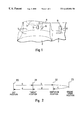
- FIG. 1 is a schematic view of part of the driver's seat area of a vehicle having an immobilizing device with the ignition operated by a button and with engine starting operated by the brake pedal;
- FIG. 2 is a schematic illustration of the switching stages of a multistage immobilizer button for an entirely button-controlled immobilizing device which differs from that shown in FIG. 1;
- FIG. 3 is a schematic block diagram of the immobilizing device according to the invention.
- FIG. 1 shows a schematic view of the driver's seat area of a passenger vehicle.
- a conventional range of pedals with a brake pedal 5 and an accelerator pedal 6 is located in the footwell area 1 , between a driver's seat 2 , a steering wheel 3 and dashboard 4 .
- An automatic transmission selection lever 8 is located on a centre tunnel 7 and a button 9 which acts as an immobilizer operating element is arranged on the top of this lever.
- the immobilizer is an electronic immobilizing device 10 of the keyless-go system type. It has an appropriate, conventional immobilizer control unit 10 a on the vehicle, and a wireless immobilizer actuation communication channel 11 for actuation communications which require authentication (that is, a check of driving authorization), between the immobilizer control unit 10 a and authentication elements 12 which are carried by the authorized vehicle users, preferably in the form of smart cards.
- the brake pedal 5 and the button 9 are included in this keyless-go system as control elements which can be operated by the user and are related to immobilization.
- the authentication element 12 carried by the driver is located in the effective area of the immobilizer actuation communication channel.
- the button 9 which is in the form of a rocker switch for example, is now used by the vehicle user to issue a command (which requires authentication) to switch on the ignition. That is, the operation of the button 9 first of all initiates an authentication process between the authentication element 12 and the immobilizer control unit 10 a via the associated communication channel 11 .
- a further condition provided for actually carrying out the authentication process is that the driver keep the brake pedal 5 depressed during this process. If this is done, and the process has been successfully completed (a valid authentication element has been identified), the immobilizer control unit initiates engine starting by switching on the ignition. At the same time, it also activates the rest of the vehicle's power supply for peripheral vehicle components, such as the car radio and the like, and an associated starter. In this case, before actually starting the engine, the system determines whether the automatic transmission selection lever 8 is in the park position P or neutral position N and, if necessary, does not start the engine until the selection lever 8 has been moved to one of these positions.
- the vehicle user In order to stop the engine, the vehicle user needs only to press the button 9 once again, so that it assumes its ignition-off state again. At the same time, the system also determines whether the vehicle is stationary, and does not switch the engine off until it is.
- the fact that the vehicle is stationary can be identified, for example, via a speed sensor, or from the fact that the automatic transmission selection lever 8 is in the park position P or in the neutral position N.
- the immobilizing device shown in FIG. 1 has the advantage that it requires no mechanical or electronic ignition key/ignition lock system. Furthermore, it requires no action on the authentication element while, nevertheless, the vehicle user retains control of the security state relating to driving authorization for the vehicle at all times. That is, the immobilizer actuation commands are initiated only on request by him or her. At the same time, this device provides both a high level of operating convenience and a high level of protection against use by third parties, since the ignition can be switched on and the engine started only by users who are carrying a valid authentication element. In order to start the vehicle, an authorized user needs only to operate the button 9 followed by the brake pedal 5 ; and to stop the vehicle, needs only to operate the button 9 once again.
- engine starting can be activated via the same control element as the switching on of the ignition which requires authentication.
- an immobilizer operating element which can be operated in a number of stages is provided by, for example, configuring the button 9 in FIG. 1 as a multistage button.
- An example of such a button is illustrated, with its switch positions, in FIG. 2, in which the respective switch positions are shown diagrammatically, with respective switch operation steps a-e.
- the button element can be moved from an off position “ 20 ” via a first button operation a to a so-called “radio” position 21 , in which the standardized terminal 15R (which supplies the peripheral vehicle components such as the car radio, etc.) is live. From the “radio” position 21 , the button can then be switched to an ignition-on state 22 (standardized terminal 15 is live), by a second button operation b.
- an authentication communication process for the electronic immobilizing device is initiated, by which driving authorization is checked. Actual switching on of the ignition is carried out only after the driving authorization check has been successfully completed.
- the standardized terminal 50 can then be made live by a third button operation c, so that the starter is activated and the engine is started (position 23 ).
- Button operation c is expediently configured not to be latched, as is indicated by the reversal of the arrow in FIG. 2; that is, the button element returns to the ignition-on position 22 when it is released.
- buttons element In order to switch off the engine, the button element is switched back to its “radio position” 21 by another button operation d, so that the ignition is switched off and the engine is thus stopped, provided the transmission selection lever is in the park or neutral position and/or the vehicle speed is equal to zero.
- a further rearward button element operation e can be used to switch the peripheral vehicle components off, and the button assumes its off position “ 20 ” once again.
- the button element may be designed in various ways to achieve the switching behaviour illustrated in FIG. 2 .
- the button operates on the ball-pen principle, in which engine starting is activated by depressing the button completely and holding it in the depressed position until the engine starts. Once the ball-pen button has been released, it returns to its ignition-on position.
- a mechanically acting steering lock can simultaneously be coupled to the button by means of this changeover, which is carried out mechanically, with such a ball-pen button, between the ignition-off and the ignition-on position.
- the ball-pen button response can be implemented electrically.
- cyclically switching buttons may be used, once again optionally configured to switch mechanically or electrically. In all these cases, to control the immobilizer functions, the vehicle driver needs to operate only one button element and to carry his or her valid authentication element. No action is required of the driver.
- the immobilizing device according to the invention allows a very high level of operating convenience for arming and disarming an immobilizer as well as for switching the vehicle engine on and off.
- the invention is of course not limited to keyless-go systems, but can also expediently be used for other electronic immobilizing devices, as well as for mechanical immobilizing devices.
Landscapes
- Engineering & Computer Science (AREA)
- Mechanical Engineering (AREA)
- Lock And Its Accessories (AREA)
- Auxiliary Drives, Propulsion Controls, And Safety Devices (AREA)
Applications Claiming Priority (2)
| Application Number | Priority Date | Filing Date | Title |
|---|---|---|---|
| DE19839349A DE19839349C1 (de) | 1998-08-28 | 1998-08-28 | Wegfahrsperreinrichtung für ein Kraftfahrzeug |
| DE19839349 | 1998-08-28 |
Publications (1)
| Publication Number | Publication Date |
|---|---|
| US6445084B1 true US6445084B1 (en) | 2002-09-03 |
Family
ID=7879123
Family Applications (1)
| Application Number | Title | Priority Date | Filing Date |
|---|---|---|---|
| US09/385,366 Expired - Fee Related US6445084B1 (en) | 1998-08-28 | 1999-08-30 | Immobilizing device for a motor vehicle |
Country Status (4)
| Country | Link |
|---|---|
| US (1) | US6445084B1 (de) |
| EP (1) | EP0982202A3 (de) |
| JP (1) | JP3245713B2 (de) |
| DE (1) | DE19839349C1 (de) |
Cited By (16)
| Publication number | Priority date | Publication date | Assignee | Title |
|---|---|---|---|---|
| US20050090952A1 (en) * | 2002-05-17 | 2005-04-28 | Boomerang Tracking Inc. | Method and apparatus for detecting a radio wave jammer |
| US20060122750A1 (en) * | 2004-12-07 | 2006-06-08 | Choi Yeon J | Telematics equipment having preference extraction function |
| US20070106822A1 (en) * | 2005-11-04 | 2007-05-10 | Delphi Technologies, Inc. | Communications interface module for vehicle |
| US20070103000A1 (en) * | 2005-11-04 | 2007-05-10 | Delphi Technologies, Inc. | Steering column for vehicle interface system |
| US20070168104A1 (en) * | 2006-01-19 | 2007-07-19 | Honda Motor Co., Ltd. | Method and system for remote immobilization of vehicles |
| KR100845651B1 (ko) | 2006-05-12 | 2008-07-10 | 가부시키가이샤 덴소 | 페일세이프 장치를 가지는 엔진 시동 제어 시스템 |
| US20080242506A1 (en) * | 2007-03-28 | 2008-10-02 | Denso Corporation | Vehicle control system and method |
| US20080269979A1 (en) * | 2007-04-30 | 2008-10-30 | Ford Motor Company | System and method for updating vehicle computing platform configuration information |
| US20130325273A1 (en) * | 2012-06-05 | 2013-12-05 | Bayerische Motoren Werke Aktiengesellschaft | Method in a Motor Vehicle Having at Least One Drive Engine |
| US8725330B2 (en) | 2010-06-02 | 2014-05-13 | Bryan Marc Failing | Increasing vehicle security |
| US20140345555A1 (en) * | 2009-11-19 | 2014-11-27 | Briggs & Stratton Corporation | Push button starting system module for outdoor power equipment |
| US9668405B2 (en) | 2012-10-17 | 2017-06-06 | Husqvarna Ab | Smart ignition system |
| US9984522B2 (en) | 2016-07-07 | 2018-05-29 | Nio Usa, Inc. | Vehicle identification or authentication |
| US10074223B2 (en) * | 2017-01-13 | 2018-09-11 | Nio Usa, Inc. | Secured vehicle for user use only |
| US10464530B2 (en) | 2017-01-17 | 2019-11-05 | Nio Usa, Inc. | Voice biometric pre-purchase enrollment for autonomous vehicles |
| CN117002445A (zh) * | 2023-06-29 | 2023-11-07 | 深蓝汽车科技有限公司 | 车辆防盗控制方法、装置、电子设备及存储介质 |
Families Citing this family (9)
| Publication number | Priority date | Publication date | Assignee | Title |
|---|---|---|---|---|
| DE10002441B4 (de) * | 2000-01-21 | 2006-12-07 | Daimlerchrysler Ag | Vorrichtung zur Übergabe von Fahrerwünschen |
| DE10018762B4 (de) * | 2000-04-15 | 2011-06-22 | Volkswagen AG, 38440 | Diebstahlsicherungssystem für ein Kraftfahrzeug |
| DE10202803B4 (de) * | 2002-01-25 | 2007-12-06 | Audi Ag | Schaltvorrichtung zum Schalten einer elektronischen Komponente eines Kraftfahrzeugs beim Starten oder Stoppen eines Motors des Kraftfahrzeugs |
| WO2004005086A2 (de) * | 2002-07-03 | 2004-01-15 | Conti Temic Microelectronic Gmbh | Verfahren zur inbetriebnahme eines motorangetriebenen kraftfahrzeugs |
| DE10253936A1 (de) * | 2002-11-19 | 2004-06-03 | Bayerische Motoren Werke Ag | Verfahren zur Sicherung eines KFZ gegen Wegrollen nach Abstellen des Motors sowie Sicherheitseinrichtung |
| DE102006059593B4 (de) * | 2006-12-16 | 2026-04-30 | Bayerische Motoren Werke Aktiengesellschaft | Kraftfahrzeug |
| US8171907B2 (en) | 2009-11-19 | 2012-05-08 | Briggs And Stratton Corporation | Push button starting system for outdoor power equipment |
| EP2767445A1 (de) * | 2013-02-18 | 2014-08-20 | Volvo Car Corporation | Verfahren und Starthilfssystem zur Erleichterung der Startaktivitäten eines Fahrzeugs |
| DE102016005479A1 (de) | 2016-05-03 | 2016-11-17 | Daimler Ag | Verfahren zum Starten eines Antriebsmotors eines Kraftfahrzeugs |
Citations (18)
| Publication number | Priority date | Publication date | Assignee | Title |
|---|---|---|---|---|
| US3784839A (en) * | 1972-07-12 | 1974-01-08 | Gen Motors Corp | Anti-theft apparatus including turnover mode of operation |
| US3834484A (en) * | 1972-04-05 | 1974-09-10 | A Sangster | Anti-theft device for internal combustion engines |
| DE7927688U1 (de) | 1979-09-28 | 1980-08-14 | Achterholt, Rainer, 8963 Waltenhofen | Kraftfahrzeug mit elektronischer motorabschaltvorrichtung |
| DE8219522U1 (de) | 1982-07-08 | 1983-01-20 | Weipkema, Walter, Dipl.-Ing., 2370 Rendsburg | Motorabschaltung am getriebeschalthebel |
| DE8708510U1 (de) | 1987-06-19 | 1987-11-12 | Söhnle, Bruno, 7131 Wurmberg | Kraftfahrzeug mit Zusatzeinrichtung zum Abstellen und Wiederanlassen des Motors |
| EP0314611A1 (de) | 1987-08-29 | 1989-05-03 | Imre Gregosits | Bedieneinrichtung für eine Stop-Start-Automatik |
| FR2667554A1 (fr) * | 1990-10-09 | 1992-04-10 | Parienti Raoul | Procede d'identification et d'antivol pour vehicule automobile. |
| FR2685517A1 (fr) * | 1991-11-28 | 1993-06-25 | Pichot Eric | Peage electronique automatique d'autoroute par carte codee a decharge progressive par court-circuit. |
| JPH0621110A (ja) | 1992-07-02 | 1994-01-28 | Fuji Electric Co Ltd | 半導体チップの組立治具 |
| JPH07165017A (ja) | 1993-12-15 | 1995-06-27 | Tokai Rika Co Ltd | 車両用エンジン始動装置 |
| US5570756A (en) * | 1995-06-22 | 1996-11-05 | Blatstek | Anti-theft system for immobilizing a vehicle |
| US5608272A (en) * | 1994-07-07 | 1997-03-04 | Otoprotec, Inc. | Vehicle anti-theft device |
| US5670831A (en) * | 1994-12-13 | 1997-09-23 | Georgiades; Demetrios | Vehicle ignition system capable of continued engine running after removal of ignition key |
| US5808372A (en) * | 1995-10-26 | 1998-09-15 | Mercedes-Benz Ag | Ignition key-vehicle communication device which is protected against incorrect operation |
| US5818330A (en) * | 1996-07-30 | 1998-10-06 | Siemens Aktiengesellschaft | Anti-theft system for a motor vehicle |
| GB2334360A (en) * | 1998-02-13 | 1999-08-18 | Siemens Ag | Initializing motor vehicle anti-theft system |
| US5991159A (en) * | 1995-09-22 | 1999-11-23 | Siemens Aktiengesellschaft | Chip card |
| US6194997B1 (en) * | 1998-07-24 | 2001-02-27 | Siemens Aktiengesellschaft | Antitheft system for a motor vehicle |
Family Cites Families (6)
| Publication number | Priority date | Publication date | Assignee | Title |
|---|---|---|---|---|
| DE69029990T2 (de) * | 1989-11-02 | 1997-06-12 | Nissan Motor | Schlüsselloses Schlosssystem für ein Kraftfahrzeug |
| DE4329697C2 (de) * | 1993-09-02 | 1995-10-05 | Siemens Ag | Fernsteuerbare Zugangskontrolleinrichtung |
| WO1996016844A1 (en) * | 1994-11-30 | 1996-06-06 | Kabushiki Kaisha Tokai-Rika-Denki-Seisakusho | Vehicle startup control device |
| US5736935A (en) * | 1995-03-14 | 1998-04-07 | Trw Inc. | Keyless vehicle entry and engine starting system |
| EP0767091A1 (de) * | 1995-10-05 | 1997-04-09 | Siemens Aktiengesellschaft | Diebstahlschutzvorrichtung für ein Kraftfahrzeug |
| EP0848123B1 (de) * | 1996-10-10 | 2004-12-08 | Texas Instruments Deutschland Gmbh | Fernbedienbares schlüsselloses Eingangssystem |
-
1998
- 1998-08-28 DE DE19839349A patent/DE19839349C1/de not_active Expired - Lifetime
-
1999
- 1999-07-23 EP EP99114465A patent/EP0982202A3/de not_active Withdrawn
- 1999-08-27 JP JP28186199A patent/JP3245713B2/ja not_active Expired - Fee Related
- 1999-08-30 US US09/385,366 patent/US6445084B1/en not_active Expired - Fee Related
Patent Citations (18)
| Publication number | Priority date | Publication date | Assignee | Title |
|---|---|---|---|---|
| US3834484A (en) * | 1972-04-05 | 1974-09-10 | A Sangster | Anti-theft device for internal combustion engines |
| US3784839A (en) * | 1972-07-12 | 1974-01-08 | Gen Motors Corp | Anti-theft apparatus including turnover mode of operation |
| DE7927688U1 (de) | 1979-09-28 | 1980-08-14 | Achterholt, Rainer, 8963 Waltenhofen | Kraftfahrzeug mit elektronischer motorabschaltvorrichtung |
| DE8219522U1 (de) | 1982-07-08 | 1983-01-20 | Weipkema, Walter, Dipl.-Ing., 2370 Rendsburg | Motorabschaltung am getriebeschalthebel |
| DE8708510U1 (de) | 1987-06-19 | 1987-11-12 | Söhnle, Bruno, 7131 Wurmberg | Kraftfahrzeug mit Zusatzeinrichtung zum Abstellen und Wiederanlassen des Motors |
| EP0314611A1 (de) | 1987-08-29 | 1989-05-03 | Imre Gregosits | Bedieneinrichtung für eine Stop-Start-Automatik |
| FR2667554A1 (fr) * | 1990-10-09 | 1992-04-10 | Parienti Raoul | Procede d'identification et d'antivol pour vehicule automobile. |
| FR2685517A1 (fr) * | 1991-11-28 | 1993-06-25 | Pichot Eric | Peage electronique automatique d'autoroute par carte codee a decharge progressive par court-circuit. |
| JPH0621110A (ja) | 1992-07-02 | 1994-01-28 | Fuji Electric Co Ltd | 半導体チップの組立治具 |
| JPH07165017A (ja) | 1993-12-15 | 1995-06-27 | Tokai Rika Co Ltd | 車両用エンジン始動装置 |
| US5608272A (en) * | 1994-07-07 | 1997-03-04 | Otoprotec, Inc. | Vehicle anti-theft device |
| US5670831A (en) * | 1994-12-13 | 1997-09-23 | Georgiades; Demetrios | Vehicle ignition system capable of continued engine running after removal of ignition key |
| US5570756A (en) * | 1995-06-22 | 1996-11-05 | Blatstek | Anti-theft system for immobilizing a vehicle |
| US5991159A (en) * | 1995-09-22 | 1999-11-23 | Siemens Aktiengesellschaft | Chip card |
| US5808372A (en) * | 1995-10-26 | 1998-09-15 | Mercedes-Benz Ag | Ignition key-vehicle communication device which is protected against incorrect operation |
| US5818330A (en) * | 1996-07-30 | 1998-10-06 | Siemens Aktiengesellschaft | Anti-theft system for a motor vehicle |
| GB2334360A (en) * | 1998-02-13 | 1999-08-18 | Siemens Ag | Initializing motor vehicle anti-theft system |
| US6194997B1 (en) * | 1998-07-24 | 2001-02-27 | Siemens Aktiengesellschaft | Antitheft system for a motor vehicle |
Non-Patent Citations (6)
| Title |
|---|
| B. Preimer, Kleines Wunder-Vorstellung Mercedes S-Klasse [Minor miracle-Introduction to the Mercedes S-Class], Auto Motor Sport, 15/1998, p. 16. |
| Derwent 1992-177181, English translation of abstract of FR-2 667 554-A1, Pub. Apr. 1992.* * |
| Derwent 1999-461073, English translation of abstract of GB-2 334 360-A, Pub. Aug. 18, 1999.* * |
| Derwent English Translation of Abstract of FR 2 685 517 A1, Pub date Jun. 1993.* * |
| Schneider et al., "Vehicle Security System Dispensing with Mechanical Key", Automobiltechnische Zeitschrift 96 (1994), pp. 321-323, 330. |
| Schrey et al., "Smart Card-Abschied vom Autoschlüssel", Siemens-Zeitschrift, Jan. 1996, pp. 32-35. |
Cited By (33)
| Publication number | Priority date | Publication date | Assignee | Title |
|---|---|---|---|---|
| US20050090952A1 (en) * | 2002-05-17 | 2005-04-28 | Boomerang Tracking Inc. | Method and apparatus for detecting a radio wave jammer |
| US20060122750A1 (en) * | 2004-12-07 | 2006-06-08 | Choi Yeon J | Telematics equipment having preference extraction function |
| US20070106822A1 (en) * | 2005-11-04 | 2007-05-10 | Delphi Technologies, Inc. | Communications interface module for vehicle |
| US20070103000A1 (en) * | 2005-11-04 | 2007-05-10 | Delphi Technologies, Inc. | Steering column for vehicle interface system |
| US7498930B2 (en) | 2005-11-04 | 2009-03-03 | Delphi Technologies, Inc. | Communications interface module for vehicle |
| US20070168104A1 (en) * | 2006-01-19 | 2007-07-19 | Honda Motor Co., Ltd. | Method and system for remote immobilization of vehicles |
| US7518489B2 (en) | 2006-01-19 | 2009-04-14 | Honda Motor Co., Ltd. | Method and system for remote immobilization of vehicles |
| KR100845651B1 (ko) | 2006-05-12 | 2008-07-10 | 가부시키가이샤 덴소 | 페일세이프 장치를 가지는 엔진 시동 제어 시스템 |
| US8075447B2 (en) | 2007-03-28 | 2011-12-13 | Denso Corporation | Vehicle control system and method |
| US20080242506A1 (en) * | 2007-03-28 | 2008-10-02 | Denso Corporation | Vehicle control system and method |
| EP1975470A3 (de) * | 2007-03-28 | 2009-09-09 | Denso Corporation | Fahrzeugsteuersystem und -verfahren |
| US8751104B2 (en) * | 2007-04-30 | 2014-06-10 | Ford Motor Company | System and method for updating vehicle computing platform configuration information |
| US7979177B2 (en) | 2007-04-30 | 2011-07-12 | Ford Motor Company | System and method for updating vehicle computing platform configuration information |
| US20080269979A1 (en) * | 2007-04-30 | 2008-10-30 | Ford Motor Company | System and method for updating vehicle computing platform configuration information |
| US20110238237A1 (en) * | 2007-04-30 | 2011-09-29 | Ford Motor Company | System and method for updating vehicle computing platform configuration information |
| US9624890B2 (en) * | 2009-11-19 | 2017-04-18 | Briggs & Stratton Corporation | Push button starting system module for outdoor power equipment |
| US10202957B2 (en) * | 2009-11-19 | 2019-02-12 | Briggs & Stratton Corporation | Push button starting system module for outdoor power equipment |
| US20170226979A1 (en) * | 2009-11-19 | 2017-08-10 | Briggs & Stratton Corporation | Push button starting system module for outdoor power equipment |
| US20140345555A1 (en) * | 2009-11-19 | 2014-11-27 | Briggs & Stratton Corporation | Push button starting system module for outdoor power equipment |
| US8841881B2 (en) | 2010-06-02 | 2014-09-23 | Bryan Marc Failing | Energy transfer with vehicles |
| US10124691B1 (en) | 2010-06-02 | 2018-11-13 | Bryan Marc Failing | Energy transfer with vehicles |
| US9393878B1 (en) | 2010-06-02 | 2016-07-19 | Bryan Marc Failing | Energy transfer with vehicles |
| US9114719B1 (en) | 2010-06-02 | 2015-08-25 | Bryan Marc Failing | Increasing vehicle security |
| US11186192B1 (en) | 2010-06-02 | 2021-11-30 | Bryan Marc Failing | Improving energy transfer with vehicles |
| US8725330B2 (en) | 2010-06-02 | 2014-05-13 | Bryan Marc Failing | Increasing vehicle security |
| US9090257B2 (en) * | 2012-06-05 | 2015-07-28 | Bayerische Motoren Werke Aktiengesellschaft | Method in a motor vehicle having at least one drive engine |
| US20130325273A1 (en) * | 2012-06-05 | 2013-12-05 | Bayerische Motoren Werke Aktiengesellschaft | Method in a Motor Vehicle Having at Least One Drive Engine |
| US9668405B2 (en) | 2012-10-17 | 2017-06-06 | Husqvarna Ab | Smart ignition system |
| USD794085S1 (en) | 2012-10-17 | 2017-08-08 | Husqvarna Ab | Smart ignition system starter panel |
| US9984522B2 (en) | 2016-07-07 | 2018-05-29 | Nio Usa, Inc. | Vehicle identification or authentication |
| US10074223B2 (en) * | 2017-01-13 | 2018-09-11 | Nio Usa, Inc. | Secured vehicle for user use only |
| US10464530B2 (en) | 2017-01-17 | 2019-11-05 | Nio Usa, Inc. | Voice biometric pre-purchase enrollment for autonomous vehicles |
| CN117002445A (zh) * | 2023-06-29 | 2023-11-07 | 深蓝汽车科技有限公司 | 车辆防盗控制方法、装置、电子设备及存储介质 |
Also Published As
| Publication number | Publication date |
|---|---|
| EP0982202A3 (de) | 2003-01-15 |
| EP0982202A2 (de) | 2000-03-01 |
| JP3245713B2 (ja) | 2002-01-15 |
| JP2000085533A (ja) | 2000-03-28 |
| DE19839349C1 (de) | 2000-04-13 |
Similar Documents
| Publication | Publication Date | Title |
|---|---|---|
| US6445084B1 (en) | Immobilizing device for a motor vehicle | |
| US6549115B1 (en) | Vehicle security system with active and passage remote actuation | |
| US7254466B2 (en) | Engine start controller | |
| EP2098418B1 (de) | Fahrzeugsteuerungsvorrichtung | |
| US20100057332A1 (en) | Engine control system for vehicle | |
| EP1218610A1 (de) | Zugangssystem für fahrzeug mit einem elektronischen schlüssel und einem hoteldienermodus | |
| US20180236973A1 (en) | Two step smart key start system | |
| JP2009143528A (ja) | 車両の変速レバーロック装置 | |
| US6802574B2 (en) | Electronic control unit and method for the automatic activation of the parking brake in motor vehicles | |
| JP4094880B2 (ja) | エンジン起動装置 | |
| JP2014129082A (ja) | 車両遠隔操作システム及び車載機 | |
| JP7794688B2 (ja) | 車両用制御装置 | |
| US20090021344A1 (en) | Method and System for Controlling an Ignition Switch and an Operational State of a Vehicle | |
| JP4210412B2 (ja) | 車両用エンジン始動装置 | |
| US7011377B2 (en) | Electronic control unit for automatically activating a parking brake and method for preventing the automatic activation of the parking brake in motor vehicles | |
| EP1365258A1 (de) | Elektronische Wegfahrsperre und Steuerverfahren zum Starten eines Fahrzeugs | |
| JP2005261041A (ja) | 駆動システムおよびこれを搭載した自動車 | |
| JP2921817B2 (ja) | 運転者確認装置 | |
| JP2001334846A (ja) | 車両用エンジン始動・停止装置 | |
| KR20160036978A (ko) | 사용자 입력에 의해 발렛 파킹 모드로 전환되는 자동차 | |
| WO1998028171A3 (en) | Integrated ignition switch, multifunction switch and steering system for motor vehicle | |
| JP2005299468A (ja) | エンジン始動制御装置およびエンジン始動制御方法 | |
| JPH1059132A (ja) | シフトレバー装置 | |
| JP5170857B2 (ja) | 車両用電源制御装置 | |
| US12552401B2 (en) | Vehicle control system |
Legal Events
| Date | Code | Title | Description |
|---|---|---|---|
| AS | Assignment |
Owner name: DAIMLERCHRYSLER AG, GERMANY Free format text: ASSIGNMENT OF ASSIGNORS INTEREST;ASSIGNORS:DAISS, MICHAEL;GERBER, MICHAEL;REEL/FRAME:010213/0667;SIGNING DATES FROM 19990813 TO 19990817 |
|
| FEPP | Fee payment procedure |
Free format text: PAYOR NUMBER ASSIGNED (ORIGINAL EVENT CODE: ASPN); ENTITY STATUS OF PATENT OWNER: LARGE ENTITY |
|
| REMI | Maintenance fee reminder mailed | ||
| LAPS | Lapse for failure to pay maintenance fees | ||
| STCH | Information on status: patent discontinuation |
Free format text: PATENT EXPIRED DUE TO NONPAYMENT OF MAINTENANCE FEES UNDER 37 CFR 1.362 |
|
| FP | Lapsed due to failure to pay maintenance fee |
Effective date: 20060903 |